BACKGROUNDThe present invention relates generally to apparatus and methods for using and making carbon nanotube columns attached to a substrate.
Carbon nanotube columns have the potential to be useful in a number of applications. For example, carbon nanotube columns can be used as contact elements in electronic systems. Carbon nanotube columns can provide desirable properties, such as for example, high stiffness, toughness, resilience, electrical conductivity.
Unfortunately, numerous challenges to effective application of carbon nanotube columns remain.
SUMMARYIn accordance with some embodiments of the present invention a method for anchoring carbon nanotube columns is provided. The method can include providing a substrate with a plurality of carbon nanotube columns attached to a surface of the substrate. A filler material can be deposited on the surface to surround each of the columns. The filler material and columns can be planarized by removing first portions of the filler material and first portions of the columns. A second portion of the filler material can be etched away to expose second (tip) portions of the columns, leaving third (base) portions of the columns anchored in the filler material.
In some embodiments of the present invention an electronic device with anchored carbon nanotube columns is provided. The electronic device can include a substrate and a plurality of carbon nanotube columns attached to a surface of the substrate. The carbon nanotube columns can extend from the surface of the substrate with a length. A filler material can be disposed on the substrate filling area on the surface of the substrate between the columns. The filler material can have a thickness that is less than three quarters of the length of the carbon nanotube columns.
In some embodiments of the present invention a probe card assembly comprising anchored carbon nanotube columns is provided. The probe card assembly can include an electrical interface to a tester, and a substrate. A plurality of electrical paths through the probe card assembly can provide for electrical connection between the electrical interface to the tester and probes arranged to contact terminals an electronic device to be tested. The electrical paths can include carbon nanotube columns. The carbon nanotube columns can include a base attached to a surface of the substrate, a length of the column extending from the surface, and a filler material disposed on the surface filling area between the columns, wherein a thickness of the filler material is less than three quarters of the length of the columns.
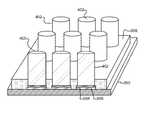
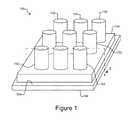
BRIEF DESCRIPTION OF THE DRAWINGSFIG. 1 is a perspective illustration of an electronic device according to some embodiments of the invention.
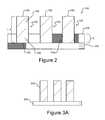
FIG. 2 is a cross-sectional illustration of the electronic device ofFIG. 1 taken alongline2.
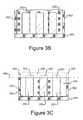
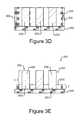
FIGS. 3A-3E illustrate various operations in a process of anchoring carbon nanotube columns according to some embodiment of the invention.
FIG. 3A is a side cross-sectional illustration of a substrate having carbon nanotube columns attached thereto.
FIG. 3B is a side cross-sectional illustration showing a dam and filler material placed onto the device ofFIG. 3A.
FIG. 3C is a side cross-sectional illustration of the substrate showing material removed from the device ofFIG. 3B during a planarizing operation.
FIG. 3D is a side cross-sectional illustration of the substrate after the planarizing operation ofFIG. 3C.
FIG. 3E is a side cross-sectional illustration after removal of a portion of the filler material form the device ofFIG. 3D.
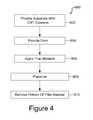
FIG. 4 is a flow chart of a process for anchoring carbon nanotubes in accordance with some embodiments of the invention.
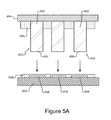
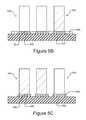
FIGS. 5A-5D illustrate various operations in a process of anchoring carbon nanotube columns according to some embodiment of the invention.
FIG. 5A is a side cross-sectional illustration showing transfer of anchored carbon nanotube columns from a first substrate to a second substrate.
FIG. 5B is a side cross-sectional illustration showing the transferred carbon nanotube columns on the second substrate.
FIG. 5C is a side cross-sectional illustration showing the transferred carbon nanotube columns after removal of excess bonding material.
FIG. 5D is a side-cross sectional illustration showing anchored carbon nanotube columns on the second substrate.
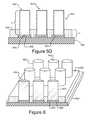
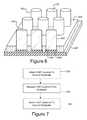
FIG. 6 is a partially sectioned perspective illustration of anchored carbon nanotube columns in accordance with some embodiments of the invention.
FIG. 7 is a flow chart of a process for anchoring carbon nanotube columns in accordance with some embodiments of the invention.
FIG. 8 is a block diagram of a test system in accordance with some embodiments of the invention.
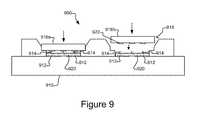
FIG. 9 is a side illustration of a socket in accordance with some embodiments of the invention.
DETAILED DESCRIPTION OF EXEMPLARY EMBODIMENTSThis specification describes exemplary embodiments and applications of the invention. The invention, however, is not limited to these exemplary embodiments and applications or to the manner in which the exemplary embodiments and applications operate or are described herein. Moreover, the Figures may show simplified or partial views, and the dimensions of elements in the Figures may be exaggerated or otherwise not in proportion for clarity. In addition, as the terms “on” and “attached to” are used herein, one object (e.g., a material, a layer, a substrate, etc.) can be “on” or “attached to” another object regardless of whether the one object is directly on or attached to the other object or there are one or more intervening objects between the one object and the other object. Also, directions (e.g., above, below, top, bottom, side, up, down, under, over, upper, lower, horizontal, vertical, “x,” “y,” “z,” etc.), if provided, are relative and provided solely by way of example and for ease of illustration and discussion and not by way of limitation. In addition, where reference is made to a list of elements (e.g., elements a, b, c), such reference is intended to include any one of the listed elements by itself, any combination of less than all of the listed elements, and/or a combination of all of the listed elements.
As introduced above, various challenges to the use of carbon nanotube columns exist. For example, vertically aligned carbon nanotube columns can be grown on a substrate using various techniques. The grown carbon nanotube columns can, however, have weak adhesion to the substrate. The application of a lateral force (or other perturbation) can cause the carbon nanotube columns to lose touch with the substrate and tip over. Accordingly, strengthening of the attachment of the carbon nanotube columns to the substrate is desirable.
In some embodiments of the invention, methods for anchoring carbon nanotube columns to a substrate are provided. For example, the carbon nanotube columns can be anchored using an etchable fill material. The etchable fill material can be a wet etchable fill material. The anchored columns can have improved adhesion properties and thus withstand application of lateral forces in use. For example, anchored columns can be useful in probe cards and other electronics applications.
FIGS. 1 and 2 illustrate an electronic device incorporating anchored carbon nanotube columns in accordance with some embodiments of the present invention. The device, shown generally at100, can include a plurality ofcarbon nanotube columns102 disposed on asubstrate104. The substrate can be of various materials, and include one or more layers of materials. For example, the substrate can be a printed circuit board, semiconductor device, or the like, and examples are described further below.
Thecarbon nanotube columns102 can comprise a plurality of individual carbon nanotubes. Carbon nanotubes can be fiber-like structures, and can be intertwined in a mass. The carbon nanotubes that compose acolumn102 can bend and/or twist and thus be intertwined one with another. Accordingly, eachcolumn102 can comprise numerous individual carbon nanotubes intertwined into a mass to form the structure of thecolumn102. For example,columns102 can each comprise few (e.g., tens) or many (e.g., thousands or hundreds of thousands) of individual nanotubes.
An individual carbon nanotube can have a number of attributes including without limitation the following: the number of walls and the thickness of the wall(s) of the carbon nanotube, the diameter of the carbon nanotube, and the chirality (rolling angle) of the carbon nanotube. In addition, a group of carbon nanotubes intertwined to form a structure likecolumns102 can have a number of attributes including without limitation the following: the average spacing between individual carbon nanotubes in the group, the average length of the carbon nanotubes in the group, and the alignment or orientation of the carbon nanotubes in the group.
The carbon nanotubes in each ofcolumns102 are not limited to having any particular number of walls, thickness of the walls, diameter, or chirality, nor are the carbon nanotubes that form acolumn102 limited to a particular average spacing between carbon nanotubes, average length, or alignment.
In some embodiments, thecarbon nanotube columns102 can comprise vertically aligned carbon nanotubes. A column comprising vertically aligned carbon nanotubes can be termed a “vertically aligned” carbon nanotube column. Any of the carbon nanotube columns described herein, including withoutlimitation columns102, can be vertically aligned.
As used herein, a column (e.g., column102) of carbon nanotubes is “vertically aligned” if most (i.e., 50% or more) of the carbon nanotubes that compose the column form a continuous path along a length of the column that start at one end of the column and end at an opposite end. In some embodiments, a greater percentage than 50% of the carbon nanotubes in a column can be vertically aligned. For example, in some embodiments, 60%, 70%, 75%, 80%, 90%, 95%, 98%, 99%, or a greater percentage of the carbon nanotubes that compose acolumn102 can be vertically aligned. In some embodiments, a single carbon nanotube can comprise a plurality of tubes that are grown directly one atop the other resulting in a continuous path.
While the columns are described herein as columns of carbon nanotubes, other types of electrical contacts can be similarly anchored. The columns can include other material in addition to the carbon nanotubes. For example, the columns can include a low modulus elastomer, which can modify the mechanical behavior of the columns. The columns can include a binder material, which can help maintain the mechanical integrity of the columns.
As seen best inFIG. 2, the carbon nanotube columns can have a length of L measured from abase end152 to atip end150. Base ends152 of thecarbon nanotube columns102 can rest on thesubstrate152, and can be anchored by afiller material106 disposed around the base ends152 of thecarbon nanotube columns102. Thefiller material106 can be disposed in a layer of thickness T, in whichcase base portions156 of thecarbon nanotube columns102 can be embedded in the filler material. Thefiller material106 can be bonded to thesurface154 of thesubstrate104 and, if desired, to thebase portions156. In other words, thebase portions156 can be embedded in thefiller material106. Thefiller material106 can fill substantially all of the area on the surface of thesubstrate104 between thecolumns102. Thefiller material106 can surround thebase portions156 and fill area on the surface of the substrate between the columns. Atip portion158 of thecolumns102 can protrude above thefiller material106
Various thicknesses T of thefiller material106 can be used. For example, the thickness T can be less than about three quarters of the length L of the carbon nanotube columns. As another example, the thickness T can be less than half of the length L, less than one third, or less than one quarter of the length L.
Although thecarbon nanotube columns102 are shown as having a circular cross section, the columns are not limited to this shape and can have any suitable cross section geometry. For example, the columns can have triangular, square, rectangular, multi-sided, oval, ring (or doughnut), or other cross sectional shapes. Furthermore, the carbon nanotube columns need not all have the same shape.
In accordance with some embodiments of the invention, a process of anchoring carbon nanotube columns will now be described in conjunction withFIGS. 3A-3E. A first operation is to provide a substrate with carbon nanotube columns attached to a surface of the substrate. For example,FIG. 3A illustrates asubstrate204 having a plurality ofcolumns202 attached thereto.Substrate204 can be likesubstrate104 described above, andcolumns202 can be likecolumns102 described above. As alluded to above, the carbon nanotube columns may be only weakly attached to the substrate.
For example, in some embodiments, the carbon nanotube columns can be grown on the substrate. Non-limiting examples ofsuitable substrates204 include a semiconductor wafer, a ceramic substrate, a substrate comprising an organic material, a substrate comprising an inorganic material, or combinations thereof. Thesubstrate204 can be a product substrate on which thecarbon nanotube columns202 will be used in their final application, or thesubstrate204 can be an intermediate substrate from which thecarbon nanotube columns202 will later be transferred.
Various ways of growing carbon nanotube columns can be used, including any suitable known or future developed process. As an example, thesubstrate204 can include growth medium portions (not shown) on which the carbon nanotubes are grown. For example, growth medium portions can be exposed portions of a growth material layer (not shown) exposed through holes in a masking layer (not shown). As another example, growth material (not shown) can be deposited on thesubstrate204, and then patterned to create growth medium portions. Patterning of growth material or masking layers can be performed using various techniques, such as for example, photolithography. The growth medium portions can be any material suitable for growing carbon nanotube columns. For example, growth medium portions can be material with an oxide film or material on which an oxide film can be formed so that growth medium portions comprise an oxide. For example, growth medium portions can comprise an oxide film on a silicon material. As another example, growth medium portions can comprise quartz.
As another example, in some embodiments, the carbon nanotube columns can be grown (e.g., on a growth substrate) and then transferred to the substrate. For example, carbon nanotube columns can be grown on a temporary processing substrate (not shown), adhesive applied to tips of the carbon distal from the substrate, and then the adhesive-covered tips brought into contact with the substrate to transfer the carbon nanotube columns tosubstrate204. Although such carbon nanotube columns may be more strongly attached tosubstrate204 than carbon nanotube columns grown in place onsubstrate204, anchoring can still be helpful in providing an even stronger attachment.
Following the providing of the substrate with carbon nanotube columns attached thereto, the process can include depositing a filler material onto the surface of the substrate and surrounding the columns. Various ways of depositing a filler material onto the surface can be used. For example, the filler material may be applied directly to the surface of the substrate. As another example, a dam can be provided to form a reservoir and filler material applied into the reservoir. Various ways of making the dam can be used. For example, a photosensitive thixotropic polymer can be applied using a pressurized dispenser. A brief exposure to ultraviolet light can cure the dam.
FIG. 3B shows adam302 placed on thesubstrate204. Although the filler material is shown completely covering the substrate, the dam can be placed on just a portion of the substrate, if desired. Alternatively, thedam302 can be placed around thesubstrate204.Filler material206 can be deposited into the dam, onto the surface of the substrate, and surrounding thecolumns202.Filler material206 can be likefiller material106 described above.
Thefiller material206 can hold thecolumns202 because the columns are captured in the filler material. If desired, although not necessary, thefiller material206 can adhere or otherwise form a bond to thesubstrate204, and can adhere or otherwise form a bond to the base portions of thecolumns202. For example, the filler material can wick or infiltrate partially into the columns to form a mechanical bond. As another example, the filler material can form a chemical or electrostatic bond to the substrate and/or columns.
Various types of filler material can be used. In general, the filler material can be a wet etchable lapping material. By “wet etchable” is meant a material than can be etched away in a wet etching processing. By “lapping material” is meant a material that is suitable for use in a lapping process, for example, as described further below. For example, thefiller material206 can be a liquid that is poured into the reservoir created by thedam302 andsubstrate202 and then hardened or cured. Curing can be performed by various ways, including for example: heating the filler material, allowing the filler material to be exposed to ambient air for a particular period of time, exposing the filler material to ultraviolet light, or any other suitable manner. During the hardening, the filler material can also be bonded to the surface of the substrate and the carbon nanotube columns. Various materials can be used as the filler material. For example, the filler material can be an acrylic polymer. More particularly, the filler material can be a wet etchable acrylic polymer.
Thefiller material206 is shown inFIG. 3B as completely surrounding and encasing the columns, although this is not essential. In other words, the height of thedam302 can be above the columns (so that the columns are completely encased in the filler material) or below the columns (so that a portion of the columns are left exposed).
Thefiller material206 and thecolumns202 can then be planarized as shown inFIG. 3C by removing afirst portion346 of thefiller material206 andportions342 of thecolumns202. For example, planarizing can be performed by lapping, chemical-mechanical polishing, or similar techniques. It will be appreciated that aportion344 of thedam302 can also be removed during the planarizing.
In some embodiments, the planarizing can be performed with respect to a surface of the substrate. For example, planarizing can be performed on aplane348 that is substantially parallel to theupper surface254 of thesubstrate204. In such a case, the resulting length of the columns will be substantially equal.
FIG. 3D illustrates the result after the planarizing has been performed. Planarization can be performed using very accurate (low tolerance) processes. For example, in some embodiments, the resulting planarized surface can be planar to within about plus or minus one micron (micrometer). If desired, other levels of accuracy can be provided. Accordingly, the resulting lengths of thecarbon nanotube columns202 remaining after the planarizing can be substantially equal, or within the tolerance of the planarizing. Various measurements and specification of the accuracy can be used (e.g., root-mean-square surface accuracy, peak deviation, etc.).
Another operation in the process can include removing a second portion of the filler material. For example, as shown inFIG. 3E, a second portion of thefiller material206 can be removed by etching, thereby exposing atip portion258 of the columns while abase portion256 of the columns remains embedded in a third portion of thefiller material206 that remains after the etching. As mentioned above, the third portion of the filler material can be bonded to the surface of thebase portion256 of thecolumns202 and to thesubstrate204, thereby enhancing the attachment of thecolumns202 to thesubstrate204.
Various etching techniques can be used to remove the second portion of thefiller material206. For example, wet etching can be performed using a solvent that removes or dissolves thefiller material206. The amount of filler material removed can be a function of the etching time, with longer etching times causing more material to be removed. Accordingly, the thickness T of the remaining third portion of thefiller material206 can be any desired thickness, including for example: less than three quarters of the length L of the columns, less than one half, less than one third, and less than one quarter, or other thicknesses desired.
The dam can also be removed, for example, after the planarizing, during the wet etching, or after the wet etching. In the finished assembly, shown generally at350, the resultingcarbon nanotube columns202 are more securely attached or anchored to thesubstrate204 as a result of thefiller material206 holding thecarbon nanotube columns202 and being attached to the surface of thesubstrate204. This enhanced attachment can be advantageous in various situations.
In some embodiments, thecarbon nanotube columns202 can be disposed on asubstrate204 that is an electronic device and thecarbon nanotube columns202 can be used as electrical connections to the electronic device. The enhanced attachment can make it less likely that the carbon nanotube columns become separated from the substrate during use.
In some embodiments, the anchoredcarbon nanotube columns202 can be used in a subsequent process, wherein thesubstrate204 is only used temporarily. The enhanced attachment can help to ensure the carbon nanotube columns remain attached to the substrate until deliberately released during the subsequent process. For example, as described further below, the anchored carbon nanotube columns can be transferred to a second substrate.
FIG. 4 provides a flow chart of aprocess600 for anchoring carbon nanotube columns similar to the examples just provided. Theprocess600 can include providing a substrate with carbon nanotube columns attached thereto atblock602. For example, as described above, the carbon nanotube columns can be transferred to the substrate or grown on the substrate.
Another operation in theprocess600 can be to provide a dam atblock604. For example, thedam604 can be place around, on, or on a portion of the substrate, as described above. At block606 a filler material can be applied. For example, filler material can be poured into the reservoir created by the dam, as described above.
Theprocess600 can also include a planarizing operation atblock608. For example, the upper, exposed surface of the filler material and carbon nanotube columns can be processed to form a plane as described above.
Atblock610, a portion of the filler material can be removed. For example, filler material can be removed by wet etching, as described above.
In accordance with some embodiments of the invention, a process of transferring anchored carbon nanotube columns to a second substrate will now be described in conjunction withFIGS. 5A-5D. The process can start with afirst substrate404 havingcarbon nanotube columns402 attached there to and secured byfiller material406. There can be exposed ends450 of thecarbon nanotube columns402 extending out of thefiller material406.
For example, thecarbon nanotube columns402 can be likecarbon nanotube columns102,202, thefirst substrate404 can be likesubstrates104,204, and the filler material can be likefiller material102,206. Thecarbon nanotube columns402,first substrate404, andfiller material406 can be provided using processes similar to those described above.
Asecond substrate502 havingterminals506 is also provided.Second substrate502 can be likesubstrate104,204,404. The process can include attaching thecarbon nanotube columns402 to thesecond substrate502. For example, as illustrated inFIG. 5A,bonding material504 can be disposed on theterminals504 of thesecond substrate502. For example,bonding material504 can be deposited on the entire upper surface (e.g., by spin coating, spray coating, etc.) as shown, or alternatively, bonding material can be deposited just on the terminals504 (e.g., by screen sprinting, stenciling, etc.). Thefirst substrate404 and thesecond substrate502 can be brought together, so that ends450 of thecarbon nanotube columns402 contact thebonding material504. The bonding material can be cured. For example, curing can be performed by heating the bonding material, allowing the bonding material to be exposed to ambient air for a particular period of time, exposing the bonding material to ultraviolet light, or any other suitable manner. The bonding material can bond to thecarbon nanotube columns402 and theterminals506. For example, thebonding material504 can wick or infiltrate partially into thecolumns404,terminals506, and/orsubstrate502 to form a mechanical bond. As another example, thebonding material504 can form a chemical or electrostatic bond. If desired, thebonding material504 can be an electrically conductive material, including for example conductive epoxy (e.g., an epoxy containing particulars of a conductive material, such as silver, copper, gold, etc.).
Alternatively, the bonding material can be applied to theends450 of thecarbon nanotube columns402, and then thesubstrates404,502 brought together. Or, if desired, bonding material can be applied to both theends450 of thecarbon nanotube columns402 and to theterminals506.
After theends450 of thecarbon nanotube columns402 have been attached to theterminals506 of thesecond substrate502, thecarbon nanotube columns402 can be released from thefiller material406 and thefirst substrate404 as shown inFIG. 5B. For example, thecarbon nanotube columns402 can be released by peeling away, dissolving, or otherwise separating thecarbon nanotube columns402 from thefiller material406 andfirst substrate404. For example, separating can be caused by applying a solution to dissolve the filler material and release the columns. As another example, separating can be caused by application of a mechanical or thermal shock. As another example, the bonding material can be selected to provide a stronger bond between theends450 of thecolumns402 attached toterminals506 than the bond between theends452 of thecolumns402 anchored to thefirst substrate404 andfiller material406, so that thecolumns402 remain attached to theterminals506 and separate from thefirst substrate404 when thefirst substrate204 andsecond substrate502 are pulled apart. As another example, a thermal shock can be applied by subjecting any or all of thecolumns402,first substrate404, and/orfiller material406 to a rapid temperature change. As a particular example, a thermal shock can be applied by impinging a rinse solution onto thecolumns402,first substrate404, and/orfiller material406.
If desired or necessary, excess bonding material can be removed, as shown inFIG. 5C. For example, excess bonding material can be removed by dissolving or etching.
Another operation in the process can be to anchor thecarbon nanotube columns402 to thesecond substrate502 as shown inFIG. 5D. For example, the carbon nanotube columns can be anchored using a process similar to that described. After being anchored, thecarbon nanotube columns402 can have ends450 attached to thesecond substrate502 by bondingmaterial506 and surrounded bysecond filler material508. The second filler material can be likefiller material102,206,406 described above and applied using similar techniques as described above (e.g.,FIGS. 3A-3E and4).
In some embodiments, one benefit of the process just described is that ends450 of thecarbon nanotube columns450 can be more securely attached to theterminals506 in part because the ends can be highly planar (having been planarizing during the process of being anchored).
In some embodiments,carbon nanotube columns402 can be disposed on asubstrate502 that is an electronic device and thecarbon nanotube columns402 can be used as electrical connections to the electronic device. The enhanced attachment can make it less likely that the carbon nanotube columns become separated from the substrate during use.
FIG. 6 shows a partially sectioned perspective view of a finished assembly550 that can, for example, be made using a process as just described. The finished assembly can therefore include asubstrate502 and a plurality ofcarbon nanotube columns402. Thecarbon nanotube columns402 can be attached toterminals506 of the substrate by abonding material504 and a filler material408. The filler material408 can extend partway up thecolumns402, so that a portion (e.g., three fourths, half, a third, or a quarter) of thecolumns402 are embedded in the filler material408.
FIG. 7 provides a flow chart of a process700 for transferring and anchoring carbon nanotube columns similar to the examples just provided. The process700 can use two substrates, a temporary substrate carrying carbon nanotube columns and a second substrate to which the carbon nanotube columns are to be attached. A first operation atblock702 can be to attach the carbon nanotube columns to the second substrate. For example, the carbon nanotube columns can be attached using an adhesive or bonding material as described above. Once attached, atblock704 the carbon nanotube columns can be released from the temporary substrate. Atblock706, the carbon nanotube columns can be anchored to the second substrate. For example, various techniques for anchoring carbon nanotube columns such as described above can be used.
As mentioned above, anchored carbon nanotube columns can be used as electrical contacts in various applications. For example,FIG. 8 illustrates atest system800 in which aprobe card assembly826 includes anchored carbon nanotube columns in accordance with some embodiments of the invention. As shown,test system800 can include atester818 configured to control testing of one ormore DUTs822. The acronym “DUT” can mean “device under test,” which can be any electronic device including without limitation semiconductor dies (singulated or in wafer form, packaged or unpackaged). A plurality ofcommunications channels820 andprobe card assembly826 can provide a plurality of electrical paths for power, ground, test, response, and other signals betweentester818 andDUT822. For example, first ends of electrical paths can be connected toelectrical interface804 and second ends of the electrical paths can be configured to contactterminals824 of theDUT822. Various types ofelectrical interfaces804 can be used, including for example, zero insertion force connectors, pogo pins, or any other suitable interface for communicating electrical signals.
Tester818 can testDUT822 by generating test signals that are provided throughcommunications channels820 andprobe card assembly826 to ones (i.e., one, two, many, or all) ofterminals824 ofDUT822. Thetester818 can evaluate response signals generated byDUT822 in response to the test signals. The response signals can be sensed at ones ofterminals824 ofDUT822 and provided to thetester818 through probe card assembly828 andcommunications channels820. A DUT can be tested to produce a tested device.
Tester818 can comprise electronic control equipment such as one or more computers or computer systems.Probe card assembly826 can comprise anelectrical interface804 to thetester818 viacommunications channels820.Probe card assembly826 can also comprise electrically conductive spring probes, which can be anchoredcarbon nanotube columns814 anchored byfiller material858. Thecarbon nanotube columns814 can have a layout corresponding generally to the layout of theterminals824 of theDUT822, so that thecarbon nanotube columns814 can make temporary pressure electrical connections from theprobe card assembly826 to theterminals824 when brought into contact with the terminals. For example, portions ofcarbon nanotube columns814 not encased in thefiller material858 can provide a resilient spring-like character. Electrical connections from thetester818 can therefore be made throughelectrical interface804, conductors834 (e.g., traces, vias), other portions of the probe card assembly (described further below), tocarbon nanotube columns814.
DUT822 can be one or more dies of an unsingulated semiconductor wafer, one or more semiconductor dies singulated from a wafer (packaged or unpackaged), one or more dies of an array of singulated semiconductor dies disposed in a carrier or other holding device, one or more multi-die electronics modules, one or more printed circuit boards, and any other suitable type of electronic device or devices. As is known, a semiconductor die can comprise a semiconductor material into which an electric circuit is integrated, andterminals824 can be bond pads or other contact features that provide electrical connections to and from the electric circuit.
Theprobe card assembly826 can include various subassemblies, such as awiring substrate802,interposer808,probe substrate812, or other assemblies. While theprobe card assembly826 is shown with awiring substrate802,interposer808 andprobe substrate812, not all of these assemblies need be included. For example, theinterposer808 andprobe substrate812 can be omitted, and probes814 provided directly on thewiring substrate802. As another alternative,interposer808 can be omitted and flexible wiring or other interconnections can be provided. As yet another example, theinterposer808 can be omitted and theprobe substrate812 can be coupled directly to thewiring substrate802.
Thewiring substrate802 can be a semi-rigid printed circuit board having theelectrical interface804 on afirst surface830 andpads836 on asecond surface832. Alternatively, thewiring substrate802 can be rigid (e.g., a multilayer ceramic substrate). Theprobe substrate812 can be a rigid wiring substrate (e.g., a multilayered ceramic) or a semi-rigid substrate (e.g., a printed circuit board). Electrical connections between the subassemblies can use anchored carbon nanotube columns. For example, the interposer can include firstcarbon nanotube columns806 disposed on afirst surface838, anchored infiller material840, and arranged to contactpads836 onwiring substrate802. The interposer can also include secondcarbon nanotube columns810 disposed on asecond surface844, anchored infiller material848, and arranged to contactpads807 onprobe substrate812.Carbon nanotube columns806,810 can be disposed onterminals842,846 of theinterposer808, and correspondingterminals842,846 electrically interconnected by conductors852 (e.g., traces, vias). Thecarbon nanotube columns806,810 can provide resilient electrical connections. For example,probe substrate812 can be attached towiring substrate802 bybrackets816, andinterposer808 held in place between by pressure applied to the anchoredcarbon nanotube columns806,810 by correspondingpads836,807.
As mentioned above,probe substrate812 can includecarbon nanotube columns814 anchored infiller material858.Carbon nanotube columns814 can be disposed onpads856 on asecond surface860 of theprobe substrate812.Pads856 can be electrically connected by conductors854 (e.g., traces, vias) topads807 on asurface850 of theprobe substrate812.
As mentioned above,carbon nanotube columns806,810,814 can be anchored carbon nanotube columns. For example,carbon nanotube columns806,810,814 can be similar tocarbon nanotube columns102,202,402 and made using any process described herein (e.g.,FIG. 4,FIG. 7).
In accordance with some embodiments, a probe card assembly need not include all of the subassemblies illustrated inFIG. 8. For example, in some embodiments,carbon nanotube columns814 can be disposed and anchored directly ontopads836 ofwiring substrate802, in whichcase interposer808 andprobe substrate812 can be omitted.
In accordance with some embodiments, positions of the anchored carbon nanotube columns can be moved to the opposite surface. For example,carbon nanotube columns814 can be anchored toDUT822 and make pressure contact withpads856. As another example,carbon nanotube columns838 can be anchored to surface832 ofwiring substrate802 and make pressure contact with pads842, andcarbon nanotube columns810 can be anchored to surface850 ofprobe substrate812 and make pressure contact withpads846. Accordingly, many other arrangements and variations of a probe card assembly will now be apparent.
In some embodiments,carbon nanotube columns806,810,814 can provide desirable spring properties. For example, the portion ofcarbon nanotube columns806,810,814 extending abovefiller material840,848,858 can act like a resilient spring. This can help to improve reliability of pressure electrical contacts, as the carbon nanotube columns can compensate for irregularities or non-planarities in theprobe card assembly826 and/orDUT822.
FIG. 9 illustrates asocket900 incorporating anchoredcarbon nanotube columns914 in accordance with some embodiments of the invention. For example, thesocket900 can be a test socket into which dies916a,916bcan be inserted for testing. The socket can comprise asubstrate910 havereceptacles918 which can receive dies916a,916b.Die916ais shown fully inserted into asocket918 and die916bis shown in position to be inserted into asocket918.Carbon nanotube columns914 can make electrical connections toterminals922 on the dies.
Thecarbon nanotube columns914 can be disposed on thesubstrate910 and anchored withfiller material920. For example, thecarbon nanotube columns914 can be like any ofcarbon nanotube columns102,202,402 described above andfiller materials920 can be like any offiller material106,206,406,508 described above.
Thecarbon nanotube columns914 can be disposed on and electrically connected topads912. Thecarbon nanotube columns914 can function as resilient spring contacts, for example as described above. Traces (not shown) in or onsubstrate910 can electrically connectpads912 to each other, to electrical components (not shown) disposed on or in thesubstrate910, and/or to other pads (not shown).
In some embodiments of the present invention, the use of carbon nanotube columns to provide contact elements can provide a number of advantages. For example, carbon nanotube columns can be resilient while maintaining high strength. When placed under a vertically-applied load (e.g., aligned with the length of the columns), carbon nanotube columns can provide a spring action while minimizing lateral displacement. This can enable very fine pitch spacing of the columns (e.g., spacing of 30 micrometers, or less, or more particularly spacing of 25 micrometers or less, or even more particularly spacing of 20 micrometers or less).
In some embodiments of the present invention, carbon nanotube columns can be grown into high aspect ratio structures. For example, columns can have length to width ratios of 3:1, or more particularly length to width ratios of 10:1, or even more particularly length to width ratios of 25:1. In contrast, it is difficult to form high aspect ratio structures using conventional lithographic techniques.
In some embodiments of the present invention, carbon nanotube columns can also have highly rectangular cross sectional shapes, providing an almost ribbon-like shape. For example, cross-sectional dimensions can have ratios of less than 2:1, or more particularly less than 10:1, or even more particularly less than 100:1. Such shapes can be beneficial, for example, in providing low inductance contact structures.
In some embodiments of the present invention, the carbon nanotube columns can have varying dimensions. For example, width or cross-sectional diameter of the carbon nanotube columns can be less than 1 millimeter, or more particularly less than 200 micrometers, or even more particularly less than 25 micrometers.
Although specific embodiments and applications of the invention have been described in this specification, these embodiments and applications are exemplary only, and many variations are possible. Particular exemplary techniques for anchoring carbon nanotube columns have been disclosed, but it will be apparent that the inventive concepts described above can apply equally to alternate shapes and arrangements. Moreover, while specific exemplary processes for anchoring carbon nanotube columns have been disclosed, variations in the order of the processing steps, substitution of alternate processing steps, elimination of some processing steps, or combinations of multiple processing steps that do not depart from the inventive concepts are contemplated. Accordingly, the invention is not to be limited except as defined by the following claims.