US8249782B2 - Method for electronically controlling a bicycle gearshift and electronic system for a bicycle - Google Patents
Method for electronically controlling a bicycle gearshift and electronic system for a bicycleDownload PDFInfo
- Publication number
- US8249782B2 US8249782B2US12/366,364US36636409AUS8249782B2US 8249782 B2US8249782 B2US 8249782B2US 36636409 AUS36636409 AUS 36636409AUS 8249782 B2US8249782 B2US 8249782B2
- Authority
- US
- United States
- Prior art keywords
- toothed wheel
- actuator
- gearshifting
- displacement
- engagement
- Prior art date
- Legal status (The legal status is an assumption and is not a legal conclusion. Google has not performed a legal analysis and makes no representation as to the accuracy of the status listed.)
- Active, expires
Links
Images




Classifications
- B—PERFORMING OPERATIONS; TRANSPORTING
- B62—LAND VEHICLES FOR TRAVELLING OTHERWISE THAN ON RAILS
- B62M—RIDER PROPULSION OF WHEELED VEHICLES OR SLEDGES; POWERED PROPULSION OF SLEDGES OR SINGLE-TRACK CYCLES; TRANSMISSIONS SPECIALLY ADAPTED FOR SUCH VEHICLES
- B62M25/00—Actuators for gearing speed-change mechanisms specially adapted for cycles
- B62M25/08—Actuators for gearing speed-change mechanisms specially adapted for cycles with electrical or fluid transmitting systems
Definitions
- the present descriptionconcerns a method for electronically controlling a bicycle gearshift as well as an electronic system for a bicycle.
- a system for transmitting motion in a bicycleincludes a chain extending between toothed wheels associated with the crank axle and associated with the hub of the rear wheel.
- a gearshiftis provided that includes a chain guide element, also known as derailleur, movable to displace the chain among the toothed wheels in order to change the gear ratio.
- the present descriptionrelates to a method for electronically servo-assisting an electronically servo-assisted bicycle gearshift.
- the methodincludes the sequential steps of starting displacement of an actuator from a current position to a position of engagement of a chain on an extreme toothed wheel of a gearshift group, preselecting a destination toothed wheel of the gearshift group, and stopping displacement when the actuator is in a position of engagement of the chain on the destination toothed wheel.
- the present descriptionalso relates to a bicycle electronic system that includes control electronics, and at least one actuator that moves a chain between toothed wheels of a gearshift group.
- the control electronicshave modules adapted to start a displacement the at least one actuator from a current position to a position of engagement of the chain on an extreme toothed wheel of the gearshift group, subsequently preselect a destination toothed wheel of the gearshift group, and subsequently stop the displacement when the actuator is in a position of engagement of the chain on the destination toothed wheel.
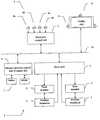
- FIG. 1represents a block diagram of a first embodiment of a bicycle electronic system
- FIG. 2represents a data structure used in the system of FIG. 1 ;
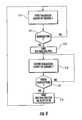
- FIG. 3represents a block diagram of the operation of an electronic control unit of the system of FIG. 1 , in the case of manual operation or manual operating mode of the gearshift;
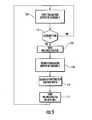
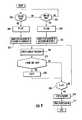
- FIGS. 4 and 5represent block diagrams of the operation of an electronic control unit of the system of FIG. 1 , in the case of automatic operation or automatic operating mode of the gearshift, according to two embodiments;
- FIGS. 6 and 7represent block diagrams of the operation of a drive unit of the system of FIG. 1 ;
- FIG. 8represents a block diagram of a second embodiment of a bicycle electronic system
- FIG. 9represents a block diagram of the operation of a drive unit of the system of FIG. 8 ;
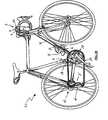
- FIG. 10represents a bicycle including the electronic control unit of FIG. 1 .
- the disclosed method for electronically servo-assisting an electronically servo-assisted bicycle gearshiftcomprises the sequential steps of:
- extreme toothed wheelis defined as the toothed wheel of minimum or maximum diameter, respectively, of the gearshift group.
- the toothed wheelis the extreme toothed wheel irrespective of the toothed wheel of the gearshift group currently engaged by the chain, and therefore not only accidentally, in case the toothed wheel currently engaged by the chain is the one immediately adjacent thereto and gearshifting is in the direction of the extreme toothed wheel.
- gearshiftingwill lead to the maximum or minimum gear ratio, respectively, relative to a gearshift group. Only after shifting has begun it is considered whether to interrupt gearshifting to stop at an intermediate gear ratio, established in step b). It follows from this that the actuation of the gearshift is particularly fast.
- step a)comprises the steps of:
- the gearshift groupis a rear gearshift group.
- the extreme toothed wheelis the toothed wheel of minimum diameter.
- the methodcan, e.g., be applied to downward gearshifting of the rear gearshift group, in the case of reaching the peak, namely when the cyclist encounters a downhill stretch at the end of a climb, and it is appropriate to change to the maximum gear ratio.
- the extreme toothed wheelis the toothed wheel of maximum diameter.
- the step a) of starting the displacementcan comprise the step of receiving a manual command for requesting the start of gearshifting.
- step a) of starting the displacementcan comprise carrying out a first evaluation of at least one travel parameter.
- the at least one travel parameteris selected from pedaling cadence and torque applied to the cranks.
- the evaluationcan consist of comparing the travel parameter with a lower threshold and/or an upper threshold.
- the step b) of preselecting a destination toothed wheelcan comprise receiving a manual command for requesting the end of gearshifting.
- the step b) of preselecting a destination toothed wheelcan comprise carrying out a second evaluation of at least one travel parameter.
- step b) of preselectingcomprises the steps of providing an end of gearshifting request signal, comparing in response to the end of gearshifting request signal the current position of the actuator with positions of the actuator for engagement of the chain with a respective toothed wheel of the gearshift group, and preselecting as the position for engagement on the destination toothed wheel one of the positions of the actuator adjacent to the current position.
- the adjacent theoretical positionfollows the current position in the direction of the displacement.
- the adjacent theoretical positionprecedes the current position in the direction of displacement.
- the adjacent theoretical positionis the adjacent theoretical position closest to the current position, respectively following or preceding in the direction of displacement.
- the methodcan further comprise step d) of reversing the direction of displacement of the chain.
- the methodcan further comprise the step of carrying out a different type of gearshifting through the steps of:
- the methodcomprises the steps of transmitting signals from at least one electronic control unit, and receiving the signals in a drive unit of the actuator, in the signals an instruction being encoded selected from the group consisting of: an instruction to start gearshifting, an instruction to finish gearshifting, an instruction to complete gearshifting at a specified toothed wheel, an instruction to carry out gearshifting up to a specific toothed wheel, an instruction to move the actuator, and an instruction to stop the actuator.
- an instructionbeing encoded selected from the group consisting of: an instruction to start gearshifting, an instruction to finish gearshifting, an instruction to complete gearshifting at a specified toothed wheel, an instruction to carry out gearshifting up to a specific toothed wheel, an instruction to move the actuator, and an instruction to stop the actuator.
- the steps of transmitting and receiving signalscan take place through a wireless communication channel, but they preferably take place through a cable communication channel.
- the steps of transmitting and receiving signals or data packetsmay take place through a half duplex asynchronous serial communication protocol.
- the disclosed bicycle electronic system or gearshiftcomprises:
- the gearshift groupmay be a rear gearshift group comprising a plurality of toothed wheels.
- the extreme toothed wheelmay also be the toothed wheel of minimum diameter.
- the extreme toothed wheelis the toothed wheel of maximum diameter.
- the electronic systemfurther may comprise at least one transducer of the position of the actuator and/or of the chain.
- the actuatorcomprises an electric motor coupled with an articulated parallelogram.
- the electric motormay be a stepper motor.
- the control electronicsmay comprise a memory of theoretical positions of the actuator, in which the chain engages with a respective toothed wheel of the gearshift group.
- the control electronicsmay comprise modules adapted to provide an end of gearshifting request signal, compare in response to the end of gearshifting request signal a current position of the actuator with the theoretical positions, and preselect the position of engagement on the destination toothed wheel as one of the theoretical positions adjacent to the current position.
- the adjacent theoretical positioncan be the adjacent theoretical position following the current position in the direction of the displacement; the adjacent theoretical position preceding in the direction of the displacement; or the adjacent theoretical position closest to the current position.
- control electronicscan further comprise modules adapted to reverse the direction of displacement of the chain.
- the control electronicscan further comprise modules adapted to carry out a different type of gearshifting through the preselection of a destination toothed wheel of the gearshift group, and the subsequent displacement of the actuator from a current position to a position of engagement of the chain on the destination toothed wheel.
- the control electronicsmay comprise at least one electronic control unit and a drive unit of the actuator, and the electronic system further comprises at least one communication channel between the units.
- the communication channelcan be of the wireless type, or it may comprise at least one cable communication channel.
- the unitsmay communicate over the communication channel through a half duplex asynchronous serial communication protocol.
- the communication channelmay also comprise a first communication channel between the units and at least one signal line between the electronic control unit and the drive unit of the actuator.
- the signal linemay be suitable for transmitting a signal to request stopping of the actuator.
- the signal linecan also be suitable for transmitting a signal to request movement of the actuator.
- the electronic control unitmay comprise modules adapted to transmit signals over the communication channel, and the drive unit comprises modules adapted to receive the signals from the communication channel, in the signals an instruction being encoded, selected from the group consisting of: an instruction to start gearshifting, an instruction to finish gearshifting, an instruction to complete gearshifting at a specified toothed wheel, an instruction to carry out gearshifting up to a specified toothed wheel, an instruction to move the actuator, an instruction to stop the actuator.
- the bicycle electronic systemcan comprise manually actuated members to enter gearshifting commands.
- the bicycle electronic systemcan comprise at least one travel parameter sensor, the control electronics comprising modules adapted to manage the gear ratios based upon the outputs of the sensor(s) and/or of the manual commands.
- the control electronicsmay comprise modules adapted to carry out a first evaluation of the outputs of the sensor(s) to establish when to start the displacement of the actuator from the current position to the position of engagement on the extreme toothed wheel of the gearshift group.
- the control electronicsfurther may comprise modules adapted to carry out a second evaluation of the outputs of the at least one sensor to preselect the destination toothed wheel of the gearshift group.
- the bicycle electronic systemcan further comprise a display unit.
- the display unitcan further comprise further manually actuated members for entering further commands into the electronic system.
- a bicycle electronic system 1generally includes an electronic control unit 2 , at least one actuator 3 , 3 ′ associated with a chain guide element or derailleur 28 , 28 ′ intended for the displacement of a motion transmitting chain 29 between toothed wheels 26 associated with the crank axle and/or between toothed wheels 26 ′ associated with the hub of the rear wheel of the bicycle, and a drive unit 4 of the actuator(s) 3 , 3 ′.
- the servo-assisted bicycle gearshift controlled by the electronic systemcan, for example, be the type described in U.S. Pat. Nos. 5,480,356, 5,470,277, or European Patent Application No. 1 103 456, all of which are incorporated herein by reference as if fully set forth.
- the at least one actuator 3 , 3 ′can comprise an electric motor, preferably of the direct current type, such as a stepper motor, coupled with an articulated parallelogram, but it is possible to use other types of motors or actuators well known in the art, such as a rack or worm screw system, such as the one described in U.S. Pat. No. 6,679,797, incorporated herein by reference as if fully set forth.
- an electric motorpreferably of the direct current type, such as a stepper motor, coupled with an articulated parallelogram, but it is possible to use other types of motors or actuators well known in the art, such as a rack or worm screw system, such as the one described in U.S. Pat. No. 6,679,797, incorporated herein by reference as if fully set forth.
- the bicycle electronic system 1preferably further includes at least one position transducer 5 , 5 ′ suitable for detecting the position of the actuator 3 , 3 ′ and therefore indirectly detecting the position of the derailleur and the chain, or for directly detecting the position of the derailleur, to cooperate with the drive unit 4 and/or the actuator 3 , 3 ′ in the displacement of the derailleur.
- the electronic control unit 2is preferably associated with a plurality of switches, of the normally open type 6 a - 6 d , actuated by the cyclist through manual command members, such as levers or buttons, to enter commands and in particular, manual gearshifting requests.
- a pair of switches 6 a , 6 bare provided, associated with a left command that is grippable by the cyclist and connected to the handlebars for commanding the front derailleur, and a pair of switches 6 c , 6 d associated with a right command that is grippable by the cyclist and connected to the handlebars for commanding the rear derailleur.
- the closing of the switch 6 acommands the front derailleur to displace the chain towards toothed wheels having a greater diameter (upward gearshifting), while the closing of the switch 6 b commands the front derailleur to displace the chain towards toothed wheels having a smaller diameter (downward gearshifting); the closing of the switch 6 c commands the rear derailleur to displace the chain towards toothed wheels having a greater diameter (upward gearshifting), while the closing of the switch 6 d commands the derailleur to displace the chain towards toothed wheels having a smaller diameter (downward gearshifting).
- the normally open switches 6 a - 6 dcan be replaced, mutatis mutandis, by normally closed switches or by commutating switches.
- the electronic control unit 2is further associated with one or more sensors 7 of travel parameters, such as the travel speed, the cadence of revolution of the cranks, the torque applied to the cranks, the slope of the travel terrain, the heart rate of the cyclist, and similar parameters.
- the sensors 7may be of any type commonly known in the art for detecting such travel parameters.
- the electronic control unit 2obtains from such sensors 7 a desired gear ratio, and therefore the advisability of carrying out gearshifting. If only manual operation is provided, the sensors 7 can be omitted.
- the sensors 7are preferably under the control of a second electronic control unit 11 , responsible for pre-processing their outputs.
- the sensors 7could be under the direct control of the electronic control unit 2 , or even under the control of the drive unit 4 , or of a display unit 8 preferably included in the bicycle electronic system 1 .
- the display unit 8if provided, is used to supply information to the cyclist and/or to enter other parameters and/or commands. Further switches 9 are preferably associated with the display unit 8 , and actuated by the cyclist through buttons or a multidirectional button (joystick) for entering the parameters and/or commands, and for selecting the type of data to be displayed, preferably by selecting areas of the display of the display unit 8 in the manner of a graphical user interface.
- the display unit 8can be a touch screen.
- the display unit 8can comprise its own electronic control unit suitable for managing the information displayed and for managing the communication with the other components of the system, in particular with the electronic control unit 2 .
- the electronic control unit 2is preferably positioned near the command members that are actuatable by the cyclist, namely near the handlebars.
- the electronic control unit 2can be housed in a casing 22 fixed to the center of the handlebars.
- a casingcan contain the display unit 8 , or act as a support for the removable connection of the display unit 8 ( FIG. 10 ).
- the drive unit 4is preferably positioned near the actuators 3 , 3 ′, for example in a location near a bottle holder of the bicycle, as shown in FIG. 10 .
- the sensor unit 11is preferably also positioned near a bottle-holder of the bicycle, in the same casing 24 of the drive unit or in a separate casing.
- the communicationis preferably conducted via cable 30 , but alternatively can be conducted via radio transmission (wireless).
- the display unit 8 and the second electronic control unit or sensor unit 11also preferably communicate through the same communication channel 10 and the same communication protocol.
- the communication channel 10in practice, includes two common signal lines “Tx/Rx” and “WU,” to which the electronic control unit 2 and the drive unit 4 , as well as the possible other units 8 , 11 are connected, to form a communication network.
- the signal line Tx/Rxis a receiving/transmitting line for a bi-directional transmission of data among the various components 2 , 4 , 8 , 11 , while the signal line WL is a status line with two values used for the communication protocol.
- the logic value “0” of the status line NUindicates that the transmission line Tx/Rx is busy
- the logic value “1” of the status line WUindicates that the transmission line Tx/Rx is available for a communication process.
- the senderthen transmits a packet of serial data over the transmission line Tx/Rx.
- Each data packetcomprises one or more header bytes, depending upon the communication protocol used, and one or more data bytes.
- transmission check datasuch as parity or check-sum bits.
- the header bytesindicate, e.g., the instructions that must be carried out by the recipient, such information being defined in terms of a code that also encodes the recipient itself, as well as the address of the sender.
- the data bytesdepend, in length, structure and content, upon which unit 2 , 4 , 8 , 11 is the sender, which unit 2 , 4 , 8 , 11 is the recipient, and the type of information that is transmitted.
- the network connected units 2 , 4 , 8 , 11When the status line WU is taken to “0” by the sender, the network connected units 2 , 4 , 8 , 11 begin to read the data packet sent by the sender along the transmission line Tx/Rx.
- the unit 2 , 4 , 8 , 11that recognizes to be the recipient of the transmission, through the decoding of the header byte(s) of the data packet, becomes the recipient, and can reply by transmitting over the transmission line Tx/Rx, a packet of serial data acknowledging receipt to the current sender.
- the other network connected units 2 , 4 , 8 , 11with the exception of the sender and the recipient, are not involved in the transmission process and can perform other activities.
- the sendertakes the status line WU to “1,” thus releasing the communication network. If none of the network connected units 2 , 4 , 8 , 11 reply to the sender, such as in the case of malfunction of the recipient, the sender releases the network after a predetermined time out, taking the status line WU to “1”.
- the described half duplex asynchronous serial communicationis a “random access multi-master communication system,” where the exclusive use of the network is carried out by the first “sender” unit 2 , 4 , 8 , 11 that requires the network.
- the exclusive use of the networkis hierarchically established through a priority system defined by the firmware of the various units 2 , 4 , 8 , 11 .
- a synchronous serial communication, duplex asynchronous serial communication, CAN, Ethernet or similarcould be established, through a suitable communication channel.
- FIG. 2illustrates a data structure, stored in a memory area of the drive unit 4 or in another memory area accessible to it, in which the theoretical positions Pi are stored in the form of a table T, i being an integer between 1 and N, each value of i corresponding to a particular toothed wheel of a rear gearshift group.
- the tableincludes the theoretical positions from P 1 to P 11 .
- the theoretical position P 1represents the position, in a proper measurement unit, that the actuator 3 , 3 ′ or position transducer 5 , 5 ′ needs to take in order to place the chain in a physical position of engagement with the smallest toothed wheel of the rear gearshift group, i.e.
- the theoretical position P 2represents the position, in the same measurement unit, that the actuator 3 , 3 ′ or the position transducer 5 , 5 ′ needs to take in order to place the chain in a physical position of engagement with the second smallest toothed wheel of the rear gearshift group, etc., up to the position PN, which is P 11 in the case illustrated, which represents the position, in the same measurement unit, that the actuator 3 , 3 ′ or the position transducer 5 , 5 ′ must take up in order to place the chain in a physical position of engagement with the largest toothed wheel of the rear gearshift group, i.e. the one with the largest diameter.
- Each theoretical positioncan be expressed as a value that the output of the transducer 5 , 5 ′ must take up, or as a value of a drive input of the actuator 3 , 3 ′.
- the actuator 3 , 3 ′comprises a stepper motor
- each theoretical positioncan be expressed as the number of steps necessary to reach it, starting from an end of stroke position corresponding to the toothed wheel having the minimum diameter.
- a field iis also included, having values from 1 to N, in this case from 1 to 11. Nevertheless, it should be understood that in a practical implementation, this field can be omitted should the theoretical positions Pi be stored sorted according to the diameter of the corresponding toothed wheel.
- the table Tcould contain different theoretical positions for upward gearshifting and downward gearshifting, the changes to be made with respect to what is subsequently described being within the skills of a person of ordinary skill in the art.
- a table analogous to the one shown in FIG. 2shall be provided in the case of a front gearshift group containing many toothed wheels.
- FIG. 3illustrates the block diagram showing the management of the gearshift by the electronic control unit 2 for a system having exclusively manual operation or a manual operating mode.
- a block 100it is checked whether one of the switches 6 a - 6 d is in the not normal or actuated state, in particular closed, and namely, whether the cyclist is actuating one of the actuation levers or buttons associated with the gearshift. If the check is positive, the control unit 2 sends over the network (block 101 ) a signal or data packet corresponding to the actuated switch 6 a - 6 d .
- a signal or data packetis indicated as RDS (Rear Down Start), RUS (Rear Up Start), FDS (Front Down Start), or FUS (Front Up Start), respectively.
- the data packet RDS/RUS/FDS/FUSincludes, in code form, an indication of the recipient, i.e. the drive unit 4 , and the instruction “start rear derailleur downward gearshifting”/“start rear derailleur upward gearshifting”/“start front derailleur downward gearshifting”/“start front derailleur upward gearshifting,” respectively.
- the corresponding switch 6 a - 6 dswitches, which is detected by the electronic control unit 2 (output yes from block 102 ), which upon detection generates sending (block 103 ) of another signal or data packet, indicated with RDF (Rear Down Finish), RUF (Rear Up Finish), FDF (Front Down Finish), or FUF (Front Up Finish), respectively.
- RDF/RUF/FDF/FUFcomprises, in code form, the indication of the recipient, i.e. the drive unit 4 , as well as the instruction, “finish rear derailleur downward gearshifting”/“finish rear derailleur upward gearshifting”/“finish front derailleur downward gearshifting”/“finish front derailleur upward gearshifting,” respectively.
- the signal sent in block 103can simply consist of a data packet RF (Rear Finish) or FF (Front Finish), containing the instruction, “finish rear derailleur gearshifting”/“finish front derailleur gearshifting.”
- the signal sent in block 103can simply consist of a data packet FN (Finish), containing the instruction “finish gearshifting.”
- the process of checking the state of the various switches 6 a - 6 d of blocks 100 and 102can be carried out cyclically, or it can be provided with interrupt management for such checks, with a reduction in terms of resources used by the control unit 2 .
- the electronic control unit 2performs other functions, such as error management, communication with the display unit 8 , reading of signals coming from the sensors 7 through the second electronic control unit 11 , etc.
- the transmission of the data packets of blocks 100 and 102can optionally be repeated until a data packet acknowledging receipt from the drive unit 4 is received.
- FIG. 4illustrates a block diagram corresponding to a first embodiment of the management of the gearshift by the electronic control unit 2 , in the case of a system having exclusively automatic operation or an automatic operating mode.
- a first evaluation of the outputs of the sensors 7is carried out, establishing, in block 111 , whether it is suitable or necessary to change.
- output yes from block 111in block 112 a signal is sent over the network corresponding to the type of gearshifting that is suitable, namely one of the data packets RDS/RUS/FDS/FUS described above.
- a second evaluation of the outputs of the sensors 7is then carried out, establishing in a block 114 when it is necessary or suitable to end gearshifting.
- a corresponding signalis then sent over the network, in other words one of the data packets described above, RDF/RUF/FDF/FUF, or RF/FF, or simply Fi.
- FIG. 5illustrates a block diagram corresponding to a second embodiment of the management of the gearshift by the electronic control unit 2 , in the case of a system having exclusively automatic operation or an automatic operating mode.
- a first evaluation of the outputs of the sensors 7is carried out, establishing in a block 111 whether it is suitable or necessary to change.
- output yes from block 111in block 112 a corresponding signal is sent over the network, in other words, one of the data packets RDS/RUS/FDS/FUS described above is sent.
- a second evaluation of the outputs of the sensors 7is then carried out, establishing in a block 116 which is the suitable gear ratio, namely on which toothed wheel it is suitable or necessary for the chain to engage.
- a corresponding signalis sent over the network.
- a data packetthat comprises, in code form, an indication of the recipient, i.e. the drive unit 4 and the instruction “complete rear/front derailleur downward/upward gearshifting on the i t h toothed wheel”.
- Such a data packetis indicated in FIG.
- RDi/RUi/FDi/FUiif it also indicates the type of gearshifting taking place, for a redundancy control
- Ri/Fiif it indicates, e.g., the gearshift group
- iif it only indicates the toothed wheel, in the case in which simultaneous gearshifting of the two gearshift groups is inhibited.
- the first evaluation of block 110can be a very fast evaluation, such as checking whether a predetermined travel parameter has crossed a certain threshold. For example, if a pedaling cadence sensor 7 is used and it is desired to keep the cadence constant, if the cadence falls below a lower threshold, an upward gearshifting of the rear gearshift group or a downward gearshifting of the front gearshift group is suitable, while if it rises above an upper threshold, a downward gearshifting of the rear gearshift group or an upward gearshifting of the front gearshift group is suitable.
- the torque sensor 7is used and it is desired to keep the torque constant, if the torque rises above an upper threshold, an upward gearshifting of the rear gearshift group or a downward gearshifting of the front gearshift group is suitable, while if it falls below a lower threshold, a downward gearshifting of the rear gearshift group or an upward gearshifting of the front gearshift group is suitable.
- the thresholdscan be predetermined values for each toothed wheel, percentage values of an optimal value relative to each toothed wheel or constant differential values applied to each toothed wheel.
- the first evaluation of block 111can consist of an evaluation of the change of the output sign of an inclinometer, thus indicative of the sudden passage from a climb to riding downhill or vice-versa, or of the detection of a rapid change in speed, etc.
- the gearshifting requestis forwarded immediately to the drive unit 4 , before carrying out the second evaluation of block 113 , which can therefore also be computationally complex and therefore slower.
- This second evaluationcan, for example, consist of a quantitative evaluation of the change in pedaling cadence or torque, or of its new value. It can also take many travel parameters into account in the case of numerous sensors 7 .
- the evaluation in two stepscan permit evaluating, in block 113 , values of the outputs of the sensors 7 that are settled after sudden changes and/or averaged over a short time period, thus improving the evaluation logic itself.
- the electronic control unit 2shall take care of both supervising the actuation of the switches 6 as shown in the block diagram of FIG. 3 , and of supervising and evaluating the outputs of the sensors 7 , as shown in the block diagram of FIG. 4 or 5 , and it shall generate the various signals or packets of bytes described above based upon both.
- the fulfillment of a manual gearshifting requestcan be subordinated to checking the travel parameters detected through the sensors 7 , or vice-versa, a manual gearshifting request can take priority over evaluation of the travel parameters detected through the sensors 7 .
- the electronic control unit 2may be suitable for the electronic control unit 2 to keep the network busy between the sending of the data packet RDS/RUS/FDS/FUS in block 101 or 112 , and the sending of the second data packet in block 103 , 115 or 117 , so as to ensure its immediate availability to send the second data packet.
- the immediate availability to send the second data packetcan be ensured through a high network priority of the electronic control unit 2 .
- FIGS. 6 and 7illustrate the block diagram relative to the management of the gearshift by the drive unit 4 .
- the drive unit 4detects whether a data packet has been detected over the network whose recipient is the drive unit 4 itself, and whether it concerns a gearshifting request, namely whether it is one of the data packets RDS/RUS/FDS/FUS described above.
- a block 202the target or destination position PT is set as the theoretical position of the actuator 3 , 3 ′ or of the transducer 5 , 5 ′ corresponding to the smallest toothed wheel of the rear/front gearshift group, namely the position P 1 , as obtained from table T.
- the gearshifting requestwould be ignored.
- the actuator 3 , 3 ′is enabled to start displacement of the rear/front derailleur in the downward direction.
- the target positionis set as P 1 , irrespectively of the starting toothed wheel, on which the chain is currently engaged.
- the target or destination position PTis set as the theoretical position of the actuator 3 , 3 ′ or of the transducer 5 , 5 ′ corresponding to the largest toothed wheel of the rear/front gearshift group, namely the position PN, as obtained from the table T.
- the gearshifting requestwould be ignored.
- a block 205which may follow or precede block 204 , the actuator 3 , 3 ′ is enabled to start displacement of the rear/front derailleur in the upward direction.
- a block 206 following the enabling of the actuator 3 , 3 ′ of blocks 203 or 205the current position of the actuator 3 , 3 ′ is detected, through the position transducer 5 , 5 ′, if present.
- the drive unit 4detects whether a signal has been sent over the network indicating the end of gearshifting, namely one of the data packets RDF/RUF/FDF/FUF, whose recipient is the drive unit 4 itself and containing the instruction “finish rear/front derailleur downward/upward gearshifting” or one of its simplified forms RF/FF and FN, or one of the data packets RDi/RUi/FDi/FUi, whose recipient is again the drive unit 4 and containing the instruction “complete rear/front derailleur downward/upward gearshifting on the i th toothed wheel” or one of its simplified forms Ri/Fi or i described above.
- block 209is carried out, in which it is checked whether the current position P of the actuator 3 , 3 ′ or of the transducer 5 , 5 ′ corresponds to the target position PT, which corresponds to the position P 1 or PN of the extreme toothed wheel set in blocks 202 , 204 or to the target position PT set in block 208 .
- block 206 of detecting the current position Pis returned to.
- a final adjustment step of the position of the actuatorcan also be carried out (block 211 ).
- Such an adjustment step 211consists of a displacement of the derailleur, in the same direction or in the opposite direction to that of the displacement started in block 203 or 205 , respectively, and ending in block 210 , to take the derailleur from the optimal position for the engagement with the destination toothed wheel, namely from the target position PT stored in the table T, to the optimal position for travel in the desired gear ratio.
- the driving of the actuator 3 , 3 ′can take place simply with the sending of a drive signal that lasts for the amount of time it takes to move the chain between the starting position and the target position PT set initially in blocks 202 and 204 , and thereafter in block 208 , or by changing the magnitude of a drive signal.
- the drive unit 4performs other functions, such as checking the signals coming from the transducer(s) 5 , 5 ′, indicative of possible undesired movements of the actuator 3 , 3 ′.
- the setting of the target position PT of block 208 upon receipt of the data packet RDF/RUF/FDF/FUF containing the instruction to “finish rear/front actuator downward/upward gearshifting,” or one of its simplified forms RF/FF and FNis carried out, as shown in FIG. 7 , through scanning of the table T of the theoretical positions and making a comparison with the current position P of the actuator 3 , 3 ′ or of the transducer 5 , 5 ′.
- a block 300it is checked whether the gearshifting to be finished is downward gearshifting, for example because the received signal is the data packet RDF or FDF, or based upon the gearshifting start packet received previously.
- an index iis set at the number N of toothed wheels of the gearshift group, 11 in the case of the table T illustrated in FIG. 2 .
- a cycleis carried out, first comprising the check (block 302 ) that the index i has not reached the value 1. Until the index i reaches the value 1, in block 303 , it is checked whether the current position P of the actuator 3 , 3 ′ or of the transducer 5 , 5 ′ is greater than or equal to the theoretical position Pi corresponding to the i th toothed wheel, obtained from table T.
- the target position PTis set, in block 305 , at the theoretical position Pi of the i th toothed wheel, obtained from table T.
- the target or destination position PT at the end of the setting step of FIG. 7corresponding to block 208 of FIG. 6 , and which is used in block 209 of FIG. 6 to actually end gearshifting, remains that, P 1 , of the smallest toothed wheel in the case in which the data packet of end of downward gearshifting, for example RDF/FDF, is issued when the derailleur has already reached the smallest toothed wheel of the gearshift group, or in any case it has already passed, during the downward displacement, the penultimate toothed wheel.
- P 1of the smallest toothed wheel in the case in which the data packet of end of downward gearshifting, for example RDF/FDF, is issued when the derailleur has already reached the smallest toothed wheel of the gearshift group, or in any case it has already passed, during the downward displacement, the penultimate toothed wheel.
- the target position PTis replaced by the position of the smaller toothed wheel immediately adjacent to the current position of the derailleur, actually interrupting the displacement of the derailleur towards the smallest toothed wheel of the gearshift group immediately after the cyclist has released the actuation lever or button or, respectively, immediately after the issue of the signal to finish gearshifting by the electronic control unit 2 .
- a cycleis carried out, first comprising the checking (block 307 ) that the index i has not reached the number N of toothed wheels of the gearshift group, 11 in the case of the table T illustrated in FIG. 2 . Until the index i has reached the value N, in block 308 it is checked whether the current position P of the actuator 3 , 3 ′ or of the transducer 5 , 5 ′ is less than or equal to the theoretical position Pi corresponding to the i th toothed wheel, obtained from table T.
- the value of the index iis increased in block 309 .
- the target position PTis set, in block 310 , at the theoretical position Pi of the i th toothed wheel, obtained from table T.
- the target or destination position PT at the end of the setting step of FIG. 7 , corresponding to block 208 of FIG. 6 , and that is used in block 209 of FIG. 6 to actually end gearshiftingremains that, PN, of the largest toothed wheel in the case in which the data packet to end upward gearshifting, for example RUF/FUF, is issued when the derailleur has already reached the largest toothed wheel of the gearshift group, or in any case it has already passed, during the upward displacement, the penultimate toothed wheel.
- PNof the largest toothed wheel in the case in which the data packet to end upward gearshifting, for example RUF/FUF
- the target position PTis, on the other hand, replaced by the position of the larger toothed wheel immediately adjacent to the current position of the derailleur, actually interrupting the displacement of the derailleur towards the largest toothed wheel of the gearshift group immediately after the cyclist has released the actuation lever or button or, respectively, immediately after the issue of the signal to finish the gearshifting by the electronic control unit 2 .
- the current position P of the actuatorcan be obtained only once at the start of the setting step 208 , for example at the level of block 301 or 306 respectively, and stored in an auxiliary variable, preferably stored in a register of the drive unit 4 , then referring to the value of the auxiliary variable each time the comparison of block 303 or 308 respectively is carried out.
- auxiliary variablecan be used, also preferably stored in a register of the drive unit 4 , into which the value of the theoretical position Pi is loaded, obtained from the table T, each time the value of the index i is updated.
- the comparisons of block 303 or 308respectively thus take place between the contents of the two registers.
- the target position PTin the case of downward gearshifting, it is possible to set the target position PT as the theoretical position Pi or P(i+1) of the toothed wheel closest to the current position P. For example, this can be obtained by carrying out the comparison of block 303 between the current position P and the halfway position between the two adjacent theoretical positions, [Pi+P(i ⁇ 1)]/2.
- the target positionis set as that of the larger toothed wheel immediately adjacent to the current position P of the derailleur only if it is estimated that the chain is still engaged with such a toothed wheel and/or has not yet engaged the smaller toothed wheel immediately adjacent to the current position P of the derailleur.
- the positioning of the derailleur at the theoretical positiondoes not necessarily correspond to an actual immediate disengagement of the chain from the starting toothed wheel, or respective to an actual immediate engagement of the chain with the destination toothed wheel.
- index icould also vary between 0 and N ⁇ 1 or between other suitable values in case this makes it easier to accede to the memory locations where the table T is stored.
- gearshift globally carried out according to the operation described abovecan be a single or multiple gearshift.
- FIG. 8illustrates a bicycle electronic system 1 that differs from that of FIG. 1 only in that it further provides a dedicated line 1001 between the second electronic control unit 11 and the drive unit 4 .
- the data packet RDS/RUS/FDS/FUS containing the instruction to “start rear/front derailleur downward/upward gearshifting” sent from the electronic control unit 2 to the drive unit 4 in block 101 of FIG. 3 or in block 112 of FIG. 4is read and decoded also by the second control unit 11 .
- the second control unit 11reads the data packet RDS/RUS/FDS/FUS, it generates a command signal M (Move) on the dedicated line 1001 , for example by applying a high level of voltage corresponding to a first logic signal.
- the data packetshall contain the control unit 11 as recipient.
- the second control unit 11When the second control unit 11 receives the data packet, it generates a second command signal S (Stop) on the dedicated line 1001 , for example it applies a low level of voltage corresponding to a second logic signal S.
- the drive unit 4to stop gearshifting, does not deal with controlling the commands over the network 10 and decoding them, but instead limits itself to checking the status of the command signal of the dedicated line 1001 .
- the block 207 of FIG. 6of checking whether over the network the signal to finish gearshifting has been sent, is replaced by block 212 of checking whether the second command signal S is present on the dedicated line 1001 .
- the displacement of the actuatorcontinues through block 209 , while as soon as the second command signal S is received, block 208 of setting the target position PT is carried out.
- the decoding of the data packet indicative of the end of gearshiftingis carried out by the second control unit 11 .
- Thisallows electronic components (micro-controller) having lower performance capabilities and which are less expensive to be used for the drive unit 4 or, the components being the same, allows resources of the drive unit 4 to be freed up, so that can be used for other operations.
- the decoding of the first data packet RDS/RUS/FDS/FUS, containing the instruction to “start rear/front derailleur downward/upward gearshifting,”can also be carried out by the second control unit 11 , the drive unit only concerning itself with checking the status of a respective dedicated line.
- the dedicated line 1001can be replaced by one, two, three or four dedicated lines, each intended for one of the four different types of gearshifting, rear upward, rear downward, front upward, front downward, by a line dedicated to the front gearshift group and a line dedicated to the rear gearshift group, or by a line dedicated to upward gearshifting and a line dedicated to downward gearshifting.
- a single data packetis transmitted, containing the instruction “carry out rear/front derailleur upward/downward gearshifting” for single gearshift, or “carry out rear/front derailleur upward/downward gearshifting up to the i th toothed wheel” for single or multiple gearshifting.
- the drive unit 4in block 202 or 204 of FIG.
- the target position PTshall set the target position PT as the theoretical position corresponding to the toothed wheel immediately adjacent to the current one, with a greater or smaller diameter, respectively, in the case of upward or downward gearshifting, respectively, or as the theoretical position Pi corresponding to the ith toothed wheel, as obtained from the table T, and it will skip block 207 or 212 , respectively, of waiting for the second signal and block 208 of setting the target position PT.
- the sensors 7 and the second electronic control unit 11can be omitted.
- the electronic control units 2 , 4 , 8 , 11 of the bicycle electronic system 1are necessarily present.
- the aforementioned functionscan therefore be centralized in fewer units or even in a single unit.
- the communication network 10shall be omitted.
Landscapes
- Engineering & Computer Science (AREA)
- Chemical & Material Sciences (AREA)
- Combustion & Propulsion (AREA)
- Transportation (AREA)
- Mechanical Engineering (AREA)
- Control Of Transmission Device (AREA)
Abstract
Description
The present description concerns a method for electronically controlling a bicycle gearshift as well as an electronic system for a bicycle.
A system for transmitting motion in a bicycle includes a chain extending between toothed wheels associated with the crank axle and associated with the hub of the rear wheel. When there is more than one toothed wheel at at least one of the crank axle and the hub of the rear wheel, a gearshift is provided that includes a chain guide element, also known as derailleur, movable to displace the chain among the toothed wheels in order to change the gear ratio.
In the case of an electronically servo-assisted gearshift, for example in U.S. patent application Ser. No. 12/133,625, the displacement of the derailleur takes place through an electromechanical actuator, typically including an electric motor and an articulated parallelogram system. Control electronics automatically drive the actuator, based upon one or more detected variables such as the travel speed, the cadence of revolution of the cranks, the torque applied to the cranks, the slope of the travel terrain, the heart rate of the cyclist and similar variables, and/or based upon commands manually entered by the cyclist through suitable command members, such as levers or buttons.
The present description relates to a method for electronically servo-assisting an electronically servo-assisted bicycle gearshift. The method includes the sequential steps of starting displacement of an actuator from a current position to a position of engagement of a chain on an extreme toothed wheel of a gearshift group, preselecting a destination toothed wheel of the gearshift group, and stopping displacement when the actuator is in a position of engagement of the chain on the destination toothed wheel.
The present description also relates to a bicycle electronic system that includes control electronics, and at least one actuator that moves a chain between toothed wheels of a gearshift group. The control electronics have modules adapted to start a displacement the at least one actuator from a current position to a position of engagement of the chain on an extreme toothed wheel of the gearshift group, subsequently preselect a destination toothed wheel of the gearshift group, and subsequently stop the displacement when the actuator is in a position of engagement of the chain on the destination toothed wheel.
The disclosed method for electronically servo-assisting an electronically servo-assisted bicycle gearshift, comprises the sequential steps of:
a) starting a displacement of an actuator from a current position to a position of engagement of a chain on an extreme toothed wheel of a gearshift group,
b) preselecting a destination toothed wheel of the gearshift group,
c) stopping the displacement when the actuator is in a position in which the chain engages the destination gearwheel.
In the present description and in the attached claims, “extreme toothed wheel” is defined as the toothed wheel of minimum or maximum diameter, respectively, of the gearshift group.
It should be noted that in step a), the toothed wheel is the extreme toothed wheel irrespective of the toothed wheel of the gearshift group currently engaged by the chain, and therefore not only accidentally, in case the toothed wheel currently engaged by the chain is the one immediately adjacent thereto and gearshifting is in the direction of the extreme toothed wheel.
In other words, it is initially assumed that gearshifting will lead to the maximum or minimum gear ratio, respectively, relative to a gearshift group. Only after shifting has begun it is considered whether to interrupt gearshifting to stop at an intermediate gear ratio, established in step b). It follows from this that the actuation of the gearshift is particularly fast.
Preferably step a) comprises the steps of:
1) setting a destination toothed wheel as extreme toothed wheel of the gearshift group, and
2) starting a displacement of the derailleur from the current position to the position of engagement of the chain on the destination gearwheel.
Preferably, the gearshift group is a rear gearshift group.
Even more preferably, the extreme toothed wheel is the toothed wheel of minimum diameter.
The method can, e.g., be applied to downward gearshifting of the rear gearshift group, in the case of reaching the peak, namely when the cyclist encounters a downhill stretch at the end of a climb, and it is appropriate to change to the maximum gear ratio.
Alternatively, the extreme toothed wheel is the toothed wheel of maximum diameter.
The step a) of starting the displacement can comprise the step of receiving a manual command for requesting the start of gearshifting.
Alternatively or in addition, step a) of starting the displacement can comprise carrying out a first evaluation of at least one travel parameter.
Preferably, the at least one travel parameter is selected from pedaling cadence and torque applied to the cranks.
For example, the evaluation can consist of comparing the travel parameter with a lower threshold and/or an upper threshold.
The step b) of preselecting a destination toothed wheel can comprise receiving a manual command for requesting the end of gearshifting.
Alternatively, or in addition, the step b) of preselecting a destination toothed wheel can comprise carrying out a second evaluation of at least one travel parameter.
Preferably, step b) of preselecting comprises the steps of providing an end of gearshifting request signal, comparing in response to the end of gearshifting request signal the current position of the actuator with positions of the actuator for engagement of the chain with a respective toothed wheel of the gearshift group, and preselecting as the position for engagement on the destination toothed wheel one of the positions of the actuator adjacent to the current position.
In one embodiment, the adjacent theoretical position follows the current position in the direction of the displacement.
In another embodiment, the adjacent theoretical position precedes the current position in the direction of displacement.
In yet another embodiment, the adjacent theoretical position is the adjacent theoretical position closest to the current position, respectively following or preceding in the direction of displacement.
In case the adjacent theoretical position precedes or can precede in the direction of the displacement, the method can further comprise step d) of reversing the direction of displacement of the chain.
The method can further comprise the step of carrying out a different type of gearshifting through the steps of:
e) preselecting a destination toothed wheel of the gearshift group, and
f) carrying out a displacement of the actuator from a current position to a position of engagement of the chain on the destination toothed wheel.
Preferably, the method comprises the steps of transmitting signals from at least one electronic control unit, and receiving the signals in a drive unit of the actuator, in the signals an instruction being encoded selected from the group consisting of: an instruction to start gearshifting, an instruction to finish gearshifting, an instruction to complete gearshifting at a specified toothed wheel, an instruction to carry out gearshifting up to a specific toothed wheel, an instruction to move the actuator, and an instruction to stop the actuator.
The steps of transmitting and receiving signals (or data packets) can take place through a wireless communication channel, but they preferably take place through a cable communication channel.
The steps of transmitting and receiving signals or data packets may take place through a half duplex asynchronous serial communication protocol.
The disclosed bicycle electronic system or gearshift comprises:
- at least one actuator to move a chain between toothed wheels of a gearshift group, and
- control electronics having modules adapted to
a) start a displacement of the actuator from a current position to a position of engagement of the chain on an extreme toothed wheel of the gearshift group,
b) subsequently preselect a destination toothed wheel of the gearshift group, and
c) subsequently stop the displacement when the actuator is in a position of engagement of the chain on the destination toothed wheel.
The gearshift group may be a rear gearshift group comprising a plurality of toothed wheels.
The extreme toothed wheel may also be the toothed wheel of minimum diameter.
Alternatively, the extreme toothed wheel is the toothed wheel of maximum diameter.
The electronic system further may comprise at least one transducer of the position of the actuator and/or of the chain.
Typically, the actuator comprises an electric motor coupled with an articulated parallelogram.
The electric motor may be a stepper motor.
Alternatively, other types of motors or actuators well known in the art can be used, for example a rack or worm screw system.
The control electronics may comprise a memory of theoretical positions of the actuator, in which the chain engages with a respective toothed wheel of the gearshift group.
The control electronics may comprise modules adapted to provide an end of gearshifting request signal, compare in response to the end of gearshifting request signal a current position of the actuator with the theoretical positions, and preselect the position of engagement on the destination toothed wheel as one of the theoretical positions adjacent to the current position.
As discussed above, the adjacent theoretical position can be the adjacent theoretical position following the current position in the direction of the displacement; the adjacent theoretical position preceding in the direction of the displacement; or the adjacent theoretical position closest to the current position.
In case the adjacent theoretical position precedes or can precede in the direction of the displacement, the control electronics can further comprise modules adapted to reverse the direction of displacement of the chain.
The control electronics can further comprise modules adapted to carry out a different type of gearshifting through the preselection of a destination toothed wheel of the gearshift group, and the subsequent displacement of the actuator from a current position to a position of engagement of the chain on the destination toothed wheel.
The control electronics may comprise at least one electronic control unit and a drive unit of the actuator, and the electronic system further comprises at least one communication channel between the units.
The communication channel can be of the wireless type, or it may comprise at least one cable communication channel.
Moreover, the units may communicate over the communication channel through a half duplex asynchronous serial communication protocol.
The communication channel may also comprise a first communication channel between the units and at least one signal line between the electronic control unit and the drive unit of the actuator.
The signal line may be suitable for transmitting a signal to request stopping of the actuator.
The signal line can also be suitable for transmitting a signal to request movement of the actuator.
The electronic control unit may comprise modules adapted to transmit signals over the communication channel, and the drive unit comprises modules adapted to receive the signals from the communication channel, in the signals an instruction being encoded, selected from the group consisting of: an instruction to start gearshifting, an instruction to finish gearshifting, an instruction to complete gearshifting at a specified toothed wheel, an instruction to carry out gearshifting up to a specified toothed wheel, an instruction to move the actuator, an instruction to stop the actuator.
The bicycle electronic system can comprise manually actuated members to enter gearshifting commands.
Alternatively, or in addition, the bicycle electronic system can comprise at least one travel parameter sensor, the control electronics comprising modules adapted to manage the gear ratios based upon the outputs of the sensor(s) and/or of the manual commands.
The control electronics may comprise modules adapted to carry out a first evaluation of the outputs of the sensor(s) to establish when to start the displacement of the actuator from the current position to the position of engagement on the extreme toothed wheel of the gearshift group.
The control electronics further may comprise modules adapted to carry out a second evaluation of the outputs of the at least one sensor to preselect the destination toothed wheel of the gearshift group.
The bicycle electronic system can further comprise a display unit.
The display unit can further comprise further manually actuated members for entering further commands into the electronic system.
With reference toFIGS. 1 and 10 , a bicycleelectronic system 1, according to one embodiment, generally includes anelectronic control unit 2, at least oneactuator derailleur motion transmitting chain 29 between toothedwheels 26 associated with the crank axle and/or betweentoothed wheels 26′ associated with the hub of the rear wheel of the bicycle, and adrive unit 4 of the actuator(s)3,3′. The servo-assisted bicycle gearshift controlled by the electronic system can, for example, be the type described in U.S. Pat. Nos. 5,480,356, 5,470,277, or European Patent Application No. 1 103 456, all of which are incorporated herein by reference as if fully set forth.
The at least oneactuator
The bicycleelectronic system 1 preferably further includes at least oneposition transducer actuator drive unit 4 and/or theactuator
In the bicycleelectronic system 1, when a manual operating mode and/or a semiautomatic operating mode is provided for, theelectronic control unit 2 is preferably associated with a plurality of switches, of the normallyopen type 6a-6d, actuated by the cyclist through manual command members, such as levers or buttons, to enter commands and in particular, manual gearshifting requests.
In particular, in the case of an electronic gearshift equipped both with the front gearshift group and with the rear gearshift group, a pair ofswitches switches switch 6acommands the front derailleur to displace the chain towards toothed wheels having a greater diameter (upward gearshifting), while the closing of theswitch 6bcommands the front derailleur to displace the chain towards toothed wheels having a smaller diameter (downward gearshifting); the closing of theswitch 6ccommands the rear derailleur to displace the chain towards toothed wheels having a greater diameter (upward gearshifting), while the closing of theswitch 6dcommands the derailleur to displace the chain towards toothed wheels having a smaller diameter (downward gearshifting).
The normallyopen switches 6a-6dcan be replaced, mutatis mutandis, by normally closed switches or by commutating switches.
In the bicycleelectronic system 1, theelectronic control unit 2 is further associated with one ormore sensors 7 of travel parameters, such as the travel speed, the cadence of revolution of the cranks, the torque applied to the cranks, the slope of the travel terrain, the heart rate of the cyclist, and similar parameters. Thesensors 7 may be of any type commonly known in the art for detecting such travel parameters. When an automatic operating mode and/or a semiautomatic operating mode are provided, theelectronic control unit 2 obtains from such sensors7 a desired gear ratio, and therefore the advisability of carrying out gearshifting. If only manual operation is provided, thesensors 7 can be omitted.
Thesensors 7, if provided, are preferably under the control of a secondelectronic control unit 11, responsible for pre-processing their outputs. Alternatively, thesensors 7 could be under the direct control of theelectronic control unit 2, or even under the control of thedrive unit 4, or of adisplay unit 8 preferably included in the bicycleelectronic system 1.
Thedisplay unit 8, if provided, is used to supply information to the cyclist and/or to enter other parameters and/or commands. Further switches9 are preferably associated with thedisplay unit 8, and actuated by the cyclist through buttons or a multidirectional button (joystick) for entering the parameters and/or commands, and for selecting the type of data to be displayed, preferably by selecting areas of the display of thedisplay unit 8 in the manner of a graphical user interface. Alternatively, thedisplay unit 8 can be a touch screen. Thedisplay unit 8 can comprise its own electronic control unit suitable for managing the information displayed and for managing the communication with the other components of the system, in particular with theelectronic control unit 2.
Theelectronic control unit 2 is preferably positioned near the command members that are actuatable by the cyclist, namely near the handlebars. In particular, theelectronic control unit 2 can be housed in acasing 22 fixed to the center of the handlebars. Such a casing can contain thedisplay unit 8, or act as a support for the removable connection of the display unit8 (FIG. 10 ).
Thedrive unit 4 is preferably positioned near theactuators FIG. 10 .
Thesensor unit 11 is preferably also positioned near a bottle-holder of the bicycle, in thesame casing 24 of the drive unit or in a separate casing.
Theelectronic control unit 2 and thedrive unit 4 communicate through acommunication channel 10.
The communication is preferably conducted viacable 30, but alternatively can be conducted via radio transmission (wireless).
Thedisplay unit 8 and the second electronic control unit orsensor unit 11, if provided, also preferably communicate through thesame communication channel 10 and the same communication protocol.
More specifically, in the case of a half duplex asynchronous serial communication, thecommunication channel 10, in practice, includes two common signal lines “Tx/Rx” and “WU,” to which theelectronic control unit 2 and thedrive unit 4, as well as the possibleother units
The signal line Tx/Rx is a receiving/transmitting line for a bi-directional transmission of data among thevarious components
When one of theunits units
The sender then transmits a packet of serial data over the transmission line Tx/Rx.
Each data packet comprises one or more header bytes, depending upon the communication protocol used, and one or more data bytes.
There can also be transmission check data, such as parity or check-sum bits.
The header bytes indicate, e.g., the instructions that must be carried out by the recipient, such information being defined in terms of a code that also encodes the recipient itself, as well as the address of the sender.
The data bytes depend, in length, structure and content, upon whichunit unit
When the status line WU is taken to “0” by the sender, the network connectedunits unit units
At the end of the transmission from the recipient to the sender, the sender takes the status line WU to “1,” thus releasing the communication network. If none of the network connectedunits
The described half duplex asynchronous serial communication is a “random access multi-master communication system,” where the exclusive use of the network is carried out by the first “sender”unit
If more than oneunit various units
This occurs, for example, when two ormore units
As an alternative to the half duplex asynchronous serial communication described above, between theunits
More specifically, the theoretical position P1 represents the position, in a proper measurement unit, that theactuator position transducer actuator position transducer actuator position transducer
Each theoretical position can be expressed as a value that the output of thetransducer actuator actuator
In the table ofFIG. 2 , a field i is also included, having values from 1 to N, in this case from 1 to 11. Nevertheless, it should be understood that in a practical implementation, this field can be omitted should the theoretical positions Pi be stored sorted according to the diameter of the corresponding toothed wheel. The table T can be read, as better described hereinafter, by obtaining a specified value Pi based upon the value of a current index i=1 . . . N. If the values Pi are sorted, it is sufficient to simply look up the ithvalue in the table T.
In another embodiment, the table T could contain different theoretical positions for upward gearshifting and downward gearshifting, the changes to be made with respect to what is subsequently described being within the skills of a person of ordinary skill in the art.
A table analogous to the one shown inFIG. 2 shall be provided in the case of a front gearshift group containing many toothed wheels.
Another embodiment of a control method that can be implemented in the bicycleelectronic system 1 shall be described hereinafter with reference to the block diagrams ofFIGS. 3 to 7 .
It should be noted that, since each gearshift group cannot be actuated in both the upward and downward directions simultaneously, the provision of four signals as described creates a redundancy control. In other words, the signal sent inblock 103 can simply consist of a data packet RF (Rear Finish) or FF (Front Finish), containing the instruction, “finish rear derailleur gearshifting”/“finish front derailleur gearshifting.” In an even more simplified version in which asingle actuator block 103 can simply consist of a data packet FN (Finish), containing the instruction “finish gearshifting.”
The process of checking the state of thevarious switches 6a-6dofblocks control unit 2.
In any case, until theelectronic control unit 2 establishes, inblock 100, that gearshifting is necessary, it performs other functions, such as error management, communication with thedisplay unit 8, reading of signals coming from thesensors 7 through the secondelectronic control unit 11, etc.
The transmission of the data packets ofblocks drive unit 4 is received.
In the embodiment of inFIG. 5 , the first evaluation ofblock 110 can be a very fast evaluation, such as checking whether a predetermined travel parameter has crossed a certain threshold. For example, if a pedalingcadence sensor 7 is used and it is desired to keep the cadence constant, if the cadence falls below a lower threshold, an upward gearshifting of the rear gearshift group or a downward gearshifting of the front gearshift group is suitable, while if it rises above an upper threshold, a downward gearshifting of the rear gearshift group or an upward gearshifting of the front gearshift group is suitable. Where atorque sensor 7 is used and it is desired to keep the torque constant, if the torque rises above an upper threshold, an upward gearshifting of the rear gearshift group or a downward gearshifting of the front gearshift group is suitable, while if it falls below a lower threshold, a downward gearshifting of the rear gearshift group or an upward gearshifting of the front gearshift group is suitable. The thresholds can be predetermined values for each toothed wheel, percentage values of an optimal value relative to each toothed wheel or constant differential values applied to each toothed wheel. Furthermore, the first evaluation ofblock 111 can consist of an evaluation of the change of the output sign of an inclinometer, thus indicative of the sudden passage from a climb to riding downhill or vice-versa, or of the detection of a rapid change in speed, etc.
In such situations, the gearshifting request is forwarded immediately to thedrive unit 4, before carrying out the second evaluation ofblock 113, which can therefore also be computationally complex and therefore slower. This second evaluation can, for example, consist of a quantitative evaluation of the change in pedaling cadence or torque, or of its new value. It can also take many travel parameters into account in the case ofnumerous sensors 7.
Moreover, the evaluation in two steps can permit evaluating, inblock 113, values of the outputs of thesensors 7 that are settled after sudden changes and/or averaged over a short time period, thus improving the evaluation logic itself.
It should be understood that in the case of exclusively semiautomatic operation of theelectronic system 1, or in the case of a semiautomatic operating mode, theelectronic control unit 2 shall take care of both supervising the actuation of theswitches 6 as shown in the block diagram ofFIG. 3 , and of supervising and evaluating the outputs of thesensors 7, as shown in the block diagram ofFIG. 4 or5, and it shall generate the various signals or packets of bytes described above based upon both. For example, the fulfillment of a manual gearshifting request can be subordinated to checking the travel parameters detected through thesensors 7, or vice-versa, a manual gearshifting request can take priority over evaluation of the travel parameters detected through thesensors 7.
It may be suitable for theelectronic control unit 2 to keep the network busy between the sending of the data packet RDS/RUS/FDS/FUS inblock block electronic control unit 2.
In blocks200 and201, thedrive unit 4 detects whether a data packet has been detected over the network whose recipient is thedrive unit 4 itself, and whether it concerns a gearshifting request, namely whether it is one of the data packets RDS/RUS/FDS/FUS described above.
In the case of a data packet RDS/FDS containing the instruction “start rear/front derailleur downward gearshifting,” output yes ofblock 200, in ablock 202 the target or destination position PT is set as the theoretical position of theactuator transducer
In ablock 203, which may follow or precedeblock 202, theactuator
On the other hand, in the case of the data packet RUS/FUS containing the instruction “carry out rear/front derailleur upward gearshifting,” output yes ofblock 201, inblock 204 the target or destination position PT is set as the theoretical position of theactuator transducer
In ablock 205, which may follow or precedeblock 204, theactuator
In ablock 206 following the enabling of theactuator blocks actuator position transducer
In thenext block 207, thedrive unit 4 detects whether a signal has been sent over the network indicating the end of gearshifting, namely one of the data packets RDF/RUF/FDF/FUF, whose recipient is thedrive unit 4 itself and containing the instruction “finish rear/front derailleur downward/upward gearshifting” or one of its simplified forms RF/FF and FN, or one of the data packets RDi/RUi/FDi/FUi, whose recipient is again thedrive unit 4 and containing the instruction “complete rear/front derailleur downward/upward gearshifting on the ithtoothed wheel” or one of its simplified forms Ri/Fi or i described above.
When the signal indicating the end of gearshifting is received, output yes fromblock 207, in ablock 208 the target position PT is set.
In the case of automatic operation of the embodiment described with reference toFIG. 5 , and therefore of the data packet RDi/RUi/FDi/FUi containing the instruction “complete rear/front derailleur downward/upward gearshifting on the ithtoothed wheel” or one of its simplified forms Ri/Fi or i, this shall consist of setting the target position PT at position Pi corresponding to the value i contained in the data packet. In the case of manual operation and in the case of automatic operation of the embodiment described with reference toFIG. 4 , the setting takes place according to a mode later described with reference to the block diagram ofFIG. 7 .
Until a signal indicating the end of gearshifting has been received (output no from block207), as well as after having selected the target position PT inblock 208 upon receipt of the signal indicative of the end of gearshifting, block209 is carried out, in which it is checked whether the current position P of theactuator transducer blocks block 208.
If the check ofblock 209 has a negative outcome, namely if the target position PT has not yet been reached, block206 of detecting the current position P is returned to.
When, on the other hand, the evaluation ofblock 209 has a positive outcome, namely when the target position PT has been reached, in asubsequent block 210, theactuator adjustment step 211 consists of a displacement of the derailleur, in the same direction or in the opposite direction to that of the displacement started inblock block 210, to take the derailleur from the optimal position for the engagement with the destination toothed wheel, namely from the target position PT stored in the table T, to the optimal position for travel in the desired gear ratio. These two positions might not coincide, for example considering the different slope that the chain takes up based upon the toothed wheel of the other gearshift group on which it is currently engaged, for which reason the derailleur could touch the chain itself if it were left in the engagement position, or they may not coincide due to the introduction of an overstroke, as described for example inEP 1 475 302 A1, incorporated herein by reference as if fully set forth.
If theelectronic system 1 has notransducers actuator blocks block 208, or by changing the magnitude of a drive signal. In this case, inblock 209, it is checked whether the magnitude or duration of the drive signal corresponds to the target position PT.
It should be understood that until thedrive unit 4 establishes inblocks actuator
Moreover, again as an alternative to looped checking of the receipt of the data packets ofblocks drive unit 4.
In manual operation or automatic operation according to the embodiment described with reference toFIG. 4 , the setting of the target position PT ofblock 208 upon receipt of the data packet RDF/RUF/FDF/FUF containing the instruction to “finish rear/front actuator downward/upward gearshifting,” or one of its simplified forms RF/FF and FN is carried out, as shown inFIG. 7 , through scanning of the table T of the theoretical positions and making a comparison with the current position P of theactuator transducer
In ablock 300, it is checked whether the gearshifting to be finished is downward gearshifting, for example because the received signal is the data packet RDF or FDF, or based upon the gearshifting start packet received previously.
In the case of downward gearshifting (output yes from block300), in ablock 301, an index i is set at the number N of toothed wheels of the gearshift group,11 in the case of the table T illustrated inFIG. 2 .
Then a cycle is carried out, first comprising the check (block302) that the index i has not reached thevalue 1. Until the index i reaches thevalue 1, inblock 303, it is checked whether the current position P of theactuator transducer
Until the comparison ofblocks block 304.
When, on the other hand, the comparison ofblock 303 has a positive outcome, the target position PT is set, inblock 305, at the theoretical position Pi of the ithtoothed wheel, obtained from table T.
Therefore, the target or destination position PT at the end of the setting step ofFIG. 7 , corresponding to block208 ofFIG. 6 , and which is used inblock 209 ofFIG. 6 to actually end gearshifting, remains that, P1, of the smallest toothed wheel in the case in which the data packet of end of downward gearshifting, for example RDF/FDF, is issued when the derailleur has already reached the smallest toothed wheel of the gearshift group, or in any case it has already passed, during the downward displacement, the penultimate toothed wheel. In the other cases, the target position PT, on the other hand, is replaced by the position of the smaller toothed wheel immediately adjacent to the current position of the derailleur, actually interrupting the displacement of the derailleur towards the smallest toothed wheel of the gearshift group immediately after the cyclist has released the actuation lever or button or, respectively, immediately after the issue of the signal to finish gearshifting by theelectronic control unit 2.
If, on the other hand, inblock 300, it is checked that the gearshift to be finished is not a downward gearshift (output NO from block300), and therefore it is an upward gearshifting, inblock 306, the index i is set at 1.
Then a cycle is carried out, first comprising the checking (block307) that the index i has not reached the number N of toothed wheels of the gearshift group,11 in the case of the table T illustrated inFIG. 2 . Until the index i has reached the value N, inblock 308 it is checked whether the current position P of theactuator transducer
Until the comparison of theblocks block 309.
When, on the other hand, the comparison ofblock 308 has a positive outcome, the target position PT is set, inblock 310, at the theoretical position Pi of the ithtoothed wheel, obtained from table T.
Therefore, the target or destination position PT at the end of the setting step ofFIG. 7 , corresponding to block208 ofFIG. 6 , and that is used inblock 209 ofFIG. 6 to actually end gearshifting, remains that, PN, of the largest toothed wheel in the case in which the data packet to end upward gearshifting, for example RUF/FUF, is issued when the derailleur has already reached the largest toothed wheel of the gearshift group, or in any case it has already passed, during the upward displacement, the penultimate toothed wheel. In the other cases, the target position PT is, on the other hand, replaced by the position of the larger toothed wheel immediately adjacent to the current position of the derailleur, actually interrupting the displacement of the derailleur towards the largest toothed wheel of the gearshift group immediately after the cyclist has released the actuation lever or button or, respectively, immediately after the issue of the signal to finish the gearshifting by theelectronic control unit 2.
In one embodiment, the current position P of the actuator can be obtained only once at the start of the settingstep 208, for example at the level ofblock drive unit 4, then referring to the value of the auxiliary variable each time the comparison ofblock
Moreover, another auxiliary variable can be used, also preferably stored in a register of thedrive unit 4, into which the value of the theoretical position Pi is loaded, obtained from the table T, each time the value of the index i is updated. The comparisons ofblock
In another embodiment, in the case of downward gearshifting, instead of setting the target position PT as the position of the smaller toothed wheel immediately adjacent to the current position P, it is possible to set it, inblock 305, at the position P(i+1) of the larger toothed wheel immediately adjacent to the current position P. Analogously, in upward gearshifting it is possible to set the target position PT, inblock 310, as the position of the smaller toothed wheel P(i−1) immediately adjacent to the current position P. In these cases, inblock 209 ofFIG. 6 it shall also be checked that the target position PT has not been exceeded, and after having immediately stopped the actuator inblock 210 ofFIG. 6 , one shall proceed to move it in the opposite direction (upward or downward direction respectively) until the target position PT has been reached, unless the difference between the current position P and the target position PT is sufficiently small so that the chain can in any case engage the desired toothed wheel.
In a further embodiment, in the case of downward gearshifting, it is possible to set the target position PT as the theoretical position Pi or P(i+1) of the toothed wheel closest to the current position P. For example, this can be obtained by carrying out the comparison ofblock 303 between the current position P and the halfway position between the two adjacent theoretical positions, [Pi+P(i−1)]/2. Furthermore, by carrying out the comparison between the current position P and an intermediate position, but not halfway between the two adjacent theoretical positions, it is possible to set the target position as that of the larger toothed wheel immediately adjacent to the current position P of the derailleur only if it is estimated that the chain is still engaged with such a toothed wheel and/or has not yet engaged the smaller toothed wheel immediately adjacent to the current position P of the derailleur. It should be considered that the positioning of the derailleur at the theoretical position does not necessarily correspond to an actual immediate disengagement of the chain from the starting toothed wheel, or respective to an actual immediate engagement of the chain with the destination toothed wheel. To obtain the engagement/disengagement, it is also necessary for a rotation of the toothed wheel to intervene, sufficient to take a tooth, and typically a suitably configured special tooth, at the chain. Analogously, in the case of upward gearshifting, it is possible to set the target position PT as the theoretical position of the toothed wheel closest to the current position P, for example by carrying out the comparison between the current position P and the position halfway between the two adjacent theoretical positions, [Pi+P(i+1)]/2, or it is possible to carry out the comparison between the current position P and an intermediate position, but not halfway between the two adjacent theoretical positions.
Of course, the index i could also vary between 0 and N−1 or between other suitable values in case this makes it easier to accede to the memory locations where the table T is stored.
Moreover, the scanning of the table T could take place in the opposite direction, mutatis mutandis.
It is worthwhile highlighting that the gearshift globally carried out according to the operation described above can be a single or multiple gearshift.
According to this embodiment, the data packet RDS/RUS/FDS/FUS containing the instruction to “start rear/front derailleur downward/upward gearshifting” sent from theelectronic control unit 2 to thedrive unit 4 inblock 101 ofFIG. 3 or inblock 112 ofFIG. 4 , is read and decoded also by thesecond control unit 11. When thesecond control unit 11 reads the data packet RDS/RUS/FDS/FUS, it generates a command signal M (Move) on thededicated line 1001, for example by applying a high level of voltage corresponding to a first logic signal. The data packet RDF/RUF/FDF/FUF containing the instruction to “finish rear/front derailleur downward/upward gearshifting,” or one of its simplified forms RF/FF and FN, sent by theelectronic control unit 2 inblock 103 ofFIG. 3 or inblock 115 ofFIG. 4 , is on the other hand sent not to thedrive unit 4, rather to thesecond control unit 11. In other words, the data packet shall contain thecontrol unit 11 as recipient. When thesecond control unit 11 receives the data packet, it generates a second command signal S (Stop) on thededicated line 1001, for example it applies a low level of voltage corresponding to a second logic signal S.
Thedrive unit 4, to stop gearshifting, does not deal with controlling the commands over thenetwork 10 and decoding them, but instead limits itself to checking the status of the command signal of thededicated line 1001. In other words, as illustrated inFIG. 9 , theblock 207 ofFIG. 6 , of checking whether over the network the signal to finish gearshifting has been sent, is replaced byblock 212 of checking whether the second command signal S is present on thededicated line 1001. As in the case ofFIG. 6 , until the second command signal S is received, the displacement of the actuator continues throughblock 209, while as soon as the second command signal S is received, block208 of setting the target position PT is carried out.
In this embodiment, the decoding of the data packet indicative of the end of gearshifting is carried out by thesecond control unit 11. This allows electronic components (micro-controller) having lower performance capabilities and which are less expensive to be used for thedrive unit 4 or, the components being the same, allows resources of thedrive unit 4 to be freed up, so that can be used for other operations.
In a further embodiment, the decoding of the first data packet RDS/RUS/FDS/FUS, containing the instruction to “start rear/front derailleur downward/upward gearshifting,” can also be carried out by thesecond control unit 11, the drive unit only concerning itself with checking the status of a respective dedicated line.
Thededicated line 1001 can be replaced by one, two, three or four dedicated lines, each intended for one of the four different types of gearshifting, rear upward, rear downward, front upward, front downward, by a line dedicated to the front gearshift group and a line dedicated to the rear gearshift group, or by a line dedicated to upward gearshifting and a line dedicated to downward gearshifting.
The previous description has referred to the management of gearshifting with the start of the displacement of theactuator
It should nevertheless be understood that the same principle can be used only for certain types of gearshifting, for example only in the case of downward gearshifting or only in the case of downward gearshifting of the rear gearshift group, in view of the benefits that can be obtained in the case of sudden increases in speed such as in the case of reaching the peak.
For each of the four types of gearshifting, rear upward, rear downward, front upward, front downward, it is also possible to provide both a management of gearshifting with starting of the displacement of the actuator to the theoretical position corresponding to the extreme toothed wheel and possible stopping of such displacement at an intermediate toothed wheel, as well as management of gearshifting with direct starting of the displacement of the derailleur to the theoretical position of a specified, typically but not necessarily adjacent, toothed wheel.
To obtain this second type of gearshifting, a single data packet is transmitted, containing the instruction “carry out rear/front derailleur upward/downward gearshifting” for single gearshift, or “carry out rear/front derailleur upward/downward gearshifting up to the ithtoothed wheel” for single or multiple gearshifting. In this case, thedrive unit 4, inblock FIG. 6 or9, shall set the target position PT as the theoretical position corresponding to the toothed wheel immediately adjacent to the current one, with a greater or smaller diameter, respectively, in the case of upward or downward gearshifting, respectively, or as the theoretical position Pi corresponding to the ith toothed wheel, as obtained from the table T, and it will skip block207 or212, respectively, of waiting for the second signal and block208 of setting the target position PT.
If only manual operation is provided for, thesensors 7 and the secondelectronic control unit 11 can be omitted.
As stated, not all of theelectronic control units electronic system 1 are necessarily present. The aforementioned functions can therefore be centralized in fewer units or even in a single unit. In the case of a single unit, thecommunication network 10 shall be omitted.
Claims (32)
1. A method for electronically servo-assisting an electronically servo-assisted bicycle gearshift, comprising the sequential steps of:
a) starting a displacement of an actuator from a current position to a position of engagement of a chain on an extreme toothed wheel of a gearshift group,
b) preselecting a destination toothed wheel of the gearshift group,
c) stopping the displacement when the actuator is in a position of engagement of the chain on the destination toothed wheel,
wherein the step b) of preselecting a destination toothed wheel comprises the steps of providing an end of gearshifting request signal, comparing in response to the end of gearshifting request signal the current position of the actuator with positions of the actuator for engagement of the chain with a respective toothed wheel of the gearshift group, and preselecting as the position for engagement on the destination toothed wheel one of the positions of the actuator adjacent to the current position.
2. The method ofclaim 1 wherein the gearshift group is a rear gearshift group.
3. The method ofclaim 2 wherein the extreme toothed wheel is the toothed wheel of minimum diameter.
4. The method according toclaim 2 wherein the extreme toothed wheel is the toothed wheel of maximum diameter.
5. The method ofclaim 1 wherein the step a) of starting the displacement comprises the step of receiving a manual command for requesting the start of gearshifting.
6. The method ofclaim 1 wherein the step a) of starting the displacement comprises carrying out a first evaluation of at least one travel parameter.
7. The method ofclaim 6 wherein the at least one travel parameter is selected from a pedaling cadence and a torque applied to at least one crank.
8. The method ofclaim 1 , wherein the step b) of preselecting a destination toothed wheel comprises receiving a manual command for requesting the end of gearshifting.
9. The method ofclaim 1 wherein the step b) of preselecting a destination toothed wheel comprises carrying out a second evaluation of at least one travel parameter.
10. The method ofclaim 1 wherein the position of engagement follows the current position in the direction of the displacement.
11. The method ofclaim 1 wherein the position of engagement precedes the current position in the direction of the displacement.
12. The method ofclaim 1 wherein the position of engagement is the position closest to the current position, following or preceding, respectively, in the direction of the displacement.
13. The method ofclaim 11 , further comprising a step d) of reversing the direction of displacement.
14. The method ofclaim 12 , further comprising a step d) of reversing the direction of displacement.
15. The method ofclaim 1 , further comprising the step of carrying out a different type of gearshifting through the steps of:
e) preselecting a destination toothed wheel of the gearshift group, and
f) carrying out a displacement of the actuator from a current position to a position of engagement of the chain on the destination toothed wheel.
16. A method for electronically servo-assisting an electronically servo-assisted bicycle gearshift, comprising the sequential steps of:
a) starting a displacement of an actuator from a current position to a position of engagement of a chain on an extreme toothed wheel of a gearshift group,
b) preselecting a destination toothed wheel of the gearshift group,
c) stopping the displacement when the actuator is in a position of engagement of the chain on the destination toothed wheel, and
further comprising the steps of transmitting signals from at least one electronic control unit, and receiving the signals in a drive unit of the actuator an instruction being encoded selected from a group consisting of: an instruction to start gearshifting, an instruction to finish gearshifting, an instruction to complete gearshifting at a specified toothed wheel, an instruction to carry out gearshifting up to a specified toothed wheel, an instruction to move the actuator, and an instruction to stop the actuator.
17. A bicycle electronic system, comprising:
at least one actuator that moves a chain between toothed wheels of a gearshift group, and
control electronics having modules adapted to
a) start a displacement of the at least one actuator from a current position to a position of engagement of the chain on an extreme toothed wheel of the gearshift group,
b) subsequently preselect a destination toothed wheel of the gearshift group, and
c) subsequently stop the displacement when the actuator is in a position (PT) of engagement of the chain on the destination toothed wheel,
wherein the control electronics comprise a memory of theoretical positions of the actuator, of engagement of the chain with a respective toothed wheel of the gearshift group.
18. The electronic system ofclaim 17 wherein the gearshift group is a rear gearshift group comprising a plurality of toothed wheels.
19. The electronic system ofclaim 18 wherein the extreme toothed wheel is the toothed wheel of minimum diameter.
20. The electronic system ofclaim 18 wherein the extreme toothed wheel is the toothed wheel of maximum diameter.
21. The electronic system ofclaim 17 further comprising at least one transducer of the position of the actuator and/or of the chain.
22. The electronic system ofclaim 17 wherein the control electronics comprise modules adapted to provide an end of gearshifting request signal, compare in response to the end of gearshifting request signal a current position of the actuator with the theoretical positions, and preselect the position of engagement on the destination toothed wheel as one of the theoretical positions adjacent to the current position.
23. The electronic system ofclaim 17 wherein the control electronics further comprise modules adapted to reverse the direction of displacement.
24. The electronic system ofclaim 17 , wherein the control electronics further comprise modules adapted to carry out a different type of gearshifting through the preselection of a destination toothed wheel of the gearshift group, and the subsequent displacement of the actuator from a current position to a position of engagement of the chain on the destination toothed wheel.
25. The electronic system ofclaim 17 wherein the control electronics comprise at least one electronic control unit and a drive unit of the actuator, and the electronic system further comprises at least one communication channel between the units.
26. The electronic system ofclaim 25 wherein the at least one communication channel comprises a first communication channel between the units and at least one signal line between the electronic control unit and the drive unit of the actuator.
27. The electronic system ofclaim 26 wherein the at least one signal line is suitable for transmitting a signal to request stopping of the actuator.
28. The electronic system ofclaim 17 comprising manually actuated members to enter gearshifting commands.
29. The electronic system ofclaim 17 comprising at least one travel parameter sensor, the control electronics comprising modules adapted to manage gear ratios based upon outputs of the at least one travel parameter sensor and/or of manual commands.
30. The electronic system ofclaim 29 wherein the control electronics comprises modules adapted to carry out a first evaluation of the outputs of the at least one travel parameter sensor to establish when to start the displacement of the actuator from the current position to the position of engagement on the extreme toothed wheel of the gearshift group.
31. The electronic system ofclaim 29 wherein the control electronics further comprise modules adapted to carry out a second evaluation of the outputs of the at least one travel parameter sensor to preselect the destination toothed wheel of the gearshift group.
32. A bicycle electronic system, comprising:
at least one actuator that moves a chain between toothed wheels of a gearshift group, and
control electronics having modules adapted to:
a) start a displacement of the at least one actuator from a current position to a position of engagement of the chain on an extreme toothed wheel of the gearshift group,
b) subsequently preselect a destination toothed wheel of the gearshift group, and
c) subsequently stop the displacement when the actuator is in a position of engagement of the chain on the destination toothed wheel,
wherein the control electronics comprise at least one electronic control unit and a drive unit of the actuator, and the electronic system further comprises at least one communication channel between the units,
wherein the at least one electronic control unit comprises modules adapted to transmit signals over the at least one communication channel, and the drive unit comprises modules adapted to receive the signals from the at least one communication channel that are encoded with at least one instruction selected from a group consisting of: an instruction to start gearshifting, an instruction to finish gearshifting, an instruction to complete gearshifting at a specified toothed wheel, an instruction to carry out gearshifting up to a specified toothed wheel, an instruction to move the actuator, an instruction to stop the actuator.
Applications Claiming Priority (3)
| Application Number | Priority Date | Filing Date | Title |
|---|---|---|---|
| EP08425069 | 2008-02-06 | ||
| EP08425069.5AEP2088071B1 (en) | 2008-02-06 | 2008-02-06 | Method for electronically controlling a bicycle gearshift and electronic system for a bicycle |
| EP08425069.5 | 2008-02-06 |
Publications (2)
| Publication Number | Publication Date |
|---|---|
| US20090204299A1 US20090204299A1 (en) | 2009-08-13 |
| US8249782B2true US8249782B2 (en) | 2012-08-21 |
Family
ID=39591824
Family Applications (1)
| Application Number | Title | Priority Date | Filing Date |
|---|---|---|---|
| US12/366,364Active2031-01-02US8249782B2 (en) | 2008-02-06 | 2009-02-05 | Method for electronically controlling a bicycle gearshift and electronic system for a bicycle |
Country Status (2)
| Country | Link |
|---|---|
| US (1) | US8249782B2 (en) |
| EP (1) | EP2088071B1 (en) |
Cited By (6)
| Publication number | Priority date | Publication date | Assignee | Title |
|---|---|---|---|---|
| US20130054066A1 (en)* | 2011-08-29 | 2013-02-28 | Shimano Inc. | Bicycle drive apparatus |
| US20150337951A1 (en)* | 2014-05-23 | 2015-11-26 | Shimano Inc. | Electric bicycle component |
| US20160055994A1 (en)* | 2014-08-20 | 2016-02-25 | Gustav Magenwirth Gmbh & Co. Kg | Hand-Actuated Transmitter Unit |
| TWI552919B (en)* | 2013-04-05 | 2016-10-11 | 島野股份有限公司 | Bicycle derailleur adjusting apparatus |
| TWI560100B (en)* | 2013-10-29 | 2016-12-01 | Shimano Kk | |
| US10442497B2 (en) | 2017-04-25 | 2019-10-15 | Ad-Ii Engineering Inc. | Easy-adjustment bicycle gear-shifting system |
Families Citing this family (20)
| Publication number | Priority date | Publication date | Assignee | Title |
|---|---|---|---|---|
| ITMI20071181A1 (en) | 2007-06-12 | 2008-12-13 | Campagnolo Srl | ELECTRONIC CONTROL METHOD OF A BICYCLE CHANGE AND ELECTRONIC BICYCLE SYSTEM |
| EP2088071B1 (en) | 2008-02-06 | 2013-12-11 | Campagnolo S.r.l. | Method for electronically controlling a bicycle gearshift and electronic system for a bicycle |
| AT507482B1 (en)* | 2008-03-21 | 2010-08-15 | Nagel Edmund | TRANSMISSION WITH CHANGES OF CHANGED TRANSLATION BETWEEN AN INPUT SHAFT AND AN INITIAL SHAFT |
| US8655561B2 (en)* | 2010-06-23 | 2014-02-18 | Shimano Inc. | Bicycle control system having a value generating unit |
| JP5205436B2 (en)* | 2010-10-29 | 2013-06-05 | 株式会社シマノ | Bicycle motor control system |
| EP2551182B1 (en)* | 2011-07-28 | 2015-01-21 | Campagnolo S.r.l. | Method for electronically controlling a bicycle gearshift and electronically servo-assisted bicycle gearshift |
| US8744699B2 (en)* | 2011-10-05 | 2014-06-03 | Shimano, Inc. | Apparatus for controlling multiple bicycle operating characteristics |
| ITMI20121990A1 (en)* | 2012-11-22 | 2014-05-23 | Campagnolo Srl | METHOD OF ELECTRONICALLY CHECKING A BICYCLE CHANGE AND ELECTRICALLY ASSISTED BICYCLE CHANGE |
| ES2485116B1 (en)* | 2013-02-12 | 2015-07-29 | Alberto GONZÁLEZ GARCÍA | Development change device for bicycles driven by electronically controlled linear actuators and with radio frequency processor |
| US9278728B1 (en)* | 2014-10-29 | 2016-03-08 | Shimano Inc. | Bicycle shifting control apparatus and method of controlling derailleur |
| DE102018207493A1 (en)* | 2018-05-15 | 2019-11-21 | Sram Deutschland Gmbh | A bicycle adjusting device and method of controlling or adjusting such adjusting devices |
| US11192609B2 (en)* | 2018-12-27 | 2021-12-07 | Shimano Inc. | Shift control device and gear shifting device |
| US11518472B2 (en) | 2019-02-15 | 2022-12-06 | Sram, Llc | Bicycle control system |
| US12208858B2 (en) | 2019-02-15 | 2025-01-28 | Sram, Llc | Bicycle control system |
| US11530015B2 (en) | 2019-02-15 | 2022-12-20 | Sram, Llc | Bicycle control system |
| US11738826B2 (en) | 2019-02-15 | 2023-08-29 | Sram, Llc | Bicycle control system |
| US11414151B2 (en) | 2019-09-06 | 2022-08-16 | Shimano Inc. | Operating system for human-powered vehicle |
| TWI712540B (en)* | 2019-12-02 | 2020-12-11 | 彥豪金屬工業股份有限公司 | Derailleur position setting system and method thereof |
| DE102021204352A1 (en)* | 2021-04-30 | 2022-11-03 | Robert Bosch Gesellschaft mit beschränkter Haftung | Method for shifting a transmission ratio of a gear shift of a bicycle, computer program, controller, drive unit and bicycle |
| US12005994B2 (en) | 2021-06-03 | 2024-06-11 | Sram, Llc | Bicycle control system |
Citations (40)
| Publication number | Priority date | Publication date | Assignee | Title |
|---|---|---|---|---|
| US4490127A (en) | 1981-05-29 | 1984-12-25 | Sanyo Electric Co., Ltd. | Electrically operated transmission gear system for bicycles |
| US4938733A (en) | 1988-01-06 | 1990-07-03 | Sram Corporation | Bicycle gear shifting method and apparatus |
| US4976435A (en) | 1988-10-17 | 1990-12-11 | Will Shatford | Video game control adapter |
| DE3938454A1 (en) | 1989-11-18 | 1991-05-23 | Dietrich Gerhard Ellsaesser | Electrohydraulic gearchange for bicycle - with hydraulic commands directed to slave cylinder via electric valves |
| EP0529664A2 (en) | 1991-08-30 | 1993-03-03 | Fichtel & Sachs AG | A speed change system for a bicycle or the like |
| US5213548A (en) | 1992-03-02 | 1993-05-25 | Colbert Ralph G | Gear shifting system for derailleur equipped bicycle |
| US5213005A (en) | 1989-07-06 | 1993-05-25 | Shimano, Inc. | Speed control device for bicycle derailleur |
| US5261858A (en) | 1992-06-19 | 1993-11-16 | Browning Automatic Transmission | Method and system for computer-controlled bicycle gear shifting |
| EP0605741A1 (en) | 1992-07-28 | 1994-07-13 | Mory Suntour Inc. | Change gear operation device for bicycle |
| US5357177A (en) | 1992-04-13 | 1994-10-18 | Fichtel & Sachs Ag | Electrical adjustment device |
| US5470277A (en) | 1993-07-08 | 1995-11-28 | Campagnolo S.R.L. | Power operated gear change assembly for bicycles |
| US5480356A (en) | 1994-02-24 | 1996-01-02 | Campagnolo S.R.L. | Speed change device for bicycles |
| US5494307A (en) | 1993-09-09 | 1996-02-27 | Anderson; Paul M. | Gear shifting apparatus |
| US5577969A (en) | 1993-10-06 | 1996-11-26 | Shimano, Inc. | Shifting apparatus for operating front and rear derailleurs with a single manual level |
| US5599244A (en) | 1995-08-14 | 1997-02-04 | Ethington; Russell A. | Automatic transmission shifter for velocipedes |
| US5728017A (en) | 1990-05-08 | 1998-03-17 | E.B.T., Inc. | Electronic transmission control system for a bicycle or the like |
| US5787757A (en) | 1994-08-02 | 1998-08-04 | Sugino Cycle Industries, Ltd. | Bicycle speed change operation device |
| US5865454A (en) | 1995-06-07 | 1999-02-02 | Campagnolo S.R.L. | Electronically controlled speed change device for bicycles |
| US6047230A (en) | 1997-02-27 | 2000-04-04 | Spencer; Marc D. | Automatic bicycle transmission |
| US6146297A (en) | 1997-08-28 | 2000-11-14 | Shimano, Inc. | Bicycle automatic shift control device with varying shift speeds |
| EP1103456A2 (en) | 1999-11-23 | 2001-05-30 | Campagnolo S.R.L. | Gear shift device for bicycles |
| US20010027495A1 (en) | 2000-03-29 | 2001-10-04 | Valentino Campagnolo | Multiprocessor control system for cycles, for example for competition bicycles |
| US6367833B1 (en) | 2000-09-13 | 2002-04-09 | Shimano, Inc. | Automatic shifting control device for a bicycle |
| EP1238903A2 (en) | 2001-03-07 | 2002-09-11 | Shimano Inc. | Bicycle shift control device |
| US20030078716A1 (en) | 2001-10-22 | 2003-04-24 | Shimano, Inc. | Method and apparatus for controlling a bicycle transmission |
| US20030160420A1 (en) | 2002-02-21 | 2003-08-28 | Shimano, Inc. | Method and apparatus for controlling a bicycle transmission with combined shift commands |
| US6634971B2 (en) | 2000-03-29 | 2003-10-21 | Campagnolo Srl | Process for controlling gear shifting in a cycle, and corresponding system and components |
| EP1381021A2 (en) | 2002-07-10 | 2004-01-14 | Shimano Inc. | Illumination-controlled bicycle devices |
| US6679797B2 (en) | 2000-08-03 | 2004-01-20 | Campagnolo Srl | Front derailleur for bicycle with electrical motor and gear reducer |
| US20040051273A1 (en) | 2001-10-15 | 2004-03-18 | Shimano, Inc., A Japanese Corporation | Method and apparatus for controlling a bicycle transmission |
| EP1475302A1 (en) | 2003-05-05 | 2004-11-10 | Campagnolo S.R.L. | Electronically servo-assisted bicycle gearshift |
| EP1500582A1 (en) | 2003-07-24 | 2005-01-26 | Campagnolo S.R.L. | Method for carrying out a multiple gear-shifting in an electronically servo-assisted bicycle gearshift and related gearshift |
| US6923355B2 (en) | 2000-05-09 | 2005-08-02 | Campagnolo S.R.L. | Electronic control containment unit for bicycles |
| US20050223840A1 (en) | 2004-04-09 | 2005-10-13 | Shimano, Inc. | Switch designation apparatus for a bicycle control unit |
| EP1591355A2 (en) | 2004-04-28 | 2005-11-02 | Shimano Inc. | Apparatus for controlling a bicycle gear shift device based on movement of the device |
| US6988739B2 (en) | 2002-12-06 | 2006-01-24 | Campagnolo S.R.L. | Electronically servo-assisted bicycle gearshift and related method |
| US7223189B2 (en) | 2002-12-06 | 2007-05-29 | Campagnolo Srl | Electronically servo-assisted bicycle gearshift and related method |
| US20070270719A1 (en) | 2006-05-03 | 2007-11-22 | Star Jwo | Automatic speed setting system for bicycle use |
| US20080312799A1 (en) | 2007-06-12 | 2008-12-18 | Campagnolo S.R.L. | Method for electronically controlling a bicycle gearshift and bicycle electronic system |
| US20090204299A1 (en) | 2008-02-06 | 2009-08-13 | Campagnolo S.R.L | Method for electronically controlling a bicycle gearshift and electronic system for a bicycle |
Family Cites Families (1)
| Publication number | Priority date | Publication date | Assignee | Title |
|---|---|---|---|---|
| NL1029350C2 (en) | 2005-06-27 | 2006-12-28 | Erasmus Mc | Operating device for a computer. |
- 2008
- 2008-02-06EPEP08425069.5Apatent/EP2088071B1/enactiveActive
- 2009
- 2009-02-05USUS12/366,364patent/US8249782B2/enactiveActive
Patent Citations (53)
| Publication number | Priority date | Publication date | Assignee | Title |
|---|---|---|---|---|
| US4490127A (en) | 1981-05-29 | 1984-12-25 | Sanyo Electric Co., Ltd. | Electrically operated transmission gear system for bicycles |
| US4938733A (en) | 1988-01-06 | 1990-07-03 | Sram Corporation | Bicycle gear shifting method and apparatus |
| US4976435A (en) | 1988-10-17 | 1990-12-11 | Will Shatford | Video game control adapter |
| US5213005A (en) | 1989-07-06 | 1993-05-25 | Shimano, Inc. | Speed control device for bicycle derailleur |
| DE3938454A1 (en) | 1989-11-18 | 1991-05-23 | Dietrich Gerhard Ellsaesser | Electrohydraulic gearchange for bicycle - with hydraulic commands directed to slave cylinder via electric valves |
| US5728017A (en) | 1990-05-08 | 1998-03-17 | E.B.T., Inc. | Electronic transmission control system for a bicycle or the like |
| EP0529664A2 (en) | 1991-08-30 | 1993-03-03 | Fichtel & Sachs AG | A speed change system for a bicycle or the like |
| EP0529664A3 (en) | 1991-08-30 | 1993-04-21 | Fichtel & Sachs Ag | A speed change system for a bicycle or the like |
| US5213548A (en) | 1992-03-02 | 1993-05-25 | Colbert Ralph G | Gear shifting system for derailleur equipped bicycle |
| US5357177A (en) | 1992-04-13 | 1994-10-18 | Fichtel & Sachs Ag | Electrical adjustment device |
| US5261858A (en) | 1992-06-19 | 1993-11-16 | Browning Automatic Transmission | Method and system for computer-controlled bicycle gear shifting |
| EP0605741A1 (en) | 1992-07-28 | 1994-07-13 | Mory Suntour Inc. | Change gear operation device for bicycle |
| US5470277A (en) | 1993-07-08 | 1995-11-28 | Campagnolo S.R.L. | Power operated gear change assembly for bicycles |
| US5494307A (en) | 1993-09-09 | 1996-02-27 | Anderson; Paul M. | Gear shifting apparatus |
| US5577969A (en) | 1993-10-06 | 1996-11-26 | Shimano, Inc. | Shifting apparatus for operating front and rear derailleurs with a single manual level |
| US5480356A (en) | 1994-02-24 | 1996-01-02 | Campagnolo S.R.L. | Speed change device for bicycles |
| US5787757A (en) | 1994-08-02 | 1998-08-04 | Sugino Cycle Industries, Ltd. | Bicycle speed change operation device |
| US5865454A (en) | 1995-06-07 | 1999-02-02 | Campagnolo S.R.L. | Electronically controlled speed change device for bicycles |
| US5599244A (en) | 1995-08-14 | 1997-02-04 | Ethington; Russell A. | Automatic transmission shifter for velocipedes |
| US5681234A (en) | 1995-08-14 | 1997-10-28 | Ethington; Russell A. | Automatic transmission shifter for velocipedes |
| US6047230A (en) | 1997-02-27 | 2000-04-04 | Spencer; Marc D. | Automatic bicycle transmission |
| US6146297A (en) | 1997-08-28 | 2000-11-14 | Shimano, Inc. | Bicycle automatic shift control device with varying shift speeds |
| EP1103456A2 (en) | 1999-11-23 | 2001-05-30 | Campagnolo S.R.L. | Gear shift device for bicycles |
| EP1103456A3 (en) | 1999-11-23 | 2003-01-15 | Campagnolo S.R.L. | Gear shift device for bicycles |
| US6757567B2 (en) | 2000-03-27 | 2004-06-29 | Campagnolo Srl | Multiprocessor control system for cycles, for example for competition bicycles |
| US20010027495A1 (en) | 2000-03-29 | 2001-10-04 | Valentino Campagnolo | Multiprocessor control system for cycles, for example for competition bicycles |
| US7121968B2 (en) | 2000-03-29 | 2006-10-17 | Campagnolo S.R.L. | Process for controlling gear shifting in a cycle, and corresponding systems and components |
| US6634971B2 (en) | 2000-03-29 | 2003-10-21 | Campagnolo Srl | Process for controlling gear shifting in a cycle, and corresponding system and components |
| US6923355B2 (en) | 2000-05-09 | 2005-08-02 | Campagnolo S.R.L. | Electronic control containment unit for bicycles |
| US6679797B2 (en) | 2000-08-03 | 2004-01-20 | Campagnolo Srl | Front derailleur for bicycle with electrical motor and gear reducer |
| US6467786B2 (en) | 2000-09-13 | 2002-10-22 | Shimano, Inc. | Automatic shifting control device for a bicycle |
| US6367833B1 (en) | 2000-09-13 | 2002-04-09 | Shimano, Inc. | Automatic shifting control device for a bicycle |
| EP1652769A1 (en) | 2001-03-07 | 2006-05-03 | Shimano Inc. | Bicycle shift control device |
| EP1238903A2 (en) | 2001-03-07 | 2002-09-11 | Shimano Inc. | Bicycle shift control device |
| US20040051273A1 (en) | 2001-10-15 | 2004-03-18 | Shimano, Inc., A Japanese Corporation | Method and apparatus for controlling a bicycle transmission |
| US6866279B2 (en) | 2001-10-15 | 2005-03-15 | Shimano, Inc. | Method and apparatus for controlling a bicycle transmission |
| US20030078716A1 (en) | 2001-10-22 | 2003-04-24 | Shimano, Inc. | Method and apparatus for controlling a bicycle transmission |
| US20030160420A1 (en) | 2002-02-21 | 2003-08-28 | Shimano, Inc. | Method and apparatus for controlling a bicycle transmission with combined shift commands |
| EP1381021A2 (en) | 2002-07-10 | 2004-01-14 | Shimano Inc. | Illumination-controlled bicycle devices |
| US7223189B2 (en) | 2002-12-06 | 2007-05-29 | Campagnolo Srl | Electronically servo-assisted bicycle gearshift and related method |
| US20070213908A1 (en)* | 2002-12-06 | 2007-09-13 | Campagnolo S.r.I | Electronically servo-assisted bicycle gearshift and related method |
| US6988739B2 (en) | 2002-12-06 | 2006-01-24 | Campagnolo S.R.L. | Electronically servo-assisted bicycle gearshift and related method |
| US7383103B2 (en) | 2002-12-06 | 2008-06-03 | Campagnolo S.R.L. | Electronically servo-assisted bicycle gearshift and related method |
| US7159881B2 (en) | 2002-12-06 | 2007-01-09 | Campagnolo S.R.L. | Electronically servo-assisted bicycle gearshift and related method |
| US7292923B2 (en) | 2003-05-05 | 2007-11-06 | Campagnolo, S.R.L. | Electronically servo-assisted bicycle gearshift and related method |
| US7184872B2 (en) | 2003-05-05 | 2007-02-27 | Campagnolo S.R.L. | Electronically servo-assisted bicycle gearshift and related method |
| EP1475302A1 (en) | 2003-05-05 | 2004-11-10 | Campagnolo S.R.L. | Electronically servo-assisted bicycle gearshift |
| EP1500582A1 (en) | 2003-07-24 | 2005-01-26 | Campagnolo S.R.L. | Method for carrying out a multiple gear-shifting in an electronically servo-assisted bicycle gearshift and related gearshift |
| US20050223840A1 (en) | 2004-04-09 | 2005-10-13 | Shimano, Inc. | Switch designation apparatus for a bicycle control unit |
| EP1591355A2 (en) | 2004-04-28 | 2005-11-02 | Shimano Inc. | Apparatus for controlling a bicycle gear shift device based on movement of the device |
| US20070270719A1 (en) | 2006-05-03 | 2007-11-22 | Star Jwo | Automatic speed setting system for bicycle use |
| US20080312799A1 (en) | 2007-06-12 | 2008-12-18 | Campagnolo S.R.L. | Method for electronically controlling a bicycle gearshift and bicycle electronic system |
| US20090204299A1 (en) | 2008-02-06 | 2009-08-13 | Campagnolo S.R.L | Method for electronically controlling a bicycle gearshift and electronic system for a bicycle |
Non-Patent Citations (2)
| Title |
|---|
| European Search Report, Application No. 08005437.2, dated May 4, 2009. |
| European Search Report, Application No. 08425069.5, dated Jul. 30, 2008. |
Cited By (9)
| Publication number | Priority date | Publication date | Assignee | Title |
|---|---|---|---|---|
| US20130054066A1 (en)* | 2011-08-29 | 2013-02-28 | Shimano Inc. | Bicycle drive apparatus |
| US8781663B2 (en)* | 2011-08-29 | 2014-07-15 | Shimano Inc. | Bicycle drive apparatus |
| TWI552919B (en)* | 2013-04-05 | 2016-10-11 | 島野股份有限公司 | Bicycle derailleur adjusting apparatus |
| TWI560100B (en)* | 2013-10-29 | 2016-12-01 | Shimano Kk | |
| US20150337951A1 (en)* | 2014-05-23 | 2015-11-26 | Shimano Inc. | Electric bicycle component |
| US9447869B2 (en)* | 2014-05-23 | 2016-09-20 | Shimano Inc. | Electric bicycle component |
| US20160055994A1 (en)* | 2014-08-20 | 2016-02-25 | Gustav Magenwirth Gmbh & Co. Kg | Hand-Actuated Transmitter Unit |
| US9721738B2 (en)* | 2014-08-20 | 2017-08-01 | Gustav Magenwirth Gmbh & Co. Kg | Hand-actuated transmitter unit |
| US10442497B2 (en) | 2017-04-25 | 2019-10-15 | Ad-Ii Engineering Inc. | Easy-adjustment bicycle gear-shifting system |
Also Published As
| Publication number | Publication date |
|---|---|
| US20090204299A1 (en) | 2009-08-13 |
| EP2088071A1 (en) | 2009-08-12 |
| EP2088071B1 (en) | 2013-12-11 |
Similar Documents
| Publication | Publication Date | Title |
|---|---|---|
| US8249782B2 (en) | Method for electronically controlling a bicycle gearshift and electronic system for a bicycle | |
| JP5406469B2 (en) | Method for electronic control of bicycle gear shift and bicycle electronic system | |
| US7373232B2 (en) | Method for carrying out a multiple gear-shifting in an electronically servo-assisted bicycle gearshift and related gearshift | |
| EP1338505B1 (en) | Method and apparatus for controlling a bicycle transmission | |
| EP1426285B1 (en) | Electronically servo-assisted bicycle gearshift and related method | |
| US9469377B2 (en) | Bicycle gear changing apparatus | |
| EP1426284B1 (en) | Electronically servo-assisted bicycle gearshift and related method | |
| CN101850827B (en) | Bicycle shifting control apparatus | |
| EP0647558B1 (en) | Shifting apparatus for operating front and rear derailleurs with a single manual lever | |
| US7292923B2 (en) | Electronically servo-assisted bicycle gearshift and related method | |
| US8882122B2 (en) | Bicycle gear changing apparatus | |
| TW593054B (en) | Method and apparatus for shifting a bicycle transmission | |
| EP1391376A2 (en) | Apparatus for controlling first and second bicycle transmissions | |
| US6725143B2 (en) | Method and apparatus for controlling a bicycle transmission |
Legal Events
| Date | Code | Title | Description |
|---|---|---|---|
| AS | Assignment | Owner name:CAMPAGNOLO S.R.L., ITALY Free format text:ASSIGNMENT OF ASSIGNORS INTEREST;ASSIGNOR:MIGLIORANZA, FEDERICO;REEL/FRAME:022580/0582 Effective date:20090407 | |
| STCF | Information on status: patent grant | Free format text:PATENTED CASE | |
| CC | Certificate of correction | ||
| FPAY | Fee payment | Year of fee payment:4 | |
| MAFP | Maintenance fee payment | Free format text:PAYMENT OF MAINTENANCE FEE, 8TH YEAR, LARGE ENTITY (ORIGINAL EVENT CODE: M1552); ENTITY STATUS OF PATENT OWNER: LARGE ENTITY Year of fee payment:8 | |
| MAFP | Maintenance fee payment | Free format text:PAYMENT OF MAINTENANCE FEE, 12TH YEAR, LARGE ENTITY (ORIGINAL EVENT CODE: M1553); ENTITY STATUS OF PATENT OWNER: LARGE ENTITY Year of fee payment:12 |