CROSS REFERENCE TO RELATED APPLICATIONSThe present application is a continuation of U.S. application Ser. No. 12/038,049 filed on Feb. 27, 2008 and entitled “Waved Filter Media and Elements”, which claims priority to U.S. Provisional Application No. 60/986,626 filed on Nov. 9, 2007 and entitled “Waved Filter Media and Elements” and U.S. Provisional Application No. 60/892,025 filed on Feb. 28, 2007 and entitled “Curvilinear Filter Medium”. All of these applications are hereby incorporated by reference in their entireties.
FIELD OF THE INVENTIONThe present invention relates to filtration, and more particularly to high capacity filter media and elements.
BACKGROUND OF THE INVENTIONThe removal of air borne particulate contaminants from the air is a concern to everyone. Gas phase particulate filtration has traditionally been accomplished by methods that utilize woven or nonwoven fabrics or webs. The performance of such a system is characterized by the initial efficiency of removal or capture of the particulate as a function of particle size, the initial resistance of the system to air or gas flow as a function of gas flow rate or face velocity, and the way both of these factors change as the filter element loads with the particulate contaminant. One common measurement is the alpha value of a media, which is the product of the pressure drop and the filtration efficiency, and is calculated as follows:
alpha=−100*log((100−efficiency)/100)/Pressure Drop.
Generally, it is desirable that a particular filter media have a higher alpha value, as this is indicative that media has a low pressure drop and a high efficiency. For example, the glass materials that are used for ASHRAE bag filters have alpha values (obtained with a DOP challenge) that are in the range of 12-16 (depending upon the particular efficiency of the media), and are not reliant on any type of electrostatic charge to achieve this alpha value. Glass paper can have alpha values of about 12-13, membrane materials can have alpha values of about 20, and nanofiber electrospun materials can have alpha values in the range of about 5-12. None of these materials is reliant on any type of electrostatic charge to achieve these alpha values.
Filtration media formed from using meltblown, spunbond, carded nonwoven, and wet laid synthetic materials can have very high alpha values when they are electrostatically charged. However, when the charge is removed, the alpha values of these media significantly decreases to levels that are well below the alpha values of media made using other materials.
Accordingly, there remains a need to provide an improved filter, and more particularly to provide filter media and filter elements having improved discharged alpha value.
SUMMARY OF THE INVENTIONIn one embodiment, a filter media is provided having a fine fiber filtration layer and a coarse support layer that holds the fine fiber filtration layer in a waved configuration and maintains separation of peaks and troughs of adjacent waves of the filtration layer. The layers of the filter media, as well as the various properties of each layer can vary. In one embodiment, the coarse support layer has a density that is greater at the peaks than a density in the troughs. In another embodiment, the fine fiber filtration layer can have a surface area that is at least 50%, and more preferably 100%, greater than a surface area of the fine fiber filtration layer in a planar configuration. In another embodiment, the coarse support layer can be a downstream coarse support layer, and the filter media can further include an upstream coarse support layer. The fine fiber filtration layer can be disposed between the upstream coarse support layer and the downstream coarse support layer. The filter media can also include at least one additional filtration layer disposed between the downstream coarse support layer and the upstream coarse support layer. In one exemplary embodiment, the at least one additional filtration layer can be formed from fibers having an average diameter greater than an average fiber diameter of fibers that form the fine fiber filtration layer.
The fiber diameters of the various layers can vary. In one embodiment, the upstream coarse support layer can be formed from fibers having an average diameter greater than an average diameter of fibers forming the fine fiber filtration layer and equal to or less than an average diameter of fibers forming the downstream coarse support layer. In an exemplary embodiment, the upstream coarse support layer, the fine fiber filtration layer, and the downstream coarse support layer all have a waved configuration. In an exemplary embodiment, the filter media has about 2 to 6 waves per inch. The upstream and downstream coarse support layers can be formed from, for example, staple fiber layers, and the fine fiber filtration layer can be at least one of a meltblown layer and a glass fiber layer. The coarse support layer can also be formed from at least one binder fiber and at least one non-binder fiber.
In another embodiment, the filter media can include at least one of a planar layer disposed upstream of the upstream coarse support layer and a planar layer disposed downstream of the downstream coarse support layer. The planar layer can be formed from fibers having an average diameter less than an average diameter of fibers forming the upstream coarse support layer and the downstream coarse support layer, and greater than an average diameter of fibers forming the fine fiber filtration layer. In another embodiment, the planar layer can be formed from fibers having an average diameter that is greater than the upstream and downstream coarse support layers and the fine fiber filtration layer. In such an embodiment, the planar layer is preferably disposed downstream of the downstream coarse support layer.
The filter media can also have various properties. For example, the filter media can have a DOP alpha value of greater than about 9, and more preferably greater than about 11; a dust holding capacity of at least about 8 g/ft2at 25 FPM face velocity using ASHRAE dust loading to 1.5 inch H2O pressure drop; a NaCl loading of less than about 50 mm H2O after loading approximately 60 mg/100 cm2of 0.26μ particles at 25 FPM face velocity; an air permeability in the range of about 10 CFM to 300 CFM; a basis weight in the range of about 70 gsm to 1100 gsm; and/or a thickness in the range of about 1.5 mm to 25 mm.
In yet another embodiment, a filter media is provided having a first fibrous layer with a waved configuration forming a plurality of waves, each wave having a random wave form and height, and each wave having a peak and a trough, adjacent peaks being spaced a distance apart from one another and adjacent troughs being spaced a distance apart from one another. The filter media can also include a second fibrous layer mated to the first fibrous layer and formed from fibers that are more coarse than fibers forming the first layer.
In one embodiment, the first fibrous layer can have a surface area that is at least about 50% greater, and more preferably 100% greater, than a surface area of the first fibrous layer in a planar configuration. The first fibrous layer can be formed from, for example, fine fibers having an average diameter less than an average diameter of fibers forming the second fibrous layer. The average diameter of the fibers of the first fibrous layer can be less than about 5μ and the average diameter of the fibers of the second fibrous layer is greater than about 10. In another embodiment, the second fibrous layer can have a fiber density that is greater adjacent to the peaks of the first fibrous layer than the fiber density adjacent to the troughs of the first fibrous layer. The second fibrous layer can be disposed downstream of the first fibrous layer, and the filter media can also include a third fibrous layer disposed upstream of the first fibrous layer. In one exemplary embodiment, the third fibrous layer is formed from fibers having an average diameter that is equal to or less than an average diameter of fibers forming the second fibrous layer, and the diameter of the fibers forming the second fibrous layer is greater than an average diameter of fibers forming the first fibrous layer. The first, second, and third fibrous layers can have a waved configuration, and the filter media can also include at least one of a fourth layer disposed upstream of the third fibrous layer and having a planar configuration and a fifth layer disposed downstream of the second fibrous layer and having a planar configuration. In certain exemplary embodiments, the first fibrous layer is a meltblown layer or a glass fiber layer, and the second fibrous layer is formed from at least one binder fiber and at least one non-binder fiber.
In yet another embodiment, a multi-layer filter media is provided having a curvilinear web formed from a fine fiber layer and at least one coarse support layer formed from a blend of binder fibers and non-binder fibers. The at least one coarse support layer can maintain spacing between adjacent peaks of the fine fiber layer and maintain spacing between adjacent troughs of the fine fiber layer. The filter media can also include a planar web mated to the curvilinear web.
In one embodiment, the fine fiber layer can be a meltblown layer or a glass layer, and the at least one coarse support layer can be formed from at least one binder fiber and at least one non-binder fiber. The at least one coarse support layer can include a first coarse support layer disposed upstream of the fine fiber layer and a second coarse support layer disposed downstream of the fine fiber layer. The planar web can be disposed upstream of the first coarse support layer. In an exemplary embodiment, the second coarse support layer is formed from fibers having an average fiber diameter that is greater than an average fiber diameter of fibers forming the first coarse support layer, and the average fiber diameter of the fibers forming the second coarse support layer is greater than an average fiber diameter of the fibers forming planar web, and the average fiber diameter of the fibers forming the planar web is greater than an average fiber diameter of fibers forming the fine fiber layer. In other aspects, the fine fiber layer can have a surface area that is at least about 50% greater than a surface area of the fine fiber layer in a planar configuration.
In other aspects, a filter element is provided having a filter media with at least two fibrous layers having a waved configuration such that the filter media includes a plurality of non-uniform waves having a height that is about 2″ or less. At least one of the fibrous layers can be a fine fiber filtration layer, such as a meltblown layer or a glass layer, and at least one of the fibrous layers can be a coarse fiber support layer. The filter element can also include a housing disposed around a perimeter of the filter media. In one embodiment, the housing can be formed by stiffening a portion of the perimeter of the filter media. In another embodiment, the housing can be a frame disposed around the perimeter of the filter media. The filter media preferably has a MERV rating of 7 to 16.
In another embodiment, a pleated filter element is provided having a filtration layer and a support layer mated together to form a waved filter media with a plurality of peaks and troughs. The waved filter media is pleated. In an exemplary embodiment, the waved filter media includes a stiff backing sufficient to allow the waved filter media to maintain pleats. Alternatively or in addition, the waved filter media can have a stiffness that allows the waved filter media to maintain pleats. In an exemplary embodiment, the waved filter media has a thickness, before pleating, of about 0.5″ or less, and a thickness when pleated of about 12″ or less, and more preferably about 2″ or less. The pleated waved filter media can also include a housing disposed around a perimeter of the filter media. In an exemplary embodiment, the pleated filter media has MERV rating of 7 to 16.
In other aspects, a bag filter is provided having a housing and a plurality of filters mated to the housing. Each filter can have a pocket formed therein and can be configured to receive airflow therethrough, and each filter can be formed from a filter media having a first fibrous layer, such as a meltblown or glass layer, that is held in a waved configuration by a second fibrous layer to form peaks and troughs. The housing can be, for example, a frame and an open end of each filter can be mated to the frame. The filters can be positioned parallel to one another. The filters can also optionally include at least one spacer disposed therein and adapted to maintain opposed sidewalls of the filter at a predetermined distance apart from one another. In an exemplary embodiment, the filter media has a thickness that is about 2″ or less, and more preferably about 0.5″ or less, and/or a MERV rating in the range of about 7 to 16, and more preferably about 10 to 16. The filter media can also include a third fibrous layer disposed on a side of the first fibrous layer opposite to the second fibrous layer.
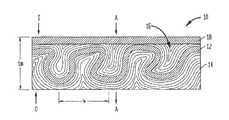
BRIEF DESCRIPTION OF THE DRAWINGSFIG. 1A is a side view illustration of one embodiment of a filter media;
FIG. 1B is a side view illustration of another embodiment of a filter media;
FIG. 1C is a side view illustration of one layer of the filter media ofFIG. 1A;
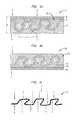
FIG. 2A is a perspective view of one embodiment of a panel filter;
FIG. 2B is a side cross-sectional view of the panel filter ofFIG. 2A taken across line2B;
FIG. 3 is a side view of another embodiment of a panel filter;
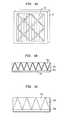
FIG. 4A is a perspective view of one embodiment of a pleated filter element;
FIG. 4B is a side cross-sectional view of another embodiment of a pleated filter element;
FIG. 4C is a side cross-sectional view of yet another embodiment of a pleated filter element;
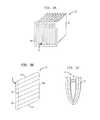
FIG. 5A is a perspective view of one embodiment of a bag filter having multiple filter bags disposed therein;
FIG. 5B is a perspective view of one of the filter bags ofFIG. 5A;
FIG. 5C is a side cross-sectional view of the filter bag ofFIG. 5B;
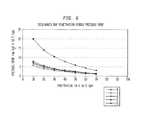
FIG. 6 is a chart showing discharged DOP penetration versus pressure drop for various filter media;
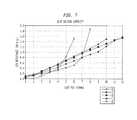
FIG. 7 is a chart showing dust holding capacity for various filter media;
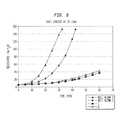
FIG. 8 is a chart showing NaCl Loading for various filter media; and
FIG. 9 is a chart showing a multi-pass liquid test for various filter media.
DETAILED DESCRIPTION OF THE INVENTIONCertain exemplary embodiments will now be described to provide an overall understanding of the principles of the structure, function, manufacture, and use of the devices and methods disclosed herein. Those skilled in the art will understand that the devices and methods specifically described herein are non-limiting exemplary embodiments and that the scope of the present invention is defined solely by the claims. The features described in connection with one exemplary embodiment may be combined with the features of other embodiments. Such modifications and variations are intended to be included within the scope of the present invention.
The present invention generally provides various high performance, high efficiency filter media that are cost effective and easy to manufacture. In particular, various filter media are provided having at least one layer with a waved configuration that results in an increased surface area, thereby enhancing various properties of the filter media. The filter media can be used to form a variety of filter elements for use in various applications.
Media
In general, various filter media are provided having at least one fibrous layer that is held in a waved or curvilinear configuration by one or more additional fibrous layers. As a result of the waved configuration, the filter media has an increased surface area which results in improved filtration properties. The filter media can include various fibrous layers, and only some or all of the layers can be waved.FIG. 1A illustrates one exemplary embodiment of afilter media10 having at least one filtration layer and at least one coarse support layer that holds the filtration layer in a waved configuration to maintain separation of peaks and troughs of adjacent waves of the filtration layer. In the illustrated embodiment, thefilter media10 includes a finefiber filtration layer12, a first, downstream coarse support layer14, and a second, upstreamcoarse support layer16 disposed on opposite sides of the finefiber filtration layer12. The support layers14,16 can help maintain the finefiber filtration layer12, and optionally any additional filtration layers, in the waved configuration. While two coarse support layers14,16 are shown, thefilter media10 need not include both support layers. Where only one coarse support layer is provided, the coarse support layer can be disposed upstream or downstream of the filtration layer(s).
Thefilter media10 can also optionally include one or more outer or cover layers located on the upstream-most and/or downstream-most sides of thefilter media10.FIG. 1A illustrates atop layer18 disposed on the upstream side of thefilter media10 to function as an upstream dust holding layer. Thetop layer18 can also function as an aesthetic layer, which will be discussed in more detail below. The layers in the illustrated embodiment are arranged so that thetop layer18 is disposed on the air entering side, labeled I, the secondcoarse support layer16 is just downstream of thetop layer18, the finefiber filtration layer12 is disposed just downstream of the secondcoarse support layer16, and the first coarse support layer14 is disposed downstream of thefirst layer12 on the air outflow side, labeled O. The direction of air flow, i.e., from air entering I to air outflow O, is indicated by the arrows marked with reference A.
The outer or cover layer can alternatively or additionally be a bottom layer disposed on the downstream side of thefilter media10 to function as a strengthening component that provides structural integrity to thefilter media10 to help maintain the waved configuration. The outer or cover layer(s) can also function to offer abrasion resistance.FIG. 1B illustrates another embodiment of a filter media10B that is similar to filtermedia10 ofFIG. 1B. In this embodiment, the filter media10B does not include a top layer, but rather has a fine fiber filtration layer12B, a first coarse support layer14B disposed just downstream of the fine fiber filtration layer12B, a second coarse support layer16B disposed just upstream of the fine fiber filtration layer12B on the air entering side I, and a bottom layer18B disposed just downstream of the first coarse support layer14B on the air exiting side O. A person skilled in the art will appreciate that a variety of other configurations are possible, and that the filter media can include any number of layers in various arrangements.
Fine Fiber Layer
As indicated above, in an exemplary embodiment thefilter media10 includes at least one finefiber filtration layer12. In an exemplary embodiment, asingle filtration layer12 formed from fine fibers is used, however thefilter media10 can include any number of additional filtration layers disposed between the downstream coarse support layer and the upstream coarse support layer, adjacent to the finefiber filtration layer12, or disposed elsewhere within the filter media. While not shown, the additional filtration layer(s) can be maintained in a waved configuration with the finefiber filtration layer12. In certain exemplary embodiment thefilter media10 can include one or more additional filtration layers disposed upstream of the finefiber filtration layer12. The additional filtration layer(s) can be formed from fine fibers, or more preferably can be formed from fibers having an average fiber diameter that is greater than an average fiber diameter of the fibers that form the finefiber filtration layer12.
The finefiber filtration layer12 can be formed from a variety of fibers, but in an exemplary embodiment the finefiber filtration layer12 is formed from fibers having an average fiber diameter that is less than about 10μ, and more preferably that is less than about 5μ, and more preferably that is less than about 3μ. In certain exemplary embodiments, the fibers can have an average fiber diameter of about 1.5μ or less, including nanofibers having an average diameter of less than about 1μ.
If provided, any additional filtration layers can likewise be formed from a variety of fibers, but in an exemplary embodiment the additional filtration layer(s) is/are formed from fibers having an average fiber diameter that is greater than about 5μ but preferably that is less than about 10μ.
Various materials can also be used to form the fibers, including synthetic and non-synthetic materials. In one exemplary embodiment, the finefiber filtration layer12, and any additional filtration layer(s), is formed from meltblown fibers. Exemplary materials include, by way of non-limiting example, polyolefins, such as polypropylene and polyethylene; polyesters, such as polybutylene terephthalate and polyethylene terephthalate; polyamides, such as Nylon; polycarbonate; polyphenylene sulfide; polystyrene; and polyurethane. In another embodiment, the finefiber filtration layer12 can be formed from glass fibers. Various manufacturing techniques can be used to form the glass fiber web, include wetlaid or drylaid webs. The type and size of glass fiber can also vary, but in an exemplary embodiment, the fiber is a microglass fiber, such as A-type or E-type glass fibers made using a rotary or flame attenuation process and having an average fiber diameter in the range of about 0.2μ to 5μ. However, other suitable materials include, by way of non-limiting example, polyvinyl alcohol and polyvinylidene fluoride. The finefiber filtration layer12, and any additional filtration layer(s), can also be formed using various other techniques known in the art, including wet laid techniques, air laid techniques, carding, electrospining, and spunbonding.
The resulting finefiber filtration layer12, as well as any additional filtration layer(s), can also have a variety of thicknesses, air permeabilities, basis weights, and filtration efficiencies depending upon the requirements of a desired application. In one exemplary embodiment, the finefiber filtration layer12, as measured in a planar configuration, has a thickness in the range of about 2 mils to 30 mils, an air permeability in the range of about 10 CFM to 300 CFM, a basis weight in the range of about 3 gsm to 50 gsm, and a DOP filtration efficiency in the range of about 20% to 99%. If any additional filtration layers are provided, in certain exemplary embodiments each additional filtration layer, as measured in a planar configuration, has a thickness in the range of about 2 mils to 30 mils, an air permeability in the range of about 10 CFM to 300 CFM, a basis weight in the range of about 3 gsm to 50 gsm, and a DOP filtration efficiency in the range of about 20% to 99%.
Coarse Support Layers
As also indicated above, thefilter media10 can include at least one coarse fibrous support layer. In an exemplary embodiment, thefilter media10 includes a downstream coarse support layer14 disposed on the air outflow side O of the finefiber filtration layer12 and that is effective to hold the finefiber filtration layer12 in the waved configuration. Thefilter media10 can also include an upstreamcoarse support layer16 that is disposed on the air entering side I of the finefiber filtration layer12 opposite to the downstream coarse support layer14. The upstreamcoarse support layer16 can likewise help maintain the finefiber filtration layer12 in a waved configuration. As indicated above, a person skilled in the art will appreciate that thefilter media10 can include any number of layers, and it need not include two coarse support layers, or a top layer. In certain exemplary embodiments, thefilter media10 can be formed from a finefiber filtration layer12 and a single, adjacentcoarse support layer14 or16. In other embodiments, the filter media can include any number of additional layers arranged in various configurations. The particular number and type of layers will depend on the intended use of the filter media.
The coarse support layers14,16 can be formed from a variety of fibers types and sizes. In an exemplary embodiment, the downstream coarse support layer14 is formed from fibers having an average fiber diameter that is greater than an average fiber diameter of the finefiber filtration layer12, the upstreamcoarse support layer16, and thetop layer18, if provided, and the upstreamcoarse support layer16 is formed from fibers having an average fiber diameter that is less than an average fiber diameter of the downstream coarse support layer14, but that is greater than an average fiber diameter of the finefiber filtration layer12 and thetop layer18. In certain exemplary embodiments, the downstream coarse support layer14 can be formed from fibers having an average fiber diameter in the range of about 5μ to 40μ, and more preferably that is in the range of about 20μ to 30μ, and the upstreamcoarse support layer16 can be formed from fibers having an average fiber diameter that is in the range of about 10μ to 40μ, and more preferably that is in the range of about 15μ to 20μ.
Various materials can also be used to form the fibers of the coarse support layers14,16, including synthetic and non-synthetic materials. In one exemplary embodiment, the coarse support layers14,16 are formed from staple fibers, and in particular from a combination of binder fibers and non-binder fibers. One suitable fiber composition is a blend of at least about 20% binder fiber and a balance of non-binder fiber. A variety of types of binder and non-binder fibers can be used to form the media of the present invention. The binder fibers can be formed from any material that is effective to facilitate thermal bonding between the layers, and will thus have an activation temperature that is lower than the melting temperature of the non-binder fibers. The binder fibers can be monocomponent fibers or any one of a number of bicomponent binder fibers. In one embodiment, the binder fibers can be bicomponent fibers, and each component can have a different melting temperature. For example, the binder fibers can include a core and a sheath where the activation temperature of the sheath is lower than the melting temperature of the core. This allows the sheath to melt prior to the core, such that the sheath binds to other fibers in the layer, while the core maintains its structural integrity. This is particularly advantageous in that it creates a more cohesive layer for trapping filtrate. The core/sheath binder fibers can be concentric or non-concentric, and exemplary core/sheath binder fibers can include the following: a polyester core/copolyester sheath, a polyester core/polyethylene sheath, a polyester core/polypropylene sheath, a polypropylene core/polyethylene sheath, and combinations thereof. Other exemplary bicomponent binder fibers can include split fiber fibers, side-by-side fibers, and/or “island in the sea” fibers. Exemplary bi-component binder fibers can include Trevira Types 254, 255, and 256; Invista Cellbond® Type 255; Fiber Innovations Types 201, 202, 215, and 252; and ES Fibervisions AL-Adhesion-C ESC 806A.
The non-binder fibers can be synthetic and/or non-synthetic, and in an exemplary embodiment the non-binder fibers can be about 100 percent synthetic. In general, synthetic fibers are preferred over non-synthetic fibers for resistance to moisture, heat, long-term aging, and microbiological degradation. Exemplary synthetic non-binder fibers can include polyesters, acrylics, polyolefins, nylons, rayons, and combinations thereof. Alternatively, the non-binder fibers used to form the media can include non-synthetic fibers such as glass fibers, glass wool fibers, cellulose pulp fibers, such as wood pulp fibers, and combinations thereof. Exemplary synthetic non-binder fibers can include Trevira Type 290 and Wellman Fortrel® Types 204, 289 and 510.
The coarse support layers14,16 can also be formed using various techniques known in the art, including meltblowing, wet laid techniques, air laid techniques, carding, electrospining, and spunbonding. In an exemplary embodiment, however, the coarse support layers14,16 are carded or airlaid webs. The resulting layers14,16 can also have a variety of thicknesses, air permeabilities, and basis weights depending upon the requirements of a desired application. In one exemplary embodiment, the downstream coarse support layer14 and the upstreamcoarse support layer16, as measured in a planar configuration, each have a thickness in the range of about 10 mil to 60 mil, an air permeability in the range of about 300 CFM to 1000 CFM, and a basis weight in the range of about 10 gsm to 100 gsm.
Outer or Cover Layer
As previously indicated, thefilter media10 can also optionally include one or more outer or cover layers disposed on the air entering side I and/or the air outflow side O.FIG. 1A illustrates atop layer18 disposed on the air entering side I of thefilter media10. Thetop layer18 can function as a dust loading layer and/or it can function as an aesthetic layer. In an exemplary embodiment, thetop layer18 is a planar layer that is mated to thefilter media10 after the finefiber filtration layer12 and the coarse support layers14,16 are waved. Thetop layer18 thus provides a top surface that is aesthetically pleasing. Thetop layer18 can be formed from a variety of fiber types and sizes, but in an exemplary embodiment thetop layer18 is formed from fibers having an average fiber diameter that is less than an average fiber diameter of the upstreamcoarse support layer16 disposed immediately downstream of thetop layer18, but that is greater than an average fiber diameter of the finefiber filtration layer12. In certain exemplary embodiments, thetop layer18 is formed from fibers having an average fiber diameter in the range of about 5μ to 20μ. As a result, thetop layer18 can function as a dust holding layer without affecting the alpha value of thefilter media10, as will be discussed in more detail below.
As shown inFIG. 1B, the filter media10B can alternatively or in addition include a bottom layer18B disposed on the air outflow side O of the filter media10B. The bottom layer18B can function as strengthening component that provides structural integrity to the filter media10B to help maintain the waved configuration. The bottom layer18B can also function to offer abrasion resistance. This is particularly desirable in ASHRAE bag applications where the outermost layer is subject to abrasion during use. The bottom layer18B can have a configuration similar to thetop layer18, as discussed above. In an exemplary embodiment, however, the bottom layer18B is preferably the coarsest layer, i.e., it is formed from fibers having an average fiber diameter that is greater than an average fiber diameter of fibers forming all of the other layers of the filter media. One exemplary bottom layer is a spunbond layer, however various other layers can be used having various configurations.
Various materials can also be used to form the fibers of the outer or cover layer, including synthetic and non-synthetic materials. In one exemplary embodiment, the outer or cover layer, e.g.,top layer18 and/or bottom layer18B, is formed from staple fibers, and in particular from a combination of binder fibers and non-binder fibers. One suitable fiber composition is a blend of at least about 20% binder fiber and a balance of non-binder fiber. A variety of types of binder and non-binder fibers can be used to form the media of the present invention, including those previously discussed above with respect to the coarse support layers14,16.
The outer or cover layer, e.g.,top layer18 and/or any bottom layer, can also be formed using various techniques known in the art, including meltblowing, wet laid techniques, air laid techniques, carding, electrospining, and spunbonding. In an exemplary embodiment, however, thetop layer18 is an airlaid layer and the bottom layer18B is a spunbond layer. The resulting layer can also have a variety of thicknesses, air permeabilities, and basis weights depending upon the requirements of a desired application. In one exemplary embodiment, the outer or cover layer, as measured in a planar configuration, has a thickness in the range of about 2 mil to 50 mil, an air permeability in the range of about 100 CFM to 1200 CFM, and a basis weight in the range of about 10 gsm to 50 gsm.
A person skilled in the art will appreciate that, whileFIG. 1A illustrates a four layer filter media, the media can include any number of layers in various configurations. Various layers can be added to enhance filtration, to provide support, to alter structure, or for various other purposes. By way of non-limiting example, the filter media can include various spunbond wetlaid cellulose, drylaid synthetic nonwoven, wetlaid synthetic, and wetlaid microglass layers.
Method of Manufacturing
Some or all of the layers can be formed into a waved configuration using various manufacturing techniques, but in an exemplary embodiment the finefiber filtration layer12, any additional filtration layers, and preferably at least one of the coarse support layers14,16, are positioned adjacent to one another in a desired arrangement from air entering side to air outflow side, and the combined layers are conveyed between first and second moving surfaces that are traveling at different speeds, such as with the second surface traveling at a speed that is slower than the speed of the first surface. A suction force, such as a vacuum force, can be used to pull the layers toward the first moving surface, and then toward the second moving surface as the layers travel from the first to the second moving surfaces. The speed difference causes the layers to form z-direction waves as they pass onto the second moving surface, thus forming peaks and troughs in the layers. The speed of each surface can be altered to obtain the desired number of waves per inch. The distance between the surfaces can also be altered to determine the amplitude of the peaks and troughs, and in an exemplary embodiment the distance is adjusted between 0 to 2″. The properties of the different layers can also be altered to obtain a desired filter media configuration. In an exemplary embodiment the filter media has about 2 to 6 waves per inch, with a height (overall thickness) in the range of about 0.025″ to 2″, however this can vary significantly depending on the intended application. As shown inFIG. 1A, a single wave W extends from the middle of one peak to the middle of an adjacent peak
In the embodiment shown inFIG. 1A, when the finefiber filtration layer12 and the coarse support layers14,16 are waved, the resulting finefiber filtration layer12 will have a plurality of peaks P and troughs T on each surface (i.e., air entering side I and air outflow side O) thereof, as shown inFIG. 1C. The coarse support layers14,16 will extend across the peaks P and into the troughs T so that the coarse support layers14,16 also have waved configurations. A person skilled in the art will appreciate that a peak P on the air entering side I of the finefiber filtration layer12 will have a corresponding trough T on the air outflow side O. Thus, the downstream coarse support layer14 will extend into a trough T, and exactly opposite that same trough T is a peak P, across which the upstreamcoarse support layer16 will extend. Since the downstream coarse support layer14 extends into the troughs T on the air outflow side O of the finefiber filtration layer12, the downstream coarse layer14 will maintain adjacent peaks P on the air outflow side O at a distance apart from one another and will maintain adjacent troughs T on the air outflow side O at a distance apart from one another. The upstreamcoarse support layer16, if provided, can likewise maintain adjacent peaks P on the air entering side I of the finefiber filtration layer12 at a distance apart from one another and can maintain adjacent troughs T on the air entry side I of the finefiber filtration layer12 at a distance apart from one another. As a result, the finefiber filtration layer12 has a surface area that is significantly increased, as compared to a surface area of the fine fiber filtration layer in the planar configuration. In certain exemplary embodiments, the surface area in the waved configuration is increased by at least about 50%, and in some instances as much as 120%, as compared to the surface area of the same layer in a planar configuration. The increased surface area leads to an increased filtration efficiency, as will be discussed in more detail below.
In certain exemplary embodiments, the downstream and/or upstream coarse support layers14,16 can have a fiber density that is greater at the peaks than it is in the troughs, and a fiber mass that is less at the peaks than it is in the troughs. This can result from the coarseness of the downstream and/or upstream coarse support layers14,16 relative to the finefiber filtration layer12. In particular, as the layers are passed from the first moving surface to the second moving surface, the relatively fine nature of the finefiber filtration layer12 will allow the downstream and/or upstream coarse support layers14,16 to conform around the waves formed in the finefiber filtration layer12. As the coarse support layers14,16 extend across a peak P, the distance traveled will be less than the distance that eachlayer14,16 travels to fill a trough. As a result, the coarse support layers14,16 will compact at the peaks, thus having an increased fiber density at the peaks as compared to the troughs, through which the layers will travel to form a loop-shaped configuration.
Once the layers are formed into a waved configuration, the waved shape can be maintained by activating the binder fibers to effect bonding of the fibers. A variety of techniques can be used to activate the binder fibers. For example, if bicomponent binder fibers having a core and sheath are used, the binder fibers can be activated upon the application of heat. If monocomponent binder fibers are used, the binder fibers can be activated upon the application of heat, steam and/or some other form of warm moisture. A top layer18 (FIG. 1A) and/or bottom layer18B (FIG. 1B) can also be positioned on top of the upstream coarse support layer16 (FIG. 1A) or on the bottom of the downstream coarse support layer14B (FIG. 1B), respectively, and mated, such as by bonding, to the upstreamcoarse support layer16 or downstream coarse support layer14B simultaneously or subsequently. A person skilled in the art will also appreciate that the layers can optionally be mated to one another using various techniques other than using binder fibers. Other suitable mating techniques include adhesives, needling, hydroentanglement, and chemical binders. The layers can also be individually bonded layers, and/or they can be mated, including bonded, to one another prior to being waved.
A saturant can also optionally be applied to the material prior to drying the material. A variety of saturants can be used with the media of the present invention to facilitate the forming of the layers at a temperature that is less than the melting temperature of the fibers. Exemplary saturants can include phenolic resins, melamine resins, urea resins, epoxy resins, polyacrylate esters, polystyrene/acrylates, polyvinyl chlorides, polyethylene/vinyl chlorides, polyvinyl acetates, polyvinyl alcohols, and combinations and copolymers thereof that are present in an aqueous or organic solvent.
In other embodiments, the resulting media can also have a gradient in at least one, and optionally all, of the following properties: binder and non-binder fibers composition, fiber diameter, solidity, basis weight, and saturant content. For example, in one embodiment, the media can have a lightweight, lofty, coarse-fibered, lightly bonded and lightly saturated sheet upstream, and a heavier, denser, fine-fibered, heavily bonded and heavily saturated sheet downstream. This allows the coarser particles to be trapped in the upstream layer, preventing early saturation of the bottom layer. In other embodiments, the upstream-most layer can be lighter and/or loftier than the downstream-most layer. That is, the upstream layer can have a solidity (e.g., the solid volume fraction of fibers in the web) and a basis weight that is less than that of the downstream layer. Additionally, in embodiments where the filter media includes a saturant, the media can have a gradient with respect to the amount of saturant in the upstream-most and downstream-most layers. One skilled in the art will appreciate the variety of properties that the layers of the media can have.
An electrostatic charge can also optionally be imparted to the filter media, or to various layers of the media, to form an electret fiber web. A variety of techniques are well known to impart a permanent dipole to the polymer web in order to form electret filter media. Charging can be effected through the use of AC and/or DC corona discharge units and combinations thereof. The particular characteristics of the discharge are determined by the shape of the electrodes, the polarity, the size of the gap, and the gas or gas mixture. Charging can also be accomplished using other techniques, including friction-based charging techniques.
The filter media can also be pleated after it is formed into the waved configuration, and various exemplary configurations will be discussed in more detail below. A person skilled in the art will appreciate that virtually any pleating technique known in the art can be used to pleat the waved filter media. Typically, a filter media is pleated by forming a plurality of parallel score lines in the media and forming folds at each score line.
Filter Media Properties
As indicated above, the properties of the resulting filter media can vary depending on the configuration of the media and the intended use. In an exemplary embodiment, the waved configuration is effective to increase the surface area of themedia10, which in turn results in the media having improved filtration properties than an otherwise similar media that has a planar configuration.
While filter performance can be evaluated based on different criteria, it is desirable that filters, or filter media, be characterized by low penetration across the filter of contaminants to be filtered. At the same time, however, there should exist a relatively low pressure drop, or resistance, across the filter. Penetration, often expressed as a percentage, is defined as follows:
Pen=C/C0
where C is the particle concentration after passage through the filter and C0is the particle concentration before passage through the filter. Filter efficiency is defined as
100−% Penetration.
Because it is desirable for effective filters to maintain values as low as possible for both penetration and pressure drop across the filter, filters are rated according to a value termed alpha, which is the slope of log penetration versus pressure drop across the filter. Steeper slopes, or higher alpha values, are indicative of better filter performance. Alpha is expressed according to the following formula
Alpha=−100 log(C/C0)/DP,
where DP is the pressure drop across the filter media.
In many filtering situations it is important to have a high initial alpha value. However, it is equally, if not more important, to maintain acceptable alpha values well into the filtration process. For example, in respiratory applications, manufacturing standards mandate that the final respiratory filter, such as a respiratory mask, be subjected to elevated temperatures to simulate an aged effect. Accordingly, the filter media must be capable of maintaining a high alpha value when subjected to heat.
In certain applications, such as HVAC, discharged performance is also important. Synthetic filter media are often charged in order to enhance the filtration performance. Due to concerns that this charge will dissipate during the use of the filter, there is a movement to inform users of a filter's worst possible efficiency. EN779:2002, the European standard for coarse and fine filters, contains a mandatory test on flat piece media before and after discharging to determine whether there is a potential for performance degradation. The test method can be used with any procedure that results in a completely discharge media. Procedures suggested include immersion in isopropanol or surfactants in water or exposure to diesel fumes. Treatment with isopropanol is performed by first measuring the efficiency of untreated media samples. Next, the samples are immersed in a 100% solution of isopropanol, and after the filter samples have been wetted by isopropanol they are placed on a flat, inert surface in a fume cupboard for drying. After a drying period of 24 hours, the efficiency measurements are repeated.
The DOP (dioctyl phthalate) challenge employs an automated filter testing unit (8130) purchased from TSI, Inc. equipped with an oil generator. The instrument measures pressure drop across filter media and the resultant penetration value on an instantaneous or “loading” basis at a flow rate less than or equal to 115 liters per minute. Instantaneous readings are defined as 1 pressure drop/penetration measurement. According to TSI specifications, the oil generator produces a 0.33 micron mass mean diameter 0.20 micron count mean diameter with DOP, DEHS paraffin, or Emory 3004. All references herein to DOP alpha refer to a DOP challenge applied to a sample size of 100 cm2. The air flow rate was 32 lpm to produce a 10.5 fpm face velocity or 76 lpm to produce a 25 fpm face velocity.
Another exemplary test is the NaCl (sodium chloride) challenge, which employs an 8130 CertiTest™ automated filter testing unit from TSI, Inc. equipped with a sodium chloride generator. The average particle size created by the salt particle generator is 0.26 micron mass mean diameter or 0.07 micron count mean diameter. The instrument measures a pressure drop across the filter media and the resultant penetration value on an instantaneous basis at a flow rate less than or equal to 115 liters per minute (lpm). The 8130 can be run in a continuous mode with one pressure drop/penetration reading approximately every minute. All references herein to NaCl alpha refer to a continuous loading of NaCl particles, to represent fine particle loading of a filter, onto a 100 cm2sample at a flow rate of 76 lpm (face velocity of 25 fpm). The sample was loaded for a period of 60 minutes at a concentration of 15 mg NaCl/m3air for a loading of approximately 60 mg NaCl per 100 cm2sample.
Glass media which meets EN779 classification of F5 to F8 is found to have an alpha value in the range of about 12 to 16 with DOP or DEHS (dioctyl sebacate, an accepted equivalent to DOP) when tested at a face velocity of 5.3 cm/s before and after discharging using isopropyl alcohol, as explained above. The media of the present invention achieves a minimum DOP alpha of 9, and more preferably greater than about 11, and most preferably greater than 16, after discharging using isopropyl alcohol, thus providing a suitable alternative to glass media. For a DOP alpha of 9, the equivalent NaCl alpha after IPA soak is about 12, for a DOP alpha of 11, the equivalent NaCl alpha after IPA soak is about 14, and for a DOP alpha of 16 the equivalent NaCl alpha after IPA soak is about 20. However, the alpha value of the filter media in accordance with the present invention may vary depending on the particular configuration of the filter media, or the filter element containing the filter media.
MERV (Minimum Efficiency Reporting Value) ratings are used by the HVAC (Heating, Ventilating and Air Conditioning) industry to describe a filter's ability to remove particulates from the air. The MERV rating is derived from the efficiency of the filter versus particles in various size ranges, and is calculated according to methods detailed in ASHRAE 52.2. A higher MERV rating means better filtration and greater performance. In an exemplary embodiment, filter media according to the present invention have a MERV rating that is in the range of about 7 to 16, however the rating can vary based on the intended use.
The resulting media can also have a variety of thicknesses, air permeabilities, basis weights, and dust holding capacities depending upon the requirements of a desired application. Thickness, as referred to herein, is determined according to TAPPI T411 using an appropriate caliper gage. Basis weight, as referred to herein, is determined according to ASTM D-846. The dust holding capacity, as referred to herein, is tested based on a modification to ASHRAE 52.1 to test dust loading on flat sheet instead of bag. The pressure drop across a 1 ft2sample is measured at a face velocity of 25 fpm. ASHRAE dust as specified in ASHRAE 52.1 is added in 1 gram increments until a pressure drop of 1.5 inch H2O is reached. The number of grams to get to this pressure drop is noted in gram/ft2.
For example, in one embodiment, the resulting media can have a thickness tm, as shown inFIG. 1A, in the range of about 1.5 mm to 25 mm, and an air permeability in the range of about 10 CFM to 300 CFM. The resulting media can also have a basis weight in the range of about 70 gsm to 1100 gsm, a dust holding capacity of at least about 8 g/ft2@25 FPM face velocity using ASHRAE dust loading to 1.5″ H2O pressure drop, and/or a NaCl loading of less than about 50 mm H2O after loading approximately 60 mg/100 cm2of 0.26μ particles at 25 FPM face velocity.
Filter Elements
As previously indicated, the filter media disclosed herein can be incorporated into a variety of filter elements for use in various applications, including both liquid and air filtration applications. Exemplary uses include ASHRAE bag filters, pleatable HVAC filters, liquid bag filter media, dust bag house filters, residential furnace filters, paint spray booth filters, surgical face masks, industrial face masks, cabin air filters, commercial ASHRAE filters, respirator filters, automotive air intake filters, automotive fuel filters, automotive lube filters, room air cleaner filters and vacuum cleaner exhaust filters. The filter elements can have various configurations, and certain exemplary filter element configurations are discussed in more detail below. Other exemplary filter elements include, by way of non-limiting example, radial filter elements that include cylindrical filter media disposed therein, micron-rater vessel bag filters (also referred to as sock filters) for liquid filtration, face masks, etc.
Panel Filter
In one exemplary embodiment, the filter media can be used in a panel filter. In particular, thefilter media10 can include a housing disposed therearound. The housing can have various configurations, and the particular configuration can vary based on the intended application. In one embodiment, as shown inFIG. 2A, the housing is in the form of aframe20 that is disposed around the perimeter of thefilter media10. In the illustrated embodiment, theframe20 has a generally rectangular configuration such that it surrounds all four sides of a generallyrectangular filter media10, however the particular shape can vary. Theframe20 can be formed from various materials, including cardboard, metal, polymers, etc. In certain exemplary embodiments, theframe20 can have a thickness t that is about 12″ or less, and more preferably about 2″ or less.FIG. 2B illustrates a side cross-sectional view of the frame showing the wavedfilter media10 disposed therein. In another embodiment, the frame can be formed from the edges of the filter media. In particular, as shown inFIG. 3, a perimeter of thefilter media10′ can be thermally sealed to form aframe20′ therearound. The panel filter can also include a variety of other features known in the art, such as stabilizing features for stabilizing the filter media relative to the frame, spacers, etc.
In use, the panel filter element can be used in a variety of applications, including commercial and residential HVAC; automotive passenger cabin air; automotive air intake; and paint spray booth filters. The particular properties of the filter element can vary based on the intended use, but in certain exemplary embodiments, the filter element has a MERV rating in the range of 7 to 16, and a pressure drop in the range of about 0.1″ to 1″ H2O.
Pleated Filter
The waved filter media can also be pleated and used in a pleated filter. As previously discussed, the waved media, or various layers thereof, can be pleated by forming score lines at a predetermined distance apart from one another, and folding the media. A person skilled in the art will appreciate, however, that other pleating techniques can be used. Once the media is pleated, the media can be incorporated into a housing, similar to the panel filter ofFIG. 3A.FIG. 4A illustrates one embodiment of apleated filter media32 that is disposed within aframe30. The frame can have various shapes and sizes, as previously discussed with respect toFIG. 3A. The media can have any number of pleats depending on the size of the frame and the intended use. In certain exemplary embodiment, the filter media has 1-2 pleats per inch, and a pleat height in the range of about 0.75″ to 2″. However, some applications utilize peaks having a height up to 12″.
In order to facilitate pleating, the filter media can be self-supporting, i.e., it can have a stiffness that allows pleating. In certain exemplary embodiments, the minimum stiffness of the filter media is about 200 mg with Gurley Stiffness tester to enable pleating. Alternatively, or in addition, the filter media can include various stiffening elements. By way of non-limiting example,FIGS. 4B and 4C illustrate a wavedfilter media32a,32bthat is pleated, and that includes a stabilizing strap34a,34bthat is adhered to (e.g., using an adhesive or other bonding techniques) an air outflow side of thefilter media32a,32b. Thefilter media32a,32bare also shown disposed within aframe30a,30b.FIG. 4B further illustrates a screen backing36adisposed on the filter media32ato stiffen the media32aand help retain the pleated configuration. The screen backing36acan be an expanded metal wire or an extruded plastic mesh.
In use, the pleated waved filter element can be used in a variety of applications, including pleatable HVAC filters, residential furnace filters, cabin air filters, commercial ASHRAE filters, automotive air intake filters, automotive fuel filters, automotive lube filters, room air cleaner filters, and vacuum cleaner exhaust filters. The particular properties of the filter element can vary based on the intended use, but in certain exemplary embodiments, the filter element has a MERV rating in the range of 7 to 16, a pressure drop in the range of about 0.1″ to 1″ inch H2O. The filter media can also have a thickness before pleating of about 0.5″ of less, and a thickness after pleating of about 2″ or less. However, in certain application the thickness after pleating can be up to 12″.
Bag/Pocket Filter
In yet another embodiment, the filter media can be incorporated into a bag or pocket filter for use in heating, air conditioning, ventilation, and/or refrigeration; and micron rated liquid filter bags. The bag or pocket filter can be formed by placing two filter media together (or folding a single filter media in half), and mating three sides (or two if folded) to one another such that only one side remains opens, thereby forming a pocket inside the filter. As shown inFIG. 5A, multiple filter pockets42 can be attached to a frame44 to form afilter element40. Eachpocket42 can be positioned such that the open end is located in the frame, thus allowing air to flow into eachpocket42 in the direction indicated by line A. The frame can include rectangular rings that extend into and retain each pocket. A person skilled in the art will appreciate that the frame can have virtually any configuration, and various mating techniques known in the art can be used to couple the pockets to the frame. Moreover, the frame can include any number of pockets, but bag filters typically include between 6 and 10 pockets.
FIG. 5B illustrates onepocket42 showing three edges42a,42b,42cbeing closed and one edge42dbeing open for receiving airflow therethrough, as indicated by line A. As further shown inFIG. 5B, thepocket filter42 can also include any number ofspacers43 disposed therein and configured to retain opposed sidewalls of thefilter42 at a predetermined distance apart from one another. The spacers can be threads or any other element extending between both sidewalls.FIG. 5C illustrates a cross-sectional view of thepocket filter42 ofFIG. 5B, showing thespacer43 extending between the sidewalls. The direction of airflow is again indicated by line A. A person skilled in the art will appreciate that various features known in the art for use with bag or pocket filters can be incorporated into the filter media disclosed herein.
The particular properties of the filter element can vary based on the intended use, but in certain exemplary embodiments, the filter element has a MERV rating in the range of about 7 to 16, and more preferably 10 to 16, and a pressure drop in the range of about 0.1″ to 1″ H2O. The filter media can also have a thickness that is about 2″ or less, and more preferably about 0.5″ or less, however the thickness can vary depending on the intended application.
By way of non-limiting example, a standard 8 pocket ASHRAE bag filter typically has a 30″ deep pocket in a 24″×24″ frame, and yields 80 sq. ft. of media. An ASHRAE bag filter having the same dimensions, but utilizing a waved filter media according to the present invention, will yield 176 sq. ft. of media.
The following non-limiting examples serve to further illustrate the present invention:
EXAMPLE 1Comparative Sample A (Control)
Sample A is a planar filter media that is manufactured by Johns Manville and sold as CM285B-2, and it is an 80-85% glass mat filter media. The properties of the media were tested and are listed below in Table 1 under Sample A.
For all samples, the DOP Penetration and DOP alpha were measured after discharging the media using isopropyl alcohol. In particular, the sample was placed in a container containing a 100% isopropyl alcohol solution, and allowed to soak for approximately 5 seconds or until full saturation was achieved. The sample was then removed from the solution and allowed to drain for approximately 30 seconds. The sample was then placed in a fume/vacuum hood and allowed to air dry. Drying time was greatly dependent upon the thickness of the sample, and varied from 20 minutes to 48 hours. The DOP Penetration and DOP alpha tests were then performed.
Comparative Sample B (Control)
Sample B is a planar filter media that is manufactured by Hollingsworth & Vose Company and sold as AS8020DD, and it is 80-85% synthetic filter media. The properties of the media were tested and are listed below in Table 1 under Sample B.
Sample C
Sample C was formed using four layers, listed in order from upstream (air entry) to downstream (air outflow): (1) a top airlaid layer, (2) an upstream airlaid coarse support layer, (3) a fine fiber meltblown layer, and (4) a downstream airlaid coarse support layer.
The top airlaid layer was formed from 50% of a 2 denier by 6 mm Type 255 bicomponent fiber available from Invista, and 50% of a 0.9 denier by 6 mm Type 510 polyethyleneterephthalate (PET) fiber available from Wellman. The top airlaid layer was bonded in an oven. The top airlaid layer had a basis weight of 25 gsm, a thickness of 30 mil, and an air permeability of 850 CFM.
The upstream airlaid coarse support layer was formed from 70% of a 2 denier by 6 mm Type 255 bicomponent fiber available from Invista, 20% of a 0.9 denier by 6 mm Type 510 PET fiber available from Wellman, and 10% of a 15 denier by 6 mm Type 341 PET fiber available from Wellman. The upstream airlaid coarse support layer had a basis weight of 40 gsm, a thickness of 40 mil, and an air permeability of 800 CFM.
The fine fiber meltblown layer was formed from a polypropylene fiber having an average fiber diameter of 1.4μ. The basis weight of the meltblown layer was 20 gsm, the thickness was 7 mil, and the air permeability was 56 CFM.
The downstream airlaid coarse support layer was formed from 50% of a 2 denier by 6 mm Type 255 fiber available from Invista, and 50% of a 15 denier by 6 mm Type 341 PET fiber available from Wellman. The downstream airlaid coarse support layer had a basis weight of 40 gsm, a thickness of 40 mil, and an air permeability of 2000 CFM.
The upstream coarse support layer, the fine fiber meltblown layer, and the downstream coarse support layer were formed into a waved configuration by placing the layers on a first moving surface traveling at a speed of about 25 m/min. The layers traveled from the first moving surface to a second moving surface traveling at a speed of about 10 m/min, and as aresult4 waves per inch were formed. The waved webs and the top layer were then thermally bonded in an oven at 130° C. The properties of the resulting media were tested and are listed below in Table 1 under Sample C.
Sample D
Sample C was repeated to form Sample D, however the fine fiber meltblown layer was formed from a polypropylene fiber having an average fiber diameter of 0.6μ on a 10 gsm polypropylene spunbond. The basis weight of the meltblown layer was 7 gsm. The properties of the resulting media were tested and are listed below in Table 1 under Sample D.
Sample E
Sample C was repeated to form Sample E. The properties of the resulting media were tested and are listed below in Table 1 under Sample E.
| TABLE 1 |
| |
| Sample | Sample | Sample | Sample | Sample |
| A | B | C | D | E |
| |
|
| Total Basis Weight (gsm) | 71 | 125 | 245 | 245 | 256 |
| Thickness (mil) | 60 | 65 | 283 | 308 | 275 |
| Air Permeability (CFM) | 61 | 130 | 71 | 97 | 67 |
| Resistance (mmH2O) | 2.3 | 1.1 | 2.7 | 1.7 | 2.5 |
| @ 10.5 FPM |
| Resistance (mmH2O) | 6 | 5 | 6.7 | 4.4 | 5.6 |
| @ 25 FPM |
| DOP Penetration (%) at | 48 | 88 | 45 | 52 | 46 |
| 10.5 FPM after IPA soak |
| DOP alpha at 10.5 FPM | 13.9 | 5.0 | 12.8 | 16.7 | 13.5 |
| after IPA soak |
| Dust Holding Capacity | 7.7 | 5.9 | 12.3 | 11.5 | 10.3 |
| (g/ft2@ 25 FPM to |
| 1.5″ H2O) |
|
As shown in Table 1, Samples C, D, and E have improved dust holding capacities and higher or equivalent DOP alpha after discharge using isopropyl alcohol as compared to Samples A and B. The various properties of Samples A-E are compared in graphs set forth inFIGS. 6-9.
FIG. 6 illustrates the discharged DOP Penetration versus the pressure drop. As shown, Sample B has a high initial pressure drop which decreases significantly as the penetration increases. Samples A, C, D, and E, on the other hand, have a low initial pressure drop that decreases slowly as the penetration increases. Thus, Samples C, D, and E have properties that are comparable to Sample A, which is a glass fiber mat, and that are superior to Sample B, which is a meltblown web.FIG. 6 therefore illustrates that the waved configuration of Samples C, D, and E advantageously improve the pressure drop as a function of penetration, and thus provide a suitable alternative to glass mat fiber webs.
FIG. 7 illustrates the dust holding capacity of Samples A-E. As shown, Samples A and B show a significantly lower dust holding capacity as compared to Samples C, D, and E. Thus, the waved configuration of Samples C, D, and E results in an improved dust holding capacity as compared to the planar configuration of Samples A and B.
EXAMPLE 2A first planar fine fiber meltblown layer, referred to as Meltblown C, was prepared having the same configuration as the fine fiber meltblown layer of Sample C. The basis weight of Meltblown C was 20 gsm.
A second planar fine fiber meltblown layer, referred to as Meltblown D, was prepared having the same configuration as the fine fiber meltblown layer of Sample D. The basis weight of Meltblown D was 20 gsm.
The NaCl loading for Meltblown C and Meltblown D, as well as for Samples C and D from Example 1 above, were tested and the NaCl Loading at 76 lpm is shown inFIG. 8. As shown, the waved filter media of Samples C and D show a significant improvement in NaCl loading, as the resistance remains low over a longer period of time, as compared to Meltblown C and Meltblown D.
EXAMPLE 3Comparative Sample F
Sample F was formed using four layers, listed in order from upstream (air entry) to downstream (air outflow): (1) a top carded nonwoven layer, (2) a fine fiber meltblown layer, and (3) a downstream carded nonwoven layer.
The top and bottom nonwoven layers were formed from 45% of a 3 denier by 1.75″ Type 202 bicomponent fiber available from FIT, and 30% of a 3 denier by 2″ Type N39 PET fiber available from Poole. The top and bottom nonwoven layers were each bonded in an oven. The top and bottom nonwoven layers each had a basis weight of 160 gsm, a thickness of 155 mil, and an air permeability of 420 CFM.
The fine fiber meltblown layer was formed from a polypropylene fiber having an average fiber diameter of 1.1μ. The basis weight of the meltblown layer was 35 gsm, the thickness was 11 mil, and the air permeability was 39 CFM.
The top and bottom nonwoven layers were positioned on opposite sides of the fine fiber meltblown layer to form a planar filter media. The properties of the resulting media were tested and are listed below in Table 1 under Sample F.
Sample G
Sample G was formed using four layers, listed in order from upstream (air entry) to downstream (air outflow): (1) a top airlaid layer, (2) an upstream airlaid coarse support layer, (3) a fine fiber meltblown layer, and (4) a downstream airlaid coarse support layer.
The top airlaid layer was formed from 50% of a 2 denier by 6 mm Type 255 bicomponent fiber available from Invista, and 50% of a 0.9 denier by 6 mm Type 510 polyethylene terephthalate (PET) fiber available from Wellman. The top airlaid layer was bonded in an oven. The top airlaid layer had a basis weight of 25 gsm, a thickness of 40 mil, and an air permeability of 850 CFM.
The upstream airlaid coarse support layer was formed from 70% of a 2 denier by 6 mm Type 255 bicomponent fiber available from Invista, 20% of a 0.9 denier by 6 mm Type 510 PET fiber available from Wellman, and 10% of a 15 denier by 6 mm Type 341PET fiber available from Wellman. The upstream airlaid coarse support layer had a basis weight of 40 gsm, a thickness of 40 mil, and an air permeability of 800 CFM.
The fine fiber meltblown layer was formed to correspond to the fine fiber meltblown layer of Sample F. In particular, the fine fiber meltblown layer was formed from a polypropylene fiber having an average fiber diameter of 1.1μ. The basis weight of the meltblown layer was 35 gsm, the thickness was 11 mil, and the air permeability was 39 CFM.
The downstream airlaid coarse support layer was formed from 50% of a 2 denier by 6 mm Type 255 fiber available from Invista, and 50% of a 15 denier by 6 mm Type 341 PET fiber available from Wellman. The downstream airlaid coarse support layer had a basis weight of 38 gsm, a thickness of 40 mil, and an air permeability of 2000 CFM.
The upstream coarse support layer, the fine fiber meltblown layer, and the downstream coarse support layer were formed into a waved configuration by placing the layers on a first moving surface traveling at a speed of about 25 m/min. The layers traveled from the first moving surface to a second moving surface traveling at a speed of about 10 m/min, and as aresult4 waves per inch were formed. The waved webs and the top layer were then thermally bonded in an oven at 140° C. The properties of the resulting media were tested and are listed below in Table 2 under Sample G.
| Total Basis Weight (gsm) | 350 | 259 |
| Total Thickness (mil) | 330 | 269 |
| Air Permeability (CFM) | 34.2 | 38.8 |
| Caliper (mm) | 6.79 | 4.6 |
| Capacity (g/m2) | 128.03 | 324.22 |
| Test Time (minutes) | 33.81 | 85.27 |
| Beta75 | 15.8 | 7.6 |
| |
As shown in Table 2, waved Sample G has a lower Beta75than planar Sample F. Beta75is determined by ISO 16889. Using a FTI Multipass Filter Test Stand available from Fluid Technologies Inc., of Stillwater, Okla., an A2 fine dust is fed at a rate of 0.3 liters per minute into Mobil MIL-H-5606 fuel for a total flow rate of 1.7 liters per minute until a terminal pressure of 172 KPa above the baseline filter pressure drop is obtained. Particle counts (particles per milliliter) at the particle sized selected (in thiscase 4, 5, 7, 10, 15, 20, 25, and 30 microns) upstream and downstream of the media are taken at ten points equally divided over the time of the test. The average of upstream and downstream particle counts are taken at each selected particle size. From the average particle count upstream (injected −C0) and the average particle count downstream (passed thru-C) the liquid filtration efficiency test value for each particle size selected is determined by the relationship [(100−[C/C0])*100%]. Another expression of efficiency is Beta Rating. Betasis defined as the particle size where the ratio of the upstream count (C0) to downstream count (C) equals 75 (efficiency equals 98.67%). The lower the Beta Rating, the lower the particle size for an efficiency. Generally, efficiency decreases as the particle size decreases.
FIG. 9 illustrates the pressure of Samples F and G as a function of time, as tested using a multi-pass test for liquid filtration per ISO 16889. During such a test, a dust is dispersed in oil, and the dispersion is passed through the filter media until a given pressure drop is reached (172 kPa in this test). It is more desirable to have the pressure increase over a longer period of time. As shown inFIG. 9, Sample G loads in 85 minutes while the comparable flat sheet of Sample F loads in 34 minutes.
EXAMPLE 4Sample H
Sample H was formed using four layers, listed in order from upstream (air entry) to downstream (air outflow): (1) an upstream carded fiber coarse support layer, (2) a fine fiber meltblown layer, (3) a downstream carded fiber coarse support layer, and (4) a bottom spunbond layer.
The upstream carded fiber coarse support layer was formed from 70% of a 2 denier by 1.5 inch Type 256 bicomponent fiber available from Trevira and 30% of a 3 denier by 2 inch Type P320 PET fiber available from Barnet. The upstream carded fiber coarse support layer had a basis weight of 35 gsm, a thickness of 40 mil, and an air permeability of 800 CFM.
The fine fiber meltblown layer was formed from a polypropylene fiber having an average fiber diameter of about 0.7μ. The basis weight of the meltblown layer was 15 gsm, the thickness was 5 mil, and the air permeability was 68 CFM.
The downstream carded fiber coarse support layer was formed from 40% of a 2 denier by 1.5 inch Type 256 fiber available from Trevira, and 60% of a 3 denier by 2 inch Type P320 PET fiber available from Barnet. The downstream airlaid coarse support layer had a basis weight of 35 gsm, a thickness of 40 mil, and an air permeability of 1000 CFM.
The bottom spunbond layer was a polypropylene spunbond purchased from Polymer Group, Inc. The bottom spunbond layer had a basis weight of 15 gsm, a thickness of 3 mil, and an air permeability of 1200 CFM.
The upstream coarse support layer, the fine fiber meltblown layer, and the downstream coarse support layer were formed into a waved configuration by placing the layers on a first moving surface traveling at a speed of about 10 m/min. The layers traveled from the first moving surface to a second moving surface traveling at a speed of about 4 m/min, and as a result3 waves per inch were formed. The waved webs and the bottom spunbond layer were then thermally bonded in an oven at 130° C. The properties of the resulting media were tested and are listed below in Table 3 under Sample H.
Sample I
Sample G was repeated for Sample I, however a bonded, carded fiber layer was used in place of the bottom spunbond layer. The bottom carded fiber layer was formed from 50% of a 2 denier by 1.5 inch Type 256 bicomponent fiber available from Trevira, and 50% of a 0.9 denier by 1.5 inch Type P1842B polyethyleneterephthalate (PET) fiber available from Barnet. The bottom carded fiber layer was pre-bonded in an oven at 130° C. The top airlaid layer had a basis weight of 25 gsm, a thickness of 20 mil, and an air permeability of 890 CFM. The properties of the resulting media were tested and are listed below in Table 3 under Sample I.
| TABLE 3 |
|
| Physical Property | Sample G | Sample I |
|
| Coverstock (SB/NW) | Spunbond | Nonwoven |
| Basis Weight (g/m2) | 206.1 | 228.78 |
| Caliper (mils) | 234 | 457.63 |
| Air Permeability (CFM) | 81 | 80 |
| Initial Values: |
| Airflow Resistance @ 32 lpm; 100 cm2 | 2.14 | 2.10 |
| (mm H2O) |
| Airflow Resistance @ 76 lpm; 100 cm2 | 5.54 | 5.29 |
| (mm H2O) |
| NaCl Penetration @ 32 lpm; 100 cm2(%) | 39.7 | 34.7 |
| NaCl Penetration @ 76 lpm; 100 cm2(%) | 45.6 | 42.7 |
| NaCl Alpha @ 32 lpm; 100 cm2(mm H2O−1) | 18.8 | 21.9 |
| NaCl Alpha @ 76 lpm; 100 cm2(mm H2O−1) | 6.2 | 7.0 |
| DOP Penetration @ 32 lpm; 100 cm2(%) | 47.8 | 44.1 |
| DOP Penetration @ 76 lpm; 100 cm2(%) | 52.4 | 48.7 |
| DOP Alpha @ 32 lpm; 100 cm2(mm H2O−1) | 15.0 | 16.9 |
| DOP Alpha @ 76 lpm; 100 cm2(mm H2O−1) | 5.1 | 5.9 |
| After IPA Discharge: |
| Airflow Resistance @ 32 lpm; 100 cm2 | 2.12 | 2.03 |
| (mm H2O) |
| Airflow Resistance @ 76 lpm; 100 cm2 | 5.32 | 5.41 |
| (mm H2O) |
| NaCl Penetration @ 32 lpm; 100 cm2(%) | 39.4 | 34.4 |
| NaCl Penetration @ 76 lpm; 100 cm2(%) | 45.7 | 39.1 |
| NaCl Alpha @ 32 lpm; 100 cm2(mm H2O−1) | 19.1 | 22.8 |
| NaCl Alpha @ 76 lpm; 100 cm2(mm H2O−1) | 6.4 | 7.5 |
| DOP Penetration @ 32 lpm; 100 cm2(%) | 47.5 | 42.6 |
| DOP Penetration @ 76 lpm; 100 cm2(%) | 52.7 | 47.7 |
| DOP Alpha @ 32 lpm; 100 cm2(mm H2O−1) | 15.2 | 18.3 |
| DOP Alpha @ 76 lpm; 100 cm2(mm H2O−1) | 5.2 | 6.0 |
| Dust Holding Value (25 fpm to 1.5″ H2O) | 10.3 | 11.0 |
| (grams/ft2) |
|
Sample J
Sample G was repeated for Sample J, however the fine fiber meltblown layer was a 6 gsm, 0.7μ polypropylene meltblown. The fine fiber meltblown layer had a thickness of 2.4 mil and an air permeability of 167 CFM. The properties of the resulting media were tested and are listed below in Table 4 under Sample J.
Sample K
Sample G was repeated for Sample K however the fine fiber meltblown layer was a 22 gsm, 0.7μ polypropylene meltblown. The fine fiber meltblown layer had a thickness of 6.8 mil and an air permeability of 37 CFM. The properties of the resulting media were tested and are listed below in Table 4 under Sample K.
| TABLE 4 |
|
| Physical Property | Sample G | Sample I |
|
| Coverstock (SB/NW) | Spunbond | Spunbond |
| Basis Weight (g/m2) | 192.4 | 206.1 |
| Caliper (mils) | 215 | 224 |
| Air Permeability (CFM) | 110 | 48 |
| Initial Values: |
| Airflow Resistance @ 32 lpm; 100 cm2 | 1.36 | 3.23 |
| (mm H2O) |
| Airflow Resistance @ 76 lpm; 100 cm2 | 3.64 | 8.12 |
| (mm H2O) |
| NaCl Penetration @ 32 lpm; 100 cm2(%) | 58.8 | 27.6 |
| NaCl Penetration @ 76 lpm; 100 cm2(%) | 63.8 | 34.8 |
| NaCl Alpha @ 32 lpm; 100 cm2(mm H2O−1) | 17.0 | 17.3 |
| NaCl Alpha @ 76 lpm; 100 cm2(mm H2O−1) | 5.4 | 5.6 |
| DOP Penetration @ 32 lpm; 100 cm2(%) | 65.9 | 33.8 |
| DOP Penetration @ 76 lpm; 100 cm2(%) | 71.2 | 40.5 |
| DOP Alpha @ 32 lpm; 100 cm2(mm H2O−1) | 13.3 | 14.6 |
| DOP Alpha @ 76 lpm; 100 cm2(mm H2O−1) | 4.1 | 4.8 |
| After IPA Discharge: |
| Airflow Resistance @ 32 lpm; 100 cm2 | 1.32 | 3.25 |
| (mm H2O) |
| Airflow Resistance @ 76 lpm; 100 cm2 | 3.62 | 8.02 |
| (mm H2O) |
| NaCl Penetration @ 32 lpm; 100 cm2(%) | 57.3 | 26.9 |
| NaCl Penetration @ 76 lpm; 100 cm2(%) | 62.1 | 34.8 |
| NaCl Alpha @ 32 lpm; 100 cm2(mm H2O−1) | 18.3 | 17.5 |
| NaCl Alpha @ 76 lpm; 100 cm2(mm H2O−1) | 5.7 | 5.7 |
| DOP Penetration @ 32 lpm; 100 cm2(%) | 65.5 | 35.8 |
| DOP Penetration @ 76 lpm; 100 cm2(%) | 69.8 | 39.5 |
| DOP Alpha @ 32 lpm; 100 cm2(mm H2O−1) | 13.92 | 13.73 |
| DOP Alpha @ 76 lpm; 100 cm2(mm H2O−1) | 4.31 | 5.03 |
| Dust Holding Value (25 fpm to 1.5″ H2O) | 11.5 | 8.9 |
| (grams/ft2) |
|
One skilled in the art will appreciate further features and advantages of the invention based on the above-described embodiments. Accordingly, the invention is not to be limited by what has been particularly shown and described, except as indicated by the appended claims. All publications and references cited herein are expressly incorporated herein by reference in their entirety.