US8150269B2 - Lighting device - Google Patents
Lighting deviceDownload PDFInfo
- Publication number
- US8150269B2 US8150269B2US12/280,707US28070707AUS8150269B2US 8150269 B2US8150269 B2US 8150269B2US 28070707 AUS28070707 AUS 28070707AUS 8150269 B2US8150269 B2US 8150269B2
- Authority
- US
- United States
- Prior art keywords
- light
- radiation
- emitting element
- illumination
- data
- Prior art date
- Legal status (The legal status is an assumption and is not a legal conclusion. Google has not performed a legal analysis and makes no representation as to the accuracy of the status listed.)
- Expired - Fee Related, expires
Links
Images
Classifications
- H—ELECTRICITY
- H04—ELECTRIC COMMUNICATION TECHNIQUE
- H04B—TRANSMISSION
- H04B10/00—Transmission systems employing electromagnetic waves other than radio-waves, e.g. infrared, visible or ultraviolet light, or employing corpuscular radiation, e.g. quantum communication
- H—ELECTRICITY
- H04—ELECTRIC COMMUNICATION TECHNIQUE
- H04B—TRANSMISSION
- H04B10/00—Transmission systems employing electromagnetic waves other than radio-waves, e.g. infrared, visible or ultraviolet light, or employing corpuscular radiation, e.g. quantum communication
- H04B10/11—Arrangements specific to free-space transmission, i.e. transmission through air or vacuum
- H04B10/114—Indoor or close-range type systems
- H04B10/1149—Arrangements for indoor wireless networking of information
- H—ELECTRICITY
- H04—ELECTRIC COMMUNICATION TECHNIQUE
- H04B—TRANSMISSION
- H04B10/00—Transmission systems employing electromagnetic waves other than radio-waves, e.g. infrared, visible or ultraviolet light, or employing corpuscular radiation, e.g. quantum communication
- H04B10/11—Arrangements specific to free-space transmission, i.e. transmission through air or vacuum
- H04B10/114—Indoor or close-range type systems
- H04B10/116—Visible light communication
- H—ELECTRICITY
- H05—ELECTRIC TECHNIQUES NOT OTHERWISE PROVIDED FOR
- H05B—ELECTRIC HEATING; ELECTRIC LIGHT SOURCES NOT OTHERWISE PROVIDED FOR; CIRCUIT ARRANGEMENTS FOR ELECTRIC LIGHT SOURCES, IN GENERAL
- H05B45/00—Circuit arrangements for operating light-emitting diodes [LED]
- H05B45/30—Driver circuits
- H05B45/32—Pulse-control circuits
- Y—GENERAL TAGGING OF NEW TECHNOLOGICAL DEVELOPMENTS; GENERAL TAGGING OF CROSS-SECTIONAL TECHNOLOGIES SPANNING OVER SEVERAL SECTIONS OF THE IPC; TECHNICAL SUBJECTS COVERED BY FORMER USPC CROSS-REFERENCE ART COLLECTIONS [XRACs] AND DIGESTS
- Y02—TECHNOLOGIES OR APPLICATIONS FOR MITIGATION OR ADAPTATION AGAINST CLIMATE CHANGE
- Y02B—CLIMATE CHANGE MITIGATION TECHNOLOGIES RELATED TO BUILDINGS, e.g. HOUSING, HOUSE APPLIANCES OR RELATED END-USER APPLICATIONS
- Y02B20/00—Energy efficient lighting technologies, e.g. halogen lamps or gas discharge lamps
- Y02B20/30—Semiconductor lamps, e.g. solid state lamps [SSL] light emitting diodes [LED] or organic LED [OLED]
Definitions
- This inventionrelates to a lighting device and a method for generating radiation including at least visible light to provide illumination, wherein simultaneously data signals are transmitted via the generated radiation.
- Lighting devices generating radiation including visible illuminationare well known. Also, state of the art is using the generated radiation, e.g. visible light for a conventional application, e.g. illumination, combined with an additional application of transmitting information being undetectable by the human eye via the generated radiation, simultaneously.
- the US 2003/00303386 A1describes a lighting device, which generates visible light to provide illumination and to transmit data information. Said data information is modulated by varying the frequency of the alternating current in the light emitting element.
- a coding scheme based on Manchester codingis proposed to eliminate visible flicker while transmitting data signals.
- the Manchester Codingcomprises a fixed sampling moment at the midpoint of a bit period having a defined transition of the current, which drives the light emitting element. The direction of transition determines whether the bit is a logical “0” or a logical “1”.
- the inventionhas for its object to improve said methods and said lighting devices, in particular to advance the quality of the provided illumination without any flickering, especially to add data to a lighting source without changing or reducing the quality of the lighting, whereby said methods and said lighting devices are simplified and a satisfactory optical data transmission is achievable.
- a method for a lighting devicein particular for a display device such as a LCD-TV, projector etc. is provided, generating radiation including at least visible light for illumination with at least one light-emitting element being a LED or an OLED, emitting radiation comprising an average light intensity for illumination purpose, a controller coupled to the light-emitting element modulating said radiation for a data transfer simultaneously to the illumination purpose, wherein the controller is configured in such a way, that simultaneously data signals are transmitted via the generated radiation of said light-emitting element and said modulation is not visible by an observer, wherein the data signals are transmitted to a detecting unit.
- Light-emitting elementshave the possibility to be modulated very fast, thus information like data signals can be embedded in the radiation, additionally.
- data signalscan be added in the light output of the lighting device.
- the controllermodulates the radiation in a high frequency (or switching time), which is invisible for the observer.
- the light-emitting elementsare switched on and off very fast to generate simultaneously data signals.
- the radiationbeing pulse frequency modulated, being pulse position modulated, being intensity modulated or being pulse-width modulated.
- the radiation comprising visible light and data signals being transmitted via the generated radiationincludes an adapted coding system, where the amount of the transmitted bits can be reduced.
- the pulse-width and/or the time between each partcan be varied.
- a certain pulse-width and/or the time between said pulsescan correspond to defined information of data.
- the controllercan be a hysteretic controller, which is modulating a current with at least two hysteretic bandwidths, which drive the light-emitting element for radiation without changing essentially the mean current of the light-emitting element, wherein a first bandwidth comprises at least a first information of data and a second bandwidth comprises at least a second information of data.
- the proposed controllerserves as a driver for the light—emitting element current—and therefore for the light output of the light-emitting element—as well as a modulator of the generated radiation.
- the hysteretic bandwidthis modulated in such a way that e.g. a broad hysteretic bandwidth corresponds to a logical “1” and a narrow bandwidth corresponds to a logical “0” or vice versa.
- the light-emitting elementis a LED, which is not switched off by the modulation scheme.
- the hysteretic controlleronly varies the instantaneous intensity of the produced radiation, wherein a simple LED driver circuit is applied.
- the LED driver circuit and the modulation schemeare capable of modulating the LED radiation independently of the mean LED current and thus, the mean illumination of the light-emitting device.
- the frequency of said current of the LEDis greater than 20 kHz.
- the data transfer via the generated radiation of said light emitting deviceis invisible for the observer.
- the occurrence of two following minima or two following maxima of the current comprising the same bandwidthcorresponds to one bit of data.
- the occurrence of two following minima or two following maxima of the current having approximately the same amount of the currentstands for one bit of data.
- the aforementioned data signalscan consists of data being analogue data and/or digital data and/or control codes and/or start codes.
- the preferred inventionrelates to a lighting device generating radiation including at least visible light to provide illumination with at least one light-emitting element being a LED or an OLED, emitting radiation comprising an average light intensity for illumination purpose, a controller coupled to the light-emitting element modulating said radiation for a data transfer simultaneously to the illumination purpose, wherein the controller is configured in such a way, that simultaneously data signals are transmitted via the generated radiation of said light-emitting element and said modulation is not visible by an observer, wherein the data signals are transmitted to a detecting unit, wherein the controller is a hysteretic controller, which is modulating a current with at least two hysteretic bandwidths, which drives the light-emitting element for radiation without changing essentially the mean current of the light-emitting element, wherein a first bandwidth comprises a first information of data and a second bandwidth comprises a second information of data and wherein the hysteretic controller comprises a light modulator circuit and a light-emitting element driver.
- the lighting device as well as the method mentioned abovecan be used in a variety of systems amongst them systems being automotive systems, home lighting systems, backlighting systems for displays, ambient lighting systems, shop lighting systems, projector illumination systems, where also optical information transmission is possible, like museums, studios, meeting rooms.
- the transmitted data signalscan be used for a plurality of applications.
- the detecting unitis sensing the data signals and demodulating these data signals into a bit stream of data.
- the data signalsare provided for copy protection.
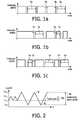
- FIG. 1 ashows a fixed rate pulse-width modulated radiation
- FIG. 1 bshows a varied pulse-width modulated radiation
- FIG. 1 cshows an alternative pulse-width modulated radiation
- FIG. 2shows a LED current as the function of time comprising two hysteretic bandwidths
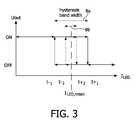
- FIG. 3shows a transfer function of a hysteretic controller with two hysteretic bandwidths
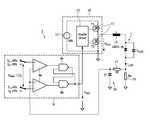
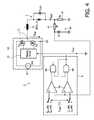
- FIG. 4shows the LED with a LED driver circuit and a light modulator circuit
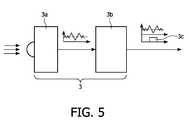
- FIG. 5shows a detecting unit for the data signal being transmitted via the generated radiation.
- FIG. 1 aillustrates a pulse-width modulated signal for modulating the radiation of at least one LED.
- a designed on/off schemeis used to provide illumination, wherein simultaneously data signals are transmitted.
- FIG. 1 ashows the modulation signal of one LED, wherein the LED is alternately switched on and switched off.
- the pulse width modulationprovides an intensity of brightness perceived by the human eye of approximately 80%. In other words, the LED is always completely on (100% intensity) or completely off (0% intensity). The 80% “perceived” intensity by the human eye is caused by the fact that the LED is switched on at 100% intensity for exactly 80% of the time.
- 1 c80% intensity perceived by the human eye is achieved, although the pulse-width 7 a and the time 7 b between each pulses are varied. Depending on the switching time, which can be achieved with a specific LED, the amount of information of data increases roughly linearly.
- the pulse-width 7 a and/or the time 7 b between two subsequent pulsescan correspond to certain information of data.
- Driving the LED with a specific scheme according to FIG. 1 b or FIG. 1 c data informationcan be embedded in the normal illumination. Because of the high frequency the additional generated data signals being transmitted via the generated radiation are not visible. However, at much higher frequencies, in the order of 1 MHz, a completely different signal can be transmitted. Also, no spatial resolution is present; a lot of information can be still transmitted. Using a LED-based projector generating said radiation, the human eye just sees the video content without detecting the transmitted data signals comprising these high frequencies.
- Said data informationwhich is embedded in the generated illumination, can serve for various purposes.
- Home lighting systemscan be built to react to this data signals.
- an atmospherecan be created following a video content comprising a generated radiation, with a superimposed, non-visible data signal.
- a flash of the home lighting systemcan accompany explosions in the video movie.
- a “dim all” data signalcan be embedded at the start of any movie. In this way there is no need for wiring between the home lighting system and the projector or television.
- the projectorcan transmit data signals via the generated radiation to a remote control being a detecting unit.
- the generated data signalscan be provided for copy protection.
- a movie in a movie theatrecan comprise a “no copy” flag embedded in a data signal, which is transmitted to a camera being in the movie theatre for coping the movie illegally. Because of the “no copy” signal the camera refuses to record said movie.
- this inventioncan also be applied to LCD-TVs with a LED-backlight, which use the same principle as LED-based projectors.
- the controller 2 coupled to the LED 1is configured in such a way, that a current 8 is modulated with at least two hysteretic bandwidths 8 a , 8 b , which drive the LED 1 for radiation without changing essentially the mean current 8 c of the LED 1 .
- the LED 1is not switched off, only the intensity is varied by a specific modulation of the hysteretic controller 2 .
- the generated current 8has a first bandwidth 8 a comprising at least a first information of data and a second bandwidth 8 b comprising at least a second information of data.
- the hysteretic controller 2 as illustrated in FIG. 4realizes this kind of modulation scheme.
- the occurrence of the following maxima or two following minima of the same bandwidth 8 a , 8 bcorresponds to one bit of data.
- the occurrence of the following maxima or minima of the first, broad bandwidth 8 acan stand for the logical “1” and the occurrence of the following maxima or minima of the second, narrow bandwidth 8 b can correspond to the logical “0” or vice versa.
- the hysteretic controller 2comprises a light modulator circuit 9 and a LED driver circuit 10 .
- the light modulator circuit 9consists of a pair of comparators 9 a and two NAND gates 9 b including a transfer function with said two hysteretic bandwidths 8 a , 8 b .
- the LED driver circuit 10comprises two transistors 11 , a dc power source 12 and a mosfet driver 13 . Before the LEDs 1 an inductor element 14 is positioned.
- the hysteretic controller 2comprises a shunt resistor R s 15 , a filter C f 16 , R f 17 eliminating high frequency noise of the voltage across the resistor R s 15 .
- the filtered shunt voltageis compared to two reference voltages i 1+ x Rs and i 1 ⁇ x Rs or
- the modulator circuit 9switches the LED driver 10 in two states.
- the current waveform according to FIG. 2can be achieved by using the transfer function as shown in FIG. 3 .
- a transistor t 1is switched on, wherein the voltage V dc drives the series connection of the inductor L 14 and the LED 1 .
- V dcdrives the series connection of the inductor L 14 and the LED 1 .
- V dcdrives the series connection of the inductor L 14 and the LED 1 .
- V dc>>V LED
- the LED current 8rises linearly.
- the transistor t 1is switched on at the LED current i ⁇ 1 or i ⁇ 2 whereas the transistor t 2 is switched on at the LED current i+ 2 or i+ 1 .
- a zigzag LED current traceis achievable according to FIG. 2 .
- the broad hysteretic bandwidth 8 acorresponds to a logical “1” and the narrow bandwidth 8 b corresponds to a logical “0”.
- the frequency of a current 8is preferably greater than 20 kHz.
- FIG. 5shows a preferred embodiment of a detecting unit 3 , comprising a detecting element 3 a for sensing the data signals and a signal analyzer 3 b to demodulate the data signals in order to generate a bit stream 3 c of data.
Landscapes
- Engineering & Computer Science (AREA)
- Physics & Mathematics (AREA)
- Electromagnetism (AREA)
- Computer Networks & Wireless Communication (AREA)
- Signal Processing (AREA)
- Computing Systems (AREA)
- Circuit Arrangement For Electric Light Sources In General (AREA)
- Electroluminescent Light Sources (AREA)
- Control Of Indicators Other Than Cathode Ray Tubes (AREA)
- Optical Communication System (AREA)
- Liquid Crystal (AREA)
Abstract
Description
- 1 Light-emitting element, LED
- 2 controller, hysteretic controller
- 3 detecting unit
- 3adetecting element
- 3bsignal analyser
- 3cbitstream
- 7apulse-width
- 7btime between two adjacent pulses
- 8 current
- 8ahysteretic bandwidth
- 8bhysteretic bandwidth
- 8cmean current
- 9 light modulator circuit
- 9acomparator
- 9bNAND gate
- 10 LED driver circuit
- 11 transistor t1, t2
- 12 power source
- 13 mosfet driver
- 14 inductor element L
- 15 shunt resistor Rs
- 16 filter Cf
- filter Rf
Claims (16)
Applications Claiming Priority (4)
| Application Number | Priority Date | Filing Date | Title |
|---|---|---|---|
| EP06110607 | 2006-03-02 | ||
| EP06110607 | 2006-03-02 | ||
| EP06110607.6 | 2006-03-02 | ||
| PCT/IB2007/050542WO2007099472A1 (en) | 2006-03-02 | 2007-02-20 | A lighting device |
Publications (2)
| Publication Number | Publication Date |
|---|---|
| US20090169215A1 US20090169215A1 (en) | 2009-07-02 |
| US8150269B2true US8150269B2 (en) | 2012-04-03 |
Family
ID=38163317
Family Applications (1)
| Application Number | Title | Priority Date | Filing Date |
|---|---|---|---|
| US12/280,707Expired - Fee RelatedUS8150269B2 (en) | 2006-03-02 | 2007-02-20 | Lighting device |
Country Status (7)
| Country | Link |
|---|---|
| US (1) | US8150269B2 (en) |
| EP (1) | EP1994656B1 (en) |
| JP (1) | JP4975048B2 (en) |
| KR (1) | KR101345357B1 (en) |
| CN (1) | CN101395826B (en) |
| RU (1) | RU2428797C2 (en) |
| WO (1) | WO2007099472A1 (en) |
Cited By (5)
| Publication number | Priority date | Publication date | Assignee | Title |
|---|---|---|---|---|
| US20100135669A1 (en)* | 2008-11-28 | 2010-06-03 | Daeho Kim | Visible light communication apparatus and visible light communciation method |
| US20110293286A1 (en)* | 2010-05-25 | 2011-12-01 | Leddynamics, Inc. | Method for optical data transmission using existing indicator or illumination lamp |
| US20120086345A1 (en)* | 2011-11-20 | 2012-04-12 | Tran Bao Q | Solid state light system with broadband optical communication capability |
| US9825703B2 (en) | 2014-09-26 | 2017-11-21 | Industrial Technology Research Institute | Optical communication device and control method thereof |
| US10128946B2 (en) | 2016-08-09 | 2018-11-13 | Industrial Technology Research Institute | Visible light communication device and driving method thereof |
Families Citing this family (15)
| Publication number | Priority date | Publication date | Assignee | Title |
|---|---|---|---|---|
| TW200950590A (en) | 2008-01-30 | 2009-12-01 | Koninkl Philips Electronics Nv | Lighting system and method for operating a lighting system |
| JP5141277B2 (en) | 2008-02-08 | 2013-02-13 | ソニー株式会社 | Lighting period setting method, display panel driving method, backlight driving method, lighting period setting device, semiconductor device, display panel, and electronic apparatus |
| JP5211732B2 (en)* | 2008-02-14 | 2013-06-12 | ソニー株式会社 | Lighting period setting method, display panel driving method, lighting condition setting device, semiconductor device, display panel, and electronic apparatus |
| KR101583729B1 (en) | 2009-05-28 | 2016-01-11 | 삼성디스플레이 주식회사 | Display apparatus |
| US8731406B2 (en)* | 2009-09-16 | 2014-05-20 | Samsung Electronics Co., Ltd. | Apparatus and method for generating high resolution frames for dimming and visibility support in visible light communication |
| EP2330756A1 (en)* | 2009-12-04 | 2011-06-08 | Hella KGaA Hueck & Co. | Device for transmitting data over illuminants |
| JP6058636B2 (en)* | 2011-05-06 | 2017-01-11 | フィリップス ライティング ホールディング ビー ヴィ | Lighting device and receiver |
| US8913893B2 (en)* | 2011-07-01 | 2014-12-16 | Electronics And Telecommunications Research Institute | Visible light communication apparatus capable of minute dimming control and method using the same |
| ES2659037T3 (en)* | 2012-01-17 | 2018-03-13 | Philips Lighting Holding B.V. | Visible light communications using a remote control |
| RU2590894C2 (en)* | 2012-04-05 | 2016-07-10 | Абб Аг | System for control of lighting installation |
| CN203519822U (en)* | 2013-04-09 | 2014-04-02 | 北京半导体照明科技促进中心 | Visible-light-based indoor positioning device and system |
| JP6480652B2 (en)* | 2013-07-10 | 2019-03-13 | パナソニック株式会社 | Visible light communication device, lighting apparatus using the same, and lighting system |
| DE102013109085A1 (en)* | 2013-08-22 | 2015-02-26 | Inotec Sicherheitstechnik Gmbh | Method for providing luminaire parameters at an interface of a luminaire, luminaire with an interface for reading luminaire parameters and device for reading out the luminaire parameters |
| CN107707304B (en)* | 2017-10-20 | 2020-01-14 | 深圳创维-Rgb电子有限公司 | Information transmission method based on visible light communication, television and storage device |
| RU197284U1 (en)* | 2019-12-27 | 2020-04-17 | федеральное государственное автономное образовательное учреждение высшего образования "Национальный исследовательский университет ИТМО" (Университет ИТМО) | Radiation flow control device |
Citations (11)
| Publication number | Priority date | Publication date | Assignee | Title |
|---|---|---|---|---|
| US20020047646A1 (en) | 1997-08-26 | 2002-04-25 | Ihor Lys | Lighting entertainment system |
| US6515434B1 (en) | 1999-10-18 | 2003-02-04 | Patent-Treuhand-Gesellschaft Fuer Elektrische Gluehlampen Mbh | Control circuit for LED and corresponding operating method |
| US20030030386A1 (en) | 1998-04-15 | 2003-02-13 | Leeb Steven B. | Non-flickering illumination based communication |
| US20040091110A1 (en) | 2002-11-08 | 2004-05-13 | Anthony Christian Barkans | Copy protected display screen |
| US20040101312A1 (en) | 2002-08-29 | 2004-05-27 | Florencio Cabrera | AC power source light modulation network |
| JP2004221747A (en) | 2003-01-10 | 2004-08-05 | Global Com:Kk | Illuminating light communication system |
| WO2004100614A1 (en) | 2003-05-07 | 2004-11-18 | Koninklijke Philips Electronics N.V. | Current control method and circuit for light emitting diodes |
| US20050041161A1 (en) | 1997-12-17 | 2005-02-24 | Color Kinetics, Incorporated | Systems and methods for digital entertainment |
| US20060056855A1 (en)* | 2002-10-24 | 2006-03-16 | Masao Nakagawa | Illuminative light communication device |
| GB2424777A (en) | 2005-04-01 | 2006-10-04 | Agilent Technologies Inc | Transmitting a wake-up instruction to a receiving device by modulating data on illumination light, such as that provided by an electroluminescent room light. |
| US20060239689A1 (en)* | 2005-01-25 | 2006-10-26 | Tir Systems, Ltd. | Method and apparatus for illumination and communication |
Family Cites Families (8)
| Publication number | Priority date | Publication date | Assignee | Title |
|---|---|---|---|---|
| JPH01122220A (en)* | 1987-11-05 | 1989-05-15 | Seiko Instr & Electron Ltd | Ceiling information transmission system |
| JP2842762B2 (en)* | 1993-06-30 | 1999-01-06 | シャープ株式会社 | Infrared data transfer device |
| JP2002511727A (en)* | 1998-04-15 | 2002-04-16 | トーキング ライツ エルエルシー | Multi-function electronic transceiver for wireless networks |
| RU2192710C2 (en)* | 2000-03-09 | 2002-11-10 | Московский государственный институт электронной техники (технический университет) | Method and device for data reception and transmission with aid of optical signal |
| JP4089370B2 (en)* | 2002-09-24 | 2008-05-28 | 東芝ライテック株式会社 | Lighting device and lighting system |
| EP1636925A1 (en)* | 2003-06-10 | 2006-03-22 | Koninklijke Philips Electronics N.V. | Led system for illumination and data transmission |
| CN1802880B (en)* | 2003-06-10 | 2011-07-06 | 皇家飞利浦电子股份有限公司 | Optical output modulation for data transmission |
| US7570246B2 (en)* | 2005-08-01 | 2009-08-04 | Avago Technologies Ecbu Ip (Singapore) Pte. Ltd. | Method and apparatus for communication using pulse-width-modulated visible light |
- 2007
- 2007-02-20EPEP07713154.8Apatent/EP1994656B1/ennot_activeNot-in-force
- 2007-02-20JPJP2008556883Apatent/JP4975048B2/ennot_activeExpired - Fee Related
- 2007-02-20CNCN2007800075260Apatent/CN101395826B/ennot_activeExpired - Fee Related
- 2007-02-20WOPCT/IB2007/050542patent/WO2007099472A1/enactiveApplication Filing
- 2007-02-20KRKR1020087024118Apatent/KR101345357B1/ennot_activeExpired - Fee Related
- 2007-02-20RURU2008139091/09Apatent/RU2428797C2/ennot_activeIP Right Cessation
- 2007-02-20USUS12/280,707patent/US8150269B2/ennot_activeExpired - Fee Related
Patent Citations (11)
| Publication number | Priority date | Publication date | Assignee | Title |
|---|---|---|---|---|
| US20020047646A1 (en) | 1997-08-26 | 2002-04-25 | Ihor Lys | Lighting entertainment system |
| US20050041161A1 (en) | 1997-12-17 | 2005-02-24 | Color Kinetics, Incorporated | Systems and methods for digital entertainment |
| US20030030386A1 (en) | 1998-04-15 | 2003-02-13 | Leeb Steven B. | Non-flickering illumination based communication |
| US6515434B1 (en) | 1999-10-18 | 2003-02-04 | Patent-Treuhand-Gesellschaft Fuer Elektrische Gluehlampen Mbh | Control circuit for LED and corresponding operating method |
| US20040101312A1 (en) | 2002-08-29 | 2004-05-27 | Florencio Cabrera | AC power source light modulation network |
| US20060056855A1 (en)* | 2002-10-24 | 2006-03-16 | Masao Nakagawa | Illuminative light communication device |
| US20040091110A1 (en) | 2002-11-08 | 2004-05-13 | Anthony Christian Barkans | Copy protected display screen |
| JP2004221747A (en) | 2003-01-10 | 2004-08-05 | Global Com:Kk | Illuminating light communication system |
| WO2004100614A1 (en) | 2003-05-07 | 2004-11-18 | Koninklijke Philips Electronics N.V. | Current control method and circuit for light emitting diodes |
| US20060239689A1 (en)* | 2005-01-25 | 2006-10-26 | Tir Systems, Ltd. | Method and apparatus for illumination and communication |
| GB2424777A (en) | 2005-04-01 | 2006-10-04 | Agilent Technologies Inc | Transmitting a wake-up instruction to a receiving device by modulating data on illumination light, such as that provided by an electroluminescent room light. |
Cited By (15)
| Publication number | Priority date | Publication date | Assignee | Title |
|---|---|---|---|---|
| US8630549B2 (en)* | 2008-11-28 | 2014-01-14 | Electronics & Telecommunications Research Institute | Visible light communication apparatus and visible light communciation method |
| US20100135669A1 (en)* | 2008-11-28 | 2010-06-03 | Daeho Kim | Visible light communication apparatus and visible light communciation method |
| US20110293286A1 (en)* | 2010-05-25 | 2011-12-01 | Leddynamics, Inc. | Method for optical data transmission using existing indicator or illumination lamp |
| US9192030B2 (en)* | 2011-11-20 | 2015-11-17 | Bao Tran | Solid state light system with broadband optical communication capability |
| US8547036B2 (en)* | 2011-11-20 | 2013-10-01 | Available For Licensing | Solid state light system with broadband optical communication capability |
| US20140346972A1 (en)* | 2011-11-20 | 2014-11-27 | Bao Tran | Solid state light system with broadband optical communication capability |
| US20120086345A1 (en)* | 2011-11-20 | 2012-04-12 | Tran Bao Q | Solid state light system with broadband optical communication capability |
| US20160309565A1 (en)* | 2011-11-20 | 2016-10-20 | Bao Tran | Solid state light system with broadband optical communication capability |
| US20170273162A1 (en)* | 2011-11-20 | 2017-09-21 | Bao Tran | Smart light |
| US9826597B2 (en)* | 2011-11-20 | 2017-11-21 | Bao Tran | Solid state light system with broadband optical communication capability |
| US9924579B2 (en)* | 2011-11-20 | 2018-03-20 | Bao Tran | Smart light |
| US20180177028A1 (en)* | 2011-11-20 | 2018-06-21 | Bao Tran | Smart light system |
| US10111305B2 (en)* | 2011-11-20 | 2018-10-23 | Bao Tran | Smart light system |
| US9825703B2 (en) | 2014-09-26 | 2017-11-21 | Industrial Technology Research Institute | Optical communication device and control method thereof |
| US10128946B2 (en) | 2016-08-09 | 2018-11-13 | Industrial Technology Research Institute | Visible light communication device and driving method thereof |
Also Published As
| Publication number | Publication date |
|---|---|
| RU2428797C2 (en) | 2011-09-10 |
| JP4975048B2 (en) | 2012-07-11 |
| WO2007099472A1 (en) | 2007-09-07 |
| KR101345357B1 (en) | 2013-12-30 |
| RU2008139091A (en) | 2010-04-10 |
| KR20090004902A (en) | 2009-01-12 |
| US20090169215A1 (en) | 2009-07-02 |
| CN101395826A (en) | 2009-03-25 |
| JP2009528750A (en) | 2009-08-06 |
| WO2007099472A8 (en) | 2008-08-21 |
| CN101395826B (en) | 2012-04-11 |
| EP1994656A1 (en) | 2008-11-26 |
| EP1994656B1 (en) | 2016-11-09 |
Similar Documents
| Publication | Publication Date | Title |
|---|---|---|
| US8150269B2 (en) | Lighting device | |
| EP2168118B1 (en) | Driving circuit for driving a plurality of light sources arranged in a series configuration | |
| EP2940901A1 (en) | Display method | |
| JP6122568B2 (en) | Backlight drive substrate and liquid crystal display device | |
| WO2003023752A1 (en) | El display, el display driving circuit and image display | |
| NL1040869B1 (en) | A method for driving a light source, a driver system to drive a light source and a luminaire comprising said light source and driver system. | |
| JP2012103538A (en) | Backlight device, image display system including the same device, and lighting system | |
| US12345879B2 (en) | Circuit and controller for increased bit depth in high frame rate applications | |
| US20090057534A1 (en) | Light source device | |
| US7285923B2 (en) | Display apparatus and driving pulse control method thereof | |
| US8760383B2 (en) | Backlight module for displays | |
| US20110234579A1 (en) | Apparatus and method for driving light emitting diode | |
| TWI345741B (en) | Circuit and method for driving backlight module | |
| EP1705633A2 (en) | Light emitting device single-cluster lamp control system | |
| KR101379968B1 (en) | Apparatus, system and method for communicating data using light | |
| TW201301941A (en) | Control circuit and dimming method of light emitting diode | |
| KR20170020097A (en) | Apparatus for driving of light emitting diode array and liquid crystal display device comprising the same | |
| CN1258169C (en) | Double-voltage electric power equipment | |
| CN119479566B (en) | Brightness adjustment method, backlight driving module, electronic device and storage medium | |
| KR102453564B1 (en) | Backlight unit and display device including the same | |
| WO2023081154A1 (en) | Adaptive flash with pulse width modulation | |
| Chi et al. | Color Overlapping Method of Projection System on LEDs | |
| TW201600795A (en) | Dimming circuit and LED power supply device having the same | |
| KR20150060219A (en) | Power device for LED lighting |
Legal Events
| Date | Code | Title | Description |
|---|---|---|---|
| AS | Assignment | Owner name:KONINKLIJKE PHILIPS ELECTRONICS N V, NETHERLANDS Free format text:ASSIGNMENT OF ASSIGNORS INTEREST;ASSIGNORS:SAUERLANDER, GEORG;SALTERS, BART ANDRE;REEL/FRAME:021441/0695;SIGNING DATES FROM 20070221 TO 20070222 Owner name:KONINKLIJKE PHILIPS ELECTRONICS N V, NETHERLANDS Free format text:ASSIGNMENT OF ASSIGNORS INTEREST;ASSIGNORS:SAUERLANDER, GEORG;SALTERS, BART ANDRE;SIGNING DATES FROM 20070221 TO 20070222;REEL/FRAME:021441/0695 | |
| STCF | Information on status: patent grant | Free format text:PATENTED CASE | |
| FPAY | Fee payment | Year of fee payment:4 | |
| AS | Assignment | Owner name:KONINKLIJKE PHILIPS N.V., NETHERLANDS Free format text:CHANGE OF NAME;ASSIGNOR:KONINKLIJKE PHILIPS ELECTRONICS N.V.;REEL/FRAME:039428/0606 Effective date:20130515 | |
| AS | Assignment | Owner name:PHILIPS LIGHTING HOLDING B.V., NETHERLANDS Free format text:ASSIGNMENT OF ASSIGNORS INTEREST;ASSIGNOR:KONINKLIJKE PHILIPS N.V.;REEL/FRAME:040060/0009 Effective date:20160607 | |
| FEPP | Fee payment procedure | Free format text:MAINTENANCE FEE REMINDER MAILED (ORIGINAL EVENT CODE: REM.); ENTITY STATUS OF PATENT OWNER: LARGE ENTITY | |
| LAPS | Lapse for failure to pay maintenance fees | Free format text:PATENT EXPIRED FOR FAILURE TO PAY MAINTENANCE FEES (ORIGINAL EVENT CODE: EXP.); ENTITY STATUS OF PATENT OWNER: LARGE ENTITY | |
| STCH | Information on status: patent discontinuation | Free format text:PATENT EXPIRED DUE TO NONPAYMENT OF MAINTENANCE FEES UNDER 37 CFR 1.362 | |
| FP | Lapsed due to failure to pay maintenance fee | Effective date:20200403 |