US8127794B2 - Dispenser arrangement for fluidic dispensing control in microfluidic system - Google Patents
Dispenser arrangement for fluidic dispensing control in microfluidic systemDownload PDFInfo
- Publication number
- US8127794B2 US8127794B2US12/441,963US44196309AUS8127794B2US 8127794 B2US8127794 B2US 8127794B2US 44196309 AUS44196309 AUS 44196309AUS 8127794 B2US8127794 B2US 8127794B2
- Authority
- US
- United States
- Prior art keywords
- holding area
- fluid holding
- dispenser arrangement
- fluid
- dispenser
- Prior art date
- Legal status (The legal status is an assumption and is not a legal conclusion. Google has not performed a legal analysis and makes no representation as to the accuracy of the status listed.)
- Expired - Fee Related, expires
Links
- 239000012530fluidSubstances0.000claimsabstractdescription242
- 239000000758substrateSubstances0.000claimsabstractdescription53
- 238000007789sealingMethods0.000claimsabstractdescription40
- 238000004891communicationMethods0.000claimsabstractdescription9
- 239000000463materialSubstances0.000claimsdescription56
- 229920001971elastomerPolymers0.000claimsdescription22
- 239000000806elastomerSubstances0.000claimsdescription18
- 230000003287optical effectEffects0.000claimsdescription5
- 239000003292glueSubstances0.000claimsdescription3
- 238000001746injection mouldingMethods0.000claimsdescription3
- 239000000126substanceSubstances0.000claimsdescription3
- 238000001721transfer mouldingMethods0.000claimsdescription3
- 238000003466weldingMethods0.000claimsdescription3
- 239000003153chemical reaction reagentSubstances0.000description30
- 239000004205dimethyl polysiloxaneSubstances0.000description13
- 229920000435poly(dimethylsiloxane)Polymers0.000description13
- 230000000994depressogenic effectEffects0.000description11
- LFQSCWFLJHTTHZ-UHFFFAOYSA-NEthanolChemical compoundCCOLFQSCWFLJHTTHZ-UHFFFAOYSA-N0.000description10
- 229920000089Cyclic olefin copolymerPolymers0.000description8
- 239000004713Cyclic olefin copolymerSubstances0.000description8
- 239000003570airSubstances0.000description8
- 238000002032lab-on-a-chipMethods0.000description8
- 239000007788liquidSubstances0.000description8
- 239000004417polycarbonateSubstances0.000description7
- 229920000515polycarbonatePolymers0.000description7
- 239000011521glassSubstances0.000description6
- 239000000919ceramicSubstances0.000description5
- 238000011109contaminationMethods0.000description5
- 230000001276controlling effectEffects0.000description5
- 239000012528membraneSubstances0.000description5
- 238000000034methodMethods0.000description5
- 239000004033plasticSubstances0.000description5
- 229920003023plasticPolymers0.000description5
- 150000003839saltsChemical class0.000description5
- 239000010703siliconSubstances0.000description5
- 229910052710siliconInorganic materials0.000description5
- 229920001169thermoplasticPolymers0.000description5
- 239000004416thermosoftening plasticSubstances0.000description5
- XLYOFNOQVPJJNP-UHFFFAOYSA-NwaterSubstancesOXLYOFNOQVPJJNP-UHFFFAOYSA-N0.000description5
- 239000002184metalSubstances0.000description4
- 239000005060rubberSubstances0.000description4
- 239000000560biocompatible materialSubstances0.000description3
- 238000005266castingMethods0.000description3
- 230000008859changeEffects0.000description3
- -1polydimethylsiloxanePolymers0.000description3
- 229920001296polysiloxanePolymers0.000description3
- 238000002174soft lithographyMethods0.000description3
- 238000003860storageMethods0.000description3
- 238000004458analytical methodMethods0.000description2
- 239000008280bloodSubstances0.000description2
- 210000004369bloodAnatomy0.000description2
- 238000006073displacement reactionMethods0.000description2
- 238000004519manufacturing processMethods0.000description2
- 238000005259measurementMethods0.000description2
- 230000007246mechanismEffects0.000description2
- 229920003229poly(methyl methacrylate)Polymers0.000description2
- 229920000642polymerPolymers0.000description2
- 239000004926polymethyl methacrylateSubstances0.000description2
- 230000008569processEffects0.000description2
- 230000001105regulatory effectEffects0.000description2
- 239000002023woodSubstances0.000description2
- 238000007400DNA extractionMethods0.000description1
- 238000000018DNA microarrayMethods0.000description1
- 239000004593EpoxySubstances0.000description1
- 238000002123RNA extractionMethods0.000description1
- 238000013459approachMethods0.000description1
- 238000012742biochemical analysisMethods0.000description1
- 230000000903blocking effectEffects0.000description1
- 238000012864cross contaminationMethods0.000description1
- 230000007423decreaseEffects0.000description1
- 238000001514detection methodMethods0.000description1
- 238000011161developmentMethods0.000description1
- 230000000694effectsEffects0.000description1
- 238000004049embossingMethods0.000description1
- 238000005516engineering processMethods0.000description1
- 238000011010flushing procedureMethods0.000description1
- 238000003780insertionMethods0.000description1
- 230000037431insertionEffects0.000description1
- 230000010354integrationEffects0.000description1
- 230000001788irregularEffects0.000description1
- 238000000520microinjectionMethods0.000description1
- 238000012986modificationMethods0.000description1
- 230000004048modificationEffects0.000description1
- 238000000465mouldingMethods0.000description1
- 230000007935neutral effectEffects0.000description1
- 238000012536packaging technologyMethods0.000description1
- 230000000149penetrating effectEffects0.000description1
- 230000000704physical effectEffects0.000description1
- 239000003566sealing materialSubstances0.000description1
- 239000012780transparent materialSubstances0.000description1
Images







Classifications
- F—MECHANICAL ENGINEERING; LIGHTING; HEATING; WEAPONS; BLASTING
- F15—FLUID-PRESSURE ACTUATORS; HYDRAULICS OR PNEUMATICS IN GENERAL
- F15C—FLUID-CIRCUIT ELEMENTS PREDOMINANTLY USED FOR COMPUTING OR CONTROL PURPOSES
- F15C5/00—Manufacture of fluid circuit elements; Manufacture of assemblages of such elements integrated circuits
- Y—GENERAL TAGGING OF NEW TECHNOLOGICAL DEVELOPMENTS; GENERAL TAGGING OF CROSS-SECTIONAL TECHNOLOGIES SPANNING OVER SEVERAL SECTIONS OF THE IPC; TECHNICAL SUBJECTS COVERED BY FORMER USPC CROSS-REFERENCE ART COLLECTIONS [XRACs] AND DIGESTS
- Y10—TECHNICAL SUBJECTS COVERED BY FORMER USPC
- Y10T—TECHNICAL SUBJECTS COVERED BY FORMER US CLASSIFICATION
- Y10T137/00—Fluid handling
- Y10T137/206—Flow affected by fluid contact, energy field or coanda effect [e.g., pure fluid device or system]
- Y10T137/218—Means to regulate or vary operation of device
- Y—GENERAL TAGGING OF NEW TECHNOLOGICAL DEVELOPMENTS; GENERAL TAGGING OF CROSS-SECTIONAL TECHNOLOGIES SPANNING OVER SEVERAL SECTIONS OF THE IPC; TECHNICAL SUBJECTS COVERED BY FORMER USPC CROSS-REFERENCE ART COLLECTIONS [XRACs] AND DIGESTS
- Y10—TECHNICAL SUBJECTS COVERED BY FORMER USPC
- Y10T—TECHNICAL SUBJECTS COVERED BY FORMER US CLASSIFICATION
- Y10T137/00—Fluid handling
- Y10T137/206—Flow affected by fluid contact, energy field or coanda effect [e.g., pure fluid device or system]
- Y10T137/218—Means to regulate or vary operation of device
- Y10T137/2202—By movable element
- Y10T137/2213—Electrically-actuated element [e.g., electro-mechanical transducer]
- Y—GENERAL TAGGING OF NEW TECHNOLOGICAL DEVELOPMENTS; GENERAL TAGGING OF CROSS-SECTIONAL TECHNOLOGIES SPANNING OVER SEVERAL SECTIONS OF THE IPC; TECHNICAL SUBJECTS COVERED BY FORMER USPC CROSS-REFERENCE ART COLLECTIONS [XRACs] AND DIGESTS
- Y10—TECHNICAL SUBJECTS COVERED BY FORMER USPC
- Y10T—TECHNICAL SUBJECTS COVERED BY FORMER US CLASSIFICATION
- Y10T137/00—Fluid handling
- Y10T137/206—Flow affected by fluid contact, energy field or coanda effect [e.g., pure fluid device or system]
- Y10T137/218—Means to regulate or vary operation of device
- Y10T137/2202—By movable element
- Y10T137/2218—Means [e.g., valve] in control input
- Y—GENERAL TAGGING OF NEW TECHNOLOGICAL DEVELOPMENTS; GENERAL TAGGING OF CROSS-SECTIONAL TECHNOLOGIES SPANNING OVER SEVERAL SECTIONS OF THE IPC; TECHNICAL SUBJECTS COVERED BY FORMER USPC CROSS-REFERENCE ART COLLECTIONS [XRACs] AND DIGESTS
- Y10—TECHNICAL SUBJECTS COVERED BY FORMER USPC
- Y10T—TECHNICAL SUBJECTS COVERED BY FORMER US CLASSIFICATION
- Y10T137/00—Fluid handling
- Y10T137/206—Flow affected by fluid contact, energy field or coanda effect [e.g., pure fluid device or system]
- Y10T137/2224—Structure of body of device
Definitions
- the present inventionrelates to the field of microfluidic systems, and in particular, to a dispenser arrangement for fluidic dispensing control into a microfluidic component such as channel, mixer, valve, pump, reservoir but not so limited in a microfluidic system.
- Microfluidic systemssuch as microfluidic devices, cartridges, packages, lab-on-a-chip (LOC) and micro total analysis system (micro-TAS) for example require fluidic dispensing control to realize particular protocol.
- Fluidic dispensing controlincludes controlling of the fluids' flow sequence, flow duration, flow direction and flow rate.
- a microfluidic system with multiple fluids or reagentsneeds to have a mechanism to control dispensing of each fluid or reagent so as to follow individual flow protocol. At the same time, the reagents' cross mixing arising to contamination in the microfluidic system should be avoided.
- microfluidic systemsrequire pre-storage of reagents in integrated reservoirs. Besides storage function, these reservoirs also need dispensing mechanism, which pushes the reagents into the microfluidic system during operation. After the reagents are fully dispensed, the dispenser should close to avoid flow of other reagents into the reservoir.
- the publication “Disposable Smart Lab on a Chip for Point-of-Care Clinical Diagnostics”, Chong H. A. et al, Proceedings of the IEEE, Vol. 92, No. 1, (January 2004), pp. 154-173discloses a micro-dispenser module in a microfluidic LOC device.
- a sample fluid volumeis loaded into the fixed-volume metering micro-dispenser, which in turn dispenses an exact volume of liquid for further biochemical analysis.
- the sample fluidis introduced through a fluid inlet at a low flow rate.
- the fluidpasses through a first passive valve and a narrow channel to enter a reservoir.
- a second passive valve at the end of the reservoirprevents the fluid from leaving the reservoir.
- applied fluid driving pressure and passive valveare used to control fluid flow within the reservoir.
- the passive valveis embedded in micro-channel structures and controls the fluid flow without any actuators.
- the key principle of the passive valveis that the fluid flow through a main channel and surface tension causes the fluid to stop before a valve gap.
- the valveis closed in the initial stage. To open the valve, a threshold pressure is applied. Fluid will then pass through the valve.
- threshold pressure and passive valveare used to control fluid flow within a disposable bio-microfluidic package.
- U.S. patent application Ser. No. 11/096,035discloses microfluidic circuits including triggerable passive valves, connected in series or in parallel.
- a triggerable passive valve arrangementincludes a flow restrictor, a pressurizing device, and a passive valve, connected with a fluid delivery channel.
- the triggerable passive valveacts upon a sample liquid. As the sample liquid flows into the fluid delivery channel, it stops at the passive valve. For flow to occur beyond the passive valve, the pressure of the sample liquid must exceed the burst pressure of the passive valve. The burst pressure of the passive valve is determined by its geometry and physical properties.
- the pressurizing deviceexerts pressure on the sample liquid when activated, increasing its pressure to a value higher than the burst pressure of the passive valve, causing the sample liquid to move past the passive valve. Most of the sample liquid flows in the direction of the passive valve, rather than in the direction of the flow restrictor. This is because the flow restrictor has a higher resistance to flow once the passive valve has been breached. Once flow beyond the passive valve occurs, the pressure exerted upon the sample liquid by the pressurizing device can be removed. According to U.S. patent application Ser. No. 11/096,035, applied fluid driving pressure and passive valve are used to control fluid flow.
- U.S. patent application Ser. No. 09/985943discloses microfluidic flow control devices.
- Each microfluidic flow control deviceincludes a regulating device having two overlapping channel segments separated by a deformable membrane in fluid communication with one another.
- the deformable membraneis responsive to changes in pressure between two channel segments. When the pressures in the channel segments are substantially the same, the deformable membrane adopts a neutral position. If the pressure in either channel segment is increased, then the deformable membrane will deform towards the other channel segment.
- the regulating deviceuses pressure to control the direction of deformation of the membrane, thereby controlling the flow of fluid.
- an objective of the present inventionis to provide an alternative dispenser arrangement that can control dispensing of fluid and fluid flow rate in microfluidic systems, thereby advantageously avoids or reduces some of the above-mentioned drawbacks of prior art devices.
- the inventionprovides a dispenser arrangement for fluidic dispensing control into a microfluidic component comprising an enclosed fluid holding area and a valve adapted to be movable between an open position and a closed position and positioned at least partially in the fluid holding area.
- the valvecomprises an elongated hollow portion having a body and two ends adapted for fluid flow from the fluid holding area to the microfluidic component in the open position, wherein the first end of the hollow portion is sealed such that it prevents fluid from entering the first end and wherein the first end is positioned within the fluid holding area.
- the valvefurther comprises a first opening on the body of the hollow portion positioned within the fluid holding area allowing fluid communication from the fluid holding area to the microfluidic component in the open position and a slant second opening at the second end of the hollow portion positioned outside of the fluid holding area.
- the slant second openingis adapted to pierce through a sealing layer covering the microfluidic component in the open position and to insert into a first substrate housing the microfluidic component in the closed position.
- microfluidic componentsinclude channels, mixers, valves, pumps, reservoirs but are not so limited.
- the channelscan have any suitable cross-sections and shapes, for example, circular, rectangle and triangle.
- Some examples of fluid holding areasinclude chambers and reservoirs but are not limited thereto.
- the valveis movable between a first closed position where the valve is not in contact with the microfluidic component and a second closed position. In the second closed position, the valve is in sealing connection with the microfluidic component when a force is exerted on the first end of the hollow portion.
- the open positionis an intermediate position between the first closed position and the second closed position.
- the slant second opening of the valveengages the microfluidic component, thereby allowing fluid communication from the fluid holding area to the microfluidic component.
- the fluid communicationallows fluid in the fluid holding area to flow in from the first opening and to flow out from the slant second opening into the microfluidic component.
- the first substratecomprises a deformable material such as an elastomer material but is not so limited.
- elastomer materialcomprise polydimethylsiloxane (PDMS) and rubber but are not so limited.
- the first substratecan also comprises a rigid material selected from the group consisting of cyclic olefin copolymer (COC), polycarbonate (PC), ceramic, glass, silicon, thermoplastic and Flame Resistant 4 (FR4) material but are not so limited.
- the enclosed fluid holding areais formed within a second substrate.
- the second substratecomprises a deformable material such as an elastomer material but is not so limited.
- elastomer materialcomprise polydimethylsiloxane and rubber but are not so limited.
- the second substratecan also comprise a rigid material selected from the group consisting of COC, PC, ceramic, glass, silicon, thermoplastic and FR4 material but are not so limited.
- the first substrate and the second substrateare adapted to be bonded by bonding means.
- the bonding meanscan comprise a double sided tape, glue, clipping means or the substrates are adapted to be bonded by pressure means, temperature means, ultrasonic means, thermosonic means, thermocompression means, laser welding means, transfer molding means, overmolding or injection molding.
- the bonding meanscan also be biocompatible.
- the enclosed fluid holding areais covered by a covering layer.
- the covering layermay comprise a deformable material such as elastomer but is not so limited. Some examples of elastomer material comprise polydimethylsiloxane and rubber but are not so limited.
- the covering layercan also comprise a rigid material selected from the group consisting of COC, PC, ceramic, glass, silicon and FR4 material but are not so limited.
- the covering layeris situated above the hollow portion and comprises a reinforced portion arranged such that it is in contact with the first end of the hollow portion when a force is exerted on the covering layer.
- the reinforced portioncan be of the same material as the covering layer but may be thicker in dimensions.
- the reinforced portioncan comprise a different material from the covering layer, usually the material for the reinforced portion is thicker in dimension or has a higher tensile strength and therefore is mechanically more resistant to stress.
- the reinforced portionprevents the covering layer from tearing when a force is exerted onto the covering layer towards the valve.
- Some examples of materials for the reinforced portioncould be polymethyl methacrylate (PMMA), COC or PC but are not so limited.
- the enclosed fluid holding areacomprises a base portion and a top portion.
- the top portion of the enclosed fluid holding areais proximal to the microfluidic component.
- the base portion of the enclosed fluid holding areais distal from the microfluidic channel component.
- the valveis sealed by three levels of sealing in the second closed position. Firstly, the sealing of the first end of the hollow portion is provided by a sealing portion connected to a first end of the hollow portion positioned within the fluid holding area. Secondly, the first opening on the body of the hollow portion is sealed by the first substrate in the second closed position. Thirdly, the slant second opening at the second end of the hollow portion is sealed by the first substrate in the second closed position.
- the fluid holding areawhen viewed from the top, has an essentially circular cross-sectional shape or a polygonal cross-sectional shape.
- the essentially circular shapecan be a circular shape or an elliptical shape.
- the polygonal shapemay be an essentially triangular shape, trapezoidal shape, rectangular shape (including a square shape), pentagonal shape, hexagonal shape, or octagonal shape.
- the fluid holding areatypically has a polygonal cross-sectional shape.
- the polygonal shapemay be an essentially trapezoidal shape, square shape, rectangular shape, pentagonal shape, hexagonal shape, or octagonal shape.
- the fluid holdingcan however also have geometrically irregular shapes.
- the base portion of the fluid holding areahas a wider cross-section area than the top portion.
- the fluid holding areacan also be a truncated cone for example.
- the microfluidic componentis adapted to accommodate the body of the hollow portion at an engagement region.
- the slant second opening of the valvemay engage the microfluidic component in the open position.
- the engagement regionhas a dimension larger than the body of the hollow portion of the valve.
- the force that is used to actuate the valveis provided by an actuator.
- the actuatorcan comprise a piston, an integrated micropump, or the actuation may be achieved by electrostatic means, pneumatic means, hydraulic means, electrical means, chemical means, magnetic means, thermal means, optical means or physical means.
- the present inventionalso provides for a dispenser unit comprising a dispenser arrangement and an actuator.
- the actuatormay be a piston, an integrated micropump or as the actuation may be achieved by electrostatic, pneumatic means, hydraulic means, electrical means, magnetic means, chemical means, thermal means, optical means or any other physical means.
- the actuatoris a cylinder having two ends.
- the cross-sectional area of each end of the cylindercan approximately be the same or smaller than the cross-sectional area of the top portion of the enclosed fluid holding area.
- FIG. 1Ashows a cross-sectional view of a valve according to an embodiment of the present invention
- FIG. 1Bshows a cross-sectional view of a valve having a plurality of openings on the body of the hollow portion according to another embodiment of the present invention
- FIG. 1Cshows a cross-sectional view of a valve with no sealing portion according to another embodiment of the present invention
- FIG. 2Ashows a cross-sectional view of a dispenser arrangement according to an embodiment of the present invention when the valve is in a starting closed position where the valve is not in contact with the microfluidic channel;
- FIG. 2Bshows a cross-sectional view of a dispenser arrangement according to an embodiment of the present invention when the valve is partially depressed into an intermediate open position where the valve engages the microfluidic channel;
- FIG. 2Cshows a cross-sectional view of a dispenser arrangement according to an embodiment of the present invention when the valve is further depressed at a constant rate to allow for dispensing of fluid into the microfluidic channel;
- FIG. 2Dshows a cross-sectional view of a dispenser arrangement according to an embodiment of the present invention when the valve is fully depressed into an ending closed position where the valve is sealed;
- FIG. 3shows top and cross-sectional views of two dispenser arrangements connected sequentially according to an embodiment of the present invention where a valve of a first dispenser arrangement is fully depressed into an ending closed position where the valve is sealed and a valve of a second dispenser arrangement is in an intermediate open position where the valve engages the microfluidic channel;
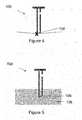
- FIG. 4shows a magnified cross-sectional view of a valve of a dispenser arrangement according to an embodiment of the present invention when the valve is depressed into an intermediate open position where the valve just engages the microfluidic channel as shown in FIG. 2B ;
- FIG. 5shows a magnified cross-sectional view of a valve of a dispenser arrangement according to an embodiment of the present invention when the valve is fully depressed into an ending closed position where the valve is sealed as shown in FIG. 2D ;
- FIG. 6shows a cross-sectional view of a dispenser arrangement according to an embodiment of the present invention showing a valve with no sealing portion and a covering layer with an reinforced portion;
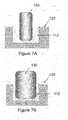
- FIG. 7Ashows a cross-sectional view of a dispenser arrangement according to an embodiment of the present invention showing a cylindrical fluid holding area with a small cylindrical actuator;
- FIG. 7Bshows a cross-sectional view of a dispenser arrangement according to an embodiment of the present invention showing a cylindrical fluid holding area with a big cylindrical actuator;
- FIG. 8shows a cross-sectional view of a dispenser arrangement according to an embodiment of the present invention showing a truncated conical fluid holding area with a small cylindrical actuator;
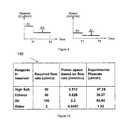
- FIG. 9shows a graph of flow rate (Q) vs time (t) and a graph of actuator speed (S) vs time (t) and their inter-relationship according to an embodiment of the present invention
- FIG. 10shows a table tabulating respective flow rate measurements for different reagents using a dispenser arrangement according to an embodiment of the present invention
- FIG. 11shows top and cross-sectional views of a microfluidic package having a plurality of dispenser arrangements according to an embodiment of the present invention
- FIG. 12shows top and cross-sectional views of a microfluidic package having a plurality of dispenser arrangements according to another embodiment of the present invention.
- FIG. 13shows a cross-sectional view of a valve of a dispenser arrangement as fabricated according to an embodiment of the present invention
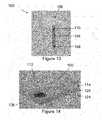
- FIG. 14shows a perspective view of a microfluidic package having a plurality of dispenser arrangements as fabricated according to an embodiment of the present invention
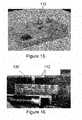
- FIG. 15shows a perspective view of a microfluidic package having a plurality of dispenser arrangements which has been filled with fluids as fabricated according to an embodiment of the present invention
- FIG. 16shows a perspective view of a microfluidic package having a plurality of dispenser arrangements where an external actuator is used to apply pressure on covering layer covering a fluid holding area to push fluid from the fluid holding area into a microfluidic channel according to an embodiment of the present invention
- FIG. 17shows a top view of a microfluidic package having a plurality of dispenser arrangements when in use according to an embodiment of the present invention
- a dispenser arrangement for fluidic dispensing control into a microfluidic componentsuch as a channel are described in detail below with reference to the accompanying figures.
- the exemplary embodiments described belowcan be modified in various aspects without changing the essence of the invention.
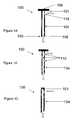
- FIG. 1Ashows a cross-sectional view of a valve according to an embodiment of the present invention.
- the valvehas been referred to as the pin valve for illustrative purposes.
- the pin valve 100comprises an elongated hollow portion or shaft 104 having a body and two ends 101 , 103 .
- a sealing portion or sealing cap 106is positioned at an end 101 of the hollow portion 104 and the other end 103 of the hollow portion 104 is an opening with a slant tip 108 .
- Another opening 110is present on the body of the hollow portion 104 , nearer to the sealing cap 106 , but not limited to this position.
- the position of the opening 110 on the body of the hollow portion 104may depend on the level of fluid or reagent in a fluid holding area where the pin valve 100 is housed.
- the opening 110 on the body of the hollow portion 104may be termed the inlet hole as it allows for fluid to enter the pin valve 100
- the opening with the slant tip 108 at the end of the hollow portion 104may be termed the exit hole as it allows for fluid to exit the pin valve 100 .
- the direction of fluid flowis as indicated by the short arrows in FIG. 1A .
- Some suitable materials for the sealing cap 106comprise elastomers such as PDMS and rubber, plastic, metal, wood and glass but are not so limited.
- Some suitable materials for the hollow portion 104comprise plastic, thermoplastic and metal but are not so limited. It would be preferred if the material for the hollow portion 104 is of a biocompatible nature.
- FIG. 1Bshows a cross-sectional view of a valve having a plurality of openings on the body of the hollow portion according to another embodiment of the present invention.
- One or a plurality of openings 110can be present on the body of the hollow portion 104 of the valve 100 . These openings 110 can be at any suitable position on the body of the hollow portion 104 .
- a plurality of openings 110may be useful if a higher flow rate is desired.
- any of the openings 110is clogged, fluid can flow in from any of the other available openings 110 . Having a valve 100 with a plurality of openings will also render the valve 100 more suitable for different fluid levels within the fluid holding area.
- FIG. 1Cshows a cross-sectional view of a valve with no sealing portion according to another embodiment of the present invention.
- the end 101 of the hollow portion 104can be sealed to prevent any fluid from entering the valve 100 .
- the sealed end 101may be an integral part of the hollow portion 104 or the end 101 can be sealed by glue, epoxy or silicone.
- the end 101can also be sealed by insertion of a small piece of sealing material or by fabricating a hollow portion 104 sealed at the end 101 .
- FIG. 2A to FIG. 2Dshows cross-sectional views of the dispenser arrangement during different stages of dispensing fluid into a microfluidic channel.
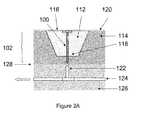
- FIG. 2Ashows a cross-sectional view of a dispenser arrangement according to an embodiment of the present invention when no fluid is dispensed.
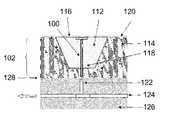
- the pin valve 100 of the dispenser arrangement 102is in a starting closed position and the pin valve 100 is not in contact with a microfluidic channel 124 . No fluid is able to be dispensed into the microfluidic channel 124 in FIG. 2A .
- the dispenser arrangement 102comprises of a fluid holding area or reservoir 112 and the pin valve 100 which is integrated or partially positioned within the fluid holding area 112 .
- the fluid holding area 112can be formed within a substrate 114 or it can be a preformed holding area.
- the fluid holding area 112has a base portion 116 and a top portion 118 .
- the base portion 116 of the fluid holding area 112may be covered or sealed with a thin covering layer 120 after fluid has been pre-stored in the fluid holding area 112 so as to seal the fluid holding area 112 to prevent any contamination.
- the substrate 114 housing the fluid holding area 112may be formed from any suitable materials including, but not limited to polymers such as elastomers, COC, PC, ceramic, glass, silicon, plastic and FR4 material.
- the covering layer 120may be formed from any suitable materials including, but not limited to polymers, elastomers, plastic, metal, wood, glass, COC, PC, ceramic, silicon and FR4 material.
- the dispenser arrangement 102comprising the fluid holding area 112 and the pin valve 100 is positioned to be aligned to an inlet 122 of a microfluidic channel 124 formed on another substrate 126 .
- a part of the pin valve 100is positioned within the fluid holding area 112 and another part of the pin valve 100 is positioned outside of the fluid holding area 112 for connection to the inlet 122 of the microfluidic channel 124 on the other substrate 126 .
- the fluid holding area 112 and the pin valve 100are aligned along the same longitudinal axis as the inlet 122 of the microfluidic channel 124 .
- Each inlet 122 of the microfluidic channel 124is connected to a dispenser arrangement 102 and there may be a plurality of inlets of the microfluidic channel if there is a plurality of dispenser arrangements.
- the substrate 126 housing the microfluidic channel 124can be of the same materials as the substrate 114 housing the fluid holding area 112 and the pin valve 100 . Both the substrates 114 , 126 can be bonded together by a double sided biocompatible tape 128 . The substrates 114 , 126 can also be glued together or bonded by some form of clips.
- the substrates 114 , 126may also be adapted to be bonded by pressure means, temperature means, ultrasonic means, thermosonic means, thermocompression means, laser welding means, transfer molding means, overmolding or injection molding but are not so limited
- an external actuator 130is brought in close contact with the covering layer 120 covering the fluid holding area 112 .
- the covering layer 120deforms upon exertion of a downward force or pressure by the external actuator 130 .
- the pin valve 100is activated or lowered towards the microfluidic channel 124 into an intermediate open position.
- the slant tip 108 of the pin valve 100penetrates through a thin sealing layer 132 covering the microfluidic channel 124 without clogging the slant tip opening 108 .
- fluidflows from the fluid holding area 112 to the microfluidic channel 124 in the open position.
- the direction of fluid flowis as indicated by the short arrows in FIG. 2B .
- the pin valve 100functions as an on-off valve during the course of deformation of the covering layer 120 and allows for fluid communication from the fluid holding area 112 to the microfluidic channel 124 after the deformation of the covering layer 120 as shown by the arrows.
- the force exerted by the external actuator 130is preferably along the longitudinal axis of the pin valve 100 and the external actuator 130 can be a piston or any suitable objects as long as it allows for an exertion of a force.
- the actuatormay also be an integrated micropump, or the actuation may be achieved by electrostatic means, pneumatic means, hydraulic means, electrical means, thermal means, optical means or physical means.
- a constant forceis applied onto the external actuator 130 and preferably along the same longitudinal axis as the pin valve 100 .
- the rate of dispensing of the fluid from the fluid holding area 112 into the microfluidic channel 124is controlled by the displacement speed of the external actuator 130 .
- the direction of fluid flowis as indicated by the short arrows in FIG. 2C .
- the pin valve 100is lowered until the sealing portion 106 of the pin valve 100 is in contact with the top portion 118 of the fluid holding area 112 or in an ending closed position.
- the pin valve 100is closed by three levels of sealing as circled in FIG. 2D .
- the first level of levelis by the sealing portion 106 with the top portion 118 of the fluid holding area 112 .
- the sealing portion 106serves to prevent fluid from flowing out of the fluid holding area 112 at the end of dispensing and thus prevent other reagents in the microfluidic channel 124 from flowing into the fluid holding area 112 .
- the second level of sealingis where the opening 110 on the body of the hollow portion 104 is blocked by the substrate material 114 housing the fluid holding area 112 and the pin valve 100 .
- the third level of sealingis where the slant tip opening 108 is clogged by the substrate material 126 housing the microfluidic channel 124 and forms an air tight seal preventing any remaining fluid within the pin valve 100 from escaping and preventing any external fluid in the microfluidic channel 124 from coming in contact with the fluid housed within the pin valve 100 . Therefore, the three levels of sealing will prevent backflow of fluid from within the pin valve 100 or the fluid holding area 112 and also prevent any fluid from within the microfluidic channel 124 to be in contact with the fluid in the pin valve 100 or the fluid holding area 112 .
- the levels of sealingwill also prevent any cross mixing of fluids between the fluid in the pin valve 100 or fluid holding area 112 and the fluid in the microfluidic channel 124 . This also helps the fluids from subsequent fluid holding areas to flow into the output side of the microfluidic system.
- a plurality of dispenser arrangementsmay be connected sequentially or in parallel depending on requirements of the microfluidic device.
- the number of dispenser arrangementsmay correspond to the required number of reagents or fluids within the microfluidic device.
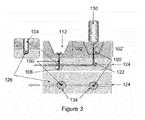
- FIG. 3shows top and cross-sectional views of two dispenser arrangements 102 , 102 ′ connected sequentially according to an embodiment of the present invention.
- a pin valve 100 of a first dispenser arrangement 102is fully depressed into an ending closed position where the pin valve 100 is sealed and a pin valve 100 ′ of a second dispenser arrangement 102 ′ is in an intermediate open position where the pin valve 100 ′ engages the inlet 122 of the microfluidic channel 124 .
- the pin valve 100 of the first dispenser arrangement 102 housing the first desired reagent in the fluid holding area 112is fully depressed into an ending closed position where the pin valve 100 is sealed. Then the pin valve 100 ′ of the second dispenser arrangement 102 ′ is activated by moving the actuator 130 over the pin valve 100 ′ of the second dispenser arrangement 102 ′. This process can be repeated for any required number of dispenser arrangements and in the order as desired.
- the enlarged portion of the first dispenser 102shows that any remaining fluid that is not dispensed into the microfluidic channel 124 is sealed within the hollow portion 104 of the pin valve 100 by the substrate material 126 housing the microfluidic channel 124 when the pin valve 100 is fully depressed into an ending closed position. In addition, no fluid in the channel is allowed into the hollow portion 104 of the pin valve 100 .
- Dead volumeis the volume of any reagent or system flow passage, where a dead-end passageway or cavity could retain reagents to contaminate subsequent reagents or flow media. This value can be influenced by many parameters, as many factors come into play to determine the actual dead volume, such as miscibility, viscosity, or binding energy. The quantity of the former reagent that remains inside the microfluidic channel after flushing with some specified volume is defined as dead volume.
- the microfluidic channel 124is adapted to accommodate the body of the hollow portion 104 of the pin valve 100 at an engagement region 134 where the slant second opening 108 of the pin valve 100 engages the microfluidic channel 124 in the open position as shown in FIG. 3 .
- the engagement region 134has a dimension larger than the body of the hollow portion 104 and is typically of an essentially circular shape but may also adopt other suitable shapes, including, but not limited to square shape, triangular shape to accommodate the dimensions and shape of the pin valve 100 .
- Ais the cross-sectional area of the microfluidic channel of flow at any point
- vis the speed of the fluid at that point, assumed to be constant across A
- the slant tip of the pin valveis typically substantially sharp enough to penetrate through the thin sealing layer covering the microfluidic channel as shown in FIG. 2B while not so sharp as to allow clogging of the substrate housing the microfluidic channel as shown in FIG. 2D .
- the slant tip of the pin valvemay typically be in the range of about 0° to about 70° , for example 15° to 45°, 20° to 35°, but not limited thereto. When the tip of the pin valve is too flat, for example about 0°, the tip will not be able to penetrate through the sealing layer covering the microfluidic channel, thereby clogging the opening of the pin valve and blocking the fluid flow path.
- the sharp tipwill push the substrate housing the microfluidic channel aside and there will be no clogging of the opening of the pin valve.
- a slant tip of about 25°will be advantageous in one embodiment as it will allow penetrating through the sealing layer covering the microfluidic channel without clogging the opening of the pin valve in FIG. 2B and then clog the opening and form an air tight seal when fully lowered into the substrate housing the microfluidic channel in FIG. 2D .
- FIG. 4shows a magnified cross-sectional view of a pin valve of a dispenser arrangement according to an embodiment of the present invention when the pin valve is depressed into an intermediate open position where the pin valve just engages the microfluidic channel as earlier shown in FIG. 2B .
- the slant tip opening 108 of the pin valve 100is substantially sharp enough to penetrate through a thin layer, similar to the thin sealing layer covering the microfluidic channel.
- FIG. 5shows a magnified cross-sectional view of a pin valve of a dispenser arrangement according to an embodiment of the present invention when the pin valve is fully depressed into an ending closed position where the pin valve is sealed as earlier shown in FIG. 2D .
- the slant tip opening 108 of the pin valve 100is clogged by the substrate material 126 housing the microfluidic channel and forms an air tight seal to prevent fluid from entering or escaping from the pin valve 100 .
- FIG. 6shows a cross-sectional view of a dispenser arrangement according to an embodiment of the present invention showing a valve with no sealing portion and a covering layer with a reinforced portion.
- the covering layer 120may comprise a reinforced portion 121 such that the covering layer 120 does not tear when a force is exerted on the covering layer 120 towards the valve 100 .
- the surface area of the reinforced portion 121may be larger in dimensions when compared to the dimensions of the end 101 of the valve 100 to allow for a bigger contact area with the actuator 130 .
- the reinforced portion 121may be of the same material as the covering layer 120 but may be thicker in dimensions. Alternatively, the reinforced portion 121 may comprises a different material from the covering layer 120 , such that the reinforced portion 121 is more resistant to pressure change.
- the fluid holding areamay be of different shapes, depending on requirements. From the top view, the fluid holding area may have an essentially circular shape such as a circular, semicircular, or an elliptical shape, but is not so limited. Alternatively, from the top view, the fluid holding area may have a polygonal shape such as a triangular shape, a trapezoidal shape, a square shape, a rectangular shape, a pentagonal shape, a hexagonal shape, or an octagonal shape, but is not so limited.
- the fluid holding areacan be of a polygonal shape such as a triangular shape, a square shape, a rectangular shape, a trapezoidal shape, a pentagonal shape, a hexagonal shape, or an octagonal shape, but is not so limited.
- FIG. 7Ashows a cross-sectional view of a dispenser arrangement according to an embodiment of the present invention showing a cylindrical fluid holding area 112 with a small cylindrical actuator 130 .
- the fluid holding area 112has a rectangular cross-sectional view and a circular top view, thereby forming a cylinder.
- the dimensions of the cylindrical actuator 130are much smaller when compared to that of the cylindrical fluid holding area 112 .
- there is a large dead volumeThis can be a result of the actuator 130 not being optimized to push all the fluid out of the fluid holding area 112 as there can be some portions that may not be reached by the effect of the actuator 130 acting on the covering layer 120 covering the fluid holding area 112 .
- the outlineshows the deformation of the covering layer 120 when the actuator 130 is being exerted downwards on the covering layer 120 .
- FIG. 7Bshows a cross-sectional view of a dispenser arrangement according to an embodiment of the present invention showing a cylindrical fluid holding area with a big actuator.
- the fluid holding area 112has a rectangular cross-sectional view and a circular top view, thereby forming a cylinder.
- the dimensions of the cylindrical actuator 130are only a little smaller when compared to that of the cylindrical fluid holding area 112 .
- dead volumeis reduced as the actuator 130 is optimized to push all the fluid out of the fluid holding area 112 .
- the large stress generatedmay cause the covering layer 120 to tear.
- FIG. 8shows a cross-sectional view of a dispenser arrangement according to an embodiment of the present invention showing a truncated conical fluid holding area with a small cylindrical actuator.
- the fluid holding area 112has a trapezoidal cross-sectional view and a circular top view, thereby forming a truncated cone.
- the fluid holding area 112has a base portion 116 and a top portion 118 .
- the cylinder actuator 130has two ends and the cross-sectional area of each end of the actuator 130 is approximately the same as the cross-sectional area of the top portion 118 of the fluid holding area 112 .
- Having such an actuator 130may minimize the dead volume and the stress generated on the covering layer 120 covering the fluid holding area 112 as the fluid is inclined to be pushed towards the top portion 118 and the actuator 130 will then push most of the fluid out from the fluid holding area 112 to the microfluidic channel.
- the flow rate of the fluid within the fluid holding areamay be controlled by the actuator displacement speed.
- ris radius of the top portion of the truncated conical fluid holding area
- his distance of deformation of the covering layer covering the fluid holding area
- FIG. 9shows a graph of flow rate (Q) vs time (t) and a graph of actuator speed (S) vs time (t) and their inter-relationship according to an embodiment of the present invention. From FIG. 9 , it can be observed that the flow rate (Q 1 ) is proportional to actuator speed (Si) in time T 1 . When flow rate (Q 1 ) is halved in time T 2 , actuator speed (S 1 ) is also halved accordingly.
- FIG. 10shows a table tabulating respective flow rate measurements for different reagents using a dispenser arrangement according to an embodiment of the present invention.
- Different reagentsare housed in the fluid holding area or reservoir respectively.
- the reagents measured using the dispenser arrangementinclude high salt, ethanol, air and water.
- the required flow rate in microlitre per minute ( ⁇ l/min) for high salt, ethanol, air and wateris 50 ⁇ l/min, 50 ⁇ l/min, 100 ⁇ l/min and 2 ⁇ l/min respectively.
- the actuator or piston speed calculated based on the required flow rate in millimeters per minute (mm/min) for high salt, ethanol, air and wateris 0.513 mm/min, 0.628 mm/min, 2.2 mm/min and 0.0437 mm/min respectively.
- the experimental flow rate obtained using the dispenser arrangement for high salt, ethanol, air and wateris 47.24 ⁇ l/min, 38.27 ⁇ l/min, 85.64 ⁇ l/min and 1.52 ⁇ l/min respectively, which is quite close to the required flow rate. From the table 140 , it can be seen that the flow rate out of the fluid holding area is related to the piston speed.
- a plurality of dispenser arrangementscan be arranged in a microfluidic package.
- the microfluidic packagecan be made from the same material or from a combination of different materials before being aligned together.
- FIG. 11shows top and cross-sectional views of a microfluidic package having a plurality of dispenser arrangements according to an embodiment of the present invention.
- Fluid holding areas 112are formed on a PDMS substrate 114 by casting or soft lithography techniques.
- the microfluidic channel 124is formed on another PDMS substrate 126 by casting or soft lithography techniques.
- the substrates 114 , 126are aligned and bonded using a double-sided biocompatible tape 128 , for example. A good sealing at the bonding interfaces is essential to prevent leakage.
- the biocompatible tape 128can also be used to bond a chip 136 to the PDMS substrate 126 housing the microfluidic channel 124 .
- An example of a chipcan be found in U.S. patent application Ser. No. 10/818532.
- a pin valve 100is housed in each fluid holding area 112 .
- the pin valve 100may be formed with a biocompatible material and may be easily integrated into the respective fluid holding area 112 using a pick and place machine, for example.
- the fluid holding areas 112may be filled with respective reagents or fluids depending on requirements and sealed by a thin covering layer 120 made of PDMS or an elastomer material.
- the enclosed fluid holding area 112allows for pre-storage of reagents and eliminates contamination from external sources.
- An example of a particular protocolmight involve reagents like, blood, primer, high salt, ethanol, air and water housed sequentially in the fluid holding areas, with blood being nearest to the chip.
- reagentslike, blood, primer, high salt, ethanol, air and water housed sequentially in the fluid holding areas, with blood being nearest to the chip.
- An external actuator 130is used to activate the pin valve 100 sequentially or in any desired order.
- FIG. 12shows top and cross-sectional views of a microfluidic package having a plurality of dispenser arrangements according to another embodiment of the present invention.
- Fluid holding areas 112 and microfluidic channel 124are formed on respective substrate 114 , 126 made of materials other than PDMS.
- the other substrate materialsinclude thermoplastic or an elastomer material, for example
- the substrate 114 housing the fluid holding areas 112may be formed from elastomer material and the substrate 126 housing the microfluidic channel 124 may be formed from thermoplastic or elastomer materials, for example COC or PC.
- the respective substrates 114 , 126are aligned before being bonded by a double sided biocompatible tape 128 .
- the biocompatible tape 128can also be used to bond a chip 136 to the substrate 126 housing the microfluidic channel 124 .
- the substrate 126 housing the microfluidic channel 124may be supported by another supporting layer 138 , for example a layer made of an elastomer material.
- a pin valve 100is housed in each fluid holding area 112 .
- the pin valve 100may be formed with biocompatible material and may be easily integrated into the fluid holding areas 112 using a pick and place machine, for example.
- the fluid holding areas 112may be filled with respective reagents or fluids depending on requirements and sealed by a thin covering layer 120 made of elastomer material, for example.
- An external actuator 130is used to activate the pin valve 100 sequentially or in any desired order.
- the dispenser arrangements 102may be arranged in a plurality of rows for dispensing one or more than one sequence of fluids or reagents to the chip 136 at any one time, but this is not so limited.
- the dispenser arrangements 102may also be arranged in any desired arrangement depending on requirements.
- FIG. 13shows a cross-sectional view of a pin valve of a dispenser arrangement as fabricated according to an embodiment of the present invention.
- the pin valve 100comprises an elongated hollow portion 104 having a body and two ends.
- a sealing portion 106is positioned at an end of the hollow portion 104 and the other end of the hollow portion 104 is an opening with a slant tip 108 .
- Another opening 110is present on the body of the hollow portion 104 , nearer to the sealing portion 106 .
- the elongated hollow portion 104is made of metal while the sealing portion 106 is made of plastic.
- FIG. 14shows a perspective view of a microfluidic package having a plurality of dispenser arrangements as fabricated according to an embodiment of the present invention.
- the substrates 114 , 126 housing the fluid holding areas 112 and the microfluidic channel 124are made of PDMS for example.
- PDMShas been selected due to the flexibility in fabrication of microfluidic channels by casting or soft lithography techniques.
- PDMSis also a biocompatible material and thereby suitable for medical devices.
- the soft, flexible and highly elastic natureallows good sealing of microfluidic system and minimizes fluidic leakage.
- the transparent materialalso facilitates optical detection of flow in the package.
- the pin valve 100is positioned within the fluid holding area 112 and a biochip 136 , for example a DNA extraction chip or RNA extraction chip is attached to the substrate 126 housing the microfluidic channel 124 using a double sided biocompatible tape.
- FIG. 15shows a perspective view of a microfluidic package having a plurality of dispenser arrangements which has been filled with fluids as fabricated according to an embodiment of the present invention.
- Different fluidsmay be pre-stored in the respective fluid holding areas 112 according to a desired protocol. After the fluids have been pre-stored in the fluid holding areas 112 , the fluid holding area 112 is sealed by a thin covering layer to prevent any leakage or contamination.
- FIG. 16shows a perspective view of a microfluidic package having a plurality of dispenser arrangements where an external actuator is used to apply pressure on covering layer covering a fluid holding area to push fluid from the fluid holding area into a microfluidic channel according to an embodiment of the present invention.
- the external actuator 130may be moved from above one fluid holding area 112 to another fluid holding area 112 sequentially or depending on the order of desired dispersing.
- FIG. 17shows a top view of a microfluidic package having a plurality of dispenser arrangements when in use according to an embodiment of the present invention.
- Four dispenser arrangements, each comprising a fluid holding area 112 and a pin valve 100is shown in FIG. 17 . No cross contamination or mixing of fluids is observed after the respective fluids in the fluid holding areas 112 have been dispensed.
Landscapes
- Engineering & Computer Science (AREA)
- General Engineering & Computer Science (AREA)
- Computer Hardware Design (AREA)
- Microelectronics & Electronic Packaging (AREA)
- Theoretical Computer Science (AREA)
- Physics & Mathematics (AREA)
- Fluid Mechanics (AREA)
- Mechanical Engineering (AREA)
- Micromachines (AREA)
Abstract
Description
This application is a National Stage Application under 35 USC §371(c) of PCT Application No. PCT/SG2006/000276, entitled “A DISPENSER ARRANGEMENT FOR FLUIDIC DISPENSING CONTROL IN MICROFLUDIC SYSTEM,” filed Sep. 19, 2006, which is hereby incorporated by reference herein.
The present invention relates to the field of microfluidic systems, and in particular, to a dispenser arrangement for fluidic dispensing control into a microfluidic component such as channel, mixer, valve, pump, reservoir but not so limited in a microfluidic system.
Microfluidic systems such as microfluidic devices, cartridges, packages, lab-on-a-chip (LOC) and micro total analysis system (micro-TAS) for example require fluidic dispensing control to realize particular protocol. Fluidic dispensing control includes controlling of the fluids' flow sequence, flow duration, flow direction and flow rate. A microfluidic system with multiple fluids or reagents needs to have a mechanism to control dispensing of each fluid or reagent so as to follow individual flow protocol. At the same time, the reagents' cross mixing arising to contamination in the microfluidic system should be avoided.
Some other microfluidic systems require pre-storage of reagents in integrated reservoirs. Besides storage function, these reservoirs also need dispensing mechanism, which pushes the reagents into the microfluidic system during operation. After the reagents are fully dispensed, the dispenser should close to avoid flow of other reagents into the reservoir.
Several attempts have been made to control the flow of each fluid or reagent in a microfluidic system with multiple fluids or reagents. Amongst them are different types of valves which can control the dispensing of respective fluids or reagents in a microfluidic system. One approach is described in the publication “Miniaturization of pinch type valves and pumps for practical micro total analysis system integration”, Kwang W. O. et al, J. MicroMech and MicroEng. 15 (2005), pp 2449-2455. This publication discloses a miniaturized pinch-type valve which is surface mountable on microfluidic LOC devices. The pinch-type valve consists of a solenoid magnetic actuator with a pinch plunger and a biomedical grade silicone tube. According to this publication, magnetic force is used to manipulate the pinch plunger to open and close the silicone tube or channel, thereby controlling the flow of fluid.
The publication “Disposable Smart Lab on a Chip for Point-of-Care Clinical Diagnostics”, Chong H. A. et al, Proceedings of the IEEE, Vol. 92, No. 1, (January 2004), pp. 154-173 discloses a micro-dispenser module in a microfluidic LOC device. A sample fluid volume is loaded into the fixed-volume metering micro-dispenser, which in turn dispenses an exact volume of liquid for further biochemical analysis. The sample fluid is introduced through a fluid inlet at a low flow rate. The fluid passes through a first passive valve and a narrow channel to enter a reservoir. A second passive valve at the end of the reservoir prevents the fluid from leaving the reservoir. As long as the applied fluid driving pressure is less than the pressure required to overcome the second passive valve, the fluid will be contained completely within the reservoir. According to this publication, applied fluid driving pressure and passive valve are used to control fluid flow within the reservoir.
The publication “Disposable Bio-microfluidic package with passive fluidic control”, Ling Xie et al, Electronics Packaging Technology Conference, 7-9 Dec. 2005, discloses a disposable bio-microfluidic package using passive valves for fluidic control. The passive valve is embedded in micro-channel structures and controls the fluid flow without any actuators. The key principle of the passive valve is that the fluid flow through a main channel and surface tension causes the fluid to stop before a valve gap. The valve is closed in the initial stage. To open the valve, a threshold pressure is applied. Fluid will then pass through the valve. According to this publication, threshold pressure and passive valve are used to control fluid flow within a disposable bio-microfluidic package.
The publication “Development of an integrated Bio-microfluidic package with micro-valves and reservoirs for a DNA Lab on a Chip (LOC) Application”, Ling Xie et al, Electronic Components and Technology Conference, 30 May-2 Jun. , 2006, discloses a bio-microfluidic package with integrated reservoir and valves for LOC application. A passive valve is embedded in a channel and the valve is activated by pressure. At storing condition, the valve is closed to prevent reagent flowing from a reservoir to the channel. Once fluidic pressure in the reservoir increases and reaches the threshold pressure, the valve opens. The valve is passive and therefore controls the fluid flow without any moving parts. According to this publication, threshold pressure and passive valve are also used to control fluid flow within a disposable bio-microfluidic package.
U.S. patent application Ser. No. 11/096,035 discloses microfluidic circuits including triggerable passive valves, connected in series or in parallel. A triggerable passive valve arrangement includes a flow restrictor, a pressurizing device, and a passive valve, connected with a fluid delivery channel. The triggerable passive valve acts upon a sample liquid. As the sample liquid flows into the fluid delivery channel, it stops at the passive valve. For flow to occur beyond the passive valve, the pressure of the sample liquid must exceed the burst pressure of the passive valve. The burst pressure of the passive valve is determined by its geometry and physical properties. The pressurizing device exerts pressure on the sample liquid when activated, increasing its pressure to a value higher than the burst pressure of the passive valve, causing the sample liquid to move past the passive valve. Most of the sample liquid flows in the direction of the passive valve, rather than in the direction of the flow restrictor. This is because the flow restrictor has a higher resistance to flow once the passive valve has been breached. Once flow beyond the passive valve occurs, the pressure exerted upon the sample liquid by the pressurizing device can be removed. According to U.S. patent application Ser. No. 11/096,035, applied fluid driving pressure and passive valve are used to control fluid flow.
U.S. patent application Ser. No. 09/985943 discloses microfluidic flow control devices. Each microfluidic flow control device includes a regulating device having two overlapping channel segments separated by a deformable membrane in fluid communication with one another. The deformable membrane is responsive to changes in pressure between two channel segments. When the pressures in the channel segments are substantially the same, the deformable membrane adopts a neutral position. If the pressure in either channel segment is increased, then the deformable membrane will deform towards the other channel segment. According to U.S. patent application Ser. No. 09/985,943, the regulating device uses pressure to control the direction of deformation of the membrane, thereby controlling the flow of fluid.
Controlling the dispensing of fluid and fluid flow rate in prior art devices to prevent back flow and cross mixing of fluids is difficult. It is also tough to maintain a low dead volume in the prior art devices. These difficulties in controlling the dispensing of fluid may lead to contamination of different fluids in microfluidic systems. Therefore, an objective of the present invention is to provide an alternative dispenser arrangement that can control dispensing of fluid and fluid flow rate in microfluidic systems, thereby advantageously avoids or reduces some of the above-mentioned drawbacks of prior art devices.
Accordingly, the invention provides a dispenser arrangement for fluidic dispensing control into a microfluidic component comprising an enclosed fluid holding area and a valve adapted to be movable between an open position and a closed position and positioned at least partially in the fluid holding area. The valve comprises an elongated hollow portion having a body and two ends adapted for fluid flow from the fluid holding area to the microfluidic component in the open position, wherein the first end of the hollow portion is sealed such that it prevents fluid from entering the first end and wherein the first end is positioned within the fluid holding area. The valve further comprises a first opening on the body of the hollow portion positioned within the fluid holding area allowing fluid communication from the fluid holding area to the microfluidic component in the open position and a slant second opening at the second end of the hollow portion positioned outside of the fluid holding area. The slant second opening is adapted to pierce through a sealing layer covering the microfluidic component in the open position and to insert into a first substrate housing the microfluidic component in the closed position. Some examples of microfluidic components include channels, mixers, valves, pumps, reservoirs but are not so limited. The channels can have any suitable cross-sections and shapes, for example, circular, rectangle and triangle. Some examples of fluid holding areas include chambers and reservoirs but are not limited thereto.
In one embodiment of the invention, the valve is movable between a first closed position where the valve is not in contact with the microfluidic component and a second closed position. In the second closed position, the valve is in sealing connection with the microfluidic component when a force is exerted on the first end of the hollow portion.
In another embodiment of the invention, the open position is an intermediate position between the first closed position and the second closed position. In the open position, the slant second opening of the valve engages the microfluidic component, thereby allowing fluid communication from the fluid holding area to the microfluidic component. Also in the open position, the fluid communication allows fluid in the fluid holding area to flow in from the first opening and to flow out from the slant second opening into the microfluidic component.
In a further embodiment of the invention, the first substrate comprises a deformable material such as an elastomer material but is not so limited. Some examples of elastomer material comprise polydimethylsiloxane (PDMS) and rubber but are not so limited. The first substrate can also comprises a rigid material selected from the group consisting of cyclic olefin copolymer (COC), polycarbonate (PC), ceramic, glass, silicon, thermoplastic and Flame Resistant 4 (FR4) material but are not so limited.
In another embodiment of the invention, the enclosed fluid holding area is formed within a second substrate. The second substrate comprises a deformable material such as an elastomer material but is not so limited. Some examples of elastomer material comprise polydimethylsiloxane and rubber but are not so limited.
The second substrate can also comprise a rigid material selected from the group consisting of COC, PC, ceramic, glass, silicon, thermoplastic and FR4 material but are not so limited.
In another embodiment of the invention, the first substrate and the second substrate are adapted to be bonded by bonding means. The bonding means can comprise a double sided tape, glue, clipping means or the substrates are adapted to be bonded by pressure means, temperature means, ultrasonic means, thermosonic means, thermocompression means, laser welding means, transfer molding means, overmolding or injection molding. The bonding means can also be biocompatible.
In another embodiment of the invention, the enclosed fluid holding area is covered by a covering layer. The covering layer may comprise a deformable material such as elastomer but is not so limited. Some examples of elastomer material comprise polydimethylsiloxane and rubber but are not so limited. The covering layer can also comprise a rigid material selected from the group consisting of COC, PC, ceramic, glass, silicon and FR4 material but are not so limited.
In another embodiment of the invention, the covering layer is situated above the hollow portion and comprises a reinforced portion arranged such that it is in contact with the first end of the hollow portion when a force is exerted on the covering layer. The reinforced portion can be of the same material as the covering layer but may be thicker in dimensions. Alternatively, the reinforced portion can comprise a different material from the covering layer, usually the material for the reinforced portion is thicker in dimension or has a higher tensile strength and therefore is mechanically more resistant to stress. The reinforced portion prevents the covering layer from tearing when a force is exerted onto the covering layer towards the valve. Some examples of materials for the reinforced portion could be polymethyl methacrylate (PMMA), COC or PC but are not so limited.
In another embodiment of the invention, the enclosed fluid holding area comprises a base portion and a top portion. The top portion of the enclosed fluid holding area is proximal to the microfluidic component. The base portion of the enclosed fluid holding area is distal from the microfluidic channel component.
In another embodiment of the invention, the valve is sealed by three levels of sealing in the second closed position. Firstly, the sealing of the first end of the hollow portion is provided by a sealing portion connected to a first end of the hollow portion positioned within the fluid holding area. Secondly, the first opening on the body of the hollow portion is sealed by the first substrate in the second closed position. Thirdly, the slant second opening at the second end of the hollow portion is sealed by the first substrate in the second closed position.
In another embodiment of the invention, when viewed from the top, the fluid holding area has an essentially circular cross-sectional shape or a polygonal cross-sectional shape. The essentially circular shape can be a circular shape or an elliptical shape. The polygonal shape may be an essentially triangular shape, trapezoidal shape, rectangular shape (including a square shape), pentagonal shape, hexagonal shape, or octagonal shape. From the side-view, the fluid holding area typically has a polygonal cross-sectional shape. The polygonal shape may be an essentially trapezoidal shape, square shape, rectangular shape, pentagonal shape, hexagonal shape, or octagonal shape. The fluid holding can however also have geometrically irregular shapes. In several embodiments, the base portion of the fluid holding area has a wider cross-section area than the top portion. The fluid holding area can also be a truncated cone for example.
In another embodiment of the invention, the microfluidic component is adapted to accommodate the body of the hollow portion at an engagement region. In this embodiment, the slant second opening of the valve may engage the microfluidic component in the open position. Usually, the engagement region has a dimension larger than the body of the hollow portion of the valve.
In another embodiment of the invention, the force that is used to actuate the valve is provided by an actuator. The actuator can comprise a piston, an integrated micropump, or the actuation may be achieved by electrostatic means, pneumatic means, hydraulic means, electrical means, chemical means, magnetic means, thermal means, optical means or physical means. Accordingly, the present invention also provides for a dispenser unit comprising a dispenser arrangement and an actuator. The actuator may be a piston, an integrated micropump or as the actuation may be achieved by electrostatic, pneumatic means, hydraulic means, electrical means, magnetic means, chemical means, thermal means, optical means or any other physical means.
In an embodiment of the dispenser unit, the actuator is a cylinder having two ends. The cross-sectional area of each end of the cylinder can approximately be the same or smaller than the cross-sectional area of the top portion of the enclosed fluid holding area.
The following figures illustrate various exemplary embodiments of the present invention. However, it should be noted that the present invention is not limited to the exemplary embodiments illustrated in the following figures.
Exemplary embodiments of a dispenser arrangement for fluidic dispensing control into a microfluidic component such as a channel are described in detail below with reference to the accompanying figures. In addition, the exemplary embodiments described below can be modified in various aspects without changing the essence of the invention.
Thedispenser arrangement 102 comprises of a fluid holding area orreservoir 112 and thepin valve 100 which is integrated or partially positioned within thefluid holding area 112. Thefluid holding area 112 can be formed within asubstrate 114 or it can be a preformed holding area. Thefluid holding area 112 has abase portion 116 and atop portion 118. Thebase portion 116 of thefluid holding area 112 may be covered or sealed with athin covering layer 120 after fluid has been pre-stored in thefluid holding area 112 so as to seal thefluid holding area 112 to prevent any contamination. Thesubstrate 114 housing thefluid holding area 112 may be formed from any suitable materials including, but not limited to polymers such as elastomers, COC, PC, ceramic, glass, silicon, plastic and FR4 material. Thecovering layer 120 may be formed from any suitable materials including, but not limited to polymers, elastomers, plastic, metal, wood, glass, COC, PC, ceramic, silicon and FR4 material.
Thedispenser arrangement 102 comprising thefluid holding area 112 and thepin valve 100 is positioned to be aligned to aninlet 122 of amicrofluidic channel 124 formed on anothersubstrate 126. A part of thepin valve 100 is positioned within thefluid holding area 112 and another part of thepin valve 100 is positioned outside of thefluid holding area 112 for connection to theinlet 122 of themicrofluidic channel 124 on theother substrate 126. Thefluid holding area 112 and thepin valve 100 are aligned along the same longitudinal axis as theinlet 122 of themicrofluidic channel 124. Eachinlet 122 of themicrofluidic channel 124 is connected to adispenser arrangement 102 and there may be a plurality of inlets of the microfluidic channel if there is a plurality of dispenser arrangements. Thesubstrate 126 housing themicrofluidic channel 124 can be of the same materials as thesubstrate 114 housing thefluid holding area 112 and thepin valve 100. Both thesubstrates biocompatible tape 128. Thesubstrates substrates
InFIG. 2B , anexternal actuator 130 is brought in close contact with thecovering layer 120 covering thefluid holding area 112. Thecovering layer 120 deforms upon exertion of a downward force or pressure by theexternal actuator 130. Upon the deformation of thecovering layer 120, thepin valve 100 is activated or lowered towards themicrofluidic channel 124 into an intermediate open position. Theslant tip 108 of thepin valve 100 penetrates through athin sealing layer 132 covering themicrofluidic channel 124 without clogging theslant tip opening 108. Then fluid flows from thefluid holding area 112 to themicrofluidic channel 124 in the open position. The direction of fluid flow is as indicated by the short arrows inFIG. 2B . Thepin valve 100 functions as an on-off valve during the course of deformation of thecovering layer 120 and allows for fluid communication from thefluid holding area 112 to themicrofluidic channel 124 after the deformation of thecovering layer 120 as shown by the arrows. The force exerted by theexternal actuator 130 is preferably along the longitudinal axis of thepin valve 100 and theexternal actuator 130 can be a piston or any suitable objects as long as it allows for an exertion of a force. The actuator may also be an integrated micropump, or the actuation may be achieved by electrostatic means, pneumatic means, hydraulic means, electrical means, thermal means, optical means or physical means.
InFIG. 2C , a constant force is applied onto theexternal actuator 130 and preferably along the same longitudinal axis as thepin valve 100. The rate of dispensing of the fluid from thefluid holding area 112 into themicrofluidic channel 124 is controlled by the displacement speed of theexternal actuator 130. The direction of fluid flow is as indicated by the short arrows inFIG. 2C .
InFIG. 2D , thepin valve 100 is lowered until the sealingportion 106 of thepin valve 100 is in contact with thetop portion 118 of thefluid holding area 112 or in an ending closed position. When thepin valve 100 is in the ending closed position, thepin valve 100 is closed by three levels of sealing as circled inFIG. 2D . The first level of level is by the sealingportion 106 with thetop portion 118 of thefluid holding area 112. The sealingportion 106 serves to prevent fluid from flowing out of thefluid holding area 112 at the end of dispensing and thus prevent other reagents in themicrofluidic channel 124 from flowing into thefluid holding area 112. The second level of sealing is where theopening 110 on the body of thehollow portion 104 is blocked by thesubstrate material 114 housing thefluid holding area 112 and thepin valve 100. The third level of sealing is where the slant tip opening108 is clogged by thesubstrate material 126 housing themicrofluidic channel 124 and forms an air tight seal preventing any remaining fluid within thepin valve 100 from escaping and preventing any external fluid in themicrofluidic channel 124 from coming in contact with the fluid housed within thepin valve 100. Therefore, the three levels of sealing will prevent backflow of fluid from within thepin valve 100 or thefluid holding area 112 and also prevent any fluid from within themicrofluidic channel 124 to be in contact with the fluid in thepin valve 100 or thefluid holding area 112. The levels of sealing will also prevent any cross mixing of fluids between the fluid in thepin valve 100 orfluid holding area 112 and the fluid in themicrofluidic channel 124. This also helps the fluids from subsequent fluid holding areas to flow into the output side of the microfluidic system.
A plurality of dispenser arrangements may be connected sequentially or in parallel depending on requirements of the microfluidic device. The number of dispenser arrangements may correspond to the required number of reagents or fluids within the microfluidic device.FIG. 3 shows top and cross-sectional views of twodispenser arrangements pin valve 100 of afirst dispenser arrangement 102 is fully depressed into an ending closed position where thepin valve 100 is sealed and apin valve 100′ of asecond dispenser arrangement 102′ is in an intermediate open position where thepin valve 100′ engages theinlet 122 of themicrofluidic channel 124. Depending on the reagent housed in the respective fluid holding area and on the requirement of the dispensing sequence of the reagent in the specific protocol, thepin valve 100 of thefirst dispenser arrangement 102 housing the first desired reagent in thefluid holding area 112 is fully depressed into an ending closed position where thepin valve 100 is sealed. Then thepin valve 100′ of thesecond dispenser arrangement 102′ is activated by moving theactuator 130 over thepin valve 100′ of thesecond dispenser arrangement 102′. This process can be repeated for any required number of dispenser arrangements and in the order as desired. There is a commonmicrofluidic channel 124 linking both thedispenser arrangements first dispenser 102 shows that any remaining fluid that is not dispensed into themicrofluidic channel 124 is sealed within thehollow portion 104 of thepin valve 100 by thesubstrate material 126 housing themicrofluidic channel 124 when thepin valve 100 is fully depressed into an ending closed position. In addition, no fluid in the channel is allowed into thehollow portion 104 of thepin valve 100.
Dead volume is the volume of any reagent or system flow passage, where a dead-end passageway or cavity could retain reagents to contaminate subsequent reagents or flow media. This value can be influenced by many parameters, as many factors come into play to determine the actual dead volume, such as miscibility, viscosity, or binding energy. The quantity of the former reagent that remains inside the microfluidic channel after flushing with some specified volume is defined as dead volume. To eliminate dead volume in the commonmicrofluidic channel 124, themicrofluidic channel 124 is adapted to accommodate the body of thehollow portion 104 of thepin valve 100 at anengagement region 134 where the slantsecond opening 108 of thepin valve 100 engages themicrofluidic channel 124 in the open position as shown inFIG. 3 . Theengagement region 134 has a dimension larger than the body of thehollow portion 104 and is typically of an essentially circular shape but may also adopt other suitable shapes, including, but not limited to square shape, triangular shape to accommodate the dimensions and shape of thepin valve 100.
The flow within any microfluidic channel of flow obeys the equation of continuity:
Rv=A*v=a constant=> equation (1)
Where Rv is the volume flow rate
Rv=A*v=a constant=> equation (1)
Where Rv is the volume flow rate
A is the cross-sectional area of the microfluidic channel of flow at any point
v is the speed of the fluid at that point, assumed to be constant across A
The cross-sectional area of the microfluidic channel of flow is defined as follows:
A=π*r*r=> equation (2)
Where r is the Radius of the Microfluidic Channel
From equations (1) and (2) above, the radius of the microfluidic channel will affect the volume flow rate of fluid. For a constant volume flow rate, if the microfluidic channel becomes narrow, the flow speed increases. If the microfluidic channel becomes larger, the flow speed decreases. Therefore, an appropriate dimension of the common microfluidic channel size in the present invention is in the range of 1 μm to 5000 μtm. Other suitable formulas may also apply if the cross-section of the channel is not a circular cross-section. It is within the ability of an average man skilled in the art to determine the respective flow rates for the other appropriate channel cross-sections.
A=π*r*r=> equation (2)
Where r is the Radius of the Microfluidic Channel
From equations (1) and (2) above, the radius of the microfluidic channel will affect the volume flow rate of fluid. For a constant volume flow rate, if the microfluidic channel becomes narrow, the flow speed increases. If the microfluidic channel becomes larger, the flow speed decreases. Therefore, an appropriate dimension of the common microfluidic channel size in the present invention is in the range of 1 μm to 5000 μtm. Other suitable formulas may also apply if the cross-section of the channel is not a circular cross-section. It is within the ability of an average man skilled in the art to determine the respective flow rates for the other appropriate channel cross-sections.
For the present invention, the slant tip of the pin valve is typically substantially sharp enough to penetrate through the thin sealing layer covering the microfluidic channel as shown inFIG. 2B while not so sharp as to allow clogging of the substrate housing the microfluidic channel as shown inFIG. 2D . The slant tip of the pin valve may typically be in the range of about 0° to about 70° , for example 15° to 45°, 20° to 35°, but not limited thereto. When the tip of the pin valve is too flat, for example about 0°, the tip will not be able to penetrate through the sealing layer covering the microfluidic channel, thereby clogging the opening of the pin valve and blocking the fluid flow path. When the tip of the pin valve is too sharp, for example higher than 70°, like those used in a syringe, the sharp tip will push the substrate housing the microfluidic channel aside and there will be no clogging of the opening of the pin valve. A slant tip of about 25° will be advantageous in one embodiment as it will allow penetrating through the sealing layer covering the microfluidic channel without clogging the opening of the pin valve inFIG. 2B and then clog the opening and form an air tight seal when fully lowered into the substrate housing the microfluidic channel inFIG. 2D .
The fluid holding area may be of different shapes, depending on requirements. From the top view, the fluid holding area may have an essentially circular shape such as a circular, semicircular, or an elliptical shape, but is not so limited. Alternatively, from the top view, the fluid holding area may have a polygonal shape such as a triangular shape, a trapezoidal shape, a square shape, a rectangular shape, a pentagonal shape, a hexagonal shape, or an octagonal shape, but is not so limited. From the cross-sectional view, the fluid holding area can be of a polygonal shape such as a triangular shape, a square shape, a rectangular shape, a trapezoidal shape, a pentagonal shape, a hexagonal shape, or an octagonal shape, but is not so limited.
The flow rate of the fluid within the fluid holding area may be controlled by the actuator displacement speed.
Using the truncated conical holding area as an example, the volume of the truncated conical fluid holding area is defined as follows:
Volume (V)=(R2+rR+r2)×h×π/3=> equation (3)
Volume (V)=(R2+rR+r2)×h×π/3=> equation (3)
- Where R is radius of the base portion of the truncated conical fluid holding area
r is radius of the top portion of the truncated conical fluid holding area
h is distance of deformation of the covering layer covering the fluid holding area
The flow rate is defined by the change in volume with time as follows:
Flow rate (Q)=dV/dt=[(R2+rR+r2)×(π/3)]×dh/dt=>equation (4)
The actuator speed is defined by the change in deformation of the covering layer covering the fluid holding area with time as follows:
Actuator speed=S=dh/dt=>equation (5)
Flow rate is proportional to actuator speed:
Flow rate (Q)=constant×actuator speed (S)=>equation (6)
Therefore, the fluid flow rate out of thefluid holding area 112 into the microfluidic channel can be controlled by the speed of exerting theactuator 130 downwards on thecovering layer 120 covering thefluid holding area 112. Exerting theactuator 130 downwards on thecovering layer 120 thereby pushes thepin valve 100 further downwards towards the microfluidic channel substrate.
Flow rate (Q)=dV/dt=[(R2+rR+r2)×(π/3)]×dh/dt=>equation (4)
The actuator speed is defined by the change in deformation of the covering layer covering the fluid holding area with time as follows:
Actuator speed=S=dh/dt=>equation (5)
Flow rate is proportional to actuator speed:
Flow rate (Q)=constant×actuator speed (S)=>equation (6)
Therefore, the fluid flow rate out of the
A plurality of dispenser arrangements can be arranged in a microfluidic package. The microfluidic package can be made from the same material or from a combination of different materials before being aligned together.FIG. 11 shows top and cross-sectional views of a microfluidic package having a plurality of dispenser arrangements according to an embodiment of the present invention.Fluid holding areas 112 are formed on aPDMS substrate 114 by casting or soft lithography techniques. Themicrofluidic channel 124 is formed on anotherPDMS substrate 126 by casting or soft lithography techniques. Thesubstrates biocompatible tape 128, for example. A good sealing at the bonding interfaces is essential to prevent leakage. Thebiocompatible tape 128 can also be used to bond achip 136 to thePDMS substrate 126 housing themicrofluidic channel 124. An example of a chip can be found in U.S. patent application Ser. No. 10/818532. Apin valve 100 is housed in eachfluid holding area 112. Thepin valve 100 may be formed with a biocompatible material and may be easily integrated into the respectivefluid holding area 112 using a pick and place machine, for example. Thefluid holding areas 112 may be filled with respective reagents or fluids depending on requirements and sealed by athin covering layer 120 made of PDMS or an elastomer material. The enclosedfluid holding area 112 allows for pre-storage of reagents and eliminates contamination from external sources. An example of a particular protocol might involve reagents like, blood, primer, high salt, ethanol, air and water housed sequentially in the fluid holding areas, with blood being nearest to the chip. However, the order or arrangement in the fluid holding area or the order of dispensing can be altered to cater to any desired requirements. Anexternal actuator 130 is used to activate thepin valve 100 sequentially or in any desired order.
COC, PC. Fabrication of the respectivefluid holding areas 112 andmicrofluidic channels 124 is possible using high throughput process including but not limited to microinjection molding and hot embossing. InFIG. 12 , thesubstrate 114 housing thefluid holding areas 112 may be formed from elastomer material and thesubstrate 126 housing themicrofluidic channel 124 may be formed from thermoplastic or elastomer materials, for example COC or PC. Therespective substrates biocompatible tape 128. Thebiocompatible tape 128 can also be used to bond achip 136 to thesubstrate 126 housing themicrofluidic channel 124. Thesubstrate 126 housing themicrofluidic channel 124 may be supported by another supportinglayer 138, for example a layer made of an elastomer material. Apin valve 100 is housed in eachfluid holding area 112. Thepin valve 100 may be formed with biocompatible material and may be easily integrated into thefluid holding areas 112 using a pick and place machine, for example. Thefluid holding areas 112 may be filled with respective reagents or fluids depending on requirements and sealed by athin covering layer 120 made of elastomer material, for example. Anexternal actuator 130 is used to activate thepin valve 100 sequentially or in any desired order. From the top view of the microfluidic package, thedispenser arrangements 102 may be arranged in a plurality of rows for dispensing one or more than one sequence of fluids or reagents to thechip 136 at any one time, but this is not so limited. Thedispenser arrangements 102 may also be arranged in any desired arrangement depending on requirements.
The aforementioned description of the various embodiments has been presented for purposes of illustration and description. It is not intended to be exhaustive or to limit the invention to the precise form disclosed, and obviously many modifications and variations are possible in light of the disclosed teaching. It is intended that the scope of the invention be defined by the claims appended hereto.
Claims (34)
1. A dispenser arrangement for fluidic dispensing control into a microfluidic component comprising:
an enclosed fluid holding area; and
a valve adapted to be movable between an open position and a closed position and positioned at least partially in the fluid holding area, said valve comprising:
an elongated hollow portion having a body and two ends adapted for fluid flow from the fluid holding area to the microfluidic component in the open position;
wherein a first end of the hollow portion is sealed such that it prevents fluid from entering the first end and wherein the first end is positioned within the fluid holding area;
a first opening on the body of the hollow portion positioned within the fluid holding area allowing fluid communication from the fluid holding area to the microfluidic component in the open position; and
a slant second opening at a second end of the hollow portion positioned outside of the fluid holding area
wherein the slant second opening is adapted to pierce through a sealing layer covering the microfluidic component in the open position and to insert into a first substrate housing the microfluidic component in the closed position.
2. The dispenser arrangement ofclaim 1 , wherein the valve is movable between a first closed position where the valve is not in contact with the microfluidic component and a second closed position where the valve is in sealing connection with the microfluidic component when a force is exerted on the first end of the hollow portion.
3. The dispenser arrangement ofclaim 2 , wherein the open position is an intermediate position between the first closed position and the second closed position.
4. The dispenser arrangement ofclaim 1 , wherein in the open position, the slant second opening of the valve engages the microfluidic component, thereby allowing fluid communication from the fluid holding area to the microfluidic component.
5. The dispenser arrangement ofclaim 4 , wherein in the open position, the fluid communication allows fluid in the fluid holding area to flow in from the first opening and to flow out from the slant second opening into the microfluidic component.
6. The dispenser arrangement ofclaim 1 , wherein the first substrate comprises a deformable material or wherein the first substrate comprises a rigid material.
7. The dispenser arrangement ofclaim 6 , wherein the deformable material comprises an elastomer material.
8. The dispenser arrangement ofclaim 1 , wherein the enclosed fluid holding area is formed within a second substrate.
9. The dispenser arrangement ofclaim 8 wherein the second substrate comprises a deformable material or wherein the second substrate comprises a rigid material.
10. The dispenser arrangement ofclaim 9 , wherein the deformable material comprises an elastomer material.
11. The dispenser arrangement ofclaim 8 , wherein the first substrate and the second substrate are adapted to be bonded by bonding means.
12. The dispenser arrangement ofclaim 11 , wherein the bonding means comprises a double sided tape, glue, clipping means, or the substrates are adapted to be bonded by pressure means, temperature means, ultrasonic means, thermosonic means, thermocompression means, laser welding means, transfer molding means, overmolding or injection molding.
13. The dispenser arrangement ofclaim 1 , wherein the enclosed fluid holding area is covered by a covering layer.
14. The dispenser arrangement ofclaim 13 , wherein the covering layer comprises a deformable material or wherein the covering layer comprises a rigid material.
15. The dispenser arrangement ofclaim 14 , wherein the deformable material comprises an elastomer material.
16. The dispenser arrangement ofclaim 13 , wherein the covering layer is situated above the hollow portion and comprises a reinforced portion arranged such that it is in contact with the first end of the hollow portion when a force is exerted on the covering layer.
17. The dispenser arrangement ofclaim 16 , wherein the reinforced portion is of the same material as the covering layer but is thicker in dimensions or wherein the reinforced portion comprises of a different material from the covering layer.
18. The dispenser arrangement ofclaim 1 , wherein the enclosed fluid holding area comprises a base portion and a top portion.
19. The dispenser arrangement ofclaim 18 , wherein the top portion of the enclosed fluid holding area is proximal to the microfluidic component.
20. The dispenser arrangement ofclaim 18 , wherein the base portion of the enclosed fluid holding area is distal from the microfluidic component.
21. The dispenser arrangement ofclaim 1 , wherein sealing of the first end is provided by a sealing portion connected to a first end of the hollow portion positioned within the fluid holding area.
22. The dispenser arrangement ofclaim 2 , wherein the first opening on the body of the hollow portion is sealed by the first substrate in the second closed position.
23. The dispenser arrangement ofclaim 2 , wherein the slant second opening at the second end of the hollow portion is sealed by the first substrate in the second closed position.
24. The dispenser arrangement ofclaim 1 , wherein from the top-view, the fluid holding area has an essentially circular cross-sectional shape or a polygonal cross-sectional shape.
25. The dispenser arrangement ofclaim 1 , wherein from the side-view, the fluid holding area has a polygonal cross-sectional shape.
26. The dispenser arrangement ofclaim 18 , wherein the base portion has a wider cross-section area than the top portion.
27. The dispenser arrangement ofclaim 1 , wherein the fluid holding area is a truncated cone.
28. The dispenser arrangement ofclaim 1 , wherein the microfluidic component is adapted to accommodate the body of the hollow portion at an engagement region where the slant second opening of the valve engages the microfluidic component in the open position.
29. The dispenser arrangement ofclaim 28 , wherein the engagement region has a dimension larger than the body of the hollow portion.
30. The dispenser arrangement ofclaim 2 , wherein the force is provided by an actuator.
31. The dispenser arrangement ofclaim 30 , wherein the actuator comprises a piston, an integrated micropump, or the actuation is achieved by electrostatic means, pneumatic means, hydraulic means, electrical means, chemical means, thermal means, optical means or physical means.
32. A dispenser unit comprising:
the dispenser arrangement as defined inclaim 1 ; and
an actuator.
33. The dispenser unit ofclaim 32 , wherein the actuator is a cylinder having two ends.
34. The dispenser unit ofclaim 33 , wherein the cross-sectional area of each end of the cylinder is approximately the same as the cross-sectional area of a top portion of a enclosed fluid holding area.
Applications Claiming Priority (1)
| Application Number | Priority Date | Filing Date | Title |
|---|---|---|---|
| PCT/SG2006/000276WO2008036045A1 (en) | 2006-09-19 | 2006-09-19 | A dispenser arrangement for fluidic dispensing control in microfluidic system |
Publications (2)
| Publication Number | Publication Date |
|---|---|
| US20100084032A1 US20100084032A1 (en) | 2010-04-08 |
| US8127794B2true US8127794B2 (en) | 2012-03-06 |
Family
ID=39200781
Family Applications (1)
| Application Number | Title | Priority Date | Filing Date |
|---|---|---|---|
| US12/441,963Expired - Fee RelatedUS8127794B2 (en) | 2006-09-19 | 2006-09-19 | Dispenser arrangement for fluidic dispensing control in microfluidic system |
Country Status (2)
| Country | Link |
|---|---|
| US (1) | US8127794B2 (en) |
| WO (1) | WO2008036045A1 (en) |
Cited By (1)
| Publication number | Priority date | Publication date | Assignee | Title |
|---|---|---|---|---|
| US9278352B2 (en) | 2010-09-30 | 2016-03-08 | Fraunhofer-Gesellschaft Zur Forderung Der Angewandten Forshung E.V. | Microfluidic chip comprising several cylinder-piston arrangements |
Families Citing this family (3)
| Publication number | Priority date | Publication date | Assignee | Title |
|---|---|---|---|---|
| WO2012109612A2 (en)* | 2011-02-11 | 2012-08-16 | Code Footwear, Llc | Reconfigurable apparel manufacture and business processes |
| CN102844425B (en)* | 2010-04-28 | 2014-10-15 | 西门子医疗保健诊断公司 | Sample analysis system and method of use |
| WO2016062788A1 (en) | 2014-10-24 | 2016-04-28 | Ait Austrian Institute Of Technology Gmbh | Microfluidic chip for biological analysis |
Citations (11)
| Publication number | Priority date | Publication date | Assignee | Title |
|---|---|---|---|---|
| WO2003016832A2 (en) | 2001-08-13 | 2003-02-27 | Boston Innovation Inc. | Microfluidic mixing and dispensing |
| US20030196695A1 (en) | 2000-11-06 | 2003-10-23 | Nanostream, Inc. | Microfluidic flow control devices |
| US20050130292A1 (en) | 2003-09-26 | 2005-06-16 | The University Of Cincinnati | Smart disposable plastic lab-on-a-chip for point-of-care testing |
| US20050217742A1 (en) | 2004-03-31 | 2005-10-06 | Sebastian Bohm | Microfluidic circuit including an array of triggerable passive valves |
| FR2873171A1 (en) | 2004-07-19 | 2006-01-20 | Centre Nat Rech Scient | ACTIVE COMPONENT MICROFLUIDIC CIRCUIT |
| WO2006018044A1 (en) | 2004-08-18 | 2006-02-23 | Agilent Technologies, Inc. | Microfluidic assembly with coupled microfluidic devices |
| US7077152B2 (en)* | 2001-07-07 | 2006-07-18 | Nanostream, Inc. | Microfluidic metering systems and methods |
| US20060159564A1 (en) | 2004-12-31 | 2006-07-20 | Industrial Technology Research Institute | Microfluidic driving and speed controlling apparatus and application thereof |
| US20060169339A1 (en) | 2005-02-02 | 2006-08-03 | Oh Kwang-Wook | Microvalve device and apparatus adopting the same |
| US7802591B2 (en)* | 2002-11-14 | 2010-09-28 | Q Chip Limited | Microfluidic device and methods for construction and application |
| US7858047B2 (en)* | 2008-06-18 | 2010-12-28 | Industrial Technology Research Institute | Fluidic device |
- 2006
- 2006-09-19WOPCT/SG2006/000276patent/WO2008036045A1/enactiveApplication Filing
- 2006-09-19USUS12/441,963patent/US8127794B2/ennot_activeExpired - Fee Related
Patent Citations (11)
| Publication number | Priority date | Publication date | Assignee | Title |
|---|---|---|---|---|
| US20030196695A1 (en) | 2000-11-06 | 2003-10-23 | Nanostream, Inc. | Microfluidic flow control devices |
| US7077152B2 (en)* | 2001-07-07 | 2006-07-18 | Nanostream, Inc. | Microfluidic metering systems and methods |
| WO2003016832A2 (en) | 2001-08-13 | 2003-02-27 | Boston Innovation Inc. | Microfluidic mixing and dispensing |
| US7802591B2 (en)* | 2002-11-14 | 2010-09-28 | Q Chip Limited | Microfluidic device and methods for construction and application |
| US20050130292A1 (en) | 2003-09-26 | 2005-06-16 | The University Of Cincinnati | Smart disposable plastic lab-on-a-chip for point-of-care testing |
| US20050217742A1 (en) | 2004-03-31 | 2005-10-06 | Sebastian Bohm | Microfluidic circuit including an array of triggerable passive valves |
| FR2873171A1 (en) | 2004-07-19 | 2006-01-20 | Centre Nat Rech Scient | ACTIVE COMPONENT MICROFLUIDIC CIRCUIT |
| WO2006018044A1 (en) | 2004-08-18 | 2006-02-23 | Agilent Technologies, Inc. | Microfluidic assembly with coupled microfluidic devices |
| US20060159564A1 (en) | 2004-12-31 | 2006-07-20 | Industrial Technology Research Institute | Microfluidic driving and speed controlling apparatus and application thereof |
| US20060169339A1 (en) | 2005-02-02 | 2006-08-03 | Oh Kwang-Wook | Microvalve device and apparatus adopting the same |
| US7858047B2 (en)* | 2008-06-18 | 2010-12-28 | Industrial Technology Research Institute | Fluidic device |
Non-Patent Citations (5)
| Title |
|---|
| Ahn et al. "Disposable Smart Lab on a Chip for Point-of-Care Clinical Diagnostics" Proceedings of the IEEE. vol. 92, No. 1. Jan. 2004. p. 154-173. |
| International Search Report. PCT/SG2006/000276. Mailed Nov. 16, 2006. |
| Oh et al. "Miniaturization of pinch-type valves and pumps for practical micro total analysis system integration" Journal of Micromechanics and Microengineering. 2005. p. 2449-2455. |
| Xie et al. "Development of an Intergrated Bio-Microfluidic Package with Micro-Valves and Reservoirs for a DNA Lab on a Chip (LOC) Application." 2006 Electronic Components and Technology Conference. p. 693-698. |
| Xie et al. "Disposable Bio-Microfluidic Package with Passive Fluidic Control" 2005 Electronics Packaging Technology Conference. p. 93-97. |
Cited By (1)
| Publication number | Priority date | Publication date | Assignee | Title |
|---|---|---|---|---|
| US9278352B2 (en) | 2010-09-30 | 2016-03-08 | Fraunhofer-Gesellschaft Zur Forderung Der Angewandten Forshung E.V. | Microfluidic chip comprising several cylinder-piston arrangements |
Also Published As
| Publication number | Publication date |
|---|---|
| WO2008036045A1 (en) | 2008-03-27 |
| US20100084032A1 (en) | 2010-04-08 |
Similar Documents
| Publication | Publication Date | Title |
|---|---|---|
| US6951632B2 (en) | Microfluidic devices for introducing and dispensing fluids from microfluidic systems | |
| US9776183B2 (en) | Microfluidic cartridge devices and methods of use and assembly | |
| US7412990B2 (en) | Microfluidic control device and method for controlling microfluid | |
| EP2216096B1 (en) | Microfluidic dispensing assembly | |
| US7284966B2 (en) | Micro-pump | |
| JP4403000B2 (en) | Microchip and micropump | |
| US7357898B2 (en) | Microfluidics packages and methods of using same | |
| JP2004108285A (en) | Micro fluid device | |
| US7096878B1 (en) | Pyrotechnically actuated microvalve | |
| US8127794B2 (en) | Dispenser arrangement for fluidic dispensing control in microfluidic system | |
| KR20060024500A (en) | Fluid transfer device and disposable chip with same | |
| KR100471377B1 (en) | Microfluidic Devices Controlled by Surface Tension | |
| JP2006053064A (en) | Microfluidic chip and manufacturing method thereof | |
| WO2007055151A1 (en) | Microreactor and microanalysis system | |
| KR100444751B1 (en) | Device of Controlling Fluid using Surface Tension | |
| EP3431180A1 (en) | System for charging and discharging air under a controlled pressure | |
| KR101635459B1 (en) | Programmable Micropump | |
| Xie et al. | Development of a disposable bio-microfluidic package with reagents self-contained reservoirs and micro-valves for a DNA lab-on-a-chip (LOC) application | |
| KR20150135613A (en) | Micropump for microfluidic actuation | |
| JP2007248218A (en) | Microchip | |
| Xie et al. | Design, integration and testing of fluidic dispensing control valve into a DNA/RNA sample preparation micro fluidic package for Lab on a Chip (LOC) applications | |
| Chew et al. | Study of a capillary force driven passive valve for a microfluidic package | |
| WO2023012024A1 (en) | Normally-closed monolithic valve for microfluidic applications | |
| Xie et al. | Optimization of a microfluidic cartridge for Lab-on-a-chip (LOC) application and bio-testing for DNA/RNA extraction |
Legal Events
| Date | Code | Title | Description |
|---|---|---|---|
| AS | Assignment | Owner name:AGENCY FOR SCIENCE, TECHNOLOGY AND RESEARCH,SINGAP Free format text:ASSIGNMENT OF ASSIGNORS INTEREST;ASSIGNORS:XIE, LING;PREMACHANDRAN, CHIRAYARIKATHUVEEDU SANKARAPILLAI;CHONG, SER CHOONG;REEL/FRAME:022556/0238 Effective date:20090225 Owner name:AGENCY FOR SCIENCE, TECHNOLOGY AND RESEARCH, SINGA Free format text:ASSIGNMENT OF ASSIGNORS INTEREST;ASSIGNORS:XIE, LING;PREMACHANDRAN, CHIRAYARIKATHUVEEDU SANKARAPILLAI;CHONG, SER CHOONG;REEL/FRAME:022556/0238 Effective date:20090225 | |
| REMI | Maintenance fee reminder mailed | ||
| LAPS | Lapse for failure to pay maintenance fees | ||
| STCH | Information on status: patent discontinuation | Free format text:PATENT EXPIRED DUE TO NONPAYMENT OF MAINTENANCE FEES UNDER 37 CFR 1.362 | |
| FP | Lapsed due to failure to pay maintenance fee | Effective date:20160306 |