US8059263B2 - Apparatus for the recognition of the presence of an object in space - Google Patents
Apparatus for the recognition of the presence of an object in spaceDownload PDFInfo
- Publication number
- US8059263B2 US8059263B2US12/458,354US45835409AUS8059263B2US 8059263 B2US8059263 B2US 8059263B2US 45835409 AUS45835409 AUS 45835409AUS 8059263 B2US8059263 B2US 8059263B2
- Authority
- US
- United States
- Prior art keywords
- light
- deflection
- accordance
- angular position
- rotation
- Prior art date
- Legal status (The legal status is an assumption and is not a legal conclusion. Google has not performed a legal analysis and makes no representation as to the accuracy of the status listed.)
- Expired - Fee Related, expires
Links
Images
Classifications
- G—PHYSICS
- G01—MEASURING; TESTING
- G01S—RADIO DIRECTION-FINDING; RADIO NAVIGATION; DETERMINING DISTANCE OR VELOCITY BY USE OF RADIO WAVES; LOCATING OR PRESENCE-DETECTING BY USE OF THE REFLECTION OR RERADIATION OF RADIO WAVES; ANALOGOUS ARRANGEMENTS USING OTHER WAVES
- G01S7/00—Details of systems according to groups G01S13/00, G01S15/00, G01S17/00
- G01S7/48—Details of systems according to groups G01S13/00, G01S15/00, G01S17/00 of systems according to group G01S17/00
- G01S7/497—Means for monitoring or calibrating
- G—PHYSICS
- G01—MEASURING; TESTING
- G01S—RADIO DIRECTION-FINDING; RADIO NAVIGATION; DETERMINING DISTANCE OR VELOCITY BY USE OF RADIO WAVES; LOCATING OR PRESENCE-DETECTING BY USE OF THE REFLECTION OR RERADIATION OF RADIO WAVES; ANALOGOUS ARRANGEMENTS USING OTHER WAVES
- G01S17/00—Systems using the reflection or reradiation of electromagnetic waves other than radio waves, e.g. lidar systems
- G01S17/02—Systems using the reflection of electromagnetic waves other than radio waves
- G01S17/06—Systems determining position data of a target
- G01S17/08—Systems determining position data of a target for measuring distance only
- G01S17/10—Systems determining position data of a target for measuring distance only using transmission of interrupted, pulse-modulated waves
- G—PHYSICS
- G01—MEASURING; TESTING
- G01S—RADIO DIRECTION-FINDING; RADIO NAVIGATION; DETERMINING DISTANCE OR VELOCITY BY USE OF RADIO WAVES; LOCATING OR PRESENCE-DETECTING BY USE OF THE REFLECTION OR RERADIATION OF RADIO WAVES; ANALOGOUS ARRANGEMENTS USING OTHER WAVES
- G01S17/00—Systems using the reflection or reradiation of electromagnetic waves other than radio waves, e.g. lidar systems
- G01S17/02—Systems using the reflection of electromagnetic waves other than radio waves
- G01S17/06—Systems determining position data of a target
- G01S17/42—Simultaneous measurement of distance and other co-ordinates
- G—PHYSICS
- G01—MEASURING; TESTING
- G01S—RADIO DIRECTION-FINDING; RADIO NAVIGATION; DETERMINING DISTANCE OR VELOCITY BY USE OF RADIO WAVES; LOCATING OR PRESENCE-DETECTING BY USE OF THE REFLECTION OR RERADIATION OF RADIO WAVES; ANALOGOUS ARRANGEMENTS USING OTHER WAVES
- G01S7/00—Details of systems according to groups G01S13/00, G01S15/00, G01S17/00
- G01S7/48—Details of systems according to groups G01S13/00, G01S15/00, G01S17/00 of systems according to group G01S17/00
- G01S7/481—Constructional features, e.g. arrangements of optical elements
- G01S7/4811—Constructional features, e.g. arrangements of optical elements common to transmitter and receiver
- G—PHYSICS
- G01—MEASURING; TESTING
- G01S—RADIO DIRECTION-FINDING; RADIO NAVIGATION; DETERMINING DISTANCE OR VELOCITY BY USE OF RADIO WAVES; LOCATING OR PRESENCE-DETECTING BY USE OF THE REFLECTION OR RERADIATION OF RADIO WAVES; ANALOGOUS ARRANGEMENTS USING OTHER WAVES
- G01S7/00—Details of systems according to groups G01S13/00, G01S15/00, G01S17/00
- G01S7/48—Details of systems according to groups G01S13/00, G01S15/00, G01S17/00 of systems according to group G01S17/00
- G01S7/497—Means for monitoring or calibrating
- G01S7/4972—Alignment of sensor
- G—PHYSICS
- G02—OPTICS
- G02B—OPTICAL ELEMENTS, SYSTEMS OR APPARATUS
- G02B26/00—Optical devices or arrangements for the control of light using movable or deformable optical elements
- G02B26/08—Optical devices or arrangements for the control of light using movable or deformable optical elements for controlling the direction of light
- G02B26/10—Scanning systems
- G02B26/105—Scanning systems with one or more pivoting mirrors or galvano-mirrors
- G—PHYSICS
- G01—MEASURING; TESTING
- G01S—RADIO DIRECTION-FINDING; RADIO NAVIGATION; DETERMINING DISTANCE OR VELOCITY BY USE OF RADIO WAVES; LOCATING OR PRESENCE-DETECTING BY USE OF THE REFLECTION OR RERADIATION OF RADIO WAVES; ANALOGOUS ARRANGEMENTS USING OTHER WAVES
- G01S17/00—Systems using the reflection or reradiation of electromagnetic waves other than radio waves, e.g. lidar systems
- G01S17/02—Systems using the reflection of electromagnetic waves other than radio waves
- G01S17/04—Systems determining the presence of a target
- G—PHYSICS
- G01—MEASURING; TESTING
- G01S—RADIO DIRECTION-FINDING; RADIO NAVIGATION; DETERMINING DISTANCE OR VELOCITY BY USE OF RADIO WAVES; LOCATING OR PRESENCE-DETECTING BY USE OF THE REFLECTION OR RERADIATION OF RADIO WAVES; ANALOGOUS ARRANGEMENTS USING OTHER WAVES
- G01S7/00—Details of systems according to groups G01S13/00, G01S15/00, G01S17/00
- G01S7/48—Details of systems according to groups G01S13/00, G01S15/00, G01S17/00 of systems according to group G01S17/00
- G01S7/497—Means for monitoring or calibrating
- G01S2007/4975—Means for monitoring or calibrating of sensor obstruction by, e.g. dirt- or ice-coating, e.g. by reflection measurement on front-screen
Definitions
- the inventionrelates to an apparatus for the recognition of the presence of an object in space in accordance with the preamble of claim 1 .
- Apparatusfor the recognition of the presence of an object in space in accordance with the pulse time-of-flight process. They have a pulsed laser which transmits light pulses into a space in a controlled manner, a photoreceiver arrangement which receives the light pulses reflected back from the object present in the space as well as an evaluation circuit which determines a distance signal characteristic for the distance of the object from the pulsed laser from the time between the transmission and the reception of a light pulse.
- a first light deflection apparatusis arranged between the space and the pulsed laser, said light deflection apparatus outputting a first angular position signal representative of its instantaneous angular position to the evaluation circuit, with the first light deflection apparatus having a deflection mirror which is arranged rotatably or pivotably about a first axis of rotation and which is made for the transmission of light pulses following one another at changing angles in a first plane and for the guidance of the light pulses reflected back to the photoreceiver arrangement.
- a deflection mirrorwhich is arranged rotatably or pivotably about a first axis of rotation and which is made for the transmission of light pulses following one another at changing angles in a first plane and for the guidance of the light pulses reflected back to the photoreceiver arrangement.
- DE 297 24 806 U1discloses an apparatus for the optical scanning of surfaces which has a light transmitter which transmits a light beam sweeping over a preset pivot angle range within a scanning plane, with the apparatus being pivotable about a preset rotational angle range about an axis of rotation disposed at least substantially in or parallel to the scanning plane.
- the angular position of the scanning planis admittedly changed in this manner in order thus to be able to monitor a three-dimensional spatial region.
- the total apparatusis pivoted about an axis of rotation with the help of an external rotational device, which is complex and/or expensive to realize.
- either the cables for the energy transmissionare constantly moved so that they are subject to high wear.
- slip rings for the energy transmissionwhich, however, are likewise subject to high wear. The same also applies to the platform for the irradiation of a laser beam disclosed in DE 33 18 686 C2.
- optoelectronic safety sensorsare known, in particular in the form of light barriers or light grids, which monitor a monitored zone for the intrusion of objects and output a signal in dependence thereon which is used to change a unit or a machine into a safe state on the occurrence of a safety demand.
- These safety sensorsdetermine when a person approaches a unit or a machine and in particular encroaches beyond a critical safety distance so that in this case the machine or unit is stopped or is at least operated at reduced operating speed.
- safety sensorsare made as safe sensors in the sense of machine safety, which means that safe sensors or the evaluation and/or control units in association with them have to satisfy the relevant standards EN 954, EN 61496 or EN 61508; for example have to have a two-channel structure, test structures or self-testing structures or have otherwise to be able to continue to work reliable even when errors occur and to recognize the errors independently. It is in particular of great relevance with such safety sensors not only to detect that a person is approaching a machine and is encroaching beyond a safety distance, but also in particular to determine the direction from which and at which speed the person is approaching this machine or unit in order to correspondingly control, reduce or fully stop the movements of the unit or machine causing danger. In particular when a person approaches a machine or unit at high speed, it must be switched correspondingly fast to a safe state so that there is no danger for the corresponding person at any time.
- An apparatus for the recognition of the presence of an object in spaceshould in particular be provided which can be made as a safe apparatus in a simple manner.
- the inventionis based on the recognition of not rotating or pivoting the whole apparatus which can carry out a scan in one plane about an axis of rotation for the monitoring of a three-dimensional space, but rather only to rotate or pivot the measuring head of the apparatus by a second light deflection apparatus, with the measuring head in particular including the first light deflection apparatus as well as preferably the pulsed laser and the photoreceiver arrangement and, optionally, parts of a control and/or of an evaluation circuit.
- Energy supplies, connectors or connector cables, operating elements or the housing of the apparatus, preferably also most parts of the evaluation circuitare not moved in order to keep the number of moving parts as small as possible and thus to be able to configure the apparatus in as compact and as simple a manner as possible.
- a second light deflection apparatusis therefore arranged between the first light deflection apparatus and an energy supply of the first light deflection apparatus, said second light deflection apparatus outputting a second angular position signal representative of its instantaneous angular position and having a deflection plate which is arranged rotatably or pivotably about a second axis of rotation and which is made for the changing of the angular position of the first plane, with the evaluation circuit determining the position of the object in space from the first angular position signal, the second angular position signal and the distance signal.
- the apparatus in accordance with the inventionis completely arranged in a housing having a window. No movable components are thus visible to the outside so that the apparatus can be used in any desired environments with a correspondingly designed housing, in particular with correspondingly sealed housings.
- the front plateis in this respect transparent for the light transmitted by the pulsed laser.
- the apparatus in accordance with the inventionthus has the advantage that the laser scanner technique, which is a tested and certified technique established in safety engineering and which is moreover largely accepted, can be used to monitor a three-dimensional space in a cost-effective and reliable manner, which is not possible with the 3D camera technique.
- the first light deflection apparatuscan be arranged in a first embodiment such that it rotates the unit of pulsed laser and photoreceiver arrangement.
- the first light deflection apparatusis arranged between the space and the pulsed laser and has a deflection mirror which is arranged rotatably or pivotably about the first axis of rotation and which is made for the transmission of light pulses following one another at changing angles in a first plane and for the guidance of the light pulses reflected back onto the photoreceiver arrangement so that the unit of pulsed laser and photoreceiver arrangement does not have to be rotated by the first light deflection apparatus, but rather only the light pulses transmitted by the pulsed laser are correspondingly deflected by the first light deflection apparatus.
- the first and second axes of rotationare arranged perpendicular to one another, which simplifies the construction design of the apparatus and makes a symmetrical scanning of the space possible.
- thishas the advantage that, with a suitable choice of the rotational frequencies of the first and second light deflection apparatus, the resolution is higher in the direction of the second axis of rotation than in the direction at an angle to or transverse to the second axis of rotation since, on each rotation of the first light deflection apparatus about the first axis of rotation, at least one light pulse is transmitted substantially in the direction of the second axis of rotation.
- the first light deflection apparatusis preferably arranged on the deflection plate so that the first light deflection apparatus is rotated or pivoted about the second axis of rotation in order in this manner to transmit light pulses into a three-dimensional spatial zone.
- the pulsed laser and/or the photoreceiver deviceare fixedly arranged on the deflection plate so that a simple and compact design is achieved.
- the deflection mirror and/or the deflection platepreferably has/have a deflection angle of more than 180°, preferably of more than 270°, in particular of 360°, to be able to monitor a spatial angular zone which is as large as possible.
- the deflection mirroris made as a rotating mirror and/or the deflection plate is made as a turntable since a continuous rotational movement can, for example, be realized more easily and more cost-effectively than a pivot movement over a specific pivot angular range.
- the energy transmission between moving and non-moving components of the apparatustakes place in a contactless manner, in particular inductively, so that no wear occurs and a reliable energy transmission is ensured.
- the data transmission between moving and non-moving components of the apparatustakes place in a contactless manner, in particular inductively, capacitively or optically, for example by means of infrared light.
- a contactless mannerin particular inductively, capacitively or optically, for example by means of infrared light.
- the apparatusis made as a safe apparatus; it is in particular made in accordance with the standards EN 61496, EN 61508 or EN 954.
- a respective incremental encoderis preferably provided for the determination of the angular position of the deflection mirror and/or of the deflection plate which is preferably made as a safe incremental encoder to be able to ensure a safe detection of the angular positions and thus of the position of the object in space.
- At least one light-reflecting or light-scattering test bodyis arranged within the housing for the monitoring of the function of the apparatus such that the light pulses transmitted by the pulsed laser are incident onto the test body and are reflected back into the photoreceiver arrangement at at least one defined angular position of the first and/or second light deflection apparatus.
- a comparison of the signal generated by the test body in the photoreceiver arrangement with reference signals in particulartakes place to check that the apparatus is working properly.
- test light sourcewhich is arranged such that the light beams transmitted by the test light source are detected in the photoreceiver arrangement at at least one defined angular position of the first and/or second light deflection apparatus and are there likewise in particular able to be compared with reference signals.
- a light pulse durationis in particular required which is so short that the apparatus can be considered more or less stationary during the transmission of the corresponding light pulse.
- the light pulse duration of the pulsed lasertherefore preferably amounts to 1 to 5 ns, preferably 2 to 4 ns, in particular approximately 3 ns.
- the first light deflection apparatusin particular the deflection mirror, has a first rotational frequency of approximately 20 to 100 Hz, in particular of approximately 50 Hz.
- the second light deflection apparatusin particular the deflection plate, preferably has a second rotational frequency of approximately 1 to 15 Hz, in particular of approximately 5 Hz. Both the first rotational frequency and the second rotational frequency are preferably variably adjustable to be able to adapt the apparatus to the corresponding applications.
- the windowis at least partly made as part of a spherical surface, in particular as a hemisphere so that a 3600 monitoring is possible in one plane and a 180° monitoring of a three-dimensional space in the plane perpendicular thereto.
- the diameter of the deflection plateis preferably slightly smaller than the diameter of the hemispherical window, whereby it is in particular made possible to arrange the deflection plate in a sectional plane of the hemispherical window to achieve a structure of the apparatus in this manner which is as simple and as compact as possible.
- a particularly simple possibility for the monitoring of the window of the apparatus, in particular of the contamination of the windowresults in that the signals of the light pulses reflected back by the window are compared with a reference signal in a comparator, with the reference signal being the signal of the light pulse reflected back at a clean window. Due to the fact that the window is permeated by light pulses in a tight pattern, a reliable monitoring of the total window is achieved in a simple manner. A monitoring of function in particular thus also takes place constantly with a clean window.
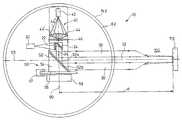
- FIG. 1a schematic plan view of an embodiment of an apparatus in accordance with the invention
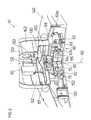
- FIG. 2a perspective, partly sectioned representation of the embodiment in accordance with FIG. 1 ;
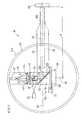
- FIG. 3a schematic side view of the embodiment in accordance with FIG. 2 ;
- FIG. 4a schematic plan view of the embodiment in accordance with FIG. 2 ;
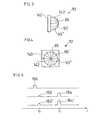
- FIG. 5a signal-time diagram of different signals.
- FIGS. 1 to 4show different views of an apparatus 10 for the determination of the position of an object 110 in the space 100 , with the same reference numerals designating the same parts, but with not all reference numerals being given in all Figures for better clarity.
- the apparatus 10has a pulsed laser 20 which transmits light pulses into the space 100 in a controlled manner.
- the angular position of the transmitted light pulses in the space 100is determined by a first light deflection apparatus 50 and a second light deflection apparatus 60 .
- the first light deflection apparatus 50has a first motor 58 which drives a rotatable plate 56 to a continuous circulating movement about a first axis of rotation 90 .
- a circular cylindrical body 54is arranged on the rotatable plate 56 and its upper end surface is made as a deflection mirror 52 , with the end surface being arranged at an angle of 45° to the first axis of rotation 90 .
- the deflection mirror 52can also be made as a planar mirror plate which is arranged accordingly on the rotatable plate 56 .
- a first incremental encoder 57is arranged at the circumference of the rotatable plate 56 and can, for example, be made as a forked light barrier.
- the first incremental encoder 57is in particular made as a safe incremental encoder so that a reliable detection of the angular position of the rotatable plate 56 and thus of the deflection mirror 52 is possible at any time.
- a redirection mirror 24is arranged above the deflection mirror 52 and its mirror surface is likewise arranged at an angle of 45° to the first axis of rotation 90 .
- the redirection mirror 24can likewise be made as an end surface of a circular cylindrical body or as a planar mirror plate.
- the redirection mirror 24has a smaller surface than the deflection mirror 52 .
- the light of the pulsed laser 20 bundled by a transmission lens 22is incident approximately perpendicular to the first axis of rotation 90 onto the redirection mirror 24 and is guided along the first axis of rotation 90 onto the deflection mirror 52 of the first light deflection apparatus 50 .
- the deflection mirror 52deflects the light pulses of the pulsed laser 20 substantially perpendicular to the first axis of rotation 90 .
- the light bundle 30 generated in this mannerenters into the space 100 and is, for example, reflected or scattered at the light-reflecting or light-scattering object 110 into a received light bundle 32 from where it moves in the sense of an autocollimation beam path back to the deflection mirror 52 .
- the received light bundle 32is as a rule fanned out more widely than the transmitted light bundle 30 , it is also incident to the side of a central region 52 a of the deflection mirror 52 which is in particular formed around the point of intersection of the first axis of rotation 90 with the deflection mirror 52 and onto which the transmitted light bundle 30 and in particular a central incidence light beam 34 of the light pulse transmitted by the pulsed light laser 20 is incident is incident in a ring region 52 b of the deflection mirror 52 in order to be reflected past the redirection mirror 24 along the first axis of rotation 90 to an interference filter 46 of a photoreceiver arrangement 40 .
- a reception lens 44which has regions 44 ′, 44 ′′ of different focal length in order also to be able to properly recognize objects 110 arranged very close to the apparatus 10 , is located before a photoreceiver 42 in the beam path after the interference filter 46 .
- the light pulses incident on the photoreceiver 42generate signals which can be forwarded to an evaluation circuit and can be processed there.
- the transmitted light bundle 30is deflected by 360° in a first plane 95 by rotation of the deflection mirror 52 about the first axis of rotation 90 .
- the first light deflection apparatus 50including the pulsed laser 20 and the photoreceiver arrangement 40 , is arranged on a deflection plate 62 , with the first axis of rotation 90 extending substantially parallel to the surface of the deflection plate 62 . Only the light pulses which are not deflected by the deflection mirror 52 on a straight line intersecting the deflection plate 62 can exit the apparatus 10 into the space 100 so that a scan zone of approximately 180° results through the first light deflection apparatus, i.e., the region above the deflection plate 62 .
- the second light deflection apparatus 60can in particular be recognized in detail in FIG. 2 .
- the deflection plate 62can be rotationally fixedly connected to a shaft 64 either directly or, as shown in FIG. 2 , via a housing 132 described in more detail in the following, said shaft being driven via a belt 63 of a belt drive which is set into continuous circulating motion via a second motor 68 .
- the belt 63runs over a first wheel 63 a and a second wheel 63 b , with the motor 68 driving the first wheel 63 a and the second wheel 63 b which is rotationally fixedly connected to the shaft 64 being driven via the belt 63 .
- the deflection plate 62rotates about a second axis of rotation 92 which in particular extends concentrically through the shaft 64 .
- a second incremental encoder 67which is likewise preferably made as a safe incremental encoder 67 , is arranged at the deflection plate 62 in order to be able to ensure a reliable determination of the angular position of the deflection plate 62 at any time.
- the shaft 64is guided by a ball bearing 65 which is held in a fixed position via support elements 66 , which provides a support of the shaft 64 and which in particular prevents pronounced positional changes of the shaft 64 and thus of the deflection plate 62 , for example by vibrations.
- the measuring head of the apparatus 10i.e. the first light deflection apparatus 50 including the pulsed laser 20 and the photoreceiver arrangement 40 , is arranged on the deflection plate 62 of the second light deflection apparatus 60 .
- a scanning angular range of 360°is realized.
- the first plane 95is in particular rotated about the second axis of rotation 92 by the rotation of the deflection plate 62 so that the transmission of the light pulses of the pulsed laser 20 takes place into the space 100 .
- the first plane 95is rotated into different positions 95 ′, 95 ′′ on a rotation of the deflection plate 62 , with the total spatial zone already being covered on a continuous rotation of the deflection plate 62 by only 180°.
- a window 142which is part of a housing 140 in which the apparatus 10 is arranged, arches approximately hemispherically above the deflection plate 62 .
- the diameter of the spherical window 142is in this respect slightly larger than the diameter of the deflection plate 62 , with the deflection plate 62 being arranged in a sectional plane along a diameter of the window 142 . In this manner, a compact structure results, on the one hand; on the other hand, the unimpeded irradiation of light pulses through the window 142 into the space 100 is possible.
- FIG. 3shows the points of intersection of the light pulses transmitted in the first plane 95 with the window 142 in a side representation so that it can in particular be seen that light pulses are irradiated in every spatial direction so that a three-dimensional monitoring of the space 100 is possible.
- the housing 132 in which a control 130 for the pulsed laser 20 as well as the measurement electronics for the photoreceiver arrangement 40 are arrangedis beneath the deflection plate 62 and is rotationally fixedly connected to the deflection plate. Said measurement electronics rotate together with the deflection plate 62 and are rotationally fixedly connected to the shaft 64 via the housing 132 .
- the data and energy transmission between the moving components of the apparatus 10 , in particular the deflection plate 62 with the measuring head of the apparatus 10 , which in the present case includes the pulsed laser 20 , the photoreceiver arrangement 40 and the first light deflection apparatus 50 , and the non-moving components of the apparatus 10takes place in a contactless manner.
- the energy transmissiontakes place inductively via a first ferrite shell 70 and a second ferrite shell 72 .
- the first ferrite shell 70is arranged within the second wheel 63 b of the belt drive, said second wheel being rotationally fixedly connected to the driving shaft 64 and being fixedly connected to the housing 140 of the apparatus 10 so that it does not rotate with the wheel 63 b .
- the second ferrite shell 72is arranged above the first ferrite shell 70 within the second wheel 63 b of the belt drive such that it is also rotated on a rotation of the second motor 68 of the second light deflection apparatus 60 and thus on a rotation of the second wheel 63 b and thus moves relative to the first ferrite shell 70 in order in this manner to enable an inductive energy transmission from the non-moving components of the apparatus 10 to the moving components of the apparatus 10 , in particular from an energy supply to the first light deflection apparatus 50 and, if necessary, to the pulsed laser 20 and the photoreceiver arrangement 40 .
- first ferrite shell 70is connected to a first electronic unit 150 which is likewise arranged stationary in the housing 140 and the second ferrite shell 72 is connected to a second electronics module 152 which counts among the moving components and can, for example, be arranged in or at the housing 132 .
- a first infrared interface 80is part of the first electronics module 150 ; a second infrared intersection 82 is part of the second electronics module 152 and data can be transmitted via it in a contactless manner by means of infrared light between the moving and non-moving components of the apparatus 10 .
- the second electronics module 152is connected to the control 130 for data exchange so that, for example, the signals detected by the photoreceiver arrangement 40 can be forwarded via the second electronics module 152 and the second infrared interface 82 to the first infrared interface 80 and to the first electronics module 150 in the fixed position housing 140 .
- the contactless data and energy transmissionhas the great advantage that the rotation of the second light deflection apparatus 60 can take place without impediment and, additionally, no wear of parts takes place such as would, for example, be the case on the use of slip rings.
- Thisfurthermore makes it possible to make the apparatus 10 as a safe apparatus since the data and energy transmission can be tested in test cycles in a simple manner and can thus continuously be ensured, which is, for example, not the case on the use of slip rings.
- the control 130causes the pulsed laser 20 to output light pulses 160 , for example of a duration of 3 to 4 ns.
- the control 130furthermore controls the first rotational frequency of the deflection mirror 62 , for example in the range from approximately 20 to 100 Hz, with a first rotational frequency being particularly preferred, for example, of approximately 50 Hz.
- the corresponding commands for the controlcan, however, also be forwarded from the electronics module 150 to the control 130 via the infrared interfaces 80 , 82 .
- the deflection plate 92also preferably has a variable rotational frequency, for example in the range of approximately 1 to 15 Hz, with a rotational frequency of approximately 5 Hz being particularly preferred, for example.
- the density of the light pulses in the direction of the second axis of rotation 92is larger than in the direction approximately perpendicular to the second axis of rotation 92 .
- a higher resolutionhereby results in the direction of the second axis of rotation 92 , which as a rule faces in the direction of view of the apparatus 10 , than at an angle to or transversely to the direction of view.
- a response time of 40 mscan be achieved in the direction of the second axis of rotation 92 , whereas a response time of still approximately 100 ms can be achieved in the direction approximately perpendicular to the second axis of rotation 92 , which is, however, completely sufficient for safety engineering applications.
- Light pulses 160are transmitted into the space 100 via the transmission lens 22 and the redirection mirror 24 . They are received as received signal 164 , 164 ′ by the photoreceiver arrangement 40 on reflection at the object 110 present in the space 100 after a time of flight t 1 (cf. FIG. 5 ).
- the distance d of the object 110 from the apparatus 10can be determined from the time of flight t 1 and the speed of light.
- a smaller received signal 162 , 162 ′can be recognized, with this time of flight t 2 corresponding to an object at a distance of half the diameter of the deflection plate and this received signal 162 , 162 ′ thus corresponding to the back reflection of the light pulse 160 at the window 142 .
- the angular position of the deflection mirror 52 detected by the first incremental encoder 57 and the angular position of the deflection plate 62 detected by the second incremental encoder 67are simultaneously stored.
- a received signal 164 , 164 ′, 162 , 162 ′not only the distance d of the object 110 from the apparatus 10 can thus be determined from the time of flight t 1 , t 2 , but also the relative position of the object 110 in the space 100 . This information can be used for the most varied application purposes.
- a switch signalcan then be generated which results in the switching off of a dangerous machine or at least on the switching of the machine into a non-dangerous state.
- the vehicleis braked or stopped in order to prevent collisions in this manner.
- the apparatus 10for the provision of a navigation signal for self-propelling vehicles.
- the spatial contour surrounding the vehicleis detected with the help of the apparatus 10 and is used for the control of the vehicle. It can, for example, be required that the vehicle moves between two track boundaries which can, for example, be provided by corresponding markings on the floor, with the track boundaries being detected with the help of the apparatus 10 .
- a protected fieldcan be defined in front of the vehicle. For example, as soon as the track boundaries are disposed within the protected field, a corresponding counter-control movement can be initiated to cause the vehicle to move substantially always between the track boundaries.
- a test body 120 and a test light source 122are arranged on the deflection plate 62 in the region which is swept over by light pulses transmitted by the pulsed laser 20 on rotation of the deflection mirror 52 .
- the test body 120has a defined reflection or scattering behavior and produces a defined signal in the photoreceiver arrangement 40 with a properly aligned light deflection arrangement 50 as well as a properly functioning pulsed laser 20 .
- light pulsesare incident onto the test body 120 and the light reflected back by the test body 120 is detected in the photoreceiver arrangement 40 and is compared with the desired signal.
- the test light source 122also generates a signal in the photoreceiver arrangement 40 at a specific angular position of the deflection mirror 52 , said signal being able to be checked on every rotation of the deflection mirror 52 and being able to be compared with a corresponding reference signal to check the alignment of the light deflection apparatus 50 .
- the apparatus 10it is furthermore required that a possibility is provided to check the apparatus 10 with respect to the question whether the window 142 is contaminated. Since the total window 142 is permeated by the light pulses in a tight pattern due to the transmission of light pulses in all spatial directions, the back reflection 162 , 162 ′ of the light pulses when passing through the window 142 is used for checking the contamination of the window 142 . If the window 142 is clean, a defined received signal 162 is generated in the photoreceiver arrangement 40 by the light pulse scattered at the window 142 .
- the corresponding received signal 162 ′which is produced by reflection at the window 142 , for each transmitted light pulse is compared with a stored reference signal which corresponds to the received signal 162 of a clean window 142 . If a dirt layer is deposited on the window 142 or if a region of the window 142 is blocked by other coverings, the received signal 162 ′ of the light pulse reflected back at the window 142 detected in the photoreceiver arrangement 40 differs from the stored reference signal so that a contamination of the window 142 of the apparatus 10 can be assumed. In this manner, a simple and reliable possibility is provided to monitor the contamination of the window 142 .
Landscapes
- Physics & Mathematics (AREA)
- Engineering & Computer Science (AREA)
- General Physics & Mathematics (AREA)
- Computer Networks & Wireless Communication (AREA)
- Radar, Positioning & Navigation (AREA)
- Remote Sensing (AREA)
- Electromagnetism (AREA)
- Optics & Photonics (AREA)
- Optical Radar Systems And Details Thereof (AREA)
- Length Measuring Devices By Optical Means (AREA)
Abstract
Description
- 10 apparatus
- 20 pulsed laser
- 22 transmission lens
- 24 redirection mirror
- 30 transmitted light bundle
- 32 received light bundle
- 34 central incidence light beam
- 40 photoreceiver arrangement
- 42 photoreceiver
- 44,44′,44″ receiver lens
- 46 interference filter
- 50 first light deflection apparatus
- 52 deflection mirror
- 52acentral region
- 52bring region
- 54 circular cylinder
- 56 rotating plate
- 57 first incremental encoder
- 58 first motor
- 60 second light deflection apparatus
- 62 deflection plate
- 63 belt
- 63afirst wheel
- 63bsecond wheel
- 64 shaft
- 65 ball bearing
- 66 support element
- 67 second incremental encoder
- 68 second motor
- 70 first ferrite shell
- 72 second ferrite shell
- 80 first infrared interface
- 82 second infrared interface
- 90 first axis of rotation
- 92 second axis of rotation
- 95,95′,95″ first plane
- 100 space
- 110 object
- 120 test body
- 122 test light source
- 130 control
- 132 housing
- 140 housing
- 142 window
- t, t1, t2 time of flight
- d distance
- 160 light pulse
- 162,162′ received signal
- 164,164′ received signal
Claims (14)
Applications Claiming Priority (3)
| Application Number | Priority Date | Filing Date | Title |
|---|---|---|---|
| DE102008032216.4 | 2008-07-09 | ||
| DE102008032216ADE102008032216A1 (en) | 2008-07-09 | 2008-07-09 | Device for detecting the presence of an object in space |
| DE102008032216 | 2008-07-09 |
Publications (2)
| Publication Number | Publication Date |
|---|---|
| US20100007870A1 US20100007870A1 (en) | 2010-01-14 |
| US8059263B2true US8059263B2 (en) | 2011-11-15 |
Family
ID=41412649
Family Applications (1)
| Application Number | Title | Priority Date | Filing Date |
|---|---|---|---|
| US12/458,354Expired - Fee RelatedUS8059263B2 (en) | 2008-07-09 | 2009-07-08 | Apparatus for the recognition of the presence of an object in space |
Country Status (2)
| Country | Link |
|---|---|
| US (1) | US8059263B2 (en) |
| DE (1) | DE102008032216A1 (en) |
Cited By (52)
| Publication number | Priority date | Publication date | Assignee | Title |
|---|---|---|---|---|
| US20110001983A1 (en)* | 2009-07-02 | 2011-01-06 | Robert Bosch Gmbh | Method and apparatus for obtaining 3-dimensional data with a portable device |
| US20110153139A1 (en)* | 2009-12-17 | 2011-06-23 | Sick Ag | Optoelectronic sensor |
| US20140268098A1 (en)* | 2013-03-14 | 2014-09-18 | Pouch Holdings LLC | Lidar scanner |
| US9316724B2 (en) | 2012-12-18 | 2016-04-19 | Sick Ag | Optoelectronic sensor for the detection of objects |
| US9804264B2 (en) | 2015-11-30 | 2017-10-31 | Luminar Technologies, Inc. | Lidar system with distributed laser and multiple sensor heads |
| US9810786B1 (en) | 2017-03-16 | 2017-11-07 | Luminar Technologies, Inc. | Optical parametric oscillator for lidar system |
| US9810775B1 (en) | 2017-03-16 | 2017-11-07 | Luminar Technologies, Inc. | Q-switched laser for LIDAR system |
| US9841495B2 (en) | 2015-11-05 | 2017-12-12 | Luminar Technologies, Inc. | Lidar system with improved scanning speed for high-resolution depth mapping |
| US9869754B1 (en) | 2017-03-22 | 2018-01-16 | Luminar Technologies, Inc. | Scan patterns for lidar systems |
| US9905992B1 (en) | 2017-03-16 | 2018-02-27 | Luminar Technologies, Inc. | Self-Raman laser for lidar system |
| US9989629B1 (en) | 2017-03-30 | 2018-06-05 | Luminar Technologies, Inc. | Cross-talk mitigation using wavelength switching |
| US10003168B1 (en) | 2017-10-18 | 2018-06-19 | Luminar Technologies, Inc. | Fiber laser with free-space components |
| US10007001B1 (en) | 2017-03-28 | 2018-06-26 | Luminar Technologies, Inc. | Active short-wave infrared four-dimensional camera |
| US10061019B1 (en) | 2017-03-28 | 2018-08-28 | Luminar Technologies, Inc. | Diffractive optical element in a lidar system to correct for backscan |
| US10088559B1 (en) | 2017-03-29 | 2018-10-02 | Luminar Technologies, Inc. | Controlling pulse timing to compensate for motor dynamics |
| US10094925B1 (en) | 2017-03-31 | 2018-10-09 | Luminar Technologies, Inc. | Multispectral lidar system |
| US10114111B2 (en) | 2017-03-28 | 2018-10-30 | Luminar Technologies, Inc. | Method for dynamically controlling laser power |
| US10121813B2 (en) | 2017-03-28 | 2018-11-06 | Luminar Technologies, Inc. | Optical detector having a bandpass filter in a lidar system |
| US10139478B2 (en) | 2017-03-28 | 2018-11-27 | Luminar Technologies, Inc. | Time varying gain in an optical detector operating in a lidar system |
| US10191155B2 (en) | 2017-03-29 | 2019-01-29 | Luminar Technologies, Inc. | Optical resolution in front of a vehicle |
| US10209359B2 (en) | 2017-03-28 | 2019-02-19 | Luminar Technologies, Inc. | Adaptive pulse rate in a lidar system |
| US10241198B2 (en) | 2017-03-30 | 2019-03-26 | Luminar Technologies, Inc. | Lidar receiver calibration |
| US10254388B2 (en) | 2017-03-28 | 2019-04-09 | Luminar Technologies, Inc. | Dynamically varying laser output in a vehicle in view of weather conditions |
| US10254762B2 (en) | 2017-03-29 | 2019-04-09 | Luminar Technologies, Inc. | Compensating for the vibration of the vehicle |
| US10267899B2 (en) | 2017-03-28 | 2019-04-23 | Luminar Technologies, Inc. | Pulse timing based on angle of view |
| US10295668B2 (en) | 2017-03-30 | 2019-05-21 | Luminar Technologies, Inc. | Reducing the number of false detections in a lidar system |
| US10310058B1 (en) | 2017-11-22 | 2019-06-04 | Luminar Technologies, Inc. | Concurrent scan of multiple pixels in a lidar system equipped with a polygon mirror |
| US10324170B1 (en) | 2018-04-05 | 2019-06-18 | Luminar Technologies, Inc. | Multi-beam lidar system with polygon mirror |
| US10340651B1 (en) | 2018-08-21 | 2019-07-02 | Luminar Technologies, Inc. | Lidar system with optical trigger |
| US10348051B1 (en) | 2018-05-18 | 2019-07-09 | Luminar Technologies, Inc. | Fiber-optic amplifier |
| US10401481B2 (en) | 2017-03-30 | 2019-09-03 | Luminar Technologies, Inc. | Non-uniform beam power distribution for a laser operating in a vehicle |
| US10451716B2 (en) | 2017-11-22 | 2019-10-22 | Luminar Technologies, Inc. | Monitoring rotation of a mirror in a lidar system |
| USD871412S1 (en)* | 2016-11-21 | 2019-12-31 | Datalogic Ip Tech S.R.L. | Optical scanner |
| US10545240B2 (en) | 2017-03-28 | 2020-01-28 | Luminar Technologies, Inc. | LIDAR transmitter and detector system using pulse encoding to reduce range ambiguity |
| US10551501B1 (en) | 2018-08-09 | 2020-02-04 | Luminar Technologies, Inc. | Dual-mode lidar system |
| US10557939B2 (en) | 2015-10-19 | 2020-02-11 | Luminar Technologies, Inc. | Lidar system with improved signal-to-noise ratio in the presence of solar background noise |
| US10591601B2 (en) | 2018-07-10 | 2020-03-17 | Luminar Technologies, Inc. | Camera-gated lidar system |
| US10627516B2 (en) | 2018-07-19 | 2020-04-21 | Luminar Technologies, Inc. | Adjustable pulse characteristics for ground detection in lidar systems |
| US10641874B2 (en) | 2017-03-29 | 2020-05-05 | Luminar Technologies, Inc. | Sizing the field of view of a detector to improve operation of a lidar system |
| US10663595B2 (en) | 2017-03-29 | 2020-05-26 | Luminar Technologies, Inc. | Synchronized multiple sensor head system for a vehicle |
| US10677897B2 (en) | 2017-04-14 | 2020-06-09 | Luminar Technologies, Inc. | Combining lidar and camera data |
| US10684360B2 (en) | 2017-03-30 | 2020-06-16 | Luminar Technologies, Inc. | Protecting detector in a lidar system using off-axis illumination |
| US10732281B2 (en) | 2017-03-28 | 2020-08-04 | Luminar Technologies, Inc. | Lidar detector system having range walk compensation |
| US10969488B2 (en) | 2017-03-29 | 2021-04-06 | Luminar Holdco, Llc | Dynamically scanning a field of regard using a limited number of output beams |
| US10976417B2 (en) | 2017-03-29 | 2021-04-13 | Luminar Holdco, Llc | Using detectors with different gains in a lidar system |
| US10983213B2 (en) | 2017-03-29 | 2021-04-20 | Luminar Holdco, Llc | Non-uniform separation of detector array elements in a lidar system |
| US11002853B2 (en) | 2017-03-29 | 2021-05-11 | Luminar, Llc | Ultrasonic vibrations on a window in a lidar system |
| US11022688B2 (en) | 2017-03-31 | 2021-06-01 | Luminar, Llc | Multi-eye lidar system |
| US11029406B2 (en) | 2018-04-06 | 2021-06-08 | Luminar, Llc | Lidar system with AlInAsSb avalanche photodiode |
| US11119198B2 (en) | 2017-03-28 | 2021-09-14 | Luminar, Llc | Increasing operational safety of a lidar system |
| US11181622B2 (en) | 2017-03-29 | 2021-11-23 | Luminar, Llc | Method for controlling peak and average power through laser receiver |
| US11774561B2 (en) | 2019-02-08 | 2023-10-03 | Luminar Technologies, Inc. | Amplifier input protection circuits |
Families Citing this family (34)
| Publication number | Priority date | Publication date | Assignee | Title |
|---|---|---|---|---|
| DE102010022159A1 (en)* | 2010-05-20 | 2011-11-24 | Leuze Electronic Gmbh + Co. Kg | Optical sensor |
| EP2431766B1 (en)* | 2010-09-21 | 2013-01-23 | Sick Ag | Optical scanner with soiling detection |
| EP2453260B2 (en)* | 2010-11-15 | 2024-01-31 | Cedes AG | Self-testing monitoring sensor |
| EP2453426B2 (en) | 2010-11-15 | 2021-03-17 | Cedes AG | Self-testing monitoring sensor |
| TWI429881B (en)* | 2011-03-22 | 2014-03-11 | Weistech Technology Co Ltd | Non - contact power transmission structure of laser ranging device |
| CN102751792B (en)* | 2011-04-21 | 2015-03-18 | 巍世科技有限公司 | Non-contact power transmission structure of laser distance measuring device |
| DE202011110290U1 (en) | 2011-07-18 | 2013-04-30 | Sick Ag | Optoelectronic sensor |
| EP2549290A1 (en) | 2011-07-18 | 2013-01-23 | Sick Ag | Optoelectronic sensor and method for recording and determining the distance of an object |
| JP2013068582A (en)* | 2011-09-26 | 2013-04-18 | Denso Wave Inc | Laser radar device |
| DE102012102395B3 (en) | 2012-03-21 | 2013-01-03 | Sick Ag | Optoelectronic sensor, particularly laser scanner, for detecting objects and measuring contamination, has test light detector arranged on side of front panel like reflector such that test light path of reflector guides over reflection |
| DE102013101889A1 (en)* | 2013-02-26 | 2014-08-28 | Sick Ag | Optoelectronic level sensor |
| DE102014100245B3 (en) | 2014-01-10 | 2014-11-20 | Sick Ag | Optoelectronic sensor and method for detecting objects in a surveillance area |
| DE102014102049B4 (en) | 2014-02-18 | 2016-03-24 | Sick Ag | Optoelectronic sensor and method for detecting objects in a surveillance area |
| DE202014100712U1 (en) | 2014-02-18 | 2015-05-19 | Sick Ag | Opto-electronic sensor for detecting objects in a surveillance area |
| US9476968B2 (en) | 2014-07-24 | 2016-10-25 | Rosemount Aerospace Inc. | System and method for monitoring optical subsystem performance in cloud LIDAR systems |
| DE102014116852A1 (en)* | 2014-11-18 | 2016-05-19 | Sick Ag | Optoelectronic sensor with a receiving element |
| DE102014118149A1 (en)* | 2014-12-08 | 2016-06-09 | Sick Ag | Optoelectronic sensor and method for detecting objects |
| JP6365364B2 (en)* | 2015-03-17 | 2018-08-01 | 株式会社デンソーウェーブ | Optical distance measuring device |
| DE102015118824B4 (en) | 2015-11-03 | 2021-08-05 | Sick Ag | Scanning device |
| DE102015118822B4 (en) | 2015-11-03 | 2021-08-12 | Sick Ag | Scanning device |
| DE102015121415A1 (en)* | 2015-12-09 | 2017-06-14 | Valeo Schalter Und Sensoren Gmbh | Method for detecting a functional impairment of a laser scanner, laser scanner and motor vehicle |
| CN106597466A (en)* | 2016-12-22 | 2017-04-26 | 深圳市镭神智能系统有限公司 | 360-DEG scanning laser radar based on optical communication |
| US10942257B2 (en) | 2016-12-31 | 2021-03-09 | Innovusion Ireland Limited | 2D scanning high precision LiDAR using combination of rotating concave mirror and beam steering devices |
| EP3367660B1 (en)* | 2017-02-27 | 2019-12-25 | Veoneer Sweden AB | A camera device comprising a dirt detection unit |
| DE102017109039A1 (en) | 2017-04-27 | 2018-10-31 | Sick Ag | Method for calibrating a camera and a laser scanner |
| US11493601B2 (en) | 2017-12-22 | 2022-11-08 | Innovusion, Inc. | High density LIDAR scanning |
| DE102018202246A1 (en)* | 2018-02-14 | 2019-08-14 | Robert Bosch Gmbh | LiDAR system, operating procedure for a LiDAR system and working device |
| DE102018202252A1 (en)* | 2018-02-14 | 2019-08-14 | Robert Bosch Gmbh | LiDAR system, operating procedure for a LiDAR system and working device |
| US11808888B2 (en) | 2018-02-23 | 2023-11-07 | Innovusion, Inc. | Multi-wavelength pulse steering in LiDAR systems |
| WO2019165294A1 (en) | 2018-02-23 | 2019-08-29 | Innovusion Ireland Limited | 2-dimensional steering system for lidar systems |
| EP3841395A1 (en)* | 2018-08-22 | 2021-06-30 | van Seeters, Josephus M. | Detection systems, communications systems and induction motors |
| DE102019129986A1 (en) | 2019-11-07 | 2021-05-12 | Sick Ag | Optoelectronic sensor and method for detecting objects |
| EP4060374A1 (en) | 2021-03-15 | 2022-09-21 | Sick Ag | Detection of an object in a monitored area |
| DE102021124430B3 (en) | 2021-09-21 | 2022-11-03 | Sick Ag | Visualize lidar measurement data |
Citations (16)
| Publication number | Priority date | Publication date | Assignee | Title |
|---|---|---|---|---|
| US5056914A (en)* | 1990-07-12 | 1991-10-15 | Ball Corporation | Charge integration range detector |
| US5194908A (en)* | 1991-11-29 | 1993-03-16 | Computing Devices Canada Ltd. | Detecting target movement |
| US5309212A (en)* | 1992-09-04 | 1994-05-03 | Yaskawa Electric Corporation | Scanning rangefinder with range to frequency conversion |
| US5465142A (en)* | 1993-04-30 | 1995-11-07 | Northrop Grumman Corporation | Obstacle avoidance system for helicopters and other aircraft |
| US5467273A (en)* | 1992-01-12 | 1995-11-14 | State Of Israel, Ministry Of Defence, Rafael Armament Development Authority | Large area movement robot |
| US5508510A (en)* | 1993-11-23 | 1996-04-16 | Coyne & Delany Co. | Pulsed infrared sensor to detect the presence of a person or object whereupon a solenoid is activated to regulate fluid flow |
| US5515156A (en) | 1993-07-29 | 1996-05-07 | Omron Corporation | Electromagentic wave generating device and a distance measuring device |
| US5680123A (en)* | 1996-08-06 | 1997-10-21 | Lee; Gul Nam | Vehicle monitoring system |
| US5831717A (en)* | 1993-12-14 | 1998-11-03 | Mitsubishi Denki Kabushiki Kaisha | Obstacle detecting apparatus which employs a laser |
| US5952835A (en)* | 1994-05-25 | 1999-09-14 | Coveley; Michael | Non-contact proximity detector to detect the presence of an object |
| DE10105774A1 (en) | 2000-02-23 | 2001-08-30 | Riegl Laser Measurement Sys | Detecting object space with optoelectronic distance meter, involves calibrating distance measurement system with distance value determined by passing laser beam across reference object |
| US6958465B2 (en)* | 2002-04-12 | 2005-10-25 | Sick Ag | Method for detecting objects and light barrier grid |
| DE102004014041B4 (en) | 2004-03-19 | 2006-04-06 | Martin Spies | Air and ground vehicle obstruction detection system has multiple channel range measurement system in rotating head with colour and contrast measurement |
| US20060170903A1 (en)* | 2005-01-30 | 2006-08-03 | Rafael-Armament Development Authority Ltd. | Rangefinder |
| US7206063B2 (en)* | 2003-09-15 | 2007-04-17 | Deere & Company | Optical range finder with directed attention |
| US7652238B2 (en)* | 2004-09-08 | 2010-01-26 | Sick Ag | Method and apparatus for detecting an object through the use of multiple sensors |
Family Cites Families (5)
| Publication number | Priority date | Publication date | Assignee | Title |
|---|---|---|---|---|
| DE3318686A1 (en) | 1983-05-21 | 1984-11-22 | Diehl GmbH & Co, 8500 Nürnberg | DEVICE FOR ALIGNING A LASER BEAM |
| DE4340756C5 (en) | 1992-12-08 | 2006-08-10 | Sick Ag | Laser range finding device |
| DE29724806U1 (en) | 1997-09-22 | 2004-04-15 | Sick Ag | System for optical scanning surface, especially cavities and inner spaces |
| JP5033291B2 (en) | 2000-04-07 | 2012-09-26 | ピルツ ゲーエムベーハー アンド コー.カーゲー | Protective device for safeguarding hazardous areas and method for checking the functional reliability of the device |
| DE50304602D1 (en) | 2002-09-24 | 2006-09-21 | Daimler Chrysler Ag | METHOD AND DEVICE FOR PROTECTING A HAZARDOUS AREA |
- 2008
- 2008-07-09DEDE102008032216Apatent/DE102008032216A1/ennot_activeWithdrawn
- 2009
- 2009-07-08USUS12/458,354patent/US8059263B2/ennot_activeExpired - Fee Related
Patent Citations (16)
| Publication number | Priority date | Publication date | Assignee | Title |
|---|---|---|---|---|
| US5056914A (en)* | 1990-07-12 | 1991-10-15 | Ball Corporation | Charge integration range detector |
| US5194908A (en)* | 1991-11-29 | 1993-03-16 | Computing Devices Canada Ltd. | Detecting target movement |
| US5467273A (en)* | 1992-01-12 | 1995-11-14 | State Of Israel, Ministry Of Defence, Rafael Armament Development Authority | Large area movement robot |
| US5309212A (en)* | 1992-09-04 | 1994-05-03 | Yaskawa Electric Corporation | Scanning rangefinder with range to frequency conversion |
| US5465142A (en)* | 1993-04-30 | 1995-11-07 | Northrop Grumman Corporation | Obstacle avoidance system for helicopters and other aircraft |
| US5515156A (en) | 1993-07-29 | 1996-05-07 | Omron Corporation | Electromagentic wave generating device and a distance measuring device |
| US5508510A (en)* | 1993-11-23 | 1996-04-16 | Coyne & Delany Co. | Pulsed infrared sensor to detect the presence of a person or object whereupon a solenoid is activated to regulate fluid flow |
| US5831717A (en)* | 1993-12-14 | 1998-11-03 | Mitsubishi Denki Kabushiki Kaisha | Obstacle detecting apparatus which employs a laser |
| US5952835A (en)* | 1994-05-25 | 1999-09-14 | Coveley; Michael | Non-contact proximity detector to detect the presence of an object |
| US5680123A (en)* | 1996-08-06 | 1997-10-21 | Lee; Gul Nam | Vehicle monitoring system |
| DE10105774A1 (en) | 2000-02-23 | 2001-08-30 | Riegl Laser Measurement Sys | Detecting object space with optoelectronic distance meter, involves calibrating distance measurement system with distance value determined by passing laser beam across reference object |
| US6958465B2 (en)* | 2002-04-12 | 2005-10-25 | Sick Ag | Method for detecting objects and light barrier grid |
| US7206063B2 (en)* | 2003-09-15 | 2007-04-17 | Deere & Company | Optical range finder with directed attention |
| DE102004014041B4 (en) | 2004-03-19 | 2006-04-06 | Martin Spies | Air and ground vehicle obstruction detection system has multiple channel range measurement system in rotating head with colour and contrast measurement |
| US7652238B2 (en)* | 2004-09-08 | 2010-01-26 | Sick Ag | Method and apparatus for detecting an object through the use of multiple sensors |
| US20060170903A1 (en)* | 2005-01-30 | 2006-08-03 | Rafael-Armament Development Authority Ltd. | Rangefinder |
Non-Patent Citations (1)
| Title |
|---|
| IEC 61496 A Safety Standard for Electrosensitive Protective Equipment,1997.* |
Cited By (95)
| Publication number | Priority date | Publication date | Assignee | Title |
|---|---|---|---|---|
| US8274507B2 (en)* | 2009-07-02 | 2012-09-25 | Robert Bosch Gmbh | Method and apparatus for obtaining 3-dimensional data with a portable device |
| US20110001983A1 (en)* | 2009-07-02 | 2011-01-06 | Robert Bosch Gmbh | Method and apparatus for obtaining 3-dimensional data with a portable device |
| US20110153139A1 (en)* | 2009-12-17 | 2011-06-23 | Sick Ag | Optoelectronic sensor |
| US8406950B2 (en)* | 2009-12-17 | 2013-03-26 | Sick Ag | Optoelectronic sensor |
| US9316724B2 (en) | 2012-12-18 | 2016-04-19 | Sick Ag | Optoelectronic sensor for the detection of objects |
| US9470520B2 (en)* | 2013-03-14 | 2016-10-18 | Apparate International C.V. | LiDAR scanner |
| US10473763B2 (en) | 2013-03-14 | 2019-11-12 | Uber Technologies, Inc. | LiDAR scanner |
| US20140268098A1 (en)* | 2013-03-14 | 2014-09-18 | Pouch Holdings LLC | Lidar scanner |
| US11650291B2 (en) | 2013-03-14 | 2023-05-16 | Uatc, Llc | LiDAR sensor |
| US10557939B2 (en) | 2015-10-19 | 2020-02-11 | Luminar Technologies, Inc. | Lidar system with improved signal-to-noise ratio in the presence of solar background noise |
| US9897687B1 (en) | 2015-11-05 | 2018-02-20 | Luminar Technologies, Inc. | Lidar system with improved scanning speed for high-resolution depth mapping |
| US10488496B2 (en) | 2015-11-05 | 2019-11-26 | Luminar Technologies, Inc. | Lidar system with improved scanning speed for high-resolution depth mapping |
| US9841495B2 (en) | 2015-11-05 | 2017-12-12 | Luminar Technologies, Inc. | Lidar system with improved scanning speed for high-resolution depth mapping |
| US11022689B2 (en) | 2015-11-30 | 2021-06-01 | Luminar, Llc | Pulsed laser for lidar system |
| US10012732B2 (en) | 2015-11-30 | 2018-07-03 | Luminar Technologies, Inc. | Lidar system |
| US9874635B1 (en) | 2015-11-30 | 2018-01-23 | Luminar Technologies, Inc. | Lidar system |
| US9857468B1 (en) | 2015-11-30 | 2018-01-02 | Luminar Technologies, Inc. | Lidar system |
| US9812838B2 (en) | 2015-11-30 | 2017-11-07 | Luminar Technologies, Inc. | Pulsed laser for lidar system |
| US9958545B2 (en) | 2015-11-30 | 2018-05-01 | Luminar Technologies, Inc. | Lidar system |
| US10591600B2 (en) | 2015-11-30 | 2020-03-17 | Luminar Technologies, Inc. | Lidar system with distributed laser and multiple sensor heads |
| US9804264B2 (en) | 2015-11-30 | 2017-10-31 | Luminar Technologies, Inc. | Lidar system with distributed laser and multiple sensor heads |
| US10557940B2 (en) | 2015-11-30 | 2020-02-11 | Luminar Technologies, Inc. | Lidar system |
| US9823353B2 (en) | 2015-11-30 | 2017-11-21 | Luminar Technologies, Inc. | Lidar system |
| US10520602B2 (en) | 2015-11-30 | 2019-12-31 | Luminar Technologies, Inc. | Pulsed laser for lidar system |
| USD871412S1 (en)* | 2016-11-21 | 2019-12-31 | Datalogic Ip Tech S.R.L. | Optical scanner |
| US20180269646A1 (en) | 2017-03-16 | 2018-09-20 | Luminar Technologies, Inc. | Solid-state laser for lidar system |
| US9810786B1 (en) | 2017-03-16 | 2017-11-07 | Luminar Technologies, Inc. | Optical parametric oscillator for lidar system |
| US9905992B1 (en) | 2017-03-16 | 2018-02-27 | Luminar Technologies, Inc. | Self-Raman laser for lidar system |
| US10418776B2 (en) | 2017-03-16 | 2019-09-17 | Luminar Technologies, Inc. | Solid-state laser for lidar system |
| US9810775B1 (en) | 2017-03-16 | 2017-11-07 | Luminar Technologies, Inc. | Q-switched laser for LIDAR system |
| US9869754B1 (en) | 2017-03-22 | 2018-01-16 | Luminar Technologies, Inc. | Scan patterns for lidar systems |
| US10267898B2 (en) | 2017-03-22 | 2019-04-23 | Luminar Technologies, Inc. | Scan patterns for lidar systems |
| US11686821B2 (en) | 2017-03-22 | 2023-06-27 | Luminar, Llc | Scan patterns for lidar systems |
| US10267899B2 (en) | 2017-03-28 | 2019-04-23 | Luminar Technologies, Inc. | Pulse timing based on angle of view |
| US11346925B2 (en) | 2017-03-28 | 2022-05-31 | Luminar, Llc | Method for dynamically controlling laser power |
| US10254388B2 (en) | 2017-03-28 | 2019-04-09 | Luminar Technologies, Inc. | Dynamically varying laser output in a vehicle in view of weather conditions |
| US12248102B2 (en) | 2017-03-28 | 2025-03-11 | Luminar Technologies, Inc. | Lidar system with multiple comparators and time-to-digital converters |
| US11802946B2 (en) | 2017-03-28 | 2023-10-31 | Luminar Technologies, Inc. | Method for dynamically controlling laser power |
| US10732281B2 (en) | 2017-03-28 | 2020-08-04 | Luminar Technologies, Inc. | Lidar detector system having range walk compensation |
| US10267918B2 (en) | 2017-03-28 | 2019-04-23 | Luminar Technologies, Inc. | Lidar detector having a plurality of time to digital converters integrated onto a detector chip |
| US11415677B2 (en) | 2017-03-28 | 2022-08-16 | Luminar, Llc | Pulse timing based on angle of view |
| US11874401B2 (en) | 2017-03-28 | 2024-01-16 | Luminar Technologies, Inc. | Adjusting receiver characteristics in view of weather conditions |
| US10061019B1 (en) | 2017-03-28 | 2018-08-28 | Luminar Technologies, Inc. | Diffractive optical element in a lidar system to correct for backscan |
| US10007001B1 (en) | 2017-03-28 | 2018-06-26 | Luminar Technologies, Inc. | Active short-wave infrared four-dimensional camera |
| US11119198B2 (en) | 2017-03-28 | 2021-09-14 | Luminar, Llc | Increasing operational safety of a lidar system |
| US10627495B2 (en) | 2017-03-28 | 2020-04-21 | Luminar Technologies, Inc. | Time varying gain in an optical detector operating in a lidar system |
| US10139478B2 (en) | 2017-03-28 | 2018-11-27 | Luminar Technologies, Inc. | Time varying gain in an optical detector operating in a lidar system |
| US10121813B2 (en) | 2017-03-28 | 2018-11-06 | Luminar Technologies, Inc. | Optical detector having a bandpass filter in a lidar system |
| US10209359B2 (en) | 2017-03-28 | 2019-02-19 | Luminar Technologies, Inc. | Adaptive pulse rate in a lidar system |
| US10114111B2 (en) | 2017-03-28 | 2018-10-30 | Luminar Technologies, Inc. | Method for dynamically controlling laser power |
| US10545240B2 (en) | 2017-03-28 | 2020-01-28 | Luminar Technologies, Inc. | LIDAR transmitter and detector system using pulse encoding to reduce range ambiguity |
| US11002853B2 (en) | 2017-03-29 | 2021-05-11 | Luminar, Llc | Ultrasonic vibrations on a window in a lidar system |
| US10088559B1 (en) | 2017-03-29 | 2018-10-02 | Luminar Technologies, Inc. | Controlling pulse timing to compensate for motor dynamics |
| US10983213B2 (en) | 2017-03-29 | 2021-04-20 | Luminar Holdco, Llc | Non-uniform separation of detector array elements in a lidar system |
| US11846707B2 (en) | 2017-03-29 | 2023-12-19 | Luminar Technologies, Inc. | Ultrasonic vibrations on a window in a lidar system |
| US10976417B2 (en) | 2017-03-29 | 2021-04-13 | Luminar Holdco, Llc | Using detectors with different gains in a lidar system |
| US11181622B2 (en) | 2017-03-29 | 2021-11-23 | Luminar, Llc | Method for controlling peak and average power through laser receiver |
| US11378666B2 (en) | 2017-03-29 | 2022-07-05 | Luminar, Llc | Sizing the field of view of a detector to improve operation of a lidar system |
| US10969488B2 (en) | 2017-03-29 | 2021-04-06 | Luminar Holdco, Llc | Dynamically scanning a field of regard using a limited number of output beams |
| US10191155B2 (en) | 2017-03-29 | 2019-01-29 | Luminar Technologies, Inc. | Optical resolution in front of a vehicle |
| US10254762B2 (en) | 2017-03-29 | 2019-04-09 | Luminar Technologies, Inc. | Compensating for the vibration of the vehicle |
| US10663595B2 (en) | 2017-03-29 | 2020-05-26 | Luminar Technologies, Inc. | Synchronized multiple sensor head system for a vehicle |
| US10641874B2 (en) | 2017-03-29 | 2020-05-05 | Luminar Technologies, Inc. | Sizing the field of view of a detector to improve operation of a lidar system |
| US10401481B2 (en) | 2017-03-30 | 2019-09-03 | Luminar Technologies, Inc. | Non-uniform beam power distribution for a laser operating in a vehicle |
| US9989629B1 (en) | 2017-03-30 | 2018-06-05 | Luminar Technologies, Inc. | Cross-talk mitigation using wavelength switching |
| US10295668B2 (en) | 2017-03-30 | 2019-05-21 | Luminar Technologies, Inc. | Reducing the number of false detections in a lidar system |
| US10663564B2 (en) | 2017-03-30 | 2020-05-26 | Luminar Technologies, Inc. | Cross-talk mitigation using wavelength switching |
| US10684360B2 (en) | 2017-03-30 | 2020-06-16 | Luminar Technologies, Inc. | Protecting detector in a lidar system using off-axis illumination |
| US10241198B2 (en) | 2017-03-30 | 2019-03-26 | Luminar Technologies, Inc. | Lidar receiver calibration |
| US11022688B2 (en) | 2017-03-31 | 2021-06-01 | Luminar, Llc | Multi-eye lidar system |
| US10094925B1 (en) | 2017-03-31 | 2018-10-09 | Luminar Technologies, Inc. | Multispectral lidar system |
| US10677897B2 (en) | 2017-04-14 | 2020-06-09 | Luminar Technologies, Inc. | Combining lidar and camera data |
| US11204413B2 (en) | 2017-04-14 | 2021-12-21 | Luminar, Llc | Combining lidar and camera data |
| US10211593B1 (en) | 2017-10-18 | 2019-02-19 | Luminar Technologies, Inc. | Optical amplifier with multi-wavelength pumping |
| US10003168B1 (en) | 2017-10-18 | 2018-06-19 | Luminar Technologies, Inc. | Fiber laser with free-space components |
| US10211592B1 (en) | 2017-10-18 | 2019-02-19 | Luminar Technologies, Inc. | Fiber laser with free-space components |
| US10720748B2 (en) | 2017-10-18 | 2020-07-21 | Luminar Technologies, Inc. | Amplifier assembly with semiconductor optical amplifier |
| US10502831B2 (en) | 2017-11-22 | 2019-12-10 | Luminar Technologies, Inc. | Scan sensors on the exterior surfaces of a vehicle |
| US10451716B2 (en) | 2017-11-22 | 2019-10-22 | Luminar Technologies, Inc. | Monitoring rotation of a mirror in a lidar system |
| US10571567B2 (en) | 2017-11-22 | 2020-02-25 | Luminar Technologies, Inc. | Low profile lidar scanner with polygon mirror |
| US11567200B2 (en) | 2017-11-22 | 2023-01-31 | Luminar, Llc | Lidar system with polygon mirror |
| US11933895B2 (en) | 2017-11-22 | 2024-03-19 | Luminar Technologies, Inc. | Lidar system with polygon mirror |
| US10324185B2 (en) | 2017-11-22 | 2019-06-18 | Luminar Technologies, Inc. | Reducing audio noise in a lidar scanner with a polygon mirror |
| US10310058B1 (en) | 2017-11-22 | 2019-06-04 | Luminar Technologies, Inc. | Concurrent scan of multiple pixels in a lidar system equipped with a polygon mirror |
| US10663585B2 (en) | 2017-11-22 | 2020-05-26 | Luminar Technologies, Inc. | Manufacturing a balanced polygon mirror |
| US10578720B2 (en) | 2018-04-05 | 2020-03-03 | Luminar Technologies, Inc. | Lidar system with a polygon mirror and a noise-reducing feature |
| US10324170B1 (en) | 2018-04-05 | 2019-06-18 | Luminar Technologies, Inc. | Multi-beam lidar system with polygon mirror |
| US11029406B2 (en) | 2018-04-06 | 2021-06-08 | Luminar, Llc | Lidar system with AlInAsSb avalanche photodiode |
| US10348051B1 (en) | 2018-05-18 | 2019-07-09 | Luminar Technologies, Inc. | Fiber-optic amplifier |
| US11609329B2 (en) | 2018-07-10 | 2023-03-21 | Luminar, Llc | Camera-gated lidar system |
| US10591601B2 (en) | 2018-07-10 | 2020-03-17 | Luminar Technologies, Inc. | Camera-gated lidar system |
| US10627516B2 (en) | 2018-07-19 | 2020-04-21 | Luminar Technologies, Inc. | Adjustable pulse characteristics for ground detection in lidar systems |
| US10551501B1 (en) | 2018-08-09 | 2020-02-04 | Luminar Technologies, Inc. | Dual-mode lidar system |
| US10340651B1 (en) | 2018-08-21 | 2019-07-02 | Luminar Technologies, Inc. | Lidar system with optical trigger |
| US11774561B2 (en) | 2019-02-08 | 2023-10-03 | Luminar Technologies, Inc. | Amplifier input protection circuits |
Also Published As
| Publication number | Publication date |
|---|---|
| DE102008032216A1 (en) | 2010-01-14 |
| US20100007870A1 (en) | 2010-01-14 |
Similar Documents
| Publication | Publication Date | Title |
|---|---|---|
| US8059263B2 (en) | Apparatus for the recognition of the presence of an object in space | |
| US9810626B2 (en) | Optoelectronic sensor and method for the transmission monitoring of a front screen | |
| US8520221B2 (en) | Optical sensor | |
| JP5657711B2 (en) | Optical sensor operating on the transit time principle | |
| KR102334432B1 (en) | Lidar optical system | |
| US7336407B1 (en) | Scanner/pointer apparatus having super-hemispherical coverage | |
| EP1992961B1 (en) | Scanning ladar with adjustable operational parameters | |
| US8730458B2 (en) | Optoelectronic sensor and method for detecting objects | |
| US6265725B1 (en) | Optoelectronic device for detecting objects in a monitoring range with a distance sensor | |
| EP1174682A2 (en) | Position determination system | |
| US9030674B2 (en) | Method and apparatus for secure control of a robot | |
| US12111424B2 (en) | Safety laser scanner and method for front screen monitoring | |
| JP2010249812A (en) | Optical sensor operating on transit time principle | |
| US6392222B1 (en) | Machine system having optical endpoint control and associated method | |
| JP2005515482A (en) | Device for scanning a scene | |
| KR101887477B1 (en) | Optical sensor system with guide light for safty and security system | |
| KR20210009119A (en) | Lidar apparatus for vehicle | |
| KR102783022B1 (en) | Optoelectronic sensor and method for detecting objects | |
| JP3784165B2 (en) | Mobile body position detection equipment | |
| JP2728332B2 (en) | Automatic position / posture measuring device for moving objects | |
| KR20120028094A (en) | Distance estimation apparatus of rotary type and moving body including the same | |
| US7566864B2 (en) | Apparatus and methods for an area scanner having an adjustable mirror and a scan mirror with scan operable to 360 degrees | |
| JP2022529216A (en) | Systems and methods to prevent collisions | |
| JP3155188B2 (en) | Automatic tracking device | |
| KR102740230B1 (en) | object recognition system in sensing area using flash LIDAR |
Legal Events
| Date | Code | Title | Description |
|---|---|---|---|
| AS | Assignment | Owner name:SICK AG, GERMANY Free format text:ASSIGNMENT OF ASSIGNORS INTEREST;ASSIGNORS:HABERER, MANFRED;ROTHENBERGER, BERND;REEL/FRAME:023098/0167 Effective date:20090630 | |
| ZAAA | Notice of allowance and fees due | Free format text:ORIGINAL CODE: NOA | |
| ZAAB | Notice of allowance mailed | Free format text:ORIGINAL CODE: MN/=. | |
| ZAAA | Notice of allowance and fees due | Free format text:ORIGINAL CODE: NOA | |
| STCF | Information on status: patent grant | Free format text:PATENTED CASE | |
| FPAY | Fee payment | Year of fee payment:4 | |
| MAFP | Maintenance fee payment | Free format text:PAYMENT OF MAINTENANCE FEE, 8TH YEAR, LARGE ENTITY (ORIGINAL EVENT CODE: M1552); ENTITY STATUS OF PATENT OWNER: LARGE ENTITY Year of fee payment:8 | |
| FEPP | Fee payment procedure | Free format text:MAINTENANCE FEE REMINDER MAILED (ORIGINAL EVENT CODE: REM.); ENTITY STATUS OF PATENT OWNER: LARGE ENTITY | |
| LAPS | Lapse for failure to pay maintenance fees | Free format text:PATENT EXPIRED FOR FAILURE TO PAY MAINTENANCE FEES (ORIGINAL EVENT CODE: EXP.); ENTITY STATUS OF PATENT OWNER: LARGE ENTITY | |
| STCH | Information on status: patent discontinuation | Free format text:PATENT EXPIRED DUE TO NONPAYMENT OF MAINTENANCE FEES UNDER 37 CFR 1.362 | |
| FP | Lapsed due to failure to pay maintenance fee | Effective date:20231115 |