US8034287B2 - Radiation sterilization of medical devices - Google Patents
Radiation sterilization of medical devicesDownload PDFInfo
- Publication number
- US8034287B2 US8034287B2US11/803,829US80382907AUS8034287B2US 8034287 B2US8034287 B2US 8034287B2US 80382907 AUS80382907 AUS 80382907AUS 8034287 B2US8034287 B2US 8034287B2
- Authority
- US
- United States
- Prior art keywords
- radiation
- stent
- selected section
- delivered
- covering
- Prior art date
- Legal status (The legal status is an assumption and is not a legal conclusion. Google has not performed a legal analysis and makes no representation as to the accuracy of the status listed.)
- Expired - Fee Related, expires
Links
Images


Classifications
- A—HUMAN NECESSITIES
- A61—MEDICAL OR VETERINARY SCIENCE; HYGIENE
- A61L—METHODS OR APPARATUS FOR STERILISING MATERIALS OR OBJECTS IN GENERAL; DISINFECTION, STERILISATION OR DEODORISATION OF AIR; CHEMICAL ASPECTS OF BANDAGES, DRESSINGS, ABSORBENT PADS OR SURGICAL ARTICLES; MATERIALS FOR BANDAGES, DRESSINGS, ABSORBENT PADS OR SURGICAL ARTICLES
- A61L2/00—Methods or apparatus for disinfecting or sterilising materials or objects other than foodstuffs or contact lenses; Accessories therefor
- A61L2/02—Methods or apparatus for disinfecting or sterilising materials or objects other than foodstuffs or contact lenses; Accessories therefor using physical phenomena
- A61L2/08—Radiation
- A—HUMAN NECESSITIES
- A61—MEDICAL OR VETERINARY SCIENCE; HYGIENE
- A61L—METHODS OR APPARATUS FOR STERILISING MATERIALS OR OBJECTS IN GENERAL; DISINFECTION, STERILISATION OR DEODORISATION OF AIR; CHEMICAL ASPECTS OF BANDAGES, DRESSINGS, ABSORBENT PADS OR SURGICAL ARTICLES; MATERIALS FOR BANDAGES, DRESSINGS, ABSORBENT PADS OR SURGICAL ARTICLES
- A61L2/00—Methods or apparatus for disinfecting or sterilising materials or objects other than foodstuffs or contact lenses; Accessories therefor
- A61L2/02—Methods or apparatus for disinfecting or sterilising materials or objects other than foodstuffs or contact lenses; Accessories therefor using physical phenomena
- A61L2/08—Radiation
- A61L2/081—Gamma radiation
- A—HUMAN NECESSITIES
- A61—MEDICAL OR VETERINARY SCIENCE; HYGIENE
- A61L—METHODS OR APPARATUS FOR STERILISING MATERIALS OR OBJECTS IN GENERAL; DISINFECTION, STERILISATION OR DEODORISATION OF AIR; CHEMICAL ASPECTS OF BANDAGES, DRESSINGS, ABSORBENT PADS OR SURGICAL ARTICLES; MATERIALS FOR BANDAGES, DRESSINGS, ABSORBENT PADS OR SURGICAL ARTICLES
- A61L2/00—Methods or apparatus for disinfecting or sterilising materials or objects other than foodstuffs or contact lenses; Accessories therefor
- A61L2/02—Methods or apparatus for disinfecting or sterilising materials or objects other than foodstuffs or contact lenses; Accessories therefor using physical phenomena
- A61L2/08—Radiation
- A61L2/087—Particle radiation, e.g. electron-beam, alpha or beta radiation
- A—HUMAN NECESSITIES
- A61—MEDICAL OR VETERINARY SCIENCE; HYGIENE
- A61L—METHODS OR APPARATUS FOR STERILISING MATERIALS OR OBJECTS IN GENERAL; DISINFECTION, STERILISATION OR DEODORISATION OF AIR; CHEMICAL ASPECTS OF BANDAGES, DRESSINGS, ABSORBENT PADS OR SURGICAL ARTICLES; MATERIALS FOR BANDAGES, DRESSINGS, ABSORBENT PADS OR SURGICAL ARTICLES
- A61L2202/00—Aspects relating to methods or apparatus for disinfecting or sterilising materials or objects
- A61L2202/20—Targets to be treated
- A61L2202/24—Medical instruments, e.g. endoscopes, catheters, sharps
Definitions
- This inventionrelates to radiation sterilization.
- This inventionrelates to radially expandable endoprostheses, which are adapted to be implanted in a bodily lumen.
- An “endoprosthesis”corresponds to an artificial device that is placed inside the body.
- a “lumen”refers to a cavity of a tubular organ such as a blood vessel.
- a stentis an example of such an endoprosthesis.
- Stentsare generally cylindrically shaped devices, which function to hold open and sometimes expand a segment of a blood vessel or other anatomical lumen such as urinary tracts and bile ducts. Stents are often used in the treatment of atherosclerotic stenosis in blood vessels.
- Stepnosisrefers to a narrowing or constriction of the diameter of a bodily passage or orifice. In such treatments, stents reinforce body vessels and prevent restenosis following angioplasty in the vascular system.
- Restenosisrefers to the reoccurrence of stenosis in a blood vessel or heart valve after it has been treated (as by balloon angioplasty, stenting, or valvuloplasty) with apparent success.
- the treatment of a diseased site or lesion with a stentinvolves both delivery and deployment of the stent.
- Deliveryrefers to introducing and transporting the stent through a bodily lumen to a region, such as a lesion, in a vessel that requires treatment.
- Deliverycorresponds to the expanding of the stent within the lumen at the treatment region. Delivery and deployment of a stent are accomplished by positioning the stent about one end of a catheter, inserting the end of the catheter through the skin into a bodily lumen, advancing the catheter in the bodily lumen to a desired treatment location, expanding the stent at the treatment location, and removing the catheter from the lumen.
- the structure of a stentis typically composed of scaffolding that includes a pattern or network of interconnecting structural elements often referred to in the art as struts or bar arms.
- the scaffoldingcan be formed from wires, tubes, or sheets of material rolled into a cylindrical shape.
- the scaffoldingis designed so that the stent can be radially compressed (to allow crimping) and radially expanded (to allow deployment).
- a conventional stentis allowed to expand and contract through movement of individual structural elements of a pattern with respect to each other.
- a stentAfter a stent is fabricated, a stent typically undergoes sterilization to reduce the bioburden of the stent to an acceptable sterility assurance level (SAL).
- SALsterility assurance level
- stentsThere are numerous methods of sterilizing medical devices such as stents, the most common being ethylene oxide treatment and treatment with ionization radiation such as electron beam and gamma radiation. Generally, it is desirable for the sterilization procedure to have little or no adverse affects on the material properties of the stent.
- Various embodiments of the present inventioninclude a method of sterilizing a stent delivery assembly comprising: exposing a stent delivery assembly to radiation from a radiation source, wherein a covering over a selected section of the assembly selectively modifies the radiation from the radiation source that is delivered to the selected section of the assembly.
- Additional embodiments of the present inventioninclude a system for sterilizing a stent delivery assembly with radiation, comprising: a stent delivery assembly; and a package having a one or more modifier sections, the assembly being disposed within the package, wherein the one or more modifier sections are positioned relative to a selected section of the assembly to modify radiation delivered to the selected section of the assembly when radiation is directed at the assembly from a radiation source.
- inventions of the present inventioninclude a system for sterilizing a stent delivery assembly with radiation, comprising: a stent delivery assembly; and a covering over a selected section of the assembly, wherein the covering modifies radiation delivered to the selected section of the assembly when radiation is directed at the assembly from a radiation source.
- Certain additional embodiments of the present inventioninclude a method of sterilizing a stent delivery assembly comprising: exposing a stent delivery assembly to radiation from a radiation source, the assembly being disposed in a package supported by a fixture, wherein a modifier section of the fixture selectively modifies the radiation from the radiation source that is delivered to a selected section of the assembly.
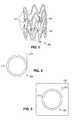
- FIG. 1depicts a stent.
- FIG. 2depicts a stent delivery assembly.
- FIG. 3depicts a schematic illustration of a stent delivery assembly disposed in a pouch.
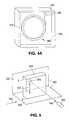
- FIG. 4Adepicts a schematic illustration of a stent delivery assembly in a pouch disposed in a flat box.
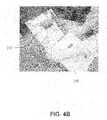
- FIG. 4Bdepicts a photograph of a pouch containing a stent delivery assembly being disposed in a chipboard box.
- FIG. 5depicts a schematic illustration of a fixture that supports a package.
- FIG. 6Adepicts the delivered dose within a material versus the depth of penetration of the radiation for materials of two different densities.
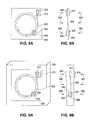
- FIGS. 6B-Ddepict embodiments of modifying radiation exposure to a selection section of device.
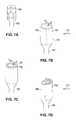
- FIG. 7Adepicts a stent disposed over a distal end of a catheter.
- FIG. 7Bdepicts a sheath disposed over stent.
- FIG. 7Cdepicts an inner sheath 720 and an outer sheath 725 over a stent.
- FIG. 7Ddepicts another embodiment of a covering 730 that is in the form of a half-cylinder.
- Covering 730covers a side of a selected section 706 of distal end 700 of a catheter 700 .
- Covering 730can be a reflective material such as metal.
- FIG. 8Adepicts a schematic illustration of a flexible package with a stent delivery assembly contained therein.
- FIG. 8Bdepicts a side view of the package of FIG. 8A .
- FIG. 9Adepicts a schematic illustration of a rigid package with a stent delivery assembly contained therein.
- FIG. 9Bdepicts a side view of the package of FIG. 9A .
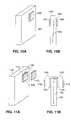
- FIG. 10Adepicts a package with a preformed barrier portion with a stent delivery assembly contained therein.
- FIG. 10Bdepicts a side view of the package of FIG. 10A .
- FIG. 11Adepicts a package that includes a receptacle or slot for insertion of a barrier element.
- FIG. 11Bdepicts a side view of the package of FIG. 10A .
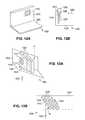
- FIG. 12Adepicts a fixture for supporting packages containing stent delivery assemblies during sterilization.
- FIG. 12Bdepicts a side view of the fixture of FIG. 11B supporting a package containing a stent delivery assembly.
- FIG. 13Adepicts a fixture containing packages arranged in a staggered horizontally stacked configuration.
- FIG. 13Bdepicts an overhead view of the fixture in FIG. 13A .
- Various embodiments of the present inventionrelate to sterilizing implantable medical devices with radiation.
- the devicescan be made in whole or in part of polymers.
- the embodimentsrelate to controlling the radiation delivered to selected sections of a device.
- the method and systems described hereinmay be applied generally to implantable medical devices.
- the methods and systemsare particularly relevant, for reasons discussed below, to implantable medical devices having a polymeric substrate, a polymer-based coating, and/or a drug-delivery coating.
- a polymer-based coatingmay contain, for example, an active agent or drug for local administration at a diseased site.
- An implantable medical devicemay include a polymer or non-polymer substrate with a polymer-based coating.
- implantable medical devicesinclude self-expandable stents, balloon-expandable stents, stent-grafts, grafts (e.g., aortic grafts), artificial heart valves, cerebrospinal fluid shunts, pacemaker electrodes, and endocardial leads (e.g., FINELINE and ENDOTAK, available from Abbott Cardiovascular Systems Inc, Santa Clara, Calif.).
- the underlying structure or substrate of the devicecan be of virtually any design.
- FIG. 1depicts an example of a view of a stent 100 .
- Stent 100has a cylindrical shape and includes a pattern with a number of interconnecting structural elements or struts 110 .
- a stent patternis designed so that the stent can be radially compressed (crimped) and radially expanded (to allow deployment). The stresses involved during compression and expansion are generally distributed throughout various structural elements of the stent pattern.
- the present inventionis not limited to the stent pattern depicted in FIG. 1 .
- the variation in stent patternsis virtually unlimited.
- a stent such as stent 100may be fabricated from a polymeric tube or a sheet by rolling and bonding the sheet to form a tube.
- a stent patternmay be formed on a polymeric tube by laser cutting a pattern on the tube.
- lasersinclude, but are not limited to, excimer, carbon dioxide, and YAG.
- chemical etchingmay be used to form a pattern on a tube.
- a stenthas certain mechanical requirements that are crucial to successful treatment.
- a stentmust have sufficient radial strength to withstand structural loads, namely radial compressive forces, imposed on the stent as it supports the walls of a vessel.
- the stentmust possess sufficient flexibility to allow for crimping, expansion, and cyclic loading. Bending elements 130 , 140 , and 150 , in particular, are subjected to a great deal of stress and strain during use of a stent.
- a polymer tubecan be radially deformed prior to laser cutting to enhance radial strength.
- the increase in strength and moduluscan be due to the induced molecular orientation in the circumferential direction.
- Tgglass transition temperature
- the “glass transition temperature,” Tgis the temperature at which the amorphous domains of a polymer change from a brittle vitreous state to a solid deformable or ductile state at atmospheric pressure.
- the Tgcorresponds to the temperature where the onset of segmental motion in the chains of the polymer occurs.
- the coefficient of expansion and the heat capacity of the polymerboth increase as the temperature is raised, indicating increased molecular motion.
- the increasing heat capacitycorresponds to an increase in heat dissipation through movement.
- Tg of a given polymercan be dependent on the heating rate and can be influenced by the thermal history of the polymer. Furthermore, the chemical structure of the polymer heavily influences the glass transition by affecting mobility.
- Sterilizationis typically performed on medical devices, such as stents, to reduce the bioburden on the device.
- Bioburdenrefers generally to the number of microorganisms with which an object is contaminated.
- the degree of sterilizationis typically measured by a sterility assurance level (SAL) which refers to the probability of a viable microorganism being present on a product unit after sterilization.
- SALsterility assurance level
- the required SAL for a productis dependent on the intended use of the product. For example, a product to be used in the body's fluid path is considered a Class III device.
- SAL's for various medical devicescan be found in materials from the Association for the Advancement of Medical Instrumentation (AAMI) in Arlington, Va.
- Radiation sterilizationis well known to those of ordinary skill the art. Medical devices composed in whole or in part of polymers can be sterilized by various kinds of radiation, including, but not limited to, electron beam (e-beam), gamma ray, ultraviolet, infra-red, ion beam, x-ray, and laser sterilization.
- a sterilization dosecan be determined by selecting a dose that provides a required SAL. A sample can be exposed to the required dose in one or multiple passes.
- the deterioration of the performance of polymeric materials and drugs due to e-beam radiation sterilizationhas been associated with free radical formation in a device during radiation exposure and by reaction with other parts of the polymer chains.
- the reactionis dependent on e-beam dose and level of temperature.
- e-beamcan cause a rise in temperature of an irradiated polymer sample.
- the rise in temperatureis dependent on the level of exposure.
- a stent delivery assemblycan increase about 7° C. per 12 kGy of radiation exposure.
- Mechanical properties of polymersare particularly sensitive to changes in temperature. In particular, the effect on properties becomes more profound as the temperature approaches and surpasses the glass transition temperature, Tg.
- Tgglass transition temperature
- e-beam radiation of polymer stentscan result in cracking of struts during deployment due to onset of brittle behavior. The cracking can be due to the increase in temperature, as well as the reduction in molecular weight. Additionally, the increase in temperature can result in a loss of some or all of the induced orientation and strength due to relaxation of polymer chains.
- the increase in temperaturecan also increase the release rate of drug resulting in a decrease of drug loading on a stent.
- Drugscan also degrade at increased temperatures during manufacture and storage conditions, altering the total content and release rate of the drug.
- the dosecan be selected to be sufficient to sterilize the stent to a desired degree.
- the exposurecan be in one or more passes from a radiation source.
- a polymeric stent and balloonare more sensitive to radiation exposure than a catheter and dispenser coil.
- the performance of the stent and balloonare more likely to be adversely affected by the increase in temperature and chemical degradation caused by radiation exposure. Therefore, it is important for the delivered radiation exposure to the stent and balloon to be within a selected range.
- a selected rangecan be, for example, 20-30 KGy or, more narrowly, 22-27 KGy.
- the performance of a catheter and dispenser coilis less sensitive to radiation exposure.
- the catheter and dispenser coilcan tolerate larger variations in delivered radiation at higher levels.
- selected sections of a devicecan have different desired or optimal delivered radiation range than other sections of the device.
- the stent and balloonmay require a lower radiation exposure for effective sterilization than the catheter and dispenser coil.
- the processing of a stentmay result in a lower level of bioburden on the stent compared to the catheter.
- a stentmay be exposed to solvents such as isopropyl alcohol and acetone during processing.
- stent materialmay be exposed to high temperatures during various processing steps.
- the stentcan have a bioburden less than 5 cfu and even as low as 0-1 cfu.
- CFUis a measure of bioburden that stands for “colony-forming unit” which is a measure of viable bacterial numbers.
- the required or terminal sterilization dose for a product with 1.5 cfuis 15 KGy and a radiation dose for an 8 cfu product is 17.5 KGy.
- the delivery systemmay require substantially higher doses than other parts of the assembly.
- the delivered dose to a stentcan be decreased. This would reduce the degradation of the performance due to radiation.
- Stentsare typically sterilized, packaged, stored, and transported in a “ready to implant” configuration in which the stent is disposed at the distal end of a delivery system that includes a catheter and dispenser coil.
- FIG. 2depicts a stent delivery assembly 200 with a stent 205 disposed on a distal end of a delivery system 215 .
- Stent 205can be crimped over a balloon.
- a sheathcan also be disposed over the stent to secure the secure to the balloon.
- Stent delivery assembly 200can be packaged prior to or after radiation sterilization.
- Stents and stent delivery assembliesare typically stored, transported, as well as sterilized in sealed storage containers. Such containers are adapted to protect the assembly from damage and environmental exposure (humidity, oxygen, light, etc.) which can have an adverse effect on the stent.
- Storage containers for a stent and delivery systemcan be designed to be any convenient form or shape that permits the effective enclosure of a stent and delivery system assembly contained therein. The container, however, may be compact and shaped so as to minimize storage space occupied by the container.
- a container intended primarily to protect the stent and delivery system from environmental exposurecan be a pouch or sleeve.
- FIG. 3depicts a schematic illustration of stent delivery assembly 200 disposed in a pouch 230 . As can be seen from FIG. 3 , assembly 200 is disposed or stored in a planar configuration.
- a pouchin one commercially useful embodiment, can have a rectangular cross-section with a width between 8 in and 12 in and a length between 10 in and 13 in.
- the containercan be of various degrees of rigidity or flexibility.
- the containercan be constructed of flexible films rather than rigid materials because it is less likely that the seal would be compromised by a change in atmospheric conditions during storage.
- the containercan be constructed of two sheets or lamina which have been joined along an edge.
- the containercan be constructed of a single sheet or lamina which has been folded and sealed along all edges or along all non-folded edges; or a bag or pocket which is sealed along one or more edges.
- the pouchescan be made from a polymer, glass, ceramic, metallic substance, or a combination thereof. Typically, the pouches are made of metallic foil.
- a pouch containing a stent and delivery systemcan be further disposed within a rigid container to protect the pouch and the stent and delivery system contained therein.
- the rigid containercan be, for example, a box, such as a chipboard box.
- FIG. 4Adepicts a schematic illustration of a stent and delivery system 200 within pouch 230 in a flat chipboard box 240 .
- FIG. 4Bdepicts a photograph of a pouch 250 containing a stent and delivery system being disposed in a chipboard box 255 .
- a system for sterilizing a packaged stent delivery assemblyincludes a radiation source, such as an e-beam source, and a fixture for supporting the package.
- the support fixtureis moved, for example, on a conveyer arrangement past an e-beam source in a manner that an e-beam is directed onto the stent delivery assembly.
- FIG. 5depicts a schematic illustration of a fixture 500 that supports a package 505 containing a stent delivery assembly (not shown).
- Fixture 500includes a bottom support 525 and a back support arm 530 .
- a radiation source 535directs radiation, as shown by an arrow 540 .
- Fixture 500can be moved by a conveyer system (not shown) as shown by an arrow 545 past radiation source 535 to sterilize the stent delivery assembly in package 505 .
- the cross-section of an E-beamis circular or generally circular in shape, as depicted by a pulse 542 of an E-beam.
- the E-beamis pulsed up and down as shown by an arrow 543 to irradiate package 505 and the stent delivery assembly along an axis from position X to position Y.
- the beamcan pulse up and down, for example, 64 times a second.
- the radiation delivered by a radiation source to selected sections of an implantable medical devicemay be greater or smaller than desired.
- a covering over a selected section of an implantable medical devicesuch as a stent delivery assembly, selectively modifies the radiation from the radiation source that is delivered to the selected section of the assembly.
- the radiationcan be modified by the covering so that radiation delivered to the selected section is within an optimal delivered radiation range.
- the coveringcan selectively modify radiation from a radiation source so that radiation delivered to a selected section of the assembly is higher or lower than the radiation delivered to the selected section without the covering.
- an implantable medical devicecan be enclosed in a package including one or more modifier sections.
- the modifier sectionscan selectively modify the radiation from the radiation source that is delivered to the selected section of the assembly In one embodiment, the radiation can be modified by the modifier sections(s) so that radiation delivered to the selected section is within an optimal delivered radiation range.
- the modifier sectionscan selectively modify radiation from a radiation source so that radiation delivered to a selected section of the assembly is higher or lower than the radiation delivered to the selected section in the absence of the modifier sections.
- radiation barrierssuch as a covering and the modifier sections, can increase or decrease the radiation delivered to the selected section. Radiation barriers can cause such increase/decrease through absorption, reflection (or backscattering), or a combination of thereof.
- the manner of modification of radiationdepends upon factors such as the thickness, density, and the reflective properties of a covering or modifier section material.
- FIG. 6Adepicts the delivered dose within a radiation absorbing material versus the depth of penetration of the radiation for materials of two different densities, curves C 1 and C 2 .
- FIG. 6Ashows that, depending on its thickness, a radiation barrier element can increase or decrease delivered radiation or dose above or below the initial radiation, Di.
- FIG. 6Ashows dose versus the density (or depth) the electrons traveled through. Di could be the radiation dose that a selected section would receive in the absence of a barrier between the selected section and radiation source or backscattering from material on a side opposite the selected section from the radiation source.
- FIG. 6Aalso shows that the range of increased-radiation increases to larger thicknesses as the density of the radiation barrier element increases. Both the density and thickness of a barrier element material can be selected to obtain selected radiation delivered on a selected section.
- Foamcan refer to a polymer foam, for example, polystyrene foam such as Styrofoam from Dow Chemical Company, Midland, Mich.
- a radiation barriercan modify or reduce radiation by reflecting or backscattering radiation.
- radiation from the radiation sourcecan be backscattered to a device from, for example, from a part of a supporting fixture back (e.g., support arm 530 in FIG. 5 ).
- Metalsgenerally, have a tendency to reflect various kinds of radiation, such as, electromagnetic radiation, electron beam, and ion beam radiation.
- Representative metals that may be used to as a reflective barrier materialinclude aluminum and stainless steel.
- Packaging, fixture, barriers, etc.can be designed so the radiation does not go through enough density to drop the dose to the selected section to zero. Additionally, the packaging, fixture, barriers, etc., can be designed so that a selected section receives a minimum dose, Dm, for example, 25 kGy. Curve C 1 rises from Di to Dp and then goes down to Dm, and finally to zero. Thus, there is a large dose variation.
- Embodiments of the present inventioninclude selective modification of radiation to obtain a selected delivered radiation dose at a selected section of a device.
- selective modification of radiationcan be performed using a covering, modifier section(s) in packaging, a fixture, or a combination thereof. Three sets of embodiments of selective modification are described herein.
- the radiationcan be selectively modified with a barrier between the radiation source and the selected section.
- the barrieris in front of the selected section, so that the radiation from the radiation source passes through the barrier to the selected section.
- the thickness, density of material, or both of the barriercan be selected to obtain a selected radiation dose to the selected section.
- a barrier in back of or on a side of the selected section opposite the incoming radiationselectively modifies radiation.
- the radiationcan be selectively modified with a barrier made from reflective material that backscatters or reflects radiation back to the selected section.
- the radiationpasses through the selected section to the barrier which reflects a portion of the radiation back at the selected section.
- the total dose delivered to the selected sectionis a sum of the radiation that initially passes through the selected section and the reflected radiation.
- the barrieris made from a non-reflective material.
- the barriercan act as a barrier that reduces or prevents radiation backscattered from, for example, a part of a fixture from increasing the radiation delivered to the selected section.
- the radiationcan be selectively modified with a barrier in front of and behind the selected section. Radiation passes through the front barrier to the selected section and then is backscattered to the selected section by the back barrier.
- the total dose delivered to the selected sectionis a sum of the radiation modified by the first barrier and radiation reflected from the back barrier to the selected section.
- the properties of the front barrier (thickness, density) and the reflective properties of the back barriercan be selected to obtain a selected delivered radiation dose to the selected section.
- FIGS. 6B-Dillustrate the first set, second set, and third set of embodiments, respectively.
- FIGS. 6B-Ddepict close-up views of a cross-section of a selected section 605 of an implantable medical device with radiation Di directed at the device as shown by an arrow 610 .
- FIG. 6Bwhich illustrates the first set of embodiments, depicts a configuration 601 with a radiation barrier 625 .
- radiation barrier 625can correspond to a part of a covering or modifier section of a package on a side of selected section 605 facing incoming radiation 610 with dose, Di.
- Radiation 610can be modified by barrier 625 to have dose D 1 , which is the radiation delivered to selected section 605 .
- the radiation delivered to the selected sectioncan be increased above Di or decreased below Di.
- Barrier 625can be a material with a dose curve C 1 from FIG. 6A .
- D 1can be increased to be above Di if the thickness of barrier 605 is less than Ti, as shown in FIG. 6A .
- D 1can be decreased to be below Di if the thickness is greater than Ti.
- a higher density materialcan be used to obtain a selected delivered dose with a thinner barrier.
- a higher density materialcan be used.
- D 1 to 44 kGyThe thickness, for example, can be changed so that D 1 is decreased to 30 kGy.
- An exemplary embodiment of a barrier materialcan be a metal.
- FIG. 6Cwhich illustrates the second set of embodiments, depicts a configuration 602 with a radiation barrier 630 behind selected section 605 .
- the radiation delivered to the selected sectioncan be increased above Di.
- Radiation barrier 630can correspond to a part of a covering, modifier section, or fixture on a side of selected section 605 . Even if barrier 630 is a non-reflective material, an increase in delivered radiation due to reflection of radiation to selected section 605 from a side opposite to selected section 605 is reduced or prevented. If barrier 630 is a reflective material, a portion, D 2 , of radiation 610 is reflected at selected section 605 . The total delivered radiation is the sum of D 1 and D 2 .
- Diis 25 kGy so that the initial exposure is 25 kGy.
- a portion, D 2 , of the 25 kGy radiationis reflected by barrier 630 , for example, 5 kGy.
- the total delivered radiationis the sum of D 1 and D 2 , or 30 kGy.
- FIG. 6Dwhich illustrates the third set of embodiments, depicts a barrier 615 in front of selected section 605 and a barrier 620 behind selected section 605 .
- Radiation 610can be modified by barrier 615 to have dose D 1 .
- D 1can be higher or lower than Di, depending on the thickness and density of barrier 615 .
- barrier 620is a reflective material, a portion of radiation 610 , D 2 , is reflected back at selected section 605 .
- the total delivered radiationis the sum of D 1 and D 2 .
- barrier 620is a non-reflective material
- the total delivered radiationcan be higher or lower than Di, depending on the thickness and density of barrier 615 .
- barrier 620is a reflective material and Di is 40, D 1 is 44 kGy, and D 2 is 6 kGy. The total delivered dose is 50 kGy.
- a coveringcan include a sheath or a sleeve that is disposed around a selected section of a stent delivery assembly.
- the selected sectioncan include a stent with the sheath or sleeve disposed around the circumference of the stent.
- the selected sectioncan be strip of polymeric material folded over to enclose a selected section of the assembly and clipped to secure the folded over strip.
- the covering for the selected sectionincludes a first side and a second side.
- the first sidecovers a side of the selected section facing incoming radiation and the second side covers a side of the selected section opposite the incoming radiation.
- the first sidecan modify the radiation through absorption.
- the second sidecan modify the radiation by backscattering of radiation at the selected section.
- the coveringis composed of a non-reflective material so that there is little modification through backscattering.
- the coveringcovers a side of the selected section facing incoming radiation with a side of the selected section opposite the incoming radiation being free of the covering.
- FIG. 7Adepicts a stent 705 disposed over a distal end 700 of a catheter.
- FIG. 7Bdepicts a sheath 710 disposed over stent 705 .
- Sheath 710can also be closed at a distal end to reduce or prevent exposure of the stent to bioburden.
- Sheath 710can serve the dual purpose of securing the stent to the catheter and as a radiation barrier.
- radiationcan be directed at distal end 700 .
- a side 720 of sheath 710can be adapted as described above to increase or decrease the delivered radiation to stent 705 .
- a side 725can also be adapted to increase the delivered dose to stent 705 through reflection of radiation.
- Sheath 710has a thickness Ts that can be adjusted to provide a desired degree of modification of radiation directed at the stent. Ts can be such that the stent receives a delivered radiation that is within a desired or optimal range.
- a materialcan be selected having a density that provides the desired degree of modification.
- the thickness, density, and materialcan be selected so that the radiation delivered to the stent is increased or decreased to a selected range.
- sheath 710can be disposed over a portion of the catheter to modify the radiation delivered to the portion.
- FIG. 7Cdepicts an alternative embodiment of a barrier showing an inner sheath 720 and an outer sheath 725 .
- Inner sheath 720 and outer sheath 725can act together to modify the delivered radiation to the stent.
- Inner sheath 720can be a sheath that is typically used to secure a stent to a catheter, while outer sheath 725 can be designed to adjust the delivered radiation to the stent.
- a thickness Tso of outer sheath 725can be adjusted and the density of sheath material can be selected to provide a desired modification of radiation.
- Various combinations of materials and thicknesses of inner and outer sheaths 720 and 725can be used to provide an optimal delivered radiation to the stent.
- FIG. 7Ddepicts another embodiment of a covering 730 that is in the form of a half-cylinder.
- Covering 730covers a side of a selected section 706 of distal end 700 of a catheter 700 .
- Covering 730can be a reflective material such as metal.
- Embodiments of modifier section(s) of the packagecan selectively modify the radiation from a radiation source so that radiation delivered to a selected section, such as a stent, of a stent delivery assembly is within a selected range.
- the modifier sectionscan have radiation absorption and reflection properties different from other portions of the package.
- the modifier section(s)can have a different thickness, density, or be made of a different material.
- the modifier sectioncan be coupled to or attached to a package that otherwise has a uniform or substantially uniform thickness, material, and density.
- the modifier sectioncan be a piece metal, foam, plastic, or other material that is taped, glued, stapled, or attached to the package.
- a modifier sectioncan be included in, on, or integral to a pouch 200 shown in FIG. 3 or a box 240 shown in FIG. 4A .
- a packagecan have a modifier section that is positioned on a side of the selected section facing incoming radiation. The modifier section can then modify radiation through absorption. Additionally or alternatively, a package can have a modifier section that is positioned on a side of the selected section opposite to the incoming radiation. Such a modifier section can modify radiation through reflection or backscattering of radiation at the selected section. The thickness and density of the modifier sections can be selected to obtain a selected delivered radiation to the selected section.
- FIG. 8Adepicts a schematic illustration of a flexible package 800 with a stent delivery assembly 805 contained therein.
- a barrier element 810is attached to a section of package 800 .
- a stent 815 of assembly 805is positioned behind barrier element 810 .
- FIG. 8Bdepicts a side view of package 800 showing barrier element 810 .
- FIG. 8Billustrates that package 800 can optionally have a barrier element 820 on its opposite side.
- barrier element 810can selectively modify radiation directed at assembly 800 from a radiation source, as shown by arrows 825 .
- barrier element 820can modify backscattered radiation as shown by arrows 830 which is reflected, for example, by a supporting fixture (not shown).
- Barrier element 830can be reflective material that increases the radiation delivered to the selected section through reflection of radiation that passes through barrier 810 .
- package 800can have barrier element 820 and be without barrier element 810 .
- Barrier elements 810 and 820can be the same or different thickness, density, or material.
- package 800can optionally include barrier elements 835 , 845 , or both to modify delivered radiation to a section of the catheter or dispenser coil.
- the thickness, density, or material of barrier elements 810 , 820 , 835 , and 845can be selected or adjusted, as discussed in reference to FIGS. 6B-D , to obtain a desired or optimal delivered radiation exposure to stent 815 and selected section 840 .
- barrier elementscan be attached to an inner surface of package 800 .
- FIGS. 9A-Bdepicts a schematic illustration of a rigid package or box 900 , such as a box 230 shown in FIG. 4 , with a stent delivery assembly 905 contained therein. Radiation is directed at package 900 as shown by arrows 925 . Backscattered radiation as shown by arrows 930 can come, for example, from a fixture. As shown, assembly 905 is enclosed within a flexible package or pouch 903 which is contained within package 900 .
- FIG. 9Ashows a front view of package 900 with barrier elements 910 and 935 attached to package 900 .
- Barrier element 910is in front of a stent 915 and barrier element 935 is in front of a section 940 of catheter 905 .
- FIG. 9Bshows a side view of package 900 .
- package 900optionally includes barrier elements 920 , 945 , or both on an opposite side of package 900 .
- package 900can have either or both barrier elements 920 or 945 and be without barrier elements 910 and 935 .
- the thickness, density, or material of barrier elements 910 , 920 , 935 , and 945can be selected or adjusted, as discussed in reference to FIGS. 6B-D , to obtain a desired or optimal delivered radiation exposure to stent 915 and section 940 .
- FIG. 10Adepicts a package 1000 with a stent delivery assembly (not shown) contained therein.
- Package 1000includes a barrier portion 1005 that is integral with, preformed, or incorporated with package 1000 .
- FIG. 10Bdepicts a side view of package 1000 showing a stent delivery assembly 1015 contained within package 1000 .
- Package 1000can optionally have a barrier portion 1010 .
- package 1000can have barrier element 1010 and be without barrier element 1005 .
- Stent 1020is positioned between barrier portion 1005 and a barrier portion 1010 , which can also be integral with, preformed, or incorporated with package 1000 .
- Package 1000can be formed of a plastic material with barrier portions 1005 and 1010 preformed as part of package 1000 .
- a packagecan have a receptacle or sleeve that allows insertion of a barrier element.
- An inserted barrier elementcan selectively modify radiation delivered to a selected section of a stent delivery assembly.
- FIG. 11Adepicts a package 1100 with a stent delivery assembly (not shown) contained therein.
- Package 1100includes a receptacle or slot 1105 that is integral with or attached to package 1100 .
- Receptacle 1105has an opening 1110 that allows insertion of a barrier element 1115 as shown by an arrow 1120 .
- FIG. 11Bdepicts a side view of package 1100 showing a stent delivery assembly 1125 contained within package 1100 .
- Package 1100can also have a receptacle 1135 for a barrier element 1140 , as shown by an arrow 1145 .
- package 1100can have receptacle 1135 with barrier element 1140 and be without receptacle 1105 with barrier element 1115 .
- Stent 1130is positioned between receptacle 1105 and a receptacle 1135 , which can also be integral with or attached to package 1100 .
- FIG. 1For embodiments of the present invention, can include sterilizing an implantable medical device using a fixture that selectively modifies the radiation delivered to a selected section of the assembly.
- the fixturecan be a support arm on a side opposite to the device that faces directed radiation.
- the supportcan include a modifier section that selectively reflects or backscatters radiation to the selected section.
- the modifier sectioncan be composed of a material that is more reflective than other portions of the support arm.
- the modifier sectioncan selectively absorb radiation or have lower reflective properties than other portions of a support arm.
- FIG. 12Adepicts a fixture 1200 for supporting packages containing stent delivery assemblies during sterilization.
- Fixture 1200includes a bottom support 1205 and a back support 1210 .
- Back support 1210has a modifier element 1215 .
- Modifier element 1215has different radiation absorption/reflective properties than other portions of the fixture.
- FIG. 12Bdepicts a side view of fixture 1200 supporting a package 1220 containing a stent delivery assembly 1225 . Radiation is directed at package 1220 as shown by an arrow 1235 . Stent 1230 is positioned between modifier element 1215 and directed radiation 1235 . If back support 1215 is composed of a reflective material, a non-reflective modifier element 1215 can reduce or eliminate backscatter from back support 1210 to stent 1230 , reducing delivered radiation to stent 1230 .
- back support 1215can be composed of aluminum and modifier element 1215 can be a non-reflective material such as foam.
- FIG. 4AAn e-beam from an e-beam source can be at an acute angle to the planar configuration of the packages which are positioned between the radiation source and the fixture.
- the packagesare arranged in a horizontally stacked configuration such that the radiation passes through more than one of the assemblies during exposure.
- the delivered dose to the assembliesvaries with distance between the radiation source and the fixture.
- one or more of the assembliescan be positioned within the packages so that a selected section of the assemblies receives a selected delivered radiation dose.
- FIG. 13Adepicts a fixture 1300 containing packages 1305 which are arranged in a staggered horizontally stacked configuration. Only three packages are shown, however, it should be understood that the method described applies to more than three. The number of packages is limited by the size of the fixture.
- Fixture 1300has a bottom support 1302 and a back support 1304 .
- Each of packages 1305contain a stent delivery assembly 1310 with a stent 1315 disposed at the distal end of a catheter.
- FIG. 13Bdepicts an overhead view of fixture 1300 and packages 1305 along line A-A.
- a radiation sourcedirects a radiation beam as shown by an arrow 1320 . Radiation beam 1320 is at an acute angle ⁇ to the face of packages 1305 .
- the delivered radiation to assembly 1310 in each of packages 1305decreases with distance along a line parallel to the face of packages 1305 , as illustrated by an arrow 1335 .
- a selected section of assembly 1310such as stent 1315 , can be positioned within one or more of packages 1305 so that the selected section has a selected delivered radiation.
- the delivered radiation to assembly 1310 or a selected sectioncan be increased by a suitable selection of the material of back support 1304 . If back support 1304 is composed of a reflective material, the delivered radiation to assembly 1310 or a selected section can be increased. Alternatively, if back support 1304 is composed of a non-reflective material, such as foam, increase of delivered radiation due to reflected radiation can be reduced or prevented.
- a modifier section 1215 as depicted in FIGS. 12A-Bcan be used with fixture 1300 to selectively modify delivered radiation to a selected section.
- the underlying structure or substrate of a stentcan be completely or at least in part made from a biodegradable polymer or combination of biodegradable polymers, a biostable polymer or combination of biostable polymers, or a combination of biodegradable and biostable polymers.
- a polymer-based coating for a surface of a devicecan be a biodegradable polymer or combination of biodegradable polymers, a biostable polymer or combination of biostable polymers, or a combination of biodegradable and biostable polymers.
- a polymer for use in fabricating an implantable medical device, such as a stentcan be biostable, bioabsorbable, biodegradable or bioerodable.
- Biostablerefers to polymers that are not biodegradable.
- biodegradable, bioabsorbable, and bioerodableare used interchangeably and refer to polymers that are capable of being completely degraded and/or eroded when exposed to bodily fluids such as blood and can be gradually resorbed, absorbed and/or eliminated by the body.
- the processes of breaking down and absorption of the polymercan be caused by, for example, hydrolysis and metabolic processes.
- the stentis intended to remain in the body for a duration of time until its intended function of, for example, maintaining vascular patency and/or drug delivery is accomplished.
- polymersthat may be used to fabricate a substrate of an implantable medical device or a coating for an implantable medical device include, but are not limited to, poly(N-acetylglucosamine) (Chitin), Chitosan, poly(hydroxyvalerate), poly(lactide-co-glycolide), poly(hydroxybutyrate), poly(hydroxybutyrate-co-valerate), polyorthoester, polyanhydride, poly(glycolic acid), poly(glycolide), poly(L-lactic acid), poly(L-lactide), poly(D,L-lactic acid), poly(L-lactide-co-glycolide); poly(D,L-lactide), poly(caprolactone), poly(trimethylene carbonate), polyethylene amide, polyethylene acrylate, poly(glycolic acid-co-trimethylene carbonate), co-poly(ether-esters) (e.g.
- PEO/PLApolyphosphazenes
- biomoleculessuch as fibrin, fibrinogen, cellulose, starch, collagen and hyaluronic acid
- polyurethanessilicones
- polyesterspolyolefins, polyisobutylene and ethylene-alphaolefin copolymers
- acrylic polymers and copolymers other than polyacrylatesvinyl halide polymers and copolymers (such as polyvinyl chloride), polyvinyl ethers (such as polyvinyl methyl ether), polyvinylidene halides (such as polyvinylidene chloride), polyacrylonitrile, polyvinyl ketones, polyvinyl aromatics (such as polystyrene), polyvinyl esters (such as polyvinyl acetate), acrylonitrile-styrene copolymers, ABS resins, polyamides (such as Nylon 66 and polycaprolactam), polycarbonates, polyoxymethylenes, polyimides,
- polymersthat may be especially well suited for use in fabricating an implantable medical device according to the methods disclosed herein include ethylene vinyl alcohol copolymer (commonly known by the generic name EVOH or by the trade name EVAL), poly(butyl methacrylate), poly(vinylidene fluoride-co-hexafluororpropene) (e.g., SOLEF 21508, available from Solvay Solexis PVDF, Thorofare, N.J.), polyvinylidene fluoride (otherwise known as KYNAR, available from ATOFINA Chemicals, Philadelphia, Pa.), ethylene-vinyl acetate copolymers, and polyethylene glycol.
- EVALethylene vinyl alcohol copolymer
- poly(vinylidene fluoride-co-hexafluororpropene)e.g., SOLEF 21508, available from Solvay Solexis PVDF, Thorofare, N.J.
- a non-polymer substrate of the devicemay be made of a metallic material or an alloy such as, but not limited to, cobalt chromium alloy (ELGILOY), stainless steel (316L), high nitrogen stainless steel, e.g., BIODUR 108, cobalt chrome alloy L-605, “MP35N,” “MP20N,” ELASTINITE (Nitinol), tantalum, nickel-titanium alloy, platinum-iridium alloy, gold, magnesium, or combinations thereof.
- “MP35N” and “MP20N”are trade names for alloys of cobalt, nickel, chromium and molybdenum available from Standard Press Steel Co., Jenkintown, Pa.
- “MP35N”consists of 35% cobalt, 35% nickel, 20% chromium, and 10% molybdenum.
- MP20Nconsists of 50% cobalt, 20% nickel, 20% chromium, and 10% molybdenum.
- a drug or active agentcan include, but is not limited to, any substance capable of exerting a therapeutic, prophylactic, or diagnostic effect.
- the drugs for use in the implantable medical device, such as a stent or non-load bearing scaffolding structuremay be of any or a combination of a therapeutic, prophylactic, or diagnostic agent.
- active agentsinclude antiproliferative substances such as actinomycin D, or derivatives and analogs thereof (manufactured by Sigma-Aldrich 100.1 West Saint Paul Avenue, Milwaukee, Wis. 53233; or COSMEGEN available from Merck). Synonyms of actinomycin D include dactinomycin, actinomycin IV, actinomycin I 1 , actinomycin X 1 , and actinomycin C 1 .
- the bioactive agentcan also fall under the genus of antineoplastic, anti-inflammatory, antiplatelet, anticoagulant, antifibrin, antithrombin, antimitotic, antibiotic, antiallergic and antioxidant substances.
- antineoplastics and/or antimitoticsinclude paclitaxel, (e.g., TAXOL® by Bristol-Myers Squibb Co., Stamford, Conn.), docetaxel (e.g., Taxotere®, from Aventis S.
- methotrexatemethotrexate
- azathioprineazathioprine
- vincristinevinblastine
- fluorouracildoxorubicin hydrochloride
- doxorubicin hydrochloridee.g., Adriamycin® from Pharmacia & Upjohn, Peapack N.J.
- mitomycine.g., Mutamycin® from Bristol-Myers Squibb Co., Stamford, Conn.
- antiplateletsexamples include aspirin, sodium heparin, low molecular weight heparins, heparinoids, hirudin, argatroban, forskolin, vapiprost, prostacyclin and prostacyclin analogues, dextran, D-phe-pro-arg-chloromethylketone (synthetic antithrombin), dipyridamole, glycoprotein IIb/IIIa platelet membrane receptor antagonist antibody, recombinant hirudin, and thrombin inhibitors such as Angiomax ä (Biogen, Inc., Cambridge, Mass.).
- cytostatic or antiproliferative agentsinclude angiopeptin, angiotensin converting enzyme inhibitors such as captopril (e.g., Capoten® and Capozide® from Bristol-Myers Squibb Co., Stamford, Conn.), cilazapril or lisinopril (e.g., Prinivil® and Prinzide® from Merck & Co., Inc., Whitehouse Station, N.J.), calcium channel blockers (such as nifedipine), colchicine, proteins, peptides, fibroblast growth factor (FGF) antagonists, fish oil (omega 3-fatty acid), histamine antagonists, lovastatin (an inhibitor of HMG-CoA reductase, a cholesterol lowering drug, brand name Mevacor® from Merck & Co., Inc., Whitehouse Station, N.J.), monoclonal antibodies (such as those specific for Platelet-Derived Growth Factor (PDGF) receptors),
- an antiallergic agentis permirolast potassium.
- Other therapeutic substances or agents which may be appropriate agentsinclude cisplatin, insulin sensitizers, receptor tyrosine kinase inhibitors, carboplatin, alpha-interferon, genetically engineered epithelial cells, steroidal anti-inflammatory agents, non-steroidal anti-inflammatory agents, antivirals, anticancer drugs, anticoagulant agents, free radical scavengers, estradiol, antibiotics, nitric oxide donors, super oxide dismutases, super oxide dismutases mimics, 4-amino-2,2,6,6-tetramethylpiperidine-1-oxyl (4-amino-TEMPO), tacrolimus, dexamethasone, ABT-578, clobetasol, cytostatic agents, prodrugs thereof, co-drugs thereof, and a combination thereof.
- rapamycinand structural derivatives or functional analogs thereof, such as 40-O-(2-hydroxy)ethyl-rapamycin (known by the trade name of EVEROLIMUS), 40-O-(3-hydroxy)propyl-rapamycin, 40-O-[2-(2-hydroxy)ethoxy]ethyl-rapamycin, methyl rapamycin, and 40-O-tetrazole-rapamycin.
- a stent storage containerfor example, package 230 of FIG. 3 or package 1100 of FIGS. 11A-B , can be made of various substances that form a barrier when sealed.
- at stent storage containercan be made of a polymer, glass, ceramic or a metallic substance such as aluminum, stainless steel or gold.
- the containerfor example can be formed of a metallic film.
- filmsinclude, but are not limited to, gold, platinum, platinum/iridium alloy, tantalum, palladium, chromium, and aluminum.
- Suitable materials for the containermay also include oxides of the above-mentioned metals, for example, aluminum oxide.
- Medical storage containersmay be obtained from, for example, Oliver Products Company of Grand Rapids, Mich.
- Suitable polymers for construction of a stent storage containercan include polymers of polyolefins, polyurethanes, cellulosics (i.e., polymers having mer units derived from cellulose), polyesters, polyamides, poly(hexamethylene isophthalamide/terephthalamide) (commercially available as Selar PATM), poly(ethylene terephthalate-co-p-oxybenzoate) (PET/PHB, e.g., copolymer having about 60-80 mole percent PHB), poly(hydroxy amide ethers), polyacrylates, polyacrylonitrile, acrylonitrile/styrene copolymer (commercially available as LopacTM), rubber-modified acrylonitrile/acrylate copolymer (commercially available as BarexTM), liquid crystal polymers (LCP) (e.g.
- poly(phenylene sulfide)polystyrenes
- polypropylenespolypropylenes
- polycarbonatesepoxies composed of bisphenol A
- polyolefinsinclude those based upon alpha-monoolefin monomers having from about 2 to 6 carbon atoms and halogen substituted olefins, i.e., halogenated polyolefins.
- low to high density polyethylenesessentially unplasticized poly(vinyl chloride), poly(vinylidene chloride) (SaranTM), poly(vinyl fluoride), poly(vinylidene fluoride), poly(tetrafluoroethylene) (Teflon), poly(chlorotrifluoroethylene) (Kel-FTM), and mixtures thereof are suitable.
- Low to high density polyethylenesare generally understood to have densities of about 0.92 g cm ⁇ 3 to about 0.96 g cm ⁇ 3 , however, no bright line can be drawn for density classifications and the density can vary according to the supplier.
- Representative polyurethanesinclude polyurethanes having a glass transition temperature above a storage or ambient temperature, for example having a glass transition temperature of at least 40° C. to 60° C., or having a non-polar soft segment which includes a hydrocarbon, silicone, fluorosilicone, or mixtures thereof.
- Elast-EonTMmanufactured by Elastomedic/CSIRO Molecular Science, is a polyurethane with a non-polar soft segment which is made from 1,4-butanediol, 4,4′-methylenediphenyl diisocyanate, and a soft segment composed of a blend of poly(hexamethylene oxide) (PHMO) and bishydroxyethoxypropylpolydimethylsiloxane (PDMS).
- PHMOpoly(hexamethylene oxide)
- PDMSbishydroxyethoxypropylpolydimethylsiloxane
- a useful examplehas a blend of 20% by weight PHMO and 80% by weight PDMS.
- cellulosicsinclude, but are not limited to, cellulose acetate having a degree of substitution (DS) greater than about 0.8 or less than about 0.6, ethyl cellulose, cellulose nitrate, cellulose acetate butyrate, methyl cellulose, and mixtures thereof.
- DSdegree of substitution
- polyestersinclude saturated or unsaturated polyesters such as, but not limited to, poly(butylene terephthalate), poly(ethylene 2,6-naphthalene dicarboxylate) (PEN), and poly(ethylene terephthalate).
- polyamidesinclude crystalline or amorphous polyamides such as, but not limited to, nylon-6, nylon-6,6, nylon-6,9, nylon-6,10, nylon-11, aromatic nylon MXD6 (manufactured by Mitsubishi Gas Chemical America, Inc.), and mixtures thereof.
- Representative polyacrylatesinclude, but are not limited to, poly(methylmethacrylate) and polymethacrylate.
- a stent storage containermay also be composed of copolymers of vinyl monomers with each other and olefins such as poly(ethyl vinyl acetate).
Landscapes
- Health & Medical Sciences (AREA)
- Epidemiology (AREA)
- Life Sciences & Earth Sciences (AREA)
- Animal Behavior & Ethology (AREA)
- General Health & Medical Sciences (AREA)
- Public Health (AREA)
- Veterinary Medicine (AREA)
- Apparatus For Disinfection Or Sterilisation (AREA)
- Materials For Medical Uses (AREA)
- Radiation-Therapy Devices (AREA)
Abstract
Description
Claims (19)
Priority Applications (13)
| Application Number | Priority Date | Filing Date | Title |
|---|---|---|---|
| US11/803,829US8034287B2 (en) | 2006-06-01 | 2007-05-15 | Radiation sterilization of medical devices |
| EP07809276.4AEP2032176B1 (en) | 2006-06-01 | 2007-06-01 | Radiation sterilization of medical devices |
| EP11195791.6AEP2436401B1 (en) | 2006-06-01 | 2007-06-01 | System for sterilizing a stent delivery assembly with radiation |
| ES11195791.6TES2573107T3 (en) | 2006-06-01 | 2007-06-01 | System for radiation sterilization of an apparatus for the introduction of a stent |
| JP2009513294AJP5057529B2 (en) | 2006-06-01 | 2007-06-01 | Radiation sterilization of medical devices |
| ES07809276.4TES2523699T3 (en) | 2006-06-01 | 2007-06-01 | Radioactive sterilization of medical devices |
| PCT/US2007/012930WO2007143087A2 (en) | 2006-06-01 | 2007-06-01 | Radiation sterilization of medical devices |
| US13/237,851US8471229B2 (en) | 2006-06-01 | 2011-09-20 | System for radiation sterilization of medical devices |
| US13/237,845US8298483B2 (en) | 2006-06-01 | 2011-09-20 | Method for radiation sterilization of medical devices using a package having modifier sections |
| US13/240,804US8461561B2 (en) | 2006-06-01 | 2011-09-22 | System for radiation sterilization of medical devices using a package having modifier sections |
| US13/240,814US8524151B2 (en) | 2006-06-01 | 2011-09-22 | Method for radiation sterilization of medical devices |
| US13/909,994US8956575B2 (en) | 2006-06-01 | 2013-06-04 | System for radiation sterilization of medical devices |
| US13/972,813US8709340B2 (en) | 2006-06-01 | 2013-08-21 | Method for radiation sterilization of medical devices |
Applications Claiming Priority (2)
| Application Number | Priority Date | Filing Date | Title |
|---|---|---|---|
| US81030006P | 2006-06-01 | 2006-06-01 | |
| US11/803,829US8034287B2 (en) | 2006-06-01 | 2007-05-15 | Radiation sterilization of medical devices |
Related Child Applications (4)
| Application Number | Title | Priority Date | Filing Date |
|---|---|---|---|
| US13/237,851DivisionUS8471229B2 (en) | 2006-06-01 | 2011-09-20 | System for radiation sterilization of medical devices |
| US13/237,845DivisionUS8298483B2 (en) | 2006-06-01 | 2011-09-20 | Method for radiation sterilization of medical devices using a package having modifier sections |
| US13/240,804DivisionUS8461561B2 (en) | 2006-06-01 | 2011-09-22 | System for radiation sterilization of medical devices using a package having modifier sections |
| US13/240,814DivisionUS8524151B2 (en) | 2006-06-01 | 2011-09-22 | Method for radiation sterilization of medical devices |
Publications (2)
| Publication Number | Publication Date |
|---|---|
| US20070280851A1 US20070280851A1 (en) | 2007-12-06 |
| US8034287B2true US8034287B2 (en) | 2011-10-11 |
Family
ID=38698231
Family Applications (7)
| Application Number | Title | Priority Date | Filing Date |
|---|---|---|---|
| US11/803,829Expired - Fee RelatedUS8034287B2 (en) | 2006-06-01 | 2007-05-15 | Radiation sterilization of medical devices |
| US13/237,845Expired - Fee RelatedUS8298483B2 (en) | 2006-06-01 | 2011-09-20 | Method for radiation sterilization of medical devices using a package having modifier sections |
| US13/237,851Expired - Fee RelatedUS8471229B2 (en) | 2006-06-01 | 2011-09-20 | System for radiation sterilization of medical devices |
| US13/240,814Expired - Fee RelatedUS8524151B2 (en) | 2006-06-01 | 2011-09-22 | Method for radiation sterilization of medical devices |
| US13/240,804Expired - Fee RelatedUS8461561B2 (en) | 2006-06-01 | 2011-09-22 | System for radiation sterilization of medical devices using a package having modifier sections |
| US13/909,994Expired - Fee RelatedUS8956575B2 (en) | 2006-06-01 | 2013-06-04 | System for radiation sterilization of medical devices |
| US13/972,813Expired - Fee RelatedUS8709340B2 (en) | 2006-06-01 | 2013-08-21 | Method for radiation sterilization of medical devices |
Family Applications After (6)
| Application Number | Title | Priority Date | Filing Date |
|---|---|---|---|
| US13/237,845Expired - Fee RelatedUS8298483B2 (en) | 2006-06-01 | 2011-09-20 | Method for radiation sterilization of medical devices using a package having modifier sections |
| US13/237,851Expired - Fee RelatedUS8471229B2 (en) | 2006-06-01 | 2011-09-20 | System for radiation sterilization of medical devices |
| US13/240,814Expired - Fee RelatedUS8524151B2 (en) | 2006-06-01 | 2011-09-22 | Method for radiation sterilization of medical devices |
| US13/240,804Expired - Fee RelatedUS8461561B2 (en) | 2006-06-01 | 2011-09-22 | System for radiation sterilization of medical devices using a package having modifier sections |
| US13/909,994Expired - Fee RelatedUS8956575B2 (en) | 2006-06-01 | 2013-06-04 | System for radiation sterilization of medical devices |
| US13/972,813Expired - Fee RelatedUS8709340B2 (en) | 2006-06-01 | 2013-08-21 | Method for radiation sterilization of medical devices |
Country Status (5)
| Country | Link |
|---|---|
| US (7) | US8034287B2 (en) |
| EP (2) | EP2436401B1 (en) |
| JP (1) | JP5057529B2 (en) |
| ES (2) | ES2573107T3 (en) |
| WO (1) | WO2007143087A2 (en) |
Cited By (6)
| Publication number | Priority date | Publication date | Assignee | Title |
|---|---|---|---|---|
| US20110200482A1 (en)* | 2007-06-01 | 2011-08-18 | Advanced Cardiovascular Systems, Inc. | Radiation Sterilization of Medical Devices |
| US20120006999A1 (en)* | 2006-06-01 | 2012-01-12 | Abbott Cardiovascular Systems Inc. | System For Radiation Sterilization Of Medical Devices |
| US20120239135A1 (en)* | 2009-09-14 | 2012-09-20 | Abbott Cardiovascular Systems Inc. | Stents including poly(l-lactide) formulations that minimize molecular weight drop during processing |
| US8475713B2 (en) | 2006-07-13 | 2013-07-02 | Advanced Cardiovascular Systems, Inc. | Reduced temperature sterilization of stents |
| US9682162B2 (en) | 2006-08-15 | 2017-06-20 | Abbott Cardiovascular Systems Inc. | Sterilization methods for medical devices |
| US20220331462A1 (en)* | 2021-04-19 | 2022-10-20 | Varex Imaging Corporation | Systems and methods for irradiation |
Families Citing this family (34)
| Publication number | Priority date | Publication date | Assignee | Title |
|---|---|---|---|---|
| JP2007511253A (en) | 2003-06-12 | 2007-05-10 | セーフ ヘイブン インコーポレイテッド | Method and apparatus for sterilizing air and objects |
| US8114345B2 (en)* | 2008-02-08 | 2012-02-14 | Ethicon Endo-Surgery, Inc. | System and method of sterilizing an implantable medical device |
| US9572692B2 (en)* | 2009-02-02 | 2017-02-21 | Abbott Cardiovascular Systems Inc. | Bioabsorbable stent that modulates plaque geometric morphology and chemical composition |
| US20100198330A1 (en)* | 2009-02-02 | 2010-08-05 | Hossainy Syed F A | Bioabsorbable Stent And Treatment That Elicits Time-Varying Host-Material Response |
| US8147744B2 (en) | 2009-04-10 | 2012-04-03 | Abbott Cardiovascular Systems Inc. | Method of making a stent formed from crosslinked bioabsorbable polymer |
| US20110319987A1 (en) | 2009-05-20 | 2011-12-29 | Arsenal Medical | Medical implant |
| CA2762811C (en)* | 2009-05-20 | 2023-03-21 | Arsenal Medical, Inc. | Self-expandable medical device comprising polymeric strands and coatings thereon |
| US8992601B2 (en) | 2009-05-20 | 2015-03-31 | 480 Biomedical, Inc. | Medical implants |
| US8888840B2 (en)* | 2009-05-20 | 2014-11-18 | Boston Scientific Scimed, Inc. | Drug eluting medical implant |
| US9265633B2 (en) | 2009-05-20 | 2016-02-23 | 480 Biomedical, Inc. | Drug-eluting medical implants |
| US9309347B2 (en) | 2009-05-20 | 2016-04-12 | Biomedical, Inc. | Bioresorbable thermoset polyester/urethane elastomers |
| US20110066223A1 (en)* | 2009-09-14 | 2011-03-17 | Hossainy Syed F A | Bioabsorbable Stent With Time Dependent Structure And Properties |
| US8887477B2 (en)* | 2009-11-16 | 2014-11-18 | Cordis Corporation | E beam sterilization of medical devices comprising bioactive coating |
| US8981316B2 (en) | 2010-04-02 | 2015-03-17 | Abbott Cardiovascular Systems Inc. | Radiation sterilization of implantable medical devices |
| US8715569B2 (en) | 2010-08-20 | 2014-05-06 | Abbott Cardiovascular Systems Inc. | Post electron beam stabilization of polymeric medical devices |
| US8496865B2 (en)* | 2010-10-15 | 2013-07-30 | Abbott Cardiovascular Systems Inc. | Method to minimize chain scission and monomer generation in processing of poly(L-lactide) stent |
| US8966868B2 (en)* | 2011-05-09 | 2015-03-03 | Abbott Cardiovascular Systems Inc. | Methods of stabilizing molecular weight of polymer stents after sterilization |
| US8986608B2 (en) | 2011-05-17 | 2015-03-24 | Abbott Cardiovascular Systems Inc. | Method for radiation sterilization of medical devices |
| US9839537B2 (en) | 2012-03-07 | 2017-12-12 | Abbott Cardiovascular Systems Inc. | Bioresorbable polymer scaffold treatment of coronary and peripheral artery disease in diabetic patients |
| US9078740B2 (en) | 2013-01-21 | 2015-07-14 | Howmedica Osteonics Corp. | Instrumentation and method for positioning and securing a graft |
| TWI559942B (en)* | 2013-08-15 | 2016-12-01 | Univ Nat Cheng Kung | Ultraviolet laser sterilization system |
| US9364588B2 (en) | 2014-02-04 | 2016-06-14 | Abbott Cardiovascular Systems Inc. | Drug delivery scaffold or stent with a novolimus and lactide based coating such that novolimus has a minimum amount of bonding to the coating |
| US10441717B2 (en) | 2014-04-15 | 2019-10-15 | Insulet Corporation | Monitoring a physiological parameter associated with tissue of a host to confirm delivery of medication |
| WO2016071919A1 (en)* | 2014-11-05 | 2016-05-12 | Meril Life Sciences Pvt.Ltd. | A method for packing and sterilization of bioresorbable scaffold systems without affecting the scaffold characteristics |
| EP3247411A1 (en) | 2015-01-22 | 2017-11-29 | Crossroads Extremity Systems, LLC | A method for processing at least a first kit |
| US10245377B2 (en)* | 2016-11-11 | 2019-04-02 | Insulet Corporation | Drug delivery systems with sealed and sterile fluid paths and methods of providing the same |
| US10722640B2 (en) | 2017-08-03 | 2020-07-28 | Insulet Corporation | Devices, systems, and methods of packaging for a pre-filled drug delivery device |
| US10973939B2 (en) | 2017-08-03 | 2021-04-13 | Insulet Corporation | System and method for aseptic packaging of a drug delivery device components |
| EP4306146A3 (en) | 2017-09-25 | 2024-01-24 | Insulet Corporation | Pre-filled cartridge-based drug delivery device |
| CN108079331A (en)* | 2017-12-20 | 2018-05-29 | 南京喜悦科技股份有限公司 | A kind of surgical instrument radiation sterilizing apparatus |
| US11241532B2 (en) | 2018-08-29 | 2022-02-08 | Insulet Corporation | Drug delivery system with sensor having optimized communication and infusion site |
| WO2022133218A1 (en) | 2020-12-18 | 2022-06-23 | Insulet Corporation | Adhesive pad with a metallic coil for securing an on-body medical device |
| EP4346945A1 (en) | 2021-05-28 | 2024-04-10 | Insulet Corporation | Spring-based status sensors |
| EP4101482A1 (en) | 2021-06-07 | 2022-12-14 | Insulet Corporation | Exercise safety prediction based on physiological conditions |
Citations (290)
| Publication number | Priority date | Publication date | Assignee | Title |
|---|---|---|---|---|
| US3687135A (en) | 1969-08-20 | 1972-08-29 | Genrikh Borisovich Stroganov | Magnesium-base alloy for use in bone surgery |
| US3839743A (en) | 1972-04-21 | 1974-10-08 | A Schwarcz | Method for maintaining the normal integrity of blood |
| US3900632A (en) | 1970-02-27 | 1975-08-19 | Kimberly Clark Co | Laminate of tissue and random laid continuous filament web |
| US4104410A (en) | 1973-12-21 | 1978-08-01 | Malecki George J | Processing of green vegetables for color retention in canning |
| US4110497A (en) | 1976-07-02 | 1978-08-29 | Snyder Manufacturing Co., Ltd. | Striped laminate and method and apparatus for making same |
| US4321711A (en) | 1978-10-18 | 1982-03-30 | Sumitomo Electric Industries, Ltd. | Vascular prosthesis |
| US4346028A (en) | 1979-12-14 | 1982-08-24 | Monsanto Company | Asbestiform crystalline calcium sodium or lithium phosphate, preparation and compositions |
| US4596574A (en) | 1984-05-14 | 1986-06-24 | The Regents Of The University Of California | Biodegradable porous ceramic delivery system for bone morphogenetic protein |
| US4599085A (en) | 1979-07-11 | 1986-07-08 | Neodontics, Inc. | Bone implant member for prostheses and bone connecting elements and process for the production thereof |
| US4612009A (en) | 1984-06-19 | 1986-09-16 | Ceskoslovenska Akademie Ved | Biodegradable implant and a method for preparation thereof |
| EP0144534A3 (en) | 1983-09-20 | 1986-12-17 | Allied Corporation | Prosthetic devices |
| US4633873A (en) | 1984-04-26 | 1987-01-06 | American Cyanamid Company | Surgical repair mesh |
| US4656083A (en) | 1983-08-01 | 1987-04-07 | Washington Research Foundation | Plasma gas discharge treatment for improving the biocompatibility of biomaterials |
| US4718907A (en) | 1985-06-20 | 1988-01-12 | Atrium Medical Corporation | Vascular prosthesis having fluorinated coating with varying F/C ratio |
| US4722335A (en) | 1986-10-20 | 1988-02-02 | Vilasi Joseph A | Expandable endotracheal tube |
| US4723549A (en) | 1986-09-18 | 1988-02-09 | Wholey Mark H | Method and apparatus for dilating blood vessels |
| US4732152A (en) | 1984-12-05 | 1988-03-22 | Medinvent S.A. | Device for implantation and a method of implantation in a vessel using such device |
| US4733665A (en) | 1985-11-07 | 1988-03-29 | Expandable Grafts Partnership | Expandable intraluminal graft, and method and apparatus for implanting an expandable intraluminal graft |
| US4740207A (en) | 1986-09-10 | 1988-04-26 | Kreamer Jeffry W | Intralumenal graft |
| EP0108171B1 (en) | 1982-09-15 | 1988-05-04 | Meadox Medicals, Inc. | Synthetic woven double-velour graft |
| US4743252A (en) | 1986-01-13 | 1988-05-10 | Corvita Corporation | Composite grafts |
| US4768507A (en) | 1986-02-24 | 1988-09-06 | Medinnovations, Inc. | Intravascular stent and percutaneous insertion catheter system for the dilation of an arterial stenosis and the prevention of arterial restenosis |
| US4800882A (en) | 1987-03-13 | 1989-01-31 | Cook Incorporated | Endovascular stent and delivery system |
| US4816339A (en) | 1987-04-28 | 1989-03-28 | Baxter International Inc. | Multi-layered poly(tetrafluoroethylene)/elastomer materials useful for in vivo implantation |
| US4818559A (en) | 1985-08-08 | 1989-04-04 | Sumitomo Chemical Company, Limited | Method for producing endosseous implants |
| US4850999A (en) | 1980-05-24 | 1989-07-25 | Institute Fur Textil-Und Faserforschung Of Stuttgart | Flexible hollow organ |
| US4877030A (en) | 1988-02-02 | 1989-10-31 | Andreas Beck | Device for the widening of blood vessels |
| US4879135A (en) | 1984-07-23 | 1989-11-07 | University Of Medicine And Dentistry Of New Jersey | Drug bonded prosthesis and process for producing same |
| US4878906A (en) | 1986-03-25 | 1989-11-07 | Servetus Partnership | Endoprosthesis for repairing a damaged vessel |
| US4886062A (en) | 1987-10-19 | 1989-12-12 | Medtronic, Inc. | Intravascular radially expandable stent and method of implant |
| US4902289A (en) | 1982-04-19 | 1990-02-20 | Massachusetts Institute Of Technology | Multilayer bioreplaceable blood vessel prosthesis |
| EP0218003B1 (en) | 1985-09-27 | 1990-11-07 | Nissho Corporation | Radiation-sterilized, packaged medical device |
| US4977901A (en) | 1988-11-23 | 1990-12-18 | Minnesota Mining And Manufacturing Company | Article having non-crosslinked crystallized polymer coatings |
| US4994298A (en) | 1988-06-07 | 1991-02-19 | Biogold Inc. | Method of making a biocompatible prosthesis |
| US5019090A (en) | 1988-09-01 | 1991-05-28 | Corvita Corporation | Radially expandable endoprosthesis and the like |
| US5028597A (en) | 1986-04-07 | 1991-07-02 | Agency Of Industrial Science And Technology | Antithrombogenic materials |
| US5059211A (en) | 1987-06-25 | 1991-10-22 | Duke University | Absorbable vascular stent |
| US5062829A (en) | 1989-03-17 | 1991-11-05 | Carter Holt Harvey Plastic Products Group Limited | Relates to devices for administering a substance such as a drug or chemical or the like |
| US5084065A (en) | 1989-07-10 | 1992-01-28 | Corvita Corporation | Reinforced graft assembly |
| US5085629A (en) | 1988-10-06 | 1992-02-04 | Medical Engineering Corporation | Biodegradable stent |
| EP0364787B1 (en) | 1988-10-04 | 1992-03-04 | EXPANDABLE GRAFTS PARTNERSHIP a Texas General Partnership | Expandable intraluminal graft |
| US5100429A (en) | 1989-04-28 | 1992-03-31 | C. R. Bard, Inc. | Endovascular stent and delivery system |
| US5104410A (en) | 1990-10-22 | 1992-04-14 | Intermedics Orthopedics, Inc | Surgical implant having multiple layers of sintered porous coating and method |
| US5108417A (en) | 1990-09-14 | 1992-04-28 | Interface Biomedical Laboratories Corp. | Anti-turbulent, anti-thrombogenic intravascular stent |
| US5108755A (en) | 1989-04-27 | 1992-04-28 | Sri International | Biodegradable composites for internal medical use |
| US5112457A (en) | 1990-07-23 | 1992-05-12 | Case Western Reserve University | Process for producing hydroxylated plasma-polymerized films and the use of the films for enhancing the compatiblity of biomedical implants |
| US5123917A (en) | 1990-04-27 | 1992-06-23 | Lee Peter Y | Expandable intraluminal vascular graft |
| US5156623A (en) | 1990-04-16 | 1992-10-20 | Olympus Optical Co., Ltd. | Sustained release material and method of manufacturing the same |
| US5163958A (en) | 1989-02-02 | 1992-11-17 | Cordis Corporation | Carbon coated tubular endoprosthesis |
| US5163952A (en) | 1990-09-14 | 1992-11-17 | Michael Froix | Expandable polymeric stent with memory and delivery apparatus and method |
| US5163951A (en) | 1990-12-27 | 1992-11-17 | Corvita Corporation | Mesh composite graft |
| US5167614A (en) | 1991-10-29 | 1992-12-01 | Medical Engineering Corporation | Prostatic stent |
| US5192311A (en) | 1988-04-25 | 1993-03-09 | Angeion Corporation | Medical implant and method of making |
| US5197977A (en) | 1984-01-30 | 1993-03-30 | Meadox Medicals, Inc. | Drug delivery collagen-impregnated synthetic vascular graft |
| US5234456A (en) | 1990-02-08 | 1993-08-10 | Pfizer Hospital Products Group, Inc. | Hydrophilic stent |
| US5234457A (en) | 1991-10-09 | 1993-08-10 | Boston Scientific Corporation | Impregnated stent |
| US5236447A (en) | 1990-06-29 | 1993-08-17 | Nissho Corporation | Artificial tubular organ |
| US5279594A (en) | 1990-05-23 | 1994-01-18 | Jackson Richard R | Intubation devices with local anesthetic effect for medical use |
| US5282860A (en) | 1991-10-16 | 1994-02-01 | Olympus Optical Co., Ltd. | Stent tube for medical use |
| US5289831A (en) | 1989-03-09 | 1994-03-01 | Vance Products Incorporated | Surface-treated stent, catheter, cannula, and the like |
| US5290271A (en) | 1990-05-14 | 1994-03-01 | Jernberg Gary R | Surgical implant and method for controlled release of chemotherapeutic agents |
| US5306294A (en) | 1992-08-05 | 1994-04-26 | Ultrasonic Sensing And Monitoring Systems, Inc. | Stent construction of rolled configuration |
| EP0604022A1 (en) | 1992-12-22 | 1994-06-29 | Advanced Cardiovascular Systems, Inc. | Multilayered biodegradable stent and method for its manufacture |
| US5328471A (en) | 1990-02-26 | 1994-07-12 | Endoluminal Therapeutics, Inc. | Method and apparatus for treatment of focal disease in hollow tubular organs and other tissue lumens |
| US5330500A (en) | 1990-10-18 | 1994-07-19 | Song Ho Y | Self-expanding endovascular stent with silicone coating |
| US5342395A (en) | 1990-07-06 | 1994-08-30 | American Cyanamid Co. | Absorbable surgical repair devices |
| US5342621A (en) | 1992-09-15 | 1994-08-30 | Advanced Cardiovascular Systems, Inc. | Antithrombogenic surface |
| US5342348A (en) | 1992-12-04 | 1994-08-30 | Kaplan Aaron V | Method and device for treating and enlarging body lumens |
| US5356433A (en) | 1991-08-13 | 1994-10-18 | Cordis Corporation | Biocompatible metal surfaces |
| EP0621017A1 (en) | 1993-04-23 | 1994-10-26 | Advanced Cardiovascular Systems, Inc. | Ratcheting stent |
| US5383925A (en) | 1992-09-14 | 1995-01-24 | Meadox Medicals, Inc. | Three-dimensional braided soft tissue prosthesis |
| US5385580A (en) | 1990-08-28 | 1995-01-31 | Meadox Medicals, Inc. | Self-supporting woven vascular graft |
| US5389106A (en) | 1993-10-29 | 1995-02-14 | Numed, Inc. | Impermeable expandable intravascular stent |
| US5399666A (en) | 1994-04-21 | 1995-03-21 | E. I. Du Pont De Nemours And Company | Easily degradable star-block copolymers |
| GB2247696B (en) | 1990-08-28 | 1995-03-22 | Meadox Medicals Inc | Ravel-resistant woven vascular graft |
| US5423885A (en) | 1992-01-31 | 1995-06-13 | Advanced Cardiovascular Systems, Inc. | Stent capable of attachment within a body lumen |
| EP0397500B1 (en) | 1989-05-10 | 1995-08-02 | United States Surgical Corporation | Synthetic semiabsorbable yarn, fabric and tubular prosthesis |
| US5443458A (en) | 1992-12-22 | 1995-08-22 | Advanced Cardiovascular Systems, Inc. | Multilayered biodegradable stent and method of manufacture |
| US5443500A (en) | 1989-01-26 | 1995-08-22 | Advanced Cardiovascular Systems, Inc. | Intravascular stent |
| US5455040A (en) | 1990-07-26 | 1995-10-03 | Case Western Reserve University | Anticoagulant plasma polymer-modified substrate |
| US5464650A (en) | 1993-04-26 | 1995-11-07 | Medtronic, Inc. | Intravascular stent and method |
| US5502158A (en) | 1988-08-08 | 1996-03-26 | Ecopol, Llc | Degradable polymer composition |
| US5514379A (en) | 1992-08-07 | 1996-05-07 | The General Hospital Corporation | Hydrogel compositions and methods of use |
| US5527337A (en) | 1987-06-25 | 1996-06-18 | Duke University | Bioabsorbable stent and method of making the same |
| US5545408A (en) | 1991-10-21 | 1996-08-13 | Peptide Technology Limited | Biocompatible implant for the timing of ovulation in mares |
| US5554120A (en) | 1994-07-25 | 1996-09-10 | Advanced Cardiovascular Systems, Inc. | Polymer blends for use in making medical devices including catheters and balloons for dilatation catheters |
| US5556413A (en) | 1994-03-11 | 1996-09-17 | Advanced Cardiovascular Systems, Inc. | Coiled stent with locking ends |
| EP0493788B1 (en) | 1990-12-29 | 1996-09-25 | MUDR. MILAN KRAJICEK CSc. | Three-layer vascular prosthesis |
| US5578046A (en) | 1994-02-10 | 1996-11-26 | United States Surgical Corporation | Composite bioabsorbable materials and surgical articles made thereform |
| US5578073A (en) | 1994-09-16 | 1996-11-26 | Ramot Of Tel Aviv University | Thromboresistant surface treatment for biomaterials |
| US5591199A (en) | 1995-06-07 | 1997-01-07 | Porter; Christopher H. | Curable fiber composite stent and delivery system |
| US5591607A (en) | 1994-03-18 | 1997-01-07 | Lynx Therapeutics, Inc. | Oligonucleotide N3→P5' phosphoramidates: triplex DNA formation |
| US5593403A (en) | 1994-09-14 | 1997-01-14 | Scimed Life Systems Inc. | Method for modifying a stent in an implanted site |
| US5599301A (en) | 1993-11-22 | 1997-02-04 | Advanced Cardiovascular Systems, Inc. | Motor control system for an automatic catheter inflation system |
| US5605696A (en) | 1995-03-30 | 1997-02-25 | Advanced Cardiovascular Systems, Inc. | Drug loaded polymeric material and method of manufacture |
| US5607442A (en) | 1995-11-13 | 1997-03-04 | Isostent, Inc. | Stent with improved radiopacity and appearance characteristics |
| US5607467A (en) | 1990-09-14 | 1997-03-04 | Froix; Michael | Expandable polymeric stent with memory and delivery apparatus and method |
| US5629077A (en) | 1994-06-27 | 1997-05-13 | Advanced Cardiovascular Systems, Inc. | Biodegradable mesh and film stent |
| US5632840A (en) | 1994-09-22 | 1997-05-27 | Advanced Cardiovascular System, Inc. | Method of making metal reinforced polymer stent |
| US5632771A (en) | 1993-07-23 | 1997-05-27 | Cook Incorporated | Flexible stent having a pattern formed from a sheet of material |
| EP0709068A3 (en) | 1994-10-27 | 1997-06-04 | Medinol Ltd | X-ray visible stent |
| US5637113A (en) | 1994-12-13 | 1997-06-10 | Advanced Cardiovascular Systems, Inc. | Polymer film for wrapping a stent structure |
| US5667767A (en) | 1995-07-27 | 1997-09-16 | Micro Therapeutics, Inc. | Compositions for use in embolizing blood vessels |
| US5667796A (en) | 1993-11-30 | 1997-09-16 | Otten; Klaus | Method for producing ceramic implant materials, preferably ceramic implant materials including hydroxyl apatite |
| US5670558A (en) | 1994-07-07 | 1997-09-23 | Terumo Kabushiki Kaisha | Medical instruments that exhibit surface lubricity when wetted |
| EP0578998B1 (en) | 1992-07-08 | 1997-10-08 | Strecker, Ernst Peter, Dr.-med.Prof. | Implantable percutaneous endoprosthesis |
| US5693085A (en) | 1994-04-29 | 1997-12-02 | Scimed Life Systems, Inc. | Stent with collagen |
| US5707385A (en) | 1994-11-16 | 1998-01-13 | Advanced Cardiovascular Systems, Inc. | Drug loaded elastic membrane and method for delivery |
| US5711763A (en) | 1991-02-20 | 1998-01-27 | Tdk Corporation | Composite biological implant of a ceramic material in a metal substrate |
| US5716981A (en) | 1993-07-19 | 1998-02-10 | Angiogenesis Technologies, Inc. | Anti-angiogenic compositions and methods of use |
| US5726297A (en) | 1994-03-18 | 1998-03-10 | Lynx Therapeutics, Inc. | Oligodeoxyribonucleotide N3' P5' phosphoramidates |
| US5728751A (en) | 1996-11-25 | 1998-03-17 | Meadox Medicals, Inc. | Bonding bio-active materials to substrate surfaces |
| US5733326A (en) | 1996-05-28 | 1998-03-31 | Cordis Corporation | Composite material endoprosthesis |
| US5733564A (en) | 1993-04-14 | 1998-03-31 | Leiras Oy | Method of treating endo-osteal materials with a bisphosphonate solution |
| US5733925A (en) | 1993-01-28 | 1998-03-31 | Neorx Corporation | Therapeutic inhibitor of vascular smooth muscle cells |
| US5733330A (en) | 1997-01-13 | 1998-03-31 | Advanced Cardiovascular Systems, Inc. | Balloon-expandable, crush-resistant locking stent |
| US5741881A (en) | 1996-11-25 | 1998-04-21 | Meadox Medicals, Inc. | Process for preparing covalently bound-heparin containing polyurethane-peo-heparin coating compositions |
| US5756476A (en) | 1992-01-14 | 1998-05-26 | The United States Of America As Represented By The Department Of Health And Human Services | Inhibition of cell proliferation using antisense oligonucleotides |
| US5756457A (en) | 1993-08-26 | 1998-05-26 | Genetics Institute, Inc. | Neural regeneration using human bone morphogenetic proteins |
| US5765682A (en) | 1994-10-13 | 1998-06-16 | Menlo Care, Inc. | Restrictive package for expandable or shape memory medical devices and method of preventing premature change of same |
| US5769883A (en) | 1991-10-04 | 1998-06-23 | Scimed Life Systems, Inc. | Biodegradable drug delivery vascular stent |
| US5780807A (en) | 1994-11-28 | 1998-07-14 | Advanced Cardiovascular Systems, Inc. | Method and apparatus for direct laser cutting of metal stents |
| US5800516A (en) | 1996-08-08 | 1998-09-01 | Cordis Corporation | Deployable and retrievable shape memory stent/tube and method |
| US5824049A (en) | 1995-06-07 | 1998-10-20 | Med Institute, Inc. | Coated implantable medical device |
| US5825042A (en)* | 1993-06-18 | 1998-10-20 | Space Electronics, Inc. | Radiation shielding of plastic integrated circuits |
| US5830461A (en) | 1992-11-25 | 1998-11-03 | University Of Pittsburgh Of The Commonwealth System Of Higher Education | Methods for promoting wound healing and treating transplant-associated vasculopathy |
| US5830879A (en) | 1995-10-02 | 1998-11-03 | St. Elizabeth's Medical Center Of Boston, Inc. | Treatment of vascular injury using vascular endothelial growth factor |
| US5830178A (en) | 1996-10-11 | 1998-11-03 | Micro Therapeutics, Inc. | Methods for embolizing vascular sites with an emboilizing composition comprising dimethylsulfoxide |
| US5833651A (en) | 1996-11-08 | 1998-11-10 | Medtronic, Inc. | Therapeutic intraluminal stents |
| US5836962A (en) | 1993-10-20 | 1998-11-17 | Schneider (Europe) Ag | Endoprosthesis |
| US5837313A (en) | 1995-04-19 | 1998-11-17 | Schneider (Usa) Inc | Drug release stent coating process |
| US5840083A (en) | 1989-01-27 | 1998-11-24 | F.B. Rice & Co. | Implant device having biocompatiable membrane coating |
| US5853408A (en) | 1992-08-20 | 1998-12-29 | Advanced Cardiovascular Systems, Inc. | In-vivo modification of the mechanical properties of surgical devices |
| US5854207A (en) | 1995-12-12 | 1998-12-29 | Stryker Corporation | Compositions and therapeutic methods using morphogenic proteins and stimulatory factors |
| US5855612A (en) | 1995-05-12 | 1999-01-05 | Ohta Inc. | Biocompatible titanium implant |
| US5855618A (en) | 1996-09-13 | 1999-01-05 | Meadox Medicals, Inc. | Polyurethanes grafted with polyethylene oxide chains containing covalently bonded heparin |
| US5858746A (en) | 1992-04-20 | 1999-01-12 | Board Of Regents, The University Of Texas System | Gels for encapsulation of biological materials |
| DE19731021A1 (en) | 1997-07-18 | 1999-01-21 | Meyer Joerg | In vivo degradable metallic implant |
| US5865814A (en) | 1995-06-07 | 1999-02-02 | Medtronic, Inc. | Blood contacting medical device and method |
| US5868781A (en) | 1996-10-22 | 1999-02-09 | Scimed Life Systems, Inc. | Locking stent |
| US5874109A (en) | 1994-07-27 | 1999-02-23 | The Trustees Of The University Of Pennsylvania | Incorporation of biological molecules into bioactive glasses |
| US5874101A (en) | 1997-04-14 | 1999-02-23 | Usbiomaterials Corp. | Bioactive-gel compositions and methods |
| US5874165A (en) | 1996-06-03 | 1999-02-23 | Gore Enterprise Holdings, Inc. | Materials and method for the immobilization of bioactive species onto polymeric subtrates |
| US5877263A (en) | 1996-11-25 | 1999-03-02 | Meadox Medicals, Inc. | Process for preparing polymer coatings grafted with polyethylene oxide chains containing covalently bonded bio-active agents |
| US5876743A (en) | 1995-03-21 | 1999-03-02 | Den-Mat Corporation | Biocompatible adhesion in tissue repair |
| US5879713A (en) | 1994-10-12 | 1999-03-09 | Focal, Inc. | Targeted delivery via biodegradable polymers |
| US5888533A (en) | 1995-10-27 | 1999-03-30 | Atrix Laboratories, Inc. | Non-polymeric sustained release delivery system |
| US5891192A (en) | 1997-05-22 | 1999-04-06 | The Regents Of The University Of California | Ion-implanted protein-coated intralumenal implants |
| US5897955A (en) | 1996-06-03 | 1999-04-27 | Gore Hybrid Technologies, Inc. | Materials and methods for the immobilization of bioactive species onto polymeric substrates |
| US5906759A (en) | 1996-12-26 | 1999-05-25 | Medinol Ltd. | Stent forming apparatus with stent deforming blades |
| US5922005A (en) | 1994-10-27 | 1999-07-13 | Medinol Ltd. | Stent fabrication method |
| US5942209A (en) | 1996-03-11 | 1999-08-24 | Focal, Inc. | Method of local radiotherapy by polymerizing a material in vivo to form a hydrogel |
| US5954744A (en) | 1995-06-06 | 1999-09-21 | Quanam Medical Corporation | Intravascular stent |
| US5957975A (en) | 1997-12-15 | 1999-09-28 | The Cleveland Clinic Foundation | Stent having a programmed pattern of in vivo degradation |
| US5965720A (en) | 1994-03-18 | 1999-10-12 | Lynx Therapeutics, Inc. | Oligonucleotide N3'→P5' phosphoramidates |
| US5971954A (en) | 1990-01-10 | 1999-10-26 | Rochester Medical Corporation | Method of making catheter |
| US5976182A (en) | 1997-10-03 | 1999-11-02 | Advanced Cardiovascular Systems, Inc. | Balloon-expandable, crush-resistant locking stent and method of loading the same |
| US5980564A (en) | 1997-08-01 | 1999-11-09 | Schneider (Usa) Inc. | Bioabsorbable implantable endoprosthesis with reservoir |
| US5980972A (en) | 1996-12-20 | 1999-11-09 | Schneider (Usa) Inc | Method of applying drug-release coatings |
| US5981568A (en) | 1993-01-28 | 1999-11-09 | Neorx Corporation | Therapeutic inhibitor of vascular smooth muscle cells |
| US5980928A (en) | 1997-07-29 | 1999-11-09 | Terry; Paul B. | Implant for preventing conjunctivitis in cattle |
| US5986169A (en) | 1997-12-31 | 1999-11-16 | Biorthex Inc. | Porous nickel-titanium alloy article |
| US5997468A (en) | 1990-02-28 | 1999-12-07 | Medtronic, Inc. | Intraluminal drug eluting prosthesis method |
| DE19856983A1 (en) | 1998-06-25 | 1999-12-30 | Biotronik Mess & Therapieg | Implantable, bioresorbable vascular wall support, in particular coronary stent |
| US6010445A (en) | 1997-09-11 | 2000-01-04 | Implant Sciences Corporation | Radioactive medical device and process |
| US6015541A (en) | 1997-11-03 | 2000-01-18 | Micro Therapeutics, Inc. | Radioactive embolizing compositions |
| US6042875A (en) | 1997-04-30 | 2000-03-28 | Schneider (Usa) Inc. | Drug-releasing coatings for medical devices |
| US6051648A (en) | 1995-12-18 | 2000-04-18 | Cohesion Technologies, Inc. | Crosslinked polymer compositions and methods for their use |
| US6056993A (en) | 1997-05-30 | 2000-05-02 | Schneider (Usa) Inc. | Porous protheses and methods for making the same wherein the protheses are formed by spraying water soluble and water insoluble fibers onto a rotating mandrel |
| US6060451A (en) | 1990-06-15 | 2000-05-09 | The National Research Council Of Canada | Thrombin inhibitors based on the amino acid sequence of hirudin |
| US6066156A (en) | 1999-03-11 | 2000-05-23 | Advanced Cardiovascular Systems, Inc. | Temperature activated adhesive for releasably attaching stents to balloons |
| US6071266A (en) | 1996-04-26 | 2000-06-06 | Kelley; Donald W. | Lubricious medical devices |
| US6080488A (en) | 1995-02-01 | 2000-06-27 | Schneider (Usa) Inc. | Process for preparation of slippery, tenaciously adhering, hydrophilic polyurethane hydrogel coating, coated polymer and metal substrate materials, and coated medical devices |
| US6080177A (en) | 1991-03-08 | 2000-06-27 | Igaki; Keiji | Luminal stent, holding structure therefor and device for attaching luminal stent |
| US6083258A (en) | 1998-05-28 | 2000-07-04 | Yadav; Jay S. | Locking stent |
| US6093463A (en) | 1997-12-12 | 2000-07-25 | Intella Interventional Systems, Inc. | Medical devices made from improved polymer blends |
| US6096070A (en) | 1995-06-07 | 2000-08-01 | Med Institute Inc. | Coated implantable medical device |
| US6099562A (en) | 1996-06-13 | 2000-08-08 | Schneider (Usa) Inc. | Drug coating with topcoat |
| US6110188A (en) | 1998-03-09 | 2000-08-29 | Corvascular, Inc. | Anastomosis method |
| US6113629A (en) | 1998-05-01 | 2000-09-05 | Micrus Corporation | Hydrogel for the therapeutic treatment of aneurysms |
| US6117979A (en) | 1997-08-18 | 2000-09-12 | Medtronic, Inc. | Process for making a bioprosthetic device and implants produced therefrom |
| US6120536A (en) | 1995-04-19 | 2000-09-19 | Schneider (Usa) Inc. | Medical devices with long term non-thrombogenic coatings |
| US6120904A (en) | 1995-02-01 | 2000-09-19 | Schneider (Usa) Inc. | Medical device coated with interpenetrating network of hydrogel polymers |
| US6121027A (en) | 1997-08-15 | 2000-09-19 | Surmodics, Inc. | Polybifunctional reagent having a polymeric backbone and photoreactive moieties and bioactive groups |
| US6127173A (en) | 1997-09-22 | 2000-10-03 | Ribozyme Pharmaceuticals, Inc. | Nucleic acid catalysts with endonuclease activity |
| US6125523A (en) | 1998-11-20 | 2000-10-03 | Advanced Cardiovascular Systems, Inc. | Stent crimping tool and method of use |
| US6129761A (en) | 1995-06-07 | 2000-10-10 | Reprogenesis, Inc. | Injectable hydrogel compositions |
| US6129928A (en) | 1997-09-05 | 2000-10-10 | Icet, Inc. | Biomimetic calcium phosphate implant coatings and methods for making the same |
| US6150630A (en) | 1996-01-11 | 2000-11-21 | The Regents Of The University Of California | Laser machining of explosives |
| US6153252A (en) | 1998-06-30 | 2000-11-28 | Ethicon, Inc. | Process for coating stents |
| JP2000334028A (en) | 1999-05-26 | 2000-12-05 | Ishikawajima Harima Heavy Ind Co Ltd | Method of sterilizing medical supplies with electron beam |
| US6159951A (en) | 1997-02-13 | 2000-12-12 | Ribozyme Pharmaceuticals Inc. | 2'-O-amino-containing nucleoside analogs and polynucleotides |
| US6160084A (en) | 1998-02-23 | 2000-12-12 | Massachusetts Institute Of Technology | Biodegradable shape memory polymers |
| US6165212A (en) | 1993-10-21 | 2000-12-26 | Corvita Corporation | Expandable supportive endoluminal grafts |
| US6171609B1 (en) | 1995-02-15 | 2001-01-09 | Neorx Corporation | Therapeutic inhibitor of vascular smooth muscle cells |
| US6174330B1 (en) | 1997-08-01 | 2001-01-16 | Schneider (Usa) Inc | Bioabsorbable marker having radiopaque constituents |
| US6177523B1 (en) | 1999-07-14 | 2001-01-23 | Cardiotech International, Inc. | Functionalized polyurethanes |
| US6183505B1 (en) | 1999-03-11 | 2001-02-06 | Medtronic Ave, Inc. | Method of stent retention to a delivery catheter balloon-braided retainers |
| US6187045B1 (en) | 1999-02-10 | 2001-02-13 | Thomas K. Fehring | Enhanced biocompatible implants and alloys |
| US6210715B1 (en) | 1997-04-01 | 2001-04-03 | Cap Biotechnology, Inc. | Calcium phosphate microcarriers and microspheres |
| US6224626B1 (en) | 1998-02-17 | 2001-05-01 | Md3, Inc. | Ultra-thin expandable stent |
| US6240616B1 (en) | 1997-04-15 | 2001-06-05 | Advanced Cardiovascular Systems, Inc. | Method of manufacturing a medicated porous metal prosthesis |
| US6245103B1 (en) | 1997-08-01 | 2001-06-12 | Schneider (Usa) Inc | Bioabsorbable self-expanding stent |
| US6248344B1 (en) | 1997-04-21 | 2001-06-19 | Heimo Ylänen | Composite and its use |
| US6251135B1 (en) | 1997-08-01 | 2001-06-26 | Schneider (Usa) Inc | Radiopaque marker system and method of use |
| US6251142B1 (en) | 1996-12-10 | 2001-06-26 | Sorin Biomedica Cardio S.P.A. | Implantation device and a kit including the device |
| US6273913B1 (en) | 1997-04-18 | 2001-08-14 | Cordis Corporation | Modified stent useful for delivery of drugs along stent strut |
| US6281262B1 (en) | 1998-11-12 | 2001-08-28 | Takiron Co., Ltd. | Shape-memory, biodegradable and absorbable material |
| US6284333B1 (en) | 1997-09-10 | 2001-09-04 | Scimed Life Systems, Inc. | Medical devices made from polymer blends containing low melting temperature liquid crystal polymers |
| US6287332B1 (en) | 1998-06-25 | 2001-09-11 | Biotronik Mess- Und Therapiegeraete Gmbh & Co. Ingenieurbuero Berlin | Implantable, bioresorbable vessel wall support, in particular coronary stent |
| US6290721B1 (en) | 1992-03-31 | 2001-09-18 | Boston Scientific Corporation | Tubular medical endoprostheses |
| US6293966B1 (en) | 1997-05-06 | 2001-09-25 | Cook Incorporated | Surgical stent featuring radiopaque markers |
| US6303901B1 (en) | 1997-05-20 | 2001-10-16 | The Regents Of The University Of California | Method to reduce damage to backing plate |
| US6312459B1 (en) | 1999-06-30 | 2001-11-06 | Advanced Cardiovascular Systems, Inc. | Stent design for use in small vessels |
| US20010044652A1 (en) | 1999-10-14 | 2001-11-22 | Moore Brian Edward | Stents with multi-layered struts |
| US6327772B1 (en) | 1996-01-30 | 2001-12-11 | Medtronic, Inc. | Method for fabricating a planar eversible lattice which forms a stent when everted |
| US20020002399A1 (en) | 1999-12-22 | 2002-01-03 | Huxel Shawn Thayer | Removable stent for body lumens |
| US6375826B1 (en) | 2000-02-14 | 2002-04-23 | Advanced Cardiovascular Systems, Inc. | Electro-polishing fixture and electrolyte solution for polishing stents and method |
| US6379381B1 (en) | 1999-09-03 | 2002-04-30 | Advanced Cardiovascular Systems, Inc. | Porous prosthesis and a method of depositing substances into the pores |
| US6387121B1 (en) | 1996-10-21 | 2002-05-14 | Inflow Dynamics Inc. | Vascular and endoluminal stents with improved coatings |
| US6388043B1 (en) | 1998-02-23 | 2002-05-14 | Mnemoscience Gmbh | Shape memory polymers |
| US20020062148A1 (en) | 1997-02-26 | 2002-05-23 | Charles C. Hart | Kinetic stent |
| US6395326B1 (en) | 2000-05-31 | 2002-05-28 | Advanced Cardiovascular Systems, Inc. | Apparatus and method for depositing a coating onto a surface of a prosthesis |
| US20020065553A1 (en) | 2000-11-28 | 2002-05-30 | Scimed Life System, Inc. | Method for manufacturing a medical device having a coated portion by laser ablation |
| US6409761B1 (en) | 1996-04-26 | 2002-06-25 | G. David Jang | Intravascular stent |
| US6423092B2 (en) | 1999-12-22 | 2002-07-23 | Ethicon, Inc. | Biodegradable stent |
| US20020111590A1 (en) | 2000-09-29 | 2002-08-15 | Davila Luis A. | Medical devices, drug coatings and methods for maintaining the drug coatings thereon |
| US20020116050A1 (en) | 1999-01-15 | 2002-08-22 | Scimed Life Systems, Inc. | Stents with temporary retaining bands |
| US20020138133A1 (en) | 1999-11-09 | 2002-09-26 | Scimed Life Systems, Inc. | Stent with variable properties |
| US6461632B1 (en) | 1998-10-19 | 2002-10-08 | Synthes (U.S.A.) | Hardenable ceramic hydraulic cement |
| US6464720B2 (en) | 1997-09-24 | 2002-10-15 | Cook Incorporated | Radially expandable stent |
| US20020161114A1 (en) | 1999-07-20 | 2002-10-31 | Gunatillake Pathiraja A. | Shape memory polyurethane or polyurethane-urea polymers |
| US6479565B1 (en) | 1999-08-16 | 2002-11-12 | Harold R. Stanley | Bioactive ceramic cement |
| US6485512B1 (en) | 2000-09-27 | 2002-11-26 | Advanced Cardiovascular Systems, Inc. | Two-stage light curable stent and delivery system |
| US6492615B1 (en) | 2000-10-12 | 2002-12-10 | Scimed Life Systems, Inc. | Laser polishing of medical devices |
| US6494908B1 (en) | 1999-12-22 | 2002-12-17 | Ethicon, Inc. | Removable stent for body lumens |
| US6495156B2 (en) | 2000-05-12 | 2002-12-17 | Merck Patent Gmbh | Biocements having improved compressive strength |
| US6511748B1 (en) | 1998-01-06 | 2003-01-28 | Aderans Research Institute, Inc. | Bioabsorbable fibers and reinforced composites produced therefrom |
| US20030033001A1 (en) | 2001-02-27 | 2003-02-13 | Keiji Igaki | Stent holding member and stent feeding system |
| US6527801B1 (en) | 2000-04-13 | 2003-03-04 | Advanced Cardiovascular Systems, Inc. | Biodegradable drug delivery material for stent |
| US6537589B1 (en) | 2000-04-03 | 2003-03-25 | Kyung Won Medical Co., Ltd. | Calcium phosphate artificial bone as osteoconductive and biodegradable bone substitute material |
| US6540777B2 (en) | 2001-02-15 | 2003-04-01 | Scimed Life Systems, Inc. | Locking stent |
| US20030065355A1 (en) | 2001-09-28 | 2003-04-03 | Jan Weber | Medical devices comprising nonomaterials and therapeutic methods utilizing the same |
| US6554854B1 (en) | 1999-12-10 | 2003-04-29 | Scimed Life Systems, Inc. | Process for laser joining dissimilar metals and endoluminal stent with radiopaque marker produced thereby |
| US6565599B1 (en) | 2000-12-28 | 2003-05-20 | Advanced Cardiovascular Systems, Inc. | Hybrid stent |
| US6569191B1 (en) | 2000-07-27 | 2003-05-27 | Bionx Implants, Inc. | Self-expanding stent with enhanced radial expansion and shape memory |
| US6569193B1 (en) | 1999-07-22 | 2003-05-27 | Advanced Cardiovascular Systems, Inc. | Tapered self-expanding stent |
| US20030100865A1 (en) | 1999-11-17 | 2003-05-29 | Santini John T. | Implantable drug delivery stents |
| US6572672B2 (en) | 1998-11-06 | 2003-06-03 | Nanoproducts Corporation | Nanotechnology for biomedical products |
| US20030105530A1 (en) | 2001-12-04 | 2003-06-05 | Inion Ltd. | Biodegradable implant and method for manufacturing one |
| US6574851B1 (en) | 2000-07-31 | 2003-06-10 | Advanced Cardiovascular Systems, Inc. | Stent made by rotational molding or centrifugal casting and method for making the same |
| US6585755B2 (en) | 2001-06-29 | 2003-07-01 | Advanced Cardiovascular | Polymeric stent suitable for imaging by MRI and fluoroscopy |
| US6592617B2 (en) | 1996-04-30 | 2003-07-15 | Boston Scientific Scimed, Inc. | Three-dimensional braided covered stent |
| US6594156B1 (en)* | 2000-04-24 | 2003-07-15 | Minimed Inc. | Device and method for circuit protection during radiation sterilization |
| US6592614B2 (en) | 1996-01-05 | 2003-07-15 | Medtronic Ave, Inc. | Cuffed endoluminal prosthesis |
| US6613072B2 (en) | 1994-09-08 | 2003-09-02 | Gore Enterprise Holdings, Inc. | Procedures for introducing stents and stent-grafts |
| US20030171053A1 (en) | 1999-11-24 | 2003-09-11 | University Of Washington | Medical devices comprising small fiber biomaterials, and methods of use |
| US6626939B1 (en) | 1997-12-18 | 2003-09-30 | Boston Scientific Scimed, Inc. | Stent-graft with bioabsorbable structural support |
| US20030187495A1 (en) | 2002-04-01 | 2003-10-02 | Cully Edward H. | Endoluminal devices, embolic filters, methods of manufacture and use |
| US6635269B1 (en) | 1997-11-24 | 2003-10-21 | Morphoplant Gmbh | Immobilizing mediator molecules via anchor molecules on metallic implant materials containing oxide layer |
| US20030208259A1 (en) | 2000-06-29 | 2003-11-06 | Pentech Medical Devices Ltd. | Polymeric stents and other surgical articles |
| US6645243B2 (en) | 1997-01-09 | 2003-11-11 | Sorin Biomedica Cardio S.P.A. | Stent for angioplasty and a production process therefor |
| US20030209835A1 (en) | 2002-05-10 | 2003-11-13 | Iksoo Chun | Method of forming a tubular membrane on a structural frame |
| US20030226833A1 (en) | 2001-02-15 | 2003-12-11 | Scimed Life Systems, Inc. | Laser cutting of stents and other medical devices |
| US6664335B2 (en) | 2000-11-30 | 2003-12-16 | Cardiac Pacemakers, Inc. | Polyurethane elastomer article with “shape memory” and medical devices therefrom |
| US6667049B2 (en) | 1999-06-14 | 2003-12-23 | Ethicon, Inc. | Relic process for producing bioresorbable ceramic tissue scaffolds |
| US6666214B2 (en) | 1995-08-03 | 2003-12-23 | Psimedica Limited | Biomaterial |
| US20030236563A1 (en) | 2002-06-20 | 2003-12-25 | Dan Fifer | Stent delivery catheter with retention bands |
| US6669723B2 (en) | 1998-03-04 | 2003-12-30 | Scimed Life Systems, Inc. | Stent having variable properties and method of its use |
| US6676697B1 (en) | 1996-09-19 | 2004-01-13 | Medinol Ltd. | Stent with variable features to optimize support and method of making such stent |
| US6679980B1 (en) | 2001-06-13 | 2004-01-20 | Advanced Cardiovascular Systems, Inc. | Apparatus for electropolishing a stent |
| US6689375B1 (en) | 1999-11-09 | 2004-02-10 | Coripharm Medizinprodukte Gmbh & Co. Kg | Resorbable bone implant material and method for producing the same |
| US6695920B1 (en) | 2001-06-27 | 2004-02-24 | Advanced Cardiovascular Systems, Inc. | Mandrel for supporting a stent and a method of using the mandrel to coat a stent |
| US6706273B1 (en) | 1999-08-14 | 2004-03-16 | Ivoclar Vivadent Ag | Composition for implantation into the human and animal body |
| US6709379B1 (en) | 1998-11-02 | 2004-03-23 | Alcove Surfaces Gmbh | Implant with cavities containing therapeutic agents |
| US6719989B1 (en) | 1999-09-08 | 2004-04-13 | Pentax Corporation | Sustained release drug carrier, and method of manufacturing sustained release drug carrier |
| EP0665023B1 (en) | 1993-07-21 | 2004-04-21 | Otsuka Pharmaceutical Factory, Inc. | Medical material and process for producing the same |
| US20040093077A1 (en) | 2002-08-06 | 2004-05-13 | Jason White | Stent with micro-latching hinge joints |
| US6746773B2 (en) | 2000-09-29 | 2004-06-08 | Ethicon, Inc. | Coatings for medical devices |
| US6753007B2 (en) | 1999-02-02 | 2004-06-22 | Wright Medical Technology, Inc. | Controlled release composite |
| US6752826B2 (en) | 2001-12-14 | 2004-06-22 | Thoratec Corporation | Layered stent-graft and methods of making the same |
| US20040127970A1 (en) | 2002-12-30 | 2004-07-01 | Saunders Richard J. | Polymer link hybrid stent |
| US6764505B1 (en) | 2001-04-12 | 2004-07-20 | Advanced Cardiovascular Systems, Inc. | Variable surface area stent |
| US20040143317A1 (en) | 2003-01-17 | 2004-07-22 | Stinson Jonathan S. | Medical devices |
| US20040167610A1 (en) | 2003-02-26 | 2004-08-26 | Fleming James A. | Locking stent |
| US6818063B1 (en) | 2002-09-24 | 2004-11-16 | Advanced Cardiovascular Systems, Inc. | Stent mandrel fixture and method for minimizing coating defects |
| US6846323B2 (en) | 2003-05-15 | 2005-01-25 | Advanced Cardiovascular Systems, Inc. | Intravascular stent |
| DE4407079B4 (en) | 1993-03-03 | 2007-01-18 | Boston Scientific Ltd., St. Michael | Intraluminal jig and graft |
| US7166099B2 (en) | 2003-08-21 | 2007-01-23 | Boston Scientific Scimed, Inc. | Multilayer medical devices |
| US20070065334A1 (en) | 2005-09-16 | 2007-03-22 | Shalaby Shalaby W | Package components for radiochemical sterilization |
Family Cites Families (17)
| Publication number | Priority date | Publication date | Assignee | Title |
|---|---|---|---|---|
| JP3623007B2 (en)* | 1995-04-05 | 2005-02-23 | テルモ株式会社 | Artificial organ and sterilization method thereof |
| JP3787993B2 (en)* | 1997-10-27 | 2006-06-21 | 株式会社Nhvコーポレーション | Electron beam irradiation device |
| JPH11248894A (en)* | 1998-02-27 | 1999-09-17 | Mitsubishi Heavy Ind Ltd | Electron beam irradiation method and its device |
| US6139524A (en)* | 1998-10-16 | 2000-10-31 | Scimed Life Systems, Inc. | Stent delivery system with perfusion |
| JP2000312708A (en)* | 1999-04-30 | 2000-11-14 | Nkk Plant Engineering Corp | Electron beam irradiation device |
| JP2002078780A (en)* | 2000-06-26 | 2002-03-19 | Mitsubishi Heavy Ind Ltd | Electron beam irradiation method and apparatus therefor |
| US8632845B2 (en) | 2000-12-28 | 2014-01-21 | Abbott Cardiovascular Systems Inc. | Method of drying bioabsorbable coating over stents |
| US7150853B2 (en)* | 2001-11-01 | 2006-12-19 | Advanced Cardiovascular Systems, Inc. | Method of sterilizing a medical device |
| JP4148391B2 (en)* | 2002-02-06 | 2008-09-10 | 三菱重工食品包装機械株式会社 | Sterilization apparatus and sterilization method |
| US20040267347A1 (en)* | 2003-05-01 | 2004-12-30 | Cervantes Marvin John | Protective elongated sleeve for stent systems |
| US7695674B2 (en)* | 2003-09-29 | 2010-04-13 | Medtronic Vascular, Inc. | Method of sterilizing balloon with ionizing radiation |
| JP4449497B2 (en)* | 2004-03-05 | 2010-04-14 | 株式会社Ihi | Electron beam irradiation method and processing apparatus |
| US7694815B2 (en)* | 2004-09-17 | 2010-04-13 | Poly-Med, Inc. | Package components for radiochemical sterilization |
| WO2006034157A2 (en)* | 2004-09-17 | 2006-03-30 | Poly-Med, Inc. | Package components for radiochemical sterilization |
| US20060186010A1 (en)* | 2005-02-15 | 2006-08-24 | Boris Warnack | Medical device packaging and antistatic system |
| WO2007105067A1 (en)* | 2006-03-14 | 2007-09-20 | Arterial Remodeling Technologies, S.A. | Method of monitoring positioning of polymeric stents |
| US8034287B2 (en)* | 2006-06-01 | 2011-10-11 | Abbott Cardiovascular Systems Inc. | Radiation sterilization of medical devices |
- 2007
- 2007-05-15USUS11/803,829patent/US8034287B2/ennot_activeExpired - Fee Related
- 2007-06-01ESES11195791.6Tpatent/ES2573107T3/enactiveActive
- 2007-06-01EPEP11195791.6Apatent/EP2436401B1/ennot_activeNot-in-force
- 2007-06-01JPJP2009513294Apatent/JP5057529B2/ennot_activeExpired - Fee Related
- 2007-06-01EPEP07809276.4Apatent/EP2032176B1/ennot_activeNot-in-force
- 2007-06-01WOPCT/US2007/012930patent/WO2007143087A2/enactiveApplication Filing
- 2007-06-01ESES07809276.4Tpatent/ES2523699T3/enactiveActive
- 2011
- 2011-09-20USUS13/237,845patent/US8298483B2/ennot_activeExpired - Fee Related
- 2011-09-20USUS13/237,851patent/US8471229B2/ennot_activeExpired - Fee Related
- 2011-09-22USUS13/240,814patent/US8524151B2/ennot_activeExpired - Fee Related
- 2011-09-22USUS13/240,804patent/US8461561B2/ennot_activeExpired - Fee Related
- 2013
- 2013-06-04USUS13/909,994patent/US8956575B2/ennot_activeExpired - Fee Related
- 2013-08-21USUS13/972,813patent/US8709340B2/ennot_activeExpired - Fee Related
Patent Citations (340)
| Publication number | Priority date | Publication date | Assignee | Title |
|---|---|---|---|---|
| US3687135A (en) | 1969-08-20 | 1972-08-29 | Genrikh Borisovich Stroganov | Magnesium-base alloy for use in bone surgery |
| US3900632A (en) | 1970-02-27 | 1975-08-19 | Kimberly Clark Co | Laminate of tissue and random laid continuous filament web |
| US3839743A (en) | 1972-04-21 | 1974-10-08 | A Schwarcz | Method for maintaining the normal integrity of blood |
| US4104410A (en) | 1973-12-21 | 1978-08-01 | Malecki George J | Processing of green vegetables for color retention in canning |
| US4110497A (en) | 1976-07-02 | 1978-08-29 | Snyder Manufacturing Co., Ltd. | Striped laminate and method and apparatus for making same |
| US4321711A (en) | 1978-10-18 | 1982-03-30 | Sumitomo Electric Industries, Ltd. | Vascular prosthesis |
| US4599085A (en) | 1979-07-11 | 1986-07-08 | Neodontics, Inc. | Bone implant member for prostheses and bone connecting elements and process for the production thereof |
| US4346028A (en) | 1979-12-14 | 1982-08-24 | Monsanto Company | Asbestiform crystalline calcium sodium or lithium phosphate, preparation and compositions |
| US4850999A (en) | 1980-05-24 | 1989-07-25 | Institute Fur Textil-Und Faserforschung Of Stuttgart | Flexible hollow organ |
| US4902289A (en) | 1982-04-19 | 1990-02-20 | Massachusetts Institute Of Technology | Multilayer bioreplaceable blood vessel prosthesis |
| EP0108171B1 (en) | 1982-09-15 | 1988-05-04 | Meadox Medicals, Inc. | Synthetic woven double-velour graft |
| US4656083A (en) | 1983-08-01 | 1987-04-07 | Washington Research Foundation | Plasma gas discharge treatment for improving the biocompatibility of biomaterials |
| EP0144534A3 (en) | 1983-09-20 | 1986-12-17 | Allied Corporation | Prosthetic devices |
| US5197977A (en) | 1984-01-30 | 1993-03-30 | Meadox Medicals, Inc. | Drug delivery collagen-impregnated synthetic vascular graft |
| US4633873A (en) | 1984-04-26 | 1987-01-06 | American Cyanamid Company | Surgical repair mesh |
| US4596574A (en) | 1984-05-14 | 1986-06-24 | The Regents Of The University Of California | Biodegradable porous ceramic delivery system for bone morphogenetic protein |
| US4612009A (en) | 1984-06-19 | 1986-09-16 | Ceskoslovenska Akademie Ved | Biodegradable implant and a method for preparation thereof |
| US4879135A (en) | 1984-07-23 | 1989-11-07 | University Of Medicine And Dentistry Of New Jersey | Drug bonded prosthesis and process for producing same |
| US4732152A (en) | 1984-12-05 | 1988-03-22 | Medinvent S.A. | Device for implantation and a method of implantation in a vessel using such device |
| US4718907A (en) | 1985-06-20 | 1988-01-12 | Atrium Medical Corporation | Vascular prosthesis having fluorinated coating with varying F/C ratio |
| US4818559A (en) | 1985-08-08 | 1989-04-04 | Sumitomo Chemical Company, Limited | Method for producing endosseous implants |
| EP0218003B1 (en) | 1985-09-27 | 1990-11-07 | Nissho Corporation | Radiation-sterilized, packaged medical device |
| US4733665C2 (en) | 1985-11-07 | 2002-01-29 | Expandable Grafts Partnership | Expandable intraluminal graft and method and apparatus for implanting an expandable intraluminal graft |
| US4776337A (en) | 1985-11-07 | 1988-10-11 | Expandable Grafts Partnership | Expandable intraluminal graft, and method and apparatus for implanting an expandable intraluminal graft |
| US4776337B1 (en) | 1985-11-07 | 2000-12-05 | Cordis Corp | Expandable intraluminal graft and method and apparatus for implanting an expandable intraluminal graft |
| US4733665A (en) | 1985-11-07 | 1988-03-29 | Expandable Grafts Partnership | Expandable intraluminal graft, and method and apparatus for implanting an expandable intraluminal graft |
| US4739762A (en) | 1985-11-07 | 1988-04-26 | Expandable Grafts Partnership | Expandable intraluminal graft, and method and apparatus for implanting an expandable intraluminal graft |
| US4733665B1 (en) | 1985-11-07 | 1994-01-11 | Expandable Grafts Partnership | Expandable intraluminal graft,and method and apparatus for implanting an expandable intraluminal graft |
| US4739762B1 (en) | 1985-11-07 | 1998-10-27 | Expandable Grafts Partnership | Expandable intraluminal graft and method and apparatus for implanting an expandable intraluminal graft |
| US4743252A (en) | 1986-01-13 | 1988-05-10 | Corvita Corporation | Composite grafts |
| US4768507A (en) | 1986-02-24 | 1988-09-06 | Medinnovations, Inc. | Intravascular stent and percutaneous insertion catheter system for the dilation of an arterial stenosis and the prevention of arterial restenosis |
| US4878906A (en) | 1986-03-25 | 1989-11-07 | Servetus Partnership | Endoprosthesis for repairing a damaged vessel |
| US5028597A (en) | 1986-04-07 | 1991-07-02 | Agency Of Industrial Science And Technology | Antithrombogenic materials |
| US4740207A (en) | 1986-09-10 | 1988-04-26 | Kreamer Jeffry W | Intralumenal graft |
| US4723549A (en) | 1986-09-18 | 1988-02-09 | Wholey Mark H | Method and apparatus for dilating blood vessels |
| US4722335A (en) | 1986-10-20 | 1988-02-02 | Vilasi Joseph A | Expandable endotracheal tube |
| US4800882A (en) | 1987-03-13 | 1989-01-31 | Cook Incorporated | Endovascular stent and delivery system |
| US4816339A (en) | 1987-04-28 | 1989-03-28 | Baxter International Inc. | Multi-layered poly(tetrafluoroethylene)/elastomer materials useful for in vivo implantation |
| US5527337A (en) | 1987-06-25 | 1996-06-18 | Duke University | Bioabsorbable stent and method of making the same |
| US5059211A (en) | 1987-06-25 | 1991-10-22 | Duke University | Absorbable vascular stent |
| US5306286A (en) | 1987-06-25 | 1994-04-26 | Duke University | Absorbable stent |
| US4886062A (en) | 1987-10-19 | 1989-12-12 | Medtronic, Inc. | Intravascular radially expandable stent and method of implant |
| US4877030A (en) | 1988-02-02 | 1989-10-31 | Andreas Beck | Device for the widening of blood vessels |
| US5192311A (en) | 1988-04-25 | 1993-03-09 | Angeion Corporation | Medical implant and method of making |
| US4994298A (en) | 1988-06-07 | 1991-02-19 | Biogold Inc. | Method of making a biocompatible prosthesis |
| US5834582A (en) | 1988-08-08 | 1998-11-10 | Chronopol, Inc. | Degradable polymer composition |
| US5502158A (en) | 1988-08-08 | 1996-03-26 | Ecopol, Llc | Degradable polymer composition |
| US5019090A (en) | 1988-09-01 | 1991-05-28 | Corvita Corporation | Radially expandable endoprosthesis and the like |
| EP0364787B1 (en) | 1988-10-04 | 1992-03-04 | EXPANDABLE GRAFTS PARTNERSHIP a Texas General Partnership | Expandable intraluminal graft |
| US5085629A (en) | 1988-10-06 | 1992-02-04 | Medical Engineering Corporation | Biodegradable stent |
| US4977901A (en) | 1988-11-23 | 1990-12-18 | Minnesota Mining And Manufacturing Company | Article having non-crosslinked crystallized polymer coatings |
| US5443500A (en) | 1989-01-26 | 1995-08-22 | Advanced Cardiovascular Systems, Inc. | Intravascular stent |
| US5840083A (en) | 1989-01-27 | 1998-11-24 | F.B. Rice & Co. | Implant device having biocompatiable membrane coating |
| US5163958A (en) | 1989-02-02 | 1992-11-17 | Cordis Corporation | Carbon coated tubular endoprosthesis |
| US5289831A (en) | 1989-03-09 | 1994-03-01 | Vance Products Incorporated | Surface-treated stent, catheter, cannula, and the like |
| US5062829A (en) | 1989-03-17 | 1991-11-05 | Carter Holt Harvey Plastic Products Group Limited | Relates to devices for administering a substance such as a drug or chemical or the like |
| US5108755A (en) | 1989-04-27 | 1992-04-28 | Sri International | Biodegradable composites for internal medical use |
| US5100429A (en) | 1989-04-28 | 1992-03-31 | C. R. Bard, Inc. | Endovascular stent and delivery system |
| EP0397500B1 (en) | 1989-05-10 | 1995-08-02 | United States Surgical Corporation | Synthetic semiabsorbable yarn, fabric and tubular prosthesis |
| US5084065A (en) | 1989-07-10 | 1992-01-28 | Corvita Corporation | Reinforced graft assembly |
| US5971954A (en) | 1990-01-10 | 1999-10-26 | Rochester Medical Corporation | Method of making catheter |
| US5234456A (en) | 1990-02-08 | 1993-08-10 | Pfizer Hospital Products Group, Inc. | Hydrophilic stent |
| US5328471A (en) | 1990-02-26 | 1994-07-12 | Endoluminal Therapeutics, Inc. | Method and apparatus for treatment of focal disease in hollow tubular organs and other tissue lumens |
| US5997468A (en) | 1990-02-28 | 1999-12-07 | Medtronic, Inc. | Intraluminal drug eluting prosthesis method |
| US5156623A (en) | 1990-04-16 | 1992-10-20 | Olympus Optical Co., Ltd. | Sustained release material and method of manufacturing the same |
| US5123917A (en) | 1990-04-27 | 1992-06-23 | Lee Peter Y | Expandable intraluminal vascular graft |
| US5290271A (en) | 1990-05-14 | 1994-03-01 | Jernberg Gary R | Surgical implant and method for controlled release of chemotherapeutic agents |
| US5279594A (en) | 1990-05-23 | 1994-01-18 | Jackson Richard R | Intubation devices with local anesthetic effect for medical use |
| US6060451A (en) | 1990-06-15 | 2000-05-09 | The National Research Council Of Canada | Thrombin inhibitors based on the amino acid sequence of hirudin |
| EP0464755B1 (en) | 1990-06-29 | 1995-05-03 | Nissho Corporation | Artificial tubular organ |
| US5236447A (en) | 1990-06-29 | 1993-08-17 | Nissho Corporation | Artificial tubular organ |
| US5342395A (en) | 1990-07-06 | 1994-08-30 | American Cyanamid Co. | Absorbable surgical repair devices |
| US5112457A (en) | 1990-07-23 | 1992-05-12 | Case Western Reserve University | Process for producing hydroxylated plasma-polymerized films and the use of the films for enhancing the compatiblity of biomedical implants |
| US5455040A (en) | 1990-07-26 | 1995-10-03 | Case Western Reserve University | Anticoagulant plasma polymer-modified substrate |
| US5385580A (en) | 1990-08-28 | 1995-01-31 | Meadox Medicals, Inc. | Self-supporting woven vascular graft |
| GB2247696B (en) | 1990-08-28 | 1995-03-22 | Meadox Medicals Inc | Ravel-resistant woven vascular graft |
| US5108417A (en) | 1990-09-14 | 1992-04-28 | Interface Biomedical Laboratories Corp. | Anti-turbulent, anti-thrombogenic intravascular stent |
| US5163952A (en) | 1990-09-14 | 1992-11-17 | Michael Froix | Expandable polymeric stent with memory and delivery apparatus and method |
| US5607467A (en) | 1990-09-14 | 1997-03-04 | Froix; Michael | Expandable polymeric stent with memory and delivery apparatus and method |
| US5330500A (en) | 1990-10-18 | 1994-07-19 | Song Ho Y | Self-expanding endovascular stent with silicone coating |
| US5104410A (en) | 1990-10-22 | 1992-04-14 | Intermedics Orthopedics, Inc | Surgical implant having multiple layers of sintered porous coating and method |
| US5163951A (en) | 1990-12-27 | 1992-11-17 | Corvita Corporation | Mesh composite graft |
| EP0493788B1 (en) | 1990-12-29 | 1996-09-25 | MUDR. MILAN KRAJICEK CSc. | Three-layer vascular prosthesis |
| US5711763A (en) | 1991-02-20 | 1998-01-27 | Tdk Corporation | Composite biological implant of a ceramic material in a metal substrate |
| US6080177A (en) | 1991-03-08 | 2000-06-27 | Igaki; Keiji | Luminal stent, holding structure therefor and device for attaching luminal stent |
| US5356433A (en) | 1991-08-13 | 1994-10-18 | Cordis Corporation | Biocompatible metal surfaces |
| US6074659A (en) | 1991-09-27 | 2000-06-13 | Noerx Corporation | Therapeutic inhibitor of vascular smooth muscle cells |
| US5769883A (en) | 1991-10-04 | 1998-06-23 | Scimed Life Systems, Inc. | Biodegradable drug delivery vascular stent |
| US5234457A (en) | 1991-10-09 | 1993-08-10 | Boston Scientific Corporation | Impregnated stent |
| US5282860A (en) | 1991-10-16 | 1994-02-01 | Olympus Optical Co., Ltd. | Stent tube for medical use |
| US5545408A (en) | 1991-10-21 | 1996-08-13 | Peptide Technology Limited | Biocompatible implant for the timing of ovulation in mares |
| US5167614A (en) | 1991-10-29 | 1992-12-01 | Medical Engineering Corporation | Prostatic stent |
| US5756476A (en) | 1992-01-14 | 1998-05-26 | The United States Of America As Represented By The Department Of Health And Human Services | Inhibition of cell proliferation using antisense oligonucleotides |
| EP0554082B1 (en) | 1992-01-31 | 1997-12-29 | Advanced Cardiovascular Systems, Inc. | Expandable stent |
| US5423885A (en) | 1992-01-31 | 1995-06-13 | Advanced Cardiovascular Systems, Inc. | Stent capable of attachment within a body lumen |
| US5593434A (en) | 1992-01-31 | 1997-01-14 | Advanced Cardiovascular Systems, Inc. | Stent capable of attachment within a body lumen |
| US6290721B1 (en) | 1992-03-31 | 2001-09-18 | Boston Scientific Corporation | Tubular medical endoprostheses |
| US5858746A (en) | 1992-04-20 | 1999-01-12 | Board Of Regents, The University Of Texas System | Gels for encapsulation of biological materials |
| EP0578998B1 (en) | 1992-07-08 | 1997-10-08 | Strecker, Ernst Peter, Dr.-med.Prof. | Implantable percutaneous endoprosthesis |
| US5306294A (en) | 1992-08-05 | 1994-04-26 | Ultrasonic Sensing And Monitoring Systems, Inc. | Stent construction of rolled configuration |
| US5514379A (en) | 1992-08-07 | 1996-05-07 | The General Hospital Corporation | Hydrogel compositions and methods of use |
| US5853408A (en) | 1992-08-20 | 1998-12-29 | Advanced Cardiovascular Systems, Inc. | In-vivo modification of the mechanical properties of surgical devices |
| US5383925A (en) | 1992-09-14 | 1995-01-24 | Meadox Medicals, Inc. | Three-dimensional braided soft tissue prosthesis |
| US5342621A (en) | 1992-09-15 | 1994-08-30 | Advanced Cardiovascular Systems, Inc. | Antithrombogenic surface |
| US6103230A (en) | 1992-11-25 | 2000-08-15 | University Of Pittsburgh Of The Commonwealth System Of Higher Education | Methods for promoting wound healing and treating transplant-associated vasculopathy |
| US5830461A (en) | 1992-11-25 | 1998-11-03 | University Of Pittsburgh Of The Commonwealth System Of Higher Education | Methods for promoting wound healing and treating transplant-associated vasculopathy |
| US5342348A (en) | 1992-12-04 | 1994-08-30 | Kaplan Aaron V | Method and device for treating and enlarging body lumens |
| US5443458A (en) | 1992-12-22 | 1995-08-22 | Advanced Cardiovascular Systems, Inc. | Multilayered biodegradable stent and method of manufacture |
| EP0604022A1 (en) | 1992-12-22 | 1994-06-29 | Advanced Cardiovascular Systems, Inc. | Multilayered biodegradable stent and method for its manufacture |
| US5811447A (en) | 1993-01-28 | 1998-09-22 | Neorx Corporation | Therapeutic inhibitor of vascular smooth muscle cells |
| US5733925A (en) | 1993-01-28 | 1998-03-31 | Neorx Corporation | Therapeutic inhibitor of vascular smooth muscle cells |
| US5981568A (en) | 1993-01-28 | 1999-11-09 | Neorx Corporation | Therapeutic inhibitor of vascular smooth muscle cells |
| DE4407079B4 (en) | 1993-03-03 | 2007-01-18 | Boston Scientific Ltd., St. Michael | Intraluminal jig and graft |
| US5733564A (en) | 1993-04-14 | 1998-03-31 | Leiras Oy | Method of treating endo-osteal materials with a bisphosphonate solution |
| US5618299A (en) | 1993-04-23 | 1997-04-08 | Advanced Cardiovascular Systems, Inc. | Ratcheting stent |
| EP0621017A1 (en) | 1993-04-23 | 1994-10-26 | Advanced Cardiovascular Systems, Inc. | Ratcheting stent |
| US5441515A (en) | 1993-04-23 | 1995-08-15 | Advanced Cardiovascular Systems, Inc. | Ratcheting stent |
| EP0623354B1 (en) | 1993-04-26 | 2002-10-02 | Medtronic, Inc. | Intravascular stents |
| US5464650A (en) | 1993-04-26 | 1995-11-07 | Medtronic, Inc. | Intravascular stent and method |
| US5825042A (en)* | 1993-06-18 | 1998-10-20 | Space Electronics, Inc. | Radiation shielding of plastic integrated circuits |
| US5716981A (en) | 1993-07-19 | 1998-02-10 | Angiogenesis Technologies, Inc. | Anti-angiogenic compositions and methods of use |
| EP0665023B1 (en) | 1993-07-21 | 2004-04-21 | Otsuka Pharmaceutical Factory, Inc. | Medical material and process for producing the same |
| US5632771A (en) | 1993-07-23 | 1997-05-27 | Cook Incorporated | Flexible stent having a pattern formed from a sheet of material |
| US5756457A (en) | 1993-08-26 | 1998-05-26 | Genetics Institute, Inc. | Neural regeneration using human bone morphogenetic proteins |
| US5836962A (en) | 1993-10-20 | 1998-11-17 | Schneider (Europe) Ag | Endoprosthesis |
| US6165212A (en) | 1993-10-21 | 2000-12-26 | Corvita Corporation | Expandable supportive endoluminal grafts |
| US5389106A (en) | 1993-10-29 | 1995-02-14 | Numed, Inc. | Impermeable expandable intravascular stent |
| US5599301A (en) | 1993-11-22 | 1997-02-04 | Advanced Cardiovascular Systems, Inc. | Motor control system for an automatic catheter inflation system |
| US5667796A (en) | 1993-11-30 | 1997-09-16 | Otten; Klaus | Method for producing ceramic implant materials, preferably ceramic implant materials including hydroxyl apatite |
| US5578046A (en) | 1994-02-10 | 1996-11-26 | United States Surgical Corporation | Composite bioabsorbable materials and surgical articles made thereform |
| US5725549A (en) | 1994-03-11 | 1998-03-10 | Advanced Cardiovascular Systems, Inc. | Coiled stent with locking ends |
| US5556413A (en) | 1994-03-11 | 1996-09-17 | Advanced Cardiovascular Systems, Inc. | Coiled stent with locking ends |
| US5726297A (en) | 1994-03-18 | 1998-03-10 | Lynx Therapeutics, Inc. | Oligodeoxyribonucleotide N3' P5' phosphoramidates |
| US5965720A (en) | 1994-03-18 | 1999-10-12 | Lynx Therapeutics, Inc. | Oligonucleotide N3'→P5' phosphoramidates |
| US5631135A (en) | 1994-03-18 | 1997-05-20 | Lynx Therapeutics, Inc. | Oligonucleotide N3'→P5' phosphoramidates: hybridization and nuclease resistance properties |
| US6169170B1 (en) | 1994-03-18 | 2001-01-02 | Lynx Therapeutics, Inc. | Oligonucleotide N3′→N5′Phosphoramidate Duplexes |
| US5591607A (en) | 1994-03-18 | 1997-01-07 | Lynx Therapeutics, Inc. | Oligonucleotide N3→P5' phosphoramidates: triplex DNA formation |
| US5599922A (en) | 1994-03-18 | 1997-02-04 | Lynx Therapeutics, Inc. | Oligonucleotide N3'-P5' phosphoramidates: hybridization and nuclease resistance properties |
| US5837835A (en) | 1994-03-18 | 1998-11-17 | Lynx Therapeutics, Inc. | Oligonucleotide N3'-P5' phosphoramidates: hybridization and nuclease resistance properties |
| US5399666A (en) | 1994-04-21 | 1995-03-21 | E. I. Du Pont De Nemours And Company | Easily degradable star-block copolymers |
| US5693085A (en) | 1994-04-29 | 1997-12-02 | Scimed Life Systems, Inc. | Stent with collagen |
| US5766710A (en) | 1994-06-27 | 1998-06-16 | Advanced Cardiovascular Systems, Inc. | Biodegradable mesh and film stent |
| US5629077A (en) | 1994-06-27 | 1997-05-13 | Advanced Cardiovascular Systems, Inc. | Biodegradable mesh and film stent |
| US5670558A (en) | 1994-07-07 | 1997-09-23 | Terumo Kabushiki Kaisha | Medical instruments that exhibit surface lubricity when wetted |
| US5554120A (en) | 1994-07-25 | 1996-09-10 | Advanced Cardiovascular Systems, Inc. | Polymer blends for use in making medical devices including catheters and balloons for dilatation catheters |
| US5874109A (en) | 1994-07-27 | 1999-02-23 | The Trustees Of The University Of Pennsylvania | Incorporation of biological molecules into bioactive glasses |
| US6613072B2 (en) | 1994-09-08 | 2003-09-02 | Gore Enterprise Holdings, Inc. | Procedures for introducing stents and stent-grafts |
| US5593403A (en) | 1994-09-14 | 1997-01-14 | Scimed Life Systems Inc. | Method for modifying a stent in an implanted site |
| US5578073A (en) | 1994-09-16 | 1996-11-26 | Ramot Of Tel Aviv University | Thromboresistant surface treatment for biomaterials |
| US5632840A (en) | 1994-09-22 | 1997-05-27 | Advanced Cardiovascular System, Inc. | Method of making metal reinforced polymer stent |
| US5649977A (en) | 1994-09-22 | 1997-07-22 | Advanced Cardiovascular Systems, Inc. | Metal reinforced polymer stent |
| US5879713A (en) | 1994-10-12 | 1999-03-09 | Focal, Inc. | Targeted delivery via biodegradable polymers |
| US5765682A (en) | 1994-10-13 | 1998-06-16 | Menlo Care, Inc. | Restrictive package for expandable or shape memory medical devices and method of preventing premature change of same |
| US5922005A (en) | 1994-10-27 | 1999-07-13 | Medinol Ltd. | Stent fabrication method |
| EP0709068A3 (en) | 1994-10-27 | 1997-06-04 | Medinol Ltd | X-ray visible stent |
| US5707385A (en) | 1994-11-16 | 1998-01-13 | Advanced Cardiovascular Systems, Inc. | Drug loaded elastic membrane and method for delivery |
| US5780807A (en) | 1994-11-28 | 1998-07-14 | Advanced Cardiovascular Systems, Inc. | Method and apparatus for direct laser cutting of metal stents |
| US5700286A (en) | 1994-12-13 | 1997-12-23 | Advanced Cardiovascular Systems, Inc. | Polymer film for wrapping a stent structure |
| US5637113A (en) | 1994-12-13 | 1997-06-10 | Advanced Cardiovascular Systems, Inc. | Polymer film for wrapping a stent structure |
| US6080488A (en) | 1995-02-01 | 2000-06-27 | Schneider (Usa) Inc. | Process for preparation of slippery, tenaciously adhering, hydrophilic polyurethane hydrogel coating, coated polymer and metal substrate materials, and coated medical devices |
| US6120904A (en) | 1995-02-01 | 2000-09-19 | Schneider (Usa) Inc. | Medical device coated with interpenetrating network of hydrogel polymers |
| US6171609B1 (en) | 1995-02-15 | 2001-01-09 | Neorx Corporation | Therapeutic inhibitor of vascular smooth muscle cells |
| US5876743A (en) | 1995-03-21 | 1999-03-02 | Den-Mat Corporation | Biocompatible adhesion in tissue repair |
| US5605696A (en) | 1995-03-30 | 1997-02-25 | Advanced Cardiovascular Systems, Inc. | Drug loaded polymeric material and method of manufacture |
| US6120536A (en) | 1995-04-19 | 2000-09-19 | Schneider (Usa) Inc. | Medical devices with long term non-thrombogenic coatings |
| US5837313A (en) | 1995-04-19 | 1998-11-17 | Schneider (Usa) Inc | Drug release stent coating process |
| US20020004101A1 (en) | 1995-04-19 | 2002-01-10 | Schneider (Usa) Inc. | Drug coating with topcoat |
| US5855612A (en) | 1995-05-12 | 1999-01-05 | Ohta Inc. | Biocompatible titanium implant |
| US5954744A (en) | 1995-06-06 | 1999-09-21 | Quanam Medical Corporation | Intravascular stent |
| US6096070A (en) | 1995-06-07 | 2000-08-01 | Med Institute Inc. | Coated implantable medical device |
| US5865814A (en) | 1995-06-07 | 1999-02-02 | Medtronic, Inc. | Blood contacting medical device and method |
| US5591199A (en) | 1995-06-07 | 1997-01-07 | Porter; Christopher H. | Curable fiber composite stent and delivery system |
| US5766204A (en) | 1995-06-07 | 1998-06-16 | Metastent Incorporated | Curable fiber composite stent and delivery system |
| US6129761A (en) | 1995-06-07 | 2000-10-10 | Reprogenesis, Inc. | Injectable hydrogel compositions |
| US5824049A (en) | 1995-06-07 | 1998-10-20 | Med Institute, Inc. | Coated implantable medical device |
| US5873904A (en) | 1995-06-07 | 1999-02-23 | Cook Incorporated | Silver implantable medical device |
| US5851508A (en) | 1995-07-27 | 1998-12-22 | Microtherapeutics, Inc. | Compositions for use in embolizing blood vessels |
| US5667767A (en) | 1995-07-27 | 1997-09-16 | Micro Therapeutics, Inc. | Compositions for use in embolizing blood vessels |
| US6666214B2 (en) | 1995-08-03 | 2003-12-23 | Psimedica Limited | Biomaterial |
| US5830879A (en) | 1995-10-02 | 1998-11-03 | St. Elizabeth's Medical Center Of Boston, Inc. | Treatment of vascular injury using vascular endothelial growth factor |
| US5888533A (en) | 1995-10-27 | 1999-03-30 | Atrix Laboratories, Inc. | Non-polymeric sustained release delivery system |
| US5607442A (en) | 1995-11-13 | 1997-03-04 | Isostent, Inc. | Stent with improved radiopacity and appearance characteristics |
| US5854207A (en) | 1995-12-12 | 1998-12-29 | Stryker Corporation | Compositions and therapeutic methods using morphogenic proteins and stimulatory factors |
| US6048964A (en) | 1995-12-12 | 2000-04-11 | Stryker Corporation | Compositions and therapeutic methods using morphogenic proteins and stimulatory factors |
| US5948428A (en) | 1995-12-12 | 1999-09-07 | Stryker Corporation | Compositions and therapeutic methods using morphogenic proteins and stimulatory factors |
| US5916870A (en) | 1995-12-12 | 1999-06-29 | Stryker Corporation | Compositions and therapeutic methods using morphogenic proteins and stimulatory factors |
| US6166130A (en) | 1995-12-18 | 2000-12-26 | Cohesion Technologies, Inc. | Method of using crosslinked polymer compositions in tissue treatment applications |
| US6051648A (en) | 1995-12-18 | 2000-04-18 | Cohesion Technologies, Inc. | Crosslinked polymer compositions and methods for their use |
| US6592614B2 (en) | 1996-01-05 | 2003-07-15 | Medtronic Ave, Inc. | Cuffed endoluminal prosthesis |
| US6150630A (en) | 1996-01-11 | 2000-11-21 | The Regents Of The University Of California | Laser machining of explosives |
| US6327772B1 (en) | 1996-01-30 | 2001-12-11 | Medtronic, Inc. | Method for fabricating a planar eversible lattice which forms a stent when everted |
| US5942209A (en) | 1996-03-11 | 1999-08-24 | Focal, Inc. | Method of local radiotherapy by polymerizing a material in vivo to form a hydrogel |
| US6409761B1 (en) | 1996-04-26 | 2002-06-25 | G. David Jang | Intravascular stent |
| US6071266A (en) | 1996-04-26 | 2000-06-06 | Kelley; Donald W. | Lubricious medical devices |
| US6592617B2 (en) | 1996-04-30 | 2003-07-15 | Boston Scientific Scimed, Inc. | Three-dimensional braided covered stent |
| US5733326A (en) | 1996-05-28 | 1998-03-31 | Cordis Corporation | Composite material endoprosthesis |
| US5897955A (en) | 1996-06-03 | 1999-04-27 | Gore Hybrid Technologies, Inc. | Materials and methods for the immobilization of bioactive species onto polymeric substrates |
| US5914182A (en) | 1996-06-03 | 1999-06-22 | Gore Hybrid Technologies, Inc. | Materials and methods for the immobilization of bioactive species onto polymeric substrates |
| US5874165A (en) | 1996-06-03 | 1999-02-23 | Gore Enterprise Holdings, Inc. | Materials and method for the immobilization of bioactive species onto polymeric subtrates |
| US6099562A (en) | 1996-06-13 | 2000-08-08 | Schneider (Usa) Inc. | Drug coating with topcoat |
| US5800516A (en) | 1996-08-08 | 1998-09-01 | Cordis Corporation | Deployable and retrievable shape memory stent/tube and method |
| US5855618A (en) | 1996-09-13 | 1999-01-05 | Meadox Medicals, Inc. | Polyurethanes grafted with polyethylene oxide chains containing covalently bonded heparin |
| US6676697B1 (en) | 1996-09-19 | 2004-01-13 | Medinol Ltd. | Stent with variable features to optimize support and method of making such stent |
| US5830178A (en) | 1996-10-11 | 1998-11-03 | Micro Therapeutics, Inc. | Methods for embolizing vascular sites with an emboilizing composition comprising dimethylsulfoxide |
| US6387121B1 (en) | 1996-10-21 | 2002-05-14 | Inflow Dynamics Inc. | Vascular and endoluminal stents with improved coatings |
| US5868781A (en) | 1996-10-22 | 1999-02-09 | Scimed Life Systems, Inc. | Locking stent |
| US6228845B1 (en) | 1996-11-08 | 2001-05-08 | Medtronic, Inc. | Therapeutic intraluminal stents |
| US5833651A (en) | 1996-11-08 | 1998-11-10 | Medtronic, Inc. | Therapeutic intraluminal stents |
| US5728751A (en) | 1996-11-25 | 1998-03-17 | Meadox Medicals, Inc. | Bonding bio-active materials to substrate surfaces |
| US5877263A (en) | 1996-11-25 | 1999-03-02 | Meadox Medicals, Inc. | Process for preparing polymer coatings grafted with polyethylene oxide chains containing covalently bonded bio-active agents |
| US6107416A (en) | 1996-11-25 | 2000-08-22 | Scimed Life Systems, Inc. | Polymer coatings grafted with polyethylene oxide chains containing covalently bonded bio-active agents |
| US6096525A (en) | 1996-11-25 | 2000-08-01 | Meadox Medicals, Inc. | Bonding bio-active materials to expanded polytetrafluoroethylene or polyethylene terephthalate via an isocyanate-terminated spacer |
| US5741881A (en) | 1996-11-25 | 1998-04-21 | Meadox Medicals, Inc. | Process for preparing covalently bound-heparin containing polyurethane-peo-heparin coating compositions |
| US6251142B1 (en) | 1996-12-10 | 2001-06-26 | Sorin Biomedica Cardio S.P.A. | Implantation device and a kit including the device |
| US5980972A (en) | 1996-12-20 | 1999-11-09 | Schneider (Usa) Inc | Method of applying drug-release coatings |
| US5906759A (en) | 1996-12-26 | 1999-05-25 | Medinol Ltd. | Stent forming apparatus with stent deforming blades |
| US6645243B2 (en) | 1997-01-09 | 2003-11-11 | Sorin Biomedica Cardio S.P.A. | Stent for angioplasty and a production process therefor |
| US5733330A (en) | 1997-01-13 | 1998-03-31 | Advanced Cardiovascular Systems, Inc. | Balloon-expandable, crush-resistant locking stent |
| US5766239A (en) | 1997-01-13 | 1998-06-16 | Advanced Cardiovascular Systems, Inc. | Balloon-expandable, crush resistant locking stent and method of loading the same |
| US6159951A (en) | 1997-02-13 | 2000-12-12 | Ribozyme Pharmaceuticals Inc. | 2'-O-amino-containing nucleoside analogs and polynucleotides |
| US20020062148A1 (en) | 1997-02-26 | 2002-05-23 | Charles C. Hart | Kinetic stent |
| US6210715B1 (en) | 1997-04-01 | 2001-04-03 | Cap Biotechnology, Inc. | Calcium phosphate microcarriers and microspheres |
| US5874101A (en) | 1997-04-14 | 1999-02-23 | Usbiomaterials Corp. | Bioactive-gel compositions and methods |
| US6240616B1 (en) | 1997-04-15 | 2001-06-05 | Advanced Cardiovascular Systems, Inc. | Method of manufacturing a medicated porous metal prosthesis |
| US6273913B1 (en) | 1997-04-18 | 2001-08-14 | Cordis Corporation | Modified stent useful for delivery of drugs along stent strut |
| US6248344B1 (en) | 1997-04-21 | 2001-06-19 | Heimo Ylänen | Composite and its use |
| US6042875A (en) | 1997-04-30 | 2000-03-28 | Schneider (Usa) Inc. | Drug-releasing coatings for medical devices |
| US6293966B1 (en) | 1997-05-06 | 2001-09-25 | Cook Incorporated | Surgical stent featuring radiopaque markers |
| US6303901B1 (en) | 1997-05-20 | 2001-10-16 | The Regents Of The University Of California | Method to reduce damage to backing plate |
| US5891192A (en) | 1997-05-22 | 1999-04-06 | The Regents Of The University Of California | Ion-implanted protein-coated intralumenal implants |
| US6056993A (en) | 1997-05-30 | 2000-05-02 | Schneider (Usa) Inc. | Porous protheses and methods for making the same wherein the protheses are formed by spraying water soluble and water insoluble fibers onto a rotating mandrel |
| US20020004060A1 (en) | 1997-07-18 | 2002-01-10 | Bernd Heublein | Metallic implant which is degradable in vivo |
| DE19731021A1 (en) | 1997-07-18 | 1999-01-21 | Meyer Joerg | In vivo degradable metallic implant |
| US5980928A (en) | 1997-07-29 | 1999-11-09 | Terry; Paul B. | Implant for preventing conjunctivitis in cattle |
| US5980564A (en) | 1997-08-01 | 1999-11-09 | Schneider (Usa) Inc. | Bioabsorbable implantable endoprosthesis with reservoir |
| US6174330B1 (en) | 1997-08-01 | 2001-01-16 | Schneider (Usa) Inc | Bioabsorbable marker having radiopaque constituents |
| US6245103B1 (en) | 1997-08-01 | 2001-06-12 | Schneider (Usa) Inc | Bioabsorbable self-expanding stent |
| US6251135B1 (en) | 1997-08-01 | 2001-06-26 | Schneider (Usa) Inc | Radiopaque marker system and method of use |
| US6719934B2 (en) | 1997-08-01 | 2004-04-13 | Boston Scientific Scimed, Inc. | Process for making bioabsorbable self-expanding stent |
| US20040111149A1 (en) | 1997-08-01 | 2004-06-10 | Stinson Jonathan S. | Bioabsorbable marker having radiopaque constituents |
| US6121027A (en) | 1997-08-15 | 2000-09-19 | Surmodics, Inc. | Polybifunctional reagent having a polymeric backbone and photoreactive moieties and bioactive groups |
| US6117979A (en) | 1997-08-18 | 2000-09-12 | Medtronic, Inc. | Process for making a bioprosthetic device and implants produced therefrom |
| US6129928A (en) | 1997-09-05 | 2000-10-10 | Icet, Inc. | Biomimetic calcium phosphate implant coatings and methods for making the same |
| US6284333B1 (en) | 1997-09-10 | 2001-09-04 | Scimed Life Systems, Inc. | Medical devices made from polymer blends containing low melting temperature liquid crystal polymers |
| US6010445A (en) | 1997-09-11 | 2000-01-04 | Implant Sciences Corporation | Radioactive medical device and process |
| US6127173A (en) | 1997-09-22 | 2000-10-03 | Ribozyme Pharmaceuticals, Inc. | Nucleic acid catalysts with endonuclease activity |
| US6464720B2 (en) | 1997-09-24 | 2002-10-15 | Cook Incorporated | Radially expandable stent |
| US5976182A (en) | 1997-10-03 | 1999-11-02 | Advanced Cardiovascular Systems, Inc. | Balloon-expandable, crush-resistant locking stent and method of loading the same |
| US6015541A (en) | 1997-11-03 | 2000-01-18 | Micro Therapeutics, Inc. | Radioactive embolizing compositions |
| US6635269B1 (en) | 1997-11-24 | 2003-10-21 | Morphoplant Gmbh | Immobilizing mediator molecules via anchor molecules on metallic implant materials containing oxide layer |
| US6093463A (en) | 1997-12-12 | 2000-07-25 | Intella Interventional Systems, Inc. | Medical devices made from improved polymer blends |
| US5957975A (en) | 1997-12-15 | 1999-09-28 | The Cleveland Clinic Foundation | Stent having a programmed pattern of in vivo degradation |
| US20040098095A1 (en) | 1997-12-18 | 2004-05-20 | Burnside Diane K. | Stent-graft with bioabsorbable structural support |
| US6626939B1 (en) | 1997-12-18 | 2003-09-30 | Boston Scientific Scimed, Inc. | Stent-graft with bioabsorbable structural support |
| US5986169A (en) | 1997-12-31 | 1999-11-16 | Biorthex Inc. | Porous nickel-titanium alloy article |
| US6511748B1 (en) | 1998-01-06 | 2003-01-28 | Aderans Research Institute, Inc. | Bioabsorbable fibers and reinforced composites produced therefrom |
| US6224626B1 (en) | 1998-02-17 | 2001-05-01 | Md3, Inc. | Ultra-thin expandable stent |
| US6720402B2 (en) | 1998-02-23 | 2004-04-13 | Mnemoscience Gmbh | Shape memory polymers |
| US6388043B1 (en) | 1998-02-23 | 2002-05-14 | Mnemoscience Gmbh | Shape memory polymers |
| US6160084A (en) | 1998-02-23 | 2000-12-12 | Massachusetts Institute Of Technology | Biodegradable shape memory polymers |
| US6669723B2 (en) | 1998-03-04 | 2003-12-30 | Scimed Life Systems, Inc. | Stent having variable properties and method of its use |
| US6110188A (en) | 1998-03-09 | 2000-08-29 | Corvascular, Inc. | Anastomosis method |
| US6113629A (en) | 1998-05-01 | 2000-09-05 | Micrus Corporation | Hydrogel for the therapeutic treatment of aneurysms |
| US6083258A (en) | 1998-05-28 | 2000-07-04 | Yadav; Jay S. | Locking stent |
| US6287332B1 (en) | 1998-06-25 | 2001-09-11 | Biotronik Mess- Und Therapiegeraete Gmbh & Co. Ingenieurbuero Berlin | Implantable, bioresorbable vessel wall support, in particular coronary stent |
| DE19856983A1 (en) | 1998-06-25 | 1999-12-30 | Biotronik Mess & Therapieg | Implantable, bioresorbable vascular wall support, in particular coronary stent |
| US6153252A (en) | 1998-06-30 | 2000-11-28 | Ethicon, Inc. | Process for coating stents |
| EP0970711B1 (en) | 1998-06-30 | 2004-10-13 | Ethicon, Inc. | Process for coating stents |
| US6461632B1 (en) | 1998-10-19 | 2002-10-08 | Synthes (U.S.A.) | Hardenable ceramic hydraulic cement |
| US6709379B1 (en) | 1998-11-02 | 2004-03-23 | Alcove Surfaces Gmbh | Implant with cavities containing therapeutic agents |
| US6572672B2 (en) | 1998-11-06 | 2003-06-03 | Nanoproducts Corporation | Nanotechnology for biomedical products |
| US6281262B1 (en) | 1998-11-12 | 2001-08-28 | Takiron Co., Ltd. | Shape-memory, biodegradable and absorbable material |
| US6125523A (en) | 1998-11-20 | 2000-10-03 | Advanced Cardiovascular Systems, Inc. | Stent crimping tool and method of use |
| US20020116050A1 (en) | 1999-01-15 | 2002-08-22 | Scimed Life Systems, Inc. | Stents with temporary retaining bands |
| US6753007B2 (en) | 1999-02-02 | 2004-06-22 | Wright Medical Technology, Inc. | Controlled release composite |
| US6539607B1 (en) | 1999-02-10 | 2003-04-01 | University Of North Carolina At Charlotte | Enhanced biocompatible implants and alloys |
| US6187045B1 (en) | 1999-02-10 | 2001-02-13 | Thomas K. Fehring | Enhanced biocompatible implants and alloys |
| US6183505B1 (en) | 1999-03-11 | 2001-02-06 | Medtronic Ave, Inc. | Method of stent retention to a delivery catheter balloon-braided retainers |
| US6245076B1 (en) | 1999-03-11 | 2001-06-12 | Advanced Cardiovascular Systems, Inc. | Temperature activated adhesive for releasably attaching stents to balloons |
| US6066156A (en) | 1999-03-11 | 2000-05-23 | Advanced Cardiovascular Systems, Inc. | Temperature activated adhesive for releasably attaching stents to balloons |
| JP2000334028A (en) | 1999-05-26 | 2000-12-05 | Ishikawajima Harima Heavy Ind Co Ltd | Method of sterilizing medical supplies with electron beam |
| US6667049B2 (en) | 1999-06-14 | 2003-12-23 | Ethicon, Inc. | Relic process for producing bioresorbable ceramic tissue scaffolds |
| US6312459B1 (en) | 1999-06-30 | 2001-11-06 | Advanced Cardiovascular Systems, Inc. | Stent design for use in small vessels |
| US6177523B1 (en) | 1999-07-14 | 2001-01-23 | Cardiotech International, Inc. | Functionalized polyurethanes |
| US20020161114A1 (en) | 1999-07-20 | 2002-10-31 | Gunatillake Pathiraja A. | Shape memory polyurethane or polyurethane-urea polymers |
| US6569193B1 (en) | 1999-07-22 | 2003-05-27 | Advanced Cardiovascular Systems, Inc. | Tapered self-expanding stent |
| US6706273B1 (en) | 1999-08-14 | 2004-03-16 | Ivoclar Vivadent Ag | Composition for implantation into the human and animal body |
| US6479565B1 (en) | 1999-08-16 | 2002-11-12 | Harold R. Stanley | Bioactive ceramic cement |
| US6379381B1 (en) | 1999-09-03 | 2002-04-30 | Advanced Cardiovascular Systems, Inc. | Porous prosthesis and a method of depositing substances into the pores |
| US6719989B1 (en) | 1999-09-08 | 2004-04-13 | Pentax Corporation | Sustained release drug carrier, and method of manufacturing sustained release drug carrier |
| US20010044652A1 (en) | 1999-10-14 | 2001-11-22 | Moore Brian Edward | Stents with multi-layered struts |
| US20020138133A1 (en) | 1999-11-09 | 2002-09-26 | Scimed Life Systems, Inc. | Stent with variable properties |
| US6689375B1 (en) | 1999-11-09 | 2004-02-10 | Coripharm Medizinprodukte Gmbh & Co. Kg | Resorbable bone implant material and method for producing the same |
| US20030100865A1 (en) | 1999-11-17 | 2003-05-29 | Santini John T. | Implantable drug delivery stents |
| US6656162B2 (en) | 1999-11-17 | 2003-12-02 | Microchips, Inc. | Implantable drug delivery stents |
| US20030171053A1 (en) | 1999-11-24 | 2003-09-11 | University Of Washington | Medical devices comprising small fiber biomaterials, and methods of use |
| US6554854B1 (en) | 1999-12-10 | 2003-04-29 | Scimed Life Systems, Inc. | Process for laser joining dissimilar metals and endoluminal stent with radiopaque marker produced thereby |
| US6423092B2 (en) | 1999-12-22 | 2002-07-23 | Ethicon, Inc. | Biodegradable stent |
| US6494908B1 (en) | 1999-12-22 | 2002-12-17 | Ethicon, Inc. | Removable stent for body lumens |
| US20020002399A1 (en) | 1999-12-22 | 2002-01-03 | Huxel Shawn Thayer | Removable stent for body lumens |
| US6375826B1 (en) | 2000-02-14 | 2002-04-23 | Advanced Cardiovascular Systems, Inc. | Electro-polishing fixture and electrolyte solution for polishing stents and method |
| US6537589B1 (en) | 2000-04-03 | 2003-03-25 | Kyung Won Medical Co., Ltd. | Calcium phosphate artificial bone as osteoconductive and biodegradable bone substitute material |
| US20030105518A1 (en) | 2000-04-13 | 2003-06-05 | Debashis Dutta | Biodegradable drug delivery material for stent |
| US6527801B1 (en) | 2000-04-13 | 2003-03-04 | Advanced Cardiovascular Systems, Inc. | Biodegradable drug delivery material for stent |
| US6594156B1 (en)* | 2000-04-24 | 2003-07-15 | Minimed Inc. | Device and method for circuit protection during radiation sterilization |
| US6495156B2 (en) | 2000-05-12 | 2002-12-17 | Merck Patent Gmbh | Biocements having improved compressive strength |
| US6395326B1 (en) | 2000-05-31 | 2002-05-28 | Advanced Cardiovascular Systems, Inc. | Apparatus and method for depositing a coating onto a surface of a prosthesis |
| US20030208259A1 (en) | 2000-06-29 | 2003-11-06 | Pentech Medical Devices Ltd. | Polymeric stents and other surgical articles |
| US6569191B1 (en) | 2000-07-27 | 2003-05-27 | Bionx Implants, Inc. | Self-expanding stent with enhanced radial expansion and shape memory |
| US6574851B1 (en) | 2000-07-31 | 2003-06-10 | Advanced Cardiovascular Systems, Inc. | Stent made by rotational molding or centrifugal casting and method for making the same |
| US6485512B1 (en) | 2000-09-27 | 2002-11-26 | Advanced Cardiovascular Systems, Inc. | Two-stage light curable stent and delivery system |
| US20020111590A1 (en) | 2000-09-29 | 2002-08-15 | Davila Luis A. | Medical devices, drug coatings and methods for maintaining the drug coatings thereon |
| US6746773B2 (en) | 2000-09-29 | 2004-06-08 | Ethicon, Inc. | Coatings for medical devices |
| US6492615B1 (en) | 2000-10-12 | 2002-12-10 | Scimed Life Systems, Inc. | Laser polishing of medical devices |
| US20020065553A1 (en) | 2000-11-28 | 2002-05-30 | Scimed Life System, Inc. | Method for manufacturing a medical device having a coated portion by laser ablation |
| US6517888B1 (en) | 2000-11-28 | 2003-02-11 | Scimed Life Systems, Inc. | Method for manufacturing a medical device having a coated portion by laser ablation |
| US6664335B2 (en) | 2000-11-30 | 2003-12-16 | Cardiac Pacemakers, Inc. | Polyurethane elastomer article with “shape memory” and medical devices therefrom |
| US6565599B1 (en) | 2000-12-28 | 2003-05-20 | Advanced Cardiovascular Systems, Inc. | Hybrid stent |
| US6540777B2 (en) | 2001-02-15 | 2003-04-01 | Scimed Life Systems, Inc. | Locking stent |
| US20030226833A1 (en) | 2001-02-15 | 2003-12-11 | Scimed Life Systems, Inc. | Laser cutting of stents and other medical devices |
| US20030033001A1 (en) | 2001-02-27 | 2003-02-13 | Keiji Igaki | Stent holding member and stent feeding system |
| US6764505B1 (en) | 2001-04-12 | 2004-07-20 | Advanced Cardiovascular Systems, Inc. | Variable surface area stent |
| US6679980B1 (en) | 2001-06-13 | 2004-01-20 | Advanced Cardiovascular Systems, Inc. | Apparatus for electropolishing a stent |
| US6695920B1 (en) | 2001-06-27 | 2004-02-24 | Advanced Cardiovascular Systems, Inc. | Mandrel for supporting a stent and a method of using the mandrel to coat a stent |
| US6585755B2 (en) | 2001-06-29 | 2003-07-01 | Advanced Cardiovascular | Polymeric stent suitable for imaging by MRI and fluoroscopy |
| US20030093107A1 (en) | 2001-09-28 | 2003-05-15 | Edward Parsonage | Medical devices comprising nanocomposites |
| US20030065355A1 (en) | 2001-09-28 | 2003-04-03 | Jan Weber | Medical devices comprising nonomaterials and therapeutic methods utilizing the same |
| US20030105530A1 (en) | 2001-12-04 | 2003-06-05 | Inion Ltd. | Biodegradable implant and method for manufacturing one |
| US6752826B2 (en) | 2001-12-14 | 2004-06-22 | Thoratec Corporation | Layered stent-graft and methods of making the same |
| US20030187495A1 (en) | 2002-04-01 | 2003-10-02 | Cully Edward H. | Endoluminal devices, embolic filters, methods of manufacture and use |
| US20030209835A1 (en) | 2002-05-10 | 2003-11-13 | Iksoo Chun | Method of forming a tubular membrane on a structural frame |
| US20030236563A1 (en) | 2002-06-20 | 2003-12-25 | Dan Fifer | Stent delivery catheter with retention bands |
| US20040093077A1 (en) | 2002-08-06 | 2004-05-13 | Jason White | Stent with micro-latching hinge joints |
| US6818063B1 (en) | 2002-09-24 | 2004-11-16 | Advanced Cardiovascular Systems, Inc. | Stent mandrel fixture and method for minimizing coating defects |
| US20040127970A1 (en) | 2002-12-30 | 2004-07-01 | Saunders Richard J. | Polymer link hybrid stent |
| US20040143317A1 (en) | 2003-01-17 | 2004-07-22 | Stinson Jonathan S. | Medical devices |
| US20040167610A1 (en) | 2003-02-26 | 2004-08-26 | Fleming James A. | Locking stent |
| US6846323B2 (en) | 2003-05-15 | 2005-01-25 | Advanced Cardiovascular Systems, Inc. | Intravascular stent |
| US7166099B2 (en) | 2003-08-21 | 2007-01-23 | Boston Scientific Scimed, Inc. | Multilayer medical devices |
| US20070065334A1 (en) | 2005-09-16 | 2007-03-22 | Shalaby Shalaby W | Package components for radiochemical sterilization |
Non-Patent Citations (42)
| Title |
|---|
| Acquarulo et al., Enhancing Medical Device Performance with Nanocomposite Poly, Med. Device Link, www.devicelink.com/grabber.php3?URL downloaded Mar. 26, 2007, 4 pgs. |
| Anonymous, Bioabsorbable stent mounted on a catheter having optical coherence tomography capabilities, Research Disclosure, Sep. 2004, pp. 1159-1162. |
| Ansari, End-to-end tubal anastomosis using an absorbable stent, Fertility and Sterility, vol. 32(2), pp. 197-201 (Aug. 1979). |
| Ansari, Tubal Reanastomosis Using Absorbable Stent, International Journal of Fertility, vol. 23(4), pp. 242-243 (1978). |
| Bull, Parylene Coating for Medical Applications, Medical Product Manufacturing News 18, 1 pg. (Mar. 1993). |
| Casper et al., Fiber-Reinforced Absorbable Composite for Orthopedic Surgery, Polymeric Materials Science and Engineering, vol. 53 pp. 497-501 (1985). |
| Detweiler et al., Gastrointestinal Sutureless Anastomosis Using Fibrin Glue: Reinforcement of the Sliding Absorbable Intraluminal Nontoxic Stent and Development of a Stent Placement Device, Journal of Investigative Surgery, vol. 9(2), pp. 111-130 (Mar. /Apr. 1996). |
| Detweiler et al., Sliding, Absorbable, Reinforced Ring and an Axially Driven Stent Placement Device for Sutureless Fibrin Glue Gastrointestinal Anastomisis, Journal of Investigative Surgery, vol. 9(6), pp. 495-504 (Nov./Dec. 1996). |
| Detweiler et al., Sutureless Anastomosis of the Small Intestine and the Colon in Pigs Using an Absorbable Intraluminal Stent and Fibrin Glue, Journal of Investigative Surgery, vol. 8(2), pp. 129-140 (Mar. 1995). |
| Detweiler et al., Sutureless Cholecystojejunostomy in Pigs Using an Absorbable Intraluminal Stent and Fibrin Glue, Journal of Investigative Surgery, vol. 9(1), pp. 13-26 (Jan./Feb. 1996). |
| Devanathan et al., Polymeric Conformal Coatings for Implantable Electronic Devices, IEEE Transactions on Biomedical Engineering, vol. BME-27(11), pp. 671-675 (1980). |
| Elbert et al., Conjugate Addition Reactions Combined with Free-Radical Cross-Linking for the Design of Materials for Tissue Engineering, Biomacromolecules, vol. 2, pp. 430-441 (2001). |
| English machine translation of JP 2000-334028.* |
| Hahn et al., Biocompatibility of Glow-Discharge-Polymerized Films and Vacuum-Deposited Parylene, J Applied Polymer Sci, vol. 38, pp. 55-64 (1984). |
| Hahn et al., Glow Discharge Polymers as Coatings for Implanted Devices, ISA, pp. 109-111 (1981). |
| He et al., Assessment of Tissue Blood Flow Following Small Artery Welding with an Intraluminal Dissolvable Stent, Microsurgery, vol. 19(3), pp. 148-152 (1999). |
| International Search Report for PCT/US2007/0129930 filed Jun. 1, 2007, mailed Dec. 18, 2007, 5 pgs. |
| Kelley et al., Totally Resorbable High-Strength Composite Material, Advances in Biomedical Polymers, vol. 35, pp. 75-85 (1987). |
| Kubies et al., Microdomain Structure in polylactide-block-poly(ethylene oxide) copolymer films, Biomaterials, vol. 21, pp. 529-536 (2000). |
| Kutryk et al., Coronary Stenting: Current Perspectives, a companion to the Handbook of Coronary Stents, pp. 1-16 (1999). |
| Martin et al., Enhancing the biological activity of immobilized osteopontin using a type-1 collagen affinity coating, J. Biomed. Mater. Res., vol. 70A, pp. 10-19 (2004). |
| Mauduit et al., Hydrolytic degradation of films prepared from blends of high and low molecular weight poly(DL-lactic acid)s, J. Biomed. Mater. Res., vol. 30, pp. 201-207 (1996). |
| Middleton et al., Synthetic biodegradable polymers as orthopedic devices, Biomaterials, vol. 21, pp. 2335-2346 (2000). |
| Muller et al., Advances in Coronary Angioplasty: Endovascular Stents, Coron. Arter. Dis., vol. 1(4), pp. 438-448 (Jul./Aug. 1990). |
| nanoComposix, products, www.nanocomposix.com, dowhloaded Mar. 26, 2007, 2 pgs. |
| Nanosiliver, Photocatalyst and Nanocomposite Material, http://eng.nanocomposite.net downloaded Mar. 26, 2007, 1 pg. |
| Nichols et al., Electrical Insulation of Implantable Devices by Composite Polymer Coatings, ISA Transactions, vol. 26(4), pp. 15-18 (1987). |
| Peuster et al., A novel approach to temporary stenting: degradable cardiovascular stents produced from corrodible metal-results 6-18 months after implantation into New Zealand white rabbits, Heart, vol. 86, pp. 563-569 (2001). |
| Pietrzak et al., Bioabsorbable Fixation Devices: Status for the Craniomaxillofacial Surgeon, J. Craniofaxial Surg., vol. 2, pp. 92-96 (1997). |
| Pietrzak et al., Bioresorbable implants-practical considerations, Bone, vol. 19, No. 1, Supplement Jul. 1996, pp. 109S-119S. |
| Pietrzak et al., Bioresorbable implants—practical considerations, Bone, vol. 19, No. 1, Supplement Jul. 1996, pp. 109S-119S. |
| Redman, Clinical Experience with Vasovasostomy Utilizing Absorbable Intravasal Stent, Urology, vol. 20(1), pp. 59-61 (Jul. 1982). |
| Rust et al., The Effect of Absorbable Stenting on Postoperative Stenosis of the Surgically Enlarged Maxillary Sinus Ostia in a Rabbit Animal Model, Archives of Otolaryngology, vol. 122(12) pp. 1395-1397 (Dec. 1996). |
| Schatz, A View of Vascular Stents, Circulation, vol. 79(2), pp. 445-457 (Feb. 1989). |
| Schmidt et al., Long-Term Implants of Patylene-C Coated Microelectrodes, Med & Biol Eng & Comp, vol. 26(1), pp. 96-101 (Jan. 1988). |
| Spagnuolo et al., Gas 1 is induced by VE-cadherin and vascular endothelial growth factor and inhibits endothelial cell apoptosis, Blood, vol. 103, pp. 3005-3012 (2004). |
| Tamai et al., Initial and 6-Month Results of Biodegradable Poly-I-Lactic Acid Coronary Stents in Humans, Circulation, pp. 399-404 (Jul. 25, 2000). |
| Tsuji et al., Biodegradable Polymeric Stents, Current Interventional Cardiology Reports, vol. 3, pp. 10-17 (2001). |
| U.S. Appl. No. 10/317,435, filed Dec. 11, 2002, Hossainy et al. |
| Völkel et al., Targeting of immunoliposomes to endothelial cells using a single-chain Fv fragment directed against human endoglin (CD105), Biochimica et Biophysica Acta 1663, pp. 158-166 (2004). |
| von Recum et al., Degradation of polydispersed poly(L-lactic acid) to modulate lactic acid release, Biomaterials, vol. 16, pp. 441-445 (1995). |
| Yau et al., Modern Size-Exclusion Liquid Chromatography, Wiley-Interscience Publication, IX-XV (1979). |
Cited By (21)
| Publication number | Priority date | Publication date | Assignee | Title |
|---|---|---|---|---|
| US8524151B2 (en) | 2006-06-01 | 2013-09-03 | Abbott Cardiovascular Systems Inc. | Method for radiation sterilization of medical devices |
| US20120006999A1 (en)* | 2006-06-01 | 2012-01-12 | Abbott Cardiovascular Systems Inc. | System For Radiation Sterilization Of Medical Devices |
| US8298483B2 (en) | 2006-06-01 | 2012-10-30 | Abbott Cardiovascular Systems Inc. | Method for radiation sterilization of medical devices using a package having modifier sections |
| US8461561B2 (en) | 2006-06-01 | 2013-06-11 | Abbott Cardiovascular Systems Inc. | System for radiation sterilization of medical devices using a package having modifier sections |
| US8471229B2 (en)* | 2006-06-01 | 2013-06-25 | Abbott Cardiovascular Systems Inc. | System for radiation sterilization of medical devices |
| US8569726B2 (en) | 2006-07-13 | 2013-10-29 | Abbott Cardiovascular Systems Inc. | Reduced temperature sterilization of stents |
| US8747736B2 (en)* | 2006-07-13 | 2014-06-10 | Abbott Cardiovascular Systems Inc. | Reduced temperature sterilization of stents |
| US9339568B2 (en) | 2006-07-13 | 2016-05-17 | Abbott Cardiovascular Systems, Inc. | Reduced temperature sterilization of stents |
| US20130309130A1 (en)* | 2006-07-13 | 2013-11-21 | Abbott Cardiovascular Systems Inc. | Reduced temperature sterilization of stents |
| US8475713B2 (en) | 2006-07-13 | 2013-07-02 | Advanced Cardiovascular Systems, Inc. | Reduced temperature sterilization of stents |
| US9682162B2 (en) | 2006-08-15 | 2017-06-20 | Abbott Cardiovascular Systems Inc. | Sterilization methods for medical devices |
| US20110211990A1 (en)* | 2007-06-01 | 2011-09-01 | Advanced Cardiovascular Systems, Inc. | Radiation Sterilization of Medical Devices |
| US20110200482A1 (en)* | 2007-06-01 | 2011-08-18 | Advanced Cardiovascular Systems, Inc. | Radiation Sterilization of Medical Devices |
| US8318088B2 (en) | 2007-06-01 | 2012-11-27 | Abbott Cardiovascular Systems Inc. | Radiation sterilization of medical devices |
| US8696984B2 (en) | 2007-06-01 | 2014-04-15 | Abbott Cardiovascular Systems Inc. | Radiation sterilization of medical devices |
| US8246904B2 (en) | 2007-06-01 | 2012-08-21 | Abbott Cardiovascular Systems Inc. | Radiation sterilization of medical devices |
| US8529617B2 (en)* | 2009-09-14 | 2013-09-10 | Abbott Cardiovascular Systems Inc. | Stents including poly(L-lactide) formulations that minimize molecular weight drop during processing |
| US8882825B2 (en) | 2009-09-14 | 2014-11-11 | Abbott Cardiovascular Systems Inc. | Stents including poly(L-lactide) formulations that minimize molecular weight drop during processing |
| US20120239135A1 (en)* | 2009-09-14 | 2012-09-20 | Abbott Cardiovascular Systems Inc. | Stents including poly(l-lactide) formulations that minimize molecular weight drop during processing |
| US20220331462A1 (en)* | 2021-04-19 | 2022-10-20 | Varex Imaging Corporation | Systems and methods for irradiation |
| US11660359B2 (en)* | 2021-04-19 | 2023-05-30 | Varex Imaging Corporation | Systems and methods for irradiation |
Also Published As
| Publication number | Publication date |
|---|---|
| US20070280851A1 (en) | 2007-12-06 |
| US20120006999A1 (en) | 2012-01-12 |
| US20120009083A1 (en) | 2012-01-12 |
| US20130270453A1 (en) | 2013-10-17 |
| US20120007003A1 (en) | 2012-01-12 |
| WO2007143087A2 (en) | 2007-12-13 |
| WO2007143087A3 (en) | 2008-02-14 |
| JP2010505453A (en) | 2010-02-25 |
| JP5057529B2 (en) | 2012-10-24 |
| ES2523699T3 (en) | 2014-11-28 |
| US8461561B2 (en) | 2013-06-11 |
| US8298483B2 (en) | 2012-10-30 |
| ES2573107T3 (en) | 2016-06-06 |
| US8471229B2 (en) | 2013-06-25 |
| EP2436401B1 (en) | 2016-03-30 |
| US8956575B2 (en) | 2015-02-17 |
| EP2032176A2 (en) | 2009-03-11 |
| US8524151B2 (en) | 2013-09-03 |
| EP2032176B1 (en) | 2014-08-20 |
| US8709340B2 (en) | 2014-04-29 |
| US20140065012A1 (en) | 2014-03-06 |
| US20120009084A1 (en) | 2012-01-12 |
| EP2436401A1 (en) | 2012-04-04 |
| EP2436401A8 (en) | 2012-08-08 |
Similar Documents
| Publication | Publication Date | Title |
|---|---|---|
| US8709340B2 (en) | Method for radiation sterilization of medical devices | |
| US9339568B2 (en) | Reduced temperature sterilization of stents | |
| US8524166B2 (en) | Stent and delivery system with reduced chemical degradation including a Chitooligosaccharide | |
| US7794776B1 (en) | Modification of polymer stents with radiation | |
| EP2605807B1 (en) | Post electron beam stabilization of polymeric medical devices | |
| HK1186132B (en) | Post electron beam stabilization of polymeric medical devices |
Legal Events
| Date | Code | Title | Description |
|---|---|---|---|
| AS | Assignment | Owner name:ABBOTT CARDIOVASCULAR SYSTEMS INC., CALIFORNIA Free format text:ASSIGNMENT OF ASSIGNORS INTEREST;ASSIGNORS:FREEMAN, ABIGAIL;SIMMONS, GREGORY S.;RIGGS, BRIAN D.;AND OTHERS;REEL/FRAME:019590/0649;SIGNING DATES FROM 20070702 TO 20070713 Owner name:ABBOTT CARDIOVASCULAR SYSTEMS INC., CALIFORNIA Free format text:ASSIGNMENT OF ASSIGNORS INTEREST;ASSIGNORS:FREEMAN, ABIGAIL;SIMMONS, GREGORY S.;RIGGS, BRIAN D.;AND OTHERS;SIGNING DATES FROM 20070702 TO 20070713;REEL/FRAME:019590/0649 | |
| ZAAA | Notice of allowance and fees due | Free format text:ORIGINAL CODE: NOA | |
| ZAAB | Notice of allowance mailed | Free format text:ORIGINAL CODE: MN/=. | |
| STCF | Information on status: patent grant | Free format text:PATENTED CASE | |
| FPAY | Fee payment | Year of fee payment:4 | |
| MAFP | Maintenance fee payment | Free format text:PAYMENT OF MAINTENANCE FEE, 8TH YEAR, LARGE ENTITY (ORIGINAL EVENT CODE: M1552); ENTITY STATUS OF PATENT OWNER: LARGE ENTITY Year of fee payment:8 | |
| FEPP | Fee payment procedure | Free format text:MAINTENANCE FEE REMINDER MAILED (ORIGINAL EVENT CODE: REM.); ENTITY STATUS OF PATENT OWNER: LARGE ENTITY | |
| LAPS | Lapse for failure to pay maintenance fees | Free format text:PATENT EXPIRED FOR FAILURE TO PAY MAINTENANCE FEES (ORIGINAL EVENT CODE: EXP.); ENTITY STATUS OF PATENT OWNER: LARGE ENTITY | |
| STCH | Information on status: patent discontinuation | Free format text:PATENT EXPIRED DUE TO NONPAYMENT OF MAINTENANCE FEES UNDER 37 CFR 1.362 | |
| FP | Lapsed due to failure to pay maintenance fee | Effective date:20231011 |