BACKGROUND OF THE INVENTIONThis application is related to the assignee's patent application “CAPACITANCE MEASUREMENT SYSTEM AND METHOD”, Ser. No. 12/381,741, filed on Mar. 16, 2009 (U.S. Pat. No. 7,982,471, granted Jul. 19, 2011) by Michael Mueck and Ronald F. Cormier, Jr, and incorporated herein by reference.
The present invention relates generally to circuits and techniques for measurement of capacitance, and more particularly to such circuits and techniques adapted for use in touch-screen, touch button, and, touch-pad applications.
Touch screen controller circuits for use in touch screen, touch pad, and touch button applications have generally included digital controller circuitry and analog circuitry for detecting/measuring the presence of capacitance if a user touches a point on a touch screen (or a touch pad or touch button). The presence or movement of a user's finger in the vicinity of the electric field associated with the capacitance of the touch screen, touch button, etc., disturbs or impedes the electric field and therefore modifies the capacitance. The capacitance detecting/measuring circuit therefore indicates the presence of the finger as a change in the modified touchscreen or touch button capacitance. The prior art typically utilizes current sourcing/sinking circuitry, RC networks, and counters to provide a digital indication of the measured capacitance, which, in a touch screen controller, can be used to precisely identify/indicate the screen location being touched.
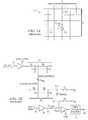
FIG. 1A illustrates part of a touch screen panel1-1 which includes a suitable number of horizontaltransparent conductors2 disposed on one surface of a thin, transparent insulative layer (not shown). A suitable number of verticaltransparent conductors3 are disposed on the other surface of the insulative layer. The left end of each of thehorizontal conductors2 can be connected to suitable current sourcing or drive circuitry. The bottom end of each of thevertical conductors3 can be connected to suitable current sinking or receiving circuitry. A cross-coupling capacitance CSENjoccurs at an “intersection” of each horizontal conductor such as2-I and each vertical conductor such as3-j, the intersection being located directly beneath a “touch point”13. Note that the touching by a user's finger does not necessarily have to occur directly over a touch point. Ifmultiple touch points13 are sufficiently close together, then a single touching may disrupt the electric fields of a number of different cross-coupling capacitances CSENj. However, the largest change in the value of a particular cross-coupling capacitance CSENjoccurs when the touching occurred directly over that particular cross-coupling capacitance.
FIG. 1B illustrates any particular horizontal conductor2-I and any particular vertical (as inFIG. 1A) conductor3-jand the associated cross-coupling capacitance CSENjbetween them, I and j being row and column index numbers of thehorizontal conductors2 and thevertical conductors3, respectively. (By way of definition, the structure including the overlapping conductors2-I and3-jwhich result in the cross-coupling capacitance CSENjis referred to as “capacitor CSENj”. That is, the term “CSENj” is used to refer both to the capacitor and its capacitance.)
The drive circuitry for horizontal conductor2-I can include adrive buffer12 which receives appropriate pulse signals on itsinput4. The output ofdrive buffer12 is connected to the right end of conductor2-I, which is modeled as a series of distributed resistances RA and distributed capacitances CA each connected between ground and a node between two adjacent distributed resistances RA. The receive circuitry for conductor3-jis illustrated as being connected to the right end of vertical conductor3-j. A switch S1jis connected between conductor3-jand VSS. A sampling capacitor CSAMPLEhas one terminal connected to conductor3-jand another terminal connected byconductor5 to an input of acomparator6, one terminal of a switch S2j, and one terminal of a resistor RSLOPE. The other terminal of switch S2jis connected to VSS. The other terminal of resistor RSLOPEis connected to the output of aslope drive amplifier9, the input of which receives a signal SLOPE DRIVE. The other input ofcomparator6 is connected to VSS. The output ofcomparator6 is connected to an input of a “timer capture register”7, which can be a counter that, together with resistor RSLOPEand capacitor CSAMPLE, perform the function of generating a digital output signal onbus14 representing the value of CSENj.
A problem of the above described prior art is that the time required for the capacitance measurement is time-varying in the sense that a lower value of the capacitance CSENjrequires less counting time bytimer capture register7, whereas a higher value of the capacitance CSENjrequires more counting time bytimer capture register7. The widely variable capacitance measurement times may be inconvenient for a user. Also, the system is quite susceptible to noise becausecomparator6 in Prior ArtFIG. 1B is connected via CSAMPLEduring the entire capacitance measurement process.
A shortcoming of passivecapacitance measurement system15 as shown inFIG. 2A of the co-pending Mueck, et al. application is that its sensitivity is limited by the ratio of the measured capacitance CSENjto the CDAC capacitance. The capacitance measurement system shown inFIG. 2A of the co-pending Mueck, et al. application can measure a value of CSENjin the range from 0 pF (picofarads) to roughly 30 pF. However, it would be desirable in some applications to provide an improved capacitance measurement system having greater sensitivity, i.e., greater measured capacitance per LSB of DATA<11:0> than can be achieved using the system shown inFIG. 2A of the above mentioned co-pending Mueck, et al. application.
Thus, there is an unmet need for a capacitance measurement system that is capable of making accurate measurements of a broader range of capacitances than the prior art.
There also is an unmet need for an improved digital circuit and method for making touch screen capacitance measurements in a touchscreen controller circuit.
There also is an unmet need for an improved digital circuit and method for making touch screen capacitance measurements in a touch button controller circuit.
There also is an unmet need for a digital capacitance measurement system and method having greater capacitance measurement sensitivity than the prior art.
There also is an unmet need for a digital capacitance measurement system and method having greater capacitance per LSB measurement sensitivity than the prior art.
There also is an unmet need for a digital capacitance measurement system and method having greater touch screen capacitance per LSB measurement sensitivity than the prior art and the capacitance measurement system described in the co-pending Mueck, et al. application.
There also is an unmet need for a digital capacitance measurement system and method having the ability to compensate for large parasitic capacitances.
There also is an unmet need for a digital capacitance measurement system and method which is conveniently configurable to provide different precharge strategies to accommodate various parasitic capacitances.
SUMMARY OF THE INVENTIONIt is an object of the invention to provide a capacitance measurement system that is capable of making accurate measurements of a broader range of capacitances than the prior art.
It is another object of the invention to provide an improved digital circuit and method for making touch screen capacitance measurements in a touchscreen controller circuit.
It is another object of the invention to provide an improved digital circuit and method for making touch screen capacitance measurements in a touch button controller circuit.
It is another object of the invention to provide a digital capacitance measurement system and method having greater capacitance measurement sensitivity than the prior art.
It is another object of the invention to provide a digital capacitance measurement system and method having greater capacitance per LSB measurement sensitivity than the prior art.
It is another object of the invention to provide a digital capacitance measurement system and method having greater touch screen capacitance per LSB measurement sensitivity than the prior art and of the above mentioned co-pending Mueck, et al. application.
It is another object of the invention to integrate a CDAC (capacitor digital-to-analog converter) in a feedback network of a transconductance amplifier in order to use CDAC capacitors both for charge redistribution with a capacitance to be measured and also for performing a SAR conversion of a voltage representing the capacitance to be measured to a digital representation thereof.
It is another object of the invention to provide a digital capacitance measurement system and method having the ability to compensate for large parasitic capacitances.
It is another object of the invention to provide a digital capacitance measurement system and method which is conveniently configurable to provide different precharge strategies to accommodate various parasitic capacitances.
Briefly described, and in accordance with one embodiment, the present invention provides a system for measuring a capacitor (CSENj) wherein the system precharges a CDAC (23) in a SAR converter (17) to a reference voltage (VAZ) and also precharges a first terminal (3-j) of the capacitor to another reference voltage (GND). During a measurement phase, the CDAC is coupled between an output and an input of an amplifier (31) and the capacitor also is coupled to the input of the amplifier, so as to redistribute charge between the capacitor and the CDAC. The amplifier generates an output voltage (VAMP) that represents the capacitance being measured. The output voltage is stored in the CDAC. The SAR converter converts the output voltage to a digital value representing the capacitance being measured.
In one embodiment, the invention provides a capacitance measurement system (15) including a successive approximation register analog-to-digital conversion circuit (SAR ADC) (17). The SAR ADC includes a comparator (26) and a divider/feedback CDAC (capacitor digital-to-converter) (23) including a plurality of weighted CDAC capacitors (25-0, . . .25-k, . . .25-n) each having a first terminal coupled to a corresponding one of a plurality of conductors (21-0, . . .21-k, . . .21-n), respectively, and each having a second terminal coupled by a first conductor (24) to a first input (+) of the comparator (26). The SAR ADC also includes SAR logic and switch circuitry (28,30) which produces a digital output (DATA) on a digital bus (32). An output of the comparator (26) is coupled to an input of the SAR logic and switch circuitry (28,30). The SAR logic and switch circuitry (28,30) is coupled to control the plurality of conductors (21-0, . . .21-k, . . .21) during a SAR conversion. A first switch (S6) has a first terminal coupled the first input (+) of the comparator (26). An active network (29) couples a capacitor (CSENjinFIG. 2A (or CSENinFIG. 2G)) to be measured to the SAR ADC (17). The active network (29) includes a measurement conductor (20) coupled to a first terminal (3-j) of the capacitor (CSENj) to be measured and an amplifier (31) for performing the function of aiding charge redistribution among the capacitance (CSENj) to be measured and the CDAC capacitors (25-0 . . .25-k. . .25-n) during a measurement phase. The amplifier (31) has a first input (−) coupled to a second terminal of the first switch (S6), a second input (+) coupled to a first reference voltage (VAZ), an output (20A) coupled to an amplifier output conductor (20A), and a first switching circuit (SO, . . . Sk . . . Sn) for coupling the amplifier output conductor (20A) to the plurality of conductors (21-0, . . .21-k, . . .21-n) during the measurement phase.
In a described embodiment, second switch (S1j) selectively couples the first terminal (3-j) of the capacitor (CSENj) to be measured to a second reference voltage (GND), and a third switch (S2j) selectively couples the first terminal (3-j) of the capacitor (CSENj) to be measured to the measurement conductor (20). In one embodiment, the capacitor (CSENj) to be measured is a cross-coupling capacitor (13 inFIG. 1A) formed by an intersection of first (2-I) and second (3-j) conductors of a touch screen panel (13A).
In one embodiment, switches of the first switching circuit (S0 . . . Sk . . . Sn) are closed during a precharge phase to couple the output (20A) of the amplifier (31) to the plurality of conductors (21-0 . . .21-k. . .21-n) to precharge the CDAC capacitors (25-0 . . .25-k. . .25-n), respectively. During the precharge phase, the amplifier (31) is connected in a unity gain configuration, wherein the second input (+) of the amplifier (31) is coupled to the first reference voltage (e.g., VAZ=VDD/2), and wherein the amplifier (31) operates to precharge both the first conductor (24) and the plurality of conductors (21-0 . . .21-k. . .21-n) to the first reference voltage (VAZ=VDD/2).
In a described embodiment, switches of the first switching circuit (S0 . . . Sk . . . Sn) are open during a precharge phase before the measurement phase to allow a group of switches (S7k) in the SAR logic and switch circuitry (28,30) to precharge the plurality of CDAC capacitors (25-0 . . .25-k. . .25-n) to a first predetermined precharge voltage (e.g., VDD). During the precharge phase, the amplifier (31) is connected in a unity gain configuration, wherein the second input (+) of the amplifier (31) is coupled to the first reference voltage (VAZ=VDD/2), and wherein the amplifier (31) operates to precharge the first conductor (24) to the first reference voltage (VAZ=VDD/2).
In one embodiment, switches of the first switching circuit (S0 . . . Sk . . . Sn) are closed during the measurement phase to allow redistribution of charges of the capacitor (CSENj) to be measured to produce a measurement voltage (V20) on themeasurement conductor20, wherein the amplifier (31) produces a corresponding voltage (VAMP) on the plurality of conductors (21-0 . . .21-k. . .21-n) in response to the measurement voltage (V20).
In one embodiment, the switches of the first switching circuit (S0 . . . Sk . . . Sn) are open during a conversion phase after the measurement phase to allow the SAR ADC (17) to successively generate bits of the digital output (DATA).
In one embodiment, a pump capacitor (CP) is coupled between the measurement conductor (20) and a predetermined reference voltage (e.g., GND) during the precharge phase before the measurement phase and is coupled between the measurement conductor (20) and another predetermined reference voltage (VDD) during the measurement phase.
In one embodiment, the invention provides method for measuring a capacitance (CSENjinFIG. 2A (CSENinFIG. 2G)) of a first capacitor (CSENjinFIG. 2A (CSENin FIG.2G)), including precharging first terminals (21-0 . . .21-k. . .21-n) of at least one of a plurality of weighted CDAC capacitors (25-0 . . .25-k. . .25-n), respectively, of a CDAC (capacitor digital-to-analog converter) (23) included in a SAR (successive approximation register) converter (17) to a first reference voltage (e.g., VDDor VDD/2) during a precharge phase, and precharging a first terminal (3-j) of the first capacitor (CSENj) to a second reference voltage (GND) during the precharge phase, coupling the first terminals (21-0 . . .21-k. . .21-n) of the CDAC capacitors (25-0 . . .25-k. . .25-n) to the first terminal (3-j) of the first capacitor (CSENj) to redistribute charges among the first capacitor (CSENjinFIG. 2A (CSENinFIG. 2G)) and at least some of the plurality of feedback capacitors (25-0 . . .25-k. . .25-n) during a measurement phase after the precharge phase so as to generate a first voltage (V20) on a measurement conductor (20), amplifying the first voltage (V20) by means of an amplifier (31) having a feedback network including the CDAC (23) to generate a second voltage (V20A) on an output (20A) of the amplifier (31) during the measurement phase while coupling at least some of the first terminals (21-0 . . .21-k. . .21-n) of the CDAC capacitors (25-0 . . .25-k. . .25-n) to the second voltage (V20A), the first voltage (V20) being representative of the capacitance (CSENj) of the first capacitor (CSENj), and performing a successive approximation conversion operation on the second voltage (V20A) during a conversion phase after the measurement phase to generate a digital representation (DATA) of the first capacitance (CSENj).
In one embodiment, the method includes closing switches of the first group of switches (S0 . . . Sk . . . Sn) during the precharge phase to couple the output (20A) of the amplifier (31) to the first terminals (21-0 . . .21-k. . .21-n) of the CDAC capacitors (25-0 . . .25-k. . .25-n) to precharge the CDAC capacitors (25-0 . . .25-k. . .25-n), respectively, wherein during the precharge phase, the amplifier (31) is connected in a unity gain configuration, wherein a first input (+) of the amplifier (31) is coupled to a predetermined reference voltage (VAZ=VDD/2). The method includes operating the amplifier (31) to precharge both a second terminal (24) of each of the CDAC capacitors (25-0 . . .25-k. . .25-n) and the plurality of conductors (21-0 . . .21-k. . .21-n) to the predetermined reference voltage (VAZ=VDD/2) during the precharge phase.
In one embodiment, the method includes opening switches of the first group of switches (S0 . . . Sk . . . Sn) during the precharge phase to allow a group of switches (S7k) in the SAR converter (17) to precharge the plurality of CDAC capacitors (25-0 . . .25-k. . .25-n) to a predetermined precharge voltage (VDD), wherein the amplifier (31) is connected in a unity gain configuration, and wherein a first input (+) of the amplifier (31) is coupled to the predetermined reference voltage (VAZ=VDD/2), the method including operating the amplifier (31) operates to precharge a second terminal (24) of each of the CDAC capacitors (25-0 . . .25-k. . .25-n) to the predetermined reference voltage (VAZ=VDD/2).
In one embodiment, the method includes coupling a pump capacitor (CP) between the first terminals (21-0 . . .21-k. . .21-n) of the CDAC capacitors (25-0 . . .25-k. . .25-n) and a predetermined reference voltage (e.g., GND) during the precharge phase and coupling the pump capacitor (CP) between the first terminals (21-0 . . .21-k. . .21-n) of the CDAC capacitors (25-0 . . .25-k. . .25-n) and another predetermined reference voltage (e.g., VDD) during the measurement phase to boost a voltage of the first terminals (21-0 . . .21-k. . .21-n) of the CDAC capacitors (25-0 . . .25-k. . .25-n) to compensate for parasitic capacitance.
In one embodiment, the invention provides a capacitance measurement system for measuring a capacitance (CSENjinFIG. 2A (CSENinFIG. 2G)) of a first capacitor (CSENjinFIG. 2A (CSENin FIG.2G)), including means (30) for precharging first terminals (21-0 . . .21-k. . .21-n) of at least one of a plurality of weighted CDAC capacitors (25-0 . . .25-k. . .25-n), respectively, of a CDAC (capacitor digital-to-analog converter) (23) included in a SAR (successive approximation register) converter (17) to a first reference voltage (e.g., VDDor VDD/2) during a precharge phase, and precharging a first terminal (3-j) of the first capacitor (CSENj) to a second reference voltage (GND) during the precharge phase, means (S0 . . . Sk . . . Sn) for coupling the first terminals (21-0 . . .21-k. . .21-n) of the CDAC capacitors (25-0 . . .25-k. . .25-n) to a first terminal (3-j) of the first capacitor (CSENj) to redistribute charges among the first capacitor (CSENjinFIG. 2A (CSENinFIG. 2G)) and at least some of the plurality of CDAC capacitors (25-0 . . .25-k. . .25-n) during a measurement phase after the precharge phase so as to generate a first voltage (V20) on a measurement conductor (20), amplifying means (31) for amplifying the first voltage (V20) having a feedback network including the CDAC (23) to generate a second voltage (V20A) on an output (20A) of the amplifier (31) during the measurement phase while coupling at least some of the first terminals (21-0 . . .21-k. . .21-n) of the CDAC capacitors (25-0 . . .25-k. . .25-n) to the second voltage (V20A), the first voltage (V20) being representative of the capacitance (CSENj) of the first capacitor (CSENj), and means (17) for performing a successive approximation conversion operation on the second voltage (V20) during a conversion phase after the measurement phase to generate a digital representation (DATA) of the first capacitance (CSENj).
BRIEF DESCRIPTION OF THE DRAWINGSFIG. 1A illustrates a plan view diagram of upper and lower orthogonal transparent, conductive strips of a touch screen panel.
FIG. 1B is a schematic diagram representing circuitry associated with an “intersection” of a horizontal conductive, transparent strip and a vertical conductive, transparent strip of a touch screen panel, cross coupling capacitance, and circuitry for sensing the presence of a person's finger close to the intersection.
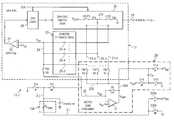
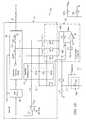
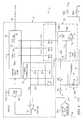
FIG. 2A is a block diagram illustrating an architecture of an embedded SAR based active gain capacitance measurement system of the present invention.
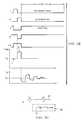
FIG. 2B is a timing diagram of clock signals used to operate the capacitance measurement system ofFIG. 2A.
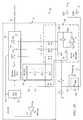
FIG. 2C is a block diagram useful in explaining operation of one precharge strategy in the capacitance measuring system ofFIG. 2A during a precharge phase.
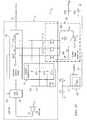
FIG. 2D is a block diagram useful in explaining operation of another precharge strategy in the capacitance measuring system ofFIG. 2A during a precharge phase.
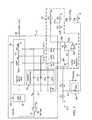
FIG. 2E is a block diagram useful in explaining operation of the capacitance measuring system ofFIG. 2A during a measurement phase.
FIG. 2F is a block diagram useful in explaining operation of the capacitance measuring system ofFIG. 2A during a SAR analog-to-digital conversion phase.
FIG. 2G is a simplified schematic diagram of a touch button circuit which can be connected tomeasurement conductor20 inFIG. 2A instead oftouchscreen panel13A.
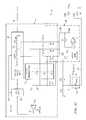
FIG. 3 is a block diagram illustrating a charge pump enhanced embedded SAR based active gain capacitance measurement system of the present invention.
FIG. 4 is a block diagram of a differential implementation of the capacitance measurement system ofFIG. 2A.
DETAILED DESCRIPTION OF THE PREFERRED EMBODIMENTSFIG. 2A shows a single-ended (i.e., not differential) embodiment of an embedded SAR based activecapacitance measurement system15 of the present invention which provides more capacitance measurement sensitivity, a wider range of parasitic capacitance, and a wider range of capacitance to be measured than the capacitance measurement system described in the above-mentioned Mueck, et al. application.Capacitance measurement system15 includesactive gain circuitry29 and a SAR (successive approximation register) type of ADC (analog-to-digital converter)17.Active gain circuitry29 is coupled to effectuate measurement of touch screen capacitance CSENj, where CSENjcan be the cross-coupling capacitance inexternal touchscreen panel13A (which can be similar to the touch screen panel shown in Prior ArtFIGS. 1A and 1B). Alternatively, the capacitance CSENjcan be a capacitance CSENor CBUTTONof a touch pad or a touch button, rather than a touchscreen panel. In any case, the capacitance CSENjis typically decreased (depending on the particular panel or touch button configuration) by the presence of a human finger in the electric field associated with capacitance CSENj. The portion of activecapacitance measuring system15 inFIG. 2A exclusive oftouchscreen panel13A preferably is implemented on a single integrated circuit chip.
InFIG. 2A, a cross-coupling capacitance CSENjat an intersection between a conductor3-jand a conductor2-I of externaltouch screen panel13A is illustrated, with conductor2-I of cross-coupling capacitance CSENjbeing coupled by a switch S25ito VDDduring the subsequently described precharge phase (waveform P inFIG. 2B) and coupled by switch S34ito ground during the subsequently described measurement phase (M inFIG. 2B). The top terminal of capacitance CSENjcan be coupled by conductor3-jand a switch S2jtomeasurement conductor20. The value of CSENjis affected by the touch or proximity or movement of a user's finger, depending on how close the finger approaches the intersection of conductors2-I and3-j(as in previously described Prior ArtFIGS. 1A and 1B) oftouchscreen panel13A or how close the finger approaches the CSENarea of atouch button13B as shown inFIG. 2G. (The capacitor to be measured also could be a pressure-sensitive capacitor in which a change in the capacitance is caused by pressure of the user's finger on the touch point.) Various parasitic capacitances having a total value CPARASITICare in effect coupled between conductor3-jand ground, generally as shown inFIG. 2A.
Touch screen panel13A and switches S25iand S34iinFIG. 2A can be replaced by the illustrated touch button switch circuit shown in above mentionedFIG. 2G. Referring toFIG. 2G, the touch button switch circuit includes atouch button capacitor13B having a capacitance CSEN, also referred to as CBUTTON. The lower terminal oftouch button capacitor13B is connected to a fixed reference voltage, such as ground. The upper terminal oftouch button capacitor13B is coupled by switch S1 to ground during precharge phase P and is coupled by switch S2 tomeasurement conductor20 during measurement phase M.
Referring again toFIG. 2A,active gain circuitry29 includes anoperational transconductance amplifier31 having its (−) input connected tomeasurement conductor20. The (+) input ofamplifier31 is connected to an auto-zeroing voltage VAZ. A typical value of VAZwould be VDD/2. However, VAZalso could be ground or VDD(or any other suitable voltage), depending on howSAR comparator26 is configured.Amplifier31 produces an output voltage VAMPonconductor20A. VAMPconductor20A is connected to one terminal of a unity gain switch S9, the other terminal of which is connected tomeasurement conductor20.Active gain circuitry29 also includes interface switches S0 . . . Sk . . . Sn, each having a first terminal connected by VAMPconductor20A. The second terminals of switches S0 . . . Sk . . . Sn are connected to “bottom plate” conductors21-0 . . .21-k. . .21-n, respectively, of a divider/feedback CDAC23 ofSAR ADC17.Active gain circuitry29 andSAR ADC circuit17 are connected/disconnected from each other by interface switches S0, . . . Sk, . . . Sn in response to clock signal PM.
Divider/feedback CDAC (capacitor digital-to-analog converter)23 inSAR ADC17 includes a “top plate”conductor24 connected to one terminal of a switch S6, the other terminal of which is connected tomeasurement conductor20.Top plate conductor24 is also connected to a first terminal of each of binarily weighted CDAC capacitors25-0 . . .25-k. . .25-n. The second terminal of each of CDAC capacitors25-0 . . .25-k. . .25 is connected to a corresponding one of bottom plate conductors21-0,1 . . .k . . . n, respectively, of divider/feedback CDAC23. Divider/feedback CDAC23 may function in the precharge operation ofactive gain circuitry29, always functions in charge redistribution operations ofactive gain circuitry29, and always functions in the SAR analog-to-digital conversion of the voltage on VAMPconductor20A into the digital output signal DATA<11:0>.
Circuit elements which are coupled to the input ofSAR DAC17 on VAMPconductor20A, including the measured capacitance CSENj, the parasitic capacitance CPARASITIC, and the charge pump capacitance CPof subsequently describedFIG. 3 if used, can be considered as part of active circuitry29 (but not also part of SAR DAC17). Charge redistribution is performed by means ofactive circuitry29, which functions much differently than the passive circuitry of the above mentioned co-pending Mueck, et al. application. Divider/feedback CDAC23 may be used byactive circuitry29 during both the precharge operation and the measurement operation or only during the measurement operation. In any case,amplifier31 is not used during any aspect of the conversion operation ofSAR ADC17. Theamplifier31 inactive circuitry29 allows complete discharge of the of the capacitance CSENjbeing measured, whereas CSENjis discharged only to a voltage level resulting from a capacitive voltage division in the above mentioned co-pending Mueck, et al. application.
A typical value of ΔCSENj, which is the change typically produced in the capacitance of capacitor CSENjby the presence of a user's finger touching the capacitor, can be approximately 100 femptofarads. An amount of charge corresponding to ΔCSENjis transferred to the be capacitors ofCDAC23 during the measurement phase. There is a gain/attenuation implicit in the transfer, equal to (CSENj+CPARASITIC) divided by the total CDAC capacitance CCDAC. The value of the total CDAC capacitance CCDACmay be approximately 13 pF, and the value of CSENjmay be approximately 3 or 4 pF. The feedback capacitance acrossamplifier31 theoretically could be decreased in order to increase the gain by increasing the value of ΔCSENj, which is due to the presence of the finger performing the touch. However, in an implementation of the invention being developed, the kT/C noise in the system makes it impractical to reduce CCDACto a value less than 13 pF.
SAR ADC17 includes anSAR comparator26 having a (+) input connected totop plate conductor24 and a (−) input connected to receive auto-zeroing voltage VAZ. (Note that ordinarily the input applied to the (−) input ofSAR comparator26 is the analog output of another CDAC which is either being used as a mirror circuit or is being used to sample ground via a “dummy” circuit. For example, the (−) input ofSAR comparator26 could be connected to the CDAC output of the capacitance measuring system disclosed in the above mentioned Mueck et al. application. Auto-zeroing circuitry for a SAR comparator is conventional, and can be readily implemented by those skilled in the art.)Top plate conductor24 of divider/feedback CDAC23, rather than the bottom plate conductors21-0 . . .21-k. . .21-nthereof, preferably is connected to the (+) input ofSAR comparator26 becausetop plate conductor24 typically has less parasitic capacitance. The output ofSAR comparator26 is connected byconductor27 to the input of conventionalSAR logic circuitry28, the output bus of which is connected to the input of a conventional SAR DAC (digital-to-analog converter)switch bank circuit30.SAR logic circuit28 and SARDAC switch bank30 are clocked by a clock signal CLK.
SAR-DAC switch bank30 includes the bank of switches S7kand S8kthat pulls the bottom plate conductor of any particular CDAC capacitor to either a high level or a low level. Completion of a SAR analog-to-digital conversion results in the final value of DATA<11:0>.SAR logic28 performs the function of controlling the switches in SARDAC switch bank30. Each of bottom plate conductors21-0 . . .21-k. . .21-nis connected to aconductor21kof a corresponding switching circuit, respectively, in SARADC switch bank30. Each such switching circuit includes a pair of switches S7kand S8k, where k is an index having a value between 0 and n. A first terminal of each of switches S7kand S8kof a “k”th pair has a first terminal connected toconductor21k. The second terminal of each switch S7kis connected to a suitable first reference voltage (such as supply voltage VDD), and the second terminal of each switch S8kis connected to a corresponding suitable second reference voltage (such as ground or VSS). The digital output of SARDAC switch bank30 is connected todata output bus32, on which the digital data value DATA<11:0> (for a 12-bit SAR DAC) is produced. DATA<11:0)> represents the measured capacitance of CSENj.
The HS/PS and LS/S signals in SARDAC switch bank30 operate the various switches S7kand S8k, respectively, during the SAR operation. The HS signal (high SAR switch bank signal) has the same timing as the PS signal and the LS signal (low SAR switch bank signal) has the same timing as the S signal inFIG. 2B, and values of HS and LS during the conversion phase are determined by the SAR ADC algorithm being executed. In one of the subsequently explained CDAC precharge strategies, the HS/PS and LS/S signals also operate to precharge the various bottom plate conductors21-0 . . .21-k. . .21-nto either high or low voltages, respectively, according to the particular precharge strategy objective.
Subsequently describedFIG. 2C showsamplifier31 in its unity gain configuration, i.e., with switch S9 closed, withCDAC23 coupled between the amplifier output VAMPonconductor20A and the (−) input ofamplifier31. If the precharge strategy illustrated in subsequently explainedFIG. 2D is being used, then appropriate values of HS and LS are used during the precharge phase to control the precharging of the various CDAC capacitors, respectively, in accordance with the particular precharge strategy being used.
As indicated above, there are a number of choices or strategies for precharging the various CDAC capacitors and measurement capacitor CSENjduring the precharge phase. For example, one precharge strategy would be to close switches S0 . . . Sk . . . Sn during the precharge phase to connect the bottom plate conductors21-0 . . .21-k. . .21-nto the amplifier output voltage VAMPwhile applying VAZtotop plate conductor24, so as to precharge CDAC capacitors25-0 . . .25-k. . .25-nduring the precharge phase. In this case, S7kand S8kare not active during precharge. This precharge strategy is illustrated in subsequently describedFIG. 2C.
Another precharge strategy would be to open switches S0 . . . Sk . . . Sn during the precharge phase to isolate bottom plate conductors21-0 . . .21-k. . .21-nfrom VAMP, and instead operate switches Sk7 and Sk8 inswitch bank32 selectively precharge the various bottom plate conductors21-0 . . .21-k. . .21-nwhile also forcingtop plate conductor24 to VAZby means of a unity feedback configuration ofamplifier31 through switch S9. SAR-DAC switches inblock30 would drive the various bottom plate conductors21-0 . . .21-k. . .21-nof any or all of CDAC capacitors25-0 . . .25-k. . .25-n, respectively, to either VDDor to ground. This would provide an “offset” of sorts that would allow or compensate for different values of voltages that may appear on VAMPconductor20A at the end of the measurement phase M (FIG. 2B). This precharge strategy is illustrated in subsequently describedFIG. 2D.
In yet another precharge strategy, all of the CDAC capacitors can be precharged to VDDand the CSENjcapacitor can be precharged to ground. Alternatively, it would be possible to precharge only some of the CDAC capacitors, or even just the MSB CDAC capacitor, to VDDand precharge all of the other CDAC capacitors to ground. Or, all of the CDAC capacitors could be precharged to ground and the capacitor CSENjto could be precharged to VDD. It should be appreciated that the voltage applied totop plate conductor24 can have any suitable voltage and can be applied in any suitable manner, and is not limited to VAZas illustrated inFIG. 2A. The benefit of such different precharging strategies would be to achieve different advantageous voltages on VAMPconductor20A resulting from the charge redistribution during the measurement phase.
Note, however, that the above mentioned “suitable” corresponding reference voltages could be set to a value higher than VDDand a value lower than ground, respectively, or alternatively they could be set to a value less than VDDand a value higher than ground, respectively, in order to “squeeze” or “expand” the usable input range ofSAR ADC17. (Various implementations of SAR ADCs that execute the well known basic SAR algorithm are widely used, and can be readily implemented by those skilled in the art. For example, the assignee's TSC2007, TSC2005, TSC2003, TSC2046, ADS7846 all include similar SAR ADC circuits which could be used.)
Thecircuitry including amplifier31, switches S1j, and S9, andSAR ADC17 is basically a transconductance amplifier with an embedded SAR ADC converter. It should be appreciated that the methodology for charge transfer and measurement of the capacitance CSENjor CSENin accordance with the present invention is substantially different than for the previously mentioned co-pending Mueck, et al. application.
Above-mentionedFIG. 2B is a timing diagram including the digital signal P which represents the precharge phase of active gaincapacitance measurement system15, the digital signal M which represents the measurement phase, and a digital signal S which represents an SAR analog-to-digital conversion phase. Timing diagramFIG. 2B also shows a digital signal PS which is the inverse of the signal M and a digital signal PM which is the inverse of the signal S. Switch S1jis controlled by precharge phase signal P. Switches S2jand S0 . . . Sk . . . Sn are controlled by measurement phase signal M. Switch S6 is controlled by clock signal PM, switches S7kare controlled by clock signal PS, and switches S8kare controlled by SAR phase clock S, where k has all of the values between 0 and n. The waveforms of the amplifier output VAMPand the voltage V24ontop plate conductor24 also are shown. (Note that all of the switches inFIG. 2A are illustrated in their “open” condition.)
FIG. 2C shows the configuration of the various switches of active gaincapacitance measurement system15 ofFIG. 2A during the above mentioned precharge phase for the above mentioned precharge strategy whereinamplifier31 is used to precharge the bottom plate conductors21-0 . . .21-k. . .21-nand wherein switches S7kand S8kofswitch bank30 are open and inactive. During precharge phase P, switches S1j, S6, S9, and S25iare closed. Switches S0 . . . Sk . . . Sn also are closed. Switch S2jand all of switches S7kand S8kare open. In this configuration, the touchscreen capacitance CSENj(or touch button capacitance CSENofFIG. 2G) being measured is discharged to ground through switch S1j. Since unity-gain switch S9 is closed, the voltage V20ofmeasurement conductor20 is equal to the amplifier output voltage VAMPonconductor20A.
Since switch S6 is closed,amplifier31 operates to prechargetop plate conductor24 of divider/feedback CDAC23 to VAZ(which may be equal to VDD/2) prior to the measurement phase (wherein charge redistribution occurs between CSENjand the capacitors of divider/feedback CDAC23.) Sinceamplifier31 is set in its unity gain configuration andCDAC23 is coupled as a feedback network between theoutput20A and (−) input ofamplifier31, the bottom plate conductors21-0 . . .21-k. . .21-ncapacitors of divider/feedback CDAC23 also are precharged to VAZ, soCDAC23 is precharged to a value of 0 volts during the precharge phase.
FIG. 2D shows a configuration of the various switches of active gaincapacitance measurement system15A the same as or similar to the system shown inFIG. 2A during the precharge phase for the above mentioned precharge strategy wherein interface switches S0 . . . Sk . . . Sn are open andamplifier31 is used only to prechargetop plate conductor20. Switches S1j, S6, S9, and S25iare closed. Switch S2jis open. The touchscreen capacitance CSENjbeing measured is discharged to ground through switch S1j. Since unity-gain switch S9 is closed, the voltage ofmeasurement conductor20 is equal to VAZ. (Note that some of bottom plate conductors21-0 . . .21-k. . .21-nof CDAC capacitors25-0 . . .25-k. . .25-ncould be coupled to the amplifier output voltage VAMPor could be precharged in various ways to VDDor ground.)
Still referring toFIG. 2D,amplifier31 can be connected in its unity gain configuration, with switch S9 closed and operated to equalize the voltages of its (−) and (+) inputs to thereby prechargetop plate conductor24. (Alternatively,amplifier31 can be completely decoupled fromCDAC23 and CDAC capacitors25-0 . . .25-k. . .25-ncan be precharged in any suitable manner to values which are suitable to the precharge strategy being used.) Switches S7kand S8kofswitch bank30 inFIG. 2D are used during the precharge phase to selectively precharge various bottom plate conductors21-0 . . .21-k. . .21-nso as to accomplish a specific objective of the precharge strategy. (Alternatively, a PS-controlled switch S14 could be coupled between auto-zero voltage VAZand the (−) input ofamplifier31 to precharge thetop plate conductor24 during the precharge phase ifamplifier31 is powered down during the precharge phase. It should be understood that bothCDAC23 and CSENjcould be precharged in many different ways, for example by means of a variable voltage source, another capacitor, or a charge pump.)
For the precharge strategy being used inFIG. 2D, some or all of the n+1 switches S7k(depending on the precharge objective ) may be closed during the precharge phase. Consequently, first terminals of some or all of CDAC capacitors25-0 . . .25-k. . .25-nin divider/feedback CDAC circuit23 are connected to VDDthrough their corresponding switches S7k, respectively, while the interface switches S0 . . . Sk . . . Sn remain closed, in order to precharge the corresponding bottom plate conductors21-0 . . .21-k. . .21-nof divider/feedback CDAC circuit23. The capacitance CSENjis discharged and the bottom plates of capacitors25-0 . . .25-k. . .25-nof divider/feedback CDAC circuit23 are precharged to a suitable reference voltage level, such as VDD(or a voltage generated by a variable gain amplifier circuit or a charge pump circuit).
Another possible precharge strategy would be to leave the charge from a previous measurement phase on at least some of CDAC capacitors during a present precharge phase and not perform an additional precharge operation during the present precharge phase. The voltage stored across those CDAC capacitors at the end of each measurement phase becomes the reference for the next measurement phase without an intervening precharging of those CDAC capacitors.
By way of definition, the term “precharge” as used herein, during any precharge phase, includes “precharging” at least some of the CDAC capacitors during the previous measurement phase simply by leaving the results of that measurement phase on those CDAC capacitors.
FIG. 2E shows the configuration of the various switches ofcapacitance measurement system15 ofFIG. 2A during the measurement phase, while clock signal M is at its high level as indicated inFIG. 2B. Switches S2j, S6, and S34iare closed. Switches S0 . . . Sk . . . Sn usually are closed, although in some cases one or more of switches S0 . . . Sk . . . Sn may be open to allow use of SAR banks switches S7kand S8kto configure the amount of CDAC capacitance to be involved in the charge transfer process (k being the above mentioned index variable having values between 0 and n). Some or all of the bottom plate conductors21-0 . . .21-k. . .21-nof divider/feedback CDAC23 (depending on the precharge strategy being used) have been precharged through some or all of switches S7kto a suitable reference voltage, for example, VDD, and then disconnected therefrom. With interface switches S0 . . . Sk . . . Sn closed, and connectingamplifier output conductor20A to bottom plate conductors21-0 . . .21-k. . .21-nof divider/feedback CDAC23, the charges produced during the precharge phase on CSENjand at least some of CDAC capacitors25-0 . . .25-k. . .25-nare redistributed among the various capacitors that are connected together. The charge redistribution causes a corresponding change in the voltage V20onmeasurement conductor20.Amplifier31 operates to equalize the voltages on its (−) and +) inputs, thereby producing a corresponding change in VAMPand hence on CDAC bottom plate conductors21-0 . . .21-k. . .21-n. Since switch S9 is open,amplifier31 generates a value of VAMPwhich is proportional to the ratio of the capacitance (CSENj+CPARASITIC) divided by the total Ctof the CDAC capacitances. (Note that although the auto-zeroing operation continues so that at this point the voltage on the (+) input ofSAR comparator26 has not changed, the auto-zeroing ofSAR comparator26 does not necessarily have to continue during the capacitance measurement phase. Auto-zeroing is not even essential to all embodiments of the present invention.)
It should be appreciated that, depending on the expected value of CSENj, it might be desirable to not connect all of the CDAC capacitors into the foregoing capacitive divider configuration during the measurement phase. For example, only the MSB CDAC capacitor might be included in the divider configuration. Alternatively, the bottom plate conductors21-0 . . .21-k. . .21-nbeing referred to could have been precharged to some other suitable reference voltage between VDDand ground. For example, the CDAC bottom plate conductors21-0 . . .21-k. . .21-ncould have been precharged to zero and CSENjcould be precharged to VDDfor the measurement phase, again depending on the precharging strategy being used. This might even be necessary, depending on the needed ratio of the total CDAC capacitances and CSENj(plus its associated parasitic capacitance CPARASITIC).
Thus, during measurement phase M, some or all of CDAC capacitors25-0 . . .25-k. . .25-nare used in a capacitive divider charge transfer configuration. Since CSENjis connected in series with the CDAC capacitance CCDACwhich is equal to the total capacitance of some or all of CDAC capacitors25-0 . . .25-k. . .25, the charge redistribution results in a voltage which appears on VAMPconductor20A, since during the measurement phase the voltage oftop plate conductor24 is fixed at VDD/2. The voltage VAMPproduced byamplifier31 is dependent on the precharge voltages previously applied toCDAC32 and to CSENjplus its associated parasitic capacitance CPARASITIC. For example, during the measurement phase, the bottom terminal of CSENj(plus its associated parasitic capacitance CPARASITIC) is grounded, and conductor3-jis connected toconductor20. The unity-gain switch S9 is open.Conductor20A is connected to all of the CDAC bottom plate conductors21-0 . . .21-k. . .21-n.Amplifier31 operates so as to cause V20to be equal to VAZ. (Since no current can flow intoamplifier31, the only way that can happen is foramplifier31 to cause charge to flow throughCDAC23. Whatever current flows throughCDAC23 also has to flow through CSENj(plus its associated parasitic capacitance CPARASITIC). Even though the result depends on the voltages to which CSENjandCDAC23 were precharged,amplifier31 produces whatever value of VAMPis necessary to cause V20to be equal to VAZ.)
Then VAMPconductor20A is disconnected from bottom plate conductors21-0 . . .21-k. . .21-nby interface switches S0 . . . Sk . . . Sn. The SAR conversion operation than can begin. (During the SAR operation,amplifier31 is either in its unity gain configuration, waiting for the next precharge/measurement sequence, powered down, or in open loop configuration.Amplifier31 is inactive during the SAR phase. The voltage onconductor24 is provided as an input tocomparator26 and varies according to the SAR algorithm.)
The use ofactive amplifier31 and its feedback network including divider/feedback CDAC23 in accordance with the present invention results in higher capacitance measurement sensitivity, in measured capacitance per LSB, than is the case for the passive capacitance measuring system of the previously mentioned co-pending Mueck et al. application, mainly because in the present invention, the voltage error or difference between the 2 capacitances is measured, rather than using only a capacitive voltage divider for the capacitive voltage measurement.
FIG. 2F shows the configuration of various switches of active gaincapacitance measurement system15 ofFIG. 2A during the SAR analog-to-digital conversion phase, when clock signals S and PS are at a high level and clock signals P, M, and PM are at a low level as indicated inFIG. 2B. (The signals HS and LS have the same timing as signals PS and S, respectively, but have varying high or low values determined by the SAR ADC algorithm being executed.) During the SAR analog-to-digital conversion phase, switches S1j,S9, and S25iare closed and switches S2j, S6, S0 . . . Sk . . . Sn, and S34iremain open. Switches S7kand S8kare controlled bySAR logic28 in accordance with the previously mentioned SAR conversion algorithm so as to causeSAR comparator26 to test, bit by bit, the voltages produced ontop plate conductor24 as the bottom plates of the CDAC capacitors25-0 . . .25-k. . .25-n, starting with the voltage on MSB CDAC capacitor25-0, are sequentially connected to VDD. The bottom conductors of the other CDAC capacitors are connected to ground through their corresponding switches S8k.Top plate conductor24 therefore “floats” according to the actions of SARDAC switch bank30 until correct settings of S7kand S8kare achieved so as to cause the voltage oftop conductor24 to become equal to Vaz, at which point the settings of S7kand S8krepresent the correct digital value DATA.
At the end of the measurement phase, the charge redistribution of the previously described measurement phase operation is complete, so the SAR conversion phase can begin. For the 12-bit case in which n=11, switches S0 . . . Sk . . . S11 and switch S6 are opened, at which point the “sampling” of CSENjbyactive gain circuitry29 has been completed. SARDAC switch bank30 contains a total of 24 switches, in pairs. The bottom plate conductor of each CDAC capacitor, for example, the MSB CDAC capacitor25-0), can either be pulled to VDDby a corresponding one of switches S7k, or it can be pulled to ground by a corresponding one of switches S8kof the same pair. (Of course, the two corresponding switches of a “k”th pair are never simultaneously asserted, i.e., one is never coupled to VDDwhile the other is coupled to ground.) For example, during the SAR conversion phase, the bottom plate of MSB capacitor25-0 first is pulled to VDDby switch S7-0 (i.e., switch S7kwhere k=0) and all of the other less significant CDAC capacitors are pulled to ground by the appropriate S8kswitches, and then topplate conductor24 is compared to VAZ. If testing of the resulting voltage ontop plate conductor24 bySAR comparator26 determines that the voltage ontop plate conductor24 is too high, then the bottom plate conductor of the corresponding MSB capacitor is pulled to ground by switch S8-0 (i.e., switch S8kwhere k=0), and the bottom plate conductors of all of the other less significant CDAC capacitors are pulled to VDDby the appropriate S7kswitches. Then the next-most-significant (MSB-1) capacitor25-1 is pulled to VDDand the voltage ontop plate conductor24 is tested, and so forth. Essentially the same procedure is successively repeated for all of the less significant bits.
Execution of the SAR ADC algorithm results in the digital output DATA<11:0>, which indicates the amount of charge redistributed due to a person's finger touching or being in the vicinity of touch point13 (seeFIG. 1A) oftouchscreen panel13A. Once the SAR conversion is complete, the 12 bits of data generated by SARDAC control circuit30 represent the value of the voltage on VAMPconductor20A immediately after the charge redistribution is complete. In a touchscreen controller, the digital output data DATA<11:0> can be readily used to determine the location of theparticular touch point13 ontouchscreen panel13A that has been touched by the finger of a user.
At this point, it may be helpful to provide a simplified example of the operation ofcapacitance measurement system15 ofFIG. 2A. For convenience, this example assumes that the precharge strategy illustrated inFIG. 2C is being used during the precharge phase. During the precharge phase, switches S0 . . . Sk . . . Sn are all closed, so amplifier output voltage VAMPis applied to bottom plate conductors21-0 . . .21-k. . .21-n. Unity-gain switch S9 is closed, soamplifier31 keeps its (−) input and its output VAMPat the voltage of its (+) input, i.e., at VAZ=VDD/2 in this example. Therefore, bottom plate conductors21-0 . . .21-k. . .21-nandtop plate conductor24 are precharged to VDD/2. That is, CDAC capacitors25-0 . . .25-k. . .25-nare precharged to zero volts. Switch S1jis closed and therefore precharges capacitor CSENjto zero volts. This operation results in level “A” of the VAMPwaveform inFIG. 2B. (Note that SAR-DAC switch bank30 is inactive during the precharge phase for this particular precharge strategy, although numerous other precharge strategies could be used, some including precharging the bottom plates of some or all of the CDAC capacitors.)
Referring toFIG. 2E, the interface switches S0 . . . Sk . . . Sn in this simplified example are closed during the measurement phase. Switches S6, S2j, and S34ialso are closed. Unity-gain switch S9, S1j, and switch S25iare open. Capacitor CSENjhas been precharged as described above, and is connected by switch S2jto the (−) input ofamplifier31 and also is connected through switch S6 totop plate conductor24. Therefore, the charge redistribution transfer occurs between conductor3-jof capacitor CSENjandtop plate conductor24 ofCDAC23. The charge redistribution causes a change in the voltage V20on the (−) input ofamplifier31, which operates to equalize the voltages on its (−) and (+) inputs and thereby causes a corresponding voltage change onconductor20A. This voltage change is applied by closed switches S0 . . . Sk . . . Sn to all of bottom plate conductors21-0 . . .21-k. . .21-nofCDAC23. Because of the operation ofamplifier31, the voltage onamplifier output conductor20A, which corresponds to the level B in the VAMPwaveform inFIG. 2B, is equal to the voltage V20onconductor20 multiplied by the ratio (CSENj+CPARASITIC)/CCDAC. The voltage difference betweenconductors20 and20A is stored across CDAC capacitors25-0 . . .25-k. . .25-n.
Referring toFIG. 2F, during the SAR conversion phase of this simplified example, the interface switches S0 . . . Sk . . . Sn are open, isolating bottom plate conductors21-0 . . .21-k. . .21-nfromamplifier31. Switches S2jand S34ialso are open. Switches S1j, S9, and S25iare closed. The SAR-DAC switches inblock30 operate according to the previously mentioned SAR conversion algorithm so as to search for and determine the combination of values of switch control signals HS and LS that cause the voltage ontop plate conductor24 to equal VAZ=VDD/2. The top plate voltage waveform V24inFIG. 2B shows how the voltage of top plate conductor approaches VAZas the successive approximation process proceeds. The combination of digital values of HS and LS which makes this happen represents the digital output value DATA.
Thus, the present invention provides a switched capacitor network includingtransconductance amplifier31, various switches, andCDAC23 by using the CDAC in the feedback loop of the transconductance amplifier so that part of the time the CDAC functions as a feedback network and the other part of the time it is functions as a CDAC in a SAR ADC converter. This structure and technique saves a substantial amount of area on the integrated circuit chip by using the same CDAC capacitors both for performing a charge redistribution capacitance measurement and performing a SAR analog to digital conversion.
FIG. 3 shows an embedded SAR based active gain capacitance measurement system15-1 which includes the circuitry shown inFIG. 2A and further includes a charge pump network including a pump capacitor CPhaving one terminal connected either directly or by a M-controlled switch (not shown) to VAMPconductor20A and another terminal connected by conductor22 to one terminal of each of switches S15 and S10. A P-controlled switch S13 is coupled betweenmeasurement conductor20 and VDD. The other terminal of M-controlled switch S15 is connected to VDD, and the other terminal of P-controlled switch S10 is connected to ground. During the previously described precharge phase P, pump capacitor CPis discharged through switch S10 to ground. During the previously described measurement phase, pump capacitor CPis coupled to VDD, thereby “pumping” the voltage on VAMPconductor20A to a significantly higher voltage than VDDbefore the previously described charge redistribution occurs. It should be understood that any parasitic capacitance coupled to conductor3-jis involved in the above described charge redistribution process.Amplifier31 may saturate if the charge transfer current is too high during the measurement phase. Charge pump capacitor CPand its associated switches shown inFIG. 3 function to generate an offset voltage to preventamplifier31 from saturating.
FIG. 4 shows an active gain capacitance measurement system15-2 which includes all of thecircuitry15 shown inFIG. 2A, and further includes a “negative side network”16A and a reference capacitor CREF.Negative side network16A together with reference capacitor CREFmay constitute anetwork15 that is very similar to the network includingactive gain circuitry29 and capacitance CSENj. Theoutput24A ofnegative side network16A is connected to the (−) input ofSAR comparator26. The capacitance of reference capacitor CREFcan be essentially the same as CSENj, andnegative side network16A can be operated simultaneously with thenetwork15 such that corresponding parasitic-based switching offset voltages are canceled and such that the charge injection in each of the twonetworks15 and16A is common mode and therefore is canceled.
Althoughnegative side network16A can be considered to be a “dummy” network to achieve the foregoing cancellations, it also can be used to compare CSENjto CREF. For example, if one of CSENjand CREFis larger than the other, then the digital output DATA<11:0> is either larger or smaller than its midrange value. A single clock SAR operation can be performed to determine which is larger, and then the rest of the SAR ADC conversion process can be completed to determine the magnitude of the difference between CSENjand CREF.
An advantage of the above described embodiments of the invention is improved capacitance measurement sensitivity, due to the active feedback nature ofamplifier31 along with the switched capacitor configuration as implemented during the measurement phase. This capacitance measurement technique is faster than the timer/counter technique used in the prior art. Another advantage of the invention is that the described embodiments of the invention permit a wider range of parasitic capacitance coupled tomeasurement conductor20. Furthermore, the described embodiments of the invention have the advantage of allowing a number of different precharge strategies which allow compensating for different levels of parasitic capacitance.
The described embodiments of the invention provide consistent times to generate DATA<11:0)> for a sample capacitance measurement, in contrast to the prior art in which the amount of time required for capacitance measurement is quite dependent on the amount of the capacitance to be measured. Less noise is introduced into the described embodiments of the invention because, for example, in a 12 bit SAR ADC implementation the touch screen panel is sampled only once, for 2 μs (microseconds), during each 15 μs cycle time and then is effectively disconnected by opening switches S0 . . . Sk . . . Sn. Only about 15 clock cycles, i.e., 50 μs at 1 MHZ, is required for a capacitance measurement, which is many fewer clock cycles than for the prior art. Since CSENjis only coupled toSAR ADC17 for only a small fraction of the total cycle operation and then is disconnected,SAR ADC17 is not affected as much by circuit noise as the prior art, in which the capacitance to be sampled is connected for the entire measurement cycle. The architecture is easily multiplexed for multiple channels, e.g. 8 channels per network. The described embodiments of the invention are easily reconfigurable to allow them to be used as a typical analog-to-digital converter. The capacitance measurement circuit of the present invention therefore can be utilized both as a touch-screen controller and as a fully functional analog-to-digital converter.
While the invention has been described with reference to several particular embodiments thereof, those skilled in the art will be able to make various modifications to the described embodiments of the invention without departing from its true spirit and scope. It is intended that all elements or steps which are insubstantially different from those recited in the claims but perform substantially the same functions, respectively, in substantially the same way to achieve the same result as what is claimed are within the scope of the invention. For example, the CDAC capacitors in divider/feedback CDAC23 do not have to be weighted binarily. Furthermore, various known capacitive divider arrangements other than the one illustrated can be used, for example to provide cancellation of common mode errors due to mismatching of circuit elements and mismatching of parasitic elements. It should be appreciated that although the CDAC capacitors are binarily weighted in the described embodiments, they could be weighted in other ways.