US8018206B2 - Excitation device for an electric machine - Google Patents
Excitation device for an electric machineDownload PDFInfo
- Publication number
- US8018206B2 US8018206B2US11/992,846US99284606AUS8018206B2US 8018206 B2US8018206 B2US 8018206B2US 99284606 AUS99284606 AUS 99284606AUS 8018206 B2US8018206 B2US 8018206B2
- Authority
- US
- United States
- Prior art keywords
- excitation device
- superconducting
- voltage
- excitation
- energy
- Prior art date
- Legal status (The legal status is an assumption and is not a legal conclusion. Google has not performed a legal analysis and makes no representation as to the accuracy of the status listed.)
- Expired - Fee Related, expires
Links
Images

Classifications
- H—ELECTRICITY
- H02—GENERATION; CONVERSION OR DISTRIBUTION OF ELECTRIC POWER
- H02M—APPARATUS FOR CONVERSION BETWEEN AC AND AC, BETWEEN AC AND DC, OR BETWEEN DC AND DC, AND FOR USE WITH MAINS OR SIMILAR POWER SUPPLY SYSTEMS; CONVERSION OF DC OR AC INPUT POWER INTO SURGE OUTPUT POWER; CONTROL OR REGULATION THEREOF
- H02M7/00—Conversion of AC power input into DC power output; Conversion of DC power input into AC power output
- H02M7/42—Conversion of DC power input into AC power output without possibility of reversal
- H—ELECTRICITY
- H02—GENERATION; CONVERSION OR DISTRIBUTION OF ELECTRIC POWER
- H02P—CONTROL OR REGULATION OF ELECTRIC MOTORS, ELECTRIC GENERATORS OR DYNAMO-ELECTRIC CONVERTERS; CONTROLLING TRANSFORMERS, REACTORS OR CHOKE COILS
- H02P9/00—Arrangements for controlling electric generators for the purpose of obtaining a desired output
- H—ELECTRICITY
- H01—ELECTRIC ELEMENTS
- H01F—MAGNETS; INDUCTANCES; TRANSFORMERS; SELECTION OF MATERIALS FOR THEIR MAGNETIC PROPERTIES
- H01F38/00—Adaptations of transformers or inductances for specific applications or functions
- H01F38/18—Rotary transformers
- H—ELECTRICITY
- H01—ELECTRIC ELEMENTS
- H01F—MAGNETS; INDUCTANCES; TRANSFORMERS; SELECTION OF MATERIALS FOR THEIR MAGNETIC PROPERTIES
- H01F6/00—Superconducting magnets; Superconducting coils
- H01F6/006—Supplying energising or de-energising current; Flux pumps
- H01F6/008—Electric circuit arrangements for energising superconductive electromagnets
- H—ELECTRICITY
- H02—GENERATION; CONVERSION OR DISTRIBUTION OF ELECTRIC POWER
- H02K—DYNAMO-ELECTRIC MACHINES
- H02K19/00—Synchronous motors or generators
- H02K19/16—Synchronous generators
- H02K19/38—Structural association of synchronous generators with exciting machines
Definitions
- the electric machineis a synchronous machine, which preferably, but not exclusively, uses a superconducting inductance as the field winding.
- the excitation lossescan advantageously be reduced to a minimum by implementing the exciter winding as a high-temperature superconducting (HTS) winding.
- HTShigh-temperature superconducting
- any input of heat via mechanical contactsshould be avoided as far as possible.
- Mechanical contactssuch as sliprings or the like, are involved as a result of the maintenance required and moreover are susceptible to wear.
- the excitation power, the monitoring and regulation informationis advantageously transmitted in contactless fashion, i.e. inductively, to the rotor.
- Known excitation devices for a superconducting windingtypically include a contactless energy transmission path, a contactless control or regulating signal transmission path to a stationary control and regulating unit, and an actuator for impressing a voltage and a freewheeling circuit.
- the transformerin particular functions inductively.
- EP 1 247 324 B1proposes a unidirectional inductive energy transmission, a “rotating transformer” including two pot-type cores with ring windings and axial flux guidance being provided as inductive operating means.
- the pot-type corescan move toward one another about the common axis.
- an improved excitation device for a windingwhich can be used in electric machines.
- Described belowis a synchronous machine with a superconducting field winding; however, it is also suitable for exciting non-superconducting windings.
- the inductive transformerin this case advantageously includes pot-type cores and a suitable voltage actuator on the rotor.
- a superconducting inductancecan be fed directly.
- a bipolar voltagecan be impressed on the superconducting inductance. If this voltage has a constant absolute value, the superconducting inductance can be excited or de-excited linearly in corresponding fashion.
- the rotating transformerdoes not necessarily need to be operated in star-connected fashion as a result of a reduced capacity utilization. Transmission at mid-frequency, under certain circumstances if possible at resonant frequency, is recommended for a good power density of the inductive transformer, with the result that the components are small.
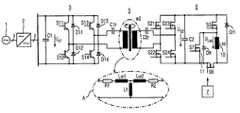
- the single FIGUREis a circuit diagram of a device for the bidirectional excitation and de-excitation especially of a superconducting coil.
- the circuitin detail includes a system terminal 1 as the voltage source, a downstream converter 2 including a rectifier with a connected inverter 3 and associated electronics. Furthermore, an inductive transformer 5 is provided whose equivalent circuit diagram as a contactless transformer is illustrated in the enlarged illustration A.
- an excitation circuit 6 with voltage input or setting for an inductanceis connected to the transformer 5 .
- the inductanceis formed from a coil made of superconducting material, in particular of high-temperature superconducting (HTS) material, which has a comparatively high critical temperature.
- HTShigh-temperature superconducting
- the superconducting coil with the inductance value L SCis overall denoted by 10 .
- a freewheeling circuit 11is connected in parallel with the superconducting coil 10 .
- the freewheeling circuit 11is arranged in the direct vicinity of the superconducting winding 11 and, in accordance with specifications, has a low resistance value.
- An external actuator 7 for providing a bipolar voltage on the superconducting winding 10 in the event of a unipolar field currentis essential for the dynamic operation of the excitation field. If, during the demagnetization, a power failure occurs on the primary side of an excitation device, the HTS winding 10 needs to be connected to the freewheeling circuit 11 since the excitation power then does not need to be dissipated to the primary side. Otherwise, the electrical power on the stator of the machine would need to be converted into heat.
- a three-phase steady-state system terminalmakes available a DC voltage on the intermediate circuit capacitance C 1 by a standard rectifier.
- Predetermining a bidirectional power flowrequires either a self-commutated voltage-impressing rectifier or a simple line-commutated diode bridge with a braking chopper for converting the energy which can be fed back from the superconducting inductance.
- the power flow from the system terminal to the superconducting inductanceis illustrated (from left to right).
- the inverter 3 and the transmission pathare voltage-impressing converters.
- the inverter(for example with the IGBTs S1 x , D1 x ) converts the DC voltage into a square-wave voltage with a mid-frequency f S .
- the rectifier(S2 x in this case MOSFETs with intrinsic freewheeling diodes) functions on a DC voltage capacitor C 2 .
- the use of MOSFETs on the secondary sideis preferably suitable in the case of a comparatively low voltage U 2 .
- a sinusoidal current in the AC intermediate circuitresults, with the inductive voltage drops across the stray inductances L ⁇ x being compensated for.
- the resonant capacitancecan also only be applied on one side.
- the selection of the capacitance C 2 which is suitable in terms of the correct attenuationis explained in the dissertation cited at the outset.
- the respective rectifieris always passive, and the corresponding power switches (IGBTs or diodes) are correspondingly turned off by the sequence controller.
- the diodesconduct the current and are naturally commutated.
- the inverterswitches the IGBTs on with zero current and hard off. However, then only the low delta-wave magnetization current needs to be commutated to the diodes.
- the superordinate steady-state sequence controllercontrols the excitation or de-excitation or the freewheeling of the field current and the rotating voltage actuator in order to control U LSC .
- S 5 -S 7 with the diodes Dr 1 and the body diode Dfr of S 7function as the voltage actuator. If S 5 and S 6 are in the switched-on state and S 7 is in the switched-off state, the HTS winding is excited by the voltage ⁇ U C2 . If S 5 is switched off, the diode Dfr takes on the free-wheeling current. Its forward voltage is reduced by the MOSFET S 7 being switched on in the third quadrant of its control characteristic and therefore substantially taking on the freewheeling current. If S 6 is switched off, the voltage ⁇ U C2 is present at L SC . The HTS winding 10 is therefore de-excited.
- the arrangement describedis particularly suitable for feeding a large rotating HTS inductance, whose magnetization current is controlled in steady-state fashion by low regulation/control dynamics.
- the sequence controllerhas knowledge on the direction of the power flow, with the result that no synchronization of the inverter and the rectifier is required as in the related art mentioned at the outset.
- the respective rectifieris always passive, and the corresponding power switches (IGBTs or diodes) are correspondingly turned off by the sequence controller.
- Optical, inductive or capacitive systemscan be used for the contactless data transmission of the field current measured values and the control information of the secondary converters.
- a particular advantage of the described circuitis the fact that the excitation and de-excitation can take place in controlled fashion in the circuits described. A separate energy source is therefore not required for de-excitation purposes.
- the systemalso includes permanent or removable storage, such as magnetic and optical discs, RAM, ROM, etc. on which the process and data structures of the present invention can be stored and distributed.
- the processescan also be distributed via, for example, down-loading over a network such as the Internet.
- the systemcan output the results to a display device, printer, readily accessible memory or another computer on a network.
Landscapes
- Engineering & Computer Science (AREA)
- Power Engineering (AREA)
- Physics & Mathematics (AREA)
- Electromagnetism (AREA)
- Superconductive Dynamoelectric Machines (AREA)
- Control Of Eletrric Generators (AREA)
- Control Of Electric Motors In General (AREA)
- Rectifiers (AREA)
- Control Of Ac Motors In General (AREA)
Abstract
Description
across C2, with the IR drops across the transformer windings and on the power semiconductors, is not much less than the voltage UC1calculated using the transformation ratio on the secondary side. The losses occurring are also used for attenuating the system in the event of sudden load variations on the capacitance C2, however.
Claims (9)
Applications Claiming Priority (4)
| Application Number | Priority Date | Filing Date | Title |
|---|---|---|---|
| DE102005047551 | 2005-09-30 | ||
| DE102005047551.5 | 2005-09-30 | ||
| DE102005047551ADE102005047551A1 (en) | 2005-09-30 | 2005-09-30 | Exciter device for an electrical machine |
| PCT/EP2006/066214WO2007039410A1 (en) | 2005-09-30 | 2006-09-11 | Excitation device for an electric machine |
Publications (2)
| Publication Number | Publication Date |
|---|---|
| US20090153106A1 US20090153106A1 (en) | 2009-06-18 |
| US8018206B2true US8018206B2 (en) | 2011-09-13 |
Family
ID=37402623
Family Applications (1)
| Application Number | Title | Priority Date | Filing Date |
|---|---|---|---|
| US11/992,846Expired - Fee RelatedUS8018206B2 (en) | 2005-09-30 | 2006-09-11 | Excitation device for an electric machine |
Country Status (7)
| Country | Link |
|---|---|
| US (1) | US8018206B2 (en) |
| EP (1) | EP1929616B1 (en) |
| KR (2) | KR101526164B1 (en) |
| CN (1) | CN101278470B (en) |
| DE (1) | DE102005047551A1 (en) |
| ES (1) | ES2523582T3 (en) |
| WO (1) | WO2007039410A1 (en) |
Cited By (4)
| Publication number | Priority date | Publication date | Assignee | Title |
|---|---|---|---|---|
| US20100066340A1 (en)* | 2006-12-20 | 2010-03-18 | Analogic Corporation | Non-Contact Rotary Power Transfer System |
| US8860383B2 (en) | 2010-01-13 | 2014-10-14 | Brusa Elektronik Ag | Control device and method for controlling a separately excited rotor winding of a synchronous machine |
| US8963476B2 (en) | 2011-03-11 | 2015-02-24 | Brusa Elektronik Ag | Synchronous machine with switching element in the excitation circuit |
| US20170063251A1 (en)* | 2015-08-26 | 2017-03-02 | Futurewei Technologies, Inc. | AC/DC Converters |
Families Citing this family (14)
| Publication number | Priority date | Publication date | Assignee | Title |
|---|---|---|---|---|
| DE102005047551A1 (en)* | 2005-09-30 | 2007-04-12 | Siemens Ag | Exciter device for an electrical machine |
| WO2010105764A1 (en)* | 2009-03-19 | 2010-09-23 | Sew-Eurodrive Gmbh & Co. Kg | Rotary transmitter and separately excited synchronous machine |
| DE102009040394A1 (en)* | 2009-09-07 | 2011-03-17 | Siemens Aktiengesellschaft | Excitation device for an electrical machine with superconducting load |
| US20110141771A1 (en)* | 2010-12-07 | 2011-06-16 | Karl Kyrberg | Electric power system including power converter and rotary transformer and method of assembling same |
| EP2670023A4 (en)* | 2011-01-26 | 2016-11-02 | Murata Manufacturing Co | ENERGY TRANSMISSION SYSTEM |
| JP5575731B2 (en)* | 2011-11-17 | 2014-08-20 | 株式会社日立情報通信エンジニアリング | Power supply device and control method of power supply device |
| WO2013085393A2 (en)* | 2011-12-07 | 2013-06-13 | National Oilwell Varco Norway As | Apparatus and method for transferring electrical power to a rotating shaft |
| DE102012112864A1 (en)* | 2012-12-21 | 2014-06-26 | Robert Bosch Gmbh | Battery device system for, e.g. hand tool has charging device that transmits charging power to battery element via contact area having preset power densityin charging mode |
| DE102014117524A1 (en) | 2014-11-28 | 2016-06-02 | Deutsches Zentrum für Luft- und Raumfahrt e.V. | Electric induction machine |
| CN107979277A (en)* | 2016-10-21 | 2018-05-01 | 南京理工大学 | A kind of power factor correcting based on novel transformer and inductor |
| CN107979275A (en)* | 2016-10-21 | 2018-05-01 | 南京理工大学 | A kind of new three-phase single-level active power factor correction device |
| CN110620512B (en)* | 2018-06-20 | 2020-09-15 | 台达电子工业股份有限公司 | Resonant converter and control method |
| CN111585462A (en)* | 2020-05-25 | 2020-08-25 | 中国科学院合肥物质科学研究院 | A magnetic resonance superconducting magnet lifting field device |
| DE102024105731A1 (en)* | 2024-02-29 | 2025-09-04 | Audi Aktiengesellschaft | Electric machine, motor vehicle with an electric machine and method for operating an electric machine |
Citations (31)
| Publication number | Priority date | Publication date | Assignee | Title |
|---|---|---|---|---|
| DE1488978A1 (en) | 1966-08-16 | 1969-04-03 | Licentia Gmbh | Electric rotating device |
| DE1438628A1 (en) | 1962-10-09 | 1969-04-30 | Siemens Ag | Arrangement for the excitation of a synchronous machine without slip rings |
| DE1563783A1 (en) | 1966-12-09 | 1970-04-09 | Siemens Ag | Arrangement for fine regulation of the voltage and for de-energizing load-dependent excited synchronous machines |
| US3784888A (en)* | 1972-06-26 | 1974-01-08 | Allis Chalmers | Control for commutatorless motor |
| US3931553A (en)* | 1972-08-07 | 1976-01-06 | Allis-Chalmers Corporation | Electronic commutation system having motor stator windings in push-pull |
| US3956679A (en)* | 1973-12-22 | 1976-05-11 | C.A.V. Limited | Brushless A.C. synchronous motors |
| US3991351A (en)* | 1973-12-22 | 1976-11-09 | C.A.V. Limited | Brushless A.C. synchronous motors |
| US4093869A (en)* | 1976-04-13 | 1978-06-06 | Westinghouse Electric Corp. | Quadrature axis field brushless exciter |
| US4549130A (en)* | 1983-07-12 | 1985-10-22 | International Business Machines Corporation | Low leakage transformers for efficient line isolation in VHF switching power supplies |
| US4949362A (en)* | 1989-03-09 | 1990-08-14 | General Electric Company | System for detecting and limiting electrical ground faults within electrical devices |
| DE4133001A1 (en) | 1990-10-05 | 1992-04-09 | Toshiba Kawasaki Kk | Superconductive current generator with cold rotor - has refrigeration device for cooling medium fed through rotor winding incorporated in rotor |
| US6288551B1 (en)* | 1995-08-19 | 2001-09-11 | Robert Bosch Gmbh | System for controlling the resistance of a load connected to a transformer |
| US6301128B1 (en)* | 2000-02-09 | 2001-10-09 | Delta Electronics, Inc. | Contactless electrical energy transmission system |
| US6362588B1 (en) | 2000-02-09 | 2002-03-26 | Reliance Electric Technologies, Llc | Excitation system for rotating synchronous machines |
| US6396247B1 (en)* | 2000-11-15 | 2002-05-28 | Eaton Corporation | Exciter system with protection for manual regulator failure and an electric generator incorporating same |
| US6462432B1 (en)* | 1997-08-18 | 2002-10-08 | Alstom Anlagen- Und Automatisierungstechnik Gmbh | Method and device for inductive transmission of electric power to a plurality of mobile consumers |
| EP1247324B1 (en) | 2000-01-11 | 2004-03-24 | American Superconductor Corporation | Exciter and electronic regulator for superconducting rotating machinery |
| DE10237779A1 (en) | 2002-08-17 | 2004-03-25 | Daimlerchrysler Ag | Converter for motor vehicle with at least one electrical energy supply and load, produces two variable input voltages with phase shift so current peaks on constant input voltage side are phase shifted |
| US6934167B2 (en)* | 2003-05-01 | 2005-08-23 | Delta Electronics, Inc. | Contactless electrical energy transmission system having a primary side current feedback control and soft-switched secondary side rectifier |
| US20050218741A1 (en)* | 2004-03-18 | 2005-10-06 | Wnorowski Edward J Jr | Generators, transformers and stators containing high-strength, laminated, carbon-fiber windings |
| US20060113968A1 (en)* | 2002-08-17 | 2006-06-01 | Altana Pharma Ag | Novel benzonaphthyridines |
| US20060267523A1 (en)* | 2003-01-20 | 2006-11-30 | Eurocopter Deutschland Gmbh | Device and method for transmitting and proving the energy of capacitive actuators |
| US20070120539A1 (en)* | 2005-11-29 | 2007-05-31 | Bray James W | Cryogenic exciter |
| US20090153106A1 (en)* | 2005-09-30 | 2009-06-18 | Jan Weigel | Excitation Device for an Electric Machine |
| US20100066299A1 (en)* | 2006-11-08 | 2010-03-18 | Mitsuru Izumi | Superconductive rotating electric machine drive control system and superconductive rotating electric machine drive control method |
| US20100071889A1 (en)* | 2008-09-19 | 2010-03-25 | Brad Radl | Closed loop control of hydrogen cooling of an electric power generator |
| US7687928B2 (en)* | 2006-06-14 | 2010-03-30 | Smiths Aerospace, Llc | Dual-structured aircraft engine starter/generator |
| US20100134074A1 (en)* | 2005-02-24 | 2010-06-03 | Allan David Crane | Exciter assemblies |
| US20100147605A1 (en)* | 2007-10-26 | 2010-06-17 | Frederick William Klatt | Brushless Multiphase Self-Commutation Control (or BMSCC) and Related Inventions |
| US20100171381A1 (en)* | 2007-01-16 | 2010-07-08 | Gangqin Ling | Self-contained intelligent cascaded synchronous electric motor-generator tandems of cumulative compound excitation |
| US20100219786A1 (en)* | 2007-09-11 | 2010-09-02 | Abb Schweiz Ag | Method and apparatus for determining a field current in brushless electrical machines |
Family Cites Families (1)
| Publication number | Priority date | Publication date | Assignee | Title |
|---|---|---|---|---|
| CN1581675A (en)* | 2004-05-14 | 2005-02-16 | 国电自动化研究院 | Generator controlled follow-current type de-excitation circuit |
- 2005
- 2005-09-30DEDE102005047551Apatent/DE102005047551A1/ennot_activeWithdrawn
- 2006
- 2006-09-11WOPCT/EP2006/066214patent/WO2007039410A1/enactiveApplication Filing
- 2006-09-11EPEP06793396.0Apatent/EP1929616B1/ennot_activeNot-in-force
- 2006-09-11KRKR1020087010302Apatent/KR101526164B1/ennot_activeExpired - Fee Related
- 2006-09-11USUS11/992,846patent/US8018206B2/ennot_activeExpired - Fee Related
- 2006-09-11CNCN2006800363348Apatent/CN101278470B/ennot_activeExpired - Fee Related
- 2006-09-11ESES06793396.0Tpatent/ES2523582T3/enactiveActive
- 2006-09-11KRKR1020147006387Apatent/KR20140040286A/ennot_activeCeased
Patent Citations (33)
| Publication number | Priority date | Publication date | Assignee | Title |
|---|---|---|---|---|
| DE1438628A1 (en) | 1962-10-09 | 1969-04-30 | Siemens Ag | Arrangement for the excitation of a synchronous machine without slip rings |
| DE1488978A1 (en) | 1966-08-16 | 1969-04-03 | Licentia Gmbh | Electric rotating device |
| DE1563783A1 (en) | 1966-12-09 | 1970-04-09 | Siemens Ag | Arrangement for fine regulation of the voltage and for de-energizing load-dependent excited synchronous machines |
| US3784888A (en)* | 1972-06-26 | 1974-01-08 | Allis Chalmers | Control for commutatorless motor |
| US3931553A (en)* | 1972-08-07 | 1976-01-06 | Allis-Chalmers Corporation | Electronic commutation system having motor stator windings in push-pull |
| US3991351A (en)* | 1973-12-22 | 1976-11-09 | C.A.V. Limited | Brushless A.C. synchronous motors |
| US3956679A (en)* | 1973-12-22 | 1976-05-11 | C.A.V. Limited | Brushless A.C. synchronous motors |
| US4093869A (en)* | 1976-04-13 | 1978-06-06 | Westinghouse Electric Corp. | Quadrature axis field brushless exciter |
| US4549130A (en)* | 1983-07-12 | 1985-10-22 | International Business Machines Corporation | Low leakage transformers for efficient line isolation in VHF switching power supplies |
| US4949362A (en)* | 1989-03-09 | 1990-08-14 | General Electric Company | System for detecting and limiting electrical ground faults within electrical devices |
| DE4133001A1 (en) | 1990-10-05 | 1992-04-09 | Toshiba Kawasaki Kk | Superconductive current generator with cold rotor - has refrigeration device for cooling medium fed through rotor winding incorporated in rotor |
| US6288551B1 (en)* | 1995-08-19 | 2001-09-11 | Robert Bosch Gmbh | System for controlling the resistance of a load connected to a transformer |
| US6462432B1 (en)* | 1997-08-18 | 2002-10-08 | Alstom Anlagen- Und Automatisierungstechnik Gmbh | Method and device for inductive transmission of electric power to a plurality of mobile consumers |
| EP1247324B1 (en) | 2000-01-11 | 2004-03-24 | American Superconductor Corporation | Exciter and electronic regulator for superconducting rotating machinery |
| DE60009349T2 (en) | 2000-01-11 | 2005-02-10 | American Superconductor Corp., Westborough | ELECTRONIC CONTROLLER FOR A SUPERIOR ROTARY ELECTRICAL MACHINE |
| US6362588B1 (en) | 2000-02-09 | 2002-03-26 | Reliance Electric Technologies, Llc | Excitation system for rotating synchronous machines |
| US6301128B1 (en)* | 2000-02-09 | 2001-10-09 | Delta Electronics, Inc. | Contactless electrical energy transmission system |
| US6396247B1 (en)* | 2000-11-15 | 2002-05-28 | Eaton Corporation | Exciter system with protection for manual regulator failure and an electric generator incorporating same |
| US20060113968A1 (en)* | 2002-08-17 | 2006-06-01 | Altana Pharma Ag | Novel benzonaphthyridines |
| DE10237779A1 (en) | 2002-08-17 | 2004-03-25 | Daimlerchrysler Ag | Converter for motor vehicle with at least one electrical energy supply and load, produces two variable input voltages with phase shift so current peaks on constant input voltage side are phase shifted |
| US20060267523A1 (en)* | 2003-01-20 | 2006-11-30 | Eurocopter Deutschland Gmbh | Device and method for transmitting and proving the energy of capacitive actuators |
| US7579715B2 (en)* | 2003-01-20 | 2009-08-25 | Eurocopter Deutschland Gmbh | Device and method for transmitting and providing the power of capacitive actuators |
| US6934167B2 (en)* | 2003-05-01 | 2005-08-23 | Delta Electronics, Inc. | Contactless electrical energy transmission system having a primary side current feedback control and soft-switched secondary side rectifier |
| US20050218741A1 (en)* | 2004-03-18 | 2005-10-06 | Wnorowski Edward J Jr | Generators, transformers and stators containing high-strength, laminated, carbon-fiber windings |
| US20100134074A1 (en)* | 2005-02-24 | 2010-06-03 | Allan David Crane | Exciter assemblies |
| US20090153106A1 (en)* | 2005-09-30 | 2009-06-18 | Jan Weigel | Excitation Device for an Electric Machine |
| US20070120539A1 (en)* | 2005-11-29 | 2007-05-31 | Bray James W | Cryogenic exciter |
| US7687928B2 (en)* | 2006-06-14 | 2010-03-30 | Smiths Aerospace, Llc | Dual-structured aircraft engine starter/generator |
| US20100066299A1 (en)* | 2006-11-08 | 2010-03-18 | Mitsuru Izumi | Superconductive rotating electric machine drive control system and superconductive rotating electric machine drive control method |
| US20100171381A1 (en)* | 2007-01-16 | 2010-07-08 | Gangqin Ling | Self-contained intelligent cascaded synchronous electric motor-generator tandems of cumulative compound excitation |
| US20100219786A1 (en)* | 2007-09-11 | 2010-09-02 | Abb Schweiz Ag | Method and apparatus for determining a field current in brushless electrical machines |
| US20100147605A1 (en)* | 2007-10-26 | 2010-06-17 | Frederick William Klatt | Brushless Multiphase Self-Commutation Control (or BMSCC) and Related Inventions |
| US20100071889A1 (en)* | 2008-09-19 | 2010-03-25 | Brad Radl | Closed loop control of hydrogen cooling of an electric power generator |
Non-Patent Citations (4)
| Title |
|---|
| Albert Esser; "Berührungslose, Kombinierte Energie-und Infomationsübertragung für Bewegliche Systeme"; Von der Fakultät für Elektrotechnik-Fachbereich 6-der Rheinisch-Westfälischen Technishen Hochschule Aachen zur Erlangung des akademischen Grades eines Doktor-Ingenieurs genehmigte Dissertation; Feb. 1992; pp. 1-127. |
| Communication issued by the European Patent Office on Feb. 28, 2011 in the related European patent application. |
| German Office Action for Application No. 10 2005 047 551.5-32; dated Dec. 21, 2006. |
| International Search Report for Application No. PCT/EP2006/066214; mailed Dec. 12, 2006. |
Cited By (7)
| Publication number | Priority date | Publication date | Assignee | Title |
|---|---|---|---|---|
| US20100066340A1 (en)* | 2006-12-20 | 2010-03-18 | Analogic Corporation | Non-Contact Rotary Power Transfer System |
| US8581437B2 (en)* | 2006-12-20 | 2013-11-12 | Analogic Corporation | Non-contact rotary power transfer system |
| US8860383B2 (en) | 2010-01-13 | 2014-10-14 | Brusa Elektronik Ag | Control device and method for controlling a separately excited rotor winding of a synchronous machine |
| US8963476B2 (en) | 2011-03-11 | 2015-02-24 | Brusa Elektronik Ag | Synchronous machine with switching element in the excitation circuit |
| US20170063251A1 (en)* | 2015-08-26 | 2017-03-02 | Futurewei Technologies, Inc. | AC/DC Converters |
| US9973099B2 (en)* | 2015-08-26 | 2018-05-15 | Futurewei Technologies, Inc. | AC/DC converters with wider voltage regulation range |
| US10135350B2 (en) | 2015-08-26 | 2018-11-20 | Futurewei Technologies, Inc. | AC/DC converters with wider voltage regulation range |
Also Published As
| Publication number | Publication date |
|---|---|
| US20090153106A1 (en) | 2009-06-18 |
| EP1929616A1 (en) | 2008-06-11 |
| EP1929616B1 (en) | 2014-10-29 |
| CN101278470B (en) | 2010-09-15 |
| KR101526164B1 (en) | 2015-06-18 |
| KR20140040286A (en) | 2014-04-02 |
| WO2007039410A1 (en) | 2007-04-12 |
| CN101278470A (en) | 2008-10-01 |
| DE102005047551A1 (en) | 2007-04-12 |
| KR20080068829A (en) | 2008-07-24 |
| ES2523582T3 (en) | 2014-11-27 |
Similar Documents
| Publication | Publication Date | Title |
|---|---|---|
| US8018206B2 (en) | Excitation device for an electric machine | |
| US7622825B2 (en) | Wide-voltage-range converter | |
| US5796598A (en) | Voltage-converting circuit for the power supply of an electrical consumer of high output, particularly a bobbin winding machine | |
| Mecke et al. | High frequency resonant inverter for contactless energy transmission over large air gap | |
| US6714428B2 (en) | Combined transformer-inductor device for application to DC-to-DC converter with synchronous rectifier | |
| US9787199B2 (en) | Power conversion device to control power distribution of input power to multiple outputs | |
| US20030058662A1 (en) | Inverter with a mains system side and load-side freewheeling pulse converter | |
| US8559194B2 (en) | Converter circuit and unit and system comprising such converter circuit | |
| JP2007151382A (en) | Ultra-low temperature exciter | |
| KR101452146B1 (en) | Electric power converter | |
| US5687071A (en) | Voltage lowering device and asynchronous traction system supplied from a single-phase mains supply incorporating a device of this kind | |
| US8036009B2 (en) | Method for supplying and discharging power to and from a resistive-inductive load, and rectifier used therein | |
| US8199542B2 (en) | Method and device for creating a direct voltage or a direct current | |
| US6914788B2 (en) | Power supply apparatus | |
| EP3534519A1 (en) | Power conversion device | |
| WO2021001888A1 (en) | Power conversion device | |
| US4542450A (en) | Electrical converter including gain enhancing means for low gain transistors | |
| JP2597592B2 (en) | Superconducting transformer monitoring device | |
| US20240055897A1 (en) | Wireless power supply device and wireless power supply system | |
| JP2764528B2 (en) | Power supply for driving switching elements | |
| US6385062B2 (en) | Direct current-supplying circuit for inductances | |
| JPH03239135A (en) | Feeder system | |
| JPH07154973A (en) | Inverter apparatus | |
| JPH0767336A (en) | Voltage-stabilizing transformer |
Legal Events
| Date | Code | Title | Description |
|---|---|---|---|
| AS | Assignment | Owner name:SIEMENS AKTIENGESELLSCHAFT, GERMANY Free format text:ASSIGNMENT OF ASSIGNORS INTEREST;ASSIGNOR:WEIGEL, JAN;REEL/FRAME:020780/0114 Effective date:20080310 | |
| ZAAA | Notice of allowance and fees due | Free format text:ORIGINAL CODE: NOA | |
| ZAAB | Notice of allowance mailed | Free format text:ORIGINAL CODE: MN/=. | |
| ZAAA | Notice of allowance and fees due | Free format text:ORIGINAL CODE: NOA | |
| ZAAB | Notice of allowance mailed | Free format text:ORIGINAL CODE: MN/=. | |
| STCF | Information on status: patent grant | Free format text:PATENTED CASE | |
| FPAY | Fee payment | Year of fee payment:4 | |
| MAFP | Maintenance fee payment | Free format text:PAYMENT OF MAINTENANCE FEE, 8TH YEAR, LARGE ENTITY (ORIGINAL EVENT CODE: M1552); ENTITY STATUS OF PATENT OWNER: LARGE ENTITY Year of fee payment:8 | |
| FEPP | Fee payment procedure | Free format text:MAINTENANCE FEE REMINDER MAILED (ORIGINAL EVENT CODE: REM.); ENTITY STATUS OF PATENT OWNER: LARGE ENTITY | |
| LAPS | Lapse for failure to pay maintenance fees | Free format text:PATENT EXPIRED FOR FAILURE TO PAY MAINTENANCE FEES (ORIGINAL EVENT CODE: EXP.); ENTITY STATUS OF PATENT OWNER: LARGE ENTITY | |
| STCH | Information on status: patent discontinuation | Free format text:PATENT EXPIRED DUE TO NONPAYMENT OF MAINTENANCE FEES UNDER 37 CFR 1.362 | |
| FP | Lapsed due to failure to pay maintenance fee | Effective date:20230913 |