US8015000B2 - Classification-based frame loss concealment for audio signals - Google Patents
Classification-based frame loss concealment for audio signalsDownload PDFInfo
- Publication number
- US8015000B2 US8015000B2US11/734,800US73480007AUS8015000B2US 8015000 B2US8015000 B2US 8015000B2US 73480007 AUS73480007 AUS 73480007AUS 8015000 B2US8015000 B2US 8015000B2
- Authority
- US
- United States
- Prior art keywords
- signal
- flc
- frame
- speech
- audio
- Prior art date
- Legal status (The legal status is an assumption and is not a legal conclusion. Google has not performed a legal analysis and makes no representation as to the accuracy of the status listed.)
- Active, expires
Links
Images









Classifications
- G—PHYSICS
- G10—MUSICAL INSTRUMENTS; ACOUSTICS
- G10L—SPEECH ANALYSIS TECHNIQUES OR SPEECH SYNTHESIS; SPEECH RECOGNITION; SPEECH OR VOICE PROCESSING TECHNIQUES; SPEECH OR AUDIO CODING OR DECODING
- G10L19/00—Speech or audio signals analysis-synthesis techniques for redundancy reduction, e.g. in vocoders; Coding or decoding of speech or audio signals, using source filter models or psychoacoustic analysis
- G10L19/005—Correction of errors induced by the transmission channel, if related to the coding algorithm
- G—PHYSICS
- G10—MUSICAL INSTRUMENTS; ACOUSTICS
- G10L—SPEECH ANALYSIS TECHNIQUES OR SPEECH SYNTHESIS; SPEECH RECOGNITION; SPEECH OR VOICE PROCESSING TECHNIQUES; SPEECH OR AUDIO CODING OR DECODING
- G10L25/00—Speech or voice analysis techniques not restricted to a single one of groups G10L15/00 - G10L21/00
- G10L25/78—Detection of presence or absence of voice signals
Definitions
- the present inventionrelates to digital communication systems. More particularly, the present invention relates to the enhancement of audio quality when portions of a bit stream representing an audio signal are lost within the context of a digital communications system.
- a coderencodes an input audio signal into a compressed digital bit stream for transmission or storage, and a decoder decodes the transmitted or stored bit stream into an output audio signal.
- the combination of the coder and the decoderis called a codec.
- the compressed bit streamis usually partitioned into frames.
- certain frames of the compressed bit streammay be deemed “lost” and thus not available for the normal decoding operation. This frame loss may be due to late or dropped packets in a packet transmission system or to severely corrupted frames in a wireless transmission system. Frame loss may even occur in audio storage applications for a variety of reasons.
- FLCframe loss concealment
- FECframe erasure concealment
- PLCpacket loss concealment
- One of the simplest and most common FLC techniquesconsists of repeating the bit stream of the last good frame preceding the lost frame, and decoding the repeated bit stream normally as if it were the received bit stream for the lost frame.
- This schemeis commonly called the “Frame Repeat” method. If the audio codec performs instantaneous quantization (such as Pulse Code Modulation (PCM)) without any overlap-add operation, the application of such a frame repeat method will generally cause waveform discontinuities at the frame boundaries. These waveform discontinuities will give rise to undesired audible artifacts that may be perceived as “clicks” by the listener.
- PCMPulse Code Modulation
- modern audio codecstypically perform frequency-domain transforms, such as Fast Fourier Transform (FFT) or Modified Discrete Cosine Transform (MDCT), and such transforms are typically performed on a windowed version of the input signal, wherein adjacent windows are to some extent overlapping.
- FFTFast Fourier Transform
- MDCTModified Discrete Cosine Transform
- the corresponding audio decoderstypically synthesize the output audio signals by using an overlap-add technique that is well-known in the art.
- the frame repeat FLC methodgenerally will not cause waveform discontinuities at the frame boundaries, because the overlap-add operation gradually transitions between one piece of waveform and the next overlapping piece of waveform, thus smoothing out waveform discontinuities at the frame boundaries.
- the frame repeat methodwill not cause waveform discontinuities if it is used with audio codecs that employ overlap-add synthesis at the decoder, it can still result in audible distortion for certain types of audio signals, especially those signals that are nearly periodic, such as the vowels portions of speech signals (voiced speech).
- the waveform repeated at the frame rateis generally not aligned or “in phase” with the original input waveform in the lost frame.
- the frame repeat methodoverlaps such two “out-of-phase” waveforms and adds them together, the resulting output signal usually includes an audible disturbance that will make the output signal sound a little “busy” and not as “clean” as the original signal. Therefore, the frame repeat method generally performs poorly for nearly periodic signals such as voiced speech.
- This class of PWE-based FLC methodsis usually tuned for speech signals, and thus these methods usually work quite well for speech. However, when applied to general audio signals such as music, these methods do not perform as well and tend to generate more audible distortion.
- One of the most common problemsis that for busy-sounding music signals, the use of periodic waveform extrapolation often generates a “buzzing” sound. This is due to the fact that the periodically-extrapolated waveform is more periodic than the original waveform corresponding to the lost frames.
- the frame repeat FLC methodworks well for most music signals but performs poorly for speech signals.
- PWE-based FLC methodswork well for speech signals but often produce an audible “buzzing” for busy, non-periodic music signals.
- many audio signalssuch as those associated with movie soundtracks, television, and radio programs, frequently change between pure speech, pure music, and a combination of speech and music. Consequently, using either a frame repeat or a PWE-based FLC method will result in performance problems for at least some portion(s) of the audio signal.
- the desired FLC methodshould be “universal” in that it works well for any kind of audio signal, but at the very least, the desired FLC method should work well for both speech and music, since speech and music are the dominant types of audio signals in soundtracks for movie, television, and radio.
- the present inventionaddresses this problem and can achieve good performance for both speech and music signals.
- classification-based frame loss concealment system of the present inventionis an improvement over the classification-based frame loss concealment system described in co-owned, commonly pending U.S. patent application Ser. No. 11/285,311 to Chen, filed Nov. 23, 2005, and entitled “Classification-Based Frame Loss Concealment for Audio Signals,” the entirety of which is incorporated by reference herein.
- an audio decoding systememploys at least two different frame loss concealment (FLC) methods, wherein one method is designed to perform well for music and the other is designed to perform well for speech.
- FLCframe loss concealment
- the speech-based FLC methodis a modified version of that described in U.S. patent application Ser. No. 11/234,291 to Juin-Hwey Chen, filed Sep. 26, 2005, and entitled “Packet Loss Concealment for Block-Independent Speech Codecs” (the entirety of which is incorporated by reference herein) and the music-based FLC method is an advanced frame repeat scheme.
- the present inventionis appropriate for audio systems that employ overlap-add synthesis at the decoder as well as those that do not.
- a system in accordance with an embodiment of the present inventionmakes use of any overlap-add synthesis employed at the decoder to improve analysis and concealment. If unavailable, the system generates a ringing signal to maintain smooth transitions from received frames to lost frames.
- FIG. 1illustrates an audio decoding system that performs classification-based frame loss concealment (FLC) system in accordance with an embodiment of the present invention.
- FLCframe loss concealment
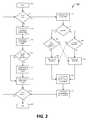
- FIG. 2illustrates a flowchart of a method for performing classification-based FLC in an audio decoding system in accordance with an embodiment of the present invention.
- FIG. 3illustrates a flowchart of a method for determining which of a plurality of FLC methods to apply when a signal classifier has identified an input signal as speech in accordance with an embodiment of the present invention.
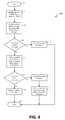
- FIG. 4illustrates a flowchart of a method for determining which of a plurality of FLC methods to apply when a signal classifier has identified an input signal as music in accordance with an embodiment of the present invention.
- FIG. 5illustrates a flowchart of a method for performing frame-repeat based FLC for music-like signals in accordance with an embodiment of the present invention.
- FIG. 6illustrates a first portion of a flowchart of a method for performing FLC for speech signals in accordance with an embodiment of the present invention.
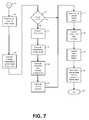
- FIG. 7illustrates a second portion of a flowchart of a method for performing FLC for speech signals in accordance with an embodiment of the present invention.
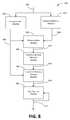
- FIG. 8is a block diagram of a speech/non-speech classifier in accordance with an embodiment of the present invention.
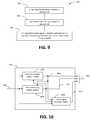
- FIG. 9shows a flowchart providing example steps for tracking energy of an audio signal, according to embodiments of the present invention.
- FIG. 10shows an example block diagram of an energy tracking module, in accordance with an embodiment of the present invention.
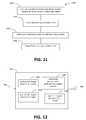
- FIG. 11shows a flowchart providing example steps for analyzing features of an audio signal, according to embodiments of the present invention.
- FIG. 12shows an example block diagram of an audio signal feature extraction module, in accordance with an embodiment of the present invention.
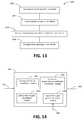
- FIG. 13shows a flowchart providing example steps for normalizing audio signal features, according to embodiments of the present invention.
- FIG. 14shows an example block diagram of a normalization module, in accordance with an embodiment of the present invention.
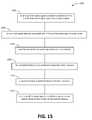
- FIG. 15shows a flowchart providing example steps for classifying audio signals as speech or music, according to embodiments of the present invention.
- FIG. 16shows a flowchart providing example steps for overlapping first and second decomposed signals, according to embodiments of the present invention.
- FIG. 17shows a system configured to overlap first and second decomposed signals, according to an example embodiment of the present invention.
- FIG. 18shows a flowchart providing example steps for overlapping a decomposed signal with a non-decomposed signal, according to embodiments of the present invention.
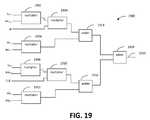
- FIG. 19shows a system configured to overlap a decomposed signal with a non-decomposed signal, according to an example embodiment of the present invention.
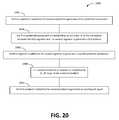
- FIG. 20shows a flowchart providing example steps for overlapping a mixed first signal with a mixed second signal, according to an embodiment of the present invention.
- FIG. 21shows a system configured to overlap a mixed first signal with a mixed second signal, according to an example embodiment of the present invention.
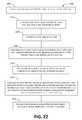
- FIG. 22shows a flowchart providing example steps for determining a pitch period of an audio signal, according to an example embodiment of the present invention.
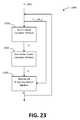
- FIG. 23shows block diagram of a pitch refinement system, in accordance with an example embodiment of the present invention.
- FIG. 24shows a flowchart for performing a decimated bisectional search, according to an example embodiment of the present invention.
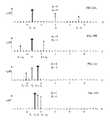
- FIGS. 25A-25Dshow plots related to an example determination of a pitch period, in accordance with an embodiment of the present invention.
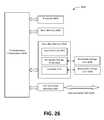
- FIG. 26is a block diagram of a computer system in which embodiments of the present invention may be implemented.
- FIG. 1illustrates an audio decoding system 100 that performs classification-based frame loss concealment (FLC) in accordance with an embodiment of the present invention.
- audio decoding system 100includes an audio decoder 110 , a decoded signal buffer 120 , a signal classifier 130 , FLC decision/control logic 140 , first and second FLC method selection switches 150 and 170 , FLC processing blocks 161 and 162 , and an output signal selection switch 180 .
- each of the elements of system 100may be implemented as software, as hardware, or as a combination of software and hardware.
- each of the elements of system 100is implemented as a series of software instructions that, when executed by a digital signal processor (DSP), perform the functions of that element as described herein.
- DSPdigital signal processor
- audio decoding system 100operates to decode each of a series of frames of an input audio bit-stream into corresponding frames of an output audio signal.
- System 100decodes the input audio bit-stream one frame at a time.
- current framerefers to a frame of the input audio bit-stream that system 100 is currently decoding
- previously framerefers to a frame of the input audio bit-stream that system 100 has already decoded.
- decodingmay include both normal decoding of a received frame of the input audio bit-stream into corresponding output audio signal samples as well as generating output audio signal samples for a lost frame of the input audio bit-stream using an FLC technique.
- audio decoder 110decodes the current frame using any of a variety of known audio decoding techniques to generate output audio signal samples.
- Output signal selection switch 180is controlled by a lost frame indicator, which indicates whether the current frame of the input audio bit-stream is deemed received or is lost. If the current frame is deemed received, switch 180 is placed in the upper position shown in FIG. 1 (connected to the node labeled “Frame Received”) and the decoded audio signal at the output of audio decoder 110 is used as the output audio signal for the current frame. Additionally, if the current frame is deemed received, the decoded audio signal for the current frame is also stored in decoded signal buffer 120 in preparation for possible FLC operations for future frames.
- output signal selection switch 180is placed in the lower position shown in FIG. 1 (connected to the node labeled “Frame Lost”).
- signal classifier 130 and FLC decision/control logic 140operate together to select one of two possible FLC methods to perform the necessary FLC operations.
- processing block 161(labeled “First FLC Method”) is designed or tuned to perform FLC for an audio signal that has been classified as speech, while processing block 162 (labeled “Second FLC Method”) is designed or tuned to perform FLC for an audio signal that has been classified as music.
- signal classifier 130is to analyze the previously-decoded audio signal stored in decoded signal buffer 120 , or a portion thereof, in order to determine whether the current frame should be classified as speech or music. There are several approaches discussed in the related art that are appropriate for performing this function. In one embodiment, a signal classifier 130 is used that shares a feature set with one or both of the incorporated FLC methods of processing blocks 161 and 162 to reduce complexity.
- FLC decision/control logic 140selects the FLC method for the current frame based on a classification output from signal classifier 130 and other decision logic.
- FLC decision/control logicselects the FLC method by generating a signal (labeled “FLC Method Decision” in FIG. 1 ) that controls the operation of first and second FLC method selection switches 150 and 170 to apply either the FLC method of processing block 161 or the FLC method of processing block 162 .
- switches 150 and 170are in the uppermost position so that the FLC method of processing block 161 is selected.
- FLC decision/control logic 140may select the FLC method of processing block 162 .
- FLC decision/control logic 140performs further logic and analysis to determine which FLC technique to use.
- signal classifierpasses FLC decision/control logic 140 a feature set used in performing speech classification. FLC decision/control logic 140 then uses this information along with the knowledge of the FLC algorithms to determine which FLC method would perform best for the current frame.
- this FLC methoduses the previously-decoded audio signal, or some portion thereof, stored in decoded signal buffer 120 and performs the associated FLC operations.
- the resulting output signalis then routed through switches 170 and 180 and becomes the output audio signal for the audio decoding system 100 .
- the FLC audio signal picked up by switch 170is also passed back to decoded signal buffer 120 so that the audio signal produced by the selected FLC method for the current lost frame is also stored as the newest portion of the “previously-decoded audio signal.” This is done to prepare decoded signal buffer 120 for the next frame in case the next frame is also lost.
- decoded signal buffer 120it is generally advantageous for decoded signal buffer 120 to store the audio signal corresponding to the last frame immediately processed before a lost frame, whether or not the audio signal was produced by audio decoder 110 or one of FLC processing blocks 161 or 162 .
- switches 150 , 170 and 180 in an upper or lower position as described hereinis not necessarily meant to denote the operation of a mechanical switch, but rather to describe the selection of one of two logical processing paths within system 100 .
- FIG. 2illustrates a flowchart 200 of a method for performing classification-based FLC in an audio decoding system in accordance with an embodiment of the present invention.
- the method of flowchart 200will be described with continuing reference to audio decoding system 100 of FIG. 1 , although persons skilled in the relevant art(s) will appreciate that the invention is not limited to that implementation.
- step 202the beginning of flowchart 200 is indicated at step 202 labeled “start”. Processing immediately proceeds to step 204 , in which a decision is made as to whether the next frame of the input audio bit-stream to be received by audio decoder 110 is received or lost. If the frame is deemed received, then audio decoder 110 performs normal decoding operations on the received frame to generate corresponding decoded audio signal samples, as shown at step 206 . Processing then proceeds to step 208 in which the decoded audio signal corresponding to the received frame is stored in decoded signal buffer 120 .
- the decoded audio signalis then provided as the output audio signal of audio decoding system 100 , as shown at step 214 .
- thisis achieved through the operation of output signal selection switch 180 (under the control of the lost frame indicator) to couple the output of audio decoder 110 to the ultimate output of system 100 .
- Processingthen proceeds to step 216 , where it is determined whether or not there are more frames in the input audio bit-stream to be processed by audio decoding system 100 . If there are more frames, then processing returns to decision step 204 ; otherwise, processing ends as shown at step 236 labeled “end”.
- step 220in which signal classifier 130 analyzes at least a portion of the previously decoded audio signal stored in decoded signal buffer 120 . Based on this analysis, signal classifier 130 classifies the input signal as either speech or music as shown at step 222 .
- a classifieris used that shares a feature set with one or both of the incorporated FLC methods of processing blocks 161 and 162 to reduce complexity.
- step 222FLC decision/control logic 140 performs further logic and analysis to determine which FLC method to apply.
- signal classifier 130passes FLC decision/control logic a feature set used in the speech classification.
- FLC decision/control logic 140uses this information along with knowledge of the FLC algorithms to determine which FLC method would perform best for the current frame.
- the input signalmight be speech with background music and although the predominant signal is speech, there still may be localized frames for which the FLC method designed for music is most suitable. If the FLC method designed for speech is deemed most suitable, the flow continues to step 226 , in which the FLC method designed for speech is applied.
- the flowcrosses over to step 230 and that method is applied.
- FLC decision/control logic 140decides which FLC method is most suitable for the current frame, as shown at step 228 , and then the selected method is applied.
- the input signalmay be music with vocals and, even though signal classifier 130 has classified the input signal as music, there may be a strong vocal element such that the FLC method designed for speech will provide the best results.
- the selection of the FLC method by FLC decision/control logic 140is performed via the generation of the signal labeled “FLC Method Decision”, which controls FLC method selection switches 150 and 170 to select one of the processing blocks 161 or 162 .
- FLC decision/control logic 140also uses logic/analysis to control or modify the FLC algorithms.
- signal classifier 130classifies the input signal as speech, and further analysis has a high confidence in the ability of the FLC method designed for speech to conceal the loss of the current frame, then the FLC method designed for speech is selected and left unmodified.
- further analysisshows that the signal is not very periodic, or that there are indications of some background music, etc., the speech FLC may be selected, but some part of the algorithm may be modified.
- the speech FLCis Periodic Waveform Extrapolation (PWE) based
- PWEPeriodic Waveform Extrapolation
- an effective modificationis to use a pitch multiple (double, triple, etc.) for extrapolation. If the signal is speech, using a pitch multiple will still produce an in-phase extrapolation. If the signal is music, using the pitch multiple increases the repetition period and the method becomes more like a frame-repeat method, which has been shown to provide good FLC performance for music signals.
- Modificationscan also be performed on the FLC method designed for music. For example, if signal classifier 130 classifies the input signal as speech, but FLC decision/control logic 140 selects the FLC method designed for music, the FLC method designed for music may be modified to be more appropriate for speech. For example, the signal can be analyzed for the degree of mix between periodic and noise-like components in a manner similar to that described in U.S. patent application Ser. No. 11/234,291 to Chen (explaining the calculation of a “voicing measure”), the entirety of which has been incorporated by reference herein. The output of the FLC method designed for music can then be mixed with a speech-like derived (LPC analysis) noise signal.
- LPC analysisspeech-like derived
- the audio signal generated by application of the selected FLC methodis then provided as the output audio signal of audio decoding system 100 , as shown at step 232 .
- thisis achieved through the operation of output signal selection switch 180 (under the control of the lost frame indicator) to couple the output at switch 170 to the ultimate output of system 100 .
- the audio signal generated by application of the selected FLC methodis also stored in decoded signal buffer 120 as shown in step 234 . Processing then proceeds to step 216 , where it is determined whether or not there are more frames in the input audio bit-stream to be processed by audio decoding system 100 . If there are more frames, then processing returns to decision step 204 ; otherwise, processing ends at step 236 labeled “end”.
- FIG. 3illustrates a flowchart 300 of one method that may be used by FLC decision/control logic 140 for determining which FLC method to apply when signal classifier 130 has identified the input signal as speech.
- This methodutilizes a feature set provided by signal classifier 130 , which includes a single speech likelihood measure for the current frame, denoted SLM, and a long-term running average of the speech likelihood measure, denoted LTSLM. The derivation of each of these values is described in Section B below.
- SLMis in the range ⁇ 4,+4 ⁇ , wherein values close to the minimum or maximum indicate the likelihood of speech, while values close to zero indicate the likelihood of music or other non-speech signals.
- the methodalso uses values of SLM associated with previously-decoded frames, which may be stored and subsequently accessed in a local buffer.
- step 302labeled “start”.
- processingimmediately proceeds to step 304 , in which a dynamic threshold for SLM is determined based on LTSLM.
- this stepis carried out by setting the dynamic threshold to ⁇ 4 if LTSLM is greater than 2.18, and otherwise setting the dynamic threshold to (1.8/LTSLM) 3 if LTSLM is less than or equal to 2.18.
- Thishas the effect of eliminating the dynamic threshold for signals that exhibit a strong long-term tendency for speech, while setting the dynamic threshold to a value that is inversely proportional to LTSLM for signals that do not.
- the higher the dynamic threshold is setthe less likely it is that the method of flowchart 300 will select the FLC method designed for speech.
- a first series of testsare performed to determine if the FLC method designed for speech should be applied. These tests may include determining if SLM, and/or the absolute value thereof, exceeds a certain threshold, if the sum total of one or more SLM values associated with prior frames exceeds certain thresholds, and/or if a pitch prediction gain associated with the last good frame is large. If true, this last condition would indicate that the frame is very periodic at the detected pitch period and that an FLC method designed for speech would work well. If the results of these tests indicate that the FLC method designed for speech should be applied, then processing proceeds via decision step 308 to step 310 , wherein the FLC method designed for speech is selected.
- the series of tests applied in step 306include (1) determining if the absolute value of SLM is greater than 1.8; (2) determining if SLM is greater than the dynamic threshold set in step 304 AND if the one of the following is true: the sum of the SLM values associated with the two preceding frames is greater than 3.4 OR the sum of the SLM values associated with the three preceding frames is greater than 4.8 OR the sum of the SLM values associated with the four preceding frames is greater than 5.6 OR the sum of the SLM values associated with the five preceding frames is greater than 7; (3) determining if the sum of the SLM values associated with the two preceding frames is less than ⁇ 3.4; (4) determining if the sum of the SLM values associated with the three preceding frames is less than ⁇ 4.8; (5) determining if the sum of the SLM values associated with the four preceding frames is less than ⁇ 5.6; (6) determining if the sum of the SLM values associated with the five preceding frames is less than ⁇ 7; and (7) determining if the pitch
- a series of testsare applied to determine if the speech classification is a borderline one as shown at step 312 .
- This series of testsmay include determining if SLM is less than a certain threshold and/or determining if LTSLM is less than a certain threshold.
- these additional testsinclude determining if SLM is less than 1.4 and if LTSLM is less than 2.4. If either of these conditions is evaluated as true, then a borderline classification is indicated and processing proceeds via decision step 314 to decision step 316 . Otherwise, the pitch period is not doubled and processing ends at step 328 labeled “end.”
- the pitch prediction gainis compared to a threshold value to determine how periodic the current frame is. If the pitch prediction gain is low, this indicates that the frame has very little periodicity. In one implementation, this step includes determining if the pitch prediction gain is less than 0.3. If decision step 316 determines that the frame has very little periodicity, then processing proceeds to step 318 , in which the pitch period is doubled prior to application of the FLC method designed for speech, after which processing ends as shown at step 328 . Otherwise, the pitch period is not doubled and processing ends at step 328 .
- decision step 308if the series of tests applied during step 306 do not indicate speech, then processing proceeds to decision step 320 .
- decision step 320SLM is compared to a threshold value to determine if there is at least some indication that the current frame is voiced speech or periodic. If the comparison provides such an indication, then processing proceeds to step 322 , wherein the FLC method designed for speech is selected.
- decision step 308includes determining if SLM is greater than 1.5.
- step 320if the test applied in that step does not provide at least some indication that the current frame is voiced speech or periodic, then processing proceeds to step 326 , in which the FLC method designed for music is selected. After this, processing ends at step 328 .
- FIG. 4illustrates a flowchart 400 of one method that may be used by FLC decision/control logic 140 for determining which FLC method to apply when signal classifier 130 has identified the input signal as music.
- this methodutilizes a feature set provided by signal classifier 130 , which includes a single speech likelihood measure for the current frame, denoted SLM, and a long-term running average of the speech likelihood measure, denoted LTSLM.
- SLMsingle speech likelihood measure for the current frame
- LTSLMlong-term running average of the speech likelihood measure
- the methodalso uses values of SLM associated with previously-decoded frames, which may be stored and subsequently accessed in a local buffer.
- step 402labeled “start”.
- processingimmediately proceeds to step 404 , in which a dynamic scaling factor is determined based on LTSLM.
- the dynamic scaling factoris set to a value that is inversely proportional to LTSLM.
- the dynamic scaling factoris set to 1.8/LTSLM. As will be made evident below, the higher the scaling factor, the less likely that the FLC method designed for speech will be selected.
- a series of testsare performed to detect speech in music and thereby determine if the FLC method designed for speech should be applied. These tests may include determining if SLM exceeds a certain threshold, if the sum total of one or more SLM values associated with prior frames exceeds certain thresholds, or a combination of both. If the results of these tests indicate speech in music, then processing proceeds via decision step 408 to step 410 , wherein the FLC method designed for speech is selected. Processing then ends as shown at step 422 denoted “end”.
- the series of tests performed in step 406include (1) determining if SLM is greater than 1.8 times the scaling factor determined in step 404 and (2) determining if the sum of the SLM values associated with the three preceding frames is greater than 5.4 times the scaling factor determined in step 404 OR if the sum of the SLM values associated with the four preceding frames is greater than 7.2 times the scaling factor determined in step 404 . If both tests (1) and (2) are passed (the conditions are evaluated as true), then speech in music is indicated.
- step 412a weaker test for speech in music is performed. This test may include determining if SLM exceeds a certain threshold and/or if the sum total of one or more SLM values associated with prior frames exceeds certain thresholds. For example, in one implementation, speech in music is indicated if SLM is greater than 1.8 and the sum of the SLM values associated with the two preceding frames is greater than 4.0. As shown at decision step 414 , if the test of step 412 indicates speech in music, then processing proceeds to step 416 , in which the FLC method for speech is selected.
- the pitch periodis set to the largest multiple of the pitch period that will fit within frame size. This is done because there is a weak indication of speech in the recent past but a long-term indication of music. Consequently, the FLC method designed for speech is used but with a larger pitch multiple, thereby making it act more like an FLC method designed for music (e.g., a frame repeat FLC method). After this, processing ends at step 422 labeled “end”.
- step 414if the weaker test performed at step 412 does not indicate speech in music, then the FLC method designed for music is selected as shown at step 420 . After this processing ends at step 422 .
- an embodiment of the present inventionincludes a processing block 161 that performs an FLC method designed for speech and a processing block 162 that performs an FLC method designed for music.
- a processing block 161that performs an FLC method designed for speech
- a processing block 162that performs an FLC method designed for music.
- the present inventionis for use with either audio codecs that employ overlap-add synthesis at the decoder or with codecs that do not, such as PCM.
- a “ringing” signal, ris obtained to maintain continuity between the previously-decoded frame and the lost frame.
- this ringing signalis calculated as the zero-input response of a synthesis filter associated with the audio decoder 110 .
- an effective approachis to use the ringing of the cascaded long-term and short-term synthesis filters of the decoder.
- the length of the ringing signal for overlap-addis denoted herein as ROLA. If the pitch period is less than the overlap length, the ringing is computed for one pitch period and then waveform repeated to obtain ROLA samples.
- the pitch used for ringing, pprmay be a multiple of the original pitch period, pp, depending on the mode (SPEECH or MUSIC) as determined by signal classifier 130 and the decision logic applied by FLC decision/control logic 140 . In one implementation, ppr is determined as follows: if the selected mode is MUSIC and the frame size (FRSZ) is greater than or equal to two times the original pitch period (pp) then ppr is set to two times pp. Otherwise, ppr is set to ppm. As used herein, ppm refers to a modified pitch period that results when the pitch period is multiplied. As discussed above, such multiplication of the pitch period may occur as a result of the operation of FLC decision/control logic 140 .
- the ringing signalis set to the audio fade-out signal provided by the decoder, denoted herein as A out .
- the FLC method designed for musicis an improved frame repeat method.
- a frame repeat methodcombined with the overlapping windows of typical audio coders produces surprisingly sufficient quality for most music.
- FIG. 5is a flowchart 500 illustrating an improved frame repeat method in accordance with an embodiment of the present invention.
- the beginning of flowchart 500is indicated by a step 502 labeled “start”.
- Processingimmediately proceeds to step 504 , in which it is determined whether the current frame is the first bad (i.e., erased) frame since a good (i.e., non-erased) frame was received. If so, step 506 is performed.
- the last good frame played outdenoted Lgf
- wc inis a correlated fade-in window
- wc outis a correlated fade-out window
- AOLAis the length in samples of the overlap-add window
- ROLAis the length in samples of the ringing signal for overlap-add
- FSis the number of samples in a frame (i.e., the frame size).
- step 508locally-generated white or Gaussian noise is passed through an LPC filter in a manner similar to that described in U.S. patent application Ser. No. 11/234,291 to Chen (the entirety of which has been incorporated by reference herein), except that in the present embodiment, scaling is applied to the noise signal after it has been passed through the LPC filter rather than before, and the scaling factor is based on the average magnitude of the speech signal associated with the last frame rather than on the average magnitude of the LPC prediction residual signal of the last frame.
- This stepproduces a filtered noise signal n lpc .
- Enough samples(FS+OLAG) are produced for the current frame and for an overlap-add window for the first good frame.
- an appropriate mixture of the repeated signal fr cor and the filtered noise signal n lpcis determined.
- a “voicing measure” or figure of merit (fom)such as that described in U.S. patent application Ser. No. 11/234,291 to Chen is used to compute a scale factor, ⁇ , that ranges from 0 to 1. The scale is overwritten to 0 if the current classification from signal classifier 130 is MUSIC.
- a scaled overlap-add of the repeated signal fr cor and the filtered noise signal n lpcis performed.
- the scaled overlap-addis preferably performed in accordance with the method described in Section C below. Hence:
- any frame-to-frame memoryis updated in order to maintain continuity (signal buffer, decimation filters, LPC filters, pitch buffers, etc.).
- the output of the FLC schemeis preferably ramped down to zero in a gradual manner in order to avoid buzzy sounds or other artifacts.
- a measure of the time in frame erasureis compared to a predetermined threshold, and if it exceeds the threshold, step 518 is performed which attenuates the signal in the output signal buffer denoted sq(N . . . FS ⁇ 1).
- a linear ramp starting at 43 ms and ending at 63 msis preferably used.
- the samples in sq(N . . . FS ⁇ 1)are released to a playback buffer. After this, processing ends as indicated by step 522 labeled “end”.
- an overlap-addis performed on the first good frame after erasure for both FLC methods.
- the overlap window length for this stepis denoted OLAG herein. If an audio codec that employs overlap-add synthesis at the decoder is being used, this overlap-add length will be the length of the built-in analysis overlap. Otherwise, it is a tuned parameter.
- the overlap-addis again performed in accordance with a method described below in Section C below. For the improved frame repeat method, the function is:
- OLAG- 1 ⁇ ( 1 - ⁇ ) + ( n lpc ⁇ ( n + FS ) ⁇ wu out ⁇ ( n ) + sq ⁇ ( N + n ) ⁇ wu in ⁇ ( n ) ) ⁇ ⁇
- sqis the output signal buffer
- Nis the position of the first sample of the current frame in the output signal buffer
- fr coris the correlated repeat component
- ⁇is the scale factor
- n lpcis the filtered noise signal
- wc outis the correlated fade-out window
- wc inis the correlated fade-in window
- wu outis the uncorrelated fade-out window
- wu inis the uncorrelated fade-in window
- OLAGis the overlap-add window length
- FSis the frame size.
- sq(N+n)likely has a portion or all of Wc in already applied if the frame is from an audio decoder.
- the audio encoderapplies ⁇ square root over (wc in (n)) ⁇ and the decoder does the same. It should be understood that whatever portion of the window has been applied is not reapplied.
- a “ramp up” operationis performed on the first good frame after erasure for both FLC methods.
- the output signal in the first good frameis ramped up from a scale factor associated with a last sample in the previously-described gain attenuation step, to 1, over a period of min( OLAG, 0.02 *SF ) where SF is the sampling frequency.
- the FLC method applied by processing block 161is a modified version of that described in U.S. patent application Ser. No. 11/234,291 to Chen, which is incorporated by reference herein.
- a flowchart of the modified approachis collectively depicted in FIGS. 6 and 7 of the present application. Because the flowchart is large, it has been divided into two portions, one depicted in FIG. 6 and one depicted in FIG. 7 , with a node “A” as the connecting point between the two portions.
- step 602The method begins at step 602 , which is located in the upper left corner of FIG. 6 and is labeled “start”. Processing then immediately proceeds to decision step 604 , in which it is determined whether the current frame is erased. If the current frame is not erased, then processing proceeds to decision step 606 , in which it is determined whether the current frame is the first good frame after an erasure. If the current frame is not the first good frame after an erasure, then the decoded speech samples in the current frame are copied to a corresponding location in the output buffer as shown at step 608 .
- the current frameis overlap added with an extrapolated frame loss signal as shown at step 610 .
- the overlap window lengthis designated OLAG. If an audio codec that employs overlap-add synthesis at the decoder is being used, this overlap-add length will be the length of the built-in analysis overlap. Otherwise, it is a tuned parameter.
- the overlap-addis performed in accordance with a method described in Section C below. The function is:
- sq ⁇ ( N + n )( 1 - ⁇ ) ⁇ ( sq ⁇ ( N + n ) ⁇ wc in ⁇ ( n ) + sq ⁇ ( N + FS + n ) ⁇ wc out ⁇ ( n ) ) + ⁇ ⁇ ( sq ⁇ ( N + n ) ⁇ wu in ⁇ ( n ) + n lpc ⁇ ( FS + n ) ⁇ wu out ⁇ ( n ) )
- sqis the output signal buffer
- Nis the position of the first sample of the current frame in the output signal buffer
- ⁇is a scale factor that will be described in more detail herein
- wc outis the correlated fade-out window
- wc inis the correlated fade-in window
- wu outis the uncorrelated fade-out window
- wu inis the uncorrelated fade-in window
- OLAGis the overlap-add window length for the first good frame
- step 612control flows to step 612 in which a “ramp up” operation is performed on the current frame.
- the output signal in the first good frameis ramped up from a scale factor associated with a last sample in a gain attenuation step (described herein in reference to step 648 of FIG. 6 ) to 1, over a period of min( OLAG, 0.02 *SF ) where SF is the sampling frequency.
- step 608 or 612processing proceeds to step 614 , which updates the coefficients of a short-term predictor by performing a so-called “LPC analysis”, a technique that is well-known by persons skilled in art.
- LPC analysisa technique that is well-known by persons skilled in art.
- One method of performing this stepis described in more detail in U.S. patent application Ser. No. 11/234,291.
- control flows to node 650labeled “A”. This node is identical to node 702 in FIG. 7 .
- decision step 604if it is determined during this step that the current frame is erased, then processing proceeds to decision step 618 , in which it is determined whether the current frame is the first frame in this current stream of erasure. If the current frame is not the first frame in this stream of erasure, processing proceeds directly to decision step 624 .
- a determination is made at decision step 620 as to whether or not there is audio overlap-add synthesis at the decoder. If there is no audio overlap-add synthesis at the decoder (i.e., if AOLA0), then the ringing signal of a cascaded long-term synthesis filter and short-term synthesis filter is calculated at step 622 . This calculation is discussed above in Section A.1.a, and described in detail in U.S. patent application Ser. No. 11/234,291 to Chen.
- a voicing measure(the calculation of which is described below in reference to step 718 of FIG. 7 ) has a value greater than a first threshold value T 1 . If the answer is “No”, the waveform in the last frame is considered not periodic enough to warrant doing any periodic waveform extrapolation. As a result, steps 626 , 628 and 630 are bypassed and control flows directly to decision step 632 . On the other hand, if the answer is “Yes”, the waveform in the last frame is considered to have at least some degree of periodicity. Consequently, control flows to decision step 626 .
- a determination is made as to whether or not there is audio overlap-add synthesis at the decoder. If there is no audio overlap-add synthesis at the decoder (i.e., if AOLA0), then processing proceeds directly to step 630 . However, if there is audio overlap-add synthesis at the decoder (i.e., if AOLA>0), then pitch refinement based on the audio fade-out signal is performed at step 628 prior to performance of step 630 .
- the pitch used for frame erasureis that estimated during the last good frame, denoted pp. Due to the local stationarity of speech, it is a good estimate for the pitch in the lost frame. However, due to the time separation between frames, it can be expected that the pitch has deviated from the last frame. As is described elsewhere herein, an embodiment of the invention utilizes an audio fade-out signal to overlap-add with the periodic extrapolated signal. If the pitch has deviated, this can result in the overlapping signals becoming out-of-phase, and to begin to cancel each other. This is especially problematic for small pitch periods. To alleviate the cancellation, step 628 uses the audio fade-out signal to refine the pitch.
- step 630the signal buffer sq is extrapolated and simultaneously overlap-added with the ringing signal on a sample-by-sample basis using the refined pitch ppmr.
- the extrapolationis computed as:
- this techniqueis advantageous. It incorporates the original signal fading out into the extrapolation so the extrapolation is closer to the original signal. The successive periods of the extrapolated signal are slightly different due to the incorporated fade-out signal resulting in a significant reduction in buzzy artifacts (these occur when the simple extrapolation results in identical pitch periods which get repeated over and over and are too periodic).
- decision step 632it is determined whether the voicing measure (the calculation of which is described below in reference to step 718 of FIG. 7 ) is less than a second threshold T 2 . If the answer is “No”, the waveform in the last frame is considered highly periodic and there is no need to mix in any random, noisy component in the output audio signal; hence, control flows directly to decision step 640 as shown in FIG. 6 .
- step 634a sequence of pseudo-random white noise is generated.
- the sequence of pseudo-random white noiseis passed through a short-term synthesis filter to generate a filtered noise signal, as shown at step 636 .
- the manner in which steps 634 and 636 are performedis described in detail in U.S. patent application Ser. No.
- scalingis applied to the noise signal after it has been passed through the short-term synthesis filter rather than before, and the scaling factor is based on the average magnitude of the speech signal associated with the last frame rather than on the average magnitude of the LPC prediction residual signal of the last frame.
- step 636control flows to step 638 in which the voicing measure is used to compute a scale factor, ⁇ , which ranges from 0 to 1.
- ⁇a scale factor
- One manner of computing such a scale factoris set forth in detail in U.S. patent application Ser. No. 11/234,291 to Chen. If it was determined at decision step 624 that the voicing measure does not exceed T 1 , then ⁇ will be set to one.
- decision step 640determines if the current frame is the first erased frame in a stream of erasure. If the current frame is the first frame in the stream of erasure, the audio fade-out signal, A out , is combined with the extrapolated signal and the LPC generated noise from step 636 (denoted n lpc ), as shown at step 642 . The signal and the noise are combined in accordance with the scaled overlap-add technique described in Section C below. Hence:
- step 640If it is determined at decision step 640 that the current frame is not the first erased frame in a stream of erasure, then there is no audio fade-out signal, A out , for overlapping. Consequently, only the extrapolated signal and the LPC generated noise are combined at step 644 in accordance with:
- step 646determines whether the current erasure is too long—that is, whether the current frame is too “deep” into erasure. If the length of the current erasure has not exceeded a predetermined threshold, then control flows to node 650 (labeled “A”) in FIG. 6 , which is the same as node 702 in FIG. 7 . However, if the length of the current erasure has exceeded this threshold, then step 648 is performed. Step 648 attenuates the signal in the output signal buffer denoted sq(N . . . FS ⁇ 1) in a manner similar to that described in U.S. patent application Ser. No. 11/234,291 to Chen. This is done to avoid buzzy artifacts. A linear ramp starting at 43 ms and ending at 63 ms is preferably used.
- step 704 and step 708are performed.
- Step 704plays back the output signal samples in output signal buffer, while step 706 calculates the average magnitude of the speech signal associated with the last frame. This value is stored and is later used in step 634 to scale the filtered noise signal.
- step 710it is determined whether the current frame is erased. If the answer is “Yes”, then steps 712 , 714 , 716 and 718 are skipped, and control flows directly to step 720 . If the answer is “No”, then the current frame is a good frame, and steps 712 , 714 , 716 and 718 are performed.
- Step 712uses any one of a large number of possible pitch estimators to generate an estimated pitch period pp that may be used by processes 622 , 628 and 630 during processing of the next frame.
- Step 714calculates an extrapolation scaling factor that may optionally be used by step 630 in the next frame. In the present implementation, this extrapolation scaling factor has been set to one and thus does not appear in any of the equations associated with step 630 .
- Step 716calculates a long-term filter memory scaling factor that may be used in step 622 in the next frame.
- Step 718calculates a voicing measure on the current frame of decoded speech. The voicing measure is a single figure of merit whose value depends on how strongly voiced the underlying speech signal is.
- One method of performing each of steps 712 , 714 , 716 and 718is described in more detail in U.S.
- Step 720updates a pitch period buffer.
- the pitch period bufferis used by signal classifier 130 of FIG. 1 to calculate a pitch period change parameter that is used by signal classifier 130 and FLC decision/control logic 140 , as discussed elsewhere herein.
- step 722updates a short-term synthesis filter memory that may be used in steps 622 and 636 during processing of the next frame.
- step 724performs shifting and updating of the output speech buffer.
- step 726stores extra samples of the extrapolated speech signal beyond the need of the current frame as the ringing signal for the next frame.
- step 726control flows to step 728 , which is labeled “end”. Node 728 denotes the end of the frame processing loop. Then, the control flow goes back to node 602 labeled “start” to start the frame processing for the next frame.
- Embodiments for classifying audio signals as speech or musicare described in the present section.
- the example embodiments described hereinare provided for illustrative purposes, and are not limiting. Further structural and operational embodiments, including modifications/alterations, will become apparent to persons skilled in the relevant art(s) from the teachings herein.
- FIG. 8shows a block diagram of a speech/non-speech classifier 800 in accordance with an example embodiment of the present invention.
- Speech/non-speech classifier 800may be used to implement signal classifier 130 described above in reference to FIG. 1 , for example.
- speech/non-speech classifier 800may also be used in a variety of other applications as will be readily understood by persons skilled in the relevant art(s).
- speech/non-speech classifier 800includes an energy tracker module 810 , a feature extraction module 820 , a normalization module 830 , a speech likelihood measure module 840 , a long term running average module 850 , and a classification module 860 .
- These modulesmay be implemented in hardware, software, firmware, or any combination thereof.
- one or more of these modulesmay be implemented in logic, such as a programmable logic chip (PLC), in a programmable gate array (PGA), in a digital signal processor (DSP), as software instructions that execute in a processor, etc.
- PLCprogrammable logic chip
- PGAprogrammable gate array
- DSPdigital signal processor
- energy tracker module 810tracks one or both of a maximum frame energy estimate and a minimum frame energy estimate of a signal frame received on an input signal 802 .
- Input signal 802is characterized herein as x(n).
- energy tracker module 810tracks frame energy using a combination of long term and short term minimum/maximum estimators. A final threshold for active signals may be derived from both the minimum and maximum estimators.
- One example energy tracking algorithmtracks a base-2 logarithmic signal gain, lg. Note that frame energy is discussed in terms of lg in the following description for illustrative purposes, but may alternatively be referred to in other terms, as would be understood to persons skilled in the relevant art(s).
- Signal activity detectorssuch as energy tracker module 810 may be used to distinguish a desired audio signal from noise on a signal channel. For instance, in one implementation, a signal activity detector may detect a level of noise on the signal channel, and use this detected noise level as a minimum energy estimate. A predetermined offset value is added to the detected noise level to create a threshold level. A signal level on the signal channel that is above the threshold level is considered to be the desired audio signal. In this manner, signals with large dynamic range (e.g., speech) can be relatively easily distinguished from a noise floor.
- a signal activity detectormay detect a level of noise on the signal channel, and use this detected noise level as a minimum energy estimate. A predetermined offset value is added to the detected noise level to create a threshold level. A signal level on the signal channel that is above the threshold level is considered to be the desired audio signal. In this manner, signals with large dynamic range (e.g., speech) can be relatively easily distinguished from a noise floor.
- a signal activity detectormay detect a level of noise on the
- a threshold based on a maximum energy estimatemay have better performance.
- a tracking system based on a minimum energy estimatemay undesirably determine the minimum energy estimate to be roughly equal to lower level audio portions of the audio signal.
- portions of the audio signalmay be mistaken for noise.
- a signal activity detector based on a maximum energy estimatedetects a maximum signal level on the signal channel, and subtracts a predetermined offset level from the detected maximum signal level to create a threshold level. The subtracted offset level can be selected to maintain the threshold level below the lower level audio portions of the audio signal.
- a signal level on the signal channel that is above the threshold levelis considered to be the desired audio signal.
- energy tracking module 810may be configured to track a signal according to these minimum and/or maximum energy estimate techniques. In embodiments where both the minimum and maximum energy estimates are used, energy tracking module 810 provides a meaningful active signal threshold for a wide range of signal types. Furthermore, the tracking of short term estimators and long term estimators (as further described below) enables classifier 800 to adapt quickly to sudden changes in the signal energy profile while at the same time maintaining some stability and smoothness. The determined final active signal threshold is used by long term running average module 850 to indicate when to update the long term running average of the speech likelihood measure. In order to provide accurate classification in the presence of background noise or interfering signals, updates to detected minimum and/or maximum estimates are performed during active signal detection.
- FIG. 9shows a flowchart 900 providing example steps for tracking energy of an audio signal, according to example embodiments of the present invention.
- Flowchart 900may be performed by energy tracking module 810 , for example.
- the steps of flowchart 900need not necessarily occur in the order shown in FIG. 9 .
- Other structural and operational embodimentswill be apparent to persons skilled in the relevant art(s) based on the discussion provided herein.
- Flowchart 900is described as follows.
- Flowchart 900begins with step 902 .
- a maximum frame energy estimateis determined.
- the maximum frame energy estimate for an input audio signalmay be measured and/or determined according to conventional or other techniques, as would be known to persons skilled in the relevant art(s).
- a minimum frame energy estimateis determined.
- the minimum frame energy estimate for an input audio signalmay be measure and/or determined according to conventional or other techniques, as would be known to persons skilled in the relevant art(s).
- a threshold for active signalsis determined based on the maximum frame energy estimate and the minimum frame energy estimate. For example, as described above, a first offset may be added to the determined minimum frame energy estimate, and a second offset may be subtracted from the determined maximum frame energy estimate, to generate respective first and second thresholds. The first and/or second thresholds may be compared to an input signal to determine whether the input signal is active.
- FIG. 10shows an example block diagram of energy tracking module 810 , in accordance with an embodiment of the present invention.
- Energy tracking module 810 shown in FIG. 10may be used to implement flowchart 900 shown in FIG. 9 .
- energy tracking module 810may also be used in a variety of other applications as will be readily understood by persons skilled in the relevant art(s).
- energy tracking module 810includes a maximum energy tracker module 1002 , a minimum energy tracker module 1004 , and an active signal detector module 1006 . Example embodiments for these portions of energy tracking module 810 will now be described.
- maximum energy tracker module 1002generates and maintains a short term estimate (StMaxEst) and a long term estimate (LtMaxEst) of the maximum frame energy for input signal 802 .
- StMaxEst and LtMaxEstare output by maximum energy tracker module 1002 on maximum energy tracking signal 1008 in a serial, parallel, or other fashion.
- a conventional maximum (or peak) energy trackerenergy of a received signal frame is compared to a current maximum energy estimate. If the current maximum energy estimate is less than the frame energy, the (new) maximum energy estimate is set to the frame energy. If the current maximum energy estimate is greater than the frame energy, the current maximum energy estimate is decreased by a predetermined static amount to create a new maximum energy estimate.
- This conventional techniqueresults in a maximum energy estimate that jumps to a maximum amount instantaneously and then decays (by the static amount).
- the static amount for decayis selected as a trade-off between stability (slow decay) and a desired degree of responsiveness, especially if input signal characteristics have changed (e.g., a switch from speech to music or vice versa has occurred; switching from loud, to quiet, to loud, etc., in different sections of a music piece has occurred; or a shift from singing, where there may be many peaks and valleys in the energy profile, to a more instrumental segment that has a more constant energy profile has occurred).
- stabilityslow decay
- a desired degree of responsivenessespecially if input signal characteristics have changed (e.g., a switch from speech to music or vice versa has occurred; switching from loud, to quiet, to loud, etc., in different sections of a music piece has occurred; or a shift from singing, where there may be many peaks and valleys in the energy profile, to a more instrumental segment that has a more constant energy profile has occurred).
- LtMaxEstis compared to StMaxEst (which is a relatively quickly decaying average of the frame energy, and thus is a slightly smoothed version of the frame energy), and is then updated, with the resulting LtMaxEst including a running average component and a component based on StMaxEst.
- the decay rateis increased further and further as long as the frame energy is less than StMaxEst.
- the conceptis that longer periods are expected where the frame energy does not reach LtMaxEst, but the frame energy should often cross StMaxEst because StMaxEst decays quickly. If it does not, this is unexpected behavior that is most likely a local or longer term decrease in energy indicating changing characteristics in the signal input. As a result, LtMaxEst is more aggressively decreased. This prevents LtMaxEst from remaining too high for too long when the input signal changes.
- StMaxEstis tracking a signal maximum, and then the signal suddenly goes to the noise floor for a relatively long time period, it is desirable for the decay of StMaxEst to reach the noise floor in approximately the same amount of time whether a relatively high (e.g., 60 dB) dynamic range or a relatively low (e.g., 10 dB) dynamic range was present.
- the adaptation of StMaxEstis normalized to the dynamic range.
- StMaxEstis updated based on the current estimated dynamic range of the input signal. In this way, the system becomes adaptive to the dynamic range, where the long term and short term maximum energy estimates adapt slower when receiving small dynamic range signals and adapt faster when receiving wide dynamic range signals.
- StMaxEstmay have an initialization value, as appropriate for the particular application. For example, in an embodiment, StMaxEst may have an initial value of 6.
- LtMaxEstmay have an initialization value, as appropriate for the particular application. For example, in an embodiment, LtMaxEst may have an initial value of 16. After updating LtMaxEst, LtMaxBeta is reset to an initial value (e.g., 0.99 in one embodiment). Furthermore, if StMaxEst is greater than LtMaxEst, LtMaxEst is adjusted as follows:
- LtMaxEstLtMaxEst ⁇ LtMaxAlpha + StMaxEst ⁇ (1 ⁇ LtMaxAlpha) where LtMaxAlpha is set between 0 and 1 (e.g., tuned to 0.5 in one embodiment).
- StMaxEstis greater than LtMaxEst
- LtMaxEstis adjusted with the sum of a long term running average component (LtMaxEst ⁇ LtMaxAlpha) and a component based on StMaxEst (StMaxEst ⁇ (1 ⁇ LtMaxAlpha)).
- LtMaxBetamay be decreased in order to increase a change in long term maximum estimate LtMaxEst when there is an update:
- LtMaxBetaLtMaxBeta ⁇ LtMaxBetaDecay
- ⁇ LtMaxBetaDecay0.9998 ⁇ FS 344 ⁇ 16 SF and FS is the frame size, and SF is the sampling frequency in kHz.
- maximum energy tracker module 1002receives a minimum energy tracking signal 1010 from minimum energy tracker module 1004 .
- Minimum energy tracking signal 1010includes a long term minimum energy estimate, LtMinEst, generated by minimum energy tracker module 1004 , which is used as an indication of the input dynamic range:
- minimum energy tracker module 1004generates and maintains a short term estimate (StMinEst) and a long term estimate (LtMinEst) of the minimum frame energy for input signal 802 .
- StMinEst and LtMinEstare output by minimum energy tracker module 1004 on minimum energy tracking signal 1010 in a serial, parallel, or other fashion.
- conventional minimum energy trackerscompare energy of a received signal frame to a current minimum energy estimate. If the current minimum energy estimate is greater than the frame energy, the minimum energy estimate is set to the frame energy. If the current minimum energy estimate is less than the frame energy, the current minimum energy estimate is increased by a predetermined static amount. Again, this conventional technique results in a minimum energy estimate that jumps to a minimum amount instantaneously and then decays upward (by the static amount).
- LtMinEstis compared to StMinEst and is then updated, with the resulting LtMinEst including a running average component and a component based on StMinEst.
- the decay rateis increased further and further as long as the frame energy is greater than StMinEst.
- the conceptis that longer periods are expected where the frame energy does not reach LtMinEst, but the frame energy should often cross StMinEst because StMinEst decays upward quickly. If it does not, this is unexpected behavior that is most likely a local or longer term increase in energy indicating changing characteristics in the signal input. As a result, LtMinEst is more aggressively increased. This prevents LtMinEst from remaining too low for too long when the input signal changes.
- the adaptation of StMinEstis normalized to the dynamic range.
- StMinEstis updated based on the current estimated dynamic range of the input signal. In this way, the system becomes adaptive to the dynamic range, where long term and short term minimum energy estimates adapt slower when receiving small dynamic range signals and adapt faster when receiving wide dynamic range signals.
- StMinEstmay have an initialization value, as appropriate for the particular application. For example, in an embodiment, StMinEst may have an initial value of 21.
- LtMinEstmay have an initialization value, as appropriate for the particular application. For example, in an embodiment, LtMinEst may have an initial value of 6. If the short term min estimate StMinEst is less than the long term estimate LtMinEst, the long term estimate LtMinEst may be adjusted more aggressively, as follows:
- LtMinEstLtMinEst ⁇ LtMinAlpha + StMinEst ⁇ (1 ⁇ LtMinAlpha) where LtMinAlpha is set between 0 and 1 (e.g., tuned to 0.5 in one embodiment).
- StMinEstis less than LtMinEst
- LtMinEstis adjusted with the sum of a long term running average component (LtMinEst ⁇ LtMinAlpha) and a component based on StMinEst (StMinEst ⁇ (1 ⁇ LtMinAlpha)).
- LtMinBetais decreased in order to increase a change to LtMinEst when there is an update:
- minimum energy tracker module 1004receives maximum energy tracking signal 1008 from maximum energy tracker module 1002 .
- Maximum energy tracking signal 1008includes long term maximum energy estimate, LtMaxEst, generated by maximum energy tracker module 1002 , which is used as an indication of the input dynamic range:
- active signal detector module 1006receives input signal 802 , maximum energy tracking signal 1008 and minimum energy tracking signal 1010 .
- Active signal detector module 1006generates a threshold, ThActive, which may be used to indicate an active signal for input signal 802 .
- ThMinLtMinEst+5.5
- ThActivemax(min(ThMax, ThMin),11.0)
- values other than 4.5, 5.5, and/or 11.0may be used to generate ThActive, depending on the particular application.
- Active signal detector module 1006may further perform a comparison of energy of the current frame, lg, to ThActive, to determine whether input signal 802 is currently active:
- feature extraction module 820receives input audio signal 802 .
- Feature extraction module 820analyzes one or more features of the input audio signal 802 .
- the analyzed featuresmay be used by classifier 800 to determine whether the audio signal is a speech or non-speech (e.g., music, general audio, noise) signal.
- the featurestypically discriminate in some manner between speech and non-speech, and/or between unvoiced speech and voiced speech.
- any number and type of suitable features of input signal 802may be analyzed by feature extraction module 820 .
- feature extraction module 820may alternatively be used in other applications as will be readily understood by persons skilled in the relevant art(s).
- FIG. 11shows a flowchart 1100 providing example steps for analyzing features of an audio signal, according to example embodiments of the present invention.
- Flowchart 1100may be performed by feature extraction module 820 .
- the steps of flowchart 1100need not necessarily occur in the order shown in FIG. 11 .
- not all steps of flowchart 1100are necessarily performed.
- flowchart 1100relates to the analysis of four features of an audio signal.
- fewer, additional, and/or alternative features of the audio signalmay be analyzed.
- Other structural and operational embodimentswill be apparent to persons skilled in the relevant art(s) based on the discussion provided herein.
- FIG. 12shows an example block diagram of feature extraction module 820 , in accordance with an example embodiment of the present invention.
- feature extraction module 820includes a pitch period change determiner module 1202 , a pitch prediction gain determiner module 1204 , a normalized autocorrelation coefficient determiner module 1206 , and a logarithmic signal gain determiner module 1208 .
- These modules of feature extraction module 820are further described below along with a corresponding step of flowchart 1100 .
- step 1102 of flowchart 1100a change in a pitch period between the frame and a previous frame of the audio signal is determined.
- Pitch period change determiner module 1202may perform step 1102 .
- Pitch period change determiner module 1202analyzes a first signal feature, which is a fractional change in pitch period, pp ⁇ , from one signal frame to the next.
- the change in pitch periodis calculated by pitch period change determiner module 1202 according to:
- pp ia pitch period of a current input signal frame
- pp i-1a pitch period of a previous input signal frame.
- a pitch prediction gainis determined.
- pitch prediction gain determiner module 1204may perform step 1104 .
- Pitch prediction gain determiner module 1204analyzes a second signal feature, which is pitch prediction gain, ppg.
- pitch prediction gainis calculated by pitch prediction gain determiner module 1204 according to:
- Rthe pitch prediction residual energy
- Rmay be calculated by:
- a first normalized autocorrelation coefficientis determined.
- normalized autocorrelation coefficient determiner module 1206may perform step 1106 .
- Normalized autocorrelation coefficient determiner module 1206analyzes a third signal feature, which is the first normalized autocorrelation coefficient, ⁇ 1 .
- the first normalized autocorrelation coefficientis calculated by normalized autocorrelation coefficient determiner module 1206 according to:
- ⁇ 1works well for narrowband signals (up to 16 kHz). Beyond the narrowband signal range, ⁇ [SF/16] may instead be desirable to use, where SF is the sampling frequency in kHz.
- a logarithmic signal gainis determined.
- logarithmic signal gain determiner module 1208may perform step 1108 .
- Logarithmic signal gain determiner module 1208analyzes a fourth signal feature, which is the logarithmic signal gain, lg.
- feature extraction module 820outputs an extracted feature signal 806 , which includes the results of the analysis of the one or more analyzed signal features, such as change in pitch period, pp ⁇ (from module 1202 ), pitch prediction gain, ppg (from module 1204 ), first normalized autocorrelation coefficient, ⁇ 1 (from module 1206 ), and logarithmic signal gain, lg (from module 1208 ).
- normalization module 830receives energy tracking signal 804 and extracted feature signal 806 . Normalization module 830 normalizes the analyzed signal feature results received on extracted feature signal 806 . In embodiments, normalization module 830 may normalize results for any number and type of received features, as desired for the particular application. In an embodiment, normalization module 830 is configured to normalize the feature results such that the normalized feature results tend in a first direction (e.g., toward ⁇ 1) for unvoiced or noise-like characteristics and in a second direction (e.g., toward +1) for voiced speech or a signal that is periodic.
- first directione.g., toward ⁇ 1
- second directione.g., toward +1
- signal featuresare normalized by normalization module 830 to be between a lower bound value and a higher bound value.
- each signal featureis normalized between ⁇ 1 and +1, where a value near ⁇ 1 is an indication that input signal 802 has unvoiced or noise-like characteristics, and a value near +1 indicates that input signal 802 likely includes voiced speech or a signal that is periodic.
- normalization techniquesare just example ways of performing normalization. They are all basically clipped linear functions. Other normalization techniques may be used in alternative embodiments. For example, one could derive more complicated smooth higher order functions that would approach ⁇ 1,+1.
- FIG. 13shows a flowchart 1300 providing example steps for normalizing signal features, according to example embodiments of the present invention.
- Flowchart 1300may be performed by normalization module 830 .
- the steps of flowchart 1300need not necessarily occur in the order shown in FIG. 13 .
- not all steps of flowchart 1300are necessarily performed.
- flowchart 1300relates to the normalization of four features of an audio signal.
- fewer, additional, and/or alternative features of the audio signalmay be normalized.
- Other structural and operational embodimentswill be apparent to persons skilled in the relevant art(s) based on the discussion provided herein.
- FIG. 14shows an example block diagram of normalization module 830 , in accordance with an example embodiment of the present invention.
- normalization module 830includes a pitch period change normalization module 1402 , a pitch prediction gain normalization module 1404 , a normalized autocorrelation coefficient normalization module 1406 , and a logarithmic signal gain normalization module 1408 .
- These modules of normalization module 830are further described below along with a corresponding step of flowchart 1300 .
- step 1302 of flowchart 1300the change in a pitch period is normalized.
- Pitch period change normalization module 1402may perform step 1302 .
- Pitch period change normalization module 1402receives change in pitch period, pp ⁇ , on extracted feature signal 806 , and outputs a normalized pitch period change, N_pp ⁇ , on a normalized feature signal 808 .
- N — pp ⁇(1 ⁇ min(3 ⁇ pp ⁇ ,1)) ⁇ 2 ⁇ 1
- other equations for normalizing pitch period changemay alternatively be used.
- step 1304the pitch prediction gain is normalized.
- pitch prediction gain normalization module 1404may perform step 1304 .
- Pitch prediction gain normalization module 1404receives pitch prediction gain, ppg, on extracted feature signal 806 , and outputs a normalized pitch prediction gain, N_ppg, on normalized feature signal 808 .
- ppgthe pitch prediction gain
- ppgthe pitch prediction gain normalization
- N_ppgmax ⁇ ( min ⁇ ( ppg , 10 ) , 0 ) 5 - 1
- other equations for normalizing pitch prediction gainmay alternatively be used.
- the first normalized autocorrelation coefficientis normalized.
- normalized autocorrelation coefficient normalization module 1406may perform step 1306 .
- Normalized autocorrelation coefficient normalization module 1406receives first normalized autocorrelation coefficient, ⁇ 1 , on extracted feature signal 806 , and outputs a normalized first normalized autocorrelation coefficient, N_ ⁇ 1 on normalized feature signal 808 .
- the first normalized autocorrelation coefficient, ⁇ 1will tend to be close to +1, whereas for unvoiced speech, ⁇ 1 will tend to be much less than 1.
- logarithmic signal gain normalization module 1408may perform step 1308 .
- Logarithmic signal gain coefficient normalization module 1408receives logarithmic signal gain, lg, on extracted feature signal 806 , and outputs a normalized logarithmic signal gain, N_lg, on normalized feature signal 808 .
- logarithmic signal gain normalization module 1408receives energy tracking signal 804 .
- LtMaxEst, LtMinEst, and ThActiveprovided on energy tracking signal 804 are used to normalize the logarithmic signal gain.
- An example logarithmic signal gain normalizationthat may be performed by module 1408 in an embodiment is given by:
- other equations for normalizing logarithmic signal gainmay alternatively be used.
- speech likelihood measure module 840receives normalized feature signal 808 .
- Speech likelihood measure module 840makes a determination whether speech is likely to have been received on input signal 802 , by calculating one or more speech likelihood measures.
- SLMis in the range ⁇ 4 to +4 ⁇ . Values close to the minimum or maximum values of the range indicate a likelihood that speech is present in input signal 802 , while values close to zero indicate the likelihood of the presence of music or other non-speech signals.
- SLMmay have a range other than ⁇ 4 to +4 ⁇ .
- one or more normalized features in the equation for SLM abovemay have ranges other than ( ⁇ 1 to +1).
- one or more normalized features in the equation for SLMmay be multiplied, divided, or otherwise scaled by a weighting factor, to provide the one or more normalized features with a weight in SLM that is different from one or more of the other normalized features.
- Such variation in ranges and/or weightingmay be used to increase or decrease the importance of one or more of the normalized features in the speech likelihood determination, for example.
- a number and type of the featuresare selected to have little or no correlation between normalized features in tending toward the first value or the second value for a typical music audio signal. Enough features are selected such that this random direction tends to cancel the sum SLM when adding the normalized results to generally yield a sum near zero.
- the normalized featuresthemselves may also generally be close to zero for certain music. For example, in multiple instrument music, a single pitch will give a pitch prediction gain that is low since the single pitch can only track one instrument and the prediction does not necessarily capture the energy in the other instrument (assuming the other instruments are at a different pitch).
- speech likelihood measure module 840outputs speech likelihood indicator signal 812 , which includes SLM.
- long term running average module 850receives speech likelihood indicator signal 812 and energy tracking signal 804 .
- Long term running average module 850generates a running average of speech likelihood indicator signal 812 .
- a long term speech likelihood running averageis generated by module 850 according to the equation:
- LTSLMLTSLM * LtslAlpha +
- LtslAlphais a variable that may be set between 0 and 1 (e.g., tuned to 0.99 in one embodiment).
- the long term averageis updated by module 850 only when an active signal is indicated by ThActive on energy tracking signal 804 . This provides classification robustness during background noise.
- long term running average module 850outputs long term running average signal 814 , which includes LTSLM.
- classification module 860receives long term running average signal 814 . Classification module 860 classifies the current frame of input signal 802 as speech or non-speech.
- the classification, Class(i), for the ith frameis calculated by module 860 according to the equation:
- Threshold values other than 1.75 and 1.85may alternatively be used by module 860 , in other embodiments.
- classification module 860outputs classification signal 818 , which includes Class(i). Classification signal 818 is received by FLC/decision control logic 140 , shown in FIG. 1 .
- FIG. 15shows a flowchart 1500 providing example steps for classifying audio signals as speech or music, according to example embodiments of the present invention.
- Flowchart 1500may be performed by signal classifier 130 described above with regard to FIG. 1 , for example.
- the steps of flowchart 1500need not necessarily occur in the order shown in FIG. 15 .
- Other structural and operational embodimentswill be apparent to persons skilled in the relevant art(s) based on the discussion provided herein.
- Flowchart 1500is described as follows.
- Flowchart 1500begins with step 1502 .
- an energy of the audio signalis tracked to determine if the frame of the audio signal comprises an active signal.
- energy tracker module 810performs step 1502 .
- the steps of flowchart 900 shown in FIG. 9may be performed during step 1502 .
- step 1504one or more signal features associated with a frame of the audio signal are extracted.
- feature extraction module 820performs step 1504 .
- the steps of flowchart 1100 shown in FIG. 11may be performed during step 1504 .
- each feature of the extracted signal featuresis normalized.
- normalization module 830performs step 1506 .
- the steps of flowchart 1300 shown in FIG. 13may be performed during step 1506 .
- step 1508the normalized features are combined to generate a first measure.
- speech likelihood measure module 840performs step 1508 .
- the first measureis the speech likelihood measure, SLM.
- a second measureis updated based on the first measure.
- the second measurecomprises a long-term running average of the first measure.
- long term running average module 850performs step 1510 .
- the second measureis the long term speech likelihood running average, LTSLM.
- step 1510is performed only if the frame of the audio signal comprises an active signal, as determined by step 1502 .
- step 1512the frame of the audio signal is classified as speech or non-speech based at least in part on the second measure.
- classification module 860performs step 1512 .
- An embodiment of the present inventionuses a dynamic mix of windows to overlap two signals whose normalized cross-correlation may vary from zero to one. If the overlapping signals are decomposed into a correlated component and an uncorrelated component, they are overlap-added separately using the appropriate window, and then added together. If the overlapping signals are not decomposed, a weighted mix of windows is used. The mix is determined by a measure estimating the amount of cross-correlation between overlapping signals, or the relative amount of correlated to uncorrelated signals.
- Two signals to be overlapped addedmay be defined as a first signal segment that is to be faded out, and a second signal segment that is to be faded in.
- the first signal segmentmay be a first received segment of an audio signal
- the second signal segmentmay be a second received segment of the audio signal.
- a general overlap-add of the two signalscan be defined by:
- FIG. 16shows a flowchart 1600 providing example steps for overlapping a first decomposed signal with a second decomposed signal according to the above Equation C.1.
- the steps of flowchart 1600need not necessarily occur in the order shown in FIG. 16 .
- FIG. 17shows a system 1700 configured to implement Equation C.1, according to an embodiment of the present invention.
- Flowchart 1600is described as follows with respect to FIG. 17 , for illustrative purposes.
- Flowchart 1600begins with step 1602 .
- a correlated component of the first segmentis added to a correlated component of the second segment to generate a combined correlated component.
- the correlated component of the first segment, SC outis multiplied with a correlated fade-out window, wc out , by a first multiplier 1702 , to generate a first product.
- the correlated component of the second segment, sc inis multiplied with a correlated fade-in window, wc in , by a second multiplier 1704 , to generate a second product.
- the first productis added to the second product by a first adder 1710 to generate the combined correlated component, sc out (n) ⁇ wc out (n)+sc in (n) ⁇ wc in (n).
- an uncorrelated component of the first segmentis added to an uncorrelated component of the second segment to generate a combined uncorrelated component.
- the uncorrelated component of the first segment, su outis multiplied with an uncorrelated fade-out window, wu out , by third multiplier 1706 , to generate a first product.
- the uncorrelated component of the second segment, su inis multiplied with an uncorrelated fade-in window, wu in , by fourth multiplier 1708 , to generate a second product.
- the first productis added to the second product by a second adder 1712 to generate the combined uncorrelated component su out (n) ⁇ wu out (n)+su in (n) ⁇ wu in (n).
- step 1606the combined correlated component is added to the combined uncorrelated component to generate an overlapped signal.
- the combined correlated componentis added to the combined uncorrelated component by third adder 1714 , to generate the overlapped signal, shown as signal 1716 .
- first through fourth multipliers 1702 , 1704 , 1706 , and 1708 , and first through third adders 1710 , 1712 , and 1714 , and further multipliers and adders described in Section C.may be implemented in hardware, software, firmware, or any combination thereof, including respectively as sequence multipliers and adders that are well known to persons skilled in the relevant art(s).
- such multipliers and addersmay be implemented in logic, such as a programmable logic chip (PLC), in a programmable gate array (PGA), in a digital signal processor (DSP), as software instructions that execute in a processor, etc.
- PLCprogrammable logic chip
- PGAprogrammable gate array
- DSPdigital signal processor
- one of the overlapping signals(in or out) is decomposed while the other signal has the correlated and uncorrelated components mixed together.
- the mixed signalis first decomposed and the first embodiment described above is used.
- signal decompositionis very complex and overkill for most applications.
- the optimal overlapped signalmay be approximated by the following equation (Equation C.2.a):
- FIG. 18shows a flowchart 1800 providing example steps for overlapping a first signal with a second signal according to the above equation.
- the steps of flowchart 1800need not necessarily occur in the order shown in FIG. 18 .
- FIG. 19shows a system 1900 configured to implement the above Equation C.2.a, according to an embodiment of the present invention. It is noted that it will be apparent to persons skilled in the relevant art(s) how to reconfigure system 1900 to implement Equation C.2.b provided above.
- Flowchart 1800is described as follows with respect to FIG. 19 , for illustrative purposes.
- Flowchart 1800begins with step 1802 .
- the first segmentis multiplied by an estimate ⁇ of the correlation between the first segment and the second segment to generate a first product.
- the first segment, s outis multiplied with a correlated fade-out window, wc out , by a first multiplier 1902 , to generate a third product, s out (n) ⁇ wc out (n).
- the third productis multiplied with ⁇ by a second multiplier 1904 to generate the first product.
- the first productis added to a correlated component of the second segment to generate a combined correlated component.
- the correlated component of the second segment, sc in (n)is multiplied with a correlated fade-in window, wc in (n), by a third multiplier 1906 , to generate a fourth product, sc in (n) ⁇ wc in (n).
- the first productis added to the fourth product by a first adder 1914 to generate the combined correlated component.
- the first segmentis multiplied by (1 ⁇ ) to generate a second product.
- the first segment, s outis multiplied with an uncorrelated fade-out window, wu out (n), by a fourth multiplier 1908 , to generate a fifth product, s out (n) ⁇ wu out (n).
- the fifth productis multiplied with (1 ⁇ ) by a fifth multiplier 1910 to generate the second product.
- the second productis added to an uncorrelated component of the second segment to generate a combined uncorrelated component.
- the uncorrelated component of the second segment, su in (n)is multiplied with an uncorrelated fade-in window, wu in (n), by a sixth multiplier 1912 , to generate a sixth product, su in (n) ⁇ wu in (n).
- the second productis added to the sixth product by a second adder 1916 to generate the combined uncorrelated component.
- the combined correlated componentis added to the combined uncorrelated component to generate an overlapped signal.
- the combined correlated componentis added to the combined uncorrelated component by a third adder 1918 , to generate the overlapped signal, shown as signal 1920 .
- FIG. 20shows a flowchart 2000 providing example steps for overlapping a mixed first signal with a mixed second signal according to the above Equation C.3.
- the steps of flowchart 2000need not necessarily occur in the order shown in FIG. 20 .
- FIG. 21shows a system 2100 configured to implement Equation C.3, according to an embodiment of the present invention.
- Flowchart 2000is described as follows with respect to FIG. 21 , for illustrative purposes.
- Flowchart 2000begins with step 2002 .
- the first segmentis added to the second segment to generate a first combined component.
- the first segment, s out (n)is multiplied with a correlated fade-out window, wc out (n), by a first multiplier 2102 , to generate a third product, s out (n) ⁇ wc out (n).
- the second segment, s in (n)is multiplied with a correlated fade-in window, wc in (n), by a second multiplier 2104 , to generate a fourth product, s in (n) ⁇ wc in (n).
- the third productis added to the fourth product by a first adder 2110 to generate the first combined component.
- the first combined componentis multiplied by an estimate ⁇ of the correlation between the first segment and the second segment to generate a first product. For example, as shown in FIG. 21 , the first combined component is multiplied with ⁇ by a third multiplier 2114 to generate the first product.
- the first segmentis added to the second segment to generate a second combined component.
- the first segment, s out (n)is multiplied with an uncorrelated fade-out window, wu out (n), by a fourth multiplier 2106 , to generate a fifth product.
- the second segment, s in (n)is multiplied with an uncorrelated fade-in window, wu in (n), by a fifth multiplier 2108 , to generate a sixth product, s in (n) ⁇ wu in (n).
- the fifth productis added to the sixth product by a second adder 2112 to generate the second combined component.
- step 2008the second combined component is multiplied by (1 ⁇ ) to generate a second product.
- the second combined componentis multiplied with (1 ⁇ ) by a sixth multiplier 2116 to generate the second product.
- step 2010the first product is added to the second product to generate an overlapped signal.
- the first productis added to the second product by third adder 2118 , to generate the overlapped signal, shown as signal 2120 .
- Embodiments for determining pitch periodare described below. Such embodiments may be used by processing block 161 shown in FIG. 1 , and described above in Section A. However, embodiments are not limited to that application.
- the example embodiments described hereinare provided for illustrative purposes, and are not limiting. Further structural and operational embodiments, including modifications/alterations, will become apparent to persons skilled in the relevant art(s) from the teachings herein.
- An embodiment of the present inventionuses the following procedure to refine a pitch period estimate based on a coarse pitch.
- the normalized correlation at the coarse pitch lagis calculated and used as a current best candidate.
- the normalized correlationis then evaluated at the midpoint of the refinement pitch range on either side of the current best candidate. If the normalized correlation at either midpoint is greater than the current best lag, the midpoint with the maximum correlation is selected as the current best lag.
- the refinement rangeis decreased by a factor of two and centered on the current best lag. This bisectional search continues until the pitch has been refined to an acceptable tolerance or until the refinement range has been exhausted.
- the signalis decimated to reduce the complexity of computing the normalized correlation.
- the decimation factoris chosen such that enough time resolution is still available to select the correct lag at each step. Hence, the decimated signal contains increasing time resolution as the bisectional search refines the pitch and reduces the search range.
- FIG. 22shows a flowchart 2200 providing example steps for determining a pitch period of an audio signal, according to an example embodiment of the present invention.
- Flowchart 2200may be performed by processing block 161 , for example.
- Other structural and operational embodimentswill be apparent to persons skilled in the relevant art(s) based on the discussion provided herein.
- Flowchart 2200is described as follows with respect to FIG. 23 .
- FIG. 23shows block diagram of a pitch refinement system 2300 in accordance with an example embodiment of the present invention. As shown in FIG. 23 , pitch refinement system 2300 includes a search range calculator module 2310 , a decimation factor calculator module 2320 , and a decimated bisectional search module 2330 .
- modules 2310 , 2320 , and 2330may be implemented in hardware, software, firmware, or any combination thereof.
- modules 2310 , 2320 , and 2330may be implemented in logic, such as a programmable logic chip (PLC), in a programmable gate array (PGA), in a digital signal processor (DSP), as software instructions that execute in a processor, etc.
- PLCprogrammable logic chip
- PGAprogrammable gate array
- DSPdigital signal processor
- Flowchart 2200begins with step 2202 .
- a coarse pitch lag associated with the audio signalis set as a best pitch lag.
- the initial pitch estimatealso referred to as a “coarse pitch,” is denoted P 0 .
- the coarse pitchmay be a pitch value from a prior received signal frame used as a best pitch lag estimate, or the coarse pitch may be obtained by other ways.
- a normalized correlation associated with the coarse pitch lagis set as a best normalized correlation.
- the normalized correlation at P 0is denoted by c(P 0 ), and is calculated according to:
- Mis the pitch analysis window length.
- the parameters P 0 and c(P 0 )are assumed to be available before the pitch refinement is performed in subsequent steps.
- the normalized correlationmay be calculated by one of modules 2310 , 2320 , 2330 or other module not shown in FIG. 23 (e.g., a normalized correlation calculator module).
- a refinement pitch rangeis calculated.
- search range calculator module 2310 shown in FIG. 23calculates the search range for the current iteration.
- search range calculator 2310receives P 0 and c(P 0 ).
- the initial search rangeis selected while considering the accuracy of the initial pitch estimate.
- ⁇ i-1may be divided by factors other than 2 to determine ⁇ i .
- search range calculator module 2310outputs ⁇ i .
- a normalized correlationis calculated at a first midpoint of the refinement pitch range preceding the best pitch lag and at a second midpoint of the refinement pitch range following the best pitch lag.
- a decimated bisectional searchis conducted to hone in a best pitch lag.
- decimation factor calculator module 2320receives ⁇ i .
- Decimation factor calculator module 2320calculates a decimation factor, D , according to: D i ⁇ i . If D i > ⁇ i then the time resolution of decimated signal is not sufficient to guarantee convergence of the bisectional search.
- decimation factor calculator module 2320outputs decimation factor D.
- decimated bisectional search module 2330receives decimation factor D, P i-1 , and c(P i-1 ). Decimated bisectional search module 2330 performs the decimated bisectional search. In an embodiment, decimated bisectional search module 2330 performs the steps of flowchart 2400 shown in FIG. 24 to perform step 2208 of FIG. 22 .
- step 2404decimate the signal x(n).
- D( ⁇ )represent a decimator with decimation factor D.
- xd ( m )D ( x ( n )).
- step 2408calculate the normalized correlation for the decimated signals.
- the normalized correlationmay be calculated according to:
- step 2210 shown in FIG. 22the normalized correlation at each of the first and second midpoints is compared to the best normalized correlation.
- step 2212responsive to a determination that the normalized correlation at either of the first and second midpoints is greater than the best normalized correlation, the greatest normalized correlation associated with each of the first and second midpoints is set to the best normalized correlation and the midpoint associated with the greatest normalized correlation is set to the best pitch lag.
- step 2214for one or more additional iterations, a new refinement pitch range is calculated and steps 2208 , 2210 , and 2212 are repeated. Step 2214 may perform as many additional iterations as necessary, until no further decimation is practical, until an acceptable pitch value is determined, etc. As shown in FIG. 23 , decimated bisectional search module 2330 outputs pitch estimate P i .
- the input signal and a shifted version of the input signalare decimated.
- the signalis first lowpass filtered in order to avoid aliasing in the decimated domain.
- the lowpass filtering stepmay be omitted and still achieve near equivalent results, especially in voiced speech where the signal is generally lowpass.
- the aliasingrarely alters the normalized correlation enough to affect the result of the search.
- the decimated signalis given by:
- FIGS. 25A-25Dshow plots of normalized correlation values (c d (k)) versus values of k.
- c d (P 0 )is calculated.
- the time resolution of the decimated correlationis noted by the darkened sample points.
- the candidate that maximizes c d (k)is P 0 ⁇ 8 and is selected as P 1 .
- the candidate at P 0 ⁇ 7(P 3 ⁇ 1)maximizes c d (k), and is selected as the final pitch value.
- an adapted step 2202may include setting a coarse value for the parameter associated with the signal to a best parameter value.
- An adapted step 2204may include setting a value of a function f(Q) associated with the coarse parameter value as a best function value.
- An adapted step 2206may include calculating a refinement parameter range.
- An adapted step 2208may include calculating a value of the function f(Q) at a first midpoint of the refinement parameter range preceding the best parameter value and at a second midpoint of the refinement parameter range following the best parameter value.
- An adapted step 2210may include comparing the calculated function value at each of the first and second midpoints to the best function value.
- An adapted step 2212may include, responsive to a determination that the calculated function value at either of the first and second midpoints is better than the best function value, setting the better function value associated with each of the first and second midpoints to the best function value and setting the midpoint associated with the better function value to the best parameter value.
- Flowchart 2200may be adapted in this manner just described, or in other ways, to determine/refine a variety of signal parameters, as would be known to persons skilled in the relevant art(s) from the teachings herein.
- the bisectional decimation techniques described further abovemay be applied to the just described process of determining/refining parameters other than just a pitch period parameter.
- the adapted step 2208may include decimating the signal prior to computing a value of the function f(Q) at the midpoint of the refinement parameter range to either side of the best parameter value.
- This process of decimationmay include calculating a decimation factor, where the decimation factor is less than or equal to the refinement parameter range.
- the techniques of bisectional decimation described hereinmay be further adapted to the present example of determining/refining parameters, as would be apparent to persons skilled in the relevant art(s) from the teachings herein.
- the following description of a general purpose computer systemis provided for the sake of completeness.
- the present inventioncan be implemented in hardware, or as a combination of software and hardware. Consequently, the invention may be implemented in the environment of a computer system or other processing system.
- An example of such a computer system 2600is shown in FIG. 26 .
- the computer system 2600includes one or more processors, such as processor 2604 .
- Processor 2604can be a special purpose or a general purpose digital signal processor.
- the processor 2604is connected to a communication infrastructure 2602 (for example, a bus or network).
- Various software implementationsare described in terms of this exemplary computer system. After reading this description, it will become apparent to a person skilled in the relevant art(s) how to implement the invention using other computer systems and/or computer architectures.
- Computer system 2600also includes a main memory 2606 , preferably random access memory (RAM), and may also include a secondary memory 2620 .
- the secondary memory 2620may include, for example, a hard disk drive 2622 and/or a removable storage drive 2624 , representing a floppy disk drive, a magnetic tape drive, an optical disk drive, or the like.
- the removable storage drive 2624reads from and/or writes to a removable storage unit 2628 in a well known manner.
- Removable storage unit 2628represents a floppy disk, magnetic tape, optical disk, or the like, which is read by and written to by removable storage drive 2624 .
- the removable storage unit 2628includes a computer usable storage medium having stored therein computer software and/or data.
- secondary memory 2620may include other similar means for allowing computer programs or other instructions to be loaded into computer system 2600 .
- Such meansmay include, for example, a removable storage unit 2630 and an interface 2626 .
- Examples of such meansmay include a program cartridge and cartridge interface (such as that found in video game devices), a removable memory chip (such as an EPROM, or PROM) and associated socket, and other removable storage units 2630 and interfaces 2626 which allow software and data to be transferred from the removable storage unit 2630 to computer system 2600 .
- Computer system 2600may also include a communications interface 2640 .
- Communications interface 2640allows software and data to be transferred between computer system 2600 and external devices. Examples of communications interface 2640 may include a modem, a network interface (such as an Ethernet card), a communications port, a PCMCIA slot and card, etc.
- Software and data transferred via communications interface 2640are in the form of signals which may be electronic, electromagnetic, optical, or other signals capable of being received by communications interface 2640 . These signals are provided to communications interface 2640 via a communications path 2642 .
- Communications path 2642carries signals and may be implemented using wire or cable, fiber optics, a phone line, a cellular phone link, an RF link and other communications channels.
- computer program mediumand “computer usable medium” are used to generally refer to media such as removable storage units 2628 and 2630 , a hard disk installed in hard disk drive 2622 , and signals received by communications interface 2640 .
- These computer program productsare means for providing software to computer system 2600 .
- Computer programsare stored in main memory 2606 and/or secondary memory 2620 . Computer programs may also be received via communications interface 2640 . Such computer programs, when executed, enable the computer system 2600 to implement the present invention as discussed herein. In particular, the computer programs, when executed, enable the processor 2600 to implement the processes of the present invention, such as any of the methods described herein. Accordingly, such computer programs represent controllers of the computer system 2600 . Where the invention is implemented using software, the software may be stored in a computer program product and loaded into computer system 2600 using removable storage drive 2624 , interface 2626 , or communications interface 2640 .
- features of the inventionare implemented primarily in hardware using, for example, hardware components such as Application Specific Integrated Circuits (ASICs) and gate arrays.
- ASICsApplication Specific Integrated Circuits
- gate arraysgate arrays.
Landscapes
- Engineering & Computer Science (AREA)
- Computational Linguistics (AREA)
- Signal Processing (AREA)
- Health & Medical Sciences (AREA)
- Audiology, Speech & Language Pathology (AREA)
- Human Computer Interaction (AREA)
- Physics & Mathematics (AREA)
- Acoustics & Sound (AREA)
- Multimedia (AREA)
- Compression, Expansion, Code Conversion, And Decoders (AREA)
Abstract
Description
where wcinis a correlated fade-in window, wcoutis a correlated fade-out window, AOLA is the length in samples of the overlap-add window, ROLA is the length in samples of the ringing signal for overlap-add, and FS is the number of samples in a frame (i.e., the frame size).
wci(n)+wcout(n)=1.
Note that Aoutlikely has a portion or all of woutalready applied. Typically, the audio encoder applies √{square root over (wcout(n))} and the decoder does the same. It should be understood that whatever portion of the window has been applied is not reapplied to the ringing signal, r.
where sq is the output signal buffer, N is the position of the first sample of the current frame in the output signal buffer, frcoris the correlated repeat component, β is the scale factor described in the preceding paragraph, nlpcis the filtered noise signal, Aoutis the audio fade-out signal, wuoutis the uncorrelated fade-out window, wuinis the uncorrelated fade-in window, AOLA is the overlap add window length, and FS is the frame size. Where there is no overlap-add synthesis at the decoder, AOLA=0, and the foregoing simply becomes:
where sq is the output signal buffer, N is the position of the first sample of the current frame in the output signal buffer, frcoris the correlated repeat component, β is the scale factor, nlpcis the filtered noise signal, wcoutis the correlated fade-out window, wcinis the correlated fade-in window, wuoutis the uncorrelated fade-out window, wuinis the uncorrelated fade-in window, OLAG is the overlap-add window length, and FS is the frame size. It should be noted that sq(N+n) likely has a portion or all of Wcinalready applied if the frame is from an audio decoder. Typically, the audio encoder applies √{square root over (wcin(n))} and the decoder does the same. It should be understood that whatever portion of the window has been applied is not reapplied.
min(OLAG,0.02*SF)
where SF is the sampling frequency.
where sq is the output signal buffer, N is the position of the first sample of the current frame in the output signal buffer, β is a scale factor that will be described in more detail herein, wcoutis the correlated fade-out window, wcinis the correlated fade-in window, wuoutis the uncorrelated fade-out window, wuinis the uncorrelated fade-in window, OLAG is the overlap-add window length for the first good frame, and FS is the frame size.
min(OLAG,0.02*SF)
where SF is the sampling frequency.
Δ0=min(127, ┌pp*0.2┐)
P0=ppm
The final refined pitch will be denoted ppmr. If pitch refinement is not performed at
where sq is the output signal buffer, N is the position of the first sample of the current frame in the output signal buffer, ppmr is the refined pitch, wcinis the correlated fade-in window, wcoutis the correlated fade-out window, ring is the ringing signal, ROLA is the length in samples of the ringing signal for overlap-add, OLAG is the overlap-add length for the first good frame, and FS is the frame size. Note that Aoutlikely has a portion or all of wcoutalready applied. Typically, the audio encoder applies √{square root over (wcout(n))} and the decoder does the same. It should be understood that whatever portion of the window has been applied is not reapplied.
where sq is the output signal buffer, N is the position of the first sample of the current frame in the output signal buffer, β is the scale factor, nlpcis the noise signal, Aoutis the audio fade-out signal, wcoutis the correlated fade-out window, wcinis the correlated fade-in window, wuoutis the uncorrelated fade-out window, wuinis the uncorrelated fade-in window, AOLA is the overlap-add window length, and FS is the frame size. Note that if β=0, then only the extrapolated signal and the audio fade-out signal are combined and if β=1, then only the LPC generated noise and the audio fade-out signal are combined.
In this instance, even though there is no audio fade-out signal for overlapping, a smooth signal transition will still occur at the frame boundary because the ringing signal was overlap-added with the extrapolated signal contained in the output signal buffer during
StMaxEst=StMaxEst·StMaxBeta+lg·(1−StMaxBeta)
where StMaxBeta is a variable set between 0 and 1 (e.g., tuned to 0.5 in one embodiment). StMaxEst may have an initialization value, as appropriate for the particular application. For example, in an embodiment, StMaxEst may have an initial value of 6. The long term maximum estimate, LtMaxEst, is updated as follows:
LtMaxEst=LtMaxEst·LtMaxBeta+lg·(1−LtMaxBeta)
where LtMaxBeta is a variable generated to be between 0 and 1. LtMaxEst may have an initialization value, as appropriate for the particular application. For example, in an embodiment, LtMaxEst may have an initial value of 16. After updating LtMaxEst, LtMaxBeta is reset to an initial value (e.g., 0.99 in one embodiment). Furthermore, if StMaxEst is greater than LtMaxEst, LtMaxEst is adjusted as follows:
| if (StMaxEst > LtMaxEst) |
| LtMaxEst = LtMaxEst · LtMaxAlpha + StMaxEst · (1 − LtMaxAlpha) |
where LtMaxAlpha is set between 0 and 1 (e.g., tuned to 0.5 in one embodiment). Thus, as described above, if StMaxEst is greater than LtMaxEst, LtMaxEst is adjusted with the sum of a long term running average component (LtMaxEst·LtMaxAlpha) and a component based on StMaxEst (StMaxEst·(1−LtMaxAlpha)). If the frame energy is less than the short term maximum estimate StMaxEst, the more likely the long term maximum estimate LtMaxEst is lagging, so LtMaxBeta may be decreased in order to increase a change in long term maximum estimate LtMaxEst when there is an update:
and FS is the frame size, and SF is the sampling frequency in kHz.
In this way, the short-term estimate adaptation rate increases with the input dynamic range.
StMinEst=StMinEst·StMinBeta+lg·(1−StMinBeta)
where StMinBeta is set between 0 and 1 (e.g., tuned to 0.5 in one embodiment). StMinEst may have an initialization value, as appropriate for the particular application. For example, in an embodiment, StMinEst may have an initial value of 21. LtMinEst is updated according to:
LtMinEst=LtMinEst·LtMinBeta+lg·(1−LtMinBeta)
After updating LtMinEst, LtMinBeta is reset to an initial value (e.g., tuned to 0.99 in one embodiment). LtMinEst may have an initialization value, as appropriate for the particular application. For example, in an embodiment, LtMinEst may have an initial value of 6. If the short term min estimate StMinEst is less than the long term estimate LtMinEst, the long term estimate LtMinEst may be adjusted more aggressively, as follows:
| if (StMinEst < LtMinEst) |
| LtMinEst = LtMinEst · LtMinAlpha + StMinEst · (1 − LtMinAlpha) |
where LtMinAlpha is set between 0 and 1 (e.g., tuned to 0.5 in one embodiment). Thus, as described above, if StMinEst is less than LtMinEst, LtMinEst is adjusted with the sum of a long term running average component (LtMinEst·LtMinAlpha) and a component based on StMinEst (StMinEst·(1−LtMinAlpha)).
As described above, the short term minimum estimate StMinEst is then updated by increasing it slightly by a factor that depends on the dynamic range of
ThMax=LtMaxEst−4.5
ThMin=LtMinEst+5.5
ThActive=max(min(ThMax, ThMin),11.0)
In alternative embodiments, values other than 4.5, 5.5, and/or 11.0 may be used to generate ThActive, depending on the particular application. Active
| if (lg > ThActive) | |
| ActiveSignal = TRUE | |
| else | |
| ActiveSignal = FALSE | |
If ActiveSignal is TRUE, then input
where:
where:
where:
where:
lg=log2(E/K).
N—ppΔ=(1−min(3·ppΔ,1))·2−1
In other embodiments, other equations for normalizing pitch period change may alternatively be used.
In other embodiments, other equations for normalizing pitch prediction gain may alternatively be used.
N_ρ1=max(ρ1,0)·2−1
In other embodiments, other equations for normalizing the first normalized autocorrelation coefficient may alternatively be used.
In other embodiments, other equations for normalizing logarithmic signal gain may alternatively be used.
SLM=N—ppΔ+N—ppg+N_ρ1+N—lg.
In an embodiment, where each normalized feature is in a range (−1 to +1), SLM is in the range {−4 to +4}. Values close to the minimum or maximum values of the range indicate a likelihood that speech is present in
| if (lg > ThActive) | |
| LTSLM = LTSLM * LtslAlpha + |SLM| * (1 − LtslAlpha) | |
where LtslAlpha is a variable that may be set between 0 and 1 (e.g., tuned to 0.99 in one embodiment). As indicated above, in an embodiment, the long term average is updated by
| if (Class(i − 1) == SPEECH) | |
| if (LTSLM > 1.75) | |
| Class(i) = SPEECH | |
| else | |
| Class(i) = NONSPEECH | |
| else | |
| if (LTSLM > 1.85) | |
| Class(i) = SPEECH | |
| else | |
| Class(i) = NONSPEECH | |
where Class(i−1) is the classification of the prior (i−1) classified frame of
where soutis the signal to be faded out, sinis the signal to be faded in, woutis a fade-out window, winis the fade-in window, and N is the overlap-add window length.
where β is the desired fraction of correlated signal in the final overlapped signal s(n), or an estimate of the cross-correlation between soutand scin+suin. The above formulation is given for a mixed soutsignal and decomposed sinsignal. A similar formulation for the opposite case, where soutis decomposed and Sinmixed, is provided by the following equation (Equation C.2.b):
where β is an estimate of the cross-correlation between soutand sin. Again, notice that if the signals are completely correlated (β=1) or completely uncorrelated (β=0), the solution is optimal.
where M is the pitch analysis window length. The parameters P0and c(P0) are assumed to be available before the pitch refinement is performed in subsequent steps. The normalized correlation may be calculated by one of
Δ0=└(1+|(Pideal−P0)|/2)┘
where Pidealis the ideal pitch. Then for each iteration, in an embodiment, a range for the iteration (i) is calculated based on the previous iteration (i−1) according to:
Δi=└Δi-1/2┘.
In other embodiments, Δi-1may be divided by factors other than 2 to determine Δi. As shown in
Di≦Δi.
If Di>Δithen the time resolution of decimated signal is not sufficient to guarantee convergence of the bisectional search. As shown in
xd(m)=D(x(n)).
xdk(m)=D(x(n−k)).
Ifcd(k)>c(Pi) thenc(Pi)=Cd(k) andPi=Pi-1+k
Claims (16)
Priority Applications (1)
| Application Number | Priority Date | Filing Date | Title |
|---|---|---|---|
| US11/734,800US8015000B2 (en) | 2006-08-03 | 2007-04-13 | Classification-based frame loss concealment for audio signals |
Applications Claiming Priority (2)
| Application Number | Priority Date | Filing Date | Title |
|---|---|---|---|
| US83510606P | 2006-08-03 | 2006-08-03 | |
| US11/734,800US8015000B2 (en) | 2006-08-03 | 2007-04-13 | Classification-based frame loss concealment for audio signals |
Publications (2)
| Publication Number | Publication Date |
|---|---|
| US20080033718A1 US20080033718A1 (en) | 2008-02-07 |
| US8015000B2true US8015000B2 (en) | 2011-09-06 |
Family
ID=39030339
Family Applications (1)
| Application Number | Title | Priority Date | Filing Date |
|---|---|---|---|
| US11/734,800Active2030-07-06US8015000B2 (en) | 2006-08-03 | 2007-04-13 | Classification-based frame loss concealment for audio signals |
Country Status (1)
| Country | Link |
|---|---|
| US (1) | US8015000B2 (en) |
Cited By (18)
| Publication number | Priority date | Publication date | Assignee | Title |
|---|---|---|---|---|
| US20090070117A1 (en)* | 2007-09-07 | 2009-03-12 | Fujitsu Limited | Interpolation method |
| US20110301962A1 (en)* | 2009-02-13 | 2011-12-08 | Wu Wenhai | Stereo encoding method and apparatus |
| US20140088974A1 (en)* | 2012-09-26 | 2014-03-27 | Motorola Mobility Llc | Apparatus and method for audio frame loss recovery |
| US8798991B2 (en)* | 2007-12-18 | 2014-08-05 | Fujitsu Limited | Non-speech section detecting method and non-speech section detecting device |
| US9053699B2 (en) | 2012-07-10 | 2015-06-09 | Google Technology Holdings LLC | Apparatus and method for audio frame loss recovery |
| US9514755B2 (en) | 2012-09-28 | 2016-12-06 | Dolby Laboratories Licensing Corporation | Position-dependent hybrid domain packet loss concealment |
| RU2665889C2 (en)* | 2014-05-15 | 2018-09-04 | Телефонактиеболагет Лм Эрикссон (Пабл) | Selection of procedure for masking packet losses |
| RU2667380C2 (en)* | 2014-06-24 | 2018-09-19 | Хуавэй Текнолоджиз Ко., Лтд. | Method and device for audio coding |
| US11127408B2 (en) | 2017-11-10 | 2021-09-21 | Fraunhofer—Gesellschaft zur F rderung der angewandten Forschung e.V. | Temporal noise shaping |
| RU2759092C1 (en)* | 2017-11-10 | 2021-11-09 | Фраунхофер-Гезелльшафт Цур Фердерунг Дер Ангевандтен Форшунг Е.Ф. | Audio decoder supporting a set of different loss masking tools |
| US11217261B2 (en) | 2017-11-10 | 2022-01-04 | Fraunhofer-Gesellschaft zur Förderung der angewandten Forschung e.V. | Encoding and decoding audio signals |
| US11290509B2 (en) | 2017-05-18 | 2022-03-29 | Fraunhofer-Gesellschaft zur Förderung der angewandten Forschung e.V. | Network device for managing a call between user terminals |
| US11315583B2 (en) | 2017-11-10 | 2022-04-26 | Fraunhofer-Gesellschaft zur Förderung der angewandten Forschung e.V. | Audio encoders, audio decoders, methods and computer programs adapting an encoding and decoding of least significant bits |
| US11380341B2 (en) | 2017-11-10 | 2022-07-05 | Fraunhofer-Gesellschaft zur Förderung der angewandten Forschung e.V. | Selecting pitch lag |
| US11462226B2 (en) | 2017-11-10 | 2022-10-04 | Fraunhofer-Gesellschaft zur Förderung der angewandten Forschung e.V. | Controlling bandwidth in encoders and/or decoders |
| US11545167B2 (en) | 2017-11-10 | 2023-01-03 | Fraunhofer-Gesellschaft zur Förderung der angewandten Forschung e.V. | Signal filtering |
| US11562754B2 (en) | 2017-11-10 | 2023-01-24 | Fraunhofer-Gesellschaft Zur F Rderung Der Angewandten Forschung E.V. | Analysis/synthesis windowing function for modulated lapped transformation |
| US20230386481A1 (en)* | 2020-11-05 | 2023-11-30 | Nippon Telegraph And Telephone Corporation | Sound signal refinement method, sound signal decode method, apparatus thereof, program, and storage medium |
Families Citing this family (17)
| Publication number | Priority date | Publication date | Assignee | Title |
|---|---|---|---|---|
| JP4182444B2 (en)* | 2006-06-09 | 2008-11-19 | ソニー株式会社 | Signal processing apparatus, signal processing method, and program |
| JP5395066B2 (en)* | 2007-06-22 | 2014-01-22 | ヴォイスエイジ・コーポレーション | Method and apparatus for speech segment detection and speech signal classification |
| US20110023079A1 (en)* | 2008-03-20 | 2011-01-27 | Mark Alan Schultz | System and method for processing priority transport stream data in real time in a multi-channel broadcast multimedia system |
| CN101958119B (en)* | 2009-07-16 | 2012-02-29 | 中兴通讯股份有限公司 | Audio-frequency drop-frame compensator and compensation method for modified discrete cosine transform domain |
| GB0920729D0 (en)* | 2009-11-26 | 2010-01-13 | Icera Inc | Signal fading |
| US9330672B2 (en) | 2011-10-24 | 2016-05-03 | Zte Corporation | Frame loss compensation method and apparatus for voice frame signal |
| TWI585748B (en)* | 2012-06-08 | 2017-06-01 | 三星電子股份有限公司 | Frame error concealment method and audio decoding method |
| TWI553628B (en) | 2012-09-24 | 2016-10-11 | 三星電子股份有限公司 | Frame error concealment method |
| FR3004876A1 (en)* | 2013-04-18 | 2014-10-24 | France Telecom | FRAME LOSS CORRECTION BY INJECTION OF WEIGHTED NOISE. |
| PL3011557T3 (en) | 2013-06-21 | 2017-10-31 | Fraunhofer Ges Forschung | Apparatus and method for improved signal fade out for switched audio coding systems during error concealment |
| CN104301064B (en) | 2013-07-16 | 2018-05-04 | 华为技术有限公司 | Method and decoder for handling lost frames |
| CN106683681B (en) | 2014-06-25 | 2020-09-25 | 华为技术有限公司 | Method and apparatus for handling lost frames |
| KR102547480B1 (en)* | 2014-12-09 | 2023-06-26 | 돌비 인터네셔널 에이비 | Mdct-domain error concealment |
| US9978400B2 (en)* | 2015-06-11 | 2018-05-22 | Zte Corporation | Method and apparatus for frame loss concealment in transform domain |
| BR112018008874A8 (en)* | 2015-11-09 | 2019-02-26 | Sony Corp | apparatus and decoding method, and, program. |
| WO2019091573A1 (en) | 2017-11-10 | 2019-05-16 | Fraunhofer-Gesellschaft zur Förderung der angewandten Forschung e.V. | Apparatus and method for encoding and decoding an audio signal using downsampling or interpolation of scale parameters |
| JP7155854B2 (en)* | 2018-10-16 | 2022-10-19 | オムロン株式会社 | Information processing equipment |
Citations (25)
| Publication number | Priority date | Publication date | Assignee | Title |
|---|---|---|---|---|
| US5550543A (en)* | 1994-10-14 | 1996-08-27 | Lucent Technologies Inc. | Frame erasure or packet loss compensation method |
| US5611019A (en)* | 1993-05-19 | 1997-03-11 | Matsushita Electric Industrial Co., Ltd. | Method and an apparatus for speech detection for determining whether an input signal is speech or nonspeech |
| US5712953A (en) | 1995-06-28 | 1998-01-27 | Electronic Data Systems Corporation | System and method for classification of audio or audio/video signals based on musical content |
| US6134518A (en)* | 1997-03-04 | 2000-10-17 | International Business Machines Corporation | Digital audio signal coding using a CELP coder and a transform coder |
| US6157670A (en) | 1999-08-10 | 2000-12-05 | Telogy Networks, Inc. | Background energy estimation |
| US20010014857A1 (en) | 1998-08-14 | 2001-08-16 | Zifei Peter Wang | A voice activity detector for packet voice network |
| US6490556B2 (en) | 1999-05-28 | 2002-12-03 | Intel Corporation | Audio classifier for half duplex communication |
| US20030009325A1 (en)* | 1998-01-22 | 2003-01-09 | Raif Kirchherr | Method for signal controlled switching between different audio coding schemes |
| US20030074197A1 (en)* | 2001-08-17 | 2003-04-17 | Juin-Hwey Chen | Method and system for frame erasure concealment for predictive speech coding based on extrapolation of speech waveform |
| US6570991B1 (en) | 1996-12-18 | 2003-05-27 | Interval Research Corporation | Multi-feature speech/music discrimination system |
| US6647366B2 (en)* | 2001-12-28 | 2003-11-11 | Microsoft Corporation | Rate control strategies for speech and music coding |
| US6694293B2 (en) | 2001-02-13 | 2004-02-17 | Mindspeed Technologies, Inc. | Speech coding system with a music classifier |
| US20040083110A1 (en)* | 2002-10-23 | 2004-04-29 | Nokia Corporation | Packet loss recovery based on music signal classification and mixing |
| US20050044471A1 (en)* | 2001-11-15 | 2005-02-24 | Chia Pei Yen | Error concealment apparatus and method |
| US20050154584A1 (en)* | 2002-05-31 | 2005-07-14 | Milan Jelinek | Method and device for efficient frame erasure concealment in linear predictive based speech codecs |
| US20050166124A1 (en)* | 2003-01-30 | 2005-07-28 | Yoshiteru Tsuchinaga | Voice packet loss concealment device, voice packet loss concealment method, receiving terminal, and voice communication system |
| US20050192798A1 (en) | 2004-02-23 | 2005-09-01 | Nokia Corporation | Classification of audio signals |
| US6952668B1 (en)* | 1999-04-19 | 2005-10-04 | At&T Corp. | Method and apparatus for performing packet loss or frame erasure concealment |
| US20050228649A1 (en) | 2002-07-08 | 2005-10-13 | Hadi Harb | Method and apparatus for classifying sound signals |
| US7069208B2 (en)* | 2001-01-24 | 2006-06-27 | Nokia, Corp. | System and method for concealment of data loss in digital audio transmission |
| US20060265216A1 (en) | 2005-05-20 | 2006-11-23 | Broadcom Corporation | Packet loss concealment for block-independent speech codecs |
| US7243063B2 (en) | 2002-07-17 | 2007-07-10 | Mitsubishi Electric Research Laboratories, Inc. | Classifier-based non-linear projection for continuous speech segmentation |
| US7328149B2 (en) | 2000-04-19 | 2008-02-05 | Microsoft Corporation | Audio segmentation and classification |
| US7565286B2 (en)* | 2003-07-17 | 2009-07-21 | Her Majesty The Queen In Right Of Canada, As Represented By The Minister Of Industry, Through The Communications Research Centre Canada | Method for recovery of lost speech data |
| US7596489B2 (en)* | 2000-09-05 | 2009-09-29 | France Telecom | Transmission error concealment in an audio signal |
- 2007
- 2007-04-13USUS11/734,800patent/US8015000B2/enactiveActive
Patent Citations (25)
| Publication number | Priority date | Publication date | Assignee | Title |
|---|---|---|---|---|
| US5611019A (en)* | 1993-05-19 | 1997-03-11 | Matsushita Electric Industrial Co., Ltd. | Method and an apparatus for speech detection for determining whether an input signal is speech or nonspeech |
| US5550543A (en)* | 1994-10-14 | 1996-08-27 | Lucent Technologies Inc. | Frame erasure or packet loss compensation method |
| US5712953A (en) | 1995-06-28 | 1998-01-27 | Electronic Data Systems Corporation | System and method for classification of audio or audio/video signals based on musical content |
| US6570991B1 (en) | 1996-12-18 | 2003-05-27 | Interval Research Corporation | Multi-feature speech/music discrimination system |
| US6134518A (en)* | 1997-03-04 | 2000-10-17 | International Business Machines Corporation | Digital audio signal coding using a CELP coder and a transform coder |
| US20030009325A1 (en)* | 1998-01-22 | 2003-01-09 | Raif Kirchherr | Method for signal controlled switching between different audio coding schemes |
| US20010014857A1 (en) | 1998-08-14 | 2001-08-16 | Zifei Peter Wang | A voice activity detector for packet voice network |
| US6952668B1 (en)* | 1999-04-19 | 2005-10-04 | At&T Corp. | Method and apparatus for performing packet loss or frame erasure concealment |
| US6490556B2 (en) | 1999-05-28 | 2002-12-03 | Intel Corporation | Audio classifier for half duplex communication |
| US6157670A (en) | 1999-08-10 | 2000-12-05 | Telogy Networks, Inc. | Background energy estimation |
| US7328149B2 (en) | 2000-04-19 | 2008-02-05 | Microsoft Corporation | Audio segmentation and classification |
| US7596489B2 (en)* | 2000-09-05 | 2009-09-29 | France Telecom | Transmission error concealment in an audio signal |
| US7069208B2 (en)* | 2001-01-24 | 2006-06-27 | Nokia, Corp. | System and method for concealment of data loss in digital audio transmission |
| US6694293B2 (en) | 2001-02-13 | 2004-02-17 | Mindspeed Technologies, Inc. | Speech coding system with a music classifier |
| US20030074197A1 (en)* | 2001-08-17 | 2003-04-17 | Juin-Hwey Chen | Method and system for frame erasure concealment for predictive speech coding based on extrapolation of speech waveform |
| US20050044471A1 (en)* | 2001-11-15 | 2005-02-24 | Chia Pei Yen | Error concealment apparatus and method |
| US6647366B2 (en)* | 2001-12-28 | 2003-11-11 | Microsoft Corporation | Rate control strategies for speech and music coding |
| US20050154584A1 (en)* | 2002-05-31 | 2005-07-14 | Milan Jelinek | Method and device for efficient frame erasure concealment in linear predictive based speech codecs |
| US20050228649A1 (en) | 2002-07-08 | 2005-10-13 | Hadi Harb | Method and apparatus for classifying sound signals |
| US7243063B2 (en) | 2002-07-17 | 2007-07-10 | Mitsubishi Electric Research Laboratories, Inc. | Classifier-based non-linear projection for continuous speech segmentation |
| US20040083110A1 (en)* | 2002-10-23 | 2004-04-29 | Nokia Corporation | Packet loss recovery based on music signal classification and mixing |
| US20050166124A1 (en)* | 2003-01-30 | 2005-07-28 | Yoshiteru Tsuchinaga | Voice packet loss concealment device, voice packet loss concealment method, receiving terminal, and voice communication system |
| US7565286B2 (en)* | 2003-07-17 | 2009-07-21 | Her Majesty The Queen In Right Of Canada, As Represented By The Minister Of Industry, Through The Communications Research Centre Canada | Method for recovery of lost speech data |
| US20050192798A1 (en) | 2004-02-23 | 2005-09-01 | Nokia Corporation | Classification of audio signals |
| US20060265216A1 (en) | 2005-05-20 | 2006-11-23 | Broadcom Corporation | Packet loss concealment for block-independent speech codecs |
Non-Patent Citations (3)
| Title |
|---|
| "ITU-T Recommendation G.711-Appendix I: A High Quality Low-Complexity Algorithm for Packet Loss Concealment with G.711", prepared by ITU-T Study Group 16, (Sep. 1999), 26 pages. |
| Goodman, et al., "Waveform Substitution Techniques for Recovering Missing Speech Segments in Packet Voice Communications", IEEE Transaction on Acoustics, Speech and Signal Processing, (Dec. 1986), pp. 1440-1448. |
| Office Action for U.S. Appl. No. 11/734,806 mailed on Oct. 7, 2010, 23 pages. |
Cited By (33)
| Publication number | Priority date | Publication date | Assignee | Title |
|---|---|---|---|---|
| US20090070117A1 (en)* | 2007-09-07 | 2009-03-12 | Fujitsu Limited | Interpolation method |
| US8798991B2 (en)* | 2007-12-18 | 2014-08-05 | Fujitsu Limited | Non-speech section detecting method and non-speech section detecting device |
| US20110301962A1 (en)* | 2009-02-13 | 2011-12-08 | Wu Wenhai | Stereo encoding method and apparatus |
| US8489406B2 (en)* | 2009-02-13 | 2013-07-16 | Huawei Technologies Co., Ltd. | Stereo encoding method and apparatus |
| US9053699B2 (en) | 2012-07-10 | 2015-06-09 | Google Technology Holdings LLC | Apparatus and method for audio frame loss recovery |
| US9123328B2 (en)* | 2012-09-26 | 2015-09-01 | Google Technology Holdings LLC | Apparatus and method for audio frame loss recovery |
| US20140088974A1 (en)* | 2012-09-26 | 2014-03-27 | Motorola Mobility Llc | Apparatus and method for audio frame loss recovery |
| US9514755B2 (en) | 2012-09-28 | 2016-12-06 | Dolby Laboratories Licensing Corporation | Position-dependent hybrid domain packet loss concealment |
| US9881621B2 (en) | 2012-09-28 | 2018-01-30 | Dolby Laboratories Licensing Corporation | Position-dependent hybrid domain packet loss concealment |
| US11038787B2 (en) | 2014-05-15 | 2021-06-15 | Telefonaktiebolaget Lm Ericsson (Publ) | Selecting a packet loss concealment procedure |
| RU2665889C2 (en)* | 2014-05-15 | 2018-09-04 | Телефонактиеболагет Лм Эрикссон (Пабл) | Selection of procedure for masking packet losses |
| US11729079B2 (en) | 2014-05-15 | 2023-08-15 | Telefonaktiebolaget Lm Ericsson (Publ) | Selecting a packet loss concealment procedure |
| US10103958B2 (en) | 2014-05-15 | 2018-10-16 | Telefonaktiebolaget Lm Ericsson (Publ) | Selecting a packet loss concealment procedure |
| RU2704747C2 (en)* | 2014-05-15 | 2019-10-30 | Телефонактиеболагет Лм Эрикссон (Пабл) | Selection of packet loss masking procedure |
| US10476769B2 (en) | 2014-05-15 | 2019-11-12 | Telefonaktiebolaget Lm Ericsson (Publ) | Selecting a packet loss concealment procedure |
| US11074922B2 (en) | 2014-06-24 | 2021-07-27 | Huawei Technologies Co., Ltd. | Hybrid encoding method and apparatus for encoding speech or non-speech frames using different coding algorithms |
| RU2667380C2 (en)* | 2014-06-24 | 2018-09-19 | Хуавэй Текнолоджиз Ко., Лтд. | Method and device for audio coding |
| US10347267B2 (en) | 2014-06-24 | 2019-07-09 | Huawei Technologies Co., Ltd. | Audio encoding method and apparatus |
| US11290509B2 (en) | 2017-05-18 | 2022-03-29 | Fraunhofer-Gesellschaft zur Förderung der angewandten Forschung e.V. | Network device for managing a call between user terminals |
| US11380339B2 (en) | 2017-11-10 | 2022-07-05 | Fraunhofer-Gesellschaft zur Förderung der angewandten Forschung e.V. | Audio encoders, audio decoders, methods and computer programs adapting an encoding and decoding of least significant bits |
| US11462226B2 (en) | 2017-11-10 | 2022-10-04 | Fraunhofer-Gesellschaft zur Förderung der angewandten Forschung e.V. | Controlling bandwidth in encoders and/or decoders |
| US11315580B2 (en) | 2017-11-10 | 2022-04-26 | Fraunhofer-Gesellschaft zur Förderung der angewandten Forschung e.V. | Audio decoder supporting a set of different loss concealment tools |
| US11315583B2 (en) | 2017-11-10 | 2022-04-26 | Fraunhofer-Gesellschaft zur Förderung der angewandten Forschung e.V. | Audio encoders, audio decoders, methods and computer programs adapting an encoding and decoding of least significant bits |
| US11380341B2 (en) | 2017-11-10 | 2022-07-05 | Fraunhofer-Gesellschaft zur Förderung der angewandten Forschung e.V. | Selecting pitch lag |
| RU2759092C1 (en)* | 2017-11-10 | 2021-11-09 | Фраунхофер-Гезелльшафт Цур Фердерунг Дер Ангевандтен Форшунг Е.Ф. | Audio decoder supporting a set of different loss masking tools |
| US11386909B2 (en) | 2017-11-10 | 2022-07-12 | Fraunhofer-Gesellschaft zur Förderung der angewandten Forschung e.V. | Audio encoders, audio decoders, methods and computer programs adapting an encoding and decoding of least significant bits |
| US11217261B2 (en) | 2017-11-10 | 2022-01-04 | Fraunhofer-Gesellschaft zur Förderung der angewandten Forschung e.V. | Encoding and decoding audio signals |
| US11545167B2 (en) | 2017-11-10 | 2023-01-03 | Fraunhofer-Gesellschaft zur Förderung der angewandten Forschung e.V. | Signal filtering |
| US11562754B2 (en) | 2017-11-10 | 2023-01-24 | Fraunhofer-Gesellschaft Zur F Rderung Der Angewandten Forschung E.V. | Analysis/synthesis windowing function for modulated lapped transformation |
| US11127408B2 (en) | 2017-11-10 | 2021-09-21 | Fraunhofer—Gesellschaft zur F rderung der angewandten Forschung e.V. | Temporal noise shaping |
| US12033646B2 (en) | 2017-11-10 | 2024-07-09 | Fraunhofer-Gesellschaft zur Förderung der angewandten Forschung e.V. | Analysis/synthesis windowing function for modulated lapped transformation |
| US20230386481A1 (en)* | 2020-11-05 | 2023-11-30 | Nippon Telegraph And Telephone Corporation | Sound signal refinement method, sound signal decode method, apparatus thereof, program, and storage medium |
| US12424227B2 (en)* | 2020-11-05 | 2025-09-23 | Nippon Telegraph And Telephone Corporation | Sound signal refinement method, sound signal decode method, apparatus thereof, program, and storage medium |
Also Published As
| Publication number | Publication date |
|---|---|
| US20080033718A1 (en) | 2008-02-07 |
Similar Documents
| Publication | Publication Date | Title |
|---|---|---|
| US8015000B2 (en) | Classification-based frame loss concealment for audio signals | |
| US8010350B2 (en) | Decimated bisectional pitch refinement | |
| US8731913B2 (en) | Scaled window overlap add for mixed signals | |
| US7590525B2 (en) | Frame erasure concealment for predictive speech coding based on extrapolation of speech waveform | |
| EP1363273B1 (en) | A speech communication system and method for handling lost frames | |
| US20080033583A1 (en) | Robust Speech/Music Classification for Audio Signals | |
| US7711563B2 (en) | Method and system for frame erasure concealment for predictive speech coding based on extrapolation of speech waveform | |
| US8756054B2 (en) | Method for trained discrimination and attenuation of echoes of a digital signal in a decoder and corresponding device | |
| CA2483791C (en) | Method and device for efficient frame erasure concealment in linear predictive based speech codecs | |
| US7454335B2 (en) | Method and system for reducing effects of noise producing artifacts in a voice codec | |
| CA2659197C (en) | Time-warping frames of wideband vocoder | |
| US8386246B2 (en) | Low-complexity frame erasure concealment | |
| KR100488080B1 (en) | Multimode speech encoder | |
| US7143032B2 (en) | Method and system for an overlap-add technique for predictive decoding based on extrapolation of speech and ringinig waveform | |
| US7308406B2 (en) | Method and system for a waveform attenuation technique for predictive speech coding based on extrapolation of speech waveform | |
| US11315580B2 (en) | Audio decoder supporting a set of different loss concealment tools | |
| WO2003023763A1 (en) | Improved frame erasure concealment for predictive speech coding based on extrapolation of speech waveform |
Legal Events
| Date | Code | Title | Description |
|---|---|---|---|
| AS | Assignment | Owner name:BROADCOM CORPORATION, CALIFORNIA Free format text:ASSIGNMENT OF ASSIGNORS INTEREST;ASSIGNORS:ZOPF, ROBERT W.;CHEN, JUIN-HWEY;THYSSEN, JES;REEL/FRAME:019156/0035 Effective date:20070412 | |
| STCF | Information on status: patent grant | Free format text:PATENTED CASE | |
| CC | Certificate of correction | ||
| FPAY | Fee payment | Year of fee payment:4 | |
| AS | Assignment | Owner name:BANK OF AMERICA, N.A., AS COLLATERAL AGENT, NORTH CAROLINA Free format text:PATENT SECURITY AGREEMENT;ASSIGNOR:BROADCOM CORPORATION;REEL/FRAME:037806/0001 Effective date:20160201 Owner name:BANK OF AMERICA, N.A., AS COLLATERAL AGENT, NORTH Free format text:PATENT SECURITY AGREEMENT;ASSIGNOR:BROADCOM CORPORATION;REEL/FRAME:037806/0001 Effective date:20160201 | |
| AS | Assignment | Owner name:AVAGO TECHNOLOGIES GENERAL IP (SINGAPORE) PTE. LTD., SINGAPORE Free format text:ASSIGNMENT OF ASSIGNORS INTEREST;ASSIGNOR:BROADCOM CORPORATION;REEL/FRAME:041706/0001 Effective date:20170120 Owner name:AVAGO TECHNOLOGIES GENERAL IP (SINGAPORE) PTE. LTD Free format text:ASSIGNMENT OF ASSIGNORS INTEREST;ASSIGNOR:BROADCOM CORPORATION;REEL/FRAME:041706/0001 Effective date:20170120 | |
| AS | Assignment | Owner name:BROADCOM CORPORATION, CALIFORNIA Free format text:TERMINATION AND RELEASE OF SECURITY INTEREST IN PATENTS;ASSIGNOR:BANK OF AMERICA, N.A., AS COLLATERAL AGENT;REEL/FRAME:041712/0001 Effective date:20170119 | |
| AS | Assignment | Owner name:AVAGO TECHNOLOGIES INTERNATIONAL SALES PTE. LIMITE Free format text:MERGER;ASSIGNOR:AVAGO TECHNOLOGIES GENERAL IP (SINGAPORE) PTE. LTD.;REEL/FRAME:047196/0687 Effective date:20180509 | |
| AS | Assignment | Owner name:AVAGO TECHNOLOGIES INTERNATIONAL SALES PTE. LIMITE Free format text:CORRECTIVE ASSIGNMENT TO CORRECT THE EFFECTIVE DATE OF MERGER TO 9/5/2018 PREVIOUSLY RECORDED AT REEL: 047196 FRAME: 0687. ASSIGNOR(S) HEREBY CONFIRMS THE MERGER;ASSIGNOR:AVAGO TECHNOLOGIES GENERAL IP (SINGAPORE) PTE. LTD.;REEL/FRAME:047630/0344 Effective date:20180905 | |
| MAFP | Maintenance fee payment | Free format text:PAYMENT OF MAINTENANCE FEE, 8TH YEAR, LARGE ENTITY (ORIGINAL EVENT CODE: M1552); ENTITY STATUS OF PATENT OWNER: LARGE ENTITY Year of fee payment:8 | |
| AS | Assignment | Owner name:AVAGO TECHNOLOGIES INTERNATIONAL SALES PTE. LIMITE Free format text:CORRECTIVE ASSIGNMENT TO CORRECT THE PROPERTY NUMBERS PREVIOUSLY RECORDED AT REEL: 47630 FRAME: 344. ASSIGNOR(S) HEREBY CONFIRMS THE ASSIGNMENT;ASSIGNOR:AVAGO TECHNOLOGIES GENERAL IP (SINGAPORE) PTE. LTD.;REEL/FRAME:048883/0267 Effective date:20180905 | |
| MAFP | Maintenance fee payment | Free format text:PAYMENT OF MAINTENANCE FEE, 12TH YEAR, LARGE ENTITY (ORIGINAL EVENT CODE: M1553); ENTITY STATUS OF PATENT OWNER: LARGE ENTITY Year of fee payment:12 |