US8012157B2 - Internal bone fixation sizing device and methods - Google Patents
Internal bone fixation sizing device and methodsDownload PDFInfo
- Publication number
- US8012157B2 US8012157B2US12/339,244US33924408AUS8012157B2US 8012157 B2US8012157 B2US 8012157B2US 33924408 AUS33924408 AUS 33924408AUS 8012157 B2US8012157 B2US 8012157B2
- Authority
- US
- United States
- Prior art keywords
- bone
- distal end
- medical device
- sizing
- outer shaft
- Prior art date
- Legal status (The legal status is an assumption and is not a legal conclusion. Google has not performed a legal analysis and makes no representation as to the accuracy of the status listed.)
- Active, expires
Links
Images




Classifications
- A—HUMAN NECESSITIES
- A61—MEDICAL OR VETERINARY SCIENCE; HYGIENE
- A61B—DIAGNOSIS; SURGERY; IDENTIFICATION
- A61B17/00—Surgical instruments, devices or methods
- A61B17/56—Surgical instruments or methods for treatment of bones or joints; Devices specially adapted therefor
- A61B17/58—Surgical instruments or methods for treatment of bones or joints; Devices specially adapted therefor for osteosynthesis, e.g. bone plates, screws or setting implements
- A61B17/68—Internal fixation devices, including fasteners and spinal fixators, even if a part thereof projects from the skin
- A61B17/72—Intramedullary devices, e.g. pins or nails
- A61B17/7233—Intramedullary devices, e.g. pins or nails with special means of locking the nail to the bone
- A61B17/7258—Intramedullary devices, e.g. pins or nails with special means of locking the nail to the bone with laterally expanding parts, e.g. for gripping the bone
- A61B17/7266—Intramedullary devices, e.g. pins or nails with special means of locking the nail to the bone with laterally expanding parts, e.g. for gripping the bone with fingers moving radially outwardly
- A—HUMAN NECESSITIES
- A61—MEDICAL OR VETERINARY SCIENCE; HYGIENE
- A61B—DIAGNOSIS; SURGERY; IDENTIFICATION
- A61B5/00—Measuring for diagnostic purposes; Identification of persons
- A61B5/41—Detecting, measuring or recording for evaluating the immune or lymphatic systems
- A61B5/414—Evaluating particular organs or parts of the immune or lymphatic systems
- A61B5/417—Evaluating particular organs or parts of the immune or lymphatic systems the bone marrow
- A—HUMAN NECESSITIES
- A61—MEDICAL OR VETERINARY SCIENCE; HYGIENE
- A61B—DIAGNOSIS; SURGERY; IDENTIFICATION
- A61B5/00—Measuring for diagnostic purposes; Identification of persons
- A61B5/45—For evaluating or diagnosing the musculoskeletal system or teeth
- A61B5/4504—Bones
- A—HUMAN NECESSITIES
- A61—MEDICAL OR VETERINARY SCIENCE; HYGIENE
- A61B—DIAGNOSIS; SURGERY; IDENTIFICATION
- A61B90/00—Instruments, implements or accessories specially adapted for surgery or diagnosis and not covered by any of the groups A61B1/00 - A61B50/00, e.g. for luxation treatment or for protecting wound edges
- A61B90/06—Measuring instruments not otherwise provided for
- A—HUMAN NECESSITIES
- A61—MEDICAL OR VETERINARY SCIENCE; HYGIENE
- A61B—DIAGNOSIS; SURGERY; IDENTIFICATION
- A61B17/00—Surgical instruments, devices or methods
- A61B17/56—Surgical instruments or methods for treatment of bones or joints; Devices specially adapted therefor
- A61B17/58—Surgical instruments or methods for treatment of bones or joints; Devices specially adapted therefor for osteosynthesis, e.g. bone plates, screws or setting implements
- A61B17/68—Internal fixation devices, including fasteners and spinal fixators, even if a part thereof projects from the skin
- A61B17/72—Intramedullary devices, e.g. pins or nails
- A—HUMAN NECESSITIES
- A61—MEDICAL OR VETERINARY SCIENCE; HYGIENE
- A61B—DIAGNOSIS; SURGERY; IDENTIFICATION
- A61B90/00—Instruments, implements or accessories specially adapted for surgery or diagnosis and not covered by any of the groups A61B1/00 - A61B50/00, e.g. for luxation treatment or for protecting wound edges
- A61B90/06—Measuring instruments not otherwise provided for
- A61B2090/061—Measuring instruments not otherwise provided for for measuring dimensions, e.g. length
- A—HUMAN NECESSITIES
- A61—MEDICAL OR VETERINARY SCIENCE; HYGIENE
- A61B—DIAGNOSIS; SURGERY; IDENTIFICATION
- A61B6/00—Apparatus or devices for radiation diagnosis; Apparatus or devices for radiation diagnosis combined with radiation therapy equipment
- A61B6/12—Arrangements for detecting or locating foreign bodies
Definitions
- the embodiments disclosed hereinrelate to a medical device for use during an internal bone fixation procedure, and more particularly to an internal bone fixation sizing device and methods of using the sizing device for preparing and sizing a medullary cavity of a fractured bone for a bone fixation pin.
- Boneis a living tissue and plays a structural role in the body.
- a bone fractureis a medical condition in which a bone has cracked or broken. While many fractures are the result of high force impact or stress, bone fracture can also occur as a result of certain medical conditions that weaken the bones, such as osteoporosis, certain types of cancer or osteogenesis imperfecta. The average person sustains two to three fractured bones during the course of a lifetime. Fracture repair is the process of rejoining and realigning the ends of broken bones.
- Fracture repairis the process of rejoining and realigning the ends of broken bones.
- Conventional internal fixation devicesinclude wires, plates, rods, pins, nails, and screws to support the fractured bone directly, as well as the addition of bone cement mixtures, or bone void fillers to the fractured bone.
- one common deviceincludes a thick rod, or a plurality of thinner rods, which are implanted into the medullary cavity of the broken bone to stabilize the placement of the bone fragments once they are set in place.
- these rodsIn order for these rods to function properly upon implantation, however, they must fit tightly within the medullary cavity. This fit is usually achieved by boring or reaming the cavity to obtain a constant diameter, widened cavity in which the rod is inserted.
- Newer internal fixation devicesinclude expandable members in which an outer surface of the device contacts the interior surface of the medullary cavity which leads to greater support and strength to the healing bone.
- Drawbacks to the present techniques for using these expandable membersinclude the guess work involved in fitting the expandable member within the medullary cavity available. For example, since a medical professional cannot see into the cavity space, there is a lack of knowledge as to the size of the available space in the cavity and the exact pressure needed to expand the member. If too much pressure is exerted on the expandable member, necrosis of bone along the entire length of the fractured bone is possible. Also, since most of the expandable members presently available are pre-sized, an expandable member that does not conform to the cavity space available may be used, resulting in an improper fixation of the fractured bone and poor healing.
- a sizing device and method of using the sizing device for preparing and sizing a medullary cavity of a fractured bone for a custom fit bone fixation pinare disclosed herein.
- a medical device for determining a length and a diameter of a medullary cavity of a bonethat includes an outer shaft having a proximal end engaging an activation mechanism, a distal end having a first opening at an upper surface and a second opening at a lower surface, and a longitudinal axis between the proximal end and the distal end, wherein the longitudinal axis of the outer shaft includes a plurality of markers; and an inner shaft having a proximal end engaging the activation mechanism, a distal end terminating in two sizing arms, and a longitudinal axis therebetween, wherein the two sizing arms are able to move from a retracted position to an extended position extending beyond the outer shaft.
- a method for determining a depth and a diameter of a cleared-out medullary cavity of a bonethat includes gaining access to the medullary cavity of the bone; removing medullary material from the medullary cavity to form a void in the bone; providing a medical device, the medical device including: an outer shaft having a proximal end engaging an activation mechanism, a distal end having a first opening at an upper surface and a second opening at a lower surface, and a longitudinal axis between the proximal end and the distal end, wherein the longitudinal axis of the outer shaft includes a plurality of markers; and an inner shaft having a proximal end engaging the activation mechanism, a distal end terminating in two sizing arms, and a longitudinal axis therebetween, wherein the two sizing arms are able to move from a retracted position to an extended position extending beyond the outer shaft; inserting the medical device into the void; determining
- a method for clearing excess medullary material from a void in a bonethat includes gaining access to the medullary cavity of the bone through an access hole; removing initial medullary material from the medullary cavity to form the void in the bone; providing a medical device, the medical device including: an outer shaft having a proximal end engaging an activation mechanism, a rounded distal end having a first opening at an upper surface and a second opening at a lower surface, and a longitudinal axis between the proximal end and the distal end; and an inner shaft having a proximal end engaging the activation mechanism, a distal end terminating in two sizing arms, and a longitudinal axis therebetween, wherein the two sizing arms move from a retracted position to an extended position extending beyond the outer shaft through the first opening at the upper surface and the second opening at the lower surface of the distal end; inserting the medical device into the void in the bone, wherein the
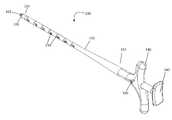
- FIG. 1A and FIG. 1Bshow perspective views of an internal bone fixation sizing device for preparing and sizing a medullary cavity of a fractured bone for a custom fit bone fixation pin according to the presently disclosed embodiments.
- FIG. 1Ashows an internal bone fixation sizing device with two sizing arms in a retracted or “bone sound” position.
- FIG. 1Bshows an internal bone fixation sizing device with two sizing arms in an extended position.
- FIG. 2A and FIG. 2Bshow side views of an internal bone fixation sizing device according to the presently disclosed embodiments.
- FIG. 2Ashows some of the main outer components of the device.
- FIG. 2Bis a cross-sectional view showing some of the main internal components of the device.
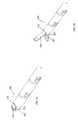
- FIG. 3A and FIG. 3Bshow close-up perspective views of a distal end of an internal bone fixation sizing device according to the presently disclosed embodiments.
- FIG. 3Ashows a head portion of the distal end of the device in a retracted or “bone sound” position.
- FIG. 3Bshows the head portion of the distal end of the device in an extended “bone measurement” position.
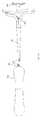
- FIG. 4A and FIG. 4Bshow side views of an internal bone fixation sizing device positioned within a medullary cavity of a fractured bone according to the presently disclosed embodiments.
- FIG. 4Ashows the device positioned within the medullary cavity of the fractured bone.
- FIG. 4Bis a cross-sectional view showing some of the main internal components of the device positioned within the medullary cavity of the fractured bone.
- FIG. 5shows a close-up perspective view of an internal bone fixation sizing device bone in a bone measurement position within the medullary cavity of the fractured bone according to the presently disclosed embodiments.
- the medical deviceacts as a sizing device and is used for preparing and sizing a medullary cavity of a fractured bone for a custom fit bone fixation pin.
- the sizing deviceenables a user to complete several tasks, which include clearing any residual medullary material from the medullary cavity of the fractured bone prior to insertion of a custom fit bone fixation pin, determining the depth of the medullary cavity prior to insertion of a custom fit bone fixation pin, and measuring the diameter of the medullary cavity prior to insertion of the custom fit bone fixation pin. Knowing the measurements of the medullary cavity prior to insertion of a bone fixation pin provides a customized pin for the fractured bone which results in an internal bone fixation pin.
- the main components of a sizing device 100 of the presently disclosed embodimentsare shown generally in FIG. 1A and FIG. 1B in conjunction with FIG. 2A and FIG. 2B .
- the sizing device 100includes an elongated shaft 101 with a proximal end 102 , a distal end 104 , and a longitudinal axis therebetween.
- the diameter of the elongated shaft 101 of the sizing device 100may range from about 2 mm to about 4 mm or larger.
- the elongated shaft 101has a diameter of about 3 mm.
- the distal end 104 of the device 100terminates in a head portion 103 .
- the head portion 103is welded onto the elongated shaft 101 with techniques known in the art.
- the head portion 103 and the elongated shaft 101may be fabricated as a continuous piece.
- An arm shaft 115 housed within the body of the elongated shaft 101terminates in two expandable sizing arms 105 at the distal end 104 of the device 100 . Openings 116 at an upper surface and a lower surface of the head portion 103 allow for the sizing arms 105 to retract (as seen in FIG. 1A ) and extend (as seen in FIG. 1B ).
- the sizing arms 105are in a retracted position within the head portion 103 . In the retracted position, the sizing arms 105 are located inside the head portion 103 , resting about 4 mm apart from one another.
- the sizing arms 105extend by sliding up and down respective inclined surfaces 125 within the body of the elongated shaft 101 .
- the elongated shaft 101 of the device 100is flexible, so that the device 100 may accommodate bends in the shape and geometry of a bone, allowing the distal end 104 of the device 100 to reach a desired location inside a bone.
- the outside surface of the elongated shaft 101is marked with radiopaque markers 130 , displaying depth indicators and numbers in millimeter dimensions. These radiopaque markers 130 allow a user to gauge the depth of a cleared-out medullary cavity of a fractured bone.
- the radiopaque markers 130using radiopaque materials such as barium sulfate, tantalum, or other materials known to increase radiopacity, allow the user to view the device 100 using fluoroscopy techniques.
- a typical readout for the length of the medullary cavitymay range from about 10 mm to about 70 mm or greater.
- the sizing arms 105are coated with a radiopaque material or contain radiopaque materials that are known to increase radiopacity, which will allow the user to view the sizing arms 105 using fluoroscopy techniques.
- a handle 140engages the proximal end 102 of the device 100 and allows for activation of an activation mechanism 145 .
- the activation mechanism 145is a thumb press.
- the thumb press 145activates a spring 148 located at a proximal end of the arm shaft 115 , within the handle 140 housing, which pushes the arm shaft 115 forward.
- a spring pin 170keeps the arm shaft 115 , the spring 148 , and the thumb press 145 housed within the handle 140 and controls the distance traveled by the spring 148 .
- a window 160 machined into the handle 140provides millimeter dimension readouts that reflect the inner diameter dimensions of the medullary cavity of the fractured bone.
- a typical readout for the diameter of the medullary cavitymay range from about 4 mm to about 9 mm or greater. As seen in FIG. 2A , the readout in the window 160 is 6 mm.
- other suitable activation mechanisms 145can be used that are known in the art including, but not limited to, a trigger device, a threaded knob which translates rotational motion to linear motion, and mating gears.
- FIG. 3A and FIG. 3Bshow close-up perspective views of the distal end 104 of the internal bone fixation sizing device.
- the head portion 103is rounded, allowing for smooth entry into a fractured bone void, i.e., a medullary cavity of a fractured bone.
- the head portion 103has a gradual increase in diameter.
- the openings 116 at the head portion 103allow for the sizing arms 105 to extend and retract.
- the sizing arms 105are in a retracted position, also referred to as a “bone sound” position. In this retracted position, the sizing arms 105 rest about 4 mm apart along the inclined surfaces 125 .
- the rounded head portion 105is able to clear away any residual medullary material that remains within the medullary cavity of the fractured bone.
- the thumb press 145is pushed, the arm shaft 115 moves forward within the interior of the elongated shaft 101 , thus moving the sizing arms 105 up along the inclined surfaces 125 .
- the sizing arms 105extend through the openings 116 of the head portion 103 extending beyond the outer shaft 101 , as shown in FIG. 3B .
- the corresponding diameter dimensionsare displayed within the window 160 of the handle 140 . In an embodiment, the diameter dimensions are displayed in units of millimeters.
- the thumb press 145is released, causing the sizing arms 105 to retract into the head portion 103 and return to the retracted position.
- the sizing device 100may be removed from the void or re-positioned within the void in order to obtain another diameter dimension readout.
- the sizing device 100may be re-positioned within the void so that the sizing arms 105 are about perpendicular to a longitudinal axis of the void.
- the thumb press 145is pushed, the arm shaft 115 moves forward within the interior of the elongated shaft 101 , and the sizing arms 105 are moved up along the inclined surfaces 125 .
- the sizing arms 105extend through the openings 116 of the head portion 103 and extend beyond the outer shaft 101 .
- the sizing arms 105contact the interior surfaces of the fractured bone void, and a corresponding diameter dimension is displayed within the window 160 of the handle 140 . In this way, the sizing device 100 will be able to provide an overall picture of the internal geometry of the void.
- Minimally invasiverefers to surgical means, such as microsurgical, endoscopic or arthroscopic surgical means, that can be accomplished with minimal disruption of the pertinent musculature, for instance, without the need for open access to the tissue injury site or through minimal incisions.
- Minimally invasive proceduresare often accomplished by the use of visualization such as fiber optic or microscopic visualization, and provide a post-operative recovery time that is substantially less than the recovery time that accompanies the corresponding open surgical approach.
- Benefits of minimally invasive proceduresinclude causing less trauma because there is minimal blood loss, a reduction in surgery and anesthetized time, shortened hospitalization, and an easier and more rapid recovery.
- FIG. 4A and FIG. 4Bshow side views of the internal bone fixation sizing device 100 in place within a fractured bone 190 .
- a method of placing the device 100 within a medullary cavity of the fractured bone 190includes making a minimally invasive incision (not shown) through a patient's skin to expose the fractured bone 190 .
- the incisionmay be made at the proximal end or the distal end of the fractured bone 190 to expose the bone surface. Once the bone 190 is exposed, it may be necessary to retract some muscles and tissues that may be in view of the fractured bone 190 .
- An access hole 185is formed in the fractured bone 190 by drilling or other methods known in the art.
- the diameter of the access hole 185is determined based on the size of the fractured bone 190 and the diameter of a bone fixation pin.
- the access hole 185extends through a hard compact outer cortical layer of the fractured bone 190 into the relatively porous inner or cancellous bone.
- medullary materialincluding air, blood, fluids, fat, marrow, tissue and bone debris, should be cleared from the medullary cavity to form a void 187 .
- the void 187is defined as a hollowed out space, wherein a first position defines the most distal edge of the void 187 with relation to the access hole 185 on the fractured bone 190 , and a second position defines the most proximal edge of the void 187 with relation to the access hole 185 on the fractured bone 190 .
- the fractured bone 190may be hollowed out sufficiently to have the medullary material of the medullary cavity up to the cortical bone removed. There are many methods for removing the medullary material that are known in the art and within the spirit and scope on the presently disclosed embodiments including, but not limited to, methods described in U.S. Pat. No.
- the internal bone fixation sizing device 100is introduced into the void 187 of the fractured bone 190 via the access hole 185 .
- the sizing device 100is inserted into the void 187 without activating the thumb press 145 , so that the sizing arms 105 remain in the bone sound or retracted position.
- the sizing device 100is inserted into the void 187 and may be moved back and forth within the void 187 , allowing the surfaces of the head portion 103 and the sizing arms 105 to break off and push away any excess medullary material that may otherwise block the path of an internal bone fixation pin.
- the thumb press 145is activated, causing the sizing arms 105 to extend through the openings 116 of the head portion 103 .
- the sizing arms 105in this extended position may be moved back and forth within the void 187 , allowing the surfaces of the head portion 103 and the extended sizing arms 105 to break off and push away any excess medullary material that may otherwise block the path of the internal bone fixation pin. Once the void 187 has been cleared-out of excess medullary material, measurements of the interior of the void 187 may be gauged.
- Fluoroscopic imagesmay be taken incrementally, allowing a user to gradually gauge the depth of the void 187 using the radiopaque markers 130 , until the head portion 103 of the sizing device 100 has reached a desired location within the void 187 .
- the thumb press 145 of the sizing device 100may or may not be activated throughout this procedure.
- the radiopaque markers 130 on the outside of the device 100provide a measurement of the approximate depth of the void 187 , providing detailed information on the approximate length requirements for the bone fixation pin needed to support the fractured bone.
- FIG. 5shows a close-up perspective view of the distal end 104 of the device 100 within the void 187 of the fractured bone 190 . As shown in FIG.
- the sizing arms 105have been extended through the openings 116 and contact the interior surface 189 of the void 187 .
- the sizing device 100may be re-positioned within the void 187 in order to obtain another diameter dimension readout.
- the sizing device 100is re-positioned within the void so that the sizing arms 105 are about perpendicular to a longitudinal axis of the void.
- the sizing device 100is re-positioned along the depth of the void. After re-positioning, the thumb press 145 is pushed, the arm shaft 115 moves forward within the interior of the elongated shaft 101 , and the sizing arms 105 are moved up along the inclined surfaces 125 .
- the sizing arms 105extend through the openings 116 of the head portion 103 and extend beyond the outer shaft 101 .
- the sizing arms 105contact the interior surfaces of the fractured bone void, and a corresponding diameter dimension is displayed within the window 160 of the handle 140 . In this way, the sizing device 100 will be able to provide an overall picture of the internal geometry of the void 187 .
- the internal bone fixation sizing device and methods disclosed hereincan be used prior to the insertion of an internal bone fixation device.
- Internal bone fixation devicesare known in the art. Examples of internal bone fixation devices that may be used in conjunction with the sizing device disclosed herein include, but are not limited to, those devices described in U.S. patent application Ser. No. 11/789,907 entitled “Apparatus and Method for Delivery of Reinforcing Materials to Bone” and U.S. patent application Ser. No. 11/903,123 entitled “Systems and Methods for Internal Bone Fixation.”
- a method for determining a depth and a diameter of a cleared-out medullary cavity of a boneincludes gaining access to the medullary cavity of the bone; removing medullary material from the medullary cavity to form a void in the bone; providing a medical device, the medical device including: an outer shaft having a proximal end engaging an activation mechanism, a distal end having a first opening at an upper surface and a second opening at a lower surface, and a longitudinal axis between the proximal end and the distal end, wherein the longitudinal axis of the outer shaft includes a plurality of radiopaque markers; and an inner shaft having a proximal end engaging the activation mechanism, a distal end terminating in two sizing arms, and a longitudinal axis therebetween, wherein the two sizing arms are able to move from a retracted position to an extended position extending beyond the outer shaft; inserting the medical device into the void; determining
- a method for clearing excess medullary material from a void in a bonethat includes gaining access to the medullary cavity of the bone through an access hole; removing initial medullary material from the medullary cavity to form the void in the bone; providing a medical device, the medical device including: an outer shaft having a proximal end engaging an activation mechanism, a rounded distal end having a first opening at an upper surface and a second opening at a lower surface, and a longitudinal axis between the proximal end and the distal end; and an inner shaft having a proximal end engaging the activation mechanism, a distal end terminating in two sizing arms, and a longitudinal axis therebetween, wherein the two sizing arms move from a retracted position to an extended position extending beyond the outer shaft through the first opening at the upper surface and the second opening at the lower surface of the distal end; inserting the medical device into the void in the bone, wherein the two sizing arms of the medical device are
Landscapes
- Health & Medical Sciences (AREA)
- Life Sciences & Earth Sciences (AREA)
- Surgery (AREA)
- Public Health (AREA)
- General Health & Medical Sciences (AREA)
- Animal Behavior & Ethology (AREA)
- Veterinary Medicine (AREA)
- Engineering & Computer Science (AREA)
- Biomedical Technology (AREA)
- Heart & Thoracic Surgery (AREA)
- Medical Informatics (AREA)
- Molecular Biology (AREA)
- Orthopedic Medicine & Surgery (AREA)
- Pathology (AREA)
- Biophysics (AREA)
- Physics & Mathematics (AREA)
- Nuclear Medicine, Radiotherapy & Molecular Imaging (AREA)
- Oral & Maxillofacial Surgery (AREA)
- Vascular Medicine (AREA)
- Immunology (AREA)
- Neurology (AREA)
- Hematology (AREA)
- Dentistry (AREA)
- Rheumatology (AREA)
- Surgical Instruments (AREA)
Abstract
Description
This application is related to and claims the benefit of priority from U.S. Provisional Patent Application No. 61/017,367, filed on Dec. 28, 2007, the entirety of which is incorporated herein by reference.
The embodiments disclosed herein relate to a medical device for use during an internal bone fixation procedure, and more particularly to an internal bone fixation sizing device and methods of using the sizing device for preparing and sizing a medullary cavity of a fractured bone for a bone fixation pin.
Bone is a living tissue and plays a structural role in the body. A bone fracture is a medical condition in which a bone has cracked or broken. While many fractures are the result of high force impact or stress, bone fracture can also occur as a result of certain medical conditions that weaken the bones, such as osteoporosis, certain types of cancer or osteogenesis imperfecta. The average person sustains two to three fractured bones during the course of a lifetime. Fracture repair is the process of rejoining and realigning the ends of broken bones. Currently there are several internal approaches to repair, strengthen and support a fractured bone.
Conventional internal fixation devices include wires, plates, rods, pins, nails, and screws to support the fractured bone directly, as well as the addition of bone cement mixtures, or bone void fillers to the fractured bone. For example, one common device includes a thick rod, or a plurality of thinner rods, which are implanted into the medullary cavity of the broken bone to stabilize the placement of the bone fragments once they are set in place. In order for these rods to function properly upon implantation, however, they must fit tightly within the medullary cavity. This fit is usually achieved by boring or reaming the cavity to obtain a constant diameter, widened cavity in which the rod is inserted.
Newer internal fixation devices include expandable members in which an outer surface of the device contacts the interior surface of the medullary cavity which leads to greater support and strength to the healing bone. Drawbacks to the present techniques for using these expandable members include the guess work involved in fitting the expandable member within the medullary cavity available. For example, since a medical professional cannot see into the cavity space, there is a lack of knowledge as to the size of the available space in the cavity and the exact pressure needed to expand the member. If too much pressure is exerted on the expandable member, necrosis of bone along the entire length of the fractured bone is possible. Also, since most of the expandable members presently available are pre-sized, an expandable member that does not conform to the cavity space available may be used, resulting in an improper fixation of the fractured bone and poor healing.
Therefore, there is a need in the art for a device that can be used prior to inserting an expandable member within the medullary cavity space that can predict the size of the cavity. This pre-procedure sizing will enable custom fit bone fixation pins and lead to advantageous healing conditions.
A sizing device and method of using the sizing device for preparing and sizing a medullary cavity of a fractured bone for a custom fit bone fixation pin are disclosed herein. According to aspects illustrated herein, there is provided a medical device for determining a length and a diameter of a medullary cavity of a bone that includes an outer shaft having a proximal end engaging an activation mechanism, a distal end having a first opening at an upper surface and a second opening at a lower surface, and a longitudinal axis between the proximal end and the distal end, wherein the longitudinal axis of the outer shaft includes a plurality of markers; and an inner shaft having a proximal end engaging the activation mechanism, a distal end terminating in two sizing arms, and a longitudinal axis therebetween, wherein the two sizing arms are able to move from a retracted position to an extended position extending beyond the outer shaft.
According to aspects illustrated herein, there is provided a method for determining a depth and a diameter of a cleared-out medullary cavity of a bone that includes gaining access to the medullary cavity of the bone; removing medullary material from the medullary cavity to form a void in the bone; providing a medical device, the medical device including: an outer shaft having a proximal end engaging an activation mechanism, a distal end having a first opening at an upper surface and a second opening at a lower surface, and a longitudinal axis between the proximal end and the distal end, wherein the longitudinal axis of the outer shaft includes a plurality of markers; and an inner shaft having a proximal end engaging the activation mechanism, a distal end terminating in two sizing arms, and a longitudinal axis therebetween, wherein the two sizing arms are able to move from a retracted position to an extended position extending beyond the outer shaft; inserting the medical device into the void; determining the depth of the void by viewing the radiopaque markers on the outer shaft of the device; activating the activation mechanism to move the two sizing arms from the retracted position into the extended position; and determining a first diameter dimension of the void by reading a readout from a window in the activation mechanism.
According to aspects illustrated herein, there is provided a method for clearing excess medullary material from a void in a bone that includes gaining access to the medullary cavity of the bone through an access hole; removing initial medullary material from the medullary cavity to form the void in the bone; providing a medical device, the medical device including: an outer shaft having a proximal end engaging an activation mechanism, a rounded distal end having a first opening at an upper surface and a second opening at a lower surface, and a longitudinal axis between the proximal end and the distal end; and an inner shaft having a proximal end engaging the activation mechanism, a distal end terminating in two sizing arms, and a longitudinal axis therebetween, wherein the two sizing arms move from a retracted position to an extended position extending beyond the outer shaft through the first opening at the upper surface and the second opening at the lower surface of the distal end; inserting the medical device into the void in the bone, wherein the two sizing arms of the medical device are in the retracted position; and moving the medical device within the void to clear excess medullary material within the void.
The presently disclosed embodiments will be further explained with reference to the attached drawings, wherein like structures are referred to by like numerals throughout the several views. The drawings shown are not necessarily to scale, with emphasis instead generally being placed upon illustrating the principles of the presently disclosed embodiments.
While the above-identified drawings set forth presently disclosed embodiments, other embodiments are also contemplated, as noted in the discussion. This disclosure presents illustrative embodiments by way of representation and not limitation. Numerous other modifications and embodiments can be devised by those skilled in the art which fall within the scope and spirit of the principles of the presently disclosed embodiments.
A medical device and methods for using this device during an internal bone fixation procedure are disclosed herein. The medical device acts as a sizing device and is used for preparing and sizing a medullary cavity of a fractured bone for a custom fit bone fixation pin. The sizing device enables a user to complete several tasks, which include clearing any residual medullary material from the medullary cavity of the fractured bone prior to insertion of a custom fit bone fixation pin, determining the depth of the medullary cavity prior to insertion of a custom fit bone fixation pin, and measuring the diameter of the medullary cavity prior to insertion of the custom fit bone fixation pin. Knowing the measurements of the medullary cavity prior to insertion of a bone fixation pin provides a customized pin for the fractured bone which results in an internal bone fixation pin.
The main components of asizing device 100 of the presently disclosed embodiments are shown generally inFIG. 1A andFIG. 1B in conjunction withFIG. 2A andFIG. 2B . Thesizing device 100 includes anelongated shaft 101 with aproximal end 102, adistal end 104, and a longitudinal axis therebetween. The diameter of theelongated shaft 101 of thesizing device 100 may range from about 2 mm to about 4 mm or larger. In an embodiment, theelongated shaft 101 has a diameter of about 3 mm. Thedistal end 104 of thedevice 100 terminates in ahead portion 103. In an embodiment, thehead portion 103 is welded onto theelongated shaft 101 with techniques known in the art. Alternately, thehead portion 103 and theelongated shaft 101 may be fabricated as a continuous piece. Anarm shaft 115 housed within the body of theelongated shaft 101 terminates in twoexpandable sizing arms 105 at thedistal end 104 of thedevice 100.Openings 116 at an upper surface and a lower surface of thehead portion 103 allow for the sizingarms 105 to retract (as seen inFIG. 1A ) and extend (as seen inFIG. 1B ). As shown inFIG. 1A , the sizingarms 105 are in a retracted position within thehead portion 103. In the retracted position, the sizingarms 105 are located inside thehead portion 103, resting about 4 mm apart from one another. As can be seen inFIG. 2B , the sizingarms 105 extend by sliding up and down respectiveinclined surfaces 125 within the body of theelongated shaft 101.
Theelongated shaft 101 of thedevice 100 is flexible, so that thedevice 100 may accommodate bends in the shape and geometry of a bone, allowing thedistal end 104 of thedevice 100 to reach a desired location inside a bone. The outside surface of theelongated shaft 101 is marked withradiopaque markers 130, displaying depth indicators and numbers in millimeter dimensions. Theseradiopaque markers 130 allow a user to gauge the depth of a cleared-out medullary cavity of a fractured bone. Theradiopaque markers 130, using radiopaque materials such as barium sulfate, tantalum, or other materials known to increase radiopacity, allow the user to view thedevice 100 using fluoroscopy techniques. A typical readout for the length of the medullary cavity may range from about 10 mm to about 70 mm or greater. In an embodiment, the sizingarms 105 are coated with a radiopaque material or contain radiopaque materials that are known to increase radiopacity, which will allow the user to view the sizingarms 105 using fluoroscopy techniques.
Ahandle 140 engages theproximal end 102 of thedevice 100 and allows for activation of anactivation mechanism 145. In an embodiment, theactivation mechanism 145 is a thumb press. Thethumb press 145 activates aspring 148 located at a proximal end of thearm shaft 115, within thehandle 140 housing, which pushes thearm shaft 115 forward. Aspring pin 170 keeps thearm shaft 115, thespring 148, and thethumb press 145 housed within thehandle 140 and controls the distance traveled by thespring 148. Awindow 160 machined into thehandle 140 provides millimeter dimension readouts that reflect the inner diameter dimensions of the medullary cavity of the fractured bone. A typical readout for the diameter of the medullary cavity may range from about 4 mm to about 9 mm or greater. As seen inFIG. 2A , the readout in thewindow 160 is 6 mm. Alternately, othersuitable activation mechanisms 145 can be used that are known in the art including, but not limited to, a trigger device, a threaded knob which translates rotational motion to linear motion, and mating gears.
The presently disclosed embodiments use minimally invasive approaches to gain access to a fractured bone. Minimally invasive refers to surgical means, such as microsurgical, endoscopic or arthroscopic surgical means, that can be accomplished with minimal disruption of the pertinent musculature, for instance, without the need for open access to the tissue injury site or through minimal incisions. Minimally invasive procedures are often accomplished by the use of visualization such as fiber optic or microscopic visualization, and provide a post-operative recovery time that is substantially less than the recovery time that accompanies the corresponding open surgical approach. Benefits of minimally invasive procedures include causing less trauma because there is minimal blood loss, a reduction in surgery and anesthetized time, shortened hospitalization, and an easier and more rapid recovery.
The internal bonefixation sizing device 100 is introduced into thevoid 187 of the fracturedbone 190 via theaccess hole 185. Initially, thesizing device 100 is inserted into thevoid 187 without activating thethumb press 145, so that the sizingarms 105 remain in the bone sound or retracted position. Thesizing device 100 is inserted into thevoid 187 and may be moved back and forth within thevoid 187, allowing the surfaces of thehead portion 103 and the sizingarms 105 to break off and push away any excess medullary material that may otherwise block the path of an internal bone fixation pin. In an embodiment, thethumb press 145 is activated, causing the sizingarms 105 to extend through theopenings 116 of thehead portion 103. The sizingarms 105, in this extended position may be moved back and forth within thevoid 187, allowing the surfaces of thehead portion 103 and the extended sizingarms 105 to break off and push away any excess medullary material that may otherwise block the path of the internal bone fixation pin. Once thevoid 187 has been cleared-out of excess medullary material, measurements of the interior of the void187 may be gauged. Fluoroscopic images may be taken incrementally, allowing a user to gradually gauge the depth of the void187 using theradiopaque markers 130, until thehead portion 103 of thesizing device 100 has reached a desired location within thevoid 187. Thethumb press 145 of thesizing device 100 may or may not be activated throughout this procedure. Theradiopaque markers 130 on the outside of thedevice 100 provide a measurement of the approximate depth of the void187, providing detailed information on the approximate length requirements for the bone fixation pin needed to support the fractured bone.
By activating thethumb press 145, thespring 148 pushes thearm shaft 115 forward causing the sizingarms 105 to extend from theopenings 116 of thehead portion 103. The sizingarms 105 extend and expand to contact aninterior surface 189 of thebone void 187. A corresponding diameter measurement readout will be provided through thewindow 160 on thehandle 140. Once the readout has been determined, or a desired diameter measurement has been achieved, thethumb press 145 is released, causing the sizingarms 105 to retract within thedevice 100.FIG. 5 shows a close-up perspective view of thedistal end 104 of thedevice 100 within thevoid 187 of the fracturedbone 190. As shown inFIG. 5 , the sizingarms 105 have been extended through theopenings 116 and contact theinterior surface 189 of thevoid 187. Thesizing device 100 may be re-positioned within the void187 in order to obtain another diameter dimension readout. In an embodiment, thesizing device 100 is re-positioned within the void so that the sizingarms 105 are about perpendicular to a longitudinal axis of the void. In an embodiment, thesizing device 100 is re-positioned along the depth of the void. After re-positioning, thethumb press 145 is pushed, thearm shaft 115 moves forward within the interior of theelongated shaft 101, and the sizingarms 105 are moved up along the inclined surfaces125. The sizingarms 105 extend through theopenings 116 of thehead portion 103 and extend beyond theouter shaft 101. The sizingarms 105 contact the interior surfaces of the fractured bone void, and a corresponding diameter dimension is displayed within thewindow 160 of thehandle 140. In this way, thesizing device 100 will be able to provide an overall picture of the internal geometry of thevoid 187.
The internal bone fixation sizing device and methods disclosed herein can be used prior to the insertion of an internal bone fixation device. Internal bone fixation devices are known in the art. Examples of internal bone fixation devices that may be used in conjunction with the sizing device disclosed herein include, but are not limited to, those devices described in U.S. patent application Ser. No. 11/789,907 entitled “Apparatus and Method for Delivery of Reinforcing Materials to Bone” and U.S. patent application Ser. No. 11/903,123 entitled “Systems and Methods for Internal Bone Fixation.”
A method for determining a depth and a diameter of a cleared-out medullary cavity of a bone according to the presently disclosed embodiments includes gaining access to the medullary cavity of the bone; removing medullary material from the medullary cavity to form a void in the bone; providing a medical device, the medical device including: an outer shaft having a proximal end engaging an activation mechanism, a distal end having a first opening at an upper surface and a second opening at a lower surface, and a longitudinal axis between the proximal end and the distal end, wherein the longitudinal axis of the outer shaft includes a plurality of radiopaque markers; and an inner shaft having a proximal end engaging the activation mechanism, a distal end terminating in two sizing arms, and a longitudinal axis therebetween, wherein the two sizing arms are able to move from a retracted position to an extended position extending beyond the outer shaft; inserting the medical device into the void; determining the depth of the void by viewing the radiopaque markers on the outer shaft of the device; activating the activation mechanism to move the two sizing arms from the retracted position into the extended position; and determining a first diameter dimension of the void by reading a readout from a window in the activation mechanism.
A method for clearing excess medullary material from a void in a bone that includes gaining access to the medullary cavity of the bone through an access hole; removing initial medullary material from the medullary cavity to form the void in the bone; providing a medical device, the medical device including: an outer shaft having a proximal end engaging an activation mechanism, a rounded distal end having a first opening at an upper surface and a second opening at a lower surface, and a longitudinal axis between the proximal end and the distal end; and an inner shaft having a proximal end engaging the activation mechanism, a distal end terminating in two sizing arms, and a longitudinal axis therebetween, wherein the two sizing arms move from a retracted position to an extended position extending beyond the outer shaft through the first opening at the upper surface and the second opening at the lower surface of the distal end; inserting the medical device into the void in the bone, wherein the two sizing arms of the medical device are in the retracted position; and moving the medical device within the void to clear excess medullary material within the void.
All patents, patent applications, and published references cited herein are hereby incorporated by reference in their entirety. It will be appreciated that several of the above-disclosed and other features and functions, or alternatives thereof, may be desirably combined into many other different systems or applications. Various presently unforeseen or unanticipated alternatives, modifications, variations, or improvements therein may be subsequently made by those skilled in the art which are also intended to be encompassed by the following claims.
Claims (20)
1. A medical device for determining a depth and a diameter of a medullary cavity of a bone comprising:
an outer shaft having:
a proximal end engaging an activation mechanism,
a distal end having a first opening at an upper surface and a second opening at a lower surface, and a longitudinal axis between the proximal end and the distal end, wherein the longitudinal axis of the outer shaft includes a plurality of markers for determining the depth of the medullary cavity of the bone;
an inner shaft having a proximal end engaging the activation mechanism, a distal end terminating in two sizing arms, and a longitudinal axis therebetween,
wherein the two sizing arms are moveable through the first opening and the second opening of the distal end of the outer shaft from a retracted position in which the two sizing arms are located inside the outer shaft to an extended position in which the two sizing arms extend beyond the distal end of the outer shaft; and
a diameter dimension readout reflecting a spaced apart distance between the two sizing arms when the two sizing arms are in the extended position for determining the diameter of the medullary cavity of the bone.
2. The medical device ofclaim 1 wherein the plurality of markers are circumferential rings spaced apart uniformly along the outer shaft.
3. The medical device ofclaim 1 wherein the plurality of markers are numeric indicia spaced apart starting from the distal end of the outer shaft.
4. The medical device ofclaim 1 wherein the plurality of markers are radiopaque.
5. The medical device ofclaim 1 wherein the activation mechanism includes a handle and a thumb press.
6. The medical device ofclaim 5 wherein activation of the thumb press causes a spring at the proximal end of the inner shaft to push the inner shaft in a forward movement.
7. The medical device ofclaim 6 wherein the inner shaft moving forward causes the two sizing arms to move from the retracted position to the extended position so that the two sizing arms protrude from the first opening and the second opening of the distal end.
8. The medical device ofclaim 1 further comprising a window in a handle for viewing the diameter dimension readout.
9. The medical device ofclaim 1 wherein the distal end is rounded to allow smooth entry into the medullary cavity of the bone.
10. The medical device ofclaim 1 wherein the outer shaft is flexible to accommodate bends in the bone.
11. The medical device ofclaim 1 wherein the two sizing arms contain radiopaque material.
12. A method for determining a depth and a diameter of a cleared-out medullary cavity of a bone comprising:
gaining access to the medullary cavity of the bone;
removing medullary material from the medullary cavity to form a void in the bone;
providing a medical device, the medical device including:
an outer shaft having a proximal end engaging an activation mechanism, a distal end having a first opening at an upper surface and a second opening at a lower surface, and a longitudinal axis between the proximal end and the distal end, wherein the longitudinal axis of the outer shaft includes a plurality of markers; and
an inner shaft having a proximal end engaging the activation mechanism, a distal end terminating in two sizing arms, and a longitudinal axis therebetween, wherein the two sizing arms are able to move from a retracted position to an extended position extending beyond the outer shaft;
inserting the medical device into the void in the bone;
determining the depth of the void by viewing the markers on the outer shaft of the device;
activating the activation mechanism to move the two sizing arms from the retracted position into the extended position; and
determining a first diameter dimension of the void by reading a readout from a window in the activation mechanism.
13. The method ofclaim 12 wherein the plurality of markers are numeric indicia spaced apart starting from the distal end of the outer shaft.
14. The method ofclaim 12 wherein the plurality of markers are radiopaque.
15. The method ofclaim 12 wherein the distal end is rounded to allow smooth entry into the medullary cavity of the bone.
16. The method ofclaim 12 wherein the outer shaft is flexible to accommodate bends in the bone.
17. The method ofclaim 12 wherein the two sizing arms contain radiopaque material.
18. The method ofclaim 12 further comprising:
de-activating the activation mechanism to move the two sizing arms from the extended position into the retracted position;
repositioning the medical device within the void;
activating the activation mechanism to move the two sizing arms from the retracted position into the extended position; and
determining a second diameter dimension of the void by reading readout from the window in the activation mechanism,
wherein the first diameter reading and the second diameter reading provide a circumferential analysis of the diameter of the void.
19. A method for clearing excess medullary material from a void in a bone comprising:
gaining access to the medullary cavity of the bone through an access hole;
removing initial medullary material from the medullary cavity to form the void in the bone;
providing a medical device, the medical device including:
an outer shaft having a proximal end engaging an activation mechanism, a rounded distal end having a first opening at an upper surface and a second opening at a lower surface, and a longitudinal axis between the proximal end and the distal end; and
an inner shaft having a proximal end engaging the activation mechanism, a distal end terminating in two sizing arms, and a longitudinal axis therebetween,
wherein the two sizing arms move from a retracted position where the two sizing arms are located inside the outer shaft to an extended position where the two sizing arms extend beyond the distal end of the outer shaft through the first opening at the upper surface and the second opening at the lower surface of the distal end;
inserting the medical device into the void in the bone, wherein the two sizing arms of the medical device are in the retracted position; and
moving the medical device within the void to clear excess medullary material within the void.
20. The method ofclaim 19 further comprising activating the activation mechanism to move the two sizing arms from the retracted position into the extended position extending beyond the outer shaft through the first opening at the upper surface and the second opening at the lower surface of the distal end.
Priority Applications (1)
| Application Number | Priority Date | Filing Date | Title |
|---|---|---|---|
| US12/339,244US8012157B2 (en) | 2007-12-28 | 2008-12-19 | Internal bone fixation sizing device and methods |
Applications Claiming Priority (2)
| Application Number | Priority Date | Filing Date | Title |
|---|---|---|---|
| US1736707P | 2007-12-28 | 2007-12-28 | |
| US12/339,244US8012157B2 (en) | 2007-12-28 | 2008-12-19 | Internal bone fixation sizing device and methods |
Publications (2)
| Publication Number | Publication Date |
|---|---|
| US20090171358A1 US20090171358A1 (en) | 2009-07-02 |
| US8012157B2true US8012157B2 (en) | 2011-09-06 |
Family
ID=40799418
Family Applications (1)
| Application Number | Title | Priority Date | Filing Date |
|---|---|---|---|
| US12/339,244Active2030-01-11US8012157B2 (en) | 2007-12-28 | 2008-12-19 | Internal bone fixation sizing device and methods |
Country Status (1)
| Country | Link |
|---|---|
| US (1) | US8012157B2 (en) |
Cited By (13)
| Publication number | Priority date | Publication date | Assignee | Title |
|---|---|---|---|---|
| US20120290094A1 (en)* | 2002-06-25 | 2012-11-15 | Warsaw Orthopedic, Inc. | Minimally invasive expanding spacer and method |
| US20130072941A1 (en)* | 2011-09-16 | 2013-03-21 | Francisca Tan-Malecki | Cement Injector and Cement Injector Connectors, and Bone Cement Injector Assembly |
| US8546456B2 (en) | 2008-07-25 | 2013-10-01 | Smith & Nephew, Inc. | Fracture fixation systems |
| KR101706893B1 (en)* | 2016-07-07 | 2017-02-14 | 인제대학교 산학협력단 | Depth gauge for medical care |
| US9572589B2 (en) | 2012-07-10 | 2017-02-21 | Stryker European Holdings I, Llc | Drill guide |
| US10111689B2 (en) | 2010-12-22 | 2018-10-30 | Illuminoss Medical, Inc. | Systems and methods for treating conditions and diseases of the spine |
| US10226642B2 (en) | 2015-11-06 | 2019-03-12 | Illuminoss Medical, Inc. | Systems and methods for anti-microbial effect for bones |
| US10456184B2 (en) | 2006-04-26 | 2019-10-29 | Illuminoss Medical, Inc. | Apparatus for delivery of reinforcing materials to bone |
| US10543025B2 (en) | 2006-11-10 | 2020-01-28 | Illuminoss Medical, Inc. | Systems and methods for internal bone fixation |
| US10575882B2 (en) | 2012-12-20 | 2020-03-03 | Illuminoss Medical, Inc. | Distal tip for bone fixation devices |
| US11071572B2 (en) | 2018-06-27 | 2021-07-27 | Illuminoss Medical, Inc. | Systems and methods for bone stabilization and fixation |
| US11141207B2 (en) | 2011-07-19 | 2021-10-12 | Illuminoss Medical, Inc. | Photodynamic articular joint implants and methods of use |
| US11813368B2 (en) | 2021-08-27 | 2023-11-14 | Abl Medical Inc. | Anti-microbial blue light systems and methods |
Families Citing this family (31)
| Publication number | Priority date | Publication date | Assignee | Title |
|---|---|---|---|---|
| US7811290B2 (en) | 2006-04-26 | 2010-10-12 | Illuminoss Medical, Inc. | Apparatus and methods for reinforcing bone |
| US7879041B2 (en) | 2006-11-10 | 2011-02-01 | Illuminoss Medical, Inc. | Systems and methods for internal bone fixation |
| US9427289B2 (en) | 2007-10-31 | 2016-08-30 | Illuminoss Medical, Inc. | Light source |
| US8403968B2 (en) | 2007-12-26 | 2013-03-26 | Illuminoss Medical, Inc. | Apparatus and methods for repairing craniomaxillofacial bones using customized bone plates |
| US9168173B2 (en) | 2008-04-04 | 2015-10-27 | Truevision Systems, Inc. | Apparatus and methods for performing enhanced visually directed procedures under low ambient light conditions |
| US10117721B2 (en)* | 2008-10-10 | 2018-11-06 | Truevision Systems, Inc. | Real-time surgical reference guides and methods for surgical applications |
| US9226798B2 (en)* | 2008-10-10 | 2016-01-05 | Truevision Systems, Inc. | Real-time surgical reference indicium apparatus and methods for surgical applications |
| ES2920877T3 (en) | 2009-01-28 | 2022-08-11 | Alcon Inc | Ocular implant placement system |
| US9173717B2 (en) | 2009-02-20 | 2015-11-03 | Truevision Systems, Inc. | Real-time surgical reference indicium apparatus and methods for intraocular lens implantation |
| EP2410912B1 (en)* | 2009-03-27 | 2020-02-12 | Mardil, Inc. | Intra-operative heart size measuring tool |
| US8210729B2 (en) | 2009-04-06 | 2012-07-03 | Illuminoss Medical, Inc. | Attachment system for light-conducting fibers |
| US8512338B2 (en) | 2009-04-07 | 2013-08-20 | Illuminoss Medical, Inc. | Photodynamic bone stabilization systems and methods for reinforcing bone |
| EP2467098A4 (en) | 2009-08-19 | 2015-07-08 | Illuminoss Medical Inc | Devices and methods for bone alignment, stabilization and distraction |
| US8784443B2 (en) | 2009-10-20 | 2014-07-22 | Truevision Systems, Inc. | Real-time surgical reference indicium apparatus and methods for astigmatism correction |
| US20110213342A1 (en)* | 2010-02-26 | 2011-09-01 | Ashok Burton Tripathi | Real-time Virtual Indicium Apparatus and Methods for Guiding an Implant into an Eye |
| US8684965B2 (en) | 2010-06-21 | 2014-04-01 | Illuminoss Medical, Inc. | Photodynamic bone stabilization and drug delivery systems |
| US8936644B2 (en) | 2011-07-19 | 2015-01-20 | Illuminoss Medical, Inc. | Systems and methods for joint stabilization |
| US10085633B2 (en)* | 2012-04-19 | 2018-10-02 | Novartis Ag | Direct visualization system for glaucoma treatment |
| US9241832B2 (en) | 2012-04-24 | 2016-01-26 | Transcend Medical, Inc. | Delivery system for ocular implant |
| US8939977B2 (en) | 2012-07-10 | 2015-01-27 | Illuminoss Medical, Inc. | Systems and methods for separating bone fixation devices from introducer |
| WO2014036499A1 (en) | 2012-08-30 | 2014-03-06 | Truevision Systems, Inc. | Imaging system and methods displaying a fused multidimensional reconstructed image |
| EP2895123B1 (en) | 2012-09-17 | 2017-06-07 | Novartis Ag | Expanding ocular implant devices |
| US9763829B2 (en) | 2012-11-14 | 2017-09-19 | Novartis Ag | Flow promoting ocular implant |
| US10543026B2 (en)* | 2014-04-21 | 2020-01-28 | The General Hospital Corporation | Fracture fixation device having clip for stabilizing intramedullary nail |
| US11602407B2 (en)* | 2016-09-08 | 2023-03-14 | Ascension Texas | Depth gauges and related methods |
| US10299880B2 (en) | 2017-04-24 | 2019-05-28 | Truevision Systems, Inc. | Stereoscopic visualization camera and platform |
| US11083537B2 (en) | 2017-04-24 | 2021-08-10 | Alcon Inc. | Stereoscopic camera with fluorescence visualization |
| US10917543B2 (en) | 2017-04-24 | 2021-02-09 | Alcon Inc. | Stereoscopic visualization camera and integrated robotics platform |
| CN109965990A (en)* | 2019-05-09 | 2019-07-05 | 苏州点合医疗科技有限公司 | A kind of bone cavity center positioning rod |
| CN112807135A (en)* | 2021-02-09 | 2021-05-18 | 汕头大学 | Device, system and method for measuring inner diameter and polishing depth of marrow cavity |
| CN119184877B (en)* | 2024-12-02 | 2025-02-28 | 北京爱康宜诚医疗器材有限公司 | A visual femoral medullary cavity measurement tool |
Citations (10)
| Publication number | Priority date | Publication date | Assignee | Title |
|---|---|---|---|---|
| US4294251A (en) | 1978-10-17 | 1981-10-13 | Greenwald A Seth | Method of suction lavage |
| US5554111A (en) | 1995-03-16 | 1996-09-10 | Mayo Foundation For Medical Education & Research | Bone cleaning and drying system |
| US5707374A (en) | 1995-06-09 | 1998-01-13 | Merck Patent Gesellschaft Mit Beschrankter Haftung | Apparatus for preparing the medullary cavity |
| US5865724A (en)* | 1996-01-11 | 1999-02-02 | Symbiosis Corp. | Flexible microsurgical instruments incorporating a sheath having tactile and visual position indicators |
| US6358252B1 (en) | 1997-07-01 | 2002-03-19 | Ira L. Shapira | Apparatus for extracting bone marrow |
| US6478751B1 (en) | 2000-04-18 | 2002-11-12 | Allegiance Corporation | Bone marrow aspiration needle |
| US20060068362A1 (en) | 2004-09-27 | 2006-03-30 | Ormco Corporation | Endodontic instrument with depth markers |
| US20070106181A1 (en) | 2005-10-17 | 2007-05-10 | Alveolus, Inc. | Lumen measuring devices and methods |
| US20080039854A1 (en) | 2006-04-26 | 2008-02-14 | Illuminoss Medical, Inc. | Apparatus and methods for delivery of reinforcing materials to bone |
| US20080125784A1 (en) | 2006-11-10 | 2008-05-29 | Illuminoss Medical, Inc. | Systems and methods for internal bone fixation |
- 2008
- 2008-12-19USUS12/339,244patent/US8012157B2/enactiveActive
Patent Citations (12)
| Publication number | Priority date | Publication date | Assignee | Title |
|---|---|---|---|---|
| US4294251A (en) | 1978-10-17 | 1981-10-13 | Greenwald A Seth | Method of suction lavage |
| US5554111A (en) | 1995-03-16 | 1996-09-10 | Mayo Foundation For Medical Education & Research | Bone cleaning and drying system |
| US5707374A (en) | 1995-06-09 | 1998-01-13 | Merck Patent Gesellschaft Mit Beschrankter Haftung | Apparatus for preparing the medullary cavity |
| US5865724A (en)* | 1996-01-11 | 1999-02-02 | Symbiosis Corp. | Flexible microsurgical instruments incorporating a sheath having tactile and visual position indicators |
| US6358252B1 (en) | 1997-07-01 | 2002-03-19 | Ira L. Shapira | Apparatus for extracting bone marrow |
| US6478751B1 (en) | 2000-04-18 | 2002-11-12 | Allegiance Corporation | Bone marrow aspiration needle |
| US20060068362A1 (en) | 2004-09-27 | 2006-03-30 | Ormco Corporation | Endodontic instrument with depth markers |
| US20070106181A1 (en) | 2005-10-17 | 2007-05-10 | Alveolus, Inc. | Lumen measuring devices and methods |
| US20080039854A1 (en) | 2006-04-26 | 2008-02-14 | Illuminoss Medical, Inc. | Apparatus and methods for delivery of reinforcing materials to bone |
| US7806900B2 (en) | 2006-04-26 | 2010-10-05 | Illuminoss Medical, Inc. | Apparatus and methods for delivery of reinforcing materials to bone |
| US20080125784A1 (en) | 2006-11-10 | 2008-05-29 | Illuminoss Medical, Inc. | Systems and methods for internal bone fixation |
| US7811284B2 (en) | 2006-11-10 | 2010-10-12 | Illuminoss Medical, Inc. | Systems and methods for internal bone fixation |
Cited By (27)
| Publication number | Priority date | Publication date | Assignee | Title |
|---|---|---|---|---|
| US20120290094A1 (en)* | 2002-06-25 | 2012-11-15 | Warsaw Orthopedic, Inc. | Minimally invasive expanding spacer and method |
| US10456184B2 (en) | 2006-04-26 | 2019-10-29 | Illuminoss Medical, Inc. | Apparatus for delivery of reinforcing materials to bone |
| US11331132B2 (en) | 2006-04-26 | 2022-05-17 | Illuminoss Medical, Inc. | Apparatus for delivery of reinforcing materials to bone |
| US12349946B2 (en) | 2006-11-10 | 2025-07-08 | Illuminoss Medical, Inc. | Systems and methods for internal bone fixation |
| US11793556B2 (en) | 2006-11-10 | 2023-10-24 | Illuminoss Medical, Inc. | Systems and methods for internal bone fixation |
| US11259847B2 (en) | 2006-11-10 | 2022-03-01 | Illuminoss Medical, Inc. | Systems and methods for internal bone fixation |
| US10543025B2 (en) | 2006-11-10 | 2020-01-28 | Illuminoss Medical, Inc. | Systems and methods for internal bone fixation |
| US8546456B2 (en) | 2008-07-25 | 2013-10-01 | Smith & Nephew, Inc. | Fracture fixation systems |
| US9730740B2 (en) | 2008-07-25 | 2017-08-15 | Smith & Nephew, Inc. | Fracture fixation systems |
| US10772664B2 (en) | 2010-12-22 | 2020-09-15 | Illuminoss Medical, Inc. | Systems and methods for treating conditions and diseases of the spine |
| US10111689B2 (en) | 2010-12-22 | 2018-10-30 | Illuminoss Medical, Inc. | Systems and methods for treating conditions and diseases of the spine |
| US11141207B2 (en) | 2011-07-19 | 2021-10-12 | Illuminoss Medical, Inc. | Photodynamic articular joint implants and methods of use |
| US11559343B2 (en) | 2011-07-19 | 2023-01-24 | Illuminoss Medical, Inc. | Photodynamic articular joint implants and methods of use |
| US20130072941A1 (en)* | 2011-09-16 | 2013-03-21 | Francisca Tan-Malecki | Cement Injector and Cement Injector Connectors, and Bone Cement Injector Assembly |
| US9572589B2 (en) | 2012-07-10 | 2017-02-21 | Stryker European Holdings I, Llc | Drill guide |
| US10314598B2 (en) | 2012-07-10 | 2019-06-11 | Stryker European Holdings I, Llc | Drill guide |
| US10575882B2 (en) | 2012-12-20 | 2020-03-03 | Illuminoss Medical, Inc. | Distal tip for bone fixation devices |
| US12364521B2 (en) | 2012-12-20 | 2025-07-22 | Illuminoss Medical, Inc. | Distal tip for bone fixation devices |
| US10226642B2 (en) | 2015-11-06 | 2019-03-12 | Illuminoss Medical, Inc. | Systems and methods for anti-microbial effect for bones |
| US11154724B2 (en) | 2015-11-06 | 2021-10-26 | Illuminoss Medical, Inc. | Systems and methods for anti-microbial effect for bones |
| US11724124B2 (en) | 2015-11-06 | 2023-08-15 | Illuminoss Medical, Inc. | Systems and methods for anti-microbial effect for bones |
| KR101706893B1 (en)* | 2016-07-07 | 2017-02-14 | 인제대학교 산학협력단 | Depth gauge for medical care |
| US11419649B2 (en) | 2018-06-27 | 2022-08-23 | Illuminoss Medical, Inc. | Systems and methods for bone stabilization and fixation |
| US12161373B2 (en) | 2018-06-27 | 2024-12-10 | Illuminoss Medical, Inc. | Systems and methods for bone stabilization and fixation |
| US11071572B2 (en) | 2018-06-27 | 2021-07-27 | Illuminoss Medical, Inc. | Systems and methods for bone stabilization and fixation |
| US11813368B2 (en) | 2021-08-27 | 2023-11-14 | Abl Medical Inc. | Anti-microbial blue light systems and methods |
| US12397071B2 (en) | 2021-08-27 | 2025-08-26 | Abl Medical Inc. | Anti-microbial blue light systems and methods |
Also Published As
| Publication number | Publication date |
|---|---|
| US20090171358A1 (en) | 2009-07-02 |
Similar Documents
| Publication | Publication Date | Title |
|---|---|---|
| US8012157B2 (en) | Internal bone fixation sizing device and methods | |
| US5643303A (en) | Flexible surgical instrument | |
| US9113954B2 (en) | Coordinate instrument set | |
| JP4904271B2 (en) | Insertion device and method of use | |
| US7927332B2 (en) | Bone reamer | |
| US6214013B1 (en) | Method of using a guide-pin placement device | |
| US9526540B2 (en) | Intramedullary system and method | |
| CA2429758A1 (en) | Method and apparatus for reducing femoral fractures | |
| KR20130141426A (en) | Protection sleeve holding mechanism | |
| US20040010264A1 (en) | Cable passer for less invasive surgery | |
| CN108697472B (en) | Positioning and Alignment Instruments for Introducing Surgical Devices into Bone | |
| US20090005816A1 (en) | Spinal rod, insertion device, and method of using | |
| CA2676038C (en) | Tunnel tool for soft tissue | |
| WO2024215510A2 (en) | Orthopedic implants | |
| CN114206242B (en) | Guide sleeve for fine axial adjustability of a fixing member and related system | |
| EP0926992B1 (en) | Flexible surgical instrument | |
| US20240285291A1 (en) | Reusable surgical guide for osteosynthesis surgery in particular of the hallux valgus and method of using the same | |
| WO2024127233A1 (en) | Device and kit for bone fracture treatment | |
| WO2024127243A1 (en) | Device and kit for bone fracture treatment | |
| RU2496441C1 (en) | Device for introduction of intramedullary rod | |
| Taglang | The operative technique for the latest generation gamma nail (the Gamma3) | |
| WO2014114968A1 (en) | Bone fixation device |
Legal Events
| Date | Code | Title | Description |
|---|---|---|---|
| AS | Assignment | Owner name:ILLUMINOSS MEDICAL, INC., RHODE ISLAND Free format text:ASSIGNMENT OF ASSIGNORS INTEREST;ASSIGNORS:CHANG, NARISSA Y.;COLLERAN, DENNIS P.;RABINER, ROBERT A.;AND OTHERS;REEL/FRAME:022080/0932 Effective date:20081223 | |
| STCF | Information on status: patent grant | Free format text:PATENTED CASE | |
| FPAY | Fee payment | Year of fee payment:4 | |
| MAFP | Maintenance fee payment | Free format text:PAYMENT OF MAINTENANCE FEE, 8TH YR, SMALL ENTITY (ORIGINAL EVENT CODE: M2552); ENTITY STATUS OF PATENT OWNER: SMALL ENTITY Year of fee payment:8 | |
| MAFP | Maintenance fee payment | Free format text:PAYMENT OF MAINTENANCE FEE, 12TH YR, SMALL ENTITY (ORIGINAL EVENT CODE: M2553); ENTITY STATUS OF PATENT OWNER: SMALL ENTITY Year of fee payment:12 |