US7888767B2 - Structures of high-voltage MOS devices with improved electrical performance - Google Patents
Structures of high-voltage MOS devices with improved electrical performanceDownload PDFInfo
- Publication number
- US7888767B2 US7888767B2US11/588,902US58890206AUS7888767B2US 7888767 B2US7888767 B2US 7888767B2US 58890206 AUS58890206 AUS 58890206AUS 7888767 B2US7888767 B2US 7888767B2
- Authority
- US
- United States
- Prior art keywords
- region
- hvw
- hvw region
- conductivity type
- semiconductor structure
- Prior art date
- Legal status (The legal status is an assumption and is not a legal conclusion. Google has not performed a legal analysis and makes no representation as to the accuracy of the status listed.)
- Expired - Fee Related, expires
Links
Images



Classifications
- H—ELECTRICITY
- H10—SEMICONDUCTOR DEVICES; ELECTRIC SOLID-STATE DEVICES NOT OTHERWISE PROVIDED FOR
- H10D—INORGANIC ELECTRIC SEMICONDUCTOR DEVICES
- H10D30/00—Field-effect transistors [FET]
- H10D30/60—Insulated-gate field-effect transistors [IGFET]
- H10D30/601—Insulated-gate field-effect transistors [IGFET] having lightly-doped drain or source extensions, e.g. LDD IGFETs or DDD IGFETs
- H10D30/603—Insulated-gate field-effect transistors [IGFET] having lightly-doped drain or source extensions, e.g. LDD IGFETs or DDD IGFETs having asymmetry in the channel direction, e.g. lateral high-voltage MISFETs having drain offset region or extended drain IGFETs [EDMOS]
- H—ELECTRICITY
- H10—SEMICONDUCTOR DEVICES; ELECTRIC SOLID-STATE DEVICES NOT OTHERWISE PROVIDED FOR
- H10D—INORGANIC ELECTRIC SEMICONDUCTOR DEVICES
- H10D30/00—Field-effect transistors [FET]
- H10D30/01—Manufacture or treatment
- H10D30/021—Manufacture or treatment of FETs having insulated gates [IGFET]
- H10D30/0221—Manufacture or treatment of FETs having insulated gates [IGFET] having asymmetry in the channel direction, e.g. lateral high-voltage MISFETs having drain offset region or extended-drain MOSFETs [EDMOS]
- H—ELECTRICITY
- H10—SEMICONDUCTOR DEVICES; ELECTRIC SOLID-STATE DEVICES NOT OTHERWISE PROVIDED FOR
- H10D—INORGANIC ELECTRIC SEMICONDUCTOR DEVICES
- H10D62/00—Semiconductor bodies, or regions thereof, of devices having potential barriers
- H10D62/10—Shapes, relative sizes or dispositions of the regions of the semiconductor bodies; Shapes of the semiconductor bodies
- H10D62/17—Semiconductor regions connected to electrodes not carrying current to be rectified, amplified or switched, e.g. channel regions
- H10D62/351—Substrate regions of field-effect devices
- H10D62/357—Substrate regions of field-effect devices of FETs
- H10D62/364—Substrate regions of field-effect devices of FETs of IGFETs
- H10D62/371—Inactive supplementary semiconductor regions, e.g. for preventing punch-through, improving capacity effect or leakage current
- H—ELECTRICITY
- H10—SEMICONDUCTOR DEVICES; ELECTRIC SOLID-STATE DEVICES NOT OTHERWISE PROVIDED FOR
- H10D—INORGANIC ELECTRIC SEMICONDUCTOR DEVICES
- H10D30/00—Field-effect transistors [FET]
- H10D30/60—Insulated-gate field-effect transistors [IGFET]
- H10D30/601—Insulated-gate field-effect transistors [IGFET] having lightly-doped drain or source extensions, e.g. LDD IGFETs or DDD IGFETs
- H—ELECTRICITY
- H10—SEMICONDUCTOR DEVICES; ELECTRIC SOLID-STATE DEVICES NOT OTHERWISE PROVIDED FOR
- H10D—INORGANIC ELECTRIC SEMICONDUCTOR DEVICES
- H10D62/00—Semiconductor bodies, or regions thereof, of devices having potential barriers
- H10D62/10—Shapes, relative sizes or dispositions of the regions of the semiconductor bodies; Shapes of the semiconductor bodies
- H10D62/113—Isolations within a component, i.e. internal isolations
- H10D62/115—Dielectric isolations, e.g. air gaps
- H10D62/116—Dielectric isolations, e.g. air gaps adjoining the input or output regions of field-effect devices, e.g. adjoining source or drain regions
- H—ELECTRICITY
- H10—SEMICONDUCTOR DEVICES; ELECTRIC SOLID-STATE DEVICES NOT OTHERWISE PROVIDED FOR
- H10D—INORGANIC ELECTRIC SEMICONDUCTOR DEVICES
- H10D62/00—Semiconductor bodies, or regions thereof, of devices having potential barriers
- H10D62/10—Shapes, relative sizes or dispositions of the regions of the semiconductor bodies; Shapes of the semiconductor bodies
- H10D62/124—Shapes, relative sizes or dispositions of the regions of semiconductor bodies or of junctions between the regions
- H10D62/126—Top-view geometrical layouts of the regions or the junctions
- H—ELECTRICITY
- H10—SEMICONDUCTOR DEVICES; ELECTRIC SOLID-STATE DEVICES NOT OTHERWISE PROVIDED FOR
- H10D—INORGANIC ELECTRIC SEMICONDUCTOR DEVICES
- H10D62/00—Semiconductor bodies, or regions thereof, of devices having potential barriers
- H10D62/10—Shapes, relative sizes or dispositions of the regions of the semiconductor bodies; Shapes of the semiconductor bodies
- H10D62/17—Semiconductor regions connected to electrodes not carrying current to be rectified, amplified or switched, e.g. channel regions
- H10D62/213—Channel regions of field-effect devices
- H10D62/221—Channel regions of field-effect devices of FETs
- H10D62/235—Channel regions of field-effect devices of FETs of IGFETs
- H10D62/299—Channel regions of field-effect devices of FETs of IGFETs having lateral doping variations
- H10D62/307—Channel regions of field-effect devices of FETs of IGFETs having lateral doping variations the doping variations being parallel to the channel lengths
- H—ELECTRICITY
- H10—SEMICONDUCTOR DEVICES; ELECTRIC SOLID-STATE DEVICES NOT OTHERWISE PROVIDED FOR
- H10D—INORGANIC ELECTRIC SEMICONDUCTOR DEVICES
- H10D62/00—Semiconductor bodies, or regions thereof, of devices having potential barriers
- H10D62/10—Shapes, relative sizes or dispositions of the regions of the semiconductor bodies; Shapes of the semiconductor bodies
- H10D62/17—Semiconductor regions connected to electrodes not carrying current to be rectified, amplified or switched, e.g. channel regions
- H10D62/351—Substrate regions of field-effect devices
- H10D62/357—Substrate regions of field-effect devices of FETs
- H10D62/364—Substrate regions of field-effect devices of FETs of IGFETs
- H10D62/378—Contact regions to the substrate regions
Definitions
- This inventionrelates generally to semiconductor devices, and more particularly to metal-oxide-semiconductor (MOS) devices, and even more particularly to the structure and manufacturing methods of high-voltage MOS devices.
- MOSmetal-oxide-semiconductor
- High-voltage metal-oxide-semiconductor (HVMOS) devicesare widely used in many electrical devices, such as input/output (I/O) circuits, CPU power supplies, power management systems, AC/DC converters, etc.
- a symmetric HVMOS devicemay have a symmetric structure on the source side and drain side. High voltage can be applied on both drain and source sides.
- An asymmetric HVMOS devicemay have asymmetric structures on the source side and drain side. For example, only one of the source side and drain side, typically the drain side, is designed for sustaining high voltages.
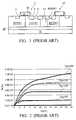
- FIG. 1illustrates a conventional asymmetric HVNMOS device 2 , which includes gate oxide 10 , gate electrode 12 on gate oxide 10 , drain region 4 in a high-voltage n-well region 1 (HVNW 1 ), and a source region 6 in a high-voltage p-well region 1 (HVPW 1 ).
- a shallow trench isolation (STI) region 8spaces drain region 4 and gate electrode 12 apart so that a high drain-to-gate voltage can be applied.
- STIshallow trench isolation
- HVNMOS device 2is formed on a high-voltage anti-punch-through (APT) region 14 , which is of p-type, and is referred to as an HVNAPT region 14 , wherein the letter “N” indicates an n-type inversion region formed in HVNAPT region 14 during the operation of HNVMOS device 2 .
- APTanti-punch-through
- drain region 4wherein the voltage can be as high as 20 volts
- HVNW 1 regionWhen a high voltage is applied to drain region 4 , wherein the voltage can be as high as 20 volts, a high voltage is also applied to HVNW 1 region.
- HVNAPT region 14Assuming HVNAPT region 14 is not formed, and HVPW 1 region and HVNW 1 region are formed directly on p-substrate 16 , the high voltage applied on drain region 4 will cause inversion regions (not shown) to be generated at the interface of HVNW 1 region and p-substrate 16 .
- the inversion regionOn the HVNW 1 region side, the inversion region is of p-type, and on the p-substrate 16 side, the inversion region is of n-type. Since p-substrate 16 is typically lightly doped, the inversion region in p-substrate 16 extends for a relatively great distance.
- the inversion regionmay be connected to another inversion region of HVNW 2 region, which belongs to a neighboring HVNMOS device 18 .
- a punch-throughthus occurs.
- a HVNAPT region 14is formed underlying HVNMOS devices. Since HVNAPT regions are doped with a p-type impurity with a significantly greater concentration than in p-substrate 16 , the thicknesses of the respective inversion regions are significantly less, and thus punch-through is prevented.
- FIG. 2illustrates an I-V curve obtained from an HVNMOS device shown in FIG. 1 , wherein the X-axis represents voltages applied on drain region 4 , and the Y-axis represents drive currents.
- Vgfor example, 20V
- the drive currentsdo not saturate, or in other words, do not pinch, with the increase in drain voltages. This indicates an output resistance problem, which will cause device reliability problems. Therefore, a solution for the above-discussed problem is needed.
- a semiconductor structureincludes a first high-voltage well (HVW) region of a first conductivity type overlying a substrate, a second HVW region of a second conductivity type opposite the first conductivity type overlying the substrate and laterally adjoining the first HVW region, and a third HVW region of the second conductivity type underlying the second HVW region.
- a region underlying the first HVW regionis substantially free from the third HVW region, wherein the third HVW region has a bottom lower than a bottom of the first HVW region.
- the semiconductor structurefurther includes an insulation region and extending from a top surface of the first HVW region into the first HVW region, a gate dielectric extending from over the first HVW region to over the second HVW region wherein the gate dielectric has a portion over the insulation region, and a gate electrode on the gate dielectric.
- a semiconductor structureincludes a semiconductor substrate, a first HVW region of a first conductivity type directly on the substrate, a second HVW region of a second conductivity type opposite the first conductivity directly on the substrate and laterally adjoining the first HVW region, wherein the first HVW region has a first thickness substantially less than a second thickness of the second HVW region, an insulation region in the first HVW region and spaced apart from an interface between the first and the second HVW regions, a gate dielectric extending from over the insulation region to over the second HVW region, and a gate electrode on the gate dielectric.
- a semiconductor structureincludes a semiconductor substrate, a high-voltage n-well (HVNW) region overlying the substrate, a high-voltage p-well (HVPW) region overlying the substrate and encircling the HVNW region, a p-type high-voltage anti-punch-through (HVNAPT) region only between the HVPW region and the substrate, wherein the HVNAPT region substantially overlaps the HVPW region, and wherein the HVNAPT region has a bottom substantially lower than a bottom of the HVNW region, an insulation region in the HVNW region, a gate dielectric extending from over the insulation region to over the HVPW region, a gate electrode on the gate dielectric, a first source/drain region in the HVNW region and adjacent the insulation region, and a second source/drain region in the HVPW region and adjacent the gate dielectric.
- HVNWhigh-voltage n-well
- HVPWhigh-voltage p-
- the advantageous features of the present inventioninclude reduced resistivity in the HVNW region and improved drive current.
- FIG. 1illustrates conventional high-voltage n-type MOS (HVNMOS) devices
- FIG. 2illustrates an I-V curve of the HVNMOS devices shown in FIG. 1 ;
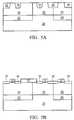
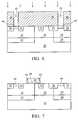
- FIGS. 3 , 4 , 5 A, 5 B, 6 , 7 , and 8 Aare cross-sectional views of intermediate stages in the manufacture of an HVNMOS device
- FIG. 8Billustrates a top view of the HVNMOS device shown in FIG. 8A ;
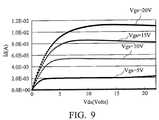
- FIG. 9illustrates an I-V curve of an HVNMOS device embodiment of the present invention.
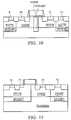
- FIG. 10illustrates a symmetric HVNMOS device embodiment
- FIG. 11illustrates a high-voltage p-type MOS device embodiment.
- substrate 20preferably comprises a semiconductor material such as silicon, although other semiconductor materials may be used.
- substrate 20is lightly doped with a p-type impurity, although it can also be doped with n-type impurities.
- HVNAPT regions 24are formed.
- HVNAPT regions 24are preferably doped with p-type impurities, such as boron and/or indium.
- the p-type impurity concentration in HVNAPT regions 24is at least one order higher than the p-type impurity concentration in substrate 20 .
- the p-type impurity concentration in HVNAPT regions 24is between about 10 14 /cm 3 to about 10 17 /cm 3 .
- FIG. 3also illustrates the formation of high-voltage p-well (HVPW) regions 26 and 30 on HVNAPT regions 24 .
- HVPW regions 26 and 30are also preferably doped with a p-type impurity, such as boron and/or indium.
- the p-type impurity concentration in HVPW regions 26 and 30are greater than the p-type impurity concentration in HVNAPT regions 24 , although the concentration in HVPW regions 26 and 30 may be equal to or smaller than the p-type impurity concentration in HVNAPT regions 24 .
- the p-type impurity concentration in HVPW regions 26 and 30is between about 10 14 /cm 3 to about 10 17 /cm 3 .
- HVPW regions 26 and 30may be two separate regions, they can also be portions of a continuous HVPW region encircling high-voltage n-well (HVNW) region 28 , as is shown in FIG. 8B , which is a top view of the resulting HVNMOS device.
- HVNAPT regions 24may either be separate regions, or portions of a closed loop, depending on the shape of HVPW regions 26 and 30 .
- One skilled in the artwill realize that the order for forming regions 24 , 26 and 30 is merely a design choice.
- HVNAPT regions 24may be formed using a same mask as the mask used for forming HVPW regions 26 and 30 , as is illustrated in FIG. 3 . However, they can be formed using different masks.
- One convenient feature of the present inventionis that the mask for forming HVNAPT regions 24 may be formed through logic operations from conventional masks, wherein the new mask for HVNAPT regions 24 may be obtained by subtracting a conventional HVNAPT region by HVNW region 28 (refer to FIG. 4 ).
- HVNAPT regions 24may have a small overlap with HVNW region 28 , wherein the overlapped regions 25 may have a width TE of less than, for example, about 1 ⁇ m.
- FIG. 4illustrates the formation of high-voltage n-well (HVNW) region 28 .
- Photoresist 27is formed to mask the previously formed HNPW regions 26 and 30 , and an n-type impurity, such as phosphorous, antimony and/or arsenic, is implanted.
- HVNW region 28has an impurity concentration of between about 10 14 /cm 3 to about 10 17 /cm 3 .
- HVNW region 28has a thickness T 1 substantially equal to thickness T 2 of HVPW regions 26 and 30 . Therefore, HVNAPT regions 24 are located lower than the bottom level of regions 26 , 28 and 30 .
- the preferred thickness T 3 of HVNAPT regions 24partially depends on the concentration of p-type impurities in HVNAPT regions 24 , and the thickness T 3 may be reduced with an increased p-type impurity concentration. It should be appreciated that the thickness T 3 of HVNAPT regions 24 may be scaled with the formation technology of the integrated circuits and with the voltages applied on drain regions of the respective HVNMOS devices. In an exemplary embodiment, thickness T 3 is between about 10 nm and about 800 nm.
- HVNAPT regions 24 and HVPW region 26can be formed as one region in a single process step, which may be achieved by more than one implant having different energies, thus the implanted impurity has a more uniform impurity concentration from a top surface of HVPW region 26 to a bottom surface of HVNAPT regions 24 .
- HVNAPT regions 24 and HVPW 30may also be formed as one combined region.
- the thickness of the combined regionsis preferably substantially greater than thickness T 1 of HVNW region 28 , for example, by between about 10 nm and about 800 nm.
- thickness T 3 of HVNAPT regions 24is greater than about 1/10 of thicknesses T 1 of HVPW regions 26 and T 2 .
- HVPW regions 26 and 30 , HVNW region 28 , and HVNAPT regions 24may be formed by epitaxially growing a doped semiconductor layer, which has thickness T 1 as illustrated in FIG. 4 , on substrate 20 .
- the doped semiconductor layeris preferably doped with an n-type impurity to a concentration of essentially the same as in HVNW region 28 .
- a photoresistwhich is essentially the same as photoresist 22 in FIG. 3 , is then formed, and HVPW regions 26 and 30 and HVNAPT regions 24 are formed by implanting p-type impurities.
- the n-type impurity in the doped semiconductor layeris neutralized by the implanted p-type impurity, and the net concentration of implanted regions 24 , 26 and 30 are essentially the same as discussed in the preceding paragraphs.
- the un-implanted region of the doped semiconductor layerthus forms HVNW region 28 .
- FIGS. 5A and 5Billustrate the formation of insulation regions 36 .
- insulation regions 36are formed by forming trenches in HVPW regions 26 and 30 and HVNW region 28 , filling the trenches with a dielectric material, such as SiO 2 or high-density plasma (HDP) oxide, and performing a chemical mechanical polish to level the surface of the filled dielectric material to top surfaces of regions 26 , 28 and 30 .
- the resulting shallow trench isolation (STD regionsare insulation regions 36 .
- a mask layer 32preferably formed of SiN, is formed over HVPW region 26 and 30 and HVNW region 28 .
- Mask layer 32is then patterned to form openings.
- An oxidationis then performed, and insulation regions (also referred to as field oxides) 36 are formed in openings 30 .
- field regionsare preferably STI regions.
- field regionsare preferably field oxides.
- a photoresist 40is deposited and patterned, forming openings 42 .
- a p-type dopant implantationis performed, forming P+ regions 44 and 46 in HVPW regions 26 and 30 , respectively.
- P+ regions 44 and 46comprise boron and/or other p-type dopants and are heavily doped to a concentration of greater than about 10 20 /cm 3 .
- P+ regions 44 and 46act as the contacts for pick-up regions. Photoresist 40 is then removed.
- FIG. 7illustrates the formation of a gate dielectric 60 , a gate electrode 62 and gate spacers 64 .
- gate dielectric 60preferably comprises silicon oxide, although other dielectric materials such as silicon nitride, silicon carbide, silicon oxynitride, combinations thereof, and multi-layers thereof, can be used.
- Gate electrode 62preferably includes doped polysilicon. Alternatively, metals, metal nitrides, metal silicides, and other conductive materials can be used.
- Gate spacers 64are preferably formed by blanket forming a dielectric material, and removing undesired portions from horizontal surfaces.
- gate dielectric 60The details of formation processes of gate dielectric 60 , gate electrode 62 , and gate spacers 64 are well known in the art, and thus are not repeated herein.
- a side edge of gate electrode 62is over the insulation regions 36 in HVNW region 28 .
- photoresist 50is formed and patterned.
- An n-type impurity implantationis performed, forming N+ region 54 in HVPW region 26 and N+ region 56 in HVNW region 28 .
- HVNMOS device 68is thus formed.
- the N+ dopantmay comprise phosphorus and/or arsenic (As).
- the n-type dopantis heavily doped to a concentration of greater than about 10 20 /cm 3 .
- heavily dopedmeans an impurity concentration of above about 10 20 /cm 3 .
- heavily dopedis a term of art that depends upon the specific device type, technology generation, minimum feature size, and the like.
- N+ region 54forms the source region of the resulting HVNMOS device 68
- N+ region 56forms the drain region of HVNMOS device 68 .
- N+ regions 54 and 56may be formed before the formation of gate dielectric 60 , gate electrode 62 and gate spacers 64 .
- One skilled in the artwill realize the respective process steps of for the formation.
- FIG. 8Billustrates a top view of an exemplary layout of HVNMOS device 68 .
- an HVPW regionwhich includes HVPW regions 26 and 30 , encircles HVNW region 28 , wherein the HVPW region occupies the entire illustrated region except HVNW region 28 .
- Portions of the HVPW regions 26 and 30may have insulation regions 36 on top.
- HVNAPT regions 24which preferably overlap HVPW regions 26 and 30 , also encircle HVNW region 28 .
- a region defined by two dotted squares, which are marked as “ 44 , 46 ”is a P+ region including regions 44 and 46 . It is to be noted that the embodiments of the present invention may be implemented with a variety of layouts, and the layout shown in FIG. 8B is merely an example.
- FIG. 9illustrates I d -V d characteristics measured from an HVNMOS device embodiment of the present invention. It is noted that when a gate of the HVNMOS device is applied with a high voltage, such as 20 volts, the I-V curve pinches when drain-source voltages around 12 volts. This indicates that the reliability of the HVMOS devices formed using the embodiments of the present invention is improved.
- HVNAPT region 28If an HVNAPT region is formed underlying HVNW region 28 , the p-type impurity atoms in the HVNAPT region will diffuse into HVNW region 28 and neutralize the n-type impurity in HVNW region 28 . This in turn causes the increase in resistance in HVNW region 28 and degradation in device drive current.
- An advantageous feature of the present inventionis that by removing HVNAPT region, which has p-type impurities, from underlying HVNW region 28 , atoms of p-type impurity diffused into HVNW region 28 are significantly reduced.
- FIG. 10illustrates an HVNMOS embodiment having a symmetric structure, wherein the HVNMOS device includes two HVNW regions and an HVPW region therebetween. Similar to the embodiment illustrated in FIG. 8A , HVNAPT regions are formed under HVPW regions, while HVNW regions have substantially no underlying HVNAPT regions.
- HVNMOSa symmetric HVPMOS device
- the conductivity type of HVNW region 28 , HVPW region 26 and 30 , and source/drain regions 54 and 56 , etc.reversed (refer to FIG. 8A ).
- An exemplary illustrative embodimentis shown in FIG. 11 .
- HVMOS deviceshave various different layouts. However, the concept of the present invention may still be applied.
- a symmetric HVPMOS devicemay be formed by reversing the conductivity types of the doped regions in FIG. 10 .
Landscapes
- Insulated Gate Type Field-Effect Transistor (AREA)
- Metal-Oxide And Bipolar Metal-Oxide Semiconductor Integrated Circuits (AREA)
Abstract
Description
This application claims priority to the following U.S. provisional patents: Patent Application Ser. No. 60/832,477, filed Jul. 21, 2006, entitled “Structures of High-Voltage MOS Devices with Improved Electrical Performance,” which patent application is incorporated herein by reference.
This invention relates generally to semiconductor devices, and more particularly to metal-oxide-semiconductor (MOS) devices, and even more particularly to the structure and manufacturing methods of high-voltage MOS devices.
High-voltage metal-oxide-semiconductor (HVMOS) devices are widely used in many electrical devices, such as input/output (I/O) circuits, CPU power supplies, power management systems, AC/DC converters, etc.
There are a variety of forms of HVMOS devices. A symmetric HVMOS device may have a symmetric structure on the source side and drain side. High voltage can be applied on both drain and source sides. An asymmetric HVMOS device may have asymmetric structures on the source side and drain side. For example, only one of the source side and drain side, typically the drain side, is designed for sustaining high voltages.
The conventional HVNMOS devices illustrated inFIG. 1 have drawbacks, however.FIG. 2 illustrates an I-V curve obtained from an HVNMOS device shown inFIG. 1 , wherein the X-axis represents voltages applied ondrain region 4, and the Y-axis represents drive currents. It is noted that if a high voltage Vg, for example, 20V, is applied, the drive currents do not saturate, or in other words, do not pinch, with the increase in drain voltages. This indicates an output resistance problem, which will cause device reliability problems. Therefore, a solution for the above-discussed problem is needed.
In accordance with one aspect of the present invention, a semiconductor structure includes a first high-voltage well (HVW) region of a first conductivity type overlying a substrate, a second HVW region of a second conductivity type opposite the first conductivity type overlying the substrate and laterally adjoining the first HVW region, and a third HVW region of the second conductivity type underlying the second HVW region. A region underlying the first HVW region is substantially free from the third HVW region, wherein the third HVW region has a bottom lower than a bottom of the first HVW region. The semiconductor structure further includes an insulation region and extending from a top surface of the first HVW region into the first HVW region, a gate dielectric extending from over the first HVW region to over the second HVW region wherein the gate dielectric has a portion over the insulation region, and a gate electrode on the gate dielectric.
In accordance with another aspect of the present invention, a semiconductor structure includes a semiconductor substrate, a first HVW region of a first conductivity type directly on the substrate, a second HVW region of a second conductivity type opposite the first conductivity directly on the substrate and laterally adjoining the first HVW region, wherein the first HVW region has a first thickness substantially less than a second thickness of the second HVW region, an insulation region in the first HVW region and spaced apart from an interface between the first and the second HVW regions, a gate dielectric extending from over the insulation region to over the second HVW region, and a gate electrode on the gate dielectric.
In accordance with yet another aspect of the present invention, a semiconductor structure includes a semiconductor substrate, a high-voltage n-well (HVNW) region overlying the substrate, a high-voltage p-well (HVPW) region overlying the substrate and encircling the HVNW region, a p-type high-voltage anti-punch-through (HVNAPT) region only between the HVPW region and the substrate, wherein the HVNAPT region substantially overlaps the HVPW region, and wherein the HVNAPT region has a bottom substantially lower than a bottom of the HVNW region, an insulation region in the HVNW region, a gate dielectric extending from over the insulation region to over the HVPW region, a gate electrode on the gate dielectric, a first source/drain region in the HVNW region and adjacent the insulation region, and a second source/drain region in the HVPW region and adjacent the gate dielectric.
The advantageous features of the present invention include reduced resistivity in the HVNW region and improved drive current.
For a more complete understanding of the present invention, and the advantages thereof, reference is now made to the following descriptions taken in conjunction with the accompanying drawings, in which:
The making and using of the presently preferred embodiments are discussed in detail below. It should be appreciated, however, that the present invention provides many applicable inventive concepts that can be embodied in a wide variety of specific contexts. The specific embodiments discussed are merely illustrative of specific ways to make and use the invention, and do not limit the scope of the invention.
The preferred embodiments of the present invention are described with reference toFIGS. 3 through 8A , and variations of the preferred embodiments are then discussed. Throughout the various views and illustrative embodiments of the present invention, like reference numbers are used to designate like elements.
Referring toFIG. 3 , asubstrate 20 is provided.Substrate 20 preferably comprises a semiconductor material such as silicon, although other semiconductor materials may be used. Preferably,substrate 20 is lightly doped with a p-type impurity, although it can also be doped with n-type impurities.
Aphotoresist 22 is formed and patterned using lithography techniques. High-voltage (HV) anti-punch-through (APT) regions24 (also referred to as HVNAPT regions as the inversion regions formed inregions 24 are of n-type) are formed. HVNAPTregions 24 are preferably doped with p-type impurities, such as boron and/or indium. Preferably, the p-type impurity concentration inHVNAPT regions 24 is at least one order higher than the p-type impurity concentration insubstrate 20. In an exemplary embodiment, the p-type impurity concentration inHVNAPT regions 24 is between about 1014/cm3to about 1017/cm3.
Preferably,HVNW region 28 has a thickness T1 substantially equal to thickness T2 ofHVPW regions HVNAPT regions 24 are located lower than the bottom level ofregions HVNAPT regions 24 partially depends on the concentration of p-type impurities inHVNAPT regions 24, and the thickness T3 may be reduced with an increased p-type impurity concentration. It should be appreciated that the thickness T3 ofHVNAPT regions 24 may be scaled with the formation technology of the integrated circuits and with the voltages applied on drain regions of the respective HVNMOS devices. In an exemplary embodiment, thickness T3 is between about 10 nm and about 800 nm.
It is noted thatHVNAPT regions 24 andHVPW region 26 can be formed as one region in a single process step, which may be achieved by more than one implant having different energies, thus the implanted impurity has a more uniform impurity concentration from a top surface ofHVPW region 26 to a bottom surface ofHVNAPT regions 24. Similarly,HVNAPT regions 24 andHVPW 30 may also be formed as one combined region. In this embodiment, the thickness of the combined regions is preferably substantially greater than thickness T1 ofHVNW region 28, for example, by between about 10 nm and about 800 nm. Alternatively, thickness T3 ofHVNAPT regions 24 is greater than about 1/10 of thicknesses T1 ofHVPW regions 26 and T2.
In other embodiments,HVPW regions HVNW region 28, andHVNAPT regions 24 may be formed by epitaxially growing a doped semiconductor layer, which has thickness T1 as illustrated inFIG. 4 , onsubstrate 20. The doped semiconductor layer is preferably doped with an n-type impurity to a concentration of essentially the same as inHVNW region 28. A photoresist, which is essentially the same asphotoresist 22 inFIG. 3 , is then formed, andHVPW regions HVNAPT regions 24 are formed by implanting p-type impurities. The n-type impurity in the doped semiconductor layer is neutralized by the implanted p-type impurity, and the net concentration of implantedregions HVNW region 28.
Referring toFIG. 6 , aphotoresist 40 is deposited and patterned, formingopenings 42. A p-type dopant implantation is performed, formingP+ regions HVPW regions P+ regions P+ regions Photoresist 40 is then removed.
Referring toFIG. 8A ,photoresist 50 is formed and patterned. An n-type impurity implantation is performed, formingN+ region 54 inHVPW region 26 andN+ region 56 inHVNW region 28.HVNMOS device 68 is thus formed. The N+ dopant may comprise phosphorus and/or arsenic (As). Preferably, the n-type dopant is heavily doped to a concentration of greater than about 1020/cm3. In the described embodiments, heavily doped means an impurity concentration of above about 1020/cm3. One skilled in the art will recognize, however, that heavily doped is a term of art that depends upon the specific device type, technology generation, minimum feature size, and the like. It is intended, therefore, that the term be interpreted in light of the technology being evaluated and not be limited to the described embodiments.N+ region 54 forms the source region of the resultingHVNMOS device 68, whileN+ region 56 forms the drain region ofHVNMOS device 68. After the implantation,photoresist 50 is removed. Sincegate electrode 62 is spaced apart fromN+ region 56, a high voltage can be applied.
Alternatively,N+ regions gate dielectric 60,gate electrode 62 andgate spacers 64. One skilled in the art will realize the respective process steps of for the formation.
If an HVNAPT region is formedunderlying HVNW region 28, the p-type impurity atoms in the HVNAPT region will diffuse intoHVNW region 28 and neutralize the n-type impurity inHVNW region 28. This in turn causes the increase in resistance inHVNW region 28 and degradation in device drive current. An advantageous feature of the present invention is that by removing HVNAPT region, which has p-type impurities, from underlyingHVNW region 28, atoms of p-type impurity diffused intoHVNW region 28 are significantly reduced.
The previously illustrated embodiments have asymmetric structures, wherein source and drain regions are in different types of high-voltage well regions.FIG. 10 illustrates an HVNMOS embodiment having a symmetric structure, wherein the HVNMOS device includes two HVNW regions and an HVPW region therebetween. Similar to the embodiment illustrated inFIG. 8A , HVNAPT regions are formed under HVPW regions, while HVNW regions have substantially no underlying HVNAPT regions.
Although the preferred embodiments illustrate the formation of an HVNMOS device, one skilled in the art will realize the respective formation steps for forming HVPMOS devices, with the conductivity type ofHVNW region 28,HVPW region drain regions FIG. 8A ). An exemplary illustrative embodiment is shown inFIG. 11 . It should also be appreciated that HVMOS devices have various different layouts. However, the concept of the present invention may still be applied. Similarly, a symmetric HVPMOS device may be formed by reversing the conductivity types of the doped regions inFIG. 10 .
Although the present invention and its advantages have been described in detail, it should be understood that various changes, substitutions and alterations can be made herein without departing from the spirit and scope of the invention as defined by the appended claims. Moreover, the scope of the present application is not intended to be limited to the particular embodiments of the process, machine, manufacture, and composition of matter, means, methods and steps described in the specification. As one of ordinary skill in the art will readily appreciate from the disclosure of the present invention, processes, machines, manufacture, compositions of matter, means, methods, or steps, presently existing or later to be developed, that perform substantially the same function or achieve substantially the same result as the corresponding embodiments described herein may be utilized according to the present invention. Accordingly, the appended claims are intended to include within their scope such processes, machines, manufacture, compositions of matter, means, methods, or steps.
Claims (18)
1. A semiconductor structure comprising:
a substrate;
a first high-voltage well (HVW) region of a first conductivity type overlying the substrate, wherein no well region is directly underlying the first HVW region;
a second HVW region of a second conductivity type opposite the first conductivity type overlying the substrate and laterally contacting the first HVW region;
a third HVW region of the second conductivity type underlying the second HVW region, wherein the third HVW region substantially does not extend into the region directly underlying the first HVW region, and wherein the third HVW region has a bottom substantially lower than a bottom of the first HVW region;
an insulation region in a portion of the first HVW region and extending from a top surface of the first HVW region into the first HVW region;
a gate dielectric extending from over the first HVW region to over the second HVW region, wherein the gate dielectric has a portion over the insulation region;
a gate electrode on the gate dielectric;
a fourth HVW region of the second conductivity type overlying the substrate and laterally contacting the first HVW region, wherein the fourth HVW region is on an opposite side of the first HVW region relative to the second HVW region, and wherein the gate dielectric does not extend into the region directly over the fourth HVW region; and
a fifth HVW region of the second conductivity type underlying the fourth HVW region, wherein the fifth HVW region does not extend into the region directly underlying the first HVW region, and wherein the fifth HVW region has a bottom substantially lower than the bottom of the first HVW region.
2. The semiconductor structure ofclaim 1 , wherein the first conductivity type is n-type and the second conductivity type is p-type.
3. The semiconductor structure ofclaim 1 , wherein edges of the third HVW region are substantially aligned with edges of the second HVW region.
4. The semiconductor structure ofclaim 1 , wherein the bottom of the third HVW region is lower than the bottom of the first HVW region by greater than about 10 nm.
5. The semiconductor structure ofclaim 1 , wherein the third HVW region has an impurity concentration substantially close to an impurity concentration of the second HVW region.
6. The semiconductor structure ofclaim 1 , wherein the third HVW region has an impurity concentration higher than an impurity concentration of the substrate by greater than about one order.
7. The semiconductor structure ofclaim 1 , wherein the first and the third HVW regions are in physical contact with the substrate.
8. The semiconductor structure ofclaim 1 further comprising:
a first source/drain region in the first HVW region and adjacent the insulation region, wherein the first source/drain region is selected from the group consisting of a source region and a drain region; and
a second source/drain region in the second HVW region and adjacent the gate dielectric.
9. The semiconductor structure ofclaim 1 , wherein the first, the second, and the third HVW regions have impurity concentrations between about 1014/cm3and about 1017/cm3.
10. A semiconductor structure comprising:
a substrate;
a first high-voltage well (HVW) region of a first conductivity type overlying and contacting the substrate, wherein no well region is directly underlying the first HVW region wherein the substrate is of a second conductivity type opposite the first conductivity type;
a second HVW region of a second conductivity type opposite the first conductivity type overlying the substrate and laterally contacting the first HVW region;
a third HVW region of the second conductivity type underlying the second HVW region, wherein the third HVW region substantially does not extend into the region directly underlying the first HVW region, and wherein the third HVW region has a bottom substantially lower than a bottom of the first HVW region;
an insulation region in a portion of the first HVW region and extending from a top surface of the first HVW region into the first HVW region;
a gate dielectric extending from over the first HVW region to over the second HVW region, wherein the gate dielectric has a portion over the insulation region; and
a gate electrode on the gate dielectric.
11. The semiconductor structure ofclaim 10 , wherein the first conductivity type is n-type and the second conductivity type is p-type.
12. The semiconductor structure ofclaim 10 , wherein edges of the third HVW region are substantially aligned with edges of the second HVW region.
13. The semiconductor structure ofclaim 10 , wherein the bottom of the third HVW region is lower than the bottom of the first HVW region by greater than about 10 nm.
14. The semiconductor structure ofclaim 10 , wherein the third HVW region has an impurity concentration substantially close to an impurity concentration of the second HVW region.
15. The semiconductor structure ofclaim 10 , wherein the third HVW region has an impurity concentration higher than an impurity concentration of the substrate by greater than about one order.
16. The semiconductor structure ofclaim 10 further comprising a fourth HVW region of the first conductivity type on an opposite side of the first HVW region than the second HVW region, wherein the fourth HVW region has a same thickness as the first HVW region does, and wherein a region underlying the fourth HVW region is substantially free from the third HVW region, and wherein the gate dielectric extends over the fourth HVW region.
17. The semiconductor structure ofclaim 10 , wherein the third HVW region is in physical contact with the substrate.
18. The semiconductor structure ofclaim 10 further comprising:
a first source/drain region in the first HVW region and adjacent the insulation region, wherein the first source/drain region is selected from the group consisting of a source region and a drain region; and
a second source/drain region in the second HVW region and adjacent the gate dielectric.
Priority Applications (2)
| Application Number | Priority Date | Filing Date | Title |
|---|---|---|---|
| US11/588,902US7888767B2 (en) | 2006-07-21 | 2006-10-26 | Structures of high-voltage MOS devices with improved electrical performance |
| TW096106118ATWI336524B (en) | 2006-07-21 | 2007-02-16 | Semiconductor structures |
Applications Claiming Priority (2)
| Application Number | Priority Date | Filing Date | Title |
|---|---|---|---|
| US83247706P | 2006-07-21 | 2006-07-21 | |
| US11/588,902US7888767B2 (en) | 2006-07-21 | 2006-10-26 | Structures of high-voltage MOS devices with improved electrical performance |
Publications (2)
| Publication Number | Publication Date |
|---|---|
| US20080017948A1 US20080017948A1 (en) | 2008-01-24 |
| US7888767B2true US7888767B2 (en) | 2011-02-15 |
Family
ID=38970647
Family Applications (1)
| Application Number | Title | Priority Date | Filing Date |
|---|---|---|---|
| US11/588,902Expired - Fee RelatedUS7888767B2 (en) | 2006-07-21 | 2006-10-26 | Structures of high-voltage MOS devices with improved electrical performance |
Country Status (2)
| Country | Link |
|---|---|
| US (1) | US7888767B2 (en) |
| TW (1) | TWI336524B (en) |
Cited By (2)
| Publication number | Priority date | Publication date | Assignee | Title |
|---|---|---|---|---|
| US20100200922A1 (en)* | 2009-02-06 | 2010-08-12 | Ming-Song Sheu | Electrostatic Discharge Protection Device and Method |
| US8492866B1 (en)* | 2012-01-09 | 2013-07-23 | International Business Machines Corporation | Isolated Zener diode |
Families Citing this family (7)
| Publication number | Priority date | Publication date | Assignee | Title |
|---|---|---|---|---|
| US8749016B2 (en)* | 2010-10-06 | 2014-06-10 | Macronix International Co., Ltd. | High voltage MOS device and method for making the same |
| US9209098B2 (en) | 2011-05-19 | 2015-12-08 | Taiwan Semiconductor Manufacturing Company, Ltd. | HVMOS reliability evaluation using bulk resistances as indices |
| US9117687B2 (en)* | 2011-10-28 | 2015-08-25 | Texas Instruments Incorporated | High voltage CMOS with triple gate oxide |
| US9653459B2 (en)* | 2012-07-03 | 2017-05-16 | Taiwan Semiconductor Manufacturing Company, Ltd. | MOSFET having source region formed in a double wells region |
| TWI686786B (en)* | 2017-04-17 | 2020-03-01 | 世界先進積體電路股份有限公司 | display system |
| US20190019472A1 (en) | 2017-07-13 | 2019-01-17 | Vanguard International Semiconductor Corporation | Display system and method for forming an output buffer of a source driver |
| US10453836B2 (en) | 2017-08-17 | 2019-10-22 | Globalfoundries Singapore Pte. Ltd. | High holding high voltage (HHHV) FET for ESD protection with modified source and method for producing the same |
Citations (8)
| Publication number | Priority date | Publication date | Assignee | Title |
|---|---|---|---|---|
| US4803533A (en)* | 1986-09-30 | 1989-02-07 | General Electric Company | IGT and MOSFET devices having reduced channel width |
| US6242787B1 (en)* | 1995-11-15 | 2001-06-05 | Denso Corporation | Semiconductor device and manufacturing method thereof |
| US6265752B1 (en) | 1999-05-25 | 2001-07-24 | Taiwan Semiconductor Manufacturing, Co., Inc. | Method of forming a HVNMOS with an N+ buried layer combined with N well and a structure of the same |
| US6376891B1 (en)* | 1995-12-30 | 2002-04-23 | Mitsubishi Denki Kabushiki Kaisha | High voltage breakdown isolation semiconductor device and manufacturing process for making the device |
| US20020050619A1 (en)* | 2000-09-28 | 2002-05-02 | Yusuke Kawaguchi | MOS transistor having an offset region |
| US20030057459A1 (en)* | 2001-09-26 | 2003-03-27 | Vladimir Rumennik | High current field-effect transistor |
| US20040150041A1 (en)* | 1999-12-27 | 2004-08-05 | Kabushiki Kaisha Toshiba | Lateral high-breakdown-voltage transistor |
| US7375398B2 (en)* | 2004-07-02 | 2008-05-20 | Impinj, Inc. | High voltage FET gate structure |
- 2006
- 2006-10-26USUS11/588,902patent/US7888767B2/ennot_activeExpired - Fee Related
- 2007
- 2007-02-16TWTW096106118Apatent/TWI336524B/ennot_activeIP Right Cessation
Patent Citations (8)
| Publication number | Priority date | Publication date | Assignee | Title |
|---|---|---|---|---|
| US4803533A (en)* | 1986-09-30 | 1989-02-07 | General Electric Company | IGT and MOSFET devices having reduced channel width |
| US6242787B1 (en)* | 1995-11-15 | 2001-06-05 | Denso Corporation | Semiconductor device and manufacturing method thereof |
| US6376891B1 (en)* | 1995-12-30 | 2002-04-23 | Mitsubishi Denki Kabushiki Kaisha | High voltage breakdown isolation semiconductor device and manufacturing process for making the device |
| US6265752B1 (en) | 1999-05-25 | 2001-07-24 | Taiwan Semiconductor Manufacturing, Co., Inc. | Method of forming a HVNMOS with an N+ buried layer combined with N well and a structure of the same |
| US20040150041A1 (en)* | 1999-12-27 | 2004-08-05 | Kabushiki Kaisha Toshiba | Lateral high-breakdown-voltage transistor |
| US20020050619A1 (en)* | 2000-09-28 | 2002-05-02 | Yusuke Kawaguchi | MOS transistor having an offset region |
| US20030057459A1 (en)* | 2001-09-26 | 2003-03-27 | Vladimir Rumennik | High current field-effect transistor |
| US7375398B2 (en)* | 2004-07-02 | 2008-05-20 | Impinj, Inc. | High voltage FET gate structure |
Cited By (4)
| Publication number | Priority date | Publication date | Assignee | Title |
|---|---|---|---|---|
| US20100200922A1 (en)* | 2009-02-06 | 2010-08-12 | Ming-Song Sheu | Electrostatic Discharge Protection Device and Method |
| US8378422B2 (en)* | 2009-02-06 | 2013-02-19 | Taiwan Semiconductor Manufacturing Company, Ltd. | Electrostatic discharge protection device comprising a plurality of highly doped areas within a well |
| US8492866B1 (en)* | 2012-01-09 | 2013-07-23 | International Business Machines Corporation | Isolated Zener diode |
| US8796108B2 (en) | 2012-01-09 | 2014-08-05 | International Business Machines Corporation | Isolated zener diode, an integrated circuit incorporating multiple instances of the zener diode, a method of forming the zener diode and a design structure for the zener diode |
Also Published As
| Publication number | Publication date |
|---|---|
| TWI336524B (en) | 2011-01-21 |
| US20080017948A1 (en) | 2008-01-24 |
| TW200807713A (en) | 2008-02-01 |
Similar Documents
| Publication | Publication Date | Title |
|---|---|---|
| US7928508B2 (en) | Disconnected DPW structures for improving on-state performance of MOS devices | |
| US8158475B2 (en) | Gate electrodes of HVMOS devices having non-uniform doping concentrations | |
| US7981783B2 (en) | Semiconductor device and method for fabricating the same | |
| US8236642B2 (en) | Fully isolated high-voltage MOS device | |
| US7888767B2 (en) | Structures of high-voltage MOS devices with improved electrical performance | |
| US7423319B2 (en) | LDPMOS structure with enhanced breakdown voltage | |
| US20080160706A1 (en) | Method for fabricating semiconductor device | |
| US7893490B2 (en) | HVNMOS structure for reducing on-resistance and preventing BJT triggering | |
| US8592923B2 (en) | Coupling well structure for improving HVMOS performance | |
| US20160043217A1 (en) | Methods and Apparatus for LDMOS Devices with Cascaded Resurf Implants and Double Buffers | |
| US9224862B2 (en) | High voltage semiconductor device and method for fabricating the same | |
| US7994013B2 (en) | Semiconductor device and method of fabricating the semiconductor device | |
| US20080001189A1 (en) | Shielding structures for preventing leakages in high voltage MOS devices | |
| US8502326B2 (en) | Gate dielectric formation for high-voltage MOS devices | |
| CN101661955B (en) | Laterally diffused metal oxide semiconductor device and manufacturing method thereof | |
| US10910493B2 (en) | Semiconductor device and method of manufacturing the same | |
| US9768054B2 (en) | High voltage device with low Rdson | |
| EP3998638A1 (en) | Laterally diffused metal oxide semiconductor device and manufacturing method therefor | |
| TWI798825B (en) | Manufacturing method of semiconductor device | |
| CN100499167C (en) | Semiconductor structure | |
| US9070766B1 (en) | Semiconductor device and method of forming the same |
Legal Events
| Date | Code | Title | Description |
|---|---|---|---|
| AS | Assignment | Owner name:TAIWAN SEMICONDUCTOR MANUFACTURING COMPANY, LTD., Free format text:ASSIGNMENT OF ASSIGNORS INTEREST;ASSIGNORS:HUANG, KUN-MING;CHOU, HSUEH-LIANG;CHU, WENG-CHU;AND OTHERS;REEL/FRAME:018539/0773 Effective date:20061023 | |
| FPAY | Fee payment | Year of fee payment:4 | |
| FEPP | Fee payment procedure | Free format text:MAINTENANCE FEE REMINDER MAILED (ORIGINAL EVENT CODE: REM.); ENTITY STATUS OF PATENT OWNER: LARGE ENTITY | |
| LAPS | Lapse for failure to pay maintenance fees | Free format text:PATENT EXPIRED FOR FAILURE TO PAY MAINTENANCE FEES (ORIGINAL EVENT CODE: EXP.); ENTITY STATUS OF PATENT OWNER: LARGE ENTITY | |
| STCH | Information on status: patent discontinuation | Free format text:PATENT EXPIRED DUE TO NONPAYMENT OF MAINTENANCE FEES UNDER 37 CFR 1.362 | |
| FP | Lapsed due to failure to pay maintenance fee | Effective date:20190215 |