US7881782B2 - Neural stimulation system to prevent simultaneous energy discharges - Google Patents
Neural stimulation system to prevent simultaneous energy dischargesDownload PDFInfo
- Publication number
- US7881782B2 US7881782B2US11/110,542US11054205AUS7881782B2US 7881782 B2US7881782 B2US 7881782B2US 11054205 AUS11054205 AUS 11054205AUS 7881782 B2US7881782 B2US 7881782B2
- Authority
- US
- United States
- Prior art keywords
- neural stimulation
- energy discharge
- controller
- delivery
- energy
- Prior art date
- Legal status (The legal status is an assumption and is not a legal conclusion. Google has not performed a legal analysis and makes no representation as to the accuracy of the status listed.)
- Expired - Fee Related, expires
Links
Images



Classifications
- A—HUMAN NECESSITIES
- A61—MEDICAL OR VETERINARY SCIENCE; HYGIENE
- A61N—ELECTROTHERAPY; MAGNETOTHERAPY; RADIATION THERAPY; ULTRASOUND THERAPY
- A61N1/00—Electrotherapy; Circuits therefor
- A61N1/18—Applying electric currents by contact electrodes
- A61N1/32—Applying electric currents by contact electrodes alternating or intermittent currents
- A61N1/36—Applying electric currents by contact electrodes alternating or intermittent currents for stimulation
- A61N1/3605—Implantable neurostimulators for stimulating central or peripheral nerve system
- A61N1/3606—Implantable neurostimulators for stimulating central or peripheral nerve system adapted for a particular treatment
- A61N1/36114—Cardiac control, e.g. by vagal stimulation
Definitions
- This applicationrelates generally to medical devices and, more particularly, to neural stimulation systems, devices and methods.
- Direct electrical stimulation of parasympathetic nervescan activate the baroreflex, inducing a reduction of sympathetic nerve activity and reducing blood pressure by decreasing vascular resistance.
- Sympathetic inhibition and parasympathetic activationhave been associated with reduced arrhythmia vulnerability following a myocardial infarction, presumably by increasing collateral perfusion of the acutely ischemic myocardium and decreasing myocardial damage.
- Modulation of the sympathetic and parasympathetic nervous system with neural stimulationhas been shown to have positive clinical benefits, such as protecting the myocardium from further remodeling and predisposition to fatal arrhythmias following a myocardial infarction.
- neural stimulation therapiesinvolve stimulating two or more neural stimulation targets.
- NSneural stimulation
- CRMcardiac rhythm management
- Some therapiesinvolve stimulating two or more cardiac sites.
- Some therapiesapply pulses to measure an impedance across tissue, and use the impedance measurement to provide a sensed feedback to control the therapies.
- therapiescan use multiple electrodes to apply current through tissue for the neural stimulation and CRM therapies, and for impedance measurements.
- the present subject matteraddresses undesirable interactions that might occur when neural stimulation and another energy discharge occur simultaneously.
- the neural stimulationhas an intended current path through tissue, and the other energy discharge has an intended current path through tissue.
- unintended current pathscan occur between electrodes when the neural stimulation and the other energy discharge occur simultaneously.
- the other energy dischargecan be for therapy or diagnostic purposes. Examples of other energy discharges include another neural stimulation to a different neural target or recharge pulses after neural stimulation, a pulse for an impedance measurement such as a minute ventilation pulse, and discharges associated with CRM therapy such as pacing pulses, recharge pulses and defibrillation pulses.
- the present subject matterprevents neural stimulation from being simultaneously applied when another energy discharge is occurring. Some embodiments stagger the neural stimulation with respect to the other energy discharge(s) to provide at least a few milliseconds between energy discharges, which prevents electrical interactions between pulses without diminishing the effectiveness of the pulses from a physiological perspective.
- Various aspects of the present subject matterrelate to a system.
- Various embodiments of the systemcomprise at least one port to connect to at least one lead with at least one electrode, at least one stimulator circuit and at least one controller.
- the at least one stimulator circuitis connected to the at least one port and is adapted to deliver neural stimulation to a neural stimulation target using the at least one electrode.
- the at least one controlleris adapted to determine when another energy discharge other than the neural stimulation to the neural stimulation target is occurring and to prevent delivery of the neural stimulation simultaneously with the other energy discharge.
- neural stimulationis delivered to a neural stimulation target, and another energy discharge is provided. It is determined when the other energy discharge is occurring. Delivery of the neural stimulation to the neural stimulation target is prevented when the other energy discharge is occurring.
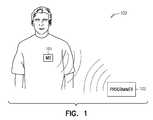
- FIG. 1illustrates a system including an implantable medical device (IMD) and a programmer, according to various embodiments of the present subject matter.
- IMDimplantable medical device
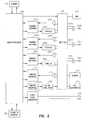
- FIG. 2illustrates a system diagram of an embodiment of an implantable medical device configured for multi-site stimulation and sensing.
- FIG. 3illustrates an implantable medical device (IMD) having a neural stimulation (NS) component and cardiac rhythm management (CRM) component, according to various embodiments of the present subject matter.
- IMDimplantable medical device
- NSneural stimulation
- CRMcardiac rhythm management
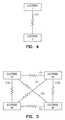
- FIG. 4illustrates a pair of electrodes such as can be used provide an energy discharge, and a desired current path between the electrodes and through tissue.
- FIG. 5illustrates a first pair of electrodes for use in providing a first desired energy discharge and a second pair of electrodes for use in providing a second desired energy discharge.
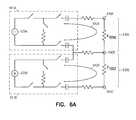
- FIGS. 6A and 6Billustrates an electrical schematic of a neural stimulator with two independent pacing circuits and with two energy discharge outputs 638 A and 638 B, and further illustrates desired current paths and undesired current paths, respectively, for the two energy discharge outputs, and further illustrates intended and unintended current paths.
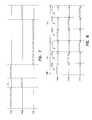
- FIG. 7illustrates neural stimulation to three neural targets whose stimulation is staggered to prevent simultaneous neural stimulation, according to various embodiments of the present subject matter.
- FIG. 8illustrates neural stimulation to three neural targets whose stimulation is staggered using predetermined time slots for a predetermined time period within a time domain multiplexing scheme to prevent simultaneous neural stimulation, according to various embodiments of the present subject matter.
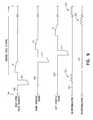
- FIG. 9illustrates CRM pacing and neural stimulation over the course of a cardiac cycle, according to various embodiments of the present subject matter.
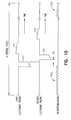
- FIG. 10illustrates CRM pacing and neural stimulation over the course of a cardiac cycle, according to various embodiments of the present subject matter.
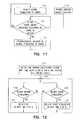
- FIG. 11illustrates a method according to various embodiments of the present subject matter.
- FIG. 12illustrates a method according to various embodiments of the present subject matter.
- Implantable medical devicesare capable of having independent programmable outputs. If stimulation is delivered simultaneously from capacitive coupled outputs programmed to different pacing voltages, unexpected current pathways are created between outputs. These unexpected currents can add or subtract from the intended current pathway.
- One problem associated with these unexpected current pathways from simultaneous pacinginvolves changes in the capture thresholds from the expected capture threshold for the electrodes. Stimulating the outputs one at a time, with a small period of time (e.g. 1 millisecond) separating the end of one stimulation pulse for one output and the beginning of another stimulation pulse for another output, such that the pacing stimulation does not overlap avoids complex intersite current pathways.
- the present subject matteraddresses undesirable interactions that may occur when neural stimulation is provided simultaneously with another energy discharge, whether for therapy or diagnostic purposes.
- another energy dischargeinclude another neural stimulation to a different neural target, a pulse for an impedance measurement such as a minute ventilation pulse, and a discharge associated with a CRM therapy such as a pacing pulse, a recharge pulse and a defibrillation pulse.
- the algorithms of the therapy(ies)would simultaneously provide neural stimulation and an energy discharge, the present subject matter overrides the algorithms to stagger the neural stimulation and the other energy discharge.
- a few millisecondsis sufficient to prevent electrical interaction.
- a few millisecond dischargetypically will not diminish the effectiveness from a physiological perspective.
- FIG. 1illustrates a system 100 including an implantable medical device (IMD) 101 and a programmer 102 , according to various embodiments of the present subject matter.
- IMDimplantable medical device
- Various embodiments of the IMD 101include neural stimulator functions only, and various embodiments include a combination of NS and CRM functions.
- the IMDcan be designed to deliver other therapies, such as drug therapies, along with the neural stimulation and/or CRM therapies.
- the IMD and programmerare capable of wirelessly communicating data and instructions.
- the programmer and IMDuse telemetry coils to wirelessly communicate data and instructions.
- the programmercan be used to adjust the programmed therapy provided by the IMD, and the IMD can report device data (such as battery and lead resistance) and therapy data (such as sense and stimulation data) to the programmer using radio telemetry, for example.
- FIG. 1illustrates an implantable medical device (IMD). Aspects of the present subject matter can be practiced using external devices. FIG. 1 also illustrates that IMD communicating with a programmer. The IMD can also wirelessly communicate directly with a personal digital assistant or other electronic device such as would be used in an advanced patient management (APM) system, which can organize and perform calculations based on recorded data, and later provide the data to a programmer.
- IMDimplantable medical device
- FIG. 2illustrates a system diagram of an embodiment of an implantable medical device configured for multi-site stimulation and sensing.
- This diagramprovides another example of an IMD capable of performing a neural stimulation therapy and a number of CRM therapies.
- Pacingas used in the discussion of this figure, relates to electrical stimulation.
- the stimulation for a given channelincludes stimulation to capture myocardia, neural stimulation or both pacing and neural stimulation.
- Three examples of sensing and pacing channels, such as can be used in CRM therapy,are designated “A” through “C”.
- the illustrated channelscomprise bipolar leads with ring electrodes 203 A-C and tip electrodes 204 A-C, sensing amplifiers 205 A-C, pulse generators 206 A-C, and channel interfaces 207 A-C.
- Each of these channelsthus includes a stimulation channel extending between the pulse generator the electrode and a sensing channel extending between the sense amplifier and the electrode.
- the channel interfaces 207 A-Ccommunicate bidirectionally with microprocessor 208 , and each interface may include analog-to-digital converters for digitizing sensing signal inputs from the sensing amplifiers and registers that can be written to by the microprocessor in order to output pacing pulses, change the pacing pulse amplitude, and adjust the gain and threshold values for the sensing amplifiers.
- the sensing circuitrydetects a chamber sense, either an atrial sense or ventricular sense, when an electrogram signal (i.e., a voltage sensed by an electrode representing cardiac electrical activity) generated by a particular channel exceeds a specified detection threshold.
- Algorithms, including a number of adjustable parameters, used in particular stimulation modesemploy such senses to trigger or inhibit stimulation, and the intrinsic atrial and/or ventricular rates can be detected by measuring the time intervals between atrial and ventricular senses, respectively
- the switching network 209is used to switch the electrodes to the input of a sense amplifier in order to detect intrinsic cardiac activity and to the output of a pulse generator in order to deliver stimulation.
- the switching networkalso enables the device to sense or stimulate either in a bipolar mode using both the ring and tip electrodes of a lead or in a unipolar mode using only one of the electrodes of the lead with the device housing or can 210 serving as a ground electrode or another electrode on another lead serving as the ground electrode.
- a shock pulse generator 211is also interfaced to the controller for delivering a defibrillation shock via a pair of shock electrodes 212 to the atria or ventricles upon detection of a shockable tachyarrhythmia.
- Channel interface 213 and sense amplifier 214provide a connection between the microprocessor and the switch to receive a sensed signal from a sensor 215 for use to guide therapy.
- Channel interface 217provides a connection between the microprocessor 208 and a neural stimulator 218 , which provides neural stimulation to the neural stimulation electrodes 216 .
- the controller or microprocessorcontrols the overall operation of the device in accordance with programmed instructions and a number of adjustable parameters stored in memory 219 , including controlling the delivery of stimulation (including neural stimulation and CRM pacing, defibrillation and recharge pulses) via the channels, interpreting sense signals received from the sensing channels, and implementing timers for defining escape intervals and sensory refractory periods.
- the controlleris capable of operating the device in a number of programmed stimulation modes which define how pulses are output in response to sensed events and expiration of time intervals.
- Most pacemakers for treating bradycardiaare programmed to operate synchronously in a so-called demand mode where sensed cardiac events occurring within a defined interval either trigger or inhibit a pacing pulse.
- Inhibited stimulation modesutilize escape intervals to control pacing in accordance with sensed intrinsic activity such that a stimulation pulse is delivered to a heart chamber during a cardiac cycle only after expiration of a defined escape interval during which no intrinsic beat by the chamber is detected. Escape intervals for ventricular stimulation can be restarted by ventricular or atrial events, the latter allowing the pacing to track intrinsic atrial beats.
- a telemetry interface 220is also provided which enables the controller to communicate with an external programmer or remote monitor.
- FIG. 3illustrates an implantable medical device (IMD) 321 such as shown at 101 in FIG. 1 having a neural stimulation (NS) component 322 and cardiac rhythm management (CRM) component 323 , according to various embodiments of the present subject matter.
- the IMD in FIG. 3provides another illustration in addition to the IMD in FIG. 2 .
- the illustrated device 321includes a controller 324 and a memory 325 .
- the controllerincludes hardware, software, or a combination of hardware and software to perform the neural stimulation and CRM functions.
- the programmed therapy applications discussed in this disclosureare capable of being stored as computer-readable instructions embodied in memory and executed by a processor.
- the controllerincludes a processor to execute instructions embedded in memory to perform the neural stimulation and CRM functions.
- the illustrated device 321further includes a transceiver 326 and associated circuitry for use to communicate with a programmer or another external or internal device.
- Various embodimentsinclude a telemetry coil.
- the CRM therapy section 323includes components, under the control of the controller, to stimulate a heart and/or sense cardiac signals using one or more electrodes.
- the CRM therapy sectionincludes a pulse generator 327 for use to provide an electrical signal through an electrode to stimulate a heart, and further includes sense circuitry 328 to detect and process sensed cardiac signals.
- An interface 329is generally illustrated for use to communicate between the controller 324 and the pulse generator 327 and sense circuitry 328 .
- Three electrodesare illustrated as an example for use to provide CRM therapy. However, the present subject matter is not limited to a particular number of electrode sites. Each electrode may include its own pulse generator and sense circuitry. However, the present subject matter is not so limited.
- the pulse generating and sensing functionscan be multiplexed to function with multiple electrodes.
- the NS therapy section 322includes components, under the control of the controller, to stimulate a neural stimulation target and/or sense ANS parameters associated with nerve activity or surrogates of ANS parameters such as blood pressure and respiration.
- Three interfaces 330are illustrated for use to provide ANS therapy. However, the present subject matter is not limited to a particular number interfaces, or to any particular stimulating or sensing functions.
- Pulse generators 331are used to provide electrical pulses to an electrode for use to stimulate a neural stimulation target.
- the pulse generatorincludes circuitry to set, and in some embodiments change, the amplitude of the stimulation pulse, the frequency of the stimulation pulse, the burst frequency of the pulse, and the morphology of the pulse such as a square wave, triangle wave, sinusoidal wave, and waves with desired harmonic components to mimic white noise or other signals.
- Sense circuits 332are used to detect and process signals from a sensor, such as a sensor of nerve activity, blood pressure, respiration, and the like.
- the interfaces 330are generally illustrated for use to communicate between the controller 324 and the pulse generator 331 and sense circuitry 332 . Each interface, for example, may be used to control a separate lead.
- Various embodiments of the NS therapy sectiononly include a pulse generator to stimulate neural targets such as baroreceptors, nerve trunks, and cardiac fat pads.
- the lead(s) and the electrode(s) on the leadsare physically arranged with respect to the heart in a fashion that enables the electrodes to properly transmit pulses and sense signals from the heart, and with respect to neural targets to stimulate, and in some embodiments sense neural traffic from, the neural targets.
- neural targetsinclude both efferent and afferent pathways, such as baroreceptors, nerve trunks and branches such as the vagus nerve and its cardiac branches, and cardiac fat pads, to provide a desired neural stimulation therapy.
- the configurationcan be programmed to use a particular electrode or electrodes.
- the leads of the deviceinclude one or more leads to provide CRM therapy, such as atrial pacing, right and/or left ventricular pacing, and/or defibrillation.
- the devicealso contains at least on neural stimulation lead which is placed in an appropriate location. Some embodiments perform neural stimulation and CRM therapy using the same lead.
- neural stimulation leadsinclude: an expandable stimulation lead placed in the pulmonary artery in proximity of a high concentration of baroreceptors; an intravascularly-fed lead placed proximate to a cardiac fat pad to transvascularly stimulate the fat pad; an epicardial lead with an electrode placed in or proximate to the fat pad; a cuff electrode placed around the aortic, carotid, or vagus nerve; and an intravascularly-fed lead placed to transvascularly stimulate the aortic, carotid or vagus nerve.
- Other lead placements to stimulate other neural targetsmay be used.
- the controllercontrols delivery of the electrical pulses using a plurality of parameters for at least one programmed electrical therapy of a first electrical therapy type.
- the controlleris adapted to prevent different stimulus, or energy discharges, from occurring simultaneously with a neural stimulation.
- FIG. 4illustrates a pair of electrodes such as can be used provide an energy discharge, and a desired current path 433 between the electrodes and through tissue.
- FIG. 5illustrates a first pair of electrodes A 1 and A 2 for use in providing a first desired energy discharge via desired current path 533 A, and a second pair of electrodes B 1 and B 2 for use in providing a second desired energy discharge via desired current path 533 B.
- other unintended current pathsmay be presence if there is a potential difference between the electrodes.
- Currents in these unintended current paths 534 - 537can interfere with the current in the intended current paths 533 A and 533 B.
- the unintended currentcan be summed with the intended current or subtracted from the intended current.
- the figuresillustrate tissue impedance via a simple resistive network. Capacitive and inductive components in the stimulation channels in the lead(s) and IMD can also provide an adverse interaction for the intended current paths.
- FIGS. 6A and 6Billustrates an electrical schematic of a neural stimulator with two independent pacing circuits and with two energy discharge outputs 638 A and 638 B, and further illustrates desired current paths and undesired current paths, respectively, for the two energy discharge outputs.
- the illustrated deviceincludes energy sources 639 A and 639 B associated with each output.
- Three electrodes 640 A, 640 B and 640 Care schematically illustrated, along with tissue resistances R Tissue between electrodes 640 A and 640 B for output 638 A and between electrodes 640 B and 640 C for output 638 B.
- the figureillustrates that energy discharge outputs 638 A and 638 B associated with the two independent pacing circuits 641 A and 641 B share electrode 640 B.
- the figurealso illustrates a number of switches, capacitors and resistances to model the independent pacing circuits of the neural stimulator.
- FIG. 6Aillustrates the desired current paths 642 A and 642 B for each of the independent pacing circuits
- FIG. 6Billustrates the unintended current paths 643 A, 643 B and 643 C between the two independent pacing circuits 641 A and 642 B.
- the aberrant current pathsare present during stimulations (neural stimulation, pacing, recharge cycles, and impedance measurements.
- the aberrant current pathscorrupt the charge balance between the pacing and recharge pulses. This improper charge balance results in a significant capture threshold increase of a site with the lowest independent capture threshold.
- the increase in the capture thresholdis dependent on the pacing impedance, voltage and lead location.
- the present subject matterrelates to an implantable system that provides neural stimulation at multiple sites, or both neural stimulation and CRM therapy (such as pacing, defibrillation, CRT or a combination). Both these functions could be contained in the same device, or independent implantable devices that communicate through lead-based or leadless means.
- some system embodimentsinclude a device that includes port(s), stimulator circuit(s), and a controller to control delivery of both the neural stimulation and the other energy discharge.
- Some system embodimentsinclude a device that includes port(s), stimulator circuit(s), a first controller to control delivery of the neural stimulation, and a second controller to control delivery of the other energy discharge, where the second controller is adapted to interrupt delivery of the neural stimulation when the other energy discharge is occurring.
- Some system embodimentsinclude a device that includes port(s), stimulator circuit(s), a first controller to control delivery of the neural stimulation, and a second controller to control delivery of the other energy discharge, where the first controller is adapted to prevent delivery of the neural stimulation when the other energy discharge is occurring.
- Some system embodimentsinclude a first device to deliver neural stimulation and a second device to deliver another energy discharge and to communicate with the first device, where each of the first and second devices include port(s) to connect lead(s), stimulator circuit(s), and controller(s).
- the implantable systemprevents the simultaneous release of two or more sources of energy, preventing pulse attenuation or reversal that would otherwise occur.
- the sources of energyinclude cardiac pacing, neural stimulation, recharging, minute ventilation pulses, etc.
- Various embodimentsstagger the application of neural stimulation therapy with the application of other therapies. For example, if a cardiac pacing is required during a prolonged (e.g. 10 second) period of neural stimulation, short windows can be created in the neural stimulation burst during which cardiac pacing could occur.
- the present subject matterprovides a solution for pulse attenuation or reversal that may result from the simultaneous application of neural stimulation and cardiac pacing.
- FIG. 7illustrates neural stimulation to three neural targets 744 A, 744 B and 744 C, whose stimulation is staggered to prevent simultaneous neural stimulation, according to various embodiments of the present subject matter.
- a controllerstops a neural stimulation burst (e.g. 744 A at 745 ) before beginning another neural stimulation burst (e.g. 744 B at 745 ).
- the duration of each neural stimulation burstis able to vary, since the controller controls the starting and stopping of each neural stimulation 744 A, 744 B and 744 C.
- FIG. 8illustrates neural stimulation to three neural targets 844 A, 844 B, 844 C, whose stimulation is staggered using predetermined time slots 845 A, 845 B, 845 C, for a predetermined time period 846 within a time domain multiplexing scheme to prevent simultaneous neural stimulation, according to various embodiments of the present subject matter.
- the time slotscan be of equal duration with respect to each other, or some time slots can be longer or shorter than other time slots.
- the controllercontrols the delivery of the neural stimulation to remain in the predetermined time slot for the neural target. In this illustrated embodiment, the controller only needs to apply the different therapies 844 A, 844 B and 844 C in its respective time slot, and does not need to determine when a first therapy is ready to be applied, and interrupt a second therapy to allow the first therapy to be applied.
- FIG. 9illustrates CRM pacing and neural stimulation over the course of a cardiac cycle, according to various embodiments of the present subject matter.
- Pacing pulsesare represented at 947 .
- the illustrated systempaces 947 the right atrium 948 , the right ventricle 949 , and the left ventricle 950 .
- the figurealso illustrates recharge pulses 951 used to reduce an afterpotential resulting from the paces 947 .
- an afterpotential of opposite chargeis induced in the tissue (e.g. myocardium) at the interface between the tissue and stimulating electrode.
- tissuee.g. myocardium
- cathodal stimulationfor example, a negatively charged electrode is surrounded by an excess of positively charged ions, and negatively charged ions are repelled.
- the electrode-tissue interfaceis polarized.
- the polarizationis related to a number of factors, including the amplitude and duration of the pacing stimulus, and the radius, surface area, geometry, surface structure, and chemical composition of the electrode.
- the afterpotentialis temporary and exponentially decays to neutrality.
- the temporary polarizationcan be represented as a voltage source at the tissue-electrode interface.
- Afterpotentialscan cause an inappropriate inhibition of a pacing pulse unless the sensing circuits are suitably blanked for a time until the afterpotential sufficiently decays.
- the afterpotentialcan also change the capture threshold. For example, if a negative potential is applied to the electrode to provide cathodal stimulation in the presence of a positive afterpotential, the negative potential needs to be more negative to compensate for the positive afterpotential and still provide sufficient stimulus to capture the myocardium.
- the recharge pulse 951reduces the afterpotential. During the recharge pulse, the electrode polarity is reversed for a period of time following the pulse, which diminishes the polarization at the interface between the electrode and myocardium.
- Electrode-tissue interfacescan also be polarized after neural stimulation pulses.
- a recharge pulsecan also be used to reduce the after potential following neural stimulation.
- FIG. 9also illustrates neural stimulation 952 to two neural targets 953 and 954 .
- only one energy discharge(pace, recharge, neural stimulation) is delivered at a time. That is, the energy discharges are staggered such that one energy discharge completes before another energy discharge begins.
- the separation between the end of one discharge and the beginning of another dischargecan be on the order of about 1 ms to prevent the undesired current paths between electrodes.
- FIG. 10illustrates CRM pacing and neural stimulation over the course of a cardiac cycle, according to various embodiments of the present subject matter.
- the figurerepresents three types of energy discharges. They are a pace 1047 , recharge 1051 and neural stimulation 1052 . Defibrillation pulses and current provided to conduct impedance measurement, such as a transthoracic impedance measurement, are others type of energy discharges.
- the first electrodeis paced, then the second electrode is paced, then the first electrode is recharged to remove the afterpotential, and then the second electrode is recharged to remove the afterpotential.
- the neural stimulationis provided during portions of the cardiac cycle that are not used to provide the CRM pacing and recharge functions.
- FIG. 11illustrates a method according to various embodiments of the present subject matter.
- neural stimulationis delivered to a neural stimulation target at 1153 .
- a neural stimulation targetThere are a number of ways in which neural stimulation can be delivered to a neural target.
- Some embodimentsdeliver neural stimulation to a baroreceptor.
- an expandable leadcan be intravascularly placed in a vessel, such as a pulmonary artery, proximate to a baroreceptor.
- Some embodimentsdeliver neural stimulation to a cardiac fat pad.
- the cardiac fat padcan be stimulated using an intravascularly-fed lead to transvascularly stimulate the cardiac fat pad, or can be stimulated using an epicardial lead to place an electrode in or proximate to the cardiac fat pad for use in stimulating the cardiac fat pad.
- Some embodimentsdeliver neural stimulation to a nerve trunk, such as an aortic nerve, a carotid nerve or a vagus nerve.
- a nerve trunksuch as an aortic nerve, a carotid nerve or a vagus nerve.
- the nerve trunkcan be stimulated using a nerve cuff placed around the nerve trunk or using an intravascularly-fed lead to transvascularly stimulate the nerve trunk.
- Another energy dischargeis provided at 1154 .
- Examples of such energy dischargesinclude pacing pulses from a cardiac rhythm management therapy such as a cardiac resynchronization therapy (CRT), a defibrillation shock, a recharge pulse to depolarize an interface between tissue and the electrode, energy discharged to measure impedance such as a minute ventilation pulse, and another neural stimulation to another neural stimulation target.
- CTRcardiac resynchronization therapy
- a defibrillation shocka recharge pulse to depolarize an interface between tissue and the electrode
- energy discharged to measure impedancesuch as a minute ventilation pulse
- another neural stimulationto another neural stimulation target.
- some embodimentsreceive an interrupt delivered from a CRM module to disable neural stimulation delivery in preparation for an energy discharge from the CRM module.
- delivery of the neural stimulation to the neural stimulation targetis prevented when the other energy discharge is occurring or going to occur.
- the processreturns from 1156 to 1155 to determine if the other energy discharge is still occurring. If, at 1155 , the other energy discharge is not occurring or an indication is not received that it will be occurring, the process proceeds from 1155 to 1153 to continue delivering the neural stimulation to the target in accordance with the neural stimulation therapy.
- FIG. 12illustrates a method according to various embodiments of the present subject matter.
- a time division multiplexing (TDM) schemeis defined for a time period.
- the TDM schemedefines at least time slots A and B within the time period.
- An example of a time periodis a cardiac cycle, which provide some benefits for devices that apply both neural stimulation and CRM therapy.
- Other time periodsmay be used.
- a device that provides neural stimulation at multiple neural stimulation targetsmay use other time periods.
- other stimulatione.g. pacing, recharging, other neural stimulation, defibrillation, impedance measurement
- neural stimulationis to be delivered, the process proceeds from 1258 to 1260 where the neural stimulation is delivered in the next time slot A. If neural stimulation is not to be delivered, the process proceeds from 1258 to 1262 . If the other stimulation is to be delivered, the process proceeds from 1259 to 1261 where the other stimulation is delivered in the next time slot B. If the other stimulation is not to be delivered, the process proceeds from 1259 to 1262 .
- modules and other circuitry shown and described hereincan be implemented using software, hardware, and combinations of software and hardware. As such, the illustrated modules and circuitry are intended to encompass software implementations, hardware implementations, and software and hardware implementations.
- the methods illustrated in this disclosureare not intended to be exclusive of other methods within the scope of the present subject matter. Those of ordinary skill in the art will understand, upon reading and comprehending this disclosure, other methods within the scope of the present subject matter.
- the above-identified embodiments, and portions of the illustrated embodimentsare not necessarily mutually exclusive. These embodiments, or portions thereof, can be combined.
- the methods provided aboveare implemented as a computer data signal embodied in a carrier wave or propagated signal, that represents a sequence of instructions which, when executed by a processor cause the processor to perform the respective method.
- methods provided aboveare implemented as a set of instructions contained on a computer-accessible medium capable of directing a processor to perform the respective method.
- the mediumis a magnetic medium, an electronic medium, or an optical medium.
Landscapes
- Health & Medical Sciences (AREA)
- Cardiology (AREA)
- Life Sciences & Earth Sciences (AREA)
- Engineering & Computer Science (AREA)
- Biomedical Technology (AREA)
- Nuclear Medicine, Radiotherapy & Molecular Imaging (AREA)
- Radiology & Medical Imaging (AREA)
- Heart & Thoracic Surgery (AREA)
- Animal Behavior & Ethology (AREA)
- General Health & Medical Sciences (AREA)
- Public Health (AREA)
- Veterinary Medicine (AREA)
- Neurology (AREA)
- Neurosurgery (AREA)
- Electrotherapy Devices (AREA)
Abstract
Description
Claims (43)
Priority Applications (5)
| Application Number | Priority Date | Filing Date | Title |
|---|---|---|---|
| US11/110,542US7881782B2 (en) | 2005-04-20 | 2005-04-20 | Neural stimulation system to prevent simultaneous energy discharges |
| EP06750826.7AEP1899003B1 (en) | 2005-04-20 | 2006-04-20 | Neural stimulation system to prevent simultaneous discharge |
| JP2008507870AJP5113738B2 (en) | 2005-04-20 | 2006-04-20 | Neural stimulation system to prevent simultaneous release |
| PCT/US2006/014877WO2006113871A1 (en) | 2005-04-20 | 2006-04-20 | Neural stimulation system to prevent simultaneous discharge |
| US13/007,739US8831718B2 (en) | 2005-04-20 | 2011-01-17 | Neural stimulation system to prevent simultaneous energy discharges |
Applications Claiming Priority (1)
| Application Number | Priority Date | Filing Date | Title |
|---|---|---|---|
| US11/110,542US7881782B2 (en) | 2005-04-20 | 2005-04-20 | Neural stimulation system to prevent simultaneous energy discharges |
Related Child Applications (1)
| Application Number | Title | Priority Date | Filing Date |
|---|---|---|---|
| US13/007,739ContinuationUS8831718B2 (en) | 2005-04-20 | 2011-01-17 | Neural stimulation system to prevent simultaneous energy discharges |
Publications (2)
| Publication Number | Publication Date |
|---|---|
| US20060241699A1 US20060241699A1 (en) | 2006-10-26 |
| US7881782B2true US7881782B2 (en) | 2011-02-01 |
Family
ID=36867558
Family Applications (2)
| Application Number | Title | Priority Date | Filing Date |
|---|---|---|---|
| US11/110,542Expired - Fee RelatedUS7881782B2 (en) | 2005-04-20 | 2005-04-20 | Neural stimulation system to prevent simultaneous energy discharges |
| US13/007,739Expired - Fee RelatedUS8831718B2 (en) | 2005-04-20 | 2011-01-17 | Neural stimulation system to prevent simultaneous energy discharges |
Family Applications After (1)
| Application Number | Title | Priority Date | Filing Date |
|---|---|---|---|
| US13/007,739Expired - Fee RelatedUS8831718B2 (en) | 2005-04-20 | 2011-01-17 | Neural stimulation system to prevent simultaneous energy discharges |
Country Status (4)
| Country | Link |
|---|---|
| US (2) | US7881782B2 (en) |
| EP (1) | EP1899003B1 (en) |
| JP (1) | JP5113738B2 (en) |
| WO (1) | WO2006113871A1 (en) |
Cited By (25)
| Publication number | Priority date | Publication date | Assignee | Title |
|---|---|---|---|---|
| US20060095080A1 (en)* | 2004-11-04 | 2006-05-04 | Cardiac Pacemakers, Inc. | System and method for filtering neural stimulation |
| US20080021507A1 (en)* | 2003-12-24 | 2008-01-24 | Cardiac Pacemakers, Inc. | Sensing with compensation for neural stimulator |
| US20110015690A1 (en)* | 2006-12-22 | 2011-01-20 | Pacesetter, Inc. | Neurostimulation and Neurosensing Techniques to Optimize Atrial Anti-Tachycardia Pacing for Prevention of Atrial Tachyarrhythmias |
| US20110112592A1 (en)* | 2005-04-20 | 2011-05-12 | Imad Libbus | Neural stimulation system to prevent simultaneous energy discharges |
| US8688213B2 (en) | 2011-11-28 | 2014-04-01 | Cardiac Pacemakers, Inc. | Managing cross therapy sensing in a multiple therapy implantable device |
| US8792992B2 (en) | 2010-11-10 | 2014-07-29 | Cardiac Pacemakers, Inc. | Low-power system and methods for neuromodulation |
| US8805502B2 (en) | 2011-12-27 | 2014-08-12 | Cardiac Pacemakers, Inc. | Managing cross therapy delivery in a multiple therapy implantable device |
| US8942819B2 (en) | 2010-06-16 | 2015-01-27 | Cardiac Pacemakers, Inc. | Automatic neural stimulation titration sweep |
| US9005106B2 (en) | 2008-01-31 | 2015-04-14 | Enopace Biomedical Ltd | Intra-aortic electrical counterpulsation |
| US9079032B2 (en) | 2010-11-10 | 2015-07-14 | Cardiac Pacemakers, Inc. | Power supply management for implantable neurostimulation devices |
| US9339652B2 (en)* | 2005-03-11 | 2016-05-17 | Cardiac Pacemakers, Inc. | Neural stimulation system for cardiac fat pads |
| US9480790B2 (en) | 2005-09-12 | 2016-11-01 | The Cleveland Clinic Foundation | Methods and systems for treating acute heart failure by neuromodulation |
| US9526637B2 (en) | 2011-09-09 | 2016-12-27 | Enopace Biomedical Ltd. | Wireless endovascular stent-based electrodes |
| US9649487B2 (en) | 2010-08-05 | 2017-05-16 | Enopace Biomedical Ltd. | Enhancing perfusion by contraction |
| US10172549B2 (en) | 2016-03-09 | 2019-01-08 | CARDIONOMIC, Inc. | Methods of facilitating positioning of electrodes |
| US10493278B2 (en) | 2015-01-05 | 2019-12-03 | CARDIONOMIC, Inc. | Cardiac modulation facilitation methods and systems |
| US10576273B2 (en) | 2014-05-22 | 2020-03-03 | CARDIONOMIC, Inc. | Catheter and catheter system for electrical neuromodulation |
| US10722716B2 (en) | 2014-09-08 | 2020-07-28 | Cardionomia Inc. | Methods for electrical neuromodulation of the heart |
| US10779965B2 (en) | 2013-11-06 | 2020-09-22 | Enopace Biomedical Ltd. | Posts with compliant junctions |
| US10894160B2 (en) | 2014-09-08 | 2021-01-19 | CARDIONOMIC, Inc. | Catheter and electrode systems for electrical neuromodulation |
| US11077298B2 (en) | 2018-08-13 | 2021-08-03 | CARDIONOMIC, Inc. | Partially woven expandable members |
| US11197992B2 (en) | 2005-07-25 | 2021-12-14 | Enopace Biomedical Ltd. | Electrical stimulation of blood vessels |
| US11400299B1 (en) | 2021-09-14 | 2022-08-02 | Rainbow Medical Ltd. | Flexible antenna for stimulator |
| US11559687B2 (en) | 2017-09-13 | 2023-01-24 | CARDIONOMIC, Inc. | Methods for detecting catheter movement |
| US11607176B2 (en) | 2019-05-06 | 2023-03-21 | CARDIONOMIC, Inc. | Systems and methods for denoising physiological signals during electrical neuromodulation |
Families Citing this family (58)
| Publication number | Priority date | Publication date | Assignee | Title |
|---|---|---|---|---|
| US8914114B2 (en) | 2000-05-23 | 2014-12-16 | The Feinstein Institute For Medical Research | Inhibition of inflammatory cytokine production by cholinergic agonists and vagus nerve stimulation |
| US7460906B2 (en) | 2003-12-24 | 2008-12-02 | Cardiac Pacemakers, Inc. | Baroreflex stimulation to treat acute myocardial infarction |
| US20050149132A1 (en) | 2003-12-24 | 2005-07-07 | Imad Libbus | Automatic baroreflex modulation based on cardiac activity |
| US7509166B2 (en) | 2003-12-24 | 2009-03-24 | Cardiac Pacemakers, Inc. | Automatic baroreflex modulation responsive to adverse event |
| EP1712542A4 (en)* | 2004-02-05 | 2008-01-16 | Idemitsu Kosan Co | ADAMANTAN DERIVATIVES AND METHOD FOR THE PRODUCTION THEREOF |
| US10912712B2 (en) | 2004-03-25 | 2021-02-09 | The Feinstein Institutes For Medical Research | Treatment of bleeding by non-invasive stimulation |
| WO2006073484A2 (en) | 2004-12-27 | 2006-07-13 | North Shore-Long Island Jewish Research Institute | Treating inflammatory disorders by electrical vagus nerve stimulation |
| US11207518B2 (en) | 2004-12-27 | 2021-12-28 | The Feinstein Institutes For Medical Research | Treating inflammatory disorders by stimulation of the cholinergic anti-inflammatory pathway |
| US7660628B2 (en) | 2005-03-23 | 2010-02-09 | Cardiac Pacemakers, Inc. | System to provide myocardial and neural stimulation |
| US8473049B2 (en) | 2005-05-25 | 2013-06-25 | Cardiac Pacemakers, Inc. | Implantable neural stimulator with mode switching |
| US8406876B2 (en) | 2005-04-05 | 2013-03-26 | Cardiac Pacemakers, Inc. | Closed loop neural stimulation synchronized to cardiac cycles |
| US7493161B2 (en) | 2005-05-10 | 2009-02-17 | Cardiac Pacemakers, Inc. | System and method to deliver therapy in presence of another therapy |
| US7570999B2 (en) | 2005-12-20 | 2009-08-04 | Cardiac Pacemakers, Inc. | Implantable device for treating epilepsy and cardiac rhythm disorders |
| US8457734B2 (en) | 2006-08-29 | 2013-06-04 | Cardiac Pacemakers, Inc. | System and method for neural stimulation |
| WO2009029614A1 (en) | 2007-08-27 | 2009-03-05 | The Feinstein Institute For Medical Research | Devices and methods for inhibiting granulocyte activation by neural stimulation |
| US9662490B2 (en) | 2008-03-31 | 2017-05-30 | The Feinstein Institute For Medical Research | Methods and systems for reducing inflammation by neuromodulation and administration of an anti-inflammatory drug |
| WO2009146030A1 (en) | 2008-03-31 | 2009-12-03 | The Feinstein Institute For Medical Research | Methods and systems for reducing inflammation by neuromodulation of t-cell activity |
| US8005539B2 (en)* | 2008-10-31 | 2011-08-23 | Medtronic, Inc. | Implantable medical device crosstalk evaluation and mitigation |
| US20100114209A1 (en)* | 2008-10-31 | 2010-05-06 | Medtronic, Inc. | Communication between implantable medical devices |
| US9289613B2 (en) | 2008-10-31 | 2016-03-22 | Medtronic, Inc. | Interdevice impedance |
| US8612020B2 (en)* | 2008-10-31 | 2013-12-17 | Medtronic, Inc. | Implantable therapeutic nerve stimulator |
| US8774918B2 (en)* | 2008-10-31 | 2014-07-08 | Medtronic, Inc. | Implantable medical device crosstalk evaluation and mitigation |
| EP2370168B1 (en)* | 2008-10-31 | 2012-10-03 | Medtronic, Inc. | Interference mitigation for implantable device recharging |
| US8532779B2 (en)* | 2008-10-31 | 2013-09-10 | Medtronic, Inc. | Implantable medical device crosstalk evaluation and mitigation |
| US8688210B2 (en)* | 2008-10-31 | 2014-04-01 | Medtronic, Inc. | Implantable medical device crosstalk evaluation and mitigation |
| US9026206B2 (en)* | 2008-10-31 | 2015-05-05 | Medtronic, Inc. | Therapy system including cardiac rhythm therapy and neurostimulation capabilities |
| US9775987B2 (en)* | 2008-10-31 | 2017-10-03 | Medtronic, Inc. | Implantable medical device crosstalk evaluation and mitigation |
| US8452394B2 (en)* | 2008-10-31 | 2013-05-28 | Medtronic, Inc. | Implantable medical device crosstalk evaluation and mitigation |
| US8301263B2 (en)* | 2008-10-31 | 2012-10-30 | Medtronic, Inc. | Therapy module crosstalk mitigation |
| US8249708B2 (en)* | 2008-10-31 | 2012-08-21 | Medtronic, Inc. | Implantable medical device crosstalk evaluation and mitigation |
| US8406893B2 (en)* | 2008-10-31 | 2013-03-26 | Medtronic, Inc. | Interference mitigation for implantable device recharging |
| US9597505B2 (en)* | 2008-10-31 | 2017-03-21 | Medtronic, Inc. | Implantable medical device crosstalk evaluation and mitigation |
| US8260412B2 (en)* | 2008-10-31 | 2012-09-04 | Medtronic, Inc. | Implantable medical device crosstalk evaluation and mitigation |
| US8611996B2 (en)* | 2008-10-31 | 2013-12-17 | Medtronic, Inc. | Implantable medical device crosstalk evaluation and mitigation |
| EP2355893B1 (en) | 2008-11-18 | 2013-12-25 | Setpoint Medical Corporation | Devices for optimizing electrode placement for anti-inflamatory stimulation |
| US9814886B2 (en) | 2009-01-30 | 2017-11-14 | Medtronic, Inc. | Detecting and treating electromechanical dissociation of the heart |
| US8996116B2 (en) | 2009-10-30 | 2015-03-31 | Setpoint Medical Corporation | Modulation of the cholinergic anti-inflammatory pathway to treat pain or addiction |
| US9211410B2 (en) | 2009-05-01 | 2015-12-15 | Setpoint Medical Corporation | Extremely low duty-cycle activation of the cholinergic anti-inflammatory pathway to treat chronic inflammation |
| WO2010144578A2 (en) | 2009-06-09 | 2010-12-16 | Setpoint Medical Corporation | Nerve cuff with pocket for leadless stimulator |
| WO2014169145A1 (en) | 2013-04-10 | 2014-10-16 | Setpoint Medical Corporation | Closed-loop vagus nerve stimulation |
| US9833621B2 (en) | 2011-09-23 | 2017-12-05 | Setpoint Medical Corporation | Modulation of sirtuins by vagus nerve stimulation |
| US8548585B2 (en) | 2009-12-08 | 2013-10-01 | Cardiac Pacemakers, Inc. | Concurrent therapy detection in implantable medical devices |
| EP2515996B1 (en) | 2009-12-23 | 2019-09-18 | Setpoint Medical Corporation | Neural stimulation devices and systems for treatment of chronic inflammation |
| WO2012154865A2 (en) | 2011-05-09 | 2012-11-15 | Setpoint Medical Corporation | Single-pulse activation of the cholinergic anti-inflammatory pathway to treat chronic inflammation |
| US12172017B2 (en) | 2011-05-09 | 2024-12-24 | Setpoint Medical Corporation | Vagus nerve stimulation to treat neurodegenerative disorders |
| US9572983B2 (en) | 2012-03-26 | 2017-02-21 | Setpoint Medical Corporation | Devices and methods for modulation of bone erosion |
| US11311725B2 (en) | 2014-10-24 | 2022-04-26 | Setpoint Medical Corporation | Systems and methods for stimulating and/or monitoring loci in the brain to treat inflammation and to enhance vagus nerve stimulation |
| US11406833B2 (en) | 2015-02-03 | 2022-08-09 | Setpoint Medical Corporation | Apparatus and method for reminding, prompting, or alerting a patient with an implanted stimulator |
| US10596367B2 (en) | 2016-01-13 | 2020-03-24 | Setpoint Medical Corporation | Systems and methods for establishing a nerve block |
| US11471681B2 (en) | 2016-01-20 | 2022-10-18 | Setpoint Medical Corporation | Batteryless implantable microstimulators |
| EP3405255A4 (en) | 2016-01-20 | 2019-10-16 | Setpoint Medical Corporation | IMPLANTABLE MICROSTIMULATORS AND INDUCTION RECHARGE SYSTEMS |
| CN108882885A (en) | 2016-01-20 | 2018-11-23 | 赛博恩特医疗器械公司 | Control of vagus nerve stimulation |
| US10583304B2 (en) | 2016-01-25 | 2020-03-10 | Setpoint Medical Corporation | Implantable neurostimulator having power control and thermal regulation and methods of use |
| US11173307B2 (en) | 2017-08-14 | 2021-11-16 | Setpoint Medical Corporation | Vagus nerve stimulation pre-screening test |
| US11260229B2 (en) | 2018-09-25 | 2022-03-01 | The Feinstein Institutes For Medical Research | Methods and apparatuses for reducing bleeding via coordinated trigeminal and vagal nerve stimulation |
| EP3897818B1 (en)* | 2018-12-20 | 2025-02-12 | Galvani Bioelectronics Limited | Nerve stimulation system |
| WO2020210786A1 (en) | 2019-04-12 | 2020-10-15 | Setpoint Medical Corporation | Vagus nerve stimulation to treat neurodegenerative disorders |
| EP4566539A1 (en) | 2020-05-21 | 2025-06-11 | The Feinstein Institutes for Medical Research | Systems and methods for vagus nerve stimulation |
Citations (50)
| Publication number | Priority date | Publication date | Assignee | Title |
|---|---|---|---|---|
| US4408608A (en) | 1981-04-09 | 1983-10-11 | Telectronics Pty. Ltd. | Implantable tissue-stimulating prosthesis |
| US5161527A (en)* | 1991-02-13 | 1992-11-10 | Telectronics Pacing Systems, Inc. | Apparatus and method for detecting abnormal cardiac rhythms in dual chamber arrhythmia control system |
| US5199428A (en) | 1991-03-22 | 1993-04-06 | Medtronic, Inc. | Implantable electrical nerve stimulator/pacemaker with ischemia for decreasing cardiac workload |
| US5203326A (en)* | 1991-12-18 | 1993-04-20 | Telectronics Pacing Systems, Inc. | Antiarrhythmia pacer using antiarrhythmia pacing and autonomic nerve stimulation therapy |
| US5292338A (en)* | 1992-07-30 | 1994-03-08 | Medtronic, Inc. | Atrial defibrillator employing transvenous and subcutaneous electrodes and method of use |
| US5318592A (en) | 1991-09-12 | 1994-06-07 | BIOTRONIK, Mess- und Therapiegerate GmbH & Co., Ingenieurburo Berlin | Cardiac therapy system |
| US5330507A (en)* | 1992-04-24 | 1994-07-19 | Medtronic, Inc. | Implantable electrical vagal stimulation for prevention or interruption of life threatening arrhythmias |
| US5334221A (en) | 1992-06-30 | 1994-08-02 | Medtronic, Inc. | Method and apparatus for treatment of angina same |
| US5356425A (en) | 1992-06-30 | 1994-10-18 | Medtronic, Inc. | Method and apparatus for treatment of atrial fibrillation and flutter |
| US5411531A (en)* | 1993-09-23 | 1995-05-02 | Medtronic, Inc. | Method and apparatus for control of A-V interval |
| US5578061A (en)* | 1994-06-24 | 1996-11-26 | Pacesetter Ab | Method and apparatus for cardiac therapy by stimulation of a physiological representative of the parasympathetic nervous system |
| US5792187A (en) | 1993-02-22 | 1998-08-11 | Angeion Corporation | Neuro-stimulation to control pain during cardioversion defibrillation |
| US5817131A (en) | 1995-09-08 | 1998-10-06 | Medtronic, Inc. | Method and apparatus for alleviating cardoversion shock pain |
| US5916239A (en) | 1996-03-29 | 1999-06-29 | Purdue Research Foundation | Method and apparatus using vagal stimulation for control of ventricular rate during atrial fibrillation |
| US6006134A (en) | 1998-04-30 | 1999-12-21 | Medtronic, Inc. | Method and device for electronically controlling the beating of a heart using venous electrical stimulation of nerve fibers |
| US6073048A (en) | 1995-11-17 | 2000-06-06 | Medtronic, Inc. | Baroreflex modulation with carotid sinus nerve stimulation for the treatment of heart failure |
| US6134470A (en) | 1998-11-09 | 2000-10-17 | Medtronic, Inc. | Method and apparatus for treating a tachyarrhythmic patient |
| US6341236B1 (en) | 1999-04-30 | 2002-01-22 | Ivan Osorio | Vagal nerve stimulation techniques for treatment of epileptic seizures |
| US6363278B1 (en) | 2000-04-14 | 2002-03-26 | Cardiac Pacemakers, Inc. | Cardiac rhythm management system with staggered pulses for coordination therapy |
| US20030040774A1 (en) | 2001-08-21 | 2003-02-27 | Terry Reese S. | Treatment of congestive heart failure and autonomic cardiovascular drive disorders |
| US20030078623A1 (en) | 2001-10-22 | 2003-04-24 | Weinberg Lisa P. | Implantable lead and method for stimulating the vagus nerve |
| US20030100925A1 (en) | 2001-11-28 | 2003-05-29 | Medtronic, Inc. | Implantable medical device for measuring mechanical heart function |
| US20030181951A1 (en) | 2002-03-25 | 2003-09-25 | Cates Adam W. | Method and apparatus for preventing cardiac arrhythmias with endovascular stimulation |
| WO2003099377A1 (en) | 2002-05-23 | 2003-12-04 | Biocontrol Medical Ltd. | Selective nerve fiber stimulation for treating heart conditions |
| US20030229380A1 (en) | 2002-10-31 | 2003-12-11 | Adams John M. | Heart failure therapy device and method |
| EP1426078A1 (en) | 2002-12-04 | 2004-06-09 | Terumo Kabushiki Kaisha | Heart treatment equipment for preventing fatal arrhythmia |
| US20040172074A1 (en) | 2002-11-25 | 2004-09-02 | Terumo Kabushiki Kaisha | Heart treatment equipment for treating heart failure |
| US20040172075A1 (en) | 1996-04-30 | 2004-09-02 | Shafer Lisa L. | Method and system for vagal nerve stimulation with multi-site cardiac pacing |
| US20040199210A1 (en) | 2002-06-12 | 2004-10-07 | Shelchuk Anne M. | Vagal stimulation for improving cardiac function in heart failure or CHF patients |
| US20040254612A1 (en) | 2003-06-13 | 2004-12-16 | Ezra Omry Ben | Vagal stimulation for anti-embolic therapy |
| US6895273B2 (en)* | 2001-04-06 | 2005-05-17 | Cardiac Pacemakers, Inc. | Temporary tachyarrhythmia therapy modes for electrophysiologic testing |
| US20050143779A1 (en) | 2003-12-24 | 2005-06-30 | Cardiac Pacemakers, Inc. | Baroreflex modulation based on monitored cardiovascular parameter |
| US20050143785A1 (en) | 2003-12-24 | 2005-06-30 | Imad Libbus | Baroreflex therapy for disordered breathing |
| US20050149132A1 (en) | 2003-12-24 | 2005-07-07 | Imad Libbus | Automatic baroreflex modulation based on cardiac activity |
| US20050149133A1 (en) | 2003-12-24 | 2005-07-07 | Imad Libbus | Sensing with compensation for neural stimulator |
| US20050149156A1 (en) | 2003-12-24 | 2005-07-07 | Imad Libbus | Lead for stimulating the baroreceptors in the pulmonary artery |
| US20050149143A1 (en) | 2003-12-24 | 2005-07-07 | Imad Libbus | Baroreflex stimulator with integrated pressure sensor |
| US20050149129A1 (en) | 2003-12-24 | 2005-07-07 | Imad Libbus | Baropacing and cardiac pacing to control output |
| US20050149127A1 (en) | 2003-12-24 | 2005-07-07 | Imad Libbus | Automatic baroreflex modulation responsive to adverse event |
| US20050149126A1 (en) | 2003-12-24 | 2005-07-07 | Imad Libbus | Baroreflex stimulation to treat acute myocardial infarction |
| US20050149131A1 (en) | 2003-12-24 | 2005-07-07 | Imad Libbus | Baroreflex modulation to gradually decrease blood pressure |
| US20050149128A1 (en) | 2003-12-24 | 2005-07-07 | Heil Ronald W.Jr. | Barorflex stimulation system to reduce hypertension |
| US20050261741A1 (en) | 2004-05-20 | 2005-11-24 | Imad Libbus | Combined remodeling control therapy and anti-remodeling therapy by implantable cardiac device |
| US20060079945A1 (en) | 2004-10-12 | 2006-04-13 | Cardiac Pacemakers, Inc. | System and method for sustained baroreflex stimulation |
| US20060106429A1 (en) | 2004-11-18 | 2006-05-18 | Cardiac Pacemakers, Inc. | System and method for closed-loop neural stimulation |
| US20060116737A1 (en) | 2004-11-30 | 2006-06-01 | Cardiac Pacemakers, Inc. | Neural stimulation with avoidance of inappropriate stimulation |
| US7123961B1 (en) | 2002-06-13 | 2006-10-17 | Pacesetter, Inc. | Stimulation of autonomic nerves |
| WO2006113871A1 (en) | 2005-04-20 | 2006-10-26 | Cardiac Pacemakers, Inc. | Neural stimulation system to prevent simultaneous discharge |
| US7184828B2 (en)* | 2000-09-26 | 2007-02-27 | Medtronic, Inc. | Method and system for spinal cord stimulation prior to and during a medical procedure |
| US20070142871A1 (en) | 2005-12-20 | 2007-06-21 | Cardiac Pacemakers, Inc. | Implantable device for treating epilepsy and cardiac rhythm disorders |
Family Cites Families (42)
| Publication number | Priority date | Publication date | Assignee | Title |
|---|---|---|---|---|
| ES226859Y (en)* | 1977-03-03 | 1977-11-16 | RHYTHM CONTROLLED CARDIAC PACEMAKERS BY REGULATORY SIGNALS DETECTED IN THE TRUNKS AND NOT THE NERVOUS RECEPTORS. | |
| US4791931A (en) | 1987-08-13 | 1988-12-20 | Pacesetter Infusion, Ltd. | Demand pacemaker using an artificial baroreceptor reflex |
| US5522854A (en)* | 1994-05-19 | 1996-06-04 | Duke University | Method and apparatus for the prevention of arrhythmia by nerve stimulation |
| EP0688578B1 (en)* | 1994-06-24 | 1999-11-10 | Pacesetter AB | Arrhythmia detector |
| US6449507B1 (en) | 1996-04-30 | 2002-09-10 | Medtronic, Inc. | Method and system for nerve stimulation prior to and during a medical procedure |
| US6185459B1 (en)* | 1998-08-17 | 2001-02-06 | Medtronic, Inc. | Method and apparatus for prevention of atrial tachyarrhythmias |
| US6047210A (en)* | 1998-09-03 | 2000-04-04 | Cardiac Pacemakers, Inc. | Cardioverter and method for cardioverting an atrial tachyarrhythmia while maintaining atrial pacing |
| DE50014442D1 (en)* | 1999-11-30 | 2007-08-09 | Biotronik Gmbh & Co Kg | Device for controlling heart rate and cardiac pumping force |
| US6487450B1 (en)* | 2000-02-24 | 2002-11-26 | Cedars-Sinai Medical Center | System and method for preventing Sudden Cardiac Death by nerve sprouting from right stellate ganglion |
| US6466822B1 (en)* | 2000-04-05 | 2002-10-15 | Neuropace, Inc. | Multimodal neurostimulator and process of using it |
| EP1324709B1 (en)* | 2000-09-26 | 2006-07-12 | Medtronic, Inc. | Medical device for directing blood flow |
| US6850801B2 (en)* | 2001-09-26 | 2005-02-01 | Cvrx, Inc. | Mapping methods for cardiovascular reflex control devices |
| US6522926B1 (en)* | 2000-09-27 | 2003-02-18 | Cvrx, Inc. | Devices and methods for cardiovascular reflex control |
| US6985774B2 (en)* | 2000-09-27 | 2006-01-10 | Cvrx, Inc. | Stimulus regimens for cardiovascular reflex control |
| US7158832B2 (en)* | 2000-09-27 | 2007-01-02 | Cvrx, Inc. | Electrode designs and methods of use for cardiovascular reflex control devices |
| US8086314B1 (en)* | 2000-09-27 | 2011-12-27 | Cvrx, Inc. | Devices and methods for cardiovascular reflex control |
| US7499742B2 (en)* | 2001-09-26 | 2009-03-03 | Cvrx, Inc. | Electrode structures and methods for their use in cardiovascular reflex control |
| US7010345B2 (en)* | 2000-10-26 | 2006-03-07 | Medtronic, Inc. | Method and apparatus to minimize effects of a cardiac insult |
| US7519421B2 (en)* | 2001-01-16 | 2009-04-14 | Kenergy, Inc. | Vagal nerve stimulation using vascular implanted devices for treatment of atrial fibrillation |
| US6788975B1 (en)* | 2001-01-30 | 2004-09-07 | Advanced Bionics Corporation | Fully implantable miniature neurostimulator for stimulation as a therapy for epilepsy |
| US6628988B2 (en)* | 2001-04-27 | 2003-09-30 | Cardiac Pacemakers, Inc. | Apparatus and method for reversal of myocardial remodeling with electrical stimulation |
| US6928320B2 (en)* | 2001-05-17 | 2005-08-09 | Medtronic, Inc. | Apparatus for blocking activation of tissue or conduction of action potentials while other tissue is being therapeutically activated |
| JP2004533297A (en)* | 2001-05-29 | 2004-11-04 | メドトロニック・インコーポレーテッド | Closed loop neuromodulation system for prevention and treatment of heart disease |
| US7778711B2 (en)* | 2001-08-31 | 2010-08-17 | Bio Control Medical (B.C.M.) Ltd. | Reduction of heart rate variability by parasympathetic stimulation |
| US6701188B2 (en)* | 2001-09-06 | 2004-03-02 | Medtronic, Inc. | Controlling noise sources during telemetry |
| US6937896B1 (en)* | 2002-02-26 | 2005-08-30 | Pacesetter, Inc. | Sympathetic nerve stimulator and/or pacemaker |
| US7162303B2 (en)* | 2002-04-08 | 2007-01-09 | Ardian, Inc. | Renal nerve stimulation method and apparatus for treatment of patients |
| US6990372B2 (en)* | 2002-04-11 | 2006-01-24 | Alfred E. Mann Foundation For Scientific Research | Programmable signal analysis device for detecting neurological signals in an implantable device |
| US7885711B2 (en) | 2003-06-13 | 2011-02-08 | Bio Control Medical (B.C.M.) Ltd. | Vagal stimulation for anti-embolic therapy |
| JP4252830B2 (en)* | 2003-03-24 | 2009-04-08 | テルモ株式会社 | Heart treatment equipment |
| JP4213522B2 (en)* | 2003-05-30 | 2009-01-21 | テルモ株式会社 | Heart treatment equipment |
| US7480532B2 (en)* | 2003-10-22 | 2009-01-20 | Cvrx, Inc. | Baroreflex activation for pain control, sedation and sleep |
| US7657312B2 (en)* | 2003-11-03 | 2010-02-02 | Cardiac Pacemakers, Inc. | Multi-site ventricular pacing therapy with parasympathetic stimulation |
| US7783353B2 (en)* | 2003-12-24 | 2010-08-24 | Cardiac Pacemakers, Inc. | Automatic neural stimulation modulation based on activity and circadian rhythm |
| US8200331B2 (en)* | 2004-11-04 | 2012-06-12 | Cardiac Pacemakers, Inc. | System and method for filtering neural stimulation |
| US8126560B2 (en)* | 2003-12-24 | 2012-02-28 | Cardiac Pacemakers, Inc. | Stimulation lead for stimulating the baroreceptors in the pulmonary artery |
| US7840266B2 (en)* | 2005-03-11 | 2010-11-23 | Cardiac Pacemakers, Inc. | Integrated lead for applying cardiac resynchronization therapy and neural stimulation therapy |
| US7769446B2 (en)* | 2005-03-11 | 2010-08-03 | Cardiac Pacemakers, Inc. | Neural stimulation system for cardiac fat pads |
| US7587238B2 (en)* | 2005-03-11 | 2009-09-08 | Cardiac Pacemakers, Inc. | Combined neural stimulation and cardiac resynchronization therapy |
| US7660628B2 (en)* | 2005-03-23 | 2010-02-09 | Cardiac Pacemakers, Inc. | System to provide myocardial and neural stimulation |
| US7493161B2 (en)* | 2005-05-10 | 2009-02-17 | Cardiac Pacemakers, Inc. | System and method to deliver therapy in presence of another therapy |
| US7542800B2 (en)* | 2005-04-05 | 2009-06-02 | Cardiac Pacemakers, Inc. | Method and apparatus for synchronizing neural stimulation to cardiac cycles |
- 2005
- 2005-04-20USUS11/110,542patent/US7881782B2/ennot_activeExpired - Fee Related
- 2006
- 2006-04-20WOPCT/US2006/014877patent/WO2006113871A1/enactiveApplication Filing
- 2006-04-20JPJP2008507870Apatent/JP5113738B2/ennot_activeExpired - Fee Related
- 2006-04-20EPEP06750826.7Apatent/EP1899003B1/ennot_activeNot-in-force
- 2011
- 2011-01-17USUS13/007,739patent/US8831718B2/ennot_activeExpired - Fee Related
Patent Citations (59)
| Publication number | Priority date | Publication date | Assignee | Title |
|---|---|---|---|---|
| US4408608A (en) | 1981-04-09 | 1983-10-11 | Telectronics Pty. Ltd. | Implantable tissue-stimulating prosthesis |
| US5161527A (en)* | 1991-02-13 | 1992-11-10 | Telectronics Pacing Systems, Inc. | Apparatus and method for detecting abnormal cardiac rhythms in dual chamber arrhythmia control system |
| US5199428A (en) | 1991-03-22 | 1993-04-06 | Medtronic, Inc. | Implantable electrical nerve stimulator/pacemaker with ischemia for decreasing cardiac workload |
| US5318592A (en) | 1991-09-12 | 1994-06-07 | BIOTRONIK, Mess- und Therapiegerate GmbH & Co., Ingenieurburo Berlin | Cardiac therapy system |
| US5203326A (en)* | 1991-12-18 | 1993-04-20 | Telectronics Pacing Systems, Inc. | Antiarrhythmia pacer using antiarrhythmia pacing and autonomic nerve stimulation therapy |
| EP0547734A2 (en) | 1991-12-18 | 1993-06-23 | Telectronics N.V. | Pacemaker using antiarrhythmia pacing and autonomic nerve stimulation therapy |
| US5330507A (en)* | 1992-04-24 | 1994-07-19 | Medtronic, Inc. | Implantable electrical vagal stimulation for prevention or interruption of life threatening arrhythmias |
| US5334221A (en) | 1992-06-30 | 1994-08-02 | Medtronic, Inc. | Method and apparatus for treatment of angina same |
| US5356425A (en) | 1992-06-30 | 1994-10-18 | Medtronic, Inc. | Method and apparatus for treatment of atrial fibrillation and flutter |
| US5292338A (en)* | 1992-07-30 | 1994-03-08 | Medtronic, Inc. | Atrial defibrillator employing transvenous and subcutaneous electrodes and method of use |
| US5792187A (en) | 1993-02-22 | 1998-08-11 | Angeion Corporation | Neuro-stimulation to control pain during cardioversion defibrillation |
| US5411531A (en)* | 1993-09-23 | 1995-05-02 | Medtronic, Inc. | Method and apparatus for control of A-V interval |
| US5578061A (en)* | 1994-06-24 | 1996-11-26 | Pacesetter Ab | Method and apparatus for cardiac therapy by stimulation of a physiological representative of the parasympathetic nervous system |
| US5817131A (en) | 1995-09-08 | 1998-10-06 | Medtronic, Inc. | Method and apparatus for alleviating cardoversion shock pain |
| US6073048A (en) | 1995-11-17 | 2000-06-06 | Medtronic, Inc. | Baroreflex modulation with carotid sinus nerve stimulation for the treatment of heart failure |
| US5916239A (en) | 1996-03-29 | 1999-06-29 | Purdue Research Foundation | Method and apparatus using vagal stimulation for control of ventricular rate during atrial fibrillation |
| US20050251216A1 (en) | 1996-04-30 | 2005-11-10 | Medtronic, Inc. | Method and device for electronically controlling the beating of a heart |
| US20040172075A1 (en) | 1996-04-30 | 2004-09-02 | Shafer Lisa L. | Method and system for vagal nerve stimulation with multi-site cardiac pacing |
| US6006134A (en) | 1998-04-30 | 1999-12-21 | Medtronic, Inc. | Method and device for electronically controlling the beating of a heart using venous electrical stimulation of nerve fibers |
| US6134470A (en) | 1998-11-09 | 2000-10-17 | Medtronic, Inc. | Method and apparatus for treating a tachyarrhythmic patient |
| US20020072776A1 (en) | 1999-04-30 | 2002-06-13 | Medtronic, Inc. | Vagal nerve stimulation techniques for treatment of epileptic seizures |
| US6341236B1 (en) | 1999-04-30 | 2002-01-22 | Ivan Osorio | Vagal nerve stimulation techniques for treatment of epileptic seizures |
| US20040138721A1 (en) | 1999-04-30 | 2004-07-15 | Medtronic, Inc. | Vagal nerve stimulation techniques for treatment of epileptic seizures |
| US6363278B1 (en) | 2000-04-14 | 2002-03-26 | Cardiac Pacemakers, Inc. | Cardiac rhythm management system with staggered pulses for coordination therapy |
| US7184828B2 (en)* | 2000-09-26 | 2007-02-27 | Medtronic, Inc. | Method and system for spinal cord stimulation prior to and during a medical procedure |
| US6895273B2 (en)* | 2001-04-06 | 2005-05-17 | Cardiac Pacemakers, Inc. | Temporary tachyarrhythmia therapy modes for electrophysiologic testing |
| US20030040774A1 (en) | 2001-08-21 | 2003-02-27 | Terry Reese S. | Treatment of congestive heart failure and autonomic cardiovascular drive disorders |
| US20030078623A1 (en) | 2001-10-22 | 2003-04-24 | Weinberg Lisa P. | Implantable lead and method for stimulating the vagus nerve |
| US20030100925A1 (en) | 2001-11-28 | 2003-05-29 | Medtronic, Inc. | Implantable medical device for measuring mechanical heart function |
| US20030181951A1 (en) | 2002-03-25 | 2003-09-25 | Cates Adam W. | Method and apparatus for preventing cardiac arrhythmias with endovascular stimulation |
| WO2003099377A1 (en) | 2002-05-23 | 2003-12-04 | Biocontrol Medical Ltd. | Selective nerve fiber stimulation for treating heart conditions |
| US7277761B2 (en) | 2002-06-12 | 2007-10-02 | Pacesetter, Inc. | Vagal stimulation for improving cardiac function in heart failure or CHF patients |
| US20040199210A1 (en) | 2002-06-12 | 2004-10-07 | Shelchuk Anne M. | Vagal stimulation for improving cardiac function in heart failure or CHF patients |
| US7123961B1 (en) | 2002-06-13 | 2006-10-17 | Pacesetter, Inc. | Stimulation of autonomic nerves |
| US20030229380A1 (en) | 2002-10-31 | 2003-12-11 | Adams John M. | Heart failure therapy device and method |
| US20040172074A1 (en) | 2002-11-25 | 2004-09-02 | Terumo Kabushiki Kaisha | Heart treatment equipment for treating heart failure |
| EP1426078A1 (en) | 2002-12-04 | 2004-06-09 | Terumo Kabushiki Kaisha | Heart treatment equipment for preventing fatal arrhythmia |
| US20040215289A1 (en) | 2002-12-04 | 2004-10-28 | Terumo Kabushiki Kaisha | Heart treatment equipment and method for preventing fatal arrhythmia |
| US20040254612A1 (en) | 2003-06-13 | 2004-12-16 | Ezra Omry Ben | Vagal stimulation for anti-embolic therapy |
| US20050149130A1 (en) | 2003-12-24 | 2005-07-07 | Imad Libbus | Baroreflex stimulation synchronized to circadian rhythm |
| US20050149156A1 (en) | 2003-12-24 | 2005-07-07 | Imad Libbus | Lead for stimulating the baroreceptors in the pulmonary artery |
| US20050149129A1 (en) | 2003-12-24 | 2005-07-07 | Imad Libbus | Baropacing and cardiac pacing to control output |
| US20050149127A1 (en) | 2003-12-24 | 2005-07-07 | Imad Libbus | Automatic baroreflex modulation responsive to adverse event |
| US20050149126A1 (en) | 2003-12-24 | 2005-07-07 | Imad Libbus | Baroreflex stimulation to treat acute myocardial infarction |
| US20050149131A1 (en) | 2003-12-24 | 2005-07-07 | Imad Libbus | Baroreflex modulation to gradually decrease blood pressure |
| US20050149128A1 (en) | 2003-12-24 | 2005-07-07 | Heil Ronald W.Jr. | Barorflex stimulation system to reduce hypertension |
| US20050143785A1 (en) | 2003-12-24 | 2005-06-30 | Imad Libbus | Baroreflex therapy for disordered breathing |
| US20050143779A1 (en) | 2003-12-24 | 2005-06-30 | Cardiac Pacemakers, Inc. | Baroreflex modulation based on monitored cardiovascular parameter |
| US20050149143A1 (en) | 2003-12-24 | 2005-07-07 | Imad Libbus | Baroreflex stimulator with integrated pressure sensor |
| US20050149132A1 (en) | 2003-12-24 | 2005-07-07 | Imad Libbus | Automatic baroreflex modulation based on cardiac activity |
| US20050149133A1 (en) | 2003-12-24 | 2005-07-07 | Imad Libbus | Sensing with compensation for neural stimulator |
| US20050261741A1 (en) | 2004-05-20 | 2005-11-24 | Imad Libbus | Combined remodeling control therapy and anti-remodeling therapy by implantable cardiac device |
| WO2005113066A1 (en) | 2004-05-20 | 2005-12-01 | Cardiac Pacemakers, Inc. | Combined remodeling control therapy and anti-remodeling therapy by implantable cardiac device |
| US20060079945A1 (en) | 2004-10-12 | 2006-04-13 | Cardiac Pacemakers, Inc. | System and method for sustained baroreflex stimulation |
| US20060106429A1 (en) | 2004-11-18 | 2006-05-18 | Cardiac Pacemakers, Inc. | System and method for closed-loop neural stimulation |
| US20060116737A1 (en) | 2004-11-30 | 2006-06-01 | Cardiac Pacemakers, Inc. | Neural stimulation with avoidance of inappropriate stimulation |
| WO2006113871A1 (en) | 2005-04-20 | 2006-10-26 | Cardiac Pacemakers, Inc. | Neural stimulation system to prevent simultaneous discharge |
| US20070142871A1 (en) | 2005-12-20 | 2007-06-21 | Cardiac Pacemakers, Inc. | Implantable device for treating epilepsy and cardiac rhythm disorders |
| WO2007078410A1 (en) | 2005-12-20 | 2007-07-12 | Cardiac Pacemakers, Inc. | Device for treating epilepsy and rhythm disorders |
Non-Patent Citations (6)
| Title |
|---|
| "International Search Report and Written Opinion for Application No. PCT/US2006/014877, date mailed Sep. 25, 2006", 13 Pages. |
| Bilgutay, A. M., "A new concept in the treatment of hypertension utilizing an implantable electronic device: "Baropacer"", Trans Am Soc Artif Intern Organs., 10, (1964), 387-95. |
| Li, M., "Vagal nerve stimulation markedly improves long-term survival after chronic heart failure in rats", Circulation, 109 (1), (Jan. 6, 2004), 120-4. |
| Libbus, Imad, "Implantable Device for Treating Epilepsy and Cardiac Rhythm Disorders", U.S. Appl. No. 11/312,178, filed Dec. 21, 2005, 39 Pages. |
| Sigurdsson, Axel, "The role of neurohormonal activation in chronic heart failure and postmyocardial infarction", American Heart Journal, 132 (1 Pt 2 Su), (Jul. 1996), 229-234. |
| Vanoli, Emilio, "Vagal stimulation and prevention of suddenn death in conscious dogs with a healed myocardial infarction", Circulation Research, 68(5), (May 1991), 1471-1481. |
Cited By (43)
| Publication number | Priority date | Publication date | Assignee | Title |
|---|---|---|---|---|
| US20080021507A1 (en)* | 2003-12-24 | 2008-01-24 | Cardiac Pacemakers, Inc. | Sensing with compensation for neural stimulator |
| US20100010553A1 (en)* | 2004-11-04 | 2010-01-14 | Imad Libbus | System and method for filtering neural stimulation |
| US8200332B2 (en) | 2004-11-04 | 2012-06-12 | Cardiac Pacemakers, Inc. | System and method for filtering neural stimulation |
| US8200331B2 (en) | 2004-11-04 | 2012-06-12 | Cardiac Pacemakers, Inc. | System and method for filtering neural stimulation |
| US20060095080A1 (en)* | 2004-11-04 | 2006-05-04 | Cardiac Pacemakers, Inc. | System and method for filtering neural stimulation |
| US8768462B2 (en) | 2004-11-04 | 2014-07-01 | Cardiac Pacemakers, Inc. | System and method for filtering neural stimulation |
| US9339652B2 (en)* | 2005-03-11 | 2016-05-17 | Cardiac Pacemakers, Inc. | Neural stimulation system for cardiac fat pads |
| US8831718B2 (en) | 2005-04-20 | 2014-09-09 | Cardiac Pacemakers, Inc. | Neural stimulation system to prevent simultaneous energy discharges |
| US20110112592A1 (en)* | 2005-04-20 | 2011-05-12 | Imad Libbus | Neural stimulation system to prevent simultaneous energy discharges |
| US11197992B2 (en) | 2005-07-25 | 2021-12-14 | Enopace Biomedical Ltd. | Electrical stimulation of blood vessels |
| US9878150B2 (en) | 2005-09-12 | 2018-01-30 | The Cleveland Clinic Foundation | Methods and systems for increasing heart contractility by neuromodulation |
| US9480790B2 (en) | 2005-09-12 | 2016-11-01 | The Cleveland Clinic Foundation | Methods and systems for treating acute heart failure by neuromodulation |
| US10905873B2 (en) | 2006-12-06 | 2021-02-02 | The Cleveland Clinic Foundation | Methods and systems for treating acute heart failure by neuromodulation |
| US11986650B2 (en) | 2006-12-06 | 2024-05-21 | The Cleveland Clinic Foundation | Methods and systems for treating acute heart failure by neuromodulation |
| US20110015690A1 (en)* | 2006-12-22 | 2011-01-20 | Pacesetter, Inc. | Neurostimulation and Neurosensing Techniques to Optimize Atrial Anti-Tachycardia Pacing for Prevention of Atrial Tachyarrhythmias |
| US8449472B2 (en)* | 2006-12-22 | 2013-05-28 | Pacesetter, Inc. | Neurostimulation and neurosensing techniques to optimize atrial anti-tachycardia pacing for prevention of atrial tachyarrhythmias |
| US9005106B2 (en) | 2008-01-31 | 2015-04-14 | Enopace Biomedical Ltd | Intra-aortic electrical counterpulsation |
| US8942819B2 (en) | 2010-06-16 | 2015-01-27 | Cardiac Pacemakers, Inc. | Automatic neural stimulation titration sweep |
| US9649487B2 (en) | 2010-08-05 | 2017-05-16 | Enopace Biomedical Ltd. | Enhancing perfusion by contraction |
| US9079032B2 (en) | 2010-11-10 | 2015-07-14 | Cardiac Pacemakers, Inc. | Power supply management for implantable neurostimulation devices |
| US8792992B2 (en) | 2010-11-10 | 2014-07-29 | Cardiac Pacemakers, Inc. | Low-power system and methods for neuromodulation |
| US9526637B2 (en) | 2011-09-09 | 2016-12-27 | Enopace Biomedical Ltd. | Wireless endovascular stent-based electrodes |
| US10828181B2 (en) | 2011-09-09 | 2020-11-10 | Enopace Biomedical Ltd. | Annular antenna |
| US8688213B2 (en) | 2011-11-28 | 2014-04-01 | Cardiac Pacemakers, Inc. | Managing cross therapy sensing in a multiple therapy implantable device |
| US8805502B2 (en) | 2011-12-27 | 2014-08-12 | Cardiac Pacemakers, Inc. | Managing cross therapy delivery in a multiple therapy implantable device |
| US10779965B2 (en) | 2013-11-06 | 2020-09-22 | Enopace Biomedical Ltd. | Posts with compliant junctions |
| US11432949B2 (en) | 2013-11-06 | 2022-09-06 | Enopace Biomedical Ltd. | Antenna posts |
| US10576273B2 (en) | 2014-05-22 | 2020-03-03 | CARDIONOMIC, Inc. | Catheter and catheter system for electrical neuromodulation |
| US10722716B2 (en) | 2014-09-08 | 2020-07-28 | Cardionomia Inc. | Methods for electrical neuromodulation of the heart |
| US10894160B2 (en) | 2014-09-08 | 2021-01-19 | CARDIONOMIC, Inc. | Catheter and electrode systems for electrical neuromodulation |
| US10493278B2 (en) | 2015-01-05 | 2019-12-03 | CARDIONOMIC, Inc. | Cardiac modulation facilitation methods and systems |
| US11229398B2 (en) | 2016-03-09 | 2022-01-25 | CARDIONOMIC, Inc. | Electrode assemblies for neurostimulation treatment |
| US10188343B2 (en) | 2016-03-09 | 2019-01-29 | CARDIONOMIC, Inc. | Methods of monitoring effects of neurostimulation |
| US10952665B2 (en) | 2016-03-09 | 2021-03-23 | CARDIONOMIC, Inc. | Methods of positioning neurostimulation devices |
| US10448884B2 (en) | 2016-03-09 | 2019-10-22 | CARDIONOMIC, Inc. | Methods of reducing duty cycle during neurostimulation treatment |
| US11806159B2 (en) | 2016-03-09 | 2023-11-07 | CARDIONOMIC, Inc. | Differential on and off durations for neurostimulation devices and methods |
| US10172549B2 (en) | 2016-03-09 | 2019-01-08 | CARDIONOMIC, Inc. | Methods of facilitating positioning of electrodes |
| US11559687B2 (en) | 2017-09-13 | 2023-01-24 | CARDIONOMIC, Inc. | Methods for detecting catheter movement |
| US12042655B2 (en) | 2017-09-13 | 2024-07-23 | CARDIONOMIC, Inc. | Systems for detecting catheter movement |
| US11077298B2 (en) | 2018-08-13 | 2021-08-03 | CARDIONOMIC, Inc. | Partially woven expandable members |
| US11648395B2 (en) | 2018-08-13 | 2023-05-16 | CARDIONOMIC, Inc. | Electrode assemblies for neuromodulation |
| US11607176B2 (en) | 2019-05-06 | 2023-03-21 | CARDIONOMIC, Inc. | Systems and methods for denoising physiological signals during electrical neuromodulation |
| US11400299B1 (en) | 2021-09-14 | 2022-08-02 | Rainbow Medical Ltd. | Flexible antenna for stimulator |
Also Published As
| Publication number | Publication date |
|---|---|
| US20110112592A1 (en) | 2011-05-12 |
| EP1899003B1 (en) | 2015-09-23 |
| WO2006113871A1 (en) | 2006-10-26 |
| US8831718B2 (en) | 2014-09-09 |
| EP1899003A1 (en) | 2008-03-19 |
| JP5113738B2 (en) | 2013-01-09 |
| US20060241699A1 (en) | 2006-10-26 |
| JP2008536642A (en) | 2008-09-11 |
Similar Documents
| Publication | Publication Date | Title |
|---|---|---|
| US7881782B2 (en) | Neural stimulation system to prevent simultaneous energy discharges | |
| US7555341B2 (en) | System to treat AV-conducted ventricular tachyarrhythmia | |
| US8983598B2 (en) | System for neurally-mediated anti-arrhythmic therapy | |
| EP2179765B1 (en) | Therapy delivery system | |
| US7570999B2 (en) | Implantable device for treating epilepsy and cardiac rhythm disorders | |
| US8527045B2 (en) | Therapy system including cardiac rhythm therapy and neurostimulation capabilities | |
| US7765000B2 (en) | Neural stimulation system with pulmonary artery lead | |
| EP2021075A2 (en) | System to improve atp therapy using neurostimulation | |
| US8214033B2 (en) | Interferential cardiac preconditioning and depolarization |
Legal Events
| Date | Code | Title | Description |
|---|---|---|---|
| AS | Assignment | Owner name:CARDIAC PACEMAKERS, INC., MINNESOTA Free format text:ASSIGNMENT OF ASSIGNORS INTEREST;ASSIGNORS:LIBBUS, IMAD;KRAMER, ANDREW P.;LINDER, WILLIAM J.;AND OTHERS;SIGNING DATES FROM 20050408 TO 20050415;REEL/FRAME:016495/0883 Owner name:CARDIAC PACEMARKERS, INC., MINNESOTA Free format text:ASSIGNMENT OF ASSIGNORS INTEREST;ASSIGNORS:LIBBUS, IMAD;KRAMER, ANDREW P.;LINDER, WILLIAM J.;AND OTHERS;REEL/FRAME:016495/0883;SIGNING DATES FROM 20050408 TO 20050415 | |
| FEPP | Fee payment procedure | Free format text:PAYOR NUMBER ASSIGNED (ORIGINAL EVENT CODE: ASPN); ENTITY STATUS OF PATENT OWNER: LARGE ENTITY | |
| STCF | Information on status: patent grant | Free format text:PATENTED CASE | |
| FPAY | Fee payment | Year of fee payment:4 | |
| MAFP | Maintenance fee payment | Free format text:PAYMENT OF MAINTENANCE FEE, 8TH YEAR, LARGE ENTITY (ORIGINAL EVENT CODE: M1552) Year of fee payment:8 | |
| FEPP | Fee payment procedure | Free format text:MAINTENANCE FEE REMINDER MAILED (ORIGINAL EVENT CODE: REM.); ENTITY STATUS OF PATENT OWNER: LARGE ENTITY | |
| LAPS | Lapse for failure to pay maintenance fees | Free format text:PATENT EXPIRED FOR FAILURE TO PAY MAINTENANCE FEES (ORIGINAL EVENT CODE: EXP.); ENTITY STATUS OF PATENT OWNER: LARGE ENTITY | |
| STCH | Information on status: patent discontinuation | Free format text:PATENT EXPIRED DUE TO NONPAYMENT OF MAINTENANCE FEES UNDER 37 CFR 1.362 | |
| FP | Lapsed due to failure to pay maintenance fee | Effective date:20230201 |