US7759715B2 - Memory cell comprising dynamic random access memory (DRAM) nanoparticles and nonvolatile memory (NVM) nanoparticle - Google Patents
Memory cell comprising dynamic random access memory (DRAM) nanoparticles and nonvolatile memory (NVM) nanoparticleDownload PDFInfo
- Publication number
- US7759715B2 US7759715B2US11/872,130US87213007AUS7759715B2US 7759715 B2US7759715 B2US 7759715B2US 87213007 AUS87213007 AUS 87213007AUS 7759715 B2US7759715 B2US 7759715B2
- Authority
- US
- United States
- Prior art keywords
- nanoparticles
- nvm
- charge
- dram
- memory
- Prior art date
- Legal status (The legal status is an assumption and is not a legal conclusion. Google has not performed a legal analysis and makes no representation as to the accuracy of the status listed.)
- Expired - Fee Related, expires
Links
- 230000015654memoryEffects0.000titleclaimsabstractdescription199
- 239000002105nanoparticleSubstances0.000titleclaimsabstractdescription133
- 230000006870functionEffects0.000claimsabstractdescription14
- VYPSYNLAJGMNEJ-UHFFFAOYSA-NSilicium dioxideChemical compoundO=[Si]=OVYPSYNLAJGMNEJ-UHFFFAOYSA-N0.000claimsdescription44
- BASFCYQUMIYNBI-UHFFFAOYSA-NplatinumChemical compound[Pt]BASFCYQUMIYNBI-UHFFFAOYSA-N0.000claimsdescription38
- 239000000463materialSubstances0.000claimsdescription35
- 239000000203mixtureSubstances0.000claimsdescription23
- 239000000377silicon dioxideSubstances0.000claimsdescription22
- 229910052710siliconInorganic materials0.000claimsdescription20
- 229910052697platinumInorganic materials0.000claimsdescription19
- 229910052721tungstenInorganic materials0.000claimsdescription19
- 239000010703siliconSubstances0.000claimsdescription17
- WFKWXMTUELFFGS-UHFFFAOYSA-NtungstenChemical compound[W]WFKWXMTUELFFGS-UHFFFAOYSA-N0.000claimsdescription16
- 239000010937tungstenSubstances0.000claimsdescription16
- 235000012239silicon dioxideNutrition0.000claimsdescription13
- CEPICIBPGDWCRU-UHFFFAOYSA-N[Si].[Hf]Chemical compound[Si].[Hf]CEPICIBPGDWCRU-UHFFFAOYSA-N0.000claimsdescription9
- 229910000449hafnium oxideInorganic materials0.000claimsdescription7
- WIHZLLGSGQNAGK-UHFFFAOYSA-Nhafnium(4+);oxygen(2-)Chemical compound[O-2].[O-2].[Hf+4]WIHZLLGSGQNAGK-UHFFFAOYSA-N0.000claimsdescription7
- 238000004891communicationMethods0.000claimsdescription6
- UVGLBOPDEUYYCS-UHFFFAOYSA-Nsilicon zirconiumChemical compound[Si].[Zr]UVGLBOPDEUYYCS-UHFFFAOYSA-N0.000claimsdescription6
- 229910052732germaniumInorganic materials0.000claimsdescription5
- RVTZCBVAJQQJTK-UHFFFAOYSA-Noxygen(2-);zirconium(4+)Chemical compound[O-2].[O-2].[Zr+4]RVTZCBVAJQQJTK-UHFFFAOYSA-N0.000claimsdescription5
- 239000002245particleSubstances0.000claimsdescription5
- 229910001928zirconium oxideInorganic materials0.000claimsdescription5
- 229910008310Si—GeInorganic materials0.000claimsdescription4
- 229910052707rutheniumInorganic materials0.000claimsdescription4
- 229910052737goldInorganic materials0.000claimsdescription3
- 229910052741iridiumInorganic materials0.000claimsdescription3
- 229910052759nickelInorganic materials0.000claimsdescription3
- 229910052763palladiumInorganic materials0.000claimsdescription3
- 229910052702rheniumInorganic materials0.000claimsdescription3
- 229910052709silverInorganic materials0.000claimsdescription3
- 239000002159nanocrystalSubstances0.000description50
- 239000003989dielectric materialSubstances0.000description35
- 230000004888barrier functionEffects0.000description32
- 239000000758substrateSubstances0.000description24
- 238000010586diagramMethods0.000description23
- 239000012212insulatorSubstances0.000description23
- 239000004065semiconductorSubstances0.000description22
- 230000005641tunnelingEffects0.000description18
- XUIMIQQOPSSXEZ-UHFFFAOYSA-NSiliconChemical compound[Si]XUIMIQQOPSSXEZ-UHFFFAOYSA-N0.000description16
- 230000000903blocking effectEffects0.000description16
- 229910052751metalInorganic materials0.000description16
- 239000002184metalSubstances0.000description16
- 238000003860storageMethods0.000description15
- 230000014759maintenance of locationEffects0.000description12
- 238000010276constructionMethods0.000description10
- 230000002441reversible effectEffects0.000description10
- 229910052681coesiteInorganic materials0.000description9
- 229910052906cristobaliteInorganic materials0.000description9
- 239000006185dispersionSubstances0.000description9
- 238000002955isolationMethods0.000description9
- 229910052682stishoviteInorganic materials0.000description9
- 229910052905tridymiteInorganic materials0.000description9
- CJNBYAVZURUTKZ-UHFFFAOYSA-Nhafnium(IV) oxideInorganic materialsO=[Hf]=OCJNBYAVZURUTKZ-UHFFFAOYSA-N0.000description8
- 230000008901benefitEffects0.000description7
- 238000007667floatingMethods0.000description7
- 238000000034methodMethods0.000description7
- 150000004767nitridesChemical class0.000description7
- 239000000969carrierSubstances0.000description6
- MRELNEQAGSRDBK-UHFFFAOYSA-Nlanthanum oxideInorganic materials[O-2].[O-2].[O-2].[La+3].[La+3]MRELNEQAGSRDBK-UHFFFAOYSA-N0.000description6
- KTUFCUMIWABKDW-UHFFFAOYSA-Noxo(oxolanthaniooxy)lanthanumChemical compoundO=[La]O[La]=OKTUFCUMIWABKDW-UHFFFAOYSA-N0.000description6
- 238000002161passivationMethods0.000description6
- 230000002829reductive effectEffects0.000description6
- 238000013500data storageMethods0.000description5
- 238000002347injectionMethods0.000description5
- 239000007924injectionSubstances0.000description5
- PNEYBMLMFCGWSK-UHFFFAOYSA-Naluminium oxideInorganic materials[O-2].[O-2].[O-2].[Al+3].[Al+3]PNEYBMLMFCGWSK-UHFFFAOYSA-N0.000description4
- 239000003990capacitorSubstances0.000description4
- 229910052593corundumInorganic materials0.000description4
- 230000000694effectsEffects0.000description4
- 238000005516engineering processMethods0.000description4
- 229910052747lanthanoidInorganic materials0.000description4
- 150000002602lanthanoidsChemical class0.000description4
- 230000008569processEffects0.000description4
- 229910052814silicon oxideInorganic materials0.000description4
- 229910001845yogo sapphireInorganic materials0.000description4
- 229910052581Si3N4Inorganic materials0.000description3
- 230000008878couplingEffects0.000description3
- 238000010168coupling processMethods0.000description3
- 238000005859coupling reactionMethods0.000description3
- 230000007547defectEffects0.000description3
- 239000010408filmSubstances0.000description3
- 230000010354integrationEffects0.000description3
- 229910000311lanthanide oxideInorganic materials0.000description3
- 230000005012migrationEffects0.000description3
- 238000013508migrationMethods0.000description3
- TWNQGVIAIRXVLR-UHFFFAOYSA-Noxo(oxoalumanyloxy)alumaneChemical compoundO=[Al]O[Al]=OTWNQGVIAIRXVLR-UHFFFAOYSA-N0.000description3
- 230000009467reductionEffects0.000description3
- 230000000717retained effectEffects0.000description3
- HQVNEWCFYHHQES-UHFFFAOYSA-Nsilicon nitrideChemical compoundN12[Si]34N5[Si]62N3[Si]51N64HQVNEWCFYHHQES-UHFFFAOYSA-N0.000description3
- 230000005689Fowler Nordheim tunnelingEffects0.000description2
- 229910002244LaAlO3Inorganic materials0.000description2
- BPQQTUXANYXVAA-UHFFFAOYSA-NOrthosilicateChemical compound[O-][Si]([O-])([O-])[O-]BPQQTUXANYXVAA-UHFFFAOYSA-N0.000description2
- MIQVEZFSDIJTMW-UHFFFAOYSA-Naluminum hafnium(4+) oxygen(2-)Chemical compound[O-2].[Al+3].[Hf+4]MIQVEZFSDIJTMW-UHFFFAOYSA-N0.000description2
- 238000013459approachMethods0.000description2
- 238000000429assemblyMethods0.000description2
- 230000000712assemblyEffects0.000description2
- 238000000231atomic layer depositionMethods0.000description2
- 239000002131composite materialSubstances0.000description2
- 239000000470constituentSubstances0.000description2
- 239000000356contaminantSubstances0.000description2
- 230000001351cycling effectEffects0.000description2
- 230000005516deep trapEffects0.000description2
- 238000009826distributionMethods0.000description2
- 239000002019doping agentSubstances0.000description2
- -1etc.)Substances0.000description2
- 230000005283ground stateEffects0.000description2
- 229910052735hafniumInorganic materials0.000description2
- VBJZVLUMGGDVMO-UHFFFAOYSA-Nhafnium atomChemical compound[Hf]VBJZVLUMGGDVMO-UHFFFAOYSA-N0.000description2
- 238000004519manufacturing processMethods0.000description2
- 230000008520organizationEffects0.000description2
- 230000003071parasitic effectEffects0.000description2
- 238000005381potential energyMethods0.000description2
- 238000012545processingMethods0.000description2
- 239000000243solutionSubstances0.000description2
- PBCFLUZVCVVTBY-UHFFFAOYSA-Ntantalum pentoxideInorganic materialsO=[Ta](=O)O[Ta](=O)=OPBCFLUZVCVVTBY-UHFFFAOYSA-N0.000description2
- 230000003936working memoryEffects0.000description2
- GFQYVLUOOAAOGM-UHFFFAOYSA-Nzirconium(iv) silicateChemical compound[Zr+4].[O-][Si]([O-])([O-])[O-]GFQYVLUOOAAOGM-UHFFFAOYSA-N0.000description2
- 229910052684CeriumInorganic materials0.000description1
- 208000032750Device leakageDiseases0.000description1
- 229910052692DysprosiumInorganic materials0.000description1
- 229910052691ErbiumInorganic materials0.000description1
- 229910052693EuropiumInorganic materials0.000description1
- 229910052688GadoliniumInorganic materials0.000description1
- 229910003855HfAlOInorganic materials0.000description1
- 229910052689HolmiumInorganic materials0.000description1
- 229910052765LutetiumInorganic materials0.000description1
- 229910052779NeodymiumInorganic materials0.000description1
- 229910052777PraseodymiumInorganic materials0.000description1
- KJTLSVCANCCWHF-UHFFFAOYSA-NRutheniumChemical compound[Ru]KJTLSVCANCCWHF-UHFFFAOYSA-N0.000description1
- 229910052772SamariumInorganic materials0.000description1
- 229910052771TerbiumInorganic materials0.000description1
- 229910052775ThuliumInorganic materials0.000description1
- ATJFFYVFTNAWJD-UHFFFAOYSA-NTinChemical compound[Sn]ATJFFYVFTNAWJD-UHFFFAOYSA-N0.000description1
- RTAQQCXQSZGOHL-UHFFFAOYSA-NTitaniumChemical compound[Ti]RTAQQCXQSZGOHL-UHFFFAOYSA-N0.000description1
- NRTOMJZYCJJWKI-UHFFFAOYSA-NTitanium nitrideChemical compound[Ti]#NNRTOMJZYCJJWKI-UHFFFAOYSA-N0.000description1
- 229910052769YtterbiumInorganic materials0.000description1
- 230000002411adverseEffects0.000description1
- 230000004075alterationEffects0.000description1
- 238000000137annealingMethods0.000description1
- 238000003491arrayMethods0.000description1
- 230000001174ascending effectEffects0.000description1
- 238000005452bendingMethods0.000description1
- 230000008859changeEffects0.000description1
- 238000000151depositionMethods0.000description1
- 230000008021depositionEffects0.000description1
- 238000013461designMethods0.000description1
- 238000009792diffusion processMethods0.000description1
- 230000005686electrostatic fieldEffects0.000description1
- 230000008020evaporationEffects0.000description1
- 238000001704evaporationMethods0.000description1
- GNPVGFCGXDBREM-UHFFFAOYSA-Ngermanium atomChemical compound[Ge]GNPVGFCGXDBREM-UHFFFAOYSA-N0.000description1
- 230000003993interactionEffects0.000description1
- 229910052746lanthanumInorganic materials0.000description1
- 238000005259measurementMethods0.000description1
- 230000005055memory storageEffects0.000description1
- 238000001465metallisationMethods0.000description1
- 150000002739metalsChemical class0.000description1
- 229910021421monocrystalline siliconInorganic materials0.000description1
- 230000006911nucleationEffects0.000description1
- 238000010899nucleationMethods0.000description1
- 230000035515penetrationEffects0.000description1
- 230000000737periodic effectEffects0.000description1
- 229910021420polycrystalline siliconInorganic materials0.000description1
- 229920005591polysiliconPolymers0.000description1
- 238000004886process controlMethods0.000description1
- 239000000047productSubstances0.000description1
- 230000000750progressive effectEffects0.000description1
- 238000000926separation methodMethods0.000description1
- 238000012163sequencing techniqueMethods0.000description1
- 229910021332silicideInorganic materials0.000description1
- 238000004544sputter depositionMethods0.000description1
- 230000003068static effectEffects0.000description1
- 239000013589supplementSubstances0.000description1
- 230000001629suppressionEffects0.000description1
- 238000001709templated self-assemblyMethods0.000description1
- 239000010409thin filmSubstances0.000description1
- 229910052719titaniumInorganic materials0.000description1
- 239000010936titaniumSubstances0.000description1
- 229910000314transition metal oxideInorganic materials0.000description1
- 239000006163transport mediaSubstances0.000description1
- 238000003949trap density measurementMethods0.000description1
Images




Classifications
- B—PERFORMING OPERATIONS; TRANSPORTING
- B82—NANOTECHNOLOGY
- B82Y—SPECIFIC USES OR APPLICATIONS OF NANOSTRUCTURES; MEASUREMENT OR ANALYSIS OF NANOSTRUCTURES; MANUFACTURE OR TREATMENT OF NANOSTRUCTURES
- B82Y10/00—Nanotechnology for information processing, storage or transmission, e.g. quantum computing or single electron logic
- B—PERFORMING OPERATIONS; TRANSPORTING
- B82—NANOTECHNOLOGY
- B82Y—SPECIFIC USES OR APPLICATIONS OF NANOSTRUCTURES; MEASUREMENT OR ANALYSIS OF NANOSTRUCTURES; MANUFACTURE OR TREATMENT OF NANOSTRUCTURES
- B82Y30/00—Nanotechnology for materials or surface science, e.g. nanocomposites
- H—ELECTRICITY
- H10—SEMICONDUCTOR DEVICES; ELECTRIC SOLID-STATE DEVICES NOT OTHERWISE PROVIDED FOR
- H10B—ELECTRONIC MEMORY DEVICES
- H10B12/00—Dynamic random access memory [DRAM] devices
- H10B12/01—Manufacture or treatment
- H10B12/02—Manufacture or treatment for one transistor one-capacitor [1T-1C] memory cells
- H10B12/05—Making the transistor
- H—ELECTRICITY
- H10—SEMICONDUCTOR DEVICES; ELECTRIC SOLID-STATE DEVICES NOT OTHERWISE PROVIDED FOR
- H10D—INORGANIC ELECTRIC SEMICONDUCTOR DEVICES
- H10D30/00—Field-effect transistors [FET]
- H10D30/60—Insulated-gate field-effect transistors [IGFET]
- H10D30/68—Floating-gate IGFETs
- H10D30/681—Floating-gate IGFETs having only two programming levels
- H—ELECTRICITY
- H10—SEMICONDUCTOR DEVICES; ELECTRIC SOLID-STATE DEVICES NOT OTHERWISE PROVIDED FOR
- H10D—INORGANIC ELECTRIC SEMICONDUCTOR DEVICES
- H10D30/00—Field-effect transistors [FET]
- H10D30/60—Insulated-gate field-effect transistors [IGFET]
- H10D30/68—Floating-gate IGFETs
- H10D30/6891—Floating-gate IGFETs characterised by the shapes, relative sizes or dispositions of the floating gate electrode
- H10D30/6893—Floating-gate IGFETs characterised by the shapes, relative sizes or dispositions of the floating gate electrode wherein the floating gate has multiple non-connected parts, e.g. multi-particle floating gate
- H—ELECTRICITY
- H10—SEMICONDUCTOR DEVICES; ELECTRIC SOLID-STATE DEVICES NOT OTHERWISE PROVIDED FOR
- H10D—INORGANIC ELECTRIC SEMICONDUCTOR DEVICES
- H10D30/00—Field-effect transistors [FET]
- H10D30/60—Insulated-gate field-effect transistors [IGFET]
- H10D30/69—IGFETs having charge trapping gate insulators, e.g. MNOS transistors
- H—ELECTRICITY
- H10—SEMICONDUCTOR DEVICES; ELECTRIC SOLID-STATE DEVICES NOT OTHERWISE PROVIDED FOR
- H10D—INORGANIC ELECTRIC SEMICONDUCTOR DEVICES
- H10D30/00—Field-effect transistors [FET]
- H10D30/60—Insulated-gate field-effect transistors [IGFET]
- H10D30/69—IGFETs having charge trapping gate insulators, e.g. MNOS transistors
- H10D30/694—IGFETs having charge trapping gate insulators, e.g. MNOS transistors characterised by the shapes, relative sizes or dispositions of the gate electrodes
- H10D30/697—IGFETs having charge trapping gate insulators, e.g. MNOS transistors characterised by the shapes, relative sizes or dispositions of the gate electrodes having trapping at multiple separated sites, e.g. multi-particles trapping sites
- H—ELECTRICITY
- H10—SEMICONDUCTOR DEVICES; ELECTRIC SOLID-STATE DEVICES NOT OTHERWISE PROVIDED FOR
- H10D—INORGANIC ELECTRIC SEMICONDUCTOR DEVICES
- H10D64/00—Electrodes of devices having potential barriers
- H10D64/01—Manufacture or treatment
- H10D64/031—Manufacture or treatment of data-storage electrodes
- H10D64/035—Manufacture or treatment of data-storage electrodes comprising conductor-insulator-conductor-insulator-semiconductor structures
- H—ELECTRICITY
- H10—SEMICONDUCTOR DEVICES; ELECTRIC SOLID-STATE DEVICES NOT OTHERWISE PROVIDED FOR
- H10D—INORGANIC ELECTRIC SEMICONDUCTOR DEVICES
- H10D64/00—Electrodes of devices having potential barriers
- H10D64/01—Manufacture or treatment
- H10D64/031—Manufacture or treatment of data-storage electrodes
- H10D64/037—Manufacture or treatment of data-storage electrodes comprising charge-trapping insulators
- H—ELECTRICITY
- H10—SEMICONDUCTOR DEVICES; ELECTRIC SOLID-STATE DEVICES NOT OTHERWISE PROVIDED FOR
- H10D—INORGANIC ELECTRIC SEMICONDUCTOR DEVICES
- H10D64/00—Electrodes of devices having potential barriers
- H10D64/60—Electrodes characterised by their materials
- H10D64/66—Electrodes having a conductor capacitively coupled to a semiconductor by an insulator, e.g. MIS electrodes
- H10D64/68—Electrodes having a conductor capacitively coupled to a semiconductor by an insulator, e.g. MIS electrodes characterised by the insulator, e.g. by the gate insulator
- H10D64/681—Electrodes having a conductor capacitively coupled to a semiconductor by an insulator, e.g. MIS electrodes characterised by the insulator, e.g. by the gate insulator having a compositional variation, e.g. multilayered
- H10D64/685—Electrodes having a conductor capacitively coupled to a semiconductor by an insulator, e.g. MIS electrodes characterised by the insulator, e.g. by the gate insulator having a compositional variation, e.g. multilayered being perpendicular to the channel plane
- Y—GENERAL TAGGING OF NEW TECHNOLOGICAL DEVELOPMENTS; GENERAL TAGGING OF CROSS-SECTIONAL TECHNOLOGIES SPANNING OVER SEVERAL SECTIONS OF THE IPC; TECHNICAL SUBJECTS COVERED BY FORMER USPC CROSS-REFERENCE ART COLLECTIONS [XRACs] AND DIGESTS
- Y10—TECHNICAL SUBJECTS COVERED BY FORMER USPC
- Y10S—TECHNICAL SUBJECTS COVERED BY FORMER USPC CROSS-REFERENCE ART COLLECTIONS [XRACs] AND DIGESTS
- Y10S977/00—Nanotechnology
- Y10S977/70—Nanostructure
- Y10S977/773—Nanoparticle, i.e. structure having three dimensions of 100 nm or less
- Y10S977/775—Nanosized powder or flake, e.g. nanosized catalyst
- Y10S977/777—Metallic powder or flake
- Y—GENERAL TAGGING OF NEW TECHNOLOGICAL DEVELOPMENTS; GENERAL TAGGING OF CROSS-SECTIONAL TECHNOLOGIES SPANNING OVER SEVERAL SECTIONS OF THE IPC; TECHNICAL SUBJECTS COVERED BY FORMER USPC CROSS-REFERENCE ART COLLECTIONS [XRACs] AND DIGESTS
- Y10—TECHNICAL SUBJECTS COVERED BY FORMER USPC
- Y10S—TECHNICAL SUBJECTS COVERED BY FORMER USPC CROSS-REFERENCE ART COLLECTIONS [XRACs] AND DIGESTS
- Y10S977/00—Nanotechnology
- Y10S977/902—Specified use of nanostructure
- Y10S977/932—Specified use of nanostructure for electronic or optoelectronic application
- Y10S977/943—Information storage or retrieval using nanostructure
Definitions
- Memory cellsand in some embodiments, nanocrystal based universal memory cells.
- Memory cellsprovide data storage for electronic systems.
- DRAMdynamic random access memory
- DRAMdynamic random access memory
- memoryis stored for a short period of time—typically less than a second, and accordingly DRAM requires periodic refreshing.
- DRAMloses memory when power fails, and accordingly is volatile. DRAM may be accessed and altered quickly.
- SRAMstatic random access memory
- DRAMdynamic random access memory
- SRAMmay be accessible faster than DRAM, may store memory permanently as long as power is present, and thus may not require refreshing like DRAM.
- SRAMlike DRAM, loses memory when power is off, and accordingly is also volatile.
- SRAMWhile DRAM traditionally utilizes unit cells containing a transistor and a capacitor, SRAM unit cells comprise six transistors, and therefore the cell size for SRAM is much larger than that for DRAM. In high-performance electronic systems, SRAM may be used for instruction storage, while DRAM is used for working memory and short-term data storage. Permanent instructions and data may be stored in DISCs, which are large, bulky, and relatively slow in performance.
- Capacitor-less DRAMis becoming increasingly common. In capacitor-less DRAM, charge storage is accomplished without a capacitor, and may, for example, be accomplished utilizing a floating body.
- NVMnonvolatile memory
- NVMis memory which stores data without refreshing, and accordingly memory suitable for storing data for substantial lengths of time (for instance, 10 years) in the absence of power.
- NVM unit cellsmay be random accessible similar to DRAM or SRAM, and may be called NROM or EEPROM when organized in a NOR configuration.
- An NROM cellmay consist of a single transistor unit and have a cell size about half of that of conventional DRAM. NROM may be utilized for storage of instructions.
- NVMmay be configured in a NAND configuration, and such may be even smaller than the NROM cell.
- the NAND configuration NVMmay be called NAND-NVM and may be utilized for data storage.
- NAND-NVMmay be accessed serially within a string of 32 cells, and may be slower than NROM.
- NVMMemory stored in NVM may be accessed nearly as fast as DRAM or SRAM, and may, for example, be accessed at rates of from about one nanosecond to about 30 nanoseconds. However, writing data or structures into NVM cells may be slower than writing to DRAM or SRAM by many orders of magnitude. For instance, while DRAM cells may be written or erased at from about 10 nanoseconds to about 50 nanoseconds, NVM cells are typically written or erased in the range of from about 100 microseconds to about 10 milliseconds. Additionally, NVM cells may be limited in endurance relative to DRAM or SRAM (in other words, may be limited relative to the number of write/erase cycles that can be performed).
- NVM cellsmay be about 10 million cycles, while DRAM and SRAM may have nearly infinite endurance (in other words, may have endurance that exceeds the practical lifetime of the electronic system utilizing the DRAM or SRAM). Additionally, NVM cells may require higher voltage to write/erase than DRAM and/or SRAM, with NVM cells utilizing 10 volts to 20 volts, while DRAM and/or SRAM cells may operate at power supply voltage levels of from about 1.5 volts to about 2.5 volts.
- NVMmeans memory that stores data for at least 24 hours at room temperature (about 22° C.) without refresh
- volatile memorysuch as DRAM
- volatile memoryis memory that requires refresh to store data in time intervals of less than a second during application at room temperature.
- the storage of data for 24 hours at room temperatureis a very minimal tolerance for NVM utilized for distinguishing nonvolatile memory from volatile memory for interpreting this disclosure.
- NVMmay store data without refresh for much longer periods of time, and may, for example, store data for at least about 10 years without refresh.
- NVM-NANDis flash memory.
- a flash memoryis a type of EEPROM (electrically-erasable programmable read-only memory) that may be erased and reprogrammed in blocks.
- EEPROMelectrically-erasable programmable read-only memory
- BIOSstored on a flash memory chip. Such a BIOS is sometimes called a flash BIOS. Flash memory is also popular in wireless electronic devices because it enables the manufacturer to support new communication protocols as they become standardized, and to provide the ability to remotely upgrade the device for enhanced features.
- NOR and NANDare two basic architectures of flash memory. While NOR is random accessible, NAND is currently accessible with strings of 32 bits. Each string may, however, be random accessible. Both NOR-NVM (NROM) and NAND-NVM may be made such that unit cells store single bits or multiple bits. When unit cells are used for single bits of storage, they are referred to as single level cells (SLCs), and when unit cells store multiple bits they are referred to as multilevel cells (MLCs). Manufacturers are transitioning from one bit of storage to two bits of storage per unit cell to double storage capacity. Accordingly, manufacturers are transitioning from SLC-type cells to MLC-type cells.
- SLCssingle level cells
- MLCsmultilevel cells
- MLCsmay utilize four memory states for storage of two bits of data (00, 01, 10 and 11), eight memory states for three bits of storage, and so on. Accordingly, flash MLC memory cells utilize larger memory windows than flash SLC cells, and differ in programming and addressing requirements.
- DRAMis fast, but the volatility of DRAM leads to data loss once power is turned off, and the refreshing of DRAM consumes power.
- NVMis stable in the absence of power, but tends to be slower to program than DRAM. Also, NVM often utilizes higher programming voltages than DRAM, which lowers the endurance of NVM relative to DRAM.
- a continuing goal of semiconductor fabricationis to decrease the amount of semiconductor real estate consumed by individual devices, to thereby enable increasing the level of integration of devices.
- both volatile memoriesfor instance, DRAM and SRAM
- nonvolatile memoriesface various scalability challenges.
- Scalability challenges common to volatile and nonvolatile memoriesinclude short channel effects.
- Various three-dimensional configurations, thin body substrate constructionssurround gates, finFETs, fully depleted SOI substrates, etc.
- the scalability challengemay also include difficulties associated with reducing the size of the capacitor, and accordingly capacitor-less DRAM has been suggested.
- parasitic coupling between adjacent cells during high voltage write/erase operationsmay also be an issue to be addressed during scaling of the cells. The problem of parasitic coupling may be aggravated by MLC requirements.
- Additional scalability challenges for flashmay be associated with the large memory windows utilized for MLC operation in conjunction with desires to decrease geometry and associated reduction in trapping capacity, threshold dispersion at time-zero due to write/erase cycling, and reliability issues associated with some types of “exotic” dielectric materials being incorporated into the flash devices.
- a universal memorymay be defined as a memory which addresses functional and application limitations of DRAM, SRAM, NVM and DISC memory storage devices.
- a universal memorymay possess several of, or all of the following attributes: (1) 10 years of memory retention with or without power (nonvolatility); (2) greater than 10 13 cycles of endurance; (3) write/erase speed faster than 100 nanoseconds, and in some embodiments in the range of 10 nanoseconds to 100 nanoseconds; (4) write/erase voltage less than four-times the power supply voltage; (5) cell size less than or equal to 4F 2 (where “F” is the minimum feature size of the operation utilized to build the cell); and (6) no fundamental scalability limitations. Additionally, it may be desired that the universal memory have low power requirements, and be readily integrated into multi-functional electronic devices and storage systems.
- a continuing goal of semiconductor technologyis to decrease the amount of semiconductor real estate consumed by multiple types of memory devices, and to thereby reduce costs, power requirements, and interface complexity. Such may enable higher levels of functional integration and new applications. It is thus desired to develop devices, such as universal memory cells and associated structures and processes by which simultaneous advantages of DRAM and NVM (including DISC application) may be realized.
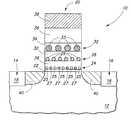
- FIG. 1is a diagrammatic, cross-sectional view of a portion of a semiconductor construction illustrating an embodiment of a memory cell.
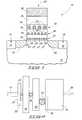
- FIG. 2is an energy band diagram of an example of the memory cell embodiment of FIG. 1 .
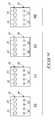
- FIG. 3diagrammatically illustrates MLC states of a DRAM element of a memory cell in accordance with an embodiment.
- FIG. 4diagrammatically illustrates MLC states of an NVM element of a memory cell in accordance with an embodiment.
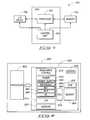
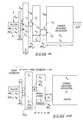
- FIG. 5is a diagrammatic view of a computer embodiment.
- FIG. 6is a block diagram showing particular features of the motherboard of the FIG. 5 computer embodiment.
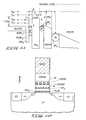
- FIG. 7is a high level block diagram of an electronic system embodiment.
- FIG. 8is a simplified block diagram of a memory device embodiment.
- FIGS. 9-11are an energy band diagrams of example embodiments.
- FIG. 12is a diagrammatic, cross-sectional view of a portion of a semiconductor construction illustrating an embodiment of a memory cell.
- FIG. 13is a graph illustrating an example method of programming a memory cell.
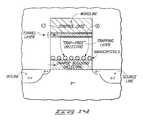
- FIG. 14is a diagrammatic, cross-sectional view of a portion of a semiconductor construction illustrating an embodiment of a memory cell.
- FIG. 15is an energy band diagram of an example of the memory cell embodiment of FIG. 14 .
- FIG. 16is a diagrammatic, cross-sectional view of a portion of a semiconductor construction illustrating an embodiment of a memory cell.
- FIG. 17is an energy band diagram of an example of the memory cell embodiment of FIG. 16 .
- FIG. 18is an energy band diagram of an example embodiment.
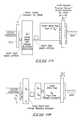
- FIG. 19diagrammatically illustrates an example method of programming a memory cell.
- memory devicesinclude multiple vertically-stacked charge-trapping zones over a tunnel dielectric.
- the charge-trapping zone closest to the tunnel dielectricmay comprise two different types of nanoparticles either placed in a single dielectric plane or in multiple dielectric planes, and may be utilized for DRAM (in other words, a volatile memory (VM) element).
- DRAMvolatile memory
- VMvolatile memory
- Charge-trapping zones over that utilized for DRAMmay be utilized for nonvolatile memory (NVM), and such NVM zones may consist of a single plane, or may comprise multiple planar structures with embedded nanoparticles.
- a single memory cellmay comprise both a DRAM element and an NVM element.
- one or both of the DRAM element and the NVM elementmay be suitable for storing single memory bits and accordingly be suitable for SLC-type applications.
- one or both of the DRAM element and the NVM elementmay be suitable for storing multiple memory bits, and accordingly suitable for MLC-type applications.
- the DRAM elementmay be utilized for rapid access memory, and the data stored in the DRAM element may be shifted to the NVM element for stable storage.
- the DRAM element and the NVM element of an individual memory cellmay be utilized entirely independently of one another so that data stored in the NVM element has no relation to the data in the DRAM element of the memory cell.
- a memory cell comprising both a DRAM element and an NVM elementmay be referred to as a universal memory cell, in that it encompasses the speed advantages of DRAM together with the stable data storage advantages of NVM.
- An example embodiment memory cell 20is shown in FIG. 1 as part of a semiconductor construction 10 .
- the semiconductor construction 10includes a base 12 .
- Such basemay comprise semiconductor material, such as, for example, monocrystalline silicon.
- the basemay be referred to as a semiconductor substrate in some embodiments, and in other embodiments may be referred to as a portion of a semiconductor substrate.
- semiconductor substratesemiconductor substrate
- semiconductor constructionsemiconductor substrate
- semiconductor substratemean any construction comprising semiconductive material, including, but not limited to, bulk semiconductive materials such as a semiconductive wafer (either alone or in assemblies comprising other materials), and semiconductive material layers (either alone or in assemblies comprising other materials).
- substraterefers to any supporting structure, including, but not limited to, the semiconductive substrates described above.
- base 12may comprise numerous layers in some embodiments.
- base 12may correspond to a semiconductor substrate containing one or more layers associated with integrated circuit fabrication.
- such layersmay correspond to one or more of metal interconnect layers, barrier layers, diffusion layers, insulator layers, etc.
- base 12may correspond to semiconductor material formed over a layer of electrically insulative material (for instance, silicon dioxide) as part of a semiconductor-on-insulator (SOI) construction.
- electrically insulative materialfor instance, silicon dioxide
- a pair of isolation regions 14 and 16extend into base 12 .
- the isolation regionsmay correspond to shallow trench isolation regions.
- the isolation regionscomprise material 18 .
- Such materialmay comprise any suitable composition or combination of compositions, and may, for example, comprise, consist essentially of, or consist of one or both of silicon dioxide and silicon nitride.
- Memory cell 20comprises, in ascending order from base 12 , a tunnel dielectric 22 , a first charge-trapping zone 24 , a first body dielectric 26 , a second charge-trapping zone 28 , a second body dielectric 30 , a third charge-trapping zone 32 , a third body dielectric 34 , a blocking dielectric 36 and a control gate 38 .
- the charge-trapping zones 24 , 28 and 32are vertically stacked relative to one another.
- the charge-trapping zone 24may be part of a DRAM element of the memory cell, and the charge-trapping zones 28 and 32 may be part of an NVM element of the memory cell.
- the charge-trapping zone 24comprises a plurality of nanoparticles which are shown as electrically conductive spheres embedded within a portion of dielectric 26 .
- the nanoparticlesmay have any suitable shape, and in some embodiments may comprise shapes other than the shown spherical shape. In embodiments in which the nanoparticles are substantially spherical, such nanoparticles may be referred to as nanodots. Nanoparticles may be structures less than or equal to about 100 nanometers along a maximal cross-section. Frequently, the nanoparticles will be less than 10 nanometers, or even less than 3 nanometers along a maximal cross-section.
- the nanoparticlesmay be nanodots having a diameter of from about 0.5 nanometers to about 100 nanometers.
- the nanodotsmay be configured to trap less than or equal to about 20 charges, and may, for example, be configured to trap from about 1 charge to about 20 charges.
- the nanoparticles of charge-trapping zone 24may be referred to a discrete islands.
- the charge-trapping zone 24may be referred to as a DRAM charge-trapping zone in some embodiments.
- the DRAM charge-trapping zone in this embodimentcomprises two different types of nanoparticles, with the nanoparticles of one type being labeled 25 , and the nanoparticles of the other type being labeled 27 .
- the two DRAM nanoparticle typesare shown to be interspersed with one another, but in other embodiments may be segregated and/or separated into non-interspersed regions.
- the charge-trapping zone 24corresponds to a single plane of nanoparticles 25 and 27 in the shown embodiment. However, in other embodiments the charge trapping zone may comprise multiple planes of nanoparticles 25 and 27 .
- the DRAM nanoparticles 25 and 27differ from one another in work function, and may differ in one or more of composition, size, density and distribution.
- the nanoparticlesmay comprise any suitable compositions, and in some embodiments the nanoparticles 25 and 27 may comprise, consist essentially of, or consist of one or more of Au, Ag, Co, conductively-doped Ge, Ir, Ni, Pd, Pt, Re, Ru, conductively-doped Si, Si—Ge, Ta, Te, Ti and W.
- one type of the nanoparticles ( 25 or 27 )will comprise, consist essentially of, or consist of tungsten and the other type will comprise, consist essentially of, or consist of platinum. This enables the two DRAM nanoparticle types to be separately charged relative to one another during reading to and writing from the DRAM element, as will be discussed in more detail below.
- the charge-trapping zones 28 and 32may be referred to as NVM charge-trapping zones.
- the charge-trapping zones 28 and 32comprise nanoparticles 29 and 33 , respectively.
- the nanoparticles 29 and 33may comprise any suitable compositions, and in some embodiments may comprise, consist essentially of, or consist of one or more of Au, Ag, Co, conductively-doped Ge, Ir, Ni, Pd, Pt, Re, Ru, conductively-doped Si, Si—Ge, Ta, Te, Ti and W.
- the nanoparticles 29 and 33may be considered to correspond to first and second types of NVM nanoparticles, respectively.
- the charge-trapping zone 28corresponds to a plane of nanoparticles 29 in the shown embodiment
- the charge-trapping zone 32corresponds to a plane of nanoparticles 33 in the shown embodiment.
- the nanoparticles 29 and 33may differ in trapping energy relative to one another. Such may be accomplished by having nanoparticles 29 differ from nanoparticles 33 in one or more of composition, size and density. In some embodiments, nanoparticles 33 will be larger than nanoparticles 29 . More specifically, the NVM nanoparticles 29 form a first population having a first average cross-sectional dimension, and the NVM nanoparticles 33 form a second population having a second average cross-sectional dimension which is larger than the first average cross-sectional dimension. In other embodiments, nanoparticles 33 will be of similar composition, size and density as nanoparticles 29 . In other embodiments, single NVM charge trapping zones with multiple nanoparticles 29 and 33 may be utilized.
- the nanoparticles 29 and 33may be interspersed with one another, or may be segregated, separated, or otherwise distributed into non-interspersed regions. In some embodiments, multiple NVM charge trapping zones with single compositions of nanoparticles may be utilized. If the nanoparticles are substantially spherical nanodots, the first and second average cross-sectional dimensions may be average diameters of the nanodots 29 and 33 . The second average cross-sectional dimension may be larger than the first average cross-sectional dimension by any amount suitable for a particular application, and in some embodiments may be at least about 10% larger than the first average cross-sectional dimension. In some embodiments, the nanoparticles of charge-trappings zones 28 and 32 may be referred to a discrete islands.
- Trapping energy associated with individual nanodots, and the amount of charge retained on individual nanodotsmay be related to the size of the nanodots and to the composition of the nanodots. Specifically, smaller nanodots of the same composition as larger nanodots may have shallower charge traps than the larger nanodots, and may retain less charge. The changes in trap depth and amount of retained charge may result from quantum confinement and coulomb blockade, at least when the nanodots have a diameter of from about 0.5 nanometer to about 10 nanometers.
- Quantum confinementdescribes how the electronic properties—the organization of energy levels into which electrons can climb or fall—change when a nanoparticle is sufficiently small in size. This size is typically 10 nanometers or less. Specifically, the phenomenon results from electrons and holes being squeezed into a dimension that approaches a critical quantum measurement, called the “exciton Bohr radius.” The larger the particle size, the lower the ground state and, therefore, the longer the charge can be retained. The smaller the particle size, the more easily the electron stays in a shallow energy level so that it can come out more readily.
- Coulomb blockadeis the suppression of current, at low bias, due to the discreteness of an elementary charge.
- a nanoparticlebecomes a charge center when it attracts a charge.
- a nanoparticlecan capture multiple electrons. Every time an electron is captured, the electrostatic field around the nanoparticle builds up to the point where it repels other electrons. At this point, any more incoming electrons come in at a higher energy state that allows them to leak out. Therefore, the more electrons that are captured, the lower the charge retention time.
- the charge-trapping zones further from the tunnel dielectricend up with deeper traps than the charge-trapping zones nearer the tunnel dielectric, and at the same time require longer tunnel distances for charges to travel from substrate 12 .
- Thisenables the two NVM charge-trapping zones 28 and 32 to be separately charged relative to one another during reading to and writing from the NVM element, as will be discussed in more detail below.
- nanoparticles 29comprise, consist essentially of, or consist of tungsten
- nanoparticles 33comprise, consist essentially of, or consist of platinum.
- the individual nanodots in the charge-trapping zones 24 , 28 and 32may be spaced from one another by at least about 3.5 nanometers to avoid cross-talk between adjacent nanodots. If the spacing between adjacent nanodots is about the same within the various charge-trapping zones, then the zones with the smaller nanodots will have a higher density of nanodots than the zones with the larger nanodots.
- the tunnel dielectric 22 of memory cell 20may comprise any suitable composition or combination of compositions, and may, for example, comprise, consist essentially of, or consist of one or more of silicon dioxide, transition metal oxides (for instance hafnium oxide and zirconium oxide), and various lanthanide oxides (with the term “lanthanide” referring to any of the elements having atomic number 57-71; and specifically to any of La, Ce, Pr, Nd, Pm, Sm, Eu, Gd, Tb, Dy, Ho, Er, Tm, Yb, and Lu).
- the tunnel dielectric materialmay be formed to an equivalent oxide thickness of from about 1 nanometer to about 4 nanometers (with the terms “equivalent oxide thickness” and “effective oxide thickness” meaning a thickness having the equivalent dielectric as the stated thickness of silicon dioxide).
- the body dielectric materials 26 , 30 and 34may comprise any suitable compositions or combination of compositions, and may be the same as one another or different.
- at least one of the dielectric materials 26 , 30 and 34will comprise high-k dielectric material (with high-k dielectric material being dielectric material having a dielectric constant greater than that of silicon dioxide).
- At least a portion of the high-k dielectric materialmay be charge-trapping material, such as silicon nitride; and the high-k dielectric material may thus supplement the charge-trapping characteristics of the charge-trapping zones.
- At least one of the dielectric materials 26 , 30 and 34will consist of dielectric material that is not charge trapping.
- the body dielectric material directly over the DRAM charge-trapping zonewill consist of high-k dielectric material that is not charge trapping.
- such dielectric materialmay comprise, consist essentially of, or consist of one or more of lanthanide oxides, lanthanide oxynitrides, hafnium oxide, aluminum oxide, hafnium aluminum oxide, hafnium silicate, hafnium silicon oxynitride, zirconium silicon oxynitride, zirconium silicate and zirconium oxide.
- lanthanide oxynitrideis PrON (shown in terms of the constituent elements, rather than in terms of a stoichiometry).
- the PrONmay comprise about 40 atom percent Pr, from about 10 atom percent to about 20 atom percent O, and from about 30 atom percent to about 50 atom percent N.
- the PrONmay comprise about 40 atom percent Pr, about 20 atom percent O, and about 40 atom percent N.
- the dielectric material 26may comprise silicon dioxide or other materials having dielectric constants less than or equal to that of silicon dioxide.
- the dielectric materials directly over the NVM charge-trapping regionsmay comprise, consist essentially of, or consist of one or more of silicon nitride, silicon-rich silicon oxynitride, silicon dioxide, lanthanide oxides, lanthanide oxynitrides, hafnium oxide, aluminum oxide, hafnium aluminum oxide, hafnium silicate, hafnium silicon oxynitride, zirconium silicon oxynitride, zirconium silicate and zirconium oxide.
- one or both of the dielectric materials 30 and 34may comprise one or more materials having dielectric constants less than or equal to that of silicon dioxide.
- the body dielectric materialsmay be formed to thicknesses of from about 0.5 nanometer to about 30 nanometers. In some embodiments, the body dielectric materials may be formed to thicknesses of from about one nanometer to about 10 nanometers of effective oxide thickness; and in some embodiments may be formed to from about one nanometer to about three nanometers of effective oxide thickness.
- the tunnel dielectric 22may be formed to a first equivalent oxide thickness, the spacing layer 26 to a second equivalent oxide thickness greater than the first equivalent oxide thickness, and the spacing layer 30 to a third equivalent oxide thickness greater than the second equivalent oxide thickness. In some embodiments, the second equivalent oxide thickness may be at least about 10% greater than the first equivalent oxide thickness, and the third equivalent oxide thickness may be at least about 10% greater than the second equivalent oxide thickness.
- the materials 26 and 30may be considered spacing materials, in that they space vertically-displaced charge-trapping zones from one another.
- the nanoparticles 25 and 27are embedded within a lower portion of material 26 ; the nanoparticles 29 are embedded within a lower portion of material 30 , and the nanoparticles 33 are embedded within a lower portion of material 34 .
- the nanoparticlesmay be embedded within different dielectric materials than those formed directly over the nanoparticles.
- the nanoparticles 25 , 27 , 29 and 33may be formed by any suitable methods.
- the nanoparticlesmay be formed by annealing a film of nanoparticle material deposited by atomic layer deposition (ALD), to cause the film to break into separated islands.
- ALDatomic layer deposition
- the nanoparticlesmay be formed by deposition of a thin film (specifically, a film of thickness of from about 1 nanometer to about 1.2 nanometers) by e-beam evaporation.
- the nanoparticlesmay be formed by co-sputtering metal with embedding insulator, by pulsed nucleation and/or by a templated self-assembly.
- the blocking dielectric material 36may comprise any of the compositions discussed above for the body dielectric materials 26 , 30 and 34 . Accordingly, the blocking dielectric material may comprise any of various high-k dielectric compositions, including, for example, one or more of aluminum oxide, hafnium silicon oxynitride (HfSiON—which is shown in terms of constituent elements rather than stoichiometry), hafnium oxide, zirconium silicon oxynitride and zirconium oxide.
- the blocking dielectric materialwill typically have a higher dielectric constant than the tunnel dielectric material.
- the blocking dielectric materialmay be formed to an effective oxide thickness of from about 2 nanometers to about 20 nanometers.
- dielectric 34may be omitted so that the blocking dielectric extends from the bottom of the control gate to the charge-trapping zone 32 .
- the control gate 38may comprise any suitable composition or combination of compositions.
- the control gatemay comprise one or more of various metals (for instance, tungsten, titanium, etc.), metal-containing compositions (for instance, metal silicides, metal nitride, etc.) and conductively-doped semiconductor materials (for instance, conductively-doped silicon, etc.).
- the control gatemay comprise a metal nitride passivation layer directly against the blocking dielectric material, and may comprise doped semiconductor material over the metal nitride passivation layer. The metal nitride passivation may block dopant from passing from the doped semiconductor material to the blocking dielectric, and/or may block migration of contaminants to the substrate.
- the metal nitride passivation layermay comprise, for example, titanium nitride.
- the metal nitride passivation layermay be omitted if the blocking dielectric comprises an oxynitride or other material that can block migration of dopant and/or contaminants.
- a pair of source/drain regions 40are formed on opposing sides of tunnel dielectric 22 .
- the source/drain regionsare conductively-doped regions of the semiconductor material of base 12 .
- Regions 40may be either n-type or p-type majority doped, depending on the transistor type (NFET or PFET) to be formed.
- the tunnel dielectric 22may consist of hafnium oxide formed to an effective oxide thickness of about 2 nanometers.
- the nanoparticles 25 and 27may consist of tungsten and platinum, respectively, and may be spheres having about the same diameters as one another, with an example diameter of such spheres being from about 1 nanometer (nm) to about 3 nm.
- the material 26 within which nanoparticles 25 and 27 are embeddedmay consist of silicon dioxide, and may be formed to a thickness over the uppermost surfaces of nanoparticles 25 and 27 of from about 3 nm to about 4 nm.
- the nanoparticles 29may consist of tungsten, and may be spheres having a diameter from about 3 nm to about 6 nm.
- the material 30 within which nanoparticles 29 are embeddedmay consist of hafnium silicon oxynitride, and may be formed to an equivalent oxide thickness over the uppermost surfaces of nanoparticles 29 of from about 3 nm to about 5 nm.
- the nanoparticles 33may consist of Pt, and may be spheres having a diameter of from about 3 nm to about 10 nm.
- the material 34 within which nanoparticles 33 are embeddedmay consist of hafnium silicon oxynitride, and may be formed to an equivalent oxide thickness over the uppermost surfaces of nanoparticles 33 of from about 2 nm to about 5 nm.
- the charge blocking material 36may consist of hafnium silicon oxynitride (HfSiON), and may have an equivalent oxide thickness of from about 4 nm to about 6 nm.
- FIG. 2shows a band gap diagram of a specific embodiment of the memory cell of FIG. 1 .
- the memory cell of FIGS. 1 and 2comprises an NVM element (which contains charge-trapping zones 28 and 32 ) and a DRAM element (which contains charge-trapping zone 24 ).
- the DRAM element and NVM elementmay be independently operated as MLC-type devices. Alternatively, both the DRAM and NVM elements may be independently operated or coupled as SLC-type devices.
- FIG. 3illustrates programming operations for the DRAM element.
- the DRAM elementcomprises the charge-trapping zone 24 .
- the charge-trapping zone 24is shown in isolation from the rest of memory cell 20 ( FIG. 1 ) in FIG. 3 to simplify the drawing.
- the charge-trapping zone 24contains the plane of nanoparticles 25 and 27 .
- the nanoparticles 25are a first type of nanoparticles having a first work function
- the nanoparticles 27are a second type of nanoparticles having a second work function.
- the second work functionhas a lower absolute value of potential energy than the first work function (see FIG. 2 for the relative depths of the potential energy wells of particles 25 and 27 ). Accordingly, the nanoparticles 25 have a greater trapping depth than the nanoparticles 27 .
- a first programming voltageis imposed at the gate of memory device 20 ( FIG. 1 ). Such creates a planar “coulomb blockade” at the first programming voltage, and selectively charges the deeper traps of nanoparticles 25 relative to the shallower traps of nanoparticles 27 . This creates the memory state 10.
- the shallow traps of nanoparticles 27can fill to achieve the memory state 11.
- the filling of the shallow trapsmay be accomplished by either increasing a programming voltage beyond that utilized to achieve memory state 10, or by increasing the amount of time that the memory cell is exposed to the programming voltage so that both the deep traps of nanoparticles 25 and the shallow traps of nanoparticles 27 are charged.
- the memory cellwill begin to erase.
- the shallow traps of nanoparticles 25will erase first to create the memory state 01 due to lower barrier energy of the charged carriers. If the erasing voltage is continued and/or increased, the deep traps of nanoparticles 27 will also erase to create the memory state 00.
- tunnel dielectriccomprising hafnium oxide
- the utilization of tunnel dielectric comprising hafnium oxidemay enable the tunnel dielectric to have a low barrier height, and to be a thin barrier when a field is imposed on the high-k material of the dielectric.
- a direct tunneling mode of electron transport through the tunnel dielectric and into the DRAM charge-trapping zonemay occur. This may enable many orders of magnitude of increased electron current relative to tunneling across a similar thickness of silicon dioxide. Such can approach a high programming speed for some embodiments of the invention. Similar transport may take place when holes tunnel during erase due to barrier thinning and direct tunneling (although the speed of holes may be slower than the speed of electrons due to a higher barrier height faced by holes relative to the barrier height faced by electrons).
- FIG. 3The programming of FIG. 3 is described as proceeding sequentially through memory states 10, 11, 01 and 00. In other embodiments, sufficient voltage may be applied to reach memory state 11 without proceeding through a stop at memory state 10, and/or to reach memory state 00 without proceeding through a stop at memory state 01. This may also provide SLC operability, if such is desired.
- FIG. 4illustrates programming operations for the NVM element.
- the NVM elementcomprises the charge-trapping zones 28 and 32 .
- the charge-trapping zones 28 and 32are shown in isolation from the rest of memory cell 20 ( FIG. 1 ) in FIG. 4 to simplify the drawing.
- the charge-trapping zone 28contains the plane of nanoparticles 29
- the charge-trapping zone 32contains the plane of nanoparticles 33 .
- the nanoparticles 33have deeper traps than the nanoparticles 29 , and are placed a larger distance from the silicon substrate.
- charge-trapping zone 28comprises injection of electrons through dielectric materials 22 and 26 ( FIG. 1 ).
- a higher programming voltagemay then be applied to charge traps associated with nanoparticles 33 of charge-trapping zone 32 , to thereby form the memory state 11.
- the charging of charge-trapping zone 32comprises injection of electrons through dielectric materials 22 , 26 and 30 ( FIG. 1 ).
- the combination of dielectric materials 22 , 26 and 30may form a crested barrier in embodiments in which dielectric material 30 has a much larger dielectric constant than dielectric material 26 . This may lead to barrier thinning, and enhanced charge transport.
- coulomb blocking created by charge trapping zones 24 and 28aids in establishing preferred energy states for tunneling, thereby reducing threshold voltage dispersion.
- the erasing voltagemay be applied at a first level which reduces electron charge on nanoparticles 29 to form memory state 01.
- the erasing voltagemay be raised to a second level which removes electron charge from nanoparticles 33 to form memory state 00.
- FIG. 4The programming of FIG. 4 is described as proceeding sequentially through memory states 10, 11, 01 and 00. In other embodiments, sufficient voltage may be applied to reach memory state 11 without proceeding through a stop at memory state 10, and/or to reach memory state 00 without proceeding through a stop at memory state 01.
- the programming of the NVM elementmay alter the memory state of the DRAM element. For instance, if the DRAM element is not in a fully-charged state during charging of a charge-trapping zone of the NVM element, the DRAM element may be shifted to such fully-charged state during the programming of the NVM element. In some embodiments, it may be acceptable to lose data from DRAM elements of individual memory cells during programming of the NVM elements of the individual memory cells. In other embodiments, it may be desired to backup the data of DRAM elements of first memory cells onto DRAM or NVM elements of second memory cells prior to programming of the NVM elements of the first memory cells. After the NVM elements of the first memory cells are programmed, the data may be written from the second memory elements back to the DRAM of the first memory elements. By appropriately sequencing reading and programming, DRAM states, if altered during programming of the NVM element, can be restored.
- the DRAM and NVM elements of the memory cells of FIGS. 1-4are shown as MLC-type devices storing two data bits.
- one or both of the DRAM or NVM elementsmay be an SLC-type device.
- more types of nanoparticlesmay be included in the DRAM and/or NVM elements so that the DRAM and/or NVM elements are MLC-type devices that can store more than two data bits.
- the DRAM and NVM elements of the memory cells of FIGS. 1-4are described as working in a “normal” mode in which charge is injected from a silicon substrate through a tunnel dielectric to the charge-trapping zones.
- one or both of the DRAM and NVM elementsmay work in a “reverse” mode in which charge is injected from the control gate through appropriate dielectric layers to the charge-trapping zones.
- one or both of the DRAM and NVM elementsmay be asymmetric so that some charge is injected in a “normal” mode and some in a “reverse” mode.
- the memory cells discussed abovemay be utilized in electronic systems, such as, for example, cars, telephones, computers, cameras, video recorders, televisions, airplanes, etc.
- FIG. 5illustrates an embodiment of a computer system 400 .
- Computer system 400includes a monitor 401 or other communication output device, a keyboard 402 or other communication input device, and a motherboard 404 .
- Motherboard 404may carry a microprocessor 406 or other data processing unit, and at least one memory device 408 .
- Memory device 408may comprise an array of memory cells, and such array may be coupled with addressing circuitry for accessing individual memory cells in the array. Further, the memory cell array may be coupled to a read circuit for reading data from the memory cells.
- the addressing and read circuitrymay be utilized for conveying information between memory device 408 and processor 406 .
- Suchis illustrated in the block diagram of the motherboard 404 shown in FIG. 6 . In such block diagram, the addressing circuitry is illustrated as 410 and the read circuitry is illustrated as 412 .
- Processor device 406may correspond to a processor module, and associated memory utilized with the module may comprise may comprise memory cells of the type described with reference to FIGS. 1-4 .
- the processor device and associated memorymay be formed in a single integrated circuit chip.
- Memory device 408may correspond to a memory module, and may comprise memory cells of the type described with reference to FIGS. 1-4 .
- the memory device 408may be on one integrated circuit chip and the processor device on a separate integrated circuit chip.
- the memory device 408may be a memory card.
- FIG. 7illustrates a simplified block diagram of a high-level organization of an electronic system 700 .
- System 700may correspond to, for example, a computer system, a process control system, or any other system that employs a processor and associated memory.
- Electronic system 700has functional elements, including a processor 702 , a control unit 704 , a memory device unit 706 and an input/output (I/O) device 708 (it is to be understood that the system may have a plurality of processors, control units, memory device units and/or I/O devices in various embodiments).
- I/Oinput/output
- electronic system 700will have a native set of instructions that specify operations to be performed on data by the processor 702 and other interactions between the processor 702 , the memory device unit 706 and the I/O device 708 .
- the control unit 704coordinates all operations of the processor 702 , the memory device 706 and the I/O device 708 by continuously cycling through a set of operations that cause instructions to be fetched from the memory device 706 and executed.
- the memory device 706may comprise memory cells of the type described with reference to FIGS. 1-4 .
- FIG. 8is a simplified block diagram of an electronic system 800 .
- the system 800includes a memory device 802 that has an array of memory cells 804 , address decoder 806 , row access circuitry 808 , column access circuitry 810 , read/write control circuitry 812 for controlling operations, and input/output circuitry 814 .
- the memory device 802further includes power circuitry 816 , and sensors 820 , such as current sensors for determining whether a memory cell is in a low-threshold conducting state or in a high-threshold non-conducting state.
- the illustrated power circuitry 816includes power supply circuitry 880 , circuitry 882 for providing a reference voltage, circuitry 884 for providing a first wordline with pulses, circuitry 886 for providing a second wordline with pulses, and circuitry 888 for providing a bitline with pulses.
- the system 800also includes a processor 822 , or memory controller for memory accessing.
- the memory device 802receives control signals from the processor 822 over wiring or metallization lines.
- the memory device 802is used to store data which is accessed via I/O lines.
- At least one of the processor 822 or memory device 802may include memory cells of the type described with reference to FIGS. 1-4 .
- the various electronic systemsmay be fabricated in single-package processing units, or even on a single semiconductor chip, in order to reduce the communication time between the processor and the memory device(s).
- the electronic systemsmay be used in memory modules, device drivers, power modules, communication modems, processor modules, and application-specific modules, and may include multilayer, multichip modules.
- the electronic systemsmay be any of a broad range of systems, such as clocks, televisions, cell phones, personal computers, automobiles, industrial control systems, aircraft, etc.
- FIGS. 9-19Additional aspects and applications of some embodiments are described with reference to FIGS. 9-19 .
- Floating-gate Multi-level-Cell (MLC) NAND Flash technologyhas been in the forefront in recent years providing low-cost, low power memory solutions especially for a wide variety of hand-held devices. All the above memories may utilize custom technologies not compatible with each other due to different cell design and characteristics and consequently produced on different silicon substrates to minimize cost and maximize product yield.
- Both DRAM and floating-gate FLASHmay consume high power, the former due to the requirement of frequent refreshing to maintain the data integrity, and the later due to the requirement of on-chip high voltage/current (tunneling/channel effects) for programming and erase. Furthermore, there may exist serious scalability concerns for both DRAM (capacitor scalability problems) and floating-gate FLASH (voltage and coupling noise scalability problems) for implementation into future technology generations. Additionally, with progressive scaling of feature size, fundamental device leakage issues (for instance, short-channel effects and gate-dielectric leakage) may need to be contained to take advantages of scaling.
- the inventorhas proposed ideas based on direct tunnel memories and SGT-based devices to provide multiple functionality of arrays covering ROM, DRAM, and FLASH functionalities by appropriately altering the tunneling distance for such devices thereby providing varying degree of non-volatility and programming speed. Additionally, the inventor has proposed the concepts of DRAM applications and of UNIVERSAL MEMORY based on Discrete Trap (DT) (SONOS-type) devices whereby many orders of magnitude higher programming speed could be achieved by replacing SiO 2 tunneling dielectric by multiple layers of appropriate higher K dielectric to simultaneously achieve barrier lowering and barrier thinning. This improves forward transport of carriers by many orders of magnitude compared to those through SiO 2 . Simultaneously, required charge retention greater than 10 years may be achieved by reducing back tunneling of trapped charges by 5-6 orders of magnitude from that of SiO 2 by introducing asymmetry in both barrier energy and tunneling distance during the standby state of the memory.
- DTDiscrete Trap
- Embedded Trap (ET) nanocrystal memoriesstore charges in defects associated with silicon, or germanium or metal nanocrystals embedded in oxide or other appropriate relatively trap-free insulators.
- Ge or Si—Ge nanocrystals embedded in HfAlO dielectricmay demonstrate significantly improved retention over silicon-nanocrystal and other metal nanocrystals by providing deeper trapping energy. It is observed that defects associated with higher work-function (WF) metal nanocrystals provide deeper traps and consequently such devices exhibit improved retention.
- WFwork-function
- Both DT and ET deviceshave advantages over silicon floating gate devices for NVM (nonvolatile memory) applications since these may require approximately half the tunnel-oxide thickness for charge retention for 10 years ( ⁇ 4 nm tunnel-oxide compared to ⁇ 8 nm tunnel-oxide for Si floating gate device). These devices, in general, also exhibit higher programming speed and endurance.
- the nanocrystal ET type devicesWhen compared with the SONOS type of DT devices, the nanocrystal ET type devices have two potential advantages: 1) improved endurance and 2) reduced threshold voltage (VT) dispersion. For MLC operation, a larger VT-window is desired. The inventor has disclosed ET devices for MLC applications which simultaneously provide large VT-window, reduced VT dispersion and voltage scalability.
- the present disclosureprovides a nanocrystal MLC device which integrates within the same cell functionality features of DRAM and NVM, thus providing a universal memory within the context of MLC operation, and yet also improving the memory density at the same time. Examples of two-bit per cell (four stable states) for both DRAM and NVM operations and DRAM/NVM operations are provided. Further refinement could potentially extend such devices to higher MLC levels (e.g. three-bit per cell with eight stable states). This device concept may integrate various combinations of numerous disclosed features.
- DRAM elementsconsisting of band-engineered tunneling dielectric layers may provide very high electron (or hole) current during writing and erasing to achieve writing and erasing speed of nanoseconds. While such carrier transport is achieved by direct tunneling, deeper traps and asymmetric barriers reduce charge losses by back-tunneling and retains memory up to thousands of seconds.
- the DRAM elementmay provide multiple storage states for two-bit per cell operation (four levels) with very small VT-dispersion per states.
- the DRAM elementoperates at lower programming voltage levels and physically closer to the silicon-insulator interface.
- the DRAM elementsare designed to provide high endurance.
- NVM elementsmay consist of multi-planar stacks of nanocrystal planes separated by larger tunneling distance and an insulator with higher energy barrier to prevent charge penetration deeper into the stack during DRAM operations and to provide relative isolation between the two elements.
- the NVM elementsmay consist of planes of nanocrystals containing progressively deeper traps (higher work-function metal nanocrystals), progressively larger nanocrystal sizes to reduce quantum confinement and improve retention, and planes separated at progressively larger physical distances for achieving distinct and multiple stable states with low VT-dispersion (by taking advantage of “Planar Coulomb blockade”) for MLC operation.
- the NVM elementscould emulate the DRAM states by appropriate programming at desired intervals (refreshing) for permanent data storage when such is desired. Alternately, the NVM element could operate as non-volatile MLC memory only.
- a device gate stack equivalent oxide thicknessmay be scaled by appropriate selection of high K charge blocking layers for programming voltage scaling.
- a device as stated abovemay operate as a “Normal” mode device. By reversing the stack configuration, the device could potentially operate in a “Reverse” mode.
- the programming of the DRAM memory statesmay involve electron transport at relatively low voltage levels across the low band-gap “direct-tunnel” insulator interfacing the silicon substrate.
- SLC operationtrapping and detrapping of electrons are associated with an appropriate single type of nanocrystal trapping center.
- MLC operationtwo types of nanocrystals with significantly different work-functions and associated trap depths are employed. This results in trap filling and trap emptying at distinctly different voltage levels associated with the different nanocrystals.
- Programming the DRAM memory statescould be achieved either independently to those of non-volatile memory states or in conjunction with those of the non-volatile memory states.
- the programming the nonvolatile (NV) memory statesmay involve electron transport at relatively higher voltage levels (due to Fowler-Nordheim tunneling) at larger tunnel distances and subsequent trapping at appropriate nanocrystal traps.
- SLC NV operationa single type of nanocrystal trapping center is employed.
- MLC operationmulti-planar trapping centers with single or multiple types of nanocrystals with different work-functions may be employed.
- NV memory statescould be achieved independently to those of the DRAM memory states or in conjunction with the DRAM memory states. However, programming of NV memory states may affect the DRAM states and therefore, may require restoring the DRAM states by an appropriate programming sequence. This is explained in more detail below for both the “Normal” and “Reverse” mode of NV memory operations.
- FIGS. 9-11describe a generalized band diagram to obtain the key elements and features of an embodiment.
- FIG. 9is the band diagram for the entire gate stack at zero gate bias.
- FIG. 10is the corresponding enlarged band diagram for the tunnel dielectric regions identifying the DRAM elements as well as NVRAM elements.
- FIG. 11shows the band diagram to illustrate band bending and charge transport during writing when an appropriate bias of V p4 is imposed on the gate.
- dielectric regions I 1 -I 4there are at least four relatively trap-free dielectric regions I 1 -I 4 , with thickness t 1 , t 2 , t 3 and t 4 , and at least three nanocrystal planes p 1 , p 2 and p 3 between the silicon substrate and the gate.
- the dielectric regions I 1 , I 2 , I 3 , and I 4consist of materials with dielectric constants K 1 , K 2 , K 3 and K 4 with corresponding energy barriers to electrons and holes being: X 1e /X 1h , X 2e /X 2h , X 3e /X 3h and X 4e /X 4h respectively.
- the three nanocrystal trapping planescontain embedded nanocrystals of diameters D 1 and D 2 both embedded in K 2 in p 1 ; whereas D 3 and D 4 are embedded respectively in dielectric layers K 3 and K 4 for planes p 2 and p 3 .
- Plane p 1contains two different nanocrystals N 1 and N 2 with different work functions: WF 1 and WF 2 .
- the nanocrystals N 1 and N 2both could be approximately same diameter.
- Plane p 2contains nanocrystals with diameter D 3
- plane p 3contains nanocrystals with diameter D 4 ; with respective work functions of the nanocrystals in p 3 and p 4 being WF 3 and WF 4 .
- Not shownare lateral separation of nanocrystals in any of the planes which should be in the order of ⁇ 3.5 nm-4 nm to minimize lateral charge migration due to direct tunneling. As shown in FIG.
- dielectric materials t 1 ⁇ t 2 ⁇ t 3 ⁇ t 4where t 1 is less than or equal to about 2 nm;
- X 1e ⁇ X 3e ⁇ X 4e ⁇ X 2ewhere X 1e ⁇ 1.5 ev and X 2e >3 ev;
- K 1 ⁇ K 3 ⁇ K 4 and K 2 ⁇ K 1whereby K 2 ⁇ 4 to 9.
- the nanocrystal materials D 1D 2 ⁇ D 3 ⁇ D 4 , where D 1 ⁇ D 2 may range between 1-2 nm; and the work functions are WF 1 ⁇ WF 2 where WF 1 ⁇ 4.0-4.2 ev, and WF 3 ⁇ WF 4 where WF 3 ⁇ 4.0-4.6 ev.
- the energy barriers to the holesmay be X 1h ⁇ X 2h ⁇ X 3h ⁇ X 4h , where X 1h >3 ev.
- FIG. 10shows an enlarged view of the tunneling regions identifying the DRAM elements and the NVM elements.
- electron transport to the trapping nanocrystal plane p 1is established preferentially at two distinct voltage levels consistent to the trap depths of N 1 and N 2 of WF 1 and WF 2 respectively. Due to the lower barrier height of I 1 and barrier thinning t 1 resulting from a high value of K 1 (when a field is imposed during programming) coupled with direct tunneling mode of electron transport, many orders of magnitude increased electron current is established compared to tunneling across similar thickness of SiO 2 , which may lead to a very high programming speed. Similarly, reverse transport of electrons takes place during erase due to barrier thinning and direct tunneling (although the speed may be slower due to higher barrier height).
- Electronsfirst get filled at the deeper trap levels defined by WF 2 to provide Memory State 10 (DRAM) when the first programming voltage V p1 is imposed at the gate. This creates planer “coulomb blockade” at the first programming voltage level V p1 .
- V p2When the programming voltage is raised to V p2 , electrons are transported again rapidly to fill the trap levels defined by WF 1 which defines Memory State 11 (DRAM).
- V e1(polarity reversed) the process is reversed, since first the trap levels defined by WF 1 is emptied of trapped carriers by direct tunneling at lower energy level (lower V erase ), establishing Memory State 01 (DRAM).
- V eraseat V e2 , all electronic charges are removed and the most negative Memory State 00 (DRAM) is achieved. Due to well-defined quantum confinement of carriers and planar coulomb blockade, VT-dispersion (threshold voltage dispersion) for each level is suppressed.
- Electron transport and trapping for DRAM memory states 10 and 11are schematically shown in FIG. 11 corresponding to V p1 and V p2 .
- High barrier energy associated with I 2 (X 2e ) compounded by planar coulomb blockadeprevents electron transport beyond the DRAM elements (even at V p2 level), thereby providing relative isolation between DRAM elements and NVRAM elements. Retention for DRAM memory is expected to be greater than 100 seconds.
- VT shift in trap-filling in p 2defines 10 (NVM) memory state and the VT shift in trap-filling in p 3 defines 11 (NVM) memory state.
- V e3when V e3 is reached, electrons tunnel back to the substrate from p 2 establishing the 01 (NVM) memory state.
- Electron transport and trapping for NVM memory states: 10 and 11are schematically shown in FIG. 11 corresponding to V p3 and V p4 .
- the deviceWhen erase voltage is further increased to remove all electrons from the p 3 trapping sites (at V e4 ), the device returns to the 00 (NVM) memory state which is also the same state for the DRAM memory elements. Due to the asymmetric energy barriers and longer tunnel distances, charge retention may be in excess of 10 years.
- the well-defined charge centroids of the planar charge storages of the p 2 and p 3 planesmay provide enhanced endurance for such a device. Since the device programs and erases at reduced field across the various dielectric layers, the device may provide enhanced reliability.
- the DRAM memory statesmay be replicated into the corresponding NVM memory states by first reading the DRAM state of the cell and programming that state in the NVM mode. Subsequently, the NVM memory state may be addressed and verified and the DRAM state can be replicated back. This can be done periodically at much reduced power than conventional DRAM refreshing. Since the DRAM state is preserved for permanency into the NVM state, no data is lost even when the power is lost. Thus the device works as an universal memory while providing MLC operation; and may provide a potentially high density (cell density ⁇ 2F 2 , where “F” is a minimum feature size of a process), low-power universal memory solution.
- FIG. 11corresponds to the band diagram of a specific embodiment of the above device.
- Total EOT of the stackwould be around ⁇ 15 nm and V p4 /V e4 would be around 15 v, 1 msec, while the other NVM mode programming voltage level is estimated to be V p3 /V e3 of about 12 v.
- the DRAM voltage levelswould depend on the speed/window trade offs ranging from estimated about 4 volts (slower, on the order of microseconds) to about 7.0 volts (faster, on the order of nanoseconds) for V p1 /V e1 ; and estimated to be about 6.0 volt (slower, on the order of microseconds) to about 9.0 volt (faster, on the order of nanoseconds) for V p2 /V e2 .
- EOT and programming voltage levelscould be accomplished by judicious selection of higher K insulators for I 3 and I 4 .
- K insulatorsfor example, a combination of HfO 2 as I 1 , Al 2 O 3 as I 2 , La 2 O 3 or Pr 2 O 3 (K ⁇ 30) as I 3 and LaAlO 3 (K ⁇ 27.5) could reduce the stack EOT to 7 nm. Consequently, all voltage levels could be scaled by a factor of about two.
- FIG. 12shows a schematic of a gate stack structure corresponding to the band diagram as exemplified in FIG. 11 , with a direct tunnel insulator HfO 2 interfacing a background p-type doped (in other words, p ⁇ doped) silicon substrate.
- Nanocrystals N 1 (WF 1 ) and N 2 (WF 2 )are tungsten and platinum respectively and are embedded in I 2 which corresponds to SiO 2 with a bandgap of 9 ev.
- Both I 3 and I 4are HfSiON layers embedding tungsten and platinum nanocrystals, respectively, with increasingly larger diameter and greater charge retention.
- the charge blocking layer HfSiONalso provides interface passivation as well as higher thermal stability for ease of stack integration with the conventional n+ doped polysilicon gate. Additionally, it also provides electron barrier energy >2.9 ev at the gate interface, thereby eliminating the potential requirement of interface metallic layer such as TiN or TaN to prevent unwanted back-injection of carriers during erase operation. Shallow trench isolation (STI) is shown adjacent n-type doped source/drain regions.
- STIShallow trench isolation
- FIG. 13shows the estimated VT levels for the DRAM/NVM-MLC device corresponding to the band diagram of FIG. 11 .
- FIG. 14shows a schematic gate stack cross section of a reverse mode nanocrystal NOR-NVM device.
- a corresponding band diagram for such a deviceis shown in FIG. 15 .
- active carrier injectiontakes place from the gate during programming, while the silicon substrate remains passive due to the high interface energy barrier of a large bandgap insulator at the interface.
- the device shown in FIG. 14shows a schematic gate stack cross section of a reverse mode nanocrystal NOR-NVM device.
- a composite tunnel dielectric of SiN/HfSiON/SiN at the gate interfaceforming a crested barrier to enhance Fowler-Nordheim tunneling of carriers during programming
- a large bandgap charge blocking insulatorsuch as HfSiON (alternately, SiO 2 or Al 2 O 3 ) interfacing a silicon substrate.
- Writinginvolves electron injection from the gate and trapping in platinum nanocrystals when a negative potential is imposed on the gate. Erasing involves removal of electrons either by detrapping or by compensation of holes when a positive potential is imposed on the gate. Since silicon-insulator interface is passive, the device provides enhanced endurance and reliability compared to a normal mode device.
- FIG. 16shows a schematic cross section of a universal memory concept of an SLC cell whereby a DRAM functionality is integrated with a reverse-mode NVM device within the same gate stack.
- the DRAM elementis similar to that shown in FIGS. 9-12 in that the charge transport is from the silicon substrate through the direct tunnel insulator interfacing the silicon substrate to the trapping centers provided by the appropriate nanocrystals.
- the charge transportis from the silicon substrate through the direct tunnel insulator interfacing the silicon substrate to the trapping centers provided by the appropriate nanocrystals.
- For SLC operationonly one type of nanocrystal center may be utilized (as shown); while for MLC operation, multiple nanocrystals with different work functions may be utilized (not shown) as explained earlier.
- Programming of the DRAM memory stateswould be similar to those discussed in FIGS. 9-12 as discussed before.
- the DRAM nanocrystal trapping centersare embedded into the charge blocking layer, I 4 .
- the I 4prevents charge transport upward towards the gate from DRAM-trapping centers as well as charge transport downward towards the substrate from NV trapping centers acting as the charge blocking layer for both device elements by providing large barrier energy for both trapping centers.
- the NV trapping centersare embedded in high-K lower bandgap trap-free insulator, I 3 , similar to those of FIG. 14 .
- Bandgap for I 3 insulatormay be in the range of 4 ev to 6 ev.
- SLC-NV operationa single plane of embedded nanocrystal may be considered as shown in FIG. 16 .
- MLC operationmulti-planar embedding of two types of nanocrystals of differing work-functions may be considered [e.g.
- Crested barrier tunnel layer compositemay consist of HfO 2 /HfSiON/HfO 2 or SiON/HfSiON/SiON or SiON/HfSiON/La 2 O 3 or HfO 2 /HfSiON/La 2 O 3 ; the last two contain I 3 as integrated element of the crested barrier (see FIG. 18 ).
- Other possibilitiesmay include replacing HfO 2 by SiN or SRN (silicon-rich nitride) or Ta 2 O 5 or La 2 O 3 , etc.
- the nanocrystalsmay be tungsten, platinum or ruthenium.
- FIG. 17shows a generalized band diagram for an SLC device
- FIG. 18shows the generalized band diagram for an MLC device with multi-planar trapping centers embedded in I 3 .
- the deviceoperates similar to the normal mode as explained earlier. Specifically, the DRAM states, programming voltage levels and pulse durations will be similar to the normal mode. Such programming will not significantly affect the NV states.
- NV applicationmay adversely affect the DRAM states and may also alters the states of “NV-only” device. Therefore, operability for NV application may involve restoration of DRAM states simultaneously. As a result NV application and Universal memory application are indistinguishable and always coupled.
- Writing in this deviceis accomplishes by first reading the DRAM state and then programming with a high negative bias to fill one of the two NV trapping planes followed by a positive pulse to restore the equivalent DRAM memory state.
- the DRAM stateis the highest positive VT state
- D 11achieved by programming the DRAM element with a positive V 2 pulse
- the NV/Universal memory state of NV 11 or U 11is achieved by programming at the highest negative voltage ⁇ V 4 pulse followed by a positive +V 2 pulse.
- the intermediate high VT stateD 10 is replicated in NV/Univ element by pulsing at ⁇ V 3 pulse followed by +V 1 pulse to establish NV 10 as well as to restore D 10 memory state.
- the programminginvolves a +V 3 pulse followed by a ⁇ V 2 pulse to establish NV 01 state as well as to restore the D 10 state.
- the ground state of D 00 or NV 00is achieved by successive pulses of +V 4 and ⁇ V 2 . This is summarized in FIG. 19 , with times indicated by T 1 through T 4 , and programming voltages indicated by ⁇ V p1 through ⁇ V p4 , and by +V p1 through +V p4 .
Landscapes
- Engineering & Computer Science (AREA)
- Chemical & Material Sciences (AREA)
- Nanotechnology (AREA)
- Physics & Mathematics (AREA)
- Crystallography & Structural Chemistry (AREA)
- Materials Engineering (AREA)
- General Physics & Mathematics (AREA)
- Condensed Matter Physics & Semiconductors (AREA)
- Composite Materials (AREA)
- Mathematical Physics (AREA)
- Theoretical Computer Science (AREA)
- Manufacturing & Machinery (AREA)
- Non-Volatile Memory (AREA)
- Semiconductor Memories (AREA)
Abstract
Description
Claims (24)
Priority Applications (2)
| Application Number | Priority Date | Filing Date | Title |
|---|---|---|---|
| US11/872,130US7759715B2 (en) | 2007-10-15 | 2007-10-15 | Memory cell comprising dynamic random access memory (DRAM) nanoparticles and nonvolatile memory (NVM) nanoparticle |
| US12/815,109US8193568B2 (en) | 2007-10-15 | 2010-06-14 | Nanocrystal based universal memory cells, and memory cells |
Applications Claiming Priority (1)
| Application Number | Priority Date | Filing Date | Title |
|---|---|---|---|
| US11/872,130US7759715B2 (en) | 2007-10-15 | 2007-10-15 | Memory cell comprising dynamic random access memory (DRAM) nanoparticles and nonvolatile memory (NVM) nanoparticle |
Related Child Applications (1)
| Application Number | Title | Priority Date | Filing Date |
|---|---|---|---|
| US12/815,109ContinuationUS8193568B2 (en) | 2007-10-15 | 2010-06-14 | Nanocrystal based universal memory cells, and memory cells |
Publications (2)
| Publication Number | Publication Date |
|---|---|
| US20090302365A1 US20090302365A1 (en) | 2009-12-10 |
| US7759715B2true US7759715B2 (en) | 2010-07-20 |
Family
ID=41399518
Family Applications (2)
| Application Number | Title | Priority Date | Filing Date |
|---|---|---|---|
| US11/872,130Expired - Fee RelatedUS7759715B2 (en) | 2007-10-15 | 2007-10-15 | Memory cell comprising dynamic random access memory (DRAM) nanoparticles and nonvolatile memory (NVM) nanoparticle |
| US12/815,109Active2028-02-06US8193568B2 (en) | 2007-10-15 | 2010-06-14 | Nanocrystal based universal memory cells, and memory cells |
Family Applications After (1)
| Application Number | Title | Priority Date | Filing Date |
|---|---|---|---|
| US12/815,109Active2028-02-06US8193568B2 (en) | 2007-10-15 | 2010-06-14 | Nanocrystal based universal memory cells, and memory cells |
Country Status (1)
| Country | Link |
|---|---|
| US (2) | US7759715B2 (en) |
Cited By (60)
| Publication number | Priority date | Publication date | Assignee | Title |
|---|---|---|---|---|
| US20090050953A1 (en)* | 2007-08-22 | 2009-02-26 | Macronix International Co., Ltd. | Non-volatile memory device and method for manufacturing the same |
| US20090097320A1 (en)* | 2007-10-12 | 2009-04-16 | Min Kyu S | Memory Cells, Electronic Systems, Methods Of Forming Memory Cells, And Methods of Programming Memory Cells |
| US20090109750A1 (en)* | 2007-10-24 | 2009-04-30 | Yuniarto Widjaja | Semiconductor memory having both volatile and non-volatile functionality and method of operating |
| US20090316492A1 (en)* | 2007-11-29 | 2009-12-24 | Yuniarto Widjaja | Memory cells, memory cell arrays, methods of using and methods of making |
| US20100034041A1 (en)* | 2008-08-05 | 2010-02-11 | Yuniarto Widjaja | Method of operating semiconductor memory device with floating body transistor using silicon controlled rectifier principle |
| US20100046287A1 (en)* | 2008-08-22 | 2010-02-25 | Yuniarto Widjaja | Semiconductor memory having both volatile and non-volatile functionality including resistance change material and method of operating |
| US20100197095A1 (en)* | 2009-02-03 | 2010-08-05 | John Mark Meldrim | Methods Of Forming Memory Cells |
| US20100246277A1 (en)* | 2007-11-29 | 2010-09-30 | Yuniarto Widjaja | Method of maintaining the state of semiconductor memory having electrically floating body transistor |
| US20100295118A1 (en)* | 2007-10-15 | 2010-11-25 | Micron Technology, Inc. | Nanocrystal Based Universal Memory Cells, and Memory Cells |
| US20110032756A1 (en)* | 2007-11-29 | 2011-02-10 | Yuniarto Widjaja | Compact Semiconductor Memory Device Having Reduced Number of Contacts, Methods of Operating and Methods of Making |
| US20110198685A1 (en)* | 2007-12-20 | 2011-08-18 | Hyun-Suk Kim | Non-Volatile Memory Devices |
| US8130548B2 (en) | 2007-11-29 | 2012-03-06 | Zeno Semiconductor, Inc. | Semiconductor memory having electrically floating body transistor |
| US8174886B2 (en) | 2007-11-29 | 2012-05-08 | Zeno Semiconductor, Inc. | Semiconductor memory having electrically floating body transistor |
| US8194471B2 (en) | 2010-10-04 | 2012-06-05 | Zeno Semiconductor, Inc. | Semiconductor memory device having an electrically floating body transistor |
| US8264875B2 (en) | 2010-10-04 | 2012-09-11 | Zeno Semiconducor, Inc. | Semiconductor memory device having an electrically floating body transistor |
| WO2012134452A1 (en)* | 2011-03-29 | 2012-10-04 | Empire Technology Development Llc | Two-particle nanocomposite dielectrics |
| US8391066B2 (en) | 2006-11-29 | 2013-03-05 | Zeno Semiconductor, Inc. | Semiconductor memory having both volatile and non-volatile functionality and method of operating |
| US20130187215A1 (en)* | 2006-08-09 | 2013-07-25 | Micron Technology, Inc. | Methods of forming nanoscale floating gate |
| US8582359B2 (en) | 2010-11-16 | 2013-11-12 | Zeno Semiconductor, Inc. | Dual-port semiconductor memory and first-in first-out (FIFO) memory having electrically floating body transistor |
| US8923052B2 (en) | 2008-04-08 | 2014-12-30 | Zeno Semiconductor, Inc. | Semiconductor memory having volatile and multi-bit, non-volatile functionality and methods of operating |
| US8957458B2 (en) | 2011-03-24 | 2015-02-17 | Zeno Semiconductor, Inc. | Asymmetric semiconductor memory device having electrically floating body transistor |
| US9025358B2 (en) | 2011-10-13 | 2015-05-05 | Zeno Semiconductor Inc | Semiconductor memory having both volatile and non-volatile functionality comprising resistive change material and method of operating |
| US9029922B2 (en) | 2013-03-09 | 2015-05-12 | Zeno Semiconductor, Inc. | Memory device comprising electrically floating body transistor |
| US9153309B2 (en) | 2010-02-07 | 2015-10-06 | Zeno Semiconductor Inc. | Semiconductor memory device having electrically floating body transistor, semiconductor memory device having both volatile and non-volatile functionality and method or operating |
| US9208880B2 (en) | 2013-01-14 | 2015-12-08 | Zeno Semiconductor, Inc. | Content addressable memory device having electrically floating body transistor |
| US9230651B2 (en) | 2012-04-08 | 2016-01-05 | Zeno Semiconductor, Inc. | Memory device having electrically floating body transitor |
| US9275723B2 (en) | 2013-04-10 | 2016-03-01 | Zeno Semiconductor, Inc. | Scalable floating body memory cell for memory compilers and method of using floating body memories with memory compilers |
| US9281022B2 (en) | 2013-07-10 | 2016-03-08 | Zeno Semiconductor, Inc. | Systems and methods for reducing standby power in floating body memory devices |
| US9368625B2 (en) | 2013-05-01 | 2016-06-14 | Zeno Semiconductor, Inc. | NAND string utilizing floating body memory cell |
| US9391079B2 (en) | 2007-11-29 | 2016-07-12 | Zeno Semiconductor, Inc. | Compact semiconductor memory device having reduced number of contacts, methods of operating and methods of making |
| US9496053B2 (en) | 2014-08-15 | 2016-11-15 | Zeno Semiconductor, Inc. | Memory device comprising electrically floating body transistor |
| US9548119B2 (en) | 2014-01-15 | 2017-01-17 | Zeno Semiconductor, Inc | Memory device comprising an electrically floating body transistor |
| US9601493B2 (en) | 2006-11-29 | 2017-03-21 | Zeno Semiconductor, Inc | Compact semiconductor memory device having reduced number of contacts, methods of operating and methods of making |
| US9768265B1 (en)* | 2016-03-17 | 2017-09-19 | Toshiba Memory Corporation | Semiconductor memory device |
| US9922981B2 (en) | 2010-03-02 | 2018-03-20 | Zeno Semiconductor, Inc. | Compact semiconductor memory device having reduced number of contacts, methods of operating and methods of making |
| DE112016004265T5 (en) | 2015-09-21 | 2018-06-07 | Monolithic 3D Inc. | 3D SEMICONDUCTOR DEVICE AND STRUCTURE |
| US10079301B2 (en) | 2016-11-01 | 2018-09-18 | Zeno Semiconductor, Inc. | Memory device comprising an electrically floating body transistor and methods of using |
| US10153039B1 (en) | 2017-07-05 | 2018-12-11 | Micron Technology, Inc. | Memory cells programmed via multi-mechanism charge transports |
| US10153348B1 (en) | 2017-07-05 | 2018-12-11 | Micron Technology, Inc. | Memory configurations |
| US10153381B1 (en) | 2017-07-05 | 2018-12-11 | Micron Technology, Inc. | Memory cells having an access gate and a control gate and dielectric stacks above and below the access gate |
| US10176870B1 (en) | 2017-07-05 | 2019-01-08 | Micron Technology, Inc. | Multifunctional memory cells |
| US10217505B1 (en) | 2017-08-31 | 2019-02-26 | Sandisk Technologies Llc | Chip with phase change memory and magnetoresistive random access memory |
| US10262736B2 (en) | 2017-07-05 | 2019-04-16 | Micron Technology, Inc. | Multifunctional memory cells |
| US10276576B2 (en) | 2017-07-05 | 2019-04-30 | Micron Technology, Inc. | Gated diode memory cells |
| USRE47381E1 (en) | 2008-09-03 | 2019-05-07 | Zeno Semiconductor, Inc. | Forming semiconductor cells with regions of varying conductivity |
| US10297493B2 (en) | 2017-07-05 | 2019-05-21 | Micron Technology, Inc. | Trench isolation interfaces |
| US10340276B2 (en) | 2010-03-02 | 2019-07-02 | Zeno Semiconductor, Inc. | Method of maintaining the state of semiconductor memory having electrically floating body transistor |
| US10374101B2 (en) | 2017-07-05 | 2019-08-06 | Micron Technology, Inc. | Memory arrays |
| US10403361B2 (en) | 2007-11-29 | 2019-09-03 | Zeno Semiconductor, Inc. | Memory cells, memory cell arrays, methods of using and methods of making |
| US10411026B2 (en) | 2017-07-05 | 2019-09-10 | Micron Technology, Inc. | Integrated computing structures formed on silicon |
| US10461084B2 (en) | 2010-03-02 | 2019-10-29 | Zeno Semiconductor, Inc. | Compact semiconductor memory device having reduced number of contacts, methods of operating and methods of making |
| US10553683B2 (en) | 2015-04-29 | 2020-02-04 | Zeno Semiconductor, Inc. | MOSFET and memory cell having improved drain current through back bias application |
| US10833087B2 (en) | 2018-08-21 | 2020-11-10 | Micron Technology, Inc. | Semiconductor devices including transistors comprising a charge trapping material, and related systems and methods |
| US10892340B2 (en) | 2017-07-05 | 2021-01-12 | Micron Technology, Inc. | Memory cell structures |
| US11201215B2 (en) | 2015-04-29 | 2021-12-14 | Zeno Semiconductor, Inc. | MOSFET and memory cell having improved drain current through back bias application |
| US11404419B2 (en) | 2018-04-18 | 2022-08-02 | Zeno Semiconductor, Inc. | Memory device comprising an electrically floating body transistor |
| US11600663B2 (en) | 2019-01-11 | 2023-03-07 | Zeno Semiconductor, Inc. | Memory cell and memory array select transistor |
| US11908899B2 (en) | 2009-02-20 | 2024-02-20 | Zeno Semiconductor, Inc. | MOSFET and memory cell having improved drain current through back bias application |
| US11974425B2 (en) | 2012-02-16 | 2024-04-30 | Zeno Semiconductor, Inc. | Memory cell comprising first and second transistors and methods of operating |
| US12439611B2 (en) | 2019-03-12 | 2025-10-07 | Zeno Semiconductor, Inc. | Memory cell and memory array select transistor |
Families Citing this family (34)
| Publication number | Priority date | Publication date | Assignee | Title |
|---|---|---|---|---|
| KR100874944B1 (en)* | 2007-02-02 | 2008-12-19 | 삼성전자주식회사 | Method for manufacturing semiconductor memory device and semiconductor memory device |
| US20090179253A1 (en) | 2007-05-25 | 2009-07-16 | Cypress Semiconductor Corporation | Oxide-nitride-oxide stack having multiple oxynitride layers |
| US8643124B2 (en) | 2007-05-25 | 2014-02-04 | Cypress Semiconductor Corporation | Oxide-nitride-oxide stack having multiple oxynitride layers |
| US8633537B2 (en) | 2007-05-25 | 2014-01-21 | Cypress Semiconductor Corporation | Memory transistor with multiple charge storing layers and a high work function gate electrode |
| US8940645B2 (en) | 2007-05-25 | 2015-01-27 | Cypress Semiconductor Corporation | Radical oxidation process for fabricating a nonvolatile charge trap memory device |
| US8063434B1 (en) | 2007-05-25 | 2011-11-22 | Cypress Semiconductor Corporation | Memory transistor with multiple charge storing layers and a high work function gate electrode |
| US9449831B2 (en) | 2007-05-25 | 2016-09-20 | Cypress Semiconductor Corporation | Oxide-nitride-oxide stack having multiple oxynitride layers |
| JP5348898B2 (en) | 2008-01-22 | 2013-11-20 | 株式会社東芝 | Semiconductor device and manufacturing method thereof |
| US8088683B2 (en)* | 2008-03-31 | 2012-01-03 | Cypress Semiconductor Corporation | Sequential deposition and anneal of a dielectic layer in a charge trapping memory device |
| US8643079B2 (en)* | 2008-05-05 | 2014-02-04 | Micron Technology, Inc. | Nanocrystal formation using atomic layer deposition and resulting apparatus |
| US9123422B2 (en)* | 2012-07-02 | 2015-09-01 | Super Talent Technology, Corp. | Endurance and retention flash controller with programmable binary-levels-per-cell bits identifying pages or blocks as having triple, multi, or single-level flash-memory cells |
| KR20100100550A (en)* | 2009-03-06 | 2010-09-15 | 삼성전자주식회사 | Fabricating method the memory device |
| US8242008B2 (en) | 2009-05-18 | 2012-08-14 | Micron Technology, Inc. | Methods of removing noble metal-containing nanoparticles, methods of forming NAND string gates, and methods of forming integrated circuitry |
| US8120071B2 (en)* | 2010-01-11 | 2012-02-21 | Hewlett-Packard Development Company, L.P. | Memfet ram |
| US20120175696A1 (en)* | 2010-11-09 | 2012-07-12 | North Carolina State University | Multilayer floating gate field-effect transistor (fet) devices and related methods |
| JP5584155B2 (en)* | 2011-03-16 | 2014-09-03 | 株式会社東芝 | Semiconductor memory |
| EP2560195A1 (en)* | 2011-08-17 | 2013-02-20 | Hitachi, Ltd. | Memory device with an isolated gate comprising two portions separated by a barrier and method of operating the same |
| JP2013077603A (en)* | 2011-09-29 | 2013-04-25 | Toshiba Corp | Memory device |
| US8791444B2 (en)* | 2011-11-23 | 2014-07-29 | National Chiao Tung University | Resistive random access memory (RRAM) using stacked dielectrics and method for manufacturing the same |
| US8685813B2 (en) | 2012-02-15 | 2014-04-01 | Cypress Semiconductor Corporation | Method of integrating a charge-trapping gate stack into a CMOS flow |
| US9233842B2 (en)* | 2013-03-15 | 2016-01-12 | Robert Bosch Gmbh | Passivation layer for harsh environments and methods of fabrication thereof |
| US9187314B2 (en)* | 2013-03-15 | 2015-11-17 | Robert Bosch Gmbh | Anisotropic conductor and method of fabrication thereof |
| US20150263013A1 (en)* | 2014-03-12 | 2015-09-17 | Kabushiki Kaisha Toshiba | Non-volatile semiconductor memory device |
| US9735359B2 (en)* | 2014-04-23 | 2017-08-15 | Micron Technology, Inc. | Methods of forming a memory cell material, and related methods of forming a semiconductor device structure, memory cell materials, and semiconductor device structures |
| CN107548520B (en)* | 2015-02-24 | 2021-05-25 | 东芝存储器株式会社 | Semiconductor memory device and method of manufacturing the same |
| US9496043B1 (en) | 2015-06-24 | 2016-11-15 | International Business Machines Corporation | Dynamically optimizing flash data retention or endurance based on data write frequency |
| US9941300B2 (en)* | 2015-12-16 | 2018-04-10 | Globalfoundries Inc. | Structure and method for fully depleted silicon on insulator structure for threshold voltage modification |
| JP2017163044A (en)* | 2016-03-10 | 2017-09-14 | 東芝メモリ株式会社 | Semiconductor device and manufacturing method of the same |
| US9899410B1 (en)* | 2016-12-13 | 2018-02-20 | Sandisk Technologies Llc | Charge storage region in non-volatile memory |
| CN106920755A (en)* | 2017-02-14 | 2017-07-04 | 复旦大学 | A kind of preparation method and applications of high density nano nickel particles |
| EP3496119A1 (en)* | 2017-12-07 | 2019-06-12 | IMEC vzw | Capacitor comprising metal nanoparticles |
| JP2019169554A (en)* | 2018-03-22 | 2019-10-03 | 東芝メモリ株式会社 | Storage device |
| US11508664B2 (en)* | 2019-04-30 | 2022-11-22 | Samsung Electronics Co., Ltd. | Interconnect structure including graphene-metal barrier and method of manufacturing the same |
| US11475941B2 (en) | 2020-12-03 | 2022-10-18 | Globalfoundries U.S. Inc. | Non-volatile transistor embedded static random access memory (SRAM) cell |
Citations (28)
| Publication number | Priority date | Publication date | Assignee | Title |
|---|---|---|---|---|
| US4870470A (en) | 1987-10-16 | 1989-09-26 | International Business Machines Corporation | Non-volatile memory cell having Si rich silicon nitride charge trapping layer |
| US6784480B2 (en) | 2002-02-12 | 2004-08-31 | Micron Technology, Inc. | Asymmetric band-gap engineered nonvolatile memory device |
| EP1480274A2 (en) | 2003-04-30 | 2004-11-24 | Samsung Electronics Co., Ltd. | Nonvolatile semiconductor memory device having gate stack including oha film and method of manufacturing the same |
| JP2004349705A (en) | 2003-05-20 | 2004-12-09 | Samsung Electronics Co Ltd | SONOS memory device |
| US6888200B2 (en) | 2002-08-30 | 2005-05-03 | Micron Technology Inc. | One transistor SOI non-volatile random access memory cell |
| US7005697B2 (en) | 2002-06-21 | 2006-02-28 | Micron Technology, Inc. | Method of forming a non-volatile electron storage memory and the resulting device |
| US7012297B2 (en) | 2001-08-30 | 2006-03-14 | Micron Technology, Inc. | Scalable flash/NV structures and devices with extended endurance |
| US20060110870A1 (en) | 2004-11-23 | 2006-05-25 | Micron Technology, Inc. | Scalable integrated logic and non-volatile memory |
| US20060131633A1 (en) | 2004-12-21 | 2006-06-22 | Micron Technology, Inc. | Integrated two device non-volatile memory |
| US20060192243A1 (en) | 2005-02-25 | 2006-08-31 | Micron Technology, Inc. | Embedded trap direct tunnel non-volatile memory |
| US20060192240A1 (en) | 2005-02-25 | 2006-08-31 | Micron Technology, Inc. | Low power memory subsystem with progressive non-volatility |
| US20060202251A1 (en) | 2005-02-25 | 2006-09-14 | Micron Technology, Inc. | Scalable high performance non-volatile memory cells using multi-mechanism carrier transport |
| US20060258090A1 (en) | 2005-05-12 | 2006-11-16 | Micron Technology, Inc. | Band-engineered multi-gated non-volatile memory device with enhanced attributes |
| US7158410B2 (en) | 2004-08-27 | 2007-01-02 | Micron Technology, Inc. | Integrated DRAM-NVRAM multi-level memory |
| US7166888B2 (en) | 2005-01-27 | 2007-01-23 | Micron Technology, Inc. | Scalable high density non-volatile memory cells in a contactless memory array |
| KR20070014593A (en) | 2005-07-29 | 2007-02-01 | 강윤규 | Slide opening and closing drive of sliding mobile phone |
| US20070034930A1 (en) | 2005-08-11 | 2007-02-15 | Micron Technology, Inc. | Discrete trap non-volatile multi-functional memory device |
| US20070034922A1 (en) | 2005-08-11 | 2007-02-15 | Micron Technology, Inc. | Integrated surround gate multifunctional memory device |
| US20070045711A1 (en) | 2005-09-01 | 2007-03-01 | Micron Technology, Inc. | High performance multi-level non-volatile memory |
| US20070045706A1 (en) | 2005-08-24 | 2007-03-01 | Micron Technology, Inc. | Combined volatile and non-volatile memory device with graded composition insulator stack |
| US20070045718A1 (en) | 2005-08-31 | 2007-03-01 | Micron Technology, Inc. | Band engineered nano-crystal non-volatile memory device utilizing enhanced gate injection |
| US20070052011A1 (en) | 2005-08-24 | 2007-03-08 | Micron Technology, Inc. | Scalable multi-functional and multi-level nano-crystal non-volatile memory device |
| US7209389B2 (en) | 2004-02-03 | 2007-04-24 | Macronix International Co., Ltd. | Trap read only non-volatile memory (TROM) |
| US20070132010A1 (en) | 2005-12-09 | 2007-06-14 | Micron Technology, Inc. | Enhanced multi-bit non-volatile memory device with resonant tunnel barrier |
| US20080057690A1 (en) | 2006-08-31 | 2008-03-06 | Micron Technology, Inc. | Tantalum silicon oxynitride high-k dielectrics and metal gates |
| US20080121962A1 (en) | 2006-08-31 | 2008-05-29 | Micron Technology, Inc. | Tantalum aluminum oxynitride high-k dielectric and metal gates |
| US20080268605A1 (en) | 2007-04-27 | 2008-10-30 | Ahn Kie Y | Capacitors and methods with praseodymium oxide insulators |
| WO2009051944A2 (en) | 2007-10-12 | 2009-04-23 | Micron Technology, Inc. | Memory cells, electronic systems, methods of forming memory cells, and methods of programming memory cells |
Family Cites Families (5)
| Publication number | Priority date | Publication date | Assignee | Title |
|---|---|---|---|---|
| US5714766A (en) | 1995-09-29 | 1998-02-03 | International Business Machines Corporation | Nano-structure memory device |
| US7410910B2 (en) | 2005-08-31 | 2008-08-12 | Micron Technology, Inc. | Lanthanum aluminum oxynitride dielectric films |
| US20070045719A1 (en) | 2005-09-01 | 2007-03-01 | Taiwan Semiconductor Manufacturing Company, Ltd. | Multi-purpose semiconductor device |
| TWI264797B (en) | 2005-11-07 | 2006-10-21 | Ind Tech Res Inst | Self-alignment dual-layer silicon-metal nano-grain memory device, fabricating method thereof and memory containing the same |
| US7759715B2 (en) | 2007-10-15 | 2010-07-20 | Micron Technology, Inc. | Memory cell comprising dynamic random access memory (DRAM) nanoparticles and nonvolatile memory (NVM) nanoparticle |
- 2007
- 2007-10-15USUS11/872,130patent/US7759715B2/ennot_activeExpired - Fee Related
- 2010
- 2010-06-14USUS12/815,109patent/US8193568B2/enactiveActive
Patent Citations (29)
| Publication number | Priority date | Publication date | Assignee | Title |
|---|---|---|---|---|
| US4870470A (en) | 1987-10-16 | 1989-09-26 | International Business Machines Corporation | Non-volatile memory cell having Si rich silicon nitride charge trapping layer |
| US7012297B2 (en) | 2001-08-30 | 2006-03-14 | Micron Technology, Inc. | Scalable flash/NV structures and devices with extended endurance |
| US6784480B2 (en) | 2002-02-12 | 2004-08-31 | Micron Technology, Inc. | Asymmetric band-gap engineered nonvolatile memory device |
| US7005697B2 (en) | 2002-06-21 | 2006-02-28 | Micron Technology, Inc. | Method of forming a non-volatile electron storage memory and the resulting device |
| US6888200B2 (en) | 2002-08-30 | 2005-05-03 | Micron Technology Inc. | One transistor SOI non-volatile random access memory cell |
| EP1480274A2 (en) | 2003-04-30 | 2004-11-24 | Samsung Electronics Co., Ltd. | Nonvolatile semiconductor memory device having gate stack including oha film and method of manufacturing the same |
| JP2004349705A (en) | 2003-05-20 | 2004-12-09 | Samsung Electronics Co Ltd | SONOS memory device |
| US7209389B2 (en) | 2004-02-03 | 2007-04-24 | Macronix International Co., Ltd. | Trap read only non-volatile memory (TROM) |
| US7158410B2 (en) | 2004-08-27 | 2007-01-02 | Micron Technology, Inc. | Integrated DRAM-NVRAM multi-level memory |
| US20060110870A1 (en) | 2004-11-23 | 2006-05-25 | Micron Technology, Inc. | Scalable integrated logic and non-volatile memory |
| US20060205132A1 (en) | 2004-11-23 | 2006-09-14 | Micron Technology, Inc. | Scalable integrated logic and non-volatile memory |
| US20060131633A1 (en) | 2004-12-21 | 2006-06-22 | Micron Technology, Inc. | Integrated two device non-volatile memory |
| US7166888B2 (en) | 2005-01-27 | 2007-01-23 | Micron Technology, Inc. | Scalable high density non-volatile memory cells in a contactless memory array |
| US20060192240A1 (en) | 2005-02-25 | 2006-08-31 | Micron Technology, Inc. | Low power memory subsystem with progressive non-volatility |
| US20060202251A1 (en) | 2005-02-25 | 2006-09-14 | Micron Technology, Inc. | Scalable high performance non-volatile memory cells using multi-mechanism carrier transport |
| US20060192243A1 (en) | 2005-02-25 | 2006-08-31 | Micron Technology, Inc. | Embedded trap direct tunnel non-volatile memory |
| US20060258090A1 (en) | 2005-05-12 | 2006-11-16 | Micron Technology, Inc. | Band-engineered multi-gated non-volatile memory device with enhanced attributes |
| KR20070014593A (en) | 2005-07-29 | 2007-02-01 | 강윤규 | Slide opening and closing drive of sliding mobile phone |
| US20070034922A1 (en) | 2005-08-11 | 2007-02-15 | Micron Technology, Inc. | Integrated surround gate multifunctional memory device |
| US20070034930A1 (en) | 2005-08-11 | 2007-02-15 | Micron Technology, Inc. | Discrete trap non-volatile multi-functional memory device |
| US20070045706A1 (en) | 2005-08-24 | 2007-03-01 | Micron Technology, Inc. | Combined volatile and non-volatile memory device with graded composition insulator stack |
| US20070052011A1 (en) | 2005-08-24 | 2007-03-08 | Micron Technology, Inc. | Scalable multi-functional and multi-level nano-crystal non-volatile memory device |
| US20070045718A1 (en) | 2005-08-31 | 2007-03-01 | Micron Technology, Inc. | Band engineered nano-crystal non-volatile memory device utilizing enhanced gate injection |
| US20070045711A1 (en) | 2005-09-01 | 2007-03-01 | Micron Technology, Inc. | High performance multi-level non-volatile memory |
| US20070132010A1 (en) | 2005-12-09 | 2007-06-14 | Micron Technology, Inc. | Enhanced multi-bit non-volatile memory device with resonant tunnel barrier |
| US20080057690A1 (en) | 2006-08-31 | 2008-03-06 | Micron Technology, Inc. | Tantalum silicon oxynitride high-k dielectrics and metal gates |
| US20080121962A1 (en) | 2006-08-31 | 2008-05-29 | Micron Technology, Inc. | Tantalum aluminum oxynitride high-k dielectric and metal gates |
| US20080268605A1 (en) | 2007-04-27 | 2008-10-30 | Ahn Kie Y | Capacitors and methods with praseodymium oxide insulators |
| WO2009051944A2 (en) | 2007-10-12 | 2009-04-23 | Micron Technology, Inc. | Memory cells, electronic systems, methods of forming memory cells, and methods of programming memory cells |
Non-Patent Citations (26)
Cited By (278)
| Publication number | Priority date | Publication date | Assignee | Title |
|---|---|---|---|---|
| US20130187215A1 (en)* | 2006-08-09 | 2013-07-25 | Micron Technology, Inc. | Methods of forming nanoscale floating gate |
| US9240495B2 (en)* | 2006-08-09 | 2016-01-19 | Micron Technology, Inc. | Methods of forming nanoscale floating gate |
| US8391066B2 (en) | 2006-11-29 | 2013-03-05 | Zeno Semiconductor, Inc. | Semiconductor memory having both volatile and non-volatile functionality and method of operating |
| US8570803B2 (en) | 2006-11-29 | 2013-10-29 | Zeno Semiconductor, Inc. | Semiconductor memory having both volatile and non-volatile functionality and method of operating |
| US9601493B2 (en) | 2006-11-29 | 2017-03-21 | Zeno Semiconductor, Inc | Compact semiconductor memory device having reduced number of contacts, methods of operating and methods of making |
| US20090050953A1 (en)* | 2007-08-22 | 2009-02-26 | Macronix International Co., Ltd. | Non-volatile memory device and method for manufacturing the same |
| US7898850B2 (en)* | 2007-10-12 | 2011-03-01 | Micron Technology, Inc. | Memory cells, electronic systems, methods of forming memory cells, and methods of programming memory cells |
| US20090097320A1 (en)* | 2007-10-12 | 2009-04-16 | Min Kyu S | Memory Cells, Electronic Systems, Methods Of Forming Memory Cells, And Methods of Programming Memory Cells |
| US8228743B2 (en) | 2007-10-12 | 2012-07-24 | Micron Technology, Inc. | Memory cells containing charge-trapping zones |
| US8193568B2 (en) | 2007-10-15 | 2012-06-05 | Micron Technology, Inc. | Nanocrystal based universal memory cells, and memory cells |
| US20100295118A1 (en)* | 2007-10-15 | 2010-11-25 | Micron Technology, Inc. | Nanocrystal Based Universal Memory Cells, and Memory Cells |
| US11488665B2 (en) | 2007-10-24 | 2022-11-01 | Zeno Semiconductor, Inc. | Semiconductor memory having both volatile and non-volatile functionality and method of operating |
| US8787085B2 (en) | 2007-10-24 | 2014-07-22 | Zeno Semiconductor, Inc. | Semiconductor memory having both volatile and non-volatile functionality and method of operating |
| US11862245B2 (en) | 2007-10-24 | 2024-01-02 | Zeno Semiconductor, Inc. | Semiconductor memory having both volatile and non-volatile functionality and method of operating |
| US9460790B2 (en) | 2007-10-24 | 2016-10-04 | Zeno Semiconductor, Inc. | Semiconductor memory having both volatile and non-volatile functionality and method of operating |
| US8059459B2 (en)* | 2007-10-24 | 2011-11-15 | Zeno Semiconductor, Inc. | Semiconductor memory having both volatile and non-volatile functionality and method of operating |
| US20110042736A1 (en)* | 2007-10-24 | 2011-02-24 | Yuniarto Widjaja | Semiconductor memory having both volatile and non-volatile functionality and method of operating |
| US9153333B2 (en) | 2007-10-24 | 2015-10-06 | Zeno Semiconductor, Inc. | Semiconductor memory having both volatile and non-volatile functionality and method of operating |
| US20110044110A1 (en)* | 2007-10-24 | 2011-02-24 | Yuniarto Widjaja | Semiconductor memory having both volatile and non-volatile functionality and method of operating |
| US9761311B2 (en) | 2007-10-24 | 2017-09-12 | Zeno Semiconductor, Inc. | Semiconductor memory having both volatile and non-volatile functionality |
| US10825520B2 (en) | 2007-10-24 | 2020-11-03 | Zeno Semiconductor, Inc. | Semiconductor memory having both volatile and non-volatile functionality and method of operating |
| US8159878B2 (en) | 2007-10-24 | 2012-04-17 | Zeno Semiconductor, Inc. | Semiconductor memory having both volatile and non-volatile functionality and method of operating |
| US8472249B2 (en) | 2007-10-24 | 2013-06-25 | Zeno Semiconductor, Inc. | Semiconductor memory having both volatile and non-volatile functionality and method of operating |
| US10468102B2 (en) | 2007-10-24 | 2019-11-05 | Zeno Semiconductor, Inc | Semiconductor memory having both volatile and non-volatile functionality and method of operating |
| US8294193B2 (en) | 2007-10-24 | 2012-10-23 | Zeno Semiconductor, Inc. | Semiconductor memory having both volatile and non-volatile functionality and method of operating |
| US20090109750A1 (en)* | 2007-10-24 | 2009-04-30 | Yuniarto Widjaja | Semiconductor memory having both volatile and non-volatile functionality and method of operating |
| US8711622B2 (en) | 2007-11-29 | 2014-04-29 | Zeno Semiconductor, Inc. | Compact semiconductor memory device having reduced number of contacts, methods of operating and methods of making |
| US9793277B2 (en) | 2007-11-29 | 2017-10-17 | Zeno Semiconductor, Inc. | Method of maintaining the state of semiconductor memory having electrically floating body transistor |
| US9679648B2 (en) | 2007-11-29 | 2017-06-13 | Zeno Semiconductor, Inc. | Memory cells, memory cell arrays, methods of using and methods of making |
| US20110032756A1 (en)* | 2007-11-29 | 2011-02-10 | Yuniarto Widjaja | Compact Semiconductor Memory Device Having Reduced Number of Contacts, Methods of Operating and Methods of Making |
| US20090316492A1 (en)* | 2007-11-29 | 2009-12-24 | Yuniarto Widjaja | Memory cells, memory cell arrays, methods of using and methods of making |
| US10403361B2 (en) | 2007-11-29 | 2019-09-03 | Zeno Semiconductor, Inc. | Memory cells, memory cell arrays, methods of using and methods of making |
| US8194451B2 (en) | 2007-11-29 | 2012-06-05 | Zeno Semiconductor, Inc. | Memory cells, memory cell arrays, methods of using and methods of making |
| US9030872B2 (en) | 2007-11-29 | 2015-05-12 | Zeno Semiconductor, Inc. | Method of maintaining the state of semiconductor memory having electrically floating body transistor |
| US8208302B2 (en) | 2007-11-29 | 2012-06-26 | Zeno Semiconductor, Inc. | Method of maintaining the state of semiconductor memory having electrically floating body transistor |
| US8174886B2 (en) | 2007-11-29 | 2012-05-08 | Zeno Semiconductor, Inc. | Semiconductor memory having electrically floating body transistor |
| US9715932B2 (en) | 2007-11-29 | 2017-07-25 | Zeno Semiconductor, Inc. | Memory cells, memory cell arrays, methods of using and methods of making |
| US8514623B2 (en) | 2007-11-29 | 2013-08-20 | Zeno Semiconductor, Inc. | Method of maintaining the state of semiconductor memory having electrically floating body transistor |
| US8514622B2 (en) | 2007-11-29 | 2013-08-20 | Zeno Semiconductor, Inc. | Compact semiconductor memory device having reduced number of contacts, methods of operating and methods of making |
| US8531881B2 (en) | 2007-11-29 | 2013-09-10 | Zeno Semiconductor, Inc. | Memory cells, memory cell arrays, methods of using and methods of making |
| US20100246277A1 (en)* | 2007-11-29 | 2010-09-30 | Yuniarto Widjaja | Method of maintaining the state of semiconductor memory having electrically floating body transistor |
| US9514803B2 (en) | 2007-11-29 | 2016-12-06 | Zeno Semiconductor, Inc. | Semiconductor memory having electrically floating body transistor |
| US8130547B2 (en) | 2007-11-29 | 2012-03-06 | Zeno Semiconductor, Inc. | Method of maintaining the state of semiconductor memory having electrically floating body transistor |
| US10109349B2 (en) | 2007-11-29 | 2018-10-23 | Zeno Semiconductors, Inc. | Memory cells, memory cell arrays, methods of using and methods of making |
| US8654583B2 (en) | 2007-11-29 | 2014-02-18 | Zeno Semiconductor, Inc. | Memory cells, memory cell arrays, methods of using and methods of making |
| US9847131B2 (en) | 2007-11-29 | 2017-12-19 | Zeno Semiconductor, Inc. | Memory cells, memory cell arrays, methods of using and methods of making |
| US9653467B2 (en) | 2007-11-29 | 2017-05-16 | Zeno Semiconductor, Inc. | Method of maintaining the state of semiconductor memory having electrically floating body transistor |
| US10242739B2 (en) | 2007-11-29 | 2019-03-26 | Zeno Semiconductor, Inc. | Memory cells, memory cell arrays, methods of using and methods of making |
| US8130548B2 (en) | 2007-11-29 | 2012-03-06 | Zeno Semiconductor, Inc. | Semiconductor memory having electrically floating body transistor |
| US9391079B2 (en) | 2007-11-29 | 2016-07-12 | Zeno Semiconductor, Inc. | Compact semiconductor memory device having reduced number of contacts, methods of operating and methods of making |
| US9978450B2 (en) | 2007-11-29 | 2018-05-22 | Zeno Semiconductor, Inc. | Memory cells, memory cell arrays, methods of using and methods of making |
| US9236382B2 (en) | 2007-11-29 | 2016-01-12 | Zeno Semiconductor, Inc. | Method of maintaining the state of semiconductor memory having electrically floating body transistor |
| US10032776B2 (en) | 2007-11-29 | 2018-07-24 | Zeno Semiconductor, Inc. | Method of maintaining the state of semiconductor memory having electrically floating body transistor |
| US8937834B2 (en) | 2007-11-29 | 2015-01-20 | Zeno Semiconductor, Inc. | Method of maintaining the state of semiconductor memory having electrically floating body transistor |
| US9209188B2 (en) | 2007-11-29 | 2015-12-08 | Zeno Semiconductor, Inc. | Compact semiconductor memory device having reduced number of contacts, methods of operating and methods of making |
| US8995186B2 (en) | 2007-11-29 | 2015-03-31 | Zeno Semiconductors, Inc. | Memory cells, memory cell arrays, methods of using and methods of making |
| US9001581B2 (en) | 2007-11-29 | 2015-04-07 | Zeno Semiconductor Inc. | Compact semiconductor memory device having reduced number of contacts, methods of operating and methods of making |
| US20110198685A1 (en)* | 2007-12-20 | 2011-08-18 | Hyun-Suk Kim | Non-Volatile Memory Devices |
| US8314457B2 (en)* | 2007-12-20 | 2012-11-20 | Samsung Electronics Co., Ltd. | Non-volatile memory devices |
| US9928910B2 (en) | 2008-04-08 | 2018-03-27 | Zeno Semiconductor, Inc. | Semiconductor memory having volatile and multi-bit non-volatile functionality and method of operating |
| US8923052B2 (en) | 2008-04-08 | 2014-12-30 | Zeno Semiconductor, Inc. | Semiconductor memory having volatile and multi-bit, non-volatile functionality and methods of operating |
| US9646693B2 (en) | 2008-04-08 | 2017-05-09 | Zeno Semiconductor, Inc. | Semiconductor memory having volatile and multi-bit non-volatile functionality and method of operating |
| US10818354B2 (en) | 2008-04-08 | 2020-10-27 | Zeno Semiconductor, Inc. | Semiconductor memory having volatile and multi-bit non-volatile functionality and method of operating |
| US9257179B2 (en) | 2008-04-08 | 2016-02-09 | Zeno Semiconductor, Inc. | Semiconductor memory having volatile and multi-bit non-volatile functionality and method of operating |
| US10210934B2 (en) | 2008-04-08 | 2019-02-19 | Zeno Semiconductor, Inc. | Semiconductor memory having volatile and multi-bit non-volatile functionality and method of operating |
| US20100034041A1 (en)* | 2008-08-05 | 2010-02-11 | Yuniarto Widjaja | Method of operating semiconductor memory device with floating body transistor using silicon controlled rectifier principle |
| US9960166B2 (en) | 2008-08-05 | 2018-05-01 | Zeno Semiconductor, Inc. | Method of operating semiconductor memory device with floating body transisor using silicon controlled rectifier principle |
| US9230965B2 (en) | 2008-08-05 | 2016-01-05 | Zeno Semiconductor, Inc. | Method of operating semiconductor memory device with floating body transistor using silicon controlled rectifier principle |
| US10211209B2 (en) | 2008-08-05 | 2019-02-19 | Zeno Semiconductor, Inc. | Method of operating semiconductor memory device with floating body transistor using silicon controlled rectifier principle |
| US8077536B2 (en) | 2008-08-05 | 2011-12-13 | Zeno Semiconductor, Inc. | Method of operating semiconductor memory device with floating body transistor using silicon controlled rectifier principle |
| US12426238B2 (en) | 2008-08-05 | 2025-09-23 | Zeno Semiconductor, Inc. | Method of operating semiconductor memory device with floating body transistor using silicon controlled rectifier principle |
| US8837247B2 (en) | 2008-08-05 | 2014-09-16 | Zeno Semiconductor, Inc. | Method of operating semiconductor memory device with floating body transistor using silicon controlled rectifier principle |
| US9484082B2 (en) | 2008-08-05 | 2016-11-01 | Zeno Semiconductor, Inc. | Method of operating semiconductor memory device with floating body transistor using silicon controlled rectifier principle |
| US10644002B2 (en) | 2008-08-05 | 2020-05-05 | Zeno Semiconductor, Inc. | Method of operating semiconductor memory device with floating body transistor using silicon controlled rectifier principle |
| US10991698B2 (en) | 2008-08-05 | 2021-04-27 | Zeno Semiconductor, Inc. | Method of operating semiconductor memory device with floating body transistor using silicon controlled rectifier principle |
| US11785758B2 (en) | 2008-08-05 | 2023-10-10 | Zeno Semiconductor, Inc. | Method of operating semiconductor memory device with floating body transistor using silicon controlled rectifier principle |
| US9761589B2 (en) | 2008-08-05 | 2017-09-12 | Zeno Semiconductor, Inc. | Method of operating semiconductor memory device with floating body transistor using silicon controlled rectifier principle |
| US8559257B2 (en) | 2008-08-05 | 2013-10-15 | Zeno Semiconductor, Inc. | Method of operating semiconductor memory device with floating body transistor using silicon controlled rectifier principle |
| US11404420B2 (en) | 2008-08-05 | 2022-08-02 | Zeno Semiconductor, Inc. | Method of operating semiconductor memory device with floating body transistor using silicon controlled rectifier principle |
| US9812203B2 (en) | 2008-08-22 | 2017-11-07 | Zeno Semiconductor, Inc. | Semiconductor memory having both volatile and non-volatile functionality including resistance change material and method of operating |
| US20110228591A1 (en)* | 2008-08-22 | 2011-09-22 | Yuniarto Widjaja | Semiconductor memory having both volatile and non-volatile functionality including resistance change material and method of operating |
| US9490012B2 (en) | 2008-08-22 | 2016-11-08 | Zeno Semiconductor, Inc. | Semiconductor memory having both volatile and non-volatile functionality including resistance change material and method of operating |
| US10340006B2 (en) | 2008-08-22 | 2019-07-02 | Zeno Semiconductor, Inc. | Semiconductor memory having both volatile and non-volatile functionality including resistance change material and method of operating |
| US10867676B2 (en) | 2008-08-22 | 2020-12-15 | Zeno Semiconductor, Inc. | Semiconductor memory having both volatile and non-volatile functionality including resistance change material and method of operating |
| US9087580B2 (en) | 2008-08-22 | 2015-07-21 | Zeno Semiconductor, Inc. | Semiconductor memory having both volatile and non-volatile functionality including resistance change material and method of operating |
| US11727987B2 (en) | 2008-08-22 | 2023-08-15 | Zeno Semiconductor, Inc. | Semiconductor memory having both volatile and non-volatile functionality including resistance change material and method of operating |
| US8159868B2 (en) | 2008-08-22 | 2012-04-17 | Zeno Semiconductor, Inc. | Semiconductor memory having both volatile and non-volatile functionality including resistance change material and method of operating |
| US11295813B2 (en) | 2008-08-22 | 2022-04-05 | Zeno Semiconductor Inc. | Semiconductor memory having both volatile and non-volatile functionality including resistance change material and method of operating |
| US20100046287A1 (en)* | 2008-08-22 | 2010-02-25 | Yuniarto Widjaja | Semiconductor memory having both volatile and non-volatile functionality including resistance change material and method of operating |
| US12148472B2 (en) | 2008-08-22 | 2024-11-19 | Zeno Semiconductor, Inc. | Semiconductor memory having both volatile and non-volatile functionality including resistance change material and method of operating |
| US8243499B2 (en) | 2008-08-22 | 2012-08-14 | Zeno Semiconductor, Inc. | Semiconductor memory having both volatile and non-volatile functionality including resistance change material and method of operating |
| US10032514B2 (en) | 2008-08-22 | 2018-07-24 | Zeno Semiconductor, Inc. | Semiconductor memory having both volatile and non-volatile functionality including resistance change material and method of operating |
| US11011232B2 (en) | 2008-09-03 | 2021-05-18 | Zero Semiconductor, Inc. | Memory cells, memory cell arrays, methods of using and methods of making |
| US11948637B2 (en) | 2008-09-03 | 2024-04-02 | Zeno Semiconductor, Inc. | Memory cells, memory cell arrays, methods of using and methods of making |
| US10734076B2 (en) | 2008-09-03 | 2020-08-04 | Zeno Semiconductor, Inc. | Memory cells, memory cell arrays, methods of using and methods of making |
| US10163907B2 (en) | 2008-09-03 | 2018-12-25 | Zeno Semiconductor, Inc. | Method of maintaining the state of semiconductor memory having electrically floating body transistor |
| US10553281B2 (en) | 2008-09-03 | 2020-02-04 | Zeno Semiconductor, Inc. | Memory cells, memory cell arrays, methods of using and methods of making |
| US11545217B2 (en) | 2008-09-03 | 2023-01-03 | Zeno Semiconductor, Inc. | Memory cells, memory cell arrays, methods of using and methods of making |
| USRE47381E1 (en) | 2008-09-03 | 2019-05-07 | Zeno Semiconductor, Inc. | Forming semiconductor cells with regions of varying conductivity |
| US20100197095A1 (en)* | 2009-02-03 | 2010-08-05 | John Mark Meldrim | Methods Of Forming Memory Cells |
| US8093129B2 (en) | 2009-02-03 | 2012-01-10 | Micron Technology, Inc. | Methods of forming memory cells |
| US11908899B2 (en) | 2009-02-20 | 2024-02-20 | Zeno Semiconductor, Inc. | MOSFET and memory cell having improved drain current through back bias application |
| US11887666B2 (en) | 2010-02-07 | 2024-01-30 | Zeno Semiconductor, Inc. | Semiconductor device having electrically floating body transistor, semiconductor device having both volatile and non-volatile functionality and method of operating |
| US10622069B2 (en) | 2010-02-07 | 2020-04-14 | Zeno Semiconductor Inc. | Semiconductor device having electrically floating body transistor, semiconductor device having both volatile and non-volatile functionality and method of operating |
| US9747983B2 (en) | 2010-02-07 | 2017-08-29 | Zeno Semiconductor, Inc. | Semiconductor device having electrically floating body transistor, semiconductor device having both volatile and non-volatile functionality and method of operating |
| US9153309B2 (en) | 2010-02-07 | 2015-10-06 | Zeno Semiconductor Inc. | Semiconductor memory device having electrically floating body transistor, semiconductor memory device having both volatile and non-volatile functionality and method or operating |
| US9455262B2 (en) | 2010-02-07 | 2016-09-27 | Zeno Semiconductor, Inc. | Semiconductor device having electrically floating body transistor, semiconductor device having both volatile and non-volatile functionality and method of operating |
| US10388378B2 (en) | 2010-02-07 | 2019-08-20 | Zeno Semiconductor, Inc. | Semiconductor device having electrically floating body transistor, semiconductor device having both volatile and non-volatile functionality and method of operating |
| US10008266B1 (en) | 2010-02-07 | 2018-06-26 | Zeno Semiconductor, Inc | Semiconductor device having electrically floating body transistor, semiconductor device having both volatile and non-volatile functionality and method of operating |
| US10497443B2 (en) | 2010-02-07 | 2019-12-03 | Zeno Semiconductor, Inc. | Semiconductor device having electrically floating body transistor, semiconductor device having both volatile and non-volatile functionality and method of operating |
| US11551754B2 (en) | 2010-02-07 | 2023-01-10 | Zeno Semiconductor, Inc. | Semiconductor device having electrically floating body transistor, semiconductor device having both volatile and non-volatile functionality and method of operating |
| US11004512B2 (en) | 2010-02-07 | 2021-05-11 | Zeno Semiconductor, Inc. | Semiconductor device having electrically floating body transistor, semiconductor device having both volatile and non-volatile functionality and method of operating |
| US10204684B2 (en) | 2010-02-07 | 2019-02-12 | Zeno Semiconductor, Inc. | Semiconductor device having electrically floating body transistor, semiconductor device having both volatile and non-volatile functionality and method of operating |
| US9614080B2 (en) | 2010-02-07 | 2017-04-04 | Zeno Semiconductor, Inc. | Semiconductor device having electrically floating body transistor, semiconductor device having both volatile and non-volatile functionality and method of operating |
| US10461084B2 (en) | 2010-03-02 | 2019-10-29 | Zeno Semiconductor, Inc. | Compact semiconductor memory device having reduced number of contacts, methods of operating and methods of making |
| US10748904B2 (en) | 2010-03-02 | 2020-08-18 | Zeno Semiconductor, Inc. | Method of maintaining the state of semiconductor memory having electrically floating body transistor |
| US11488955B2 (en) | 2010-03-02 | 2022-11-01 | Zeno Semiconductor, Inc. | Compact semiconductor memory device having reduced number of contacts, methods of operating and methods of making |
| US9922981B2 (en) | 2010-03-02 | 2018-03-20 | Zeno Semiconductor, Inc. | Compact semiconductor memory device having reduced number of contacts, methods of operating and methods of making |
| US10453847B2 (en) | 2010-03-02 | 2019-10-22 | Zeno Semiconductor, Inc. | Method of maintaining the state of semiconductor memory having electrically floating body transistor |
| US10204908B2 (en) | 2010-03-02 | 2019-02-12 | Zeno Semiconductor, Inc. | Compact semiconductor memory device having reduced number of contacts, methods of operating and methods of making |
| US10593675B2 (en) | 2010-03-02 | 2020-03-17 | Zeno Semiconductor, Inc. | Method of maintaining the state of semiconductor memory having electrically floating body transistor |
| US10340276B2 (en) | 2010-03-02 | 2019-07-02 | Zeno Semiconductor, Inc. | Method of maintaining the state of semiconductor memory having electrically floating body transistor |
| US11018136B2 (en) | 2010-03-02 | 2021-05-25 | Zeno Semiconductor, Inc. | Method of maintaining the state of semiconductor memory having electrically floating body transistor |
| US11037929B2 (en) | 2010-03-02 | 2021-06-15 | Zeno Semiconductor Inc. | Compact semiconductor memory device having reduced number of contacts, methods of operating and methods of making |
| US10056387B2 (en) | 2010-03-02 | 2018-08-21 | Zeno Semiconductor, Inc. | Compact semiconductor memory device having reduced number of contacts, methods of operating and methods of making |
| US9704870B2 (en) | 2010-03-02 | 2017-07-11 | Zeno Semiconductors, Inc. | Compact semiconductor memory device having reduced number of contacts, methods of operating and methods of making |
| US10615163B2 (en) | 2010-03-02 | 2020-04-07 | Zeno Semiconductor, Inc. | Compact semiconductor memory device having reduced number of contacts, methods of operating and methods of making |
| US10347636B2 (en) | 2010-03-02 | 2019-07-09 | Zeno Semiconductor, Inc. | Compact semiconductor memory device having reduced number of contacts, methods of operating and methods of making |
| US12185523B2 (en) | 2010-10-04 | 2024-12-31 | Zeno Semiconductor, Inc. | Semiconductor memory device having an electrically floating body transistor |
| US8264875B2 (en) | 2010-10-04 | 2012-09-11 | Zeno Semiconducor, Inc. | Semiconductor memory device having an electrically floating body transistor |
| US11737258B2 (en) | 2010-10-04 | 2023-08-22 | Zeno Semiconductor, Inc. | Semiconductor memory device having an electrically floating body transistor |
| US8547756B2 (en) | 2010-10-04 | 2013-10-01 | Zeno Semiconductor, Inc. | Semiconductor memory device having an electrically floating body transistor |
| US11183498B2 (en) | 2010-10-04 | 2021-11-23 | Zeno Semiconductor, Inc. | Semiconductor memory device having an electrically floating body transistor |
| US10141315B2 (en) | 2010-10-04 | 2018-11-27 | Zeno Semiconductor, Inc. | Semiconductor memory device having an electrically floating body transistor |
| US8194471B2 (en) | 2010-10-04 | 2012-06-05 | Zeno Semiconductor, Inc. | Semiconductor memory device having an electrically floating body transistor |
| US8817548B2 (en) | 2010-10-04 | 2014-08-26 | Zeno Semiconductor, Inc. | Semiconductor memory device having an electrically floating body transistor |
| US9208840B2 (en) | 2010-10-04 | 2015-12-08 | Zeno Semiconductor, Inc. | Semiconductor memory device having an electrically floating body transistor |
| US10644001B2 (en) | 2010-10-04 | 2020-05-05 | Zeno Semiconductor, Inc. | Semiconductor memory device having an electrically floating body transistor |
| US9704869B2 (en) | 2010-10-04 | 2017-07-11 | Zeno Semiconductor, Inc. | Semiconductor memory device having an electrically floating body transistor |
| US9450090B2 (en) | 2010-10-04 | 2016-09-20 | Zeno Semiconductor, Inc. | Semiconductor memory device having an electrically floating body transistor |
| US8264876B2 (en) | 2010-10-04 | 2012-09-11 | Zeno Semiconductor, Inc. | Semiconductor memory device having an electrically floating body transistor |
| US8582359B2 (en) | 2010-11-16 | 2013-11-12 | Zeno Semiconductor, Inc. | Dual-port semiconductor memory and first-in first-out (FIFO) memory having electrically floating body transistor |
| US11348923B2 (en) | 2010-11-16 | 2022-05-31 | Zeno Semiconductor, Inc. | Dual-port semiconductor memory and first in first out (FIFO) memory having electrically floating body transistor |
| US9589963B2 (en) | 2010-11-16 | 2017-03-07 | Zeno Semiconductor, Inc. | Dual-port semiconductor memory and first in first out (FIFO) memory having electrically floating body transistor |
| US9812456B2 (en) | 2010-11-16 | 2017-11-07 | Zeno Semiconductor, Inc. | Dual-port semiconductor memory and first in first out (FIFO) memory having electrically floating body transistor |
| US8934296B2 (en) | 2010-11-16 | 2015-01-13 | Zeno Semiconductor, Inc. | Dual-port semiconductor memory and first in first out (FIFO) memory having electrically floating body transistor |
| US11063048B2 (en) | 2010-11-16 | 2021-07-13 | Zeno Semiconductor, Inc. | Dual-port semiconductor memory and first in first out (FIFO) memory having electrically floating body transistor |
| US10515968B2 (en) | 2010-11-16 | 2019-12-24 | Zeno Semiconductor, Inc. | Dual-port semiconductor memory and first in first out (FIFO) memory having electrically floating body transistor |
| US12156397B2 (en) | 2010-11-16 | 2024-11-26 | Zeno Semiconductor, Inc. | Dual-port semiconductor memory and first in first out (FIFO) memory having electrically floating body transistor |
| US8767458B2 (en) | 2010-11-16 | 2014-07-01 | Zeno Semiconductor, Inc. | Dual-port semiconductor memory and first in first out (FIFO) memory having electrically floating body transistor |
| US10804276B2 (en) | 2010-11-16 | 2020-10-13 | Zeno Semiconductor, Inc. | Dual-port semiconductor memory and first in first out (FIFO) memory having electrically floating body transistor |
| US10079236B2 (en) | 2010-11-16 | 2018-09-18 | Zeno Semiconductor, Inc. | Dual-port semiconductor memory and first in first out (FIFO) memory having electrically floating body transistor |
| US11133313B2 (en) | 2011-03-24 | 2021-09-28 | Zeno Semiconductor, Inc. | Asymmetric semiconductor memory device having electrically floating body transistor |
| US10707209B2 (en) | 2011-03-24 | 2020-07-07 | Zeno Semiconductor, Inc. | Asymmetric semiconductor memory device having electrically floating body transistor |
| US9524970B2 (en) | 2011-03-24 | 2016-12-20 | Zeno Semiconductor, Inc. | Asymmetric semiconductor memory device having electrically floating body transistor |
| US8957458B2 (en) | 2011-03-24 | 2015-02-17 | Zeno Semiconductor, Inc. | Asymmetric semiconductor memory device having electrically floating body transistor |
| US11729961B2 (en) | 2011-03-24 | 2023-08-15 | Zeno Semiconductor, Inc. | Asymmetric semiconductor memory device having electrically floating body transistor |
| US10074653B2 (en) | 2011-03-24 | 2018-09-11 | Zeno Semiconductor, Inc. | Asymmetric semiconductor memory device having electrically floating body transistor |
| US12238916B2 (en) | 2011-03-24 | 2025-02-25 | Zeno Semiconductor, Inc. | Asymmetric semiconductor memory device having electrically floating body transistor |
| US8785521B2 (en) | 2011-03-29 | 2014-07-22 | Empire Technology Development, Llc | Two-particle nanocomposite dielectrics |
| WO2012134452A1 (en)* | 2011-03-29 | 2012-10-04 | Empire Technology Development Llc | Two-particle nanocomposite dielectrics |
| US10249368B2 (en) | 2011-10-13 | 2019-04-02 | Zeno Semiconductor, Inc. | Semiconductor memory having both volatile and non-volatile functionality comprising resistive change material and method of operating |
| US10529424B2 (en) | 2011-10-13 | 2020-01-07 | Zeno Semiconductor, Inc. | Semiconductor memory having both volatile and non-volatile functionality comprising resistive change material and method of operating |
| US10861548B2 (en) | 2011-10-13 | 2020-12-08 | Zeno Semiconductor, Inc. | Semiconductor memory having both volatile and non-volatile functionality comprising resistive change material and method of operating |
| US9401206B2 (en) | 2011-10-13 | 2016-07-26 | Zeno Semiconductor, Inc. | Semiconductor memory having both volatile and non-volatile functionality comprising resistive change material and method of operating |
| US9922711B2 (en) | 2011-10-13 | 2018-03-20 | Zeno Semiconductor, Inc. | Semiconductor memory having both volatile and non-volatile functionality comprising resistive change material and method of operating |
| US9025358B2 (en) | 2011-10-13 | 2015-05-05 | Zeno Semiconductor Inc | Semiconductor memory having both volatile and non-volatile functionality comprising resistive change material and method of operating |
| US9666275B2 (en) | 2011-10-13 | 2017-05-30 | Zeno Semiconductor, Inc. | Semiconductor memory having both volatile and non-volatile functionality comprising resistive change material and method of operating |
| US11742022B2 (en) | 2011-10-13 | 2023-08-29 | Zeno Semiconductor Inc. | Semiconductor memory having both volatile and non-volatile functionality comprising resistive change material and method of operating |
| US11211125B2 (en) | 2011-10-13 | 2021-12-28 | Zeno Semiconductor, Inc. | Semiconductor memory having both volatile and non-volatile functionality comprising resistive change material and method of operating |
| US12159669B2 (en) | 2011-10-13 | 2024-12-03 | Zeno Semiconductor, Inc. | Semiconductor memory having both volatile and non-volatile functionality comprising resistive change material and method of operating |
| US11348922B2 (en) | 2012-02-16 | 2022-05-31 | Zeno Semiconductor, Inc. | Memory cell comprising first and second transistors and methods of operating |
| US10181471B2 (en) | 2012-02-16 | 2019-01-15 | Zeno Semiconductor, Inc. | Memory cell comprising first and second transistors and methods of operating |
| US10797055B2 (en) | 2012-02-16 | 2020-10-06 | Zeno Semiconductor, Inc. | Memory cell comprising first and second transistors and methods of operating |
| US11974425B2 (en) | 2012-02-16 | 2024-04-30 | Zeno Semiconductor, Inc. | Memory cell comprising first and second transistors and methods of operating |
| US9905564B2 (en) | 2012-02-16 | 2018-02-27 | Zeno Semiconductors, Inc. | Memory cell comprising first and second transistors and methods of operating |
| US10978455B2 (en) | 2012-04-08 | 2021-04-13 | Zeno Semiconductor, Inc. | Memory device having electrically floating body transistor |
| US11417657B2 (en) | 2012-04-08 | 2022-08-16 | Zeno Semiconductor, Inc. | Memory device having electrically floating body transistor |
| US11985809B2 (en) | 2012-04-08 | 2024-05-14 | Zeno Semiconductor, Inc. | Memory device having electrically floating body transistor |
| US9576962B2 (en) | 2012-04-08 | 2017-02-21 | Zeno Semiconductor, Inc. | Memory device having electrically floating body transistor |
| US9230651B2 (en) | 2012-04-08 | 2016-01-05 | Zeno Semiconductor, Inc. | Memory device having electrically floating body transitor |
| US10192872B2 (en) | 2012-04-08 | 2019-01-29 | Zeno Semiconductor, Inc. | Memory device having electrically floating body transistor |
| US9893067B2 (en) | 2012-04-08 | 2018-02-13 | Zeno Semiconductor, Inc. | Memory device having electrically floating body transistor |
| US10629599B2 (en) | 2012-04-08 | 2020-04-21 | Zeno Semiconductor, Inc. | Memory device having electrically floating body transistor |
| US11594280B2 (en) | 2013-01-14 | 2023-02-28 | Zeno Semiconductor, Inc. | Content addressable memory device having electrically floating body transistor |
| US12080349B2 (en) | 2013-01-14 | 2024-09-03 | Zeno Semiconductor, Inc. | Content addressable memory device having electrically floating body transistor |
| US11100994B2 (en) | 2013-01-14 | 2021-08-24 | Zeno Semiconductor, Inc. | Content addressable memory device having electrically floating body transistor |
| US10839905B2 (en) | 2013-01-14 | 2020-11-17 | Zeno Semiconductor, Inc. | Content addressable memory device having electrically floating body transistor |
| US10026479B2 (en) | 2013-01-14 | 2018-07-17 | Zeno Semiconductor, Inc. | Content addressable memory device having electrically floating body transistor |
| US11881264B2 (en) | 2013-01-14 | 2024-01-23 | Zeno Semiconductor, Inc. | Content addressable memory device having electrically floating body transistor |
| US9208880B2 (en) | 2013-01-14 | 2015-12-08 | Zeno Semiconductor, Inc. | Content addressable memory device having electrically floating body transistor |
| US10373685B2 (en) | 2013-01-14 | 2019-08-06 | Zeno Semiconductor, Inc. | Content addressable memory device having electrically floating body transistor |
| US11031401B2 (en) | 2013-03-09 | 2021-06-08 | Zeno Semiconductor, Inc. | Memory device comprising electrically floating body transistor |
| US10103149B2 (en) | 2013-03-09 | 2018-10-16 | Zeno Semiconductor, Inc. | Memory device comprising electrically floating body transistor |
| US9831247B2 (en) | 2013-03-09 | 2017-11-28 | Zeno Semiconductor Inc. | Memory device comprising electrically floating body transistor |
| US9029922B2 (en) | 2013-03-09 | 2015-05-12 | Zeno Semiconductor, Inc. | Memory device comprising electrically floating body transistor |
| US10461083B2 (en) | 2013-03-09 | 2019-10-29 | Zeno Semiconductor, Inc. | Memory device comprising electrically floating body transistor |
| US9431401B2 (en) | 2013-03-09 | 2016-08-30 | Zeno Semiconductor, Inc. | Memory device comprising electrically floating body transistor |
| US11910589B2 (en) | 2013-03-09 | 2024-02-20 | Zeno Semiconductor, Inc. | Memory device comprising electrically floating body transistor |
| US11699484B2 (en) | 2013-04-10 | 2023-07-11 | Zeno Semiconductor, Inc. | Scalable floating body memory cell for memory compilers and method of using floating body memories with memory compilers |
| US9865332B2 (en) | 2013-04-10 | 2018-01-09 | Zeno Semiconductor, Inc. | Scalable floating body memory cell for memory compilers and method of using floating body memories with memory compilers |
| US9275723B2 (en) | 2013-04-10 | 2016-03-01 | Zeno Semiconductor, Inc. | Scalable floating body memory cell for memory compilers and method of using floating body memories with memory compilers |
| US10504585B2 (en) | 2013-04-10 | 2019-12-10 | Zeno Semiconductor, Inc. | Scalable floating body memory cell for memory compilers and method of using floating body memories with memory compilers |
| US11217300B2 (en) | 2013-04-10 | 2022-01-04 | Zeno Semiconductor, Inc. | Scalable floating body memory cell for memory compilers and method of using floating body memories with memory compilers |
| US12062392B2 (en) | 2013-04-10 | 2024-08-13 | Zeno Semiconductor Inc. | Scalable floating body memory cell for memory compilers and method of using floating body memories with memory compilers |
| US9704578B2 (en) | 2013-05-01 | 2017-07-11 | Zeno Semiconductor, Inc. | NAND string utilizing floating body memory cell |
| US11818878B2 (en) | 2013-05-01 | 2023-11-14 | Zeno Semiconductor, Inc. | NAND string utilizing floating body memory cell |
| US12171093B2 (en) | 2013-05-01 | 2024-12-17 | Zeno Semiconductor, Inc. | NAND string utilizing floating body memory cell |
| US10991697B2 (en) | 2013-05-01 | 2021-04-27 | Zeno Semiconductor, Inc. | NAND string utilizing floating body memory cell |
| US11417658B2 (en) | 2013-05-01 | 2022-08-16 | Zeno Semiconductor, Inc. | NAND string utilizing floating body memory cell |
| US9368625B2 (en) | 2013-05-01 | 2016-06-14 | Zeno Semiconductor, Inc. | NAND string utilizing floating body memory cell |
| US10546860B2 (en) | 2013-05-01 | 2020-01-28 | Zeno Semiconductor, Inc. | NAND string utilizing floating body memory cell |
| US10103148B2 (en) | 2013-05-01 | 2018-10-16 | Zeno Semiconductor, Inc. | NAND string utilizing floating body memory cell |
| US11769550B2 (en) | 2013-07-10 | 2023-09-26 | Zeno Semiconductor, Inc. | Systems and methods for reducing standby power in floating body memory devices |
| US9947387B2 (en) | 2013-07-10 | 2018-04-17 | Zeno Semiconductor, Inc. | Systems and methods for reducing standby power in floating body memory devices |
| US11342018B2 (en) | 2013-07-10 | 2022-05-24 | Zeno Semiconductor, Inc. | Systems and methods for reducing standby power in floating body memory devices |
| US10157663B2 (en) | 2013-07-10 | 2018-12-18 | Zeno Semiconductor, Inc. | Systems and methods for reducing standby power in floating body memory devices |
| US9281022B2 (en) | 2013-07-10 | 2016-03-08 | Zeno Semiconductor, Inc. | Systems and methods for reducing standby power in floating body memory devices |
| US10783952B2 (en) | 2013-07-10 | 2020-09-22 | Zeno Semiconductor, Inc. | Systems and methods for reducing standby power in floating body memory devices |
| US10354718B2 (en) | 2013-07-10 | 2019-07-16 | Zeno Semiconductor, Inc. | Systems and methods for reducing standby power in floating body memory devices |
| US9536595B2 (en) | 2013-07-10 | 2017-01-03 | Zeno Semiconductor, Inc. | Systems and methods for reducing standby power in floating body memory devices |
| US9881667B2 (en) | 2014-01-15 | 2018-01-30 | Zeno Semiconductor, Inc. | Memory device comprising an electrically floating body transistor |
| US11769549B2 (en) | 2014-01-15 | 2023-09-26 | Zeno Semiconductor, Inc. | Memory device comprising an electrically floating body transistor |
| US10141046B2 (en) | 2014-01-15 | 2018-11-27 | Zeno Semiconductor, Inc. | Memory device comprising an electrically floating body transistor |
| US12176024B2 (en) | 2014-01-15 | 2024-12-24 | Zeno Semiconducter, Inc. | Memory device comprising an electrically floating body transistor |
| US10916297B2 (en) | 2014-01-15 | 2021-02-09 | Zeno Semiconductor, Inc | Memory device comprising an electrically floating body transistor |
| US10522213B2 (en) | 2014-01-15 | 2019-12-31 | Zeno Semiconductor, Inc. | Memory device comprising an electrically floating body transistor |
| US11328765B2 (en) | 2014-01-15 | 2022-05-10 | Zeno Semiconductor, Inc. | Memory device comprising an electrically floating body transistor |
| US9548119B2 (en) | 2014-01-15 | 2017-01-17 | Zeno Semiconductor, Inc | Memory device comprising an electrically floating body transistor |
| US11250905B2 (en) | 2014-08-15 | 2022-02-15 | Zeno Semiconductor, Inc. | Memory device comprising electrically floating body transistor |
| US9496053B2 (en) | 2014-08-15 | 2016-11-15 | Zeno Semiconductor, Inc. | Memory device comprising electrically floating body transistor |
| US10580482B2 (en) | 2014-08-15 | 2020-03-03 | Zeno Semiconductor, Inc. | Memory device comprising electrically floating body transistor |
| US9799392B2 (en) | 2014-08-15 | 2017-10-24 | Zeno Semiconductor, Inc. | Memory device comprising electrically floating body transistor |
| US12094526B2 (en) | 2014-08-15 | 2024-09-17 | Zeno Semiconductor, Inc. | Memory device comprising electrically floating body transistor |
| US10115451B2 (en) | 2014-08-15 | 2018-10-30 | Zeno Semiconductor, Inc. | Memory device comprising electrically floating body transistor |
| US11715515B2 (en) | 2014-08-15 | 2023-08-01 | Zeno Semiconductor, Inc. | Memory device comprising electrically floating body transistor |
| US10923183B2 (en) | 2014-08-15 | 2021-02-16 | Zeno Semiconductor, Inc. | Memory device comprising electrically floating body transistor |
| US10553683B2 (en) | 2015-04-29 | 2020-02-04 | Zeno Semiconductor, Inc. | MOSFET and memory cell having improved drain current through back bias application |
| US11201215B2 (en) | 2015-04-29 | 2021-12-14 | Zeno Semiconductor, Inc. | MOSFET and memory cell having improved drain current through back bias application |
| DE112016004265T5 (en) | 2015-09-21 | 2018-06-07 | Monolithic 3D Inc. | 3D SEMICONDUCTOR DEVICE AND STRUCTURE |
| US9768265B1 (en)* | 2016-03-17 | 2017-09-19 | Toshiba Memory Corporation | Semiconductor memory device |
| US10529853B2 (en) | 2016-11-01 | 2020-01-07 | Zeno Semiconductor, Inc. | Memory device comprising an electrically floating body transistor and methods of operating |
| US10854745B2 (en) | 2016-11-01 | 2020-12-01 | Zeno Semiconductor, Inc. | Memory device comprising an electrically floating body transistor and methods of using |
| US12046675B2 (en) | 2016-11-01 | 2024-07-23 | Zeno Semiconductor, Inc. | Memory device comprising an electrically floating body transistor and methods of using |
| US11769832B2 (en) | 2016-11-01 | 2023-09-26 | Zeno Semiconductor, Inc. | Memory device comprising an electrically floating body transistor and methods of using |
| US11489073B2 (en) | 2016-11-01 | 2022-11-01 | Zeno Semiconductor, Inc. | Memory device comprising an electrically floating body transistor and methods of operating |
| US10079301B2 (en) | 2016-11-01 | 2018-09-18 | Zeno Semiconductor, Inc. | Memory device comprising an electrically floating body transistor and methods of using |
| US10957389B2 (en) | 2017-07-05 | 2021-03-23 | Micron Technology, Inc. | Multifunctional memory cells |
| US10411026B2 (en) | 2017-07-05 | 2019-09-10 | Micron Technology, Inc. | Integrated computing structures formed on silicon |
| US11031283B2 (en) | 2017-07-05 | 2021-06-08 | Micron Technology, Inc. | Trench isolation interfaces |
| US10998042B2 (en) | 2017-07-05 | 2021-05-04 | Micron Technology, Inc. | Memory cells with tunneling materials including lanthanum oxide |
| US10153381B1 (en) | 2017-07-05 | 2018-12-11 | Micron Technology, Inc. | Memory cells having an access gate and a control gate and dielectric stacks above and below the access gate |
| US10566053B2 (en) | 2017-07-05 | 2020-02-18 | Micron Technology, Inc. | Memory cells programmed via multi-mechanism charge transports |
| US10262736B2 (en) | 2017-07-05 | 2019-04-16 | Micron Technology, Inc. | Multifunctional memory cells |
| US11264472B2 (en) | 2017-07-05 | 2022-03-01 | Micron Technology, Inc. | Memory configurations |
| US10546639B2 (en) | 2017-07-05 | 2020-01-28 | Micron Technology, Inc. | Multifunctional memory cells |
| US10892340B2 (en) | 2017-07-05 | 2021-01-12 | Micron Technology, Inc. | Memory cell structures |
| US10541027B2 (en) | 2017-07-05 | 2020-01-21 | Micron Technology, Inc. | Multifunctional memory cells |
| US10276576B2 (en) | 2017-07-05 | 2019-04-30 | Micron Technology, Inc. | Gated diode memory cells |
| US10297493B2 (en) | 2017-07-05 | 2019-05-21 | Micron Technology, Inc. | Trench isolation interfaces |
| US10153348B1 (en) | 2017-07-05 | 2018-12-11 | Micron Technology, Inc. | Memory configurations |
| US11211503B2 (en) | 2017-07-05 | 2021-12-28 | Micron Technology, Inc. | Memory arrays |
| US11087842B2 (en) | 2017-07-05 | 2021-08-10 | Micron Technology, Inc. | Multifunctional memory cells |
| US10483155B2 (en) | 2017-07-05 | 2019-11-19 | Micron Technology, Inc. | Trench isolation interfaces |
| US10374101B2 (en) | 2017-07-05 | 2019-08-06 | Micron Technology, Inc. | Memory arrays |
| US10153039B1 (en) | 2017-07-05 | 2018-12-11 | Micron Technology, Inc. | Memory cells programmed via multi-mechanism charge transports |
| US10811424B2 (en) | 2017-07-05 | 2020-10-20 | Micron Technology, Inc. | Integrated computing structures formed on silicon |
| US10797053B2 (en) | 2017-07-05 | 2020-10-06 | Micron Technology, Inc. | Gated diode memory cells |
| US11211124B2 (en) | 2017-07-05 | 2021-12-28 | Micron Technology, Inc. | Multifunctional memory cells |
| US10176870B1 (en) | 2017-07-05 | 2019-01-08 | Micron Technology, Inc. | Multifunctional memory cells |
| US10741658B2 (en) | 2017-07-05 | 2020-08-11 | Micron Technology, Inc. | Memory configurations |
| US10217505B1 (en) | 2017-08-31 | 2019-02-26 | Sandisk Technologies Llc | Chip with phase change memory and magnetoresistive random access memory |
| US11882684B2 (en) | 2018-04-18 | 2024-01-23 | Zeno Semiconductor Inc. | Memory device comprising an electrically floating body transistor |
| US11404419B2 (en) | 2018-04-18 | 2022-08-02 | Zeno Semiconductor, Inc. | Memory device comprising an electrically floating body transistor |
| US10833087B2 (en) | 2018-08-21 | 2020-11-10 | Micron Technology, Inc. | Semiconductor devices including transistors comprising a charge trapping material, and related systems and methods |
| US11943937B2 (en) | 2019-01-11 | 2024-03-26 | Zeno Semiconductor Inc. | Memory cell and memory array select transistor |
| US11600663B2 (en) | 2019-01-11 | 2023-03-07 | Zeno Semiconductor, Inc. | Memory cell and memory array select transistor |
| US12439611B2 (en) | 2019-03-12 | 2025-10-07 | Zeno Semiconductor, Inc. | Memory cell and memory array select transistor |
Also Published As
| Publication number | Publication date |
|---|---|
| US20100295118A1 (en) | 2010-11-25 |
| US20090302365A1 (en) | 2009-12-10 |
| US8193568B2 (en) | 2012-06-05 |
Similar Documents
| Publication | Publication Date | Title |
|---|---|---|
| US7759715B2 (en) | Memory cell comprising dynamic random access memory (DRAM) nanoparticles and nonvolatile memory (NVM) nanoparticle | |
| CN101223646B (en) | A novel low power non-volatile memory and gate stack | |
| US8228743B2 (en) | Memory cells containing charge-trapping zones | |
| US7436018B2 (en) | Discrete trap non-volatile multi-functional memory device | |
| US7429767B2 (en) | High performance multi-level non-volatile memory device | |
| US7898022B2 (en) | Scalable multi-functional and multi-level nano-crystal non-volatile memory device | |
| US7768062B2 (en) | Combined volatile and non-volatile memory device with graded composition insulator stack | |
| US20070045718A1 (en) | Band engineered nano-crystal non-volatile memory device utilizing enhanced gate injection | |
| US20100038701A1 (en) | Integrated two device non-volatile memory | |
| CN101223640A (en) | High Density NAND Non-Volatile Memory Device | |
| JP2004134799A (en) | Single-bit nonvolatile memory cell, and method for writing and erasing the same |
Legal Events
| Date | Code | Title | Description |
|---|---|---|---|
| AS | Assignment | Owner name:MICRON TECHNOLOGY, INC., IDAHO Free format text:ASSIGNMENT OF ASSIGNORS INTEREST;ASSIGNOR:BHATTACHARYYA, ARUP;REEL/FRAME:019961/0530 Effective date:20070816 | |
| FPAY | Fee payment | Year of fee payment:4 | |
| AS | Assignment | Owner name:U.S. BANK NATIONAL ASSOCIATION, AS COLLATERAL AGENT, CALIFORNIA Free format text:SECURITY INTEREST;ASSIGNOR:MICRON TECHNOLOGY, INC.;REEL/FRAME:038669/0001 Effective date:20160426 Owner name:U.S. BANK NATIONAL ASSOCIATION, AS COLLATERAL AGEN Free format text:SECURITY INTEREST;ASSIGNOR:MICRON TECHNOLOGY, INC.;REEL/FRAME:038669/0001 Effective date:20160426 | |
| AS | Assignment | Owner name:MORGAN STANLEY SENIOR FUNDING, INC., AS COLLATERAL AGENT, MARYLAND Free format text:PATENT SECURITY AGREEMENT;ASSIGNOR:MICRON TECHNOLOGY, INC.;REEL/FRAME:038954/0001 Effective date:20160426 Owner name:MORGAN STANLEY SENIOR FUNDING, INC., AS COLLATERAL Free format text:PATENT SECURITY AGREEMENT;ASSIGNOR:MICRON TECHNOLOGY, INC.;REEL/FRAME:038954/0001 Effective date:20160426 | |
| AS | Assignment | Owner name:U.S. BANK NATIONAL ASSOCIATION, AS COLLATERAL AGENT, CALIFORNIA Free format text:CORRECTIVE ASSIGNMENT TO CORRECT THE REPLACE ERRONEOUSLY FILED PATENT #7358718 WITH THE CORRECT PATENT #7358178 PREVIOUSLY RECORDED ON REEL 038669 FRAME 0001. ASSIGNOR(S) HEREBY CONFIRMS THE SECURITY INTEREST;ASSIGNOR:MICRON TECHNOLOGY, INC.;REEL/FRAME:043079/0001 Effective date:20160426 Owner name:U.S. BANK NATIONAL ASSOCIATION, AS COLLATERAL AGEN Free format text:CORRECTIVE ASSIGNMENT TO CORRECT THE REPLACE ERRONEOUSLY FILED PATENT #7358718 WITH THE CORRECT PATENT #7358178 PREVIOUSLY RECORDED ON REEL 038669 FRAME 0001. ASSIGNOR(S) HEREBY CONFIRMS THE SECURITY INTEREST;ASSIGNOR:MICRON TECHNOLOGY, INC.;REEL/FRAME:043079/0001 Effective date:20160426 | |
| FEPP | Fee payment procedure | Free format text:MAINTENANCE FEE REMINDER MAILED (ORIGINAL EVENT CODE: REM.) | |
| AS | Assignment | Owner name:MICRON TECHNOLOGY, INC., IDAHO Free format text:RELEASE BY SECURED PARTY;ASSIGNOR:U.S. BANK NATIONAL ASSOCIATION, AS COLLATERAL AGENT;REEL/FRAME:047243/0001 Effective date:20180629 | |
| LAPS | Lapse for failure to pay maintenance fees | Free format text:PATENT EXPIRED FOR FAILURE TO PAY MAINTENANCE FEES (ORIGINAL EVENT CODE: EXP.); ENTITY STATUS OF PATENT OWNER: LARGE ENTITY | |
| STCH | Information on status: patent discontinuation | Free format text:PATENT EXPIRED DUE TO NONPAYMENT OF MAINTENANCE FEES UNDER 37 CFR 1.362 | |
| FP | Lapsed due to failure to pay maintenance fee | Effective date:20180720 | |
| AS | Assignment | Owner name:MICRON TECHNOLOGY, INC., IDAHO Free format text:RELEASE BY SECURED PARTY;ASSIGNOR:MORGAN STANLEY SENIOR FUNDING, INC., AS COLLATERAL AGENT;REEL/FRAME:050937/0001 Effective date:20190731 |