US7700973B2 - GaN/AlGaN/GaN dispersion-free high electron mobility transistors - Google Patents
GaN/AlGaN/GaN dispersion-free high electron mobility transistorsDownload PDFInfo
- Publication number
- US7700973B2 US7700973B2US10/962,911US96291104AUS7700973B2US 7700973 B2US7700973 B2US 7700973B2US 96291104 AUS96291104 AUS 96291104AUS 7700973 B2US7700973 B2US 7700973B2
- Authority
- US
- United States
- Prior art keywords
- layer
- algan
- type doped
- hemt
- mole fraction
- Prior art date
- Legal status (The legal status is an assumption and is not a legal conclusion. Google has not performed a legal analysis and makes no representation as to the accuracy of the status listed.)
- Expired - Fee Related
Links
Images




Classifications
- H—ELECTRICITY
- H10—SEMICONDUCTOR DEVICES; ELECTRIC SOLID-STATE DEVICES NOT OTHERWISE PROVIDED FOR
- H10D—INORGANIC ELECTRIC SEMICONDUCTOR DEVICES
- H10D30/00—Field-effect transistors [FET]
- H10D30/01—Manufacture or treatment
- H10D30/015—Manufacture or treatment of FETs having heterojunction interface channels or heterojunction gate electrodes, e.g. HEMT
- H—ELECTRICITY
- H10—SEMICONDUCTOR DEVICES; ELECTRIC SOLID-STATE DEVICES NOT OTHERWISE PROVIDED FOR
- H10D—INORGANIC ELECTRIC SEMICONDUCTOR DEVICES
- H10D30/00—Field-effect transistors [FET]
- H10D30/40—FETs having zero-dimensional [0D], one-dimensional [1D] or two-dimensional [2D] charge carrier gas channels
- H10D30/47—FETs having zero-dimensional [0D], one-dimensional [1D] or two-dimensional [2D] charge carrier gas channels having 2D charge carrier gas channels, e.g. nanoribbon FETs or high electron mobility transistors [HEMT]
- H10D30/471—High electron mobility transistors [HEMT] or high hole mobility transistors [HHMT]
- H10D30/475—High electron mobility transistors [HEMT] or high hole mobility transistors [HHMT] having wider bandgap layer formed on top of lower bandgap active layer, e.g. undoped barrier HEMTs such as i-AlGaN/GaN HEMTs
- H10D30/4755—High electron mobility transistors [HEMT] or high hole mobility transistors [HHMT] having wider bandgap layer formed on top of lower bandgap active layer, e.g. undoped barrier HEMTs such as i-AlGaN/GaN HEMTs having wide bandgap charge-carrier supplying layers, e.g. modulation doped HEMTs such as n-AlGaAs/GaAs HEMTs
- H—ELECTRICITY
- H10—SEMICONDUCTOR DEVICES; ELECTRIC SOLID-STATE DEVICES NOT OTHERWISE PROVIDED FOR
- H10D—INORGANIC ELECTRIC SEMICONDUCTOR DEVICES
- H10D62/00—Semiconductor bodies, or regions thereof, of devices having potential barriers
- H10D62/80—Semiconductor bodies, or regions thereof, of devices having potential barriers characterised by the materials
- H10D62/85—Semiconductor bodies, or regions thereof, of devices having potential barriers characterised by the materials being Group III-V materials, e.g. GaAs
- H10D62/8503—Nitride Group III-V materials, e.g. AlN or GaN
Definitions
- This inventionrelates to semiconductor devices, and more particularly, to gallium nitride/aluminum gallium nitride/gallium nitride (GaN/AlGaN/GaN) dispersion-free high electron mobility transistors (HEMTs).
- GaN/AlGaN/GaNgallium nitride/aluminum gallium nitride/gallium nitride
- HEMTshigh electron mobility transistors
- GaN power HEMTssuffer from “DC-to-RF dispersion,” which is defined as the difference between the static and dynamic (e.g. gate lag measurement) I-V characteristics. This dispersion has been reported to be due to the slow response of the surface traps.
- silicon nitride (SiN) passivationhas been used to suppress this problem, but the drawback of SiN passivation is that it is very sensitive to both surface and deposition conditions, which leads to poor reproducibility.
- the present inventiondiscloses a dispersion-free high electron mobility transistor (HEMT), comprised of a substrate; a semi-insulating buffer layer, comprised of gallium nitride (GaN) or aluminum gallium nitride (AlGaN), deposited on the substrate, an AlGaN barrier layer, with an aluminum (Al) mole fraction larger than that of the semi-insulating buffer layer, deposited on the semi-insulating buffer layer, an n-type doped graded AlGaN layer deposited on the AlGaN barrier layer, wherein an Al mole fraction is decreased from a bottom of the n-type doped graded AlGaN layer to a top of the n-type doped graded AlGaN layer, and a cap layer, comprised of GaN or AlGaN with an Al mole fraction smaller than that of the AlGaN barrier layer, deposited on the n
- HEMTdispersion-free high electron mobility transistor
- FIG. 1is a schematic cross-section of a GaN/AlGaN/GaN HEMT
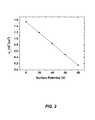
- FIG. 2is a graph that illustrates sheet charge density vs. surface potential of a GaN/AlGaN/GaN HEMT with a 250 nm GaN cap;
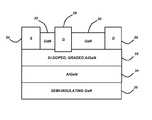
- FIG. 3is a schematic cross-section of a GaN/AlGaN/GaN HEMT
- FIG. 4Ais a schematic cross-section of a GaN/AlGaN/GaN HEMT
- FIG. 4Bis a graph that illustrates a band diagram of a GaN/AlGaN/GaN HEMT
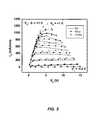
- FIG. 5is a graph that illustrates DC and Pulsed I-V curves
- FIG. 6is a graph that illustrates power performance at 8 GHz of 15 V drain bias.
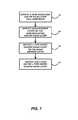
- FIG. 7is a flowchart that illustrates the steps for fabricating a dispersion-free HEMT, according to the preferred embodiment of the present invention.
- the present inventionuses an epitaxial solution to suppress the “DC-to-RF” dispersion problem suffered by GaN power HEMTs.
- This epitaxial solutionresults in the novel epitaxial structure of a GaN/AlGaN/GaN HEMT shown in FIG. 1 , comprising a sapphire or silicon carbide (SiC) substrate 10 , semi-insulating (S.I.) GaN buffer layer 12 , AlN layer 14 , Al x Ga 1-x N layer 16 , silicon-doped (Si-doped), graded Al x Ga 1-x N layer 18 , GaN cap 20 and surface 22 .
- SiCsilicon carbide
- the GaN cap 20is unintentionally doped (UID).
- the amount of dispersiondepends on a ratio of a pinch-off voltage between the gate and access regions, wherein the pinch-off voltage is proportional to the distance between the channel and surface. Therefore, the GaN cap 20 needs to be a certain thickness to decrease dispersion to an acceptable level. For example, if dispersion needs to be less than 10%, the thickness of the GaN cap 20 , therefore, should be at least 10 times as thick as the distance between the channel and metal gate.
- the thickness of the Si-doped, graded AlGaN layer 18is around 5-40 nm.
- the Al mole fractionvaries linearly from 0 at the GaN 20 /graded AlGaN 18 interface to the mole fraction of the adjacent AlGaN layer 16 at the graded AlGaN 18 /AlGaN 16 interface.
- This layer 18is uniformly doped by Si and doping density can be from 10% to 100% of the net polarization charge present in the graded AlGaN layer 18 .
- the thickness of the AlGaN layer 16is about 5-40 nm and the Al mole fraction can vary from a low of 5-10% to a high of 70-90%.
- the AlN layer 14is 0.5-1 nm thick.
- the GaN buffer layer 12is semi-insulating and 2-4 ⁇ m thick.
- the substrate 10can be either sapphire or SiC.
- FIG. 2illustrates sheet charge density vs. surface potential of the GaN/AlGaN/GaN HEMT with a 250 nm GaN cap. It can be seen that the channel is not depleted until ⁇ 80 V, which is much larger than that of conventional AlGaN/GaN HEMT (about ⁇ 10 V). This is the key element in the present invention to implement dispersion-free GaN HEMTs.
- the Si-doping of the graded AlGaN layer 18is used to remove hole accumulation in said graded layer.
- a thin AlN layeris inserted to improve mobility.
- the processingis similar to that of conventional HEMTs, except that deep etching is necessary for both the source/drain contact and gate, in order to obtain ohmic contacts, reasonable transconductance and pinch-off voltage.
- FIG. 3is a schematic cross-section of a GaN/AlGaN/GaN HEMT.
- This figureillustrates source (S) 24 , drain (D) 26 and gate (G) 28 contacts, GaN layer 30 , Si-doped, graded AlGaN layer 32 , AlGaN layer 34 and semi-insulating (S.I.) GaN layer 36 .
- the n-type doped graded AlGaN layer 32includes a recess in a gate region of the device, wherein the gate contact 28 is formed in the recess in the gate region of the n-type doped graded AlGaN layer.
- the source contact 24 and the drain contact 26are formed on the n-type doped graded AlGaN layer 32 on opposite sides of the gate region.
- FIG. 4Ashows the details of the epitaxial structure and FIG. 4B shows the band diagram of a GaN/AlGaN/GaN HEMT.
- the DC and gate lag pulsed I-V characteristics of the unpassivated samplewere measured. No dispersion was observed up to 200 ns, as shown in FIG. 5 . At 200 ns, current density of 1.25 A/mm and transconductance of 230 mS/mm were obtained. Small signal RF performance showed 22 GHz f t and 40 GHz f max for 0.7 ⁇ m-gate-length device. Power measurement of the unpassivated sample at 8 GHz showed 2 W/mm and 3 W/mm with a PAE (power added efficiency) of 42% and 38% at a drain bias of 10 V and 15 V, respectively, as shown in FIG. 6 . This indicates that the dispersion is suppressed even in the GHz range.
- PAEpower added efficiency
- FIG. 7is a flowchart that illustrates the steps for fabricating a dispersion-free HEMT, according to the preferred embodiment of the present invention.
- Block 38represents depositing a semi-insulating buffer layer, comprised of gallium nitride (GaN) or aluminum gallium nitride (AlGaN), on a substrate, wherein the substrate is sapphire or silicon carbide.
- a semi-insulating buffer layercomprised of gallium nitride (GaN) or aluminum gallium nitride (AlGaN)
- GaNgallium nitride
- AlGaNaluminum gallium nitride
- Block 40represents depositing an AlGaN barrier layer, with an aluminum (Al) mole fraction larger than that of the semi-insulating buffer layer, on the semi-insulating buffer layer. Note that this Block may also place a thin aluminum nitride (AlN) layer between the semi-insulating buffer layer and the AlGaN barrier layer.
- Alaluminum nitride
- Block 42represents depositing an n-type doped graded AlGaN layer on the AlGaN barrier layer, wherein the Al mole fraction is decreased from the bottom of the layer to the top of the layer.
- the Al mole fraction in the n-type doped graded AlGaN layeris varied through the layer, such that the Al mole fraction in the n-type doped graded AlGaN layer next to the AlGaN barrier layer equals the Al mole fraction of the AlGaN barrier layer, and that the Al mole fraction in the n-type doped graded AlGaN layer next to the cap layer equals the Al mole fraction of the cap layer.
- Block 44represents depositing a cap layer, comprised of GaN or AlGaN with an Al mole fraction smaller than that of the AlGaN barrier layer, on the n-type doped graded AlGaN layer.
- the cap layer and the n-type doped graded AlGaN layerseparate a channel from the HEMT's surface in an access region to minimize surface potential fluctuations from affecting device performance.
- the n-type doped graded AlGaN layerprevents hole accumulation at an interface between the cap layer and the AlGaN barrier layer.
- the structurehas a low Al mole fraction AlGaN cap layer instead of GaN cap layer.
- graded AlGaN regionis removed, thus there is abrupt GaN/AlGaN interface, instead of a graded junction.
- the n-type dopingis performed with other shallow donor element than Si.
- the graded AlGaN layerhas a non-linear change in Al composition over a distance.
- Part/parts of the distance during which the Al composition is changedare undoped.
- the n-type doping in the graded AlGaN regionis not uniform.
- One or more parts of the UID GaN capare doped by n-type or p-type dopants.
- GaN capinstead of a plain GaN cap, there can be another heterojunction (e.g. AlGaN/GaN to form another 2DEG channel) to screen surface potential fluctuation further.
- another heterojunctione.g. AlGaN/GaN to form another 2DEG channel
- the GaN cap and the graded AlGaN layercan be replaced by a thick, graded AlGaN layer, wherein the thickness of the graded AlGaN is similar to the thickness of the GaN cap, to screen the surface potential fluctuation.
Landscapes
- Junction Field-Effect Transistors (AREA)
Abstract
Description
This application claims the benefit under 35 U.S.C. §119(e) of the following commonly-assigned U.S. Provisional Patent Application Ser. No. 60/510,695, entitled “GaN/AlGaN/GaN dispersion-free high electron mobility transistors,” filed on Oct. 10, 2003, by Likun Shen, Sten J. Heikman and Umesh K. Mishra, which application is incorporated by reference herein.
This invention was made with Government support under Grant No. N00014-01-1-0764 awarded by the CANE MURI program. The Government has certain rights in this invention.
1. Field of the Invention
This invention relates to semiconductor devices, and more particularly, to gallium nitride/aluminum gallium nitride/gallium nitride (GaN/AlGaN/GaN) dispersion-free high electron mobility transistors (HEMTs).
2. Description of the Related Art
GaN power HEMTs suffer from “DC-to-RF dispersion,” which is defined as the difference between the static and dynamic (e.g. gate lag measurement) I-V characteristics. This dispersion has been reported to be due to the slow response of the surface traps. In the prior art, silicon nitride (SiN) passivation has been used to suppress this problem, but the drawback of SiN passivation is that it is very sensitive to both surface and deposition conditions, which leads to poor reproducibility.
What is needed, then, are improved methods of fabricating dispersion-free GaN-based HEMTs without SiN passivation.
To overcome the limitations in the prior art described above, and to overcome other limitations that will become apparent upon reading and understanding the present specification, the present invention discloses a dispersion-free high electron mobility transistor (HEMT), comprised of a substrate; a semi-insulating buffer layer, comprised of gallium nitride (GaN) or aluminum gallium nitride (AlGaN), deposited on the substrate, an AlGaN barrier layer, with an aluminum (Al) mole fraction larger than that of the semi-insulating buffer layer, deposited on the semi-insulating buffer layer, an n-type doped graded AlGaN layer deposited on the AlGaN barrier layer, wherein an Al mole fraction is decreased from a bottom of the n-type doped graded AlGaN layer to a top of the n-type doped graded AlGaN layer, and a cap layer, comprised of GaN or AlGaN with an Al mole fraction smaller than that of the AlGaN barrier layer, deposited on the n-type doped graded AlGaN layer.
Referring now to the drawings in which like reference numbers represent corresponding parts throughout:
In the following description of the preferred embodiment, reference is made to the accompanying drawings which form a part hereof, and in which is shown by way of illustration a specific embodiment in which the invention may be practiced. It is to be understood that other embodiments may be utilized and structural changes may be made without departing from the scope of the present invention.
General Description
The present invention uses an epitaxial solution to suppress the “DC-to-RF” dispersion problem suffered by GaN power HEMTs. This epitaxial solution results in the novel epitaxial structure of a GaN/AlGaN/GaN HEMT shown inFIG. 1 , comprising a sapphire or silicon carbide (SiC)substrate 10, semi-insulating (S.I.) GaNbuffer layer 12,AlN layer 14, AlxGa1-xNlayer 16, silicon-doped (Si-doped), graded AlxGa1-xNlayer 18, GaNcap 20 andsurface 22.
In this structure, the GaNcap 20 is unintentionally doped (UID). The amount of dispersion depends on a ratio of a pinch-off voltage between the gate and access regions, wherein the pinch-off voltage is proportional to the distance between the channel and surface. Therefore, the GaNcap 20 needs to be a certain thickness to decrease dispersion to an acceptable level. For example, if dispersion needs to be less than 10%, the thickness of the GaNcap 20, therefore, should be at least 10 times as thick as the distance between the channel and metal gate.
The thickness of the Si-doped, gradedAlGaN layer 18 is around 5-40 nm. The Al mole fraction varies linearly from 0 at theGaN 20/gradedAlGaN 18 interface to the mole fraction of theadjacent AlGaN layer 16 at the graded AlGaN18/AlGaN16 interface. Thislayer 18 is uniformly doped by Si and doping density can be from 10% to 100% of the net polarization charge present in the gradedAlGaN layer 18. The thickness of the AlGaNlayer 16 is about 5-40 nm and the Al mole fraction can vary from a low of 5-10% to a high of 70-90%. TheAlN layer 14 is 0.5-1 nm thick. The GaNbuffer layer 12 is semi-insulating and 2-4 μm thick. Thesubstrate 10 can be either sapphire or SiC.
Research has shown that the dispersion is caused by the slow response of the surface states at the drain access region. In order to decrease this effect, one solution is to increase the distance between the surface and channel so that the capacitance can be reduced. The ability of the surface states to modulate the channel decreases when this capacitance becomes smaller. Therefore, thethick GaN cap 20 in the access region reduces surface potential fluctuations from affecting device performance.
The processing is similar to that of conventional HEMTs, except that deep etching is necessary for both the source/drain contact and gate, in order to obtain ohmic contacts, reasonable transconductance and pinch-off voltage.
One sample with this structure was grown and fabricated.FIG. 4A shows the details of the epitaxial structure andFIG. 4B shows the band diagram of a GaN/AlGaN/GaN HEMT.
The DC and gate lag pulsed I-V characteristics of the unpassivated sample were measured. No dispersion was observed up to 200 ns, as shown inFIG. 5 . At 200 ns, current density of 1.25 A/mm and transconductance of 230 mS/mm were obtained. Small signal RF performance showed 22 GHz ftand 40 GHz fmaxfor 0.7 μm-gate-length device. Power measurement of the unpassivated sample at 8 GHz showed 2 W/mm and 3 W/mm with a PAE (power added efficiency) of 42% and 38% at a drain bias of 10 V and 15 V, respectively, as shown inFIG. 6 . This indicates that the dispersion is suppressed even in the GHz range.
Process Steps
Possible Modifications
Possible modifications include:
1. The structure has a low Al mole fraction AlGaN cap layer instead of GaN cap layer.
2. The graded AlGaN region is removed, thus there is abrupt GaN/AlGaN interface, instead of a graded junction.
3. The n-type doping is performed with other shallow donor element than Si.
4. The graded AlGaN layer has a non-linear change in Al composition over a distance.
5. Part/parts of the distance during which the Al composition is changed are undoped.
6. The n-type doping in the graded AlGaN region is not uniform.
7. One or more parts of the UID GaN cap are doped by n-type or p-type dopants.
8. Instead of a plain GaN cap, there can be another heterojunction (e.g. AlGaN/GaN to form another 2DEG channel) to screen surface potential fluctuation further.
9. The GaN cap and the graded AlGaN layer can be replaced by a thick, graded AlGaN layer, wherein the thickness of the graded AlGaN is similar to the thickness of the GaN cap, to screen the surface potential fluctuation.
This concludes the description of the preferred embodiment of the present invention. The foregoing description of one or more embodiments of the invention has been presented for the purposes of illustration and description. It is not intended to be exhaustive or to limit the invention to the precise form disclosed. Many modifications and variations are possible in light of the above teaching. It is intended that the scope of the invention be limited not by this detailed description, but rather by the claims appended hereto.
Claims (15)
1. A high electron mobility transistor (HEMT), comprising:
a substrate;
a semi-insulating buffer layer, comprised of gallium nitride (GaN) or aluminum gallium nitride (AlGaN), deposited on the substrate;
an AlGaN barrier layer, with an aluminum (Al) mole fraction larger than that of the semi-insulating buffer layer, deposited on the semi-insulating buffer layer;
an n-type doped graded AlGaN layer deposited on the AlGaN barrier layer, wherein an Al mole fraction is decreased from a bottom of the n-type doped graded AlGaN layer to a top of the n-type doped graded AlGaN layer and the n-type doped graded AlGaN layer includes a recess in a gate region of the HEMT;
a source contact and a drain contact formed on the n-type doped graded AlGaN layer on opposite sides of the gate region;
a gate contact formed in the recess in the gate region of the n-type doped graded AlGaN layer; and
a cap layer, comprised of GaN or AlGaN with an Al mole fraction smaller than that of the AlGaN barrier layer, deposited on the n-type doped graded AlGaN layer in an access region between the source contact and the gate contact and between the drain contact and the gate contact;
wherein a thickness of the cap layer as compared to a distance between a channel and the gate contact is such that dispersion is less than 10%.
2. The HEMT ofclaim 1 , wherein the n-type doped graded AlGaN layer prevents hole accumulation at an interface between the cap layer and the AlGaN barrier layer.
3. The HEMT ofclaim 1 , wherein the Al mole fraction in the n-type doped graded AlGaN layer is varied through the n-type doped graded AlGaN layer, such that the Al mole fraction in the n-type doped graded AlGaN layer next to the AlGaN barrier layer equals the Al mole fraction of the AlGaN barrier layer, and that the Al mole fraction in the n-type doped graded AlGaN layer next to the cap layer equals the Al mole fraction of the cap layer.
4. The HEMT ofclaim 1 , wherein the substrate is sapphire or silicon carbide.
5. The HEMT ofclaim 1 , wherein a thin aluminum nitride (AlN) layer is placed between the semi-insulating buffer layer and the AlGaN barrier layer.
6. The HEMT ofclaim 1 , wherein the thickness of the cap layer is at least 250 nm.
7. The HEMT ofclaim 1 , wherein the thickness of the cap layer is at least 10 times the distance between the channel and the gate.
8. The HEMT ofclaim 1 , wherein the cap layer in the access region between the gate contact and the drain contact is adjacent to the gate contact.
9. The HEMT ofclaim 1 , wherein the thickness of the cap layer is such that the channel is not depleted until a surface potential of −80 V.
10. A high electron mobility transistor (HEMT), comprising:
a substrate;
a semi-insulating buffer layer, comprised of gallium nitride (GaN) or aluminum gallium nitride (AlGaN), deposited on the substrate;
an AlGaN barrier layer, with an aluminum (Al) mole fraction larger than that of the semi-insulating buffer layer, deposited on the semi-insulating buffer layer; and
an n-type doped graded AlGaN layer, deposited on the AlGaN barrier layer, wherein the aluminum mole fraction is decreased from the bottom of the n-type doped graded AlGaN layer to the top of the n-type doped graded AlGaN layer,
wherein a thickness of the n-type doped graded AlGaN layer, in an access region between a source contact and a gate contact and between a drain contact and the gate contact, as compared to a distance between a channel and the gate contact is such that dispersion is less than 10%.
11. The HEMT ofclaim 10 , wherein the n-type doping of the n-type doped graded AlGaN layer prevents hole accumulation in the n-type doped graded AlGaN layer or in the AlGaN barrier layer.
12. The HEMT ofclaim 10 , wherein the Al mole fraction in the n-type doped graded AlGaN layer is varied through the n-type doped graded AlGaN layer, such that the Al mole fraction in the n-type doped graded AlGaN layer next to the AlGaN barrier layer equals the Al mole fraction of the AlGaN barrier layer, and that the Al mole fraction at the top of the n-type doped graded AlGaN layer is less than 0.10.
13. The HEMT ofclaim 10 , wherein the substrate is sapphire or silicon carbide.
14. The HEMT ofclaim 10 , wherein a thin aluminum nitride (AlN) layer is placed between the semi-insulating buffer layer and the AlGaN barrier layer.
15. A high electron mobility transistor (HEMT), comprising:
a substrate;
a semi-insulating buffer layer, comprised of gallium nitride (GaN) or aluminum gallium nitride (AlGaN), deposited on the substrate;
an AlGaN barrier layer, with an aluminum (Al) mole fraction larger than that of the semi-insulating buffer layer, deposited on the semi-insulating buffer layer;
an unintentionally doped cap layer, comprised of GaN or AlGaN with an Al mole fraction smaller than that of the AlGaN barrier layer, deposited on the AlGaN barrier layer; and
an n-type doping region between the cap layer and the AlGaN barrier layer;
wherein a thickness of the cap layer, the n-type doping region and the AlGaN barrier layer, in an access region between a source contact and a gate contact and between a drain contact and the gate contact, as compared to a distance between a channel and the gate contact is such that dispersion is less than 10%.
Priority Applications (1)
| Application Number | Priority Date | Filing Date | Title |
|---|---|---|---|
| US10/962,911US7700973B2 (en) | 2003-10-10 | 2004-10-12 | GaN/AlGaN/GaN dispersion-free high electron mobility transistors |
Applications Claiming Priority (2)
| Application Number | Priority Date | Filing Date | Title |
|---|---|---|---|
| US51069503P | 2003-10-10 | 2003-10-10 | |
| US10/962,911US7700973B2 (en) | 2003-10-10 | 2004-10-12 | GaN/AlGaN/GaN dispersion-free high electron mobility transistors |
Publications (2)
| Publication Number | Publication Date |
|---|---|
| US20050077541A1 US20050077541A1 (en) | 2005-04-14 |
| US7700973B2true US7700973B2 (en) | 2010-04-20 |
Family
ID=34738576
Family Applications (1)
| Application Number | Title | Priority Date | Filing Date |
|---|---|---|---|
| US10/962,911Expired - Fee RelatedUS7700973B2 (en) | 2003-10-10 | 2004-10-12 | GaN/AlGaN/GaN dispersion-free high electron mobility transistors |
Country Status (2)
| Country | Link |
|---|---|
| US (1) | US7700973B2 (en) |
| WO (1) | WO2005062745A2 (en) |
Cited By (17)
| Publication number | Priority date | Publication date | Assignee | Title |
|---|---|---|---|---|
| US20110169014A1 (en)* | 2010-01-12 | 2011-07-14 | Sumitomo Electric Industries, Ltd. | Compound semiconductor device |
| US20120274402A1 (en)* | 2011-04-26 | 2012-11-01 | Texas Instruments Incorporated | High electron mobility transistor |
| WO2013096821A1 (en)* | 2011-12-21 | 2013-06-27 | Massachusetts Institute Of Technology | Aluminum nitride based semiconductor devices |
| US8816396B2 (en) | 2010-10-11 | 2014-08-26 | Samsung Electronics Co., Ltd. | E-mode high electron mobility transistor and method of manufacturing the same |
| US9093366B2 (en) | 2012-04-09 | 2015-07-28 | Transphorm Inc. | N-polar III-nitride transistors |
| US9171836B2 (en) | 2011-10-07 | 2015-10-27 | Transphorm Inc. | Method of forming electronic components with increased reliability |
| US20160005846A1 (en)* | 2011-08-08 | 2016-01-07 | Renesas Electronics Corporation | Semiconductor device and method of manufacturing the same |
| US9245993B2 (en) | 2013-03-15 | 2016-01-26 | Transphorm Inc. | Carbon doping semiconductor devices |
| US9318593B2 (en) | 2014-07-21 | 2016-04-19 | Transphorm Inc. | Forming enhancement mode III-nitride devices |
| US9443938B2 (en) | 2013-07-19 | 2016-09-13 | Transphorm Inc. | III-nitride transistor including a p-type depleting layer |
| US9472667B2 (en) | 2015-01-08 | 2016-10-18 | International Business Machines Corporation | III-V MOSFET with strained channel and semi-insulating bottom barrier |
| US9536967B2 (en) | 2014-12-16 | 2017-01-03 | Transphorm Inc. | Recessed ohmic contacts in a III-N device |
| US9536966B2 (en) | 2014-12-16 | 2017-01-03 | Transphorm Inc. | Gate structures for III-N devices |
| US9590060B2 (en) | 2013-03-13 | 2017-03-07 | Transphorm Inc. | Enhancement-mode III-nitride devices |
| US9666683B2 (en) | 2015-10-09 | 2017-05-30 | Taiwan Semiconductor Manufacturing Company, Ltd. | Surface treatment and passivation for high electron mobility transistors |
| US10224401B2 (en) | 2016-05-31 | 2019-03-05 | Transphorm Inc. | III-nitride devices including a graded depleting layer |
| US11322599B2 (en) | 2016-01-15 | 2022-05-03 | Transphorm Technology, Inc. | Enhancement mode III-nitride devices having an Al1-xSixO gate insulator |
Families Citing this family (46)
| Publication number | Priority date | Publication date | Assignee | Title |
|---|---|---|---|---|
| JP4179539B2 (en) | 2003-01-15 | 2008-11-12 | 富士通株式会社 | Compound semiconductor device and manufacturing method thereof |
| US7649215B2 (en)* | 2003-12-05 | 2010-01-19 | International Rectifier Corporation | III-nitride device passivation and method |
| EP1756875A4 (en) | 2004-04-07 | 2010-12-29 | Tinggi Technologies Private Ltd | FABRICATION OF A RETROFLECTIVE LAYER ON SEMICONDUCTOR ELECTROLUMINESCENT DIODES |
| US8441030B2 (en)* | 2004-09-30 | 2013-05-14 | International Rectifier Corporation | III-nitride multi-channel heterojunction interdigitated rectifier |
| US7544963B2 (en)* | 2005-04-29 | 2009-06-09 | Cree, Inc. | Binary group III-nitride based high electron mobility transistors |
| US20070018198A1 (en)* | 2005-07-20 | 2007-01-25 | Brandes George R | High electron mobility electronic device structures comprising native substrates and methods for making the same |
| JP2007088252A (en)* | 2005-09-22 | 2007-04-05 | Toyoda Gosei Co Ltd | Field effect transistor |
| SG131803A1 (en) | 2005-10-19 | 2007-05-28 | Tinggi Tech Private Ltd | Fabrication of transistors |
| US8114717B2 (en)* | 2005-11-15 | 2012-02-14 | The Regents Of The University Of California | Methods to shape the electric field in electron devices, passivate dislocations and point defects, and enhance the luminescence efficiency of optical devices |
| SG133432A1 (en) | 2005-12-20 | 2007-07-30 | Tinggi Tech Private Ltd | Localized annealing during semiconductor device fabrication |
| SG140473A1 (en) | 2006-08-16 | 2008-03-28 | Tinggi Tech Private Ltd | Improvements in external light efficiency of light emitting diodes |
| SG140512A1 (en) | 2006-09-04 | 2008-03-28 | Tinggi Tech Private Ltd | Electrical current distribution in light emitting devices |
| CN100495724C (en)* | 2006-09-06 | 2009-06-03 | 中国科学院半导体研究所 | GaN-based heterojunction field effect transistor structure and fabrication method |
| US7728356B2 (en)* | 2007-06-01 | 2010-06-01 | The Regents Of The University Of California | P-GaN/AlGaN/AlN/GaN enhancement-mode field effect transistor |
| US7915643B2 (en) | 2007-09-17 | 2011-03-29 | Transphorm Inc. | Enhancement mode gallium nitride power devices |
| US20090072269A1 (en)* | 2007-09-17 | 2009-03-19 | Chang Soo Suh | Gallium nitride diodes and integrated components |
| US8519438B2 (en) | 2008-04-23 | 2013-08-27 | Transphorm Inc. | Enhancement mode III-N HEMTs |
| US8289065B2 (en) | 2008-09-23 | 2012-10-16 | Transphorm Inc. | Inductive load power switching circuits |
| US20100109018A1 (en)* | 2008-10-31 | 2010-05-06 | The Regents Of The University Of California | Method of fabricating semi-insulating gallium nitride using an aluminum gallium nitride blocking layer |
| US7898004B2 (en) | 2008-12-10 | 2011-03-01 | Transphorm Inc. | Semiconductor heterostructure diodes |
| US8742459B2 (en) | 2009-05-14 | 2014-06-03 | Transphorm Inc. | High voltage III-nitride semiconductor devices |
| US8390000B2 (en) | 2009-08-28 | 2013-03-05 | Transphorm Inc. | Semiconductor devices with field plates |
| US8389977B2 (en) | 2009-12-10 | 2013-03-05 | Transphorm Inc. | Reverse side engineered III-nitride devices |
| US8742460B2 (en) | 2010-12-15 | 2014-06-03 | Transphorm Inc. | Transistors with isolation regions |
| US8643062B2 (en) | 2011-02-02 | 2014-02-04 | Transphorm Inc. | III-N device structures and methods |
| US8716141B2 (en) | 2011-03-04 | 2014-05-06 | Transphorm Inc. | Electrode configurations for semiconductor devices |
| US8772842B2 (en) | 2011-03-04 | 2014-07-08 | Transphorm, Inc. | Semiconductor diodes with low reverse bias currents |
| US9373688B2 (en)* | 2011-05-04 | 2016-06-21 | Infineon Technologies Austria Ag | Normally-off high electron mobility transistors |
| TWI508281B (en)* | 2011-08-01 | 2015-11-11 | Murata Manufacturing Co | Field effect transistor |
| US8901604B2 (en) | 2011-09-06 | 2014-12-02 | Transphorm Inc. | Semiconductor devices with guard rings |
| US9257547B2 (en) | 2011-09-13 | 2016-02-09 | Transphorm Inc. | III-N device structures having a non-insulating substrate |
| US8723226B2 (en)* | 2011-11-22 | 2014-05-13 | Texas Instruments Incorporated | Manufacturable enhancement-mode group III-N HEMT with a reverse polarization cap |
| US9165766B2 (en) | 2012-02-03 | 2015-10-20 | Transphorm Inc. | Buffer layer structures suited for III-nitride devices with foreign substrates |
| US8860091B2 (en)* | 2012-04-16 | 2014-10-14 | Hrl Laboratories, Llc | Group III-N HFET with a graded barrier layer |
| US9184275B2 (en) | 2012-06-27 | 2015-11-10 | Transphorm Inc. | Semiconductor devices with integrated hole collectors |
| CN105164811B (en) | 2013-02-15 | 2018-08-31 | 创世舫电子有限公司 | Electrode of semiconductor devices and forming method thereof |
| US9443737B2 (en)* | 2013-04-03 | 2016-09-13 | Texas Instruments Incorporated | Method of forming metal contacts in the barrier layer of a group III-N HEMT |
| US9640650B2 (en)* | 2014-01-16 | 2017-05-02 | Qorvo Us, Inc. | Doped gallium nitride high-electron mobility transistor |
| CN105789296B (en)* | 2015-12-29 | 2019-01-25 | 中国电子科技集团公司第五十五研究所 | A kind of aluminum gallium nitride compound/gallium nitride high electron mobility transistor |
| CN105787210B (en)* | 2016-03-25 | 2019-01-08 | 西安电子科技大学 | GaN high electron mobility transistor small-signal circuit model parameter extracting method |
| WO2017171700A1 (en)* | 2016-03-28 | 2017-10-05 | Intel Corporation | Gallium nitride voltage regulator |
| CN106252398B (en)* | 2016-08-19 | 2019-06-14 | 苏州捷芯威半导体有限公司 | An IGBT device and its manufacturing method |
| JP6957982B2 (en)* | 2017-05-29 | 2021-11-02 | 三菱電機株式会社 | Semiconductor devices and their manufacturing methods |
| US11848362B2 (en)* | 2019-04-18 | 2023-12-19 | Intel Corporation | III-N transistors with contacts of modified widths |
| CN112151361B (en)* | 2020-08-21 | 2022-06-14 | 华灿光电(苏州)有限公司 | Preparation method of high electron mobility transistor |
| US11967642B2 (en)* | 2021-09-03 | 2024-04-23 | Vanguard International Semiconductor Corporation | Semiconductor structure, high electron mobility transistor and fabrication method thereof |
Citations (5)
| Publication number | Priority date | Publication date | Assignee | Title |
|---|---|---|---|---|
| US20030155578A1 (en)* | 2000-06-02 | 2003-08-21 | Erhard Kohn | Heterostructure with rear-face donor doping |
| US20030218183A1 (en)* | 2001-12-06 | 2003-11-27 | Miroslav Micovic | High power-low noise microwave GaN heterojunction field effet transistor |
| US20040061129A1 (en)* | 2002-07-16 | 2004-04-01 | Saxler Adam William | Nitride-based transistors and methods of fabrication thereof using non-etched contact recesses |
| US20050017317A1 (en)* | 2001-11-27 | 2005-01-27 | Jds Uniphase Corporation | Doped absorption for enhanced responsivity for high speed photodiodes |
| US7033961B1 (en)* | 2003-07-15 | 2006-04-25 | Rf Micro Devices, Inc. | Epitaxy/substrate release layer |
- 2004
- 2004-10-12WOPCT/US2004/033546patent/WO2005062745A2/enactiveApplication Filing
- 2004-10-12USUS10/962,911patent/US7700973B2/ennot_activeExpired - Fee Related
Patent Citations (5)
| Publication number | Priority date | Publication date | Assignee | Title |
|---|---|---|---|---|
| US20030155578A1 (en)* | 2000-06-02 | 2003-08-21 | Erhard Kohn | Heterostructure with rear-face donor doping |
| US20050017317A1 (en)* | 2001-11-27 | 2005-01-27 | Jds Uniphase Corporation | Doped absorption for enhanced responsivity for high speed photodiodes |
| US20030218183A1 (en)* | 2001-12-06 | 2003-11-27 | Miroslav Micovic | High power-low noise microwave GaN heterojunction field effet transistor |
| US20040061129A1 (en)* | 2002-07-16 | 2004-04-01 | Saxler Adam William | Nitride-based transistors and methods of fabrication thereof using non-etched contact recesses |
| US7033961B1 (en)* | 2003-07-15 | 2006-04-25 | Rf Micro Devices, Inc. | Epitaxy/substrate release layer |
Non-Patent Citations (4)
| Title |
|---|
| Coffie et al. p-Capped GaN-AlGaN-GaN High-Electron Mobility Transistors (HEMTS). IEEE Electron Device Letters, vol. 23, No. 10, Oct. 2002.* |
| L Shen et al., "AlGaN/AIN/GaN High-Power Microwave HEMT", IEEE Electron Device Letters, vol. 22, No. 10, Oct. 2001, pp. 457-459. |
| N.-Q. Zhang et al., "High Breakdown GaN HEMT with Overlapping Gate Structure", IEEE Electron Device Letters, vol. 21, No. 9, Sep. 2000, pp. 421-423. |
| Y.-F. Wu et al, "A 50-W AIGaN/GaN HEMT Amplifier", IEEE, 2000, (Document No. 0-7803-6438-4/00), 2pp. |
Cited By (36)
| Publication number | Priority date | Publication date | Assignee | Title |
|---|---|---|---|---|
| US8242512B2 (en)* | 2010-01-12 | 2012-08-14 | Sumitomo Electric Industries, Ltd. | Compound semiconductor device |
| US20110169014A1 (en)* | 2010-01-12 | 2011-07-14 | Sumitomo Electric Industries, Ltd. | Compound semiconductor device |
| US8816396B2 (en) | 2010-10-11 | 2014-08-26 | Samsung Electronics Co., Ltd. | E-mode high electron mobility transistor and method of manufacturing the same |
| US20120274402A1 (en)* | 2011-04-26 | 2012-11-01 | Texas Instruments Incorporated | High electron mobility transistor |
| US20160005846A1 (en)* | 2011-08-08 | 2016-01-07 | Renesas Electronics Corporation | Semiconductor device and method of manufacturing the same |
| US9502551B2 (en)* | 2011-08-08 | 2016-11-22 | Renesas Electronics Corporation | Nitride semiconductor transistor device |
| US9171836B2 (en) | 2011-10-07 | 2015-10-27 | Transphorm Inc. | Method of forming electronic components with increased reliability |
| US9337301B2 (en)* | 2011-12-21 | 2016-05-10 | Massachusetts Institute Of Technology | Aluminum nitride based semiconductor devices |
| WO2013096821A1 (en)* | 2011-12-21 | 2013-06-27 | Massachusetts Institute Of Technology | Aluminum nitride based semiconductor devices |
| US20150028346A1 (en)* | 2011-12-21 | 2015-01-29 | Massachusetts Institute Of Technology | Aluminum nitride based semiconductor devices |
| US9490324B2 (en) | 2012-04-09 | 2016-11-08 | Transphorm Inc. | N-polar III-nitride transistors |
| US9093366B2 (en) | 2012-04-09 | 2015-07-28 | Transphorm Inc. | N-polar III-nitride transistors |
| US10535763B2 (en) | 2013-03-13 | 2020-01-14 | Transphorm Inc. | Enhancement-mode III-nitride devices |
| US10043898B2 (en) | 2013-03-13 | 2018-08-07 | Transphorm Inc. | Enhancement-mode III-nitride devices |
| US9590060B2 (en) | 2013-03-13 | 2017-03-07 | Transphorm Inc. | Enhancement-mode III-nitride devices |
| US9245992B2 (en) | 2013-03-15 | 2016-01-26 | Transphorm Inc. | Carbon doping semiconductor devices |
| US9865719B2 (en) | 2013-03-15 | 2018-01-09 | Transphorm Inc. | Carbon doping semiconductor devices |
| US9245993B2 (en) | 2013-03-15 | 2016-01-26 | Transphorm Inc. | Carbon doping semiconductor devices |
| US9443938B2 (en) | 2013-07-19 | 2016-09-13 | Transphorm Inc. | III-nitride transistor including a p-type depleting layer |
| US10043896B2 (en) | 2013-07-19 | 2018-08-07 | Transphorm Inc. | III-Nitride transistor including a III-N depleting layer |
| US9842922B2 (en) | 2013-07-19 | 2017-12-12 | Transphorm Inc. | III-nitride transistor including a p-type depleting layer |
| US9318593B2 (en) | 2014-07-21 | 2016-04-19 | Transphorm Inc. | Forming enhancement mode III-nitride devices |
| US9935190B2 (en) | 2014-07-21 | 2018-04-03 | Transphorm Inc. | Forming enhancement mode III-nitride devices |
| US9536966B2 (en) | 2014-12-16 | 2017-01-03 | Transphorm Inc. | Gate structures for III-N devices |
| US9536967B2 (en) | 2014-12-16 | 2017-01-03 | Transphorm Inc. | Recessed ohmic contacts in a III-N device |
| US9748357B2 (en) | 2015-01-08 | 2017-08-29 | International Business Machines Corporation | III-V MOSFET with strained channel and semi-insulating bottom barrier |
| US9472667B2 (en) | 2015-01-08 | 2016-10-18 | International Business Machines Corporation | III-V MOSFET with strained channel and semi-insulating bottom barrier |
| US9666683B2 (en) | 2015-10-09 | 2017-05-30 | Taiwan Semiconductor Manufacturing Company, Ltd. | Surface treatment and passivation for high electron mobility transistors |
| US10170579B2 (en) | 2015-10-09 | 2019-01-01 | Taiwan Semiconductor Manufacturing Company, Ltd. | Surface treatment and passivation for high electron mobility transistors |
| US10522645B2 (en) | 2015-10-09 | 2019-12-31 | Taiwan Semiconductor Manufacturing Company, Ltd. | Surface treatment and passivation for high electron mobility transistors |
| US11004951B2 (en)* | 2015-10-09 | 2021-05-11 | Taiwan Semiconductor Manufacturing Company, Ltd. | Surface treatment and passivation for high electron mobility transistors |
| US11575021B2 (en) | 2015-10-09 | 2023-02-07 | Taiwan Semiconductor Manufacturing Company, Ltd. | Surface treatment and passivation for high electron mobility transistors |
| US11322599B2 (en) | 2016-01-15 | 2022-05-03 | Transphorm Technology, Inc. | Enhancement mode III-nitride devices having an Al1-xSixO gate insulator |
| US10224401B2 (en) | 2016-05-31 | 2019-03-05 | Transphorm Inc. | III-nitride devices including a graded depleting layer |
| US10629681B2 (en) | 2016-05-31 | 2020-04-21 | Transphorm Technology, Inc. | III-nitride devices including a graded depleting layer |
| US11121216B2 (en) | 2016-05-31 | 2021-09-14 | Transphorm Technology, Inc. | III-nitride devices including a graded depleting layer |
Also Published As
| Publication number | Publication date |
|---|---|
| WO2005062745A2 (en) | 2005-07-14 |
| US20050077541A1 (en) | 2005-04-14 |
| WO2005062745A3 (en) | 2006-10-19 |
Similar Documents
| Publication | Publication Date | Title |
|---|---|---|
| US7700973B2 (en) | GaN/AlGaN/GaN dispersion-free high electron mobility transistors | |
| US9608075B1 (en) | III-nitride semiconductor device with doped epi structures | |
| US9035354B2 (en) | Heterojunction transistors having barrier layer bandgaps greater than channel layer bandgaps and related methods | |
| US8896022B2 (en) | Method of manufacturing compound semiconductor device | |
| Shen et al. | High-power polarization-engineered GaN/AlGaN/GaN HEMTs without surface passivation | |
| US8399911B2 (en) | Enhancement mode field effect device and the method of production thereof | |
| US7170111B2 (en) | Nitride heterojunction transistors having charge-transfer induced energy barriers and methods of fabricating the same | |
| US6624452B2 (en) | Gallium nitride-based HFET and a method for fabricating a gallium nitride-based HFET | |
| US20050133816A1 (en) | III-nitride quantum-well field effect transistors | |
| US20130240901A1 (en) | Nitride semiconductor device | |
| US20070164313A1 (en) | Gallium nitride high electron mobility transistor structure | |
| US20120299060A1 (en) | Nitride semiconductor device and manufacturing method thereof | |
| US7525130B2 (en) | Polarization-doped field effect transistors (POLFETS) and materials and methods for making the same | |
| US8710548B2 (en) | Semiconductor device and method for manufacturing the same | |
| US11594625B2 (en) | III-N transistor structures with stepped cap layers | |
| JP2004327892A (en) | Compound semiconductor FET | |
| US20240332397A1 (en) | High current and field-managed transistor | |
| US11610989B2 (en) | High electron mobility transistor | |
| US20070120208A1 (en) | Wide bandgap semiconductor based field effect transistors | |
| KR102382347B1 (en) | High electron mobility transistor and manufacturing method thereof | |
| US11699723B1 (en) | N-polar III-nitride device structures with a p-type layer | |
| Weimann et al. | AlGaN/GaN HEMTs grown by molecular beam epitaxy on sapphire, SiC, and HVPE GaN templates | |
| JPH10335349A (en) | Field effect transistor |
Legal Events
| Date | Code | Title | Description |
|---|---|---|---|
| AS | Assignment | Owner name:REGENTS OF THE UNIVERSITY OF CALIFORNIA, THE, CALI Free format text:ASSIGNMENT OF ASSIGNORS INTEREST;ASSIGNORS:SHEN, LIKUN;HEIKMAN, STEN J.;MISHRA, UMESH K.;REEL/FRAME:015887/0411 Effective date:20041011 Owner name:REGENTS OF THE UNIVERSITY OF CALIFORNIA, THE,CALIF Free format text:ASSIGNMENT OF ASSIGNORS INTEREST;ASSIGNORS:SHEN, LIKUN;HEIKMAN, STEN J.;MISHRA, UMESH K.;REEL/FRAME:015887/0411 Effective date:20041011 | |
| FPAY | Fee payment | Year of fee payment:4 | |
| FEPP | Fee payment procedure | Free format text:MAINTENANCE FEE REMINDER MAILED (ORIGINAL EVENT CODE: REM.) | |
| LAPS | Lapse for failure to pay maintenance fees | Free format text:PATENT EXPIRED FOR FAILURE TO PAY MAINTENANCE FEES (ORIGINAL EVENT CODE: EXP.) | |
| STCH | Information on status: patent discontinuation | Free format text:PATENT EXPIRED DUE TO NONPAYMENT OF MAINTENANCE FEES UNDER 37 CFR 1.362 | |
| FP | Lapsed due to failure to pay maintenance fee | Effective date:20180420 |