US7632097B2 - Method for manufacturing a suprastructure and a corresponding drill jig - Google Patents
Method for manufacturing a suprastructure and a corresponding drill jigDownload PDFInfo
- Publication number
- US7632097B2 US7632097B2US10/482,927US48292704AUS7632097B2US 7632097 B2US7632097 B2US 7632097B2US 48292704 AUS48292704 AUS 48292704AUS 7632097 B2US7632097 B2US 7632097B2
- Authority
- US
- United States
- Prior art keywords
- reference element
- aligning plate
- jaw
- bone
- aperture
- Prior art date
- Legal status (The legal status is an assumption and is not a legal conclusion. Google has not performed a legal analysis and makes no representation as to the accuracy of the status listed.)
- Expired - Fee Related, expires
Links
- 238000000034methodMethods0.000titleclaimsabstractdescription47
- 238000004519manufacturing processMethods0.000titleclaimsabstractdescription10
- 239000007943implantSubstances0.000claimsabstractdescription41
- 210000000988bone and boneAnatomy0.000claimsabstractdescription37
- 210000003484anatomyAnatomy0.000claimsdescription19
- 238000005553drillingMethods0.000claimsdescription15
- 210000005036nerveAnatomy0.000claimsdescription10
- 238000002591computed tomographyMethods0.000claimsdescription5
- 210000000214mouthAnatomy0.000claimsdescription4
- 210000000056organAnatomy0.000abstract1
- 210000004204blood vesselAnatomy0.000description7
- 210000003128headAnatomy0.000description4
- 229920003002synthetic resinPolymers0.000description3
- 239000000057synthetic resinSubstances0.000description3
- 229920001296polysiloxanePolymers0.000description2
- 2380000101463D printingMethods0.000description1
- 230000008021depositionEffects0.000description1
- 239000002184metalSubstances0.000description1
- 238000003801millingMethods0.000description1
- 238000000110selective laser sinteringMethods0.000description1
- 238000001356surgical procedureMethods0.000description1
Images
Classifications
- A—HUMAN NECESSITIES
- A61—MEDICAL OR VETERINARY SCIENCE; HYGIENE
- A61C—DENTISTRY; APPARATUS OR METHODS FOR ORAL OR DENTAL HYGIENE
- A61C1/00—Dental machines for boring or cutting ; General features of dental machines or apparatus, e.g. hand-piece design
- A61C1/08—Machine parts specially adapted for dentistry
- A61C1/082—Positioning or guiding, e.g. of drills
- A61C1/084—Positioning or guiding, e.g. of drills of implanting tools
- B—PERFORMING OPERATIONS; TRANSPORTING
- B33—ADDITIVE MANUFACTURING TECHNOLOGY
- B33Y—ADDITIVE MANUFACTURING, i.e. MANUFACTURING OF THREE-DIMENSIONAL [3-D] OBJECTS BY ADDITIVE DEPOSITION, ADDITIVE AGGLOMERATION OR ADDITIVE LAYERING, e.g. BY 3-D PRINTING, STEREOLITHOGRAPHY OR SELECTIVE LASER SINTERING
- B33Y80/00—Products made by additive manufacturing
Definitions
- the inventionrelates to a method for producing a superstructure provided with artificial teeth, which superstructure is fitted on at least one implant, which is provided in the oral cavity of a person and has to be fixed in the bone of a lower or an upper jaw, an aligning plate with at least one aperture being produced for the purpose of drilling a hole in the bone through said aperture, in order to fit the abovementioned implant.
- a wax model of a dental prosthesisis made using an impression that is taken of the patient's jaw.
- a replica of this wax modelis then prepared in synthetic resin, in which replica openings are already provided, corresponding to a possible position for the implants, for the purpose of drilling holes in the jaw.
- a so-called CT scanthen has to be made of this replica when it has been placed on the corresponding jaw of the patient, in order to determine the anatomical bone structure and the precise location of nerve bundles and blood vessels.
- an aligning plateis then produced on the basis of the abovementioned replica, and the implants are placed in position.
- a number of impressions of the jaw together with the implantsare taken, in order to produce a provisional model, i.e. a wax model, of the superstructure.
- This provisional modelthen has to be fitted on the patient If the provisional model is satisfactory, the final superstructure is produced on the basis of this provisional model.
- the abovementioned first stepis to make a CT scan of the jaw on which the superstructure is to be fixed, and an aligning plate is produced directly, on the basis of the electronic information from this CT scan.
- the superstructureis then further produced according to the technique described above.
- a patientOwing to the different steps required in the case of these processes, a patient generally undergoes six months of treatment before a final superstructure is fitted.
- Another method according to the prior artmakes use of prefabricated superstructures.
- a disadvantage of this methodis that for fitting of the superstructure part of the bone of the upper jaw or of the lower jaw has to be removed
- the prostheses placed in this wayare not adapted to the individual shape of a person's jaw.
- the object of the inventionis to overcome the abovementioned disadvantages by proposing a method that allows holes that are necessary for the placing of implants to be drilled in a very simple and accurate manner.
- This methodhas the further advantage that the production of a superstructure and its fitting on a person's jaw can be performed in a very short time.
- At least one reference elementis fixed to the abovementioned bone, and the location of anatomical structures of the abovementioned jaw relative to this reference element is then determined, means being provided on the abovementioned aligning plate for fixing the latter on the abovementioned jaw relative to the abovementioned reference element and, taking into account the determined location of the anatomical structures, the position of the abovementioned aperture in the aligning plate is determined in such a way that critical anatomical structures, such as nerve bundles or blood vessels, are not touched during the drilling of the abovementioned hole when the aligning plate has been fixed on the abovementioned jaw.
- a screwis expediently fixed in the abovementioned bone, said screw forming the abovementioned reference element
- meansare provided on the abovementioned aligning plate for fixing the latter detachably on the abovementioned reference element before the abovementioned hole is drilled in the bone. More particularly, the abovementioned means are formed by providing an opening in the aligning plate, which opening connects up in a virtually exact fit with the abovementioned reference element.
- a dental impressionis made of the abovementioned jaw with the abovementioned reference element, and a provisional model of the abovementioned superstructure with teeth is made on the basis of this impression, a three-dimensional image being made of the abovementioned jaw together with this provisional model and the abovementioned reference element
- the abovementioned aligning plateis made on the basis of the abovementioned three-dimensional image.
- the abovementioned three-dimensional imageis preferably processed electronically in order to produce the abovementioned aligning plate and/or the abovementioned superstructure by means of a so-called rapid prototyping technique.
- the abovementioned aligning plateis fixed to the abovementioned reference element, and the abovementioned hole is drilled in the jaw, and the implant is fixed in said hole, and subsequently, preferably after the abovementioned reference element has been removed, the abovementioned superstructure is fitted on said implant.
- the inventionalso relates to an aligning plate for use of the method, having at least one aperture for drilling a hole in the bone of a lower or an upper jaw of a person, in order to place at least one implant.
- Said aligning plateis characterized in that it has means for fixing it to at least one reference element that is provided in the abovementioned bone.
- Said meanspreferably have an opening that connects up in a virtually exact fit with the abovementioned reference element, so that the aligning plate can be fixed detachably on the reference element by means of at least one screw or bolt.
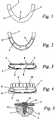
- FIG. 1is a diagrammatic top view of a part of a lower jaw with reference elements according to the invention.
- FIG. 2is a diagrammatic top view of a part of a lower jaw with an aligning plate according to the invention.
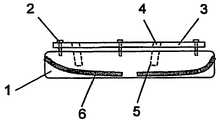
- FIG. 3is a diagrammatic front view of the lower jaw and the aligning plate of FIG. 2 .
- FIG. 4is a diagrammatic front view of a part of a lower jaw with a superstructure provided with teeth according to the invention.
- FIG. 5is a diagrammatic cross section of a reference element together with an aligning plate, according to the invention.
- the inventionrelates in general to a method for producing a dental prosthesis which has to be fixed upon so-called, implants provided in the jawbone of a patient.
- a dental prosthesiscomprises a so-called superstructure, on which artificial teeth are provided, in a manner that is known per se, and which has fixing means for fixing to the abovementioned implants.
- the inventionalso relates to a method for producing an aligning plate that makes it possible in a simple manner to drill very accurate holes, in which said implants are placed.
- FIG. 1shows diagrammatically a toothless lower jaw 1 in the case of which three reference elements have been fixed in the bone of said jaw.
- Each of these reference elementsis formed by a screw 2 .
- Said screws 2are fixed in different positions in the bone of the jaw 1 , in such a way that they project slightly above the gum surrounding the bone. Furthermore, the screws 2 are relatively short; but they are still sufficiently long, for example almost 5 mm, to be anchored stably in the jaw.
- This wax modelcomprises a relatively rigid bearing structure on which artificial teeth are fixed with wax.
- This provisional modellikewise has hollows that correspond to the position of the abovementioned screws 2 , in such a way that it can be positioned virtually perfectly in the oral cavity of the patient.
- the abovementioned hollowsare not provided in this provisional model, but said hollows are formed during the fitting of the model, through depressions being formed in its bearing structure by the abovementioned screws 2 .
- CT scanIn order to obtain such a three-dimensional image, it is preferable to perform a so-called CT scan.
- the information from this three-dimensional imageis preferably processed electronically, in order to make it possible to display it in a simple manner on, for example, a computer screen and to enable it to be used for certain so-called rapid prototyping techniques.
- anatomical structuressuch as the shape of the bone and the position of the nerve bundles and the blood vessels in the jaw 1 are deduced. It is then determined at what positions in the lower jaw and according to what orientations implants can be placed in the jaw 1 without touching nerve bundles, blood vessels or other critical anatomical structures.
- an aligning plate 3is produced, having apertures 4 with a suitable orientation and diameter to allow said holes to be drilled through them in the bone of the jaw 1 , in order to fit the abovementioned implants.
- the aligning plate 3is placed on the jaw 1 in the manner shown in FIGS. 2 and 3 .
- meansare also provided for fixing the. aligning plate 3 on the abovementioned screws 2 .
- Said meansmore specifically comprise openings, the position of which corresponds to that of the screws 2 , and which can connect up in a virtually exact fit with the latter.
- a drill with a small diameteris used, in which case a first bush, with a cylindrical opening whose diameter corresponds to that of the drill, is placed in the abovementioned aperture 4 of the aligning plate 3 , in order to guide the drill, so that a very accurate hole can be drilled.
- a number of successive holesare drilled in this way, in each case a drill with a larger diameter being used, and in each case a bush with corresponding dimensions being placed in the aperture 4 , until the hole obtained in this way is large enough for the placing of an implant
- the position and the orientation of the abovementioned apertures 4are selected in such a way that the blood vessels or the nerve bundles 6 or other critical anatomical structures cannot be touched during drilling in the jaw 1 .
- the aligning plateis made by means of the abovementioned rapid prototyping techniques.
- Such techniquesare, for example, stereolithography, selective laser sintering, fused deposition modelling, laminated object prototyping, three-dimensional printing, and so forth.
- the abovementioned aligning plate 3is produced on the basis of the information from the abovementioned three-dimensional image by milling from, for example, a block of metal or plastic.
- the superstructureis also made using one of these rapid prototyping techniques, starting, on the one hand, from the abovementioned provisional model and the abovementioned hollows that correspond to the position of the abovementioned screws 2 , and, on the other hand, from the relative position of the abovementioned apertures 4 in the aligning plate 3 , or therefore the desired position of the implants relative to the screws 2 .
- the superstructureis preferably produced by means of a similar rapid prototyping technique to that used for making up the aligning plate 3 .
- the abovementioned provisional modelis placed on a holder, with the abovementioned hollows connecting up in a virtually exact fit with supporting points provided on said holder.
- the mutual position of said supporting pointstherefore corresponds to the mutual position of the abovementioned reference elements.
- the provisional model with the artificial teethis then cast in a plastic, in order to form a so-called plastic key, said plastic key forming a contact face with the holder.
- the wax and the bearing structureare then removed from the plastic key according to techniques that are known per se, the artificial teeth remaining behind in a fixed position in the plastic. If a setting silicone is used for the abovementioned plastic, said plastic key is called a silicone key.
- the latteris placed on the holder, in which case the hollows corresponding to the reference elements connect up in a virtually exact fit with the abovementioned supporting points.
- the superstructureassumes the same position relative to the holder as the provisional model during the making up of the plastic key.
- the plastic keyis then placed over the superstructure, care being taken to ensure that the plastic key is positioned in an identical manner relative to the holder. This is carried out more specifically by placing the plastic key with the same contact surface and in the same way against the holder as was the case during its manufacture.
- a synthetic resinis placed in the plastic key, in a manner known per se, between the superstructure 7 and the artificial teeth. When this synthetic resin has set, in such a way that the teeth are immovably connected to the superstructure, the plastic key is removed from the superstructure and the artificial teeth.
- FIG. 4shows diagrammatically a superstructure 7 produced in this way, with artificial teeth 8 placed on it.
- Said superstructure 7is fitted on implants 9 and 10 , which are provided in the holes 5 drilled in the lower jaw 1 .
- FIG. 5shows diagrammatically a reference element that is formed by a screw 2 .
- Said screw 2is fixed through the gum 11 in the bone of a jaw 1 and has a preferably polygonal head 12 , which extends above the gum 11 .
- the head 12has on its top side a cylindrical threaded opening 13 which is coaxial with the screw 2 .
- Fixed in this opening 13is a bolt 14 , which allows the abovementioned aligning plate 3 to be fixed to the screw 2 .
- the aligning plate 3has at a position corresponding to that of the screw 2 an opening that connects up in a virtually exact fit with the head 12 of the screw 2 , said opening having a collar 15 that rests on the top of the head 12 .
- the abovementioned bolt 14extends through the opening in the aligning plate 3 .
- the abovementioned aligning plate 3is formed by the superstructure 7 , so that it is not necessary to manufactured a separate aligning plate 3 .
- the abovementioned apertures 4are made in the superstructure 7 , and after the implants 9 and 10 have been placed the superstructure is fixed on said implants by means of screws or bolts suitable for the purpose.
- the reference elements 2are preferably removed from the jaw 1 before the final placing of the superstructure 7 .
- thisalso includes the bone parts connected to said jaw ( 1 ).
- the inventionalso relates to a method and an aligning plate in the case of which three or more implants are provided in the lower jaw, or in the case of which only one implant is used.
- the dental prosthesis produced in this wayneed not extend over the entire jaw 1 , but it may have only a few teeth and be fitted on one implant.
- the inventionis also equally usable for producing and fitting a superstructure for an upper jaw.
- the inventionis in no way limited to the embodiments of the method, the superstructure and the aligning plate according to the invention described above and proposed in the figures, but a number of variants can be considered within the scope of this invention, both as regards the reference elements and as regards the dimensions and shapes of the aligning plate.
Landscapes
- Health & Medical Sciences (AREA)
- Oral & Maxillofacial Surgery (AREA)
- Veterinary Medicine (AREA)
- Life Sciences & Earth Sciences (AREA)
- Animal Behavior & Ethology (AREA)
- General Health & Medical Sciences (AREA)
- Public Health (AREA)
- Dentistry (AREA)
- Epidemiology (AREA)
- Dental Prosthetics (AREA)
- Surgical Instruments (AREA)
- Prostheses (AREA)
- Perforating, Stamping-Out Or Severing By Means Other Than Cutting (AREA)
- Drilling Tools (AREA)
- Component Parts Of Construction Machinery (AREA)
- Gears, Cams (AREA)
Abstract
Description
Claims (17)
Priority Applications (1)
| Application Number | Priority Date | Filing Date | Title |
|---|---|---|---|
| US12/637,373US20100092911A1 (en) | 2001-07-06 | 2009-12-14 | Method for manufacturing a suprastructure and a corresponding drill jig |
Applications Claiming Priority (3)
| Application Number | Priority Date | Filing Date | Title |
|---|---|---|---|
| BE2001/0463 | 2001-07-06 | ||
| BE2001/0463ABE1014288A3 (en) | 2001-07-06 | 2001-07-06 | Method for manufacturing a structure supra and similar rifle plate. |
| PCT/BE2002/000117WO2003003933A1 (en) | 2001-07-06 | 2002-07-08 | Method for manufacturing a suprastructure and a corresponding drill jig |
Related Child Applications (1)
| Application Number | Title | Priority Date | Filing Date |
|---|---|---|---|
| US12/637,373ContinuationUS20100092911A1 (en) | 2001-07-06 | 2009-12-14 | Method for manufacturing a suprastructure and a corresponding drill jig |
Publications (2)
| Publication Number | Publication Date |
|---|---|
| US20050112524A1 US20050112524A1 (en) | 2005-05-26 |
| US7632097B2true US7632097B2 (en) | 2009-12-15 |
Family
ID=3897052
Family Applications (2)
| Application Number | Title | Priority Date | Filing Date |
|---|---|---|---|
| US10/482,927Expired - Fee RelatedUS7632097B2 (en) | 2001-07-06 | 2002-07-08 | Method for manufacturing a suprastructure and a corresponding drill jig |
| US12/637,373AbandonedUS20100092911A1 (en) | 2001-07-06 | 2009-12-14 | Method for manufacturing a suprastructure and a corresponding drill jig |
Family Applications After (1)
| Application Number | Title | Priority Date | Filing Date |
|---|---|---|---|
| US12/637,373AbandonedUS20100092911A1 (en) | 2001-07-06 | 2009-12-14 | Method for manufacturing a suprastructure and a corresponding drill jig |
Country Status (12)
| Country | Link |
|---|---|
| US (2) | US7632097B2 (en) |
| EP (1) | EP1404244B1 (en) |
| JP (1) | JP4399257B2 (en) |
| AT (1) | ATE426370T1 (en) |
| BE (1) | BE1014288A3 (en) |
| CA (1) | CA2452869C (en) |
| CY (1) | CY1109124T1 (en) |
| DE (1) | DE60231712D1 (en) |
| DK (1) | DK1404244T3 (en) |
| ES (1) | ES2322441T3 (en) |
| PT (1) | PT1404244E (en) |
| WO (1) | WO2003003933A1 (en) |
Cited By (25)
| Publication number | Priority date | Publication date | Assignee | Title |
|---|---|---|---|---|
| US20100055640A1 (en)* | 2006-11-03 | 2010-03-04 | Carl Van Lierde | Device for securing a dental attachment to an implant |
| DE102010044256A1 (en)* | 2010-09-02 | 2012-03-08 | Jürgen Schmitt-Bylandt | Denture coupling device comprises base body with connecting element, and replacement tooth with another elastically deformable connecting element made of nickel and titanium, which is formed on former connecting element |
| US8185224B2 (en) | 2005-06-30 | 2012-05-22 | Biomet 3I, Llc | Method for manufacturing dental implant components |
| US8206153B2 (en) | 2007-05-18 | 2012-06-26 | Biomet 3I, Inc. | Method for selecting implant components |
| US8221121B2 (en) | 2008-04-16 | 2012-07-17 | Biomet 3I, Llc | Method for pre-operative visualization of instrumentation used with a surgical guide for dental implant placement |
| US8257083B2 (en) | 2005-10-24 | 2012-09-04 | Biomet 3I, Llc | Methods for placing an implant analog in a physical model of the patient's mouth |
| US8651858B2 (en) | 2008-04-15 | 2014-02-18 | Biomet 3I, Llc | Method of creating an accurate bone and soft-tissue digital dental model |
| US8777612B2 (en) | 2007-11-16 | 2014-07-15 | Biomet 3I, Llc | Components for use with a surgical guide for dental implant placement |
| US8882508B2 (en) | 2010-12-07 | 2014-11-11 | Biomet 3I, Llc | Universal scanning member for use on dental implant and dental implant analogs |
| US8926328B2 (en) | 2012-12-27 | 2015-01-06 | Biomet 3I, Llc | Jigs for placing dental implant analogs in models and methods of doing the same |
| US8944816B2 (en) | 2011-05-16 | 2015-02-03 | Biomet 3I, Llc | Temporary abutment with combination of scanning features and provisionalization features |
| US9089382B2 (en) | 2012-01-23 | 2015-07-28 | Biomet 3I, Llc | Method and apparatus for recording spatial gingival soft tissue relationship to implant placement within alveolar bone for immediate-implant placement |
| US9452032B2 (en) | 2012-01-23 | 2016-09-27 | Biomet 3I, Llc | Soft tissue preservation temporary (shell) immediate-implant abutment with biological active surface |
| US9668834B2 (en) | 2013-12-20 | 2017-06-06 | Biomet 3I, Llc | Dental system for developing custom prostheses through scanning of coded members |
| US9700390B2 (en) | 2014-08-22 | 2017-07-11 | Biomet 3I, Llc | Soft-tissue preservation arrangement and method |
| US10278789B2 (en) | 2013-03-14 | 2019-05-07 | National Dentex, Llc | Bone foundation guide system and method |
| US10307226B2 (en) | 2013-03-14 | 2019-06-04 | National Dentex, Llc | Bone foundation guide and method of use |
| US10398530B2 (en) | 2013-03-14 | 2019-09-03 | National Dentex, Llc | Bone foundation guide system and method |
| US10405945B2 (en) | 2013-03-14 | 2019-09-10 | National Dentex, Llc | Bone foundation guide and method of use |
| US10449018B2 (en) | 2015-03-09 | 2019-10-22 | Stephen J. Chu | Gingival ovate pontic and methods of using the same |
| US10639129B2 (en) | 2013-03-14 | 2020-05-05 | National Dentex, Llc | Bone foundation guide system and method |
| US10813729B2 (en) | 2012-09-14 | 2020-10-27 | Biomet 3I, Llc | Temporary dental prosthesis for use in developing final dental prosthesis |
| US11219511B2 (en) | 2005-10-24 | 2022-01-11 | Biomet 3I, Llc | Methods for placing an implant analog in a physical model of the patient's mouth |
| US11344383B2 (en) | 2015-10-23 | 2022-05-31 | National Dentex, Llc | Bone foundation guide system and method |
| US12226269B2 (en) | 2016-03-05 | 2025-02-18 | National Dentex, Llc | Bone foundation guide system and method |
Families Citing this family (28)
| Publication number | Priority date | Publication date | Assignee | Title |
|---|---|---|---|---|
| US6814575B2 (en)* | 1997-02-26 | 2004-11-09 | Technique D'usinage Sinlab Inc. | Manufacturing a dental implant drill guide and a dental implant superstructure |
| DE10335272A1 (en)* | 2003-08-01 | 2005-03-03 | Bego Semados Gmbh | Arrangement for guiding a dental implant drill, drilling template and drilling template receiving implant for the arrangement and method for producing this surgical template |
| GB0327822D0 (en) | 2003-12-01 | 2003-12-31 | Materialise Nv | Method for manufacturing a prosthesis made prior to implant placement |
| SE527503C2 (en)* | 2004-08-05 | 2006-03-21 | Nobel Biocare Ab | Device and method for facilitating application to correct position of tooth or tooth residue template |
| BE1016390A3 (en) | 2004-12-20 | 2006-10-03 | Clerck Renu De | Drill for boring holes in jawbone for dental implants, includes coaxial centering part for guiding it through die cavity |
| ITBS20070040A1 (en)* | 2007-03-26 | 2008-09-27 | Studio Dentistico Dr Jacotti M | METHOD OF REALIZING A GUIDE MASK FOR DENTAL IMPLANTOLOGY, A GUIDE MASK GETTING OBTAINED AND A REFERENCE DEVICE FOR THE EXECUTION OF THE METHOD |
| WO2009046391A1 (en)* | 2007-10-03 | 2009-04-09 | Bernard Gantes | Assisted dental implant treatment |
| GB2460643A (en)* | 2008-06-02 | 2009-12-09 | Materialise Dental Nv | A securing device for dental drill guides |
| EP2328504A2 (en)* | 2008-08-29 | 2011-06-08 | René De Clerck | Methods and devices for prosthetic dentistry |
| EP2177175A1 (en) | 2008-10-15 | 2010-04-21 | Straumann Holding AG | Non-invasive reference device |
| KR101044399B1 (en) | 2009-08-07 | 2011-06-27 | 주식회사 사이버메드 | Design method of implant placement using guide |
| DE102009010699C5 (en)* | 2009-02-27 | 2020-11-12 | Marcus Abboud | Drilling template for preparing a patient's jawbone for a medical dental implant |
| BE1018981A3 (en) | 2009-10-30 | 2011-12-06 | Clerck Renu De | METHOD FOR CONFIRMING A SUPRASTRUCTURE ON IMPLANTS AND SET WITH A SUPRASTRUCTURE, A SUPPORT ELEMENT, A FIXING SCREW AND AN IMPLANT FOR USING THIS METHOD. |
| US20130011813A1 (en)* | 2010-03-05 | 2013-01-10 | Jose Alvarez Garcia | Prosthesis for dental implants |
| ES2566758T3 (en) | 2010-03-25 | 2016-04-15 | Straumann Holding Ag | Impression coping for a dental implant |
| WO2011128088A1 (en) | 2010-04-14 | 2011-10-20 | Straumann Holding Ag | Invasive fastening device |
| DE102011119839B4 (en)* | 2011-12-01 | 2019-11-28 | Kulzer Gmbh | Production of superstructures on a SLM system with subsequent milling of the connection geometry |
| DE102012003811A1 (en) | 2012-02-27 | 2013-08-29 | Peter NEUMEIER | Dental method for generating guide path of preparation guide rail, involves determining data set representing ideal taxidermy, guiding cutting tool depending on data set, and determining another data set representing actual denture surface |
| BE1020744A3 (en)* | 2012-06-05 | 2014-04-01 | Dental Vision B V B A | A METHOD FOR MANUFACTURING A DRILL Jig for guiding a milling cutter in order to remove chewing bone. |
| WO2013181721A2 (en) | 2012-06-05 | 2013-12-12 | Dental Vision B.V.B.A | Method for manufacturing a template to adapt the shape of a bone defect in a jaw to a bone superstructure |
| US10111728B2 (en)* | 2013-03-08 | 2018-10-30 | Trophy | Partial surgical guide |
| BR112015031951A2 (en)* | 2013-07-01 | 2017-07-25 | Angel Martinez Navarro Manuel | system to fix a dental prosthesis |
| US20150017051A1 (en)* | 2013-07-11 | 2015-01-15 | Taiwan Shan Yin Int'l Co., Ltd. | Method of speedily forming dental implant auxiliary devices |
| KR101691977B1 (en)* | 2016-01-18 | 2017-01-02 | 경북대학교 산학협력단 | Micro screw system and intraoral image file merge method using the same |
| GB201602598D0 (en) | 2016-02-13 | 2016-03-30 | Nulty Adam B | A method to accurately combine digital impressions with CBCT scans of the mandible or maxilla |
| US20220087789A1 (en)* | 2016-02-13 | 2022-03-24 | Adam Brian Nulty | Method of Creating a Dental Implant Drill-Guide |
| WO2019210373A1 (en)* | 2018-05-03 | 2019-11-07 | Philip Leong Biow Tan | System and apparatus for fitting dental prostheses |
| BE1027734B1 (en)* | 2019-11-06 | 2021-06-09 | Dental Vision B V B A | DENTAL PROSTHETIC SYSTEM WITH A BRIDGE REMOVABLE FROM A BASE |
Citations (8)
| Publication number | Priority date | Publication date | Assignee | Title |
|---|---|---|---|---|
| EP0534552A1 (en) | 1991-09-23 | 1993-03-31 | Bernard M. Kruger | Dental implant product and method of making |
| US5320529A (en) | 1992-09-09 | 1994-06-14 | Howard C. Weitzman | Method and apparatus for locating an ideal site for a dental implant and for the precise surgical placement of that implant |
| US5484285A (en) | 1994-06-16 | 1996-01-16 | Morgan; Vincent J. | Overdenture bar apparatus and method for installing same |
| US5630717A (en)* | 1995-05-01 | 1997-05-20 | Zest Anchors, Inc. | Dental implant bar system and method |
| US5725376A (en)* | 1996-02-27 | 1998-03-10 | Poirier; Michel | Methods for manufacturing a dental implant drill guide and a dental implant superstructure |
| US5967777A (en)* | 1997-11-24 | 1999-10-19 | Klein; Michael | Surgical template assembly and method for drilling and installing dental implants |
| US6224373B1 (en)* | 1999-03-15 | 2001-05-01 | Samsung Sds Co., Ltd. | Simulation method for visualizing density of jawbone for dental implantation |
| US6319000B1 (en) | 1996-06-27 | 2001-11-20 | Medevelop Ab | Dental prosthesis system, components for dental prosthesis system and methods for such a dental prosthesis system |
Family Cites Families (5)
| Publication number | Priority date | Publication date | Assignee | Title |
|---|---|---|---|---|
| US4325373A (en)* | 1978-08-01 | 1982-04-20 | Carbo Mediec Inc. | Apparatus for forming an osteotomy for a dental implant |
| US5133660A (en)* | 1989-08-07 | 1992-07-28 | Fenick Thomas J | Device for locating the optimum position for a tooth implant |
| US5688283A (en)* | 1995-11-17 | 1997-11-18 | Knapp; John G. | Drill guide for mandibular staple transosseous implants |
| US5741133A (en)* | 1995-12-07 | 1998-04-21 | Gordils; Antonio Jose | Apparatuses and process for parallel placement of bone-integrated cylindrical type implants in dentistry |
| US6296483B1 (en)* | 1997-03-07 | 2001-10-02 | Universite Joseph Fourier | System for preparing the placing of a dental implant |
- 2001
- 2001-07-06BEBE2001/0463Apatent/BE1014288A3/ennot_activeIP Right Cessation
- 2002
- 2002-07-08ESES02748481Tpatent/ES2322441T3/ennot_activeExpired - Lifetime
- 2002-07-08CACA2452869Apatent/CA2452869C/ennot_activeExpired - Lifetime
- 2002-07-08DEDE60231712Tpatent/DE60231712D1/ennot_activeExpired - Lifetime
- 2002-07-08EPEP02748481Apatent/EP1404244B1/ennot_activeRevoked
- 2002-07-08PTPT02748481Tpatent/PT1404244E/enunknown
- 2002-07-08ATAT02748481Tpatent/ATE426370T1/enactive
- 2002-07-08DKDK02748481Tpatent/DK1404244T3/enactive
- 2002-07-08JPJP2003509949Apatent/JP4399257B2/ennot_activeExpired - Fee Related
- 2002-07-08USUS10/482,927patent/US7632097B2/ennot_activeExpired - Fee Related
- 2002-07-08WOPCT/BE2002/000117patent/WO2003003933A1/enactiveApplication Filing
- 2009
- 2009-06-09CYCY20091100608Tpatent/CY1109124T1/enunknown
- 2009-12-14USUS12/637,373patent/US20100092911A1/ennot_activeAbandoned
Patent Citations (8)
| Publication number | Priority date | Publication date | Assignee | Title |
|---|---|---|---|---|
| EP0534552A1 (en) | 1991-09-23 | 1993-03-31 | Bernard M. Kruger | Dental implant product and method of making |
| US5320529A (en) | 1992-09-09 | 1994-06-14 | Howard C. Weitzman | Method and apparatus for locating an ideal site for a dental implant and for the precise surgical placement of that implant |
| US5484285A (en) | 1994-06-16 | 1996-01-16 | Morgan; Vincent J. | Overdenture bar apparatus and method for installing same |
| US5630717A (en)* | 1995-05-01 | 1997-05-20 | Zest Anchors, Inc. | Dental implant bar system and method |
| US5725376A (en)* | 1996-02-27 | 1998-03-10 | Poirier; Michel | Methods for manufacturing a dental implant drill guide and a dental implant superstructure |
| US6319000B1 (en) | 1996-06-27 | 2001-11-20 | Medevelop Ab | Dental prosthesis system, components for dental prosthesis system and methods for such a dental prosthesis system |
| US5967777A (en)* | 1997-11-24 | 1999-10-19 | Klein; Michael | Surgical template assembly and method for drilling and installing dental implants |
| US6224373B1 (en)* | 1999-03-15 | 2001-05-01 | Samsung Sds Co., Ltd. | Simulation method for visualizing density of jawbone for dental implantation |
Cited By (71)
| Publication number | Priority date | Publication date | Assignee | Title |
|---|---|---|---|---|
| US8612037B2 (en) | 2005-06-30 | 2013-12-17 | Biomet 3I, Llc | Method for manufacturing dental implant components |
| US11897201B2 (en) | 2005-06-30 | 2024-02-13 | Biomet 3I, Llc | Method for manufacturing dental implant components |
| US8185224B2 (en) | 2005-06-30 | 2012-05-22 | Biomet 3I, Llc | Method for manufacturing dental implant components |
| US12202204B2 (en) | 2005-06-30 | 2025-01-21 | Biomet 31, Llc | Method for manufacturing dental implant components |
| US12202203B2 (en) | 2005-06-30 | 2025-01-21 | Biomet 3I, Llc | Method for manufacturing dental implant components |
| US9108361B2 (en) | 2005-06-30 | 2015-08-18 | Biomet 3I, Llc | Method for manufacturing dental implant components |
| US10022916B2 (en) | 2005-06-30 | 2018-07-17 | Biomet 3I, Llc | Method for manufacturing dental implant components |
| US11046006B2 (en) | 2005-06-30 | 2021-06-29 | Biomet 3I, Llc | Method for manufacturing dental implant components |
| US8855800B2 (en) | 2005-06-30 | 2014-10-07 | Biomet 3I, Llc | Method for manufacturing dental implant components |
| US8257083B2 (en) | 2005-10-24 | 2012-09-04 | Biomet 3I, Llc | Methods for placing an implant analog in a physical model of the patient's mouth |
| US8690574B2 (en) | 2005-10-24 | 2014-04-08 | Biomet 3I, Llc | Methods for placing an implant analog in a physical model of the patient's mouth |
| US11219511B2 (en) | 2005-10-24 | 2022-01-11 | Biomet 3I, Llc | Methods for placing an implant analog in a physical model of the patient's mouth |
| US12329608B2 (en) | 2005-10-24 | 2025-06-17 | Biomet 3I, Llc | Methods for placing an implant analog in a physical model of the patient's mouth |
| US11896459B2 (en) | 2005-10-24 | 2024-02-13 | Biomet 3I, Llc | Methods for placing an implant analog in a physical model of the patient's mouth |
| US10307227B2 (en) | 2005-10-24 | 2019-06-04 | Biomet 3I, Llc | Methods for placing an implant analog in a physical model of the patient's mouth |
| US8998614B2 (en) | 2005-10-24 | 2015-04-07 | Biomet 3I, Llc | Methods for placing an implant analog in a physical model of the patient's mouth |
| US20100055640A1 (en)* | 2006-11-03 | 2010-03-04 | Carl Van Lierde | Device for securing a dental attachment to an implant |
| US8272870B2 (en)* | 2006-11-03 | 2012-09-25 | Materialise Dental N.V. | Device for securing a dental attachment to an implant |
| US10925694B2 (en) | 2007-05-18 | 2021-02-23 | Biomet 3I, Llc | Method for selecting implant components |
| US9089380B2 (en) | 2007-05-18 | 2015-07-28 | Biomet 3I, Llc | Method for selecting implant components |
| US10368963B2 (en) | 2007-05-18 | 2019-08-06 | Biomet 3I, Llc | Method for selecting implant components |
| US9888985B2 (en) | 2007-05-18 | 2018-02-13 | Biomet 3I, Llc | Method for selecting implant components |
| US8206153B2 (en) | 2007-05-18 | 2012-06-26 | Biomet 3I, Inc. | Method for selecting implant components |
| US8777612B2 (en) | 2007-11-16 | 2014-07-15 | Biomet 3I, Llc | Components for use with a surgical guide for dental implant placement |
| US9011146B2 (en) | 2007-11-16 | 2015-04-21 | Biomet 3I, Llc | Components for use with a surgical guide for dental implant placement |
| US10667885B2 (en) | 2007-11-16 | 2020-06-02 | Biomet 3I, Llc | Components for use with a surgical guide for dental implant placement |
| US8967999B2 (en) | 2007-11-16 | 2015-03-03 | Biomet 3I, Llc | Components for use with a surgical guide for dental implant placement |
| US11207153B2 (en) | 2007-11-16 | 2021-12-28 | Biomet 3I, Llc | Components for use with a surgical guide for dental implant placement |
| US8870574B2 (en) | 2008-04-15 | 2014-10-28 | Biomet 3I, Llc | Method of creating an accurate bone and soft-tissue digital dental model |
| US9848836B2 (en) | 2008-04-15 | 2017-12-26 | Biomet 3I, Llc | Method of creating an accurate bone and soft-tissue digital dental model |
| US9204941B2 (en) | 2008-04-15 | 2015-12-08 | Biomet 3I, Llc | Method of creating an accurate bone and soft-tissue digital dental model |
| US8651858B2 (en) | 2008-04-15 | 2014-02-18 | Biomet 3I, Llc | Method of creating an accurate bone and soft-tissue digital dental model |
| US11154258B2 (en) | 2008-04-16 | 2021-10-26 | Biomet 3I, Llc | Method for pre-operative visualization of instrumentation used with a surgical guide for dental implant placement |
| US9795345B2 (en) | 2008-04-16 | 2017-10-24 | Biomet 3I, Llc | Method for pre-operative visualization of instrumentation used with a surgical guide for dental implant placement |
| US8221121B2 (en) | 2008-04-16 | 2012-07-17 | Biomet 3I, Llc | Method for pre-operative visualization of instrumentation used with a surgical guide for dental implant placement |
| US8414296B2 (en) | 2008-04-16 | 2013-04-09 | Biomet 3I, Llc | Method for pre-operative visualization of instrumentation used with a surgical guide for dental implant placement |
| US8888488B2 (en) | 2008-04-16 | 2014-11-18 | Biomet 3I, Llc | Method for pre-operative visualization of instrumentation used with a surgical guide for dental implant placement |
| DE102010044256A1 (en)* | 2010-09-02 | 2012-03-08 | Jürgen Schmitt-Bylandt | Denture coupling device comprises base body with connecting element, and replacement tooth with another elastically deformable connecting element made of nickel and titanium, which is formed on former connecting element |
| US9662185B2 (en) | 2010-12-07 | 2017-05-30 | Biomet 3I, Llc | Universal scanning member for use on dental implant and dental implant analogs |
| US8882508B2 (en) | 2010-12-07 | 2014-11-11 | Biomet 3I, Llc | Universal scanning member for use on dental implant and dental implant analogs |
| US11389275B2 (en) | 2011-05-16 | 2022-07-19 | Biomet 3I, Llc | Temporary abutment with combination of scanning features and provisionalization features |
| US10368964B2 (en) | 2011-05-16 | 2019-08-06 | Biomet 3I, Llc | Temporary abutment with combination of scanning features and provisionalization features |
| US8944816B2 (en) | 2011-05-16 | 2015-02-03 | Biomet 3I, Llc | Temporary abutment with combination of scanning features and provisionalization features |
| US8944818B2 (en) | 2011-05-16 | 2015-02-03 | Biomet 3I, Llc | Temporary abutment with combination of scanning features and provisionalization features |
| US10335254B2 (en) | 2012-01-23 | 2019-07-02 | Evollution IP Holdings Inc. | Method and apparatus for recording spatial gingival soft tissue relationship to implant placement within alveolar bone for immediate-implant placement |
| US9474588B2 (en) | 2012-01-23 | 2016-10-25 | Biomet 3I, Llc | Method and apparatus for recording spatial gingival soft tissue relationship to implant placement within alveolar bone for immediate-implant placement |
| US9452032B2 (en) | 2012-01-23 | 2016-09-27 | Biomet 3I, Llc | Soft tissue preservation temporary (shell) immediate-implant abutment with biological active surface |
| US9089382B2 (en) | 2012-01-23 | 2015-07-28 | Biomet 3I, Llc | Method and apparatus for recording spatial gingival soft tissue relationship to implant placement within alveolar bone for immediate-implant placement |
| US10813729B2 (en) | 2012-09-14 | 2020-10-27 | Biomet 3I, Llc | Temporary dental prosthesis for use in developing final dental prosthesis |
| US10092379B2 (en) | 2012-12-27 | 2018-10-09 | Biomet 3I, Llc | Jigs for placing dental implant analogs in models and methods of doing the same |
| US8926328B2 (en) | 2012-12-27 | 2015-01-06 | Biomet 3I, Llc | Jigs for placing dental implant analogs in models and methods of doing the same |
| US10639129B2 (en) | 2013-03-14 | 2020-05-05 | National Dentex, Llc | Bone foundation guide system and method |
| US11540901B2 (en) | 2013-03-14 | 2023-01-03 | National Dentex, Llc | Bone foundation guide system and method |
| US11065083B2 (en) | 2013-03-14 | 2021-07-20 | National Dentex, Llc | Bone foundation guide system and method |
| US10278789B2 (en) | 2013-03-14 | 2019-05-07 | National Dentex, Llc | Bone foundation guide system and method |
| US10307226B2 (en) | 2013-03-14 | 2019-06-04 | National Dentex, Llc | Bone foundation guide and method of use |
| US10405945B2 (en) | 2013-03-14 | 2019-09-10 | National Dentex, Llc | Bone foundation guide and method of use |
| US11298215B2 (en) | 2013-03-14 | 2022-04-12 | National Dentex, Llc | Bone foundation guide and methods of use |
| US11712323B2 (en) | 2013-03-14 | 2023-08-01 | National Dentex, Llc | Bone foundation guide system and method |
| US10398530B2 (en) | 2013-03-14 | 2019-09-03 | National Dentex, Llc | Bone foundation guide system and method |
| US11000346B2 (en) | 2013-03-14 | 2021-05-11 | National Dentex, Llc | Bone foundation guide system and method |
| US10842598B2 (en) | 2013-12-20 | 2020-11-24 | Biomet 3I, Llc | Dental system for developing custom prostheses through scanning of coded members |
| US10092377B2 (en) | 2013-12-20 | 2018-10-09 | Biomet 3I, Llc | Dental system for developing custom prostheses through scanning of coded members |
| US9668834B2 (en) | 2013-12-20 | 2017-06-06 | Biomet 3I, Llc | Dental system for developing custom prostheses through scanning of coded members |
| US9700390B2 (en) | 2014-08-22 | 2017-07-11 | Biomet 3I, Llc | Soft-tissue preservation arrangement and method |
| US11571282B2 (en) | 2015-03-09 | 2023-02-07 | Keystone Dental, Inc. | Gingival ovate pontic and methods of using the same |
| US10449018B2 (en) | 2015-03-09 | 2019-10-22 | Stephen J. Chu | Gingival ovate pontic and methods of using the same |
| US11547526B2 (en) | 2015-10-23 | 2023-01-10 | National Dentex, Llc | Bone foundation guide system and method |
| US11547527B2 (en) | 2015-10-23 | 2023-01-10 | National Dentex, Llc | Bone foundation guide system and method |
| US11344383B2 (en) | 2015-10-23 | 2022-05-31 | National Dentex, Llc | Bone foundation guide system and method |
| US12226269B2 (en) | 2016-03-05 | 2025-02-18 | National Dentex, Llc | Bone foundation guide system and method |
Also Published As
| Publication number | Publication date |
|---|---|
| US20100092911A1 (en) | 2010-04-15 |
| ES2322441T3 (en) | 2009-06-22 |
| DK1404244T3 (en) | 2009-07-27 |
| JP4399257B2 (en) | 2010-01-13 |
| EP1404244B1 (en) | 2009-03-25 |
| US20050112524A1 (en) | 2005-05-26 |
| PT1404244E (en) | 2009-06-02 |
| CY1109124T1 (en) | 2014-07-02 |
| BE1014288A3 (en) | 2003-08-05 |
| WO2003003933A1 (en) | 2003-01-16 |
| JP2004521711A (en) | 2004-07-22 |
| ATE426370T1 (en) | 2009-04-15 |
| CA2452869C (en) | 2010-06-08 |
| CA2452869A1 (en) | 2003-01-16 |
| EP1404244A1 (en) | 2004-04-07 |
| DE60231712D1 (en) | 2009-05-07 |
Similar Documents
| Publication | Publication Date | Title |
|---|---|---|
| US7632097B2 (en) | Method for manufacturing a suprastructure and a corresponding drill jig | |
| JP4664274B2 (en) | Method for placing and manufacturing a dental superstructure, method for placing an implant, and accessories used thereby | |
| US20110151399A1 (en) | Method and transfer element for manufacturing a superstructure and a corresponding template | |
| AU706852B2 (en) | Method for producing an elongate supporting part in a replacement construction, and such a supporting part manufactured using this method | |
| US20090325127A1 (en) | Method and device for producing tooth prosthesis parts | |
| JP2008528220A (en) | Dental prosthesis manufacturing method and apparatus used therefor | |
| JPH06181936A (en) | Structure for prosthesis of tooth and prosthesis method | |
| US10874490B2 (en) | Method for producing a dental prosthesis with parallel roots of the prosthetic teeth | |
| EP3750506B1 (en) | Denture system and method for manufacturing a denture | |
| US20130065195A1 (en) | Method for manufacturing a template for providing dental implants in a jaw and scan prosthesis for applying this method | |
| EP1922015A2 (en) | Work station and method to build up a surgical template to guide the insertion of osteointegrated implants in the maxilliary arches | |
| CN212592509U (en) | Passive position clamp for multi-implant repair | |
| US20130022937A1 (en) | Method for manufacturing a template for providing dental implants in a jaw | |
| KR101732466B1 (en) | A method of manufacturing the digital model for implant |
Legal Events
| Date | Code | Title | Description |
|---|---|---|---|
| AS | Assignment | Owner name:DENTAL VSION BVB, BELGIUM Free format text:ASSIGNMENT OF ASSIGNORS INTEREST;ASSIGNOR:DE CLERCK, RENE;REEL/FRAME:023350/0696 Effective date:20040823 | |
| STCF | Information on status: patent grant | Free format text:PATENTED CASE | |
| FPAY | Fee payment | Year of fee payment:4 | |
| REMI | Maintenance fee reminder mailed | ||
| FEPP | Fee payment procedure | Free format text:7.5 YR SURCHARGE - LATE PMT W/IN 6 MO, LARGE ENTITY (ORIGINAL EVENT CODE: M1555) | |
| MAFP | Maintenance fee payment | Free format text:PAYMENT OF MAINTENANCE FEE, 8TH YEAR, LARGE ENTITY (ORIGINAL EVENT CODE: M1552) Year of fee payment:8 | |
| FEPP | Fee payment procedure | Free format text:MAINTENANCE FEE REMINDER MAILED (ORIGINAL EVENT CODE: REM.); ENTITY STATUS OF PATENT OWNER: LARGE ENTITY | |
| LAPS | Lapse for failure to pay maintenance fees | Free format text:PATENT EXPIRED FOR FAILURE TO PAY MAINTENANCE FEES (ORIGINAL EVENT CODE: EXP.); ENTITY STATUS OF PATENT OWNER: LARGE ENTITY | |
| STCH | Information on status: patent discontinuation | Free format text:PATENT EXPIRED DUE TO NONPAYMENT OF MAINTENANCE FEES UNDER 37 CFR 1.362 | |
| FP | Lapsed due to failure to pay maintenance fee | Effective date:20211215 |