US7625352B1 - Depth and puncture control for system for hemostasis of blood vessel - Google Patents
Depth and puncture control for system for hemostasis of blood vesselDownload PDFInfo
- Publication number
- US7625352B1 US7625352B1US09/621,670US62167000AUS7625352B1US 7625352 B1US7625352 B1US 7625352B1US 62167000 AUS62167000 AUS 62167000AUS 7625352 B1US7625352 B1US 7625352B1
- Authority
- US
- United States
- Prior art keywords
- pledget
- accordance
- distal end
- pusher
- delivery cannula
- Prior art date
- Legal status (The legal status is an assumption and is not a legal conclusion. Google has not performed a legal analysis and makes no representation as to the accuracy of the status listed.)
- Expired - Fee Related, expires
Links
Images






Classifications
- A—HUMAN NECESSITIES
- A61—MEDICAL OR VETERINARY SCIENCE; HYGIENE
- A61B—DIAGNOSIS; SURGERY; IDENTIFICATION
- A61B17/00—Surgical instruments, devices or methods
- A61B17/0057—Implements for plugging an opening in the wall of a hollow or tubular organ, e.g. for sealing a vessel puncture or closing a cardiac septal defect
- A—HUMAN NECESSITIES
- A61—MEDICAL OR VETERINARY SCIENCE; HYGIENE
- A61B—DIAGNOSIS; SURGERY; IDENTIFICATION
- A61B17/00—Surgical instruments, devices or methods
- A61B2017/00004—(bio)absorbable, (bio)resorbable or resorptive
- A—HUMAN NECESSITIES
- A61—MEDICAL OR VETERINARY SCIENCE; HYGIENE
- A61B—DIAGNOSIS; SURGERY; IDENTIFICATION
- A61B17/00—Surgical instruments, devices or methods
- A61B2017/00526—Methods of manufacturing
- A61B2017/0053—Loading magazines or sutures into applying tools
- A—HUMAN NECESSITIES
- A61—MEDICAL OR VETERINARY SCIENCE; HYGIENE
- A61B—DIAGNOSIS; SURGERY; IDENTIFICATION
- A61B17/00—Surgical instruments, devices or methods
- A61B17/0057—Implements for plugging an opening in the wall of a hollow or tubular organ, e.g. for sealing a vessel puncture or closing a cardiac septal defect
- A61B2017/00637—Implements for plugging an opening in the wall of a hollow or tubular organ, e.g. for sealing a vessel puncture or closing a cardiac septal defect for sealing trocar wounds through abdominal wall
- A—HUMAN NECESSITIES
- A61—MEDICAL OR VETERINARY SCIENCE; HYGIENE
- A61B—DIAGNOSIS; SURGERY; IDENTIFICATION
- A61B17/00—Surgical instruments, devices or methods
- A61B17/0057—Implements for plugging an opening in the wall of a hollow or tubular organ, e.g. for sealing a vessel puncture or closing a cardiac septal defect
- A61B2017/00646—Type of implements
- A61B2017/00654—Type of implements entirely comprised between the two sides of the opening
- A—HUMAN NECESSITIES
- A61—MEDICAL OR VETERINARY SCIENCE; HYGIENE
- A61B—DIAGNOSIS; SURGERY; IDENTIFICATION
- A61B17/00—Surgical instruments, devices or methods
- A61B17/0057—Implements for plugging an opening in the wall of a hollow or tubular organ, e.g. for sealing a vessel puncture or closing a cardiac septal defect
- A61B2017/00672—Locating means therefor, e.g. bleed back lumen
- A—HUMAN NECESSITIES
- A61—MEDICAL OR VETERINARY SCIENCE; HYGIENE
- A61B—DIAGNOSIS; SURGERY; IDENTIFICATION
- A61B17/00—Surgical instruments, devices or methods
- A61B17/22—Implements for squeezing-off ulcers or the like on inner organs of the body; Implements for scraping-out cavities of body organs, e.g. bones; for invasive removal or destruction of calculus using mechanical vibrations; for removing obstructions in blood vessels, not otherwise provided for
- A61B2017/22038—Implements for squeezing-off ulcers or the like on inner organs of the body; Implements for scraping-out cavities of body organs, e.g. bones; for invasive removal or destruction of calculus using mechanical vibrations; for removing obstructions in blood vessels, not otherwise provided for with a guide wire
- A—HUMAN NECESSITIES
- A61—MEDICAL OR VETERINARY SCIENCE; HYGIENE
- A61B—DIAGNOSIS; SURGERY; IDENTIFICATION
- A61B90/00—Instruments, implements or accessories specially adapted for surgery or diagnosis and not covered by any of the groups A61B1/00 - A61B50/00, e.g. for luxation treatment or for protecting wound edges
- A61B90/06—Measuring instruments not otherwise provided for
- A61B2090/062—Measuring instruments not otherwise provided for penetration depth
Definitions
- the inventionrelates to closure systems and methods for blood vessel puncture sites.
- a large number of diagnostic and interventional proceduresinvolve the percutaneous introduction of instrumentation into a vein or artery.
- coronary angioplasty, angiography, atherectomy, stenting of arteries, and many other proceduresoften involve accessing the vasculature through a catheter placed in the femoral artery or other blood vessel. Once the procedure is completed and the catheter or other instrumentation is removed, bleeding from the punctured artery must be controlled.
- One class of such puncture sealing devicesfeatures an intraluminal anchor which is placed within the blood vessel and seals against an inside surface of the vessel puncture.
- the intraluminal plugmay be used in combination with a sealing material positioned on the outside of the blood vessel, such as collagen. Sealing devices of this type are disclosed in U.S. Pat. Nos. 4,852,568; 4,890,612; 5,021,059; and 5,061,274.
- an absorbable materialsuch as collagen or a non-absorbable tissue adhesive at the puncture site has several drawbacks including: 1) possible injection of the material into the blood vessel causing thrombosis; 2) a lack of pressure directly on the blood vessel puncture which may allow blood to escape beneath the material plug into the surrounding tissue; and 3) the inability to accurately place the absorbable material plug directly over the puncture site.
- an anchor and plug systemaddresses these problems to some extent but provides other problems including: 1) complex and difficult application; 2) partial occlusion of the blood vessel by the anchor when placed properly; and 3) complete blockage of the blood vessel or a branch of the blood vessel by the anchor if placed improperly.
- Another problem with the anchor and plug systeminvolves reaccess. Reaccess of a particular blood vessel site sealed with an anchor and plug system is not possible until the anchor has been completely absorbed because the anchor could be dislodged into the blood stream by an attempt to reaccess.
- Such puncture sealing devicesare generally used in conjunction with a cannula or arterial dilator which dilates an access tract in the tissue before inserting the sealing device for placing the intraluminal or sealing plug.
- a cannulaBy using the cannula to dilate the access tract, the sealing device can be easily advanced into the tissue toward the vascular puncture.
- a conventional cannulahas either a constant diameter lumen which is sized to closely accommodate a guidewire, or the diameter of the lumen narrows at the distal end. When these conventional cannulas are advanced into the access tract, the cannulas often encounter scar or muscular tissue that requires substantial force to advance the cannula through these layers.
- a cannula which has a constant diameter lumenmay enter the vascular puncture while being advanced into the access tract, or the cannula will bounce against a wall of the blood vessel rather than accurately locate the blood vessel wall. Accordingly, the sealing plug may not be accurately placed over the puncture site.
- an apparatus useful for inhibiting blood loss out a puncture site in a blood vessel wall and for indicating the location of a blood vesselcomprises a vent tube including a tubular shaft having a proximal end, a distal end, and a lumen extending longitudinally between the proximal end and the distal end, and a control head on the distal end of the vent tube shaft, the control head including a proximal end portion, a distal end portion having a distal port, and a central portion between the proximal end portion and the distal end portion, the control head including a lumen extending from the distal port to the vent tube shaft lumen.
- a pledget delivery and blood vessel puncture site control systemcomprises a control tip including a vent tube having a tubular shaft with a proximal end, a distal end, and a lumen extending longitudinally between the proximal end and the distal end, and a control head on the distal end of the vent tube shaft, the control head including an externally tapered proximal end portion, a distal end portion having a distal port, and a central portion between the proximal end portion and the distal end portion, the control head including a lumen extending from the distal port to the vent tube shaft lumen, a pledget pusher positioned around the vent tube shaft, the pledget pusher including a tubular shaft having a proximal end, a distal end, and a lumen extending longitudinally between the pledget pusher proximal end and the pledget pusher distal end, the inner diameter of the pledget pusher lumen being larger than the outer diameter of the vent tube,
- a method of positioning a pledget adjacent to the exterior surface of a blood vessel puncture site in a patientcomprises the steps of advancing a control head of a control tip through the puncture site and at least partially into the blood vessel, the control tip including a proximal portion extending out of the puncture site and out of the patient, advancing an assembly over the control tip proximal portion and adjacent to an exterior surface of the blood vessel, the assembly including a delivery cannula having a lumen, a pledget pusher in the delivery cannula, and a pledget in the delivery cannula, proximally retracting the control head to engage the pledget, and expelling the pledget from the delivery cannula.
- a method of measuring the distance between an epidermal outer surface and the outer surface of a blood vessel, the blood vessel having a puncture therethrough at a puncture sitecomprises the steps of advancing a control tip through subcutaneous tissue and into the blood vessel through the puncture, advancing a tubular shaft over the control tip until a distal end of the tubular shaft engages the outer surface of the blood vessel, and positioning a marker along the tubular shaft against the epidermal outer surface.
- a method of at least partially controlling blood flow through a puncture site in a blood vessel wallcomprises the steps of inserting a control tip through the vessel wall at the puncture site and at least partially into the blood vessel, and positioning a pledget adjacent to an outer surface of the blood vessel wall at the puncture site with the control tip still at least part in the vessel puncture site.
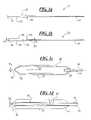
- FIG. 1 aillustrates a first exemplary embodiment of a control tip in accordance with the present invention
- FIG. 1 billustrates a second exemplary embodiment of a control tip in accordance with the present invention
- FIG. 1 cillustrates an enlarged cross-sectional view of a third exemplary embodiment of a control tip in accordance with the present invention, taken at line 1 — 1 ;
- FIG. 1 dillustrates an enlarged cross-sectional view of a third exemplary embodiment of a control tip in accordance with the present invention, taken at line 1 — 1 ;
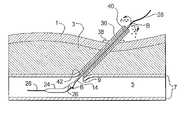
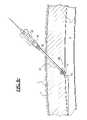
- FIG. 2schematically illustrates portions of a system in accordance with the present invention positioned in a blood vessel of a patient
- FIG. 3 aillustrates a side elevational view of portions of a first exemplary system in accordance with the present invention
- FIG. 3 billustrates an enlarged cross-sectional view of a portion of the exemplary embodiment of a pusher illustrated in FIG. 3 a in accordance with the present invention
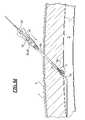
- FIG. 4schematically illustrates portions of the first embodiment, illustrated in FIG. 3 a , positioned in a blood vessel of a patient;
- FIG. 5illustrates a side elevational view of portions of a second embodiment of a system in accordance with the present invention
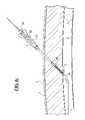
- FIG. 6schematically illustrates portions of the second embodiment, illustrated in FIG. 5 , positioned in a blood vessel of a patient;
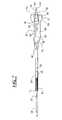
- FIG. 7illustrates a side elevational view of a system in accordance with the present invention.
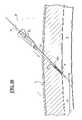
- FIGS. 8 a – 8 fillustrate steps of an exemplary method in accordance with the present invention
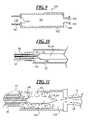
- FIG. 9illustrates a cross-sectional view of a pledget hydration chamber in accordance with an exemplary embodiment of the present invention.
- FIG. 10illustrates the chamber of FIG. 9 with portions of a device of FIG. 7 ;
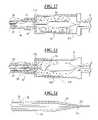
- FIGS. 11–13illustrate exemplary steps of hydrating, preparing, and positioning a pledget into a delivery device in accordance with an exemplary embodiment of the present invention
- FIG. 14illustrates a cross-sectional view of yet another embodiment of a control tip device in accordance with the present invention.
- FIG. 15illustrates a cross-sectional view of yet another embodiment of portions of a control tip device in accordance with the present invention.
- FIG. 16illustrates a cross-sectional view of yet another embodiment of portions of a control tip device in accordance with the present invention
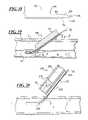
- FIG. 17illustrates a cross-sectional view of yet another embodiment in accordance with the present invention.
- FIG. 18illustrates a cross-sectional view of yet another embodiment in accordance with the present invention.
- FIG. 19diagrammatically illustrates a cross-sectional view of yet another embodiment in accordance with the present invention in one preferred use
- FIG. 20diagrammatically illustrates a cross-sectional view of yet another embodiment in accordance with the present invention in one preferred use
- FIG. 21diagrammatically illustrates a cross-sectional view of yet another embodiment in accordance with the present invention in one preferred use.
- FIG. 22diagrammatically illustrates a cross-sectional view of yet another embodiment in accordance with the present invention in one preferred use.
- “pledget”means a piece of sponge formed into a generally elongated shape having a size which allows delivery in a hydrated state through a delivery cannula or introducer to a site of a puncture in a blood vessel.
- “Sponge”means a biocompatible material which is capable of being hydrated and is resiliently compressible in a hydrated state.
- the spongeis non-immunogenic and may be absorbable or non-absorbable.
- “Absorbable sponge”means sponge which, when implanted within a human or other mammalian body, is absorbed or resorbed by the body.
- “Hydrate”means to partially or fully saturate with a fluid, such as saline, water, contrast agent, thrombin, therapeutic agents, or the like.
- FIG. 1 aillustrates a puncture control tip 10 in accordance with a first embodiment of the present invention.
- the puncture control tip 10includes a tubular, hollow puncture control tip shaft 14 , which functions as a flash tube, as described in greater detail below.
- the shaft 14includes a lumen 34 (see FIG. 1 c , for example) which extends longitudinally between proximal and distal ends.
- lumen 34can optionally be coated or otherwise provided with an interior surface which inhibits blood coagulation.
- the lumen 34can be coated with material including heparin (e.g. heparinized), tPa, or other functionally similar materials or compounds which inhibit or prevent blood from clotting or otherwise coagulating in the lumen 34 .
- the puncture control tip 10includes, at its distal end, a hollow puncture control head 16 mounted or otherwise secured to distal portions of the shaft 14 .
- the head 16includes a distal tapered portion 18 , a proximal tapered portion 20 , and a center portion 22 between the distal and proximal portions which preferably has a constant outer diameter. Both of the portions 18 and 20 can alternatively be a step, rounded shoulder, or the like.
- the interior of head 16is open to the exterior of the head at the distal portion 18 (see, e.g., FIGS. 1 c and 1 d ).
- FIG. 1 billustrates another embodiment of a puncture control tip 12 in accordance with the present invention.
- the control tip 12is similar to control tip 10 , but includes a puncture control tip head 24 which includes a hole 26 which communicates the exterior of the head with the interior thereof and functions as a flash hole or vent for the control tip.
- a hole 26 ′can be included in addition to, and preferably instead of, hole 26 .
- Hole 26 ′is formed in the shaft 14 proximal of and proximate to the proximal portion 20 , and communicates the interior lumen of the shaft with the exterior of the shaft.
- Shaft 14includes lumen 34 which fluidly communicates the interior 30 of heads 16 , 24 with a proximal end of the shaft.
- the lumen 34has an inner diameter selected to be larger than the external diameter of a guidewire, preferably an exchange wire 28 , used therewith (see FIG. 2 ).
- a plurality of holes 26can be formed in the control head, circumferentially spaced and at the same longitudinal location as hole 26 .
- head 16 , 24can be relatively thin walled such that the internal dimensions of the interior cavity 30 is larger in center portion 22 than in the distal 18 and proximal 20 portions of the head.
- the distal portion 18 of head 16 , 24includes a distal port 32 having an internal opening diameter D 1 also selected to be larger, and preferably only slightly larger, than the external diameter of a wire 28 used with the control tip 10 , 12 .
- one aspect of the present inventionis that by selecting the external diameter of wire 28 and the inner diameter of port 32 to be only slightly different, blood flow into interior 30 of head 16 , 24 is greatly restricted, thus allowing the hole 26 to be the sole entrance into the control tip for blood to flow up shaft 14 to indicate that the control tip head has been located in a blood vessel.
- the head 16 , 24can be formed with a thick wall, such that the interior chamber 30 is the same size as port 32 .
- control tipis formed of a flexible, biocompatible material, such as thermoplastic.
- material out of which the control tip is formedhas a Shore hardness between about 90A–82D, preferably between about 98A–74D, more preferably about 64D.
- FIG. 2some functions of control tips in accordance with the present invention can be better appreciated.
- the practitionerwill oftentimes want to seal the access point to the patient's vasculature.
- a guidewire, exchange wire, or guide catheterremains in the patient's blood vessel 5 at the end of the procedure.
- the indwelling deviceextends through the epidermis layer 1 , through the subcutaneous layers 3 , and enters the vessel wall 7 at a puncture site 9 .
- a control tip 12(as illustrated in FIG. 2 , although control tips 10 can also be used) is advanced either through an indwelling guide catheter, or over an indwelling wire 28 , until blood B enters hole 26 .
- the blood Bflows into interior 30 of the control head 24 , through lumen 34 and around the wire 28 , and exits the shaft 14 at its proximal end.
- This flash of blood at the proximal end of shaft 14gives the practitioner a visual indication that the control tip is seated in the puncture site 9 , while the placement of the hole 26 distal of the proximal portion 20 assists in maintaining the puncture site closed during the procedure.
- vent tube 14can optionally be formed to have a flexibility which changes along its length, e.g., is more flexible at distal portions than at proximal portions. While a gradual distal increase in flexibility is preferred, the change can be more abrupt, such as by forming the vent tube 14 of two distinct tubes of different flexibilities, although this later embodiment is less preferred.
- FIG. 3 aillustrates an embodiment of a depth marker 36 mounted over a control tip 12 in accordance with the present invention.
- Marker 36is a hollow, tubular member preferably shorter than the control tip 12 .
- Marker 36optionally further includes a collar 38 slidable along the outer surface of the marker.
- the collar 38is preferably elastic such that it will engage the exterior of the marker 36 to hold its position on the marker, yet be movable along the marker upon the application of a small force to slide the collar along the marker.
- collar 38can be used as a depth indicator, as described in greater detail below.
- the marker 36includes a proximal end 40 , a distal end 42 , and an interior lumen 44 extending longitudinally between the proximal and distal ends.
- the proximal and distal ends of the marker 36preferably include a seal with the shaft 14 of the control tip 12 .
- the seal between the shaft 14 and the marker 36can be formed in any suitable way that provides a fluid seal between the marker and the shaft.
- the proximal and distal sealscan be formed by forming the marker with a reduced inner diameter at (at least) the proximal and distal ends of the marker, or by including dynamic sealing members, such as O-rings or septa.
- at least the distalmost portions of distal end 42is slightly rounded to prevent trauma to the vascular tissues with which it comes into contact.
- Marker 36is preferably attached to control tip 12 , or less preferably, positioned on the control tip 12 so that it is difficult to slide them longitudinally relative to each other.
- the distal end 42is spaced from the elongated central portion 22 of the control head by a distance X, described in greater detail below.
- the control tip and the markercan be interconnected using a releasable proximal connection, e.g. a Touhy-Borst connector (for which the marker would include cross-drilled holes or the like for blood flash), ultrasonic welding, gluing, etc.
- FIG. 3 billustrates an enlarged cross-sectional view of a distal end of a marker 36 or 46 in accordance with the present invention.
- the markerincludes an interior lumen 44 which terminates at the distal end 52 of the marker with a countersunk tapered distal port.
- the taper of the distal port relative to longitudinal axis Ais selected to be very similar to that of the proximal tapered portion 20 of head 16 , 24 .
- This aspect of the present inventionpermits the wall of the marker 36 , 46 which forms the port, together with the proximal tapered portion 20 , to function as a valve in a manner similar to a needle valve.
- FIG. 4illustrates a control tip 12 used together with a depth marker 36 to control a puncture site 9 .
- the control tip 12has been located in the puncture site 9 , as shown by the blood flash B out the proximal end of flash tube 14 , with the marker 36 on the shaft 14 the practitioner feels the additional resistance offered by the vessel wall 7 to further advancement of the marker upon distal advancement of the control tip/marker assembly.
- the distal end 42 of the marker 36forms a seal with the shaft 14 , the distal end 42 can then be used to control the flow of blood out of the puncture site 9 , and the control head 24 is pushed slightly distally into the blood vessel 5 .
- Collar 38can be positioned against the epidermis 1 when the distal end 42 is at the puncture site 9 , which permits the collar 38 to mark the distance between the distal end of the marker 36 and the outer surface of the epidermis, thus functioning as a depth indicator of the puncture site.
- FIG. 5illustrates a control tip 10 with head 16 and a marker 46 mounted thereover.
- Marker 46is similar to marker 36 , described above, but does not include seals at its proximal 50 and distal 52 ends.
- a lumen 48extends longitudinally through the marker 46 between the proximal and distal ends and forms an annular space or lumen 54 between the flash tube or shaft 14 and the marker 46 .
- distal end 52is tapered as illustrated in FIG. 3 b .
- Marker 46is affixed to control tip 10 in a fashion similar to marker 36 and control tip 12 , described above.
- FIG. 6illustrates a marker 46 used in accordance with one aspect of the present invention with a control tip 10 . While control tip 12 can also be used, the function of flash hole or holes 26 is assumed by the combination of proximal tapered portion 20 of head 16 and the distal end 52 of marker 46 , optionally further including a tapered countersunk port therein. In a manner similar to that described above with reference to FIG. 4 , the marker 46 can be used to control puncture site 9 . By moving the assembly of the control tip 10 and the marker 46 longitudinally, the distal end 52 of the marker 46 and the proximal tapered portion 20 of the head 16 can be used to throttle the flow of blood into the annular lumen 54 in a manner similar to a needle valve.
- the flow cross-sectional areais made smaller, thereby reducing the flow of blood into the lumen 54 , and pushing the assembly distally increases the flow area, increasing the flow of blood.
- blood flash Bcan be observed out of the proximal end of the marker 46 , indicating that the marker is in fluid communication with the blood vessel 5 .
- wire 28 and port 32as described above, permit little or no blood to flow into lumen 34 of the shaft 14 , the blood flash B at proximal end 50 can be a reliable indicator that the blood vessel has been accessed.
- the distal end of the depth markerhas significant radial or lateral clearance from the control tip shaft, so that the two elements will move laterally relative to each other near the marker's distal end, which promotes tactile feedback to the practitioner when the control tip enters the blood vessel.
- FIG. 7illustrates a side elevational view of a system in accordance with the present invention.
- the systemgenerally includes a control tip 10 or 12 , a pledget pusher 37 , a delivery cannula 56 , a pledget 90 , and a proximal handle 62 .
- pledget 90is positioned in a lumen 58 in delivery cannula 56 and around shaft 14 of control tip 12 .
- Pusher 37is also positioned in lumen 58 , and has a length such that, when the pusher is in a retracted, proximal position illustrated in FIG. 7 , the distal end 42 , 52 of the pusher is proximal of the distal end of the delivery cannula 56 .
- a pledget 90is positioned in the distal portion of the lumen 58 distal of the distal end of the pusher 37 so that the pusher can push the pledget distally out of the delivery cannula.
- Pledget pusher 37is structurally very similar to either pusher 36 or pusher 46 , but is not attached to the control tip 10 , 12 over which it longitudinally slides.
- the pledget 90is formed from a sheet of absorbable sponge material which has been cut into a rectangular shape and rolled to form a compact, substantially cylindrical, elongated pledget.
- absorbable sponge materialwhich is acceptable for use in the present invention is GelfoamTM, manufactured by the Pharmacia & Upjohn Company. GelfoamTM is a porous, pliable, cross-linked gelatin material and is available commercially in sheet form as pre-compressed or non-compressed sponge.
- the materialmay be provided preformed as a pledget 90 or may be cut with a punch, or a stencil, or template and knife and rolled to form a pledget.
- the pledget 90can be easily compressed to fit into a lumen having a smaller cross sectional area than the original cross sectional area of the pledget. Additionally, the kneading of the hydrated pledget 90 during delivery encourages air trapped within the GelfoamTM to be expelled and replaced with fluid, allowing rapid expansion upon delivery.
- a pledget 90 of a pre-compressed GelfoamTMis hydrated and kneaded (expelling air) during delivery, the pledget will have the absorption capacity to rapidly expand to many times (e.g., 3 or more times) its original dry volume upon delivery.
- the pledget 90 of the non-compressed GelfoamTMWhen a pledget 90 of the non-compressed GelfoamTM is hydrated and kneaded (expelling air) during delivery, the pledget will have the absorption capacity to rapidly expand to its original dry volume upon delivery. These properties make the GelfoamTM sponge material particularly useful for facilitating hemostasis of puncture sites by injection.
- the delivery cannula 56includes a proximal hub 60 .
- Hub 60includes mating structures to mate with corresponding mating structures formed in a distal hub 76 of handle 62 .
- the mating structures of hub 60 and hub 76can be luer fittings, screw threads, releasable bayonet fittings, and any other fitting which can releasably connect together hubs 60 , 76 so that the delivery cannula 56 and the handle 62 can be moved together when the structures are mated, and the delivery cannula and handle can be separated and moved independently when the structures are released.
- Pusher 37includes a proximal hub 78 which both limits the proximal and distal movement of the pusher, and provides an enlarged section at which a practitioner can grasp the pusher if necessary.
- Hub 78optionally further includes a proximal outwardly flared stop 80 which limits longitudinal motion of the pusher 37 relative to the handle 62 and other structures of the system, described in detail below. More particularly, stop 80 limits distal motion of the pusher 37 , because it has an outer dimension (e.g., diameter) larger than portions of hub 76 of handle 62 , and limits proximal motion because the stop is longitudinally aligned with portions of a motion limiting device 82 (described below) positioned proximal of the stop.
- a motion limiting device 82described below
- Handle 62generally provides a place for a practitioner to grasp and manipulate the control tip 12 , pusher 37 , and delivery cannula 56 together, while also permitting the practitioner to separately move these individual components. Therefore, while a particular embodiment of a handle in accordance with the present invention is illustrated in FIG. 7 , the present invention relates more generally to structures which performs these functions.
- Handle 62includes a first side 64 , a second side 66 , and an open interior space 68 .
- a practitioneris able to access the proximal portions of pusher 36 , 46 and control tip 12 in order to manipulate these elements.
- Each of the sides 64 , 66includes a wing 70 , 72 , respectively, which is optionally further provided to provide a bearing surface for a practitioner to pull the handle and any attached elements proximally.
- the proximal end of the handle 62includes an opening, slot, or the like 74 which receives a proximal motion limiting device 82 for the control tip 12 .
- device 82includes a proximal flange 84 which extends radially beyond the extent of opening 74 , and therefore limits distal motion of the device 82 as it slides in the opening 74 .
- the device 82also includes a central cylindrical portion 86 which longitudinally slides in opening 74 .
- a distal bumper 88 of device 82is also radially larger than opening 74 , and limits proximal motion of the device 82 relative to the handle 62 .
- the flash tube or shaft 14is secured to and preferably extends proximally through device 82 , as illustrated in FIG. 7 .
- the entire control tip 12is permitted to move longitudinally over a limited range delimited by the proximal flange 84 and the distal bumper 88 . Because the control tip 12 is therefore permitted to move longitudinally over only a limited-range defined by device 82 , and handle 62 is attached to delivery cannula 56 via hubs 60 and 76 , the control tip is capable of moving longitudinally over only a limited range relative to the delivery cannula.
- the magnitude of range X(see FIGS.
- 3 a , 5 , and 8 Ais between about 0.025 inches (0.06 cm) and about 0.25 inches (0.6 cm), preferably between about 0.1 inches (0.25 cm) and about 0.2 inches (0.51 cm), and more preferably about 0.15 inches (0.38 cm).
- device 82can take forms different from those illustrated in FIG. 7 , while still performing the functions describe above.
- device 82 and handle 62can include other types of complementary surfaces, including mating threads, tabs and slots, and the like, within the scope of the present invention.
- opening 74can be formed open on one lateral side, so that device 82 can be snapped into the handle 62 in a direction into or out of the plane of view of FIG. 7 , thereby permitting assembly and disassembly of the handle with the other elements of the system.
- FIGS. 8 a – 8 fillustrate a system as illustrated in FIG. 7 used in accordance with an exemplary embodiment of the present invention.
- a wire 28is advanced into the patient's blood vessel 5 through a puncture site 9 in the vessel wall 7 .
- a control tip 12 , pusher 37 , delivery cannula 56 , handle 62 , and pledget 90are advanced together over the wire 28 , as illustrated in FIG. 8 a .
- the control tipis first advanced over the wire and into the blood vessel, and thereafter the delivery cannula, handle, pusher, and pledget are advanced over the control tip.
- the control head 24passes through the puncture site 9 . Because the vessel wall presents more resistance to the control head than the subcutaneous tissues 3 , the practitioner can feel when the control head has reached the outer portions of the puncture site 9 . The practitioner then advances the control head further into the patient and into the blood vessel 5 .
- blood Bflashes out the proximal end of flash tube 14 , as described above, indicating to the practitioner that entry to the blood vessel has been made. Because blood may have previously been present in lumen 34 of shaft 14 , and therefore potentially has already clotted or coagulated, blocking the lumen 34 , it is preferable that lumen 34 be coated with a blood anticoagulant, as described above. Another tactile indication to the practitioner that entry to the blood vessel 5 has been made is provided by the distance or gap X between the proximal end of the control head 24 and the distal end of the delivery cannula 56 .
- the practitionercan feel that the system is more easily moved laterally when the control head 24 is in the position illustrated in FIG. 8 a . Conversely, when the practitioner does not feel this reduced resistance to lateral movement of the system, the practitioner has an indication that the blood vessel 5 has not been properly accessed.
- FIG. 8 billustrates a stage in the exemplary method later than that illustrated in FIG. 8 a .
- FIG. 8 cillustrates a stage in the exemplary method later than that illustrated in FIG. 8 b .
- the device 82(described above) is pulled proximally relative to the handle 62 while the remaining elements of the system are held stationary.
- the control tip 12including the control head 24 , is retracted proximally and engages the inner surface of the vessel wall at the puncture site 9 .
- both the interior and exterior surfaces of the vessel wall 7are engaged by portions of the system, which controls blood flow out of the puncture site.
- the present inventionis also advantageous because it can be used to prevent introduction of all or portions of a pledget into the bloodstream of a patient, which could otherwise initiate a clotting sequence in the blood vessel, with predictably hazardous consequences to the patient.
- FIG. 8 dillustrates a stage in the exemplary method later than that illustrated in FIG. 8 c .
- the handle 62 , delivery cannula 56 , and control tip 12have been retracted proximally, while holding stationary the pusher 37 , such as by pulling proximally on the distal portions of bumper 88 while engaging the proximal portions of stop 80 to prevent its longitudinal motion.
- Proximal retraction of the delivery cannula 56 relative to the pusher 37causes distal portions of the pledget 90 to be exposed, while at the same time the pusher does not move and is left positioned at the exterior surface of the blood vessel 5 at the puncture site 9 .
- proximal portions of the control head 24are drawn through the distal portions of the pledget 90 . It is preferable that the handle 62 , delivery cannula 56 , and control tip 12 are moved only part of the distance necessary to completely expose the pledget 90 and for stop 80 to engage portions of hub 76 , as illustrated in FIG. 8 d , so that the pledget can be expressed and compressed, as described below with reference to FIG. 8 e.
- FIG. 8 eillustrates a stage in the exemplary method later than that illustrated in FIG. 8 d .
- the pusher 37While holding handle 62 stationary relative to the patient, the pusher 37 is advanced distally down the control tip 12 , which expels or pushes the remainder of the pledget 90 out of the lumen 58 and simultaneously compresses the pledget against the external surface of the blood vessel wall 7 at the puncture site 9 .
- the control head 24is positioned in the puncture site 9 , and therefore at least inhibits, and preferably prevents, the pledget 90 from being pushed into the blood vessel 5 .
- the puncture site 9is controlled throughout the steps of positioning the pledget 90 adjacent to the exterior of the puncture site and both inhibits bleeding and inhibits the introduction of material, including the pledget 90 as well as tissue fragments, into the blood vessel.
- FIG. 8 fillustrates a stage in the exemplary method later than that illustrated in FIG. 8 e .
- the handle 62is released from its connection with the delivery cannula 56 by releasing the connection between hub 76 and hub 60 .
- the handleis then retracted proximally, carrying with it the control tip 12 and the pusher 37 .
- the delivery cannula 56is preferably held stationary in the patient during this retraction, so that the delivery catheter can hold the pledget 90 in place.
- the siteis compressed by the pledget 90 , which inhibits bleeding and promotes closure of the puncture site.
- the control tip 12As the control tip 12 is further retracted, the control head 24 is drawn through the pledget, while the delivery cannula inhibits the pledget from following the control tip back up into the delivery cannula.
- the handle, pusher, and control tipare then completely removed.
- the delivery cannulais removed, preferably slowly and with the application of localized compression to the epidermis above the puncture site, leaving the pledget 90 in place to promote healing of the puncture site 9 and inhibit blood flow from the blood vessel.
- FIG. 8 fAlso illustrated in FIG. 8 f is an exemplary embodiment of the mating structures of hubs 60 and 76 which releasably hold together the handle 62 and the delivery cannula 56 .
- hub 60includes a mating structure 92 , e.g., a tubular extension 94 including a tab 96 extending radially therefrom.
- Hub 76includes an internally threaded collar 96 which receives the extension 94 therein and secures the two elements together.
- FIG. 9illustrates an exemplary embodiment of a pledget loading device 100 useful for preparing a pledget 90 and loading the pledget into a delivery cannula.
- the pledget loading device 100includes a body 102 having an interior chamber 104 .
- a tubular receiving element 106extends distally from the distal end of the body, and includes a lumen 116 therein communicating the interior chamber 104 with the exterior of the body.
- a fluid coupling 108extends proximally from the end of the body opposite the element 106 , and includes a flange, tab, or the like 112 and an internal lumen 114 which communicates the interior chamber 104 with the exterior of the body.
- the flange 112is structured to releasably mate with a corresponding structure on a high pressure fluid delivery device, e.g., a syringe with a luer fitting.
- the body 102also includes a stop 110 positioned in the lumen 116 which prevents a delivery cannula of a size greater than the internal dimension of the stop from entering into the chamber 104 .
- FIG. 10illustrates the pledget loading device 100 with a delivery cannula 56 , pusher 37 , and a control tip 12 inserted into the tubular receiving element 106 .
- stop 110is sized so that the delivery cannula 56 is prevented from entering into the chamber 104 , and preferably forms a fluid seal with the stop 110 , the inner surface of the element 106 , or both.
- the pusher 37 and the control tip 12extend into the chamber 104 .
- the combination of the tapered countersunk distal end 52 of the pusher and the tapered proximal portion 20 of the control head 16 , 24form a fluid control member 118 which operates in a manner similar to a needle valve. The operation of fluid control member 118 will be described in greater detail below.
- a cylindrical pledget 90has been inserted into the chamber 104 .
- the pledgetcan be placed in the chamber 104 before or after the control head 16 , 24 is positioned in the chamber.
- a source of hydration fluidsuch as a syringe (not illustrated), is coupled to fluid coupling 108 , and hydration fluid F is injected into the chamber 104 .
- Air in the chamber 104is allowed to escape through fluid control member 118 , while the pledget 90 is retained in the chamber and hydrated.
- the pusher 37is retracted into the lumen 58 of the delivery cannula 56 , in effect opening the fluid control member 118 .
- Air and hydration fluidare then allowed to flow past the stop 110 , through the lumen 58 , through the lumen 39 of pusher 37 , and out of the system.
- the further introduction of high pressure fluid into chamber 104forces the hydrated pledget 90 past the stop 110 and into the portion of lumen 58 not occupied by the pusher 37 , while hydration fluid continues to flow out the lumen 39 .
- the hydrated pledget 90is loaded into the end of the delivery cannula 56 .
- FIG. 14illustrates yet another embodiment of a control head in accordance with the present invention.
- a constant outer diameter guidewire 120is slidingly received in the tapered distal portion 20 of a control tip 24 .
- the guidewire 120 and the tapered portion 20are nearly the same size, so that there is little or no blood flow into the interior 30 of the control head 24 past the guidewire.
- Such an arrangementhelps assure that any blood flow into the flash tube 14 (see FIGS. 1 a – 1 d ) enters the control head 24 through the hole 26 .
- FIG. 15illustrates yet another embodiment in accordance with the present invention.
- the proximal end of shaft 14is fitted with a removable insertion tip 130 so that the proximal end of the shaft, with the tip 130 mounted in the shaft as illustrated in FIG. 15 , can be backloaded through a pledget (not illustrated) held within a distal end of a delivery cannula (not illustrated).
- the insertion tipin the embodiment illustrated in FIG. 15 , includes a shank 132 and a head 134 attached to the shank.
- the shankhas an outer dimension (e.g., diameter) sized to be received in the lumen 34 of the shaft 14 , and can be large enough to form an interference or press fit with the shaft.
- the shank 132 and the head 134meet at a shoulder 136 which abuts the proximalmost end of the shaft 14 .
- the headpreferably includes a pointed or otherwise tapered tip 138 which assists in moving portions of the pledget radially outward when the shaft and insertion tip 134 are pushed longitudinally through the pledget.
- FIG. 16illustrates yet another embodiment in accordance with the present invention.
- a stylet 150is inserted through a control tip 10 or 12 and assists in inserting the control tip through a pledget (not illustrated) positioned inside a delivery cannula (not illustrated).
- the stylet 150includes a head 152 and a shaft 154 connected to and extending from the head.
- the shaft 154is sized to slide through the control tip and shaft 14 .
- the head 152is enlarged to facilitate pushing on the head to push the proximal end of the shaft 14 through a pledget; the shaft 154 extends from the proximal end of the shaft to assist is radially parting the material of the pledget.
- FIG. 17illustrates yet another embodiment in accordance with the present invention, in which a delivery cannula 160 includes a control tip 168 integral with the delivery cannula.
- the delivery cannula 160has a tubular wall 162 which extends longitudinally between a proximal end 162 and a distal end 164 , which distal end is preferably rounded to ease its insertion through subcutaneous tissues and limit trauma to the vascular wall when it is pressed against it.
- a lumen 166extends through the delivery cannula 160 between the proximal end 162 and the distal end 164 , and is sized in a manner similar to the other embodiments described herein to receive a pledget, pledget pusher, and/or wire.
- the control tip 168extends longitudinally between a proximal end 170 and a distal end 172 radially offset from the center longitudinal axis of the lumen 166 .
- the control tip 168includes a longitudinally extending lumen 174 and a vent port or hole 176 similar to hole or holes 26 .
- the distal end 172is preferably tapered, and preferably has an inner diameter which tapers distally, as at 178 , to form a dynamic seal with a wire (not illustrated) over which the control tip 168 is inserted. As illustrated in FIG.
- the external taper 180 of the distal end of the control tip 168can extend proximally toward the delivery cannula 160 , and the vent hole 176 is preferably formed in this tapered section. Less preferably, however, the vent hole 176 can be formed in the untapered portion 182 within the scope of the present invention.
- FIG. 19illustrates yet another embodiment in accordance with the present invention.
- a depth marker 190is similar to the delivery cannula 160 having the integral control tip 168 , but does not include a lumen 166 .
- a collar 38is positioned on the outer surface of the depth marker, and permits the user to record the depth of the blood vessel 5 relative to the outer surface of the epidermis 1 .
- the depth marker 190is otherwise used in the same manner as the other embodiments of depth markers described herein.
- FIG. 20illustrates yet another embodiment in accordance with the present invention.
- a biaxial delivery cannula 200includes a lumen 202 sized to receive a pledget 90 and a pledget pusher or piston 204 which extends proximally out of the delivery cannula 200 .
- the delivery cannula 200also includes an integral control tip 206 having a longitudinally extending through lumen 210 extending from the control head 208 proximally to the proximal end of the delivery cannula in a manner similar to other embodiments described herein.
- the lumen 210is sized to slidingly receive the wire 28 , and preferably forms a seal with the wire 28 as also described elsewhere herein.
- the delivery cannula 200further includes a vent lumen 212 laterally offset from the lumen 202 and the lumen 210 , and preferably between the lumenae 202 , 210 .
- the vent lumen 212permits blood to flash to the proximal end of the delivery cannula 200 to give a visual indication of when control of the puncture site 9 is made and lost.
- FIG. 21illustrates yet another embodiment in accordance with the present invention.
- the embodiment illustrated in FIG. 21is similar is some respects to the embodiment illustrated in FIG. 7 .
- a delivery cannula 56 , control tip 10 or 12 , pledget 90 , pusher 37 , and wire 28are similar or the same as described above, and are used in combination with a coaxial vent tube 220 which extends longitudinally through the pusher 37 and the pledget 90 .
- the vent tube 220includes a longitudinally extending lumen 222 which is sized to receive the control tip 10 , 12 therein with an annular clearance to permit blood to flash proximally through the vent tube 220 .
- the shaft 14 of the control tip 10 , 12can be formed without a lumen 34 , and can be dimensioned with a smaller outer diameter to increase the annular clearance between the shaft and the vent tube 220 .
- the shaft 14preferably maintains its relative flexibility to permit the tactile feedback previously described herein.
- the embodiment illustrated in FIG. 21is used in a manner otherwise similar to those previously described herein.
- FIG. 22illustrates yet another embodiment in accordance with the present invention.
- a vent tube 230can be used with a control tip 10 , 12 so that the vent tube and control tip are advanced laterally next to each other to the puncture site 9 .
- the vent tube 230permits blood to flash proximally to give a visual indication of when control of the puncture site 9 is made and lost by the control head of the control tip.
- the outer diameter of the central portionis between about 5 French and about 9 French, preferably between about 6 French and about 7 French.
- the length of the control head, between the distalmost end and the proximal end of the proximal tapered portion,is between about 1.5 inches (3.8 cm) and about 3 inches (7.6 cm), preferably between about 1.5 inches and about 2 inches (6.4 cm), and more preferably about 1.875 inches (4.8 cm).
- Control heads of these dimensionsare well suited for controlling puncture sites as described herein, particularly puncture sites used during Seldinger-type vascular access.
- the transverse cross sectional profile of all of the foregoing structurescan be any desired shape, including square, oval, triangular, and preferably circular.
- the materials out of which the control tip, pledget pusher, and delivery cannula are constructedare preferably selected to be relatively rigid and biocompatible, and more preferably are biocompatible polymers, biocompatible metals and metal alloys, and combinations thereof.
Landscapes
- Health & Medical Sciences (AREA)
- Surgery (AREA)
- Life Sciences & Earth Sciences (AREA)
- Biomedical Technology (AREA)
- Nuclear Medicine, Radiotherapy & Molecular Imaging (AREA)
- Engineering & Computer Science (AREA)
- Cardiology (AREA)
- Heart & Thoracic Surgery (AREA)
- Medical Informatics (AREA)
- Molecular Biology (AREA)
- Animal Behavior & Ethology (AREA)
- General Health & Medical Sciences (AREA)
- Public Health (AREA)
- Veterinary Medicine (AREA)
- Surgical Instruments (AREA)
Abstract
Description
Claims (37)
Priority Applications (2)
| Application Number | Priority Date | Filing Date | Title |
|---|---|---|---|
| US09/621,670US7625352B1 (en) | 1998-05-01 | 2000-07-24 | Depth and puncture control for system for hemostasis of blood vessel |
| US10/462,065US7695492B1 (en) | 1999-09-23 | 2003-06-12 | Enhanced bleed back system |
Applications Claiming Priority (4)
| Application Number | Priority Date | Filing Date | Title |
|---|---|---|---|
| US09/071,284US6162192A (en) | 1998-05-01 | 1998-05-01 | System and method for facilitating hemostasis of blood vessel punctures with absorbable sponge |
| US15600799P | 1999-09-23 | 1999-09-23 | |
| US09/613,439US7048710B1 (en) | 1998-05-01 | 2000-07-11 | System and method for facilitating hemostasis of blood vessel punctures with absorbable sponge |
| US09/621,670US7625352B1 (en) | 1998-05-01 | 2000-07-24 | Depth and puncture control for system for hemostasis of blood vessel |
Related Parent Applications (2)
| Application Number | Title | Priority Date | Filing Date |
|---|---|---|---|
| US09/613,439Continuation-In-PartUS7048710B1 (en) | 1998-05-01 | 2000-07-11 | System and method for facilitating hemostasis of blood vessel punctures with absorbable sponge |
| US6910702AContinuation-In-Part | 1999-09-23 | 2002-12-16 |
Related Child Applications (1)
| Application Number | Title | Priority Date | Filing Date |
|---|---|---|---|
| US10/462,065Continuation-In-PartUS7695492B1 (en) | 1999-09-23 | 2003-06-12 | Enhanced bleed back system |
Publications (1)
| Publication Number | Publication Date |
|---|---|
| US7625352B1true US7625352B1 (en) | 2009-12-01 |
Family
ID=41350854
Family Applications (1)
| Application Number | Title | Priority Date | Filing Date |
|---|---|---|---|
| US09/621,670Expired - Fee RelatedUS7625352B1 (en) | 1998-05-01 | 2000-07-24 | Depth and puncture control for system for hemostasis of blood vessel |
Country Status (1)
| Country | Link |
|---|---|
| US (1) | US7625352B1 (en) |
Cited By (23)
| Publication number | Priority date | Publication date | Assignee | Title |
|---|---|---|---|---|
| US20080287986A1 (en)* | 2007-05-18 | 2008-11-20 | Possis Medical, Inc. | Closure device |
| US20110137338A1 (en)* | 2009-12-08 | 2011-06-09 | Victor Matthew Phillips | Hemostatic Device and Its Methods of Use |
| US7963961B2 (en) | 2005-07-21 | 2011-06-21 | Tyco Healthcare Group Lp | Systems for treating a hollow anatomical structure |
| US20110178399A1 (en)* | 2008-08-13 | 2011-07-21 | Andrea Del Corso | Occlusion device for vascular surgery |
| US8070772B2 (en) | 2008-02-15 | 2011-12-06 | Rex Medical, L.P. | Vascular hole closure device |
| US8491629B2 (en) | 2008-02-15 | 2013-07-23 | Rex Medical | Vascular hole closure delivery device |
| US8506592B2 (en) | 2008-08-26 | 2013-08-13 | St. Jude Medical, Inc. | Method and system for sealing percutaneous punctures |
| US8821918B2 (en) | 2001-03-12 | 2014-09-02 | Boston Scientific Scimed Inc. | Cross-linked gelatin composition comprising a wetting agent |
| US8876862B2 (en) | 2011-04-14 | 2014-11-04 | Phillips Medical Llc | Hemostatic device and its methods of use |
| US20140358076A1 (en)* | 2013-05-28 | 2014-12-04 | Smh Device Corp. | Tunneled Catheter with Hemostasis Mechanism |
| US8905946B2 (en)* | 2010-10-28 | 2014-12-09 | Abbott Cardiovascular Systems Inc. | Nickel—titanium core guide wire |
| US8920463B2 (en) | 2008-02-15 | 2014-12-30 | Rex Medical, L.P. | Vascular hole closure device |
| US8920462B2 (en) | 2008-02-15 | 2014-12-30 | Rex Medical, L.P. | Vascular hole closure device |
| WO2014164009A3 (en)* | 2013-03-12 | 2015-03-05 | St. Jude Medical Puerto Rico Llc | Oval vascular closure device and methods |
| US9226738B2 (en) | 2008-02-15 | 2016-01-05 | Rex Medical, L.P. | Vascular hole closure delivery device |
| US9463005B2 (en) | 2008-02-15 | 2016-10-11 | Rex Medical, L.P. | Vascular hole closure device |
| US9468428B2 (en) | 2012-06-13 | 2016-10-18 | Phillips Medical Llc | Hemostatic device and its methods of use |
| US9642604B2 (en) | 2012-04-12 | 2017-05-09 | Phillips Medical Llc | Hemostatic system and its methods of use |
| US9724081B2 (en) | 2013-06-04 | 2017-08-08 | Phillips Medical Llc | Hemostatic system and its methods of use |
| US9839416B2 (en) | 2013-07-12 | 2017-12-12 | Phillips Medical, LLC | Hemostatic device and its methods of use |
| US9993236B2 (en) | 2009-12-08 | 2018-06-12 | Phillips Medical, LLC | Hemostatic device and its methods of use |
| US10085730B2 (en) | 2013-07-12 | 2018-10-02 | Phillips Medical, LLC | Hemostatic device and its methods of use |
| US11504105B2 (en) | 2019-01-25 | 2022-11-22 | Rex Medical L.P. | Vascular hole closure device |
Citations (176)
| Publication number | Priority date | Publication date | Assignee | Title |
|---|---|---|---|---|
| US581235A (en) | 1897-04-20 | Island | ||
| US1578517A (en) | 1924-12-23 | 1926-03-30 | George N Hein | Valve piston and barrel construction for hypodermic syringes |
| US2086580A (en) | 1935-06-24 | 1937-07-13 | Myron C Shirley | Applicator |
| US2370319A (en) | 1944-11-07 | 1945-02-27 | Dohner & Lippincott | Paper perforator |
| US2465357A (en) | 1944-08-14 | 1949-03-29 | Upjohn Co | Therapeutic sponge and method of making |
| US2492458A (en) | 1944-12-08 | 1949-12-27 | Jr Edgar A Bering | Fibrin foam |
| US2507244A (en) | 1947-04-14 | 1950-05-09 | Upjohn Co | Surgical gelatin dusting powder and process for preparing same |
| US2558395A (en) | 1947-06-03 | 1951-06-26 | Hoffmann La Roche | Undenatured gelatin hemostatic sponge containing thrombin |
| US2597011A (en) | 1950-07-28 | 1952-05-20 | Us Agriculture | Preparation of starch sponge |
| US2680442A (en) | 1952-04-04 | 1954-06-08 | Frank L Linzmayer | Disposable suppository casing |
| US2761446A (en) | 1955-03-30 | 1956-09-04 | Chemical Specialties Co Inc | Implanter and cartridge |
| US2814294A (en) | 1953-04-17 | 1957-11-26 | Becton Dickinson Co | Unit for and method of inhibiting and controlling bleeding tendencies |
| US2824092A (en) | 1955-01-04 | 1958-02-18 | Robert E Thompson | Process of preparation of a gelatincarboxymethyl cellulose complex |
| US2828744A (en)* | 1956-02-13 | 1958-04-01 | Hirsch Sidney | Flexible needle for use in intravenous therapy |
| US2874776A (en) | 1954-06-07 | 1959-02-24 | Royal Mcbee Corp | Punch and die mechanism |
| US2899362A (en) | 1959-08-11 | Hemostatic sponges and method of | ||
| US3157524A (en) | 1960-10-25 | 1964-11-17 | Ethicon Inc | Preparation of collagen sponge |
| US3358689A (en) | 1964-06-09 | 1967-12-19 | Roehr Products Company Inc | Integral lancet and package |
| US3411505A (en) | 1965-12-15 | 1968-11-19 | Paul D. Nobis | Device for interrupting arterial flow |
| US3724465A (en) | 1971-07-22 | 1973-04-03 | Kimberly Clark Co | Tampon coated with insertion aid and method for coating |
| US3736939A (en) | 1972-01-07 | 1973-06-05 | Kendall & Co | Balloon catheter with soluble tip |
| US4000741A (en) | 1975-11-03 | 1977-01-04 | The Kendall Company | Syringe assembly |
| GB1509023A (en) | 1973-02-12 | 1978-04-26 | Ochsner Med Found Alton | Septal defect closure apparatus |
| US4098728A (en) | 1976-01-02 | 1978-07-04 | Solomon Rosenblatt | Medical surgical sponge and method of making same |
| GB1569660A (en) | 1976-07-30 | 1980-06-18 | Medline Ab | Occlusion of body channels |
| US4211323A (en) | 1978-12-01 | 1980-07-08 | California Medical Developments, Inc. | Disposable diagnostic swab having a stored culture medium |
| US4218155A (en) | 1978-02-10 | 1980-08-19 | Etablissements Armor, S.A. | Stick for applying a liquid |
| US4219026A (en) | 1978-09-15 | 1980-08-26 | The Kendall Company | Bladder hemostatic catheter |
| US4224945A (en) | 1978-08-30 | 1980-09-30 | Jonathan Cohen | Inflatable expansible surgical pressure dressing |
| SU782814A1 (en) | 1977-01-18 | 1980-11-30 | За витель | Prosthesis for closing defect in heart tissues |
| US4238480A (en) | 1978-05-19 | 1980-12-09 | Sawyer Philip Nicholas | Method for preparing an improved hemostatic agent and method of employing the same |
| EP0032826A2 (en) | 1980-01-18 | 1981-07-29 | Shiley Incorporated | Vein distention apparatus |
| US4292972A (en) | 1980-07-09 | 1981-10-06 | E. R. Squibb & Sons, Inc. | Lyophilized hydrocolloio foam |
| US4340066A (en) | 1980-02-01 | 1982-07-20 | Sherwood Medical Industries Inc. | Medical device for collecting a body sample |
| US4390018A (en) | 1980-09-15 | 1983-06-28 | Zukowski Henry J | Method for preventing loss of spinal fluid after spinal tap |
| US4405314A (en) | 1982-04-19 | 1983-09-20 | Cook Incorporated | Apparatus and method for catheterization permitting use of a smaller gage needle |
| US4404970A (en) | 1978-05-19 | 1983-09-20 | Sawyer Philip Nicholas | Hemostatic article and methods for preparing and employing the same |
| US4515637A (en) | 1983-11-16 | 1985-05-07 | Seton Company | Collagen-thrombin compositions |
| US4573576A (en) | 1983-10-27 | 1986-03-04 | Krol Thomas C | Percutaneous gastrostomy kit |
| US4587969A (en) | 1985-01-28 | 1986-05-13 | Rolando Gillis | Support assembly for a blood vessel or like organ |
| US4588395A (en) | 1978-03-10 | 1986-05-13 | Lemelson Jerome H | Catheter and method |
| US4619261A (en) | 1984-08-09 | 1986-10-28 | Frederico Guerriero | Hydrostatic pressure device for bleeding control through an inflatable, stitchable and retrievable balloon-net system |
| US4619913A (en) | 1984-05-29 | 1986-10-28 | Matrix Pharmaceuticals, Inc. | Treatments employing drug-containing matrices for introduction into cellular lesion areas |
| US4645488A (en) | 1982-08-12 | 1987-02-24 | Board Of Trustees Of The University Of Alabama | Syringe for extrusion of wetted, particulate material |
| US4644649A (en) | 1985-09-26 | 1987-02-24 | Seaman Roy C | Apparatus for trimming reeds of musical instruments |
| US4699616A (en) | 1986-06-13 | 1987-10-13 | Hollister Incorporated | Catheter retention device and method |
| US4708718A (en) | 1985-07-02 | 1987-11-24 | Target Therapeutics | Hyperthermic treatment of tumors |
| US4744364A (en) | 1987-02-17 | 1988-05-17 | Intravascular Surgical Instruments, Inc. | Device for sealing percutaneous puncture in a vessel |
| US4790819A (en) | 1987-08-24 | 1988-12-13 | American Cyanamid Company | Fibrin clot delivery device and method |
| US4829994A (en) | 1987-05-27 | 1989-05-16 | Kurth Paul A | Femoral compression device for post-catheterization hemostasis |
| US4832688A (en) | 1986-04-09 | 1989-05-23 | Terumo Kabushiki Kaisha | Catheter for repair of blood vessel |
| US4839204A (en) | 1987-05-19 | 1989-06-13 | Yazaki Kakoh Co., Ltd. | Resin coated metal pipe having a plane surface for a lightweight structure |
| US4850960A (en) | 1987-07-08 | 1989-07-25 | Joseph Grayzel | Diagonally tapered, bevelled tip introducing catheter and sheath and method for insertion |
| US4852568A (en) | 1987-02-17 | 1989-08-01 | Kensey Nash Corporation | Method and apparatus for sealing an opening in tissue of a living being |
| US4869143A (en) | 1985-06-11 | 1989-09-26 | Merrick Industries, Inc. | Card file punch |
| US4890612A (en) | 1987-02-17 | 1990-01-02 | Kensey Nash Corporation | Device for sealing percutaneous puncture in a vessel |
| US4900303A (en) | 1978-03-10 | 1990-02-13 | Lemelson Jerome H | Dispensing catheter and method |
| US4929246A (en) | 1988-10-27 | 1990-05-29 | C. R. Bard, Inc. | Method for closing and sealing an artery after removing a catheter |
| US4936835A (en) | 1988-05-26 | 1990-06-26 | Haaga John R | Medical needle with bioabsorbable tip |
| US4950234A (en) | 1987-05-26 | 1990-08-21 | Sumitomo Pharmaceuticals Company, Limited | Device for administering solid preparations |
| US5007895A (en) | 1989-04-05 | 1991-04-16 | Burnett George S | Wound packing instrument |
| US5021059A (en) | 1990-05-07 | 1991-06-04 | Kensey Nash Corporation | Plug device with pulley for sealing punctures in tissue and methods of use |
| WO1991012847A1 (en) | 1990-02-28 | 1991-09-05 | Devices For Vascular Intervention, Inc. | Improved balloon configuration for atherectomy catheter |
| US5049138A (en) | 1989-11-13 | 1991-09-17 | Boston Scientific Corporation | Catheter with dissolvable tip |
| US5053046A (en) | 1988-08-22 | 1991-10-01 | Woodrow W. Janese | Dural sealing needle and method of use |
| US5061274A (en) | 1989-12-04 | 1991-10-29 | Kensey Nash Corporation | Plug device for sealing openings and method of use |
| US5080655A (en) | 1988-05-26 | 1992-01-14 | Haaga John R | Medical biopsy needle |
| EP0476178A1 (en) | 1990-09-21 | 1992-03-25 | Bioplex Medical B.V. | Device for placing styptic material on perforated blood vessels |
| US5108421A (en) | 1990-10-01 | 1992-04-28 | Quinton Instrument Company | Insertion assembly and method of inserting a vessel plug into the body of a patient |
| EP0482350A2 (en) | 1990-09-21 | 1992-04-29 | Datascope Investment Corp. | Device for sealing puncture wounds |
| US5129889A (en) | 1987-11-03 | 1992-07-14 | Hahn John L | Synthetic absorbable epidural catheter |
| US5163904A (en) | 1991-11-12 | 1992-11-17 | Merit Medical Systems, Inc. | Syringe apparatus with attached pressure gauge |
| US5167624A (en) | 1990-11-09 | 1992-12-01 | Catheter Research, Inc. | Embolus delivery system and method |
| US5192290A (en) | 1990-08-29 | 1993-03-09 | Applied Medical Resources, Inc. | Embolectomy catheter |
| US5192301A (en) | 1989-01-17 | 1993-03-09 | Nippon Zeon Co., Ltd. | Closing plug of a defect for medical use and a closing plug device utilizing it |
| US5192300A (en) | 1990-10-01 | 1993-03-09 | Quinton Instrument Company | Insertion assembly and method of inserting a vessel plug into the body of a patient |
| US5195988A (en) | 1988-05-26 | 1993-03-23 | Haaga John R | Medical needle with removable sheath |
| US5219899A (en) | 1989-04-22 | 1993-06-15 | Degussa Aktiengesellschaft | Pasty dental material which is an organopolysilane filler combined with a polymerizable bonding agent |
| US5220926A (en) | 1992-07-13 | 1993-06-22 | Jones George T | Finger mounted core biopsy guide |
| US5221259A (en) | 1990-12-27 | 1993-06-22 | Novoste Corporation | Wound treating device and method of using same |
| US5232453A (en) | 1989-07-14 | 1993-08-03 | E. R. Squibb & Sons, Inc. | Catheter holder |
| EP0557963A1 (en) | 1992-02-24 | 1993-09-01 | United States Surgical Corporation | Resilient arm mesh deployer |
| US5242683A (en) | 1989-07-21 | 1993-09-07 | Nycomed Imaging As | Contrast media comprising a paramagnetic agent and an iodinated agent for x-ray and mri |
| US5254105A (en) | 1988-05-26 | 1993-10-19 | Haaga John R | Sheath for wound closure caused by a medical tubular device |
| US5282827A (en) | 1991-11-08 | 1994-02-01 | Kensey Nash Corporation | Hemostatic puncture closure system and method of use |
| WO1994002072A1 (en) | 1992-07-16 | 1994-02-03 | Sherwood Medical Company | Device for sealing hemostatic incisions |
| US5292309A (en)* | 1993-01-22 | 1994-03-08 | Schneider (Usa) Inc. | Surgical depth measuring instrument and method |
| US5310407A (en) | 1991-06-17 | 1994-05-10 | Datascope Investment Corp. | Laparoscopic hemostat delivery system and method for using said system |
| US5320639A (en) | 1993-03-12 | 1994-06-14 | Meadox Medicals, Inc. | Vascular plug delivery system |
| US5322515A (en) | 1993-03-15 | 1994-06-21 | Abbott Laboratories | Luer adapter assembly for emergency syringe |
| US5325857A (en) | 1993-07-09 | 1994-07-05 | Hossein Nabai | Skin biopsy device and method |
| US5334216A (en) | 1992-12-10 | 1994-08-02 | Howmedica Inc. | Hemostatic plug |
| US5342388A (en) | 1993-03-25 | 1994-08-30 | Sonia Toller | Method and apparatus for sealing luminal tissue |
| US5350399A (en) | 1991-09-23 | 1994-09-27 | Jay Erlebacher | Percutaneous arterial puncture seal device and insertion tool therefore |
| US5352211A (en) | 1993-07-11 | 1994-10-04 | Louisville Laboratories | External stability device |
| US5366480A (en) | 1990-12-24 | 1994-11-22 | American Cyanamid Company | Synthetic elastomeric buttressing pledget |
| US5370656A (en) | 1993-02-26 | 1994-12-06 | Merocel Corporation | Throat pack |
| WO1994028800A1 (en) | 1993-06-04 | 1994-12-22 | Kensey Nash Corporation | Hemostatic vessel puncture closure with filament lock |
| US5383896A (en) | 1993-05-25 | 1995-01-24 | Gershony; Gary | Vascular sealing device |
| US5383899A (en) | 1993-09-28 | 1995-01-24 | Hammerslag; Julius G. | Method of using a surface opening adhesive sealer |
| US5385550A (en) | 1994-03-29 | 1995-01-31 | Su; Chan-Ho | Needle protective means for prevention against stab and virus infection |
| EP0637431A1 (en) | 1993-08-05 | 1995-02-08 | VODA, Jan | Suture device |
| US5388588A (en) | 1993-05-04 | 1995-02-14 | Nabai; Hossein | Biopsy wound closure device and method |
| US5399361A (en) | 1992-05-01 | 1995-03-21 | Amgen Inc. | Collagen-containing sponges as drug delivery compositions for proteins |
| US5417699A (en) | 1992-12-10 | 1995-05-23 | Perclose Incorporated | Device and method for the percutaneous suturing of a vascular puncture site |
| US5419765A (en) | 1990-12-27 | 1995-05-30 | Novoste Corporation | Wound treating device and method for treating wounds |
| US5431639A (en) | 1993-08-12 | 1995-07-11 | Boston Scientific Corporation | Treating wounds caused by medical procedures |
| US5437292A (en) | 1993-11-19 | 1995-08-01 | Bioseal, Llc | Method for sealing blood vessel puncture sites |
| US5443481A (en) | 1992-07-27 | 1995-08-22 | Lee; Benjamin I. | Methods and device for percutaneous sealing of arterial puncture sites |
| US5447502A (en) | 1988-05-26 | 1995-09-05 | Haaga; John R. | Sheath for wound closure caused by a medical tubular device |
| US5458570A (en) | 1991-01-22 | 1995-10-17 | May, Jr.; James W. | Absorbable catheter and method of using the same |
| WO1995028124A2 (en) | 1994-04-08 | 1995-10-26 | Atrix Laboratories, Inc. | An adjunctive polymer system for use with medical device |
| US5462194A (en) | 1995-01-11 | 1995-10-31 | Candea Inc. | Self-venting straw tip |
| WO1995032671A1 (en) | 1994-06-01 | 1995-12-07 | Perclose, Inc. | Method and device for providing vascular hemostasis |
| WO1995032669A1 (en) | 1994-06-01 | 1995-12-07 | Perclose, Inc. | Apparatus and method for advancing surgical knots |
| US5486195A (en) | 1993-07-26 | 1996-01-23 | Myers; Gene | Method and apparatus for arteriotomy closure |
| US5490736A (en) | 1994-09-08 | 1996-02-13 | Habley Medical Technology Corporation | Stylus applicator for a rehydrated multi-constituent medication |
| WO1996008208A1 (en) | 1994-09-16 | 1996-03-21 | Biopsys Medical, Inc. | Methods and devices for defining and marking tissue |
| US5507279A (en) | 1993-11-30 | 1996-04-16 | Fortune; John B. | Retrograde endotracheal intubation kit |
| US5522850A (en) | 1994-06-23 | 1996-06-04 | Incontrol, Inc. | Defibrillation and method for cardioverting a heart and storing related activity data |
| US5522840A (en) | 1992-11-23 | 1996-06-04 | Krajicek; Milan | Device for the non-surgical seal of the interstice in the wall of a vessel |
| US5527332A (en) | 1994-11-02 | 1996-06-18 | Mectra Labs, Inc. | Tissue cutter for surgery |
| US5526822A (en) | 1994-03-24 | 1996-06-18 | Biopsys Medical, Inc. | Method and apparatus for automated biopsy and collection of soft tissue |
| US5542914A (en) | 1993-02-12 | 1996-08-06 | Kimberly-Clark Corporation | Encapsulated tampon with an applicator |
| US5545178A (en) | 1994-04-29 | 1996-08-13 | Kensey Nash Corporation | System for closing a percutaneous puncture formed by a trocar to prevent tissue at the puncture from herniating |
| US5545175A (en) | 1993-06-18 | 1996-08-13 | Leonard Bloom | Disposable quarded finger scalpel for inserting a line in a patent and lock off therefor |
| US5558853A (en) | 1993-01-25 | 1996-09-24 | Sonus Pharmaceuticals | Phase shift colloids as ultrasound contrast agents |
| US5571168A (en) | 1995-04-05 | 1996-11-05 | Scimed Lifesystems Inc | Pull back stent delivery system |
| US5601603A (en) | 1993-06-16 | 1997-02-11 | White Spot Ag | Use of and process for the introduction of fibrin sealant into a puncture channel |
| US5601601A (en) | 1991-12-13 | 1997-02-11 | Unisurge Holdings, Inc. | Hand held surgical device |
| WO1997007934A1 (en) | 1995-08-28 | 1997-03-06 | Norton Company | Washable coated abrasives |
| US5620461A (en) | 1989-05-29 | 1997-04-15 | Muijs Van De Moer; Wouter M. | Sealing device |
| US5645566A (en)* | 1995-09-15 | 1997-07-08 | Sub Q Inc. | Apparatus and method for percutaneous sealing of blood vessel punctures |
| US5649547A (en) | 1994-03-24 | 1997-07-22 | Biopsys Medical, Inc. | Methods and devices for automated biopsy and collection of soft tissue |
| US5653730A (en) | 1993-09-28 | 1997-08-05 | Hemodynamics, Inc. | Surface opening adhesive sealer |
| EP0637432B1 (en) | 1993-08-03 | 1997-10-01 | Aesculap Ag | Looping instrument |
| US5674346A (en) | 1992-12-15 | 1997-10-07 | Johnson & Johnson Consumer Products, Inc. | Hydrogel laminate, bandages and composites and methods for forming the same |
| US5676689A (en) | 1991-11-08 | 1997-10-14 | Kensey Nash Corporation | Hemostatic puncture closure system including vessel location device and method of use |
| US5681279A (en) | 1996-11-04 | 1997-10-28 | Roper; David H. | Pill dispensing syringe |
| WO1998006346A1 (en) | 1996-08-12 | 1998-02-19 | Biopsys Medical, Inc. | Apparatus and method for marking tissue |
| US5728132A (en) | 1996-04-08 | 1998-03-17 | Tricardia, L.L.C. | Self-sealing vascular access device |
| US5769086A (en) | 1995-12-06 | 1998-06-23 | Biopsys Medical, Inc. | Control system and method for automated biopsy device |
| US5782861A (en) | 1996-12-23 | 1998-07-21 | Sub Q Inc. | Percutaneous hemostasis device |
| US5792152A (en)* | 1993-11-08 | 1998-08-11 | Perclose, Inc. | Device and method for suturing of internal puncture sites |
| US5800389A (en) | 1996-02-09 | 1998-09-01 | Emx, Inc. | Biopsy device |
| WO1998040016A2 (en) | 1997-03-12 | 1998-09-17 | Advanced Closure Systems, Inc. | Universal introducer |
| US5810806A (en) | 1996-08-29 | 1998-09-22 | Ethicon Endo-Surgery | Methods and devices for collection of soft tissue |
| US5858008A (en) | 1997-04-22 | 1999-01-12 | Becton, Dickinson And Company | Cannula sealing shield assembly |
| US5868762A (en) | 1997-09-25 | 1999-02-09 | Sub-Q, Inc. | Percutaneous hemostatic suturing device and method |
| US5931165A (en) | 1994-09-06 | 1999-08-03 | Fusion Medical Technologies, Inc. | Films having improved characteristics and methods for their preparation and use |
| WO1999056692A1 (en) | 1998-05-01 | 1999-11-11 | Sub Q, Inc. | System and method for facilitating hemostasis of blood vessel punctures with absorbable sponge |
| US6027471A (en) | 1995-01-18 | 2000-02-22 | Fallon; Timothy J. | Apparatus for applying a hemostatic agent onto a tissue |
| US6027482A (en) | 1994-12-12 | 2000-02-22 | Becton Dickinson And Company | Syringe tip cap |
| US6033427A (en) | 1998-01-07 | 2000-03-07 | Lee; Benjamin I. | Method and device for percutaneous sealing of internal puncture sites |
| US6056768A (en) | 1992-01-07 | 2000-05-02 | Cates; Christopher U. | Blood vessel sealing system |
| US6066325A (en) | 1996-08-27 | 2000-05-23 | Fusion Medical Technologies, Inc. | Fragmented polymeric compositions and methods for their use |
| US6071300A (en) | 1995-09-15 | 2000-06-06 | Sub-Q Inc. | Apparatus and method for percutaneous sealing of blood vessel punctures |
| US6071301A (en) | 1998-05-01 | 2000-06-06 | Sub Q., Inc. | Device and method for facilitating hemostasis of a biopsy tract |
| US6126675A (en) | 1999-01-11 | 2000-10-03 | Ethicon, Inc. | Bioabsorbable device and method for sealing vascular punctures |
| US6161034A (en) | 1999-02-02 | 2000-12-12 | Senorx, Inc. | Methods and chemical preparations for time-limited marking of biopsy sites |
| US6183497B1 (en) | 1998-05-01 | 2001-02-06 | Sub-Q, Inc. | Absorbable sponge with contrasting agent |
| US6200328B1 (en) | 1998-05-01 | 2001-03-13 | Sub Q, Incorporated | Device and method for facilitating hemostasis of a biopsy tract |
| US6315753B1 (en)* | 1998-05-01 | 2001-11-13 | Sub-Q, Inc. | System and method for facilitating hemostasis of blood vessel punctures with absorbable sponge |
| US20020002889A1 (en) | 2000-04-28 | 2002-01-10 | Mark Ashby | Easy cutter |
| US20020016612A1 (en) | 1998-05-01 | 2002-02-07 | Mark Ashby | Device and method for facilitating hemostasis of a biopsy tract |
| US20020042378A1 (en) | 1999-06-10 | 2002-04-11 | Cary J. Reich | Hemoactive compositions and methods for their manufacture and use |
| US20020062104A1 (en) | 1999-09-23 | 2002-05-23 | Mark Ashby | Depth and puncture control for blood vessel hemostasis system |
| US6503222B2 (en) | 2000-09-28 | 2003-01-07 | Pfizer Inc | Oral dosage dispenser |
| US20030028140A1 (en) | 2001-03-12 | 2003-02-06 | Greff Richard J. | Cross-linked gelatin composition comprising a wetting agent |
| US6540735B1 (en) | 2000-05-12 | 2003-04-01 | Sub-Q, Inc. | System and method for facilitating hemostasis of blood vessel punctures with absorbable sponge |
| US6544236B1 (en) | 1999-02-10 | 2003-04-08 | Sub-Q, Incorporated | Device, system and method for improving delivery of hemostatic material |
| US20030088269A1 (en) | 2001-11-08 | 2003-05-08 | Sub-Q, Inc. | System and method for delivering hemostasis promoting material to a blood vessel puncture site by fluid pressure |
| US6610026B2 (en) | 1998-05-01 | 2003-08-26 | Sub-Q, Inc. | Method of hydrating a sponge material for delivery to a body |
| US20040019330A1 (en) | 2001-11-08 | 2004-01-29 | Sub-Q, Inc., A California Corporation | Sheath based blood vessel puncture locator and depth indicator |
| US20040019328A1 (en) | 2001-11-08 | 2004-01-29 | Sing Eduardo Chi | System and method for delivering hemostasis promoting material to a blood vessel puncture site by fluid pressure |
| US6818008B1 (en)* | 1992-01-07 | 2004-11-16 | Cch Associates, Inc. | Percutaneous puncture sealing method |
- 2000
- 2000-07-24USUS09/621,670patent/US7625352B1/ennot_activeExpired - Fee Related
Patent Citations (213)
| Publication number | Priority date | Publication date | Assignee | Title |
|---|---|---|---|---|
| US2899362A (en) | 1959-08-11 | Hemostatic sponges and method of | ||
| US581235A (en) | 1897-04-20 | Island | ||
| US1578517A (en) | 1924-12-23 | 1926-03-30 | George N Hein | Valve piston and barrel construction for hypodermic syringes |
| US2086580A (en) | 1935-06-24 | 1937-07-13 | Myron C Shirley | Applicator |
| US2465357A (en) | 1944-08-14 | 1949-03-29 | Upjohn Co | Therapeutic sponge and method of making |
| US2370319A (en) | 1944-11-07 | 1945-02-27 | Dohner & Lippincott | Paper perforator |
| US2492458A (en) | 1944-12-08 | 1949-12-27 | Jr Edgar A Bering | Fibrin foam |
| US2507244A (en) | 1947-04-14 | 1950-05-09 | Upjohn Co | Surgical gelatin dusting powder and process for preparing same |
| US2558395A (en) | 1947-06-03 | 1951-06-26 | Hoffmann La Roche | Undenatured gelatin hemostatic sponge containing thrombin |
| US2597011A (en) | 1950-07-28 | 1952-05-20 | Us Agriculture | Preparation of starch sponge |
| US2680442A (en) | 1952-04-04 | 1954-06-08 | Frank L Linzmayer | Disposable suppository casing |
| US2814294A (en) | 1953-04-17 | 1957-11-26 | Becton Dickinson Co | Unit for and method of inhibiting and controlling bleeding tendencies |
| US2874776A (en) | 1954-06-07 | 1959-02-24 | Royal Mcbee Corp | Punch and die mechanism |
| US2824092A (en) | 1955-01-04 | 1958-02-18 | Robert E Thompson | Process of preparation of a gelatincarboxymethyl cellulose complex |
| US2761446A (en) | 1955-03-30 | 1956-09-04 | Chemical Specialties Co Inc | Implanter and cartridge |
| US2828744A (en)* | 1956-02-13 | 1958-04-01 | Hirsch Sidney | Flexible needle for use in intravenous therapy |
| US3157524A (en) | 1960-10-25 | 1964-11-17 | Ethicon Inc | Preparation of collagen sponge |
| US3358689A (en) | 1964-06-09 | 1967-12-19 | Roehr Products Company Inc | Integral lancet and package |
| US3411505A (en) | 1965-12-15 | 1968-11-19 | Paul D. Nobis | Device for interrupting arterial flow |
| US3724465A (en) | 1971-07-22 | 1973-04-03 | Kimberly Clark Co | Tampon coated with insertion aid and method for coating |
| US3736939A (en) | 1972-01-07 | 1973-06-05 | Kendall & Co | Balloon catheter with soluble tip |
| GB1509023A (en) | 1973-02-12 | 1978-04-26 | Ochsner Med Found Alton | Septal defect closure apparatus |
| US4000741A (en) | 1975-11-03 | 1977-01-04 | The Kendall Company | Syringe assembly |
| US4098728A (en) | 1976-01-02 | 1978-07-04 | Solomon Rosenblatt | Medical surgical sponge and method of making same |
| GB1569660A (en) | 1976-07-30 | 1980-06-18 | Medline Ab | Occlusion of body channels |
| SU782814A1 (en) | 1977-01-18 | 1980-11-30 | За витель | Prosthesis for closing defect in heart tissues |
| US4218155A (en) | 1978-02-10 | 1980-08-19 | Etablissements Armor, S.A. | Stick for applying a liquid |
| US4900303A (en) | 1978-03-10 | 1990-02-13 | Lemelson Jerome H | Dispensing catheter and method |
| US4588395A (en) | 1978-03-10 | 1986-05-13 | Lemelson Jerome H | Catheter and method |
| US4238480A (en) | 1978-05-19 | 1980-12-09 | Sawyer Philip Nicholas | Method for preparing an improved hemostatic agent and method of employing the same |
| US4404970A (en) | 1978-05-19 | 1983-09-20 | Sawyer Philip Nicholas | Hemostatic article and methods for preparing and employing the same |
| US4224945A (en) | 1978-08-30 | 1980-09-30 | Jonathan Cohen | Inflatable expansible surgical pressure dressing |
| US4219026A (en) | 1978-09-15 | 1980-08-26 | The Kendall Company | Bladder hemostatic catheter |
| US4211323A (en) | 1978-12-01 | 1980-07-08 | California Medical Developments, Inc. | Disposable diagnostic swab having a stored culture medium |
| EP0032826A2 (en) | 1980-01-18 | 1981-07-29 | Shiley Incorporated | Vein distention apparatus |
| EP0032826B1 (en) | 1980-01-18 | 1984-06-20 | Shiley Incorporated | Vein distention apparatus |
| US4323072A (en) | 1980-01-18 | 1982-04-06 | Shiley, Incorporated | Cannula for a vein distention system |
| US4340066A (en) | 1980-02-01 | 1982-07-20 | Sherwood Medical Industries Inc. | Medical device for collecting a body sample |
| US4292972A (en) | 1980-07-09 | 1981-10-06 | E. R. Squibb & Sons, Inc. | Lyophilized hydrocolloio foam |
| US4390018A (en) | 1980-09-15 | 1983-06-28 | Zukowski Henry J | Method for preventing loss of spinal fluid after spinal tap |
| US4405314A (en) | 1982-04-19 | 1983-09-20 | Cook Incorporated | Apparatus and method for catheterization permitting use of a smaller gage needle |
| US4645488A (en) | 1982-08-12 | 1987-02-24 | Board Of Trustees Of The University Of Alabama | Syringe for extrusion of wetted, particulate material |
| US4573576A (en) | 1983-10-27 | 1986-03-04 | Krol Thomas C | Percutaneous gastrostomy kit |
| US4515637A (en) | 1983-11-16 | 1985-05-07 | Seton Company | Collagen-thrombin compositions |
| US4619913A (en) | 1984-05-29 | 1986-10-28 | Matrix Pharmaceuticals, Inc. | Treatments employing drug-containing matrices for introduction into cellular lesion areas |
| US4619261A (en) | 1984-08-09 | 1986-10-28 | Frederico Guerriero | Hydrostatic pressure device for bleeding control through an inflatable, stitchable and retrievable balloon-net system |
| US4587969A (en) | 1985-01-28 | 1986-05-13 | Rolando Gillis | Support assembly for a blood vessel or like organ |
| US4869143A (en) | 1985-06-11 | 1989-09-26 | Merrick Industries, Inc. | Card file punch |
| US4708718A (en) | 1985-07-02 | 1987-11-24 | Target Therapeutics | Hyperthermic treatment of tumors |
| US4644649A (en) | 1985-09-26 | 1987-02-24 | Seaman Roy C | Apparatus for trimming reeds of musical instruments |
| US4832688A (en) | 1986-04-09 | 1989-05-23 | Terumo Kabushiki Kaisha | Catheter for repair of blood vessel |
| US4699616A (en) | 1986-06-13 | 1987-10-13 | Hollister Incorporated | Catheter retention device and method |
| US4744364A (en) | 1987-02-17 | 1988-05-17 | Intravascular Surgical Instruments, Inc. | Device for sealing percutaneous puncture in a vessel |
| US4852568A (en) | 1987-02-17 | 1989-08-01 | Kensey Nash Corporation | Method and apparatus for sealing an opening in tissue of a living being |
| US4890612A (en) | 1987-02-17 | 1990-01-02 | Kensey Nash Corporation | Device for sealing percutaneous puncture in a vessel |
| US4839204A (en) | 1987-05-19 | 1989-06-13 | Yazaki Kakoh Co., Ltd. | Resin coated metal pipe having a plane surface for a lightweight structure |
| US4950234A (en) | 1987-05-26 | 1990-08-21 | Sumitomo Pharmaceuticals Company, Limited | Device for administering solid preparations |
| US4829994A (en) | 1987-05-27 | 1989-05-16 | Kurth Paul A | Femoral compression device for post-catheterization hemostasis |
| US4850960A (en) | 1987-07-08 | 1989-07-25 | Joseph Grayzel | Diagonally tapered, bevelled tip introducing catheter and sheath and method for insertion |
| US4790819A (en) | 1987-08-24 | 1988-12-13 | American Cyanamid Company | Fibrin clot delivery device and method |
| US5129889A (en) | 1987-11-03 | 1992-07-14 | Hahn John L | Synthetic absorbable epidural catheter |
| US5447502A (en) | 1988-05-26 | 1995-09-05 | Haaga; John R. | Sheath for wound closure caused by a medical tubular device |
| US5080655A (en) | 1988-05-26 | 1992-01-14 | Haaga John R | Medical biopsy needle |
| US5195988A (en) | 1988-05-26 | 1993-03-23 | Haaga John R | Medical needle with removable sheath |
| US5254105A (en) | 1988-05-26 | 1993-10-19 | Haaga John R | Sheath for wound closure caused by a medical tubular device |
| US4936835A (en) | 1988-05-26 | 1990-06-26 | Haaga John R | Medical needle with bioabsorbable tip |
| US5053046A (en) | 1988-08-22 | 1991-10-01 | Woodrow W. Janese | Dural sealing needle and method of use |
| US4929246A (en) | 1988-10-27 | 1990-05-29 | C. R. Bard, Inc. | Method for closing and sealing an artery after removing a catheter |
| US5192301A (en) | 1989-01-17 | 1993-03-09 | Nippon Zeon Co., Ltd. | Closing plug of a defect for medical use and a closing plug device utilizing it |
| FR2641692B1 (en) | 1989-01-17 | 1995-05-12 | Nippon Zeon Co | |
| US5007895A (en) | 1989-04-05 | 1991-04-16 | Burnett George S | Wound packing instrument |
| US5219899A (en) | 1989-04-22 | 1993-06-15 | Degussa Aktiengesellschaft | Pasty dental material which is an organopolysilane filler combined with a polymerizable bonding agent |
| US5620461A (en) | 1989-05-29 | 1997-04-15 | Muijs Van De Moer; Wouter M. | Sealing device |
| US5232453A (en) | 1989-07-14 | 1993-08-03 | E. R. Squibb & Sons, Inc. | Catheter holder |
| US5242683A (en) | 1989-07-21 | 1993-09-07 | Nycomed Imaging As | Contrast media comprising a paramagnetic agent and an iodinated agent for x-ray and mri |
| US5049138A (en) | 1989-11-13 | 1991-09-17 | Boston Scientific Corporation | Catheter with dissolvable tip |
| US5061274A (en) | 1989-12-04 | 1991-10-29 | Kensey Nash Corporation | Plug device for sealing openings and method of use |
| WO1991012847A1 (en) | 1990-02-28 | 1991-09-05 | Devices For Vascular Intervention, Inc. | Improved balloon configuration for atherectomy catheter |
| US5021059A (en) | 1990-05-07 | 1991-06-04 | Kensey Nash Corporation | Plug device with pulley for sealing punctures in tissue and methods of use |
| US5192290A (en) | 1990-08-29 | 1993-03-09 | Applied Medical Resources, Inc. | Embolectomy catheter |
| US5741223A (en) | 1990-09-21 | 1998-04-21 | Datascope Investment Corp. | Device and method for sealing puncture wounds |
| US5591204A (en) | 1990-09-21 | 1997-01-07 | Datascope Investment Corp. | Device and method for sealing puncture wounds |
| US5437631A (en)* | 1990-09-21 | 1995-08-01 | Datascope Investment Corp. | Percutaneous introducer set and method for sealing puncture wounds |
| EP0482350A2 (en) | 1990-09-21 | 1992-04-29 | Datascope Investment Corp. | Device for sealing puncture wounds |
| US5830130A (en) | 1990-09-21 | 1998-11-03 | Datascope Investment Corp. | Device and method for sealing puncture wounds |
| EP0476178A1 (en) | 1990-09-21 | 1992-03-25 | Bioplex Medical B.V. | Device for placing styptic material on perforated blood vessels |
| US5725498A (en) | 1990-09-21 | 1998-03-10 | Datascope Investment Corp. | Device and method for sealing puncture wounds |
| US5391183A (en) | 1990-09-21 | 1995-02-21 | Datascope Investment Corp | Device and method sealing puncture wounds |
| US5716375A (en) | 1990-10-01 | 1998-02-10 | Quinton Instrument Company | Insertion assembly and method of inserting a vessel plug into the body of a patient |
| US5478352A (en) | 1990-10-01 | 1995-12-26 | Quinton Instrument Company | Insertion assembly and method of inserting a vessel plug into the body of a patient |
| US5108421A (en) | 1990-10-01 | 1992-04-28 | Quinton Instrument Company | Insertion assembly and method of inserting a vessel plug into the body of a patient |
| US5601602A (en) | 1990-10-01 | 1997-02-11 | Quinton Instrument Company | Insertion assembly and method of inserting a vessel plug into the body of a patient |
| US5275616A (en) | 1990-10-01 | 1994-01-04 | Quinton Instrument Company | Insertion assembly and method of inserting a vessel plug into the body of a patient |
| US5192300A (en) | 1990-10-01 | 1993-03-09 | Quinton Instrument Company | Insertion assembly and method of inserting a vessel plug into the body of a patient |
| US5275616B1 (en) | 1990-10-01 | 1996-01-23 | Quinton Instr | Insertion assembly and method of inserting a vessel plug into the body of a patient |
| US5591205A (en) | 1990-10-01 | 1997-01-07 | Quinton Instrument Company | Insertion assembly and method of inserting a vessel plug into the body of a patient |
| US5167624A (en) | 1990-11-09 | 1992-12-01 | Catheter Research, Inc. | Embolus delivery system and method |
| US5366480A (en) | 1990-12-24 | 1994-11-22 | American Cyanamid Company | Synthetic elastomeric buttressing pledget |
| US5221259A (en) | 1990-12-27 | 1993-06-22 | Novoste Corporation | Wound treating device and method of using same |
| US5419765A (en) | 1990-12-27 | 1995-05-30 | Novoste Corporation | Wound treating device and method for treating wounds |
| US5458570A (en) | 1991-01-22 | 1995-10-17 | May, Jr.; James W. | Absorbable catheter and method of using the same |
| US5310407A (en) | 1991-06-17 | 1994-05-10 | Datascope Investment Corp. | Laparoscopic hemostat delivery system and method for using said system |
| US5350399A (en) | 1991-09-23 | 1994-09-27 | Jay Erlebacher | Percutaneous arterial puncture seal device and insertion tool therefore |
| US5707393A (en) | 1991-11-08 | 1998-01-13 | Kensey Nash Corporation | Hemostatic puncture closure system and method of use |
| US5282827A (en) | 1991-11-08 | 1994-02-01 | Kensey Nash Corporation | Hemostatic puncture closure system and method of use |
| US5676689A (en) | 1991-11-08 | 1997-10-14 | Kensey Nash Corporation | Hemostatic puncture closure system including vessel location device and method of use |
| US6007563A (en) | 1991-11-08 | 1999-12-28 | Kensey Nash Corporation | Method of deploying percutaneous puncture closure |
| US6090130A (en) | 1991-11-08 | 2000-07-18 | Kensey Nash Corporation | Hemostatic puncture closure system including blood vessel locator and method of use |
| US5163904A (en) | 1991-11-12 | 1992-11-17 | Merit Medical Systems, Inc. | Syringe apparatus with attached pressure gauge |
| US5601601A (en) | 1991-12-13 | 1997-02-11 | Unisurge Holdings, Inc. | Hand held surgical device |
| US6818008B1 (en)* | 1992-01-07 | 2004-11-16 | Cch Associates, Inc. | Percutaneous puncture sealing method |
| US6056768A (en) | 1992-01-07 | 2000-05-02 | Cates; Christopher U. | Blood vessel sealing system |
| EP0557963A1 (en) | 1992-02-24 | 1993-09-01 | United States Surgical Corporation | Resilient arm mesh deployer |
| US5399361A (en) | 1992-05-01 | 1995-03-21 | Amgen Inc. | Collagen-containing sponges as drug delivery compositions for proteins |
| US5220926A (en) | 1992-07-13 | 1993-06-22 | Jones George T | Finger mounted core biopsy guide |
| US5540715A (en) | 1992-07-16 | 1996-07-30 | Sherwood Medical Company | Device for sealing hemostatic incisions |
| WO1994002072A1 (en) | 1992-07-16 | 1994-02-03 | Sherwood Medical Company | Device for sealing hemostatic incisions |
| US5443481A (en) | 1992-07-27 | 1995-08-22 | Lee; Benjamin I. | Methods and device for percutaneous sealing of arterial puncture sites |
| US5522840A (en) | 1992-11-23 | 1996-06-04 | Krajicek; Milan | Device for the non-surgical seal of the interstice in the wall of a vessel |
| US5334216A (en) | 1992-12-10 | 1994-08-02 | Howmedica Inc. | Hemostatic plug |
| US5417699A (en) | 1992-12-10 | 1995-05-23 | Perclose Incorporated | Device and method for the percutaneous suturing of a vascular puncture site |
| US5674346A (en) | 1992-12-15 | 1997-10-07 | Johnson & Johnson Consumer Products, Inc. | Hydrogel laminate, bandages and composites and methods for forming the same |
| US5292309A (en)* | 1993-01-22 | 1994-03-08 | Schneider (Usa) Inc. | Surgical depth measuring instrument and method |
| US5558853A (en) | 1993-01-25 | 1996-09-24 | Sonus Pharmaceuticals | Phase shift colloids as ultrasound contrast agents |
| US5542914A (en) | 1993-02-12 | 1996-08-06 | Kimberly-Clark Corporation | Encapsulated tampon with an applicator |
| US5370656A (en) | 1993-02-26 | 1994-12-06 | Merocel Corporation | Throat pack |
| US5320639A (en) | 1993-03-12 | 1994-06-14 | Meadox Medicals, Inc. | Vascular plug delivery system |
| US5322515A (en) | 1993-03-15 | 1994-06-21 | Abbott Laboratories | Luer adapter assembly for emergency syringe |
| US5342388A (en) | 1993-03-25 | 1994-08-30 | Sonia Toller | Method and apparatus for sealing luminal tissue |
| US5479936A (en) | 1993-05-04 | 1996-01-02 | Nabai; Hossein | Biopsy wound closure device and method |
| US5467780A (en) | 1993-05-04 | 1995-11-21 | Nabai; Hossein | Biopsy wound closure device and method |
| US5388588A (en) | 1993-05-04 | 1995-02-14 | Nabai; Hossein | Biopsy wound closure device and method |
| US5383896A (en) | 1993-05-25 | 1995-01-24 | Gershony; Gary | Vascular sealing device |
| WO1994028800A1 (en) | 1993-06-04 | 1994-12-22 | Kensey Nash Corporation | Hemostatic vessel puncture closure with filament lock |
| US5601603A (en) | 1993-06-16 | 1997-02-11 | White Spot Ag | Use of and process for the introduction of fibrin sealant into a puncture channel |
| US5545175A (en) | 1993-06-18 | 1996-08-13 | Leonard Bloom | Disposable quarded finger scalpel for inserting a line in a patent and lock off therefor |
| US5325857A (en) | 1993-07-09 | 1994-07-05 | Hossein Nabai | Skin biopsy device and method |
| US5352211A (en) | 1993-07-11 | 1994-10-04 | Louisville Laboratories | External stability device |
| US5486195A (en) | 1993-07-26 | 1996-01-23 | Myers; Gene | Method and apparatus for arteriotomy closure |
| EP0637432B1 (en) | 1993-08-03 | 1997-10-01 | Aesculap Ag | Looping instrument |
| EP0637431A1 (en) | 1993-08-05 | 1995-02-08 | VODA, Jan | Suture device |
| US5431639A (en) | 1993-08-12 | 1995-07-11 | Boston Scientific Corporation | Treating wounds caused by medical procedures |
| US5653730A (en) | 1993-09-28 | 1997-08-05 | Hemodynamics, Inc. | Surface opening adhesive sealer |
| US5529577A (en) | 1993-09-28 | 1996-06-25 | Hemodynamics, Inc. | Surface opening adhesive sealer |
| US5665107A (en) | 1993-09-28 | 1997-09-09 | Hemodynamics, Inc. | Surface opening adhesive sealer |
| US5383899A (en) | 1993-09-28 | 1995-01-24 | Hammerslag; Julius G. | Method of using a surface opening adhesive sealer |
| US5792152A (en)* | 1993-11-08 | 1998-08-11 | Perclose, Inc. | Device and method for suturing of internal puncture sites |
| US5437292A (en) | 1993-11-19 | 1995-08-01 | Bioseal, Llc | Method for sealing blood vessel puncture sites |
| US5507279A (en) | 1993-11-30 | 1996-04-16 | Fortune; John B. | Retrograde endotracheal intubation kit |
| US5649547A (en) | 1994-03-24 | 1997-07-22 | Biopsys Medical, Inc. | Methods and devices for automated biopsy and collection of soft tissue |
| US5526822A (en) | 1994-03-24 | 1996-06-18 | Biopsys Medical, Inc. | Method and apparatus for automated biopsy and collection of soft tissue |
| US5775333A (en) | 1994-03-24 | 1998-07-07 | Ethicon Endo-Surgery, Inc. | Apparatus for automated biopsy and collection of soft tissue |
| US5385550A (en) | 1994-03-29 | 1995-01-31 | Su; Chan-Ho | Needle protective means for prevention against stab and virus infection |
| WO1995028124A2 (en) | 1994-04-08 | 1995-10-26 | Atrix Laboratories, Inc. | An adjunctive polymer system for use with medical device |
| US5545178A (en) | 1994-04-29 | 1996-08-13 | Kensey Nash Corporation | System for closing a percutaneous puncture formed by a trocar to prevent tissue at the puncture from herniating |
| WO1995032671A1 (en) | 1994-06-01 | 1995-12-07 | Perclose, Inc. | Method and device for providing vascular hemostasis |
| WO1995032669A1 (en) | 1994-06-01 | 1995-12-07 | Perclose, Inc. | Apparatus and method for advancing surgical knots |
| US5522850A (en) | 1994-06-23 | 1996-06-04 | Incontrol, Inc. | Defibrillation and method for cardioverting a heart and storing related activity data |
| US5931165A (en) | 1994-09-06 | 1999-08-03 | Fusion Medical Technologies, Inc. | Films having improved characteristics and methods for their preparation and use |
| US5490736A (en) | 1994-09-08 | 1996-02-13 | Habley Medical Technology Corporation | Stylus applicator for a rehydrated multi-constituent medication |
| WO1996008208A1 (en) | 1994-09-16 | 1996-03-21 | Biopsys Medical, Inc. | Methods and devices for defining and marking tissue |
| US5527332A (en) | 1994-11-02 | 1996-06-18 | Mectra Labs, Inc. | Tissue cutter for surgery |
| US6027482A (en) | 1994-12-12 | 2000-02-22 | Becton Dickinson And Company | Syringe tip cap |
| US5462194A (en) | 1995-01-11 | 1995-10-31 | Candea Inc. | Self-venting straw tip |
| US6027471A (en) | 1995-01-18 | 2000-02-22 | Fallon; Timothy J. | Apparatus for applying a hemostatic agent onto a tissue |
| US5571168A (en) | 1995-04-05 | 1996-11-05 | Scimed Lifesystems Inc | Pull back stent delivery system |
| WO1997007934A1 (en) | 1995-08-28 | 1997-03-06 | Norton Company | Washable coated abrasives |
| US6371974B1 (en) | 1995-09-15 | 2002-04-16 | Sub Q, Inc. | Apparatus and method for percutaneous sealing of blood vessel punctures |
| US20020156495A1 (en) | 1995-09-15 | 2002-10-24 | Rodney Brenneman | Apparatus and method for percutaneous sealing of blood vessel punctures |
| US5645566A (en)* | 1995-09-15 | 1997-07-08 | Sub Q Inc. | Apparatus and method for percutaneous sealing of blood vessel punctures |
| US6071300A (en) | 1995-09-15 | 2000-06-06 | Sub-Q Inc. | Apparatus and method for percutaneous sealing of blood vessel punctures |
| US5769086A (en) | 1995-12-06 | 1998-06-23 | Biopsys Medical, Inc. | Control system and method for automated biopsy device |
| US5800389A (en) | 1996-02-09 | 1998-09-01 | Emx, Inc. | Biopsy device |
| US5728132A (en) | 1996-04-08 | 1998-03-17 | Tricardia, L.L.C. | Self-sealing vascular access device |
| US5902310A (en) | 1996-08-12 | 1999-05-11 | Ethicon Endo-Surgery, Inc. | Apparatus and method for marking tissue |
| WO1998006346A1 (en) | 1996-08-12 | 1998-02-19 | Biopsys Medical, Inc. | Apparatus and method for marking tissue |
| US6066325A (en) | 1996-08-27 | 2000-05-23 | Fusion Medical Technologies, Inc. | Fragmented polymeric compositions and methods for their use |
| US5810806A (en) | 1996-08-29 | 1998-09-22 | Ethicon Endo-Surgery | Methods and devices for collection of soft tissue |
| US5681279A (en) | 1996-11-04 | 1997-10-28 | Roper; David H. | Pill dispensing syringe |
| US5984950A (en) | 1996-12-23 | 1999-11-16 | Sub-Q, Inc. | Percutaneous hemostasis device |
| US5782861A (en) | 1996-12-23 | 1998-07-21 | Sub Q Inc. | Percutaneous hemostasis device |
| WO1998040016A2 (en) | 1997-03-12 | 1998-09-17 | Advanced Closure Systems, Inc. | Universal introducer |
| US5858008A (en) | 1997-04-22 | 1999-01-12 | Becton, Dickinson And Company | Cannula sealing shield assembly |
| US5868762A (en) | 1997-09-25 | 1999-02-09 | Sub-Q, Inc. | Percutaneous hemostatic suturing device and method |
| US6033427A (en) | 1998-01-07 | 2000-03-07 | Lee; Benjamin I. | Method and device for percutaneous sealing of internal puncture sites |
| US20020038133A1 (en) | 1998-05-01 | 2002-03-28 | Sing Eduardo Chi | Absorbable sponge with contrasting agent |
| US6440151B1 (en) | 1998-05-01 | 2002-08-27 | Sub-Q, Inc. | Device and method for facilitating hemostasis of a biopsy tract |
| US6162192A (en)* | 1998-05-01 | 2000-12-19 | Sub Q, Inc. | System and method for facilitating hemostasis of blood vessel punctures with absorbable sponge |
| US6183497B1 (en) | 1998-05-01 | 2001-02-06 | Sub-Q, Inc. | Absorbable sponge with contrasting agent |
| US6200328B1 (en) | 1998-05-01 | 2001-03-13 | Sub Q, Incorporated | Device and method for facilitating hemostasis of a biopsy tract |
| US6315753B1 (en)* | 1998-05-01 | 2001-11-13 | Sub-Q, Inc. | System and method for facilitating hemostasis of blood vessel punctures with absorbable sponge |
| US6071301A (en) | 1998-05-01 | 2000-06-06 | Sub Q., Inc. | Device and method for facilitating hemostasis of a biopsy tract |
| US20020016612A1 (en) | 1998-05-01 | 2002-02-07 | Mark Ashby | Device and method for facilitating hemostasis of a biopsy tract |
| WO1999056692A1 (en) | 1998-05-01 | 1999-11-11 | Sub Q, Inc. | System and method for facilitating hemostasis of blood vessel punctures with absorbable sponge |
| US6610026B2 (en) | 1998-05-01 | 2003-08-26 | Sub-Q, Inc. | Method of hydrating a sponge material for delivery to a body |
| US20030135237A1 (en) | 1998-05-01 | 2003-07-17 | Cragg Andrew H. | Device, system and method for improving delivery of hemostatic material |
| US20030088271A1 (en) | 1998-05-01 | 2003-05-08 | Cragg Andrew M. | System and method for facilitating hemostasis of blood vessel punctures with absorbable sponge |
| US6440153B2 (en) | 1998-05-01 | 2002-08-27 | Sub-Q, Inc. | Device and method for facilitating hemostasis of a biopsy tract |
| US6527734B2 (en) | 1998-05-01 | 2003-03-04 | Sub-Q, Inc. | System and method for facilitating hemostasis of blood vessel punctures with absorbable sponge |
| US6086607A (en) | 1998-05-01 | 2000-07-11 | Sub-Q, Inc. | Device and method for facilitating hemostasis of a biopsy tract |
| US6126675A (en) | 1999-01-11 | 2000-10-03 | Ethicon, Inc. | Bioabsorbable device and method for sealing vascular punctures |
| US6161034A (en) | 1999-02-02 | 2000-12-12 | Senorx, Inc. | Methods and chemical preparations for time-limited marking of biopsy sites |
| US6544236B1 (en) | 1999-02-10 | 2003-04-08 | Sub-Q, Incorporated | Device, system and method for improving delivery of hemostatic material |
| US20020042378A1 (en) | 1999-06-10 | 2002-04-11 | Cary J. Reich | Hemoactive compositions and methods for their manufacture and use |
| US20020062104A1 (en) | 1999-09-23 | 2002-05-23 | Mark Ashby | Depth and puncture control for blood vessel hemostasis system |
| US20020002889A1 (en) | 2000-04-28 | 2002-01-10 | Mark Ashby | Easy cutter |
| US20030120258A1 (en) | 2000-05-12 | 2003-06-26 | Mark Ashby | System and method for facilitating hemostasis of blood vessel punctures with absorbable sponge |
| US6540735B1 (en) | 2000-05-12 | 2003-04-01 | Sub-Q, Inc. | System and method for facilitating hemostasis of blood vessel punctures with absorbable sponge |
| US6503222B2 (en) | 2000-09-28 | 2003-01-07 | Pfizer Inc | Oral dosage dispenser |
| US20030028140A1 (en) | 2001-03-12 | 2003-02-06 | Greff Richard J. | Cross-linked gelatin composition comprising a wetting agent |
| US20030088269A1 (en) | 2001-11-08 | 2003-05-08 | Sub-Q, Inc. | System and method for delivering hemostasis promoting material to a blood vessel puncture site by fluid pressure |
| US20040019330A1 (en) | 2001-11-08 | 2004-01-29 | Sub-Q, Inc., A California Corporation | Sheath based blood vessel puncture locator and depth indicator |
| US20040019328A1 (en) | 2001-11-08 | 2004-01-29 | Sing Eduardo Chi | System and method for delivering hemostasis promoting material to a blood vessel puncture site by fluid pressure |
Non-Patent Citations (40)
| Title |
|---|
| Ashby, Mark et al, U.S. Appl. No. 10/462,064, filed Jun. 12, 2003; entitled: Release Mechanism. |
| Ashby, Mark et al; U.S. Appl No. 10/334,770, filed Dec. 31, 2002; entitled: Improved System and Method for Facilitating Hemostasis with Absorbable Sponge. |
| Ashby, Mark et al; U.S. Appl No. 10/754,824, filed Jan. 9, 2004; entitled: Sheath-Mounted Arterial Plug Delivery Device. |
| Ashby, Mark et al; U.S. Appl. No. 10/069,107, filed Dec. 16, 2002; entitled: Device And Method For Determining A Depth Of An Incision. |
| Ashby, Mark et al; U.S. Appl. No. 10/278,710, filed Oct. 22, 2002; entitled: System and Method for Facilitating Hemostasis of Blood Vessel Punctures With Absorbable Sponge. |
| Ashby, Mark et al; U.S. Appl. No. 10/287,922, filed Nov. 4, 2002; entitled: Apparatus And Method For Inhibiting Blood Loss. |
| Ashby, Mark et al; U.S. Appl. No. 10/421,680, filed Apr. 22, 2003; entitled: Puncture Closure System With Pin And Pull Technique. |
| Ashby, Mark et al; U.S. Appl. No. 10/460,859, filed Jun. 12, 2003; entitled: Hemostatic Device Including a Capsule. |
| Ashby, Mark et al; U.S. Appl. No. 10/461,006, filed Jun. 13, 2003; entitled: System and Method for Delivering Hemostasis Promoting Material to a Blood Vessel Puncture with a Staging Tube. |
| Ashby, Mark et al; U.S. Appl. No. 10/461,035, filed Jun. 13, 2003; entitled: System And Method For Delivering Hemostasis Promoting Material To A Blood Vessel Puncture Site Using a Cannula. |
| Ashby, Mark et al; U.S. Appl. No. 10/461,587, filed Jun. 12, 2003; entitled: Dissolvable Closure Device. |
| Ashby, Mark et al; U.S. Appl. No. 10/462,065, filed Jun. 12, 2003; entitled: Enhanced Bleed Back System. |
| Ashby, Mark et al; U.S. Appl. No. 10/732,441, filed Dec. 9, 2003; entitled: Pledget-Handling System and Method for Delivering Hemostasis Promoting Material to a Blood Vessel Puncture Site By Fluid Pressure. |
| Berman et al "Modification of the Cope Drainage Catheter to Facilitate Placement" AJR 146:169-170, Jan. 1986 0361-803X-86/1461-0169 (C) American Ray Society. |
| Berman et al "Modification of the Cope Drainage Catheter to Facilitate Placement" AJR 146:169-170, Jan. 1986 0361-803X-86/1461-0169 © American Ray Society. |
| Berman, et al "Guided Direct Antegrade Puncture of the Superficial Femoral Artery" AJR 147:632-634, Sep. 1986 0361-803X86/1473-0632 (C) American Roentgen Ray Society. |
| Berman, et al "Guided Direct Antegrade Puncture of the Superficial Femoral Artery" AJR 147:632-634, Sep. 1986 0361-803X86/1473-0632 © American Roentgen Ray Society. |
| Correll, John T. et al. Biologic investigations of new absorbable sponge; p. 585. |
| David J. Allison, M.D., et al., "Percutaneous Liver Biopsy and Track Embolization with Steel Coils", Radiology, 169(1):261-263 (1988). |
| Di Seni, Ricardo, et al, "Part 1, Embolotherapy: Agents, Equipment, and Techniques," Vascular Embolotherapy, vol. 4, pp. 29 & 33. |
| Fandrich, C., et al. Small Gauge Gelfoam Plug Liver Biopsy in High Risk Patients:, Australian Rdiology, vol. 40, pp. 230-234 (1996). |
| J. Bryne Review Article; Endovascular treatments for intracranial anuerysms, 1996 The British Journal of Rdiology 68, 891-899. |
| John T. Correll et al. A New Physiologically Asorbable sponge. |
| John T. Correll, et al. A new physiologically absorbable sponge. |
| Journal of Interventional Cardiology vol. 5 No. 2 Jun. 1992. |
| Kassell et al. Size of intracranial aneursysm; vol. 12, No. 3, 1983. |
| Marc Zins, M.D., et al., "US-guided Percutaneous Liver Biopsy with Plugging of the Needle Track: A Prospective Study in 72 High-Risk Patients", Radiology, 184(3):841-843 (1992). |
| Our Pending Applications. |
| S.A. Riley, et al., "Percutaneous Liver Biopsy with Plugging of Needle Track: A Safe Method for Use in Patients with Impaired Coagulation", The Lancet, p. 436 (1984). |
| Saddekni, MD et al "Antegrade Catheterization of the Superficial Femoral Artery" Radiology 1985 157:561-532. |
| Schievink, et al. The new england journal of medicine; review articles; intracanial aneurysms; Jan. 2, 1997. |
| Supplementary European Search Report EP 00 96 6874; report dated Jul. 1, 2008. |
| Szikora, et al. Combined use of stents and cells to treat experimental wide-necked carotid aneurysms: Prliminary ruesults; AJNR AM newroradio15: 1091-1102, Jun. 1994. |
| Szikora, et al. Endovascular treatment of experimental anuerysms with liquid polymers: vol. 38, No. 2, Feb. 1996. |
| Tony P. Smith, M.D., et al., "Percutaneous Transhepatic Liver Biopsy with Tract Embolization", Radiology, 198:769-774 (1996). |
| Turjman, et al. Combined stent implantation & enosacular coil placement for treatment of experimental wide-necked aneurysms: AJNR AM J. Neuroradiol 15: 1087-1090 Jun. 1994. |
| Vincent P. Chuang, M.D., et al., "Sheath Needle for Liver Biopsy in High-Risk Patients", Radiology, 166:261-262 (1988). |
| Vogelzang "A Modified Cope Introducing Dilator to Allow Straight Guide Wire Introduction" AJR 146:381-382 Feb. 1986 0361-803X/86/1462-0381 (C) American Roentgen Ray Society. |
| Vogelzang "A Modified Cope Introducing Dilator to Allow Straight Guide Wire Introduction" AJR 146:381-382 Feb. 1986 0361-803X/86/1462-0381 © American Roentgen Ray Society. |
| Yoshimoto, et al. Cerebral aneurysms unrelated to arterial bifurcations; Acta Neurochir (Wien) (96) 138: 958-964. |
Cited By (56)
| Publication number | Priority date | Publication date | Assignee | Title |
|---|---|---|---|---|
| US8821918B2 (en) | 2001-03-12 | 2014-09-02 | Boston Scientific Scimed Inc. | Cross-linked gelatin composition comprising a wetting agent |
| US8721634B2 (en) | 2005-07-21 | 2014-05-13 | Covidien Lp | Apparatus and method for ensuring thermal treatment of a hollow anatomical structure |
| US11672587B2 (en) | 2005-07-21 | 2023-06-13 | Covidien Lp | Systems for treating a hollow anatomical structure |
| US7963961B2 (en) | 2005-07-21 | 2011-06-21 | Tyco Healthcare Group Lp | Systems for treating a hollow anatomical structure |
| US7963962B2 (en) | 2005-07-21 | 2011-06-21 | Tyco Healthcare Group Lp | Methods for treating a hollow anatomical structure |
| US10722284B2 (en) | 2005-07-21 | 2020-07-28 | Covidien Lp | Systems for treating a hollow anatomical structure |
| US8043285B2 (en) | 2005-07-21 | 2011-10-25 | Tyco Healthcare Group Lp | Systems for treating a hollow anatomical structure |
| US8321019B2 (en) | 2005-07-21 | 2012-11-27 | Covidien Lp | Apparatus and method for ensuring safe operation of a thermal treatment catheter |
| US8852178B2 (en) | 2005-07-21 | 2014-10-07 | Covidien Lp | Systems for treating a hollow anatomical structure |
| US8636729B2 (en) | 2005-07-21 | 2014-01-28 | Covidien Lp | Therapeutic system with energy application device and programmed power delivery |
| US20080287986A1 (en)* | 2007-05-18 | 2008-11-20 | Possis Medical, Inc. | Closure device |
| US10342524B2 (en) | 2008-02-15 | 2019-07-09 | Rex Medical, L.P. | Vascular hole closure device |
| US10390807B2 (en) | 2008-02-15 | 2019-08-27 | Rex Medical, L.P. | Vascular hole closure device |
| US12349883B2 (en) | 2008-02-15 | 2025-07-08 | Rex Medical, L.P. | Vascular hole closure device |
| US8491629B2 (en) | 2008-02-15 | 2013-07-23 | Rex Medical | Vascular hole closure delivery device |
| US11369354B2 (en) | 2008-02-15 | 2022-06-28 | Rex Medical L.P. | Vascular hole closure delivery device |
| US11123059B2 (en) | 2008-02-15 | 2021-09-21 | Rex Medical, L.P. | Vascular hole closure delivery device |
| US11064986B2 (en) | 2008-02-15 | 2021-07-20 | Rex Medical, L.P. | Vascular hole closure device |
| US8920463B2 (en) | 2008-02-15 | 2014-12-30 | Rex Medical, L.P. | Vascular hole closure device |
| US8920462B2 (en) | 2008-02-15 | 2014-12-30 | Rex Medical, L.P. | Vascular hole closure device |
| US8968361B2 (en) | 2008-02-15 | 2015-03-03 | Rex Medical, L.P. | Vascular hole closure device |
| US11020104B2 (en) | 2008-02-15 | 2021-06-01 | Rex Medical L.P. | Vascular hole closure delivery device |
| US9924930B2 (en) | 2008-02-15 | 2018-03-27 | Rex Medical, L.P. | Vascular hole closure device |
| US9226738B2 (en) | 2008-02-15 | 2016-01-05 | Rex Medical, L.P. | Vascular hole closure delivery device |
| US9295458B2 (en) | 2008-02-15 | 2016-03-29 | Rex Medical, L.P. | Vascular hole closure delivery device |
| US10390808B2 (en) | 2008-02-15 | 2019-08-27 | Rex Medical, L.P | Vascular hole closure device |
| US8070772B2 (en) | 2008-02-15 | 2011-12-06 | Rex Medical, L.P. | Vascular hole closure device |
| US9339261B2 (en) | 2008-02-15 | 2016-05-17 | Rex Medical, L.P. | Vascular hole closure delivery device |
| US9463005B2 (en) | 2008-02-15 | 2016-10-11 | Rex Medical, L.P. | Vascular hole closure device |
| US10108646B2 (en) | 2008-02-15 | 2018-10-23 | Rex Medical, L.P. | Vascular hole closure delivery device |
| US10098621B2 (en) | 2008-02-15 | 2018-10-16 | Rex Medical, Lp. | Vascular hole closure delivery device |
| US10004486B2 (en) | 2008-02-15 | 2018-06-26 | Rex Medical, L.P. | Vascular hole closure delivery device |
| US9782155B2 (en) | 2008-02-15 | 2017-10-10 | Rex Medical, L.P. | Vascular hole closure device |
| US9943300B2 (en) | 2008-02-15 | 2018-04-17 | Rex Medical, L.P. | Vascular hole closure device |
| US20110178399A1 (en)* | 2008-08-13 | 2011-07-21 | Andrea Del Corso | Occlusion device for vascular surgery |
| US9332975B2 (en)* | 2008-08-13 | 2016-05-10 | Andrea Del Corso | Occlusion device for vascular surgery |
| US8845683B2 (en) | 2008-08-26 | 2014-09-30 | St. Jude Medical, Inc. | Method and system for sealing percutaneous punctures |
| US8506592B2 (en) | 2008-08-26 | 2013-08-13 | St. Jude Medical, Inc. | Method and system for sealing percutaneous punctures |
| US9993236B2 (en) | 2009-12-08 | 2018-06-12 | Phillips Medical, LLC | Hemostatic device and its methods of use |
| US20110137338A1 (en)* | 2009-12-08 | 2011-06-09 | Victor Matthew Phillips | Hemostatic Device and Its Methods of Use |
| US10765415B2 (en) | 2009-12-08 | 2020-09-08 | Phillips Medical, LLC | Hemostatic device and its methods of use |
| US9179900B2 (en) | 2009-12-08 | 2015-11-10 | Phillips Medical Llc | Hemostatic device and its methods of use |
| US8905946B2 (en)* | 2010-10-28 | 2014-12-09 | Abbott Cardiovascular Systems Inc. | Nickel—titanium core guide wire |
| US8876862B2 (en) | 2011-04-14 | 2014-11-04 | Phillips Medical Llc | Hemostatic device and its methods of use |
| US9642604B2 (en) | 2012-04-12 | 2017-05-09 | Phillips Medical Llc | Hemostatic system and its methods of use |
| US9468428B2 (en) | 2012-06-13 | 2016-10-18 | Phillips Medical Llc | Hemostatic device and its methods of use |
| WO2014164009A3 (en)* | 2013-03-12 | 2015-03-05 | St. Jude Medical Puerto Rico Llc | Oval vascular closure device and methods |
| US9308351B2 (en)* | 2013-05-28 | 2016-04-12 | Smh Device Corp. | Tunneled catheter with hemostasis mechanism |
| US20140358076A1 (en)* | 2013-05-28 | 2014-12-04 | Smh Device Corp. | Tunneled Catheter with Hemostasis Mechanism |
| US9724081B2 (en) | 2013-06-04 | 2017-08-08 | Phillips Medical Llc | Hemostatic system and its methods of use |
| US10085730B2 (en) | 2013-07-12 | 2018-10-02 | Phillips Medical, LLC | Hemostatic device and its methods of use |
| US10772615B2 (en)* | 2013-07-12 | 2020-09-15 | Phillips Medical, LLC | Hemostatic device and its methods of use |
| US20180064429A1 (en)* | 2013-07-12 | 2018-03-08 | Phillips Medical, LLC | Hemostatic device and its methods of use |
| US10722226B2 (en) | 2013-07-12 | 2020-07-28 | Phillips Medical, LLC | Hemostatic device and its methods of use |
| US9839416B2 (en) | 2013-07-12 | 2017-12-12 | Phillips Medical, LLC | Hemostatic device and its methods of use |
| US11504105B2 (en) | 2019-01-25 | 2022-11-22 | Rex Medical L.P. | Vascular hole closure device |
Similar Documents
| Publication | Publication Date | Title |
|---|---|---|
| US6984219B2 (en) | Depth and puncture control for blood vessel hemostasis system | |
| US7625352B1 (en) | Depth and puncture control for system for hemostasis of blood vessel | |
| US7201725B1 (en) | Device and method for determining a depth of an incision | |
| CA2384817C (en) | Device and method for determining a depth of an incision | |
| US5221259A (en) | Wound treating device and method of using same | |
| EP0493810B1 (en) | Wound clotting device | |
| US7622628B2 (en) | Hemostatic wire guided bandage and method of use | |
| US5626601A (en) | Vascular sealing apparatus and method | |
| US5443481A (en) | Methods and device for percutaneous sealing of arterial puncture sites | |
| US6863680B2 (en) | System and method for delivering hemostasis promoting material to a blood vessel puncture site by fluid pressure | |
| US7008439B1 (en) | Device and method for sealing puncture wounds | |
| US7025748B2 (en) | Sheath based blood vessel puncture locator and depth indicator | |
| US6527734B2 (en) | System and method for facilitating hemostasis of blood vessel punctures with absorbable sponge | |
| US6296658B1 (en) | Vascular sealing apparatus | |
| US20060276836A1 (en) | Hemostatic wire guided bandage and method of use | |
| US20070060950A1 (en) | Apparatus and methods for delivering sealing materials during a percutaneous procedure to facilitate hemostasis | |
| US20060276838A1 (en) | Vascular puncture sealing method, apparatus, and system |
Legal Events
| Date | Code | Title | Description |
|---|---|---|---|
| AS | Assignment | Owner name:BOSTON SCIENTIFIC CORPORATION,MASSACHUSETTS Free format text:NOTE AND WARRANT PURCHASE AGREEMENT;ASSIGNOR:SUB-Q, INC.;REEL/FRAME:015156/0484 Effective date:20040831 Owner name:PACIFIC VENTURE GROUP II, L.P.,CALIFORNIA Free format text:NOTE AND WARRANT PURCHASE AGREEMENT;ASSIGNOR:SUB-Q, INC.;REEL/FRAME:015156/0484 Effective date:20040831 Owner name:PVG ASSOCIATES II, L.P.,CALIFORNIA Free format text:NOTE AND WARRANT PURCHASE AGREEMENT;ASSIGNOR:SUB-Q, INC.;REEL/FRAME:015156/0484 Effective date:20040831 Owner name:PEQUOT PRIVATE EQUITY FUND II, L.P.,CONNECTICUT Free format text:NOTE AND WARRANT PURCHASE AGREEMENT;ASSIGNOR:SUB-Q, INC.;REEL/FRAME:015156/0484 Effective date:20040831 Owner name:KINGSBURY CAPITAL PARTNERS, L.P. III,CALIFORNIA Free format text:NOTE AND WARRANT PURCHASE AGREEMENT;ASSIGNOR:SUB-Q, INC.;REEL/FRAME:015156/0484 Effective date:20040831 Owner name:KINGSBURY CAPITAL PARTNERS, L.P. IV,CALIFORNIA Free format text:NOTE AND WARRANT PURCHASE AGREEMENT;ASSIGNOR:SUB-Q, INC.;REEL/FRAME:015156/0484 Effective date:20040831 Owner name:HARTZLER, GEOFFREY O.,KANSAS Free format text:NOTE AND WARRANT PURCHASE AGREEMENT;ASSIGNOR:SUB-Q, INC.;REEL/FRAME:015156/0484 Effective date:20040831 Owner name:WALLACE, GEORGE,CALIFORNIA Free format text:NOTE AND WARRANT PURCHASE AGREEMENT;ASSIGNOR:SUB-Q, INC.;REEL/FRAME:015156/0484 Effective date:20040831 Owner name:CRAGG, ANDREW H.,MINNESOTA Free format text:NOTE AND WARRANT PURCHASE AGREEMENT;ASSIGNOR:SUB-Q, INC.;REEL/FRAME:015156/0484 Effective date:20040831 Owner name:ALLEN FAMILY TRUST DATED 10/12/81,CALIFORNIA Free format text:NOTE AND WARRANT PURCHASE AGREEMENT;ASSIGNOR:SUB-Q, INC.;REEL/FRAME:015156/0484 Effective date:20040831 Owner name:FEUCHTER, BRUCE,CALIFORNIA Free format text:NOTE AND WARRANT PURCHASE AGREEMENT;ASSIGNOR:SUB-Q, INC.;REEL/FRAME:015156/0484 Effective date:20040831 Owner name:BOSTON SCIENTIFIC CORPORATION, MASSACHUSETTS Free format text:NOTE AND WARRANT PURCHASE AGREEMENT;ASSIGNOR:SUB-Q, INC.;REEL/FRAME:015156/0484 Effective date:20040831 Owner name:PACIFIC VENTURE GROUP II, L.P., CALIFORNIA Free format text:NOTE AND WARRANT PURCHASE AGREEMENT;ASSIGNOR:SUB-Q, INC.;REEL/FRAME:015156/0484 Effective date:20040831 Owner name:PVG ASSOCIATES II, L.P., CALIFORNIA Free format text:NOTE AND WARRANT PURCHASE AGREEMENT;ASSIGNOR:SUB-Q, INC.;REEL/FRAME:015156/0484 Effective date:20040831 Owner name:PEQUOT PRIVATE EQUITY FUND II, L.P., CONNECTICUT Free format text:NOTE AND WARRANT PURCHASE AGREEMENT;ASSIGNOR:SUB-Q, INC.;REEL/FRAME:015156/0484 Effective date:20040831 Owner name:KINGSBURY CAPITAL PARTNERS, L.P. III, CALIFORNIA Free format text:NOTE AND WARRANT PURCHASE AGREEMENT;ASSIGNOR:SUB-Q, INC.;REEL/FRAME:015156/0484 Effective date:20040831 Owner name:KINGSBURY CAPITAL PARTNERS, L.P. IV, CALIFORNIA Free format text:NOTE AND WARRANT PURCHASE AGREEMENT;ASSIGNOR:SUB-Q, INC.;REEL/FRAME:015156/0484 Effective date:20040831 Owner name:HARTZLER, GEOFFREY O., KANSAS Free format text:NOTE AND WARRANT PURCHASE AGREEMENT;ASSIGNOR:SUB-Q, INC.;REEL/FRAME:015156/0484 Effective date:20040831 Owner name:WALLACE, GEORGE, CALIFORNIA Free format text:NOTE AND WARRANT PURCHASE AGREEMENT;ASSIGNOR:SUB-Q, INC.;REEL/FRAME:015156/0484 Effective date:20040831 Owner name:CRAGG, ANDREW H., MINNESOTA Free format text:NOTE AND WARRANT PURCHASE AGREEMENT;ASSIGNOR:SUB-Q, INC.;REEL/FRAME:015156/0484 Effective date:20040831 Owner name:ALLEN FAMILY TRUST DATED 10/12/81, CALIFORNIA Free format text:NOTE AND WARRANT PURCHASE AGREEMENT;ASSIGNOR:SUB-Q, INC.;REEL/FRAME:015156/0484 Effective date:20040831 Owner name:FEUCHTER, BRUCE, CALIFORNIA Free format text:NOTE AND WARRANT PURCHASE AGREEMENT;ASSIGNOR:SUB-Q, INC.;REEL/FRAME:015156/0484 Effective date:20040831 | |
| AS | Assignment | Owner name:BOSTON SCIENTIFIC SCIMED, INC.,MINNESOTA Free format text:ASSIGNMENT OF ASSIGNORS INTEREST;ASSIGNOR:SUB-Q, INC.;REEL/FRAME:018420/0029 Effective date:20050504 Owner name:BOSTON SCIENTIFIC SCIMED, INC., MINNESOTA Free format text:ASSIGNMENT OF ASSIGNORS INTEREST;ASSIGNOR:SUB-Q, INC.;REEL/FRAME:018420/0029 Effective date:20050504 | |
| FEPP | Fee payment procedure | Free format text:PAYOR NUMBER ASSIGNED (ORIGINAL EVENT CODE: ASPN); ENTITY STATUS OF PATENT OWNER: LARGE ENTITY | |
| CC | Certificate of correction | ||
| FPAY | Fee payment | Year of fee payment:4 | |
| REMI | Maintenance fee reminder mailed | ||
| LAPS | Lapse for failure to pay maintenance fees | Free format text:PATENT EXPIRED FOR FAILURE TO PAY MAINTENANCE FEES (ORIGINAL EVENT CODE: EXP.) | |
| STCH | Information on status: patent discontinuation | Free format text:PATENT EXPIRED DUE TO NONPAYMENT OF MAINTENANCE FEES UNDER 37 CFR 1.362 | |
| FP | Lapsed due to failure to pay maintenance fee | Effective date:20171201 |