US7583728B2 - Equalizers for layered modulated and other signals - Google Patents
Equalizers for layered modulated and other signalsDownload PDFInfo
- Publication number
- US7583728B2 US7583728B2US11/656,662US65666207AUS7583728B2US 7583728 B2US7583728 B2US 7583728B2US 65666207 AUS65666207 AUS 65666207AUS 7583728 B2US7583728 B2US 7583728B2
- Authority
- US
- United States
- Prior art keywords
- signal
- equalizer
- data
- training sequence
- layer
- Prior art date
- Legal status (The legal status is an assumption and is not a legal conclusion. Google has not performed a legal analysis and makes no representation as to the accuracy of the status listed.)
- Expired - Lifetime
Links
Images




Classifications
- H—ELECTRICITY
- H04—ELECTRIC COMMUNICATION TECHNIQUE
- H04L—TRANSMISSION OF DIGITAL INFORMATION, e.g. TELEGRAPHIC COMMUNICATION
- H04L27/00—Modulated-carrier systems
- H04L27/32—Carrier systems characterised by combinations of two or more of the types covered by groups H04L27/02, H04L27/10, H04L27/18 or H04L27/26
- H04L27/34—Amplitude- and phase-modulated carrier systems, e.g. quadrature-amplitude modulated carrier systems
- H04L27/3488—Multiresolution systems
- H—ELECTRICITY
- H04—ELECTRIC COMMUNICATION TECHNIQUE
- H04L—TRANSMISSION OF DIGITAL INFORMATION, e.g. TELEGRAPHIC COMMUNICATION
- H04L25/00—Baseband systems
- H04L25/02—Details ; arrangements for supplying electrical power along data transmission lines
- H04L25/03—Shaping networks in transmitter or receiver, e.g. adaptive shaping networks
- H04L25/03006—Arrangements for removing intersymbol interference
- H04L25/03012—Arrangements for removing intersymbol interference operating in the time domain
- H04L25/03019—Arrangements for removing intersymbol interference operating in the time domain adaptive, i.e. capable of adjustment during data reception
- H—ELECTRICITY
- H04—ELECTRIC COMMUNICATION TECHNIQUE
- H04L—TRANSMISSION OF DIGITAL INFORMATION, e.g. TELEGRAPHIC COMMUNICATION
- H04L25/00—Baseband systems
- H04L25/02—Details ; arrangements for supplying electrical power along data transmission lines
- H04L25/03—Shaping networks in transmitter or receiver, e.g. adaptive shaping networks
- H04L25/03006—Arrangements for removing intersymbol interference
- H04L2025/0335—Arrangements for removing intersymbol interference characterised by the type of transmission
- H04L2025/03375—Passband transmission
- H04L2025/03401—PSK
- H—ELECTRICITY
- H04—ELECTRIC COMMUNICATION TECHNIQUE
- H04L—TRANSMISSION OF DIGITAL INFORMATION, e.g. TELEGRAPHIC COMMUNICATION
- H04L25/00—Baseband systems
- H04L25/02—Details ; arrangements for supplying electrical power along data transmission lines
- H04L25/03—Shaping networks in transmitter or receiver, e.g. adaptive shaping networks
- H04L25/03006—Arrangements for removing intersymbol interference
- H04L2025/0335—Arrangements for removing intersymbol interference characterised by the type of transmission
- H04L2025/03375—Passband transmission
- H04L2025/0342—QAM
- H—ELECTRICITY
- H04—ELECTRIC COMMUNICATION TECHNIQUE
- H04L—TRANSMISSION OF DIGITAL INFORMATION, e.g. TELEGRAPHIC COMMUNICATION
- H04L25/00—Baseband systems
- H04L25/02—Details ; arrangements for supplying electrical power along data transmission lines
- H04L25/03—Shaping networks in transmitter or receiver, e.g. adaptive shaping networks
- H04L25/03006—Arrangements for removing intersymbol interference
- H04L2025/03433—Arrangements for removing intersymbol interference characterised by equaliser structure
- H04L2025/03439—Fixed structures
- H04L2025/03445—Time domain
- H04L2025/03471—Tapped delay lines
- H04L2025/03484—Tapped delay lines time-recursive
- H04L2025/0349—Tapped delay lines time-recursive as a feedback filter
Definitions
- the present inventionrelates to systems and methods for transmitting data, and in particular to a system and method for equalizing digital data signals.
- Digital signal communication systemshave been used in various fields, including digital TV signal transmission, both terrestrial and satellite.
- various digital signal communication systems and servicesevolve, there is a burgeoning demand for increased data throughput and added services.
- New systems and servicesare at an advantage when they can utilize existing legacy hardware.
- this principleis further highlighted by the limited availability of electromagnetic spectrum. Thus, it is not possible (or at least not practical) to merely transmit enhanced or additional data at a new frequency.
- the conventional method of increasing spectral capacityis to move to a higher-order modulation, such as from quadrature phase shift keying (QPSK) to eight phase shift keying (8PSK) or sixteen quadrature amplitude modulation (16QAM).
- QPSKquadrature phase shift keying
- 8PSKeight phase shift keying
- 16QAMsixteen quadrature amplitude modulation
- QPSK receiverscannot demodulate conventional 8PSK or 16QAM signals.
- legacy customers with QPSK receiversmust upgrade their receivers in order to continue to receive any signals transmitted utilizing 8PSK or 16QAM modulation.
- a layered modulation signaltransmitting non-coherently upper as well as lower layer signals be employed to meet these needs.
- Such layered modulation systemsallow for higher information throughput with backwards compatibility.
- backward compatibilityis not required (such as with an entirely new system)
- layered modulationcan still be advantageous because it requires a TWTA peak power significantly lower than that for a conventional 8PSK or 16QAM modulation formats for a given throughput.
- Equalizersare widely used in communication systems, and are particularly useful when there are multipath and/or other distortion effects in the transmission channel. Equalizers can also be used to cancel “echo” in the system. However, such equalizers typically require apriori knowledge of the channel impulse response, or knowledge of a pre-determined training sequence that is transmitted in the channel. Since the training sequence is known, the channel impulse response can be determined from the training sequence and appropriately equalized. Blind equalizers, which do not have apriori knowledge of the channel impulse response or knowledge of the pre-determined training sequence, are known, but such equalizers typically exhibit poor performance.
- the present inventiondiscloses a method and apparatus for equalizing digital data signals.
- the methodcomprises the steps of demodulating and decoding an input signal having input data to produce a data output, remodulating the data output to produce a training sequence including an idealized input signal, wherein the training sequence is comprised of adjacent symbols in the input data, and generating equalizer parameters from the training sequence.
- the apparatuscomprises a demodulator for demodulating an input signal to produce a data output, a modulator, communicatively coupled to the demodulator, for remodulating the data output to produce a training sequence including an idealized input signal, wherein the training sequence is comprised of adjacent symbols in the input data, and a parameter generation module, communicatively coupled to the modulator for generating equalizer parameters from the training sequence.
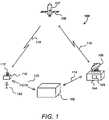
- FIG. 1is a diagram illustrating an overview of a single satellite video distribution system
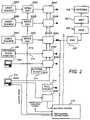
- FIG. 2is a block diagram showing a typical uplink configuration for a single satellite transponder
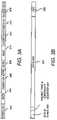
- FIG. 3Ais a diagram of a representative data stream
- FIG. 3Bis a diagram of a representative data packet
- FIG. 4is a block diagram showing one embodiment of the modulator
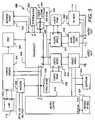
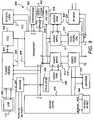
- FIG. 5is a block diagram of an integrated receiver/decoder
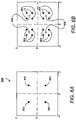
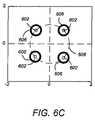
- FIGS. 6A-6Care diagrams illustrating the basic relationship of signal layers in a layered modulation transmission
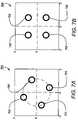
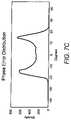
- FIGS. 7A-7Care diagrams illustrating a signal constellation of a second transmission layer over the first transmission layer after first layer demodulation
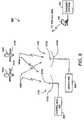
- FIG. 8is a diagram showing a system for transmitting and receiving layered modulation signals
- FIG. 9is a block diagram depicting one embodiment of an enhanced receiver/decoder capable of receiving layered modulation signals
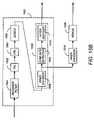
- FIG. 10Ais a block diagram of one embodiment of the enhanced tuner/modulator and FEC encoder
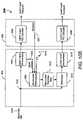
- FIG. 10Bdepicts another embodiment of the enhanced tuner/modulator wherein layer subtraction is performed on the received layered signal
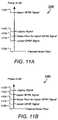
- FIGS. 11A and 11Bdepicts the relative power levels of example embodiments of the present invention.
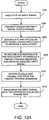
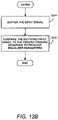
- FIGS. 12A and 12Bare diagram illustrating the application of unblind equalization techniques
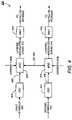
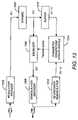
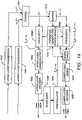
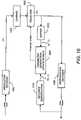
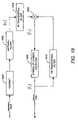
- FIG. 13presents an exemplary implementation of an unblind equalizer system
- FIG. 14is a diagram illustrating the embodiment shown in FIG. 13 , as it can be applied to a layered modulation system such as is illustrated in FIGS. 10A and 10B ;
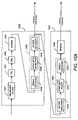
- FIGS. 15A and 15Bare diagrams depicting further detail regarding the generation of a pseudo-training sequence
- FIG. 16is a block diagram illustrating an unblind equalizer that recursively updates equalizer parameters
- FIG. 17is a block diagram illustrating the unblind equalizer of FIG. 16 as applied to a layered modulation system
- FIGS. 18A and 18Bare state transition diagrams depicting alternative embodiments of the present invention.
- FIG. 19is a block diagram of a conventional distributed feedback equalizer (DFE) that may be used in the present invention.
- DFEdistributed feedback equalizer
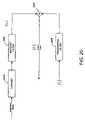
- FIG. 20is a block diagram of a proposed blanket equalizer that incorporates the functionality of the unblind equalizer described above, and the signal reconstruction technique that re-creates a “training” symbol sequence from the received signal;
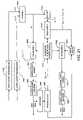
- FIG. 21illustrates an example application of the equalization for a layer-modulated signal performed by the present invention.
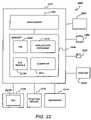
- FIG. 22illustrates an exemplary computer system that could be used to implement selected modules or functions the present invention
- FIG. 1is a diagram illustrating an overview of a single satellite video distribution system 100 .
- the video distribution system 100comprises a control center 102 in communication with an uplink center 104 via a ground or other link 114 and with a subscriber receiver station 110 via a public switched telephone network (PSTN) or other link 120 .
- the control center 102provides program material (e.g. video programs, audio programs and other data) to the uplink center 104 and coordinates with the subscriber receiver stations 110 to offer, for example, pay-per-view (PPV) program services, including billing and associated decryption of video programs.
- program materiale.g. video programs, audio programs and other data
- PSVpay-per-view
- the uplink center 104receives program material and program control information from the control center 102 , and using an uplink antenna 106 and transmitter 105 , transmits the program material and program control information to the satellite 108 .
- the satellitereceives and processes this information and transmits the video programs and control information to the subscriber receiver station 110 via downlink 118 using transmitter 107 .
- the subscriber receiving station 110receives this information using the outdoor unit (ODU) 112 , which includes a subscriber antenna and a low noise block converter (LNB).
- ODUoutdoor unit
- LNBlow noise block converter
- the subscriber receiving station antennais an 18-inch slightly oval-shaped Ku-band antenna.
- the slight ovoid shapeis due to the 22.5 degree offset feed of the LNB (low noise block converter) which is used to receive signals reflected from the subscriber antenna.
- the offset feedpositions the LNB out of the way so it does not block any surface area of the antenna minimizing attenuation of the incoming microwave signal.
- the video distribution system 100can comprise a plurality of satellites 108 in order to provide wider terrestrial coverage, to provide additional channels, or to provide additional bandwidth per channel.
- each satellitecomprises 16 transponders to receive and transmit program material and other control data from the uplink center 104 and provide such material to the subscriber receiving stations 110 .
- two satellites 108 working togethercan receive and broadcast over 150 conventional (non-HDTV) audio and video channels via 32 transponders.
- the present inventionmay also be utilized with terrestrial-based transmission of program information, whether by broadcasting means, cable, or other means. Further, the different functions collectively allocated among the control center 102 and the uplink center 104 as described above can be reallocated as desired without departing from the intended scope of the present invention.
- the foregoinghas been described with respect to an embodiment in which the program material delivered to the subscriber 122 is video (and audio) program material such as a movie, the foregoing method can be used to deliver program material comprising purely audio information or other data.
- FIG. 2is a block diagram showing a typical uplink configuration for a single satellite 108 transponder, showing how video program material is uplinked to the satellite 108 by the control center 102 and the uplink center 104 .
- FIG. 2shows three video channels (which could be augmented respectively with one or more audio channels for high fidelity music, soundtrack information, or a secondary audio program for transmitting foreign languages), a data channel from a program guide subsystem 206 and computer data information from a computer data source 208 .
- the video channelsare provided by a program source of video material 200 A- 200 C [collectively referred to hereinafter as video source(s) 200 ].
- the data from each video program source 200is provided to an encoder 202 A- 202 C [collectively referred to hereinafter as encoder(s) 202 ].
- Each of the encodersaccepts a program time stamp (PTS) from the controller 216 .
- the PTSis a wrap-around binary time stamp that is used to assure that the video information is properly synchronized with the audio information after encoding and decoding.
- a PTS time stampis sent with each I-frame of the MPEG encoded data.
- each encoder 202is a second generation Motion Picture Experts Group (MPEG-2) encoder, but other decoders implementing other coding techniques can be used as well.
- the data channelcan be subjected to a similar compression scheme by an encoder (not shown), but such compression is usually either unnecessary, or performed by computer programs in the computer data source (for example, photographic data is typically compressed into *.TIF files or *.JPG files before transmission).
- the signalsare converted into data packets by a packetizer 204 A- 204 F [collectively referred to hereinafter as packetizer(s) 204 ] associated with each source 200 .
- the data packetsare assembled using a reference from the system clock 214 (SCR) and from the conditional access manager 210 , which provides the SCID to the packetizers 204 for use in generating the data packets. These data packets are then multiplexed into serial data and transmitted.
- SCRsystem clock 214
- conditional access manager 210which provides the SCID to the packetizers 204 for use in generating the data packets.
- FIG. 3Ais a diagram of a representative data stream.
- the first packet segment 302comprises information from video channel 1 (data coming from, for example, the first video program source 200 A).
- the next packet segment 304comprises computer data information that was obtained, for example from the computer data source 208 .
- the next packet segment 306comprises information from video channel 5 (from one of the video program sources 200 ).
- the next packet segment 308comprises program guide information such as the information provided by the program guide subsystem 206 .
- null packets 310 created by the null packet module 310may be inserted into the data stream as desired.
- the data streamtherefore comprises a series of packets from any one of the data sources in an order determined by the controller 216 .
- the data streamis encrypted by the encryption module 218 , modulated by the modulator 220 (typically using a QPSK modulation scheme), and provided to the transmitter 222 , which broadcasts the modulated data stream on a frequency bandwidth to the satellite via the antenna 106 .
- the receiver 500receives these signals, and using the SCID, reassembles the packets to regenerate the program material for each of the channels.
- FIG. 3Bis a diagram of a data packet.
- Each data packet(e.g. 302 - 316 ) is 147 bytes long, and comprises a number of packet segments.
- the first packet segment 320comprises two bytes of information containing the SCID and flags.
- the SCIDis a unique 12-bit number that uniquely identifies the data packet's data channel.
- the flagsinclude 4 bits that are used to control other features.
- the second packet segment 322is made up of a 4-bit packet type indicator and a 4-bit continuity counter.
- the packet typeidentifies the packet as one of the four data types (video, audio, data, or null). When combined with the SCID, the packet type determines how the data packet will be used.
- the continuity counterincrements once for each packet type and SCID.
- the next packet segment 324comprises 127 bytes of payload data, which in the cases of packets 302 or 306 is a portion of the video program provided by the video program source 200 .
- FIG. 4is a block diagram showing one embodiment of the modulator 220 .
- the modulator 220optionally comprises a forward error correction (FEC) encoder 404 which accepts the first signal symbols 402 and adds redundant information that are used to reduce transmission errors.
- the coded symbols 405are modulated by modulator 406 according to a first carrier 408 to produce an upper layer modulated signal 410 .
- Second symbols 420are likewise provided to an optional second FEC encoder 422 to produce coded second symbols 424 .
- the coded second symbols 424are provided to a second modulator 414 , which modulates the coded second signals according to a second carrier 416 to produce a lower layer modulated signal 418 .
- the resulting signalsare then transmitted by one or more transmitters 420 , 422 .
- the upper layer modulated signal 410 and the lower layer modulated signal 418are therefore uncorrelated, and the frequency range used to transmit each layer can substantially or completely overlap the frequency spectrum used to transmit the other.
- the upper layer signal 410must be a sufficiently greater amplitude signal than the lower layer signal 418 , in order to maintain the signal constellations shown in FIG. 6 and FIG. 7 .
- the modulator 220may also employ pulse shaping techniques (illustrated by pulse p(t) 430 ) to account for the limited channel bandwidth. Although FIG. 4 illustrates the same pulse shaping p(t) 430 being applied to both layers, different pulse shaping can be applied to each layer as well.
- FIG. 5is a block diagram of an integrated receiver/decoder (IRD) 500 (also hereinafter alternatively referred to as receiver 500 ).
- the receiver 500comprises a tuner/demodulator 504 communicatively coupled to an ODU 112 having one or more LNBs 502 .
- the LNB 502converts the 12.2- to 12.7 GHz downlink 118 signal from the satellites 108 to, e.g., a 950-1450 MHz signal required by the IRD's 500 tuner/demodulator 504 .
- the LNB 502may provide either a dual or a single output.
- the single-output LNB 502has only one RF connector, while the dual output LNB 502 has two RF output connectors and can be used to feed a second tuner 504 , a second receiver 500 , or some other form of distribution system.
- the tuner/demodulator 504isolates a single, digitally modulated 24 MHz transponder and converts the modulated data to a digital data stream. Further details regarding the demodulation of the received signal follow.
- the digital data streamis then supplied to a forward error correction (FEC) decoder 506 .
- FECforward error correction
- the error-corrected datamay be fed from the FEC decoder module 506 to the transport module 508 via an 8-bit parallel interface.
- the transport module 508performs many of the data processing functions performed by the IRD 500 .
- the transport module 508processes data received from the FEC decoder module 506 and provides the processed data to the video MPEG decoder 514 and the audio MPEG decoder 517 .
- the transport module, video MPEG decoder and audio MPEG decoderare all implemented on integrated circuits. This design promotes both space and power efficiency, and increases the security of the functions performed within the transport module 508 .
- the transport module 508also provides a passage for communications between the microcontroller 510 and the video and audio MPEG decoders 514 , 517 .
- the transport modulealso works with the conditional access module (CAM) 512 to determine whether the subscriber receiving station 110 is permitted to access certain program material. Data from the transport module can also be supplied to the external communication module 526 .
- CAMconditional access module
- the CAM 512functions in association with other elements to decode an encrypted signal from the transport module 508 .
- the CAM 512may also be used for tracking and billing these services.
- the CAM 512function as a smart card, having contacts cooperatively interacting with contacts in the IRD 500 to pass information.
- the IRD 500and specifically the transport module 508 provides a clock signal to the CAM 512 .
- Video datais processed by the MPEG video decoder 514 .
- the MPEG video decoder 514decodes the compressed video data and sends it to an encoder or video processor 516 , which converts the digital video information received from the video MPEG module 514 into an output signal usable by a display or other output device.
- processor 516may comprise a National TV Standards Committee (NTSC) or Advanced Television Systems Committee (ATSC) encoder.
- NTSCNational TV Standards Committee
- ATSCAdvanced Television Systems Committee
- S-Video and ordinary video (NTSC or ATSC) signalsare provided.
- Other outputsmay also be utilized and are advantageous if high definition programming is processed.
- Audio datais likewise decoded by the MPEG audio decoder 517 .
- the decoded audio datamay then be sent to a digital-to-analog (D/A) converter 518 .
- the D/A converter 518is a dual D/A converter, one for the right and left channels. If desired, additional channels can be added for use in surround sound processing or secondary audio programs (SAPs).
- SAPssecondary audio programs
- the dual D/A converter 518itself separates the left and right channel information, as well as any additional channel information.
- Other audio formatsmay be similarly supported, for example, multi-channel DOLBY DIGITAL AC-3.
- the microcontroller 510receives and processes command signals from the remote control 524 , an IRD 500 keyboard interface, and/or another input device.
- the microcontrollerreceives commands for performing its operations from a processor programming memory, which permanently stores such instructions for performing such commands.
- the processor programming memorymay comprise a read-only memory (ROM) 538 , an electrically erasable programmable read-only memory (EEPROM) 522 or, similar memory device.
- the microcontroller 510also controls the other digital devices of the IRD 500 via address and data lines (denoted “A” and “D” respectively, in FIG. 5 ).
- the modem 540connects to the customer's phone line via the PSTN port 120 . It calls, e.g. the program provider, and transmits the customer's purchase information for billing purposes, and/or other information.
- the modem 540is controlled by the microprocessor 510 .
- the modem 540can output data to other I/O port types including standard parallel and serial computer I/O ports.
- the present inventionalso comprises a local storage unit such as the video storage device 532 for storing video and/or audio data obtained from the transport module 508 .
- Video storage device 532can be a hard disk drive, a read/writable compact disc or DVD, a solid state RAM, or any other storage medium.
- the video storage device 532is a hard disk drive with specialized parallel read/write capability so that data may be read from the video storage device 532 and written to the device 532 at the same time. To accomplish this feat, additional buffer memory accessible by the video storage 532 or its controller may be used.
- a video storage processor 530can be used to manage the storage and retrieval of the video data from the video storage device 532 .
- the video storage processor 530may also comprise memory for buffering data passing into and out of the video storage device 532 .
- a plurality of video storage devices 532can be used.
- the microcontroller 510can also perform the operations required to store and/or retrieve video and other data in the video storage device 532 .
- the video processing module 516 inputcan be directly supplied as a video output to a viewing device such as a video or computer monitor.
- the video and/or audio outputscan be supplied to an RF modulator 534 to produce an RF output and/or 8 vestigial side band (VSB) suitable as an input signal to a conventional television tuner. This allows the receiver 500 to operate with televisions without a video output.
- a viewing devicesuch as a video or computer monitor.
- the video and/or audio outputscan be supplied to an RF modulator 534 to produce an RF output and/or 8 vestigial side band (VSB) suitable as an input signal to a conventional television tuner. This allows the receiver 500 to operate with televisions without a video output.
- VSBvestigial side band
- Each of the satellites 108comprises a transponder, which accepts program information from the uplink center 104 , and relays this information to the subscriber receiving station 110 .
- Known multiplexing techniquesare used so that multiple channels can be provided to the user. These multiplexing techniques include, by way of example, various statistical or other time domain multiplexing techniques and polarization multiplexing.
- a single transponder operating at a single frequency bandcarries a plurality of channels identified by respective service channel identification (SCID).
- SCIDservice channel identification
- the IRD 500also receives and stores a program guide in a memory available to the microcontroller 510 .
- the program guideis received in one or more data packets in the data stream from the satellite 108 .
- the program guidecan be accessed and searched by the execution of suitable operation steps implemented by the microcontroller 510 and stored in the processor ROM 538 .
- the program guidemay include data to map viewer channel numbers to satellite transponders and service channel identifications (SCIDs), and also provide TV program listing information to the subscriber 122 identifying program events.
- SCIDsservice channel identifications
- the functionality implemented in the IRD 500 depicted in FIG. 5can be implemented by one or more hardware modules, one or more software modules defining instructions performed by a processor, or a combination of both.
- the present inventionprovides for the modulation of signals at different power levels and advantageously for the signals to be non-coherent from each layer.
- independent modulation and coding of the signalsmay be performed.
- Backwards compatibility with legacy receivers, such as a quadrature phase shift keying (QPSK) receiveris enabled and new services are provided to new receivers.
- QPSKquadrature phase shift keying
- a typical new receiver of the present inventionuses two demodulators and one remodulator as will be described in detail hereafter.
- the legacy QPSK signalis boosted in power to a higher transmission (and reception) level. This creates a power “room” in which a new lower layer signal may operate.
- the legacy receiverwill not be able to distinguish the new lower layer signal, from additive white Gaussian noise, and, thus, operates in the usual manner.
- the optimum selection of the layer power levelsis based on accommodating the legacy equipment, as well as the desired new throughput and services.
- the new lower layer signalis provided with a sufficient carrier to thermal noise ratio to function properly.
- the new lower layer signal and the boosted legacy signalare non-coherent with respect to each other. Therefore, the new lower layer signal can be implemented from a different TWTA and even from a different satellite.
- the new lower layer signal formatis also independent of the legacy format, e.g., it may be QPSK or 8PSK, using the conventional concatenated FEC code or using a new Turbo code.
- the lower layer signalmay even be an analog signal.
- the combined layered signalis demodulated and decoded by first demodulating the upper layer to remove the upper carrier.
- the stabilized layered signalmay then have the upper layer FEC decoded and the output upper layer symbols communicated to the upper layer transport.
- the upper layer symbolsare also employed in a remodulator to generate an idealized upper layer signal.
- the idealized upper layer signalis then subtracted from the stable layered signal to reveal the lower layer signal.
- the lower layer signalis then demodulated and FEC decoded and communicated to the lower layer transport.
- Signals, systems and methods using the present inventionmay be used to supplement a pre-existing transmission compatible with legacy receiving hardware in a backwards-compatible application or as part of a preplanned layered modulation architecture providing one or more additional layers at a present or at a later date.
- FIGS. 6A-6Cillustrate the basic relationship of signal layers in a layered modulation transmission.
- FIG. 6Aillustrates a first layer signal constellation 600 of a transmission signal showing the signal points or symbols 602 .
- FIG. 6Billustrates the second layer signal constellation of symbols 604 over the first layer signal constellation 600 where the layers are coherent.
- FIG. 6Cillustrates a second signal layer 606 of a second transmission layer over the first layer constellation where the layers may be non-coherent.
- the second layer 606rotates about the first layer constellation 602 due to the relative modulating frequencies of the two layers in a non-coherent transmission. Both the first and second layers rotate about the origin due to the first layer modulation frequency as described by path 608 .
- FIGS. 7A-7Care diagrams illustrating a signal constellation of a second transmission layer over the first transmission layer after first layer demodulation.
- FIG. 7Ashows the constellation 700 before the first carrier recovery loop (CRL) and
- FIG. 7Bshows the constellation 704 after CRL.
- the signal points of the second layerare actually rings 702 .
- FIG. 7Cdepicts a phase distribution of the received signal with respect to nodes 602 .
- Relative modulating frequenciescause the second layer constellation to rotate around the nodes of the first layer constellation. After the second layer CRL, this rotation is eliminated.
- the radius of the second layer constellationis determined by its power level.
- the thickness of the rings 702is determined by the carrier to noise ratio (CNR) of the second layer.
- CNRcarrier to noise ratio
- FIG. 8is a diagram showing a system for transmitting and receiving layered modulation signals.
- Separate transmitters 107 A, 107 Bas may be located on any suitable platform, such as satellites 108 A, 108 B, are used to non-coherently transmit different layers of a signal of the present invention.
- Uplink signalsare typically transmitted to each satellite 108 A, 108 B from one or more transmitters 105 via an antenna 106 .
- the layered signals 808 A, 808 B(downlink signals) are received at receiver antennas 112 A, 112 B, such as satellite dishes, each with a low noise block (LNB) 812 A, 812 B where they are then coupled to integrated receiver/decoders (IRDs) 500 , 802 .
- LNBlow noise block
- any composite signal, including new additional signal layerswill be backwards compatible with legacy receivers 500 , which will disregard the new signal layers.
- the combined signal and noise level for the lower layermust be at or below the allowed noise floor for the upper layer.
- Layered modulation applicationsinclude backwards compatible and non-backwards compatible applications.
- “Backwards compatible” in this sensedescribes systems in which legacy receivers 500 are not rendered obsolete by the additional signal layer(s). Instead, even if the legacy receivers 500 are incapable of decoding the additional signal layer(s), they are capable of receiving the layered modulated signal and decoding the original signal layer. In these applications, the pre-existing system architecture is accommodated by the architecture of the additional signal layers.
- “Non-backwards compatible”describes a system architecture which makes use of layered modulation, but the modulation scheme employed is such that pre-existing equipment is incapable of receiving and decoding the information on additional signal layer(s).
- the pre-existing legacy IRDs 500decode and make use of data only from the layer (or layers) they were designed to receive, unaffected by the additional layers.
- the legacy signalsmay be modified to optimally implement the new layers.
- the present inventionmay be applied to existing direct satellite services which are broadcast to individual users in order to enable additional features and services with new receivers without adversely affecting legacy receivers and without requiring additional signal frequency.
- FIG. 9is a block diagram depicting one embodiment of an enhanced IRD 802 capable of receiving layered modulation signals.
- the enhanced IRD 802includes a feedback path 902 in which the FEC decoded symbols are fed back to a enhanced modified tuner/demodulator 904 and transport module 908 .
- FIG. 10Ais a block diagram of one embodiment of the enhanced tuner/modulator 904 and FEC encoder 506 .
- FIG. 10Adepicts reception where layer subtraction is performed on a signal where the upper carrier has been demodulated.
- the upper layer of the received combined signal 1016 from the LNB 502which may contain legacy modulation format, is provided to and processed by an upper layer demodulator 1004 to produce the stable demodulated signal 1020 .
- the demodulated signal 1020is fed to a communicatively coupled FEC decoder 1002 which decodes the upper layer to produce the upper layer symbols which are output to an upper layer transport.
- the upper layer symbolsare also used to generate an idealized upper layer signal.
- the upper layer symbolsmay be produced from the decoder 1002 after Viterbi decode (BER ⁇ 10 ⁇ 3 or so) or after Reed-Solomon (RS) decode (BER ⁇ 10 ⁇ 9 or so), in typical decoding operations known to those skilled in the art.
- the upper layer symbolsare provided via feedback path 902 from the upper layer decoder 1002 to a re-encoder/remodulator 1006 which effectively produces an idealized upper layer signal.
- the idealized upper level signalis subtracted from the demodulated upper layer signal 1020 .
- the modulated signalmay have been distorted, for example, by traveling wave tube amplifier (TWTA) non-linearity or other non-linear or linear distortions in the transmission channel.
- TWTAtraveling wave tube amplifier
- the distortion effectsare estimated from the received signal after the fact or from TWTA characteristics which may be downloaded into the IRE in AM-AM and/or AM-PM maps 1014 , used to eliminate the distortion.
- a subtractor 1012then subtracts the idealized upper layer signal from the stable demodulated signal 1020 . This leaves the lower-power second layer signal.
- the subtractor 1012may include a buffer or delay function to retain the stable demodulated signal 1020 while the idealized upper layer signal is being constructed.
- the second layer signalis demodulated by the lower level demodulator 1010 and FEC decoded by decoder 1008 according to its signal format to produce the lower layer symbols, which are provided to the transport module 508 .
- FIG. 10Bdepicts another embodiment wherein layer subtraction is performed on the received layered signal.
- the upper layer demodulator 1004produces the upper carrier signal 1022 (as well as the stable demodulated signal output 1020 ).
- An upper carrier signal 1022is provided to the remodulator 1006 .
- the remodulator 1006provides the remodulated signal to the non-linear distortion mapper 1018 which effectively produces an idealized upper layer signal.
- the idealized upper layer signalincludes the upper layer carrier for subtraction from the received combined signal 416 .
- M Uis the magnitude of the upper layer QPSK signal
- M Lis the magnitude of the lower layer QPSK signal
- M L ⁇ M UM L ⁇ M U .
- the signal frequencies and phase for the upper and lower layer signalsare respectively ⁇ U , ⁇ U and ⁇ L , ⁇ L , respectively.
- the symbol timing misalignment between the upper and lower layersis ⁇ T m .
- the expression p(t ⁇ mT)represents the time shifted version of the pulse shaping filter p(t) 430 employed in signal modulation.
- QPSK symbols S Um and S Lmare elements of
- any distortion effectssuch as TWTA nonlinearity effects are estimated for signal subtraction.
- the upper and lower layer frequenciesare substantially equal. Significant improvements in system efficiency can be obtained by using a frequency offset between layers.
- two-layered backward compatible modulation with QPSKdoubles a current 6/7 rate capacity by adding a TWTA approximately 6.2 dB above an existing TWTA power.
- New QPSK signalsmay be transmitted from a separate transmitter, for example, from a different satellite.
- TWTAslinear traveling wave tube amplifiers
- 16QAMphase error penalty
- FIG. 11Adepicts the relative power levels 1100 of example embodiments of the present invention.
- FIG. 11Ais not to scale.
- This embodimentdoubles the pre-existing rate 6/7 capacity by using a TWTA 6.2 dB above a pre-existing TWTA equivalent isotropic radiated power (EIRP) and second TWTA 2 dB below the pre-existing TWTA power.
- EIRPisotropic radiated power
- This embodimentuses upper and lower QPSK layers which are non-coherent.
- a code rate of 6/7is also used for both layers.
- the signal of the legacy QPSK signal 1102is used to generate the upper layer 1104 and a new QPSK layer is the lower layer 1110 .
- the CNR of the legacy QPSK signal 1102is approximately 7 dB.
- the legacy QPSK signal 1102is boosted in power by approximately 6.2 dB bringing the new power level to approximately 13.2 dB as the upper layer 1104 .
- the noise floor 1106 of the upper layeris approximately 6.2 dB.
- the new lower QPSK layer 1110has a CNR of approximately 5 dB.
- the total signal and noise of the lower layeris kept at or below the tolerable noise floor 1106 of the upper layer.
- the power boosted upper layer 1104 of the present inventionis also very robust, making it resistant to rain fade. It should be noted that the invention may be extended to multiple layers with mixed modulations, coding and code rates.
- a code rate of 2/3may be used for both the upper and lower layers 1104 , 1110 .
- the CNR of the legacy QPSK signal 1102(with a code rate of 2/3) is approximately 5.8 dB.
- the legacy signal 1102is boosted by approximately 5.3 dB to approximately 11.1 dB (4.1 dB above the legacy QPSK signal 1102 with a code rate of 2/3) to form the upper QPSK layer 1104 .
- the new lower QPSK layer 1110has a CNR of approximately 3.8 dB.
- the total signal and noise of the lower layer 1110is kept at or below approximately 5.3 dB, the tolerable noise floor 1106 of the upper QPSK layer. In this case, overall capacity is improved by 1.55 and the effective rate for legacy IRDs will be 7/9 of that before implementing the layered modulation.
- the code rates between the upper and lower layers 1104 , 1110may be mixed.
- the legacy QPSK signal 1102may be boosted by approximately 5.3 dB to approximately 12.3 dB with the code rate unchanged at 6/7 to create the upper QPSK layer 1104 .
- the new lower QPSK layer 1110may use a code rate of 2/3 with a CNR of approximately 3.8 dB. In this case, the total capacity relative to the legacy signal 1102 is approximately 1.78.
- the legacy IRDswill suffer no rate decrease.
- two QPSK layers 1104 , 1110are used each at a code rate of 2/3.
- the upper QPSK layer 504has a CNR of approximately 4.1 dB above its noise floor 1106 and the lower QPSK layer 1110 also has a CNR of approximately 4.1 dB.
- the total code and noise level of the lower QPSK layer 1110is approximately 5.5 dB.
- the total CNR for the upper QPSK signal 1104is approximately 9.4 dB, merely 2.4 dB above the legacy QPSK signal rate 6/7.
- the capacityis approximately 1.74 compared to the legacy rate 6/7.
- FIG. 11Bdepicts the relative power levels of an alternate embodiment wherein both the upper and lower layers 1104 , 1110 are below the legacy signal level 1102 .
- the two QPSK layers 1104 , 1110use a code rate of 1/2.
- the upper QPSK layer 1104is approximately 2.0 dB above its noise floor 1106 of approximately 4.1 dB.
- the lower QPSK layerhas a CNR of approximately 2.0 dB and a total code and noise level at or below 4.1 dB.
- the capacity of this embodimentis approximately 1.31 compared to the legacy rate 6/7.
- Equalizerscan be classified into two groups: those that either know or estimate channel impulse response, and those that operate without such knowledge. Information about such equalizers can be found in the paper “Adaptive Equalizer” by Qureshi, Proceedings of IEEE, Vol. 73, No. 9, September 1985, and in the textbook “Digital Communications, ” by John G. Proakis, Third Edition, McGraw-Hill Book Company, 1995, in Chapters 10 and 11.
- the first groupincludes equalizers that have a priori knowledge of the channel impulse response, and those that estimate the channel impulse response using prearranged training sequences known to both the transmitter and the receiver.
- the second groupincludes blind equalizers (which have no knowledge of the channel impulse response and do not attempt to estimate it).
- One type of blind equalizeris a decision feedback blind equalizer, which uses the digital output of the system to feedback to the equalizer computation. However, that type of decision-making process is very sensitive to the digital output error rate.
- the “unblind” equalizer described belowdoes not fall neatly into any of the above categories. Unlike the first category, no a priori knowledge of the transmission channel characteristics is required and prearranged training sequences are not required, thus saving valuable transmission capacity.
- the “unblind” equalizerhas the same implementation advantages and provides performance better than a blind equalizer. However, the unblind equalizer does not require specific knowledge of the channel impulse response, nor does it need to dedicate transmission capacity to transmit training sequences.
- the unblind equalizeruses past received data to recover the transmission signal, and then uses the recovered transmission signal to define the equalizer format and parameters.
- the unblind equalizercan also be used in combination with an adaptive equalizer to create an adaptive unblind equalizer, which can be used in applications where channel characteristics change over time.
- FIGS. 12A and 12Billustrate the application of unblind equalization techniques to a conventional single-layered signal.
- FIGS. 12A and 12Bwill be discussed with reference to FIG. 13 , which presents an exemplary implementation of an unblind equalizer system.
- an input signal having input datais modulated to produce a modulated input signal, as shown in block 1202 .
- the signalis also typically encoded with an FEC encoder such as a turbo encoder. This can be accomplished, for example, by the modulator/encoder 1302 .
- the modulated signal s(t)is transmitted via channel 1304 , producing signal y(t) as shown in block 1204 .
- the signal y(t)is equalized by equalizer 1306 , producing an equalized input signal ⁇ (t).
- the equalized input signal ⁇ (t)is demodulated (and decoded if was encoded) to produce data output, as described in block 1206 .
- the demodulator/decoder 1308 shown in FIG. 13The data output is remodulated to produce a pseudo-training sequence that includes an idealized input signal, as is shown in block 1208 . This can be accomplished by means of the remodulator 1310 . Since there is a time delay associated with this process, the resulting remodulated signal (and pseudo-training sequence) is represented as s (t ⁇ ).
- equalizer parametersare derived from the pseudo-training sequence, as shown in block 1210 . This can be accomplished by the parameter generation/update module 1314 .
- the input signal y(t)is equalized using the generated parameters. This can be performed by the equalizer 1306 shown in FIG. 13 .
- the equalizer parametersare generated by comparing a buffered or delayed version of the input signal with the pseudo-training sequence. This technique is illustrated in blocks 1214 and 1216 of FIG. 12B .
- FIG. 14further illustrates the embodiment shown in FIG. 13 , as it can be applied to a layered modulation system as is illustrated in FIGS. 10A and 10B .
- Blocks 1402 and 1404illustrate the modulation and transmission of the upper layer signal s up (t) and the lower layer signal s low (t), respectively, through channel 1304 to produce signal y(t) (which is equal to S up (t)+S low (t).
- Signal y(t)is applied to a first equalizer 1306 A to produce an equalized upper layer signal S up (t ⁇ ).
- the equalized upper layer signal S up (t ⁇ )is applied to an upper layer demodulator 1004 and an upper layer decoder 1002 to produce the upper layer signal.
- the upper layer signalis recoded by re-encoder 1408 and remodulated by modulator 1006 to produce a pseudo-training sequence S up (t ⁇ ).
- the pseudo-training sequence S up (t ⁇ )is an idealized version of the upper layer signal, delayed by processing delays inherent in the recoding and remodulating process.
- the signal S up (t ⁇ )is provided to a signal canceller 1012 .
- Signal y(t)is delayed by a time period ⁇ approximating that of the remodulation and recoding process by buffer 1312 to produce y(t ⁇ ).
- This delayed signal y(t ⁇ )is applied to both the parameter generation/update module 1314 and a second equalizer 1306 B.
- the equalized y(t) signal, ⁇ up (t)+ ⁇ low (t)is provided to the signal canceller 1012 as well.
- the output of the signal canceller 1012is S up (t ⁇ ) ⁇ [ ⁇ up (t ⁇ )+ ⁇ low (t ⁇ )].
- S up (t ⁇ )is approximately equal to ⁇ up (t ⁇ ); thus, the output of the signal canceller 1012 can be represented as a delayed and equalized version of the lower layer signal, or ⁇ low (t ⁇ ).
- This signalis provided to the lower layer demodulator 1010 and the lower layer encoder 1008 to reconstruct the lower layer signal.
- the parameters of the upper layer equalizer 1306 A and the lower layer equalizer 1306 Bare updated with equalizer parameters generated or updated in the parameter generation/update module 1314 using the buffered input signal y(t ⁇ ) or S up (t ⁇ )+S low (t ⁇ ) and the pseudo-training sequence S up (t ⁇ ).
- the foregoing techniqueassumes that the transmission channel is, in a wide-sense, stationary, or has characteristics that vary slowly over time, at least as compared to the digital detection process of the receiver 500 .
- the effectiveness of the foregoing techniqueis reduced in situations where channel variances over time are not smaller than those of the equalizer parameter update.
- the foregoing techniquealso assumes that even without equalization, the receiver can detect the transmitted digital information or a portion thereof at a certain range of data error rate. This may not be the case when this “unblind” equalization technique is combined for use with traditional training sequence equalizers or blind equalizers.
- FIGS. 15A and 15Bdepict further detail regarding the generation of a pseudo-training sequence.
- the processincludes a receiving process 1520 and a remodulation process 1522 .
- the receiving process 1520is shared with the ordinary data receiving process and is performed by a filter 1501 , timing recovery loop (TRL) module 1502 , a carrier recovery loop (CRL) module 1504 , and a demodulator 1004 and a decoder 1002 .
- the decoder 1002includes an inner decoder 1506 , a synchronization bit detector module 1508 and an outer decoder 1510 .
- the output of the receiving processis a received data output.
- the received data outputis provided to an encoder 1524 , which includes an outer encoder 1512 , synchronization module 1514 for placing synchronization bits in the data stream, and an inner encoder 1516 .
- the resulting signalis modulated by remodulator 1006 and may optionally be filtered by a front end filter to produce the training sequence.
- BERbit error rate
- an unblinded pseudo-training sequencecan be used to process the parameter update computation.
- the point at which there is sufficient channel performance (as measured, for example, by the BER) to generate a pseudo-training sequencevaries from system to system, and largely depends upon the value of other communication system parameters.
- FIG. 15Billustrates an embodiment in which the generation of the pseudo-training sequence from the transmitted data is foreshortened.
- FIG. 15Bdiffers FIG. 15A in that the process does not use a complete version of the remodulation process.
- the remodulationstarts with the output of the inner decoder 1506 .
- this embodimentmay yield a higher symbol error rate for an unblinded pseudo-training sequence.
- FIGS. 13 and 14illustrate an unblind equalization architecture that produces independent measurements over time.
- FIG. 16illustrates an unblind equalizer that recursively updates equalizer parameters. Comparing this embodiment with the embodiment illustrated in FIGS. 13 and 14 , the parameter generation/update module 1604 forces its two inputs to be identical through a filtering process.
- FIG. 17illustrates the unblind equalizer of FIG. 16 as applied to a layered modulation system.
- This embodimentuses a single equalizer 1602 , unlike the embodiment shown in FIG. 14 .
- Unblind equalizerscan be used in a conventional and/or an adaptive manner. Conventionally, it is assumed that the channel 1304 characteristics are either time-invariant or slowly changing in time. In such circumstances, once the equalizer is defined, the same equalizer parameters (e.g. structure and coefficients) can be used without further change. Where the channel 1304 characteristics change significantly over time, an adaptive unblind equalizer can be utilized. In such cases, the parameter generation/update module 1314 , 1604 can continually accept renewed data and continue to update the parameters of the equalizer(s).
- the systemIn the case of multi-layer modulation, it can generally be assumed that the system is capable of detecting the transmitted information within certain error rates, even without equalization. In most cases, the upper layer may be demodulated with a relatively low BER. However, in general cases where the system includes only one layer of modulation, it may be difficult to adequately detect the transmitted information without equalization. In such cases, the more traditional equalizers (using training sequences or blind equalizers) can be used to improve the signal, with the unblind equalizer accepting the equalized signal and providing further performance improvements.
- the unblind equalizercan be used with a training sequence equalizer.
- a system using a training system equalizerassumes the signal channel is static during the data transmission. If the channel varies, the system has to wait until the next training sequence before the system can make any correction.
- the training sequencemust have a length long enough to be able to adequately train the equalizer, and the training sequence must be repeated on a periodic or aperiodic basis in order to keep the equalizer updated.
- the training sequenceprovides perfect knowledge of the transmitted data sequence, it consumes some of the transmitting capacity. Hence, it is not cost effective to use a long training sequence or to frequently use a training sequence.
- the unblind equalizercan be used to ameliorate the weaknesses of the training sequence equalizer. This can be accomplished by using the unblind equalizer to update the training equalizer after the training sequence equalizer has established the equalizer and the communications link. An unblind equalizer can also be used without the need of any additional training sequence once the receiver is able to receive the transmitted data.
- FIG. 18Aillustrates a state transition diagram for the use of an unblind equalizer in combination with a training sequence equalizer.
- the systemuses the training sequence equalizer 1802 .
- the systemswitches to select use of an unblind equalizer 1804 .
- the training sequence equalizer 1802is used once again; when the training sequence has been received, the unblind equalizer 1804 is again used.
- This systemtakes advantage of the training sequence's perfectly matched data, can reduce the repeated frequency of the training sequence transmissions (using the pseudo-training sequence), and can keep the equalizer updated in a dynamically changing channel environment.
- a system without a training sequencemay require an equalizer to generate a sufficiently error-free signal to allow the unblind equalizer to effectively function.
- a blind equalizercan be used before the unblind equalizer is employed.
- the systemis able to receive the transmitted data.
- a pseudo-training sequencecan be derived and the unblind equalizer can be employed. Since the unblind equalizer uses the received data as its training sequence, equalizer parameters can be more accurately determined, improving equalizer performance.
- FIG. 18Billustrates a state transition diagram for the use of an unblind equalizer with a blind equalizer.
- the systemuses a blind equalizer 1806 .
- the systemswitches to select the use of an unblind equalizer.
- This techniquecan be used when the channel changes slowly compared to data processing (demodulation, decoding, re-encoding and remodulation) time delay.
- This systemdoes not require any training sequence and thus improves transmission capacity, while improving accuracy to that of the training sequence equalizer and may be used in a dynamically changing transmission channel environment.
- ISIinter-symbol interference
- DFEdecision-feedback equalizer
- the first piece of informationis the channel model, such as frequency response of a filter or the multi-path characteristics of the signal propagation channel.
- the second piece of informationis the transmitted symbols around the symbol being demodulated.
- the channel model and the adjacent symbolscombine to determine the exact amount of distortions at the symbol time. Often, only partial information about these two pieces of information can be obtained, resulting in a suboptimal equalizer.
- the present inventionimproves upon the unblind equalizer described above, and claimed in the and commonly-assigned Utility patent application Ser. No. 10/691,032, filed Oct. 22, 2003, by Weizheng Wang, Tung-Sheng Lin, Ernest C. Chen, and William C. Lindsey, entitled “UNBLIND EQUALIZER ARCHITECTURE FOR DIGITAL COMMUNICATION SYSTEMS,” which application claims the benefit of U.S. Provisional Patent Application No. 60/421,329, filed Oct. 25, 2002, by Weizheng Wang, Tung-Sheng Lin, Ernest C. Chen, and William C. Lindsey, entitled “INNOVATIVE UNBLIND EQUALIZER ARCHITECTURE FOR DIGITAL COMMUNICATION SYSTEMS,” both of which applications are incorporated by reference herein.
- the present inventionuses a signal reconstruction technique to re-create a “training” symbol sequence from the received signal. By using these essentially perfect, re-created training symbol sequences, the channel model can be constructed very accurately.
- the present inventionfurther offers a technique to obtain symbols adjacent to a given symbol. Specifically, the present invention decodes the received symbols around a given symbol with quasi error-free performance, re-encodes the decoded symbols into a nearly perfect signal and compares the re-encoded signal with the received signal to determine the exact channel distortion.
- the highly accurate channel characteristics derived from the unblind equalizer described above and the nearly perfect adjacent symbols derived from the present inventioncombine to reproduce exact channel impairments, such as inter-symbol interference, which can be subtracted from the received signal to provide a nearly perfect equalization.
- the equalizerconstructs a pseudo-training sequence from the received data to determine the exact channel model. Consequently, there is no need for a training symbol sequence to be inserted into the payload data. Therefore, the technique is backwards compatible with existing signal formats and there is no throughput reduction. Thus, the present invention improves upon the unblind equalizer by offering an equalizer that uses a nearly perfect channel model and error-free symbols.
- the uncoded bit error ratemay be as high as 10% or more for a signal encoded by some advanced coding schemes.
- the unblind equalizerobtains a quasi error-free symbol sequence through the reconstruction of the upper-layer signal.
- the present inventiontakes this one step further and uses the reconstructed, quasi error-free symbol sequence in place of a sub-optimal feed-forward section of the equalizer. Consequently, the reconstructed, quasi error-free symbol sequence obtained from the unblind equalizer provides nearly perfect knowledge about the channel model.
- the signal reconstruction process of the present inventionprovides error-free adjacent symbols, which results in a nearly perfect linear equalizer.
- the equalizer outputis delayed due to the re-construction of the upper-layer signal. Since demodulation is sequential between the two layers, the scheme relies on the upper-layer signal being demodulated and decoded correctly for the reconstruction of the symbols and therefore the channel model.
- a similar latencyexists between the time the data is received for equalization and the time the equalizer coefficients are available. Generally, the amount of latency is on the order of a transport length of the FEC code.
- FIG. 19is a block diagram of a conventional distributed feedback equalizer (DFE) that may be used in the present invention.
- the incoming modulated signalis received by a channel 1900 and filtered by a matched filter 1902 .
- the additive noise sequence of the matched filter 1902denoted as ⁇ k , is then input to the DFE, which is comprised of a feed-forward (FF) transversal filter 1904 , an adder 1906 , a feedback (FB) transversal filter 1908 and a symbol-by-symbol detector 1910 .
- FFfeed-forward
- FBfeedback
- the output of the FF transversal filter 1904 and FB transversal filter 1910are summed at the adder 1906 to create an estimated symbol sequence Î k as input to the symbol-by-symbol detector 1908 .
- the reconstructed symbol sequence ⁇ k output from the symbol-by-symbol detector 1908is fed back into the FB transversal filter 1910 as a previous symbol sequence and also comprises the output of the DFE.
- Both the FF transversal filter 1904 and FB transversal filter 1910comprise transversal (convolutional) filters with coefficients determined by the estimated channel model.
- the FF transversal filter 1904is a “blind” equalizer that compensates for distortion from future symbols, which are not yet available.
- the FB transversal filter 1910also includes an uncoded symbol detector. Without a training sequence, channel estimation is “blind” since it lacks the full knowledge about the symbols that are used in estimating the equalizer coefficients. Furthermore, symbol decision errors in the FB transversal filter 1910 degrade the performance of the equalizer.
- FIG. 20is a block diagram of an embodiment of a blanket equalizer that incorporates the functionality of the unblind equalizer described above with the signal reconstruction technique that re-creates a training sequence from the received signal.
- the incoming modulated signalis received by a channel 2000 and filtered by a matched filter 2002 .
- the output ⁇ k of the matched filter 2002is then input to the blanket equalizer, which is comprised of an adder 2004 and a transversal filter 2006 .
- the input to the transversal filter 2006is the reconstructed symbol sequence ⁇ k ⁇ from a DFE, such as shown in FIG. 19 , which is summed with the output ⁇ k of the matched filter 2002 at the adder 2004 .
- the output data of the adder 2004comprises the estimated symbol sequence ⁇ Î k ⁇ .
- the nearly perfect adjacent symbols provided by the present invention and the channel model provided by the unblind equalizer described aboveallow exact channel impairments to be reproduced, which can then be subtracted from the received signal for nearly perfect equalization.
- the channel modelis also nearly perfect since it is obtained from reconstructed symbols that are essentially error-free. As a result, the equalizer performance is significantly improved over a conventional DFE.
- FIG. 21illustrates an example of an application of the equalization for a layer-modulated signal performed by the present invention. Note that FIG. 21 is similar to FIG. 14 except that it includes an additional third equalizer 2100 and the signal canceller 1012 is relocated, wherein the parameters of the first equalizer 1306 A, second equalizer 1306 B and third equalizer 2100 are all updated with equalizer parameters generated or updated in the parameter generation/update module 1314 .
- the parameter generation/update module 1314also provides the reconstructed symbol sequence received from the remodulator 1006 to the third equalizer 2100 .
- the first equalizer 1306 A and second equalizer 1306 Bare DFEs, as described above in FIG. 19 .
- the third equalizer 2100is a blanket equalizer as described above in FIG. 20 .
- the three equalizers 1306 A, 1306 B and 2100are all based on the single channel model obtained from the nearly perfectly reconstructed symbols.
- the first equalizer 1306 Aworks on the incoming composite signal and comprises a conventional DFE with FF and FB transversal filters (except that the channel model is nearly perfect as discussed above).
- the second equalizer 1306 Bworks on the extracted lower-layer signal and also comprises a conventional DFE with the FF and FB transversal filters (and a nearly perfect channel model).
- the third equalizer 2100works on the delayed version of the incoming signal, i.e., the previous or reconstructed symbol sequence ⁇ k ⁇ , and comprises the equalizer of FIG. 20 , since all adjacent symbols are available from the signal reconstruction process at this point.
- the first and second equalizers 1306 A and 1306 Bare optional.
- the receiver designcan trade equalization performance for reduced hardware complexity. Most equalization gain is provided by the third equalizer 2100 .
- the present inventionproposes a method to perform equalization for LM as well as conventional signal formats. Coupled with the unblind equalizer, the present invention discloses an improved equalizer with a pseudo-training sequence for LM.
- FIG. 22illustrates an exemplary computer system 2200 that could be used to implement selected modules or functions the present invention.
- the computer 2202comprises a processor 2204 and a memory, such as random access memory (RAM) 2206 .
- the computer 2202is operatively coupled to a display 2222 , which presents images such as windows to the user on a graphical user interface 2218 B.
- the computer 2202may be coupled to other devices, such as a keyboard 2214 , a mouse device 2216 , a printer, etc.
- keyboard 2214a keyboard 2214
- a mouse device 2216a printer, etc.
- printera printer
- the computer 2202operates under control of an operating system 2208 stored in the memory 2206 , and interfaces with the user to accept inputs and commands and to present results through a graphical user interface (GUI) module 2218 A.
- GUIgraphical user interface
- the instructions performing the GUI functionscan be resident or distributed in the operating system 2208 , the computer program 2210 , or implemented with special purpose memory and processors.
- the computer 2202also implements a compiler 2212 which allows an application program 2210 written in a programming language such as COBOL, C++, FORTRAN, or other language to be translated into processor 2204 readable code.
- the application 2210accesses and manipulates data stored in the memory 2206 of the computer 2202 using the relationships and logic that was generated using the compiler 2212 .
- the computer 2202also optionally comprises an external communication device such as a modem, satellite link, Ethernet card, or other device for communicating with other computers.
- instructions implementing the operating system 2208 , the computer program 2210 , and the compiler 2212are tangibly embodied in a computer-readable medium, e.g., data storage device 2220 , which could include one or more fixed or removable data storage devices, such as a zip drive, floppy disc drive 2224 , hard drive, CD-ROM drive, tape drive, etc.
- the operating system 2208 and the computer program 2210are comprised of instructions which, when read and executed by the computer 2202 , causes the computer 2202 to perform the steps necessary to implement and/or use the present invention.
- Computer program 2210 and/or operating instructionsmay also be tangibly embodied in memory 2206 and/or data communications devices 2230 , thereby making a computer program product or article of manufacture according to the invention.
- article of manufacture“program storage device” and “computer program product” as used herein are intended to encompass a computer program accessible from any computer readable device or media.
Landscapes
- Engineering & Computer Science (AREA)
- Computer Networks & Wireless Communication (AREA)
- Signal Processing (AREA)
- Power Engineering (AREA)
- Digital Transmission Methods That Use Modulated Carrier Waves (AREA)
- Two-Way Televisions, Distribution Of Moving Picture Or The Like (AREA)
Abstract
Description
where, MUis the magnitude of the upper layer QPSK signal and MLis the magnitude of the lower layer QPSK signal and ML<<MU. The signal frequencies and phase for the upper and lower layer signals are respectively ωU, θUand ωL, θL, respectively. The symbol timing misalignment between the upper and lower layers is ΔTm. The expression p(t−mT) represents the time shifted version of the pulse shaping filter p(t)430 employed in signal modulation. QPSK symbols SUmand SLmare elements of
and ƒL(•) denote the distortion function of the TWTAs for the respective signals.
Because of the magnitude difference between MUand ML, the
Claims (2)
Priority Applications (2)
| Application Number | Priority Date | Filing Date | Title |
|---|---|---|---|
| US11/656,662US7583728B2 (en) | 2002-10-25 | 2007-01-22 | Equalizers for layered modulated and other signals |
| US12/404,253US8208526B2 (en) | 2001-04-27 | 2009-03-13 | Equalizers for layered modulated and other signals |
Applications Claiming Priority (5)
| Application Number | Priority Date | Filing Date | Title |
|---|---|---|---|
| US42124102P | 2002-10-25 | 2002-10-25 | |
| US42132902P | 2002-10-25 | 2002-10-25 | |
| US10/691,032US7483505B2 (en) | 2001-04-27 | 2003-10-22 | Unblind equalizer architecture for digital communication systems |
| US10/691,133US7184473B2 (en) | 2001-04-27 | 2003-10-22 | Equalizers for layered modulated and other signals |
| US11/656,662US7583728B2 (en) | 2002-10-25 | 2007-01-22 | Equalizers for layered modulated and other signals |
Related Parent Applications (2)
| Application Number | Title | Priority Date | Filing Date |
|---|---|---|---|
| US10/691,032Continuation-In-PartUS7483505B2 (en) | 2001-04-27 | 2003-10-22 | Unblind equalizer architecture for digital communication systems |
| US10/691,133ContinuationUS7184473B2 (en) | 2001-04-27 | 2003-10-22 | Equalizers for layered modulated and other signals |
Related Child Applications (1)
| Application Number | Title | Priority Date | Filing Date |
|---|---|---|---|
| US12/404,253ContinuationUS8208526B2 (en) | 2001-04-27 | 2009-03-13 | Equalizers for layered modulated and other signals |
Publications (2)
| Publication Number | Publication Date |
|---|---|
| US20070116108A1 US20070116108A1 (en) | 2007-05-24 |
| US7583728B2true US7583728B2 (en) | 2009-09-01 |
Family
ID=40844519
Family Applications (2)
| Application Number | Title | Priority Date | Filing Date |
|---|---|---|---|
| US11/656,662Expired - LifetimeUS7583728B2 (en) | 2001-04-27 | 2007-01-22 | Equalizers for layered modulated and other signals |
| US12/404,253Expired - LifetimeUS8208526B2 (en) | 2001-04-27 | 2009-03-13 | Equalizers for layered modulated and other signals |
Family Applications After (1)
| Application Number | Title | Priority Date | Filing Date |
|---|---|---|---|
| US12/404,253Expired - LifetimeUS8208526B2 (en) | 2001-04-27 | 2009-03-13 | Equalizers for layered modulated and other signals |
Country Status (1)
| Country | Link |
|---|---|
| US (2) | US7583728B2 (en) |
Cited By (4)
| Publication number | Priority date | Publication date | Assignee | Title |
|---|---|---|---|---|
| US20070286065A1 (en)* | 2005-03-28 | 2007-12-13 | Michael Mao Wang | Timing and frequency acquisition for OFDM systems |
| US20090265406A1 (en)* | 2008-04-22 | 2009-10-22 | Patrick Bosshart | Decision feedback equalizer having parallel processing architecture |
| US8804605B2 (en) | 2001-04-27 | 2014-08-12 | The Directv Group, Inc. | Feeder link configurations to support layered modulation for digital signals |
| US9608714B2 (en) | 2015-07-21 | 2017-03-28 | Google Inc. | Global communication network |
Families Citing this family (8)
| Publication number | Priority date | Publication date | Assignee | Title |
|---|---|---|---|---|
| US7529297B2 (en)* | 2005-03-01 | 2009-05-05 | Broadcom Corporation | Equalizer training method using re-encoded bits and known training sequences |
| US7995578B2 (en)* | 2007-12-14 | 2011-08-09 | Electronics And Telecommunications Research Institute | Repetition apparatus and method for repeatedly transmitting and receiving data packet using different puncturing patterns |
| US8804264B1 (en)* | 2011-06-01 | 2014-08-12 | Sk Hynix Memory Solutions Inc. | Method to apply user data for read channel training and adaptation in hard disk drive applications |
| US10616011B1 (en)* | 2019-06-26 | 2020-04-07 | Cisco Technology, Inc. | Distortion cancellation |
| WO2021016832A1 (en)* | 2019-07-30 | 2021-02-04 | Qualcomm Incorporated | Layer modulation of coded and unencoded bits |
| US11025365B1 (en)* | 2019-12-30 | 2021-06-01 | Hughes Network Systems, Llc | Satellite forward link non-linear noise and APSK I/Q imbalance error cancellation using artificial intelligence |
| US11909455B2 (en)* | 2021-08-16 | 2024-02-20 | Samsung Electronics Co., Ltd. | Global equalizer self interference cancelation for hybrid MIMO systems |
| US11909457B2 (en)* | 2021-08-16 | 2024-02-20 | Samsung Electronics Co., Ltd. | Equalizer digital self interference cancelation for hybrid MIMO transmitters |
Citations (265)
| Publication number | Priority date | Publication date | Assignee | Title |
|---|---|---|---|---|
| US3076180A (en) | 1959-10-08 | 1963-01-29 | Ibm | Multiple bit phase-modulated storage loop |
| US3383598A (en) | 1965-02-15 | 1968-05-14 | Space General Corp | Transmitter for multiplexed phase modulated singaling system |
| US3878468A (en) | 1974-01-30 | 1975-04-15 | Bell Telephone Labor Inc | Joint equalization and carrier recovery adaptation in data transmission systems |
| US3879664A (en) | 1973-05-07 | 1975-04-22 | Signatron | High speed digital communication receiver |
| US3974449A (en) | 1975-03-21 | 1976-08-10 | Bell Telephone Laboratories, Incorporated | Joint decision feedback equalization and carrier recovery adaptation in data transmission systems |
| US4039961A (en) | 1974-09-12 | 1977-08-02 | Nippon Telegraph And Telephone Public Corporation | Demodulator for combined digital amplitude and phase keyed modulation signals |
| US4068186A (en) | 1975-06-24 | 1978-01-10 | Kokusai Denshin Denwa Kabushiki Kaisha | Circuit for compensating for nonlinear characteristics in high-frequency amplifiers |
| US4213095A (en) | 1978-08-04 | 1980-07-15 | Bell Telephone Laboratories, Incorporated | Feedforward nonlinear equalization of modulated data signals |
| US4253184A (en) | 1979-11-06 | 1981-02-24 | Bell Telephone Laboratories, Incorporated | Phase-jitter compensation using periodic harmonically related components |
| US4283684A (en) | 1978-04-17 | 1981-08-11 | Kokusai Denshin Denwa Co., Ltd. | Non-linearity compensating circuit for high-frequency amplifiers |
| US4384355A (en) | 1979-10-15 | 1983-05-17 | Bell Telephone Laboratories, Incorporated | Control of coefficient drift for fractionally spaced equalizers |
| USRE31351E (en) | 1978-08-04 | 1983-08-16 | Bell Telephone Laboratories, Incorporated | Feedback nonlinear equalization of modulated data signals |
| US4416015A (en) | 1981-12-30 | 1983-11-15 | Bell Telephone Laboratories, Incorporated | Timing acquisition in voiceband data sets |
| US4422175A (en)* | 1981-06-11 | 1983-12-20 | Racal-Vadic, Inc. | Constrained adaptive equalizer |
| US4484337A (en) | 1981-07-23 | 1984-11-20 | Alain Leclert | Carrier wave regenerating circuit |
| US4500984A (en) | 1982-09-29 | 1985-02-19 | International Telecommunications Satellite Organization | Equalizer for reducing crosstalk between two FDM/FM carriers in a satellite communications system |
| US4519084A (en) | 1982-09-29 | 1985-05-21 | At&T Bell Laboratories | Matched filter for combating multipath fading |
| US4594725A (en) | 1983-05-11 | 1986-06-10 | U.S. Philips Corporation | Combined adaptive equalization and demodulation circuit |
| US4628507A (en) | 1983-04-18 | 1986-12-09 | Nec Corporation | Bit error detection circuit for PSK-modulated carrier wave |
| US4637017A (en) | 1984-05-21 | 1987-01-13 | Communications Satellite Corporation | Monitoring of input backoff in time division multiple access communication satellites |
| US4647873A (en) | 1985-07-19 | 1987-03-03 | General Dynamics, Pomona Division | Adaptive linear FM sweep corrective system |
| US4654863A (en) | 1985-05-23 | 1987-03-31 | At&T Bell Laboratories | Wideband adaptive prediction |
| US4670789A (en) | 1984-09-17 | 1987-06-02 | U.S. Philips Corporation | Television transmitter |
| US4709374A (en) | 1984-07-05 | 1987-11-24 | American Telephone And Telegraph Company | Technique for decision-directed equalizer train/retrain |
| US4800573A (en) | 1987-11-19 | 1989-01-24 | American Telephone And Telegraph Company | Equalization arrangement |
| US4829543A (en)* | 1987-12-04 | 1989-05-09 | Motorola, Inc. | Phase-coherent TDMA quadrature receiver for multipath fading channels |
| US4835790A (en) | 1987-06-23 | 1989-05-30 | Nec Corporation | Carrier-to-noise detector for digital transmission systems |
| US4847864A (en) | 1988-06-22 | 1989-07-11 | American Telephone And Telegraph Company | Phase jitter compensation arrangement using an adaptive IIR filter |
| US4860315A (en) | 1987-04-21 | 1989-08-22 | Oki Electric Industry Co., Ltd. | ADPCM encoding and decoding circuits |
| EP0115218B1 (en) | 1982-12-29 | 1989-10-18 | Mitsubishi Petrochemical Co., Ltd. | Polyphenylene ether compositions having improved processability |
| US4878030A (en) | 1987-10-23 | 1989-10-31 | Ford Aerospace & Communications Corporation | Linearizer for microwave amplifier |
| US4896369A (en) | 1984-12-28 | 1990-01-23 | Harris Corporation | Optimal satellite TWT power allocation process for achieving requested availability and maintaining stability in ALPC-type networks |
| JPH025631Y2 (en) | 1981-09-29 | 1990-02-09 | ||
| JPH0295033A (en) | 1988-09-30 | 1990-04-05 | Mitsubishi Electric Corp | Transmitting electric power control device |
| US4918708A (en) | 1986-03-17 | 1990-04-17 | Hewlett-Packard Company | Analysis of digital radio transmissions |
| US4993047A (en) | 1989-09-05 | 1991-02-12 | At&T Bell Laboratories | Volterra linearizer for digital transmission |
| JPH03139027A (en) | 1989-10-24 | 1991-06-13 | Fujitsu Ltd | Transmission power control system in satellite communication |
| US5043734A (en) | 1988-12-22 | 1991-08-27 | Hughes Aircraft Company | Discrete autofocus for ultra-high resolution synthetic aperture radar |
| US5088110A (en) | 1983-05-11 | 1992-02-11 | Telecommunications Radioelectriques Et Telephoniques T.R.T. | Baseband-controlled passband equalizing arrangement |
| US5111155A (en) | 1991-03-04 | 1992-05-05 | Motorola, Inc. | Distortion compensation means and method |
| US5121414A (en) | 1990-08-09 | 1992-06-09 | Motorola, Inc. | Carrier frequency offset equalization |
| EP0491668A2 (en) | 1990-12-17 | 1992-06-24 | Ericsson Inc. | CDMA substractive demodulation |
| US5199047A (en) | 1989-10-25 | 1993-03-30 | U.S. Philips Corporation | Receiver for a digital transmission system |
| US5206889A (en) | 1992-01-17 | 1993-04-27 | Hewlett-Packard Company | Timing interpolator |
| EP0222076B1 (en) | 1985-11-09 | 1993-04-28 | Robert Bosch Gmbh | Method for transmitting speech and data |
| JPH05114878A (en) | 1991-10-21 | 1993-05-07 | Nippon Telegr & Teleph Corp <Ntt> | Transmission power control method for multiple transponders |
| EP0238822B1 (en) | 1986-02-08 | 1993-05-12 | Nec Corporation | Composite qam-psk transmission system |
| US5221908A (en) | 1991-11-29 | 1993-06-22 | General Electric Co. | Wideband integrated distortion equalizer |
| US5229765A (en) | 1991-05-08 | 1993-07-20 | Halliburton Logging Services, Inc. | SP noise cancellation technique |
| US5233632A (en) | 1991-05-10 | 1993-08-03 | Motorola, Inc. | Communication system receiver apparatus and method for fast carrier acquisition |
| US5237292A (en) | 1992-07-01 | 1993-08-17 | Space Systems/Loral | Quadrature amplitude modulation system with compensation for transmission system characteristics |
| JPH05252084A (en) | 1992-03-03 | 1993-09-28 | Fujitsu Ltd | Transmission power control system |
| JPH0541683Y2 (en) | 1988-03-14 | 1993-10-21 | ||
| DE3642213C2 (en) | 1986-12-10 | 1994-01-27 | Siemens Ag | Satellite communications system |
| US5285474A (en) | 1992-06-12 | 1994-02-08 | The Board Of Trustees Of The Leland Stanford, Junior University | Method for equalizing a multicarrier signal in a multicarrier communication system |
| US5285480A (en)* | 1991-09-03 | 1994-02-08 | General Electric Company | Adaptive MLSE-VA receiver for digital cellular radio |
| US5317599A (en) | 1992-01-14 | 1994-05-31 | Nec Corporation | Method and circuit for detecting CN ratio of QPSK signal |
| US5329311A (en) | 1993-05-11 | 1994-07-12 | The University Of British Columbia | System for determining noise content of a video signal in the disclosure |
| US5337014A (en) | 1991-06-21 | 1994-08-09 | Harris Corporation | Phase noise measurements utilizing a frequency down conversion/multiplier, direct spectrum measurement technique |
| US5353307A (en)* | 1991-09-03 | 1994-10-04 | General Electric Company | Automatic simulcast alignment |
| FR2696295B1 (en) | 1992-09-29 | 1994-12-09 | Europ Agence Spatiale | Device for correcting non-linear distortions of an electronic amplifier. |
| EP0356096B1 (en) | 1988-08-16 | 1995-02-22 | Glen A. Myers | Multiple reuse of an FM band |
| JPH0738615B2 (en) | 1989-08-21 | 1995-04-26 | 日本電信電話株式会社 | Optical FSK frequency shift stabilization circuit |
| US5412325A (en) | 1993-12-23 | 1995-05-02 | Hughes Aircraft Company | Phase noise measurement system and method |
| US5430770A (en) | 1994-04-22 | 1995-07-04 | Rockwell International Corp. | Method and apparatus for composite signal separation and PSK/AM/FM demodulation |
| US5450623A (en) | 1992-09-18 | 1995-09-12 | Leader Electronics Corp. | CN ratio measuring apparatus |
| US5467197A (en) | 1989-01-09 | 1995-11-14 | Seiko Corporation | Dual communication mode video tape recorder |
| US5471508A (en) | 1993-08-20 | 1995-11-28 | Hitachi America, Ltd. | Carrier recovery system using acquisition and tracking modes and automatic carrier-to-noise estimation |
| US5493307A (en) | 1994-05-26 | 1996-02-20 | Nec Corporation | Maximal deversity combining interference cancellation using sub-array processors and respective delay elements |
| US5513215A (en) | 1993-09-20 | 1996-04-30 | Glenayre Electronics, Inc. | High speed simulcast data system using adaptive compensation |
| US5555257A (en) | 1994-01-11 | 1996-09-10 | Ericsson Ge Mobile Communications Inc. | Cellular/satellite communications system with improved frequency re-use |
| US5577087A (en) | 1991-10-31 | 1996-11-19 | Nec Corporation | Variable modulation communication method and system |
| US5577067A (en) | 1994-02-22 | 1996-11-19 | Comsonics, Inc. | Data acquisition and storage system for telecommunication equipment to facilitate alignment and realignment of the telecommunications equipment |
| US5579344A (en) | 1993-09-20 | 1996-11-26 | Kabushiki Kaisha Toshiba | Adaptive maximum likelihood sequence estimation apparatus and adaptive maximum likelihood sequence estimation method |
| US5581229A (en) | 1990-12-19 | 1996-12-03 | Hunt Technologies, Inc. | Communication system for a power distribution line |
| US5592481A (en) | 1995-06-06 | 1997-01-07 | Globalstar L.P. | Multiple satellite repeater capacity loading with multiple spread spectrum gateway antennas |
| FR2724522B1 (en) | 1994-09-09 | 1997-01-17 | France Telecom | MULTIRESOLUTION CHANNEL CODING AND DECODING METHOD AND DEVICE IN HIGH DEFINITION AND CONVENTIONAL DIGITAL TELEVISION |
| US5602868A (en) | 1993-02-17 | 1997-02-11 | Motorola, Inc. | Multiple-modulation communication system |
| US5603084A (en) | 1995-03-02 | 1997-02-11 | Ericsson Inc. | Method and apparatus for remotely programming a cellular radiotelephone |
| US5606286A (en) | 1995-07-27 | 1997-02-25 | Bains; Devendar S. | Predistortion linearization |
| US5608331A (en) | 1995-06-06 | 1997-03-04 | Hughes Electronics | Noise measurement test system |
| US5625640A (en) | 1994-09-16 | 1997-04-29 | Hughes Electronics | Apparatus for and method of broadcast satellite network return-link signal transmission |
| US5642358A (en) | 1994-04-08 | 1997-06-24 | Ericsson Inc. | Multiple beamwidth phased array |
| US5644592A (en) | 1995-04-24 | 1997-07-01 | California Institute Of Technology | Parallel interference cancellation for CDMA applications |
| US5648955A (en) | 1993-11-01 | 1997-07-15 | Omnipoint Corporation | Method for power control in a TDMA spread spectrum communication system |
| US5732113A (en) | 1996-06-20 | 1998-03-24 | Stanford University | Timing and frequency synchronization of OFDM signals |
| US5793818A (en) | 1995-06-07 | 1998-08-11 | Discovision Associates | Signal processing system |
| US5815531A (en) | 1996-06-12 | 1998-09-29 | Ericsson Inc. | Transmitter for encoded data bits |
| US5819157A (en) | 1997-06-18 | 1998-10-06 | Lsi Logic Corporation | Reduced power tuner chip with integrated voltage regulator for a satellite receiver system |
| US5828710A (en) | 1995-12-11 | 1998-10-27 | Delco Electronics Corporation | AFC frequency synchronization network |
| EP0874474A2 (en) | 1997-04-21 | 1998-10-28 | Motorola, Inc. | Communication system and method for recovery signals utilizing separation techniques |
| WO1999000957A1 (en) | 1997-06-30 | 1999-01-07 | Thomson Consumer Electronics, Inc. | Apparatus and method for processing a quadrature amplitude modulated (qam) signal |
| US5870443A (en) | 1997-03-19 | 1999-02-09 | Hughes Electronics Corporation | Symbol timing recovery and tracking method for burst-mode digital communications |
| US5870439A (en) | 1997-06-18 | 1999-02-09 | Lsi Logic Corporation | Satellite receiver tuner chip having reduced digital noise interference |
| WO1999020001A1 (en) | 1997-10-14 | 1999-04-22 | Qualcomm Incorporated | Methods and apparatus for measuring nonlinear effects in a communication system and for selecting channels on the basis of the results |
| WO1999023718A1 (en) | 1997-11-03 | 1999-05-14 | Motorola Inc. | Antenna beam patterns having wide nulls |
| WO1999033203A1 (en) | 1997-12-18 | 1999-07-01 | Societe Europeenne Des Satellites S.A. | Method and apparatus for determining an operating point of a non-linear amplifier of a communication channel |
| US5937004A (en) | 1994-10-13 | 1999-08-10 | Fasulo, Ii; Albert Joseph | Apparatus and method for verifying performance of digital processing board of an RF receiver |
| US5940750A (en) | 1994-05-18 | 1999-08-17 | Wang; Guan-Wu | Low-cost low noise block down-converter with a self-oscillating mixer for satellite broadcast receivers |
| US5940025A (en) | 1997-09-15 | 1999-08-17 | Raytheon Company | Noise cancellation method and apparatus |
| US5946625A (en) | 1996-10-10 | 1999-08-31 | Ericsson, Inc. | Method for improving co-channel interference in a cellular system |
| US5952834A (en) | 1998-01-14 | 1999-09-14 | Advanced Testing Technologies, Inc. | Low noise signal synthesizer and phase noise measurement system |
| US5956373A (en) | 1995-11-17 | 1999-09-21 | Usa Digital Radio Partners, L.P. | AM compatible digital audio broadcasting signal transmision using digitally modulated orthogonal noise-like sequences |
| US5960040A (en) | 1996-12-05 | 1999-09-28 | Raytheon Company | Communication signal processors and methods |
| US5963845A (en) | 1994-11-24 | 1999-10-05 | Alcatel Espace | Satellite payload with integrated transparent channels |
| US5966186A (en) | 1996-07-12 | 1999-10-12 | Kabushiki Kaisha Toshiba | Digital broadcast receiving device capable of indicating a receiving signal strength or quality |
| US5966048A (en) | 1997-11-25 | 1999-10-12 | Hughes Electronics Corporation | Low IMD amplification method and apparatus |
| US5970098A (en) | 1997-05-02 | 1999-10-19 | Globespan Technologies, Inc. | Multilevel encoder |
| US5970156A (en)* | 1997-02-14 | 1999-10-19 | Telefonaktiebolaget Lm Ericsson | Method and apparatus for reducing periodic interference in audio signals |
| US5970429A (en) | 1997-08-08 | 1999-10-19 | Lucent Technologies, Inc. | Method and apparatus for measuring electrical noise in devices |
| US5978652A (en) | 1997-01-10 | 1999-11-02 | Space Systems/Loral, Inc. | Common direct broadcasting service system |
| US5987069A (en) | 1996-12-24 | 1999-11-16 | Gte Government Systems Corporation | Method and apparatus for variably allocating upstream and downstream communication spectra |
| US5987068A (en) | 1995-11-10 | 1999-11-16 | Motorola, Inc. | Method and apparatus for enhanced communication capability while maintaining standard channel modulation compatibility |
| US5995832A (en) | 1990-03-19 | 1999-11-30 | Celsat America, Inc. | Communications system |
| US5999793A (en) | 1997-06-18 | 1999-12-07 | Lsi Logic Corporation | Satellite receiver tuner chip with frequency synthesizer having an externally configurable charge pump |
| US6002713A (en) | 1997-10-22 | 1999-12-14 | Pc Tel, Inc. | PCM modem equalizer with adaptive compensation for robbed bit signalling |
| US6008692A (en) | 1996-08-26 | 1999-12-28 | Nokia Technology Gmbh | Carrier wave synchronization for multi-level two-dimensional modulation alphabets |
| US6018556A (en) | 1996-11-21 | 2000-01-25 | Dsp Group, Inc. | Programmable loop filter for carrier recovery in a radio receiver |
| US6021159A (en) | 1997-05-28 | 2000-02-01 | Ikegami Tsushinki Co., Ltd. | Circuit for measuring transmission quality of demodulated digital signal transmitted under carrier modulation transmission system |
| US6028894A (en) | 1996-12-27 | 2000-02-22 | Fujitsu Limited | SIR or SNR measurement apparatus |
| US6032026A (en) | 1997-03-05 | 2000-02-29 | Fujitsu Limited | Signal to interference power ratio measuring apparatus and signal to interference power ratio measuring method as well as transmission power controlling method under CDMA communication system |
| US6034952A (en) | 1996-04-12 | 2000-03-07 | Ntt Mobile Communications Networks, Inc. | Method and instrument for measuring receiving SIR and transmission power controller |
| US6049566A (en) | 1997-07-24 | 2000-04-11 | Trw Inc. | High efficiency signaling with minimum spacecraft hardware |
| US6052586A (en) | 1997-08-29 | 2000-04-18 | Ericsson Inc. | Fixed and mobile satellite radiotelephone systems and methods with capacity sharing |
| US6055278A (en) | 1996-04-26 | 2000-04-25 | C-Cor.Net Corporation | Linearization circuits and methods |
| US6061393A (en) | 1995-04-27 | 2000-05-09 | Wavetek Wandel And Goltermann | Non-invasive digital cable test system |
| US6072841A (en) | 1997-07-01 | 2000-06-06 | Hughes Electronics Corporation | Block phase estimator for the coherent detection of non-differentially phase modulated data bursts on rician fading channels |
| US6078645A (en) | 1997-02-20 | 2000-06-20 | Lucent Technologies Inc. | Apparatus and method for monitoring full duplex data communications |
| EP1011245A1 (en) | 1998-07-07 | 2000-06-21 | Matsushita Electric Industrial Co., Ltd. | Transmitter and receiver and data transmission method |
| US6084919A (en) | 1998-01-30 | 2000-07-04 | Motorola, Inc. | Communication unit having spectral adaptability |
| US6104747A (en) | 1998-11-30 | 2000-08-15 | Motorola, Inc. | Method for determining optimum number of complex samples for coherent averaging in a communication system |
| US6108374A (en) | 1997-08-25 | 2000-08-22 | Lucent Technologies, Inc. | System and method for measuring channel quality information |
| US6125260A (en) | 1997-04-29 | 2000-09-26 | Globalstar, L.P. | System for generating and using global radio frequency maps |
| US6125148A (en) | 1997-08-29 | 2000-09-26 | Telefonaktiebolaget Lm Ericsson | Method for demodulating information in a communication system that supports multiple modulation schemes |
| US6128357A (en) | 1997-12-24 | 2000-10-03 | Mitsubishi Electric Information Technology Center America, Inc (Ita) | Data receiver having variable rate symbol timing recovery with non-synchronized sampling |
| US6131013A (en) | 1998-01-30 | 2000-10-10 | Motorola, Inc. | Method and apparatus for performing targeted interference suppression |
| US6134282A (en) | 1997-06-18 | 2000-10-17 | Lsi Logic Corporation | Method for lowpass filter calibration in a satellite receiver |
| US6141534A (en) | 1998-03-25 | 2000-10-31 | Spacecode Llc | Communication satellite system with dynamic downlink resource allocation |
| US6140809A (en) | 1996-08-09 | 2000-10-31 | Advantest Corporation | Spectrum analyzer |
| US6144708A (en) | 1997-05-26 | 2000-11-07 | Nec Corporation | Phase-locked loop circuit with equalizer and phase locking method |
| US6166601A (en) | 1999-01-07 | 2000-12-26 | Wiseband Communications Ltd. | Super-linear multi-carrier power amplifier |
| WO2000079753A1 (en) | 1999-06-23 | 2000-12-28 | At & T Wireless Services, Inc. | Methods and apparatus for use in obtaining frequency synchronization in an ofdm communication system |
| US6177836B1 (en) | 1999-05-07 | 2001-01-23 | The Aerospace Corporation | Feed forward linearized traveling wave tube |
| US6178158B1 (en) | 1996-10-14 | 2001-01-23 | Nippon Telegraph & Telephone Corporation | Method and apparatus for transmission and reception |
| US6188717B1 (en) | 1996-11-19 | 2001-02-13 | Deutsche Forschungsanstalt Fur Luft-Und Raumfahrt E.V. | Method of simultaneous radio transmission of digital data between a plurality of subscriber stations and a base station |
| US6192088B1 (en) | 1998-03-31 | 2001-02-20 | Lucent Technologies Inc. | Carrier recovery system |
| WO2001013532A1 (en) | 1999-08-12 | 2001-02-22 | Ericsson Inc | Receivers and methods of receiving co-channel signals by channel separation and successive cancellation |
| KR20010019997A (en) | 1999-08-31 | 2001-03-15 | 박종섭 | Channel Simulator for wide bend CDMA Signal In IMT-2000 System |
| WO2001019013A1 (en) | 1999-09-09 | 2001-03-15 | Home Wireless Networks, Inc. | Turbo detection of space-time codes |
| US6212360B1 (en) | 1997-04-09 | 2001-04-03 | Ge Capital Spacenet Services, Inc. | Methods and apparatus for controlling earth-station transmitted power in a VSAT network |
| US6219095B1 (en) | 1998-02-10 | 2001-04-17 | Wavetek Corporation | Noise measurement system |
| WO2001039455A1 (en) | 1999-11-23 | 2001-05-31 | Thomson Licensing S.A. | Error detection/correction coding for hierarchical qam transmission systems |
| WO2001039456A1 (en) | 1999-11-23 | 2001-05-31 | Thomson Licensing S.A. | Gray encoding for hierarchical qam transmission systems |
| US6246717B1 (en) | 1998-11-03 | 2001-06-12 | Tektronix, Inc. | Measurement test set and method for in-service measurements of phase noise |
| US6249180B1 (en) | 1999-09-08 | 2001-06-19 | Atmel Corporation | Phase noise and additive noise estimation in a QAM demodulator |
| US6266534B1 (en) | 1997-04-22 | 2001-07-24 | Ericsson Inc. | Systems and methods for locating remote terminals in radiocommunication systems |
| US6272679B1 (en) | 1997-10-17 | 2001-08-07 | Hughes Electronics Corporation | Dynamic interference optimization method for satellites transmitting multiple beams with common frequencies |
| US20010012322A1 (en) | 2000-02-08 | 2001-08-09 | Yoshitomi Nagaoka | Signal encoding transmission apparatus, signal decoding receiving apparatus, and program recording medium |
| US20010016926A1 (en)* | 1998-01-30 | 2001-08-23 | Maxtor Corporation | Dual detector read channel with semi-soft detection |
| JP2001244832A (en) | 2000-03-01 | 2001-09-07 | Sanyo Electric Co Ltd | Digital broadcast receiver |
| US20010024479A1 (en) | 2000-03-22 | 2001-09-27 | Samarasooriya Vajira N. S. | Method and system for carrier recovery |
| US6297691B1 (en) | 2000-06-09 | 2001-10-02 | Rosemount Inc. | Method and apparatus for demodulating coherent and non-coherent modulated signals |
| US6304594B1 (en) | 1998-07-27 | 2001-10-16 | General Dynamics Government Systems Corporation | Interference detection and avoidance technique |
| US6307435B1 (en) | 2000-03-23 | 2001-10-23 | The Aerospace Corporation | High power amplifier linearization method using modified linear-log model predistortion |
| US6313885B1 (en) | 1998-03-25 | 2001-11-06 | Samsung Electronics Co., Ltd. | DTV receiver with baseband equalization filters for QAM signal and for VSB signal which employ common elements |
| US6314441B1 (en) | 1997-04-30 | 2001-11-06 | Agere Systems Inc | Robust method for providing tap leakage in adaptive equalizer systems |
| US6320919B1 (en) | 1998-11-30 | 2001-11-20 | Ericsson Inc. | Adaptive channel characterization using decoded symbols |
| US6320464B1 (en) | 1999-03-13 | 2001-11-20 | Ntt Mobile Communications Network, Inc. | Feedforward amplifier |
| US6325332B1 (en) | 1997-06-16 | 2001-12-04 | Hughes Electronics Corporation | Coordinatable system of inclined geosynchronous satellite orbits |
| US6330336B1 (en) | 1996-12-10 | 2001-12-11 | Fuji Xerox Co., Ltd. | Active silencer |
| US6333924B1 (en) | 1997-05-02 | 2001-12-25 | Uscx | High latitude geostationary satellite system |
| US20010055295A1 (en) | 2000-06-23 | 2001-12-27 | Toshiyuki Akiyama | Signal transmission/reception system of orthogonal frequency division multiplexing |
| US6335951B1 (en) | 1998-12-04 | 2002-01-01 | Itt Manufacturing Enterprises, Inc. | Programmable waveform generator for a global positioning system |
| US20020006795A1 (en) | 1997-10-17 | 2002-01-17 | Norin John L. | Non-uniform multi-beam satellite communications method |
| US20020009141A1 (en) | 1995-10-27 | 2002-01-24 | Noboru Yamaguchi | Video encoding and decoding apparatus |
| WO2001080471A3 (en) | 2000-04-17 | 2002-01-24 | Dspc Tech Ltd | Transmitter linearization using fast predistortion |
| US6366309B1 (en) | 1995-10-16 | 2002-04-02 | Robert Bosch Gmbh | Method for the terrestrially transmitting digital signals |
| US6369648B1 (en) | 1999-04-21 | 2002-04-09 | Hughes Electronics Corporation | Linear traveling wave tube amplifier utilizing input drive limiter for optimization |
| JP2002118611A (en) | 2000-10-05 | 2002-04-19 | Sharp Corp | Demodulator for hierarchized transmission digital signal |
| US6377116B1 (en) | 2000-05-08 | 2002-04-23 | Iowa State University Research Foundation, Inc. | Pre-distorter and corresponding method for deriving same |
| US20020051435A1 (en) | 2000-10-27 | 2002-05-02 | L-3 Communications Corporation | Two-dimensional channel bonding in a hybrid CDMA/FDMA fixed wireless access system to provide finely variable rate channels |
| US6389002B1 (en) | 1990-12-05 | 2002-05-14 | Interdigital Technology Corporation | Broadband CDMA overlay system and method |
| EP1065854A3 (en) | 1999-07-02 | 2002-05-29 | Tandberg Television ASA | Hierarchical modulation |
| US20020071506A1 (en) | 1995-03-09 | 2002-06-13 | Bjorn Lindquist | Slope drift and offset compensation in zero-if receivers |
| US6411797B1 (en) | 1996-09-20 | 2002-06-25 | Itt Manufacturing Enterprises, Inc. | Method and apparatus for performance characterization of satellite transponders |
| US6411659B1 (en) | 1998-11-03 | 2002-06-25 | Broadcom Corporation | Timing recovery using the pilot signal in high definition TV |
| US20020082792A1 (en) | 2000-12-22 | 2002-06-27 | Bourde Christian A. | Dynamic range extension apparatus and method |
| US6426822B1 (en) | 1998-06-25 | 2002-07-30 | Ipicom, Inc. | Method and apparatus for reducing non-linear characteristics of a signal modulator by coherent data collection |
| US6429740B1 (en) | 2000-03-23 | 2002-08-06 | The Aerospace Corporation | High power amplifier linearization method using extended saleh model predistortion |
| US6433835B1 (en) | 1998-04-17 | 2002-08-13 | Encamera Sciences Corporation | Expanded information capacity for existing communication transmission systems |
| US6452977B1 (en) | 1998-09-15 | 2002-09-17 | Ibiquity Digital Corporation | Method and apparatus for AM compatible digital broadcasting |
| US20020136327A1 (en) | 2000-11-06 | 2002-09-26 | Hesham El-Gamal | Method and system for utilizing space-time codes for block fading channels |
| US20020154705A1 (en) | 2000-03-22 | 2002-10-24 | Walton Jay R. | High efficiency high performance communications system employing multi-carrier modulation |
| US20020158619A1 (en) | 2001-04-27 | 2002-10-31 | Chen Ernest C. | Satellite TWTA on-line non-linearity measurement |
| US6477398B1 (en) | 1997-11-13 | 2002-11-05 | Randell L. Mills | Resonant magnetic susceptibility imaging (ReMSI) |
| US20020172296A1 (en) | 2001-05-18 | 2002-11-21 | Southwest Research Institute | Pre-distortion of input signals to form constant envelope signal outputs |
| WO2002073817A8 (en) | 2001-02-23 | 2002-11-28 | Nokia Corp | Method and arrangement for interference attenuation |
| US20020176516A1 (en) | 2001-05-04 | 2002-11-28 | Jeske Daniel R. | Method of estimating a signal-to-interferenceratio (SINR) using data samples |
| US20020186761A1 (en) | 2001-06-04 | 2002-12-12 | Corbaton Ivan Jesus Fernandez | Method and apparatus for estimating the signal to interference-plus-noise ratio of a wireless channel |
| US6501804B1 (en) | 1996-11-08 | 2002-12-31 | Deutsche Telekom Ag | Method for the transmission of digital signals |
| US20030002471A1 (en) | 2001-03-06 | 2003-01-02 | Crawford James A. | Method for estimating carrier-to-noise-plus-interference ratio (CNIR) for OFDM waveforms and the use thereof for diversity antenna branch selection |
| US6515713B1 (en) | 1998-12-31 | 2003-02-04 | Lg Electronics Inc. | Method and apparatus which compensates for channel distortion |
| US6522683B1 (en) | 2000-08-10 | 2003-02-18 | Qualcomm, Incorporated | Method and apparatus for adaptive linear equalization for walsh covered modulation |
| US6529715B1 (en) | 1999-02-26 | 2003-03-04 | Lucent Technologies Inc. | Amplifier architecture for multi-carrier wide-band communications |
| US20030043941A1 (en) | 2001-09-06 | 2003-03-06 | Johnson Mark J. | Method for increased location receiver sensitivity |
| US6535497B1 (en) | 1998-05-11 | 2003-03-18 | Telefonaktiebolaget Lm Ericsson (Publ) | Methods and systems for multiplexing of multiple users for enhanced capacity radiocommunications |
| US6535801B1 (en) | 2000-01-28 | 2003-03-18 | General Dynamics Decision Systems, Inc. | Method and apparatus for accurately determining the position of satellites in geosynchronous orbits |
| US20030072385A1 (en) | 2001-10-17 | 2003-04-17 | Dragonetti Philip George | Method and apparatus for generating a composite signal |
| US6597750B1 (en) | 1998-06-19 | 2003-07-22 | Thomson Licensing S.A. | Opposite polarization interference cancellation in satellite communication |
| US20030138037A1 (en) | 2000-12-04 | 2003-07-24 | Takashi Kaku | Method and apparatus for time equalization |
| US20030138040A1 (en)* | 2002-01-22 | 2003-07-24 | Rouphael Antoine J. | Multilevel decision feedback equalizer |
| US20030147472A1 (en) | 2002-02-06 | 2003-08-07 | The Boeing Company | High speed QPSK MMIC and QAM modulator |
| US20030171102A1 (en) | 2000-09-05 | 2003-09-11 | Bin Yang | Automatic frequency correction for mobile radio receivers |
| US20030185310A1 (en)* | 2002-03-27 | 2003-10-02 | Ketchum John W. | Precoding for a multipath channel in a MIMO system |
| US20030194022A1 (en) | 1999-09-15 | 2003-10-16 | Hughes Electronics Corporation | Method of generating space-time codes for generalized layered space-time architectures |
| US6657978B1 (en) | 1998-04-23 | 2003-12-02 | Transworld Communications (Usa), Inc. | Optimized integrated high capacity digital satellite trunking network |
| US6661761B2 (en)* | 2000-05-12 | 2003-12-09 | Victor Company Of Japan, Limited | Reproducing apparatus for optical disc recorded in high density |
| US6678336B1 (en) | 1997-11-28 | 2004-01-13 | Kabushiki Kaisha Kenwood | Hierarchical transmission digital demodulator |
| US20040013084A1 (en) | 2002-07-18 | 2004-01-22 | Motorola, Inc. | Training prefix modulation method and receiver |
| US6700442B2 (en) | 2001-11-20 | 2004-03-02 | Thomas Quang Ha | N way phase cancellation power amplifier |
| US6718184B1 (en) | 2000-09-28 | 2004-04-06 | Lucent Technologies Inc. | Method and system for adaptive signal processing for an antenna array |
| US6731700B1 (en) | 2001-01-04 | 2004-05-04 | Comsys Communication & Signal Processing Ltd. | Soft decision output generator |
| US6731622B1 (en) | 1998-05-01 | 2004-05-04 | Telefonaktiebolaget Lm Ericsson (Publ) | Multipath propagation delay determining means using periodically inserted pilot symbols |
| US20040091059A1 (en) | 2002-10-25 | 2004-05-13 | Chen Ernest C. | Layered modulation for terrestrial ATSC applications |
| US6745050B1 (en) | 2000-10-23 | 2004-06-01 | Massachusetts Institute Of Technology | Multichannel multiuser detection |
| US20040110467A1 (en) | 1999-01-07 | 2004-06-10 | Hughes Electronics Corporation | Method and apparatus for providing wideband services using medium and low earth orbit satellites |
| US6754872B2 (en) | 2000-05-22 | 2004-06-22 | Sarnoff Corporation | Method and apparatus for reducing channel distortion in a wireless communications network |
| US20040137863A1 (en) | 2002-10-25 | 2004-07-15 | Walton J. Rodney | Data detection and demodulation for wireless communication systems |
| US20040146014A1 (en) | 1998-09-18 | 2004-07-29 | Hughes Electronics Corporation | Method and constructions for space-time codes for PSK constellations for spatial diversity in multiple-element antenna systems |
| US20040146296A1 (en) | 2002-06-06 | 2004-07-29 | Irwin Gerszberg | Integrated electrical/optical hybrid communication system with revertive hitless switch |
| US6772182B1 (en) | 1995-12-08 | 2004-08-03 | The United States Of America As Represented By The Secretary Of The Navy | Signal processing method for improving the signal-to-noise ratio of a noise-dominated channel and a matched-phase noise filter for implementing the same |
| US6775521B1 (en) | 1999-08-09 | 2004-08-10 | Broadcom Corporation | Bad frame indicator for radio telephone receivers |
| US6795496B1 (en) | 1999-02-08 | 2004-09-21 | Advantest Corporation | Jitter measuring device and method |
| US20040196935A1 (en) | 2003-04-07 | 2004-10-07 | Nieto John Wesley | Method and apparatus for iteratively improving the performance of coded and interleaved communication systems |
| US6809587B2 (en) | 2002-04-23 | 2004-10-26 | Mitec Telecom Inc. | Active predistorting linearizer with agile bypass circuit for safe mode operation |
| US20050008100A1 (en) | 2001-04-27 | 2005-01-13 | Chen Ernest C. | Carrier to noise ratio estimations from a received signal |
| US20050037724A1 (en) | 2000-05-02 | 2005-02-17 | Walley Kenneth Scott | Cancellation system and method for a wireless positioning system |
| US6892068B2 (en) | 2000-08-02 | 2005-05-10 | Mobile Satellite Ventures, Lp | Coordinated satellite-terrestrial frequency reuse |
| US6922439B2 (en) | 2001-03-16 | 2005-07-26 | Advantest Corporation | Apparatus for and method of measuring jitter |
| US6922436B1 (en)* | 1998-03-19 | 2005-07-26 | Infineon Technologies Ag | Method and apparatus for clock timing recovery in χDSL particularly VDSL modems |
| US6934314B2 (en) | 1999-06-18 | 2005-08-23 | Ses Astra S.A. | Method and apparatus for determining characteristics of components of a communication channel |
| WO2005086444A1 (en) | 2004-02-19 | 2005-09-15 | Thomson Licensing | Method and apparatus for carrier recovery in a communications system |
| US6947741B2 (en) | 2001-04-27 | 2005-09-20 | Tandberg Television Asa | Satellite up-link fade control |
| US6956841B1 (en) | 2000-05-24 | 2005-10-18 | Nokia Networks Oy | Receiver and method of receiving a desired signal |
| US6956924B2 (en) | 2001-08-14 | 2005-10-18 | Northrop Grumman Corporation | Efficient implementation of a decision directed phase locked loop (DD-PLL) for use with short block code in digital communication systems |
| US6970496B1 (en) | 1999-10-15 | 2005-11-29 | Rf Waves Ltd. | RF modem and communications transceiver utilizing saw device and pulse shaping |
| WO2005074171A3 (en) | 2004-01-28 | 2005-12-01 | Qualcomm Inc | A method for transmitting multiple streams in wireless broadcast networks |
| US6980609B1 (en) | 1999-08-25 | 2005-12-27 | Lg Electronics Inc. | Matched filter, filtering method and digital broadcast receiver using the same |
| US20060013333A1 (en) | 2001-04-27 | 2006-01-19 | The Directv Group, Inc. | Maximizing power and spectral efficiencies for layered and conventional modulations |
| US6990627B2 (en) | 2001-02-27 | 2006-01-24 | Matsushita Electric Industrial Co., Ltd. | Digital radio communication system for communicating M-ary modulated error detection units |
| US20060022747A1 (en) | 2002-10-25 | 2006-02-02 | The Directv Group, Inc. | Estimating the operating point on a non-linear traveling wave tube amplifier |
| US6999510B2 (en) | 2003-04-18 | 2006-02-14 | Optichron, Inc. | Nonlinear inversion |
| US20060045191A1 (en) | 2002-09-06 | 2006-03-02 | Koninklijke Philips Electronics N.V. | Parameter encoding for an improved atsc dtv system |
| US20060056541A1 (en) | 2002-07-01 | 2006-03-16 | Chen Ernest C | Improving hierarchical 8psk performance |
| US7041406B2 (en) | 2002-03-19 | 2006-05-09 | Sulzer Hexis Ag | Fuel cell battery with an integrated heat exchanger |
| US7073116B1 (en) | 1999-11-23 | 2006-07-04 | Thomson Licensing | Error detection/correction coding for hierarchical QAM transmission systems |
| US7079585B1 (en) | 1999-11-23 | 2006-07-18 | Thomson Licensing | Gray encoding for hierarchical QAM transmission systems |
| US7154958B2 (en) | 2000-07-05 | 2006-12-26 | Texas Instruments Incorporated | Code division multiple access wireless system with time reversed space time block transmitter diversity |
| US7161931B1 (en) | 1999-09-20 | 2007-01-09 | Broadcom Corporation | Voice and data exchange over a packet based network |
| US7173981B1 (en) | 2001-04-27 | 2007-02-06 | The Directv Group, Inc. | Dual layer signal processing in a layered modulation digital signal system |
| US7209524B2 (en) | 2001-04-27 | 2007-04-24 | The Directv Group, Inc. | Layered modulation for digital signals |
| US20070121718A1 (en)* | 2002-06-06 | 2007-05-31 | Chin-Liang Wang | System and Method for Time-Domain Equalization in Discrete Multi-tone Systems |
| US7230992B2 (en) | 2003-11-26 | 2007-06-12 | Delphi Technologies, Inc. | Method to create hierarchical modulation in OFDM |
| US7251291B1 (en) | 2002-04-04 | 2007-07-31 | Nortel Networks Limited | System and method for I/Q imbalance compensation |
| US7263119B1 (en)* | 2001-11-29 | 2007-08-28 | Marvell International Ltd. | Decoding method and apparatus |
Family Cites Families (44)
| Publication number | Priority date | Publication date | Assignee | Title |
|---|---|---|---|---|
| US564592A (en)* | 1896-07-28 | Paper box | ||
| NL8602819A (en) | 1986-11-07 | 1988-06-01 | Philips Nv | DIRECT MIXING SYNCHRONOUS RECEIVER. |
| US5127051A (en)* | 1988-06-13 | 1992-06-30 | Itt Corporation | Adaptive modem for varying communication channel |
| US5206886A (en) | 1990-04-16 | 1993-04-27 | Telebit Corporation | Method and apparatus for correcting for clock and carrier frequency offset, and phase jitter in mulicarrier modems |
| JP3139909B2 (en) | 1994-03-15 | 2001-03-05 | 株式会社東芝 | Hierarchical orthogonal frequency multiplexing transmission system and transmitting / receiving apparatus |
| WO1996007260A1 (en) | 1994-08-31 | 1996-03-07 | Sony Corporation | Signal transmitter, signal receiver, and signal transmitting-receiving method |
| CN1075301C (en) | 1994-12-05 | 2001-11-21 | Ntt移动通信网株式会社 | Signal multiplexer and multiplexing method |
| JP2705623B2 (en) | 1995-03-22 | 1998-01-28 | 日本電気株式会社 | Diversity transmission / reception method and transceiver |
| EP0735776B1 (en) | 1995-03-29 | 2004-01-28 | Hitachi, Ltd. | Decoder for compressed and multiplexed video and audio data |
| US5649291A (en) | 1995-04-28 | 1997-07-15 | Motorola, Inc. | Communication system and method using subscriber units to evaluate hand-off candidates |
| ZA965340B (en) | 1995-06-30 | 1997-01-27 | Interdigital Tech Corp | Code division multiple access (cdma) communication system |
| US5671253A (en) | 1995-07-12 | 1997-09-23 | Thomson Consumer Electronics, Inc. | Apparatus for demodulating and decoding video signals encoded in different formats |
| KR0155900B1 (en)* | 1995-10-18 | 1998-11-16 | 김광호 | Phase error detecting method and phase tracking loop circuit |
| US6172970B1 (en) | 1997-05-05 | 2001-01-09 | The Hong Kong University Of Science And Technology | Low-complexity antenna diversity receiver |
| US5995495A (en) | 1997-05-23 | 1999-11-30 | Mci Communications Corporation | Method of and system for providing geographically targeted broadcast satellite service |
| US6539050B1 (en) | 1997-06-26 | 2003-03-25 | Hughes Electronics Corporation | Method for transmitting wideband signals via a communication system adapted for narrow-band signal transmission |
| US6047162A (en) | 1997-09-25 | 2000-04-04 | Com Dev Limited | Regional programming in a direct broadcast satellite |
| US6075781A (en) | 1997-12-12 | 2000-06-13 | Stanford Telecommunications, Inc. | Flux density reduction in OCDMA satellite communication system |
| CA2280870C (en) | 1997-12-18 | 2005-10-04 | Sony International (Europe) G.M.B.H. | N-port direct receiver |
| US5909454A (en) | 1998-01-20 | 1999-06-01 | General Instrument Corporation | Intermediate rate applications of punctured convolutional codes for 8PSK trellis modulation over satellite channels |
| US5995536A (en) | 1998-01-23 | 1999-11-30 | Bsd Broadband, N.V. | System for discrete data transmission with noise-like, broadband signals |
| JP2966396B1 (en) | 1998-05-22 | 1999-10-25 | 株式会社ケンウッド | BS digital broadcast receiver |
| US6671338B1 (en)* | 1998-11-12 | 2003-12-30 | Hughes Electronics Corporation | Combined interference cancellation with FEC decoding for high spectral efficiency satellite communications |
| US6404819B1 (en) | 1998-11-20 | 2002-06-11 | Lucent Technologies Inc. | System and method for generating NRZ signals from RZ signals in communications networks |
| US6574794B1 (en) | 1998-12-18 | 2003-06-03 | Hughes Electronics Corporation | System and satellite payload architecture for interactive data distribution services |
| JP2000278341A (en) | 1999-03-25 | 2000-10-06 | Sanyo Electric Co Ltd | Quadrature phase demodulation circuit |
| US6556639B1 (en) | 1999-06-24 | 2003-04-29 | Ibiquity Digital Corporation | Method and apparatus for determining transmission mode and synchronization for a digital audio broadcasting signal |
| US6891897B1 (en) | 1999-07-23 | 2005-05-10 | Nortel Networks Limited | Space-time coding and channel estimation scheme, arrangement and method |
| JP2001069112A (en) | 1999-08-25 | 2001-03-16 | Sony Corp | Ofdm transmitter, ofdm receiver, ofdm communication equipment using them and ofdm communication method |
| US6577353B1 (en) | 1999-10-21 | 2003-06-10 | General Electric Company | Optimization of television reception by selecting among or combining multiple antenna inputs |
| US6788917B1 (en) | 2000-01-19 | 2004-09-07 | Ericsson Inc. | Timing systems and methods for forward link diversity in satellite radiotelephone systems |
| JP2001267982A (en) | 2000-03-22 | 2001-09-28 | Matsushita Electric Ind Co Ltd | STTD encoding method and diversity transmitter |
| DE20005465U1 (en)* | 2000-03-23 | 2001-05-03 | MEZ-Keramik GmbH, 56307 Dernbach | Assembly for securing tiles in a prefabricated fireplace |
| SE517030C2 (en) | 2000-06-06 | 2002-04-02 | Ericsson Telefon Ab L M | Method and apparatus for selecting modulation and coding rules in a radio communication system |
| JP2002010251A (en) | 2000-06-19 | 2002-01-11 | Matsushita Electric Ind Co Ltd | Video signal encoding device and video signal decoding device |
| US7054384B1 (en) | 2000-08-04 | 2006-05-30 | Lucent Technologies Inc. | Power amplifier sharing in a wireless communication system with transmit diversity |
| TW545079B (en)* | 2000-10-26 | 2003-08-01 | Semiconductor Energy Lab | Light emitting device |
| JP2002164866A (en) | 2000-11-29 | 2002-06-07 | Nec Corp | Broadcasting device using ofdm modulation method |
| US7203158B2 (en) | 2000-12-06 | 2007-04-10 | Matsushita Electric Industrial Co., Ltd. | OFDM signal transmission system, portable terminal, and e-commerce system |
| EP1335512B1 (en) | 2002-02-05 | 2007-02-28 | Hughes Electronics Corporation | Preprocessing of the superimposed signals in a layered modulation digital transmission scheme to use legacy receivers |
| AU2003287103A1 (en) | 2002-10-25 | 2004-05-25 | The Directv Group, Inc. | Maximizing power and spectral efficiencies for layered and conventional modulations |
| EP1625719B1 (en) | 2003-05-16 | 2008-12-17 | Thomson Licensing | Demodulation and repetition decoding of multi-layer signals |
| CN1792057A (en)* | 2003-05-16 | 2006-06-21 | 汤姆森许可贸易公司 | A unified receiver for layered and hierarchical modulation systems |
| US20070297533A1 (en) | 2006-06-26 | 2007-12-27 | Interdigital Technology Corporation | Apparatus and methods for implementing hierarchical modulation and demodulation for geran evolution |
- 2007
- 2007-01-22USUS11/656,662patent/US7583728B2/ennot_activeExpired - Lifetime
- 2009
- 2009-03-13USUS12/404,253patent/US8208526B2/ennot_activeExpired - Lifetime
Patent Citations (273)
| Publication number | Priority date | Publication date | Assignee | Title |
|---|---|---|---|---|
| US3076180A (en) | 1959-10-08 | 1963-01-29 | Ibm | Multiple bit phase-modulated storage loop |
| US3383598A (en) | 1965-02-15 | 1968-05-14 | Space General Corp | Transmitter for multiplexed phase modulated singaling system |
| US3879664A (en) | 1973-05-07 | 1975-04-22 | Signatron | High speed digital communication receiver |
| US3878468A (en) | 1974-01-30 | 1975-04-15 | Bell Telephone Labor Inc | Joint equalization and carrier recovery adaptation in data transmission systems |
| US4039961A (en) | 1974-09-12 | 1977-08-02 | Nippon Telegraph And Telephone Public Corporation | Demodulator for combined digital amplitude and phase keyed modulation signals |
| US3974449A (en) | 1975-03-21 | 1976-08-10 | Bell Telephone Laboratories, Incorporated | Joint decision feedback equalization and carrier recovery adaptation in data transmission systems |
| US4068186A (en) | 1975-06-24 | 1978-01-10 | Kokusai Denshin Denwa Kabushiki Kaisha | Circuit for compensating for nonlinear characteristics in high-frequency amplifiers |
| US4283684A (en) | 1978-04-17 | 1981-08-11 | Kokusai Denshin Denwa Co., Ltd. | Non-linearity compensating circuit for high-frequency amplifiers |
| US4213095A (en) | 1978-08-04 | 1980-07-15 | Bell Telephone Laboratories, Incorporated | Feedforward nonlinear equalization of modulated data signals |
| USRE31351E (en) | 1978-08-04 | 1983-08-16 | Bell Telephone Laboratories, Incorporated | Feedback nonlinear equalization of modulated data signals |
| US4384355A (en) | 1979-10-15 | 1983-05-17 | Bell Telephone Laboratories, Incorporated | Control of coefficient drift for fractionally spaced equalizers |
| US4253184A (en) | 1979-11-06 | 1981-02-24 | Bell Telephone Laboratories, Incorporated | Phase-jitter compensation using periodic harmonically related components |
| US4422175A (en)* | 1981-06-11 | 1983-12-20 | Racal-Vadic, Inc. | Constrained adaptive equalizer |
| US4484337A (en) | 1981-07-23 | 1984-11-20 | Alain Leclert | Carrier wave regenerating circuit |
| JPH025631Y2 (en) | 1981-09-29 | 1990-02-09 | ||
| US4416015A (en) | 1981-12-30 | 1983-11-15 | Bell Telephone Laboratories, Incorporated | Timing acquisition in voiceband data sets |
| US4519084A (en) | 1982-09-29 | 1985-05-21 | At&T Bell Laboratories | Matched filter for combating multipath fading |
| US4500984A (en) | 1982-09-29 | 1985-02-19 | International Telecommunications Satellite Organization | Equalizer for reducing crosstalk between two FDM/FM carriers in a satellite communications system |
| EP0115218B1 (en) | 1982-12-29 | 1989-10-18 | Mitsubishi Petrochemical Co., Ltd. | Polyphenylene ether compositions having improved processability |
| US4628507A (en) | 1983-04-18 | 1986-12-09 | Nec Corporation | Bit error detection circuit for PSK-modulated carrier wave |
| US4594725A (en) | 1983-05-11 | 1986-06-10 | U.S. Philips Corporation | Combined adaptive equalization and demodulation circuit |
| US5088110A (en) | 1983-05-11 | 1992-02-11 | Telecommunications Radioelectriques Et Telephoniques T.R.T. | Baseband-controlled passband equalizing arrangement |
| US4637017A (en) | 1984-05-21 | 1987-01-13 | Communications Satellite Corporation | Monitoring of input backoff in time division multiple access communication satellites |
| US4709374A (en) | 1984-07-05 | 1987-11-24 | American Telephone And Telegraph Company | Technique for decision-directed equalizer train/retrain |
| US4670789A (en) | 1984-09-17 | 1987-06-02 | U.S. Philips Corporation | Television transmitter |
| US4896369A (en) | 1984-12-28 | 1990-01-23 | Harris Corporation | Optimal satellite TWT power allocation process for achieving requested availability and maintaining stability in ALPC-type networks |
| US4654863A (en) | 1985-05-23 | 1987-03-31 | At&T Bell Laboratories | Wideband adaptive prediction |
| US4647873A (en) | 1985-07-19 | 1987-03-03 | General Dynamics, Pomona Division | Adaptive linear FM sweep corrective system |
| EP0222076B1 (en) | 1985-11-09 | 1993-04-28 | Robert Bosch Gmbh | Method for transmitting speech and data |
| EP0238822B1 (en) | 1986-02-08 | 1993-05-12 | Nec Corporation | Composite qam-psk transmission system |
| US4918708A (en) | 1986-03-17 | 1990-04-17 | Hewlett-Packard Company | Analysis of digital radio transmissions |
| DE3642213C2 (en) | 1986-12-10 | 1994-01-27 | Siemens Ag | Satellite communications system |
| US4860315A (en) | 1987-04-21 | 1989-08-22 | Oki Electric Industry Co., Ltd. | ADPCM encoding and decoding circuits |
| US4835790A (en) | 1987-06-23 | 1989-05-30 | Nec Corporation | Carrier-to-noise detector for digital transmission systems |
| US4878030A (en) | 1987-10-23 | 1989-10-31 | Ford Aerospace & Communications Corporation | Linearizer for microwave amplifier |
| US4800573A (en) | 1987-11-19 | 1989-01-24 | American Telephone And Telegraph Company | Equalization arrangement |
| US4829543A (en)* | 1987-12-04 | 1989-05-09 | Motorola, Inc. | Phase-coherent TDMA quadrature receiver for multipath fading channels |
| JPH0541683Y2 (en) | 1988-03-14 | 1993-10-21 | ||
| US4847864A (en) | 1988-06-22 | 1989-07-11 | American Telephone And Telegraph Company | Phase jitter compensation arrangement using an adaptive IIR filter |
| EP0356096B1 (en) | 1988-08-16 | 1995-02-22 | Glen A. Myers | Multiple reuse of an FM band |
| JPH0295033A (en) | 1988-09-30 | 1990-04-05 | Mitsubishi Electric Corp | Transmitting electric power control device |
| US5043734A (en) | 1988-12-22 | 1991-08-27 | Hughes Aircraft Company | Discrete autofocus for ultra-high resolution synthetic aperture radar |
| US5467197A (en) | 1989-01-09 | 1995-11-14 | Seiko Corporation | Dual communication mode video tape recorder |
| JPH0738615B2 (en) | 1989-08-21 | 1995-04-26 | 日本電信電話株式会社 | Optical FSK frequency shift stabilization circuit |
| US4993047A (en) | 1989-09-05 | 1991-02-12 | At&T Bell Laboratories | Volterra linearizer for digital transmission |
| JPH03139027A (en) | 1989-10-24 | 1991-06-13 | Fujitsu Ltd | Transmission power control system in satellite communication |
| US5199047A (en) | 1989-10-25 | 1993-03-30 | U.S. Philips Corporation | Receiver for a digital transmission system |
| US5995832A (en) | 1990-03-19 | 1999-11-30 | Celsat America, Inc. | Communications system |
| US5121414A (en) | 1990-08-09 | 1992-06-09 | Motorola, Inc. | Carrier frequency offset equalization |
| US6389002B1 (en) | 1990-12-05 | 2002-05-14 | Interdigital Technology Corporation | Broadband CDMA overlay system and method |
| EP0491668A2 (en) | 1990-12-17 | 1992-06-24 | Ericsson Inc. | CDMA substractive demodulation |
| US5581229A (en) | 1990-12-19 | 1996-12-03 | Hunt Technologies, Inc. | Communication system for a power distribution line |
| US5111155A (en) | 1991-03-04 | 1992-05-05 | Motorola, Inc. | Distortion compensation means and method |
| US5229765A (en) | 1991-05-08 | 1993-07-20 | Halliburton Logging Services, Inc. | SP noise cancellation technique |
| US5233632A (en) | 1991-05-10 | 1993-08-03 | Motorola, Inc. | Communication system receiver apparatus and method for fast carrier acquisition |
| US5337014A (en) | 1991-06-21 | 1994-08-09 | Harris Corporation | Phase noise measurements utilizing a frequency down conversion/multiplier, direct spectrum measurement technique |
| US5285480A (en)* | 1991-09-03 | 1994-02-08 | General Electric Company | Adaptive MLSE-VA receiver for digital cellular radio |
| US5353307A (en)* | 1991-09-03 | 1994-10-04 | General Electric Company | Automatic simulcast alignment |
| JPH05114878A (en) | 1991-10-21 | 1993-05-07 | Nippon Telegr & Teleph Corp <Ntt> | Transmission power control method for multiple transponders |
| US5577087A (en) | 1991-10-31 | 1996-11-19 | Nec Corporation | Variable modulation communication method and system |
| US5221908A (en) | 1991-11-29 | 1993-06-22 | General Electric Co. | Wideband integrated distortion equalizer |
| US5317599A (en) | 1992-01-14 | 1994-05-31 | Nec Corporation | Method and circuit for detecting CN ratio of QPSK signal |
| US5206889A (en) | 1992-01-17 | 1993-04-27 | Hewlett-Packard Company | Timing interpolator |
| JPH05252084A (en) | 1992-03-03 | 1993-09-28 | Fujitsu Ltd | Transmission power control system |
| US5285474A (en) | 1992-06-12 | 1994-02-08 | The Board Of Trustees Of The Leland Stanford, Junior University | Method for equalizing a multicarrier signal in a multicarrier communication system |
| US5237292A (en) | 1992-07-01 | 1993-08-17 | Space Systems/Loral | Quadrature amplitude modulation system with compensation for transmission system characteristics |
| US5450623A (en) | 1992-09-18 | 1995-09-12 | Leader Electronics Corp. | CN ratio measuring apparatus |
| FR2696295B1 (en) | 1992-09-29 | 1994-12-09 | Europ Agence Spatiale | Device for correcting non-linear distortions of an electronic amplifier. |
| US5602868A (en) | 1993-02-17 | 1997-02-11 | Motorola, Inc. | Multiple-modulation communication system |
| US5329311A (en) | 1993-05-11 | 1994-07-12 | The University Of British Columbia | System for determining noise content of a video signal in the disclosure |
| US5471508A (en) | 1993-08-20 | 1995-11-28 | Hitachi America, Ltd. | Carrier recovery system using acquisition and tracking modes and automatic carrier-to-noise estimation |
| US5513215A (en) | 1993-09-20 | 1996-04-30 | Glenayre Electronics, Inc. | High speed simulcast data system using adaptive compensation |
| US5579344A (en) | 1993-09-20 | 1996-11-26 | Kabushiki Kaisha Toshiba | Adaptive maximum likelihood sequence estimation apparatus and adaptive maximum likelihood sequence estimation method |
| US5648955A (en) | 1993-11-01 | 1997-07-15 | Omnipoint Corporation | Method for power control in a TDMA spread spectrum communication system |
| US5412325A (en) | 1993-12-23 | 1995-05-02 | Hughes Aircraft Company | Phase noise measurement system and method |
| US5555257A (en) | 1994-01-11 | 1996-09-10 | Ericsson Ge Mobile Communications Inc. | Cellular/satellite communications system with improved frequency re-use |
| US5848060A (en) | 1994-01-11 | 1998-12-08 | Ericsson Inc. | Cellular/satellite communications system with improved frequency re-use |
| US5577067A (en) | 1994-02-22 | 1996-11-19 | Comsonics, Inc. | Data acquisition and storage system for telecommunication equipment to facilitate alignment and realignment of the telecommunications equipment |
| US5642358A (en) | 1994-04-08 | 1997-06-24 | Ericsson Inc. | Multiple beamwidth phased array |
| US5430770A (en) | 1994-04-22 | 1995-07-04 | Rockwell International Corp. | Method and apparatus for composite signal separation and PSK/AM/FM demodulation |
| US5940750A (en) | 1994-05-18 | 1999-08-17 | Wang; Guan-Wu | Low-cost low noise block down-converter with a self-oscillating mixer for satellite broadcast receivers |
| US5493307A (en) | 1994-05-26 | 1996-02-20 | Nec Corporation | Maximal deversity combining interference cancellation using sub-array processors and respective delay elements |
| FR2724522B1 (en) | 1994-09-09 | 1997-01-17 | France Telecom | MULTIRESOLUTION CHANNEL CODING AND DECODING METHOD AND DEVICE IN HIGH DEFINITION AND CONVENTIONAL DIGITAL TELEVISION |
| US5625640A (en) | 1994-09-16 | 1997-04-29 | Hughes Electronics | Apparatus for and method of broadcast satellite network return-link signal transmission |
| US5937004A (en) | 1994-10-13 | 1999-08-10 | Fasulo, Ii; Albert Joseph | Apparatus and method for verifying performance of digital processing board of an RF receiver |
| US5963845A (en) | 1994-11-24 | 1999-10-05 | Alcatel Espace | Satellite payload with integrated transparent channels |
| US5603084C1 (en) | 1995-03-02 | 2001-06-05 | Ericsson Inc | Method and apparatus for remotely programming a cellular radiotelephone |
| US5603084A (en) | 1995-03-02 | 1997-02-11 | Ericsson Inc. | Method and apparatus for remotely programming a cellular radiotelephone |
| US20020071506A1 (en) | 1995-03-09 | 2002-06-13 | Bjorn Lindquist | Slope drift and offset compensation in zero-if receivers |
| US5644592A (en) | 1995-04-24 | 1997-07-01 | California Institute Of Technology | Parallel interference cancellation for CDMA applications |
| US6061393A (en) | 1995-04-27 | 2000-05-09 | Wavetek Wandel And Goltermann | Non-invasive digital cable test system |
| US5592481A (en) | 1995-06-06 | 1997-01-07 | Globalstar L.P. | Multiple satellite repeater capacity loading with multiple spread spectrum gateway antennas |
| US5608331A (en) | 1995-06-06 | 1997-03-04 | Hughes Electronics | Noise measurement test system |
| US5793818A (en) | 1995-06-07 | 1998-08-11 | Discovision Associates | Signal processing system |
| US5606286A (en) | 1995-07-27 | 1997-02-25 | Bains; Devendar S. | Predistortion linearization |
| US6366309B1 (en) | 1995-10-16 | 2002-04-02 | Robert Bosch Gmbh | Method for the terrestrially transmitting digital signals |
| US20020009141A1 (en) | 1995-10-27 | 2002-01-24 | Noboru Yamaguchi | Video encoding and decoding apparatus |
| US5987068A (en) | 1995-11-10 | 1999-11-16 | Motorola, Inc. | Method and apparatus for enhanced communication capability while maintaining standard channel modulation compatibility |
| US5956373A (en) | 1995-11-17 | 1999-09-21 | Usa Digital Radio Partners, L.P. | AM compatible digital audio broadcasting signal transmision using digitally modulated orthogonal noise-like sequences |
| US6772182B1 (en) | 1995-12-08 | 2004-08-03 | The United States Of America As Represented By The Secretary Of The Navy | Signal processing method for improving the signal-to-noise ratio of a noise-dominated channel and a matched-phase noise filter for implementing the same |
| US5828710A (en) | 1995-12-11 | 1998-10-27 | Delco Electronics Corporation | AFC frequency synchronization network |
| US6034952A (en) | 1996-04-12 | 2000-03-07 | Ntt Mobile Communications Networks, Inc. | Method and instrument for measuring receiving SIR and transmission power controller |
| US6055278A (en) | 1996-04-26 | 2000-04-25 | C-Cor.Net Corporation | Linearization circuits and methods |
| US5815531A (en) | 1996-06-12 | 1998-09-29 | Ericsson Inc. | Transmitter for encoded data bits |
| US5732113A (en) | 1996-06-20 | 1998-03-24 | Stanford University | Timing and frequency synchronization of OFDM signals |
| US5966186A (en) | 1996-07-12 | 1999-10-12 | Kabushiki Kaisha Toshiba | Digital broadcast receiving device capable of indicating a receiving signal strength or quality |
| US6140809A (en) | 1996-08-09 | 2000-10-31 | Advantest Corporation | Spectrum analyzer |
| US6008692A (en) | 1996-08-26 | 1999-12-28 | Nokia Technology Gmbh | Carrier wave synchronization for multi-level two-dimensional modulation alphabets |
| US6411797B1 (en) | 1996-09-20 | 2002-06-25 | Itt Manufacturing Enterprises, Inc. | Method and apparatus for performance characterization of satellite transponders |
| US5946625A (en) | 1996-10-10 | 1999-08-31 | Ericsson, Inc. | Method for improving co-channel interference in a cellular system |
| US6178158B1 (en) | 1996-10-14 | 2001-01-23 | Nippon Telegraph & Telephone Corporation | Method and apparatus for transmission and reception |
| US6501804B1 (en) | 1996-11-08 | 2002-12-31 | Deutsche Telekom Ag | Method for the transmission of digital signals |
| US6188717B1 (en) | 1996-11-19 | 2001-02-13 | Deutsche Forschungsanstalt Fur Luft-Und Raumfahrt E.V. | Method of simultaneous radio transmission of digital data between a plurality of subscriber stations and a base station |
| US6018556A (en) | 1996-11-21 | 2000-01-25 | Dsp Group, Inc. | Programmable loop filter for carrier recovery in a radio receiver |
| US5960040A (en) | 1996-12-05 | 1999-09-28 | Raytheon Company | Communication signal processors and methods |
| US6330336B1 (en) | 1996-12-10 | 2001-12-11 | Fuji Xerox Co., Ltd. | Active silencer |
| US5987069A (en) | 1996-12-24 | 1999-11-16 | Gte Government Systems Corporation | Method and apparatus for variably allocating upstream and downstream communication spectra |
| US6028894A (en) | 1996-12-27 | 2000-02-22 | Fujitsu Limited | SIR or SNR measurement apparatus |
| US5978652A (en) | 1997-01-10 | 1999-11-02 | Space Systems/Loral, Inc. | Common direct broadcasting service system |
| US5970156A (en)* | 1997-02-14 | 1999-10-19 | Telefonaktiebolaget Lm Ericsson | Method and apparatus for reducing periodic interference in audio signals |
| US6078645A (en) | 1997-02-20 | 2000-06-20 | Lucent Technologies Inc. | Apparatus and method for monitoring full duplex data communications |
| US6032026A (en) | 1997-03-05 | 2000-02-29 | Fujitsu Limited | Signal to interference power ratio measuring apparatus and signal to interference power ratio measuring method as well as transmission power controlling method under CDMA communication system |
| US5870443A (en) | 1997-03-19 | 1999-02-09 | Hughes Electronics Corporation | Symbol timing recovery and tracking method for burst-mode digital communications |
| US6212360B1 (en) | 1997-04-09 | 2001-04-03 | Ge Capital Spacenet Services, Inc. | Methods and apparatus for controlling earth-station transmitted power in a VSAT network |
| EP0874474A2 (en) | 1997-04-21 | 1998-10-28 | Motorola, Inc. | Communication system and method for recovery signals utilizing separation techniques |
| US6266534B1 (en) | 1997-04-22 | 2001-07-24 | Ericsson Inc. | Systems and methods for locating remote terminals in radiocommunication systems |
| US6125260A (en) | 1997-04-29 | 2000-09-26 | Globalstar, L.P. | System for generating and using global radio frequency maps |
| US6314441B1 (en) | 1997-04-30 | 2001-11-06 | Agere Systems Inc | Robust method for providing tap leakage in adaptive equalizer systems |
| US5970098A (en) | 1997-05-02 | 1999-10-19 | Globespan Technologies, Inc. | Multilevel encoder |
| US6333924B1 (en) | 1997-05-02 | 2001-12-25 | Uscx | High latitude geostationary satellite system |
| US6144708A (en) | 1997-05-26 | 2000-11-07 | Nec Corporation | Phase-locked loop circuit with equalizer and phase locking method |
| US6021159A (en) | 1997-05-28 | 2000-02-01 | Ikegami Tsushinki Co., Ltd. | Circuit for measuring transmission quality of demodulated digital signal transmitted under carrier modulation transmission system |
| US6325332B1 (en) | 1997-06-16 | 2001-12-04 | Hughes Electronics Corporation | Coordinatable system of inclined geosynchronous satellite orbits |
| US5870439A (en) | 1997-06-18 | 1999-02-09 | Lsi Logic Corporation | Satellite receiver tuner chip having reduced digital noise interference |
| US5819157A (en) | 1997-06-18 | 1998-10-06 | Lsi Logic Corporation | Reduced power tuner chip with integrated voltage regulator for a satellite receiver system |
| US5999793A (en) | 1997-06-18 | 1999-12-07 | Lsi Logic Corporation | Satellite receiver tuner chip with frequency synthesizer having an externally configurable charge pump |
| US6134282A (en) | 1997-06-18 | 2000-10-17 | Lsi Logic Corporation | Method for lowpass filter calibration in a satellite receiver |
| US5966412A (en) | 1997-06-30 | 1999-10-12 | Thomson Consumer Electronics, Inc. | Apparatus and method for processing a Quadrature Amplitude Modulated (QAM) signal |
| WO1999000957A1 (en) | 1997-06-30 | 1999-01-07 | Thomson Consumer Electronics, Inc. | Apparatus and method for processing a quadrature amplitude modulated (qam) signal |
| US6072841A (en) | 1997-07-01 | 2000-06-06 | Hughes Electronics Corporation | Block phase estimator for the coherent detection of non-differentially phase modulated data bursts on rician fading channels |
| US6049566A (en) | 1997-07-24 | 2000-04-11 | Trw Inc. | High efficiency signaling with minimum spacecraft hardware |
| US5970429A (en) | 1997-08-08 | 1999-10-19 | Lucent Technologies, Inc. | Method and apparatus for measuring electrical noise in devices |
| US6108374A (en) | 1997-08-25 | 2000-08-22 | Lucent Technologies, Inc. | System and method for measuring channel quality information |
| US6125148A (en) | 1997-08-29 | 2000-09-26 | Telefonaktiebolaget Lm Ericsson | Method for demodulating information in a communication system that supports multiple modulation schemes |
| US6052586A (en) | 1997-08-29 | 2000-04-18 | Ericsson Inc. | Fixed and mobile satellite radiotelephone systems and methods with capacity sharing |
| US5940025A (en) | 1997-09-15 | 1999-08-17 | Raytheon Company | Noise cancellation method and apparatus |
| WO1999020001A1 (en) | 1997-10-14 | 1999-04-22 | Qualcomm Incorporated | Methods and apparatus for measuring nonlinear effects in a communication system and for selecting channels on the basis of the results |
| US6272679B1 (en) | 1997-10-17 | 2001-08-07 | Hughes Electronics Corporation | Dynamic interference optimization method for satellites transmitting multiple beams with common frequencies |
| US20020006795A1 (en) | 1997-10-17 | 2002-01-17 | Norin John L. | Non-uniform multi-beam satellite communications method |
| US6002713A (en) | 1997-10-22 | 1999-12-14 | Pc Tel, Inc. | PCM modem equalizer with adaptive compensation for robbed bit signalling |
| WO1999023718A1 (en) | 1997-11-03 | 1999-05-14 | Motorola Inc. | Antenna beam patterns having wide nulls |
| US6477398B1 (en) | 1997-11-13 | 2002-11-05 | Randell L. Mills | Resonant magnetic susceptibility imaging (ReMSI) |
| US5966048A (en) | 1997-11-25 | 1999-10-12 | Hughes Electronics Corporation | Low IMD amplification method and apparatus |
| US6678336B1 (en) | 1997-11-28 | 2004-01-13 | Kabushiki Kaisha Kenwood | Hierarchical transmission digital demodulator |
| EP0929164B1 (en) | 1997-12-18 | 2000-03-15 | Société Européenne des Satellites | Method and apparatus for determining an operating point of a non-linear amplifier of a communication channel |
| WO1999033203A1 (en) | 1997-12-18 | 1999-07-01 | Societe Europeenne Des Satellites S.A. | Method and apparatus for determining an operating point of a non-linear amplifier of a communication channel |
| US6275678B1 (en) | 1997-12-18 | 2001-08-14 | Societe Europeenne Des Satellites S.A. | Method and apparatus for determining an operating point of a non-linear amplifier of a communication channel |
| US6128357A (en) | 1997-12-24 | 2000-10-03 | Mitsubishi Electric Information Technology Center America, Inc (Ita) | Data receiver having variable rate symbol timing recovery with non-synchronized sampling |
| US5952834A (en) | 1998-01-14 | 1999-09-14 | Advanced Testing Technologies, Inc. | Low noise signal synthesizer and phase noise measurement system |
| US20010016926A1 (en)* | 1998-01-30 | 2001-08-23 | Maxtor Corporation | Dual detector read channel with semi-soft detection |
| US6084919A (en) | 1998-01-30 | 2000-07-04 | Motorola, Inc. | Communication unit having spectral adaptability |
| US6131013A (en) | 1998-01-30 | 2000-10-10 | Motorola, Inc. | Method and apparatus for performing targeted interference suppression |
| US6219095B1 (en) | 1998-02-10 | 2001-04-17 | Wavetek Corporation | Noise measurement system |
| US6922436B1 (en)* | 1998-03-19 | 2005-07-26 | Infineon Technologies Ag | Method and apparatus for clock timing recovery in χDSL particularly VDSL modems |
| US6141534A (en) | 1998-03-25 | 2000-10-31 | Spacecode Llc | Communication satellite system with dynamic downlink resource allocation |
| US6313885B1 (en) | 1998-03-25 | 2001-11-06 | Samsung Electronics Co., Ltd. | DTV receiver with baseband equalization filters for QAM signal and for VSB signal which employ common elements |
| US6192088B1 (en) | 1998-03-31 | 2001-02-20 | Lucent Technologies Inc. | Carrier recovery system |
| US6433835B1 (en) | 1998-04-17 | 2002-08-13 | Encamera Sciences Corporation | Expanded information capacity for existing communication transmission systems |
| US6657978B1 (en) | 1998-04-23 | 2003-12-02 | Transworld Communications (Usa), Inc. | Optimized integrated high capacity digital satellite trunking network |
| US6731622B1 (en) | 1998-05-01 | 2004-05-04 | Telefonaktiebolaget Lm Ericsson (Publ) | Multipath propagation delay determining means using periodically inserted pilot symbols |
| US6535497B1 (en) | 1998-05-11 | 2003-03-18 | Telefonaktiebolaget Lm Ericsson (Publ) | Methods and systems for multiplexing of multiple users for enhanced capacity radiocommunications |
| US6597750B1 (en) | 1998-06-19 | 2003-07-22 | Thomson Licensing S.A. | Opposite polarization interference cancellation in satellite communication |
| US6426822B1 (en) | 1998-06-25 | 2002-07-30 | Ipicom, Inc. | Method and apparatus for reducing non-linear characteristics of a signal modulator by coherent data collection |
| EP1011245A1 (en) | 1998-07-07 | 2000-06-21 | Matsushita Electric Industrial Co., Ltd. | Transmitter and receiver and data transmission method |
| US6304594B1 (en) | 1998-07-27 | 2001-10-16 | General Dynamics Government Systems Corporation | Interference detection and avoidance technique |
| US6452977B1 (en) | 1998-09-15 | 2002-09-17 | Ibiquity Digital Corporation | Method and apparatus for AM compatible digital broadcasting |
| US20040146014A1 (en) | 1998-09-18 | 2004-07-29 | Hughes Electronics Corporation | Method and constructions for space-time codes for PSK constellations for spatial diversity in multiple-element antenna systems |
| US6411659B1 (en) | 1998-11-03 | 2002-06-25 | Broadcom Corporation | Timing recovery using the pilot signal in high definition TV |
| US6246717B1 (en) | 1998-11-03 | 2001-06-12 | Tektronix, Inc. | Measurement test set and method for in-service measurements of phase noise |
| US6104747A (en) | 1998-11-30 | 2000-08-15 | Motorola, Inc. | Method for determining optimum number of complex samples for coherent averaging in a communication system |
| US6320919B1 (en) | 1998-11-30 | 2001-11-20 | Ericsson Inc. | Adaptive channel characterization using decoded symbols |
| US6335951B1 (en) | 1998-12-04 | 2002-01-01 | Itt Manufacturing Enterprises, Inc. | Programmable waveform generator for a global positioning system |
| US6515713B1 (en) | 1998-12-31 | 2003-02-04 | Lg Electronics Inc. | Method and apparatus which compensates for channel distortion |
| US20040110467A1 (en) | 1999-01-07 | 2004-06-10 | Hughes Electronics Corporation | Method and apparatus for providing wideband services using medium and low earth orbit satellites |
| US6166601A (en) | 1999-01-07 | 2000-12-26 | Wiseband Communications Ltd. | Super-linear multi-carrier power amplifier |
| US6795496B1 (en) | 1999-02-08 | 2004-09-21 | Advantest Corporation | Jitter measuring device and method |
| US6529715B1 (en) | 1999-02-26 | 2003-03-04 | Lucent Technologies Inc. | Amplifier architecture for multi-carrier wide-band communications |
| US6320464B1 (en) | 1999-03-13 | 2001-11-20 | Ntt Mobile Communications Network, Inc. | Feedforward amplifier |
| US6369648B1 (en) | 1999-04-21 | 2002-04-09 | Hughes Electronics Corporation | Linear traveling wave tube amplifier utilizing input drive limiter for optimization |
| US6177836B1 (en) | 1999-05-07 | 2001-01-23 | The Aerospace Corporation | Feed forward linearized traveling wave tube |
| US6934314B2 (en) | 1999-06-18 | 2005-08-23 | Ses Astra S.A. | Method and apparatus for determining characteristics of components of a communication channel |
| WO2000079753A1 (en) | 1999-06-23 | 2000-12-28 | At & T Wireless Services, Inc. | Methods and apparatus for use in obtaining frequency synchronization in an ofdm communication system |
| EP1065854A3 (en) | 1999-07-02 | 2002-05-29 | Tandberg Television ASA | Hierarchical modulation |
| US6775521B1 (en) | 1999-08-09 | 2004-08-10 | Broadcom Corporation | Bad frame indicator for radio telephone receivers |
| US6574235B1 (en) | 1999-08-12 | 2003-06-03 | Ericsson Inc. | Methods of receiving co-channel signals by channel separation and successive cancellation and related receivers |
| WO2001013532A1 (en) | 1999-08-12 | 2001-02-22 | Ericsson Inc | Receivers and methods of receiving co-channel signals by channel separation and successive cancellation |
| US6980609B1 (en) | 1999-08-25 | 2005-12-27 | Lg Electronics Inc. | Matched filter, filtering method and digital broadcast receiver using the same |
| KR20010019997A (en) | 1999-08-31 | 2001-03-15 | 박종섭 | Channel Simulator for wide bend CDMA Signal In IMT-2000 System |
| US6249180B1 (en) | 1999-09-08 | 2001-06-19 | Atmel Corporation | Phase noise and additive noise estimation in a QAM demodulator |
| WO2001019013A1 (en) | 1999-09-09 | 2001-03-15 | Home Wireless Networks, Inc. | Turbo detection of space-time codes |
| US20030194022A1 (en) | 1999-09-15 | 2003-10-16 | Hughes Electronics Corporation | Method of generating space-time codes for generalized layered space-time architectures |
| US7161931B1 (en) | 1999-09-20 | 2007-01-09 | Broadcom Corporation | Voice and data exchange over a packet based network |
| US6970496B1 (en) | 1999-10-15 | 2005-11-29 | Rf Waves Ltd. | RF modem and communications transceiver utilizing saw device and pulse shaping |
| WO2001039456A1 (en) | 1999-11-23 | 2001-05-31 | Thomson Licensing S.A. | Gray encoding for hierarchical qam transmission systems |
| US7079585B1 (en) | 1999-11-23 | 2006-07-18 | Thomson Licensing | Gray encoding for hierarchical QAM transmission systems |
| WO2001039455A1 (en) | 1999-11-23 | 2001-05-31 | Thomson Licensing S.A. | Error detection/correction coding for hierarchical qam transmission systems |
| US7073116B1 (en) | 1999-11-23 | 2006-07-04 | Thomson Licensing | Error detection/correction coding for hierarchical QAM transmission systems |
| US6535801B1 (en) | 2000-01-28 | 2003-03-18 | General Dynamics Decision Systems, Inc. | Method and apparatus for accurately determining the position of satellites in geosynchronous orbits |
| US20010012322A1 (en) | 2000-02-08 | 2001-08-09 | Yoshitomi Nagaoka | Signal encoding transmission apparatus, signal decoding receiving apparatus, and program recording medium |
| JP2001244832A (en) | 2000-03-01 | 2001-09-07 | Sanyo Electric Co Ltd | Digital broadcast receiver |
| US20010024479A1 (en) | 2000-03-22 | 2001-09-27 | Samarasooriya Vajira N. S. | Method and system for carrier recovery |
| US20020154705A1 (en) | 2000-03-22 | 2002-10-24 | Walton Jay R. | High efficiency high performance communications system employing multi-carrier modulation |
| US6307435B1 (en) | 2000-03-23 | 2001-10-23 | The Aerospace Corporation | High power amplifier linearization method using modified linear-log model predistortion |
| US6429740B1 (en) | 2000-03-23 | 2002-08-06 | The Aerospace Corporation | High power amplifier linearization method using extended saleh model predistortion |
| WO2001080471A3 (en) | 2000-04-17 | 2002-01-24 | Dspc Tech Ltd | Transmitter linearization using fast predistortion |
| US20050037724A1 (en) | 2000-05-02 | 2005-02-17 | Walley Kenneth Scott | Cancellation system and method for a wireless positioning system |
| US6377116B1 (en) | 2000-05-08 | 2002-04-23 | Iowa State University Research Foundation, Inc. | Pre-distorter and corresponding method for deriving same |
| US6661761B2 (en)* | 2000-05-12 | 2003-12-09 | Victor Company Of Japan, Limited | Reproducing apparatus for optical disc recorded in high density |
| US6754872B2 (en) | 2000-05-22 | 2004-06-22 | Sarnoff Corporation | Method and apparatus for reducing channel distortion in a wireless communications network |
| US6956841B1 (en) | 2000-05-24 | 2005-10-18 | Nokia Networks Oy | Receiver and method of receiving a desired signal |
| US6297691B1 (en) | 2000-06-09 | 2001-10-02 | Rosemount Inc. | Method and apparatus for demodulating coherent and non-coherent modulated signals |
| US20010055295A1 (en) | 2000-06-23 | 2001-12-27 | Toshiyuki Akiyama | Signal transmission/reception system of orthogonal frequency division multiplexing |
| US7154958B2 (en) | 2000-07-05 | 2006-12-26 | Texas Instruments Incorporated | Code division multiple access wireless system with time reversed space time block transmitter diversity |
| US6892068B2 (en) | 2000-08-02 | 2005-05-10 | Mobile Satellite Ventures, Lp | Coordinated satellite-terrestrial frequency reuse |
| US6522683B1 (en) | 2000-08-10 | 2003-02-18 | Qualcomm, Incorporated | Method and apparatus for adaptive linear equalization for walsh covered modulation |
| US20030171102A1 (en) | 2000-09-05 | 2003-09-11 | Bin Yang | Automatic frequency correction for mobile radio receivers |
| US6718184B1 (en) | 2000-09-28 | 2004-04-06 | Lucent Technologies Inc. | Method and system for adaptive signal processing for an antenna array |
| JP2002118611A (en) | 2000-10-05 | 2002-04-19 | Sharp Corp | Demodulator for hierarchized transmission digital signal |
| US6745050B1 (en) | 2000-10-23 | 2004-06-01 | Massachusetts Institute Of Technology | Multichannel multiuser detection |
| US20020051435A1 (en) | 2000-10-27 | 2002-05-02 | L-3 Communications Corporation | Two-dimensional channel bonding in a hybrid CDMA/FDMA fixed wireless access system to provide finely variable rate channels |
| US20020136327A1 (en) | 2000-11-06 | 2002-09-26 | Hesham El-Gamal | Method and system for utilizing space-time codes for block fading channels |
| US20030138037A1 (en) | 2000-12-04 | 2003-07-24 | Takashi Kaku | Method and apparatus for time equalization |
| US20020082792A1 (en) | 2000-12-22 | 2002-06-27 | Bourde Christian A. | Dynamic range extension apparatus and method |
| US6731700B1 (en) | 2001-01-04 | 2004-05-04 | Comsys Communication & Signal Processing Ltd. | Soft decision output generator |
| WO2002073817A8 (en) | 2001-02-23 | 2002-11-28 | Nokia Corp | Method and arrangement for interference attenuation |
| US6990627B2 (en) | 2001-02-27 | 2006-01-24 | Matsushita Electric Industrial Co., Ltd. | Digital radio communication system for communicating M-ary modulated error detection units |
| US20030002471A1 (en) | 2001-03-06 | 2003-01-02 | Crawford James A. | Method for estimating carrier-to-noise-plus-interference ratio (CNIR) for OFDM waveforms and the use thereof for diversity antenna branch selection |
| US6922439B2 (en) | 2001-03-16 | 2005-07-26 | Advantest Corporation | Apparatus for and method of measuring jitter |
| US7173981B1 (en) | 2001-04-27 | 2007-02-06 | The Directv Group, Inc. | Dual layer signal processing in a layered modulation digital signal system |
| US20060013333A1 (en) | 2001-04-27 | 2006-01-19 | The Directv Group, Inc. | Maximizing power and spectral efficiencies for layered and conventional modulations |
| US20020158619A1 (en) | 2001-04-27 | 2002-10-31 | Chen Ernest C. | Satellite TWTA on-line non-linearity measurement |
| US20050008100A1 (en) | 2001-04-27 | 2005-01-13 | Chen Ernest C. | Carrier to noise ratio estimations from a received signal |
| US6947741B2 (en) | 2001-04-27 | 2005-09-20 | Tandberg Television Asa | Satellite up-link fade control |
| US7209524B2 (en) | 2001-04-27 | 2007-04-24 | The Directv Group, Inc. | Layered modulation for digital signals |
| US20020176516A1 (en) | 2001-05-04 | 2002-11-28 | Jeske Daniel R. | Method of estimating a signal-to-interferenceratio (SINR) using data samples |
| US20020172296A1 (en) | 2001-05-18 | 2002-11-21 | Southwest Research Institute | Pre-distortion of input signals to form constant envelope signal outputs |
| US20020186761A1 (en) | 2001-06-04 | 2002-12-12 | Corbaton Ivan Jesus Fernandez | Method and apparatus for estimating the signal to interference-plus-noise ratio of a wireless channel |
| US6956924B2 (en) | 2001-08-14 | 2005-10-18 | Northrop Grumman Corporation | Efficient implementation of a decision directed phase locked loop (DD-PLL) for use with short block code in digital communication systems |
| US20030043941A1 (en) | 2001-09-06 | 2003-03-06 | Johnson Mark J. | Method for increased location receiver sensitivity |
| US7239876B2 (en) | 2001-09-06 | 2007-07-03 | Motorola, Inc. | Method for increased location receiver sensitivity |
| US20030072385A1 (en) | 2001-10-17 | 2003-04-17 | Dragonetti Philip George | Method and apparatus for generating a composite signal |
| US6700442B2 (en) | 2001-11-20 | 2004-03-02 | Thomas Quang Ha | N way phase cancellation power amplifier |
| US7263119B1 (en)* | 2001-11-29 | 2007-08-28 | Marvell International Ltd. | Decoding method and apparatus |
| US20030138040A1 (en)* | 2002-01-22 | 2003-07-24 | Rouphael Antoine J. | Multilevel decision feedback equalizer |
| US20030147472A1 (en) | 2002-02-06 | 2003-08-07 | The Boeing Company | High speed QPSK MMIC and QAM modulator |
| US7041406B2 (en) | 2002-03-19 | 2006-05-09 | Sulzer Hexis Ag | Fuel cell battery with an integrated heat exchanger |
| US20030185310A1 (en)* | 2002-03-27 | 2003-10-02 | Ketchum John W. | Precoding for a multipath channel in a MIMO system |
| US7251291B1 (en) | 2002-04-04 | 2007-07-31 | Nortel Networks Limited | System and method for I/Q imbalance compensation |
| US6809587B2 (en) | 2002-04-23 | 2004-10-26 | Mitec Telecom Inc. | Active predistorting linearizer with agile bypass circuit for safe mode operation |
| US20070121718A1 (en)* | 2002-06-06 | 2007-05-31 | Chin-Liang Wang | System and Method for Time-Domain Equalization in Discrete Multi-tone Systems |
| US20040146296A1 (en) | 2002-06-06 | 2004-07-29 | Irwin Gerszberg | Integrated electrical/optical hybrid communication system with revertive hitless switch |
| WO2003105375A1 (en) | 2002-06-07 | 2003-12-18 | Hughes Electronics Corporation | Satellite travelling-wave tube amplifier on-line non-linearity measurement |
| US20060056541A1 (en) | 2002-07-01 | 2006-03-16 | Chen Ernest C | Improving hierarchical 8psk performance |
| US20040013084A1 (en) | 2002-07-18 | 2004-01-22 | Motorola, Inc. | Training prefix modulation method and receiver |
| US20060045191A1 (en) | 2002-09-06 | 2006-03-02 | Koninklijke Philips Electronics N.V. | Parameter encoding for an improved atsc dtv system |
| US20040091059A1 (en) | 2002-10-25 | 2004-05-13 | Chen Ernest C. | Layered modulation for terrestrial ATSC applications |
| US20040137863A1 (en) | 2002-10-25 | 2004-07-15 | Walton J. Rodney | Data detection and demodulation for wireless communication systems |
| US20060022747A1 (en) | 2002-10-25 | 2006-02-02 | The Directv Group, Inc. | Estimating the operating point on a non-linear traveling wave tube amplifier |
| US20040196935A1 (en) | 2003-04-07 | 2004-10-07 | Nieto John Wesley | Method and apparatus for iteratively improving the performance of coded and interleaved communication systems |
| US6999510B2 (en) | 2003-04-18 | 2006-02-14 | Optichron, Inc. | Nonlinear inversion |
| US7230992B2 (en) | 2003-11-26 | 2007-06-12 | Delphi Technologies, Inc. | Method to create hierarchical modulation in OFDM |
| WO2005074171A3 (en) | 2004-01-28 | 2005-12-01 | Qualcomm Inc | A method for transmitting multiple streams in wireless broadcast networks |
| WO2005086444A1 (en) | 2004-02-19 | 2005-09-15 | Thomson Licensing | Method and apparatus for carrier recovery in a communications system |
Non-Patent Citations (81)
| Title |
|---|
| Arslan, H; Molnar, K: "Iterative Co-channel Interference Cancellation in Narrowband Mobile Radio Systems", Emerging Technologies Symposium: Broadband, Wireless Internet Access, 2000 IEEE Apr. 10-11, 2000, Piscataway, New Jersey, US, XP010538900. |
| Arslan, Huseyin and Molnar, Karl; "Co-channel Interference Cancellation with Successive Cancellation in Narrowband TDMA Systems"; Wireless Communications and Networking Conference; 2000 IEEE; Sep. 23-28, 2000; Piscataway, New Jersey, USA; vol. 3; pp. 1070-1074; XP010532692; ISBN: 0-7803-6596-8. |
| Arslan, Huseyin and Molnar, Karl; "Successive Cancellation of Adjacent Channel Signals in FDMA/TDMA Digital Mobile Radio Systems"; Vehicular Technology Conference; 48th IEEE VTC; Ottawa, Canada; May 18-21, 1998; New York, New York, USA; vol. 3; May 18, 1998; pp. 1720-1724; XP010288123. |
| Canadian Office Action dated Apr. 22, 2008 in Canadian counterpart Application No. 2502924 corresponding to U.S. Appl. No. 10/532,619, filed Apr. 25, 2005 by Ernest C. Chen. |
| Canadian Office Action dated Aug. 5, 2008 in Canadian counterpart Application No. 2503532 corresponding to U.S. Appl. No. 10/532,509, filed Oct. 17, 2003 by Ernest C. Chen et al., now issued Jun. 12, 2007 as US Patent No. 7,230,480. |
| Canadian Office Action dated Feb. 27, 2008 in Canadian counterpart Application No. 2515167 corresponding to U.S. Appl. No. 10/913,927, filed Aug. 5, 2004 by Ernest C. Chen. |
| Canadian Office Action dated Feb. 5, 2008 in Canadian counterpart Application No. 2503530 corresponding to U.S. Appl. No. 10/532,632, filed Apr. 25, 2005 by Ernest C. Chen et al. |
| Canadian Office Action dated Jan. 22, 2008 in Canadian counterpart Application No. 2487817 corresponding to U.S. Appl. No. 10/165,710, filed Jun. 7, 2002 by Ernest C. Chen. |
| Canadian Office Action dated Jan. 23, 2008 in Canadian counterpart Application No. 2484313 corresponding to U.S. Appl. No. 10/962,346, filed Oct. 8, 2004 by Ernest C. Chen. |
| Canadian Office Action dated Nov. 29, 2007 in Canadian counterpart Application No. 2442400 corresponding to U.S. Appl. No. 09/844,401, filed Apr. 27, 2001 by Ernest Chen, now issued Apr. 24, 2007 as US Patent No. 7,209,524. |
| Canadian Office Action dated Sep. 12, 2007 in Canadian counterpart Application No. 2491259 of corresponding U.S. Appl. No. 10/519,375, filed Jul. 3, 2003 by Ernest C. Chen et al. |
| Chen, Ernest et al.; "DVB-S2 Backward-Compatible Modes: A Bridge Between the Present and the Future"; International Journal of Satellite Communications and Networking; vol. 22, Issue 3, pp. 341-365; published 2004 by John Wiley & Sons, Ltd. |
| Chinese Office Action dated Aug. 22, 2008 in Chinese Patent Application No. 200410100591.6 filed Oct. 10, 2004 by Ernest Chen. |
| Combarel, L. and Lavan, E.; "HD-SAT (Race 2075): HDTV Broadcasting over KA-Band Satellite, Cable and MMDS"; International Broadcasting Convention; 1994; pp. 633-640; XP006505143. |
| Combarel, L. et al.; HD-SAT Modems for the Satellite Broadcasting in the 20 GHz Frequency Band; IEEE Transactions on Consumer Electronics; vol. 41, Issue 4; Nov. 1995; pp. 991-999. |
| Earth Station Technology; 1986; pp. 404-412; XP-002248387. |
| El-Gamal, Abbas and Cover, Thomas M.; "Multiple User Information Theory"; Proceedings of IEEE; vol. 68, No. 12; Dec. 1980; pp. 1466-1483; XP007904837. |
| EPO Communication dated Apr. 4, 2008 in European counterpart Application No. 03757359.9 corresponding to U.S. Appl. No. 10/165,710, filed Jun. 7, 2002 by Ernest Chen. |
| EPO Communication dated Aug. 3, 2007 in European counterpart application No. 03794510.2 of correponding U.S. Appl. No. 10/236,414, filed Sep. 6, 2002 by Ernest C. Chen et al. |
| EPO Communication dated Feb. 26, 2008 in European counterpart Application No. 04256234.8 corresponding to U.S. Appl. No. 10/962,346, filed Oct. 8, 2004 by Ernest Chen. |
| EPO Communication dated Feb. 7, 2008 in European counterpart Application No. 03742400.9 and received from European representative on Feb. 14, 2008 and corresponding to U.S. Appl. No. 10/519,322, filed Dec. 23, 2004 by Ernest Chen et al. |
| EPO Communication dated Mar. 11, 2008 in European counterpart Application No. 03777694.5 of corresponding U.S. Appl. No. 10/532,509, filed Oct. 17, 2003 by Ernest C. Chen et al., now issued as Patent No. 7,230,480. |
| EPO Communication dated Mar. 27, 2008 in European counterpart Application No. 03742393.6 of corresponding U.S. Appl. No. 10/519,375, filed Jul. 3, 2003 by Ernest Chen et al. |
| EPO Communication dated May 6, 2008 in European counterpart Application No. 03774848.0 corresponding to U.S. Appl. No. 10/532,582, filed Apr. 25, 2005 by Ernest C. Chen et al., now issued Feb. 6, 2007 as US Patent No. 7,173,977. |
| EPO Communication dated May 6, 2008 in European counterpart Application No. 03777627.5 corresponding to U.S. Appl. No. 10/532,619, filed Apr. 25, 2005 by Ernest C. Chen. |
| EPO Communication dated Nov. 18, 2008 in European Patent Application No. 03742393.6 filed Jul. 03, 2003 by Ernest Chen et al. |
| EPO Communication dated Oct. 17, 2008 in European Patent Application No. 03774848.0 filed Oct. 15, 2003 by Ernest Chen et al. |
| EPO Summons to attend Oral Proceedings dated Jul. 18, 2008 in European counterpart Application No. 027289894.3 corresponding to U.S. Appl. No. 09/844,401, filed Apr. 27, 2001 by Ernest Chen, now issued Apr. 24, 2007 as US Patent No. 7,209,524. |
| European Search Report and Search Opinion dated Jun. 13, 2008 in European counterpart Application No. 07075745.5 corresponding to U.S. Appl. No. 09/844,401, filed Apr. 27, 2001 by Ernest C. Chen, now issued Apr. 24, 2007 as US Patent No. 7,209,524. |
| Fang, T. et al.; "Fourth-Power Law Clock Recovery with Prefiltering", Proceedings of the International Conference on Communications (ICC), Geneva, May 23-26, 1993, New York, IEEE, US, vol. 3, May 23, 1993, pp. 811-815, XP010137089, ISBN:0-7803-0950-2, Section I, Introduction. |
| Final Rejection dated Jun. 24, 2008 in U.S. Appl. No. 10/519,375, filed Dec. 22, 2004 by Ernest C. Chen et al. |
| Janssen, G.J.M; Slimane, S.B.: "Performance of a Multiuser Detector for M-PSK Signals Based on Successive Cancellation", ICC 2001, 2001 IEEE International Conference on Communications, Conference Record, Helsinky, Finland, Jun. 11-14, 2001, XP010552960. |
| Japanese Office Action dated Mar. 4, 2008 in Japanese counterpart Application No. 2004-297297 corresponding to U.S. Appl. No. 10/962,346, filed Oct. 28, 2004 by Ernest Chen. |
| Mazzini, Gianluca: "Power Division Multiple Access", Universal Personal Communications, 1998, ICUPC 1998, IEEE 1998, International Conference on Florence, Italy, Oct. 5-9, 1998, New York, NY, US, IEEE, US Oct. 5, 1998, pp. 543-546, XP010314962 ISBN: 0-7803-5106-1. |
| Meyr, Heinrich et al.; "Digital Communication Receivers-Synchronization, Channel Estimation, and Signal Processing"; John Wiley & Sons, Inc.; 1998; pp. 212-213 and 217-218; XP 002364874. |
| Meyr, Heinrich et al.; "Digital Communication Receivers-Synchronization, Channel Estimation, and Signal Processing"; John Wiley & Sons, Inc.; 1998; pp. 610-612; XP 002364876. |
| Non-final Communication dated Apr. 1, 2008 in U.S. Appl. No. 10/961,579 by Ernest Chen. |
| Non-final Communication dated Oct. 16, 2007 in U.S. Appl. No. 10/962,346, filed Oct. 8, 2004 by Ernest Chen. |
| Non-final Office Action dated Apr. 30, 2008 in U.S. Appl. No. 10/962,346, filed Oct. 8, 2004 by Ernest Chen. |
| Non-final Office Action dated Dec. 03, 2008 in U.S. Appl. No. 10/913,927 filed Aug. 05, 2004 by Ernest Chen. |
| Non-final Office Action dated Dec. 16, 2008 in U.S. Appl. No. 12/176,533 filed Jul. 21, 2008 by Ernest C. Chen et al. |
| Non-Final Office Action dated Jun. 17, 2008 in U.S. Appl. No. 10/913,927, filed Aug. 5, 2004 by Ernest C. Chen. |
| Norwegian Office Action dated Jan. 15, 2007 in Norwegian counterpart Application No. 20026115 of corresponding U.S. Appl. No. 09/844,401, filed Apr. 27, 2001 by Ernest C. Chen, now Patent No. 7,209,524. |
| Notice of Allowance dated Apr. 21, 2008 in U.S. Appl. No. 10/519,322, filed Dec. 23, 2004 by Ernest Chen et al. |
| Notice of Allowance dated Apr. 30, 2008 in U.S. Appl. No. 11/603,776, filed Nov. 22, 2006 by Ernest Chen et al. |
| Notice of Allowance dated Jun. 13, 2008 in U.S. Appl. No. 10/532,524, filed Apr. 25, 2005 by Ernest C. Chen et al. |
| Notice of Allowance dated Jun. 2, 2008 in U.S. Appl. No. 10/691,032, filed Oct. 22, 2003 by Weizheng W. Wang et al. |
| Notice of Allowance dated Jun. 2, 2008 in U.S. Appl. No. 10/693,135, filed Oct. 24, 2003 by Ernest C. Chen. |
| Notice of Allowance dated Mar. 12, 2008 in U.S. Appl. No. 11/655,001, filed Jan. 18, 2007 by Weizheng Wang et al. |
| Notice of Allowance dated Mar. 25, 2008 in U.S. Appl. No. 11/653,517, filed Jan. 16, 2007 by Ernest C. Chen. |
| Notice of Allowance dated May 22, 2008 in U.S. Appl. No. 10/532,619, filed Apr. 25, 2005 by Ernest C. Chen. |
| Notice of Allowance dated May 6, 2008 in U.S. Appl. No. 10/532,631, filed Apr. 25, 2005 by Paul R. Anderson et al. |
| Notice of Allowance dated May 6, 2008 in U.S. Appl. No. 10/532,632, filed Apr. 25, 2005 by Ernest Chen et al. |
| Notice of Allowance dated May 8, 2008 in U.S. Appl. No. 11/619,173, filed Jan. 2, 2007 by Ernest Chen et al. |
| Notice of Allowance dated Oct. 23, 2008 in U.S. Appl. No. 10/961,579, filed Oct. 8, 2004 by Ernest C. Chen. |
| Notice of Allowance dated Oct. 23, 2008 in U.S. Appl. No. 10/962,346, filed Oct. 8, 2004 by Ernest C. Chen. |
| Palicot, J., Veillard, J.; "Possible Coding and Modulation Approaches to Improve Service Availability for Digital HDTV Satellite Broadcasting at 22 GHz"; IEEE Transactions on Consumer Electronics; vol. 39, Issue 3; Aug. 1993; pp. 660-667. |
| Ramchandran, Kannan et al.: Multiresolution Broadcast for Digital HDTV Using Joint Source/Channel Coding, IEEE, vol. 11, No. 1, Jan. 1993, pp. 6-22. |
| Saleh, A.A.M. et al.: "Adaptive Linearization of Power Amplifiers in Digital Radio Systems", Bell System Technical Journal, American Telephone and Telegraph Co., New York, US, vol. 62, No. 4, Part 1, Apr. 1, 1983, pp. 1019-1033, XP002028354. |
| Scalart, Pascal; Leclerc, Michel; Fortier, Paul; Huynh Huu Tue; "Performance Analysis of a COFDM/FM In-band Digital Audio Broadcasting System"; IEEE Transactions on Broadcasting, IEEE Service Center; Piscataway, New Jersey, USA; vol. 43, No. 2; Jun. 1, 1997; pp. 191-198; XP011006070. |
| Scott, R. P. et al.; Ultralow Phase Noise Ti:sapphire Laser Rivals 100 MHz Crystal Oscillator; Nov. 11-15, 2001; IEEE-Leos; pp. 1-2. |
| Seskar, Ivan et al.; "Implementation Aspects for Successive Interface Cancellation in DS/CDMA Systems"; Wireless Networks; 1998; pp. 447-452. |
| Slimane, S.B.; Janssen, G.J.M.: "Power Optimization of M-PSK Cochannel Signals for a Narrowband Multiuser Detector", 2001 IEEE Pacific Rim Conference on Communications, Computer and Signal Processing, Victoria, B.C., Canada, Aug. 26-28, 2001, XP010560334. |
| Soong, A.C.K.; Krzymien, W.A.: "Performance of a Reference Symbol Assisted Multistage Successive Interference Cancelling Receiver in a Multicell CDMA Wireless System", Conference Record, Communication Theory Mini-Conference GlobeCom '95, IEEE Singapore Nov. 13-17, 1995, XP010159490. |
| Taiwanese Office Action dated May 14, 2008 in Taiwan counterpart Application No. 092129629 corresponding to U.S. Appl. No. 10/532,631, filed Apr. 25, 2005 by Paul R. Anderson et al. |
| U.S. Appl. No. 10/519,322, filed Dec. 23, 2004, Ernest C. Chen, Notice of Allowance dated Dec. 11, 2007. |
| U.S. Appl. No. 10/519,375, filed Dec. 22, 2004, Ernest C. Chen, Non-final Communication dated Dec. 27, 2007. |
| U.S. Appl. No. 10/532,619, filed Apr. 25, 2005, Ernest C. Chen, Notice of Allowance dated Dec. 26, 2007. |
| U.S. Appl. No. 10/532,631, filed Apr. 25, 2005, Paul R. Anderson, Non-final Communication dated Nov. 19, 2007. |
| U.S. Appl. No. 10/532,632, filed Apr. 25, 2003, Chen et al., Notice of Allowance date Jul. 29, 2007. |
| U.S. Appl. No. 10/532,632, filed Apr. 25, 2005, Ernest C. Chen, Notice of Allowance dated Jan. 7, 2008. |
| U.S. Appl. No. 10/691,032, filed Oct. 22, 2003, Weizheng Wang, Non-final Communication dated Nov. 16, 2007. |
| U.S. Appl. No. 10/692,491, filed Oct. 24, 2003, Ernest C. Chen, Date of Notice of Allowance Sep. 6, 2007. |
| U.S. Appl. No. 10/692,539, filed Oct. 24, 2003, Ernest C. Chen, Non-final Communication dated May 31, 2007. |
| U.S. Appl. No. 10/692,539, filed Oct. 24, 2003, Ernest C. Chen, Notice of Allowance dated Sep. 20, 2007. |
| U.S. Appl. No. 10/693,135, filed Oct. 24, 2003, Chen, Notice of Allowance Date Jun. 20, 2007. |
| U.S. Appl. No. 10/913,927, filed Aug. 5, 2004, Ernest C. Chen, Non-final Communication dated Dec. 11, 2007. |
| U.S. Appl. No. 11/603,776, filed Nov. 22, 2006, Chen et al., Date of Notice of Allowance Aug. 29, 2007. |
| U.S. Appl. No. 11/603,776, filed Nov. 22, 2006, Ernest C. Chen, Notice of Allowance dated Jan. 2, 2008. |
| U.S. Appl. No. 11/619,173, filed Jan. 2, 2007, Ernest C. Chen, Non-final Communication dated Nov. 15, 2007. |
| Wolcott, Ted J. et al.; "Uplink-Noise Limited Satellite Channels"; IEEE 1995; pp. 717-721; XP-00580915. |
Cited By (7)
| Publication number | Priority date | Publication date | Assignee | Title |
|---|---|---|---|---|
| US8804605B2 (en) | 2001-04-27 | 2014-08-12 | The Directv Group, Inc. | Feeder link configurations to support layered modulation for digital signals |
| US20070286065A1 (en)* | 2005-03-28 | 2007-12-13 | Michael Mao Wang | Timing and frequency acquisition for OFDM systems |
| US8223623B2 (en)* | 2005-03-28 | 2012-07-17 | Qualcomm Incorporated | Timing and frequency acquisition for OFDM systems |
| US20090265406A1 (en)* | 2008-04-22 | 2009-10-22 | Patrick Bosshart | Decision feedback equalizer having parallel processing architecture |
| US8131791B2 (en)* | 2008-04-22 | 2012-03-06 | Texas Instruments Incorporated | Decision feedback equalizer having parallel processing architecture |
| US9608714B2 (en) | 2015-07-21 | 2017-03-28 | Google Inc. | Global communication network |
| US9973260B2 (en) | 2015-07-21 | 2018-05-15 | Google Llc | Global communication network |
Also Published As
| Publication number | Publication date |
|---|---|
| US8208526B2 (en) | 2012-06-26 |
| US20090175327A1 (en) | 2009-07-09 |
| US20070116108A1 (en) | 2007-05-24 |
Similar Documents
| Publication | Publication Date | Title |
|---|---|---|
| US7184473B2 (en) | Equalizers for layered modulated and other signals | |
| US7583728B2 (en) | Equalizers for layered modulated and other signals | |
| US7639759B2 (en) | Carrier to noise ratio estimations from a received signal | |
| US7512189B2 (en) | Lower complexity layered modulation signal processor | |
| US7471735B2 (en) | Maximizing power and spectral efficiencies for layered and conventional modulations | |
| US8259641B2 (en) | Feeder link configurations to support layered modulation for digital signals | |
| US7577213B2 (en) | Hierarchical 8PSK performance | |
| US7469019B2 (en) | Optimization technique for layered modulation | |
| US7230480B2 (en) | Estimating the operating point on a non-linear traveling wave tube amplifier | |
| WO2004040924A1 (en) | Method and apparatus for tailoring carrier power requirements according to availability in layered modulation systems | |
| EP1523103B1 (en) | Coherent averaging for measuring traveling wave tube amplifier nonlinearity | |
| US7502430B2 (en) | Coherent averaging for measuring traveling wave tube amplifier nonlinearity | |
| US7502429B2 (en) | Equalization for traveling wave tube amplifier nonlinearity measurements | |
| US7483505B2 (en) | Unblind equalizer architecture for digital communication systems | |
| US7151807B2 (en) | Fast acquisition of timing and carrier frequency from received signal | |
| US8005035B2 (en) | Online output multiplexer filter measurement | |
| CA2503133C (en) | Method and apparatus for tailoring carrier power requirements according to availability in layered modulation systems | |
| WO2004040406A2 (en) | Estimating the operating point on a nonlinear traveling wave tube amplifier |
Legal Events
| Date | Code | Title | Description |
|---|---|---|---|
| STCF | Information on status: patent grant | Free format text:PATENTED CASE | |
| FPAY | Fee payment | Year of fee payment:4 | |
| FPAY | Fee payment | Year of fee payment:8 | |
| MAFP | Maintenance fee payment | Free format text:PAYMENT OF MAINTENANCE FEE, 12TH YEAR, LARGE ENTITY (ORIGINAL EVENT CODE: M1553); ENTITY STATUS OF PATENT OWNER: LARGE ENTITY Year of fee payment:12 | |
| AS | Assignment | Owner name:HUGHES ELECTRONICS CORPORATION, CALIFORNIA Free format text:ASSIGNMENT OF ASSIGNORS INTEREST;ASSIGNORS:CHEN, ERNEST C.;LIN, TUNG-SHENG;WANG, WEIZHENG;AND OTHERS;SIGNING DATES FROM 20040305 TO 20040527;REEL/FRAME:056971/0322 | |
| AS | Assignment | Owner name:THE DIRECTV GROUP, INC., CALIFORNIA Free format text:MERGER AND CHANGE OF NAME;ASSIGNORS:HUGHES ELECTRONICS CORPORATION;THE DIRECTV GROUP, INC.;REEL/FRAME:056981/0728 Effective date:20040316 | |
| AS | Assignment | Owner name:DIRECTV, LLC, CALIFORNIA Free format text:ASSIGNMENT OF ASSIGNORS INTEREST;ASSIGNOR:THE DIRECTV GROUP, INC.;REEL/FRAME:057033/0451 Effective date:20210728 | |
| AS | Assignment | Owner name:CREDIT SUISSE AG, CAYMAN ISLANDS BRANCH, AS COLLATERAL AGENT, NEW YORK Free format text:SECURITY AGREEMENT;ASSIGNOR:DIRECTV, LLC;REEL/FRAME:057695/0084 Effective date:20210802 | |
| AS | Assignment | Owner name:THE BANK OF NEW YORK MELLON TRUST COMPANY, N.A. AS COLLATERAL AGENT, TEXAS Free format text:SECURITY AGREEMENT;ASSIGNOR:DIRECTV, LLC;REEL/FRAME:058220/0531 Effective date:20210802 |