CROSS-REFERENCE TO RELATED APPLICATIONSThis application claims the benefit of U.S. Provisional Application No. 60/523,208 filed Nov. 17, 2003, the entire disclosure of which is incorporated herein by reference.
FIELD OF THE INVENTIONThe invention relates generally to structures located on medical implants and/or on implant delivery devices for associating the medical implant with the delivery device.
BACKGROUND OF THE INVENTIONUrinary incontinence occurs in both men and women. Various types of incontinence are caused by different conditions and call for different treatments. For example, stress urinary incontinence (SUI) is known to be caused by at least two conditions, intrinsic sphincter deficiency (ISD) and hypermobility. These conditions may occur independently or in combination. In ISD, the urinary sphincter valve, located within the urethra, fails to close properly (coapt), causing urine to leak out of the urethra during stressful activity. Hypermobility is a condition in which the pelvis floor is distended, weakened or damaged, causing the bladder neck and proximal urethra to rotate and descend in response to increases in intra-abdominal pressure (for example, due to sneezing, coughing, straining, etc.). As a result, the patient's response time becomes insufficient to promote urethral closure and, consequently, the patient suffers from urine leakage and/or flow.
A popular treatment of SUI uses a surgical sling placed under the bladder neck or the mid-urethra to provide a urethral platform. Placement of the sling limits the endopelvis fascia drop. One disadvantage of conventional medical implant systems is that they typically require attaching the implant to a delivery device of some sort. In some instances the making and/or breaking the interconnection requires significant mechanical force, which can be both inconvenient for a medical operator and can risk damage to patient tissue near the implantation site.
Accordingly, there is a need for an improved approach to associating a medical implant, such as a sling assembly, with a delivery device.
SUMMARY OF THE INVENTIONThe invention relates to cooperating structures for associating a medical implant with a delivery device or assembly (collectively a “delivery device”). According to a preferred embodiment, the medical implant includes an implantable sling and the delivery device is a device for delivering the implantable sling to an anatomical location in the body of a patient. Preferably, the sling is configured for midurethral placement for treating urinary incontinence. In some embodiments, the sling resides, at least partially, in a protective sheath, and is part of a sling assembly. According to various embodiments, a structure located on an end of the sling assembly cooperates with a mating structure on a distal portion of a delivery device shaft to associate the sling assembly with the delivery device. According to one aspect, the structure located on the sling assembly includes an association loop.
According to one embodiment, the association loop attaches to a dilator, also located at the end of the sling assembly. In one preferred configuration, the sling assembly includes a dilator at each end, with an association loop extending out of an end of each dilator. The association loops may be oriented, for example, in substantially the same plane as a sling included in the sling assembly, or in a plane substantially orthogonal to the plane of the sling. The association loop may be formed from a substantially rigid material or may be formed from a deformable material. Preferably, the association loop is formed from a deformable, yet generally resilient, shape-retaining material. However, in some configurations, the association loop is formed from a non-shape-retaining, suture-like material. According to a further embodiment, a filament is embedded and secured along the length of a dilator, and extends from a conical tip of the dilator to form an association loop. In one configuration, the dilator has an axially extending channel, and the filament ends are affixed in the axially extending channel by crimping them within a crimp tube. In other configurations, the dilator includes a biasing member, such as a spring, interfitted with the crimp tube within a cavity of the dilator. According to one feature, pulling on the association loop compresses the spring and extends more of the loop filament out of the dilator to effectively increase the size of the association loop. When the pulling ceases, the spring decompresses to retract a portion of the loop filament into the dilator and effectively reducing the size of the association loop. The bias spring may also be configured to enable the association loop to rotate relative to the dilator to allow the medical operator to twist or untwist the sling while the loop is coupled to the delivery device. The loop may include features, such as one or more bends, to maintain the loop external to the dilator.
In an alternative embodiment, a portion of the association loop external but near to the dilator may be twisted to effectively reduce the size of the association loop. The twisted section may also be employed to position an open portion of the association loop a desired reference distance from the dilator. In another embodiment, the association loop is placed a desired reference distance from the dilator by placing a tube of a desired length between the dilator and the loop. The tube may be separate from or part of the dilator.
The association loop may be formed from a single or multi-stranded filament. Multiple strands of material may be twisted together to form a flexible and/or resilient loop filament. In another embodiment, the multiple strands may be woven together to form a braided filament. Alternatively, the multiple strands may be woven to form a tube-shaped filament having an inner and outer diameter. An association loop formed from a braided tube may change shape when a force is applied. For example, in response to pulling on the association loop, its length may increase while the inner and outer diameters of the filament decrease. In other embodiments, the loop may be coated with a polymer.
In one aspect of the invention, the structure located in the distal portion of the delivery device shaft includes an L- or T-shaped slot. In one configuration, an a L-slot is formed as a first section extending radially into the distal portion of the delivery device shaft, and a second section extending from an inner end of the first section axially in a distal direction along the delivery device shaft. In alternative embodiments, the second section of the L-slot extends axially in a proximal direction. The slot may include additional structures, such as indentations, protuberances, coatings, and/or flaps for impeding, but not prohibiting, the association loop from disassociating with the L-slot. Additionally, the radially extending first section may have the same or different dimensions as the axially extending second section. The radially and axially extending sections may have constant or varying widths. For example, the radially extending section may taper inward from the radial opening on the delivery device shaft to its inner terminal end.
In another embodiment, the delivery device shaft may include a sheath for partially or substantially surrounding the axial opening to the L-slot. The sheath may partially extend over the axial opening L-slot or form a flap overhanging the axial opening to impede an association loop from unhooking/disassociating from the L-slot.
Any delivery device may be modified to include an association structure as described above. For example, any delivery device configured for suprapubic, pre-pubic, transvaginal, or transobtural delivery of an implant may employ an association structure of the invention.
BRIEF DESCRIPTION OF THE DRAWINGSThe following figures depict illustrative embodiments of the invention in which like reference numerals refer to like elements. These depicted embodiments may not be drawn to scale and are to be understood as illustrative of the invention and not as limiting in any way.
FIG. 1 depicts a sling assembly including association loops according to an illustrative embodiment of the invention.
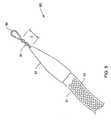
FIG. 2 depicts an association loop affixed into a dilator assembly according to an illustrative embodiment of the invention.
FIG. 3 depicts an association loop affixed into a dilator assembly according to a alternative illustrative embodiment of the invention.
FIG. 4 depicts an association loop having a biasing mechanism and affixed into a dilator assembly according to another alternative illustrative embodiment of the invention.
FIG. 5 depicts an association loop having an alternative shape, a biasing mechanism and affixed into a dilator assembly according to another illustrative embodiment of the invention.
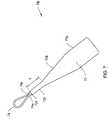
FIG. 6 depicts an association loop having a twisted portion affixed into a dilator assembly connected to an end of a sling assembly according to another illustrative embodiment of the invention.
FIG. 7 depicts an association loop affixed in a dilator assembly and including an extension portion for positioning the association loop a desired distance away from the tissue dilating portion of the dilator assembly according to another illustrative embodiment of the invention.
FIG. 8 depicts an association loop affixed into a dilator assembly and formed from a braided tubular filament according to another illustrative embodiment of the invention.
FIG. 9 depicts an association loop affixed into a dilator assembly and including a coating according to another illustrative embodiment of the invention.
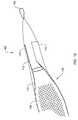
FIG. 10 shows a sling assembly end with a sleeve attached to an association loop via a dilator assembly according to an illustrative embodiment of the invention.
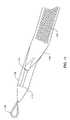
FIG. 11 shows a sling assembly end with a sleeve attached to an association loop via a dilator assembly according to another illustrative embodiment of the invention.
FIG. 12 shows a side view of an association loop affixed into a dilator assembly according to another illustrative embodiment of the invention.
FIG. 13 shows an L-slot formed in a distal portion of a delivery device shaft according to an illustrative embodiment of the invention.
FIG. 14 shows an L-slot formed in a distal portion of a delivery device shaft and including an indentation and a protuberance for facilitating retention of an association loop according to an illustrative embodiment of the invention.
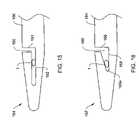
FIG. 15 shows an L-slot formed in a distal portion of a delivery device shaft wherein a radially extending leg of the L-slot is wider than an axially extending leg for facilitating ease of insertion into the radially extending leg and for facilitating retention of an association loop in the axially extending leg according to another illustrative embodiment of the invention.
FIG. 16 shows an L-slot formed in a distal portion of a delivery device and having a tapered axially extending leg for facilitating retention of an association loop in that leg according to another illustrative embodiment of the invention.
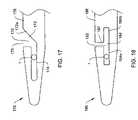
FIG. 17 shows another illustrative L-slot formed in a distal portion of a delivery device wherein the radially extending leg has a tapered shape for facilitating insertion of an association loop, and the axially extending leg has a narrowed width to facilitate retention of the association loop according to another illustrative embodiment of the invention.
FIG. 18 shows a T-shaped structure formed in a distal portion of a delivery device for engaging with an association loop according to another illustrative embodiment.
FIG. 19 shows the L-slot structure ofFIG. 13 including a sheath partially extending over the opening to the radially extending leg according to an illustrative embodiment of the invention.
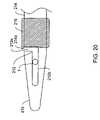
FIG. 20 shows the L-slot structure ofFIG. 13 including another illustrative embodiment of a sheath that partially extends over the opening to the radially extending leg.
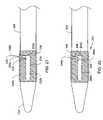
FIG. 21 shows the L-slot structure ofFIG. 13 including another illustrative embodiment of a sheath that partially surrounds the L-slot structure.
FIG. 22 shows the L-slot structure ofFIG. 13 including another illustrative embodiment of a sheath that includes a flap portion that extends into the radially extending leg of the L-slot.
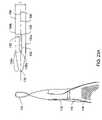
FIG. 23A shows an association loop at the end of a sling assembly prior to association with an L-slot on the end of a delivery device according to an illustrative embodiment of the invention.
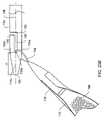
FIG. 23B shows an association loop of a sling assembly hooked into the axially extending leg of the L-slot on the end of a delivery device according to an illustrative embodiment of the invention.
FIG. 24 depicts a ball-shaped association member extending from a dilator assembly according to another illustrative embodiment of the invention.
FIG. 25 shows the ball-shaped association member ofFIG. 28 associating with a corresponding illustrative structure on a delivery device for placement of an implantable sling.
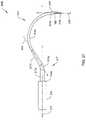
FIG. 26 depicts a sling delivery system including a delivery device particularly sized and shaped for suprapubic sling delivery and having any suitable slot at a distal end according to an illustrative embodiment of the invention, and employable with any of the illustrative embodiments of the association loops ofFIGS. 1-11.
FIG. 27 shows another illustrative delivery device particularly sized and shaped for transobtural placement of an implantable sling and having any suitable slot at a distal end, and employable with any of the illustrative embodiments of the association loops ofFIGS. 1-11.
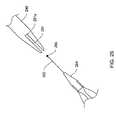
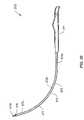
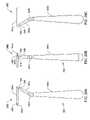
FIGS. 28A-28C show another illustrative delivery device also particularly sized and shaped for transobtural placement of an implantable sling and having any suitable slot at a distal end, and employable with any of the illustrative embodiments of the association loops ofFIGS. 1-11.
ILLUSTRATIVE DESCRIPTIONThe invention relates to cooperating structures on one or more ends of a medical implant assembly and on an end of a delivery device to enable a medical operator to associate the medical implant assembly with the delivery device so that the medical operator may deliver the implant to an anatomical location in a patient's body. Preferably, the implant assembly is a sling assembly including a sling for treating urinary incontinence, and the anatomical site is in the periurethral tissue of the patient (e.g. under a bladder neck or mid-urethral location).
Without limitation, examples of features of various sling configurations that may be employed with illustrative embodiments of the invention are disclosed in U.S. Ser. No. 10/092,872, entitled “Medical slings,” U.S. Ser. No. 10/640,838, entitled “Medical implant,” U.S. Ser. No. 10/641,170, entitled “Medical slings,” U.S. Ser. No. 10/641,192, entitled “Medical slings,” U.S. Ser. No. 10/918,123, entitled “Surgical Slings,” the entire contents of all of which are incorporated herein by reference.
Additionally, examples of features of various delivery systems that may be employed with illustrative embodiments of the invention include, without limitation, those delivery systems configured for supra-pubic, pre-pubic, transvaginal, and/or transobtural procedures. Again, without limitation, examples of features of dilators, slings, sling assemblies, delivery devices and implantation approaches that may be employed with illustrative embodiments of the invention are disclosed in U.S. Pat. No. 6,666,817, entitled “Expandable surgical implants and methods of using them,” U.S. Pat. No. 6,669,706, entitled “Thin soft tissue surgical support mesh,” U.S. Pat. No. 6,375,662, entitled “Thin soft tissue surgical support mesh,” U.S. Pat. No. 6,042,592, entitled “Thin soft tissue surgical support mesh,” U.S. Ser. No. 10/015,114, entitled “Devices for minimally invasive pelvic surgery,” U.S. Ser. No. 10/774,826, entitled “Devices for minimally invasive pelvic surgery,” U.S. Ser. No. 10/093,398, entitled “System for implanting an implant and method thereof,” U.S. Ser. No. 10/093,498, entitled “System for implanting an implant and method thereof,” U.S. Ser. No. 10/093,371, entitled “System for implanting an implant and method thereof,” U.S. Ser. No. 10/093,424, entitled “System for implanting an implant and method thereof,” U.S. Ser. No. 10/093,450, entitled “System for implanting an implant and method thereof,” U.S. Ser. No. 10/094,352, entitled “System for implanting an implant and method thereof,” U.S. Ser. No. 10/631,364, entitled “Bioabsorbable casing for surgical sling assembly,” U.S. Ser. No. 10/641,376, entitled “Spacer for sling delivery system,” U.S. Ser. No. 10/641,487, entitled “Systems, methods and devices relating to delivery of medical implants,” U.S. Ser. No. 10/642,395, entitled “Systems, methods and devices relating to delivery of medical implants,” U.S. Ser. No. 10/642,397, entitled “Systems, methods and devices relating to delivery of medical implants,” U.S. patent application Ser. No. 10/642,365, entitled “Systems, methods and devices relating to delivery of medical implants,” U.S. Ser. No. 10/832,653, entitled “Systems and methods for sling delivery and placement,” U.S. patent application Ser. No. 10/939,191, entitled “Devices for minimally invasive pelvic surgery,” U.S. patent application Ser. No. 10/957,926, entitled “Systems and methods for delivering a medical implant to an anatomical location in a patient,” U.S. Provisional Application No. 60/569,300, entitled “Systems and methods for delivering a medical implant to an anatomical location in a patient,” and U.S. Provisional Application No. 60/508,600 entitled “Systems and methods for delivering a medical implant to an anatomical location in a patient,” the entire contents of all of which are incorporated herein by reference.
FIG. 1 depicts asling assembly10, which includes anassociation loop1 attached via adilator5 to an end of asleeve9 holding animplantable sling11. Anotherassociation loop3 attaches via adilator7 to the other end of thesleeve9. Theassociation loop1 is shown as substantially in the plane of thesleeve9. It is to be understood that theassociation loop1 may be configured at other angles relative to the plane of thesleeve9. For example, theassociate loop3 may be in a plane substantially orthogonal to the plane of thesleeve9. Furthermore, theassociation loops1 and3 may be substantially in the same plane or in different planes. In certain embodiments, theassociation loops1 and3 may be fixed at a specific angle relative to the plane of thesleeve9, for example, in a plane about 30, 45, 60 or 90 degrees to the plane of thesleeve9. In other embodiments, theassociation loops1 and3 may be configured to rotate 360 degrees relative to the plane of thesleeve9.
In alternative embodiments, theassociation loop1 can be configured into any shape that allows it to cooperate with a complementary structure located on a delivery device. For example, theassociation loop1 can have an irregular shape or it can be, for example, substantially circular, teardrop, triangular, square, rectangular or a combination of these shapes. In one example, theassociation loop1 is open, for example, forms a hook or forms an eyelet. In another example, the loop is closed. The loop can be resilient, rigid, semi-rigid, and/or flexible. Preferably, the loop is flexible enough to deform as it is pushed/pulled through tissue, but rigid enough to maintain its integrity (i.e., not break) against the pushing/pulling force. Theassociation loop1 can be made from any suitable material, such as a wire or a suturing material. Preferably the loop is made of a biocompatible material that allows for the resiliency, flexibility and rigidity described above, for example, metal, plastic, polymers, etc.
Theassociation loop1 can also be of any suitable size, for example, theassociation loop1 can have a diameter that is just large enough to slide over an end of a delivery device or a delivery needle. Theassociation loop1, when it is configured to have such a diameter, helps to maintain the cooperation between theassociation loop1 and the delivery device during placement of the sling. Theassociation loop1 may also be sized to be long enough such that when hooked on to a complementary structure near a distal end of a delivery device and pulled by a user with enough force away from the distal tip of a delivery device, theassociation loop1 swings about the tip of the delivery device for removal.
The association loop can be formed from a single stranded filament or can be formed from a multi-stranded filament. The multiple strands may be braided or twisted together. The use of multiple strands to form theassociation loop1 is preferred because a multi-stranded loop may provided more structural flexibility than an association loop formed from a single strand.
Any suitable adaptor may be used to attach theassociation loop1 with a particular medical implant assembly. For example, inFIG. 1, thesling assembly10 employs thedilators5 and7 for attaching theassociation loops1 and3, respectively, to the ends of theplastic sleeve9. More specifically, the knittedmesh11 resides, at least partially, within theplastic sleeve9. Anopening8, located at a midpoint of a top portion of theplastic sleeve9, exposes the entire width of the knittedmesh11. The knittedmesh11 may be made entirely of polypropylene, may be approximately 1 cm in width and 45 cm in length, and terminates at free ends. The knittedmesh11, including both free ends, does not connect to theplastic sleeve9 or anything else. This feature enables a medical operator to pull on the ends of theplastic sleeve9 during sling placement, for example, via thedilators5 and7, theassociation loops1 and3, and/or the delivery devices, without risk of stretching, curling or otherwise deforming the knittedmesh11.
A tabbed spacer (not shown) is located at a midpoint of a bottom side of theplastic sleeve9, and encloses a looped portion of the bottom side of theplastic sleeve9. The tabbed spacer can be used during implantation as a visual aid to placement of the implant assembly. The tabbed spacer also engages the looped portion of the bottom side of theplastic sleeve9 and prohibits theplastic sleeve9 from sliding off, or otherwise being removed from, the knittedmesh11 during implant assembly placement. The tabbed spacer must be cut to enable theplastic sleeve9 to slide off the knittedmesh11. This feature ensures that theplastic sleeve9 cannot be removed simply by applying a pulling force, such as that applied to the implant assembly ends by a medical operator during implant assembly placement. After thesling assembly10 is positioned within the patient, a cut is made through the center of the tabbed spacer, and thus through the looped portion of the bottom side of theplastic sleeve9. Theplastic sleeve9 is then slid off of the knittedmesh11, out of the body of the patient, and discarded, along with thedilators5 and7.
FIG. 2 depictsdilator assembly20 including anassociation loop22 according to an illustrative embodiment of the invention. In this embodiment, theassociation loop22 is formed from a multi-stranded twisted filament. Apin29 is used to size and shape theassociation loop22. The filament ends22aand22bare inserted through anaxially extending channel26 into acrimp tube24. A second crimp tube is depicted in outline to demonstrate that thecrimp tube24 may be placed at any location along the filament ends22aand22b. Thecrimp tube24, once compressed (i.e., crimped), serves to lock the filament ends22aand22btogether to form theloop22. The filament ends22aand22b, including thecrimp tube24 may affixed into thedilator28 in any suitable manner. For example, thedilator28 may be injection molded around the filament ends22aand22b, and/or thecrimp tube24. The filament ends22aand22band thecrimp tube24 can be permanently or removably positioned within thedilator28. For example, the filament ends22aand22bmay be permanently attached to thedilator28 by, for example, molding or gluing thedilator28 over the filament ends22aand22band thecrimp tube24.
In this embodiment, the loop ends22aand22bare shown to be entirely inside thedilator28 and a portion of thecrimp tube24 is located external to thedilator28. As depicted inFIG. 2, theloop22 extends from thetapered end28aof thedilator28.
In one example, the length of a dilator is preferred to be greater than about 0.3 inches long to aid in passage through a patient's body. However, in other embodiments, it may be less than about 0.3 inches. In other embodiments, the dilator length is between about 0.2 inches and about 10.0 inches. In preferred embodiments, the dilator length is between about 0.3 inches and about 2.0 inches. One advantage of the longer dilators, for example, dilators having a length greater than about 2.0 inches, is that the dilators can be used to untwist the sling assembly before pulling the plastic sleeve and knitted mesh into the body.
A dilator may include a conical portion and a straight portion. The straight portion has a constant diameter. The conical portion has a diameter that varies and decrease from the diameter of the straight portion. Preferably, the diameter of the straight portion of a dilator will be about 0.25 inches. However, the diameter of the straight portion of a dilator may be from about to 0.1 about 0.8 inches.
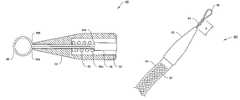
FIG. 3 depicts an alternate embodiment of adilator assembly30 including atissue dilator38 and anassociation loop32 according to another illustrative embodiment of the invention. As in the case of the illustrative embodiment ofFIG. 2, the filament ends32aand32bof theassociation loop32 pass through acrimp tube34. As an improvement over theFIG. 2 embodiment, thecrimp tube34 includes aball section34band ashank section34a. Theshank section34ais crimped to ensure filament retention, while theball section34bcreates further resistance against theassociation loop32 being inadvertently pulled out of thedilator38. Theassociation loop32 and thecrimp tube34 may be insert-molded into thedilator38. Apin39 is used to size and shape theassociation loop32.
FIG. 4 shows an alternative illustrative embodiment of adilator assembly40 having anextendable association loop46 according to the invention. Thedilator assembly40 includes atissue dilator41 having a leadingend42 and a trailingend43. The leadingend42 is the end of the dilator that is first inserted into a patient's tissues, and is tapered to increase the size of a tunnel formed initially by a shaft of a delivery device. The increased tunnel size eases the passage of a sling assembly or other medical implant. As in the case of previously disclosed embodiments, anassociation loop46 extends out of theleading end42 of thedilator41. As depicted, thedilator41 includes achannel44 extending axially through thedilator41 from the leadingend42 to anintermediate shoulder47, and achannel45 extending axially through thedilator41 from theintermediate shoulder47 to the trailingend43. Thechannels44 and45 are in fluid communication with each other, with thechannel44 having a reduced diameter relative to thechannel45, and with the reduced diameter being delineated by theintermediate shoulder47. A biasing element, such as thespring48, is seated within thechannel45, with aleading end48aabutting theshoulder47. As in the case ofFIGS. 2 and 3, theassociation loop46 is formed from a filament having two terminal ends46aand46b. The terminal ends46aand46bthread through thechannel44 and thespring48. Acrimp tube49 interfits over the filament ends46aand46band is crimped for retention. Thecrimp tube49 then concentrically interfits into thespring48. As shown, thecrimp tube49 includes aradially extending rim49a. Theradially extending rim49ais wider than the inner diameter of thespring48 and abuts the trailingspring end48b.FIG. 4 shows thespring48 in an uncompressed state.
In operation, in response to pulling on theassociation loop46, theradially extending rim49aof thecrimp tube49 engages the trailingend48bof thespring48 and causes thespring48 to compress, also causing an additional length of the filament forming theassociation loop46 to extend out of theleading end42 of thedilator41. Extending additional filament out of thedilator41 effectively increases the size of theassociation loop46. This type of spring biasing enables theassociation loop46 to expand over a particular delivery device feature during association with the delivery device, and then to retract to impede theassociation loop46 from becoming disassociated with the delivery device during implantation.
A crimp tube as depicted inFIGS. 2,3, and4 may have an outer diameter of about 0.5 mm, 1 mm, or about 2 mm larger than the association loop ends. The crimp tube may have a constant or varying diameter and may include other structural features, such as a shoulder, a ledge, an indent, and/or a slot. When used in combination with a spring, the crimp tube and spring are sized such that at least a portion of the crimp tube is larger than the inner diameter of the spring to enable the crimp tube to engage and compress the spring in response to a pulling force on the association loop.
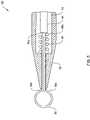
FIG. 5 depicts another embodiment of an association loop anddilator assembly50 including acrimp tube54, aspring56, adilator52, and anassociation loop58 where theassociation loop58 includebends58aand58bjust distal and external to thedilator52. Thedilator assembly50 operates in a substantially similar fashion to the previously discusseddilator assembly40, the difference being primarily in the configuration of thecrimp tube54 and the inclusion ofbends58aand58bin theassociation loop58. Rather than engaging the biasingspring48 with aradially extending rim49a, thecrimp tube54 has an increased diameter along its entire length. Thecrimp tube54 has a diameter wider than the inner diameter of thespring56 and, thus, enables it to be positioned with its leadingend54aabutting the trailingend56bof thespring56. In operation of this embodiment, pulling on theassociation loop58 causes the leadingend54aof thecrimp tube54 to engage with the trailingend56bof thespring56 also causing thespring56 to compress. Furthermore, the compression of thespring56 allows an additional length of loop filament to extend out of thedilator52. Thebends58aand58binhibit theassociation loop58 itself from being retracted back into thedilator52. Thebends58aand58bmay also maintain thespring56 and thecrimp tube54 within achannel51 of thedilator52 during assembly, as the trailing end of thedilator52 may be left open. In alternative embodiments, the trailing end of thedilator52 may be closed and thedilator52 may enclose thecrimp tube54 within thecavity51. It is to be understood that the configuration of thecrimp tube54 and thespring56 may be employed in combination with an association loop having any of the various shapes as described herein.
FIG. 6 depicts another embodiment of adilator assembly60. In this embodiment, the filament forming anassociation loop66 twists around itself subsequent to extending out of thedilator62 to form atwisted section64. The illustrativetwisted section64 has a length X, which may be increased by additional twisting or decreased by reduced twisting. As can be seen, increased twisting also reduces the size of theassociation loop66, while reduced twisting increases the size of theassociation loop66. Additionally, the twisting can be used to change the orientation of theassociation loop66 relative to the orientation of thesleeve61 and thesling63 contained within thesleeve61. Thetwisted section64 of distance X can be bent to position thedilator62 in front of a shaft tip of a delivery device to provide a smooth pull-through due to the inline profile of the shaft and dilator. This embodiment provides an easily used mechanism for forming anassociation loop66 having a predetermined size and a predetermined distance X from the leading end of thedilator62. Thetwisted section64 may add a distance X between thesleeve61 and theassociation loop66, without the need for changing the length of thedilator62.
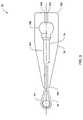
FIG. 7 depicts another illustrative embodiment of anassociation loop74 formed into adilator72. In this embodiment, thedilator72 has three sections, a trailingsection72a, an intermediateconical section72b, and a leadingsection72c. The intermediateconical section72bextends from the trailingsection72a. The leadingsection72cterminates in aconical tip72dand extends from theintermediate section72b. Theassociation loop74 extends from theconical tip72dof the leadingsection72cmuch in the same way as theassociation loop66 extends from thedilator62 inFIG. 6. One function of the leadingsection72cis to space theassociation loop74adistance X from the end of the intermediateconical section72b, without the need for any filament twisting.
In the depicted embodiment, the filament ends74aand74bare embedded in thedilator72 in any suitable fashion, including any of those described herein. In some configurations, the leadingsection72cmay be substantially hollow or solid, and may be substantially rigid or deformable. In some configurations, the leadingsection72cmay be formed integral with theintermediate section72bor may be a separate component that interfits over theassociation loop74 to adjust the size of theassociation loop74 and/or space it a distance X from the end of theintermediate section72b.
FIG. 8 depicts anotherdilator assembly80 having anassociation loop84 affixed at a leading end of adilator82. A unique aspect of this embodiment is that theassociation loop84 is formed from a multi-stranded filament. In the depicted embodiment, the multiple strands are braided to form a hollow tube. When thebraided association loop84 is tensioned, the inner and outer cross-sectional diameters of the loop filament become smaller, while the length of theloop84 increases. Theassociation loop84 anddilator82 may be associated with any complementary structure on a delivery device, such as any of those described herein. One advantage of this configuration, referring also toFIGS. 13-23B, is that theassociation loop84 may be tensioned during insertion into a suitable slot or notch. Such tensioning causes the diameter of the loop filament to decrease and more easily fit into the notch or slot. Another advantage is that once tensioning is removed, the loop filament tends to expand back to its steady state diameter, thus impeding it from easily sliding out of a suitably sized notch or slot in a delivery device.
FIG. 9 depicts another illustrative embodiment ofdilator assembly90 including anassociation loop94 according to an illustrative embodiment of the invention. As in the previously discussed embodiments, theassociation loop94 is affixed in some suitable fashion within thedilator92. In the depicted example ofFIG. 9, the association loop filament may be single or multi-stranded. If multi-stranded, it may be configured in any suitable manner, including the above described twisted, braided, and/or hollow tubular manner. As an additional feature, the loop filament ofFIG. 9 includes acoating96. Thecoating96 may be formed, for example, from a suitable elastic material, such as silicone.
According to one configuration, the diameter of thecoated loop94 is sized to be smaller than the outer diameter of a shaft of a delivery device. In operation, as theloop94 is placed over a tapered distal tip, as shown inFIG. 13, thecompressible coating96 on theassociation loop94 contracts to allow theassociation loop94 to interfit over the distal end of a delivery device shaft.
According to another illustrative example, thecoated association loop94 has a cross-sectional diameter that is larger than the width of a slot on a delivery device shaft. In this example, and as in the case of theFIG. 8 braided embodiment, the association loop filament can compress to interfit into the slot. Then, the tendency for the compressed coating to return to its normal uncompressed state acts to impede, and in some configurations prohibit, theassociation loop94 from falling out of the slot and becoming disassociated with the delivery device.
FIG. 10 shows adilator assembly102, including anassociation loop104 of the type described above, affixed to an end of asling assembly106 according to an illustrative embodiment of the invention. As shown, theexemplary sling assembly106 includes amesh sling108 and aprotective sleeve110. Themesh sling108 is free floating in that it does not attach to anything, including theprotective sleeve110 or thedilator assembly102. Theend114 of thesleeve110 wraps around and is heat-bonded to a substantially cylindrical trailingportion112 of thedilator assembly102. To heat bond thesleeve end114 to thedilator portion112, the plane of theassociation loop104 is first oriented to the plane of thesleeve110, for example, either substantially parallel, perpendicular, or any other any angle, to thesleeve110. Thesleeve end114 is flattened and thedilator portion112 is placed on top of thesleeve end114. Thesleeve end110 is then wrapped around thedilator portion112 to form a “U” or “C” shape, and heat is applied to bond thesleeve end114 onto the surface of thedilator portion112. In an alternative embodiment, a piece of heat shrink tubing can be placed over thesleeve end114 and thedilator portion112 prior to the application of heat to bond thesleeve110 to thedilator assembly102. It should be noted that any suitable method may be used to attach the sleeve to the dilator assembly, for example, heat bonding, gluing, stapling, stitching, etc.
In other embodiments, the sleeve end may have a width larger than the circumference of the dilator. The sleeve end may be wrapped around the dilator and the sides of the sleeve end may overlap each other. The width of the sleeve end may also be reduced, for example, by folding or trimming, such that the sleeve end encircles the dilator fully at most once, and without overlap. It is preferred that the attachment of the sleeve end to the dilator not substantially add to the size or profile of the dilator as a smaller profile is perceived to be safer during delivery of an implantable sling assembly.
FIG. 11 depicts another method of bonding asleeve end115 to adilator assembly116. Instead of just wrapping thesleeve end115 around thedilator trailing portion113, thedilator trailing portion113 is first inserted into thesleeve end115. More specifically, the plane of theassociation loop118 is first oriented to the plane of thesleeve119, for example, either substantially parallel, perpendicular, or any other any angle, to thesleeve119. The trailingportion113 of thedilator assembly116 is then inserted into thesleeve end115. Thesleeve end115 is then pulled tightly around thedilator trailing portion113, and heat is applied to bond thesleeve end115 to the surface of thedilator trailing portion113. In an alternative embodiment, a piece of heat shrink tubing is then inserted over thesleeve end115 and heated to bond thesleeve end115 to the surface of thedilator trailing portion113.
Although the preferred illustrative embodiments ofFIGS. 10 and 11 depict the sling assembly including a protective sleeve and the sling as being free floating, this need not be the case. In other illustrative embodiments, the protective sheath may be eliminated and the sling ends be bonded directly to the dilator assemblies. In other illustrative embodiments, the sling may be attached to the protective sleeve in any suitable fashion.
Additionally, any suitable sleeve and sling assemblies or slings known in the art can be used with the invention. For example, a sling mesh having tangs or projections that extend laterally from the edges of the sling along at least a portion of the length of the sling can be used. It is preferred that when the sling is placed in the body, the sling can lie somewhat flat to allow tissue ingrowth and the tanged portion of the sling to grip the tissue. In the embodiment where the sleeve or sling is thermobonded to the dilator, the dilator and the sling or sleeve are preferably made of a material which is compatible for thermobonding to achieve the maximum bond strength. An example of such a compatible thermobonding material is polyethylene. In an alternative embodiment, the sling or sleeve is glued to the dilator, for example, using cyanoacrylate. When gluing with cyanacrylate, the dilator and the sleeve are preferably made of a plastic material such as nylon. Suitable sleeves and slings are disclosed in the documents listed herein above and incorporated by reference in their entirety.
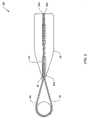
The invention further includes methods of producing a mating structure, such as an association loop, on an implant assembly.FIG. 12 depicts anotherillustrative dilator assembly120 including anassociation loop122 formed into atissue dilating structure124. In addition to employing acrimp tube126, such as the metal crimp tubes previously discussed, this illustrative configuration also bends the terminal ends122aand122bof the association loop filament at an angle to a longitudinal axis of thecrimp tube126. In a similar fashion to the embodiments ofFIGS. 4 and 5, thedilator124 includes two axially extendingchannels127 and129 in fluid communication with each other and interfacing at anintermediate shoulder128.
According to one illustrative process, the association loop is flatted and interfitted through thecrimp tube126 as shown inFIG. 12. Theleading end123 of the flattedassociation loop122 is then inserted into thechannel127 via thechannel129 at the trailingend124aof thedilator124. As theleading end123 of theassociation loop122 extends through an opening at theleading end124bof thedilator124, theleading end126aof thecrimp tube126 abuts theshoulder128, which stops thecrimp tube126 from passing into thechannel127. At this point, the excess ends122aand122bmay be trimmed or cut off all together. Leaving some remnant of theends122aand122bmay be desirable to provide additional protection against theassociation loop122 pulling out of thedilator124.
Subsequent to the above described assembly, theassociation loop122 can be expanded and shaped as desired. Preferably, the loop is shaped such that it cannot slip back into thedilator124. In some configurations, neither thecrimp tube126 nor the association loop filament is affixed rotationally in thedilator124. This feature enables theassociation loop122 to rotate relative to thedilator124, allowing the medical operator to twist and untwist a sling assembly while theloop122 is associated with a delivery device.
According to another feature, the invention provides an association loop expansion tool of the type depicted at129. To expand theassociation loop122, thetip129aof theloop expansion tool129 is passed through the flattedassociation loop122 to open it to a desired degree. In this embodiment, where theexpansion tool129 is conical in shape, an oval likeassociation loop122 is produced. However, thetool129 can have any preferred profile or cross-section of choice, for example, triangular or rectangular to provided association loops of various shapes. One advantage of the conical design of thetool129 is that it enables theassociation loop122 to be opened to whatever degree is desired by the medical operator.
In an alternative embodiment, anassociation loop122 anddilator assembly120 can also be produced by inserting the two ends122aand122bof a flatted loop filament into theleading end124bof thedilator124. Acrimp tube126 can then be inserted onto the filament ends122aand122band crimped at a given length. In this example, the filament ends124aand124bextend in a trailing direction and are not bend to form a T. The flattedassociation loop122 and thedilator tube126 are then pulled back towards the leadingend124bof thedilator124 where the loop is formed to a preferred shape.
In another illustrative embodiment, a cavity of a dilator can be shaped to a desired configuration such as an oval cross-sectional configuration to prevent the crimped filament from rotating within the dilator and, thus, preventing the association loop from rotating outside the dilator. In another alternative embodiment, a cavity can be tapered such that when the crimp tube is pulled into the cavity, the cavity interferes with the crimp tube to prevent rotation of the association loop relative to the dilator.
The association loops and dilator assemblies depicted inFIGS. 1-12 have been described as having a generally oval shape. However, this need not be the case and the association loops of the invention may have any suitable shape, including without limitation, circular, rectangular, triangular, or any other suitable polygonal or curved shape. Additionally, the association loops described herein may be used in combination with any suitable complimentary mating structure located on a delivery device, for example, such as an appropriately sized and shaped slot in a distal end of a shaft of a delivery device. In the following illustrative description and accompanying drawings, theassociation loop1 is used to illustrate the interaction of an association loop with a suitable mating structure located on a delivery device. Only the portion of theassociation loop1 within the mating structure is depicted, e.g., a cross-sectional view of theassociation loop1. Although theassociation loop1 may be shown contacting the walls of the channels of the delivery devices, it is understood that the association loop may be sized smaller or larger than the width of the channels of the delivery devices, and that any suitable association loop may be employed, including without limitation, any of the illustrative association loops described herein.
A delivery device may be configured with a mating structure, such as a slot, which can cooperate with an association loop as described above. The slot can be positioned at any location along the delivery device, but is preferably located close to the distal tip of the delivery device. Some illustrative suitable delivery devices are disclosed in the documents listed herein above and incorporated by reference in their entirety. In one embodiment, the delivery device includes a shaft that can be used to penetrate tissue or fascia. The shaft can be made of rigid material or malleable material. The shaft can be pre-bent such that it defines a configuration that has one or more curves in a plane or the shaft can have one or more curves on multiple planes. Preferably, the delivery device has an opening into which the association loop can be inserted. In one illustrative embodiment, the opening is a slot defined by a channel having radially disposed and longitudinally disposed sections/legs. The slot can have any shape and can be substantially smooth or can include one or more dimples, grooves, protuberances and/or indentations or other irregularities, formed either during the manufacture of the slot or by attaching an implant to the slot wall. Preferably, the slot is shaped such that it impedes, and in some cases prohibits, the loop from easily unhooking and disassociating from the slot.
FIG. 13, for example, depicts an L-shapedslot132 positioned near adistal end130 of adelivery device shaft134. The L-shapedslot132 is formed from afirst channel133 extending radially into theshaft134, and asecond channel135 extending distally along theaxis136 of theshaft134 from an innerterminal end133aof thefirst channel133. An association loop, such as theassociate loop1 ofFIG. 1, can slide radially into theopening133bof thefirst channel133 and along thefirst channel133 to the innerterminal end133a. Theassociation loop1 can then slide distally along thesecond channel135 to the mostdistal end135aof thesecond channel135 to hook one end of theimplant assembly10 ofFIG. 1 onto thedistal end130 of theshaft134. During a sling placement procedure, this process may be repeated with thesecond association loop3 and the same or a second similar delivery device.
According to the illustrative embodiment ofFIG. 13, the firstradially extending channel133 may be about 1 mm, 1.5 mm, 2 mm, or about 2.5 mm in length and about 0.5 mm, 0.75 mm, 1 mm, or about 1.5 mm in width, and the secondaxially extending channel135 may be about 3 mm, 4 mm, 5 mm or about 6 mm in length and about 0.5 mm, 0.75 mm, 1 mm, or about 1.5 mm in width. The shape and/or dimensions (e.g., width, length or diameter) of theslot132 may be varied to suit the dimensions or intended orientation of the association loop on the implant assembly.
An advantageous feature of the L-shapedslot132 is that theassociation loop1 slides easily into thefirst channel133 and remains free to slide along thesecond channel135. When slid to a proximalmost position133ain thesecond channel135, theassociation loop1 may be slid radially out of thefirst channel133 to unhook theassociation loop1 and thus, theimplant assembly10, from theshaft134 with a minimum of effort. Alternatively, in response to pulling the shaft in a proximal direction (a motion typically employed in a abdominally initiated sling implantation procedure when withdrawing a delivery device to pull an end of a sling assembly up through the abdomen via an incision in the vaginal wall of a patient), the distally extending orientation of thesecond channel135 causes theassociation loop1 to slide to the distalmost position135ain the L-shapedslot132. This tends to maintain theassociation loop1, and thus theimplant assembly10, hooked onto the L-shapedslot132 during withdrawal of theshaft134 in a proximal direction.
FIG. 14 depicts an alternate embodiment of an L-shapedslot142 formed in adistal end144 of a shaft146 of a delivery device. The L-shapedslot142 is similar to the L-shapedslot132 in that it includes a firstradially extending channel143 and a secondaxially extending channel145. As an additional feature, theradially extending channel143 includes anindentation147 extending axially in a proximal direction. The indentation is sized and shaped to seat theassociation loop1 to impede, and in some cases prohibit, it from sliding radially out of thechannel143. As a further feature, theaxially extending channel145 includes awidth narrowing protuberance149 located at its proximal most end. Theprotuberance149 is sized to impede, and in some configurations to prohibit, theassociation loop1, subsequent to insertion into thechannel145, from sliding in a proximal direction along thechannel145 sufficiently far to enable it to enter theradially extending channel143. In this way, theprotuberance149 also impedes, and in some configurations prohibits, theassociation loop1 from becoming unhooked from the shaft146.
FIG. 15 depicts another illustrative embodiment of an L-shapedslot150 in adistal end154 of ashaft156. As in the previously discussed embodiments, theslot150 includes aradially extending channel151 and anaxially extending channel152. A feature of the illustrative embodiment ofFIG. 15 is that theaxially extending channel152 has a width that is both smaller than the width of theradially extending channel151 and less than a normal uncompressed diameter of the filament forming theassociation loop1. In operation, theassociation loop1 slides freely into theradially extending channel151, but is compressed when slid into theaxially extending channel152. This compression causes an increased friction between theassociation loop1 and theaxially extending channel152, which tends to maintain theassociation loop1 within theaxially extending channel152.
FIG. 16 depicts a further alternative embodiment of an L-shapedslot160 located at thedistal end162 of adelivery device shaft164. A feature of this embodiment is that theaxially extending channel168 tapers inward as it extends distally. The taper reduces the width of thechannel168 sufficiently near itsdistal end168ato compress the filament of theassociation loop1 when theassociation loop1 is pulled distally toward the tapereddistal end168aof thesecond channel168. This tends to inhibit theassociation loop1 from sliding proximally along thechannel168 and becoming unhooked from theshaft164.
The resiliency and flexibility of the material forming and/or coating theassociation loop1 contribute to the force holding theassociation loop1 in place near thedistal end168aof the taperedsecond channel168. For example, anassociation loop1 formed from a strand of metal wire may not easily compress and become lodged in the taperedsecond channel168. However, anassociation loop1 formed from multiple strands of wire and/or coated with a flexible or resilient material, such as a polymer, may compress and lodge more securely in the taperedsecond channel168. This type of association loop may require more force to pull the association loop out of thechannel168.
FIG. 17 depicts another alternative embodiment of an L-shapedslot170 formed in adistal end176 of adelivery device shaft178. As in the previously discussed embodiments, theslot170 includes aradially extending channel172 and anaxially extending channel174. One feature of this illustrative embodiment is that theopening173 to theradially extending channel172 is enlarged for easy insertion of theassociation loop1. More specifically, thewall172aof theradially extending channel172 tapers outward to create to theenlarged opening173. According to the illustrative embodiment, the width of theradially extending channel172 at all locations is larger than the outside diameter of the association loop filament. According to another feature of this embodiment, in a similar fashion to theaxially extending channel152 ofFIG. 15, theaxially extending channel174 has a width less than the outside diameter of the association loop filament. The combination of theenlarged opening173 of thechannel172 and the reduced width of thechannel174 facilitates hooking theassociation loop1 into the L-slot170 and, at the same time, impedes, and in some configuration prohibits, theassociation loop1 from becoming unhooked.
FIG. 18 depicts another alternativeembodiment slot structure180 in adistal end186 of adelivery device shaft188. In contrast to previous L-shaped slots, theslot structure180 ofFIG. 18 is T-shaped, including aradially extending channel182 and anaxially extending channel184. As in the case of the previously discussed L-shaped slots, theaxially extending channel184 includes a distally extendingchannel portion184a. However, in addition, in theslot structure180, theaxially extending channel184 also includes a proximally extendingchannel portion184b. One advantage of the T-shapedstructure180 is that it tends to cause theassociation loop1 to remain withinchannel184 regardless of whether theshaft188 is moved in the proximal direction or the distal direction. More specifically, in response to thedelivery device shaft188 being inserted into a patient's body and moved in a distal direction, theassociation loop1 tends to slide into thechannel portion184b. Alternatively, in response to moving the shaft in the proximal direction, the association loop tends to slide into thechannel portion184a. In either case, theassociation loop1 tends to stay hooked within thestructure180. It should be noted that any of the previously described modifications to the dimensions of the L-shaped slot may also be applied to the T-shaped slot ofFIG. 18.
Theassociation loop1 is may be unhooked from the T-shapedslot180 by positioning theassociation loop1 at the inner terminal end of theradially extending channel182 and sliding theassociation loop1 radially out of theslot180.
As now described, the invention also may include a structure that overhangs the entrance to the L- or T-shaped slot to further reduce the likelihood of the association loop inadvertently coming unhooked from the delivery device shaft. Preferably, such structures are deformable to the degree that they do not prohibit the association loop from coming unhooked, but instead impedes its exit from the L- or T-shaped slot. However, in alternative configurations, such structures may be sufficiently rigid to prohibit the association loop from coming unhooked. In various illustrative embodiments, the overhanging structure takes the form of a sheath or tube having a portion placed over a portion of the radially extending channel opening. The structures discussed below can be employed, for example, with any of the slot structures discussed above. In one illustrative embodiment, the below discussed structures are formed as a coating on the delivery device shaft. In other illustrative embodiments, they may be formed from a heat-shrink tubing cut to a suitable shape and interfitted over the delivery device shaft. The overhanging structures may be formed from a variety of flexible and/or resilient materials, such as a polymer plastic. Preferably, they are fixedly attached to the delivery device shaft, and may in some embodiments, be colored to increase visibility and/or can be made lubricious to aid the delivery device shaft in traversing tissue in the body.
FIG. 19 is a longitudinal cross-sectional view of adelivery device shaft194 having an L-shapedslot192 of the type described above formed in adistal portion195. Asheath196 interfits over a portion of thedelivery device shaft194 and extends partially over the opening to theradially extending channel192a. In this illustrative embodiment, the sheath is flexible enough to deflect sufficiently to allow theassociation loop1 to enter thechannel192a, but rigid enough to impede, and in some configurations prohibit, theassociation loop1 from sliding out of thechannel192aonce inserted. The sheath structure ofFIG. 19 may be employed with any of the above described slot structures.
FIG. 20 depicts a cross-sectional view of another L-shapedslot structure212 formed in adistal end215 of adelivery device shaft214. As depicted, the L-shapedslot212 includes both aradially extending channel212aand anaxially extending channel212b. The illustrative embodiment ofFIG. 20 also includes asheath216 interfitted over theshaft214 and located on the proximal side of thechannel212a. Theillustrative sheath216 includes aflap216a, which extends axially in a distal direction to at least partially overlap with the opening to theradially extending channel212a. Theextension flap216ais flexible enough to deflect inward toward theaxially extending channel212bto enable a medical operator to insert theassociation loop1 into theradially extending channel212a. However, theextension flap216ais also rigid enough to impede, and in some configurations prohibit, theassociation loop1 from sliding out of thefirst channel212asubsequent to insertion. As in the case of thestructure196 ofFIG. 19, thestructure216amay be sized and shaped to be employed with any suitable slot structure, including any of those described herein. Additionally, theextension flap216aneed not be supported with thesleeve216, but instead may be supported in place with any suitable structure.
FIG. 21 depicts another illustrative L-shapedslot structure232 formed in adistal end234 of adelivery device shaft236. The illustrative embodiment ofFIG. 21 also includes asheath238 interfitted over thedelivery device shaft236. Thesheath238 includes a slottedportion240 that aligns with theradially extending channel232a. As shown, the slottedportion240 is defined by thesheath walls240aand240b, and is narrower than theradially extending channel232a, and preferably narrower than the diameter of the filament forming theassociation loop1. According to the illustrative embodiment, thesheath walls240aand240bare sufficiently resilient to deflect outward to enable expansion of theslot240 and insertion of theassociation loop1. Subsequent toassociation loop1 insertion, thesheath walls240aand240bexpand back to a normal position to impede, and in some configurations prohibit, theassociation loop1 from sliding back out theradially extending channel232a. As depicted, thesheath238 also includes an axially extending slottedportion239 for enabling theassociation loop1 to slide distally into theaxially extending channel232b. Although the axially extending slottedportion239 is depicted as having the same width as thechannel232b, this need not be the case. The axially extending slottedportion239 of thesheath238 may have a larger width or, in some configurations, a smaller width to further impede theassociation loop1 from unhooking from theslot232.
It is to be understood that a sheath interfitted over a delivery device shaft as described above may have other configurations. For example, ahood portion240cof thesheath238, includingsheath wall240a, need not be present. Instead, thesheath wall240bmay act alone to impede, and in some configurations prohibit, theassociation loop1 from sliding back out theradially extending channel232a.
FIG. 22 depicts another illustrative slot andsheath combination242. Theillustrative embodiment242 is substantially the same as the illustrative embodiment ofFIG. 21, except that thesheath246 includes a curved slottedsection248. The curved slottedsection248 preferably aligns with the radially extending channel244a. The curved nature of the slottedsection248 acts both to ease the insertion of theassociation loop1 into the L-shapedslot244 and to reduce the likelihood of theassociation loop1 sliding back out of the radially extending channel244a.
Thesheath portions248aand248bthat form the curved slottedsection248 accomplish this by cooperating to constrain theassociation loop1, when inserted into theslot244, from re-entering the radially extending channel244a. More specifically, in this embodiment, thesheath portion248bextends across the inner terminal end of the channel244ainto thechannel244b. Thesheath portion248bthus acts as a flap. For example, when theassociation loop1 is slid into the channel244a, thesheath portion248bdeflects downward to allow theassociation loop1 to slide into thechannel244b. Thesheath portion248bthen prevents theassociation loop1 from exiting thechannel244bbecause, as theassociation loop1 is pulled into the channel244a, thesheath portion248bdeflects against the wall of thechannel244bto block the entrance to the channel244a.
Any of the above described association loop and dilator assemblies ofFIGS. 1-9 and L- or T-shaped slots ofFIGS. 13-22 may be used in combination and coordinated to ease insertion of an association loop into a slot, restrict or allow freedom of movement of the association loop within the slot, and impede the association loop from becoming unhooked from the slot. The dimensions of an association loop and a slot may be coordinated to facilitate the above.FIGS. 23A and 23B illustrate the interaction between an association loop on an end of a sling assembly and a slot near a distal end of a delivery device. Specifically,FIGS. 23A and 23B use the loop and dilator structure ofFIG. 10 and ashaft134 of the delivery device ofFIG. 13 for demonstrating the coordination of the dimensions of an association loop and a slot on a delivery device.
FIG. 23A depicts the loop and dilator structure of the implant assembly ofFIG. 10 and aslot132 near thedistal end130 of theshaft134 ofFIG. 13 before the mating structures, e.g., theassociation loop104 and theslot132, are associated. Theassociation loop104 may be sized such that it has a diameter larger than or equal to the diameter I of theshaft134 such that theassociation loop104 may be slid over thedistal end130 of thedelivery device shaft134. Theassociation loop104, and thus, one end of a sling assembly, is hooked onto theshaft134 by radially sliding theassociation loop104 intochannel133 and axially sliding theassociation loop104 to adistal end135aof thechannel135.
FIG. 23B depicts theassociation loop104 hooked onto thesecond channel135 of the L-shapedslot132. Theloop104, when positioned at thedistal end135aof thesecond channel135, is constrained in theslot132. As depicted, theloop104 has a length sufficiently large to slide over thedelivery device134 and sufficiently short that aportion134cof the delivery device134 (from thedistal end135aof theaxial channel135 to thedistal tip130 of the shaft134) prevents thedilator112 from crossing theaxis136 around thedistal tip130 of theshaft134. Even when thedilator112 is pulled to extend theassociation loop104 as far as possible, the length H of theportion134cof theshaft134 is longer that theassociation loop104 and keeps thedilator112 on aside134aof theshaft134. The diameter I and the length H of theportion134cof theshaft134 and the length of theassociation loop104 all may vary yet still be selected relative to each other to maintain thedilator112 on one side, e.g.,side134aof theshaft134. This feature allows theloop104 to be removed in specific directions. For example, to remove theloop104 from theshaft134, theloop104 is slid towards the proximal most position in thesecond channel135, is rotated 180 degrees around theaxis136 of theshaft134 to remove theassociation loop104 from the L-shapedslot132, and slid back off thedistal tip130 of theshaft134. When theassociation loop104 is rotated 180 degrees around thedelivery device shaft134, theassociation loop104 encircles theshaft134 and the distal tip of thedilator112 points towards the opening of the L-shapedslot132.
In an alternative embodiment, the diameter I and the length H of theportion134cof theshaft134 and the length of theassociation loop104 may be varied so that thedilator112 may crossing theaxis136 around thedistal tip130 of thedelivery device shaft134 to aside134b. For example, the length of theassociation loop104 may be selected to be long enough to thatportion134cdoes not prevent thedilator112 from crossing theaxis136 around thedistal tip130. In another embodiment, the length of theassociation loop104 may be selected to be long enough to that portion134C prevents thedilator112 from crossing theaxis136 around thedistal tip130 of theshaft134 when theassociation loop104 is not fully extended. However, when thedilator112 is pulled to extend theassociation loop104, theassociation loop104 becomes longer than the length H of theportion134cof theshaft134 and allows thedilator112 to cross theaxis136 around thedistal tip130 of thedelivery device shaft134 fromside134atoside134b.
FIG. 24 shows another embodiment of a structure, a ball anchor-dilator assembly280, that can be attached to an end of a sling assembly. In this embodiment, awire282 extends from adilator284 and terminates in aball anchor286. Theball anchor286 can be attached to the end of thewire282 or it can be molded to the end of awire282. Theball anchor286 can be rigid or elastic. Although the anchor is depicted in the shape of a ball, it is understood that the anchor may be any regular or irregular shape, such as crescent, square, rectangular, bar, star, etc.
FIG. 25 depicts the ball-dilator assembly280 and a complementary structure near the distal end of theshaft290. As depicted, theshaft290 can be constructed such that it has aball receiving slot291 located near the distal tip of thedelivery device290. The ball anchor may be snapped or otherwise inserted into theproximal end291aof theslot291. In one embodiment, where an elastic ball is used as theball anchor286, theproximal end291aof theslot291 for receiving theball anchor286 has a size smaller than the size of theball anchor286. In this embodiment, theball anchor286 is compressed as it is inserted into theproximal end291aof theslot291 and expands in the ball-shapedproximal end291aof theslot291 when inserted to prevent theball anchor286 from inadvertently separating from theproximal end291aof theslot291.
In an alternative embodiment where theball anchor286 is rigid, theproximal end291aof theslot291 in thedelivery device290 may be made to the size of theball anchor286 and theball anchor286 is made to snap into theproximal end291aof theslot291 of thedelivery device290.
It is to be understood that any of the slots described herein, such as slot/sheath combinations, slots of varying dimensions, and slots including indentations and/or protuberances may be employed in combination with any of the associations loops described herein. Furthermore, the above described illustrative structures may be employed with any of the described delivery devices, or others known in the art, including the suprapubic, transobtural, and transvaginal delivery devices described below.
FIG. 26 depicts adelivery device270 for delivering a sling assembly, such as thesling assembly10 depicted inFIG. 1, to an anatomical location in the body of a patient. Thedelivery device270 includes ahandle271 and, extending from thehandle271, aneedle shaft272 which is composed of a firststraight section272a, acurved section272b, and a secondstraight section272c. The firststraight section272aof theshaft272 is permanently affixed to and extends distally from a distal end of thehandle271. Thecurved section272bof theshaft272 extends distally from the firststraight section272a. The secondstraight section272cextends distally from thecurved section272b, and terminates at a distal end to form aconical tip272d. Theshaft272 of thedelivery device270 is formed of surgical grade stainless steel and, excluding theconical tip272d, has a constant diameter along its length. An L-shapedslot279, which may be any of the slot structures described herein, is positioned on the secondstraight section272cnear the distal end of thedelivery device270.
In use, theshaft272 is employed to create a passage through body tissue, namely, from the abdomen to the vagina. An incision is made on each side of the midline of the body in the lower abdomen and an incision is made in the vaginal wall. Theshaft272 of thedelivery device270 is inserted through one abdominal incision down along the posterior surface of the pubic bone through the vaginal incision. An association loop, which may be any of the association loops described herein, slides into the L-shapedslot279 to hook one end of a sling assembly onto the distal end of theshaft272. This process may be repeated with a second association loop and thedelivery device270 or a second delivery device similar to or the same asdelivery device270 on the contralateral side of the body. With both delivery devices placed, cystoscopy may be performed to ensure bladder integrity. The twodelivery devices270 may be withdrawn from the abdominal incisions, drawing each end of the sling assembly through the respective passages created by the shafts of the delivery devices. The association loops are then unhooked from the respective delivery devices. The dilators may be used as handles to adjust the position of the sling assembly to achieve desired placement. Once desired placement of the sling assembly is achieved, the tabbed spacer, and thus the looped portion of the bottom side of the plastic sleeve, is cut. Then, by pulling upward on the dilators, the medical operator slides the plastic sleeve off the knitted mesh and removes it from the body. The delivery devices and the plastic sleeve, including the dilators, are then discarded.
In another aspect, the invention includes coloring the shaft of the delivery device so that that the needle shaft of the delivery device is visible. The shaft can be colored by either attaching a colored tubing or sheath, or by chemically coloring the shaft of the delivery device. A heat-shrink tubing277 may be thermobonded to theneedle shaft272. As depicted, the heat-shrink tubing277 can extend the length of theneedle shaft272 to act as a visible coating to aid the physician during cystoscopy. The colored heat-shrink tubing277 can be configured to terminate at a location on theneedle shaft272 of thedelivery device270 that corresponds to the opening of theslot279 and can thus serve to prevent the association loop from disengaging freely from theneedle shaft272. Alternatively, the heat-shrink tubing277 can extend just partially along the length of theneedle shaft272. The colored needle shaft aids the user during cystoscopy. In another embodiment, an electrochemical process can be used to provide a colored finish on theneedle shaft272 of thedelivery device270 to facilitate needle visibility during cystoscopy. Any color can be used such as green, blue, yellow or orange. In one example, the finish includes a blue chrome oxide finish.
In an alternative embodiment, although not shown, thedelivery device270 ofFIG. 26 may be configured for a transvaginal or a prepubic procedure. For example, theslot279 may be oriented such that the axially extending channel of theslot279 extends proximally towards thehandle271, instead of distally toward the distal end of theshaft272. When configured for a transvaginal or a prepubic procedure, the delivery device may be shaped and sized the same as or differently from thedelivery device270 ofFIG. 26. For example, theshaft272 may be configured shorter than for a suprapubic procedure or incorporate a different curve radius. A transvaginal or a prepubic procedure is similar to suprapubic procedure described above, however, a sling assembly is hooked onto a delivery device via an association loop and then is inserted from a vaginal incision to an abdominal incision over or under the pubic bone.
FIG. 27 shows anotherillustrative delivery device300 particularly sized and shaped for transobtural placement of an implantable sling, and employable with any of the illustrative embodiments ofFIGS. 1-25.FIG. 30 depicts a side view of adelivery device300 according an illustrative embodiment of the invention. Thedelivery device300 includes ahandle312, ashaft314, and atransitional portion317 extending distally between adistal end312aof thehandle312 and a proximal end of theshaft314. Thetransitional portion317 includes a firststraight section317a, acurved section317band a secondstraight section317c, all lying substantially in a single plane, and may be formed as either part of theshaft314 or as part of thehandle312. Theshaft314 includes acurved section314a, astraight section314band aconical tip314c, all lying substantially in the same plane as thetransitional portion317. In the illustrative embodiment, the firststraight section317aof thetransitional portion317 attaches to thedistal end312aof thehandle312, extends distally along afirst axis311, and preferably has a substantially constant diameter. Thecurved section317bof thetransitional portion317 extends from a distal end of the firststraight section317a, curves away from thefirst axis311, and also preferably has a substantially constant diameter. The secondstraight section317cextends from a distal end of thecurved section317balong asecond axis313, and preferably has a diameter that decreases from its proximal end to its distal end to provide increased structural stability to theshaft314. Thecurved section314a, preferably, has a substantially constant diameter, smaller than the diameter of thecurved section317bof thetransitional portion317, and extends from the distal end of the secondstraight section317cof thetransitional portion317, curves back toward thefirst axis311, and terminates at a distal end approximately at an intersection with thefirst axis311. Thestraight section314b, preferably, has a substantially constant diameter and extends from the distal end of thecurved section314aalong athird axis315, which crosses thefirst axis311. In one configuration, aconical tip314cextends distally from thestraight section314b. In another configuration, thedistal portion319 of thedelivery device300 may include a structure or feature320 for associating thedelivery device300 with a sling and/or sling assembly or an end of a sling and/or sling assembly, such as any of the slot structures described herein. The delivery device ofFIG. 30 may be employed with any of the above described loop and dilator assemblies described herein.
In use, theshaft314 is employed to create a passage through body tissue, namely, from just lateral to the inferior pubic ramus through the obturator foramen to the vagina. Three incisions are made to the body of the patient. A first incision is made just lateral to the inferior pubic ramus at the junction where the inferior pubic ramus and the adductor longus muscle meet. A second incision, corresponding to the first incision, is made on the contralateral side. A third incision is made in the anterior vaginal wall and dissected bilaterally to the interior portion of the inferior pubic ramus. Thehandle312 is grasped in one hand, and theshaft314 of thedelivery device300 is inserted through one ischiopubic incision in a downward motion, piercing the obturator muscle and obturator membrane. Then thehandle312 is turned to aposition 45 degrees to the midline of the patient's body. A forefinger of the opposite hand is placed in the lateral dissection of the vaginal incision and on the distal end of thedelivery device300. The forefinger is used to guide the distal end of theshaft314 around the inferior pubic ramus through the vaginal incision.
Next, a first association loop is slid over the distal end of theshaft314 and into aslot320 to hook one end of a sling assembly onto thedelivery device300. Thedelivery device300 is then withdrawn from the ischiopubic incision, drawing one end of the sling assembly through the passage created by theshaft314 of thedelivery device300. The association loop is then unhooked from thedelivery device300. This process is repeated with a second association loop and thedelivery device300, or a second delivery device the same as or similar to thedelivery device300, on the contralateral side of the body. A single cystoscopy may be performed at this time to ensure bladder integrity. Then the dilators may be used as handles to adjust the position of the sling assembly to achieve desired placement. Once desired placement of the sling assembly is achieved, the tabbed spacer, and thus the looped portion of the bottom side of the plastic sleeve, is cut. Then, by pulling upward on the dilators, the medical operator slides the plastic sleeve off the knitted mesh and removes it from the body. The delivery devices and the plastic sleeve, including the dilators, are then discarded.
FIGS. 28A,28B and28C show anotherillustrative delivery device340 also particularly sized and shaped for transobtural placement of an implantable sling, and employable with any of the above described loop and dilator assemblies described herein, including those ofFIGS. 2-9. Thedelivery device340 includes ahandle342 with a first substantiallystraight section342a, acurved section342b, and a second substantiallystraight section342clocated substantially in a first plane, atransitional portion345 extending out of adistal end343 of thehandle342, and a shaft344 extending from a distal end of thetransitional portion345. The shaft includescurved section344a, astraight section344b, and in one configuration, terminates in aconical tip344c. Thedigital portion349 of thedelivery device340 may include a structure or feature348, for example, a slot structure as depicted inFIGS. 13-25, for associating thedelivery device340 with a sling and/or sling assembly or an end of a sling and/or sling assembly. The delivery device ofFIGS. 28A,28B and28C may be employed with any of the above described loop and dilator assemblies described herein, including those ofFIGS. 2-9.
Thetransitional portion345 interfits and extends axially out of thedistal end343 of thesecond handle section342cto affix the shaft344 to thehandle342. As a result, thetransitional portion345 is substantially co-planar with thehandle342 in the first plane. Thecurved section344aof the shaft344 extends from a distal end of thetransitional portion345. Thestraight section344bof the shaft344 extends from a distal end of thecurved section344a. Thecurved section344aand thestraight section344bare substantially coplanar in a second plane. According to the illustrative embodiment ofFIGS. 28A,28B and28C, the first and second planes are substantially orthogonal to each other. However, the first and second planes may be at any suitable angle (e.g., about 10, 20, 30, 45, 60, 70 or 80 degrees) to each other.
To provide structural reinforcement,sections342band342chave cross sectional diameters that taper to be smaller at thedistal end343 of thehandle342. Additionally, rather than having the taperedsection317cof thetransitional portion317 being formed as part of theshaft314, as shown inFIG. 27, thetapered portions342band342cof the embodiment ofFIGS. 28A,28B and28C are formed as part of thehandle342. According to one feature, this configuration reduces the length of thetransitional portion345 and thus, provides improved structural support for thecurved section344a. Preferably, in operation, neither thehandle342 nor the intermediate/transitional portion345 extends into the body of the patient, and provides a positive stop against this occurring.
In use, the shaft344 is employed to create a passage through body tissue, namely, from just lateral to the inferior pubic ramus through the obturator foramen to the vagina. Three incisions are made to the body of the patient. A first incision is made just lateral to the inferior pubic ramus at the junction where the inferior pubic ramus and the adductor longus muscle meet. A second incision, corresponding to the first incision, is made on the contralateral side. A third incision is made and dissected bilaterally in the anterior vaginal wall. Thehandle342 of thedelivery device340 is grasped in one hand, and the shaft344 is inserted into the ischiopubic incision perpendicular to the skin with thefirst section342aof thehandle342 at a 45-degree angle parallel with the thigh. A forefinger of the opposite hand is placed in the lateral dissection of the vaginal incision. The thumb of the opposite hand is placed on the outside of the curve of the shaft344, and a downward force is applied, allowing the shaft344 to pierce through the obturator foramen. The shaft344 is then rotated medially around the inferior pubic ramus to meet the forefinger of the opposite hand, which guides theconical tip349 of the shaft344 through the vaginal incision. It is our understanding that during this procedure, thetransition portion345 does not extend into the ischiopubic incision.
Next, a first association loop is slid over the distal end of the shaft344 and into aslot348 to hook one end of a sling assembly onto thedelivery device340. Thedelivery device340 is then withdrawn from the ischiopubic incision, drawing one end of the sling assembly through the passage created by the shaft344 of thedelivery device340. The association loop is then unhooked from thedelivery device340. This process is repeated with a second association loop and thedelivery device340, or a second delivery device the same as or similar to thedelivery device340, on the contralateral side of the body. A single cystoscopy may be performed at this time to ensure bladder integrity. Then the dilators may be used as handles to adjust the position of the sling assembly to achieve desired placement. Once desired placement of the sling assembly is achieved, the tabbed spacer, and thus the looped portion of the bottom side of the plastic sleeve, is cut. Then, by pulling upward on the dilators, the medical operator slides the plastic sleeve off the knitted mesh and removes it from the body. The delivery devices and the plastic sleeve, including the dilators, are then discarded.
Preferably, the delivery devices and/or delivery assemblies of the invention are made of biocompatible materials, which can include, for example, polyethylene/ethylene vinyl acetate (EVA) blend, polyethylene, polyester, nylon, polypropylene, thermoplastic fluorinated ethylene propylene (FEP), TFP, stainless steel, malleable metal or any combination of these materials. Preferably, a shaft of a delivery device of the invention is formed of surgical grade stainless steel.
The drawings are not necessarily to scale; emphasis instead is generally placed upon illustrating the principles of the invention.
Variations, modifications, and other implementations of what is described herein will occur to those of ordinary skill without departing from the spirit and the scope of the invention. Accordingly, the invention is not to be limited only to the preceding illustrative description. For additional illustrative features that may be used with the invention, including the embodiments described here, refer to the documents listed herein above and incorporated by reference in their entirety. All operative combinations between the above described illustrative embodiments and those features described in U.S. patent application Ser. No. 10/642,365, entitled “Systems, methods and devices relating to delivery of medical implants,” are considered to be potentially patentable embodiments of the invention.