US7494941B2 - Manufacturing method of semiconductor device, and substrate processing apparatus - Google Patents
Manufacturing method of semiconductor device, and substrate processing apparatusDownload PDFInfo
- Publication number
- US7494941B2 US7494941B2US10/571,349US57134906AUS7494941B2US 7494941 B2US7494941 B2US 7494941B2US 57134906 AUS57134906 AUS 57134906AUS 7494941 B2US7494941 B2US 7494941B2
- Authority
- US
- United States
- Prior art keywords
- reaction chamber
- substrate
- exhaust
- exhaust line
- unloading
- Prior art date
- Legal status (The legal status is an assumption and is not a legal conclusion. Google has not performed a legal analysis and makes no representation as to the accuracy of the status listed.)
- Expired - Lifetime, expires
Links
Images
Classifications
- H—ELECTRICITY
- H01—ELECTRIC ELEMENTS
- H01L—SEMICONDUCTOR DEVICES NOT COVERED BY CLASS H10
- H01L21/00—Processes or apparatus adapted for the manufacture or treatment of semiconductor or solid state devices or of parts thereof
- H01L21/02—Manufacture or treatment of semiconductor devices or of parts thereof
- H—ELECTRICITY
- H01—ELECTRIC ELEMENTS
- H01J—ELECTRIC DISCHARGE TUBES OR DISCHARGE LAMPS
- H01J37/00—Discharge tubes with provision for introducing objects or material to be exposed to the discharge, e.g. for the purpose of examination or processing thereof
- H01J37/32—Gas-filled discharge tubes
- H01J37/32431—Constructional details of the reactor
- H01J37/32798—Further details of plasma apparatus not provided for in groups H01J37/3244 - H01J37/32788; special provisions for cleaning or maintenance of the apparatus
- H01J37/32816—Pressure
- H01J37/32834—Exhausting
- C—CHEMISTRY; METALLURGY
- C23—COATING METALLIC MATERIAL; COATING MATERIAL WITH METALLIC MATERIAL; CHEMICAL SURFACE TREATMENT; DIFFUSION TREATMENT OF METALLIC MATERIAL; COATING BY VACUUM EVAPORATION, BY SPUTTERING, BY ION IMPLANTATION OR BY CHEMICAL VAPOUR DEPOSITION, IN GENERAL; INHIBITING CORROSION OF METALLIC MATERIAL OR INCRUSTATION IN GENERAL
- C23C—COATING METALLIC MATERIAL; COATING MATERIAL WITH METALLIC MATERIAL; SURFACE TREATMENT OF METALLIC MATERIAL BY DIFFUSION INTO THE SURFACE, BY CHEMICAL CONVERSION OR SUBSTITUTION; COATING BY VACUUM EVAPORATION, BY SPUTTERING, BY ION IMPLANTATION OR BY CHEMICAL VAPOUR DEPOSITION, IN GENERAL
- C23C16/00—Chemical coating by decomposition of gaseous compounds, without leaving reaction products of surface material in the coating, i.e. chemical vapour deposition [CVD] processes
- C23C16/44—Chemical coating by decomposition of gaseous compounds, without leaving reaction products of surface material in the coating, i.e. chemical vapour deposition [CVD] processes characterised by the method of coating
- C23C16/4401—Means for minimising impurities, e.g. dust, moisture or residual gas, in the reaction chamber
- H—ELECTRICITY
- H01—ELECTRIC ELEMENTS
- H01L—SEMICONDUCTOR DEVICES NOT COVERED BY CLASS H10
- H01L21/00—Processes or apparatus adapted for the manufacture or treatment of semiconductor or solid state devices or of parts thereof
- H01L21/02—Manufacture or treatment of semiconductor devices or of parts thereof
- H01L21/02104—Forming layers
- H01L21/02107—Forming insulating materials on a substrate
- H01L21/02109—Forming insulating materials on a substrate characterised by the type of layer, e.g. type of material, porous/non-porous, pre-cursors, mixtures or laminates
- H01L21/02112—Forming insulating materials on a substrate characterised by the type of layer, e.g. type of material, porous/non-porous, pre-cursors, mixtures or laminates characterised by the material of the layer
- H01L21/02123—Forming insulating materials on a substrate characterised by the type of layer, e.g. type of material, porous/non-porous, pre-cursors, mixtures or laminates characterised by the material of the layer the material containing silicon
- H01L21/0217—Forming insulating materials on a substrate characterised by the type of layer, e.g. type of material, porous/non-porous, pre-cursors, mixtures or laminates characterised by the material of the layer the material containing silicon the material being a silicon nitride not containing oxygen, e.g. SixNy or SixByNz
- H—ELECTRICITY
- H01—ELECTRIC ELEMENTS
- H01J—ELECTRIC DISCHARGE TUBES OR DISCHARGE LAMPS
- H01J2237/00—Discharge tubes exposing object to beam, e.g. for analysis treatment, etching, imaging
- H01J2237/02—Details
- H01J2237/022—Avoiding or removing foreign or contaminating particles, debris or deposits on sample or tube
- Y—GENERAL TAGGING OF NEW TECHNOLOGICAL DEVELOPMENTS; GENERAL TAGGING OF CROSS-SECTIONAL TECHNOLOGIES SPANNING OVER SEVERAL SECTIONS OF THE IPC; TECHNICAL SUBJECTS COVERED BY FORMER USPC CROSS-REFERENCE ART COLLECTIONS [XRACs] AND DIGESTS
- Y10—TECHNICAL SUBJECTS COVERED BY FORMER USPC
- Y10S—TECHNICAL SUBJECTS COVERED BY FORMER USPC CROSS-REFERENCE ART COLLECTIONS [XRACs] AND DIGESTS
- Y10S438/00—Semiconductor device manufacturing: process
- Y10S438/935—Gas flow control
Definitions
- the present inventionrelates to a manufacturing method of a semiconductor device, and to a substrate processing apparatus, and particularly, to a device for eliminating particles in a reaction chamber.
- a vertical CVD apparatuswhich performs processing such as film forming for a large number of wafers in a reaction chamber (hereinafter, also referred to as “in a furnace”).
- a reaction chamberhereinafter, also referred to as “in a furnace”.
- the particle generation sourceis a reaction product adsorbed on a reaction chamber wall, a pipe wall, or the like.
- the film formingis repeated in the furnace, films of the reaction product are thereby adsorbed on the reaction chamber wall, the pipe wall, or the like, and the films are exfoliated and become particles 92 as shown in FIG. 8 .
- a silicon nitride filma SiN film
- Si 3 N 4 films 90are deposited on the wall surfaces in a high temperature region of 500° C. or more, and ammonium chloride films (NH 4 Cl films) 91 are deposited thereon in a low temperature region of 150° C. or less, and these are exfoliated and become the particles 92 .
- the placesare a surface of a quartz-made boat 117 , and an inner wall of an inner reaction tube 104 which constructs a quarts-made reaction pipe (hereinafter, also referred to as a “furnace body”) 103 with a double-pipe structure, on an outer circumference of which a heater 102 is provided.
- a quartz-made boat 117an inner wall of an inner reaction tube 104 which constructs a quarts-made reaction pipe (hereinafter, also referred to as a “furnace body”) 103 with a double-pipe structure, on an outer circumference of which a heater 102 is provided.
- a quarts-made reaction pipehereinafter, also referred to as a “furnace body”
- the placesare a lower outer wall of the inner reaction tube 104 in the vicinity of an exhaust port 111 , an inner wall of a metal-made, for example, stainless steel-made manifold 106 to which a supply pipe 132 and an exhaust pipe 112 are connected, an inner wall of the supply pipe 132 which introduces reaction gas into the reaction chamber, an inner wall of the exhaust pipe 112 connected to the exhaust port 111 of the manifold 106 , an inner wall of a seal cap 119 which seals a throat opening 116 , and the like.
- a metal-made, for example, stainless steel-made manifold 106to which a supply pipe 132 and an exhaust pipe 112 are connected
- an inner wall of the supply pipe 132which introduces reaction gas into the reaction chamber
- an inner wall of the exhaust pipe 112 connected to the exhaust port 111 of the manifold 106an inner wall of a seal cap 119 which seals a throat opening 116 , and the like.
- the Si 3 N 4 films 90are deposited on the high temperature regions of the above-described members, and the NH 4 Cl films 91 are deposited on the low temperature regions thereof.
- the Si 3 N 4 films 90 deposited in the reaction chamber 101 and the NH 4 Cl films 91 deposited on the low temperature regions of the reaction chamber, the manifold, and the pipesare exfoliated, these films become the particles 92 .
- the SiN (Si 3 N 4 films) 90 , the NH 4 Cl films 91 , and the particles 92are drawn emphatically for the sake of convenience.
- FIG. 9shows a step (a wafer loading step) of elevating (boat up) the boat 117 having the wafers 100 charged thereon in a direction of an open arrow, and loading the wafers 100 into the reaction chamber 101 .
- a wafer loading stepof elevating (boat up) the boat 117 having the wafers 100 charged thereon in a direction of an open arrow, and loading the wafers 100 into the reaction chamber 101 .
- the SiN films 90 adhered onto the wall surface of the reaction pipe, and the likeundergo a stress caused by a difference thereof in thermal expansion from the reaction pipe 103 , and are exfoliated from the wall surface, and the particles 92 are generated.
- the particlesare generated owing to a similar mechanism to the above. It is conceived that the particles are generated because of the following reason.
- the wall surface of the reaction pipe and the manifoldare going to be exposed to the outside in a pipe axial direction by the high temperature portion of the boat when the wafers 100 and the boat 117 are unloaded from the reaction chamber 101 , in particular, the NH 4 Cl films 91 adsorbed on the wall surface of a lower portion of the reaction pipe and an inner wall surface of the manifold, which become the low temperature regions, undergo a stress, and are exfoliated from the wall surfaces, and the particles 92 are generated.
- Patent Document 1Japanese Patent Laid-Open Publication No. H10-326752 (published in 1998)
- Patent Document 2Japanese Patent Laid-Open Publication No. H8-31743 (published in 1996)
- a first inventionis a method of manufacturing a semiconductor device, comprising the steps of: loading at least one substrate into a reaction chamber; introducing reaction gas into the reaction chamber, and exhausting an inside of the reaction chamber, thereby processing the substrate; and unloading the processed substrate from the reaction chamber, wherein, in the step of loading the substrate or/and in the step of unloading the substrate, the inside of the reaction chamber is exhausted at a larger exhaust flow rate than an exhaust flow rate in the step of processing the substrate.
- a temperature change of the reaction chamber walloccurs, and the deposited films adhered onto the reaction chamber wall are exfoliated from the reaction chamber wall owing to a stress caused by a difference in thermal expansion between the deposited films and the reaction chamber wall, and become the particles.
- the effective airflow for removing the particlescan be formed, and accordingly, the particles are effectively emitted to the outside of the reaction chamber. Hence, the adhesion of the particles onto the substrates can be reduced.
- a second inventionis the method of manufacturing a semiconductor device in the first invention, wherein, in the step of loading the substrate or/and in the step of unloading the substrate, the inside of the reaction chamber is exhausted at the larger exhaust flow rate than the exhaust flow rate in the step of processing the substrate while introducing inert gas into the reaction chamber.
- the effective airflow for removing the particlescan be formed. Accordingly, the particles can be effectively emitted to the outside of the reaction chamber. Hence, the adhesion of the particles onto the substrates can be reduced.
- the inert gas for usewhen a particle size is as large as 0.5 ⁇ m or more, other gas than N 2 , such as Ar, of which molecules are larger than those of N 2 , may be used.
- N 2when the particle size is an order of 0.1 ⁇ m to 0.5 ⁇ m, it is preferable to use N 2 for the most common use.
- a third inventionis a method of manufacturing a semiconductor device, comprising the steps of: loading at least one substrate into a reaction chamber; introducing reaction gas into the reaction chamber, and exhausting an inside of the reaction chamber by a first exhaust line communicating with a vacuum pump, thereby processing the substrate; and unloading the processed substrate from the reaction chamber, wherein, in the step of loading the substrate or/and in the step of unloading the substrate, the inside of the reaction chamber is exhausted by a second exhaust line having a larger exhaust flow rate than the first exhaust line.
- the effective airflow for removing the particlescan be formed, and accordingly, the particles can be effectively emitted to the outside of the reaction chamber. Hence, the adhesion of the particles onto the substrates can be reduced.
- the second exhaust linebe adapted not to perform vacuum exhaust but to perform atmospheric pressure exhaust.
- the particlescan be emitted more effectively as compared with the vacuum exhaust.
- a fourth inventionis the method of manufacturing a semiconductor device in the third invention, wherein, in the step of loading the substrate or/and in the step of unloading the substrate, the inside of the reaction chamber is exhausted by the second exhaust line having the larger exhaust flow rate than the first exhaust line while introducing inert gas into the reaction chamber.
- the effective airflow for removing the particlescan be formed, and accordingly, the particles can be effectively emitted to the outside of the reaction chamber. Hence, the adhesion of the particles onto the substrates can be reduced.
- a fifth inventionis the method of manufacturing a semiconductor device in the third invention, further comprising the step of purging the inside of the reaction chamber with the inert gas after the substrate is unloaded therefrom, wherein the inside of the reaction chamber is exhausted by the second exhaust line having the larger exhaust flow rate than the first exhaust line while introducing the inert gas into the reaction chamber continuously during a period from the step of unloading the substrate until an end of the step of purging the inside of the reaction chamber.
- the particlescan be effectively emitted to the outside of the reaction chamber.
- a sixth inventionis the method of manufacturing a semiconductor device in the third invention, wherein the second exhaust line communicates with exhaust equipment of a building-accompanying facility.
- the emissioncan be performed by using, as the second exhaust line, the exhaust equipment having a large flow rate, which is incorporated in the building-accompanying facility. Accordingly, the exhaust at the larger exhaust flow rate than the exhaust flow rate of the first exhaust line can be obtained surely and easily.
- a seventh inventionis the method of manufacturing a semiconductor device in the third invention, wherein, in the step of processing the substrate, a silicon nitride film is deposited on the substrate.
- the step of processing the substrateis one to deposit the silicon nitride film on the substrate, the particles formed of the silicon nitride film and the ammonium chloride film, which are deposited in the reaction chamber and are exfoliated therefrom, can be effectively emitted to the outside of the reaction chamber.
- An eighth inventionis the method of manufacturing a semiconductor device in the fourth invention, wherein a flow rate of the inert gas is set at 100 times or more a flow rate of the reaction gas. Based on the experience value, it is preferable to set the flow rate of the inert gas at 100 times or more the flow rate of the reaction gas.
- a ninth inventionis the method of manufacturing a semiconductor device in the fourth invention, wherein a flow rate of the inert gas is 100 L/min or more. It is preferable that the flow rate of the inert gas be 100 L/min or more in order to smoothly move the particles out of the reaction chamber against the gravity of the particles.
- a tenth inventionis the method of manufacturing a semiconductor device in the fourth invention, wherein a flow rate of the inert gas is 100 L/min to 200 L/min. Because of the reason that the particles are to be smoothly moved out of the reaction chamber and that heat in the reaction chamber is not to be taken away too much, it is more preferable that the flow rate of the inert gas be 100 to 200 L/min. In particular, when an upper limit of the flow rate of the inert gas is set at 150 L/min, facility cost can be suppressed from being expensive, and in addition, the heat in the reaction chamber can be adapted not to be taken away too much.
- An eleventh inventionis the method of manufacturing a semiconductor device in the fourth invention, wherein the exhaust flow rate of the second exhaust line is larger than a supply flow rate of the inert gas.
- the atmosphereis absorbed into the reaction chamber when the exhaust flow rate of the second exhaust flow line exceeds the flow rate of the inert gas. Accordingly, when it is not desired that oxide films be formed on the substrates, it is recommended to set the exhaust flow rate of the second exhaust line to be substantially equal to the flow rate of the inert gas. However, when the oxide films may be formed on the substrates, it is preferable that the exhaust flow rate of the second exhaust flow line be larger than the flow rate of the inert gas because the particles can be emitted to the outside of the reaction chamber more effectively.
- a twelfth inventionis the method of manufacturing a semiconductor device in the fourth invention, wherein the inert gas is heated and introduced into the reaction chamber.
- the inert gasis heated and introduced into the reaction chamber, the change of the temperature in the reaction chamber can be suppressed even in the substrate loading step or/and in the substrate unloading step. Accordingly, a crack of the deposited films owing to the lowering of the reaction chamber temperature can be restricted from being generated, and the generation of the particles can be further suppressed.
- the heating temperature of the inert gasis approximately at the temperature in the reaction chamber, the change of the temperature in the reaction chamber can be further suppressed even in the substrate loading step or/and in the substrate unloading step, and accordingly, the generation of the particles can be further suppressed.
- a thirteenth inventionis a substrate processing apparatus, comprising: a reaction chamber which performs processing for at least one substrate; at least one gas supply line which introduces gas into the reaction chamber; a first exhaust line which exhausts an inside of the reaction chamber by a vacuum pump; a second exhaust line having a larger exhaust flow rate than the first exhaust line which exhausts the inside of the reaction chamber; and a controller which makes a control to exhaust the inside of the reaction chamber by the second exhaust line at a time of loading the substrate into the reaction chamber or/and at a time of unloading the substrate from the reaction chamber.
- the controllerwhich performs the exhaust by the second exhaust line having the larger exhaust flow rate than the first exhaust line which exhausts the inside of the reaction chamber at the time of loading the substrate into the reaction chamber or/and at the time of unloading the substrate from the reaction chamber, the particles generated in the reaction chamber can be emitted easily.
- a fourteenth inventionis the substrate processing apparatus in the thirteenth invention, wherein the controller makes the control to exhaust the inside of the reaction chamber by the second exhaust line while introducing inert gas from the gas supply line into the reaction chamber at the time of loading the substrate into the reaction chamber or/and at the time of unloading the substrate from the reaction chamber.
- the controllerwhich performs the exhaust by the second exhaust line having the larger exhaust flow rate than the first exhaust line while introducing the inert gas from the gas supply line into the reaction chamber at the time of loading the substrate into the reaction chamber or/and at the time of unloading the substrate from the reaction chamber, the particles generated in the reaction chamber can be emitted easily.
- the time when the reaction chamber is openedis mainly composed of the substrate loading step of loading the substrate held by the holder into the reaction chamber, and of the substrate unloading step of unloading the processed substrate held by the holder from the reaction chamber.
- a period while the second exhaust line is being exposed to emitted heatis shortened as compared with the case of performing the exhaust by the second exhaust line while introducing the inert gas from the gas supply line into the reaction chamber continuously during all the period while the reaction chamber is being opened. Accordingly, the members constructing the exhaust line can be protected.
- the period while the exhaust is being performed by the second exhaust line while introducing the inert gas from the gas supply line into the reaction chamberis limited to the time of the substrate loading step or/and the time of the substrate unloading step, a consumption of the inert gas can be reduced.
- a fifteenth inventionis the substrate processing apparatus in the thirteenth invention, wherein the controller further makes a control to exhaust the inside of the reaction chamber by the second exhaust line while introducing inert gas from the gas supply line into the reaction chamber continuously during a period from the time of unloading the substrate until an end of purging of the reaction chamber, the purging being performed after the substrate is unloaded.
- the particlescan be emitted to the outside of the reaction chamber more effectively.
- a sixteenth inventionis the substrate processing apparatus in the thirteenth invention, wherein the second exhaust line communicates with exhaust equipment of a building-accompanying facility.
- the emissioncan be performed by using exhaust equipment of which exhaust flow rate is large. Accordingly, the exhaust of which exhaust flow rate is larger than that of the first exhaust line can be performed surely and easily.
- a seventeenth inventionis the substrate processing apparatus in the thirteenth invention, further comprising a holder which charges a plurality of the substrates in a horizontal attitude at multi-stages in the reaction chamber.
- the inside of the reaction chamberis exhausted from the second exhaust line of which exhaust flow rate is large. Accordingly, the particles can be effectively emitted even from such a large-capacity reaction chamber as housing the holder on which the substrates are charged at the multi-stages. Therefore, the adhesion of the particles onto the substrates can be reduced at any stage of the holder.
- An eighteenth inventionis the substrate processing apparatus in the thirteenth invention, wherein the reaction chamber is composed of an outer reaction tube and an inner reaction tube.
- the exhaustis performed by the second exhaust line of which exhaust flow rate is large. Accordingly, the particles can be easily emitted even from the reaction chamber composed of the outer reaction tube and the inner reaction tube.
- a nineteenth inventionis the substrate processing apparatus in the thirteenth invention, wherein a preliminary chamber which leaves the substrate on standby is conjoined to the reaction chamber. Since the preliminary chamber is conjoined to the reaction chamber, the substrates can be loaded and unloaded without leaving the reaction chamber open to the atmosphere at the time when the reaction chamber is opened.
- the inert gascan be introduced from the preliminary chamber into the reaction chamber in combination with the gas supply line or without using the gas supply line.
- the above-described preliminary chamberis a load-lock chamber or a N 2 purge box.
- a twentieth inventionis the substrate processing apparatus in the fourteenth invention, wherein the gas supply line includes a line for reaction gas, and a line for the inert gas, and the inert gas is introduced from the line for the inert gas. Since the inert gas is introduced from the line for the inert gas, the stress caused by the introduction of the inert gas can be adapted not to be applied to the deposited films adhered onto the line for the reaction gas. Hence, the crack of the deposited films adhered onto the line for the reaction gas can be restricted from being generated.
- the inside of the reaction chamberis exhausted at the larger exhaust flow rate than the exhaust flow rate in the step of processing the substrate. Accordingly, the particles can be effectively emitted from the reaction chamber, and the adhesion of the particles onto the substrates can be reduced.
- the controllerwhich performs the exhaust by the second exhaust line having the larger exhaust flow rate than the first exhaust line which exhausts the inside of the reaction chamber at the time of loading the substrate into the reaction chamber or/and at the time of unloading the substrate from the reaction chamber. Accordingly, the particles can be effectively emitted from the reaction chamber, and the adhesion of the particles onto the substrates can be reduced.
- boat loadingwhich is an operation of elevating a boat having wafers charged thereon and of loading the boat in a furnace
- boat unloadingwhich is an operation of lowering the boat having the wafers charged thereon and of unloading the boat from the furnace
- wafer unloadingcorresponds to wafer unloading (substrate unloading). Since a vertical CVD apparatus will be described in the following description, the term “wafer loading” and the term “boat loading” will be used in the same meaning. Moreover, the term “wafer unloading” and the term “boat unloading” will be used in the same meaning.
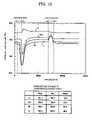
- FIG. 10shows changes of the furnace temperature, which occur in the wafer loading step accompanied with the boat elevation and the wafer unloading step accompanied with the boat lowering.
- reference symbols U, CU, CL, and Ldenote temperature transition curves in an upper portion, upper center portion, lower center portion, and lower portion of the furnace, respectively.
- film forming temperatureis set at 750° C.
- a temperature gradientis formed in the furnace, and accordingly, temperatures of U, CU, CL and L portions are different from one another, and the temperature in the furnace is lower as the portions go downward. It is seen that, since a boat 117 at normal temperature is loaded into the furnace at the time of the boat elevation, a large temperature drop temporarily occurs in the furnace somewhat late from loading timing. Moreover, it is seen that, since the boat 117 at high temperature is unloaded from the furnace at the time of lowering the boat, the CU, CL and L portions which are other than the U portion and are lower in temperature than the U portion receive radiant heat from the high-temperature boat 117 , and raise the temperatures of their own on the contrary.
- a temperature difference between the highest temperature and lowest temperature of the U portionremains at 12.0° C. at the times of the wafer loading and the wafer unloading, when the reaction chamber is opened; however, in the CU, CL and L portions, such temperature differences thereof become larger, such as 53.9° C., 87.8° C., and 90.8° C., as the portions go from the CU portion toward the L portion.
- the wall surface of the reaction pipeundergoes such a large temperature change at the times of the wafer loading and the wafer unloading. Accordingly, a heat stress applied to films on the wall surface is increased, a film crack occurs, and the films are exfoliated from the wall surface.
- the filmsWhen the films are exfoliated, the films become particles, scatter, and are adhered onto wafers in the reaction chamber 101 , resulting in contamination of the wafers. Also at the time of a film forming step, the particles are sometimes adhered onto surfaces of the wafers owing to backflow and diffusion thereof; however, the inventor of the present invention obtained findings that the contamination owing to the adhesion at the times of the wafer loading and the wafer unloading was the most.
- the inventor of the present inventionobtained findings that a main particle generation source was films adhered onto an inner reaction tube at the time of the wafer loading, and was films adhered onto the boat at the time of the wafer unloading.
- the substrate processing apparatusincludes a processing furnace having a reaction chamber which processes substrates, and is constructed to house a substrate holding member having the substrates charged thereon in the processing furnace, thereby processing the substrates.
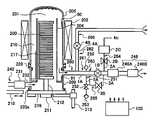
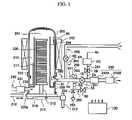
- This processing furnaceis illustrated in FIG. 1 .
- FIG. 1is a cross-sectional view of a reduced-pressure CVD processing furnace according to a first embodiment.
- An outer reaction tube 205is composed of a heat-resistant material, for example, such as quartz (SiO 2 ), and has a cylindrical form in which an upper end is closed and an opening is provided on a lower end.
- An inner reaction tube 204has a cylindrical form having openings on both upper and lower ends thereof, and is disposed in the outer reaction tube 205 coaxially therewith.
- a space between the outer reaction tube 205 and the inner reaction tube 204forms a cylindrical space 210 serving as a gas passage. Gas elevated from the upper opening of the inner reaction tube 204 is adapted to pass through the cylindrical space 210 , and to be exhausted from an exhaust line 260 .
- a heating device 202composed of a resistance heating heater or the like is disposed on an outer circumference of the outer reaction tube 205 coaxially therewith.
- the heating device 202is controlled by a controller 120 so as to set temperature in the outer reaction tube 205 at a predetermined processing temperature.
- the above-described inner reaction tube 204 and outer reaction tube 205 and a manifold 209 to be described laterconstruct a reaction chamber 201 for housing and processing wafers 200 as substrates supported by a boat 217 to be described later.
- the manifold 209 formed of, for example, stainless steel or the likeis engaged with the lower ends of the outer reaction tube 205 and the inner reaction tube 204 .
- the outer reaction tube 205 and the inner reaction tube 204are held on the manifold 209 .
- Annular flangesare provided individually on the lower end of the outer reaction tube 205 and an upper opening end of the manifold 209 . Between these flanges, a hermetically sealing member (hereinafter, an O-ring 220 ) is disposed, and both of the flanges are hermetically sealed.
- An annular flangeis provided on a lower end opening (hereinafter, referred to as “a throat opening”) of the manifold 209 .
- a disc-like cap member(hereinafter, a seal cap 219 ) made of, for example, stainless steel or the like is attached onto the flange through a hermetically sealing member (hereinafter, an O-ring 220 a ) so as to be capable of hermetically sealing the flange and to be freely detachable therefrom.
- a throat shutter 218is provided, and is set capable of freely opening and closing the throat opening in place of the seal cap 219 in a state where the boat 217 is unloaded from the reaction chamber 201 . The throat shutter 218 is opened when the wafers are loaded, and is closed after the wafer loading is finished.
- Rotating means 211is coupled to the seal cap 219 , and rotates a substrate holding member (hereinafter, a boat 217 ) and the wafers 200 held on the boat 217 .
- the seal cap 219is coupled to elevating means 213 , and elevates and lowers the boat 217 .
- a controlis made by the controller 120 so as to set rotation speeds of a rotation shaft 212 and the boat 217 by the rotating means 211 and an elevating speed of the boat 217 by the elevating means 213 at predetermined speeds.
- the gas introduction line 240includes a gas supply pipe 232 .
- processing gasreaction gas
- inert gasis adapted to be introduced into the inner reaction tube 204 and the outer reaction tube 205 .
- the gas supply pipe 232is coupled to gas flow rate controlling means (hereinafter, a mass flow controller (MFC) 231 ).
- MFCmass flow controller
- the MFC 231is connected to the controller 120 , and is capable of controlling a flow rate of the introduced gas at a predetermined rate.
- the exhaust line 260is composed mainly of a first exhaust line 261 and a second exhaust line 262 .
- the second exhaust line 262is provided in a form branched from the first exhaust line 261 .
- the first exhaust line 261communicates with an exhaust device (hereinafter, a vacuum pump 246 ), and is adapted to exhaust the reaction gas introduced from the gas introduction line 240 into the reaction chamber 201 .
- the second exhaust line 262communicates with large-scale exhaust equipment, and is adapted to exhaust a large amount of the inert gas introduced from the gas introduction line 240 into the reaction chamber 201 .
- the inert gas introduced from the gas introduction line 240 into the reaction chamber 201for example, N 2 gas, He gas, Ar gas, and the like, are used.
- An exhaust flow rate of the gas exhausted from the second exhaust line 262is set larger than an exhaust flow rate of the gas exhausted from the first exhaust line 261 . Therefore, the second exhaust line 262 is connected to, for example, exhaust equipment of a building-accompanying facility, and the like. Moreover, when the inert gas introduced from the gas introduction line 240 into the reaction chamber 201 is exhausted from the second exhaust line 262 , the flow rate thereof is set at 20 to 100 times or more the flow rate of the reaction gas.
- the above-described first exhaust line 261is composed of a main exhaust line (a main exhaust line) 263 for performing main exhaust processing, a pressure adjusting line 264 for introducing the inert gas from the main exhaust line 263 side and adjusting pressure in the reaction chamber 201 , a slow exhaust line 265 for performing slow exhaust processing, and an overpressurization prevention line 251 for preventing the pressure in the reaction chamber 201 from reaching pressure (overpressure) exceeding the atmospheric pressure.
- the pressure adjusting processing by the pressure adjusting line 264is executed when the reaction chamber is closed.
- the slow exhaust processing by the slow exhaust line 265is executed when vacuum exhaust processing (evacuation processing) after the wafer loading processing is started.
- the overpressurization prevention processing by the overpressurization prevention line 251is executed at the time of returning the pressure in the reaction chamber 201 to the atmospheric pressure, such returning being performed subsequently to purging of the reaction chamber after the wafers are processed.
- the above-described first exhaust line 261includes a main exhaust pipe 1 A.
- One end of the main exhaust pipe 1 Ais connected to the manifold 209 .
- a turbo molecular pump 246 A and a dry pump 246 Bwhich construct the vacuum pump 246 , are sequentially connected from an upstream side toward a downstream side.
- a main exhaust valve 1 Bis inserted into the main exhaust pipe 1 A.
- the above-described pressure adjusting line 264includes a pressure adjusting line 2 A.
- One end of the pressure adjusting pipe 2 Ais connected to the main exhaust pipe 1 A.
- a connected position of the one endis set between the main exhaust valve 1 B and the vacuum pump 246 .
- the other endcommunicates with an inert gas source, for example, a N 2 gas source.
- a piezo valve 2 Cwhich controls a flow rate of the N 2 gas is inserted into the pressure adjusting pipe 2 A through a gate valve 2 B.
- the above-described slow exhaust line 265includes a slow exhaust pipe 3 A.
- One end of the slow exhaust pipe 3 Ais connected to the main exhaust pipe 1 A on an upstream side of the main exhaust valve 1 B.
- the other endis connected to the main exhaust pipe 1 A on a downstream side of the main exhaust valve 1 B.
- a gate valve 3 Bis provided on the slow exhaust pipe 3 A.
- the above-described overpressurization prevention line 251includes a pressure detector 250 , and an overpressurization prevention pipe 5 A.
- One ends of the pressure detector 250 and the overpressurization prevention pipe 5 Aare connected to the main exhaust pipe 1 A on the upstream side of the main exhaust valve 1 B.
- the other end of the overpressurization prevention pipe 5 Ais closed by a check valve 253 through a gate valve 252 .
- the main exhaust pipe 1 A communicating with the vacuum pump 246emits the gas flowing through the cylindrical space 210 between the outer reaction tube 205 and the inner reaction tube 204 , and makes a control so as to set the inside of the outer reaction tube 205 at a reduced-pressure atmosphere with a predetermined pressure.
- This controlis made by the controller 120 which operates the main exhaust valve 1 B, the gate valve 2 B, the piezo valve 2 C, and the gate valve 3 B.
- the above-described second exhaust line 262is composed of a high flow vent line (hereinafter, referred to as “an HFV line”) 266 as a general exhaust line for performing large-amount exhaust processing.
- the HFV lineis an exhaust line which performs the exhaust under the atmospheric pressure.
- the HFV line 266includes a sub-exhaust pipe 4 A. One end of the sub-exhaust pipe 4 A is connected to the main exhaust pipe 1 A. A connected position of the one end is set on the upstream side of the main exhaust valve 1 B.
- a gate valve 4 Bis provided on the sub-exhaust pipe 4 A.
- the controller 120which operates the gate valve 4 B makes a control so as to form a large airflow, which goes from the gas supply pipe 232 toward the sub-exhaust pipe 4 A, in the reaction chamber 201 .
- a period while the control is being made so as to exhaust the large amount of inert gas from the HFV line 266 while introducing the inert gas from the gas introduction line 240 into the reaction chamber 201can be set at the entire period while the reaction chamber 201 is being opened.
- the periodis limited to a period of the wafer loading step of loading the wafers 200 into the reaction chamber 201 and to a period of the wafer unloading step of unloading the already processed wafers 200 from the reaction chamber 201 .
- the controller 120functions so as (1) to flow the large amount of inert gas, (2) to allow the HFV line 266 to exhaust the inert gas therethrough, and (3) to control the flow rate of the inert gas.
- the HFV line 266is an exhaust line different from the main exhaust line 263 communicating with the vacuum pump 264 , and from the slow exhaust line 265 , and the overpressurization prevention line 251 , which are provided branched from the main exhaust line 263 .
- the HFV line 266is provided branched from the main exhaust line 263 , and communicates with the exhaust equipment of the building-accompanying facility.
- the HFV line 266is set so that an exhaust flow rate thereof can be larger than those of the main exhaust line 263 , the slow exhaust line 265 , and the overpressurization prevention line 251 , and can flow the gas at a large flow rate under the atmospheric pressure.
- An inner diameter of the HFV line 266is smaller than an inner diameter of the main exhaust line 263 and larger than inner diameters of the slow exhaust line 265 and the overpressurization prevention line 251 .
- the boat 217is lowered by the elevating means (boat down).
- the throat shutter 218is closed, and the throat opening of the reaction chamber 201 is thereby closed.
- the plurality of wafers 200are charged on the boat 217 by carrying means (not shown) (wafer charging).
- the temperature in the reaction chamber 201is set at the predetermined processing temperature while heating the inside of the reaction chamber 201 by the heating means 202 .
- the inert gasis supplied into the reaction chamber 201 from the gas supply pipe 232 , the reaction chamber 201 is thereby filled with the inert gas in advance.
- the boat 217 having the wafers 200 charged thereonis elevated by the elevating means (boat up), the wafers 200 are loaded in the reaction chamber 201 (wafer loading), and the inner temperature of the reaction chamber 201 is maintained at the predetermined processing temperature.
- the inside of the reaction chamber 201is exhausted to a predetermined vacuum state by the first exhaust line 261 .
- the rotation shaft 212 , the boat 217 , and the wafers 200 charged on the boat 217are rotated by the rotating means 211 .
- the reaction gasis introduced from the gas supply pipe 232 in a state where the wafers are rotated.
- the reaction gas thus introducedis elevated in the reaction chamber 201 , and is exhausted through the first exhaust line 261 while being uniformly introduced to the plurality of wafers 200 , thereby performing the reduced-pressure CVD processing for a predetermined time.
- the gas in the reaction chamber 201is replaced by the inert gas, and the pressure is set at normal pressure. Thereafter, the boat 217 is lowered by the elevating means (boat down), and the boat 217 and the processed wafers 200 are unloaded from the reaction chamber 201 (wafer unloading). When the boat 217 completely comes out of the furnace, the throat shutter 218 is closed, and the throat opening of the reaction chamber 201 is thereby closed.
- the processed wafers 200 on the boat 217 unloaded from the reaction chamber 201are cooled to temperature at which it is possible to carry the wafers 200 (cooling), and are thereafter collected by carrying means (not shown) (wafer discharging).
- the unprocessed wafers 200are charged on the boat 217 which has become vacant (wafer charging), and again in a similar way to the above, the throat shutter 218 is opened, the boat 217 is elevated and loaded in the reaction chamber 201 (boat up, wafer loading), and the reduced-pressure CVD processing is then performed.
- the filmsare exfoliated owing to the stress caused by the temperature change of the furnace body, and the particles are generated and adhered onto the wafers 200 .
- the inert gasfor example, the N 2 gas at the large flow rate is adapted to flow in the furnace from the gas introduction side to the exhaust side.
- the large amount of N 2 gas controlled by the MFC 231is introduced from the gas supply pipe 232 (the gas introduction line 240 ) into the inner reaction tube 204 .
- the introduced N 2 gasis elevated in the inner reaction tube 204 , passes above through the cylindrical space 210 formed between the inner reaction tube 204 and the outer reaction tube 205 , and is emitted to the sub-exhaust pipe 4 A (the HFV line 266 ) branched from the main exhaust pipe 1 A.
- the large amount of N 2 gasis introduced into the inner reaction tube 204 , and is emitted to the sub-exhaust pipe 4 A.
- the airflow at the large flow ratewhich goes from the introduction side of the reaction gas toward the exhaust side thereof, is formed in the furnace, and together with the airflow, the particles which occur in the furnace at the time of the wafer loading and the time of the wafer unloading are emitted to the outside of the furnace.
- the flow rate of the exhaust in the HFV line 266be set larger than the flow rate of the exhaust in the main exhaust line 263 at the time of the reduced-pressure CVD processing for the substrates.
- the exhaust from the HFV 266be not the vacuum exhaust but exhaust under pressure larger than the pressure at the time of the reduced-pressure CVD processing for the substrates.
- the pressure at the exhaustis preferably 400 Pa or more, and more preferably, the atmospheric pressure (101,325 Pa). The reason is as follows.
- the particlescan be effectively emitted to the outside of the furnace, and thus, an increase of the particles, which is accompanied with an increase of a thickness of the deposited films, is restricted, and the adhesion of the particles onto the surfaces of the wafers at the time of the wafer loading and the time of the wafer unloading can be reduced to a great extent.
- the inert gassuch as the N 2 gas is introduced, and the flow of the inert gas is made in the furnace. Accordingly, the inside of the furnace can be set at an inert gas atmosphere, and oxidation of the surfaces of the wafers 200 can also be prevented.
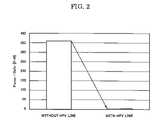
- FIG. 2is an explanatory view showing, in the case of performing the SiN film forming for the wafers, a comparison in change of the number of particles between the case of performing the exhaust by the HFV line at the times of the wafer loading and the wafer unloading (with the HFV) and the case of not performing the exhaust by the HFV line at the times of the wafer loading/wafer unloading (without the HFV). It is seen that, though the counted number of particles was 350 pieces per wafer or more in the case of not performing the exhaust by the HFV line, the number of particles is radically reduced to near ten pieces in the case of performing the exhaust by the HFV line 266 . As described above, in order to emit the particles generated owing to the film crack in the furnace, the exhaust under the pressure of 400 Pa or more by the HFV line, for example, the exhaust under the atmospheric pressure thereby is effective.
- film forming conditionscommon to “with the HFV line” and “without the HFV line” in a comparison experiment between the case of performing the exhaust by the HFV line and the case of not performing the exhaust thereby, which is shown in FIG. 2
- inert gas introduction/exhaust conditionsonly in “with the HFV line” at the times of the wafer loading/wafer unloading
- Diameter of particles to be counted⁇ 0.13 ⁇ m or more
- the second exhaust line 262is added to the exhaust side, and the particles are adapted to be emitted under the pressure larger than the vacuum pressure as the pressure at the time of the substrate processing. Accordingly, the adhesion of the particles onto the wafers can be sufficiently restricted.
- the inside of the furnaceis set at the N 2 gas atmosphere at the time of the wafer loading or/and at the time of the wafer unloading, thus making it possible to effectively prevent the oxidation of the wafer surfaces.
- the increase of the particles and the oxidation of the wafer surfaceswhich become problems in the case of forming the SiN films by the conventional vertical CVD apparatus, can be restricted effectively.
- the flow rate of the inert gas flown in the furnacebe 20 L/min or more, more preferably, 100 L/min or more.
- the exhaust pressure at this timebe 40 mm H 2 O or more (400 Pa or more), for example, the atmospheric pressure as described above.
- the flow rate of the inert gas flown in the furnacebe 20 to 200 L/min, more preferably, 100 to 200 L/min. Furthermore, it is preferable that the flow rate of the inert gas flown in the furnace be 100 to 150 L/min. This is because, when an upper limit of the flow rate of the inert gas flown in the furnace is set at 150 L/min, facility cost can be suppressed from being expensive, and in addition, excessive lowering of the temperature in the reaction chamber owing to the introduction of the inert gas of the normal temperature can be restricted. In these cases, the capacity of the reaction chamber 201 is, for example, 30 L to 120 L.
- the inert gas for useit is preferable to use N 2 for the most common use when the type of the film to be formed is SiN and the particle size is, for example, an order of 0.1 ⁇ m to 0.5 ⁇ m.
- the particle sizebecomes an order of 0.5 ⁇ m or more because the type of the film to be formed differs and so on, it is preferable to use other gas such as He gas and Ar gas, of which molecules are larger than those of N 2 .
- the exhaust flow rate of the second exhaust line 262may be set larger than the flow rate of the inert gas introduced from the gas introduction line 240 .
- the exhaust flow rate of the second exhaust line 262exceeds the flow rate of the inert gas as described above, there is a possibility that the wafers 200 are oxidized because the atmosphere is absorbed into the reaction chamber 201 .
- the exhaust flow rate of the second exhaust line 262is set to be larger than the flow rate of the inert gas. This is because the particles can be more effectively emitted to the outside of the reaction chamber 201 together with the atmosphere.
- a preferable range of the exhaust rateis 20 L/min to 200 L/min.
- the second exhaust line 262communicate with exhaust equipment 270 of the building-accompanying facility which performs the exhaust at the atmospheric pressure.
- the exhaust equipment 270 of which exhaust flow rate is largeis provided in the building-accompanying facility.
- a plurality of the processing furnacesis arrayed.
- all of the second exhaust lines 262 of the plurality of processing furnacesare connected to the exhaust equipment 270 .
- the exhaust from each second exhaust line 262can be emitted by using the exhaust equipment of which exhaust flow rate is large, the exhaust equipment being incorporated in the building-accompanying facility.
- the exhaust of which exhaust flow rate is larger than that of the first exhaust line 261can be performed surely and easily.
- a blower 262may be inserted according to needs into the exhaust line 262 communicating with the exhaust equipment 270 of the building-accompanying facility.
- the exhaust by the HFV line at the times of the wafer loading/wafer unloadingis applied to the processing furnace including the boat 217 on which the wafers 200 are charged in a horizontal attitude at multi-stages in the reaction chamber 201 .
- the reasonis as follows. Since the inside of the reaction chamber 201 is exhausted from the second exhaust line 262 of which exhaust flow rate is larger than that of the first exhaust line 261 , the particles can be effectively emitted even from such a large-capacity reaction chamber as housing the boat 217 on which the wafers 200 are charged at the multi-stages, and accordingly, the adhesion of the particles onto the substrates can be reduced at any stage of the boat 217 .
- the present inventioncan also be applied to a processing furnace of a substrate processing apparatus for sheets, which holds one or two to three pieces of the wafers in the reaction chamber.
- the capacity of the reaction chamberis not so large.
- a capacity range from the reaction chamber which houses one substrate to the reaction chamber which houses many substratesis 30 L to 120 L.
- this embodimentis applied to the processing furnace composed of the double reaction pipe including the outer reaction tube 205 and the inner reaction tube 204 in the reaction chamber 201 .
- the processing furnace composed of the double reaction pipewhen the inert gas is supplied from the lower portion of the inner reaction tube 204 , the inert gas is elevated in the reaction pipe 204 , and is exhausted through the cylindrical space 210 formed between the outer reaction tube 205 and the inner reaction tube 204 .
- the purging at the atmospheric pressureis performed by the inert gas at the large flow rate, and accordingly, the number of molecules and the number of atoms, which are capable of carrying foreign objects, are large, and energy for carrying the foreign objects is large. Accordingly, even in the case of the processing furnace with the double-pipe structure, which is difficult to emit the particles, the particles can be emitted easily.
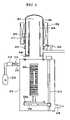
- a preliminary chamber 271such as a load-lock chamber and a N 2 purge box is conjoined to the reaction chamber 201 .
- the preliminary chamber 271includes a N 2 supply line 272 .
- a N 2 gas supply source 275is connected to the N 2 supply line 272 through an MFC 274 and a gate valve 273 .
- the N 2 gas of which flow rate is controlled by the MFC 274is adapted to be introduced from the N 2 supply line 272 into the preliminary chamber 271 and to be exhausted from an exhaust line 276 .
- the inside of the reaction chamber 201is adapted to be exhausted by the HFV line 266 while flowing N 2 into the preliminary chamber 271 at the times of the boat loading/boat unloading, N 2 in the preliminary chamber 271 will be flown into the reaction chamber 201 even if N 2 is not supplied from the gas introduction line 240 into the reaction chamber 201 , and accordingly, an effect similar thereto can be obtained.
- the inert gas introduction from the gas introduction line 240 and from the preliminary chamber 271may be performed concurrently.
- the total flow rate of the inert gasis set approximately within 20 L/min to 200 L/min.
- the oxidation of the Si waferscan also be prevented effectively.
- the atmospherebecomes entangled from the throat opening, and sometimes, the oxidation of the wafer surfaces becomes a problem.
- the Si wafersare prone to be oxidized.
- the load-lock chamber or the N 2 purge box as the preliminary chamber 271is conjoined to the processing chamber 201 , and the wafer loading is performed under the N 2 gas atmosphere.
- the entanglement of the atmosphere at the throat openingis prevented, and an increase of the oxidation of the wafer surfaces, for example, an increase of natural oxide films of the WSi films (tungsten silicide films) processed in the upstream step can be prevented effectively.
- the gas introduction line 240is branched on the upstream side so as to provide exclusive SiH 2 Cl 2 line 241 a , N 2 line 242 a , and NH 3 line 243 a , and is integrated on the downstream side, thereby being made into the shared line.
- a SiH 2 Cl 2 gas supply source 241 dis connected through an MFC 241 c and a gate valve 241 b .
- a N 2 gas supply source 242 dis connected through an MFC 242 c and a gate valve 242 b .
- a NH 3 gas supply source 243 dis connected through a MFC 243 c and a gate valve 243 b.
- the lines for the reaction gases and the line for the inert gasare separated from one another, and are composed of two or more gas supply lines, and the inert gas may thereby be adapted to be introduced from the line for the inert gas.
- the linesmay be provided as a SiH 2 Cl 2 line 241 , a N 2 line 242 , and a NH 3 line 243 separately from and independently of one another. If the inert gas N 2 is introduced from the exclusive line for the inert gas as described above, then the crack is avoided being generated on the NH 4 Cl films adsorbed on the pipe inner walls of the lines for the reaction gases, and the particles are avoided from scattering.
- the flow of the N 2 gas at the large flow rateis formed in the furnace by using the HFV line, the inside of the furnace is purged, and the particles generated in the furnace are thereby adapted to be emitted. Accordingly, the adhesion of the particles onto the wafers can be reduced.
- the introduction flow rate of the inert gas and the exhaust flow rate thereofare set substantially equal to each other, thus also making it possible to effectively prevent the oxidation of the wafer surfaces at the time of loading the wafers into the reaction chamber or/and at the time of unloading the wafers therefrom.
- the step where this embodiment becomes particularly effectiveis the boat loading step rather than the boat unloading step.
- the temperature in the reaction furnaceis varied more largely than that at the time of the boat unloading (refer to FIG. 10 ).
- a variation range of the in-furnace temperature at the time of the boat unloadingis approximately 10° C.
- a variation range of the in-furnace temperature at the time of the boat loadingis approximately 80° C., which is approximately eight times that at the time of the boat unloading.
- a heat stress applied to the films adhered onto the wall surfacesis larger than that at the time of the boat unloading, and the film crack is prone to occur.
- the filmsare more prone to be exfoliated, and the particles are more prone to be generated. This embodiment becomes particularly effective in the boat loading step where the particles are prone to be generated.
- a material of the reaction pipes and the boat, in which this embodiment becomes particularly effectiveis as follows.
- SiChas a coefficient of thermal expansion, which is approximate to that of SiN, and accordingly, even if the in-furnace temperature is varied, a stress difference does not occur very much between SiC and SiN.
- SiO 2quartz
- SiO 2has a large difference in coefficient of thermal expansion from SiN, and accordingly, a stress difference between SiO 2 and SiN is increased when the in-furnace temperature is varied.
- the present inventionbecomes particularly effective in the case of forming the SiN film by using a combination of the members and the film forming, in which the particles are prone to be generated owing to the temperature variation, that is, by using the quartz-made reaction pipes and the boat.
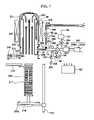
- FIG. 7is a cross-sectional view of a reduced-pressure CVD processing furnace according to a second embodiment.
- a heating mechanism 233is provided on the gas introduction line 240 . Note that the same reference numerals are assigned to the same portions as the portions described by using FIG. 1 , and a description thereof is omitted.
- the heating mechanism 233can be composed of a heater, a heat exchanger, or the like, which heats the gas supply pipe 232 and heats the gas flowing therein.
- a function to heat-control the N 2 gasis further added in addition to the control functions (1) to (3) according to the first embodiment. Note that the function (4) may be controlled by providing a separate and different controller from the controller 120 .
- the throat shutter 218is opened, and as shown by a black arrow, the N 2 gas preheated to the in-furnace temperature or to the vicinity thereof is introduced at a large flow rate into the furnace. Then, the N 2 gas elevated from the upper opening of the inner reaction tube 204 is made to pass through the cylindrical space 210 , and is drawn by the HFV line 266 , whereby the inside of the furnace is purged at the atmospheric pressure.
- the N 2 gas preheated to the in-furnace temperature or to the vicinity thereofis exhausted by the HFV line 266 while being introduced at the large flow rate into the furnace as shown by the black arrow, whereby the inside of the furnace is purged at the atmospheric pressure.
- the temperature drop in the inside of the furnacecan be reduced even if the inert gas is introduced into the furnace.
- the inside of the temperaturecan be maintained at a reaction chamber temperature at an idle time, and accordingly, the temperature drops of the wall surfaces of the reaction pipes and the like can be prevented even if the throat shutter 218 is opened at the time of the wafer loading, or even if the seal cap 219 opens the throat opening at the time of the wafer unloading.
- the purging conditionsare as follows. Note that film forming conditions are the same as those of the first embodiment.
- Preheated temperature of N 2 gas600° C. or less
- the flow of the N 2 gas at the large flow rateis formed by using the HFV line 266 .
- the inside of the furnacecan be purged in the atmospheric pressure state, and the particles 92 generated in the furnace can be emitted sufficiently.
- the throat shutter 218is closed, and the wafers 200 held on the boat 217 unloaded from the reaction furnace are subjected to cooling processing.
- the film forming temperatureis approximately 780° C. in the nitride film
- the in-furnace temperature during the cooling processingis maintained at the temperature of 600° C. to 780° C. at the time of the boat loading.
- a third embodimentwhich will be described from now on is one adapted to unload the boat 217 and to close the throat shutter 218 after performing the film forming processing for the wafers 200 in the furnace, and to thereafter flow N 2 at the large flow rate into the furnace during the cooling of the wafers 200 .
- the particles 92can be emitted more effectively.
- the temperature of the furnaceis radically lowered to approximately 400° C. at a temperature drop rate of, for example, 20° C.
- the in-furnace temperatureis radically lowered in a state where the wafers 200 are not housed in the furnace during the cooling of the wafers 200 , whereby the heat stress is applied to the SiN films 90 deposited on the wall surfaces of the reaction pipes, and the crack is made to be generated forcibly, and the exfoliation of the films is made to be generated.
- N 2 at the large flow rateis flown into the furnace, and the exhaust is performed therefor by using the HFV line 266 .
- the inside of the furnaceis purged in the atmospheric pressure state in such a way, thus making it possible to effectively emit the particles 92 . Furthermore, while the SiN films deposited on the wall surfaces of the reaction pipes are exfoliated forcibly by controlling the temperature of the heating means 202 , and the exhaust is performed therefor by flowing N 2 at the large flow rate, the throat shutter 218 is left closed at this time. Accordingly, there is no possibility that the particles 92 scatter and are adhered onto the wafers 200 held on the boat 217 .
- the third embodimentis further added to the first and second embodiments, thus making it possible to effectively emit the particles 92 .
- the period while the inside of the furnace is being exhausted by the HFV line while introducing the inert gas thereintobe the time of the boat loading in a period before the substrate processing.
- the period concernedbe the time of the boat unloading, which has been described in the first and second embodiments.
- N 2be continued to be flown continuously during a period from the time of the boat unloading until the end of the forcible cooling purge step described in the third embodiment.
- the exhaust flow rate by the HFV line at the times of the boat loading/boat unloading or the time of the forcible cooling purgeis larger than the exhaust flow rate by the vacuum exhaust line at the time of the wafer processing. Note that the exhaust flow rate by the HFV line at the times of the boat loading/boat unloading or the time of the forcible cooling purge is the largest among those in the entire processing process from the boat loading to the boat unloading.
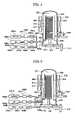
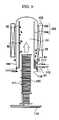
- FIG. 1is an explanatory view of a processing furnace constructing a substrate processing apparatus at a time of wafer processing in a first embodiment.
- FIG. 2is an explanatory view showing a comparison in change of the number of particles between a case of performing exhaust by an HFV line in the first embodiment (with HFV) and a case of not performing the exhaust by the HFV line (without the HFV).
- FIG. 3is a view showing a modification example at a time of wafer loading in a case where a preliminary chamber is conjoined to the processing furnace in the first embodiment.
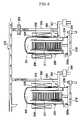
- FIG. 4is a specific explanatory view of a supply system in the first embodiment.
- FIG. 5is a view showing a modification example in a case where an inert gas introduction line in the first embodiment is provided separately from and individually of reaction gas introduction lines.
- FIG. 6is an explanatory view showing a case where a second exhaust line in the first embodiment communicates with exhaust equipment of a building-accompanying facility.
- FIG. 7is an explanatory view of a processing furnace constructing the substrate processing apparatus at the time of the wafer loading in a second embodiment.
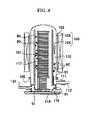
- FIG. 8is an explanatory view showing particle generation sources in a vertical CVD apparatus in a conventional example.
- FIG. 9is a view explaining a generation mechanism of the particles at the time of the wafer loading by elevating a boat in the conventional example.
- FIG. 10is an explanatory view showing transitions of furnace temperatures by elevating/lowering a boat in the conventional example.
Landscapes
- Engineering & Computer Science (AREA)
- Chemical & Material Sciences (AREA)
- Physics & Mathematics (AREA)
- Manufacturing & Machinery (AREA)
- General Physics & Mathematics (AREA)
- Computer Hardware Design (AREA)
- Microelectronics & Electronic Packaging (AREA)
- Power Engineering (AREA)
- Condensed Matter Physics & Semiconductors (AREA)
- Chemical Kinetics & Catalysis (AREA)
- General Chemical & Material Sciences (AREA)
- Materials Engineering (AREA)
- Mechanical Engineering (AREA)
- Metallurgy (AREA)
- Organic Chemistry (AREA)
- Plasma & Fusion (AREA)
- Analytical Chemistry (AREA)
- Chemical Vapour Deposition (AREA)
- Formation Of Insulating Films (AREA)
Abstract
Description
The present invention relates to a manufacturing method of a semiconductor device, and to a substrate processing apparatus, and particularly, to a device for eliminating particles in a reaction chamber.
As a substrate processing apparatus for carrying out one step of a manufacturing process of a semiconductor device (a device), there is a vertical CVD apparatus which performs processing such as film forming for a large number of wafers in a reaction chamber (hereinafter, also referred to as “in a furnace”). In the conventional vertical CVD apparatus, in the semiconductor manufacturing process, in particular, when the reaction chamber is opened, particles scatter from a particle generation source into the furnace, and the particles are prone to be adhered onto a surface of each wafer. The particle generation source is a reaction product adsorbed on a reaction chamber wall, a pipe wall, or the like. The film forming is repeated in the furnace, films of the reaction product are thereby adsorbed on the reaction chamber wall, the pipe wall, or the like, and the films are exfoliated and becomeparticles 92 as shown inFIG. 8 . For example, when film forming of a silicon nitride film (a SiN film) is repeated, Si3N4films90 are deposited on the wall surfaces in a high temperature region of 500° C. or more, and ammonium chloride films (NH4Cl films)91 are deposited thereon in a low temperature region of 150° C. or less, and these are exfoliated and become theparticles 92.
At the time of the film forming step, inFIG. 8 , if places on which the Si3N4films90 are prone to be adsorbed are first mentioned, the places are a surface of a quartz-madeboat 117, and an inner wall of aninner reaction tube 104 which constructs a quarts-made reaction pipe (hereinafter, also referred to as a “furnace body”)103 with a double-pipe structure, on an outer circumference of which aheater 102 is provided. If places on which the NH4Cl films 91 are prone to be adhered are mentioned next, the places are a lower outer wall of theinner reaction tube 104 in the vicinity of anexhaust port 111, an inner wall of a metal-made, for example, stainless steel-mademanifold 106 to which asupply pipe 132 and anexhaust pipe 112 are connected, an inner wall of thesupply pipe 132 which introduces reaction gas into the reaction chamber, an inner wall of theexhaust pipe 112 connected to theexhaust port 111 of themanifold 106, an inner wall of aseal cap 119 which seals a throat opening116, and the like.
Owing to a fact that the film forming is repeated in the furnace, the Si3N4films 90 are deposited on the high temperature regions of the above-described members, and the NH4Cl films 91 are deposited on the low temperature regions thereof. When the Si3N4films 90 deposited in thereaction chamber 101 and the NH4Cl films 91 deposited on the low temperature regions of the reaction chamber, the manifold, and the pipes are exfoliated, these films become theparticles 92. Note that, in the drawing, the SiN (Si3N4films)90, the NH4Cl films 91, and theparticles 92 are drawn emphatically for the sake of convenience.
When the films adsorbed and deposited on the wall surfaces are exfoliated from the wall surfaces owing to some cause, the films become theparticles 92. A description will be made of a generation mechanism of the particles by usingFIG. 9 .
Moreover, since thewafers 100 and theboat 117, which are at room temperature, are loaded into thereaction chamber 101, temperature of the wall surface of theheated reaction pipe 103 is lowered. Accordingly, the SiNfilms 90 adhered onto the wall surface of the reaction pipe, and the like, undergo a stress caused by a difference thereof in thermal expansion from thereaction pipe 103, and are exfoliated from the wall surface, and theparticles 92 are generated.
Furthermore, also in a (wafer unloading) step of lowering theboat 117 which holds the already processedwafers 100, and unloading thewafers 100 from thereaction chamber 101, the particles are generated owing to a similar mechanism to the above. It is conceived that the particles are generated because of the following reason. Specifically, since the wall surface of the reaction pipe and the manifold are going to be exposed to the outside in a pipe axial direction by the high temperature portion of the boat when thewafers 100 and theboat 117 are unloaded from thereaction chamber 101, in particular, the NH4Cl films 91 adsorbed on the wall surface of a lower portion of the reaction pipe and an inner wall surface of the manifold, which become the low temperature regions, undergo a stress, and are exfoliated from the wall surfaces, and theparticles 92 are generated.
In this connection, in order to prevent contamination of the wafers by the above-described particles, heretofore, there have been proposed a method of back-purging and slowly exhausting the reaction chamber at the times of wafer loading/wafer unloading (for example, refer to Patent Document 1), and a method of introducing inert gas into the reaction chamber and slowly exhausting the reaction chamber in a state where the reaction chamber is opened (for example, refer to Patent Document 2).
Patent Document 1: Japanese Patent Laid-Open Publication No. H10-326752 (published in 1998)
Patent Document 2: Japanese Patent Laid-Open Publication No. H8-31743 (published in 1996)
However, according to the methods of exhausting the reaction chamber by the slow exhaust at the times of wafer loading/wafer unloading or at the time of opening the reaction chamber, which are as described in Patent Documents 1 and 2, an effective airflow for removing the particles cannot be formed, and accordingly, there is room for improvement.
It is an object of the present invention to provide a manufacturing method of a semiconductor device, and a substrate processing apparatus, which are capable of effectively eliminating the particles from the reaction chamber.
A first invention is a method of manufacturing a semiconductor device, comprising the steps of: loading at least one substrate into a reaction chamber; introducing reaction gas into the reaction chamber, and exhausting an inside of the reaction chamber, thereby processing the substrate; and unloading the processed substrate from the reaction chamber, wherein, in the step of loading the substrate or/and in the step of unloading the substrate, the inside of the reaction chamber is exhausted at a larger exhaust flow rate than an exhaust flow rate in the step of processing the substrate.
In the step of loading the substrate or/and in the step of unloading the substrate, a temperature change of the reaction chamber wall occurs, and the deposited films adhered onto the reaction chamber wall are exfoliated from the reaction chamber wall owing to a stress caused by a difference in thermal expansion between the deposited films and the reaction chamber wall, and become the particles. When the inside of the reaction chamber is exhausted at the larger exhaust flow rate than the exhaust flow rate in the step of processing the substrate, the effective airflow for removing the particles can be formed, and accordingly, the particles are effectively emitted to the outside of the reaction chamber. Hence, the adhesion of the particles onto the substrates can be reduced.
A second invention is the method of manufacturing a semiconductor device in the first invention, wherein, in the step of loading the substrate or/and in the step of unloading the substrate, the inside of the reaction chamber is exhausted at the larger exhaust flow rate than the exhaust flow rate in the step of processing the substrate while introducing inert gas into the reaction chamber.
When the inside of the reaction chamber is exhausted at the larger exhaust flow rate than the exhaust flow rate in the step of processing the substrate while introducing the inert gas into the reaction chamber, the effective airflow for removing the particles can be formed. Accordingly, the particles can be effectively emitted to the outside of the reaction chamber. Hence, the adhesion of the particles onto the substrates can be reduced.
In this case, with regard to the inert gas for use, when a particle size is as large as 0.5 μm or more, other gas than N2, such as Ar, of which molecules are larger than those of N2, may be used. However, when the particle size is an order of 0.1 μm to 0.5 μm, it is preferable to use N2for the most common use.
A third invention is a method of manufacturing a semiconductor device, comprising the steps of: loading at least one substrate into a reaction chamber; introducing reaction gas into the reaction chamber, and exhausting an inside of the reaction chamber by a first exhaust line communicating with a vacuum pump, thereby processing the substrate; and unloading the processed substrate from the reaction chamber, wherein, in the step of loading the substrate or/and in the step of unloading the substrate, the inside of the reaction chamber is exhausted by a second exhaust line having a larger exhaust flow rate than the first exhaust line.
When the inside of the reaction chamber is exhausted by the second exhaust line having the larger exhaust flow rate than the first exhaust line, the effective airflow for removing the particles can be formed, and accordingly, the particles can be effectively emitted to the outside of the reaction chamber. Hence, the adhesion of the particles onto the substrates can be reduced.
It is recommended that the second exhaust line be adapted not to perform vacuum exhaust but to perform atmospheric pressure exhaust. In the case of the atmospheric pressure exhaust, the particles can be emitted more effectively as compared with the vacuum exhaust.
A fourth invention is the method of manufacturing a semiconductor device in the third invention, wherein, in the step of loading the substrate or/and in the step of unloading the substrate, the inside of the reaction chamber is exhausted by the second exhaust line having the larger exhaust flow rate than the first exhaust line while introducing inert gas into the reaction chamber.
When the inside of the reaction chamber is exhausted by the second exhaust line having the larger exhaust flow rate than the first exhaust line while introducing the inert gas into the reaction chamber, the effective airflow for removing the particles can be formed, and accordingly, the particles can be effectively emitted to the outside of the reaction chamber. Hence, the adhesion of the particles onto the substrates can be reduced.
A fifth invention is the method of manufacturing a semiconductor device in the third invention, further comprising the step of purging the inside of the reaction chamber with the inert gas after the substrate is unloaded therefrom, wherein the inside of the reaction chamber is exhausted by the second exhaust line having the larger exhaust flow rate than the first exhaust line while introducing the inert gas into the reaction chamber continuously during a period from the step of unloading the substrate until an end of the step of purging the inside of the reaction chamber.
When the inside of the reaction chamber is exhausted by the second exhaust line having the larger exhaust flow rate than the first exhaust line while introducing the inert gas into the reaction chamber continuously during the period from the step of unloading the substrate until the end of the step of purging the inside of the reaction chamber, the particles can be effectively emitted to the outside of the reaction chamber.
A sixth invention is the method of manufacturing a semiconductor device in the third invention, wherein the second exhaust line communicates with exhaust equipment of a building-accompanying facility. The emission can be performed by using, as the second exhaust line, the exhaust equipment having a large flow rate, which is incorporated in the building-accompanying facility. Accordingly, the exhaust at the larger exhaust flow rate than the exhaust flow rate of the first exhaust line can be obtained surely and easily.
A seventh invention is the method of manufacturing a semiconductor device in the third invention, wherein, in the step of processing the substrate, a silicon nitride film is deposited on the substrate. When the step of processing the substrate is one to deposit the silicon nitride film on the substrate, the particles formed of the silicon nitride film and the ammonium chloride film, which are deposited in the reaction chamber and are exfoliated therefrom, can be effectively emitted to the outside of the reaction chamber.
An eighth invention is the method of manufacturing a semiconductor device in the fourth invention, wherein a flow rate of the inert gas is set at 100 times or more a flow rate of the reaction gas. Based on the experience value, it is preferable to set the flow rate of the inert gas at 100 times or more the flow rate of the reaction gas.
A ninth invention is the method of manufacturing a semiconductor device in the fourth invention, wherein a flow rate of the inert gas is 100 L/min or more. It is preferable that the flow rate of the inert gas be 100 L/min or more in order to smoothly move the particles out of the reaction chamber against the gravity of the particles.
A tenth invention is the method of manufacturing a semiconductor device in the fourth invention, wherein a flow rate of the inert gas is 100 L/min to 200 L/min. Because of the reason that the particles are to be smoothly moved out of the reaction chamber and that heat in the reaction chamber is not to be taken away too much, it is more preferable that the flow rate of the inert gas be 100 to 200 L/min. In particular, when an upper limit of the flow rate of the inert gas is set at 150 L/min, facility cost can be suppressed from being expensive, and in addition, the heat in the reaction chamber can be adapted not to be taken away too much.
An eleventh invention is the method of manufacturing a semiconductor device in the fourth invention, wherein the exhaust flow rate of the second exhaust line is larger than a supply flow rate of the inert gas. Note that the atmosphere is absorbed into the reaction chamber when the exhaust flow rate of the second exhaust flow line exceeds the flow rate of the inert gas. Accordingly, when it is not desired that oxide films be formed on the substrates, it is recommended to set the exhaust flow rate of the second exhaust line to be substantially equal to the flow rate of the inert gas. However, when the oxide films may be formed on the substrates, it is preferable that the exhaust flow rate of the second exhaust flow line be larger than the flow rate of the inert gas because the particles can be emitted to the outside of the reaction chamber more effectively.
A twelfth invention is the method of manufacturing a semiconductor device in the fourth invention, wherein the inert gas is heated and introduced into the reaction chamber. When the inert gas is heated and introduced into the reaction chamber, the change of the temperature in the reaction chamber can be suppressed even in the substrate loading step or/and in the substrate unloading step. Accordingly, a crack of the deposited films owing to the lowering of the reaction chamber temperature can be restricted from being generated, and the generation of the particles can be further suppressed.
In particular, when the heating temperature of the inert gas is approximately at the temperature in the reaction chamber, the change of the temperature in the reaction chamber can be further suppressed even in the substrate loading step or/and in the substrate unloading step, and accordingly, the generation of the particles can be further suppressed.
A thirteenth invention is a substrate processing apparatus, comprising: a reaction chamber which performs processing for at least one substrate; at least one gas supply line which introduces gas into the reaction chamber; a first exhaust line which exhausts an inside of the reaction chamber by a vacuum pump; a second exhaust line having a larger exhaust flow rate than the first exhaust line which exhausts the inside of the reaction chamber; and a controller which makes a control to exhaust the inside of the reaction chamber by the second exhaust line at a time of loading the substrate into the reaction chamber or/and at a time of unloading the substrate from the reaction chamber. When there is provided the controller which performs the exhaust by the second exhaust line having the larger exhaust flow rate than the first exhaust line which exhausts the inside of the reaction chamber at the time of loading the substrate into the reaction chamber or/and at the time of unloading the substrate from the reaction chamber, the particles generated in the reaction chamber can be emitted easily.
A fourteenth invention is the substrate processing apparatus in the thirteenth invention, wherein the controller makes the control to exhaust the inside of the reaction chamber by the second exhaust line while introducing inert gas from the gas supply line into the reaction chamber at the time of loading the substrate into the reaction chamber or/and at the time of unloading the substrate from the reaction chamber.
When there is provided the controller which performs the exhaust by the second exhaust line having the larger exhaust flow rate than the first exhaust line while introducing the inert gas from the gas supply line into the reaction chamber at the time of loading the substrate into the reaction chamber or/and at the time of unloading the substrate from the reaction chamber, the particles generated in the reaction chamber can be emitted easily.
For example, when the substrate processing apparatus uses a holding jig (a substrate holder such as the boat) in order to load the substrate into the reaction chamber, the time when the reaction chamber is opened is mainly composed of the substrate loading step of loading the substrate held by the holder into the reaction chamber, and of the substrate unloading step of unloading the processed substrate held by the holder from the reaction chamber. As in the present invention, when the period while the exhaust is being performed by the second exhaust line while introducing the inert gas from the gas supply line into the reaction chamber is limited to the substrate loading time or/and the substrate unloading time, a period while the second exhaust line is being exposed to emitted heat is shortened as compared with the case of performing the exhaust by the second exhaust line while introducing the inert gas from the gas supply line into the reaction chamber continuously during all the period while the reaction chamber is being opened. Accordingly, the members constructing the exhaust line can be protected. Moreover, when the period while the exhaust is being performed by the second exhaust line while introducing the inert gas from the gas supply line into the reaction chamber is limited to the time of the substrate loading step or/and the time of the substrate unloading step, a consumption of the inert gas can be reduced.
A fifteenth invention is the substrate processing apparatus in the thirteenth invention, wherein the controller further makes a control to exhaust the inside of the reaction chamber by the second exhaust line while introducing inert gas from the gas supply line into the reaction chamber continuously during a period from the time of unloading the substrate until an end of purging of the reaction chamber, the purging being performed after the substrate is unloaded.
When the control is made by the controller to exhaust the inside of the reaction chamber by the second exhaust line while introducing the inert gas into the reaction chamber continuously during the period from the time of unloading the substrate until the end of the purging of the reaction chamber, the particles can be emitted to the outside of the reaction chamber more effectively.
A sixteenth invention is the substrate processing apparatus in the thirteenth invention, wherein the second exhaust line communicates with exhaust equipment of a building-accompanying facility.
When the second exhaust line communicates with the building-accompanying facility, the emission can be performed by using exhaust equipment of which exhaust flow rate is large. Accordingly, the exhaust of which exhaust flow rate is larger than that of the first exhaust line can be performed surely and easily.
A seventeenth invention is the substrate processing apparatus in the thirteenth invention, further comprising a holder which charges a plurality of the substrates in a horizontal attitude at multi-stages in the reaction chamber. The inside of the reaction chamber is exhausted from the second exhaust line of which exhaust flow rate is large. Accordingly, the particles can be effectively emitted even from such a large-capacity reaction chamber as housing the holder on which the substrates are charged at the multi-stages. Therefore, the adhesion of the particles onto the substrates can be reduced at any stage of the holder.
An eighteenth invention is the substrate processing apparatus in the thirteenth invention, wherein the reaction chamber is composed of an outer reaction tube and an inner reaction tube.
In order to emit the particles generated in the inner reaction tube to the outside of the furnace, it is necessary to elevate the particles against the gravity, and it is therefore difficult to emit the particles. However, according to the present invention, the exhaust is performed by the second exhaust line of which exhaust flow rate is large. Accordingly, the particles can be easily emitted even from the reaction chamber composed of the outer reaction tube and the inner reaction tube.
A nineteenth invention is the substrate processing apparatus in the thirteenth invention, wherein a preliminary chamber which leaves the substrate on standby is conjoined to the reaction chamber. Since the preliminary chamber is conjoined to the reaction chamber, the substrates can be loaded and unloaded without leaving the reaction chamber open to the atmosphere at the time when the reaction chamber is opened. In particular, when a function to introduce the inert gas is provided in the preliminary chamber, the inert gas can be introduced from the preliminary chamber into the reaction chamber in combination with the gas supply line or without using the gas supply line. For example, the above-described preliminary chamber is a load-lock chamber or a N2purge box.
A twentieth invention is the substrate processing apparatus in the fourteenth invention, wherein the gas supply line includes a line for reaction gas, and a line for the inert gas, and the inert gas is introduced from the line for the inert gas. Since the inert gas is introduced from the line for the inert gas, the stress caused by the introduction of the inert gas can be adapted not to be applied to the deposited films adhered onto the line for the reaction gas. Hence, the crack of the deposited films adhered onto the line for the reaction gas can be restricted from being generated.
According to the method of the present invention, in the step of loading the substrate or/and in the step of unloading the substrate, the inside of the reaction chamber is exhausted at the larger exhaust flow rate than the exhaust flow rate in the step of processing the substrate. Accordingly, the particles can be effectively emitted from the reaction chamber, and the adhesion of the particles onto the substrates can be reduced.
Moreover, according to the apparatus of the present invention, there is provided the controller which performs the exhaust by the second exhaust line having the larger exhaust flow rate than the first exhaust line which exhausts the inside of the reaction chamber at the time of loading the substrate into the reaction chamber or/and at the time of unloading the substrate from the reaction chamber. Accordingly, the particles can be effectively emitted from the reaction chamber, and the adhesion of the particles onto the substrates can be reduced.
A description will be made below of a manufacturing method of a semiconductor device of the present invention, and of a substrate processing apparatus for carrying out the manufacturing method. Note that, when the substrate processing apparatus is a vertical device, boat loading, which is an operation of elevating a boat having wafers charged thereon and of loading the boat in a furnace, corresponds to wafer loading (substrate loading). Moreover, boat unloading, which is an operation of lowering the boat having the wafers charged thereon and of unloading the boat from the furnace, corresponds to wafer unloading (substrate unloading). Since a vertical CVD apparatus will be described in the following description, the term “wafer loading” and the term “boat loading” will be used in the same meaning. Moreover, the term “wafer unloading” and the term “boat unloading” will be used in the same meaning.
The inventor of the present invention investigated as to which extent temperature (furnace temperature) of a wall surface of a reaction pipe was changed in a wafer loading step and a wafer unloading step in a semiconductor manufacturing process. This will be described by usingFIG. 10 .FIG. 10 shows changes of the furnace temperature, which occur in the wafer loading step accompanied with the boat elevation and the wafer unloading step accompanied with the boat lowering. In the drawing, reference symbols U, CU, CL, and L denote temperature transition curves in an upper portion, upper center portion, lower center portion, and lower portion of the furnace, respectively. Although film forming temperature is set at 750° C., a temperature gradient is formed in the furnace, and accordingly, temperatures of U, CU, CL and L portions are different from one another, and the temperature in the furnace is lower as the portions go downward. It is seen that, since aboat 117 at normal temperature is loaded into the furnace at the time of the boat elevation, a large temperature drop temporarily occurs in the furnace somewhat late from loading timing. Moreover, it is seen that, since theboat 117 at high temperature is unloaded from the furnace at the time of lowering the boat, the CU, CL and L portions which are other than the U portion and are lower in temperature than the U portion receive radiant heat from the high-temperature boat 117, and raise the temperatures of their own on the contrary.
The following is seen from a table written in combination inFIG. 10 . Specifically, a temperature difference between the highest temperature and lowest temperature of the U portion remains at 12.0° C. at the times of the wafer loading and the wafer unloading, when the reaction chamber is opened; however, in the CU, CL and L portions, such temperature differences thereof become larger, such as 53.9° C., 87.8° C., and 90.8° C., as the portions go from the CU portion toward the L portion. The wall surface of the reaction pipe undergoes such a large temperature change at the times of the wafer loading and the wafer unloading. Accordingly, a heat stress applied to films on the wall surface is increased, a film crack occurs, and the films are exfoliated from the wall surface. When the films are exfoliated, the films become particles, scatter, and are adhered onto wafers in thereaction chamber 101, resulting in contamination of the wafers. Also at the time of a film forming step, the particles are sometimes adhered onto surfaces of the wafers owing to backflow and diffusion thereof; however, the inventor of the present invention obtained findings that the contamination owing to the adhesion at the times of the wafer loading and the wafer unloading was the most.
Moreover, the inventor of the present invention obtained findings that a main particle generation source was films adhered onto an inner reaction tube at the time of the wafer loading, and was films adhered onto the boat at the time of the wafer unloading.
Note that film forming conditions at the time when furnace temperature characteristics ofFIG. 10 were obtained are as follows.
- Film type: SiN
- Film forming gas SiH2Cl2: 30 to 100 sccm NH3: 300 to 900 sccm
- Film forming temperature: 680 to 800° C.
- Pressure: 10 to 100 Pa
- Number of wafers loaded on boat: 200 or less
- Wafer diameter: Ø200 mm or more
The inventor of the present invention accomplished the present invention based on the above-described findings. A description will be made below of embodiments of the present invention.
The substrate processing apparatus includes a processing furnace having a reaction chamber which processes substrates, and is constructed to house a substrate holding member having the substrates charged thereon in the processing furnace, thereby processing the substrates. This processing furnace is illustrated inFIG. 1 .
Aheating device 202 composed of a resistance heating heater or the like is disposed on an outer circumference of theouter reaction tube 205 coaxially therewith. Theheating device 202 is controlled by acontroller 120 so as to set temperature in theouter reaction tube 205 at a predetermined processing temperature. The above-describedinner reaction tube 204 andouter reaction tube 205 and a manifold209 to be described later construct areaction chamber 201 for housing andprocessing wafers 200 as substrates supported by aboat 217 to be described later.
The manifold209 formed of, for example, stainless steel or the like is engaged with the lower ends of theouter reaction tube 205 and theinner reaction tube 204. Theouter reaction tube 205 and theinner reaction tube 204 are held on themanifold 209. Annular flanges are provided individually on the lower end of theouter reaction tube 205 and an upper opening end of themanifold 209. Between these flanges, a hermetically sealing member (hereinafter, an O-ring220) is disposed, and both of the flanges are hermetically sealed.
An annular flange is provided on a lower end opening (hereinafter, referred to as “a throat opening”) of themanifold 209. A disc-like cap member (hereinafter, a seal cap219) made of, for example, stainless steel or the like is attached onto the flange through a hermetically sealing member (hereinafter, an O-ring 220a) so as to be capable of hermetically sealing the flange and to be freely detachable therefrom. Moreover, in the throat opening of the manifold209, athroat shutter 218 is provided, and is set capable of freely opening and closing the throat opening in place of theseal cap 219 in a state where theboat 217 is unloaded from thereaction chamber 201. Thethroat shutter 218 is opened when the wafers are loaded, and is closed after the wafer loading is finished.
Rotating means211 is coupled to theseal cap 219, and rotates a substrate holding member (hereinafter, a boat217) and thewafers 200 held on theboat 217. Moreover, theseal cap 219 is coupled to elevatingmeans 213, and elevates and lowers theboat 217. A control is made by thecontroller 120 so as to set rotation speeds of arotation shaft 212 and theboat 217 by the rotatingmeans 211 and an elevating speed of theboat 217 by the elevating means213 at predetermined speeds.
On the lower portion of the manifold209, agas introduction line 240 is provided. Thegas introduction line 240 includes agas supply pipe 232. By thegas supply pipe 232, processing gas (reaction gas) or inert gas is adapted to be introduced into theinner reaction tube 204 and theouter reaction tube 205. Thegas supply pipe 232 is coupled to gas flow rate controlling means (hereinafter, a mass flow controller (MFC)231). TheMFC 231 is connected to thecontroller 120, and is capable of controlling a flow rate of the introduced gas at a predetermined rate.
On an upper portion on an opposite side to the lower portion of the manifold209, on which thegas introduction line 240 is provided, the above-describedexhaust line 260 is provided. Theexhaust line 260 is composed mainly of afirst exhaust line 261 and asecond exhaust line 262. Here, thesecond exhaust line 262 is provided in a form branched from thefirst exhaust line 261.
Thefirst exhaust line 261 communicates with an exhaust device (hereinafter, a vacuum pump246), and is adapted to exhaust the reaction gas introduced from thegas introduction line 240 into thereaction chamber 201. Thesecond exhaust line 262 communicates with large-scale exhaust equipment, and is adapted to exhaust a large amount of the inert gas introduced from thegas introduction line 240 into thereaction chamber 201. Note that, as the inert gas introduced from thegas introduction line 240 into thereaction chamber 201, for example, N2gas, He gas, Ar gas, and the like, are used.
An exhaust flow rate of the gas exhausted from thesecond exhaust line 262 is set larger than an exhaust flow rate of the gas exhausted from thefirst exhaust line 261. Therefore, thesecond exhaust line 262 is connected to, for example, exhaust equipment of a building-accompanying facility, and the like. Moreover, when the inert gas introduced from thegas introduction line 240 into thereaction chamber 201 is exhausted from thesecond exhaust line 262, the flow rate thereof is set at 20 to 100 times or more the flow rate of the reaction gas.
The above-described firstexhaust line 261 is composed of a main exhaust line (a main exhaust line)263 for performing main exhaust processing, apressure adjusting line 264 for introducing the inert gas from themain exhaust line 263 side and adjusting pressure in thereaction chamber 201, aslow exhaust line 265 for performing slow exhaust processing, and anoverpressurization prevention line 251 for preventing the pressure in thereaction chamber 201 from reaching pressure (overpressure) exceeding the atmospheric pressure. Here, the pressure adjusting processing by thepressure adjusting line 264 is executed when the reaction chamber is closed. The slow exhaust processing by theslow exhaust line 265 is executed when vacuum exhaust processing (evacuation processing) after the wafer loading processing is started. The overpressurization prevention processing by theoverpressurization prevention line 251 is executed at the time of returning the pressure in thereaction chamber 201 to the atmospheric pressure, such returning being performed subsequently to purging of the reaction chamber after the wafers are processed.
The above-described firstexhaust line 261 includes amain exhaust pipe 1A. One end of themain exhaust pipe 1A is connected to themanifold 209. To the other end of themain exhaust pipe 1A, a turbomolecular pump 246A and adry pump 246B, which construct thevacuum pump 246, are sequentially connected from an upstream side toward a downstream side. Amain exhaust valve 1B is inserted into themain exhaust pipe 1A.
The above-describedpressure adjusting line 264 includes apressure adjusting line 2A. One end of thepressure adjusting pipe 2A is connected to themain exhaust pipe 1A. A connected position of the one end is set between themain exhaust valve 1B and thevacuum pump 246. The other end communicates with an inert gas source, for example, a N2gas source. Apiezo valve 2C which controls a flow rate of the N2gas is inserted into thepressure adjusting pipe 2A through agate valve 2B.
The above-describedslow exhaust line 265 includes aslow exhaust pipe 3A. One end of theslow exhaust pipe 3A is connected to themain exhaust pipe 1A on an upstream side of themain exhaust valve 1B. The other end is connected to themain exhaust pipe 1A on a downstream side of themain exhaust valve 1B. Agate valve 3B is provided on theslow exhaust pipe 3A.
The above-describedoverpressurization prevention line 251 includes apressure detector 250, and anoverpressurization prevention pipe 5A. One ends of thepressure detector 250 and theoverpressurization prevention pipe 5A are connected to themain exhaust pipe 1A on the upstream side of themain exhaust valve 1B. The other end of theoverpressurization prevention pipe 5A is closed by acheck valve 253 through agate valve 252.
Themain exhaust pipe 1A communicating with thevacuum pump 246 emits the gas flowing through thecylindrical space 210 between theouter reaction tube 205 and theinner reaction tube 204, and makes a control so as to set the inside of theouter reaction tube 205 at a reduced-pressure atmosphere with a predetermined pressure. This control is made by thecontroller 120 which operates themain exhaust valve 1B, thegate valve 2B, thepiezo valve 2C, and thegate valve 3B.
The above-described secondexhaust line 262 is composed of a high flow vent line (hereinafter, referred to as “an HFV line”)266 as a general exhaust line for performing large-amount exhaust processing. Unlike the vacuum exhaust line which performs the evacuation by the vacuum pump, the HFV line is an exhaust line which performs the exhaust under the atmospheric pressure. TheHFV line 266 includes asub-exhaust pipe 4A. One end of thesub-exhaust pipe 4A is connected to themain exhaust pipe 1A. A connected position of the one end is set on the upstream side of themain exhaust valve 1B. Agate valve 4B is provided on thesub-exhaust pipe 4A. Thecontroller 120 which operates thegate valve 4B makes a control so as to form a large airflow, which goes from thegas supply pipe 232 toward thesub-exhaust pipe 4A, in thereaction chamber 201.
A period while the control is being made so as to exhaust the large amount of inert gas from theHFV line 266 while introducing the inert gas from thegas introduction line 240 into thereaction chamber 201 can be set at the entire period while thereaction chamber 201 is being opened. However, here, the period is limited to a period of the wafer loading step of loading thewafers 200 into thereaction chamber 201 and to a period of the wafer unloading step of unloading the already processedwafers 200 from thereaction chamber 201. Moreover, during these periods, thecontroller 120 functions so as (1) to flow the large amount of inert gas, (2) to allow theHFV line 266 to exhaust the inert gas therethrough, and (3) to control the flow rate of the inert gas.
Here, if features of theHFV line 266 will be described in summary, the following is mentioned. TheHFV line 266 is an exhaust line different from themain exhaust line 263 communicating with thevacuum pump 264, and from theslow exhaust line 265, and theoverpressurization prevention line 251, which are provided branched from themain exhaust line 263. TheHFV line 266 is provided branched from themain exhaust line 263, and communicates with the exhaust equipment of the building-accompanying facility. TheHFV line 266 is set so that an exhaust flow rate thereof can be larger than those of themain exhaust line 263, theslow exhaust line 265, and theoverpressurization prevention line 251, and can flow the gas at a large flow rate under the atmospheric pressure. An inner diameter of theHFV line 266 is smaller than an inner diameter of themain exhaust line 263 and larger than inner diameters of theslow exhaust line 265 and theoverpressurization prevention line 251.
A description will be made of an example of a reduced-pressure CVD processing method by the processing furnace shown inFIG. 1 . First, theboat 217 is lowered by the elevating means (boat down). When theboat 217 completely comes out of the furnace, thethroat shutter 218 is closed, and the throat opening of thereaction chamber 201 is thereby closed. The plurality ofwafers 200 are charged on theboat 217 by carrying means (not shown) (wafer charging). Subsequently, the temperature in thereaction chamber 201 is set at the predetermined processing temperature while heating the inside of thereaction chamber 201 by the heating means202. The inert gas is supplied into thereaction chamber 201 from thegas supply pipe 232, thereaction chamber 201 is thereby filled with the inert gas in advance. After opening thethroat shutter 218, theboat 217 having thewafers 200 charged thereon is elevated by the elevating means (boat up), thewafers 200 are loaded in the reaction chamber201 (wafer loading), and the inner temperature of thereaction chamber 201 is maintained at the predetermined processing temperature. After performing the slow exhaust for the inside of thereaction chamber 201 by theslow exhaust line 265, the inside of thereaction chamber 201 is exhausted to a predetermined vacuum state by thefirst exhaust line 261. Thereafter, therotation shaft 212, theboat 217, and thewafers 200 charged on theboat 217 are rotated by the rotatingmeans 211.
The reaction gas is introduced from thegas supply pipe 232 in a state where the wafers are rotated. The reaction gas thus introduced is elevated in thereaction chamber 201, and is exhausted through thefirst exhaust line 261 while being uniformly introduced to the plurality ofwafers 200, thereby performing the reduced-pressure CVD processing for a predetermined time.
When the reduced-pressure CVD processing is ended, in order to proceed to the reduced-pressure CVD processing for thenext wafers 200, the gas in thereaction chamber 201 is replaced by the inert gas, and the pressure is set at normal pressure. Thereafter, theboat 217 is lowered by the elevating means (boat down), and theboat 217 and the processedwafers 200 are unloaded from the reaction chamber201 (wafer unloading). When theboat 217 completely comes out of the furnace, thethroat shutter 218 is closed, and the throat opening of thereaction chamber 201 is thereby closed. The processedwafers 200 on theboat 217 unloaded from thereaction chamber 201 are cooled to temperature at which it is possible to carry the wafers200 (cooling), and are thereafter collected by carrying means (not shown) (wafer discharging). Theunprocessed wafers 200 are charged on theboat 217 which has become vacant (wafer charging), and again in a similar way to the above, thethroat shutter 218 is opened, theboat 217 is elevated and loaded in the reaction chamber201 (boat up, wafer loading), and the reduced-pressure CVD processing is then performed.
Incidentally, at the times of the wafer loading and the wafer unloading in the above-described reduced-pressure CVD processing process, phenomena as described above occur. Specifically, at the time when the reaction chamber is opened, the temperature drop in the reaction chamber occurs. Moreover, when thewafers 200 and theboat 217, which are at the room temperature, are inserted into the furnace at the time of the wafer loading, the temperature drop occurs on the wall surfaces of the reaction pipes, and the like. Therefore, the deposited films adhered onto the wall surfaces of the reaction pipes, and the like, are exfoliated owing to the stress caused by the difference thereof in coefficient of thermal expansion from the reaction pipes and the like, and scatter as the particles. The particles which have scattered are adhered onto thewafers 200. Moreover, also at the time of the wafer unloading, in a similar way to the time of the wafer loading, the films are exfoliated owing to the stress caused by the temperature change of the furnace body, and the particles are generated and adhered onto thewafers 200.
Accordingly, in this first embodiment, in order to prevent the scattered particles from being adhered onto thewafers 200 at the times of the wafer loading and the wafer unloading, the inert gas, for example, the N2gas at the large flow rate is adapted to flow in the furnace from the gas introduction side to the exhaust side.
At the time of the wafer loading, the large amount of N2gas controlled by theMFC 231 is introduced from the gas supply pipe232 (the gas introduction line240) into theinner reaction tube 204. The introduced N2gas is elevated in theinner reaction tube 204, passes above through thecylindrical space 210 formed between theinner reaction tube 204 and theouter reaction tube 205, and is emitted to thesub-exhaust pipe 4A (the HFV line266) branched from themain exhaust pipe 1A. Also at the time of the unloading, in a similar way, the large amount of N2gas is introduced into theinner reaction tube 204, and is emitted to thesub-exhaust pipe 4A. Thus, the airflow at the large flow rate, which goes from the introduction side of the reaction gas toward the exhaust side thereof, is formed in the furnace, and together with the airflow, the particles which occur in the furnace at the time of the wafer loading and the time of the wafer unloading are emitted to the outside of the furnace.
In this case, it is preferable that the flow rate of the exhaust in theHFV line 266 be set larger than the flow rate of the exhaust in themain exhaust line 263 at the time of the reduced-pressure CVD processing for the substrates. Moreover, it is preferable that the exhaust from theHFV 266 be not the vacuum exhaust but exhaust under pressure larger than the pressure at the time of the reduced-pressure CVD processing for the substrates. The pressure at the exhaust is preferably 400 Pa or more, and more preferably, the atmospheric pressure (101,325 Pa). The reason is as follows. When the exhaust is performed under a reduced pressure by thevacuum pump 246 such as the turbomolecular pump 246A, it is difficult to effectively emit the particles as a molecule flow even if the flow of the N2gas is made fast because N2molecules roughly exist in the gas flow and a mean free path of the N2particles is large. This is because the particles which do the Brownian movement by heat have a high probability to do a gravity drop without being brought into contact with the N2molecules. In terms of this point, in the case of the atmospheric pressure exhaust, though the gas flow rate is made as slow as, for example, approximately 10 cm/min, the N2molecules densely exist in the gas flow and easily collide with the particles, and accordingly, it is easy to emit the particles. This is just because a wind of the N2gas blows in the furnace from the introduction side toward the exhaust side, and the particles come to be blown out to the outside of the furnace together with the wind concerned.
As described above, by the exhaust under the pressure larger than the pressure at the time of the substrate processing, the particles can be effectively emitted to the outside of the furnace, and thus, an increase of the particles, which is accompanied with an increase of a thickness of the deposited films, is restricted, and the adhesion of the particles onto the surfaces of the wafers at the time of the wafer loading and the time of the wafer unloading can be reduced to a great extent. Moreover, at the times of the wafer loading and the wafer unloading when the throat opening is opened and the atmosphere flows into the furnace, the inert gas such as the N2gas is introduced, and the flow of the inert gas is made in the furnace. Accordingly, the inside of the furnace can be set at an inert gas atmosphere, and oxidation of the surfaces of thewafers 200 can also be prevented.
Note that film forming conditions (common to “with the HFV line” and “without the HFV line”) in a comparison experiment between the case of performing the exhaust by the HFV line and the case of not performing the exhaust thereby, which is shown inFIG. 2 , and inert gas introduction/exhaust conditions (only in “with the HFV line”) at the times of the wafer loading/wafer unloading, are as follows.
- (1) Film forming conditions (common to “with the HFV line” and “without the HFV line”)
Film type: SiN
Reaction gas SiH2Cl2: 30 to 100 sccm
Reaction gas NH3: 300 to 900 sccm
In-furnace temperature(film forming temperature): 750° C.
In-furnace pressure: 10 to 100 Pa
- (2) Inert gas introduction/exhaust conditions at the times of the wafer loading/wafer unloading (only in “with the HFV line”)
Introduction rate of N2gas: 20 to 200 L/min
Exhaust flow rate of N2gas: approximately equal to the introduction rate
Exhaust pressure: 40 mm H2O or more (400 Pa or more)
Diameter of particles to be counted: Ø0.13 μm or more
As described above, according to this first embodiment, thesecond exhaust line 262 is added to the exhaust side, and the particles are adapted to be emitted under the pressure larger than the vacuum pressure as the pressure at the time of the substrate processing. Accordingly, the adhesion of the particles onto the wafers can be sufficiently restricted. Moreover, simultaneously, the inside of the furnace is set at the N2gas atmosphere at the time of the wafer loading or/and at the time of the wafer unloading, thus making it possible to effectively prevent the oxidation of the wafer surfaces. Hence, the increase of the particles and the oxidation of the wafer surfaces, which become problems in the case of forming the SiN films by the conventional vertical CVD apparatus, can be restricted effectively.
In the above-described first embodiment, the more the flow rate of the inert gas (N2gas) flown in the furnace is, the more preferable it is. However, based on the experience value, it is preferable to set the flow rate of the inert gas at 20 times or more the flow rate of the reaction gas, more preferably, at 100 times or more. Moreover, in order to smoothly move the particles out of thereaction chamber 201 against the gravity of the particles, it is preferable that the flow rate of the inert gas flown in the furnace be 20 L/min or more, more preferably, 100 L/min or more. It is desirable that the exhaust pressure at this time be 40 mm H2O or more (400 Pa or more), for example, the atmospheric pressure as described above. Moreover, because of the reason that the particles are to be smoothly moved out of the reaction chamber and that the heat in the heated reaction chamber is not to be taken away too much, it is preferable that the flow rate of the inert gas flown in the furnace be 20 to 200 L/min, more preferably, 100 to 200 L/min. Furthermore, it is preferable that the flow rate of the inert gas flown in the furnace be 100 to 150 L/min. This is because, when an upper limit of the flow rate of the inert gas flown in the furnace is set at 150 L/min, facility cost can be suppressed from being expensive, and in addition, excessive lowering of the temperature in the reaction chamber owing to the introduction of the inert gas of the normal temperature can be restricted. In these cases, the capacity of thereaction chamber 201 is, for example, 30 L to 120 L.
Moreover, as the inert gas for use, it is preferable to use N2for the most common use when the type of the film to be formed is SiN and the particle size is, for example, an order of 0.1 μm to 0.5 μm. However, when the particle size becomes an order of 0.5 μm or more because the type of the film to be formed differs and so on, it is preferable to use other gas such as He gas and Ar gas, of which molecules are larger than those of N2.
Moreover, the exhaust flow rate of thesecond exhaust line 262 may be set larger than the flow rate of the inert gas introduced from thegas introduction line 240. When the exhaust flow rate of thesecond exhaust line 262 exceeds the flow rate of the inert gas as described above, there is a possibility that thewafers 200 are oxidized because the atmosphere is absorbed into thereaction chamber 201. Hence, when it is not preferable that the wafers be oxidized, it is recommended to set the exhaust flow rate of thesecond exhaust line 262 at an exhaust flow rate substantially equal to the flow rate of the inert gas or at an exhaust flow rate somewhat smaller than the flow rate of the inert gas. However, when thewafers 200 may be oxidized, it is preferable to set the exhaust flow rate of thesecond exhaust line 262 to be larger than the flow rate of the inert gas. This is because the particles can be more effectively emitted to the outside of thereaction chamber 201 together with the atmosphere. A preferable range of the exhaust rate is 20 L/min to 200 L/min.
Moreover, as shown inFIG. 6 , it is preferable that thesecond exhaust line 262 communicate withexhaust equipment 270 of the building-accompanying facility which performs the exhaust at the atmospheric pressure. In general, in a semiconductor manufacturing factory, theexhaust equipment 270 of which exhaust flow rate is large is provided in the building-accompanying facility. Moreover, in the semiconductor manufacturing factory, a plurality of the processing furnaces is arrayed. Hence, all of thesecond exhaust lines 262 of the plurality of processing furnaces are connected to theexhaust equipment 270. The exhaust from eachsecond exhaust line 262 can be emitted by using the exhaust equipment of which exhaust flow rate is large, the exhaust equipment being incorporated in the building-accompanying facility. Accordingly, the exhaust of which exhaust flow rate is larger than that of thefirst exhaust line 261 can be performed surely and easily. Note that, in order to ensure a predetermined exhaust flow rate, ablower 262 may be inserted according to needs into theexhaust line 262 communicating with theexhaust equipment 270 of the building-accompanying facility.
Moreover, in the above-described embodiment, limitedly to the time of the wafer loading and the time of the wafer unloading during the period while the reaction chamber is being opened, a large amount of flow of the N2gas, which goes from thegas introduction line 240 side toward theexhaust lines second exhaust line 262 is being exposed to emitted heat is shortened as compared with the case of performing the exhaust by thesecond exhaust line 262 while introducing the inert gas from thegas introduction line 240 into thereaction chamber 201 continuously during all the period while the reaction chamber is being opened. Moreover, this is because a consumption of the N2gas can be reduced. However, if there are not such limitations, the N2gas may be flown during all the period while the reaction chamber is being opened.
Moreover, in the above-described first embodiment, the exhaust by the HFV line at the times of the wafer loading/wafer unloading is applied to the processing furnace including theboat 217 on which thewafers 200 are charged in a horizontal attitude at multi-stages in thereaction chamber 201. The reason is as follows. Since the inside of thereaction chamber 201 is exhausted from thesecond exhaust line 262 of which exhaust flow rate is larger than that of thefirst exhaust line 261, the particles can be effectively emitted even from such a large-capacity reaction chamber as housing theboat 217 on which thewafers 200 are charged at the multi-stages, and accordingly, the adhesion of the particles onto the substrates can be reduced at any stage of theboat 217. However, without being limited to this, the present invention can also be applied to a processing furnace of a substrate processing apparatus for sheets, which holds one or two to three pieces of the wafers in the reaction chamber. In this case, the capacity of the reaction chamber is not so large. A capacity range from the reaction chamber which houses one substrate to the reaction chamber which houses many substrates is 30 L to 120 L.
Moreover, this embodiment is applied to the processing furnace composed of the double reaction pipe including theouter reaction tube 205 and theinner reaction tube 204 in thereaction chamber 201. In the case of the processing furnace composed of the double reaction pipe, when the inert gas is supplied from the lower portion of theinner reaction tube 204, the inert gas is elevated in thereaction pipe 204, and is exhausted through thecylindrical space 210 formed between theouter reaction tube 205 and theinner reaction tube 204. Hence, in order to emit the particles generated in theinner reaction tube 204 to the outside of the furnace, it is necessary to elevate the particles toward a direction against the gravity and to let the particles go beyond theinner reaction tube 204, and it is therefore difficult to emit the particles. However, according to this embodiment, the purging at the atmospheric pressure is performed by the inert gas at the large flow rate, and accordingly, the number of molecules and the number of atoms, which are capable of carrying foreign objects, are large, and energy for carrying the foreign objects is large. Accordingly, even in the case of the processing furnace with the double-pipe structure, which is difficult to emit the particles, the particles can be emitted easily.
Moreover, with regard to the supply of the inert gas at the time of the exhaust by the HFV line, in the above-described embodiment, the description has been made of the method of exhausting the inside of thereaction chamber 201 by theHFV line 266 while supplying N2from thegas introduction line 240 into thereaction chamber 201. However, if the gas such as N2and a clean air is flown to a transfer area (the boat unloading position) at the times of the boat loading/boat unloading, even if N2is not supplied from thegas introduction line 240 into thereaction chamber 201, an effect similar thereto can be obtained only by exhausting the inside of thereaction chamber 201 by theHFV line 266.
For example, as shown inFIG. 3 , apreliminary chamber 271 such as a load-lock chamber and a N2purge box is conjoined to thereaction chamber 201. Thepreliminary chamber 271 includes a N2supply line272. A N2gas supply source 275 is connected to the N2supply line272 through anMFC 274 and agate valve 273. The N2gas of which flow rate is controlled by theMFC 274 is adapted to be introduced from the N2supply line272 into thepreliminary chamber 271 and to be exhausted from anexhaust line 276.
Hence, if the inside of thereaction chamber 201 is adapted to be exhausted by theHFV line 266 while flowing N2into thepreliminary chamber 271 at the times of the boat loading/boat unloading, N2in thepreliminary chamber 271 will be flown into thereaction chamber 201 even if N2is not supplied from thegas introduction line 240 into thereaction chamber 201, and accordingly, an effect similar thereto can be obtained. In this case, the inert gas introduction from thegas introduction line 240 and from thepreliminary chamber 271 may be performed concurrently. In this case, the total flow rate of the inert gas is set approximately within 20 L/min to 200 L/min.
Moreover, if a clean air unit or the like is installed on the transfer area (the boat unloading position), and the inside of the reaction chamber is exhausted by theHFV line 266 while flowing the clean air to the transfer area at the times of the boat loading/boat unloading, then the clean air supplied to the transfer area (the boat unloading position) will be flown into thereaction chamber 201 even if N2is not supplied from thegas introduction line 240 into thereaction chamber 201, and accordingly, an effect similar thereto can be obtained.
Note that, if thepreliminary chamber 271 is conjoined to thereaction chamber 201, the oxidation of the Si wafers can also be prevented effectively. Specifically, in this embodiment, since the N2gas at the large flow rate is flown into the furnace in the wafer loading step or/and in the wafer unloading step, the atmosphere becomes entangled from the throat opening, and sometimes, the oxidation of the wafer surfaces becomes a problem. For example, in the case of forming WSi films as base films on the Si wafers in an upstream step, the Si wafers are prone to be oxidized. In such a case, the load-lock chamber or the N2purge box as thepreliminary chamber 271 is conjoined to theprocessing chamber 201, and the wafer loading is performed under the N2gas atmosphere. In such a way, the entanglement of the atmosphere at the throat opening is prevented, and an increase of the oxidation of the wafer surfaces, for example, an increase of natural oxide films of the WSi films (tungsten silicide films) processed in the upstream step can be prevented effectively.
Moreover, in this embodiment, the description has been made of the case where thegas introduction line 240 is composed of one gas supply line shared between the lines for the reaction gases and the line for the inert gas. Specifically, as shown inFIG. 4 , thegas introduction line 240 is branched on the upstream side so as to provide exclusive SiH2Cl2line241a, N2line242a, and NH3line243a, and is integrated on the downstream side, thereby being made into the shared line. Note that, to the SiH2Cl2line241a, a SiH2Cl2gas supply source 241dis connected through anMFC 241cand agate valve 241b. To the N2line242a, a N2gas supply source 242dis connected through anMFC 242cand agate valve 242b. To the NH3line243a, a NH3gas supply source 243dis connected through a MFC243cand agate valve 243b.
Note that, as shown inFIG. 5 , the lines for the reaction gases and the line for the inert gas are separated from one another, and are composed of two or more gas supply lines, and the inert gas may thereby be adapted to be introduced from the line for the inert gas. In this case, as shown inFIG. 5 , the lines may be provided as a SiH2Cl2line241, a N2line242, and a NH3line243 separately from and independently of one another. If the inert gas N2is introduced from the exclusive line for the inert gas as described above, then the crack is avoided being generated on the NH4Cl films adsorbed on the pipe inner walls of the lines for the reaction gases, and the particles are avoided from scattering.
As described above, according to this first embodiment, at the time of loading the wafers into the reaction chamber or/and at the time of unloading the wafers therefrom, the flow of the N2gas at the large flow rate is formed in the furnace by using the HFV line, the inside of the furnace is purged, and the particles generated in the furnace are thereby adapted to be emitted. Accordingly, the adhesion of the particles onto the wafers can be reduced. Moreover, the introduction flow rate of the inert gas and the exhaust flow rate thereof are set substantially equal to each other, thus also making it possible to effectively prevent the oxidation of the wafer surfaces at the time of loading the wafers into the reaction chamber or/and at the time of unloading the wafers therefrom.
The step where this embodiment becomes particularly effective is the boat loading step rather than the boat unloading step. At the time of the boat loading, the temperature in the reaction furnace is varied more largely than that at the time of the boat unloading (refer toFIG. 10 ). For example, when attention is paid to the CL zone ofFIG. 10 , it is seen that, while a variation range of the in-furnace temperature at the time of the boat unloading is approximately 10° C., a variation range of the in-furnace temperature at the time of the boat loading is approximately 80° C., which is approximately eight times that at the time of the boat unloading. Therefore, at the time of the boat loading, a heat stress applied to the films adhered onto the wall surfaces is larger than that at the time of the boat unloading, and the film crack is prone to occur. Specifically, at the time of the boat loading, the films are more prone to be exfoliated, and the particles are more prone to be generated. This embodiment becomes particularly effective in the boat loading step where the particles are prone to be generated.
Moreover, a material of the reaction pipes and the boat, in which this embodiment becomes particularly effective, is as follows. SiC has a coefficient of thermal expansion, which is approximate to that of SiN, and accordingly, even if the in-furnace temperature is varied, a stress difference does not occur very much between SiC and SiN. Hence, when the reaction pipes and the boat are made of SiC, the particles are difficult to occur even if the in-furnace temperature is varied. As opposed to this, SiO2(quartz) has a large difference in coefficient of thermal expansion from SiN, and accordingly, a stress difference between SiO2and SiN is increased when the in-furnace temperature is varied. Hence, when the reaction pipes and the boat are made of SiO2, the particles become prone to be generated when the in-furnace temperature is varied. As described above, the present invention becomes particularly effective in the case of forming the SiN film by using a combination of the members and the film forming, in which the particles are prone to be generated owing to the temperature variation, that is, by using the quartz-made reaction pipes and the boat.
For example, theheating mechanism 233 can be composed of a heater, a heat exchanger, or the like, which heats thegas supply pipe 232 and heats the gas flowing therein. To thecontroller 120, (4) a function to heat-control the N2gas is further added in addition to the control functions (1) to (3) according to the first embodiment. Note that the function (4) may be controlled by providing a separate and different controller from thecontroller 120.
As shown inFIG. 7 , when the boat is elevated up and the wafers are loaded, thethroat shutter 218 is opened, and as shown by a black arrow, the N2gas preheated to the in-furnace temperature or to the vicinity thereof is introduced at a large flow rate into the furnace. Then, the N2gas elevated from the upper opening of theinner reaction tube 204 is made to pass through thecylindrical space 210, and is drawn by theHFV line 266, whereby the inside of the furnace is purged at the atmospheric pressure. Moreover, also at the time of lowering the boat and unloading the wafers, in a similar way, the N2gas preheated to the in-furnace temperature or to the vicinity thereof is exhausted by theHFV line 266 while being introduced at the large flow rate into the furnace as shown by the black arrow, whereby the inside of the furnace is purged at the atmospheric pressure.
As described above, when the N2gas is preheated to the in-furnace temperature or to the vicinity thereof in the case of purging the inside of the furnace with the N2gas, the temperature drop in the inside of the furnace can be reduced even if the inert gas is introduced into the furnace. Hence, the inside of the temperature can be maintained at a reaction chamber temperature at an idle time, and accordingly, the temperature drops of the wall surfaces of the reaction pipes and the like can be prevented even if thethroat shutter 218 is opened at the time of the wafer loading, or even if theseal cap 219 opens the throat opening at the time of the wafer unloading.
Note that, when purging conditions at the times of the wafer loading/wafer unloading in this second embodiment are illustrated, the purging conditions are as follows. Note that film forming conditions are the same as those of the first embodiment.
Introduction rate of N2gas: 20 to 150 L/min
Exhaust flow rate of N2gas: equal to the introduction rate
Exhaust pressure: 400 Pa or more
Preheated temperature of N2gas: 600° C. or less
As described above, according to the first and second embodiments of the present invention, at the time of the wafer loading or/and at the time of the wafer unloading, that is, only at the time when the reaction furnace is opened, the flow of the N2gas at the large flow rate is formed by using theHFV line 266. In such a way, the inside of the furnace can be purged in the atmospheric pressure state, and theparticles 92 generated in the furnace can be emitted sufficiently. Moreover, after the film forming, theboat 217 is unloaded, thethroat shutter 218 is closed, and thewafers 200 held on theboat 217 unloaded from the reaction furnace are subjected to cooling processing. For example, while the film forming temperature is approximately 780° C. in the nitride film, the in-furnace temperature during the cooling processing is maintained at the temperature of 600° C. to 780° C. at the time of the boat loading.
However, a third embodiment which will be described from now on is one adapted to unload theboat 217 and to close thethroat shutter 218 after performing the film forming processing for thewafers 200 in the furnace, and to thereafter flow N2at the large flow rate into the furnace during the cooling of thewafers 200. In such a way, theparticles 92 can be emitted more effectively. Specifically, during the cooling of thewafers 200, the temperature of the furnace is radically lowered to approximately 400° C. at a temperature drop rate of, for example, 20° C. /min (forcible cooling), whereby a large temperature drop is given to the inside of the furnace, and N2at the large flow rate is flown into the furnace (hereinafter, also referred to as “forcible cooling purge”). Specifically, the in-furnace temperature is radically lowered in a state where thewafers 200 are not housed in the furnace during the cooling of thewafers 200, whereby the heat stress is applied to theSiN films 90 deposited on the wall surfaces of the reaction pipes, and the crack is made to be generated forcibly, and the exfoliation of the films is made to be generated. Then, N2at the large flow rate is flown into the furnace, and the exhaust is performed therefor by using theHFV line 266. The inside of the furnace is purged in the atmospheric pressure state in such a way, thus making it possible to effectively emit theparticles 92. Furthermore, while the SiN films deposited on the wall surfaces of the reaction pipes are exfoliated forcibly by controlling the temperature of the heating means202, and the exhaust is performed therefor by flowing N2at the large flow rate, thethroat shutter 218 is left closed at this time. Accordingly, there is no possibility that theparticles 92 scatter and are adhered onto thewafers 200 held on theboat 217.
Hence, the third embodiment is further added to the first and second embodiments, thus making it possible to effectively emit theparticles 92.
It is preferable that the period while the inside of the furnace is being exhausted by the HFV line while introducing the inert gas thereinto be the time of the boat loading in a period before the substrate processing. Moreover, in a period after the substrate processing, it is preferable that the period concerned be the time of the boat unloading, which has been described in the first and second embodiments. Furthermore, it is preferable that N2be continued to be flown continuously during a period from the time of the boat unloading until the end of the forcible cooling purge step described in the third embodiment.
Moreover, with regard to the exhaust flow rate, the exhaust flow rate by the HFV line at the times of the boat loading/boat unloading or the time of the forcible cooling purge is larger than the exhaust flow rate by the vacuum exhaust line at the time of the wafer processing. Note that the exhaust flow rate by the HFV line at the times of the boat loading/boat unloading or the time of the forcible cooling purge is the largest among those in the entire processing process from the boat loading to the boat unloading.
- 120 CONTROLLER
- 200 WAFER
- 201 REACTION CHAMBER (PROCESSING FURNACE)
- 240 GAS INTRODUCTION LINE
- 246 VACUUM PUMP
- 260 EXHAUST LINE
- 261 FIRST EXHAUST LINE
- 262 SECOND EXHAUST LINE
- 266 HFV LINE
Claims (16)
1. A method of manufacturing a semiconductor device, comprising the steps of:
loading at least one substrate into a reaction chamber;
introducing reaction gas into the reaction chamber, and exhausting an inside of the reaction chamber by a first exhaust line communicating with a vacuum pump, thereby processing the substrate; and
unloading the processed substrate from the reaction chamber, wherein
in the step of loading the substrate or/and in the step of unloading the substrate, the inside of the reaction chamber is exhausted by a second exhaust line having a larger exhaust flow rate than the first exhaust line, and
the second exhaust line communicates with exhaust equipment of a building-accompanying facility.
2. A method of manufacturing a semiconductor device, comprising the steps of:
loading at least one substrate into a reaction chamber;
introducing reaction gas into the reaction chamber, and exhausting an inside of the reaction chamber by a first exhaust line communicating with a vacuum pump, thereby processing the substrate; and
unloading the processed substrate from the reaction chamber, wherein
in the step of loading the substrate or/and in the step of unloading the substrate, the inside of the reaction chamber is exhausted by a second exhaust line having a larger exhaust flow rate than the first exhaust line, and
in the step of processing the substrate, a silicon nitride film is deposited on the substrate.
3. The method of manufacturing the semiconductor device according toclaim 1 , wherein, in the step of loading the substrate or/and in the step of unloading the substrate, the inside of the reaction chamber is exhausted under atmospheric pressure.
4. The method of manufacturing the semiconductor device according toclaim 1 , wherein, in the step of loading the substrate or/and in the step of unloading the substrate, the inside of the reaction chamber is exhausted by the second exhaust line while introducing inert gas into the reaction chamber.
5. The method of manufacturing the semiconductor device according toclaim 4 , wherein a supply flow rate of the inert gas is 20 L/min to 200 L/min.
6. The method of manufacturing the semiconductor device according toclaim 1 , wherein, in the step of loading the substrate or/and in the step of unloading the substrate, the inside of the reaction chamber is exhausted by the second exhaust line at a larger exhaust flow rate than the exhaust flow rate in the first exhaust line in the step of processing the substrate.
7. A method of manufacturing a semiconductor device, comprising the steps of:
loading at least one substrate into a reaction chamber;
introducing reaction gas into the reaction chamber, and exhausting an inside of the reaction chamber by a first exhaust line communicating with a vacuum pump, thereby processing the substrate; and
unloading the processed substrate from the reaction chamber, wherein
in the step of loading the substrate or/and in the step of unloading the substrate, the inside of the reaction chamber is exhausted by a second exhaust line having a larger exhaust flow rate than the first exhaust line while introducing inert gas into the reaction chamber, and
a supply flow rate of the inert gas is set at 100 times or more than a supply flow rate of the reaction gas.
8. A method of manufacturing a semiconductor device, comprising the steps of:
loading at least one substrate into a reaction chamber;
introducing reaction gas into the reaction chamber, and exhausting an inside of the reaction chamber by a first exhaust line communicating with a vacuum pump, thereby processing the substrate; and
unloading the processed substrate from the reaction chamber, wherein
in the step of loading the substrate or/and in the step of unloading the substrate, the inside of the reaction chamber is exhausted by a second exhaust line having a larger exhaust flow rate than the first exhaust line while introducing inert gas into the reaction chamber, and
a supply flow rate of the inert gas is 100 L/min or more.
9. A method of manufacturing a semiconductor device, comprising the steps of:
loading at least one substrate into a reaction chamber;
introducing reaction gas into the reaction chamber, and exhausting an inside of the reaction chamber by a first exhaust line communicating with a vacuum pump, thereby processing the substrate; and
unloading the processed substrate from the reaction chamber, wherein
in the step of loading the substrate or/and in the step of unloading the substrate, the inside of the reaction chamber is exhausted by a second exhaust line having a larger exhaust flow rate than the first exhaust line while introducing inert gas into the reaction chamber, and
a supply flow rate of the inert gas is 100 L/min to 200 L/min.
10. A method of manufacturing a semiconductor device, comprising the steps of:
loading at least one substrate into a reaction chamber;
introducing reaction gas into the reaction chamber, and exhausting an inside of the reaction chamber by a first exhaust line communicating with a vacuum pump, thereby processing the substrate; and
unloading the processed substrate from the reaction chamber, wherein
in the step of loading the substrate or/and in the step of unloading the substrate, the inside of the reaction chamber is exhausted by a second exhaust line having a larger exhaust flow rate than the first exhaust line while introducing inert gas into the reaction chamber, and
the exhaust flow rate of the second exhaust line is larger than a supply flow rate of the inert gas.
11. A method of manufacturing a semiconductor device, comprising the steps of:
loading at least one substrate into a reaction chamber;
introducing reaction gas into the reaction chamber, and exhausting an inside of the reaction chamber by a first exhaust line communicating with a vacuum pump, thereby processing the substrate; and
unloading the processed substrate from the reaction chamber, wherein
in the step of loading the substrate or/and in the step of unloading the substrate, the inside of the reaction chamber is exhausted by a second exhaust line having a larger exhaust flow rate than the first exhaust line while introducing inert gas into the reaction chamber, and
the inert gas is heated and introduced into the reaction chamber.
12. A substrate processing apparatus comprising:
a reaction chamber which performs processing for at least one substrate;
at least one gas supply line which introduces gas into the reaction chamber;
a first exhaust line which exhausts an inside of the reaction chamber by a vacuum pump;
a second exhaust line having a larger exhaust flow rate than the first exhaust line which exhausts the inside of the reaction chamber; and
a controller which makes a control to exhaust the inside of the reaction chamber by the second exhaust line at a time of loading the substrate into the reaction chamber or/and at a time of unloading the substrate from the reaction chamber,
wherein the second exhaust line communicates with exhaust equipment of a building-accompanying facility.
13. A substrate processing apparatus comprising:
a reaction chamber which performs processing for at least one substrate;
at least one gas supply line which introduces gas into the reaction chamber;
a first exhaust line which exhausts an inside of the reaction chamber by a vacuum pump;
a second exhaust line having a larger exhaust flow rate than the first exhaust line which exhausts the inside of the reaction chamber;
a controller which makes a control to exhaust the inside of the reaction chamber by the second exhaust line at a time of loading the substrate into the reaction chamber or/and at a time of unloading the substrate from the reaction chamber; and
a holder that supports a plurality of the substrates in a horizontal attitude at multi-stages in the reaction chamber.
14. A substrate processing apparatus comprising:
a reaction chamber which performs processing for at least one substrate;
at least one gas supply line which introduces gas into the reaction chamber;
a first exhaust line which exhausts an inside of the reaction chamber by a vacuum pump;
a second exhaust line having a larger exhaust flow rate than the first exhaust line which exhausts the inside of the reaction chamber; and
a controller which makes a control to exhaust the inside of the reaction chamber by the second exhaust line at a time of loading the substrate into the reaction chamber or/and at a time of unloading the substrate from the reaction chamber,
wherein the reaction chamber is composed of an outer reaction tube and an inner reaction tube.
15. A method of manufacturing a semiconductor device, comprising the steps of:
loading at least one substrate into a reaction chamber;
introducing reaction gas into the reaction chamber, and exhausting an inside of the reaction chamber by a first exhaust line communicating with a vacuum pump, thereby processing the substrate; and
unloading the processed substrate from the reaction chamber, wherein
in the step of loading the substrate or/and in the step of unloading the substrate, the inside of the reaction chamber is exhausted by a second exhaust line communicating with exhaust equipment of a building-accompanying facility while introducing inert gas into the reaction chamber.
16. A substrate processing apparatus comprising:
a reaction chamber which performs processing for at least one substrate;
an inert gas supply line that introduces gas into the reaction chamber;
a first exhaust line that exhausts an inside of the reaction chamber by a vacuum pump;
a second exhaust line that exhausts the inside of the reaction chamber by exhaust equipment of a building-accompanying facility; and
a controller that performs control to exhaust the inside of the reaction chamber by the second exhaust line at a time of loading the substrate into the reaction chamber or/and at a time of unloading the substrate from the reaction chamber while introducing the inert gas into the reaction chamber by the inert gas supply line.
Applications Claiming Priority (3)
| Application Number | Priority Date | Filing Date | Title |
|---|---|---|---|
| JP2003-391194 | 2003-11-20 | ||
| JP2003391194 | 2003-11-20 | ||
| PCT/JP2004/017258WO2005050725A1 (en) | 2003-11-20 | 2004-11-19 | Method for manufacturing semiconductor device and substrate processing apparatus |
Publications (2)
| Publication Number | Publication Date |
|---|---|
| US20070032045A1 US20070032045A1 (en) | 2007-02-08 |
| US7494941B2true US7494941B2 (en) | 2009-02-24 |
Family
ID=34616368
Family Applications (1)
| Application Number | Title | Priority Date | Filing Date |
|---|---|---|---|
| US10/571,349Expired - LifetimeUS7494941B2 (en) | 2003-11-20 | 2004-11-19 | Manufacturing method of semiconductor device, and substrate processing apparatus |
Country Status (6)
| Country | Link |
|---|---|
| US (1) | US7494941B2 (en) |
| JP (2) | JP4320323B2 (en) |
| KR (1) | KR100802990B1 (en) |
| CN (1) | CN1868042A (en) |
| TW (1) | TW200527513A (en) |
| WO (1) | WO2005050725A1 (en) |
Cited By (22)
| Publication number | Priority date | Publication date | Assignee | Title |
|---|---|---|---|---|
| US20070259532A1 (en)* | 2003-09-19 | 2007-11-08 | Hitachi Kokusai Electric Inc. | Producing Method of Semiconductor Device and Substrate Processing Apparatus |
| US7985188B2 (en) | 2009-05-13 | 2011-07-26 | Cv Holdings Llc | Vessel, coating, inspection and processing apparatus |
| US8512796B2 (en) | 2009-05-13 | 2013-08-20 | Si02 Medical Products, Inc. | Vessel inspection apparatus and methods |
| US9272095B2 (en) | 2011-04-01 | 2016-03-01 | Sio2 Medical Products, Inc. | Vessels, contact surfaces, and coating and inspection apparatus and methods |
| US9458536B2 (en) | 2009-07-02 | 2016-10-04 | Sio2 Medical Products, Inc. | PECVD coating methods for capped syringes, cartridges and other articles |
| US9545360B2 (en) | 2009-05-13 | 2017-01-17 | Sio2 Medical Products, Inc. | Saccharide protective coating for pharmaceutical package |
| US9554968B2 (en) | 2013-03-11 | 2017-01-31 | Sio2 Medical Products, Inc. | Trilayer coated pharmaceutical packaging |
| US9664626B2 (en) | 2012-11-01 | 2017-05-30 | Sio2 Medical Products, Inc. | Coating inspection method |
| US9662450B2 (en) | 2013-03-01 | 2017-05-30 | Sio2 Medical Products, Inc. | Plasma or CVD pre-treatment for lubricated pharmaceutical package, coating process and apparatus |
| US9764093B2 (en) | 2012-11-30 | 2017-09-19 | Sio2 Medical Products, Inc. | Controlling the uniformity of PECVD deposition |
| US9863042B2 (en) | 2013-03-15 | 2018-01-09 | Sio2 Medical Products, Inc. | PECVD lubricity vessel coating, coating process and apparatus providing different power levels in two phases |
| US9878101B2 (en) | 2010-11-12 | 2018-01-30 | Sio2 Medical Products, Inc. | Cyclic olefin polymer vessels and vessel coating methods |
| US9903782B2 (en) | 2012-11-16 | 2018-02-27 | Sio2 Medical Products, Inc. | Method and apparatus for detecting rapid barrier coating integrity characteristics |
| US9937099B2 (en) | 2013-03-11 | 2018-04-10 | Sio2 Medical Products, Inc. | Trilayer coated pharmaceutical packaging with low oxygen transmission rate |
| US10189603B2 (en) | 2011-11-11 | 2019-01-29 | Sio2 Medical Products, Inc. | Passivation, pH protective or lubricity coating for pharmaceutical package, coating process and apparatus |
| US10201660B2 (en) | 2012-11-30 | 2019-02-12 | Sio2 Medical Products, Inc. | Controlling the uniformity of PECVD deposition on medical syringes, cartridges, and the like |
| US10375901B2 (en) | 2014-12-09 | 2019-08-13 | Mtd Products Inc | Blower/vacuum |
| US11066745B2 (en) | 2014-03-28 | 2021-07-20 | Sio2 Medical Products, Inc. | Antistatic coatings for plastic vessels |
| US11077233B2 (en) | 2015-08-18 | 2021-08-03 | Sio2 Medical Products, Inc. | Pharmaceutical and other packaging with low oxygen transmission rate |
| US11116695B2 (en) | 2011-11-11 | 2021-09-14 | Sio2 Medical Products, Inc. | Blood sample collection tube |
| US11624115B2 (en) | 2010-05-12 | 2023-04-11 | Sio2 Medical Products, Inc. | Syringe with PECVD lubrication |
| US12257371B2 (en) | 2012-07-03 | 2025-03-25 | Sio2 Medical Products, Llc | SiOx barrier for pharmaceutical package and coating process |
Families Citing this family (360)
| Publication number | Priority date | Publication date | Assignee | Title |
|---|---|---|---|---|
| JP5028957B2 (en)* | 2005-12-28 | 2012-09-19 | 東京エレクトロン株式会社 | Film forming method, film forming apparatus, and storage medium |
| WO2008016143A1 (en)* | 2006-08-04 | 2008-02-07 | Hitachi Kokusai Electric Inc. | Substrate processing apparatus and semiconductor device manufacturing method |
| JP4838083B2 (en)* | 2006-09-20 | 2011-12-14 | 株式会社日立国際電気 | Substrate processing apparatus and semiconductor device manufacturing method |
| JP4464979B2 (en)* | 2007-03-05 | 2010-05-19 | 東京エレクトロン株式会社 | Processing system, processing method, and program |
| JP2009138210A (en)* | 2007-12-04 | 2009-06-25 | Sony Corp | Film depositing apparatus, film depositing method, and manufacturing method of luminescent device |
| JP4531833B2 (en)* | 2007-12-05 | 2010-08-25 | 株式会社日立国際電気 | Substrate processing apparatus, semiconductor device manufacturing method, and cleaning method |
| US10378106B2 (en) | 2008-11-14 | 2019-08-13 | Asm Ip Holding B.V. | Method of forming insulation film by modified PEALD |
| US9394608B2 (en) | 2009-04-06 | 2016-07-19 | Asm America, Inc. | Semiconductor processing reactor and components thereof |
| US8802201B2 (en) | 2009-08-14 | 2014-08-12 | Asm America, Inc. | Systems and methods for thin-film deposition of metal oxides using excited nitrogen-oxygen species |
| JP2011066106A (en)* | 2009-09-16 | 2011-03-31 | Hitachi Kokusai Electric Inc | Method of manufacturing semiconductor device, and substrate processing device |
| US9312155B2 (en) | 2011-06-06 | 2016-04-12 | Asm Japan K.K. | High-throughput semiconductor-processing apparatus equipped with multiple dual-chamber modules |
| US10854498B2 (en) | 2011-07-15 | 2020-12-01 | Asm Ip Holding B.V. | Wafer-supporting device and method for producing same |
| US20130023129A1 (en) | 2011-07-20 | 2013-01-24 | Asm America, Inc. | Pressure transmitter for a semiconductor processing environment |
| JP2013074133A (en)* | 2011-09-28 | 2013-04-22 | Hitachi Kokusai Electric Inc | Facility management system |
| US9017481B1 (en) | 2011-10-28 | 2015-04-28 | Asm America, Inc. | Process feed management for semiconductor substrate processing |
| CN103137412B (en)* | 2011-11-30 | 2016-09-28 | 中国科学院微电子研究所 | modular ion implanter control system |
| CN103377902B (en)* | 2012-04-28 | 2016-05-04 | 无锡华润上华科技有限公司 | Thermal oxide wafer generates the method for oxide layer |
| US9659799B2 (en) | 2012-08-28 | 2017-05-23 | Asm Ip Holding B.V. | Systems and methods for dynamic semiconductor process scheduling |
| US10714315B2 (en) | 2012-10-12 | 2020-07-14 | Asm Ip Holdings B.V. | Semiconductor reaction chamber showerhead |
| US20160376700A1 (en) | 2013-02-01 | 2016-12-29 | Asm Ip Holding B.V. | System for treatment of deposition reactor |
| FI125222B (en)* | 2013-03-22 | 2015-07-15 | Beneq Oy | Apparatus for processing two or more substrates in a batch process |
| US10683571B2 (en) | 2014-02-25 | 2020-06-16 | Asm Ip Holding B.V. | Gas supply manifold and method of supplying gases to chamber using same |
| US10167557B2 (en) | 2014-03-18 | 2019-01-01 | Asm Ip Holding B.V. | Gas distribution system, reactor including the system, and methods of using the same |
| US11015245B2 (en) | 2014-03-19 | 2021-05-25 | Asm Ip Holding B.V. | Gas-phase reactor and system having exhaust plenum and components thereof |
| JP6213487B2 (en) | 2014-03-24 | 2017-10-18 | 東京エレクトロン株式会社 | Method of operating vertical heat treatment apparatus, storage medium, and vertical heat treatment apparatus |
| US10858737B2 (en) | 2014-07-28 | 2020-12-08 | Asm Ip Holding B.V. | Showerhead assembly and components thereof |
| US9890456B2 (en) | 2014-08-21 | 2018-02-13 | Asm Ip Holding B.V. | Method and system for in situ formation of gas-phase compounds |
| US9657845B2 (en) | 2014-10-07 | 2017-05-23 | Asm Ip Holding B.V. | Variable conductance gas distribution apparatus and method |
| US10941490B2 (en) | 2014-10-07 | 2021-03-09 | Asm Ip Holding B.V. | Multiple temperature range susceptor, assembly, reactor and system including the susceptor, and methods of using the same |
| KR102263121B1 (en) | 2014-12-22 | 2021-06-09 | 에이에스엠 아이피 홀딩 비.브이. | Semiconductor device and manufacuring method thereof |
| US10529542B2 (en) | 2015-03-11 | 2020-01-07 | Asm Ip Holdings B.V. | Cross-flow reactor and method |
| US10276355B2 (en) | 2015-03-12 | 2019-04-30 | Asm Ip Holding B.V. | Multi-zone reactor, system including the reactor, and method of using the same |
| US10458018B2 (en) | 2015-06-26 | 2019-10-29 | Asm Ip Holding B.V. | Structures including metal carbide material, devices including the structures, and methods of forming same |
| US10600673B2 (en) | 2015-07-07 | 2020-03-24 | Asm Ip Holding B.V. | Magnetic susceptor to baseplate seal |
| CN106467980B (en)* | 2015-08-21 | 2019-01-29 | 东莞市中镓半导体科技有限公司 | Assembly auxiliary device of large-scale vertical HVPE reaction chamber |
| JP6391171B2 (en)* | 2015-09-07 | 2018-09-19 | 東芝メモリ株式会社 | Semiconductor manufacturing system and operation method thereof |
| US9960072B2 (en) | 2015-09-29 | 2018-05-01 | Asm Ip Holding B.V. | Variable adjustment for precise matching of multiple chamber cavity housings |
| US10211308B2 (en) | 2015-10-21 | 2019-02-19 | Asm Ip Holding B.V. | NbMC layers |
| US11139308B2 (en) | 2015-12-29 | 2021-10-05 | Asm Ip Holding B.V. | Atomic layer deposition of III-V compounds to form V-NAND devices |
| US10529554B2 (en) | 2016-02-19 | 2020-01-07 | Asm Ip Holding B.V. | Method for forming silicon nitride film selectively on sidewalls or flat surfaces of trenches |
| US10468251B2 (en) | 2016-02-19 | 2019-11-05 | Asm Ip Holding B.V. | Method for forming spacers using silicon nitride film for spacer-defined multiple patterning |
| US10343920B2 (en) | 2016-03-18 | 2019-07-09 | Asm Ip Holding B.V. | Aligned carbon nanotubes |
| US10865475B2 (en) | 2016-04-21 | 2020-12-15 | Asm Ip Holding B.V. | Deposition of metal borides and silicides |
| US10190213B2 (en) | 2016-04-21 | 2019-01-29 | Asm Ip Holding B.V. | Deposition of metal borides |
| US10367080B2 (en) | 2016-05-02 | 2019-07-30 | Asm Ip Holding B.V. | Method of forming a germanium oxynitride film |
| US10032628B2 (en) | 2016-05-02 | 2018-07-24 | Asm Ip Holding B.V. | Source/drain performance through conformal solid state doping |
| US11453943B2 (en) | 2016-05-25 | 2022-09-27 | Asm Ip Holding B.V. | Method for forming carbon-containing silicon/metal oxide or nitride film by ALD using silicon precursor and hydrocarbon precursor |
| JP6559618B2 (en)* | 2016-06-23 | 2019-08-14 | 株式会社Kokusai Electric | Semiconductor device manufacturing method, substrate processing apparatus, and program |
| US10388509B2 (en) | 2016-06-28 | 2019-08-20 | Asm Ip Holding B.V. | Formation of epitaxial layers via dislocation filtering |
| US9859151B1 (en) | 2016-07-08 | 2018-01-02 | Asm Ip Holding B.V. | Selective film deposition method to form air gaps |
| US10612137B2 (en) | 2016-07-08 | 2020-04-07 | Asm Ip Holdings B.V. | Organic reactants for atomic layer deposition |
| US10714385B2 (en) | 2016-07-19 | 2020-07-14 | Asm Ip Holding B.V. | Selective deposition of tungsten |
| KR102532607B1 (en) | 2016-07-28 | 2023-05-15 | 에이에스엠 아이피 홀딩 비.브이. | Substrate processing apparatus and method of operating the same |
| US9887082B1 (en) | 2016-07-28 | 2018-02-06 | Asm Ip Holding B.V. | Method and apparatus for filling a gap |
| US9812320B1 (en) | 2016-07-28 | 2017-11-07 | Asm Ip Holding B.V. | Method and apparatus for filling a gap |
| US10395919B2 (en) | 2016-07-28 | 2019-08-27 | Asm Ip Holding B.V. | Method and apparatus for filling a gap |
| KR102613349B1 (en)* | 2016-08-25 | 2023-12-14 | 에이에스엠 아이피 홀딩 비.브이. | Exhaust apparatus and substrate processing apparatus and thin film fabricating method using the same |
| US10410943B2 (en) | 2016-10-13 | 2019-09-10 | Asm Ip Holding B.V. | Method for passivating a surface of a semiconductor and related systems |
| US10643826B2 (en) | 2016-10-26 | 2020-05-05 | Asm Ip Holdings B.V. | Methods for thermally calibrating reaction chambers |
| US11532757B2 (en) | 2016-10-27 | 2022-12-20 | Asm Ip Holding B.V. | Deposition of charge trapping layers |
| US10229833B2 (en) | 2016-11-01 | 2019-03-12 | Asm Ip Holding B.V. | Methods for forming a transition metal nitride film on a substrate by atomic layer deposition and related semiconductor device structures |
| US10714350B2 (en) | 2016-11-01 | 2020-07-14 | ASM IP Holdings, B.V. | Methods for forming a transition metal niobium nitride film on a substrate by atomic layer deposition and related semiconductor device structures |
| US10643904B2 (en) | 2016-11-01 | 2020-05-05 | Asm Ip Holdings B.V. | Methods for forming a semiconductor device and related semiconductor device structures |
| US10435790B2 (en) | 2016-11-01 | 2019-10-08 | Asm Ip Holding B.V. | Method of subatmospheric plasma-enhanced ALD using capacitively coupled electrodes with narrow gap |
| US10134757B2 (en) | 2016-11-07 | 2018-11-20 | Asm Ip Holding B.V. | Method of processing a substrate and a device manufactured by using the method |
| KR102546317B1 (en) | 2016-11-15 | 2023-06-21 | 에이에스엠 아이피 홀딩 비.브이. | Gas supply unit and substrate processing apparatus including the same |
| US10340135B2 (en) | 2016-11-28 | 2019-07-02 | Asm Ip Holding B.V. | Method of topologically restricted plasma-enhanced cyclic deposition of silicon or metal nitride |
| KR102762543B1 (en) | 2016-12-14 | 2025-02-05 | 에이에스엠 아이피 홀딩 비.브이. | Substrate processing apparatus |
| US11581186B2 (en) | 2016-12-15 | 2023-02-14 | Asm Ip Holding B.V. | Sequential infiltration synthesis apparatus |
| US11447861B2 (en) | 2016-12-15 | 2022-09-20 | Asm Ip Holding B.V. | Sequential infiltration synthesis apparatus and a method of forming a patterned structure |
| KR102700194B1 (en) | 2016-12-19 | 2024-08-28 | 에이에스엠 아이피 홀딩 비.브이. | Substrate processing apparatus |
| US10269558B2 (en) | 2016-12-22 | 2019-04-23 | Asm Ip Holding B.V. | Method of forming a structure on a substrate |
| US10867788B2 (en) | 2016-12-28 | 2020-12-15 | Asm Ip Holding B.V. | Method of forming a structure on a substrate |
| US11390950B2 (en) | 2017-01-10 | 2022-07-19 | Asm Ip Holding B.V. | Reactor system and method to reduce residue buildup during a film deposition process |
| US10655221B2 (en) | 2017-02-09 | 2020-05-19 | Asm Ip Holding B.V. | Method for depositing oxide film by thermal ALD and PEALD |
| US10468261B2 (en) | 2017-02-15 | 2019-11-05 | Asm Ip Holding B.V. | Methods for forming a metallic film on a substrate by cyclical deposition and related semiconductor device structures |
| US10529563B2 (en) | 2017-03-29 | 2020-01-07 | Asm Ip Holdings B.V. | Method for forming doped metal oxide films on a substrate by cyclical deposition and related semiconductor device structures |
| USD876504S1 (en) | 2017-04-03 | 2020-02-25 | Asm Ip Holding B.V. | Exhaust flow control ring for semiconductor deposition apparatus |
| KR102457289B1 (en) | 2017-04-25 | 2022-10-21 | 에이에스엠 아이피 홀딩 비.브이. | Method for depositing a thin film and manufacturing a semiconductor device |
| US10446393B2 (en) | 2017-05-08 | 2019-10-15 | Asm Ip Holding B.V. | Methods for forming silicon-containing epitaxial layers and related semiconductor device structures |
| US10770286B2 (en) | 2017-05-08 | 2020-09-08 | Asm Ip Holdings B.V. | Methods for selectively forming a silicon nitride film on a substrate and related semiconductor device structures |
| US10892156B2 (en) | 2017-05-08 | 2021-01-12 | Asm Ip Holding B.V. | Methods for forming a silicon nitride film on a substrate and related semiconductor device structures |
| US10504742B2 (en) | 2017-05-31 | 2019-12-10 | Asm Ip Holding B.V. | Method of atomic layer etching using hydrogen plasma |
| US10886123B2 (en) | 2017-06-02 | 2021-01-05 | Asm Ip Holding B.V. | Methods for forming low temperature semiconductor layers and related semiconductor device structures |
| US12040200B2 (en) | 2017-06-20 | 2024-07-16 | Asm Ip Holding B.V. | Semiconductor processing apparatus and methods for calibrating a semiconductor processing apparatus |
| US11306395B2 (en) | 2017-06-28 | 2022-04-19 | Asm Ip Holding B.V. | Methods for depositing a transition metal nitride film on a substrate by atomic layer deposition and related deposition apparatus |
| US10685834B2 (en) | 2017-07-05 | 2020-06-16 | Asm Ip Holdings B.V. | Methods for forming a silicon germanium tin layer and related semiconductor device structures |
| KR20190009245A (en) | 2017-07-18 | 2019-01-28 | 에이에스엠 아이피 홀딩 비.브이. | Methods for forming a semiconductor device structure and related semiconductor device structures |
| US11374112B2 (en) | 2017-07-19 | 2022-06-28 | Asm Ip Holding B.V. | Method for depositing a group IV semiconductor and related semiconductor device structures |
| US10541333B2 (en) | 2017-07-19 | 2020-01-21 | Asm Ip Holding B.V. | Method for depositing a group IV semiconductor and related semiconductor device structures |
| US11018002B2 (en) | 2017-07-19 | 2021-05-25 | Asm Ip Holding B.V. | Method for selectively depositing a Group IV semiconductor and related semiconductor device structures |
| US10605530B2 (en) | 2017-07-26 | 2020-03-31 | Asm Ip Holding B.V. | Assembly of a liner and a flange for a vertical furnace as well as the liner and the vertical furnace |
| US10590535B2 (en) | 2017-07-26 | 2020-03-17 | Asm Ip Holdings B.V. | Chemical treatment, deposition and/or infiltration apparatus and method for using the same |
| TWI815813B (en) | 2017-08-04 | 2023-09-21 | 荷蘭商Asm智慧財產控股公司 | Showerhead assembly for distributing a gas within a reaction chamber |
| US10770336B2 (en) | 2017-08-08 | 2020-09-08 | Asm Ip Holding B.V. | Substrate lift mechanism and reactor including same |
| US10692741B2 (en) | 2017-08-08 | 2020-06-23 | Asm Ip Holdings B.V. | Radiation shield |
| US10249524B2 (en) | 2017-08-09 | 2019-04-02 | Asm Ip Holding B.V. | Cassette holder assembly for a substrate cassette and holding member for use in such assembly |
| US11139191B2 (en) | 2017-08-09 | 2021-10-05 | Asm Ip Holding B.V. | Storage apparatus for storing cassettes for substrates and processing apparatus equipped therewith |
| US11769682B2 (en) | 2017-08-09 | 2023-09-26 | Asm Ip Holding B.V. | Storage apparatus for storing cassettes for substrates and processing apparatus equipped therewith |
| USD900036S1 (en) | 2017-08-24 | 2020-10-27 | Asm Ip Holding B.V. | Heater electrical connector and adapter |
| US11830730B2 (en) | 2017-08-29 | 2023-11-28 | Asm Ip Holding B.V. | Layer forming method and apparatus |
| US11056344B2 (en) | 2017-08-30 | 2021-07-06 | Asm Ip Holding B.V. | Layer forming method |
| KR102491945B1 (en) | 2017-08-30 | 2023-01-26 | 에이에스엠 아이피 홀딩 비.브이. | Substrate processing apparatus |
| US11295980B2 (en) | 2017-08-30 | 2022-04-05 | Asm Ip Holding B.V. | Methods for depositing a molybdenum metal film over a dielectric surface of a substrate by a cyclical deposition process and related semiconductor device structures |
| KR102401446B1 (en) | 2017-08-31 | 2022-05-24 | 에이에스엠 아이피 홀딩 비.브이. | Substrate processing apparatus |
| US10607895B2 (en) | 2017-09-18 | 2020-03-31 | Asm Ip Holdings B.V. | Method for forming a semiconductor device structure comprising a gate fill metal |
| KR102630301B1 (en) | 2017-09-21 | 2024-01-29 | 에이에스엠 아이피 홀딩 비.브이. | Method of sequential infiltration synthesis treatment of infiltrateable material and structures and devices formed using same |
| US10844484B2 (en) | 2017-09-22 | 2020-11-24 | Asm Ip Holding B.V. | Apparatus for dispensing a vapor phase reactant to a reaction chamber and related methods |
| US10658205B2 (en) | 2017-09-28 | 2020-05-19 | Asm Ip Holdings B.V. | Chemical dispensing apparatus and methods for dispensing a chemical to a reaction chamber |
| US10403504B2 (en) | 2017-10-05 | 2019-09-03 | Asm Ip Holding B.V. | Method for selectively depositing a metallic film on a substrate |
| US10319588B2 (en) | 2017-10-10 | 2019-06-11 | Asm Ip Holding B.V. | Method for depositing a metal chalcogenide on a substrate by cyclical deposition |
| JP6911705B2 (en)* | 2017-10-27 | 2021-07-28 | 東京エレクトロン株式会社 | How to operate the film forming apparatus and the film forming apparatus |
| US10923344B2 (en) | 2017-10-30 | 2021-02-16 | Asm Ip Holding B.V. | Methods for forming a semiconductor structure and related semiconductor structures |
| US10910262B2 (en) | 2017-11-16 | 2021-02-02 | Asm Ip Holding B.V. | Method of selectively depositing a capping layer structure on a semiconductor device structure |
| KR102443047B1 (en) | 2017-11-16 | 2022-09-14 | 에이에스엠 아이피 홀딩 비.브이. | Method of processing a substrate and a device manufactured by the same |
| US11022879B2 (en) | 2017-11-24 | 2021-06-01 | Asm Ip Holding B.V. | Method of forming an enhanced unexposed photoresist layer |
| TWI779134B (en) | 2017-11-27 | 2022-10-01 | 荷蘭商Asm智慧財產控股私人有限公司 | A storage device for storing wafer cassettes and a batch furnace assembly |
| WO2019103610A1 (en) | 2017-11-27 | 2019-05-31 | Asm Ip Holding B.V. | Apparatus including a clean mini environment |
| JP6485536B1 (en) | 2017-12-28 | 2019-03-20 | 株式会社Sumco | Epitaxial wafer manufacturing apparatus and manufacturing method |
| US10872771B2 (en) | 2018-01-16 | 2020-12-22 | Asm Ip Holding B. V. | Method for depositing a material film on a substrate within a reaction chamber by a cyclical deposition process and related device structures |
| CN111630203A (en) | 2018-01-19 | 2020-09-04 | Asm Ip私人控股有限公司 | Method for depositing gap filling layer by plasma auxiliary deposition |
| TWI852426B (en) | 2018-01-19 | 2024-08-11 | 荷蘭商Asm Ip私人控股有限公司 | Deposition method |
| USD903477S1 (en) | 2018-01-24 | 2020-12-01 | Asm Ip Holdings B.V. | Metal clamp |
| US11018047B2 (en) | 2018-01-25 | 2021-05-25 | Asm Ip Holding B.V. | Hybrid lift pin |
| US10535516B2 (en) | 2018-02-01 | 2020-01-14 | Asm Ip Holdings B.V. | Method for depositing a semiconductor structure on a surface of a substrate and related semiconductor structures |
| USD880437S1 (en) | 2018-02-01 | 2020-04-07 | Asm Ip Holding B.V. | Gas supply plate for semiconductor manufacturing apparatus |
| US11081345B2 (en) | 2018-02-06 | 2021-08-03 | Asm Ip Holding B.V. | Method of post-deposition treatment for silicon oxide film |
| US10896820B2 (en) | 2018-02-14 | 2021-01-19 | Asm Ip Holding B.V. | Method for depositing a ruthenium-containing film on a substrate by a cyclical deposition process |
| WO2019158960A1 (en) | 2018-02-14 | 2019-08-22 | Asm Ip Holding B.V. | A method for depositing a ruthenium-containing film on a substrate by a cyclical deposition process |
| US10731249B2 (en) | 2018-02-15 | 2020-08-04 | Asm Ip Holding B.V. | Method of forming a transition metal containing film on a substrate by a cyclical deposition process, a method for supplying a transition metal halide compound to a reaction chamber, and related vapor deposition apparatus |
| US10658181B2 (en) | 2018-02-20 | 2020-05-19 | Asm Ip Holding B.V. | Method of spacer-defined direct patterning in semiconductor fabrication |
| KR102636427B1 (en) | 2018-02-20 | 2024-02-13 | 에이에스엠 아이피 홀딩 비.브이. | Substrate processing method and apparatus |
| US10975470B2 (en) | 2018-02-23 | 2021-04-13 | Asm Ip Holding B.V. | Apparatus for detecting or monitoring for a chemical precursor in a high temperature environment |
| US11473195B2 (en) | 2018-03-01 | 2022-10-18 | Asm Ip Holding B.V. | Semiconductor processing apparatus and a method for processing a substrate |
| US11629406B2 (en) | 2018-03-09 | 2023-04-18 | Asm Ip Holding B.V. | Semiconductor processing apparatus comprising one or more pyrometers for measuring a temperature of a substrate during transfer of the substrate |
| US11114283B2 (en) | 2018-03-16 | 2021-09-07 | Asm Ip Holding B.V. | Reactor, system including the reactor, and methods of manufacturing and using same |
| KR102646467B1 (en) | 2018-03-27 | 2024-03-11 | 에이에스엠 아이피 홀딩 비.브이. | Method of forming an electrode on a substrate and a semiconductor device structure including an electrode |
| US11230766B2 (en) | 2018-03-29 | 2022-01-25 | Asm Ip Holding B.V. | Substrate processing apparatus and method |
| US10510536B2 (en) | 2018-03-29 | 2019-12-17 | Asm Ip Holding B.V. | Method of depositing a co-doped polysilicon film on a surface of a substrate within a reaction chamber |
| US11088002B2 (en) | 2018-03-29 | 2021-08-10 | Asm Ip Holding B.V. | Substrate rack and a substrate processing system and method |
| KR102501472B1 (en) | 2018-03-30 | 2023-02-20 | 에이에스엠 아이피 홀딩 비.브이. | Substrate processing method |
| KR102600229B1 (en) | 2018-04-09 | 2023-11-10 | 에이에스엠 아이피 홀딩 비.브이. | Substrate supporting device, substrate processing apparatus including the same and substrate processing method |
| US20190330740A1 (en)* | 2018-04-30 | 2019-10-31 | Asm Ip Holding B.V. | Substrate processing apparatus and method |
| US12025484B2 (en) | 2018-05-08 | 2024-07-02 | Asm Ip Holding B.V. | Thin film forming method |
| TWI811348B (en) | 2018-05-08 | 2023-08-11 | 荷蘭商Asm 智慧財產控股公司 | Methods for depositing an oxide film on a substrate by a cyclical deposition process and related device structures |
| US12272527B2 (en) | 2018-05-09 | 2025-04-08 | Asm Ip Holding B.V. | Apparatus for use with hydrogen radicals and method of using same |
| KR20190129718A (en) | 2018-05-11 | 2019-11-20 | 에이에스엠 아이피 홀딩 비.브이. | Methods for forming a doped metal carbide film on a substrate and related semiconductor device structures |
| KR102596988B1 (en) | 2018-05-28 | 2023-10-31 | 에이에스엠 아이피 홀딩 비.브이. | Method of processing a substrate and a device manufactured by the same |
| US11718913B2 (en) | 2018-06-04 | 2023-08-08 | Asm Ip Holding B.V. | Gas distribution system and reactor system including same |
| TWI840362B (en) | 2018-06-04 | 2024-05-01 | 荷蘭商Asm Ip私人控股有限公司 | Wafer handling chamber with moisture reduction |
| US11286562B2 (en) | 2018-06-08 | 2022-03-29 | Asm Ip Holding B.V. | Gas-phase chemical reactor and method of using same |
| KR102568797B1 (en) | 2018-06-21 | 2023-08-21 | 에이에스엠 아이피 홀딩 비.브이. | Substrate processing system |
| US10797133B2 (en) | 2018-06-21 | 2020-10-06 | Asm Ip Holding B.V. | Method for depositing a phosphorus doped silicon arsenide film and related semiconductor device structures |
| US11492703B2 (en) | 2018-06-27 | 2022-11-08 | Asm Ip Holding B.V. | Cyclic deposition methods for forming metal-containing material and films and structures including the metal-containing material |
| US11499222B2 (en) | 2018-06-27 | 2022-11-15 | Asm Ip Holding B.V. | Cyclic deposition methods for forming metal-containing material and films and structures including the metal-containing material |
| KR102686758B1 (en) | 2018-06-29 | 2024-07-18 | 에이에스엠 아이피 홀딩 비.브이. | Method for depositing a thin film and manufacturing a semiconductor device |
| US10612136B2 (en) | 2018-06-29 | 2020-04-07 | ASM IP Holding, B.V. | Temperature-controlled flange and reactor system including same |
| US10388513B1 (en) | 2018-07-03 | 2019-08-20 | Asm Ip Holding B.V. | Method for depositing silicon-free carbon-containing film as gap-fill layer by pulse plasma-assisted deposition |
| US10755922B2 (en) | 2018-07-03 | 2020-08-25 | Asm Ip Holding B.V. | Method for depositing silicon-free carbon-containing film as gap-fill layer by pulse plasma-assisted deposition |
| US10767789B2 (en) | 2018-07-16 | 2020-09-08 | Asm Ip Holding B.V. | Diaphragm valves, valve components, and methods for forming valve components |
| US10483099B1 (en) | 2018-07-26 | 2019-11-19 | Asm Ip Holding B.V. | Method for forming thermally stable organosilicon polymer film |
| US11053591B2 (en) | 2018-08-06 | 2021-07-06 | Asm Ip Holding B.V. | Multi-port gas injection system and reactor system including same |
| US10883175B2 (en) | 2018-08-09 | 2021-01-05 | Asm Ip Holding B.V. | Vertical furnace for processing substrates and a liner for use therein |
| US10829852B2 (en) | 2018-08-16 | 2020-11-10 | Asm Ip Holding B.V. | Gas distribution device for a wafer processing apparatus |
| US11430674B2 (en) | 2018-08-22 | 2022-08-30 | Asm Ip Holding B.V. | Sensor array, apparatus for dispensing a vapor phase reactant to a reaction chamber and related methods |
| US11024523B2 (en) | 2018-09-11 | 2021-06-01 | Asm Ip Holding B.V. | Substrate processing apparatus and method |
| KR102707956B1 (en) | 2018-09-11 | 2024-09-19 | 에이에스엠 아이피 홀딩 비.브이. | Method for deposition of a thin film |
| US11049751B2 (en) | 2018-09-14 | 2021-06-29 | Asm Ip Holding B.V. | Cassette supply system to store and handle cassettes and processing apparatus equipped therewith |
| CN110970344B (en) | 2018-10-01 | 2024-10-25 | Asmip控股有限公司 | Substrate holding apparatus, system comprising the same and method of using the same |
| US11232963B2 (en) | 2018-10-03 | 2022-01-25 | Asm Ip Holding B.V. | Substrate processing apparatus and method |
| KR102592699B1 (en) | 2018-10-08 | 2023-10-23 | 에이에스엠 아이피 홀딩 비.브이. | Substrate support unit and apparatuses for depositing thin film and processing the substrate including the same |
| US10847365B2 (en) | 2018-10-11 | 2020-11-24 | Asm Ip Holding B.V. | Method of forming conformal silicon carbide film by cyclic CVD |
| US10811256B2 (en) | 2018-10-16 | 2020-10-20 | Asm Ip Holding B.V. | Method for etching a carbon-containing feature |
| KR102605121B1 (en) | 2018-10-19 | 2023-11-23 | 에이에스엠 아이피 홀딩 비.브이. | Substrate processing apparatus and substrate processing method |
| KR102546322B1 (en) | 2018-10-19 | 2023-06-21 | 에이에스엠 아이피 홀딩 비.브이. | Substrate processing apparatus and substrate processing method |
| USD948463S1 (en) | 2018-10-24 | 2022-04-12 | Asm Ip Holding B.V. | Susceptor for semiconductor substrate supporting apparatus |
| US10381219B1 (en) | 2018-10-25 | 2019-08-13 | Asm Ip Holding B.V. | Methods for forming a silicon nitride film |
| US12378665B2 (en) | 2018-10-26 | 2025-08-05 | Asm Ip Holding B.V. | High temperature coatings for a preclean and etch apparatus and related methods |
| US11087997B2 (en) | 2018-10-31 | 2021-08-10 | Asm Ip Holding B.V. | Substrate processing apparatus for processing substrates |
| KR102748291B1 (en) | 2018-11-02 | 2024-12-31 | 에이에스엠 아이피 홀딩 비.브이. | Substrate support unit and substrate processing apparatus including the same |
| US11572620B2 (en) | 2018-11-06 | 2023-02-07 | Asm Ip Holding B.V. | Methods for selectively depositing an amorphous silicon film on a substrate |
| US11031242B2 (en) | 2018-11-07 | 2021-06-08 | Asm Ip Holding B.V. | Methods for depositing a boron doped silicon germanium film |
| US10818758B2 (en) | 2018-11-16 | 2020-10-27 | Asm Ip Holding B.V. | Methods for forming a metal silicate film on a substrate in a reaction chamber and related semiconductor device structures |
| US10847366B2 (en) | 2018-11-16 | 2020-11-24 | Asm Ip Holding B.V. | Methods for depositing a transition metal chalcogenide film on a substrate by a cyclical deposition process |
| US10559458B1 (en) | 2018-11-26 | 2020-02-11 | Asm Ip Holding B.V. | Method of forming oxynitride film |
| US12040199B2 (en) | 2018-11-28 | 2024-07-16 | Asm Ip Holding B.V. | Substrate processing apparatus for processing substrates |
| US11217444B2 (en) | 2018-11-30 | 2022-01-04 | Asm Ip Holding B.V. | Method for forming an ultraviolet radiation responsive metal oxide-containing film |
| KR102636428B1 (en) | 2018-12-04 | 2024-02-13 | 에이에스엠 아이피 홀딩 비.브이. | A method for cleaning a substrate processing apparatus |
| US11158513B2 (en) | 2018-12-13 | 2021-10-26 | Asm Ip Holding B.V. | Methods for forming a rhenium-containing film on a substrate by a cyclical deposition process and related semiconductor device structures |
| JP7504584B2 (en) | 2018-12-14 | 2024-06-24 | エーエスエム・アイピー・ホールディング・ベー・フェー | Method and system for forming device structures using selective deposition of gallium nitride - Patents.com |
| TWI866480B (en) | 2019-01-17 | 2024-12-11 | 荷蘭商Asm Ip 私人控股有限公司 | Methods of forming a transition metal containing film on a substrate by a cyclical deposition process |
| KR102727227B1 (en) | 2019-01-22 | 2024-11-07 | 에이에스엠 아이피 홀딩 비.브이. | Semiconductor processing device |
| CN111524788B (en) | 2019-02-01 | 2023-11-24 | Asm Ip私人控股有限公司 | Method for forming topologically selective films of silicon oxide |
| TWI845607B (en) | 2019-02-20 | 2024-06-21 | 荷蘭商Asm Ip私人控股有限公司 | Cyclical deposition method and apparatus for filling a recess formed within a substrate surface |
| US11482533B2 (en) | 2019-02-20 | 2022-10-25 | Asm Ip Holding B.V. | Apparatus and methods for plug fill deposition in 3-D NAND applications |
| KR102626263B1 (en) | 2019-02-20 | 2024-01-16 | 에이에스엠 아이피 홀딩 비.브이. | Cyclical deposition method including treatment step and apparatus for same |
| JP7603377B2 (en) | 2019-02-20 | 2024-12-20 | エーエスエム・アイピー・ホールディング・ベー・フェー | Method and apparatus for filling recesses formed in a substrate surface - Patents.com |
| TWI842826B (en) | 2019-02-22 | 2024-05-21 | 荷蘭商Asm Ip私人控股有限公司 | Substrate processing apparatus and method for processing substrate |
| KR102782593B1 (en) | 2019-03-08 | 2025-03-14 | 에이에스엠 아이피 홀딩 비.브이. | Structure Including SiOC Layer and Method of Forming Same |
| KR102762833B1 (en) | 2019-03-08 | 2025-02-04 | 에이에스엠 아이피 홀딩 비.브이. | STRUCTURE INCLUDING SiOCN LAYER AND METHOD OF FORMING SAME |
| KR102858005B1 (en) | 2019-03-08 | 2025-09-09 | 에이에스엠 아이피 홀딩 비.브이. | Method for Selective Deposition of Silicon Nitride Layer and Structure Including Selectively-Deposited Silicon Nitride Layer |
| KR20200116033A (en) | 2019-03-28 | 2020-10-08 | 에이에스엠 아이피 홀딩 비.브이. | Door opener and substrate processing apparatus provided therewith |
| KR102809999B1 (en) | 2019-04-01 | 2025-05-19 | 에이에스엠 아이피 홀딩 비.브이. | Method of manufacturing semiconductor device |
| KR20200123380A (en) | 2019-04-19 | 2020-10-29 | 에이에스엠 아이피 홀딩 비.브이. | Layer forming method and apparatus |
| KR20200125453A (en) | 2019-04-24 | 2020-11-04 | 에이에스엠 아이피 홀딩 비.브이. | Gas-phase reactor system and method of using same |
| CN111910175B (en) | 2019-05-07 | 2023-10-20 | Asm Ip私人控股有限公司 | Method for reforming amorphous carbon polymer film |
| KR20200130121A (en) | 2019-05-07 | 2020-11-18 | 에이에스엠 아이피 홀딩 비.브이. | Chemical source vessel with dip tube |
| KR20200130652A (en) | 2019-05-10 | 2020-11-19 | 에이에스엠 아이피 홀딩 비.브이. | Method of depositing material onto a surface and structure formed according to the method |
| JP7598201B2 (en) | 2019-05-16 | 2024-12-11 | エーエスエム・アイピー・ホールディング・ベー・フェー | Wafer boat handling apparatus, vertical batch furnace and method |
| JP7612342B2 (en) | 2019-05-16 | 2025-01-14 | エーエスエム・アイピー・ホールディング・ベー・フェー | Wafer boat handling apparatus, vertical batch furnace and method |
| USD975665S1 (en) | 2019-05-17 | 2023-01-17 | Asm Ip Holding B.V. | Susceptor shaft |
| USD947913S1 (en) | 2019-05-17 | 2022-04-05 | Asm Ip Holding B.V. | Susceptor shaft |
| USD935572S1 (en) | 2019-05-24 | 2021-11-09 | Asm Ip Holding B.V. | Gas channel plate |
| USD922229S1 (en) | 2019-06-05 | 2021-06-15 | Asm Ip Holding B.V. | Device for controlling a temperature of a gas supply unit |
| KR20200141003A (en) | 2019-06-06 | 2020-12-17 | 에이에스엠 아이피 홀딩 비.브이. | Gas-phase reactor system including a gas detector |
| KR20200141931A (en) | 2019-06-10 | 2020-12-21 | 에이에스엠 아이피 홀딩 비.브이. | Method for cleaning quartz epitaxial chambers |
| KR20200143254A (en) | 2019-06-11 | 2020-12-23 | 에이에스엠 아이피 홀딩 비.브이. | Method of forming an electronic structure using an reforming gas, system for performing the method, and structure formed using the method |
| USD944946S1 (en) | 2019-06-14 | 2022-03-01 | Asm Ip Holding B.V. | Shower plate |
| USD931978S1 (en) | 2019-06-27 | 2021-09-28 | Asm Ip Holding B.V. | Showerhead vacuum transport |
| KR20210005515A (en) | 2019-07-03 | 2021-01-14 | 에이에스엠 아이피 홀딩 비.브이. | Temperature control assembly for substrate processing apparatus and method of using same |
| JP7499079B2 (en) | 2019-07-09 | 2024-06-13 | エーエスエム・アイピー・ホールディング・ベー・フェー | Plasma device using coaxial waveguide and substrate processing method |
| CN112216646A (en) | 2019-07-10 | 2021-01-12 | Asm Ip私人控股有限公司 | Substrate supporting assembly and substrate processing device comprising same |
| KR20210010307A (en) | 2019-07-16 | 2021-01-27 | 에이에스엠 아이피 홀딩 비.브이. | Substrate processing apparatus |
| KR20210010816A (en) | 2019-07-17 | 2021-01-28 | 에이에스엠 아이피 홀딩 비.브이. | Radical assist ignition plasma system and method |
| KR102860110B1 (en) | 2019-07-17 | 2025-09-16 | 에이에스엠 아이피 홀딩 비.브이. | Methods of forming silicon germanium structures |
| US11643724B2 (en) | 2019-07-18 | 2023-05-09 | Asm Ip Holding B.V. | Method of forming structures using a neutral beam |
| TWI839544B (en) | 2019-07-19 | 2024-04-21 | 荷蘭商Asm Ip私人控股有限公司 | Method of forming topology-controlled amorphous carbon polymer film |
| KR20210010817A (en) | 2019-07-19 | 2021-01-28 | 에이에스엠 아이피 홀딩 비.브이. | Method of Forming Topology-Controlled Amorphous Carbon Polymer Film |
| CN112309843A (en) | 2019-07-29 | 2021-02-02 | Asm Ip私人控股有限公司 | Selective Deposition Method for High Dopant Incorporation |
| CN112309899A (en) | 2019-07-30 | 2021-02-02 | Asm Ip私人控股有限公司 | Substrate processing apparatus |
| CN112309900A (en) | 2019-07-30 | 2021-02-02 | Asm Ip私人控股有限公司 | Substrate processing apparatus |
| US12169361B2 (en) | 2019-07-30 | 2024-12-17 | Asm Ip Holding B.V. | Substrate processing apparatus and method |
| US11587815B2 (en) | 2019-07-31 | 2023-02-21 | Asm Ip Holding B.V. | Vertical batch furnace assembly |
| US11587814B2 (en) | 2019-07-31 | 2023-02-21 | Asm Ip Holding B.V. | Vertical batch furnace assembly |
| US11227782B2 (en) | 2019-07-31 | 2022-01-18 | Asm Ip Holding B.V. | Vertical batch furnace assembly |
| CN112323048B (en) | 2019-08-05 | 2024-02-09 | Asm Ip私人控股有限公司 | Liquid level sensor for chemical source container |
| CN112342526A (en) | 2019-08-09 | 2021-02-09 | Asm Ip私人控股有限公司 | Heater assembly including cooling device and method of using same |
| USD965044S1 (en) | 2019-08-19 | 2022-09-27 | Asm Ip Holding B.V. | Susceptor shaft |
| USD965524S1 (en) | 2019-08-19 | 2022-10-04 | Asm Ip Holding B.V. | Susceptor support |
| JP2021031769A (en) | 2019-08-21 | 2021-03-01 | エーエスエム アイピー ホールディング ビー.ブイ. | Production apparatus of mixed gas of film deposition raw material and film deposition apparatus |
| USD979506S1 (en) | 2019-08-22 | 2023-02-28 | Asm Ip Holding B.V. | Insulator |
| USD949319S1 (en) | 2019-08-22 | 2022-04-19 | Asm Ip Holding B.V. | Exhaust duct |
| KR20210024423A (en) | 2019-08-22 | 2021-03-05 | 에이에스엠 아이피 홀딩 비.브이. | Method for forming a structure with a hole |
| USD940837S1 (en) | 2019-08-22 | 2022-01-11 | Asm Ip Holding B.V. | Electrode |
| USD930782S1 (en) | 2019-08-22 | 2021-09-14 | Asm Ip Holding B.V. | Gas distributor |
| US11286558B2 (en) | 2019-08-23 | 2022-03-29 | Asm Ip Holding B.V. | Methods for depositing a molybdenum nitride film on a surface of a substrate by a cyclical deposition process and related semiconductor device structures including a molybdenum nitride film |
| KR20210024420A (en) | 2019-08-23 | 2021-03-05 | 에이에스엠 아이피 홀딩 비.브이. | Method for depositing silicon oxide film having improved quality by peald using bis(diethylamino)silane |
| KR102806450B1 (en) | 2019-09-04 | 2025-05-12 | 에이에스엠 아이피 홀딩 비.브이. | Methods for selective deposition using a sacrificial capping layer |
| KR102733104B1 (en) | 2019-09-05 | 2024-11-22 | 에이에스엠 아이피 홀딩 비.브이. | Substrate processing apparatus |
| US11562901B2 (en) | 2019-09-25 | 2023-01-24 | Asm Ip Holding B.V. | Substrate processing method |
| CN112593212B (en) | 2019-10-02 | 2023-12-22 | Asm Ip私人控股有限公司 | Method for forming topologically selective silicon oxide film by cyclic plasma enhanced deposition process |
| TW202128273A (en) | 2019-10-08 | 2021-08-01 | 荷蘭商Asm Ip私人控股有限公司 | Gas injection system, reactor system, and method of depositing material on surface of substratewithin reaction chamber |
| TWI846953B (en) | 2019-10-08 | 2024-07-01 | 荷蘭商Asm Ip私人控股有限公司 | Substrate processing device |
| KR20210042810A (en) | 2019-10-08 | 2021-04-20 | 에이에스엠 아이피 홀딩 비.브이. | Reactor system including a gas distribution assembly for use with activated species and method of using same |
| KR20210043460A (en) | 2019-10-10 | 2021-04-21 | 에이에스엠 아이피 홀딩 비.브이. | Method of forming a photoresist underlayer and structure including same |
| US12009241B2 (en) | 2019-10-14 | 2024-06-11 | Asm Ip Holding B.V. | Vertical batch furnace assembly with detector to detect cassette |
| TWI834919B (en) | 2019-10-16 | 2024-03-11 | 荷蘭商Asm Ip私人控股有限公司 | Method of topology-selective film formation of silicon oxide |
| US11637014B2 (en) | 2019-10-17 | 2023-04-25 | Asm Ip Holding B.V. | Methods for selective deposition of doped semiconductor material |
| KR102845724B1 (en) | 2019-10-21 | 2025-08-13 | 에이에스엠 아이피 홀딩 비.브이. | Apparatus and methods for selectively etching films |
| KR20210050453A (en) | 2019-10-25 | 2021-05-07 | 에이에스엠 아이피 홀딩 비.브이. | Methods for filling a gap feature on a substrate surface and related semiconductor structures |
| US11646205B2 (en) | 2019-10-29 | 2023-05-09 | Asm Ip Holding B.V. | Methods of selectively forming n-type doped material on a surface, systems for selectively forming n-type doped material, and structures formed using same |
| KR20210054983A (en) | 2019-11-05 | 2021-05-14 | 에이에스엠 아이피 홀딩 비.브이. | Structures with doped semiconductor layers and methods and systems for forming same |
| US11501968B2 (en) | 2019-11-15 | 2022-11-15 | Asm Ip Holding B.V. | Method for providing a semiconductor device with silicon filled gaps |
| KR102861314B1 (en) | 2019-11-20 | 2025-09-17 | 에이에스엠 아이피 홀딩 비.브이. | Method of depositing carbon-containing material on a surface of a substrate, structure formed using the method, and system for forming the structure |
| US11450529B2 (en) | 2019-11-26 | 2022-09-20 | Asm Ip Holding B.V. | Methods for selectively forming a target film on a substrate comprising a first dielectric surface and a second metallic surface |
| CN112951697B (en) | 2019-11-26 | 2025-07-29 | Asmip私人控股有限公司 | Substrate processing apparatus |
| CN112885692B (en) | 2019-11-29 | 2025-08-15 | Asmip私人控股有限公司 | Substrate processing apparatus |
| CN120432376A (en) | 2019-11-29 | 2025-08-05 | Asm Ip私人控股有限公司 | Substrate processing equipment |
| JP7527928B2 (en) | 2019-12-02 | 2024-08-05 | エーエスエム・アイピー・ホールディング・ベー・フェー | Substrate processing apparatus and substrate processing method |
| KR20210070898A (en) | 2019-12-04 | 2021-06-15 | 에이에스엠 아이피 홀딩 비.브이. | Substrate processing apparatus |
| TWI869506B (en) | 2019-12-17 | 2025-01-11 | 荷蘭商Asm Ip私人控股有限公司 | Method and system of forming vanadium nitride layer and structure including the vanadium nitride layer |
| KR20210080214A (en) | 2019-12-19 | 2021-06-30 | 에이에스엠 아이피 홀딩 비.브이. | Methods for filling a gap feature on a substrate and related semiconductor structures |
| KR20210089077A (en) | 2020-01-06 | 2021-07-15 | 에이에스엠 아이피 홀딩 비.브이. | Gas supply assembly, components thereof, and reactor system including same |
| JP7636892B2 (en) | 2020-01-06 | 2025-02-27 | エーエスエム・アイピー・ホールディング・ベー・フェー | Channeled Lift Pins |
| US11993847B2 (en) | 2020-01-08 | 2024-05-28 | Asm Ip Holding B.V. | Injector |
| KR20210093163A (en) | 2020-01-16 | 2021-07-27 | 에이에스엠 아이피 홀딩 비.브이. | Method of forming high aspect ratio features |
| KR102675856B1 (en) | 2020-01-20 | 2024-06-17 | 에이에스엠 아이피 홀딩 비.브이. | Method of forming thin film and method of modifying surface of thin film |
| TWI889744B (en) | 2020-01-29 | 2025-07-11 | 荷蘭商Asm Ip私人控股有限公司 | Contaminant trap system, and baffle plate stack |
| TWI871421B (en) | 2020-02-03 | 2025-02-01 | 荷蘭商Asm Ip私人控股有限公司 | Devices and structures including a vanadium or indium layer and methods and systems for forming the same |
| TW202146882A (en) | 2020-02-04 | 2021-12-16 | 荷蘭商Asm Ip私人控股有限公司 | Method of verifying an article, apparatus for verifying an article, and system for verifying a reaction chamber |
| US11776846B2 (en) | 2020-02-07 | 2023-10-03 | Asm Ip Holding B.V. | Methods for depositing gap filling fluids and related systems and devices |
| KR20210103956A (en) | 2020-02-13 | 2021-08-24 | 에이에스엠 아이피 홀딩 비.브이. | Substrate processing apparatus including light receiving device and calibration method of light receiving device |
| KR20210103953A (en) | 2020-02-13 | 2021-08-24 | 에이에스엠 아이피 홀딩 비.브이. | Gas distribution assembly and method of using same |
| US11781243B2 (en) | 2020-02-17 | 2023-10-10 | Asm Ip Holding B.V. | Method for depositing low temperature phosphorous-doped silicon |
| CN113410160A (en) | 2020-02-28 | 2021-09-17 | Asm Ip私人控股有限公司 | System specially used for cleaning parts |
| KR20210113043A (en) | 2020-03-04 | 2021-09-15 | 에이에스엠 아이피 홀딩 비.브이. | Alignment fixture for a reactor system |
| US11876356B2 (en) | 2020-03-11 | 2024-01-16 | Asm Ip Holding B.V. | Lockout tagout assembly and system and method of using same |
| KR20210116240A (en) | 2020-03-11 | 2021-09-27 | 에이에스엠 아이피 홀딩 비.브이. | Substrate handling device with adjustable joints |
| KR102775390B1 (en) | 2020-03-12 | 2025-02-28 | 에이에스엠 아이피 홀딩 비.브이. | Method for Fabricating Layer Structure Having Target Topological Profile |
| US12173404B2 (en) | 2020-03-17 | 2024-12-24 | Asm Ip Holding B.V. | Method of depositing epitaxial material, structure formed using the method, and system for performing the method |
| KR102755229B1 (en) | 2020-04-02 | 2025-01-14 | 에이에스엠 아이피 홀딩 비.브이. | Thin film forming method |
| TWI887376B (en) | 2020-04-03 | 2025-06-21 | 荷蘭商Asm Ip私人控股有限公司 | Method for manufacturing semiconductor device |
| TWI888525B (en) | 2020-04-08 | 2025-07-01 | 荷蘭商Asm Ip私人控股有限公司 | Apparatus and methods for selectively etching silcon oxide films |
| KR20210128343A (en) | 2020-04-15 | 2021-10-26 | 에이에스엠 아이피 홀딩 비.브이. | Method of forming chromium nitride layer and structure including the chromium nitride layer |
| US11821078B2 (en) | 2020-04-15 | 2023-11-21 | Asm Ip Holding B.V. | Method for forming precoat film and method for forming silicon-containing film |
| US11996289B2 (en) | 2020-04-16 | 2024-05-28 | Asm Ip Holding B.V. | Methods of forming structures including silicon germanium and silicon layers, devices formed using the methods, and systems for performing the methods |
| TW202143328A (en) | 2020-04-21 | 2021-11-16 | 荷蘭商Asm Ip私人控股有限公司 | Method for adjusting a film stress |
| TWI887400B (en) | 2020-04-24 | 2025-06-21 | 荷蘭商Asm Ip私人控股有限公司 | Methods and apparatus for stabilizing vanadium compounds |
| TW202208671A (en) | 2020-04-24 | 2022-03-01 | 荷蘭商Asm Ip私人控股有限公司 | Methods of forming structures including vanadium boride and vanadium phosphide layers |
| TW202146831A (en) | 2020-04-24 | 2021-12-16 | 荷蘭商Asm Ip私人控股有限公司 | Vertical batch furnace assembly, and method for cooling vertical batch furnace |
| KR20210132600A (en) | 2020-04-24 | 2021-11-04 | 에이에스엠 아이피 홀딩 비.브이. | Methods and systems for depositing a layer comprising vanadium, nitrogen, and a further element |
| US11898243B2 (en) | 2020-04-24 | 2024-02-13 | Asm Ip Holding B.V. | Method of forming vanadium nitride-containing layer |
| KR102783898B1 (en) | 2020-04-29 | 2025-03-18 | 에이에스엠 아이피 홀딩 비.브이. | Solid source precursor vessel |
| KR20210134869A (en) | 2020-05-01 | 2021-11-11 | 에이에스엠 아이피 홀딩 비.브이. | Fast FOUP swapping with a FOUP handler |
| JP7726664B2 (en) | 2020-05-04 | 2025-08-20 | エーエスエム・アイピー・ホールディング・ベー・フェー | Substrate processing system for processing a substrate |
| JP7736446B2 (en) | 2020-05-07 | 2025-09-09 | エーエスエム・アイピー・ホールディング・ベー・フェー | Reactor system with tuned circuit |
| KR102788543B1 (en) | 2020-05-13 | 2025-03-27 | 에이에스엠 아이피 홀딩 비.브이. | Laser alignment fixture for a reactor system |
| TW202146699A (en) | 2020-05-15 | 2021-12-16 | 荷蘭商Asm Ip私人控股有限公司 | Method of forming a silicon germanium layer, semiconductor structure, semiconductor device, method of forming a deposition layer, and deposition system |
| TW202147383A (en) | 2020-05-19 | 2021-12-16 | 荷蘭商Asm Ip私人控股有限公司 | Substrate processing apparatus |
| KR20210145079A (en) | 2020-05-21 | 2021-12-01 | 에이에스엠 아이피 홀딩 비.브이. | Flange and apparatus for processing substrates |
| KR102795476B1 (en) | 2020-05-21 | 2025-04-11 | 에이에스엠 아이피 홀딩 비.브이. | Structures including multiple carbon layers and methods of forming and using same |
| KR102702526B1 (en) | 2020-05-22 | 2024-09-03 | 에이에스엠 아이피 홀딩 비.브이. | Apparatus for depositing thin films using hydrogen peroxide |
| KR20210146802A (en) | 2020-05-26 | 2021-12-06 | 에이에스엠 아이피 홀딩 비.브이. | Method for depositing boron and gallium containing silicon germanium layers |
| TWI876048B (en) | 2020-05-29 | 2025-03-11 | 荷蘭商Asm Ip私人控股有限公司 | Substrate processing device |
| TW202212620A (en) | 2020-06-02 | 2022-04-01 | 荷蘭商Asm Ip私人控股有限公司 | Apparatus for processing substrate, method of forming film, and method of controlling apparatus for processing substrate |
| TW202208659A (en) | 2020-06-16 | 2022-03-01 | 荷蘭商Asm Ip私人控股有限公司 | Method for depositing boron containing silicon germanium layers |
| TW202218133A (en) | 2020-06-24 | 2022-05-01 | 荷蘭商Asm Ip私人控股有限公司 | Method for forming a layer provided with silicon |
| TWI873359B (en) | 2020-06-30 | 2025-02-21 | 荷蘭商Asm Ip私人控股有限公司 | Substrate processing method |
| US12431354B2 (en) | 2020-07-01 | 2025-09-30 | Asm Ip Holding B.V. | Silicon nitride and silicon oxide deposition methods using fluorine inhibitor |
| KR102707957B1 (en) | 2020-07-08 | 2024-09-19 | 에이에스엠 아이피 홀딩 비.브이. | Method for processing a substrate |
| KR20220010438A (en) | 2020-07-17 | 2022-01-25 | 에이에스엠 아이피 홀딩 비.브이. | Structures and methods for use in photolithography |
| TWI878570B (en) | 2020-07-20 | 2025-04-01 | 荷蘭商Asm Ip私人控股有限公司 | Method and system for depositing molybdenum layers |
| KR20220011092A (en) | 2020-07-20 | 2022-01-27 | 에이에스엠 아이피 홀딩 비.브이. | Method and system for forming structures including transition metal layers |
| TW202219303A (en) | 2020-07-27 | 2022-05-16 | 荷蘭商Asm Ip私人控股有限公司 | Thin film deposition process |
| KR20220021863A (en) | 2020-08-14 | 2022-02-22 | 에이에스엠 아이피 홀딩 비.브이. | Method for processing a substrate |
| US12040177B2 (en) | 2020-08-18 | 2024-07-16 | Asm Ip Holding B.V. | Methods for forming a laminate film by cyclical plasma-enhanced deposition processes |
| TW202228863A (en) | 2020-08-25 | 2022-08-01 | 荷蘭商Asm Ip私人控股有限公司 | Method for cleaning a substrate, method for selectively depositing, and reaction system |
| TWI874701B (en) | 2020-08-26 | 2025-03-01 | 荷蘭商Asm Ip私人控股有限公司 | Method of forming metal silicon oxide layer and metal silicon oxynitride layer |
| TW202229601A (en) | 2020-08-27 | 2022-08-01 | 荷蘭商Asm Ip私人控股有限公司 | Method of forming patterned structures, method of manipulating mechanical property, device structure, and substrate processing system |
| TW202217045A (en) | 2020-09-10 | 2022-05-01 | 荷蘭商Asm Ip私人控股有限公司 | Methods for depositing gap filing fluids and related systems and devices |
| USD990534S1 (en) | 2020-09-11 | 2023-06-27 | Asm Ip Holding B.V. | Weighted lift pin |
| KR20220036866A (en) | 2020-09-16 | 2022-03-23 | 에이에스엠 아이피 홀딩 비.브이. | Silicon oxide deposition method |
| USD1012873S1 (en) | 2020-09-24 | 2024-01-30 | Asm Ip Holding B.V. | Electrode for semiconductor processing apparatus |
| TWI889903B (en) | 2020-09-25 | 2025-07-11 | 荷蘭商Asm Ip私人控股有限公司 | Semiconductor processing method |
| US12009224B2 (en) | 2020-09-29 | 2024-06-11 | Asm Ip Holding B.V. | Apparatus and method for etching metal nitrides |
| KR20220045900A (en) | 2020-10-06 | 2022-04-13 | 에이에스엠 아이피 홀딩 비.브이. | Deposition method and an apparatus for depositing a silicon-containing material |
| CN114293174A (en) | 2020-10-07 | 2022-04-08 | Asm Ip私人控股有限公司 | Gas supply unit and substrate processing apparatus including the same |
| TW202229613A (en) | 2020-10-14 | 2022-08-01 | 荷蘭商Asm Ip私人控股有限公司 | Method of depositing material on stepped structure |
| TW202232565A (en) | 2020-10-15 | 2022-08-16 | 荷蘭商Asm Ip私人控股有限公司 | Method of manufacturing semiconductor device, and substrate treatment apparatus using ether-cat |
| TW202217037A (en) | 2020-10-22 | 2022-05-01 | 荷蘭商Asm Ip私人控股有限公司 | Method of depositing vanadium metal, structure, device and a deposition assembly |
| TW202223136A (en) | 2020-10-28 | 2022-06-16 | 荷蘭商Asm Ip私人控股有限公司 | Method for forming layer on substrate, and semiconductor processing system |
| TW202229620A (en) | 2020-11-12 | 2022-08-01 | 特文特大學 | Deposition system, method for controlling reaction condition, method for depositing |
| TW202229795A (en) | 2020-11-23 | 2022-08-01 | 荷蘭商Asm Ip私人控股有限公司 | A substrate processing apparatus with an injector |
| TW202235649A (en) | 2020-11-24 | 2022-09-16 | 荷蘭商Asm Ip私人控股有限公司 | Methods for filling a gap and related systems and devices |
| KR20220076343A (en) | 2020-11-30 | 2022-06-08 | 에이에스엠 아이피 홀딩 비.브이. | an injector configured for arrangement within a reaction chamber of a substrate processing apparatus |
| US12255053B2 (en) | 2020-12-10 | 2025-03-18 | Asm Ip Holding B.V. | Methods and systems for depositing a layer |
| TW202233884A (en) | 2020-12-14 | 2022-09-01 | 荷蘭商Asm Ip私人控股有限公司 | Method of forming structures for threshold voltage control |
| CN114639631A (en) | 2020-12-16 | 2022-06-17 | Asm Ip私人控股有限公司 | Fixing device for measuring jumping and swinging |
| TW202232639A (en) | 2020-12-18 | 2022-08-16 | 荷蘭商Asm Ip私人控股有限公司 | Wafer processing apparatus with a rotatable table |
| TW202226899A (en) | 2020-12-22 | 2022-07-01 | 荷蘭商Asm Ip私人控股有限公司 | Plasma treatment device having matching box |
| TW202242184A (en) | 2020-12-22 | 2022-11-01 | 荷蘭商Asm Ip私人控股有限公司 | Precursor capsule, precursor vessel, vapor deposition assembly, and method of loading solid precursor into precursor vessel |
| TW202231903A (en) | 2020-12-22 | 2022-08-16 | 荷蘭商Asm Ip私人控股有限公司 | Transition metal deposition method, transition metal layer, and deposition assembly for depositing transition metal on substrate |
| USD980814S1 (en) | 2021-05-11 | 2023-03-14 | Asm Ip Holding B.V. | Gas distributor for substrate processing apparatus |
| USD1023959S1 (en) | 2021-05-11 | 2024-04-23 | Asm Ip Holding B.V. | Electrode for substrate processing apparatus |
| USD981973S1 (en) | 2021-05-11 | 2023-03-28 | Asm Ip Holding B.V. | Reactor wall for substrate processing apparatus |
| USD980813S1 (en) | 2021-05-11 | 2023-03-14 | Asm Ip Holding B.V. | Gas flow control plate for substrate processing apparatus |
| USD990441S1 (en) | 2021-09-07 | 2023-06-27 | Asm Ip Holding B.V. | Gas flow control plate |
| USD1060598S1 (en) | 2021-12-03 | 2025-02-04 | Asm Ip Holding B.V. | Split showerhead cover |
| JP7641258B2 (en) | 2022-09-14 | 2025-03-06 | 株式会社Kokusai Electric | Substrate processing apparatus, cleaning method, semiconductor device manufacturing method and program |
| JP2024043273A (en) | 2022-09-16 | 2024-03-29 | 株式会社Kokusai Electric | Exhaust system, substrate processing equipment, and semiconductor device manufacturing method |
Citations (13)
| Publication number | Priority date | Publication date | Assignee | Title |
|---|---|---|---|---|
| JPH0252424A (en) | 1988-08-17 | 1990-02-22 | Mitsubishi Electric Corp | Semiconductor manufacturing apparatus |
| JPH0831743A (en) | 1994-07-08 | 1996-02-02 | Kokusai Electric Co Ltd | Method for preventing contamination of CVD apparatus and apparatus therefor |
| JPH10326752A (en) | 1997-03-21 | 1998-12-08 | Kokusai Electric Co Ltd | Substrate processing apparatus and substrate processing method |
| JP2000100733A (en) | 1998-09-24 | 2000-04-07 | Nec Kyushu Ltd | Method and equipment for manufacturing semi-conductor |
| JP2000306904A (en) | 1999-04-21 | 2000-11-02 | Kokusai Electric Co Ltd | Semiconductor device manufacturing method and apparatus |
| US6187102B1 (en)* | 1998-11-26 | 2001-02-13 | Tokyo Electron Limited | Thermal treatment apparatus |
| JP2001077099A (en) | 1999-09-01 | 2001-03-23 | Hitachi Kokusai Electric Inc | Substrate processing method |
| US20010048981A1 (en)* | 1997-12-15 | 2001-12-06 | Nobumasa Suzuki | Method of processing substrate |
| US20020029818A1 (en)* | 2000-05-15 | 2002-03-14 | Hitoshi Murayama | Vacuum processing methods |
| US20020073923A1 (en)* | 1998-11-27 | 2002-06-20 | Yukimasa Saito | Heat treatment apparatus and cleaning method of the same |
| US20020094502A1 (en) | 2001-01-15 | 2002-07-18 | Hitachi Kokusai Electric Inc. | Substrate processing apparatus and method for manufacturing semiconductor device |
| US20020104206A1 (en)* | 1996-03-08 | 2002-08-08 | Mitsuhiro Hirano | Substrate processing apparatus |
| US20050056223A1 (en)* | 2001-04-18 | 2005-03-17 | Tae-Wan Lee | Cold wall chemical vapor deposition apparatus and cleaning method of a chamber for the same |
Family Cites Families (3)
| Publication number | Priority date | Publication date | Assignee | Title |
|---|---|---|---|---|
| JP2000269303A (en)* | 1999-03-18 | 2000-09-29 | Kokusai Electric Co Ltd | Semiconductor manufacturing equipment |
| JP3676983B2 (en)* | 2000-03-29 | 2005-07-27 | 株式会社日立国際電気 | Semiconductor manufacturing method, substrate processing method, and semiconductor manufacturing apparatus |
| JP2003100731A (en)* | 2001-09-27 | 2003-04-04 | Hitachi Kokusai Electric Inc | Method for manufacturing semiconductor device |
- 2004
- 2004-11-19KRKR1020067008316Apatent/KR100802990B1/ennot_activeExpired - Fee Related
- 2004-11-19USUS10/571,349patent/US7494941B2/ennot_activeExpired - Lifetime
- 2004-11-19WOPCT/JP2004/017258patent/WO2005050725A1/enactiveApplication Filing
- 2004-11-19JPJP2005515660Apatent/JP4320323B2/ennot_activeExpired - Fee Related
- 2004-11-19CNCNA2004800300725Apatent/CN1868042A/enactivePending
- 2004-11-19TWTW093135613Apatent/TW200527513A/ennot_activeIP Right Cessation
- 2008
- 2008-11-10JPJP2008287380Apatent/JP4832494B2/ennot_activeExpired - Fee Related
Patent Citations (14)
| Publication number | Priority date | Publication date | Assignee | Title |
|---|---|---|---|---|
| JPH0252424A (en) | 1988-08-17 | 1990-02-22 | Mitsubishi Electric Corp | Semiconductor manufacturing apparatus |
| JPH0831743A (en) | 1994-07-08 | 1996-02-02 | Kokusai Electric Co Ltd | Method for preventing contamination of CVD apparatus and apparatus therefor |
| US20020104206A1 (en)* | 1996-03-08 | 2002-08-08 | Mitsuhiro Hirano | Substrate processing apparatus |
| JPH10326752A (en) | 1997-03-21 | 1998-12-08 | Kokusai Electric Co Ltd | Substrate processing apparatus and substrate processing method |
| US20010048981A1 (en)* | 1997-12-15 | 2001-12-06 | Nobumasa Suzuki | Method of processing substrate |
| JP2000100733A (en) | 1998-09-24 | 2000-04-07 | Nec Kyushu Ltd | Method and equipment for manufacturing semi-conductor |
| US6187102B1 (en)* | 1998-11-26 | 2001-02-13 | Tokyo Electron Limited | Thermal treatment apparatus |
| US20020073923A1 (en)* | 1998-11-27 | 2002-06-20 | Yukimasa Saito | Heat treatment apparatus and cleaning method of the same |
| JP2000306904A (en) | 1999-04-21 | 2000-11-02 | Kokusai Electric Co Ltd | Semiconductor device manufacturing method and apparatus |
| US6573178B1 (en) | 1999-04-21 | 2003-06-03 | Kokusai Electric Co., Ltd. | Manufacturing method for semiconductor device and semiconductor manufacturing apparatus |
| JP2001077099A (en) | 1999-09-01 | 2001-03-23 | Hitachi Kokusai Electric Inc | Substrate processing method |
| US20020029818A1 (en)* | 2000-05-15 | 2002-03-14 | Hitoshi Murayama | Vacuum processing methods |
| US20020094502A1 (en) | 2001-01-15 | 2002-07-18 | Hitachi Kokusai Electric Inc. | Substrate processing apparatus and method for manufacturing semiconductor device |
| US20050056223A1 (en)* | 2001-04-18 | 2005-03-17 | Tae-Wan Lee | Cold wall chemical vapor deposition apparatus and cleaning method of a chamber for the same |
Cited By (46)
| Publication number | Priority date | Publication date | Assignee | Title |
|---|---|---|---|---|
| US8636882B2 (en)* | 2003-09-19 | 2014-01-28 | Hitachi Kokusai Electric Inc. | Producing method of semiconductor device and substrate processing apparatus |
| US20090239386A1 (en)* | 2003-09-19 | 2009-09-24 | Kenichi Suzaki | Producing method of semiconductor device and substrate processing apparatus |
| US7955991B2 (en)* | 2003-09-19 | 2011-06-07 | Hitachi Kokussai Electric Inc. | Producing method of a semiconductor device using CVD processing |
| US20070259532A1 (en)* | 2003-09-19 | 2007-11-08 | Hitachi Kokusai Electric Inc. | Producing Method of Semiconductor Device and Substrate Processing Apparatus |
| US20110239936A1 (en)* | 2003-09-19 | 2011-10-06 | Kenichi Suzaki | Producing method of semiconductor device and substrate processing apparatus |
| US8231731B2 (en)* | 2003-09-19 | 2012-07-31 | Hitachi Kokusai Electric, Inc. | Substrate processing apparatus |
| US8834954B2 (en) | 2009-05-13 | 2014-09-16 | Sio2 Medical Products, Inc. | Vessel inspection apparatus and methods |
| US8512796B2 (en) | 2009-05-13 | 2013-08-20 | Si02 Medical Products, Inc. | Vessel inspection apparatus and methods |
| US9545360B2 (en) | 2009-05-13 | 2017-01-17 | Sio2 Medical Products, Inc. | Saccharide protective coating for pharmaceutical package |
| US9572526B2 (en) | 2009-05-13 | 2017-02-21 | Sio2 Medical Products, Inc. | Apparatus and method for transporting a vessel to and from a PECVD processing station |
| US10537273B2 (en) | 2009-05-13 | 2020-01-21 | Sio2 Medical Products, Inc. | Syringe with PECVD lubricity layer |
| US10390744B2 (en) | 2009-05-13 | 2019-08-27 | Sio2 Medical Products, Inc. | Syringe with PECVD lubricity layer, apparatus and method for transporting a vessel to and from a PECVD processing station, and double wall plastic vessel |
| US7985188B2 (en) | 2009-05-13 | 2011-07-26 | Cv Holdings Llc | Vessel, coating, inspection and processing apparatus |
| US9458536B2 (en) | 2009-07-02 | 2016-10-04 | Sio2 Medical Products, Inc. | PECVD coating methods for capped syringes, cartridges and other articles |
| US11624115B2 (en) | 2010-05-12 | 2023-04-11 | Sio2 Medical Products, Inc. | Syringe with PECVD lubrication |
| US9878101B2 (en) | 2010-11-12 | 2018-01-30 | Sio2 Medical Products, Inc. | Cyclic olefin polymer vessels and vessel coating methods |
| US11123491B2 (en) | 2010-11-12 | 2021-09-21 | Sio2 Medical Products, Inc. | Cyclic olefin polymer vessels and vessel coating methods |
| US9272095B2 (en) | 2011-04-01 | 2016-03-01 | Sio2 Medical Products, Inc. | Vessels, contact surfaces, and coating and inspection apparatus and methods |
| US10189603B2 (en) | 2011-11-11 | 2019-01-29 | Sio2 Medical Products, Inc. | Passivation, pH protective or lubricity coating for pharmaceutical package, coating process and apparatus |
| US11884446B2 (en) | 2011-11-11 | 2024-01-30 | Sio2 Medical Products, Inc. | Passivation, pH protective or lubricity coating for pharmaceutical package, coating process and apparatus |
| US11724860B2 (en) | 2011-11-11 | 2023-08-15 | Sio2 Medical Products, Inc. | Passivation, pH protective or lubricity coating for pharmaceutical package, coating process and apparatus |
| US11148856B2 (en) | 2011-11-11 | 2021-10-19 | Sio2 Medical Products, Inc. | Passivation, pH protective or lubricity coating for pharmaceutical package, coating process and apparatus |
| US11116695B2 (en) | 2011-11-11 | 2021-09-14 | Sio2 Medical Products, Inc. | Blood sample collection tube |
| US10577154B2 (en) | 2011-11-11 | 2020-03-03 | Sio2 Medical Products, Inc. | Passivation, pH protective or lubricity coating for pharmaceutical package, coating process and apparatus |
| US12257371B2 (en) | 2012-07-03 | 2025-03-25 | Sio2 Medical Products, Llc | SiOx barrier for pharmaceutical package and coating process |
| US9664626B2 (en) | 2012-11-01 | 2017-05-30 | Sio2 Medical Products, Inc. | Coating inspection method |
| US9903782B2 (en) | 2012-11-16 | 2018-02-27 | Sio2 Medical Products, Inc. | Method and apparatus for detecting rapid barrier coating integrity characteristics |
| US11406765B2 (en) | 2012-11-30 | 2022-08-09 | Sio2 Medical Products, Inc. | Controlling the uniformity of PECVD deposition |
| US9764093B2 (en) | 2012-11-30 | 2017-09-19 | Sio2 Medical Products, Inc. | Controlling the uniformity of PECVD deposition |
| US10363370B2 (en) | 2012-11-30 | 2019-07-30 | Sio2 Medical Products, Inc. | Controlling the uniformity of PECVD deposition |
| US10201660B2 (en) | 2012-11-30 | 2019-02-12 | Sio2 Medical Products, Inc. | Controlling the uniformity of PECVD deposition on medical syringes, cartridges, and the like |
| US9662450B2 (en) | 2013-03-01 | 2017-05-30 | Sio2 Medical Products, Inc. | Plasma or CVD pre-treatment for lubricated pharmaceutical package, coating process and apparatus |
| US11298293B2 (en) | 2013-03-11 | 2022-04-12 | Sio2 Medical Products, Inc. | PECVD coated pharmaceutical packaging |
| US10016338B2 (en) | 2013-03-11 | 2018-07-10 | Sio2 Medical Products, Inc. | Trilayer coated pharmaceutical packaging |
| US10912714B2 (en) | 2013-03-11 | 2021-02-09 | Sio2 Medical Products, Inc. | PECVD coated pharmaceutical packaging |
| US9937099B2 (en) | 2013-03-11 | 2018-04-10 | Sio2 Medical Products, Inc. | Trilayer coated pharmaceutical packaging with low oxygen transmission rate |
| US10537494B2 (en) | 2013-03-11 | 2020-01-21 | Sio2 Medical Products, Inc. | Trilayer coated blood collection tube with low oxygen transmission rate |
| US11344473B2 (en) | 2013-03-11 | 2022-05-31 | SiO2Medical Products, Inc. | Coated packaging |
| US12239606B2 (en) | 2013-03-11 | 2025-03-04 | Sio2 Medical Products, Llc | PECVD coated pharmaceutical packaging |
| US9554968B2 (en) | 2013-03-11 | 2017-01-31 | Sio2 Medical Products, Inc. | Trilayer coated pharmaceutical packaging |
| US11684546B2 (en) | 2013-03-11 | 2023-06-27 | Sio2 Medical Products, Inc. | PECVD coated pharmaceutical packaging |
| US9863042B2 (en) | 2013-03-15 | 2018-01-09 | Sio2 Medical Products, Inc. | PECVD lubricity vessel coating, coating process and apparatus providing different power levels in two phases |
| US11066745B2 (en) | 2014-03-28 | 2021-07-20 | Sio2 Medical Products, Inc. | Antistatic coatings for plastic vessels |
| US10674681B2 (en) | 2014-12-09 | 2020-06-09 | Mtd Products Inc | Blower/vacuum |
| US10375901B2 (en) | 2014-12-09 | 2019-08-13 | Mtd Products Inc | Blower/vacuum |
| US11077233B2 (en) | 2015-08-18 | 2021-08-03 | Sio2 Medical Products, Inc. | Pharmaceutical and other packaging with low oxygen transmission rate |
Also Published As
| Publication number | Publication date |
|---|---|
| JP2009044191A (en) | 2009-02-26 |
| JPWO2005050725A1 (en) | 2007-12-06 |
| KR20060070578A (en) | 2006-06-23 |
| KR100802990B1 (en) | 2008-02-14 |
| TW200527513A (en) | 2005-08-16 |
| WO2005050725A1 (en) | 2005-06-02 |
| US20070032045A1 (en) | 2007-02-08 |
| CN1868042A (en) | 2006-11-22 |
| TWI313890B (en) | 2009-08-21 |
| JP4832494B2 (en) | 2011-12-07 |
| JP4320323B2 (en) | 2009-08-26 |
Similar Documents
| Publication | Publication Date | Title |
|---|---|---|
| US7494941B2 (en) | Manufacturing method of semiconductor device, and substrate processing apparatus | |
| US8741783B2 (en) | Cleaning method, method of manufacturing semiconductor device, substrate processing apparatus and recording medium | |
| US8123858B2 (en) | Manufacturing method of semiconductor device and substrate processing apparatus | |
| US20120052203A1 (en) | Substrate processing apparatus and method of processing substrate | |
| CN100456435C (en) | Substrate processing apparatus and method for manufacturing semiconductor device | |
| CN101764049A (en) | Substrate processing apparatus | |
| CN102194660A (en) | Semiconductor device manufacturing method, and substrate processing method and apparatus | |
| US5500388A (en) | Heat treatment process for wafers | |
| JP2011066106A (en) | Method of manufacturing semiconductor device, and substrate processing device | |
| US8012885B2 (en) | Manufacturing method of semiconductor device | |
| US20080199610A1 (en) | Substrate processing apparatus, and substrate processing method | |
| JP6475135B2 (en) | Semiconductor device manufacturing method, gas supply method, substrate processing apparatus, and substrate holder | |
| US20030175426A1 (en) | Heat treatment apparatus and method for processing substrates | |
| JP4324632B2 (en) | Semiconductor device manufacturing method and substrate processing apparatus | |
| KR20090110223A (en) | Method for manufacturing semiconductor device and substrate processing apparatus | |
| JP3894865B2 (en) | Semiconductor manufacturing apparatus, cladding tube, and manufacturing method of semiconductor integrated circuit device | |
| JP2004241566A (en) | Substrate processing equipment | |
| JP4465342B2 (en) | Semiconductor manufacturing apparatus, exhaust pipe system, and manufacturing method of semiconductor integrated circuit device | |
| JP2010153480A (en) | Process of fabricating semiconductor device | |
| JP2000077346A (en) | Heat treatment apparatus | |
| JP2002289602A (en) | Semiconductor substrate processing equipment | |
| JP5792972B2 (en) | Semiconductor device manufacturing method and substrate processing apparatus | |
| WO2004057656A1 (en) | Substrate processing device and semiconductor device producing method | |
| JP2007305798A (en) | Manufacturing method of semiconductor device | |
| JP2002008986A (en) | Semiconductor manufacturing equipment |
Legal Events
| Date | Code | Title | Description |
|---|---|---|---|
| AS | Assignment | Owner name:HITACHI KOKUSAI ELECTRIC INC., JAPAN Free format text:ASSIGNMENT OF ASSIGNORS INTEREST;ASSIGNORS:KASAHARA, OSAMU;MAEDA, KIYOHIKO;YONEDA, AKIHIKO;REEL/FRAME:017932/0517;SIGNING DATES FROM 20060411 TO 20060413 | |
| FEPP | Fee payment procedure | Free format text:PAYOR NUMBER ASSIGNED (ORIGINAL EVENT CODE: ASPN); ENTITY STATUS OF PATENT OWNER: LARGE ENTITY | |
| STCF | Information on status: patent grant | Free format text:PATENTED CASE | |
| FPAY | Fee payment | Year of fee payment:4 | |
| FPAY | Fee payment | Year of fee payment:8 | |
| AS | Assignment | Owner name:KOKUSAI ELECTRIC CORPORATION, JAPAN Free format text:ASSIGNMENT OF ASSIGNORS INTEREST;ASSIGNOR:HITACHI KOKUSAI ELECTRIC INC.;REEL/FRAME:048008/0206 Effective date:20181205 | |
| MAFP | Maintenance fee payment | Free format text:PAYMENT OF MAINTENANCE FEE, 12TH YEAR, LARGE ENTITY (ORIGINAL EVENT CODE: M1553); ENTITY STATUS OF PATENT OWNER: LARGE ENTITY Year of fee payment:12 |