US7493143B2 - Method and system for utilizing polarization reuse in wireless communications - Google Patents
Method and system for utilizing polarization reuse in wireless communicationsDownload PDFInfo
- Publication number
- US7493143B2 US7493143B2US09/850,520US85052001AUS7493143B2US 7493143 B2US7493143 B2US 7493143B2US 85052001 AUS85052001 AUS 85052001AUS 7493143 B2US7493143 B2US 7493143B2
- Authority
- US
- United States
- Prior art keywords
- pilot signals
- signal
- polarization
- polarized
- signal quality
- Prior art date
- Legal status (The legal status is an assumption and is not a legal conclusion. Google has not performed a legal analysis and makes no representation as to the accuracy of the status listed.)
- Expired - Fee Related, expires
Links
- 230000010287polarizationEffects0.000titleclaimsabstractdescription66
- 238000000034methodMethods0.000titleclaimsdescription41
- 238000004891communicationMethods0.000titleabstractdescription46
- 238000005259measurementMethods0.000claimsabstractdescription36
- 230000008569processEffects0.000description9
- 230000005540biological transmissionEffects0.000description6
- 238000001228spectrumMethods0.000description4
- 238000013459approachMethods0.000description2
- 230000008901benefitEffects0.000description2
- 230000000295complement effectEffects0.000description2
- 238000010586diagramMethods0.000description2
- 230000005684electric fieldEffects0.000description2
- 230000006870functionEffects0.000description2
- 239000002245particleSubstances0.000description2
- 230000001413cellular effectEffects0.000description1
- 238000013461designMethods0.000description1
- 238000005516engineering processMethods0.000description1
- 238000012986modificationMethods0.000description1
- 230000004048modificationEffects0.000description1
- 230000003287optical effectEffects0.000description1
- 238000012545processingMethods0.000description1
- 238000011002quantificationMethods0.000description1
- 230000008054signal transmissionEffects0.000description1
- 230000007480spreadingEffects0.000description1
Images
Classifications
- H—ELECTRICITY
- H04—ELECTRIC COMMUNICATION TECHNIQUE
- H04B—TRANSMISSION
- H04B1/00—Details of transmission systems, not covered by a single one of groups H04B3/00 - H04B13/00; Details of transmission systems not characterised by the medium used for transmission
- H04B1/76—Pilot transmitters or receivers for control of transmission or for equalising
- H—ELECTRICITY
- H04—ELECTRIC COMMUNICATION TECHNIQUE
- H04B—TRANSMISSION
- H04B7/00—Radio transmission systems, i.e. using radiation field
- H04B7/02—Diversity systems; Multi-antenna system, i.e. transmission or reception using multiple antennas
- H04B7/04—Diversity systems; Multi-antenna system, i.e. transmission or reception using multiple antennas using two or more spaced independent antennas
- H04B7/0491—Diversity systems; Multi-antenna system, i.e. transmission or reception using multiple antennas using two or more spaced independent antennas using two or more sectors, i.e. sector diversity
- H—ELECTRICITY
- H04—ELECTRIC COMMUNICATION TECHNIQUE
- H04W—WIRELESS COMMUNICATION NETWORKS
- H04W72/00—Local resource management
- H04W72/50—Allocation or scheduling criteria for wireless resources
- H04W72/54—Allocation or scheduling criteria for wireless resources based on quality criteria
- H04W72/541—Allocation or scheduling criteria for wireless resources based on quality criteria using the level of interference
- H—ELECTRICITY
- H04—ELECTRIC COMMUNICATION TECHNIQUE
- H04B—TRANSMISSION
- H04B7/00—Radio transmission systems, i.e. using radiation field
- H04B7/02—Diversity systems; Multi-antenna system, i.e. transmission or reception using multiple antennas
- H04B7/10—Polarisation diversity; Directional diversity
Definitions
- the present inventiongenerally relates to the field of wireless communication systems, and more specifically to techniques using antenna polarization in wireless communication system.
- CDMAcode division multiple access
- each signalis separated from those of other users by coding the signal.
- Each useruniquely encodes its information signal into a transmission signal. The intended receiver, knowing the code sequences of the user, can decode the transmission signal to receive the information.
- a technique for increasing the signal to interference ratiois to use different frequencies in different cells, or even in different sectors within a cell in order to increase signal to interference ratio.
- a cellcan be divided into three sectors, each assigned a different frequency.
- the same frequenciescan be similarly allocated in other cells in the system, which is known as frequency reuse.
- adjacent sectorsare allocated different frequencies the interference between their signals is reduced, and the signal to interference ratio for users in the two adjacent sectors is increased. Therefore, the sectors' capacity is increased with frequency reuse, but the disadvantage is that frequency reuse necessitates using more frequencies.
- Embodiments disclosed hereinaddress the above stated needs by using polarization of radio signals as an additional resource to enhance and complement presently known approaches to channel allocation in order to further increase signal to interference ratios at a receiver terminal.
- Polarization of radio signals as a means for increasing signal to interference ratiosrequires minimal expenditure of additional system resources such as the allocation of more frequencies.
- a wireless access terminalreceives a first plurality of pilot signals of a first polarization, which can be, for example, vertical polarization.
- the pilot signalscontain a data sequence which can be used to identify the sector and/or base transceiver station transmitting the pilot signals.
- the first plurality of pilot signalsis ranked.
- a second plurality of pilot signalsis received of a second polarization, which can be, for example, horizontal polarization, and the second plurality of pilot signals is ranked.
- a pilot signal from the first and second pluralities of pilot signals received and rankedis selected based on a signal quality measurement.
- the signal quality measurementcan be, for example, a signal to interference ratio.
- a systemin another aspect, can be constructed comprising antennas configured to receive orthogonally polarized pilot signals.
- the systemfurther comprises a receiver configured to demodulate the pilot signals and a CPU configured to rank the pilot signals and to select a pilot signal based on a signal quality measurement.
- the signal quality measurementcan be, for example, a signal to interference ratio.
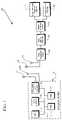
- FIG. 1shows a block diagram of an exemplary wireless modem and an exemplary wireless communication system in accordance with one embodiment of the invention.
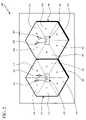
- FIG. 2shows an illustrative representation of a two cell array in a wireless communication system used to illustrate example implementations of the invention.
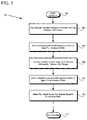
- FIG. 3is a flow chart for a process of selecting the highest signal to interference ratio in accordance with one embodiment of the invention.
- the present inventionis directed to method and system for utilizing polarization reuse in wireless communications.
- the principles of the invention, as defined by the claims appended herein,can obviously be applied beyond the embodiments of the description described specifically herein.
- certain detailshave been left out in order to not obscure the inventive aspects of the invention.
- the specific details not described in the present applicationare within the knowledge of a person of ordinary skill in the art.
- FIG. 1illustrates an exemplary wireless communication system in accordance with one embodiment.
- Exemplary wireless communication system 100 shown in FIG. 1can comprise, for example, part of a code division multiple access (“CDMA”) communication system.
- system 100can be a frequency division multiple access (“FDMA”) system, a time division multiple access (“TDMA”) system, a wideband code division multiple access (“WCDMA”), a high data rate (“HDR”) system, or in general any wireless communication system employing a combination of CDMA, TDMA, and/or FDMA techniques.
- CDMAcode division multiple access
- TDMAtime division multiple access
- WCDMAwideband code division multiple access
- HDRhigh data rate
- the present inventionis discussed in relation to a CDMA communication system.
- the inventioncan be used in other communications systems as stated above.
- the general principles of CDMA communication systems, and in particular the general principles for generation of spread spectrum signals for transmission over a communication channelis described in U.S. Pat. No. 4,901,307 entitled “Spread Spectrum Multiple Access Communication System Using Satellite or Terrestrial Repeaters” and assigned to the assignee of the present invention.
- the disclosure in that parent, i.e. U.S. Pat. No. 4,901,307,is hereby fully incorporated by reference into the present application.
- exemplary wireless communication system 100which can be a CDMA communication system, comprises components typically found in wireless communication systems, including a wireless access terminal such as wireless modem 110 , base transceiver station (“BTS”) 134 , base station controller (“BSC”) 136 , mobile switching center (“MSC”) 138 , public switched telephone network (“PSTN”) 140 , and Internet service provider (“ISP”) 142 .
- BTS 134which is also referred to as a “base station” in the present application, serves as a radio link between the wireless access terminal, e.g. wireless modem 110 , and the rest of the system.
- BTS 134comprises vertically polarized BTS antenna 130 , which is configured to transmit and receive vertically polarized radio signals, and horizontally polarized BTS antenna 132 , which is configured to transmit and receive horizontally polarized radio signals.
- a vertically polarized antennasuch as vertically polarized BTS antenna 130
- horizontally polarized antennasuch as horizontally polarized BTS antenna 132
- BTS 134can comprise a right hand circular polarized antenna and a left hand circular polarized antenna configured to transmit and receive circular polarized radio signals.
- connections between BTS 134 , BSC 136 , MSC 138 , PSTN 140 , and ISP 142can be wired, wireless, or both.
- Wireless modem 110 in FIG. 1includes, among other components which are not shown in FIG. 1 , central processing unit (“CPU”) 112 , read only memory module (“ROM”) 114 , flash memory module 116 , random access memory module (“RAM”) 118 , and transmitter and receiver 120 .
- bus 122couples CPU 112 , ROM 114 , flash memory module 116 , RAM 118 , and transmitter and receiver 120 .
- wireless modem 110comprises vertically polarized modem antenna 124 and horizontally polarized modem antenna 126 .
- Wireless modem 110can comprise a right hand circular polarized antenna and a left hand circular polarized antenna configured to receive and transmit circular polarized radio signals. It is noted that wireless modem 110 is also referred to as a “polarized reception system” in the present application.
- communication between wireless modem 110 and BTS 134is achieved by the transmission and reception of polarized radio signals.
- BTS 134can communicate with wireless modem 110 by using vertically polarized BTS antenna 130 to transmit vertically polarized radio signals that are received by vertically polarized modem antenna 124 .
- communication between wireless modem 110 and BTS 134could involve horizontally polarized BTS antenna 132 transmitting a horizontally polarized radio signal that is received by horizontally polarized modem antenna 126 .
- PSTN 140refers to a conventional wireline telephone network
- ISP 142refers to services providing access to the Internet.
- Data and voice information provided by ISP 142 and PSTN 140can be communicated to wireless modem 110 by being routed through MSC 138 , BSC 136 , and BTS 134 .
- MSC 138functions generally as a switch between the wireless network and PSTN 140 and ISP 142 , while the role of BSC 136 , among others, is to manage the signal transmission power of BTS 134 .
- Internet datacan be communicated to wireless modem 110 by being routed from ISP 142 through MSC 138 , BSC 136 , and to BTS 134 in order for BTS 134 to transmit the data to wireless modem 110 as radio frequency signals on both vertically polarized BTS antenna 130 and horizontally polarized BTS antenna 132 in a manner known in the art.
- BTS 134can, for example, transmit radio frequency signals as vertically polarized radio signals transmitted by vertically polarized BTS antenna 130 that are generally received by vertically polarized modem antenna 124 .
- the radio frequency signalsare demodulated by transmitter and receiver 120 and the information extracted at wireless modem 110 . Communication between ISP 142 and wireless modem 110 is thereby completed.
- FIG. 1shows a block diagram of an exemplary wireless communication system in which communication between a base transceiver station and a wireless modem is accomplished by means of polarized radio signals.
- FIG. 2illustrates a two cell array in a wireless communication system in accordance with one embodiment.
- Cell array 200 shown in FIG. 2comprises a geographical region in a wireless communication system, which can be, for example, a CDMA communication system.
- Cell array 200comprises cell 210 and cell 240 which are defined by solid lines and shown as hexagons in FIG. 2 .
- cell 210is divided into six sectors, which are sector 214 , sector 216 , sector 218 , sector 220 , sector 222 , and sector 224 .
- Sectors 214 , 216 , 218 , 220 , 222 , and 224are defined by dashed lines in FIG. 2 .
- cell 240comprises six sectors, which are sectors 244 , 246 , 248 , 250 , 252 , and 254 which are also defined by dashed lines.
- sectors 244 , 246 , 248 , 250 , 252 , and 254which are also defined by dashed lines.
- cell 210 of cell array 200comprises base transceiver station (“BTS”) 230 positioned at the center of cell 210 .
- BTS 230is equipped with vertically polarized BTS antenna 232 and horizontally polarized BTS antenna 234 .
- Vertically polarized BTS antenna 232is configured to transmit and receive vertically polarized radio signals
- horizontally polarized BTS antenna 234is configured to transmit and receive horizontally polarized radio signals.
- BTS 230can communicate with wireless access terminals in cell array 200 using polarized radio signals.
- Wireless access terminalsare not shown in FIG. 2 , but can be, for example, a wireless modem such as wireless modem 110 shown in FIG. 1 .
- BTS 230is a sectorized base transceiver station.
- BTS 230continuously broadcasts a pilot signal in each sector of cell 210 on the polarization designated for that particular sector.
- BTS 230utilizes vertically polarized BTS antenna 232 to transmit vertically polarized pilot signals to sectors 216 , 220 and 224 and utilizes horizontally polarized BTS antenna 234 to transmit horizontally polarized pilot signals to sectors 214 , 218 and 222 .
- data from BTS 230is transmitted in frames where each data frame contains an initial pilot sequence as well as a subsequent message data sequence. As an example, the initial pilot sequence may take up approximately 5% of the entire data frame.
- the pilot sequenceis generally a known data sequence recognizable to a receiving wireless access terminal.
- a receiving wireless access terminalcan use the data sequence contained in a pilot signal to identify the particular sector and base transceiver station transmitting the particular pilot signal.
- a wireless access terminalsuch as wireless modem 110 in FIG. 1 , equipped with both vertically and horizontally polarized antennas would have the capability to receive both vertically and horizontally polarized pilot signals transmitted by BTS 230 .
- BTS 260Base transceiver station 260
- BTS 260is situated at the center of cell 210 and comprises vertically polarized BTS antenna 262 and horizontally polarized BTS antenna 264 which are configured to transmit and receive, respectively, vertically and horizontally polarized radio signals.
- BTS 260is a sectorized base transceiver station which continuously broadcasts a pilot signal to each sector of cell 240 on the polarization assigned to that sector.
- BTS 260utilizes vertically polarized BTS antenna 262 to transmit vertically polarized pilot signals to sectors 244 , 248 and 252 and utilizes horizontally polarized BTS antenna 264 to transmit horizontally polarized pilot signals to sectors 246 , 250 and 254 .
- the pilot signals transmitted by BTS 260can be received by wireless access terminals in cell array 200 equipped with vertically and horizontally polarized antennas.
- a wireless access terminalcan use, for example, the unique data sequence contained in the pilot signals it receives to identify a particular sector and base transceiver station transmitting a particular pilot signal.
- FIG. 2thus illustrates a two cell array in an exemplary communication system wherein base transceiver stations situated at the center of the cells are equipped with polarized antennas to transmit polarized pilot signals in each sector.
- the pilot signalsare received by wireless access terminals which utilize a unique data sequence contained in the pilot signals in order to identify the particular sector and base transceiver station transmitting the pilot signal.
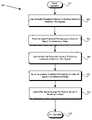
- flow chart 300illustrates an example method for selecting a pilot signal having a highest signal to interference ratio in accordance with one embodiment.
- the signal to interference ratiois a quantification of the power of the desired signal to interference signals.
- the signal to interference ratiotherefore indicates the signal quality of the received data signal.
- the process illustrated in flow chart 300 in FIG. 3describes the process as performed by a wireless access terminal in a wireless communication system, which can be, for example, a CDMA communication system.
- the process shown in flow chart 300is described in the context of wireless modem 110 in FIG. 1 and exemplary cell array 200 in FIG. 2 . As such, it is manifest that the process illustrated in flow chart 300 can be practiced by an access terminal other than wireless modem 110 and in a wireless environment other than cell array 200 .
- Flow chart 300illustrates the process of selecting a pilot signal having a highest signal to interference ratio beginning at step 302 .
- the processcontinues at step 304 where a wireless access terminal using a vertically polarized antenna receives vertically polarized pilot signals transmitted by base transceiver stations situated throughout the wireless communication system.
- wireless modem 110can use vertically polarized modem antenna 124 to receive vertically polarized pilot signals transmitted by vertically polarized BTS antenna 232 and vertically polarized BTS antenna 262 .
- vertically polarized modem antenna 124may receive vertically polarized pilot signals transmitted throughout cell array 200 , i.e. vertically polarized pilot signals transmitted by both vertically polarized BTS antenna 232 and vertically polarized BTS antenna 262 .
- vertically polarized modem antenna 124may not receive all of the vertically polarized pilot signals transmitted by vertically polarized BTS antenna 232 and vertically polarized BTS antenna 262 , depending on, for example, the power of the transmission, as well as the distance and terrain between vertically polarized modem antenna 124 and vertically polarized BTS antennas 232 and 262 .
- radio signalslose their power over distance and can also be reflected by obstacles such as hills, buildings, and trees in their paths.
- the radio signals containing the pilot signalsreach vertically polarized modem antenna 124 , some of the pilot signals may be too weak to be received.
- vertically polarized modem antenna 124receives the various pilot signals at different reception power or signal to interference ratios.
- the information signalcan comprise, for example, a data sequence which identifies the base transceiver station and the sector transmitting the pilot signals. The steps involved in the demodulation of radio signals is generally known in the art.
- the vertically polarized pilot signals received by vertically polarized modem antenna 124 at wireless modem 110are ranked by their signal to interference ratios.
- Ranking of vertically polarized pilot signals by their signal to interference ratiosinvolves measuring the signal quality of each pilot signal received, comparing the signal quality of the pilot signals to one another, and ordering the pilot signals by their signal to interference ratios.
- Ranking of vertically polarized pilot signals by their signal to interference ratiocan be performed, for example, by software running on CPU 112 .
- the rankingcan be stored, for example, in flash memory 116 .
- wireless modem 110switches from vertically polarized modem antenna 124 to horizontally polarized modem antenna 126 in order to receive horizontally polarized pilot signals.
- the horizontally polarized pilot signalsare transmitted continuously by horizontally polarized BTS antennas 234 and 264 in cell array 200 .
- horizontally polarized modem antenna 126may receive horizontally polarized pilot signals form throughout cell array 200 .
- the horizontally polarized pilot signalsare received by horizontally polarized modem antenna 126 at different signal to interference ratios, depending on, for example, the distance and type of terrain between horizontally polarized modem antenna 126 and the horizontally polarized BTS antennas transmitting the pilot signals.
- the horizontally polarized pilot signals received by horizontally polarized modem antenna 126are ranked by their signal to interference ratios.
- the ranking of horizontally polarized pilot signalscan involve, for example, measuring the signal quality of each pilot signal, comparing the signal quality of the pilot signals, and ordering the pilot signals in sequence of their signal to interference ratios.
- Ranking horizontally polarized pilot signals by their signal to interference ratiocan be performed, for example, by software running on CPU 112 .
- the rankingcan be stored, for example, in flash memory 116 .
- the ranking of vertically polarized pilot signalsis compared to the ranking of horizontally polarized pilot signals.
- the pilot signal having the highest signal to interference ratio overallcan be selected.
- the signal to interference ratio for a pilot signalindicates the signal quality of the initial pilot sequence in a data frame as well as the signal quality of the message data sequence in the data frame received from the base transceiver station on the particular sector transmitting the pilot signal.
- the operation for selecting a pilot signal having the highest signal to interference ratiothen ends at step 314 .
- wireless modem 110uses the information contained in the pilot signal to identify and select the sector and base transceiver station transmitting the pilot signal.
- Wireless modem 110sends an identification signal (“ID signal”) to the base transceiver station transmitting the pilot signal.
- ID signalcan be, for example, an electronic serial number unique to wireless modem 110 which identifies wireless modem 110 to the base transceiver station.
- the ID signalinforms the particular base transceiver station that wireless modem 110 has selected to communicate with that station on the particular sector which wireless modem 110 has determined to have the highest signal quality. It is noted that the ID signal is also referred to as a “sector identification” in the present application.
- flow chart 300 in FIG. 3illustrates a process for selecting a pilot signal having the highest signal to interference ratio and communicating with the sector and base transceiver station transmitting the pilot signal having the highest signal to interference ratio so as to improve signal reception quality in accordance with one embodiment.
- the steps shown in flow chart 300 to receive and rank pilot signals, and thereafter communicate with a selected base station on a sector having the highest quality signalare repeated periodically, such as every few days.
- the reasonis that due to terrain changes, for example changes in the configuration of obstacles such as buildings and trees in the signal path, it is necessary to periodically determine whether a different base transceiver station and/or a different sector should be used for communication with wireless modem 110 .
- the present exampleuses the signal to interference ratio as the signal quality measurement for ranking and selecting pilot signals, it is manifest that other signal quality measurements can be used. For example, a signal to noise ratio measurement can also be used.
- the present applicationwas discussed in relation to vertically polarized and horizontally polarized signals, the invention can also be used with right hand circular polarized and left hand circular polarized signals.
- a wireless access terminalsuch as wireless modem 110 , utilizes the process set forth in FIG. 3 to receive and select a polarized pilot signal having a highest signal to interference ratio. Subsequently, the wireless access terminal communicates with a number of sectors corresponding to one or more base transceiver stations on the same polarization as the polarization of the pilot signal providing the highest signal to interference ratio. Each of the sectors of the one or more base transceiver stations would be configured to transmit on the same polarization as the polarization of the pilot signal.
- the wireless access terminalwould communicate with a number of “vertically polarized sectors” in one or more base transceiver stations by means of vertically polarized radio signals.
- the vertically polarized signals from the base transceiver stationsare received and then combined to generate diversity.
- the present inventionis a system and method for “polarization reuse.”
- polarization reuseinvolves allocating orthogonal polarizations to adjacent sectors, rather than allocating different frequencies to adjacent sectors.
- interference between various sectorsis reduced because their signals are polarized perpendicularly to one another.
- One advantage of polarization reuse described aboveis that it increases the overall system capacity without requiring the allocation of more frequencies.
- DSPdigital signal processor
- ASICapplication specific integrated circuit
- FPGAfield programmable gate array
- a general purpose processormay be a microprocessor, but in the alternative, the processor may be any conventional processor, controller, microcontroller, or state machine.
- a processormay also be implemented as a combination of computing devices, e.g., a combination of a DSP and a microprocessor, a plurality of microprocessors, one or more microprocessors in conjunction with a DSP core, or any other such configuration.
- a software modulemay reside in RAM memory, flash memory, ROM memory, EPROM memory, EEPROM memory, registers, hard disk, a removable disk, a CD-ROM, or any other form of storage medium known in the art.
- An exemplary storage mediumis coupled to the processor such that the processor can read information from, and write information to, the storage medium.
- the storage mediummay be integral to the processor.
- the processor and the storage mediummay reside in an Application Specific Integrated Circuit (“ASIC”).
- the ASICmay reside in a wireless modem.
- the processor and the storage mediummay reside as discrete components in the wireless modem.
- the access terminali.e. wireless modem 110
- the access terminalhas a single receiver.
- a single receiver within transmitter and receiver module 120must be switched between the different wireless modem antennas, such as vertically polarized antenna 124 and horizontally polarized antenna 126 , so that wireless modem 110 can receive and rank the highest signal to interference ratio as described above.
- the access terminalwould have a dedicated receiver for each antenna. In that embodiment, the dedicated receivers are not switched between the various antennas of the access terminal.
- the polarization reuse technique of the present inventioncan be employed in addition to the conventional frequency reuse. It is also noted that the invention can be used in a MIMO (“multiple input multiple output”) system where multiple transmit antennas and multiple receive antennas are used by the communication channel to carry multiple streams of user data. Therefore, the present invention is not intended to be limited to the embodiments shown herein but is to be accorded the widest scope consistent with the principles and novel features disclosed herein.
Landscapes
- Engineering & Computer Science (AREA)
- Computer Networks & Wireless Communication (AREA)
- Signal Processing (AREA)
- Quality & Reliability (AREA)
- Mobile Radio Communication Systems (AREA)
- Monitoring And Testing Of Transmission In General (AREA)
- Optical Communication System (AREA)
- Transmitters (AREA)
Abstract
Description
1. Field
The present invention generally relates to the field of wireless communication systems, and more specifically to techniques using antenna polarization in wireless communication system.
2. Background
In wireless communication systems several users share a common communication channel. To avoid interference arising from several users transmitting information over the communication channel at the same time, some form of allocation of the available channel is required. Allocation of user access to the communication channel can be achieved by various forms of multiple access protocols, such as code division multiple access (CDMA). In CDMA systems, also referred to as “spread spectrum” systems, each signal is separated from those of other users by coding the signal. Each user uniquely encodes its information signal into a transmission signal. The intended receiver, knowing the code sequences of the user, can decode the transmission signal to receive the information.
A technique for increasing the signal to interference ratio, analogous to what is utilized in FDMA (“Frequency Division Multiple Access”) wireless communication systems, is to use different frequencies in different cells, or even in different sectors within a cell in order to increase signal to interference ratio. For example, a cell can be divided into three sectors, each assigned a different frequency. The same frequencies can be similarly allocated in other cells in the system, which is known as frequency reuse. Where adjacent sectors are allocated different frequencies the interference between their signals is reduced, and the signal to interference ratio for users in the two adjacent sectors is increased. Therefore, the sectors' capacity is increased with frequency reuse, but the disadvantage is that frequency reuse necessitates using more frequencies.
It would be desirable to further increase signal to interference ratios in wireless communication systems as a means to enhance and complement the presently known approaches of using different frequencies to increase signal to interference ratio at a receiver terminal. It is also further desirable to achieve an increased signal to interference ratio at the receiver terminal without expending a large amount of system bandwidth.
Embodiments disclosed herein address the above stated needs by using polarization of radio signals as an additional resource to enhance and complement presently known approaches to channel allocation in order to further increase signal to interference ratios at a receiver terminal. Polarization of radio signals as a means for increasing signal to interference ratios requires minimal expenditure of additional system resources such as the allocation of more frequencies.
In one aspect of the invention, a wireless access terminal receives a first plurality of pilot signals of a first polarization, which can be, for example, vertical polarization. The pilot signals contain a data sequence which can be used to identify the sector and/or base transceiver station transmitting the pilot signals. Subsequently, the first plurality of pilot signals is ranked. Thereafter, a second plurality of pilot signals is received of a second polarization, which can be, for example, horizontal polarization, and the second plurality of pilot signals is ranked.
Following, a pilot signal from the first and second pluralities of pilot signals received and ranked is selected based on a signal quality measurement. The signal quality measurement can be, for example, a signal to interference ratio. After a pilot signal providing the highest signal quality measurement is selected, the wireless terminal communicates with that sector or base station.
In another aspect, a system can be constructed comprising antennas configured to receive orthogonally polarized pilot signals. The system further comprises a receiver configured to demodulate the pilot signals and a CPU configured to rank the pilot signals and to select a pilot signal based on a signal quality measurement. The signal quality measurement can be, for example, a signal to interference ratio.
The present invention is directed to method and system for utilizing polarization reuse in wireless communications. Although the invention is described with respect to specific embodiments, the principles of the invention, as defined by the claims appended herein, can obviously be applied beyond the embodiments of the description described specifically herein. Moreover, certain details have been left out in order to not obscure the inventive aspects of the invention. The specific details not described in the present application are within the knowledge of a person of ordinary skill in the art.
The drawings in the present application and their accompanying detailed description are directed to merely example embodiments of the invention. To maintain brevity, other embodiments of the invention that use the principles of the present invention are not specifically described in the present application and are not specifically illustrated by the present drawings. The word “exemplary” is used exclusively herein to mean “serving as an example, instance, or illustration.” Any embodiment described herein as “exemplary” is not necessarily to be construed as preferred or advantageous over other embodiments.
By way of a specific example, the present invention is discussed in relation to a CDMA communication system. However, it is understood that the invention can be used in other communications systems as stated above. The general principles of CDMA communication systems, and in particular the general principles for generation of spread spectrum signals for transmission over a communication channel is described in U.S. Pat. No. 4,901,307 entitled “Spread Spectrum Multiple Access Communication System Using Satellite or Terrestrial Repeaters” and assigned to the assignee of the present invention. The disclosure in that parent, i.e. U.S. Pat. No. 4,901,307, is hereby fully incorporated by reference into the present application. Moreover, U.S. Pat. No. 5,103,459 entitled “System and Method for Generating Signal Waveforms in a CDMA Cellular Telephone System” and assigned to the assignee of the present invention, discloses principles related to PN spreading, Walsh covering, and techniques to generate CDMA spread spectrum communication signals. The disclosure in that patent, i.e. U.S. Pat. No. 5,103,459, is also hereby fully incorporated by reference into the present application. Further, the present invention utilizes time multiplexing of data and various principles related to “high data rate” communication systems, and the present invention can be used in “high data rate” communication systems, such as that disclosed in U.S. patent application entitled “Method and Apparatus for High Rate Packet Data Transmission” Ser. No. 08/963,386 filed on Nov. 3, 1997, and assigned to the assignee of the present invention. The disclosure in that patent application is also hereby fully incorporated by reference into the present application.
Continuing withFIG. 1 , exemplarywireless communication system 100, which can be a CDMA communication system, comprises components typically found in wireless communication systems, including a wireless access terminal such aswireless modem 110, base transceiver station (“BTS”)134, base station controller (“BSC”)136, mobile switching center (“MSC”)138, public switched telephone network (“PSTN”)140, and Internet service provider (“ISP”)142. Inwireless communication system 100, BTS134, which is also referred to as a “base station” in the present application, serves as a radio link between the wireless access terminal, e.g.wireless modem 110, and the rest of the system.
As illustrated inFIG. 1 ,BTS 134 comprises vertically polarizedBTS antenna 130, which is configured to transmit and receive vertically polarized radio signals, and horizontally polarizedBTS antenna 132, which is configured to transmit and receive horizontally polarized radio signals. By way of background, a vertically polarized antenna, such as verticallypolarized BTS antenna 130, has an electric field perpendicular to the earth's surface while a horizontally polarized antenna, such as horizontally polarizedBTS antenna 132, has an electric field parallel to the earth's surface. In a different embodiment,BTS 134 can comprise a right hand circular polarized antenna and a left hand circular polarized antenna configured to transmit and receive circular polarized radio signals. By way of background, in a circular polarized antenna, the plane of polarization rotates in a circle, making one complete revolution during one period of the radio wave. If the rotation is clockwise looking in the direction of propagation, the sense is called right hand circular. If the rotation is counterclockwise, the sense is called left hand circular. Referring back toFIG. 1 , connections betweenBTS 134,BSC 136,MSC 138,PSTN 140, andISP 142 can be wired, wireless, or both.
In accordance with the present embodiment, communication betweenwireless modem 110 andBTS 134 is achieved by the transmission and reception of polarized radio signals. For example,BTS 134 can communicate withwireless modem 110 by using vertically polarizedBTS antenna 130 to transmit vertically polarized radio signals that are received by vertically polarizedmodem antenna 124. Similarly, communication betweenwireless modem 110 andBTS 134 could involve horizontally polarizedBTS antenna 132 transmitting a horizontally polarized radio signal that is received by horizontally polarizedmodem antenna 126.
Continuing withFIG. 1 ,PSTN 140 refers to a conventional wireline telephone network, andISP 142 refers to services providing access to the Internet. Data and voice information provided byISP 142 andPSTN 140 can be communicated towireless modem 110 by being routed throughMSC 138,BSC 136, andBTS 134.MSC 138 functions generally as a switch between the wireless network andPSTN 140 andISP 142, while the role ofBSC 136, among others, is to manage the signal transmission power ofBTS 134. For example, Internet data can be communicated towireless modem 110 by being routed fromISP 142 throughMSC 138,BSC 136, and toBTS 134 in order forBTS 134 to transmit the data towireless modem 110 as radio frequency signals on both vertically polarizedBTS antenna 130 and horizontally polarizedBTS antenna 132 in a manner known in the art.
Referring again toFIG. 2 ,cell 210 ofcell array 200 comprises base transceiver station (“BTS”)230 positioned at the center ofcell 210. In accordance with the present embodiment,BTS 230 is equipped with vertically polarizedBTS antenna 232 and horizontally polarizedBTS antenna 234. Verticallypolarized BTS antenna 232 is configured to transmit and receive vertically polarized radio signals, and horizontally polarizedBTS antenna 234 is configured to transmit and receive horizontally polarized radio signals. Utilizing vertically polarizedBTS antenna 232 and horizontally polarizedBTS antenna 234,BTS 230 can communicate with wireless access terminals incell array 200 using polarized radio signals. Wireless access terminals are not shown inFIG. 2 , but can be, for example, a wireless modem such aswireless modem 110 shown inFIG. 1 .
In accordance with one embodiment,BTS 230 is a sectorized base transceiver station.BTS 230 continuously broadcasts a pilot signal in each sector ofcell 210 on the polarization designated for that particular sector.BTS 230 utilizes vertically polarizedBTS antenna 232 to transmit vertically polarized pilot signals tosectors BTS antenna 234 to transmit horizontally polarized pilot signals tosectors BTS 230 is transmitted in frames where each data frame contains an initial pilot sequence as well as a subsequent message data sequence. As an example, the initial pilot sequence may take up approximately 5% of the entire data frame. The pilot sequence is generally a known data sequence recognizable to a receiving wireless access terminal. A receiving wireless access terminal can use the data sequence contained in a pilot signal to identify the particular sector and base transceiver station transmitting the particular pilot signal. A wireless access terminal such aswireless modem 110 inFIG. 1 , equipped with both vertically and horizontally polarized antennas would have the capability to receive both vertically and horizontally polarized pilot signals transmitted byBTS 230.
Continuing withFIG. 2 ,cell 240 is organized similarly tocell 210. Base transceiver station260 (“BTS 260”) is situated at the center ofcell 210 and comprises vertically polarizedBTS antenna 262 and horizontally polarizedBTS antenna 264 which are configured to transmit and receive, respectively, vertically and horizontally polarized radio signals.BTS 260 is a sectorized base transceiver station which continuously broadcasts a pilot signal to each sector ofcell 240 on the polarization assigned to that sector.BTS 260 utilizes vertically polarizedBTS antenna 262 to transmit vertically polarized pilot signals tosectors BTS antenna 264 to transmit horizontally polarized pilot signals tosectors BTS 260 can be received by wireless access terminals incell array 200 equipped with vertically and horizontally polarized antennas. A wireless access terminal can use, for example, the unique data sequence contained in the pilot signals it receives to identify a particular sector and base transceiver station transmitting a particular pilot signal.
It is noted that even thoughcells FIG. 2 as discretely defined areas, a person skilled in the art would appreciate that the radio frequency coverage area for a cell or sector commonly overlaps into adjacent cells and/or sectors. Therefore, a wireless access terminal, particularly one situated near the boundaries between adjacent cells and/or sectors, may receive signals from different cells and sectors.FIG. 2 thus illustrates a two cell array in an exemplary communication system wherein base transceiver stations situated at the center of the cells are equipped with polarized antennas to transmit polarized pilot signals in each sector. In one embodiment, the pilot signals are received by wireless access terminals which utilize a unique data sequence contained in the pilot signals in order to identify the particular sector and base transceiver station transmitting the pilot signal.
Referring toFIG. 3 ,flow chart 300 illustrates an example method for selecting a pilot signal having a highest signal to interference ratio in accordance with one embodiment. The signal to interference ratio is a quantification of the power of the desired signal to interference signals. The signal to interference ratio therefore indicates the signal quality of the received data signal. The process illustrated inflow chart 300 inFIG. 3 describes the process as performed by a wireless access terminal in a wireless communication system, which can be, for example, a CDMA communication system. For illustrative purposes, the process shown inflow chart 300 is described in the context ofwireless modem 110 inFIG. 1 andexemplary cell array 200 inFIG. 2 . As such, it is manifest that the process illustrated inflow chart 300 can be practiced by an access terminal other thanwireless modem 110 and in a wireless environment other thancell array 200.
As discussed above, because signals in one sector or cell commonly overlap into nearby cells and sectors, vertically polarizedmodem antenna 124 may receive vertically polarized pilot signals transmitted throughoutcell array 200, i.e. vertically polarized pilot signals transmitted by both vertically polarizedBTS antenna 232 and vertically polarizedBTS antenna 262. At the same time, vertically polarizedmodem antenna 124 may not receive all of the vertically polarized pilot signals transmitted by vertically polarizedBTS antenna 232 and vertically polarizedBTS antenna 262, depending on, for example, the power of the transmission, as well as the distance and terrain between vertically polarizedmodem antenna 124 and vertically polarizedBTS antennas
As is known in the art, radio signals lose their power over distance and can also be reflected by obstacles such as hills, buildings, and trees in their paths. Thus, when the radio signals containing the pilot signals reach vertically polarizedmodem antenna 124, some of the pilot signals may be too weak to be received. Furthermore, because the various pilot signals travel different paths to reachwireless modem 110, vertically polarizedmodem antenna 124 receives the various pilot signals at different reception power or signal to interference ratios. Once the pilot signals are received bywireless modem 110, they can be demodulated by a receiver module in transmitter andreceiver 120 in order to extract the information in the pilot signals. The information signal can comprise, for example, a data sequence which identifies the base transceiver station and the sector transmitting the pilot signals. The steps involved in the demodulation of radio signals is generally known in the art.
Atstep 306, the vertically polarized pilot signals received by vertically polarizedmodem antenna 124 atwireless modem 110 are ranked by their signal to interference ratios. Ranking of vertically polarized pilot signals by their signal to interference ratios involves measuring the signal quality of each pilot signal received, comparing the signal quality of the pilot signals to one another, and ordering the pilot signals by their signal to interference ratios. Ranking of vertically polarized pilot signals by their signal to interference ratio can be performed, for example, by software running onCPU 112. The ranking can be stored, for example, inflash memory 116.
Continuing withflow chart 300, atstep 308,wireless modem 110 switches from vertically polarizedmodem antenna 124 to horizontally polarizedmodem antenna 126 in order to receive horizontally polarized pilot signals. The horizontally polarized pilot signals are transmitted continuously by horizontally polarizedBTS antennas cell array 200. And because radio signals can overlap into nearby cells and sectors, as discussed above, horizontally polarizedmodem antenna 126 may receive horizontally polarized pilot signals form throughoutcell array 200. The horizontally polarized pilot signals are received by horizontally polarizedmodem antenna 126 at different signal to interference ratios, depending on, for example, the distance and type of terrain between horizontallypolarized modem antenna 126 and the horizontally polarized BTS antennas transmitting the pilot signals.
Atstep 310, the horizontally polarized pilot signals received by horizontally polarizedmodem antenna 126 are ranked by their signal to interference ratios. As with ranking of vertically polarized pilot signals atstep 306, the ranking of horizontally polarized pilot signals can involve, for example, measuring the signal quality of each pilot signal, comparing the signal quality of the pilot signals, and ordering the pilot signals in sequence of their signal to interference ratios. Ranking horizontally polarized pilot signals by their signal to interference ratio can be performed, for example, by software running onCPU 112. The ranking can be stored, for example, inflash memory 116.
Atstep 312, the ranking of vertically polarized pilot signals is compared to the ranking of horizontally polarized pilot signals. By comparing the two groups of rankings, the pilot signal having the highest signal to interference ratio overall can be selected. The signal to interference ratio for a pilot signal indicates the signal quality of the initial pilot sequence in a data frame as well as the signal quality of the message data sequence in the data frame received from the base transceiver station on the particular sector transmitting the pilot signal. The operation for selecting a pilot signal having the highest signal to interference ratio then ends atstep 314.
After the pilot signal having the highest signal to interference ratio has been selected,wireless modem 110 uses the information contained in the pilot signal to identify and select the sector and base transceiver station transmitting the pilot signal.Wireless modem 110 sends an identification signal (“ID signal”) to the base transceiver station transmitting the pilot signal. The ID signal can be, for example, an electronic serial number unique towireless modem 110 which identifieswireless modem 110 to the base transceiver station. The ID signal informs the particular base transceiver station thatwireless modem 110 has selected to communicate with that station on the particular sector whichwireless modem 110 has determined to have the highest signal quality. It is noted that the ID signal is also referred to as a “sector identification” in the present application. Communications betweenwireless modem 110 and the selected base transceiver station on the selected sector are then performed using the same polarization as the polarization of the pilot signal having the highest signal to interference ratio. Thus,flow chart 300 inFIG. 3 illustrates a process for selecting a pilot signal having the highest signal to interference ratio and communicating with the sector and base transceiver station transmitting the pilot signal having the highest signal to interference ratio so as to improve signal reception quality in accordance with one embodiment.
The steps shown inflow chart 300 to receive and rank pilot signals, and thereafter communicate with a selected base station on a sector having the highest quality signal are repeated periodically, such as every few days. The reason is that due to terrain changes, for example changes in the configuration of obstacles such as buildings and trees in the signal path, it is necessary to periodically determine whether a different base transceiver station and/or a different sector should be used for communication withwireless modem 110. It is noted that although the present example uses the signal to interference ratio as the signal quality measurement for ranking and selecting pilot signals, it is manifest that other signal quality measurements can be used. For example, a signal to noise ratio measurement can also be used. It is also noted that although the present application was discussed in relation to vertically polarized and horizontally polarized signals, the invention can also be used with right hand circular polarized and left hand circular polarized signals.
In another embodiment which is not illustrated in any of the Figures in the present application, a wireless access terminal, such aswireless modem 110, utilizes the process set forth inFIG. 3 to receive and select a polarized pilot signal having a highest signal to interference ratio. Subsequently, the wireless access terminal communicates with a number of sectors corresponding to one or more base transceiver stations on the same polarization as the polarization of the pilot signal providing the highest signal to interference ratio. Each of the sectors of the one or more base transceiver stations would be configured to transmit on the same polarization as the polarization of the pilot signal. For example, if the pilot signal having the highest signal to interference ratio is received on a vertically polarized antenna, the wireless access terminal would communicate with a number of “vertically polarized sectors” in one or more base transceiver stations by means of vertically polarized radio signals. In this embodiment, the vertically polarized signals from the base transceiver stations are received and then combined to generate diversity.
In its various embodiments, the present invention is a system and method for “polarization reuse.” As discussed in the present application, polarization reuse involves allocating orthogonal polarizations to adjacent sectors, rather than allocating different frequencies to adjacent sectors. Using the polarization reuse system and method described above, interference between various sectors is reduced because their signals are polarized perpendicularly to one another. One advantage of polarization reuse described above is that it increases the overall system capacity without requiring the allocation of more frequencies.
Those of skill in the art would understand that information and signals may be represented using any of a variety of different technologies and techniques. For example, data, instructions, commands, information, signals, bits, symbols, and chips that may be referenced throughout the above description may be represented by voltages, currents, electromagnetic waves, magnetic fields or particles, optical fields or particles, or any combination thereof.
Those of skill would further appreciate that the various illustrative logical blocks, modules, circuits, and algorithm steps described in connection with the embodiments disclosed herein may be implemented as electronic hardware, computer software, or combinations of both. To clearly illustrate this interchangeability of hardware and software, various illustrative components, blocks, modules, circuits, and steps have been described above generally in terms of their functionality. Whether such functionality is implemented as hardware or software depends upon the particular application and design constraints imposed on the overall system. Skilled artisans may implement the described functionality in varying ways for each particular application, but such implementation decisions should not be interpreted as causing a departure from the scope of the present invention.
The various illustrative logical blocks, modules, and circuits described in connection with the embodiments disclosed herein may be implemented or performed with a general purpose processor, a digital signal processor (DSP), an application specific integrated circuit (ASIC), a field programmable gate array (FPGA) or other programmable logic device, discrete gate or transistor logic, discrete hardware components, or any combination thereof designed to perform the functions described herein. A general purpose processor may be a microprocessor, but in the alternative, the processor may be any conventional processor, controller, microcontroller, or state machine. A processor may also be implemented as a combination of computing devices, e.g., a combination of a DSP and a microprocessor, a plurality of microprocessors, one or more microprocessors in conjunction with a DSP core, or any other such configuration.
The steps of a method or algorithm described in connection with the embodiments disclosed herein may be embodied directly in hardware, in a software module executed by a processor, or in a combination of the two. A software module may reside in RAM memory, flash memory, ROM memory, EPROM memory, EEPROM memory, registers, hard disk, a removable disk, a CD-ROM, or any other form of storage medium known in the art. An exemplary storage medium is coupled to the processor such that the processor can read information from, and write information to, the storage medium. In the alternative, the storage medium may be integral to the processor. The processor and the storage medium may reside in an Application Specific Integrated Circuit (“ASIC”). The ASIC may reside in a wireless modem. In the alternative, the processor and the storage medium may reside as discrete components in the wireless modem.
The previous description of the disclosed embodiments is provided to enable any person skilled in the art to make or use the present invention. Various modifications to these embodiments will be readily apparent to those skilled in the art, and the principles defined herein may be applied to other embodiments without departing from the spirit or scope of the invention. For example, in the embodiment of the invention described above, the access terminal, i.e.wireless modem 110, has a single receiver. In this embodiment, a single receiver within transmitter andreceiver module 120 must be switched between the different wireless modem antennas, such as verticallypolarized antenna 124 and horizontallypolarized antenna 126, so thatwireless modem 110 can receive and rank the highest signal to interference ratio as described above. In an alternative embodiment, the access terminal would have a dedicated receiver for each antenna. In that embodiment, the dedicated receivers are not switched between the various antennas of the access terminal.
It is noted that in one embodiment, the polarization reuse technique of the present invention can be employed in addition to the conventional frequency reuse. It is also noted that the invention can be used in a MIMO (“multiple input multiple output”) system where multiple transmit antennas and multiple receive antennas are used by the communication channel to carry multiple streams of user data. Therefore, the present invention is not intended to be limited to the embodiments shown herein but is to be accorded the widest scope consistent with the principles and novel features disclosed herein.
Thus, method and system for utilizing polarization reuse in wireless communications have been described.
Claims (39)
1. A method comprising steps of:
receiving a first plurality of pilot signals of a first polarization;
performing at least one signal quality measurement of said first plurality of pilot signals, wherein said first plurality of pilot signals are ranked based on said at least one signal quality measurement;
receiving a second plurality of pilot signals of a second polarization;
performing at least one signal quality measurement of said second plurality of pilot signals, wherein said second plurality of pilot signals are ranked based on said at least one signal quality measurement; and
selecting a pilot signal from said first plurality signals and said second plurality of pilot signals based on said ranked signal quality measurements.
2. The method ofclaim 1 further comprising a step of demodulating said first plurality of pilot signals after said step of receiving said first plurality of pilot signals and before said step of performing said at least one signal quality measurement of said first plurality of pilot signals.
3. The method ofclaim 1 further comprising of step of demodulating said second plurality of pilot signals after said step of receiving said second plurality of pilot signals and before said step of performing said at least one signal quality measurement of said second plurality of pilot signals.
4. The method ofclaim 1 wherein said first polarization is orthogonal to said second polarization.
5. The method ofclaim 1 wherein said first polarization and said second polarization are selected from the group consisting of a vertical polarization and a horizontal polarization.
6. The method ofclaim 1 wherein said first polarization and said second polarization are selected from the group consisting of a right hand circular polarization and a left hand circular polarization.
7. The method ofclaim 1 wherein said at least one signal quality measurement comprises a signal to interference ratio.
8. The method ofclaim 1 wherein said at least one signal quality measurement comprises a signal to noise ratio.
9. A method comprising steps of:
measuring a first signal quality of a first plurality of polarized pilot signals received utilizing a first polarized reception system, wherein each pilot signal of said first plurality of polarized pilot signals identifies one of a first plurality of sectors;
measuring a second signal quality of a second plurality of polarized pilot signals received utilizing a second polarized reception system, wherein each pilot signal of said second plurality of polarized pilot signals identifies one of a second plurality of sectors;
selecting a sector from said first plurality of sectors and said second plurality of sectors by comparing said first signal quality with said second signal quality, wherein said selecting is based upon ranking at least one of said first plurality of polarized pilot signals and ranking at least one of said second plurality of polarized pilot signals.
10. The method ofclaim 9 wherein said first plurality of polarized pilot signals is orthogonal to said second plurality of polarized signals.
11. The method ofclaim 9 wherein said first signal quality is measured by using a signal to interference ratio.
12. The method ofclaim 9 wherein said second signal quality is measured by using a signal to interference ratio.
13. The method ofclaim 9 wherein said first signal quality is measured by using a signal to noise ratio.
14. The method ofclaim 9 wherein said second signal quality is measured by using a signal to noise ratio.
15. The method ofclaim 9 wherein said selecting step comprises sending a sector identification to a base station.
16. The method ofclaim 9 wherein said step of ranking said at least one of said plurality of polarized pilot signals is based on a signal to interference ratio measurement.
17. The method ofclaim 9 wherein said step of ranking said at least one of said second plurality of polarized pilot signals is based on a signal to interference ratio measurement.
18. A system comprising:
a first antenna configured to receive a first plurality of pilot signals of a first polarization;
a second antenna configured to receive a second plurality of pilot signals of a second polarization;
a receiver configured to demodulate said first plurality of pilot signals of said first polarization and said second plurality of pilot signals of said second polarization; and
a CPU configured to rank said pilot signals of said first plurality and said second plurality, said CPU being further configured to select a pilot signal from said ranking of pilot signals based on signal quality measurements, wherein at least one of said first plurality of pilot signals and at least one of said second plurality of pilot signals are differently polarized and include different data.
19. The system ofclaim 18 , wherein said CPU is further configured to generate said rank as a first ranking of said first plurality of pilot signals and a second ranking of said second plurality of pilot signals and a flash memory module to store said first and second rankings.
20. The system ofclaim 19 wherein said first ranking is based on a signal to interference ratio.
21. The system ofclaim 19 wherein said second ranking is based on said signal to interference ratio.
22. The system ofclaim 18 wherein said first polarization is orthogonal to said second polarization.
23. The system ofclaim 18 wherein said first polarization and said second polarization are selected from the group consisting of vertical polarization and a horizontal polarization.
24. The system ofclaim 18 wherein said first polarization and said second polarization are selected from the group consisting of a right hand circular polarization and a left hand circular polarization.
25. The system ofclaim 18 wherein said signal quality measurements comprise a signal to interference ratio.
26. The system ofclaim 18 wherein said signal quality measurements comprise a signal to noise ratio.
27. An apparatus comprising:
means for receiving a first plurality of pilot signals of a first polarization;
means for performing at least one signal quality measurement of said first plurality of pilot signals, wherein said first plurality of pilot signals are ranked based on said at least one signal quality measurement;
means for receiving a second plurality of pilot signals of a second polarization;
means for performing at least one signal quality measurement of said second plurality of pilot signals, wherein said second plurality of pilot signals are ranked based on said at least one signal quality measurement; and
means for selecting a pilot signal from said first plurality signals and said second plurality of pilot signals based on said ranked signal quality measurements.
28. The apparatus ofclaim 27 further comprising means for demodulating said first plurality of pilot signals after said receiving said first plurality of pilot signals and before said performing said at least one signal quality measurement of said first plurality of pilot signals.
29. The apparatus ofclaim 27 further comprising means for demodulating said second plurality of pilot signals after said receiving said second plurality of pilot signals and before said performing said at least one signal quality measurement of said second plurality of pilot signals.
30. The apparatus ofclaim 27 wherein said first polarization is orthogonal to said second polarization.
31. The apparatus ofclaim 27 wherein said first polarization and said second polarization are selected from the group consisting of a vertical polarization and a horizontal polarization.
32. The apparatus ofclaim 27 wherein said first polarization and said second polarization are selected from the group consisting of a right hand circular polarization and a left hand circular polarization.
33. The apparatus ofclaim 27 wherein said at least one signal quality measurement comprises a signal to interference ratio.
34. The apparatus ofclaim 27 wherein said at least one signal quality measurement comprises a signal to noise ratio.
35. An apparatus comprising:
means for measuring a first signal quality of a first plurality of polarized pilot signals received utilizing a first polarized reception system, wherein each pilot signal of said first plurality of polarized pilot signals identifies one of a first plurality of sectors;
means for measuring a second signal quality of a second plurality of polarized pilot signals received utilizing a second polarized reception system, wherein each pilot signal of said second plurality of polarized pilot signals identifies one of a second plurality of sectors;
means for selecting a sector from said first plurality of sectors and said second plurality of sectors by comparing said first signal quality with said second signal quality, wherein said selecting is based upon ranking at least one of said first plurality of polarized pilot signals and ranking at least one of said second plurality of polarized pilot signals.
36. The apparatus ofclaim 35 wherein said first plurality of polarized pilot signals is orthogonal to said second plurality of polarized signals.
37. The apparatus ofclaim 35 wherein said means for selecting comprises means for sending a sector identification to a base station.
38. The apparatus ofclaim 35 wherein said ranking said at least one of said plurality of polarized pilot signals is based on a signal to interference ratio measurement.
39. The apparatus ofclaim 35 wherein said ranking said at least one of said second plurality of polarized pilot signals is based on a signal to interference ratio measurement.
Priority Applications (11)
| Application Number | Priority Date | Filing Date | Title |
|---|---|---|---|
| US09/850,520US7493143B2 (en) | 2001-05-07 | 2001-05-07 | Method and system for utilizing polarization reuse in wireless communications |
| CN028094158ACN1529952B (en) | 2001-05-07 | 2002-05-07 | Method and system for utilizing polarization reuse in wireless communication |
| AU2002309675AAU2002309675A1 (en) | 2001-05-07 | 2002-05-07 | Method and system for utilizing polarization reuse in wireless communications |
| TW091109475ATWI268053B (en) | 2001-05-07 | 2002-05-07 | Method and system for utilizing polarization reuse in wireless communications |
| AT02736691TATE434868T1 (en) | 2001-05-07 | 2002-05-07 | METHOD AND SYSTEM FOR EXPLOITING POLARIZATION REUSE IN WIRELESS TRANSMISSIONS |
| BR0209459-2ABR0209459A (en) | 2001-05-07 | 2002-05-07 | Method and system for using polarization reuse in wireless communications |
| PCT/US2002/014527WO2002091619A2 (en) | 2001-05-07 | 2002-05-07 | Method and system for utilizing polarization reuse in wireless communications |
| DE60232721TDE60232721D1 (en) | 2001-05-07 | 2002-05-07 | METHOD AND SYSTEM FOR UTILIZING POLARIZATION REUSE IN WIRELESS TRANSMISSIONS |
| EP02736691AEP1386416B1 (en) | 2001-05-07 | 2002-05-07 | Method and system for utilizing polarization reuse in wireless communications |
| JP2002587964AJP2004527966A (en) | 2001-05-07 | 2002-05-07 | Method and system for utilizing repeated use of polarization in wireless communication |
| KR10-2003-7014440AKR20040012797A (en) | 2001-05-07 | 2002-05-07 | Method and system for utilizing polarization reuse in wireless communications |
Applications Claiming Priority (1)
| Application Number | Priority Date | Filing Date | Title |
|---|---|---|---|
| US09/850,520US7493143B2 (en) | 2001-05-07 | 2001-05-07 | Method and system for utilizing polarization reuse in wireless communications |
Publications (2)
| Publication Number | Publication Date |
|---|---|
| US20020164954A1 US20020164954A1 (en) | 2002-11-07 |
| US7493143B2true US7493143B2 (en) | 2009-02-17 |
Family
ID=25308360
Family Applications (1)
| Application Number | Title | Priority Date | Filing Date |
|---|---|---|---|
| US09/850,520Expired - Fee RelatedUS7493143B2 (en) | 2001-05-07 | 2001-05-07 | Method and system for utilizing polarization reuse in wireless communications |
Country Status (11)
| Country | Link |
|---|---|
| US (1) | US7493143B2 (en) |
| EP (1) | EP1386416B1 (en) |
| JP (1) | JP2004527966A (en) |
| KR (1) | KR20040012797A (en) |
| CN (1) | CN1529952B (en) |
| AT (1) | ATE434868T1 (en) |
| AU (1) | AU2002309675A1 (en) |
| BR (1) | BR0209459A (en) |
| DE (1) | DE60232721D1 (en) |
| TW (1) | TWI268053B (en) |
| WO (1) | WO2002091619A2 (en) |
Cited By (10)
| Publication number | Priority date | Publication date | Assignee | Title |
|---|---|---|---|---|
| US20070066226A1 (en)* | 2005-09-21 | 2007-03-22 | Samsung Electronics Co., Ltd. | Apparatus and method for interference cancellation in wireless mobile stations operating concurrently on two or more air interfaces |
| US20090075606A1 (en)* | 2005-06-24 | 2009-03-19 | Victor Shtrom | Vertical multiple-input multiple-output wireless antennas |
| US20090143039A1 (en)* | 2007-11-30 | 2009-06-04 | Kabushiki Kaisha Toshiba | Radio reception apparatus and radio reception method |
| US20100053010A1 (en)* | 2004-08-18 | 2010-03-04 | Victor Shtrom | Antennas with Polarization Diversity |
| US20100289705A1 (en)* | 2009-05-12 | 2010-11-18 | Victor Shtrom | Mountable Antenna Elements for Dual Band Antenna |
| US20110274146A1 (en)* | 2010-05-09 | 2011-11-10 | Hsiao-Ting Huang | Antenna and multi-input multi-output communication device using the same |
| US8314749B2 (en) | 2004-08-18 | 2012-11-20 | Ruckus Wireless, Inc. | Dual band dual polarization antenna array |
| US9407012B2 (en) | 2010-09-21 | 2016-08-02 | Ruckus Wireless, Inc. | Antenna with dual polarization and mountable antenna elements |
| US9570799B2 (en) | 2012-09-07 | 2017-02-14 | Ruckus Wireless, Inc. | Multiband monopole antenna apparatus with ground plane aperture |
| US10230161B2 (en) | 2013-03-15 | 2019-03-12 | Arris Enterprises Llc | Low-band reflector for dual band directional antenna |
Families Citing this family (24)
| Publication number | Priority date | Publication date | Assignee | Title |
|---|---|---|---|---|
| US6539384B1 (en) | 2000-06-02 | 2003-03-25 | Bellsouth Intellectual Property Corporation | Browser on test equipment |
| JP4052835B2 (en)* | 2001-12-28 | 2008-02-27 | 株式会社日立製作所 | Wireless transmission system for multipoint relay and wireless device used therefor |
| FI20021000A0 (en)* | 2002-05-28 | 2002-05-28 | Nokia Corp | A pilot in a radio system |
| US7603479B2 (en)* | 2005-02-02 | 2009-10-13 | At&T Mobility Ii Llc | Portable diagnostic device for trouble-shooting a wireless network and a method for trouble-shooting a wireless network |
| DE602005013000D1 (en)* | 2005-02-07 | 2009-04-09 | Ericsson Telefon Ab L M | TRANSFER RATE MEASUREMENTS |
| JP5268237B2 (en)* | 2006-07-28 | 2013-08-21 | シャープ株式会社 | Scheduling method, communication control device, and terminal device |
| WO2008108885A2 (en)* | 2006-09-26 | 2008-09-12 | Viasat, Inc. | Improved spot beam satellite systems |
| US8553594B2 (en)* | 2007-03-20 | 2013-10-08 | Motorola Mobility Llc | Method and apparatus for resource allocation within a multi-carrier communication system |
| JP5308439B2 (en)* | 2007-06-27 | 2013-10-09 | トムソン ライセンシング | Signal control apparatus and method |
| WO2009002319A1 (en)* | 2007-06-28 | 2008-12-31 | Thomson Licensing | Method and apparatus for controlling a signal |
| US8271044B2 (en)* | 2007-11-21 | 2012-09-18 | Air Advantage | System and method for installation of a wireless connection |
| DK3096581T3 (en)* | 2008-01-04 | 2017-12-04 | Panasonic Corp | CHANNEL DEVICE PROCEDURE AND WIRELESS COMMUNICATION BASE UNIT |
| US8331946B2 (en)* | 2008-03-06 | 2012-12-11 | Qualcomm Incorporated | Methods and apparatus for supporting multiple users in a system with multiple polarized antennas |
| US8989817B2 (en)* | 2008-03-06 | 2015-03-24 | Qualcomm Incorporated | Methods and apparatus for using antennas with different polarization and signal transmit powers |
| US8737497B2 (en)* | 2008-10-06 | 2014-05-27 | Ceragon Networks Ltd. | Estimating interference in multi channel systems |
| US8320926B2 (en) | 2009-05-20 | 2012-11-27 | Telefonaktiebolaget L M Ericsson (Publ) | Methods and arrangements in a wireless communication system |
| EP2514111B1 (en)* | 2009-12-16 | 2014-06-04 | Telefonaktiebolaget L M Ericsson (PUBL) | Method and arrangement for coordinating polarizations in a wireless communication system |
| JP6053305B2 (en)* | 2012-03-30 | 2016-12-27 | 株式会社Nttドコモ | Wireless base station, wireless communication system, and wireless communication method |
| KR102136288B1 (en) | 2013-07-17 | 2020-07-22 | 삼성전자주식회사 | Method and apparatus for estimating channel in wireless communication system |
| US9525472B2 (en) | 2014-07-30 | 2016-12-20 | Corning Incorporated | Reducing location-dependent destructive interference in distributed antenna systems (DASS) operating in multiple-input, multiple-output (MIMO) configuration, and related components, systems, and methods |
| US9716541B2 (en)* | 2015-09-15 | 2017-07-25 | Qualcomm Incorporated | Systems and methods for reducing interference using polarization diversity |
| WO2017157450A1 (en)* | 2016-03-17 | 2017-09-21 | Sony Mobile Communications Inc. | Operating a wireless communication system |
| CN105978612B (en)* | 2016-06-07 | 2018-11-20 | 重庆邮电大学 | The double-deck Precoding Design method for combining pilot pollution to eliminate in extensive mimo system |
| US20250070826A1 (en)* | 2022-01-26 | 2025-02-27 | Greatest Heroes Oy | Polarization switching |
Citations (10)
| Publication number | Priority date | Publication date | Assignee | Title |
|---|---|---|---|---|
| US5319673A (en)* | 1992-04-10 | 1994-06-07 | Cd Radio Inc. | Radio frequency broadcasting systems and methods using two low-cost geosynchronous satellites |
| US5325403A (en)* | 1992-12-09 | 1994-06-28 | Motorola, Inc. | Method and apparatus for dual-channel diversity reception of a radio signal |
| US5570349A (en)* | 1994-06-07 | 1996-10-29 | Stanford Telecommunications, Inc. | Wireless direct sequence spread spectrum digital cellular telephone system |
| US5691727A (en)* | 1995-01-03 | 1997-11-25 | State Of Israel-Ministry Of Defense Armament Development Authority-Rafael | Adaptive polarization diversity system |
| US6167036A (en)* | 1998-11-24 | 2000-12-26 | Nortel Networks Limited | Method and apparatus for a sectored cell of a cellular radio communications system |
| US6198928B1 (en)* | 1995-08-31 | 2001-03-06 | Nokia Telecommunications Oy | Handover method, and a cellular radio system |
| US6212397B1 (en) | 1996-12-23 | 2001-04-03 | Texas Instruments Incorporated | Method and system for controlling remote multipoint stations |
| US6415149B1 (en)* | 1998-11-24 | 2002-07-02 | Nortel Networks Limited | Method and apparatus for handoff in a cellular radio communications system |
| GB2375266A (en)* | 2001-05-04 | 2002-11-06 | Motorola Inc | Setting pilot signal transmit powers in a CDMA system |
| US20030073463A1 (en)* | 1997-03-03 | 2003-04-17 | Joseph Shapira | Active antenna array configuration and control for cellular communication systems |
Family Cites Families (1)
| Publication number | Priority date | Publication date | Assignee | Title |
|---|---|---|---|---|
| US5697053A (en)* | 1994-07-28 | 1997-12-09 | Lucent Technologies Inc. | Method of power control and cell site selection |
- 2001
- 2001-05-07USUS09/850,520patent/US7493143B2/ennot_activeExpired - Fee Related
- 2002
- 2002-05-07KRKR10-2003-7014440Apatent/KR20040012797A/ennot_activeWithdrawn
- 2002-05-07DEDE60232721Tpatent/DE60232721D1/ennot_activeExpired - Lifetime
- 2002-05-07AUAU2002309675Apatent/AU2002309675A1/ennot_activeAbandoned
- 2002-05-07EPEP02736691Apatent/EP1386416B1/ennot_activeExpired - Lifetime
- 2002-05-07TWTW091109475Apatent/TWI268053B/ennot_activeIP Right Cessation
- 2002-05-07JPJP2002587964Apatent/JP2004527966A/enactivePending
- 2002-05-07CNCN028094158Apatent/CN1529952B/ennot_activeExpired - Fee Related
- 2002-05-07BRBR0209459-2Apatent/BR0209459A/ennot_activeIP Right Cessation
- 2002-05-07ATAT02736691Tpatent/ATE434868T1/ennot_activeIP Right Cessation
- 2002-05-07WOPCT/US2002/014527patent/WO2002091619A2/enactiveApplication Filing
Patent Citations (10)
| Publication number | Priority date | Publication date | Assignee | Title |
|---|---|---|---|---|
| US5319673A (en)* | 1992-04-10 | 1994-06-07 | Cd Radio Inc. | Radio frequency broadcasting systems and methods using two low-cost geosynchronous satellites |
| US5325403A (en)* | 1992-12-09 | 1994-06-28 | Motorola, Inc. | Method and apparatus for dual-channel diversity reception of a radio signal |
| US5570349A (en)* | 1994-06-07 | 1996-10-29 | Stanford Telecommunications, Inc. | Wireless direct sequence spread spectrum digital cellular telephone system |
| US5691727A (en)* | 1995-01-03 | 1997-11-25 | State Of Israel-Ministry Of Defense Armament Development Authority-Rafael | Adaptive polarization diversity system |
| US6198928B1 (en)* | 1995-08-31 | 2001-03-06 | Nokia Telecommunications Oy | Handover method, and a cellular radio system |
| US6212397B1 (en) | 1996-12-23 | 2001-04-03 | Texas Instruments Incorporated | Method and system for controlling remote multipoint stations |
| US20030073463A1 (en)* | 1997-03-03 | 2003-04-17 | Joseph Shapira | Active antenna array configuration and control for cellular communication systems |
| US6167036A (en)* | 1998-11-24 | 2000-12-26 | Nortel Networks Limited | Method and apparatus for a sectored cell of a cellular radio communications system |
| US6415149B1 (en)* | 1998-11-24 | 2002-07-02 | Nortel Networks Limited | Method and apparatus for handoff in a cellular radio communications system |
| GB2375266A (en)* | 2001-05-04 | 2002-11-06 | Motorola Inc | Setting pilot signal transmit powers in a CDMA system |
Non-Patent Citations (1)
| Title |
|---|
| "Smart Antennas for Broadband Wireless Access Networks", Sheikh et al., IEEE Communications Magazine, Nov. 1999, p. 100-105. |
Cited By (21)
| Publication number | Priority date | Publication date | Assignee | Title |
|---|---|---|---|---|
| US8860629B2 (en) | 2004-08-18 | 2014-10-14 | Ruckus Wireless, Inc. | Dual band dual polarization antenna array |
| US20100053010A1 (en)* | 2004-08-18 | 2010-03-04 | Victor Shtrom | Antennas with Polarization Diversity |
| US10181655B2 (en) | 2004-08-18 | 2019-01-15 | Arris Enterprises Llc | Antenna with polarization diversity |
| US7880683B2 (en)* | 2004-08-18 | 2011-02-01 | Ruckus Wireless, Inc. | Antennas with polarization diversity |
| US20110205137A1 (en)* | 2004-08-18 | 2011-08-25 | Victor Shtrom | Antenna with Polarization Diversity |
| US8314749B2 (en) | 2004-08-18 | 2012-11-20 | Ruckus Wireless, Inc. | Dual band dual polarization antenna array |
| US9077071B2 (en) | 2004-08-18 | 2015-07-07 | Ruckus Wireless, Inc. | Antenna with polarization diversity |
| US20090075606A1 (en)* | 2005-06-24 | 2009-03-19 | Victor Shtrom | Vertical multiple-input multiple-output wireless antennas |
| US9577346B2 (en) | 2005-06-24 | 2017-02-21 | Ruckus Wireless, Inc. | Vertical multiple-input multiple-output wireless antennas |
| US7761075B2 (en)* | 2005-09-21 | 2010-07-20 | Samsung Electronics Co., Ltd. | Apparatus and method for interference cancellation in wireless mobile stations operating concurrently on two or more air interfaces |
| US20070066226A1 (en)* | 2005-09-21 | 2007-03-22 | Samsung Electronics Co., Ltd. | Apparatus and method for interference cancellation in wireless mobile stations operating concurrently on two or more air interfaces |
| US20090143039A1 (en)* | 2007-11-30 | 2009-06-04 | Kabushiki Kaisha Toshiba | Radio reception apparatus and radio reception method |
| US9419344B2 (en) | 2009-05-12 | 2016-08-16 | Ruckus Wireless, Inc. | Mountable antenna elements for dual band antenna |
| US8698675B2 (en) | 2009-05-12 | 2014-04-15 | Ruckus Wireless, Inc. | Mountable antenna elements for dual band antenna |
| US20100289705A1 (en)* | 2009-05-12 | 2010-11-18 | Victor Shtrom | Mountable Antenna Elements for Dual Band Antenna |
| US10224621B2 (en) | 2009-05-12 | 2019-03-05 | Arris Enterprises Llc | Mountable antenna elements for dual band antenna |
| US8666450B2 (en)* | 2010-05-09 | 2014-03-04 | Ralink Technology Corp. | Antenna and multi-input multi-output communication device using the same |
| US20110274146A1 (en)* | 2010-05-09 | 2011-11-10 | Hsiao-Ting Huang | Antenna and multi-input multi-output communication device using the same |
| US9407012B2 (en) | 2010-09-21 | 2016-08-02 | Ruckus Wireless, Inc. | Antenna with dual polarization and mountable antenna elements |
| US9570799B2 (en) | 2012-09-07 | 2017-02-14 | Ruckus Wireless, Inc. | Multiband monopole antenna apparatus with ground plane aperture |
| US10230161B2 (en) | 2013-03-15 | 2019-03-12 | Arris Enterprises Llc | Low-band reflector for dual band directional antenna |
Also Published As
| Publication number | Publication date |
|---|---|
| JP2004527966A (en) | 2004-09-09 |
| KR20040012797A (en) | 2004-02-11 |
| TWI268053B (en) | 2006-12-01 |
| EP1386416B1 (en) | 2009-06-24 |
| EP1386416A2 (en) | 2004-02-04 |
| WO2002091619A2 (en) | 2002-11-14 |
| US20020164954A1 (en) | 2002-11-07 |
| CN1529952B (en) | 2010-05-12 |
| CN1529952A (en) | 2004-09-15 |
| ATE434868T1 (en) | 2009-07-15 |
| AU2002309675A1 (en) | 2002-11-18 |
| DE60232721D1 (en) | 2009-08-06 |
| BR0209459A (en) | 2004-12-07 |
| WO2002091619A3 (en) | 2002-12-12 |
Similar Documents
| Publication | Publication Date | Title |
|---|---|---|
| US7493143B2 (en) | Method and system for utilizing polarization reuse in wireless communications | |
| US11622316B2 (en) | Techniques for communicating synchronization signal timing information | |
| US6233466B1 (en) | Downlink beamforming using beam sweeping and subscriber feedback | |
| CN107113048B (en) | Efficient beam scanning for high frequency wireless networks | |
| AU677717B2 (en) | Using two classes of channels with different capacity | |
| KR20190035777A (en) | Systems and methods for beam -formed broadcast and synchronization signals in large-scale multiple-input multiple-output communication systems | |
| US20050026562A1 (en) | System for efficiently covering a sectorized cell utilizing beam forming and sweeping | |
| US11342965B2 (en) | Transmissions of blocks of data in distributed MIMO systems | |
| CN111385803B (en) | Method, device, equipment and medium for adjusting antenna engineering parameters | |
| US20100008281A1 (en) | Broadcast and multicast in single frequency networks using othrogonal space-time codes | |
| CN113315549A (en) | Wireless transmission method and device | |
| CN112994766A (en) | Beam transmission method and related equipment | |
| Okamoto et al. | Evaluation of beamforming algorithm effectiveness for the smart wireless lan system | |
| CN101162931B (en) | Method of using multiple antennas, method of achieving synchronization, and system and device | |
| EP4391404A1 (en) | Wireless communication method, first terminal device, and second terminal device | |
| KR100960205B1 (en) | How to improve the trunk broadcast service using spatial diversity reception method | |
| HK1066936A (en) | Method and system for utilizing polarization reuse in wireless communications | |
| WO2019144405A1 (en) | Method and apparatus for generating spreading sequence codebooks | |
| CN100393161C (en) | A method of improving frequency band utilization by utilizing the space division characteristic of the array | |
| CN120601930A (en) | A method and device for adaptive beam-directional antenna resource scheduling based on reflection path enhancement | |
| WO2019014889A1 (en) | Beam tracking method, rru, bbu and base station | |
| HK1077452A (en) | System for efficiently providing coverge of a sectorized cell |
Legal Events
| Date | Code | Title | Description |
|---|---|---|---|
| AS | Assignment | Owner name:QUALCOMM INCORPORATED, CALIFORNIA Free format text:ASSIGNMENT OF ASSIGNORS INTEREST;ASSIGNOR:JALALI, AHMAD;REEL/FRAME:012077/0177 Effective date:20010727 | |
| STCF | Information on status: patent grant | Free format text:PATENTED CASE | |
| FPAY | Fee payment | Year of fee payment:4 | |
| FPAY | Fee payment | Year of fee payment:8 | |
| FEPP | Fee payment procedure | Free format text:MAINTENANCE FEE REMINDER MAILED (ORIGINAL EVENT CODE: REM.); ENTITY STATUS OF PATENT OWNER: LARGE ENTITY | |
| LAPS | Lapse for failure to pay maintenance fees | Free format text:PATENT EXPIRED FOR FAILURE TO PAY MAINTENANCE FEES (ORIGINAL EVENT CODE: EXP.); ENTITY STATUS OF PATENT OWNER: LARGE ENTITY | |
| STCH | Information on status: patent discontinuation | Free format text:PATENT EXPIRED DUE TO NONPAYMENT OF MAINTENANCE FEES UNDER 37 CFR 1.362 | |
| FP | Lapsed due to failure to pay maintenance fee | Effective date:20210217 |