US7475008B2 - Construction, manipulation, and comparison of a multi-dimensional semantic space - Google Patents
Construction, manipulation, and comparison of a multi-dimensional semantic spaceDownload PDFInfo
- Publication number
- US7475008B2 US7475008B2US11/562,337US56233706AUS7475008B2US 7475008 B2US7475008 B2US 7475008B2US 56233706 AUS56233706 AUS 56233706AUS 7475008 B2US7475008 B2US 7475008B2
- Authority
- US
- United States
- Prior art keywords
- concepts
- concept
- basis
- chain
- directed set
- Prior art date
- Legal status (The legal status is an assumption and is not a legal conclusion. Google has not performed a legal analysis and makes no representation as to the accuracy of the status listed.)
- Expired - Fee Related, expires
Links
Images






Classifications
- G—PHYSICS
- G06—COMPUTING OR CALCULATING; COUNTING
- G06F—ELECTRIC DIGITAL DATA PROCESSING
- G06F16/00—Information retrieval; Database structures therefor; File system structures therefor
- G06F16/20—Information retrieval; Database structures therefor; File system structures therefor of structured data, e.g. relational data
- G06F16/24—Querying
- G06F16/242—Query formulation
- G06F16/243—Natural language query formulation
- G—PHYSICS
- G06—COMPUTING OR CALCULATING; COUNTING
- G06F—ELECTRIC DIGITAL DATA PROCESSING
- G06F16/00—Information retrieval; Database structures therefor; File system structures therefor
- G06F16/30—Information retrieval; Database structures therefor; File system structures therefor of unstructured textual data
- G06F16/33—Querying
- G06F16/3331—Query processing
- G06F16/334—Query execution
- G06F16/3344—Query execution using natural language analysis
- G—PHYSICS
- G06—COMPUTING OR CALCULATING; COUNTING
- G06F—ELECTRIC DIGITAL DATA PROCESSING
- G06F18/00—Pattern recognition
- G06F18/20—Analysing
- G06F18/22—Matching criteria, e.g. proximity measures
- G—PHYSICS
- G06—COMPUTING OR CALCULATING; COUNTING
- G06F—ELECTRIC DIGITAL DATA PROCESSING
- G06F40/00—Handling natural language data
- G06F40/30—Semantic analysis
- Y—GENERAL TAGGING OF NEW TECHNOLOGICAL DEVELOPMENTS; GENERAL TAGGING OF CROSS-SECTIONAL TECHNOLOGIES SPANNING OVER SEVERAL SECTIONS OF THE IPC; TECHNICAL SUBJECTS COVERED BY FORMER USPC CROSS-REFERENCE ART COLLECTIONS [XRACs] AND DIGESTS
- Y10—TECHNICAL SUBJECTS COVERED BY FORMER USPC
- Y10S—TECHNICAL SUBJECTS COVERED BY FORMER USPC CROSS-REFERENCE ART COLLECTIONS [XRACs] AND DIGESTS
- Y10S707/00—Data processing: database and file management or data structures
- Y10S707/99931—Database or file accessing
- Y10S707/99932—Access augmentation or optimizing
- Y—GENERAL TAGGING OF NEW TECHNOLOGICAL DEVELOPMENTS; GENERAL TAGGING OF CROSS-SECTIONAL TECHNOLOGIES SPANNING OVER SEVERAL SECTIONS OF THE IPC; TECHNICAL SUBJECTS COVERED BY FORMER USPC CROSS-REFERENCE ART COLLECTIONS [XRACs] AND DIGESTS
- Y10—TECHNICAL SUBJECTS COVERED BY FORMER USPC
- Y10S—TECHNICAL SUBJECTS COVERED BY FORMER USPC CROSS-REFERENCE ART COLLECTIONS [XRACs] AND DIGESTS
- Y10S707/00—Data processing: database and file management or data structures
- Y10S707/99931—Database or file accessing
- Y10S707/99933—Query processing, i.e. searching
- Y—GENERAL TAGGING OF NEW TECHNOLOGICAL DEVELOPMENTS; GENERAL TAGGING OF CROSS-SECTIONAL TECHNOLOGIES SPANNING OVER SEVERAL SECTIONS OF THE IPC; TECHNICAL SUBJECTS COVERED BY FORMER USPC CROSS-REFERENCE ART COLLECTIONS [XRACs] AND DIGESTS
- Y10—TECHNICAL SUBJECTS COVERED BY FORMER USPC
- Y10S—TECHNICAL SUBJECTS COVERED BY FORMER USPC CROSS-REFERENCE ART COLLECTIONS [XRACs] AND DIGESTS
- Y10S707/00—Data processing: database and file management or data structures
- Y10S707/99931—Database or file accessing
- Y10S707/99933—Query processing, i.e. searching
- Y10S707/99934—Query formulation, input preparation, or translation
- Y—GENERAL TAGGING OF NEW TECHNOLOGICAL DEVELOPMENTS; GENERAL TAGGING OF CROSS-SECTIONAL TECHNOLOGIES SPANNING OVER SEVERAL SECTIONS OF THE IPC; TECHNICAL SUBJECTS COVERED BY FORMER USPC CROSS-REFERENCE ART COLLECTIONS [XRACs] AND DIGESTS
- Y10—TECHNICAL SUBJECTS COVERED BY FORMER USPC
- Y10S—TECHNICAL SUBJECTS COVERED BY FORMER USPC CROSS-REFERENCE ART COLLECTIONS [XRACs] AND DIGESTS
- Y10S707/00—Data processing: database and file management or data structures
- Y10S707/99931—Database or file accessing
- Y10S707/99933—Query processing, i.e. searching
- Y10S707/99935—Query augmenting and refining, e.g. inexact access
Definitions
- This inventionpertains to determining the semantic content of a network, and more particularly to improving searching of the network.
- the Internetis about content. Content being accessed, published, indexed, analyzed, secured, purchased, stolen, vandalized, etc. Whether the content is white-papers, on-line books, catalogs, real-time games, address books, streaming audio and video, etc., it is content that people and cyber-agents are seeking. The future of the Internet lies not in bandwidth or capacity, but rather the ability to retrieve relevant content. Technology that allows fast and accurate access to relevant content will be used by the masses of carbon and silicon Internet users. Not because it is a better mouse-trap, but because controlled access to relevant content will allow the Internet to thrive, survive, and continue its explosive growth. Fast and accurate semantic access to Internet content will determine who rules the next Internet era.
- the directed setcomprises a plurality of elements and chains relating the concepts.
- One conceptis identified as a maximal element. Chains are established in the directed set, connecting the maximal element to each concept in the directed set. More than one chain can connect the maximal element to each concept.
- a subset of the chainsis selected to form a basis for the directed set.
- Each concept in the directed setis measured to determine how concretely each chain in the basis represents it. These measurements can be used to determine how closely related pairs of concepts are in the directed set.
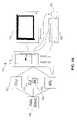
- FIG. 1Ashows a computer system on which the invention can operate.
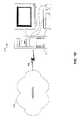
- FIG. 1Bshows the computer system of FIG. 1A connected to the Internet.
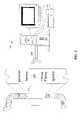
- FIG. 2shows the computer system of FIG. 1A listening to a content stream.
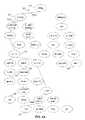
- FIG. 3shows an example of set of concepts that can form a directed set.
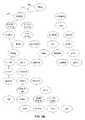
- FIG. 4shows a directed set constructed from the set of concepts of FIG. 3 in a preferred embodiment of the invention.
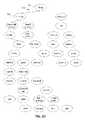
- FIGS. 5A-5Gshow eight different chains in the directed set of FIG. 4 that form a basis for the directed set.
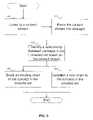
- FIG. 6is a flowchart of a method to construct a directed set in the system of FIG. 1A .
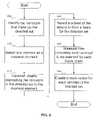
- FIG. 7is a flowchart of a method to add a new concept to a directed set in the system of FIG. 1A .
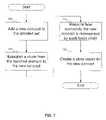
- FIG. 8is a flowchart of a method to update a basis for a directed set in the system of FIG. 1A .
- FIG. 9is a flowchart of a method of updating the concepts in a directed set in the system of FIG. 1A .
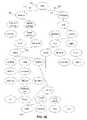
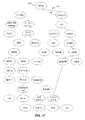
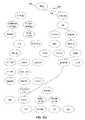
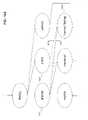
- FIGS. 10A and 10Bshow how a new concept is added and relationships changed in the directed set of FIG. 4 .
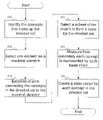
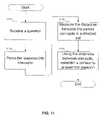
- FIG. 11is a flowchart of a method using a directed set in the system of FIG. 1A to help in answering a question.
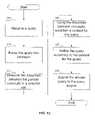
- FIG. 12is a flowchart of a method using a directed set in the system of FIG. 1A to refine a query.
- FIG. 13shows data structures for storing a directed set, chains, and basis chains, such as the directed set of FIG. 3 , the chains of FIG. 4 , and the basis chains of FIGS. 5A-5G .
- FIG. 1Ashows a computer system 105 on which a method and apparatus for using a multi-dimensional semantic space can operate.
- Computer system 105conventionally includes a computer 110 , a monitor 115 , a keyboard 120 , and a mouse 125 .
- Optional equipment not shown in FIG. 1Acan include a printer and other input/output devices.
- the conventional internal components of computer system 105e.g., a central processing unit, memory, file system, etc.
- Computer system 105further includes a concept identification unit (CIU) 130 , a chain unit (CU) 135 , a basis unit (BU) 140 , and a measurement unit (MU) 145 .
- Concept identification unit 130is responsible for identifying the concepts that will form a directed set, from which the multi-dimensional semantic space can be mapped.
- One conceptis identified as a maximal element: this element describes (more or less concretely) every concept in the directed set.
- Chain unit 135is responsible for constructing chains from the maximal element to all other concepts identified by concept identification unit 130 .
- Basis unit 140is responsible for selecting a subset of the chains to form a basis for the directed set.
- basis unit 140selects a subset of the chains established by chain unit 135 , basis unit 140 is depicted as being part of chain unit 135 . However, a person skilled in the art will recognize that basis unit 140 can be separate from chain unit 135 .
- Measurement unit 145is responsible for measuring how concretely each chain in the basis represents each concept. (How this measurement is performed is discussed below.) In the preferred embodiment, concept identification unit 130 , chain unit 135 , basis unit 140 , and measurement unit 145 are implemented in software. However, a person skilled in the art will recognize that other implementations are possible.
- computer system 105includes a data structure 150 (discussed with reference to FIG. 13 below). The data structure is responsible for storing the concepts, chains, and measurements of the directed set.
- FIG. 1Bshows computer system 105 connected over a network connection 140 to a network 145 .
- the specifics of network connection 140are not important, so long as the invention has access to a content stream to listen for concepts and their relationships.
- computer system 105does not have to be connected to a network 145 , provided some content stream is available.
- FIG. 2shows computer system 105 listening to a content stream.
- network connection 140includes a listening device 205 .
- Listening device 205(sometimes called a “listening mechanism”) allows computer system 105 to listen to the content stream 210 (in FIG. 2 , represented as passing through a “pipe” 215 ).
- Computer system 105is parsing a number of concepts, such as “behavior,” “female,” “cat,” “Venus Flytrap,” “iguana,” and so on. Listening device 205 also allows computer system 105 to determine the relationships between concepts.
- the data expressing content on the networkis encoded as text, binary code, bit map or in any other form
- the vocabularyis more than an arbitrarily-ordered list: an element of a vocabulary stands in relation to other elements, and the “place” of its standing is the semantic value of the element. For example, consider a spoon. Comparing the spoon with something taken from another scene—say, a shovel—one might classify the two items as being somewhat similar. And to the extent that form follows function in both nature and human artifice, this is correct! The results would be similar if the spoon were compared with a ladle. All three visual elements—the spoon, the shovel, and the ladle—are topologically equivalent; each element can be transformed into the other two elements with relatively little geometric distortion.
- Fractal dimensionpossesses a nice linear ordering. For example, a space-filling boundary such as a convoluted coastline (or a fork! would have a higher fractal dimension than, say, the boundary of a circle. Can the topology of an element be characterized in the same way? In fact, one can assign a topological measure to the vocabulary elements, but the measure may involve aspects of homotopy and homology that preclude a simple linear ordering. Suppose, for visual simplicity, that there is some simple, linearly ordered way of measuring the topological essence of an element. One can formally represent an attribute space for the elements, where fork-like and spoon-like resolve to different regions in the attribute space.
- the example attribute spaceis a (simplistic) illustration of a semantic space, also known as a concept space.
- a vocabulary for human visual elementsa kind of visual lexicon.
- many researchershave argued for an iconic representation of meaning, particularly those looking for a representation unifying perception and language. They take an empirical positivist position that meaning is simply an artifact of the “binding” of language to perception, and point out that all writing originated with pictographs (even the letter “A” is just an inverted ox head!).
- pictographseven the letter “A” is just an inverted ox head!.
- a propositionis typically framed as a pairing of an argument and a predicate.
- the fragment “a red car”could be represented prepositionally as the argument “a car” paired with the predicate “is red.”
- the propositionsimply asserts a property (the predicate) of an object (the argument).
- stipulating the argumentalone has consequences; “a car” invokes the existential quantifier, and asserts instances for all relevant primitive attributes associated with the lexical element “car.”
- nominativethe boy ⁇ (is human), (is ⁇ adult), (is male), (is ⁇ infant), etc.
- the phrasehas been transformed into two sets of attributes: the nominative attributes and two subsets of predicate attributes (verb and object). This suggests stipulating that all propositions must have the form (n: n ⁇ N, p: p ⁇ P), where N (the set of nominatives) is some appropriately restricted subset of (P) (the power set of the space P of predicates). N is restricted to avoid things like ((is adult) and (is ⁇ adult)). In this way the predicates can be used to generate a semantic space. A semantic representation might even be possible for something like, “The movie The Boy Hit the Baseball hit this critic's heart-strings!”
- Two elements of the lexiconare related by hyponymy if the meaning of one is included in the meaning of the other.
- the words “cat” and “animal”are related by hyponymy.
- a catis an animal, and so “cat” is a hyponym of “animal.”
- a particular lexiconmay not explicitly recognize some hyponymies.
- the words “hit,” “touch,” “brush,” “stroke,” “strike,” and “ram”are all hyponyms of the concept “co-incident in some space or context.”
- Such a conceptcan be formulated as a meaning postulate, and the lexicon is extended with the meaning postulate in order to capture formally the hyponymy.
- a topologyis a set O of subsets of S that satisfies the following criteria:
- the elements of Oare called the open sets of S. If X is a subset of S, and p is an element of S, then p is called a limit point of X if every open set that contains p also contains a point in X distinct from p.
- a set B of subsets of Sis a basis if
- a subset of Sis open if it is the union of elements of B. This defines a topology on S. Note that it is usually easier to characterize a basis for a topology rather than to explicitly identify all open sets.
- the space Sis said to be completely separable if it has a countable basis.
- the goalis to choose as strong a topology as possible.
- a compact metric spaceOne looks to satisfy separability conditions such that the space S is guaranteed to be homeomorphic to a subspace of Hilbert space (i.e., there is a continuous and one-to-one mapping from S to the subspace of Hilbert space).
- T 3 and T 4 spacesare important enough to merit a place in the mathematical lexicon—T 3 spaces are called regular spaces, and T 4 spaces are called normal spaces—and the following very beautiful theorem:
- ( S, d)The completeness of the underlying metric space (S, d) is sufficient to show that every Cauchy sequence ⁇ u k ⁇ in ( (S), h) converges to a point in ( (S),h).
- ( (S), h)is a complete metric space.
- Bbe the set of all elements of 2 2 P , i.e., ( (P)), that express hyponymy.
- Bis a basis for S.
- FIG. 3shows a set of concepts, including “thing” 305 , “man” 310 , “girl” 312 , “adult human” 315 , “kinetic energy” 320 , and “local action” 325 .
- “Thing” 305is the maximal element of the set, as every other concept is a type of “thing.”
- Some concepts, such as “man” 310 and “girl” 312are “leaf concepts,” in the sense that no other concept in the set is a type of “man” or “girl.”
- Other concepts, such as “adult human” 315 , “kinetic energy” 320 , and “local action” 325are “internal concepts,” in the sense that they are types of other concepts (e.g., “local action” 325 is a type of “kinetic energy” 320 ) but there are other concepts that are types of these concepts (e.g., “man” 310 is a type of “adult human” 315 ).
- FIG. 4shows a directed set constructed from the concepts of FIG. 3 .
- For each concept in the directed setthere is at least one chain extending from maximal element “thing” 305 to the concept.
- These chainsare composed of directed links, such as links 405 , 410 , and 415 , between pairs of concepts.
- every chain from maximal element “thing”must pass through either “energy” 420 or “category” 425 . Further, there can be more than one chain extending from maximal element “thing” 305 to any concept.
- the maximal elementis, by definition, closer to itself than any of the other concepts; therefore, the maximal element can be thought of as a lineal ancestor of all other concepts in the directed set (and all other concepts in the directed set can be considered lineal descendants of the maximal element).
- FIGS. 5A-5Gshow eight different chains in the directed set that form a basis for the directed set.
- FIG. 5Ashows chain 505 , which extends to concept “man” 310 through concept “energy” 420 .
- FIG. 5Bshows chain 510 extending to concept “iguana.”
- FIG. 5Cshows another chain 515 extending to concept “man” 310 via a different path.
- FIGS. 5D-5Gshow other chains.
- FIG. 13shows a data structure for storing the directed set of FIG. 3 , the chains of FIG. 4 , and the basis chains of FIGS. 5A-5G .
- concepts array 1305is used to store the concepts in the directed set.
- Concepts array 1305stores pairs of elements.
- One elementidentifies concepts by name; the other element stores numerical identifiers 1306 .
- concept name 1307stores the concept “dust,” which is paired with numerical identifier “2” 1308 .
- Concepts array 1305shows 9 pairs of elements, but there is no theoretical limit to the number of concepts in concepts array 1305 .
- concepts array 1305there should be no duplicated numerical identifiers 1306 .
- concepts array 1305is shown sorted by numerical identifier 1306 , although this is not required.
- numerical identifier 1306can be called the index of the concept name.
- Maximal element (ME) 1310stores the index to the maximal element in the directed set.
- the concept index to maximal element 1310is “6,” which corresponds to concept “thing,” the maximal element of the directed set of FIG. 4 .
- Chains array 1315is used to store the chains of the directed set. Chains array 1315 stores pairs of elements. One element identifies the concepts in a chain by index; the other element stores a numerical identifier. For example, chain 1317 stores a chain of concept indices “6”, “5”, “9”, “7”, and “2,” and is indexed by chain index “1” ( 1318 ). (Concept index 0, which does not occur in concepts array 1305 , can be used in chains array 1315 to indicate the end of the chain.
- chain 1317includes five concepts, the number of concepts in each chain can vary.
- this chaincorresponds to concepts “thing,” “energy,” “potential energy,” “matter,” and “dust.”
- Chains array 1315shows one complete chain and part of a second chain, but there is no theoretical limit to the number of chains stored in chain array 1315 . Observe that, because maximal element 1310 stores the concept index “6,” every chain in chains array 1315 should begin with concept index “6.” Ordering the concepts within a chain is ultimately helpful in measuring distances between the concepts. However concept order is not required. Further, there is no required order to the chains as they are stored in chains array 1315 .
- Basis chains array 1320is used to store the chains of chains array 1315 that form a basis of the directed set.
- Basis chains array 1320stores chain indices into chains array 1315 .
- Basis chains array 1320shows four chains in the basis (chains 1, 4, 8, and 5), but there is no theoretical limit to the number of chains in the basis for the directed set.
- Euclidean distance matrix 1325 Astores the distances between pairs of concepts in the directed set of FIG. 4 . (How distance is measured between pairs of concepts in the directed set is discussed below. But in short, the concepts in the directed set are mapped to state vectors in multi-dimensional space, where a state vector is a directed line segment starting at the origin of the multi-dimensional space and extending to a point in the multi-dimensional space.) The distance between the end points of pairs of state vectors representing concepts is measured. The smaller the distance is between the state vectors representing the concepts, the more closely related the concepts are. Euclidean distance matrix 1325 A uses the indices 1306 of the concepts array for the row and column indices of the matrix.
- Euclidean distance matrix 1325 AFor a given pair of row and column indices into Euclidean distance matrix 1325 A, the entry at the intersection of that row and column in Euclidean distance matrix 1325 A shows the distance between the concepts with the row and column concept indices, respectively. So, for example, the distance between concepts “man” and “dust” can be found at the intersection of row 1 and column 2 of Euclidean distance matrix 1325 A as approximately 1.96 units.
- the distance between concepts “man” and “iguana”is approximately 1.67, which suggests that “man” is closer to “iguana” than “man” is to “dust.”
- Euclidean distance matrix 1325 Ais symmetrical: that is, for an entry in Euclidean distance matrix 1325 A with given row and column indices, the row and column indices can be swapped, and Euclidean distance matrix 1325 A will yield the same value. In words, this means that the distance between two concepts is not dependent on concept order: the distance from concept “man” to concept “dust” is the same as the distance from concept “dust” to concept “man.”
- Angle subtended matrix 1325 Bis an alternative way to store the distance between pairs of concepts. Instead of measuring the distance between the state vectors representing the concepts (see below), the angle between the state vectors representing the concepts is measured. This angle will vary between 0 and 90 degrees. The narrower the angle is between the state vectors representing the concepts, the more closely related the concepts are.
- angle subtended matrix 1325 Buses the indices 1306 of the concepts array for the row and column indices of the matrix. For a given pair of row and column indices into angle subtended matrix 1325 B, the entry at the intersection of that row and column in angle subtended matrix 1325 B shows the angle subtended the state vectors for the concepts with the row and column concept indices, respectively.
- angle subtended matrix 1325 Bis symmetrical.
- FIG. 13Not shown in FIG. 13 is a data structure component for storing state vectors (discussed below). As state vectors are used in calculating the distances between pairs of concepts, if the directed set is static (i.e., concepts are not being added or removed and basis chains remain unchanged), the state vectors are not required after distances are calculated. Retaining the state vectors is useful, however, when the directed set is dynamic. A person skilled in the art will recognize how to add state vectors to the data structure of FIG. 13 .
- a symmetric matrixcan be represented using only one half the space of a full matrix if only the entries below the main diagonal are preserved and the row index is always larger than the column index. Further space can be saved by computing the values of Euclidean distance matrix 1325 A and angle subtended matrix 1325 B “on the fly” as distances and angles are needed.
- g kAs an example of the definition of g k , consider chain 505 of FIG. 5A , for which n is 8.
- nis 8.
- This state vector ⁇ (s)maps a concept s in the directed set to a point in k-space (R k ).
- the means by which distance can be measuredinclude distance functions, such as Equations (1a), (1b), or (1c).
- trigonometrydictates that the distance between two vectors is related to the angle subtended between the two vectors, so means that measure the angle between the state vectors also approximates the distance between the state vectors.
- the state vectorscan be normalized to the unit sphere. If the state vectors are normalized, then the angle between two state vectors is no longer an approximation of the distance between the two state vectors, but rather is an exact measure.
- the functions g kare analogous to step functions, and in the limit (of refinements of the topology) the functions are continuous. Continuous functions preserve local topology; i.e., “close things” in S map to “close things” in R k , and “far things” in S tend to map to “far things” in R k .
- ⁇ automobileis a machine, is a vehicle, has engine, has brakes, . . . ⁇
- “automobile”is simply an element of the power set of P, the set of all propositions; i.e., it is an element of the set of all subsets of P.
- the power setis denoted as (P).
- the first two properties of the “automobile” exampleexpress “is a” relationships. By “is a” is meant entailment.
- Entailmentmeans that, were one to intersect the properties of every element of (P) that is called, for example, “machine,” then the intersection would contain a subset of properties common to anything (in (P)) that one has, does, will or would have called “machine.” Reliance on the existence of a “least” common subset of properties to define entailment has a hint of well ordering about it; and indeed it is true that the axiom of choice is relied on to define entailment.
- B⁇ b ⁇ ⁇ be the set of elements of ( (P)) that correspond to good meaning postulates; e.g., b m ⁇ B is the set of all elements of (P) that entail “machine.”
- goodis meant complete and consistent.
- Comppletemeans non-exclusion of objects that should entail (some concept).
- Consistentmeans exclusion of objects that should not entail (any concept). Should/should-not are understood to be negotiated between the community (of language users) and its individuals.
- Bwas deliberately constructed to be the basis of a topology ⁇ for S.
- an open set in Sis defined to be the union of elements of B. This is what is meant when one says that hyponymy is used to define the topology of the lexicon (in this particular embodiment).
- Urysohn's lemmashould be a strong hint to the reader that perhaps (H, d) should be considered.
- B 1 , B 2 , . . . , B n , . . .be a countable basis for S.
- B ithere are pairs B i , B j , such that B i is contained in B j ; in fact, each point of point of S lies in infinitely many such pairs, or is itself an open set. However, there are at most a countable number of pairs for each point of S.
- Hdenote the Hilbert coordinate space
- ⁇ ( s )⁇ g 1 ( s ), g 2 ( s )/2, g 3 ( s )/3, . . . , g n ( s )/ n, . . . ⁇ for each point s in S. It remains to prove that the function ⁇ so defined is continuous one-to-one, and open.
- the original proof (in its entirety) of Theorem 3is available in the literature.
- ⁇is applied to a lexicon with the entailment topology, it is herein called the Bohm transformation.
- the finite-dimensional transform ⁇is an approximation of the Bohm transform, mapping the explicate order of the lexicon to a (shallow) implicate order in R k .
- FIG. 6is a flowchart of the steps to construct a directed set.
- the concepts that will form the basis for the semantic spaceare identified. These concepts can be determined according to a heuristic, or can be defined statically.
- one conceptis selected as the maximal element.
- chainsare established from the maximal element to each concept in the directed set. As noted earlier, there can be more than one chain from the maximal element to a concept: the directed set does not have to be a tree.
- the chainsrepresent a topology that allows the application of Uryshon's lemma to metrize the set: for example, hyponomy, meronomy, or any other relations that induce inclusion chains on the set.
- a subset of the chainsis selected to form a basis for the directed set.
- each conceptis measured to see how concretely each basis chain represents the concept.
- a state vectoris constructed for each concept, where the state vector includes as its coordinates the measurements of how concretely each basis chain represents the concept.
- FIG. 7is a flowchart of how to add a new concept to an existing directed set.
- the new conceptis added to the directed set.
- the new conceptcan be learned by any number of different means.
- the administrator of the directed setcan define the new concept.
- the new conceptcan be learned by listening to a content stream as shown in FIG. 2 .
- the new conceptcan be learned in other ways as well.
- the new conceptcan be a “leaf concept” or an “intermediate concept.” Recall that an “intermediate concept” is one that is an abstraction of further concepts; a “leaf concept” is one that is not an abstraction of further concepts. For example, referring to FIG.
- a chainis established from the maximal element to the new concept. Determining the appropriate chain to establish to the new concept can be done manually or based on properties of the new concept learned by the system. A person skilled in the art will also recognize that, as discussed above, more than one chain to the new concept can be established.
- the new conceptis measured to see how concretely each chain in the basis represents the new concept.
- a state vectoris created for the new concept, where the state vector includes as its coordinates the measurements of how concretely each basis chain represents the new concept.
- FIG. 8is a flowchart of how to update the basis, either by adding to or removing from the basis chains. If chains are to be removed from the basis, then at step 805 the chains to be removed are deleted. Otherwise, at step 810 new chains are added to the basis. If a new chain is added to the basis, each concept must be measured to see how concretely the new basis chain represents the concept (step 815 ). Finally, whether chains are being added to or removed from the basis, at step 820 the state vectors for each concept in the directed set are updated to reflect the change.
- FIG. 8shows adding and removing basis chains to be separate operations, they can be done at the same time. In other words, one basis chain can be deleted and a new basis chain added at the same time.
- FIG. 9is a flowchart of how the directed set is updated.
- the systemis listening to a content stream.
- the systemparses the content stream into concepts.
- the systemidentifies relationships between concepts in the directed set that are described by the content stream. Then, if the relationship identified at step 915 indicates that an existing chain is incorrect, at step 920 the existing chain is broken. Alternatively, if the relationship identified at step 915 indicates that a new chain is needed, at step 925 a new chain is established.
- FIG. 9shows establishing new chains and breaking existing chains to be separate operations, they can be done at the same time. In other words, an identified relationship may require breaking an existing chain and establishing a new chain at the same time.
- FIGS. 10A and 10Bshow how new concepts are added and relationships changed in the directed set of FIG. 4 .
- FIGS. 10A and 10Bshow a close-up of a portion of the directed set of FIG. 4 .
- FIG. 10Ashows the state of the directed set after the system listens to the content stream 210 of FIG. 2 .
- the terms “behavior,” “female,” “cat,” “Venus Flytrap,” and “iguana,”are parsed from the content stream. For example, the stream may have included the question “How does the behavior of a female cat around a Venus Flytrap differ from that around an iguana?”, from which the concepts were parsed.
- Venus Flytrapis unknown in the directed set, and a new concept “Venus Flytrap” 1005 is added to the directed set.
- the directed setmay then conclude that, since “Venus Flytrap” is being compared to an “iguana,” that “Venus Flytrap” is some type of animal, and should be related to “animal” 1010 . (The directed set might even be more specific and conclude that “Venus Flytrap” is the same type of animal as “iguana,” i.e., a reptile, but for this example a more general conclusion is assumed.)
- the directed setthen introduces a chain 1015 through “animal” 1010 to “Venus Flytrap” 1005 .
- the directed setlearns that a Venus Flytrap is some kind of plant, and not an animal. As shown in FIG. 10B , the directed set needs to establish a relationship between “Venus Flytrap” 1005 and “plant” 1020 , and break the relationship with “animal” 1010 . The directed set then breaks chain 1015 and adds chain 1025 .
- FIG. 11shows a flowchart of how a directed set can be used to help in answering a question.
- the systemreceives the question.
- the systemparses the question into concepts.
- the distances between the parsed conceptsare measured in a directed set.
- a contextis established in which to answer the question.
- FIG. 12shows a flowchart of how a directed set can be used to refine a query, for example, to a database.
- the systemreceives the query.
- the systemparses the query into concepts.
- the distances between the parsed conceptsare measured in a directed set.
- a contextis established in which to refine the query.
- the queryis refined according to the context.
- the refined queryis submitted to the query engine.
Landscapes
- Engineering & Computer Science (AREA)
- Theoretical Computer Science (AREA)
- Physics & Mathematics (AREA)
- Artificial Intelligence (AREA)
- Data Mining & Analysis (AREA)
- General Engineering & Computer Science (AREA)
- General Physics & Mathematics (AREA)
- Computational Linguistics (AREA)
- Mathematical Physics (AREA)
- Databases & Information Systems (AREA)
- Health & Medical Sciences (AREA)
- Audiology, Speech & Language Pathology (AREA)
- General Health & Medical Sciences (AREA)
- Life Sciences & Earth Sciences (AREA)
- Bioinformatics & Cheminformatics (AREA)
- Bioinformatics & Computational Biology (AREA)
- Computer Vision & Pattern Recognition (AREA)
- Evolutionary Biology (AREA)
- Evolutionary Computation (AREA)
- Machine Translation (AREA)
Abstract
Description
- verb: hit→(is contact), (is forceful), (is aggressive), etc.
- d.o.: the baseball→(is round), (is leather), (is stitched), etc.

- Any union of elements of O is in O.
- Any finite intersection of elements of O is in O.
- S and the empty set are both in O.
- S=the union of all elements of B,
- for p ∈ bα∩bγ, (bα, bγ ∈ B), there exists bλ ∈ B such that p ∈ bλ and bλ⊃bα∩bγ.
- T0. Given two points of a topological space S, at least one of them is contained in an open set not containing the other.
- T1. Given two points of S, each of them lies in an open set not containing the other.
- T2. Given two points of S, there are disjoint open sets, each containing just one of the two points (Hausdorff axiom).
- T3. If C is a closed set in the space S, and if p is a point not in C, then there are disjoint open sets in S, one containing C and one containing p.
- T4. If H and K are disjoint closed sets in the space S, then there are disjoint open sets in S, one containing H and one containing K.
Theorem 1. Every completely separable regular space can be imbedded in a Hilbert coordinate space.

ξ(x, u)=min {d(x, y):y ∈ u}.
λ(u, v)=max {ξ(x, v):x ∈ u}.
h(u, v)=max {λ(u, v), λ(v, u)}.
h(u, v)=h(v, u),
0<h(u, v)<∞ for allu, v∈
h(u, u)=0 for allu∈
h(u, v)≦h(u, w)+h(w, v) for allu, v, w∈
the metric space (
|ρ2−ρ1|=(|n2−n1|2+|p2−p1|2)1/2 Equation (1a)
or alternatively one might use “city block” distance:
|ρ2−ρ1|=|n2−n1|+|p2−p1| Equation (1b)
as a fair approximation of distance. Those skilled in the art will recognize that other metrics are also possible: for example:
(Σ(ρ2,i−ρ1,i)n)1/n Equation (1c)
- First, the model is a topological space.
- Second, note that the model is not a tree. In fact, it is an example of a directed set. For example, concepts “being”430 and “adult human”315 are types of multiple concepts higher in the hierarchy. “Being”430 is a type of “matter”435 and a type of “behavior”440; “adult human”315 is a type of “adult”445 and a type of “human”450.
- Third, observe that the relationships expressed by the links are indeed relations of hyponymy.
- Fourth, note particularly—but without any loss of generality—that “man”310 maps to both “energy”420 and “category”425 (via composite mappings) which in turn both map to “thing”305; i.e., the (composite) relations are multiple valued and induce a partial ordering. These multiple mappings are natural to the meaning of things and critical to semantic characterization.
- Finally, note that “thing”305 is maximal; indeed, “thing”305 is the greatest element of any quantization of the lexical semantic field (subject to the premises of the model).
f: μ

where the chain connects n+1 concepts, and ƒj: links the (n−j)thpredecessor of μ with the (n+1−j)thpredecessor of μ, 1≦j≦n. For example, with reference to
gk(s)=(n−m)/n Equation (2)
This formula gives a measure of concreteness of a concept to a given chain associated with function fk.
φ(s)=<g1(s),g2(s),g3(s), . . . ,gk(s)> Equation (3)
This state vector φ(s) maps a concept s in the directed set to a point in k-space (Rk). One can measure distances between the points (the state vectors) in k-space. These distances provide measures of the closeness of concepts within the directed set. The means by which distance can be measured include distance functions, such as Equations (1a), (1b), or (1c). Further, trigonometry dictates that the distance between two vectors is related to the angle subtended between the two vectors, so means that measure the angle between the state vectors also approximates the distance between the state vectors. Finally, since only the direction (and not the magnitude) of the state vectors is important, the state vectors can be normalized to the unit sphere. If the state vectors are normalized, then the angle between two state vectors is no longer an approximation of the distance between the two state vectors, but rather is an exact measure.
φ(“boy”)
φ(“dust”)
φ(“iguana”)
φ(“woman”)
φ(“man”)
| Distance | Angle | |||
| Pairs of Concepts | (Euclidean) | Subtended | ||
| “boy” and “dust” | ~1.85 | ~52° | ||
| “boy” and “iguana” | ~1.65 | ~46° | ||
| “boy” and “woman” | ~0.41 | ~10° | ||
| “dust” and “iguana” | ~0.80 | ~30° | ||
| “dust” and “woman” | ~1.68 | ~48° | ||
| “iguana” and “woman” | ~1.40 | ~39° | ||
| “man” and “woman” | ~0.39 | ~07° | ||
- “boy” is closer to “iguana” than to “dust.”
- “boy” is closer to “iguana” than “woman” is to “dust.”
- “boy” is much closer to “woman” than to “iguana” or “dust.”
- “dust” is further from “iguana” than “boy” to “woman” or “man” to “woman.”
- “woman” is closer to “iguana” than to “dust.”
- “woman” is closer to “iguana” than “boy” is to “dust.”
- “man” is closer to “woman” than “boy” is to “woman.”
| {automobile: | is a machine, | ||
| is a vehicle, | |||
| has engine, | |||
| has brakes, | |||
| . . . | |||
| } | |||

- Urysohn's lemma. If S is a normal space and A and B are two disjoint closed subsets of S, then there is a real-valued continuous function g: SI1of S into the unit interval I1such that g(A)=0 and g(B)=1.

- Urysohn's lemma. If S is a normal space and A and B are two disjoint closed subsets of S, then there is a real-valued continuous function g: S
on the set H, and denote the Hilbert coordinate space (H, d).
Theorem 2. A T1-space S is regular if and only if for each point p in S and each open set U containing p, there is an open set V containing p whose closureV is contained in U.
Theorem 3. Every completely separable normal space S is homeomorphic to a subspace of Hilbert's coordinate space.
θ(s)={g1(s),g2(s)/2,g3(s)/3, . . . ,gn(s)/n, . . . }
for each point s in S. It remains to prove that the function θ so defined is continuous one-to-one, and open.
Claims (20)
Priority Applications (2)
| Application Number | Priority Date | Filing Date | Title |
|---|---|---|---|
| US11/562,337US7475008B2 (en) | 2000-02-25 | 2006-11-21 | Construction, manipulation, and comparison of a multi-dimensional semantic space |
| US11/929,678US8131741B2 (en) | 2000-02-25 | 2007-10-30 | Construction, manipulation, and comparison of a multi-dimensional semantic space |
Applications Claiming Priority (2)
| Application Number | Priority Date | Filing Date | Title |
|---|---|---|---|
| US09/512,963US7152031B1 (en) | 2000-02-25 | 2000-02-25 | Construction, manipulation, and comparison of a multi-dimensional semantic space |
| US11/562,337US7475008B2 (en) | 2000-02-25 | 2006-11-21 | Construction, manipulation, and comparison of a multi-dimensional semantic space |
Related Parent Applications (1)
| Application Number | Title | Priority Date | Filing Date |
|---|---|---|---|
| US09/512,963ContinuationUS7152031B1 (en) | 1998-07-02 | 2000-02-25 | Construction, manipulation, and comparison of a multi-dimensional semantic space |
Related Child Applications (1)
| Application Number | Title | Priority Date | Filing Date |
|---|---|---|---|
| US11/929,678DivisionUS8131741B2 (en) | 2000-02-25 | 2007-10-30 | Construction, manipulation, and comparison of a multi-dimensional semantic space |
Publications (2)
| Publication Number | Publication Date |
|---|---|
| US20070078870A1 US20070078870A1 (en) | 2007-04-05 |
| US7475008B2true US7475008B2 (en) | 2009-01-06 |
Family
ID=37526631
Family Applications (3)
| Application Number | Title | Priority Date | Filing Date |
|---|---|---|---|
| US09/512,963Expired - Fee RelatedUS7152031B1 (en) | 1998-07-02 | 2000-02-25 | Construction, manipulation, and comparison of a multi-dimensional semantic space |
| US11/562,337Expired - Fee RelatedUS7475008B2 (en) | 2000-02-25 | 2006-11-21 | Construction, manipulation, and comparison of a multi-dimensional semantic space |
| US11/929,678Expired - Fee RelatedUS8131741B2 (en) | 2000-02-25 | 2007-10-30 | Construction, manipulation, and comparison of a multi-dimensional semantic space |
Family Applications Before (1)
| Application Number | Title | Priority Date | Filing Date |
|---|---|---|---|
| US09/512,963Expired - Fee RelatedUS7152031B1 (en) | 1998-07-02 | 2000-02-25 | Construction, manipulation, and comparison of a multi-dimensional semantic space |
Family Applications After (1)
| Application Number | Title | Priority Date | Filing Date |
|---|---|---|---|
| US11/929,678Expired - Fee RelatedUS8131741B2 (en) | 2000-02-25 | 2007-10-30 | Construction, manipulation, and comparison of a multi-dimensional semantic space |
Country Status (1)
| Country | Link |
|---|---|
| US (3) | US7152031B1 (en) |
Cited By (28)
| Publication number | Priority date | Publication date | Assignee | Title |
|---|---|---|---|---|
| US20080052283A1 (en)* | 2000-02-25 | 2008-02-28 | Novell, Inc. | Construction, manipulation, and comparison of a multi-dimensional semantic space |
| US20080228467A1 (en)* | 2004-01-06 | 2008-09-18 | Neuric Technologies, Llc | Natural language parsing method to provide conceptual flow |
| US20090234718A1 (en)* | 2000-09-05 | 2009-09-17 | Novell, Inc. | Predictive service systems using emotion detection |
| US20100034745A1 (en)* | 2005-05-03 | 2010-02-11 | Neuera Pharmaceuticals, Inc. | Method for Reducing Levels of Disease Associated Proteins |
| US20100122312A1 (en)* | 2008-11-07 | 2010-05-13 | Novell, Inc. | Predictive service systems |
| US20100138216A1 (en)* | 2007-04-16 | 2010-06-03 | The European Comminuty, Represented By The European Commission | method for the extraction of relation patterns from articles |
| US20100169315A1 (en)* | 2008-12-30 | 2010-07-01 | Novell, Inc. | Attribution analysis and correlation |
| US20100169314A1 (en)* | 2008-12-30 | 2010-07-01 | Novell, Inc. | Content analysis and correlation |
| US20100169337A1 (en)* | 2008-12-30 | 2010-07-01 | Novell, Inc. | Identity analysis and correlation |
| US20100235539A1 (en)* | 2009-03-13 | 2010-09-16 | Novell, Inc. | System and method for reduced cloud ip address utilization |
| US20100235630A1 (en)* | 2009-03-13 | 2010-09-16 | Novell, Inc. | System and method for providing key-encrypted storage in a cloud computing environment |
| US20100235903A1 (en)* | 2009-03-13 | 2010-09-16 | Novell, Inc. | System and method for transparent cloud access |
| US20100235887A1 (en)* | 2009-03-13 | 2010-09-16 | Novell, Inc. | System and method for queuing to a cloud via a queuing proxy |
| US20100250479A1 (en)* | 2009-03-31 | 2010-09-30 | Novell, Inc. | Intellectual property discovery and mapping systems and methods |
| US20110013777A1 (en)* | 2009-07-16 | 2011-01-20 | Teerlink Craig N | Encryption/decryption of digital data using related, but independent keys |
| US20110107411A1 (en)* | 2009-11-05 | 2011-05-05 | Novell, Inc. | System and method for implementing a secure web application entitlement service |
| US20110106926A1 (en)* | 2008-08-25 | 2011-05-05 | Novell, Inc. | System and method for implementing a cloud workflow |
| US20110106927A1 (en)* | 2008-08-25 | 2011-05-05 | Novell, Inc. | System and method for implementing cloud mitigation and operations controllers |
| US20110107398A1 (en)* | 2009-11-05 | 2011-05-05 | Novell, Inc. | System and method for transparent access and management of user accessible cloud assets |
| US20110107133A1 (en)* | 2009-11-05 | 2011-05-05 | Novell, Inc. | System and method for implementing a cloud computer |
| US20110225659A1 (en)* | 2010-03-10 | 2011-09-15 | Isaacson Scott A | Semantic controls on data storage and access |
| US8458105B2 (en) | 2009-02-12 | 2013-06-04 | Decisive Analytics Corporation | Method and apparatus for analyzing and interrelating data |
| US8473449B2 (en) | 2005-01-06 | 2013-06-25 | Neuric Technologies, Llc | Process of dialogue and discussion |
| US8832103B2 (en) | 2010-04-13 | 2014-09-09 | Novell, Inc. | Relevancy filter for new data based on underlying files |
| US9064211B2 (en) | 2004-01-06 | 2015-06-23 | Neuric Technologies, Llc | Method for determining relationships through use of an ordered list between processing nodes in an emulated human brain |
| US9213936B2 (en) | 2004-01-06 | 2015-12-15 | Neuric, Llc | Electronic brain model with neuron tables |
| CN109766424A (en)* | 2018-12-29 | 2019-05-17 | 安徽省泰岳祥升软件有限公司 | Filtering method and device for reading understanding model training data |
| CN110413761A (en)* | 2019-08-06 | 2019-11-05 | 浩鲸云计算科技股份有限公司 | A kind of method that the territoriality in knowledge based library is individually talked with |
Families Citing this family (67)
| Publication number | Priority date | Publication date | Assignee | Title |
|---|---|---|---|---|
| US8396824B2 (en)* | 1998-05-28 | 2013-03-12 | Qps Tech. Limited Liability Company | Automatic data categorization with optimally spaced semantic seed terms |
| US7711672B2 (en)* | 1998-05-28 | 2010-05-04 | Lawrence Au | Semantic network methods to disambiguate natural language meaning |
| US20070294229A1 (en)* | 1998-05-28 | 2007-12-20 | Q-Phrase Llc | Chat conversation methods traversing a provisional scaffold of meanings |
| WO2003102740A2 (en)* | 2002-06-03 | 2003-12-11 | Arizona Board Of Regents Acting For And On Behalf Of Arizona State University | System and method of analyzing the temporal evolution of text using dynamic centering resonance analysis |
| US7398486B2 (en)* | 2004-03-17 | 2008-07-08 | Lsi Corporation | Method and apparatus for performing logical transformations for global routing |
| US7869989B1 (en)* | 2005-01-28 | 2011-01-11 | Artificial Cognition Inc. | Methods and apparatus for understanding machine vocabulary |
| CN101112078B (en)* | 2005-02-08 | 2012-04-18 | 日本电信电话株式会社 | Information communication terminal, information communication system, information communication method, information communication program, and recording medium storing the program |
| US7853555B2 (en)* | 2006-04-19 | 2010-12-14 | Raytheon Company | Enhancing multilingual data querying |
| US7991608B2 (en)* | 2006-04-19 | 2011-08-02 | Raytheon Company | Multilingual data querying |
| US20080189268A1 (en)* | 2006-10-03 | 2008-08-07 | Lawrence Au | Mechanism for automatic matching of host to guest content via categorization |
| US8798988B1 (en)* | 2006-10-24 | 2014-08-05 | Google Inc. | Identifying related terms in different languages |
| WO2009061390A1 (en)* | 2007-11-05 | 2009-05-14 | Enhanced Medical Decisions, Inc. | Machine learning systems and methods for improved natural language processing |
| US8463053B1 (en) | 2008-08-08 | 2013-06-11 | The Research Foundation Of State University Of New York | Enhanced max margin learning on multimodal data mining in a multimedia database |
| US8972424B2 (en) | 2009-05-29 | 2015-03-03 | Peter Snell | Subjective linguistic analysis |
| EP2435903A4 (en) | 2009-05-29 | 2013-12-18 | Peter S Snell | System and related method for digital attitude mapping |
| US8260664B2 (en)* | 2010-02-05 | 2012-09-04 | Microsoft Corporation | Semantic advertising selection from lateral concepts and topics |
| US8150859B2 (en)* | 2010-02-05 | 2012-04-03 | Microsoft Corporation | Semantic table of contents for search results |
| US8903794B2 (en)* | 2010-02-05 | 2014-12-02 | Microsoft Corporation | Generating and presenting lateral concepts |
| US8983989B2 (en)* | 2010-02-05 | 2015-03-17 | Microsoft Technology Licensing, Llc | Contextual queries |
| US20110231395A1 (en)* | 2010-03-19 | 2011-09-22 | Microsoft Corporation | Presenting answers |
| US8577718B2 (en) | 2010-11-04 | 2013-11-05 | Dw Associates, Llc | Methods and systems for identifying, quantifying, analyzing, and optimizing the level of engagement of components within a defined ecosystem or context |
| US8996359B2 (en) | 2011-05-18 | 2015-03-31 | Dw Associates, Llc | Taxonomy and application of language analysis and processing |
| US8952796B1 (en) | 2011-06-28 | 2015-02-10 | Dw Associates, Llc | Enactive perception device |
| US9269353B1 (en) | 2011-12-07 | 2016-02-23 | Manu Rehani | Methods and systems for measuring semantics in communications |
| US9020807B2 (en) | 2012-01-18 | 2015-04-28 | Dw Associates, Llc | Format for displaying text analytics results |
| US9667513B1 (en) | 2012-01-24 | 2017-05-30 | Dw Associates, Llc | Real-time autonomous organization |
| US10372739B2 (en)* | 2014-03-17 | 2019-08-06 | NLPCore LLC | Corpus search systems and methods |
| US9336546B2 (en)* | 2014-03-27 | 2016-05-10 | Microsoft Technology Licensing, Llc | Recommendation system with multi-dimensional discovery experience |
| US9348898B2 (en)* | 2014-03-27 | 2016-05-24 | Microsoft Technology Licensing, Llc | Recommendation system with dual collaborative filter usage matrix |
| US10606883B2 (en) | 2014-05-15 | 2020-03-31 | Evolv Technology Solutions, Inc. | Selection of initial document collection for visual interactive search |
| US20150331908A1 (en) | 2014-05-15 | 2015-11-19 | Genetic Finance (Barbados) Limited | Visual interactive search |
| US10102277B2 (en) | 2014-05-15 | 2018-10-16 | Sentient Technologies (Barbados) Limited | Bayesian visual interactive search |
| US9922352B2 (en)* | 2016-01-25 | 2018-03-20 | Quest Software Inc. | Multidimensional synopsis generation |
| US10909459B2 (en) | 2016-06-09 | 2021-02-02 | Cognizant Technology Solutions U.S. Corporation | Content embedding using deep metric learning algorithms |
| US20180101773A1 (en)* | 2016-10-07 | 2018-04-12 | Futurewei Technologies, Inc. | Apparatus and method for spatial processing of concepts |
| US12001804B2 (en)* | 2017-05-10 | 2024-06-04 | Oracle International Corporation | Using communicative discourse trees to detect distributed incompetence |
| US12141535B2 (en)* | 2017-05-10 | 2024-11-12 | Oracle International Corporation | Techniques for maintaining rhetorical flow |
| JP7086993B2 (en)* | 2017-05-10 | 2022-06-20 | オラクル・インターナショナル・コーポレイション | Enable rhetorical analysis by using a discourse tree for communication |
| US11960844B2 (en)* | 2017-05-10 | 2024-04-16 | Oracle International Corporation | Discourse parsing using semantic and syntactic relations |
| US11373632B2 (en)* | 2017-05-10 | 2022-06-28 | Oracle International Corporation | Using communicative discourse trees to create a virtual persuasive dialogue |
| US11586827B2 (en)* | 2017-05-10 | 2023-02-21 | Oracle International Corporation | Generating desired discourse structure from an arbitrary text |
| US10679011B2 (en)* | 2017-05-10 | 2020-06-09 | Oracle International Corporation | Enabling chatbots by detecting and supporting argumentation |
| US11386274B2 (en)* | 2017-05-10 | 2022-07-12 | Oracle International Corporation | Using communicative discourse trees to detect distributed incompetence |
| US10599885B2 (en)* | 2017-05-10 | 2020-03-24 | Oracle International Corporation | Utilizing discourse structure of noisy user-generated content for chatbot learning |
| US10817670B2 (en)* | 2017-05-10 | 2020-10-27 | Oracle International Corporation | Enabling chatbots by validating argumentation |
| US11615145B2 (en) | 2017-05-10 | 2023-03-28 | Oracle International Corporation | Converting a document into a chatbot-accessible form via the use of communicative discourse trees |
| US10839154B2 (en)* | 2017-05-10 | 2020-11-17 | Oracle International Corporation | Enabling chatbots by detecting and supporting affective argumentation |
| US10839161B2 (en) | 2017-06-15 | 2020-11-17 | Oracle International Corporation | Tree kernel learning for text classification into classes of intent |
| US11100144B2 (en) | 2017-06-15 | 2021-08-24 | Oracle International Corporation | Data loss prevention system for cloud security based on document discourse analysis |
| US10755144B2 (en) | 2017-09-05 | 2020-08-25 | Cognizant Technology Solutions U.S. Corporation | Automated and unsupervised generation of real-world training data |
| US10755142B2 (en) | 2017-09-05 | 2020-08-25 | Cognizant Technology Solutions U.S. Corporation | Automated and unsupervised generation of real-world training data |
| US11182412B2 (en) | 2017-09-27 | 2021-11-23 | Oracle International Corporation | Search indexing using discourse trees |
| EP3688626A1 (en) | 2017-09-28 | 2020-08-05 | Oracle International Corporation | Enabling autonomous agents to discriminate between questions and requests |
| EP3688609A1 (en) | 2017-09-28 | 2020-08-05 | Oracle International Corporation | Determining cross-document rhetorical relationships based on parsing and identification of named entities |
| US11537645B2 (en) | 2018-01-30 | 2022-12-27 | Oracle International Corporation | Building dialogue structure by using communicative discourse trees |
| CN111670435B (en) | 2018-01-30 | 2024-08-06 | 甲骨文国际公司 | Using an exchange utterance tree to detect requests for interpretation |
| US11574201B2 (en) | 2018-02-06 | 2023-02-07 | Cognizant Technology Solutions U.S. Corporation | Enhancing evolutionary optimization in uncertain environments by allocating evaluations via multi-armed bandit algorithms |
| EP3791292A1 (en) | 2018-05-09 | 2021-03-17 | Oracle International Corporation | Constructing imaginary discourse trees to improve answering convergent questions |
| US11455494B2 (en) | 2018-05-30 | 2022-09-27 | Oracle International Corporation | Automated building of expanded datasets for training of autonomous agents |
| US11645459B2 (en) | 2018-07-02 | 2023-05-09 | Oracle International Corporation | Social autonomous agent implementation using lattice queries and relevancy detection |
| US11562135B2 (en) | 2018-10-16 | 2023-01-24 | Oracle International Corporation | Constructing conclusive answers for autonomous agents |
| US11321536B2 (en) | 2019-02-13 | 2022-05-03 | Oracle International Corporation | Chatbot conducting a virtual social dialogue |
| US11449682B2 (en) | 2019-08-29 | 2022-09-20 | Oracle International Corporation | Adjusting chatbot conversation to user personality and mood |
| US11475065B2 (en) | 2019-10-29 | 2022-10-18 | Neo4J Sweden Ab | Pre-emptive graph search for guided natural language interactions with connected data systems |
| US11775772B2 (en) | 2019-12-05 | 2023-10-03 | Oracle International Corporation | Chatbot providing a defeating reply |
| JP2025515316A (en)* | 2022-04-25 | 2025-05-14 | ギャン,インコーポレイテッド(ア デラウェア コーポレーション) | Explainable Natural Language Understanding Platform |
| US12111826B1 (en)* | 2023-03-31 | 2024-10-08 | Amazon Technologies, Inc. | Neural search for programming-related query answering |
Citations (52)
| Publication number | Priority date | Publication date | Assignee | Title |
|---|---|---|---|---|
| US5276677A (en) | 1992-06-26 | 1994-01-04 | Nec Usa, Inc. | Predictive congestion control of high-speed wide area networks |
| US5317507A (en) | 1990-11-07 | 1994-05-31 | Gallant Stephen I | Method for document retrieval and for word sense disambiguation using neural networks |
| US5325298A (en) | 1990-11-07 | 1994-06-28 | Hnc, Inc. | Methods for generating or revising context vectors for a plurality of word stems |
| US5390281A (en) | 1992-05-27 | 1995-02-14 | Apple Computer, Inc. | Method and apparatus for deducing user intent and providing computer implemented services |
| US5539841A (en) | 1993-12-17 | 1996-07-23 | Xerox Corporation | Method for comparing image sections to determine similarity therebetween |
| US5551049A (en) | 1987-05-26 | 1996-08-27 | Xerox Corporation | Thesaurus with compactly stored word groups |
| US5619709A (en) | 1993-09-20 | 1997-04-08 | Hnc, Inc. | System and method of context vector generation and retrieval |
| US5675819A (en) | 1994-06-16 | 1997-10-07 | Xerox Corporation | Document information retrieval using global word co-occurrence patterns |
| US5694523A (en) | 1995-05-31 | 1997-12-02 | Oracle Corporation | Content processing system for discourse |
| US5696962A (en) | 1993-06-24 | 1997-12-09 | Xerox Corporation | Method for computerized information retrieval using shallow linguistic analysis |
| US5708825A (en) | 1995-05-26 | 1998-01-13 | Iconovex Corporation | Automatic summary page creation and hyperlink generation |
| US5721897A (en) | 1996-04-09 | 1998-02-24 | Rubinstein; Seymour I. | Browse by prompted keyword phrases with an improved user interface |
| US5778378A (en) | 1996-04-30 | 1998-07-07 | International Business Machines Corporation | Object oriented information retrieval framework mechanism |
| US5778397A (en) | 1995-06-28 | 1998-07-07 | Xerox Corporation | Automatic method of generating feature probabilities for automatic extracting summarization |
| US5778362A (en) | 1996-06-21 | 1998-07-07 | Kdl Technologies Limted | Method and system for revealing information structures in collections of data items |
| US5799276A (en) | 1995-11-07 | 1998-08-25 | Accent Incorporated | Knowledge-based speech recognition system and methods having frame length computed based upon estimated pitch period of vocalic intervals |
| US5822731A (en) | 1995-09-15 | 1998-10-13 | Infonautics Corporation | Adjusting a hidden Markov model tagger for sentence fragments |
| US5832470A (en) | 1994-09-30 | 1998-11-03 | Hitachi, Ltd. | Method and apparatus for classifying document information |
| US5867799A (en) | 1996-04-04 | 1999-02-02 | Lang; Andrew K. | Information system and method for filtering a massive flow of information entities to meet user information classification needs |
| US5873056A (en) | 1993-10-12 | 1999-02-16 | The Syracuse University | Natural language processing system for semantic vector representation which accounts for lexical ambiguity |
| US5934910A (en) | 1996-12-02 | 1999-08-10 | Ho; Chi Fai | Learning method and system based on questioning |
| US5937400A (en) | 1997-03-19 | 1999-08-10 | Au; Lawrence | Method to quantify abstraction within semantic networks |
| US5940821A (en) | 1997-05-21 | 1999-08-17 | Oracle Corporation | Information presentation in a knowledge base search and retrieval system |
| US5963965A (en) | 1997-02-18 | 1999-10-05 | Semio Corporation | Text processing and retrieval system and method |
| US5966686A (en) | 1996-06-28 | 1999-10-12 | Microsoft Corporation | Method and system for computing semantic logical forms from syntax trees |
| US5970490A (en) | 1996-11-05 | 1999-10-19 | Xerox Corporation | Integration platform for heterogeneous databases |
| US5974412A (en) | 1997-09-24 | 1999-10-26 | Sapient Health Network | Intelligent query system for automatically indexing information in a database and automatically categorizing users |
| US5991713A (en) | 1997-11-26 | 1999-11-23 | International Business Machines Corp. | Efficient method for compressing, storing, searching and transmitting natural language text |
| US6006221A (en) | 1995-08-16 | 1999-12-21 | Syracuse University | Multilingual document retrieval system and method using semantic vector matching |
| US6009418A (en) | 1996-05-02 | 1999-12-28 | Cooper; David L. | Method and apparatus for neural networking using semantic attractor architecture |
| US6078953A (en) | 1997-12-29 | 2000-06-20 | Ukiah Software, Inc. | System and method for monitoring quality of service over network |
| US6085201A (en) | 1996-06-28 | 2000-07-04 | Intel Corporation | Context-sensitive template engine |
| US6097697A (en) | 1998-07-17 | 2000-08-01 | Sitara Networks, Inc. | Congestion control |
| US6105044A (en) | 1991-07-19 | 2000-08-15 | Enigma Information Systems Ltd. | Data processing system and method for generating a representation for and random access rendering of electronic documents |
| US6108619A (en) | 1998-07-02 | 2000-08-22 | Novell, Inc. | Method and apparatus for semantic characterization of general content streams and repositories |
| US6122628A (en) | 1997-10-31 | 2000-09-19 | International Business Machines Corporation | Multidimensional data clustering and dimension reduction for indexing and searching |
| US6173261B1 (en) | 1998-09-30 | 2001-01-09 | At&T Corp | Grammar fragment acquisition using syntactic and semantic clustering |
| US6205456B1 (en) | 1997-01-17 | 2001-03-20 | Fujitsu Limited | Summarization apparatus and method |
| US6295533B2 (en) | 1997-02-25 | 2001-09-25 | At&T Corp. | System and method for accessing heterogeneous databases |
| US6297824B1 (en) | 1997-11-26 | 2001-10-02 | Xerox Corporation | Interactive interface for viewing retrieval results |
| US6311194B1 (en) | 2000-03-15 | 2001-10-30 | Taalee, Inc. | System and method for creating a semantic web and its applications in browsing, searching, profiling, personalization and advertising |
| US6317709B1 (en) | 1998-06-22 | 2001-11-13 | D.S.P.C. Technologies Ltd. | Noise suppressor having weighted gain smoothing |
| US6317708B1 (en) | 1999-01-07 | 2001-11-13 | Justsystem Corporation | Method for producing summaries of text document |
| US6356864B1 (en) | 1997-07-25 | 2002-03-12 | University Technology Corporation | Methods for analysis and evaluation of the semantic content of a writing based on vector length |
| US6363378B1 (en)* | 1998-10-13 | 2002-03-26 | Oracle Corporation | Ranking of query feedback terms in an information retrieval system |
| US6459809B1 (en) | 1999-07-12 | 2002-10-01 | Novell, Inc. | Searching and filtering content streams using contour transformations |
| US6470307B1 (en) | 1997-06-23 | 2002-10-22 | National Research Council Of Canada | Method and apparatus for automatically identifying keywords within a document |
| US6493663B1 (en) | 1998-12-17 | 2002-12-10 | Fuji Xerox Co., Ltd. | Document summarizing apparatus, document summarizing method and recording medium carrying a document summarizing program |
| US6513031B1 (en) | 1998-12-23 | 2003-01-28 | Microsoft Corporation | System for improving search area selection |
| US6523026B1 (en) | 1999-02-08 | 2003-02-18 | Huntsman International Llc | Method for retrieving semantically distant analogies |
| US6615208B1 (en) | 2000-09-01 | 2003-09-02 | Telcordia Technologies, Inc. | Automatic recommendation of products using latent semantic indexing of content |
| US6675159B1 (en) | 2000-07-27 | 2004-01-06 | Science Applic Int Corp | Concept-based search and retrieval system |
Family Cites Families (48)
| Publication number | Priority date | Publication date | Assignee | Title |
|---|---|---|---|---|
| US5278980A (en)* | 1991-08-16 | 1994-01-11 | Xerox Corporation | Iterative technique for phrase query formation and an information retrieval system employing same |
| CA2077604C (en) | 1991-11-19 | 1999-07-06 | Todd A. Cass | Method and apparatus for determining the frequency of words in a document without document image decoding |
| EP0555024B1 (en) | 1992-02-07 | 2000-05-17 | Canon Kabushiki Kaisha | Method and apparatus for pattern recognition |
| US5412804A (en)* | 1992-04-30 | 1995-05-02 | Oracle Corporation | Extending the semantics of the outer join operator for un-nesting queries to a data base |
| WO1995003586A1 (en) | 1993-07-21 | 1995-02-02 | Persistence Software, Inc. | Method and apparatus for generation of code for mapping relational data to objects |
| US6963920B1 (en) | 1993-11-19 | 2005-11-08 | Rose Blush Software Llc | Intellectual asset protocol for defining data exchange rules and formats for universal intellectual asset documents, and systems, methods, and computer program products related to same |
| US5600831A (en)* | 1994-02-28 | 1997-02-04 | Lucent Technologies Inc. | Apparatus and methods for retrieving information by modifying query plan based on description of information sources |
| US5724567A (en) | 1994-04-25 | 1998-03-03 | Apple Computer, Inc. | System for directing relevance-ranked data objects to computer users |
| US5821945A (en) | 1995-02-03 | 1998-10-13 | The Trustees Of Princeton University | Method and apparatus for video browsing based on content and structure |
| US5643388A (en) | 1995-02-13 | 1997-07-01 | Westvaco Corporation | Process of making paperboard carrier for static cling vinyl products |
| US6041311A (en) | 1995-06-30 | 2000-03-21 | Microsoft Corporation | Method and apparatus for item recommendation using automated collaborative filtering |
| US6076088A (en)* | 1996-02-09 | 2000-06-13 | Paik; Woojin | Information extraction system and method using concept relation concept (CRC) triples |
| US5873079A (en) | 1996-09-20 | 1999-02-16 | Novell, Inc. | Filtered index apparatus and method |
| US6460034B1 (en)* | 1997-05-21 | 2002-10-01 | Oracle Corporation | Document knowledge base research and retrieval system |
| US5991756A (en) | 1997-11-03 | 1999-11-23 | Yahoo, Inc. | Information retrieval from hierarchical compound documents |
| US6134532A (en) | 1997-11-14 | 2000-10-17 | Aptex Software, Inc. | System and method for optimal adaptive matching of users to most relevant entity and information in real-time |
| US6269362B1 (en) | 1997-12-19 | 2001-07-31 | Alta Vista Company | System and method for monitoring web pages by comparing generated abstracts |
| US6415282B1 (en) | 1998-04-22 | 2002-07-02 | Nec Usa, Inc. | Method and apparatus for query refinement |
| US7152031B1 (en)* | 2000-02-25 | 2006-12-19 | Novell, Inc. | Construction, manipulation, and comparison of a multi-dimensional semantic space |
| US6141010A (en) | 1998-07-17 | 2000-10-31 | B. E. Technology, Llc | Computer interface method and apparatus with targeted advertising |
| US6295092B1 (en)* | 1998-07-30 | 2001-09-25 | Cbs Corporation | System for analyzing television programs |
| US6446061B1 (en) | 1998-07-31 | 2002-09-03 | International Business Machines Corporation | Taxonomy generation for document collections |
| US6446099B1 (en) | 1998-09-30 | 2002-09-03 | Ricoh Co., Ltd. | Document matching using structural information |
| US6510406B1 (en)* | 1999-03-23 | 2003-01-21 | Mathsoft, Inc. | Inverse inference engine for high performance web search |
| US6292792B1 (en)* | 1999-03-26 | 2001-09-18 | Intelligent Learning Systems, Inc. | System and method for dynamic knowledge generation and distribution |
| US6711585B1 (en)* | 1999-06-15 | 2004-03-23 | Kanisa Inc. | System and method for implementing a knowledge management system |
| US6732080B1 (en) | 1999-09-15 | 2004-05-04 | Nokia Corporation | System and method of providing personal calendar services |
| US6754873B1 (en) | 1999-09-20 | 2004-06-22 | Google Inc. | Techniques for finding related hyperlinked documents using link-based analysis |
| US6615209B1 (en) | 2000-02-22 | 2003-09-02 | Google, Inc. | Detecting query-specific duplicate documents |
| US7653530B2 (en) | 2000-07-13 | 2010-01-26 | Novell, Inc. | Method and mechanism for the creation, maintenance, and comparison of semantic abstracts |
| US7286977B1 (en)* | 2000-09-05 | 2007-10-23 | Novell, Inc. | Intentional-stance characterization of a general content stream or repository |
| US6606620B1 (en) | 2000-07-24 | 2003-08-12 | International Business Machines Corporation | Method and system for classifying semi-structured documents |
| JP4405661B2 (en) | 2000-11-22 | 2010-01-27 | 富士通株式会社 | Reservation server, user terminal, reservation system, and reservation method |
| US7117198B1 (en) | 2000-11-28 | 2006-10-03 | Ip Capital Group, Inc. | Method of researching and analyzing information contained in a database |
| US7899702B2 (en) | 2001-03-23 | 2011-03-01 | Melamed David P | System and method for facilitating generation and performance of on-line evaluations |
| US6931399B2 (en) | 2001-06-26 | 2005-08-16 | Igougo Inc. | Method and apparatus for providing personalized relevant information |
| US7103609B2 (en) | 2002-10-31 | 2006-09-05 | International Business Machines Corporation | System and method for analyzing usage patterns in information aggregates |
| US20040122841A1 (en) | 2002-12-19 | 2004-06-24 | Ford Motor Company | Method and system for evaluating intellectual property |
| US7617202B2 (en) | 2003-06-16 | 2009-11-10 | Microsoft Corporation | Systems and methods that employ a distributional analysis on a query log to improve search results |
| WO2006007194A1 (en) | 2004-06-25 | 2006-01-19 | Personasearch, Inc. | Dynamic search processor |
| US8078607B2 (en) | 2006-03-30 | 2011-12-13 | Google Inc. | Generating website profiles based on queries from webistes and user activities on the search results |
| US7577665B2 (en) | 2005-09-14 | 2009-08-18 | Jumptap, Inc. | User characteristic influenced search results |
| US7613692B2 (en) | 2006-07-25 | 2009-11-03 | Microsoft Corporation | Persona-based application personalization |
| US10007895B2 (en) | 2007-01-30 | 2018-06-26 | Jonathan Brian Vanasco | System and method for indexing, correlating, managing, referencing and syndicating identities and relationships across systems |
| US8060505B2 (en) | 2007-02-13 | 2011-11-15 | International Business Machines Corporation | Methodologies and analytics tools for identifying white space opportunities in a given industry |
| US20080235189A1 (en) | 2007-03-23 | 2008-09-25 | Drew Rayman | System for searching for information based on personal interactions and presences and methods thereof |
| US20090063467A1 (en) | 2007-08-30 | 2009-03-05 | Fatdoor, Inc. | Persona management in a geo-spatial environment |
| US7870253B2 (en) | 2008-10-01 | 2011-01-11 | The Cobalt Group, Inc. | Systems and methods for aggregating user profile information in a network of affiliated websites |
- 2000
- 2000-02-25USUS09/512,963patent/US7152031B1/ennot_activeExpired - Fee Related
- 2006
- 2006-11-21USUS11/562,337patent/US7475008B2/ennot_activeExpired - Fee Related
- 2007
- 2007-10-30USUS11/929,678patent/US8131741B2/ennot_activeExpired - Fee Related
Patent Citations (54)
| Publication number | Priority date | Publication date | Assignee | Title |
|---|---|---|---|---|
| US5551049A (en) | 1987-05-26 | 1996-08-27 | Xerox Corporation | Thesaurus with compactly stored word groups |
| US5317507A (en) | 1990-11-07 | 1994-05-31 | Gallant Stephen I | Method for document retrieval and for word sense disambiguation using neural networks |
| US5325298A (en) | 1990-11-07 | 1994-06-28 | Hnc, Inc. | Methods for generating or revising context vectors for a plurality of word stems |
| US6105044A (en) | 1991-07-19 | 2000-08-15 | Enigma Information Systems Ltd. | Data processing system and method for generating a representation for and random access rendering of electronic documents |
| US5390281A (en) | 1992-05-27 | 1995-02-14 | Apple Computer, Inc. | Method and apparatus for deducing user intent and providing computer implemented services |
| US5276677A (en) | 1992-06-26 | 1994-01-04 | Nec Usa, Inc. | Predictive congestion control of high-speed wide area networks |
| US5696962A (en) | 1993-06-24 | 1997-12-09 | Xerox Corporation | Method for computerized information retrieval using shallow linguistic analysis |
| US5794178A (en) | 1993-09-20 | 1998-08-11 | Hnc Software, Inc. | Visualization of information using graphical representations of context vector based relationships and attributes |
| US5619709A (en) | 1993-09-20 | 1997-04-08 | Hnc, Inc. | System and method of context vector generation and retrieval |
| US5873056A (en) | 1993-10-12 | 1999-02-16 | The Syracuse University | Natural language processing system for semantic vector representation which accounts for lexical ambiguity |
| US5539841A (en) | 1993-12-17 | 1996-07-23 | Xerox Corporation | Method for comparing image sections to determine similarity therebetween |
| US5675819A (en) | 1994-06-16 | 1997-10-07 | Xerox Corporation | Document information retrieval using global word co-occurrence patterns |
| US5832470A (en) | 1994-09-30 | 1998-11-03 | Hitachi, Ltd. | Method and apparatus for classifying document information |
| US5708825A (en) | 1995-05-26 | 1998-01-13 | Iconovex Corporation | Automatic summary page creation and hyperlink generation |
| US5694523A (en) | 1995-05-31 | 1997-12-02 | Oracle Corporation | Content processing system for discourse |
| US5778397A (en) | 1995-06-28 | 1998-07-07 | Xerox Corporation | Automatic method of generating feature probabilities for automatic extracting summarization |
| US6006221A (en) | 1995-08-16 | 1999-12-21 | Syracuse University | Multilingual document retrieval system and method using semantic vector matching |
| US5822731A (en) | 1995-09-15 | 1998-10-13 | Infonautics Corporation | Adjusting a hidden Markov model tagger for sentence fragments |
| US5799276A (en) | 1995-11-07 | 1998-08-25 | Accent Incorporated | Knowledge-based speech recognition system and methods having frame length computed based upon estimated pitch period of vocalic intervals |
| US5867799A (en) | 1996-04-04 | 1999-02-02 | Lang; Andrew K. | Information system and method for filtering a massive flow of information entities to meet user information classification needs |
| US5721897A (en) | 1996-04-09 | 1998-02-24 | Rubinstein; Seymour I. | Browse by prompted keyword phrases with an improved user interface |
| US5778378A (en) | 1996-04-30 | 1998-07-07 | International Business Machines Corporation | Object oriented information retrieval framework mechanism |
| US6009418A (en) | 1996-05-02 | 1999-12-28 | Cooper; David L. | Method and apparatus for neural networking using semantic attractor architecture |
| US5778362A (en) | 1996-06-21 | 1998-07-07 | Kdl Technologies Limted | Method and system for revealing information structures in collections of data items |
| US6085201A (en) | 1996-06-28 | 2000-07-04 | Intel Corporation | Context-sensitive template engine |
| US5966686A (en) | 1996-06-28 | 1999-10-12 | Microsoft Corporation | Method and system for computing semantic logical forms from syntax trees |
| US5970490A (en) | 1996-11-05 | 1999-10-19 | Xerox Corporation | Integration platform for heterogeneous databases |
| US5934910A (en) | 1996-12-02 | 1999-08-10 | Ho; Chi Fai | Learning method and system based on questioning |
| US6205456B1 (en) | 1997-01-17 | 2001-03-20 | Fujitsu Limited | Summarization apparatus and method |
| US5963965A (en) | 1997-02-18 | 1999-10-05 | Semio Corporation | Text processing and retrieval system and method |
| US6295533B2 (en) | 1997-02-25 | 2001-09-25 | At&T Corp. | System and method for accessing heterogeneous databases |
| US5937400A (en) | 1997-03-19 | 1999-08-10 | Au; Lawrence | Method to quantify abstraction within semantic networks |
| US5940821A (en) | 1997-05-21 | 1999-08-17 | Oracle Corporation | Information presentation in a knowledge base search and retrieval system |
| US6470307B1 (en) | 1997-06-23 | 2002-10-22 | National Research Council Of Canada | Method and apparatus for automatically identifying keywords within a document |
| US6356864B1 (en) | 1997-07-25 | 2002-03-12 | University Technology Corporation | Methods for analysis and evaluation of the semantic content of a writing based on vector length |
| US6289353B1 (en) | 1997-09-24 | 2001-09-11 | Webmd Corporation | Intelligent query system for automatically indexing in a database and automatically categorizing users |
| US5974412A (en) | 1997-09-24 | 1999-10-26 | Sapient Health Network | Intelligent query system for automatically indexing information in a database and automatically categorizing users |
| US6122628A (en) | 1997-10-31 | 2000-09-19 | International Business Machines Corporation | Multidimensional data clustering and dimension reduction for indexing and searching |
| US5991713A (en) | 1997-11-26 | 1999-11-23 | International Business Machines Corp. | Efficient method for compressing, storing, searching and transmitting natural language text |
| US6297824B1 (en) | 1997-11-26 | 2001-10-02 | Xerox Corporation | Interactive interface for viewing retrieval results |
| US6078953A (en) | 1997-12-29 | 2000-06-20 | Ukiah Software, Inc. | System and method for monitoring quality of service over network |
| US6317709B1 (en) | 1998-06-22 | 2001-11-13 | D.S.P.C. Technologies Ltd. | Noise suppressor having weighted gain smoothing |
| US6108619A (en) | 1998-07-02 | 2000-08-22 | Novell, Inc. | Method and apparatus for semantic characterization of general content streams and repositories |
| US6097697A (en) | 1998-07-17 | 2000-08-01 | Sitara Networks, Inc. | Congestion control |
| US6173261B1 (en) | 1998-09-30 | 2001-01-09 | At&T Corp | Grammar fragment acquisition using syntactic and semantic clustering |
| US6363378B1 (en)* | 1998-10-13 | 2002-03-26 | Oracle Corporation | Ranking of query feedback terms in an information retrieval system |
| US6493663B1 (en) | 1998-12-17 | 2002-12-10 | Fuji Xerox Co., Ltd. | Document summarizing apparatus, document summarizing method and recording medium carrying a document summarizing program |
| US6513031B1 (en) | 1998-12-23 | 2003-01-28 | Microsoft Corporation | System for improving search area selection |
| US6317708B1 (en) | 1999-01-07 | 2001-11-13 | Justsystem Corporation | Method for producing summaries of text document |
| US6523026B1 (en) | 1999-02-08 | 2003-02-18 | Huntsman International Llc | Method for retrieving semantically distant analogies |
| US6459809B1 (en) | 1999-07-12 | 2002-10-01 | Novell, Inc. | Searching and filtering content streams using contour transformations |
| US6311194B1 (en) | 2000-03-15 | 2001-10-30 | Taalee, Inc. | System and method for creating a semantic web and its applications in browsing, searching, profiling, personalization and advertising |
| US6675159B1 (en) | 2000-07-27 | 2004-01-06 | Science Applic Int Corp | Concept-based search and retrieval system |
| US6615208B1 (en) | 2000-09-01 | 2003-09-02 | Telcordia Technologies, Inc. | Automatic recommendation of products using latent semantic indexing of content |
Non-Patent Citations (23)
| Title |
|---|
| "Platform for Internet Content Selection (PICS)" http://www.w3.org pp. 1-8. |
| "WordNet-a lexical database for the English language" Cognitive Science Laboratory Princeton University www.cogsci.princeton.edu 2 pgs, printed Feb. 10, 2000, selected pages from website. |
| Bartell et al. "Latent Semantic Indexing is an Optimal Special Case of Multidimensional Scaling" Dept. of Computer Science & Engineering University of California San Diego 1992 7 pages. |
| Chomsky, Norm, "Language and Thought" 1993 pp. 18-19 22-27 44-45 60-61. |
| Chomsky, Norm, "The Minimalist Program" 1995 pp. 13-65. |
| Cook et al. "Chomsky's Universal Grammar-An Introduction" 1988 pp. 40-74 131-272. |
| Culler, Jonathan, "Ferdinand de Saussure-Revised Edition" 1986 pp. 38-57. |
| Eco "Semiotics and the Philosophy of Language" 1984 p. 46-86. |
| Eco et al. "Meaning and Mental Representations" 1988 p. 221. |
| Edwards "Functional Analysis; theory and applications" 1965 pp. 10-13 32-33 50-53 62-65 88-103 174-203 224-233. |
| Halmos "Naïve Set Theory" Undergraduate Texts in Mathematics 1960, pp. 56-57 66-69. |
| Hocking "Topology" 1961 pp. 6-7 56-59 68-71. |
| Hutson "Applications of Functional Analysis and Operator Theory" 1980 index preface and Table of Contents. |
| Kahn "Topology: An Introduction to the Point-Set and Algebraic Areas" 1975 pp. 10-15. |
| Khare et al. "Capturing the State of Distributed Systems with XML" Oct. 26, 1997 pp. 1-12. |
| Lundquist et al. "Improving Relevance Feedback in the Vector Space Model" 1997 pp. 16-23. |
| Mahesh; "Ontology Development for Machine Translation: Ideology and Method"; Technical Report, Computing Research Laboratory, New Mexico State University; 1996, p. 1-79. |
| Mostafa et al. "A Multilevel Approach to Intelligent Information Filtering: Model System and Evaluation" ACM Transactions on Information Systems vol. 15 No. 4 Oct. 1997 pp. 368-399. |
| Onyshkevych, et al., "A Lexicon for Knowledge-Based MT"; US Department of Defense and Carnegie Mellon University, 1995, pp. 1-49. |
| Pejtersen "Semantic Information Retrieval" Communications of the ACM vol. 41 No. 5 Apr. 1998 pp. 90-92. |
| Pesetsky "Zero Syntax: experiencers and cascades" 1995 pp. 1-122. |
| Singh "Unifying Heterogeneous Information Models" Tesserae Information Systems Inc. http://citeseer.ist.psu.edu.com pp. 1-13. |
| Smith "Computers and human language" 1991 pp. 205-257. |
Cited By (61)
| Publication number | Priority date | Publication date | Assignee | Title |
|---|---|---|---|---|
| US20140303963A1 (en)* | 1996-05-06 | 2014-10-09 | Neuric Llc | Natural language parsing method to provide conceptual flow |
| US20080052283A1 (en)* | 2000-02-25 | 2008-02-28 | Novell, Inc. | Construction, manipulation, and comparison of a multi-dimensional semantic space |
| US8131741B2 (en)* | 2000-02-25 | 2012-03-06 | Novell Intellectual Property Holdings, Inc. | Construction, manipulation, and comparison of a multi-dimensional semantic space |
| US20090234718A1 (en)* | 2000-09-05 | 2009-09-17 | Novell, Inc. | Predictive service systems using emotion detection |
| US20080228467A1 (en)* | 2004-01-06 | 2008-09-18 | Neuric Technologies, Llc | Natural language parsing method to provide conceptual flow |
| US8725493B2 (en)* | 2004-01-06 | 2014-05-13 | Neuric Llc | Natural language parsing method to provide conceptual flow |
| US9064211B2 (en) | 2004-01-06 | 2015-06-23 | Neuric Technologies, Llc | Method for determining relationships through use of an ordered list between processing nodes in an emulated human brain |
| US9213936B2 (en) | 2004-01-06 | 2015-12-15 | Neuric, Llc | Electronic brain model with neuron tables |
| US8473449B2 (en) | 2005-01-06 | 2013-06-25 | Neuric Technologies, Llc | Process of dialogue and discussion |
| US20100034745A1 (en)* | 2005-05-03 | 2010-02-11 | Neuera Pharmaceuticals, Inc. | Method for Reducing Levels of Disease Associated Proteins |
| US8583420B2 (en)* | 2007-04-16 | 2013-11-12 | The European Community, Represented By The European Commission | Method for the extraction of relation patterns from articles |
| US20100138216A1 (en)* | 2007-04-16 | 2010-06-03 | The European Comminuty, Represented By The European Commission | method for the extraction of relation patterns from articles |
| US9742864B2 (en) | 2008-08-25 | 2017-08-22 | Novell, Inc. | System and method for implementing cloud mitigation and operations controllers |
| US9288264B2 (en) | 2008-08-25 | 2016-03-15 | Novell, Inc. | System and method for implementing a cloud workflow |
| US20110106926A1 (en)* | 2008-08-25 | 2011-05-05 | Novell, Inc. | System and method for implementing a cloud workflow |
| US20110106927A1 (en)* | 2008-08-25 | 2011-05-05 | Novell, Inc. | System and method for implementing cloud mitigation and operations controllers |
| US20100122312A1 (en)* | 2008-11-07 | 2010-05-13 | Novell, Inc. | Predictive service systems |
| US20100169337A1 (en)* | 2008-12-30 | 2010-07-01 | Novell, Inc. | Identity analysis and correlation |
| US8386475B2 (en) | 2008-12-30 | 2013-02-26 | Novell, Inc. | Attribution analysis and correlation |
| US8301622B2 (en) | 2008-12-30 | 2012-10-30 | Novell, Inc. | Identity analysis and correlation |
| US8296297B2 (en) | 2008-12-30 | 2012-10-23 | Novell, Inc. | Content analysis and correlation |
| US20100169315A1 (en)* | 2008-12-30 | 2010-07-01 | Novell, Inc. | Attribution analysis and correlation |
| US20100169314A1 (en)* | 2008-12-30 | 2010-07-01 | Novell, Inc. | Content analysis and correlation |
| US8458105B2 (en) | 2009-02-12 | 2013-06-04 | Decisive Analytics Corporation | Method and apparatus for analyzing and interrelating data |
| US20100235539A1 (en)* | 2009-03-13 | 2010-09-16 | Novell, Inc. | System and method for reduced cloud ip address utilization |
| US8065395B2 (en) | 2009-03-13 | 2011-11-22 | Novell, Inc. | System and method for queuing to a cloud via a queuing proxy |
| US9122533B2 (en) | 2009-03-13 | 2015-09-01 | Novell, Inc. | System and method for reducing cloud IP address utilization using a distributor registry |
| US8286232B2 (en) | 2009-03-13 | 2012-10-09 | Novell, Inc. | System and method for transparent cloud access |
| US20100235630A1 (en)* | 2009-03-13 | 2010-09-16 | Novell, Inc. | System and method for providing key-encrypted storage in a cloud computing environment |
| US9658891B2 (en) | 2009-03-13 | 2017-05-23 | Micro Focus Software Inc. | System and method for providing key-encrypted storage in a cloud computing environment |
| US8364842B2 (en) | 2009-03-13 | 2013-01-29 | Novell, Inc. | System and method for reduced cloud IP address utilization |
| US20100235903A1 (en)* | 2009-03-13 | 2010-09-16 | Novell, Inc. | System and method for transparent cloud access |
| US20100235887A1 (en)* | 2009-03-13 | 2010-09-16 | Novell, Inc. | System and method for queuing to a cloud via a queuing proxy |
| US10230704B2 (en) | 2009-03-13 | 2019-03-12 | Micro Focus Software Inc. | System and method for providing key-encrypted storage in a cloud computing environment |
| US20100250479A1 (en)* | 2009-03-31 | 2010-09-30 | Novell, Inc. | Intellectual property discovery and mapping systems and methods |
| US20110016124A1 (en)* | 2009-07-16 | 2011-01-20 | Isaacson Scott A | Optimized Partitions For Grouping And Differentiating Files Of Data |
| US9390098B2 (en) | 2009-07-16 | 2016-07-12 | Novell, Inc. | Fast approximation to optimal compression of digital data |
| US8566323B2 (en) | 2009-07-16 | 2013-10-22 | Novell, Inc. | Grouping and differentiating files based on underlying grouped and differentiated files |
| US20110013777A1 (en)* | 2009-07-16 | 2011-01-20 | Teerlink Craig N | Encryption/decryption of digital data using related, but independent keys |
| US20110016096A1 (en)* | 2009-07-16 | 2011-01-20 | Teerlink Craig N | Optimal sequential (de)compression of digital data |
| US20110016138A1 (en)* | 2009-07-16 | 2011-01-20 | Teerlink Craig N | Grouping and Differentiating Files Based on Content |
| US8811611B2 (en) | 2009-07-16 | 2014-08-19 | Novell, Inc. | Encryption/decryption of digital data using related, but independent keys |
| US20110016135A1 (en)* | 2009-07-16 | 2011-01-20 | Teerlink Craig N | Digital spectrum of file based on contents |
| US9348835B2 (en) | 2009-07-16 | 2016-05-24 | Novell, Inc. | Stopping functions for grouping and differentiating files based on content |
| US8874578B2 (en) | 2009-07-16 | 2014-10-28 | Novell, Inc. | Stopping functions for grouping and differentiating files based on content |
| US8983959B2 (en) | 2009-07-16 | 2015-03-17 | Novell, Inc. | Optimized partitions for grouping and differentiating files of data |
| US9053120B2 (en) | 2009-07-16 | 2015-06-09 | Novell, Inc. | Grouping and differentiating files based on content |
| US9298722B2 (en) | 2009-07-16 | 2016-03-29 | Novell, Inc. | Optimal sequential (de)compression of digital data |
| US20110016136A1 (en)* | 2009-07-16 | 2011-01-20 | Isaacson Scott A | Grouping and Differentiating Files Based on Underlying Grouped and Differentiated Files |
| US9614855B2 (en) | 2009-11-05 | 2017-04-04 | Micro Focus Software Inc. | System and method for implementing a secure web application entitlement service |
| US20110107411A1 (en)* | 2009-11-05 | 2011-05-05 | Novell, Inc. | System and method for implementing a secure web application entitlement service |
| US20110107398A1 (en)* | 2009-11-05 | 2011-05-05 | Novell, Inc. | System and method for transparent access and management of user accessible cloud assets |
| US20110107133A1 (en)* | 2009-11-05 | 2011-05-05 | Novell, Inc. | System and method for implementing a cloud computer |
| US8516293B2 (en) | 2009-11-05 | 2013-08-20 | Novell, Inc. | System and method for implementing a cloud computer |
| US8429716B2 (en) | 2009-11-05 | 2013-04-23 | Novell, Inc. | System and method for transparent access and management of user accessible cloud assets |
| US8782734B2 (en) | 2010-03-10 | 2014-07-15 | Novell, Inc. | Semantic controls on data storage and access |
| US20110225659A1 (en)* | 2010-03-10 | 2011-09-15 | Isaacson Scott A | Semantic controls on data storage and access |
| US8832103B2 (en) | 2010-04-13 | 2014-09-09 | Novell, Inc. | Relevancy filter for new data based on underlying files |
| CN109766424A (en)* | 2018-12-29 | 2019-05-17 | 安徽省泰岳祥升软件有限公司 | Filtering method and device for reading understanding model training data |
| CN109766424B (en)* | 2018-12-29 | 2021-11-19 | 安徽省泰岳祥升软件有限公司 | Filtering method and device for reading understanding model training data |
| CN110413761A (en)* | 2019-08-06 | 2019-11-05 | 浩鲸云计算科技股份有限公司 | A kind of method that the territoriality in knowledge based library is individually talked with |
Also Published As
| Publication number | Publication date |
|---|---|
| US20080052283A1 (en) | 2008-02-28 |
| US8131741B2 (en) | 2012-03-06 |
| US20070078870A1 (en) | 2007-04-05 |
| US7152031B1 (en) | 2006-12-19 |
Similar Documents
| Publication | Publication Date | Title |
|---|---|---|
| US7475008B2 (en) | Construction, manipulation, and comparison of a multi-dimensional semantic space | |
| Shariff et al. | Natural-language spatial relations between linear and areal objects: the topology and metric of English-language terms | |
| CN110717106B (en) | Information pushing method and device | |
| US7653530B2 (en) | Method and mechanism for the creation, maintenance, and comparison of semantic abstracts | |
| CN115034224B (en) | A news event detection method and system integrating multiple text semantic structure graph representations | |
| CN111783903B (en) | Text processing method, text model processing method and device and computer equipment | |
| CN117521814B (en) | Question answering method and device based on multi-modal input and knowledge graph | |
| CN114780777B (en) | Cross-modal retrieval method and device, storage medium and terminal based on semantic enhancement | |
| CN115982338A (en) | Query path ordering-based domain knowledge graph question-answering method and system | |
| CN109992784B (en) | A Heterogeneous Network Construction and Distance Measurement Method for Fusing Multimodal Information | |
| de Mauro et al. | Similarity learning for graph-based image representations | |
| CN111259851A (en) | Multi-mode event detection method and device | |
| Ponza et al. | On computing entity relatedness in wikipedia, with applications | |
| CN115186072A (en) | A Knowledge Graph Visual Question Answering Method Based on Dual-process Cognitive Theory | |
| US7567976B1 (en) | Merging objects in a facts database | |
| CN117035008A (en) | Image text matching method based on graphic neural network | |
| CN111581326B (en) | A method for extracting answer information based on heterogeneous external knowledge source graph structure | |
| CN112417170A (en) | Relation linking method for incomplete knowledge graph | |
| Partyka et al. | Enhanced geographically typed semantic schema matching | |
| Watters | Dictionary of information science and technology | |
| Wu et al. | Knowledge-based VQA | |
| CN115658850A (en) | Image retrieval method based on NLP (line segment language) composite sentence segmentation | |
| Cooper | Semantic distance measures | |
| Nasef et al. | Soft set theory and its applications | |
| Merelo-Guervós et al. | Clustering web-based communities using self-organizing maps |
Legal Events
| Date | Code | Title | Description |
|---|---|---|---|
| STCF | Information on status: patent grant | Free format text:PATENTED CASE | |
| AS | Assignment | Owner name:CPTN HOLDINGS LLC, WASHINGTON Free format text:ASSIGNMENT OF ASSIGNORS INTEREST;ASSIGNOR:NOVELL, INC.;REEL/FRAME:027157/0583 Effective date:20110427 | |
| AS | Assignment | Owner name:NOVELL INTELLECTUAL PROPERTY HOLDINGS INC., WASHIN Free format text:ASSIGNMENT OF ASSIGNORS INTEREST;ASSIGNOR:CPTN HOLDINGS LLC;REEL/FRAME:027162/0342 Effective date:20110909 | |
| AS | Assignment | Owner name:NOVELL INTELLECTUAL PROPERTY HOLDINGS, INC., WASHI Free format text:ASSIGNMENT OF ASSIGNORS INTEREST;ASSIGNOR:CPTN HOLDINGS LLC;REEL/FRAME:027465/0206 Effective date:20110909 Owner name:CPTN HOLDINGS LLC, WASHINGTON Free format text:ASSIGNMENT OF ASSIGNORS INTEREST;ASSIGNOR:NOVELL,INC.;REEL/FRAME:027465/0227 Effective date:20110427 | |
| AS | Assignment | Owner name:NOVELL INTELLECTUAL PROPERTY HOLDING, INC., WASHIN Free format text:ASSIGNMENT OF ASSIGNORS INTEREST;ASSIGNOR:CPTN HOLDINGS LLC;REEL/FRAME:027325/0131 Effective date:20110909 | |
| FPAY | Fee payment | Year of fee payment:4 | |
| AS | Assignment | Owner name:RPX CORPORATION, CALIFORNIA Free format text:ASSIGNMENT OF ASSIGNORS INTEREST;ASSIGNOR:NOVELL INTELLECTUAL PROPERTY HOLDINGS, INC.;REEL/FRAME:037809/0057 Effective date:20160208 | |
| AS | Assignment | Owner name:JPMORGAN CHASE BANK, N.A., AS COLLATERAL AGENT, IL Free format text:SECURITY AGREEMENT;ASSIGNORS:RPX CORPORATION;RPX CLEARINGHOUSE LLC;REEL/FRAME:038041/0001 Effective date:20160226 | |
| FPAY | Fee payment | Year of fee payment:8 | |
| AS | Assignment | Owner name:RPX CORPORATION, CALIFORNIA Free format text:RELEASE (REEL 038041 / FRAME 0001);ASSIGNOR:JPMORGAN CHASE BANK, N.A.;REEL/FRAME:044970/0030 Effective date:20171222 Owner name:RPX CLEARINGHOUSE LLC, CALIFORNIA Free format text:RELEASE (REEL 038041 / FRAME 0001);ASSIGNOR:JPMORGAN CHASE BANK, N.A.;REEL/FRAME:044970/0030 Effective date:20171222 | |
| AS | Assignment | Owner name:JEFFERIES FINANCE LLC, NEW YORK Free format text:SECURITY INTEREST;ASSIGNOR:RPX CORPORATION;REEL/FRAME:046486/0433 Effective date:20180619 | |
| FEPP | Fee payment procedure | Free format text:MAINTENANCE FEE REMINDER MAILED (ORIGINAL EVENT CODE: REM.); ENTITY STATUS OF PATENT OWNER: LARGE ENTITY | |
| AS | Assignment | Owner name:RPX CORPORATION, CALIFORNIA Free format text:RELEASE BY SECURED PARTY;ASSIGNOR:JEFFERIES FINANCE LLC;REEL/FRAME:054486/0422 Effective date:20201023 | |
| LAPS | Lapse for failure to pay maintenance fees | Free format text:PATENT EXPIRED FOR FAILURE TO PAY MAINTENANCE FEES (ORIGINAL EVENT CODE: EXP.); ENTITY STATUS OF PATENT OWNER: LARGE ENTITY | |
| STCH | Information on status: patent discontinuation | Free format text:PATENT EXPIRED DUE TO NONPAYMENT OF MAINTENANCE FEES UNDER 37 CFR 1.362 | |
| FP | Lapsed due to failure to pay maintenance fee | Effective date:20210106 |