US7391933B2 - Method and apparatus for image interpolation based on adaptive polyphase filters - Google Patents
Method and apparatus for image interpolation based on adaptive polyphase filtersDownload PDFInfo
- Publication number
- US7391933B2 US7391933B2US10/697,358US69735803AUS7391933B2US 7391933 B2US7391933 B2US 7391933B2US 69735803 AUS69735803 AUS 69735803AUS 7391933 B2US7391933 B2US 7391933B2
- Authority
- US
- United States
- Prior art keywords
- image
- filter
- interpolation
- high frequency
- output
- Prior art date
- Legal status (The legal status is an assumption and is not a legal conclusion. Google has not performed a legal analysis and makes no representation as to the accuracy of the status listed.)
- Expired - Fee Related, expires
Links
Images
Classifications
- H—ELECTRICITY
- H04—ELECTRIC COMMUNICATION TECHNIQUE
- H04N—PICTORIAL COMMUNICATION, e.g. TELEVISION
- H04N7/00—Television systems
- H04N7/015—High-definition television systems
- G—PHYSICS
- G06—COMPUTING OR CALCULATING; COUNTING
- G06T—IMAGE DATA PROCESSING OR GENERATION, IN GENERAL
- G06T3/00—Geometric image transformations in the plane of the image
- G06T3/40—Scaling of whole images or parts thereof, e.g. expanding or contracting
- G06T3/4007—Scaling of whole images or parts thereof, e.g. expanding or contracting based on interpolation, e.g. bilinear interpolation
- G—PHYSICS
- G06—COMPUTING OR CALCULATING; COUNTING
- G06T—IMAGE DATA PROCESSING OR GENERATION, IN GENERAL
- G06T5/00—Image enhancement or restoration
- G06T5/20—Image enhancement or restoration using local operators
- G—PHYSICS
- G06—COMPUTING OR CALCULATING; COUNTING
- G06T—IMAGE DATA PROCESSING OR GENERATION, IN GENERAL
- G06T5/00—Image enhancement or restoration
- G06T5/70—Denoising; Smoothing
- G—PHYSICS
- G06—COMPUTING OR CALCULATING; COUNTING
- G06T—IMAGE DATA PROCESSING OR GENERATION, IN GENERAL
- G06T5/00—Image enhancement or restoration
- G06T5/73—Deblurring; Sharpening
- G—PHYSICS
- G06—COMPUTING OR CALCULATING; COUNTING
- G06T—IMAGE DATA PROCESSING OR GENERATION, IN GENERAL
- G06T2207/00—Indexing scheme for image analysis or image enhancement
- G06T2207/10—Image acquisition modality
- G06T2207/10016—Video; Image sequence
- G—PHYSICS
- G06—COMPUTING OR CALCULATING; COUNTING
- G06T—IMAGE DATA PROCESSING OR GENERATION, IN GENERAL
- G06T2207/00—Indexing scheme for image analysis or image enhancement
- G06T2207/20—Special algorithmic details
- G06T2207/20172—Image enhancement details
- G06T2207/20192—Edge enhancement; Edge preservation
Definitions
- the present inventionrelates to image interpolation, an in particular to image interpolations using polyphase filters.
- Image interpolationis widely used in applications such as video deinterlacing, video scaling, etc. in digital TV systems.
- An effective image interpolation techniqueis important for the overall image quality in a digital TV system.
- image interpolation techniquesthat generate a sharp image, but they give rise to ringing artifacts around sharp edges.
- existing techniquesthat generate a smooth image without ringing artifacts, tend to smooth the sharpness of edges and make the edges blurring.
- U.S. Pat. No. 5,008,752provides several interpolation kernels including cubic convolution, bilinear and nearest neighbor interpolation that are selected by a control unit based on the difference between two neighboring image pixel values.
- a control unitcan be sensitive to image noise.
- bilinear and nearest neighbor interpolation methodsgenerally produce too smooth interpolated images.
- U.S. Pat. No. 5,327,257provides a technique whereby an image is interpolated by combining a sharp result and a smooth result based on a scaling factor with a value from 0 to 1.
- 2D filtersare used to obtain a sharp result and a smooth result from the original image.
- the scaling factoris calculated based on lookup tables according to local image contrast and image density. For a given application, this method requires that the contrast and density lookup tables be predetermined and stored in system memory.
- U.S. Pat. No. 6,535,651provides a method of interpolating images depending on whether a new image pixel belongs to an edge area or a flat image area. In order to accurately check if a pixel belongs to an edge area as well as the direction of the edge, a relatively complicated mechanism is required.
- a polyphase filter used for digital signal interpolationcomprises a low pass filter having a cutoff frequency determined by the interpolation ratio.
- a low pass filter with a cutoff frequency of 1/Lcan be used to expand a digital signal L times.
- the referred frequencyis normalized where the normalized frequency value of 1 corresponds to half sampling frequency.
- the low pass filter used in this casecan be separated into L sub-filters, with each sub-filter used for a different phase of interpolation. More detailed explanation of the polyphase filter concept can be found in “ Multirate Systems and Filter Banks ”, P. P. Vaidyanathan, Prentice Hall, 1993, incorporated herein by reference.
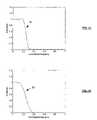
- FIG. 1Ashows an example frequency response 10 of a low pass filter with a sharp frequency transition band.
- FIG. 1Bshows an example frequency response 20 of a low pass filter with a smooth frequency transition band.
- the filters in FIGS. 1A-Bare both 8 tap 4 phase polyphase filters with a cutoff frequency of 1 ⁇ 4. When they are used for image interpolation, they generate the undesirable results as mentioned above.
- the present inventionaddresses the above problems. Accordingly, in one embodiment the present invention provides a method and system for reproducing an original image as an interpolated output image in which the original image is represented by digital input pixel data. Two polyphase filters are used to interpolate a selected image position, and the output of the two filters are selectively combined to achieve a better image interpolation result.
- a controlleris designed based on local image high-frequency levels and used to adaptively select or combine the filter output values, so that the image interpolation artifacts mentioned above can be avoided.
- the two filtersare designed as low pass filters with a cutoff frequency that is directly related to the number of phases of the filter.
- the polyphase filterscomprise one-dimensional (1D) finite impulse response (FIR) digital filters.
- FIRfinite impulse response
- one of the filterscomprises a “sharp filter” having a sharp frequency transition band
- the other filtercomprises a “smooth filter” having a smooth frequency transition band.
- the sharp filter and the smooth filterhave different characteristics for image interpolation.
- the output from the sharp filterpreserves the sharpness of the original image edge. However, it generates some ringing artifacts in smooth image areas that have a sharp edge in the vicinity.
- the output from the smooth filterhas no ringing artifact, but originally sharp edges tend to be smoothed and blurred. Therefore, according to the present invention, the functions of the two filters are adaptively (selectively) combined to avoid those artifacts. As such, for a given interpolation position in a video image frame, both the sharp filter and the smooth filter are applied. Then the filtering output values from the two filters are adaptively combined to obtain an interpolation value for the given pixel location.
- weighting coefficientsare calculated for each of the filter outputs, based on an estimation of local image high frequency level.
- the neighboring original image pixels at locations/positions that are within the filtering range of interpolationare checked.
- the image high frequencyis calculated at these original pixel locations, and used to estimate the image high frequency level at the given interpolation position.
- the weighting coefficientsare determined based on the estimation results.
- the output from the sharp filteris given more weight in determining the interpolation value for the given location. Otherwise, the output from the smooth filter is given more weight.
- FIG. 1Ais an example frequency response of a sharp filter that can be used for image interpolation
- FIG. 1Bis an example frequency response of a smooth filter that can be used for image interpolation
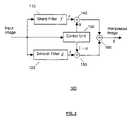
- FIG. 2is a functional block diagram for an image interpolation system according to an embodiment of the present invention.
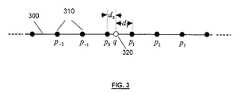
- FIG. 3shows an example interpolation position and the neighboring original image samples in an image line (or column) within an image frame, that can be used for the interpolation at the given position;
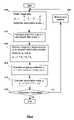
- FIG. 4shows a flowchart of an example image interpolation method according to the present invention, wherein image high frequency level at a given position is estimated based on the image high frequency components calculated at the two closest original image sample positions;
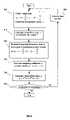
- FIG. 5shows a flowchart of another example image interpolation method according to the present invention, wherein image high frequency level at a given position is estimated based on the image high frequency components calculated at all the original image sample positions that are within the filtering range of interpolation to the given position.
- the present inventionprovides an image interpolation method and apparatus that utilizes polyphase filters and adaptively selects and/or combines their outputs to achieve a better image interpolation result.
- a control strategyis provided to adaptively select or combine the filter output values based on local image high-frequency levels, so that the image interpolation artifacts mentioned above can be avoided.
- the filtersare designed as low pass filters with a cutoff frequency that is directly related to the number of phases of the filter.
- the polyphase filterscomprise one-dimensional (1D) finite impulse response (FIR) digital filters. Using a one-dimensional filter, a two dimensional image interpolation can be achieved by interpolation along horizontal direction and vertical direction separately.
- an example image interpolation methodutilizes two polyphase filters.
- One of the filterscomprises a “sharp filter” having a sharp frequency transition band
- the other filtercomprises a “smooth filter” having a smooth frequency transition band.
- the sharp filter and the smooth filterhave different characteristics for image interpolation.
- the output from the sharp filterpreserves the sharpness of the original image edge. However, it generates some ringing artifacts in smooth image areas that have a sharp edge in the vicinity.
- the output from the smooth filterhas no ringing artifact, but it can smooth and blur the sharpness of edges. Therefore, according to the present invention, the functions of the two filters are adaptively (selectively) combined to avoid those artifacts. As such, for a given interpolation position in a video image frame, both the sharp filter and the smooth filter are applied. Then the filtering output values from the two filters are adaptively combined to obtain an interpolation value for the given pixel location.
- weighting coefficientsare calculated for each of the filter outputs, based on an estimation of local image high frequency level.
- the neighboring original image pixels at locations/positions that are within the filtering range of interpolationare checked.
- the image high frequencyis calculated at these original pixel locations, and used to estimate the image high frequency level at the given interpolation position.
- the weighting coefficientsare determined based on the estimation results.
- the output from the sharp filteris given more weight in determining the interpolation value for the given location. Otherwise, the output from the smooth filter is given more weight.
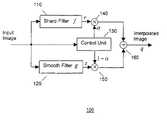
- FIG. 2shows a functional block diagram of an example interpolation system 100 that implements the above method according to an embodiment of the present invention.
- the system 100comprises a sharp polyphase filter 110 (denoted as f), a smooth polyphase filter 120 (denoted as g) and a control unit 130 .
- Both the sharp polyphase filter 110 and the smooth polyphase filter 120are 1D low pass FIR digital filter.
- the sharp filter 110has a sharp frequency transition band and the smooth filter has a smooth frequency transition band.
- the sharp filter 110provides sharp interpolation results with good edge quality, but it also causes some ringing artifacts in smooth image areas that have a sharp edge in the vicinity.
- the smooth filter 120does not cause ringing artifacts, however, it may smooth and blur the sharpness of edges.
- the control unit 130generates said weighting coefficients that are applied to the output from each of the polyphase filters 110 , 120 , using combiners (e.g., multipliers) 140 and 150 , respectively, to generate weighted filter output values. Then, the two weighted filter output values are combined (e.g., added) together using a summing node 160 to provide the interpolation value for a given position.
- combinerse.g., multipliers
- the sharp filter 110 and the smooth filter 120are 1D, FIR, polyphase filters.
- Each of the filters 110 and 120comprises a group of sub-filters, wherein each sub-filter is used for a different phase of interpolation.
- each of the filters 110 and 120is a N tap, M phase polyphase filter
- the filter length of each sub-filter f j or g jis N.
- Ncan be an odd or even integer.
- sub-filter coefficientscan be denoted as f i j and g i j , where
- sub-filter coefficientscan be denoted as f i j and g i j wherein
- N- N - 1 2 , ... ⁇ , 0 , ... ⁇ , N - 1 2 .
- the value of Nis assumed to be an even number.
- the value of Mcan be simply set equal to the interpolation ratio.
- Mshould be designed large enough to provide a proper interpolation resolution.
- the number of phases of a polyphase filterdetermines the number of essentially different interpolation values that can be generated between two neighboring original image pixels.
- a phase value of Ma polyphase filter can interpolate M ⁇ 1 essentially different interpolation values between each two neighboring original image pixels. Therefore, with a larger value of M, the filter can provide better interpolation resolution.
- a phase value larger than 10is used for digital TV related applications. With a good interpolation resolution, a given interpolation position can be approximated by an interpolation phase that is closest to it.
- the image pixel data input to the system 100is a one dimensional data stream.
- image interpolationis conducted along horizontal direction and vertical direction separately. If the length of the sub-filters is N (N is assumed to be an even number), for a given interpolation position, the original pixel samples within the filtering range of interpolation can be denoted as
- FIG. 3shows such one dimensional image data to be interpolated. It can be either part of an image line or column 300 , comprising pixels 310 (solid circles).
- FIG. 3depicts an interpolation position q 320 (hollow circle) and the neighboring original image pixels 310 in an image line or column 300 , that can be used for the interpolation at the given position.
- the value Nis assumed to be 6 for the given interpolation position 320 .
- the two closest neighboring original pixels 310 for the given interpolation position 320are p 0 and p 1 .
- p iis used to refer both a pixel's location and value in the following.
- qis used to refer both an interpolation position and the interpolation value at that position.
- filter coefficients of both f j and g jare assumed to be normalized (i.e., the sum of filter coefficients of either f j or g i is equal to 1).
- the weighting coefficients generated by the control unit 130are combined with the filter output values r and s.
- the interpolation value qwhen ⁇ takes a value of 1, the interpolation value q will be equal to the sharp filter output r, which may contain ringing artifacts around sharp image edge area.
- the interpolation value qWhen ⁇ takes a value of 0, the interpolation value q will have the same value as the smooth filter output s, which may have smoothed or blurred edge artifacts.
- the values r and sare adaptively combined to essentially eliminate those artifacts, based on the value of ⁇ calculated by the control unit 130 .
- determination of the value of ⁇ in the control unit 130is based on an estimation of image high frequency level at the given interpolation position 320 .
- the estimationcan be obtained through the image high frequency components calculated at original pixel locations 310 neighboring the interpolation position 320 .
- only the two closest original pixel locations to the given interpolation position 320are considered.
- all the original pixel locations that are within the filtering range of interpolation to the given interpolation positioncan be considered.
- other number of neighboring pixel positions on the current image line (or column), and even some pixel positions from neighboring image lines (or columns)may be used.
- the image high frequency level ⁇can be measured through a high-pass filtering process (e.g., using a high-pass FIR filter).
- image high frequency level at the given interpolation position 320is estimated based on the high frequency components calculated at the two closest original pixel locations to the given interpolation position.
- the two closest original pixels to the interpolation position 320are p 0 and p 1 .
- image high frequency components ⁇ 0 and ⁇ 1 at pixel location p 0 and p 1can be calculated according to relation (4) above.
- the image high frequency level at the given interpolation position 320can be estimated based on the high frequency components calculated at all the original pixel locations, within the filtering range of interpolation to the given position.
- Nis an even number
- jis the interpolation phase for the given interpolation position and 0 ⁇ j ⁇ M
- Mis the number of phases of the polyphase filters 110 and 120 .
- the value of ⁇ estimated through either relation (6) or (7),can reflect the image high frequency level around the given interpolation position. If ⁇ has a relatively large value, then there is rich image high frequency around the interpolation position 320 . In this case, the output from the sharp filter 110 should be given more weight in calculating the interpolation value for the given position so that edges can be better interpolated without being smoothed or blurred. On the other hand, if ⁇ has a relatively small value, it means that the given interpolation position 320 is in a flat image area. In this case, the output from the smooth filter 120 should be given more weight in calculating the interpolation value so that ringing artifacts can be avoided.
- the output from the smooth filter 120is used as the interpolation value for the given position.
- ⁇takes a value between 0 and 1.
- the output values from the sharp filter 110 and the smooth filter 120are mixed together as the interpolation value q for the given position 320 .
- the values of T 1 and T 2are determined in an empirical fashion. To do so, once the sharp filter 110 and the smooth filter 120 are designed, a group of testing images can be selected. Image interpolation is performed with different interpolation ratios with these test images accordingly. During this process, the values of T 1 and T 2 can be manually adjusted according to the interpolated result. If obvious ringing artifacts appear, the values of T 1 and T 2 can be adjusted higher. Otherwise, if there is blurred edge artifact due to interpolation, the values of T 1 and T 2 can be adjusted lower.
- FIG. 4shows an example flowchart of the image interpolation method above, wherein image high frequency level at a given position is estimated based on the image high frequency components calculated at the two original image sample positions that are closest to the given position.
- FIG. 5shows the flowchart of another embodiment of image interpolation according to the present invention, wherein image high frequency level at a given position is estimated based on the image high frequency components calculated at all the original image sample positions that are within the filtering range of interpolation to the given position.
- ⁇ i , i- N 2 + 1 , ... ⁇ , 0 , ... ⁇ , N 2 (step 520 ).
- the process steps in FIGS. 4 and 5are performed for the vertical and horizontal direction separately according to the relations detailed above.
- an imagecan be interpolated in an adaptive manner with polyphase filters. Both the blurred edge artifact and the ringing artifact can be successfully avoided in the interpolated image.
- the polyphase filtersare 1D FIR filters, computation requirement and complexity of a system according to the present invention is low, making such a system suitable for real-time applications.
- the controller 130determines weighting coefficients for each of the plurality of the filters. Then the weighted output of the filters is combined to determine the interpolated output value.
Landscapes
- Engineering & Computer Science (AREA)
- Physics & Mathematics (AREA)
- General Physics & Mathematics (AREA)
- Theoretical Computer Science (AREA)
- Multimedia (AREA)
- Signal Processing (AREA)
- Image Processing (AREA)
Abstract
Description
The present invention relates to image interpolation, an in particular to image interpolations using polyphase filters.
Image interpolation is widely used in applications such as video deinterlacing, video scaling, etc. in digital TV systems. An effective image interpolation technique is important for the overall image quality in a digital TV system. There are image interpolation techniques that generate a sharp image, but they give rise to ringing artifacts around sharp edges. And, existing techniques that generate a smooth image without ringing artifacts, tend to smooth the sharpness of edges and make the edges blurring.
In order to solve those problems, some adaptive image interpolation techniques have been proposed, such as in U.S. Pat. No. 4,468,693, that provide an interpolation method based on a manually operated switch for switching between different interpolation algorithms depending on the type of image being interpolated. However, such a manual operation is not suitable for a digital TV system.
In another example, U.S. Pat. No. 5,008,752 provides several interpolation kernels including cubic convolution, bilinear and nearest neighbor interpolation that are selected by a control unit based on the difference between two neighboring image pixel values. Such a control unit can be sensitive to image noise. In addition, bilinear and nearest neighbor interpolation methods generally produce too smooth interpolated images.
In another example, U.S. Pat. No. 5,327,257 provides a technique whereby an image is interpolated by combining a sharp result and a smooth result based on a scaling factor with a value from 0 to 1. In this method, 2D filters are used to obtain a sharp result and a smooth result from the original image. The scaling factor is calculated based on lookup tables according to local image contrast and image density. For a given application, this method requires that the contrast and density lookup tables be predetermined and stored in system memory.
Yet in another example, U.S. Pat. No. 6,535,651 provides a method of interpolating images depending on whether a new image pixel belongs to an edge area or a flat image area. In order to accurately check if a pixel belongs to an edge area as well as the direction of the edge, a relatively complicated mechanism is required.
Polyphase filters have been widely used for image interpolation purposes due to their computation simplicity and good performance. Generally, a polyphase filter used for digital signal interpolation comprises a low pass filter having a cutoff frequency determined by the interpolation ratio. For example, to expand a digital signal L times, a low pass filter with a cutoff frequency of 1/L can be used. The referred frequency is normalized where the normalized frequency value of 1 corresponds to half sampling frequency. The low pass filter used in this case can be separated into L sub-filters, with each sub-filter used for a different phase of interpolation. More detailed explanation of the polyphase filter concept can be found in “Multirate Systems and Filter Banks”, P. P. Vaidyanathan, Prentice Hall, 1993, incorporated herein by reference.
However, such existing image interpolation techniques based on polyphase filters have similar problems mentioned above. This is because when the filter is designed to have a sharp frequency transition band, it provides a sharp interpolated image. But it also generates ringing artifacts around sharp edges.FIG. 1A shows anexample frequency response 10 of a low pass filter with a sharp frequency transition band.
When the filter is designed to have a smooth frequency transition band, it provides a smooth interpolated image without ringing artifacts. However, the filter tends to smooth and blur the sharpness of edges.FIG. 1B shows anexample frequency response 20 of a low pass filter with a smooth frequency transition band. The filters inFIGS. 1A-B , are both 8 tap 4 phase polyphase filters with a cutoff frequency of ¼. When they are used for image interpolation, they generate the undesirable results as mentioned above.
The present invention addresses the above problems. Accordingly, in one embodiment the present invention provides a method and system for reproducing an original image as an interpolated output image in which the original image is represented by digital input pixel data. Two polyphase filters are used to interpolate a selected image position, and the output of the two filters are selectively combined to achieve a better image interpolation result. A controller is designed based on local image high-frequency levels and used to adaptively select or combine the filter output values, so that the image interpolation artifacts mentioned above can be avoided.
The two filters are designed as low pass filters with a cutoff frequency that is directly related to the number of phases of the filter. According to said embodiment of the present invention, the polyphase filters comprise one-dimensional (1D) finite impulse response (FIR) digital filters. Using a one-dimensional filter, a two dimensional image interpolation can be achieved by interpolation along horizontal direction and vertical direction separately.
In one example, one of the filters comprises a “sharp filter” having a sharp frequency transition band, and the other filter comprises a “smooth filter” having a smooth frequency transition band. The sharp filter and the smooth filter have different characteristics for image interpolation. The output from the sharp filter preserves the sharpness of the original image edge. However, it generates some ringing artifacts in smooth image areas that have a sharp edge in the vicinity. The output from the smooth filter has no ringing artifact, but originally sharp edges tend to be smoothed and blurred. Therefore, according to the present invention, the functions of the two filters are adaptively (selectively) combined to avoid those artifacts. As such, for a given interpolation position in a video image frame, both the sharp filter and the smooth filter are applied. Then the filtering output values from the two filters are adaptively combined to obtain an interpolation value for the given pixel location.
To adaptively combine the two filter outputs, weighting coefficients are calculated for each of the filter outputs, based on an estimation of local image high frequency level. In one estimation example, for a given interpolation position, the neighboring original image pixels at locations/positions that are within the filtering range of interpolation, are checked. The image high frequency is calculated at these original pixel locations, and used to estimate the image high frequency level at the given interpolation position. Then, the weighting coefficients are determined based on the estimation results.
As such, if image high frequency level at the given interpolation position is estimated high, the output from the sharp filter is given more weight in determining the interpolation value for the given location. Otherwise, the output from the smooth filter is given more weight. Through such an example adaptive combination of the filter output values from a sharp filter and a smooth filter in the interpolation process, the sharpness of image edges can be well preserved without introducing either blurring edge artifacts or ringing artifacts.
Other objects, features and advantages of the present invention will be apparent from the following specification taken in conjunction with the following drawings.
In one embodiment the present invention provides an image interpolation method and apparatus that utilizes polyphase filters and adaptively selects and/or combines their outputs to achieve a better image interpolation result. As noted, a control strategy is provided to adaptively select or combine the filter output values based on local image high-frequency levels, so that the image interpolation artifacts mentioned above can be avoided.
According to polyphase filter theory for image interpolation, the filters are designed as low pass filters with a cutoff frequency that is directly related to the number of phases of the filter. According to said embodiment of the present invention, the polyphase filters comprise one-dimensional (1D) finite impulse response (FIR) digital filters. Using a one-dimensional filter, a two dimensional image interpolation can be achieved by interpolation along horizontal direction and vertical direction separately.
As such, an example image interpolation method according to the present invention utilizes two polyphase filters. One of the filters comprises a “sharp filter” having a sharp frequency transition band, and the other filter comprises a “smooth filter” having a smooth frequency transition band. The sharp filter and the smooth filter have different characteristics for image interpolation. The output from the sharp filter preserves the sharpness of the original image edge. However, it generates some ringing artifacts in smooth image areas that have a sharp edge in the vicinity. The output from the smooth filter has no ringing artifact, but it can smooth and blur the sharpness of edges. Therefore, according to the present invention, the functions of the two filters are adaptively (selectively) combined to avoid those artifacts. As such, for a given interpolation position in a video image frame, both the sharp filter and the smooth filter are applied. Then the filtering output values from the two filters are adaptively combined to obtain an interpolation value for the given pixel location.
To adaptively combine the two filter outputs, weighting coefficients are calculated for each of the filter outputs, based on an estimation of local image high frequency level. In one estimation example, for a given interpolation position, the neighboring original image pixels at locations/positions that are within the filtering range of interpolation are checked. The image high frequency is calculated at these original pixel locations, and used to estimate the image high frequency level at the given interpolation position. Then, the weighting coefficients are determined based on the estimation results.
As such, if image high frequency level at the given interpolation position is estimated high, the output from the sharp filter is given more weight in determining the interpolation value for the given location. Otherwise, the output from the smooth filter is given more weight. Through such an example adaptive combination of the filter output values from a sharp filter and a smooth filter in the interpolation process, the sharpness of image edges can be well preserved without introducing either noticeable blurring edge artifacts or ringing artifacts.
According to the example described herein, thesharp filter 110 and thesmooth filter 120 are 1D, FIR, polyphase filters. Each of thefilters filters filters filter 110 are denoted as fj, j=0,1, . . . M−1, wherein j is the interpolation phase. Likewise, the sub-filters of thefilter 120 are denoted as gj, j=0,1, . . . M−1. The filter length of each sub-filter fjor gjis N.
The value of N can be an odd or even integer. When N is an even number, sub-filter coefficients can be denoted as fijand gij, where
When N is an odd number, sub-filter coefficients can be denoted as fijand gijwherein
For simplicity of explanation in the example described herein, the value of N is assumed to be an even number.
For image interpolation with a fixed and integer ratio, the value of M can be simply set equal to the interpolation ratio. However, for an image interpolation application that requires arbitrary or variable interpolation ratios, M should be designed large enough to provide a proper interpolation resolution. The number of phases of a polyphase filter determines the number of essentially different interpolation values that can be generated between two neighboring original image pixels. With a phase value of M, a polyphase filter can interpolate M−1 essentially different interpolation values between each two neighboring original image pixels. Therefore, with a larger value of M, the filter can provide better interpolation resolution. In one example, a phase value larger than 10 is used for digital TV related applications. With a good interpolation resolution, a given interpolation position can be approximated by an interpolation phase that is closest to it.
According to the example described herein, it can be assumed that the image pixel data input to thesystem 100 is a one dimensional data stream. As such, image interpolation is conducted along horizontal direction and vertical direction separately. If the length of the sub-filters is N (N is assumed to be an even number), for a given interpolation position, the original pixel samples within the filtering range of interpolation can be denoted as
Assuming the interpolation phase for the given position q is j, (0≦j<M), the output values r and s from thesharp filter 110 and the smooth filter120 (FIG. 2 ), respectively for the position q, can be expressed according to relations (1) and (2) below:
In relations (1) and (2), filter coefficients of both fjand gjare assumed to be normalized (i.e., the sum of filter coefficients of either fjor giis equal to 1).
Referring back toFIG. 2 , the weighting coefficients generated by thecontrol unit 130 are combined with the filter output values r and s. The final interpolation value q of the interpolation position320 (FIG. 3 ) is performed according to the example relation (3) below:
q=r*α+s*(1−α) (3)
wherein α and (1−α) are the weighting coefficients generated by thecontrol unit 130 for thesharp filter 110 and thesmooth filter 120, respectively (0≦═≦1).
q=r*α+s*(1−α) (3)
wherein α and (1−α) are the weighting coefficients generated by the
In relation (3) above, when α takes a value of 1, the interpolation value q will be equal to the sharp filter output r, which may contain ringing artifacts around sharp image edge area. When α takes a value of 0, the interpolation value q will have the same value as the smooth filter output s, which may have smoothed or blurred edge artifacts. According to the present invention, the values r and s are adaptively combined to essentially eliminate those artifacts, based on the value of α calculated by thecontrol unit 130.
In this example implementation, determination of the value of α in thecontrol unit 130 is based on an estimation of image high frequency level at the giveninterpolation position 320. The estimation can be obtained through the image high frequency components calculated atoriginal pixel locations 310 neighboring theinterpolation position 320. In one case, only the two closest original pixel locations to the giveninterpolation position 320 are considered. In another case, all the original pixel locations that are within the filtering range of interpolation to the given interpolation position can be considered. In general, other number of neighboring pixel positions on the current image line (or column), and even some pixel positions from neighboring image lines (or columns) may be used.
As such, inFIG. 3 , at an original pixel location pi, the image high frequency level φ can be measured through a high-pass filtering process (e.g., using a high-pass FIR filter). For example, image high frequency level φ can be simply measured according to the relation:
φi=|pi−0.5*(pi−1+pi+l)| (4)
wherein the high pass filter is a 3-tap FIR filter with coefficients of {−½, 1,−½}.
φi=|pi−0.5*(pi−1+pi+l)| (4)
wherein the high pass filter is a 3-tap FIR filter with coefficients of {−½, 1,−½}.
In a simple method, image high frequency level at the giveninterpolation position 320 is estimated based on the high frequency components calculated at the two closest original pixel locations to the given interpolation position. As shown inFIG. 3 , when the length N of a sub-filter is an even number value, the two closest original pixels to theinterpolation position 320 are p0and p1. Assuming that the distances between the given interpolation position and its two closest original pixels are d0and d1respectively, and that the distance between neighboring original samples is1, such that:
d0+d1=1 (5)
then, image high frequency components φ0and φ1at pixel location p0and p1, respectively, can be calculated according to relation (4) above. Then, based on the values of φ0, φ1and d0, d1, an estimation of the image high frequency level, Φ, can be further calculated according to the relation:
Φ=d1*φ0+d0*φ1 (6)
wherein Φ is used as an estimation of the image high frequency level at the giveninterpolation position 320.
d0+d1=1 (5)
then, image high frequency components φ0and φ1at pixel location p0and p1, respectively, can be calculated according to relation (4) above. Then, based on the values of φ0, φ1and d0, d1, an estimation of the image high frequency level, Φ, can be further calculated according to the relation:
Φ=d1*φ0+d0*φ1 (6)
wherein Φ is used as an estimation of the image high frequency level at the given
In another embodiment, the image high frequency level at the giveninterpolation position 320 can be estimated based on the high frequency components calculated at all the original pixel locations, within the filtering range of interpolation to the given position. In the example shown inFIG. 3 , when the polyphase filter includes 6 taps, the pixels pi, i=−2,−1,0,1,2,3 are within the filtering range to theinterpolation position 320. In general, when the polyphase filter has N taps (N is an even number), then pixels
are all the pixels within the filtering range. Accordingly, image high frequency component
can be calculated using relation (4) above. Then the value of Φ can be calculated according to relation:
wherein j is the interpolation phase for the given interpolation position and 0≦j<M, and M is the number of phases of the
The value of Φ estimated through either relation (6) or (7), can reflect the image high frequency level around the given interpolation position. If Φ has a relatively large value, then there is rich image high frequency around theinterpolation position 320. In this case, the output from thesharp filter 110 should be given more weight in calculating the interpolation value for the given position so that edges can be better interpolated without being smoothed or blurred. On the other hand, if Φ has a relatively small value, it means that the giveninterpolation position 320 is in a flat image area. In this case, the output from thesmooth filter 120 should be given more weight in calculating the interpolation value so that ringing artifacts can be avoided.
Once the estimation of the image high frequency level Φ around the given interpolation position is available, the weighting coefficient α can be calculated according to the relation:
α=min(1, max(0,(Φ−T1)/(T2−T1))) (8)
wherein T1and T2are two pre-determined threshold values (T2>T1≧0). According to relation (8), when the value of Φ is greater than T2, then α takes a value of 1. In this case, the output from thesharp filter 110 is used as the interpolation value for the giveninterpolation position 320. When the value of Φ is smaller than T1, then α takes a value of 0. In this case, the output from thesmooth filter 120 is used as the interpolation value for the given position. And, when the value of Φ is between T1and T2, then α takes a value between 0 and 1. In this case, the output values from thesharp filter 110 and thesmooth filter 120 are mixed together as the interpolation value q for the givenposition 320.
α=min(1, max(0,(Φ−T1)/(T2−T1))) (8)
wherein T1and T2are two pre-determined threshold values (T2>T1≧0). According to relation (8), when the value of Φ is greater than T2, then α takes a value of 1. In this case, the output from the
In one implementation, the values of T1and T2are determined in an empirical fashion. To do so, once thesharp filter 110 and thesmooth filter 120 are designed, a group of testing images can be selected. Image interpolation is performed with different interpolation ratios with these test images accordingly. During this process, the values of T1and T2can be manually adjusted according to the interpolated result. If obvious ringing artifacts appear, the values of T1and T2can be adjusted higher. Otherwise, if there is blurred edge artifact due to interpolation, the values of T1and T2can be adjusted lower.
is obtained, and the interpolation phase j is determined (step400). Then outputs r and s of the sharp and
As such, initially image data
is obtained, and the interpolation phase j is determined (step500). Then outputs r and s of the sharp and
(step520). The weighting coefficient is determined as α=min(1, max(0,(Φ−T1)/(T2−T1))) (step530), and the interpolation value is calculated as q=r*α+s*(1−α) (step540). It is determined if all necessary positions have been interpolated (step550). If so, the process ends, otherwise the next interpolation position is selected for processing (step560) and the process returns to step 500. As those skilled in the art will recognize, the process steps in
Using the above example method, an image can be interpolated in an adaptive manner with polyphase filters. Both the blurred edge artifact and the ringing artifact can be successfully avoided in the interpolated image. In addition, because the polyphase filters are 1D FIR filters, computation requirement and complexity of a system according to the present invention is low, making such a system suitable for real-time applications. Although in the example description herein two polyphase filters are utilized, as those skilled in the art will recognize, the present invention contemplates using three or more polyphase filters having different frequency transition bands, ranging from very smooth to very sharp. In that case thecontroller 130 determines weighting coefficients for each of the plurality of the filters. Then the weighted output of the filters is combined to determine the interpolated output value.
While this invention is susceptible of embodiments in many different forms, there are shown in the drawings and will herein be described in detail, preferred embodiments of the invention with the understanding that the present disclosure is to be considered as an exemplification of the principles of the invention and is not intended to limit the broad aspects of the invention to the embodiments illustrated. Theaforementioned system 100 according to the present invention can be implemented in many ways, such as program instructions for execution by a processor, as logic circuits, as Application-Specific Integrated Circuit (ASIC), as firmware, etc., as is known to those skilled in the art. Therefore, the present invention is not limited to the example embodiments described herein.
The present invention has been described in considerable detail with reference to certain preferred versions thereof; however, other versions are possible. Therefore, the spirit and scope of the appended claims should not be limited to the description of the preferred versions contained herein.
Claims (10)
1. A method of interpolating image positions in an original image to produce an interpolated output image, wherein the original image is represented by digital input pixel data, comprising the steps of:
(a) providing a first filter having a sharp interpolation characteristic;
(b) providing a second filter having a smooth interpolation characteristic;
(c) interpolating a selected image position in the image using the first filter to generate a sharp interpolation output value;
(d) interpolating the selected image position in the image using the second filter to generate a smooth interpolation output value;
(e) calculating a different weighting coefficient for the output of each filter by estimating a high frequency level at the interpolated selected image position and calculating the weighting coefficients based on the estimated image high frequency level; and
(f) selectively combining the output values from the filters as a function of the weighting coefficients, to generate an interpolation output value for the selected image position of an interpolated output image, wherein the weighting coefficient α for the first filter output is calculated according to the relation:
α=min(1, max(0,(φ−T1)/(T2−T1)))
α=min(1, max(0,(φ−T1)/(T2−T1)))
where φ is the image high frequency level estimated for the given interpolation position, T1and T2are pre-determined threshold values where T2>T1≧0; and
the weighting coefficient for the second filter output is (1−α).
2. A method of interpolating image positions in an original image to produce an interpolated output image, wherein the original image is represented by digital input pixel data, comprising the steps of:
providing a first filter having a sharp interpolation characteristic;
providing a second filter having a smooth interpolation characteristic;
each of the filters comprises a N -tap M -phase polyphase filter;
interpolating a selected image position in the image using the first filter to generate a sharp interpolation output value;
interpolating a selected image position in the image using the second filter to generate a smooth interpolation output value;
calculating a weighting coefficient for the output of each filter by estimating the image high frequency level at the selected image position based on image high frequency components measured at original image pixels neighboring the selected image position, and calculating the weighting coefficients based on the estimated image high frequency level;
selectively combining the output values from the filters as a function of the weighting coefficients, to generate an interpolation output value for the selected image position of an interpolated output image;
wherein the image high frequency component øiat each of the original image pixels is measured according to the relation
øi=|pi−0.5*(pi−1+Pi+1)|
øi=|pi−0.5*(pi−1+Pi+1)|
wherein piis original image pixel value where image high frequency component is to be measured, and pi−1and pi+1are original images pixel values of the neighboring pixels.
3. The method ofclaim 2 , wherein the image high frequency level φ at the selected image position is estimated according to the relation:
wherein
are the image high frequency components calculated at the original image pixels that are within the filtering range of interpolation to the selected image position, fijand gijare filter coefficients of sub-filters fjand gjfor the first filter and the second filter, respectively, and j is the interpolation phase for the selected image position.
4. A method of interpolating image positions in an original image to produce an interpolated output image, wherein the original image is represented by digital input pixel data, comprising the steps of:
providing a first filter having a sharp interpolation characteristic;
providing a second filter having a smooth interpolation characteristic;
each of the filters comprises a N -tap M -phase polyphase filter;
interpolating a selected image position in the image using the first filter to generate a sharp interpolation output value;
interpolating a selected image position in the image using the second filter to generate a smooth interpolation output value;
calculating a weighting coefficient for the output of each filter by estimating the image high frequency level at the selected image position based on image high frequency components measured at original image pixels neighboring the selected image position, and calculating the weighting coefficients based on the estimated image high frequency level;
selectively combining the output values from the filters as a function of the weighting coefficients, to generate an interpolation output value for the selected image position of an interpolated output image;
wherein the image high frequency level Φ at the selected image position is estimated according to the relation:
φ=d1*ø0+d0*ø1
φ=d1*ø0+d0*ø1
wherein ø0and ø1are the image high frequency components calculated at the two closest original image pixels, d0and d1are the distances between the selected interpolation position and the two closest original image pixels, the distance between two neighboring original image pixels is assumed to be 1, such that d0+d1=1.
5. A method of interpolating image positions in an original image to produce an interpolated output image, wherein the original image is represented by digital input pixel data, comprising the steps of:
providing a first filter having a sharp interpolation characteristic;
providing a second filter having a smooth interpolation characteristic;
each of the filters comprises a N -tap M -phase polyphase filter;
interpolating a selected image position in the image using the first filter to generate a sharp interpolation output value;
interpolating a selected image position in the image using the second filter to generate a smooth interpolation output value;
calculating a weighting coefficient for the output of each filter by estimating the image high frequency level at the selected image position based on image high frequency components measured at original image pixels neighboring the selected image position, and calculating the weighting coefficients based on the estimated image high frequency level;
selectively combining the output values from the filters as a function of the weighting coefficients, to generate an interpolation output value for the selected image position of an interpolated output image; and
wherein the image high frequency level φ at the selected image position is estimated according to the relation:
wherein
are the image high frequency components calculated at the original image pixels that are within the filtering range of interpolation to the selected image position, fijand gijare filter coefficients of sub-filters fjand gjfor the first filter and the second filter, respectively, and j is the interpolation phase for the selected image position.
6. An interpolation system that interpolates image positions in an original image to produce an interpolated output image, wherein the original image is represented by digital input pixel data, comprising:
(a) a first filter having a sharp interpolation characteristic, the first filter interpolating a selected image position in the image to generate a sharp interpolation output value;
(b) a second filter having a smooth interpolation characteristic, the second filter interpolating the selected image position in the image to generate a smooth interpolation output value;
(c) a controller that calculates a weighting coefficient for the output of each filter by estimating a high frequency level at the interpolated selected image position, and calculating a weighting coefficient for the output of the filter based on the estimated image high frequency level; and
(d) a combiner that selectively combines the output values from the filters as a function of the weighting coefficients, to generate an interpolation output value for the selected image position of an interpolated output image, wherein the controller calculates the weighting coefficient α for the first filter output according to the relation:
α=min(1, max(0,(φ−T1)/(T2−T1)))
α=min(1, max(0,(φ−T1)/(T2−T1)))
where φ is the image high frequency level estimated for the given interpolation position, T1and T2are pre-determined threshold values where T2>T1≧0, whereby that the weighting coefficient for the second filter output is (1−α).
7. An interpolation system that interpolates image positions in an original image to produce an interpolated output image, wherein the original image is represented by digital input pixel data, comprising:
a first filter having a sharp interpolation characteristic, the first filter interpolating a selected image position in the image to generate a sharp interpolation output value;
a second filter having a smooth interpolation characteristic, the second filter interpolating the selected image position in the image to generate a smooth interpolation output value;
wherein each of the first and second filters comprises a polyphase filter, and each of the polyphase filters comprises a N -tap M phase polyphase filter;
a controller that calculates a weighting coefficient for the output of each filter by estimating the image high frequency level at the selected image position, and calculating a weighting coefficient for the output of the filter based on the estimated image high frequency level such that the image high frequency level at the selected image position is estimated based on image high frequency components measured using a high-pass filtering process at original image pixels neighboring the selected image position; and
a combiner that selectively combines the output values from the filters as a function of the weighting coefficients, to generate an interpolation output value for the selected image position of an interpolated output image;
wherein the image high frequency component øiat each of the original image pixels is measured according to the relation:
øi=|pi−0.5*(pi−1+Pi+1)|
øi=|pi−0.5*(pi−1+Pi+1)|
wherein piis original image pixel value where image high frequency component is to be measured, and pi−1and pi+1are values of its neighboring pixels.
8. The system ofclaim 7 , wherein the image high frequency level φ at the selected image position is estimated according to the relation:
wherein
are the image high frequency components calculated at the original image pixels that are within the filtering range of interpolation to the selected image position, fijand gijare filter coefficients of sub-filters fjand gjfor the first filter and the second filter, respectively, and j is the interpolation phase for the selected image position.
9. An interpolation system that interpolates image positions in an original image to produce an interpolated output image, wherein the original image is represented by digital input pixel data, comprising:
a first filter having a sharp interpolation characteristic, the first filter interpolating a selected image position in the image to generate a sharp interpolation output value;
a second filter having a smooth interpolation characteristic, the second filter interpolating the selected image position in the image to generate a smooth interpolation output value;
wherein each of the first and second filters comprises a polyphase filter, and each of the polyphase filters comprises a N -tap M phase polyphase filter;
a controller that calculates a weighting coefficient for the output of each filter by estimating the image high frequency level at the selected image position, and calculating a weighting coefficient for the output of the filter based on the estimated image high frequency level such that the image high frequency level at the selected image position is estimated based on image high frequency components measured at original image pixels closest to the selected image position;
a combiner that selectively combines the output values from the filters as a function of the weighting coefficients, to generate an interpolation output value for the selected image position of an interpolated output image;
wherein the image high frequency level φ at the selected image position is estimated according to the relation:
φ=d1*ø0+d0*ø1
φ=d1*ø0+d0*ø1
wherein ø0and ø1are the image high frequency components calculated at the two closest original image pixels, d0and d1are the distances between the selected interpolation position and the two closest original image pixels, the distance between two neighboring original image pixels is assumed to be 1, such that d0+d1=1.
10. An interpolation system that interpolates image positions in an original image to produce an interpolated output image, wherein the original image is represented by digital input pixel data, comprising:
a first filter having a sharp interpolation characteristic, the first filter interpolating a selected image position in the image to generate a sharp interpolation output value;
a second filter having a smooth interpolation characteristic, the second filter interpolating the selected image position in the image to generate a smooth interpolation output value;
wherein each of the first and second filters comprises a polyphase filter, and each of the polyphase filters comprises a N -tap M phase polyphase filter;
a controller that calculates a weighting coefficient for the output of each filter by estimating the image high frequency level at the selected image position, and calculating a weighting coefficient for the output of the filter based on the estimated image high frequency level such that the image high frequency level at the selected image position is estimated based on image high frequency components measured at original image pixels neighboring the selected image position;
a combiner that selectively combines the output values from the filters as a function of the weighting coefficients, to generate an interpolation output value for the selected image position of an interpolated output image;
wherein the image high frequency level φ at the selected image position is estimated according to the relation:
wherein
are the image high frequency components calculated at the original image pixels that are within the filtering range of interpolation to the selected image position, fijand gijare filter coefficients of sub-filters fjand gjfor the first filter and the second filter, respectively, and j is the interpolation phase for the selected image position.
Priority Applications (2)
| Application Number | Priority Date | Filing Date | Title |
|---|---|---|---|
| US10/697,358US7391933B2 (en) | 2003-10-30 | 2003-10-30 | Method and apparatus for image interpolation based on adaptive polyphase filters |
| KR1020040023178AKR20050041849A (en) | 2003-10-30 | 2004-04-03 | Method and apparatus for image interpolation based on adaptive polyphase filters |
Applications Claiming Priority (1)
| Application Number | Priority Date | Filing Date | Title |
|---|---|---|---|
| US10/697,358US7391933B2 (en) | 2003-10-30 | 2003-10-30 | Method and apparatus for image interpolation based on adaptive polyphase filters |
Publications (2)
| Publication Number | Publication Date |
|---|---|
| US20040091174A1 US20040091174A1 (en) | 2004-05-13 |
| US7391933B2true US7391933B2 (en) | 2008-06-24 |
Family
ID=32230676
Family Applications (1)
| Application Number | Title | Priority Date | Filing Date |
|---|---|---|---|
| US10/697,358Expired - Fee RelatedUS7391933B2 (en) | 2003-10-30 | 2003-10-30 | Method and apparatus for image interpolation based on adaptive polyphase filters |
Country Status (2)
| Country | Link |
|---|---|
| US (1) | US7391933B2 (en) |
| KR (1) | KR20050041849A (en) |
Cited By (12)
| Publication number | Priority date | Publication date | Assignee | Title |
|---|---|---|---|---|
| US20050196072A1 (en)* | 2004-03-04 | 2005-09-08 | Sheng Zhong | Method and system for polyphase filtering by combining IIR and FIR filters and its applications in video scaling |
| US20060274089A1 (en)* | 2005-03-11 | 2006-12-07 | Huaya Microelectronics (Shanghai), Inc. | Image scaler with controllable sharpness |
| US20070139560A1 (en)* | 2005-12-20 | 2007-06-21 | Sheng Zhong | Method and system for non-linear blending in motion-based video processing |
| US20070139567A1 (en)* | 2005-12-20 | 2007-06-21 | Sheng Zhong | Method and system for analog video noise detection |
| US20070139563A1 (en)* | 2005-12-20 | 2007-06-21 | Sheng Zhong | Method and system for analog video noise reduction by blending FIR and IIR filtering |
| US20100215284A1 (en)* | 2005-05-31 | 2010-08-26 | Broadcom Corporation | System and Method for Implementing Graphics and Video Scaling Algorithm Using Interpolation Based on Symmetrical Polyphase Filtering |
| US20100321216A1 (en)* | 2009-06-19 | 2010-12-23 | Conexant Systems, Inc. | Systems and Methods for Variable Rate Conversion |
| US20110135208A1 (en)* | 2009-12-03 | 2011-06-09 | Qualcomm Incorporated | Digital image combining to produce optical effects |
| US20110298972A1 (en)* | 2010-06-04 | 2011-12-08 | Stmicroelectronics Asia Pacific Pte. Ltd. | System and process for image rescaling using adaptive interpolation kernel with sharpness and de-ringing control |
| US20120082396A1 (en)* | 2010-09-30 | 2012-04-05 | Crandall Richard E | Digital Image Resampling |
| US8786637B2 (en) | 2011-03-23 | 2014-07-22 | Samsung Electronics Co., Ltd. | Method for processing image and devices using the method |
| US20140205207A1 (en)* | 2013-01-21 | 2014-07-24 | Apple Inc. | Techniques for presenting user adjustments to a digital image |
Families Citing this family (22)
| Publication number | Priority date | Publication date | Assignee | Title |
|---|---|---|---|---|
| WO2001054359A1 (en)* | 2000-01-20 | 2001-07-26 | Mci Worldcom, Inc. | Intelligent network and method for providing voice telephony over atm |
| US20050091174A1 (en)* | 2003-10-22 | 2005-04-28 | International Business Machines Corporation | Searching for services in a UDDI registry |
| US7508997B2 (en) | 2004-05-06 | 2009-03-24 | Samsung Electronics Co., Ltd. | Method and apparatus for video image interpolation with edge sharpening |
| US7386183B2 (en)* | 2004-07-09 | 2008-06-10 | Aloka Co., Ltd. | Method and apparatus for image processing |
| US8243820B2 (en)* | 2004-10-06 | 2012-08-14 | Microsoft Corporation | Decoding variable coded resolution video with native range/resolution post-processing operation |
| US9071847B2 (en) | 2004-10-06 | 2015-06-30 | Microsoft Technology Licensing, Llc | Variable coding resolution in video codec |
| US7956930B2 (en) | 2006-01-06 | 2011-06-07 | Microsoft Corporation | Resampling and picture resizing operations for multi-resolution video coding and decoding |
| US8442344B2 (en)* | 2006-08-07 | 2013-05-14 | Qualcomm Incorporated | Adaptive spatial image filter for filtering image information |
| US8260087B2 (en)* | 2007-01-22 | 2012-09-04 | Sharp Laboratories Of America, Inc. | Image upsampling technique |
| JP4905187B2 (en)* | 2007-03-09 | 2012-03-28 | ソニー株式会社 | Image processing apparatus, imaging apparatus, image processing method, and computer program |
| US8107571B2 (en)* | 2007-03-20 | 2012-01-31 | Microsoft Corporation | Parameterized filters and signaling techniques |
| US20110200108A1 (en)* | 2010-02-18 | 2011-08-18 | Qualcomm Incorporated | Chrominance high precision motion filtering for motion interpolation |
| KR101129723B1 (en)* | 2010-04-12 | 2012-05-11 | 상명대학교 산학협력단 | Method of piecewise weighted linear interpolation and device adopting the method |
| WO2012103359A2 (en) | 2011-01-27 | 2012-08-02 | Soft Machines, Inc. | Hardware acceleration components for translating guest instructions to native instructions |
| KR101612594B1 (en)* | 2011-01-27 | 2016-04-14 | 소프트 머신즈, 인크. | Guest instruction to native instruction range based mapping using a conversion look aside buffer of a processor |
| US20130162901A1 (en)* | 2011-12-22 | 2013-06-27 | Silicon Image, Inc. | Ringing suppression in video scalers |
| CN103986922B (en)* | 2013-02-07 | 2016-03-02 | 聚晶半导体股份有限公司 | Image processing method |
| WO2016154966A1 (en)* | 2015-04-01 | 2016-10-06 | 中国科学院自动化研究所 | Method and system for image scaling based on edge self-adaptation |
| US10445894B2 (en)* | 2016-05-11 | 2019-10-15 | Mitutoyo Corporation | Non-contact 3D measuring system |
| US9860429B1 (en)* | 2016-06-30 | 2018-01-02 | Apple Inc. | Scaling of image data in sensor interface based on detection of defective pixels |
| CN107025631A (en)* | 2017-03-13 | 2017-08-08 | 深圳市嘉和顺信息科技有限公司 | A kind of image processing method, device and the equipment of golf course figure |
| US12086961B2 (en)* | 2020-12-11 | 2024-09-10 | Samsung Electronics Co., Ltd | Method and apparatus for adaptive hybrid fusion |
Citations (23)
| Publication number | Priority date | Publication date | Assignee | Title |
|---|---|---|---|---|
| US4468693A (en) | 1981-07-14 | 1984-08-28 | Dai Nippon Printing Co., Ltd. | Video printing apparatus |
| US5008752A (en) | 1989-06-16 | 1991-04-16 | Eastman Kodak Company | Digital image interpolator with multiple interpolation algorithms |
| US5038388A (en)* | 1989-05-15 | 1991-08-06 | Polaroid Corporation | Method for adaptively sharpening electronic images |
| US5054100A (en) | 1989-11-16 | 1991-10-01 | Eastman Kodak Company | Pixel interpolator with edge sharpening |
| US5070465A (en)* | 1987-02-25 | 1991-12-03 | Sony Corporation | Video image transforming method and apparatus |
| US5257326A (en)* | 1990-04-20 | 1993-10-26 | Hitachi, Ltd. | Method and apparatus for interpolating a video signal of a picture element which has not been sampled and transmitted by an interleave sampling operation |
| US5327257A (en) | 1992-02-26 | 1994-07-05 | Cymbolic Sciences International Ltd. | Method and apparatus for adaptively interpolating a digital image |
| US5774601A (en)* | 1994-11-23 | 1998-06-30 | Imation Corp. | System and method for adaptive interpolation of image data |
| US5889895A (en) | 1995-05-23 | 1999-03-30 | Hewlett-Packard Company | Area based interpolation for image scaling |
| US5953465A (en) | 1996-03-15 | 1999-09-14 | Fuji Photo Film Co., Ltd. | Interpolation processing method and apparatus for image signals having improved image edge differentiation |
| US5959693A (en)* | 1997-05-07 | 1999-09-28 | General Instrument Corporation | Pixel adaptive noise reduction filter for digital video |
| US6175659B1 (en) | 1998-10-06 | 2001-01-16 | Silicon Intergrated Systems Corp. | Method and apparatus for image scaling using adaptive edge enhancement |
| US20020067862A1 (en)* | 2001-12-12 | 2002-06-06 | Samsung Electronics Co., Ltd. | Method for enhancing a digital image while suppressing undershoots and overshoots |
| US6411305B1 (en)* | 1999-05-07 | 2002-06-25 | Picsurf, Inc. | Image magnification and selective image sharpening system and method |
| US6424749B1 (en)* | 1999-03-30 | 2002-07-23 | Matsushita Electric Industrial Co., Ltd. | System and method for scaling combined video and computer generated imagery |
| US6535651B1 (en) | 1996-03-28 | 2003-03-18 | Fuji Photo Film Co., Ltd. | Interpolating operation method and apparatus for image signals |
| US6574365B1 (en)* | 1998-12-23 | 2003-06-03 | Eastman Kodak Company | Correction of color balance in images |
| US20030185463A1 (en)* | 2001-09-10 | 2003-10-02 | Wredenhagen G. Finn | System and method of scaling images using adaptive nearest neighbour |
| US6701024B1 (en)* | 1999-08-05 | 2004-03-02 | Nucore Technology Inc. | Image processing apparatus |
| US6724832B1 (en)* | 1999-01-29 | 2004-04-20 | Adc Broadband Wireless Group, Inc. | Vestigial sideband generator particularly for digital television |
| US6795587B2 (en)* | 2001-07-23 | 2004-09-21 | Micron Technology, Inc. | Image resizing using short asymmetric FIR filters |
| US6975354B2 (en)* | 2000-06-29 | 2005-12-13 | Texas Instruments Incorporated | Digital still camera color filter array interpolation system and method |
| US7092020B2 (en)* | 2002-04-30 | 2006-08-15 | Eastman Kodak Company | Resizing images captured by an electronic still camera |
- 2003
- 2003-10-30USUS10/697,358patent/US7391933B2/ennot_activeExpired - Fee Related
- 2004
- 2004-04-03KRKR1020040023178Apatent/KR20050041849A/ennot_activeWithdrawn
Patent Citations (23)
| Publication number | Priority date | Publication date | Assignee | Title |
|---|---|---|---|---|
| US4468693A (en) | 1981-07-14 | 1984-08-28 | Dai Nippon Printing Co., Ltd. | Video printing apparatus |
| US5070465A (en)* | 1987-02-25 | 1991-12-03 | Sony Corporation | Video image transforming method and apparatus |
| US5038388A (en)* | 1989-05-15 | 1991-08-06 | Polaroid Corporation | Method for adaptively sharpening electronic images |
| US5008752A (en) | 1989-06-16 | 1991-04-16 | Eastman Kodak Company | Digital image interpolator with multiple interpolation algorithms |
| US5054100A (en) | 1989-11-16 | 1991-10-01 | Eastman Kodak Company | Pixel interpolator with edge sharpening |
| US5257326A (en)* | 1990-04-20 | 1993-10-26 | Hitachi, Ltd. | Method and apparatus for interpolating a video signal of a picture element which has not been sampled and transmitted by an interleave sampling operation |
| US5327257A (en) | 1992-02-26 | 1994-07-05 | Cymbolic Sciences International Ltd. | Method and apparatus for adaptively interpolating a digital image |
| US5774601A (en)* | 1994-11-23 | 1998-06-30 | Imation Corp. | System and method for adaptive interpolation of image data |
| US5889895A (en) | 1995-05-23 | 1999-03-30 | Hewlett-Packard Company | Area based interpolation for image scaling |
| US5953465A (en) | 1996-03-15 | 1999-09-14 | Fuji Photo Film Co., Ltd. | Interpolation processing method and apparatus for image signals having improved image edge differentiation |
| US6535651B1 (en) | 1996-03-28 | 2003-03-18 | Fuji Photo Film Co., Ltd. | Interpolating operation method and apparatus for image signals |
| US5959693A (en)* | 1997-05-07 | 1999-09-28 | General Instrument Corporation | Pixel adaptive noise reduction filter for digital video |
| US6175659B1 (en) | 1998-10-06 | 2001-01-16 | Silicon Intergrated Systems Corp. | Method and apparatus for image scaling using adaptive edge enhancement |
| US6574365B1 (en)* | 1998-12-23 | 2003-06-03 | Eastman Kodak Company | Correction of color balance in images |
| US6724832B1 (en)* | 1999-01-29 | 2004-04-20 | Adc Broadband Wireless Group, Inc. | Vestigial sideband generator particularly for digital television |
| US6424749B1 (en)* | 1999-03-30 | 2002-07-23 | Matsushita Electric Industrial Co., Ltd. | System and method for scaling combined video and computer generated imagery |
| US6411305B1 (en)* | 1999-05-07 | 2002-06-25 | Picsurf, Inc. | Image magnification and selective image sharpening system and method |
| US6701024B1 (en)* | 1999-08-05 | 2004-03-02 | Nucore Technology Inc. | Image processing apparatus |
| US6975354B2 (en)* | 2000-06-29 | 2005-12-13 | Texas Instruments Incorporated | Digital still camera color filter array interpolation system and method |
| US6795587B2 (en)* | 2001-07-23 | 2004-09-21 | Micron Technology, Inc. | Image resizing using short asymmetric FIR filters |
| US20030185463A1 (en)* | 2001-09-10 | 2003-10-02 | Wredenhagen G. Finn | System and method of scaling images using adaptive nearest neighbour |
| US20020067862A1 (en)* | 2001-12-12 | 2002-06-06 | Samsung Electronics Co., Ltd. | Method for enhancing a digital image while suppressing undershoots and overshoots |
| US7092020B2 (en)* | 2002-04-30 | 2006-08-15 | Eastman Kodak Company | Resizing images captured by an electronic still camera |
Cited By (26)
| Publication number | Priority date | Publication date | Assignee | Title |
|---|---|---|---|---|
| US20050196072A1 (en)* | 2004-03-04 | 2005-09-08 | Sheng Zhong | Method and system for polyphase filtering by combining IIR and FIR filters and its applications in video scaling |
| US8417066B2 (en)* | 2004-03-04 | 2013-04-09 | Broadcom Corporation | Method and system for polyphase filtering by combining IIR and FIR filters and its applications in video scaling |
| US20060274089A1 (en)* | 2005-03-11 | 2006-12-07 | Huaya Microelectronics (Shanghai), Inc. | Image scaler with controllable sharpness |
| US7957611B2 (en)* | 2005-03-11 | 2011-06-07 | Huaya, Microelectronics, Ltd. | Image scaler with controllable sharpness |
| US8005312B2 (en)* | 2005-05-31 | 2011-08-23 | Broadcom Corporation | System and method for implementing graphics and video scaling algorithm using interpolation based on symmetrical polyphase filtering |
| US20100215284A1 (en)* | 2005-05-31 | 2010-08-26 | Broadcom Corporation | System and Method for Implementing Graphics and Video Scaling Algorithm Using Interpolation Based on Symmetrical Polyphase Filtering |
| US20100073569A1 (en)* | 2005-12-20 | 2010-03-25 | Broadcom Corporation | Method and system for video noise reduction by blending filtering outputs |
| US8040437B2 (en) | 2005-12-20 | 2011-10-18 | Broadcom Corporation | Method and system for analog video noise detection |
| US8514332B2 (en)* | 2005-12-20 | 2013-08-20 | Broadcom Corporation | Method and system for non-linear blending in motion-based video processing |
| US20070139560A1 (en)* | 2005-12-20 | 2007-06-21 | Sheng Zhong | Method and system for non-linear blending in motion-based video processing |
| US20070139563A1 (en)* | 2005-12-20 | 2007-06-21 | Sheng Zhong | Method and system for analog video noise reduction by blending FIR and IIR filtering |
| US8212933B2 (en) | 2005-12-20 | 2012-07-03 | Broadcom Corporation | Method and system for video noise reduction by blending filtering outputs |
| US20070139567A1 (en)* | 2005-12-20 | 2007-06-21 | Sheng Zhong | Method and system for analog video noise detection |
| US7639309B2 (en)* | 2005-12-20 | 2009-12-29 | Broadcom Corporation | Method and system for analog video noise reduction by blending FIR and IIR filtering |
| US7920078B2 (en) | 2009-06-19 | 2011-04-05 | Conexant Systems, Inc. | Systems and methods for variable rate conversion |
| US20100321216A1 (en)* | 2009-06-19 | 2010-12-23 | Conexant Systems, Inc. | Systems and Methods for Variable Rate Conversion |
| US8798388B2 (en)* | 2009-12-03 | 2014-08-05 | Qualcomm Incorporated | Digital image combining to produce optical effects |
| US20110135208A1 (en)* | 2009-12-03 | 2011-06-09 | Qualcomm Incorporated | Digital image combining to produce optical effects |
| US20110298972A1 (en)* | 2010-06-04 | 2011-12-08 | Stmicroelectronics Asia Pacific Pte. Ltd. | System and process for image rescaling using adaptive interpolation kernel with sharpness and de-ringing control |
| US9390469B2 (en) | 2010-06-04 | 2016-07-12 | Stmicroelectronics Asia Pacific Pte. Ltd. | System and process for image rescaling using adaptive interpolation kernal with sharpness and de-ringing control |
| US20120082396A1 (en)* | 2010-09-30 | 2012-04-05 | Crandall Richard E | Digital Image Resampling |
| US8520971B2 (en)* | 2010-09-30 | 2013-08-27 | Apple Inc. | Digital image resampling |
| US9600857B2 (en) | 2010-09-30 | 2017-03-21 | Apple Inc. | Digital image resampling |
| US8786637B2 (en) | 2011-03-23 | 2014-07-22 | Samsung Electronics Co., Ltd. | Method for processing image and devices using the method |
| US20140205207A1 (en)* | 2013-01-21 | 2014-07-24 | Apple Inc. | Techniques for presenting user adjustments to a digital image |
| US8977077B2 (en)* | 2013-01-21 | 2015-03-10 | Apple Inc. | Techniques for presenting user adjustments to a digital image |
Also Published As
| Publication number | Publication date |
|---|---|
| US20040091174A1 (en) | 2004-05-13 |
| KR20050041849A (en) | 2005-05-04 |
Similar Documents
| Publication | Publication Date | Title |
|---|---|---|
| US7391933B2 (en) | Method and apparatus for image interpolation based on adaptive polyphase filters | |
| US8369649B2 (en) | Image processing apparatus, image processing method, and computer program for performing super-resolution process | |
| US6259489B1 (en) | Video noise reducer | |
| EP0641508B1 (en) | Method and apparatus for enhancing sharpness of a sequence of images subject to continuous zoom | |
| US7876979B2 (en) | Resolution-converting apparatus and method | |
| US20080199101A1 (en) | Image Processing Apparatus and Image Processing Program | |
| US20040234165A1 (en) | Image interpolation apparatus and method | |
| US8503812B2 (en) | Method and system for motion compensated temporal filtering using both FIR and IIR filtering | |
| JP2010213284A (en) | System and method for image improvement in multiple dimensions | |
| US7508997B2 (en) | Method and apparatus for video image interpolation with edge sharpening | |
| RU2222873C2 (en) | Image processor | |
| US20020094130A1 (en) | Noise filtering an image sequence | |
| US8417066B2 (en) | Method and system for polyphase filtering by combining IIR and FIR filters and its applications in video scaling | |
| KR100611179B1 (en) | Image processing device | |
| US7375856B2 (en) | Halftone screen frequency and magnitude estimation for digital descreening of documents | |
| JP2001352230A (en) | Fir filter and method for setting coefficients of the filter | |
| US7031535B2 (en) | Image processing apparatus capable of interpolating error data | |
| EP1564984A2 (en) | Halftone screen frequency and magnitude estimation for digital descreening of documents | |
| EP1089563B1 (en) | Motion compensation apparatus for digital video format down-conversion | |
| JPH04330858A (en) | Method and device for enlarging/reducing digital images | |
| JP2507154B2 (en) | Filter device | |
| JP5603414B2 (en) | Content Adaptive Scaler Based on Fallow Structure | |
| JPH05225323A (en) | Picture interpolation method | |
| JP4206726B2 (en) | Interpolator | |
| US20040264809A1 (en) | Image processing apparatus, image processing method and image processing system |
Legal Events
| Date | Code | Title | Description |
|---|---|---|---|
| AS | Assignment | Owner name:SAMSUNG ELECTRONICS CO., LTD., KOREA, REPUBLIC OF Free format text:ASSIGNMENT OF ASSIGNORS INTEREST;ASSIGNORS:WANG, XIANGLIN;KIM, YEONG-TAEG;REEL/FRAME:014659/0680 Effective date:20031009 | |
| FEPP | Fee payment procedure | Free format text:PAYER NUMBER DE-ASSIGNED (ORIGINAL EVENT CODE: RMPN); ENTITY STATUS OF PATENT OWNER: LARGE ENTITY Free format text:PAYOR NUMBER ASSIGNED (ORIGINAL EVENT CODE: ASPN); ENTITY STATUS OF PATENT OWNER: LARGE ENTITY | |
| REMI | Maintenance fee reminder mailed | ||
| LAPS | Lapse for failure to pay maintenance fees | ||
| STCH | Information on status: patent discontinuation | Free format text:PATENT EXPIRED DUE TO NONPAYMENT OF MAINTENANCE FEES UNDER 37 CFR 1.362 | |
| FP | Lapsed due to failure to pay maintenance fee | Effective date:20120624 |