US7319489B2 - Camera with strobe light - Google Patents
Camera with strobe lightDownload PDFInfo
- Publication number
- US7319489B2 US7319489B2US10/446,224US44622403AUS7319489B2US 7319489 B2US7319489 B2US 7319489B2US 44622403 AUS44622403 AUS 44622403AUS 7319489 B2US7319489 B2US 7319489B2
- Authority
- US
- United States
- Prior art keywords
- strobe light
- photographing
- cpu
- emitting
- flashing
- Prior art date
- Legal status (The legal status is an assumption and is not a legal conclusion. Google has not performed a legal analysis and makes no representation as to the accuracy of the status listed.)
- Expired - Fee Related, expires
Links
- 230000004044responseEffects0.000claimsabstractdescription12
- 238000000034methodMethods0.000claimsdescription44
- 230000008569processEffects0.000claimsdescription43
- 238000003384imaging methodMethods0.000claimsdescription14
- 230000003287optical effectEffects0.000claimsdescription8
- 238000003672processing methodMethods0.000claimsdescription2
- 238000012545processingMethods0.000description13
- 238000007906compressionMethods0.000description7
- 230000008901benefitEffects0.000description4
- 238000006243chemical reactionMethods0.000description4
- 230000000875corresponding effectEffects0.000description4
- 230000007246mechanismEffects0.000description3
- 239000002131composite materialSubstances0.000description2
- 230000002596correlated effectEffects0.000description2
- 239000004973liquid crystal related substanceSubstances0.000description2
- 238000005070samplingMethods0.000description2
- 241000593989Scardinius erythrophthalmusSpecies0.000description1
- 230000006835compressionEffects0.000description1
- 230000001276controlling effectEffects0.000description1
- 238000010586diagramMethods0.000description1
- 230000005611electricityEffects0.000description1
- 230000006870functionEffects0.000description1
- 201000005111ocular hyperemiaDiseases0.000description1
- 230000009467reductionEffects0.000description1
- 238000000926separation methodMethods0.000description1
- 230000001360synchronised effectEffects0.000description1
Images


Classifications
- H—ELECTRICITY
- H04—ELECTRIC COMMUNICATION TECHNIQUE
- H04N—PICTORIAL COMMUNICATION, e.g. TELEVISION
- H04N23/00—Cameras or camera modules comprising electronic image sensors; Control thereof
- H04N23/70—Circuitry for compensating brightness variation in the scene
- H04N23/74—Circuitry for compensating brightness variation in the scene by influencing the scene brightness using illuminating means
Definitions
- the present inventionrelates to a camera. More specifically, the present invention relates to a camera provided with a strobe light.
- an electronic cameracomprises: an imaging device having an imaging surface onto which an optical image of an object scene is irradiated; an exposing controller for subjecting the imaging surface to a plurality of exposure processes m response to an operation of a shutter button; a driver for flashing a strobe light corresponding to any one of the plurality of exposure processes; and a recorder for recording to a record medium a plurality of object scene images respectively generated by the plurality of exposure processes on the imaging surface.
- a processing method of an electronic camera having an imaging surface onto which an optical image of an object scene is irradiatedcomprises the steps of: (a) subjecting the imaging surface to a plurality of exposure processes in response to an operation of a shutter button; (b) flashing a strobe light corresponding to anyone of the plurality of exposure processes; and (c) recording to a record medium a plurality of object scene images respectively generated by the plurality of exposure processes on the imaging surface.
- FIG. 1is a block diagram showing schematic structure of one embodiment of the present invention
- FIG. 2is an illustrative view showing structure of a screen in FIG. 1 embodiment
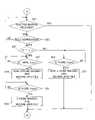
- FIG. 3is a flowchart showing an operation of a CPU in FIG. 1 embodiment.
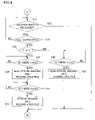
- FIG. 4is a flowchart showing subsequent to FIG. 3 .
- a digital camera 10 of this embodimentis driven using a battery 100 as a power source, and has an image sensor 16 of a CCD (Charge Coupled Device) type upon which an optical image of an object is incident via a focus lens 12 , and an aperture 14 a of an aperture mechanism 14 .
- CCDCharge Coupled Device
- a CPU 20instructs a TG (Timing Generator) 22 to repeatedly perform a pre-exposure and a thinning-out reading-out.
- the TG 22supplies a timing signal corresponding to the instruction to the image sensor 16 , and according to the supplied timing signal, the image sensor 16 exposes the optical image of the object, and outputs one portion of an electric charge accumulated by the exposure in a subsequent one frame period. That is, during an initial phase of the photographing mode to be selected, a raw image signal of a low-resolution is output from the image sensor 16 at every one frame period.
- the raw image signal of each frame output from the image sensor 16is input into a CDS (Correlated Double Sampling)/AGC (Automatic Gain Control) circuit 24 , and after a correlated double sampling process and a gain control process are herein applied thereto, input into a A/D conversion circuit 26 .
- the A/D conversion circuit 26converts the input raw image signal into raw image data, which is a digital signal, and inputs converted raw image data into a signal processing circuit 28 .
- the signal processing circuit 28includes a buffer 29 , and subjects the input raw image data to a series of processings such as a color separation, a white balance adjustment, a gamma correction, a YUV conversion, and etc. by taking advantage of the buffer 29 , and inputs YUV data generated by these processings into a video encoder 30 .
- the video encoder 30converts the input YUV data into a composite image signal of an NTSC format, and inputs a converted composite image signal into a liquid crystal monitor 32 . This allows a real time moving image (through image) of the object to be displayed on a screen of the liquid crystal monitor 32 .
- Y data out of the YUV data generated by the signal processing circuit 28is input into an AE (Automatic Exposure)/AF (Autofocus) evaluating circuit 34 .
- the AE/AF evaluating circuit 34calculates, based on the input Y data, a luminance evaluating value Ey representing a luminance of an object image, and a focus evaluating value Ef representing a level of a focus of the focus lens 12 relative to the object image.
- the AE/AF evaluating circuit 34divides an object field (monitor screen) into 256 blocks of 16 rows ⁇ 16 columns as shown in FIG. 2 . Furthermore, regarding each frame, the luminance evaluating value Ey of each block is calculated by integrating the Y data by each relevant block, and the focus evaluating value Ef is calculated by integrating a high-frequency component of the Y data within a predetermined block (several blocks located at a center of the object field, for example) constituting a focus area (not shown).
- the CPU 20fetches the luminance evaluating value Ey and the focus evaluating value Ef from the AE/AF evaluating circuit 34 . Then, an optimum exposure time and an optimum aperture value are calculated based on the fetched luminance evaluating value Ey, and in addition to setting the calculated optimum exposure time to the TG 22 , an aperture driver 38 is controlled in such a manner as to render an aperture value of the aperture mechanism 14 the optimum aperture value. Furthermore, the CPU 20 controls a focus driver 40 in such a manner that the focus evaluating value Ef becomes large, and sets the focus lens 12 to a focal position.
- the CPU 20enters a recording process. That is, the CPU 20 , in addition to instructing the TG 22 to perform one frame of a primary exposure, and read out all pixels, instructs the signal processing circuit 28 to carry out a compression process.
- the TG 22supplies to the image sensor 16 the timing signal corresponding to the instruction from the CPU 20 . This allows the primary exposure to be executed in accordance with the optimum exposure time. All electric charges accumulated by the primary exposure, that is, one frame of a high-resolution raw image signal is output from the image sensor 16 .
- the raw image signalis input into the signal processing circuit 28 via the CDS/AGC circuit 24 and A/D conversion circuit 26 , and converted into the YUV data as a result of a series of the above-described processings. Furthermore, the signal processing circuit 28 subjects the compression process in accordance with a JPEG (Joint Photographic Expert Group) system to the YUV data in response to a compression instruction from the CPU 20 , and records a JPEG image file generated by the compression process into a memory card 42 .
- JPEGJoint Photographic Expert Group
- the digital camera 10 of this embodimentis provided with a strobe light 44 .
- a forced light-emitting modethat forcedly causes the strobe light 44 to emit a light is set by operating the mode key 18 , for example, the CPU 20 enters the recording process that accompanies a light-emitting of the strobe light 44 in response to the full-depression of the shutter button 36 . That is, the CPU 20 instructs the TG 22 to perform one frame of the primary exposure, and read out all the pixels.
- the CPUinstructs the signal processing circuit 28 to perform the compression process, and furthermore, supplies a trigger signal to a strobe light driver 46 , thereby causing the strobe light 44 to emit the light in synchronous with the primary exposure of the image sensor 16 .
- Thisallows the JPEG image file of the object generated by the strobe light-emitting photograph to be recorded into the memory card 42 .
- the CPU 20does not supply the above-described trigger signal to the strobe light driver 46 . Consequently, in this case, photographing without flashing the strobe light that does not accompany the light-emitting of the strobe light 44 is performed in response to the full-depression of the shutter button 36 . This allows the JPEG image file of the object generated by photographing without flashing the strobe light to be recorded into the memory card 42 .
- the CPU 20calculates the brightness of the object image from the above-described luminance evaluating value Ey. Then, when the calculated brightness does not reach a predetermined brightness, the CPU 20 executes the recording process that accompanies the strobe light 44 in response to the full-depression of the shutter button 36 . On the other hand, when the calculated brightness is brighter than the predetermined brightness, the CPU 20 executes the recording process that does not accompany the light-emitting of the strobe light 44 .
- the digital camera 10 of this embodimentis provided with a special continuously photographing mode, in which photographing without flashing the strobe light is first carried out in response to one full-depression operation (release) of the shutter button 36 , and subsequently, the strobe light-emitting photographing is carried out.
- the CPU 20in response to the full-depression of the shutter button 36 , firstly executes the recording process that does not accompany the light-emitting of the strobe light 44 , thereby allowing photographing without flashing the strobe light to be performed. This results in the JPEG image file of the object generated by photographing without flashing the strobe light being recorded into the memory card 42 .
- the CPU 20executes the recording process that accompanies the light-emitting of the strobe light 44 , thereby allowing the strobe light-emitting photographing to be performed, and as a result, the JPEG image file of the object generated by the strobe light-emitting photographing is recorded into the memory card 42 . This completes a series of the photographing processes by the continuously photographing mode.
- the strobe light-emitting photographingis not performed. More specifically, when a luminance evaluating value Eymin of the block having the lowest luminance (luminance evaluating value Ey) out of each block shown in above-described FIG. 2 is greater than a predetermined threshold value ⁇ (Eymin> ⁇ ), the CPU 20 executes only the recording process that does not accompany the light-emitting of the strobe light 44 .
- the CPU 20completes a series of the photographing processes of the continuously photographing mode without executing the recording process that accompanies the light-emitting of the strobe light 44 .
- the CPU 20when the luminance evaluating value Eymin is equal to or smaller than the threshold value ⁇ (Eymin ⁇ ), the CPU 20 , after executing the recording process that does not accompany the light-emitting of the strobe light 44 as described above, executes, without interruption, the recording process that accompanies the light-emitting of the strobe light 44 , and completes a series of the photographing processes by the continuously photographing mode.
- the CPU 20operates in accordance with procedures shown in flowcharts in FIG. 3 and FIG. 4 . It is noted that a control program for controlling an operation of the CPU 20 in accordance with the flowcharts is stored in the program memory 20 within the CPU 20 .
- the CPU 20advances to a step S 1 , and waits for a vertical synchronizing signal Vsync to be input.
- the CPU 20advances to a step S 3 , and obtains the luminance evaluating value Ey from the AE/AF evaluating circuit 34 before advancing to a step S 5 .
- the CPU 20compares the minimum value Eymin of the luminance evaluating value Ey obtained in the above-described step S 3 with the threshold value ⁇ .
- the CPU 20advances to a step S 7 so as to set a flag F, which is for instructing whether or not to perform the strobe light-emitting photographing, to “0” before advancing to a step S 9 .
- the CPU 20advances from the step S 5 to a step S 11 so as to set the flag to “1” before advancing to the step S 9 .
- the CPU 20calculates the optimum exposure time and the optimum aperture value based on the luminance evaluating value Ey obtained in the above-described step S 3 . Then, the CPU 20 advances to a step S 13 so as to set the calculated optimum exposure time to the TG 22 , and control the aperture driver 38 in such a manner that the aperture value of the aperture mechanism 14 becomes the optimum aperture value.
- the CPU 20Upon completion of the process in the step S 13 , the CPU 20 advances to a step S 15 so as to perform a focus adjustment. That is, the CPU 20 obtains the focus evaluating value Ef from the AE/AF evaluating circuit 34 so as to control the focus driver 40 in such a manner that the obtained focus evaluating value Ef becomes large. Then, the CPU 20 determines whether or not the focus adjustment is ended in a step S 17 . That is, the CPU 20 determines whether or not the focus lens 12 is set to the focal position, and in a case of determining that the focus adjustment is not yet ended, the process advances to a step S 19 .
- the CPU 20determines whether or not the operation of the shutter button 36 is cancelled, more specifically, whether or not a finger of an operator is released from the shutter button 36 .
- the CPU 20ends (suspends) the process shown in this flowchart. That is, in a case that the finger of the operator is released from the shutter button 36 before the focus adjustment is ended, the photographing is not performed.
- the CPU 20returns to the step S 17 . Then, if it is determined that the focus adjustment is ended in the step S 17 , the CPU 20 advances to a step S 21 in FIG. 4 .
- the CPU 20also determines whether or not the operation of the shutter button 36 is cancelled as in the above-described step S 19 .
- the CPU 20ends (interrupts) the process shown in the flowchart. That is, in a case that the finger of the operator is released from the shutter button 30 with the shutter button 36 being half-depressed, the photographing is not performed.
- the CPU 20advances from the step S 21 to a step S 23 so as to determine whether or not the shutter button 36 is full-depressed.
- the CPU 20repeats the process of the above-described step S 21 until the shutter button 36 is full-depressed, and if it is determined that the shutter button 32 is full-depressed, the process advances from the step S 23 to a step S 25 .
- the CPU 20determines whether or not “1” is set to the above-described flag F.
- the CPU 20advances to a step S 27 so as to wait for the vertical synchronizing signal Vsync to be input.
- the CPU 20advances to a step S 29 so as to execute the recording process that does not accompany the light-emitting of the strobe light 44 . That is, in addition to instructing the TG 22 to perform one frame of the primary exposure and read out all pixels, the CPU 20 instructs the signal processing circuit 28 to perform the compression process. Then, upon completion of the process of the step S 29 , the CPU 20 advances to a step S 31 so as to wait for the vertical synchronizing signal Vsync to be input once again.
- the CPU 20advances to a step S 33 so as to execute the recording process that accompanies the light-emitting of the strobe light 44 . That is, in addition to instructing the TG 22 to perform one frame of the primary exposure and read out all the pixels, the CPU 20 instructs the signal processing circuit 28 to perform the compression process, and furthermore, supplies the trigger signal to the strobe light driver 46 . Then, upon completion of the process of the step S 33 , the CPU 20 ends a series of the photographing processes by the continuously photographing mode.
- the CPU 20advances to a step S 35 so as to wait for the vertical synchronizing signal Vsync to be input. Then, if the vertical synchronizing signal Vsync is input, the CPU 20 advances to a step S 37 so as to execute the recording process that does not accompany the light-emitting of the strobe light 44 . Then, upon completion of the process of the step S 37 , the CPU 20 ends a series of the photographing processes by the continuously photographing mode.
- the strobe light-emitting photographingis automatically performed subsequent thereto. Therefore, even in a situation where it is seen to flash the strobe light 44 , it is possible to photograph the object in a good condition.
- a nature of the humandictates that he recognizes that an act of the photographing is ended by the flashing of the strobe light 44 . Consequently, if the strobe light-emitting photographing is performed first, the human, which is the object, mistakenly recognizes that the act of the photographing is ended by an end of the strobe light-emitting photographing, and as a result, it is probable that the human cancels a photographing pose. Again, it is inconvenient that no good photographing is obtained in the photographing without flashing the strobe light that is later performed. Therefore, as in this embodiment, it is possible to obtain the good photographed image when the strobe light-emitting photographing is performed after photographing without flashing the strobe light.
- the strobe light-emitting photographingwhen it is apparent that the excessive exposure occurs in a case that the strobe light-emitting photographing is performed, the strobe light-emitting photographing is not performed, thus possible to prevent an electricity from being wastefully consumed due to a meaningless strobe light-emitting photographing. At the same time, this makes it possible to extend a life of the battery 100 (operating hours of the digital camera 10 ).
- the present inventionis highly effective to the digital camera 10 having a characteristic of capable of arbitrarily deleting the photographed image.
- the strobe light-emitting photographing after photographing without flashing the strobe lightbased on the luminance evaluating value Eymin of the block having the lowest luminance.
- the determinationmay be made based on an average value of the luminance evaluating value Ey of each block, the luminance evaluating value Ey weighted on a center portion of the screen (weighted), and etc., for example.
- the threshold value ⁇which serves as a determination reference may, be arbitrarily set by the operator.
- the determination of whether or not to flash the strobe light 44is made based on a brightness of a whole object image.
- the determination of whether or not to perform the strobe light-emitting photographingis made based on the luminance evaluating value Eymin of the block having the lowest luminance as described above. Therefore, viewed from the brightness of the whole object image, in many cases, the determination reference at a time of determining whether or not to flash the strobe light 44 in the continuously photographing mode becomes higher than the determination reference at a time of determining whether or not to flash the strobe light 44 in the automatically light-emitting mode. That is, in the automatically light-emitting mode, even in a situation where the strobe light 44 is not flashed, there may be a case that the strobe light-emitting photographing is performed in the continuously photographing mode.
- photographing without flashing the strobe light performed prior to the strobe light-emitting photographingmay be continuously-photographable. That is, after a plurality of sheets of photographings without flashing the strobe light are performed, one sheet of the strobe light-emitting photographing may be performed. In addition, after a plurality of sheets of photographings without flashing the strobe light by an automatic exposure bracketing (AEB) function, the strobe light-emitting photographing may be performed.
- AEBautomatic exposure bracketing
- a pre-light-emittingwhich flashes the strobe light 44 prior to the strobe light-emitting photographing, may be performed.
- the strobe light 44may be an incorporated-type that is incorporated with a chassis of the digital camera 10 or an externally-attached-type (external strobe light).
- the strobe light-emitting photographingwhen it is apparently possible to photograph the object in a good condition even without flashing the strobe light 44 (that is, when the luminance evaluating value Eymin exceeds the threshold value a), the strobe light-emitting photographing is not to be performed, this is not always the case. That is, after photographing without flashing the strobe light is performed, the strobe light-emitting photographing may forcedly be performed irrespective of the brightness of the object image. Then, whether or not the strobe light-emitting photographing is forcedly performed may be arbitrarily selected by the operation of the mode key 18 .
- the strobe light-emitting photographingis to be performed.
- the photographing without flashing the strobe light, and the strobe light-emitting photographingare performed all at once, for example, and two sheets of the image files generated by these photographings are temporarily stored in a buffer 29 provided in the signal processing circuit 28 in FIG. 1 , for example, and upon completion of the photographing, each of the image files may be transferred from the buffer 29 to the memory card for a recording.
- the present inventionis, under a certain condition, to execute photographing without flashing the strobe light and the strobe light-emitting photographing at least once each time in response to one release operation.
- the order of the photographingis not limited to the order described in this embodiment, that is, the order that the strobe light-emitting photographing is performed after photographing without flashing the strobe light. Contrary to that, photographing without flashing the strobe light may be performed after the strobe light-emitting photographing.
- an arbitrary storing or recording mediummay be used other than the medium called “memory card” shown in the embodiment.
Landscapes
- Engineering & Computer Science (AREA)
- Multimedia (AREA)
- Signal Processing (AREA)
- Studio Devices (AREA)
- Stroboscope Apparatuses (AREA)
- Exposure Control For Cameras (AREA)
Abstract
Description
Claims (2)
Applications Claiming Priority (2)
| Application Number | Priority Date | Filing Date | Title |
|---|---|---|---|
| JP2002159670 | 2002-05-31 | ||
| JP2002-159670 | 2002-05-31 |
Publications (2)
| Publication Number | Publication Date |
|---|---|
| US20030223011A1 US20030223011A1 (en) | 2003-12-04 |
| US7319489B2true US7319489B2 (en) | 2008-01-15 |
Family
ID=29561589
Family Applications (1)
| Application Number | Title | Priority Date | Filing Date |
|---|---|---|---|
| US10/446,224Expired - Fee RelatedUS7319489B2 (en) | 2002-05-31 | 2003-05-28 | Camera with strobe light |
Country Status (2)
| Country | Link |
|---|---|
| US (1) | US7319489B2 (en) |
| JP (1) | JP4911645B2 (en) |
Cited By (5)
| Publication number | Priority date | Publication date | Assignee | Title |
|---|---|---|---|---|
| US20080277473A1 (en)* | 2003-11-13 | 2008-11-13 | Metrologic Intruments, Inc. | Digital image capture and processing system employing an image formation and detection system having an area-type image detection array supporting single snap-shot and periodic snap-shot modes of image acquisition during object illumination and imaging operations |
| US20080316332A1 (en)* | 2007-06-21 | 2008-12-25 | Sony Ericsson Mobile Communications Ab | Dual capture |
| US20100165179A1 (en)* | 2008-12-25 | 2010-07-01 | Fujifilm Corporation | Imaging apparatus and imaging method |
| US20100259665A1 (en)* | 2009-04-14 | 2010-10-14 | Sony Corporation | Electronic device |
| US20120033086A1 (en)* | 2010-08-06 | 2012-02-09 | Hon Hai Precision Industry Co., Ltd. | Sensor system detection device and detection method using same |
Families Citing this family (2)
| Publication number | Priority date | Publication date | Assignee | Title |
|---|---|---|---|---|
| US7643738B2 (en)* | 2004-03-19 | 2010-01-05 | Panasonic Corporation | Imaging device |
| JP2007256907A (en)* | 2006-02-10 | 2007-10-04 | Fujifilm Corp | Digital camera |
Citations (6)
| Publication number | Priority date | Publication date | Assignee | Title |
|---|---|---|---|---|
| US5410225A (en)* | 1991-08-30 | 1995-04-25 | Aiwa Co., Ltd. | Video camera and camera system employing aperture control |
| US6151073A (en)* | 1996-03-28 | 2000-11-21 | Fotonation, Inc. | Intelligent camera flash system |
| US6195127B1 (en)* | 1996-07-18 | 2001-02-27 | Sanyo Electric Co., Ltd. | Digital camera, having a flash unit, which determines proper flash duration through an assessment of image luminance and, where needed, a preliminary flash emission |
| US6278490B1 (en)* | 1996-05-23 | 2001-08-21 | Olympus Optical Co., Ltd. | Exposure control for an image pickup apparatus that uses an electronic flash |
| US6546203B2 (en)* | 2001-06-21 | 2003-04-08 | Hewlett-Packard Company | Camera with adjustable strobe energy |
| US7098946B1 (en)* | 1998-09-16 | 2006-08-29 | Olympus Optical Co., Ltd. | Image pickup apparatus |
Family Cites Families (2)
| Publication number | Priority date | Publication date | Assignee | Title |
|---|---|---|---|---|
| JPH08179403A (en)* | 1994-12-26 | 1996-07-12 | Olympus Optical Co Ltd | Stroboscopic consecutively photographing camera |
| JP3384691B2 (en)* | 1996-07-18 | 2003-03-10 | 三洋電機株式会社 | Electronic still camera |
- 2003
- 2003-05-28USUS10/446,224patent/US7319489B2/ennot_activeExpired - Fee Related
- 2009
- 2009-05-07JPJP2009112914Apatent/JP4911645B2/ennot_activeExpired - Lifetime
Patent Citations (6)
| Publication number | Priority date | Publication date | Assignee | Title |
|---|---|---|---|---|
| US5410225A (en)* | 1991-08-30 | 1995-04-25 | Aiwa Co., Ltd. | Video camera and camera system employing aperture control |
| US6151073A (en)* | 1996-03-28 | 2000-11-21 | Fotonation, Inc. | Intelligent camera flash system |
| US6278490B1 (en)* | 1996-05-23 | 2001-08-21 | Olympus Optical Co., Ltd. | Exposure control for an image pickup apparatus that uses an electronic flash |
| US6195127B1 (en)* | 1996-07-18 | 2001-02-27 | Sanyo Electric Co., Ltd. | Digital camera, having a flash unit, which determines proper flash duration through an assessment of image luminance and, where needed, a preliminary flash emission |
| US7098946B1 (en)* | 1998-09-16 | 2006-08-29 | Olympus Optical Co., Ltd. | Image pickup apparatus |
| US6546203B2 (en)* | 2001-06-21 | 2003-04-08 | Hewlett-Packard Company | Camera with adjustable strobe energy |
Cited By (16)
| Publication number | Priority date | Publication date | Assignee | Title |
|---|---|---|---|---|
| US7845561B2 (en) | 2003-11-13 | 2010-12-07 | Metrologic Instruments, Inc. | Digital image capture and processing system supporting a periodic snapshot mode of operation wherein during each image acquisition cycle, the rows of image detection elements in the image detection array are exposed simultaneously to illumination |
| US8047438B2 (en) | 2003-11-13 | 2011-11-01 | Metrologic Instruments, Inc. | Digital image capture and processing system employing an image formation and detection subsystem having an area-type image detection array supporting periodic occurrance of snap-shot type image acquisition cycles at a high-repetition rate during object illumination |
| US20080283606A1 (en)* | 2003-11-13 | 2008-11-20 | Anatoly Kotlarsky | Digital image capture and processing system supporting a periodic snapshot mode of operation wherein during each image acquistion cycle, the rows of image detection elements in the image detection array are exposed simultaneously to illumination |
| US9104930B2 (en) | 2003-11-13 | 2015-08-11 | Metrologic Instruments, Inc. | Code symbol reading system |
| US20090020610A1 (en)* | 2003-11-13 | 2009-01-22 | Metrologic Instruments, Inc. | Digital image capture and processing system employing an image formation and detection subsystem having an area-type image detection array supporting periodic occurrance of snap-shot type image acquisition cycles at a high-repetition rate during object illumination and imaging operations |
| US8157174B2 (en) | 2003-11-13 | 2012-04-17 | Metrologic Instruments, Inc. | Digital image capture and processing system employing an image formation and detection system having an area-type image detection array supporting single snap-shot and periodic snap-shot modes of image acquisition during object illumination and imaging operations |
| US20080277475A1 (en)* | 2003-11-13 | 2008-11-13 | Metrologic Instruments, Inc. | Digital image capture and processing system supporting a presentation mode of system operation which employs a combination of video and snapshot modes of image detection array operation during a single cycle of system operation |
| US8157175B2 (en) | 2003-11-13 | 2012-04-17 | Metrologic Instruments, Inc. | Digital image capture and processing system supporting a presentation mode of system operation which employs a combination of video and snapshot modes of image detection array operation during a single cycle of system operation |
| US20080277473A1 (en)* | 2003-11-13 | 2008-11-13 | Metrologic Intruments, Inc. | Digital image capture and processing system employing an image formation and detection system having an area-type image detection array supporting single snap-shot and periodic snap-shot modes of image acquisition during object illumination and imaging operations |
| US7679653B2 (en)* | 2007-06-21 | 2010-03-16 | Sony Ericsson Mobile Communications Ab | Digital image acquisition arranged to acquire image data related to different light configurations |
| US20080316332A1 (en)* | 2007-06-21 | 2008-12-25 | Sony Ericsson Mobile Communications Ab | Dual capture |
| US20100165179A1 (en)* | 2008-12-25 | 2010-07-01 | Fujifilm Corporation | Imaging apparatus and imaging method |
| US20100259665A1 (en)* | 2009-04-14 | 2010-10-14 | Sony Corporation | Electronic device |
| US8488054B2 (en)* | 2009-04-14 | 2013-07-16 | Sony Corporation | Electronic device including a biometric authentication function |
| US20120033086A1 (en)* | 2010-08-06 | 2012-02-09 | Hon Hai Precision Industry Co., Ltd. | Sensor system detection device and detection method using same |
| US8508596B2 (en)* | 2010-08-06 | 2013-08-13 | Hon Hai Precision Industry Co., Ltd. | Sensor system detection device and detection method using same |
Also Published As
| Publication number | Publication date |
|---|---|
| JP4911645B2 (en) | 2012-04-04 |
| US20030223011A1 (en) | 2003-12-04 |
| JP2009223328A (en) | 2009-10-01 |
Similar Documents
| Publication | Publication Date | Title |
|---|---|---|
| JP4870887B2 (en) | Imaging apparatus, strobe control method, and program for computer to execute the method | |
| US7924343B2 (en) | Photographing apparatus and exposure control method | |
| JP4510768B2 (en) | Imaging apparatus and method, and program | |
| US7590346B2 (en) | Digital camera | |
| US8411159B2 (en) | Method of detecting specific object region and digital camera | |
| JP2008070562A (en) | Imaging apparatus and exposure control method | |
| JP4911645B2 (en) | Camera with strobe | |
| CN101489047B (en) | Imaging apparatus | |
| US7428012B2 (en) | Image processing method including generating face region information and a digital camera including face region identification unit | |
| JP4309524B2 (en) | Electronic camera device | |
| CN1874426A (en) | Image display apparatus | |
| US8035730B2 (en) | Digital camera and flash emission control method based on face detection | |
| JP4178017B2 (en) | Image processing method and digital camera | |
| JP4359074B2 (en) | Camera with strobe | |
| JP2007228532A (en) | Imaging apparatus and program thereof | |
| JP2002252804A (en) | Electronic camera | |
| JP2007208355A (en) | Imaging apparatus, method, and program | |
| JP2003302570A (en) | Digital camera | |
| JP2003319234A (en) | Digital camera | |
| JP4120690B2 (en) | Still image capturing apparatus and still image capturing method in still image capturing apparatus | |
| US7570289B2 (en) | Electronic camera having a clamp circuit and performing a clamping process on an image signal | |
| JP4122765B2 (en) | Still image pickup device | |
| JP2004126288A (en) | Camera, shooting method and program | |
| JP2001339636A (en) | Image pickup method and device | |
| JP4663607B2 (en) | Digital camera and control method thereof |
Legal Events
| Date | Code | Title | Description |
|---|---|---|---|
| AS | Assignment | Owner name:SANYO ELECTRIC CO., LTD., JAPAN Free format text:ASSIGNMENT OF ASSIGNORS INTEREST;ASSIGNOR:MIKI, SHIGERU;REEL/FRAME:014124/0312 Effective date:20030523 | |
| FEPP | Fee payment procedure | Free format text:PAYOR NUMBER ASSIGNED (ORIGINAL EVENT CODE: ASPN); ENTITY STATUS OF PATENT OWNER: LARGE ENTITY | |
| FPAY | Fee payment | Year of fee payment:4 | |
| AS | Assignment | Owner name:XACTI CORPORATION, JAPAN Free format text:ASSIGNMENT OF ASSIGNORS INTEREST;ASSIGNOR:SANYO ELECTRIC CO., LTD.;REEL/FRAME:032467/0095 Effective date:20140305 | |
| AS | Assignment | Owner name:XACTI CORPORATION, JAPAN Free format text:CORRECTIVE ASSIGNMENT TO CORRECT THE TO CORRECT THE INCORRECT PATENT NUMBER 13/446,454, AND REPLACE WITH 13/466,454 PREVIOUSLY RECORDED ON REEL 032467 FRAME 0095. ASSIGNOR(S) HEREBY CONFIRMS THE ASSIGNMENT OF ASSIGNORS INTEREST;ASSIGNOR:SANYO ELECTRIC CO., LTD.;REEL/FRAME:032601/0646 Effective date:20140305 | |
| REMI | Maintenance fee reminder mailed | ||
| LAPS | Lapse for failure to pay maintenance fees | ||
| STCH | Information on status: patent discontinuation | Free format text:PATENT EXPIRED DUE TO NONPAYMENT OF MAINTENANCE FEES UNDER 37 CFR 1.362 | |
| FP | Lapsed due to failure to pay maintenance fee | Effective date:20160115 |