US7226475B2 - Stent with variable properties - Google Patents
Stent with variable propertiesDownload PDFInfo
- Publication number
- US7226475B2 US7226475B2US10/150,117US15011702AUS7226475B2US 7226475 B2US7226475 B2US 7226475B2US 15011702 AUS15011702 AUS 15011702AUS 7226475 B2US7226475 B2US 7226475B2
- Authority
- US
- United States
- Prior art keywords
- tubular member
- stent
- cut
- over
- out regions
- Prior art date
- Legal status (The legal status is an assumption and is not a legal conclusion. Google has not performed a legal analysis and makes no representation as to the accuracy of the status listed.)
- Expired - Fee Related, expires
Links
Images



Classifications
- A—HUMAN NECESSITIES
- A61—MEDICAL OR VETERINARY SCIENCE; HYGIENE
- A61F—FILTERS IMPLANTABLE INTO BLOOD VESSELS; PROSTHESES; DEVICES PROVIDING PATENCY TO, OR PREVENTING COLLAPSING OF, TUBULAR STRUCTURES OF THE BODY, e.g. STENTS; ORTHOPAEDIC, NURSING OR CONTRACEPTIVE DEVICES; FOMENTATION; TREATMENT OR PROTECTION OF EYES OR EARS; BANDAGES, DRESSINGS OR ABSORBENT PADS; FIRST-AID KITS
- A61F2/00—Filters implantable into blood vessels; Prostheses, i.e. artificial substitutes or replacements for parts of the body; Appliances for connecting them with the body; Devices providing patency to, or preventing collapsing of, tubular structures of the body, e.g. stents
- A61F2/82—Devices providing patency to, or preventing collapsing of, tubular structures of the body, e.g. stents
- A61F2/86—Stents in a form characterised by the wire-like elements; Stents in the form characterised by a net-like or mesh-like structure
- A61F2/90—Stents in a form characterised by the wire-like elements; Stents in the form characterised by a net-like or mesh-like structure characterised by a net-like or mesh-like structure
- A61F2/91—Stents in a form characterised by the wire-like elements; Stents in the form characterised by a net-like or mesh-like structure characterised by a net-like or mesh-like structure made from perforated sheets or tubes, e.g. perforated by laser cuts or etched holes
- A—HUMAN NECESSITIES
- A61—MEDICAL OR VETERINARY SCIENCE; HYGIENE
- A61F—FILTERS IMPLANTABLE INTO BLOOD VESSELS; PROSTHESES; DEVICES PROVIDING PATENCY TO, OR PREVENTING COLLAPSING OF, TUBULAR STRUCTURES OF THE BODY, e.g. STENTS; ORTHOPAEDIC, NURSING OR CONTRACEPTIVE DEVICES; FOMENTATION; TREATMENT OR PROTECTION OF EYES OR EARS; BANDAGES, DRESSINGS OR ABSORBENT PADS; FIRST-AID KITS
- A61F2/00—Filters implantable into blood vessels; Prostheses, i.e. artificial substitutes or replacements for parts of the body; Appliances for connecting them with the body; Devices providing patency to, or preventing collapsing of, tubular structures of the body, e.g. stents
- A61F2/82—Devices providing patency to, or preventing collapsing of, tubular structures of the body, e.g. stents
- A61F2/86—Stents in a form characterised by the wire-like elements; Stents in the form characterised by a net-like or mesh-like structure
- A61F2/90—Stents in a form characterised by the wire-like elements; Stents in the form characterised by a net-like or mesh-like structure characterised by a net-like or mesh-like structure
- A61F2/91—Stents in a form characterised by the wire-like elements; Stents in the form characterised by a net-like or mesh-like structure characterised by a net-like or mesh-like structure made from perforated sheets or tubes, e.g. perforated by laser cuts or etched holes
- A61F2/915—Stents in a form characterised by the wire-like elements; Stents in the form characterised by a net-like or mesh-like structure characterised by a net-like or mesh-like structure made from perforated sheets or tubes, e.g. perforated by laser cuts or etched holes with bands having a meander structure, adjacent bands being connected to each other
- A—HUMAN NECESSITIES
- A61—MEDICAL OR VETERINARY SCIENCE; HYGIENE
- A61F—FILTERS IMPLANTABLE INTO BLOOD VESSELS; PROSTHESES; DEVICES PROVIDING PATENCY TO, OR PREVENTING COLLAPSING OF, TUBULAR STRUCTURES OF THE BODY, e.g. STENTS; ORTHOPAEDIC, NURSING OR CONTRACEPTIVE DEVICES; FOMENTATION; TREATMENT OR PROTECTION OF EYES OR EARS; BANDAGES, DRESSINGS OR ABSORBENT PADS; FIRST-AID KITS
- A61F2/00—Filters implantable into blood vessels; Prostheses, i.e. artificial substitutes or replacements for parts of the body; Appliances for connecting them with the body; Devices providing patency to, or preventing collapsing of, tubular structures of the body, e.g. stents
- A61F2/82—Devices providing patency to, or preventing collapsing of, tubular structures of the body, e.g. stents
- A61F2/852—Two or more distinct overlapping stents
- A—HUMAN NECESSITIES
- A61—MEDICAL OR VETERINARY SCIENCE; HYGIENE
- A61F—FILTERS IMPLANTABLE INTO BLOOD VESSELS; PROSTHESES; DEVICES PROVIDING PATENCY TO, OR PREVENTING COLLAPSING OF, TUBULAR STRUCTURES OF THE BODY, e.g. STENTS; ORTHOPAEDIC, NURSING OR CONTRACEPTIVE DEVICES; FOMENTATION; TREATMENT OR PROTECTION OF EYES OR EARS; BANDAGES, DRESSINGS OR ABSORBENT PADS; FIRST-AID KITS
- A61F2/00—Filters implantable into blood vessels; Prostheses, i.e. artificial substitutes or replacements for parts of the body; Appliances for connecting them with the body; Devices providing patency to, or preventing collapsing of, tubular structures of the body, e.g. stents
- A61F2/82—Devices providing patency to, or preventing collapsing of, tubular structures of the body, e.g. stents
- A61F2/86—Stents in a form characterised by the wire-like elements; Stents in the form characterised by a net-like or mesh-like structure
- A61F2/90—Stents in a form characterised by the wire-like elements; Stents in the form characterised by a net-like or mesh-like structure characterised by a net-like or mesh-like structure
- A61F2/91—Stents in a form characterised by the wire-like elements; Stents in the form characterised by a net-like or mesh-like structure characterised by a net-like or mesh-like structure made from perforated sheets or tubes, e.g. perforated by laser cuts or etched holes
- A61F2/915—Stents in a form characterised by the wire-like elements; Stents in the form characterised by a net-like or mesh-like structure characterised by a net-like or mesh-like structure made from perforated sheets or tubes, e.g. perforated by laser cuts or etched holes with bands having a meander structure, adjacent bands being connected to each other
- A61F2002/91533—Stents in a form characterised by the wire-like elements; Stents in the form characterised by a net-like or mesh-like structure characterised by a net-like or mesh-like structure made from perforated sheets or tubes, e.g. perforated by laser cuts or etched holes with bands having a meander structure, adjacent bands being connected to each other characterised by the phase between adjacent bands
- A—HUMAN NECESSITIES
- A61—MEDICAL OR VETERINARY SCIENCE; HYGIENE
- A61F—FILTERS IMPLANTABLE INTO BLOOD VESSELS; PROSTHESES; DEVICES PROVIDING PATENCY TO, OR PREVENTING COLLAPSING OF, TUBULAR STRUCTURES OF THE BODY, e.g. STENTS; ORTHOPAEDIC, NURSING OR CONTRACEPTIVE DEVICES; FOMENTATION; TREATMENT OR PROTECTION OF EYES OR EARS; BANDAGES, DRESSINGS OR ABSORBENT PADS; FIRST-AID KITS
- A61F2/00—Filters implantable into blood vessels; Prostheses, i.e. artificial substitutes or replacements for parts of the body; Appliances for connecting them with the body; Devices providing patency to, or preventing collapsing of, tubular structures of the body, e.g. stents
- A61F2/82—Devices providing patency to, or preventing collapsing of, tubular structures of the body, e.g. stents
- A61F2/86—Stents in a form characterised by the wire-like elements; Stents in the form characterised by a net-like or mesh-like structure
- A61F2/90—Stents in a form characterised by the wire-like elements; Stents in the form characterised by a net-like or mesh-like structure characterised by a net-like or mesh-like structure
- A61F2/91—Stents in a form characterised by the wire-like elements; Stents in the form characterised by a net-like or mesh-like structure characterised by a net-like or mesh-like structure made from perforated sheets or tubes, e.g. perforated by laser cuts or etched holes
- A61F2/915—Stents in a form characterised by the wire-like elements; Stents in the form characterised by a net-like or mesh-like structure characterised by a net-like or mesh-like structure made from perforated sheets or tubes, e.g. perforated by laser cuts or etched holes with bands having a meander structure, adjacent bands being connected to each other
- A61F2002/9155—Adjacent bands being connected to each other
- A—HUMAN NECESSITIES
- A61—MEDICAL OR VETERINARY SCIENCE; HYGIENE
- A61F—FILTERS IMPLANTABLE INTO BLOOD VESSELS; PROSTHESES; DEVICES PROVIDING PATENCY TO, OR PREVENTING COLLAPSING OF, TUBULAR STRUCTURES OF THE BODY, e.g. STENTS; ORTHOPAEDIC, NURSING OR CONTRACEPTIVE DEVICES; FOMENTATION; TREATMENT OR PROTECTION OF EYES OR EARS; BANDAGES, DRESSINGS OR ABSORBENT PADS; FIRST-AID KITS
- A61F2210/00—Particular material properties of prostheses classified in groups A61F2/00 - A61F2/26 or A61F2/82 or A61F9/00 or A61F11/00 or subgroups thereof
- A61F2210/0076—Particular material properties of prostheses classified in groups A61F2/00 - A61F2/26 or A61F2/82 or A61F9/00 or A61F11/00 or subgroups thereof multilayered, e.g. laminated structures
- A—HUMAN NECESSITIES
- A61—MEDICAL OR VETERINARY SCIENCE; HYGIENE
- A61F—FILTERS IMPLANTABLE INTO BLOOD VESSELS; PROSTHESES; DEVICES PROVIDING PATENCY TO, OR PREVENTING COLLAPSING OF, TUBULAR STRUCTURES OF THE BODY, e.g. STENTS; ORTHOPAEDIC, NURSING OR CONTRACEPTIVE DEVICES; FOMENTATION; TREATMENT OR PROTECTION OF EYES OR EARS; BANDAGES, DRESSINGS OR ABSORBENT PADS; FIRST-AID KITS
- A61F2220/00—Fixations or connections for prostheses classified in groups A61F2/00 - A61F2/26 or A61F2/82 or A61F9/00 or A61F11/00 or subgroups thereof
- A61F2220/0025—Connections or couplings between prosthetic parts, e.g. between modular parts; Connecting elements
- A61F2220/005—Connections or couplings between prosthetic parts, e.g. between modular parts; Connecting elements using adhesives
- A—HUMAN NECESSITIES
- A61—MEDICAL OR VETERINARY SCIENCE; HYGIENE
- A61F—FILTERS IMPLANTABLE INTO BLOOD VESSELS; PROSTHESES; DEVICES PROVIDING PATENCY TO, OR PREVENTING COLLAPSING OF, TUBULAR STRUCTURES OF THE BODY, e.g. STENTS; ORTHOPAEDIC, NURSING OR CONTRACEPTIVE DEVICES; FOMENTATION; TREATMENT OR PROTECTION OF EYES OR EARS; BANDAGES, DRESSINGS OR ABSORBENT PADS; FIRST-AID KITS
- A61F2220/00—Fixations or connections for prostheses classified in groups A61F2/00 - A61F2/26 or A61F2/82 or A61F9/00 or A61F11/00 or subgroups thereof
- A61F2220/0025—Connections or couplings between prosthetic parts, e.g. between modular parts; Connecting elements
- A61F2220/0058—Connections or couplings between prosthetic parts, e.g. between modular parts; Connecting elements soldered or brazed or welded
- A—HUMAN NECESSITIES
- A61—MEDICAL OR VETERINARY SCIENCE; HYGIENE
- A61F—FILTERS IMPLANTABLE INTO BLOOD VESSELS; PROSTHESES; DEVICES PROVIDING PATENCY TO, OR PREVENTING COLLAPSING OF, TUBULAR STRUCTURES OF THE BODY, e.g. STENTS; ORTHOPAEDIC, NURSING OR CONTRACEPTIVE DEVICES; FOMENTATION; TREATMENT OR PROTECTION OF EYES OR EARS; BANDAGES, DRESSINGS OR ABSORBENT PADS; FIRST-AID KITS
- A61F2230/00—Geometry of prostheses classified in groups A61F2/00 - A61F2/26 or A61F2/82 or A61F9/00 or A61F11/00 or subgroups thereof
- A61F2230/0002—Two-dimensional shapes, e.g. cross-sections
- A61F2230/0028—Shapes in the form of latin or greek characters
- A61F2230/0054—V-shaped
- A—HUMAN NECESSITIES
- A61—MEDICAL OR VETERINARY SCIENCE; HYGIENE
- A61F—FILTERS IMPLANTABLE INTO BLOOD VESSELS; PROSTHESES; DEVICES PROVIDING PATENCY TO, OR PREVENTING COLLAPSING OF, TUBULAR STRUCTURES OF THE BODY, e.g. STENTS; ORTHOPAEDIC, NURSING OR CONTRACEPTIVE DEVICES; FOMENTATION; TREATMENT OR PROTECTION OF EYES OR EARS; BANDAGES, DRESSINGS OR ABSORBENT PADS; FIRST-AID KITS
- A61F2250/00—Special features of prostheses classified in groups A61F2/00 - A61F2/26 or A61F2/82 or A61F9/00 or A61F11/00 or subgroups thereof
- A61F2250/0014—Special features of prostheses classified in groups A61F2/00 - A61F2/26 or A61F2/82 or A61F9/00 or A61F11/00 or subgroups thereof having different values of a given property or geometrical feature, e.g. mechanical property or material property, at different locations within the same prosthesis
- A61F2250/0018—Special features of prostheses classified in groups A61F2/00 - A61F2/26 or A61F2/82 or A61F9/00 or A61F11/00 or subgroups thereof having different values of a given property or geometrical feature, e.g. mechanical property or material property, at different locations within the same prosthesis differing in elasticity, stiffness or compressibility
- A—HUMAN NECESSITIES
- A61—MEDICAL OR VETERINARY SCIENCE; HYGIENE
- A61F—FILTERS IMPLANTABLE INTO BLOOD VESSELS; PROSTHESES; DEVICES PROVIDING PATENCY TO, OR PREVENTING COLLAPSING OF, TUBULAR STRUCTURES OF THE BODY, e.g. STENTS; ORTHOPAEDIC, NURSING OR CONTRACEPTIVE DEVICES; FOMENTATION; TREATMENT OR PROTECTION OF EYES OR EARS; BANDAGES, DRESSINGS OR ABSORBENT PADS; FIRST-AID KITS
- A61F2250/00—Special features of prostheses classified in groups A61F2/00 - A61F2/26 or A61F2/82 or A61F9/00 or A61F11/00 or subgroups thereof
- A61F2250/0014—Special features of prostheses classified in groups A61F2/00 - A61F2/26 or A61F2/82 or A61F9/00 or A61F11/00 or subgroups thereof having different values of a given property or geometrical feature, e.g. mechanical property or material property, at different locations within the same prosthesis
- A61F2250/0023—Special features of prostheses classified in groups A61F2/00 - A61F2/26 or A61F2/82 or A61F9/00 or A61F11/00 or subgroups thereof having different values of a given property or geometrical feature, e.g. mechanical property or material property, at different locations within the same prosthesis differing in porosity
- A—HUMAN NECESSITIES
- A61—MEDICAL OR VETERINARY SCIENCE; HYGIENE
- A61F—FILTERS IMPLANTABLE INTO BLOOD VESSELS; PROSTHESES; DEVICES PROVIDING PATENCY TO, OR PREVENTING COLLAPSING OF, TUBULAR STRUCTURES OF THE BODY, e.g. STENTS; ORTHOPAEDIC, NURSING OR CONTRACEPTIVE DEVICES; FOMENTATION; TREATMENT OR PROTECTION OF EYES OR EARS; BANDAGES, DRESSINGS OR ABSORBENT PADS; FIRST-AID KITS
- A61F2250/00—Special features of prostheses classified in groups A61F2/00 - A61F2/26 or A61F2/82 or A61F9/00 or A61F11/00 or subgroups thereof
- A61F2250/0014—Special features of prostheses classified in groups A61F2/00 - A61F2/26 or A61F2/82 or A61F9/00 or A61F11/00 or subgroups thereof having different values of a given property or geometrical feature, e.g. mechanical property or material property, at different locations within the same prosthesis
- A61F2250/0029—Special features of prostheses classified in groups A61F2/00 - A61F2/26 or A61F2/82 or A61F9/00 or A61F11/00 or subgroups thereof having different values of a given property or geometrical feature, e.g. mechanical property or material property, at different locations within the same prosthesis differing in bending or flexure capacity
- A—HUMAN NECESSITIES
- A61—MEDICAL OR VETERINARY SCIENCE; HYGIENE
- A61F—FILTERS IMPLANTABLE INTO BLOOD VESSELS; PROSTHESES; DEVICES PROVIDING PATENCY TO, OR PREVENTING COLLAPSING OF, TUBULAR STRUCTURES OF THE BODY, e.g. STENTS; ORTHOPAEDIC, NURSING OR CONTRACEPTIVE DEVICES; FOMENTATION; TREATMENT OR PROTECTION OF EYES OR EARS; BANDAGES, DRESSINGS OR ABSORBENT PADS; FIRST-AID KITS
- A61F2250/00—Special features of prostheses classified in groups A61F2/00 - A61F2/26 or A61F2/82 or A61F9/00 or A61F11/00 or subgroups thereof
- A61F2250/0014—Special features of prostheses classified in groups A61F2/00 - A61F2/26 or A61F2/82 or A61F9/00 or A61F11/00 or subgroups thereof having different values of a given property or geometrical feature, e.g. mechanical property or material property, at different locations within the same prosthesis
- A61F2250/0036—Special features of prostheses classified in groups A61F2/00 - A61F2/26 or A61F2/82 or A61F9/00 or A61F11/00 or subgroups thereof having different values of a given property or geometrical feature, e.g. mechanical property or material property, at different locations within the same prosthesis differing in thickness
- A—HUMAN NECESSITIES
- A61—MEDICAL OR VETERINARY SCIENCE; HYGIENE
- A61F—FILTERS IMPLANTABLE INTO BLOOD VESSELS; PROSTHESES; DEVICES PROVIDING PATENCY TO, OR PREVENTING COLLAPSING OF, TUBULAR STRUCTURES OF THE BODY, e.g. STENTS; ORTHOPAEDIC, NURSING OR CONTRACEPTIVE DEVICES; FOMENTATION; TREATMENT OR PROTECTION OF EYES OR EARS; BANDAGES, DRESSINGS OR ABSORBENT PADS; FIRST-AID KITS
- A61F2250/00—Special features of prostheses classified in groups A61F2/00 - A61F2/26 or A61F2/82 or A61F9/00 or A61F11/00 or subgroups thereof
- A61F2250/0014—Special features of prostheses classified in groups A61F2/00 - A61F2/26 or A61F2/82 or A61F9/00 or A61F11/00 or subgroups thereof having different values of a given property or geometrical feature, e.g. mechanical property or material property, at different locations within the same prosthesis
- A61F2250/0039—Special features of prostheses classified in groups A61F2/00 - A61F2/26 or A61F2/82 or A61F9/00 or A61F11/00 or subgroups thereof having different values of a given property or geometrical feature, e.g. mechanical property or material property, at different locations within the same prosthesis differing in diameter
- A—HUMAN NECESSITIES
- A61—MEDICAL OR VETERINARY SCIENCE; HYGIENE
- A61F—FILTERS IMPLANTABLE INTO BLOOD VESSELS; PROSTHESES; DEVICES PROVIDING PATENCY TO, OR PREVENTING COLLAPSING OF, TUBULAR STRUCTURES OF THE BODY, e.g. STENTS; ORTHOPAEDIC, NURSING OR CONTRACEPTIVE DEVICES; FOMENTATION; TREATMENT OR PROTECTION OF EYES OR EARS; BANDAGES, DRESSINGS OR ABSORBENT PADS; FIRST-AID KITS
- A61F2250/00—Special features of prostheses classified in groups A61F2/00 - A61F2/26 or A61F2/82 or A61F9/00 or A61F11/00 or subgroups thereof
- A61F2250/0058—Additional features; Implant or prostheses properties not otherwise provided for
- A61F2250/006—Additional features; Implant or prostheses properties not otherwise provided for modular
- A61F2250/0063—Nested prosthetic parts
- A—HUMAN NECESSITIES
- A61—MEDICAL OR VETERINARY SCIENCE; HYGIENE
- A61F—FILTERS IMPLANTABLE INTO BLOOD VESSELS; PROSTHESES; DEVICES PROVIDING PATENCY TO, OR PREVENTING COLLAPSING OF, TUBULAR STRUCTURES OF THE BODY, e.g. STENTS; ORTHOPAEDIC, NURSING OR CONTRACEPTIVE DEVICES; FOMENTATION; TREATMENT OR PROTECTION OF EYES OR EARS; BANDAGES, DRESSINGS OR ABSORBENT PADS; FIRST-AID KITS
- A61F2250/00—Special features of prostheses classified in groups A61F2/00 - A61F2/26 or A61F2/82 or A61F9/00 or A61F11/00 or subgroups thereof
- A61F2250/0058—Additional features; Implant or prostheses properties not otherwise provided for
- A61F2250/0067—Means for introducing or releasing pharmaceutical products into the body
Definitions
- the present inventionrelates to intraluminal medical devices, in particular to endoprosthetic devices commonly referred to as stents. More particularly, the present invention relates to stents having improved properties such as improved radiopacity, MRI safety and compatibility, radial stiffness and flexibility, and to the method of making such stents.
- Stents and stent delivery devicesare employed in a number of medical procedures and as such their structure and function are well known.
- Stentsare typically cylindrical, radially expandable prostheses introduced via a catheter assembly into a lumen of a body vessel in a configuration having a generally reduced diameter, i.e. in a crimped or unexpanded state, and are then expanded to the diameter of the vessel.
- stentssupport or reinforce sections of vessel walls, for example a blood vessel, which have collapsed, are partially occluded, blocked, weakened, or dilated, and maintain them in an open unobstructed state. They have also been implanted in the urinary tract and in bile ducts. Stents are advantageous because they can reduce the likelihood of restenosis, and because the patency of the blood vessel is maintained immediately after the intravascular treatment.
- Stentsare available in self-expanding and in inflation expandable versions which employ a dilatation balloon for expansion. Both versions are well known and widely available in a variety of designs and configurations, and are made from a variety of materials including plastics and metals with metals being more typically used.
- the stent and optionally a balloonare positioned at the distal end of the catheter, around a core lumen.
- the stent and balloonare held down and covered by a sheath or sleeve.
- the sheath or sleeveis retracted to expose the stent.
- Self-expanding stentsare typically in unexpanded state using a variety of methods including sheaths or sleeves, for example, during delivery to the site of deployment.
- the catheter delivery systemis advanced through the patients vascular system until the stent is at the desired location within a blood vessel, and then the expandable member is inflated on the catheter to expand the stent within the blood vessel.
- the sheath or sleevesmay be retracted, leaving the stent free to self-expand.
- the expandable memberi.e. the balloon
- the expandable membermay be expanded using a variety of methods such as through an inflation fluid, once the sheath or sleeves are removed, and the stent expands with the expandable member.
- the expandable memberis then deflated and the catheter withdrawn, leaving the expanded stent within the blood vessel to hold the occluded or blocked vessel open.
- the advancement of the stent through a patient's vasculaturecan involve traversing sharp bends and other obstacles which may require the stent to be highly flexible. Stent flexibility also permits the stent to be deployed in and conform to a tortuous section of a patient's vasculature.
- Radiographic fluoroscopy and magnetic resonance imagingMRI
- the techniquesrequire the stent to have good radiographic properties for fluoroscopy and good magnetic properties that avoid stent movement, floating, and image artifact during MRI.
- Radiopacityfor stents formed from stainless steel or NITINOL®, for example, is determined by the radiographic density of the material and the thickness of the stent tubing wall. Therefore, the use of thin material can reduce the radiopacity of the stent, making it more difficult to accurately visualize the stent. Conversely, the use of thicker material which can improve radiopacity, can reduce stent flexibility which can negatively impact the deliverability of the stent in a patient's vasculature.
- MRI safety and compatibilityis optimal when materials having low magnetic susceptibility are employed such as tantalum, titanium, niobium, and so forth.
- materials having low magnetic susceptibilitysuch as tantalum, titanium, niobium, and so forth.
- propertiessuch as flexibility, radial strength, and/or radiopacity, for example.
- One method for improving the radiopacityis to deposit a thin surface coating or plating or a more radiographically dense material such as gold. This may change the properties of the stent, however, and these highly radiographic materials are often very costly.
- the stentis of a closed cylindrical construction in which expansion is accompanied by deformation of the strut structure making up the body of the stent.
- Deformationas used herein, is meant to include other deformation in addition to permanent deformation as used in the metallurgical sense.
- a suitable micro structure designcan be obtained by dimensionally constructing a stent having a reduction ratio as compared to current coronary stents of 4:1 to 10:1. Note with reference to ratio reduction-current dimensions are thereby reduced by a factor of about 4-10.
- micro structure stents in accordance with the present inventionwill preferably have about the following dimensions:
- maximum PIN openingdescribes micro openings in which the dimensions specify the largest which can be passed through the cell opening. This applies as noted above to the expanded stent configuration. Typically, as a stent is expanded to larger diameters, the opening becomes larger. It is believed that using a maximum PIN opening specification that the concept of the present invention may be more readily applicable to stents of either open or closed cell geometries.
- the stents having a micro structure according to the present inventionwill also have a wall thickness of up to about 0.004 inches, which is not requirement of the invention, but provides adequate radiopacity and handling characteristics of the stent structure according to this embodiment.
- the present inventionmay include a stent within a stent wherein both stents, even though having larger openings than would be characterized as providing micro structure, may in fact provide micro structure by control of the registration of the openings in the stents as is more fully described below.
- the present inventionalso relates to a stent having variable thickness of relatively thinner and thicker areas which exhibits improved flexibility, radiopacity, MRI safety and compatibility, and radial strength, and to a method of making the same.
- the relatively thinner sections of the stentpromote flexibility while the relatively thicker sections promote radiopacity and radial strength.
- materialsmay be selected so as to produce optimum MRI safety and compatibility as well, without sacrificing other properties.
- the stentis formed of a first tubular member and a second tubular member.
- the first tubular memberhas cut-out regions and the second tubular member is made of a thin walled construction.
- the tubular membersmay be advantageously formed from the same material, or they may be formed from different materials.
- first tubular memberis slightly larger in diameter than the second tubular member and is assembled over the second tubular member.
- second tubular membermay be slightly larger in diameter than the first tubular member and is assembled over the first tubular member.
- tubular membersmay be secured together using any method known in the art including, for example, welding, brazing, bonding, drawing, rolling, and so forth.
- an interference or line-to-line fitmay be employed to secure the tubular members together.
- This techniquemay find particularly utility, for example, when the expansion of the medical device is conducted through mechanical means such as with an inflation member, for example, a dilatation balloon. Upon expansion with the dilatation balloon, the tubular members will be suitably pressed together thus remaining securely together in the implanted, i.e. expanded, configuration.
- sections of tubular membersmay secured together prior to forming the stent pattern. These sections may be secured together end to end, i.e. through a butt joint.
- the tubular membersmay be advantageously formed of different materials, some of which have increased flexibility, such as shape memory alloys such as NITINOL®, for example, while others of which exhibit excellent fluoroscopic properties or MRI properties, i.e. those materials with high radiopacity such as gold, platinum, tantalum, and so forth, or those which have low magnetic susceptibility such as titanium and niobium, for example.
- the less fluoroscopic sectionsmay be MRI compatible materials such as NITINOL®, or they may be strong materials such as stainless steel including 316L stainless steel, for example.
- the sections formed of radiopaque materialsare not as long as those formed of contrasting materials such as NITINOL® or stainless steel, for example. To increase radiographic contrast, the thickness of the radiopaque sections may be increased.
- the sectionsmay be formed from the same material but may be manufactured of varying thicknesses to obtain improved radiographic contrast and strength with thicker sections and improved flexibility with the thinner sections. These properties may be designed into the stent based on expansion properties as well.
- the stentis provided with increased flexibility, radial strength and radiographic contrast by providing the tubular member with a particular stent pattern.
- the patternis an oval, a protuberance, or a honeycomb pattern.
- the stenthas a substantially polygonal cross-section.
- the inside surface of the polygonal preformmay be machined, ground, etched and so forth thus producing sections of varying thickness.
- the stent patternmay then be cut from sections of the tube having the desired thicknesses in order to obtain optimum properties.
- FIG. 1is a schematic fragment showing a micro structure stent of the invention
- FIGS. 2 and 3are schematic showings of a stent within a stent according to this invention.
- FIG. 4is a schematic showing of a section of a stent made up of serpentine annular rings, the stent being bent;
- FIG. 5is a schematic showing of a stent similar to that of FIG. 4 but including an inner stent arranged according to this invention
- FIG. 6is a schematic showing of a stent within a stent arranged according to this invention.
- FIG. 7is a schematic showing of three stents arranged within each other according to this invention.
- FIGS. 8-10are schematic showings of another embodiment of the invention for providing multiple layer arrangements in a stent.
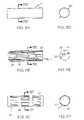
- FIG. 11 ais a side view of a tubular member having no cut-out regions.
- FIG. 11 bis a side view of a tubular member having cut-out regions.
- FIG. 11 cis a side view of the inventive stent of the present invention after joining the tubular member shown in FIG. 11 a with the tubular member shown in FIG. 11 b.
- FIG. 11 dis a cross-sectional view of the same tubular structure shown in FIG. 11 a.
- FIG. 11 eis a cross-sectional view of the same tubular structure shown in FIG. 11 b.
- FIG. 11 fis a cross-sectional view of the stent shown in FIG. 11 c.
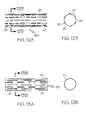
- FIG. 12 ais a side view of an alternative embodiment of the inventive stent of the present invention.
- FIG. 12 bis a cross-sectional view of the stent shown in FIG. 12 a.
- FIG. 13 ais a side view of a prior art stent formed of a single tubular member.
- FIG. 13 bis a cross-sectional view of the stent shown in FIG. 13 a.
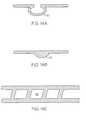
- FIGS. 14 a - cillustrate several different inventive stent patterns.
- FIG. 14 dshows an end view of the same stent pattern as shown in FIG. 14 a.
- FIG. 14 eshows an end view of the same stent pattern as shown in FIG. 14 b.
- FIG. 14 fshows an end view of the same stent pattern as shown in FIG. 14 c in an unexpanded state.
- FIG. 14 gshows an end view of the same stent pattern as shown in FIG. 14 c in an expanded state.
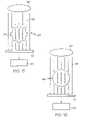
- FIG. 15shows a cross-section of an inventive stent pattern of the present invention subjected to x-rays.
- FIG. 16shows a cross-section of a prior art stent subjected to x-rays.
- FIG. 17illustrates an embodiment in which the tubular stent perform is formed of tubular sections of different materials joined end to end.
- FIG. 18 a - 18 cillustrate several different polygonal stent performs prior to cutting the stent pattern.
- the present inventionincludes a micro porous stent having a deformable structure.
- a micro porous stent having a deformable structureis meant that the deformable struts of both self-expanding and mechanically-expandable stents already known in the art should be provided with micro porous structure.
- the fabrication of such stentsis typically from flat sheet which is rolled then welded into a cylinder or from tubular stock.
- a first way to achieve micro structure in a stentinvolves simply making the struts and the openings of the stent extremely small.
- a stentwould be comprised of a plurality of interconnected deformable struts arranged with respect to each other to provide a micro structure which facilitates support with a minimal disruption in the vessel of a body, the micro structure being characterized, after expansion, by about the following dimensions or smaller.
- FIG. 1there is shown in fragment a portion of a stent 10 of closed cell geometry in schematic form.
- This stentcould be taken to be formed of wire or wires 12 into a cylindrical configuration to form the stent 10 .
- the struts formed by wire 12could also be manufactured by laser cutting struts 12 from tubular stock of an appropriate diameter.
- a second way to achieve micro structure in a stentinvolves the combination of one stent within another stent (slidably interfitted) in which the openings in the stents are mismatched or out of register relative to each other to provide an overall opening which is smaller than either of any of the two registered openings. That is, the openings do not exactly correspond with each other and are not exactly aligned with respect to each other. In such a situation each of the stents may have openings over a wide range of sizes which may or may not be individually micro porous but together in registration provide micro porous openings.
- FIGS. 2 and 3Such a structure is shown in FIGS. 2 and 3 in which an apertured stent 10 a is being slidably interfitted with an apertured stent 10 b .
- openings 12 a in stent 10 a when out of register with openings 12 b in stent 10 bwill provide openings 12 c of markedly smaller size than either of the openings 12 a or 12 b.
- Such a combinationmay even include a third stent within the second stent and so forth.
- Each stent in such a casewould be fabricated independently following which the stents would be slidably interfitted one into the other to provide the overall combination.
- the combined stents if tightly fit togetherwould not necessarily require any sort of fastening means.
- the stentsmay be joined as by welding or by the use of adhesives. If adhesives are used, the adhesives could be biodegradable or even contain a drug eluting material.
- each interfitted stentwill preferably be as thin as possible.
- a stent within a stentwhen viewed broadly, would not necessarily be limited to micro structure stents or to deformable stents but rather would be applicable broadly to stents in which it is desired to obtain finer detail in the configuration of the pattern making up the openings within the stent.
- FIG. 4a schematic showing of a well known type of stent configuration, generally indicated at 20 , made up of a series of serpentine annular rings 22 is shown. As can be seen in FIG. 4 , when the stent is bent to accommodate vessel curvature, gaps 24 enlarge.
- a similar stent 20is shown having the standard annular serpentine rings 22 .
- a similar stent 26included within the stent is a similar stent 26 arranged such that its rings 28 bridge the gaps 24 of the external stent 20 upon flexing or bending.
- Customized stent strengthmay be accomplished by adding or subtracting stent layers.
- FIG. 6schematically shows a stent 40 partially within a stent 42 .
- High strengthis provided at region 44 where the two stents overlap and relatively low strength is provided at regions 46 where there is but a single stent structure.
- Such an arrangementprovides a stent with soft ends.
- a triple stent 40 within a stent 42 within a stent 43is shown to provide three layers in region 50 , two layers in regions 52 and a single layer in regions 54 , thus providing three regions of different relative strength.
- Various other arrangementsare available.
- variations in layersmay be accomplished by rolling up a generally triangular shaped piece of metal sheet 60 shown in FIG. 8 ??? to form a cylinder 62 indicated in FIG. 9 which has in fact regions of various layers as shown in FIG. 10 .
- sheet 60provides a cylindrical stent structure 64 having more layers in the mid regions 66 and successively fewer layers in regions 68 and even fewer in region 70 .
- the present inventionis further directed to stents having variable thickness which exhibit improved radiopacity, MRI properties, flexibility and radial strength.
- the inventionis further directed to expandable stents formed with a pattern adapted for radial expansion from a first unexpanded diameter to a second expanded diameter which approximates the inner diameter of the body lumen into which the stent is intended for implantation.
- the stentsare further designed so as to have flexible portions which deform during bending and portions which provide improved radiopacity and radial strength which remain largely undeformed during bending.
- the stentWhen a stent is introduced into the vasculature of a patient, the stent must be flexible enough so that it can be navigated through the curves of the vasculature.
- a stent patternmay be designed in such a manner that the areas which flex coincide with the areas that deform during expansion.
- the need for flexibilitytypically requires decreased stent thickness, while good radiopacity and radial strength require increased stent thickness.
- the present inventionprovides a stent having variable wall thickness which provides a balanced set of good properties, the relatively thicker sections providing for improved radial strength and radiopacity and the relatively thinner sections providing for good flexibility.
- the wall thicknesses of the stents of the present inventionmay range from about 0.002 to about 0.012′′ with wall thickness for thin walled construction being in the range of about 0.002′′ to about 0.004′′ and thicker walled construction being in the range of about 0.005′′ to about 0.010′′ although this may vary.
- the outside diameter of the tubingmay range from about 0.060′′ to about 0.16′′ (about 1.5 mm to about 4 mm) and more suitably in the range of about 0.060′′ to about 0.075′′ (1.5 mm to about 2 mm).
- the tubular memberswhich may also be referred to as stent performs or stent blanks, may be manufactured from any materials known in the art for use in forming such members, and suitably the tubular members may be made of a biocompatible material. Examples include, but are not limited to, the shape memory materials, noble metals, transition metals, any alloys of the shape memory materials, noble metals, transition metals, polymeric materials, and so forth.
- shape memory materials useful hereininclude, but are not limited to, binary shape-memory metals such as NITINOL® which is a nickel-titanium alloy, or other alloys of nickel and titanium and doped binary metals such as chromium, niobium, vanadium, and so forth. Additional suitable shape-memory alloys are disclosed in WO 95/31945, the contents of which are incorporated by reference herein in their entirety.
- useful stainless steel alloysinclude, but are not limited to, Special Chemistry of type 316L SS per ASTM F138-92 or ASTM F139-92 grade 2, and so forth.
- metals suitable for formation of the inventive stents of the present inventioninclude, but are not limited to the more radiopaque metals including the noble metals gold and platinum, and tantalum; iridium, palladium, tungsten, titanium, chromium, cobalt, molybdenum, nickel, niobium, palladium, iridium, vanadium, barium, hafnium, silver, copper, zinc, aluminum, and so forth, and alloys thereof.
- alloys useful for manufacture of the inventive stents hereininclude, but are not limited to, nickel-titanium, cobalt-chromium, cobalt-chromium-molybdenum, titanium-chromium, titanium-aluminum-vanadium (Ti6Al4V), and so forth.
- the present inventionis directed to a stent manufactured of at least a first and second tubular member.
- the first tubular memberincludes cut-out regions, and the second tubular member may or may not have cut-out regions.
- the tubular membersare suitably of a thin-walled construction.
- FIG. 11 aillustrates generally at 1 , a tubular member of a thin-walled construction and having no cut-out regions.
- FIG. 11 billustrates generally at 2 , a tubular member having cut-out regions 20 .
- Tubular member 2may also be of a thin-walled construction.
- FIG. 11 cillustrates generally at 10 , a stent made by placing tubular member 2 over tubular member 1 as shown.
- cut-outas used herein is not intended to refer to any particular method of producing such regions in the tubular member and thus contemplates any methods known in the art including, for example, laser and chemical etching, and so forth.
- tubular member 2 having the cut-out regions 20is slightly larger than tubular member 1 and is fitted over tubular member 1 forming stent 10 which has variable thickness.
- the cut-out regions 20 of tubular member 2may be created by any methods known to those of skill in the art including laser machining or machine or chemical etching, for example.
- the tubular membersmay be interference fit or line-to-line fit, for example, or they may be fitted together so that a slight gap exists between the tubular members which is subsequently closed during balloon expansion, for example.
- the tubular membersmay be secured together using any method known in the art including, but not limited to, welding, friction welding, brazing, diffusion bonding, co-drawing or co-rolling as sheet metal to create a metallurgical bond, and so forth.
- stent 10Some areas of stent 10 have only one layer where the cut-out regions 20 exist on tubular member 2 and some have a double layer where there are no cut-out regions.
- a cross-sectional view of a section of tubular member 1is shown at A-A in FIG. 11 d and a cross-sectional view of a section of tubular member 2 is shown at B-B in FIG. 11 e.
- a cross-sectional view of a section of stent 10is shown at C-C in FIG. 11 f .
- This embodimentoffers a stent having improved flexibility in the areas of the stent having only a single layer shown by reference numeral 25 , i.e. where the cut-out regions 20 of tubular member 2 overlap tubular member 1 . Thin walled materials allows for reasonable balloon expansion pressures.
- the sections of the stent having a double layer shown by the reference numeral 30exhibit improved radiopacity and also improve the radial stiffness and resistance to radial compression.
- the result of having at least two layers for the x-rays to pass throughresults in more contrast on the x-ray film or fluoroscopy screen which results in enhanced radiopacity.
- reducing the ferromagnetic strength of a monolithic stent such as a 316L stainless steel stentby employing a stent having one layer which is 316L stainless steel and one which is formed of a highly MRI safe and compatible material such as titanium, platinum, tantalum or niobium, for example, may result in improved MRI safety and compatibility.
- FIG. 12 aillustrates generally at 100 , an alternative embodiment of the inventive stent of the present invention in which stent 100 has not only areas which have a single layer thickness 25 and areas which have a double layer thickness 30 , but also has areas which are cut-out through both layers represented by reference numeral 35 .
- both tubular membershave cut-out regions 20 which substantially align with one another therefore creating sections in the finished stent 100 which are cut-out through both layers.
- the cut-out regionsmay be created in each tube prior to assembly, or the cut-out regions may be created in tubular member 2 by laser machining or chemical or laser etching, for example after tubular member 1 has been fitted over tubular member 2 .
- tubular member 2being slightly larger than tubular member 1 , is first fitted over tubular member 1 and the cut-out regions in tubular member 1 may be created by laser or chemical etching the cut-out regions in 1 which will therefore substantially match those cut-out regions 20 of tubular member 2 .
- tubular member 1may have fewer cut-out regions than tubular member 2 as desired.
- a cross-sectional view of this embodiment of the inventive stent of the present inventionis taken at section A-A and shown in FIG. 12 b.
- both tubular member 1 and tubular member 2are manufactured of the same material.
- the material employedmay be stainless steel 316L, stainless steel 304L, nickel-titanium alloy such as NITINOL®, CoCrMo alloy, titanium alloy, tantalum or its alloys, platinum or its alloys, for example.
- the materialmay be polymeric.
- the thickness and/or other properties of the stentmay be further varied over its surface by varying the thickness and/or properties of tubular member 1 using methods known in the art such as, for example, annealing or other heat treating techniques, or by machining techniques, and so forth which will produce a wall in the tubular member having thinner and thicker regions and/or other variable properties.
- the thickness and/or other properties of tubular member 2may also be varied.
- more than two tubesmay be employed in the present invention as well to create more than two layers in the finished composite stent structure.
- 3, 4, 5 or more tubular membersmay be employed to produce composite stents having 3, 4, 5 or more layers.
- FIG. 13 aillustrates generally at 150 , a prior art stent formed of a single tubular member.
- FIG. 13 bis a cross-sectional view of the prior art stent shown in FIG. 13 a.
- Configuration of a specific stent designmay also be employed to create improved radiographic contrast on the fluoroscopy screen, as well as improved radial strength and improved flexibility.
- FIG. 14illustrates several different stent configurations. Such configurations may be formed using methods known to those in the art including, but not limited to, tube drawing, extruding through a shaped die or by honeycomb construction techniques, for example.
- FIGS. 14 a - 14 cillustrates several different stent patterns designed to create regions of the stent that will produce more radiographic contrast on a fluoroscopy screen and more radial strength, as well as having regions of increased flexibility.
- FIG. 14 ais a side view of a portion of a stent having a pattern which includes an oval protrusion 70 . This protrusion includes a void in the center of the protrusion in contrast to the pattern shown in FIG. 14 b .
- the present inventionalso contemplates other similar patterns which have more distinct corners as well.
- FIG. 14 dis an end view of the stent employing the pattern described in FIG. 14 a.
- FIG. 14 bis a side view of a portion of a stent having a pattern which includes a solid protuberance, i.e. is formed in the stent material and does not have a void in its center. This pattern may be varied as well by changing the geometry without departing from the scope of the present invention.
- FIG. 14 eis an end view of the stent employing the pattern described in FIG. 14 b.
- FIG. 14 cis a side view of a portion of a stent employing a honeycomb pattern which also may be employed to increase the radiographic contrast of the stent while maintaining the radial strength and flexibility.
- FIG. 14 fis an end view of a stent employing the pattern described in FIG. 14 c in an unexpanded state while FIG. 14 g is an end view of the same stent as in FIG. 14 f shown in an expanded state.
- the above described patternscreate areas of greater radiographic contrast thus making the stent more visible using fluoroscopic techniques.
- These patternsmay be employed in the multi-tubular stent structure as described above, and may be employed in creating a stent of a single tubular member as well.
- FIG. 15illustrates generally at 40 , an end view of an inventive stent of the present invention employing a pattern similar to that shown in FIG. 14 a.
- the stenthas an oval protuberance 65 creating more complexity in the stent pattern and thus creating regions of more radiographic contrast on the fluoroscopy screen 60 when the stent is subjected to a source of x-rays 50 .
- the oval protuberances 65act as x-ray absorbers, thus the creation of more radiographic contrast and visibility on the fluoroscopy screen 60 .
- stent patternsas described above results in a stent which has areas which are thicker, or which are more complex, providing more radiographic contrast on a fluoroscopy screen and more radial strength, and areas which are thinner resulting in more flexibility.
- FIG. 16shows a cross-section of a typical stent design.
- the radiographic contrast, radial strength and the flexibility of the stentare improved by employing a tubular perform having a plurality of first and second sections each having a first end and a second end.
- the first sectionsare formed of a first material and the second sections are formed of a second material which is more radiopaque than the first material.
- the first materialmay be an alloy or a blend of materials and the second section may be an alloy or blend of materials which results in a blend which is more radiopaque that the first material.
- the first sectionsare joined to the second sections end to end in a butt joint fashion.
- the materialsare also selected such that some sections are more flexible, and some sections are radially stronger and have better radiopacity.
- the thickness of a sectionmay also be varied in order to achieve the desired balance, and some sections may be thicker than other sections as well.
- FIG. 17illustrates generally at 12 a tubular preform of this type in which a first section 60 formed of a first material is joined end to end with a second section 62 formed of a second material which is more radiopaque than the first material.
- the first materialmay be a flexible material such as stainless steel or a shape memory alloy such as NITINOL®, while the second material may be formed of a more rigid, radiopaque material such as gold, tantalum, platinum, and so forth, or alloys thereof.
- the sections of tubingmay be joined using any methods known in the art including, but not limited to, welding including laser welding, brazing, rolling, bonding, drawing, and so forth.
- weldingincluding laser welding, brazing, rolling, bonding, drawing, and so forth.
- no mechanical securement other than contactis required, particularly for tubing which is employed in a mechanically expandable stent such as those expanded using an inflation member, for example, a dilatation balloon.
- the stent patternmay be cut into the preform using methods known to those of skill in the art including laser and chemical etching, for example.
- the polygonal shapemay be any geometric shape which has 3 or more sides including a triangle, pentagon, hexagon, octagon, and so forth. Suitable, hexagons or octagons are employed in the present invention and most suitably, an octagon is employed.
- the polygonal shapemay be formed during extrusion or by machining, for instance. Material from the inner surface of the preform may be removed using any methods known in the art including, but not limited to, machine grinding, lasering, etching, and so forth.
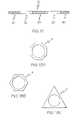
- FIGS. 18 a - 18 crepresent several different polygonal performs after removal of material from the inner surface of the preform.
- FIG. 18 aillustrates generally at 3 a octagonal preform
- FIG. 18 brepresents generally at 4 a hexagonal preform
- FIG. 18 crepresents generally 5 a triangular preform. It is apparent from the figures that the result is a variable thickness stent.
- the stent patternmay then be cut into the preform using methods known in the art such as laser and chemical etching.
- the stent patternis designed to match with the thicker and thinner portions of the stent preform in order to optimize the flexibility and radiopacity.
Landscapes
- Health & Medical Sciences (AREA)
- Engineering & Computer Science (AREA)
- Biomedical Technology (AREA)
- Heart & Thoracic Surgery (AREA)
- Life Sciences & Earth Sciences (AREA)
- Cardiology (AREA)
- Oral & Maxillofacial Surgery (AREA)
- Transplantation (AREA)
- Physics & Mathematics (AREA)
- Vascular Medicine (AREA)
- Optics & Photonics (AREA)
- Animal Behavior & Ethology (AREA)
- General Health & Medical Sciences (AREA)
- Public Health (AREA)
- Veterinary Medicine (AREA)
- Media Introduction/Drainage Providing Device (AREA)
- Materials For Medical Uses (AREA)
- Prostheses (AREA)
Abstract
Description
- strut width 0.00025-0.002 inches
- strut thickness 0.00025-0.004 inches
- maximum PIN opening 0.002-0.020 inches diameter
(current stent designs typically have a maximum PIN opening of around 0.025 inches to 0.050 inches in diameter).
- strut width 0.00025-0.002 inches
- strut thickness 0.00025-0.004 inches
- maximum PIN opening 0.002-0.20 inches
- Uniform vessel coverage
- improved flexibility
- customized strength provided by adding or subtracting layers of stent.
Claims (19)
Priority Applications (3)
| Application Number | Priority Date | Filing Date | Title |
|---|---|---|---|
| US10/150,117US7226475B2 (en) | 1999-11-09 | 2002-05-20 | Stent with variable properties |
| AU2003230421AAU2003230421A1 (en) | 2002-05-20 | 2003-05-16 | Stent with variable properties |
| PCT/US2003/015617WO2003099168A2 (en) | 2002-05-20 | 2003-05-16 | Stent with variable properties |
Applications Claiming Priority (2)
| Application Number | Priority Date | Filing Date | Title |
|---|---|---|---|
| US09/437,049US6428569B1 (en) | 1999-11-09 | 1999-11-09 | Micro structure stent configurations |
| US10/150,117US7226475B2 (en) | 1999-11-09 | 2002-05-20 | Stent with variable properties |
Related Parent Applications (1)
| Application Number | Title | Priority Date | Filing Date |
|---|---|---|---|
| US09/437,049Continuation-In-PartUS6428569B1 (en) | 1999-11-09 | 1999-11-09 | Micro structure stent configurations |
Publications (2)
| Publication Number | Publication Date |
|---|---|
| US20020138133A1 US20020138133A1 (en) | 2002-09-26 |
| US7226475B2true US7226475B2 (en) | 2007-06-05 |
Family
ID=29582031
Family Applications (1)
| Application Number | Title | Priority Date | Filing Date |
|---|---|---|---|
| US10/150,117Expired - Fee RelatedUS7226475B2 (en) | 1999-11-09 | 2002-05-20 | Stent with variable properties |
Country Status (3)
| Country | Link |
|---|---|
| US (1) | US7226475B2 (en) |
| AU (1) | AU2003230421A1 (en) |
| WO (1) | WO2003099168A2 (en) |
Cited By (53)
| Publication number | Priority date | Publication date | Assignee | Title |
|---|---|---|---|---|
| US20060135984A1 (en)* | 2003-07-18 | 2006-06-22 | Broncus Technologies, Inc. | Devices for maintaining patency of surgically created channels in tissue |
| US20070093899A1 (en)* | 2005-09-28 | 2007-04-26 | Christof Dutoit | Apparatus and methods for treating bone |
| US20080071348A1 (en)* | 2006-09-15 | 2008-03-20 | Boston Scientific Scimed, Inc. | Medical Devices |
| US20090292352A1 (en)* | 2002-06-27 | 2009-11-26 | Boston Scientific Scimed, Inc. | Methods of making medical devices |
| US20100234874A1 (en)* | 2007-01-24 | 2010-09-16 | Cook Incorporated | Preform and balloon having a non-uniform thickness |
| US7823263B2 (en) | 2006-07-11 | 2010-11-02 | Abbott Cardiovascular Systems Inc. | Method of removing stent islands from a stent |
| US7901452B2 (en) | 2007-06-27 | 2011-03-08 | Abbott Cardiovascular Systems Inc. | Method to fabricate a stent having selected morphology to reduce restenosis |
| US20110118826A1 (en)* | 2008-07-30 | 2011-05-19 | Boston Scientific Scimed. Inc. | Bioerodible Endoprosthesis |
| US7955381B1 (en) | 2007-06-29 | 2011-06-07 | Advanced Cardiovascular Systems, Inc. | Polymer-bioceramic composite implantable medical device with different types of bioceramic particles |
| US20110160839A1 (en)* | 2009-12-29 | 2011-06-30 | Boston Scientific Scimed, Inc. | Endoprosthesis |
| US8002821B2 (en) | 2006-09-18 | 2011-08-23 | Boston Scientific Scimed, Inc. | Bioerodible metallic ENDOPROSTHESES |
| US8048150B2 (en) | 2006-04-12 | 2011-11-01 | Boston Scientific Scimed, Inc. | Endoprosthesis having a fiber meshwork disposed thereon |
| US8052743B2 (en) | 2006-08-02 | 2011-11-08 | Boston Scientific Scimed, Inc. | Endoprosthesis with three-dimensional disintegration control |
| US8052745B2 (en) | 2007-09-13 | 2011-11-08 | Boston Scientific Scimed, Inc. | Endoprosthesis |
| US8052744B2 (en) | 2006-09-15 | 2011-11-08 | Boston Scientific Scimed, Inc. | Medical devices and methods of making the same |
| US8057534B2 (en) | 2006-09-15 | 2011-11-15 | Boston Scientific Scimed, Inc. | Bioerodible endoprostheses and methods of making the same |
| US8080055B2 (en) | 2006-12-28 | 2011-12-20 | Boston Scientific Scimed, Inc. | Bioerodible endoprostheses and methods of making the same |
| US8089029B2 (en) | 2006-02-01 | 2012-01-03 | Boston Scientific Scimed, Inc. | Bioabsorbable metal medical device and method of manufacture |
| US8128689B2 (en) | 2006-09-15 | 2012-03-06 | Boston Scientific Scimed, Inc. | Bioerodible endoprosthesis with biostable inorganic layers |
| US8128688B2 (en) | 2006-06-27 | 2012-03-06 | Abbott Cardiovascular Systems Inc. | Carbon coating on an implantable device |
| US8236046B2 (en) | 2008-06-10 | 2012-08-07 | Boston Scientific Scimed, Inc. | Bioerodible endoprosthesis |
| US8267992B2 (en) | 2009-03-02 | 2012-09-18 | Boston Scientific Scimed, Inc. | Self-buffering medical implants |
| US8303643B2 (en) | 2001-06-27 | 2012-11-06 | Remon Medical Technologies Ltd. | Method and device for electrochemical formation of therapeutic species in vivo |
| US8382824B2 (en) | 2008-10-03 | 2013-02-26 | Boston Scientific Scimed, Inc. | Medical implant having NANO-crystal grains with barrier layers of metal nitrides or fluorides |
| US20130238083A1 (en)* | 2008-10-20 | 2013-09-12 | Imds Corporation | Systems and methods for aneurysm treatment and vessel occlusion |
| US8535380B2 (en) | 2010-05-13 | 2013-09-17 | Stout Medical Group, L.P. | Fixation device and method |
| US8535372B1 (en) | 2006-06-16 | 2013-09-17 | Abbott Cardiovascular Systems Inc. | Bioabsorbable stent with prohealing layer |
| US8668732B2 (en) | 2010-03-23 | 2014-03-11 | Boston Scientific Scimed, Inc. | Surface treated bioerodible metal endoprostheses |
| US8709042B2 (en) | 2004-09-21 | 2014-04-29 | Stout Medical Group, LP | Expandable support device and method of use |
| US8752268B2 (en) | 2006-05-26 | 2014-06-17 | Abbott Cardiovascular Systems Inc. | Method of making stents with radiopaque markers |
| US8808726B2 (en) | 2006-09-15 | 2014-08-19 | Boston Scientific Scimed. Inc. | Bioerodible endoprostheses and methods of making the same |
| US8840660B2 (en) | 2006-01-05 | 2014-09-23 | Boston Scientific Scimed, Inc. | Bioerodible endoprostheses and methods of making the same |
| US9050112B2 (en) | 2011-08-23 | 2015-06-09 | Flexmedex, LLC | Tissue removal device and method |
| US9149286B1 (en) | 2010-11-12 | 2015-10-06 | Flexmedex, LLC | Guidance tool and method for use |
| US9198785B2 (en) | 2010-01-30 | 2015-12-01 | Abbott Cardiovascular Systems Inc. | Crush recoverable polymer scaffolds |
| US9289240B2 (en) | 2005-12-23 | 2016-03-22 | DePuy Synthes Products, Inc. | Flexible elongated chain implant and method of supporting body tissue with same |
| US9358140B1 (en) | 2009-11-18 | 2016-06-07 | Aneuclose Llc | Stent with outer member to embolize an aneurysm |
| US9532888B2 (en) | 2006-01-04 | 2017-01-03 | Abbott Cardiovascular Systems Inc. | Stents with radiopaque markers |
| US9770339B2 (en) | 2005-07-14 | 2017-09-26 | Stout Medical Group, L.P. | Expandable support device and method of use |
| US9827119B2 (en) | 2010-01-30 | 2017-11-28 | Abbott Cardiovascular Systems Inc. | Polymer scaffolds having a low crossing profile |
| US9848906B1 (en) | 2017-06-20 | 2017-12-26 | Joe Michael Eskridge | Stent retriever having an expandable fragment guard |
| US9907684B2 (en) | 2013-05-08 | 2018-03-06 | Aneuclose Llc | Method of radially-asymmetric stent expansion |
| US9999527B2 (en) | 2015-02-11 | 2018-06-19 | Abbott Cardiovascular Systems Inc. | Scaffolds having radiopaque markers |
| US10028747B2 (en) | 2008-05-01 | 2018-07-24 | Aneuclose Llc | Coils with a series of proximally-and-distally-connected loops for occluding a cerebral aneurysm |
| US10070968B2 (en) | 2010-08-24 | 2018-09-11 | Flexmedex, LLC | Support device and method for use |
| US10285819B2 (en) | 2008-11-12 | 2019-05-14 | Stout Medical Group, L.P. | Fixation device and method |
| US10307274B2 (en) | 2011-07-29 | 2019-06-04 | Abbott Cardiovascular Systems Inc. | Methods for uniform crimping and deployment of a polymer scaffold |
| US10610387B2 (en) | 2015-06-12 | 2020-04-07 | Abbott Cardiovascular Systems Inc. | Scaffolds having a radiopaque marker and methods for attaching a marker to a scaffold |
| US20200222214A1 (en)* | 2007-02-09 | 2020-07-16 | Taheri Laduca Llc | Vascular implants and methods of fabricating the same |
| US10716573B2 (en) | 2008-05-01 | 2020-07-21 | Aneuclose | Janjua aneurysm net with a resilient neck-bridging portion for occluding a cerebral aneurysm |
| US10758289B2 (en) | 2006-05-01 | 2020-09-01 | Stout Medical Group, L.P. | Expandable support device and method of use |
| US10940014B2 (en) | 2008-11-12 | 2021-03-09 | Stout Medical Group, L.P. | Fixation device and method |
| US20210192448A1 (en)* | 2018-06-18 | 2021-06-24 | General Electric Company | Blockchain enabled transaction processing for an industrial asset supply chain |
Families Citing this family (138)
| Publication number | Priority date | Publication date | Assignee | Title |
|---|---|---|---|---|
| US6240616B1 (en) | 1997-04-15 | 2001-06-05 | Advanced Cardiovascular Systems, Inc. | Method of manufacturing a medicated porous metal prosthesis |
| US10028851B2 (en) | 1997-04-15 | 2018-07-24 | Advanced Cardiovascular Systems, Inc. | Coatings for controlling erosion of a substrate of an implantable medical device |
| US8172897B2 (en) | 1997-04-15 | 2012-05-08 | Advanced Cardiovascular Systems, Inc. | Polymer and metal composite implantable medical devices |
| US6776792B1 (en) | 1997-04-24 | 2004-08-17 | Advanced Cardiovascular Systems Inc. | Coated endovascular stent |
| US6368346B1 (en) | 1999-06-03 | 2002-04-09 | American Medical Systems, Inc. | Bioresorbable stent |
| US7402173B2 (en)* | 2000-09-18 | 2008-07-22 | Boston Scientific Scimed, Inc. | Metal stent with surface layer of noble metal oxide and method of fabrication |
| US7101391B2 (en) | 2000-09-18 | 2006-09-05 | Inflow Dynamics Inc. | Primarily niobium stent |
| US6783793B1 (en) | 2000-10-26 | 2004-08-31 | Advanced Cardiovascular Systems, Inc. | Selective coating of medical devices |
| US6569194B1 (en) | 2000-12-28 | 2003-05-27 | Advanced Cardiovascular Systems, Inc. | Thermoelastic and superelastic Ni-Ti-W alloy |
| US20030069629A1 (en)* | 2001-06-01 | 2003-04-10 | Jadhav Balkrishna S. | Bioresorbable medical devices |
| US20020188342A1 (en)* | 2001-06-01 | 2002-12-12 | Rykhus Robert L. | Short-term bioresorbable stents |
| US6565659B1 (en) | 2001-06-28 | 2003-05-20 | Advanced Cardiovascular Systems, Inc. | Stent mounting assembly and a method of using the same to coat a stent |
| US7989018B2 (en) | 2001-09-17 | 2011-08-02 | Advanced Cardiovascular Systems, Inc. | Fluid treatment of a polymeric coating on an implantable medical device |
| US7285304B1 (en) | 2003-06-25 | 2007-10-23 | Advanced Cardiovascular Systems, Inc. | Fluid treatment of a polymeric coating on an implantable medical device |
| US6863683B2 (en) | 2001-09-19 | 2005-03-08 | Abbott Laboratoris Vascular Entities Limited | Cold-molding process for loading a stent onto a stent delivery system |
| US7285287B2 (en)* | 2002-11-14 | 2007-10-23 | Synecor, Llc | Carbon dioxide-assisted methods of providing biocompatible intraluminal prostheses |
| US20040098106A1 (en)* | 2002-11-14 | 2004-05-20 | Williams Michael S. | Intraluminal prostheses and carbon dioxide-assisted methods of impregnating same with pharmacological agents |
| US20050187615A1 (en)* | 2004-02-23 | 2005-08-25 | Williams Michael S. | Polymeric endoprostheses with enhanced strength and flexibility and methods of manufacture |
| US9333102B2 (en)* | 2003-02-24 | 2016-05-10 | Allium Medical Solutions Ltd. | Stent |
| US6932930B2 (en)* | 2003-03-10 | 2005-08-23 | Synecor, Llc | Intraluminal prostheses having polymeric material with selectively modified crystallinity and methods of making same |
| DE10335192A1 (en)* | 2003-07-30 | 2005-03-03 | Phytis Medical Devices Gmbh | Medical implant for animal or human patient made of material allowing use of implant as visualization marker e.g. X-ray marker |
| US7479157B2 (en) | 2003-08-07 | 2009-01-20 | Boston Scientific Scimed, Inc. | Stent designs which enable the visibility of the inside of the stent during MRI |
| US11259945B2 (en) | 2003-09-03 | 2022-03-01 | Bolton Medical, Inc. | Dual capture device for stent graft delivery system and method for capturing a stent graft |
| US11596537B2 (en) | 2003-09-03 | 2023-03-07 | Bolton Medical, Inc. | Delivery system and method for self-centering a proximal end of a stent graft |
| US8292943B2 (en) | 2003-09-03 | 2012-10-23 | Bolton Medical, Inc. | Stent graft with longitudinal support member |
| US20080264102A1 (en)* | 2004-02-23 | 2008-10-30 | Bolton Medical, Inc. | Sheath Capture Device for Stent Graft Delivery System and Method for Operating Same |
| US7763063B2 (en) | 2003-09-03 | 2010-07-27 | Bolton Medical, Inc. | Self-aligning stent graft delivery system, kit, and method |
| US9198786B2 (en)* | 2003-09-03 | 2015-12-01 | Bolton Medical, Inc. | Lumen repair device with capture structure |
| US8500792B2 (en) | 2003-09-03 | 2013-08-06 | Bolton Medical, Inc. | Dual capture device for stent graft delivery system and method for capturing a stent graft |
| US20070198078A1 (en) | 2003-09-03 | 2007-08-23 | Bolton Medical, Inc. | Delivery system and method for self-centering a Proximal end of a stent graft |
| US7198675B2 (en) | 2003-09-30 | 2007-04-03 | Advanced Cardiovascular Systems | Stent mandrel fixture and method for selectively coating surfaces of a stent |
| US9066912B2 (en) | 2003-11-17 | 2015-06-30 | Ethicon, Inc. | Drug-enhanced adhesion prevention |
| DE10357334A1 (en)* | 2003-12-05 | 2005-07-07 | Grönemeyer, Dietrich H. W., Prof. Dr.med. | MR compatible medical implant |
| US7563324B1 (en) | 2003-12-29 | 2009-07-21 | Advanced Cardiovascular Systems Inc. | System and method for coating an implantable medical device |
| US20050230039A1 (en)* | 2004-04-19 | 2005-10-20 | Michael Austin | Stent with protective pads or bulges |
| US7553377B1 (en) | 2004-04-27 | 2009-06-30 | Advanced Cardiovascular Systems, Inc. | Apparatus and method for electrostatic coating of an abluminal stent surface |
| CA2565106C (en) | 2004-05-25 | 2013-11-05 | Chestnut Medical Technologies, Inc. | Flexible vascular occluding device |
| US8617234B2 (en) | 2004-05-25 | 2013-12-31 | Covidien Lp | Flexible vascular occluding device |
| US8267985B2 (en) | 2005-05-25 | 2012-09-18 | Tyco Healthcare Group Lp | System and method for delivering and deploying an occluding device within a vessel |
| US20060206200A1 (en) | 2004-05-25 | 2006-09-14 | Chestnut Medical Technologies, Inc. | Flexible vascular occluding device |
| US9675476B2 (en) | 2004-05-25 | 2017-06-13 | Covidien Lp | Vascular stenting for aneurysms |
| US8623067B2 (en) | 2004-05-25 | 2014-01-07 | Covidien Lp | Methods and apparatus for luminal stenting |
| CA2758946C (en) | 2004-05-25 | 2014-10-21 | Tyco Healthcare Group Lp | Vascular stenting for aneurysms |
| US20050278017A1 (en) | 2004-06-09 | 2005-12-15 | Scimed Life Systems, Inc. | Overlapped stents for scaffolding, flexibility and MRI compatibility |
| US8568469B1 (en) | 2004-06-28 | 2013-10-29 | Advanced Cardiovascular Systems, Inc. | Stent locking element and a method of securing a stent on a delivery system |
| US8241554B1 (en) | 2004-06-29 | 2012-08-14 | Advanced Cardiovascular Systems, Inc. | Method of forming a stent pattern on a tube |
| US8747879B2 (en) | 2006-04-28 | 2014-06-10 | Advanced Cardiovascular Systems, Inc. | Method of fabricating an implantable medical device to reduce chance of late inflammatory response |
| US8747878B2 (en) | 2006-04-28 | 2014-06-10 | Advanced Cardiovascular Systems, Inc. | Method of fabricating an implantable medical device by controlling crystalline structure |
| US8012402B2 (en)* | 2008-08-04 | 2011-09-06 | Abbott Cardiovascular Systems Inc. | Tube expansion process for semicrystalline polymers to maximize fracture toughness |
| US7971333B2 (en) | 2006-05-30 | 2011-07-05 | Advanced Cardiovascular Systems, Inc. | Manufacturing process for polymetric stents |
| US7731890B2 (en)* | 2006-06-15 | 2010-06-08 | Advanced Cardiovascular Systems, Inc. | Methods of fabricating stents with enhanced fracture toughness |
| US8268228B2 (en) | 2007-12-11 | 2012-09-18 | Abbott Cardiovascular Systems Inc. | Method of fabricating stents from blow molded tubing |
| US20110066222A1 (en)* | 2009-09-11 | 2011-03-17 | Yunbing Wang | Polymeric Stent and Method of Making Same |
| US8778256B1 (en) | 2004-09-30 | 2014-07-15 | Advanced Cardiovascular Systems, Inc. | Deformation of a polymer tube in the fabrication of a medical article |
| US20140107761A1 (en) | 2004-07-26 | 2014-04-17 | Abbott Cardiovascular Systems Inc. | Biodegradable stent with enhanced fracture toughness |
| US8501079B2 (en) | 2009-09-14 | 2013-08-06 | Abbott Cardiovascular Systems Inc. | Controlling crystalline morphology of a bioabsorbable stent |
| US20060020330A1 (en) | 2004-07-26 | 2006-01-26 | Bin Huang | Method of fabricating an implantable medical device with biaxially oriented polymers |
| US9283099B2 (en) | 2004-08-25 | 2016-03-15 | Advanced Cardiovascular Systems, Inc. | Stent-catheter assembly with a releasable connection for stent retention |
| US7229471B2 (en) | 2004-09-10 | 2007-06-12 | Advanced Cardiovascular Systems, Inc. | Compositions containing fast-leaching plasticizers for improved performance of medical devices |
| US20070280850A1 (en)* | 2004-09-27 | 2007-12-06 | Carlson James M | Mri Compatible Devices |
| CN101094623B (en) | 2004-09-28 | 2012-08-08 | 科迪斯公司 | Thin film medical device and delivery system |
| US8043553B1 (en)* | 2004-09-30 | 2011-10-25 | Advanced Cardiovascular Systems, Inc. | Controlled deformation of a polymer tube with a restraining surface in fabricating a medical article |
| US8173062B1 (en)* | 2004-09-30 | 2012-05-08 | Advanced Cardiovascular Systems, Inc. | Controlled deformation of a polymer tube in fabricating a medical article |
| US7875233B2 (en)* | 2004-09-30 | 2011-01-25 | Advanced Cardiovascular Systems, Inc. | Method of fabricating a biaxially oriented implantable medical device |
| US7628807B2 (en)* | 2004-11-04 | 2009-12-08 | Boston Scientific Scimed, Inc. | Stent for delivering a therapeutic agent having increased body tissue contact surface |
| US20060122694A1 (en)* | 2004-12-03 | 2006-06-08 | Stinson Jonathan S | Medical devices and methods of making the same |
| US7632307B2 (en) | 2004-12-16 | 2009-12-15 | Advanced Cardiovascular Systems, Inc. | Abluminal, multilayer coating constructs for drug-delivery stents |
| US7381048B2 (en) | 2005-04-12 | 2008-06-03 | Advanced Cardiovascular Systems, Inc. | Stents with profiles for gripping a balloon catheter and molds for fabricating stents |
| US7291166B2 (en) | 2005-05-18 | 2007-11-06 | Advanced Cardiovascular Systems, Inc. | Polymeric stent patterns |
| US20060276875A1 (en)* | 2005-05-27 | 2006-12-07 | Stinson Jonathan S | Medical devices |
| US7622070B2 (en) | 2005-06-20 | 2009-11-24 | Advanced Cardiovascular Systems, Inc. | Method of manufacturing an implantable polymeric medical device |
| US7658880B2 (en) | 2005-07-29 | 2010-02-09 | Advanced Cardiovascular Systems, Inc. | Polymeric stent polishing method and apparatus |
| US7297758B2 (en) | 2005-08-02 | 2007-11-20 | Advanced Cardiovascular Systems, Inc. | Method for extending shelf-life of constructs of semi-crystallizable polymers |
| US7476245B2 (en) | 2005-08-16 | 2009-01-13 | Advanced Cardiovascular Systems, Inc. | Polymeric stent patterns |
| US9248034B2 (en) | 2005-08-23 | 2016-02-02 | Advanced Cardiovascular Systems, Inc. | Controlled disintegrating implantable medical devices |
| US7867547B2 (en) | 2005-12-19 | 2011-01-11 | Advanced Cardiovascular Systems, Inc. | Selectively coating luminal surfaces of stents |
| US7951185B1 (en) | 2006-01-06 | 2011-05-31 | Advanced Cardiovascular Systems, Inc. | Delivery of a stent at an elevated temperature |
| US8152833B2 (en) | 2006-02-22 | 2012-04-10 | Tyco Healthcare Group Lp | Embolic protection systems having radiopaque filter mesh |
| US7964210B2 (en) | 2006-03-31 | 2011-06-21 | Abbott Cardiovascular Systems Inc. | Degradable polymeric implantable medical devices with a continuous phase and discrete phase |
| US8003156B2 (en) | 2006-05-04 | 2011-08-23 | Advanced Cardiovascular Systems, Inc. | Rotatable support elements for stents |
| US7761968B2 (en) | 2006-05-25 | 2010-07-27 | Advanced Cardiovascular Systems, Inc. | Method of crimping a polymeric stent |
| US7951194B2 (en) | 2006-05-26 | 2011-05-31 | Abbott Cardiovascular Sysetms Inc. | Bioabsorbable stent with radiopaque coating |
| US7842737B2 (en) | 2006-09-29 | 2010-11-30 | Abbott Cardiovascular Systems Inc. | Polymer blend-bioceramic composite implantable medical devices |
| US7959940B2 (en) | 2006-05-30 | 2011-06-14 | Advanced Cardiovascular Systems, Inc. | Polymer-bioceramic composite implantable medical devices |
| US20070282434A1 (en)* | 2006-05-30 | 2007-12-06 | Yunbing Wang | Copolymer-bioceramic composite implantable medical devices |
| US8343530B2 (en) | 2006-05-30 | 2013-01-01 | Abbott Cardiovascular Systems Inc. | Polymer-and polymer blend-bioceramic composite implantable medical devices |
| US8486135B2 (en) | 2006-06-01 | 2013-07-16 | Abbott Cardiovascular Systems Inc. | Implantable medical devices fabricated from branched polymers |
| US8034287B2 (en) | 2006-06-01 | 2011-10-11 | Abbott Cardiovascular Systems Inc. | Radiation sterilization of medical devices |
| US8603530B2 (en) | 2006-06-14 | 2013-12-10 | Abbott Cardiovascular Systems Inc. | Nanoshell therapy |
| US8048448B2 (en) | 2006-06-15 | 2011-11-01 | Abbott Cardiovascular Systems Inc. | Nanoshells for drug delivery |
| US8333000B2 (en) | 2006-06-19 | 2012-12-18 | Advanced Cardiovascular Systems, Inc. | Methods for improving stent retention on a balloon catheter |
| US8017237B2 (en) | 2006-06-23 | 2011-09-13 | Abbott Cardiovascular Systems, Inc. | Nanoshells on polymers |
| US9072820B2 (en) | 2006-06-26 | 2015-07-07 | Advanced Cardiovascular Systems, Inc. | Polymer composite stent with polymer particles |
| US7794776B1 (en) | 2006-06-29 | 2010-09-14 | Abbott Cardiovascular Systems Inc. | Modification of polymer stents with radiation |
| US7740791B2 (en)* | 2006-06-30 | 2010-06-22 | Advanced Cardiovascular Systems, Inc. | Method of fabricating a stent with features by blow molding |
| US7757543B2 (en) | 2006-07-13 | 2010-07-20 | Advanced Cardiovascular Systems, Inc. | Radio frequency identification monitoring of stents |
| US7998404B2 (en) | 2006-07-13 | 2011-08-16 | Advanced Cardiovascular Systems, Inc. | Reduced temperature sterilization of stents |
| US7794495B2 (en) | 2006-07-17 | 2010-09-14 | Advanced Cardiovascular Systems, Inc. | Controlled degradation of stents |
| US7886419B2 (en) | 2006-07-18 | 2011-02-15 | Advanced Cardiovascular Systems, Inc. | Stent crimping apparatus and method |
| US8016879B2 (en) | 2006-08-01 | 2011-09-13 | Abbott Cardiovascular Systems Inc. | Drug delivery after biodegradation of the stent scaffolding |
| US9173733B1 (en) | 2006-08-21 | 2015-11-03 | Abbott Cardiovascular Systems Inc. | Tracheobronchial implantable medical device and methods of use |
| US7923022B2 (en) | 2006-09-13 | 2011-04-12 | Advanced Cardiovascular Systems, Inc. | Degradable polymeric implantable medical devices with continuous phase and discrete phase |
| US20080071346A1 (en)* | 2006-09-14 | 2008-03-20 | Boston Scientific Scimed, Inc. | Multilayer Sheet Stent |
| US20080102098A1 (en)* | 2006-10-30 | 2008-05-01 | Vipul Bhupendra Dave | Method for making a device having discrete regions |
| US8099849B2 (en) | 2006-12-13 | 2012-01-24 | Abbott Cardiovascular Systems Inc. | Optimizing fracture toughness of polymeric stent |
| US20080167710A1 (en)* | 2007-01-05 | 2008-07-10 | Vipul Bhupendra Dave | Medical Device Having Regions With Various Agents Dispersed Therein and a Method for Making the Same |
| JP2010517722A (en)* | 2007-02-13 | 2010-05-27 | アボット、カーディオバスキュラー、システムズ、インコーポレーテッド | Radiopaque medical device alloy compatible with MRI |
| AU2008216670B2 (en)* | 2007-02-15 | 2013-10-17 | Medtronic, Inc. | Multi-layered stents and methods of implanting |
| US8262723B2 (en) | 2007-04-09 | 2012-09-11 | Abbott Cardiovascular Systems Inc. | Implantable medical devices fabricated from polymer blends with star-block copolymers |
| US8409270B2 (en) | 2007-04-16 | 2013-04-02 | Boston Scientific Scimed, Inc. | Radiopaque compositions, stents and methods of preparation |
| US7829008B2 (en) | 2007-05-30 | 2010-11-09 | Abbott Cardiovascular Systems Inc. | Fabricating a stent from a blow molded tube |
| US7959857B2 (en) | 2007-06-01 | 2011-06-14 | Abbott Cardiovascular Systems Inc. | Radiation sterilization of medical devices |
| US8293260B2 (en) | 2007-06-05 | 2012-10-23 | Abbott Cardiovascular Systems Inc. | Elastomeric copolymer coatings containing poly (tetramethyl carbonate) for implantable medical devices |
| US8202528B2 (en) | 2007-06-05 | 2012-06-19 | Abbott Cardiovascular Systems Inc. | Implantable medical devices with elastomeric block copolymer coatings |
| US8425591B1 (en) | 2007-06-11 | 2013-04-23 | Abbott Cardiovascular Systems Inc. | Methods of forming polymer-bioceramic composite medical devices with bioceramic particles |
| US8048441B2 (en) | 2007-06-25 | 2011-11-01 | Abbott Cardiovascular Systems, Inc. | Nanobead releasing medical devices |
| US7666342B2 (en) | 2007-06-29 | 2010-02-23 | Abbott Cardiovascular Systems Inc. | Method of manufacturing a stent from a polymer tube |
| CN101902992B (en)* | 2007-12-19 | 2012-11-28 | 因瓦泰克技术中心有限公司 | Modular Bracket Assembly |
| JP2011510751A (en)* | 2008-02-01 | 2011-04-07 | ボストン サイエンティフィック サイムド,インコーポレイテッド | Medical device coated with a drug that separates and releases the drug |
| CN102076281B (en) | 2008-06-30 | 2014-11-05 | 波顿医疗公司 | Systems and methods for abdominal aortic aneurysm |
| EP3284447B1 (en) | 2009-03-13 | 2020-05-20 | Bolton Medical Inc. | System for deploying an endoluminal prosthesis at a surgical site |
| US20100244304A1 (en)* | 2009-03-31 | 2010-09-30 | Yunbing Wang | Stents fabricated from a sheet with increased strength, modulus and fracture toughness |
| US8100932B2 (en)* | 2009-03-31 | 2012-01-24 | Onciomed, Inc. | Method and apparatus for treating obesity and controlling weight gain using self-expanding intragastric devices |
| US8370120B2 (en) | 2010-04-30 | 2013-02-05 | Abbott Cardiovascular Systems Inc. | Polymeric stents and method of manufacturing same |
| US20120101565A1 (en)* | 2010-10-25 | 2012-04-26 | Boston Scientific Scimed, Inc. | Bioabsorbable stent having radiopacity |
| CN103442668B (en)* | 2011-03-22 | 2016-05-18 | 泰尔茂株式会社 | Support |
| US8911490B2 (en)* | 2012-03-27 | 2014-12-16 | Medtronic Vascular, Inc. | Integrated mesh high metal to vessel ratio stent and method |
| EP2846743B1 (en) | 2012-04-12 | 2016-12-14 | Bolton Medical Inc. | Vascular prosthetic delivery device |
| US9301831B2 (en) | 2012-10-30 | 2016-04-05 | Covidien Lp | Methods for attaining a predetermined porosity of a vascular device |
| US9452070B2 (en) | 2012-10-31 | 2016-09-27 | Covidien Lp | Methods and systems for increasing a density of a region of a vascular device |
| US9943427B2 (en) | 2012-11-06 | 2018-04-17 | Covidien Lp | Shaped occluding devices and methods of using the same |
| US9629735B2 (en)* | 2012-11-16 | 2017-04-25 | W. L. Gore & Associates, Inc. | Flexible endoluminal device |
| US9157174B2 (en) | 2013-02-05 | 2015-10-13 | Covidien Lp | Vascular device for aneurysm treatment and providing blood flow into a perforator vessel |
| US9439751B2 (en) | 2013-03-15 | 2016-09-13 | Bolton Medical, Inc. | Hemostasis valve and delivery systems |
| US9364588B2 (en) | 2014-02-04 | 2016-06-14 | Abbott Cardiovascular Systems Inc. | Drug delivery scaffold or stent with a novolimus and lactide based coating such that novolimus has a minimum amount of bonding to the coating |
| US9908297B2 (en)* | 2015-08-20 | 2018-03-06 | Abbott Cardiovascular Systems Inc. | Scaffolds having variable wall thickness |
| US10314593B2 (en) | 2015-09-23 | 2019-06-11 | Covidien Lp | Occlusive devices |
| EP4585192A3 (en) | 2020-06-24 | 2025-10-15 | Bolton Medical, Inc. | Anti-backspin component for vascular prosthesis delivery device |
Citations (49)
| Publication number | Priority date | Publication date | Assignee | Title |
|---|---|---|---|---|
| US4580568A (en) | 1984-10-01 | 1986-04-08 | Cook, Incorporated | Percutaneous endovascular stent and method for insertion thereof |
| US5064435A (en) | 1990-06-28 | 1991-11-12 | Schneider (Usa) Inc. | Self-expanding prosthesis having stable axial length |
| US5383892A (en)* | 1991-11-08 | 1995-01-24 | Meadox France | Stent for transluminal implantation |
| US5443511A (en) | 1991-01-28 | 1995-08-22 | Matsushita Electric Industrial Co., Ltd. | Medical member and method of manufacturing the same |
| WO1995031945A1 (en) | 1994-05-19 | 1995-11-30 | Scimed Life Systems, Inc. | Improved tissue supporting devices |
| US5618299A (en) | 1993-04-23 | 1997-04-08 | Advanced Cardiovascular Systems, Inc. | Ratcheting stent |
| US5645559A (en) | 1992-05-08 | 1997-07-08 | Schneider (Usa) Inc | Multiple layer stent |
| US5667523A (en) | 1995-04-28 | 1997-09-16 | Impra, Inc. | Dual supported intraluminal graft |
| US5669924A (en) | 1995-10-26 | 1997-09-23 | Shaknovich; Alexander | Y-shuttle stent assembly for bifurcating vessels and method of using the same |
| US5683450A (en) | 1994-02-09 | 1997-11-04 | Boston Scientific Technology, Inc. | Bifurcated endoluminal prosthesis |
| US5693085A (en) | 1994-04-29 | 1997-12-02 | Scimed Life Systems, Inc. | Stent with collagen |
| US5733303A (en) | 1994-03-17 | 1998-03-31 | Medinol Ltd. | Flexible expandable stent |
| US5746765A (en) | 1992-05-01 | 1998-05-05 | Nitinol Medical Technologies, Inc. | Stent and method and apparatus for forming and delivering the same |
| US5755773A (en) | 1996-06-04 | 1998-05-26 | Medtronic, Inc. | Endoluminal prosthetic bifurcation shunt |
| WO1998022045A1 (en) | 1996-11-21 | 1998-05-28 | Cardiovascular Dynamics, Inc. | Microporous tubular prosthesis |
| WO1998032412A2 (en) | 1997-01-24 | 1998-07-30 | Scimed Life Systems Inc | Bistable spring construction for a stent and other medical apparatus |
| US5800525A (en)* | 1997-06-04 | 1998-09-01 | Vascular Science, Inc. | Blood filter |
| US5807404A (en) | 1996-09-19 | 1998-09-15 | Medinol Ltd. | Stent with variable features to optimize support and method of making such stent |
| US5824052A (en) | 1997-03-18 | 1998-10-20 | Endotex Interventional Systems, Inc. | Coiled sheet stent having helical articulation and methods of use |
| WO1998049964A1 (en) | 1997-05-08 | 1998-11-12 | C. R. Bard, Inc. | Tmr stent and delivery system |
| US5843168A (en) | 1997-03-31 | 1998-12-01 | Medtronic, Inc. | Double wave stent with strut |
| WO1998053765A1 (en) | 1997-03-18 | 1998-12-03 | Endotex Interventional Systems, Inc. | Coiled sheet graft for single and bifurcated lumens and methods of making and use |
| US5879381A (en) | 1996-03-10 | 1999-03-09 | Terumo Kabushiki Kaisha | Expandable stent for implanting in a body |
| WO1999022045A1 (en) | 1997-10-28 | 1999-05-06 | Toyo Tanso Co., Ltd. | Electrode of an electrolytic bath for generating fluorine and isotropic carbonaceous block used therefor |
| US5906640A (en) | 1994-11-03 | 1999-05-25 | Divysio Solutions Ulc | Bifurcated stent and method for the manufacture and delivery of same |
| WO1999030638A1 (en) | 1997-12-12 | 1999-06-24 | Microval (S.A.R.L.) | Coronary prosthesis |
| US5916264A (en) | 1997-05-14 | 1999-06-29 | Jomed Implantate Gmbh | Stent graft |
| US5938697A (en) | 1998-03-04 | 1999-08-17 | Scimed Life Systems, Inc. | Stent having variable properties |
| US5980565A (en) | 1997-10-20 | 1999-11-09 | Iowa-India Investments Company Limited | Sandwich stent |
| US6007573A (en) | 1996-09-18 | 1999-12-28 | Microtherapeutics, Inc. | Intracranial stent and method of use |
| US6015433A (en) | 1998-05-29 | 2000-01-18 | Micro Therapeutics, Inc. | Rolled stent with waveform perforation pattern |
| US6066167A (en) | 1991-10-28 | 2000-05-23 | Advanced Cardiovascular Systems, Inc. | Expandable stents |
| WO2000028922A1 (en) | 1998-11-12 | 2000-05-25 | Advanced Cardiovascular Systems, Inc. | Stent having non-uniform structure |
| US6099559A (en) | 1998-05-28 | 2000-08-08 | Medtronic Ave, Inc. | Endoluminal support assembly with capped ends |
| US6120535A (en) | 1996-07-29 | 2000-09-19 | Radiance Medical Systems, Inc. | Microporous tubular prosthesis |
| US6131266A (en) | 1994-11-28 | 2000-10-17 | Advanced Cardiovascular Systems, Inc. | Method and apparatus for direct laser cutting of metal stents |
| US6165209A (en) | 1997-12-15 | 2000-12-26 | Prolifix Medical, Inc. | Vascular stent for reduction of restenosis |
| WO2001000112A1 (en) | 1999-06-30 | 2001-01-04 | Advanced Cardiovascular Systems, Inc. | Variable thickness stent and method of manufacture thereof |
| WO2001008600A2 (en) | 1999-07-28 | 2001-02-08 | Scimed Life Systems, Inc. | Nitinol medical devices having variable stifness by heat treatment |
| WO2001034064A2 (en) | 1999-11-09 | 2001-05-17 | Scimed Life Systems, Inc. | Micro structure stent configurations |
| US6245100B1 (en) | 2000-02-01 | 2001-06-12 | Cordis Corporation | Method for making a self-expanding stent-graft |
| US6261320B1 (en) | 1996-11-21 | 2001-07-17 | Radiance Medical Systems, Inc. | Radioactive vascular liner |
| US6264682B1 (en) | 1997-08-13 | 2001-07-24 | Advanced Cardiovascular Systems, Inc. | Stent and catheter assembly and method for treating bifurcations |
| US20010044649A1 (en) | 1998-04-29 | 2001-11-22 | Franco Vallana | Stents for angioplasty |
| US20010044650A1 (en) | 2001-01-12 | 2001-11-22 | Simso Eric J. | Stent for in-stent restenosis |
| US6325825B1 (en) | 1999-04-08 | 2001-12-04 | Cordis Corporation | Stent with variable wall thickness |
| US6325823B1 (en)* | 1999-10-29 | 2001-12-04 | Revasc Corporation | Endovascular prosthesis accommodating torsional and longitudinal displacements and methods of use |
| US6331191B1 (en) | 1997-11-25 | 2001-12-18 | Trivascular Inc. | Layered endovascular graft |
| US6676701B2 (en) | 2000-02-01 | 2004-01-13 | Endotex Interventional Systems, Inc. | Micro-porous mesh stent with hybrid structure |
Family Cites Families (1)
| Publication number | Priority date | Publication date | Assignee | Title |
|---|---|---|---|---|
| US6508832B1 (en)* | 1999-12-09 | 2003-01-21 | Advanced Cardiovascular Systems, Inc. | Implantable nickel-free stainless steel stents and method of making the same |
- 2002
- 2002-05-20USUS10/150,117patent/US7226475B2/ennot_activeExpired - Fee Related
- 2003
- 2003-05-16WOPCT/US2003/015617patent/WO2003099168A2/ennot_activeApplication Discontinuation
- 2003-05-16AUAU2003230421Apatent/AU2003230421A1/ennot_activeAbandoned
Patent Citations (54)
| Publication number | Priority date | Publication date | Assignee | Title |
|---|---|---|---|---|
| US4580568A (en) | 1984-10-01 | 1986-04-08 | Cook, Incorporated | Percutaneous endovascular stent and method for insertion thereof |
| US5064435A (en) | 1990-06-28 | 1991-11-12 | Schneider (Usa) Inc. | Self-expanding prosthesis having stable axial length |
| US5443511A (en) | 1991-01-28 | 1995-08-22 | Matsushita Electric Industrial Co., Ltd. | Medical member and method of manufacturing the same |
| US6066167A (en) | 1991-10-28 | 2000-05-23 | Advanced Cardiovascular Systems, Inc. | Expandable stents |
| US5383892A (en)* | 1991-11-08 | 1995-01-24 | Meadox France | Stent for transluminal implantation |
| US5746765A (en) | 1992-05-01 | 1998-05-05 | Nitinol Medical Technologies, Inc. | Stent and method and apparatus for forming and delivering the same |
| US5645559A (en) | 1992-05-08 | 1997-07-08 | Schneider (Usa) Inc | Multiple layer stent |
| US5618299A (en) | 1993-04-23 | 1997-04-08 | Advanced Cardiovascular Systems, Inc. | Ratcheting stent |
| US5683450A (en) | 1994-02-09 | 1997-11-04 | Boston Scientific Technology, Inc. | Bifurcated endoluminal prosthesis |
| US5733303A (en) | 1994-03-17 | 1998-03-31 | Medinol Ltd. | Flexible expandable stent |
| US5693085A (en) | 1994-04-29 | 1997-12-02 | Scimed Life Systems, Inc. | Stent with collagen |
| WO1995031945A1 (en) | 1994-05-19 | 1995-11-30 | Scimed Life Systems, Inc. | Improved tissue supporting devices |
| US5906640A (en) | 1994-11-03 | 1999-05-25 | Divysio Solutions Ulc | Bifurcated stent and method for the manufacture and delivery of same |
| US6131266A (en) | 1994-11-28 | 2000-10-17 | Advanced Cardiovascular Systems, Inc. | Method and apparatus for direct laser cutting of metal stents |
| US5667523A (en) | 1995-04-28 | 1997-09-16 | Impra, Inc. | Dual supported intraluminal graft |
| US5669924A (en) | 1995-10-26 | 1997-09-23 | Shaknovich; Alexander | Y-shuttle stent assembly for bifurcating vessels and method of using the same |
| US5879381A (en) | 1996-03-10 | 1999-03-09 | Terumo Kabushiki Kaisha | Expandable stent for implanting in a body |
| US5755773A (en) | 1996-06-04 | 1998-05-26 | Medtronic, Inc. | Endoluminal prosthetic bifurcation shunt |
| US6120535A (en) | 1996-07-29 | 2000-09-19 | Radiance Medical Systems, Inc. | Microporous tubular prosthesis |
| US6007573A (en) | 1996-09-18 | 1999-12-28 | Microtherapeutics, Inc. | Intracranial stent and method of use |
| US5807404A (en) | 1996-09-19 | 1998-09-15 | Medinol Ltd. | Stent with variable features to optimize support and method of making such stent |
| US6261320B1 (en) | 1996-11-21 | 2001-07-17 | Radiance Medical Systems, Inc. | Radioactive vascular liner |
| WO1998022045A1 (en) | 1996-11-21 | 1998-05-28 | Cardiovascular Dynamics, Inc. | Microporous tubular prosthesis |
| WO1998032412A2 (en) | 1997-01-24 | 1998-07-30 | Scimed Life Systems Inc | Bistable spring construction for a stent and other medical apparatus |
| US5824052A (en) | 1997-03-18 | 1998-10-20 | Endotex Interventional Systems, Inc. | Coiled sheet stent having helical articulation and methods of use |
| WO1998053765A1 (en) | 1997-03-18 | 1998-12-03 | Endotex Interventional Systems, Inc. | Coiled sheet graft for single and bifurcated lumens and methods of making and use |
| US5843168A (en) | 1997-03-31 | 1998-12-01 | Medtronic, Inc. | Double wave stent with strut |
| WO1998049964A1 (en) | 1997-05-08 | 1998-11-12 | C. R. Bard, Inc. | Tmr stent and delivery system |
| US5916264A (en) | 1997-05-14 | 1999-06-29 | Jomed Implantate Gmbh | Stent graft |
| EP0878173B1 (en) | 1997-05-14 | 2000-08-09 | Jomed Implantate GmbH | Stent-graft |
| US5800525A (en)* | 1997-06-04 | 1998-09-01 | Vascular Science, Inc. | Blood filter |
| US6264682B1 (en) | 1997-08-13 | 2001-07-24 | Advanced Cardiovascular Systems, Inc. | Stent and catheter assembly and method for treating bifurcations |
| US5980565A (en) | 1997-10-20 | 1999-11-09 | Iowa-India Investments Company Limited | Sandwich stent |
| WO1999022045A1 (en) | 1997-10-28 | 1999-05-06 | Toyo Tanso Co., Ltd. | Electrode of an electrolytic bath for generating fluorine and isotropic carbonaceous block used therefor |
| US6331191B1 (en) | 1997-11-25 | 2001-12-18 | Trivascular Inc. | Layered endovascular graft |
| WO1999030638A1 (en) | 1997-12-12 | 1999-06-24 | Microval (S.A.R.L.) | Coronary prosthesis |
| US6165209A (en) | 1997-12-15 | 2000-12-26 | Prolifix Medical, Inc. | Vascular stent for reduction of restenosis |
| US6159238A (en) | 1998-03-04 | 2000-12-12 | Scimed Life Systems, Inc | Stent having variable properties and method of its use |
| US5938697A (en) | 1998-03-04 | 1999-08-17 | Scimed Life Systems, Inc. | Stent having variable properties |
| US20010044649A1 (en) | 1998-04-29 | 2001-11-22 | Franco Vallana | Stents for angioplasty |
| US6099559A (en) | 1998-05-28 | 2000-08-08 | Medtronic Ave, Inc. | Endoluminal support assembly with capped ends |
| US6015433A (en) | 1998-05-29 | 2000-01-18 | Micro Therapeutics, Inc. | Rolled stent with waveform perforation pattern |
| WO2000028922A1 (en) | 1998-11-12 | 2000-05-25 | Advanced Cardiovascular Systems, Inc. | Stent having non-uniform structure |
| US6325825B1 (en) | 1999-04-08 | 2001-12-04 | Cordis Corporation | Stent with variable wall thickness |
| WO2001000112A1 (en) | 1999-06-30 | 2001-01-04 | Advanced Cardiovascular Systems, Inc. | Variable thickness stent and method of manufacture thereof |
| WO2001008600A2 (en) | 1999-07-28 | 2001-02-08 | Scimed Life Systems, Inc. | Nitinol medical devices having variable stifness by heat treatment |
| US6325823B1 (en)* | 1999-10-29 | 2001-12-04 | Revasc Corporation | Endovascular prosthesis accommodating torsional and longitudinal displacements and methods of use |
| WO2001034064A2 (en) | 1999-11-09 | 2001-05-17 | Scimed Life Systems, Inc. | Micro structure stent configurations |
| US6852123B2 (en) | 1999-11-09 | 2005-02-08 | Scimed Life Systems, Inc. | Micro structure stent configurations |
| US20050107863A1 (en) | 1999-11-09 | 2005-05-19 | Brown Brian J. | Micro structure stent configurations |
| US6245100B1 (en) | 2000-02-01 | 2001-06-12 | Cordis Corporation | Method for making a self-expanding stent-graft |
| US6676701B2 (en) | 2000-02-01 | 2004-01-13 | Endotex Interventional Systems, Inc. | Micro-porous mesh stent with hybrid structure |
| US20040111142A1 (en) | 2000-02-01 | 2004-06-10 | Rourke Jonathan M. | Micro-porous mesh stent with hybrid structure |
| US20010044650A1 (en) | 2001-01-12 | 2001-11-22 | Simso Eric J. | Stent for in-stent restenosis |
Non-Patent Citations (4)
| Title |
|---|
| Dialog Patent Search Dated Feb. 17, 1999. |
| Histeopathological Evaluation of a Self-Expanding Arterial Liner (SEAL) in the Peripheral Vascular System of Dogs, Brennecke et al. |
| Jostent(R) Coronary Stent Graft Product Information Brochure from Jomed(R) . |
| U.S. Appl. No. 09/437,049, filed Nov. 09, 1999, Brown. |
Cited By (81)
| Publication number | Priority date | Publication date | Assignee | Title |
|---|---|---|---|---|
| US8303643B2 (en) | 2001-06-27 | 2012-11-06 | Remon Medical Technologies Ltd. | Method and device for electrochemical formation of therapeutic species in vivo |
| US20090292352A1 (en)* | 2002-06-27 | 2009-11-26 | Boston Scientific Scimed, Inc. | Methods of making medical devices |
| US20060135984A1 (en)* | 2003-07-18 | 2006-06-22 | Broncus Technologies, Inc. | Devices for maintaining patency of surgically created channels in tissue |
| US9314349B2 (en) | 2004-09-21 | 2016-04-19 | Stout Medical Group, L.P. | Expandable support device and method of use |
| US9259329B2 (en) | 2004-09-21 | 2016-02-16 | Stout Medical Group, L.P. | Expandable support device and method of use |
| US11051954B2 (en) | 2004-09-21 | 2021-07-06 | Stout Medical Group, L.P. | Expandable support device and method of use |
| US8709042B2 (en) | 2004-09-21 | 2014-04-29 | Stout Medical Group, LP | Expandable support device and method of use |
| US9770339B2 (en) | 2005-07-14 | 2017-09-26 | Stout Medical Group, L.P. | Expandable support device and method of use |
| US20070093899A1 (en)* | 2005-09-28 | 2007-04-26 | Christof Dutoit | Apparatus and methods for treating bone |
| US11406508B2 (en) | 2005-12-23 | 2022-08-09 | DePuy Synthes Products, Inc. | Flexible elongated chain implant and method of supporting body tissue with same |
| US10881520B2 (en) | 2005-12-23 | 2021-01-05 | DePuy Synthes Products, Inc. | Flexible elongated chain implant and method of supporting body tissue with same |
| US9289240B2 (en) | 2005-12-23 | 2016-03-22 | DePuy Synthes Products, Inc. | Flexible elongated chain implant and method of supporting body tissue with same |
| US11701233B2 (en) | 2005-12-23 | 2023-07-18 | DePuy Synthes Products, Inc. | Flexible elongated chain implant and method of supporting body tissue with same |
| US9956085B2 (en) | 2005-12-23 | 2018-05-01 | DePuy Synthes Products, Inc. | Flexible elongated chain implant and method of supporting body tissue with same |
| US9532888B2 (en) | 2006-01-04 | 2017-01-03 | Abbott Cardiovascular Systems Inc. | Stents with radiopaque markers |
| US10070975B2 (en) | 2006-01-04 | 2018-09-11 | Abbott Cardiovascular Systems Inc. | Stents with radiopaque markers |
| US8840660B2 (en) | 2006-01-05 | 2014-09-23 | Boston Scientific Scimed, Inc. | Bioerodible endoprostheses and methods of making the same |
| US8089029B2 (en) | 2006-02-01 | 2012-01-03 | Boston Scientific Scimed, Inc. | Bioabsorbable metal medical device and method of manufacture |
| US8048150B2 (en) | 2006-04-12 | 2011-11-01 | Boston Scientific Scimed, Inc. | Endoprosthesis having a fiber meshwork disposed thereon |
| US10758289B2 (en) | 2006-05-01 | 2020-09-01 | Stout Medical Group, L.P. | Expandable support device and method of use |
| US11141208B2 (en) | 2006-05-01 | 2021-10-12 | Stout Medical Group, L.P. | Expandable support device and method of use |
| US10813677B2 (en) | 2006-05-01 | 2020-10-27 | Stout Medical Group, L.P. | Expandable support device and method of use |
| US8752268B2 (en) | 2006-05-26 | 2014-06-17 | Abbott Cardiovascular Systems Inc. | Method of making stents with radiopaque markers |
| US9694116B2 (en) | 2006-05-26 | 2017-07-04 | Abbott Cardiovascular Systems Inc. | Stents with radiopaque markers |
| US9358325B2 (en) | 2006-05-26 | 2016-06-07 | Abbott Cardiovascular Systems Inc. | Stents with radiopaque markers |
| US9038260B2 (en) | 2006-05-26 | 2015-05-26 | Abbott Cardiovascular Systems Inc. | Stent with radiopaque markers |
| US8752267B2 (en) | 2006-05-26 | 2014-06-17 | Abbott Cardiovascular Systems Inc. | Method of making stents with radiopaque markers |
| US8535372B1 (en) | 2006-06-16 | 2013-09-17 | Abbott Cardiovascular Systems Inc. | Bioabsorbable stent with prohealing layer |
| US8128688B2 (en) | 2006-06-27 | 2012-03-06 | Abbott Cardiovascular Systems Inc. | Carbon coating on an implantable device |
| US7823263B2 (en) | 2006-07-11 | 2010-11-02 | Abbott Cardiovascular Systems Inc. | Method of removing stent islands from a stent |
| US8052743B2 (en) | 2006-08-02 | 2011-11-08 | Boston Scientific Scimed, Inc. | Endoprosthesis with three-dimensional disintegration control |
| US20080071348A1 (en)* | 2006-09-15 | 2008-03-20 | Boston Scientific Scimed, Inc. | Medical Devices |
| US8808726B2 (en) | 2006-09-15 | 2014-08-19 | Boston Scientific Scimed. Inc. | Bioerodible endoprostheses and methods of making the same |
| US8052744B2 (en) | 2006-09-15 | 2011-11-08 | Boston Scientific Scimed, Inc. | Medical devices and methods of making the same |
| US8057534B2 (en) | 2006-09-15 | 2011-11-15 | Boston Scientific Scimed, Inc. | Bioerodible endoprostheses and methods of making the same |
| US8128689B2 (en) | 2006-09-15 | 2012-03-06 | Boston Scientific Scimed, Inc. | Bioerodible endoprosthesis with biostable inorganic layers |
| US8002821B2 (en) | 2006-09-18 | 2011-08-23 | Boston Scientific Scimed, Inc. | Bioerodible metallic ENDOPROSTHESES |
| US8080055B2 (en) | 2006-12-28 | 2011-12-20 | Boston Scientific Scimed, Inc. | Bioerodible endoprostheses and methods of making the same |
| US8715339B2 (en) | 2006-12-28 | 2014-05-06 | Boston Scientific Scimed, Inc. | Bioerodible endoprostheses and methods of making the same |
| US8303539B2 (en)* | 2007-01-24 | 2012-11-06 | Cook Medical Technologies Llc | Preform and balloon having a non-uniform thickness |
| US20100234874A1 (en)* | 2007-01-24 | 2010-09-16 | Cook Incorporated | Preform and balloon having a non-uniform thickness |
| US12029667B2 (en)* | 2007-02-09 | 2024-07-09 | Taheri Laduca Llc | Vascular implants and methods of fabricating the same |
| US20200222214A1 (en)* | 2007-02-09 | 2020-07-16 | Taheri Laduca Llc | Vascular implants and methods of fabricating the same |
| US7901452B2 (en) | 2007-06-27 | 2011-03-08 | Abbott Cardiovascular Systems Inc. | Method to fabricate a stent having selected morphology to reduce restenosis |
| US7955381B1 (en) | 2007-06-29 | 2011-06-07 | Advanced Cardiovascular Systems, Inc. | Polymer-bioceramic composite implantable medical device with different types of bioceramic particles |
| US8052745B2 (en) | 2007-09-13 | 2011-11-08 | Boston Scientific Scimed, Inc. | Endoprosthesis |
| US10716573B2 (en) | 2008-05-01 | 2020-07-21 | Aneuclose | Janjua aneurysm net with a resilient neck-bridging portion for occluding a cerebral aneurysm |
| US10028747B2 (en) | 2008-05-01 | 2018-07-24 | Aneuclose Llc | Coils with a series of proximally-and-distally-connected loops for occluding a cerebral aneurysm |
| US8236046B2 (en) | 2008-06-10 | 2012-08-07 | Boston Scientific Scimed, Inc. | Bioerodible endoprosthesis |
| US20110118826A1 (en)* | 2008-07-30 | 2011-05-19 | Boston Scientific Scimed. Inc. | Bioerodible Endoprosthesis |
| US8382824B2 (en) | 2008-10-03 | 2013-02-26 | Boston Scientific Scimed, Inc. | Medical implant having NANO-crystal grains with barrier layers of metal nitrides or fluorides |
| US20130238083A1 (en)* | 2008-10-20 | 2013-09-12 | Imds Corporation | Systems and methods for aneurysm treatment and vessel occlusion |
| US10285819B2 (en) | 2008-11-12 | 2019-05-14 | Stout Medical Group, L.P. | Fixation device and method |
| US10292828B2 (en) | 2008-11-12 | 2019-05-21 | Stout Medical Group, L.P. | Fixation device and method |
| US10940014B2 (en) | 2008-11-12 | 2021-03-09 | Stout Medical Group, L.P. | Fixation device and method |
| US10285820B2 (en) | 2008-11-12 | 2019-05-14 | Stout Medical Group, L.P. | Fixation device and method |
| US8267992B2 (en) | 2009-03-02 | 2012-09-18 | Boston Scientific Scimed, Inc. | Self-buffering medical implants |
| US9358140B1 (en) | 2009-11-18 | 2016-06-07 | Aneuclose Llc | Stent with outer member to embolize an aneurysm |
| US20110160839A1 (en)* | 2009-12-29 | 2011-06-30 | Boston Scientific Scimed, Inc. | Endoprosthesis |
| US10123894B2 (en) | 2010-01-30 | 2018-11-13 | Abbott Cardiovascular Systems Inc. | Method of crimping stent on catheter delivery assembly |
| US9763818B2 (en) | 2010-01-30 | 2017-09-19 | Abbott Cardiovascular Systems Inc. | Method of crimping stent on catheter delivery assembly |
| US9770351B2 (en) | 2010-01-30 | 2017-09-26 | Abbott Cardiovascular Systems Inc. | Crush recoverable polymer scaffolds |
| US11324614B2 (en) | 2010-01-30 | 2022-05-10 | Abbott Cardiovascular Systems Inc. | Balloon expanded polymer stent |
| US9198785B2 (en) | 2010-01-30 | 2015-12-01 | Abbott Cardiovascular Systems Inc. | Crush recoverable polymer scaffolds |
| US9827119B2 (en) | 2010-01-30 | 2017-11-28 | Abbott Cardiovascular Systems Inc. | Polymer scaffolds having a low crossing profile |
| US9867728B2 (en) | 2010-01-30 | 2018-01-16 | Abbott Cardiovascular Systems Inc. | Method of making a stent |
| US8668732B2 (en) | 2010-03-23 | 2014-03-11 | Boston Scientific Scimed, Inc. | Surface treated bioerodible metal endoprostheses |
| US8535380B2 (en) | 2010-05-13 | 2013-09-17 | Stout Medical Group, L.P. | Fixation device and method |
| US10070968B2 (en) | 2010-08-24 | 2018-09-11 | Flexmedex, LLC | Support device and method for use |
| US9149286B1 (en) | 2010-11-12 | 2015-10-06 | Flexmedex, LLC | Guidance tool and method for use |
| US10307274B2 (en) | 2011-07-29 | 2019-06-04 | Abbott Cardiovascular Systems Inc. | Methods for uniform crimping and deployment of a polymer scaffold |
| US9050112B2 (en) | 2011-08-23 | 2015-06-09 | Flexmedex, LLC | Tissue removal device and method |
| US9907684B2 (en) | 2013-05-08 | 2018-03-06 | Aneuclose Llc | Method of radially-asymmetric stent expansion |
| US9999527B2 (en) | 2015-02-11 | 2018-06-19 | Abbott Cardiovascular Systems Inc. | Scaffolds having radiopaque markers |
| US10610387B2 (en) | 2015-06-12 | 2020-04-07 | Abbott Cardiovascular Systems Inc. | Scaffolds having a radiopaque marker and methods for attaching a marker to a scaffold |
| US11478370B2 (en) | 2015-06-12 | 2022-10-25 | Abbott Cardiovascular Systems Inc. | Scaffolds having a radiopaque marker and methods for attaching a marker to a scaffold |
| US12324755B2 (en) | 2015-06-12 | 2025-06-10 | Abbott Cardiovascular Systems Inc. | Scaffolds having a radiopaque marker and methods for attaching a marker to a scaffold |
| US11266435B2 (en) | 2017-06-20 | 2022-03-08 | Joe Michael Eskridge | Stent retriever having an expandable fragment guard |
| US9848906B1 (en) | 2017-06-20 | 2017-12-26 | Joe Michael Eskridge | Stent retriever having an expandable fragment guard |
| US20210192448A1 (en)* | 2018-06-18 | 2021-06-24 | General Electric Company | Blockchain enabled transaction processing for an industrial asset supply chain |
| US11829942B2 (en)* | 2018-06-18 | 2023-11-28 | General Electric Company | Blockchain enabled transaction processing for an industrial asset supply chain |
Also Published As
| Publication number | Publication date |
|---|---|
| WO2003099168A3 (en) | 2004-03-04 |
| WO2003099168A2 (en) | 2003-12-04 |
| AU2003230421A1 (en) | 2003-12-12 |
| US20020138133A1 (en) | 2002-09-26 |
Similar Documents
| Publication | Publication Date | Title |
|---|---|---|
| US7226475B2 (en) | Stent with variable properties | |
| CA2388947C (en) | Micro structure stent configurations | |
| EP1189554B1 (en) | Variable thickness stent | |
| US6540774B1 (en) | Stent design with end rings having enhanced strength and radiopacity | |
| EP1954224B1 (en) | Stent delivery system for ostial locations in a conduit | |
| US8333798B2 (en) | Implantable medical devices with enhanced visibility, mechanical properties and biocompatability | |
| US6605110B2 (en) | Stent with enhanced bendability and flexibility | |
| US6331189B1 (en) | Flexible medical stent | |
| US6537311B1 (en) | Stent designs for use in peripheral vessels | |
| EP1565129B1 (en) | Expandable stents | |
| US6508832B1 (en) | Implantable nickel-free stainless steel stents and method of making the same | |
| US12290458B2 (en) | Stents having a hybrid pattern and methods of manufacture | |
| US20030139799A1 (en) | Multi-layer stent | |
| US20100174358A1 (en) | Multi-Segment Modular Stent And Methods For Manufacturing Stents | |
| EP1155664A2 (en) | A helical stent having flat ends | |
| MXPA01009526A (en) | Stent with optimal strength and radiopacity characteristics. | |
| JP2006512984A (en) | Bifurcated stent | |
| EP1711127A2 (en) | Ostium stent system | |
| US20030225449A1 (en) | Intravascular stents | |
| CA2497996A1 (en) | Medical devices comprising a molybdenunm/rhenium alloy | |
| US8252041B2 (en) | Stent designs for use in peripheral vessels | |
| WO2008024928A2 (en) | Stent designs for use in peripheral vessels |
Legal Events
| Date | Code | Title | Description |
|---|---|---|---|
| AS | Assignment | Owner name:SCIMED LIFE SYSTEMS, INC., MINNESOTA Free format text:ASSIGNMENT OF ASSIGNORS INTEREST;ASSIGNORS:LENZ, JASON T.;STINSON, JONATHAN SWIFT;REEL/FRAME:012923/0045 Effective date:20020507 | |
| FEPP | Fee payment procedure | Free format text:PAYOR NUMBER ASSIGNED (ORIGINAL EVENT CODE: ASPN); ENTITY STATUS OF PATENT OWNER: LARGE ENTITY | |
| AS | Assignment | Owner name:BOSTON SCIENTIFIC SCIMED, INC., MINNESOTA Free format text:CHANGE OF NAME;ASSIGNOR:SCIMED LIFE SYSTEMS, INC.;REEL/FRAME:018505/0868 Effective date:20050101 Owner name:BOSTON SCIENTIFIC SCIMED, INC.,MINNESOTA Free format text:CHANGE OF NAME;ASSIGNOR:SCIMED LIFE SYSTEMS, INC.;REEL/FRAME:018505/0868 Effective date:20050101 | |
| FPAY | Fee payment | Year of fee payment:4 | |
| REMI | Maintenance fee reminder mailed | ||
| LAPS | Lapse for failure to pay maintenance fees | ||
| STCH | Information on status: patent discontinuation | Free format text:PATENT EXPIRED DUE TO NONPAYMENT OF MAINTENANCE FEES UNDER 37 CFR 1.362 | |
| FP | Lapsed due to failure to pay maintenance fee | Effective date:20150605 |