US7068610B2 - System and method for reliable communications over multiple packet RF networks - Google Patents
System and method for reliable communications over multiple packet RF networksDownload PDFInfo
- Publication number
- US7068610B2 US7068610B2US10/086,182US8618202AUS7068610B2US 7068610 B2US7068610 B2US 7068610B2US 8618202 AUS8618202 AUS 8618202AUS 7068610 B2US7068610 B2US 7068610B2
- Authority
- US
- United States
- Prior art keywords
- message
- wireless carrier
- network routing
- transceiver
- carrier
- Prior art date
- Legal status (The legal status is an assumption and is not a legal conclusion. Google has not performed a legal analysis and makes no representation as to the accuracy of the status listed.)
- Expired - Lifetime, expires
Links
- 238000000034methodMethods0.000titleclaimsabstractdescription79
- 238000004891communicationMethods0.000titledescription27
- 239000000969carrierSubstances0.000claimsabstractdescription38
- 238000010295mobile communicationMethods0.000claimsabstractdescription4
- 239000000872bufferSubstances0.000claimsdescription38
- 230000005540biological transmissionEffects0.000claimsdescription28
- 239000011159matrix materialSubstances0.000claimsdescription22
- 238000012545processingMethods0.000claimsdescription13
- 229910052741iridiumInorganic materials0.000claimsdescription5
- GKOZUEZYRPOHIO-UHFFFAOYSA-Niridium atomChemical compound[Ir]GKOZUEZYRPOHIO-UHFFFAOYSA-N0.000claimsdescription5
- 241001417511ArdisSpecies0.000claimsdescription3
- 230000001413cellular effectEffects0.000claimsdescription3
- 238000012544monitoring processMethods0.000claims3
- 238000010586diagramMethods0.000description17
- 230000006870functionEffects0.000description6
- 238000001228spectrumMethods0.000description6
- 238000005516engineering processMethods0.000description4
- 238000006243chemical reactionMethods0.000description2
- 238000007726management methodMethods0.000description2
- 238000005259measurementMethods0.000description2
- 230000001427coherent effectEffects0.000description1
- 238000010276constructionMethods0.000description1
- 238000012217deletionMethods0.000description1
- 230000037430deletionEffects0.000description1
- 230000000694effectsEffects0.000description1
- 230000003287optical effectEffects0.000description1
- 238000012546transferMethods0.000description1
Images
Classifications
- H—ELECTRICITY
- H04—ELECTRIC COMMUNICATION TECHNIQUE
- H04W—WIRELESS COMMUNICATION NETWORKS
- H04W48/00—Access restriction; Network selection; Access point selection
- H04W48/02—Access restriction performed under specific conditions
- H04W48/06—Access restriction performed under specific conditions based on traffic conditions
- H—ELECTRICITY
- H04—ELECTRIC COMMUNICATION TECHNIQUE
- H04W—WIRELESS COMMUNICATION NETWORKS
- H04W40/00—Communication routing or communication path finding
- H04W40/02—Communication route or path selection, e.g. power-based or shortest path routing
- H—ELECTRICITY
- H04—ELECTRIC COMMUNICATION TECHNIQUE
- H04W—WIRELESS COMMUNICATION NETWORKS
- H04W48/00—Access restriction; Network selection; Access point selection
- H04W48/18—Selecting a network or a communication service
- H—ELECTRICITY
- H04—ELECTRIC COMMUNICATION TECHNIQUE
- H04W—WIRELESS COMMUNICATION NETWORKS
- H04W88/00—Devices specially adapted for wireless communication networks, e.g. terminals, base stations or access point devices
- H04W88/02—Terminal devices
- H04W88/06—Terminal devices adapted for operation in multiple networks or having at least two operational modes, e.g. multi-mode terminals
- H—ELECTRICITY
- H04—ELECTRIC COMMUNICATION TECHNIQUE
- H04W—WIRELESS COMMUNICATION NETWORKS
- H04W84/00—Network topologies
- H04W84/02—Hierarchically pre-organised networks, e.g. paging networks, cellular networks, WLAN [Wireless Local Area Network] or WLL [Wireless Local Loop]
- H04W84/10—Small scale networks; Flat hierarchical networks
- H04W84/12—WLAN [Wireless Local Area Networks]
Definitions
- This inventionrelates generally to the field of wireless communications systems. Specifically, the invention is an improved system and method for providing reliable communications over multiple packet radio frequency (RF) networks.
- RFradio frequency
- RF wireless networksexist (satellite, terrestrial, wideband and narrow band) in frequency ranges from AM broadcast through to the high gigahertz for satellite transmission and also with a myriad of technology or air interfaces. Individually, a single RF network may not complete a desired solution but if combined with another type of RF network or networks would be ideal.
- U.S. Pat. No. 4,901,307issued to Gilhousen et al., and assigned to Qualcomm, Inc., describes a multiple access, spread spectrum communication system and method for providing high capacity communications to, from, or between a plurality of system users, using code-division-spread-spectrum communication signals.
- the system described thereinuses various configurations of circuitry and power level variation to allow for dynamic carrier switching, including between satellite carriers and terrestrial carriers.
- Such a systemmay be used by the system of the present invention to accomplish carrier switching, and therefore the contents of U.S. Pat. No. 4,901,307 is hereby incorporated by reference in full herein.
- a transceiveralso called a communications management module (CMM) or mobile communicator
- CMScommunications management module
- the transceivercomprises a medium access controller.
- a first set of control logicis in the medium access controller that configures the transceiver for communicating over two or more wireless carriers with a network routing center.
- a second control logic in the medium access controllermonitors each of the two or more wireless carriers for one or more service characteristics which are part of an air interface personality for each wireless carrier.
- a third control logic in the medium access controllerfurther selects, based on the monitored service characteristic, one of the two or more wireless carriers that the first control logic configures the transceiver to use to communicate with the network routing center.
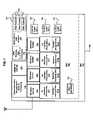
- FIG. 1is a block diagram illustrating the components of a mobile communicator according to an embodiment of the present invention
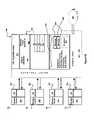
- FIG. 2is a block diagram illustrating the components of a network routing center according to an embodiment of the present invention
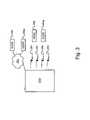
- FIG. 3is a block diagram illustrating the relationship between one or more wireless network systems and a network routing center of FIG. 2 , and nodes that communicate with the network routing center;
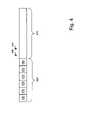
- FIG. 4is a block diagram illustrating a packet structure that could be used as a data structure for communication in the systems of FIGS. 1–3 ;
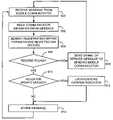
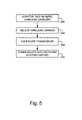
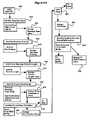
- FIG. 5is a flow diagram illustrating a method performed by transceiver/mobile communicator of FIG. 1 ;
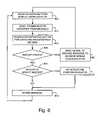
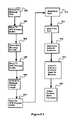
- FIG. 6is a flow diagram illustrating the steps performed by the network routing center of FIG. 2 ;
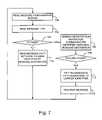
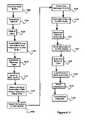
- FIG. 7is a flow chart illustrating the steps in another method performed by the network routing center of FIG. 2 ;
- FIG. 8is a data flow diagram illustrating a method for processing a message in the mobile communicator of FIG. 1 ;
- FIG. 9is a data flow diagram illustrating the details of channel selection performed by the mobile communicator of FIG. 1 ;
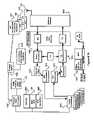
- FIG. 10is a block diagram illustrating some of the components and data flow of the medium access controller included in the system if FIG. 1 ;
- FIG. 11is a data flow diagram illustrating a method performed by the network routing system of FIG. 2 .
- a transceiver 100also called a communications management module (CMM) or mobile communicator, may comprise a mobile hardware plus software apparatus that is configurable dynamically or over-the air to communicate via various radio frequency, microwave, infrared, laser, satellite, and terrestrial networks that exist both today and as well as in the future with technology advancements.
- the transceiver, 100comprises a medium access controller 110 .
- a first set of control logic 112is in the medium access controller 110 that configures the transceiver 100 for communicating over two or more wireless carriers 201 – 203 , 20 n with a network routing center 400 .
- Examples of wireless carriers 201 – 203 , 20 n on which the transceiver 100 can be configured to transmit overinclude: code division multiple access (CDMA), cellular digital packet data, 1XRTT, time division multiple access (TDMA), global system for mobile communications, general packet radio service, enhanced data rates for global evolution, wide band code division multiple access, ARDIS, MOBITEX or IRIDIUM.
- CDMA and TDMAmay, for example, include implementations of satellite carriers as well as terrestrial wireless carriers. Satellite carriers, such as the IRIDIUM system and others, have been proven to operate with mobile transceivers 100 , even of the hand-held variety.
- the NRC 400may interface the specific satellite and terrestrial networks with wire and optical based physical interfaces (such as T 1 , Ethernet, ATM, Frame relay, TCP/IP etc).
- wire and optical based physical interfacessuch as T 1 , Ethernet, ATM, Frame relay, TCP/IP etc.
- APIsapplications program interfaces
- This systemalso has the advantage in that no matter how dynamic the communication need is, constant flexibility exists without redesign of the user applications, APIs ( 170 in FIG. 1 , 470 in FIG. 2 ) and hardware.
- a second control logic 114 in the medium access controller 110monitors each of the two or more wireless carriers 201 – 203 , 20 n for a service characteristic 211 a – 212 a , 21 na which is part of the air interface personality 211 – 213 , 21 n for each wireless carrier 201 – 203 , 20 n .
- a third control logic 116 in the medium access controller 110further selects, based on the monitored service characteristic 211 a – 212 a , 21 na , one of the two or more wireless carriers 201 – 203 , 20 n that the first control logic 112 configures the transceiver 100 to use to communicate with the network routing center 400 .
- Each control logic 112 – 116is comprised of a hardware based control logic, software based control logic or a combination hardware-software based control logic.
- software based control logiccomprises software that causes the hardware components of the transceiver 100 to produce radio signals of the proper strength, frequency, amplitude, etc. for transmission over one of the wireless carriers 201 – 203 , 20 n based on the measured service characteristic 211 – 213 , 21 n .
- the software based control logiccould alternatively be implemented using hardware based or hardware-software based control logic.
- the service characteristic 211 a – 213 a , 21 namay comprise, for example, a quality of service characteristic or a least cost routing characteristic.
- quality of service characteristicsinclude a bit error rate, a signal to noise ratio, a packet loss rate, path fade, packet latency or network latency for the respective wireless carrier 201 – 203 , 20 n.
- An application program interface 170is included with the transceiver 100 that is consistent with an application program interface 470 in the network routing center 400 regardless of which of the two or more wireless carriers 201 – 203 , 20 n are selected by the medium access controller 110 .
- APIs 170 , 470generally comprise software applications that, as part of API 170 , 470 function, shield application programs from system and hardware level calls. This way, the application program can use universal calls to an API structure.
- the APIs 170 and 470 of the CMM 100 and NRC 400respectively allow for the software programs, and hardware, to access lower communication level functions without regard to, for example, the specific protocol used for the currently used wireless carrier 201 – 203 , 20 n.
- the network routing center 400may further communicate with one or more nodes 100 , 100 a , 300 , 300 a .
- the transceiver 100 of FIG. 1may communicate with other nodes 100 a , 300 and 300 a through the network routing center 400 .
- the network routing center (NRC) 400handles all of the transmission and reception of information from the mobile communicators 100 , 100 a or groups of mobile communicators 100 , 100 a over the wireless carriers 201 – 203 , 20 n , also called RF networks 201 – 203 , 20 n.
- One or more of the nodes 100 – 100 amay comprise transceivers 100 – 100 a such as that described with respect to FIG. 1 .
- Those transceivers 100 – 100 acan be dynamically configured to communicate with the network routing center 400 over two or more wireless carriers 201 203 , 201 n ; in other words, communication is accomplished using a node-selected wireless carrier selected from the two or more wireless carriers 201 – 203 , 20 n .
- the wireless carrier 201 – 203 , 20 n selected and used by transceivers 100 and 100 amay be the same or different, depending on the independently selected wireless carrier 201 – 203 , 20 n selected by a medium access controller 110 in each of the transceivers 100 and 100 a as described above with respect to FIG. 1 .
- One or more other nodes 300 , 300 amay be connected to the network routing center 400 through a terrestrial network 250 which may either be wide or local in type.
- nodes 300 and 300 amay comprise desktop computers connected to the terrestrial network 250 using modems and dialup lines, cable television systems, digital subscriber lines, or other hard wired terrestrial or wireless local area networks familiar to those skilled in the art.
- the network routing center 400may transmit information to nodes 300 , 300 a by means of standard TCP/IP, Ethernet, T1/E1, LAN, WLAN, etc.
- the transceiver 100uses messages or data packets 140 for reception and transmission.
- the transceiver 100may comprise an applications data monitor (ADM) 120 having a message buffer 144 .
- the ADM 120may comprise either a set of software program instructions to be executed on a processor 130 in a transceiver main processor 130 or an independent ADM 120 processor to execute those instructions.
- the transceiver 100includes a processor 130 , wherein one of its functions is processing the data packets 140 .
- the processor 130may comprise an integrated circuit (hardware), coded instructions stored in non-volatile and/or volatile memory (software) in combination with an integrated circuit.
- Part of the processing of the data packets 140comprises determining a message type, priority, packet length, destination and air interface availability for each data packet 140 .
- the message type, priority, packet length, destination and air interfaceare influenced by the software application running on the electronic device, such as a computer or cell phone, using the transceiver. 100 .
- the ADM 120 internal to the CMM 100determines the message type, priority and air interface.
- the medium access controller 110selects a wireless carrier 201 – 203 , 20 n based on one or more of the determined message type, priority, packet length, destination and air interface for each data packet 140 .
- the medium access controller 110is further for converting each data packet 140 to an appropriate protocol based on the one selected wireless carrier 201 – 203 , 20 n.
- the medium access controller 110prepares the data packets 140 so that their representative signals may be divided each into a plurality of data streams (such as I and Q data streams) for independent modulation of the I and Q data streams using CPM or a related technique.
- the medium access controller 110then superposes the plurality of resultant streams for transmission so that the NRC 400 may receive the superposed spread spectrum signal and simultaneously attempt to correlate for a plurality of chip sequences and demodulation.
- the inventionmay also be characterized as a network routing center 400 for communication with transceivers 100 , 100 a and other nodes 300 , 300 a as described with respect to FIG. 3 above.
- the network routing center 400includes a registration matrix 410 , or database 410 , for storing one or more carrier indicators 422 for indicating the current wireless carrier 201 – 203 , 20 n for each of one or more transceivers 100 , 100 a .
- the registration matrix 410ties a unique communicator identifier 426 in the matrix 410 to a wireless carrier 201 – 203 , 20 n .
- Each stored communicator identifier 426corresponds to a transceiver 100 that the network routing center 400 is capable of communicating with.
- a corresponding communicator identifier 124is stored in each transceiver 124 that is transmitted with each message ( 140 in FIG. 4 discussed below) so that the network routing center 400 may determine the transceiver 100 from which each message 140 is received.
- the registration matrix 410allows for speedy lookup of communicator identifier 426 to determine the particular wireless network 201 – 203 , 20 n being used by the relative transceiver 100 .
- the network routing center 400includes two or more wireless carrier or radio frequency gateways 451 – 453 , 45 n which are for interfacing with the wireless carriers 201 – 203 , 20 n for communicating with the one or more transceivers 100 , 100 a that are remote from the network routing center 400 .
- Each of the radio frequency gateways 451 – 453 , 45 ncommunicate with one or more communications hardware systems for a particular wireless carrier 201 – 203 , 20 n , for example, a cell phone tower or satellite dish equipment.
- Each of gateways 451 – 453 , 45 ncontains software or hardware that tales the resultant raw data that is the output of the particular communications equipment, and converts or strips the raw data to produce packet data in the form described with respect to FIG.
- gateways 451 – 453 , 45 nare readable to the network routing center 400 , and converts outgoing packet data into a form for transmission over the particular communications equipment.
- gateways 451 – 453 , 45 nmay describe this function of gateways 451 – 453 , 45 n as protocol conversion.
- Other functions that may be performed by gateways 451 – 453 , 45 ninclude determination of transmission costs, carrier load sensing, security functions, per packet billing processing, etc.
- the transceivers 100 , 100 a that are remote from the network routing center 400are also referred to herein as mobile communicators 100 , 100 a .
- Each gateway 451 – 453 , 45 n included in the network routing center 400interfaces with a different wireless carrier 201 – 203 , 20 n .
- a processor 460is included in the network routing center 400 that, as part of its functionality, is used for updating each of the one or more carrier indicators 422 to reflect the wireless carrier 201 – 203 , 20 n depending on which gateway 451 – 453 , 45 n receives a message 464 from the respective mobile communicator 100 , 100 a that transmitted the message 464 .
- the processor 460may comprise an integrated circuit (hardware), coded instructions stored in non-volatile and/or volatile memory (software) in combination with an integrated circuit.
- the network routing center 400comprises a received message buffer 462 for storing each message 464 received from a mobile communicator 100 , 100 a.
- each message 464 , 140 in a header portion 468 , or as part of a body portion 470comprises a communicator identifier 466 (CMM-ID) for identifying the respective mobile communicator 100 , 100 a that transmitted the message 464 , 140 .
- CMM-IDcommunicator identifier
- Messages 464 stored in the network routing center 400may also have the same structure as message 140 stored in the mobile communicator 100 .
- Each message 464 , 140may also comprise a message type 472 in the header portion 468 or as part of the body portion 470 .
- Each message type 472may comprise a type indicator indicating that the message 464 is peer-to-peer, peer-to-client host or hybrid peer-to-peer/peer-to-client host.
- Peer-to-peer types of messages 464for example, may be those that are for transmission from one mobile communicator 100 to one or more other mobile communicators 100 a.
- Peer-to-client host types of messages 464 , 140may be those that are for transmission from a mobile communicator 100 to one or more terrestrial nodes 300 , 300 a .
- Peer-to-peer/peer-to-client host types of messages 464 , 140may be those that are for transmission from one mobile communicator 100 to another mobile communicator 100 a and/or to one or more terrestrial nodes 300 , 300 a .
- three types of communicationsare: host connection, peer-to-peer and a hybrid.
- the host connectionis one that is initiated by a host, 300 , 300 a to deliver information to one or more CMMs 100 , 100 a , either individually or in a group.
- the peer-to-peer communicationis one that an individual CMM 100 initiates to communicate with another individual CMM 100 a or group of CMMs 100 , 100 a .
- the hybrid communicationis one in which a CMM 100 communicates with another CMM 100 a or group of CMMs 100 , 100 a and one or more hosts 300 , 300 a.
- the messagemay also include a priority indicator, also called priority 478 , for indicating the priority of the message 140 , 464 .
- each carrier indicator 422 stored in the registration matrixmay be stored in a registration record 424 indexed by a matching communicator identifier 426 .
- the processor 460may validate each message 424 by searching the registration matrix 410 for the matching communicator identifier 426 that matches the communicator identifier 466 of the message 464 .
- the processor 460may further be configured to compose a transmission path for each message 464 according to the message type 472 .
- Each message 464comprises a message destination 474 , which may comprise, for example, a network 250 internet protocol (IP) address or a communicator identifier identifying a communicator 100 different from that which sent the message 464 .
- IPinternet protocol
- Each message 464further comprises a communicator identifier 476 for identifying the mobile communicator 100 , 100 a that transmitted each message 464 . These elements may also be included in the messages 140 stored in the mobile communicator 140 .
- a message type 472indicates that the message 464 is for transmitting to one of the mobile communicators 100 , 10 a .
- the processor 460selects one of the one or more gateways 451 – 453 , 45 n , and thereby one of the networks 201 – 203 , 20 n , for transmitting the message 464 .
- the messagemay have been received from a host-client node 300 , 300 a ( FIG. 3 ), or from another mobile communicator 100 , 100 a as described above.
- the processor 460selects which of the gateways 451 – 453 , 45 n with which to transmit the message 464 according to the respective carrier indicator 422 for the one mobile communicator 100 , 100 a identified by the message destination 474 contained in the message 464 .
- the network routing center 400may communicate at the same time with the plurality of mobile communicators 100 , 100 a , over different wireless carriers 201 – 203 , 20 n using the different radio frequency gateways 451 – 453 , 45 n .
- the processor 460updates each carrier indicator 422 to reflect which radio frequency gateway 451 – 453 , 45 n receives messages 464 from the respective mobile communicators 100 , 100 a . This is how the processor 460 is able to select the proper gateway 451 – 453 , 45 n for sending a message 464 if one needs to be sent to a specific mobile communicator 100 , 100 a.
- the systemcreates a mezzanine system effect. This structure allows for the addition and deletion of any individual wireless carrier 201 – 203 , 20 n with simple command changes to the NRC 400 registration matrix processor 460 software instructions.
- the delivery systemis, thus, transparent to the user of a node 300 of CMM 100 , but allows for dynamic and total reconfiguration with simple commands at the NRC 400 .
- FIG. 5a flow diagram illustrating a method performed by transceiver/mobile communicator 100 of FIG. 1 is shown.
- the method performed by the transceiver 100is for communicating with a network routing center 400 .
- Each of the two or more wireless carriers 201 – 203 , 20 nis monitored for a service characteristic 211 a – 213 a , 21 na , step 500 .
- Based on the monitored service characteristic 211 a – 213 a , 21 naone of the two or more wireless carriers 201 – 203 , 20 n is selected, step 502 .
- the transceiver 100is configured for using the selected wireless carrier 201 – 203 , 20 n , step 504 .
- the transceiver 100then communicates with the network routing center 400 using the selected wireless carrier 201 – 203 , 20 n , step 506 .
- Part of configuring the transceiver 100 to operate using different wireless carriers 201 – 203 , 20 nmay involve, for example, loading logic or accessing circuitry of the transceiver 100 to operate in different frequency bands and power levels to switch between a terrestrial network 201 and a satellite network 202 . Less power may be required for the CMM 100 to communicate with a terrestrial repeater in the terrestrial network 201 , given the reduced distance between the CMM 100 and the terrestrial repeater compared with a satellite repeater. Thus, one feature of the transceiver 100 is to vary the power level of the signal depending on the specific network 201 – 203 , 20 n used.
- the satellite network 202may have orbital repeaters that can use basically the same circuitry as terrestrial repeaters except that advanced VLSI and hybrid circuit techniques can reduce the size and power consumption in the repeater.
- Small and light transceivers 100have been proven for satellite communication, such as the MOTOROLA 9505 portable satellite phone, that can be purchased from Iridium, Inc. of Plano, Tex.
- the circuitry and configuration of such a light mobile communicatorcan be integrated with the CMM 100 of the present invention, to be accessed selectively depending on the selection of the carrier 201 – 203 , 20 n by the medium access controller 110 .
- a detailed explanation of power, frequency band, and circuitry switchingis provided in U.S. Pat. No. 4,901,307 incorporated by reference above.
- a message 464is received by a radio frequency gateway 451 – 453 , 45 n , step 600 .
- the processor 460reads the communicator identifier 466 from the received message 464 , step 602 .
- the processor 460validates the message 464 by searching the registration matrix 410 for a registration record 424 with a matching communicator identifier 426 matched with the communicator identifier 476 stored in the received message 464 , step 604 .
- the processor 460may cause a return message to be sent back to the mobile communicator 100 , 100 a that sent the received message 464 to advise the mobile communicator 100 , 100 a that use of the network routing center 400 is denied, step 608 .
- the processor 460checks for whether the carrier indicator 422 stored in the matched registration record 424 reflects the wireless carrier 201 – 203 , 20 n of the gateway 451 – 453 , 45 n that received the message 464 , step 610 . If not, then the carrier indicator 422 is updated (stored if first contact is made) in the registration matrix 410 , step 612 . The received message 464 is stored in the message buffer 462 , step 614 .
- FIG. 7a flow chart illustrating the steps in another method performed by the network routing center 400 is shown.
- the method of FIG. 7describes the steps for transmission of messages 464 from the network routing center 400 .
- the next message 464 for transmissionis read from the message buffer 462 , step 700 .
- the message type 472is read from the header 468 , step 702 .
- the processor 460determines whether the message type 472 is a ‘to-peer type message 464 (to mobile communicator 400 ), step 704 . If so, then the processor 460 reads the message destination 474 and searches the registration matrix 410 for the matching communicator identifier 426 , step 706 .
- the processor 460sets the transmission path for the message 464 for transmission using the wireless carrier 201 – 203 , 20 n identified by the carrier identifier 422 , step 710 .
- the message 454is transmitted to the mobile communicator 100 , 100 a identified by the message destination 474 over the wireless carrier 201 – 203 , 20 n identified by the carrier identifier 422 , step 712 .
- a registration record 424is not found step 706 , then the message 464 may have an erroneous message destination 474 , and the message 464 is discarded. In that case, the sending node 100 , 100 a , 300 , 300 a may or may not be sent a notification.
- the message type 472indicates that the message 464 is a ‘to host type message 464 , then the message is routed over the network 250 to the node 300 , 300 a indicated by the message destination 474 , step 714 .
- Processingmoves back to step 700 for processing the next message 464 in the message buffer 462 .
- the data for the messages 140may enter the CMM 100 through a verity of ways, either automatically, from an application program, or manually by the user, for example voice data packets.
- the data packets 140maybe put into a message buffer 144 .
- the physical data interfacecan take many forms, data terminal, infrared device, J1708, IEEE 1394, RS-232, RS-485, personal data assistant (PDA), scanner, barcode reader etc.
- the data input into the CMM 100routes through the API 170 , 470 and into the ADM buffer 144 to await examination by the ADM 120 to determine the following: message type 472 (peer-to-peer, client host or both-hybrid), priority 478 ; message packet length by measurement of the size thereof; destination 474 and air interface (carrier) selection 480 .
- a data flow diagram illustrating a method for processing a message 140 in the CMM of FIG. 1is shown.
- WLANwireless short-range local area network
- wireless interfacessuch as Bluetooth and the IEEE 802.11x can be built into the CMM 100 as permanent functioning interfaces.
- the datais processed through the API 170 , it is stored in the ADM buffer 144 , step 800 .
- the messagehas three possible types, peer-to-peer, peer-to-client host, or a hybrid peer-to-peer/client host.
- the processor 130may take message type information sent in from the originating application and compare that information to stored message type 472 in the packet 140 in the ADM buffer 144 to facilitate identification of the message type 472 . Once this process is complete, a message type value is generated and sent to the ADM buffer 144 to be held as part of the completed ADM buffer 144 for use in the CMM 100 , step 804 . The next step in the process is the identification of message priority, step 806 .
- the information sent by the applicationhas one of two priority levels, critical or non-critical.
- the ADMlooks at the message priority information sent by the application and compares this information to stored values in the ADM buffer 144 to facilitate identification of the priority level. Once this process is complete, a priority level value is generated and sent to the message 140 in the ADM buffer 808 to be held as part of the completed ADM buffer 144 for use in the CMM 100 , step 808 .
- the next step in the processis the identification of the original data field packet length, step 810 .
- the information sent by the application regarding packet lengthis passed from the API in this portion of the process.
- the API valueis the actual value of the original data field packet length and is sent to the ADM buffer 144 for use in the CMM 100 , step 812 .
- the next step in this processis the identification of the packet destination, step 814 .
- the information sent by the application regarding the identification of the message type 472is extracted from the ADM buffer 144 and may be combined with anther host or destination value to create final destination information.
- the output generated by combining these valuesis then sent to the ADM buffer 144 for use in the CMM 100 , steps 815 – 816 .
- the next step in this processis the selection of the air interface or wireless network 201 – 203 , 20 n that the data will be transferred across, step 818 .
- the medium access controller 110is responsible for the selection of the wireless network 201 – 203 , 20 n that information will be transmitted/received across. The details of channel selection are covered below with reference to FIG. 9 .
- a buffer 118 in the MAC 110is sent an RF network designator.
- the MAC buffer 118is queried and the information is sent to the ADM buffer 144 as part of the completed protocol stack of the ADM 120 for use in the CMM 100 , step 818 .
- the next stepmay be the addition of global positioning satellite (GPS) information.
- GPSglobal positioning satellite
- the GPS informationis read from the MAC buffer 118 , step 820 .
- the MAC 110is where GPS receiver circuits may reside.
- the GPS informationis transferred to the ADM buffer 144 as part of the completed protocol stack of the ADM for use in the CMM, step 822 .
- the GPS datais read when a user application may require it to be transmitted.
- the next step in the processis the addition of the original data packet to the ADM buffer 144 , steps 824 – 826 .
- medium access controllers 110are known to those skilled in the communications technical field and is responsible for protocol conversion and RF network 201 – 203 , 20 n selection.
- the process of RF network 201 – 203 , 20 n selectionis referred to as the automatic path establishment (APE).
- APEautomatic path establishment
- FIG. 9a data flow diagram illustrating the steps performed for APE is shown. Automatic path selection may be based on the following criteria: quality of service (QoS) and/or least-cost-routing (LoS) based on cost per byte of data.
- QoSquality of service
- LoSleast-cost-routing
- the MAC 110may continuously monitor the stored air interface personalities 211 – 213 , 21 n and search for available networks 201 – 203 , 20 n . In the event that no RF network 201 – 203 , 20 n should be available, the data to be sent is stored for future transmission once a valid RF network 201 – 203 , 20 n is available.
- the APE processqueries the information that is stored in the ADM buffer 144 .
- the information of interest to the APE processis the message type 472 , message priority 478 and the message packet length, which are moved into an APE process buffer ( 122 in FIG. 1 ), steps 900 – 910 .
- APE process buffer 122Once the information is sent to the APE process buffer 122 , additional considerations are made with regard to completing the APE process. Those considerations include QoS and cost per byte measurements, or least-cost-routing, steps 912 – 914 . The QoS issue will be discussed first.
- the quality of service issues regarding the selection of the RF network 201 – 203 , 20 nmay have several considerations involved.
- the considerationsmay be bit error rate (BER), signal to noise ratio (SNR), delay spread, packet loss rate, path fade, packet latency and network latency.
- BERbit error rate
- SNRsignal to noise ratio
- delay spreaddelay spread
- packet loss ratepacket loss rate
- path fadepacket latency
- network latencynetwork latency
- Information relating to the cost per byte of a particular network 201 – 203 , 20 nis stored as part of the air interface personality information 211 – 213 , 21 n , 211 a – 213 a , 21 na . Additional information stored in the AIP 211 – 213 , 21 n database may include the unique CMM-ID 124 (these Ids are one in the same). The Cost per byte information may be continuously updated from the NRC 400 and stored in the AIP database 211 – 213 , 21 n . Once the APE process finishes determining the least cost route for the data, network 201 – 203 , 20 n selection is made, step 916 .
- the information relating to the particular wireless network 201 – 203 , 20 nis extracted from the air interface personality database 211 – 213 , 21 n and loaded into a RF digital processing section of memory in the CMM 100 for final configuration for RF network 201 – 203 , 20 n use, step 918 . Additionally, the air interface personality database 211 – 213 , 21 n information is sent to a protocol stack converter 126 so that the ADM buffer 144 can be converted into the appropriate air interface protocol for the selected wireless carrier 201 – 203 , 20 n , step 920 .
- FIG. 10a block diagram illustrating some of the components and data flow of the MAC 110 is shown.
- the MAC 110also may have an additional element.
- the digital processing section, consisting of a processor 130 and APE application 1006 , of a memory 1004may hold a minimum of configuration information for two wireless networks 201 – 203 , 20 n loaded at any one time and a maximum number of networks that is equal to the AIP database 211 – 213 , 21 n .
- the reason for thisis that it is possible with this configuration to split a message 140 for transmission into sections to send over two different wireless networks 201 – 203 , 20 n .
- a message 140could be transmitted partially over network 201 and partially over network 203 and recombined at the NRC 400 as one complete message 464 .
- the MACmay also include components that those skilled in the art would recognize such as processing buffers 1008 , databases 1010 , digital converters 1012 , filters 1014 , modulators 1016 , signal converters 1016 , RF processors 1018 , an antenna 1020 , and/or wireless local area network interfaces 1022 .
- a data flow diagram illustrating a method performed by the NRC 400 of FIG. 2is shown.
- the information sent by the mobile communicator 100is buffered in the received message buffer 462 , step 1102 .
- the next step of the NRC 400is to process the CMM-ID 466 of the message 464 , step 1104 .
- the received data messageis then validated by a look-up of the CMM-ID 426 in the NRC registration matrix 410 . This look-up establishes validity of the CMM 100 , step 1106 and also establishes additional CMMs 100 , 100 a that are registered in the same group for peer-to-peer messaging and also the client host identification is made for peer-to-client host messaging, step 1108 .
- the next stepis the identification of message type 472 , peer-to-peer, peer-to-client host or a hybrid, step 1110 .
- This informationis extracted from the NRC message buffer 462 and may be sent to another NRC buffer (not shown) for further processing, step 1112 .
- the determination of the message type 472is made a subset of steps occur.
- the NRC 400begins to set-up an internal path to complete message transfer.
- the next step of the processis to determine the final destination 474 of the message 464 , steps 1114 – 1116 .
- the destination 474may be for a specific CMM 100 , 100 a or the entire group of CMMs 100 , 100 a , a sub-group of CMMs 100 , 100 a or the client-host 300 , 300 a .
- the next step in the processis the determination of the message priority, steps 1118 – 1120 .
- the message prioritymay affect the setup process slightly in that all high priority messages 464 may go to the client host 300 first and then routed to any CMMs 100 , 100 a that may be named in the application.
- the next step in the processis the selection of the wireless network 201 – 203 , 20 n for messages 464 that have a CMM as the destination 474 .
- the protocol stack information(not shown in FIG. 2 , but similar to that in FIG. 1 ) is loaded into a protocol stack converter (not shown in FIG. 2 , but similar to that in FIG. 1 ) and the physical path is determined, steps 1122 – 1128 .
- the NRC 400can now establish the path for delivery of the message 464 , steps 1130 – 1132 .
- the message 464 in the NRC buffer 462is sent to a protocol stack converter for preparation of delivery to the client host 300 , 300 a .
- Client host 300 , 300 a initiated communicationis very similar to the CMM 100 , 100 a initiated communication. They share the same steps and the same components reside in the process. The difference between the two is that the NRC 400 may use AIP, APE and ADM processes that were explained relating to the CMM 100 , 100 a , when dealing with a client host 300 , 300 a initiated communication. Essentially the process follows the identical steps to that of the CMM initiated communication.
- the process in the CMM 100is the same as previously explained. The minor difference in that case is the routing of the information.
- the datawas routed to the host. However, in the peer-to-peer example, the data is routed through one of the RF networks 201 – 203 , 20 n to be sent out to another CMM 100 , 100 a or group of CMMs 100 , 100 a.
- any desired combination of networks 201 – 203 , 20 ncan be connected at the CMM 100 , 100 a simply by routing the data of the multiple single networks 201 – 203 , 20 n to a network routing center 400 to allow routing to a specific CMM 100 , 100 a or group of CMMs 100 , 100 a .
- the CMMs 100 , 100 athemselves are configurable over-the air (OTA) to allow for dynamic network or system updating/configuration.
- OTAover-the air
- incompatible networks 201 – 203 , 20 nis eliminated in that a CMM 100 communicating utilizing, for example, carrier 201 can easily communicate with a CMM 100 a that is utilizing carrier 202 because of the routing path the data takes throughout the system.
Landscapes
- Engineering & Computer Science (AREA)
- Computer Networks & Wireless Communication (AREA)
- Signal Processing (AREA)
- Computer Security & Cryptography (AREA)
- Mobile Radio Communication Systems (AREA)
Abstract
Description
Claims (76)
Priority Applications (6)
| Application Number | Priority Date | Filing Date | Title |
|---|---|---|---|
| US10/086,182US7068610B2 (en) | 2002-02-26 | 2002-02-26 | System and method for reliable communications over multiple packet RF networks |
| US11/475,545US7362716B2 (en) | 2002-02-26 | 2006-06-27 | System and method for reliable communications over multiple packet RF networks |
| US12/039,746US8077735B1 (en) | 2002-02-26 | 2008-02-29 | System and method for reliable communications over multiple packet RF networks |
| US13/313,022US9743340B2 (en) | 2002-02-26 | 2011-12-07 | System and method for reliable communications over multiple packet RF networks |
| US14/987,381US9730146B2 (en) | 2002-02-26 | 2016-01-04 | System and method for reliable communications over multiple packet RF networks |
| US15/666,487US20170347309A1 (en) | 2002-02-26 | 2017-08-01 | System and method for reliable communications over multiple packet rf networks |
Applications Claiming Priority (1)
| Application Number | Priority Date | Filing Date | Title |
|---|---|---|---|
| US10/086,182US7068610B2 (en) | 2002-02-26 | 2002-02-26 | System and method for reliable communications over multiple packet RF networks |
Related Child Applications (1)
| Application Number | Title | Priority Date | Filing Date |
|---|---|---|---|
| US11/475,545ContinuationUS7362716B2 (en) | 2002-02-26 | 2006-06-27 | System and method for reliable communications over multiple packet RF networks |
Publications (2)
| Publication Number | Publication Date |
|---|---|
| US20030161288A1 US20030161288A1 (en) | 2003-08-28 |
| US7068610B2true US7068610B2 (en) | 2006-06-27 |
Family
ID=27753806
Family Applications (6)
| Application Number | Title | Priority Date | Filing Date |
|---|---|---|---|
| US10/086,182Expired - LifetimeUS7068610B2 (en) | 2002-02-26 | 2002-02-26 | System and method for reliable communications over multiple packet RF networks |
| US11/475,545Expired - Fee RelatedUS7362716B2 (en) | 2002-02-26 | 2006-06-27 | System and method for reliable communications over multiple packet RF networks |
| US12/039,746Expired - Fee RelatedUS8077735B1 (en) | 2002-02-26 | 2008-02-29 | System and method for reliable communications over multiple packet RF networks |
| US13/313,022Expired - Fee RelatedUS9743340B2 (en) | 2002-02-26 | 2011-12-07 | System and method for reliable communications over multiple packet RF networks |
| US14/987,381Expired - Fee RelatedUS9730146B2 (en) | 2002-02-26 | 2016-01-04 | System and method for reliable communications over multiple packet RF networks |
| US15/666,487AbandonedUS20170347309A1 (en) | 2002-02-26 | 2017-08-01 | System and method for reliable communications over multiple packet rf networks |
Family Applications After (5)
| Application Number | Title | Priority Date | Filing Date |
|---|---|---|---|
| US11/475,545Expired - Fee RelatedUS7362716B2 (en) | 2002-02-26 | 2006-06-27 | System and method for reliable communications over multiple packet RF networks |
| US12/039,746Expired - Fee RelatedUS8077735B1 (en) | 2002-02-26 | 2008-02-29 | System and method for reliable communications over multiple packet RF networks |
| US13/313,022Expired - Fee RelatedUS9743340B2 (en) | 2002-02-26 | 2011-12-07 | System and method for reliable communications over multiple packet RF networks |
| US14/987,381Expired - Fee RelatedUS9730146B2 (en) | 2002-02-26 | 2016-01-04 | System and method for reliable communications over multiple packet RF networks |
| US15/666,487AbandonedUS20170347309A1 (en) | 2002-02-26 | 2017-08-01 | System and method for reliable communications over multiple packet rf networks |
Country Status (1)
| Country | Link |
|---|---|
| US (6) | US7068610B2 (en) |
Cited By (6)
| Publication number | Priority date | Publication date | Assignee | Title |
|---|---|---|---|---|
| US20040240404A1 (en)* | 2003-03-12 | 2004-12-02 | Ibrahim Brima B. | Peer to peer wireless communication conflict resolution |
| US20070189241A1 (en)* | 2003-07-31 | 2007-08-16 | Wenlin Zhang | Optimized interaction method of user terminal selecting access mobile network in wireless local area network |
| US9609587B2 (en) | 2011-01-31 | 2017-03-28 | Synchronoss Technologies, Inc. | System and method for host and OS agnostic management of connected devices through network controlled state alteration |
| US10091155B1 (en)* | 2015-07-30 | 2018-10-02 | Open Invention Network Llc | Message management and message modification application |
| US10193835B1 (en)* | 2015-07-30 | 2019-01-29 | Open Invention Network Llc | Message management and message modification application |
| US11929907B2 (en) | 2022-03-08 | 2024-03-12 | T-Mobile Usa, Inc. | Endpoint assisted selection of routing paths over multiple networks |
Families Citing this family (27)
| Publication number | Priority date | Publication date | Assignee | Title |
|---|---|---|---|---|
| US6996369B2 (en)* | 2002-08-22 | 2006-02-07 | Eagle Broadband, Inc. | Repeater for a satellite phone |
| CN1266891C (en)* | 2003-06-06 | 2006-07-26 | 华为技术有限公司 | Method for user cut-in authorization in wireless local net |
| US20190357827A1 (en) | 2003-08-01 | 2019-11-28 | Dexcom, Inc. | Analyte sensor |
| US7676194B2 (en) | 2003-08-22 | 2010-03-09 | Rappaport Theodore S | Broadband repeater with security for ultrawideband technologies |
| US8774886B2 (en) | 2006-10-04 | 2014-07-08 | Dexcom, Inc. | Analyte sensor |
| US8364231B2 (en) | 2006-10-04 | 2013-01-29 | Dexcom, Inc. | Analyte sensor |
| US20050215284A1 (en)* | 2004-03-26 | 2005-09-29 | Broadcom Corporation | Collaborative coexistence with dynamic prioritization of wireless devices |
| US7965982B2 (en) | 2004-10-07 | 2011-06-21 | Nokia Corporation | Reconfigurable wireless communications device and radio |
| US7727669B2 (en)* | 2005-05-26 | 2010-06-01 | Novolyte Technologies Inc. | Triazine compounds for removing acids and water from nonaqueous electrolytes for electrochemical cells |
| US8494491B2 (en)* | 2005-09-28 | 2013-07-23 | Research In Motion Limited | System and method for provisioning a mobile wireless communications device to display account or device-specific characteristics |
| US7920586B2 (en)* | 2005-09-29 | 2011-04-05 | Meshnetworks, Inc. | System and method for selecting a medium access technique for transmitting packets over a network |
| US8081970B2 (en) | 2006-03-27 | 2011-12-20 | Research In Motion Limited | System and method for provisioning a mobile wireless communications device, including indicators representative of image and sound data |
| US20080031205A1 (en)* | 2006-08-02 | 2008-02-07 | Mika Kahola | Scalable WLAN wireless communications device and radio for WPAN and WRAN operation |
| EP2051452B1 (en)* | 2006-08-09 | 2013-07-17 | Hitachi, Ltd. | Communication system using multi-radio mode |
| US8121140B2 (en)* | 2007-02-28 | 2012-02-21 | Honeywell International Inc. | Cost containment of mobile datalink communications |
| US8175034B2 (en)* | 2007-10-31 | 2012-05-08 | Hewlett-Packard Development Company, L.P. | Configuration techniques for wireless communications devices |
| JP5178739B2 (en)* | 2007-12-07 | 2013-04-10 | パナソニック株式会社 | Communication device |
| US8274994B2 (en)* | 2009-06-19 | 2012-09-25 | Qualcomm Incorporated | Methods and apparatus for communicating using a gateway communications device having alert generation capability |
| US20110116424A1 (en)* | 2009-11-19 | 2011-05-19 | Hand Held Products, Inc. | Network-agnostic encoded information reading terminal |
| ES2902634T3 (en)* | 2009-12-14 | 2022-03-29 | Ericsson Telefon Ab L M | Method and arrangement for reconfiguring the mapping of a carrier indicator field to a component carrier |
| ES2964546T3 (en) | 2011-04-15 | 2024-04-08 | Dexcom Inc | Advanced analyte sensor calibration and error detection |
| US9042304B2 (en)* | 2012-06-05 | 2015-05-26 | Vmware, Inc. | Controlling a paravirtualized wireless interface from a guest virtual machine |
| US20140071840A1 (en)* | 2012-09-11 | 2014-03-13 | Hand Held Products, Inc., doing business as Honeywell Scanning & Mobility | Mobile computer configured to select wireless communication network |
| US20170295104A1 (en)* | 2016-04-07 | 2017-10-12 | Qualcomm Incorporated | Network selection for relaying of delay-tolerant traffic |
| EP3442404B1 (en)* | 2016-04-15 | 2022-07-27 | BR Invention Holding, LLC | Mobile medicine communication platform and methods and uses thereof |
| US10650621B1 (en) | 2016-09-13 | 2020-05-12 | Iocurrents, Inc. | Interfacing with a vehicular controller area network |
| CN111869134B (en)* | 2018-03-08 | 2022-10-04 | 史密斯英特康公司 | Network agnostic dynamic SATCOM system and associated network features |
Citations (2)
| Publication number | Priority date | Publication date | Assignee | Title |
|---|---|---|---|---|
| US20030033394A1 (en)* | 2001-03-21 | 2003-02-13 | Stine John A. | Access and routing protocol for ad hoc network using synchronous collision resolution and node state dissemination |
| US6765931B1 (en)* | 1999-04-13 | 2004-07-20 | Broadcom Corporation | Gateway with voice |
Family Cites Families (169)
| Publication number | Priority date | Publication date | Assignee | Title |
|---|---|---|---|---|
| US4091307A (en) | 1972-03-06 | 1978-05-23 | Esquire, Inc. | Emergency lighting system for gaseous-discharge lamps |
| US5303286A (en) | 1991-03-29 | 1994-04-12 | Space Systems/Loral, Inc. | Wireless telephone/satellite roaming system |
| US5355517A (en) | 1984-12-28 | 1994-10-11 | Motorola, Inc. | Method and apparatus for automatic alternate communications system access |
| US4829554A (en) | 1985-01-31 | 1989-05-09 | Harris Corporation | Cellular mobile telephone system and method |
| US4901307A (en) | 1986-10-17 | 1990-02-13 | Qualcomm, Inc. | Spread spectrum multiple access communication system using satellite or terrestrial repeaters |
| ZA883232B (en) | 1987-05-06 | 1989-07-26 | Dowd Research Pty Ltd O | Packet switches,switching methods,protocols and networks |
| US4804937A (en) | 1987-05-26 | 1989-02-14 | Motorola, Inc. | Vehicle monitoring arrangement and system |
| US5274837A (en) | 1987-06-03 | 1993-12-28 | Ericsson Ge Mobile Communications Inc. | Trunked radio repeater system with multigroup calling feature |
| US5210785A (en) | 1988-02-29 | 1993-05-11 | Canon Kabushiki Kaisha | Wireless communication system |
| US5367558A (en) | 1988-09-23 | 1994-11-22 | Motorola, Inc. | Cellular cordless telephone |
| US4989230A (en) | 1988-09-23 | 1991-01-29 | Motorola, Inc. | Cellular cordless telephone |
| US5680633A (en) | 1990-01-18 | 1997-10-21 | Norand Corporation | Modular, portable data processing terminal for use in a radio frequency communication network |
| IL93444A (en) | 1989-04-27 | 1994-05-30 | Motorola Inc | Method and unit for communicating with communications systems having different operating characteristics |
| US5454024A (en) | 1989-08-31 | 1995-09-26 | Lebowitz; Mayer M. | Cellular digital packet data (CDPD) network transmission system incorporating cellular link integrity monitoring |
| SE466081B (en) | 1990-04-26 | 1991-12-09 | Ericsson Telefon Ab L M | PROCEDURES FOR HANDOFFS IN A MOBILE RADIO SYSTEM |
| US5276908A (en) | 1990-10-25 | 1994-01-04 | Northern Telecom Limited | Call set-up and spectrum sharing in radio communication on systems with dynamic channel allocation |
| EP0488173A3 (en) | 1990-11-27 | 1993-04-28 | Canon Kabushiki Kaisha | Wireless communication channel selecting method |
| CA2032325C (en) | 1990-12-14 | 1998-07-07 | Leo Strawczynski | Intra-cell call hand-over in radio communication systems with dynamic channel allocation |
| US5303297A (en) | 1991-07-25 | 1994-04-12 | Motorola, Inc. | Dynamic pricing method and apparatus for communication systems |
| US5347272A (en) | 1991-09-13 | 1994-09-13 | Fuji Xerox Co., Ltd. | System for determining communication routes in a network |
| JPH0815267B2 (en) | 1991-09-27 | 1996-02-14 | 松下電器産業株式会社 | Wireless phone |
| AU664864B2 (en)* | 1991-10-01 | 1995-12-07 | Broadcom Corporation | A radio frequency local area network |
| US5309503A (en) | 1991-12-06 | 1994-05-03 | Motorola, Inc. | Dynamic channel assignment in a communication system |
| US5260988A (en) | 1992-02-06 | 1993-11-09 | Motorola, Inc. | Apparatus and method for alternative radiotelephone system selection |
| US5203012A (en) | 1992-02-10 | 1993-04-13 | Motorola, Inc. | Method and apparatus for optimum channel assignment |
| US5533097A (en) | 1992-02-26 | 1996-07-02 | Motorola, Inc. | Portable communication system comprising a local and wide area communication units which can store a communication when the wide area communication system is not available |
| JPH05292010A (en) | 1992-04-10 | 1993-11-05 | Fujitsu Ltd | Method and device for assigning radio channel |
| US5448750A (en) | 1992-04-22 | 1995-09-05 | Telefonaktiebolaget Lm Ericsson | Segregation method of dynamic channel allocation in a mobile radio system |
| FI96157C (en) | 1992-04-27 | 1996-05-10 | Nokia Mobile Phones Ltd | Digital cellular radio telephone network based on time multiplexing to move a radio connection from the base station to a new base station |
| US5233604A (en) | 1992-04-28 | 1993-08-03 | International Business Machines Corporation | Methods and apparatus for optimum path selection in packet transmission networks |
| US5260943A (en) | 1992-06-16 | 1993-11-09 | Motorola, Inc. | TDM hand-off technique using time differences |
| FI91345C (en) | 1992-06-24 | 1994-06-10 | Nokia Mobile Phones Ltd | A method for enhancing handover |
| US5410535A (en) | 1992-07-02 | 1995-04-25 | Digital Equipment Corporation | Automatic selection of an interface for ethernet stations |
| JP2805565B2 (en) | 1992-09-21 | 1998-09-30 | エヌ・ティ・ティ移動通信網株式会社 | Control channel selection method in mobile station |
| TW253088B (en) | 1992-10-02 | 1995-08-01 | Ericsson Telefon Ab L M | |
| US5388101A (en) | 1992-10-26 | 1995-02-07 | Eon Corporation | Interactive nationwide data service communication system for stationary and mobile battery operated subscriber units |
| DE4236982A1 (en) | 1992-11-02 | 1994-05-05 | Philips Patentverwaltung | Cellular mobile radio system |
| US5392452A (en) | 1992-11-27 | 1995-02-21 | Motorola, Inc. | Selective call signaling system with combined wide area paging and high data rate transmissions via radio telephone transceivers |
| GB2273424A (en) | 1992-12-14 | 1994-06-15 | Motorola Ltd | A cellular communications system and method for hand-off |
| SE9300681D0 (en) | 1993-03-01 | 1993-03-01 | Ericsson Telefon Ab L M | A METHOD AND APPARATUS FOR HANDING OFF A MOBILE STATION FROM A FIRST TO A SECOND CHANNEL IN A MOBILE COMMUNICATION SYSTEM |
| US6259915B1 (en) | 1993-02-05 | 2001-07-10 | Telefonaktiebolaget Lm Ericsson (Publ) | Multiple hyperband mobile and base stations |
| US5406643A (en) | 1993-02-11 | 1995-04-11 | Motorola, Inc. | Method and apparatus for selecting between a plurality of communication paths |
| US5410733A (en) | 1993-02-11 | 1995-04-25 | Nokia Mobile Phones Ltd. | Received signal strength information measurement useful in a mobile telephone system having mobile assisted handoff capability |
| US5331635A (en) | 1993-02-12 | 1994-07-19 | Fuji Xerox Co., Ltd. | Network system having function of updating routing information |
| WO1994022240A1 (en) | 1993-03-19 | 1994-09-29 | Motorola, Inc. | Method and apparatus for selecting the best fixed communication unit |
| JPH06315005A (en) | 1993-04-30 | 1994-11-08 | Matsushita Electric Ind Co Ltd | Wireless telephone |
| CA2113750C (en) | 1993-04-30 | 1999-08-24 | Hamid Ahmadi | A multiaccess scheme for mobile integrated local area networks |
| US5696903A (en) | 1993-05-11 | 1997-12-09 | Norand Corporation | Hierarchical communications system using microlink, data rate switching, frequency hopping and vehicular local area networking |
| DE69423810T2 (en) | 1993-05-12 | 2000-10-12 | Ntt Mobile Communications Network Inc., Tokio/Tokyo | Handover method and mobile station for spread spectrum communication system |
| SE9301695L (en) | 1993-05-17 | 1994-09-12 | Ericsson Telefon Ab L M | Method and apparatus for channel utilization in a radio communication system |
| SE518649C2 (en) | 1993-06-22 | 2002-11-05 | Ericsson Telefon Ab L M | Procedure for telecommunications access in a multi-network environment |
| JP2843956B2 (en) | 1993-06-24 | 1999-01-06 | エヌ・ティ・ティ移動通信網株式会社 | Mobile communication channel switching method and mobile station device |
| JP2518156B2 (en) | 1993-07-19 | 1996-07-24 | 日本電気株式会社 | Channel allocation method for wireless communication system |
| EP0637152A1 (en) | 1993-07-30 | 1995-02-01 | International Business Machines Corporation | Method and apparatus to speed up the path selection in a packet switching network |
| US5574775A (en) | 1993-08-04 | 1996-11-12 | Lucent Technologies, Inc. | Universal wireless radiotelephone system |
| US5406615A (en) | 1993-08-04 | 1995-04-11 | At&T Corp. | Multi-band wireless radiotelephone operative in a plurality of air interface of differing wireless communications systems |
| US5446736A (en) | 1993-10-07 | 1995-08-29 | Ast Research, Inc. | Method and apparatus for connecting a node to a wireless network using a standard protocol |
| GB2282730B (en) | 1993-10-08 | 1998-01-28 | Nokia Telecommunications Oy | Dual mode subscriber terminal and a handover procedure of the dual mode subscriber terminal in a mobile telecommunication network |
| US6088590A (en) | 1993-11-01 | 2000-07-11 | Omnipoint Corporation | Method and system for mobile controlled handoff and link maintenance in spread spectrum communication |
| US5428668A (en) | 1993-11-04 | 1995-06-27 | Ericsson Ge Mobile Communications Inc. | Radio personal communications system and method for allocating frequencies for communications between a cellular terminal and a base station |
| US5506866A (en) | 1993-11-15 | 1996-04-09 | At&T Corp. | Side-channel communications in simultaneous voice and data transmission |
| US5497339A (en) | 1993-11-15 | 1996-03-05 | Ete, Inc. | Portable apparatus for providing multiple integrated communication media |
| US5761621A (en) | 1993-12-15 | 1998-06-02 | Spectrum Information Technologies, Inc. | Apparatus and methods for networking omni-modal radio devices |
| US6934558B1 (en) | 1993-12-15 | 2005-08-23 | Mlr, Llc | Adaptive omni-modal radio apparatus and methods |
| US5854985A (en) | 1993-12-15 | 1998-12-29 | Spectrum Information Technologies, Inc. | Adaptive omni-modal radio apparatus and methods |
| ATE532370T1 (en) | 1993-12-15 | 2011-11-15 | Mlr Llc | WIRELESS COMMUNICATION SYSTEM WITH A VARIETY OF INDEPENDENT WIRELESS SERVICE NETWORK |
| US5960344A (en)* | 1993-12-20 | 1999-09-28 | Norand Corporation | Local area network having multiple channel wireless access |
| US6708028B1 (en) | 1993-12-22 | 2004-03-16 | Nokia Mobile Phones, Ltd. | Multi-mode radio telephone |
| GB2285198B (en) | 1993-12-22 | 1998-03-04 | Nokia Mobile Phones Ltd | Multi-mode radio telephone |
| US5774805A (en) | 1994-02-24 | 1998-06-30 | Gte Mobile Communications Service Corporation | Multi-mode communication network with handset-selected channel assignments |
| US5594782A (en) | 1994-02-24 | 1997-01-14 | Gte Mobile Communications Service Corporation | Multiple mode personal wireless communications system |
| BR9506893B1 (en) | 1994-02-24 | 2010-08-10 | multi-mode personal wireless communications system. | |
| US5636220A (en) | 1994-03-01 | 1997-06-03 | Motorola, Inc. | Packet delivery method for use in a wireless local area network (LAN) |
| GB2288101B (en) | 1994-03-22 | 1998-04-29 | Nokia Mobile Phones Ltd | Multi-mode radio telephone |
| US5613213A (en) | 1994-03-31 | 1997-03-18 | Motorola, Inc. | Determining and displaying available services for a communication unit |
| US5561836A (en) | 1994-05-02 | 1996-10-01 | Motorola, Inc. | Method and apparatus for qualifying access to communication system services based on subscriber unit location |
| US5513379A (en) | 1994-05-04 | 1996-04-30 | At&T Corp. | Apparatus and method for dynamic resource allocation in wireless communication networks utilizing ordered borrowing |
| US5732359A (en) | 1994-05-13 | 1998-03-24 | Westinghouse Electric Corporation | Mobile terminal apparatus and method having network inter-operability |
| US5771459A (en) | 1994-06-21 | 1998-06-23 | U.S. Philips Corporation | Communication system for use with stationary and second entities, via a wireless intermediate network with gateway devices, a gateway device for use with such system, and a mobile entity provided with such gateway device |
| US5553075A (en) | 1994-06-22 | 1996-09-03 | Ericsson Ge Mobile Communications Inc. | Packet data protocol for wireless communication |
| US5542115A (en) | 1994-06-24 | 1996-07-30 | Pioneer Tech Development Limited | Paging method and apparatus |
| US5452294A (en) | 1994-07-05 | 1995-09-19 | Motorola, Inc. | Method and apparatus for adaptive route selection in communication networks |
| FR2722628B1 (en) | 1994-07-13 | 1996-08-09 | Tabbane Sami | CELL SELECTION IN A MULTI-LAYERED CELL RADIO NETWORK |
| DE19526586A1 (en) | 1994-07-21 | 1996-01-25 | Mitel Corp | Integrated telecommunication system |
| WO1996005709A1 (en) | 1994-08-09 | 1996-02-22 | Pacific Communication Sciences, Inc. | Method and apparatus for efficient handoffs by mobile communication entities |
| JP3215018B2 (en) | 1994-09-09 | 2001-10-02 | 三菱電機株式会社 | Mobile communication system |
| US5535432A (en) | 1994-09-14 | 1996-07-09 | Ericsson Ge Mobile Communications Inc. | Dual-mode satellite/cellular phone with a frequency synthesizer |
| GB2294844B (en) | 1994-11-07 | 1999-05-26 | Motorola Inc | Communications operating system and method therefor |
| US5537415A (en) | 1994-11-08 | 1996-07-16 | Microsoft Corporation | Multi-channel personal messaging unit |
| JP2626597B2 (en) | 1994-12-14 | 1997-07-02 | 日本電気株式会社 | Radio base station selection method in cellular mobile radio communication system |
| JP3351534B2 (en) | 1994-12-19 | 2002-11-25 | クゥアルコム・インコーポレイテッド | Message display method and apparatus in mobile communication system |
| GB2296626B (en) | 1994-12-23 | 1999-07-28 | Nokia Mobile Phones Ltd | Multi-mode radio telephone |
| SE503848C2 (en) | 1995-02-06 | 1996-09-16 | Telia Ab | Method and arrangement for switching between wireless telecommunication system and cellular mobile telecommunication system |
| US5915214A (en) | 1995-02-23 | 1999-06-22 | Reece; Richard W. | Mobile communication service provider selection system |
| FI106671B (en) | 1995-03-13 | 2001-03-15 | Nokia Mobile Phones Ltd | Mobile telephony, mobile terminal and a method of establishing a connection from a mobile terminal |
| US6047187A (en) | 1995-04-07 | 2000-04-04 | Ericsson, Inc. | Stabilized control channel planning using loosely coupled dedicated traffic channels |
| GB9508367D0 (en) | 1995-04-25 | 1995-06-14 | Aethos Communication Systems | Telecommunication systems |
| US6418324B1 (en) | 1995-06-01 | 2002-07-09 | Padcom, Incorporated | Apparatus and method for transparent wireless communication between a remote device and host system |
| SE504866C2 (en) | 1995-06-01 | 1997-05-20 | Ericsson Telefon Ab L M | Device and method for interactive selection of communication device in mobile communication |
| US6334062B1 (en) | 1995-06-07 | 2001-12-25 | Cirrus Logic, Inc. | Portable communications and data terminal operating to optimize receipt of both incoming CDPD and AMPS messages |
| US6370135B1 (en) | 1995-06-07 | 2002-04-09 | Cirrus Logic, Inc. | Continuous CDPD base station and method of facilitating efficient data transfer |
| US5524009A (en) | 1995-06-07 | 1996-06-04 | Nokia Mobile Phones Ltd. | Fast AGC setting using RSS (I) measurement procedure |
| US6078652A (en) | 1995-07-21 | 2000-06-20 | Call Manage, Ltd. | Least cost routing system |
| US5636211A (en) | 1995-08-15 | 1997-06-03 | Motorola, Inc. | Universal multimedia access device |
| CA2229615C (en) | 1995-08-15 | 2002-10-29 | Amsc Subsidiary Corporation | Improved mobile earth terminal |
| JPH11511313A (en) | 1995-08-16 | 1999-09-28 | スターガイド デジタル ネットワークス,インコーポレイティド | Dynamic bandwidth allocation for audio and video signal transmission |
| US5839075A (en) | 1995-08-21 | 1998-11-17 | Ericsson Inc. | Methods and systems for allocating a cellular communications channel for communication between a cellular terminal and a telephone base station using received signal strength measurements |
| US5636140A (en) | 1995-08-25 | 1997-06-03 | Advanced Micro Devices, Inc. | System and method for a flexible MAC layer interface in a wireless local area network |
| US5752193A (en) | 1995-09-01 | 1998-05-12 | Motorola, Inc. | Method and apparatus for communicating in a wireless communication system |
| US5845215A (en) | 1995-10-18 | 1998-12-01 | Telefonaktiebolaget Lm Ericsson | Operating mobile stations of wireless communication systems in multiple modes by external control |
| US5771353A (en) | 1995-11-13 | 1998-06-23 | Motorola Inc. | System having virtual session manager used sessionless-oriented protocol to communicate with user device via wireless channel and session-oriented protocol to communicate with host server |
| KR0167644B1 (en) | 1995-11-30 | 1999-02-01 | 김광호 | Communication system for selectively using multi transmission methods |
| US5826188A (en) | 1995-12-07 | 1998-10-20 | Motorola, Inc. | Method and apparatus for handing off calls between differing radio telecommunication networks |
| CA2188330C (en) | 1995-12-12 | 2001-04-24 | Michael D. Bamburak | A method for selecting a wireless communications service provider in a multi-service provider environment |
| US5758293A (en) | 1996-03-06 | 1998-05-26 | Motorola Inc. | Subscriber unit and delivery system for wireless information retrieval |
| US6430186B1 (en) | 1996-03-15 | 2002-08-06 | Pmc-Sierra, Inc. | Asynchronous bit-table calendar for ATM switch |
| US5774814A (en) | 1996-03-22 | 1998-06-30 | Cornell Research Foundation, Inc. | Multiply-detected macrodiversity method and system for wireless communications |
| GB2312592A (en) | 1996-04-24 | 1997-10-29 | Ibm | Quality of service parameters |
| US5963848A (en) | 1996-04-24 | 1999-10-05 | Motorola, Inc. | Method and apparatus for assigning a channel to a mobile unit in a wireless communication system |
| US6308072B1 (en) | 1996-04-26 | 2001-10-23 | Motorola, Inc. | Method and apparatus for controlling a wireless communication system |
| US6067452A (en) | 1996-05-28 | 2000-05-23 | Comsat Corporation | Technique for least cost routing for mobile satellite systems employing a GSM network infrastructure |
| US5845198A (en) | 1996-06-28 | 1998-12-01 | At&T Wireless Services Inc. | Method for optimal selection among multiple providers in a wireless communications service environment |
| US6088591A (en) | 1996-06-28 | 2000-07-11 | Aironet Wireless Communications, Inc. | Cellular system hand-off protocol |
| US6195532B1 (en) | 1996-06-28 | 2001-02-27 | At&T Wireless Srcs. Inc. | Method for categorization of multiple providers in a wireless communications service environment |
| US5974447A (en) | 1996-07-17 | 1999-10-26 | Motorola, Inc. | Method and system for coupling a selective call receiver to widely distributed information sources |
| US5894478A (en) | 1996-07-24 | 1999-04-13 | Lucent Technologies Inc. | Protocol converter and router for multi-mode wireless data communications |
| US6035212A (en) | 1996-08-02 | 2000-03-07 | Lsi Logic Corporation | Multi-frequency wireless communication device |
| US6006105A (en) | 1996-08-02 | 1999-12-21 | Lsi Logic Corporation | Multi-frequency multi-protocol wireless communication device |
| US5884157A (en) | 1996-08-02 | 1999-03-16 | Qualcomm Incorporated | Method and apparatus for supporting multiple service providers using single mobile switching center |
| US5812544A (en) | 1996-10-03 | 1998-09-22 | Ericsson Inc. | Dual mode portable telephone unit |
| FR2754658A1 (en) | 1996-10-16 | 1998-04-17 | Philips Electronics Nv | RADIOELECTRIC TRANSMISSION SYSTEM INCLUDING MOBILE TELECOMMUNICATIONS, PROCESS FOR CONNECTING TO SUCH A MOBILE SYSTEM IN WHICH THIS PROCESS IS APPLIED |
| US5987518A (en) | 1996-10-28 | 1999-11-16 | General Instrument Corporation | Method and apparatus for communicating internet protocol data over a broadband MPEG channel |
| US6016307A (en) | 1996-10-31 | 2000-01-18 | Connect One, Inc. | Multi-protocol telecommunications routing optimization |
| GB9624419D0 (en) | 1996-11-23 | 1997-01-08 | Inmedia Investment Ltd | Communication system for delivery of content over electronic networks |
| US7929950B1 (en) | 1996-12-16 | 2011-04-19 | Ip Holdings, Inc. | Dynamically configurable IP based wireless device and wireless networks |
| US5903548A (en) | 1996-12-19 | 1999-05-11 | Itronix Corporation | Portable electronic communications device having switchable LAN/WAN wireless communications features |
| US6122514A (en) | 1997-01-03 | 2000-09-19 | Cellport Systems, Inc. | Communications channel selection |
| US6114970A (en) | 1997-01-09 | 2000-09-05 | Motorola, Inc. | Method of assigning a device identification |
| US6101368A (en) | 1997-03-07 | 2000-08-08 | General Instrument Corporation | Bidirectional external device interface for communications receiver |
| US5948066A (en) | 1997-03-13 | 1999-09-07 | Motorola, Inc. | System and method for delivery of information over narrow-band communications links |
| FR2761557B1 (en) | 1997-03-28 | 1999-04-30 | Alsthom Cge Alcatel | TRANSMISSION METHOD ON A PLURALITY OF TRANSMISSION MEDIA, WITH DYNAMIC DATA DISTRIBUTION, AND CORRESPONDING TRANSMITTER AND TERMINAL |
| US6169893B1 (en) | 1997-04-04 | 2001-01-02 | Nortel Networks Limited | Wireless communication system that supports multiple standards, multiple protocol revisions, multiple extended services and multiple extended services delivery options and method of operation therefor |
| US6128490A (en) | 1997-05-08 | 2000-10-03 | Nortel Networks Limited | Wireless communication system that supports selection of operation from multiple frequency bands and multiple protocols and method of operation therefor |
| US5991800A (en) | 1997-05-22 | 1999-11-23 | Motorola, Inc. | Method and apparatus for providing internet service at a subscriber premise |
| US6578077B1 (en) | 1997-05-27 | 2003-06-10 | Novell, Inc. | Traffic monitoring tool for bandwidth management |
| US6073007A (en) | 1997-07-24 | 2000-06-06 | Qualcomm Incorporated | Wireless fleet communications system for providing separable communications services |
| JP2954105B2 (en) | 1997-08-05 | 1999-09-27 | 日本電気通信システム株式会社 | Transmission path selection device for mobile communication system |
| US6434620B1 (en) | 1998-08-27 | 2002-08-13 | Alacritech, Inc. | TCP/IP offload network interface device |
| US6101387A (en) | 1997-11-17 | 2000-08-08 | Telefonaktiebolaget Lm Ericsson | Providing notification of location dependent services to mobile stations |
| US6145082A (en) | 1998-03-20 | 2000-11-07 | Motorola, Inc. | Method for a vehicular gateway to transport information, including a method for programming the gateway |
| US5974085A (en) | 1998-04-17 | 1999-10-26 | Motorola, Inc. | Wireless modem and method therefor for routing data to an application or to storage |
| US6275585B1 (en) | 1998-04-28 | 2001-08-14 | Motorola, Inc. | Method for reprogramming a vehicle system or a user system in a vehicle |
| US6246870B1 (en) | 1998-04-30 | 2001-06-12 | Ericsson Inc. | Tariff management apparatus and methods for multiple-mode communications terminals |
| US5956490A (en) | 1998-06-30 | 1999-09-21 | Motorola, Inc. | Method, client device, server and computer readable medium for specifying and negotiating compression of uniform resource identifiers |
| US6862622B2 (en)* | 1998-07-10 | 2005-03-01 | Van Drebbel Mariner Llc | Transmission control protocol/internet protocol (TCP/IP) packet-centric wireless point to multi-point (PTMP) transmission system architecture |
| US6253082B1 (en) | 1998-07-30 | 2001-06-26 | The Whitaker Corporation | Method for selecting an alternate channel in a wireless communications system |
| US6341222B1 (en) | 1998-11-04 | 2002-01-22 | Motorola, Inc. | Method and apparatus for performing selection and distribution in a communication system |
| US6201957B1 (en) | 1998-11-18 | 2001-03-13 | Neopoint, Inc. | System and method for implementing flexible calling plans |
| US6243581B1 (en) | 1998-12-11 | 2001-06-05 | Nortel Networks Limited | Method and system for seamless roaming between wireless communication networks with a mobile terminal |
| US6526034B1 (en) | 1999-09-21 | 2003-02-25 | Tantivy Communications, Inc. | Dual mode subscriber unit for short range, high rate and long range, lower rate data communications |
| US6470189B1 (en) | 1999-09-29 | 2002-10-22 | Motorola, Inc. | Method and apparatus in a wireless transceiver for seeking and transferring information available from a network server |
| US7844687B1 (en)* | 1999-10-06 | 2010-11-30 | Gelvin David C | Method for internetworked hybrid wireless integrated network sensors (WINS) |
| US20030099254A1 (en)* | 2000-03-03 | 2003-05-29 | Richter Roger K. | Systems and methods for interfacing asynchronous and non-asynchronous data media |
| US7072360B2 (en)* | 2000-09-22 | 2006-07-04 | Narad Networks, Inc. | Network architecture for intelligent network elements |
| US7230931B2 (en)* | 2001-01-19 | 2007-06-12 | Raze Technologies, Inc. | Wireless access system using selectively adaptable beam forming in TDD frames and method of operation |
| US6765497B2 (en) | 2000-12-18 | 2004-07-20 | Motorola, Inc. | Method for remotely accessing vehicle system information and user information in a vehicle |
| US7027418B2 (en)* | 2001-01-25 | 2006-04-11 | Bandspeed, Inc. | Approach for selecting communications channels based on performance |
| US6737703B1 (en) | 2002-03-12 | 2004-05-18 | Advanced Micro Devices, Inc. | Memory array with buried bit lines |
| US8060017B2 (en)* | 2008-04-04 | 2011-11-15 | Powerwave Cognition, Inc. | Methods and systems for a mobile, broadband, routable internet |
- 2002
- 2002-02-26USUS10/086,182patent/US7068610B2/ennot_activeExpired - Lifetime
- 2006
- 2006-06-27USUS11/475,545patent/US7362716B2/ennot_activeExpired - Fee Related
- 2008
- 2008-02-29USUS12/039,746patent/US8077735B1/ennot_activeExpired - Fee Related
- 2011
- 2011-12-07USUS13/313,022patent/US9743340B2/ennot_activeExpired - Fee Related
- 2016
- 2016-01-04USUS14/987,381patent/US9730146B2/ennot_activeExpired - Fee Related
- 2017
- 2017-08-01USUS15/666,487patent/US20170347309A1/ennot_activeAbandoned
Patent Citations (2)
| Publication number | Priority date | Publication date | Assignee | Title |
|---|---|---|---|---|
| US6765931B1 (en)* | 1999-04-13 | 2004-07-20 | Broadcom Corporation | Gateway with voice |
| US20030033394A1 (en)* | 2001-03-21 | 2003-02-13 | Stine John A. | Access and routing protocol for ad hoc network using synchronous collision resolution and node state dissemination |
Cited By (12)
| Publication number | Priority date | Publication date | Assignee | Title |
|---|---|---|---|---|
| US20040240404A1 (en)* | 2003-03-12 | 2004-12-02 | Ibrahim Brima B. | Peer to peer wireless communication conflict resolution |
| US7295528B2 (en)* | 2003-03-12 | 2007-11-13 | Broadcom Corporation | Peer to peer wireless communication conflict resolution |
| US20080062918A1 (en)* | 2003-03-12 | 2008-03-13 | Ibrahim Brima B | Peer to peer wireless communication conflict resolution |
| US8311209B2 (en) | 2003-03-12 | 2012-11-13 | Broadcom Corporation | Peer to peer wireless communication conflict resolution |
| US20070189241A1 (en)* | 2003-07-31 | 2007-08-16 | Wenlin Zhang | Optimized interaction method of user terminal selecting access mobile network in wireless local area network |
| US7706793B2 (en)* | 2003-07-31 | 2010-04-27 | Huawei Technologies Co., Ltd. | Optimized interaction method of user terminal selecting access mobile network in wireless local area network |
| US9609587B2 (en) | 2011-01-31 | 2017-03-28 | Synchronoss Technologies, Inc. | System and method for host and OS agnostic management of connected devices through network controlled state alteration |
| US10091155B1 (en)* | 2015-07-30 | 2018-10-02 | Open Invention Network Llc | Message management and message modification application |
| US10193835B1 (en)* | 2015-07-30 | 2019-01-29 | Open Invention Network Llc | Message management and message modification application |
| US10554597B1 (en) | 2015-07-30 | 2020-02-04 | Open Invention Network Llc | Message management and message modification application |
| US10608977B1 (en) | 2015-07-30 | 2020-03-31 | Open Invention Network Llc | Message management and message modification application |
| US11929907B2 (en) | 2022-03-08 | 2024-03-12 | T-Mobile Usa, Inc. | Endpoint assisted selection of routing paths over multiple networks |
Also Published As
| Publication number | Publication date |
|---|---|
| US20170347309A1 (en) | 2017-11-30 |
| US7362716B2 (en) | 2008-04-22 |
| US20160119855A1 (en) | 2016-04-28 |
| US20110310749A1 (en) | 2011-12-22 |
| US9730146B2 (en) | 2017-08-08 |
| US20070014270A1 (en) | 2007-01-18 |
| US20030161288A1 (en) | 2003-08-28 |
| US9743340B2 (en) | 2017-08-22 |
| US8077735B1 (en) | 2011-12-13 |
| US20120170518A1 (en) | 2012-07-05 |
Similar Documents
| Publication | Publication Date | Title |
|---|---|---|
| US9730146B2 (en) | System and method for reliable communications over multiple packet RF networks | |
| US6198924B1 (en) | Frequency channel selection method for radio communication system | |
| KR101527287B1 (en) | Method and apparatus for selecting a multi-band access point to associate with a multi-band mobile station | |
| CN100505912C (en) | Service and Radio Resource Control in Wireless Communication Equipment | |
| US7333460B2 (en) | Adaptive beacon interval in WLAN | |
| JP3438206B2 (en) | Method and apparatus for causing nodes to self-organize in a wireless local area network | |
| US7930729B2 (en) | Performing presence service in a wireless communication system | |
| EP2018007B1 (en) | Method and system for quality of service management in a multi-standard mesh of networks | |
| US20080304455A1 (en) | Method, System, Mobile Communication Terminal and a Node Adapted for End-to-End Quality Access Selection of an Access Network | |
| US7099295B1 (en) | Apparatus and method for bridging a wired network and wireless devices | |
| US6707425B2 (en) | Method and system for aligning a point-to-multipoint access terminal | |
| US20150237570A1 (en) | Method and Mobile Communication Appliance for Selecting a Transmission Path | |
| US7539169B1 (en) | Directed association mechanism in wireless network environments | |
| US20080107055A1 (en) | Performing presence service in a wireless communication system | |
| US6882843B1 (en) | Multiple wireless data transport transceiver system | |
| US6975857B2 (en) | Automatically configuring a communication interface of a device for connection with a wireless communication network | |
| US9357371B2 (en) | System and method for adaptive channel scanning within a wireless network | |
| US20080107066A1 (en) | Performing presence service in a wireless communication system | |
| US20200127874A1 (en) | Integration of physical and virtual lmr networks | |
| US20080109551A1 (en) | Performing presence service in a wireless communication system | |
| US8504012B2 (en) | System and method for providing broadcast services in broadband wireless access system | |
| US20220394587A1 (en) | Optimized multicast messaging in lpwa networks | |
| KR100670795B1 (en) | Integrated Handset Configuration Manager for Heterogeneous Networks and Application Approach | |
| HK1158405B (en) | Method and system for network communication |
Legal Events
| Date | Code | Title | Description |
|---|---|---|---|
| REMI | Maintenance fee reminder mailed | ||
| FPAY | Fee payment | Year of fee payment:4 | |
| SULP | Surcharge for late payment | ||
| FEPP | Fee payment procedure | Free format text:PETITION RELATED TO MAINTENANCE FEES GRANTED (ORIGINAL EVENT CODE: PMFG); ENTITY STATUS OF PATENT OWNER: SMALL ENTITY Free format text:PETITION RELATED TO MAINTENANCE FEES FILED (ORIGINAL EVENT CODE: PMFP); ENTITY STATUS OF PATENT OWNER: SMALL ENTITY | |
| REMI | Maintenance fee reminder mailed | ||
| LAPS | Lapse for failure to pay maintenance fees | ||
| REIN | Reinstatement after maintenance fee payment confirmed | ||
| PRDP | Patent reinstated due to the acceptance of a late maintenance fee | Effective date:20140802 | |
| FPAY | Fee payment | Year of fee payment:8 | |
| STCF | Information on status: patent grant | Free format text:PATENTED CASE | |
| FP | Lapsed due to failure to pay maintenance fee | Effective date:20140627 | |
| MAFP | Maintenance fee payment | Free format text:PAYMENT OF MAINTENANCE FEE, 12TH YR, SMALL ENTITY (ORIGINAL EVENT CODE: M2553) Year of fee payment:12 | |
| AS | Assignment | Owner name:RPX CORPORATION, CALIFORNIA Free format text:ASSIGNMENT OF ASSIGNORS INTEREST;ASSIGNOR:UNRUH, LINCOLN;REEL/FRAME:048955/0358 Effective date:20190228 | |
| AS | Assignment | Owner name:JEFFERIES FINANCE LLC, AS COLLATERAL AGENT, NEW YO Free format text:PATENT SECURITY AGREEMENT;ASSIGNOR:RPX CORPORATION;REEL/FRAME:049316/0927 Effective date:20190514 | |
| AS | Assignment | Owner name:BARINGS FINANCE LLC, AS COLLATERAL AGENT, NORTH CAROLINA Free format text:PATENT SECURITY AGREEMENT;ASSIGNORS:RPX CLEARINGHOUSE LLC;RPX CORPORATION;REEL/FRAME:054198/0029 Effective date:20201023 Owner name:BARINGS FINANCE LLC, AS COLLATERAL AGENT, NORTH CAROLINA Free format text:PATENT SECURITY AGREEMENT;ASSIGNORS:RPX CLEARINGHOUSE LLC;RPX CORPORATION;REEL/FRAME:054244/0566 Effective date:20200823 | |
| AS | Assignment | Owner name:RPX CORPORATION, CALIFORNIA Free format text:RELEASE BY SECURED PARTY;ASSIGNOR:JEFFERIES FINANCE LLC;REEL/FRAME:054486/0422 Effective date:20201023 | |
| AS | Assignment | Owner name:RPX CORPORATION, CALIFORNIA Free format text:RELEASE OF LIEN ON PATENTS;ASSIGNOR:BARINGS FINANCE LLC;REEL/FRAME:068328/0278 Effective date:20240802 | |
| AS | Assignment | Owner name:BARINGS FINANCE LLC, AS COLLATERAL AGENT, NORTH CAROLINA Free format text:PATENT SECURITY AGREEMENT;ASSIGNORS:RPX CORPORATION;RPX CLEARINGHOUSE LLC;REEL/FRAME:068328/0674 Effective date:20240802 |