US7059096B2 - Multifunction utility pole - Google Patents
Multifunction utility poleDownload PDFInfo
- Publication number
- US7059096B2 US7059096B2US10/179,567US17956702AUS7059096B2US 7059096 B2US7059096 B2US 7059096B2US 17956702 AUS17956702 AUS 17956702AUS 7059096 B2US7059096 B2US 7059096B2
- Authority
- US
- United States
- Prior art keywords
- utility
- pole
- base portion
- box
- housing
- Prior art date
- Legal status (The legal status is an assumption and is not a legal conclusion. Google has not performed a legal analysis and makes no representation as to the accuracy of the status listed.)
- Expired - Fee Related, expires
Links
- 238000009434installationMethods0.000claimsabstractdescription9
- 230000003014reinforcing effectEffects0.000claimsdescription25
- 238000004891communicationMethods0.000claimsdescription22
- 229910000831SteelInorganic materials0.000claimsdescription6
- 239000010959steelSubstances0.000claimsdescription6
- 239000011150reinforced concreteSubstances0.000claims4
- 238000009826distributionMethods0.000description9
- 238000000034methodMethods0.000description7
- 239000000463materialSubstances0.000description6
- 238000012423maintenanceMethods0.000description5
- 229910052751metalInorganic materials0.000description5
- 239000002184metalSubstances0.000description5
- 238000013459approachMethods0.000description4
- 230000008901benefitEffects0.000description4
- 238000004519manufacturing processMethods0.000description4
- 230000007704transitionEffects0.000description4
- 230000000694effectsEffects0.000description3
- 239000000835fiberSubstances0.000description3
- 230000005540biological transmissionEffects0.000description2
- 238000010276constructionMethods0.000description2
- 238000012986modificationMethods0.000description2
- 230000004048modificationEffects0.000description2
- 239000000615nonconductorSubstances0.000description2
- 230000002787reinforcementEffects0.000description2
- 238000009987spinningMethods0.000description2
- 244000025254Cannabis sativaSpecies0.000description1
- 230000004075alterationEffects0.000description1
- 239000004411aluminiumSubstances0.000description1
- 229910052782aluminiumInorganic materials0.000description1
- XAGFODPZIPBFFR-UHFFFAOYSA-NaluminiumChemical compound[Al]XAGFODPZIPBFFR-UHFFFAOYSA-N0.000description1
- 230000004888barrier functionEffects0.000description1
- 230000001413cellular effectEffects0.000description1
- 238000005520cutting processMethods0.000description1
- 230000002708enhancing effectEffects0.000description1
- 230000009969flowable effectEffects0.000description1
- 231100001261hazardousToxicity0.000description1
- 238000003780insertionMethods0.000description1
- 230000037431insertionEffects0.000description1
- 230000001788irregularEffects0.000description1
- 238000002955isolationMethods0.000description1
- 238000002844meltingMethods0.000description1
- 230000008018meltingEffects0.000description1
- NJPPVKZQTLUDBO-UHFFFAOYSA-NnovaluronChemical compoundC1=C(Cl)C(OC(F)(F)C(OC(F)(F)F)F)=CC=C1NC(=O)NC(=O)C1=C(F)C=CC=C1FNJPPVKZQTLUDBO-UHFFFAOYSA-N0.000description1
- 230000008569processEffects0.000description1
- 230000008439repair processEffects0.000description1
- XLYOFNOQVPJJNP-UHFFFAOYSA-NwaterSubstancesOXLYOFNOQVPJJNP-UHFFFAOYSA-N0.000description1
Images




Classifications
- E—FIXED CONSTRUCTIONS
- E04—BUILDING
- E04H—BUILDINGS OR LIKE STRUCTURES FOR PARTICULAR PURPOSES; SWIMMING OR SPLASH BATHS OR POOLS; MASTS; FENCING; TENTS OR CANOPIES, IN GENERAL
- E04H12/00—Towers; Masts or poles; Chimney stacks; Water-towers; Methods of erecting such structures
- E04H12/003—Access covers or locks therefor
- E—FIXED CONSTRUCTIONS
- E04—BUILDING
- E04H—BUILDINGS OR LIKE STRUCTURES FOR PARTICULAR PURPOSES; SWIMMING OR SPLASH BATHS OR POOLS; MASTS; FENCING; TENTS OR CANOPIES, IN GENERAL
- E04H12/00—Towers; Masts or poles; Chimney stacks; Water-towers; Methods of erecting such structures
- E04H12/02—Structures made of specified materials
- E04H12/12—Structures made of specified materials of concrete or other stone-like material, with or without internal or external reinforcements, e.g. with metal coverings, with permanent form elements
Definitions
- This inventionrelates to the general field of distribution of utility services, and more particularly to utility poles.
- Communication servicessuch as telephone, cable television, and Internet access are generally considered essential in personal and business life, and accordingly have become universally available in most homes, offices, and other locations in the community. These communication services generally involve one or two-way transmission of a communication signal between a central location, a number of sub-distribution points, and end users. In most cases the final connection between the last local distribution point and the end user is delivered through some sort of physical link such as a wire pair, co-axial cable, or fiber optic cable.
- the telephone and cable TV utility providerseach independently construct and maintain their own separate pedestals.
- the pedestalsmay be located on the strip of land between the sidewalk and the road, or alternatively on the edge of user's front lawns, approximately every 3 to 4 lots.
- the pedestalscome in a variety of sizes depending on the amount of equipment being stored, with the smaller pedestals being generally several feet high and under a foot wide. They are often constructed from a metal such as aluminium, or from plastic. Since they are outdoors and free-standing they are accessible to service personnel at any time of the day or night.
- the service pedestalshowever are generally unsightly, being rectangular industrial boxes that clash with the neighborhood aesthetic or front yard landscape. Also, since the boxes are placed by the utilities with only ease of service in mind, they are visually uncoordinated, which exacerbates their unattractive appearance. Further, when installed on private land they deny the land owner use of the space occupied by and in the immediate vicinity of the pedestal. They can be hazardous to children, pets, or others who walk into them without looking, and can hinder recreational or sporting use of the lawn. Lawn maintenance activities such as grass cutting are also clearly obstructed by the pedestals. Yet another problem is that in new subdivisions the pedestals are usually installed before the adjacent house is constructed. As a result, they are occasionally inadvertently destroyed by bulldozers or other construction equipment, necessitating expensive and inconvenient repair or reconstruction.
- What is desiredis a means of housing local distribution equipment that overcomes one or more of the problems associated with the current devices and methods, such as lawn pedestals, used for local distribution of utility services.
- the discrete, dedicated lawn pedestalscould be dispensed with entirely or reduced in number. In this way, neighborhood appearance would be improved and the lawn space previously occupied by the pedestals would be recovered for private or community use. Lawn maintenance would be easier and the risks of collision eliminated.
- the equipmentwill continue to be both readily accessible to utility service personnel and protected in secure, weatherproof housing.
- a multifunction utility polecomprising:
- a base portionsuitable for installation in the ground or mounting on a surface, said base portion including a housing for a first utility
- pole portionextending above said base portion, said pole portion including a fixture for a second utility
- said utility poleis capable of simultaneously accommodating said first and second utilities.
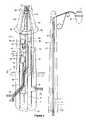
- FIG. 1is a perspective, phantom view of the multifunction utility pole of the present invention, showing the various utility services provided;
- FIG. 2is a perspective view of the housing of FIG. 1 ;
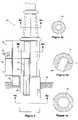
- FIG. 3is a front view of the multifunction utility pole of FIG. 1 , showing the various surface apertures in the finished pole;
- FIGS. 4 a, 4 b, and 4 care cross-sectional views taken at different points of the multifunction utility pole of FIG. 3 ;
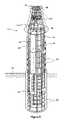
- FIG. 5is another perspective, phantom view of the multifunction utility pole of FIG. 1 , showing the structural features of the invention
- FIG. 6 ais an exploded view of a mold and associated equipment used to manufacture the multifunction utility pole of FIG. 1 ;
- FIG. 6 bis a perspective view of the elements of FIG. 6 a installed in the mold
- FIG. 6 cis a perspective view of FIG. 6 b after installation of the structural elements of the utility pole;
- FIG. 7is a perspective view of a neighborhood subdivision in which the multifunction utility pole of the present invention is installed.
- FIG. 8is a perspective view of a neighborhood subdivision showing the utility poles and lawn pedestals of the prior art.
- the multifunction utility pole of the present inventionis shown in FIG. 1 , with several elements shown in phantom and exploded view for clarity.
- the poleis generally indicated with reference numeral 10 , and broadly comprises a base portion 12 , a pole portion 14 , and a wiring path 16 .
- the polehas an outer wall 11 surrounding a hollow interior core 13 . It can be seen that the utility pole 10 is installed in the ground 18 , and accordingly includes a below-ground portion 20 and an above-ground portion 22 .
- the utility pole of the present inventionis shown in two parts in FIG. 1 , with the left-side drawing showing a lower part and the right-side drawing showing an upper part of the utility pole 10 .
- a view of the pole 10 as a wholeis shown in FIG. 7 .
- the multi-function utility pole of the present inventionprovides the traditional street lighting utility, and as discussed in greater detail below, also includes facilities to provide additional local utility services.
- the base portion 12includes that part of the utility pole 10 that maintains a fixed and secure contact with the ground, in order to support the pole 10 . As shown in FIG. 1 , this will generally include all of the below-ground portion 20 and part of the above-ground portion 22 .
- the utility pole 10is installed below the surface of the ground and is sized and shaped so that the stability provided by the below-ground portion 20 is sufficient to maintain the visible, above-ground portion 22 securely upright, particularly in the face of strong winds or moderate vehicle collision. For example, in the case of a utility pole having an overall height of about 30 feet, it has been found that a below-ground portion of about 5 feet is generally sufficient.
- the inventionalso comprehends the less common case of utility poles 10 mounted on a surface, where the pole 10 is entirely above ground and does not have a below-ground portion 20 .
- the base portion 12will be configured to secure to the surface through some other means, such as, for example, a flange or bracket that accepts bolts attachable to a concrete base.
- the base portion 12also includes a housing or utility box 24 for a first utility 26 , and at least a portion of the wiring path 16 , This is preferably accomplished by including in the base portion 12 an internal cavity 28 sized and shaped to receive the housing 24 and the wiring path 16 .
- the base portion 12should preferably be enlarged relative to the pole portion 14 . In this way, the internal cavity 28 within the base portion 12 will accordingly also be larger, providing more room for the housing 24 .
- a base portion having a diameter of about 20 inchesis adequate.
- the inventionalso comprehends other means by which the base portion 12 can include a housing 24 for a first utility 26 .
- the housing 24could simply be the internal cavity 28 itself, where the first utility 26 is mounted directly to the inside of the outer wall 11 of the base portion 12 , or to a flat plate or bracket rather than a more comprehensive utility box.
- the embodiment first describedin which a housing or utility box 24 is contained within an internal cavity 28 of an enlarged base portion 12 , provides more convenient access for utility service personnel and better protection of the first utility 26 .
- the enlarged base portion 12has other advantages such as a more stable and secure structural base, and in some cases a more attractive appearance than a conventional tapered pole. For these reasons as noted this embodiment is preferred.
- the height of the base portion 12can now be understood as comprising that portion of the utility pole 10 that extends from the bottom or tip 30 to the point just above the housing 24 , shown as 32 in FIG. 1 .
- the pole portion 14generally comprises the upper part of the pole 10 above point 32 .
- the base portion 12preferably also includes at least one access opening to receive utility cables for connection to the first utility 26 .
- FIG. 1shows a first access opening 34 , which provides access to two sets of utility cables 36 and 38 .
- the first access opening 34is preferably located in the below-ground portion 20 of the utility pole 10 to better receive the utility cables, which are generally laid underground. It can be appreciated that the present invention comprehends other configurations such as the transmission of utility cables above ground, in which case the access openings may be desirably located in the above-ground portion 22 of the pole.
- the base portion 12preferably contains at least two access openings, one for each utility. Accordingly, FIG.
- FIG. 1shows a second access opening 40 providing access into base portion 12 to a set of utility cables 42 .
- at least one access openingin particular access opening 40 , is preferably sized and shaped to receive utility cables 42 that provide electrical power.
- the other at least one access openingis sized and shaped to receive utility cables 36 and/or 38 that provide communication signals.
- the housing or utility box 24is shown installed in the utility pole 10 in FIG. 1 , and also shown isolated, for greater clarity, in FIG. 2 .
- the box 24is a rigid enclosure preferably constructed from a durable and strong material such as steel or other metal. In particular, it has been found that 14 gauge steel is adequate. It can be seen that the box 24 is generally rectangular, and is closed on three sides with an open front side 44 . The top of the box 24 is closed, and the bottom is open and connected to a box extension 46 .
- the box extension 46is an irregular shaped element having two sides, an open back, and an open front 48 . The front 48 of the box extension 46 is flush or in-line with the front 44 of the utility box 24 .
- front sides 48 and 46lie along an outer surface of the utility pole 10 and thereby provide access openings into the utility pole 10 .
- the box extensionmay be viewed as an integral part of the housing or utility box 24 , or alternatively as an additional element attachable to the utility box 24 .
- FIG. 2also shows a slidable rack 60 in upper compartment 52 and a set of brackets 62 bolted to the sides of lower compartment 54 .
- Rack 60can be oriented horizontally, as shown, or vertically if desired. It can be appreciated that any one of a rack, brackets, or other means of securing utility equipment can be installed in either compartment as desired.
- Retainer brackets 64are shown attached at each corner at the top of the box 24 .
- the retainer brackets 64are flat tabs or projections having apertures or holes 66 at a tip end overhanging the space adjacent to the utility box 24 .
- a vent stack 68in the form of a PVC tube projecting out of the top of the utility box 24 .
- the vent stack 68is preferably about two inches in diameter, and provides a path to dissipate any heat buildup in the interior of the utility box 24 .
- the first utility 26is located inside the housing or utility box 24 .
- the utility 26means the equipment used to provide a utility service to local customers, and in the preferred embodiment generally refers to communication distribution equipment or a communication panel that distributes communication or television signals. Fiber optic based equipment that provides telephone, cable television, Internet access and other services on a single fiber is also comprehended by this invention.
- the utility 26therefore comprises the same type of equipment that in the ordinary course is installed in the lawn pedestals described in the background section above.
- the first utility 26can comprise more than one type of distribution equipment, as long as there is sufficient space available in the utility box 24 .
- the equipment comprising first utility 26must be connected to the cables 36 and/or 38 that carry the utility signals to be distributed.
- utility cablesare usually laid underground, and therefore are preferably received in the below-ground portion 20 of the utility pole 10 .
- the box extension 46is preferably provided for this purpose, to receive the cables directed to the first utility 26 .
- utility cables 36 and 38enter the first access opening 34 provided by the box extension 46 . From there, cable set 36 is directed into lower compartment 54 , where it is connected to lower utility 72 . Similarly, cable set 38 is directed upwards, in the cable chase access 58 behind vertical back wall 56 , to upper compartment 52 where it is connected to upper utility 70 .
- upper utility 70is cable television equipment and lower utility 72 is a telephone terminal panel.
- cable set 36represents telephone cables and cable set 38 represents cable television cables.
- This arrangementis preferred because telephone cables 36 are generally very thick and inflexible, often containing hundreds of pairs of wire in bundles as much as three inches thick.
- the open front 48 of the box extension 46facilitates the insertion and manipulation of the cables.
- the inventioncomprehends other means of inserting cables into utility pole 10 , such as, for example, pVC conduits that project out of the bottom of the box 24 and that individually connect to compartments 52 and 54 .
- pVC conduitsthat project out of the bottom of the box 24 and that individually connect to compartments 52 and 54 .
- manipulating thick, inflexible telephone cables through a conduitwas often a difficult or time consuming procedure. Accordingly, the open approach provided by the box extension 46 is preferred.
- FIG. 3shows the utility pole 10 of the present invention installed in the ground 18 with the various access openings shown.
- Several access opening coversare also shown in exploded view.
- the cover 74would generally be bolted on and remain permanently installed, since it would not need to be removed in the ordinary course once the cables to the first utility 26 are connected.
- a lower part of the front side 48 of box extension 46is underground and left open in the preferred embodiment. It can be appreciated that if desired, cover 74 could be lengthened to cover all of front side 48 , or a second cover could be provided.
- the utility box 26also has a cover 76 , or in the preferred embodiment two covers 76 and 78 , to permit access to the first utility 26 .
- upper cover 76protects upper compartment 52
- lower cover 78protects lower compartment 54 , to permit access to the cable television or upper utility 70 and telephone or lower utility 72 respectively.
- the inventioncomprehends various means of attaching and securing the covers to the compartments, including camlocks, padlocks, bolts, hinged doors, or other means familiar to persons skilled in the art.
- a vent 80is usefully provided in the covers 76 or 78 .
- holes 82 in the coversmay be provided as shown to permit a temporary line connection to be made during servicing. This feature is particularly useful to restore temporary service quickly without having to dig a trench when an underground line has been cut.
- FIGS. 4 a, 4 b, and 4 cshow various cross-sectional views.
- FIGS. 4 a and 4 care views taken at positions above and below the utility box 24 respectively, and accordingly show an unobstructed cross-section of the inner wall with a hollow core.
- FIG. 4 bshows the position of the utility box 24 within the pole 10 . It can be seen that the front of the utility box 24 occupies a portion of the space otherwise occupied by the wall of the pole 10 . The rear portion of the box 24 is mostly accommodated by the otherwise unused hollow core 13 , with the back edges of the box 24 abutting the outer walls 11 .
- the front side 44 of the utility box 24faces the outside surface of the pole 10 , and is accordingly accessible upon removal of covers 76 and 78 .
- the pole portion 14 of the utility pole 10extends above the base portion 12 , and includes a fixture 84 for a second utility 86 .
- the second utility 86is a lamp or other lighting appliance used to provide the traditional function of street lighting.
- the inventionalso comprehends other services for the second utility 86 such as, for example, a high mount camera to provide traffic information, or a cellular telephone repeater.
- more than one utility service or functionmay be provided by the second utility 86 .
- the lamp used as second utility 86is preferably approximately 25 feet above the ground.
- a utility poleapproximately 30 feet high, of which 5 feet comprise the below-ground portion 20 and 25 feet comprise the above-ground portion 22 has been found to be adequate.
- a preferable set of dimensions for the utility box 24 in this pole 10is about 44 inches high, 9.5 inches wide, and 12 inches deep.
- the box extension 46is preferably about 36 inches high. If the utility box 24 is positioned 6 inches above the ground 18 , the base portion 12 would be about 9 feet high, extending from the bottom 30 of the pole 10 to the point 32 above the utility box 24 . For the box area dimensions of 9.5 inches wide by 12 inches deep, the diameter of the base portion 12 would preferably be about 20 inches.
- the pole portion diameterat its conventional width of approximately 9.5 inches in diameter, tapering gradually to about 6 inches diameter at the top of the pole 10 .
- a transition section 88comprising a base or first part of the pole portion 14 is preferably provided.
- the transition section 88is approximately 2 feet, 10 inches high, and preferably includes thicker ring sections 89 at its top and bottom for decorative appearance.
- the wiring path 16provides access for wiring to the second utility 86 . As shown in FIG. 1 , the wiring path 16 extends from the point of entry of the utility or electrical power cables 42 into the utility pole 10 at the second access opening 40 , through the base portion 12 and pole portion 14 , to the lamp or second utility 86 .
- the wiring path 16preferably comprises a conduit 90 that generally runs outside of the housing 24 . More particularly, between the second access opening 40 and the top of the housing 24 at point 32 , the conduit 90 runs within the outer wall 11 of the pole 10 or alternatively within the hollow core 13 , along side the housing 24 .
- the wiring path 16is preferably electrically isolated from the housing 24 . This can be achieved by configuring the wiring path 16 or conduit 90 so that it does not make contact with the utility box 24 , and also by using a conduit 90 that is an electrical insulator. It can be appreciated that other means of achieving electrical isolation are also comprehended by the present invention.
- the wiring path 16can be offset around the housing 24 inside the base portion 12 , so that is angled towards the center of the pole 10 .
- the transition section 88 of the pole portion 14provides a convenient segment within the utility pole 10 in which the conduit 90 can be offset.
- the conduit 90reaches the center it can terminate.
- the wiring path 16comprises the conduit 90 in the base portion 12 , and a raceway or hollow core 13 in the pole portion 14 .
- the conduit 90is preferably constructed of PVC plastic or other material that is durable, strong, and lightweight. As noted, the material is preferably also an electrical insulator.
- the diameter of the conduit 90is preferably about 2 inches, or generally sufficiently large to accommodate the utility cables 42 .
- a handhole frame or splice box 92is preferably provided in the path of the conduit 90 .
- heavy duty cables 42 that run undergroundenter the pole 10 at the second access opening 40 and pass through the conduit 90 to splice box 92 . There, the heavy duty cables 42 can be conveniently spliced with a lighter, less costly gauge of cable 42 that run up to the lamp 86 .
- the utility pole of the present inventioncan accommodate both the first utility 26 contained in the housing 24 and the wiring path 16 required to fulfill the operation of the second utility 86 . It can be appreciated that other means by which the first utility 26 and wiring path 16 coexist within the utility pole 10 are also comprehended by the scope of the invention.
- the utility pole 10 of the present inventionis preferably constructed from concrete. This material has the advantages of being durable, strong, weather resistant, and cost effective. In addition, as will be described below, concrete poles can be readily fabricated to have an enlarged base with an internal cavity suitable for containing the utility box 24 of the preferred embodiment. However, it can be appreciated that the present invention comprehends the use of other strong and durable materials, such as metal or plastic for example, provided they can be similarly configured to contain the key elements of the invention.
- FIG. 5is a phantom view of a concrete pole showing, in hidden view, some of the elements commonly used to provide structural strength and integrity to the finished pole 10 .
- These elementsinclude reinforcing cables or steel strands 94 that are installed under very high tension and extend the full length of the pole 10 .
- Reinforcing or “rebar” rods 96are also often included. These rods run parallel with the reinforcing cables and add extra reinforcement, usually for a distance approximately corresponding to the base portion 12 .
- helical wire in the form of circular loops 98which form a series of rings around at least a portion of the pole 10 to provide torsional reinforcement. All of these structural elements are positioned within the concrete outer wall 11 of the pole 10 in order to impart tensile or torsional strength.
- the reinforcing cables or steel strands 94run straight up along the sides of the outer walls 11 of the base portion 12 and are then offset or angled inward, around the utility box 24 , so that they follow the contour of the pole 10 as it narrows.
- the reinforcing cables 94pass through the apertures 66 in the retainer brackets 64 located at the top of utility box 24 .
- the high tension applied to the reinforcing cableswould tend to urge the cables inwards within the base portion 12 . This is undesirable, as it could result in drawing the reinforcing cables 94 outside the outer walls 11 and into the hollow core 13 of the pole.
- the retainer brackets 64help to maintain the reinforcing cables fixed within the outer walls 11 . It can now also be appreciated that another advantage of the preferred embodiment is that it includes the utility box 24 , which provides a convenient platform on which the retainer brackets 64 can be mounted.
- the reinforcing rods 96are also offset to follow the contour of the pole. However, the rods 96 are sufficiently stiff and malleable that they can be bent in advance to angle inward. Therefore, unlike the overly flexible reinforcing cables 94 , the reinforcing rods 96 do not need a positioner such as the retainer brackets 64 to be properly positioned inside the utility pole 10 .
- one or more circular rings 100are preferably provided through which the reinforcing cables 94 may be threaded.
- the circular rings 100further guide the reinforcing cables 94 and fixes them within the outer walls 11 of the pole 10 .
- the circular rings 100can also be used to help guide and stabilize the offset conduit 90 and vent stack 68 .
- the helical wires 98 that intersect the utility box 24 and box extension 46are modified to terminate at a reinforcing cable 94 or reinforcing rod 96 , rather than continue as a full loop. In this way the front side 44 of the utility box 24 and front side 48 of the box extension 46 remain open and unimpeded.
- the utility pole 10 of the present inventionhaving an enlarged base portion and an internal housing holding a first utility, continues to maintain its structural integrity and strength.
- FIGS. 6 a to 6 cA method by which the concrete multifunction utility pole of the present invention can be manufactured is shown in FIGS. 6 a to 6 c.
- FIG. 6 ashows a mold 102 of the type commonly used in the production of concrete poles.
- the mold 102is sized and shaped to have a base portion 12 and pole portion 14 , with an internal cavity 28 sized and shaped to receive a housing 24 in accordance with the present invention.
- the utility box 24 and box extension 46are shown in exploded view above the mold 102 .
- two additional elements used specifically in the production processare two additional elements used specifically in the production process, a mounting plate 104 and box extension blockout 106 .
- FIG. 6 bshows the mold 102 after installation of the various elements, including installing the utility box 24 in the internal cavity 28 .
- the mounting plate 104hidden in FIG. 6 b, occupies the space corresponding with the front side 44 of utility box 24 .
- the mounting plate 104therefore prevents concrete from flowing to the front side 44 of box 24 , so that box 24 remains open and accessible. It also functions to provide a counterweight that helps keep the mold 102 balanced during the spinning process, described below.
- the mounting plate 104is accordingly preferably made from a heavy steel plate or other metal, in order to act as an effective barrier to concrete and act as a counterweight.
- the box extension blockout 106occupies the space inside the box extension 46 , and thereby functions to prevent concrete from accumulating inside the box extension.
- the box extension blockout 106is accordingly preferably made from a material that effectively blocks concrete, such as metal or plastic.
- FIG. 6 cthe reinforcing cables 94 are shown installed, extending from the base portion 12 to the pole portion 14 .
- the reinforcing cables 94pass through the retainer brackets 64 and are accordingly offset around the utility box 24 .
- the other structural featuressuch as the reinforcing rods 94 and helical wires 98 , as well as the conduit 90 of the wiring path 16 , are also installed in FIG. 6 c .
- This figurealso shows a variation in which the structural features have two different widths within the base portion 12 . It can be appreciated that each shift in width would require at least one additional set of retainer brackets 64 or similar positioner to offset the reinforcing cables 94 .
- the preferred embodimentis to maintain a uniform width within the base portion 12 , with an offset at the top of the utility box 24 .
- flowable concreteis poured into the mold 102 , and the mold is closed by bolting it to its upper half.
- the reinforcing cables 94are then prestressed under very high tension, and the mold is spun for a predetermined time until the concrete takes the shape of the mold.
- the spinning of the moldforces the concrete to the outside by centrifugal force, so that it forms a pole having an outer wall 11 and hollow interior core 13 .
- the mold 102is removed and the pole 10 becomes available for use.
- a holeis made in the ground 18 to a depth sufficient to bury the below-ground portion 20 of the pole. To provide worker access, the hole is initially made wider than the base portion 12 of the pole.
- the various underground utility cablesare brought up to the pole 10 for installation.
- the electric power utility cables 42are passed through second access opening 40 and up through conduit 90 to splice box 92 . There they are spliced with a lighter utility cable 42 which continues to the fixture 84 at the top of the pole 10 .
- the cable television cables 38are pushed through the box extension 46 , up the cable chase access 58 , and connected to the cable television equipment 70 installed in the upper compartment 52 .
- the telephone cables 36are pushed into the box extension 46 and up into the lower compartment 54 , where they are connected with the telephone terminal panel 72 .
- the covers 74 , 76 , and 78are then installed, to cover the box extension 46 and upper and lower compartments of the utility box 24 .
- the hand hole frame 92also has a cover (not shown), which is also installed.
- the first utility 26receives and processes communication signals.
- the first utility 26preferably includes two utilities, for telephone and cable television. Accordingly, it can be appreciated that the utility pole of the present invention is capable of simultaneously accommodating the first and second utilities, or at least two utilities overall.
- Service access to the installed pole 10is readily available through the removable front covers 76 and 78 .
- the inventioncomprehends the use of different locks for each cover. In this way, the cable television workers, for example, could only unlock the top cover 76 and not have access to the telephone equipment protected by lower cover 78 .
- the utility pole of the present inventionfacilitates and lowers the cost of maintenance for the utilities involved, since fewer dedicated lawn pedestals need to be constructed and maintained.
- the utility poles 10can be more easily located and accessed, particularly in the winter when the much shorter lawn pedestals may be obscured by snow.
- the utility polesalso generally have a longer life than the pedestals, particularly compared with those pedestals made from plastic. Further, the utility poles provide better protection against vandalism and accidental collision.
- the utility poles 10provide communication services to end users in the adjacent buildings (indicated by the dotted lines), as well as street lighting. Accordingly, it can be appreciated that the present invention also provides a method of providing communication services to a neighborhood of consumers.
- the methodinvolves providing a multifunction utility pole having a utility fixture and communication equipment.
- the communication equipmenthas a predetermined capacity, for example, an ability to handle the communication connections for 8 houses.
- the methodfurther involves connecting a communication cable from the communication equipment in the pole to a proximate communication consumer, and repeating this step until the communication equipment reaches its predetermined capacity.
- FIG. 7shows a streetscape having conventional utility poles and lawn pedestals of the prior art.
- FIG. 8shows a streetscape having conventional utility poles and lawn pedestals of the prior art.
- the unsightly, cluttered look of the lawn pedestalsis absent in FIG. 7 .
- the lawn space occupied by the pedestalshas been reclaimed, so that obstacles to lawn mowers and other maintenance activities are removed.
- the streetscape of FIG. 7is also safer, since there are fewer potential objects presenting a risk of collision to pedestrians, vehicles, or construction equipment.
Landscapes
- Engineering & Computer Science (AREA)
- Architecture (AREA)
- Civil Engineering (AREA)
- Structural Engineering (AREA)
- Life Sciences & Earth Sciences (AREA)
- Chemical & Material Sciences (AREA)
- Materials Engineering (AREA)
- Wood Science & Technology (AREA)
- Suspension Of Electric Lines Or Cables (AREA)
- Road Signs Or Road Markings (AREA)
- Laying Of Electric Cables Or Lines Outside (AREA)
Abstract
Description
Claims (21)
Priority Applications (2)
| Application Number | Priority Date | Filing Date | Title |
|---|---|---|---|
| CA002391548ACA2391548C (en) | 2002-06-25 | 2002-06-25 | Multifunction utility pole |
| US10/179,567US7059096B2 (en) | 2002-06-25 | 2002-06-25 | Multifunction utility pole |
Applications Claiming Priority (2)
| Application Number | Priority Date | Filing Date | Title |
|---|---|---|---|
| CA002391548ACA2391548C (en) | 2002-06-25 | 2002-06-25 | Multifunction utility pole |
| US10/179,567US7059096B2 (en) | 2002-06-25 | 2002-06-25 | Multifunction utility pole |
Publications (2)
| Publication Number | Publication Date |
|---|---|
| US20030233806A1 US20030233806A1 (en) | 2003-12-25 |
| US7059096B2true US7059096B2 (en) | 2006-06-13 |
Family
ID=32231682
Family Applications (1)
| Application Number | Title | Priority Date | Filing Date |
|---|---|---|---|
| US10/179,567Expired - Fee RelatedUS7059096B2 (en) | 2002-06-25 | 2002-06-25 | Multifunction utility pole |
Country Status (2)
| Country | Link |
|---|---|
| US (1) | US7059096B2 (en) |
| CA (1) | CA2391548C (en) |
Cited By (17)
| Publication number | Priority date | Publication date | Assignee | Title |
|---|---|---|---|---|
| US20060185874A1 (en)* | 2004-08-26 | 2006-08-24 | Bowman Joseph M | Handhole reinforcing frame for round utility poles |
| US7456354B1 (en)* | 2005-08-09 | 2008-11-25 | Valmont Industries Inc | Pole with knock-outs |
| US20090185376A1 (en)* | 2008-01-23 | 2009-07-23 | Hon Hai Precision Industry Co., Ltd. | Street lamp |
| US20090273261A1 (en)* | 2007-01-15 | 2009-11-05 | Fournier Paul W | Service cabinet for use with a utility pole |
| CZ302243B6 (en)* | 2010-03-09 | 2011-01-05 | Smalt Spol. S R.O. | Steel supporting column |
| US7884283B1 (en)* | 2007-07-31 | 2011-02-08 | Lighting Security Products, LLC | Security cover for a utility pole and enclosure and method |
| USD652977S1 (en)* | 2010-12-22 | 2012-01-24 | Landscape Forms, Inc. | Light |
| USD652976S1 (en)* | 2010-12-22 | 2012-01-24 | Landscape Forms, Inc. | Light |
| US20120018213A1 (en)* | 2008-12-11 | 2012-01-26 | Codensa S.A. Esp | Electric energy distribution pole with incorporated ground system |
| US20130232780A1 (en)* | 2012-03-06 | 2013-09-12 | Trylon Tsf Inc. | Foundation for supporting a pole |
| US20150020464A1 (en)* | 2013-03-11 | 2015-01-22 | Paula C. Anderson d/b/a Rascals Railcrete | Tilt tower and pipe auger anchor assembly |
| US20170030571A1 (en)* | 2013-11-26 | 2017-02-02 | Bimetal Industria Metalurgica Ltda | Lamppost with inner compartment fitted into the lamppost base for telecommunications systems |
| US9941736B1 (en) | 2015-02-05 | 2018-04-10 | Thomas Roy Ellingboe | Secondary power system for light standard |
| US10416683B2 (en) | 2017-04-25 | 2019-09-17 | At&T Intellectual Property I, L.P. | Modular pole telecommunications system |
| US10513866B2 (en)* | 2018-02-05 | 2019-12-24 | MCA Tecnologia de Estruturas Ltda. | Wind turbine tower and respective foundation base |
| US11060314B2 (en)* | 2019-03-28 | 2021-07-13 | Toyota Jidosha Kabushiki Kaisha | Support post |
| US11204142B2 (en)* | 2019-05-07 | 2021-12-21 | TE Connectivity Services Gmbh | Light fixture assembly for a street light fixture |
Families Citing this family (32)
| Publication number | Priority date | Publication date | Assignee | Title |
|---|---|---|---|---|
| CA2449194C (en)* | 2003-11-12 | 2013-03-05 | Paul W. Fournier | Service line distribution base |
| DE102008020847A1 (en)* | 2008-04-25 | 2009-11-05 | Adc Gmbh | Foundation body, method for producing a foundation body and method for setting up a mast |
| ES2388807T3 (en)* | 2008-12-16 | 2012-10-18 | Vestas Wind Systems A/S | Foundation to allow the anchoring of a wind turbine tower to it by means of replaceable through bolts |
| USD613893S1 (en)* | 2009-03-04 | 2010-04-13 | Kmw Inc. | Street lamp |
| USD613894S1 (en)* | 2009-03-09 | 2010-04-13 | Kmw Inc. | Street lamp |
| US11297284B2 (en)* | 2014-04-08 | 2022-04-05 | Udisense Inc. | Monitoring camera and mount |
| US9530080B2 (en)* | 2014-04-08 | 2016-12-27 | Joan And Irwin Jacobs Technion-Cornell Institute | Systems and methods for configuring baby monitor cameras to provide uniform data sets for analysis and to provide an advantageous view point of babies |
| US10708550B2 (en)* | 2014-04-08 | 2020-07-07 | Udisense Inc. | Monitoring camera and mount |
| FR3032779B1 (en)* | 2015-02-13 | 2018-12-07 | Citeos Pam | DEVICE FOR PROTECTING CABLES IN A MAT OR SIMILAR, IN PARTICULAR FOR PROTECTING AT LEAST ONE CABLE IN A LIGHTING MAT, METHOD FOR IMPLEMENTING THE PROTECTIVE DEVICE AND ASSEMBLY COMPRISING AT LEAST TWO MATS EQUIPPED WITH SAID DEVICE. |
| USD854074S1 (en) | 2016-05-10 | 2019-07-16 | Udisense Inc. | Wall-assisted floor-mount for a monitoring camera |
| WO2018119502A1 (en)* | 2016-12-29 | 2018-07-05 | Bimetal Industria Metalúrgica Ltda. | Improvement applied to a compartment for installing micro-equipment specific to fixed and/or mobile telephony provided in the base of a lamppost and assembly method |
| CN207453609U (en)* | 2017-05-10 | 2018-06-05 | 华为技术有限公司 | Tower and base station |
| USD855684S1 (en) | 2017-08-06 | 2019-08-06 | Udisense Inc. | Wall mount for a monitoring camera |
| CA3073826A1 (en)* | 2017-08-29 | 2019-03-07 | Schreder S.A. | Lamp post with functional modules |
| CN107718266B (en)* | 2017-10-10 | 2019-07-09 | 健研检测集团有限公司 | A kind of air guide of connection chamber and pressure benefit paste-making method for sleeve grouting connection |
| EP3713487A4 (en) | 2017-11-22 | 2021-07-21 | UdiSense Inc. | BREATHING MONITOR |
| US10947751B2 (en)* | 2018-03-07 | 2021-03-16 | Comptek Technologies, Llc | Utility pole with transparent portion |
| CN112292495B (en)* | 2018-06-28 | 2023-09-01 | 昕诺飞控股有限公司 | street lighting pole |
| TWI670447B (en)* | 2018-08-20 | 2019-09-01 | 艾普仕股份有限公司 | Smart street lamp |
| USD900429S1 (en) | 2019-01-28 | 2020-11-03 | Udisense Inc. | Swaddle band with decorative pattern |
| USD900428S1 (en) | 2019-01-28 | 2020-11-03 | Udisense Inc. | Swaddle band |
| USD900430S1 (en) | 2019-01-28 | 2020-11-03 | Udisense Inc. | Swaddle blanket |
| USD900431S1 (en) | 2019-01-28 | 2020-11-03 | Udisense Inc. | Swaddle blanket with decorative pattern |
| US11201382B2 (en) | 2020-04-01 | 2021-12-14 | Comptek Technologies, Llc | Ducted antenna housing for small cell pole |
| US11469488B2 (en) | 2020-04-01 | 2022-10-11 | Comptek Technologies, Llc | Thermal management system for modular antenna housing |
| US11817614B2 (en) | 2021-06-09 | 2023-11-14 | Comptek Technologies Llc | Wireless access point thermal management |
| US11909093B2 (en) | 2021-06-09 | 2024-02-20 | Comptek Technologies Llc | Wireless access point support spire and dividers |
| CN114109120B (en)* | 2021-11-13 | 2023-03-24 | 重庆顺泰铁塔制造有限公司 | Anti-breaking composite high-strength concrete electric pole |
| USD1002600S1 (en) | 2022-02-24 | 2023-10-24 | Comptek Technologies, Llc | Wireless antenna shroud |
| USD1006801S1 (en) | 2022-02-24 | 2023-12-05 | Comptek Technologies, Llc | Wireless access point support pole |
| USD1002599S1 (en) | 2022-02-24 | 2023-10-24 | Comptek Technologies, Llc | Wireless access tower |
| TWI834446B (en)* | 2022-12-22 | 2024-03-01 | 永滐投資有限公司 | Street lamp that can be installed with network equipment and its network equipment management system |
Citations (25)
| Publication number | Priority date | Publication date | Assignee | Title |
|---|---|---|---|---|
| US825627A (en) | 1905-08-09 | 1906-07-10 | Charles Peter Weeks | Reinforced concrete construction for buildings. |
| US866460A (en) | 1907-04-20 | 1907-09-17 | Hugo Haiss | Universal beam-frame. |
| US890033A (en) | 1907-03-04 | 1908-06-09 | Julian O Ellinger | Reinforcement for concrete construction. |
| US965729A (en) | 1908-11-07 | 1910-07-26 | Nat Fire Proofing Company | Reinforcing structure for concrete. |
| US1085144A (en) | 1913-01-24 | 1914-01-27 | C F Massey Company | Lamp-supporting structure. |
| US1446239A (en)* | 1921-02-09 | 1923-02-20 | Yumura Gentaro | Electric pole |
| US1777509A (en)* | 1927-12-14 | 1930-10-07 | Lux Mfg Company | Construction for lighting posts and the like |
| US1798982A (en)* | 1927-04-07 | 1931-03-31 | Page Justus F Ne | Concrete pole |
| US2596495A (en) | 1947-01-10 | 1952-05-13 | Macerata Stelio | Method of manufacturing prestressed concrete structural members |
| US2912849A (en) | 1958-01-10 | 1959-11-17 | Kenneth C Wissinger | Precast concrete construction |
| US3110928A (en) | 1960-08-11 | 1963-11-19 | Eugene G Engman | Apparatus for making large hollow articles |
| US3242252A (en)* | 1963-02-02 | 1966-03-22 | Reliance Electric & Eng Co | Transformer for underground power distribution system |
| US3257496A (en)* | 1964-01-06 | 1966-06-21 | Douglas L P Hamilton | Tap enclosure for use with underground utility cables |
| US3300570A (en)* | 1963-03-19 | 1967-01-24 | Mc Graw Edison Co | Power distribution connection apparatus |
| US3600865A (en) | 1968-03-09 | 1971-08-24 | Vanich F | Elevated single column-borne house of precast concrete elements and posttensioned tendons |
| US3760234A (en)* | 1968-10-28 | 1973-09-18 | R Jones | Underground distribution system for utilities with meter pullbox |
| US3862411A (en)* | 1971-06-11 | 1975-01-21 | Leonard Per Anders Persson | Apparatus for outdoor lighting, especially for traffic signs |
| US4166347A (en) | 1976-10-18 | 1979-09-04 | Pohlman Joe C | Composite structural member and method of constructing same |
| US5581958A (en)* | 1995-01-27 | 1996-12-10 | Unr Industries, Inc. | Pole and cabinet structure for antenna-mounting at communications site |
| US5761875A (en)* | 1996-08-27 | 1998-06-09 | Newmark International, Inc. | Reinforced concrete pole with attachment mechanism |
| US5820255A (en)* | 1997-02-14 | 1998-10-13 | Ruud Lighting, Inc. | Lighting-fixture support pole |
| US6167673B1 (en)* | 1998-03-19 | 2001-01-02 | Paul W. Fournier | Utility pole |
| US6222503B1 (en) | 1997-01-10 | 2001-04-24 | William Gietema | System and method of integrating and concealing antennas, antenna subsystems and communications subsystems |
| US6303857B1 (en)* | 1998-10-19 | 2001-10-16 | D.O.T. Connectors, Inc. | Mast lighting system |
| US6398392B2 (en)* | 1996-09-16 | 2002-06-04 | Musco Corporation | Ballast box pole mounting system |
Family Cites Families (2)
| Publication number | Priority date | Publication date | Assignee | Title |
|---|---|---|---|---|
| US622503A (en)* | 1899-04-04 | Perambulator | ||
| US616673A (en)* | 1898-12-27 | kennedy |
- 2002
- 2002-06-25USUS10/179,567patent/US7059096B2/ennot_activeExpired - Fee Related
- 2002-06-25CACA002391548Apatent/CA2391548C/ennot_activeExpired - Lifetime
Patent Citations (25)
| Publication number | Priority date | Publication date | Assignee | Title |
|---|---|---|---|---|
| US825627A (en) | 1905-08-09 | 1906-07-10 | Charles Peter Weeks | Reinforced concrete construction for buildings. |
| US890033A (en) | 1907-03-04 | 1908-06-09 | Julian O Ellinger | Reinforcement for concrete construction. |
| US866460A (en) | 1907-04-20 | 1907-09-17 | Hugo Haiss | Universal beam-frame. |
| US965729A (en) | 1908-11-07 | 1910-07-26 | Nat Fire Proofing Company | Reinforcing structure for concrete. |
| US1085144A (en) | 1913-01-24 | 1914-01-27 | C F Massey Company | Lamp-supporting structure. |
| US1446239A (en)* | 1921-02-09 | 1923-02-20 | Yumura Gentaro | Electric pole |
| US1798982A (en)* | 1927-04-07 | 1931-03-31 | Page Justus F Ne | Concrete pole |
| US1777509A (en)* | 1927-12-14 | 1930-10-07 | Lux Mfg Company | Construction for lighting posts and the like |
| US2596495A (en) | 1947-01-10 | 1952-05-13 | Macerata Stelio | Method of manufacturing prestressed concrete structural members |
| US2912849A (en) | 1958-01-10 | 1959-11-17 | Kenneth C Wissinger | Precast concrete construction |
| US3110928A (en) | 1960-08-11 | 1963-11-19 | Eugene G Engman | Apparatus for making large hollow articles |
| US3242252A (en)* | 1963-02-02 | 1966-03-22 | Reliance Electric & Eng Co | Transformer for underground power distribution system |
| US3300570A (en)* | 1963-03-19 | 1967-01-24 | Mc Graw Edison Co | Power distribution connection apparatus |
| US3257496A (en)* | 1964-01-06 | 1966-06-21 | Douglas L P Hamilton | Tap enclosure for use with underground utility cables |
| US3600865A (en) | 1968-03-09 | 1971-08-24 | Vanich F | Elevated single column-borne house of precast concrete elements and posttensioned tendons |
| US3760234A (en)* | 1968-10-28 | 1973-09-18 | R Jones | Underground distribution system for utilities with meter pullbox |
| US3862411A (en)* | 1971-06-11 | 1975-01-21 | Leonard Per Anders Persson | Apparatus for outdoor lighting, especially for traffic signs |
| US4166347A (en) | 1976-10-18 | 1979-09-04 | Pohlman Joe C | Composite structural member and method of constructing same |
| US5581958A (en)* | 1995-01-27 | 1996-12-10 | Unr Industries, Inc. | Pole and cabinet structure for antenna-mounting at communications site |
| US5761875A (en)* | 1996-08-27 | 1998-06-09 | Newmark International, Inc. | Reinforced concrete pole with attachment mechanism |
| US6398392B2 (en)* | 1996-09-16 | 2002-06-04 | Musco Corporation | Ballast box pole mounting system |
| US6222503B1 (en) | 1997-01-10 | 2001-04-24 | William Gietema | System and method of integrating and concealing antennas, antenna subsystems and communications subsystems |
| US5820255A (en)* | 1997-02-14 | 1998-10-13 | Ruud Lighting, Inc. | Lighting-fixture support pole |
| US6167673B1 (en)* | 1998-03-19 | 2001-01-02 | Paul W. Fournier | Utility pole |
| US6303857B1 (en)* | 1998-10-19 | 2001-10-16 | D.O.T. Connectors, Inc. | Mast lighting system |
Cited By (22)
| Publication number | Priority date | Publication date | Assignee | Title |
|---|---|---|---|---|
| US7157642B2 (en)* | 2004-08-26 | 2007-01-02 | Hapco Aluminum Pole Products | Handhole reinforcing frame for round utility poles |
| US20060185874A1 (en)* | 2004-08-26 | 2006-08-24 | Bowman Joseph M | Handhole reinforcing frame for round utility poles |
| US7456354B1 (en)* | 2005-08-09 | 2008-11-25 | Valmont Industries Inc | Pole with knock-outs |
| US20090273261A1 (en)* | 2007-01-15 | 2009-11-05 | Fournier Paul W | Service cabinet for use with a utility pole |
| US7851702B2 (en)* | 2007-01-15 | 2010-12-14 | Paul W. Fournier | Service cabinet for use with a utility pole |
| US7884283B1 (en)* | 2007-07-31 | 2011-02-08 | Lighting Security Products, LLC | Security cover for a utility pole and enclosure and method |
| US20090185376A1 (en)* | 2008-01-23 | 2009-07-23 | Hon Hai Precision Industry Co., Ltd. | Street lamp |
| US7819555B2 (en)* | 2008-01-23 | 2010-10-26 | Hon Hai Precision Industry Co., Ltd. | Street lamp |
| US20120018213A1 (en)* | 2008-12-11 | 2012-01-26 | Codensa S.A. Esp | Electric energy distribution pole with incorporated ground system |
| US8598452B2 (en)* | 2008-12-11 | 2013-12-03 | Codensa S.A. Esp | Electric energy distribution pole with incorporated ground system |
| CZ302243B6 (en)* | 2010-03-09 | 2011-01-05 | Smalt Spol. S R.O. | Steel supporting column |
| USD652976S1 (en)* | 2010-12-22 | 2012-01-24 | Landscape Forms, Inc. | Light |
| USD652977S1 (en)* | 2010-12-22 | 2012-01-24 | Landscape Forms, Inc. | Light |
| US20130232780A1 (en)* | 2012-03-06 | 2013-09-12 | Trylon Tsf Inc. | Foundation for supporting a pole |
| US20150020464A1 (en)* | 2013-03-11 | 2015-01-22 | Paula C. Anderson d/b/a Rascals Railcrete | Tilt tower and pipe auger anchor assembly |
| US10590673B2 (en)* | 2013-03-11 | 2020-03-17 | Paula C. Anderson | Tilt tower and pipe auger anchor assembly |
| US20170030571A1 (en)* | 2013-11-26 | 2017-02-02 | Bimetal Industria Metalurgica Ltda | Lamppost with inner compartment fitted into the lamppost base for telecommunications systems |
| US9941736B1 (en) | 2015-02-05 | 2018-04-10 | Thomas Roy Ellingboe | Secondary power system for light standard |
| US10416683B2 (en) | 2017-04-25 | 2019-09-17 | At&T Intellectual Property I, L.P. | Modular pole telecommunications system |
| US10513866B2 (en)* | 2018-02-05 | 2019-12-24 | MCA Tecnologia de Estruturas Ltda. | Wind turbine tower and respective foundation base |
| US11060314B2 (en)* | 2019-03-28 | 2021-07-13 | Toyota Jidosha Kabushiki Kaisha | Support post |
| US11204142B2 (en)* | 2019-05-07 | 2021-12-21 | TE Connectivity Services Gmbh | Light fixture assembly for a street light fixture |
Also Published As
| Publication number | Publication date |
|---|---|
| CA2391548C (en) | 2006-04-11 |
| CA2391548A1 (en) | 2003-12-25 |
| US20030233806A1 (en) | 2003-12-25 |
Similar Documents
| Publication | Publication Date | Title |
|---|---|---|
| US7059096B2 (en) | Multifunction utility pole | |
| US7765770B2 (en) | Service line distribution base | |
| US7851702B2 (en) | Service cabinet for use with a utility pole | |
| DE102009024721A1 (en) | Local charging station for charging storage battery of e.g. electrical passenger car, has plug-in module provided for power connector, where power is supplied from station via existing supply points of public infrastructures | |
| US11655649B2 (en) | Public service cabinet with modular expansion facility for a street mast | |
| US6667437B2 (en) | Pedestal for outdoor circuits | |
| JP4054763B2 (en) | Inspection tunnel for underground pipes and cables | |
| CA1319358C (en) | Self-supporting pedestal | |
| CA2532149C (en) | Multifunction utility pole | |
| EP3005503B1 (en) | Cable trough assembly | |
| DE102019007858A1 (en) | Use of a junction box | |
| US7433570B2 (en) | Slack storage system | |
| JPH0849285A (en) | Duct for gutter | |
| EP3660991A1 (en) | Connection housing device | |
| KR200417100Y1 (en) | Manhole with inflow prevention structure | |
| CN220539413U (en) | Well head encloses fender device | |
| KR102826227B1 (en) | Double structure electric shock prevention light pole with one-touch connection structure | |
| WO1982004163A1 (en) | Improvements in or relating to construction of service units | |
| US20050257488A1 (en) | Power pedestal assembly | |
| JP2023148920A (en) | Integrated column and integrated column installation method | |
| JP2005348459A (en) | Overhead line laying management system | |
| SK9988Y1 (en) | A method of creating a connection point for a charging station for electrically powered vehicles comprising a rechargeable battery source and a connection point for this charging station | |
| GB2343375A (en) | Outdoor service point | |
| KR200297359Y1 (en) | Curb including Cable Tray | |
| US20020036094A1 (en) | Secure cage for telecommunications fiber optic cable assembled splices |
Legal Events
| Date | Code | Title | Description |
|---|---|---|---|
| AS | Assignment | Owner name:SKY CAST INC., CANADA Free format text:ASSIGNMENT OF ASSIGNORS INTEREST;ASSIGNORS:KUEBLER, ULRICH;DEGASPERIS, ANTONIO;REEL/FRAME:013058/0835 Effective date:20020625 | |
| FPAY | Fee payment | Year of fee payment:4 | |
| AS | Assignment | Owner name:CON-CAST PIPE INC., CANADA Free format text:ASSIGNMENT OF ASSIGNORS INTEREST;ASSIGNOR:SKY CAST, INC.;REEL/FRAME:023839/0856 Effective date:20091231 | |
| AS | Assignment | Owner name:STRESS-CRETE LIMITED, CANADA Free format text:LICENSE AGREEMENT;ASSIGNOR:CON-CAST PIPE INC.;REEL/FRAME:027531/0847 Effective date:20111206 | |
| FPAY | Fee payment | Year of fee payment:8 | |
| FEPP | Fee payment procedure | Free format text:MAINTENANCE FEE REMINDER MAILED (ORIGINAL EVENT CODE: REM.) | |
| LAPS | Lapse for failure to pay maintenance fees | Free format text:PATENT EXPIRED FOR FAILURE TO PAY MAINTENANCE FEES (ORIGINAL EVENT CODE: EXP.) | |
| STCH | Information on status: patent discontinuation | Free format text:PATENT EXPIRED DUE TO NONPAYMENT OF MAINTENANCE FEES UNDER 37 CFR 1.362 | |
| FP | Lapsed due to failure to pay maintenance fee | Effective date:20180613 |