US7046221B1 - Increasing brightness in field-sequential color displays - Google Patents
Increasing brightness in field-sequential color displaysDownload PDFInfo
- Publication number
- US7046221B1 US7046221B1US09/974,437US97443701AUS7046221B1US 7046221 B1US7046221 B1US 7046221B1US 97443701 AUS97443701 AUS 97443701AUS 7046221 B1US7046221 B1US 7046221B1
- Authority
- US
- United States
- Prior art keywords
- color
- light
- display
- during
- light source
- Prior art date
- Legal status (The legal status is an assumption and is not a legal conclusion. Google has not performed a legal analysis and makes no representation as to the accuracy of the status listed.)
- Expired - Fee Related, expires
Links
Images

Classifications
- G—PHYSICS
- G09—EDUCATION; CRYPTOGRAPHY; DISPLAY; ADVERTISING; SEALS
- G09G—ARRANGEMENTS OR CIRCUITS FOR CONTROL OF INDICATING DEVICES USING STATIC MEANS TO PRESENT VARIABLE INFORMATION
- G09G3/00—Control arrangements or circuits, of interest only in connection with visual indicators other than cathode-ray tubes
- G09G3/20—Control arrangements or circuits, of interest only in connection with visual indicators other than cathode-ray tubes for presentation of an assembly of a number of characters, e.g. a page, by composing the assembly by combination of individual elements arranged in a matrix no fixed position being assigned to or needed to be assigned to the individual characters or partial characters
- G09G3/34—Control arrangements or circuits, of interest only in connection with visual indicators other than cathode-ray tubes for presentation of an assembly of a number of characters, e.g. a page, by composing the assembly by combination of individual elements arranged in a matrix no fixed position being assigned to or needed to be assigned to the individual characters or partial characters by control of light from an independent source
- G09G3/3406—Control of illumination source
- G09G3/3413—Details of control of colour illumination sources
- G—PHYSICS
- G09—EDUCATION; CRYPTOGRAPHY; DISPLAY; ADVERTISING; SEALS
- G09G—ARRANGEMENTS OR CIRCUITS FOR CONTROL OF INDICATING DEVICES USING STATIC MEANS TO PRESENT VARIABLE INFORMATION
- G09G2300/00—Aspects of the constitution of display devices
- G09G2300/04—Structural and physical details of display devices
- G09G2300/0439—Pixel structures
- G09G2300/0452—Details of colour pixel setup, e.g. pixel composed of a red, a blue and two green components
- G—PHYSICS
- G09—EDUCATION; CRYPTOGRAPHY; DISPLAY; ADVERTISING; SEALS
- G09G—ARRANGEMENTS OR CIRCUITS FOR CONTROL OF INDICATING DEVICES USING STATIC MEANS TO PRESENT VARIABLE INFORMATION
- G09G2300/00—Aspects of the constitution of display devices
- G09G2300/04—Structural and physical details of display devices
- G09G2300/0439—Pixel structures
- G09G2300/0465—Improved aperture ratio, e.g. by size reduction of the pixel circuit, e.g. for improving the pixel density or the maximum displayable luminance or brightness
- G—PHYSICS
- G09—EDUCATION; CRYPTOGRAPHY; DISPLAY; ADVERTISING; SEALS
- G09G—ARRANGEMENTS OR CIRCUITS FOR CONTROL OF INDICATING DEVICES USING STATIC MEANS TO PRESENT VARIABLE INFORMATION
- G09G2310/00—Command of the display device
- G09G2310/02—Addressing, scanning or driving the display screen or processing steps related thereto
- G09G2310/0235—Field-sequential colour display
- G—PHYSICS
- G09—EDUCATION; CRYPTOGRAPHY; DISPLAY; ADVERTISING; SEALS
- G09G—ARRANGEMENTS OR CIRCUITS FOR CONTROL OF INDICATING DEVICES USING STATIC MEANS TO PRESENT VARIABLE INFORMATION
- G09G2310/00—Command of the display device
- G09G2310/06—Details of flat display driving waveforms
- G09G2310/061—Details of flat display driving waveforms for resetting or blanking
- G09G2310/063—Waveforms for resetting the whole screen at once
- G—PHYSICS
- G09—EDUCATION; CRYPTOGRAPHY; DISPLAY; ADVERTISING; SEALS
- G09G—ARRANGEMENTS OR CIRCUITS FOR CONTROL OF INDICATING DEVICES USING STATIC MEANS TO PRESENT VARIABLE INFORMATION
- G09G3/00—Control arrangements or circuits, of interest only in connection with visual indicators other than cathode-ray tubes
- G09G3/20—Control arrangements or circuits, of interest only in connection with visual indicators other than cathode-ray tubes for presentation of an assembly of a number of characters, e.g. a page, by composing the assembly by combination of individual elements arranged in a matrix no fixed position being assigned to or needed to be assigned to the individual characters or partial characters
- G09G3/2007—Display of intermediate tones
- G09G3/2018—Display of intermediate tones by time modulation using two or more time intervals
- G09G3/2022—Display of intermediate tones by time modulation using two or more time intervals using sub-frames
Definitions
- This inventionrelates generally to field-sequential color displays and more particularly to methods and arrangements for increasing the brightness of such displays by more efficiently utilizing the light from a light source.
- Microdisplaysare becoming increasingly popular as low cost, low power consumption, yet high resolution replacements for traditional information display components such as cathode-ray tubes. Their small size allows integration into hand-held products, such as camcorders and digital still cameras, while their high resolution capabilities promote usefulness in projection applications, such as televisions and business projectors.
- microdisplaysin projection applications depends greatly on the system's ability to project a sufficiently bright image.
- certain types of microdisplays, liquid crystal microdisplays in particularrequire optical elements such as polarizers or diffusers that reduce the amount of light that reaches the viewing area.
- the algorithms used to operate microdisplays to produce imagesalso may result in wasted light, as will be explained immediately below.
- Field-sequential color microdisplaysproduce color images by dividing an image frame into color segments.
- An image frameis a period of time during which the information necessary to produce a single image is displayed on the display device.
- a color segmentis a portion of a frame during which the image information for a single color is displayed while the display is illuminated with that single color of light.
- Field-sequential color displayscan be contrasted with non-sequential color systems, which usually combine three different color images simultaneously. By using the three primary colors, red, green and blue (RGB), in sequence, a field-sequential color display is capable of producing images from a palette of many colors. The size of the color palette is further increased by adding grayscale.
- Grayscalerefers to “shading” colors—varying the amount of each primary color included in the image—thus increasing the number of combined colors the system is capable of producing.
- Field-sequential color systemsproduce grayscale in one of several ways. One method is to vary the intensity of light either reflected by or transmitted through the device. A second method is to vary the duration of time that the light is reflected or transmitted. Methods for producing grayscale in microdisplays are well known. For example, U.S. Pat. No. 5,748,164, issued May 5, 1998, entitled Active Matrix Liquid Crystal Image Generator, describes various methods for producing gray-scale images in field-sequential color microdisplays, which patent is incorporated herein by reference in its entirety.
- Lightmay also be wasted even if image information can be written to the entire display as fast as, or faster than, the light source can be switched to a different color.
- Most methods of switching a light source between colorsdo so in a finite amount of time, producing intermediate states of illumination that are either of a different color or a different intensity from the desired pure colors before and after the transition. For example, a color wheel that transitions between red and green will produce yellow light during the transition.
- a liquid crystal color switchmay avoid such intermediate colors but will then produce intermediate light of varying intensity. In both cases the intermediate light is generally considered unusable directly by the display element in a field sequential color system designed to operate with primary colors of a single intensity. Again, a common ameliorative step is to make the display dark during the transition.
- a compensatormay be used to allow the inverted image to be displayed without affecting the appearance of the image at the image area.
- the compensatorcan be switched much faster than data can be written over the entire display.
- one prior art solutionis to make the display dark during a compensator transition.
- the present inventionrelates generally to a display for producing modulated light so as to form an image during a frame.
- the displayincludes a display panel having a plurality of pixels configured to modulate light in a temporal sequence.
- the pixelshave a plurality of light modulating states, including OFF and ON.
- the displayalso includes a light source arrangement that illuminates the display panel, the light source arrangement being configured to selectively emit light of at least one of at least two different colors.
- the displayalso includes a data ordering arrangement that is receptive of incoming video data and that generates drive signals that drive the pixels to the light modulating states.
- the frameis divided time-wise into color segments with only one of the different colors of light being emitted from the light source arrangement during each color segment.
- the color segmentsare separated in time by transition periods during which more than one color of light may illuminate the panel.
- the incoming video dataincludes information from which the data ordering arrangement determines pixel brightness values for each color segment.
- the drive signalscause individual pixels to be in the same state during each transition period of a frame.
- the state of a pixel during the transition periodsis determined by the pixel brightness values. Pixels with pixel brightness values above predetermined values for each color segment in a given frame are in a state other than OFF during the transition periods corresponding to the frame.
- the number of color segmentsmay be at least three.
- the light source arrangementmay illuminate the panel with red light during one color segment, green light during a different color segment and blue light during a different color segment.
- the light source arrangementmay illuminate the panel with at least two different colors during a transition period.
- the intensity of the different colors of light illuminating the panel during the transition periodsmay be adjustable to maintain a stable white point.
- the displaymay also include a temperature sensing arrangement that senses the temperature of the light source arrangement.
- the intensity of the different colors of light illuminating the panel during the transition periodsmay be adjustable to maintain a stable white point in response to the temperature of the light source arrangement.
- the light source arrangementmay include color filters.
- the light source arrangementmay include a color wheel. The color wheel may be divided into at least three color areas. The color wheel may include red, green and blue color areas. The color wheel may include at least one broadly-transmissive area that passes a substantial amount of light across the visible light spectrum. The color wheel may include at least one broadly-transmissive area between each color area. The light illuminating the panel during a transition segment may travel through a broadly-transmissive area of the color wheel.
- the displaymay also include a compensator cell having at least two states, one state wherein the compensator has no effect on the appearance to a viewer of individual pixels, and a second state wherein the compensator changes the appearance of pixels by inverting the contrast of the image.
- the compensatormay change from the first state to the second state at least once during the frame.
- the compensatormay change state during the color segment during which the light source is illuminating the display panel with blue light.
- the present inventionalso relates to a display with a display panel.
- the panelhas a plurality of pixels configured to modulate light in a temporal sequence so as to form an image during a frame.
- the pixelshave a plurality of light modulating states, including OFF and ON.
- the displayalso includes a light source arrangement that illuminates the display panel.
- the light source arrangementis configured to selectively emit light of at least one of at least two different colors.
- the displayalso includes a data ordering arrangement that is receptive of incoming video data and that generates drive signals that drive the pixels to the light modulating states.
- the frameis divided time-wise into color segments with only one of the different colors of light being emitted from the light source arrangement during each color segment.
- the color segmentsinclude one or more grayscale periods.
- the incoming video dataincludes information from which the data ordering arrangement determines pixel brightness values for each color segment.
- the state of a pixel during each grayscale periodis determined by the pixel brightness values for the corresponding color segment. Pixels with pixel brightness values above predetermined values for each color segment in a given frame are in a state other than OFF during corresponding grayscale periods of each color segment of the frame.
- the present inventionalso relates to a display having a display panel.
- the panelhas a plurality of pixels configured to modulate light in a temporal sequence so as to form an image during a frame.
- the displayalso includes a light source arrangement that illuminates the display panel.
- the light source arrangementis configured to selectively emit light of at least two different colors.
- the displayalso includes a compensator cell having at least two states, one state wherein the compensator has no effect on the appearance to a viewer of individual pixels, and a second state wherein the compensator changes the appearance of pixels by inverting the contrast of the image.
- the frameis divided time-wise into color segments with only one of the different colors of light being emitted from the light source arrangement during each color segment.
- the light source arrangementilluminates the panel with blue light during at least one color segment.
- the compensatorchanges from the first state to the second state at least once during the frame.
- the compensatormay change state during the color segment during which the light source is illuminating the display panel with blue light.
- the present inventionalso relates to a method of increasing the brightness of a display.
- the methodincludes providing a display panel having a plurality of pixels.
- the pixelshave a plurality of light modulating states, including ON and OFF.
- the pixelsare configured to modulate light in a temporal sequence so as to form an image during a frame.
- the methodalso includes providing a light source arrangement that illuminates the display panel.
- the light source arrangementis configured to selectively emit light of at least one of at least two different colors.
- the methodalso includes providing a data ordering arrangement that is receptive of incoming video data and that generates drive signals that drive the pixels to the light modulating states.
- the methodalso includes dividing the frame time-wise into a plurality of color segments.
- the methodalso includes inserting transition periods between each color segment.
- the methodfurther includes determining pixel brightness values for each color segment from the incoming video data.
- the methodalso includes generating drive signals that cause individual pixels with pixel brightness values above predetermined values for each color segment in a given frame to be in a state other than OFF during each transition period of the frame.
- the methodalso includes illuminating the panel with only one of the different colors of light from the light source arrangement during a color segment.
- the methodalso includes illuminating the panel with at least one of the different colors of light from the light source arrangement during a transition period.
- the number of color segmentsmay be at least three.
- the panelmay be illuminated with red light during one color segment, green light during a different color segment, and blue light during a different color segment.
- the panelmay be illuminated with at least two different colors of light during a transition period.
- the methodmay also include adjusting the intensity of the different colors of light illuminating the panel during the transition periods to maintain a stable white point.
- the methodmay also include providing a temperature sensing arrangement that senses the temperature of the light source arrangement and adjusting the intensity of the different colors of light illuminating the panel during the transition periods to maintain a stable white point in response to the temperature of the light source arrangement.
- the light source arrangementmay include color filters.
- the light source arrangementmay include a color wheel.
- the color wheelmay be divided into at least three color areas.
- the color wheelmay include red, green and blue color areas.
- the color wheelmay include at least one broadly-transmissive area that passes a substantial amount of light across the visible light spectrum.
- the color wheelmay include at least one broadly-transmissive area between each color area. The light illuminating the panel during a transition segment may travel through a broadly-transmissive area of the color wheel.
- the methodmay also include providing a compensator cell having at least two states, one state wherein the compensator has no effect on the appearance to a viewer of individual pixels, and a second wherein the compensator changes the appearance of pixels by inverting the contrast of the image.
- the compensatormay change from the first state to the second state at least once during the frame.
- the methodmay also include changing the compensator state during the color segment during which blue light is illuminating the display panel.
- the present inventionalso relates to a field-sequential grayscale color display system having a display panel.
- the display panelincludes an array of pixels having a plurality of light modulating states.
- the display systemalso includes an illumination arrangement that illuminates the pixels.
- the illumination arrangementincludes a color generating arrangement that produces light in at least three different color spectrum ranges.
- the illumination arrangementsequentially illuminates the panel with light from each one of the at least three different color spectrum ranges at a time during a frame.
- the light from the at least three different color spectrum rangesproduces white light when combined.
- the display systemalso includes a pixel driving arrangement that is receptive of incoming video data and that produces grayscale pixel drive signals that drive individual pixels to light modulating states in accordance with a grayscale scheme.
- the pixel driving arrangementalso produces compensation drive signals that cause each pixel to be in the same light modulating state during each of at least three compensation periods.
- One compensation periodcorresponds to each color spectrum range of light in the illumination sequence.
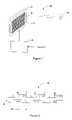
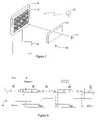
- FIG. 1is a perspective view of a simple display system based on a liquid crystal microdisplay, which may include and be operated according to the teachings of the present invention.
- FIG. 2is a timing diagram for a single frame in a field-sequential RGB color, 3-bit grayscale display system.
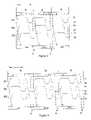
- FIG. 3is a timing diagram showing the state of three pixels, one on each of three different rows, in a field-sequential RGB color, 3-bit grayscale display system.
- FIG. 4is a timing diagram showing the state of three pixels, one on each of three different rows, in a field-sequential RGB color, 3-bit grayscale display system, including a transition segment bit that is always off.
- FIG. 5is a timing diagram showing the state of three pixels, one on each of three different rows, in a field-sequential RGB color, 3-bit grayscale display system, including a transition segment bit whose state is determined according to the teachings of the present invention.
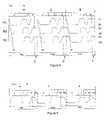
- FIG. 6is a timing diagram showing the state of a single pixel in a field-sequential RGB color, 3-bit grayscale system, including a transition period bit having 2 bits of gray scale, the states of which are determined according to the teachings of the present invention.
- FIG. 7is a perspective view of a simple display system based on a liquid crystal microdisplay and a compensator, which may include and be operated according to the teachings of the present invention.
- FIG. 8is a timing diagram for a partial frame in a field-sequential RGB color, 3-bit grayscale display system, including a compensator operated in accordance with the teachings of the present invention.
- FIG. 9is a perspective view of a simple display system based on a liquid crystal microdisplay and a series of color filters included in the light source arrangement, which may include and be operated according to the teachings of the present invention.
- FIG. 10is a first timing diagram depicting the state of the light source arrangement for a partial frame in a field-sequential RGB color display system, including light source devices having non-negligible ON and OFF transition times, operated according to the teachings of the present invention.
- FIG. 11is a second timing diagram depicting the state of the light source arrangement for a partial frame in a field-sequential RGB color display system, including light sources having non-negligible ON and OFF transition times, operated according to the teachings of the present invention.
- FIG. 12is a perspective view of a simple display system based on a liquid crystal microdisplay and a color wheel included in the light source arrangement, which may include and be operated according to the teachings of the present invention.
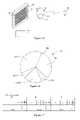
- FIG. 13is a plan view of a color wheel having a plurality of broadly-transmissive segments.
- FIG. 14is a timing diagram for a single frame in a field-sequential RGB color, 3-bit grayscale display system having a 2-bit grayscale transition segment.
- the present inventionapplies to many display systems, including, for example, digital micro-mirror devices (DMDs) and liquid crystal devices (LCDs), including nematic, ferroelectric and antiferroelectric LCDs.
- DMDsdigital micro-mirror devices
- LCDsliquid crystal devices
- the inventionwill be described herein as embodied in a ferroelectric liquid crystal microdisplay device.
- the present inventionshould not be considered limited to ferroelectric liquid crystal devices specifically or even liquid crystal devices generally.
- the present inventionis not limited to microdisplays, as the teachings herein apply to most display systems using field-sequential color, as will become apparent in view of this detailed description.
- FIG. 1illustrates a simple microdisplay system 28 .
- the microdisplay system 28 of FIG. 1includes a microdisplay panel 30 having an array of pixels 32 .
- a data ordering arrangement 34receives incoming video data and produces drive signals that cause individual pixels 36 of the pixel array 32 to assume various light modulating states.
- a light source arrangement 38illuminates the microdisplay panel 30 with light of any of a number of color combinations. (Herein, “color” does not limit the description to a single wavelength in the color spectrum.
- Typical color display systemsinclude a light source arrangement 38 that illuminates the panel 30 with the three primary colors, red, green and blue, either in combination or in sequence.
- a light source arrangement 38that illuminates the panel 30 sequentially with red, green and blue light (i.e., RGB field-sequential color)
- the present inventionapplies broadly to display systems having light source arrangements that illuminate the microdisplay panel 30 with any combination or sequence of at least two colors of light.
- the light source arrangement 38produces colored light in any of a number of different ways, some of which will be described in more detail hereinafter.
- the light source arrangement 30may include light emitting diodes (LEDs) that each emit light of a specific color, in which case the light source arrangement 38 would include at least two such devices to produce the at least two different colors.
- the light source arrangementmay use a color wheel or color filter(s) in combination with a broad spectrum light emitting device.
- the color wheel or color filter(s)would include filtering components that each pass light of a specific color, in which case the light source arrangement 38 would include a color wheel or color filter(s) having at least two filtering components to produce the at least two colors.
- display system 28includes a data ordering arrangement 34 that receives incoming video data and produces drive signals that cause individual pixels 36 of the pixel array 32 to assume various light modulating states.
- the pixelsIn binary state display systems, such as DMDs and most ferroelectric LCDs, the pixels typically have two states, ON and OFF. In other systems, such as nematic or antiferroelectric LCDs, the pixels may have any number of light modulating states.
- Microdisplay systemssuch as system 28 of FIG. 1 , produce color images by driving the pixels in a temporal sequence while illuminating the pixels with different colors of light.
- One such method of producing images in microdisplay systemsis called field-sequential color. In a field-sequential color system, time is divided into frames, as illustrated in FIG.
- FIG. 2includes one frame 40 of pixel information timing in a field-sequential color system, such as system 28 of FIG. 1 .
- Framesare typically on the order of 1/60 th of a second or shorter, because the human eye is capable of integrating into a single image a number of different images it perceives during such short time periods.
- the frame 40is divided into color segments, during which a single color of light illuminates the pixels, except possibly during color transitions.
- the state of the light source arrangement( 38 from FIG. 1 ) is indicated by bar 42 .
- the frame 40is divided into red, green and blue color segments, represented by R, G and B, respectively.
- the data ordering arrangement 34converts the incoming video data into RGB drive signals.
- Grayscalemay be produced using any of a number of well known methods, including amplitude modulation, pulse-width modulation and binary pulse-width modulation.
- grayscalemay be produced using amplitude modulation by driving the pixels to any light modulating state from fully ON to fully OFF for each color segment. The amplitude of the pixel drive signal determines the intensity of the light reflected by or transmitted through the pixel.
- grayscalemay be produced using pulse-width modulation or binary pulse-width modulation.
- Pulse-width-modulated grayscalemay be produced using either analog or binary drive circuitry.
- analog drive systemseach pixel typically is held in the ON state continuously during each color segment for a duration corresponding to the desired intensity of the pixel for that color segment.
- binary drive systemseach color segment typically is divided into grayscale time periods having different durations corresponding to a binary coded system, and the pixel may be driven to either the ON or OFF state for each grayscale time period.
- the RGB data produced by the data ordering arrangement 34represents the grayscale intensity of the pixel in each color segment in each frame.
- the present inventionis applicable to display systems that produce grayscale according to any of these methods, as well as various hybrids thereof, for ease of illustration, the invention will be described herein with reference to a binary pulse-width-modulated grayscale system.
- the binary grayscale field-sequential RGB color systemincludes 3 bits of grayscale.
- each color segmentis divided into three grayscale periods, which are labeled 2 , 1 and 0 .
- Grayscale period 1is twice as long as period 0
- period 2is twice as long as period 1 in each color segment.
- a pixelmay be either ON or OFF for each grayscale period of each color segment.
- each color segmentcan produce 8 different shades of that color.
- FIG. 2illustrates a relatively simple field-sequential color
- 3-bit grayscale systemuseful microdisplay devices typically operate using more complex systems to overcome some limitations, as will be explained immediately hereinafter.
- a microdisplay panel such as panel 30contains an array of pixels 32 , as explained above with reference to FIG. 1 .
- the pixelsare arranged into rows and columns.
- the data ordering arrangement 34sends drive signals to pixels on a row-by-row basis, causing the pixels to be in either the ON or OFF state for each grayscale period of each color segment of each frame. Due to bandwidth limitations, it is not always possible in most practical designs to write different information to various pixels in the array simultaneously. However, when a light source changes from one color to the next color, the color change may occur across the entire panel at once. Thus, the problem arises that some pixels will be displaying data for the next color segment while being illuminated with light for the current color segment, or vice versa.
- FIG. 3illustrates a timing diagram for a single frame of data in a 3-bit binary grayscale, field-sequential color system.
- the systemhas three color segments, red, green and blue, represented by R, G and B, respectively. Each color segment is divided into three grayscale bits, 2 , 1 and 0 .
- FIG. 3further illustrates the pixel state of three hypothetical pixels on three different rows, R 1 , R 2 and R 3 , of a pixel array. For this example, it will be assumed that R 1 is the top most row, R 2 is the middle row and R 3 is the bottom row of the pixel array. Also in this example, drive signals are sent to the pixel array from a data ordering arrangement starting at the top of the array and working row-by-row to the bottom of the array.
- each color segment of each pixelhas a grayscale value of 5.
- a single valuehas been chosen for purposes of illustration to simplify the example.
- 5is represented by bit 2 being ON, bit 1 being OFF and bit 0 being ON.
- the pixel in row R 1receives the bit 2 drive signal first, as can be appreciated by observing the timing diagram of FIG. 3 .
- the state of the pixel in R 1begins to change at the beginning of the bit 2 time period of the red color segment. In this example, and in most cases in typical microdisplays, the pixel does not change instantly—it has a non-negligible response time to the drive signal. Therefore, the pixel is not fully ON until some point in time after it receives the ON signal.
- the pixel in row R 2receives its bit 2 drive signal after the pixel in row R 1 receives its bit 2 drive signal for each respective color segment.
- the pixel in row R 3receives its bit 2 drive signal last for each color segment.
- the difference in time by which each pixel in the different rows receives its bit 2 drive signalis shown by line 50 .
- the delayis consistent across different color segments in the timing diagram.
- the time interval between the dashed lines, indicated by reference numeral 52is the transition period, during which the light source arrangement is changing from one color to the next. During this time, more than one color may illuminate the display panel and/or the panel may be illuminated with light having a different intensity than the light that illuminates the panel during non-transition periods.
- each of the three pixelsexhibits a different response during the transition periods 52 .
- the delayed writing time across the panelcauses the pixel in R 1 to appear more red than the pixel in R 3 because it is in the ON state for a greater portion of the red color segment.
- a similar problemoccurs at each transition period 52 in the frame. This condition results in color inaccuracies that degrade the quality of the image and the usefulness of the device.
- FIG. 4depicts a similar timing diagram for the same pixels.
- the system of FIG. 4overcomes the aforementioned problem of FIG. 3 by making all pixels across the entire panel OFF during the transition periods 52 in the following way.
- an additional grayscale bitis inserted between the grayscale bits of each color segment.
- This additional grayscale bitis shown as bit K (for blacK).
- the value of bit Kis always 0, which causes black to be written to the panel.
- the duration of bit Kis approximately the amount of time it takes to write the entire panel with data, plus the amount of time the light source arrangement takes to fully transition between colors.
- transition periods 52 that occur while the pixels are displaying bit K dataoccur while the display appears dark, and no color inaccuracies result.
- useable lightis wasted, because the display is dark during every color transition of every frame, and the display does not appear as bright as it otherwise could.
- the present inventionimproves upon this limitation.
- FIG. 5illustrates a 3-bit grayscale, field sequential color system according to the present invention.
- WWhite
- the RGB color segmentsare designated as R′, G′ and B′ color segments.
- W bitsare not necessarily the opposite of K bits, as will be explained below; however, this representation indicates that the system displays the image data differently than in the previous example of FIG. 4 .
- the data ordering arrangementperforms a different data transformation on the incoming video data. Instead of generating RGB data, the data ordering arrangement generates R′G′B′W data.
- the data ordering arrangementthen sends the R′ data to the panel during the R′ color segment, the G′ data during the G′ color segment, and the B′ data during the B′ color segment.
- the data ordering arrangementsends the W data to the panel during each transition period 52 in a given frame. That is, for a given frame and pixel, the same W data is displayed during each transition period 52 of the frame.
- the resultant optical effectis either black or white during the combined transition periods 52 , because equal intensities of red, green and blue light combine to form white light.
- the integrated optical result of only the transition periods 52 in a frameis that the pixels reflect white light of a certain intensity if the data transformation resulting in R′G′B′W data requires the W bit to have an intensity other than zero, or the pixels do not reflect any light, if the W bit has zero intensity.
- the W bit for each pixelmay be any grayscale value from fully OFF to fully ON, depending on the grayscale arrangement (e.g., amplitude modulated, pulse-width modulated, or binary pule-width modulated) of the system.
- FIG. 6illustrates a timing diagram for a single frame in a binary pulse-width modulated grayscale, field-sequential color R′G′B′W system.
- the W informationis contained in two bits of grayscale, W 1 and W 0 .
- Wmay have four different values, in this example. If additional W values are desirable, additional grayscale W bits could be added.
- bit Wcould have values ranging from fully OFF to fully ON.
- FIG. 6discloses another important aspect of the present invention. That is, it is not a requirement that no pixels transition while the light source arrangement transitions between colors. For example, if bit W 1 is ON and bit W 0 is OFF (i.e., W value 10 (binary) or grayscale level 2) for a given pixel during each color segment of a given frame, it is acceptable for the light source arrangement to transition to a different color while the state of the pixel transitions from W 1 to W 0 because the transition will be the same during each color segment of the frame.
- the transformation of incoming video data to R′G′B′W datamay be accomplished according to a number of well known methods. Examples may be found, for instance, in copending U.S. patent application Ser. No. 09/923,920, filed Aug. 17, 2001, entitled, Color-Balanced Enhancement for Display Systems, which application is incorporated herein by reference in its entirety. Other examples may be found in U.S. Pat. No. 6,256,425, issued Jul. 3, 2001, entitled, Adaptive White Light Enhancement for Displays, which patent is incorporated herein by reference in its entirety.
- the data ordering arrangementessentially evaluates the red, green and blue intensity information for each frame for a given pixel, and, if each color requires sufficient intensity, the data ordering arrangement places some of the intensity from each color in the W period, instead of the respective color segment.
- the present inventionis not limited to inserting W bits only between color segments; it may be desirable to place W bits in the middle of a color field for various reasons. For instance, some binary pulse-width-modulated grayscale algorithms (especially those involving multiple subpixels) result in “leftover” grayscale time periods when balancing the number of periods in a frame. Heretofore, such periods were written with OFF data, resulting in wasted light. However, in light of the present invention, leftover grayscale periods in RGB field-sequential color systems may be written with W data, which may be either ON or OFF, provided the W data is written to the pixel in each color segment in a frame.
- FIG. 7depicts a simple display system 58 , which includes a compensator 60 placed between the panel 30 and a viewing area 62 .
- a compensatoris an optical device that alters the polarization of light that passes through it.
- Compensatorsare more fully explained in previously incorporated U.S. Pat. No. 6,075,577.
- Compensator transitionswere located at a color transition so that the compensator could be switched while the display was dark. However, because the display is no longer necessarily dark at color transitions according to the present invention, the compensator transition may be located elsewhere.
- FIG. 8illustrates the compensator transition taking place during the blue color segment of a frame.
- RGB systemsthat use a compensator
- the present inventionlocates the compensator transition within the blue color segment.
- FIG. 8is a timing diagram depicting both a partial frame of image data and the compensator state 64 .
- a bar above the textindicates that the appearance of the image information is inverted.
- Frame 1 barinverted
- the image information displayedis inverted with respect to Frame 1 .
- the compensator transitiontakes place during the blue color segment.
- the panelis written with black or OFF data, as indicated by bit K.
- the compensator stateis changed as the panel is written with K bar or ON data.
- the panelcontinues to appear dark at a viewing area after the compensator transition. Any light the leaks through to the viewing area during the compensator/panel transition will appear as a brief flash of blue light, which is less disturbing to a viewer than a brief flash of either red or green light.
- the present inventionmay be embodied in display systems that use any one of a number of different types of light source arrangements.
- the systemmay use either color filters or color wheels in a number of advantageous ways. Attention is now directed to FIG. 9 , which illustrates a system that uses a single, broad spectrum light source device 70 in combination with a number of switchable color filers 72 arranged in series.
- Color filtersare more full explained in WIPO International Publication No. WO 01/09668 A1, published Feb. 8, 2001, entitled Color Filters, Sequencers and Displays Using Color Selective Light Modulators, which publication is incorporated herein in its entirety.
- the systemuses red, green and blue color filters.
- the color filtersare switched by electrical signals from a color sequencer 74 that causes a particular color filter to be active during the corresponding color segment of each image frame.
- the red color filtercan selectively block or pass red light, but has no effect on either green or blue light.
- the green and blue filtersoperate similarly on green and blue light, respectively.
- Color filtershave a non-negligible switching time to change between the passive, light-blocking state and the active, light-transmitting state. Also, the time the color filter takes to fully transition from the active state to the passive state may be different than the time the color filter takes to transition from the passive state to the active state.
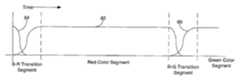
- FIG. 10illustrates the state of the light source arrangement over a partial image frame. It depicts the state of the red color filter during the red color segment and the blue-to-red (B-R) and red-to-green (R-G) transition segments, as well as the state of the green color filter during the R-G transition segment.
- the green color filterbegins to turn ON as soon as the red color filter begins to turn OFF, as can be seen by lines 80 and 82 , representing the state of the green and red color filters, respectively.
- the state of the color filters during a transition segmenthad no effect on the image, since all pixels were in the OFF state during color transitions.
- the present inventionincreases the brightness of the image by utilizing otherwise wasted light during the transition segments by making the W bits either ON or OFF, depending on the pixel image data. Therefore, the state of the color filters during transition segments is relevant in the present invention.
- light represented by the portions of lines 80 and 82 during the transition segmentswould cause pixels having ON W bits to appear ON at the viewing area.
- each color filtermay have different ON and OFF transitions times, the combination of light across all color segments in a particular frame may not appear to be the desired shade of white. Therefore, additional considerations are necessary.
- FIG. 11illustrates a second example of the state of the light source arrangement over time.
- the red and green color filtersare both active for a longer period of time during the R-G transition segment, as is evident from lines 80 and 82 .
- more light from two different color filtersilluminates the display panel during the transition segment.
- This arrangementin combination with having some pixels in the on state during the transition segment, increases the brightness of the image over the situation depicted in FIG. 10 .
- FIG. 11also illustrates the state of the blue color filter 84 during the blue-to-red (B-R) transition segment. During this transition segment, both the red and blue color filters are active.
- B-Rblue-to-red
- the degree of overlapmay be adjusted for each color transition in a frame such that the combination of all color transitions across a single frame results in light of a desired color, in this case white light. Further, the degree of overlap may be adjusted to maximize the brightness of the display during the W bits. The degree of overlap is controlled by either advancing or delaying the time at which each color filter receives its ON and/or OFF signal from the color sequencer 74 of FIG. 9 .
- Color filtersas well as other light source arrangements, often have transition times that are affected by their temperature. In such cases, the degree of overlap may be adjusted to maintain the desired color of combined light in response to the temperature. This may be accomplished by using a temperature sensing arrangement 76 in FIG. 9 to sense the temperature of each color filter.
- the temperature sensing arrangement 76provides information representing the sensed temperature to the color sequencer 74 , from which the color sequencer determines the amount of time by which to advance or delay the ON and OFF signals to each color filter.
- the color sequencer 74may accomplish the adjustment in a number of ways that are well known to those skilled in the art of electronic devices and will not be explained further.
- the present inventiongreatly increases the brightness of a display image by more efficiently utilizing light during color transitions.
- this aspect of the present inventionhas been described with respect to color filters, it should not be considered limited to color filters.
- Any light source arrangementthat includes light source devices having either negligible or non-negligible transition times may be used, and the system would enjoy the benefits of the present invention.
- discrete light sources with nearly instantaneous ON and OFF timessuch as light emitting diodes (LEDs) could be used, in which case it may even be beneficial to have all LEDs in an RGB system ON for some portion of each color transition.
- LEDslight emitting diodes
- the present inventionmay include a light source arrangement that utilizes a color wheel.
- Color wheelsare more fully explained in copending U.S. patent application Ser. No. 09/923,920, filed Aug. 17, 2001, entitled, Color-Balanced Enhancement for Display Systems, which application is incorporated herein by reference in its entirety. Attention is directed to FIG. 12 which illustrates a display system including a color wheel 90 .
- the color wheel 90is divided into color areas, one for each color to be displayed.
- the color wheel 90is divided into red, green and blue color areas, 92 , 94 and 96 respectively.
- the color wheel 90is configured to rotate around its center axis and is placed in the light path between the light source device 70 and the display panel 30 , such that light passes through a portion thereof, before reaching the display panel 30 .
- the rotationis timed such that light shines through the red color area 92 during the red color segment of a field-sequential color frame, through the green color area 94 during the green color segment, and through the blue color area 96 during the blue color segment.
- light from adjacent color areasmay illuminate the panel simultaneously. This condition, together with the non-negligible panel writing time, can result in the same type of color inaccuracies discussed previously with respect to FIG. 3 .
- FIG. 3This condition, together with the non-negligible panel writing time, can result in the same type of color inaccuracies discussed previously with respect to FIG. 3 .
- FIG. 3As explained previously with respect to FIG.
- the present inventionmay be used in field-sequential color systems that include a color wheel in the light source arrangement to eliminate these color inaccuracies while efficiently utilizing the available light by inserting transition segments where the state of each pixel depends on the desired brightness for that pixel.
- FIG. 13depicts a color wheel 98 having a number of additional broadly-transmissive areas 100 .
- the inventionmay include one or more such areas, which are configured such that light passing therethrough illuminates the display panel during transition segments. This aspect of the invention may result in an even brighter image, since light passes though the broadly-transmissive areas 100 of the color wheel 98 essentially unfiltered, thus utilizing more of the available light.
- the transmissivity of the broadly-transmissive area with respect to wavelengthmay be selected to provide the desired color temperature.
- this methodis fixed at the time of manufacture, it alone does not allow further operational adjustments.
- a color wheel system designed according to the present inventionmay include more than one W bit between each color segment.
- FIG. 14which includes a single frame in a field-sequential RGB color, 3-bit grayscale system that includes a color wheel in the light source arrangement.
- This system of FIG. 14is similar to the system of FIG. 6 discussed previously. While the system is shown as having two bits of grayscale during each transition period, the invention is not limited to a certain number of transition grayscale time periods. Bits W 1 and W 0 may be either ON or OFF in any particular transition period, such that up to four shades of transition period brightness may be produced.
- bits W 1 and W 0must be in the same state in each transition segment in a particular frame to prevent color inaccuracies, since some amount of color from either side of each clear segment illuminates the panel during a transition period. Therefore, as will be clear in light of the teachings of the present invention, if corresponding transition bits are in the same state for each transition period in a particular frame, the integrated effect across the frame is an increase in brightness of the image with no color inaccuracies as a result of color transitions and little or no effect on the overall color balance of the system.
Landscapes
- Engineering & Computer Science (AREA)
- Physics & Mathematics (AREA)
- Computer Hardware Design (AREA)
- General Physics & Mathematics (AREA)
- Theoretical Computer Science (AREA)
- Control Of Indicators Other Than Cathode Ray Tubes (AREA)
- Liquid Crystal Display Device Control (AREA)
Abstract
Description
This invention relates generally to field-sequential color displays and more particularly to methods and arrangements for increasing the brightness of such displays by more efficiently utilizing the light from a light source.
Microdisplays are becoming increasingly popular as low cost, low power consumption, yet high resolution replacements for traditional information display components such as cathode-ray tubes. Their small size allows integration into hand-held products, such as camcorders and digital still cameras, while their high resolution capabilities promote usefulness in projection applications, such as televisions and business projectors.
The usefulness of microdisplays in projection applications depends greatly on the system's ability to project a sufficiently bright image. However, certain types of microdisplays, liquid crystal microdisplays in particular, require optical elements such as polarizers or diffusers that reduce the amount of light that reaches the viewing area. Moreover, the algorithms used to operate microdisplays to produce images also may result in wasted light, as will be explained immediately below.
Field-sequential color microdisplays produce color images by dividing an image frame into color segments. An image frame is a period of time during which the information necessary to produce a single image is displayed on the display device. A color segment is a portion of a frame during which the image information for a single color is displayed while the display is illuminated with that single color of light. Field-sequential color displays can be contrasted with non-sequential color systems, which usually combine three different color images simultaneously. By using the three primary colors, red, green and blue (RGB), in sequence, a field-sequential color display is capable of producing images from a palette of many colors. The size of the color palette is further increased by adding grayscale.
Grayscale refers to “shading” colors—varying the amount of each primary color included in the image—thus increasing the number of combined colors the system is capable of producing. Field-sequential color systems produce grayscale in one of several ways. One method is to vary the intensity of light either reflected by or transmitted through the device. A second method is to vary the duration of time that the light is reflected or transmitted. Methods for producing grayscale in microdisplays are well known. For example, U.S. Pat. No. 5,748,164, issued May 5, 1998, entitled Active Matrix Liquid Crystal Image Generator, describes various methods for producing gray-scale images in field-sequential color microdisplays, which patent is incorporated herein by reference in its entirety.
In prior art methods of producing gray-scale images in field-sequential color systems, light may be underutilized. For instance, because image information cannot be written to the entire display as fast as the light source can be switched to a different color, color transitions can result in image artifacts unless ameliorative steps are taken. One common ameliorative step is to make the display dark during the time that the light source is switched to a different color. Unfortunately, any light emitted while the display is dark is essentially wasted.
Light may also be wasted even if image information can be written to the entire display as fast as, or faster than, the light source can be switched to a different color. Most methods of switching a light source between colors do so in a finite amount of time, producing intermediate states of illumination that are either of a different color or a different intensity from the desired pure colors before and after the transition. For example, a color wheel that transitions between red and green will produce yellow light during the transition. A liquid crystal color switch may avoid such intermediate colors but will then produce intermediate light of varying intensity. In both cases the intermediate light is generally considered unusable directly by the display element in a field sequential color system designed to operate with primary colors of a single intensity. Again, a common ameliorative step is to make the display dark during the transition.
Light is also wasted in liquid crystal display systems that use a compensator cell while DC balancing the liquid crystal material. Compensators are more fully explained in U.S. Pat. No. 6,075,577, issued Jun. 13, 2000, entitled Continuously Viewable, DC Field-Balanced, Reflective Ferroelectric Liquid Crystal Image Generator, which patent is incorporated herein by reference in its entirety. DC balancing is desirable to prevent image sticking or image retention. It is achieved by inverting the electrical polarity sense of the pixel drive voltage. In the case of liquid crystal displays incorporating polarity responsive liquid crystal materials such as ferroelectric liquid crystals, reversing the electrical polarity sense of the pixel drive inverts the appearance of the image. In such cases, a compensator may be used to allow the inverted image to be displayed without affecting the appearance of the image at the image area. However, as with changing the color of the light source, the compensator can be switched much faster than data can be written over the entire display. Thus, to avoid image artifacts, one prior art solution is to make the display dark during a compensator transition.
A number of additional factors similar to those briefly discussed above also result in inefficient use of the available light in field-sequential color display systems. It is against this backdrop and a desire to solve the problems of the prior art, including a desire to increase the brightness of field-sequential color displays, that the present invention has been developed.
The present invention relates generally to a display for producing modulated light so as to form an image during a frame. The display includes a display panel having a plurality of pixels configured to modulate light in a temporal sequence. The pixels have a plurality of light modulating states, including OFF and ON. The display also includes a light source arrangement that illuminates the display panel, the light source arrangement being configured to selectively emit light of at least one of at least two different colors. The display also includes a data ordering arrangement that is receptive of incoming video data and that generates drive signals that drive the pixels to the light modulating states. The frame is divided time-wise into color segments with only one of the different colors of light being emitted from the light source arrangement during each color segment. The color segments are separated in time by transition periods during which more than one color of light may illuminate the panel. The incoming video data includes information from which the data ordering arrangement determines pixel brightness values for each color segment. The drive signals cause individual pixels to be in the same state during each transition period of a frame. The state of a pixel during the transition periods is determined by the pixel brightness values. Pixels with pixel brightness values above predetermined values for each color segment in a given frame are in a state other than OFF during the transition periods corresponding to the frame.
The number of color segments may be at least three. The light source arrangement may illuminate the panel with red light during one color segment, green light during a different color segment and blue light during a different color segment. The light source arrangement may illuminate the panel with at least two different colors during a transition period. The intensity of the different colors of light illuminating the panel during the transition periods may be adjustable to maintain a stable white point.
The display may also include a temperature sensing arrangement that senses the temperature of the light source arrangement. The intensity of the different colors of light illuminating the panel during the transition periods may be adjustable to maintain a stable white point in response to the temperature of the light source arrangement. The light source arrangement may include color filters. The light source arrangement may include a color wheel. The color wheel may be divided into at least three color areas. The color wheel may include red, green and blue color areas. The color wheel may include at least one broadly-transmissive area that passes a substantial amount of light across the visible light spectrum. The color wheel may include at least one broadly-transmissive area between each color area. The light illuminating the panel during a transition segment may travel through a broadly-transmissive area of the color wheel.
The display may also include a compensator cell having at least two states, one state wherein the compensator has no effect on the appearance to a viewer of individual pixels, and a second state wherein the compensator changes the appearance of pixels by inverting the contrast of the image. The compensator may change from the first state to the second state at least once during the frame. The compensator may change state during the color segment during which the light source is illuminating the display panel with blue light.
The present invention also relates to a display with a display panel. The panel has a plurality of pixels configured to modulate light in a temporal sequence so as to form an image during a frame. The pixels have a plurality of light modulating states, including OFF and ON. The display also includes a light source arrangement that illuminates the display panel. The light source arrangement is configured to selectively emit light of at least one of at least two different colors. The display also includes a data ordering arrangement that is receptive of incoming video data and that generates drive signals that drive the pixels to the light modulating states. The frame is divided time-wise into color segments with only one of the different colors of light being emitted from the light source arrangement during each color segment. The color segments include one or more grayscale periods. The incoming video data includes information from which the data ordering arrangement determines pixel brightness values for each color segment. The state of a pixel during each grayscale period is determined by the pixel brightness values for the corresponding color segment. Pixels with pixel brightness values above predetermined values for each color segment in a given frame are in a state other than OFF during corresponding grayscale periods of each color segment of the frame.
The present invention also relates to a display having a display panel. The panel has a plurality of pixels configured to modulate light in a temporal sequence so as to form an image during a frame. The display also includes a light source arrangement that illuminates the display panel. The light source arrangement is configured to selectively emit light of at least two different colors. The display also includes a compensator cell having at least two states, one state wherein the compensator has no effect on the appearance to a viewer of individual pixels, and a second state wherein the compensator changes the appearance of pixels by inverting the contrast of the image. The frame is divided time-wise into color segments with only one of the different colors of light being emitted from the light source arrangement during each color segment. The light source arrangement illuminates the panel with blue light during at least one color segment. The compensator changes from the first state to the second state at least once during the frame. The compensator may change state during the color segment during which the light source is illuminating the display panel with blue light.
The present invention also relates to a method of increasing the brightness of a display. The method includes providing a display panel having a plurality of pixels. The pixels have a plurality of light modulating states, including ON and OFF. The pixels are configured to modulate light in a temporal sequence so as to form an image during a frame. The method also includes providing a light source arrangement that illuminates the display panel. The light source arrangement is configured to selectively emit light of at least one of at least two different colors. The method also includes providing a data ordering arrangement that is receptive of incoming video data and that generates drive signals that drive the pixels to the light modulating states. The method also includes dividing the frame time-wise into a plurality of color segments. The method also includes inserting transition periods between each color segment. The method further includes determining pixel brightness values for each color segment from the incoming video data. The method also includes generating drive signals that cause individual pixels with pixel brightness values above predetermined values for each color segment in a given frame to be in a state other than OFF during each transition period of the frame. The method also includes illuminating the panel with only one of the different colors of light from the light source arrangement during a color segment. The method also includes illuminating the panel with at least one of the different colors of light from the light source arrangement during a transition period.
The number of color segments may be at least three. The panel may be illuminated with red light during one color segment, green light during a different color segment, and blue light during a different color segment. The panel may be illuminated with at least two different colors of light during a transition period.
The method may also include adjusting the intensity of the different colors of light illuminating the panel during the transition periods to maintain a stable white point. The method may also include providing a temperature sensing arrangement that senses the temperature of the light source arrangement and adjusting the intensity of the different colors of light illuminating the panel during the transition periods to maintain a stable white point in response to the temperature of the light source arrangement.
The light source arrangement may include color filters. The light source arrangement may include a color wheel. The color wheel may be divided into at least three color areas. The color wheel may include red, green and blue color areas. The color wheel may include at least one broadly-transmissive area that passes a substantial amount of light across the visible light spectrum. The color wheel may include at least one broadly-transmissive area between each color area. The light illuminating the panel during a transition segment may travel through a broadly-transmissive area of the color wheel.
The method may also include providing a compensator cell having at least two states, one state wherein the compensator has no effect on the appearance to a viewer of individual pixels, and a second wherein the compensator changes the appearance of pixels by inverting the contrast of the image. The compensator may change from the first state to the second state at least once during the frame. The method may also include changing the compensator state during the color segment during which blue light is illuminating the display panel.
The present invention also relates to a field-sequential grayscale color display system having a display panel. The display panel includes an array of pixels having a plurality of light modulating states. The display system also includes an illumination arrangement that illuminates the pixels. The illumination arrangement includes a color generating arrangement that produces light in at least three different color spectrum ranges. The illumination arrangement sequentially illuminates the panel with light from each one of the at least three different color spectrum ranges at a time during a frame. The light from the at least three different color spectrum ranges produces white light when combined. The display system also includes a pixel driving arrangement that is receptive of incoming video data and that produces grayscale pixel drive signals that drive individual pixels to light modulating states in accordance with a grayscale scheme. The pixel driving arrangement also produces compensation drive signals that cause each pixel to be in the same light modulating state during each of at least three compensation periods. One compensation period corresponds to each color spectrum range of light in the illumination sequence.
An invention is described herein relating to methods and systems for increasing brightness in field-sequential color display systems. In the following description, numerous specific details are set forth in order to provide a thorough understanding of the present invention. Based on the following description, however, it will be obvious to one skilled in the art that the present invention may be embodied in a variety of specific configurations. In addition, well-known processes for producing various components and certain well-known optical effects of various optical components will not be described in detail in order not to unnecessarily obscure the present invention.
The present invention applies to many display systems, including, for example, digital micro-mirror devices (DMDs) and liquid crystal devices (LCDs), including nematic, ferroelectric and antiferroelectric LCDs. However, for purposes of illustration, where necessary, the invention will be described herein as embodied in a ferroelectric liquid crystal microdisplay device. As will be readily apparent to one skilled in the art, the present invention should not be considered limited to ferroelectric liquid crystal devices specifically or even liquid crystal devices generally. Further, the present invention is not limited to microdisplays, as the teachings herein apply to most display systems using field-sequential color, as will become apparent in view of this detailed description.
Attention is first directed toFIG. 1 , which illustrates asimple microdisplay system 28. InFIG. 1 and all figures that follow, like reference numbers refer to like components between figures. Themicrodisplay system 28 ofFIG. 1 includes amicrodisplay panel 30 having an array ofpixels 32. Adata ordering arrangement 34 receives incoming video data and produces drive signals that causeindividual pixels 36 of thepixel array 32 to assume various light modulating states. Alight source arrangement 38 illuminates themicrodisplay panel 30 with light of any of a number of color combinations. (Herein, “color” does not limit the description to a single wavelength in the color spectrum. For example, any number of different visible wavelengths of light may be present in what is perceived as a single color.) Typical color display systems include alight source arrangement 38 that illuminates thepanel 30 with the three primary colors, red, green and blue, either in combination or in sequence. Although the present invention will be described with reference to adisplay system 28 having alight source arrangement 38 that illuminates thepanel 30 sequentially with red, green and blue light (i.e., RGB field-sequential color), the present invention applies broadly to display systems having light source arrangements that illuminate themicrodisplay panel 30 with any combination or sequence of at least two colors of light.
Thelight source arrangement 38 produces colored light in any of a number of different ways, some of which will be described in more detail hereinafter. For example, thelight source arrangement 30 may include light emitting diodes (LEDs) that each emit light of a specific color, in which case thelight source arrangement 38 would include at least two such devices to produce the at least two different colors. Alternatively, the light source arrangement may use a color wheel or color filter(s) in combination with a broad spectrum light emitting device. The color wheel or color filter(s) would include filtering components that each pass light of a specific color, in which case thelight source arrangement 38 would include a color wheel or color filter(s) having at least two filtering components to produce the at least two colors.
As previously stated,display system 28 includes adata ordering arrangement 34 that receives incoming video data and produces drive signals that causeindividual pixels 36 of thepixel array 32 to assume various light modulating states. In binary state display systems, such as DMDs and most ferroelectric LCDs, the pixels typically have two states, ON and OFF. In other systems, such as nematic or antiferroelectric LCDs, the pixels may have any number of light modulating states. Microdisplay systems, such assystem 28 ofFIG. 1 , produce color images by driving the pixels in a temporal sequence while illuminating the pixels with different colors of light. One such method of producing images in microdisplay systems is called field-sequential color. In a field-sequential color system, time is divided into frames, as illustrated inFIG. 2 .FIG. 2 includes oneframe 40 of pixel information timing in a field-sequential color system, such assystem 28 ofFIG. 1 . Frames are typically on the order of 1/60thof a second or shorter, because the human eye is capable of integrating into a single image a number of different images it perceives during such short time periods. Theframe 40 is divided into color segments, during which a single color of light illuminates the pixels, except possibly during color transitions. InFIG. 2 , the state of the light source arrangement (38 fromFIG. 1 ) is indicated bybar 42. In this example, theframe 40 is divided into red, green and blue color segments, represented by R, G and B, respectively. Thus, thedata ordering arrangement 34 converts the incoming video data into RGB drive signals.
The number of colors a microdisplay system is capable of producing may be increased beyond the number of different colors produced by thelight source arrangement 38 by adding grayscale. Grayscale may be produced using any of a number of well known methods, including amplitude modulation, pulse-width modulation and binary pulse-width modulation. For instance, grayscale may be produced using amplitude modulation by driving the pixels to any light modulating state from fully ON to fully OFF for each color segment. The amplitude of the pixel drive signal determines the intensity of the light reflected by or transmitted through the pixel. Alternatively, grayscale may be produced using pulse-width modulation or binary pulse-width modulation. In both examples of pulse-width-modulated grayscale systems, the pixels are driven to the ON state for only a portion of each color segment. The amount of time the pixel is in the ON state determines the intensity of the light either reflected by or transmitted through the pixel during each color segment. Pulse-width-modulated grayscale may be produced using either analog or binary drive circuitry. In analog drive systems, each pixel typically is held in the ON state continuously during each color segment for a duration corresponding to the desired intensity of the pixel for that color segment. In binary drive systems, each color segment typically is divided into grayscale time periods having different durations corresponding to a binary coded system, and the pixel may be driven to either the ON or OFF state for each grayscale time period. Thus, regardless of the grayscale system used in combination with the present invention, the RGB data produced by thedata ordering arrangement 34, represents the grayscale intensity of the pixel in each color segment in each frame. Although the present invention is applicable to display systems that produce grayscale according to any of these methods, as well as various hybrids thereof, for ease of illustration, the invention will be described herein with reference to a binary pulse-width-modulated grayscale system.
In the example ofFIG. 2 , the binary grayscale field-sequential RGB color system includes 3 bits of grayscale. Thus, each color segment is divided into three grayscale periods, which are labeled2,1 and0.Grayscale period 1 is twice as long asperiod 0, andperiod 2 is twice as long asperiod 1 in each color segment. A pixel may be either ON or OFF for each grayscale period of each color segment. Thus, in this example of a 3-bit grayscale system, each color segment can produce 8 different shades of that color. Further, because a person viewing the image perceives all color segments within a frame as a single image, the image may contain 8×8×8=512 different colors. WhileFIG. 2 illustrates a relatively simple field-sequential color, 3-bit grayscale system, useful microdisplay devices typically operate using more complex systems to overcome some limitations, as will be explained immediately hereinafter.
A microdisplay panel such aspanel 30 contains an array ofpixels 32, as explained above with reference toFIG. 1 . The pixels are arranged into rows and columns. Thedata ordering arrangement 34, in this simplified example, sends drive signals to pixels on a row-by-row basis, causing the pixels to be in either the ON or OFF state for each grayscale period of each color segment of each frame. Due to bandwidth limitations, it is not always possible in most practical designs to write different information to various pixels in the array simultaneously. However, when a light source changes from one color to the next color, the color change may occur across the entire panel at once. Thus, the problem arises that some pixels will be displaying data for the next color segment while being illuminated with light for the current color segment, or vice versa. This situation is further explained in previously incorporated U.S. Pat. No. 5,748,164 and is illustrated inFIG. 3 . Further, even in systems incorporating a feature that allows all pixels to be written with new data simultaneously (a feature herein referred to as “global update”), an illumination system that illuminates the display panel with a transition color or intensity different from the primary colors used for illumination, may cause the pixels to display incorrect information during the transitions.
In this diagram, each color segment of each pixel has a grayscale value of 5. A single value has been chosen for purposes of illustration to simplify the example. In a 3-bit binary grayscale system, 5 is represented bybit 2 being ON,bit 1 being OFF andbit 0 being ON.
The pixel in row R1 receives thebit 2 drive signal first, as can be appreciated by observing the timing diagram ofFIG. 3 . The state of the pixel in R1 begins to change at the beginning of thebit 2 time period of the red color segment. In this example, and in most cases in typical microdisplays, the pixel does not change instantly—it has a non-negligible response time to the drive signal. Therefore, the pixel is not fully ON until some point in time after it receives the ON signal. The pixel in row R2 receives itsbit 2 drive signal after the pixel in row R1 receives itsbit 2 drive signal for each respective color segment. The pixel in row R3 receives itsbit 2 drive signal last for each color segment. The difference in time by which each pixel in the different rows receives itsbit 2 drive signal is shown byline 50. The delay is consistent across different color segments in the timing diagram. The time interval between the dashed lines, indicated byreference numeral 52, is the transition period, during which the light source arrangement is changing from one color to the next. During this time, more than one color may illuminate the display panel and/or the panel may be illuminated with light having a different intensity than the light that illuminates the panel during non-transition periods.
As can be appreciated with reference toFIG. 3 , each of the three pixels exhibits a different response during thetransition periods 52. Although all pixels should appear to display the same data during the frame (because we have selected the same data for each pixel in this example), the delayed writing time across the panel causes the pixel in R1 to appear more red than the pixel in R3 because it is in the ON state for a greater portion of the red color segment. A similar problem occurs at eachtransition period 52 in the frame. This condition results in color inaccuracies that degrade the quality of the image and the usefulness of the device.
One possible solution to overcome this problem is illustrated inFIG. 4 , which depicts a similar timing diagram for the same pixels. The system ofFIG. 4 overcomes the aforementioned problem ofFIG. 3 by making all pixels across the entire panel OFF during thetransition periods 52 in the following way. In the field-sequential color, 3-bit grayscale system ofFIG. 4 , an additional grayscale bit is inserted between the grayscale bits of each color segment. This additional grayscale bit is shown as bit K (for blacK). The value of bit K is always 0, which causes black to be written to the panel. The duration of bit K is approximately the amount of time it takes to write the entire panel with data, plus the amount of time the light source arrangement takes to fully transition between colors. Thus, thetransition periods 52 that occur while the pixels are displaying bit K data occur while the display appears dark, and no color inaccuracies result. However, useable light is wasted, because the display is dark during every color transition of every frame, and the display does not appear as bright as it otherwise could. The present invention improves upon this limitation.
Attention is now directed toFIG. 5 , which illustrates a 3-bit grayscale, field sequential color system according to the present invention. In this example, W (White) bits are inserted between the grayscale bits of each color segment, and the RGB color segments are designated as R′, G′ and B′ color segments. W bits are not necessarily the opposite of K bits, as will be explained below; however, this representation indicates that the system displays the image data differently than in the previous example ofFIG. 4 . In this example, the data ordering arrangement performs a different data transformation on the incoming video data. Instead of generating RGB data, the data ordering arrangement generates R′G′B′W data. The data ordering arrangement then sends the R′ data to the panel during the R′ color segment, the G′ data during the G′ color segment, and the B′ data during the B′ color segment. However, the data ordering arrangement sends the W data to the panel during eachtransition period 52 in a given frame. That is, for a given frame and pixel, the same W data is displayed during eachtransition period 52 of the frame. Thus, although possible depending on the result of the data transformation, it is not necessary for each pixel to be dark during color transitions. Color inaccuracies that result from pixels on different rows being in different states during transition periods are hidden, as are the color inaccuracies that result from the light source arrangement projecting light other than a pure primary color, because the same inaccuracies are repeated for eachtransition period 52. Because such inaccuracies are repeated for eachtransition period 52, the resultant optical effect is either black or white during the combinedtransition periods 52, because equal intensities of red, green and blue light combine to form white light. In other words, the integrated optical result of only thetransition periods 52 in a frame is that the pixels reflect white light of a certain intensity if the data transformation resulting in R′G′B′W data requires the W bit to have an intensity other than zero, or the pixels do not reflect any light, if the W bit has zero intensity.
In addition to not being necessary for all pixels to be OFF during eachtransition period 52, it is also not necessary for all pixels in the array to display the same data during the color transitions52, as was the case in the example ofFIG. 4 . Different pixels across the display may have different W bit values for a given frame. Additionally, the W bit for each pixel may be any grayscale value from fully OFF to fully ON, depending on the grayscale arrangement (e.g., amplitude modulated, pulse-width modulated, or binary pule-width modulated) of the system. An example follows.
The immediately preceding example ofFIG. 6 discloses another important aspect of the present invention. That is, it is not a requirement that no pixels transition while the light source arrangement transitions between colors. For example, if bit W1 is ON and bit W0 is OFF (i.e., W value 10 (binary) or grayscale level 2) for a given pixel during each color segment of a given frame, it is acceptable for the light source arrangement to transition to a different color while the state of the pixel transitions from W1 to W0 because the transition will be the same during each color segment of the frame.
The transformation of incoming video data to R′G′B′W data may be accomplished according to a number of well known methods. Examples may be found, for instance, in copending U.S. patent application Ser. No. 09/923,920, filed Aug. 17, 2001, entitled, Color-Balanced Enhancement for Display Systems, which application is incorporated herein by reference in its entirety. Other examples may be found in U.S. Pat. No. 6,256,425, issued Jul. 3, 2001, entitled, Adaptive White Light Enhancement for Displays, which patent is incorporated herein by reference in its entirety. The data ordering arrangement essentially evaluates the red, green and blue intensity information for each frame for a given pixel, and, if each color requires sufficient intensity, the data ordering arrangement places some of the intensity from each color in the W period, instead of the respective color segment.
The present invention is not limited to inserting W bits only between color segments; it may be desirable to place W bits in the middle of a color field for various reasons. For instance, some binary pulse-width-modulated grayscale algorithms (especially those involving multiple subpixels) result in “leftover” grayscale time periods when balancing the number of periods in a frame. Heretofore, such periods were written with OFF data, resulting in wasted light. However, in light of the present invention, leftover grayscale periods in RGB field-sequential color systems may be written with W data, which may be either ON or OFF, provided the W data is written to the pixel in each color segment in a frame.
The dark display at color transitions was also used previously to mask other events. For instance, some display systems, ferroelectric liquid crystal display systems in particular, use “compensator” cells to DC-balance the liquid crystal material without blocking the light.FIG. 7 depicts asimple display system 58, which includes acompensator 60 placed between thepanel 30 and aviewing area 62. A compensator is an optical device that alters the polarization of light that passes through it. Compensators are more fully explained in previously incorporated U.S. Pat. No. 6,075,577. Compensator transitions were located at a color transition so that the compensator could be switched while the display was dark. However, because the display is no longer necessarily dark at color transitions according to the present invention, the compensator transition may be located elsewhere.
Attention is directed toFIG. 8 , which illustrates the compensator transition taking place during the blue color segment of a frame. In RGB systems that use a compensator, it is difficult to perfectly align in time the transition of the compensator with inversion of the image appearance by the microdisplay panel. Therefore, a small flash of light usually results during compensator transitions. It has been discovered to be advantageous to locate the compensator transition in the blue color segment, since the viewer will not be as disturbed by a brief flash of blue light as the viewer would be by either a red or green flash of light. This is because the human eye is less sensitive to blue light than either red or green light. Thus, the present invention locates the compensator transition within the blue color segment.
The present invention may be embodied in display systems that use any one of a number of different types of light source arrangements. For example, the system may use either color filters or color wheels in a number of advantageous ways. Attention is now directed toFIG. 9 , which illustrates a system that uses a single, broad spectrumlight source device 70 in combination with a number ofswitchable color filers 72 arranged in series. (Color filters are more full explained in WIPO International Publication No. WO 01/09668 A1, published Feb. 8, 2001, entitled Color Filters, Sequencers and Displays Using Color Selective Light Modulators, which publication is incorporated herein in its entirety.) In this example, the system uses red, green and blue color filters. The color filters are switched by electrical signals from acolor sequencer 74 that causes a particular color filter to be active during the corresponding color segment of each image frame. The red color filter can selectively block or pass red light, but has no effect on either green or blue light. The green and blue filters operate similarly on green and blue light, respectively.
Color filters have a non-negligible switching time to change between the passive, light-blocking state and the active, light-transmitting state. Also, the time the color filter takes to fully transition from the active state to the passive state may be different than the time the color filter takes to transition from the passive state to the active state.FIG. 10 illustrates the state of the light source arrangement over a partial image frame. It depicts the state of the red color filter during the red color segment and the blue-to-red (B-R) and red-to-green (R-G) transition segments, as well as the state of the green color filter during the R-G transition segment. In this example, the green color filter begins to turn ON as soon as the red color filter begins to turn OFF, as can be seen bylines lines
Color filters, as well as other light source arrangements, often have transition times that are affected by their temperature. In such cases, the degree of overlap may be adjusted to maintain the desired color of combined light in response to the temperature. This may be accomplished by using atemperature sensing arrangement 76 inFIG. 9 to sense the temperature of each color filter. Thetemperature sensing arrangement 76 provides information representing the sensed temperature to thecolor sequencer 74, from which the color sequencer determines the amount of time by which to advance or delay the ON and OFF signals to each color filter. Thecolor sequencer 74 may accomplish the adjustment in a number of ways that are well known to those skilled in the art of electronic devices and will not be explained further.
Thus, the present invention greatly increases the brightness of a display image by more efficiently utilizing light during color transitions. Although this aspect of the present invention has been described with respect to color filters, it should not be considered limited to color filters. Any light source arrangement that includes light source devices having either negligible or non-negligible transition times may be used, and the system would enjoy the benefits of the present invention. For example, discrete light sources with nearly instantaneous ON and OFF times such as light emitting diodes (LEDs) could be used, in which case it may even be beneficial to have all LEDs in an RGB system ON for some portion of each color transition. Thus, any such light source should be considered within the scope of the present invention.
As stated previously, the present invention may include a light source arrangement that utilizes a color wheel. Color wheels are more fully explained in copending U.S. patent application Ser. No. 09/923,920, filed Aug. 17, 2001, entitled, Color-Balanced Enhancement for Display Systems, which application is incorporated herein by reference in its entirety. Attention is directed toFIG. 12 which illustrates a display system including a color wheel90. The color wheel90 is divided into color areas, one for each color to be displayed. In this example, the color wheel90 is divided into red, green and blue color areas,92,94 and96 respectively. The color wheel90 is configured to rotate around its center axis and is placed in the light path between thelight source device 70 and thedisplay panel 30, such that light passes through a portion thereof, before reaching thedisplay panel 30. The rotation is timed such that light shines through thered color area 92 during the red color segment of a field-sequential color frame, through thegreen color area 94 during the green color segment, and through theblue color area 96 during the blue color segment. During transition segments between color segments, light from adjacent color areas may illuminate the panel simultaneously. This condition, together with the non-negligible panel writing time, can result in the same type of color inaccuracies discussed previously with respect toFIG. 3 . However, as explained previously with respect toFIG. 5 , the present invention may be used in field-sequential color systems that include a color wheel in the light source arrangement to eliminate these color inaccuracies while efficiently utilizing the available light by inserting transition segments where the state of each pixel depends on the desired brightness for that pixel.
Attention is now directed toFIG. 13 , which depicts acolor wheel 98 having a number of additional broadly-transmissive areas 100. The invention may include one or more such areas, which are configured such that light passing therethrough illuminates the display panel during transition segments. This aspect of the invention may result in an even brighter image, since light passes though the broadly-transmissive areas 100 of thecolor wheel 98 essentially unfiltered, thus utilizing more of the available light.
In color wheel systems, it is further possible to vary the brightness of the combined light across all transition segments in a frame in a number of ways. In one example, the transmissivity of the broadly-transmissive area with respect to wavelength may be selected to provide the desired color temperature. However, because this method is fixed at the time of manufacture, it alone does not allow further operational adjustments.
In a second method for adjusting the color temperature, a color wheel system designed according to the present invention may include more than one W bit between each color segment. Such a system is illustrated inFIG. 14 , which includes a single frame in a field-sequential RGB color, 3-bit grayscale system that includes a color wheel in the light source arrangement. This system ofFIG. 14 is similar to the system ofFIG. 6 discussed previously. While the system is shown as having two bits of grayscale during each transition period, the invention is not limited to a certain number of transition grayscale time periods. Bits W1 and W0 may be either ON or OFF in any particular transition period, such that up to four shades of transition period brightness may be produced. However, bits W1 and W0 must be in the same state in each transition segment in a particular frame to prevent color inaccuracies, since some amount of color from either side of each clear segment illuminates the panel during a transition period. Therefore, as will be clear in light of the teachings of the present invention, if corresponding transition bits are in the same state for each transition period in a particular frame, the integrated effect across the frame is an increase in brightness of the image with no color inaccuracies as a result of color transitions and little or no effect on the overall color balance of the system.
The foregoing description is considered as illustrative only of the principles of the invention. Furthermore, since numerous modifications and changes will readily occur to those skilled in the art, it is not desired to limit the invention to the exact construction and process shown and described above. For example, all or part of the teachings of the present invention may be applicable to other types of displays, including without limitation, nematic liquid crystal displays, digital micromirror displays, and others. Lastly, the present invention is also applicable to transmissive as well as reflective display systems. Accordingly, all suitable modifications and equivalents may be regarded as falling within the scope of the invention as defined by the claims that follow.
Claims (21)
1. A display, comprising:
a display panel, the panel having a plurality of pixels configured to modulate light in a temporal sequence so as to form an image during a frame, the pixels having a plurality of light modulating states, including OFF and ON;
a light source arrangement that illuminates the display panel, the light source arrangement being configured to selectively emit light of at least one of at least three different colors; and
a data ordering arrangement that is receptive of incoming video data and that generates drive signals that drive the pixels to the light modulating states;
wherein the frame is divided time-wise into multiple color segments and multiple transition periods, the color segments being time periods where the light source arrangement emits, and illuminates the panel with, only one of the different colors of light, wherein between each two of the color segments is a transition period, the transition period being a time period where the light source arrangement emits, and illuminates the panel with, varying amounts of two of the at least three different colors of light, wherein the incoming video data includes information from which the data ordering arrangement determines pixel brightness values for each color segment, wherein the drive signals cause certain individual pixels to be in the same state other than the OFF state during each of the transition periods of a frame.
2. A display as defined inclaim 1 , wherein the number of color segments is at least three.
3. A display as defined inclaim 2 , wherein the light source arrangement illuminates the panel with red light during one color segment, green light during a different color segment and blue light during a different color segment.
4. A display as defined inclaim 3 , further comprising a compensator cell having at least two states, one state wherein the compensator has no effect on the appearance to a viewer of individual pixels, and a second state wherein the compensator changes the appearance of pixels by inverting the contrast of the image, and wherein the compensator changes from the first state to the second state at least once during the frame.
5. A display as defined inclaim 4 , wherein the compensator changes state during the color segment during which the light source is illuminating the display panel with blue light.
6. A display as defined inclaim 1 , wherein the intensity of the different colors of light illuminating the panel during the transition periods is adjustable to maintain a stable white point.
7. A display as defined inclaim 1 , further comprising a temperature sensing arrangement that senses the temperature of the light source arrangement, wherein the intensity of the different colors of light illuminating the panel during the transition periods is adjustable to maintain a stable white point in response to the temperature of the light source arrangement.
8. A display as defined inclaim 1 , wherein the light source arrangement includes color filters.
9. A display as defined inclaim 1 , wherein the light source arrangement includes a color wheel.
10. A display as defined inclaim 9 , wherein the color wheel is divided into at least three color areas.
11. A display as defined inclaim 10 , wherein the color wheel includes red, green and blue color areas.
12. A display as defined inclaim 11 , wherein the color wheel includes at least one broadly-transmissive area that passes a substantial amount of light across the visible light spectrum.
13. A display as defined inclaim 12 , wherein the color wheel includes at least one broadly-transmissive area between each color area.
14. A display as defined inclaim 13 , wherein the light illuminating the panel during a transition segment travels through a broadly-transmissive area of the color wheel.
15. A display as defined inclaim 1 , wherein the state of a pixel during the transition periods is determined by the pixel brightness values.
16. A display as defined inclaim 15 , wherein pixels with pixel brightness values above predetermined values for each color segment in a given frame are in a state other than OFF during the transition periods corresponding to the frame.
17. A display as defined inclaim 15 , wherein the color switching device is a color wheel.
18. A display as defined inclaim 15 , wherein the color switching device includes one or more color filters.
19. A display as defined inclaim 15 , wherein substantially the same drive signals are provided to the pixels by the data ordering arrangement during each transition period in a frame.
20. A display, comprising:
a display panel, the panel having a plurality of pixels configured to modulate light so as to form an image during a frame, the pixels having a plurality of light modulating states, including OFF and ON;
a light source arrangement that illuminates the display panel, the arrangement including a broad-spectrum source of light and a color switching device to control the color of light emitted by the arrangement, the light source arrangement being configured to selectively emit light of at least one of at least three different colors, a first color, a second color, and a third color; and
a data ordering arrangement that is receptive of incoming video data and that generates drive signals that drive the pixels to the light modulating states;
wherein the frame is divided time-wise into color segments, the color segments being time periods where the light source arrangement emits, and illuminates the panel with, only one of the different colors of light, wherein between each two of the color segments is a transition period that is relatively shorter in time duration than the color segments, the transition period being a time period where the light source arrangement emits, and illuminates the panel with, varying amounts of two of the different colors of light there being one transition period during which varying amounts of the first and second color are emitted by the light source arrangement, a second transition period during which varying amounts of the second and third color are emitted by the light source arrangement, and a third transition period during which varying amounts of the first and third color are emitted by the light source arrangement;
wherein, depending on the incoming video data, the data ordering arrangement provides data to place certain pixels into an ON state during at least a portion of each of the transition periods to increase the amount of light in the displayed image, the increased light having a color that is a selected combination of the first, second, and third colors.
21. A display, comprising:
a display panel, the panel having a plurality of pixels configured to modulate light in a temporal sequence so as to form an image during a frame, the pixels having a plurality of light modulating states, including OFF and ON;
a light source arrangement that illuminates the display panel, the arrangement including a broad spectrum source of light and a color switching device to control the color of light emitted by the arrangement, the light source arrangement being configured to selectively emit light of at least one of at least three different primary additive colors, a first color, a second color, and a third color; and
a data ordering arrangement that is receptive of incoming video data and that generates drive signals that drive the pixels to the light modulating states;
wherein the frame is divided time-wise into color segments, the color segments being time periods where the light source arrangement emits, and illuminates the panel with, only one of the different primary additive colors of light, wherein between each two of the color segments is a transition period that is relatively shorter in time duration than the color segments, the transition period being a time period where the light source arrangement emits, and illuminates the panel with, varying amounts of two of the different primary additive colors of light;
wherein, depending on the incoming video data, the data ordering arrangement provides data to place certain pixels into an ON state during at least a portion of each of the transition periods to increase the amount of light in the displayed image, the increased light having a color that is a selected combination of the first, second, and third colors.
Priority Applications (2)
| Application Number | Priority Date | Filing Date | Title |
|---|---|---|---|
| US09/974,437US7046221B1 (en) | 2001-10-09 | 2001-10-09 | Increasing brightness in field-sequential color displays |
| US11/383,718US20060197727A1 (en) | 2001-10-09 | 2006-05-16 | Increasing Brightness in Field-Sequential Color Displays |
Applications Claiming Priority (1)
| Application Number | Priority Date | Filing Date | Title |
|---|---|---|---|
| US09/974,437US7046221B1 (en) | 2001-10-09 | 2001-10-09 | Increasing brightness in field-sequential color displays |
Related Child Applications (1)
| Application Number | Title | Priority Date | Filing Date |
|---|---|---|---|
| US11/383,718ContinuationUS20060197727A1 (en) | 2001-10-09 | 2006-05-16 | Increasing Brightness in Field-Sequential Color Displays |
Publications (1)
| Publication Number | Publication Date |
|---|---|
| US7046221B1true US7046221B1 (en) | 2006-05-16 |
Family
ID=36318140
Family Applications (2)
| Application Number | Title | Priority Date | Filing Date |
|---|---|---|---|
| US09/974,437Expired - Fee RelatedUS7046221B1 (en) | 2001-10-09 | 2001-10-09 | Increasing brightness in field-sequential color displays |
| US11/383,718AbandonedUS20060197727A1 (en) | 2001-10-09 | 2006-05-16 | Increasing Brightness in Field-Sequential Color Displays |
Family Applications After (1)
| Application Number | Title | Priority Date | Filing Date |
|---|---|---|---|
| US11/383,718AbandonedUS20060197727A1 (en) | 2001-10-09 | 2006-05-16 | Increasing Brightness in Field-Sequential Color Displays |
Country Status (1)
| Country | Link |
|---|---|
| US (2) | US7046221B1 (en) |
Cited By (46)
| Publication number | Priority date | Publication date | Assignee | Title |
|---|---|---|---|---|
| US20040155856A1 (en)* | 2002-01-16 | 2004-08-12 | Peter Richards | Sequential color illumination in display systems employing light modulators |
| US20050179824A1 (en)* | 2004-02-12 | 2005-08-18 | Lg Electronics Inc. | Apparatus and method for correcting color error |
| US20060256301A1 (en)* | 2005-05-13 | 2006-11-16 | Infocus Corporation | Overlapping waveform utilization in projection systems and processes |
| US20080150882A1 (en)* | 2005-04-15 | 2008-06-26 | Koninklijke Philips Electronics, N.V. | Color Display Device and Method of Operating the Same |
| US20080158116A1 (en)* | 2006-12-29 | 2008-07-03 | Texas Instruments Incorporated | System and method for timing color presentaion of an image display system |
| US7405852B2 (en) | 2005-02-23 | 2008-07-29 | Pixtronix, Inc. | Display apparatus and methods for manufacture thereof |
| GB2446873A (en)* | 2007-02-22 | 2008-08-27 | Forth Dimension Displays Ltd | Enhanced sequential colour display |
| US20080259099A1 (en)* | 2007-04-17 | 2008-10-23 | Seiko Epson Corporation | Display device, method for driving display device, and electronic apparatus |
| US20080273006A1 (en)* | 2007-05-03 | 2008-11-06 | Novatek Microelectronics Corp. | Color-zone layout of light-emitting module and controlling method of color sequence |
| US7551344B2 (en) | 2005-02-23 | 2009-06-23 | Pixtronix, Inc. | Methods for manufacturing displays |
| US20090180040A1 (en)* | 2006-09-26 | 2009-07-16 | Brother Kogyo Kabushiki Kaisha | Image Forming Device |
| US20090179848A1 (en)* | 2008-01-10 | 2009-07-16 | Honeywell International, Inc. | Method and system for improving dimming performance in a field sequential color display device |
| US20090190045A1 (en)* | 2003-11-01 | 2009-07-30 | Taro Endo | Color display apparatus |
| US7636189B2 (en) | 2005-02-23 | 2009-12-22 | Pixtronix, Inc. | Display methods and apparatus |
| US20100085289A1 (en)* | 2008-10-08 | 2010-04-08 | Dell Products, Lp | Grayscale-based field-sequential display for low power operation |
| US7746529B2 (en) | 2005-02-23 | 2010-06-29 | Pixtronix, Inc. | MEMS display apparatus |
| US7755582B2 (en) | 2005-02-23 | 2010-07-13 | Pixtronix, Incorporated | Display methods and apparatus |
| US20100188443A1 (en)* | 2007-01-19 | 2010-07-29 | Pixtronix, Inc | Sensor-based feedback for display apparatus |
| US7852546B2 (en) | 2007-10-19 | 2010-12-14 | Pixtronix, Inc. | Spacers for maintaining display apparatus alignment |
| US7876489B2 (en) | 2006-06-05 | 2011-01-25 | Pixtronix, Inc. | Display apparatus with optical cavities |
| US7927654B2 (en) | 2005-02-23 | 2011-04-19 | Pixtronix, Inc. | Methods and apparatus for spatial light modulation |
| US20110148948A1 (en)* | 2005-02-23 | 2011-06-23 | Pixtronix, Inc. | Circuits for controlling display apparatus |
| US8159428B2 (en) | 2005-02-23 | 2012-04-17 | Pixtronix, Inc. | Display methods and apparatus |
| CN101290761B (en)* | 2007-04-17 | 2012-07-18 | 精工爱普生株式会社 | Display device, method for driving display device, and electronic apparatus |
| US8248560B2 (en) | 2008-04-18 | 2012-08-21 | Pixtronix, Inc. | Light guides and backlight systems incorporating prismatic structures and light redirectors |
| US8262274B2 (en) | 2006-10-20 | 2012-09-11 | Pitronix, Inc. | Light guides and backlight systems incorporating light redirectors at varying densities |
| US8310442B2 (en) | 2005-02-23 | 2012-11-13 | Pixtronix, Inc. | Circuits for controlling display apparatus |
| US8384734B2 (en) | 2010-04-06 | 2013-02-26 | Dell Products, Lp | System and method for user selectable white level |
| US8482496B2 (en) | 2006-01-06 | 2013-07-09 | Pixtronix, Inc. | Circuits for controlling MEMS display apparatus on a transparent substrate |
| US8519945B2 (en) | 2006-01-06 | 2013-08-27 | Pixtronix, Inc. | Circuits for controlling display apparatus |
| US8520285B2 (en) | 2008-08-04 | 2013-08-27 | Pixtronix, Inc. | Methods for manufacturing cold seal fluid-filled display apparatus |
| US8526096B2 (en) | 2006-02-23 | 2013-09-03 | Pixtronix, Inc. | Mechanical light modulators with stressed beams |
| US8599463B2 (en) | 2008-10-27 | 2013-12-03 | Pixtronix, Inc. | MEMS anchors |
| US8749538B2 (en) | 2011-10-21 | 2014-06-10 | Qualcomm Mems Technologies, Inc. | Device and method of controlling brightness of a display based on ambient lighting conditions |
| US9082353B2 (en) | 2010-01-05 | 2015-07-14 | Pixtronix, Inc. | Circuits for controlling display apparatus |
| US9134552B2 (en) | 2013-03-13 | 2015-09-15 | Pixtronix, Inc. | Display apparatus with narrow gap electrostatic actuators |
| US9135868B2 (en) | 2005-02-23 | 2015-09-15 | Pixtronix, Inc. | Direct-view MEMS display devices and methods for generating images thereon |
| US9158106B2 (en) | 2005-02-23 | 2015-10-13 | Pixtronix, Inc. | Display methods and apparatus |
| US9176318B2 (en) | 2007-05-18 | 2015-11-03 | Pixtronix, Inc. | Methods for manufacturing fluid-filled MEMS displays |
| US9183812B2 (en) | 2013-01-29 | 2015-11-10 | Pixtronix, Inc. | Ambient light aware display apparatus |
| US9229222B2 (en) | 2005-02-23 | 2016-01-05 | Pixtronix, Inc. | Alignment methods in fluid-filled MEMS displays |
| US9261694B2 (en) | 2005-02-23 | 2016-02-16 | Pixtronix, Inc. | Display apparatus and methods for manufacture thereof |
| US9398666B2 (en) | 2010-03-11 | 2016-07-19 | Pixtronix, Inc. | Reflective and transflective operation modes for a display device |
| US9500853B2 (en) | 2005-02-23 | 2016-11-22 | Snaptrack, Inc. | MEMS-based display apparatus |
| US11538389B2 (en)* | 2020-09-22 | 2022-12-27 | Raontech, Inc. | Field-sequential-color display device |
| CN117198235A (en)* | 2022-05-31 | 2023-12-08 | 深圳晶微峰光电科技有限公司 | Display driving method, display driving chip and display device for gray scale image |
Families Citing this family (3)
| Publication number | Priority date | Publication date | Assignee | Title |
|---|---|---|---|---|
| KR20070080660A (en)* | 2006-02-08 | 2007-08-13 | 삼성전자주식회사 | Display panel and display device having same |
| US8416262B2 (en) | 2009-09-16 | 2013-04-09 | Research In Motion Limited | Methods and devices for displaying an overlay on a device display screen |
| US20130027444A1 (en)* | 2011-07-25 | 2013-01-31 | Qualcomm Mems Technologies, Inc. | Field-sequential color architecture of reflective mode modulator |
Citations (38)
| Publication number | Priority date | Publication date | Assignee | Title |
|---|---|---|---|---|
| US2295443A (en) | 1941-04-23 | 1942-09-08 | Hazeltine Corp | Television signal-translating system |
| US2317989A (en) | 1941-02-24 | 1943-05-04 | Columbia Broadcasting Syst Inc | Television |
| US2466021A (en) | 1945-11-27 | 1949-04-05 | Columbia Broadcasting Syst Inc | Color television |
| US2493200A (en) | 1946-05-31 | 1950-01-03 | Polaroid Corp | Variable polarizing color filter |
| US2878309A (en) | 1955-06-10 | 1959-03-17 | Columbia Broadcasting Syst Inc | Apparatus for making motion pictures of reproductions in field sequential color television systems |
| US2880267A (en) | 1954-09-22 | 1959-03-31 | Columbia Broadcasting Syst Inc | Color television apparatus |
| US4600274A (en) | 1982-10-01 | 1986-07-15 | Seiko Epson Corporation | Liquid crystal display device having color filter triads |
| US4907862A (en)* | 1985-03-05 | 1990-03-13 | Oy Lohja Ab | Method for generating elecronically controllable color elements and color display based on the method |
| US5233385A (en) | 1991-12-18 | 1993-08-03 | Texas Instruments Incorporated | White light enhanced color field sequential projection |
| US5448314A (en) | 1994-01-07 | 1995-09-05 | Texas Instruments | Method and apparatus for sequential color imaging |
| US5528393A (en) | 1989-10-30 | 1996-06-18 | Regents Of The University Of Colorado | Split-element liquid crystal tunable optical filter |
| US5654756A (en)* | 1994-08-31 | 1997-08-05 | Mitsubishi Denki Kabushiki Kaisha | Image pick-up apparatus having color space converter and/or shield disc with slit |
| US5668572A (en) | 1995-05-26 | 1997-09-16 | Texas Instruments Incorporated | Color temperature compensation for digital display system with color wheel |
| US5680180A (en) | 1995-05-08 | 1997-10-21 | Texas Instruments Incorporated | Color balance compensation for digital display system with color wheel |
| US5686931A (en) | 1994-11-14 | 1997-11-11 | Rolic Ag | Device for displaying colors produced by controllable cholesteric color filters |
| US5751384A (en) | 1995-05-23 | 1998-05-12 | The Board Of Regents Of The University Of Colorado | Color polarizers for polarizing an additive color spectrum along a first axis and it's compliment along a second axis |
| US5777694A (en) | 1995-06-13 | 1998-07-07 | Texas Instruments Incorporated | Color wheel with plastic film filters |
| US5777707A (en)* | 1995-07-14 | 1998-07-07 | Canon Kabushiki Kaisha | Color liquid crystal display device and process for producing same |
| US5863125A (en) | 1998-01-30 | 1999-01-26 | International Business Machines Corporation | High efficiency two-SLM projector employing total-internal-reflection prism |
| US5921650A (en) | 1998-02-27 | 1999-07-13 | International Business Machines Corporation | High efficiency field-sequential color projector using two SLMs |
| US5969868A (en) | 1997-09-11 | 1999-10-19 | Vari-Lite, Inc. | Sequential cross-fading color filters and system |
| US6002452A (en) | 1995-06-08 | 1999-12-14 | Texas Instruments Incorporated | Sequential color display system with spoke synchronous frame rate conversion |
| US6097367A (en)* | 1996-09-06 | 2000-08-01 | Matsushita Electric Industrial Co., Ltd. | Display device |
| US6108053A (en) | 1997-05-30 | 2000-08-22 | Texas Instruments Incorporated | Method of calibrating a color wheel system having a clear segment |
| US6115016A (en)* | 1997-07-30 | 2000-09-05 | Fujitsu Limited | Liquid crystal displaying apparatus and displaying control method therefor |
| US6151004A (en)* | 1996-08-19 | 2000-11-21 | Citizen Watch Co., Ltd. | Color display system |
| US6208393B1 (en) | 1998-09-30 | 2001-03-27 | Intel Corporation | Liquid crystal color filter with integrated infrared blocking |
| US6243148B1 (en)* | 1996-07-11 | 2001-06-05 | Seiko Epson Corporation | Liquid crystal display device having a two-dimensional light emitting element array |
| US6256425B1 (en) | 1997-05-30 | 2001-07-03 | Texas Instruments Incorporated | Adaptive white light enhancement for displays |
| US6256073B1 (en) | 1997-11-26 | 2001-07-03 | Texas Instruments Incorporated | Color source selection for improved brightness |
| US6309071B1 (en) | 1999-08-04 | 2001-10-30 | Sharp Laboratories Of America, Inc. | Liquid crystal projection display system |
| US6324006B1 (en) | 1999-05-17 | 2001-11-27 | Texas Instruments Incorporated | Spoke light recapture in sequential color imaging systems |
| US6392717B1 (en) | 1997-05-30 | 2002-05-21 | Texas Instruments Incorporated | High brightness digital display system |
| US6392620B1 (en)* | 1998-11-06 | 2002-05-21 | Canon Kabushiki Kaisha | Display apparatus having a full-color display |
| US6417892B1 (en) | 1995-05-23 | 2002-07-09 | Colorlink, Inc. | Color filters, sequencers and displays using color selective light modulators |
| US6490017B1 (en) | 1999-01-28 | 2002-12-03 | Duke University | Separating white light into polarized, colored light |
| US6570554B1 (en)* | 1999-11-08 | 2003-05-27 | Fujitsu Limited | Liquid crystal display |
| US6768481B2 (en) | 1997-07-25 | 2004-07-27 | Seiko Epson Corporation | Display device and electronic equipment employing the same |
Family Cites Families (5)
| Publication number | Priority date | Publication date | Assignee | Title |
|---|---|---|---|---|
| US6348907B1 (en)* | 1989-08-22 | 2002-02-19 | Lawson A. Wood | Display apparatus with digital micromirror device |
| US5748164A (en)* | 1994-12-22 | 1998-05-05 | Displaytech, Inc. | Active matrix liquid crystal image generator |
| US6567134B1 (en)* | 1999-06-08 | 2003-05-20 | Texas Instruments Incorporated | Secondary color boost in sequential color systems |
| US20010030511A1 (en)* | 2000-04-18 | 2001-10-18 | Shunpei Yamazaki | Display device |
| US6680578B2 (en)* | 2001-09-19 | 2004-01-20 | Osram Opto Semiconductors, Gmbh | Organic light emitting diode light source |
- 2001
- 2001-10-09USUS09/974,437patent/US7046221B1/ennot_activeExpired - Fee Related
- 2006
- 2006-05-16USUS11/383,718patent/US20060197727A1/ennot_activeAbandoned
Patent Citations (39)
| Publication number | Priority date | Publication date | Assignee | Title |
|---|---|---|---|---|
| US2317989A (en) | 1941-02-24 | 1943-05-04 | Columbia Broadcasting Syst Inc | Television |
| US2295443A (en) | 1941-04-23 | 1942-09-08 | Hazeltine Corp | Television signal-translating system |
| US2466021A (en) | 1945-11-27 | 1949-04-05 | Columbia Broadcasting Syst Inc | Color television |
| US2493200A (en) | 1946-05-31 | 1950-01-03 | Polaroid Corp | Variable polarizing color filter |
| US2880267A (en) | 1954-09-22 | 1959-03-31 | Columbia Broadcasting Syst Inc | Color television apparatus |
| US2878309A (en) | 1955-06-10 | 1959-03-17 | Columbia Broadcasting Syst Inc | Apparatus for making motion pictures of reproductions in field sequential color television systems |
| US4600274A (en) | 1982-10-01 | 1986-07-15 | Seiko Epson Corporation | Liquid crystal display device having color filter triads |
| US4907862A (en)* | 1985-03-05 | 1990-03-13 | Oy Lohja Ab | Method for generating elecronically controllable color elements and color display based on the method |
| US5528393A (en) | 1989-10-30 | 1996-06-18 | Regents Of The University Of Colorado | Split-element liquid crystal tunable optical filter |
| US6091462A (en) | 1989-10-30 | 2000-07-18 | The Board Of Regents Of The University Of Colorado | Split-element liquid crystal tunable optical filter |
| US5233385A (en) | 1991-12-18 | 1993-08-03 | Texas Instruments Incorporated | White light enhanced color field sequential projection |
| US5448314A (en) | 1994-01-07 | 1995-09-05 | Texas Instruments | Method and apparatus for sequential color imaging |
| US5654756A (en)* | 1994-08-31 | 1997-08-05 | Mitsubishi Denki Kabushiki Kaisha | Image pick-up apparatus having color space converter and/or shield disc with slit |
| US5686931A (en) | 1994-11-14 | 1997-11-11 | Rolic Ag | Device for displaying colors produced by controllable cholesteric color filters |
| US5680180A (en) | 1995-05-08 | 1997-10-21 | Texas Instruments Incorporated | Color balance compensation for digital display system with color wheel |
| US5751384A (en) | 1995-05-23 | 1998-05-12 | The Board Of Regents Of The University Of Colorado | Color polarizers for polarizing an additive color spectrum along a first axis and it's compliment along a second axis |
| US6417892B1 (en) | 1995-05-23 | 2002-07-09 | Colorlink, Inc. | Color filters, sequencers and displays using color selective light modulators |
| US5668572A (en) | 1995-05-26 | 1997-09-16 | Texas Instruments Incorporated | Color temperature compensation for digital display system with color wheel |
| US6002452A (en) | 1995-06-08 | 1999-12-14 | Texas Instruments Incorporated | Sequential color display system with spoke synchronous frame rate conversion |
| US5777694A (en) | 1995-06-13 | 1998-07-07 | Texas Instruments Incorporated | Color wheel with plastic film filters |
| US5777707A (en)* | 1995-07-14 | 1998-07-07 | Canon Kabushiki Kaisha | Color liquid crystal display device and process for producing same |
| US6243148B1 (en)* | 1996-07-11 | 2001-06-05 | Seiko Epson Corporation | Liquid crystal display device having a two-dimensional light emitting element array |
| US6151004A (en)* | 1996-08-19 | 2000-11-21 | Citizen Watch Co., Ltd. | Color display system |
| US6097367A (en)* | 1996-09-06 | 2000-08-01 | Matsushita Electric Industrial Co., Ltd. | Display device |
| US6392717B1 (en) | 1997-05-30 | 2002-05-21 | Texas Instruments Incorporated | High brightness digital display system |
| US6108053A (en) | 1997-05-30 | 2000-08-22 | Texas Instruments Incorporated | Method of calibrating a color wheel system having a clear segment |
| US6256425B1 (en) | 1997-05-30 | 2001-07-03 | Texas Instruments Incorporated | Adaptive white light enhancement for displays |
| US6768481B2 (en) | 1997-07-25 | 2004-07-27 | Seiko Epson Corporation | Display device and electronic equipment employing the same |
| US6115016A (en)* | 1997-07-30 | 2000-09-05 | Fujitsu Limited | Liquid crystal displaying apparatus and displaying control method therefor |
| US5969868A (en) | 1997-09-11 | 1999-10-19 | Vari-Lite, Inc. | Sequential cross-fading color filters and system |
| US6256073B1 (en) | 1997-11-26 | 2001-07-03 | Texas Instruments Incorporated | Color source selection for improved brightness |
| US5863125A (en) | 1998-01-30 | 1999-01-26 | International Business Machines Corporation | High efficiency two-SLM projector employing total-internal-reflection prism |
| US5921650A (en) | 1998-02-27 | 1999-07-13 | International Business Machines Corporation | High efficiency field-sequential color projector using two SLMs |
| US6208393B1 (en) | 1998-09-30 | 2001-03-27 | Intel Corporation | Liquid crystal color filter with integrated infrared blocking |
| US6392620B1 (en)* | 1998-11-06 | 2002-05-21 | Canon Kabushiki Kaisha | Display apparatus having a full-color display |
| US6490017B1 (en) | 1999-01-28 | 2002-12-03 | Duke University | Separating white light into polarized, colored light |
| US6324006B1 (en) | 1999-05-17 | 2001-11-27 | Texas Instruments Incorporated | Spoke light recapture in sequential color imaging systems |
| US6309071B1 (en) | 1999-08-04 | 2001-10-30 | Sharp Laboratories Of America, Inc. | Liquid crystal projection display system |
| US6570554B1 (en)* | 1999-11-08 | 2003-05-27 | Fujitsu Limited | Liquid crystal display |
Non-Patent Citations (3)
| Title |
|---|
| A. Kunzman, G. Pettitt, Texas Instruments, "White Enhancement for Color Sequential DLP," published in the 1998 SID Digest, p. 121. |
| A.N. Brinson, A.D. Edgar, "Liquid Crystal Aparatus for Converting Black and White CRT Display into Colored Display," published in the IBM Technical Disclosure Bulletin vol. 22, No. 5, Oct. 1979. |
| P.C. Goldmark,J.N. Dyer, E.R. Piore, J.M. Hollywood, "Color Television-Part I," published in Proceedings of the I.R.E., Apr. 1942. |
Cited By (71)
| Publication number | Priority date | Publication date | Assignee | Title |
|---|---|---|---|---|
| US20040155856A1 (en)* | 2002-01-16 | 2004-08-12 | Peter Richards | Sequential color illumination in display systems employing light modulators |
| US7944605B2 (en) | 2003-11-01 | 2011-05-17 | Silicon Quest Kabushiki-Kaisha | Color display apparatus |
| US20090190045A1 (en)* | 2003-11-01 | 2009-07-30 | Taro Endo | Color display apparatus |
| US7339631B2 (en)* | 2004-02-12 | 2008-03-04 | Lg Electronics Inc. | Apparatus and method for correcting color error |
| US20050179824A1 (en)* | 2004-02-12 | 2005-08-18 | Lg Electronics Inc. | Apparatus and method for correcting color error |
| US9261694B2 (en) | 2005-02-23 | 2016-02-16 | Pixtronix, Inc. | Display apparatus and methods for manufacture thereof |
| US8519923B2 (en) | 2005-02-23 | 2013-08-27 | Pixtronix, Inc. | Display methods and apparatus |
| US9135868B2 (en) | 2005-02-23 | 2015-09-15 | Pixtronix, Inc. | Direct-view MEMS display devices and methods for generating images thereon |
| US7405852B2 (en) | 2005-02-23 | 2008-07-29 | Pixtronix, Inc. | Display apparatus and methods for manufacture thereof |
| US9087486B2 (en) | 2005-02-23 | 2015-07-21 | Pixtronix, Inc. | Circuits for controlling display apparatus |
| US9158106B2 (en) | 2005-02-23 | 2015-10-13 | Pixtronix, Inc. | Display methods and apparatus |
| US9177523B2 (en) | 2005-02-23 | 2015-11-03 | Pixtronix, Inc. | Circuits for controlling display apparatus |
| US9229222B2 (en) | 2005-02-23 | 2016-01-05 | Pixtronix, Inc. | Alignment methods in fluid-filled MEMS displays |
| US7551344B2 (en) | 2005-02-23 | 2009-06-23 | Pixtronix, Inc. | Methods for manufacturing displays |
| US9500853B2 (en) | 2005-02-23 | 2016-11-22 | Snaptrack, Inc. | MEMS-based display apparatus |
| US9274333B2 (en) | 2005-02-23 | 2016-03-01 | Pixtronix, Inc. | Alignment methods in fluid-filled MEMS displays |
| US8310442B2 (en) | 2005-02-23 | 2012-11-13 | Pixtronix, Inc. | Circuits for controlling display apparatus |
| US7636189B2 (en) | 2005-02-23 | 2009-12-22 | Pixtronix, Inc. | Display methods and apparatus |
| US9530344B2 (en) | 2005-02-23 | 2016-12-27 | Snaptrack, Inc. | Circuits for controlling display apparatus |
| US7746529B2 (en) | 2005-02-23 | 2010-06-29 | Pixtronix, Inc. | MEMS display apparatus |
| US7755582B2 (en) | 2005-02-23 | 2010-07-13 | Pixtronix, Incorporated | Display methods and apparatus |
| US8159428B2 (en) | 2005-02-23 | 2012-04-17 | Pixtronix, Inc. | Display methods and apparatus |
| US20110148948A1 (en)* | 2005-02-23 | 2011-06-23 | Pixtronix, Inc. | Circuits for controlling display apparatus |
| US9336732B2 (en) | 2005-02-23 | 2016-05-10 | Pixtronix, Inc. | Circuits for controlling display apparatus |
| US7927654B2 (en) | 2005-02-23 | 2011-04-19 | Pixtronix, Inc. | Methods and apparatus for spatial light modulation |
| US20080150882A1 (en)* | 2005-04-15 | 2008-06-26 | Koninklijke Philips Electronics, N.V. | Color Display Device and Method of Operating the Same |
| US20060256301A1 (en)* | 2005-05-13 | 2006-11-16 | Infocus Corporation | Overlapping waveform utilization in projection systems and processes |
| WO2006124478A3 (en)* | 2005-05-13 | 2007-03-29 | Infocus Corp | Overlapping waveform utilization in projection systems and processes |
| US7210794B2 (en)* | 2005-05-13 | 2007-05-01 | Infocus Corporation | Overlapping waveform utilization in projection systems and processes |
| US8482496B2 (en) | 2006-01-06 | 2013-07-09 | Pixtronix, Inc. | Circuits for controlling MEMS display apparatus on a transparent substrate |
| US8519945B2 (en) | 2006-01-06 | 2013-08-27 | Pixtronix, Inc. | Circuits for controlling display apparatus |
| US9128277B2 (en) | 2006-02-23 | 2015-09-08 | Pixtronix, Inc. | Mechanical light modulators with stressed beams |
| US8526096B2 (en) | 2006-02-23 | 2013-09-03 | Pixtronix, Inc. | Mechanical light modulators with stressed beams |
| US7876489B2 (en) | 2006-06-05 | 2011-01-25 | Pixtronix, Inc. | Display apparatus with optical cavities |
| US20090180040A1 (en)* | 2006-09-26 | 2009-07-16 | Brother Kogyo Kabushiki Kaisha | Image Forming Device |
| US8167439B2 (en)* | 2006-09-26 | 2012-05-01 | Brother Kogyo Kabushiki Kaisha | Image forming device |
| US8545084B2 (en) | 2006-10-20 | 2013-10-01 | Pixtronix, Inc. | Light guides and backlight systems incorporating light redirectors at varying densities |
| US8262274B2 (en) | 2006-10-20 | 2012-09-11 | Pitronix, Inc. | Light guides and backlight systems incorporating light redirectors at varying densities |
| US20080158116A1 (en)* | 2006-12-29 | 2008-07-03 | Texas Instruments Incorporated | System and method for timing color presentaion of an image display system |
| US8970459B2 (en)* | 2006-12-29 | 2015-03-03 | Texas Instruments Incorporated | System and method for timing color presentation of an image display system |
| US20100188443A1 (en)* | 2007-01-19 | 2010-07-29 | Pixtronix, Inc | Sensor-based feedback for display apparatus |
| GB2446873A (en)* | 2007-02-22 | 2008-08-27 | Forth Dimension Displays Ltd | Enhanced sequential colour display |
| EP1962503A1 (en)* | 2007-02-22 | 2008-08-27 | Forth Dimension Displays Ltd. | Colour image displays |
| US9280950B2 (en) | 2007-04-17 | 2016-03-08 | Seiko Epson Corporation | Display device, method for driving display device, and electronic apparatus |
| CN101290761B (en)* | 2007-04-17 | 2012-07-18 | 精工爱普生株式会社 | Display device, method for driving display device, and electronic apparatus |
| US20080259099A1 (en)* | 2007-04-17 | 2008-10-23 | Seiko Epson Corporation | Display device, method for driving display device, and electronic apparatus |
| US20080273006A1 (en)* | 2007-05-03 | 2008-11-06 | Novatek Microelectronics Corp. | Color-zone layout of light-emitting module and controlling method of color sequence |
| US9176318B2 (en) | 2007-05-18 | 2015-11-03 | Pixtronix, Inc. | Methods for manufacturing fluid-filled MEMS displays |
| US7852546B2 (en) | 2007-10-19 | 2010-12-14 | Pixtronix, Inc. | Spacers for maintaining display apparatus alignment |
| US20090179848A1 (en)* | 2008-01-10 | 2009-07-16 | Honeywell International, Inc. | Method and system for improving dimming performance in a field sequential color display device |
| US8400391B2 (en) | 2008-01-10 | 2013-03-19 | Honeywell International Inc. | Method and system for improving dimming performance in a field sequential color display device |
| US8441602B2 (en) | 2008-04-18 | 2013-05-14 | Pixtronix, Inc. | Light guides and backlight systems incorporating prismatic structures and light redirectors |
| US9243774B2 (en) | 2008-04-18 | 2016-01-26 | Pixtronix, Inc. | Light guides and backlight systems incorporating prismatic structures and light redirectors |
| US8248560B2 (en) | 2008-04-18 | 2012-08-21 | Pixtronix, Inc. | Light guides and backlight systems incorporating prismatic structures and light redirectors |
| US8520285B2 (en) | 2008-08-04 | 2013-08-27 | Pixtronix, Inc. | Methods for manufacturing cold seal fluid-filled display apparatus |
| US8891152B2 (en) | 2008-08-04 | 2014-11-18 | Pixtronix, Inc. | Methods for manufacturing cold seal fluid-filled display apparatus |
| US8884857B2 (en) | 2008-10-08 | 2014-11-11 | Dell Products, Lp | Grayscale-based field-sequential display for low power operation |
| US8466864B2 (en) | 2008-10-08 | 2013-06-18 | Dell Products, Lp | Grayscale-based field-sequential display for low power operation |
| US20100085289A1 (en)* | 2008-10-08 | 2010-04-08 | Dell Products, Lp | Grayscale-based field-sequential display for low power operation |
| US9182587B2 (en) | 2008-10-27 | 2015-11-10 | Pixtronix, Inc. | Manufacturing structure and process for compliant mechanisms |
| US9116344B2 (en) | 2008-10-27 | 2015-08-25 | Pixtronix, Inc. | MEMS anchors |
| US8599463B2 (en) | 2008-10-27 | 2013-12-03 | Pixtronix, Inc. | MEMS anchors |
| US9400382B2 (en) | 2010-01-05 | 2016-07-26 | Pixtronix, Inc. | Circuits for controlling display apparatus |
| US9082353B2 (en) | 2010-01-05 | 2015-07-14 | Pixtronix, Inc. | Circuits for controlling display apparatus |
| US9398666B2 (en) | 2010-03-11 | 2016-07-19 | Pixtronix, Inc. | Reflective and transflective operation modes for a display device |
| US8384734B2 (en) | 2010-04-06 | 2013-02-26 | Dell Products, Lp | System and method for user selectable white level |
| US8749538B2 (en) | 2011-10-21 | 2014-06-10 | Qualcomm Mems Technologies, Inc. | Device and method of controlling brightness of a display based on ambient lighting conditions |
| US9183812B2 (en) | 2013-01-29 | 2015-11-10 | Pixtronix, Inc. | Ambient light aware display apparatus |
| US9134552B2 (en) | 2013-03-13 | 2015-09-15 | Pixtronix, Inc. | Display apparatus with narrow gap electrostatic actuators |
| US11538389B2 (en)* | 2020-09-22 | 2022-12-27 | Raontech, Inc. | Field-sequential-color display device |
| CN117198235A (en)* | 2022-05-31 | 2023-12-08 | 深圳晶微峰光电科技有限公司 | Display driving method, display driving chip and display device for gray scale image |
Also Published As
| Publication number | Publication date |
|---|---|
| US20060197727A1 (en) | 2006-09-07 |
Similar Documents
| Publication | Publication Date | Title |
|---|---|---|
| US7046221B1 (en) | Increasing brightness in field-sequential color displays | |
| US6850352B1 (en) | Method and system for generating color using a low-resolution spatial color modulator and a high-resolution modulator | |
| US6188379B1 (en) | Color display system and method of driving the same | |
| KR100725426B1 (en) | Time division type liquid crystal display device and color image display method thereof | |
| EP1715683B1 (en) | Methods and systems for projecting images | |
| US5748164A (en) | Active matrix liquid crystal image generator | |
| US8289266B2 (en) | Method, device and system for multi-color sequential LCD panel | |
| KR19990013518A (en) | Image display device and image display method | |
| US20070064008A1 (en) | Image display system and method | |
| JPWO2002056288A1 (en) | Color image display | |
| CN102129832B (en) | Electro-optic device and electronic apparatus | |
| CN101013254A (en) | Modulating images for display | |
| US8519937B2 (en) | Digitally modulated image projection system | |
| US6473092B1 (en) | Apparatus and method for color illumination in display devices | |
| JPH11259020A (en) | Image display device | |
| US11935480B2 (en) | Apparatuses, systems, and methods for dimming displays | |
| CN101276052A (en) | Increased color depth modulation using fast response light sources | |
| US7471300B2 (en) | Progressive data delivery to spatial light modulators | |
| JP2006030783A (en) | Liquid crystal display device | |
| US8711070B2 (en) | Display device and projector | |
| US20060132471A1 (en) | Illumination modulation technique | |
| US20060132510A1 (en) | Illumination modulation technique | |
| JP5376678B2 (en) | Liquid crystal display device, liquid crystal display element drive circuit, color image generation method, and liquid crystal display element drive method | |
| JP6508277B2 (en) | projector | |
| US9082347B2 (en) | Illumination modulation technique for microdisplays |
Legal Events
| Date | Code | Title | Description |
|---|---|---|---|
| AS | Assignment | Owner name:DISPLAYTECH, INC., COLORADO Free format text:ASSIGNMENT OF ASSIGNORS INTEREST;ASSIGNOR:MALZBENDER, RAINER M.;REEL/FRAME:012254/0489 Effective date:20011009 | |
| FPAY | Fee payment | Year of fee payment:4 | |
| AS | Assignment | Owner name:MICRON TECHNOLOGY, INC.,IDAHO Free format text:ASSIGNMENT OF ASSIGNORS INTEREST;ASSIGNOR:DISPLAYTECH, INC.;REEL/FRAME:024351/0598 Effective date:20090513 | |
| AS | Assignment | Owner name:CITIZEN FINETECH MIYOTA CO., LTD., JAPAN Free format text:ASSIGNMENT OF ASSIGNORS INTEREST;ASSIGNOR:MICRON TECHNOLOGY, INC.;REEL/FRAME:028841/0195 Effective date:20120809 | |
| REMI | Maintenance fee reminder mailed | ||
| LAPS | Lapse for failure to pay maintenance fees | ||
| STCH | Information on status: patent discontinuation | Free format text:PATENT EXPIRED DUE TO NONPAYMENT OF MAINTENANCE FEES UNDER 37 CFR 1.362 | |
| FP | Lapsed due to failure to pay maintenance fee | Effective date:20140516 |