US7037308B2 - Implant device for applying compression across a fracture site - Google Patents
Implant device for applying compression across a fracture siteDownload PDFInfo
- Publication number
- US7037308B2 US7037308B2US10/073,826US7382602AUS7037308B2US 7037308 B2US7037308 B2US 7037308B2US 7382602 AUS7382602 AUS 7382602AUS 7037308 B2US7037308 B2US 7037308B2
- Authority
- US
- United States
- Prior art keywords
- bone
- leg
- fracture
- implant
- legs
- Prior art date
- Legal status (The legal status is an assumption and is not a legal conclusion. Google has not performed a legal analysis and makes no representation as to the accuracy of the status listed.)
- Expired - Lifetime, expires
Links
- 239000007943implantSubstances0.000titleclaimsabstractdescription61
- 230000006835compressionEffects0.000titleclaimsabstractdescription26
- 238000007906compressionMethods0.000titleclaimsabstractdescription26
- 210000000988bone and boneAnatomy0.000claimsabstractdescription129
- 208000010392Bone FracturesDiseases0.000claimsdescription72
- 238000000034methodMethods0.000claimsdescription16
- 238000003780insertionMethods0.000claimsdescription4
- 230000037431insertionEffects0.000claimsdescription4
- 230000007704transitionEffects0.000claimsdescription2
- 238000009751slip formingMethods0.000claims1
- 210000002414legAnatomy0.000description74
- 206010017076FractureDiseases0.000description34
- 210000004417patellaAnatomy0.000description6
- 238000009434installationMethods0.000description5
- 230000004048modificationEffects0.000description5
- 238000012986modificationMethods0.000description5
- 210000002221olecranon processAnatomy0.000description5
- 210000002758humerusAnatomy0.000description3
- 210000002435tendonAnatomy0.000description3
- 210000000623ulnaAnatomy0.000description3
- 206010034122Patella fractureDiseases0.000description2
- 238000004873anchoringMethods0.000description2
- 230000000694effectsEffects0.000description2
- 208000017013ulna fractureDiseases0.000description2
- 208000027502Ankle fractureDiseases0.000description1
- 230000003116impacting effectEffects0.000description1
- 230000007794irritationEffects0.000description1
- 238000004519manufacturing processMethods0.000description1
- 230000003387muscularEffects0.000description1
- 238000003825pressingMethods0.000description1
- 230000001737promoting effectEffects0.000description1
- 210000004872soft tissueAnatomy0.000description1
- 229910001220stainless steelInorganic materials0.000description1
- 239000010935stainless steelSubstances0.000description1
Images






Classifications
- A—HUMAN NECESSITIES
- A61—MEDICAL OR VETERINARY SCIENCE; HYGIENE
- A61B—DIAGNOSIS; SURGERY; IDENTIFICATION
- A61B17/00—Surgical instruments, devices or methods
- A61B17/56—Surgical instruments or methods for treatment of bones or joints; Devices specially adapted therefor
- A61B17/58—Surgical instruments or methods for treatment of bones or joints; Devices specially adapted therefor for osteosynthesis, e.g. bone plates, screws or setting implements
- A61B17/68—Internal fixation devices, including fasteners and spinal fixators, even if a part thereof projects from the skin
- A61B17/72—Intramedullary devices, e.g. pins or nails
- A61B17/7208—Flexible pins, e.g. ENDER pins
- A—HUMAN NECESSITIES
- A61—MEDICAL OR VETERINARY SCIENCE; HYGIENE
- A61B—DIAGNOSIS; SURGERY; IDENTIFICATION
- A61B17/00—Surgical instruments, devices or methods
- A61B17/56—Surgical instruments or methods for treatment of bones or joints; Devices specially adapted therefor
- A61B17/58—Surgical instruments or methods for treatment of bones or joints; Devices specially adapted therefor for osteosynthesis, e.g. bone plates, screws or setting implements
- A61B17/68—Internal fixation devices, including fasteners and spinal fixators, even if a part thereof projects from the skin
- A—HUMAN NECESSITIES
- A61—MEDICAL OR VETERINARY SCIENCE; HYGIENE
- A61B—DIAGNOSIS; SURGERY; IDENTIFICATION
- A61B17/00—Surgical instruments, devices or methods
- A61B17/56—Surgical instruments or methods for treatment of bones or joints; Devices specially adapted therefor
- A61B17/58—Surgical instruments or methods for treatment of bones or joints; Devices specially adapted therefor for osteosynthesis, e.g. bone plates, screws or setting implements
- A61B17/68—Internal fixation devices, including fasteners and spinal fixators, even if a part thereof projects from the skin
- A61B17/72—Intramedullary devices, e.g. pins or nails
- A61B17/7233—Intramedullary devices, e.g. pins or nails with special means of locking the nail to the bone
- A—HUMAN NECESSITIES
- A61—MEDICAL OR VETERINARY SCIENCE; HYGIENE
- A61B—DIAGNOSIS; SURGERY; IDENTIFICATION
- A61B17/00—Surgical instruments, devices or methods
- A61B17/56—Surgical instruments or methods for treatment of bones or joints; Devices specially adapted therefor
- A61B17/58—Surgical instruments or methods for treatment of bones or joints; Devices specially adapted therefor for osteosynthesis, e.g. bone plates, screws or setting implements
- A61B17/88—Osteosynthesis instruments; Methods or means for implanting or extracting internal or external fixation devices
- A61B17/8869—Tensioning devices
Definitions
- the inventionrelates to an implant device for applying compression across a fracture site in a bone and in particular to such an implant device which is constructed as a wire element which is used without separate pins.
- fractures of the olecranon(upper end of the ulna at the level of the elbow) and fractures of the patella (kneecap) are fractures that involve an articular surface. Restoration of the joint surface to anatomic alignment is the accepted method of fixation.
- Both the olecranon and patellaare loaded during joint flexion.
- the deep articular surfaceis loaded in longitudinal compression by the reactive forces across the articular surface; the superficial bone surface is loaded in tension by the pull of a strong muscular insertion (the triceps in the case of the olecranon, and the quadriceps tendon in the case of the patella).
- these bonesnormally have a compressive side (deep surface) and a tension side (superficial surface).
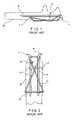
- FIGS. 1 and 2show an example of the known technique.
- two stiff stainless steel pins Aare driven longitudinally into bone B across the fracture site C. Instead of pins, screws can be utilized.
- a flexible wire Dis passed through a drill hole E on one side of the fracture site C and the two ends of the wire are crossed over the fracture site to the opposite side.
- One wireis then passed under the ends F of the two pins A, and the wire twisted and tightened at G to the other end to develop tension in the wire to produce compression across the fracture site.
- the tension band techniqueholds the tension side of the bone in apposition. Since the deep surface is under load from the articular surface, the technique results in production of compressive force across the fracture site, resulting in secure fixation, promoting early union of the fracture and early motion of the joint.
- An object of the inventionis to provide an implant device which overcomes the above problems and disadvantages by avoiding the use of the stiff pins and providing a continuous length of wire to apply the compressive force across the fracture site.
- an implant devicewhich comprises a wire element having a first portion adapted to be implanted into a bone across a fracture site in the bone, and a second portion integrally formed with the first portion and extending outside the bone for passing on a superficial surface of the bone such that the first and second portions are juxtaposed with one another, and a fixation element adapted to be secured to the bone, for cooperating with the second portion of the wire element to maintain tension force in the second portion for producing compression of the bone across the fracture site.
- a tensioning deviceis engageable with said fixation element and with said second portion to develop said tension force.
- FIG. 1is a side view of a conventional fixation device.
- FIG. 2is a plan view, from below at the posterior side in FIG. 1 .
- FIG. 3is a side view of the fixation device of the invention implanted in a bone.
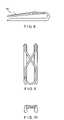
- FIG. 4is a perspective view of one embodiment of the fixation device.
- FIG. 4Ais a perspective view of another embodiment of the fixation device.
- FIG. 5is a plan view of the fixation device at the posterior side.
- FIG. 6shows the device of FIG. 5 with a tensioning device prior to application of tension force.
- FIG. 7shows application of tension force by the tensioning device.
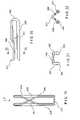
- FIG. 8is a side view of a modified embodiment of the fixation device in which the wires are crossed at the upper or superior surface of the bone.
- FIG. 9is a top plan view of the device in FIG. 8 .
- FIG. 10is an end view of the device in FIG. 8 .
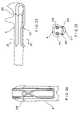
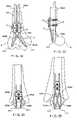
- FIG. 11is an elevational view of a different embodiment of the tensioning device in a relaxed state.
- FIG. 12shows the tensioning device of FIG. 11 in an active state in which tension is applied to the fixation device.
- FIG. 13is a sectional view taken along line 13 — 13 in FIG. 11 .
- FIG. 14is a sectional view taken along line 14 — 14 in FIG. 11 .
- FIG. 15is a plan view illustrating a further embodiment of the invention.
- FIG. 15Ais a plan view of a modification of the embodiment illustrated in FIG. 15 .
- FIG. 16is a side elevational view of the embodiment illustrated in FIG. 15 .
- FIG. 17is a top plan view showing the embodiment of FIG. 15 installed in the bone.
- FIG. 17Ais similar to FIG. 17 but illustrates the modification in FIG. 15A .
- FIG. 18is a side elevational view showing the embodiment of FIG. 15 installed in the bone.
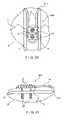
- FIG. 19is a top plan view of a further embodiment of the invention.
- FIG. 20is a side elevational view of the embodiment in FIG. 19 .
- FIG. 21is an end view as seen in the direction of arrow X in FIG. 19 .
- FIG. 22is a sectional view taking on line 22 — 22 in FIG. 20 .
- FIG. 23is a side elevational view showing the embodiment of FIG. 19 installed in the bone.
- FIG. 24is a top plan view of FIG. 23 .
- FIG. 25is a sectional view taking along line 25 — 25 in FIG. 23 .
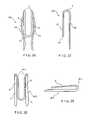
- FIG. 26is a plan view of a further embodiment according to the invention.
- FIG. 27is a side elevational view of the embodiment shown in FIG. 26 .
- FIG. 28is a plan view of a further embodiment according to the invention.
- FIG. 29is a side elevational view of the embodiment illustrated in FIG. 28 .
- FIG. 30is a plan view of a further embodiment of the invention shown installed in the bone.
- FIG. 31is an elevational view of FIG. 30 .
- FIG. 32shows a further embodiment of the invention installed in the bone.
- FIG. 33is an elevational view of FIG. 32 .
- FIG. 34shows a further embodiment installed in the bone.
- FIG. 35is a plan view showing a further embodiment installed in the bone.
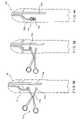
- FIG. 36is a top plan view of another embodiment of a fixation device according to the invention.
- FIG. 37is a side elevational view thereof.
- FIGS. 38 and 39illustrate successive stages of installation of the fixation device of FIG. 36 .
- FIG. 40shows the installation of the fixation device in top plan view.
- FIG. 41shows the installation of the fixation device in elevational view.
- the drawingsillustrate a fracture fixation implant device 1 for applying compression across a fracture 2 in a bone B.
- the bone Bmay be the olecranon or the patella that involve an articular surface.
- the implant device 1comprises a continuous wire element 3 formed with two spaced longitudinally extending legs 4 which are adapted to be driven into the bone B across the fracture 2 .
- the term “wire” or “wire element”is an art recognized term and covers elements having circular or rectangular cross-sections and commonly referred to as pins, wires or bars.
- the legs 4form a first portion 5 of the wire element and the legs 4 extend at their ends remote from free ends 6 thereof to bend portions 7 extending outside the bone.
- Integrally connected to bend portions 7is a second portion 8 extending backwardly from the bend portions 7 in juxtaposition with the legs 4 of the first portion 5 .
- the second portion 8includes legs 9 continuous with respective bend portions 7 and crossing one another at an intersection 10 which is located approximately at the fracture 2 .
- the legs 9extend to a connecting portion 11 in the form of a U-shaped bend to complete the continuity of the wire element 3 .
- the wire element 3is illustrated in an embedded condition in the bone so that the second portion 8 extends on a lower or posterior surface 12 of the bone.
- FIG. 4Aillustrates a modified embodiment of the wire element in which the same numerals are used to designate the same parts and primes are used for modified parts.
- the wire element 3 ′has legs 9 ′ of the second portion 8 ′ which do not cross one another as in FIG. 4 but are spaced from one another. In other respects, the wire element 3 ′ is the same as wire element 3 in FIG. 4 .
- a washer 15is secured at the posterior surface 12 of the bone by a bone screw 16 .
- the legs 9are loosely disposed below the washer 15 .
- a tensioning device 20is then installed between the washer 15 and the bend portion 11 of the wire element 3 .
- the tensioning device 20includes a rotatable cam 21 temporarily installed in the bone. In the position shown in FIG. 6 , the cam does not apply any tension to the wire element 3 .
- the camis turned from the position shown in FIG. 6 , a force is applied to the U-shaped bend 11 which develops tension in the wire element and causes the bend portions 7 to bear tightly against the distal end of the bone and produce compression across the fracture 2 . In the ninety degree position shown in FIG.
- FIGS. 8–10are similar to the embodiment of FIGS. 3–7 except that the second portion 8 with the legs 9 or 9 ′ is adapted to extend on the upper or anterior surface of the bone and tensioning of the wire element takes place at the upper surface.
- the legs 9 or 9 ′can be positioned on any superficial surface of the bone.
- the installation of the implantis carried out as follows.
- Two holesare drilled at the end of the bone at a spacing corresponding to the width of the implant as measured by the spacing of the legs 4 of the implant device thereof.
- the legs 4 of the implant deviceare impacted longitudinally into the drilled holes entering and aligning to the medullary canal.
- the distal ends of the legs 4are tapered as shown in the drawings to facilitate the impacting of the legs in the bone.
- the fracture siteis closed and the implant device is firmly seated and secured with the bone screw and washer to the bone at one end of the implant device. Compression at the fracture is achieved by turning the cam between the washer and the U-shaped bend of the implant device to effect further compression whereafter the screw is fully tightened and the washer is seated and then the cam is removed.
- the tension force in the wire elementcan be produced by the surgeon applying pressure to the U-shaped bend portoin 11 and then tightening the bone screw 16 while the wire is under tension.
- Implant devices having wire elements of different diameterare suited for different bone fractures.
- a 0.062 inch diameter wirecan be used for olecranon fractures whereas a larger diameter wire would be used for patella fractures and a smaller diameter wire element would be used for transverse lateral or medial malleolar fractures.
- the diameter of the wire of the continuous wire elementneed not be uniform along its length and it is particularly advantageous if the legs 4 of the wire element are of greater diameter than the remainder of the wire element in the legs 9 or 9 ′ and U-shaped bend 11 of the second portion 8 or 8 ′. In this way, absolute reliability of the embedded legs 4 of the first portion is obtained while flexibility of the wire element of the second portion can be obtained to achieve development of adequate tension in the wire element and resulting compression across the fracture.
- FIGS. 11–14show another embodiment of the tensioning device designated generally by numeral 30 .
- the tensioning device 30comprises lever arms 31 and 32 connected together by a hinge 33 .
- the arms 31 and 32have respective hand-engaging gripper ends 34 and 35 above the hinge 33 and actuator arms 36 and 37 below hinge 33 .
- the arm 36supports an actuating jaw 38 at its lower end and the arm 37 supports a counter-bearing jaw 39 at its lower end.
- the jaws 38 and 39are slidable with respect to one another and jaw 38 can be moved from an inactive state, as shown in FIG. 11 in which the wire element is not subjected to tensile stress by the tensioning device, to active state as shown in FIG. 12 in which the jaw 38 has been displaced to apply tension to the wire element.
- the jaw 39is connected by a strut 40 to an actuator plate 41 and the jaw 38 is connected by struts 42 to a counter-bearing plate 43 .
- the counter-bearing plate 43can be secured by a temporary pin 44 which is placed in a drill hole in the bone.
- the U-shaped bend 11 of the second portion 8 of the wire elementpasses around a back surface of the actuator plate 41 .
- first portion 5 or the second portion 8 or bothmay consist of one leg or more than two legs
- FIGS. 15 and 16therein is shown a further embodiment of a fixation device 103 according to the invention in which the first portion consists of a single leg.
- the fixation device 103has a leg 104 adapted for insertion into the bone and the leg 104 extends to a bend 107 connected to one leg 109 of the second portion 108 of the device.
- a U-shaped bend 111connects leg 109 with a second leg 109 of the second portion 108 .
- FIGS. 17 and 18illustrate the installation of the fixation device 103 in bone B.
- the leg 104is driven into the bone and extends across the fracture 102 and the second portion 108 consisting of legs 109 extends on an outer surface of the bone.
- the legs 109 of the second portionare secured to the bone by a bone screw 116 installed in a washer 115 , following the development of tension in the device in a manner previously explained.
- FIGS. 15A and 17Aillustrate a modification of the embodiment illustrated in FIGS. 15 and 17 .
- the fixation deviceis comprised of two parts 63 each having a leg 64 adapted to be implanted into the bone to form fixation portion 65 .
- the leg 64is connected by a bend 67 to second leg 69 of second portion 68 which extends backwardly and is juxtaposed with leg 64 .
- the second legs 69 of the two parts 63can be pulled to fix the fracture and develop tension in parts 63 and apply compression across the fracture.
- Washer 75is secured to the bone by bone screw 76 to connect the second legs 69 together and maintain the tension developed in the two parts 63 via the second legs 69 .
- FIGS. 19 through 25illustrate another embodiment of the fixation device according to the invention which is particularly applicable to the fixation of a fracture of the olecranon.
- This embodimentis distinguished from the earlier described embodiments in that the second portion 208 is non-planar but is bent in more than one plane to match the contour of the bone as shown with particularity in FIG. 25 .
- the fixation devicecomprises two legs 204 which are driven into the intramedullary canal across the fracture 202 .
- the legs 204extend to the bend portions 207 which extend out of the bone to the second portion 208 which comprises the crossed legs 209 connected together by the U-shaped bend 211 .
- the U-shaped bend 211is not composed only of curved portions but includes a straight portion with end radii connecting the U-shaped bend 211 to the legs 209 of the second portion 208 .
- thisnot only includes curved portions but portions which can be straight and includes such configurations as V-shaped bends and the like.
- the legs 209 of the second portion 208have a transition region 220 in which the legs are bent out of plane and pass in opposition at the sides of the bone as shown in FIG. 25 .
- the U-shaped bend 211extends out of plane and connects the ends of the legs 209 as shown in FIGS. 22 and 25 .
- the legs 204are formed with a larger diameter than the legs 209 and there is a gradual taper in diameter between the legs at the bend portions 207 .
- the U-shaped bend 211which is curved in two planes engages the surface of the bone B and forms a stabilized engagement therewith.
- FIGS. 26 and 27show another embodiment of the fixation device designated 303 which is similar to the embodiment shown in FIG. 4A .
- the same reference numeralswill be used to designate the same parts.
- the fixation device 303is particularly applicable for fractures at the distal end of the ulna which is often fractured in addition to fractures of the distal radius.
- the diameter of the wire elementsis constant throughout and the characterizing feature is that the legs 4 A which are inserted into the bone (the ulna) are not linear but have a curved or bent shape to produce a resilient effect when inserted into the intramedullary canal to produce greater fixation of the bone from the interior and help prevent the device from rotating due to resilient engagement of the legs 4 A within the intramedullary canal.
- the free ends of the legs 4 A of the fixation device 303are inserted into the intramedullary canal and squeezed together so that upon further insertion the more widely spaced bend portions of the legs 4 A are squeeze more tightly and secure the fixation device with resilient pressure against the inner wall of the intrameduallary canal.
- FIGS. 28 and 29show another embodiment 403 of the fixation device which is similar to the embodiment in FIG. 4A and the embodiment in FIGS. 26 and 27 .
- the fixation embodiment 403 in FIGS. 28 and 29is particularly adapted to fractures of the patella.
- the fixation device 403differs from that in FIG. 4A in that bend portions 411 connecting the legs 4 and 9 ′ are not in the same plane as the legs 9 ′ so that the spacing between the opposite legs 9 ′ is less than that between the opposite legs 4 as evident from FIG. 28 . Additionally, the diameter of the legs 4 is greater than the diameter of the legs 9 ′ and the change in diameter takes place gradually through the bend portions 411 .
- FIGS. 30 and 31therein the fixation device 403 is shown implanted in the patellar bone 2 across the fracture 2 in which two washers 15 and two bone screws 16 are employed.
- FIGS. 32 and 33show another embodiment of the invention similar to the embodiment in FIG. 4 but modified to provide fixation for fractures of the proximal humerus, the distal humerus, the lateral humerus, the lateral malleolus and medial malleolus.
- the embodiment illustrated in FIGS. 32 and 33 and designated 504differs from the earlier described embodiment of FIG. 4 in that legs 504 of the fixation device are not straight but are formed with straight portions 504 A and diverging non-symmetrical portions 504 B.
- the implantthereby is adapted to the configuration of the particular bone and the relatively wide aspect or spacing of the bend portions 511 as shown in FIG. 32 .
- two washers 15 and the bone screws 16are utilized as in previous embodiments.
- FIG. 34shows a variation of the embodiment in FIG. 32 adapted for being implanted in the medial malleolus.
- the legs 604instead of the legs of the implanted first portion 5 being non-parallel, the legs 604 are parallel and the legs of the second portion are bent and widen from the bend portions 611 to form diverging leg portions 608 A which merge with parallel leg portions 608 B.
- the legs of the first portioninclude diverging portions 704 A which then converge to portions 704 B which are joined to bend portions 711 connected to the crossing legs of the second portion of the fixation device.
- FIGS. 36 and 37show another embodiment of a fixation device 703 having a single straight leg 704 forming the first portion 705 of the fixation device connected by a bend portion 711 to a single leg 709 forming the second portion 708 of the fixation device. At the end of leg 709 , a 90° bend is formed to define a hook 710 .
- the leg 704 of the fixation deviceis impacted into the intramedullary canal of the bone B across the fracture 2 .
- An anchoring hole 712is drilled in the bone B and is engaged by one arm 713 of a tensioning instrument 714 .
- the other arm 715engages the hook 710 at the end of leg 708 .
- the tensioning instrumentis then closed as shown in FIG. 39 to close and compress the fracture.
- a guide hole 715is drilled in the bone B tensioning instrument 714 is then removed and hook 710 is impacted into the guide hole 715 .
- a bone screw 716 and washer 717is then installed to hold end of the leg 709 in place.
- FIGS. 36–41differs from the previously described embodiments in that instead of fixedly securing the end of leg 708 by the washer and bone screw, the hook which is impacted into the bone serves for anchoring the leg 708 and the bone screw and washer only serve for preventing the end of the leg from coming out of the bone.
- the bone screwhas to be tightened with substantial force to prevent the leg under the washer from sliding on the bone.
Landscapes
- Health & Medical Sciences (AREA)
- Orthopedic Medicine & Surgery (AREA)
- Surgery (AREA)
- Life Sciences & Earth Sciences (AREA)
- Molecular Biology (AREA)
- Animal Behavior & Ethology (AREA)
- Engineering & Computer Science (AREA)
- Biomedical Technology (AREA)
- Heart & Thoracic Surgery (AREA)
- Medical Informatics (AREA)
- Neurology (AREA)
- Nuclear Medicine, Radiotherapy & Molecular Imaging (AREA)
- General Health & Medical Sciences (AREA)
- Public Health (AREA)
- Veterinary Medicine (AREA)
- Surgical Instruments (AREA)
- Prostheses (AREA)
- Investigating Strength Of Materials By Application Of Mechanical Stress (AREA)
- Electrotherapy Devices (AREA)
- Measuring Pulse, Heart Rate, Blood Pressure Or Blood Flow (AREA)
Abstract
Description
Claims (47)
Priority Applications (11)
| Application Number | Priority Date | Filing Date | Title |
|---|---|---|---|
| US10/073,826US7037308B2 (en) | 2001-02-12 | 2002-02-11 | Implant device for applying compression across a fracture site |
| CA002475367ACA2475367A1 (en) | 2002-02-11 | 2002-06-07 | An implant device for applying compression across a fracture site |
| DE60237714TDE60237714D1 (en) | 2002-02-11 | 2002-06-07 | IMPLANT DEVICE FOR IMPLEMENTING COMPRESSION VIA A FRACTURE SITE |
| AU2002312421AAU2002312421B2 (en) | 2002-02-11 | 2002-06-07 | An implant device for applying compression across a fracture site |
| EP02739790AEP1474049B1 (en) | 2002-02-11 | 2002-06-07 | An implant device for applying compression across a fracture site field of the invention |
| JP2003567269AJP4292256B2 (en) | 2002-02-11 | 2002-06-07 | Implant orthosis that applies compression to the fracture site |
| ES02739790TES2352326T3 (en) | 2002-02-11 | 2002-06-07 | A DEVICE FOR IMPLANT TO APPLY COMPRESSION THROUGH A FRACTURE PLACE. |
| PCT/US2002/018233WO2003068080A1 (en) | 2002-02-11 | 2002-06-07 | An implant device for applying compression across a fracture site |
| AT02739790TATE481041T1 (en) | 2002-02-11 | 2002-06-07 | IMPLANT DEVICE FOR APPLYING COMPRESSION OVER A FRACTURE SITE |
| US11/377,605US7811286B2 (en) | 2001-02-12 | 2006-03-16 | Implant device for applying compression across a fracture site |
| US12/265,972US7942877B2 (en) | 2001-02-12 | 2008-11-06 | Guide system and associated method for installing an implant device adapted to apply compression across a fracture site |
Applications Claiming Priority (2)
| Application Number | Priority Date | Filing Date | Title |
|---|---|---|---|
| US26809901P | 2001-02-12 | 2001-02-12 | |
| US10/073,826US7037308B2 (en) | 2001-02-12 | 2002-02-11 | Implant device for applying compression across a fracture site |
Related Child Applications (1)
| Application Number | Title | Priority Date | Filing Date |
|---|---|---|---|
| US11/377,605Continuation-In-PartUS7811286B2 (en) | 2001-02-12 | 2006-03-16 | Implant device for applying compression across a fracture site |
Publications (2)
| Publication Number | Publication Date |
|---|---|
| US20020143339A1 US20020143339A1 (en) | 2002-10-03 |
| US7037308B2true US7037308B2 (en) | 2006-05-02 |
Family
ID=27732348
Family Applications (1)
| Application Number | Title | Priority Date | Filing Date |
|---|---|---|---|
| US10/073,826Expired - LifetimeUS7037308B2 (en) | 2001-02-12 | 2002-02-11 | Implant device for applying compression across a fracture site |
Country Status (9)
| Country | Link |
|---|---|
| US (1) | US7037308B2 (en) |
| EP (1) | EP1474049B1 (en) |
| JP (1) | JP4292256B2 (en) |
| AT (1) | ATE481041T1 (en) |
| AU (1) | AU2002312421B2 (en) |
| CA (1) | CA2475367A1 (en) |
| DE (1) | DE60237714D1 (en) |
| ES (1) | ES2352326T3 (en) |
| WO (1) | WO2003068080A1 (en) |
Cited By (20)
| Publication number | Priority date | Publication date | Assignee | Title |
|---|---|---|---|---|
| US20050010228A1 (en)* | 2003-04-10 | 2005-01-13 | Medoff Robert J. | Fracture fixation system including buttress pin and post washer |
| US20080077132A1 (en)* | 2006-09-25 | 2008-03-27 | Medoff Robert J | Bone fixation device having integral fixation member |
| US20090069851A1 (en)* | 2007-07-19 | 2009-03-12 | Acumed Llc | Bone fixation with slender spanning members disposed outside bone |
| US20090228009A1 (en)* | 2008-03-10 | 2009-09-10 | Duncan Scott F M | Olecranon Fracture Fixation System |
| US20090275987A1 (en)* | 2008-05-02 | 2009-11-05 | Thomas James Graham | Bone plate extender and extension system for bone restoration and methods of use thereof |
| US20090275947A1 (en)* | 2008-05-02 | 2009-11-05 | Thomas James Graham | Bone plate system for bone restoration and methods of use thereof |
| US20090275991A1 (en)* | 2008-05-05 | 2009-11-05 | Medoff Robert J | Contoured bone plate for fracture fixation having hook members and drill guide for same |
| US20090281577A1 (en)* | 2008-05-08 | 2009-11-12 | Thomas James Graham | Bone plate with reduction aids and methods of use thereof |
| US20110106081A1 (en)* | 2008-05-08 | 2011-05-05 | Thomas James Graham | Bone Plate with Flange Member and Methods of Use Thereof |
| EP2340777A1 (en) | 2009-12-30 | 2011-07-06 | Medartis AG | Osteosynthesis plate for fractures near joints or osteotomies |
| US20130046349A1 (en)* | 2008-05-05 | 2013-02-21 | Trimed, Incorporated | Contoured bone plate for fracture fixation having hook members and holder/impactor for same |
| US20130197518A1 (en)* | 2011-06-14 | 2013-08-01 | Amit Gupta | Intramedullary system for managing a bone fracture |
| US9011501B2 (en) | 2011-12-14 | 2015-04-21 | DePuy Synthes Products, Inc. | Device for compression across fractures |
| US9788862B2 (en) | 2014-05-12 | 2017-10-17 | DePuy Synthes Products, Inc. | Sacral fixation system |
| US10064670B2 (en) | 2014-05-12 | 2018-09-04 | DePuy Synthes Products, Inc. | Sacral fixation system |
| US10258328B2 (en) | 2015-01-12 | 2019-04-16 | Extremity Medical, Llc | Fixation assembly and method of use |
| US10543026B2 (en) | 2014-04-21 | 2020-01-28 | The General Hospital Corporation | Fracture fixation device having clip for stabilizing intramedullary nail |
| US10709485B2 (en) | 2017-06-30 | 2020-07-14 | Brian K. P. Vickaryous | Neutralization plate and related methods |
| WO2021150500A1 (en)* | 2020-01-20 | 2021-07-29 | Trimed, Incorporated | Method and apparatus for maintaining a position of a bone fragment in relationship to another bone part |
| US11490906B2 (en) | 2013-11-08 | 2022-11-08 | Trimed Incorporated | Drill guides and inserters for bone plates having hook members |
Families Citing this family (9)
| Publication number | Priority date | Publication date | Assignee | Title |
|---|---|---|---|---|
| US8979846B2 (en)* | 2004-04-12 | 2015-03-17 | Navin N Thakkar | Flexible nail assembly for fractures of long bones |
| US20060200127A1 (en)* | 2005-02-23 | 2006-09-07 | Ismail Wardak M | Method and apparatus for external fixation of bone fractures |
| SE528331C2 (en)* | 2005-04-08 | 2006-10-24 | Eulogic Ab | Surgical pin |
| JP2010537688A (en)* | 2007-08-27 | 2010-12-09 | ブクレーフ アレクサンダー | Device for osteosynthesis of humeral neck fractures and dislocation fractures |
| US8282674B2 (en)* | 2008-07-18 | 2012-10-09 | Suspension Orthopaedic Solutions, Inc. | Clavicle fixation |
| US20110029025A1 (en)* | 2009-07-31 | 2011-02-03 | Medoff Robert J | Locking pin plate assembly adapted for fracture fixation |
| JP5692802B2 (en)* | 2011-04-06 | 2015-04-01 | 学校法人 久留米大学 | Instruments and couplers used in tension band wiring method |
| CN107184266B (en)* | 2017-05-17 | 2023-11-21 | 陈伟 | Fixing device beneficial to patella fracture fixation and healing |
| CN113576644A (en)* | 2021-08-02 | 2021-11-02 | 郑州勤睿恒电子科技有限公司 | Axial tensioning clamp for fixing fracture without binding |
Citations (25)
| Publication number | Priority date | Publication date | Assignee | Title |
|---|---|---|---|---|
| US565255A (en)* | 1896-08-04 | Hair-pin | ||
| US583455A (en) | 1897-06-01 | Surgical apparatus | ||
| US1608790A (en)* | 1923-09-12 | 1926-11-30 | Johnson Walker And Tolhurst Lt | Hairpin |
| US2031483A (en)* | 1935-02-14 | 1936-02-18 | Interrante Frank | Hairpin clasp |
| US2031484A (en)* | 1935-05-01 | 1936-02-18 | Interrante Frank | Hairpin clasp |
| US3939828A (en) | 1974-09-09 | 1976-02-24 | Mohr Robert N | Method and clasp for internal osseous fixation |
| US4409970A (en)* | 1981-03-23 | 1983-10-18 | Carrel Edson D | Apparatus and method for treatment of comminuted Colles' fracture |
| US4658822A (en)* | 1985-12-31 | 1987-04-21 | Kees Jr George | Aneurysm clip |
| US4838254A (en)* | 1986-08-18 | 1989-06-13 | Georges Gauthier | Surgical fastening clip |
| US4852559A (en)* | 1988-04-21 | 1989-08-01 | Ira Chernoff | Device for pinning bone fractures |
| US5013314A (en) | 1985-11-05 | 1991-05-07 | Intreprinderea Industria Tehnico-Medicala | Instrumentation and method for inserting flexible implants into fractured bones |
| US5092889A (en)* | 1989-04-14 | 1992-03-03 | Campbell Robert M Jr | Expandable vertical prosthetic rib |
| US5312426A (en)* | 1993-03-12 | 1994-05-17 | Mizuho Ika Kogyo Kabushiki Kaisha | Surgical clip |
| US5372604A (en) | 1993-06-18 | 1994-12-13 | Linvatec Corporation | Suture anchor for soft tissue fixation |
| US5374268A (en)* | 1991-05-13 | 1994-12-20 | United States Surgical Corporation | Device and method for repairing torn tissue |
| US5441509A (en)* | 1992-04-28 | 1995-08-15 | Minnesota Mining And Manufacturing Company | Vessel clips |
| US5487746A (en)* | 1994-11-23 | 1996-01-30 | Yu; George W. | Surgical clip having a longitudinal opening through which clamped tissue protrudes |
| US5507747A (en)* | 1994-03-09 | 1996-04-16 | Yuan; Hansen A. | Vertebral fixation device |
| US5709682A (en)* | 1994-11-30 | 1998-01-20 | Medoff; Robert J. | Surgical clamp for fixation of bone fragments |
| US6066141A (en)* | 1997-07-22 | 2000-05-23 | Dall; Desmond Meiring | Bone grip |
| US6248109B1 (en)* | 1998-07-30 | 2001-06-19 | Waldemar Link (Gmbh & Co.) | Implant for interconnecting two bone fragments |
| US6302884B1 (en) | 1999-11-09 | 2001-10-16 | Bioplate, Inc. | Bone alignment and fixation device and installation method |
| US20020095157A1 (en)* | 1999-07-23 | 2002-07-18 | Bowman Steven M. | Graft fixation device combination |
| US6464710B1 (en)* | 1995-03-06 | 2002-10-15 | Cook Urological Incorporated | Releasable, surgical clamp |
| US6554835B1 (en)* | 1999-12-08 | 2003-04-29 | Ming-Kung Lee | Skull fixation device |
Family Cites Families (3)
| Publication number | Priority date | Publication date | Assignee | Title |
|---|---|---|---|---|
| US5976134A (en)* | 1995-06-01 | 1999-11-02 | Huebner; Randall J. | External fixator for repairing fractures |
| FR2722396B1 (en)* | 1994-07-18 | 1996-12-20 | Advanced Technical Fabrication | FIXING DEVICE FOR OSTEOSYNTHESIS |
| US6320884B1 (en)* | 1998-02-26 | 2001-11-20 | Tycom (Us) Inc., | Wide bandwidth Raman amplifier employing a pump unit generating a plurality of wavelengths |
- 2002
- 2002-02-11USUS10/073,826patent/US7037308B2/ennot_activeExpired - Lifetime
- 2002-06-07EPEP02739790Apatent/EP1474049B1/ennot_activeExpired - Lifetime
- 2002-06-07JPJP2003567269Apatent/JP4292256B2/ennot_activeExpired - Fee Related
- 2002-06-07ESES02739790Tpatent/ES2352326T3/ennot_activeExpired - Lifetime
- 2002-06-07DEDE60237714Tpatent/DE60237714D1/ennot_activeExpired - Lifetime
- 2002-06-07ATAT02739790Tpatent/ATE481041T1/ennot_activeIP Right Cessation
- 2002-06-07AUAU2002312421Apatent/AU2002312421B2/ennot_activeExpired
- 2002-06-07CACA002475367Apatent/CA2475367A1/ennot_activeAbandoned
- 2002-06-07WOPCT/US2002/018233patent/WO2003068080A1/enactiveApplication Filing
Patent Citations (25)
| Publication number | Priority date | Publication date | Assignee | Title |
|---|---|---|---|---|
| US565255A (en)* | 1896-08-04 | Hair-pin | ||
| US583455A (en) | 1897-06-01 | Surgical apparatus | ||
| US1608790A (en)* | 1923-09-12 | 1926-11-30 | Johnson Walker And Tolhurst Lt | Hairpin |
| US2031483A (en)* | 1935-02-14 | 1936-02-18 | Interrante Frank | Hairpin clasp |
| US2031484A (en)* | 1935-05-01 | 1936-02-18 | Interrante Frank | Hairpin clasp |
| US3939828A (en) | 1974-09-09 | 1976-02-24 | Mohr Robert N | Method and clasp for internal osseous fixation |
| US4409970A (en)* | 1981-03-23 | 1983-10-18 | Carrel Edson D | Apparatus and method for treatment of comminuted Colles' fracture |
| US5013314A (en) | 1985-11-05 | 1991-05-07 | Intreprinderea Industria Tehnico-Medicala | Instrumentation and method for inserting flexible implants into fractured bones |
| US4658822A (en)* | 1985-12-31 | 1987-04-21 | Kees Jr George | Aneurysm clip |
| US4838254A (en)* | 1986-08-18 | 1989-06-13 | Georges Gauthier | Surgical fastening clip |
| US4852559A (en)* | 1988-04-21 | 1989-08-01 | Ira Chernoff | Device for pinning bone fractures |
| US5092889A (en)* | 1989-04-14 | 1992-03-03 | Campbell Robert M Jr | Expandable vertical prosthetic rib |
| US5374268A (en)* | 1991-05-13 | 1994-12-20 | United States Surgical Corporation | Device and method for repairing torn tissue |
| US5441509A (en)* | 1992-04-28 | 1995-08-15 | Minnesota Mining And Manufacturing Company | Vessel clips |
| US5312426A (en)* | 1993-03-12 | 1994-05-17 | Mizuho Ika Kogyo Kabushiki Kaisha | Surgical clip |
| US5372604A (en) | 1993-06-18 | 1994-12-13 | Linvatec Corporation | Suture anchor for soft tissue fixation |
| US5507747A (en)* | 1994-03-09 | 1996-04-16 | Yuan; Hansen A. | Vertebral fixation device |
| US5487746A (en)* | 1994-11-23 | 1996-01-30 | Yu; George W. | Surgical clip having a longitudinal opening through which clamped tissue protrudes |
| US5709682A (en)* | 1994-11-30 | 1998-01-20 | Medoff; Robert J. | Surgical clamp for fixation of bone fragments |
| US6464710B1 (en)* | 1995-03-06 | 2002-10-15 | Cook Urological Incorporated | Releasable, surgical clamp |
| US6066141A (en)* | 1997-07-22 | 2000-05-23 | Dall; Desmond Meiring | Bone grip |
| US6248109B1 (en)* | 1998-07-30 | 2001-06-19 | Waldemar Link (Gmbh & Co.) | Implant for interconnecting two bone fragments |
| US20020095157A1 (en)* | 1999-07-23 | 2002-07-18 | Bowman Steven M. | Graft fixation device combination |
| US6302884B1 (en) | 1999-11-09 | 2001-10-16 | Bioplate, Inc. | Bone alignment and fixation device and installation method |
| US6554835B1 (en)* | 1999-12-08 | 2003-04-29 | Ming-Kung Lee | Skull fixation device |
Cited By (38)
| Publication number | Priority date | Publication date | Assignee | Title |
|---|---|---|---|---|
| US8287543B2 (en)* | 2003-04-10 | 2012-10-16 | Robert J. Medoff | Fracture fixation system including buttress pin and post washer |
| US20050010228A1 (en)* | 2003-04-10 | 2005-01-13 | Medoff Robert J. | Fracture fixation system including buttress pin and post washer |
| US20080077132A1 (en)* | 2006-09-25 | 2008-03-27 | Medoff Robert J | Bone fixation device having integral fixation member |
| US20090069851A1 (en)* | 2007-07-19 | 2009-03-12 | Acumed Llc | Bone fixation with slender spanning members disposed outside bone |
| US8475504B2 (en) | 2007-07-19 | 2013-07-02 | Acumed Llc | Method of bone fixation with slender spanning members disposed outside bone |
| US20090228009A1 (en)* | 2008-03-10 | 2009-09-10 | Duncan Scott F M | Olecranon Fracture Fixation System |
| US9408614B2 (en)* | 2008-03-10 | 2016-08-09 | Mayo Foundation For Medical Education And Research | Olecranon fracture fixation system |
| US20090275987A1 (en)* | 2008-05-02 | 2009-11-05 | Thomas James Graham | Bone plate extender and extension system for bone restoration and methods of use thereof |
| US20090275947A1 (en)* | 2008-05-02 | 2009-11-05 | Thomas James Graham | Bone plate system for bone restoration and methods of use thereof |
| US8915918B2 (en) | 2008-05-02 | 2014-12-23 | Thomas James Graham | Bone plate system for bone restoration and methods of use thereof |
| US8652179B2 (en) | 2008-05-02 | 2014-02-18 | The Cleveland Clinic Foundation | Bone plate extender and extension system for bone restoration and methods of use thereof |
| US20110213420A1 (en)* | 2008-05-05 | 2011-09-01 | Medoff Robert J | Contoured bone plate for fracture fixation having hook members |
| US8177822B2 (en) | 2008-05-05 | 2012-05-15 | Lars G. Tellman | Contoured bone plate for fracture fixation having hook members and drill guide for same |
| US20130046349A1 (en)* | 2008-05-05 | 2013-02-21 | Trimed, Incorporated | Contoured bone plate for fracture fixation having hook members and holder/impactor for same |
| US9283010B2 (en)* | 2008-05-05 | 2016-03-15 | Trimed, Incorporated | Contoured bone plate for fracture fixation having hook members and holder/impactor for same |
| US9636157B2 (en) | 2008-05-05 | 2017-05-02 | Lars G. Tellman | Contoured bone plate for fracture fixation having hook members |
| US8821508B2 (en) | 2008-05-05 | 2014-09-02 | Trimed, Incorporated | Holder/impactor for contoured bone plate for fracture fixation |
| US20090275991A1 (en)* | 2008-05-05 | 2009-11-05 | Medoff Robert J | Contoured bone plate for fracture fixation having hook members and drill guide for same |
| US8608783B2 (en) | 2008-05-08 | 2013-12-17 | The Cleveland Clinic Foundation | Bone plate with flange member and methods of use thereof |
| US8628533B2 (en) | 2008-05-08 | 2014-01-14 | The Cleveland Clinic Foundation | Bone plate with reduction aids and methods of use thereof |
| US20110106081A1 (en)* | 2008-05-08 | 2011-05-05 | Thomas James Graham | Bone Plate with Flange Member and Methods of Use Thereof |
| US20090281577A1 (en)* | 2008-05-08 | 2009-11-12 | Thomas James Graham | Bone plate with reduction aids and methods of use thereof |
| EP2340777A1 (en) | 2009-12-30 | 2011-07-06 | Medartis AG | Osteosynthesis plate for fractures near joints or osteotomies |
| US8992528B2 (en)* | 2011-06-14 | 2015-03-31 | Amit Gupta | Intramedullary system for managing a bone fracture |
| US20130197518A1 (en)* | 2011-06-14 | 2013-08-01 | Amit Gupta | Intramedullary system for managing a bone fracture |
| US9408637B2 (en) | 2011-12-14 | 2016-08-09 | DePuy Synthes Products, Inc. | Device for compression across fractures |
| US9011501B2 (en) | 2011-12-14 | 2015-04-21 | DePuy Synthes Products, Inc. | Device for compression across fractures |
| US11490906B2 (en) | 2013-11-08 | 2022-11-08 | Trimed Incorporated | Drill guides and inserters for bone plates having hook members |
| US10543026B2 (en) | 2014-04-21 | 2020-01-28 | The General Hospital Corporation | Fracture fixation device having clip for stabilizing intramedullary nail |
| US9788862B2 (en) | 2014-05-12 | 2017-10-17 | DePuy Synthes Products, Inc. | Sacral fixation system |
| US10064670B2 (en) | 2014-05-12 | 2018-09-04 | DePuy Synthes Products, Inc. | Sacral fixation system |
| US10258328B2 (en) | 2015-01-12 | 2019-04-16 | Extremity Medical, Llc | Fixation assembly and method of use |
| US10898182B2 (en) | 2015-01-12 | 2021-01-26 | Extremity Medical, Llc | Fixation assembly and method of use |
| US11864754B2 (en) | 2015-01-12 | 2024-01-09 | Extremity Medical, Llc | Fixation assembly and method of use |
| US10709485B2 (en) | 2017-06-30 | 2020-07-14 | Brian K. P. Vickaryous | Neutralization plate and related methods |
| US11553951B2 (en) | 2017-06-30 | 2023-01-17 | Brian K. P. Vickaryous | Neutralization plate and related methods |
| WO2021150500A1 (en)* | 2020-01-20 | 2021-07-29 | Trimed, Incorporated | Method and apparatus for maintaining a position of a bone fragment in relationship to another bone part |
| US11986227B2 (en) | 2020-01-20 | 2024-05-21 | Trimed Inc. | Method and apparatus for maintaining a position of a bone fragment in relationship to another bone part |
Also Published As
| Publication number | Publication date |
|---|---|
| EP1474049A4 (en) | 2008-02-27 |
| EP1474049B1 (en) | 2010-09-15 |
| ATE481041T1 (en) | 2010-10-15 |
| EP1474049A1 (en) | 2004-11-10 |
| JP2005516719A (en) | 2005-06-09 |
| DE60237714D1 (en) | 2010-10-28 |
| ES2352326T3 (en) | 2011-02-17 |
| AU2002312421B2 (en) | 2008-11-13 |
| JP4292256B2 (en) | 2009-07-08 |
| CA2475367A1 (en) | 2003-08-21 |
| AU2002312421A1 (en) | 2003-09-04 |
| WO2003068080A1 (en) | 2003-08-21 |
| US20020143339A1 (en) | 2002-10-03 |
Similar Documents
| Publication | Publication Date | Title |
|---|---|---|
| US7037308B2 (en) | Implant device for applying compression across a fracture site | |
| US7811286B2 (en) | Implant device for applying compression across a fracture site | |
| US7942877B2 (en) | Guide system and associated method for installing an implant device adapted to apply compression across a fracture site | |
| US5474554A (en) | Method for fixation of avulsion fracture | |
| US5190545A (en) | Cerclage wire positioning insert | |
| CA1149106A (en) | Bone clip | |
| CN106413575B (en) | Staple for creating and applying compression in vivo | |
| US5941878A (en) | Implantable, surgical buttressing device | |
| US6183475B1 (en) | Distal femoral osteotomy system and method | |
| US4606335A (en) | Cerclage wire passer | |
| US8906071B2 (en) | Low profile periartiular tension band plating system with soft tissue neutralization cable tunnel/channel for use on the olecranon | |
| US7410489B2 (en) | Internal cord fixation device | |
| US9962204B2 (en) | Modular bone plate | |
| US20150080967A1 (en) | System for making a bone repair | |
| US11553951B2 (en) | Neutralization plate and related methods | |
| RU2133593C1 (en) | Device foe osteosynthesis | |
| US20060200127A1 (en) | Method and apparatus for external fixation of bone fractures | |
| Hung et al. | Combined intramedullary Kirschner wire and intra-osseous wire loop for fixation of finger fractures | |
| CN219166598U (en) | Patella Fracture Fixation Device | |
| RU2083176C1 (en) | Apparatus for osteosynthesis of elbow tip | |
| Charnley | Detachment and reattachment of the great trochanter | |
| RU2132654C1 (en) | Clip for jointing bone splinters | |
| PL156056B1 (en) | Apparatus for internal anastomoses of the proximal end of the femur and method of attaching the apparatus to internal anastomoses of the proximal end of the femur |
Legal Events
| Date | Code | Title | Description |
|---|---|---|---|
| AS | Assignment | Owner name:TELLMAN, LARS G., SWEDEN Free format text:ASSIGNMENT OF ASSIGNORS INTEREST;ASSIGNOR:MEDOFF, ROBERT J.;REEL/FRAME:015116/0093 Effective date:20040816 Owner name:MEDOFF, DAVID, CALIFORNIA Free format text:ASSIGNMENT OF ASSIGNORS INTEREST;ASSIGNOR:MEDOFF, ROBERT J.;REEL/FRAME:015116/0093 Effective date:20040816 Owner name:MEDOFF, ROBERT J., HAWAII Free format text:ASSIGNMENT OF ASSIGNORS INTEREST;ASSIGNOR:MEDOFF, ROBERT J.;REEL/FRAME:015116/0093 Effective date:20040816 | |
| STCF | Information on status: patent grant | Free format text:PATENTED CASE | |
| FPAY | Fee payment | Year of fee payment:4 | |
| FPAY | Fee payment | Year of fee payment:8 | |
| MAFP | Maintenance fee payment | Free format text:PAYMENT OF MAINTENANCE FEE, 12TH YR, SMALL ENTITY (ORIGINAL EVENT CODE: M2553) Year of fee payment:12 | |
| AS | Assignment | Owner name:TRIMED INC., CALIFORNIA Free format text:ASSIGNMENT OF ASSIGNORS INTEREST;ASSIGNORS:MEDOFF, ROBERT J.;TELLMAN, LARS G.;MEDOFF, DAVID;REEL/FRAME:065473/0468 Effective date:20231105 | |
| AS | Assignment | Owner name:TRIMED, INC., CALIFORNIA Free format text:CHANGE OF NAME;ASSIGNOR:TRIMED INC.;REEL/FRAME:068916/0799 Effective date:20240816 |