US7035914B1 - System and method for transmission of data - Google Patents
System and method for transmission of dataDownload PDFInfo
- Publication number
- US7035914B1 US7035914B1US09/350,467US35046799AUS7035914B1US 7035914 B1US7035914 B1US 7035914B1US 35046799 AUS35046799 AUS 35046799AUS 7035914 B1US7035914 B1US 7035914B1
- Authority
- US
- United States
- Prior art keywords
- data
- information
- preprocessed data
- packets
- preprocessed
- Prior art date
- Legal status (The legal status is an assumption and is not a legal conclusion. Google has not performed a legal analysis and makes no representation as to the accuracy of the status listed.)
- Expired - Fee Related
Links
- 238000000034methodMethods0.000titleclaimsabstractdescription115
- 230000005540biological transmissionEffects0.000titleclaimsdescription68
- 230000009471actionEffects0.000claimsabstractdescription7
- 238000001914filtrationMethods0.000claimsdescription39
- 238000007906compressionMethods0.000claimsdescription27
- 230000006835compressionEffects0.000claimsdescription27
- 238000012937correctionMethods0.000claimsdescription23
- 230000008569processEffects0.000claimsdescription18
- 238000012545processingMethods0.000claimsdescription17
- 230000004913activationEffects0.000claimsdescription15
- 238000001514detection methodMethods0.000claimsdescription11
- 230000003068static effectEffects0.000claimsdescription7
- 230000000007visual effectEffects0.000claimsdescription5
- 230000003213activating effectEffects0.000claimsdescription4
- 230000001413cellular effectEffects0.000claimsdescription2
- 238000007781pre-processingMethods0.000claims11
- 238000012805post-processingMethods0.000claims4
- 238000012544monitoring processMethods0.000claims2
- 238000004891communicationMethods0.000abstractdescription61
- 230000008901benefitEffects0.000description21
- 238000010586diagramMethods0.000description11
- 238000013461designMethods0.000description9
- 230000003111delayed effectEffects0.000description6
- 238000005516engineering processMethods0.000description6
- 230000006870functionEffects0.000description6
- 238000012546transferMethods0.000description6
- 230000008859changeEffects0.000description5
- 238000013144data compressionMethods0.000description5
- 230000006837decompressionEffects0.000description4
- 238000012217deletionMethods0.000description4
- 230000037430deletionEffects0.000description4
- 230000010365information processingEffects0.000description4
- 230000008672reprogrammingEffects0.000description4
- 238000013478data encryption standardMethods0.000description3
- 230000009849deactivationEffects0.000description3
- 238000007726management methodMethods0.000description3
- 238000005457optimizationMethods0.000description3
- 230000001960triggered effectEffects0.000description3
- 230000001174ascending effectEffects0.000description2
- 230000000694effectsEffects0.000description2
- 239000000284extractSubstances0.000description2
- 238000009434installationMethods0.000description2
- 230000001737promoting effectEffects0.000description2
- 238000011084recoveryMethods0.000description2
- 230000002441reversible effectEffects0.000description2
- 238000012552reviewMethods0.000description2
- 230000008685targetingEffects0.000description2
- 238000012795verificationMethods0.000description2
- 208000015976Corneal dystrophy-perceptive deafness syndromeDiseases0.000description1
- 239000000969carrierSubstances0.000description1
- 230000015556catabolic processEffects0.000description1
- 238000007796conventional methodMethods0.000description1
- 238000006731degradation reactionMethods0.000description1
- 230000000994depressogenic effectEffects0.000description1
- 238000009795derivationMethods0.000description1
- 238000011156evaluationMethods0.000description1
- 238000007667floatingMethods0.000description1
- 230000006872improvementEffects0.000description1
- 238000012423maintenanceMethods0.000description1
- QCAWEPFNJXQPAN-UHFFFAOYSA-NmethoxyfenozideChemical compoundCOC1=CC=CC(C(=O)NN(C(=O)C=2C=C(C)C=C(C)C=2)C(C)(C)C)=C1CQCAWEPFNJXQPAN-UHFFFAOYSA-N0.000description1
- 238000012986modificationMethods0.000description1
- 230000004048modificationEffects0.000description1
- 238000003032molecular dockingMethods0.000description1
- 230000002093peripheral effectEffects0.000description1
- 208000011580syndromic diseaseDiseases0.000description1
- MGMXGCZJYUCMGY-UHFFFAOYSA-Ntris(4-nonylphenyl) phosphiteChemical compoundC1=CC(CCCCCCCCC)=CC=C1OP(OC=1C=CC(CCCCCCCCC)=CC=1)OC1=CC=C(CCCCCCCCC)C=C1MGMXGCZJYUCMGY-UHFFFAOYSA-N0.000description1
Images
Classifications
- G—PHYSICS
- G08—SIGNALLING
- G08B—SIGNALLING OR CALLING SYSTEMS; ORDER TELEGRAPHS; ALARM SYSTEMS
- G08B25/00—Alarm systems in which the location of the alarm condition is signalled to a central station, e.g. fire or police telegraphic systems
- G08B25/01—Alarm systems in which the location of the alarm condition is signalled to a central station, e.g. fire or police telegraphic systems characterised by the transmission medium
- G08B25/08—Alarm systems in which the location of the alarm condition is signalled to a central station, e.g. fire or police telegraphic systems characterised by the transmission medium using communication transmission lines
- G08B25/085—Alarm systems in which the location of the alarm condition is signalled to a central station, e.g. fire or police telegraphic systems characterised by the transmission medium using communication transmission lines using central distribution transmission lines
- H—ELECTRICITY
- H04—ELECTRIC COMMUNICATION TECHNIQUE
- H04L—TRANSMISSION OF DIGITAL INFORMATION, e.g. TELEGRAPHIC COMMUNICATION
- H04L67/00—Network arrangements or protocols for supporting network services or applications
- H04L67/01—Protocols
- H04L67/10—Protocols in which an application is distributed across nodes in the network
- H—ELECTRICITY
- H04—ELECTRIC COMMUNICATION TECHNIQUE
- H04L—TRANSMISSION OF DIGITAL INFORMATION, e.g. TELEGRAPHIC COMMUNICATION
- H04L12/00—Data switching networks
- H04L12/02—Details
- H04L12/16—Arrangements for providing special services to substations
- H04L12/18—Arrangements for providing special services to substations for broadcast or conference, e.g. multicast
- H—ELECTRICITY
- H04—ELECTRIC COMMUNICATION TECHNIQUE
- H04L—TRANSMISSION OF DIGITAL INFORMATION, e.g. TELEGRAPHIC COMMUNICATION
- H04L51/00—User-to-user messaging in packet-switching networks, transmitted according to store-and-forward or real-time protocols, e.g. e-mail
- H04L51/21—Monitoring or handling of messages
- H04L51/224—Monitoring or handling of messages providing notification on incoming messages, e.g. pushed notifications of received messages
- H—ELECTRICITY
- H04—ELECTRIC COMMUNICATION TECHNIQUE
- H04L—TRANSMISSION OF DIGITAL INFORMATION, e.g. TELEGRAPHIC COMMUNICATION
- H04L51/00—User-to-user messaging in packet-switching networks, transmitted according to store-and-forward or real-time protocols, e.g. e-mail
- H04L51/56—Unified messaging, e.g. interactions between e-mail, instant messaging or converged IP messaging [CPM]
- H—ELECTRICITY
- H04—ELECTRIC COMMUNICATION TECHNIQUE
- H04L—TRANSMISSION OF DIGITAL INFORMATION, e.g. TELEGRAPHIC COMMUNICATION
- H04L67/00—Network arrangements or protocols for supporting network services or applications
- H04L67/01—Protocols
- H04L67/02—Protocols based on web technology, e.g. hypertext transfer protocol [HTTP]
- H—ELECTRICITY
- H04—ELECTRIC COMMUNICATION TECHNIQUE
- H04L—TRANSMISSION OF DIGITAL INFORMATION, e.g. TELEGRAPHIC COMMUNICATION
- H04L67/00—Network arrangements or protocols for supporting network services or applications
- H04L67/01—Protocols
- H04L67/04—Protocols specially adapted for terminals or networks with limited capabilities; specially adapted for terminal portability
- H—ELECTRICITY
- H04—ELECTRIC COMMUNICATION TECHNIQUE
- H04L—TRANSMISSION OF DIGITAL INFORMATION, e.g. TELEGRAPHIC COMMUNICATION
- H04L67/00—Network arrangements or protocols for supporting network services or applications
- H04L67/50—Network services
- H04L67/55—Push-based network services
- H—ELECTRICITY
- H04—ELECTRIC COMMUNICATION TECHNIQUE
- H04W—WIRELESS COMMUNICATION NETWORKS
- H04W4/00—Services specially adapted for wireless communication networks; Facilities therefor
- H04W4/12—Messaging; Mailboxes; Announcements
- H—ELECTRICITY
- H04—ELECTRIC COMMUNICATION TECHNIQUE
- H04W—WIRELESS COMMUNICATION NETWORKS
- H04W84/00—Network topologies
- H—ELECTRICITY
- H04—ELECTRIC COMMUNICATION TECHNIQUE
- H04L—TRANSMISSION OF DIGITAL INFORMATION, e.g. TELEGRAPHIC COMMUNICATION
- H04L51/00—User-to-user messaging in packet-switching networks, transmitted according to store-and-forward or real-time protocols, e.g. e-mail
- H04L51/04—Real-time or near real-time messaging, e.g. instant messaging [IM]
- H—ELECTRICITY
- H04—ELECTRIC COMMUNICATION TECHNIQUE
- H04L—TRANSMISSION OF DIGITAL INFORMATION, e.g. TELEGRAPHIC COMMUNICATION
- H04L51/00—User-to-user messaging in packet-switching networks, transmitted according to store-and-forward or real-time protocols, e.g. e-mail
- H04L51/58—Message adaptation for wireless communication
- H—ELECTRICITY
- H04—ELECTRIC COMMUNICATION TECHNIQUE
- H04W—WIRELESS COMMUNICATION NETWORKS
- H04W4/00—Services specially adapted for wireless communication networks; Facilities therefor
- H04W4/06—Selective distribution of broadcast services, e.g. multimedia broadcast multicast service [MBMS]; Services to user groups; One-way selective calling services
Definitions
- the present inventionrelates generally to communication systems, and more particularly to both wired and non-wired data transmission communication systems.
- Multimediahas made the computer much more than a number crunching, word processing tool. Rather, multimedia has turned the computer into an indispensable educational, entertainment and information tool. By combining the realism of sound, graphics and video, multimedia applications have revolutionized the way individuals work, entertain and stay informed. Multimedia has also helped drive the computer industry to provide tools which can be used by the most novice computer user making computers almost as prevalent in our society as television or radios. Also, multimedia has driven manufacturers to build smaller and more powerful and mobile systems—leading a technological revolution not matched in our history.
- wireless communication technologyhas allowed individuals to be notified anywhere and anytime of information. Wherever an individual is, i.e. whether away from the office or in the car, he or she can be informed of information, such as new meeting schedules, dinner plans or even life or death emergencies.
- on-line serviceshave revolutionized the distribution of information in our society by making available, to individuals throughout the world, endless amounts of information on every subject imaginable.
- the Internet and on-line serviceshave brought together the world through a linkage of interconnected computer systems which can share information almost instantaneously.
- E-mailelectronic mail
- the present inventionprovides a system and method for data communication connecting on-line networks with on-line and off-line computers.
- the present systemprovides for broadcast of up to the minute notification centric information thereby providing an instant call to action for users who are provided with the ability to instantaneously retrieve further detailed information.
- various pieces of information happening around the worldare currently available in a sender initiated paradigm where individuals have to seek out the information.
- the notification centric portions of that information that lives in an electronic mediumis wirelessly broadcast on a nationwide basis to wireless receiving devices which are attached to personal computers or other computing devices.
- Wirelessly broadcasted URL'sassociated with the data, are embedded in data packets and provide an automated wired or wireless connection back to the information source for obtaining detailed data.
- the present inventionunlike other wireless systems provides for a combination of broadcast, narrowcast and pointcast transmission. That is, information can be transmitted wirelessly to everyone (broadcast), to a subset of users (narrow cast) or to one user (pointcast).
- the present inventionfurthermore provides multiple viewers which listen to the airwaves and have the ability to filter against the broadcast with specific action.
- a message serverprovides different types of filters with the ability to parse data.
- the message serveris designed such that third party developers can write different types of multimedia viewers which can easily be downloaded to the user system and automatically registered with the message server.
- the viewerscan thus be controlled through the interface of the present invention and multiple viewers and multiple controllers of such viewers can dynamically be added and controlled.
- the viewers of the present inventionhave capability to do different things for multimedia, such as sound, video, animation and so forth.
- data parsed from a plurality of incoming data feeds from existing information sourcesis prepared for optimized wireless transmission and then transmitted nationwide to connected and non-connected computing devices thereby extending the reach of existing information sources, such as Internet and on-line services.
- a global communications serverrecombines, decodes, decrypts and decompresses the incoming data.
- the communications serversends a message to the user interface alert panel causing an animated icon to fly to the alert panel notifying a user that a new message has arrived. Upon clicking the icon, the appropriate viewer is launched. Users can then display the context of the data on their computers.
- Wirelessly broadcasted URL's and on-line addressesare embedded in multimedia viewers and provide an automated wired connection/link back to the information sources to obtain detailed information.
- Informationsuch as advertisements and promotional broadcasts, can be embedded in a multimedia viewer as well as automatically activated on a scheduled or triggered basis. Information is thus modified and updated instantaneously and wirelessly. Additional information services can be activated wirelessly through broadcast activation codes which can enable or disable services.
- the present inventionalso provides a method based on Reed-Solomon code which is used to derive redundant data packets thereby minimizing redundancy, and maximizing flexibility and packet recovery ability.
- the information provided from the information sources and transmitted to the central broadcast server to be consolidated in accordance with the present invention and then transmitted wirelessly nationwide to personal computers and other computing devicescan also be sent simultaneously via a wired connection to the same personal computers and computing devices having Internet/World Wide Web (WWW) access (direct or via on-line service providing Internet and Web access).
- WWWWorld Wide Web
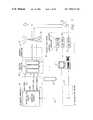
- FIG. 1is schematic diagram of a wireless communication network including information mirroring, selection addressing, bandwidth optimization, message server design and URL broadcast and hotlinks in accordance with the present invention
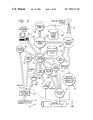
- FIG. 2is a block diagram of the wireless communication network illustrated in FIG. 1 ;
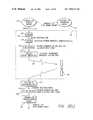
- FIG. 3( a )is a block diagram of the head-end high-level software architecture for communication over a paging network in accordance with the present invention
- FIG. 3( b )is a block diagram of the head-end high-level software architecture for communication over a Vertical Blanking Interval (VBI) in accordance with the present invention
- FIG. 3( c )is a block diagram of the head-end high-level software architecture for communication via satellite in accordance with the present invention
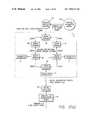
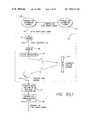
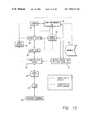
- FIG. 4is a flow chart illustrating the transfer of data from the content manager to the wireless broadcast network
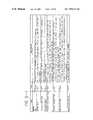
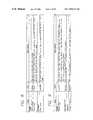
- FIG. 5is a table illustrating the 8-bit binary format for information notification data blocks
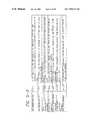
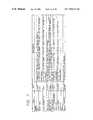
- FIG. 6is a table illustrating the 8-bit binary format for personal alert notification data blocks
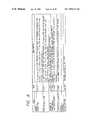
- FIG. 7is a table illustrating the 8-bit binary format for messages
- FIG. 8is a table illustrating the 8-bit binary format for packets
- FIG. 9is a table illustrating the 8-bit binary format for single packet data blocks
- FIG. 10is a detailed schematic diagram of the message server design illustrated in FIG. 1 ;
- FIG. 11is an illustration of a user remote interface for controlling the computer interface in accordance with the present invention.
- FIG. 12is a flow chart of an algorithm for extracting and processing the Internet source URL for messages broadcast over the wireless communication network illustrated in FIG. 1 ;
- FIG. 13is a flow chart of an algorithm for generating and processing E-mail alerts in accordance with the present invention.
- FIG. 14is a flow chart of an algorithm for address and message filtering in accordance with the present invention.
- FIG. 15is a detailed flow chart of the algorithm illustrated in FIG. 14 for targeting data to a user utilizing physical and virtual addresses;
- FIG. 16is an illustration of the columns of a data group encoded by an encoder using a modified Reed-Solomon code for deriving parity-check packets
- FIG. 17is a flow chart of an algorithm for deriving parity-check packets as illustrated in FIG. 16 ;
- FIG. 18( a )is a flow chart of an algorithm for data compression which combines-Huffman compression and dictionary-based compression in accordance with the present invention
- FIG. 18( b )is a flow chart of an algorithm for data decompression of the compression algorithm illustrated in FIG. 18( a );
- FIG. 19( a )is a flow chart of an algorithm for data compression using differencing in accordance with the present invention.
- FIG. 19( b )is a flow chart of an algorithm for data decompression of the compression algorithm illustrated in FIG. 19( a );
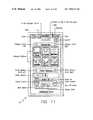
- FIG. 20is an illustration of a user interface alert panel as seen by a user
- FIG. 21is a flow chart of an algorithm for implementing the initialization procedure for the user interface alert panel illustrated in FIG. 20 ;
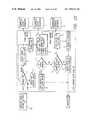
- FIG. 22is a flow chart of the algorithm for implementing process EMIT messages procedure for the user interface alert panel
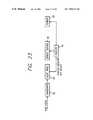
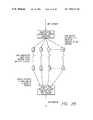
- FIG. 23is a block diagram illustrating how star feed messages are processed in accordance with the present invention.
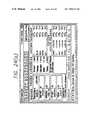
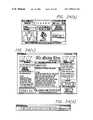
- FIG. 24( a )is a depiction of a market scoreboard viewer
- FIG. 24( b )is a depiction of a football viewer
- FIG. 24( c )is a depiction of a newspaper viewer
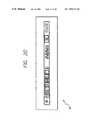
- FIG. 24( d )is a depiction of a stock ticker viewer.
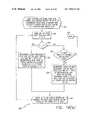
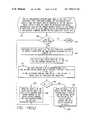
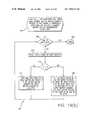
- FIG. 25is a flow chart of the algorithm for
- a wireless communication system 10including selection addressing 28 , connecting on-line information sources 12 with on- and off-line computers, such as personal computer 14 , is illustrated.
- the wireless communication system 10turns a personal computer 14 or other computing device into a personal wireless information and messaging center.
- the present inventionmay be used to interact wirelessly with any computing device, for illustrative purposes, the present invention will be described and illustrated utilizing a personal computer 14 .
- computing devicesmay include consumer electronic devices including computing capabilities.
- the data/information which is transmitted in accordance with the present inventionmay be in the form of voice (audio), video, data or a combination thereof.
- the present systemprovides for broadcast of up to the minute notification centric information thereby providing an instant call to action for users who are provided with the ability to instantaneously retrieve further detailed information.
- various pieces of information happening around the worldare currently available from information sources 12 in a sender initiated paradigm where users have to seek out the information.
- the notification centric portions of that information that lives in an electronic mediumis wirelessly broadcast on a nationwide basis to wireless receiving devices 32 which are connected to personal computers 14 or other computing devices.
- the userUpon receipt of the information at the personal computer 14 , the user is notified through different multimedia viewers 20 that there is an incoming message.
- the messagecan be of something that is happening at the present moment anywhere around the world.
- the present inventionwill automatically make a wired connection to the information source 12 utilizing the user's preferred on-line browser which will direct the user to the particular location on the Internet service provider where the user can receive detailed information.
- the information source 12may be a private Internet provider such as Quotecom, corporate Internet provider or an on-line service provider such as America On-Line, Compuserve, Prodigy, the Microsoft Network, and the like.
- a browseris a known software tool used to access the information source 12 via the providers.
- Known browser softwareincludes Netscape, Netscape Navigator, Microsoft Explorer, Mosaic and the like.
- the present inventionis designed to operate with any of these known or developing web browsers.
- the present inventionunlike other wireless systems provides for a combination of broadcast, narrowcast and pointcast transmission. That is, information can be transmitted from a central broadcast server 34 wirelessly to everyone (broadcast), to a subset of users (narrow cast) or to one user (pointcast).
- the central broadcast server 34operates effectively as a network operations center.
- the present inventionfurthermore provides multiple viewers 20 which listen to the airwaves and have the ability to filter against the broadcast with specific action.
- a message serverprovides different types of filters with the ability to parse data. The filters control which messages are handled by a particular viewer 20 .
- the message serveris designed such that third party developers can write different types of multimedia viewers 20 which can easily be downloaded to the user system and automatically registered with the message server.
- the viewerscan thus be controlled through the interface of the present invention and multiple viewers 20 and multiple controllers of such viewers can dynamically be added and controlled.
- the signalsare encoded for multimedia events, the viewers 20 of the present invention have capability to utilize multimedia capability.
- data parsed from a plurality of incoming data feeds 16 from existing information sources 12is wirelessly transmitted by the central broadcast server 34 nationwide through a commercial wireless carrier 36 to connected and non-connected computing devices 14 thereby extending the reach of existing information sources 12 , such as Internet and on-line services.
- the message server design 18recombines, decodes, and decompresses the incoming data.
- a communications server 38 in the message server design 18notifies a user interface alert panel 50 which presents an icon, which when clicked, notifies appropriate viewers 20 which are registered to display particular data. Users can then display the context of the data on their computers 14 .
- Wirelessly broadcasted Uniform Resource Locator's (URL's) 22associated with the data, are embedded in multimedia data packets and provide an automated wired or wireless connection or link 22 back to the information source 12 for obtaining detailed data.
- a network path to an information source 12is identified by the URL having a known syntax for defining a network.
- Datasuch as advertisements and promotional broadcasts, can thus be embedded in a multimedia viewer as well as automatically activated on a scheduled or triggered event.
- an advantage of the present inventionis that data can be modified and updated instantaneously and wirelessly. Additional services can be activated wirelessly and existing services disabled through broadcast activation codes which can enable or disable addresses thus turning services on and off.
- a remote computer 14can receive information instantly—even while it is off-line (i.e. not connected to the Internet or some other on-line service).
- a userhas the ability to receive “on-line” information even when the user is “off-line”.
- a usercan simultaneously, using the same computer 14 , work on a conventional application, such as a spreadsheet or word processing program, and monitor information which is being transmitted wirelessly.
- the user computer 14 of the present inventionincludes a microprocessor connected to a system bus and supported by read only memory (ROM) and random access memory (RAM) which are also coupled to the system bus.
- the RAMis the main memory into which the operating system and application programs are loaded.
- the RAMmay also support Internet services, including but not limited to the file transfer protocol (FTP) and simple mail transfer protocol (SMTP) or E-mail.
- FTPfile transfer protocol
- SMTPsimple mail transfer protocol
- a CD ROMwhich is optional, is connected to the system bus and is used to store a large amount of data.
- I/O controllersincluding but not limited to the video controller, audio controller and mouse controller may also be connected to the system bus.
- a modemenables communication over a network to other information sources or computers.
- the operating system of the computermay be Windows '95 (TM), WINDOWS NT (TM) or any other known and available operating system.
- the user computerhas a 486 PC or higher processor, 16 MB of RAM, Windows 95 operating system, at least 20 MB available on hard disk for storing the executable programs, support files and databases, sound and video cards, monitor, mouse or other equivalent pointing device, an ISA slot for receiving an internal 16 Bit ISA receiver card, or serial port.
- the receiver card installed in the ISA slot in the user computer 14interacts with the wireless receiver 32 .
- the wireless receivermay also be accessed via the serial port.
- One skilled in the artwill recognize that the present invention is not limited to the particular configuration discussed above. Rather, the present invention may be implemented on other computer systems and configurations, including but not limited to Macintosh or Unix computers, televisions, telephones, appliances and so forth.
- the wireless communication system 10 of the present inventionincludes information mirroring 26 , selection addressing 28 , bandwidth optimization 30 , receiving means 32 , message server design 18 and URL broadcast and hot links 22 .
- information sources 12such as the Internet, on-line services and other information sources, provide data feeds, including real time data feeds, to a network of servers 33 in the central broadcast server 34 .
- These data feedsonce they have been parsed, compressed, encrypted and packetized based on feed and data type, provide the basis for outgoing broadcast sent immediately or on a scheduled basis.
- the data feedsinclude but are not limited to, electronic mail (E-mail) and other personal alert notifications, news, sports, and financial stories, premium and special event feeds, advertisements/promotions, graphics, sounds, and scheduled updates.
- the data feeds generated by the information sources 12are in digital form and divided into one or more data packets.
- FIG. 2a block diagram 100 of the software architecture for communications between the information sources 12 and central broadcast server 34 prior to transmission to users is illustrated.
- information sources 12provide data feeds to the central broadcast server 34 which performs selection, scheduling and addressing 28 .
- real time data feeds from the Internet 13 in the information source 12are provided to a network of servers 33 in the central broadcast server 34 , such as the FTP server 102 and the SMTP server 104 illustrated in FIG. 2 .
- the datawhich can include but is not limited to stock quotes, weather, lotto, E-mail, etc.
- parserssuch as the stock quote parser 106 , weather parser 108 , lotto parser 110 and mail parser 112 , and then transmitted to the content manager 114 located in the central broadcast server 34 .
- Datais also provided to the central broadcast server 34 by sources 116 which provide software and hardware for a mainstream connection, via FM radio, with the source 118 .
- This kind of datais also parsed by various parsers, such as Reuters 120 , COMDEX 122 and TSN 126 .
- the present inventionis not limited to the information sources or parsers described herein. Rather, any type of information source and corresponding parser may be used.
- the parsed datais then transmitted to the content manager 114 .
- the central broadcast server 34also provides a registration/subscription processor 128 via the World Wide Web (WWW) database or alternatively, other means.
- the WWWis a collection of servers of the Internet that utilizes the Hypertext Transfer Protocol (HTTP).
- HTTPHypertext Transfer Protocol
- a usercan register and subscribe to receive broadcasts provided by the present invention via the user computer 14 .
- the information provided by the useris transmitted to a subscriber database 130 which is utilized by the central broadcast server to determine which subscribers receive which types of content.
- the content manager 114determines how different types of information are handled. In particular, it specifies priorities for different types of information, and decides which pieces of information will be transmitted and which will be rejected. It also applies scheduling rules 132 to determine when messages should be scheduled to be transmitted to the user. In addition, the content manager 114 is responsible for determining what format the information should be sent in, what compression method to use, and who information should be sent to. The compression method and format are determined by the type of information. When and if the information should be sent, who it should be sent to, and the priority of the information are determined based on the type of information, the time of day, the day of the week, and the specific date.
- these rulescould be used to specify that certain news feeds go to premium subscribers only except during certain hours of the day. Or it could be used to say that stock quotes are a low priority during hours the stock exchanges are closed, on Saturday and Sunday, and on market holidays.
- the content manager 114also has the ability to detect and remove duplicate messages.
- the content manager 114communicates with the information gateway 134 which is responsible for resolving logical information inside the system to physical information needed for the wireless gateway 136 .
- the information gateway's 114 dutiesinclude, but are not limited to: resolving service identifications (ids) and addresses from a logical address and managing the content budget rules 138 to ensure that the total content quota is not exceeded.
- the content budgetis based on the number of bytes which may be transmitted in an hour.
- the algorithm usedmanages the budget by evaluating the total bytes allowed in the hour, the priority of the information, the total bytes sent so far in the hour and the maximum instantaneous rate at which information may be sent to determine whether to send a message.
- the goalbeing to ensure that sending low priority information early in the hour will not prevent high priority information from being sent late in the hour.
- the input to the information gateway 134is primarily logical, it could be exchanged for an information gateway 134 which could send the information to be transmitted over another medium, such as the Internet.
- the information gateway 134enforces priorities to ensure that higher priority information is sent before lower priority information.
- the wireless gateway 136prepares data blocks for transmission over a wireless broadcast network, including but not limited to transmission via a paging network ( FIG. 3( a )), Vertical Blanking Interval (VBI) ( FIG. 3( b )) or satellite ( FIG. 3( c )), narrow and broadband PCS, GSM, VSB television, cellular and other developing wireless technologies.
- VBIVertical Blanking Interval
- the data blockscan be transmitted by a digital, analog or FM subcarrier.
- the present inventionis designed to operate with any of the above known or developing transmission networks.
- FIG. 3( a )a block diagram of the head-end high-level software architecture for transmission over a paging network 37 in accordance with the present invention is illustrated.
- the paging network 37allows information to be transmitted over paging frequencies to paging receivers 32 which are connected to a user computer 14 .
- the wireless gateway 136transmits information to a plurality of paging terminals 39 which transmit the information to paging transmitters 41 .
- the paging transmitters 41transmit the information to receivers 32 , which only receive information having specific addresses as noted in detail below.
- the paging terminals 39 and transmitters 41are preferably located nationwide to provide information access to all users. Paging terminals communicate with one another via the Inter and Intra System Protocol (TNPP).
- TNPPInter and Intra System Protocol
- Informationis typically received at a paging terminal 39 and eventually transmitted to a separate paging transmitter 41 through a radio control link.
- the link between the paging terminal 39 and the radio controlled link to the paging transmitters 41can be a satellite link.
- information from the paging terminal 39is transmitted to a satellite via an uplink.
- the informationis then modulated onto the carrier of the radio control link for transmission to the paging transmitters 41 .
- any commercial paging carrierwhich can transmit information wirelessly can be utilized in accordance with the present invention.
- messagesare sent on groups of pooled addresses and received at the user end on corresponding pools of addresses.
- informationis multiplexed over multiple addresses but is reassembled at the user end as if sent to a single address. This allows utilization of available network bandwidth that could not be utilized with a single address.
- the data to be transmitted over a paging network 37first goes through a process of packetization, encryption, compression and forward error correction methods, as described in detail below.
- the output of this processis 1 to n number of data packets, depending on the level of error correction, and type of compression/encryption applied to the data.
- the paging networkaddresses an individual or group by broadcasting on a particular address or capcode. By programming a paging device to listen to the individual capcode, the device is then capable of receiving the particular message.
- the inherent problem with the FLEX protocol which is used by major paging carriersis that there is a limit to the number of messages which can be sent to any one particular capcode at a time.
- FLEX encoding rulesonly 2 messages per capcode can exist at any one time in a particular FLEX frame, which is approximately 1.875 seconds.
- a FLEX frameis capable of transmitting on four different phases or channels at a particular time, hosting several messages per frame.
- the FLEX encoding rulesonly specify the maximum messages per capcode frame, but there is no limit set to the number of capcodes.
- the data messageis multiplexed over a number of capcodes (i.e. uses multiple capcodes to send one message).
- the present inventionwould send the 16 packets of the data message to 8 different capcodes.
- the data rateis approximately 8 times faster and fully utilizes the FLEX frame.
- the server softwareassigns the packets in a “round-robin” fashion, assigning packets 1–8 to capcodes 1–8, respectively, and packets 9–16 to capcodes 1–8, respectively.
- the softwaredecodes the messages in a similar manner.
- a userwould subscribe to a particular service, which essentially translates into a set of capcodes which are programmed into the receiving device 32 ( FIG. 3( a )).
- the receiving device 32then receives the packets which are transmitted to that particular set of capcodes.
- the user softwarewould initialize the receiving device 32 with the same 8 capcodes as on the transmit side. The packets received with those 8 capcodes would then be combined into the original data message.
- FIG. 3( b )a block diagram of the head-end head-level software architecture for transmitting data over a Vertical Blanking Interval (VBI) of a television signal 135 in accordance with the present invention is illustrated.
- the wireless gateway 136transmits information through a standard RS232 interface 137 and modem 139 , which through a telephone line 141 communicates with a modem 143 at a television network broadcast transmission site.
- the informationis forwarded from the modem 139 to a VBI encoder 145 which combines the VBI data with a standard television video signal 153 .
- the encoded datais then forwarded to a satellite uplink transmitter 147 which transmits the television signal 153 to a satellite antenna/receiver 151 via satellite 149 .
- a VBI decoder 155then extracts the data from the television video signal and performs physical device addressing.
- the VBI encoder and decodermay be any commercially available encoder and decoder designed for VBI transmission.
- the communications server 38is modified to interface with the driver for the VBI decoder 155 which is provided by the manufacturer of the decoder hardware.
- the wireless gateway 136transmits information through a standard RS232 interface 159 and modem 161 , which through a telephone line 163 communicates with a satellite modem 165 .
- the informationis forwarded from the satellite modem 165 to an uplink transmitter 167 which transmits the data to a satellite dish or antenna 171 via satellite 169 .
- the satellite dish or antenna 171receives the RF signal from the satellite 169 .
- a standard satellite receiver PC card 32converts the RF signal into PC compatible data.
- the communications server 38is modified to interface with the receiver card driver provided by the manufacturer of the receiver PC card 32 to receive data from a standard satellite data receiver.
- the content manager 114utilizes a content programming station 140 to control the content of programming.
- the content programming station 140allows a programming manager (not shown) to alter the rules used by the content manager 114 .
- the content programming station 140will also be used to review and alter content schedules and schedule ad hoc messages. For example, if there are news feeds which must be manually filtered to locate acceptable content, the news feeds would appear at the content programming station 140 for the program manager to review.
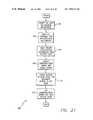
- FIG. 4A flowchart illustrating the algorithm for implementing the processing of data prior to transmission is illustrated in FIG. 4 .
- Information from the content manageris initially applied to the information gateway 134 (step 115 ) which resolves its logical destination address to a physical wireless address based on information in the subscriber database (step 117 ).
- the datais then applied to the wireless gateway 136 which creates the data block, performs packetization, compression, encryption, and so forth to prepare the data block for transmission over the wireless broadcast network (step 119 ).
- the data blockis then transmitted over the wireless broadcast network by the commercial carrier 26 .
- TCP/IPTransport Control Protocol/Internet Protocol
- each data packet transmitted by the information source 12includes a header, packet data and information to ensure proper transmission to the central broadcast server 34 .
- an error correction codeis typically added to each packet prior to transmission.
- the data blockis broken down into messages and messages are broken into packets. Each packet is accompanied by a message id and a sequence number.
- All packets belonging to the same messagecontain the same message id.
- a sequence numberdenotes the position of the packet inside the group. Some packets will also carry the total number of packets belonging to the message.
- Each packet headerincludes the following: packet type (4 bits), total packets included (1 bit), message identifier (11 bits) and packet sequence number (1 byte).
- TCP/IPTransmission Control Protocol/IP
- OSIOpen Systems Connection
- the information sources 12thus provide the information basis for outgoing broadcast transmitted by the central broadcast server 34 through nationwide wireless broadcast network immediately or on a scheduled basis to both on- and off-line computers 14 .
- the central broadcast server 34receives the data packets from the information source 12 , it pre-processes the data packets and wirelessly transmits the data packets to both on- and off-line computers 14 . Consequently, computer users receive real time notifications of information, including but not limited to breaking headlines, sport scores, weather disasters, financial information and even the arrival of new electronic mail. It will be understood by one skilled in the art that the information consolidated at the central broadcast server 34 may additionally be sent via a wired connection to a personal computer or computing device.
- information sources 12also receive requests from remote personal computers 14 or other computing devices for more detailed information.
- Wirelessly transmitted URL's 22associated with incoming information, are embedded in the broadcast message from the central broadcast server 34 , which is displayed in the multimedia viewers 20 and provide an automated direct wired or wireless line connection 22 back to the information source 12 such that detailed data may be automatically downloaded to the user's computer 14 .
- data generated by the information sources 12is fed to the central broadcast server 34 , which processes the incoming data packets by parsing the feeds 16 against specific filters, encoding the data and creating desired broadcast feeds for wireless transmission as described in detail below.
- the data packets generated by the information sources 12are transmitted to the central broadcast server 34 , where they are internally processed before being wirelessly transmitted through a carrier 36 to one or more personal computers 14 or other computing sources via selective receivers 32 .
- the packetsarrive at a user receiver 32 , they are reassembled by the communications server 38 in the message server design 18 into the original message.
- the carriercan be a local, regional, nationwide or worldwide carrier.
- Information from the content providersis first formatted according to the proprietary EMIT protocol before being prepared for transmission over the wireless broadcast network.
- FIGS. 5 and 6Data from the information sources is packed into 8-bit binary format data blocks in the central broadcast server 34 .
- the two basic data block typesare illustrated in FIGS. 5 and 6 .
- FIG. 5defines the 8-bit binary format for “information” notification data blocks
- FIG. 6defines the 8-bit binary format for “personal alert” notification data blocks.
- Information notification data blocksillustrated in FIG. 5
- FIG. 6contain general information targeted to all users, including but not limited to news headlines and stories, sports scores, financial market data, and so forth.
- Personal alert notificationsillustrated in FIG. 6 , contain alert information targeted to specific users, including but not limited to notifications regarding E-mail arrival, stock prices reaching specified values, Internet telephone calls, chats or meeting notices.
- the data packetsPrior to transmission, at the central broadcast server 34 , the data packets are encoded using a protocol suitable for the transmission of information. Data blocks are packetized for transmission over the wireless broadcast network using transmission protocols.
- TMIn the preferred embodiment, which uses the paging network as the means of wireless broadcast or transmission, Motorola's FLEX (TM) protocol is utilized. Alternatively, other protocols, such as traditional Post Office Code Standardization Advisory Group (POCSAG) protocol, Motorola's REFLEXTM and INFLEXIONTM, AT&T's protocol derived from CDPD or other developing protocols may be used as well. Most wireless transmission protocols, including POCSAG, provide random error correction as well as error detection capabilities, thereby adding error detection and correction capabilities to the information link.
- POCSAGPost Office Code Standardization Advisory Group
- a data blockmay be enclosed in a single packet, or divided into messages which in turn are subdivided into one or more packets.
- the message format protocolis illustrated in FIG. 7 . Large data blocks are divided into messages for efficiency in transmission.
- the data block headeris sent as part of the message.
- the header type itemis used to distinguish between the data block and message headers.
- the basic unit of transmissionis the packet.
- Each packetincludes a header and contents.
- the information contained in the headerdefines the packet's contents.
- the first 4 bits in the packetdefine the packet type.
- Standard packetsare used for transmitting data blocks too large for a single packet.
- each packetcontains the ID of the message to which it belongs, and the packet number denoting the position of the packet inside the message. This allows the software at the user receiving end to rebuild the original messages and data block from the individual packets.
- forward error correction packetsPrior to transmitting the packets in a message, forward error correction packets are added as described in detail below.
- the single packet data blockis used where the complete data block can fit into one packet.
- the packet headeris followed by the data block header and data block contents.
- Binary alert packetsare a special case of the single packet data block and are reserved for the predefined alert notifications described above.
- the central broadcast server 34performs the following processes on the incoming data: compression, forward error correction, encryption, packetization and wireless broadcast format encoding.
- the formatted data packetsare queued for wireless transmission to their respective destinations which could include one or more remote personal computers 14 or computing devices.
- the formatted data packetsare either immediately wirelessly transmitted to their respective destinations or stored into available memory for subsequent wireless transmission to their respective destinations.
- the central broadcast server 34includes a non-volatile storage medium for longer term storage of data programmed for subsequent wireless transmission to one or more users.
- the datais encrypted prior to wireless transmission so that anyone surreptitiously coming into possession of the data would not be able to convert the data to clear form for use.
- the user softwareis designed such that it can properly decrypt the data once it is received on the user end.
- datais encrypted using the Data Encryption Standard (DES) algorithm.
- DESData Encryption Standard
- DESData Encryption Standard
- DSSDigital Signature Standard
- DSSis used to authenticate the origin of the data (i.e., establish the identity of the signer) and to check the integrity of the data (i.e., confirm that the data has not been altered after it has been signed).
- forward error correction algorithmssuch as Fire Codes and various forms of Reed-Solomon Codes
- Reed-Solomon and other coding systemsare discussed in, for example, Theory and Practice of Error Control Codes, Richard E. Blahut, Addison Wesley, 1983, at pages 174 and 175.
- a feature of the forward error correction used hereis that the ideal packet size is dynamically computed so as to minimize total over the air size while maximizing error correcting capability.
- the columns of a data group 150are encoded by an encoder using a Reed-Solomon (RS) code for deriving parity-check packets 152 i.e. redundant packets.
- RSReed-Solomon
- the RS codeconventionally used for error detection and correction, is utilized in a novel manner with respect to reconstructing packets that arrived with errors.
- the data transmission in the present inventionis based on a wireless protocol, such as Motorola's FLEXTM protocol or the POCSAG protocol which provides error detection capabilities.
- these protocolscannot compensate for burst errors or errors due to loss of synchronization, which often results in truncated or lost packets at the receiver.
- each information packet 154 which arrives with an error or errorsis considered a lost packet. Therefore, an information packet 154 either arrives without error or is lost.
- the present inventionis thus directed to compensating for such truncated or lost information packets by sending redundant packets.
- the present inventionutilizes a modified RS code in a novel manner to transmit packets with redundancy as explained in detail below. For example, for a message which is split into 200 information packets sent over a paging network with a packet loss rate of 1%, the probability of a successful reconstruction of the message is only approximately 13.4%. If every information packet is sent twice, i.e. 400 total packets, the probability of a successful reconstruction of the message increases to approximately 98.2%.
- by using a modified RS code to derive redundant packetsonly 5 extra packets, i.e.
- the present inventionprovides an improvement over conventional methods, which utilize additional error correction and detection capabilities on a per packet basis.
- Reed Solomon parity check packets 152effectively compensate for lost information packets. As a result, redundancy and packet loss rate are minimized, and flexibility and packet recovery rate are maximized.
- data received from an information sourceis encoded into data blocks at the broadcast server. Each data block is then dividedled into one or more messages so that each message can be divided into information packets 154 .
- Each data packetis accompanied by a message identifier and a sequence number. As described in detail above, all packets which belong to the same message contain the same message identifier. The sequence number denotes the position of the data packet inside the message. Some packets will also be accompanied by information regarding the total number of packets belonging to a message. When enough packets arrive at the user receiver 32 , they will be reassembled into the original message by the communications server 38 in the message server design 18 as explained in detail below.
- a Reed Solomon codeis computed down the columns of the block of data packets, thereby creating Reed Solomon parity-check packets.
- the information packetsare sent with redundancy using a method based on Reed-Solomon code to derive Reed Solomon parity-check packets.
- a method based on Reed-Solomon codeto derive Reed Solomon parity-check packets.
- the maximum number of data packetsis 255.
- There is no limitation on the number of symbols in each data packetas long as they are acceptable by the wireless carrier.
- Multiplication and inversion in GF(256)are implemented by table lookup or by algorithm depending on performance requirements.
- the encoder for encoding k data packets column-wiseis a software simulation of polynomial division using linear feedback shift register (LFSR), with n and k being changeable.
- LFSRlinear feedback shift register
- the coefficients of the generator polynomial g(x)are saved in the order of ascending power.
- the LFSRmay be implemented in hardware, with n and k fixed. (See William Wesley Peterson, “Error Correcting Codes”, Edition One, pg. 150.)
- a series of data packets including both information packets and parity-check packetsare formed.
- the number of symbols in each data packetis limited only by the wireless broadcast system. In accordance with the present invention, no extra error correction is added to each data packet.
- the number of parity-check packets, n-kmust be in the range [1, 254] and the number of erasures, i.e. errors whose locations are known, must be in the range [0, n-k].
- the erasure locationsmust be all distinct and sorted in ascending order.
- RS error correctionis performed on each column. Each error in the column corresponds to a lost packet. Since it is known which packet is lost, the locations of all errors prior to RS decoding are known. Thus, in accordance with an advantage of the present invention, the location of the errors is known before RS decoding, thereby providing for maximal error correction. In contrast, conventional applications of RS attempt to find both the magnitude and location of an error.
- each data packet(including information packets and RS parity-check packets) is dividedled into many codewords.
- the length of each codewordis 32 bits, where 21 bits are for information and 11 bits are for error correction/detection.
- the data packetsi.e. information packets and parity-check packets, are then transmitted to the message server unit via the user receiver.
- FLEXTMprovides information regarding whether the packets were correctly received or not. As a result, any error locations are detected prior to applying RS decoding. Decoding is then implemented by syndrome evaluation with known error locations. (See Hasan, Bhargava, and Le-Ngoc, “Reed-Solomon Codes and Their Applications”, pg. 79–81.)
- the number of information packets k and the number of Reed-Solomon parity-check packets pcan be arbitrarily chosen depending on the transmission condition and the desired accuracy rate. The only condition is that the number of information packets k and the number of parity-check packets together total no more than 255.
- the restriction p+k ⁇ 255 (5)is imposed by the use of the finite field GF(256).
- each data blockwill thus first be split into several messages so that each message can be split into k packets that satisfy the above restriction. Up to p packets can be lost without compromising successful reconstruction of the message. In accordance with the present invention, even if some data packets are lost, the full message can be recovered using the redundancy data packets generated by the present invention.
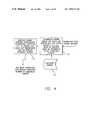
- a flow chart 160 of the algorithm for deriving RS parity-check packetsis illustrated.
- the data blockis initially divided into one or more incoming messages (step 162 ), and the messages are then divided into k information packets 154 (step 164 ).
- the number of RS parity-checks packets pis then selected (step 166 ).
- the information packetsare then encoded column-wise with a modified RS code in accordance the generating polynomial:
- parity-check packetsare generated (step 168 ).
- the data packetswhich include information packets and RS parity-check packets, are dividedled into codewords (step 170 ). After the data packets have been divided into codewords, error correction/detection is performed on the codewords (step 172 ). The data packets are then transmitted to the users (step 174 ).
- the number of codewords which have error(s)is counted (step 176 ). Then it is determined whether each packet has any errors (step 178 ). If a packet does not have an error, then it is saved (step 180 ). However, if a packet has one or more errors, it is discarded (step 182 ) and the present invention-waits for more packets (step 188 ). When there are enough packets (step 184 ), a message is assembled (step 186 ). If not, the present invention waits for more packets (step 188 ). Finally, when there are enough messages, the data block is assembled (step 192 ).
- FIG. 18( a )is a flow chart of an algorithm for data compression which combines Huffman compression and dictionary-based compression.
- the data blocksare compressed at the central broadcast server 34 end prior to transmission so that maximum amounts of information in compressed or bandwidth reduced form can be transmitted to the selected user or users.
- the data blocksare correspondingly decompressed ( FIG. 18( b )).
- the current compression algorithm for English language articles saved in ASCII text formatcombines the Huffman compression and the dictionary-based compression, such as LZ77 and LZ78 based algorithms.
- the compression algorithmscans the input texts, it not only tries to search for the next item in the previously seen text, but also tries to search for the next item in a static Huffman dictionary, and it chooses a method which produces a better result. After the data is received at the user end, it is correspondingly decompressed.
- the Huffman dictionaryis loaded from the disk storage, the address pointer is positioned to the start of the uncompressed input data in memory and a memory buffer for storing the compressed output data is allocated (step 202 ).
- step 204If in step 204 , it is determined that the address pointer is not at the end of the input data, the compression algorithm scans the input texts, searching for the next item in the previously seen text (step 210 ) and the static Huffman dictionary (step 212 ), and chooses the method which produces a better result (step 214 ).
- step 210the data is compressed using the previously seen text.
- a token T 1is generated by comparing the input data at the input pointer to the previous input data.
- T 1denotes an index to the previously seen data that has the maximum length match with the current data.
- L 1correspondingly denotes this maximum length.
- step 212the data is compressed using the Huffman dictionary which was loaded in step 202 .
- a token T 2is generated by looking for the maximum match of the input data at the input pointer to entries in the Huffman dictionary.
- T 2denotes an index to the dictionary entry for the maximum match.
- L 2correspondingly denotes the length of the match.
- the Huffman dictionaryis initially loaded from the disk storage, the address pointer is positioned to the start of the compressed input data in memory and a memory buffer for storing the decompressed output data is allocated (step 222 ).
- One bit from the input datais read and saved in b (step 224 ).
- it is determined whether b0 (step 226 ). If so, the data is decompressed using the previously seen text (step 228 ).
- the next token (T,L)is initially retrieved, followed by L bytes of decompressed data from the output buffer at a location denoted by T.
- the retrieved bytesare denoted by txt, which are then written to the output buffer (step 230 ).
- the input data pointeris then advanced by the length of the token (T,L) in bits.
- the programthen returns to step 224 and repeats the steps until the Huffman end-of-token is detected (step 232 ).
- step 226it is determined whether the next token is the Huffman end-of-data token. If so, decompression has been completed (step 234 ). If not, the data is decompressed using the Huffman dictionary (step 236 ). The next token (T,L) is retrieved, followed by L bytes of decompressed data from the Huffman dictionary using T as an entry into the dictionary. The retrieved bytes of data are denoted by txt, which as noted previously, is written to the output buffer (step 230 ). The input data pointer is advanced by the length of the token (T,L) in bits and returns to step 224 .
- FIG. 19( a )is a flow chart of an algorithm 240 for data compression utilizing differencing.
- a differencing algorithm 240is additionally used to compress the coded data, thereby significantly reducing the number of bytes sent with each transmission.
- a dictionary-based compression algorithmsuch as LZ77 and LZ78 based compression, can be adapted for this application.
- File twois described with reference to file one in a minimum number of bytes. In such an algorithm, file one is used as the dictionary.
- the precomputed standard hash table HT for file 1, the dictionary file,is loaded from mass storage (step 242 ).
- the minimum match length L from the length used in creating the hash table HT and the maximum match length U from the limits on contiguous data block transmission sizeare set.
- the memory address pointer to the stream of input data (file 2) to be compressed by differencing with file 1is retrieved and a memory buffer for the compressed output data is allocated.
- the algorithm 240next determines whether the end of the input data has been detected (step 246 ). If so, the compression is complete (step 248 ). If not, the hash value H of the next input data substring of length L bytes with the same hashing algorithm used to compute HT is calculated (step 250 ).
- the optimal match length MLis then set to 0 and the optimal position MP is set to ⁇ 1 (step 252 ).
- the algorithm 240returns to step 246 and continuously iterates until the end of the input data is detected (step 248 ).
- step 256If in step 256 , ML is not equal to 0, the bit value 1 is written to the output buffer (step 260 ).
- the optimal match length ML and the optimal match position MPare written to the output buffer.
- the input buffer pointeris then advanced by ML bytes.
- the algorithm 240returns to step 246 and continuously iterates until the end of the input data is detected (step 248 ).
- the data blocksare correspondingly decompressed in accordance with the algorithm 262 illustrated in FIG. 19( b ).
- the dictionary file, file 1is initially loaded from mass storage (step 264 ).
- step 274If in step 274 , b does not equal 0, the match length ML and the match position MP is retrieved from the input buffer (step 278 ). ML bytes are copied from file 1 at position MP to the output buffer. The input buffer pointer is advanced by the sizes of ML and MP in bytes. The algorithm 262 returns to step 266 and continuously iterates until the end of the input data is detected (step 268 ).
- all outgoing messagesare preferably encoded to 7 ⁇ 8 bit data or true 8 bit data for broadcast over paging networks. After the data is received at the user end, it is correspondingly decoded.
- all outgoing messagesare preferably encoded to true 8 bit data.
- outbound datawill be segmented and sent to the user by way of the user receiver 32 utilizing common and unique addresses.
- Addressesare numbers used by wireless receiving devices to identify messages targeted to a user. Addresses are usually stored in programmable read only memory (PROM) in the receiver hardware 32 . If the address to which a message is transmitted matches a address stored in the receiver 32 , then the receiver 32 will process the message. Otherwise, the message will be ignored.
- general “basic services”are wirelessly transmitted on global common addresses
- electronic mail and point-to-point messagesare transmitted on personalized or unique addresses
- combined premium services and pay-per-view eventsare grouped together and transmitted on common addresses. Alternatively, the combined premium services and pay-per-view events may be sent on unique addresses as well.
- the central broadcast server 34additionally includes telephone and/or modem interfaces for receiving remote request from users to obtain additional or modify existing services.
- a user from a personal computer 14 or other computing devicecan request additional services or modify existing services by telephoning or modeming the central broadcast server 34 , which automatically and wirelessly transmits the new or modified services. Modification of subscribed services may also be performed via the Internet and World Wide Web.
- the information provided from the information sources 12 and transmitted to the central broadcast server 34 to be consolidated in accordance with the present invention and then transmitted wirelessly nationwide to personal computers 14 and other computing devices as described in detail abovecan also be sent simultaneously via a wired connection to the same personal computers 14 and computing devices having Internet/World Wide Web access (direct or via on-line service providing Internet and Web access).
- the data processed at the central broadcast server 34in addition to being transmitted wirelessly, is simultaneously made available through wired connection to a specific web site on the Internet. A user can thus connect to the Web via the Internet and receive information through wired means.
- a user receiver 32connected to a personal computer 14 or computing device, receives wireless transmissions sent by the central broadcast server 34 .
- the user receiver 32preferably includes an Industry-Standard Architecture (ISA) board with a I C interface to an external wireless receiver and utilizes on-board POCSAG, Motorola's FLEXTM protocol or other wireless receiving device receiving and decoding.
- ISAIndustry-Standard Architecture
- Motorola's FLEXTM decodingallows for upgradeability to future receiver protocols without requiring replacement of the internal ISA board.
- the user receiver 32also includes an indicator, such as a flashing LED, which indicates reception of incoming messages.
- the user receiver 32includes physical addresses for filtering data prior to being transferred to the personal computer 14 .
- the user receiver 32may be a specially designed or commercially available receiving unit.
- filtering of informationcan be accomplished both at the user receiver 32 and personal computer 14 or computing device.
- Messagesare electronically sent to nationwide and local wireless broadcast networks using both physical and virtual addresses.
- Physical addressesare tags which reside in the hardware portion in the user receiver 32 .
- the present inventionimplements a virtual address as illustrated in FIG. 14 and described in detail below.
- the virtual addressesreside in the software of the user computer 14 .
- Virtual addressesprovide additional filtering of incoming data from the user receiver 32 . For example, a message may be received by all receivers 32 , but if the message is targeted to a specific virtual address, then only those installations in which that virtual address is activated will process the message.
- virtual addressesmay be activated and deactivated through the broadcast network, allowing for external control over the reception of services in a particular installation. It will be appreciated by those skilled in the art that information filtering can be accomplished utilizing virtual addresses only. Virtual addresses can allow for unlimited filtering of messages on the user end. However, this may increase the resource usage of the personal computer 14 . Correspondingly, information filtering can be accomplished by utilizing physical addresses only.
- a higher level of filtering based on message category and contentis also provided.
- Userscan set various filters based on a variety of preferences at information category or specific content levels to allow for automated filtering of incoming information.
- categories of information received from the broadcast networkare processed and which are discarded. For example, if a user were not interested in sports, all sports information categories, such as baseball, football, golf, etc. can be selected for discarding.
- a the specific content levela user can select which subcategories of information within a particular information category will be processed. The user selectable subcategories depend on the type of information contained in that category.
- Subcategoriesmay include, but are not limited to, source providers for headline news stories, specific industry segments (e.g., electronics, computers, communications, industrial, etc.) for business news, specific teams for sports categories, particular states and games for lottery results, and stocks for which quotes are displayed. For example, a user that wishes to have scores displayed only for baseball games involving the New York Yankees or New York Mets can set the filter for the baseball viewer to discard game results for all teams except those two.
- FIG. 14a flow chart of an algorithm for message processing using filtering in accordance with the present invention is illustrated.
- An incoming message from the central broadcast server end 34 after processing as described aboveis applied to the receiver hardware 32 (step 200 ).
- Physical address filtering in the receiver hardwareis then used to determine whether the message should be passed on for further virtual address filtering (step 202 ). If the message passes physical address filtering, the message is applied to virtual address filtering (step 204 ). Otherwise, the message is disregarded (step 206 ).
- Virtual address filteringis then used to determine whether the message should be passed (step 208 ) on for further message content filtering (step 210 ). If not, the message is disregarded step 212 ). Message content filtering then determines (step 214 ) whether the message should be stored in the message database (step 216 ) for further processing and transmission to the user or disregarded (step 218 ).
- FIG. 15The process of targeting data to an user utilizing real and virtual addresses is illustrated in FIG. 15 .
- Data blocksare built in the information gateway 134 and all applicable real and virtual addresses are determined based on the type of information in the data block and user subscription data from the subscriber database 130 . If a data block is to be targeted to a specific virtual address, the virtual address is inserted by the information gateway 134 into the virtual address field of the data block header and the virtual address flag is set.
- the wireless gateway 136provides the interface to the wireless transmission network. It prepares data for transmission over the network and implements real addresses in the proper data frames as specified by the standard transmission protocol that is used. At the receiving end, arriving data is first filtered via real addresses in the wireless receiver 32 followed by virtual address filtering in the communications server 38 .
- the communications server 38first checks the virtual address flag in the data block header. If it is not set, then the data block is passed onto the alert panel 50 for storage and display. If this flag is set, the communications server 38 determines if the virtual address in the data block header matches one in the virtual address database. If there is a match, then the data block is passed onto the alert panel 50 . If there is no match, then the data block is discarded.
- the message server design 18includes a communications server 38 , user interface alert panel 50 and viewer server 58 .
- the driver 44is preferably a Windows 95 driver for the wireless device hardware 42 , although another compatible device may be used as well.
- the driver 44provides an interface to access received data and control the hardware 42 , as well as inform applications as to the status of the receiver hardware 42 .
- the interface 46 for the wireless deviceis preferably an AmFlex DLL 46 , although another compatible device may be used as well.
- the interface 46is used to pass the data received from the wireless device to the communications server 38 for processing and distribution to other software components. It also provides a means by which the communications server 38 can program the device hardware to receive specific messages and also allows the communications server 38 to determine hardware status.
- the communications server 38receives data from the wireless device via the interface 46 , extracts the different types of data blocks (messages), passes public data blocks to the user interface alert panel 50 and processes private data blocks locally.
- the communications server 38is also responsible for initializing the wireless device and maintaining the address database which determines which received messages will be processed. In addition, it provides diagnostic data on received messages for software debug purposes.
- the communications server 38is notified of incoming data packets by the driver 44 via the interface 46 through a software callback function.
- the communication server 38recombines, decompresses, decrypts, filters via virtual addresses as previously discussed, and error corrects the data packets using techniques corresponding to the processing done at the central broadcast server 34 end.
- the communication server 38initially verifies the integrity of the data packets received using common error correction techniques. After error correction, the data packets are unpacketized and entire messages are assembled. After assembly, the communication server 38 verifies once again that the integrity of the message is maintained. The message is then decrypted using the common password previously established. The data signature on the message is also checked to verify the integrity of the data.
- the messagesare uniquely encoded so that it is known which data packet belongs to which message.
- the messagesare stored in a database and when a complete message is formed, it is transmitted to one or more devices that are registered with the communication server 38 . As shown in FIG. 10 , the complete message may be transmitted to the user interface alert panel 50 , shown in detail in FIGS. 3 and 4 and discussed in detail below.
- the communications server 38then notifies the user interface alert panel 50 .
- the user interface alert panel 50is the main user interface for the applications software.
- the user interface alert panel 50which appears to a user as shown in FIG. 20 , is the liaison for messages broadcast from the communications server 38 and delivered to the viewer server 20 .
- the user interface alert panel 50performs all message archiving to the messages database.
- the main functions of the user interface alert panel 50are (I) initialization, (ii) processing EMIT messages, and (iii) timing events.
- the user interface alert panel 50is run when the user double clicks on a specific icon or selects the application from a start menu, such as the Windows 95 start menu, and is responsible for other applications, such as launching the communications server 38 and viewer server 20 and passing messages received from the communications server 38 to the viewer server 20 .
- the user interface alert panel 50also displays “fly-in” graphics and icon buttons to alert the user that a new message has been received, allows the user to open a viewer 48 to examine a received message by clicking on the viewer icon button for that message, and maintains the received messages database. The latter includes saving new messages in the database and deleting old messages after a certain period of time, as explained in detail below.
- the useralso accesses the remote control 54 from the user interface alert panel 50 by clicking a remote control icon.
- FIG. 21is a flow chart of an algorithm 300 for implementing the initialization procedure for the user interface alert panel 50 in accordance with the present invention.
- step 302during initialization, the user is prompted for database management (compress the message database).
- the user interface alert panel 50will determine if there are more than a predetermined number of messages written into the database 51 .
- the predetermined number of messagesis 2000+, although one skilled in the art will recognize that any number of messages may be used. If the predetermined number is exceeded, records which have been previously marked for deletion are removed from the database 51 . Marked records are typically records which have been read by a viewer and are not targeted for any of the other viewers or applications, yet physically remain in the database. These records are removed when the predetermined number of messages is met, thereby only leaving those records which need to be read.
- the databases 51are opened for non-exclusive read/writes (step 304 ).
- the three mains databasesare the (a) messages database which holds all the messages, (b) SYSAPPS database or systems applications database which holds the viewer specific information such as what is executable, what needs to be run for that viewer to be launched, etc. and (c) V groups database which contains a list of all viewers, their alias names and descriptions.
- the next step during initializationinvolves reading the tool bar initialization information from the registry keys (step 306 ).
- the docking location of the user interface alert panel 50is determined.
- the user interface alert panel 50is dockable at all the corners of the display and can also be floated at the center.
- the animation defaultsare also determined because in the customization for the user interface alert panel 50 , the user can turn off the fly-in sequence, buttons animated and/or sound files being played. Which winsock ports need to be used to talk to the communications server 38 and viewer server 20 are also determined at initialization.
- the next step is during initializationis to launch the communications server 38 and viewer server 20 (step 308 ).
- the communications server 38is logged into as a client and the viewer server 20 is logged into as a server such that each knows about the user interface alert panel 50 .
- buttonsare created in the user interface alert panel 50 for messages marked as not read (step 310 ). For example, some records in the message database 51 are not read because the user closed the user interface alert panel 50 before reading them. In accordance with the present invention, buttons are created on the user interface alert panel 50 for those messages.
- the communications server 38is queried for valid service plans which include but are not limited to E-mail, premier services and power up services (step 312 ).
- FIG. 22is a flow chart of the algorithm for implementing process EMIT messages procedure for the user interface alert panel 50 .
- a message or feed from the communications server 38 via the winsock portis initially applied to the user interface alert panel 50 .
- the user interface alert panel 50determines what feed type is present, i.e. whether the message is a binary, star or EMIT type feed.
- a typical binary type feedis an E-mail message.
- the binary feedis, as discussed in detail below, decompressed into a common EMIT feed and processed as a normal feed.
- a typical EMIT type feedinvolves common user information such as messages for football, scoreboard viewers, horoscope, lottery etc.
- a typical star type feedinvolves a registry value change which creates or updates the appropriate registry key(s).
- a star feedinvolves a visual change to one of the viewers 48 .
- a star feedwill create/write registry values to reflect a change in advertisement on a particular viewer 48 (step 2 ).
- Star feedsare thus special feeds in that they can change register keys which point to bitmap files, source names, URL sources and so forth.
- star feedsare received by the communications server 38 and passed to the user interface alert panel 50 for processing.
- the registry values updated by star feedsare read by other components and the changes programmed by the star feeds are then put into effect.
- the basic structure of a star feed messageis shown as follows:
- COMPONENT_CODEa two letter code indicating to which component the star feed applies (e.g., BB for baseball viewer, RC for remote control, etc.)
- REGISTRY_KEY VALUESone or more sequences of the following parameters for the specified component: registry key, full file path name flag (0 or 1) if the key value contains a file name, and the registry key value.
- new bitmap files SprtNetU.bmp, SprtNet.bmp and new URL http://www.sportsnetwork.comare added to the registry settings for the Baseball viewer. Where a new bitmap or other file name is specified in a star feed, the new file will have been previously received from the wireless broadcast network by the communications server 38 via the binary file transfer capability. This process is transparent to the user.
- step 1If in step 1 , it is determined that the feed is a binary type feed, the binary feed is converted to a common EMIT string format (step 3 ).
- the messageis in the EMIT string format, a record is added to the message database by first determining the preferred viewer for the feed (step 4 ) and then by parsing out the EMIT string to common viewer fields (step 6 ).
- a filter field from the SYSAPPS tableis compared to the EMIT string (step 5 ).
- the user interface alert panel 50determines which viewer 48 will be able to read the information.
- the preferred vieweris the actual icon which will fly up to the user interface alert panel 50 .
- the user interface alert panel 50obtains the necessary information by looking at the systems applications (SYSAPPS) table or database.
- SYSAPPSsystems applications
- the user interface alert panel 50determines which viewer 48 is the preferred viewer and which viewer 48 should fly up to the user interface alert panel 50 . For example, for a football related message, the filter fields from the SYSAPPS database would be reviewed against the football related message to determine the viewer alias match.
- level tagsfurther define the EMIT message so when the comparison is executed in SYSAPPS table, it can be determined which feed is for which viewer (level tag 1–5).
- a “Q” time flag or time flag reflecting the local time at which the message arrived at a useris created (step 6 ).
- the EMIT stringis then parsed into common viewer fields and written to a message database 51 (step 8 ).
- the common fieldsinclude but are not limited to level tags, data and time, titles, source and content.
- VGROUPSthere is a description for each viewer—a text typed out in a particular field. If you put the mouse over one of the buttons on the alert panel, on the bottom, it will say what this is. That description is pulled from VGROUPS (step 8 ).
- the messageis broadcast to the preferred viewer via the viewer server (steps 9 – 14 ). Initially, it is determined whether the viewer is running (step 9 ). If the viewer is running, e.g. football viewer is already running, the message is sent directly to the viewer server (step 10 ).
- step 11it is determined whether the viewer should be auto launched. If auto-launch has been turned on for this viewer, then the viewer with message playback is launched. For example, for a football type feed, the viewer preferences are reviewed and if the user is setup for automatic launch of football, the football viewer with message playback is launched (step 12 ).
- the fly-in sequencecomprising a) creating a fly-in animation object, b) playing a viewer specific wave file, c) animating a button on the user interface alert panel 50 , and d) placing a static button on the user interface alert panel 50 , is initiated (step 13 ).
- a fly-in animation objectis initially created.
- the fly-in animation objectis an actual icon shown flying in from the opposite edge to the user interface alert panel 50 .
- fly-insalert the user that new data is available for viewing. Fly-ins are small windows displaying animated graphics representing a particular message type, e.g.
- E-mailwhich moves from the bottom right part of the user display screen to the user interface alert panel 50 whenever a new message of that particular type is received. If the user interface alert panel 50 is in a floating state, then the fly-in animation objects flies in from a random edge. At the same time the fly-in occurs, a viewer specific sound wave file is initiated. A button is then animated on the user interface alert panel 50 . Finally, a static button which the user can press to launch the viewer is placed on the user interface alert panel 50 (step 13 ) and when depressed (step 14 ), will launch a viewer with message playback (step 12 ).
- a fly-in animation object in the form of a footballlands on top of the user interface alert panel 50 , a trumpet will play followed by a button animated on the alert panel 50 , which typically spins around and finally a static button appears on the alert panel 50 .
- Fly-in graphic and default sound effectsreflect message type.
- a golf tournament fly-inincludes an image of a golf ball and the sound of a golf ball falling into a cup.
- step 13When the static button on the user interface alert panel is pressed (step 13 ), the viewer with message playback option is launched (step 12 ). The message is sent to the viewer server 20 which is the actual application which physically launches the viewer 48 .
- the user interface alert panelwill periodically and automatically perform the following functions: (1) check messages that require a mark for deletion, (2) check for valid service plans, (3) check for delayed broadcasts, and (4) implement fly-in graphics for new messages, each of which is described in detail below.
- Each viewerhas an entry in the SYSAPPS table that specifies the lifetime of the messages.
- a comparisonis made to the message database and if a record needs to be marked for deletion, an “X” is placed in the MSG_READ field. In a preferred embodiment, this function is performed every 24 hours.
- the user interface alert panel 50will decide, based on the information in the SYSAPPS table, how long a message should be kept for a particular viewer 48 . For example, for a football viewer, if it is only desirable to see messages 2 days old, the user interface alert panel 50 will check against that field and when 2 days has transpired, proceed to mark those records for deletion.
- the user interface alert panel 50will also periodically check for valid service plans.
- Service planstypically dictate what kinds of feeds are available to a user. All valid plans are recorded in the registry so that other modules can read the information.
- the service plan checkingpreferably occurs at initialization and every 5 minutes thereafter. The user is also prompted with “plan expiration reminders.”
- the user interface panel 50also checks for delayed broadcasts which allow messages to be submitted for future broadcast. If a date and time has arrived for a delayed message, the MSG_READ field will be changed from “B” to “N” and a button will be placed on the user interface alert panel 50 . Delayed broadcasts are preferably checked every five minutes. The user interface panel 50 thus checks every 5 minutes for special records that need to be shown to the user and then will change a particular field in the message database—the “B” to “N” so that next time it will not rebroadcast the same message again.
- the user interface alert panel 50performs fly-in graphics for new messages received from the communications server 38 if this option has been selected by the user.
- the viewer server 20provides the means by which other components can initiate the execution of viewers 48 to display messages received from the broadcast network. This includes launching a particular viewer 48 upon command, parsing messages, and providing data extracted from the messages to the viewers 48 for display.
- the viewer server 20also acts as the interface between the viewers 48 and the messages data base 51 . Functionality of the viewer server 20 is accessed through the Viewer Server Applications Programming Interface (VSAPI).
- VSAPIViewer Server Applications Programming Interface
- the viewer server 20serves the global control preferences across all viewers and allows common controls to be shared by viewers requiring similar functions.
- three different classes of user interfaceare present.
- One class, the viewer classviews a particular type of information, such as baseball or electronic mail.
- a second class, the viewer controlleris able to start and stop the other class, the viewers class.
- the viewer controllerresembles a remote control and enables a user to turn the viewers on and off.
- the remote controla user can thus automatically bring up a baseball viewer and baseball information will be automatically displayed in that viewer.
- FIGS. 24( a ),(b),(c) and (d)are depictions of a market scoreboard viewer, a football viewer, a newspaper viewer and stock ticker viewer, respectively.
- informationis broken into logical information categories at the central broadcast server 34 end which matches viewers 48 which exist on the user end.
- the viewer server 20ties into the viewers 48 so that an actual feed, such as an electronic mail notification feed, baseball sports feed or headline feed, is established.
- the data at the server endis classified into various formats to be able to indicate what type of a feed is present. This is accomplished by placing tags in front of various words that break it up into a type of information, such as a headline story, electronic mail story, financial story, and the like. This is the basis of the EMIT format which was described previously.
- the viewer server 20When this data arrives on the user side, the viewer server 20 reads the message including the codes and determines what type of message is being sent. Thus a viewer that is capable of displaying baseball information only receives baseball information.
- another viewer controllerwhich enables both incoming information as well as past information to be viewed can be utilized.
- a usercan bring up a baseball game that occurred earlier in the day.
- the viewer controllertalks to the viewer server 20 and indicates that it wants to bring up a particular viewer.
- the viewer server 20then activates and launches that particular viewer.
- Preference viewersenable each of the viewers in a common user interface to show any preference information it has.
- the preferences viewerscan be programmed to provide various kinds of information. For example, the preferences viewer can be directed to information relating to baseball teams. Another preferences viewer can be directed to stock market information.
- the preferences viewercan be further programmed to provide indication of events which are currently happening. For example, if the price of a stock, such as IBM, goes above a certain amount, such as $100.00 per share, a stock market crawl viewer will come up to the foreground immediately and flash a red light.
- the remote control 54provides a user interface for opening, closing and controlling viewers (viewer management), for maintenance of user settings and preferences, and for viewing the latest broadcast network news. It also maintains a message history log which allows the user to view previously received messages. Viewer control functions include mute, pause and volume level control for the viewer audio device.
- the remote control 54is launched through the user interface alert panel 50 .
- Viewers 18opened through the user interface alert panel 50 or remote control 54 , are the means by which data received from the broadcast network is displayed to the user. There are separate viewers for each of the different types of information provided over the network. Viewers 48 are capable of reading and displaying various message formats and contain preferences governing viewer actions. Viewers generally include, but are not limited, to graphics, data, sound files, and launch icons.
- each of the viewers 48When each of the viewers 48 is installed, it goes through a registration process with the viewer server 20 and the viewer server 20 stores entries in the database that keep track of each of the viewers by way of the viewer table.
- a filtering meansis provided for each viewer for filtering particular types of messages a viewer can look at. For example, a baseball viewer who wants to look at messages relating to baseball information has two filtering means-one for saving information in a database and another filter for indicating that this is the type of information that should immediately be brought up to the viewer. Thus, if a viewer is interested in Dodger baseball games, such games would instantly be brought up by the second filter. Moreover, if a viewer desires to save all of the games in the national league, the filter for saving such information would be implemented
- the User Preferences Dynamic Link Library (DLL) 53allows the user to precisely specify what information is to be displayed by the Viewers 48 and how this information will be displayed and enters various related information, such as, the name of the user's Internet browser and activation codes for activating service plans. For example, the user can select the teams for which baseball or football scores will be shown, the sources of news stories, and the speed at which text is scrolled in Marquee type viewers.
- the User Preferences DLL 53is accessed via the remote control 54 or through any open viewer 48 .
- the address reprogramming and activation code parsing DLL 57parses and validates service plan activation codes received over the wireless broadcast network or entered by the user and address reprogramming messages received over the network. Activation codes and address reprogramming messages control what broadcast network messages the user is allowed to receive.
- the code parsing DLLis used by the communications server 38 , remote control 54 ( FIG. 11 ) and user preferences DLL 53 .
- Error Logging 55provides a means by which all other components can record the occurrence of errors or potential problem conditions in a log file.
- the error logcan be a valuable aid to technical support in diagnosing problems a user may encounter in running software:
- the log fileis preferably in ASCII text format and can be viewed by any word processor or text editor, such as, Microsoft Word or Notepad.
- the communications server 38receives a new data block from the wireless device 42 via the driver 44 and wireless interface 46 .
- the communications server 38either processes it locally or passes it to the user interface alert panel 50 .
- the user interface alert panel 50receives a data block from the communications server 38 , stores it in the messages data base 51 , displays an icon for the particular message type and generates a fly-in or other means for notification such as an audio and/or visual alert for the new message if that option is selected by the user. If the user clicks on the icon for the new message, the user interface alert panel 50 sends a command to the viewer server 20 to open the appropriate viewer 48 to display the contents of the message.
- a viewer 48 to display the new messagecan be launched through the remote control 54 .
- the viewer server 20parses the message, launches the viewer 48 and passes to it the data to be displayed.
- the viewer 48displays the message data received from the viewer server 20 and commands the viewer server 20 to mark the message as “read” in the data base. At any step in the process, if an error condition is detected, it is recorded in the error log 55 .
- FIG. 13is a flow chart of an algorithm for generating and processing E-mail alerts in accordance with the present invention.
- a usermay be instantly notified of E-mail messages without being connected to an E-mail service provider.
- the user's providersends an E-mail notification to central broadcast server (step 244 ).
- the central broadcast servertransmits an E-mail alert message to the user's computer through the broadcast network (step 246 ).
- an animated visual and/or audio notificationis triggered, or the e-mail viewer automatically pops up, depending on the mode of operation selected by the user (step 248 ).
- an E-mail alert iconappears on the alert panel and the E-mail viewer can be launched in the same manner as viewers for news alerts (i.e. by clicking the icon or through the remote control).
- An E-mail alertcontains the provider ID code number and the “From” name (E-mail address of the sender).
- the alertis not limited to the provider ID code number and name. Rather, the E-mail alert could include a header, whole message etc.
- the E-mail viewerdisplays an icon corresponding to the provider ID, the date and time the alert was received, and the sender's E-mail address.
- the usersimply clicks the associated icon (step 250 ) which causes the E-mail program for the particular provider to be launched (step 252 ).
- the user's E-mailcan then be retrieved through a wired connection to the E-mail provider (step 254 ).
- E-mail alertsmay be received from more than one source. For example, a user may receive an E-mail alert from an Internet E-mail provider and America On-Line or CompuServe.
- a wirelessly transmitted on-line guideprovides a detailed schedule of when certain information, such as upcoming events, forums and chat sessions, will be transmitted. With ongoing wireless broadcasts, the information in the on-line guide is maintained up-to-date.
- the on-line guidecan notify a user just before an event is about to happen on the Internet, therefore eliminating the need to manually keep track of upcoming events.
- the userindicates which events are important, and the on-line guide reminds the user via an alarm including a visual and sound alert of the events at a predetermined time, such as minutes, before each occurs.
- the usercan then click on the event and a connection to the event's location on the Internet is made through the user's standard Internet browser and Internet service provider.
- a usercan specify that a connection to the event location via the user's Internet browser and Internet service provider be made automatically when the selected event is about to occur.
- the URL broadcast and hot links 22 back to the information source 12is shown.
- very short notification centric messagessuch as news headlines from information sources 12 , such as Internet, on-line services and other information providers, are transmitted to the computer 14 by wireless transmission.
- a userfrom a computer 14 , can make a wired connection 24 back to the information source 12 to obtain more detailed information.
- attached to each of the notification centric messagesis a universal resource locator (URL) code 22 as well as related Internet address information.
- URLuniversal resource locator
- the usercan thus go directly to the specific site that the information came from.
- the specific sitecan be ten pages deep.
- information sources 12such as the Internet and other on-line services, which are typically overwhelming particularly with respect to locating a story, are easily accessible.
- the present inventionallows a user to pinpoint and locate the specific information the user was alerted to. The user can thus hit one button which establishes the connection 24 and takes the user directly to the location where the information is located.
- FIG. 12is a flow chart of an algorithm for extracting and processing the Internet source URL for messages broadcast over the wireless communication network illustrated in FIG. 1 .
- the Internet source for a news item alertis broadcast as part of the alert message itself (step 260 ).
- the messagecontains a number of tags delineating the various parts of the message.
- the “S” tagonly applies (step 264 ).
- the actual URLhttp://www.reuters.com, is obtained by using the letter code as an index into the alert source database of the present invention (step 266 ).
- URL's in the alert source databasemay be updated by Star Feed messages in case changes in the default URL's are necessary (step 268 ).
- the “U” tagconveys the Internet source (step 272 ).
- Wireless throughputis conserved by transmitting the full URL only in those cases where the source is not restricted to being a member of a fixed set.
- the source URLis displayed at the end of the alert message text (step 270 ). A user with a wired or wireless connection to the Internet can go directly to the alert source simply by clicking the URL (step 270 ). A connection to the alert source on the Internet is thus provided.
- Services received and various operational characteristics at the user endcan be programmed by the central broadcast server 34 through the wireless broadcast network. This is accomplished primarily through Star Feeds and service activation/deactivation codes.
- Star Feedswhich have been described in detail above, are special messages which allow parameters controlling viewer operation to be modified from the central broadcast server 34 .
- Activation/deactivation codesdetermine which services a user is allowed to receive. For example, if a user subscribes to e-mail alerts, this service can be turned on for that specific user through an e-mail alert activation code message transmitted to the user site via the wireless broadcast network. Conversely, if a user stops subscribing to a service, that service can be turned off through a deactivation code message.
- the capabilityexists for binary file transfer from the central broadcast server 34 to add new executable files or replace existing ones with newer versions. In this way, new or updated viewers can be installed directly through the wireless broadcast network.
- usersmay remotely request additional services or modify existing services from the personal computer 14 or other computing device through a billing and activation server 64 which communicates with the central broadcast server 34 .
- a billing and activation server 64By telephone or modem communication, a user can contact the billing and activation server 64 which in turn communicates with the central broadcast server 34 .
- the server 34wirelessly transmits an activation code directly to the message server 18 to activate additional or modify existing services.
- the user softwarewill program a receiver board in the user receiver 32 to begin receiving additional or modified services.
- userscan remotely adjust services from their personal computers 14 or other computing devices.
- the information provided from the information sources 12 and transmitted to the central broadcast server 34 to be consolidated in accordance with the present invention and then transmitted wirelessly nationwide to personal computers 14 and other computing devices as described in detail abovecan also be sent simultaneously via a wired connection to the same personal computers 14 and computing devices having Internet/World Wide Web access (direct or via on-line service providing Internet and World Wide Web access).
- the data processed at the central broadcast server 34in addition to being transmitted wirelessly, is simultaneously placed on Web pages on the Internet.
- a usercan thus connect to the Web via the Internet.
- a usermakes a connection via the Internet to the World Wide Web server and delivers its URL request. The request is acknowledged by the Web server, which then sends the requested data to the user.
- a usercan receive real time data/information in the form of voice, video data or a combination thereof by accessing the World Wide Web.
Landscapes
- Engineering & Computer Science (AREA)
- Computer Networks & Wireless Communication (AREA)
- Signal Processing (AREA)
- Business, Economics & Management (AREA)
- Emergency Management (AREA)
- Physics & Mathematics (AREA)
- General Physics & Mathematics (AREA)
- Mobile Radio Communication Systems (AREA)
- Information Transfer Between Computers (AREA)
Abstract
Description
1=S˜2=B˜H=Dodgers Win World Series˜D=Nov. 2, 1989 9:30 pm
where the primary category (1=) is S (which stands for sports), the first sub category (2=) is B (which stands for baseball), the news headline (H=) associated with this feed is Dodgers Win World Series, and the date/time (D=) is Nov. 2, 1989 9:30 pm.
- b. Forward Error Correction
1≦n≦255 (1)
1≦k≦n (2)
where k=number of information packets generated by parceling the input message,
- n=total number of transmitted packets.
The total number of transmitted packets is determined based on the degree of protection requested. By allowing for the arbitrary combination of n and k, maximal flexibility is achieved. In particular, n and k are chosen during run-time, instead of design-time. For example, (255,223), (255,251), (7,3), (16,1) Reed Solomon codes, used column-wise are all possible combinations for generating Reed Solomon parity-check packets. In a typical operation, by using a (255, 223) Reed Solomon code column-wise, 32 parity-check packets are generated for a group of 200 information packets to be transmitted. Thus, even if 32 arbitrary packets out of 232 total data packets were lost during transmission, a successful reassembling of the information can still be achieved at the receiver end.
- n=total number of transmitted packets.
f(x)=x8+x4+x3+x2+1 (3)
Parity-check packets are generated by encoding k data packets column-wise in accordance with the following generating polynomial g(x) equation:
where g(x)=generating polynomial
- a=primitive element of GF(256)
- p=number of parity check packets
p+k≦255 (5)
is imposed by the use of the finite field GF(256). As stated earlier, each data block will thus first be split into several messages so that each message can be split into k packets that satisfy the above restriction. Up to p packets can be lost without compromising successful reconstruction of the message. In accordance with the present invention, even if some data packets are lost, the full message can be recovered using the redundancy data packets generated by the present invention.
and parity-check packets are generated (step168). The data packets, which include information packets and RS parity-check packets, are parceled into codewords (step170). After the data packets have been parceled into codewords, error correction/detection is performed on the codewords (step172). The data packets are then transmitted to the users (step174).
- d. Compression/Bandwidth Optimization
L<=PML<=U
is determined (step254). If PML is greater than ML, then ML is set such that ML=PML and MP is set such that MP=P. If in
| FEED_TAG~V=COMPONENT_CODE~P= |
| REGISTRY_KEY_VALUES |
| where | |
| FEED_TAG = | the message tag code (“*=” for star |
| feeds) | |
| COMPONENT_CODE = | a two letter code indicating to which |
| component the star feed applies | |
| (e.g., BB for baseball viewer, RC for | |
| remote control, etc.) |
| REGISTRY_KEY VALUES = | one or more sequences of the | |
| following parameters for the | ||
| specified component: registry | ||
| key, full file path name flag (0 | ||
| or 1) if the key value contains | ||
| a file name, and the registry | ||
| key value. |
| In a typical example, bitmaps for the Internet-baseball score |
| button are changed as well as the URL for the source: |
| *=~V=BB~P=Ad1;0;shared\bmps\SprtNet.bmp|TV | ||
| B;0; shared\bmps\SprtNetU.bmp|Adb;0;shared\ | ||
| bmps\SprtNet.bmp|ADB;0;shared\bmps\SprtNet | ||
| U.bmp|Ad1U;2;http://www.sportsnetwork.com: | ||
| 80 | ||
In the example, new bitmap files SprtNetU.bmp, SprtNet.bmp and new URL http://www.sportsnetwork.com are added to the registry settings for the Baseball viewer. Where a new bitmap or other file name is specified in a star feed, the new file will have been previously received from the wireless broadcast network by the
1=N,2=N,N=*,R!=*,1=N,2=N,h=*,R!=*
Under the sample preferred filtering string, the level tags are 1=N, 2=N. By comparing 1=N, 2=N against the sample EMIT feed, it knows that this is a news marquee feed.
- e. Viewer Server
- k. Operation of Received Message Data Flow
Claims (76)
Priority Applications (9)
| Application Number | Priority Date | Filing Date | Title |
|---|---|---|---|
| US09/350,467US7035914B1 (en) | 1996-01-26 | 1999-07-09 | System and method for transmission of data |
| US11/409,396US8489707B2 (en) | 1996-01-26 | 2006-05-15 | System and method for transmission of data |
| US12/871,684US8090803B2 (en) | 1996-01-26 | 2010-08-30 | System and method for transmission of data |
| US13/018,420US8572279B2 (en) | 1996-01-26 | 2011-01-31 | System and method for transmission of data |
| US13/018,421US8601154B2 (en) | 1996-01-26 | 2011-01-31 | System and method for transmission of data |
| US13/905,393US8656048B2 (en) | 1996-01-26 | 2013-05-30 | System and method for transmission of data |
| US13/906,645US8639838B2 (en) | 1996-01-26 | 2013-05-31 | System and method for transmission of data |
| US14/174,666US9380106B2 (en) | 1996-01-26 | 2014-02-06 | System and method for transmission of data |
| US14/339,305US9356899B2 (en) | 1996-01-26 | 2014-07-23 | System and method for transmission of data |
Applications Claiming Priority (6)
| Application Number | Priority Date | Filing Date | Title |
|---|---|---|---|
| US1065196P | 1996-01-26 | 1996-01-26 | |
| US1434196P | 1996-03-29 | 1996-03-29 | |
| US1473596P | 1996-04-01 | 1996-04-01 | |
| US2647196P | 1996-09-23 | 1996-09-23 | |
| US08/788,613US6021433A (en) | 1996-01-26 | 1997-01-24 | System and method for transmission of data |
| US09/350,467US7035914B1 (en) | 1996-01-26 | 1999-07-09 | System and method for transmission of data |
Related Parent Applications (1)
| Application Number | Title | Priority Date | Filing Date |
|---|---|---|---|
| US08/788,613ContinuationUS6021433A (en) | 1996-01-26 | 1997-01-24 | System and method for transmission of data |
Related Child Applications (1)
| Application Number | Title | Priority Date | Filing Date |
|---|---|---|---|
| US11/409,396ContinuationUS8489707B2 (en) | 1996-01-26 | 2006-05-15 | System and method for transmission of data |
Publications (1)
| Publication Number | Publication Date |
|---|---|
| US7035914B1true US7035914B1 (en) | 2006-04-25 |
Family
ID=36191178
Family Applications (9)
| Application Number | Title | Priority Date | Filing Date |
|---|---|---|---|
| US09/350,467Expired - Fee RelatedUS7035914B1 (en) | 1996-01-26 | 1999-07-09 | System and method for transmission of data |
| US11/409,396Expired - Fee RelatedUS8489707B2 (en) | 1996-01-26 | 2006-05-15 | System and method for transmission of data |
| US12/871,684Expired - Fee RelatedUS8090803B2 (en) | 1996-01-26 | 2010-08-30 | System and method for transmission of data |
| US13/018,420Expired - Fee RelatedUS8572279B2 (en) | 1996-01-26 | 2011-01-31 | System and method for transmission of data |
| US13/018,421Expired - Fee RelatedUS8601154B2 (en) | 1996-01-26 | 2011-01-31 | System and method for transmission of data |
| US13/905,393Expired - Fee RelatedUS8656048B2 (en) | 1996-01-26 | 2013-05-30 | System and method for transmission of data |
| US13/906,645Expired - Fee RelatedUS8639838B2 (en) | 1996-01-26 | 2013-05-31 | System and method for transmission of data |
| US14/174,666Expired - Fee RelatedUS9380106B2 (en) | 1996-01-26 | 2014-02-06 | System and method for transmission of data |
| US14/339,305Expired - Fee RelatedUS9356899B2 (en) | 1996-01-26 | 2014-07-23 | System and method for transmission of data |
Family Applications After (8)
| Application Number | Title | Priority Date | Filing Date |
|---|---|---|---|
| US11/409,396Expired - Fee RelatedUS8489707B2 (en) | 1996-01-26 | 2006-05-15 | System and method for transmission of data |
| US12/871,684Expired - Fee RelatedUS8090803B2 (en) | 1996-01-26 | 2010-08-30 | System and method for transmission of data |
| US13/018,420Expired - Fee RelatedUS8572279B2 (en) | 1996-01-26 | 2011-01-31 | System and method for transmission of data |
| US13/018,421Expired - Fee RelatedUS8601154B2 (en) | 1996-01-26 | 2011-01-31 | System and method for transmission of data |
| US13/905,393Expired - Fee RelatedUS8656048B2 (en) | 1996-01-26 | 2013-05-30 | System and method for transmission of data |
| US13/906,645Expired - Fee RelatedUS8639838B2 (en) | 1996-01-26 | 2013-05-31 | System and method for transmission of data |
| US14/174,666Expired - Fee RelatedUS9380106B2 (en) | 1996-01-26 | 2014-02-06 | System and method for transmission of data |
| US14/339,305Expired - Fee RelatedUS9356899B2 (en) | 1996-01-26 | 2014-07-23 | System and method for transmission of data |
Country Status (1)
| Country | Link |
|---|---|
| US (9) | US7035914B1 (en) |
Cited By (80)
| Publication number | Priority date | Publication date | Assignee | Title |
|---|---|---|---|---|
| US20020124068A1 (en)* | 2000-12-29 | 2002-09-05 | Hatalkar Atul N. | Alert management messaging |
| US20030065656A1 (en)* | 2001-08-31 | 2003-04-03 | Peerify Technology, Llc | Data storage system and method by shredding and deshredding |
| US20030171135A1 (en)* | 2000-09-15 | 2003-09-11 | Thomas Brune | Method for using the hand-held device in a multimedia home network |
| US20040078354A1 (en)* | 1999-04-16 | 2004-04-22 | Dwayne Pass | Interactive wireless devices to on-line system |
| US20050074007A1 (en)* | 2003-07-29 | 2005-04-07 | Samuels Allen R. | Transaction boundary detection for reduction in timeout penalties |
| US20050091376A1 (en)* | 2001-10-12 | 2005-04-28 | Helfman Nadav B. | Apparatus and method for optimized and secured reflection of network services to remote locations |
| US20050261985A1 (en)* | 1999-05-11 | 2005-11-24 | Miller Andrew K | Load balancing technique implemented in a data network device utilizing a data cache |
| US20060039368A1 (en)* | 2004-08-18 | 2006-02-23 | Punaganti Venkata Murali Krish | Data processing information feeder framework |
| US20060085250A1 (en)* | 1999-05-11 | 2006-04-20 | Christopher Kantarjiev | Techniques for processing customer service transactions at customer site using mobile computing device |
| US20060195554A1 (en)* | 1996-01-26 | 2006-08-31 | Payne John M | System and method for transmission of data |
| US20060228878A1 (en)* | 2005-04-06 | 2006-10-12 | Samsung Electronics Co., Ltd. | Semiconductor package repair method |
| US20060265262A1 (en)* | 2005-05-18 | 2006-11-23 | Microsoft Corporation | Distributed conference scheduling |
| US20070016463A1 (en)* | 2000-11-09 | 2007-01-18 | Borders Louis H | Scheduling delivery of products via the Internet |
| US20070055580A1 (en)* | 2001-03-19 | 2007-03-08 | Woodward Franklin G | Method and apparatus for facilitating online purchase of regulated products over a data network |
| US20070112647A1 (en)* | 1999-05-11 | 2007-05-17 | Borders Louis H | Webstore supporting multiple merchants |
| US20070124359A1 (en)* | 2005-11-07 | 2007-05-31 | Sung-Oh Hwang | Method for delivering service guide source for generation of service guide in a mobile broadcast system, and method and system for delivering notification event/notification message |
| US20070124418A1 (en)* | 2004-01-13 | 2007-05-31 | Yehuda Binder | Information device |
| US20070165673A1 (en)* | 2005-12-29 | 2007-07-19 | Lucent Technologies | Method for reconstructing lost packets using a binary parity check |
| US20070250572A1 (en)* | 2000-11-10 | 2007-10-25 | Paila Narasimha R | Data transmission and rendering techniques implemented over a client-server system |
| US20070266336A1 (en)* | 2001-03-29 | 2007-11-15 | International Business Machines Corporation | Method and system for providing feedback for docking a content pane in a host window |
| US7305442B1 (en)* | 2001-10-12 | 2007-12-04 | Sprint Spectrum L.P. | Asynchronous user-authorized advertising |
| US20080085700A1 (en)* | 2006-09-29 | 2008-04-10 | Varun Arora | Event update management system |
| US20080115141A1 (en)* | 2006-11-15 | 2008-05-15 | Bharat Welingkar | Dynamic resource management |
| US20080154709A1 (en)* | 1999-05-11 | 2008-06-26 | Peter Ham | Inventory replication based upon order fulfillment rates |
| US20080188251A1 (en)* | 2007-02-02 | 2008-08-07 | Disney Enterprises, Inc. | Method and system for transmission and display of rich-media alerts |
| FR2922402A1 (en)* | 2007-10-10 | 2009-04-17 | Bouygues Telecom Sa | Digital multimedia content e.g. video, accessing method for mobile telephone, involves performing request reception, modification and transmission of request to editor server when terminal transmits request to content in server direction |
| US20090132910A1 (en)* | 2001-04-19 | 2009-05-21 | Microsoft Corporation | Method and System for Providing an XML Binary Format |
| US7711738B1 (en)* | 1999-11-15 | 2010-05-04 | West Services, Inc. | Method, system and computer-readable medium for accessing and retrieving court records, items and documents |
| US20100114465A1 (en)* | 2007-04-09 | 2010-05-06 | Lg Electronic Inc. | Providing and using of information on video related to traffic situation |
| US8090626B1 (en) | 2000-12-27 | 2012-01-03 | Ipventure, Inc. | Item substitution for unavailable items relating to a customer order |
| US8238241B2 (en) | 2003-07-29 | 2012-08-07 | Citrix Systems, Inc. | Automatic detection and window virtualization for flow control |
| US20120206606A1 (en)* | 2000-03-14 | 2012-08-16 | Joseph Robert Marchese | Digital video system using networked cameras |
| US8259729B2 (en) | 2002-10-30 | 2012-09-04 | Citrix Systems, Inc. | Wavefront detection and disambiguation of acknowledgements |
| US8270423B2 (en) | 2003-07-29 | 2012-09-18 | Citrix Systems, Inc. | Systems and methods of using packet boundaries for reduction in timeout prevention |
| US20120311460A1 (en)* | 2006-09-02 | 2012-12-06 | John Edward Boyd | Computer-Based Methods for Arranging Meetings and Systems for Performing the Same |
| US8411560B2 (en) | 2002-10-30 | 2013-04-02 | Citrix Systems, Inc. | TCP selection acknowledgements for communicating delivered and missing data packets |
| US8432800B2 (en) | 2003-07-29 | 2013-04-30 | Citrix Systems, Inc. | Systems and methods for stochastic-based quality of service |
| US8437284B2 (en) | 2003-07-29 | 2013-05-07 | Citrix Systems, Inc. | Systems and methods for additional retransmissions of dropped packets |
| US20130159441A1 (en)* | 2002-11-18 | 2013-06-20 | Facebook, Inc. | Systems and methods for prioritized notification delivery |
| US8583935B2 (en) | 2003-03-17 | 2013-11-12 | Lone Star Wifi Llc | Wireless network having multiple communication allowances |
| US8782726B1 (en) | 2000-09-14 | 2014-07-15 | Network-1 Technologies, Inc. | Method for taking action based on a request related to an electronic media work |
| US20140208421A1 (en)* | 2002-09-18 | 2014-07-24 | Symantec Corporation | Secure and scalable detection of preselected data embedded in electronically transmitted messages |
| US20140257806A1 (en)* | 2013-03-05 | 2014-09-11 | Nuance Communications, Inc. | Flexible animation framework for contextual animation display |
| US20140344365A1 (en)* | 2000-03-17 | 2014-11-20 | Facebook, Inc. | State change alerts mechanism |
| US20150193309A1 (en)* | 2014-01-06 | 2015-07-09 | Cleversafe, Inc. | Configuring storage resources of a dispersed storage network |
| US20150263990A1 (en)* | 2012-10-24 | 2015-09-17 | Nec Corporation | Network device, control method, and program |
| US9166883B2 (en) | 2006-04-05 | 2015-10-20 | Joseph Robert Marchese | Network device detection, identification, and management |
| US20150373122A1 (en)* | 2013-02-08 | 2015-12-24 | Bae Systems Plc | Data processing method and apparatus |
| US20150371191A1 (en)* | 2014-06-20 | 2015-12-24 | Hirevue, Inc. | Model-driven evaluator bias detection |
| US20160036753A1 (en)* | 2002-01-08 | 2016-02-04 | Seven Networks, Llc | Mobile device power management in data synchronization over a mobile network with or without a trigger notification |
| US20160295274A1 (en)* | 1997-02-28 | 2016-10-06 | Rovi Guides, Inc. | Television control interface with electronic guide |
| US9681387B2 (en) | 2010-07-26 | 2017-06-13 | Seven Networks, Llc | Mobile traffic optimization and coordination and user experience enhancement |
| US10057217B2 (en)* | 2014-07-15 | 2018-08-21 | Sap Se | System and method to secure sensitive content in a URI |
| US10083210B2 (en) | 2013-02-19 | 2018-09-25 | Oracle International Corporation | Executing continuous event processing (CEP) queries in parallel |
| US10097477B2 (en) | 2013-06-03 | 2018-10-09 | Seven Networks, Llc | Blocking/unblocking algorithms for signaling optimization in a wireless network for traffic utilizing proprietary and non-proprietary protocols |
| US20190243765A1 (en)* | 2018-02-02 | 2019-08-08 | Fungible, Inc. | Efficient work unit processing in a multicore system |
| EP3400549A4 (en)* | 2016-01-08 | 2019-08-28 | Universal Research Solutions LLC | PORTABLE DEVICE DATA PROCESSING |
| US10404698B1 (en) | 2016-01-15 | 2019-09-03 | F5 Networks, Inc. | Methods for adaptive organization of web application access points in webtops and devices thereof |
| US10565112B2 (en) | 2017-04-10 | 2020-02-18 | Fungible, Inc. | Relay consistent memory management in a multiple processor system |
| US10644932B2 (en) | 2013-01-15 | 2020-05-05 | Oracle International Corporation | Variable duration windows on continuous data streams |
| US10725825B2 (en) | 2017-07-10 | 2020-07-28 | Fungible, Inc. | Data processing unit for stream processing |
| US10834065B1 (en) | 2015-03-31 | 2020-11-10 | F5 Networks, Inc. | Methods for SSL protected NTLM re-authentication and devices thereof |
| US10841245B2 (en) | 2017-11-21 | 2020-11-17 | Fungible, Inc. | Work unit stack data structures in multiple core processor system for stream data processing |
| US10922181B2 (en) | 2014-01-06 | 2021-02-16 | Pure Storage, Inc. | Using storage locations greater than an IDA width in a dispersed storage network |
| US10929175B2 (en) | 2018-11-21 | 2021-02-23 | Fungible, Inc. | Service chaining hardware accelerators within a data stream processing integrated circuit |
| US10943030B2 (en) | 2008-12-15 | 2021-03-09 | Ibailbonding.Com | Securable independent electronic document |
| US10986425B2 (en) | 2017-03-29 | 2021-04-20 | Fungible, Inc. | Data center network having optical permutors |
| US11178262B2 (en) | 2017-09-29 | 2021-11-16 | Fungible, Inc. | Fabric control protocol for data center networks with packet spraying over multiple alternate data paths |
| US11303472B2 (en) | 2017-07-10 | 2022-04-12 | Fungible, Inc. | Data processing unit for compute nodes and storage nodes |
| US11340993B2 (en) | 2014-01-06 | 2022-05-24 | Pure Storage, Inc. | Deferred rebuilding with alternate storage locations |
| US11469922B2 (en) | 2017-03-29 | 2022-10-11 | Fungible, Inc. | Data center network with multiplexed communication of data packets across servers |
| US11601359B2 (en) | 2017-09-29 | 2023-03-07 | Fungible, Inc. | Resilient network communication using selective multipath packet flow spraying |
| US11777839B2 (en) | 2017-03-29 | 2023-10-03 | Microsoft Technology Licensing, Llc | Data center network with packet spraying |
| US20240045777A1 (en)* | 2014-10-29 | 2024-02-08 | Pure Storage, Inc. | Processing of Data Access Requests in a Storage Network |
| US12212495B2 (en) | 2017-09-29 | 2025-01-28 | Microsoft Technology Licensing, Llc | Reliable fabric control protocol extensions for data center networks with unsolicited packet spraying over multiple alternate data paths |
| US12216740B2 (en) | 2021-01-08 | 2025-02-04 | Bank Of America Corporation | Data source evaluation platform for improved generation of supervised learning models |
| US12231353B2 (en) | 2017-09-29 | 2025-02-18 | Microsoft Technology Licensing, Llc | Fabric control protocol for data center networks with packet spraying over multiple alternate data paths |
| US12278763B2 (en) | 2017-09-29 | 2025-04-15 | Microsoft Technology Licensing, Llc | Fabric control protocol with congestion control for data center networks |
| US12294470B2 (en) | 2017-09-29 | 2025-05-06 | Microsoft Technology Licensing, Llc | Fabric control protocol for large-scale multi-stage data center networks |
| US12341687B2 (en) | 2017-09-29 | 2025-06-24 | Microsoft Technology Licensing, Llc | Reliable fabric control protocol extensions for data center networks with failure resilience |
Families Citing this family (42)
| Publication number | Priority date | Publication date | Assignee | Title |
|---|---|---|---|---|
| US7149514B1 (en) | 1997-07-30 | 2006-12-12 | Bellsouth Intellectual Property Corp. | Cellular docking station |
| US20080220775A1 (en)* | 1997-07-30 | 2008-09-11 | Steven Tischer | Apparatus, method, and computer-readable medium for securely providing communications between devices and networks |
| US20080207197A1 (en) | 1997-07-30 | 2008-08-28 | Steven Tischer | Apparatus, method, and computer-readable medium for interfacing devices with communications networks |
| US9246975B2 (en) | 2000-03-17 | 2016-01-26 | Facebook, Inc. | State change alerts mechanism |
| US8554187B2 (en) | 2002-07-15 | 2013-10-08 | At&T Intellectual Property I, L.P. | Apparatus and method for routing communications between networks and devices |
| US8275371B2 (en)* | 2002-07-15 | 2012-09-25 | At&T Intellectual Property I, L.P. | Apparatus and method for providing communications and connection-oriented services to devices |
| US8416804B2 (en) | 2002-07-15 | 2013-04-09 | At&T Intellectual Property I, L.P. | Apparatus and method for providing a user interface for facilitating communications between devices |
| US7200424B2 (en) | 2002-07-15 | 2007-04-03 | Bellsouth Intelectual Property Corporation | Systems and methods for restricting the use and movement of telephony devices |
| US8000682B2 (en) | 2002-07-15 | 2011-08-16 | At&T Intellectual Property I, L.P. | Apparatus and method for restricting access to data |
| US8526466B2 (en) | 2002-07-15 | 2013-09-03 | At&T Intellectual Property I, L.P. | Apparatus and method for prioritizing communications between devices |
| US8543098B2 (en)* | 2002-07-15 | 2013-09-24 | At&T Intellectual Property I, L.P. | Apparatus and method for securely providing communications between devices and networks |
| GB2395402A (en)* | 2002-11-16 | 2004-05-19 | Hewlett Packard Co | Advertising different protocols on a broadcast channel |
| US8275838B2 (en)* | 2003-08-14 | 2012-09-25 | International Business Machines Corporation | Conditioned delivery of electronic mail |
| WO2007109695A1 (en)* | 2006-03-20 | 2007-09-27 | Qualcomm Incorporated | Extended capability transfer between a user equipment and a wireless network |
| US8873453B2 (en)* | 2007-05-14 | 2014-10-28 | Sigma Group, Inc. | Method and apparatus for wireless transmission of high data rate streams |
| JP5169614B2 (en)* | 2008-08-19 | 2013-03-27 | 富士通株式会社 | System analysis program, system analysis apparatus, and system analysis method |
| US8493946B2 (en)* | 2008-10-01 | 2013-07-23 | Digi International Inc. | Identifying a desired mesh network in a multiple network environment |
| US9349368B1 (en) | 2010-08-05 | 2016-05-24 | Google Inc. | Generating an audio notification based on detection of a triggering event |
| US11062391B2 (en)* | 2010-09-17 | 2021-07-13 | International Business Machines Corporation | Data stream processing framework |
| US20140082104A1 (en)* | 2011-05-27 | 2014-03-20 | James M. Mann | Updating a Message |
| US9031997B2 (en)* | 2011-10-25 | 2015-05-12 | International Business Machines Corporation | Log file compression |
| US20130151589A1 (en)* | 2011-11-17 | 2013-06-13 | Market76 | Computer-based system for use in providing advisory services |
| US8824296B2 (en)* | 2011-12-13 | 2014-09-02 | Telefonaktiebolaget L M Ericsson (Publ) | Handling congestion in a queue without discarding new messages received from a message sender |
| US9342554B2 (en)* | 2013-07-05 | 2016-05-17 | Facebook, Inc. | Techniques to generate mass push notifications |
| EP3213223A4 (en) | 2014-10-30 | 2018-05-02 | Be-Bound Inc. | Asynchronous application data access system and method |
| US9397985B1 (en) | 2015-04-14 | 2016-07-19 | Manifold Technology, Inc. | System and method for providing a cryptographic platform for exchanging information |
| US9571651B2 (en) | 2015-05-27 | 2017-02-14 | Avaya Inc. | Far-end initiated mid-call notification via ring-ping |
| KR101639970B1 (en)* | 2016-01-26 | 2016-07-15 | 주식회사 이노피아테크 | Apparatus and method for configuring a two-way channel from the media service |
| US20170228371A1 (en)* | 2016-02-05 | 2017-08-10 | Manifold Technology, Inc. | Blockchain-enhanced database |
| US10650621B1 (en) | 2016-09-13 | 2020-05-12 | Iocurrents, Inc. | Interfacing with a vehicular controller area network |
| US11430305B2 (en)* | 2016-11-21 | 2022-08-30 | Textspeak Corporation | Notification terminal with text-to-speech amplifier |
| US11070523B2 (en)* | 2017-04-26 | 2021-07-20 | National University Of Kaohsiung | Digital data transmission system, device and method with an identity-masking mechanism |
| US10796484B2 (en)* | 2017-06-14 | 2020-10-06 | Anand Babu Chitavadigi | System and method for interactive multimedia and multi-lingual guided tour/panorama tour |
| US11019417B2 (en) | 2018-02-28 | 2021-05-25 | Starkey Laboratories, Inc. | Modular hearing assistance device |
| US10939216B2 (en) | 2018-02-28 | 2021-03-02 | Starkey Laboratories, Inc. | Health monitoring with ear-wearable devices and accessory devices |
| US11716580B2 (en) | 2018-02-28 | 2023-08-01 | Starkey Laboratories, Inc. | Health monitoring with ear-wearable devices and accessory devices |
| WO2019226834A1 (en)* | 2018-05-22 | 2019-11-28 | APB Care Systems LLC | Sending notifications to mobile devices over paging networks |
| US11394776B2 (en)* | 2018-06-07 | 2022-07-19 | Tuxera, Inc. | Systems and methods for transport layer processing of server message block protocol messages |
| US10911878B2 (en) | 2018-12-21 | 2021-02-02 | Starkey Laboratories, Inc. | Modularization of components of an ear-wearable device |
| US11050834B1 (en)* | 2020-11-28 | 2021-06-29 | Near Pte. Ltd. | Method for automatically assigning visits to partially observable location data streams |
| CN114553888B (en)* | 2022-01-24 | 2024-04-05 | 浙江数秦科技有限公司 | A low network occupancy data transmission method suitable for blockchain |
| US11907186B2 (en) | 2022-04-21 | 2024-02-20 | Bank Of America Corporation | System and method for electronic data archival in a distributed data network |
Citations (74)
| Publication number | Priority date | Publication date | Assignee | Title |
|---|---|---|---|---|
| US4356546A (en) | 1980-02-05 | 1982-10-26 | The Bendix Corporation | Fault-tolerant multi-computer system |
| US4893339A (en) | 1986-09-03 | 1990-01-09 | Motorola, Inc. | Secure communication system |
| US5008926A (en) | 1986-07-17 | 1991-04-16 | Efrat Future Technology Ltd. | Message management system |
| US5010317A (en) | 1989-11-30 | 1991-04-23 | Motorola, Inc. | Satellite based simulcast paging system |
| US5043721A (en)* | 1989-12-18 | 1991-08-27 | Hewlett-Packard Company | Paging accessory for portable information/computing devices |
| US5045852A (en) | 1990-03-30 | 1991-09-03 | International Business Machines Corporation | Dynamic model selection during data compression |
| US5109486A (en) | 1989-01-06 | 1992-04-28 | Motorola, Inc. | Distributed computer system with network and resource status monitoring |
| US5136523A (en) | 1988-06-30 | 1992-08-04 | Digital Equipment Corporation | System for automatically and transparently mapping rules and objects from a stable storage database management system within a forward chaining or backward chaining inference cycle |
| US5140419A (en) | 1983-04-21 | 1992-08-18 | The Weather Channel, Inc. | Communications system |
| USH1173H (en) | 1989-02-03 | 1993-04-06 | Motorola, Inc. | Paging device with alternating alert outputs |
| US5229768A (en) | 1992-01-29 | 1993-07-20 | Traveling Software, Inc. | Adaptive data compression system |
| US5247614A (en) | 1990-08-30 | 1993-09-21 | International Business Machines Corporation | Method and apparatus for distributed processing of display panel information |
| US5253294A (en) | 1983-02-22 | 1993-10-12 | At&T Bell Laboratories | Secure transmission system |
| US5281967A (en) | 1991-09-04 | 1994-01-25 | Jung Robert K | Data compression/decompression method and apparatus |
| US5295244A (en) | 1990-09-17 | 1994-03-15 | Cabletron Systems, Inc. | Network management system using interconnected hierarchies to represent different network dimensions in multiple display views |
| US5311570A (en) | 1991-05-10 | 1994-05-10 | At&T Bell Laboratories | Integration of wireless paging in a communication system |
| US5315635A (en) | 1992-09-30 | 1994-05-24 | Motorola, Inc. | Reliable message communication system |
| US5325505A (en) | 1991-09-04 | 1994-06-28 | Storage Technology Corporation | Intelligent storage manager for data storage apparatus having simulation capability |
| US5341425A (en) | 1992-12-02 | 1994-08-23 | Scientific Atlanta, Inc. | Methods and apparatus for uniquely encrypting data at a plurality of data transmission sites for transmission to a reception site |
| US5347632A (en) | 1988-07-15 | 1994-09-13 | Prodigy Services Company | Reception system for an interactive computer network and method of operation |
| US5367670A (en) | 1991-06-24 | 1994-11-22 | Compaq Computer Corporation | Computer system manager for monitoring events and operating parameters and generating alerts |
| US5371499A (en) | 1992-02-28 | 1994-12-06 | Intersecting Concepts, Inc. | Data compression using hashing |
| US5377354A (en) | 1989-08-15 | 1994-12-27 | Digital Equipment Corporation | Method and system for sorting and prioritizing electronic mail messages |
| US5392451A (en) | 1989-12-14 | 1995-02-21 | Motorola, Inc. | Satellite based acknowledge-back paging system |
| US5394537A (en) | 1989-12-13 | 1995-02-28 | Texas Instruments Incorporated | Adaptive page placement memory management system |
| US5394522A (en) | 1990-12-10 | 1995-02-28 | International Business Machines Corporation | Selecting and locating graphical icon objects to define and configure the workstations in data processing networks |
| US5396560A (en) | 1993-03-31 | 1995-03-07 | Trw Inc. | Hearing aid incorporating a novelty filter |
| US5398021A (en) | 1993-07-19 | 1995-03-14 | Motorola, Inc. | Reliable information service message delivery system |
| US5406278A (en) | 1992-02-28 | 1995-04-11 | Intersecting Concepts, Inc. | Method and apparatus for data compression having an improved matching algorithm which utilizes a parallel hashing technique |
| US5406279A (en) | 1992-09-02 | 1995-04-11 | Cirrus Logic, Inc. | General purpose, hash-based technique for single-pass lossless data compression |
| US5423086A (en) | 1992-10-19 | 1995-06-06 | Motorola, Inc. | Dual port memory communication for a radio frequency device and a personal computer |
| US5442652A (en)* | 1991-05-23 | 1995-08-15 | Interdigital Technology Corp. | Broadcast synchronized communication system |
| US5446885A (en) | 1992-05-15 | 1995-08-29 | International Business Machines Corporation | Event driven management information system with rule-based applications structure stored in a relational database |
| US5452356A (en) | 1993-02-10 | 1995-09-19 | Data Critical Corp. | Paging transmission system |
| US5459458A (en) | 1993-07-06 | 1995-10-17 | Motorola, Inc. | Virtual pager for general purpose data terminal |
| US5493692A (en) | 1993-12-03 | 1996-02-20 | Xerox Corporation | Selective delivery of electronic messages in a multiple computer system based on context and environment of a user |
| US5504476A (en) | 1994-07-28 | 1996-04-02 | Motorola, Inc. | Method and apparatus for generating alerts based upon content of messages received by a radio receiver |
| US5510808A (en) | 1990-05-31 | 1996-04-23 | International Business Machines Corporation | Scrollbar having system of user supplied information |
| US5510778A (en) | 1994-04-01 | 1996-04-23 | Krieter; Marcus A. | Paging receiver system for receiving a paging communication signal |
| US5526363A (en) | 1995-05-16 | 1996-06-11 | Telco Systems, Inc. | Multicontext compression system with shared data structures |
| US5530645A (en) | 1993-06-30 | 1996-06-25 | Apple Computer, Inc. | Composite dictionary compression system |
| US5532694A (en) | 1989-01-13 | 1996-07-02 | Stac Electronics, Inc. | Data compression apparatus and method using matching string searching and Huffman encoding |
| US5537586A (en) | 1992-04-30 | 1996-07-16 | Individual, Inc. | Enhanced apparatus and methods for retrieving and selecting profiled textural information records from a database of defined category structures |
| US5544320A (en) | 1993-01-08 | 1996-08-06 | Konrad; Allan M. | Remote information service access system based on a client-server-service model |
| US5543781A (en) | 1992-05-08 | 1996-08-06 | Motorola, Inc. | Method and apparatus for user selectable quick data access in a selective call receiver |
| US5544354A (en) | 1994-07-18 | 1996-08-06 | Ikonic Interactive, Inc. | Multimedia matrix architecture user interface |
| US5548814A (en) | 1991-02-25 | 1996-08-20 | Motorola, Inc. | Personal information management system with paging link |
| US5555446A (en) | 1992-10-01 | 1996-09-10 | Motorola, Inc. | Selective call receiver capable of requesting information from a communication system and method therefor |
| US5572643A (en) | 1995-10-19 | 1996-11-05 | Judson; David H. | Web browser with dynamic display of information objects during linking |
| US5581576A (en) | 1995-01-12 | 1996-12-03 | International Business Machines Corp. | Radio information broadcasting and receiving system |
| US5592512A (en) | 1994-06-24 | 1997-01-07 | Norand Corporation | Adaptive display refresh and data compression in a radio frequency environment |
| US5596694A (en) | 1992-05-27 | 1997-01-21 | Apple Computer, Inc. | Method and apparatus for indicating a change in status of an object and its disposition using animation |
| US5596318A (en) | 1995-01-12 | 1997-01-21 | Microsoft Corporation | Method for operating a two-way messaging system to extend battery life |
| US5602596A (en) | 1994-04-08 | 1997-02-11 | U S West Technologies, Inc. | Method for navigating a complex multimedia structure at an interactive user station |
| US5606569A (en) | 1993-01-25 | 1997-02-25 | Hughes Electronics | Error correcting decoder and decoding method for receivers in digital cellular communication systems |
| US5614899A (en) | 1993-12-03 | 1997-03-25 | Matsushita Electric Co., Ltd. | Apparatus and method for compressing texts |
| USH1641H (en) | 1993-11-30 | 1997-04-01 | Gte Mobile Communications Service Corporation | Connection of mobile devices to heterogenous networks |
| US5617541A (en) | 1994-12-21 | 1997-04-01 | International Computer Science Institute | System for packetizing data encoded corresponding to priority levels where reconstructed data corresponds to fractionalized priority level and received fractionalized packets |
| US5617565A (en) | 1994-11-29 | 1997-04-01 | Hitachi America, Ltd. | Broadcast interactive multimedia system |
| US5623589A (en) | 1995-03-31 | 1997-04-22 | Intel Corporation | Method and apparatus for incrementally browsing levels of stories |
| US5623613A (en) | 1994-11-29 | 1997-04-22 | Microsoft Corporation | System for displaying programming information |
| US5627978A (en) | 1994-12-16 | 1997-05-06 | Lucent Technologies Inc. | Graphical user interface for multimedia call set-up and call handling in a virtual conference on a desktop computer conferencing system |
| US5634062A (en) | 1993-10-27 | 1997-05-27 | Fuji Xerox Co., Ltd. | System for managing hypertext node information and link information |
| US5701302A (en)* | 1995-10-25 | 1997-12-23 | Motorola, Inc, | Method and apparatus for adaptively companding data packets in a data communication system |
| US5732338A (en)* | 1987-07-27 | 1998-03-24 | Prs Corporation | Broadcast receiver capable of autonomous format-scanning, program identification and searching |
| US5790958A (en)* | 1995-10-16 | 1998-08-04 | Mmgt Enterprises, Inc. | Radio reception system for general purpose computer |
| US5796394A (en) | 1995-10-03 | 1998-08-18 | Sony Corporation | User interface and rule processing for a personal communications routing system |
| US5809415A (en)* | 1995-12-11 | 1998-09-15 | Unwired Planet, Inc. | Method and architecture for an interactive two-way data communication network |
| US5838252A (en) | 1996-09-09 | 1998-11-17 | Datalink Systems, Inc. | Interactive two-way pager systems |
| US5872921A (en) | 1996-07-24 | 1999-02-16 | Datalink Systems Corp. | System and method for a real time data stream analyzer and alert system |
| US5892432A (en) | 1996-11-22 | 1999-04-06 | Alcatel Usa Sourcing, L.P. | Personal computer control and activation device utilizing a paging message |
| US6021433A (en)* | 1996-01-26 | 2000-02-01 | Wireless Internet, Inc. | System and method for transmission of data |
| US6167426A (en)* | 1996-11-15 | 2000-12-26 | Wireless Internet, Inc. | Contact alerts for unconnected users |
| US20030167300A1 (en)* | 1996-03-08 | 2003-09-04 | Actv, Inc. | Enhanced video programming system and method for incorporating and displaying retrieved integrated internet information segments |
Family Cites Families (252)
| Publication number | Priority date | Publication date | Assignee | Title |
|---|---|---|---|---|
| US3387268A (en) | 1963-09-09 | 1968-06-04 | Epstein Sidney | Quotation monitoring unit |
| US3611294A (en) | 1969-03-05 | 1971-10-05 | Display Sciences Inc | Portable stock ticker |
| US4518961A (en) | 1980-10-01 | 1985-05-21 | Motorola, Inc. | Universal paging device with power conservation |
| US4531184A (en)* | 1981-01-30 | 1985-07-23 | Reuters, Ltd. | Conversational video system having contact selection control |
| US4486853A (en) | 1981-04-01 | 1984-12-04 | Telemet American, Inc. | Apparatus for receiving and displaying continuously updated data |
| US4388645A (en)* | 1981-04-13 | 1983-06-14 | Zenith Radio Corporation | Teletext communication system with timed multipage local memory |
| US4473824A (en)* | 1981-06-29 | 1984-09-25 | Nelson B. Hunter | Price quotation system |
| US4525779A (en)* | 1983-03-30 | 1985-06-25 | Reuters Ltd. | Conversational video system |
| US4554418A (en)* | 1983-05-16 | 1985-11-19 | Toy Frank C | Information monitoring and notification method and apparatus |
| JPS6054535A (en) | 1983-09-06 | 1985-03-29 | Nec Corp | Selective call receiver |
| US4642425A (en)* | 1984-05-07 | 1987-02-10 | Bbl Industries, Inc. | Telephone paging system and method |
| US4644351A (en)* | 1984-05-08 | 1987-02-17 | Motorola, Inc. | Two way personal message system with extended coverage |
| US5752191A (en) | 1984-09-14 | 1998-05-12 | Accessline Technologies, Inc. | Telephone control system which connects a caller with a subscriber AT A telephone address |
| US5375161A (en) | 1984-09-14 | 1994-12-20 | Accessline Technologies, Inc. | Telephone control system with branch routing |
| JPH0678066B2 (en) | 1985-08-24 | 1994-10-05 | マツダ株式会社 | Car steering device |
| GB2179823A (en) | 1985-08-28 | 1987-03-11 | Philips Electronic Associated | Communications system |
| US5151929A (en)* | 1985-09-17 | 1992-09-29 | Sherman Wolf | Computer-controlled radio-paging and telephone communication using recorded voice messages |
| US5168271A (en) | 1985-11-27 | 1992-12-01 | Seiko Corp. | Paging and time keeping system with transmission of time slot identification used for synchronization |
| JPH0774744B2 (en) | 1985-12-11 | 1995-08-09 | 日産自動車株式会社 | Vehicle data recording device |
| US4899136A (en) | 1986-04-28 | 1990-02-06 | Xerox Corporation | Data processor having a user interface display with metaphoric objects |
| US4837798A (en) | 1986-06-02 | 1989-06-06 | American Telephone And Telegraph Company | Communication system having unified messaging |
| USRE33417E (en)* | 1986-10-27 | 1990-10-30 | Mobile Telecommunication Technologies Corporation | Mobile paging call back system and related method |
| US4845658A (en) | 1986-12-01 | 1989-07-04 | Massachusetts Institute Of Technology | Information method and apparatus using simplex and duplex communications |
| US4845491A (en)* | 1987-05-15 | 1989-07-04 | Newspager Corporation Of America | Pager based information system |
| US4829558A (en)* | 1988-01-19 | 1989-05-09 | Peac Media Research, Inc. | System and device for data transmission, and related method |
| US4951039A (en)* | 1988-04-18 | 1990-08-21 | Motorola, Inc. | Animated data display interleaving |
| GB2219423B (en) | 1988-06-02 | 1992-01-15 | Multitone Electronics Plc | Pager received data processing |
| JPH03502153A (en)* | 1988-09-06 | 1991-05-16 | カプリコム エス.エー. | Automatic notification system for message receipt in electronic mail system |
| EP0380239A3 (en) | 1989-01-18 | 1992-04-15 | Lotus Development Corporation | Search and retrieval system |
| US5007052A (en) | 1989-04-11 | 1991-04-09 | Metricom, Inc. | Method for routing packets by squelched flooding |
| US5014125A (en)* | 1989-05-05 | 1991-05-07 | Cableshare, Inc. | Television system for the interactive distribution of selectable video presentations |
| US5115433A (en) | 1989-07-18 | 1992-05-19 | Metricom, Inc. | Method and system for routing packets in a packet communication network |
| US5339392A (en) | 1989-07-27 | 1994-08-16 | Risberg Jeffrey S | Apparatus and method for creation of a user definable video displayed document showing changes in real time data |
| FI894371A7 (en)* | 1989-09-15 | 1991-03-16 | Nokia Mobile Phones Ltd | TELEPHONE SYSTEM. |
| JPH086875Y2 (en) | 1989-09-21 | 1996-02-28 | 前田建設工業株式会社 | Equipment for facilitating separation of sprayed materials in tunnel support work |
| US5117449A (en)* | 1989-11-03 | 1992-05-26 | Motorola, Inc. | Dual receiver apparatus for integrated paging and radiotelephone functions |
| US5302497A (en) | 1989-12-21 | 1994-04-12 | Ciba-Geigy Corporation | Photosensitive organic polymeric material containing UV absorbers |
| US5045850A (en)* | 1989-12-26 | 1991-09-03 | Telefind Corporation | Paging system with centralized page source and distributed page sources |
| US5173688A (en) | 1990-01-02 | 1992-12-22 | Motorola, Inc. | Pager with display updateable by incoming message |
| US5090051A (en)* | 1990-02-22 | 1992-02-18 | Motorola, Inc. | Radio communication system and method for connecting an incoming call to a wireless telephone |
| WO1991013509A1 (en) | 1990-02-22 | 1991-09-05 | Motorola, Inc. | Method and system for establishing link with wireless telephone |
| GB9006919D0 (en)* | 1990-03-28 | 1990-05-23 | Panther Giles | Paging receiver |
| US5138311A (en) | 1990-09-20 | 1992-08-11 | Motorola, Inc. | Communication system having adaptable message information formats |
| JPH04185047A (en) | 1990-11-19 | 1992-07-01 | Aoki Corp | Real time information communication equipment |
| JPH04207634A (en) | 1990-11-30 | 1992-07-29 | Hitachi Ltd | Electronic newspaper system |
| SE467856B (en)* | 1991-01-31 | 1992-09-21 | Ericsson Telefon Ab L M | TRANSCODER FOR A MOBILE RADIO SYSTEM |
| FI910683A7 (en) | 1991-02-12 | 1992-08-13 | Telenokia Oy | FOERFARANDE FOER AUTOMATISK FOERMEDLING AV LJUDMEDDELANDEN I ETT MOBILTELEFONNAET ELLER MOTSVARANDE. |
| US5323148A (en) | 1991-02-28 | 1994-06-21 | Motorola, Inc. | Selective call receiver presenting the length of an alphanumeric message prior to presentation of the message |
| CA2099253C (en) | 1991-03-04 | 1997-06-03 | Paul Walter Bodet | Selective call receiver having user defined message information in memory and presentation methods thereof |
| CA2061090A1 (en) | 1991-03-11 | 1992-09-12 | Richard A. Miska | Personal mobile communication system with call bridging |
| JPH04310158A (en) | 1991-04-08 | 1992-11-02 | Fuji Xerox Co Ltd | Data management device |
| WO1992019054A1 (en) | 1991-04-12 | 1992-10-29 | Concord Communications, Inc. | Network monitoring |
| DE69225925T2 (en)* | 1991-04-17 | 1998-10-22 | Ericsson Telefon Ab L M | Cellular communication system with integrated paging system |
| US5479472A (en) | 1991-05-20 | 1995-12-26 | Ntp Incorporated | System for interconnecting electronic mail systems by RF communications and method of operation thereof |
| US5436960A (en)* | 1991-05-20 | 1995-07-25 | Campana, Jr.; Thomas J. | Electronic mail system with RF communications to mobile processors and method of operation thereof |
| US5438611A (en)* | 1991-05-20 | 1995-08-01 | Ntp Incorporated | Electronic mail system with RF communications to mobile processors originating from outside of the electronic mail system and method of operation thereof |
| US5392023A (en)* | 1991-09-06 | 1995-02-21 | Motorola, Inc. | Data communication system with automatic power control |
| US5247347A (en)* | 1991-09-27 | 1993-09-21 | Bell Atlantic Network Services, Inc. | Pstn architecture for video-on-demand services |
| DE4132171A1 (en)* | 1991-09-27 | 1993-04-01 | Solvay Werke Gmbh | PROCESS FOR THE PREPARATION OF DIGLYCERIN AND / OR POLYGLYCERINE |
| US5337044A (en)* | 1991-10-08 | 1994-08-09 | Nomadic Systems, Inc. | System for remote computer control using message broadcasting system |
| US5347268A (en) | 1991-10-18 | 1994-09-13 | Motorola, Inc. | Data handler for handling data having multiple data formats |
| US5398280A (en)* | 1992-02-03 | 1995-03-14 | Mead Data Central, Inc. | Paging system for remote computers |
| SE469867B (en) | 1992-02-17 | 1993-09-27 | Ericsson Telefon Ab L M | Paging Procedure |
| US5307399A (en)* | 1992-03-06 | 1994-04-26 | Glenayre Electronics, Inc. | Paging system that allows caller/subscriber interconnection |
| US5717725A (en)* | 1992-03-12 | 1998-02-10 | Ntp Incorporated | System for wireless transmission and receiving of information through a computer bus interface and method of operation |
| US5327558A (en)* | 1992-04-30 | 1994-07-05 | Motorola, Inc. | Method for asynchronous application communication |
| US5907793A (en) | 1992-05-01 | 1999-05-25 | Reams; David A. | Telephone-based interactive broadcast or cable radio or television methods and apparatus |
| EP0593731A4 (en) | 1992-05-08 | 1997-05-28 | Motorola Inc | Method and apparatus for quick access to selected updated information in a selective call receiver |
| US5281962A (en)* | 1992-05-08 | 1994-01-25 | Motorola, Inc. | Method and apparatus for automatic generation and notification of tag information corresponding to a received message |
| JPH05327762A (en) | 1992-05-18 | 1993-12-10 | Ricoh Co Ltd | Electronic mail system |
| US5559860A (en)* | 1992-06-11 | 1996-09-24 | Sony Corporation | User selectable response to an incoming call at a mobile station |
| KR100227181B1 (en)* | 1992-07-20 | 1999-10-15 | 비센트 비.인그라시아 | Wireless data interface device |
| US5302947A (en) | 1992-07-31 | 1994-04-12 | Motorola, Inc. | Method and apparatus for loading a software program from a radio modem into an external computer |
| JPH0678066A (en) | 1992-08-26 | 1994-03-18 | Fujitsu Ltd | Communication system for instantaneous information |
| US5245656A (en)* | 1992-09-09 | 1993-09-14 | Bell Communications Research, Inc. | Security method for private information delivery and filtering in public networks |
| US5390172A (en) | 1992-09-15 | 1995-02-14 | Kuang; Gilbert | Electronic distribution system and method |
| DE69332932T2 (en) | 1992-09-30 | 2003-11-27 | Motorola, Inc. | ELECTRONIC MESSAGE DELIVERY SYSTEM |
| US5418908A (en) | 1992-10-15 | 1995-05-23 | International Business Machines Corporation | System for automatically establishing a link between an electronic mail item and a remotely stored reference through a place mark inserted into the item |
| KR0166658B1 (en) | 1992-10-19 | 1999-02-01 | 존 에이취 무어 | Method and apparatus for automatic transfer of control from an internal processor to an external computer |
| AU5169893A (en) | 1992-10-19 | 1994-05-09 | Motorola, Inc. | Computer card data receiver |
| US5365221A (en) | 1992-10-19 | 1994-11-15 | Motorola, Inc. | Computer card having low battery indicator |
| WO1994011980A1 (en) | 1992-11-09 | 1994-05-26 | Patoroma Research Yugenkaisha | Portable communicator |
| JP2601987B2 (en) | 1992-11-13 | 1997-04-23 | インターナショナル・ビジネス・マシーンズ・コーポレイション | Personal communication device |
| JP3553987B2 (en) | 1992-11-13 | 2004-08-11 | 株式会社日立製作所 | Client server system |
| WO1994013102A1 (en) | 1992-11-27 | 1994-06-09 | Io Research Pty. Limited | Distributed database system and database receiver therefor |
| US5392452A (en)* | 1992-11-27 | 1995-02-21 | Motorola, Inc. | Selective call signaling system with combined wide area paging and high data rate transmissions via radio telephone transceivers |
| US5986690A (en) | 1992-12-09 | 1999-11-16 | Discovery Communications, Inc. | Electronic book selection and delivery system |
| US5600573A (en)* | 1992-12-09 | 1997-02-04 | Discovery Communications, Inc. | Operations center with video storage for a television program packaging and delivery system |
| US5465401A (en)* | 1992-12-15 | 1995-11-07 | Texas Instruments Incorporated | Communication system and methods for enhanced information transfer |
| US5335276A (en)* | 1992-12-16 | 1994-08-02 | Texas Instruments Incorporated | Communication system and methods for enhanced information transfer |
| AU5956294A (en) | 1992-12-23 | 1994-07-19 | Gordon Novel | Mobile telecommunications system |
| US5416473A (en)* | 1993-02-01 | 1995-05-16 | Motorola, Inc. | Calendar driven selective call messaging system and operating method |
| US6396597B1 (en) | 1993-02-10 | 2002-05-28 | Qwest Communications International Inc. | Computer network-based facsimile reception system |
| US5428908A (en)* | 1993-03-09 | 1995-07-04 | Kerfoot; William B. | Apparatus and method for subsidence deepening |
| US5576952A (en) | 1993-03-09 | 1996-11-19 | Metriplex, Inc. | Medical alert distribution system with selective filtering of medical information |
| AU6399294A (en) | 1993-03-09 | 1994-09-26 | Metriplex, Inc. | Remote limit-setting information distribution system |
| US5590195A (en) | 1993-03-15 | 1996-12-31 | Command Audio Corporation | Information dissemination using various transmission modes |
| US5327486A (en)* | 1993-03-22 | 1994-07-05 | Bell Communications Research, Inc. | Method and system for managing telecommunications such as telephone calls |
| US5491838A (en) | 1993-04-08 | 1996-02-13 | Digital D.J. Inc. | Broadcast system with associated data capabilities |
| JPH06311119A (en)* | 1993-04-20 | 1994-11-04 | Sony Corp | Data broadcasting system |
| DE69432199T2 (en) | 1993-05-24 | 2004-01-08 | Sun Microsystems, Inc., Mountain View | Graphical user interface with methods for interfacing with remote control devices |
| US5627882A (en) | 1993-06-02 | 1997-05-06 | U.S. Philips Corporation | Enhanced power saving method for hand-held communications system and a hand-held communications system therefor |
| US5414750A (en)* | 1993-06-09 | 1995-05-09 | Mobile Telecommunication Technologies | Automated seamless cellular telephone network |
| CA2124379C (en) | 1993-06-25 | 1998-10-27 | Thomas F. La Porta | Distributed processing architecture for control of broadband and narrowband communications networks |
| US5436621A (en) | 1993-07-02 | 1995-07-25 | Motorola, Inc. | Messaging peripheral with secure message data function |
| US5418713A (en) | 1993-08-05 | 1995-05-23 | Allen; Richard | Apparatus and method for an on demand data delivery system for the preview, selection, retrieval and reproduction at a remote location of previously recorded or programmed materials |
| IL106746A (en) | 1993-08-19 | 1997-02-18 | News Datacom Ltd | CATV systems |
| EP0715794B1 (en) | 1993-08-31 | 1997-11-19 | Research In Motion Limited | Computer system for use with a wireless data communication network |
| CH686984A5 (en)* | 1993-09-07 | 1996-08-15 | Max Hugentobler | Electronic Uebersetzungsgeraet. |
| US5581594A (en)* | 1993-09-13 | 1996-12-03 | Intel Corporation | Method and apparatus for initiating communication via paging a mobile computing device |
| US5689641A (en)* | 1993-10-01 | 1997-11-18 | Vicor, Inc. | Multimedia collaboration system arrangement for routing compressed AV signal through a participant site without decompressing the AV signal |
| AU671781B2 (en) | 1993-10-28 | 1996-09-05 | Motorola, Inc. | Demodulator logic unit adaptable to multiple data protocols |
| US5809067A (en) | 1993-10-28 | 1998-09-15 | Motorola, Inc. | Wireless packet data communications modem and method of use therein |
| US5539780A (en) | 1993-10-28 | 1996-07-23 | Motorola, Inc. | Computationally efficient data decoder and method used therein |
| US5422656A (en) | 1993-11-01 | 1995-06-06 | International Business Machines Corp. | Personal communicator having improved contrast control for a liquid crystal, touch sensitive display |
| US5555376A (en) | 1993-12-03 | 1996-09-10 | Xerox Corporation | Method for granting a user request having locational and contextual attributes consistent with user policies for devices having locational attributes consistent with the user request |
| US5548726A (en) | 1993-12-17 | 1996-08-20 | Taligeni, Inc. | System for activating new service in client server network by reconfiguring the multilayer network protocol stack dynamically within the server node |
| WO1995018491A2 (en) | 1993-12-29 | 1995-07-06 | Novalink Tech Inc | Data communication device |
| US6278862B1 (en) | 1994-01-05 | 2001-08-21 | Daniel A. Henderson | Method and apparatus for enhancing the efficient communication of information in an alphanumeric paging network |
| US5515510A (en) | 1994-01-14 | 1996-05-07 | Consilium Overseas Limited | Communications internetwork system connecting a client node array to a resource array |
| US5559800A (en)* | 1994-01-19 | 1996-09-24 | Research In Motion Limited | Remote control of gateway functions in a wireless data communication network |
| US5588009A (en)* | 1994-02-03 | 1996-12-24 | Will; Craig A. | Personal paging, communications, and locating system |
| JP2675986B2 (en) | 1994-02-18 | 1997-11-12 | インターナショナル・ビジネス・マシーンズ・コーポレイション | Direct access storage device having composite actuator bearing system and method thereof |
| JP2822878B2 (en) | 1994-02-25 | 1998-11-11 | 日本電気株式会社 | Image information delivery method |
| SE516278C2 (en) | 1994-03-04 | 2001-12-10 | Volvo Ab | Traffic information systems and procedures for providing traffic information |
| JP3438934B2 (en) | 1994-03-08 | 2003-08-18 | 日本電信電話株式会社 | Information retrieval system and digest information distribution device |
| JPH07262205A (en) | 1994-03-18 | 1995-10-13 | Fujitsu Ltd | Database access agent |
| WO1995026089A1 (en)* | 1994-03-18 | 1995-09-28 | Research In Motion Limited | Method and apparatus for maximizing the transmission of data in a wireless data communication network |
| AU1995495A (en) | 1994-03-22 | 1995-10-09 | Mobile Telecommunication Technologies | Data transmission in a mixed mobile cellular/paging radio system |
| US5459717A (en) | 1994-03-25 | 1995-10-17 | Sprint International Communications Corporation | Method and apparatus for routing messagers in an electronic messaging system |
| US5512935A (en)* | 1994-03-31 | 1996-04-30 | At&T Corp. | Apparatus and method for diplaying an alert to an individual personal computer user via the user's television connected to a cable television system |
| JPH07281970A (en) | 1994-04-06 | 1995-10-27 | Fujitsu Ltd | Electronic news server |
| US5488608A (en) | 1994-04-14 | 1996-01-30 | Metricom, Inc. | Method and system for routing packets in a packet communication network using locally constructed routing tables |
| US5611031A (en) | 1994-04-29 | 1997-03-11 | General Magic, Inc. | Graphical user interface for modifying object characteristics using coupon objects |
| US5689669A (en) | 1994-04-29 | 1997-11-18 | General Magic | Graphical user interface for navigating between levels displaying hallway and room metaphors |
| US5675507A (en)* | 1995-04-28 | 1997-10-07 | Bobo, Ii; Charles R. | Message storage and delivery system |
| US5694546A (en)* | 1994-05-31 | 1997-12-02 | Reisman; Richard R. | System for automatic unattended electronic information transport between a server and a client by a vendor provided transport software with a manifest list |
| US5649117A (en) | 1994-06-03 | 1997-07-15 | Midwest Payment Systems | System and method for paying bills and other obligations including selective payor and payee controls |
| EP0765560A1 (en) | 1994-06-08 | 1997-04-02 | Hughes Aircraft Company | Apparatus and method for hybrid network access |
| US5509000A (en)* | 1994-06-10 | 1996-04-16 | Motorola, Inc. | Method and apparatus for routing information in a communication system |
| JPH07334522A (en) | 1994-06-13 | 1995-12-22 | Hitachi Ltd | Document reservation search system |
| US5608606A (en) | 1994-06-14 | 1997-03-04 | Apple Computer, Inc. | Computer plug-in module and interconnection system for wireless applications |
| US6026119A (en) | 1994-06-15 | 2000-02-15 | Motorola, Inc. | Wireless packet data communications modem and method of use therein |
| JPH086875A (en) | 1994-06-20 | 1996-01-12 | Nippon Telegr & Teleph Corp <Ntt> | Multimedia communication system and terminal device thereof |
| US5543789A (en) | 1994-06-24 | 1996-08-06 | Shields Enterprises, Inc. | Computerized navigation system |
| US5570084A (en)* | 1994-06-28 | 1996-10-29 | Metricom, Inc. | Method of loose source routing over disparate network types in a packet communication network |
| US5987432A (en) | 1994-06-29 | 1999-11-16 | Reuters, Ltd. | Fault-tolerant central ticker plant system for distributing financial market data |
| US5561703A (en)* | 1994-07-06 | 1996-10-01 | Rolm Company | System and method for integration of a paging server into a private branch exchange environment |
| WO1996004619A1 (en) | 1994-08-01 | 1996-02-15 | Motorola Inc. | Prioritizing message transmissions and alerts in a communication system |
| US5559862A (en)* | 1994-09-02 | 1996-09-24 | Mobile Telecommunication Technologies | Mobile paging telephone call back system and method |
| US5740231A (en) | 1994-09-16 | 1998-04-14 | Octel Communications Corporation | Network-based multimedia communications and directory system and method of operation |
| US5742905A (en)* | 1994-09-19 | 1998-04-21 | Bell Communications Research, Inc. | Personal communications internetworking |
| FR2725103B1 (en) | 1994-09-23 | 1996-12-27 | Alcatel Mobile Comm France | ENERGY SAVING IN A SYSTEM INCLUDING A PORTABLE RADIOTELEPHONE CONNECTED TO A PERIPHERAL DEVICE |
| US5550861A (en) | 1994-09-27 | 1996-08-27 | Novalink Technologies, Inc. | Modular PCMCIA modem and pager |
| US5802312A (en) | 1994-09-27 | 1998-09-01 | Research In Motion Limited | System for transmitting data files between computers in a wireless environment utilizing a file transfer agent executing on host system |
| EP0704827B1 (en) | 1994-09-27 | 2000-03-01 | Sony Corporation | Paging |
| US5611055A (en) | 1994-09-27 | 1997-03-11 | Novalink Technologies | Method and apparatus for implementing a PCMCIA auxiliary port connector for selectively communicating with peripheral devices |
| US5933478A (en)* | 1994-09-28 | 1999-08-03 | Hitachi, Ltd. | Data transfer system and handheld terminal device used therefor |
| US5652789A (en) | 1994-09-30 | 1997-07-29 | Wildfire Communications, Inc. | Network based knowledgeable assistant |
| WO1996013026A1 (en) | 1994-10-25 | 1996-05-02 | Taligent, Inc. | Object-oriented system for servicing windows |
| US5680615A (en) | 1994-11-04 | 1997-10-21 | International Business Machines Corporation | Desktop management of host applications |
| US6460036B1 (en) | 1994-11-29 | 2002-10-01 | Pinpoint Incorporated | System and method for providing customized electronic newspapers and target advertisements |
| US5758257A (en) | 1994-11-29 | 1998-05-26 | Herz; Frederick | System and method for scheduling broadcast of and access to video programs and other data using customer profiles |
| JPH08163169A (en) | 1994-12-06 | 1996-06-21 | Toshiba Corp | Email system |
| JP3465438B2 (en) | 1994-12-09 | 2003-11-10 | カシオ計算機株式会社 | Information provision system |
| US5617526A (en) | 1994-12-13 | 1997-04-01 | Microsoft Corporation | Operating system provided notification area for displaying visual notifications from application programs |
| AU4161796A (en) | 1994-12-16 | 1996-07-03 | At & T Corporation | Network based multimedia messaging method and system |
| US5724407A (en) | 1994-12-16 | 1998-03-03 | At&T Corp. | Network based multimedia messaging method for non-CCITT compliant switches |
| US5530852A (en) | 1994-12-20 | 1996-06-25 | Sun Microsystems, Inc. | Method for extracting profiles and topics from a first file written in a first markup language and generating files in different markup languages containing the profiles and topics for use in accessing data described by the profiles and topics |
| DE69531599T2 (en) | 1994-12-20 | 2004-06-24 | Sun Microsystems, Inc., Mountain View | Method and device for finding and obtaining personalized information |
| CA2139081C (en)* | 1994-12-23 | 1999-02-02 | Alastair Gordon | Unified messaging system and method |
| US5633916A (en) | 1994-12-30 | 1997-05-27 | Unisys Corporation | Universal messaging service using single voice grade telephone line within a client/server architecture |
| US5684990A (en) | 1995-01-11 | 1997-11-04 | Puma Technology, Inc. | Synchronization of disparate databases |
| WO1996023265A1 (en) | 1995-01-23 | 1996-08-01 | British Telecommunications Public Limited Company | Methods and/or systems for accessing information |
| US5625238A (en) | 1995-02-03 | 1997-04-29 | Motorola, Inc. | Apparatus for non-disruptively interconnecting perpheral device modules with a host device |
| US5576720A (en) | 1995-02-03 | 1996-11-19 | Motorola, Inc. | Assembly for mounting a radio frequency antenna to a communication device |
| US5819306A (en) | 1995-02-14 | 1998-10-06 | General Magic | Shadow mechanism for a modifiable object oriented system |
| US5636900A (en)* | 1995-02-14 | 1997-06-10 | Gillette Children's Hospital | Adjustable seating system |
| US5692187A (en) | 1995-02-14 | 1997-11-25 | General Magic | Shadow mechanism having masterblocks for a modifiable object oriented system |
| US5706211A (en) | 1995-03-02 | 1998-01-06 | Motorola, Inc. | Message communications system |
| JPH08265248A (en)* | 1995-03-20 | 1996-10-11 | Casio Comput Co Ltd | Communications system |
| US5819284A (en) | 1995-03-24 | 1998-10-06 | At&T Corp. | Personalized real time information display as a portion of a screen saver |
| US5790793A (en) | 1995-04-04 | 1998-08-04 | Higley; Thomas | Method and system to create, transmit, receive and process information, including an address to further information |
| US5793497A (en) | 1995-04-06 | 1998-08-11 | Infobeat, Inc. | Method and apparatus for delivering and modifying information electronically |
| US5586121A (en) | 1995-04-21 | 1996-12-17 | Hybrid Networks, Inc. | Asymmetric hybrid access system and method |
| US5842010A (en) | 1995-04-24 | 1998-11-24 | Bell Communications Research, Inc. | Periodic wireless data broadcast |
| US5661781A (en) | 1995-05-01 | 1997-08-26 | At&T | Message notification system for card users |
| US5648990A (en) | 1995-05-01 | 1997-07-15 | Motorola, Inc. | Radio accessory for communicating with a programmable computing device and method therefor |
| CA2220345C (en)* | 1995-05-08 | 2001-09-04 | Compuserve Incorporated | System for electronic messaging via wireless devices |
| US5740549A (en) | 1995-06-12 | 1998-04-14 | Pointcast, Inc. | Information and advertising distribution system and method |
| US6807558B1 (en) | 1995-06-12 | 2004-10-19 | Pointcast, Inc. | Utilization of information “push” technology |
| US5818441A (en) | 1995-06-15 | 1998-10-06 | Intel Corporation | System and method for simulating two-way connectivity for one way data streams |
| US5956521A (en) | 1995-06-26 | 1999-09-21 | Wang; Kevin Kuan-Pin | System for universal electronic mail delivery where messaging devices are notified using a particular dialing, ringing, and hanging-up pattern |
| US5907837A (en) | 1995-07-17 | 1999-05-25 | Microsoft Corporation | Information retrieval system in an on-line network including separate content and layout of published titles |
| DE69637452D1 (en) | 1995-07-31 | 2008-04-17 | Toshiba Kawasaki Kk | Interactive television system |
| US5649186A (en) | 1995-08-07 | 1997-07-15 | Silicon Graphics Incorporated | System and method for a computer-based dynamic information clipping service |
| US5956509A (en) | 1995-08-18 | 1999-09-21 | Microsoft Corporation | System and method for performing remote requests with an on-line service network |
| US5913040A (en) | 1995-08-22 | 1999-06-15 | Backweb Ltd. | Method and apparatus for transmitting and displaying information between a remote network and a local computer |
| SE9502995L (en) | 1995-08-30 | 1996-08-26 | Sendit Ab | Systems and host device for transmission of electronic mail over a mobile telephone network |
| US5850517A (en) | 1995-08-31 | 1998-12-15 | Oracle Corporation | Communication link for client-server having agent which sends plurality of requests independent of client and receives information from the server independent of the server |
| WO1997010558A1 (en) | 1995-09-14 | 1997-03-20 | Bell Communications Research, Inc. | Method and system for providing continually updated personalized information |
| US6108704A (en)* | 1995-09-25 | 2000-08-22 | Netspeak Corporation | Point-to-point internet protocol |
| US5727202A (en) | 1995-10-18 | 1998-03-10 | Palm Computing, Inc. | Method and apparatus for synchronizing information on two different computer systems |
| US5905865A (en)* | 1995-10-30 | 1999-05-18 | Web Pager, Inc. | Apparatus and method of automatically accessing on-line services in response to broadcast of on-line addresses |
| WO1997017682A1 (en) | 1995-11-06 | 1997-05-15 | Motorola Inc. | Message storage in a selective call receiver |
| US5958006A (en) | 1995-11-13 | 1999-09-28 | Motorola, Inc. | Method and apparatus for communicating summarized data |
| US5771353A (en) | 1995-11-13 | 1998-06-23 | Motorola Inc. | System having virtual session manager used sessionless-oriented protocol to communicate with user device via wireless channel and session-oriented protocol to communicate with host server |
| US5764899A (en) | 1995-11-13 | 1998-06-09 | Motorola, Inc. | Method and apparatus for communicating an optimized reply |
| US6920637B2 (en) | 1995-11-17 | 2005-07-19 | Symbol Technologies, Inc. | Method and apparatus for implementing alerts on a browser running on a portable handheld device |
| US5845077A (en) | 1995-11-27 | 1998-12-01 | Microsoft Corporation | Method and system for identifying and obtaining computer software from a remote computer |
| US6279112B1 (en) | 1996-10-29 | 2001-08-21 | Open Market, Inc. | Controlled transfer of information in computer networks |
| US5911485A (en) | 1995-12-11 | 1999-06-15 | Unwired Planet, Inc. | Predictive data entry method for a keypad |
| US6591245B1 (en) | 1996-02-02 | 2003-07-08 | John R. Klug | Media content notification via communications network |
| US6473609B1 (en) | 1995-12-11 | 2002-10-29 | Openwave Systems Inc. | Method and architecture for interactive two-way communication devices to interact with a network |
| US5956486A (en) | 1995-12-20 | 1999-09-21 | Hickman; Paul Lawrence | Method and apparatus for monitoring multiple electronic mail systems |
| US5809128A (en) | 1996-11-01 | 1998-09-15 | Interactive Telecom Inc. | Method and apparatus permitting notification and control of blocked incoming calls over a data network |
| US5732074A (en) | 1996-01-16 | 1998-03-24 | Cellport Labs, Inc. | Mobile portable wireless communication system |
| US5781614A (en) | 1996-01-19 | 1998-07-14 | Lucent Technologies Inc. | Message retrieval via alternative access |
| US6065047A (en) | 1996-01-24 | 2000-05-16 | America Online, Inc. | System for providing subscriber with access to a content area customized for the combination of subscriber's responses to topic prompt, subtopic prompt, and action prompt |
| US7035914B1 (en) | 1996-01-26 | 2006-04-25 | Simpleair Holdings, Inc. | System and method for transmission of data |
| WO1997028518A1 (en) | 1996-01-30 | 1997-08-07 | Motorola Inc. | Wireless message delivery system |
| US5761606A (en)* | 1996-02-08 | 1998-06-02 | Wolzien; Thomas R. | Media online services access via address embedded in video or audio program |
| US6343115B1 (en)* | 1996-02-13 | 2002-01-29 | At&T Corp | Method of announcing an internet call |
| US6047327A (en)* | 1996-02-16 | 2000-04-04 | Intel Corporation | System for distributing electronic information to a targeted group of users |
| FI102868B (en) | 1996-02-26 | 1999-02-26 | Nokia Mobile Phones Ltd | Terminal for use of telecommunications service |
| US5862325A (en) | 1996-02-29 | 1999-01-19 | Intermind Corporation | Computer-based communication system and method using metadata defining a control structure |
| US5673322A (en) | 1996-03-22 | 1997-09-30 | Bell Communications Research, Inc. | System and method for providing protocol translation and filtering to access the world wide web from wireless or low-bandwidth networks |
| EP0798899A1 (en) | 1996-03-25 | 1997-10-01 | Koninklijke KPN N.V. | Method for the notification of items present in a server |
| US5768509A (en) | 1996-04-08 | 1998-06-16 | Adc Newnet, Inc. | Short message server without local customer database |
| US5940478A (en) | 1996-05-31 | 1999-08-17 | Octel Communications Corporation | Method and system for extended addressing plans |
| JP3786708B2 (en) | 1996-06-18 | 2006-06-14 | クランベリー、プロパティーズ、リミテッド、ライアビリティー、カンパニー | Voice, facsimile and e-mail integrated message system |
| US5802321A (en) | 1996-06-20 | 1998-09-01 | Square D Company | Synchronous serial communication network for controlling single point I/O devices |
| US5742906A (en) | 1996-06-25 | 1998-04-21 | At&T Corp | Intelligent PBX in-building and out-of-building personal reach communications system |
| US6035104A (en) | 1996-06-28 | 2000-03-07 | Data Link Systems Corp. | Method and apparatus for managing electronic documents by alerting a subscriber at a destination other than the primary destination |
| US5907811A (en)* | 1996-07-25 | 1999-05-25 | At&T Corp | Personal reach service with paging and optional point of entry via cellular network |
| US5909651A (en) | 1996-08-02 | 1999-06-01 | Lucent Technologies Inc. | Broadcast short message service architecture |
| US5905777A (en)* | 1996-09-27 | 1999-05-18 | At&T Corp. | E-mail paging system |
| US5978837A (en)* | 1996-09-27 | 1999-11-02 | At&T Corp. | Intelligent pager for remotely managing E-Mail messages |
| US6243398B1 (en) | 1996-10-21 | 2001-06-05 | Vocaltec Communications Ltd. | System and method for personal multimedia communication over a packet switched network |
| US5905944A (en)* | 1996-11-13 | 1999-05-18 | At&T Corp | Secure communication of access information |
| US7145898B1 (en)* | 1996-11-18 | 2006-12-05 | Mci Communications Corporation | System, method and article of manufacture for selecting a gateway of a hybrid communication system architecture |
| US6401112B1 (en) | 1997-01-29 | 2002-06-04 | Palm, Inc. | Method and apparatus for synchronizing an Email client on a portable computer system with an Email client on a desktop computer |
| US6006274A (en) | 1997-01-30 | 1999-12-21 | 3Com Corporation | Method and apparatus using a pass through personal computer connected to both a local communication link and a computer network for indentifying and synchronizing a preferred computer with a portable computer |
| US6147670A (en) | 1997-03-13 | 2000-11-14 | Phone.Com, Inc. | Method of displaying elements having a width greater than a screen display width |
| US6243739B1 (en) | 1997-07-11 | 2001-06-05 | Phone.Com, Inc. | Reducing perceived latency in servicing user requests on low-bandwidth communication channels |
| US5895471A (en) | 1997-07-11 | 1999-04-20 | Unwired Planet, Inc. | Providing a directory of frequently used hyperlinks on a remote server |
| KR100253378B1 (en) | 1997-12-15 | 2000-04-15 | 김영환 | Apparatus for displaying output data in asic(application specific ic) |
| US6870523B1 (en) | 2000-06-07 | 2005-03-22 | Genoa Color Technologies | Device, system and method for electronic true color display |
| EP2273480A3 (en) | 2001-06-11 | 2012-02-22 | Genoa Color Technologies Ltd. | Device, system and method for color display |
| US6807588B2 (en) | 2002-02-27 | 2004-10-19 | International Business Machines Corporation | Method and apparatus for maintaining order in a queue by combining entry weights and queue weights |
| EP1540639A4 (en) | 2002-07-24 | 2006-05-17 | Genoa Color Technologies Ltd | DISPLAY WITH BROAD RANGE OF COLORS AND HIGH LUMINANCE |
| WO2005013193A2 (en) | 2003-08-04 | 2005-02-10 | Genoa Color Technologies Ltd. | Multi-primary color display |
- 1999
- 1999-07-09USUS09/350,467patent/US7035914B1/ennot_activeExpired - Fee Related
- 2006
- 2006-05-15USUS11/409,396patent/US8489707B2/ennot_activeExpired - Fee Related
- 2010
- 2010-08-30USUS12/871,684patent/US8090803B2/ennot_activeExpired - Fee Related
- 2011
- 2011-01-31USUS13/018,420patent/US8572279B2/ennot_activeExpired - Fee Related
- 2011-01-31USUS13/018,421patent/US8601154B2/ennot_activeExpired - Fee Related
- 2013
- 2013-05-30USUS13/905,393patent/US8656048B2/ennot_activeExpired - Fee Related
- 2013-05-31USUS13/906,645patent/US8639838B2/ennot_activeExpired - Fee Related
- 2014
- 2014-02-06USUS14/174,666patent/US9380106B2/ennot_activeExpired - Fee Related
- 2014-07-23USUS14/339,305patent/US9356899B2/ennot_activeExpired - Fee Related
Patent Citations (75)
| Publication number | Priority date | Publication date | Assignee | Title |
|---|---|---|---|---|
| US4356546A (en) | 1980-02-05 | 1982-10-26 | The Bendix Corporation | Fault-tolerant multi-computer system |
| US5253294A (en) | 1983-02-22 | 1993-10-12 | At&T Bell Laboratories | Secure transmission system |
| US5140419A (en) | 1983-04-21 | 1992-08-18 | The Weather Channel, Inc. | Communications system |
| US5008926A (en) | 1986-07-17 | 1991-04-16 | Efrat Future Technology Ltd. | Message management system |
| US4893339A (en) | 1986-09-03 | 1990-01-09 | Motorola, Inc. | Secure communication system |
| US5732338A (en)* | 1987-07-27 | 1998-03-24 | Prs Corporation | Broadcast receiver capable of autonomous format-scanning, program identification and searching |
| US5136523A (en) | 1988-06-30 | 1992-08-04 | Digital Equipment Corporation | System for automatically and transparently mapping rules and objects from a stable storage database management system within a forward chaining or backward chaining inference cycle |
| US5347632A (en) | 1988-07-15 | 1994-09-13 | Prodigy Services Company | Reception system for an interactive computer network and method of operation |
| US5109486A (en) | 1989-01-06 | 1992-04-28 | Motorola, Inc. | Distributed computer system with network and resource status monitoring |
| US5532694A (en) | 1989-01-13 | 1996-07-02 | Stac Electronics, Inc. | Data compression apparatus and method using matching string searching and Huffman encoding |
| USH1173H (en) | 1989-02-03 | 1993-04-06 | Motorola, Inc. | Paging device with alternating alert outputs |
| US5377354A (en) | 1989-08-15 | 1994-12-27 | Digital Equipment Corporation | Method and system for sorting and prioritizing electronic mail messages |
| US5010317A (en) | 1989-11-30 | 1991-04-23 | Motorola, Inc. | Satellite based simulcast paging system |
| US5394537A (en) | 1989-12-13 | 1995-02-28 | Texas Instruments Incorporated | Adaptive page placement memory management system |
| US5392451A (en) | 1989-12-14 | 1995-02-21 | Motorola, Inc. | Satellite based acknowledge-back paging system |
| US5043721A (en)* | 1989-12-18 | 1991-08-27 | Hewlett-Packard Company | Paging accessory for portable information/computing devices |
| US5045852A (en) | 1990-03-30 | 1991-09-03 | International Business Machines Corporation | Dynamic model selection during data compression |
| US5510808A (en) | 1990-05-31 | 1996-04-23 | International Business Machines Corporation | Scrollbar having system of user supplied information |
| US5247614A (en) | 1990-08-30 | 1993-09-21 | International Business Machines Corporation | Method and apparatus for distributed processing of display panel information |
| US5295244A (en) | 1990-09-17 | 1994-03-15 | Cabletron Systems, Inc. | Network management system using interconnected hierarchies to represent different network dimensions in multiple display views |
| US5394522A (en) | 1990-12-10 | 1995-02-28 | International Business Machines Corporation | Selecting and locating graphical icon objects to define and configure the workstations in data processing networks |
| US5548814A (en) | 1991-02-25 | 1996-08-20 | Motorola, Inc. | Personal information management system with paging link |
| US5311570A (en) | 1991-05-10 | 1994-05-10 | At&T Bell Laboratories | Integration of wireless paging in a communication system |
| US5442652A (en)* | 1991-05-23 | 1995-08-15 | Interdigital Technology Corp. | Broadcast synchronized communication system |
| US5367670A (en) | 1991-06-24 | 1994-11-22 | Compaq Computer Corporation | Computer system manager for monitoring events and operating parameters and generating alerts |
| US5281967A (en) | 1991-09-04 | 1994-01-25 | Jung Robert K | Data compression/decompression method and apparatus |
| US5325505A (en) | 1991-09-04 | 1994-06-28 | Storage Technology Corporation | Intelligent storage manager for data storage apparatus having simulation capability |
| US5229768A (en) | 1992-01-29 | 1993-07-20 | Traveling Software, Inc. | Adaptive data compression system |
| US5371499A (en) | 1992-02-28 | 1994-12-06 | Intersecting Concepts, Inc. | Data compression using hashing |
| US5406278A (en) | 1992-02-28 | 1995-04-11 | Intersecting Concepts, Inc. | Method and apparatus for data compression having an improved matching algorithm which utilizes a parallel hashing technique |
| US5537586A (en) | 1992-04-30 | 1996-07-16 | Individual, Inc. | Enhanced apparatus and methods for retrieving and selecting profiled textural information records from a database of defined category structures |
| US5543781A (en) | 1992-05-08 | 1996-08-06 | Motorola, Inc. | Method and apparatus for user selectable quick data access in a selective call receiver |
| US5446885A (en) | 1992-05-15 | 1995-08-29 | International Business Machines Corporation | Event driven management information system with rule-based applications structure stored in a relational database |
| US5596694A (en) | 1992-05-27 | 1997-01-21 | Apple Computer, Inc. | Method and apparatus for indicating a change in status of an object and its disposition using animation |
| US5406279A (en) | 1992-09-02 | 1995-04-11 | Cirrus Logic, Inc. | General purpose, hash-based technique for single-pass lossless data compression |
| US5315635A (en) | 1992-09-30 | 1994-05-24 | Motorola, Inc. | Reliable message communication system |
| US5555446A (en) | 1992-10-01 | 1996-09-10 | Motorola, Inc. | Selective call receiver capable of requesting information from a communication system and method therefor |
| US5423086A (en) | 1992-10-19 | 1995-06-06 | Motorola, Inc. | Dual port memory communication for a radio frequency device and a personal computer |
| US5341425A (en) | 1992-12-02 | 1994-08-23 | Scientific Atlanta, Inc. | Methods and apparatus for uniquely encrypting data at a plurality of data transmission sites for transmission to a reception site |
| US5544320A (en) | 1993-01-08 | 1996-08-06 | Konrad; Allan M. | Remote information service access system based on a client-server-service model |
| US5606569A (en) | 1993-01-25 | 1997-02-25 | Hughes Electronics | Error correcting decoder and decoding method for receivers in digital cellular communication systems |
| US5452356A (en) | 1993-02-10 | 1995-09-19 | Data Critical Corp. | Paging transmission system |
| US5481255A (en) | 1993-02-10 | 1996-01-02 | Data Critical Corp. | Paging transmission system |
| US5396560A (en) | 1993-03-31 | 1995-03-07 | Trw Inc. | Hearing aid incorporating a novelty filter |
| US5530645A (en) | 1993-06-30 | 1996-06-25 | Apple Computer, Inc. | Composite dictionary compression system |
| US5459458A (en) | 1993-07-06 | 1995-10-17 | Motorola, Inc. | Virtual pager for general purpose data terminal |
| US5398021A (en) | 1993-07-19 | 1995-03-14 | Motorola, Inc. | Reliable information service message delivery system |
| US5634062A (en) | 1993-10-27 | 1997-05-27 | Fuji Xerox Co., Ltd. | System for managing hypertext node information and link information |
| USH1641H (en) | 1993-11-30 | 1997-04-01 | Gte Mobile Communications Service Corporation | Connection of mobile devices to heterogenous networks |
| US5493692A (en) | 1993-12-03 | 1996-02-20 | Xerox Corporation | Selective delivery of electronic messages in a multiple computer system based on context and environment of a user |
| US5614899A (en) | 1993-12-03 | 1997-03-25 | Matsushita Electric Co., Ltd. | Apparatus and method for compressing texts |
| US5510778A (en) | 1994-04-01 | 1996-04-23 | Krieter; Marcus A. | Paging receiver system for receiving a paging communication signal |
| US5602596A (en) | 1994-04-08 | 1997-02-11 | U S West Technologies, Inc. | Method for navigating a complex multimedia structure at an interactive user station |
| US5592512A (en) | 1994-06-24 | 1997-01-07 | Norand Corporation | Adaptive display refresh and data compression in a radio frequency environment |
| US5544354A (en) | 1994-07-18 | 1996-08-06 | Ikonic Interactive, Inc. | Multimedia matrix architecture user interface |
| US5504476A (en) | 1994-07-28 | 1996-04-02 | Motorola, Inc. | Method and apparatus for generating alerts based upon content of messages received by a radio receiver |
| US5617565A (en) | 1994-11-29 | 1997-04-01 | Hitachi America, Ltd. | Broadcast interactive multimedia system |
| US5623613A (en) | 1994-11-29 | 1997-04-22 | Microsoft Corporation | System for displaying programming information |
| US5627978A (en) | 1994-12-16 | 1997-05-06 | Lucent Technologies Inc. | Graphical user interface for multimedia call set-up and call handling in a virtual conference on a desktop computer conferencing system |
| US5617541A (en) | 1994-12-21 | 1997-04-01 | International Computer Science Institute | System for packetizing data encoded corresponding to priority levels where reconstructed data corresponds to fractionalized priority level and received fractionalized packets |
| US5581576A (en) | 1995-01-12 | 1996-12-03 | International Business Machines Corp. | Radio information broadcasting and receiving system |
| US5596318A (en) | 1995-01-12 | 1997-01-21 | Microsoft Corporation | Method for operating a two-way messaging system to extend battery life |
| US5623589A (en) | 1995-03-31 | 1997-04-22 | Intel Corporation | Method and apparatus for incrementally browsing levels of stories |
| US5526363A (en) | 1995-05-16 | 1996-06-11 | Telco Systems, Inc. | Multicontext compression system with shared data structures |
| US5796394A (en) | 1995-10-03 | 1998-08-18 | Sony Corporation | User interface and rule processing for a personal communications routing system |
| US5790958A (en)* | 1995-10-16 | 1998-08-04 | Mmgt Enterprises, Inc. | Radio reception system for general purpose computer |
| US5572643A (en) | 1995-10-19 | 1996-11-05 | Judson; David H. | Web browser with dynamic display of information objects during linking |
| US5701302A (en)* | 1995-10-25 | 1997-12-23 | Motorola, Inc, | Method and apparatus for adaptively companding data packets in a data communication system |
| US5809415A (en)* | 1995-12-11 | 1998-09-15 | Unwired Planet, Inc. | Method and architecture for an interactive two-way data communication network |
| US6021433A (en)* | 1996-01-26 | 2000-02-01 | Wireless Internet, Inc. | System and method for transmission of data |
| US20030167300A1 (en)* | 1996-03-08 | 2003-09-04 | Actv, Inc. | Enhanced video programming system and method for incorporating and displaying retrieved integrated internet information segments |
| US5872921A (en) | 1996-07-24 | 1999-02-16 | Datalink Systems Corp. | System and method for a real time data stream analyzer and alert system |
| US5838252A (en) | 1996-09-09 | 1998-11-17 | Datalink Systems, Inc. | Interactive two-way pager systems |
| US6167426A (en)* | 1996-11-15 | 2000-12-26 | Wireless Internet, Inc. | Contact alerts for unconnected users |
| US5892432A (en) | 1996-11-22 | 1999-04-06 | Alcatel Usa Sourcing, L.P. | Personal computer control and activation device utilizing a paging message |
Non-Patent Citations (5)
| Title |
|---|
| Ammons, B., "RBDS for Your Station!" http://www.crlsystems.com/crl/tech/rbds.html, Circuit Research Labs, Inc., pp. 1-13. (Sep. 1995). |
| Beam, M., "A Summary of Data Broadcasting Technologies and Potential Applications in Today's Market" http://www.dungeon.com/~start/rds<SUB>-</SUB>0030.html, Milestone Technologies, Inc., pp. 1-8 (Dec. 1994). |
| Hemingway, D., "Radio Data System," http://www.dungeon.com/~start/rdsdh.html, pp. 1-9. (Dec. 1995). |
| Motorola, Inc. Short Form Address With Message Protocol, Jun. 21, 1995. http://www.mot.com/MIMS/MSPG/CTSD/products/short<SUB>-</SUB>form/sfp<SUB>-</SUB>s2.html, see entire document. |
| Motorola, Inc. Short Form Address With Message Protocol, Jun. 24, 1995. http://www.mot.com/MIMS/PPG/products/2way/reflex/tam<SUB>-</SUB>isv/sfp<SUB>-</SUB>s2.html, see entire document. |
Cited By (210)
| Publication number | Priority date | Publication date | Assignee | Title |
|---|---|---|---|---|
| US20110125862A1 (en)* | 1996-01-26 | 2011-05-26 | Payne John M | System and Method for Transmission of Data |
| US9380106B2 (en) | 1996-01-26 | 2016-06-28 | Simpleair, Inc. | System and method for transmission of data |
| US8090803B2 (en) | 1996-01-26 | 2012-01-03 | Simpleair, Inc. | System and method for transmission of data |
| US8489707B2 (en)* | 1996-01-26 | 2013-07-16 | Simpleair, Inc. | System and method for transmission of data |
| US8572279B2 (en) | 1996-01-26 | 2013-10-29 | Simpleair, Inc. | System and method for transmission of data |
| US8601154B2 (en) | 1996-01-26 | 2013-12-03 | Simpleair, Inc. | System and method for transmission of data |
| US20110138021A1 (en)* | 1996-01-26 | 2011-06-09 | Payne John M | System and Method for Transmission of Data |
| US8639838B2 (en) | 1996-01-26 | 2014-01-28 | Simpleair, Inc. | System and method for transmission of data |
| US8656048B2 (en) | 1996-01-26 | 2014-02-18 | Simpleair, Inc. | System and method for transmission of data |
| US20110060813A1 (en)* | 1996-01-26 | 2011-03-10 | Payne John M | System and method for transmission of data |
| US20060195554A1 (en)* | 1996-01-26 | 2006-08-31 | Payne John M | System and method for transmission of data |
| US9356899B2 (en) | 1996-01-26 | 2016-05-31 | Simpleair, Inc. | System and method for transmission of data |
| US20160295274A1 (en)* | 1997-02-28 | 2016-10-06 | Rovi Guides, Inc. | Television control interface with electronic guide |
| US20040078354A1 (en)* | 1999-04-16 | 2004-04-22 | Dwayne Pass | Interactive wireless devices to on-line system |
| US9865010B2 (en) | 1999-05-11 | 2018-01-09 | June Ray Limited | Online store product availability |
| US8170915B2 (en) | 1999-05-11 | 2012-05-01 | Ipventure, Inc. | Online store product availability |
| US7930416B2 (en) | 1999-05-11 | 2011-04-19 | Ipventure, Inc. | Load balancing technique implemented in a data network device utilizing a data cache |
| US7904975B2 (en) | 1999-05-11 | 2011-03-15 | Ipventure, Inc. | Real-time display of available products over the internet |
| US20060142895A1 (en)* | 1999-05-11 | 2006-06-29 | Waddington William H | Method and system for order fulfillment in a distribution center |
| US9342808B2 (en) | 1999-05-11 | 2016-05-17 | June Ray Limited | Load balancing technique implemented in a data network device utilizing a data cache |
| US20080015959A1 (en)* | 1999-05-11 | 2008-01-17 | Andre Kruglikov | Real-time display of available products over the Internet |
| US20070174144A1 (en)* | 1999-05-11 | 2007-07-26 | Borders Louis H | Online store product availability |
| US20060085250A1 (en)* | 1999-05-11 | 2006-04-20 | Christopher Kantarjiev | Techniques for processing customer service transactions at customer site using mobile computing device |
| US20070162353A1 (en)* | 1999-05-11 | 2007-07-12 | Borders Louis H | Online store using common carrier |
| US8635113B2 (en) | 1999-05-11 | 2014-01-21 | Ipventure, Inc. | Integrated online store |
| US7792712B2 (en) | 1999-05-11 | 2010-09-07 | Ipventure, Inc. | Techniques for processing customer service transactions at customer site using mobile computing device |
| US20070112647A1 (en)* | 1999-05-11 | 2007-05-17 | Borders Louis H | Webstore supporting multiple merchants |
| US8600821B2 (en) | 1999-05-11 | 2013-12-03 | Ipventure, Inc. | Webstore supporting multiple merchants |
| US8326708B2 (en) | 1999-05-11 | 2012-12-04 | Ipventure, Inc. | Techniques for processing customer service transactions at customer site using mobile computing device |
| US20080154709A1 (en)* | 1999-05-11 | 2008-06-26 | Peter Ham | Inventory replication based upon order fulfillment rates |
| US8626333B2 (en) | 1999-05-11 | 2014-01-07 | Ipventure, Inc. | Method and system for order fulfillment in a distribution center |
| US9396451B2 (en) | 1999-05-11 | 2016-07-19 | June Ray Limited | Method and system for order fulfillment in a distribution center |
| US9697547B2 (en) | 1999-05-11 | 2017-07-04 | June Ray Limited | Integrated online store |
| US20100332402A1 (en)* | 1999-05-11 | 2010-12-30 | Christopher Kantarjiev | Techniques for processing customer service transactions at customer site using mobile computing device |
| US7509407B2 (en) | 1999-05-11 | 2009-03-24 | Andrew Karl Miller | Load balancing technique implemented in a data network device utilizing a data cache |
| US20090094085A1 (en)* | 1999-05-11 | 2009-04-09 | Christopher Angel Kantarjiev | Scheduling delivery of products via the internet |
| US20050261985A1 (en)* | 1999-05-11 | 2005-11-24 | Miller Andrew K | Load balancing technique implemented in a data network device utilizing a data cache |
| US7532947B2 (en) | 1999-05-11 | 2009-05-12 | William Henry Waddington | Method and system for order fulfillment in a distribution center |
| US8140183B2 (en) | 1999-05-11 | 2012-03-20 | Ipventure, Inc. | Method and system for order fulfillment in a distribution center |
| US7711738B1 (en)* | 1999-11-15 | 2010-05-04 | West Services, Inc. | Method, system and computer-readable medium for accessing and retrieving court records, items and documents |
| US20120206606A1 (en)* | 2000-03-14 | 2012-08-16 | Joseph Robert Marchese | Digital video system using networked cameras |
| US9374405B2 (en)* | 2000-03-14 | 2016-06-21 | Joseph Robert Marchese | Digital video system using networked cameras |
| US9979590B2 (en) | 2000-03-14 | 2018-05-22 | Jds Technologies, Inc. | Digital video system using networked cameras |
| US20140344365A1 (en)* | 2000-03-17 | 2014-11-20 | Facebook, Inc. | State change alerts mechanism |
| US20160241632A9 (en)* | 2000-03-17 | 2016-08-18 | Facebook, Inc. | State change alerts mechanism |
| US9413808B2 (en) | 2000-05-10 | 2016-08-09 | June Ray Limited | Data transmission and rendering techniques by a device via a network |
| US10091335B2 (en) | 2000-05-10 | 2018-10-02 | June Ray Limited | Data transmission and rendering techniques by a device via a network |
| US10303714B1 (en) | 2000-09-14 | 2019-05-28 | Network-1 Technologies, Inc. | Methods for using extracted features to perform an action |
| US9529870B1 (en) | 2000-09-14 | 2016-12-27 | Network-1 Technologies, Inc. | Methods for linking an electronic media work to perform an action |
| US10621227B1 (en) | 2000-09-14 | 2020-04-14 | Network-1 Technologies, Inc. | Methods for using extracted features to perform an action |
| US9256885B1 (en) | 2000-09-14 | 2016-02-09 | Network-1 Technologies, Inc. | Method for linking an electronic media work to perform an action |
| US8904465B1 (en) | 2000-09-14 | 2014-12-02 | Network-1 Technologies, Inc. | System for taking action based on a request related to an electronic media work |
| US9282359B1 (en) | 2000-09-14 | 2016-03-08 | Network-1 Technologies, Inc. | Method for taking action with respect to an electronic media work |
| US10621226B1 (en) | 2000-09-14 | 2020-04-14 | Network-1 Technologies, Inc. | Methods for using extracted features to perform an action associated with selected identified image |
| US10552475B1 (en) | 2000-09-14 | 2020-02-04 | Network-1 Technologies, Inc. | Methods for using extracted features to perform an action |
| US10540391B1 (en) | 2000-09-14 | 2020-01-21 | Network-1 Technologies, Inc. | Methods for using extracted features to perform an action |
| US10521471B1 (en) | 2000-09-14 | 2019-12-31 | Network-1 Technologies, Inc. | Method for using extracted features to perform an action associated with selected identified image |
| US10521470B1 (en) | 2000-09-14 | 2019-12-31 | Network-1 Technologies, Inc. | Methods for using extracted features to perform an action associated with selected identified image |
| US10367885B1 (en) | 2000-09-14 | 2019-07-30 | Network-1 Technologies, Inc. | Methods for using extracted features to perform an action associated with selected identified image |
| US9348820B1 (en) | 2000-09-14 | 2016-05-24 | Network-1 Technologies, Inc. | System and method for taking action with respect to an electronic media work and logging event information related thereto |
| US8782726B1 (en) | 2000-09-14 | 2014-07-15 | Network-1 Technologies, Inc. | Method for taking action based on a request related to an electronic media work |
| US8904464B1 (en) | 2000-09-14 | 2014-12-02 | Network-1 Technologies, Inc. | Method for tagging an electronic media work to perform an action |
| US9538216B1 (en) | 2000-09-14 | 2017-01-03 | Network-1 Technologies, Inc. | System for taking action with respect to a media work |
| US9536253B1 (en) | 2000-09-14 | 2017-01-03 | Network-1 Technologies, Inc. | Methods for linking an electronic media work to perform an action |
| US10303713B1 (en) | 2000-09-14 | 2019-05-28 | Network-1 Technologies, Inc. | Methods for using extracted features to perform an action |
| US10305984B1 (en) | 2000-09-14 | 2019-05-28 | Network-1 Technologies, Inc. | Methods for using extracted features to perform an action associated with selected identified image |
| US10205781B1 (en) | 2000-09-14 | 2019-02-12 | Network-1 Technologies, Inc. | Methods for using extracted features to perform an action associated with selected identified image |
| US10108642B1 (en) | 2000-09-14 | 2018-10-23 | Network-1 Technologies, Inc. | System for using extracted feature vectors to perform an action associated with a work identifier |
| US9544663B1 (en) | 2000-09-14 | 2017-01-10 | Network-1 Technologies, Inc. | System for taking action with respect to a media work |
| US10073862B1 (en) | 2000-09-14 | 2018-09-11 | Network-1 Technologies, Inc. | Methods for using extracted features to perform an action associated with selected identified image |
| US10063936B1 (en) | 2000-09-14 | 2018-08-28 | Network-1 Technologies, Inc. | Methods for using extracted feature vectors to perform an action associated with a work identifier |
| US10063940B1 (en) | 2000-09-14 | 2018-08-28 | Network-1 Technologies, Inc. | System for using extracted feature vectors to perform an action associated with a work identifier |
| US10057408B1 (en) | 2000-09-14 | 2018-08-21 | Network-1 Technologies, Inc. | Methods for using extracted feature vectors to perform an action associated with a work identifier |
| US9558190B1 (en) | 2000-09-14 | 2017-01-31 | Network-1 Technologies, Inc. | System and method for taking action with respect to an electronic media work |
| US9883253B1 (en) | 2000-09-14 | 2018-01-30 | Network-1 Technologies, Inc. | Methods for using extracted feature vectors to perform an action associated with a product |
| US9832266B1 (en) | 2000-09-14 | 2017-11-28 | Network-1 Technologies, Inc. | Methods for using extracted features to perform an action associated with identified action information |
| US9824098B1 (en) | 2000-09-14 | 2017-11-21 | Network-1 Technologies, Inc. | Methods for using extracted features to perform an action associated with identified action information |
| US9807472B1 (en) | 2000-09-14 | 2017-10-31 | Network-1 Technologies, Inc. | Methods for using extracted feature vectors to perform an action associated with a product |
| US9781251B1 (en) | 2000-09-14 | 2017-10-03 | Network-1 Technologies, Inc. | Methods for using extracted features and annotations associated with an electronic media work to perform an action |
| US9805066B1 (en) | 2000-09-14 | 2017-10-31 | Network-1 Technologies, Inc. | Methods for using extracted features and annotations associated with an electronic media work to perform an action |
| US8028096B2 (en)* | 2000-09-15 | 2011-09-27 | Thomson Licensing | Method for using the hand-held device in a multimedia home network |
| US20030171135A1 (en)* | 2000-09-15 | 2003-09-11 | Thomas Brune | Method for using the hand-held device in a multimedia home network |
| US20070016463A1 (en)* | 2000-11-09 | 2007-01-18 | Borders Louis H | Scheduling delivery of products via the Internet |
| US7493554B2 (en)* | 2000-11-10 | 2009-02-17 | Narasimha Rao Paila | Data transmission and rendering techniques implemented over a client-server system |
| US8601365B2 (en) | 2000-11-10 | 2013-12-03 | Ipventure, Inc. | Data transmission and rendering techniques implemented over a client-server system |
| US20110047210A1 (en)* | 2000-11-10 | 2011-02-24 | Narasimha Rao Paila | Data transmission and rendering techniques implemented over a client-server system |
| US20090164570A1 (en)* | 2000-11-10 | 2009-06-25 | Narasimha Rao Paila | Data transmission and rendering techniques implemented over a client-server system |
| US7853870B2 (en) | 2000-11-10 | 2010-12-14 | Narasimha Rao Paila | Data transmission and rendering techniques implemented over a client-server system |
| US20070250572A1 (en)* | 2000-11-10 | 2007-10-25 | Paila Narasimha R | Data transmission and rendering techniques implemented over a client-server system |
| US8090626B1 (en) | 2000-12-27 | 2012-01-03 | Ipventure, Inc. | Item substitution for unavailable items relating to a customer order |
| US8751334B2 (en) | 2000-12-27 | 2014-06-10 | Ipventure, Inc. | Item substitution for unavailable items relating to a customer order |
| US7325049B2 (en)* | 2000-12-29 | 2008-01-29 | Intel Corporation | Alert management messaging |
| US20020124068A1 (en)* | 2000-12-29 | 2002-09-05 | Hatalkar Atul N. | Alert management messaging |
| US20080209002A1 (en)* | 2000-12-29 | 2008-08-28 | Intel Corporation | Alert management messaging |
| US7873698B2 (en) | 2000-12-29 | 2011-01-18 | Intel Corporation | Alert management messaging |
| US20070055580A1 (en)* | 2001-03-19 | 2007-03-08 | Woodward Franklin G | Method and apparatus for facilitating online purchase of regulated products over a data network |
| US8010411B2 (en) | 2001-03-19 | 2011-08-30 | Ipventure, Inc. | Restricted purchase of regulated items over a network |
| US20070136149A1 (en)* | 2001-03-19 | 2007-06-14 | Woodward Franklin G | Restricted purchase of regulated items over a network |
| US8880428B2 (en) | 2001-03-19 | 2014-11-04 | Ipventure, Inc. | Restricted purchase of regulated items over a network |
| US7801772B2 (en) | 2001-03-19 | 2010-09-21 | Ip Venture, Inc. | Method and apparatus for facilitating online purchase of regulated products over a data network |
| US20070266336A1 (en)* | 2001-03-29 | 2007-11-15 | International Business Machines Corporation | Method and system for providing feedback for docking a content pane in a host window |
| US9256356B2 (en)* | 2001-03-29 | 2016-02-09 | International Business Machines Corporation | Method and system for providing feedback for docking a content pane in a host window |
| US20090132910A1 (en)* | 2001-04-19 | 2009-05-21 | Microsoft Corporation | Method and System for Providing an XML Binary Format |
| US20110173161A1 (en)* | 2001-08-31 | 2011-07-14 | Peerify Technologies, Llc | Data storage system and method by shredding and deshredding |
| US10169154B2 (en)* | 2001-08-31 | 2019-01-01 | International Business Machines Corporation | Data storage system and method by shredding and deshredding |
| US20030065656A1 (en)* | 2001-08-31 | 2003-04-03 | Peerify Technology, Llc | Data storage system and method by shredding and deshredding |
| US10083083B2 (en) | 2001-08-31 | 2018-09-25 | International Business Machines Corporation | Data storage system and method by shredding and deshredding |
| US8805792B2 (en)* | 2001-08-31 | 2014-08-12 | Peerify Technologies, Llc | Data storage system and method by shredding and deshredding |
| US7933876B2 (en)* | 2001-08-31 | 2011-04-26 | Peerify Technologies, Llc | Data storage system and method by shredding and deshredding |
| US7636724B2 (en)* | 2001-08-31 | 2009-12-22 | Peerify Technologies LLC | Data storage system and method by shredding and deshredding |
| US20100077171A1 (en)* | 2001-08-31 | 2010-03-25 | Peerify Technologies, Llc | Data storage system and method by shredding and deshredding |
| US7305442B1 (en)* | 2001-10-12 | 2007-12-04 | Sprint Spectrum L.P. | Asynchronous user-authorized advertising |
| US20050091376A1 (en)* | 2001-10-12 | 2005-04-28 | Helfman Nadav B. | Apparatus and method for optimized and secured reflection of network services to remote locations |
| US20160036753A1 (en)* | 2002-01-08 | 2016-02-04 | Seven Networks, Llc | Mobile device power management in data synchronization over a mobile network with or without a trigger notification |
| US9438550B2 (en)* | 2002-01-08 | 2016-09-06 | Seven Networks, Llc | Mobile device power management in data synchronization over a mobile network with or without a trigger notification |
| US9515998B2 (en)* | 2002-09-18 | 2016-12-06 | Symantec Corporation | Secure and scalable detection of preselected data embedded in electronically transmitted messages |
| US20140208421A1 (en)* | 2002-09-18 | 2014-07-24 | Symantec Corporation | Secure and scalable detection of preselected data embedded in electronically transmitted messages |
| US8553699B2 (en) | 2002-10-30 | 2013-10-08 | Citrix Systems, Inc. | Wavefront detection and disambiguation of acknowledgements |
| US9008100B2 (en) | 2002-10-30 | 2015-04-14 | Citrix Systems, Inc. | Wavefront detection and disambiguation of acknowledgments |
| US8411560B2 (en) | 2002-10-30 | 2013-04-02 | Citrix Systems, Inc. | TCP selection acknowledgements for communicating delivered and missing data packets |
| US8259729B2 (en) | 2002-10-30 | 2012-09-04 | Citrix Systems, Inc. | Wavefront detection and disambiguation of acknowledgements |
| US9496991B2 (en) | 2002-10-30 | 2016-11-15 | Citrix Systems, Inc. | Systems and methods of using packet boundaries for reduction in timeout prevention |
| US20130159441A1 (en)* | 2002-11-18 | 2013-06-20 | Facebook, Inc. | Systems and methods for prioritized notification delivery |
| US8583935B2 (en) | 2003-03-17 | 2013-11-12 | Lone Star Wifi Llc | Wireless network having multiple communication allowances |
| US8462630B2 (en) | 2003-07-29 | 2013-06-11 | Citrix Systems, Inc. | Early generation of acknowledgements for flow control |
| US8824490B2 (en) | 2003-07-29 | 2014-09-02 | Citrix Systems, Inc. | Automatic detection and window virtualization for flow control |
| US9071543B2 (en) | 2003-07-29 | 2015-06-30 | Citrix Systems, Inc. | Systems and methods for additional retransmissions of dropped packets |
| US8233392B2 (en)* | 2003-07-29 | 2012-07-31 | Citrix Systems, Inc. | Transaction boundary detection for reduction in timeout penalties |
| US8270423B2 (en) | 2003-07-29 | 2012-09-18 | Citrix Systems, Inc. | Systems and methods of using packet boundaries for reduction in timeout prevention |
| US8432800B2 (en) | 2003-07-29 | 2013-04-30 | Citrix Systems, Inc. | Systems and methods for stochastic-based quality of service |
| US20050074007A1 (en)* | 2003-07-29 | 2005-04-07 | Samuels Allen R. | Transaction boundary detection for reduction in timeout penalties |
| US8437284B2 (en) | 2003-07-29 | 2013-05-07 | Citrix Systems, Inc. | Systems and methods for additional retransmissions of dropped packets |
| US8238241B2 (en) | 2003-07-29 | 2012-08-07 | Citrix Systems, Inc. | Automatic detection and window virtualization for flow control |
| US20070124418A1 (en)* | 2004-01-13 | 2007-05-31 | Yehuda Binder | Information device |
| US10986165B2 (en) | 2004-01-13 | 2021-04-20 | May Patents Ltd. | Information device |
| US11032353B2 (en) | 2004-01-13 | 2021-06-08 | May Patents Ltd. | Information device |
| US20100267416A1 (en)* | 2004-01-13 | 2010-10-21 | May Patents Ltd. | Information device |
| US20090174693A1 (en)* | 2004-01-13 | 2009-07-09 | Yehuda Binder | Information device |
| US11095708B2 (en) | 2004-01-13 | 2021-08-17 | May Patents Ltd. | Information device |
| US10986164B2 (en) | 2004-01-13 | 2021-04-20 | May Patents Ltd. | Information device |
| US20060039368A1 (en)* | 2004-08-18 | 2006-02-23 | Punaganti Venkata Murali Krish | Data processing information feeder framework |
| US7454461B2 (en)* | 2004-08-18 | 2008-11-18 | Nokia Corporation | Data processing information feeder framework |
| US20060228878A1 (en)* | 2005-04-06 | 2006-10-12 | Samsung Electronics Co., Ltd. | Semiconductor package repair method |
| US20060265262A1 (en)* | 2005-05-18 | 2006-11-23 | Microsoft Corporation | Distributed conference scheduling |
| US20070124359A1 (en)* | 2005-11-07 | 2007-05-31 | Sung-Oh Hwang | Method for delivering service guide source for generation of service guide in a mobile broadcast system, and method and system for delivering notification event/notification message |
| US8626055B2 (en)* | 2005-11-07 | 2014-01-07 | Samsung Electronics Co., Ltd. | Method for delivering service guide source for generation of service guide in a mobile broadcast system, and method and system for delivering notification event/notification message |
| US20070165673A1 (en)* | 2005-12-29 | 2007-07-19 | Lucent Technologies | Method for reconstructing lost packets using a binary parity check |
| US9166883B2 (en) | 2006-04-05 | 2015-10-20 | Joseph Robert Marchese | Network device detection, identification, and management |
| US10594563B2 (en) | 2006-04-05 | 2020-03-17 | Joseph Robert Marchese | Network device detection, identification, and management |
| US20120311460A1 (en)* | 2006-09-02 | 2012-12-06 | John Edward Boyd | Computer-Based Methods for Arranging Meetings and Systems for Performing the Same |
| US9355386B2 (en)* | 2006-09-02 | 2016-05-31 | Tangible Social, Llc | Computer-based methods for arranging meetings and systems for performing the same |
| US20080085700A1 (en)* | 2006-09-29 | 2008-04-10 | Varun Arora | Event update management system |
| US20080115141A1 (en)* | 2006-11-15 | 2008-05-15 | Bharat Welingkar | Dynamic resource management |
| US8073475B2 (en) | 2007-02-02 | 2011-12-06 | Disney Enterprises, Inc. | Method and system for transmission and display of rich-media alerts |
| US20080188251A1 (en)* | 2007-02-02 | 2008-08-07 | Disney Enterprises, Inc. | Method and system for transmission and display of rich-media alerts |
| US20100114465A1 (en)* | 2007-04-09 | 2010-05-06 | Lg Electronic Inc. | Providing and using of information on video related to traffic situation |
| US8903635B2 (en)* | 2007-04-09 | 2014-12-02 | Lg Electronics Inc. | Providing and using of information on video related to traffic situation |
| FR2922402A1 (en)* | 2007-10-10 | 2009-04-17 | Bouygues Telecom Sa | Digital multimedia content e.g. video, accessing method for mobile telephone, involves performing request reception, modification and transmission of request to editor server when terminal transmits request to content in server direction |
| US10943030B2 (en) | 2008-12-15 | 2021-03-09 | Ibailbonding.Com | Securable independent electronic document |
| US9681387B2 (en) | 2010-07-26 | 2017-06-13 | Seven Networks, Llc | Mobile traffic optimization and coordination and user experience enhancement |
| US20150263990A1 (en)* | 2012-10-24 | 2015-09-17 | Nec Corporation | Network device, control method, and program |
| US10644932B2 (en) | 2013-01-15 | 2020-05-05 | Oracle International Corporation | Variable duration windows on continuous data streams |
| US20150373122A1 (en)* | 2013-02-08 | 2015-12-24 | Bae Systems Plc | Data processing method and apparatus |
| US10083210B2 (en) | 2013-02-19 | 2018-09-25 | Oracle International Corporation | Executing continuous event processing (CEP) queries in parallel |
| US20140257806A1 (en)* | 2013-03-05 | 2014-09-11 | Nuance Communications, Inc. | Flexible animation framework for contextual animation display |
| US10097477B2 (en) | 2013-06-03 | 2018-10-09 | Seven Networks, Llc | Blocking/unblocking algorithms for signaling optimization in a wireless network for traffic utilizing proprietary and non-proprietary protocols |
| US12353287B2 (en) | 2014-01-06 | 2025-07-08 | Pure Storage, Inc. | Storing encoded data slices in primary storage slots |
| US10922181B2 (en) | 2014-01-06 | 2021-02-16 | Pure Storage, Inc. | Using storage locations greater than an IDA width in a dispersed storage network |
| US12026057B2 (en) | 2014-01-06 | 2024-07-02 | Pure Storage, Inc. | Mapping storage slots to a set of storage units |
| US9594639B2 (en)* | 2014-01-06 | 2017-03-14 | International Business Machines Corporation | Configuring storage resources of a dispersed storage network |
| US20150193309A1 (en)* | 2014-01-06 | 2015-07-09 | Cleversafe, Inc. | Configuring storage resources of a dispersed storage network |
| US10346250B2 (en) | 2014-01-06 | 2019-07-09 | International Business Machines Corporation | Configuring storage resources of a dispersed storage network |
| US11340993B2 (en) | 2014-01-06 | 2022-05-24 | Pure Storage, Inc. | Deferred rebuilding with alternate storage locations |
| US11650883B2 (en) | 2014-01-06 | 2023-05-16 | Pure Storage, Inc. | Batch rebuilding a set of encoded data slices |
| US10685329B2 (en) | 2014-06-20 | 2020-06-16 | Hirevue, Inc. | Model-driven evaluator bias detection |
| US9652745B2 (en)* | 2014-06-20 | 2017-05-16 | Hirevue, Inc. | Model-driven evaluator bias detection |
| US20150371191A1 (en)* | 2014-06-20 | 2015-12-24 | Hirevue, Inc. | Model-driven evaluator bias detection |
| US10057217B2 (en)* | 2014-07-15 | 2018-08-21 | Sap Se | System and method to secure sensitive content in a URI |
| US20240045777A1 (en)* | 2014-10-29 | 2024-02-08 | Pure Storage, Inc. | Processing of Data Access Requests in a Storage Network |
| US10834065B1 (en) | 2015-03-31 | 2020-11-10 | F5 Networks, Inc. | Methods for SSL protected NTLM re-authentication and devices thereof |
| EP3400549A4 (en)* | 2016-01-08 | 2019-08-28 | Universal Research Solutions LLC | PORTABLE DEVICE DATA PROCESSING |
| US10404698B1 (en) | 2016-01-15 | 2019-09-03 | F5 Networks, Inc. | Methods for adaptive organization of web application access points in webtops and devices thereof |
| US11632606B2 (en) | 2017-03-29 | 2023-04-18 | Fungible, Inc. | Data center network having optical permutors |
| US11469922B2 (en) | 2017-03-29 | 2022-10-11 | Fungible, Inc. | Data center network with multiplexed communication of data packets across servers |
| US10986425B2 (en) | 2017-03-29 | 2021-04-20 | Fungible, Inc. | Data center network having optical permutors |
| US11777839B2 (en) | 2017-03-29 | 2023-10-03 | Microsoft Technology Licensing, Llc | Data center network with packet spraying |
| US10565112B2 (en) | 2017-04-10 | 2020-02-18 | Fungible, Inc. | Relay consistent memory management in a multiple processor system |
| US11809321B2 (en) | 2017-04-10 | 2023-11-07 | Microsoft Technology Licensing, Llc | Memory management in a multiple processor system |
| US11360895B2 (en) | 2017-04-10 | 2022-06-14 | Fungible, Inc. | Relay consistent memory management in a multiple processor system |
| US11824683B2 (en) | 2017-07-10 | 2023-11-21 | Microsoft Technology Licensing, Llc | Data processing unit for compute nodes and storage nodes |
| US10725825B2 (en) | 2017-07-10 | 2020-07-28 | Fungible, Inc. | Data processing unit for stream processing |
| US11546189B2 (en) | 2017-07-10 | 2023-01-03 | Fungible, Inc. | Access node for data centers |
| US11842216B2 (en) | 2017-07-10 | 2023-12-12 | Microsoft Technology Licensing, Llc | Data processing unit for stream processing |
| US11303472B2 (en) | 2017-07-10 | 2022-04-12 | Fungible, Inc. | Data processing unit for compute nodes and storage nodes |
| US12341687B2 (en) | 2017-09-29 | 2025-06-24 | Microsoft Technology Licensing, Llc | Reliable fabric control protocol extensions for data center networks with failure resilience |
| US12294470B2 (en) | 2017-09-29 | 2025-05-06 | Microsoft Technology Licensing, Llc | Fabric control protocol for large-scale multi-stage data center networks |
| US11412076B2 (en) | 2017-09-29 | 2022-08-09 | Fungible, Inc. | Network access node virtual fabrics configured dynamically over an underlay network |
| US12231353B2 (en) | 2017-09-29 | 2025-02-18 | Microsoft Technology Licensing, Llc | Fabric control protocol for data center networks with packet spraying over multiple alternate data paths |
| US11601359B2 (en) | 2017-09-29 | 2023-03-07 | Fungible, Inc. | Resilient network communication using selective multipath packet flow spraying |
| US11178262B2 (en) | 2017-09-29 | 2021-11-16 | Fungible, Inc. | Fabric control protocol for data center networks with packet spraying over multiple alternate data paths |
| US12278763B2 (en) | 2017-09-29 | 2025-04-15 | Microsoft Technology Licensing, Llc | Fabric control protocol with congestion control for data center networks |
| US12212495B2 (en) | 2017-09-29 | 2025-01-28 | Microsoft Technology Licensing, Llc | Reliable fabric control protocol extensions for data center networks with unsolicited packet spraying over multiple alternate data paths |
| US12261926B2 (en) | 2017-09-29 | 2025-03-25 | Microsoft Technology Licensing, Llc | Fabric control protocol for data center networks with packet spraying over multiple alternate data paths |
| US10841245B2 (en) | 2017-11-21 | 2020-11-17 | Fungible, Inc. | Work unit stack data structures in multiple core processor system for stream data processing |
| US11734179B2 (en) | 2018-02-02 | 2023-08-22 | Fungible, Inc. | Efficient work unit processing in a multicore system |
| US10540288B2 (en)* | 2018-02-02 | 2020-01-21 | Fungible, Inc. | Efficient work unit processing in a multicore system |
| US11048634B2 (en) | 2018-02-02 | 2021-06-29 | Fungible, Inc. | Efficient work unit processing in a multicore system |
| US20190243765A1 (en)* | 2018-02-02 | 2019-08-08 | Fungible, Inc. | Efficient work unit processing in a multicore system |
| US10929175B2 (en) | 2018-11-21 | 2021-02-23 | Fungible, Inc. | Service chaining hardware accelerators within a data stream processing integrated circuit |
| US12216740B2 (en) | 2021-01-08 | 2025-02-04 | Bank Of America Corporation | Data source evaluation platform for improved generation of supervised learning models |
Also Published As
| Publication number | Publication date |
|---|---|
| US20110125862A1 (en) | 2011-05-26 |
| US20060195554A1 (en) | 2006-08-31 |
| US8601154B2 (en) | 2013-12-03 |
| US8572279B2 (en) | 2013-10-29 |
| US8489707B2 (en) | 2013-07-16 |
| US20140156775A1 (en) | 2014-06-05 |
| US9380106B2 (en) | 2016-06-28 |
| US8639838B2 (en) | 2014-01-28 |
| US9356899B2 (en) | 2016-05-31 |
| US20130282872A1 (en) | 2013-10-24 |
| US8090803B2 (en) | 2012-01-03 |
| US20140337447A1 (en) | 2014-11-13 |
| US20130282873A1 (en) | 2013-10-24 |
| US20110138021A1 (en) | 2011-06-09 |
| US20110060813A1 (en) | 2011-03-10 |
| US8656048B2 (en) | 2014-02-18 |
Similar Documents
| Publication | Publication Date | Title |
|---|---|---|
| US7035914B1 (en) | System and method for transmission of data | |
| US6021433A (en) | System and method for transmission of data | |
| WO1997027546A1 (en) | System and method for transmission of data | |
| EP1129539B1 (en) | Method and apparatus for performing error correction by combining two instances of a message | |
| US6754894B1 (en) | Wireless software and configuration parameter modification for mobile electronic devices | |
| EP1192780B1 (en) | Apparatus and method for internet advertising | |
| US5793980A (en) | Audio-on-demand communication system | |
| US6732150B1 (en) | Apparatus, and associated method, for providing a client with out-of-band messages | |
| US6260060B1 (en) | Method and apparatus for enhancing a message preview mode in a messaging unit | |
| JPH05501336A (en) | National radio selective calling with regional mode | |
| HK1020623A (en) | System and method for transmission of data | |
| CN1178529C (en) | Use a single command to perform updates to multiple information service topics | |
| JP7170751B2 (en) | System and method for broadcasting digital data to multiple receivers | |
| WO2004023805A1 (en) | Television receiver, method of providing a message to such a receiver, and system arranged to execute such a method | |
| KR20010008460A (en) | Method for processing urgent message in push system | |
| US20020080009A1 (en) | Selective radio paging receiver with display function | |
| MXPA99010973A (en) | System and method for multicasting multimedia content | |
| WO2009005475A1 (en) | Operator aware service and method of implementing the same |
Legal Events
| Date | Code | Title | Description |
|---|---|---|---|
| AS | Assignment | Owner name:VERUS INTERNATIONAL GROUP LIMITED, CAYMAN ISLANDS Free format text:SECURITY AGREEMENT;ASSIGNOR:WIRELESS INTERNET, INC. DBA AIRMEDIA.COM;REEL/FRAME:011742/0032 Effective date:20001213 | |
| AS | Assignment | Owner name:VERUS INTERNATIONAL GROUP, LIMITED, NEW YORK Free format text:SALE BY SECURED CREDITOR;ASSIGNOR:AIR MEDIA CORP.;REEL/FRAME:014051/0019 Effective date:20020827 | |
| AS | Assignment | Owner name:SIMPLEAIR HOLDINGS, INC., CALIFORNIA Free format text:ASSIGNMENT OF ASSIGNORS INTEREST;ASSIGNOR:VERUS INTERNATIONAL GROUP LIMITED;REEL/FRAME:015394/0341 Effective date:20041028 | |
| CC | Certificate of correction | ||
| FEPP | Fee payment procedure | Free format text:PAT HOLDER NO LONGER CLAIMS SMALL ENTITY STATUS, ENTITY STATUS SET TO UNDISCOUNTED (ORIGINAL EVENT CODE: STOL); ENTITY STATUS OF PATENT OWNER: LARGE ENTITY | |
| REFU | Refund | Free format text:REFUND - SURCHARGE, PETITION TO ACCEPT PYMT AFTER EXP, UNINTENTIONAL (ORIGINAL EVENT CODE: R2551); ENTITY STATUS OF PATENT OWNER: LARGE ENTITY | |
| FEPP | Fee payment procedure | Free format text:PAYER NUMBER DE-ASSIGNED (ORIGINAL EVENT CODE: RMPN); ENTITY STATUS OF PATENT OWNER: LARGE ENTITY Free format text:PAYOR NUMBER ASSIGNED (ORIGINAL EVENT CODE: ASPN); ENTITY STATUS OF PATENT OWNER: LARGE ENTITY | |
| AS | Assignment | Owner name:SIMPLEAIR, INC., TEXAS Free format text:MERGER;ASSIGNOR:SIMPLEAIR HOLDING, INC.;REEL/FRAME:023245/0432 Effective date:20090915 | |
| FPAY | Fee payment | Year of fee payment:4 | |
| FEPP | Fee payment procedure | Free format text:PAYER NUMBER DE-ASSIGNED (ORIGINAL EVENT CODE: RMPN); ENTITY STATUS OF PATENT OWNER: LARGE ENTITY Free format text:PAYOR NUMBER ASSIGNED (ORIGINAL EVENT CODE: ASPN); ENTITY STATUS OF PATENT OWNER: LARGE ENTITY | |
| RR | Request for reexamination filed | Effective date:20110503 | |
| B1 | Reexamination certificate first reexamination | Free format text:THE PATENTABILITY OF CLAIMS 1-20, 22-25, 43-45, 47-51, 54, 64 AND 66-70 IS CONFIRMED.CLAIMS 21, 26-42, 46, 52, 53, 55-63, 65 AND 71-76 WERE NOT REEXAMINED. | |
| FPAY | Fee payment | Year of fee payment:8 | |
| CBM | Aia trial proceeding filed before patent trial and appeal board: covered business methods | Free format text:TRIAL NO: CBM2014-00054 Opponent name:GOOGLE, INC. Effective date:20131223 | |
| CBM | Aia trial proceeding filed before patent trial and appeal board: covered business methods | Free format text:TRIAL NO: CBM2014-00170 Opponent name:GOOGLE, INC. Effective date:20140806 | |
| IPR | Aia trial proceeding filed before the patent and appeal board: inter partes review | Free format text:TRIAL NO: IPR2015-01000 Opponent name:AMAZON.COM, INC. Effective date:20150403 | |
| FEPP | Fee payment procedure | Free format text:MAINTENANCE FEE REMINDER MAILED (ORIGINAL EVENT CODE: REM.) | |
| LAPS | Lapse for failure to pay maintenance fees | Free format text:PATENT EXPIRED FOR FAILURE TO PAY MAINTENANCE FEES (ORIGINAL EVENT CODE: EXP.) | |
| STCH | Information on status: patent discontinuation | Free format text:PATENT EXPIRED DUE TO NONPAYMENT OF MAINTENANCE FEES UNDER 37 CFR 1.362 | |
| FP | Lapsed due to failure to pay maintenance fee | Effective date:20180425 |