US7032593B2 - Inhalation device and method - Google Patents
Inhalation device and methodDownload PDFInfo
- Publication number
- US7032593B2 US7032593B2US10/123,319US12331902AUS7032593B2US 7032593 B2US7032593 B2US 7032593B2US 12331902 AUS12331902 AUS 12331902AUS 7032593 B2US7032593 B2US 7032593B2
- Authority
- US
- United States
- Prior art keywords
- casing
- powder
- inhalation device
- chamber
- casing portion
- Prior art date
- Legal status (The legal status is an assumption and is not a legal conclusion. Google has not performed a legal analysis and makes no representation as to the accuracy of the status listed.)
- Expired - Lifetime
Links
- 238000000034methodMethods0.000titleclaimsabstractdescription25
- 239000000843powderSubstances0.000claimsabstractdescription170
- 238000009423ventilationMethods0.000claimsdescription20
- 239000000463materialSubstances0.000claimsdescription15
- 239000002274desiccantSubstances0.000claimsdescription9
- 230000001681protective effectEffects0.000claimsdescription9
- 239000012530fluidSubstances0.000claimsdescription7
- 238000004891communicationMethods0.000claimsdescription6
- 239000012780transparent materialSubstances0.000claimsdescription3
- 239000003814drugSubstances0.000abstractdescription73
- 238000003860storageMethods0.000abstractdescription7
- 239000003570airSubstances0.000description25
- 229940079593drugDrugs0.000description21
- 210000002345respiratory systemAnatomy0.000description6
- 210000004072lungAnatomy0.000description5
- 239000002775capsuleSubstances0.000description4
- 238000002483medicationMethods0.000description4
- 239000002245particleSubstances0.000description4
- 229920003023plasticPolymers0.000description4
- 239000012080ambient airSubstances0.000description3
- 238000003780insertionMethods0.000description3
- 230000037431insertionEffects0.000description3
- 239000000203mixtureSubstances0.000description2
- 238000007789sealingMethods0.000description2
- 239000007787solidSubstances0.000description2
- 238000010521absorption reactionMethods0.000description1
- 239000000443aerosolSubstances0.000description1
- 208000006673asthmaDiseases0.000description1
- 229920000704biodegradable plasticPolymers0.000description1
- 230000015572biosynthetic processEffects0.000description1
- 229940124630bronchodilatorDrugs0.000description1
- 239000000168bronchodilator agentSubstances0.000description1
- 238000004140cleaningMethods0.000description1
- 238000010276constructionMethods0.000description1
- 239000003246corticosteroidSubstances0.000description1
- 229960001334corticosteroidsDrugs0.000description1
- 238000005520cutting processMethods0.000description1
- 230000008021depositionEffects0.000description1
- 239000010419fine particleSubstances0.000description1
- 230000037406food intakeEffects0.000description1
- 238000010253intravenous injectionMethods0.000description1
- 238000004519manufacturing processMethods0.000description1
- 239000003595mistSubstances0.000description1
- 230000002028prematureEffects0.000description1
- 230000002035prolonged effectEffects0.000description1
- 239000003380propellantSubstances0.000description1
- 230000000241respiratory effectEffects0.000description1
- 230000029058respiratory gaseous exchangeEffects0.000description1
- 230000009885systemic effectEffects0.000description1
- 230000032258transportEffects0.000description1
Images


Classifications
- A—HUMAN NECESSITIES
- A61—MEDICAL OR VETERINARY SCIENCE; HYGIENE
- A61M—DEVICES FOR INTRODUCING MEDIA INTO, OR ONTO, THE BODY; DEVICES FOR TRANSDUCING BODY MEDIA OR FOR TAKING MEDIA FROM THE BODY; DEVICES FOR PRODUCING OR ENDING SLEEP OR STUPOR
- A61M15/00—Inhalators
- A61M15/0028—Inhalators using prepacked dosages, one for each application, e.g. capsules to be perforated or broken-up
- A—HUMAN NECESSITIES
- A61—MEDICAL OR VETERINARY SCIENCE; HYGIENE
- A61M—DEVICES FOR INTRODUCING MEDIA INTO, OR ONTO, THE BODY; DEVICES FOR TRANSDUCING BODY MEDIA OR FOR TAKING MEDIA FROM THE BODY; DEVICES FOR PRODUCING OR ENDING SLEEP OR STUPOR
- A61M11/00—Sprayers or atomisers specially adapted for therapeutic purposes
- A61M11/001—Particle size control
- A61M11/002—Particle size control by flow deviation causing inertial separation of transported particles
- A—HUMAN NECESSITIES
- A61—MEDICAL OR VETERINARY SCIENCE; HYGIENE
- A61M—DEVICES FOR INTRODUCING MEDIA INTO, OR ONTO, THE BODY; DEVICES FOR TRANSDUCING BODY MEDIA OR FOR TAKING MEDIA FROM THE BODY; DEVICES FOR PRODUCING OR ENDING SLEEP OR STUPOR
- A61M2202/00—Special media to be introduced, removed or treated
- A61M2202/06—Solids
- A61M2202/064—Powder
Definitions
- the present inventionrelates generally to administration of medication. More specifically, the present invention relates to the administration of medication by a method and apparatus for facilitating inhalation of dry powder medicaments.
- Each of these medicationscomes in a variety of forms, including fluids, which are commonly administered as an aerosol vapor or mist, as well as solids.
- Inhalable solidstypically take the form of fine, dry powders.
- Specialized devices, such as inhalers,are provided to assist the patient in directing these fine powder medications into the respiratory tract.
- U.S. Pat. No. 5,787,881discloses an inhaler that is used with encapsulated dry powder medicaments.
- use of this devicerequires numerous steps and imposes a number of inconveniences on a user.
- the medication capsules used with the devicehave an aperture formed therein prior to insertion into an opening in the inhaler. Therefore, there exists a danger that an amount of medication may be lost prior to or during insertion into the device. After insertion of the capsule, use of the device requires the additional step that a cover must be closed before the medication may be inhaled. Further inconveniences arise during periods of nonuse of the device.
- the medication and the devicemay inadvertently become separated, and alone, each is useless.
- the deviceis circular in shape, it is not as readily stored as a flatter device would be in locations such as wallet or pocket, for example.
- the above inhaler and others which are knownmay be operated in a positive gas assisted manner, such as with a source of compressed air or other gas.
- a positive gas assisted mannersuch as with a source of compressed air or other gas.
- These devicesare inconvenient for a user in that the compressed gas source must be carried with the inhaler if medication is to be effectively administered. Also, these devices carry the additional danger that a pressurized container may become ruptured.
- Propellant-free inhalerswhich depend only on an inspiration by a user, are also known.
- One such deviceis disclosed in U.S. Pat. No. 5,575,280. This device houses in a storage chamber an amount of medication sufficient for administration of more than one dose. Just prior to each use, a notched wheel rotates to meter an amount of powder into a separate chamber for inhalation. However, if the medication does not properly fill such a notch, because of an air pocket, for example, an improper amount of medication may be administered following rotation of the wheel. This inaccuracy can potentially lead to ineffective treatment of an ailment, and thereby result in prolonged suffering by a patient.
- the present inventionrelates to a method and apparatus for facilitating inhalation of dry powder medicaments.
- an apparatus for inhaling powderis provided.
- the apparatusincludes a casing that houses a powder chamber.
- the powder chamberis formed by a first wall that is coupled to the casing, and a second wall having a removable portion.
- At least one ventilation openingis defined in the casing to allow air to enter.
- the casingalso includes a powder outlet opening to allow air and powder to exit from the casing.
- the apparatusincludes a casing having a first casing portion and a second casing portion.
- the casing portionsare coupled such that they may slide with respect to each other.
- the casingcontains a powder chamber, and has at least one ventilation opening to allow air to enter into the casing.
- the casingalso includes a powder outlet opening.
- the powder chamberis configured such that sliding the first casing portion relative to the second casing portion causes the powder chamber to move from a closed position to an opened position. In the opened position, powder from the powder chamber can exit the device through the powder outlet opening.
- a method of dispensing powders by inhalationinvolves providing a powder inhalation device.
- the powder inhalation deviceincludes a casing having a powder chamber that contains powder.
- a first wall that is coupled to the casing and a second wall having a removable portiondefine the powder chamber.
- At least one ventilation openingis defined in the casing to allow air to enter into the casing.
- the casingincludes a powder outlet opening to allow powder to exit from the casing.
- the methodfurther involves pulling a tether coupled to the removable portion of the second wall, thereby removing the removable portion and defining an opening in the second wall.
- a final aspect of the methodinvolves inhaling the powder.
- a method of dispensing powders by inhalationinvolves providing a powder inhalation device having a casing.
- the casinghas a first casing portion and a second casing portion, with the casing portions being slidable with respect to each other.
- Defined in the casingis a powder chamber containing powder.
- the casingalso includes a powder outlet opening and at least one ventilation opening to allow air to enter into the casing.
- the powder chamberis configured such that sliding the first casing portion relative to the second casing portion causes the powder chamber to move from a closed position to an opened position, allowing powder to exit the powder inhalation device through the powder outlet opening.
- the methodfurther involves sliding the first casing portion relative to the second casing portion, thereby moving the powder chamber to the opened position.
- the methodinvolves inhaling the powder.
- One feature of the present inventionis its compact and convenient size and shape.
- the dimensions of the inhalerrender it ideal for storage in a pocket, or wallet or purse of a patient, with such items as identification or credit cards.
- Another advantageous feature of the present inventionis the accuracy of medicament dosage delivered thereby. Since only one dosage of medication is present in the inhaler during each use, the possibility of overdose is eliminated, and the medicament need not be metered prior to delivery. A patient may simply inhale all medicament present in the device.
- the present inventionalso possesses the advantage that the medicament is stored inside the inhaler.
- the inhaleradvantageously may be made from a material having a desiccant integral to it, or otherwise include a desiccant, to protect the medicament from moisture during storage. No capsules or other storage units need be carried other than the inhaler itself.
- the medicamentis sealed securely inside the inhaler until only a moment prior to use, and thus the chances of spillage are greatly reduced.
- the inhaleroperates only under the inhalative power of the patient, the inhaler carries the additional advantage that no accessory device, such as a compressed air cylinder or other propellant, needs to be used in conjunction with the present invention.
- Another advantage of the present inventionis that the medicament has been stored in a sealed, dry environment until just prior to administration.
- the medicamentis subjected to mixing by a plurality of baffles contained in the device.
- Yet another advantage of the apparatus of the present inventionis that it is disposable. A patient can simply use the inhaler, and dispose of it. Other steps such as cleaning, refilling and permanently storing are unnecessary.
- FIG. 1is a perspective view of an embodiment of an inhalation device in accordance with the present invention
- FIG. 2is another perspective view of an embodiment of an inhalation device in accordance with the present invention.
- FIG. 3 ais a cross sectional view along line 3 — 3 of FIG. 2 showing an internal arrangement of an inhalation device of the present invention
- FIG. 3 bis a cross sectional view along line 3 — 3 of FIG. 2 showing an alternative internal arrangement of an inhalation device of the present invention
- FIG. 4is another embodiment of an inhalation device in accordance with the present invention, illustrated in a preferred opened position;
- FIG. 5is another embodiment of an inhalation device in accordance with the present invention, illustrated in a preferred closed position;
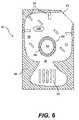
- FIG. 6is a cross sectional view of another embodiment of an inhalation device along line 6 — 6 of FIG. 5 ;
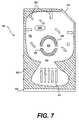
- FIG. 7is a cross sectional view of another embodiment of an inhalation device along line 7 — 7 of FIG. 4 .
- an apparatus of the present inventionis an inhaler having a compact and convenient shape.
- This inhalercontains a single dose of dry powder medicament, and may be disposed of following use by a patient.
- the inhalerincludes features for allowing air to pass into and through the device as a patient inhales. In proper use, air will exit the inhaler carrying a full dose of medicament in the form of a fine, dry powder, with little risk of spillage. Following use, the inhaler may be disposed of.
- the methods of the present inventionuse an inhaler to administer a single dose of dry powder medicament.
- a userutilizes the method of the present invention by removing the inhaler from any protective wrapping.
- the fine powder medicament contained thereinis released from a powder chamber and inhaled.
- the inhalermay then be disposed of.
- an inhaler 10 of the present inventionis shown.
- the inhaler 10is of a relatively thin, rectangular design.
- the inhaler 10is comparable in length and width to a standard credit card, and is the approximate thickness of two to three credit cards.
- the precise dimensionsmay vary in size and/or shape with a particular medication and dosage to be administered, or merely with preference.
- a devicebeing approximately 85 millimeters (mm) in length, 55 mm in width, and 3 mm thick has been contemplated. Because of the compact size and shape of the inhaler 10 , the patient may readily carry the inhaler 10 in a pocket, or store it in a wallet or purse, such as with credit cards, identification cards, or similarly shaped items.
- the inhaler 10includes a casing 11 having a powder outlet opening 13 defined therein, through which a user of the inhaler 10 inhales a powder medicament to be dispensed.
- the inhaler 10may be contained in a sealed protective enclosure, such as a plastic package or wrapper 8 , as seen in FIG. 1 .
- the inhaler 10further includes at least one ventilation opening 12 or air inlet defined in the casing 11 to allow a stream of ambient air to enter as the user draws air from the inhaler 10 through the powder outlet opening 13 .
- One or more additional ventilation openingssee FIG.
- 3 bmay be formed in the casing 11 in any desired position to allow one or more secondary or additional streams of air to enter the inhaler 10 .
- secondary or additional air streamsmay be formed from a single air inlet by passageways internal to the inhaler 10 .
- a leash or other similar structure, such as a tether 17can be seen protruding from the powder outlet opening 13 , as is illustrated in FIG. 2 .
- the inhaler 10 of FIG. 3 aincludes a casing 11 that has formed therein at least one ventilation opening 12 and a powder outlet opening 13 .
- the casing 11includes a powder chamber 15 defined by a first wall 16 coupled to the casing 11 , and a second wall 18 having a removable portion.
- the second wall 18is preferably formed at least partially by the tether 17 , which protrudes from the powder outlet opening 13 .
- the tether 17may merely be connected to, rather than itself a part of, the removable portion.
- the casing 11has defined therein exit channels 19 and 21 , and a nozzle 14 integrally formed in the casing 11 and in fluid communication between at least one ventilation opening 12 and the powder outlet opening 13 .
- a plurality of baffles 20are disposed within the exit channels 19 and 21 , as well as in the open space between the exit channels 19 and 21 and the powder outlet opening 13 .
- the casing 11is preferably formed by two opposing portions that are to be attached together, with each of the above-described features formed as desired in one or the other of the opposing portions prior to their attachment.
- the inhaler 10may be formed as a unitary device.
- FIG. 3 ban alternative embodiment of an internal structure of the inhaler 10 is illustrated. Like the embodiment of FIG. 3 a , this embodiment includes a casing 11 having at least one ventilation opening 12 and a powder outlet opening 13 defined therein. A nozzle 24 is integrally formed in the casing 11 and is in fluid communication between the at least one ventilation opening 12 and the powder outlet opening 13 .
- the inhaler 10includes an alternative powder chamber 25 defined by a first wall 26 coupled to the casing 11 . Prior to use, the powder chamber 25 will preferably be further defined by a second wall (not shown) having a removable portion, such as a tether or other removable portion connected thereto, as discussed above.
- the inhaler 10may further be provided with one or more baffles, as in the embodiment of FIG. 3 a .
- the inhaler 10may also be provided with one or more additional ventilation openings 22 , such that a secondary stream of air enters the casing 11 .
- the inhaler 10When provided to a user, such as a patient, the inhaler 10 will preferably appear substantially as shown in FIG. 2 , and will have been provided with a proper dosage of medicament in powder chamber 15 .
- the inhaler 10is preferably provided to a patient in a sealed protective enclosure 8 , such as a plastic package or wrapper. While not necessary, sealing the inhaler 10 in a protective wrapper may help to prevent moisture in the ambient air from reaching the dry powder medicament housed therein, reducing clumping and thereby facilitating inhalation when a dose is administered.
- a reusable carrying casemay also be utilized with multiple inhalers over time as a patient transports multiple doses of medicament.
- the patientWhen a patient is prepared to administer a dose of medicament, the patient first removes an inhaler 10 from its carrying case and/or protective wrapper 8 . The patient then preferably holds the inhaler 10 substantially parallel to the ground and gently tugs on the tether 17 protruding from the powder outlet opening 13 . Referring again to FIG. 3 a , pulling on the tether 17 serves to at least partially remove the second wall 18 of the powder chamber 15 , and to release medicament stored in the powder chamber 15 from its previously sealed condition. Preferably, the tether 17 and the associated portion of the second wall 18 are completely removed from the inhaler 10 by the patient prior to inhalation.
- the inhaler 10is now ready for use in administering a dosage of medicament.
- the patient's lipsare used to form an airtight seal about the powder outlet opening 13 .
- a relatively forceful inhalation action by the patientwill draw air into the casing 11 of the inhaler 10 through at least one ventilation opening 12 .
- the incoming airis forced through the nozzle 14 , causing the air to accelerate as the space through which the air is passing narrows, and aiming the air directly into the dosage of medicament previously sealed in the powder chamber 15 .
- the powder medicament usedwill consist of particles of a very fine and low-density nature. Such particles are highly susceptible to aerolization, i.e. they readily mix with ambient air.
- the stream of air through the nozzle 14causes the fine particles of medicament to become airborne, and to begin passing through the exit channels 19 and 21 towards the powder outlet opening 13 .
- one or more additional ventilation openingsmay allow one or more secondary or additional streams of air to enter the inhaler 10 . These additional streams act to further mix with the powder medicament to facilitate aerolization of the medicament particles.
- the plurality of baffles 20acts to break up any remaining clumps of medicament. Breaking up the medicament disperses the particles thereof to a size appropriate for effective respiration into the patient's respiratory tract, and makes inhalation more comfortable for the patient.
- a full dose of medicamentwill be administered by a single inhalation action by a patient.
- the inhaler 10including, for example, casing 11 , may be in part or completely formed of a translucent or transparent material, revealing to a user whether a full dosage of medicament has been properly administered.
- a patientmay have to learn through experience how to best self-administer a full dosage.
- inhaler 10is then properly disposed of.
- inhaler 10including, for example, casing 11 , is formed from a biodegradable material.
- biodegradable materialis biodegradable plastic.
- suitable biodegradable materialswould be apparent to one skilled in the art.
- reusable inhalersmay be used in connection with individually provided medicament packets that would be placed in the powder chamber 15 prior to use.
- medicament packetsfor use in reusable and disposable inhalers alike, may be prepared for use in any of a variety of ways. For example, a tether or similar arrangement, as discussed above, may be pulled by a user to release medicament stored in the packet. Alternatively, blister packs may be used.
- the inhalermay be adapted with a blade or other puncturing or cutting device that may be manipulated by a patient to open a medicament packet. Further variations will be apparent to one skilled in the art.
- inhaler 10including, for example, casing 11 , is formed from a material having a desiccant integral to it to protect against moisture during storage.
- a materialis, for example, a desiccant plastic.
- a desiccant 100is disposed in casing 11 to protect against moisture. It should be understood by one skilled in the art that the materials discussed herein for inhaler 10 are applicable to all embodiments of the invention.
- FIGS. 4–7an embodiment of the present invention is illustrated which does not rely on a leash or tether to release medicament from a powder chamber prior to use.
- the casing of this inhaler 40is formed of a first casing portion 44 , and a second casing portion 46 slidably coupled to the first casing portion 44 .
- a second wall 68 of a powder chamber 65is formed not from a portion of a tether as in the embodiments of FIGS. 3 a and 3 b , but from a material similar to that forming a first wall 66 of the powder chamber 65 .
- the second wall 68is coupled to a different casing portion than is the first wall 66 , such that when the first casing portion 44 moves with respect to the second casing portion 46 , the first wall 66 moves with respect to the second wall 68 .
- Other features of this embodimentincluding at least one ventilation opening 42 , a powder outlet opening 43 , a plurality of baffles 60 , a nozzle 64 and exit channels 69 and 71 , are substantially similar to and function in substantially the same manner as their analogous features described above with respect to FIGS. 1 , 2 , 3 a and 3 b.
- an inhaler 40When an inhaler 40 is provided to a patient, it will be in a closed position. As discussed above, the inhaler 40 will preferably be contained in a sealed protective enclosure (not shown), such as a plastic package or wrapper.
- FIG. 4illustrates the opened position while FIG. 5 shows the closed position. This arrangement leaves the inhaler 40 in its most compact position while it is not in use.
- FIG. 4may illustrate the closed position and FIG. 5 the opened position. Such an arrangement would facilitate formation of an airtight seal about the powder outlet opening 43 by the patient, since the regions of the first casing portion 44 and the second casing portion 46 that form the powder outlet opening 43 will be in closer proximity to each other in this position.
- FIG. 6an internal arrangement of the inhaler 40 in the closed position may be seen.
- the second wall 68is disposed against the first wall 66 to define powder chamber 65 .
- the powder chamber 65will likewise be in the closed position. Again, medicament to be administered will be housed within the powder chamber 65 .
- FIG. 7illustrates the internal arrangement of the inhaler 40 in the opened position.
- the movable portion of the powder chamber 65is here illustrated as a movable second wall 68 , it should be noted that any movable portion may be used.
- a relatively small plugmay be removable from the top, bottom or sides of the powder chamber 65 upon movement of the first casing portion 44 with respect to the second casing portion 46 .
- the inhaler 40may optionally be further designed such that the one or more ventilation openings 42 are open to outside air only when the inhaler 40 is in the opened position.
- the closed position of the powder chamber 65is preferably maintained merely by the pressure of the second wall 68 against the first wall 66 , so long as the pressure is sufficient to prevent premature escape of the medicament housed within the powder chamber 65 .
- the pressureresults from a friction fit between the first casing portion 44 and the second casing portion 46 , to which the second wall 68 and the first wall 66 are separately attached.
- first wall 66 and the second wall 68may each be attached to either the first casing portion 44 or the second casing portion 46 , so long as the first wall 66 and the second wall 68 are attached to portions that are movable with respect to one another.
- Additional pressure between the first wall 66 and the second wall 68 of the powder chamber 65may be induced if desired by in any way increasing the friction between the first casing portion 44 and the second casing portion 46 , such as through the use of one or more detent portions.
- the junction between the first wall 66 and the second wall 68may be provided with a releasable seal. This may be preferred where hermetic sealing of a medicament is a priority. However, such measures will typically be unnecessary since, as noted above, the inhaler 40 is preferably contained in a sealed protective enclosure when it is provided to the patient.
- the patientWhen a patient is prepared to administer a dose of medicament, the patient first removes the inhaler 40 from its protective wrapper. This arrangement allows a patient to slide the first casing portion 44 relative to the second casing portion 46 to cause the inhaler 40 , and therefore the powder chamber 65 contained therein to move from a closed position to an opened position. This is analogous in a sense to the act of tugging the exposed tether 17 as was described with reference to FIG. 2 , as it is this step that opens the powder chamber 65 . Opening the inhaler 40 releases the medicament originally stored in the powder chamber 65 .
- any reasonably forceful movement of air through the inhaler 40will lead to aerolization of the powder released from the powder chamber 65 when the inhaler 40 is opened.
- the proper dosage of medicamentmay now be administered in accordance with the procedure described above with regard to the embodiments of FIGS. 1 , 2 , 3 a and 3 b.
Landscapes
- Health & Medical Sciences (AREA)
- Engineering & Computer Science (AREA)
- Anesthesiology (AREA)
- Biomedical Technology (AREA)
- Heart & Thoracic Surgery (AREA)
- Hematology (AREA)
- Life Sciences & Earth Sciences (AREA)
- Animal Behavior & Ethology (AREA)
- General Health & Medical Sciences (AREA)
- Public Health (AREA)
- Veterinary Medicine (AREA)
- Bioinformatics & Cheminformatics (AREA)
- Pulmonology (AREA)
- Medicinal Preparation (AREA)
Abstract
Description
This application is a divisional of application Ser. No. 09/637,940 filed Aug. 14, 2000, now abandoned.
1. Field of the Invention
The present invention relates generally to administration of medication. More specifically, the present invention relates to the administration of medication by a method and apparatus for facilitating inhalation of dry powder medicaments.
2. Related art
In the medical field, it is often desirable to administer various forms of medication to patients. Well known methods of introducing medication into the human body include the oral ingestion of capsules and tablets, intravenous injection through hypodermic needles, and numerous others. In one method, certain medications may be inhaled into a patient's respiratory tract and lungs through the nose or mouth. Certain of these medications, such as bronchodilators, corticosteroids, etc., for the treatment of asthma and other respiratory anomalies, may be aimed at the respiratory tract directly. Others are inhaled for purposes of systemic treatment, i.e. for treatment of any area of the body through absorption from the respiratory tract through the lung tissue, into the deep lungs, and into the bloodstream. Each of these medications comes in a variety of forms, including fluids, which are commonly administered as an aerosol vapor or mist, as well as solids. Inhalable solids typically take the form of fine, dry powders. Specialized devices, such as inhalers, are provided to assist the patient in directing these fine powder medications into the respiratory tract.
A variety of inhalers are known for the administration of dry powder medicaments. However, each of these inhalers suffers certain drawbacks. For example, U.S. Pat. No. 5,787,881 discloses an inhaler that is used with encapsulated dry powder medicaments. However, use of this device requires numerous steps and imposes a number of inconveniences on a user. For example, the medication capsules used with the device have an aperture formed therein prior to insertion into an opening in the inhaler. Therefore, there exists a danger that an amount of medication may be lost prior to or during insertion into the device. After insertion of the capsule, use of the device requires the additional step that a cover must be closed before the medication may be inhaled. Further inconveniences arise during periods of nonuse of the device. For example, because medication is not inserted into the device until just prior to use, the medication and the device may inadvertently become separated, and alone, each is useless. Furthermore, because the device is circular in shape, it is not as readily stored as a flatter device would be in locations such as wallet or pocket, for example.
The above inhaler and others which are known may be operated in a positive gas assisted manner, such as with a source of compressed air or other gas. These devices are inconvenient for a user in that the compressed gas source must be carried with the inhaler if medication is to be effectively administered. Also, these devices carry the additional danger that a pressurized container may become ruptured.
Propellant-free inhalers, which depend only on an inspiration by a user, are also known. One such device is disclosed in U.S. Pat. No. 5,575,280. This device houses in a storage chamber an amount of medication sufficient for administration of more than one dose. Just prior to each use, a notched wheel rotates to meter an amount of powder into a separate chamber for inhalation. However, if the medication does not properly fill such a notch, because of an air pocket, for example, an improper amount of medication may be administered following rotation of the wheel. This inaccuracy can potentially lead to ineffective treatment of an ailment, and thereby result in prolonged suffering by a patient.
Thus, there is a need in the art for an improved method and apparatus for inhalation of dry powder medicaments. What is needed is an inhaler having medication pre-stored therein, and which requires minimal steps by a user prior to use. Such a device would preferably come in a size and shape for portability and convenient storage by a user, and would be designed to avoid spillage or other events leading to inaccurate administration of medication, such that a proper dosage is administered each time such a device is used. The present invention, the description of which is fully set forth below, solves the need in the art for such improved methods and apparatus.
The present invention relates to a method and apparatus for facilitating inhalation of dry powder medicaments. In one aspect of the invention, an apparatus for inhaling powder is provided. The apparatus includes a casing that houses a powder chamber. The powder chamber is formed by a first wall that is coupled to the casing, and a second wall having a removable portion. At least one ventilation opening is defined in the casing to allow air to enter. The casing also includes a powder outlet opening to allow air and powder to exit from the casing.
In a further aspect of the present invention, another apparatus for inhaling powder is provided. The apparatus includes a casing having a first casing portion and a second casing portion. The casing portions are coupled such that they may slide with respect to each other. The casing contains a powder chamber, and has at least one ventilation opening to allow air to enter into the casing. The casing also includes a powder outlet opening. The powder chamber is configured such that sliding the first casing portion relative to the second casing portion causes the powder chamber to move from a closed position to an opened position. In the opened position, powder from the powder chamber can exit the device through the powder outlet opening.
In yet another aspect of the present invention, a method of dispensing powders by inhalation is provided. The method involves providing a powder inhalation device. The powder inhalation device includes a casing having a powder chamber that contains powder. A first wall that is coupled to the casing and a second wall having a removable portion define the powder chamber. At least one ventilation opening is defined in the casing to allow air to enter into the casing. The casing includes a powder outlet opening to allow powder to exit from the casing. The method further involves pulling a tether coupled to the removable portion of the second wall, thereby removing the removable portion and defining an opening in the second wall. A final aspect of the method involves inhaling the powder.
In still yet another aspect of the present invention, another method of dispensing powders by inhalation is provided. The method involves providing a powder inhalation device having a casing. The casing has a first casing portion and a second casing portion, with the casing portions being slidable with respect to each other. Defined in the casing is a powder chamber containing powder. The casing also includes a powder outlet opening and at least one ventilation opening to allow air to enter into the casing. The powder chamber is configured such that sliding the first casing portion relative to the second casing portion causes the powder chamber to move from a closed position to an opened position, allowing powder to exit the powder inhalation device through the powder outlet opening. The method further involves sliding the first casing portion relative to the second casing portion, thereby moving the powder chamber to the opened position. Finally, the method involves inhaling the powder.
Features and Advantages
One feature of the present invention is its compact and convenient size and shape. The dimensions of the inhaler render it ideal for storage in a pocket, or wallet or purse of a patient, with such items as identification or credit cards.
Another advantageous feature of the present invention is the accuracy of medicament dosage delivered thereby. Since only one dosage of medication is present in the inhaler during each use, the possibility of overdose is eliminated, and the medicament need not be metered prior to delivery. A patient may simply inhale all medicament present in the device.
The present invention also possesses the advantage that the medicament is stored inside the inhaler. The inhaler advantageously may be made from a material having a desiccant integral to it, or otherwise include a desiccant, to protect the medicament from moisture during storage. No capsules or other storage units need be carried other than the inhaler itself. In addition, the medicament is sealed securely inside the inhaler until only a moment prior to use, and thus the chances of spillage are greatly reduced.
Because the present invention operates only under the inhalative power of the patient, the inhaler carries the additional advantage that no accessory device, such as a compressed air cylinder or other propellant, needs to be used in conjunction with the present invention.
Another advantage of the present invention is that the medicament has been stored in a sealed, dry environment until just prior to administration. In addition, during inhalation, the medicament is subjected to mixing by a plurality of baffles contained in the device. These features help to ensure that the medicament exiting the inhaler and entering the patient's respiratory system is in the form of a fine dry powder, facilitating medicament deposition in the lungs. In addition, inhalation of finer powders is typically more comfortable for the patient.
Yet another advantage of the apparatus of the present invention is that it is disposable. A patient can simply use the inhaler, and dispose of it. Other steps such as cleaning, refilling and permanently storing are unnecessary.
The present invention is described with reference to the accompanying drawings. In the drawings, like reference numbers indicate identical or functionally similar elements.
Overview
The present invention provides an improved method and apparatus for dispensing dry powder medicaments for inhalation by a patient. As will be described in more detail below, an apparatus of the present invention is an inhaler having a compact and convenient shape. This inhaler contains a single dose of dry powder medicament, and may be disposed of following use by a patient. The inhaler includes features for allowing air to pass into and through the device as a patient inhales. In proper use, air will exit the inhaler carrying a full dose of medicament in the form of a fine, dry powder, with little risk of spillage. Following use, the inhaler may be disposed of.
The methods of the present invention use an inhaler to administer a single dose of dry powder medicament. As will be discussed in greater detail below, a user utilizes the method of the present invention by removing the inhaler from any protective wrapping. The fine powder medicament contained therein is released from a powder chamber and inhaled. The inhaler may then be disposed of.
Inhaler and Associated Method of the Present Invention
An exemplary embodiment of the present invention will now be described. Referring toFIG. 1 , aninhaler 10 of the present invention is shown. As is illustrated, theinhaler 10 is of a relatively thin, rectangular design. Preferably, theinhaler 10 is comparable in length and width to a standard credit card, and is the approximate thickness of two to three credit cards. Of course, the precise dimensions may vary in size and/or shape with a particular medication and dosage to be administered, or merely with preference. For example, a device being approximately 85 millimeters (mm) in length, 55 mm in width, and 3 mm thick has been contemplated. Because of the compact size and shape of theinhaler 10, the patient may readily carry theinhaler 10 in a pocket, or store it in a wallet or purse, such as with credit cards, identification cards, or similarly shaped items.
As further illustrated inFIGS. 1 and 2 , theinhaler 10 includes acasing 11 having a powder outlet opening13 defined therein, through which a user of theinhaler 10 inhales a powder medicament to be dispensed. Prior to a time of use, theinhaler 10 may be contained in a sealed protective enclosure, such as a plastic package orwrapper 8, as seen inFIG. 1 . Theinhaler 10 further includes at least oneventilation opening 12 or air inlet defined in thecasing 11 to allow a stream of ambient air to enter as the user draws air from theinhaler 10 through thepowder outlet opening 13. One or more additional ventilation openings (seeFIG. 3 b) may be formed in thecasing 11 in any desired position to allow one or more secondary or additional streams of air to enter theinhaler 10. Alternatively, secondary or additional air streams may be formed from a single air inlet by passageways internal to theinhaler 10. A leash or other similar structure, such as atether 17, can be seen protruding from thepowder outlet opening 13, as is illustrated inFIG. 2 .
Referring next toFIG. 3 a, an embodiment of an internal structure is revealed for theinhaler 10. As discussed above with regard to external features, theinhaler 10 ofFIG. 3 aincludes acasing 11 that has formed therein at least oneventilation opening 12 and apowder outlet opening 13. In addition, thecasing 11 includes apowder chamber 15 defined by afirst wall 16 coupled to thecasing 11, and asecond wall 18 having a removable portion. Thesecond wall 18 is preferably formed at least partially by thetether 17, which protrudes from thepowder outlet opening 13. Alternatively, thetether 17 may merely be connected to, rather than itself a part of, the removable portion. Thecasing 11 has defined therein exitchannels 19 and21, and anozzle 14 integrally formed in thecasing 11 and in fluid communication between at least oneventilation opening 12 and thepowder outlet opening 13. A plurality ofbaffles 20 are disposed within theexit channels 19 and21, as well as in the open space between theexit channels 19 and21 and thepowder outlet opening 13. At a time of manufacture, thecasing 11 is preferably formed by two opposing portions that are to be attached together, with each of the above-described features formed as desired in one or the other of the opposing portions prior to their attachment. Alternatively, theinhaler 10 may be formed as a unitary device.
With reference toFIG. 3 b,an alternative embodiment of an internal structure of theinhaler 10 is illustrated. Like the embodiment ofFIG. 3 a, this embodiment includes acasing 11 having at least oneventilation opening 12 and a powder outlet opening13 defined therein. Anozzle 24 is integrally formed in thecasing 11 and is in fluid communication between the at least oneventilation opening 12 and thepowder outlet opening 13. In this embodiment, theinhaler 10 includes analternative powder chamber 25 defined by afirst wall 26 coupled to thecasing 11. Prior to use, thepowder chamber 25 will preferably be further defined by a second wall (not shown) having a removable portion, such as a tether or other removable portion connected thereto, as discussed above. Theinhaler 10 may further be provided with one or more baffles, as in the embodiment ofFIG. 3 a. Theinhaler 10 may also be provided with one or moreadditional ventilation openings 22, such that a secondary stream of air enters thecasing 11.
The operation of an inhaler of the present invention will now be described. For convenience, theinhaler 10 ofFIGS. 1 and 2 and the internal features ofFIGS. 3 aand3bwill be referred to. However, the following description is also applicable to other embodiments of the present invention.
When provided to a user, such as a patient, theinhaler 10 will preferably appear substantially as shown inFIG. 2 , and will have been provided with a proper dosage of medicament inpowder chamber 15. As noted, theinhaler 10 is preferably provided to a patient in a sealedprotective enclosure 8, such as a plastic package or wrapper. While not necessary, sealing theinhaler 10 in a protective wrapper may help to prevent moisture in the ambient air from reaching the dry powder medicament housed therein, reducing clumping and thereby facilitating inhalation when a dose is administered. A reusable carrying case may also be utilized with multiple inhalers over time as a patient transports multiple doses of medicament.
When a patient is prepared to administer a dose of medicament, the patient first removes aninhaler 10 from its carrying case and/orprotective wrapper 8. The patient then preferably holds theinhaler 10 substantially parallel to the ground and gently tugs on thetether 17 protruding from thepowder outlet opening 13. Referring again toFIG. 3 a, pulling on thetether 17 serves to at least partially remove thesecond wall 18 of thepowder chamber 15, and to release medicament stored in thepowder chamber 15 from its previously sealed condition. Preferably, thetether 17 and the associated portion of thesecond wall 18 are completely removed from theinhaler 10 by the patient prior to inhalation.
Theinhaler 10 is now ready for use in administering a dosage of medicament. The patient's lips are used to form an airtight seal about thepowder outlet opening 13. At this time, a relatively forceful inhalation action by the patient will draw air into thecasing 11 of theinhaler 10 through at least oneventilation opening 12. The incoming air is forced through thenozzle 14, causing the air to accelerate as the space through which the air is passing narrows, and aiming the air directly into the dosage of medicament previously sealed in thepowder chamber 15. Preferably, the powder medicament used will consist of particles of a very fine and low-density nature. Such particles are highly susceptible to aerolization, i.e. they readily mix with ambient air. The stream of air through thenozzle 14 causes the fine particles of medicament to become airborne, and to begin passing through theexit channels 19 and21 towards thepowder outlet opening 13. As noted above, one or more additional ventilation openings may allow one or more secondary or additional streams of air to enter theinhaler 10. These additional streams act to further mix with the powder medicament to facilitate aerolization of the medicament particles. As the airborne medicament passes through theexit channels 19 and21 and the space about thepowder outlet opening 13, the plurality ofbaffles 20 acts to break up any remaining clumps of medicament. Breaking up the medicament disperses the particles thereof to a size appropriate for effective respiration into the patient's respiratory tract, and makes inhalation more comfortable for the patient.
Preferably, a full dose of medicament will be administered by a single inhalation action by a patient. However, depending on a size of the dose, a patient's lung capacity generally, and a particular inhalation specifically, further inhalations may be necessary. Theinhaler 10, including, for example, casing11, may be in part or completely formed of a translucent or transparent material, revealing to a user whether a full dosage of medicament has been properly administered. Alternatively, a patient may have to learn through experience how to best self-administer a full dosage. Preferably,inhaler 10 is then properly disposed of. In such a disposable embodiment of the present invention,inhaler 10, including, for example, casing11, is formed from a biodegradable material. One such biodegradable material is biodegradable plastic. Other suitable biodegradable materials would be apparent to one skilled in the art. Alternatively, reusable inhalers may be used in connection with individually provided medicament packets that would be placed in thepowder chamber 15 prior to use. Such medicament packets, for use in reusable and disposable inhalers alike, may be prepared for use in any of a variety of ways. For example, a tether or similar arrangement, as discussed above, may be pulled by a user to release medicament stored in the packet. Alternatively, blister packs may be used. In another embodiment, the inhaler may be adapted with a blade or other puncturing or cutting device that may be manipulated by a patient to open a medicament packet. Further variations will be apparent to one skilled in the art.
In one embodiment of the present invention,inhaler 10, including, for example, casing11, is formed from a material having a desiccant integral to it to protect against moisture during storage. One such material is, for example, a desiccant plastic. In an alternate embodiment of the present invention, adesiccant 100, as shown inFIGS. 3 a,3b,6, and7, is disposed in casing11 to protect against moisture. It should be understood by one skilled in the art that the materials discussed herein forinhaler 10 are applicable to all embodiments of the invention.
Referring toFIGS. 4–7 , an embodiment of the present invention is illustrated which does not rely on a leash or tether to release medicament from a powder chamber prior to use. With reference toFIGS. 4 and 5 , the casing of thisinhaler 40 is formed of afirst casing portion 44, and asecond casing portion 46 slidably coupled to thefirst casing portion 44. Referring toFIG. 6 , asecond wall 68 of apowder chamber 65 is formed not from a portion of a tether as in the embodiments ofFIGS. 3 aand3b, but from a material similar to that forming afirst wall 66 of thepowder chamber 65. Thesecond wall 68 is coupled to a different casing portion than is thefirst wall 66, such that when thefirst casing portion 44 moves with respect to thesecond casing portion 46, thefirst wall 66 moves with respect to thesecond wall 68. Other features of this embodiment, including at least oneventilation opening 42, apowder outlet opening 43, a plurality ofbaffles 60, anozzle 64 andexit channels FIGS. 1 ,2,3aand3b.
When aninhaler 40 is provided to a patient, it will be in a closed position. As discussed above, theinhaler 40 will preferably be contained in a sealed protective enclosure (not shown), such as a plastic package or wrapper. Preferably,FIG. 4 illustrates the opened position whileFIG. 5 shows the closed position. This arrangement leaves theinhaler 40 in its most compact position while it is not in use. Alternatively,FIG. 4 may illustrate the closed position andFIG. 5 the opened position. Such an arrangement would facilitate formation of an airtight seal about the powder outlet opening43 by the patient, since the regions of thefirst casing portion 44 and thesecond casing portion 46 that form the powder outlet opening43 will be in closer proximity to each other in this position.
Referring now toFIG. 6 , an internal arrangement of theinhaler 40 in the closed position may be seen. With theinhaler 40 in the closed position, thesecond wall 68 is disposed against thefirst wall 66 to definepowder chamber 65. With this arrangement, when theinhaler 40 is in the closed position, thepowder chamber 65 will likewise be in the closed position. Again, medicament to be administered will be housed within thepowder chamber 65.FIG. 7 illustrates the internal arrangement of theinhaler 40 in the opened position. When thefirst casing portion 44 is moved with respect to thesecond casing portion 46 from the closed position to the opened position, thefirst wall 66 andsecond wall 68 of thepowder chamber 65 separate, releasing the dry powder stored in thepowder chamber 65. While the movable portion of thepowder chamber 65 is here illustrated as a movablesecond wall 68, it should be noted that any movable portion may be used. For example, a relatively small plug may be removable from the top, bottom or sides of thepowder chamber 65 upon movement of thefirst casing portion 44 with respect to thesecond casing portion 46. Additionally, theinhaler 40 may optionally be further designed such that the one ormore ventilation openings 42 are open to outside air only when theinhaler 40 is in the opened position.
In the present embodiment, the closed position of thepowder chamber 65 is preferably maintained merely by the pressure of thesecond wall 68 against thefirst wall 66, so long as the pressure is sufficient to prevent premature escape of the medicament housed within thepowder chamber 65. The pressure results from a friction fit between thefirst casing portion 44 and thesecond casing portion 46, to which thesecond wall 68 and thefirst wall 66 are separately attached. Note thatfirst wall 66 and thesecond wall 68 may each be attached to either thefirst casing portion 44 or thesecond casing portion 46, so long as thefirst wall 66 and thesecond wall 68 are attached to portions that are movable with respect to one another. Additional pressure between thefirst wall 66 and thesecond wall 68 of thepowder chamber 65 may be induced if desired by in any way increasing the friction between thefirst casing portion 44 and thesecond casing portion 46, such as through the use of one or more detent portions. Alternatively, the junction between thefirst wall 66 and thesecond wall 68 may be provided with a releasable seal. This may be preferred where hermetic sealing of a medicament is a priority. However, such measures will typically be unnecessary since, as noted above, theinhaler 40 is preferably contained in a sealed protective enclosure when it is provided to the patient.
The operation of theinhaler 40 of this embodiment of the present invention will now be described. When a patient is prepared to administer a dose of medicament, the patient first removes theinhaler 40 from its protective wrapper. This arrangement allows a patient to slide thefirst casing portion 44 relative to thesecond casing portion 46 to cause theinhaler 40, and therefore thepowder chamber 65 contained therein to move from a closed position to an opened position. This is analogous in a sense to the act of tugging the exposedtether 17 as was described with reference toFIG. 2 , as it is this step that opens thepowder chamber 65. Opening theinhaler 40 releases the medicament originally stored in thepowder chamber 65. Because of the fine and low-density nature of the medicament preferably used in theinhaler 40, any reasonably forceful movement of air through theinhaler 40 will lead to aerolization of the powder released from thepowder chamber 65 when theinhaler 40 is opened. The proper dosage of medicament may now be administered in accordance with the procedure described above with regard to the embodiments ofFIGS. 1 ,2,3aand3b.
While various embodiments of the present invention have been described above, it should be understood that they have been presented by way of example only, and not limitation. For example, the present invention is not limited to the physical arrangements or dimensions illustrated or described. Nor is the present invention limited to any particular design or materials of construction. As such, the breadth and scope of the present invention should not be limited to any of the above-described exemplary embodiments, but should be defined only in accordance with the following claims and their equivalents.
Claims (32)
1. A powder inhalation device, comprising:
a casing consisting of a first casing portion and a second casing portion, said first casing portion comprising a substantially planar first face portion and said second casing portion comprising a substantially planar second face portion, wherein said second casing portion is slidably coupled to said first casing portion;
a powder chamber disposed in said casing defined by a first wall coupled to said first face portion and a second wall coupled to said second face portion so that when said first casing portion moves with respect to said second casing portion, said first wall moves with respect to said second wall;
at least one ventilation opening defined in said casing to allow air to enter into said casing; and
a powder outlet opening, through which powder exits from said casing and around which a user's lips are used to form a seal, defined by said first casing portion and said second casing portion.
2. The powder inhalation device ofclaim 1 , further comprising a nozzle integrally formed in said casing in fluid communication with said at least one ventilation opening.
3. The powder inhalation device ofclaim 2 , wherein said powder chamber is disposed adjacent said nozzle, such that said nozzle converges toward said powder chamber and is configured to direct a stream of air into said powder chamber.
4. The powder inhalation device ofclaim 3 , further comprising:
at least one secondary opening defined in said casing, wherein a secondary stream of air enters said casing through said secondary opening.
5. The powder inhalation device ofclaim 1 , further comprising an exit channel defined by said casing, said exit channel being in fluid communication with said powder outlet opening.
6. The powder inhalation device ofclaim 5 , further comprising a plurality of baffles disposed within said exit channel.
7. The powder inhalation device ofclaim 1 , further comprising powder disposed within said powder chamber.
8. The powder inhalation device ofclaim 7 , further comprising a wrapper encapsulating said casing.
9. The powder inhalation device ofclaim 1 , wherein said device is dimensioned to form a compact configuration.
10. The powder inhalation device ofclaim 1 , wherein said powder chamber is configured such that sliding said first casing portion relative to said second casing portion causes said powder chamber to move from a closed position to an open position, thereby allowing powder to exit the device through said powder outlet opening.
11. The powder inhalation device ofclaim 1 , wherein at least a portion of said casing is formed from a translucent material.
12. The powder inhalation device ofclaim 1 , wherein at least a portion of said casing is formed from a transparent material.
13. The powder inhalation device ofclaim 1 , wherein said device is disposable.
14. The powder inhalation device ofclaim 1 , wherein said casing is formed from a biodegradable material.
15. The powder inhalation device ofclaim 1 , wherein said casing is formed from a material having an integral desiccant.
16. The powder inhalation device ofclaim 1 , further comprising:
a desiccant disposed in said casing.
17. A powder inhalation device, comprising:
a casing, said casing consisting of a first casing portion and a second casing portion, said first casing portion comprising a substantially planar first face portion and said second casing portion comprising a substantially planar second face portion, wherein said second casing portion is slidably coupled to said first casing portion;
a powder chamber disposed in said casing;
at least one ventilation opening defined in said casing to allow air to enter into said casing;
a powder outlet opening, through which powder exits from said casing and around which a user's lips are used to form a seal, defined by said first casing portion and said second casing portion, wherein said powder chamber is configured such that said first and said second casing portions together enclose said powder chamber and sliding said first casing portion relative to said second casing portion causes said powder chamber to move from a closed position to an opened position, thereby allowing powder to exit the device through said powder outlet opening.
18. The powder inhalation device ofclaim 17 , further comprising:
a nozzle integrally formed in said casing opposite said powder outlet opening and in fluid communication with said at least one ventilation opening, said nozzle converging toward said powder chamber and configured to direct a stream of air into said powder chamber.
19. The powder inhalation device ofclaim 18 , further comprising:
an exit channel defined by said casing, said exit channel being in fluid communication with said powder outlet opening.
20. The powder inhalation device ofclaim 19 , further comprising a plurality of baffles disposed within said exit channel.
21. The powder inhalation device ofclaim 18 , further comprising:
at least one secondary opening defined in said casing, wherein a secondary stream of air enters said casing through said secondary opening.
22. The powder inhalation device ofclaim 17 , further comprising powder disposed within said powder chamber.
23. The powder inhalation device ofclaim 22 , further comprising a wrapper encapsulating said casing.
24. The powder inhalation device ofclaim 17 , wherein at least a portion of said casing is formed from a translucent material.
25. The powder inhalation device ofclaim 17 , wherein at least a portion of said casing is formed from a transparent material.
26. The powder inhalation device ofclaim 17 , wherein said casing is formed from a biodegradable material.
27. The powder inhalation device ofclaim 17 , wherein said casing is formed from a material having an integral desiccant.
28. The powder inhalation device ofclaim 17 , further comprising:
a desiccant disposed in said casing.
29. A method for dispensing powder by inhalation, comprising:
sliding a first casing portion, comprising a substantially planar first face portion, relative to a second casing portion, comprising a substantially planar second face portion, of a powder inhalation device, thereby moving a powder chamber to an open position, wherein a casing for the powder inhalation device consists of the second casing portion slidably coupled to the first casing portion,
the powder chamber is defined by a first wall coupled to the first face portion and a second wall coupled to the second face portion so that when the first casing portion moves with respect to the second casing portion, the first wall moves with respect to the second wall, and
the powder inhalation device comprises at least one ventilation opening defined in said casing to allow air to enter into the device, and a powder outlet opening, through which powder exits from said casing and around which a user's lips are used to form a seal, the powder outlet being defined by the first casing portion and the second casing portion; and
inhaling powder from the device through said powder outlet opening.
30. The method ofclaim 29 , further comprising:
removing a protective wrapper from said device.
31. The method ofclaim 29 , further comprising:
providing the powder to the powder chamber.
32. The method ofclaim 31 , wherein said providing includes inserting a powder packet into the powder chamber.
Priority Applications (1)
| Application Number | Priority Date | Filing Date | Title |
|---|---|---|---|
| US10/123,319US7032593B2 (en) | 2000-08-14 | 2002-04-17 | Inhalation device and method |
Applications Claiming Priority (2)
| Application Number | Priority Date | Filing Date | Title |
|---|---|---|---|
| US63794000A | 2000-08-14 | 2000-08-14 | |
| US10/123,319US7032593B2 (en) | 2000-08-14 | 2002-04-17 | Inhalation device and method |
Related Parent Applications (1)
| Application Number | Title | Priority Date | Filing Date |
|---|---|---|---|
| US63794000ADivision | 2000-08-14 | 2000-08-14 |
Publications (2)
| Publication Number | Publication Date |
|---|---|
| US20020108611A1 US20020108611A1 (en) | 2002-08-15 |
| US7032593B2true US7032593B2 (en) | 2006-04-25 |
Family
ID=24557983
Family Applications (1)
| Application Number | Title | Priority Date | Filing Date |
|---|---|---|---|
| US10/123,319Expired - LifetimeUS7032593B2 (en) | 2000-08-14 | 2002-04-17 | Inhalation device and method |
Country Status (3)
| Country | Link |
|---|---|
| US (1) | US7032593B2 (en) |
| AU (1) | AU2001283546A1 (en) |
| WO (1) | WO2002013897A2 (en) |
Cited By (43)
| Publication number | Priority date | Publication date | Assignee | Title |
|---|---|---|---|---|
| US20060021616A1 (en)* | 2004-06-07 | 2006-02-02 | Mederio Ag | Inhaler |
| US20070209661A1 (en)* | 2006-03-03 | 2007-09-13 | Hugh Smyth | Dry powder inhaler with aeroelastic dispersion mechanism |
| US20090178676A1 (en)* | 2006-05-16 | 2009-07-16 | Hovione Inter Ag | Simple inhaler |
| US20090308392A1 (en)* | 2008-06-13 | 2009-12-17 | Smutney Chad C | Dry Powder Inhaler and System for Drug Delivery |
| US20100168710A1 (en)* | 2007-01-17 | 2010-07-01 | Philip Braithwaite | Device |
| US20100197565A1 (en)* | 2008-06-13 | 2010-08-05 | Smutney Chad C | Dry powder drug delivery system |
| US20130032145A1 (en)* | 2008-05-01 | 2013-02-07 | Dan Adler | Dry powder inhaler |
| US8561609B2 (en) | 2010-12-07 | 2013-10-22 | Respira Therapeutics, Inc. | Dry powder inhaler |
| US9179691B2 (en) | 2007-12-14 | 2015-11-10 | Aerodesigns, Inc. | Delivering aerosolizable food products |
| US9220687B2 (en) | 2008-12-29 | 2015-12-29 | Mannkind Corporation | Substituted diketopiperazine analogs for use as drug delivery agents |
| US9233159B2 (en) | 2011-10-24 | 2016-01-12 | Mannkind Corporation | Methods and compositions for treating pain |
| US9241903B2 (en) | 2006-02-22 | 2016-01-26 | Mannkind Corporation | Method for improving the pharmaceutic properties of microparticles comprising diketopiperazine and an active agent |
| US9283193B2 (en) | 2005-09-14 | 2016-03-15 | Mannkind Corporation | Method of drug formulation based on increasing the affinity of crystalline microparticle surfaces for active agents |
| US9346766B2 (en) | 2004-08-20 | 2016-05-24 | Mannkind Corporation | Catalysis of diketopiperazine synthesis |
| US9358352B2 (en) | 2008-06-13 | 2016-06-07 | Mannkind Corporation | Dry powder drug delivery system and methods |
| US9364436B2 (en) | 2011-06-17 | 2016-06-14 | Mannkind Corporation | High capacity diketopiperazine microparticles and methods |
| US9364619B2 (en) | 2008-06-20 | 2016-06-14 | Mannkind Corporation | Interactive apparatus and method for real-time profiling of inhalation efforts |
| US9492625B2 (en) | 2009-11-12 | 2016-11-15 | Stc.Unm | Dry powder inhaler with flutter dispersion member |
| US9630930B2 (en) | 2009-06-12 | 2017-04-25 | Mannkind Corporation | Diketopiperazine microparticles with defined specific surface areas |
| US9675674B2 (en) | 2004-08-23 | 2017-06-13 | Mannkind Corporation | Diketopiperazine salts for drug delivery and related methods |
| US9700690B2 (en) | 2002-03-20 | 2017-07-11 | Mannkind Corporation | Inhalation apparatus |
| US9706944B2 (en) | 2009-11-03 | 2017-07-18 | Mannkind Corporation | Apparatus and method for simulating inhalation efforts |
| US9801925B2 (en) | 1999-06-29 | 2017-10-31 | Mannkind Corporation | Potentiation of glucose elimination |
| US9802012B2 (en) | 2012-07-12 | 2017-10-31 | Mannkind Corporation | Dry powder drug delivery system and methods |
| US9925144B2 (en) | 2013-07-18 | 2018-03-27 | Mannkind Corporation | Heat-stable dry powder pharmaceutical compositions and methods |
| US9943571B2 (en) | 2008-08-11 | 2018-04-17 | Mannkind Corporation | Use of ultrarapid acting insulin |
| US9983108B2 (en) | 2009-03-11 | 2018-05-29 | Mannkind Corporation | Apparatus, system and method for measuring resistance of an inhaler |
| WO2018200425A1 (en) | 2017-04-24 | 2018-11-01 | Cocrystal Pharma, Inc. | Pyrrolopyrimidine derivatives useful as inhibitors of influenza virus replication |
| US10159644B2 (en) | 2012-10-26 | 2018-12-25 | Mannkind Corporation | Inhalable vaccine compositions and methods |
| US10307464B2 (en) | 2014-03-28 | 2019-06-04 | Mannkind Corporation | Use of ultrarapid acting insulin |
| US10421729B2 (en) | 2013-03-15 | 2019-09-24 | Mannkind Corporation | Microcrystalline diketopiperazine compositions and methods |
| US10441733B2 (en) | 2012-06-25 | 2019-10-15 | Respira Therapeutics, Inc. | Powder dispersion devices and methods |
| WO2020023813A1 (en) | 2018-07-27 | 2020-01-30 | Cocrystal Pharma, Inc. | Pyrrolo[2,3-b]pyridin derivatives as inhibitors of influenza virus replication |
| US10561806B2 (en) | 2014-10-02 | 2020-02-18 | Mannkind Corporation | Mouthpiece cover for an inhaler |
| WO2020055858A1 (en) | 2018-09-10 | 2020-03-19 | Cocrystal Pharma, Inc. | Pyridopyrazine and pyridotriazine inhibitors of influenza virus replication |
| US10625034B2 (en) | 2011-04-01 | 2020-04-21 | Mannkind Corporation | Blister package for pharmaceutical cartridges |
| WO2020081751A1 (en) | 2018-10-17 | 2020-04-23 | Cocrystal Pharma, Inc. | Combinations of inhibitors of influenza virus replication |
| WO2020112716A1 (en) | 2018-11-26 | 2020-06-04 | Cocrystal Pharma, Inc. | Inhibitors of influenza virus replication |
| WO2021188620A1 (en) | 2020-03-17 | 2021-09-23 | Cocrystal Pharma Inc. | Peptidomimetic n5-methyl-n2-(nonanoyl-l-leucyl)-l-glutaminate derivatives, triazaspiro[4.14]nonadecane derivatives and similar compounds as inhibitors of norovirus and coronavirus replication |
| WO2021206876A1 (en) | 2020-04-10 | 2021-10-14 | Cocrystal Pharma, Inc. | Inhibitors of norovirus and coronavirus replication |
| US11446127B2 (en) | 2013-08-05 | 2022-09-20 | Mannkind Corporation | Insufflation apparatus and methods |
| US11471623B2 (en) | 2012-02-21 | 2022-10-18 | Respira Therapeutics, Inc. | Powder dispersion methods and devices |
| WO2023014758A1 (en) | 2021-08-03 | 2023-02-09 | Cocrystal Pharma, Inc. | Inhibitors for coronaviruses |
Families Citing this family (17)
| Publication number | Priority date | Publication date | Assignee | Title |
|---|---|---|---|---|
| US6427688B1 (en) | 2000-02-01 | 2002-08-06 | Dura Pharmaceuticals, Icn. | Dry powder inhaler |
| WO2003103563A2 (en)* | 2002-06-07 | 2003-12-18 | Sun Pharmaceutical Industries Limited | Powder inhaler |
| GB0227128D0 (en) | 2002-11-20 | 2002-12-24 | Glaxo Group Ltd | A capsule |
| US6941947B2 (en) | 2002-12-18 | 2005-09-13 | Quadrant Technologies Limited | Unit dose dry powder inhaler |
| GB0308969D0 (en) | 2003-04-17 | 2003-05-28 | Glaxo Group Ltd | Capsules |
| GB0520794D0 (en)* | 2005-10-12 | 2005-11-23 | Innovata Biomed Ltd | Inhaler |
| DE102008023376A1 (en)* | 2008-05-13 | 2009-11-19 | Alfred Von Schuckmann | Dispenser for powdery masses contained in a separate packaging |
| GB2460281A (en)* | 2008-05-23 | 2009-11-25 | Goldie 123 Ltd | Inhaler |
| WO2013036881A2 (en) | 2011-09-07 | 2013-03-14 | Syphase, Llc | Dry powder inhalation device |
| CN104159633B (en)* | 2011-12-16 | 2018-10-12 | 因多西斯有限公司 | unit dose kit and conveying device |
| DE102014005647B4 (en)* | 2014-01-30 | 2016-05-12 | Klaus-Dieter Beller | Powder inhaler and powder inhaler set |
| DE102014005646B4 (en)* | 2014-01-30 | 2016-05-12 | Klaus-Dieter Beller | Powder inhaler and powder inhalation kit |
| EP3137140B1 (en)* | 2014-05-02 | 2019-07-10 | Manta Devices, LLC | Delivery device |
| DE102014017409B4 (en)* | 2014-11-26 | 2016-06-09 | Klaus Dieter Beller | Single-dose powder inhaler and process for its preparation |
| DE102017106500A1 (en)* | 2017-03-27 | 2018-09-27 | Aixtron Se | powder feeder |
| US10456537B2 (en) | 2017-03-28 | 2019-10-29 | Concentrx Pharmaceuticals, Inc. | Devices and methods for delivering dry powder medicaments |
| DE102017006763A1 (en)* | 2017-07-18 | 2019-01-24 | Klaus Dieter Beller | Single-dose powder inhaler |
Citations (67)
| Publication number | Priority date | Publication date | Assignee | Title |
|---|---|---|---|---|
| US3635219A (en) | 1968-06-07 | 1972-01-18 | Fisons Pharmaceuticals Ltd | Inhalation device |
| US3669113A (en) | 1966-03-07 | 1972-06-13 | Fisons Ltd | Inhalation device |
| US3795244A (en) | 1973-02-02 | 1974-03-05 | Syntex Corp | Inhalation device |
| US3837341A (en) | 1972-08-23 | 1974-09-24 | Fisons Ltd | Medicament inhalation device with audible indicating means |
| US3888253A (en) | 1972-08-04 | 1975-06-10 | Beecham Group Ltd | Device for administration of medicines |
| US3906950A (en) | 1973-04-04 | 1975-09-23 | Isf Spa | Inhaling device for powdered medicaments |
| US4013075A (en) | 1974-07-15 | 1977-03-22 | I.S.F. S.P.A. | Inhalers and insufflators having a cutting means |
| US4069819A (en) | 1973-04-13 | 1978-01-24 | Societa Farmaceutici S.P.A. | Inhalation device |
| US4105027A (en) | 1975-06-13 | 1978-08-08 | Syntex Puerto Rico, Inc. | Inhalation device |
| US4192309A (en) | 1978-09-05 | 1980-03-11 | Syntex Puerto Rico, Inc. | Inhalation device with capsule opener |
| US4240418A (en) | 1974-08-22 | 1980-12-23 | Schering Aktiengesellschaft | Apparatus for the inhalation of medicinal agents |
| US4338931A (en) | 1979-04-27 | 1982-07-13 | Claudio Cavazza | Device for the quick inhalation of drugs in powder form by humans suffering from asthma |
| US4841964A (en) | 1985-08-01 | 1989-06-27 | Wilhelm Hurka | Inhaler |
| US4846168A (en)* | 1986-12-05 | 1989-07-11 | Mect Corporation | Inhaler |
| US4860740A (en) | 1980-10-30 | 1989-08-29 | Riker Laboratories, Inc. | Powder inhalation device |
| US4889114A (en) | 1983-12-17 | 1989-12-26 | Boehringer Ingelheim Kg | Powdered pharmaceutical inhaler |
| US4995385A (en) | 1989-02-23 | 1991-02-26 | Phidea S.P.A. | Inhaler with regular complete emptying of the capsule |
| US5042472A (en) | 1990-10-15 | 1991-08-27 | Merck & Co., Inc. | Powder inhaler device |
| US5152284A (en) | 1989-02-23 | 1992-10-06 | Phidea S.P.A. | Disposable inhaler with pre-pierced capsule |
| US5239992A (en) | 1991-05-30 | 1993-08-31 | Societe Francaise D'aerosols Et De Bouchage | Loose powder inhaler with inhalation-actuated dosing piston |
| US5239991A (en) | 1989-06-21 | 1993-08-31 | Fisons Plc | Disposable powder medicament inhalation device with peel-off cover |
| US5301666A (en) | 1991-12-14 | 1994-04-12 | Asta Medica Aktiengesellschaft | Powder inhaler |
| WO1994008552A2 (en) | 1992-10-19 | 1994-04-28 | Dura Pharmaceuticals, Inc. | Dry powder inhaler |
| US5349947A (en) | 1993-07-15 | 1994-09-27 | Newhouse Michael T | Dry powder inhaler and process that explosively discharges a dose of powder and gas from a soft plastic pillow |
| US5437271A (en) | 1993-04-06 | 1995-08-01 | Minnesota Mining And Manufacturing Company | Deagglomerators for dry powder inhalers |
| US5507281A (en) | 1990-08-30 | 1996-04-16 | Boehringer Ingelheim Kg | Device for initiating a mechanical switching operation in synchronism with the breathing |
| US5524613A (en) | 1993-08-25 | 1996-06-11 | Habley Medical Technology Corporation | Controlled multi-pharmaceutical inhaler |
| US5533505A (en) | 1992-03-04 | 1996-07-09 | Astra Aktiebolag | Disposable inhaler |
| US5575280A (en) | 1990-11-29 | 1996-11-19 | Boehringer Ingelheim Kg | Powder inhalation device having nozzle to empty dosing chamber |
| US5595175A (en) | 1991-08-16 | 1997-01-21 | Sandoz Ltd. | Inhaler for administration of powdery substances |
| US5617845A (en) | 1990-08-30 | 1997-04-08 | Boehringer Ingelheim Kg | Inhalation device free from propellent gas |
| US5647349A (en) | 1995-06-01 | 1997-07-15 | Unisia Jecs Corporation | Medicine administering inhaling device |
| US5651359A (en) | 1994-10-18 | 1997-07-29 | Sofab | Device for inhaling powder |
| US5660169A (en)* | 1990-09-12 | 1997-08-26 | Astra Aktiebolag | Disposable inhaler with pull-off seal |
| US5673686A (en) | 1994-02-02 | 1997-10-07 | Plurichemie Anstalt | Medicament inhaler and method |
| US5685294A (en) | 1989-08-17 | 1997-11-11 | Boehringer Ingelheim Kg | Powder inhaler having magazine storage and a hinged mouthpiece |
| US5699789A (en) | 1996-03-11 | 1997-12-23 | Hendricks; Mark R. | Dry powder inhaler |
| US5727546A (en) | 1993-08-18 | 1998-03-17 | Fisons Plc | Powder inhaler with breath flow regulation valve |
| US5740794A (en) | 1994-09-21 | 1998-04-21 | Inhale Therapeutic Systems | Apparatus and methods for dispersing dry powder medicaments |
| US5787881A (en) | 1993-02-27 | 1998-08-04 | Fisons Plc | Inhalation device |
| US5797391A (en) | 1991-03-28 | 1998-08-25 | Rhone-Poulenc Rorer Limited | Inhaler |
| US5810004A (en) | 1995-10-09 | 1998-09-22 | Unisia Jecs Corporation | Medicator for a capsule filled with a powdered drug |
| US5829434A (en)* | 1992-12-18 | 1998-11-03 | Schering Corporation | Inhaler for powdered medications |
| US5860419A (en) | 1990-03-02 | 1999-01-19 | Glaxo Group Limited | Inhalation device |
| US5896855A (en) | 1992-12-24 | 1999-04-27 | Rhone-Poulenc Rorer Limited | Multi dose inhaler apparatus |
| US5918594A (en) | 1995-08-10 | 1999-07-06 | Astra Aktiebolag | Inhaler with deagglomerating device |
| US5921237A (en) | 1995-04-24 | 1999-07-13 | Dura Pharmaceuticals, Inc. | Dry powder inhaler |
| US6065472A (en) | 1996-01-03 | 2000-05-23 | Glaxo Wellcome Inc. | Multidose powder inhalation device |
| US6092522A (en) | 1990-06-14 | 2000-07-25 | Rhone-Poulenc Rorer Limited | Powder inhaler having capsule holding structure and anti-static walls |
| US6098619A (en) | 1998-05-04 | 2000-08-08 | Glaxo Wellcome Inc. | Unit dose inhaler apparatus and method of delivery using same |
| US6102035A (en) | 1995-08-10 | 2000-08-15 | Astra Aktiebolag | Inhaler |
| US6105574A (en) | 1997-02-07 | 2000-08-22 | Astra Aktiebolag | Single dose inhaler II |
| US6116238A (en) | 1997-12-02 | 2000-09-12 | Dura Pharmaceuticals, Inc. | Dry powder inhaler |
| US6116237A (en) | 1996-04-29 | 2000-09-12 | Dura Pharmaceuticals, Inc. | Methods of dry powder inhalation |
| US6119853A (en) | 1998-12-18 | 2000-09-19 | Glaxo Wellcome Inc. | Method and package for storing a pressurized container containing a drug |
| WO2000064519A1 (en) | 1999-04-23 | 2000-11-02 | Orion Corporation | Powder inhaler for combined medicament |
| US6142145A (en) | 1997-03-14 | 2000-11-07 | Astra Aktiebolag | Inhalation device |
| WO2001007107A2 (en) | 1999-07-23 | 2001-02-01 | Pharmaceutical Discovery Corporation | Unit dose capsules and dry powder inhaler |
| US6187269B1 (en) | 1995-03-17 | 2001-02-13 | Unipath Limited | Assay devices |
| US6237590B1 (en) | 1997-09-18 | 2001-05-29 | Delsys Pharmaceutical Corporation | Dry powder delivery system apparatus |
| US6273085B1 (en) | 1997-03-20 | 2001-08-14 | Dura Pharmaceuticals, Inc. | Dry powder inhaler |
| US6286507B1 (en) | 1997-02-07 | 2001-09-11 | Astra Aktiebolag | Single dose inhaler I |
| US6332461B1 (en)* | 1994-05-11 | 2001-12-25 | Orion-Yhtyma Oy | Powder inhaler |
| US6390291B1 (en)* | 1998-12-18 | 2002-05-21 | Smithkline Beecham Corporation | Method and package for storing a pressurized container containing a drug |
| US20030094173A1 (en) | 2001-11-14 | 2003-05-22 | Inhale Therapeutic Systems, Inc. | Aerosolization device with improved endpiece connection |
| US6575160B1 (en) | 1997-08-07 | 2003-06-10 | Art Slutsky | Inhalation device |
| US6732732B2 (en) | 2001-04-16 | 2004-05-11 | Advanced Inhalation Research, Inc. | Inhalation device and method |
Family Cites Families (2)
| Publication number | Priority date | Publication date | Assignee | Title |
|---|---|---|---|---|
| GB8914223D0 (en)* | 1989-06-21 | 1989-08-09 | Fisons Plc | Medicament container |
| AU746970B2 (en)* | 1997-12-02 | 2002-05-09 | Dura Pharmaceuticals, Inc. | Dry powder inhaler |
- 2001
- 2001-08-08AUAU2001283546Apatent/AU2001283546A1/ennot_activeAbandoned
- 2001-08-08WOPCT/US2001/041617patent/WO2002013897A2/enactiveApplication Filing
- 2002
- 2002-04-17USUS10/123,319patent/US7032593B2/ennot_activeExpired - Lifetime
Patent Citations (68)
| Publication number | Priority date | Publication date | Assignee | Title |
|---|---|---|---|---|
| US3669113A (en) | 1966-03-07 | 1972-06-13 | Fisons Ltd | Inhalation device |
| US3635219A (en) | 1968-06-07 | 1972-01-18 | Fisons Pharmaceuticals Ltd | Inhalation device |
| US3888253A (en) | 1972-08-04 | 1975-06-10 | Beecham Group Ltd | Device for administration of medicines |
| US3837341A (en) | 1972-08-23 | 1974-09-24 | Fisons Ltd | Medicament inhalation device with audible indicating means |
| US3795244A (en) | 1973-02-02 | 1974-03-05 | Syntex Corp | Inhalation device |
| US3906950A (en) | 1973-04-04 | 1975-09-23 | Isf Spa | Inhaling device for powdered medicaments |
| US4069819A (en) | 1973-04-13 | 1978-01-24 | Societa Farmaceutici S.P.A. | Inhalation device |
| US4013075A (en) | 1974-07-15 | 1977-03-22 | I.S.F. S.P.A. | Inhalers and insufflators having a cutting means |
| US4240418A (en) | 1974-08-22 | 1980-12-23 | Schering Aktiengesellschaft | Apparatus for the inhalation of medicinal agents |
| US4105027A (en) | 1975-06-13 | 1978-08-08 | Syntex Puerto Rico, Inc. | Inhalation device |
| US4192309A (en) | 1978-09-05 | 1980-03-11 | Syntex Puerto Rico, Inc. | Inhalation device with capsule opener |
| US4338931A (en) | 1979-04-27 | 1982-07-13 | Claudio Cavazza | Device for the quick inhalation of drugs in powder form by humans suffering from asthma |
| US4860740A (en) | 1980-10-30 | 1989-08-29 | Riker Laboratories, Inc. | Powder inhalation device |
| US4889114A (en) | 1983-12-17 | 1989-12-26 | Boehringer Ingelheim Kg | Powdered pharmaceutical inhaler |
| US4841964A (en) | 1985-08-01 | 1989-06-27 | Wilhelm Hurka | Inhaler |
| US4846168A (en)* | 1986-12-05 | 1989-07-11 | Mect Corporation | Inhaler |
| US4995385A (en) | 1989-02-23 | 1991-02-26 | Phidea S.P.A. | Inhaler with regular complete emptying of the capsule |
| US5152284A (en) | 1989-02-23 | 1992-10-06 | Phidea S.P.A. | Disposable inhaler with pre-pierced capsule |
| US5239991A (en) | 1989-06-21 | 1993-08-31 | Fisons Plc | Disposable powder medicament inhalation device with peel-off cover |
| US5685294A (en) | 1989-08-17 | 1997-11-11 | Boehringer Ingelheim Kg | Powder inhaler having magazine storage and a hinged mouthpiece |
| US5860419A (en) | 1990-03-02 | 1999-01-19 | Glaxo Group Limited | Inhalation device |
| US6092522A (en) | 1990-06-14 | 2000-07-25 | Rhone-Poulenc Rorer Limited | Powder inhaler having capsule holding structure and anti-static walls |
| US5507281A (en) | 1990-08-30 | 1996-04-16 | Boehringer Ingelheim Kg | Device for initiating a mechanical switching operation in synchronism with the breathing |
| US5617845A (en) | 1990-08-30 | 1997-04-08 | Boehringer Ingelheim Kg | Inhalation device free from propellent gas |
| US5660169A (en)* | 1990-09-12 | 1997-08-26 | Astra Aktiebolag | Disposable inhaler with pull-off seal |
| US5042472A (en) | 1990-10-15 | 1991-08-27 | Merck & Co., Inc. | Powder inhaler device |
| US5575280A (en) | 1990-11-29 | 1996-11-19 | Boehringer Ingelheim Kg | Powder inhalation device having nozzle to empty dosing chamber |
| US5797391A (en) | 1991-03-28 | 1998-08-25 | Rhone-Poulenc Rorer Limited | Inhaler |
| US5239992A (en) | 1991-05-30 | 1993-08-31 | Societe Francaise D'aerosols Et De Bouchage | Loose powder inhaler with inhalation-actuated dosing piston |
| US5595175A (en) | 1991-08-16 | 1997-01-21 | Sandoz Ltd. | Inhaler for administration of powdery substances |
| US5301666A (en) | 1991-12-14 | 1994-04-12 | Asta Medica Aktiengesellschaft | Powder inhaler |
| US5533505A (en) | 1992-03-04 | 1996-07-09 | Astra Aktiebolag | Disposable inhaler |
| WO1994008552A2 (en) | 1992-10-19 | 1994-04-28 | Dura Pharmaceuticals, Inc. | Dry powder inhaler |
| US5829434A (en)* | 1992-12-18 | 1998-11-03 | Schering Corporation | Inhaler for powdered medications |
| US5896855A (en) | 1992-12-24 | 1999-04-27 | Rhone-Poulenc Rorer Limited | Multi dose inhaler apparatus |
| US5787881A (en) | 1993-02-27 | 1998-08-04 | Fisons Plc | Inhalation device |
| US5437271A (en) | 1993-04-06 | 1995-08-01 | Minnesota Mining And Manufacturing Company | Deagglomerators for dry powder inhalers |
| US5349947A (en) | 1993-07-15 | 1994-09-27 | Newhouse Michael T | Dry powder inhaler and process that explosively discharges a dose of powder and gas from a soft plastic pillow |
| US5727546A (en) | 1993-08-18 | 1998-03-17 | Fisons Plc | Powder inhaler with breath flow regulation valve |
| US5524613A (en) | 1993-08-25 | 1996-06-11 | Habley Medical Technology Corporation | Controlled multi-pharmaceutical inhaler |
| US5673686A (en) | 1994-02-02 | 1997-10-07 | Plurichemie Anstalt | Medicament inhaler and method |
| US6332461B1 (en)* | 1994-05-11 | 2001-12-25 | Orion-Yhtyma Oy | Powder inhaler |
| US5740794A (en) | 1994-09-21 | 1998-04-21 | Inhale Therapeutic Systems | Apparatus and methods for dispersing dry powder medicaments |
| US5785049A (en) | 1994-09-21 | 1998-07-28 | Inhale Therapeutic Systems | Method and apparatus for dispersion of dry powder medicaments |
| US5651359A (en) | 1994-10-18 | 1997-07-29 | Sofab | Device for inhaling powder |
| US6187269B1 (en) | 1995-03-17 | 2001-02-13 | Unipath Limited | Assay devices |
| US5921237A (en) | 1995-04-24 | 1999-07-13 | Dura Pharmaceuticals, Inc. | Dry powder inhaler |
| US5647349A (en) | 1995-06-01 | 1997-07-15 | Unisia Jecs Corporation | Medicine administering inhaling device |
| US5918594A (en) | 1995-08-10 | 1999-07-06 | Astra Aktiebolag | Inhaler with deagglomerating device |
| US6102035A (en) | 1995-08-10 | 2000-08-15 | Astra Aktiebolag | Inhaler |
| US5810004A (en) | 1995-10-09 | 1998-09-22 | Unisia Jecs Corporation | Medicator for a capsule filled with a powdered drug |
| US6065472A (en) | 1996-01-03 | 2000-05-23 | Glaxo Wellcome Inc. | Multidose powder inhalation device |
| US5699789A (en) | 1996-03-11 | 1997-12-23 | Hendricks; Mark R. | Dry powder inhaler |
| US6116237A (en) | 1996-04-29 | 2000-09-12 | Dura Pharmaceuticals, Inc. | Methods of dry powder inhalation |
| US6105574A (en) | 1997-02-07 | 2000-08-22 | Astra Aktiebolag | Single dose inhaler II |
| US6286507B1 (en) | 1997-02-07 | 2001-09-11 | Astra Aktiebolag | Single dose inhaler I |
| US6142145A (en) | 1997-03-14 | 2000-11-07 | Astra Aktiebolag | Inhalation device |
| US6273085B1 (en) | 1997-03-20 | 2001-08-14 | Dura Pharmaceuticals, Inc. | Dry powder inhaler |
| US6575160B1 (en) | 1997-08-07 | 2003-06-10 | Art Slutsky | Inhalation device |
| US6237590B1 (en) | 1997-09-18 | 2001-05-29 | Delsys Pharmaceutical Corporation | Dry powder delivery system apparatus |
| US6116238A (en) | 1997-12-02 | 2000-09-12 | Dura Pharmaceuticals, Inc. | Dry powder inhaler |
| US6098619A (en) | 1998-05-04 | 2000-08-08 | Glaxo Wellcome Inc. | Unit dose inhaler apparatus and method of delivery using same |
| US6119853A (en) | 1998-12-18 | 2000-09-19 | Glaxo Wellcome Inc. | Method and package for storing a pressurized container containing a drug |
| US6390291B1 (en)* | 1998-12-18 | 2002-05-21 | Smithkline Beecham Corporation | Method and package for storing a pressurized container containing a drug |
| WO2000064519A1 (en) | 1999-04-23 | 2000-11-02 | Orion Corporation | Powder inhaler for combined medicament |
| WO2001007107A2 (en) | 1999-07-23 | 2001-02-01 | Pharmaceutical Discovery Corporation | Unit dose capsules and dry powder inhaler |
| US6732732B2 (en) | 2001-04-16 | 2004-05-11 | Advanced Inhalation Research, Inc. | Inhalation device and method |
| US20030094173A1 (en) | 2001-11-14 | 2003-05-22 | Inhale Therapeutic Systems, Inc. | Aerosolization device with improved endpiece connection |
Non-Patent Citations (9)
| Title |
|---|
| Bisgaard, H. et al., Fine particle mass from the Diskus inhaler and Turbuhaler inhaler in children with asthma, European Respiratory Journal, 11: 1111-1115, May 1998. |
| de Boer, A.H. et al., "Inhalation characteristics and their effects on in vitro drug delivery from dry powder inhalers, Part 1. Inhalation characteristics, work of breathing and volunteers' preference in dependence of the inhaler resistance," International Journal of Pharmaceutics 130: 231-244 (1996). |
| Dunbar, Craig A. et al., A Comparison of Dry Powder Inhaler Dose Delivery Characteristics Using a Power Criterion, PDA Journal of Pharmaceutical Science & Technology, 54(6): 4780484, Nov./Dec. 2000. |
| Feddah, Majid R. et al., In-Vitro Characterisation of Metered Dose Inhaler Versus Dry Powder Inhaler Glucocorticoid Products: Influence of Inspiratory Flow Rates, J. Pham. Pharmaceut. Sci. (www.ualberta.ca/-csps) 3(3): 317-324 (2000). |
| Koskela, T. et al., Efficacy of salbutamol via Easyhaler(R) unaffected by low inspiratory flow, Respiratory Medicine 94: 1229-1233 (Dec. 2000). |
| Nielsen, K.G. et al., Flow-dependent effect of formoterol dry-powder inhaled from the Aerolizer(R), European Respiratory Journal, 10: 2105-2109 (Sep. 1997). |
| Richards, Robert and Saunders, Michael, Need for a comparative performance standard for dry powder inhalers, Thorax 48: 1186-1187 (Nov. 1993). |
| Ross, Danna L. and Schultz, Robert K., Effect of Inhalation Flow Rate on the Dosing Characteristics of Dry Powder Inhaler (DPI) and Metered Dose Inhaler (MDI) Products, Journal of Aerosol Medicine, 9: 215-226 (Nov. 2, 1996). |
| Smith, Karen J. et al., Influence of Flow Rate on Aerosole Particle Size Distributions from Pressurized and Breath-Actuated Inhalers, Journal of Aerosol Medicine, 11: 231-245 (Nov. 4, 1998). |
Cited By (75)
| Publication number | Priority date | Publication date | Assignee | Title |
|---|---|---|---|---|
| US9801925B2 (en) | 1999-06-29 | 2017-10-31 | Mannkind Corporation | Potentiation of glucose elimination |
| US9700690B2 (en) | 2002-03-20 | 2017-07-11 | Mannkind Corporation | Inhalation apparatus |
| US20060021616A1 (en)* | 2004-06-07 | 2006-02-02 | Mederio Ag | Inhaler |
| US9346766B2 (en) | 2004-08-20 | 2016-05-24 | Mannkind Corporation | Catalysis of diketopiperazine synthesis |
| US9796688B2 (en) | 2004-08-20 | 2017-10-24 | Mannkind Corporation | Catalysis of diketopiperazine synthesis |
| US9675674B2 (en) | 2004-08-23 | 2017-06-13 | Mannkind Corporation | Diketopiperazine salts for drug delivery and related methods |
| US10130685B2 (en) | 2004-08-23 | 2018-11-20 | Mannkind Corporation | Diketopiperazine salts for drug delivery and related methods |
| US9717689B2 (en) | 2005-09-14 | 2017-08-01 | Mannkind Corporation | Method of drug formulation based on increasing the affinity of crystalline microparticle surfaces for active agents |
| US10143655B2 (en) | 2005-09-14 | 2018-12-04 | Mannkind Corporation | Method of drug formulation |
| US9446001B2 (en) | 2005-09-14 | 2016-09-20 | Mannkind Corporation | Increasing drug affinity for crystalline microparticle surfaces |
| US9283193B2 (en) | 2005-09-14 | 2016-03-15 | Mannkind Corporation | Method of drug formulation based on increasing the affinity of crystalline microparticle surfaces for active agents |
| US9241903B2 (en) | 2006-02-22 | 2016-01-26 | Mannkind Corporation | Method for improving the pharmaceutic properties of microparticles comprising diketopiperazine and an active agent |
| US10130581B2 (en) | 2006-02-22 | 2018-11-20 | Mannkind Corporation | Method for improving the pharmaceutic properties of microparticles comprising diketopiperazine and an active agent |
| US20070209661A1 (en)* | 2006-03-03 | 2007-09-13 | Hugh Smyth | Dry powder inhaler with aeroelastic dispersion mechanism |
| US20090178676A1 (en)* | 2006-05-16 | 2009-07-16 | Hovione Inter Ag | Simple inhaler |
| US8109267B2 (en) | 2006-05-16 | 2012-02-07 | Hovione International Ltd. | Simple inhaler |
| US20100168710A1 (en)* | 2007-01-17 | 2010-07-01 | Philip Braithwaite | Device |
| US9179691B2 (en) | 2007-12-14 | 2015-11-10 | Aerodesigns, Inc. | Delivering aerosolizable food products |
| US20130032145A1 (en)* | 2008-05-01 | 2013-02-07 | Dan Adler | Dry powder inhaler |
| US10342938B2 (en) | 2008-06-13 | 2019-07-09 | Mannkind Corporation | Dry powder drug delivery system |
| US20100197565A1 (en)* | 2008-06-13 | 2010-08-05 | Smutney Chad C | Dry powder drug delivery system |
| US8424518B2 (en) | 2008-06-13 | 2013-04-23 | Mannkind Corporation | Dry powder inhaler and system for drug delivery |
| US9339615B2 (en) | 2008-06-13 | 2016-05-17 | Mannkind Corporation | Dry powder inhaler and system for drug delivery |
| US10751488B2 (en) | 2008-06-13 | 2020-08-25 | Mannkind Corporation | Dry powder inhaler and system for drug delivery |
| US9358352B2 (en) | 2008-06-13 | 2016-06-07 | Mannkind Corporation | Dry powder drug delivery system and methods |
| US10201672B2 (en) | 2008-06-13 | 2019-02-12 | Mannkind Corporation | Dry powder inhaler and system for drug delivery |
| US8636001B2 (en) | 2008-06-13 | 2014-01-28 | Mannkind Corporation | Dry powder inhaler and system for drug delivery |
| US9393372B2 (en) | 2008-06-13 | 2016-07-19 | Mannkind Corporation | Dry powder drug delivery system |
| US8499757B2 (en) | 2008-06-13 | 2013-08-06 | Mannkind Corporation | Dry powder inhaler and system for drug delivery |
| US9446133B2 (en) | 2008-06-13 | 2016-09-20 | Mannkind Corporation | Dry powder inhaler and system for drug delivery |
| US8485180B2 (en) | 2008-06-13 | 2013-07-16 | Mannkind Corporation | Dry powder drug delivery system |
| US9511198B2 (en) | 2008-06-13 | 2016-12-06 | Mannkind Corporation | Dry powder inhaler and system for drug delivery |
| US9192675B2 (en) | 2008-06-13 | 2015-11-24 | Mankind Corporation | Dry powder inhaler and system for drug delivery |
| US8912193B2 (en) | 2008-06-13 | 2014-12-16 | Mannkind Corporation | Dry powder inhaler and system for drug delivery |
| US20090308392A1 (en)* | 2008-06-13 | 2009-12-17 | Smutney Chad C | Dry Powder Inhaler and System for Drug Delivery |
| US9662461B2 (en) | 2008-06-13 | 2017-05-30 | Mannkind Corporation | Dry powder drug delivery system and methods |
| US20090308390A1 (en)* | 2008-06-13 | 2009-12-17 | Smutney Chad C | Dry Powder Inhaler and System for Drug Delivery |
| US10675421B2 (en) | 2008-06-20 | 2020-06-09 | Mannkind Corporation | Interactive apparatus and method for real-time profiling of inhalation efforts |
| US9364619B2 (en) | 2008-06-20 | 2016-06-14 | Mannkind Corporation | Interactive apparatus and method for real-time profiling of inhalation efforts |
| US9943571B2 (en) | 2008-08-11 | 2018-04-17 | Mannkind Corporation | Use of ultrarapid acting insulin |
| US9220687B2 (en) | 2008-12-29 | 2015-12-29 | Mannkind Corporation | Substituted diketopiperazine analogs for use as drug delivery agents |
| US10172850B2 (en) | 2008-12-29 | 2019-01-08 | Mannkind Corporation | Substituted diketopiperazine analogs for use as drug delivery agents |
| US9655850B2 (en) | 2008-12-29 | 2017-05-23 | Mannkind Corporation | Substituted diketopiperazine analogs for use as drug delivery agents |
| US9983108B2 (en) | 2009-03-11 | 2018-05-29 | Mannkind Corporation | Apparatus, system and method for measuring resistance of an inhaler |
| US9630930B2 (en) | 2009-06-12 | 2017-04-25 | Mannkind Corporation | Diketopiperazine microparticles with defined specific surface areas |
| US9706944B2 (en) | 2009-11-03 | 2017-07-18 | Mannkind Corporation | Apparatus and method for simulating inhalation efforts |
| US9492625B2 (en) | 2009-11-12 | 2016-11-15 | Stc.Unm | Dry powder inhaler with flutter dispersion member |
| US8561609B2 (en) | 2010-12-07 | 2013-10-22 | Respira Therapeutics, Inc. | Dry powder inhaler |
| US8651104B2 (en) | 2010-12-07 | 2014-02-18 | Respira Therapeutics, Inc. | Bead-containing dry powder inhaler |
| US10625034B2 (en) | 2011-04-01 | 2020-04-21 | Mannkind Corporation | Blister package for pharmaceutical cartridges |
| US10130709B2 (en) | 2011-06-17 | 2018-11-20 | Mannkind Corporation | High capacity diketopiperazine microparticles and methods |
| US9364436B2 (en) | 2011-06-17 | 2016-06-14 | Mannkind Corporation | High capacity diketopiperazine microparticles and methods |
| US9610351B2 (en) | 2011-10-24 | 2017-04-04 | Mannkind Corporation | Methods and compositions for treating pain |
| US10258664B2 (en) | 2011-10-24 | 2019-04-16 | Mannkind Corporation | Methods and compositions for treating pain |
| US9233159B2 (en) | 2011-10-24 | 2016-01-12 | Mannkind Corporation | Methods and compositions for treating pain |
| US11471623B2 (en) | 2012-02-21 | 2022-10-18 | Respira Therapeutics, Inc. | Powder dispersion methods and devices |
| US10441733B2 (en) | 2012-06-25 | 2019-10-15 | Respira Therapeutics, Inc. | Powder dispersion devices and methods |
| US9802012B2 (en) | 2012-07-12 | 2017-10-31 | Mannkind Corporation | Dry powder drug delivery system and methods |
| US10159644B2 (en) | 2012-10-26 | 2018-12-25 | Mannkind Corporation | Inhalable vaccine compositions and methods |
| US10421729B2 (en) | 2013-03-15 | 2019-09-24 | Mannkind Corporation | Microcrystalline diketopiperazine compositions and methods |
| US9925144B2 (en) | 2013-07-18 | 2018-03-27 | Mannkind Corporation | Heat-stable dry powder pharmaceutical compositions and methods |
| US11446127B2 (en) | 2013-08-05 | 2022-09-20 | Mannkind Corporation | Insufflation apparatus and methods |
| US10307464B2 (en) | 2014-03-28 | 2019-06-04 | Mannkind Corporation | Use of ultrarapid acting insulin |
| US10561806B2 (en) | 2014-10-02 | 2020-02-18 | Mannkind Corporation | Mouthpiece cover for an inhaler |
| WO2018200425A1 (en) | 2017-04-24 | 2018-11-01 | Cocrystal Pharma, Inc. | Pyrrolopyrimidine derivatives useful as inhibitors of influenza virus replication |
| US11014941B2 (en) | 2017-04-24 | 2021-05-25 | Cocrystal Pharma, Inc. | Pyrrolopyrimidine derivatives useful as inhibitors of influenza virus replication |
| US12357631B2 (en) | 2018-07-27 | 2025-07-15 | Cocrystal Pharma, Inc. | Pyrrolo[2,3-B]pyridin derivatives as inhibitors of influenza virus replication |
| WO2020023813A1 (en) | 2018-07-27 | 2020-01-30 | Cocrystal Pharma, Inc. | Pyrrolo[2,3-b]pyridin derivatives as inhibitors of influenza virus replication |
| WO2020055858A1 (en) | 2018-09-10 | 2020-03-19 | Cocrystal Pharma, Inc. | Pyridopyrazine and pyridotriazine inhibitors of influenza virus replication |
| WO2020081751A1 (en) | 2018-10-17 | 2020-04-23 | Cocrystal Pharma, Inc. | Combinations of inhibitors of influenza virus replication |
| US12233066B2 (en) | 2018-10-17 | 2025-02-25 | Cocrystal Pharma, Inc. | Combinations of inhibitors of influenza virus replication |
| WO2020112716A1 (en) | 2018-11-26 | 2020-06-04 | Cocrystal Pharma, Inc. | Inhibitors of influenza virus replication |
| WO2021188620A1 (en) | 2020-03-17 | 2021-09-23 | Cocrystal Pharma Inc. | Peptidomimetic n5-methyl-n2-(nonanoyl-l-leucyl)-l-glutaminate derivatives, triazaspiro[4.14]nonadecane derivatives and similar compounds as inhibitors of norovirus and coronavirus replication |
| WO2021206876A1 (en) | 2020-04-10 | 2021-10-14 | Cocrystal Pharma, Inc. | Inhibitors of norovirus and coronavirus replication |
| WO2023014758A1 (en) | 2021-08-03 | 2023-02-09 | Cocrystal Pharma, Inc. | Inhibitors for coronaviruses |
Also Published As
| Publication number | Publication date |
|---|---|
| WO2002013897A2 (en) | 2002-02-21 |
| US20020108611A1 (en) | 2002-08-15 |
| AU2001283546A1 (en) | 2002-02-25 |
| WO2002013897A3 (en) | 2002-06-27 |
Similar Documents
| Publication | Publication Date | Title |
|---|---|---|
| US7032593B2 (en) | Inhalation device and method | |
| US5161524A (en) | Dosage inhalator with air flow velocity regulating means | |
| US5823183A (en) | Dry powder medicament inhalator having an inhalation-activated flow diverting means for triggering delivery of medicament | |
| US6561186B2 (en) | Dry powder medicament inhalator having an inhalation-activated flow diverting means for triggering delivery of medicament | |
| US5575281A (en) | Medicated package | |
| US8109267B2 (en) | Simple inhaler | |
| CN101400397B (en) | Improvements in dry powder inhalers | |
| JP5667170B2 (en) | Dry powder inhaler | |
| US5692496A (en) | Dry powder medicament inhalator having an inhalation-activated flow diverting means for triggering delivery of medicament | |
| US20060021616A1 (en) | Inhaler | |
| EP0469814A1 (en) | Medicament administering devices | |
| US5988163A (en) | Dry powder medicament inhalator having an inhalation-activated flow diverting means for triggering delivery of delivery of medicament | |
| US20200121870A1 (en) | Low-cost single use powder inhaler | |
| HK1130713B (en) | Improvement of a dry powder inhaler |
Legal Events
| Date | Code | Title | Description |
|---|---|---|---|
| STCF | Information on status: patent grant | Free format text:PATENTED CASE | |
| AS | Assignment | Owner name:ALKERMES, INC., MASSACHUSETTS Free format text:MERGER;ASSIGNOR:ADVANCED INHALATION RESEARCH, INC.;REEL/FRAME:019606/0187 Effective date:20070326 | |
| FPAY | Fee payment | Year of fee payment:4 | |
| AS | Assignment | Owner name:CIVITAS THERAPEUTICS, INC., MASSACHUSETTS Free format text:ASSIGNMENT OF ASSIGNORS INTEREST;ASSIGNOR:ALKERMES, INC.;REEL/FRAME:030335/0784 Effective date:20130411 | |
| FPAY | Fee payment | Year of fee payment:8 | |
| FEPP | Fee payment procedure | Free format text:PAYER NUMBER DE-ASSIGNED (ORIGINAL EVENT CODE: RMPN); ENTITY STATUS OF PATENT OWNER: LARGE ENTITY Free format text:PAYOR NUMBER ASSIGNED (ORIGINAL EVENT CODE: ASPN); ENTITY STATUS OF PATENT OWNER: LARGE ENTITY | |
| MAFP | Maintenance fee payment | Free format text:PAYMENT OF MAINTENANCE FEE, 12TH YEAR, LARGE ENTITY (ORIGINAL EVENT CODE: M1553) Year of fee payment:12 |