US6958998B2 - Traffic management in packet-based networks - Google Patents
Traffic management in packet-based networksDownload PDFInfo
- Publication number
- US6958998B2 US6958998B2US09/901,229US90122901AUS6958998B2US 6958998 B2US6958998 B2US 6958998B2US 90122901 AUS90122901 AUS 90122901AUS 6958998 B2US6958998 B2US 6958998B2
- Authority
- US
- United States
- Prior art keywords
- packets
- packet
- service priority
- network node
- relative service
- Prior art date
- Legal status (The legal status is an assumption and is not a legal conclusion. Google has not performed a legal analysis and makes no representation as to the accuracy of the status listed.)
- Expired - Fee Related, expires
Links
Images

Classifications
- H—ELECTRICITY
- H04—ELECTRIC COMMUNICATION TECHNIQUE
- H04L—TRANSMISSION OF DIGITAL INFORMATION, e.g. TELEGRAPHIC COMMUNICATION
- H04L47/00—Traffic control in data switching networks
- H04L47/10—Flow control; Congestion control
- H04L47/20—Traffic policing
- H—ELECTRICITY
- H04—ELECTRIC COMMUNICATION TECHNIQUE
- H04L—TRANSMISSION OF DIGITAL INFORMATION, e.g. TELEGRAPHIC COMMUNICATION
- H04L47/00—Traffic control in data switching networks
- H04L47/10—Flow control; Congestion control
- H—ELECTRICITY
- H04—ELECTRIC COMMUNICATION TECHNIQUE
- H04L—TRANSMISSION OF DIGITAL INFORMATION, e.g. TELEGRAPHIC COMMUNICATION
- H04L47/00—Traffic control in data switching networks
- H04L47/10—Flow control; Congestion control
- H04L47/12—Avoiding congestion; Recovering from congestion
- H04L47/125—Avoiding congestion; Recovering from congestion by balancing the load, e.g. traffic engineering
- H—ELECTRICITY
- H04—ELECTRIC COMMUNICATION TECHNIQUE
- H04L—TRANSMISSION OF DIGITAL INFORMATION, e.g. TELEGRAPHIC COMMUNICATION
- H04L47/00—Traffic control in data switching networks
- H04L47/10—Flow control; Congestion control
- H04L47/24—Traffic characterised by specific attributes, e.g. priority or QoS
- H04L47/2425—Traffic characterised by specific attributes, e.g. priority or QoS for supporting services specification, e.g. SLA
- H04L47/2433—Allocation of priorities to traffic types
- H—ELECTRICITY
- H04—ELECTRIC COMMUNICATION TECHNIQUE
- H04L—TRANSMISSION OF DIGITAL INFORMATION, e.g. TELEGRAPHIC COMMUNICATION
- H04L47/00—Traffic control in data switching networks
- H04L47/10—Flow control; Congestion control
- H04L47/24—Traffic characterised by specific attributes, e.g. priority or QoS
- H04L47/2458—Modification of priorities while in transit
- H—ELECTRICITY
- H04—ELECTRIC COMMUNICATION TECHNIQUE
- H04L—TRANSMISSION OF DIGITAL INFORMATION, e.g. TELEGRAPHIC COMMUNICATION
- H04L47/00—Traffic control in data switching networks
- H04L47/10—Flow control; Congestion control
- H04L47/28—Flow control; Congestion control in relation to timing considerations
- H04L47/283—Flow control; Congestion control in relation to timing considerations in response to processing delays, e.g. caused by jitter or round trip time [RTT]
- H—ELECTRICITY
- H04—ELECTRIC COMMUNICATION TECHNIQUE
- H04L—TRANSMISSION OF DIGITAL INFORMATION, e.g. TELEGRAPHIC COMMUNICATION
- H04L47/00—Traffic control in data switching networks
- H04L47/10—Flow control; Congestion control
- H04L47/30—Flow control; Congestion control in combination with information about buffer occupancy at either end or at transit nodes
- H—ELECTRICITY
- H04—ELECTRIC COMMUNICATION TECHNIQUE
- H04L—TRANSMISSION OF DIGITAL INFORMATION, e.g. TELEGRAPHIC COMMUNICATION
- H04L47/00—Traffic control in data switching networks
- H04L47/10—Flow control; Congestion control
- H04L47/31—Flow control; Congestion control by tagging of packets, e.g. using discard eligibility [DE] bits
- H—ELECTRICITY
- H04—ELECTRIC COMMUNICATION TECHNIQUE
- H04L—TRANSMISSION OF DIGITAL INFORMATION, e.g. TELEGRAPHIC COMMUNICATION
- H04L47/00—Traffic control in data switching networks
- H04L47/10—Flow control; Congestion control
- H04L47/32—Flow control; Congestion control by discarding or delaying data units, e.g. packets or frames
Definitions
- the inventionrelates to traffic management in packet-based networks and relates particularly to the provision of packet-based service differentiation in packet-based networks.
- U.S. Pat. No. 5,224,099 issued to Corbalis et al on 29 Jun. 1993discloses a method of queuing and servicing of cell traffic.
- the described techniquesattempt to provide a fair servicing regime that satisfactorily handles different classes of traffic (voice, data etc) which have different quality-of-service priorities, in terms of delay and loss sensitivity.
- Corbalis et aldraw a distinction between bursty and non-bursty cell traffic.
- Bursty cell trafficis placed in one of a number of subqueues according to a hopcount associated with the respective cell. Each subqueue has a different servicing priority. Minimum bandwidths are respectively allocated to bursty and non-bursty traffic, and spare bandwidth is allocated to cell traffic according to a predefined priority scheme.
- the use of hopcount information(discussed in Corbalis et al), generally, has no bearing on the underlying congestion on the network. Accordingly, the use of hopcount information, as disclosed in Corbalis et al, does not provide a particularly advantageous way in which to address network congestion.
- REDRandom Early Drop
- RED and related algorithmsare probabilistic and stateless, as packets are indiscriminately dropped at a certain rate, depending on the current average queue length. This approach is relatively unsophisticated, and accordingly does not make optimal use of network resources.
- Packet-based traffic management in packet networkscan be advantageously improved by using information associated with individual packets.
- Packetsare implicitly differentiated into connections of different types, based on information derived from the individual packets. It may be considered that fields associated with individual packets explicitly or implicitly convey connection characteristics associated with that packet. Connections are distinguished into different types based on a measure (a metric or a characteristic) that at least partly reflects the duration (for example, end-to-end packet delay) of packet transmission associated with the connection.
- a connection characteristiccan be inferred from a field which has a numerical value representative of a particular metric. It is preferred that this representative value be correlated with the amount of network resources consumed by the respective packet in the packet-based network.
- RTTRandom Trip Time
- hopcountmay be used as a representative value which is combined with duration information such as RTT.
- hopcountcan be determined by comparing the current value for the TTL (Time to Live) field in the packet header information with the initial TTL value.
- RED routers/gatewaysare inherently biased against packet flows with a large RTT. Accordingly, at congested network nodes, dropping packets from long connections (that is, with high RTT) adversely affects the throughput associated with the packet flow of such connections, more so than for shorter connections. Further, long connections consume correspondingly greater network resources than short connections and, as a result, there is greater wastage of network resources if packets from long connections are dropped. In this context, long connections can be thought of as being characterised by a large RTT value and, additionally, a relatively high “hopcount”.
- hopcount and RTTmay be combined in a predetermined manner to provide an empirically representative measure of the amount of network resources consumed by particular packets, for a given type of network topology and traffic flow characteristics. Hopcount and RTT can for some networks provide a generally reliable indication of the characteristics of a connection with which the packet is associated.
- a fair and efficient regime for queuing packets through a network nodeallows for improved network usage.
- the priority of packetsis adjusted at network nodes in response to information associated with packets which implies certain connection characteristics, and the packet drop probability correspondingly adjusted, based on the assigned priority of the packet.
- FIGS. 1 and 2are flowcharts which each represent steps involved in performing steps of a traffic management algorithm for a packet-based network.
- FIG. 3is a schematic representation of a generic architecture for a network hardware element with which the algorithm represented in FIGS. 1 and 2 can be implemented.
- the described techniquescan be implemented at a network node (for example, a gateway or router) which receives and forwards packets as they are passed through the packet-based network.
- a network nodefor example, a gateway or router
- TCPTransmission Control Protocol
- IPInternet Protocol
- a hosttransmits a TCP packet to a peer, it must wait a period of time for an acknowledgment by reply. If the acknowledgment reply does not come within an expected period, the packet is assumed to have been lost and the data is retransmitted. However, how long does one wait before retransmitting the packet? Over an Ethernet connection, no more than a few microseconds should be needed for a reply. If the traffic must flow over the wide-area Internet, a second or two might be reasonable during peak utilization times.
- RTTRound-Trip Time
- a routertypically has multiple packet connections passing through the router. Packets can be differentiated as being associated with “long” connections or “short” connections, based on packet header information.
- IP packets in TCP networkshave (at layer 3 ) a TTL (time to live) field.
- a RTT (Round Trip Time) fieldcan be transmitted by sources using, for example, the TCP option field or IP option field. As packets pass through the network node, these fields can be used to differentiate packets as being associated with long or short connections.
- TTLtime to live
- RTTRed Trip Time
- RTTis fundamental to timeout and retransmission functions in TCP.
- RTT experienced on a given connection for a TCP connectionis the estimated time taken for a packet to reach its destination, and the corresponding acknowledgment return to the source. As routes or congestion can change over time, these times are monitored and RTT modified if warranted, as noted above.
- the RTTcan be used to differentiate different connections at a particular network node.
- the TCP option fieldmay be used by the sender to send the RTT of the TCP connection.
- the RTT valuescan be sent periodically within a predetermined period. In either case, even if a value of RTT is not included with each packet, a value can be inferred by correlating other characteristics (for example, source and destination IP addresses) with a packet for which RTT is known.
- a running average RTT value for all packetsis maintained at a network node, as well as a record of prevailing maximum and minimum values. For each arriving packet, a comparison is made between the RTT for that packet and the average. If the RTT is greater than average, the packet can be assigned a greater relative priority. If the RTT is lower than average, the packet can be assigned a lower relative priority.
- the TTL field in an IP headersets an upper limit on the number of network routers through which a datagram can pass, thus limiting the potential lifetime of the datagram.
- the TTL fieldis initialised by the sender to some value. Different operating systems can assign different default TTL values, and TTL values can also vary from one version of TCP to another. Further, TTL values can be varied by appropriate network applications.
- the TTL per seis not useful in determining the implied characteristics of a connection with which the packet is associated, as there is no reliable indication of the initial value of the TTL value.
- the “hopcount”that is, the number of routers through which the packet has passed to reach the particular network node
- the “hopcount”can be determined by comparing the TTL field value in the packet header of the packet, with the initial TTL value stored in the packet header.
- the initial TTL valueis stored in the IP option field.
- hopcountis a relatively reliable indication of the connection with which the packet is associated. In other words, the hopcount can be used to meaningfully differentiate packet connections.
- the calculated hopcountis stored in a register and indicates the number of nodes through which the packet has passed before arriving at the present network node.
- a running average hopcountis maintained at the node for all packets passing through that node.
- a recordis also maintained of the maximum and minimum values of hopcount for packets through the node.
- hopcount informationFor each packet that passes through the node, hopcount information can be combined with other transmission duration information (such as RTT) to determine the relative service priority assigned to respective packets.
- RTTtransmission duration information
- RTTis used in conjunction with hopcount to determine whether the packet is associated with a long or short connection.
- a path through the networkmay have a low hopcount, but a large RTT associated with the packet, due to congestion.
- another pathmay have a high hopcount but a low RTT, if there is little or no congestion.
- hopcountalone is not used to prioritize packets.
- Relative service prioritycan be more finely graded than simply “lower” or “higher” priority.
- a whole range of statistical techniques and binning algorithmscan be brought to bear on these and/or other packet header information values to assign relative priorities to packets passing through a network node.
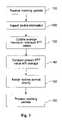
- FIG. 1illustrates the steps that occur when RTT values are used to prioritise network traffic.
- the network nodereceives incoming packets from the network.
- the network nodeinspects the packet information associated with the incoming packets, in step 120 .
- the values for the average value, maximum value and minimum value of the RTTare updated using the new values of RTT taken from the incoming packets. These values are respectively maintained as Avg — RTT, Max — RTT and Min — RTT.
- step 140the value of RTT for each incoming packet is compared with the corresponding average value of RTT. On this basis, packets are assigned a relative service priority in step 150 . That is, if the packet has a greater than average RTT, then the packet is assigned a higher relative service priority, though if the packet has a lower than average RTT, then the packet is assigned a lower relative service priority.
- the nodeWhen there is no packet congestion at a network node, the node operates in its usual manner. That is, all incoming packets are admitted to a packet buffer maintained for the purpose of temporarily storing then forwarding incoming packets.
- packets with a lower assigned service priorityare dropped in preference to packets with a higher assigned service priority.
- the packetsare typically dropped before being admitted to the buffer maintained at the network node. (Packets can be dropped once stored in the buffer, but providing such functionality results in higher implementation overloads, involving pointer manipulations.)
- a FIFO algorithmis used to process packets stored in the buffer at the network node.
- Other scheduling algorithmscan be used, if considered appropriate or desirable, though more sophisticated schemes necessarily involve additional complexity.
- packetscan be “marked” rather than dropped. Packets are “marked” on the same basis that they are “dropped”. A marked packet, once it eventually returns to the node from which it was originally sent, is recognised as marked. In response, the source node shrinks the TCP window thereby possibly reducing congestion at the bottleneck node.
- the bufferis essentially a queue in which packets are processed in a FIFO manner.
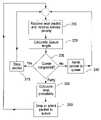
- FIG. 2is a flowchart representing the steps which occur once a relative service priority has been assigned, and before packets are queued in a buffer.
- a packet and the associated relative service priorityis received in step 210 .
- the associated relative service priorityis determined as described above with reference to FIG. 1 .
- a check of the queue lengthis made (that is, the number of packets stored in the buffer) in step 220 .
- a record of the average queue length, AvgQis maintained, for the purpose described below. It is determined at this point, in step 230 , whether the queue is congested.
- AvgQaverage queue length at the node, AvgQ
- Min — qminimum predetermined threshold
- Max — qmaximum predetermined threshold
- AvgQis between these two predetermined thresholds; that is: Min — q ⁇ AvgQ ⁇ Max — q, then the queue is partly congested.
- step 240the packet is admitted in step 240 , and the process repeats from step 210 .
- the packetis dropped in step 270 and similarly the process repeats from step 210 .
- a random processis then implemented at the network node to determine whether the packet is to be dropped. Packets with higher relative service priority use a lower Max — p and thus have a lower calculated drop probability and are thus dropped less frequently.
- the described techniquesare implemented on network hardware elements that are located at network nodes.
- the network hardware or network nodecan be, for example, a router, gateway or any other form of programmable network hardware through which packets pass in a packet-based network.
- the methods described abovemay be implemented in a router that receives packets from the network, and passes the packets on, after appropriate processing.
- the network hardwareexecutes software code that allows the network hardware to function as intended.
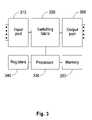
- FIG. 3A generic architecture for a suitable network hardware element is schematically represented in FIG. 3 , for the case of a router.
- the routerhas an input port 310 , an output port 360 , switching fabric 320 , a processor 330 , and associated registers 340 and memory 350 .
- the input port 310interfaces to the switching fabric 320 , which is in turn interfaced to the output port 360 .
- Incoming packets in the input port 310are interrogated by the processor 330 , which is connected to the switching fabric 320 .
- the processor 330to which storage registers 340 and a memory 350 are operatively connected, executes a computer software program that is essentially control program stored in the memory 350 .
- the registers 340stores values obtained from the processor 330 , during computation by the processor 330 .
- the processor 330operates the switching fabric 320 in accordance with the control program, for the ultimate purpose of routing incoming packets on the input port 310 , through the switching fabric 320 , to outgoing packets on the output port 360 .
- the processor 330maintains a buffer of packets scheduled for output on the output port 360 . Due to congestion, packets are queued at the output port 360 pending transmission in the manner described above.
Landscapes
- Engineering & Computer Science (AREA)
- Computer Networks & Wireless Communication (AREA)
- Signal Processing (AREA)
- Data Exchanges In Wide-Area Networks (AREA)
Abstract
Description
The invention relates to traffic management in packet-based networks and relates particularly to the provision of packet-based service differentiation in packet-based networks.
For a telecommunications network such as an ATM network, U.S. Pat. No. 5,224,099 issued to Corbalis et al on 29 Jun. 1993 discloses a method of queuing and servicing of cell traffic. The described techniques attempt to provide a fair servicing regime that satisfactorily handles different classes of traffic (voice, data etc) which have different quality-of-service priorities, in terms of delay and loss sensitivity.
Corbalis et al draw a distinction between bursty and non-bursty cell traffic. Bursty cell traffic is placed in one of a number of subqueues according to a hopcount associated with the respective cell. Each subqueue has a different servicing priority. Minimum bandwidths are respectively allocated to bursty and non-bursty traffic, and spare bandwidth is allocated to cell traffic according to a predefined priority scheme. The use of hopcount information (discussed in Corbalis et al), generally, has no bearing on the underlying congestion on the network. Accordingly, the use of hopcount information, as disclosed in Corbalis et al, does not provide a particularly advantageous way in which to address network congestion.
In packet-based computer networks, one widely used congestion avoidance algorithm is referred to as RED (Random Early Drop). According to this algorithm, the network drops packets when the average queue length at a network node, such as a router, is within a predetermined range.
The operation of RED and related algorithms is probabilistic and stateless, as packets are indiscriminately dropped at a certain rate, depending on the current average queue length. This approach is relatively unsophisticated, and accordingly does not make optimal use of network resources.
The above described existing techniques do not adequately or, in all cases, appropriately conserve network resources. Accordingly, a clear need exists for an improved manner of handling network traffic which at least attempts to address these and other limitations associated with existing techniques.
Packet-based traffic management in packet networks can be advantageously improved by using information associated with individual packets. Packets are implicitly differentiated into connections of different types, based on information derived from the individual packets. It may be considered that fields associated with individual packets explicitly or implicitly convey connection characteristics associated with that packet. Connections are distinguished into different types based on a measure (a metric or a characteristic) that at least partly reflects the duration (for example, end-to-end packet delay) of packet transmission associated with the connection.
A connection characteristic can be inferred from a field which has a numerical value representative of a particular metric. It is preferred that this representative value be correlated with the amount of network resources consumed by the respective packet in the packet-based network.
For TCP/IP networks, one such field that can be used is the value of RTT (Round Trip Time). This value, if explicitly included in the packet header information for IP packets, estimates the round trip time associated with the packet as it travels between source and destination, and as the corresponding acknowledgment returns from the destination back to the source.
Other measures can also be additionally used, either taken directly from packet header information values, or derived therefrom. For example, hopcount may be used as a representative value which is combined with duration information such as RTT. In a TCP/IP network, hopcount can be determined by comparing the current value for the TTL (Time to Live) field in the packet header information with the initial TTL value.
It is recognised that RED routers/gateways are inherently biased against packet flows with a large RTT. Accordingly, at congested network nodes, dropping packets from long connections (that is, with high RTT) adversely affects the throughput associated with the packet flow of such connections, more so than for shorter connections. Further, long connections consume correspondingly greater network resources than short connections and, as a result, there is greater wastage of network resources if packets from long connections are dropped. In this context, long connections can be thought of as being characterised by a large RTT value and, additionally, a relatively high “hopcount”.
Statistical measures of these values are typically maintained, so that individual packets can be classified as having, for example, below average or above average values.
More sophisticated metrics, which take into account one or more such values, can be derived and applied accordingly. For example, hopcount and RTT may be combined in a predetermined manner to provide an empirically representative measure of the amount of network resources consumed by particular packets, for a given type of network topology and traffic flow characteristics. Hopcount and RTT can for some networks provide a generally reliable indication of the characteristics of a connection with which the packet is associated.
A fair and efficient regime for queuing packets through a network node allows for improved network usage. The priority of packets is adjusted at network nodes in response to information associated with packets which implies certain connection characteristics, and the packet drop probability correspondingly adjusted, based on the assigned priority of the packet.
While various techniques and arrangements are described herein in relation to “packets”, it is understood that these techniques and arrangements are also applicable to other connectionless data arrangements using, for example, “cells” and that packets and associated terminology can be used interchangeably with any such other corresponding terms.
Techniques for packet management in a packet-based network are described herein. The described techniques can be implemented at a network node (for example, a gateway or router) which receives and forwards packets as they are passed through the packet-based network.
The Transmission Control Protocol (TCP) provides reliable, stream-oriented connections on packet-based networks. The Internet, and Ethernet implementations, use TCP/IP protocols that are based on TCP, which is in turn based on the Internet Protocol (IP). When a host transmits a TCP packet to a peer, it must wait a period of time for an acknowledgment by reply. If the acknowledgment reply does not come within an expected period, the packet is assumed to have been lost and the data is retransmitted. However, how long does one wait before retransmitting the packet? Over an Ethernet connection, no more than a few microseconds should be needed for a reply. If the traffic must flow over the wide-area Internet, a second or two might be reasonable during peak utilization times.
However, as this reasonable expected wait time is variable, TCP implementations monitor the normal exchange of data packets and develop an estimate of the time that should elapse before an acknowledgment is received. This estimate is termed the Round-Trip Time (RTT) estimation. RTT estimates are one of the most important performance parameters in a TCP exchange, especially as all TCP implementations typically experience packet drops due to congestion and must accordingly retransmit dropped packets, irrespective of link quality. If the RTT estimate is too low, packets are retransmitted unnecessarily. If the RTT estimate is too high, the network connection can remain idle unnecessarily, while the host waits to timeout.
A router typically has multiple packet connections passing through the router. Packets can be differentiated as being associated with “long” connections or “short” connections, based on packet header information. In this respect, IP packets in TCP networks have (at layer3) a TTL (time to live) field. Further, a RTT (Round Trip Time) field can be transmitted by sources using, for example, the TCP option field or IP option field. As packets pass through the network node, these fields can be used to differentiate packets as being associated with long or short connections. Each of these packet header information fields, and their use, is discussed further below.
RTT is fundamental to timeout and retransmission functions in TCP. RTT experienced on a given connection for a TCP connection is the estimated time taken for a packet to reach its destination, and the corresponding acknowledgment return to the source. As routes or congestion can change over time, these times are monitored and RTT modified if warranted, as noted above.
The RTT can be used to differentiate different connections at a particular network node. The TCP option field may be used by the sender to send the RTT of the TCP connection. As RTT values for a connection do not change very frequently with time, the RTT values can be sent periodically within a predetermined period. In either case, even if a value of RTT is not included with each packet, a value can be inferred by correlating other characteristics (for example, source and destination IP addresses) with a packet for which RTT is known.
A running average RTT value for all packets is maintained at a network node, as well as a record of prevailing maximum and minimum values. For each arriving packet, a comparison is made between the RTT for that packet and the average. If the RTT is greater than average, the packet can be assigned a greater relative priority. If the RTT is lower than average, the packet can be assigned a lower relative priority.
The TTL field in an IP header sets an upper limit on the number of network routers through which a datagram can pass, thus limiting the potential lifetime of the datagram. The TTL field is initialised by the sender to some value. Different operating systems can assign different default TTL values, and TTL values can also vary from one version of TCP to another. Further, TTL values can be varied by appropriate network applications.
Accordingly, the TTL per se is not useful in determining the implied characteristics of a connection with which the packet is associated, as there is no reliable indication of the initial value of the TTL value. Instead, however, the “hopcount” (that is, the number of routers through which the packet has passed to reach the particular network node) can be determined by comparing the TTL field value in the packet header of the packet, with the initial TTL value stored in the packet header. The initial TTL value is stored in the IP option field.
This gives the number of “hops” (routers) through which the packet has passed. As packet routes through the Internet change infrequently, the hopcount is a relatively reliable indication of the connection with which the packet is associated. In other words, the hopcount can be used to meaningfully differentiate packet connections.
The calculated hopcount is stored in a register and indicates the number of nodes through which the packet has passed before arriving at the present network node. A running average hopcount is maintained at the node for all packets passing through that node. A record is also maintained of the maximum and minimum values of hopcount for packets through the node.
For each packet that passes through the node, hopcount information can be combined with other transmission duration information (such as RTT) to determine the relative service priority assigned to respective packets.
In the two cases discussed above of TTL and RTT, packets are only classified as being of higher or lower priority, depending on the inference of whether the packet is associated with a longer or shorter connection respectively.
Desirably, RTT is used in conjunction with hopcount to determine whether the packet is associated with a long or short connection. A path through the network may have a low hopcount, but a large RTT associated with the packet, due to congestion. Similarly, another path may have a high hopcount but a low RTT, if there is little or no congestion. As there appears to be little correlation between hopcount and RTT in the Internet, it is advantageous that hopcount alone is not used to prioritize packets.
Relative service priority can be more finely graded than simply “lower” or “higher” priority. A whole range of statistical techniques and binning algorithms can be brought to bear on these and/or other packet header information values to assign relative priorities to packets passing through a network node.
Instep 110, the network node receives incoming packets from the network. The network node inspects the packet information associated with the incoming packets, instep 120. Instep 130, the values for the average value, maximum value and minimum value of the RTT are updated using the new values of RTT taken from the incoming packets. These values are respectively maintained as Avg—RTT, Max—RTT and Min—RTT.
Instep 140, the value of RTT for each incoming packet is compared with the corresponding average value of RTT. On this basis, packets are assigned a relative service priority instep 150. That is, if the packet has a greater than average RTT, then the packet is assigned a higher relative service priority, though if the packet has a lower than average RTT, then the packet is assigned a lower relative service priority.
When there is no packet congestion at a network node, the node operates in its usual manner. That is, all incoming packets are admitted to a packet buffer maintained for the purpose of temporarily storing then forwarding incoming packets.
However, when there is congestion detected at the node, packets with a lower assigned service priority are dropped in preference to packets with a higher assigned service priority. The packets are typically dropped before being admitted to the buffer maintained at the network node. (Packets can be dropped once stored in the buffer, but providing such functionality results in higher implementation overloads, involving pointer manipulations.)
Most simply, a FIFO algorithm is used to process packets stored in the buffer at the network node. Other scheduling algorithms can be used, if considered appropriate or desirable, though more sophisticated schemes necessarily involve additional complexity.
In some implementations, packets can be “marked” rather than dropped. Packets are “marked” on the same basis that they are “dropped”. A marked packet, once it eventually returns to the node from which it was originally sent, is recognised as marked. In response, the source node shrinks the TCP window thereby possibly reducing congestion at the bottleneck node.
As noted above, some packets are dropped before being admitted to a buffer. The buffer is essentially a queue in which packets are processed in a FIFO manner.
A packet and the associated relative service priority is received instep 210. The associated relative service priority is determined as described above with reference toFIG. 1 . A check of the queue length is made (that is, the number of packets stored in the buffer) instep 220. In this respect, a record of the average queue length, AvgQ, is maintained, for the purpose described below. It is determined at this point, instep 230, whether the queue is congested.
If the average queue length at the node, AvgQ, is less than a minimum predetermined threshold, Min—q, then the queue is not congested. If the average queue length at the node, AvgQ, is greater than a maximum predetermined threshold, Max—q, then the queue is congested. If AvgQ is between these two predetermined thresholds; that is: Min—q<AvgQ<Max—q, then the queue is partly congested.
If the queue is not congested, the packet is admitted instep 240, and the process repeats fromstep 210. Similarly, if the queue is congested, the packet is dropped instep 270 and similarly the process repeats fromstep 210.
If the queue is partly congested, a drop probability P—drop, is calculated for the packet, as follows:
P—drop=Max—p (Max—RTT−Avg—RTT)/(Max—RTT−Min—RTT)
P—drop=Max—p (Max—RTT−Avg—RTT)/(Max—RTT−Min—RTT)
In the expression above for P—drop, the relevant terms are as follows:
- Max—p is a predetermined maximum drop probability, which is adjusted as required for packets of different relative service priority.
- Max—RTT is the maximum value of RTT for packets for a particular “connection”.
- Min—RTT is the minimum value of RTT for packets for a particular “connection”.
- Avg—RTT is the average value of RTT for packets for a particular “connection”.
A random process is then implemented at the network node to determine whether the packet is to be dropped. Packets with higher relative service priority use a lower Max—p and thus have a lower calculated drop probability and are thus dropped less frequently.
The converse applies to packets with lower relative service priority, which have a higher Max—p and are thus sacrificially dropped to reduce queue congestion, while intelligently conserving network resources. That is, lower service priority packets (such as those with a relatively low average RTT) consume less network resources than higher service priority packets. Accordingly, a lower overall network performance penalty is paid by the network as a whole, if such lower service priority packets are preferentially dropped instead of higher service priority packets.
Once the packet is processed, by dropping the packet or admitting the packet to the buffer, the process returns again to step210.
The described techniques are implemented on network hardware elements that are located at network nodes. In this context, the network hardware or network node can be, for example, a router, gateway or any other form of programmable network hardware through which packets pass in a packet-based network.
In a TCP/IP network, the methods described above may be implemented in a router that receives packets from the network, and passes the packets on, after appropriate processing. In this respect, the network hardware executes software code that allows the network hardware to function as intended.
A generic architecture for a suitable network hardware element is schematically represented inFIG. 3 , for the case of a router.
The router has aninput port 310, anoutput port 360, switchingfabric 320, aprocessor 330, and associatedregisters 340 andmemory 350. Theinput port 310 interfaces to the switchingfabric 320, which is in turn interfaced to theoutput port 360. Incoming packets in theinput port 310 are interrogated by theprocessor 330, which is connected to the switchingfabric 320.
Theprocessor 330, to which storage registers340 and amemory 350 are operatively connected, executes a computer software program that is essentially control program stored in thememory 350. Theregisters 340 stores values obtained from theprocessor 330, during computation by theprocessor 330. Theprocessor 330 operates the switchingfabric 320 in accordance with the control program, for the ultimate purpose of routing incoming packets on theinput port 310, through the switchingfabric 320, to outgoing packets on theoutput port 360.
Theprocessor 330 maintains a buffer of packets scheduled for output on theoutput port 360. Due to congestion, packets are queued at theoutput port 360 pending transmission in the manner described above.
It is understood that various alterations and modifications to the techniques and arrangements described can be made, as would be apparent to one skilled in the art.
Claims (28)
1. A method of handling packet traffic on a packet-based network, the method comprising:
receiving, at a network node, a flow of packets from the packet-based network;
determining, for each of the received packets, a metric at least partly based on the duration of transmission for the received packet;
calculating one or more statistical measures associated with values of said metric for the received packets, wherein the statistical measures include an average value;
assigning, to each of the packets, a relative service priority on the basis of the metric; and
queuing one or more of the packets in a queue and transmitting the queued packets from the network node dynamically allocating a packet drop probability for one or more of the packets, based on the assigned relative service priority for the respective packets.
2. The method as claimed inclaim 1 , further comprising preferentially dropping packets that have a lower relative service priority in favor of packets that have a greater relative service priority, prior to the step of queuing of one or more of the packets.
3. The method as claimed inclaim 1 , further comprising marking packets that have a lower relative service priority, prior to the queuing of one or more of the packets.
4. The method as claimed inclaim 1 , further comprising dynamically allocating a packet drop probability occurs, prior to the queuing of one or more packets, wherein packets with a higher relative service priority are allocated a lower packet drop probability and packets with a lower relative service priority are allocated a higher packet drop probability.
5. The method as claimed inclaim 4 , wherein said dynamically allocating a packet drop probability is preformed if an avenge number of queued packets, at the network node, falls between maximum and minimum predetermined thresholds.
6. The method as claimed inclaim 5 , further comprising dropping packets if an average number of queued packets, at the network node, exceeds the maximum predetermined threshold.
7. The method as claimed inclaim 5 , further comprising admitting packets if an average number of queued packets, at the network node, falls below the minimum predetermined threshold.
8. The method as claimed inclaim 1 , wherein said metric comprises the value of time taken by the packet to traverse the network from the source to destination, and the packet's corresponding acknowledgment to traverse the network from the destination to source.
9. The method as claimed inclaim 1 , wherein said metric incorporates a hopcount representative of the number of nodes traversed by the packet from source of the packet to the network node.
10. The method as claimed inclaim 9 , wherein the statistical measures further include a maximum value and a minimum value.
11. The method as claimed inclaim 9 , wherein two classes of relative service priority, comprising a higher relative service priority and a lower relative service priority, are assigned to the received packets depending on a comparison of the metric with its corresponding average value for the received packets.
12. The method as claimed inclaim 1 , wherein the packet-based network transmits internet protocol (IP) packets.
13. The method as claimed inclaim 12 , wherein the packet-based network uses the transmission connection protocol (TCP).
14. The method as claimed inclaim 13 , wherein the metric comprises the value at the round trip time (RTT) field in the TCP packet header.
15. A method of handling packet traffic on a packet-based network, the method comprising steps of:
receiving, at a network node, a flow of packets from the packet-based network;
inferring, for each of the received packets, a connection characteristic at least partly representative of the duration of transmission for the received packet;
assigning, to each of the packets, a relative service priority on the basis of the inferred connection characteristic;
dynamically allocating a packet drop probability for one or more of the packets, based on the results of the assigned relative service priority; and
queuing one or more of the packets in a queue and transmitting the queued packets from the network node.
16. The method as claimed inclaim 15 , further comprising preferentially dropping packets that have a lower relative service priority in favor of packets that have a greater relative service priority, prior to the queuing of one or more of the packets.
17. The method as claimed inclaim 16 , further comprising marking packets that have a lower relative service priority, prior to the queuing of one or more of the packets.
18. The method as claimed inclaim 15 , wherein packets with a higher relative service priority are allocated a lower packet drop probability and packets with a lower relative service priority are allocated a higher packet drop probability.
19. The method as claimed inclaim 18 , wherein said dynamically allocating a packet drop probability is preformed if an average number of queued packets, at the network node, falls between maximum and minimum predetermined thresholds.
20. The method as claimed inclaim 19 , further comprising dropping packets if an average number of queued packets, at the network node, exceeds the maximum predetermined threshold.
21. The method as claimed inclaim 19 , further comprising admitting packets if an average number of queued packets, at the network node, falls below the minimum predetermined threshold.
22. The method as claimed inclaim 18 , wherein a plurality of different classes of relative service priority are available to be assigned to the received packets depending upon the identity of the connection characteristic fir respective packets.
23. The method as claimed inclaim 15 , wherein the packet-based network transmits internet protocol (IP) packets.
24. The method as claimed inclaim 15 , wherein the packet-based network uses the transmission connection protocol (TCP).
25. A network node apparatus for handling packet traffic on a packet-based network, said apparatus including:
means for receiving, at a network node, a flow of packets from the packet-based network;
means for determining, for each of the received packets, a metric at least partly based the duration of transmission for the received packet;
means for comparing, for each of the received packets, said metric with a corresponding reference value;
means for assigning, to each of the packets, a relative service priority on the basis of the comparison;
means for dynamically allocating a packet drop probability for one or more of the packets, based on the results of the assigned relative service priority; and
means for queuing one or more of the packets in a queue and transmitting the queued packets from the network node.
26. A network node apparatus for handling packet traffic on a packet-based network, said apparatus including:
means for receiving, at a network node, a flow of packets from the packet-based network;
means for inferring, for each of the received packets, a connection characteristic at least partly representative of the duration of transmission for the received packet;
means for assigning, to each of the packets, a relative service priority on the basis of the inferred connection characteristic;
means for dynamically allocating a packet drop probability for one or more of the packets, based on the results of the assigned relative service priority; and
means for queuing one or more of the packets in a queue and transmitting the queued packets from the network node.
27. A computer software program, recorded on a medium and capable of execution by computing means able to interpret the computer software program, for handling packet traffic on a packet-based network, said computer software program comprising:
code means for receiving, at a network node, a flow of packets from the packet-based network;
code means for determining, for each of the received packets, a metric at least partly based the duration of transmission for the received packet;
code means for comparing, for each of the received packets, said metric with a corresponding reference value;
code means for assigning, to each of the packets, a relative service priority on the basis of the comparison;
code means for dynamically allocating a packet drop probability for one or more of the packets, based on the results of the assigned relative service priority; and
code means for queuing one or more of the packets in a queue and transmitting the queued packets from the network node.
28. A computer software program, recorded on a medium and capable of execution by computing means able to interpret the computer software program, for handling packet traffic on a packet-based network, said computer software program comprising:
code means for receiving, at a network node, a flow of packets from the packet-based network;
code means for inferring, for each of the received packets, a connection characteristic at least partly representative of the duration of transmission for the received packet;
code means for assigning, to each of the packets, a relative service priority on the basis of the inferred connection characteristic;
code means for dynamically allocating a packet drop probability for one or more of the packets, based on the results of the assigned relative service priority; and
code means for queuing one or more of the packets in a queue and transmitting the queued packets from the network node.
Priority Applications (1)
| Application Number | Priority Date | Filing Date | Title |
|---|---|---|---|
| US09/901,229US6958998B2 (en) | 2001-07-09 | 2001-07-09 | Traffic management in packet-based networks |
Applications Claiming Priority (1)
| Application Number | Priority Date | Filing Date | Title |
|---|---|---|---|
| US09/901,229US6958998B2 (en) | 2001-07-09 | 2001-07-09 | Traffic management in packet-based networks |
Publications (2)
| Publication Number | Publication Date |
|---|---|
| US20030007454A1 US20030007454A1 (en) | 2003-01-09 |
| US6958998B2true US6958998B2 (en) | 2005-10-25 |
Family
ID=25413787
Family Applications (1)
| Application Number | Title | Priority Date | Filing Date |
|---|---|---|---|
| US09/901,229Expired - Fee RelatedUS6958998B2 (en) | 2001-07-09 | 2001-07-09 | Traffic management in packet-based networks |
Country Status (1)
| Country | Link |
|---|---|
| US (1) | US6958998B2 (en) |
Cited By (60)
| Publication number | Priority date | Publication date | Assignee | Title |
|---|---|---|---|---|
| US20030048791A1 (en)* | 2001-09-12 | 2003-03-13 | Alcatel | Method and apparatus for differentiating service in a data network |
| US20040151179A1 (en)* | 2003-01-31 | 2004-08-05 | Andre Michael R.. | Methods and apparatus to limit transmission of data to a localized area |
| US20060069804A1 (en)* | 2004-08-25 | 2006-03-30 | Ntt Docomo, Inc. | Server device, client device, and process execution method |
| US20060088024A1 (en)* | 2004-10-27 | 2006-04-27 | Rockwell Electronic Commerce Technologies, Llc | Method and apparatus for internet protocol transaction routing |
| US20060218620A1 (en)* | 2005-03-03 | 2006-09-28 | Dinesh Nadarajah | Network digital video recorder and method |
| US20060227706A1 (en)* | 2002-03-01 | 2006-10-12 | Bellsouth Intellectual Property Corp. | System and method for delay-based congestion detection and connection admission control |
| US20070058559A1 (en)* | 2005-09-15 | 2007-03-15 | Sharp Laboratories Of America, Inc. | Method and system of assigning priority to detection messages |
| US20080181126A1 (en)* | 2006-11-29 | 2008-07-31 | Alain Durand | Methods and a device for secure distance calculation in communication networks |
| US20080249961A1 (en)* | 2007-03-22 | 2008-10-09 | Harkness David H | Digital rights management and audience measurement systems and methods |
| US20080294647A1 (en)* | 2007-05-21 | 2008-11-27 | Arun Ramaswamy | Methods and apparatus to monitor content distributed by the internet |
| US20090097483A1 (en)* | 2007-10-15 | 2009-04-16 | Canon Kabushiki Kaisha | Method and device for transmitting data |
| US7636321B1 (en)* | 2003-05-12 | 2009-12-22 | Sprint Communications Company L.P. | Method and system for measuring round-trip time of packets in a communications network |
| US20100046927A1 (en)* | 2008-08-20 | 2010-02-25 | At&T Intellectual Property I, L.P. | System and Method for Retrieving a Previously Transmitted Portion of Television Program Content |
| US7684347B2 (en) | 2004-12-23 | 2010-03-23 | Solera Networks | Method and apparatus for network packet capture distributed storage system |
| US8521732B2 (en) | 2008-05-23 | 2013-08-27 | Solera Networks, Inc. | Presentation of an extracted artifact based on an indexing technique |
| US8625642B2 (en) | 2008-05-23 | 2014-01-07 | Solera Networks, Inc. | Method and apparatus of network artifact indentification and extraction |
| US8666985B2 (en) | 2011-03-16 | 2014-03-04 | Solera Networks, Inc. | Hardware accelerated application-based pattern matching for real time classification and recording of network traffic |
| US8849991B2 (en) | 2010-12-15 | 2014-09-30 | Blue Coat Systems, Inc. | System and method for hypertext transfer protocol layered reconstruction |
| US9083635B1 (en)* | 2010-10-04 | 2015-07-14 | Adtran, Inc. | Enqueue policing systems and methods |
| US9935851B2 (en) | 2015-06-05 | 2018-04-03 | Cisco Technology, Inc. | Technologies for determining sensor placement and topology |
| US9967158B2 (en) | 2015-06-05 | 2018-05-08 | Cisco Technology, Inc. | Interactive hierarchical network chord diagram for application dependency mapping |
| US10033602B1 (en) | 2015-09-29 | 2018-07-24 | Amazon Technologies, Inc. | Network health management using metrics from encapsulation protocol endpoints |
| US10033766B2 (en) | 2015-06-05 | 2018-07-24 | Cisco Technology, Inc. | Policy-driven compliance |
| US10044581B1 (en) | 2015-09-29 | 2018-08-07 | Amazon Technologies, Inc. | Network traffic tracking using encapsulation protocol |
| US10089099B2 (en) | 2015-06-05 | 2018-10-02 | Cisco Technology, Inc. | Automatic software upgrade |
| US10116559B2 (en) | 2015-05-27 | 2018-10-30 | Cisco Technology, Inc. | Operations, administration and management (OAM) in overlay data center environments |
| US20180331922A1 (en)* | 2017-05-12 | 2018-11-15 | Pragati Kumar Dhingra | Methods and systems for time-based binning of network traffic |
| US10142353B2 (en) | 2015-06-05 | 2018-11-27 | Cisco Technology, Inc. | System for monitoring and managing datacenters |
| US10171357B2 (en) | 2016-05-27 | 2019-01-01 | Cisco Technology, Inc. | Techniques for managing software defined networking controller in-band communications in a data center network |
| US10177977B1 (en) | 2013-02-13 | 2019-01-08 | Cisco Technology, Inc. | Deployment and upgrade of network devices in a network environment |
| CN109474538A (en)* | 2018-12-29 | 2019-03-15 | 北京达佳互联信息技术有限公司 | A kind of data transmission method, device, terminal device and storage medium |
| US10243820B2 (en) | 2016-09-28 | 2019-03-26 | Amazon Technologies, Inc. | Filtering network health information based on customer impact |
| US10250446B2 (en) | 2017-03-27 | 2019-04-02 | Cisco Technology, Inc. | Distributed policy store |
| US10289438B2 (en) | 2016-06-16 | 2019-05-14 | Cisco Technology, Inc. | Techniques for coordination of application components deployed on distributed virtual machines |
| CN109992391A (en)* | 2017-12-29 | 2019-07-09 | 浙江宇视科技有限公司 | Connection management method and system |
| US10374904B2 (en) | 2015-05-15 | 2019-08-06 | Cisco Technology, Inc. | Diagnostic network visualization |
| US10523541B2 (en) | 2017-10-25 | 2019-12-31 | Cisco Technology, Inc. | Federated network and application data analytics platform |
| US10523512B2 (en) | 2017-03-24 | 2019-12-31 | Cisco Technology, Inc. | Network agent for generating platform specific network policies |
| US10554501B2 (en) | 2017-10-23 | 2020-02-04 | Cisco Technology, Inc. | Network migration assistant |
| US10574575B2 (en) | 2018-01-25 | 2020-02-25 | Cisco Technology, Inc. | Network flow stitching using middle box flow stitching |
| US10594542B2 (en) | 2017-10-27 | 2020-03-17 | Cisco Technology, Inc. | System and method for network root cause analysis |
| US10594560B2 (en) | 2017-03-27 | 2020-03-17 | Cisco Technology, Inc. | Intent driven network policy platform |
| US10680887B2 (en) | 2017-07-21 | 2020-06-09 | Cisco Technology, Inc. | Remote device status audit and recovery |
| US10708152B2 (en) | 2017-03-23 | 2020-07-07 | Cisco Technology, Inc. | Predicting application and network performance |
| US10708183B2 (en) | 2016-07-21 | 2020-07-07 | Cisco Technology, Inc. | System and method of providing segment routing as a service |
| US10764141B2 (en) | 2017-03-27 | 2020-09-01 | Cisco Technology, Inc. | Network agent for reporting to a network policy system |
| US10798015B2 (en) | 2018-01-25 | 2020-10-06 | Cisco Technology, Inc. | Discovery of middleboxes using traffic flow stitching |
| US10826803B2 (en) | 2018-01-25 | 2020-11-03 | Cisco Technology, Inc. | Mechanism for facilitating efficient policy updates |
| US10862777B2 (en) | 2016-09-28 | 2020-12-08 | Amazon Technologies, Inc. | Visualization of network health information |
| US10873794B2 (en) | 2017-03-28 | 2020-12-22 | Cisco Technology, Inc. | Flowlet resolution for application performance monitoring and management |
| US10873593B2 (en) | 2018-01-25 | 2020-12-22 | Cisco Technology, Inc. | Mechanism for identifying differences between network snapshots |
| US10911263B2 (en) | 2016-09-28 | 2021-02-02 | Amazon Technologies, Inc. | Programmatic interfaces for network health information |
| US10917438B2 (en) | 2018-01-25 | 2021-02-09 | Cisco Technology, Inc. | Secure publishing for policy updates |
| US10931629B2 (en) | 2016-05-27 | 2021-02-23 | Cisco Technology, Inc. | Techniques for managing software defined networking controller in-band communications in a data center network |
| US10972388B2 (en) | 2016-11-22 | 2021-04-06 | Cisco Technology, Inc. | Federated microburst detection |
| US10999149B2 (en) | 2018-01-25 | 2021-05-04 | Cisco Technology, Inc. | Automatic configuration discovery based on traffic flow data |
| US11128700B2 (en) | 2018-01-26 | 2021-09-21 | Cisco Technology, Inc. | Load balancing configuration based on traffic flow telemetry |
| US11233821B2 (en) | 2018-01-04 | 2022-01-25 | Cisco Technology, Inc. | Network intrusion counter-intelligence |
| US11641319B2 (en) | 2016-09-28 | 2023-05-02 | Amazon Technologies, Inc. | Network health data aggregation service |
| US11765046B1 (en) | 2018-01-11 | 2023-09-19 | Cisco Technology, Inc. | Endpoint cluster assignment and query generation |
Families Citing this family (25)
| Publication number | Priority date | Publication date | Assignee | Title |
|---|---|---|---|---|
| US7684422B1 (en)* | 2002-01-17 | 2010-03-23 | Juniper Networks, Inc. | Systems and methods for congestion control using random early drop at head of buffer |
| US7558197B1 (en) | 2002-01-17 | 2009-07-07 | Juniper Networks, Inc. | Dequeuing and congestion control systems and methods |
| US7382793B1 (en) | 2002-01-17 | 2008-06-03 | Juniper Networks, Inc. | Systems and methods for determining the bandwidth used by a queue |
| GB2395856A (en)* | 2002-11-26 | 2004-06-02 | King S College London | Method for reducing packet congestion at a network node |
| US20040249917A1 (en)* | 2003-06-05 | 2004-12-09 | Cheng Yung Lin | Data flow management method |
| KR100656509B1 (en)* | 2004-03-03 | 2006-12-11 | 삼성전자주식회사 | Packet Congestion Control Method for Guaranteeing Video Service Bandwidth |
| US7643503B2 (en)* | 2004-07-30 | 2010-01-05 | Sony Corporation | System and method for dynamically determining retransmit buffer time |
| US7839844B2 (en)* | 2004-07-30 | 2010-11-23 | Sony Corporation | System and method for dynamically determining retransmit buffer time |
| JP2006101004A (en)* | 2004-09-28 | 2006-04-13 | Fujitsu Ltd | Transmission apparatus and leaky bucket bandwidth control method |
| JP4705115B2 (en)* | 2005-02-07 | 2011-06-22 | ブリティッシュ・テレコミュニケーションズ・パブリック・リミテッド・カンパニー | Network monitoring |
| DE102006035098A1 (en)* | 2006-07-28 | 2008-01-31 | Siemens Ag | Method for transmitting a data packet and network nodes |
| EP2067295A1 (en)* | 2006-10-06 | 2009-06-10 | Telefonaktiebolaget LM Ericsson (PUBL) | Signal quality indicator |
| JP2009199453A (en)* | 2008-02-22 | 2009-09-03 | Hitachi Ltd | Method for deciding whether client is appropriate or not, and storage controller |
| US8144611B2 (en)* | 2009-02-10 | 2012-03-27 | Microsoft Corporation | Network coordinate systems using IP information |
| KR101568288B1 (en)* | 2009-09-21 | 2015-11-12 | 삼성전자주식회사 | Data receiving apparatus and method |
| US20110282980A1 (en)* | 2010-05-11 | 2011-11-17 | Udaya Kumar | Dynamic protection of a resource during sudden surges in traffic |
| EP2437440A1 (en) | 2010-10-01 | 2012-04-04 | Koninklijke Philips Electronics N.V. | Device and method for delay optimization of end-to-end data packet transmissions in wireless networks |
| US8441927B2 (en)* | 2011-01-13 | 2013-05-14 | Alcatel Lucent | System and method for implementing periodic early discard in on-chip buffer memories of network elements |
| TWI459768B (en)* | 2011-12-30 | 2014-11-01 | Ind Tech Res Inst | Communication system and method for assisting TCP packet transmission |
| CN105075202B (en) | 2013-03-28 | 2019-07-12 | 英国电讯有限公司 | For handling method, node and the packet network of grouping in packet network |
| GB201313760D0 (en)* | 2013-07-31 | 2013-09-18 | British Telecomm | Fast friendly start for a data flow |
| US20160139924A1 (en)* | 2014-11-14 | 2016-05-19 | Intel Corporation | Machine Level Instructions to Compute a 4D Z-Curve Index from 4D Coordinates |
| CN107852372B (en)* | 2015-08-06 | 2021-05-11 | 英国电讯有限公司 | packet network |
| US10645016B2 (en) | 2015-08-06 | 2020-05-05 | British Telecommunications Public Limited Company | Data packet network |
| EP3185493A1 (en)* | 2015-12-24 | 2017-06-28 | Alcatel Lucent | Data packet transport layer with utility based fairness |
Citations (2)
| Publication number | Priority date | Publication date | Assignee | Title |
|---|---|---|---|---|
| US5224099A (en) | 1991-05-17 | 1993-06-29 | Stratacom, Inc. | Circuitry and method for fair queuing and servicing cell traffic using hopcounts and traffic classes |
| US6760309B1 (en)* | 2000-03-28 | 2004-07-06 | 3Com Corporation | Method of dynamic prioritization of time sensitive packets over a packet based network |
Family Cites Families (1)
| Publication number | Priority date | Publication date | Assignee | Title |
|---|---|---|---|---|
| US5224009A (en)* | 1990-01-16 | 1993-06-29 | Hubbell Incorporated | Shallow electrical receptacle with surge suppression and isolated ground |
- 2001
- 2001-07-09USUS09/901,229patent/US6958998B2/ennot_activeExpired - Fee Related
Patent Citations (2)
| Publication number | Priority date | Publication date | Assignee | Title |
|---|---|---|---|---|
| US5224099A (en) | 1991-05-17 | 1993-06-29 | Stratacom, Inc. | Circuitry and method for fair queuing and servicing cell traffic using hopcounts and traffic classes |
| US6760309B1 (en)* | 2000-03-28 | 2004-07-06 | 3Com Corporation | Method of dynamic prioritization of time sensitive packets over a packet based network |
Non-Patent Citations (8)
| Title |
|---|
| B. Suter, T.V. Lakshman, D. Stiliadis, A. Choudhury, "Efficient Active Queue Management for Internet Routers", Proc. INTEROP 1998 Engineering Conference, pp. 1-21. |
| D. Lin and R. Morris, "Dynamics of Random Early Detection", SIGCOM 1997. |
| F. M. Anjum and L. Tassiulas, "Balanced-RED: An Algorithm to Achieve Fairness in the Internet", Technical Research Report, Mar. 8, 1999. |
| F. M. Anjum and L. Tassiulas, "Fair Bandwidth Sharing Among Adaptive and Non-Adaptive Flows in the Internet", Proceedings of IEEE INFCOM 1999, 9 pages |
| L.L. Peterson & B.S. Davie, "Computer Networks: A Systems Approach", Morgan Kaufmann publishers, 2000, 2 pages. |
| S. Blake, D. Black, M. Carlson, E. Davies, Z. Wang, W. Weiss, "An Architecture for Differentiated Services", Request for Comments 2475, Dec. 1998, pp. 1-32. |
| S. Floyd and V. Jacobson, "Random Early Detection Gateways for Congestion Avoidance", IEEE/ACM Transactions on Networking, vol. 1, No. 4, Aug. 1993, 397-413. |
| W.R. Stevens, "TCP/IP Illustrated, vol. 1", Addison-Wesley, 1997, 3 pages. |
Cited By (169)
| Publication number | Priority date | Publication date | Assignee | Title |
|---|---|---|---|---|
| US7881190B2 (en)* | 2001-09-12 | 2011-02-01 | Alcatel | Method and apparatus for differentiating service in a data network |
| US20030048791A1 (en)* | 2001-09-12 | 2003-03-13 | Alcatel | Method and apparatus for differentiating service in a data network |
| US20060227706A1 (en)* | 2002-03-01 | 2006-10-12 | Bellsouth Intellectual Property Corp. | System and method for delay-based congestion detection and connection admission control |
| US7558265B2 (en)* | 2003-01-31 | 2009-07-07 | Intel Corporation | Methods and apparatus to limit transmission of data to a localized area |
| US8937943B2 (en) | 2003-01-31 | 2015-01-20 | Intel Corporation | Methods and apparatus to limit transmission of data to a localized area |
| US20040151179A1 (en)* | 2003-01-31 | 2004-08-05 | Andre Michael R.. | Methods and apparatus to limit transmission of data to a localized area |
| US20100008364A1 (en)* | 2003-01-31 | 2010-01-14 | Andre Michael R | Methods and apparatus to limit transmission of data to a localized area |
| US8094662B2 (en) | 2003-01-31 | 2012-01-10 | Intel Corporation | Methods and apparatus to limit transmission of data to a localized area |
| US7636321B1 (en)* | 2003-05-12 | 2009-12-22 | Sprint Communications Company L.P. | Method and system for measuring round-trip time of packets in a communications network |
| US20060069804A1 (en)* | 2004-08-25 | 2006-03-30 | Ntt Docomo, Inc. | Server device, client device, and process execution method |
| US8001188B2 (en)* | 2004-08-25 | 2011-08-16 | Ntt Docomo, Inc. | Server device, client device, and process execution method |
| US7330429B2 (en)* | 2004-10-27 | 2008-02-12 | Rockwell Electronic Commerce Technologies, Inc. | Method and apparatus for internet protocol transaction routing |
| US20060088024A1 (en)* | 2004-10-27 | 2006-04-27 | Rockwell Electronic Commerce Technologies, Llc | Method and apparatus for internet protocol transaction routing |
| US7855974B2 (en) | 2004-12-23 | 2010-12-21 | Solera Networks, Inc. | Method and apparatus for network packet capture distributed storage system |
| US7684347B2 (en) | 2004-12-23 | 2010-03-23 | Solera Networks | Method and apparatus for network packet capture distributed storage system |
| US20060218620A1 (en)* | 2005-03-03 | 2006-09-28 | Dinesh Nadarajah | Network digital video recorder and method |
| US20070058559A1 (en)* | 2005-09-15 | 2007-03-15 | Sharp Laboratories Of America, Inc. | Method and system of assigning priority to detection messages |
| KR101419785B1 (en)* | 2006-11-29 | 2014-07-15 | 톰슨 라이센싱 | Method and device for security distance calculation in a communication network |
| US8325729B2 (en)* | 2006-11-29 | 2012-12-04 | Thomson Licensing | Methods and a device for secure distance calculation in communication networks |
| US20080181126A1 (en)* | 2006-11-29 | 2008-07-31 | Alain Durand | Methods and a device for secure distance calculation in communication networks |
| US8249992B2 (en) | 2007-03-22 | 2012-08-21 | The Nielsen Company (Us), Llc | Digital rights management and audience measurement systems and methods |
| US20080249961A1 (en)* | 2007-03-22 | 2008-10-09 | Harkness David H | Digital rights management and audience measurement systems and methods |
| US20080294647A1 (en)* | 2007-05-21 | 2008-11-27 | Arun Ramaswamy | Methods and apparatus to monitor content distributed by the internet |
| US20090097483A1 (en)* | 2007-10-15 | 2009-04-16 | Canon Kabushiki Kaisha | Method and device for transmitting data |
| US8462778B2 (en)* | 2007-10-15 | 2013-06-11 | Canon Kabushiki Kaisha | Method and device for transmitting data |
| US8521732B2 (en) | 2008-05-23 | 2013-08-27 | Solera Networks, Inc. | Presentation of an extracted artifact based on an indexing technique |
| US8625642B2 (en) | 2008-05-23 | 2014-01-07 | Solera Networks, Inc. | Method and apparatus of network artifact indentification and extraction |
| US20100046927A1 (en)* | 2008-08-20 | 2010-02-25 | At&T Intellectual Property I, L.P. | System and Method for Retrieving a Previously Transmitted Portion of Television Program Content |
| US11102554B2 (en) | 2008-08-20 | 2021-08-24 | At&T Intellectual Property I, L.P. | System and method for retrieving a previously transmitted portion of television program content |
| US9838750B2 (en) | 2008-08-20 | 2017-12-05 | At&T Intellectual Property I, L.P. | System and method for retrieving a previously transmitted portion of television program content |
| US9083635B1 (en)* | 2010-10-04 | 2015-07-14 | Adtran, Inc. | Enqueue policing systems and methods |
| US8849991B2 (en) | 2010-12-15 | 2014-09-30 | Blue Coat Systems, Inc. | System and method for hypertext transfer protocol layered reconstruction |
| US8666985B2 (en) | 2011-03-16 | 2014-03-04 | Solera Networks, Inc. | Hardware accelerated application-based pattern matching for real time classification and recording of network traffic |
| US10177977B1 (en) | 2013-02-13 | 2019-01-08 | Cisco Technology, Inc. | Deployment and upgrade of network devices in a network environment |
| US10374904B2 (en) | 2015-05-15 | 2019-08-06 | Cisco Technology, Inc. | Diagnostic network visualization |
| US10116559B2 (en) | 2015-05-27 | 2018-10-30 | Cisco Technology, Inc. | Operations, administration and management (OAM) in overlay data center environments |
| US10693749B2 (en) | 2015-06-05 | 2020-06-23 | Cisco Technology, Inc. | Synthetic data for determining health of a network security system |
| US11924072B2 (en) | 2015-06-05 | 2024-03-05 | Cisco Technology, Inc. | Technologies for annotating process and user information for network flows |
| US12335275B2 (en) | 2015-06-05 | 2025-06-17 | Cisco Technology, Inc. | System for monitoring and managing datacenters |
| US10089099B2 (en) | 2015-06-05 | 2018-10-02 | Cisco Technology, Inc. | Automatic software upgrade |
| US10116530B2 (en) | 2015-06-05 | 2018-10-30 | Cisco Technology, Inc. | Technologies for determining sensor deployment characteristics |
| US10116531B2 (en) | 2015-06-05 | 2018-10-30 | Cisco Technology, Inc | Round trip time (RTT) measurement based upon sequence number |
| US12278746B2 (en) | 2015-06-05 | 2025-04-15 | Cisco Technology, Inc. | Auto update of sensor configuration |
| US10129117B2 (en) | 2015-06-05 | 2018-11-13 | Cisco Technology, Inc. | Conditional policies |
| US12231308B2 (en) | 2015-06-05 | 2025-02-18 | Cisco Technology, Inc. | Unique ID generation for sensors |
| US10142353B2 (en) | 2015-06-05 | 2018-11-27 | Cisco Technology, Inc. | System for monitoring and managing datacenters |
| US10171319B2 (en) | 2015-06-05 | 2019-01-01 | Cisco Technology, Inc. | Technologies for annotating process and user information for network flows |
| US12231307B2 (en) | 2015-06-05 | 2025-02-18 | Cisco Technology, Inc. | System and method for user optimized application dependency mapping |
| US10009240B2 (en) | 2015-06-05 | 2018-06-26 | Cisco Technology, Inc. | System and method of recommending policies that result in particular reputation scores for hosts |
| US10177998B2 (en) | 2015-06-05 | 2019-01-08 | Cisco Technology, Inc. | Augmenting flow data for improved network monitoring and management |
| US10181987B2 (en) | 2015-06-05 | 2019-01-15 | Cisco Technology, Inc. | High availability of collectors of traffic reported by network sensors |
| US10230597B2 (en) | 2015-06-05 | 2019-03-12 | Cisco Technology, Inc. | Optimizations for application dependency mapping |
| US12224921B2 (en) | 2015-06-05 | 2025-02-11 | Cisco Technology, Inc. | Technologies for managing compromised sensors in virtualized environments |
| US12212476B2 (en) | 2015-06-05 | 2025-01-28 | Cisco Technology, Inc. | System and method for network policy simulation |
| US10243817B2 (en) | 2015-06-05 | 2019-03-26 | Cisco Technology, Inc. | System and method of assigning reputation scores to hosts |
| US12192078B2 (en) | 2015-06-05 | 2025-01-07 | Cisco Technology, Inc. | System and method of assigning reputation scores to hosts |
| US12177097B2 (en) | 2015-06-05 | 2024-12-24 | Cisco Technology, Inc. | Policy utilization analysis |
| US10305757B2 (en) | 2015-06-05 | 2019-05-28 | Cisco Technology, Inc. | Determining a reputation of a network entity |
| US10320630B2 (en) | 2015-06-05 | 2019-06-11 | Cisco Technology, Inc. | Hierarchichal sharding of flows from sensors to collectors |
| US10326672B2 (en) | 2015-06-05 | 2019-06-18 | Cisco Technology, Inc. | MDL-based clustering for application dependency mapping |
| US10326673B2 (en) | 2015-06-05 | 2019-06-18 | Cisco Technology, Inc. | Techniques for determining network topologies |
| US12113684B2 (en) | 2015-06-05 | 2024-10-08 | Cisco Technology, Inc. | Identifying bogon address spaces |
| US9979615B2 (en) | 2015-06-05 | 2018-05-22 | Cisco Technology, Inc. | Techniques for determining network topologies |
| US10439904B2 (en) | 2015-06-05 | 2019-10-08 | Cisco Technology, Inc. | System and method of determining malicious processes |
| US10454793B2 (en) | 2015-06-05 | 2019-10-22 | Cisco Technology, Inc. | System and method of detecting whether a source of a packet flow transmits packets which bypass an operating system stack |
| US11968102B2 (en) | 2015-06-05 | 2024-04-23 | Cisco Technology, Inc. | System and method of detecting packet loss in a distributed sensor-collector architecture |
| US10505828B2 (en) | 2015-06-05 | 2019-12-10 | Cisco Technology, Inc. | Technologies for managing compromised sensors in virtualized environments |
| US10505827B2 (en) | 2015-06-05 | 2019-12-10 | Cisco Technology, Inc. | Creating classifiers for servers and clients in a network |
| US10516585B2 (en) | 2015-06-05 | 2019-12-24 | Cisco Technology, Inc. | System and method for network information mapping and displaying |
| US10516586B2 (en) | 2015-06-05 | 2019-12-24 | Cisco Technology, Inc. | Identifying bogon address spaces |
| US11968103B2 (en) | 2015-06-05 | 2024-04-23 | Cisco Technology, Inc. | Policy utilization analysis |
| US11936663B2 (en) | 2015-06-05 | 2024-03-19 | Cisco Technology, Inc. | System for monitoring and managing datacenters |
| US10536357B2 (en) | 2015-06-05 | 2020-01-14 | Cisco Technology, Inc. | Late data detection in data center |
| US11924073B2 (en) | 2015-06-05 | 2024-03-05 | Cisco Technology, Inc. | System and method of assigning reputation scores to hosts |
| US10567247B2 (en) | 2015-06-05 | 2020-02-18 | Cisco Technology, Inc. | Intra-datacenter attack detection |
| US11128552B2 (en) | 2015-06-05 | 2021-09-21 | Cisco Technology, Inc. | Round trip time (RTT) measurement based upon sequence number |
| US11902122B2 (en) | 2015-06-05 | 2024-02-13 | Cisco Technology, Inc. | Application monitoring prioritization |
| US11902120B2 (en) | 2015-06-05 | 2024-02-13 | Cisco Technology, Inc. | Synthetic data for determining health of a network security system |
| US10623284B2 (en) | 2015-06-05 | 2020-04-14 | Cisco Technology, Inc. | Determining a reputation of a network entity |
| US10623283B2 (en) | 2015-06-05 | 2020-04-14 | Cisco Technology, Inc. | Anomaly detection through header field entropy |
| US10623282B2 (en) | 2015-06-05 | 2020-04-14 | Cisco Technology, Inc. | System and method of detecting hidden processes by analyzing packet flows |
| US10659324B2 (en) | 2015-06-05 | 2020-05-19 | Cisco Technology, Inc. | Application monitoring prioritization |
| US11902121B2 (en) | 2015-06-05 | 2024-02-13 | Cisco Technology, Inc. | System and method of detecting whether a source of a packet flow transmits packets which bypass an operating system stack |
| US10686804B2 (en) | 2015-06-05 | 2020-06-16 | Cisco Technology, Inc. | System for monitoring and managing datacenters |
| US9967158B2 (en) | 2015-06-05 | 2018-05-08 | Cisco Technology, Inc. | Interactive hierarchical network chord diagram for application dependency mapping |
| US11894996B2 (en) | 2015-06-05 | 2024-02-06 | Cisco Technology, Inc. | Technologies for annotating process and user information for network flows |
| US11700190B2 (en) | 2015-06-05 | 2023-07-11 | Cisco Technology, Inc. | Technologies for annotating process and user information for network flows |
| US10728119B2 (en) | 2015-06-05 | 2020-07-28 | Cisco Technology, Inc. | Cluster discovery via multi-domain fusion for application dependency mapping |
| US10735283B2 (en) | 2015-06-05 | 2020-08-04 | Cisco Technology, Inc. | Unique ID generation for sensors |
| US10742529B2 (en) | 2015-06-05 | 2020-08-11 | Cisco Technology, Inc. | Hierarchichal sharding of flows from sensors to collectors |
| US11695659B2 (en) | 2015-06-05 | 2023-07-04 | Cisco Technology, Inc. | Unique ID generation for sensors |
| US11637762B2 (en) | 2015-06-05 | 2023-04-25 | Cisco Technology, Inc. | MDL-based clustering for dependency mapping |
| US10797973B2 (en) | 2015-06-05 | 2020-10-06 | Cisco Technology, Inc. | Server-client determination |
| US10797970B2 (en) | 2015-06-05 | 2020-10-06 | Cisco Technology, Inc. | Interactive hierarchical network chord diagram for application dependency mapping |
| US11601349B2 (en) | 2015-06-05 | 2023-03-07 | Cisco Technology, Inc. | System and method of detecting hidden processes by analyzing packet flows |
| US11528283B2 (en) | 2015-06-05 | 2022-12-13 | Cisco Technology, Inc. | System for monitoring and managing datacenters |
| US10862776B2 (en) | 2015-06-05 | 2020-12-08 | Cisco Technology, Inc. | System and method of spoof detection |
| US11522775B2 (en) | 2015-06-05 | 2022-12-06 | Cisco Technology, Inc. | Application monitoring prioritization |
| US11516098B2 (en) | 2015-06-05 | 2022-11-29 | Cisco Technology, Inc. | Round trip time (RTT) measurement based upon sequence number |
| US10904116B2 (en) | 2015-06-05 | 2021-01-26 | Cisco Technology, Inc. | Policy utilization analysis |
| US11502922B2 (en) | 2015-06-05 | 2022-11-15 | Cisco Technology, Inc. | Technologies for managing compromised sensors in virtualized environments |
| US11496377B2 (en) | 2015-06-05 | 2022-11-08 | Cisco Technology, Inc. | Anomaly detection through header field entropy |
| US11477097B2 (en) | 2015-06-05 | 2022-10-18 | Cisco Technology, Inc. | Hierarchichal sharding of flows from sensors to collectors |
| US10917319B2 (en) | 2015-06-05 | 2021-02-09 | Cisco Technology, Inc. | MDL-based clustering for dependency mapping |
| US10033766B2 (en) | 2015-06-05 | 2018-07-24 | Cisco Technology, Inc. | Policy-driven compliance |
| US11431592B2 (en) | 2015-06-05 | 2022-08-30 | Cisco Technology, Inc. | System and method of detecting whether a source of a packet flow transmits packets which bypass an operating system stack |
| US11405291B2 (en) | 2015-06-05 | 2022-08-02 | Cisco Technology, Inc. | Generate a communication graph using an application dependency mapping (ADM) pipeline |
| US10979322B2 (en) | 2015-06-05 | 2021-04-13 | Cisco Technology, Inc. | Techniques for determining network anomalies in data center networks |
| US11368378B2 (en) | 2015-06-05 | 2022-06-21 | Cisco Technology, Inc. | Identifying bogon address spaces |
| US11252058B2 (en) | 2015-06-05 | 2022-02-15 | Cisco Technology, Inc. | System and method for user optimized application dependency mapping |
| US11252060B2 (en) | 2015-06-05 | 2022-02-15 | Cisco Technology, Inc. | Data center traffic analytics synchronization |
| US11153184B2 (en) | 2015-06-05 | 2021-10-19 | Cisco Technology, Inc. | Technologies for annotating process and user information for network flows |
| US9935851B2 (en) | 2015-06-05 | 2018-04-03 | Cisco Technology, Inc. | Technologies for determining sensor placement and topology |
| US11102093B2 (en) | 2015-06-05 | 2021-08-24 | Cisco Technology, Inc. | System and method of assigning reputation scores to hosts |
| US11121948B2 (en) | 2015-06-05 | 2021-09-14 | Cisco Technology, Inc. | Auto update of sensor configuration |
| US10917322B2 (en) | 2015-09-29 | 2021-02-09 | Amazon Technologies, Inc. | Network traffic tracking using encapsulation protocol |
| US10044581B1 (en) | 2015-09-29 | 2018-08-07 | Amazon Technologies, Inc. | Network traffic tracking using encapsulation protocol |
| US10033602B1 (en) | 2015-09-29 | 2018-07-24 | Amazon Technologies, Inc. | Network health management using metrics from encapsulation protocol endpoints |
| US12021826B2 (en) | 2016-05-27 | 2024-06-25 | Cisco Technology, Inc. | Techniques for managing software defined networking controller in-band communications in a data center network |
| US10171357B2 (en) | 2016-05-27 | 2019-01-01 | Cisco Technology, Inc. | Techniques for managing software defined networking controller in-band communications in a data center network |
| US10931629B2 (en) | 2016-05-27 | 2021-02-23 | Cisco Technology, Inc. | Techniques for managing software defined networking controller in-band communications in a data center network |
| US11546288B2 (en) | 2016-05-27 | 2023-01-03 | Cisco Technology, Inc. | Techniques for managing software defined networking controller in-band communications in a data center network |
| US10289438B2 (en) | 2016-06-16 | 2019-05-14 | Cisco Technology, Inc. | Techniques for coordination of application components deployed on distributed virtual machines |
| US11283712B2 (en) | 2016-07-21 | 2022-03-22 | Cisco Technology, Inc. | System and method of providing segment routing as a service |
| US10708183B2 (en) | 2016-07-21 | 2020-07-07 | Cisco Technology, Inc. | System and method of providing segment routing as a service |
| US12068938B2 (en) | 2016-09-28 | 2024-08-20 | Amazon Technologies, Inc. | Network health data aggregation service |
| US10243820B2 (en) | 2016-09-28 | 2019-03-26 | Amazon Technologies, Inc. | Filtering network health information based on customer impact |
| US10911263B2 (en) | 2016-09-28 | 2021-02-02 | Amazon Technologies, Inc. | Programmatic interfaces for network health information |
| US12335117B2 (en) | 2016-09-28 | 2025-06-17 | Amazon Technologies, Inc. | Visualization of network health information |
| US11641319B2 (en) | 2016-09-28 | 2023-05-02 | Amazon Technologies, Inc. | Network health data aggregation service |
| US10862777B2 (en) | 2016-09-28 | 2020-12-08 | Amazon Technologies, Inc. | Visualization of network health information |
| US10972388B2 (en) | 2016-11-22 | 2021-04-06 | Cisco Technology, Inc. | Federated microburst detection |
| US11088929B2 (en) | 2017-03-23 | 2021-08-10 | Cisco Technology, Inc. | Predicting application and network performance |
| US10708152B2 (en) | 2017-03-23 | 2020-07-07 | Cisco Technology, Inc. | Predicting application and network performance |
| US11252038B2 (en) | 2017-03-24 | 2022-02-15 | Cisco Technology, Inc. | Network agent for generating platform specific network policies |
| US10523512B2 (en) | 2017-03-24 | 2019-12-31 | Cisco Technology, Inc. | Network agent for generating platform specific network policies |
| US10764141B2 (en) | 2017-03-27 | 2020-09-01 | Cisco Technology, Inc. | Network agent for reporting to a network policy system |
| US10250446B2 (en) | 2017-03-27 | 2019-04-02 | Cisco Technology, Inc. | Distributed policy store |
| US12368629B2 (en) | 2017-03-27 | 2025-07-22 | Cisco Technology, Inc. | Network agent for reporting to a network policy system |
| US10594560B2 (en) | 2017-03-27 | 2020-03-17 | Cisco Technology, Inc. | Intent driven network policy platform |
| US11509535B2 (en) | 2017-03-27 | 2022-11-22 | Cisco Technology, Inc. | Network agent for reporting to a network policy system |
| US11146454B2 (en) | 2017-03-27 | 2021-10-12 | Cisco Technology, Inc. | Intent driven network policy platform |
| US11683618B2 (en) | 2017-03-28 | 2023-06-20 | Cisco Technology, Inc. | Application performance monitoring and management platform with anomalous flowlet resolution |
| US11202132B2 (en) | 2017-03-28 | 2021-12-14 | Cisco Technology, Inc. | Application performance monitoring and management platform with anomalous flowlet resolution |
| US11863921B2 (en) | 2017-03-28 | 2024-01-02 | Cisco Technology, Inc. | Application performance monitoring and management platform with anomalous flowlet resolution |
| US10873794B2 (en) | 2017-03-28 | 2020-12-22 | Cisco Technology, Inc. | Flowlet resolution for application performance monitoring and management |
| US20180331922A1 (en)* | 2017-05-12 | 2018-11-15 | Pragati Kumar Dhingra | Methods and systems for time-based binning of network traffic |
| US10466934B2 (en)* | 2017-05-12 | 2019-11-05 | Guavus, Inc. | Methods and systems for time-based binning of network traffic |
| US10680887B2 (en) | 2017-07-21 | 2020-06-09 | Cisco Technology, Inc. | Remote device status audit and recovery |
| US10554501B2 (en) | 2017-10-23 | 2020-02-04 | Cisco Technology, Inc. | Network migration assistant |
| US11044170B2 (en) | 2017-10-23 | 2021-06-22 | Cisco Technology, Inc. | Network migration assistant |
| US10523541B2 (en) | 2017-10-25 | 2019-12-31 | Cisco Technology, Inc. | Federated network and application data analytics platform |
| US10904071B2 (en) | 2017-10-27 | 2021-01-26 | Cisco Technology, Inc. | System and method for network root cause analysis |
| US10594542B2 (en) | 2017-10-27 | 2020-03-17 | Cisco Technology, Inc. | System and method for network root cause analysis |
| CN109992391B (en)* | 2017-12-29 | 2021-09-28 | 浙江宇视科技有限公司 | Connection management method and system |
| CN109992391A (en)* | 2017-12-29 | 2019-07-09 | 浙江宇视科技有限公司 | Connection management method and system |
| US11750653B2 (en) | 2018-01-04 | 2023-09-05 | Cisco Technology, Inc. | Network intrusion counter-intelligence |
| US11233821B2 (en) | 2018-01-04 | 2022-01-25 | Cisco Technology, Inc. | Network intrusion counter-intelligence |
| US11765046B1 (en) | 2018-01-11 | 2023-09-19 | Cisco Technology, Inc. | Endpoint cluster assignment and query generation |
| US10873593B2 (en) | 2018-01-25 | 2020-12-22 | Cisco Technology, Inc. | Mechanism for identifying differences between network snapshots |
| US10999149B2 (en) | 2018-01-25 | 2021-05-04 | Cisco Technology, Inc. | Automatic configuration discovery based on traffic flow data |
| US10917438B2 (en) | 2018-01-25 | 2021-02-09 | Cisco Technology, Inc. | Secure publishing for policy updates |
| US10574575B2 (en) | 2018-01-25 | 2020-02-25 | Cisco Technology, Inc. | Network flow stitching using middle box flow stitching |
| US10826803B2 (en) | 2018-01-25 | 2020-11-03 | Cisco Technology, Inc. | Mechanism for facilitating efficient policy updates |
| US11924240B2 (en) | 2018-01-25 | 2024-03-05 | Cisco Technology, Inc. | Mechanism for identifying differences between network snapshots |
| US10798015B2 (en) | 2018-01-25 | 2020-10-06 | Cisco Technology, Inc. | Discovery of middleboxes using traffic flow stitching |
| US11128700B2 (en) | 2018-01-26 | 2021-09-21 | Cisco Technology, Inc. | Load balancing configuration based on traffic flow telemetry |
| CN109474538B (en)* | 2018-12-29 | 2021-07-30 | 北京达佳互联信息技术有限公司 | Data transmission method and device, terminal equipment and storage medium |
| CN109474538A (en)* | 2018-12-29 | 2019-03-15 | 北京达佳互联信息技术有限公司 | A kind of data transmission method, device, terminal device and storage medium |
Also Published As
| Publication number | Publication date |
|---|---|
| US20030007454A1 (en) | 2003-01-09 |
Similar Documents
| Publication | Publication Date | Title |
|---|---|---|
| US6958998B2 (en) | Traffic management in packet-based networks | |
| Suter et al. | Design considerations for supporting TCP with per-flow queueing | |
| US7385986B2 (en) | Packet transfer method and apparatus | |
| US7983159B2 (en) | Queue-based active queue management process | |
| US6839321B1 (en) | Domain based congestion management | |
| US8724462B2 (en) | Congestion handling in a packet switched network domain | |
| Parris et al. | Lightweight active router-queue management for multimedia networking | |
| US7324442B1 (en) | Active queue management toward fair bandwidth allocation | |
| JP2005295581A (en) | TCP connection performance improvement method | |
| Chatranon et al. | A survey of TCP-friendly router-based AQM schemes | |
| Albuquerque et al. | Network border patrol: Preventing congestion collapse and promoting fairness in the internet | |
| Wen et al. | Differentiated bandwidth allocation with TCP protection in core routers | |
| Császár et al. | Severe congestion handling with resource management in diffserv on demand | |
| Agarwal et al. | Link utilization based AQM and its performance | |
| Chatranon et al. | Fairness of AQM schemes for TCP-friendly traffic | |
| Kawahara et al. | Dynamically weighted queueing for fair bandwidth allocation and its performance analysis | |
| Miyamura et al. | Active queue control scheme for achieving approximately fair bandwidth allocation | |
| Filali et al. | Fair bandwidth sharing between unicast and multicast flows in best-effort networks | |
| Siew et al. | Congestion control based on flow-state-dependent dynamic priority scheduling | |
| Pan et al. | CHOKe-A simple approach for providing Quality of Service through stateless approximation of fair queueing | |
| Yang | Pushout with Differentiated Dropping Queue Management for High-Speed Networks | |
| Wang et al. | C3P: a cooperant congestion control protocol in high bandwidth-delay product networks | |
| Lin et al. | Scalable fair random early detection | |
| Prasad et al. | A stateless and light-weight bandwidth management mechanism for elastic traffic | |
| Filali et al. | SBQ: A Simple Scheduler for Fair Bandwidth Sharing Between Unicast and Multicast Flows |
Legal Events
| Date | Code | Title | Description |
|---|---|---|---|
| AS | Assignment | Owner name:INTERNATIONAL BUSINESS, NEW YORK Free format text:ASSIGNMENT OF ASSIGNORS INTEREST;ASSIGNOR:SHOREY, RAJEEV;REEL/FRAME:012650/0625 Effective date:20010619 | |
| FEPP | Fee payment procedure | Free format text:PAYOR NUMBER ASSIGNED (ORIGINAL EVENT CODE: ASPN); ENTITY STATUS OF PATENT OWNER: LARGE ENTITY | |
| FPAY | Fee payment | Year of fee payment:4 | |
| REMI | Maintenance fee reminder mailed | ||
| LAPS | Lapse for failure to pay maintenance fees | ||
| STCH | Information on status: patent discontinuation | Free format text:PATENT EXPIRED DUE TO NONPAYMENT OF MAINTENANCE FEES UNDER 37 CFR 1.362 | |
| FP | Lapsed due to failure to pay maintenance fee | Effective date:20131025 |