US6953885B2 - Tuning device - Google Patents
Tuning deviceDownload PDFInfo
- Publication number
- US6953885B2 US6953885B2US10/659,611US65961103AUS6953885B2US 6953885 B2US6953885 B2US 6953885B2US 65961103 AUS65961103 AUS 65961103AUS 6953885 B2US6953885 B2US 6953885B2
- Authority
- US
- United States
- Prior art keywords
- tuning device
- led
- meter
- deviation
- light
- Prior art date
- Legal status (The legal status is an assumption and is not a legal conclusion. Google has not performed a legal analysis and makes no representation as to the accuracy of the status listed.)
- Expired - Fee Related, expires
Links
- 239000000126substanceSubstances0.000claimsabstractdescription12
- 238000000576coating methodMethods0.000claimsdescription13
- 239000011248coating agentSubstances0.000claimsdescription10
- 239000000463materialSubstances0.000claimsdescription2
- 239000005338frosted glassSubstances0.000description2
- 238000007796conventional methodMethods0.000description1
- 230000000694effectsEffects0.000description1
- 230000001678irradiating effectEffects0.000description1
- 239000004973liquid crystal related substanceSubstances0.000description1
- 238000004519manufacturing processMethods0.000description1
- 238000000034methodMethods0.000description1
- 229920005989resinPolymers0.000description1
- 239000011347resinSubstances0.000description1
- 230000003746surface roughnessEffects0.000description1
- 229920003002synthetic resinPolymers0.000description1
- 239000000057synthetic resinSubstances0.000description1
- 238000012795verificationMethods0.000description1
- 230000000007visual effectEffects0.000description1
Images
Classifications
- G—PHYSICS
- G10—MUSICAL INSTRUMENTS; ACOUSTICS
- G10G—REPRESENTATION OF MUSIC; RECORDING MUSIC IN NOTATION FORM; ACCESSORIES FOR MUSIC OR MUSICAL INSTRUMENTS NOT OTHERWISE PROVIDED FOR, e.g. SUPPORTS
- G10G7/00—Other auxiliary devices or accessories, e.g. conductors' batons or separate holders for resin or strings
- G10G7/02—Tuning forks or like devices
Definitions
- the present inventionrelates to a tuning device for tuning a musical instrument, and in particular, to a display portion of the tuning device.
- Tuning devices for measuring a deviation between a fundamental frequency of a sound of a musical instrument, a music signal, or the like, and a reference frequency as a standard for comparison, which are provided with displaying means for displaying the deviation,are conventionally known (refer to JP 2000-243131 A, for example). Further, meters having a needle indicator portion and a graduated scale portion, devices having liquid crystal display elements, and the like, are known as the displaying means for the tuning device (refer to Japanese Utility Model Registration No. 3033255, for example).
- an object of the present inventionis to provide a tuning device with which it is possible to easily read a graduated scale of a display, and in which it is possible to easily verify the behavior of a needle indicator, even when tuning is performed in a dark location.
- a tuning device of the present inventionuses an LED as an illuminating means, the LED having energy that can cause a fluorescent coating to emit light. Further, the fluorescent coating is applied to a needle indicator portion or a graduated scale portion of the meter, or to both the needle indicator portion and the graduated scale portion of the meter, in the tuning device of the present invention. If the LED, which is disposed in the vicinity of the meter, illuminates the meter in the tuning device structured as described above, light from the LED itself lights up the meter. In addition, the energy of the LED can excite the fluorescent coating, and cause the fluorescent coating to emit light.
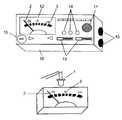
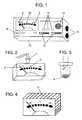
- FIG. 1is a front elevational view of an embodiment of a tuning device in accordance with the present invention
- FIG. 2is an embodiment of a meter of the tuning device of the present invention
- FIG. 3is an embodiment of an LED having a light diffusing means provided in a lens portion
- FIG. 4is an embodiment of a meter to which a light diffusing means is provided.
- FIG. 1is a front elevational view of an embodiment of a tuning device in accordance with the present invention.
- a displaying means 12an electric power source and mode setting switch 13 , a pitch setting switch 14 , an internal microphone 16 for picking up musical sounds, a speaker 17 for sound production of a selected reference tone, and the like are disposed in a front surface of a main body case 10 .
- An input jack 15 for inputting musical soundsis provided in a main body side surface.
- the displaying means 12has a needle indicator portion 2 and a graduated scale portion 3 .
- the displaying means 12is a meter that is enclosed in a case made of a transparent resin, or the like, in order to make visual verification possible.
- Each switchis a push type switch or a sliding type switch.
- the electric power source and mode switch 13 of the tuning deviceis operated first, to turn on the tuning device.
- a userselects a tuning mode from manual or sound by selecting a position of the electric power source and mode switch 13 .
- the userselects which sound to perform tuning on by using the pitch setting switch 14 .
- musical instrument soundsare input from the input jack or the internal microphone, a cent deviation between the selected sound and the input sound is displayed by the meter.
- FIG. 2An embodiment of the meter of the tuning device of the present invention is shown next in FIG. 2 .
- an LED 1 used as an illuminating meansis disposed in a portion above the center of the meter 12 .
- the LED 1has energy that is capable of causing a fluorescent substance to emit light.
- the LED 1emits near ultraviolet rays in the embodiments of the present invention.
- the LED 1is disposed in the vicinity of the meter in FIG. 1.
- a fluorescent coatingis applied to, or printed onto, the needle indicator portion 2 or the graduated scale portion 3 .
- the needle indicator portion 2may be made of a synthetic resin or the like, in which the fluorescent substance may be incorporated instead of applied or printed. If the color of the fluorescent coating used on the graduated scale portion is different, then color variations can be provided when the LED emits light. For example, the needle indicator portion 2 may be orange, and the graduated scale portion 3 may be blue.
- the fluorescent coatings provided in the needle indicator portion 2 and in the graduated scale portion 3emit light. It thus becomes possible to easily read the meter display, even in a dark location.
- LED emission anglesmay differ according to product. For example, when using an LED having a narrow emission angle in a meter having a structure like that of FIG. 2 , light can only be emitted to a center portion of the meter, and the fluorescent coating can only partially emit light.
- FIG. 3An embodiment of an LED having a light diffusing means provided in a lens portion 4 is shown in FIG. 3 .
- the LED shown in FIG. 3structures the light diffusing means by finishing a surface of the lens portion 4 in the periphery of an LED lamp in a frosted glass state. It becomes possible to light up the entire meter even if an LED having a narrow emission angle is used, because the surface roughness of the surface is coarse, and light from the lamp is diffused.
- the light emitting meansis not limited to this structure, and a plurality of grooves may also be formed in the surface of the lens.
- the light diffusing meanscan also be provided in the outer circumference of the meter.
- An embodiment of a meter to which the light diffusing means is providedis shown in FIG. 4 .
- a knurl grooveis cut around the entire circumference in a case portion outer circumference 11 of the meter 12 .
- the near ultraviolet rays emitted form the LED 1are diffused by the knurl groove, and the entire meter is illuminated.
- the light diffusing means of the meteris not limited to this method. Using frosted glass, or finishing a surface of the light diffusing means into a coarse state, can also be considered, similar to the case of the LED.
- disposal of the LED 1need not be in the portion above the center of the meter, as shown in FIG. 2 .
- disposing the LED 1 on a side surface of the meter, or irradiating from a lower surfacecan also be considered. It thus becomes possible to increase the degree of freedom in designing the tuning device, and miniaturization and cost savings become possible.
- a tuning deviceAs explained above, visibility can be increased when performing tuning in a dark location by using an LED having energy capable of causing a fluorescent material to emit light, and by using a needle indicator portion or a graduated scale portion to which a fluorescent coating is applied, in a meter. Further, as many variations as the number of fluorescent coatings being used can be made by using a plurality of fluorescent coatings, and visibility effects can be obtained.
Landscapes
- Physics & Mathematics (AREA)
- Engineering & Computer Science (AREA)
- Acoustics & Sound (AREA)
- Multimedia (AREA)
- Auxiliary Devices For Music (AREA)
- Details Of Measuring And Other Instruments (AREA)
Abstract
Description
1. Field of the Invention
The present invention relates to a tuning device for tuning a musical instrument, and in particular, to a display portion of the tuning device.
2. Description of the Related Art
Tuning devices for measuring a deviation between a fundamental frequency of a sound of a musical instrument, a music signal, or the like, and a reference frequency as a standard for comparison, which are provided with displaying means for displaying the deviation, are conventionally known (refer to JP 2000-243131 A, for example). Further, meters having a needle indicator portion and a graduated scale portion, devices having liquid crystal display elements, and the like, are known as the displaying means for the tuning device (refer to Japanese Utility Model Registration No. 3033255, for example).
When a meter having a needle indicator portion and a graduated scale portion is used, light from an LED employed as an illuminating means diffuses and lights up the needle indicator portion and the graduated scale portion. However, expression can only be made by light of a single color when performing tuning in a dark location with this type of conventional method. Further, there is a problem in that the behavior of the needle indicator is difficult to verify. Therefore, with conventional tuning devices, it is particularly difficult to satisfy the requirements for cases when quick and accurate tuning is sought in a dark location, such as on stage during a concert.
In view of those problems, an object of the present invention is to provide a tuning device with which it is possible to easily read a graduated scale of a display, and in which it is possible to easily verify the behavior of a needle indicator, even when tuning is performed in a dark location.
In order to achieve the aforementioned object, a tuning device of the present invention uses an LED as an illuminating means, the LED having energy that can cause a fluorescent coating to emit light. Further, the fluorescent coating is applied to a needle indicator portion or a graduated scale portion of the meter, or to both the needle indicator portion and the graduated scale portion of the meter, in the tuning device of the present invention. If the LED, which is disposed in the vicinity of the meter, illuminates the meter in the tuning device structured as described above, light from the LED itself lights up the meter. In addition, the energy of the LED can excite the fluorescent coating, and cause the fluorescent coating to emit light.
In the accompanying drawings:
The preferred embodiments of the present invention are explained hereinafter with reference to the drawings.
To use the tuning device, the electric power source andmode switch 13 of the tuning device is operated first, to turn on the tuning device. A user selects a tuning mode from manual or sound by selecting a position of the electric power source andmode switch 13. In addition, the user selects which sound to perform tuning on by using thepitch setting switch 14. When musical instrument sounds are input from the input jack or the internal microphone, a cent deviation between the selected sound and the input sound is displayed by the meter.
An embodiment of the meter of the tuning device of the present invention is shown next in FIG.2.
InFIG. 2 , an LED1 used as an illuminating means is disposed in a portion above the center of themeter 12. The LED1 has energy that is capable of causing a fluorescent substance to emit light. The LED1 emits near ultraviolet rays in the embodiments of the present invention. The LED1 is disposed in the vicinity of the meter inFIG. 1. A fluorescent coating is applied to, or printed onto, theneedle indicator portion 2 or the graduatedscale portion 3. Theneedle indicator portion 2 may be made of a synthetic resin or the like, in which the fluorescent substance may be incorporated instead of applied or printed. If the color of the fluorescent coating used on the graduated scale portion is different, then color variations can be provided when the LED emits light. For example, theneedle indicator portion 2 may be orange, and the graduatedscale portion 3 may be blue.
When the near ultraviolet rays are emitted from the LED1 in this embodiment, the fluorescent coatings provided in theneedle indicator portion 2 and in the graduatedscale portion 3 emit light. It thus becomes possible to easily read the meter display, even in a dark location. LED emission angles may differ according to product. For example, when using an LED having a narrow emission angle in a meter having a structure like that ofFIG. 2 , light can only be emitted to a center portion of the meter, and the fluorescent coating can only partially emit light.
An embodiment of an LED having a light diffusing means provided in alens portion 4 is shown in FIG.3.
The LED shown inFIG. 3 structures the light diffusing means by finishing a surface of thelens portion 4 in the periphery of an LED lamp in a frosted glass state. It becomes possible to light up the entire meter even if an LED having a narrow emission angle is used, because the surface roughness of the surface is coarse, and light from the lamp is diffused. The light emitting means is not limited to this structure, and a plurality of grooves may also be formed in the surface of the lens.
The light diffusing means can also be provided in the outer circumference of the meter. An embodiment of a meter to which the light diffusing means is provided is shown in FIG.4.
InFIG. 4 , a knurl groove is cut around the entire circumference in a case portionouter circumference 11 of themeter 12. The near ultraviolet rays emitted form the LED1 are diffused by the knurl groove, and the entire meter is illuminated. The light diffusing means of the meter is not limited to this method. Using frosted glass, or finishing a surface of the light diffusing means into a coarse state, can also be considered, similar to the case of the LED.
Provided that the light diffusing means is used, disposal of the LED1 need not be in the portion above the center of the meter, as shown in FIG.2. For example, disposing the LED1 on a side surface of the meter, or irradiating from a lower surface can also be considered. It thus becomes possible to increase the degree of freedom in designing the tuning device, and miniaturization and cost savings become possible.
With a tuning device according to the present invention, as explained above, visibility can be increased when performing tuning in a dark location by using an LED having energy capable of causing a fluorescent material to emit light, and by using a needle indicator portion or a graduated scale portion to which a fluorescent coating is applied, in a meter. Further, as many variations as the number of fluorescent coatings being used can be made by using a plurality of fluorescent coatings, and visibility effects can be obtained.
Claims (18)
1. A tuning device for measuring a deviation between a fundamental frequency of one of a sound of a musical instrument and a music signal, and a reference frequency as a standard for comparison, to display the deviation, comprising:
displaying means for displaying the deviation, the displaying means comprising a meter having a needle indicator portion and a graduated scale portion;
illuminating means for illuminating the displaying means, the illuminating means comprising an LED disposed in the vicinity of the displaying means; and
a fluorescent coating applied to one of the needle indicator portion and the graduated scale portion.
2. A tuning device according toclaim 1 ; wherein the LED emits energy capable of causing the fluorescent coating to emit light.
3. A tuning device according toclaim 1 ; wherein the LED emits near ultraviolet rays.
4. A tuning device according toclaim 1 ; further including light diffusing means provided in a lens portion of the LED for diffusing light.
5. A tuning device according toclaim 1 ; further including light diffusing means provided in an outer circumference of the meter for diffusing light.
6. A tuning device according toclaim 5 ; wherein the light diffusing means comprises a knurl provided in the outer circumference of the meter.
7. A tuning device for measuring a deviation between a fundamental frequency of one of a sound of a musical instrument and a music signal, and a reference frequency as a standard for comparison, to display the deviation, comprising:
displaying means for displaying the deviation, the displaying means comprising a meter having a needle indicator portion and a graduated scale portion;
illuminating means for illuminating the displaying means, the illuminating means comprising an LED disposed in the vicinity of the displaying means; and
a fluorescent substance incorporated in one of the needle indicator portion and the graduated scale portion.
8. A tuning device according toclaim 7 , wherein the LED emits energy capable of causing the fluorescent material to emit light.
9. A tuning device according toclaim 7 ; wherein the LED emits near ultraviolet rays.
10. A tuning device according toclaim 7 ; further including light diffusing means provided in a lens portion of the LED for diffusing light.
11. A tuning device according toclaim 7 ; further including light diffusing means provided in an outer circumference of the meter for diffusing light.
12. A tuning device according toclaim 11 ; wherein the light diffusing means comprises a knurl provided in the outer circumference of the meter.
13. A tuning device for measuring a deviation between a fundamental frequency of one of a sound of a musical instrument and a music signal, and a reference frequency as a standard for comparison, to display the deviation, comprising:
a meter having a graduated display portion and a needle indicator portion movable relative to the graduated display portion to indicate the deviation, at least one of the graduated display portion and the needle indicator portion being provided with a fluorescent substance; and an LED for emitting energy effective to cause the fluorescent substance to emit light to illuminate the meter.
14. A tuning device according toclaim 13 ; wherein the LED has a lens portion having a coarse surface for diffusing energy emitted by the LED.
15. A tuning device according toclaim 13 ; wherein both of the graduated display portion and the needle indicator portion are provided with a fluorescent substance.
16. A tuning device according toclaim 15 ; wherein the fluorescent substance of the graduated display portion emits light of a different color from that emitted by the fluorescent substance of the needle indicator portion.
17. A tuning device according toclaim 16 ; wherein the LED emits near ultraviolet rays.
18. A tuning device accordingclaim 13 ; wherein the LED emits near ultraviolet rays.
Applications Claiming Priority (2)
| Application Number | Priority Date | Filing Date | Title |
|---|---|---|---|
| JP2002268087AJP2004109173A (en) | 2002-09-13 | 2002-09-13 | Tuner |
| JP2002-268087 | 2002-09-13 |
Publications (2)
| Publication Number | Publication Date |
|---|---|
| US20040112200A1 US20040112200A1 (en) | 2004-06-17 |
| US6953885B2true US6953885B2 (en) | 2005-10-11 |
Family
ID=32266403
Family Applications (1)
| Application Number | Title | Priority Date | Filing Date |
|---|---|---|---|
| US10/659,611Expired - Fee RelatedUS6953885B2 (en) | 2002-09-13 | 2003-09-10 | Tuning device |
Country Status (2)
| Country | Link |
|---|---|
| US (1) | US6953885B2 (en) |
| JP (1) | JP2004109173A (en) |
Cited By (2)
| Publication number | Priority date | Publication date | Assignee | Title |
|---|---|---|---|---|
| US20080072739A1 (en)* | 2006-09-21 | 2008-03-27 | Roland Corporation | Tuner for musical instruments and amplifier with tuner |
| US20160005276A1 (en)* | 2014-07-03 | 2016-01-07 | David Krinkel | Musical Energy Use Display |
Families Citing this family (3)
| Publication number | Priority date | Publication date | Assignee | Title |
|---|---|---|---|---|
| JP4649633B2 (en)* | 2004-11-30 | 2011-03-16 | 株式会社ニデック | Optometry equipment |
| JP4602262B2 (en)* | 2006-02-14 | 2010-12-22 | セイコーインスツル株式会社 | Tuning device and pointer-type meter with illumination function |
| JP4520952B2 (en)* | 2006-02-14 | 2010-08-11 | セイコーインスツル株式会社 | Music practice support equipment |
Citations (5)
| Publication number | Priority date | Publication date | Assignee | Title |
|---|---|---|---|---|
| US3896697A (en)* | 1973-10-17 | 1975-07-29 | Gary L Iannone | Device for testing the tune of musical instruments |
| US4081764A (en)* | 1972-10-12 | 1978-03-28 | Minnesota Mining And Manufacturing Company | Zinc oxide light emitting diode |
| US5777248A (en)* | 1996-07-22 | 1998-07-07 | Campbell; James A. | Tuning indicator for musical instruments |
| US6252254B1 (en)* | 1998-02-06 | 2001-06-26 | General Electric Company | Light emitting device with phosphor composition |
| US6319425B1 (en)* | 1997-07-07 | 2001-11-20 | Asahi Rubber Inc. | Transparent coating member for light-emitting diodes and a fluorescent color light source |
- 2002
- 2002-09-13JPJP2002268087Apatent/JP2004109173A/ennot_activeWithdrawn
- 2003
- 2003-09-10USUS10/659,611patent/US6953885B2/ennot_activeExpired - Fee Related
Patent Citations (5)
| Publication number | Priority date | Publication date | Assignee | Title |
|---|---|---|---|---|
| US4081764A (en)* | 1972-10-12 | 1978-03-28 | Minnesota Mining And Manufacturing Company | Zinc oxide light emitting diode |
| US3896697A (en)* | 1973-10-17 | 1975-07-29 | Gary L Iannone | Device for testing the tune of musical instruments |
| US5777248A (en)* | 1996-07-22 | 1998-07-07 | Campbell; James A. | Tuning indicator for musical instruments |
| US6319425B1 (en)* | 1997-07-07 | 2001-11-20 | Asahi Rubber Inc. | Transparent coating member for light-emitting diodes and a fluorescent color light source |
| US6252254B1 (en)* | 1998-02-06 | 2001-06-26 | General Electric Company | Light emitting device with phosphor composition |
Cited By (4)
| Publication number | Priority date | Publication date | Assignee | Title |
|---|---|---|---|---|
| US20080072739A1 (en)* | 2006-09-21 | 2008-03-27 | Roland Corporation | Tuner for musical instruments and amplifier with tuner |
| US7915510B2 (en) | 2006-09-21 | 2011-03-29 | Roland Corporation | Tuner for musical instruments and amplifier with tuner |
| US20160005276A1 (en)* | 2014-07-03 | 2016-01-07 | David Krinkel | Musical Energy Use Display |
| US9817379B2 (en)* | 2014-07-03 | 2017-11-14 | David Krinkel | Musical energy use display |
Also Published As
| Publication number | Publication date |
|---|---|
| US20040112200A1 (en) | 2004-06-17 |
| JP2004109173A (en) | 2004-04-08 |
Similar Documents
| Publication | Publication Date | Title |
|---|---|---|
| US5549028A (en) | Chromatic tuner display providing guitar note and precision tuning information | |
| KR20090022670A (en) | Display apparatus and display method of tuner in guitar equalizer | |
| KR100378649B1 (en) | Illumination structure of meter for vehicle instrumental panel | |
| US4004546A (en) | Illuminated indicator gauge | |
| US6953885B2 (en) | Tuning device | |
| JPH04118624U (en) | Automotive instrument lighting system | |
| US5427011A (en) | Chromatic tuner display | |
| JP2004340915A (en) | Measuring instrument for vehicle | |
| JP3658629B2 (en) | clock | |
| JP4778223B2 (en) | Self-luminous pointer and pointer-type display device | |
| JP3457142B2 (en) | Instrument lighting system | |
| JP3536773B2 (en) | Display panel | |
| JP3246359B2 (en) | Display device | |
| JP3599184B2 (en) | Lighting equipment | |
| US8132930B2 (en) | Display device for a tuning apparatus | |
| JP4602262B2 (en) | Tuning device and pointer-type meter with illumination function | |
| JP2548854Y2 (en) | Lighting structure of instrument pointer | |
| JP3052868B2 (en) | Instrument lighting device | |
| JPH0814951A (en) | Pointer for measuring instrument | |
| JP5379111B2 (en) | Self-luminous pointer and pointer-type display device | |
| JP2552997Y2 (en) | Transmitted illumination meter | |
| JP2991205B1 (en) | Lighting equipment | |
| JP2599858Y2 (en) | Display device | |
| JPH0566519U (en) | Instrument lighting equipment | |
| JP2004151014A (en) | Lighting device |
Legal Events
| Date | Code | Title | Description |
|---|---|---|---|
| AS | Assignment | Owner name:SEIKO INSTRUMENTS INC., JAPAN Free format text:ASSIGNMENT OF ASSIGNORS INTEREST;ASSIGNOR:KONISHI, HIROYUKI;REEL/FRAME:016886/0368 Effective date:20050621 | |
| FPAY | Fee payment | Year of fee payment:4 | |
| FPAY | Fee payment | Year of fee payment:8 | |
| FEPP | Fee payment procedure | Free format text:PAYOR NUMBER ASSIGNED (ORIGINAL EVENT CODE: ASPN); ENTITY STATUS OF PATENT OWNER: LARGE ENTITY | |
| REMI | Maintenance fee reminder mailed | ||
| LAPS | Lapse for failure to pay maintenance fees | Free format text:PATENT EXPIRED FOR FAILURE TO PAY MAINTENANCE FEES (ORIGINAL EVENT CODE: EXP.) | |
| STCH | Information on status: patent discontinuation | Free format text:PATENT EXPIRED DUE TO NONPAYMENT OF MAINTENANCE FEES UNDER 37 CFR 1.362 | |
| FP | Lapsed due to failure to pay maintenance fee | Effective date:20171011 |