US6882619B1 - Interference suppressing OFDM method for wireless communications - Google Patents
Interference suppressing OFDM method for wireless communicationsDownload PDFInfo
- Publication number
- US6882619B1 US6882619B1US09/969,868US96986802AUS6882619B1US 6882619 B1US6882619 B1US 6882619B1US 96986802 AUS96986802 AUS 96986802AUS 6882619 B1US6882619 B1US 6882619B1
- Authority
- US
- United States
- Prior art keywords
- parallel
- ofdm
- produce
- data
- signal
- Prior art date
- Legal status (The legal status is an assumption and is not a legal conclusion. Google has not performed a legal analysis and makes no representation as to the accuracy of the status listed.)
- Expired - Lifetime, expires
Links
- 238000000034methodMethods0.000titleclaimsabstractdescription56
- 238000004891communicationMethods0.000titleclaimsabstractdescription10
- 125000004122cyclic groupChemical group0.000claimsdescription16
- 230000007480spreadingEffects0.000claimsdescription14
- 230000001629suppressionEffects0.000claimsdescription9
- 230000001360synchronised effectEffects0.000claimsdescription9
- 230000003139buffering effectEffects0.000claims8
- 230000005540biological transmissionEffects0.000abstractdescription18
- 230000008569processEffects0.000description17
- 238000005562fadingMethods0.000description10
- 239000000969carrierSubstances0.000description8
- 230000008901benefitEffects0.000description7
- 238000005070samplingMethods0.000description7
- 239000006185dispersionSubstances0.000description6
- 230000004044responseEffects0.000description5
- 230000011664signalingEffects0.000description5
- 239000000872bufferSubstances0.000description4
- 239000011159matrix materialSubstances0.000description4
- 230000003595spectral effectEffects0.000description4
- 238000001228spectrumMethods0.000description4
- 238000012546transferMethods0.000description4
- 238000005311autocorrelation functionMethods0.000description3
- 230000006735deficitEffects0.000description3
- 230000000694effectsEffects0.000description3
- GMYRVMSXMHEDTL-UHFFFAOYSA-M1,1'-diethyl-2,2'-cyanine iodideChemical compound[I-].C1=CC2=CC=CC=C2N(CC)C1=CC1=CC=C(C=CC=C2)C2=[N+]1CCGMYRVMSXMHEDTL-UHFFFAOYSA-M0.000description2
- 238000012935AveragingMethods0.000description2
- 230000001427coherent effectEffects0.000description2
- 230000001934delayEffects0.000description2
- 230000003111delayed effectEffects0.000description2
- 238000009795derivationMethods0.000description2
- 238000013461designMethods0.000description2
- 238000010586diagramMethods0.000description2
- 238000011156evaluationMethods0.000description2
- 230000007246mechanismEffects0.000description2
- 238000012986modificationMethods0.000description2
- 230000004048modificationEffects0.000description2
- 230000010363phase shiftEffects0.000description2
- 238000004088simulationMethods0.000description2
- 230000005654stationary processEffects0.000description2
- 238000000342Monte Carlo simulationMethods0.000description1
- 238000009825accumulationMethods0.000description1
- 230000003044adaptive effectEffects0.000description1
- 239000000654additiveSubstances0.000description1
- 230000000996additive effectEffects0.000description1
- 238000013459approachMethods0.000description1
- 230000002238attenuated effectEffects0.000description1
- 230000015556catabolic processEffects0.000description1
- 238000006243chemical reactionMethods0.000description1
- 238000005094computer simulationMethods0.000description1
- 238000006731degradation reactionMethods0.000description1
- 238000005516engineering processMethods0.000description1
- 230000006872improvementEffects0.000description1
- 230000010354integrationEffects0.000description1
- 230000002452interceptive effectEffects0.000description1
- 238000013178mathematical modelMethods0.000description1
- 238000012549trainingMethods0.000description1
Images


Classifications
- H—ELECTRICITY
- H04—ELECTRIC COMMUNICATION TECHNIQUE
- H04B—TRANSMISSION
- H04B7/00—Radio transmission systems, i.e. using radiation field
- H04B7/02—Diversity systems; Multi-antenna system, i.e. transmission or reception using multiple antennas
- H04B7/12—Frequency diversity
- H—ELECTRICITY
- H04—ELECTRIC COMMUNICATION TECHNIQUE
- H04L—TRANSMISSION OF DIGITAL INFORMATION, e.g. TELEGRAPHIC COMMUNICATION
- H04L5/00—Arrangements affording multiple use of the transmission path
- H04L5/02—Channels characterised by the type of signal
- H04L5/023—Multiplexing of multicarrier modulation signals, e.g. multi-user orthogonal frequency division multiple access [OFDMA]
- H04L5/026—Multiplexing of multicarrier modulation signals, e.g. multi-user orthogonal frequency division multiple access [OFDMA] using code division
- H—ELECTRICITY
- H04—ELECTRIC COMMUNICATION TECHNIQUE
- H04J—MULTIPLEX COMMUNICATION
- H04J11/00—Orthogonal multiplex systems, e.g. using WALSH codes
- H04J11/0023—Interference mitigation or co-ordination
- H04J11/0066—Interference mitigation or co-ordination of narrowband interference
Definitions
- the present inventionrelates to an Orthogonal Frequency Division Multiplexed (OFDM) system and method that has the capabilities of suppressing narrow-band interference and combating channel impairment in wireless applications requiring high data rates.
- OFDMOrthogonal Frequency Division Multiplexed
- the Interference Suppression OFDM (IS-OFDM) system and method of the present inventionprovides point-to-point wireless links without spreading the incoming data rate.
- Orthogonal Frequency Division Multiplexinghas been accepted as a mature technology for wireless broad-band communication links. Its design as a multi-carrier system, allows the support of high data rates while maintaining symbol durations longer than the channel's dispersion time. Thus, OFDM modems can have reliable high data rate transmission in time-dispersive or frequency-selective channels without the need for complex time-domain channel equalizers. OFDM can also provide high spectral efficiency by taking advantage of the adaptive nature of the multi-carrier modulation. Information feedback of the channel conditions is used for allocating and adapting the modulation load for each sub-carrier in order to maximize the channel throughput. Such a prior art concept, is effective when channel conditions vary slowly. Another point art approach, provides suppression of narrow-band interferers by using a hidden Markov model filter for detecting and estimating interference in the frequency domain.
- multi-user OFDMmulti-carrier or multi-tone CDMA.
- CDMAbinary spreading sequences are used for distinguishing and separating the user transmissions while OFDM is used to enhance the link performance of each transmission in the presence of interference (from the other users) and channel impairments.
- a multi-user OFDM or multi-carrier CDMA systemmay be a synchronous one if its transmission is in the downlink (point-to-multipoint) or an asynchronous one if its transmission is in the uplink.
- a multi-user OFDM or multi-carrier CDMA systemmay either be a bandwidth expanding (spreading the spectrum) one or a non-bandwidth expanding (not spectrum-spreading) one.
- the non-bandwidth expanding multi-carrier CDMA systemsare based on the method of orthogonal code division multiplexing (OCDM), or multi-code CDMA (MC-CDMA) in which a serial-to-parallel converter is used to provide parallel outputs that are “spread” to the original input rate by means of orthogonal sequences.
- the present inventionproposes an alternative improved method, which makes the OFDM system resistant to narrow-band interference and channel impairments.
- the power of any transmitted symbolis distributed in more than one and possibly in all sub-carrier channels.
- each sub-carrier“contains” more than one or all symbols transmitted in a given frame.
- the different symbols in the same sub-carrierare separated and distinguished by orthogonal sequences.
- Thisis equivalent to having several OFDM systems combined in parallel with the same frequency sub-carriers in which each parallel OFDM encodes the same symbol in more than one (and possibly in all) of its frequency sub-carrier channels (frequency bins).
- the parallel OFDM systemsare orthogonally separated with Hadamard sequences so that the OFDM systems do not interfere with each other.
- IS-OFDMinterference suppressing OFDM
- the present inventionhas all of the advantages of the known OFDM system and method (which is a special case of IS-OFDM) and, additionally, offers frequency diversity, which is the result of distributing the transmit power of each symbol into more than one frequency bin.
- the IS-OFDM system and method of the present inventionalso allows the implementation of a multi-path resolution mechanism aided by the use of its orthogonal Hadamard sequences.
- the IS-OFMA presented hereis a point-to-point transmission method (not a multi-user one), which also does not spread its transmission bandwidth.
- the IS-OFDMmay also be viewed as an orthogonal code division multiplexing (OCDM) system in which symbols are spread in parallel by orthogonal complex sequences. This type of IS-OFDM mathematical model is presented below.
- an object of the present inventionto provide a point-to-point wireless link without spreading the incoming data rate.
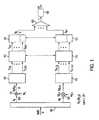
- FIG. 1is a functional block schematic diagram of an IS-OFDM transmitter
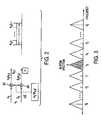
- FIG. 2depicts the IS-OFDM spreading operation
- FIG. 3shows the IS-OFDM frequency spectrum
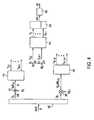
- FIG. 4is an alternative embodiment of the IS-OFDM transmitter
- FIG. 5is a functional block schematic diagram of an IS-OFDM receiver
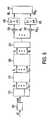
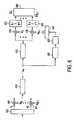
- FIG. 6illustrates the IS-OFDM synchronization process
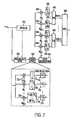
- FIG. 7shows IS-OFDM multi path resolution
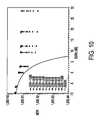
- FIG. 10shows the average bit error probability (BER) of the ordinary OFDM system versus the E b /N 0 [dB] (N 0 is the power spectral density of the AWGN) and the JSR as a parameter; and
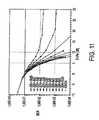
- FIG. 11shows the average bit error probability (BER) of the IS-OFDM system versus the E b N 0 [dB] and the narrow-band interference power to signal ratio JSR, as a parameter.
- the IS-OFDM transmitteris illustrated in FIG. 1 .
- the input data stream of rate R bits/secenters a serial-to-parallel (S/P) converter 105 , which provides ⁇ parallel data streams each with rate R/ ⁇ bits/sec.
- S/P converter 105serial-to-parallel
- the signal rateis again R bits/sec.
- x qrepresents a complex-valued signaling point in a QAM constellation
- x q⁇ q +j ⁇ q
- OCDMorthogonal code division multiplexing
- each of the parallel orthogonal streamsis processed as in an ordinary OFDM. That is, each of the spread signals enter a S/P bit-buffer and encoder device 110 , which provides N parallel sub-streams.
- the N parallel data streamsare then input to an inverse discrete Fourier Transform 115 .
- the output of the inverse discrete Fourier Transform (idft or ifft) that followsis real-valued.
- the N parallel idft or ifft outputseach then enter a parallel-to-serial (P/S) converter 120 , which also adds a guard-time or cyclic prefix to each frame.
- P/Sparallel-to-serial
- D/Adigital-to-analog
- FIGS. 2 a and 2 bDetails of the spreading process are illustrated in FIGS. 2 a and 2 b.
- Both componentsare spread by the Hadamard code w q , which is a vector of [w q,k ].
- the componentsare spread by spreaders 207 .
- the entire sequence of length Thas to “overlay” a single data symbol also of length T.
- the arrangement of sub-carrier frequenciesis illustrated in FIG. 3 .
- the input data stream of rate R bits/secenters a serial-to-parallel (S/P) converter 105 , which provides ⁇ parallel data streams each with rate R/ ⁇ bits/sec.
- S/P converter 105serial-to-parallel converter
- the signal rateis again R bits/sec. If the outputs of the ⁇ parallel S/P bit-buffers/encoders 110 are taken and summed to provide ⁇ parallel data points b k shown in FIG. 4 .
- the ordinary OFDMis a special case of the IS-OFDM, corresponding to the matrix D ⁇ shown below,
- D N ⁇[ x 0 0 ... 0 0 x 1 ... 0 ... ... ... ... 0 0 ... x N ⁇ - 1 ] ⁇ ⁇ w 0 ⁇ w 1 ⁇ w N ⁇ - 1 ⁇ ⁇ f 0 ⁇ ⁇ ⁇ f 1 ⁇ ⁇ ⁇ f N ⁇ - 1
- the IS-OFDM receiveris illustrated in FIG. 5 .
- the process up to this pointcan be the same as in a known OF
- the despread data signalsare then summed by accumulators 535 , as shown in FIG. 5 , for producing accumulated data streams, which are then parallel-to-serial (P/S) converted by P/S converter 540 to produce a recovered data stream.
- the synchronization of the IS-OFDM systemconsists of the frequency and the time synchronization processes. As shown in FIG. 6 , frequency synchronization is obtained by extracting the information needed from the received analog signal either with explicit training data or from the structure of the IS-OFDM signal. Specifically, S/P converter 605 , spreaders 607 and the balance of the OFDM transmitter 610 are coupled to form the OFDM transmission subsystem. A portion of the OFDM receiver 615 and despreaders 630 along the accumulators 635 and P/S converter 640 form the OFDM receiver subsystem. The synchronization subsystem forms a portion of the OFDM receiver subsystem and comprises frequency synchronization unit 620 , code synchronization unit 625 and code generators 648 .
- Frequency synchronization unit 620retrieves information needed to perform frequency synchronization from the portion of the OFDM subsystem 615 .
- Frequency synchronization unit 620is coupled to code synchronization unit 625 , which is, in turn, coupled to code generators 648 that are coupled to and provide input to despreaders 630 .
- Code generatorsgenerate the orthogonal Hadamard code sequences locally at the receiver. These orthogonal Hadamard code sequences have to be synchronized to the received analog signal in order to despread them. Such techniques, developed for ordinary OFDM systems may also be used here.
- the orthogonal code sequencesare used to provide timing synchronization. Standard CDMA code acquisition and tracking methods can be applied for this purpose. Given that the code sequence length is equal to the symbol length such a process can provide accurate symbol-level time-synchronization continuously.
- the parallel orthogonal sequencescan be used for multi-path resolution. That is, in a multi-path propagation environment, paths that are delayed by one or more chips (of length T c ) can be recovered.
- the processis illustrated in FIG. 7 .
- the multi-path processis very similar to the process described in FIG. 6 , which is the addition of frequency and time synchronization to the process described in FIG. 5 . Since there are multiple paths, however, in FIG. 7 there are a plurality of P/S converters 640 , which each accept a plurality of accumulated data streams.
- the P/S converters 640each produce a P/S recovered data stream representing one of the multiple paths, where the K possible multiple paths are less than ⁇ tilde over (M) ⁇ .
- the P/S recovered data streamsare accepted by a maximum ratio combiner 650 to produce a recovered data stream.
- each sequence kis delayed by kT c .
- the time accumulated signals produced by the time accumulatorsare then each input to a threshold circuit 715 . Since each received path contains all ⁇ codes in synchronization, the above parallel code acquisition method can recover up to ⁇ paths.
- the process described aboveis for a K-finger IS-OFDM rake receiver.
- the IS-OFDM conceptcan be extended for cases where an incoming signaling point x q is assigned into only M out of ⁇ frequency bins, M ⁇ .
- M ⁇an incoming signaling point x q is assigned into only M out of ⁇ frequency bins, M ⁇ .
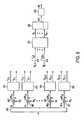
- S/P converter 805is coupled to spreaders 807 with each spreader spreading only by code w 0 or w 1 .
- Spreaders 807are coupled to S/P buffers and encoders 810 . If the outputs of the ⁇ parallel S/P bit-buffers/encoders 810 are taken and summed to provide ⁇ parallel data points b k shown in FIG. 8 . Then, the N parallel points b k enter a single idft or ifft 415 followed by a P/S converter 420 (which adds guard-time or cyclic prefix to each frame).
- the signal s(m)is then input to an A/D converter 825 .
- the IS-OFDM receiveris illustrated in FIG. 9 and comprises A/D converter 905 coupled to S/P converter 910 , which also removes the cyclic prefix.
- the outputs of the S/P converter 910are input to DFT or FFT 915 .
- the outputs of DFT or FFT 915are input to decoder-demapper 920 .
- the A/D converter 905 , S/P converter 910 , DFT or FFT 915 and decoder-demapper 920can be considered an ordinary OFDM receiver.
- two despreaders 930operate on each output of each P/S converter 925 .
- the despreader pairdespreads the output of P/S converters 925 by using codes w 0 and w 1 .
- the result of the despreadersare summed by accumulators 935 .
- N sN+N g samples per frame
- N gare the guard-samples.
- T gis the guard time (or cyclic prefix)
- the transmitted continuous time signal s(t)is given by.
- the OFDM transmission subsystemwas modeled.
- the simulation modelwas exercised assuming that the channel can be modeled as wide-sense stationary process with uncorrelated delays and further assuming that the delays ⁇ i are unchanged during the time of interest.
- the multi-path spread (or channel dispersion) T mthen is the range of values or ⁇ for which R h ( ⁇ ; ⁇ t)> ⁇ ⁇ >0.
- R H ⁇ ( ⁇ ⁇ ⁇ f ; ⁇ ⁇ ⁇ t )⁇ - ⁇ + ⁇ ⁇ R h ⁇ ( ⁇ ; ⁇ ⁇ ⁇ t ) ⁇ e - j2 ⁇ ⁇ ⁇ f ⁇ ⁇ d ⁇ .
- the coherent bandwidth of the channel ( ⁇ f) crepresents the range of values or ⁇ for which R H ( ⁇ )> ⁇ ⁇ >0. Then ( ⁇ ) c ⁇ 1/T m .
- the transmitter time scaleis unknown to the receiver.
- the window setting for removal of the guard intervalis usually offset by a time ⁇ t.
- the received signalmay contain disturbances caused by inter-symbol interference (ISI) and inter-(sub)channel interference (ICI).
- ISI and ICImay result from timing offset of the frame (or symbol) being greater than the guard interval T g .
- ISI and ICImay also result from the channel impulse response being longer than the guard interval T g .
- the range of values of ⁇ for which S H ( ⁇ ) is essentially nonzerois the Doppler-spread B d of the channel.
- the reciprocal of B dis a measure of the coherence time ( ⁇ t) c of the channel. i.e., ( ⁇ t) c ⁇ 1/B d .
- the signal r l,nwill then be demodulated by the DFT or FFT 515 .
- b l,kis defined by (5).
- I k,lis the DFT or FFT of I(k) and ⁇ k,l is the DFT or FFT of n k,l .
- This signalthen enters a parallel-to-serial (P/S) converter 525 , the output of which will be despread (by despreaders 530 ) by each orthogonal sequence in parallel for recovering the corresponding signaling point, and summed by accumulators 535 as shown in FIG. 5 .
- P/Sparallel-to-serial
- ⁇E ⁇ k (
- L ⁇ NL ⁇ ⁇ E ⁇ [ ⁇ I k ⁇ 2 ] + N ⁇ ⁇ ⁇ ⁇ 2
- n′n+ ⁇ n+N g +lN S
- the sampling offset ⁇ n ⁇ 0Replacing the transmitted signal s(t) in the above equation yields.
- r 1 , n⁇ i ⁇ ⁇ h l ⁇ ( t ) ⁇ [ ⁇ l ⁇ ⁇ ⁇ k ⁇ a l , k ⁇ e j2 ⁇ ⁇ ⁇ k ⁇ [ ( n ′ ⁇ T N - T g - lT s - ⁇ i ) / T ] ⁇ g ⁇ ( n ′ ⁇ T N - lT S - ⁇ i ) ] + n ⁇ ( n ′ ⁇ T N ) ( 26 ) Now since ⁇ n>0 the vector r 1 will contain samples from both the lth symbol the (l+1)st symbol, which will cause ICI and ISI.
- r 1[r 1, ⁇ n , r l, ⁇ n+1 , . . . , r l,N ⁇ 1 ⁇ n+1 , r l+1,0 , r l+1,1 , . . .
- P U (k)+P ICI (k)+P ISI (k)P S (k).
- SINRNx 1 2 /( ⁇ l 2 + ⁇ ⁇ 2 ).
- a channelis said to be frequency-selective if its coherence bandwidth is much smaller than its transmission bandwidth, i.e., ( ⁇ ) c ⁇ B.
- the channelis time-flat (or time-nonselective) which means that the coherence time is much greater than the frame length, i.e., ( ⁇ t) c >>T.
- n uis due to the loss of orthogonality because the transfer function H k does not have a constant value for all k.
- the despreader/accumulatorcan maximize the signal to interference and noise ratio (SINR) by averaging over all frequency bins.
- An OFDM channelis said to be time-selective if its coherence time is smaller than the frame or symbol length T s , i.e., ( ⁇ t) c ⁇ T s .
- the channelis frequency-flat (or frequency-nonselective), which means that the coherence bandwidth is greater than the transmission bandwidth, i.e., ( ⁇ ) c >B.
- integrationhas been used instead of DFT or FFT.
- I m⁇ k ⁇ m H m-k a k is the ICI.
- S H ( ⁇ )1 ⁇ ⁇ ⁇ f d ⁇ 1 - ( f / f d ) 2 ⁇ ⁇ for ⁇ ⁇ ⁇ f ⁇ ⁇ f d ( 48 ) where, ⁇ d is the Doppler frequency.
- the above equationindicates that the SIR of the IS-OFDM in time-varying channel will be better than the ordinary OFDM if the variance ⁇ m 2 varies from one frequency bin m to another. If not, the IS and the ordinary OFDM have the same SIR performance.
- the uncoded bit error probability due to narrow-band interference and Average White Gaussian Noise (AWGN)has been evaluated by computer simulation and comparisons between the ordinary OFDM and the IS-OFDM wireless systems.
- the system parameters consideredare as follows:
- the frequency sub-carriersare spaced 312 kHz apart and the data modulation is Quad Phase Shift Keying (QPSK) for all sub-carriers.
- QPSKQuad Phase Shift Keying
- the processis the output of a 20 tap linear band-pass FIR filter, characterized by a stop-band value of ⁇ 30 dB, driven at the input by a Gaussian sequence.
- FIGS. 11 and 12show the performance results for the ordinary OFDM and IS-OFDM systems respectively.
- the ordinary OFDMhas been generated from the IS-OFDM by taking an identity matrix instead of a Hadamard one, so that the two systems are equivalent.
- FIG. 10shows the average bit error probability (BER) of the ordinary OFDM system versus the E b N 0 [dB] (N 0 is the power spectral density of the AWGN) and the JSR as a parameter with the values considered above.
- the performance curve for the AWGN channelis taken as a benchmark.
- a significant floor for BERis observed when E b N 0 >10 dB.
- JSRForward Error Correcting
- FIG. 11shows the average bit error probability (BER) of the IS-OFDM system versus the E b /N 0 [dB] and the narrow-band interference power to signal ratio JSR, as a parameter.
- the proposed IS-OFDM systemcan be characterized by the following features:
- the IS-OFDMis an innovative method for providing high bit rate in wireless transmission links, which is reliable and spectrally efficient.
- IS-OFDMhas all the advantages of the ordinary OFDM and additionally new ones which are the result of distributing the transmit power of each symbol into more than one frequency bins.
Landscapes
- Engineering & Computer Science (AREA)
- Signal Processing (AREA)
- Computer Networks & Wireless Communication (AREA)
- Mobile Radio Communication Systems (AREA)
- Radio Transmission System (AREA)
Abstract
Description
This application claims priority under 35 USC § 119(e) to U.S. provisional patent application Ser. No. 60/269,860, filed on Feb. 21, 2001.
The present invention relates to an Orthogonal Frequency Division Multiplexed (OFDM) system and method that has the capabilities of suppressing narrow-band interference and combating channel impairment in wireless applications requiring high data rates. The Interference Suppression OFDM (IS-OFDM) system and method of the present invention provides point-to-point wireless links without spreading the incoming data rate.
Orthogonal Frequency Division Multiplexing (OFDM) has been accepted as a mature technology for wireless broad-band communication links. Its design as a multi-carrier system, allows the support of high data rates while maintaining symbol durations longer than the channel's dispersion time. Thus, OFDM modems can have reliable high data rate transmission in time-dispersive or frequency-selective channels without the need for complex time-domain channel equalizers. OFDM can also provide high spectral efficiency by taking advantage of the adaptive nature of the multi-carrier modulation. Information feedback of the channel conditions is used for allocating and adapting the modulation load for each sub-carrier in order to maximize the channel throughput. Such a prior art concept, is effective when channel conditions vary slowly. Another point art approach, provides suppression of narrow-band interferers by using a hidden Markov model filter for detecting and estimating interference in the frequency domain.
Related prior art methods, used in multi-user communication, are known as multi-user OFDM, multi-carrier or multi-tone CDMA. These methods are the results of combining the OFDM with CDMA. The CDMA (binary) spreading sequences are used for distinguishing and separating the user transmissions while OFDM is used to enhance the link performance of each transmission in the presence of interference (from the other users) and channel impairments. A multi-user OFDM or multi-carrier CDMA system may be a synchronous one if its transmission is in the downlink (point-to-multipoint) or an asynchronous one if its transmission is in the uplink. Also, a multi-user OFDM or multi-carrier CDMA system may either be a bandwidth expanding (spreading the spectrum) one or a non-bandwidth expanding (not spectrum-spreading) one. The non-bandwidth expanding multi-carrier CDMA systems are based on the method of orthogonal code division multiplexing (OCDM), or multi-code CDMA (MC-CDMA) in which a serial-to-parallel converter is used to provide parallel outputs that are “spread” to the original input rate by means of orthogonal sequences.
The present invention proposes an alternative improved method, which makes the OFDM system resistant to narrow-band interference and channel impairments. In the proposed method the power of any transmitted symbol is distributed in more than one and possibly in all sub-carrier channels. Hence, each sub-carrier “contains” more than one or all symbols transmitted in a given frame. The different symbols in the same sub-carrier are separated and distinguished by orthogonal sequences. This is equivalent to having several OFDM systems combined in parallel with the same frequency sub-carriers in which each parallel OFDM encodes the same symbol in more than one (and possibly in all) of its frequency sub-carrier channels (frequency bins). Then, the parallel OFDM systems are orthogonally separated with Hadamard sequences so that the OFDM systems do not interfere with each other. Therefore, more than one, or possibly all, frequency bins contain the same information. This provides redundancy in the case where one or more sub-carriers are affected by narrow-band interferers or frequency-selective fading. For this reason the proposed OFDM system is called interference suppressing OFDM (IS-OFDM). The present invention has all of the advantages of the known OFDM system and method (which is a special case of IS-OFDM) and, additionally, offers frequency diversity, which is the result of distributing the transmit power of each symbol into more than one frequency bin. The IS-OFDM system and method of the present invention also allows the implementation of a multi-path resolution mechanism aided by the use of its orthogonal Hadamard sequences.
The IS-OFMA presented here is a point-to-point transmission method (not a multi-user one), which also does not spread its transmission bandwidth. The IS-OFDM may also be viewed as an orthogonal code division multiplexing (OCDM) system in which symbols are spread in parallel by orthogonal complex sequences. This type of IS-OFDM mathematical model is presented below.
It is, therefore, an object of the present invention to provide a point-to-point wireless link without spreading the incoming data rate.
It is yet another object of the present invention to maintain symbol duration longer than the channel's dispersion time.
It is a further object of the present invention to provide narrow-band interference suppression.
It is yet another of the present invention to maintain the orthogonality between Hadamard sequences in a channel that is frequency-selective and thus to average the power of each transmitted symbol over all frequency bins.
It is a further object of the present invention to permit the resolution of multi-paths.
The invention is best described with reference to the detailed description and the following figures, where:
The IS-OFDM transmitter is illustrated in FIG.1. The input data stream of rate R bits/sec, enters a serial-to-parallel (S/P)converter 105, which provides Ñ parallel data streams each with rate R/Ñ bits/sec. At the output of the S/P converter, a data signal xq(T sec long), of a parallel stream q is spread (by spreader107) by an orthogonal binary Hadamard code sequence wq=[wq,0, qq,2, . . . , wq,Ñ−1] for q=0, . . . , Ñ−1. After the spreading operation the signal rate is again R bits/sec. Assuming that xqrepresents a complex-valued signaling point in a QAM constellation, i.e., xq=αq+jβq, the spread signal then is
Xq,k=xqwq,k=αqwq,k+jβqwq,kfork=0, . . . ,Ñ−1 (1)
The above process is called orthogonal code division multiplexing (OCDM) and provides a set of Ñ parallel data streams, which are separated from each other by orthogonal codes.
Xq,k=xqwq,k=αqwq,k+jβqwq,kfork=0, . . . ,Ñ−1 (1)
The above process is called orthogonal code division multiplexing (OCDM) and provides a set of Ñ parallel data streams, which are separated from each other by orthogonal codes.
In the next step, each of the parallel orthogonal streams is processed as in an ordinary OFDM. That is, each of the spread signals enter a S/P bit-buffer andencoder device 110, which provides N parallel sub-streams. The encoder creates N=2Ñ complex data points defined by,
where (*) denotes complex conjugate and both Yq,0and Yq,Ñare real valued. The N parallel data streams are then input to an inversediscrete Fourier Transform 115. Given the above symmetry condition the output of the inverse discrete Fourier Transform (idft or ifft) that follows is real-valued. The resulting idft or ifft output samples then are,
The N parallel idft or ifft outputs each then enter a parallel-to-serial (P/S)converter 120, which also adds a guard-time or cyclic prefix to each frame. The output P/S signal of the parallel stream-q then is given by,
Ns=N+Ngand Ngis the number of guard-samples added to the frame.
where (*) denotes complex conjugate and both Yq,0and Yq,Ñare real valued. The N parallel data streams are then input to an inverse
The N parallel idft or ifft outputs each then enter a parallel-to-serial (P/S)
Ns=N+Ngand Ngis the number of guard-samples added to the frame.
The IS-OFDM process described above takes place in parallel for each q, (q=0, 1, . . . , Ñ−1) and all Ñ parallel IS-OFDM data signals are synchronized to each other in both frequency (rate) and timing (delay). That is, the Ñ parallel IS-OFDM data signals have exactly the same frequency bins and their time-frames are in synch. The parallel IS-OFDM data signals sq(m) are then summed-up by anaccumulator 125 to provide the IS-OFDM signal
which enters the digital-to-analog (D/A)converter 130 to provide the transmit signal s(t).
which enters the digital-to-analog (D/A)
Details of the spreading process are illustrated inFIGS. 2 aand2b.Complex signaling point xq=αq+jβqhas real component αqand complex component βq. Both components are spread by the Hadamard code wq, which is a vector of [wq,k]. The components are spread byspreaders 207. As shown inFIG. 2 b,the entire sequence of length T has to “overlay” a single data symbol also of length T. The arrangement of sub-carrier frequencies is illustrated in FIG.3.
Now, using the assumption that the Ñ parallel processes of idft or ifft and P/S are synchronized, an equivalent arrangement of the above IS-OFDM transmitter may be drawn. The input data stream of rate R bits/sec, enters a serial-to-parallel (S/P)converter 105, which provides Ñ parallel data streams each with rate R/Ñ bits/sec. At the output of the S/P converter, a data signal xq(T sec long), of a parallel stream q is spread by an orthogonal binary Hadamard sequence wq=[wq,0, wq,2, . . . , wq,Ñ−1] for q=0, . . . , Ñ−1. After the spreading operation the signal rate is again R bits/sec. If the outputs of the Ñ parallel S/P bit-buffers/encoders 110 are taken and summed to provide Ñ parallel data points bkshown in FIG.4. The parallel points bkare given by,
Then, the N parallel points bkenter a single idft orifft 415 followed by a P/S converter420 (which adds guard-time or cyclic prefix to each frame) the output of which is given by,
It is easily verified that
where sq(m) is the same as in equation (4). The signal s(m) is then input to an D/A converter 425.
Then, the N parallel points bkenter a single idft or
It is easily verified that
where sq(m) is the same as in equation (4). The signal s(m) is then input to an D/
Based on the above description, the Ñ incoming data symbols [x0, x2, . . . , xÑ−1], to the input of the IS-OFDM transmitter for the period of a frame (Ñ=RT), can be arranged as illustrated by the matrix DÑ below.
Every OFDM frequency bin or sub-carrier fi, i=0, . . . , Ñ−1, “contains” all data bits, x0, x1, . . . xÑ−1, which are distinguished from each other by the orthogonal Hadamard sequences wq=[wq,0, wq,2, . . . ,wq,Ñ−1], k=0, . . . , Ñ−1. This means that the power of each data bit is distributed or “spread” to all sub-carriers as opposed to the ordinary OFDM in which a symbol belongs to only one sub-carrier.
Every OFDM frequency bin or sub-carrier fi, i=0, . . . , Ñ−1, “contains” all data bits, x0, x1, . . . xÑ−1, which are distinguished from each other by the orthogonal Hadamard sequences wq=[wq,0, wq,2, . . . ,wq,Ñ−1], k=0, . . . , Ñ−1. This means that the power of each data bit is distributed or “spread” to all sub-carriers as opposed to the ordinary OFDM in which a symbol belongs to only one sub-carrier.
Now consider the special case where the orthogonal sequences are not Hadamard but having a (0, 1) as, wq=[wq,k] where
Then, it is easily verified that the IS-OFDM becomes the ordinary OFDM. Hence, the ordinary OFDM is a special case of the IS-OFDM, corresponding to the matrix DÑshown below,
Then, it is easily verified that the IS-OFDM becomes the ordinary OFDM. Hence, the ordinary OFDM is a special case of the IS-OFDM, corresponding to the matrix DÑshown below,
The IS-OFDM receiver is illustrated in FIG.5. As shown, after demodulation and A/D conversion (by A/D converter505) the received signal r(m) enters a S/P converter 510, which provides N parallel data points zmfor m=0, 1, . . . , N−1. The parallel data zmthen enter a discrete Fourier transform (DFT or FFT)515, which provides N complex data signal points given by,
The above complex data signal points then enter a decoder-demapper 520, which creates Ñ=N/2 parallel data points defined by,
The process up to this point can be the same as in a known OFDM system. Now, Ñ parallel Zkpoints enter a P/S converter 525, the output (serial data stream) of which is despread (by despreaders530) by the Ñ Hadamard code sequences wq=[wq,0, wq,2, . . . ,wq,Ñ−1], in parallel for q=0, 1, . . . , Ñ−1. The despread data signals are then summed byaccumulators 535, as shown inFIG. 5 , for producing accumulated data streams, which are then parallel-to-serial (P/S) converted by P/S converter540 to produce a recovered data stream.
The above complex data signal points then enter a decoder-
The process up to this point can be the same as in a known OFDM system. Now, Ñ parallel Zkpoints enter a P/
In order to verify the functional correctness of the IS-OFDM system, assuming that the received signal at the output of the A/D converter is the same as the transmitted signal, i.e., r(m)=s(m). The signal at the output of the DFT or FFT then is,
where, smare the signal points at the output of the S/P converter and after the removal of the cyclic prefix. The signal points at the output of the decoder-demapper then is
After the P/S converter the signal at the output of the despreader-1 given by,
where, smare the signal points at the output of the S/P converter and after the removal of the cyclic prefix. The signal points at the output of the decoder-demapper then is
After the P/S converter the signal at the output of the despreader-1 given by,
The above equation indicates that the signal power at the output of the accumulator-1 is the total power of the signal x1in all sub-carriers.
The synchronization of the IS-OFDM system consists of the frequency and the time synchronization processes. As shown inFIG. 6 , frequency synchronization is obtained by extracting the information needed from the received analog signal either with explicit training data or from the structure of the IS-OFDM signal. Specifically, S/P converter 605,spreaders 607 and the balance of theOFDM transmitter 610 are coupled to form the OFDM transmission subsystem. A portion of theOFDM receiver 615 anddespreaders 630 along theaccumulators 635 and P/S converter 640 form the OFDM receiver subsystem. The synchronization subsystem forms a portion of the OFDM receiver subsystem and comprisesfrequency synchronization unit 620,code synchronization unit 625 andcode generators 648.Frequency synchronization unit 620 retrieves information needed to perform frequency synchronization from the portion of theOFDM subsystem 615.Frequency synchronization unit 620 is coupled tocode synchronization unit 625, which is, in turn, coupled tocode generators 648 that are coupled to and provide input to despreaders630. Code generators generate the orthogonal Hadamard code sequences locally at the receiver. These orthogonal Hadamard code sequences have to be synchronized to the received analog signal in order to despread them. Such techniques, developed for ordinary OFDM systems may also be used here. After the frequency acquisition is accomplished, the orthogonal code sequences are used to provide timing synchronization. Standard CDMA code acquisition and tracking methods can be applied for this purpose. Given that the code sequence length is equal to the symbol length such a process can provide accurate symbol-level time-synchronization continuously.
In addition, the parallel orthogonal sequences can be used for multi-path resolution. That is, in a multi-path propagation environment, paths that are delayed by one or more chips (of length Tc) can be recovered. The process is illustrated in FIG.7. The multi-path process is very similar to the process described inFIG. 6 , which is the addition of frequency and time synchronization to the process described in FIG.5. Since there are multiple paths, however, inFIG. 7 there are a plurality of P/S converters 640, which each accept a plurality of accumulated data streams. The P/S converters 640 each produce a P/S recovered data stream representing one of the multiple paths, where the K possible multiple paths are less than {tilde over (M)}. The P/S recovered data streams are accepted by amaximum ratio combiner 650 to produce a recovered data stream. The IS-OFDM code synchronization portion of the multi-path resolution process is performed bydespreaders 705, which are coupled to time accumulators (integrators)710. As shown, the set of Ñ orthogonal sequences (w0, w1, . . . , wÑ−1), are used to resolve up to Ñ paths. The incoming signal is frequency synchronized and DFT or FFT demodulated. Then it is despread (by despreaders705) by code sequences wk(k=0, 1, 2, . . . , Ñ−1), in parallel, where each sequence k is delayed by kTc. The time accumulation for the kthdespreader takes place over the interval kTc≦t≦T+kTc, where T=ÑTc. The time accumulated signals produced by the time accumulators are then each input to athreshold circuit 715. Since each received path contains all Ñcodes in synchronization, the above parallel code acquisition method can recover up to Ñ paths. The process described above is for a K-finger IS-OFDM rake receiver.
The IS-OFDM concept can be extended for cases where an incoming signaling point xqis assigned into only M out of Ñ frequency bins, M<Ñ. In the examples below, the cases M=2<Ñ and M=Ñ/2 are considered and illustrated by the matrices D2andD Ñ/2 respectively.
In the first case where M=2 the power of each data point is distributed into two frequency bins while in the second case where M=Ñ/2 the power of each data point is distributed into half of the frequency bins. The frequency bins having the same data point may or may not be adjacent. This alternative of having M<Ñ reduces the peak-to-average amplitude of the signal as compared to the case where M=Ñ, however the frequency diversity of the signal is also reduced into M out of Ñ sub-carriers.
The IS-OFDM transmitter implementation for M=2<Ñ is illustrated in FIG.8 and the corresponding receiver is illustrated in FIG.9. S/P converter 805 is coupled tospreaders 807 with each spreader spreading only by code w0or w1.Spreaders 807 are coupled to S/P buffers andencoders 810. If the outputs of the Ñ parallel S/P bit-buffers/encoders 810 are taken and summed to provide Ñ parallel data points bkshown in FIG.8. Then, the N parallel points bkenter a single idft orifft 415 followed by a P/S converter420 (which adds guard-time or cyclic prefix to each frame). The signal s(m) is then input to an A/D converter825. The transmitted signal s(m) for M<Ñ has the same expression as in equation (6) but with
The IS-OFDM receiver is illustrated in FIG.9 and comprises A/D converter 905 coupled to S/P converter 910, which also removes the cyclic prefix. The outputs of the S/P converter 910 are input to DFT orFFT 915. The outputs of DFT orFFT 915 are input to decoder-demapper 920. The A/D converter 905, S/P converter 910, DFT orFFT 915 and decoder-demapper 920 can be considered an ordinary OFDM receiver. The received signal is then processed by an ordinary OFDM receiver the outputs of which are P/S converted by P/S converters 925 in groups of M and despread bydespreaders 930 as shown inFIG. 9 for M=2. That is, twodespreaders 930 operate on each output of each P/S converter 925. The despreader pair despreads the output of P/S converters 925 by using codes w0and w1. The result of the despreaders are summed byaccumulators 935.
A simulation model was used to perform a performance evaluation. Consider bl,kto be a symbol at the kth sub-carrier and the lth frame. Then,
where Yq,k(l)is the same as in equation (5). The mth idft or ifft output sample at the ith transmitted frame is then given by,
for m=−Ng, . . . , N−1, There are Ns=N+Ngsamples per frame, Ngare the guard-samples. The equivalent time length are Ts=T+Tg, Tgis the guard time (or cyclic prefix), and the sampling time interval is TN=T/N. The transmitted continuous time signal s(t) is given by.
where Yq,k(l)is the same as in equation (5). The mth idft or ifft output sample at the ith transmitted frame is then given by,
for m=−Ng, . . . , N−1, There are Ns=N+Ngsamples per frame, Ngare the guard-samples. The equivalent time length are Ts=T+Tg, Tgis the guard time (or cyclic prefix), and the sampling time interval is TN=T/N. The transmitted continuous time signal s(t) is given by.
First, the OFDM transmission subsystem was modeled. The wireless communication channel is considered to be a multi-path fading channel having an impulse response h(τ;t),
The simulation model was exercised assuming that the channel can be modeled as wide-sense stationary process with uncorrelated delays and further assuming that the delays τiare unchanged during the time of interest.
The simulation model was exercised assuming that the channel can be modeled as wide-sense stationary process with uncorrelated delays and further assuming that the delays τiare unchanged during the time of interest.
Considering the autocorrelation function of the channel (or multi-path intensity profile), +[h(τ1;t)h*(τ2;t+Δt)]=Rh(τ1;Δt)*(τ1−τ2), the multi-path spread (or channel dispersion) Tmthen is the range of values or τ for which Rh(τ;Δt)>Γτ>0.
The Fourier transform of Rh(τ;Δt) is given by,
The coherent bandwidth of the channel (Δf)crepresents the range of values or Δƒ for which RH(Δƒ)>εƒ>0. Then (Δƒ)c≈1/Tm.
The coherent bandwidth of the channel (Δf)crepresents the range of values or Δƒ for which RH(Δƒ)>εƒ>0. Then (Δƒ)c≈1/Tm.
For a given OFDM bandwidth B we distinguish the following two cases:
- (a) If (Δfƒ)c<<B the channel is said to be frequency-selective.
- (b) (Δƒ)c>B the channel is said to be frequency-nonselective.
In a pass-band transmission system, the transmitter time scale is unknown to the receiver. Hence, during the OFDM frame reception, the window setting for removal of the guard interval is usually offset by a time Δt. Similarly, the sampling time at the receiver t′scannot be identical with the transmitter. This timing delay can be incorporated into a channel model represented by an equivalent impulse response h′(τ,t)=h(τ,t−Δt)
Therefore, due to the channel dispersion described above the received signal may contain disturbances caused by inter-symbol interference (ISI) and inter-(sub)channel interference (ICI). ISI and ICI may result from timing offset of the frame (or symbol) being greater than the guard interval Tg. ISI and ICI may also result from the channel impulse response being longer than the guard interval Tg.
Further considering the time variation of the channel as measured by the parameter Δt in RH(Δƒ; Δt), the Fourier transform of RH(Δη;Δt) with respect to the variable Δt,
relates the Doppler effects to the time variation of the channel. If Δη=0 then, SH(λ)≡SH(Δƒ;λ) is the power spectrum as a function of the Doppler frequency λ. The range of values of λ for which SH(λ) is essentially nonzero is the Doppler-spread Bdof the channel. The reciprocal of Bdis a measure of the coherence time (Δt)cof the channel. i.e., (Δt)c≈1/Bd.
relates the Doppler effects to the time variation of the channel. If Δη=0 then, SH(λ)≡SH(Δƒ;λ) is the power spectrum as a function of the Doppler frequency λ. The range of values of λ for which SH(λ) is essentially nonzero is the Doppler-spread Bdof the channel. The reciprocal of Bdis a measure of the coherence time (Δt)cof the channel. i.e., (Δt)c≈1/Bd.
For a given OFDM frame or symbol length T, we distinguish the following two cases:
- (c) If (Δt)c≦T the channel is said to be time-selective.
- (d) (Δt)c>>T the channel is said to be time-nonselective.
The total OFDM interference in a time-selective channel (i.e. (Δt)c.≦T) is dominated by the ICI while in a time-nonselective channel ICI and ISI equally contribute to the interference because ISI is independent of the coherence time.
In this case, consider a narrow-band interferer within the transmission bandwidth. Assuming, however, that the timing offset is smaller than the guard interval so that no ISI or ICS occurs and further assuming that the channel multi-path fading is frequency-flat, i.e., Bw>(Δƒ)c. The received signal is then given by,
where, I(t) represents an interfering signal from narrow-band transmission and n(k) is additive white Gaussian noise.
where, I(t) represents an interfering signal from narrow-band transmission and n(k) is additive white Gaussian noise.
A/D converting and sampling the signal (by A/D converter505) at time instants tn=nTN
is obtained. After S/P converting and removing the guard interval (by S/P converter510), the N samples received during the lth frame (or OFDM symbol) are represented by the vector
r1=[rl,n]=[rl,0, rl,1, . . . , r,lN−1] (17)
where, rl,n=r((n+Ng+lNS)T).
is obtained. After S/P converting and removing the guard interval (by S/P converter510), the N samples received during the lth frame (or OFDM symbol) are represented by the vector
r1=[rl,n]=[rl,0, rl,1, . . . , r,lN−1] (17)
where, rl,n=r((n+Ng+lNS)T).
The signal rl,nwill then be demodulated by the DFT orFFT 515. Assuming for the moment, that the channel remains unchanged for the duration of the OFDM frame, the output of the DFT orFFT 515 at the lth frame (or OFDM symbol) and kth sub-carrier is given by,
where, bl,kis defined by (5). Hl,kis the channel tranfer function (CTF) during the lth frame and at subcarrier frequency ƒk=k/T, which may be considered to include both the response of the channel and the transmission filter. Hl,kis given by,
Also, Ik,lis the DFT or FFT of I(k) and ηk,lis the DFT or FFT of nk,l.
The signal Z′l,kis further processed by the decoder-demapper 520, which provides the signal
for k=0, 1, . . . , Ñ−1. This signal then enters a parallel-to-serial (P/S)converter 525, the output of which will be despread (by despreaders530) by each orthogonal sequence in parallel for recovering the corresponding signaling point, and summed byaccumulators 535 as shown in FIG.5. Now, since the channel is a stationary process, attention may be focused on a particular frame and the subscript I may be dropped. The output of the despreader−1 is then given by,
Based on the assumption of frequency-flat fading, Hkhas the same value for all sub-channels k. Hence, Hk=H for k=0, 1, 2, . . . , Ñ−1. The useful signal (represented by the first term above) provides the signaling data point x1as shown below,
Notice that in the above derivation xqhas the same value in all sub-carriers k=0, 1, . . . , Ñ−1. Hence,
The total power at the output of the each despreader then is, PZ=Pu+Pl+P0. Where Puis the useful signal power and is given by, Pu=N2xl2, (N=2Ñ). Plis the interference power and is represented as follows: Pl=Var{|Σklkwl,k|}=E{Σk(|Ikwl,k|2)}. Assuming that random variables lkare independent of the sub-carrier k, (as well as random variables wl,k), then Plis given by,
Also, Pη is the noise power, which is given by,
where
for all k. The signal-to-interference and noise ratio (SINR) then is given by,
From the above equation it can be observed that the useful signal power x12is received from all Ñ frequency bins while the interference power only exists in L out of N frequency bins (L<N). This is the advantage of IS-OFDM as compared with an ordinary OFDM in which the data symbols in the frequency bins affected by the narrow-band interference may not be recovered. In the IS-OFDM on the other hand, the SINR is averaged over all frequency bins since each data symbol spreads its power to all bins.
where, bl,kis defined by (5). Hl,kis the channel tranfer function (CTF) during the lth frame and at subcarrier frequency ƒk=k/T, which may be considered to include both the response of the channel and the transmission filter. Hl,kis given by,
Also, Ik,lis the DFT or FFT of I(k) and ηk,lis the DFT or FFT of nk,l.
The signal Z′l,kis further processed by the decoder-
for k=0, 1, . . . , Ñ−1. This signal then enters a parallel-to-serial (P/S)
Based on the assumption of frequency-flat fading, Hkhas the same value for all sub-channels k. Hence, Hk=H for k=0, 1, 2, . . . , Ñ−1. The useful signal (represented by the first term above) provides the signaling data point x1as shown below,
Notice that in the above derivation xqhas the same value in all sub-carriers k=0, 1, . . . , Ñ−1. Hence,
The total power at the output of the each despreader then is, PZ=Pu+Pl+P0. Where Puis the useful signal power and is given by, Pu=N2xl2, (N=2Ñ). Plis the interference power and is represented as follows: Pl=Var{|Σklkwl,k|}=E{Σk(|Ikwl,k|2)}. Assuming that random variables lkare independent of the sub-carrier k, (as well as random variables wl,k), then Plis given by,
Also, Pη is the noise power, which is given by,
where
for all k. The signal-to-interference and noise ratio (SINR) then is given by,
From the above equation it can be observed that the useful signal power x12is received from all Ñ frequency bins while the interference power only exists in L out of N frequency bins (L<N). This is the advantage of IS-OFDM as compared with an ordinary OFDM in which the data symbols in the frequency bins affected by the narrow-band interference may not be recovered. In the IS-OFDM on the other hand, the SINR is averaged over all frequency bins since each data symbol spreads its power to all bins.
Now considering the effects of Inter-Symbol and Inter-Channel Interfences (ISI and ICI). ICI and ISI occurs when the channel dispersion time Tm(due to multi-path), is greater than the guard interval Tg. That is, Tm≧Tg, and since Tg=NgTN, Tm−NgTN≧0. Then, the sampling offset Δn is, [Tm/TN]−Ng≧Δn≧0. On the other hand if, Tm≦Tgor Tm−NgTN≧0, no ICI or ISI will occur and any sampling offeset Δn≦0 can preserve th orthogonality between consecutive symbols.
In order to demonstrate this effect first consider a single path with frame misalignment or receiver synchronization offset Δn. The received signal samples may then be expressed by,
where, TNis the sampling interval (TN=T/N), n′=n+Δn+Ng+lNSand the sampling offset Δn≧0. Replacing the transmitted signal s(t) in the above equation yields.
Now since Δn>0 the vector r1will contain samples from both the lth symbol the (l+1)st symbol, which will cause ICI and ISI. That is,
r1=[r1,Δn, rl,Δn+1, . . . , rl,N−1−Δn+1, rl+1,0, rl+1,1, . . . , rl+l,Δn−1] (27)
Demodulating this vector by DFT or FFT, the output signal zl,,kof a single path is given by,
zl,k=ul,k+(ici)l,k+(isi)l,k+ηl,k (28)
where, ul,kis the useful part of the signal, (ici)l,kand (isi)l,kare the inter-channel and inter-symbol interferences respectively and ηl,kis the DFT or FFT of the white Gaussian noise. Each component is given below
where, TNis the sampling interval (TN=T/N), n′=n+Δn+Ng+lNSand the sampling offset Δn≧0. Replacing the transmitted signal s(t) in the above equation yields.
Now since Δn>0 the vector r1will contain samples from both the lth symbol the (l+1)st symbol, which will cause ICI and ISI. That is,
r1=[r1,Δn, rl,Δn+1, . . . , rl,N−1−Δn+1, rl+1,0, rl+1,1, . . . , rl+l,Δn−1] (27)
Demodulating this vector by DFT or FFT, the output signal zl,,kof a single path is given by,
zl,k=ul,k+(ici)l,k+(isi)l,k+ηl,k (28)
where, ul,kis the useful part of the signal, (ici)l,kand (isi)l,kare the inter-channel and inter-symbol interferences respectively and ηl,kis the DFT or FFT of the white Gaussian noise. Each component is given below
Assuming now that the above offset is a result of the multi-path channel having a transfer function Hl,kfor each path and further assuming that the channel remains constant for the duration of one frame or OFDM symbol, the signal at the output of the DFT or FFT and after the decoder-demapper is given by,
Zl,k={tilde over (H)}l,kal,kej2πΔn(k/N)+(ICI)l,k+(ISI)l,k+ηl,k (32)
where, {tilde over (H)}l,k=α(Δni)Hl,kand α(Δni) is the resulting attenuation of the symbols which is approximated by,
Zl,k={tilde over (H)}l,kal,kej2πΔn(k/N)+(ICI)l,k+(ISI)l,k+ηl,k (32)
where, {tilde over (H)}l,k=α(Δni)Hl,kand α(Δni) is the resulting attenuation of the symbols which is approximated by,
It has been shown, that at the DFT or FFT output, and for any given frame or OFDM symbol l, the total power of the signal PS(k) (without the noise) is the sum of the useful power PUand the powers of the interchannel and intersymbol interferences PICI(k) and PISI(k) respectively, i.e., PU(k)+PICI(k)+PISI(k)=PS(k). This means that, depending on the channel conditions the relative values of each of the three components of PS(k) may vary but their sum is always constant.
As is observed in equation (32), the useful component of the signal is attenuated and rotated by a phasor with phase proportional to the sub-carrier index k and the timing offset Δn, but they are constant in time. Since the phase rotation is constant in time it will have no impact on the system if coherent or differential modulation has been used having a channel estimator. Then each of the N outputs of the DFT or FFT may scaled and rotated, by a channel estimator and are given by,
Zk=Ĥkak+lk+ηk (33)
In the above equation the subscript l has been dropped, Ĥkis the estimate of sub-channel k. Also, Ilrepresents the total inter-channel and inter-symbol interference before the despreader.
Zk=Ĥkak+lk+ηk (33)
In the above equation the subscript l has been dropped, Ĥkis the estimate of sub-channel k. Also, Ilrepresents the total inter-channel and inter-symbol interference before the despreader.
Now, since
the useful data component Ulat the output of the despreader-1 is given by,
the useful data component Ulat the output of the despreader-1 is given by,
The above equation has the same derivation as equation (22). Here again the assumption of frequency-nonselective (frequency-flat) channel has been used, that is Ĥk≈Ĥ for all k. The normalized useful signal power (with respect to Ĥ), then is {overscore (P)}u=Pul|Ĥ|2=N2x12. The interference noise at the output of the despreader is given by,
As is known, Ikmay be approximate to Gaussian noise with variance Var(Ik)=σk2. Hence,
In the above equation the assumption that the interference lkis independently distributed for each k has been made. The interference power at the output of the despreader then is
and the signal to interference and noise ratio (SINR) is given by
Assuming that the interference Ikis also identically distributed with variance σl2=σk2for all k, then, SINR=Nx12/(σl2+ση2).
and the signal to interference and noise ratio (SINR) is given by
Assuming that the interference Ikis also identically distributed with variance σl2=σk2for all k, then, SINR=Nx12/(σl2+ση2).
As has been described above, a channel is said to be frequency-selective if its coherence bandwidth is much smaller than its transmission bandwidth, i.e., (Δƒ)c<<B. Here, in addition it can be assumed that the channel is time-flat (or time-nonselective) which means that the coherence time is much greater than the frame length, i.e., (Δt)c>>T.
In this case, the useful part of the signal at the output of the despreader-1 is given by
The noise nuthat is introduced in this case, is due to the loss of orthogonality because the transfer function Hkdoes not have a constant value for all k. Using the property that each row of a Hadamard matrix in normal form (except the first one) has {overscore (N)}/2−1s and {overscore (N)}/2+1s, nuis given by,
For a deeply frequency-selective fading channel this noise component may be significant. In such a case it is necessary to obtain an estimate Ĥ of the transfer function of each sub-channel k (before the despreading operation), in order to compensate (equalize) for the frequency-selective fading and to eliminate the “noise” nu. The signal before the despreading will then be given by Zk=Ĥak+ln+μk.
The noise power Pl
at the output of the despreader then is
In frequency-selective fading however, σk2varies from one frequency bin k to another. Therefore, the despreader/accumulator can maximize the signal to interference and noise ratio (SINR) by averaging over all frequency bins. Thus, the output of the despreader-1 is,
Therefore, given that the “noise” nu, can be eliminated, the IS-OFDM has an advantage over the ordinary OFDM in which frequency-selective fading may result in lost of symbols in the frequency bins where the deep fades occur.
at the output of the despreader then is
In frequency-selective fading however, σk2varies from one frequency bin k to another. Therefore, the despreader/accumulator can maximize the signal to interference and noise ratio (SINR) by averaging over all frequency bins. Thus, the output of the despreader-1 is,
Therefore, given that the “noise” nu, can be eliminated, the IS-OFDM has an advantage over the ordinary OFDM in which frequency-selective fading may result in lost of symbols in the frequency bins where the deep fades occur.
An OFDM channel is said to be time-selective if its coherence time is smaller than the frame or symbol length Ts, i.e., (Δt)c<Ts. In addition, here it is assumed that the channel is frequency-flat (or frequency-nonselective), which means that the coherence bandwidth is greater than the transmission bandwidth, i.e., (Δƒ)c>B.
Assuming that the channel impulse response is given by h(t,τ)=Σiγi(t)δ(t−τi), the received OFDM signal in time-varying channels is given by,
where τiis the delay of the ith path and γi(t) is its corresponding complex amplitude. γ(t) is assumed to be a wide-sense stationary (wss) process with zero mean, unit variance and auto-correlation function Rγ(τ)=ε[γ(t+τ)γ*(t)].
where τiis the delay of the ith path and γi(t) is its corresponding complex amplitude. γ(t) is assumed to be a wide-sense stationary (wss) process with zero mean, unit variance and auto-correlation function Rγ(τ)=ε[γ(t+τ)γ*(t)].
The transmitted time domain signal can be represented as follows,
where, ƒk=ƒ0+kΔƒ is the frequency of the kth subcarrier and Δη=1/Ts. The received signal after the DFT or FFT demodulation then is,
For simplicity, as is known integration has been used instead of DFT or FFT.
where, ƒk=ƒ0+kΔƒ is the frequency of the kth subcarrier and Δη=1/Ts. The received signal after the DFT or FFT demodulation then is,
For simplicity, as is known integration has been used instead of DFT or FFT.
Replacing r(t) and s(t) from the corresponding equations above yields,
where, Hlis defined by,
H0represents the attenuation and phase shift of the desired signal and Hk's for k≠0 the inter-channel interference (ICI), which is dominant in time varying channels. The above implies that any time variation in the channel results in Hk≠0, for k>0.
where, Hlis defined by,
H0represents the attenuation and phase shift of the desired signal and Hk's for k≠0 the inter-channel interference (ICI), which is dominant in time varying channels. The above implies that any time variation in the channel results in Hk≠0, for k>0.
The signal at the output of the decoder-demapper then becomes,
After that, the signals Zmare converted into serial format and then despread in parallel by orthogonal sequences. The output of the despreader-1 is then given by,
where, Im=Σk≠mHm-kakis the ICI.
After that, the signals Zmare converted into serial format and then despread in parallel by orthogonal sequences. The output of the despreader-1 is then given by,
where, Im=Σk≠mHm-kakis the ICI.
The first term of the above equation is the useful part of the signal. Since H0is constant in the frequency domain (frequency-flat channel), the signal recovered at the output of the despreader-1 is given below,
The useful power then is, PU=N2Ho2x12, (N=1Ñ). The interference power Pl=Var{|ΣmImwl,m|}=E{Σm(|Imwl,m|2)}, assuming that random variables Imare independent, Plis given by,
As is known,
is tightly bounded by,
SH(ƒ) is the Fourier transform of the autocorrelation function of γi(t), i.e., SH(ƒ)=F{Rγ(τ)}, and describes the Doppler power spectrum. According to Jakes' model SH(ƒ) is given by,
where, ƒdis the Doppler frequency. The signal-to-interference ratio then is
The above equation indicates that the SIR of the IS-OFDM in time-varying channel will be better than the ordinary OFDM if the variance σm2varies from one frequency bin m to another. If not, the IS and the ordinary OFDM have the same SIR performance.
The useful power then is, PU=N2Ho2x12, (N=1Ñ). The interference power Pl=Var{|ΣmImwl,m|}=E{Σm(|Imwl,m|2)}, assuming that random variables Imare independent, Plis given by,
As is known,
is tightly bounded by,
SH(ƒ) is the Fourier transform of the autocorrelation function of γi(t), i.e., SH(ƒ)=F{Rγ(τ)}, and describes the Doppler power spectrum. According to Jakes' model SH(ƒ) is given by,
where, ƒdis the Doppler frequency. The signal-to-interference ratio then is
The above equation indicates that the SIR of the IS-OFDM in time-varying channel will be better than the ordinary OFDM if the variance σm2varies from one frequency bin m to another. If not, the IS and the ordinary OFDM have the same SIR performance.
The uncoded bit error probability due to narrow-band interference and Average White Gaussian Noise (AWGN) has been evaluated by computer simulation and comparisons between the ordinary OFDM and the IS-OFDM wireless systems.
The system parameters considered are as follows: The signal bandwidth is 20 MHz and Ñ=64. The frequency sub-carriers are spaced 312 kHz apart and the data modulation is Quad Phase Shift Keying (QPSK) for all sub-carriers. The narrow-band interference is modeled as a Gaussian process with constant one-sided spectral density σNBI and a total bandwidth WNBI=10 MHz. The process is the output of a 20 tap linear band-pass FIR filter, characterized by a stop-band value of −30 dB, driven at the input by a Gaussian sequence. The uncoded bit error probability has been evaluated for the power of interference to signal ratio values JSR=−10, −8, . . . , 8, 10 dBs. JSR is defined as the ratio JSR=PI/PS, where PIis the average interference power and PSis the average transmitted signal power.
The major finding showed by Monte Carlo simulations is that improvement in bit error probability due to a form of diversity introduced by the IS-OFDM system does not simply follow a proportional relation. In fact, the gain can become infinity if the target BER is fixed under the error floor induced by narrow-band interference.
Based on the performance evaluation and analysis presented above, the proposed IS-OFDM system can be characterized by the following features:
- 1. The IS-OFDM provides a point-to-point wireless link without spreading the incoming data rate.
- 2. The IS-OFDM, as with the ordinary OFDM, is appropriate for transmission of high data rates while maintaining symbol duration longer than the channel's dispersion time.
- 3. The IS-OFDM provides narrow-band interference suppression. That is, if one or more frequency bins are affected by interference, symbols may still be recovered from the remaining bins since each IS-OFDM symbol is transmitted in all (or at least in two) bins.
- 4. In frequency-selective fading the IS-OFDM requires that the transfer function of each frequency bin is equalized to a constant value so that the orthogonality between Hadamard sequences is maintained. If this problem is solved, IS-OFDM offers the advantage of averaging the power of each transmitted symbol over all frequency bins (for which that symbol is transmitted) some of which may be faded.
- 5. In time-selective fading the IS-OFDM does not have any additional advantage, but it has all the properties of an ordinary OFDM system.
- 6. The ordinary OFDM is a special case of the IS-OFDM in which the Hadamard sequences (used for separating different symbols is the same frequency bin), are replaced by non-Hadamard (0,1)-orthogonal sequences.
- 7. The IS-OFDM system design is flexible in terms of distributing the transmit symbol power into two, three, or all frequency bins. When the transmit symbol power is distributed into a smaller number of frequency bins the peak-to-average amplitude is reduced, however the frequency diversity is also reduced.
- 8. The IS-OFDM system allows resolution of multi-paths. Such a mechanism, utilizes the Ñ parallel Hadamard sequences for resolving up to Ñ paths, which are received one or more chips apart.
- 9. Finally, the IS-OFDM may be conceived or modeled as a multi-carrier orthogonal code division multiplexed (M-OCDM) system utilizing complex orthogonal sequences.
In conclusion, the IS-OFDM is an innovative method for providing high bit rate in wireless transmission links, which is reliable and spectrally efficient. IS-OFDM has all the advantages of the ordinary OFDM and additionally new ones which are the result of distributing the transmit power of each symbol into more than one frequency bins.
It should be clear from the foregoing that the objectives of the invention have been met. While particular embodiments of the present invention have been described and illustrated, it should be noted that the invention is not limited thereto since modifications may be made by persons skilled in the art. The present application contemplates any and all modifications within the spirit and scope of the underlying invention disclosed and claimed herein.
Claims (22)
1. A method for operating an interference Suppression Orthogonal Frequency Division Multiplexed (IS-OFDM) system for point-to-point wireless communications that suppresses narrow-band interference comprising the steps of:
serial-to-parallel (S/P) converting an input data stream to produce a plurality of parallel data streams;
spreading each of said plurality of parallel data streams by an orthogonal binary code sequence resulting in a set of parallel spread data streams separated from each other by orthogonal codes;
S/P buffering and encoding each of said set of parallel data streams to produce of plurality of parallel sub-streams;
operating on each of said plurality of parallel sub-streams to produce a plurality of Inverse Discrete Fourier Transform (IDFT) outputs;
parallel-to-serial (P/S) converting said plurality of IDFT outputs to produce a plurality of IS-OFDM data signals, each of said plurality of IS-OFDM data signals comprises a plurality of frames;
adding a cyclic prefix to each of said frames of each of plurality of IS-OFDM data signals;
accumulating said plurality of IS-OFDM data signals to produce an IS-OFDM signal;
digital-to-analog (D/A) converting said IS-OFDM signal to produce an IS-OFDM transmit signal;
transmitting said IS-OFDM transmit signal point-to-point through the air;
accepting a received analog signal;
analog-to-digital (A/D) converting said received analog signal to produce a digital received signal, said digital received signal comprising a plurality of frames;
removing said cyclic prefix from each of said plurality of frames of said digital received signal;
S/P converting said digital received signal, having said cyclic prefix removed, to produce a plurality of parallel received data points,
operating on said plurality of parallel received data points to produce a plurality of complex data signal points;
decoding and demapping said plurality of complex data points to produce a plurality of parallel data points;
P/S converting said plurality of parallel data points to produce a serial data stream;
despreading said serial data stream to produce despread data signals;
accumulating said despread data signals to produce accumulated data streams; and
P/S converting said accumulated data streams to produce a recovered data stream.
2. The method according toclaim 1 , wherein said orthogonal binary code sequence is an orthogonal binary Hadamard code sequence.
3. The method according toclaim 1 , wherein said S/P buffering and encoding step further comprises the step of creating complex data points, which are used to produce said plurality of parallel sub-streams.
4. The method according toclaim 3 , wherein said IS-OFDM transmit signal is at a data rate that is equal to a data rate of said input data stream via said P/S converting step.
5. The method according toclaim 1 , wherein each of said plurality of parallel IS-OFDM data signals are synchronized to each other in both frequency and timing.
6. The method according toclaim 1 , wherein said IS-OFDM transmit signal is at a data rate that is equal to a data rate of said input data stream via said P/S converting step.
7. A method for operating an interference Suppression Orthogonal Frequency Division Multiplexed (IS-OFDM) system for point-to-point wireless communications that suppresses narrow-band interference comprising the steps of:
serial-to-parallel (S/P) converting an input data stream to produce a plurality of parallel data streams;
spreading each of said plurality of parallel data streams by an orthogonal binary code sequence resulting in a set of parallel spread data streams separated from each other by orthogonal codes;
S/P buffering and encoding each of said set of parallel data streams to produce of plurality of parallel sub-streams;
summing said plurality of parallel sub-streams;
producing a plurality of Inverse Discrete Fourier Transform (IDFT) outputs from the sum of said plurality of parallel sub-streams;
parallel-to-serial (P/S) converting said plurality of IDFT outputs to produce an IS-OFDM data signal, said IS-OFDM signal comprising a plurality of frames and adding a cyclic prefix to each frame of said IS-OFDM data signal;
digital-to-analog (D/A) converting said IS-OFDM signal to produce an IS-OFDM transmit signal;
transmitting said IS-OFDM transmit signal point-to-point through the air;
accepting a received analog signal;
analog-to-digital (A/D) converting said received analog signal to produce a digital received signal, said digital received signal comprising a plurality of frames;
removing said cyclic prefix from each of said plurality of frames of said digital received signal;
S/P converting said digital received signal, having said cyclic prefix removed, to produce a plurality of parallel received data points;
operating on said plurality of parallel received data points to produce a plurality of complex data signal points;
decoding and demapping said plurality of complex data points to produce a plurality of parallel data points;
P/S converting said plurality of parallel data points to produce a serial data stream;
despreading said serial data stream to produce despread data signals;
accumulating said despread data signals to produce accumulated data streams; and
P/S converting said accumulated data streams to produce a recovered data stream.
8. The method according toclaim 7 , wherein said orthogonal binary code sequence is an orthogonal binary Hadamard code sequence.
9. The method according toclaim 7 , wherein said S/P buffering and encoding step further comprises the step of creating complex data points, which are used to produce said plurality of parallel sub-streams.
10. The method according toclaim 7 , wherein each of said plurality of parallel IS-OFDM data signals are synchronized to each other in both frequency and timing.
11. The method according toclaim 7 , wherein said IS-OFDM transmit signal is at a data rate that is equal to a data rate of said input data stream via said P/S converting step.
12. A method for operating an interference Suppression Orthogonal Frequency Division Multiplexed (IS-OFDM) transmitter for point-to-point wireless communications that suppresses narrow-band interference comprising the steps of:
serial-to-parallel (S/P) converting an input data stream to produce a plurality of parallel data streams;
spreading each of said plurality of parallel data streams by an orthogonal binary code sequence resulting in a set of parallel spread data streams separated from each other by orthogonal codes;
S/P buffering and encoding each of said set of parallel data streams to produce of plurality of parallel sub-streams;
operating on each of said plurality of parallel sub-streams to produce a plurality of Inverse Discrete Fourier Transform (IDFT) outputs;
parallel-to-serial (P/S) converting said plurality of IDFT outputs to produce a plurality of IS-OFDM data signals, each of said plurality of IS-OFDM data signals comprises a plurality of frames;
adding a cyclic prefix to each of said frames of each of plurality of IS-OFDM data signals;
accumulating said plurality of IS-OFDM data signals to produce an IS-OFDM signal; and
digital-to-analog (D/A) converting said IS-OFDM signal to produce an IS-OFDM transmit signal.
13. The method according toclaim 12 , wherein said orthogonal binary code sequence is an orthogonal binary Hadamard code sequence.
14. The method according toclaim 12 , wherein said S/P buffering and encoding step further comprises the step of creating complex data points, which are used to produce said plurality of parallel sub-streams.
15. The method according toclaim 12 , wherein each of said plurality of parallel IS-OFDM data signals are synchronized to each other in both frequency and timing.
16. A method for operating an interference Suppression Orthogonal Frequency Division Multiplexed (IS-OFDM) transmitter for point-to-point wireless communications that suppresses narrow-band interference comprising the steps of:
serial-to-parallel (S/P) converting an input data stream to produce a plurality of parallel data streams;
spreading each of said plurality of parallel data streams by an orthogonal binary code sequence resulting in a set of parallel spread data streams separated from each other by orthogonal codes;
S/P buffering and encoding each of said set of parallel data streams to produce of plurality of parallel sub-streams;
summing said plurality of parallel sub-streams;
producing a plurality of Inverse Discrete Fourier Transform (IDFT) outputs from the sum of said plurality of parallel sub-streams;
parallel-to-serial (P/S) converting said plurality of IDFT outputs to produce an IS-OFDM data signal, said IS-OFDM signal comprising a plurality of frames and adding a cyclic prefix to each frame of said IS-OFDM data signal; and
digital-to-analog (D/A) converting said IS-OFDM data signal to produce an IS-OFDM transmit signal.
17. The method according toclaim 16 , wherein said orthogonal binary code sequence is an orthogonal binary Hadamard code sequence.
18. The method according toclaim 16 , wherein said S/P buffering and encoding step further comprises the step of creating complex data points, which are used to produce said plurality of parallel sub-streams.
19. The method according toclaim 16 , wherein each of said plurality of parallel IS-OFDM data signals are synchronized to each other in both frequency and timing.
20. The method according toclaim 16 , wherein said IS-OFDM transmit signal is at a data rate that is equal to a data rate of said input data stream via said P/S converting step.
21. A method for operating an interference Suppression Orthogonal Frequency Division Multiplexed (IS-OFDM) receiver for point-to-point wireless communications that suppresses narrow-band interference comprising the steps of:
accepting a received analog signal;
analog-to-digital (A/D) converting said received analog signal to produce a digital received signal, said digital received signal comprising a plurality of frames;
removing said cyclic prefix from each of said plurality of frames of said digital received signal;
S/P converting said digital received signal, having said cyclic prefix removed, to produce a plurality of parallel received data points,
operating on said plurality of parallel received data points to produce a plurality of complex data signal points;
decoding and demapping said plurality of complex data points to produce a plurality of parallel data points;
P/S converting said plurality of parallel data points to produce a serial data stream;
despreading said serial data stream to produce despread data signals;
accumulating said despread data signals to produce accumulated data streams; and
P/S converting said accumulated data streams to produce a recovered data stream.
22. The method according toclaim 21 , wherein said plurality of code sequences are Hadamard code sequences.
Priority Applications (3)
| Application Number | Priority Date | Filing Date | Title |
|---|---|---|---|
| US09/969,868US6882619B1 (en) | 2001-02-21 | 2002-01-31 | Interference suppressing OFDM method for wireless communications |
| US11/103,762US7133355B1 (en) | 2001-02-21 | 2005-04-12 | Interference suppressing OFDM method for wireless communications |
| US11/589,421US7738358B1 (en) | 2001-02-21 | 2006-10-30 | Interference suppressing OFDM method for wireless communications |
Applications Claiming Priority (2)
| Application Number | Priority Date | Filing Date | Title |
|---|---|---|---|
| US26986001P | 2001-02-21 | 2001-02-21 | |
| US09/969,868US6882619B1 (en) | 2001-02-21 | 2002-01-31 | Interference suppressing OFDM method for wireless communications |
Related Child Applications (1)
| Application Number | Title | Priority Date | Filing Date |
|---|---|---|---|
| US11/103,762ContinuationUS7133355B1 (en) | 2001-02-21 | 2005-04-12 | Interference suppressing OFDM method for wireless communications |
Publications (1)
| Publication Number | Publication Date |
|---|---|
| US6882619B1true US6882619B1 (en) | 2005-04-19 |
Family
ID=34437182
Family Applications (3)
| Application Number | Title | Priority Date | Filing Date |
|---|---|---|---|
| US09/969,868Expired - LifetimeUS6882619B1 (en) | 2001-02-21 | 2002-01-31 | Interference suppressing OFDM method for wireless communications |
| US11/103,762Expired - LifetimeUS7133355B1 (en) | 2001-02-21 | 2005-04-12 | Interference suppressing OFDM method for wireless communications |
| US11/589,421Expired - Fee RelatedUS7738358B1 (en) | 2001-02-21 | 2006-10-30 | Interference suppressing OFDM method for wireless communications |
Family Applications After (2)
| Application Number | Title | Priority Date | Filing Date |
|---|---|---|---|
| US11/103,762Expired - LifetimeUS7133355B1 (en) | 2001-02-21 | 2005-04-12 | Interference suppressing OFDM method for wireless communications |
| US11/589,421Expired - Fee RelatedUS7738358B1 (en) | 2001-02-21 | 2006-10-30 | Interference suppressing OFDM method for wireless communications |
Country Status (1)
| Country | Link |
|---|---|
| US (3) | US6882619B1 (en) |
Cited By (37)
| Publication number | Priority date | Publication date | Assignee | Title |
|---|---|---|---|---|
| US20030007573A1 (en)* | 2001-03-30 | 2003-01-09 | Telefonaktiebolaget Lm Ericsson (Publ). | Minimization of error contributions in a DMT system |
| US20030026200A1 (en)* | 2001-04-20 | 2003-02-06 | Po-Wei Fu | Programmable transceiver structure of multi-rate OFDM-CDMA for wireless multimedia communications |
| US20030185282A1 (en)* | 2002-03-29 | 2003-10-02 | Hudson John E. | Methods and apparatus for transmitting data over a CDMA network |
| US20040066838A1 (en)* | 2002-10-07 | 2004-04-08 | Kwon-Hue Choi | MC/MC-DS dual-mode adaptive multi-carrier code division multiple access (CDMA) apparatus and method thereof |
| US20040081227A1 (en)* | 2002-10-25 | 2004-04-29 | Kwang-Jae Lim | System and method for spreading/despreading in multi-carrier code division multiple access |
| WO2006014141A1 (en)* | 2004-08-03 | 2006-02-09 | Agency For Science, Technology And Research | Method for transmitting a digital signal, method for receiving a digital signal, transmitter and receiver |
| US20060146856A1 (en)* | 2004-12-30 | 2006-07-06 | Samsung Electronics Co., Ltd. | Adaptive subchannel and bit allocation method using partial channel information feedback in an orthogonal frequency division multiple access communication system |
| US20060285602A1 (en)* | 2005-06-16 | 2006-12-21 | Lg Electronics, Inc. | Method of transmitting/receiving OFDM signal and mobile communication terminal thereof |
| US7173976B1 (en)* | 2001-04-09 | 2007-02-06 | At&T Corp. | Frequency-domain method for joint equalization and decoding of space-time block codes |
| WO2007020626A1 (en)* | 2005-08-18 | 2007-02-22 | Hill, Hanit Selecter | A wireless mobile communication system without pilot signals |
| US7187647B1 (en)* | 2002-01-23 | 2007-03-06 | At&T Corp. | Ultra-wide bandwidth system and method for in-premises wireless networking |
| US20070207741A1 (en)* | 2003-08-07 | 2007-09-06 | Jones Alan E | Method and arrangement for noise variance and sir estimation |
| US20070280372A1 (en)* | 2006-05-31 | 2007-12-06 | M/A-Com, Inc. | Fully Saturated Multi-Tone Transceiver |
| US20080095252A1 (en)* | 2006-06-16 | 2008-04-24 | Lg Electronics Inc. | Encoding uplink acknowledgments to downlink transmissions |
| US7379508B1 (en)* | 2001-04-09 | 2008-05-27 | At&T Corp. | Frequency-domain method for joint equalization and decoding of space-time block codes |
| US20090175162A1 (en)* | 2006-09-07 | 2009-07-09 | Pantelis Monogioudis | Method of OFDM communication using superposition coding |
| US20090207925A1 (en)* | 2008-02-15 | 2009-08-20 | Mediatek Inc. | Wireless communication system, OFDM communication apparatus and method thereof |
| US20100034326A1 (en)* | 2006-07-12 | 2010-02-11 | Greenpeak Technologies B.V. | Receiver for receiving data symbols having a symbol period |
| US7738358B1 (en)* | 2001-02-21 | 2010-06-15 | At&T Intellectual Property Ii, L.P. | Interference suppressing OFDM method for wireless communications |
| US7778336B1 (en)* | 2005-02-09 | 2010-08-17 | Marvell International Ltd. | Timing and frequency synchronization of OFDM signals for changing channel conditions |
| US8358574B2 (en) | 2001-02-21 | 2013-01-22 | At&T Intellectual Property Ii, L.P. | Interference suppressing OFDM system for wireless communications |
| KR101253162B1 (en) | 2006-06-16 | 2013-04-10 | 엘지전자 주식회사 | Method and apparatus for transmitting control information in the wireless communication system, and user equipment for dft-s-ofdm type wireless communication system |
| KR101265596B1 (en) | 2006-06-16 | 2013-05-22 | 엘지전자 주식회사 | Method and Apparatus For Transmitting ACK/NACK In Multiple Codeword Type MIMO Wireless Communication System |
| US20130279545A1 (en)* | 2006-02-28 | 2013-10-24 | ATC Technoligies, LLC | Systems, Methods and Transceivers or Wireless Communications Over Discontinguous Spectrum Segments |
| US8738020B2 (en) | 2000-12-15 | 2014-05-27 | Adaptix, Inc. | Multi-carrier communications with adaptive cluster configuration and switching |
| US8760992B2 (en) | 2004-12-07 | 2014-06-24 | Adaptix, Inc. | Method and system for switching antenna and channel assignments in broadband wireless networks |
| US10965512B2 (en) | 2004-01-29 | 2021-03-30 | Neo Wireless Llc | Method and apparatus using cell-specific and common pilot subcarriers in multi-carrier, multi cell wireless communication networks |
| US11075786B1 (en) | 2004-08-02 | 2021-07-27 | Genghiscomm Holdings, LLC | Multicarrier sub-layer for direct sequence channel and multiple-access coding |
| US11184037B1 (en) | 2004-08-02 | 2021-11-23 | Genghiscomm Holdings, LLC | Demodulating and decoding carrier interferometry signals |
| US11196603B2 (en) | 2017-06-30 | 2021-12-07 | Genghiscomm Holdings, LLC | Efficient synthesis and analysis of OFDM and MIMO-OFDM signals |
| US11368347B2 (en)* | 2004-01-29 | 2022-06-21 | Neo Wireless Llc | Channel probing signal for a broadband communication system |
| US11381285B1 (en) | 2004-08-02 | 2022-07-05 | Genghiscomm Holdings, LLC | Transmit pre-coding |
| US11424792B2 (en) | 2001-04-26 | 2022-08-23 | Genghiscomm Holdings, LLC | Coordinated multipoint systems |
| US11700162B2 (en) | 2017-05-25 | 2023-07-11 | Tybalt, Llc | Peak-to-average-power reduction for OFDM multiple access |
| US11791953B2 (en) | 2019-05-26 | 2023-10-17 | Tybalt, Llc | Non-orthogonal multiple access |
| US12206535B1 (en) | 2018-06-17 | 2025-01-21 | Tybalt, Llc | Artificial neural networks in wireless communication systems |
| US12224860B1 (en) | 2014-01-30 | 2025-02-11 | Genghiscomm Holdings, LLC | Linear coding in decentralized networks |
Families Citing this family (5)
| Publication number | Priority date | Publication date | Assignee | Title |
|---|---|---|---|---|
| RU2232464C2 (en)* | 2002-08-22 | 2004-07-10 | Бобков Михаил Николаевич | Method for suppressing narrow-band noise in broadband communication system |
| US8571136B1 (en) | 2007-11-21 | 2013-10-29 | University Of South Florida | Adaptive symbol transition method for OFDM-based cognitive radio systems |
| US9426010B1 (en) | 2007-11-21 | 2016-08-23 | University Of South Florida | Adaptive symbol transition method for OFDM-based cognitive radio systems |
| US9106324B1 (en) | 2007-11-21 | 2015-08-11 | University Of South Florida | Adaptive symbol transition method for OFDM-based cognitive radio systems |
| US8194799B2 (en)* | 2009-03-30 | 2012-06-05 | King Fahd University of Pertroleum & Minerals | Cyclic prefix-based enhanced data recovery method |
Citations (2)
| Publication number | Priority date | Publication date | Assignee | Title |
|---|---|---|---|---|
| US5425050A (en)* | 1992-10-23 | 1995-06-13 | Massachusetts Institute Of Technology | Television transmission system using spread spectrum and orthogonal frequency-division multiplex |
| US6282185B1 (en)* | 1996-09-05 | 2001-08-28 | Nokia Telecommunications Oy | Transmitting and receiving method and radio system |
Family Cites Families (20)
| Publication number | Priority date | Publication date | Assignee | Title |
|---|---|---|---|---|
| US5063571A (en) | 1989-12-27 | 1991-11-05 | Nynex Corporation | Method and apparatus for increasing the data rate for a given symbol rate in a spread spectrum system |
| US5548615A (en) | 1993-05-03 | 1996-08-20 | At&T Corp. | Methods and apparatus for rotationally invariant multilevel coding |
| JPH0746217A (en) | 1993-07-26 | 1995-02-14 | Sony Corp | Digital demodulator |
| US5825807A (en) | 1995-11-06 | 1998-10-20 | Kumar; Derek D. | System and method for multiplexing a spread spectrum communication system |
| SE518137C2 (en) | 1996-06-18 | 2002-09-03 | Telia Ab | Pulse formation and equalization in multiple systems with orthogonal frequency division |
| US5912876A (en) | 1997-01-15 | 1999-06-15 | Ericsson, Inc. | Method and apparatus for channel estimation |
| KR19990016606A (en)* | 1997-08-18 | 1999-03-15 | 윤종용 | Spread Spectrum Signal Generator and Method using Pseudo-orthogonal Code of CDM Mobile Communication System |
| EP0924909A1 (en) | 1997-12-17 | 1999-06-23 | Hewlett-Packard Company | Methods and apparatus for decoding DOFDM-data |
| US6134261A (en) | 1998-03-05 | 2000-10-17 | At&T Wireless Svcs. Inc | FDD forward link beamforming method for a FDD communications system |
| US6795424B1 (en)* | 1998-06-30 | 2004-09-21 | Tellabs Operations, Inc. | Method and apparatus for interference suppression in orthogonal frequency division multiplexed (OFDM) wireless communication systems |
| US6614861B1 (en)* | 1999-04-16 | 2003-09-02 | Nokia Networks Oy | Method and apparatus for higher dimensional modulation |
| US6668352B1 (en)* | 1999-04-28 | 2003-12-23 | Samsung Electronics Co., Ltd. | Distortion compensating device and method in a multi-code mobile communication system |
| US6654431B1 (en)* | 1999-09-15 | 2003-11-25 | Telcordia Technologies, Inc. | Multicarrier personal access communication system |
| AU2280300A (en)* | 1999-11-27 | 2001-06-12 | Deutsche Telekom Ag | Method for co-channel interference cancelation in a multicarrier communication system |
| US6369758B1 (en) | 2000-11-01 | 2002-04-09 | Unique Broadband Systems, Inc. | Adaptive antenna array for mobile communication |
| US7054375B2 (en)* | 2000-12-22 | 2006-05-30 | Nokia Corporation | Method and apparatus for error reduction in an orthogonal modulation system |
| EA007357B1 (en) | 2001-02-16 | 2006-10-27 | Кейп Рэндж Уайэлесс, Инк. | Parallel spread spectrum communication system and method |
| US6882619B1 (en)* | 2001-02-21 | 2005-04-19 | At&T Corp. | Interference suppressing OFDM method for wireless communications |
| JP4454308B2 (en)* | 2001-08-30 | 2010-04-21 | 富士通株式会社 | Multi-carrier CDMA transmission method and base station transmitter |
| WO2003032541A1 (en)* | 2001-09-28 | 2003-04-17 | Fujitsu Limited | Ofdm receiving method and ofdm receiving device |
- 2002
- 2002-01-31USUS09/969,868patent/US6882619B1/ennot_activeExpired - Lifetime
- 2005
- 2005-04-12USUS11/103,762patent/US7133355B1/ennot_activeExpired - Lifetime
- 2006
- 2006-10-30USUS11/589,421patent/US7738358B1/ennot_activeExpired - Fee Related
Patent Citations (2)
| Publication number | Priority date | Publication date | Assignee | Title |
|---|---|---|---|---|
| US5425050A (en)* | 1992-10-23 | 1995-06-13 | Massachusetts Institute Of Technology | Television transmission system using spread spectrum and orthogonal frequency-division multiplex |
| US6282185B1 (en)* | 1996-09-05 | 2001-08-28 | Nokia Telecommunications Oy | Transmitting and receiving method and radio system |
Non-Patent Citations (13)
| Title |
|---|
| C. Carlemalm, H. V. Poor and A. Logothetis, "Suppression of Multiple Narrowband Interferers in a Spread-Spectrum Communication System" IEEE Journal Selected Areas In Comm., vol. 18, No. 8, Aug. 2000, pp. 1365-1374. |
| C.Y. Wong, R.S.Cheng, K.B. Letaief and R.D. Murch, "Multisuer OFDM with Adaptive Subcarrier, Bit and Power Allocation" IEEE Journal Selected Areas In Comm.; vol. 17, No. 10, Oct. 1999, pp. 1747-1758. |
| H. Steendam and M. Moeneclaey, "Analysis and Optimization of the Performance of OFDM on Frequency-Selective Time-Selective Fading Channels," IEEE Trans. On Comm., vol. 47, No. 12, Dec. 1999, pp. 1811-1819. |
| H-J Su and E. Geraniotis, "A Distributed Power Allocation Algorithm with Adaptive Modulation for Multi-Cell OFDM System" in Proceeding of ISSSTA '98, pp. 474-478. |
| L. Vandendorpe, "Multitone Spread-Spectrum Multiple Access Communications System in a Multipath Rician Fading Channel," IEEE Trans. On Vehicle. Tech., vol. 44, No. 2, May 1995, pp. 327-337. |
| Li Ping, "A Combined OFDM-CsDMA Approach to Cellular Mobile Communications" IEEE Trans. On Comm., vol. 47, No. 7, Jul. 1999, pp. 979-982. |
| M. Luise and R. Reggiannini, "Carrier Frequency Acquisition and Tracking for OFDM Systems," IEEE Trans. On Comm., vol. 44, No. 11, Nov. 1996, pp. 1590-1598. |
| M. Speth, S.A. Fechtel, G. Fock and H. Meyr, "Optimum Receiver Design for Wireless Broad-Band System Using OFDM-Part I," IEEE Trans. On Comm., vol. 47, No. 11, Nov. 1999, pp. 1668-1677. |
| N. Yee, J-P. M. G. Linnartz and G. Fettweis, "Multi-Carrier CDMA in Indoor Wireless Radio Networks" IEICE Trans. Comm., vol. E77-B, Jul. 1994, pp. 900-904. |
| U. Lambrette, M. Speth and H. Meyr, "OFDM Burst Frequency Synchronization by Single Carrier Training Data," IEEE Comm. Letters, vol. 1, No. 2, Mar. 1997, pp. 46-48. |
| W. R. Braun, "PN Acquisition and Tracking in DS/CDMA Systems with Symbol-Length Spreading Sequences," IEEE Trans. On Comm., vol. 45, No. 12, Dec. 1997, pp. 1595-1601. |
| X. Gui and T.S. Ng., "Performance of Asynchronous Orthogonal Multicarrier CDMA System in Frequency Selective Fading Channel", IEEE Trans. On Comm., vol. 47, No. 7, Jul. 1999, pp. 1084-1091. |
| Y. Li and L. J. Cimini, "Bounds on the Interchannel Interference of OFDM in Time-Varying Impairments," IEEE Trans. On Comm., vol. 49, No. 3, Mar. 2001, pp. 401-404. |
Cited By (92)
| Publication number | Priority date | Publication date | Assignee | Title |
|---|---|---|---|---|
| US8934375B2 (en) | 2000-12-15 | 2015-01-13 | Adaptix, Inc. | OFDMA with adaptive subcarrier-cluster configuration and selective loading |
| US9191138B2 (en) | 2000-12-15 | 2015-11-17 | Adaptix, Inc. | OFDMA with adaptive subcarrier-cluster configuration and selective loading |
| US8738020B2 (en) | 2000-12-15 | 2014-05-27 | Adaptix, Inc. | Multi-carrier communications with adaptive cluster configuration and switching |
| US9344211B2 (en) | 2000-12-15 | 2016-05-17 | Adaptix, Inc. | OFDMA with adaptive subcarrier-cluster configuration and selective loading |
| US8743717B2 (en) | 2000-12-15 | 2014-06-03 | Adaptix, Inc. | Multi-carrier communications with adaptive cluster configuration and switching |
| US8743729B2 (en) | 2000-12-15 | 2014-06-03 | Adaptix, Inc. | Multi-carrier communications with adaptive cluster configuration and switching |
| US8750238B2 (en) | 2000-12-15 | 2014-06-10 | Adaptix, Inc. | Multi-carrier communications with adaptive cluster configuration and switching |
| US8767702B2 (en) | 2000-12-15 | 2014-07-01 | Adaptix, Inc. | Multi-carrier communications with adaptive cluster configuration and switching |
| US8891414B2 (en) | 2000-12-15 | 2014-11-18 | Adaptix, Inc. | Multi-carrier communications with adaptive cluster configuration and switching |
| US8958386B2 (en) | 2000-12-15 | 2015-02-17 | Adaptix, Inc. | Multi-carrier communications with adaptive cluster configuration and switching |
| US9210708B1 (en) | 2000-12-15 | 2015-12-08 | Adaptix, Inc. | OFDMA with adaptive subcarrier-cluster configuration and selective loading |
| US9203553B1 (en) | 2000-12-15 | 2015-12-01 | Adaptix, Inc. | OFDMA with adaptive subcarrier-cluster configuration and selective loading |
| US8934445B2 (en) | 2000-12-15 | 2015-01-13 | Adaptix, Inc. | Multi-carrier communications with adaptive cluster configuration and switching |
| US8964719B2 (en) | 2000-12-15 | 2015-02-24 | Adaptix, Inc. | OFDMA with adaptive subcarrier-cluster configuration and selective loading |
| US9219572B2 (en) | 2000-12-15 | 2015-12-22 | Adaptix, Inc. | OFDMA with adaptive subcarrier-cluster configuration and selective loading |
| US9100260B2 (en) | 2001-02-21 | 2015-08-04 | At&T Intellectual Property Ii, L.P. | Interference suppressing OFDM system for wireless communications |
| US7738358B1 (en)* | 2001-02-21 | 2010-06-15 | At&T Intellectual Property Ii, L.P. | Interference suppressing OFDM method for wireless communications |
| US9832062B2 (en) | 2001-02-21 | 2017-11-28 | At&T Intellectual Property Ii, L.P. | Interference suppressing OFDM system for wireless communications |
| US8711674B2 (en) | 2001-02-21 | 2014-04-29 | At&T Intellectual Property Ii, L.P. | Interference suppressing OFDM system for wireless communications |
| US8358574B2 (en) | 2001-02-21 | 2013-01-22 | At&T Intellectual Property Ii, L.P. | Interference suppressing OFDM system for wireless communications |
| US20030007573A1 (en)* | 2001-03-30 | 2003-01-09 | Telefonaktiebolaget Lm Ericsson (Publ). | Minimization of error contributions in a DMT system |
| US7177378B2 (en)* | 2001-03-30 | 2007-02-13 | Telefonaktiebolaget Lm Ericsson (Publ) | Minimization of error contributions in a DMT system |
| US7173976B1 (en)* | 2001-04-09 | 2007-02-06 | At&T Corp. | Frequency-domain method for joint equalization and decoding of space-time block codes |
| US7379508B1 (en)* | 2001-04-09 | 2008-05-27 | At&T Corp. | Frequency-domain method for joint equalization and decoding of space-time block codes |
| US7035201B2 (en)* | 2001-04-20 | 2006-04-25 | Mediatek Inc. | Programmable transceiver structure of multi-rate OFDM-CDMA for wireless multimedia communications |
| US20030026200A1 (en)* | 2001-04-20 | 2003-02-06 | Po-Wei Fu | Programmable transceiver structure of multi-rate OFDM-CDMA for wireless multimedia communications |
| US11424792B2 (en) | 2001-04-26 | 2022-08-23 | Genghiscomm Holdings, LLC | Coordinated multipoint systems |
| US8503287B2 (en) | 2002-01-23 | 2013-08-06 | At&T Intellectual Property Ii, L.P. | Ultra-wide bandwidth system and method for in-premises wireless networking |
| US9525529B2 (en) | 2002-01-23 | 2016-12-20 | At&T Intellectual Property Ii, L.P. | Ultra-wide bandwidth system and method for in-premises wireless networking |
| US9088381B2 (en) | 2002-01-23 | 2015-07-21 | At&T Intellectual Property Ii, L.P. | Ultra-wide bandwidth system and method for in-premises wireless networking |
| US7187647B1 (en)* | 2002-01-23 | 2007-03-06 | At&T Corp. | Ultra-wide bandwidth system and method for in-premises wireless networking |
| US8134913B1 (en)* | 2002-01-23 | 2012-03-13 | At&T Intellectual Property Ii, L.P. | Ultra-wide bandwidth system and method for in-premises wireless networking |
| US20030185282A1 (en)* | 2002-03-29 | 2003-10-02 | Hudson John E. | Methods and apparatus for transmitting data over a CDMA network |
| US7085307B2 (en)* | 2002-03-29 | 2006-08-01 | Nortel Networks Limited | Methods and apparatus for transmitting data over a CDMA network |
| US20040066838A1 (en)* | 2002-10-07 | 2004-04-08 | Kwon-Hue Choi | MC/MC-DS dual-mode adaptive multi-carrier code division multiple access (CDMA) apparatus and method thereof |
| US7349460B2 (en)* | 2002-10-07 | 2008-03-25 | Electronics And Telecommunications Research Institute | MC/MC-DS dual-mode adaptive multi-carrier code division multiple access (CDMA) apparatus and method thereof |
| US20040081227A1 (en)* | 2002-10-25 | 2004-04-29 | Kwang-Jae Lim | System and method for spreading/despreading in multi-carrier code division multiple access |
| US20070207741A1 (en)* | 2003-08-07 | 2007-09-06 | Jones Alan E | Method and arrangement for noise variance and sir estimation |
| US7590388B2 (en)* | 2003-08-07 | 2009-09-15 | Ipwireless, Inc. | Method and arrangement for noise variance and SIR estimation |
| US11804870B2 (en) | 2004-01-29 | 2023-10-31 | Neo Wireless Llc | Channel probing signal for a broadband communication system |
| US11388034B2 (en) | 2004-01-29 | 2022-07-12 | Neo Wireless Llc | Method and apparatus using cell-specific and common pilot subcarriers in multi-carrier, multi-cell wireless communication networks |
| US11368347B2 (en)* | 2004-01-29 | 2022-06-21 | Neo Wireless Llc | Channel probing signal for a broadband communication system |
| US10965512B2 (en) | 2004-01-29 | 2021-03-30 | Neo Wireless Llc | Method and apparatus using cell-specific and common pilot subcarriers in multi-carrier, multi cell wireless communication networks |
| US11075786B1 (en) | 2004-08-02 | 2021-07-27 | Genghiscomm Holdings, LLC | Multicarrier sub-layer for direct sequence channel and multiple-access coding |
| US11184037B1 (en) | 2004-08-02 | 2021-11-23 | Genghiscomm Holdings, LLC | Demodulating and decoding carrier interferometry signals |
| US12095529B2 (en) | 2004-08-02 | 2024-09-17 | Genghiscomm Holdings, LLC | Spread-OFDM receiver |
| US11252005B1 (en) | 2004-08-02 | 2022-02-15 | Genghiscomm Holdings, LLC | Spreading and precoding in OFDM |
| US11804882B1 (en) | 2004-08-02 | 2023-10-31 | Genghiscomm Holdings, LLC | Single carrier frequency division multiple access baseband signal generation |
| US11784686B2 (en) | 2004-08-02 | 2023-10-10 | Genghiscomm Holdings, LLC | Carrier interferometry transmitter |
| US11431386B1 (en) | 2004-08-02 | 2022-08-30 | Genghiscomm Holdings, LLC | Transmit pre-coding |
| US11575555B2 (en) | 2004-08-02 | 2023-02-07 | Genghiscomm Holdings, LLC | Carrier interferometry transmitter |
| US11646929B1 (en) | 2004-08-02 | 2023-05-09 | Genghiscomm Holdings, LLC | Spreading and precoding in OFDM |
| US11671299B1 (en) | 2004-08-02 | 2023-06-06 | Genghiscomm Holdings, LLC | Wireless communications using flexible channel bandwidth |
| US11381285B1 (en) | 2004-08-02 | 2022-07-05 | Genghiscomm Holdings, LLC | Transmit pre-coding |
| US8218694B2 (en) | 2004-08-03 | 2012-07-10 | Agency For Science, Technology And Research | Method for transmitting a digital signal, method for receiving a digital signal, transmitter and receiver |
| US20080260070A1 (en)* | 2004-08-03 | 2008-10-23 | Agency For Science, Technology And Research | Method for Transmitting a Digital Signal, Method for Receiving a Digital Signal, Transmitter and Receiver |
| WO2006014141A1 (en)* | 2004-08-03 | 2006-02-09 | Agency For Science, Technology And Research | Method for transmitting a digital signal, method for receiving a digital signal, transmitter and receiver |
| US8797970B2 (en) | 2004-12-07 | 2014-08-05 | Adaptix, Inc. | Method and system for switching antenna and channel assignments in broadband wireless networks |
| US8760992B2 (en) | 2004-12-07 | 2014-06-24 | Adaptix, Inc. | Method and system for switching antenna and channel assignments in broadband wireless networks |
| US8265012B2 (en)* | 2004-12-30 | 2012-09-11 | Samsung Electronics Co., Ltd | Adaptive subchannel and bit allocation method using partial channel information feedback in an orthogonal frequency division multiple access communication system |
| US20060146856A1 (en)* | 2004-12-30 | 2006-07-06 | Samsung Electronics Co., Ltd. | Adaptive subchannel and bit allocation method using partial channel information feedback in an orthogonal frequency division multiple access communication system |
| US7778336B1 (en)* | 2005-02-09 | 2010-08-17 | Marvell International Ltd. | Timing and frequency synchronization of OFDM signals for changing channel conditions |
| US20060285602A1 (en)* | 2005-06-16 | 2006-12-21 | Lg Electronics, Inc. | Method of transmitting/receiving OFDM signal and mobile communication terminal thereof |
| KR100781313B1 (en) | 2005-06-16 | 2007-12-03 | 엘지전자 주식회사 | ODF signal transmission and reception method and mobile communication terminal using same |
| WO2007020626A1 (en)* | 2005-08-18 | 2007-02-22 | Hill, Hanit Selecter | A wireless mobile communication system without pilot signals |
| US8831122B2 (en)* | 2006-02-28 | 2014-09-09 | Atc Technologies, Llc | Systems, methods and transceivers or wireless communications over discontiguous spectrum segments |
| US20130279545A1 (en)* | 2006-02-28 | 2013-10-24 | ATC Technoligies, LLC | Systems, Methods and Transceivers or Wireless Communications Over Discontinguous Spectrum Segments |
| US20070280372A1 (en)* | 2006-05-31 | 2007-12-06 | M/A-Com, Inc. | Fully Saturated Multi-Tone Transceiver |
| US8270513B2 (en) | 2006-05-31 | 2012-09-18 | Cobham Defense Electronic Systems Corporation | Fully saturated multi-tone transceiver |
| KR101253162B1 (en) | 2006-06-16 | 2013-04-10 | 엘지전자 주식회사 | Method and apparatus for transmitting control information in the wireless communication system, and user equipment for dft-s-ofdm type wireless communication system |
| US20110239074A1 (en)* | 2006-06-16 | 2011-09-29 | Bong Hoe Kim | Encoding uplink acknowledgments to downlink transmissions |
| KR101265596B1 (en) | 2006-06-16 | 2013-05-22 | 엘지전자 주식회사 | Method and Apparatus For Transmitting ACK/NACK In Multiple Codeword Type MIMO Wireless Communication System |
| US20080095252A1 (en)* | 2006-06-16 | 2008-04-24 | Lg Electronics Inc. | Encoding uplink acknowledgments to downlink transmissions |
| US8320434B2 (en) | 2006-06-16 | 2012-11-27 | Lg Electronics Inc. | Encoding uplink acknowledgments to downlink transmissions |
| US7916775B2 (en) | 2006-06-16 | 2011-03-29 | Lg Electronics Inc. | Encoding uplink acknowledgments to downlink transmissions |
| US20110085479A1 (en)* | 2006-06-16 | 2011-04-14 | Bong Hoe Kim | Encoding uplink acknowledgments to downlink transmissions |
| WO2007145492A3 (en)* | 2006-06-16 | 2009-06-11 | Lg Electronics Inc | Encoding uplink acknowledgments to downlink transmissions |
| US7983330B2 (en) | 2006-06-16 | 2011-07-19 | Lg Electronics Inc. | Encoding uplink acknowledgments to downlink transmissions |
| US8130819B2 (en) | 2006-06-16 | 2012-03-06 | Lg Electronics Inc. | Encoding uplink acknowledgments to downlink transmissions |
| US8189715B2 (en)* | 2006-07-12 | 2012-05-29 | Greenpeak Technologies B.V. | Receiver for receiving data symbols having a symbol period |
| US20100034326A1 (en)* | 2006-07-12 | 2010-02-11 | Greenpeak Technologies B.V. | Receiver for receiving data symbols having a symbol period |
| US20090175162A1 (en)* | 2006-09-07 | 2009-07-09 | Pantelis Monogioudis | Method of OFDM communication using superposition coding |
| US8189453B2 (en)* | 2006-09-07 | 2012-05-29 | Alcatel Lucent | Method of OFDM communication using superposition coding |
| US20090207925A1 (en)* | 2008-02-15 | 2009-08-20 | Mediatek Inc. | Wireless communication system, OFDM communication apparatus and method thereof |
| US12395268B1 (en) | 2014-01-30 | 2025-08-19 | Genghiscomm Holdings, LLC | Linear network coding in communication networks |
| US12224860B1 (en) | 2014-01-30 | 2025-02-11 | Genghiscomm Holdings, LLC | Linear coding in decentralized networks |
| US11700162B2 (en) | 2017-05-25 | 2023-07-11 | Tybalt, Llc | Peak-to-average-power reduction for OFDM multiple access |
| US11894965B2 (en) | 2017-05-25 | 2024-02-06 | Tybalt, Llc | Efficient synthesis and analysis of OFDM and MIMO-OFDM signals |
| US11196603B2 (en) | 2017-06-30 | 2021-12-07 | Genghiscomm Holdings, LLC | Efficient synthesis and analysis of OFDM and MIMO-OFDM signals |
| US11570029B2 (en) | 2017-06-30 | 2023-01-31 | Tybalt Llc | Efficient synthesis and analysis of OFDM and MIMO-OFDM signals |
| US12206535B1 (en) | 2018-06-17 | 2025-01-21 | Tybalt, Llc | Artificial neural networks in wireless communication systems |
| US11791953B2 (en) | 2019-05-26 | 2023-10-17 | Tybalt, Llc | Non-orthogonal multiple access |
Also Published As
| Publication number | Publication date |
|---|---|
| US7738358B1 (en) | 2010-06-15 |
| US7133355B1 (en) | 2006-11-07 |
Similar Documents
| Publication | Publication Date | Title |
|---|---|---|
| US9832062B2 (en) | Interference suppressing OFDM system for wireless communications | |
| US6882619B1 (en) | Interference suppressing OFDM method for wireless communications | |
| Hara et al. | Overview of multicarrier CDMA | |
| Prasad et al. | An overview of multi-carrier CDMA | |
| US7099299B2 (en) | CDMA system with frequency domain equalization | |
| Liu et al. | Space-time block-coded multiple access through frequency-selective fading channels | |
| KR100635534B1 (en) | Hybrid Channel Estimation Method and System for High Speed Mobile Environment | |
| KR100873173B1 (en) | Cochannel Interference Cancellation System and Method in Cellular Orthogonal Frequency Division Multiplexing | |
| Gerakoulis et al. | An interference suppressing OFDM system for wireless communications | |
| EP1555783A2 (en) | Pilot-based channel estimation method for MC-CDMA system using frequency interleaving | |
| JP3891986B2 (en) | Multi-carrier transmission method and apparatus | |
| Cai et al. | ICI cancellation in OFDM wireless communication systems | |
| KR100416640B1 (en) | OFDM-CDMA Transmission Method Using Orthogonal Code Multiplexing and Its Transmitter and Receiver | |
| KR20060082228A (en) | Pilot-based Channel Estimation Method for Multicarrier Code Division Multiple Access Systems | |
| Kunnari et al. | Performance analysis of multirate MC-CDMA in Rayleigh-fading channels with delay power spectrum exceeding the guard interval | |
| JP2007074224A (en) | Multi-carrier transmission system and multi-carrier transmission method | |
| Aono et al. | Performance of FDE using cyclic-shifted CDM based pilot signal multiplexing for single-carrier LOS-MIMO | |
| KR20060072096A (en) | Method and apparatus for calculating ELL in orthogonal frequency division multiplexing communication system using linear equalizer | |
| HELEN et al. | Image Transmission in Multi Carrier CDMA System with Different Equalization Techniques | |
| Takyu et al. | Frequency offset compensation with MMSE-MUD for multi-carrier CDMA in quasi-synchronous uplink | |
| Cariou et al. | MIMO frequency hopping OFDM-CDMA: A novel uplink system for B3G cellular networks | |
| Liu et al. | Performance of the uplink multicarrier CDMA systems for WPAN indoor applications on MMW band | |
| Cariou et al. | Superimposed pilot-based channel estimation for MIMO OFDM Code Division Multiplexing uplink systems | |
| Deshmukh et al. | Bit error probability analysis of MIMO multicarrier spread spectrum for different channels and modulations | |
| Trivedi et al. | Pilot based adaptive channel estimation and tracking in uplink MC-CD MA using Kalman filter |
Legal Events
| Date | Code | Title | Description |
|---|---|---|---|
| AS | Assignment | Owner name:AT&T CORP., NEW YORK Free format text:ASSIGNMENT OF ASSIGNORS INTEREST;ASSIGNOR:GERAKOULIS, DIAKOUMIS;REEL/FRAME:012234/0904 Effective date:20010923 | |
| STCF | Information on status: patent grant | Free format text:PATENTED CASE | |
| FPAY | Fee payment | Year of fee payment:4 | |
| FPAY | Fee payment | Year of fee payment:8 | |
| FPAY | Fee payment | Year of fee payment:12 |