US6875182B2 - Electrosurgical specimen-collection system - Google Patents
Electrosurgical specimen-collection systemDownload PDFInfo
- Publication number
- US6875182B2 US6875182B2US10/136,700US13670002AUS6875182B2US 6875182 B2US6875182 B2US 6875182B2US 13670002 AUS13670002 AUS 13670002AUS 6875182 B2US6875182 B2US 6875182B2
- Authority
- US
- United States
- Prior art keywords
- tissue
- cutting
- shaft
- distal
- elongated
- Prior art date
- Legal status (The legal status is an assumption and is not a legal conclusion. Google has not performed a legal analysis and makes no representation as to the accuracy of the status listed.)
- Expired - Fee Related, expires
Links
Images


Classifications
- A—HUMAN NECESSITIES
- A61—MEDICAL OR VETERINARY SCIENCE; HYGIENE
- A61B—DIAGNOSIS; SURGERY; IDENTIFICATION
- A61B10/00—Instruments for taking body samples for diagnostic purposes; Other methods or instruments for diagnosis, e.g. for vaccination diagnosis, sex determination or ovulation-period determination; Throat striking implements
- A61B10/02—Instruments for taking cell samples or for biopsy
- A61B10/0233—Pointed or sharp biopsy instruments
- A—HUMAN NECESSITIES
- A61—MEDICAL OR VETERINARY SCIENCE; HYGIENE
- A61B—DIAGNOSIS; SURGERY; IDENTIFICATION
- A61B10/00—Instruments for taking body samples for diagnostic purposes; Other methods or instruments for diagnosis, e.g. for vaccination diagnosis, sex determination or ovulation-period determination; Throat striking implements
- A61B10/02—Instruments for taking cell samples or for biopsy
- A61B10/0233—Pointed or sharp biopsy instruments
- A61B10/0266—Pointed or sharp biopsy instruments means for severing sample
- A—HUMAN NECESSITIES
- A61—MEDICAL OR VETERINARY SCIENCE; HYGIENE
- A61B—DIAGNOSIS; SURGERY; IDENTIFICATION
- A61B10/00—Instruments for taking body samples for diagnostic purposes; Other methods or instruments for diagnosis, e.g. for vaccination diagnosis, sex determination or ovulation-period determination; Throat striking implements
- A61B10/02—Instruments for taking cell samples or for biopsy
- A61B10/0233—Pointed or sharp biopsy instruments
- A61B10/0266—Pointed or sharp biopsy instruments means for severing sample
- A61B10/0275—Pointed or sharp biopsy instruments means for severing sample with sample notch, e.g. on the side of inner stylet
- A—HUMAN NECESSITIES
- A61—MEDICAL OR VETERINARY SCIENCE; HYGIENE
- A61B—DIAGNOSIS; SURGERY; IDENTIFICATION
- A61B17/00—Surgical instruments, devices or methods
- A61B17/32—Surgical cutting instruments
- A61B17/3205—Excision instruments
- A61B17/32056—Surgical snare instruments
- A—HUMAN NECESSITIES
- A61—MEDICAL OR VETERINARY SCIENCE; HYGIENE
- A61B—DIAGNOSIS; SURGERY; IDENTIFICATION
- A61B18/00—Surgical instruments, devices or methods for transferring non-mechanical forms of energy to or from the body
- A61B18/04—Surgical instruments, devices or methods for transferring non-mechanical forms of energy to or from the body by heating
- A61B18/12—Surgical instruments, devices or methods for transferring non-mechanical forms of energy to or from the body by heating by passing a current through the tissue to be heated, e.g. high-frequency current
- A61B18/14—Probes or electrodes therefor
- A—HUMAN NECESSITIES
- A61—MEDICAL OR VETERINARY SCIENCE; HYGIENE
- A61B—DIAGNOSIS; SURGERY; IDENTIFICATION
- A61B18/00—Surgical instruments, devices or methods for transferring non-mechanical forms of energy to or from the body
- A61B18/04—Surgical instruments, devices or methods for transferring non-mechanical forms of energy to or from the body by heating
- A61B18/12—Surgical instruments, devices or methods for transferring non-mechanical forms of energy to or from the body by heating by passing a current through the tissue to be heated, e.g. high-frequency current
- A61B18/14—Probes or electrodes therefor
- A61B18/148—Probes or electrodes therefor having a short, rigid shaft for accessing the inner body transcutaneously, e.g. for neurosurgery or arthroscopy
- A—HUMAN NECESSITIES
- A61—MEDICAL OR VETERINARY SCIENCE; HYGIENE
- A61B—DIAGNOSIS; SURGERY; IDENTIFICATION
- A61B18/00—Surgical instruments, devices or methods for transferring non-mechanical forms of energy to or from the body
- A61B18/04—Surgical instruments, devices or methods for transferring non-mechanical forms of energy to or from the body by heating
- A61B18/12—Surgical instruments, devices or methods for transferring non-mechanical forms of energy to or from the body by heating by passing a current through the tissue to be heated, e.g. high-frequency current
- A61B18/14—Probes or electrodes therefor
- A61B18/1482—Probes or electrodes therefor having a long rigid shaft for accessing the inner body transcutaneously in minimal invasive surgery, e.g. laparoscopy
- A—HUMAN NECESSITIES
- A61—MEDICAL OR VETERINARY SCIENCE; HYGIENE
- A61B—DIAGNOSIS; SURGERY; IDENTIFICATION
- A61B10/00—Instruments for taking body samples for diagnostic purposes; Other methods or instruments for diagnosis, e.g. for vaccination diagnosis, sex determination or ovulation-period determination; Throat striking implements
- A61B10/02—Instruments for taking cell samples or for biopsy
- A—HUMAN NECESSITIES
- A61—MEDICAL OR VETERINARY SCIENCE; HYGIENE
- A61B—DIAGNOSIS; SURGERY; IDENTIFICATION
- A61B10/00—Instruments for taking body samples for diagnostic purposes; Other methods or instruments for diagnosis, e.g. for vaccination diagnosis, sex determination or ovulation-period determination; Throat striking implements
- A61B10/02—Instruments for taking cell samples or for biopsy
- A61B10/0233—Pointed or sharp biopsy instruments
- A61B10/0283—Pointed or sharp biopsy instruments with vacuum aspiration, e.g. caused by retractable plunger or by connected syringe
- A—HUMAN NECESSITIES
- A61—MEDICAL OR VETERINARY SCIENCE; HYGIENE
- A61B—DIAGNOSIS; SURGERY; IDENTIFICATION
- A61B10/00—Instruments for taking body samples for diagnostic purposes; Other methods or instruments for diagnosis, e.g. for vaccination diagnosis, sex determination or ovulation-period determination; Throat striking implements
- A61B10/02—Instruments for taking cell samples or for biopsy
- A61B10/04—Endoscopic instruments, e.g. catheter-type instruments
- A—HUMAN NECESSITIES
- A61—MEDICAL OR VETERINARY SCIENCE; HYGIENE
- A61B—DIAGNOSIS; SURGERY; IDENTIFICATION
- A61B17/00—Surgical instruments, devices or methods
- A61B17/32—Surgical cutting instruments
- A61B17/3205—Excision instruments
- A61B17/3207—Atherectomy devices working by cutting or abrading; Similar devices specially adapted for non-vascular obstructions
- A61B17/320725—Atherectomy devices working by cutting or abrading; Similar devices specially adapted for non-vascular obstructions with radially expandable cutting or abrading elements
- A—HUMAN NECESSITIES
- A61—MEDICAL OR VETERINARY SCIENCE; HYGIENE
- A61B—DIAGNOSIS; SURGERY; IDENTIFICATION
- A61B17/00—Surgical instruments, devices or methods
- A61B17/34—Trocars; Puncturing needles
- A61B17/3417—Details of tips or shafts, e.g. grooves, expandable, bendable; Multiple coaxial sliding cannulas, e.g. for dilating
- A—HUMAN NECESSITIES
- A61—MEDICAL OR VETERINARY SCIENCE; HYGIENE
- A61B—DIAGNOSIS; SURGERY; IDENTIFICATION
- A61B18/00—Surgical instruments, devices or methods for transferring non-mechanical forms of energy to or from the body
- A61B18/04—Surgical instruments, devices or methods for transferring non-mechanical forms of energy to or from the body by heating
- A61B18/12—Surgical instruments, devices or methods for transferring non-mechanical forms of energy to or from the body by heating by passing a current through the tissue to be heated, e.g. high-frequency current
- A61B18/14—Probes or electrodes therefor
- A61B18/1487—Trocar-like, i.e. devices producing an enlarged transcutaneous opening
- A—HUMAN NECESSITIES
- A61—MEDICAL OR VETERINARY SCIENCE; HYGIENE
- A61B—DIAGNOSIS; SURGERY; IDENTIFICATION
- A61B18/00—Surgical instruments, devices or methods for transferring non-mechanical forms of energy to or from the body
- A61B18/04—Surgical instruments, devices or methods for transferring non-mechanical forms of energy to or from the body by heating
- A61B18/12—Surgical instruments, devices or methods for transferring non-mechanical forms of energy to or from the body by heating by passing a current through the tissue to be heated, e.g. high-frequency current
- A61B18/14—Probes or electrodes therefor
- A61B18/1492—Probes or electrodes therefor having a flexible, catheter-like structure, e.g. for heart ablation
- A—HUMAN NECESSITIES
- A61—MEDICAL OR VETERINARY SCIENCE; HYGIENE
- A61B—DIAGNOSIS; SURGERY; IDENTIFICATION
- A61B10/00—Instruments for taking body samples for diagnostic purposes; Other methods or instruments for diagnosis, e.g. for vaccination diagnosis, sex determination or ovulation-period determination; Throat striking implements
- A61B10/02—Instruments for taking cell samples or for biopsy
- A61B2010/0208—Biopsy devices with actuators, e.g. with triggered spring mechanisms
- A—HUMAN NECESSITIES
- A61—MEDICAL OR VETERINARY SCIENCE; HYGIENE
- A61B—DIAGNOSIS; SURGERY; IDENTIFICATION
- A61B10/00—Instruments for taking body samples for diagnostic purposes; Other methods or instruments for diagnosis, e.g. for vaccination diagnosis, sex determination or ovulation-period determination; Throat striking implements
- A61B10/02—Instruments for taking cell samples or for biopsy
- A61B2010/0225—Instruments for taking cell samples or for biopsy for taking multiple samples
- A—HUMAN NECESSITIES
- A61—MEDICAL OR VETERINARY SCIENCE; HYGIENE
- A61B—DIAGNOSIS; SURGERY; IDENTIFICATION
- A61B18/00—Surgical instruments, devices or methods for transferring non-mechanical forms of energy to or from the body
- A61B2018/00053—Mechanical features of the instrument of device
- A61B2018/00184—Moving parts
- A61B2018/00202—Moving parts rotating
- A61B2018/00208—Moving parts rotating actively driven, e.g. by a motor
- A—HUMAN NECESSITIES
- A61—MEDICAL OR VETERINARY SCIENCE; HYGIENE
- A61B—DIAGNOSIS; SURGERY; IDENTIFICATION
- A61B18/00—Surgical instruments, devices or methods for transferring non-mechanical forms of energy to or from the body
- A61B2018/00053—Mechanical features of the instrument of device
- A61B2018/00214—Expandable means emitting energy, e.g. by elements carried thereon
- A—HUMAN NECESSITIES
- A61—MEDICAL OR VETERINARY SCIENCE; HYGIENE
- A61B—DIAGNOSIS; SURGERY; IDENTIFICATION
- A61B18/00—Surgical instruments, devices or methods for transferring non-mechanical forms of energy to or from the body
- A61B2018/00053—Mechanical features of the instrument of device
- A61B2018/00214—Expandable means emitting energy, e.g. by elements carried thereon
- A61B2018/00267—Expandable means emitting energy, e.g. by elements carried thereon having a basket shaped structure
- A—HUMAN NECESSITIES
- A61—MEDICAL OR VETERINARY SCIENCE; HYGIENE
- A61B—DIAGNOSIS; SURGERY; IDENTIFICATION
- A61B18/00—Surgical instruments, devices or methods for transferring non-mechanical forms of energy to or from the body
- A61B2018/00053—Mechanical features of the instrument of device
- A61B2018/00273—Anchoring means for temporary attachment of a device to tissue
- A61B2018/00291—Anchoring means for temporary attachment of a device to tissue using suction
- A—HUMAN NECESSITIES
- A61—MEDICAL OR VETERINARY SCIENCE; HYGIENE
- A61B—DIAGNOSIS; SURGERY; IDENTIFICATION
- A61B18/00—Surgical instruments, devices or methods for transferring non-mechanical forms of energy to or from the body
- A61B2018/00315—Surgical instruments, devices or methods for transferring non-mechanical forms of energy to or from the body for treatment of particular body parts
- A61B2018/00333—Breast
- A—HUMAN NECESSITIES
- A61—MEDICAL OR VETERINARY SCIENCE; HYGIENE
- A61B—DIAGNOSIS; SURGERY; IDENTIFICATION
- A61B18/00—Surgical instruments, devices or methods for transferring non-mechanical forms of energy to or from the body
- A61B2018/00636—Sensing and controlling the application of energy
- A61B2018/00898—Alarms or notifications created in response to an abnormal condition
- A—HUMAN NECESSITIES
- A61—MEDICAL OR VETERINARY SCIENCE; HYGIENE
- A61B—DIAGNOSIS; SURGERY; IDENTIFICATION
- A61B18/00—Surgical instruments, devices or methods for transferring non-mechanical forms of energy to or from the body
- A61B2018/0091—Handpieces of the surgical instrument or device
- A—HUMAN NECESSITIES
- A61—MEDICAL OR VETERINARY SCIENCE; HYGIENE
- A61B—DIAGNOSIS; SURGERY; IDENTIFICATION
- A61B18/00—Surgical instruments, devices or methods for transferring non-mechanical forms of energy to or from the body
- A61B2018/0091—Handpieces of the surgical instrument or device
- A61B2018/00916—Handpieces of the surgical instrument or device with means for switching or controlling the main function of the instrument or device
- A—HUMAN NECESSITIES
- A61—MEDICAL OR VETERINARY SCIENCE; HYGIENE
- A61B—DIAGNOSIS; SURGERY; IDENTIFICATION
- A61B18/00—Surgical instruments, devices or methods for transferring non-mechanical forms of energy to or from the body
- A61B18/04—Surgical instruments, devices or methods for transferring non-mechanical forms of energy to or from the body by heating
- A61B18/12—Surgical instruments, devices or methods for transferring non-mechanical forms of energy to or from the body by heating by passing a current through the tissue to be heated, e.g. high-frequency current
- A61B18/1206—Generators therefor
- A61B2018/1246—Generators therefor characterised by the output polarity
- A61B2018/1253—Generators therefor characterised by the output polarity monopolar
- A—HUMAN NECESSITIES
- A61—MEDICAL OR VETERINARY SCIENCE; HYGIENE
- A61B—DIAGNOSIS; SURGERY; IDENTIFICATION
- A61B18/00—Surgical instruments, devices or methods for transferring non-mechanical forms of energy to or from the body
- A61B18/04—Surgical instruments, devices or methods for transferring non-mechanical forms of energy to or from the body by heating
- A61B18/12—Surgical instruments, devices or methods for transferring non-mechanical forms of energy to or from the body by heating by passing a current through the tissue to be heated, e.g. high-frequency current
- A61B18/1206—Generators therefor
- A61B2018/1246—Generators therefor characterised by the output polarity
- A61B2018/126—Generators therefor characterised by the output polarity bipolar
- A—HUMAN NECESSITIES
- A61—MEDICAL OR VETERINARY SCIENCE; HYGIENE
- A61B—DIAGNOSIS; SURGERY; IDENTIFICATION
- A61B18/00—Surgical instruments, devices or methods for transferring non-mechanical forms of energy to or from the body
- A61B18/04—Surgical instruments, devices or methods for transferring non-mechanical forms of energy to or from the body by heating
- A61B18/12—Surgical instruments, devices or methods for transferring non-mechanical forms of energy to or from the body by heating by passing a current through the tissue to be heated, e.g. high-frequency current
- A61B18/14—Probes or electrodes therefor
- A61B2018/1405—Electrodes having a specific shape
- A61B2018/1407—Loop
- A—HUMAN NECESSITIES
- A61—MEDICAL OR VETERINARY SCIENCE; HYGIENE
- A61B—DIAGNOSIS; SURGERY; IDENTIFICATION
- A61B18/00—Surgical instruments, devices or methods for transferring non-mechanical forms of energy to or from the body
- A61B18/04—Surgical instruments, devices or methods for transferring non-mechanical forms of energy to or from the body by heating
- A61B18/12—Surgical instruments, devices or methods for transferring non-mechanical forms of energy to or from the body by heating by passing a current through the tissue to be heated, e.g. high-frequency current
- A61B18/14—Probes or electrodes therefor
- A61B2018/1405—Electrodes having a specific shape
- A61B2018/1412—Blade
- A—HUMAN NECESSITIES
- A61—MEDICAL OR VETERINARY SCIENCE; HYGIENE
- A61B—DIAGNOSIS; SURGERY; IDENTIFICATION
- A61B18/00—Surgical instruments, devices or methods for transferring non-mechanical forms of energy to or from the body
- A61B18/04—Surgical instruments, devices or methods for transferring non-mechanical forms of energy to or from the body by heating
- A61B18/12—Surgical instruments, devices or methods for transferring non-mechanical forms of energy to or from the body by heating by passing a current through the tissue to be heated, e.g. high-frequency current
- A61B18/14—Probes or electrodes therefor
- A61B2018/1405—Electrodes having a specific shape
- A61B2018/1425—Needle
- A—HUMAN NECESSITIES
- A61—MEDICAL OR VETERINARY SCIENCE; HYGIENE
- A61B—DIAGNOSIS; SURGERY; IDENTIFICATION
- A61B18/00—Surgical instruments, devices or methods for transferring non-mechanical forms of energy to or from the body
- A61B18/04—Surgical instruments, devices or methods for transferring non-mechanical forms of energy to or from the body by heating
- A61B18/12—Surgical instruments, devices or methods for transferring non-mechanical forms of energy to or from the body by heating by passing a current through the tissue to be heated, e.g. high-frequency current
- A61B18/14—Probes or electrodes therefor
- A61B18/1442—Probes having pivoting end effectors, e.g. forceps
- A61B2018/1452—Probes having pivoting end effectors, e.g. forceps including means for cutting
- A61B2018/1455—Probes having pivoting end effectors, e.g. forceps including means for cutting having a moving blade for cutting tissue grasped by the jaws
- A—HUMAN NECESSITIES
- A61—MEDICAL OR VETERINARY SCIENCE; HYGIENE
- A61B—DIAGNOSIS; SURGERY; IDENTIFICATION
- A61B18/00—Surgical instruments, devices or methods for transferring non-mechanical forms of energy to or from the body
- A61B18/04—Surgical instruments, devices or methods for transferring non-mechanical forms of energy to or from the body by heating
- A61B18/12—Surgical instruments, devices or methods for transferring non-mechanical forms of energy to or from the body by heating by passing a current through the tissue to be heated, e.g. high-frequency current
- A61B18/14—Probes or electrodes therefor
- A61B2018/1475—Electrodes retractable in or deployable from a housing
- A—HUMAN NECESSITIES
- A61—MEDICAL OR VETERINARY SCIENCE; HYGIENE
- A61B—DIAGNOSIS; SURGERY; IDENTIFICATION
- A61B18/00—Surgical instruments, devices or methods for transferring non-mechanical forms of energy to or from the body
- A61B18/04—Surgical instruments, devices or methods for transferring non-mechanical forms of energy to or from the body by heating
- A61B18/12—Surgical instruments, devices or methods for transferring non-mechanical forms of energy to or from the body by heating by passing a current through the tissue to be heated, e.g. high-frequency current
- A61B18/14—Probes or electrodes therefor
- A61B18/16—Indifferent or passive electrodes for grounding
- A61B2018/162—Indifferent or passive electrodes for grounding located on the probe body
- A—HUMAN NECESSITIES
- A61—MEDICAL OR VETERINARY SCIENCE; HYGIENE
- A61B—DIAGNOSIS; SURGERY; IDENTIFICATION
- A61B90/00—Instruments, implements or accessories specially adapted for surgery or diagnosis and not covered by any of the groups A61B1/00 - A61B50/00, e.g. for luxation treatment or for protecting wound edges
- A61B90/39—Markers, e.g. radio-opaque or breast lesions markers
- A61B2090/3904—Markers, e.g. radio-opaque or breast lesions markers specially adapted for marking specified tissue
- A61B2090/3908—Soft tissue, e.g. breast tissue
- A—HUMAN NECESSITIES
- A61—MEDICAL OR VETERINARY SCIENCE; HYGIENE
- A61B—DIAGNOSIS; SURGERY; IDENTIFICATION
- A61B90/00—Instruments, implements or accessories specially adapted for surgery or diagnosis and not covered by any of the groups A61B1/00 - A61B50/00, e.g. for luxation treatment or for protecting wound edges
- A61B90/36—Image-producing devices or illumination devices not otherwise provided for
- A61B90/37—Surgical systems with images on a monitor during operation
Definitions
- This inventionrelates generally to the field of acquisition of tissue from a patient, as occurs in a biopsy procedure, in particular to the cutting and removal of tissue from the biopsy site.
- biopsyIn diagnosing and treating certain medical conditions, it is often desirable to perform a biopsy, in which a specimen or sample of tissue is removed for pathological examination, tests and analysis. Typically, it is desired that biopsy material be taken from locations having characteristics indicating the presence of disease. For example, breast biopsies may be taken where a suspicious lump or swelling is noticed in a breast. As is known, obtaining a tissue sample by biopsy and the subsequent examination are typically employed in the diagnosis of cancers and other malignant tumors, or to confirm that a suspected lesion or tumor is not malignant. The information obtained from these diagnostic tests and/or examinations is frequently used to devise a plan for an appropriate surgical procedure or other course of treatment. Examination of tissue samples taken by biopsy is of particular significance in the diagnosis and treatment of breast cancer.
- a biopsy devicehaving features of the invention has an elongated shaft with an inner bore and an aperture, and an elongated cutting member with a flexible distal portion and a tissue cutting member on the distal end.
- the elongated cutting memberis at least in part movably disposed within the bore of the elongated shaft.
- the elongated cutting memberis preferably open-ended, and preferably has a guide configured to direct movement of the flexible distal end.
- the shaftmay be inserted into a patient's body for removal of tissue, such as a biopsy sample. Distal movement of the elongated cutting member within the bore of the shaft allows the flexible distal end to emerge from the shaft aperture to cut surrounding tissue. Tissue samples may be transported proximally by suction within a hollow elongated cutting member for collection.
- An embodiment of a biopsy device having features of the inventionhas an elongated shaft with an inner bore, a first guide extending along a distal shaft section which defines at least in part a tissue cutting pathway, and an elongated cutting member which is at least in part movably disposed within the bore of the elongated shaft.
- the elongated cutting memberhas a proximal section, a flexible distal section with an distal end and a tissue cutting member on the distal end.
- the elongated cutting memberis preferably open-ended, with a second guide configured to engage the first guide on a distal section of the elongated shaft.
- the first and second guidescooperate to facilitate the movement of the elongated cutting member along the tissue cutting pathway.
- devices embodying features of the inventioninclude an elongated shaft with an inner bore, and an elongated cutting member configured to move within the bore.
- the elongated cutting memberis preferably a hollow tube, termed a tissue extraction tube, with a flexible distal portion, a distal opening, and a cutter disposed around the opening.
- the cuttermay be on the rim of the opening, or may be spaced distally from it; preferably, the cutter is spaced away from the rim of the opening.
- the shaftmay be relatively stiff in comparison to the elongated cutting member, and preferably has a cutting element on its distal tip to facilitate accessing the tissue site.
- a shaft cutting elementmay be a sharpened tip, a cutter configured to puncture or cut tissue, a radiofrequency (RF) cutter, or other cutting element.
- the shaft cutting elementis preferably spaced a distance away from the distal tip of the shaft.
- the shafthas a first guide, oriented in a substantially longitudinal direction, that is preferably disposed within the bore of the shaft.
- the elongated cutting memberis configured to engage with the first guide, preferably with a cooperating second guide disposed on the elongated cutting member to facilitate following the tissue cutting pathway defined by the first guide.
- One of the guidesmay be, for example, a channel or slot, and the other guide may be, for example, a rail or a series of pins configured to slide within the channel or slot. The guides ensure that the motion of the elongated cutting member follows the desired tissue cutting pathway.
- the shaftalso has an aperture in a portion of the distal side wall connecting the shaft bore with a region outside the shaft. Although an opening, the aperture is taken to define an imaginary surface that is the continuation of the shaft wall.
- the shaft internal boreincludes a ramp on an inner surface disposed substantially opposite the aperture.
- the ramprises within the bore from the inner surface towards an imaginary center-line within the shaft, and, in particularly preferred embodiments, past the center-line towards the open aperture, and then descends back to the level of the inner wall surface of the bore.
- a first guidesuch as a channel, is disposed along at least a portion of the ramp.
- Elongated cutting members embodying features of the inventionare preferably configured to slide longitudinally within the bore of a shaft.
- the elongated cutting memberwill be exemplified by a tissue extraction tube, although it will be understood that any elongated cutting member may be suitable.
- a second guidesuch as a rail, is attached to at least a distal portion of the tube, and may extend along most or all of the length of the tube.
- the boreincludes a ramp with a channel
- the tubehas an attached rail engaged with the channel
- longitudinal motion of a tissue extraction tubeis guided by and follows the path defined by the channel.
- the flexibility of a tissue extraction tube embodying features of the inventionallows it to substantially conform to the topography of the ramp.
- a tubemoves distally within a bore having a ramp disposed opposite an aperture
- the distal end of the tuberises, causing at least its distal tip to emerge from the shaft aperture under the guidance of the rail engaged with the channel.
- Further distal movementbrings the distal end of the tube back down within the shaft again.
- such distal movementplaces the distal tip of the hollow tube against the inner wall of the shaft distal tip within a structure termed a “cutting bowl.”
- Vacuummay be applied to a proximal portion of the tissue extraction tube to aspirate tissue specimens through the inner lumen of the tube.
- Systemsinclude a carrier for mounting the shaft and for connecting the shaft and tube to a vacuum source and optionally to a radiofrequency power source.
- Methods for removing a tissue specimen from within a patient's bodyinclude placing the shaft adjacent a tissue mass of interest located within a patient's body, advancing the tissue extraction tube, and cutting a tissue sample.
- a RF cutteris activated and tissue is cut with a RF cutter.
- distal advancement of the tissue extraction tubemoves the tube distal end and the loop cutter out of, and then back into, the shaft aperture.
- the cutter on the distal tip of the hollow tubecuts a path through the tissue, and severs the separated tissue from the tissue bed in the cutting bowl as it re-enters the shaft bore at the distal end of the ramp. Vacuum may be used to attract and hold tissue against the shaft and tube.
- Vacuum from the same or from a separate sourcemay be applied to the proximal part of the hollow tube to transport the severed tissue specimen proximally to a tissue collection chamber.
- Tissue collection methodsalso include collection of multiple samples. Multiple samples may be taken at multiple locations distally or proximally along an axis, and may be taken at multiple radial locations around an axis.
- the shaft and tubemay be partially rotated about the longitudinal axis of the device by turning a thumbwheel to sever and collect a plurality of specimens about the longitudinal axis of the device.
- the amount of rotationmay be an arbitrary amount and may be a preset amount.
- a preset amount of rotation about a longitudinal axis of a devicemay be, for example, designated by detents.
- tissue sampleis vacuumed into a collection tube as soon as it is cut by a cutter at the opening of the tube.
- biopsy samplesmay be collected with only a single small incision, thus minimizing trauma to the patient and eliminating the need for a separate vacuum or sample acquisition tube.
- Rotation of the shaftallows biopsy collection from diverse radial locations, thus maximizing the sample collection volume while maintaining the minimal level of patient trauma.
- Radiofrequency cutterssuch as a radiofrequency cutting loop on the distal end of the hollow tube allow the ready acquisition of tissue with little resistance from or deformation of the tissue during sample acquisition, insuring that the samples are actually taken from the expected locations.
- the primary biopsy site describedis generally the human breast, although the invention may be used for collecting biopsy specimens from other parts of the human body and other mammalian body as well.
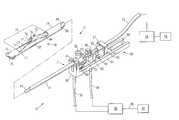
- FIG. 1is a perspective view of a system embodying features of the invention shown configured to begin taking a biopsy sample.
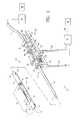
- FIG. 2Ais a perspective view of a system embodying features of the invention, showing the flexible distal portion of a tissue extraction tube emerging from the aperture.
- FIG. 2Bis a detailed perspective view of the distal portion of the shaft and tube of the device shown in FIG. 2A showing the advancing distal end of the flexible tube in cutting position along the tissue cutting pathway defined in part by the ramp.
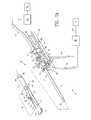
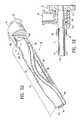
- FIG. 3Ais a perspective view of the device of FIGS. 1 and 2 configured with the tissue extraction tube fully advanced within the shaft, with the distal tip of the flexible tissue extraction tube fully extended past the aperture into the cutting bowl.
- FIG. 3Bis a longitudinal cross-sectional view of the distal portion of the shaft and tube of the device shown in FIG. 3A showing the distal end of the flexible tube fully extended along the tissue cutting pathway over the ramp with its distal tip within the cutting bowl at the distal end of the aperture, after it has cut a tissue specimen.
- FIG. 4is a perspective view of a shaft and of a flexible tissue extraction tube embodying features of the invention shown lying next to each other in positions corresponding to the relative positions taken by these elements when in place in the assembled device.
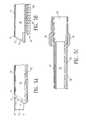
- FIG. 5Ais a side, cross-sectional elevation view of the distal tip and loop electrode of a tissue extraction tube embodying features of the invention.
- FIG. 5Bis a side, cross-sectional elevation view of the distal tip and loop electrode of an alternative embodiment of a tissue extraction tube embodying features of the invention.
- FIG. 5Cis a side, cross-sectional elevation view of the proximal tip of a tissue extraction tube embodying features of the invention showing a luer lock vacuum connection and a conductor for connecting a radiofrequency electrode connection to a source of radiofrequency power.
- FIG. 5Dis a perspective, cross-sectional view of half of the distal tip of a tissue extraction tube embodying features of the invention.
- FIG. 5Eis a side, cross-sectional view of the proximal tip of an elongated shaft embodying features of the invention showing a vacuum connection and vacuum port and a radiofrequency electrode connection.
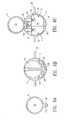
- FIG. 6Ais a transverse cross-sectional view of a tissue extraction tube with an attached rail embodying features of the invention taken along line 6 A— 6 A of FIG. 4 .
- FIG. 6Bis a transverse cross-sectional view of a shaft embodying features of the invention taken along line 6 B— 6 B of FIG. 4 of the invention, showing vacuum ports, an internal bore and a channel running along the ramp seen distally of the section.
- FIG. 6Cis a transverse cross-sectional view of a shaft and a flexible tube taken along line 6 C— 6 C of FIG. 3A with the tube in position along a channel on a ramp within the shaft.
- FIG. 1is a perspective view of a system 10 embodying features of the invention, including a tissue acquisition assembly 12 , a source of radiofrequency (RF) power 38 and a vacuum source 56 .
- the tissue acquisition assembly 12has a shaft 14 with a distal tip 16 at the end of distal portion 18 .
- Shaft 14preferably has a distal tip cutter 20 disposed on the distal tip 16 .
- the shaft 14is an elongated structure oriented along a longitudinal axis 80 that serves to define distal and proximal directions and a radial direction 82 perpendicular to axis 80 .
- a center line within the shaftlies generally along axis 80 .
- Distal tip cutter 20has a cutting surface effective to cut through tissue, opening up a path through which distal portion 18 of shaft 14 may be inserted, thus aiding in the placement of shaft 14 within a patient's body.
- a cutting surfacemay be any surface configured to cut tissue, e.g., by having a sharp edge, by having a thin cross-section, by being hard, by conducting radiofrequency energy, or by any combination of these or other properties.
- a cutter, or equivalently, a cutting elementmay include supporting surfaces and structures in addition to cutting surfaces and structures.
- Distal tip cutter 20is preferably spaced away from the shaft distal tip 16 .
- Shaft 14may have any cross-sectional shape, including round, square, hexagonal, or other shape.
- distal cutter 20may extend radially to a distance greater than the width, or radius, of a shaft 14 .
- Distal cutter 20may also be made from multiple cutting elements; e.g., a distal cutter 20 embodying features of the invention may be made from a pair of wires configured to carry RF energy.
- a distal cutter 20 embodying features of the inventionmay be made from a pair of wires configured to carry RF energy.
- distal cutter 20may include two curved wires configured to carry RF energy that are separated from, and extend distally from, shaft tip 16 .
- a pair of wires making up a distal cutter 20are oriented substantially along a plane, most preferably a plane including a diameter of a shaft 14 , so that the wires extend in directions separated by about 180°.
- Cutting elements, such as a wire or wires, making up a distal cutter 20may be rigidly mounted to a distal tip 16 , or may be flexibly mounted to a distal tip 16 .
- a flexibly mounted cutting elementmay spring back outwardly to a deployed configuration after having been inwardly compressed within a cannula.
- the shaft distal portion 18also includes a cutting bowl 22 and a ramp guide 24 , visible through aperture 26 , which provides access to them.
- a ramp guide 24may be any structure within a shaft 14 having a surface with contours that include tangents not substantially parallel to a shaft longitudinal axis. Such a surface may be termed a non-axial surface. The inner radius of the shaft bore thus changes in a longitudinal direction along the length of a ramp disposed within the bore of the shaft.
- a ramp guide 24may have a flat surface, having parallel tangent lines when tangents are taken at various positions along the ramp guide 24 ; such a flat ramp guide 24 may be termed a linear non-axial surface.
- a ramp guide 24may have a curved surface, having tangent lines that are not parallel when tangents are taken at various positions along the ramp guide 24 .
- a ramp guide 24 having such a curved surfacemay be termed a non-linear non-axial surface.
- a ramp guide 24includes non-linear non-axial surface portions.
- the ramp guide 24 shown in FIGS. 2A and 2Bhas a non-linear non-axial surface.
- the ramp guide 24is shown rising from within the shaft to a level near that of the level of the aperture 26 .
- the level of an aperture 26is taken to be the level of the surrounding wall surface extended across the opening of the aperture 26 . Where the surrounding wall is curved, the extension of the curved surface is also taken to have the same curvature.
- a ramp guide 24may be entirely below the level of the aperture 26 , or may rise to a level equal to, or greater than, the level of the aperture 26 .
- Cutting bowl 22is bounded proximally by ramp guide 24 and is defined radially by shaft inner wall 84 .
- Aperture 26is an opening in the wall of shaft 14 , shaft outer wall 86 extending from all directions to the aperture edge 27 .
- Vacuum vents 28shown here disposed on shaft distal portion 18 near aperture 26 , are useful for pulling and holding tissue against shaft 14 and cutting bowl 22 when a shaft 14 is placed within a patient's body.
- a vacuum inlet connector 30is disposed on a proximal portion 31 of shaft 14 for connecting to a vacuum line connected to a source of vacuum for providing vacuum to vacuum vents 28 .
- Thumbwheel 32also disposed on shaft proximal portion 31 , enables an operator to manually rotate shaft 14 around longitudinal axis 80 to orient aperture 26 so that it opens in a variety of radial directions 82 towards body tissue surrounding shaft 14 .
- RF connector 34provides RF energy to cutting element 20 .
- RF connector 34may be configured to provide RF power during rotation of the shaft, for example, where RF connector 34 is a conductive ring as shown in FIG. 1 .
- RF cable 36leads to RF power source 38 .
- Radiofrequency cuttersmay be monopolar or bipolar; a monopolar cutting surface is connected to one conductor leading to a source of radiofrequency energy, and requires a separate ground or indifferent electrode to be placed in contact with a patient's body in order to cut a patient's body tissue.
- a bipolar radiofrequency cutting surfaceincludes at least two conductors, each connected to different conductors connected to a radiofrequency energy source, so that the bipolar radiofrequency cutting surface does not require a separate ground or indifferent electrode in order to operate.
- RF power source 38may be connected to conductor 40 and ground pad 42 which may be placed in electrical contact with a patient's body to provide a complete electrical circuit.
- distal cutter 20is a bipolar RF cutter, conductor 40 and ground pad 42 are not necessary.
- Tissue acquisition assembly 12also includes a tissue extraction tube 44 configured to slide into shaft 14 .
- An exposed proximal portion 43 of a tissue extraction tube 44 having features of the inventionis shown in FIG. 1 .
- RF connection 46which carries RF energy obtained from an operable electrical connection to RF cable 48 leading to RF power source 38 , provides RF energy to tissue extraction tube 44 .
- Tube 44has a vacuum connector 50 disposed on its proximal portion 43 that is configured to mate with a complementary vacuum connector 51 which provides an operable connection to vacuum line 52 connected to vacuum source 56 .
- Vacuum line 52is preferably a flexible vacuum hose.
- Vacuum applied to the tissue extraction tube 44is effective to draw tissue towards the tube 44 and to transport severed tissue samples within the hollow tissue extraction tube 44 towards the vacuum source 56 .
- a tissue collection chamber 54may be placed in or near the vacuum line 52 or vacuum source 56 in order to retain tissue samples for analysis.
- a tissue extraction tube 44is preferably a hollow elongated tubular member with openings at both ends that is configured to sever a sample of tissue from within a body.
- a tissue extraction tube 44may be used to acquire biopsy samples from a patient and may also be used to transport a tissue sample out of the body to, for example, a tissue collection chamber.
- a center line within a tube 44lies generally along a local longitudinal axis. The center line of one portion of a straight tube is also a center line for other portions of that straight tube.
- a tissue extraction tubetypically has a flexible portion and is capable of assuming a non-linear configuration during use (it may bend or curve), such that at least a portion of the tube wall may approach or cross a center line defined by another portion of the tube.
- the flexible part of a tissue extraction tubemay be limited to only a portion, such as a distal portion; alternatively, a tissue extraction tube may be flexible along its entire length.
- a shaft 14 and tissue extraction tube 44 embodying features of the inventionmay be mounted onto a support frame 58 effective to secure and guide them before, during, and after tissue sample collection.
- the support frame 58 illustrated in FIG. 1includes a distal brace 60 configured to hold a shaft 14 while allowing its rotation and a proximal brace 62 , configured to hold a tube 44 .
- Braces 60 and 62are configured to hold shaft 14 and tube 44 while allowing their rotation.
- Braces 60 and 62may include snap connectors or other mechanisms configured to provide both mechanical support and electrical contact.
- Proximal brace 62is configured to move longitudinally along support beams 64 while being substantially prevented from lateral (radial) movement.
- vacuum support 66is configured to move freely along support beams 64 in longitudinal directions but not in radial directions. It will be understood that, in embodiments of the invention, a single support beam 64 , or a plurality of support beams 64 may be used to hold and guide either or both of a brace 62 and a support 66 .
- springs 68between proximal brace 62 and vacuum support 66
- 69between distal brace 60 and proximal brace 62
- Springs 68 and 69are configured to apply forces so that when removal of forward pressure, the tissue extraction tube 44 and proximal brace 62 automatically retract.
- Spring 69is preferably stronger than spring 68 in order to insure that the connection with vacuum source 56 is maintained while cutting. Spring 68 also cushions contact between proximal brace 62 and vacuum support 66 . Vacuum line 52 , being connected to vacuum support 66 , is carried along by any longitudinal movement of vacuum support 66 , maintaining its operable connection to vacuum source 56 and tissue collection chamber 54 even during movement of the tissue extraction tube 44 .
- shaft 14 and tissue extraction tube 44may be configured so that distal movement of the vacuum support 66 towards proximal brace 62 brings spring 68 into contact with proximal brace 62 , urging proximal brace 62 distally towards distal brace 60 , to compress spring 69 and to move tissue extraction tube 44 distally within shaft 14 .
- Vacuum vents 28are disposed along shaft outer wall 86 at locations near the aperture edge 27 adjacent aperture 26 and at locations somewhat removed from aperture 26 . Vents 28 serve to attract and hold tissue near to the distal portion 18 of shaft 14 and to cutting bowl 22 .
- the distal portion of tube 44includes a loop cutter 72 disposed on the rim 74 of the orifice 76 leading into the hollow interior 92 of tube 44 .
- Loop cutter 72may be any cutting element, such as a sharp blade; however, loop cutter 72 is preferably a RF cutter, such as a loop of conducting wire operably connected to a RF power source 38 .
- a loop cuttermay be formed from any loop-shaped cutting surface, such as a wire, band, ribbon or strip of material, shaped as a loop, whether circular, elliptical, polygonal, or irregular in cross-section.
- a loop cutter 72may be a continuous loop in the shape of a closed loop, or may be discontinuous, in the shape of a partial loop such as a loop with ends that do not fully connect with one another, or be made up of more than one separate cutting elements arrayed about the rim 74 of an orifice 76 in a loop shape. In some embodiments, a loop cutter 72 may be spaced distally from the rim 74 of orifice 76 .
- a cutter support 73 or plurality of cutter supports 73may connect with a cutter 72 in order to support a cutter 72 at a position distal to the rim 74 of an orifice 76 .
- loop cutter 72When supplied with RF power, or when it includes a sharp cutting edge, or other cutting element, loop cutter 72 is effective to cut body tissue with which it comes into contact. Insertion of a distal portion 18 of shaft 14 into a patient's body, and the application of suction through vacuum vents 28 and tube orifice 76 , are each effective to bring tissue into contact with a cutting loop 72 disposed outside an aperture 26 . Movement of loop cutter 72 through body tissue is effective to cut a portion of body tissue. The body tissue may be drawn into orifice 76 by action of the forward (distal) motion of tube 44 and by suction from vacuum source 56 applied by vacuum line 52 to vacuum inlet connector 50 and to the hollow interior 92 of tube 44 .
- ramp guide 24angles upward to a maximum and then descends again into cutting bowl 22 defined proximally by the ramp and radially by shaft inner wall 84 .
- Tube 44is shown angling upward with its distal tip 74 and orifice 76 positioned approximately mid-way along the ramp guide 24 . This corresponds to a configuration where vacuum tube support 66 and proximal brace 62 are situated approximately mid-way along the extent of their effective longitudinal travel distance on support beams 64 .
- Cutting loop 72moves through tissue adjacent aperture 26 as tissue extraction tube 44 moves in a distal direction along ramp guide 24 .
- the path taken by cutting loop 72is determined by the guides of the shaft 14 and of tube 44 , such as channel 106 and rail 96 , which constrain the motion of tube 44 and of cutting loop 72 along a tissue cutting pathway defined by channel 106 , the shaft guide shown in FIG. 2 B.
- the orientation of shaft 14 within a patient's body, including the radial orientation of aperture 26thus determines the point of origin of the tissue samples removed from the patient.
- FIG. 2Balso shows guides rail 96 and channel 106 , which are shown in greater detail in later figures.
- Rail 96is attached to tube 44 , and engages channel 106 so that movement of tube 44 is constrained in radial directions, but not longitudinal directions, by the tissue cutting pathway defined by channel 106 .
- a rail 96follows the tissue cutting pathway defined by the channel 106 .
- channel 106lies along ramp guide 24 and along shaft inner wall 84 within shaft 14 , and follows the contours of shaft inner wall 84 and ramp guide 24 ; in particular, in the region of ramp guide 24 , channel 106 defines a non-linear non-axial pathway within shaft 14 .
- a rail 96may be any elongated element configured to engage a channel 106 .
- a channel 106is typically much longer than it is wide, its length defining a longitudinal direction and its width defining a radial direction.
- a rail 96 engaged with a channel 106is able to move readily in a longitudinal direction, while its motion in a radial direction is constrained by the channel 106 . These directions may be applicable to the entire channel 106 , if the channel 106 is straight, or may be merely local directions, if the channel 106 is curved.
- tube 44is shown advanced to a maximal distal extent.
- Tube 44follows an arc-like path as it climbs up and then down along the ramp guide 24 .
- vacuum tube support 66 and proximal brace 62have moved distally to the full extent of their effective longitudinal travel distance on support beam** 64 , pushing tube 44 to its full travel within shaft 14 , out of aperture 26 , and placing at least part of tissue extraction tube distal portion 70 into cutting bowl 22 .
- a ramp embodying features of the inventionmay have any contour effective to expose a cutting loop 72 to body tissue as a tube 44 moves longitudinally along a tissue cutting pathway lying on or along the ramp.
- a ramp guide 24may ascend and descend with little or no transition portion between ascending and descending portions, or may alternatively include an extended level plateau portion between ascending and descending ramp portions.
- a tube 44assumes a configuration conforming to that ramp profile by angling upward, lying level over the plateau portion, and then angling downward into the cutting bowl 22 at its most distal extent.
- loop cutter 72advances in a distal direction along ramp guide 24 , cutting a swath of tissue from a tissue bed, a distal, connecting portion of the tissue swath remains attached to the body tissue mass. However, the loop cutter 72 descends into cutting bowl 22 as it advances along the distal, descending portion of ramp guide 24 near its maximal distal travel. As shown in FIG. 3B , within the cutting bowl 22 , the loop cutter 72 is no longer in contact with the tissue bed adjacent the shaft distal portion 18 . The descent of loop cutter 72 into cutting bowl 22 , past aperture edge 27 severs the connecting portion of the tissue swath, freeing the swath of body tissue from the tissue bed and providing an isolated tissue sample. Vacuum within tube 44 draws the tissue sample proximally within the hollow interior 92 of tube 44 into vacuum line 52 and to tissue collection chamber 54 .
- Cutting loop 72 disposed on tube rim 74is illustrated in cross-section within cutting bowl 22 in FIG. 3 B.
- tube 44assumes an arc-like configuration along ramp 44 , with a part of distal tube portion 70 within cutting bowl 22 . That position may be achieved by distal movement of cutting loop 72 from a position where orifice 76 is outside aperture 26 to a position where orifice 76 passes aperture edge 27 to assume a position within cutting bowl 22 as shown in the figure.
- Distal movement of orifice 76 and cutting loop 72 past aperture edge 27is effective to sever the strip of tissue connecting a tissue swath with the external tissue bed adjacent shaft distal portion 18 .
- FIG. 3Balso shows vacuum chamber 88 which supplies vacuum vents 28 .
- the connection of vacuum chamber 88 to vacuum port 30is illustrated in FIGS. 5D and 6B .
- FIG. 4shows shaft 14 and tissue extraction tube 44 disposed along side one another.
- Tissue extraction tube 44is preferably somewhat longer than shaft 14 , so that tube 44 may be inserted within shaft bore 110 with tube distal portion 70 fully extended into cutting bowl 22 and still allow proximal end 43 of tube 44 , with its vacuum connection 50 , to extend proximally beyond the vacuum connection 30 and thumbwheel 32 at shaft proximal portion 31 .
- FIG. 4also illustrates optional radial indents 94 on RF connector 34 which may be used to help to hold shaft 14 in a desired radial orientation after rotation of the shaft 14 , as by turning thumbwheel 32 . Pins, detents, or other devices may be used to engage indents 94 effective to secure the position of shaft 14 .
- FIG. 4also shows rail 96 attached to tube 44 .
- rail 96extends along the length of tube 44 ; however, in other embodiments, a rail 96 may extend along only a distal portion of tube 44 and may be absent along a proximal portion 43 of a tissue extraction tube 44 .
- a rail 96is securely attached to tube 44 , and in some embodiments of the invention may be an integral part of a tube 44 .
- Control of the movement of a rail 96is also effective to control the movement of a tube 44 to which is attached or of which it is a part.
- engagement of a rail 96 with a channel 106is effective to guide the movement of a tube 44 along a ramp guide 24 .
- rail 96is effective to guide tissue extraction tube 44 into the arc-shaped path lying over ramp guide 24 as illustrated in FIGS. 2A-2B and 3 A- 3 B.
- FIG. 5 AA distal portion 70 of a tissue extraction tube 44 embodying features of the invention is shown in FIG. 5 A.
- the orifice 76 of tube 44leads in a proximal direction to tube bore 92 ; loop cutter 72 is disposed on rim 74 of tube 44 and about the orifice 76 in the embodiment shown in FIG. 5 A.
- the loop diameter 98 of loop cutter 72is preferably smaller than the inner diameter 100 of orifice 76 , insuring that the dimensions of a tissue swath cut by loop cutter 72 are small enough to fit within tube bore 92 .
- cutting loop 72is connected to tube RF connection wire 102 which runs in a longitudinal direction along tube 44 within rail 96 .
- FIG. 5BAn alternative tube guide 97 is shown in FIG. 5B.
- a series of pins 97 having heads 99are disposed in a linear arrangement along a surface of a tube 44 .
- Pins 97 and heads 99are configured to fit into and engage a shaft guide, such as a channel 106 as illustrate in other Figures, effective to guide movement of a tube 44 along a tissue cutting passage.
- FIG. 5 CA proximal portion 43 of a tissue extraction tube 44 embodying features of the invention is shown in FIG. 5 C.
- rail 96(including RF connection wire 102 ) extends along the entire length of the tube 44 .
- External RF connector 46which includes a conductive ring around the diameter of tube 44 , is operably connected to RF connection wire 102 as shown, allowing tube 44 to rotate while maintaining effective electrical contact with RF power source 38 .
- FIG. 5Calso illustrates a luer lock vacuum connection 50 configured to engage a vacuum connection 51 or vacuum line 52 leading to a vacuum source 56 , effective to supply vacuum to tube bore 92 .
- a cutting bowl 22 within the shaft distal portion 18has a distal inner wall 108 which serves to limit the distal movement of a tube 44 disposed within a bore 110 of a shaft 14 embodying features of the invention.
- Shaft inner wall 84forms the remainder of the boundary defining cutting bowl 22
- shaft outer wall 86extends up to aperture edge 27 to define the outer surface of shaft 14 and the outer perimeter of aperture 26 .
- This figurealso shows vacuum chamber 88 which provides vacuum to vacuum vents 28 . Vacuum vents 28 aid in drawing tissue to shaft 14 so that a cutting loop 72 has sufficient nearby tissue from which to cut a tissue sample.
- Vacuum ports 90 within shaft 14connect vacuum chamber 88 with vacuum source 56 via vacuum connections 50 and 51 and via vacuum line 52 .
- FIG. 5EThe proximal portion 31 of a shaft 14 embodying features of the invention is illustrated in FIG. 5E , showing RF connector 34 operably connected to shaft RF wire 114 to provide an electrical connection effective to supply RF power to distal cutter 20 .
- vacuum connector 30leads to vacuum port 90 so that vacuum provided through connector 30 has access to vacuum port 90 at all radial orientations of shaft 14 .
- O-ring 112provides a vacuum-tight seal allowing rotation of shaft 14 while maintaining an effective vacuum connection.
- FIGS. 6A-6CTransverse cross-sections of a tube 44 and shaft 14 embodying features of the invention are shown in FIGS. 6A-6C .
- FIG. 6Ashows a transverse cross-section of a tube 44 taken along line 6 A— 6 A of FIG. 4 , and illustrates a suitable configuration for the attachment of a rail 96 with a tube 44 .
- Tube electrode wire 102which supplies cutting loop 72 with RF power, is insulated by the non-conductive material of rail 96 surrounding it, and also provides strength to rail 96 .
- FIG. 6Billustrating a transverse cross-section of a shaft 14 taken along line 6 B— 6 B of FIG.
- vacuum ports 90 and shaft electrode wires 114may be disposed within the wall of shaft 14 .
- Ramp guide 24 and channel 106may also be seen in FIG. 6B , which is a view looking in the distal direction.
- FIG. 6Cis a transverse cross-sectional view, taken along line 6 C— 6 C of FIG. 3A , of a shaft 14 and a tube 44 engaged together.
- the cross-section of FIG. 6Cis taken at a position where the ramp guide 24 has risen to a level near to the level of aperture 26 , exposing tube 44 to a maximal extent to the region outside the shaft 14 .
- tissue extraction tube 44is shown in cross-section in FIG. 6C at the point of its greatest excursion out of bore 110 outside aperture 26 , at the peak of ramp guide 24 .
- Such radial excursion of the tube 44 outside the aperture 26is effective to allow loop cutter 72 to cut tissue from regions surrounding shaft 14 .
- FIG. 6Calso shows the vacuum chamber 88 disposed below ramp guide 24 and channel 106 . Shaft electrode wires 114 leading to distal cutter 20 are also shown, as are vacuum vents 28 .
- the inventionprovides assemblies, devices, and systems for obtaining tissue samples from within a patient's body.
- Assemblies 12include shafts 14 and tissue extraction tubes 44 having features of the invention, with tubes 44 disposed at least in part within shafts 14 for example, as described above.
- Systems 10include tissue acquisition assemblies 12 in conjunction with some or all of, for example, a support frame 58 , a RF power source 38 , a vacuum source 56 , and a tissue collection chamber 54 . These and other elements may be operably connected together with some or all of, for example, a RF cable 48 or 36 , a vacuum line 52 , and a ground pad 40 and ground cable 42 .
- a suitable source of radiofrequency energyis effective to provide radiofrequency energy of between about 35 W and about 150 W, preferably between about 50 W and about 100 W.
- the radiofrequency energymay suitably have a frequency of between about 0.1 MHz and about 10 MHz, preferably between about 0.3 MHz and about 1.2 MHz.
- a tissue extraction tube 44 embodying features of the inventionmay be made with any flexible, biocompatible material.
- a tube 14is preferably made with a flexible, non-conducting biocompatible material.
- Suitable materialsinclude, but are not limited to, silicon rubber, latex and other natural and synthetic rubber materials, nylon, polyethylene block amides (such as Pebax®), thermoplastic elastomers, such as, for example, Kraton and C-Flex, and including thermoplastic polyester elastomers (e.g., Hytrel®), and other polymers, polymer blends and copolymers of polymers, including but not limited to polyacrylonitrile, polyamide, polynitrile, polyolefin, polyurethane, polyvinyl chloride, and other flexible non-conducting materials.
- Tube 44may include a strengthening filament 78 on or within its wall, shown here as a spiral coil; filament 78 may alternatively be in the configuration of a ring or rings, a braid, multiple longitudinal strips, or other configurations.
- a strengthening filament 78is effective to add strength to a flexible tube, providing radial strength to prevent vacuum from causing the tube to collapse, and allowing a tube to bend without breaking or tearing.
- a strengthening filamentmay be any elongated object, such as a cord, band or other thin strip of material, and may be embedded in or attached to the tube wall.
- a strengthening filamentmay be straight, curved, coiled, ring-shaped, spiral-shaped, braided with other strengthening filaments, another shape or any combination of shapes.
- Strengthening filaments 78are preferably non-conductive, and may be made from materials including, but not limited to, glass fiber, polymers such as, for example, Kevlar®, polyesters, other polymers, polymer blends and copolymers of polymers, including but not limited to polyacetal, polyacrylonitrile, polyamide, polyethylene including high density polyethylene (HDPE), polyethylene terephthalate, polyimide, poly(methyl)methacrylate, polynitrile, polyolefin, polyurethane, polypropylene, polystyrene, polysulfone, polytetrafluoroethylene (Teflon®) and other fluorinated ethylene fibers, polyvinyl chloride, and other materials such as graphite fibers.
- Strengthening filamentsmay also be made with filled materials, such as glass or mineral-filled polymers such as glass-filled polyester, mica-filled polysulfone, other filled polymers and other filled materials.
- a rail 96 , series of pins 97 , or other tube guide embodying features of the inventionmay be made with a durable, biocompatible material, which is preferably non-conducting and may be flexible. Suitable materials include HDPE, polyetheylene, polyacrylonitrile, polyacetal, polyamide, polyethylene terephthalate, polyimide, poly(methyl)methacrylate, polynitrile, polyolefin, polypropylene, polystyrene, polysulfone, polytetrafluoroethylene (Teflon®) and other fluorinated ethylene polymers, polyurethane, polyvinyl chloride, Pebax®, Hytrel®, acrylonitrile-butadiene-styrene (ABS), glass- or mineral-filled polymers, such as glass-filled polyester, mica-filled polysulfone, other filled polymers and other filled materials and other biocompatible non-conducting materials. As shown in FIG. 6A , a rail may en
- a shaft 14may be made of any suitably strong biocompatible material, and preferably a non-conductive material.
- a shaft 14may be made from a biocompatible polymer, composite, such as a graphite composite and an epoxy-bound braid of glass or nylon, ceramic, or other material.
- polycarbonateis a strong and durable biocompatible material.
- suitable materialsinclude other plastics including thermoplastics and polymers, and co-polymers, polymer alloys and polymer mixtures.
- Suitable materialsinclude HDPE, polyetheylene, polyacrylonitrile, polyacetal, polyamide, polyethylene terephthalate, polyimide, poly(methyl)methacrylate, polynitrile, polyolefin, polypropylene, polystyrene, polysulfone, polytetrafluoroethylene (Teflon®) and other fluorinated ethylene polymers, polyurethane, polyvinyl chloride, Pebax®, Hytrel®, acrylonitrile-butadiene-styrene (ABS), glass- or mineral-filled polymers, such as glass-filled polyester, mica-filled polysulfone, other filled polymers and other filled materials and other biocompatible non-conducting materials.
- HDPEhigh density polyethylene
- polyetheylenepolyacrylonitrile
- polyacetalpolyamide
- polyethylene terephthalatepolyimide
- poly(methyl)methacrylatepolynitrile
- polyolefinpolypropylene
- a shaftmay be made from or include a metal, such as stainless steel.
- a metalmay be coated with a ceramic, Teflon®, a polymer such as polyimide, or with any other biocompatible coating.
- a guide, such as a channel 106 disposed on a shaft 14may be made of the same material as a shaft 14 , may be made of a different material chosen from materials suitable for making a shaft 14 , or may further include other materials or coatings.
- a material or coating having a low coefficient of frictionsuch as Teflon®, may be used in the manufacture of a guide.
- Rail 96 and channel 106as shown in the Figures and described above are particular examples of guides; other guides configured to cooperate together to guide the motion of a tissue extraction tube 44 along a shaft 14 are also suitable for the practice of the invention.
- suitable guidesinclude any elements configured to engage each other and to guide the movement of a tissue extraction tube along a tissue cutting pathway.
- Guides embodying features of the inventionneed not be continuous, unitary elements, nor need they extend along the entire length of a shaft or tube embodying features of the invention.
- a guidemay be a series of pins or protuberances configured and aligned so as to engage a channel.
- a shaftmay have a rail
- a tubemay have a channel
- other possible configurations of guidesare suitable for the practice of the invention.
- a shaft and a tubemay each, or singly, have multiple guides, such as, for example, a pair of rails configured to engage a pair of channels, or a plurality of pins aligned in a row or rows so as to fit within a slot or slots, or a multitude of parallel runners configured to engage and slide along a multitude of tracks.
- devices embodying features of the inventionmay have a tube with a rail configured to move within a channel, the tube also having one or more runners configured to slide along a track or tracks.
- a shaftneed not have a guide.
- a tissue extraction tubemay have a guide configured to direct the movement of the flexible distal portion without engaging with another guide.
- Such embodimentsinclude devices having flexible, curved guides disposed along a distal portion of a tissue extraction tube configured to direct a distal tip of the tissue extraction tube back towards a cutting bowl after the distal tip has been deflected radially out of a shaft aperture during distal movement along a shaft.
- Such flexible, curved guidesmay be ramp-shaped, and may cause the flexible distal end of a tube to assume a ramp shape as it emerges from an aperture.
- the open distal end 76 of a tissue extraction tube 44 with a ramp-shaped curved guide on its distal portion 70will emerge from the shaft aperture 26 as the distal portion 70 of the tube 44 moves distally and climbs up a ramp 24 , enabling its loop cutter 72 to cut tissue; further distal movement of the tube 44 guided by the curved guide allows the flexible distal portion 70 to re-enter aperture 26 , to enter cutting bowl 22 , and to partially or completely conform to the ramp 24 when the tube 44 is extended distally along a shaft.
- Such flexible curved guidesmay be made from previously discussed materials, or other materials, such as memory materials and spring materials.
- Memory materialsinclude, for example, memory metals such as nickel titanium alloys, and spring materials include plastic spring materials and metal spring material, such as, for example, spring steel.
- Aperture 26is illustrated in the Figures as an uncovered opening through the wall of shaft 14 .
- aperture 26is covered by a movable aperture cover.
- an aperture coveris in place over an aperture 26 during placement or removal of shaft 14 at or from a desired location within a patient's body, and the cover is moved during collection of a tissue sample so as to expose aperture 26 .
- the systems, assemblies and devices embodying features of the inventionare made from materials that are suitable for sterilization, including ultraviolet, chemical and radiation sterilization.
- sterilizable materialsinclude metals, glasses, ceramics, composites, plastics, thermoplastics and thermoplastic elastomers, and other polymers including, but not limited to polyethylene, HDPE, Kevlar®, C-Flex, polypropylene, polyacrylonitrile, polyamide, polyethylene terephthalate, polyimide, poly(methyl)methacrylate, polynitrile, polyolefin, polypropylene, polystyrene, polysulfone, polytetrafluoroethylene (Teflon®) and other fluorinated ethylene polymers, polyurethane, polyvinyl chloride, and other biocompatible non-conducting materials and other materials.
- Assemblies, devices and systems embodying features of the inventionmay be used to cut and to collect tissue samples from within a patient's body.
- a skin incisionis typically needed to access a body location to obtain a tissue sample. Skin incisions are often made using scalpels or other sharp cutting tools, although RF cutters may also be used.
- a distal cutter 20may be used to make an initial skin incision, or, alternatively, another cutting instrument maybe used to cut through a patient's skin.
- a distal cutter 20is effective to cut through body tissue below the skin to provide a path for the insertion of a shaft 14 into a desired location within a patient's body.
- Methods for removing a tissue specimen from within a bodyinclude placing a shaft 14 adjacent a tissue mass of interest located within a patient's body.
- a hollow tube 44may be in place within the shaft 14 during insertion of a shaft 14 into a patient's body, or may be placed within the shaft after the shaft is inserted into a patient's body.
- Advancing the hollow tube 14 along ramp guide 24 out of a shaft aperture 26exposes tissue to loop cutter 72 , which is effective to cut tissue surrounding the shaft.
- loop cutter 72is a RF cutter
- loop cutter 72is activated with RF energy during advancement outside of the aperture 26 .
- Distal advancement of the loop cutter 72 disposed about orifice 76is effective to cut a swath of tissue, which may be sucked into orifice 76 by vacuum applied via tube bore 92 originating from a vacuum source 56 . Further distal advancement of loop cutter 72 brings it back into the shaft aperture 26 ; this movement, by bringing loop cutter 72 past aperture edge 27 , is effective to cut any tissue still connecting the tissue swath with the tissue bed. The completely severed tissue sample within tube bore 92 is drawn by vacuum proximally along the length of tube 44 , through vacuum line 52 and into tissue collection chamber 54 .
- one tissue sampling method embodying features of the inventionincludes placing a shaft 14 adjacent a tissue mass within a body; advancing a tissue extraction tube 44 with a flexible distal portion 70 and a distal cutting element 72 through the shaft bore 110 so that distal cutting element 72 and distal portion 70 advance at least partially out of aperture 26 and advance through tissue, cutting a tissue sample.
- cutting element 72is a RF cutter, and RF power is applied to cutting element 72 as it advances, effective to cut tissue.
- Application of vacuumdraws surrounding tissue towards hollow tube 44 , where it may be cut by the advancing cutting element 72 , providing a tissue sample.
- the above methodmay further include guiding the tube 44 by engaging the rail 96 with the channel 106 .
- Methods embodying features of the inventionmay also include guiding a hollow tube 44 out of an aperture 26 while the tube 44 travels over a ramp guide 24 .
- Methodsfurther include activating an RF cutter 72 to cut tissue, and cutting tissue while a hollow tube 44 is guided out of an aperture 26 while the tube 44 travels over the ramp guide 24 .
- Applying vacuum to a proximal part 43 of a hollow tube 44is effective to transport a tissue specimen proximally to a tissue collection chamber 54 .
- Tissue collection methodsalso include collection of multiple tissue samples. Multiple tissue samples may be collected from one location or from multiple locations using methods of the present invention.
- a method for collecting multiple tissue samplesincludes placing a shaft 14 adjacent tissue; advancing a tissue extraction tube 44 in a distal direction so that its distal end 70 and distal cutter 72 advance through tissue for a first time; cutting a first tissue sample; advancing a tissue extraction tube 44 in a distal direction so that its distal end 70 and distal cutter 72 advance through tissue for a second time; and cutting a second tissue sample.
- distal cutter 72is a RF cutter and RF power is supplied to distal cutter 72 while tissue samples are taken.
- Distal end 70 and distal cutter 72may be retracted in a proximal direction back within bore 110 between sample acquisitions.
- Preferred methods of collecting multiple samplesinclude rotating the shaft 14 and tube 44 around a longitudinal axis 80 , preferably between collection of a first and a second sample. Such rotation may be accomplished by turning a thumbwheel, preferably to preset locations designated by detents or indentations. Alternatively, a shaft 14 and tube 44 may be rotated by an arbitrary amount. Rotational force may be applied manually, for example, by an operator's hand rotating a thumbwheel 32 , or by mechanical, electrical, or other means of providing rotational force.
- An advantage of this methodis that multiple samples may be obtained from a single shaft position by rotating the shaft around a longitudinal axis while it remains inserted within a patient's body. Thus, multiple samples may be recovered from different positions oriented at designated radial positions around an initial biopsy site. In addition, the positions may be known and recorded by clinical operators, so that the locations from which samples were taken may be known.
- a shaft 14may be moved in a longitudinal direction between sample acquisitions, as well as, or instead of, rotating the shaft between sample acquisitions.
Landscapes
- Health & Medical Sciences (AREA)
- Life Sciences & Earth Sciences (AREA)
- Surgery (AREA)
- Engineering & Computer Science (AREA)
- General Health & Medical Sciences (AREA)
- Biomedical Technology (AREA)
- Heart & Thoracic Surgery (AREA)
- Medical Informatics (AREA)
- Molecular Biology (AREA)
- Animal Behavior & Ethology (AREA)
- Public Health (AREA)
- Veterinary Medicine (AREA)
- Nuclear Medicine, Radiotherapy & Molecular Imaging (AREA)
- Physics & Mathematics (AREA)
- Plasma & Fusion (AREA)
- Otolaryngology (AREA)
- Pathology (AREA)
- Neurology (AREA)
- Neurosurgery (AREA)
- Surgical Instruments (AREA)
- Sampling And Sample Adjustment (AREA)
Abstract
Description
This application is a continuation-in-part of application Ser. No. 09/619,867, filed Jul. 20, 2000, now U.S. Pat. No. 6,517,498, which is a continuation of application Ser. No. 09/618,685, filed Jul. 18, 2000, now abandoned, which is a continuation-in-part of application Ser. No. 09/159,467, filed Sep. 23, 1998, now U.S. Pat. No. 6,261,241, application Ser. No. 09/196,125, filed Nov. 20, 1998, now U.S. Pat. No. 6,454,727, and application Ser. No. 09/057,303, filed Apr. 8, 1998, now U.S. Pat. No. 6,331,166, which claims benefit of provisional application Ser. No. 60/076,973, filed Mar. 3, 1998; and a continuation-in-part of application Ser. No. 09/717,176, filed Nov. 16, 2000, now U.S. Pat. No. 6,497,706, which is a continuation-in-part of application Ser. No. 09/477,255, filed Jan. 4, 2000, now U.S. Pat. No. 6,471,700, which are all hereby incorporated herein by reference in their entireties, and from all of which priority is hereby claimed under 35 U.S.C. §119(e) and §120.
This invention relates generally to the field of acquisition of tissue from a patient, as occurs in a biopsy procedure, in particular to the cutting and removal of tissue from the biopsy site.
In diagnosing and treating certain medical conditions, it is often desirable to perform a biopsy, in which a specimen or sample of tissue is removed for pathological examination, tests and analysis. Typically, it is desired that biopsy material be taken from locations having characteristics indicating the presence of disease. For example, breast biopsies may be taken where a suspicious lump or swelling is noticed in a breast. As is known, obtaining a tissue sample by biopsy and the subsequent examination are typically employed in the diagnosis of cancers and other malignant tumors, or to confirm that a suspected lesion or tumor is not malignant. The information obtained from these diagnostic tests and/or examinations is frequently used to devise a plan for an appropriate surgical procedure or other course of treatment. Examination of tissue samples taken by biopsy is of particular significance in the diagnosis and treatment of breast cancer.
Thus, there is need in the art for devices and methods for collecting specimens from a biopsy site.
The present invention is directed to collecting tissue samples from a biopsy site within a patient. A biopsy device having features of the invention has an elongated shaft with an inner bore and an aperture, and an elongated cutting member with a flexible distal portion and a tissue cutting member on the distal end. The elongated cutting member is at least in part movably disposed within the bore of the elongated shaft. The elongated cutting member is preferably open-ended, and preferably has a guide configured to direct movement of the flexible distal end. The shaft may be inserted into a patient's body for removal of tissue, such as a biopsy sample. Distal movement of the elongated cutting member within the bore of the shaft allows the flexible distal end to emerge from the shaft aperture to cut surrounding tissue. Tissue samples may be transported proximally by suction within a hollow elongated cutting member for collection.
An embodiment of a biopsy device having features of the invention has an elongated shaft with an inner bore, a first guide extending along a distal shaft section which defines at least in part a tissue cutting pathway, and an elongated cutting member which is at least in part movably disposed within the bore of the elongated shaft. The elongated cutting member has a proximal section, a flexible distal section with an distal end and a tissue cutting member on the distal end. The elongated cutting member is preferably open-ended, with a second guide configured to engage the first guide on a distal section of the elongated shaft. The first and second guides cooperate to facilitate the movement of the elongated cutting member along the tissue cutting pathway.
In general, devices embodying features of the invention include an elongated shaft with an inner bore, and an elongated cutting member configured to move within the bore. The elongated cutting member is preferably a hollow tube, termed a tissue extraction tube, with a flexible distal portion, a distal opening, and a cutter disposed around the opening. The cutter may be on the rim of the opening, or may be spaced distally from it; preferably, the cutter is spaced away from the rim of the opening. The shaft may be relatively stiff in comparison to the elongated cutting member, and preferably has a cutting element on its distal tip to facilitate accessing the tissue site. A shaft cutting element may be a sharpened tip, a cutter configured to puncture or cut tissue, a radiofrequency (RF) cutter, or other cutting element. The shaft cutting element is preferably spaced a distance away from the distal tip of the shaft.
The shaft has a first guide, oriented in a substantially longitudinal direction, that is preferably disposed within the bore of the shaft. The elongated cutting member is configured to engage with the first guide, preferably with a cooperating second guide disposed on the elongated cutting member to facilitate following the tissue cutting pathway defined by the first guide. One of the guides may be, for example, a channel or slot, and the other guide may be, for example, a rail or a series of pins configured to slide within the channel or slot. The guides ensure that the motion of the elongated cutting member follows the desired tissue cutting pathway.
The shaft also has an aperture in a portion of the distal side wall connecting the shaft bore with a region outside the shaft. Although an opening, the aperture is taken to define an imaginary surface that is the continuation of the shaft wall. In addition, in shafts embodying preferred features of the invention, the shaft internal bore includes a ramp on an inner surface disposed substantially opposite the aperture. In preferred embodiments, as viewed from a proximal-to-distal perspective, the ramp rises within the bore from the inner surface towards an imaginary center-line within the shaft, and, in particularly preferred embodiments, past the center-line towards the open aperture, and then descends back to the level of the inner wall surface of the bore. Preferably, a first guide, such as a channel, is disposed along at least a portion of the ramp.
Elongated cutting members embodying features of the invention, such as tissue extraction tubes, are preferably configured to slide longitudinally within the bore of a shaft. In the following discussion, the elongated cutting member will be exemplified by a tissue extraction tube, although it will be understood that any elongated cutting member may be suitable. A second guide, such as a rail, is attached to at least a distal portion of the tube, and may extend along most or all of the length of the tube. In preferred embodiments, where the bore includes a ramp with a channel, and the tube has an attached rail engaged with the channel, longitudinal motion of a tissue extraction tube is guided by and follows the path defined by the channel. The flexibility of a tissue extraction tube embodying features of the invention allows it to substantially conform to the topography of the ramp. As such a tube moves distally within a bore having a ramp disposed opposite an aperture, the distal end of the tube rises, causing at least its distal tip to emerge from the shaft aperture under the guidance of the rail engaged with the channel. Further distal movement brings the distal end of the tube back down within the shaft again. In preferred embodiments, such distal movement places the distal tip of the hollow tube against the inner wall of the shaft distal tip within a structure termed a “cutting bowl.”
Vacuum may be applied to a proximal portion of the tissue extraction tube to aspirate tissue specimens through the inner lumen of the tube. Systems include a carrier for mounting the shaft and for connecting the shaft and tube to a vacuum source and optionally to a radiofrequency power source.
Methods for removing a tissue specimen from within a patient's body include placing the shaft adjacent a tissue mass of interest located within a patient's body, advancing the tissue extraction tube, and cutting a tissue sample. In preferred methods, a RF cutter is activated and tissue is cut with a RF cutter. As described above, distal advancement of the tissue extraction tube moves the tube distal end and the loop cutter out of, and then back into, the shaft aperture. As the hollow tube passes through tissue, the cutter on the distal tip of the hollow tube cuts a path through the tissue, and severs the separated tissue from the tissue bed in the cutting bowl as it re-enters the shaft bore at the distal end of the ramp. Vacuum may be used to attract and hold tissue against the shaft and tube. Vacuum from the same or from a separate source may be applied to the proximal part of the hollow tube to transport the severed tissue specimen proximally to a tissue collection chamber. Tissue collection methods also include collection of multiple samples. Multiple samples may be taken at multiple locations distally or proximally along an axis, and may be taken at multiple radial locations around an axis. For example, the shaft and tube may be partially rotated about the longitudinal axis of the device by turning a thumbwheel to sever and collect a plurality of specimens about the longitudinal axis of the device. The amount of rotation may be an arbitrary amount and may be a preset amount. A preset amount of rotation about a longitudinal axis of a device may be, for example, designated by detents.
The need for separate collection and vacuum tubes is eliminated in the present invention since a tissue sample is vacuumed into a collection tube as soon as it is cut by a cutter at the opening of the tube. By cutting and collecting samples with a single flexible tube that emerges from an aperture in the wall of a shaft, biopsy samples may be collected with only a single small incision, thus minimizing trauma to the patient and eliminating the need for a separate vacuum or sample acquisition tube. Rotation of the shaft allows biopsy collection from diverse radial locations, thus maximizing the sample collection volume while maintaining the minimal level of patient trauma. Radiofrequency cutters such as a radiofrequency cutting loop on the distal end of the hollow tube allow the ready acquisition of tissue with little resistance from or deformation of the tissue during sample acquisition, insuring that the samples are actually taken from the expected locations.
These and other advantages will be further described in the following detailed description of embodiments of the invention. In the foregoing discussion, the primary biopsy site described is generally the human breast, although the invention may be used for collecting biopsy specimens from other parts of the human body and other mammalian body as well.
The shaftdistal portion 18 also includes a cuttingbowl 22 and aramp guide 24, visible throughaperture 26, which provides access to them. Aramp guide 24 may be any structure within ashaft 14 having a surface with contours that include tangents not substantially parallel to a shaft longitudinal axis. Such a surface may be termed a non-axial surface. The inner radius of the shaft bore thus changes in a longitudinal direction along the length of a ramp disposed within the bore of the shaft. Aramp guide 24 may have a flat surface, having parallel tangent lines when tangents are taken at various positions along theramp guide 24; such aflat ramp guide 24 may be termed a linear non-axial surface. Alternatively, aramp guide 24 may have a curved surface, having tangent lines that are not parallel when tangents are taken at various positions along theramp guide 24. Aramp guide 24 having such a curved surface may be termed a non-linear non-axial surface. In preferred embodiments, aramp guide 24 includes non-linear non-axial surface portions. For example, theramp guide 24 shown inFIGS. 2A and 2B has a non-linear non-axial surface.
Theramp guide 24 is shown rising from within the shaft to a level near that of the level of theaperture 26. The level of anaperture 26 is taken to be the level of the surrounding wall surface extended across the opening of theaperture 26. Where the surrounding wall is curved, the extension of the curved surface is also taken to have the same curvature. Aramp guide 24 may be entirely below the level of theaperture 26, or may rise to a level equal to, or greater than, the level of theaperture 26.
Cuttingbowl 22 is bounded proximally byramp guide 24 and is defined radially by shaftinner wall 84.Aperture 26 is an opening in the wall ofshaft 14, shaftouter wall 86 extending from all directions to theaperture edge 27. Vacuum vents28, shown here disposed on shaftdistal portion 18 nearaperture 26, are useful for pulling and holding tissue againstshaft 14 and cuttingbowl 22 when ashaft 14 is placed within a patient's body.
Avacuum inlet connector 30 is disposed on aproximal portion 31 ofshaft 14 for connecting to a vacuum line connected to a source of vacuum for providing vacuum to vacuum vents28.Thumbwheel 32, also disposed on shaftproximal portion 31, enables an operator to manually rotateshaft 14 aroundlongitudinal axis 80 to orientaperture 26 so that it opens in a variety of radial directions82 towards bodytissue surrounding shaft 14.RF connector 34 provides RF energy to cuttingelement 20.RF connector 34 may be configured to provide RF power during rotation of the shaft, for example, whereRF connector 34 is a conductive ring as shown in FIG.1.RF cable 36 leads toRF power source 38. Radiofrequency cutters may be monopolar or bipolar; a monopolar cutting surface is connected to one conductor leading to a source of radiofrequency energy, and requires a separate ground or indifferent electrode to be placed in contact with a patient's body in order to cut a patient's body tissue. A bipolar radiofrequency cutting surface includes at least two conductors, each connected to different conductors connected to a radiofrequency energy source, so that the bipolar radiofrequency cutting surface does not require a separate ground or indifferent electrode in order to operate. Wheredistal cutter 20 is a monopolar RF cutter,RF power source 38 may be connected toconductor 40 andground pad 42 which may be placed in electrical contact with a patient's body to provide a complete electrical circuit. Wheredistal cutter 20 is a bipolar RF cutter,conductor 40 andground pad 42 are not necessary.
Thus, atissue extraction tube 44 is preferably a hollow elongated tubular member with openings at both ends that is configured to sever a sample of tissue from within a body. Atissue extraction tube 44 may be used to acquire biopsy samples from a patient and may also be used to transport a tissue sample out of the body to, for example, a tissue collection chamber. A center line within atube 44 lies generally along a local longitudinal axis. The center line of one portion of a straight tube is also a center line for other portions of that straight tube. A tissue extraction tube typically has a flexible portion and is capable of assuming a non-linear configuration during use (it may bend or curve), such that at least a portion of the tube wall may approach or cross a center line defined by another portion of the tube. The flexible part of a tissue extraction tube may be limited to only a portion, such as a distal portion; alternatively, a tissue extraction tube may be flexible along its entire length.
Ashaft 14 andtissue extraction tube 44 embodying features of the invention may be mounted onto asupport frame 58 effective to secure and guide them before, during, and after tissue sample collection. Thesupport frame 58 illustrated inFIG. 1 includes adistal brace 60 configured to hold ashaft 14 while allowing its rotation and aproximal brace 62, configured to hold atube 44.Braces shaft 14 andtube 44 while allowing their rotation.Braces Proximal brace 62 is configured to move longitudinally along support beams64 while being substantially prevented from lateral (radial) movement. Similarly,vacuum support 66 is configured to move freely along support beams64 in longitudinal directions but not in radial directions. It will be understood that, in embodiments of the invention, asingle support beam 64, or a plurality of support beams64 may be used to hold and guide either or both of abrace 62 and asupport 66. In preferred embodiments, and as illustrated inFIG. 1 , springs68 (betweenproximal brace 62 and vacuum support66) and69 (betweendistal brace 60 and proximal brace62) aid in proper positioning of components at rest and during use.Springs tissue extraction tube 44 andproximal brace 62 automatically retract.Spring 69 is preferably stronger thanspring 68 in order to insure that the connection withvacuum source 56 is maintained while cutting.Spring 68 also cushions contact betweenproximal brace 62 andvacuum support 66.Vacuum line 52, being connected to vacuumsupport 66, is carried along by any longitudinal movement ofvacuum support 66, maintaining its operable connection to vacuumsource 56 andtissue collection chamber 54 even during movement of thetissue extraction tube 44.
As illustrated inFIG. 1 ,shaft 14 andtissue extraction tube 44 may be configured so that distal movement of thevacuum support 66 towardsproximal brace 62 bringsspring 68 into contact withproximal brace 62, urgingproximal brace 62 distally towardsdistal brace 60, to compressspring 69 and to movetissue extraction tube 44 distally withinshaft 14.
As illustrated inFIGS. 2A and 2B , longitudinal movement of atissue extraction tube 44 within ashaft 14 causes thedistal portion 70 oftube 44 to travel alongramp guide 24 and to emerge fromaperture 26. Vacuum vents28 are disposed along shaftouter wall 86 at locations near theaperture edge 27adjacent aperture 26 and at locations somewhat removed fromaperture 26.Vents 28 serve to attract and hold tissue near to thedistal portion 18 ofshaft 14 and to cuttingbowl 22.
The distal portion oftube 44 includes aloop cutter 72 disposed on therim 74 of theorifice 76 leading into thehollow interior 92 oftube 44.Loop cutter 72 may be any cutting element, such as a sharp blade; however,loop cutter 72 is preferably a RF cutter, such as a loop of conducting wire operably connected to aRF power source 38. A loop cutter may be formed from any loop-shaped cutting surface, such as a wire, band, ribbon or strip of material, shaped as a loop, whether circular, elliptical, polygonal, or irregular in cross-section. Aloop cutter 72 may be a continuous loop in the shape of a closed loop, or may be discontinuous, in the shape of a partial loop such as a loop with ends that do not fully connect with one another, or be made up of more than one separate cutting elements arrayed about therim 74 of anorifice 76 in a loop shape. In some embodiments, aloop cutter 72 may be spaced distally from therim 74 oforifice 76. Acutter support 73 or plurality of cutter supports73 may connect with acutter 72 in order to support acutter 72 at a position distal to therim 74 of anorifice 76.
When supplied with RF power, or when it includes a sharp cutting edge, or other cutting element,loop cutter 72 is effective to cut body tissue with which it comes into contact. Insertion of adistal portion 18 ofshaft 14 into a patient's body, and the application of suction through vacuum vents28 andtube orifice 76, are each effective to bring tissue into contact with a cuttingloop 72 disposed outside anaperture 26. Movement ofloop cutter 72 through body tissue is effective to cut a portion of body tissue. The body tissue may be drawn intoorifice 76 by action of the forward (distal) motion oftube 44 and by suction fromvacuum source 56 applied byvacuum line 52 to vacuuminlet connector 50 and to thehollow interior 92 oftube 44. Thus, when ashaft 14 holding atissue extraction tube 44 is disposed within a patient's body, forward motion oftube 44 alongramp guide 24 bringing cuttingloop 72 into contact with body tissue adjacent shaftdistal portion 18 is effective to cut a swath or strip of tissue from within a patient's body.
As shown inFIG. 2B , viewed from a proximal to distal direction, ramp guide24 angles upward to a maximum and then descends again into cuttingbowl 22 defined proximally by the ramp and radially by shaftinner wall 84.Tube 44 is shown angling upward with itsdistal tip 74 andorifice 76 positioned approximately mid-way along theramp guide 24. This corresponds to a configuration wherevacuum tube support 66 andproximal brace 62 are situated approximately mid-way along the extent of their effective longitudinal travel distance on support beams64.
Cuttingloop 72 moves through tissueadjacent aperture 26 astissue extraction tube 44 moves in a distal direction alongramp guide 24. The path taken by cuttingloop 72 is determined by the guides of theshaft 14 and oftube 44, such aschannel 106 andrail 96, which constrain the motion oftube 44 and of cuttingloop 72 along a tissue cutting pathway defined bychannel 106, the shaft guide shown in FIG.2B. The orientation ofshaft 14 within a patient's body, including the radial orientation ofaperture 26, thus determines the point of origin of the tissue samples removed from the patient.
InFIGS. 3A and 3B ,tube 44 is shown advanced to a maximal distal extent.Tube 44 follows an arc-like path as it climbs up and then down along theramp guide 24. As shown inFIG. 3A ,vacuum tube support 66 andproximal brace 62 have moved distally to the full extent of their effective longitudinal travel distance on support beam**64, pushingtube 44 to its full travel withinshaft 14, out ofaperture 26, and placing at least part of tissue extraction tubedistal portion 70 into cuttingbowl 22. A ramp embodying features of the invention may have any contour effective to expose acutting loop 72 to body tissue as atube 44 moves longitudinally along a tissue cutting pathway lying on or along the ramp. Aramp guide 24 may ascend and descend with little or no transition portion between ascending and descending portions, or may alternatively include an extended level plateau portion between ascending and descending ramp portions. In such alternative configurations, atube 44 assumes a configuration conforming to that ramp profile by angling upward, lying level over the plateau portion, and then angling downward into the cuttingbowl 22 at its most distal extent.
Asloop cutter 72 advances in a distal direction alongramp guide 24, cutting a swath of tissue from a tissue bed, a distal, connecting portion of the tissue swath remains attached to the body tissue mass. However, theloop cutter 72 descends into cuttingbowl 22 as it advances along the distal, descending portion oframp guide 24 near its maximal distal travel. As shown inFIG. 3B , within the cuttingbowl 22, theloop cutter 72 is no longer in contact with the tissue bed adjacent the shaftdistal portion 18. The descent ofloop cutter 72 into cuttingbowl 22,past aperture edge 27 severs the connecting portion of the tissue swath, freeing the swath of body tissue from the tissue bed and providing an isolated tissue sample. Vacuum withintube 44 draws the tissue sample proximally within thehollow interior 92 oftube 44 intovacuum line 52 and totissue collection chamber 54.
Cuttingloop 72 disposed ontube rim 74 is illustrated in cross-section within cuttingbowl 22 in FIG.3B. In that figure,tube 44 assumes an arc-like configuration alongramp 44, with a part ofdistal tube portion 70 within cuttingbowl 22. That position may be achieved by distal movement of cuttingloop 72 from a position whereorifice 76 isoutside aperture 26 to a position whereorifice 76passes aperture edge 27 to assume a position within cuttingbowl 22 as shown in the figure. Distal movement oforifice 76 and cuttingloop 72past aperture edge 27 is effective to sever the strip of tissue connecting a tissue swath with the external tissue bed adjacent shaftdistal portion 18.FIG. 3B also showsvacuum chamber 88 which supplies vacuum vents28. The connection ofvacuum chamber 88 to vacuumport 30, provided byvacuum ports 90, is illustrated inFIGS. 5D and 6B .
Adistal portion 70 of atissue extraction tube 44 embodying features of the invention is shown in FIG.5A. Theorifice 76 oftube 44 leads in a proximal direction to tube bore92;loop cutter 72 is disposed onrim 74 oftube 44 and about theorifice 76 in the embodiment shown in FIG.5A. Theloop diameter 98 ofloop cutter 72 is preferably smaller than theinner diameter 100 oforifice 76, insuring that the dimensions of a tissue swath cut byloop cutter 72 are small enough to fit within tube bore92. As illustrated inFIG. 5A , cuttingloop 72 is connected to tubeRF connection wire 102 which runs in a longitudinal direction alongtube 44 withinrail 96.
Analternative tube guide 97 is shown inFIG. 5B. A series ofpins 97 havingheads 99 are disposed in a linear arrangement along a surface of atube 44.Pins 97 and heads99 are configured to fit into and engage a shaft guide, such as achannel 106 as illustrate in other Figures, effective to guide movement of atube 44 along a tissue cutting passage.
Aproximal portion 43 of atissue extraction tube 44 embodying features of the invention is shown in FIG.5C. In this embodiment, rail96 (including RF connection wire102) extends along the entire length of thetube 44.External RF connector 46, which includes a conductive ring around the diameter oftube 44, is operably connected toRF connection wire 102 as shown, allowingtube 44 to rotate while maintaining effective electrical contact withRF power source 38.FIG. 5C also illustrates a luerlock vacuum connection 50 configured to engage avacuum connection 51 orvacuum line 52 leading to avacuum source 56, effective to supply vacuum to tube bore92.
As illustrated inFIG. 5D , a cuttingbowl 22 within the shaftdistal portion 18 has a distalinner wall 108 which serves to limit the distal movement of atube 44 disposed within abore 110 of ashaft 14 embodying features of the invention. Shaftinner wall 84 forms the remainder of the boundary defining cuttingbowl 22, while shaftouter wall 86 extends up toaperture edge 27 to define the outer surface ofshaft 14 and the outer perimeter ofaperture 26. This figure also showsvacuum chamber 88 which provides vacuum to vacuum vents28. Vacuum vents28 aid in drawing tissue toshaft 14 so that a cuttingloop 72 has sufficient nearby tissue from which to cut a tissue sample.Vacuum ports 90 withinshaft 14 connectvacuum chamber 88 withvacuum source 56 viavacuum connections vacuum line 52.
Theproximal portion 31 of ashaft 14 embodying features of the invention is illustrated inFIG. 5E , showingRF connector 34 operably connected toshaft RF wire 114 to provide an electrical connection effective to supply RF power todistal cutter 20. As shown,vacuum connector 30 leads to vacuumport 90 so that vacuum provided throughconnector 30 has access tovacuum port 90 at all radial orientations ofshaft 14. O-ring 112 provides a vacuum-tight seal allowing rotation ofshaft 14 while maintaining an effective vacuum connection.
Transverse cross-sections of atube 44 andshaft 14 embodying features of the invention are shown inFIGS. 6A-6C .FIG. 6A shows a transverse cross-section of atube 44 taken alongline 6A—6A ofFIG. 4 , and illustrates a suitable configuration for the attachment of arail 96 with atube 44.Tube electrode wire 102, which supplies cuttingloop 72 with RF power, is insulated by the non-conductive material ofrail 96 surrounding it, and also provides strength to rail96. As shown inFIG. 6B , illustrating a transverse cross-section of ashaft 14 taken alongline 6B—6B ofFIG. 4 ,vacuum ports 90 and shaft electrode wires114 (which provide RF power to distal cutter20) may be disposed within the wall ofshaft 14.Ramp guide 24 andchannel 106 may also be seen inFIG. 6B , which is a view looking in the distal direction.
The invention provides assemblies, devices, and systems for obtaining tissue samples from within a patient's body.Assemblies 12 includeshafts 14 andtissue extraction tubes 44 having features of the invention, withtubes 44 disposed at least in part withinshafts 14 for example, as described above.Systems 10 includetissue acquisition assemblies 12 in conjunction with some or all of, for example, asupport frame 58, aRF power source 38, avacuum source 56, and atissue collection chamber 54. These and other elements may be operably connected together with some or all of, for example, aRF cable vacuum line 52, and aground pad 40 andground cable 42.
A suitable source of radiofrequency energy is effective to provide radiofrequency energy of between about 35 W and about 150 W, preferably between about 50 W and about 100 W. The radiofrequency energy may suitably have a frequency of between about 0.1 MHz and about 10 MHz, preferably between about 0.3 MHz and about 1.2 MHz.
Atissue extraction tube 44 embodying features of the invention may be made with any flexible, biocompatible material. Such atube 14 is preferably made with a flexible, non-conducting biocompatible material. Suitable materials include, but are not limited to, silicon rubber, latex and other natural and synthetic rubber materials, nylon, polyethylene block amides (such as Pebax®), thermoplastic elastomers, such as, for example, Kraton and C-Flex, and including thermoplastic polyester elastomers (e.g., Hytrel®), and other polymers, polymer blends and copolymers of polymers, including but not limited to polyacrylonitrile, polyamide, polynitrile, polyolefin, polyurethane, polyvinyl chloride, and other flexible non-conducting materials.
Arail 96, series ofpins 97, or other tube guide embodying features of the invention may be made with a durable, biocompatible material, which is preferably non-conducting and may be flexible. Suitable materials include HDPE, polyetheylene, polyacrylonitrile, polyacetal, polyamide, polyethylene terephthalate, polyimide, poly(methyl)methacrylate, polynitrile, polyolefin, polypropylene, polystyrene, polysulfone, polytetrafluoroethylene (Teflon®) and other fluorinated ethylene polymers, polyurethane, polyvinyl chloride, Pebax®, Hytrel®, acrylonitrile-butadiene-styrene (ABS), glass- or mineral-filled polymers, such as glass-filled polyester, mica-filled polysulfone, other filled polymers and other filled materials and other biocompatible non-conducting materials. As shown inFIG. 6A , a rail may enclose aRF connection wire 102.
Ashaft 14 may be made of any suitably strong biocompatible material, and preferably a non-conductive material. Thus, ashaft 14 may be made from a biocompatible polymer, composite, such as a graphite composite and an epoxy-bound braid of glass or nylon, ceramic, or other material. For example, polycarbonate is a strong and durable biocompatible material. Other suitable materials include other plastics including thermoplastics and polymers, and co-polymers, polymer alloys and polymer mixtures. Suitable materials include HDPE, polyetheylene, polyacrylonitrile, polyacetal, polyamide, polyethylene terephthalate, polyimide, poly(methyl)methacrylate, polynitrile, polyolefin, polypropylene, polystyrene, polysulfone, polytetrafluoroethylene (Teflon®) and other fluorinated ethylene polymers, polyurethane, polyvinyl chloride, Pebax®, Hytrel®, acrylonitrile-butadiene-styrene (ABS), glass- or mineral-filled polymers, such as glass-filled polyester, mica-filled polysulfone, other filled polymers and other filled materials and other biocompatible non-conducting materials. A shaft may be made from or include a metal, such as stainless steel. A metal may be coated with a ceramic, Teflon®, a polymer such as polyimide, or with any other biocompatible coating. A guide, such as achannel 106 disposed on ashaft 14, may be made of the same material as ashaft 14, may be made of a different material chosen from materials suitable for making ashaft 14, or may further include other materials or coatings. For example, a material or coating having a low coefficient of friction, such as Teflon®, may be used in the manufacture of a guide.
In addition, it will be understood that in embodiments of the invention, a shaft need not have a guide. In such embodiments, a tissue extraction tube may have a guide configured to direct the movement of the flexible distal portion without engaging with another guide. Such embodiments include devices having flexible, curved guides disposed along a distal portion of a tissue extraction tube configured to direct a distal tip of the tissue extraction tube back towards a cutting bowl after the distal tip has been deflected radially out of a shaft aperture during distal movement along a shaft. Such flexible, curved guides may be ramp-shaped, and may cause the flexible distal end of a tube to assume a ramp shape as it emerges from an aperture. For example, the opendistal end 76 of atissue extraction tube 44 with a ramp-shaped curved guide on itsdistal portion 70 will emerge from theshaft aperture 26 as thedistal portion 70 of thetube 44 moves distally and climbs up aramp 24, enabling itsloop cutter 72 to cut tissue; further distal movement of thetube 44 guided by the curved guide allows the flexibledistal portion 70 to re-enteraperture 26, to enter cuttingbowl 22, and to partially or completely conform to theramp 24 when thetube 44 is extended distally along a shaft. Such flexible curved guides may be made from previously discussed materials, or other materials, such as memory materials and spring materials. Memory materials include, for example, memory metals such as nickel titanium alloys, and spring materials include plastic spring materials and metal spring material, such as, for example, spring steel.
Preferably, the systems, assemblies and devices embodying features of the invention are made from materials that are suitable for sterilization, including ultraviolet, chemical and radiation sterilization. Such sterilizable materials include metals, glasses, ceramics, composites, plastics, thermoplastics and thermoplastic elastomers, and other polymers including, but not limited to polyethylene, HDPE, Kevlar®, C-Flex, polypropylene, polyacrylonitrile, polyamide, polyethylene terephthalate, polyimide, poly(methyl)methacrylate, polynitrile, polyolefin, polypropylene, polystyrene, polysulfone, polytetrafluoroethylene (Teflon®) and other fluorinated ethylene polymers, polyurethane, polyvinyl chloride, and other biocompatible non-conducting materials and other materials.
Assemblies, devices and systems embodying features of the invention may be used to cut and to collect tissue samples from within a patient's body. A skin incision is typically needed to access a body location to obtain a tissue sample. Skin incisions are often made using scalpels or other sharp cutting tools, although RF cutters may also be used. Adistal cutter 20 may be used to make an initial skin incision, or, alternatively, another cutting instrument maybe used to cut through a patient's skin. Adistal cutter 20 is effective to cut through body tissue below the skin to provide a path for the insertion of ashaft 14 into a desired location within a patient's body. Methods for removing a tissue specimen from within a body include placing ashaft 14 adjacent a tissue mass of interest located within a patient's body. Ahollow tube 44 may be in place within theshaft 14 during insertion of ashaft 14 into a patient's body, or may be placed within the shaft after the shaft is inserted into a patient's body. Advancing thehollow tube 14 alongramp guide 24 out of ashaft aperture 26 exposes tissue toloop cutter 72, which is effective to cut tissue surrounding the shaft. Whereloop cutter 72 is a RF cutter,loop cutter 72 is activated with RF energy during advancement outside of theaperture 26. Distal advancement of theloop cutter 72 disposed aboutorifice 76 is effective to cut a swath of tissue, which may be sucked intoorifice 76 by vacuum applied via tube bore92 originating from avacuum source 56. Further distal advancement ofloop cutter 72 brings it back into theshaft aperture 26; this movement, by bringingloop cutter 72past aperture edge 27, is effective to cut any tissue still connecting the tissue swath with the tissue bed. The completely severed tissue sample within tube bore92 is drawn by vacuum proximally along the length oftube 44, throughvacuum line 52 and intotissue collection chamber 54.
Thus, one tissue sampling method embodying features of the invention includes placing ashaft 14 adjacent a tissue mass within a body; advancing atissue extraction tube 44 with a flexibledistal portion 70 and adistal cutting element 72 through the shaft bore110 so thatdistal cutting element 72 anddistal portion 70 advance at least partially out ofaperture 26 and advance through tissue, cutting a tissue sample. Preferably, cuttingelement 72 is a RF cutter, and RF power is applied to cuttingelement 72 as it advances, effective to cut tissue. Application of vacuum draws surrounding tissue towardshollow tube 44, where it may be cut by the advancing cuttingelement 72, providing a tissue sample. The above method, whereshaft 14 has a guide such as achannel 106 andtube 44 has a guide such as arail 96, may further include guiding thetube 44 by engaging therail 96 with thechannel 106. Methods embodying features of the invention may also include guiding ahollow tube 44 out of anaperture 26 while thetube 44 travels over aramp guide 24. Methods further include activating anRF cutter 72 to cut tissue, and cutting tissue while ahollow tube 44 is guided out of anaperture 26 while thetube 44 travels over theramp guide 24. Applying vacuum to aproximal part 43 of ahollow tube 44 is effective to transport a tissue specimen proximally to atissue collection chamber 54.
Tissue collection methods also include collection of multiple tissue samples. Multiple tissue samples may be collected from one location or from multiple locations using methods of the present invention. A method for collecting multiple tissue samples includes placing ashaft 14 adjacent tissue; advancing atissue extraction tube 44 in a distal direction so that itsdistal end 70 anddistal cutter 72 advance through tissue for a first time; cutting a first tissue sample; advancing atissue extraction tube 44 in a distal direction so that itsdistal end 70 anddistal cutter 72 advance through tissue for a second time; and cutting a second tissue sample. In preferred methods of collecting multiple samples,distal cutter 72 is a RF cutter and RF power is supplied todistal cutter 72 while tissue samples are taken.Distal end 70 anddistal cutter 72 may be retracted in a proximal direction back withinbore 110 between sample acquisitions. Preferred methods of collecting multiple samples include rotating theshaft 14 andtube 44 around alongitudinal axis 80, preferably between collection of a first and a second sample. Such rotation may be accomplished by turning a thumbwheel, preferably to preset locations designated by detents or indentations. Alternatively, ashaft 14 andtube 44 may be rotated by an arbitrary amount. Rotational force may be applied manually, for example, by an operator's hand rotating athumbwheel 32, or by mechanical, electrical, or other means of providing rotational force.
An advantage of this method is that multiple samples may be obtained from a single shaft position by rotating the shaft around a longitudinal axis while it remains inserted within a patient's body. Thus, multiple samples may be recovered from different positions oriented at designated radial positions around an initial biopsy site. In addition, the positions may be known and recorded by clinical operators, so that the locations from which samples were taken may be known. Ashaft 14 may be moved in a longitudinal direction between sample acquisitions, as well as, or instead of, rotating the shaft between sample acquisitions.
It will be apparent from the foregoing that, while particular forms of the invention have been illustrated and described herein primarily in terms of an electrosurgical specimen-collection system, various modifications can be made without departing from the spirit and scope of the invention. Moreover, those skilled in the art will recognize that features shown in one embodiment may be utilized in other embodiments. Terms such a “element”, “member”, “device”, “sections”, “portion”, “section”, “steps” and words of similar import when used herein shall not be construed as invoking the provisions of 35 U.S.C. §112(6) unless the following claims expressly use the terms “means” or “step” followed by a particular function without specific structure or action.
While particular forms of the invention have been illustrated and described, it should be apparent that various modifications can be made without departing from the spirit and scope of the invention. Accordingly, it is not intended that the invention be limited, except as by the appended claims.
Claims (37)
1. A tissue extraction device comprising:
an elongated shaft having a proximal portion, a distal portion with a distal tip having a tissue penetrating element, an inner bore, an aperture on said shaft distal portion in fluid communication with said bore, and a guide extending along said distal portion to define a tissue cutting pathway; and
a tissue extraction member which is movably disposed at least in part within said shaft inner bore, which has an elongated hollow tube having a proximal tubular portion, a flexible distal tubular portion, a longitudinal bore in the flexible distal tubular portion, a distal end, a tissue receiving port in fluid communication with the bore and a tissue cutting surface at the distal end, and a guide follower on the distal tubular portion configured to engage the guide on the elongated shaft so as to direct movement of the flexible distal tubular portion along the tissue cutting pathway.
2. The tissue extraction device ofclaim 1 , wherein said longitudinal bore extends through said elongated hollow tube, and the proximal tubular portion is configured to operably connect with a vacuum source.
3. The tissue extraction device ofclaim 1 , wherein said tissue cutting surface is a radiofrequency cutting element.
4. The tissue extraction device ofclaim 1 , wherein the tissue penetrating element a radiofrequency cutting element.
5. The tissue extraction device ofclaim 4 , wherein the radiofrequency cutting element is spaced distally away from the distal tip.
6. The tissue extraction device ofclaim 5 , wherein the radiofrequency cutting element comprises a plurality of cutting wires.
7. The tissue extraction device ofclaim 6 , wherein said plurality of cutting wires comprises a pair of cutting wires each having a portion extending from the distal tip to a distance greater than a width of the distal tip.
8. The tissue extraction device ofclaim 7 , wherein said pair of cutting wires extends away from the distal tip along radial directions separated by about 180°.
9. The tissue extraction device ofclaim 5 , wherein at least a portion of radiofrequency cutting element extends away from the distal tip to a distance greater than a width of the distal tip.
10. The tissue extraction device ofclaim 1 , wherein the guide defines at least in part a non-axial pathway.
11. The tissue extraction device ofclaim 10 , wherein the shaft further has a plurality of radial positions and a non-axial ramp surface on said inner bore within said distal portion of said shaft, said guide being disposed on said non-axial ramp surface, said aperture being located along said distal portion of said shaft so that at least a portion of said non-axial ramp surface extends substantially towards said aperture.
12. The tissue extraction device ofclaim 11 , said ramp surface having a distal portion, said shaft further comprising a chamber disposed adjacent a distal portion of said ramp surface, accessible from said aperture, and configured to receive at least a portion of the distal end of said tissue extraction member.
13. The tissue extraction device ofclaim 10 , further comprising a vacuum vent disposed on said shaft distal portion.
14. The tissue extraction device ofclaim 1 , further comprising a vacuum vent disposed on said shaft distal portion.
15. A biopsy device for cutting tissue, comprising:
a. an elongated shaft which has a longitudinal axis, a proximal shaft portion, a distal shaft portion with a distal tip having a tissue penetrating element, an inner bore, an aperture on the distal shaft portion in fluid communication with said bore and a guide on the distal shaft portion defining a non-axial tissue cutting pathway; and
b. an elongated cutting member which is at least in part movably disposed within the bore of the elongated shaft and which has a proximal portion, a flexible distal portion, a tissue cutting member on the distal open end, a guide follower on the flexible distal portion configured to direct movement of the tissue cutting member along the tissue cutting pathway to cut tissue disposed about said shaft.
16. A method for obtaining a tissue sample from a target site within a patient's body, comprising:
a) providing a biopsy device having an elongated shaft with a guideway defining an arcuate tissue cutting pathway which extends away from a longitudinal axis of the elongated shaft and toward the longitudinal axis and having an elongated tissue cutting member with a guide following element which engages the guideway so as to follow the pathway when cutting a tissue sample;
b) placing the biopsy device adjacent a tissue mass within the patient's body; and
c) advancing the elongated tissue cutting member along the arcuate tissue cutting pathway to cut a tissue sample from the target site within the patient's body.
17. The method ofclaim 16 , wherein cutting a tissue sample comprises cutting a tissue sample with a radiofrequency cutting element.
18. The method ofclaim 16 , further comprising applying vacuum within the biopsy device effective to draw tissue towards said cutting member.
19. The method ofclaim 18 , further comprising applying vacuum effective to draw tissue into said shaft.
20. The method ofclaim 16 , wherein the guideway defining a tissue cutting pathway has a ramp which extends away from a longitudinal axis of the elongated shaft, and wherein the ramp guides a distal cutting element out of an aperture in the shaft while said elongated cutting member travels over said ramp.
21. The method ofclaim 20 , wherein said shaft has a distal cutting bowl, wherein said distal movement is effective to guide a distal cutting element on said elongated cutting member out of said aperture and into said cutting bowl.
22. The method ofclaim 21 , further comprising applying vacuum effective to draw tissue towards said cutting member.
23. The method ofclaim 22 , further comprising applying vacuum effective to draw tissue towards said cutting bowl.
24. A method for obtaining multiple tissue samples from a target tissue mass within a patient's body, comprising:
a) providing a tissue collection system having an elongated shaft with a bore extending therein and with a guideway defining a tissue cutting passageway that extends radially away from a longitudinal axis of the elongated shaft and having an elongated tissue cutting member which has a cutting element on a flexible distal portion on the tissue cutting member, which is disposed at least in part within the bore of the elongated shaft and which has a follower that engages the guideway so as to follow the tissue cutting passageway when cutting a tissue sample;
b) disposing a distal portion of the elongated shaft of the tissue collection system adjacent the target tissue mass within the patient's body;
c) advancing the elongated tissue cutting member within said bore in a distal direction, said elongated cutting member having a distal cutting element on a flexible distal portion extending out of the bore configured to follow a non-axial tissue cutting pathway;
to cut a first tissue sample;
withdrawing the tissue cutting member at least in part back into the bore;
rotating the elongated shaft to change the location of the tissue cutting pathway; and
advancing the flexible distal portion of the elongated tissue cutting member out of the bore to follow the non-axial tissue cutting pathway to cut a second tissue sample.
25. The method for obtaining multiple tissue samples from within a body ofclaim 24 , wherein cutting a tissue sample comprises cutting a tissue sample with a radiofrequency cutting element.
26. The method for obtaining multiple tissue samples from within a body ofclaim 24 , further comprising rotating said shaft around a longitudinal axis.
27. The method for obtaining multiple tissue samples from within a body ofclaim 26 , further comprising retracting in a proximal direction said elongated cutting member into said bore effective that said distal cutting element is not substantially disposed out of said aperture.
28. The method for obtaining multiple tissue samples from within a body ofclaim 24 , further comprising retracting in a proximal direction said elongated cutting member into said bore effective that said distal cutting element is not substantially disposed out of said aperture.
29. The method ofclaim 24 , further comprising applying vacuum effective to draw tissue towards said cutting element.
30. The method ofclaim 29 , wherein said shaft has a distal cutting bowl, wherein said distal movement is effective to guide said distal cutting element and said elongated cutting member out of an aperture in said shaft and into said cutting bowl.
31. The method ofclaim 30 , further comprising applying vacuum effective to draw tissue towards said cutting bowl.
32. The method ofclaim 24 , further comprising applying vacuum effective to draw tissue towards said shaft.
33. The method ofclaim 32 , further comprising applying vacuum effective to draw tissue towards said cutting element.
34. The method ofclaim 24 , wherein said shaft comprises a first guide and said elongated cutting member comprises a second guide, further comprising engaging said guides effective to guide said cutting element.
35. The method ofclaim 24 , wherein said bore comprises a ramp, further comprising guiding said distal cutting element out of an aperture in said shaft while said elongated cutting member travels over said ramp.
36. A biopsy device, comprising:
a. an elongated shaft having a proximal shaft section, a distal shaft section, an inner bore, and a guide means extending within the distal shaft section for defining a tissue cutting pathway; and
b. an elongated tissue cutting member which is at least in part movably disposed within the bore of the elongated shaft and which has a proximal portion, a flexible distal portion with a distal open end, a tissue cutting means disposed on the distal open end, a follower means on the flexible distal portion for engaging the guide means and for facilitating movement of the tissue cutting means on the distal open end of the flexible distal portion along the tissue cutting pathway defined by the guide means in the distal shaft section of the elongated shaft.
37. A tissue extraction device comprising:
an elongated shaft having a proximal portion, a distal portion with a distal tip having a shaft cutting means, an inner bore, an aperture on said shaft distal portion connected with said bore, and a guide means extending along said distal portion for defining a tissue cutting pathway; and
a tissue extraction member movably disposed at least in part within said shaft inner bore, comprising an elongated hollow tube having a tube proximal portion, a flexible tube distal portion, a tube distal end having a longitudinal bore connecting with a tissue receiving port with a rim, a tissue cutting means disposed about at least a portion of said rim, and a follower configured to engage said guide means to follow the tissue cutting pathway defined thereby.
Priority Applications (4)
| Application Number | Priority Date | Filing Date | Title |
|---|---|---|---|
| US10/136,700US6875182B2 (en) | 1998-03-03 | 2002-04-30 | Electrosurgical specimen-collection system |
| AU2003259025AAU2003259025A1 (en) | 2002-04-30 | 2003-04-28 | Electrosurgical specimen-collection system |
| PCT/US2003/013520WO2003092472A2 (en) | 2002-04-30 | 2003-04-28 | Electrosurgical specimen-collection system |
| US11/098,963US20050187489A1 (en) | 1998-03-03 | 2005-04-04 | Electrosurgical specimen-collection system |
Applications Claiming Priority (9)
| Application Number | Priority Date | Filing Date | Title |
|---|---|---|---|
| US7697398P | 1998-03-03 | 1998-03-03 | |
| US09/057,303US6331166B1 (en) | 1998-03-03 | 1998-04-08 | Breast biopsy system and method |
| US09/159,467US6261241B1 (en) | 1998-03-03 | 1998-09-23 | Electrosurgical biopsy device and method |
| US09/196,125US6454727B1 (en) | 1998-03-03 | 1998-11-20 | Tissue acquisition system and method of use |
| US09/477,255US6471700B1 (en) | 1998-04-08 | 2000-01-04 | Apparatus and method for accessing biopsy site |
| US61868500A | 2000-07-18 | 2000-07-18 | |
| US09/619,867US6517498B1 (en) | 1998-03-03 | 2000-07-20 | Apparatus and method for tissue capture |
| US09/717,176US6497706B1 (en) | 1998-03-03 | 2000-11-16 | Biopsy device and method of use |
| US10/136,700US6875182B2 (en) | 1998-03-03 | 2002-04-30 | Electrosurgical specimen-collection system |
Related Parent Applications (1)
| Application Number | Title | Priority Date | Filing Date |
|---|---|---|---|
| US09/619,867Continuation-In-PartUS6517498B1 (en) | 1998-03-03 | 2000-07-20 | Apparatus and method for tissue capture |
Related Child Applications (1)
| Application Number | Title | Priority Date | Filing Date |
|---|---|---|---|
| US11/098,963DivisionUS20050187489A1 (en) | 1998-03-03 | 2005-04-04 | Electrosurgical specimen-collection system |
Publications (2)
| Publication Number | Publication Date |
|---|---|
| US20020120211A1 US20020120211A1 (en) | 2002-08-29 |
| US6875182B2true US6875182B2 (en) | 2005-04-05 |
Family
ID=29399248
Family Applications (2)
| Application Number | Title | Priority Date | Filing Date |
|---|---|---|---|
| US10/136,700Expired - Fee RelatedUS6875182B2 (en) | 1998-03-03 | 2002-04-30 | Electrosurgical specimen-collection system |
| US11/098,963AbandonedUS20050187489A1 (en) | 1998-03-03 | 2005-04-04 | Electrosurgical specimen-collection system |
Family Applications After (1)
| Application Number | Title | Priority Date | Filing Date |
|---|---|---|---|
| US11/098,963AbandonedUS20050187489A1 (en) | 1998-03-03 | 2005-04-04 | Electrosurgical specimen-collection system |
Country Status (3)
| Country | Link |
|---|---|
| US (2) | US6875182B2 (en) |
| AU (1) | AU2003259025A1 (en) |
| WO (1) | WO2003092472A2 (en) |
Cited By (14)
| Publication number | Priority date | Publication date | Assignee | Title |
|---|---|---|---|---|
| US20090131871A1 (en)* | 2003-09-19 | 2009-05-21 | Csaba Rethy | Trocar insertion apparatus |
| US20110237975A1 (en)* | 2010-03-24 | 2011-09-29 | United States Endoscopy Group, Inc. | Multiple biopsy device |
| US8968210B2 (en) | 2008-10-01 | 2015-03-03 | Covidien LLP | Device for needle biopsy with integrated needle protection |
| US9186128B2 (en) | 2008-10-01 | 2015-11-17 | Covidien Lp | Needle biopsy device |
| US9332973B2 (en) | 2008-10-01 | 2016-05-10 | Covidien Lp | Needle biopsy device with exchangeable needle and integrated needle protection |
| US9462999B2 (en) | 2006-12-13 | 2016-10-11 | Devicor Medical Products, Inc. | Biopsy sample storage |
| US9636082B2 (en) | 2001-08-24 | 2017-05-02 | The Cooper Companies Global Holdings Lp | Medical-surgical devices |
| US9782565B2 (en) | 2008-10-01 | 2017-10-10 | Covidien Lp | Endoscopic ultrasound-guided biliary access system |
| US20180103940A1 (en)* | 2015-06-19 | 2018-04-19 | Starmed Co., Ltd. | Surgical device |
| US10045756B2 (en) | 2003-03-29 | 2018-08-14 | The Cooper Companies Global Holdings Lp | Medical devices |
| US11259861B2 (en) | 2016-02-23 | 2022-03-01 | Covidien Lp | Common connector for monopolar and bipolar instruments |
| US11298113B2 (en) | 2008-10-01 | 2022-04-12 | Covidien Lp | Device for needle biopsy with integrated needle protection |
| US20230034865A1 (en)* | 2017-05-12 | 2023-02-02 | Devicor Medical Products Inc. | Biopsy device with remote multi-chamber tissue sample holder |
| US12426860B2 (en) | 2018-04-18 | 2025-09-30 | C.R. Bard, Inc. | Dual lumen coaxial introducer having integrated tissue marker delivery |
Families Citing this family (33)
| Publication number | Priority date | Publication date | Assignee | Title |
|---|---|---|---|---|
| ITCE990004A1 (en)* | 1999-10-25 | 2000-01-25 | Mario Immacolato Paternuosto | VALVE FOR BIOPSY FORCEPS IN DIGESTIVE ENDOSCOPY |
| US6942627B2 (en)* | 2001-07-19 | 2005-09-13 | Ethicon Endo-Surgery, Inc. | Surgical biopsy device having a flexible cutter |
| US7628762B2 (en)* | 2003-03-19 | 2009-12-08 | Suros Surgical Systems, Inc. | Adapter assembly for stereotactic biopsy |
| US7588545B2 (en) | 2003-09-10 | 2009-09-15 | Boston Scientific Scimed, Inc. | Forceps and collection assembly with accompanying mechanisms and related methods of use |
| US7942896B2 (en) | 2003-11-25 | 2011-05-17 | Scimed Life Systems, Inc. | Forceps and collection assembly and related methods of use and manufacture |
| US20050203441A1 (en)* | 2004-03-12 | 2005-09-15 | Voegele James W. | Electrode sleeve for biopsy device |
| US20100198066A1 (en)* | 2004-03-12 | 2010-08-05 | Voegele James W | Method and Device for Obtaining Tissue Samples |
| US7762960B2 (en) | 2005-05-13 | 2010-07-27 | Boston Scientific Scimed, Inc. | Biopsy forceps assemblies |
| US9492239B2 (en) | 2007-04-16 | 2016-11-15 | Alexander Greer | Devices for interfacing between manipulators and surgical tools |
| US20100130850A1 (en)* | 2008-11-25 | 2010-05-27 | Pakter Robert L | Flexible Core Surgical Device |
| US8206316B2 (en)* | 2009-06-12 | 2012-06-26 | Devicor Medical Products, Inc. | Tetherless biopsy device with reusable portion |
| US9173641B2 (en) | 2009-08-12 | 2015-11-03 | C. R. Bard, Inc. | Biopsy apparatus having integrated thumbwheel mechanism for manual rotation of biopsy cannula |
| EP2645937A4 (en)* | 2010-12-03 | 2014-06-25 | Barrostat Medical Inc | Methods and devices for metabolic surgery |
| CN103876785B (en)* | 2014-03-05 | 2015-09-30 | 中国人民解放军第二军医大学 | Solid tumor Minimal Invasive Biopsy and melt multi-functional needle |
| WO2016044072A1 (en) | 2014-09-18 | 2016-03-24 | Mayo Foundation For Medical Education And Research | Soft tissue cutting device and methods of use |
| US11406364B2 (en) | 2017-03-08 | 2022-08-09 | Access Health, Llc | Selectively extendable and retractable biopsy devices |
| US10864055B2 (en) | 2017-10-13 | 2020-12-15 | Sonex Health, Inc. | Tray for a soft tissue cutting device and methods of use |
| US11446196B2 (en) | 2018-03-26 | 2022-09-20 | Augustine Biomedical + Design, LLC | Relocation module and methods for surgical equipment |
| US11426318B2 (en) | 2020-05-20 | 2022-08-30 | Augustine Biomedical + Design, LLC | Medical module including automated dose-response record system |
| US11432982B2 (en) | 2018-03-26 | 2022-09-06 | Augustine Biomedical + Design, LLC | Relocation module and methods for surgical equipment |
| US11291602B2 (en) | 2018-03-26 | 2022-04-05 | Augustine Biomedical + Design, LLC | Relocation module and methods for surgical equipment |
| US10507153B2 (en) | 2018-03-26 | 2019-12-17 | Augustine Biomedical + Design, LLC | Relocation modules and methods for surgical field |
| US11219570B2 (en) | 2018-03-26 | 2022-01-11 | Augustine Biomedical + Design, LLC | Relocation module and methods for surgical equipment |
| US11160710B1 (en) | 2020-05-20 | 2021-11-02 | Augustine Biomedical + Design, LLC | Relocation module and methods for surgical equipment |
| EP3908215B1 (en) | 2019-01-11 | 2023-08-02 | Mayo Foundation for Medical Education and Research | Micro-invasive surgical device |
| US12426939B2 (en) | 2019-05-29 | 2025-09-30 | Mayo Foundation For Medical Education And Research | Micro-invasive surgical device and methods of use |
| KR102497261B1 (en)* | 2020-11-02 | 2023-02-06 | 정치영 | Specimen collection apparatus |
| WO2022150837A1 (en) | 2021-01-08 | 2022-07-14 | Sonex Health, Inc. | Surgical cutting device for ultrasonic guided soft tissue surgery |
| US12251122B2 (en) | 2021-04-30 | 2025-03-18 | Sonex Health, Inc. | Cutting device for trigger finger and other soft tissues |
| USD989961S1 (en) | 2021-04-30 | 2023-06-20 | Sonex Health, Inc. | Soft tissue cutting device |
| EP4338685A4 (en)* | 2021-05-11 | 2025-04-23 | Chongqing Xishan Science & Technology Co.,Ltd. | Electrosurgical biopsy needle, electrosurgical biopsy needle kit, and vacuum-assisted breast biopsy system |
| CN115227385A (en)* | 2022-06-17 | 2022-10-25 | 上海修能医疗器械有限公司 | Radio frequency scalpel and system |
| WO2025042567A1 (en)* | 2023-08-22 | 2025-02-27 | Carefusion 303, Inc. | Vacuum luer lock for medical infusion fluid lines connectors |
Citations (169)
| Publication number | Priority date | Publication date | Assignee | Title |
|---|---|---|---|---|
| US2032860A (en) | 1933-03-24 | 1936-03-03 | Wappler Frederick Charles | Method for electrosurgical treatment of tissue |
| US2192270A (en) | 1938-05-25 | 1940-03-05 | American Brake Co | Brake rigging |
| US3341417A (en) | 1965-07-14 | 1967-09-12 | Edwin S Sinaiko | Method of and means for diagnosis of ingested drugs with radio-opaque and other indicators |
| US3805791A (en) | 1971-07-01 | 1974-04-23 | K Seuberth | Apparatus for the diathermic removal of growths |
| US3818894A (en) | 1971-01-22 | 1974-06-25 | Ceskoslovenska Akademie Ved | Laryngeal implant |
| US3823212A (en) | 1968-11-27 | 1974-07-09 | Freudenberg C Fa | Process for the production of collagen fiber fabrics in the form of felt-like membranes or sponge-like layers |
| US3847153A (en) | 1973-09-14 | 1974-11-12 | B Weissman | Disposable probe tip for electro-surgical device |
| US3910279A (en) | 1973-06-20 | 1975-10-07 | Olympus Optical Co | Electrosurgical instrument |
| US3955578A (en) | 1974-12-23 | 1976-05-11 | Cook Inc. | Rotatable surgical snare |
| US4007732A (en) | 1975-09-02 | 1977-02-15 | Robert Carl Kvavle | Method for location and removal of soft tissue in human biopsy operations |
| US4172449A (en) | 1978-05-01 | 1979-10-30 | New Research And Development Laboratories, Inc. | Body fluid pressure monitor |
| US4197846A (en) | 1974-10-09 | 1980-04-15 | Louis Bucalo | Method for structure for situating in a living body agents for treating the body |
| US4202338A (en) | 1977-11-18 | 1980-05-13 | Richard Wolf Gmbh | Device for removing excrescences and polyps |
| US4243048A (en) | 1976-09-21 | 1981-01-06 | Jim Zegeer | Biopsy device |
| US4276885A (en) | 1979-05-04 | 1981-07-07 | Rasor Associates, Inc | Ultrasonic image enhancement |
| US4294254A (en) | 1977-12-08 | 1981-10-13 | Chamness Dale L | Surgical apparatus |
| US4294241A (en) | 1977-06-09 | 1981-10-13 | Teruo Miyata | Collagen skin dressing |
| US4311143A (en) | 1978-10-12 | 1982-01-19 | Olympus Optical Co., Ltd. | Apparatus for resecting tissue inside the body cavity utilizing high-frequency currents |
| US4331654A (en) | 1980-06-13 | 1982-05-25 | Eli Lilly And Company | Magnetically-localizable, biodegradable lipid microspheres |
| US4362160A (en) | 1979-07-24 | 1982-12-07 | Richard Wolf Gmbh | Endoscopes |
| US4418692A (en) | 1978-11-17 | 1983-12-06 | Guay Jean Louis | Device for treating living tissue with an electric current |
| US4503855A (en) | 1981-12-31 | 1985-03-12 | Harald Maslanka | High frequency surgical snare electrode |
| EP0146699A1 (en) | 1983-12-22 | 1985-07-03 | GebràDer Sulzer Aktiengesellschaft | Implanted marker |
| US4545367A (en) | 1982-07-16 | 1985-10-08 | Cordis Corporation | Detachable balloon catheter and method of use |
| US4565200A (en) | 1980-09-24 | 1986-01-21 | Cosman Eric R | Universal lesion and recording electrode system |
| US4576162A (en) | 1983-03-30 | 1986-03-18 | Mccorkle Charles E | Apparatus and method for separation of scar tissue in venous pathway |
| US4638802A (en) | 1984-09-21 | 1987-01-27 | Olympus Optical Co., Ltd. | High frequency instrument for incision and excision |
| US4647480A (en) | 1983-07-25 | 1987-03-03 | Amchem Products, Inc. | Use of additive in aqueous cure of autodeposited coatings |
| US4693237A (en) | 1986-01-21 | 1987-09-15 | Hoffman Richard B | Radiopaque coded ring markers for use in identifying surgical grafts |
| US4718419A (en) | 1985-08-05 | 1988-01-12 | Olympus Optical Co., Ltd. | Snare assembly for endoscope |
| EP0255123A2 (en) | 1986-07-30 | 1988-02-03 | Sumitomo Pharmaceuticals Company, Limited | Solid preparation administering instrument |
| US4724836A (en) | 1985-01-08 | 1988-02-16 | Olympus Optical Co., Ltd. | High-frequency incision tool |
| US4813062A (en) | 1986-08-13 | 1989-03-14 | Milliken Research Corporation | Radio-opaque marker and method |
| US4847049A (en) | 1985-12-18 | 1989-07-11 | Vitaphore Corporation | Method of forming chelated collagen having bactericidal properties |
| US4863470A (en) | 1985-03-19 | 1989-09-05 | Medical Engineering Corporation | Identification marker for a breast prosthesis |
| US4909250A (en) | 1988-11-14 | 1990-03-20 | Smith Joseph R | Implant system for animal identification |
| US4926858A (en) | 1984-05-30 | 1990-05-22 | Devices For Vascular Intervention, Inc. | Atherectomy device for severe occlusions |
| US5007908A (en) | 1989-09-29 | 1991-04-16 | Everest Medical Corporation | Electrosurgical instrument having needle cutting electrode and spot-coag electrode |
| US5024617A (en) | 1989-03-03 | 1991-06-18 | Wilson-Cook Medical, Inc. | Sphincterotomy method and device having controlled bending and orientation |
| US5035696A (en) | 1990-02-02 | 1991-07-30 | Everest Medical Corporation | Electrosurgical instrument for conducting endoscopic retrograde sphincterotomy |
| US5047027A (en) | 1990-04-20 | 1991-09-10 | Everest Medical Corporation | Tumor resector |
| US5064424A (en) | 1989-05-18 | 1991-11-12 | Richard Wolf Gmbh | Electro-surgical instrument |
| US5066295A (en) | 1986-05-13 | 1991-11-19 | Mill-Rose Laboratories, Inc. | Rotatable surgical snare |
| US5078716A (en) | 1990-05-11 | 1992-01-07 | Doll Larry F | Electrosurgical apparatus for resecting abnormal protruding growth |
| US5080660A (en) | 1990-05-11 | 1992-01-14 | Applied Urology, Inc. | Electrosurgical electrode |
| EP0472368A2 (en) | 1990-08-21 | 1992-02-26 | Med Institute, Inc. | Ablation catheter |
| EP0481685A1 (en) | 1990-10-15 | 1992-04-22 | Cook Incorporated | Medical device for localizing a lesion |
| US5111828A (en) | 1990-09-18 | 1992-05-12 | Peb Biopsy Corporation | Device for percutaneous excisional breast biopsy |
| USRE33925E (en) | 1984-05-22 | 1992-05-12 | Cordis Corporation | Electrosurgical catheter aned method for vascular applications |
| US5133360A (en) | 1991-03-07 | 1992-07-28 | Spears Colin P | Spears retriever |
| US5133359A (en) | 1990-11-14 | 1992-07-28 | Du-Kedem Technologies Ltd. | Hard tissue biopsy instrument with rotary drive |
| USRE34056E (en) | 1989-07-31 | 1992-09-08 | C.R. Bard, Inc. | Tissue sampling device |
| US5147307A (en) | 1991-06-17 | 1992-09-15 | Gluck Seymour M | Anatomical marker device and method |
| EP0509670A2 (en) | 1991-04-15 | 1992-10-21 | Everest Medical Corporation | Bipolar electrosurgical scalpel with paired loop electrodes |
| US5158561A (en) | 1992-03-23 | 1992-10-27 | Everest Medical Corporation | Monopolar polypectomy snare with coagulation electrode |
| US5163938A (en) | 1990-07-19 | 1992-11-17 | Olympus Optical Co., Ltd. | High-frequency surgical treating device for use with endoscope |
| US5196007A (en) | 1991-06-07 | 1993-03-23 | Alan Ellman | Electrosurgical handpiece with activator |
| US5197846A (en) | 1989-12-22 | 1993-03-30 | Hitachi, Ltd. | Six-degree-of-freedom articulated robot mechanism and assembling and working apparatus using same |
| US5201741A (en) | 1990-07-24 | 1993-04-13 | Andrew Surgical, Inc. | Surgical snare with shape memory effect wire |
| US5201732A (en) | 1992-04-09 | 1993-04-13 | Everest Medical Corporation | Bipolar sphincterotomy utilizing side-by-side parallel wires |
| US5207686A (en) | 1992-04-15 | 1993-05-04 | Stuart Dolgin | Surgical snare |
| US5224488A (en) | 1992-08-31 | 1993-07-06 | Neuffer Francis H | Biopsy needle with extendable cutting means |
| WO1993013718A1 (en) | 1992-01-21 | 1993-07-22 | Valleylab, Inc. | Electrosurgical control for a trocar |
| WO1993014712A1 (en) | 1992-01-28 | 1993-08-05 | Technomed International | Apparatus for treating a target such as a lesion with a tracer element |
| US5236410A (en) | 1990-08-02 | 1993-08-17 | Ferrotherm International, Inc. | Tumor treatment method |
| US5258006A (en) | 1992-08-21 | 1993-11-02 | Everest Medical Corporation | Bipolar electrosurgical forceps |
| US5281408A (en) | 1991-04-05 | 1994-01-25 | Unger Evan C | Low density microspheres and their use as contrast agents for computed tomography |
| US5281218A (en) | 1992-06-05 | 1994-01-25 | Cardiac Pathways Corporation | Catheter having needle electrode for radiofrequency ablation |
| US5282781A (en) | 1990-10-25 | 1994-02-01 | Omnitron International Inc. | Source wire for localized radiation treatment of tumors |
| US5312400A (en) | 1992-10-09 | 1994-05-17 | Symbiosis Corporation | Cautery probes for endoscopic electrosurgical suction-irrigation instrument |
| US5318564A (en) | 1992-05-01 | 1994-06-07 | Hemostatic Surgery Corporation | Bipolar surgical snare and methods of use |
| US5323768A (en) | 1991-04-22 | 1994-06-28 | Olympus Optical Co., Ltd. | Diathermic dissector with a bifurcation having substantially the same cross-sectional area as a lumen for guiding a wire |
| US5324288A (en) | 1991-04-30 | 1994-06-28 | Utah Medical Products, Inc. | Electrosurgical loop with a depth gauge |
| US5330471A (en) | 1991-06-07 | 1994-07-19 | Hemostatic Surgery Corporation | Bi-polar electrosurgical endoscopic instruments and methods of use |
| US5334381A (en) | 1989-12-22 | 1994-08-02 | Unger Evan C | Liposomes as contrast agents for ultrasonic imaging and methods for preparing the same |
| US5335671A (en) | 1989-11-06 | 1994-08-09 | Mectra Labs, Inc. | Tissue removal assembly with provision for an electro-cautery device |
| US5344420A (en) | 1991-02-13 | 1994-09-06 | Applied Medical Resources Corporation | Surgical trocar |
| US5368030A (en) | 1992-09-09 | 1994-11-29 | Izi Corporation | Non-invasive multi-modality radiographic surface markers |
| US5376094A (en) | 1993-08-19 | 1994-12-27 | Boston Scientific Corporation | Improved actuating handle with pulley system for providing mechanical advantage to a surgical working element |
| US5380321A (en) | 1992-11-04 | 1995-01-10 | Yoon; Inbae | Shielded energy transmitting surgical instrument and methods therefor |
| WO1995002370A2 (en) | 1993-07-15 | 1995-01-26 | Aws Shakir Mustafa Salim | Tunnelling catheter |
| US5395319A (en) | 1991-03-06 | 1995-03-07 | Suddeutsche Feinmechanik Gmbh | Needle for inserting an object into the body |
| US5395312A (en) | 1991-10-18 | 1995-03-07 | Desai; Ashvin | Surgical tool |
| WO1995002371A3 (en) | 1993-07-15 | 1995-03-09 | Aws Shakir Mustafa Salim | Rectal and rectosigmoid cancer tunnelling umbrella |
| US5401272A (en) | 1992-09-25 | 1995-03-28 | Envision Surgical Systems, Inc. | Multimodality probe with extendable bipolar electrodes |
| US5415656A (en) | 1993-09-28 | 1995-05-16 | American Medical Systems, Inc. | Electrosurgical apparatus |
| US5417697A (en) | 1993-07-07 | 1995-05-23 | Wilk; Peter J. | Polyp retrieval assembly with cauterization loop and suction web |
| US5417687A (en) | 1993-04-30 | 1995-05-23 | Medical Scientific, Inc. | Bipolar electrosurgical trocar |
| US5422730A (en) | 1994-03-25 | 1995-06-06 | Barlow; Clyde H. | Automated optical detection of tissue perfusion by microspheres |
| US5423814A (en) | 1992-05-08 | 1995-06-13 | Loma Linda University Medical Center | Endoscopic bipolar coagulation device |
| US5431649A (en) | 1993-08-27 | 1995-07-11 | Medtronic, Inc. | Method and apparatus for R-F ablation |
| US5433204A (en) | 1993-11-16 | 1995-07-18 | Camilla Olson | Method of assessing placentation |
| US5437665A (en) | 1993-10-12 | 1995-08-01 | Munro; Malcolm G. | Electrosurgical loop electrode instrument for laparoscopic surgery |
| US5441503A (en) | 1988-09-24 | 1995-08-15 | Considine; John | Apparatus for removing tumors from hollow organs of the body |
| US5441498A (en) | 1994-02-16 | 1995-08-15 | Envision Surgical Systems, Inc. | Method of using a multimodality probe with extendable bipolar electrodes |
| EP0667126A1 (en) | 1993-08-19 | 1995-08-16 | Vidamed, Inc. | Steerable medical probe with stylets |
| US5470308A (en) | 1992-08-12 | 1995-11-28 | Vidamed, Inc. | Medical probe with biopsy stylet |
| US5477862A (en) | 1994-03-14 | 1995-12-26 | Haaga; John R. | Cutting tip for biopsy needle |
| US5484436A (en) | 1991-06-07 | 1996-01-16 | Hemostatic Surgery Corporation | Bi-polar electrosurgical instruments and methods of making |
| US5487385A (en) | 1993-12-03 | 1996-01-30 | Avitall; Boaz | Atrial mapping and ablation catheter system |
| US5494030A (en) | 1993-08-12 | 1996-02-27 | Trustees Of Dartmouth College | Apparatus and methodology for determining oxygen in biological systems |
| EP0292936B1 (en) | 1987-05-26 | 1996-03-06 | Sumitomo Pharmaceuticals Company, Limited | Device for administering solid preparations |
| WO1996008208A1 (en) | 1994-09-16 | 1996-03-21 | Biopsys Medical, Inc. | Methods and devices for defining and marking tissue |
| US5501654A (en) | 1993-07-15 | 1996-03-26 | Ethicon, Inc. | Endoscopic instrument having articulating element |
| US5527331A (en) | 1993-10-13 | 1996-06-18 | Femrx | Method for prostatic tissue resection |
| US5526822A (en) | 1994-03-24 | 1996-06-18 | Biopsys Medical, Inc. | Method and apparatus for automated biopsy and collection of soft tissue |
| US5536267A (en) | 1993-11-08 | 1996-07-16 | Zomed International | Multiple electrode ablation apparatus |
| US5542948A (en) | 1994-05-24 | 1996-08-06 | Arrow Precision Products, Inc. | Surgical combination inject and snare apparatus |
| US5549560A (en) | 1992-05-13 | 1996-08-27 | Wijdeven Gijsbertus G P Van De | Apparatus and method for injecting a pharmaceutical preparation in solid form |
| DE19528440A1 (en) | 1995-08-02 | 1997-02-06 | Harald Dr Med Kuebler | Surgical cutting instrument for tissue removal - has cutting device enclosed by tubular end section of instrument during insertion and curved transverse to its axial direction in working position |
| US5611803A (en) | 1994-12-22 | 1997-03-18 | Urohealth Systems, Inc. | Tissue segmentation device |
| US5636255A (en) | 1996-03-05 | 1997-06-03 | Queen's University At Kingston | Method and apparatus for CT image registration |
| US5643282A (en) | 1994-08-22 | 1997-07-01 | Kieturakis; Maciej J. | Surgical instrument and method for removing tissue from an endoscopic workspace |
| US5643246A (en) | 1995-02-24 | 1997-07-01 | Gel Sciences, Inc. | Electromagnetically triggered, responsive gel based drug delivery device |
| US5646146A (en) | 1993-02-02 | 1997-07-08 | Novo Nordisk A/S | Heterocyclic compounds and their preparation and use |
| US5649547A (en) | 1994-03-24 | 1997-07-22 | Biopsys Medical, Inc. | Methods and devices for automated biopsy and collection of soft tissue |
| US5665085A (en) | 1991-11-01 | 1997-09-09 | Medical Scientific, Inc. | Electrosurgical cutting tool |
| US5672174A (en) | 1995-08-15 | 1997-09-30 | Rita Medical Systems, Inc. | Multiple antenna ablation apparatus and method |
| GB2311468A (en) | 1996-03-27 | 1997-10-01 | Valleylab Inc | Electrosurgical interstitial resector |
| US5674184A (en) | 1994-03-15 | 1997-10-07 | Ethicon Endo-Surgery, Inc. | Surgical trocars with cutting electrode and viewing rod |
| US5676925A (en) | 1992-03-06 | 1997-10-14 | Nycomed Imaging As | Contrast agents comprising gas-containing or gas-generating polymer microparticles or microballoons |
| US5688490A (en) | 1991-02-15 | 1997-11-18 | Bracco International B.V. | Mucoadhesive compositions for increasing the ultrasonic image contrast of the digestive tract |
| US5687739A (en) | 1995-12-06 | 1997-11-18 | Interventional Concepts, Inc. | Biopsy specimen cutter |
| US5715825A (en) | 1988-03-21 | 1998-02-10 | Boston Scientific Corporation | Acoustic imaging catheter and the like |
| WO1998006346A1 (en) | 1996-08-12 | 1998-02-19 | Biopsys Medical, Inc. | Apparatus and method for marking tissue |
| US5720763A (en) | 1993-09-21 | 1998-02-24 | United States Surgical Corporation | Surgical instrument for expanding body tissue |
| WO1998008441A1 (en) | 1996-08-29 | 1998-03-05 | Ethicon Endo-Surgery | Methods and devices for collection of soft tissue |
| US5741225A (en) | 1992-08-12 | 1998-04-21 | Rita Medical Systems | Method for treating the prostate |
| US5766169A (en) | 1994-06-13 | 1998-06-16 | Delma Elektro-Und Medizinische Apparatebau Gesellschaft Mbh | Medical multifunctional instrument for performing endoscopic operations |
| US5769086A (en) | 1995-12-06 | 1998-06-23 | Biopsys Medical, Inc. | Control system and method for automated biopsy device |
| US5772660A (en) | 1995-03-20 | 1998-06-30 | United States Surgical Corporation | Trocar assembly with electrocautery penetrating tip |
| US5782827A (en) | 1995-08-15 | 1998-07-21 | Rita Medical Systems, Inc. | Multiple antenna ablation apparatus and method with multiple sensor feedback |
| US5782775A (en) | 1995-10-20 | 1998-07-21 | United States Surgical Corporation | Apparatus and method for localizing and removing tissue |
| US5782764A (en) | 1995-11-07 | 1998-07-21 | Iti Medical Technologies, Inc. | Fiber composite invasive medical instruments and methods for use in interventional imaging procedures |
| US5794626A (en) | 1994-08-18 | 1998-08-18 | Kieturakis; Maciej J. | Excisional stereotactic apparatus |
| US5797907A (en) | 1989-11-06 | 1998-08-25 | Mectra Labs, Inc. | Electrocautery cutter |
| US5800378A (en) | 1992-08-12 | 1998-09-01 | Vidamed, Inc. | Medical probe device and method |
| WO1998043531A1 (en) | 1997-04-01 | 1998-10-08 | Vilos George A | Debris aspirating resectoscope |
| WO1998044506A2 (en) | 1997-04-03 | 1998-10-08 | Koninklijke Philips Electronics N.V. | Cassette having at least one axially movable reel and having blocking means for blocking an axial movement of the reel |
| US5853366A (en) | 1996-07-08 | 1998-12-29 | Kelsey, Inc. | Marker element for interstitial treatment and localizing device and method using same |
| US5876340A (en) | 1997-04-17 | 1999-03-02 | Irvine Biomedical, Inc. | Ablation apparatus with ultrasonic imaging capabilities |
| US5882316A (en) | 1996-08-29 | 1999-03-16 | City Of Hope | Minimally invasive biopsy device |
| US5902272A (en) | 1992-01-07 | 1999-05-11 | Arthrocare Corporation | Planar ablation probe and method for electrosurgical cutting and ablation |
| US5913857A (en) | 1996-08-29 | 1999-06-22 | Ethicon End0-Surgery, Inc. | Methods and devices for collection of soft tissue |
| WO1999030764A1 (en) | 1997-12-18 | 1999-06-24 | C.R. Bard, Inc. | Systems and methods for local delivery of an agent |
| US5925044A (en) | 1996-07-01 | 1999-07-20 | Gebrueder Berchtold Gmbh & Co. | Trocar for laparoscopic operations |
| US5938587A (en) | 1996-04-25 | 1999-08-17 | Modified Polymer Components, Inc. | Flexible inner liner for the working channel of an endoscope |
| US5941893A (en)* | 1996-12-02 | 1999-08-24 | Angiotrax, Inc. | Apparatus for transluminally performing surgery |
| US5947964A (en) | 1995-03-03 | 1999-09-07 | Neothermia Corporation | Methods and apparatus for therapeutic cauterization of predetermined volumes of biological tissue |
| WO1999044506A1 (en) | 1998-03-03 | 1999-09-10 | Senorx, Inc. | Breast biopsy system and method |
| US5964716A (en) | 1998-05-14 | 1999-10-12 | Ethicon Endo-Surgery, Inc. | Method of use for a multi-port biopsy instrument |
| US5972002A (en) | 1998-06-02 | 1999-10-26 | Cabot Technology Corporation | Apparatus and method for surgical ligation |
| US5984919A (en) | 1991-02-13 | 1999-11-16 | Applied Medical Resources Corporation | Surgical trocar |
| US6004269A (en) | 1993-07-01 | 1999-12-21 | Boston Scientific Corporation | Catheters for imaging, sensing electrical potentials, and ablating tissue |
| US6036681A (en) | 1995-02-10 | 2000-03-14 | Enable Medical Corporation | Apparatus and method for morselating and removing tissue from a patient |
| US6050992A (en) | 1997-05-19 | 2000-04-18 | Radiotherapeutics Corporation | Apparatus and method for treating tissue with multiple electrodes |
| US6056700A (en) | 1998-10-13 | 2000-05-02 | Emx, Inc. | Biopsy marker assembly and method of use |
| US6059782A (en) | 1995-11-20 | 2000-05-09 | Storz Endoskop Gmbh | Bipolar high-frequency surgical instrument |
| US6063082A (en) | 1997-11-04 | 2000-05-16 | Scimed Life Systems, Inc. | Percutaneous myocardial revascularization basket delivery system and radiofrequency therapeutic device |
| WO2000030531A1 (en) | 1998-11-20 | 2000-06-02 | Senorx Inc. | Tissue acquisition system and method of use |
| US6071280A (en) | 1993-11-08 | 2000-06-06 | Rita Medical Systems, Inc. | Multiple electrode ablation apparatus |
| WO2000016697A3 (en) | 1998-09-23 | 2000-08-10 | Senorx Inc | Electrosurgical biopsy device and method |
| US6120462A (en) | 1999-03-31 | 2000-09-19 | Ethicon Endo-Surgery, Inc. | Control method for an automated surgical biopsy device |
| US6161034A (en) | 1999-02-02 | 2000-12-12 | Senorx, Inc. | Methods and chemical preparations for time-limited marking of biopsy sites |
| US6203524B1 (en)* | 1997-02-10 | 2001-03-20 | Emx, Inc. | Surgical and pharmaceutical site access guide and methods |
| US6234177B1 (en) | 1999-08-12 | 2001-05-22 | Thomas Barsch | Apparatus and method for deploying an expandable biopsy marker |
| US6254601B1 (en)* | 1998-12-08 | 2001-07-03 | Hysterx, Inc. | Methods for occlusion of the uterine arteries |
| US6277083B1 (en) | 1999-12-27 | 2001-08-21 | Neothermia Corporation | Minimally invasive intact recovery of tissue |
| WO2002005717A1 (en) | 2000-07-18 | 2002-01-24 | Senorx, Inc. | Apparatus and method for tissue capture |
Family Cites Families (15)
| Publication number | Priority date | Publication date | Assignee | Title |
|---|---|---|---|---|
| US16555A (en)* | 1857-02-03 | Improvement in life-preservers | ||
| US1811A (en)* | 1840-10-08 | Machine for cutting the teeth of combs | ||
| US4276685A (en)* | 1979-12-12 | 1981-07-07 | Callahan David K | Portable in-line press |
| DE3603758A1 (en)* | 1985-02-09 | 1986-08-14 | Olympus Optical Co., Ltd., Tokio/Tokyo | RESECTOSCOPE DEVICE |
| US4741225A (en)* | 1987-02-17 | 1988-05-03 | General Motors Corporation | Engine and transmission housing with improved attachment |
| US4917082A (en)* | 1988-06-02 | 1990-04-17 | Circon Corporation | Resectoscope electrode |
| US5505210A (en)* | 1989-11-06 | 1996-04-09 | Mectra Labs, Inc. | Lavage with tissue cutting cannula |
| US5195958A (en)* | 1990-05-25 | 1993-03-23 | Phillips Edward H | Tool for laparoscopic surgery |
| US5403311A (en)* | 1993-03-29 | 1995-04-04 | Boston Scientific Corporation | Electro-coagulation and ablation and other electrotherapeutic treatments of body tissue |
| US5636267A (en)* | 1994-02-04 | 1997-06-03 | Jintec Corporation | Cleaning system for telephone number list |
| US5707389A (en)* | 1995-06-07 | 1998-01-13 | Baxter International Inc. | Side branch occlusion catheter device having integrated endoscope for performing endoscopically visualized occlusion of the side branches of an anatomical passageway |
| US5857982A (en)* | 1995-09-08 | 1999-01-12 | United States Surgical Corporation | Apparatus and method for removing tissue |
| JP3132642B2 (en)* | 1996-05-22 | 2001-02-05 | 池田物産株式会社 | Internal tooth type reclining device |
| US5733283A (en)* | 1996-06-05 | 1998-03-31 | Malis; Jerry L. | Flat loop bipolar electrode tips for electrosurgical instrument |
| US5851226A (en)* | 1996-10-22 | 1998-12-22 | Medtronic, Inc. | Temporary transvenous endocardial lead |
- 2002
- 2002-04-30USUS10/136,700patent/US6875182B2/ennot_activeExpired - Fee Related
- 2003
- 2003-04-28WOPCT/US2003/013520patent/WO2003092472A2/enactiveSearch and Examination
- 2003-04-28AUAU2003259025Apatent/AU2003259025A1/ennot_activeAbandoned
- 2005
- 2005-04-04USUS11/098,963patent/US20050187489A1/ennot_activeAbandoned
Patent Citations (177)
| Publication number | Priority date | Publication date | Assignee | Title |
|---|---|---|---|---|
| US2032860A (en) | 1933-03-24 | 1936-03-03 | Wappler Frederick Charles | Method for electrosurgical treatment of tissue |
| US2192270A (en) | 1938-05-25 | 1940-03-05 | American Brake Co | Brake rigging |
| US3341417A (en) | 1965-07-14 | 1967-09-12 | Edwin S Sinaiko | Method of and means for diagnosis of ingested drugs with radio-opaque and other indicators |
| US3823212A (en) | 1968-11-27 | 1974-07-09 | Freudenberg C Fa | Process for the production of collagen fiber fabrics in the form of felt-like membranes or sponge-like layers |
| US3818894A (en) | 1971-01-22 | 1974-06-25 | Ceskoslovenska Akademie Ved | Laryngeal implant |
| US3805791A (en) | 1971-07-01 | 1974-04-23 | K Seuberth | Apparatus for the diathermic removal of growths |
| US3910279A (en) | 1973-06-20 | 1975-10-07 | Olympus Optical Co | Electrosurgical instrument |
| US3847153A (en) | 1973-09-14 | 1974-11-12 | B Weissman | Disposable probe tip for electro-surgical device |
| US4197846A (en) | 1974-10-09 | 1980-04-15 | Louis Bucalo | Method for structure for situating in a living body agents for treating the body |
| US3955578A (en) | 1974-12-23 | 1976-05-11 | Cook Inc. | Rotatable surgical snare |
| US4007732A (en) | 1975-09-02 | 1977-02-15 | Robert Carl Kvavle | Method for location and removal of soft tissue in human biopsy operations |
| US4243048A (en) | 1976-09-21 | 1981-01-06 | Jim Zegeer | Biopsy device |
| US4294241A (en) | 1977-06-09 | 1981-10-13 | Teruo Miyata | Collagen skin dressing |
| US4202338A (en) | 1977-11-18 | 1980-05-13 | Richard Wolf Gmbh | Device for removing excrescences and polyps |
| US4294254A (en) | 1977-12-08 | 1981-10-13 | Chamness Dale L | Surgical apparatus |
| US4172449A (en) | 1978-05-01 | 1979-10-30 | New Research And Development Laboratories, Inc. | Body fluid pressure monitor |
| US4311143A (en) | 1978-10-12 | 1982-01-19 | Olympus Optical Co., Ltd. | Apparatus for resecting tissue inside the body cavity utilizing high-frequency currents |
| US4418692A (en) | 1978-11-17 | 1983-12-06 | Guay Jean Louis | Device for treating living tissue with an electric current |
| US4276885A (en) | 1979-05-04 | 1981-07-07 | Rasor Associates, Inc | Ultrasonic image enhancement |
| US4362160A (en) | 1979-07-24 | 1982-12-07 | Richard Wolf Gmbh | Endoscopes |
| US4331654A (en) | 1980-06-13 | 1982-05-25 | Eli Lilly And Company | Magnetically-localizable, biodegradable lipid microspheres |
| US4565200A (en) | 1980-09-24 | 1986-01-21 | Cosman Eric R | Universal lesion and recording electrode system |
| US4503855A (en) | 1981-12-31 | 1985-03-12 | Harald Maslanka | High frequency surgical snare electrode |
| US4545367A (en) | 1982-07-16 | 1985-10-08 | Cordis Corporation | Detachable balloon catheter and method of use |
| US4576162A (en) | 1983-03-30 | 1986-03-18 | Mccorkle Charles E | Apparatus and method for separation of scar tissue in venous pathway |
| US4647480A (en) | 1983-07-25 | 1987-03-03 | Amchem Products, Inc. | Use of additive in aqueous cure of autodeposited coatings |
| EP0146699A1 (en) | 1983-12-22 | 1985-07-03 | GebràDer Sulzer Aktiengesellschaft | Implanted marker |
| USRE33925E (en) | 1984-05-22 | 1992-05-12 | Cordis Corporation | Electrosurgical catheter aned method for vascular applications |
| US4926858A (en) | 1984-05-30 | 1990-05-22 | Devices For Vascular Intervention, Inc. | Atherectomy device for severe occlusions |
| US4638802A (en) | 1984-09-21 | 1987-01-27 | Olympus Optical Co., Ltd. | High frequency instrument for incision and excision |
| US4724836A (en) | 1985-01-08 | 1988-02-16 | Olympus Optical Co., Ltd. | High-frequency incision tool |
| US4863470A (en) | 1985-03-19 | 1989-09-05 | Medical Engineering Corporation | Identification marker for a breast prosthesis |
| US4718419A (en) | 1985-08-05 | 1988-01-12 | Olympus Optical Co., Ltd. | Snare assembly for endoscope |
| US4847049A (en) | 1985-12-18 | 1989-07-11 | Vitaphore Corporation | Method of forming chelated collagen having bactericidal properties |
| US4693237A (en) | 1986-01-21 | 1987-09-15 | Hoffman Richard B | Radiopaque coded ring markers for use in identifying surgical grafts |
| US5066295A (en) | 1986-05-13 | 1991-11-19 | Mill-Rose Laboratories, Inc. | Rotatable surgical snare |
| EP0255123A2 (en) | 1986-07-30 | 1988-02-03 | Sumitomo Pharmaceuticals Company, Limited | Solid preparation administering instrument |
| US4813062A (en) | 1986-08-13 | 1989-03-14 | Milliken Research Corporation | Radio-opaque marker and method |
| EP0292936B1 (en) | 1987-05-26 | 1996-03-06 | Sumitomo Pharmaceuticals Company, Limited | Device for administering solid preparations |
| US5715825A (en) | 1988-03-21 | 1998-02-10 | Boston Scientific Corporation | Acoustic imaging catheter and the like |
| US5441503A (en) | 1988-09-24 | 1995-08-15 | Considine; John | Apparatus for removing tumors from hollow organs of the body |
| US4909250A (en) | 1988-11-14 | 1990-03-20 | Smith Joseph R | Implant system for animal identification |
| US5024617A (en) | 1989-03-03 | 1991-06-18 | Wilson-Cook Medical, Inc. | Sphincterotomy method and device having controlled bending and orientation |
| US5064424A (en) | 1989-05-18 | 1991-11-12 | Richard Wolf Gmbh | Electro-surgical instrument |
| USRE34056E (en) | 1989-07-31 | 1992-09-08 | C.R. Bard, Inc. | Tissue sampling device |
| US5007908A (en) | 1989-09-29 | 1991-04-16 | Everest Medical Corporation | Electrosurgical instrument having needle cutting electrode and spot-coag electrode |
| US5797907A (en) | 1989-11-06 | 1998-08-25 | Mectra Labs, Inc. | Electrocautery cutter |
| US5335671A (en) | 1989-11-06 | 1994-08-09 | Mectra Labs, Inc. | Tissue removal assembly with provision for an electro-cautery device |
| US5334381A (en) | 1989-12-22 | 1994-08-02 | Unger Evan C | Liposomes as contrast agents for ultrasonic imaging and methods for preparing the same |
| US5197846A (en) | 1989-12-22 | 1993-03-30 | Hitachi, Ltd. | Six-degree-of-freedom articulated robot mechanism and assembling and working apparatus using same |
| US5035696A (en) | 1990-02-02 | 1991-07-30 | Everest Medical Corporation | Electrosurgical instrument for conducting endoscopic retrograde sphincterotomy |
| US5047027A (en) | 1990-04-20 | 1991-09-10 | Everest Medical Corporation | Tumor resector |
| US5078716A (en) | 1990-05-11 | 1992-01-07 | Doll Larry F | Electrosurgical apparatus for resecting abnormal protruding growth |
| US5080660A (en) | 1990-05-11 | 1992-01-14 | Applied Urology, Inc. | Electrosurgical electrode |
| US5163938A (en) | 1990-07-19 | 1992-11-17 | Olympus Optical Co., Ltd. | High-frequency surgical treating device for use with endoscope |
| US5201741A (en) | 1990-07-24 | 1993-04-13 | Andrew Surgical, Inc. | Surgical snare with shape memory effect wire |
| US5236410A (en) | 1990-08-02 | 1993-08-17 | Ferrotherm International, Inc. | Tumor treatment method |
| EP0472368A2 (en) | 1990-08-21 | 1992-02-26 | Med Institute, Inc. | Ablation catheter |
| US5111828A (en) | 1990-09-18 | 1992-05-12 | Peb Biopsy Corporation | Device for percutaneous excisional breast biopsy |
| EP0481685A1 (en) | 1990-10-15 | 1992-04-22 | Cook Incorporated | Medical device for localizing a lesion |
| US5282781A (en) | 1990-10-25 | 1994-02-01 | Omnitron International Inc. | Source wire for localized radiation treatment of tumors |
| US5133359A (en) | 1990-11-14 | 1992-07-28 | Du-Kedem Technologies Ltd. | Hard tissue biopsy instrument with rotary drive |
| US5984919A (en) | 1991-02-13 | 1999-11-16 | Applied Medical Resources Corporation | Surgical trocar |
| US5344420A (en) | 1991-02-13 | 1994-09-06 | Applied Medical Resources Corporation | Surgical trocar |
| US5688490A (en) | 1991-02-15 | 1997-11-18 | Bracco International B.V. | Mucoadhesive compositions for increasing the ultrasonic image contrast of the digestive tract |
| US5395319A (en) | 1991-03-06 | 1995-03-07 | Suddeutsche Feinmechanik Gmbh | Needle for inserting an object into the body |
| US5133360A (en) | 1991-03-07 | 1992-07-28 | Spears Colin P | Spears retriever |
| US5281408A (en) | 1991-04-05 | 1994-01-25 | Unger Evan C | Low density microspheres and their use as contrast agents for computed tomography |
| EP0509670A2 (en) | 1991-04-15 | 1992-10-21 | Everest Medical Corporation | Bipolar electrosurgical scalpel with paired loop electrodes |
| US5323768A (en) | 1991-04-22 | 1994-06-28 | Olympus Optical Co., Ltd. | Diathermic dissector with a bifurcation having substantially the same cross-sectional area as a lumen for guiding a wire |
| US5324288A (en) | 1991-04-30 | 1994-06-28 | Utah Medical Products, Inc. | Electrosurgical loop with a depth gauge |
| US5484436A (en) | 1991-06-07 | 1996-01-16 | Hemostatic Surgery Corporation | Bi-polar electrosurgical instruments and methods of making |
| US5196007A (en) | 1991-06-07 | 1993-03-23 | Alan Ellman | Electrosurgical handpiece with activator |
| US5330471A (en) | 1991-06-07 | 1994-07-19 | Hemostatic Surgery Corporation | Bi-polar electrosurgical endoscopic instruments and methods of use |
| US5147307A (en) | 1991-06-17 | 1992-09-15 | Gluck Seymour M | Anatomical marker device and method |
| US5395312A (en) | 1991-10-18 | 1995-03-07 | Desai; Ashvin | Surgical tool |
| US5665085A (en) | 1991-11-01 | 1997-09-09 | Medical Scientific, Inc. | Electrosurgical cutting tool |
| US5902272A (en) | 1992-01-07 | 1999-05-11 | Arthrocare Corporation | Planar ablation probe and method for electrosurgical cutting and ablation |
| WO1993013718A1 (en) | 1992-01-21 | 1993-07-22 | Valleylab, Inc. | Electrosurgical control for a trocar |
| WO1993014712A1 (en) | 1992-01-28 | 1993-08-05 | Technomed International | Apparatus for treating a target such as a lesion with a tracer element |
| US5676925A (en) | 1992-03-06 | 1997-10-14 | Nycomed Imaging As | Contrast agents comprising gas-containing or gas-generating polymer microparticles or microballoons |
| US5158561A (en) | 1992-03-23 | 1992-10-27 | Everest Medical Corporation | Monopolar polypectomy snare with coagulation electrode |
| US5201732A (en) | 1992-04-09 | 1993-04-13 | Everest Medical Corporation | Bipolar sphincterotomy utilizing side-by-side parallel wires |
| US5207686A (en) | 1992-04-15 | 1993-05-04 | Stuart Dolgin | Surgical snare |
| US5462553A (en) | 1992-04-15 | 1995-10-31 | Dolgin; Stuart | Surgical snare with a frangible loop |
| US5318564A (en) | 1992-05-01 | 1994-06-07 | Hemostatic Surgery Corporation | Bipolar surgical snare and methods of use |
| US5423814A (en) | 1992-05-08 | 1995-06-13 | Loma Linda University Medical Center | Endoscopic bipolar coagulation device |
| US5549560A (en) | 1992-05-13 | 1996-08-27 | Wijdeven Gijsbertus G P Van De | Apparatus and method for injecting a pharmaceutical preparation in solid form |
| US5281218A (en) | 1992-06-05 | 1994-01-25 | Cardiac Pathways Corporation | Catheter having needle electrode for radiofrequency ablation |
| US5607389A (en) | 1992-08-12 | 1997-03-04 | Vidamed, Inc. | Medical probe with biopsy stylet |
| US5741225A (en) | 1992-08-12 | 1998-04-21 | Rita Medical Systems | Method for treating the prostate |
| US5470308A (en) | 1992-08-12 | 1995-11-28 | Vidamed, Inc. | Medical probe with biopsy stylet |
| US5800378A (en) | 1992-08-12 | 1998-09-01 | Vidamed, Inc. | Medical probe device and method |
| US5258006A (en) | 1992-08-21 | 1993-11-02 | Everest Medical Corporation | Bipolar electrosurgical forceps |
| US5224488A (en) | 1992-08-31 | 1993-07-06 | Neuffer Francis H | Biopsy needle with extendable cutting means |
| US5368030A (en) | 1992-09-09 | 1994-11-29 | Izi Corporation | Non-invasive multi-modality radiographic surface markers |
| US5401272A (en) | 1992-09-25 | 1995-03-28 | Envision Surgical Systems, Inc. | Multimodality probe with extendable bipolar electrodes |
| US5312400A (en) | 1992-10-09 | 1994-05-17 | Symbiosis Corporation | Cautery probes for endoscopic electrosurgical suction-irrigation instrument |
| US5380321A (en) | 1992-11-04 | 1995-01-10 | Yoon; Inbae | Shielded energy transmitting surgical instrument and methods therefor |
| US5646146A (en) | 1993-02-02 | 1997-07-08 | Novo Nordisk A/S | Heterocyclic compounds and their preparation and use |
| US5417687A (en) | 1993-04-30 | 1995-05-23 | Medical Scientific, Inc. | Bipolar electrosurgical trocar |
| US6004269A (en) | 1993-07-01 | 1999-12-21 | Boston Scientific Corporation | Catheters for imaging, sensing electrical potentials, and ablating tissue |
| US5417697A (en) | 1993-07-07 | 1995-05-23 | Wilk; Peter J. | Polyp retrieval assembly with cauterization loop and suction web |
| US5501654A (en) | 1993-07-15 | 1996-03-26 | Ethicon, Inc. | Endoscopic instrument having articulating element |
| WO1995002370A2 (en) | 1993-07-15 | 1995-01-26 | Aws Shakir Mustafa Salim | Tunnelling catheter |
| WO1995002371A3 (en) | 1993-07-15 | 1995-03-09 | Aws Shakir Mustafa Salim | Rectal and rectosigmoid cancer tunnelling umbrella |
| US5494030A (en) | 1993-08-12 | 1996-02-27 | Trustees Of Dartmouth College | Apparatus and methodology for determining oxygen in biological systems |
| US5376094A (en) | 1993-08-19 | 1994-12-27 | Boston Scientific Corporation | Improved actuating handle with pulley system for providing mechanical advantage to a surgical working element |
| EP0667126B1 (en) | 1993-08-19 | 1999-03-17 | Vidamed, Inc. | Steerable medical probe with stylets |
| EP0667126A1 (en) | 1993-08-19 | 1995-08-16 | Vidamed, Inc. | Steerable medical probe with stylets |
| US5431649A (en) | 1993-08-27 | 1995-07-11 | Medtronic, Inc. | Method and apparatus for R-F ablation |
| US5720763A (en) | 1993-09-21 | 1998-02-24 | United States Surgical Corporation | Surgical instrument for expanding body tissue |
| US5415656A (en) | 1993-09-28 | 1995-05-16 | American Medical Systems, Inc. | Electrosurgical apparatus |
| US5437665A (en) | 1993-10-12 | 1995-08-01 | Munro; Malcolm G. | Electrosurgical loop electrode instrument for laparoscopic surgery |
| US5527331A (en) | 1993-10-13 | 1996-06-18 | Femrx | Method for prostatic tissue resection |
| US5536267A (en) | 1993-11-08 | 1996-07-16 | Zomed International | Multiple electrode ablation apparatus |
| US6071280A (en) | 1993-11-08 | 2000-06-06 | Rita Medical Systems, Inc. | Multiple electrode ablation apparatus |
| US5433204A (en) | 1993-11-16 | 1995-07-18 | Camilla Olson | Method of assessing placentation |
| US5487385A (en) | 1993-12-03 | 1996-01-30 | Avitall; Boaz | Atrial mapping and ablation catheter system |
| US5441498A (en) | 1994-02-16 | 1995-08-15 | Envision Surgical Systems, Inc. | Method of using a multimodality probe with extendable bipolar electrodes |
| US5477862A (en) | 1994-03-14 | 1995-12-26 | Haaga; John R. | Cutting tip for biopsy needle |
| US5674184A (en) | 1994-03-15 | 1997-10-07 | Ethicon Endo-Surgery, Inc. | Surgical trocars with cutting electrode and viewing rod |
| US5526822A (en) | 1994-03-24 | 1996-06-18 | Biopsys Medical, Inc. | Method and apparatus for automated biopsy and collection of soft tissue |
| US5928164A (en) | 1994-03-24 | 1999-07-27 | Ethicon Endo-Surgery, Inc. | Apparatus for automated biopsy and collection of soft tissue |
| US5649547A (en) | 1994-03-24 | 1997-07-22 | Biopsys Medical, Inc. | Methods and devices for automated biopsy and collection of soft tissue |
| US20020016555A1 (en) | 1994-03-24 | 2002-02-07 | Ritchart Mark A. | Methods and devices for automated biopsy and collection of soft tissue |
| US5775333A (en) | 1994-03-24 | 1998-07-07 | Ethicon Endo-Surgery, Inc. | Apparatus for automated biopsy and collection of soft tissue |
| US5422730A (en) | 1994-03-25 | 1995-06-06 | Barlow; Clyde H. | Automated optical detection of tissue perfusion by microspheres |
| US5542948A (en) | 1994-05-24 | 1996-08-06 | Arrow Precision Products, Inc. | Surgical combination inject and snare apparatus |
| US5766169A (en) | 1994-06-13 | 1998-06-16 | Delma Elektro-Und Medizinische Apparatebau Gesellschaft Mbh | Medical multifunctional instrument for performing endoscopic operations |
| US5794626A (en) | 1994-08-18 | 1998-08-18 | Kieturakis; Maciej J. | Excisional stereotactic apparatus |
| US5643282A (en) | 1994-08-22 | 1997-07-01 | Kieturakis; Maciej J. | Surgical instrument and method for removing tissue from an endoscopic workspace |
| WO1996008208A1 (en) | 1994-09-16 | 1996-03-21 | Biopsys Medical, Inc. | Methods and devices for defining and marking tissue |
| US5611803A (en) | 1994-12-22 | 1997-03-18 | Urohealth Systems, Inc. | Tissue segmentation device |
| US6036681A (en) | 1995-02-10 | 2000-03-14 | Enable Medical Corporation | Apparatus and method for morselating and removing tissue from a patient |
| US5643246A (en) | 1995-02-24 | 1997-07-01 | Gel Sciences, Inc. | Electromagnetically triggered, responsive gel based drug delivery device |
| US5947964A (en) | 1995-03-03 | 1999-09-07 | Neothermia Corporation | Methods and apparatus for therapeutic cauterization of predetermined volumes of biological tissue |
| US5772660A (en) | 1995-03-20 | 1998-06-30 | United States Surgical Corporation | Trocar assembly with electrocautery penetrating tip |
| DE19528440A1 (en) | 1995-08-02 | 1997-02-06 | Harald Dr Med Kuebler | Surgical cutting instrument for tissue removal - has cutting device enclosed by tubular end section of instrument during insertion and curved transverse to its axial direction in working position |
| US5782827A (en) | 1995-08-15 | 1998-07-21 | Rita Medical Systems, Inc. | Multiple antenna ablation apparatus and method with multiple sensor feedback |
| US5672174A (en) | 1995-08-15 | 1997-09-30 | Rita Medical Systems, Inc. | Multiple antenna ablation apparatus and method |
| US5782775A (en) | 1995-10-20 | 1998-07-21 | United States Surgical Corporation | Apparatus and method for localizing and removing tissue |
| US5782764A (en) | 1995-11-07 | 1998-07-21 | Iti Medical Technologies, Inc. | Fiber composite invasive medical instruments and methods for use in interventional imaging procedures |
| US6059782A (en) | 1995-11-20 | 2000-05-09 | Storz Endoskop Gmbh | Bipolar high-frequency surgical instrument |
| US5769086A (en) | 1995-12-06 | 1998-06-23 | Biopsys Medical, Inc. | Control system and method for automated biopsy device |
| US5687739A (en) | 1995-12-06 | 1997-11-18 | Interventional Concepts, Inc. | Biopsy specimen cutter |
| US20010001811A1 (en) | 1996-02-09 | 2001-05-24 | Burney Bryan T. | Surgical and pharmaceutical site access guide and methods |
| US5636255A (en) | 1996-03-05 | 1997-06-03 | Queen's University At Kingston | Method and apparatus for CT image registration |
| GB2311468A (en) | 1996-03-27 | 1997-10-01 | Valleylab Inc | Electrosurgical interstitial resector |
| US5938587A (en) | 1996-04-25 | 1999-08-17 | Modified Polymer Components, Inc. | Flexible inner liner for the working channel of an endoscope |
| US5925044A (en) | 1996-07-01 | 1999-07-20 | Gebrueder Berchtold Gmbh & Co. | Trocar for laparoscopic operations |
| US5853366A (en) | 1996-07-08 | 1998-12-29 | Kelsey, Inc. | Marker element for interstitial treatment and localizing device and method using same |
| WO1998006346A1 (en) | 1996-08-12 | 1998-02-19 | Biopsys Medical, Inc. | Apparatus and method for marking tissue |
| US5882316A (en) | 1996-08-29 | 1999-03-16 | City Of Hope | Minimally invasive biopsy device |
| WO1998008441A1 (en) | 1996-08-29 | 1998-03-05 | Ethicon Endo-Surgery | Methods and devices for collection of soft tissue |
| US5810806A (en) | 1996-08-29 | 1998-09-22 | Ethicon Endo-Surgery | Methods and devices for collection of soft tissue |
| US5913857A (en) | 1996-08-29 | 1999-06-22 | Ethicon End0-Surgery, Inc. | Methods and devices for collection of soft tissue |
| US5941893A (en)* | 1996-12-02 | 1999-08-24 | Angiotrax, Inc. | Apparatus for transluminally performing surgery |
| US6203524B1 (en)* | 1997-02-10 | 2001-03-20 | Emx, Inc. | Surgical and pharmaceutical site access guide and methods |
| WO1998043531A1 (en) | 1997-04-01 | 1998-10-08 | Vilos George A | Debris aspirating resectoscope |
| WO1998044506A2 (en) | 1997-04-03 | 1998-10-08 | Koninklijke Philips Electronics N.V. | Cassette having at least one axially movable reel and having blocking means for blocking an axial movement of the reel |
| US5876340A (en) | 1997-04-17 | 1999-03-02 | Irvine Biomedical, Inc. | Ablation apparatus with ultrasonic imaging capabilities |
| US6050992A (en) | 1997-05-19 | 2000-04-18 | Radiotherapeutics Corporation | Apparatus and method for treating tissue with multiple electrodes |
| US6063082A (en) | 1997-11-04 | 2000-05-16 | Scimed Life Systems, Inc. | Percutaneous myocardial revascularization basket delivery system and radiofrequency therapeutic device |
| WO1999030764A1 (en) | 1997-12-18 | 1999-06-24 | C.R. Bard, Inc. | Systems and methods for local delivery of an agent |
| WO1999044506A1 (en) | 1998-03-03 | 1999-09-10 | Senorx, Inc. | Breast biopsy system and method |
| US5964716A (en) | 1998-05-14 | 1999-10-12 | Ethicon Endo-Surgery, Inc. | Method of use for a multi-port biopsy instrument |
| US5972002A (en) | 1998-06-02 | 1999-10-26 | Cabot Technology Corporation | Apparatus and method for surgical ligation |
| WO2000016697A3 (en) | 1998-09-23 | 2000-08-10 | Senorx Inc | Electrosurgical biopsy device and method |
| US6056700A (en) | 1998-10-13 | 2000-05-02 | Emx, Inc. | Biopsy marker assembly and method of use |
| WO2000030531A1 (en) | 1998-11-20 | 2000-06-02 | Senorx Inc. | Tissue acquisition system and method of use |
| US6254601B1 (en)* | 1998-12-08 | 2001-07-03 | Hysterx, Inc. | Methods for occlusion of the uterine arteries |
| US6161034A (en) | 1999-02-02 | 2000-12-12 | Senorx, Inc. | Methods and chemical preparations for time-limited marking of biopsy sites |
| US6120462A (en) | 1999-03-31 | 2000-09-19 | Ethicon Endo-Surgery, Inc. | Control method for an automated surgical biopsy device |
| US6234177B1 (en) | 1999-08-12 | 2001-05-22 | Thomas Barsch | Apparatus and method for deploying an expandable biopsy marker |
| US6277083B1 (en) | 1999-12-27 | 2001-08-21 | Neothermia Corporation | Minimally invasive intact recovery of tissue |
| WO2002005717A1 (en) | 2000-07-18 | 2002-01-24 | Senorx, Inc. | Apparatus and method for tissue capture |
Non-Patent Citations (15)
| Title |
|---|
| Armstrong J.S. et al., "Differential marking of excision planes in screened breast lesions by organically coloured gelantins [see comments].", Journal of Clinical Pathology, (Jul. 1990), 43(7) 604-7, XP000971447 abstract; tables 1 and 2. |
| English translation of German Application DE 195 28 440 A1, published Aug. 2, 1995. |
| F. Burbank, M.D., Stereotactic Breast Biopsy: Its History, Its Present, and Its Future, The American Surgeon, Feb. 1996, vol. 62, pp. 128-150. |
| International Search Report for PCT, US 01/22894 mailed Nov. 21, 2001. |
| International Search Report for PCT, US 99/21416 mailed May 19, 2000. |
| International Search Report for PCT/US03/13520, mailed Dec. 17, 2003. |
| International Search Report PCT/US01/00543, mailed Jul. 19, 2001. |
| International Search Report PCT/US99/04471, mailed Jun. 14, 1999. |
| N. E. Schindlbeck et al., "Measurement of Colon Transit Time", J. of Gastroenterology, No. 28, pp. 399-404, 1990. |
| The Loop Electrode: a New Device For US-guided Interstitial Tissue Ablation Using Radio frequency Electrosurgery-An Animal Study, 1996 Blackwell Science Ltd. Min Incas Ther & Allied Technol, pp. 5.511-516. |
| Timothy J. Micklos, Percutaneous Biopsy Techniques, Manual of Oncologic Therapeutics (1989/1990) pp. 39-42. |
| V. Fucci et al., "Large Bowel Transit Times Using Radiopaque Markers in Normal Cats", J. Of Am. Animal Hospital Assn., Nov.-DEc. 1995 31 (6) 473-7. |
| Whitman et al., "Coaxial Core Nedle Biopsy Under Mammographic Guidance: Ihdications and Applications", AJR: 171, Jul. 1998, pp. 67-70. |
| Whitman et al., Coaxial Core Needle Biopsy Under Mammographic Guidance: Indications and Applications, AJR:171, Jul. 1998, pp. 67-70. |
| Written Opinion mailed Jul. 18, 2000, PCT Rule 66, for International Application PCT/US/9921416. |
Cited By (27)
| Publication number | Priority date | Publication date | Assignee | Title |
|---|---|---|---|---|
| US9642591B2 (en) | 2001-08-24 | 2017-05-09 | The Cooper Companies Global Holdings Lp | Medical-surgical devices |
| US10478150B2 (en) | 2001-08-24 | 2019-11-19 | The Cooper Companies Global Holdings Lp | Medico—surgical devices |
| US9743904B2 (en) | 2001-08-24 | 2017-08-29 | The Cooper Companies Global Holdings Lp | Medico-surgical devices |
| US9636082B2 (en) | 2001-08-24 | 2017-05-02 | The Cooper Companies Global Holdings Lp | Medical-surgical devices |
| US10639002B2 (en) | 2003-03-29 | 2020-05-05 | The Cooper Companies Global Holdings Lp | Medical devices |
| US10045756B2 (en) | 2003-03-29 | 2018-08-14 | The Cooper Companies Global Holdings Lp | Medical devices |
| US20090131871A1 (en)* | 2003-09-19 | 2009-05-21 | Csaba Rethy | Trocar insertion apparatus |
| US9974523B2 (en) | 2006-12-13 | 2018-05-22 | Devicor Medical Products, Inc. | Biopsy sample storage |
| US10966691B2 (en) | 2006-12-13 | 2021-04-06 | Devicor Medical Products, Inc. | Biopsy sample storage |
| US9462999B2 (en) | 2006-12-13 | 2016-10-11 | Devicor Medical Products, Inc. | Biopsy sample storage |
| US11039816B2 (en) | 2008-10-01 | 2021-06-22 | Covidien Lp | Needle biopsy device with exchangeable needle and integrated needle protection |
| US9913630B2 (en) | 2008-10-01 | 2018-03-13 | Covidien Lp | Device for needle biopsy with integrated needle protection |
| US9332973B2 (en) | 2008-10-01 | 2016-05-10 | Covidien Lp | Needle biopsy device with exchangeable needle and integrated needle protection |
| US9186128B2 (en) | 2008-10-01 | 2015-11-17 | Covidien Lp | Needle biopsy device |
| US10076316B2 (en) | 2008-10-01 | 2018-09-18 | Covidien Lp | Needle biopsy device |
| US8968210B2 (en) | 2008-10-01 | 2015-03-03 | Covidien LLP | Device for needle biopsy with integrated needle protection |
| US11298113B2 (en) | 2008-10-01 | 2022-04-12 | Covidien Lp | Device for needle biopsy with integrated needle protection |
| US9782565B2 (en) | 2008-10-01 | 2017-10-10 | Covidien Lp | Endoscopic ultrasound-guided biliary access system |
| US10888689B2 (en) | 2008-10-01 | 2021-01-12 | Covidien Lp | Endoscopic ultrasound-guided biliary access system |
| US20110237975A1 (en)* | 2010-03-24 | 2011-09-29 | United States Endoscopy Group, Inc. | Multiple biopsy device |
| US11864742B2 (en) | 2010-03-24 | 2024-01-09 | United States Endoscopy Group, Inc. | Biopsy device |
| US20180103940A1 (en)* | 2015-06-19 | 2018-04-19 | Starmed Co., Ltd. | Surgical device |
| US10595833B2 (en)* | 2015-06-19 | 2020-03-24 | Starmed Co., Ltd. | Surgical device |
| US11259861B2 (en) | 2016-02-23 | 2022-03-01 | Covidien Lp | Common connector for monopolar and bipolar instruments |
| US20230034865A1 (en)* | 2017-05-12 | 2023-02-02 | Devicor Medical Products Inc. | Biopsy device with remote multi-chamber tissue sample holder |
| US12376838B2 (en)* | 2017-05-12 | 2025-08-05 | Devicor Medical Products, Inc. | Biopsy device with remote multi-chamber tissue sample holder |
| US12426860B2 (en) | 2018-04-18 | 2025-09-30 | C.R. Bard, Inc. | Dual lumen coaxial introducer having integrated tissue marker delivery |
Also Published As
| Publication number | Publication date |
|---|---|
| US20020120211A1 (en) | 2002-08-29 |
| AU2003259025A8 (en) | 2003-11-17 |
| US20050187489A1 (en) | 2005-08-25 |
| AU2003259025A1 (en) | 2003-11-17 |
| WO2003092472A2 (en) | 2003-11-13 |
| WO2003092472A3 (en) | 2004-03-18 |
Similar Documents
| Publication | Publication Date | Title |
|---|---|---|
| US6875182B2 (en) | Electrosurgical specimen-collection system | |
| EP1252863B1 (en) | Multiple biopsy sampling coring device | |
| US6712775B2 (en) | Tissue acquisition system and method of use | |
| US7377902B2 (en) | Biopsy anchor device with cutter | |
| US6517498B1 (en) | Apparatus and method for tissue capture | |
| US7229439B2 (en) | Apparatus and method for accessing a body site | |
| US6551254B2 (en) | Endoscopic submucosal core biopsy device | |
| US12167841B2 (en) | Biopsy devices and related methods of use | |
| US7819819B2 (en) | Biopsy device with inner cutting member | |
| US7625347B2 (en) | Electrosurgical biopsy device and method | |
| US5573008A (en) | Multiple biopsy sampling coring device | |
| US6050955A (en) | Biopsy apparatus and method | |
| US5709697A (en) | Apparatus and method for removing tissue | |
| EP3148445B1 (en) | Laser cut needle cannula with increased flexibility | |
| EP0858774A2 (en) | Devices for collection of soft tissue | |
| US20030163129A1 (en) | Devices and methods for tissue severing and removal | |
| EP0955891A1 (en) | Biopsy specimen cutter | |
| WO2004075719A2 (en) | Biopsy device with inner cutting member | |
| WO2002005717A1 (en) | Apparatus and method for tissue capture |
Legal Events
| Date | Code | Title | Description |
|---|---|---|---|
| AS | Assignment | Owner name:SENORX, INC., CALIFORNIA Free format text:ASSIGNMENT OF ASSIGNORS INTEREST;ASSIGNORS:WARDLE, JOHN L.;BURBANK, FRED H.;LUBOCK, PAUL;REEL/FRAME:012863/0511;SIGNING DATES FROM 20020417 TO 20020418 | |
| CC | Certificate of correction | ||
| REMI | Maintenance fee reminder mailed | ||
| LAPS | Lapse for failure to pay maintenance fees | ||
| STCH | Information on status: patent discontinuation | Free format text:PATENT EXPIRED DUE TO NONPAYMENT OF MAINTENANCE FEES UNDER 37 CFR 1.362 | |
| FP | Lapsed due to failure to pay maintenance fee | Effective date:20090405 |