US6872227B2 - Strip-like implant - Google Patents
Strip-like implantDownload PDFInfo
- Publication number
- US6872227B2 US6872227B2US10/169,326US16932602AUS6872227B2US 6872227 B2US6872227 B2US 6872227B2US 16932602 AUS16932602 AUS 16932602AUS 6872227 B2US6872227 B2US 6872227B2
- Authority
- US
- United States
- Prior art keywords
- tape
- implant
- tissue
- application aid
- application aids
- Prior art date
- Legal status (The legal status is an assumption and is not a legal conclusion. Google has not performed a legal analysis and makes no representation as to the accuracy of the status listed.)
- Expired - Lifetime
Links
Images


Classifications
- A—HUMAN NECESSITIES
- A61—MEDICAL OR VETERINARY SCIENCE; HYGIENE
- A61B—DIAGNOSIS; SURGERY; IDENTIFICATION
- A61B17/00—Surgical instruments, devices or methods
- A61B17/28—Surgical forceps
- A61B17/29—Forceps for use in minimally invasive surgery
- A—HUMAN NECESSITIES
- A61—MEDICAL OR VETERINARY SCIENCE; HYGIENE
- A61F—FILTERS IMPLANTABLE INTO BLOOD VESSELS; PROSTHESES; DEVICES PROVIDING PATENCY TO, OR PREVENTING COLLAPSING OF, TUBULAR STRUCTURES OF THE BODY, e.g. STENTS; ORTHOPAEDIC, NURSING OR CONTRACEPTIVE DEVICES; FOMENTATION; TREATMENT OR PROTECTION OF EYES OR EARS; BANDAGES, DRESSINGS OR ABSORBENT PADS; FIRST-AID KITS
- A61F2/00—Filters implantable into blood vessels; Prostheses, i.e. artificial substitutes or replacements for parts of the body; Appliances for connecting them with the body; Devices providing patency to, or preventing collapsing of, tubular structures of the body, e.g. stents
- A61F2/0063—Implantable repair or support meshes, e.g. hernia meshes
- A—HUMAN NECESSITIES
- A61—MEDICAL OR VETERINARY SCIENCE; HYGIENE
- A61B—DIAGNOSIS; SURGERY; IDENTIFICATION
- A61B17/00—Surgical instruments, devices or methods
- A61B17/32—Surgical cutting instruments
- A61B17/320016—Endoscopic cutting instruments, e.g. arthroscopes, resectoscopes
- A—HUMAN NECESSITIES
- A61—MEDICAL OR VETERINARY SCIENCE; HYGIENE
- A61B—DIAGNOSIS; SURGERY; IDENTIFICATION
- A61B17/00—Surgical instruments, devices or methods
- A61B17/00234—Surgical instruments, devices or methods for minimally invasive surgery
- A61B2017/00353—Surgical instruments, devices or methods for minimally invasive surgery one mechanical instrument performing multiple functions, e.g. cutting and grasping
- A—HUMAN NECESSITIES
- A61—MEDICAL OR VETERINARY SCIENCE; HYGIENE
- A61B—DIAGNOSIS; SURGERY; IDENTIFICATION
- A61B17/00—Surgical instruments, devices or methods
- A61B2017/00743—Type of operation; Specification of treatment sites
- A61B2017/00805—Treatment of female stress urinary incontinence
- A—HUMAN NECESSITIES
- A61—MEDICAL OR VETERINARY SCIENCE; HYGIENE
- A61B—DIAGNOSIS; SURGERY; IDENTIFICATION
- A61B17/00—Surgical instruments, devices or methods
- A61B17/28—Surgical forceps
- A61B17/29—Forceps for use in minimally invasive surgery
- A61B2017/2926—Details of heads or jaws
- A—HUMAN NECESSITIES
- A61—MEDICAL OR VETERINARY SCIENCE; HYGIENE
- A61B—DIAGNOSIS; SURGERY; IDENTIFICATION
- A61B17/00—Surgical instruments, devices or methods
- A61B17/32—Surgical cutting instruments
- A61B2017/320064—Surgical cutting instruments with tissue or sample retaining means
- A—HUMAN NECESSITIES
- A61—MEDICAL OR VETERINARY SCIENCE; HYGIENE
- A61F—FILTERS IMPLANTABLE INTO BLOOD VESSELS; PROSTHESES; DEVICES PROVIDING PATENCY TO, OR PREVENTING COLLAPSING OF, TUBULAR STRUCTURES OF THE BODY, e.g. STENTS; ORTHOPAEDIC, NURSING OR CONTRACEPTIVE DEVICES; FOMENTATION; TREATMENT OR PROTECTION OF EYES OR EARS; BANDAGES, DRESSINGS OR ABSORBENT PADS; FIRST-AID KITS
- A61F2/00—Filters implantable into blood vessels; Prostheses, i.e. artificial substitutes or replacements for parts of the body; Appliances for connecting them with the body; Devices providing patency to, or preventing collapsing of, tubular structures of the body, e.g. stents
- A61F2/0004—Closure means for urethra or rectum, i.e. anti-incontinence devices or support slings against pelvic prolapse
- A61F2/0031—Closure means for urethra or rectum, i.e. anti-incontinence devices or support slings against pelvic prolapse for constricting the lumen; Support slings for the urethra
- A61F2/0036—Closure means for urethra or rectum, i.e. anti-incontinence devices or support slings against pelvic prolapse for constricting the lumen; Support slings for the urethra implantable
- A61F2/0045—Support slings
Definitions
- the inventionrelates to a strip-like implant which has a tape with a first end and with a second end, as well as a surgical gripping instrument with two jaws, which is set up to grip an implant tape.
- Strip-like implantse.g. in the form of resorbable or non-resorbable meshes or gauze strips (tapes), are used e.g. to support or bind tissue.
- tissueWhen such an implant is to be used in a surgical operation, it is often necessary to guide one end area or both end areas of the implant through tissue. For this, a large area of tissue must usually be prepared, and after the implant has been applied and positioned, the usually not inconsiderable wound in the end area of the implant must be closed. This is time-consuming and stressful for the patient.
- the object of the inventionis to provide a possibility for guiding a strip-like implant quickly and gently through tissue.
- the basic concept of the inventionis a disk-like application aid with which a strip-like implant (implant tape) can be pulled through tissue.
- the disk-like application aidis arranged either in the area of one of the ends of the implant tape (claim 1 ) or constructed as jaws of a surgical instrument (claim 9 ), both of which have the same effect.
- the strip-like implant according to the inventionhas a tape with a first end and with a second end.
- a disk-like application aid aligned with the plane of the tapeis arranged in the area of at least one of the two ends.
- the disk-like application aidreinforces the end area of the tape and thus enables the tape to be pulled through tissue with the help of a gripping instrument.
- the application aidprovides the tissue quickly and gently with an opening which is no larger than is absolutely necessary for pulling through the tape.
- tissue preparationis dispensed with.
- the help of the application aidonly the area of tissue which is also actually required to position the strip-like implant is prepared.
- the specific placing of the implantis guaranteed by means of the application aid as required by the surgeon.
- the implantcan lie flat without difficulty, if it is to lie uniformly flat.
- the implantcan also be inserted twisted.
- the disk-like application aidwhich is aligned with the plane of the tape (i.e. runs essentially parallel to the plane of the tape), the end area of the tape is thus constructed so that the implant can be pulled through the desired tissue or lengthwise between two layers of tissue without major problems. Almost automatically, tissue is prepared only for the area that is required for the implant.
- All resorbable or non-resorbable materials suitable for the medical fieldcan be considered as material for the tape. Mixtures of resorbable and non-resorbable materials are also conceivable.
- non-resorbable materialssuch as metals, plastics and ceramics are particularly suitable; in principle, however, resorbable materials can also be used.
- Application areasare e.g. the augmentation of tendon sutures or the strength support in the case of abdominal wall defects.
- the maximum width of the application aid measured perpendicular to the longitudinal axis of the tapeis at least as great as the width of the tape in the area of the application aid.
- the application aidis designed as a one-piece disk which is attached to one side of the tape.
- the application aidis designed as a double disk, both parts of which are attached to opposite sides of the tape and enclose the tape between them.
- the application aidthat is e.g. the one-piece disk or both parts of the double disk, can be attached to the tape using clips or adhesive.
- Another possibilityis to pour the material for the application aid, e.g. a melted plastic or a plastic which has not yet been cured, round the end area of the tape and in doing so fully shape the application aid.
- the end area of the tapecan be reinforced by melting on the application aid.
- the application aidis circular, elliptical, oval or rhombic in the plane of the tape, but other forms are also possible.
- the application aidis a double disk with two round halves of the same size, the diameter of which is greater than the width of the tape, the end area of the tape being arranged between the two halves.
- the application aidcan have an atraumatically designed edge and/or a cutting edge. It can be achieved by the design of the edges of the application aid that, when the implant is pulled through tissue, the application aid cuts the tissue gently only where it is absolutely necessary.
- the disk-like application aidcan achieve the same effect if it is not integrated into a strip-like implant but rather forms a part of a surgical gripping instrument which serves for pulling through a conventional strip-like implant.
- a surgical gripping instrumenthas two jaws and is set up to grip an implant tape.
- the two jawsare designed as a disk-like application aid aligned to the plane of the tape when gripping the tape.
- the two jawsare each designed as small disks between which the tape can be gripped.
- the end area of a conventional mesh strip or implant tapeis clamped between the two jaws of the surgical gripping instrument according to the invention, the same effect is achieved as when the disk-like application aid of a strip-like implant according to the invention is gripped with a conventional forceps-like operating instrument.
- the operating instrument according to the inventionis used, the opening in the tissue required for pulling through the implant tape is created by the two jaws.
- clamping meansproject from at least one of the two jaws, directed towards the other jaw.
- Thesecan be e.g. one or more spikes or teeth, interlocking teeth or a corrugation.
- At least one of the two jawsis circular, elliptical, oval or rhombic in the plane of the tape.
- the two jawshave the same outline.
- the surgical gripping instrumentis advantageously used with implant tapes the width of which is at most as great as the dimension of the jaws in the direction of the width of the implant tape.
- the application aid of the strip-like implant according to the inventionpreferably has an atraumatically designed edge and/or a cutting edge
- the surgical gripping instrument according to the inventionpreferably at least one of the two jaws has an atraumatically designed edge and/or a cutting edge.
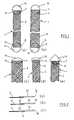
- FIG. 1in parts (a) to (e) top views of the undersides of different versions of strip-like implants according to the invention (in partial view),
- FIG. 2in parts (a) to (c) side views of various versions of strip-like implants according to the invention (in partial view), which are constructed as in FIG. 1 ,
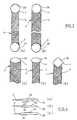
- FIG. 3in parts (a) to (e) top views of further versions of strip-like implants according to the invention (in partial view),
- FIG. 4in parts (a) to (c) side views of various versions of strip-like implants according to the invention (in partial view) which are constructed as in FIG. 3 , and
- FIG. 5a perspective view of a surgical gripping instrument according to the invention, in part (a) with opened jaws and in part (b) with closed jaws when gripping an implant tape.
- FIGS. 1 and 2various versions of a strip-like implant 1 are shown in which, for simplicity's sake, the same reference numbers are used for similar parts.
- Each of the strip-like implants 1has a tape 2 with a first end 4 and a second end 6 .
- the tape 2is a conventional mesh strip of implantable material and can be resorbable or non-resorbable.
- a disk-like application aid in the form of a one-piece disk 10is attached on the upper side of the tape 2 in an end zone 12 , as can be seen in particular in FIG. 2 .
- the versions according to FIG. 1 ( a ) and FIG. 1 ( b )are in addition provided with a corresponding small disk 10 in the area of the second end 6 of the tape 2 .
- a disk-like application aidcan be attached in the area of one or in the area of both ends of the tape 2 .
- the small disk 10is stuck or clipped onto the tape 2 in the end zone 12 . Combinations of these means of attachment or other means of attachment, such as e.g. melting on, are also conceivable.
- the small disk 10consists preferably of metal, plastic or ceramic.
- the versions of the strip-like implant 1differ in the design of the small disk 10 .
- the small disk 10has a circular outline and a somewhat greater diameter than the width of the tape 2 .
- the diameter of the small disk 10corresponds to the width of the tape 2 .
- FIG. 1 ( c )shows a small disk 10 with an elliptical outline, the greatest expanse of which is aligned with the width of the tape 2 and is the same as the width.
- the small disk 10is shaped and aligned similarly, but wider than the tape 2 .
- FIG. 1 ( e )shows a rhombic small disk 10 which is somewhat wider than the tape 2 .
- the small disks 10are aligned with the plane of the tape 2 and relatively flat.
- FIG. 2 ( a )a version is shown with a small disk 10 , the front edge 14 of which is constructed as a cutting edge.
- the front edge 16 of the small disk 10is blunt and atraumatic whilst the shape of the front edge 18 in FIG. 2 ( c ) is in between.
- FIGS. 3 and 4further versions for strip-like implants are shown, each here numbered 1 ′. Otherwise, for simplicity's sake, the same reference numbers are used for similar parts, which, when possible, are the same as those from FIGS. 1 and 2 .
- the versions according to FIGS. 3 and 4differ from the versions according to FIGS. 1 and 2 in the design of the disk-like application aid here numbered 20 .
- the application aid 20encloses an end zone 22 of the tape 2 as indicated in FIG. 4 .
- the application aid 20can be constructed as a double disk, the two parts of which are attached on opposite sides of the tape 2 and enclose the tape between them.
- a recess to house the end zone 22 of the tape 2can be provided on the insides of the disks so that the application aid 20 can have a smooth edge as indicated in FIG. 4 .
- FIGS. 3 and 4differ in the design of the application aid 20 .
- Its shapeis circular in FIG. 3 ( a ) (the diameter being greater than the width of the tape 2 ), circular in FIG. 3 ( b ) (the diameter being the same as the width of the tape 2 ), elliptical in FIG. 3 ( c ) and FIG. 3 ( d ) (the application aid 20 being wider in FIG. 3 ( d ) than the tape 2 ) and rhombic in FIG. 3 ( e ).
- FIG. 4shows that in these versions the application aid 20 is arranged essentially symmetrical to the plane of the tape 2 and is flat overall.
- FIG. 4 ( a )shows a version with an atraumatically shaped front edge 24
- FIG. 4 ( b )a version with a cutting front edge 26
- FIG. 4 ( c )a version with a front edge 28 , the shape of which lies between these two extremes.
- the application aid 10 or 20is gripped with a surgical gripping instrument such as e.g. a forceps and pressed against one side of the tissue so that the front edge of the small disk 10 or of the application aid 20 (e.g. the edge 14 ) comes to lie freely against this side of the tissue.
- the small disk 10 or the application aid 20can then be pressed through the tissue using the gripping instrument and, as soon as a part of it has emerged on the other side of the tissue, be pulled through the tissue by gripping this part with the gripping instrument, the tape 2 following.
- the opening created in the tissue in this waycauses the patient little discomfort as it is matched well to the size of the tape 2 .
- the small disk 10 or the application aid 20can be cut off. Afterwards, the procedure with the tape 2 is as per usual for the operating technique concerned.
- sharp-pointed forcepscan be used as a gripping instrument, these being pushed through the tissue in order to grip the application aid 10 or 20 moved to the other side of the tissue. Subsequently, using the forceps, the application aid 10 or 20 and the following tape 2 are pulled through the tissue. In this way, the forceps initially ensure a small opening in the tissue, this then being increased by the application aid 10 or 20 to the size required for pulling through the tape 2 .
- FIG. 5another possibility for an application aid is shown.
- the distal area of a surgical gripping instrument 30 with a first jaw 31 and a second jaw 32is shown in perspective view, in FIG. 5 ( a ) with opened jaws 31 , 32 and in FIG. 5 ( b ) with closed jaws 31 , 32 .
- the two jaws 31 , 32are connected to each other in articulated manner at the distal end of a shaft 34 and can be swivelled against each other via a mechanism not shown in more detail and guided in the shaft 34 .
- the jaws 31 , 32are designed so that they form a disk-like application aid when closed, thus e.g. have a similar overall shape to the small disks 10 according to FIGS. 1 and 2 or the application aids 20 according to FIGS. 3 and 4 .
- the surgical gripping instrument 30is set up to grip an implant tape, for which reason the insides of the jaws 31 , 32 are preferably generally flat, but provided with clamping means in order to prevent the implant tape from slipping out.
- the version of the surgical gripping instrument 30 shown in FIG. 5has a plurality of spikes 36 opposite which, in the second jaw 32 , recesses 37 are arranged, in which the spikes 36 engage when the jaws 31 , 32 are closed.
- both the front edge 38 of the first jaw 31 and its side edgesare cutting edges.
- the edges of the second jaw 32are designed correspondingly.
- FIG. 5 ( a )shows the surgical gripping instrument 30 with opened jaws 31 , 32 opposite the end area of a conventional implant tape 40 .
- the implant tape 40is clamped between the jaws 31 , 32 , the shaft 34 running as an extension of the implant tape 40 .
- the surgical gripping instrument 30must be applied differently, i.e. rotated by approximately 180°.
- the gripping instrument 30can be used with closed jaws 31 , 32 (and without the implant tape 40 ) in order to create an opening at the desired position in the tissue. Subsequently, the closed jaws 31 , 32 are pushed through this opening in order to be able to grip the implant tape 40 moved to the opposite side of the tissue and to pull it through the opening in the configuration according to FIG. 5 ( b ).
Landscapes
- Health & Medical Sciences (AREA)
- Life Sciences & Earth Sciences (AREA)
- Animal Behavior & Ethology (AREA)
- General Health & Medical Sciences (AREA)
- Veterinary Medicine (AREA)
- Engineering & Computer Science (AREA)
- Biomedical Technology (AREA)
- Heart & Thoracic Surgery (AREA)
- Public Health (AREA)
- Surgery (AREA)
- Ophthalmology & Optometry (AREA)
- Molecular Biology (AREA)
- Medical Informatics (AREA)
- Nuclear Medicine, Radiotherapy & Molecular Imaging (AREA)
- Cardiology (AREA)
- Oral & Maxillofacial Surgery (AREA)
- Transplantation (AREA)
- Vascular Medicine (AREA)
- Prostheses (AREA)
- Surgical Instruments (AREA)
Abstract
Description
This application claims the benefit of international application serial number PCT/EP00/12491 filed on Dec. 11, 2000.
The invention relates to a strip-like implant which has a tape with a first end and with a second end, as well as a surgical gripping instrument with two jaws, which is set up to grip an implant tape.
Strip-like implants, e.g. in the form of resorbable or non-resorbable meshes or gauze strips (tapes), are used e.g. to support or bind tissue. When such an implant is to be used in a surgical operation, it is often necessary to guide one end area or both end areas of the implant through tissue. For this, a large area of tissue must usually be prepared, and after the implant has been applied and positioned, the usually not inconsiderable wound in the end area of the implant must be closed. This is time-consuming and stressful for the patient.
The object of the invention is to provide a possibility for guiding a strip-like implant quickly and gently through tissue.
This object is achieved by a strip-like implant with the features ofclaim 1 as well as by a surgical gripping instrument with the features of claim9. Advantageous versions of the invention are given in the dependent claims.
The basic concept of the invention is a disk-like application aid with which a strip-like implant (implant tape) can be pulled through tissue. The disk-like application aid is arranged either in the area of one of the ends of the implant tape (claim1) or constructed as jaws of a surgical instrument (claim9), both of which have the same effect.
The strip-like implant according to the invention has a tape with a first end and with a second end. A disk-like application aid aligned with the plane of the tape is arranged in the area of at least one of the two ends.
The disk-like application aid reinforces the end area of the tape and thus enables the tape to be pulled through tissue with the help of a gripping instrument. In the process, the application aid provides the tissue quickly and gently with an opening which is no larger than is absolutely necessary for pulling through the tape. Thus an extensive tissue preparation is dispensed with. With the help of the application aid, only the area of tissue which is also actually required to position the strip-like implant is prepared. The specific placing of the implant is guaranteed by means of the application aid as required by the surgeon. In particular, the implant can lie flat without difficulty, if it is to lie uniformly flat. Similarly, if desired, the implant can also be inserted twisted. Through the disk-like application aid which is aligned with the plane of the tape (i.e. runs essentially parallel to the plane of the tape), the end area of the tape is thus constructed so that the implant can be pulled through the desired tissue or lengthwise between two layers of tissue without major problems. Almost automatically, tissue is prepared only for the area that is required for the implant.
All resorbable or non-resorbable materials suitable for the medical field can be considered as material for the tape. Mixtures of resorbable and non-resorbable materials are also conceivable. For the disk-like application aid, non-resorbable materials such as metals, plastics and ceramics are particularly suitable; in principle, however, resorbable materials can also be used.
Application areas are e.g. the augmentation of tendon sutures or the strength support in the case of abdominal wall defects.
Preferably, the maximum width of the application aid measured perpendicular to the longitudinal axis of the tape is at least as great as the width of the tape in the area of the application aid. With this version, the opening required for pulling the tape through tissue can be wholly created by means of the application aid without the edges of the tape cutting into the opening.
Numerous designs are conceivable for the application aid. For one version, the application aid is designed as a one-piece disk which is attached to one side of the tape. In another version, the application aid is designed as a double disk, both parts of which are attached to opposite sides of the tape and enclose the tape between them. The application aid, that is e.g. the one-piece disk or both parts of the double disk, can be attached to the tape using clips or adhesive. Depending on the material, it is also conceivable to weld the application aid to the end area of the tape. Another possibility is to pour the material for the application aid, e.g. a melted plastic or a plastic which has not yet been cured, round the end area of the tape and in doing so fully shape the application aid. Similarly, the end area of the tape can be reinforced by melting on the application aid.
Preferably, the application aid is circular, elliptical, oval or rhombic in the plane of the tape, but other forms are also possible. In a particularly preferred version, the application aid is a double disk with two round halves of the same size, the diameter of which is greater than the width of the tape, the end area of the tape being arranged between the two halves.
The application aid can have an atraumatically designed edge and/or a cutting edge. It can be achieved by the design of the edges of the application aid that, when the implant is pulled through tissue, the application aid cuts the tissue gently only where it is absolutely necessary.
The disk-like application aid can achieve the same effect if it is not integrated into a strip-like implant but rather forms a part of a surgical gripping instrument which serves for pulling through a conventional strip-like implant. Such a surgical gripping instrument has two jaws and is set up to grip an implant tape. The two jaws are designed as a disk-like application aid aligned to the plane of the tape when gripping the tape.
Preferably, the two jaws are each designed as small disks between which the tape can be gripped. When the end area of a conventional mesh strip or implant tape is clamped between the two jaws of the surgical gripping instrument according to the invention, the same effect is achieved as when the disk-like application aid of a strip-like implant according to the invention is gripped with a conventional forceps-like operating instrument. When the operating instrument according to the invention is used, the opening in the tissue required for pulling through the implant tape is created by the two jaws.
To prevent the end area of an implant tape gripped by the surgical gripping instrument from slipping out of the jaws, preferably, clamping means project from at least one of the two jaws, directed towards the other jaw. These can be e.g. one or more spikes or teeth, interlocking teeth or a corrugation.
Preferably, at least one of the two jaws is circular, elliptical, oval or rhombic in the plane of the tape. In a preferred design, the two jaws have the same outline. The surgical gripping instrument is advantageously used with implant tapes the width of which is at most as great as the dimension of the jaws in the direction of the width of the implant tape.
In the same way as the application aid of the strip-like implant according to the invention preferably has an atraumatically designed edge and/or a cutting edge, in the surgical gripping instrument according to the invention preferably at least one of the two jaws has an atraumatically designed edge and/or a cutting edge.
In the following, the invention is explained in more detail using embodiments. The Figures show in
InFIGS. 1 and 2 , various versions of a strip-like implant 1 are shown in which, for simplicity's sake, the same reference numbers are used for similar parts.
Each of the strip-like implants 1 has atape 2 with afirst end 4 and asecond end 6. Thetape 2 is a conventional mesh strip of implantable material and can be resorbable or non-resorbable.
In the area of thefirst end 4 of thetape 2, in all cases, a disk-like application aid in the form of a one-piece disk 10 is attached on the upper side of thetape 2 in anend zone 12, as can be seen in particular in FIG.2. The versions according to FIG.1(a) and FIG.1(b) are in addition provided with a correspondingsmall disk 10 in the area of thesecond end 6 of thetape 2. In principle, a disk-like application aid can be attached in the area of one or in the area of both ends of thetape 2.
In the embodiments according toFIGS. 1 and 2 , thesmall disk 10 is stuck or clipped onto thetape 2 in theend zone 12. Combinations of these means of attachment or other means of attachment, such as e.g. melting on, are also conceivable. Thesmall disk 10 consists preferably of metal, plastic or ceramic.
The versions of the strip-like implant 1 differ in the design of thesmall disk 10. In FIG.1(a), thesmall disk 10 has a circular outline and a somewhat greater diameter than the width of thetape 2. In the version according to FIG.1(b), the diameter of thesmall disk 10 corresponds to the width of thetape 2. FIG.1(c) shows asmall disk 10 with an elliptical outline, the greatest expanse of which is aligned with the width of thetape 2 and is the same as the width. In the version according to FIG.1(d), thesmall disk 10 is shaped and aligned similarly, but wider than thetape 2. FIG.1(e) shows a rhombicsmall disk 10 which is somewhat wider than thetape 2.
As can be seen inFIG. 2 , thesmall disks 10 are aligned with the plane of thetape 2 and relatively flat. In FIG.2(a), a version is shown with asmall disk 10, thefront edge 14 of which is constructed as a cutting edge. In the version according to FIG.2(b), thefront edge 16 of thesmall disk 10 is blunt and atraumatic whilst the shape of thefront edge 18 in FIG.2(c) is in between.
InFIGS. 3 and 4 , further versions for strip-like implants are shown, each here numbered1′. Otherwise, for simplicity's sake, the same reference numbers are used for similar parts, which, when possible, are the same as those fromFIGS. 1 and 2 .
The versions according toFIGS. 3 and 4 differ from the versions according toFIGS. 1 and 2 in the design of the disk-like application aid here numbered20. Theapplication aid 20 encloses anend zone 22 of thetape 2 as indicated in FIG.4. There are different possible ways of achieving this. Thus, theapplication aid 20 can be constructed as a double disk, the two parts of which are attached on opposite sides of thetape 2 and enclose the tape between them. A recess to house theend zone 22 of thetape 2 can be provided on the insides of the disks so that theapplication aid 20 can have a smooth edge as indicated in FIG.4. It is also conceivable to pour the material for theapplication aid 20 round theend zone 22 in the area of thefirst end 4 or thesecond end 6 of thetape 2, to fully shape the application aid and then carry out a curing (e.g. by cooling from the melt or by chemical reaction).
The versions according toFIGS. 3 and 4 differ in the design of theapplication aid 20. Its shape is circular in FIG.3(a) (the diameter being greater than the width of the tape2), circular in FIG.3(b) (the diameter being the same as the width of the tape2), elliptical in FIG.3(c) and FIG.3(d) (theapplication aid 20 being wider in FIG.3(d) than the tape2) and rhombic in FIG.3(e).
In order to insert one of the strip-like implants application aid small disk 10 or of the application aid20 (e.g. the edge14) comes to lie freely against this side of the tissue. Thesmall disk 10 or theapplication aid 20 can then be pressed through the tissue using the gripping instrument and, as soon as a part of it has emerged on the other side of the tissue, be pulled through the tissue by gripping this part with the gripping instrument, thetape 2 following. The opening created in the tissue in this way causes the patient little discomfort as it is matched well to the size of thetape 2. After thetape 2 is guided through the tissue, thesmall disk 10 or theapplication aid 20 can be cut off. Afterwards, the procedure with thetape 2 is as per usual for the operating technique concerned.
Alternatively, sharp-pointed forceps can be used as a gripping instrument, these being pushed through the tissue in order to grip theapplication aid application aid tape 2 are pulled through the tissue. In this way, the forceps initially ensure a small opening in the tissue, this then being increased by theapplication aid tape 2.
InFIG. 5 , another possibility for an application aid is shown. The distal area of a surgicalgripping instrument 30 with afirst jaw 31 and asecond jaw 32 is shown in perspective view, in FIG.5(a) with openedjaws closed jaws jaws shaft 34 and can be swivelled against each other via a mechanism not shown in more detail and guided in theshaft 34.
Thejaws small disks 10 according toFIGS. 1 and 2 or the application aids20 according toFIGS. 3 and 4 . The surgicalgripping instrument 30 is set up to grip an implant tape, for which reason the insides of thejaws first jaw 31, the version of the surgicalgripping instrument 30 shown inFIG. 5 has a plurality ofspikes 36 opposite which, in thesecond jaw 32, recesses37 are arranged, in which thespikes 36 engage when thejaws front edge 38 of thefirst jaw 31 and its side edges are cutting edges. The edges of thesecond jaw 32 are designed correspondingly.
FIG.5(a) shows the surgicalgripping instrument 30 with openedjaws conventional implant tape 40. In the position shown in FIG.5(b), theimplant tape 40 is clamped between thejaws shaft 34 running as an extension of theimplant tape 40. In this way, it is possible to pull theimplant tape 40 or also to pull it through tissue after the end zone of theimplant tape 40 has already passed through the tissue. On the other hand, to create an opening for theimplant tape 40 in the tissue, the surgicalgripping instrument 30 must be applied differently, i.e. rotated by approximately 180°. Then thefront edge 38 points towards the tissue and theclosed jaws implant tape 40 can be pressed through the tissue, in a similar way to that described previously in connection withFIGS. 1 to4. Alternatively, the grippinginstrument 30 can be used withclosed jaws 31,32 (and without the implant tape40) in order to create an opening at the desired position in the tissue. Subsequently, theclosed jaws implant tape 40 moved to the opposite side of the tissue and to pull it through the opening in the configuration according to FIG.5(b).
Claims (7)
1. A strip-like implant for implantation in tissue during a surgical operation, the implant comprising:
a substantially flat, flexible mesh tape having a first end and a second end and a porous outer surface for binding the tape to the tissue when implanted; and
first and second application aids affixed to and extending outwardly from the first and second ends of the mesh tape respectively, the first and second application aids being composed of a material different from the mesh tape and enabling the tape to be pulled through the tissue, the application aids lying in substantially the same plane as the first and second ends respectively, and having a maximum cross-section at least as large as the cross-section of the first and second ends of the tape respectively, the first and second application aids further having a tissue penetrating leading edge.
2. The implant according toclaim 1 , wherein the first and second application aids are disc elements affixed to one side of the tape.
3. The implant according toclaim 1 , wherein the first and second application aids further comprise first and second disc elements, the first disc elements being affixed to a first side of the tape and the second disc elements being affixed to a second side of the tape.
4. The implant according to claim according toclaim 1 , wherein the first and second application aids are affixed to the tape by clipping, gluing, welding, casting around, or melting-on.
5. The implant according toclaim 1 , wherein the first and second application aids have a shape in the plane of the tape that is circular, elliptical, oval or rhombic.
6. The implant according toclaim 1 , wherein the leading edge of the first and second application aids are atraumatic.
7. The implant according toclaim 1 , wherein the leading edge of the first and second application aids is a cutting edge.
Applications Claiming Priority (3)
| Application Number | Priority Date | Filing Date | Title |
|---|---|---|---|
| DE19964081.5 | 1999-12-29 | ||
| DE19964081ADE19964081B4 (en) | 1999-12-29 | 1999-12-29 | Stripe-type implant and surgical gripping instrument |
| PCT/EP2000/012491WO2001049095A2 (en) | 1999-12-29 | 2000-12-11 | Strip-like implant |
Publications (2)
| Publication Number | Publication Date |
|---|---|
| US20030004580A1 US20030004580A1 (en) | 2003-01-02 |
| US6872227B2true US6872227B2 (en) | 2005-03-29 |
Family
ID=7935199
Family Applications (1)
| Application Number | Title | Priority Date | Filing Date |
|---|---|---|---|
| US10/169,326Expired - LifetimeUS6872227B2 (en) | 1999-12-29 | 2000-12-11 | Strip-like implant |
Country Status (5)
| Country | Link |
|---|---|
| US (1) | US6872227B2 (en) |
| EP (2) | EP1242001B1 (en) |
| AU (1) | AU2364301A (en) |
| DE (2) | DE19964081B4 (en) |
| WO (1) | WO2001049095A2 (en) |
Cited By (57)
| Publication number | Priority date | Publication date | Assignee | Title |
|---|---|---|---|---|
| US20030130670A1 (en)* | 2001-01-23 | 2003-07-10 | Anderson Kimberly A. | Pelvic floor implant system and method of assembly |
| US20030191480A1 (en)* | 2000-11-22 | 2003-10-09 | Ulf Ulmsten | Surgical instrument and method for treating female urinary incontinence |
| US20040087981A1 (en)* | 2000-01-25 | 2004-05-06 | Rod Berube | Tissue fastener |
| US20050075660A1 (en)* | 2003-10-03 | 2005-04-07 | Chu Michael S. H. | Systems and methods for delivering a medical implant to an anatomical location in a patient |
| US20050072751A1 (en)* | 2002-08-09 | 2005-04-07 | Price Michael L. | Tamper evident closure with locking band and container therefor |
| US20050177162A1 (en)* | 2002-07-23 | 2005-08-11 | Fondel Finance B.V. | Supporting element for attachment to bone |
| US20050197525A1 (en)* | 2000-11-15 | 2005-09-08 | Gellman Barry N. | Systems and methods for delivering a medical implant to an anatomical location in a patient |
| US20060025649A1 (en)* | 2004-07-28 | 2006-02-02 | Smith Daniel J | Minimally invasive medical implant and insertion device and method for using the same |
| US20070015953A1 (en)* | 2005-07-13 | 2007-01-18 | Boston Scientific Scimed, Inc. | Snap fit sling anchor system and related methods |
| US20070038018A1 (en)* | 2005-08-11 | 2007-02-15 | Boston Scientific Scimed, Inc. | Systems, methods and devices relating to a removable sleeve for an implantable sling |
| US20070173864A1 (en)* | 2006-01-13 | 2007-07-26 | Boston Scientific Scimed, Inc. | Placing fixation devices |
| US20070270854A1 (en)* | 2006-03-30 | 2007-11-22 | Zhigang Li | Bone anchoring device |
| US20100106254A1 (en)* | 2008-10-23 | 2010-04-29 | Delsignore Jeanne L | Surgical implantable stabilizer sling for basal joint arthroplasty |
| US20100121448A1 (en)* | 2001-03-13 | 2010-05-13 | Depuy Mitek, Inc. | Method and apparatus for fixing a graft in a bone tunnel |
| US20100168857A1 (en)* | 2008-05-30 | 2010-07-01 | Edwin Burton Hatch | Flexibly compliant ceramic prosthetic meniscus for the replacement of damaged cartilage in orthopedic surgical repair or reconstruction of hip, knee, ankle, shoulder, elbow. wrist and other anatomical joints |
| US20100318023A1 (en)* | 2009-06-15 | 2010-12-16 | Heraeus Medical Gmbh | Medical system, pulling device and method for pulling an active substance chain |
| KR101044731B1 (en) | 2010-12-02 | 2011-06-28 | 구태훈 | Soft tissue repair mesh |
| US20110224698A1 (en)* | 2010-03-12 | 2011-09-15 | Coloplast A/S | Implantable support attachment system and assembly |
| US8123671B2 (en) | 2005-08-04 | 2012-02-28 | C.R. Bard, Inc. | Pelvic implant systems and methods |
| US8480559B2 (en) | 2006-09-13 | 2013-07-09 | C. R. Bard, Inc. | Urethral support system |
| US20130204367A1 (en)* | 2012-02-02 | 2013-08-08 | Smith & Nephew, Inc. | Implantable biologic holder |
| US8574149B2 (en) | 2007-11-13 | 2013-11-05 | C. R. Bard, Inc. | Adjustable tissue support member |
| US8579924B2 (en) | 2011-07-26 | 2013-11-12 | Covidien Lp | Implantable devices including a mesh and a pivotable film |
| KR101432268B1 (en) | 2012-09-03 | 2014-08-21 | 구태훈 | Mesh for soft tissue repair, device for forming space in the soft tissue, device for inserting the mesh in the soft tissue and, operation set having them |
| US8845512B2 (en) | 2005-11-14 | 2014-09-30 | C. R. Bard, Inc. | Sling anchor system |
| US8932621B2 (en) | 2011-10-25 | 2015-01-13 | Covidien Lp | Implantable film/mesh composite |
| US9005308B2 (en) | 2011-10-25 | 2015-04-14 | Covidien Lp | Implantable film/mesh composite for passage of tissue therebetween |
| US9044223B2 (en) | 2012-06-05 | 2015-06-02 | Ethicon, Inc. | Implant insertion systems and methods of use |
| US9078727B2 (en) | 2006-03-16 | 2015-07-14 | Boston Scientific Scimed, Inc. | System and method for treating tissue wall prolapse |
| US9179994B2 (en) | 2011-10-25 | 2015-11-10 | Covidien Lp | Implantable film/mesh composite |
| US9339362B2 (en) | 2005-09-28 | 2016-05-17 | Boston Scientific Scimed, Inc. | Apparatus and method for suspending a uterus |
| US9387061B2 (en) | 2010-09-02 | 2016-07-12 | Boston Scientific Scimed, Inc. | Pelvic implants and methods of implanting the same |
| US9510927B2 (en) | 2012-06-28 | 2016-12-06 | Sofradim Production | Method of making a knit with barbs |
| US9554887B2 (en) | 2011-03-16 | 2017-01-31 | Sofradim Production | Prosthesis comprising a three-dimensional and openworked knit |
| US9622843B2 (en) | 2011-07-13 | 2017-04-18 | Sofradim Production | Umbilical hernia prosthesis |
| US9744020B1 (en)* | 2016-02-12 | 2017-08-29 | Sanford Health | Mesh for hiatal hernia repair and deployment device |
| US9750837B2 (en) | 2012-09-25 | 2017-09-05 | Sofradim Production | Haemostatic patch and method of preparation |
| US9750595B2 (en) | 2012-09-28 | 2017-09-05 | Covidien Lp | Implantable medical devices which include grip-members and methods of use thereof |
| US9782957B2 (en) | 2011-08-24 | 2017-10-10 | Covidien Lp | Medical device films |
| US9801705B2 (en) | 2012-06-29 | 2017-10-31 | Sofradim Production | Hernia prosthesis |
| US9839505B2 (en) | 2012-09-25 | 2017-12-12 | Sofradim Production | Prosthesis comprising a mesh and a strengthening means |
| US9861590B2 (en) | 2010-10-19 | 2018-01-09 | Covidien Lp | Self-supporting films for delivery of therapeutic agents |
| US9931198B2 (en) | 2015-04-24 | 2018-04-03 | Sofradim Production | Prosthesis for supporting a breast structure |
| US9980802B2 (en) | 2011-07-13 | 2018-05-29 | Sofradim Production | Umbilical hernia prosthesis |
| US10076395B2 (en) | 2010-07-16 | 2018-09-18 | Sofradim Production | Prosthesis having a radiopaque element |
| US10080639B2 (en) | 2011-12-29 | 2018-09-25 | Sofradim Production | Prosthesis for inguinal hernia |
| US10184032B2 (en) | 2015-02-17 | 2019-01-22 | Sofradim Production | Method for preparing a chitosan-based matrix comprising a fiber reinforcement member |
| US10188494B2 (en) | 2013-03-14 | 2019-01-29 | Ethicon, Inc. | Methods of using delivery systems for the placement of surgical implants |
| US10206769B2 (en) | 2012-03-30 | 2019-02-19 | Covidien Lp | Implantable devices including a film providing folding characteristics |
| US10278692B2 (en) | 2008-10-23 | 2019-05-07 | CMC Group LLC | Sling suspension system for supporting the thumb of a patient after basal joint arthroplasty |
| US10363690B2 (en) | 2012-08-02 | 2019-07-30 | Sofradim Production | Method for preparing a chitosan-based porous layer |
| US10646321B2 (en) | 2016-01-25 | 2020-05-12 | Sofradim Production | Prosthesis for hernia repair |
| US10675137B2 (en) | 2017-05-02 | 2020-06-09 | Sofradim Production | Prosthesis for inguinal hernia repair |
| US10682215B2 (en) | 2016-10-21 | 2020-06-16 | Sofradim Production | Method for forming a mesh having a barbed suture attached thereto and the mesh thus obtained |
| US10743976B2 (en) | 2015-06-19 | 2020-08-18 | Sofradim Production | Synthetic prosthesis comprising a knit and a non porous film and method for forming same |
| US11484301B2 (en) | 2014-01-14 | 2022-11-01 | Simparo Inc. | Suture-locking washer for use with a bone anchor, and method for supporting the thumb of a patient after basal joint arthroplasty, and other novel orthopedic apparatus and other novel orthopedic procedures |
| US12064330B2 (en) | 2020-04-28 | 2024-08-20 | Covidien Lp | Implantable prothesis for minimally invasive hernia repair |
Families Citing this family (27)
| Publication number | Priority date | Publication date | Assignee | Title |
|---|---|---|---|---|
| EP1665991B1 (en)* | 2000-06-05 | 2017-12-13 | Boston Scientific Limited | Devices for the treatment of urinary continence |
| DE60223502T2 (en)* | 2001-03-09 | 2008-11-13 | Boston Scientific Ltd., St. Michael | MEDICAL SLING |
| US8033983B2 (en)* | 2001-03-09 | 2011-10-11 | Boston Scientific Scimed, Inc. | Medical implant |
| US9149261B2 (en) | 2001-03-09 | 2015-10-06 | Boston Scientific Scimed, Inc. | Systems, methods and devices relating to delivery of medical implants |
| US20050131393A1 (en)* | 2001-03-09 | 2005-06-16 | Scimed Life Systems, Inc. | Systems, methods and devices relating to delivery of medical implants |
| US8915927B2 (en)* | 2001-03-09 | 2014-12-23 | Boston Scientific Scimed, Inc. | Systems, methods and devices relating to delivery of medical implants |
| US7364541B2 (en) | 2001-03-09 | 2008-04-29 | Boston Scientific Scimed, Inc. | Systems, methods and devices relating to delivery of medical implants |
| WO2003013392A1 (en) | 2001-08-03 | 2003-02-20 | Aesculap Ag & Co. Kg | Incontinence strip for treating urinary incontinence |
| CA2705609C (en) | 2002-08-14 | 2016-10-25 | Boston Scientific Limited | Systems, methods and devices relating to delivery of medical implants |
| AU2003259834A1 (en) | 2002-12-17 | 2004-07-29 | Boston Scientific Limited | Spacer for sling delivery system |
| US7361138B2 (en)* | 2003-07-31 | 2008-04-22 | Scimed Life Systems, Inc. | Bioabsorbable casing for surgical sling assembly |
| US8545386B2 (en) | 2003-08-14 | 2013-10-01 | Boston Scientific Scimed, Inc. | Surgical slings |
| DE602004023314D1 (en) | 2003-08-14 | 2009-11-05 | Boston Scient Ltd | SURGICAL SLINGS |
| EP1696803B1 (en)* | 2003-11-17 | 2016-09-28 | Boston Scientific Limited | Systems relating to associating a medical implant with a delivery device |
| EP3087949B1 (en) | 2004-06-14 | 2018-07-25 | Boston Scientific Limited | System relating to implantable supportive slings |
| US20060173468A1 (en)* | 2005-01-28 | 2006-08-03 | Marc Simmon | Obturator introducer with snare |
| JP5058969B2 (en)* | 2005-04-06 | 2012-10-24 | ボストン サイエンティフィック リミテッド | System, apparatus and method for suburethral support |
| EP2974692B1 (en) | 2005-07-25 | 2019-03-13 | Boston Scientific Limited | Pelvic floor repair system |
| WO2008042434A2 (en) | 2006-10-03 | 2008-04-10 | Boston Scientific Scimed, Inc. | Systems and devices for delivering an implant |
| US8888795B2 (en) | 2007-09-07 | 2014-11-18 | Boston Scientific Scimed, Inc. | Suture passer |
| US8449573B2 (en) | 2008-12-05 | 2013-05-28 | Boston Scientific Scimed, Inc. | Insertion device and method for delivery of a mesh carrier |
| US8968334B2 (en) | 2009-04-17 | 2015-03-03 | Boston Scientific Scimed, Inc. | Apparatus for delivering and anchoring implantable medical devices |
| US9301750B2 (en) | 2009-11-03 | 2016-04-05 | Boston Scientific Scimed, Inc. | Device and method for delivery of mesh-based devices |
| US9636201B2 (en) | 2011-05-12 | 2017-05-02 | Boston Scientific Scimed, Inc. | Delivery members for delivering an implant into a body of a patient |
| US9113991B2 (en) | 2011-05-12 | 2015-08-25 | Boston Scientific Scimed, Inc. | Anchors for bodily implants and methods for anchoring bodily implants into a patient's body |
| US9775699B2 (en)* | 2012-04-13 | 2017-10-03 | Boston Scientific Scimed, Inc. | Adjustable implant for the treatment of urinary incontinence |
| FR3005564B1 (en)* | 2013-05-20 | 2018-01-12 | Cousin Biotech | INSTRUMENT FOR USE IN MODIFYING THE VOLUME OF THE STOMACH OF A PATIENT. |
Citations (15)
| Publication number | Priority date | Publication date | Assignee | Title |
|---|---|---|---|---|
| US3513484A (en)* | 1967-10-27 | 1970-05-26 | Extracorporeal Med Spec | Artificial tendon |
| US3545008A (en)* | 1968-05-27 | 1970-12-08 | Karl F Bader Jr | Tendon prosthesis |
| US4455690A (en)* | 1980-11-06 | 1984-06-26 | Homsy Charles A | Structure for in vivo implanation |
| US5197983A (en)* | 1988-04-19 | 1993-03-30 | W. L. Gore & Associates, Inc. | Ligament and tendon prosthesis |
| US5368602A (en) | 1993-02-11 | 1994-11-29 | De La Torre; Roger A. | Surgical mesh with semi-rigid border members |
| US5441508A (en)* | 1989-04-27 | 1995-08-15 | Gazielly; Dominique | Reinforcement and supporting device for the rotator cuff of a shoulder joint of a person |
| US5584884A (en)* | 1995-07-27 | 1996-12-17 | Anthony S. Pignataro | Mammary prosthesis and method of surgically implanting same |
| US5788625A (en)* | 1996-04-05 | 1998-08-04 | Depuy Orthopaedics, Inc. | Method of making reconstructive SIS structure for cartilaginous elements in situ |
| US5922026A (en) | 1997-05-01 | 1999-07-13 | Origin Medsystems, Inc. | Surgical method and prosthetic strip therefor |
| US5968051A (en)* | 1995-07-27 | 1999-10-19 | Johnson & Johnson Professional, Inc. | Patella clamping device |
| US5997565A (en) | 1997-01-16 | 1999-12-07 | Asahi Kogaku Kogyo Kabushiki Kaisha | Forceps for an endoscopic operation |
| US20020019635A1 (en)* | 2000-06-28 | 2002-02-14 | Wenstrom Richard F. | Method for fixing a graft in a bone tunnel |
| US20020019670A1 (en)* | 1997-02-28 | 2002-02-14 | Jerald M. Crawley | Implantable tissue augmentation device |
| US20020169464A1 (en)* | 1999-09-14 | 2002-11-14 | Surgical Diffusion Sa | Gastric band |
| US20030191480A1 (en)* | 2000-11-22 | 2003-10-09 | Ulf Ulmsten | Surgical instrument and method for treating female urinary incontinence |
Family Cites Families (1)
| Publication number | Priority date | Publication date | Assignee | Title |
|---|---|---|---|---|
| NL1007751C2 (en)* | 1997-12-09 | 1999-06-22 | Surgical Innovations Vof | Surgical device. |
- 1999
- 1999-12-29DEDE19964081Apatent/DE19964081B4/ennot_activeExpired - Fee Related
- 2000
- 2000-12-11EPEP00987380Apatent/EP1242001B1/ennot_activeExpired - Lifetime
- 2000-12-11DEDE60033691Tpatent/DE60033691T2/ennot_activeExpired - Lifetime
- 2000-12-11EPEP04017739Apatent/EP1477121A3/ennot_activeWithdrawn
- 2000-12-11WOPCT/EP2000/012491patent/WO2001049095A2/enactiveIP Right Grant
- 2000-12-11AUAU23643/01Apatent/AU2364301A/ennot_activeAbandoned
- 2000-12-11USUS10/169,326patent/US6872227B2/ennot_activeExpired - Lifetime
Patent Citations (15)
| Publication number | Priority date | Publication date | Assignee | Title |
|---|---|---|---|---|
| US3513484A (en)* | 1967-10-27 | 1970-05-26 | Extracorporeal Med Spec | Artificial tendon |
| US3545008A (en)* | 1968-05-27 | 1970-12-08 | Karl F Bader Jr | Tendon prosthesis |
| US4455690A (en)* | 1980-11-06 | 1984-06-26 | Homsy Charles A | Structure for in vivo implanation |
| US5197983A (en)* | 1988-04-19 | 1993-03-30 | W. L. Gore & Associates, Inc. | Ligament and tendon prosthesis |
| US5441508A (en)* | 1989-04-27 | 1995-08-15 | Gazielly; Dominique | Reinforcement and supporting device for the rotator cuff of a shoulder joint of a person |
| US5368602A (en) | 1993-02-11 | 1994-11-29 | De La Torre; Roger A. | Surgical mesh with semi-rigid border members |
| US5584884A (en)* | 1995-07-27 | 1996-12-17 | Anthony S. Pignataro | Mammary prosthesis and method of surgically implanting same |
| US5968051A (en)* | 1995-07-27 | 1999-10-19 | Johnson & Johnson Professional, Inc. | Patella clamping device |
| US5788625A (en)* | 1996-04-05 | 1998-08-04 | Depuy Orthopaedics, Inc. | Method of making reconstructive SIS structure for cartilaginous elements in situ |
| US5997565A (en) | 1997-01-16 | 1999-12-07 | Asahi Kogaku Kogyo Kabushiki Kaisha | Forceps for an endoscopic operation |
| US20020019670A1 (en)* | 1997-02-28 | 2002-02-14 | Jerald M. Crawley | Implantable tissue augmentation device |
| US5922026A (en) | 1997-05-01 | 1999-07-13 | Origin Medsystems, Inc. | Surgical method and prosthetic strip therefor |
| US20020169464A1 (en)* | 1999-09-14 | 2002-11-14 | Surgical Diffusion Sa | Gastric band |
| US20020019635A1 (en)* | 2000-06-28 | 2002-02-14 | Wenstrom Richard F. | Method for fixing a graft in a bone tunnel |
| US20030191480A1 (en)* | 2000-11-22 | 2003-10-09 | Ulf Ulmsten | Surgical instrument and method for treating female urinary incontinence |
Cited By (104)
| Publication number | Priority date | Publication date | Assignee | Title |
|---|---|---|---|---|
| US20040087981A1 (en)* | 2000-01-25 | 2004-05-06 | Rod Berube | Tissue fastener |
| US8025619B2 (en) | 2000-11-15 | 2011-09-27 | Boston Scientifc Scimed, Inc. | Systems and methods for delivering a medical implant to an anatomical location in a patient |
| US8845511B2 (en) | 2000-11-15 | 2014-09-30 | Boston Scientific Scimed, Inc. | Systems and methods for delivering a medical implant to an anatomical location in a patient |
| US20050197525A1 (en)* | 2000-11-15 | 2005-09-08 | Gellman Barry N. | Systems and methods for delivering a medical implant to an anatomical location in a patient |
| US20070060788A1 (en)* | 2000-11-15 | 2007-03-15 | Boston Scientific Scimed Inc. | Systems and methods for delivering a medical implant to an anatomical location in a patient |
| US20030191480A1 (en)* | 2000-11-22 | 2003-10-09 | Ulf Ulmsten | Surgical instrument and method for treating female urinary incontinence |
| US7112210B2 (en)* | 2000-11-22 | 2006-09-26 | Ethicon, Inc. | Surgical instrument and method for treating female urinary incontinence |
| US20030130670A1 (en)* | 2001-01-23 | 2003-07-10 | Anderson Kimberly A. | Pelvic floor implant system and method of assembly |
| US7229453B2 (en)* | 2001-01-23 | 2007-06-12 | Ams Research Corporation | Pelvic floor implant system and method of assembly |
| US9717580B2 (en) | 2001-01-23 | 2017-08-01 | Astora Women's Health, Llc | Pelvic floor implant system and method of assembly |
| US9314332B2 (en) | 2001-03-13 | 2016-04-19 | Depuy Mitek, Llc | Method and apparatus for fixing a graft in a bone tunnel |
| US8591580B2 (en) | 2001-03-13 | 2013-11-26 | Depuy Mitek, Llc | Folded ligament graft |
| US8226716B2 (en)* | 2001-03-13 | 2012-07-24 | Depuy Mitek, Inc. | Method and apparatus for fixing a graft in a bone tunnel |
| US20100121448A1 (en)* | 2001-03-13 | 2010-05-13 | Depuy Mitek, Inc. | Method and apparatus for fixing a graft in a bone tunnel |
| US20050177162A1 (en)* | 2002-07-23 | 2005-08-11 | Fondel Finance B.V. | Supporting element for attachment to bone |
| US20050072751A1 (en)* | 2002-08-09 | 2005-04-07 | Price Michael L. | Tamper evident closure with locking band and container therefor |
| US20100222641A1 (en)* | 2003-10-03 | 2010-09-02 | Boston Scientific Scimed, Inc. | Systems and methods for delivering a medical implant to an anatomical location in a patient |
| US9968429B2 (en) | 2003-10-03 | 2018-05-15 | Boston Scientific Scimed, Inc. | Systems and methods for delivering a medical implant to an anatomical location in a patient |
| US9050164B2 (en) | 2003-10-03 | 2015-06-09 | Boston Scientific Scimed, Inc. | Systems and methods for delivering a medical implant to an anatomical location in a patient |
| US8167786B2 (en) | 2003-10-03 | 2012-05-01 | Boston Scientific Scimed, Inc. | Systems and methods for delivering a medical implant to an anatomical location in a patient |
| US7713187B2 (en) | 2003-10-03 | 2010-05-11 | Boston Scientific Scimed, Inc. | Systems and methods for delivering a medical implant to an anatomical location in a patient |
| US20050075660A1 (en)* | 2003-10-03 | 2005-04-07 | Chu Michael S. H. | Systems and methods for delivering a medical implant to an anatomical location in a patient |
| US7297102B2 (en) | 2004-07-28 | 2007-11-20 | Ethicon, Inc. | Minimally invasive medical implant and insertion device and method for using the same |
| US20060025649A1 (en)* | 2004-07-28 | 2006-02-02 | Smith Daniel J | Minimally invasive medical implant and insertion device and method for using the same |
| US7285086B2 (en) | 2004-07-28 | 2007-10-23 | Ethicon, Inc. | Minimally invasive medical implant and insertion device and method for using the same |
| US20060025783A1 (en)* | 2004-07-28 | 2006-02-02 | Smith Daniel J | Minimally invasive medical implant and insertion device and method for using the same |
| US20070015953A1 (en)* | 2005-07-13 | 2007-01-18 | Boston Scientific Scimed, Inc. | Snap fit sling anchor system and related methods |
| US8043205B2 (en) | 2005-07-13 | 2011-10-25 | Boston Scientific Scimed, Inc. | Snap fit sling anchor system |
| US8123671B2 (en) | 2005-08-04 | 2012-02-28 | C.R. Bard, Inc. | Pelvic implant systems and methods |
| US7935046B2 (en) | 2005-08-11 | 2011-05-03 | Boston Scientific Scimed, Inc. | Systems, methods and devices relating to a removable sleeve for an implantable sling |
| US20070038018A1 (en)* | 2005-08-11 | 2007-02-15 | Boston Scientific Scimed, Inc. | Systems, methods and devices relating to a removable sleeve for an implantable sling |
| US9339362B2 (en) | 2005-09-28 | 2016-05-17 | Boston Scientific Scimed, Inc. | Apparatus and method for suspending a uterus |
| US8845512B2 (en) | 2005-11-14 | 2014-09-30 | C. R. Bard, Inc. | Sling anchor system |
| US20070173864A1 (en)* | 2006-01-13 | 2007-07-26 | Boston Scientific Scimed, Inc. | Placing fixation devices |
| US9144483B2 (en)* | 2006-01-13 | 2015-09-29 | Boston Scientific Scimed, Inc. | Placing fixation devices |
| US9078727B2 (en) | 2006-03-16 | 2015-07-14 | Boston Scientific Scimed, Inc. | System and method for treating tissue wall prolapse |
| US20070270854A1 (en)* | 2006-03-30 | 2007-11-22 | Zhigang Li | Bone anchoring device |
| US8480559B2 (en) | 2006-09-13 | 2013-07-09 | C. R. Bard, Inc. | Urethral support system |
| US8574149B2 (en) | 2007-11-13 | 2013-11-05 | C. R. Bard, Inc. | Adjustable tissue support member |
| US8114156B2 (en)* | 2008-05-30 | 2012-02-14 | Edwin Burton Hatch | Flexibly compliant ceramic prosthetic meniscus for the replacement of damaged cartilage in orthopedic surgical repair or reconstruction of hip, knee, ankle, shoulder, elbow, wrist and other anatomical joints |
| US20100168857A1 (en)* | 2008-05-30 | 2010-07-01 | Edwin Burton Hatch | Flexibly compliant ceramic prosthetic meniscus for the replacement of damaged cartilage in orthopedic surgical repair or reconstruction of hip, knee, ankle, shoulder, elbow. wrist and other anatomical joints |
| US10278692B2 (en) | 2008-10-23 | 2019-05-07 | CMC Group LLC | Sling suspension system for supporting the thumb of a patient after basal joint arthroplasty |
| US9707090B2 (en) | 2008-10-23 | 2017-07-18 | CMC Group LLC | Surgical implantable stabilizer sling for basal joint arthroplasty |
| US20100106254A1 (en)* | 2008-10-23 | 2010-04-29 | Delsignore Jeanne L | Surgical implantable stabilizer sling for basal joint arthroplasty |
| US8613942B2 (en)* | 2009-06-15 | 2013-12-24 | Heraeus Medical Gmbh | Medical system, pulling device and method for pulling an active substance chain |
| US20100318023A1 (en)* | 2009-06-15 | 2010-12-16 | Heraeus Medical Gmbh | Medical system, pulling device and method for pulling an active substance chain |
| US8398659B2 (en) | 2010-03-12 | 2013-03-19 | Coloplast A/S | Method of intracorporeally suturing tissue |
| US8226686B2 (en) | 2010-03-12 | 2012-07-24 | Coloplast A/S | Implantable support attachment system and assembly |
| US20110224697A1 (en)* | 2010-03-12 | 2011-09-15 | Coloplast A/S | Implantable support attachment system and assembly |
| US20110224698A1 (en)* | 2010-03-12 | 2011-09-15 | Coloplast A/S | Implantable support attachment system and assembly |
| US10076395B2 (en) | 2010-07-16 | 2018-09-18 | Sofradim Production | Prosthesis having a radiopaque element |
| US9387061B2 (en) | 2010-09-02 | 2016-07-12 | Boston Scientific Scimed, Inc. | Pelvic implants and methods of implanting the same |
| US9861590B2 (en) | 2010-10-19 | 2018-01-09 | Covidien Lp | Self-supporting films for delivery of therapeutic agents |
| KR101044731B1 (en) | 2010-12-02 | 2011-06-28 | 구태훈 | Soft tissue repair mesh |
| US9554887B2 (en) | 2011-03-16 | 2017-01-31 | Sofradim Production | Prosthesis comprising a three-dimensional and openworked knit |
| US10472750B2 (en) | 2011-03-16 | 2019-11-12 | Sofradim Production | Prosthesis comprising a three-dimensional and openworked knit |
| US12258689B2 (en) | 2011-03-16 | 2025-03-25 | Sofradim Production | Prosthesis comprising a three-dimensional and openworked knit |
| US11612472B2 (en) | 2011-03-16 | 2023-03-28 | Sofradim Production | Prosthesis comprising a three-dimensional and openworked knit |
| US11903807B2 (en) | 2011-07-13 | 2024-02-20 | Sofradim Production | Umbilical hernia prosthesis |
| US10709538B2 (en) | 2011-07-13 | 2020-07-14 | Sofradim Production | Umbilical hernia prosthesis |
| US9622843B2 (en) | 2011-07-13 | 2017-04-18 | Sofradim Production | Umbilical hernia prosthesis |
| US12329626B2 (en) | 2011-07-13 | 2025-06-17 | Sofradim Production | Umbilical hernia prosthesis |
| US9980802B2 (en) | 2011-07-13 | 2018-05-29 | Sofradim Production | Umbilical hernia prosthesis |
| US11039912B2 (en) | 2011-07-13 | 2021-06-22 | Sofradim Production | Umbilical hernia prosthesis |
| US9364310B2 (en) | 2011-07-26 | 2016-06-14 | Covidien Lp | Implantable devices including a mesh and a pivotable film |
| US8579924B2 (en) | 2011-07-26 | 2013-11-12 | Covidien Lp | Implantable devices including a mesh and a pivotable film |
| US9782957B2 (en) | 2011-08-24 | 2017-10-10 | Covidien Lp | Medical device films |
| US9179994B2 (en) | 2011-10-25 | 2015-11-10 | Covidien Lp | Implantable film/mesh composite |
| US8932621B2 (en) | 2011-10-25 | 2015-01-13 | Covidien Lp | Implantable film/mesh composite |
| US9005308B2 (en) | 2011-10-25 | 2015-04-14 | Covidien Lp | Implantable film/mesh composite for passage of tissue therebetween |
| US12419733B2 (en) | 2011-12-29 | 2025-09-23 | Sofradim Production | Prosthesis for inguinal hernia |
| US11471256B2 (en) | 2011-12-29 | 2022-10-18 | Sofradim Production | Prosthesis for inguinal hernia |
| US10080639B2 (en) | 2011-12-29 | 2018-09-25 | Sofradim Production | Prosthesis for inguinal hernia |
| US9913710B2 (en) | 2012-02-02 | 2018-03-13 | Smith & Nephew, Inc. | Implantable biologic holder |
| US9204959B2 (en)* | 2012-02-02 | 2015-12-08 | Smith & Nephew, Inc. | Implantable biologic holder |
| US20130204367A1 (en)* | 2012-02-02 | 2013-08-08 | Smith & Nephew, Inc. | Implantable biologic holder |
| US10206769B2 (en) | 2012-03-30 | 2019-02-19 | Covidien Lp | Implantable devices including a film providing folding characteristics |
| US9044223B2 (en) | 2012-06-05 | 2015-06-02 | Ethicon, Inc. | Implant insertion systems and methods of use |
| US9510927B2 (en) | 2012-06-28 | 2016-12-06 | Sofradim Production | Method of making a knit with barbs |
| US9801705B2 (en) | 2012-06-29 | 2017-10-31 | Sofradim Production | Hernia prosthesis |
| US10363690B2 (en) | 2012-08-02 | 2019-07-30 | Sofradim Production | Method for preparing a chitosan-based porous layer |
| KR101432268B1 (en) | 2012-09-03 | 2014-08-21 | 구태훈 | Mesh for soft tissue repair, device for forming space in the soft tissue, device for inserting the mesh in the soft tissue and, operation set having them |
| US9750837B2 (en) | 2012-09-25 | 2017-09-05 | Sofradim Production | Haemostatic patch and method of preparation |
| US9839505B2 (en) | 2012-09-25 | 2017-12-12 | Sofradim Production | Prosthesis comprising a mesh and a strengthening means |
| US9750595B2 (en) | 2012-09-28 | 2017-09-05 | Covidien Lp | Implantable medical devices which include grip-members and methods of use thereof |
| US10188494B2 (en) | 2013-03-14 | 2019-01-29 | Ethicon, Inc. | Methods of using delivery systems for the placement of surgical implants |
| US11484301B2 (en) | 2014-01-14 | 2022-11-01 | Simparo Inc. | Suture-locking washer for use with a bone anchor, and method for supporting the thumb of a patient after basal joint arthroplasty, and other novel orthopedic apparatus and other novel orthopedic procedures |
| US10815345B2 (en) | 2015-02-17 | 2020-10-27 | Sofradim Production | Method for preparing a chitosan-based matrix comprising a fiber reinforcement member |
| US10184032B2 (en) | 2015-02-17 | 2019-01-22 | Sofradim Production | Method for preparing a chitosan-based matrix comprising a fiber reinforcement member |
| US12161547B2 (en) | 2015-04-24 | 2024-12-10 | Sofradim Production | Prosthesis for supporting a breast structure |
| US10660741B2 (en) | 2015-04-24 | 2020-05-26 | Sofradim Production | Prosthesis for supporting a breast structure |
| US11439498B2 (en) | 2015-04-24 | 2022-09-13 | Sofradim Production | Prosthesis for supporting a breast structure |
| US9931198B2 (en) | 2015-04-24 | 2018-04-03 | Sofradim Production | Prosthesis for supporting a breast structure |
| US10743976B2 (en) | 2015-06-19 | 2020-08-18 | Sofradim Production | Synthetic prosthesis comprising a knit and a non porous film and method for forming same |
| US11826242B2 (en) | 2015-06-19 | 2023-11-28 | Sofradim Production | Synthetic prosthesis comprising a knit and a non porous film and method for forming same |
| US12257137B2 (en) | 2015-06-19 | 2025-03-25 | Sofradim Production | Synthetic prosthesis comprising a knit and a non porous film and method for forming same |
| US11389282B2 (en) | 2016-01-25 | 2022-07-19 | Sofradim Production | Prosthesis for hernia repair |
| US10646321B2 (en) | 2016-01-25 | 2020-05-12 | Sofradim Production | Prosthesis for hernia repair |
| US9744020B1 (en)* | 2016-02-12 | 2017-08-29 | Sanford Health | Mesh for hiatal hernia repair and deployment device |
| US11696819B2 (en) | 2016-10-21 | 2023-07-11 | Sofradim Production | Method for forming a mesh having a barbed suture attached thereto and the mesh thus obtained |
| US10682215B2 (en) | 2016-10-21 | 2020-06-16 | Sofradim Production | Method for forming a mesh having a barbed suture attached thereto and the mesh thus obtained |
| US11672636B2 (en) | 2017-05-02 | 2023-06-13 | Sofradim Production | Prosthesis for inguinal hernia repair |
| US10675137B2 (en) | 2017-05-02 | 2020-06-09 | Sofradim Production | Prosthesis for inguinal hernia repair |
| US12064330B2 (en) | 2020-04-28 | 2024-08-20 | Covidien Lp | Implantable prothesis for minimally invasive hernia repair |
Also Published As
| Publication number | Publication date |
|---|---|
| EP1242001A2 (en) | 2002-09-25 |
| DE19964081B4 (en) | 2005-06-30 |
| DE60033691T2 (en) | 2007-10-31 |
| WO2001049095A2 (en) | 2001-07-12 |
| EP1242001B1 (en) | 2007-02-28 |
| DE60033691D1 (en) | 2007-04-12 |
| EP1477121A2 (en) | 2004-11-17 |
| WO2001049095A3 (en) | 2002-03-14 |
| US20030004580A1 (en) | 2003-01-02 |
| AU2364301A (en) | 2001-07-16 |
| DE19964081A1 (en) | 2001-07-26 |
| EP1477121A3 (en) | 2011-12-14 |
Similar Documents
| Publication | Publication Date | Title |
|---|---|---|
| US6872227B2 (en) | Strip-like implant | |
| EP2452634B1 (en) | Staples formed over a wire during a wound closure procedure. | |
| US6099551A (en) | Pericardial strip and stapler assembly for dividing and sealing visceral tissues and method of use thereof | |
| EP2417916B1 (en) | Endoscopic purse string surgical device | |
| JP5073333B2 (en) | Surgical fasteners and surgical instruments | |
| US5810845A (en) | Ligating instrument with multiple loop ligature supply and methods therefor | |
| JP5465048B2 (en) | Center cinch and buttress material release | |
| AU734707B2 (en) | Apparatus and method for producing a reinforced surgical fastener suture line | |
| JP4002065B2 (en) | Reinforcing sleeve for surgical stapler | |
| US9877716B2 (en) | Wheeled suture passer | |
| GB2476461A (en) | Laparoscopic surgical device with jaws biased closed | |
| WO2004058053A2 (en) | Connective tissue repair system | |
| JPH11276494A (en) | Surgical anastomotic apparatus | |
| JPH10286224A (en) | Endoscope for ligating | |
| US20220240964A1 (en) | Dissection and ligation cartridge | |
| US9060766B2 (en) | Suture fixation kit of parts, system, and device | |
| US8852211B2 (en) | Surgical device | |
| CN113693660A (en) | Tendon positioning anastomat | |
| JP2013013490A (en) | Tissue-securing device | |
| US11779342B2 (en) | Laparoscopic purse string suture device | |
| CN215306435U (en) | Surgical forceps with push-knot function | |
| US10743865B1 (en) | Apparatus for subcuticular suturing and corresponding method of use thereof | |
| JP2023512755A (en) | Method and apparatus for supporting a U-shaped portion of an elongated flexible element against body tissue | |
| JP2005527251A (en) | Anastomosis transport system | |
| CN116077113A (en) | A device for securing surgical sutures |
Legal Events
| Date | Code | Title | Description |
|---|---|---|---|
| AS | Assignment | Owner name:ETHICON, GMBH, GERMANY Free format text:ASSIGNMENT OF ASSIGNORS INTEREST;ASSIGNORS:SUMP, RAIMO;WALTHER, CHRISTOPHER;REEL/FRAME:015164/0183 Effective date:20040831 | |
| STCF | Information on status: patent grant | Free format text:PATENTED CASE | |
| FPAY | Fee payment | Year of fee payment:4 | |
| FPAY | Fee payment | Year of fee payment:8 | |
| FPAY | Fee payment | Year of fee payment:12 |