US6811896B2 - Organic light emitting device (OLED) with thick (100 to 250 nanometers) porphyrin buffer layer - Google Patents
Organic light emitting device (OLED) with thick (100 to 250 nanometers) porphyrin buffer layerDownload PDFInfo
- Publication number
- US6811896B2 US6811896B2US10/208,595US20859502AUS6811896B2US 6811896 B2US6811896 B2US 6811896B2US 20859502 AUS20859502 AUS 20859502AUS 6811896 B2US6811896 B2US 6811896B2
- Authority
- US
- United States
- Prior art keywords
- porphyrin
- buffer layer
- luminescent region
- light emitting
- cathode
- Prior art date
- Legal status (The legal status is an assumption and is not a legal conclusion. Google has not performed a legal analysis and makes no representation as to the accuracy of the status listed.)
- Expired - Lifetime, expires
Links
Images

Classifications
- H—ELECTRICITY
- H05—ELECTRIC TECHNIQUES NOT OTHERWISE PROVIDED FOR
- H05B—ELECTRIC HEATING; ELECTRIC LIGHT SOURCES NOT OTHERWISE PROVIDED FOR; CIRCUIT ARRANGEMENTS FOR ELECTRIC LIGHT SOURCES, IN GENERAL
- H05B33/00—Electroluminescent light sources
- H05B33/12—Light sources with substantially two-dimensional radiating surfaces
- H05B33/20—Light sources with substantially two-dimensional radiating surfaces characterised by the chemical or physical composition or the arrangement of the material in which the electroluminescent material is embedded
- H—ELECTRICITY
- H05—ELECTRIC TECHNIQUES NOT OTHERWISE PROVIDED FOR
- H05B—ELECTRIC HEATING; ELECTRIC LIGHT SOURCES NOT OTHERWISE PROVIDED FOR; CIRCUIT ARRANGEMENTS FOR ELECTRIC LIGHT SOURCES, IN GENERAL
- H05B33/00—Electroluminescent light sources
- H05B33/12—Light sources with substantially two-dimensional radiating surfaces
- H05B33/14—Light sources with substantially two-dimensional radiating surfaces characterised by the chemical or physical composition or the arrangement of the electroluminescent material, or by the simultaneous addition of the electroluminescent material in or onto the light source
- H—ELECTRICITY
- H10—SEMICONDUCTOR DEVICES; ELECTRIC SOLID-STATE DEVICES NOT OTHERWISE PROVIDED FOR
- H10K—ORGANIC ELECTRIC SOLID-STATE DEVICES
- H10K50/00—Organic light-emitting devices
- H10K50/10—OLEDs or polymer light-emitting diodes [PLED]
- H10K50/17—Carrier injection layers
- H—ELECTRICITY
- H10—SEMICONDUCTOR DEVICES; ELECTRIC SOLID-STATE DEVICES NOT OTHERWISE PROVIDED FOR
- H10K—ORGANIC ELECTRIC SOLID-STATE DEVICES
- H10K50/00—Organic light-emitting devices
- H10K50/10—OLEDs or polymer light-emitting diodes [PLED]
- H10K50/17—Carrier injection layers
- H10K50/171—Electron injection layers
- H—ELECTRICITY
- H10—SEMICONDUCTOR DEVICES; ELECTRIC SOLID-STATE DEVICES NOT OTHERWISE PROVIDED FOR
- H10K—ORGANIC ELECTRIC SOLID-STATE DEVICES
- H10K2102/00—Constructional details relating to the organic devices covered by this subclass
- H10K2102/301—Details of OLEDs
- H10K2102/351—Thickness
- H—ELECTRICITY
- H10—SEMICONDUCTOR DEVICES; ELECTRIC SOLID-STATE DEVICES NOT OTHERWISE PROVIDED FOR
- H10K—ORGANIC ELECTRIC SOLID-STATE DEVICES
- H10K85/00—Organic materials used in the body or electrodes of devices covered by this subclass
- H10K85/30—Coordination compounds
- Y—GENERAL TAGGING OF NEW TECHNOLOGICAL DEVELOPMENTS; GENERAL TAGGING OF CROSS-SECTIONAL TECHNOLOGIES SPANNING OVER SEVERAL SECTIONS OF THE IPC; TECHNICAL SUBJECTS COVERED BY FORMER USPC CROSS-REFERENCE ART COLLECTIONS [XRACs] AND DIGESTS
- Y10—TECHNICAL SUBJECTS COVERED BY FORMER USPC
- Y10S—TECHNICAL SUBJECTS COVERED BY FORMER USPC CROSS-REFERENCE ART COLLECTIONS [XRACs] AND DIGESTS
- Y10S428/00—Stock material or miscellaneous articles
- Y10S428/917—Electroluminescent
- Y—GENERAL TAGGING OF NEW TECHNOLOGICAL DEVELOPMENTS; GENERAL TAGGING OF CROSS-SECTIONAL TECHNOLOGIES SPANNING OVER SEVERAL SECTIONS OF THE IPC; TECHNICAL SUBJECTS COVERED BY FORMER USPC CROSS-REFERENCE ART COLLECTIONS [XRACs] AND DIGESTS
- Y10—TECHNICAL SUBJECTS COVERED BY FORMER USPC
- Y10T—TECHNICAL SUBJECTS COVERED BY FORMER US CLASSIFICATION
- Y10T428/00—Stock material or miscellaneous articles
- Y10T428/26—Web or sheet containing structurally defined element or component, the element or component having a specified physical dimension
Definitions
- the present inventionrelates generally to an organic light emitting device (OLED), and more particularly to a thick (100 to 250 nanometers) porphyrin buffer layer between the anode and the luminescent region of an organic light emitting device (OLED).
- OLEDorganic light emitting device
- a typical organic light emitting deviceincludes a transparent or a substantially transparent substrate; a transparent or substantially transparent first electrode, which usually acts as a hole-injecting anode; a luminescent region comprising an organic electroluminescent material; and a second electrode, which usually acts as an electron injecting cathode.
- some known OLEDshave an organic luminescent region consisting of two or three or four extremely thin layers of less than 1 micron in combined thickness separating the anode and cathode.
- the layersinclude a hole transport layer (HTL) adjacent to the anode to inject and transport holes and an electron transport layer (ETL) adjacent to the cathode to inject and transport electrons and sometimes also acting as the light emission zone of the OLED.
- HTLhole transport layer
- ETLelectron transport layer
- an applied electric fieldcauses positive charges (holes) and negative charges (electrons) to be respectively injected from the anode and the cathode to recombine in the luminescent region and thereby produce light emission.
- the thin luminescent regionoffers reduced electrical resistance, permitting higher current densities for a given level of electrical biasing. Since light emission is directly related to current density through the luminescent region, the thin layers coupled with increased charge injection and transport efficiencies have allowed acceptable light emission levels (e.g., brightness levels capable of being visually detected in ambient light) to be achieved for the first time with low applied voltages.
- acceptable light emission levelse.g., brightness levels capable of being visually detected in ambient light
- Electroluminescencecan be obtained from organic light emitting devices containing mixed layers in the luminescent region, for example, layers in which both the hole transport material and the electron transport material are mixed together in one layer.
- the luminescent region between the anode and cathode electrodes of the OLEDis very thin organic medium, usually less than 200 nm thick.
- the total thickness of the organic luminescent regionwhich may comprise one or more layers, typically two to four layers, has to be minimized to less than 1000 nanometers and preferably less than 200 nanometers.
- a thin buffer layer of less than 100 nanometers thickness made of a porphyrin compound such as copper phthalocyanine (CuPc)can be formed between the anode and the hole transport layer (HTL) of the OLED to increase the operational stability of the OLED as taught, for example, in U.S. Pat. Nos. 4,356,429, 4,720,432 and 4,769,292, herein incorporated by reference.
- the hole transport zone (HTZ)comprises one or more layers of a hole transport layer (HTL), each comprising a hole transport material (HTM) in addition to the buffer layer.
- the thin buffer layerleads to an inevitable and undesirable increase in OLED operating voltage from three to four Volts higher than an OLED without a buffer layer.
- a total thickness for the whole organic luminescent region, including the thin porphyrin buffer layeris suggested to not exceed 1000 nanometers, and preferably, to not exceed 200 nanometers. Smaller thicknesses for the thin buffer layer of less than 40 nanometers are used in these OLEDs, where the smaller thickness, as then believed, was desirable in order to avoid further increases in OLED operating voltage.
- OLEDsin general, are high susceptibility of the devices to electrical shorting.
- the reduced thickness of the organic luminescent regionis necessary to allow low device operating voltages of less than 15 Volts.
- the same reduced thickness of the organic luminescent regionoften results in the formation of pinholes.
- These pinholesact as electrical shorts between the cathode and anode and eliminate luminescence by the OLED.
- non-conductive polymeric binderscan be added, usually as solid solvents, to provide pinhole free layers, and to create a luminescent region of the desired thickness, the binders tend to interfere with the injection of holes and electrons at the electrodes.
- an organic light emitting diodehas a thick (100 to 250 nanometers) porphyrin buffer layer between the anode and the luminescent region.
- the thick porphyrin buffer layer in the OLEDresults in a smaller increase in device operating voltage, only one to two Volts over that of OLEDs without the buffer layer.
- the thick porphyrin buffer layerreduces the possibility of OLED shorting.
- the thick porphyrin buffer layercan improve color purity in blue emitting OLEDs due to its significant optical absorption in the red range.
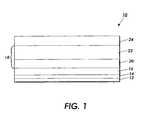
- FIG. 1illustrates an organic light emitting device (OLED) with a thick (100 to 250 nanometers) porphyrin buffer layer in accordance with a first embodiment of the present invention.
- OLEDorganic light emitting device
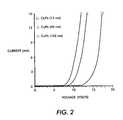
- FIG. 2is a graph of voltage versus current for OLEDs with varying thicknesses of the porphyrin buffer layer.
- FIG. 3is a graph of operational stability of OLEDs with varying thicknesses of the porphyrin buffer layer.
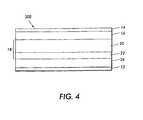
- FIG. 4illustrates an organic light emitting device (OLED) with a thick (100 to 250 nanometers) porphyrin buffer layer in accordance with a second embodiment of the present invention.
- OLEDorganic light emitting device
- FIG. 1wherein there is illustrated an organic light emitting device (OLED) 10 with a thick (100 to 250 nanometers) porphyrin buffer layer between the anode and the luminescent region in accordance with this invention.
- OLEDorganic light emitting device
- the OLED 10has a transparent or substantially transparent substrate 12 , such as glass or MYLAR®.
- a luminescent region 18 of an organic electroluminescent materialis formed on the buffer layer 16 .
- the luminescent region 18has a naphthyl-substituted benzidine derivative, N,N′-di-1-naphthyl-N,N′-diphenyl-1,1′-biphenyl-1,1′-biphenyl-4,4′-diamine (NPB) hole transport layer 20 having a thickness of 72 nm formed on the buffer layer 16 and a tris(8-hydroxyquinolinate) aluminum (AlQ 3 ) emitting electron transport layer 22 having a thickness of 75 nm formed on the hole transport layer 20 .
- a Mg:Ag (90 percent volume Mg and 10 percent volume Ag) cathode 24having a thickness of 120 nm is formed on the electron transport layer 22 of the luminescent region 18 .
- An external power source(not shown in the Figure) will forward bias the anode 14 in relation to the cathode 24 .
- Holeswill be injected from the anode 14 through the buffer layer 16 , through the hole transport layer 20 of the luminescent region 18 and into the electron transport layer 22 of the luminescent region 18 .
- Concurrently electronswill be injected from the cathode 24 into the electron transport layer 22 of the luminescent region 18 .
- the holes and the electronswill combine and emit light.
- the lightwill be emitted from the luminescent region 18 through the transparent buffer layer 16 , the transparent anode 14 and the transparent substrate 12 .
- Alternate OLED designsallow the light to be emitted from the edge of the luminescent region 18 or through a transparent cathode 24 .
- the use of a thicker (100 to 250 nm) porphyrin buffer layer in an OLEDunexpectedly results in a small increase in OLED operating voltage of only one to two Volts over that of an OLED without the porphyrin buffer layer.
- the use of a thinner (less than 100 nm) porphyrin buffer layer in an OLEDresults in an increase of three to four Volts over that of an OLED without the porphyrin buffer layer.
- the current-voltage characteristics of a group of OLEDs which all contain a CuPc porphyrin buffer layer at the hole injection anodeare given in FIG. 2 .
- the CuPc porphyrin buffer layerhas a different thickness in each OLED, but, otherwise, the OLEDs have essentially identical structures: ITO anode 14 /CuPc buffer layer 16 /NPB hole transport layer 20 /AlQ3 emitter and electron transport layer 22 /Mg:Ag cathode 24 of OLED 10 in FIG. 1 .
- the current-voltage characteristics of the OLEDshifts to lower voltages on increasing the thickness of the CuPc porphyrin buffer layer, which translates into a lower operating voltage for the OLED.
- a voltage of about 13.8 voltsis needed, whereas a voltage of only about 8.8 volts is needed to drive the same current in the OLED containing the 150 nm thick CuPc porphyrin buffer layer.
- a lower OLED operating voltageis more desirable for lower energy consumption.
- the shift in the current-voltage characteristics to lower voltage valuesindicates increased charge transport in thicker CuPc porphyrin buffer layers over that in thinner CuPc porphyrin buffer layers.
- the ability of the CuPc porphyrin buffer layer to attain a different morphology on increasing the thickness of the buffer layermay lead to the improved charge conduction through the OLED.
- Comparative operational stability tests on OLEDs with thin (15 nm) and thick (150 nm) thick CuPc porphyrin buffer layers, operated under the same accelerated testing conditions (AC driving, 31.25 mA/cm 2 )are shown in FIG. 3 .
- the resultsare presented in the form of normalized luminance (luminance (L)/initial luminance (Lo) versus duration (time) of OLED operation.
- the rate of luminance decayis essentially the same in both OLEDs with thick (150 nm) and thin (15 nm) porphyrin buffer layers, revealing that both OLEDs demonstrate the same operational stability behavior.
- the use of thick CuPc porphyrin buffer layersreduces the possibility of OLED shorting.
- the ability of the CuPC porphyrin buffer layer to conform to substrate topographyprovides a smoother and more planarized surface that prevents, or at least substantially reduces pinhole formation.
- the thick CuPc porphyrin buffer layerimproves color purity due to its significant optical absorption in the red range during light transmission through the porphyrin buffer layer.
- FIG. 4wherein there is illustrated an organic light emitting device (OLED) 100 with a thick (100 to 250 nanometers) porphyrin buffer layer between the anode and the luminescent region in accordance with a second embodiment of this invention.
- OLEDorganic light emitting device
- the OLED 100has a substrate 12 , such as glass or MYLAR®.
- a Mg:Ag (90 percent volume Mg and 10 percent volume Ag) cathode 24 having a thickness of 120 nmis formed on the substrate 12 .
- a luminescent region 18 of an organic electroluminescent materialis formed on the cathode 24 .
- the luminescent region 18has a tris(8-hydroxyquinolinate) aluminum (AlQ 3 ) emitting electron transport layer 22 having a thickness of 75 nm formed on the cathode 24 and anaphtyl-substituted benzidine derivative, N,N′-di-1-naphthyl-N,N′-diphenyl-1,1′-biphenyl-1,1′-biphenyl-4,4′-diamine (NPB) hole transport layer 20 having a thickness of 72 nm formed on the electron transport layer 22 .
- NPBtris(8-hydroxyquinolinate) aluminum
- a porphyrin buffer layer 16 of copper phthalocyanine (CuPc) having a thickness of between 100 and 250 nanometersis formed on the hole transport layer 20 of the luminescent region 18 .
- An indium tin oxide (ITO) anode 14 having a thickness of 30 nmis formed on the buffer layer 16 .
- An external power source(not shown in the Figure) will forward bias the anode 14 in relation to the cathode 24 .
- Holeswill be injected from the anode 14 through the buffer layer 16 , through the hole transport layer 20 of the luminescent region 18 and into the electron transport layer 22 of the luminescent region 18 .
- Concurrently electronswill be injected from the cathode 24 into the electron transport layer 22 of the luminescent region 18 .
- the holes and the electronswill combine and emit light.
- the lightwill be emitted from the luminescent region 18 either through a transparent cathode 24 and a transparent substrate 12 or through a transparent buffer layer and a transparent anode 14 or from the edge of the luminescent region 18 .
- a porphyrin for the buffer layeris any compound, natural or synthetic, which is derived from or includes a porphyrin structure, including porphine itself.
- Highly preferred examples of useful porphyrin compoundsare metal free phthalocyanines and metal containing phthalocyanines. While porphyrin compounds in general and the phthalocyanines in particular can contain any metal, the metal preferably has a positive valence of two or higher.
- Exemplary preferred metalsare cobalt, magnesium, zinc, palladium, nickel, and, particularly, copper, lead, and platinum.
- Illustrative of useful porphyrin compoundsare the following: porphine; 1,10,15,20-tetraphenyl-21h,23h-porphine copper (ii); 1,10,15,20-tetraphenyl-21h,23h-porphine zinc (ii); 5,10,15,20-tetrakis(pentafluorophenyl)-21h,23h-porphine; silicon phthalocyanine oxide; aluminum phthalocyanine chloride; phthalocyanine (metal free); dilithium phthalocyanine; copper tetramethylphthalocyanine; chromium phthalocyanine fluoride; zinc phthalocyanine; lead phthalocyanine; titanium phthalocyanine oxide; magnesium phthalocyanine; or copper octamethylphthalocyanine.
- the substrate 12can comprise various suitable materials including, for example, polymeric components, glass, quartz and the like. Suitable polymeric components include, but are not limited to polyesters such as MYLAR®, polycarbonates, polyacrylates, polymethacrylates, polysulfones, and the like. Mixtures of these various materials can also be used. Other substrate materials can also be selected provided, for example, that the materials can effectively support the other layers, and do not interfere with the device functional performance.
- the substrateis formed of a light transmission material.
- the thickness of the substrate 12is not particularly limited except by the structural demands of the organic light emitting device and its intended use. Suitable thicknesses include, for example, from about 25 ⁇ m to at least about 1,000 ⁇ m.
- the anode 14can comprise suitable positive charge injecting electrodes such as indium tin oxide (ITO), tin oxide, gold and platinum.
- ITOindium tin oxide
- suitable materials for forming the anodeinclude, but are not limited to, electrically conductive carbon, ⁇ -conjugated polymers such as polyaniline, polythiophene, polypyrrole, and the like having, for example, a work function equal to, or greater than, about 4 eV, and preferably from about 4 eV to about 6 eV.
- the anode 14can have any suitable form.
- a thin conductive layercan be coated onto a tight transmissive substrate, such as, for example, a transparent or substantially transparent glass plate or plastic film.
- Embodiments of organic light emitting devicescan comprise a light transmissive anode formed from tin oxide or indium tin oxide coated on glass.
- very thin light-transparent metallic anodeshaving a thickness, for example, of less than about 200 ⁇ , and, preferably, from about 75 ⁇ to about 150 ⁇ can be used.
- These thin anodescan comprise metals such as gold, palladium and the like.
- transparent or semi-transparent thin layers of conductive carbon or conjugated polymerssuch as polyaniline, polythiophene, polypyrrole and the like can be used to form anodes.
- These thin layerscan have a thickness of, for example from 50 ⁇ to about 175 ⁇ .
- the thickness of the anode 14can range from about 1 nm to about 5000 nm.
- the preferred thickness range of the anodeis dependent on the optical constants of the anode material.
- One preferred thickness range of the anodeis from about 30 nm to about 300 nm. Although less preferred, thicknesses outside of this range can also be used.
- the luminescent region 18 of the light emitting device 10comprises at least one layer of electroluminescent organic material.
- Suitable organic electroluminescent materialsinclude, for example, polyphenylenevinylenes, such as poly(p-phenylenevinylene) PPV, poly(2-methoxy-5-(2-ethylhexyloxy) 1,4-phenylenevinylene) MEHPPV and poly(2,5-dialkoxyphenylenevinylene) PDMeOPV, and other materials disclosed in U.S. Pat. No.
- polyphenylenessuch as poly(p-phenylene) PPP, ladder-poly-para-phenylene (LPPP), and poly(tetrahydropyrene) PTHP
- polyfluorenessuch as poly(9,9-di-n-octylfluorene-2,7-diyl), poly(2,8-(6,7,12,12-tetraalkylindenofluorene) and copolymers containing fluorenes such as fluorene-amine copolymers.
- organic electroluminescent materialsthat can be utilized in the luminescent region 18 includes, but is not limited to, the metal oxinoid compounds.
- Illustrative examplesinclude tris(8-hydroxyquinolinate) aluminum (AlQ3), which is one preferred example, and bis(8-hydroxyquinolato)-(4-phenylphenolato) aluminum (BAlq) which is another preferred example.
- this class of materialsinclude tris(8-hydroxyquinolinate) gallium, bis(8-hydroxyquinolinate) magnesium, bis(8-hydroxyquinolinate) zinc, tris(5-methyl-8-hydroxyquinolinate) aluminum, tris(7-propyl-8-quinolinolato) aluminum, bis[benzo ⁇ f ⁇ -8-quinolinate]zinc, bis(10-hydroxybenzo[h]quinolinate) beryllium, and the like, and metal thioxinoid compounds, such as metal thioxinoid compounds of bis(8-quinolinethiolato)zinc, bis(8-quinolinethiolato)cadmium, tris(8-quinolinethiolato)gallium, tris(8-quinolinethiolato)indium, bis(5-methylquinolinethiolato)zinc, tris(5-methylquinolinethiolato)gallium, tris(5-methylquinolinethiolato)indium, bis(5-methylquinolinethiolato)cadmium, bis(3-
- Preferred materialsare bis(8-quinolinethiolato)zinc, bis(8-quinolinethiolato)cadmium, tris(8-quinolinethiolato)gallium, tris(8-quinolinethiolato)indium and bis[benzo ⁇ f ⁇ -8-quinolinethiolato]zinc.
- Yet another class of organic electroluminescent materials that can be used in the luminescent region 18comprises stilbene derivatives.
- a preferred stilbene derivativeis 4,4′-bis(2,2-diphenylvinyl)biphenyl.
- oxadiazole metal chelatesAnother class of suitable organic electroluminescent materials suitable for utilizing in the luminescent region 18 is the oxadiazole metal chelates. These materials include bis[2-(2-hydroxyphenyl)-5-phenyl-1,3,4-oxadiazolato]zinc; bis[2-(2-hydroxyphenyl)-5-phenyl-1,3,4-oxadiazolato]beryllium; bis[2-(2-hydroxyphenyl)-5-(1-naphthyl)-1,3,4-oxadiazolato]zinc; bis[2-(2-hydroxyphenyl)-5-(1-naphthyl)-1,3,4-oxadiazolato]beryllium; bis[5-biphenyl-2-(2-hydroxyphenyl)-1,3,4-oxadiazolato]zinc; bis[5-biphenyl-2-(2-hydroxyphenyl)-1,3,4-oxadiazolato]beryllium
- the luminescent region 18can further include from about 0.01 weight percent to about 25 weight percent of a luminescent material as a dopant.
- dopant materialsthat can be utilized in the luminescent region 18 are fluorescent materials, such as, for example, coumarin, dicyanomethylene pyranes, polymethine, oxabenzanthrane, xanthene, pyrylium, carbostyl, perylene, and the like.
- Another preferred class of fluorescent materialsare quinacridone dyes.
- quinacridone dyesinclude quinacridone, 2-methylquinacridone, 2,9-dimethylquinacridone, 2-chloroquinacridone, 2-fluoroquinacridone, 1,2-benzoquinacridone, N,N′-dimethylquinacridone, N,N′-dimethyl-2-methylquinacridone, N,N′-dimethyl-2,9-dimethylquinacridone, N,N′-dimethyl-2-chloroquinacridone, N,N′-dimethyl-2-fluoroquinacridone, N,N′-dimethyl-1,2-benzoquinacridone, and the like.
- Another class of fluorescent materials that may be usedis fused ring fluorescent dyes.
- fused ring fluorescent dyesinclude perylene, rubrene, anthracene, coronene, phenanthrecene, pyrene and the like.
- fluorescent materialsinclude butadienes, such as 1,4-diphenylbutadiene and tetraphenylbutadiene, and stilbenes, and the like.
- luminescent dopantsthat can be utilized in the light luminescent region 18 are the fluorescent dyes, such as, for example, 4-(dicyanomethylene)-2-I-propyl-6-(1,1,7,7-tetramethyljulolidyl-9-enyl)-4H-pyran (DCJTB); the lanthanide metal chelate complexes, such as for example, tris(acetylacetonato)(phenanthroline) terbium, tris(acetyl acetonato)(phenanthroline) europium, and tris(thenoyl trisfluoroacetonato)(phenanthroline) europium; and phosphorescent materials, such as, for example, organometallic compounds containing heavy metal atoms that lead to strong spin-orbit coupling.
- fluorescent dyessuch as, for example, 4-(dicyanomethylene)-2-I-propyl-6-(1,1,7,7-tetramethyljulolid
- Preferred examplesinclude 2,3,7,8,12,13,17,18-octaethyl-21H23H-phorpine platinum(II) (PtOEP) and fac tris(2-phenylpyridine)iridium (Ir(ppy) 3 ).
- the luminescent region 18can have two layers; a hole transport layer 20 and an electron transport layer 22 .
- the luminescent region 18can also include one or more materials with hole-transporting properties.
- hole-transporting materialsthat can be utilized in the hole transport layer 20 of the luminescent region 18 include polypyrrole, polyaniline, poly(phenylene vinylene), polythiophene, polyarylamine, and their derivatives, and known semiconductive organic materials; porphyrin derivatives such as 1,10,15,20-tetraphenyl-21H,23H-porphyrin copper (II); copper phthalocyanine, copper tetramethyl phthalocyanine; zinc phthalocyanine; titanium oxide phthalocyanine; magnesium phthalocyanine; and the like.
- a specific class of hole transporting materials that can be utilized in the hole transport layer 20 of the luminescent region 18are the aromatic tertiary amines.
- Suitable exemplary aromatic tertiary aminesinclude, but are not limited to, bis(4-dimethylamino-2-methylphenyl)phenylmethane, N,N,N-tri(p-tolyl)amine, 1,1-bis(4-di-p-tolylaminophenyl)cyclohexane, 1,1-bis(4-di-p-tolylaminophenyl)-4-phenyl cyclohexane, N,N′-diphenyl-N,N′-bis(3-methylphenyl)-1,1′-biphenyl-4,4′-diamine, N,N′-diphenyl-N,N′-bis(3-methylphenyl)-1,1′-biphenyl-4,4′-diamine, N,N′-dip
- polynuclear aromatic aminesare polynuclear aromatic amines.
- polynuclear aromatic aminesinclude, but are not limited to, N,N-bis-[4′-(N-phenyl-N-m-tolylamino)-4-biphenylyl]aniline; N,N-bis-[4′-(N-phenyl-N-m-tolylamino)-4-biphenylyl]-m-toluidine; N,N-bis-[4′-(N-phenyl-N-p-tolylamino)-4-biphenylyl]-p-toluidine; N,N-bis-[4′-(N-phenyl-N-p-tolylamino)-4-biphenylyl]aniline; N,N-bis-[4′-(N-phenyl-N-p-tolylamino)-4-biphenylyl]-m-toluidine; N,N-bis
- a specific class of the hole transporting materials that can be used in the hole transport layer 20 of the luminescent region 18are the indolo-carabazoles, such as, for example, 5,11-di-naphthyl-5,11-dihydroindolo[3,2-b]carbazole, and 2,8-dimethyl-5,11-dinaphthyl-5,11-dihydroindolo[3,2-b]carbazole; N,N,N′N′-tetraarylbenzidines, wherein aryl may be selected from phenyl, m-tolyl, p-tolyl, m-methoxyphenyl, p-methoxyphenyl, 1-naphthyl, 2-naphthyl and the like.
- N,N,N′N′-tetraarylbenzidineare N,N;-di-1-naphthyl-N,N′-diphenyl-1,1′-biphenyl-4,4′-diamine, which is more preferred; N,N′-bis(3-methylphenyl)-N,N′-diphenyl-1,1′-biphenyl-4,4′-diamine; N,N′-bis(3-methoxyphenyl)-N,N′-diphenyl-1,1′-biphenyl-4,4′-diamine, and the like.
- Preferred hole transporting materials that can be used in the hole transport layer 20 of the luminescent region 16are the naphtyl-substituted benzidine derivatives.
- the luminescent region 18can also include one or more materials with electron transporting properties.
- An example of electron transporting materials that can be utilized in the electron transport layer 22 of the luminescent region 18is polyfluorenes, such as poly(9,9-di-n-octylfluorene-2,7-diyl), poly(2,8-(6,7,12,12-tetraalkylindenofluorene) and copolymers containing fluorenes such as fluorene-amine copolymers.
- electron transporting materialsthat can be utilized in the electron transport layer 22 of the luminescent region 18 can be selected from the metal oxinoid compounds, the oxadiazole metal chelate compounds, the triazine compounds and the stilbene compounds, examples of which have been described above in detail.
- the luminescent region 18includes one or more hole transport material and/or one or more electron transport material in addition to the organic electroluminescent material(s), the organic electroluminescent material, the hole transport material(s), and/or the electron transport material(s) can be formed in separate regions; or in the same region thus forming mixed regions of two or more materials.
- the thickness of the luminescent region 18can vary from for example, about 1 nm to about 1000 nm, typically from about 20 nm to about 200 nm, and preferably from about 50 nm to about 150 nm.
- the cathode 24can comprise any suitable metal, including high work function components, having a work function, for example, from about 4.0 eV to about 6.0 eV, or low work function components, such as metals with, for example, a work function of from about 2.5 eV to about 4.0 eV.
- the cathodecan comprise a combination of a low work function (less than about 4 eV) metal and at least one other metal. Effective proportions of the low work function metal to the second or other metal are from less than about 0. 1 weight percent to about 99.9 weight percent.
- low work function metalsinclude, but are not limited to, alkaline metals such as lithium or sodium; Group 2A or alkaline earth metals such as beryllium, magnesium, calcium or barium; and Group III metals including rare earth metals and the actinide group metals such as scandium, yttrium, lanthanum, cerium, europium, terbium or actinium. Lithium, magnesium and calcium are preferred low work function metals.
- the Mg-Ag alloy cathodesare preferred cathode materials for forming the cathode 24 .
- Other preferred cathodesare formed from lithium alloys with other high work function metals such as aluminum and indium.
- the cathode 24can also include an electron injection layer in contact with the electron transport layer 22 made of an insulative material such as an oxide material or an alkaline metal compound.
- the thickness of the cathode 24can range from, for example, about 10 nm to about 500 nm. Of course, thicknesses outside of this range can also be used.
- Electroluminescent devices including buffer layers according to this inventioncan be used in various types of image forming devices or display applications, such as, for example, flat panel displays. Such applications can be used in a wide range of products, such as, for example, displays for televisions and computers, instrument displays, displays for automotive and aviation applications, and hand-held electronic devices, such as, for example, cellular phones, etc.
Landscapes
- Physics & Mathematics (AREA)
- Optics & Photonics (AREA)
- Electroluminescent Light Sources (AREA)
Abstract
Description
Claims (14)
Priority Applications (1)
| Application Number | Priority Date | Filing Date | Title |
|---|---|---|---|
| US10/208,595US6811896B2 (en) | 2002-07-29 | 2002-07-29 | Organic light emitting device (OLED) with thick (100 to 250 nanometers) porphyrin buffer layer |
Applications Claiming Priority (1)
| Application Number | Priority Date | Filing Date | Title |
|---|---|---|---|
| US10/208,595US6811896B2 (en) | 2002-07-29 | 2002-07-29 | Organic light emitting device (OLED) with thick (100 to 250 nanometers) porphyrin buffer layer |
Publications (2)
| Publication Number | Publication Date |
|---|---|
| US20040018381A1 US20040018381A1 (en) | 2004-01-29 |
| US6811896B2true US6811896B2 (en) | 2004-11-02 |
Family
ID=30770575
Family Applications (1)
| Application Number | Title | Priority Date | Filing Date |
|---|---|---|---|
| US10/208,595Expired - LifetimeUS6811896B2 (en) | 2002-07-29 | 2002-07-29 | Organic light emitting device (OLED) with thick (100 to 250 nanometers) porphyrin buffer layer |
Country Status (1)
| Country | Link |
|---|---|
| US (1) | US6811896B2 (en) |
Cited By (24)
| Publication number | Priority date | Publication date | Assignee | Title |
|---|---|---|---|---|
| US20040174321A1 (en)* | 2003-02-17 | 2004-09-09 | Seiko Epson Corporation | Electro-optic device, method for manufacturing the same, and electronic apparatus |
| US20060125733A1 (en)* | 2002-10-28 | 2006-06-15 | Jean-Paul Dagois | Image display device with capacitive energy recovery |
| US7132163B1 (en)* | 2004-12-01 | 2006-11-07 | Shelnutt John A | Heteroporphyrin nanotubes and composites |
| US20070194705A1 (en)* | 2006-02-17 | 2007-08-23 | Samsung Electronics Co., Ltd. | Display device and manufacturing method thereof |
| US20080311307A1 (en)* | 2007-06-14 | 2008-12-18 | Massachusetts Institute Of Technology | Method and apparatus for depositing films |
| US20090140635A1 (en)* | 2005-04-15 | 2009-06-04 | Seiko Epson Corporation | Porous semiconductor layer formation material |
| US20090267891A1 (en)* | 2008-04-25 | 2009-10-29 | Bamidele Ali | Virtual paper |
| US20100188457A1 (en)* | 2009-01-05 | 2010-07-29 | Madigan Connor F | Method and apparatus for controlling the temperature of an electrically-heated discharge nozzle |
| US8383202B2 (en) | 2008-06-13 | 2013-02-26 | Kateeva, Inc. | Method and apparatus for load-locked printing |
| US8556389B2 (en) | 2011-02-04 | 2013-10-15 | Kateeva, Inc. | Low-profile MEMS thermal printhead die having backside electrical connections |
| US8632145B2 (en) | 2008-06-13 | 2014-01-21 | Kateeva, Inc. | Method and apparatus for printing using a facetted drum |
| US8808799B2 (en) | 2009-05-01 | 2014-08-19 | Kateeva, Inc. | Method and apparatus for organic vapor printing |
| US8899171B2 (en) | 2008-06-13 | 2014-12-02 | Kateeva, Inc. | Gas enclosure assembly and system |
| US8986780B2 (en) | 2004-11-19 | 2015-03-24 | Massachusetts Institute Of Technology | Method and apparatus for depositing LED organic film |
| US9005365B2 (en) | 2004-11-19 | 2015-04-14 | Massachusetts Institute Of Technology | Method and apparatus for depositing LED organic film |
| US9048344B2 (en) | 2008-06-13 | 2015-06-02 | Kateeva, Inc. | Gas enclosure assembly and system |
| US9604245B2 (en) | 2008-06-13 | 2017-03-28 | Kateeva, Inc. | Gas enclosure systems and methods utilizing an auxiliary enclosure |
| US11107712B2 (en) | 2013-12-26 | 2021-08-31 | Kateeva, Inc. | Techniques for thermal treatment of electronic devices |
| US11338319B2 (en) | 2014-04-30 | 2022-05-24 | Kateeva, Inc. | Gas cushion apparatus and techniques for substrate coating |
| US11489119B2 (en) | 2014-01-21 | 2022-11-01 | Kateeva, Inc. | Apparatus and techniques for electronic device encapsulation |
| US11633968B2 (en) | 2008-06-13 | 2023-04-25 | Kateeva, Inc. | Low-particle gas enclosure systems and methods |
| US11975546B2 (en) | 2008-06-13 | 2024-05-07 | Kateeva, Inc. | Gas enclosure assembly and system |
| US12018857B2 (en) | 2008-06-13 | 2024-06-25 | Kateeva, Inc. | Gas enclosure assembly and system |
| US12064979B2 (en) | 2008-06-13 | 2024-08-20 | Kateeva, Inc. | Low-particle gas enclosure systems and methods |
Families Citing this family (4)
| Publication number | Priority date | Publication date | Assignee | Title |
|---|---|---|---|---|
| KR100711161B1 (en)* | 2002-09-12 | 2007-04-24 | 도시바 마쯔시따 디스플레이 테크놀로지 컴퍼니, 리미티드 | Organic el display |
| GB0424294D0 (en)* | 2004-11-03 | 2004-12-01 | Elam T Ltd | Buffer layer |
| KR100712214B1 (en)* | 2005-07-14 | 2007-04-27 | 삼성에스디아이 주식회사 | OLED display device |
| KR101487729B1 (en)* | 2013-07-03 | 2015-01-29 | 코닝정밀소재 주식회사 | Substrate for optoelectronics and optoelectronics including the same |
Citations (6)
| Publication number | Priority date | Publication date | Assignee | Title |
|---|---|---|---|---|
| US4356429A (en) | 1980-07-17 | 1982-10-26 | Eastman Kodak Company | Organic electroluminescent cell |
| US4720432A (en) | 1987-02-11 | 1988-01-19 | Eastman Kodak Company | Electroluminescent device with organic luminescent medium |
| US4769292A (en) | 1987-03-02 | 1988-09-06 | Eastman Kodak Company | Electroluminescent device with modified thin film luminescent zone |
| US6069442A (en)* | 1997-09-18 | 2000-05-30 | Eastman Kodak Company | Organic electroluminescent device with inorganic electron transporting layer |
| US20020145380A1 (en)* | 2001-01-26 | 2002-10-10 | Xerox Corporation | Electroluminescent devices |
| US6562982B1 (en)* | 2002-07-25 | 2003-05-13 | Xerox Corporation | Carbazole compounds |
- 2002
- 2002-07-29USUS10/208,595patent/US6811896B2/ennot_activeExpired - Lifetime
Patent Citations (6)
| Publication number | Priority date | Publication date | Assignee | Title |
|---|---|---|---|---|
| US4356429A (en) | 1980-07-17 | 1982-10-26 | Eastman Kodak Company | Organic electroluminescent cell |
| US4720432A (en) | 1987-02-11 | 1988-01-19 | Eastman Kodak Company | Electroluminescent device with organic luminescent medium |
| US4769292A (en) | 1987-03-02 | 1988-09-06 | Eastman Kodak Company | Electroluminescent device with modified thin film luminescent zone |
| US6069442A (en)* | 1997-09-18 | 2000-05-30 | Eastman Kodak Company | Organic electroluminescent device with inorganic electron transporting layer |
| US20020145380A1 (en)* | 2001-01-26 | 2002-10-10 | Xerox Corporation | Electroluminescent devices |
| US6562982B1 (en)* | 2002-07-25 | 2003-05-13 | Xerox Corporation | Carbazole compounds |
Non-Patent Citations (1)
| Title |
|---|
| Hung et al., "Sputter deposition of cathodes in organic light emitting diodes", Journal of Applied Physics, vol. 86, No. 8, pp. 4607-4612.* |
Cited By (44)
| Publication number | Priority date | Publication date | Assignee | Title |
|---|---|---|---|---|
| US20060125733A1 (en)* | 2002-10-28 | 2006-06-15 | Jean-Paul Dagois | Image display device with capacitive energy recovery |
| US7965262B2 (en)* | 2002-10-28 | 2011-06-21 | Thomson Licensing | Display device with capacitive energy recovery |
| US7116461B2 (en)* | 2003-02-17 | 2006-10-03 | Seiko Epson Corporation | Electro-optic device, method for manufacturing the same, and electronic apparatus |
| US20040174321A1 (en)* | 2003-02-17 | 2004-09-09 | Seiko Epson Corporation | Electro-optic device, method for manufacturing the same, and electronic apparatus |
| US9005365B2 (en) | 2004-11-19 | 2015-04-14 | Massachusetts Institute Of Technology | Method and apparatus for depositing LED organic film |
| US8986780B2 (en) | 2004-11-19 | 2015-03-24 | Massachusetts Institute Of Technology | Method and apparatus for depositing LED organic film |
| US8962073B2 (en) | 2004-11-19 | 2015-02-24 | Massachusetts Institute Of Technology | Method and apparatus for controlling film deposition |
| US7132163B1 (en)* | 2004-12-01 | 2006-11-07 | Shelnutt John A | Heteroporphyrin nanotubes and composites |
| US7223474B1 (en)* | 2004-12-01 | 2007-05-29 | Sandia Corporation | Heteroporphyrin nanotubes and composites |
| US7910226B2 (en)* | 2005-04-15 | 2011-03-22 | Seiko Epson Corporation | Porous semiconductor layer formation material |
| US20090140635A1 (en)* | 2005-04-15 | 2009-06-04 | Seiko Epson Corporation | Porous semiconductor layer formation material |
| US9385322B2 (en) | 2005-11-21 | 2016-07-05 | Massachusetts Institute Of Technology | Method and apparatus for depositing LED organic film |
| US20070194705A1 (en)* | 2006-02-17 | 2007-08-23 | Samsung Electronics Co., Ltd. | Display device and manufacturing method thereof |
| US7564060B2 (en) | 2006-02-17 | 2009-07-21 | Samsung Electronics Co., Ltd. | Display device preventing short of driving voltage lines |
| US9023670B2 (en) | 2007-06-14 | 2015-05-05 | Kateeva, Inc. | Modular printhead for OLED printing |
| US20080311307A1 (en)* | 2007-06-14 | 2008-12-18 | Massachusetts Institute Of Technology | Method and apparatus for depositing films |
| US20090267891A1 (en)* | 2008-04-25 | 2009-10-29 | Bamidele Ali | Virtual paper |
| US8802186B2 (en) | 2008-06-13 | 2014-08-12 | Kateeva, Inc. | Method and apparatus for load-locked printing |
| US9048344B2 (en) | 2008-06-13 | 2015-06-02 | Kateeva, Inc. | Gas enclosure assembly and system |
| US8802195B2 (en) | 2008-06-13 | 2014-08-12 | Kateeva, Inc. | Method and apparatus for load-locked printing |
| US12344014B2 (en) | 2008-06-13 | 2025-07-01 | Kateeva, Inc. | Gas enclosure assembly and system |
| US8807071B2 (en) | 2008-06-13 | 2014-08-19 | Kateeva, Inc. | Method and apparatus for load-locked printing |
| US12064979B2 (en) | 2008-06-13 | 2024-08-20 | Kateeva, Inc. | Low-particle gas enclosure systems and methods |
| US12018857B2 (en) | 2008-06-13 | 2024-06-25 | Kateeva, Inc. | Gas enclosure assembly and system |
| US8875648B2 (en) | 2008-06-13 | 2014-11-04 | Kateeva, Inc. | Method and apparatus for load-locked printing |
| US8899171B2 (en) | 2008-06-13 | 2014-12-02 | Kateeva, Inc. | Gas enclosure assembly and system |
| US8632145B2 (en) | 2008-06-13 | 2014-01-21 | Kateeva, Inc. | Method and apparatus for printing using a facetted drum |
| US8596747B2 (en) | 2008-06-13 | 2013-12-03 | Kateeva, Inc. | Modular printhead for OLED printing |
| US11975546B2 (en) | 2008-06-13 | 2024-05-07 | Kateeva, Inc. | Gas enclosure assembly and system |
| US8383202B2 (en) | 2008-06-13 | 2013-02-26 | Kateeva, Inc. | Method and apparatus for load-locked printing |
| US8720366B2 (en) | 2008-06-13 | 2014-05-13 | Kateeva, Inc. | Method and apparatus for load-locked printing |
| US9174433B2 (en) | 2008-06-13 | 2015-11-03 | Kateeva, Inc. | Method and apparatus for load-locked printing |
| US9248643B2 (en) | 2008-06-13 | 2016-02-02 | Kateeva, Inc. | Method and apparatus for load-locked printing |
| US11633968B2 (en) | 2008-06-13 | 2023-04-25 | Kateeva, Inc. | Low-particle gas enclosure systems and methods |
| US9604245B2 (en) | 2008-06-13 | 2017-03-28 | Kateeva, Inc. | Gas enclosure systems and methods utilizing an auxiliary enclosure |
| US8235487B2 (en) | 2009-01-05 | 2012-08-07 | Kateeva, Inc. | Rapid ink-charging of a dry ink discharge nozzle |
| US20100188457A1 (en)* | 2009-01-05 | 2010-07-29 | Madigan Connor F | Method and apparatus for controlling the temperature of an electrically-heated discharge nozzle |
| US8808799B2 (en) | 2009-05-01 | 2014-08-19 | Kateeva, Inc. | Method and apparatus for organic vapor printing |
| US8556389B2 (en) | 2011-02-04 | 2013-10-15 | Kateeva, Inc. | Low-profile MEMS thermal printhead die having backside electrical connections |
| US8815626B2 (en) | 2011-02-04 | 2014-08-26 | Kateeva, Inc. | Low-profile MEMS thermal printhead die having backside electrical connections |
| US11107712B2 (en) | 2013-12-26 | 2021-08-31 | Kateeva, Inc. | Techniques for thermal treatment of electronic devices |
| US12040203B2 (en) | 2013-12-26 | 2024-07-16 | Kateeva, Inc. | Techniques for thermal treatment of electronic devices |
| US11489119B2 (en) | 2014-01-21 | 2022-11-01 | Kateeva, Inc. | Apparatus and techniques for electronic device encapsulation |
| US11338319B2 (en) | 2014-04-30 | 2022-05-24 | Kateeva, Inc. | Gas cushion apparatus and techniques for substrate coating |
Also Published As
| Publication number | Publication date |
|---|---|
| US20040018381A1 (en) | 2004-01-29 |
Similar Documents
| Publication | Publication Date | Title |
|---|---|---|
| US6811896B2 (en) | Organic light emitting device (OLED) with thick (100 to 250 nanometers) porphyrin buffer layer | |
| US6765348B2 (en) | Electroluminescent devices containing thermal protective layers | |
| US6392250B1 (en) | Organic light emitting devices having improved performance | |
| US6734625B2 (en) | Organic light emitting device (OLED) with multiple capping layers passivation region on an electrode | |
| US7449831B2 (en) | OLEDs having inorganic material containing anode capping layer | |
| US6743067B2 (en) | Annealed organic light emitting devices and methods of annealing organic light emitting devices | |
| US7977862B2 (en) | Organic light emitting devices | |
| US6759146B2 (en) | Organic devices | |
| US7750561B2 (en) | Stacked OLED structure | |
| US6740429B2 (en) | Organic light emitting devices | |
| US7449830B2 (en) | OLEDs having improved luminance stability | |
| US8487527B2 (en) | Organic light emitting devices | |
| US6753098B2 (en) | Organic light emitting devices | |
| US7645525B2 (en) | Organic light emitting devices | |
| KR100826441B1 (en) | Organic light emitting device |
Legal Events
| Date | Code | Title | Description |
|---|---|---|---|
| AS | Assignment | Owner name:XEROX CORPORATION, CONNECTICUT Free format text:ASSIGNMENT OF ASSIGNORS INTEREST;ASSIGNORS:AZIZ, HANY;POPOVIC, ZORAN D.;HU, NAN-XING;AND OTHERS;REEL/FRAME:013161/0885 Effective date:20020729 | |
| AS | Assignment | Owner name:JPMORGAN CHASE BANK, AS COLLATERAL AGENT, TEXAS Free format text:SECURITY AGREEMENT;ASSIGNOR:XEROX CORPORATION;REEL/FRAME:015134/0476 Effective date:20030625 Owner name:JPMORGAN CHASE BANK, AS COLLATERAL AGENT,TEXAS Free format text:SECURITY AGREEMENT;ASSIGNOR:XEROX CORPORATION;REEL/FRAME:015134/0476 Effective date:20030625 | |
| STCF | Information on status: patent grant | Free format text:PATENTED CASE | |
| AS | Assignment | Owner name:JP MORGAN CHASE BANK,TEXAS Free format text:SECURITY AGREEMENT;ASSIGNOR:XEROX CORPORATION;REEL/FRAME:016761/0158 Effective date:20030625 Owner name:JP MORGAN CHASE BANK, TEXAS Free format text:SECURITY AGREEMENT;ASSIGNOR:XEROX CORPORATION;REEL/FRAME:016761/0158 Effective date:20030625 | |
| AS | Assignment | Owner name:XEROX CORPORATION, CONNECTICUT Free format text:RELEASE OF LIEN IN PATENTS;ASSIGNOR:JPMORGAN CHASE BANK, N.A.;REEL/FRAME:016369/0825 Effective date:20050726 | |
| AS | Assignment | Owner name:LG.PHILIPS LCD CO., LTD.,KOREA, REPUBLIC OF Free format text:ASSIGNMENT OF ASSIGNORS INTEREST;ASSIGNOR:XEROX CORPORATION;REEL/FRAME:016914/0536 Effective date:20050630 Owner name:LG.PHILIPS LCD CO., LTD., KOREA, REPUBLIC OF Free format text:ASSIGNMENT OF ASSIGNORS INTEREST;ASSIGNOR:XEROX CORPORATION;REEL/FRAME:016914/0536 Effective date:20050630 | |
| FEPP | Fee payment procedure | Free format text:PAYOR NUMBER ASSIGNED (ORIGINAL EVENT CODE: ASPN); ENTITY STATUS OF PATENT OWNER: LARGE ENTITY | |
| FPAY | Fee payment | Year of fee payment:4 | |
| AS | Assignment | Owner name:LG DISPLAY CO., LTD., KOREA, REPUBLIC OF Free format text:CHANGE OF NAME;ASSIGNOR:LG.PHILIPS LCD CO., LTD.;REEL/FRAME:021952/0300 Effective date:20080304 Owner name:LG DISPLAY CO., LTD.,KOREA, REPUBLIC OF Free format text:CHANGE OF NAME;ASSIGNOR:LG.PHILIPS LCD CO., LTD.;REEL/FRAME:021952/0300 Effective date:20080304 | |
| FEPP | Fee payment procedure | Free format text:PAYOR NUMBER ASSIGNED (ORIGINAL EVENT CODE: ASPN); ENTITY STATUS OF PATENT OWNER: LARGE ENTITY Free format text:PAYER NUMBER DE-ASSIGNED (ORIGINAL EVENT CODE: RMPN); ENTITY STATUS OF PATENT OWNER: LARGE ENTITY | |
| FPAY | Fee payment | Year of fee payment:8 | |
| FPAY | Fee payment | Year of fee payment:12 | |
| AS | Assignment | Owner name:XEROX CORPORATION, CONNECTICUT Free format text:RELEASE BY SECURED PARTY;ASSIGNOR:JPMORGAN CHASE BANK, N.A. AS SUCCESSOR-IN-INTEREST ADMINISTRATIVE AGENT AND COLLATERAL AGENT TO BANK ONE, N.A.;REEL/FRAME:061360/0628 Effective date:20220822 | |
| AS | Assignment | Owner name:XEROX CORPORATION, CONNECTICUT Free format text:RELEASE BY SECURED PARTY;ASSIGNOR:JPMORGAN CHASE BANK, N.A. AS SUCCESSOR-IN-INTEREST ADMINISTRATIVE AGENT AND COLLATERAL AGENT TO JPMORGAN CHASE BANK;REEL/FRAME:066728/0193 Effective date:20220822 |