US6790140B1 - Game machine - Google Patents
Game machineDownload PDFInfo
- Publication number
- US6790140B1 US6790140B1US09/641,709US64170900AUS6790140B1US 6790140 B1US6790140 B1US 6790140B1US 64170900 AUS64170900 AUS 64170900AUS 6790140 B1US6790140 B1US 6790140B1
- Authority
- US
- United States
- Prior art keywords
- game
- notifying
- prize winning
- subsequent
- state
- Prior art date
- Legal status (The legal status is an assumption and is not a legal conclusion. Google has not performed a legal analysis and makes no representation as to the accuracy of the status listed.)
- Expired - Lifetime, expires
Links
- 238000000034methodMethods0.000description65
- 230000008569processEffects0.000description63
- 238000012545processingMethods0.000description42
- 238000003780insertionMethods0.000description19
- 230000037431insertionEffects0.000description19
- 238000005070samplingMethods0.000description13
- 238000012790confirmationMethods0.000description12
- 230000002093peripheral effectEffects0.000description6
- 235000021018plumsNutrition0.000description6
- 230000004044responseEffects0.000description6
- 230000009471actionEffects0.000description3
- 230000000149penetrating effectEffects0.000description3
- 230000006978adaptationEffects0.000description2
- 230000003466anti-cipated effectEffects0.000description2
- 230000000903blocking effectEffects0.000description2
- 238000012986modificationMethods0.000description2
- 230000004048modificationEffects0.000description2
- BYXHQQCXAJARLQ-ZLUOBGJFSA-NAla-Ala-AlaChemical compoundC[C@H](N)C(=O)N[C@@H](C)C(=O)N[C@@H](C)C(O)=OBYXHQQCXAJARLQ-ZLUOBGJFSA-N0.000description1
- BUZMZDDKFCSKOT-CIUDSAMLSA-NGlu-Glu-GluChemical compoundOC(=O)CC[C@H](N)C(=O)N[C@@H](CCC(O)=O)C(=O)N[C@@H](CCC(O)=O)C(O)=OBUZMZDDKFCSKOT-CIUDSAMLSA-N0.000description1
- 241000722921Tulipa gesnerianaSpecies0.000description1
- 230000001174ascending effectEffects0.000description1
- 230000008859changeEffects0.000description1
- 238000010276constructionMethods0.000description1
- 238000010586diagramMethods0.000description1
- 230000000694effectsEffects0.000description1
- 230000006870functionEffects0.000description1
- 230000007274generation of a signal involved in cell-cell signalingEffects0.000description1
- 235000012054mealsNutrition0.000description1
Images














Classifications
- G—PHYSICS
- G07—CHECKING-DEVICES
- G07F—COIN-FREED OR LIKE APPARATUS
- G07F17/00—Coin-freed apparatus for hiring articles; Coin-freed facilities or services
- G07F17/32—Coin-freed apparatus for hiring articles; Coin-freed facilities or services for games, toys, sports, or amusements
- G07F17/3225—Data transfer within a gaming system, e.g. data sent between gaming machines and users
- G07F17/3227—Configuring a gaming machine, e.g. downloading personal settings, selecting working parameters
- G—PHYSICS
- G07—CHECKING-DEVICES
- G07F—COIN-FREED OR LIKE APPARATUS
- G07F17/00—Coin-freed apparatus for hiring articles; Coin-freed facilities or services
- G07F17/32—Coin-freed apparatus for hiring articles; Coin-freed facilities or services for games, toys, sports, or amusements
Definitions
- the present inventionrelates to a game machine which can provide a game player with a thrilling and exciting fun in a game, and in particular to a game machine which comprises shift and display means for shifting and displaying various kinds of symbol marks, notifying means for notifying a game player various information and awarding means for awarding a winning prize to a game player when a predetermined set of symbol marks are stopped and displayed on a prize winning line.
- Such a known slot machinecomprises a front panel, and three rotation reels juxtaposed in the rear side of the front panel and rotatably supported on the body of the slot machine.
- Each of the rotation reelshas a peripheral surface having thereon various kinds of symbol marks arranged in a row at a predetermined interval.
- an internal lightwhich can light the symbol marks on the peripheral surface of the rotation reel from the rear side of the symbol marks to ensure that a game player can observe the symbol marks respectively through observation windows formed in the front panel.
- On the observation windows of the front panelis drawn five prize winning lines which make it possible for the game player to enjoy a game with thrilling and exciting feelings so that any predetermined set of the symbol marks will be stopped and displayed in line on any of the five prize winning lines or not.
- the game machineis started by the game player when he or she inserts a game medal into a medal inserting opening.
- the rotation reelsWith the operation of a start lever after the game medal inserting operation by the game player, the rotation reels concurrently start rotating so that the game player can observe through the observation windows the symbol marks rotating in the direction that the symbol marks are arranged in a row on the peripheral surfaces of the rotation reels.
- the rotation reels which are rotated to reach a predetermined speed levelmake effective the operation of stop buttons respectively provided to be operable for the rotation reels.
- the game playercan operate the stop buttons while observing the symbol marks to independently stop the rotation reels from rotating with the aim of stopping and displaying the desired set of symbol marks in line on any one of the prize winning lines of the observation windows.
- the predetermined sets of the symbol marks on the prize winning lines of the observation windows appearing at the time of the rotation reels' standstillresults in making it possible for the game player to get a prize winning based on the set of the lined-up symbol marks on the observation windows.
- the prize winning statesinclude a big prize winning, a medium prize winning, and a small prize winning.
- the big prize winning and the medium prize winningare won with three symbol marks of “7” or other predetermined symbol marks which are stopped from rotating in line by the game player on the prize winning lines of the observation windows.
- the big prize winningallows the game player to play a big bonus game (BB game), while the medium prize winning allowing the game player to play a regular bonus game (RB game).
- BB gamebig bonus game
- RB gameregular bonus game
- These big and medium prize winningsmean that the game player can have respective rights to play a special bonus game by which the game player can obtain a large number of coins.
- the small prize winningcan entitle the game player to get a few coins when the rotation reels are stopped by him or her with a predetermined number of symbol marks such as “plums” and “bells” being stopped from rotating in line on any of the prize winning lines of the observation windows.
- the aforementioned prize winning statesare determined based on a lottery operation using random numbers performed immediately after the start lever is operated by the game player. This means that the prize winning states are defined prior to the stop operation of the rotation reels by the game player.
- the lottery operation using random numbersis carried out by prize winning determining means which is assembled in the game machine.
- the rotation reelsare controlled to stop from rotating so that the game player can experience in reality a prize winning when the set of the corresponding symbol marks determined on the basis of the lottery operation using the random numbers displayed and stopped in line on any of the prize winning lines of the observation windows.
- the above mentioned lottery operation using random numberscan determine the big prize winning which in turn raises a prize winning flag, and a notification flag with a predetermined probability.
- the notification flag thus raisedserves to light an indication device such as a notification light provided in front of the front panel of the slot machine, thereby notifying the game player of winning the big prize winning through the lottery operation of the slot machine.
- the prize winning flag thus raisedwill remain in the subsequent game if the set of symbol marks corresponding to the big prize winning fail to be stopped and displayed on any of the prize winning lines in the current game.
- the notification lightcontinues to turn on until the set of the symbol marks corresponding to the big prize winning are stopped and displayed on any of the prize winning lines.
- the aforesaid conventional game machinefor instance, is operative to generate a big prize winning state by the lottery action with random numbers to raise a notification flag for notifying a game player of the big prize winning.
- the notification flagremains for the subsequent games only when that the result of the internal lottery operation is ensured to be notified to the game player. In other words, the notification flag will not remain for the subsequent games, if it is not ensured that the result is notified to the game player.
- the conventional game machinecannot associate the current notification with the subsequent notifications. This means that a subsequent notification is notified independent from the current notification, thereby causing the contents of the current notification to be interrupted when the subsequent notification starts. This results in the fact that the fun of the games fail to be provided, thus the game player feels bored.
- the aforesaid conventional machineis operated to notify the game player of the big prize inner winning generated by lottery action.
- the big prize winning itselfis rarely generated, and the thus generated big prize winning simply causes to light on an indication lamp, being unable to provide the fun of the games.
- the aforesaid conventional game machinedisplays a set of symbol marks called “li-zhi” (for notifying the game player that the big prize inner winning is generated by lottery action) with the rotation reels stopped from rotating so that the game player can aim at the target set of symbol marks.
- a set of symbol markscalled “li-zhi” (for notifying the game player that the big prize inner winning is generated by lottery action) with the rotation reels stopped from rotating so that the game player can aim at the target set of symbol marks.
- only skillful game playerscan read “li-zhi” state by careful observation of set of symbol marks displayed in the observation window while it is difficult for game players with no experience to read the “li-zhi” state.
- a game machinecomprising: shift and display means for shifting and displaying a plurality of rows each having a plurality of symbol marks thereon, prize winning state determining means for determining a prize winning state based on random number lottery, stop control means for controlling the stop of the shift and display means to have a predetermined set of symbol marks shifted and displayed on the basis of the prize winning state determined by the prize winning state determining means, notifying means for notifying a game player of notifying information in notifying states including a current notifying state and subsequent notifying states following the current notifying state, while the game player is enjoying games including a current game and subsequent games following the current game, and subsequent notifying state determining means for determining and selecting in advance the subsequent notifying states in the current game on the basis of the current notifying state to be informed by the notifying means.
- the game machinefurther comprises: second notifying means provided separately from the notifying means to notify a game player of notifying information in a current notifying state, and second notifying state determining means for determining and selecting in advance the current notifying states on the basis of the subsequent notifying states determined by the subsequent notifying state determining means.
- the game machineis formed with a medal inserting slot
- the notifying meansis operative to notify the game player of the notifying state determined by the subsequent notifying state determining means when the current or subsequent game starts with a game medium inserted in the medal inserting slot.
- the notifying meansmay preferably continue to notify the game player of the identical notifying state without interruption.
- the present inventionfurther provide a game machine in which the notifying information notified by the notifying means may be correspondent to specified prize winning state determined by the prize winning state determining means.
- the notifying meansmay be operative to notify the game player of the notifying state corresponding to the prize winning state at a predetermined probability.
- the prize winning statemay be any of big inner winning state or medium winning state.
- the game machinemay be a slot machine or a pinball machine.
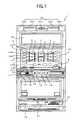
- FIG. 1is a front elevational view of one embodiment of the slot machine according to the present invention
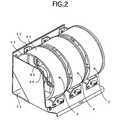
- FIG. 2is a perspective view of the rotation reel unit forming part of the slot machine according to the present invention
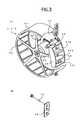
- FIG. 3 ( a )is a perspective view, partly fragmentary, of the rotation reel forming part of the rotation reel unit of the slot machine according to the present invention
- FIG. 3 ( b )is a perspective view of back lumps and a base plate having thereon the back lumps supported
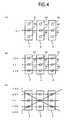
- FIG. 4 ( a ) to FIG. 4 ( c )are diagrammatic views respectively showing winning lines in their effective state on the observation windows forming part of the rotation reel unit of the slot machine according to the present invention
- FIG. 5is a block diagram showing a control circuit of the slot machine according to the present invention.
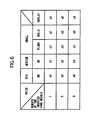
- FIG. 6is a prize winning probability table used in the processing unit forming part of the slot machine according to the present invention.
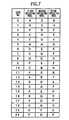
- FIG. 7is a symbol mark table to be used for processing a game play performed by the slot machine according to the present invention.
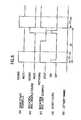
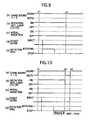
- FIG. 8is a timing chart showing times at which game starting sounds are processed to emit by a processing unit forming part of the slot machine according to the present invention
- FIG. 9is a timing chart showing a plurality of times at which a specific number of game sounds are processed to emit by a processing unit forming part of the slot machine according to the present invention.
- FIG. 10is a timing chart showing a plurality of times at which game sounds are processed to emit and not to emit by a processing unit forming part of the slot machine according to the present invention
- FIG. 11is a table showing a combination of a current game sound and a subsequent game sound processed to emit by the processing unit forming part of the slot machine according to the present invention
- FIG. 12is a table showing the relationships between current and subsequent game sounds in the current and subsequent game conditions, respectively, processed by the processing unit forming part of the slot machine according to the present invention
- FIGS. 13 ( a ) to 13 ( e )are tables each showing a subsequent game sound selection probability table available upon selecting the second information notifying state in the processing unit forming part of the slot machine according to the present invention
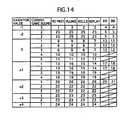
- FIG. 14is a selection table showing the relationships between the game start sounds and the rotation reel lamp operation group numbers available upon selecting the second information notifying state in the processing unit forming part of the slot machine according to the present invention
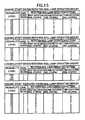
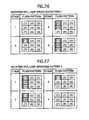
- FIGS. 15 ( a ) to 15 ( d )are tables respectively showing the relationships between the game start sounds and the rotation reel lamp operation groups 1 to 4 available upon selecting the second information notifying state in the processing unit forming part of the slot machine according to the present invention
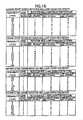
- FIGS. 16 ( e ) to 16 ( h )are tables respectively showing the relationships between the game start sounds and the rotation reel lamp operation groups 5 to 8 available upon selecting the sound information notifying state in the processing unit forming part of the slot machine according to the present invention
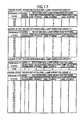
- FIGS. 17 ( i ) to 17 ( l )are tables respectively showing the relationships between the game start sounds and the rotation reel lamp operation groups 9 to 12 available upon selecting the second information notifying state in the processing unit forming part of the slot machine according to the present invention
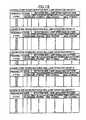
- FIGS. 18 ( m ) to 18 ( q )are tables respectively showing the relationships between the game start sounds and the rotation reel lamp operation groups 13 to 17 available upon selecting the second information notifying state in the processing unit forming part of the slot machine according to the present invention
- FIGS. 19 ( r ) to 19 ( t )are tables respectively showing the relationships between the game start sounds and the rotation reel lamp operation groups 18 to 20 available upon selecting the second information notifying state in the processing unit forming part of the slot machine according to the present invention
- FIGS. 20 ( u ) to 20 ( x )are tables respectively showing the relationships between the game start sounds and the rotation reel lamp operation groups 21 to 24 available upon selecting the second information notifying state in the processing unit forming part of the slot machine according to the present invention
- FIG. 21is a table showing the former half of the relationships between the game start sounds and the rotation reel lamp operation group 25 available upon selecting the second information notifying state in the processing unit forming part of the slot machine according to the present invention
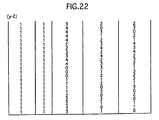
- FIG. 22is a table showing the latter half of the relationships between the game start sounds and the rotation reel lamp operation group 25 available upon selecting the second information notifying state in the processing unit forming part of the slot machine according to the present invention
- FIG. 23is a table showing the former half of the relationships between the game start sounds and the rotation reel lamp operation group 26 available upon selecting the second information notifying state in the processing unit forming part of the slot machine according to the present invention
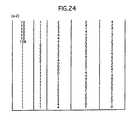
- FIG. 24is a table showing the latter half of the relationships between the game start sounds and the rotation reel lamp operation group 26 available upon selecting the second information notifying state in the processing unit forming part of the slot machine according to the present invention
- FIG. 25is a table showing a rotation reel lamp operation pattern “0” to be used for the second notification of the current game in the processing unit forming part of the slot machine according to the present invention
- FIG. 26is a table showing a rotation reel lamp operation pattern “1” to be used for the second notification of the current game in the processing unit forming part of the slot machine according to the present invention
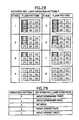
- FIG. 27is a table showing a rotation reel lamp operation pattern “3” to be used for the second notification of the current game in the processing unit forming part of the slot machine according to the present invention
- FIG. 28is a table showing a rotation reel lamp operation pattern “4” to be used for the second notification of the current game in the processing unit forming part of the slot machine according to the present invention
- FIG. 29is a table showing a rotation reel lamp operation pattern to be used for the first notification of the current game in the processing unit forming part of the slot machine according to the present invention
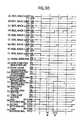
- FIG. 30is a timing chart showing the times of the rotation reel lamps, the game condition indication LED, and other constitutional elements or parts forming an electric circuit of the processing unit forming part of the slot machine according to the present invention
- FIGS. 31 ( a ) to ( c )are tables each showing the relationships between the rotation reel lamp operation pattern and the game condition indication LED pattern which are used in the process of the processing unit forming part of the slot machine according to the present invention
- FIG. 32is a table showing a game condition indication LED pattern “0” under the regular game condition which is used for the second notification of the current game in the process of the processing unit forming part of the slot machine according to the present invention
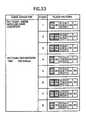
- FIG. 33is a table showing a game condition indication LED pattern “1” under the regular game condition which is used for the second notification of the current game in the process of the processing unit forming part of the slot machine according to the present invention
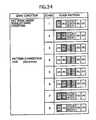
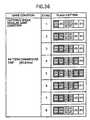
- FIG. 34is a table showing a game condition indication LED pattern “2” under the regular game condition which is used for the second notification of the current game in the process of the processing unit forming part of the slot machine according to the present invention
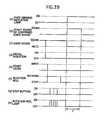
- FIG. 35is a table showing a game condition indication LED pattern “3” under the regular game condition which is used for the second notification of the current game in the process of the processing unit forming part of the slot machine according to the present invention
- FIG. 36is a table showing a game condition indication LED pattern “4” under the regular game condition which is used for the second notification of the current game in the process of the processing unit forming part of the slot machine according to the present invention
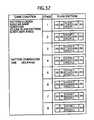
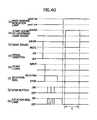
- FIG. 37is a table showing the relationships between the game start sounds and the rotation reel lamp operation patterns specified to satisfy the bonus condition in the process of the processing unit forming part of the slot machine according to the present invention
- FIG. 38is a timing chart showing the first lighting times of the prize winning indication lamps used in the process of the processing unit forming part of the slot machine according to the present invention.
- FIG. 39is a timing chart showing the second lighting times of the prize winning indication lamps used in the process of the processing unit forming part of the slot machine according to the present invention.
- FIG. 40is a timing chart showing the third lighting times of the prize winning indication lamps used in the process of the processing unit forming part of the slot machine according to the present invention.
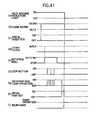
- FIG. 41is a timing chart showing the turning-off time of the prize winning indication lamp used in the process of the processing unit forming part of the slot machine according to the present invention.
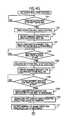
- FIG. 42is a first flow chart partly showing the process of the processing unit forming part of the slot machine according to the present invention.
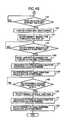
- FIG. 43is a second flow chart partly showing the process of the processing unit forming part of the slot machine according to the present invention.
- FIG. 44is a third flow chart partly showing the process of the processing unit forming part of the slot machine according to the present invention.
- FIG. 45is a first flow chart partly showing the process of controlling the rotation and stop of the rotation reels shown in FIG. 43,
- FIG. 46is a second flow chart partly showing the process of controlling the rotation and stop of the rotation reels shown in FIG. 43,
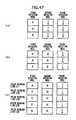
- FIGS. 47 ( a ) to 47 ( c )are tables showing the relationships between the rotation reels and the symbol cords assigned to the rotation reels and read respectively by the processing unit forming part of the slot machine according to the present invention.
- FIG. 48is a table showing a hit-expectation flag which is available for the process of the processing unit forming part of the slot machine according to the present invention
- CT machinea slot machine
- FIG. 1is a front elevational view of the slot machine of the preferred embodiment.
- the slot machine 1 shown in FIG. 1comprises a front panel 2 having a rear portion which is adapted to rotatably support three rotation reels 3 , 4 and 5 collectively constituting part of the shift and display means for shifting and displaying a plurality of rows each having plurality of symbol marks thereon.
- a symbol rowOn the peripheral surface of each of the rotation reels 3 , 4 and 5 is drawn a symbol row which is constituted by a plurality of symbol marks.
- Three symbol markscan be observed through the respective observation windows 6 , 7 and 8 located on the front face of the slot machine 1 .
- a medal inserting slot 9which serves to have the game player insert game medals therein.
- the rotation reels 3 to 5are best shown in FIG. 2 as collectively constituting a rotation reel unit and are independently rotatably mounted on a frame 51 by respective brackets 52 .
- Each of the rotation reels 3 to 5has a rotation reel drum 53 having a peripheral surface to which a rotation reel band 54 is adhered.
- On the outer surface of the rotation reel band 54is drawn a symbol row constituted by a plurality of different symbol marks.
- Each of the brackets 52has attached thereto a stepping motor 55 enabling each of the rotation reels 3 to 5 to be driven to rotate.
- each of the rotation reels 3 to 5is particularly shown in FIG. 3 ( a ).
- the constitutional elements and parts of each of the rotation reels 3 to 5 shown in FIG. 3 ( a )are substantially identical to those of each of the rotation reels 3 to 5 in FIG. 2 illustrated bearing the reference numerals of the rotation reels 3 to 5 the same as those of the rotation reels 3 to 5 in FIG. 2 and will therefore be omitted in description hereinafter.
- the rotation reel drum 53 behind the rotation reel band 54has a lamp case 56 therein.
- Back lamps 57 a , 57 b , and 57 care provided in the lamp cases 56 .
- the back lamps 57 a , 57 b , and 57 care mounted in a base plate 58 as illustrated in FIG. 3 ( b ).
- a photo sensor 59which is designed to detect an light blocking plate 60 mounted on the rotation reel drum 53 passing through the photo sensor 59 as the rotation reel drum 53 makes a full rotation.
- each of the back lamps 57 a to 57 cis controlled by means of a lamp drive circuit 48 which will be described hereinafter.
- Each of the back lamps 57 a to 57 cindividually illuminates the respective symbol mark drawn on the rotation reel band located from behind, thereby enabling three symbol marks to be projected in the observation windows 6 , 7 and 8 .
- the observation windows 6 , 7 and 8have a plurality of prize winning lines in common respectively represented by lines in FIG. 1 including: a prize winning line L 1 horizontally extending over the center of the area; a pair of prize winning lines L 2 A and L 2 B disposed on the upper and lower sides of the center prize winning line L 1 ; and a pair of cross prize winning lines L 3 A and L 3 B crossed at oblique angles and traversing the prize winning lines L 1 , L 2 A and L 2 B.
- the insertion of one game medal into the medal inserting slot 9 by the game playermakes only the center prize winning line L 1 effective in betting as shown in FIG. 4 ( a ).
- the insertion of two game medals into the medal inserting slot 9 the game playermakes the upper and lower prize winning lines L 2 A and L 2 B effective in betting in addition to the center prize winning line L 1 as shown in FIG. 4 ( b ).
- the insertion of three game medals into the medal inserting slot 9 by the game playermakes all of the prize winning lines L 1 , L 2 A, L 2 B, L 3 A and L 3 B effective in betting as shown in FIG. 4 ( c ).
- At the ends of the prize winning linesare disposed effective line indication lamps 23 , respectively (see FIG. 1) which is adapted to light on when any of the prize winning lines is made effective in betting, thereby making it possible for the game player to recognize the prize winning line effective in betting.
- the back lamps 57 a to 57 care shown by respective circles in FIGS. 4 ( a ) to 4 ( c ) to be accommodated in the rotation reels 3 to 5 , respectively.
- the back lamps 57 aare arranged on the upper line of the rotation reels 3 , 4 and 5 are represented by the circles ( 1 ), ( 2 ) and ( 3 ), respectively.
- the back lamps 57 b arranged on the intermediate line of the rotation reels 3 , 4 and 5are shown in FIGS. 4 ( a ) and 4 ( b ) as being represented by the circles ( 4 ), ( 5 ) and ( 6 ), respectively.
- the back lamps 57 c arranged on the lower line of the rotation reels 3 , 4 and 5are also shown in FIGS. 4 ( a ) and 4 ( b ) as being represented by the circles ( 7 ), ( 8 ) and ( 9 ), respectively.
- a 1 BET switch 10At the left side of the front panel 2 and below the observation windows 6 to 8 in FIG. 1 are disposed a 1 BET switch 10 , a 2 BET switch 11 and a max BET switch 12 .
- the aforesaid switchesi.e., the 1 BET switch 10 , the 2 BET switch 11 and the max BET switch 12 are turned on to bet one, two and three game medals, respectively, in one game in place of the game medals inserted into the medal inserting slot 9 .
- the credit indication portion 13is constituted by 7-segment LEDs (light emitting diode) corresponding to the digit number of a numerical value displayed thereon, and thus is designed to indicate a medal number credited in the current game.
- C/P switchCredit/pay-out switch
- start lever 15At the right side of the start lever 15 or the central portion of the front panel are arranged stop buttons 16 , 17 and 18 .
- the operation of the C/P switch 14makes it possible to change over the credit/pay-out of the medals.
- the start lever 15forms part of shift and display starting means for starting the display of the rotations of the rotation reels 3 to 5 so that the operation of the start lever 15 can start all the rotation reels 3 to 5 to rotate simultaneously.
- the stop buttons 16 , 17 and 18are arranged with respect to the rotation reels 3 to 5 , respectively, and thus constitute part of stop control means for controlling the independently stopping of displaying the rotations of the individual rotation reels 3 to 5 in accordance with the prize winning state determined by the prize winning state determining means, which will be described later.
- the operation of the stop button 16 to 18is made effective when the rotation reels 3 to 5 are driven to rotate at a predetermined rotation speed. This means that the game player can individually operated the stop buttons 16 to 18 to independently stop the rotation reels 3 to 5 at any time after the operation of the stop button 16 to 18 is made effective.
- the sound penetrating holes 19are adapted to allow the sound emitted from a speaker housed within the slot machine 1 to be emitted out of the slot machine 1 .
- the medal receptacle 20serves to reserve game medals paid out from a medal paying-out opening 21 disposed at the upper side of the medal receptacle 20 .
- a dividend rate indication portion 22for indicating the number of game medals to be paid out for each of prize winnings.
- a prize winning indication lamp 24functions to inform the game player of the current game condition such as big prize winning game condition and middle prize winning game condition, which will be described later, when the prize winning indication lamp 24 is turn on.
- the prize winning indication lamp 24is turned on at a predetermined provability by a lottery after the bonus game condition such as the big prize winning game condition and the middle prize winning game condition is determined.
- a game condition indication LED 25which is divided into five sections 25 a , 25 b , 25 c , 25 d , and 25 e .
- the sections 25 a , 25 b , 25 d , and 25 e excluding the central section 25 chave LEDs (A), (B), (G), and (H) respectively housed therein, while the central section 25 c has four LEDs (C), (D), (E), and (F) also housed therein.
- FIG. 5shows an electric circuit which comprises control means for controlling the game processing operation of the slot machine 1 according to the present embodiment of the present invention, and peripheral devices (actuators) electrically connected with the control means.
- the control meansis mainly constituted by a microcomputer 30 , hereinafter referred to as simply “micom”, and a plurality of circuits for sampling random numbers.
- the micom 30has a CPU 31 for performing control operations on the basis of a predetermined program, a ROM 32 and a RAM 33 .
- the ROM 32 and the RAM 33collectively constitute storage means.
- the storage meansis designed to store table data having a plurality of predetermined reference values such as table data.
- the CPU 31is further connected to a clock pulse generating circuit 34 for generating a base clock pulse, a divider 35 , a random number generator 36 for generating random numbers within a defined range, and a random number sampling circuit 37 for sampling a single number from the generated random numbers.
- the random number generator 36 and the random number sampling circuit 37collectively constitute random number generation means.
- the micro 30is operable to control the operations of the actuators e.g., stepping motors 55 for driving the rotation reels 3 , 4 and 5 , a hopper 38 for storing the game medals, the game condition indication LED 25 , a speaker 39 , the back lamps 57 a to 57 c , and the prize winning indication lamp 24 .
- the actuatorsare driven by a motor drive circuit 40 , a hopper drive circuit 41 , an LED drive circuit 42 , a speaker drive circuit 43 , and a lamp drive circuit 48 , respectively.
- the drive circuits 40 , 41 , 42 and 43 , 48are connected with the CPU 31 through I/O ports of the micom 30 . Stepping motors 55 are energized in one/two-phase by the motor drive circuit 40 and each of the stepping motor 55 makes a full rotation with a 400-pulse drive signal.
- the micro 30is connected with sensors, including a start switch 15 S for sensing the rocking operation of the start lever 15 , a medal sensor 9 S for sensing the insertion of the game medal(s) into the medal inserting slot 9 , the aforesaid C/P switch 14 , a photo sensor 59 , and a reel position sensing circuit 44 for sensing the position of each of the rotation reels 3 , 4 and 5 by receiving signals from the photo sensor 59 .
- sensorsincluding a start switch 15 S for sensing the rocking operation of the start lever 15 , a medal sensor 9 S for sensing the insertion of the game medal(s) into the medal inserting slot 9 , the aforesaid C/P switch 14 , a photo sensor 59 , and a reel position sensing circuit 44 for sensing the position of each of the rotation reels 3 , 4 and 5 by receiving signals from the photo sensor 59 .
- the photo sensor 59detects the light blocking plate 60 passing through the photo sensor 59 and thus generates a reset pulse as each of the rotation reels 4 , 5 and 5 makes a full rotation.
- the thus generated reset pulseis transmitted to the CPU 31 through the rotation reel position sensing circuit 44 .
- the RAM 33contains discrete values specifying position ranges of the rotation reels 3 , 4 and 5 , respectively.
- the CPU 31is operated to clear the respective value contained in the RAM 33 to zero upon receiving a reset pulse from any of the rotation reels 3 , 4 , and 5 , thereby enabling any error caused between the value stored in the RAM 33 specifying a position range of each of symbol marks being rotated and the actual position of each of the stepping motors 55 to be eliminated for a full rotation.
- the micro 30is further connected with a reel stop signal circuit 45 and a payout completion signal circuit 46 .
- the reel stop signal circuit 45 and the payout completion signal circuit 46collectively constitute input signal generation means.
- the reel stop signal circuit 45is designed to generate a stop signal to have the respective rotation reels 3 , 4 and 5 stopped from rotating in response to the operation of the stop buttons 16 , 17 , and 18 , respectively.
- the payout completion signal circuit 46is connected with a medal sensing unit 47 for counting the number of game medals paid out from the hopper 38 .
- the payout completion signal circuit 46is designed to output a payout completion signal to the CPU 31 when the number of the game medals actually paid out, which is input from the medal sensing unit 47 , reaches a predetermined value of the dividend rate.
- the data stored in the ROM 32includes sequence programs for game process procedures performed in the slot machine 1 .
- the data stored in the ROM 32includes data tables such as a prize probability table, a symbol mark table, and a winning symbol combination table indicative of relationships between symbol mark sets and the respective prize winnings.
- the prize probability tableincludes data indicative of relationships between segment ranges of the random numbers generated by the random number generator 36 and the respective prize winning states.
- the prize probability tableforms part of random number assigning means for assigning the random number sampled by the random number sampling circuit 37 to the respective segment range (hereinafter referred to as simply “segment”) representing the prize winning state in reference to the prize probability table.
- the data contained in the prize probability tableis best shown in FIG. 6 .
- the segments of the expected random numbersare shown in FIG. 6 as being represented by data rows of alphanumeric characters: a1-a3, b1-b3, c1-c3, d1-d3, and e1-e3 in the data table.
- the random number assigning meansassigns the random number sampled by the sampling circuit 37 to the corresponding prize winning state in reference to any of the data rows of the prize probability table.
- the insertion of one game medal in bettingcauses the random number assigning means to refer to the data raw of “a1-e1”
- the insertion of two game medalscauses the random number assigning means to refer to the data raw of “a2-e2”
- the insertion of three game medalscauses the random number assigning means to refer to the data raw of “a3-e3”.
- the segment of the prize probability table that the sampled random number belongsdetermines the prize winning state.
- the prize winning statesare represented by six kinds of prize winning state flag, including “no-prize” and “replay” prize winning flags, respectively.
- the random number generator 36 , the random number sampling circuit 37 , the winning probability table, and the micom 30collectively constitute the prize winning state determining means for determining a prize winning state based on random number lottery.
- the stop control meansfor controlling the stop of the shift and display means to have a predetermined set of symbol marks shifted and displayed on the basis of the prize winning state determined by the prize winning state determining means.
- the prize winning states of each kindare generated at a predetermined probability according to the setting of the prize probability table. This leads to the fact that the total number of game medals paid out in a business day remains approximately the same regardless of the skill of the game players.
- Each of the aforesaid alphanumeric charactersspecifies a value.
- the valuesusually defined a ⁇ b ⁇ c ⁇ d ⁇ e ⁇ f ⁇ g in the ascending order of size, represent the respective segments representative of respective prize winning states as shown in FIG. 6 .
- the sampled random number not greater than acauses the prize winning state determining means to request the big prize winning state (big hit), thereby setting up the BB winning flag.
- the sampled random number less than a but not greater than bcauses the prize winning state determining means to request the middle prize winning state (middle hit), thereby setting up the “RB” prize winning flag.
- the sampled random number not less than b but not greater than dcauses the prize winning state determining means to request the small prize winning state (small hit).
- the sampled random number not less than b but not greater than csets up the “plums” prize winning flag
- the sampled random number not less than c but not greater than dsets up the “bells” prize winning flag.
- the sampled random number not less than d but not greater than ecauses the prize winning state determining means to request “replay” prize winning state, thereby setting up the “replay” winning flag.
- the sampled random number not less than esets up no-prize winning flag.
- the game conditionsinclude five types: “RB game operation”, “regular game in BB operation”, “regular game”, “regular game in RB inner winning operation”, and “regular game in BB inner winning operation”.
- RBmeans the aforesaid regular bonus game under which the game player can play a bonus game composed of a set of games with a plurality of predetermined high dividend rates.
- RB operationmeans the game condition under which the RB game is played, and the game player can win either no-prize or JAC prize.
- BBmeans the aforesaid big bonus game under which the game player can repeatedly play a set of the regular games and the aforesaid bonus games.
- the regular game in BB operationmeans that the regular game condition under which the BB game is played, and the game player can win the small prize at a high probability.
- the regular game conditionmeans that the game is played under neither of the aforesaid BB nor RB, in which neither RB nor BB prize winning flag is set up.
- the “regular game in RB inner winning operation” or “regular game in BB inner winning operation”means a regular condition under which the predetermined set of symbol marks representative of the RB prize or BB prize have not yet been stopped and displayed on the prize winning line, thereby resulting in that RB game or BB game has not started although RB prize winning flag or BB prize winning flag is set up.
- the symbol mark tableis best shown in FIG. 7 .
- the symbol mark tableis indicative of relationships between positions of each of the rotation reels 3 , 4 , and 5 , and the respective symbol marks.
- Each symbol row of the rotation reelsis represented by a code number of 0 to 20 indicating the position of the respective rotation reel and each symbol mark is represented by a symbol code of A to H. More specifically, the code numbers are allocated to the outer surface of each of the rotation reels 3 , 4 and 5 equi-distantly spaced apart from one another with reference to the position at which the aforesaid reset pulse is generated.
- the symbol mark tableis indicative of relationships between the code numbers representing the positions of each of the rotation reels 3 , 4 and 5 and the symbol codes representing the respective symbol mark.
- the winning symbol combination tableincludes a plurality of predetermined sets of symbol codes (symbol marks) which will be indicated in the dividend rate indication portion 22 .
- the winning symbol combination tablefurther includes a plurality of predetermined sets of symbol codes (symbol marks) representative of “li-zhi” state for notifying the game player that that the prize winning request is set for the special game condition, winning prize judging codes for indicating each of the winning prizes, and the numbers of game medals awarded for the respective winning states.
- the speaker 39 , the speaker drive circuit 43 and the micom 30 as a wholeconstitute sound generation means which is operative to generate any one of game start sounds 1 and 2 as effect sound when the rotation reels 3 to 5 in the display start to rotate with the operation of the start lever 15 .
- the kind of the game start sound thus generated by the aforesaid sound generation meansis selected in the manner described in detail hereinafter.
- the game start sounds 1 and 2are generated at the time shown in FIG. 8 ( a ) and output for the period of t 1 immediately after the prize winning state lottery time (see FIG. 8 ( e )).
- the start lever 15must be operated at an interval of t 2 , for instance, 4.1 seconds.
- a rotation reel disable soundis output from the speaker 39 at the time shown in FIG. 8 ( b ).
- FIG. 8 ( c )shows the rotating state of the rotation reel last stopped in the previous game.
- the last stopped rotation reeldoes not start to rotate until t 2 elapses after the previous start.
- the game start soundis output in the subsequent game simultaneously with the start of the last stopped rotation reel at an interval of t 2 after the previous start (see FIG. 8 ( a )).
- the sound generation means forming part of notifying meansis operated to notify the game player of predetermined notifying information in notifying states including a current notifying state and subsequent notifying states following said current notifying state, while the game player is enjoying games including a current game and subsequent games following said current game.
- the notifying meansoutputs any one of five games sounds: game sound 1 , game sound 2 , game sound 3 , game sound 4 and game sound 5 during the regular game operation.
- One game soundis selected from the game sounds 1 to 5 through a lottery operation run after the input time of the start lever 15 (see FIG. 9 ( d )) by subsequent notifying state determining means, which will be described hereinafter.
- the notifying meansis operated to output the selected game sound (see FIG. 9 ( a )). More specifically, the game sound to be sounded in the subsequent game is selected in advance on the basis of the game sound sounded in the current game.
- the subsequent notifying state determining meansis constituted by the micom 30 .
- the game sound 1 , 2 , 3 , 4 or 5is output continuously during one game.
- One gamestarts with the insertion of the first game medal in the Xth game and ends with the insertion of the game medal in the (X+1) th game.
- the type of the game sound to be selected in the subsequent gamesis selected, and then stored in the RAM 33 in each game.
- the sound generation meansis operated to output the selected type of the game sound with reference to a value stored in the RAM 33 at the game medal insertion time (see FIG. 9 ( c )).
- the rotation reel lamps ( 1 ) to ( 9 )are lighted on simultaneously with the game medal insertion time (see FIG. 9 ( c )).
- the rotation reels 3 to 5start to rotate simultaneously with the start lever input time (see FIG. 9 ( e )).
- the game sound 1 , 2 , 3 , 4 or 5is output at the game medal insertion time. Any one of the game sounds 1 to 5 other than the current game sound is output at the game medal insertion time t 2 at which the game sound is changed over. On the other hand, the same game sound continues without interruption at the medal insertion time t 1 at which the game sound sounded in the current game is identical with the game sound to be sounded in the subsequent game.
- the game sound 1 , 2 , 3 , 4 or 5is output if the game sound is switched to mute at the game medal insertion time.
- FIG. 10 of the drawingthere is shown a timing chart of a mute timing of the game sound 1 , 2 , 3 , 4 , or 5 .
- the game sound 1 , 2 , 3 , 4 or 5starts to sound (see FIG. 10 ( a )) and the rotation reel lamps ( 1 ) to ( 9 ) are lighted (see FIG. 10 ( b )) on at the game medal insertion times t 1 and t 3 (see FIG. 10 ( c )).
- the start lever 15is operated at the time shown in FIG. 10 ( d ), and the rotation reel lamps ( 1 ) to ( 9 ) are lighted off (see FIG.
- the subsequent notifying state determining meansis designed to determine and select the game sound to be sounded in the subsequent game (hereinafter simply referred to as “subsequent game sound”) by the lottery operation in reference to the game sound sounded in the current game (hereinafter simply referred to as “current game sound”). That is, the subsequent determining means is operative to determine and select in advance the subsequent notifying states in the current game on the basis of the current notifying state to be informed by the notifying means.
- FIG. 11there is shown a table which indicates combinations of the current game sounds and the possible subsequent game sounds determined as a result of the lottery/selection. In the table there is stated a variation value which means the difference of the subsequent game sound number minus the current game number wherein game sound number means any one of the numbers 1 to 5 indicative of the game sounds 1 to 5 .
- the subsequent notifying state determining meansselects the game sound 1 , 2 , 3 , 4 , or 5 under the three game conditions of “regular game”, “regular game in RB inner winning operation”, and “regular game in BB inner winning operation”. Under game conditions of “RB game operation” and “regular game in BB operation” is sounded a working sound other than any of the game sounds 1 to 5 .
- the selection of the subsequent game sound (D)will be described in detail.
- the variation value (C)is selected by the lottery operation on the basis of the current game condition (A) and the current game sound (B).
- the subsequent game sound (D)is determined as a result of the addition of the variation value (C) to the current game number. This leads to the fact that the same game sound will continue for a couple of games if the variation value (C) happens to be 0 for the games.
- the lottery operation of the game sound 1 , 2 , 3 , 4 , or 5is performed after the prize winning state is determined through the probability lottery process by the prize winning state determining means in the current game.
- the slot machineincludes a register which generates random numbers: discrete numbers of 0 to 127.
- game sound selection probability tablesindicative of relationships between the game sounds and the respective segment ranges (hereinafter referred to as “segment”) of numbers.
- the lottery operation of the game sound 1 to 5is carried out by sampling a random number generated by the register at an arbitrary time. Then, the segment of the game sound selection probability table that the sampled random number belongs determines the subsequent game sound.
- FIG. 13 ( a )there is shown a game sound selection probability table having data used to select the subsequent game sound with the current game sound of game sound 1 .
- FIGS. 13 ( b ), ( c ), ( d ), and ( e )there are shown the game sound selection probability tables used to select the subsequent game sound with the current game sound of game sound 2 , 3 , 4 and 5 , respectively. Every value stated in the tables is indicative of the numerator of the fraction with the denominator of 128 which is the total number of the random numbers.
- FIG. 13 ( a )there is shown the probability table with the current game sound 1 . For instance, the probability of the game sound 1 to be selected for the subsequent game sound under the “regular game” condition is 80/128. The probability of the game sound 5 to be selected for the subsequent game sound under the “regular game in BB inner winning operation” condition is 80/128.
- the game sound 4is selected for the subsequent game sound only under the game condition of “regular game in RB inner winning operation”, or “regular game in BB inner winning operation”. This leads to the fact that the game player can confirm that the RB or BB inner winning is generated inside the machine by hearing the game sound 4 .
- the game sound 5is selected for the subsequent game sound only under the game condition of “regular game in BB inner winning operation” so that the game player can confirm that the BB inner winning is generated inside the machine by hearing the game sound 5 .
- the confirmation of the inner winning state made by the game soundis referred to as “inner winning confirmation”. It is thus noted from the foregoing description, the notifying information notified by the notifying means is correspondent to specified prize winning state determined by the prize winning state determining means.
- the sound generation meansconstitutes notifying means for notifying of the game player of notifying information indicative of winning state determined by the prize winning state determining means, i.e., RB or BB inner winning state confirmation in this case.
- the game sound selection probability tables shown in FIG. 13indicate that the game sound 4 or 5 is not always selected for the subsequent game sound under the game condition of RB or BB inner winning confirmation.
- the game sound 1 , 2 , or 3may be selected for the subsequent game sound under such game condition.
- the notifying meansserves to notify the game player of the probability of the generated inner winning state in addition to the inner winning state confirmation.
- the notifying meansis operative to notify the game player of said notifying state corresponding to said prize winning state at a predetermined probability.
- the probability of the game sound 5 to be selected for the subsequent game sound under the current game condition of “regular game in BB inner winning operation” with the current game sound of the game sound 1is at 5/128.
- the probability of the game sound 4 to be selected for the subsequent game sound under the current game condition of “regular game in RB inner winning operation” with the current game sound of the game sound 4is at 128/128, i.e., 100%.
- the probability of the game sound 5 to be selected for the subsequent game sound under the current game condition of “regular game in BB inner winning operation” with the current game sound of the game sound 5is at 128/128, i.e., 100%
- second notifying meansIn addition to the aforesaid notifying means for notifying the game sound 1 to 5 , there is provided second notifying means. After the lottery process of the game sound 1 to 5 , the notifying state of the second notifying means is determined in reference to the same variation value obtained in the aforesaid lottery process.
- the aforesaid sound generation means for generating two kinds of the game sounds 1 and 2 , the rotation reel back lamps 57 a to 57 c , the lamp drive circuit 48 , the game condition indication LED 25 , the LED drive circuit 42 and the micom 30 as a wholeconstitutes the second notifying means.
- the second notifying meansis designed to notify the game player of notifying information in a current notifying state.
- the notifying state in the current game (hereinafter referred to as “current notifying state”) by the second notifying meansis determined on the basis of the notifying state to be notified in the subsequent game (hereinafter referred to as “subsequent notifying state”) determined by the subsequent notifying state determining means.
- the game start sound, the rotation reel back lamps 57 and the game condition indication LED 25are combined to perform an entertaining performance (hereinafter referred to as “entertainment”) in accordance with the notifying state.
- This means that the entertainmentis selected on the basis of the same variation value obtained in the lottery process for the subsequent game sound 1 to 5 , i.e., on the basis of the subsequent notifying state.
- the four elements of the entertainmentsuch as for example the game start sound, the movements of the first rotation reel 3 , the second rotation reel 4 , and the third rotation reel 5 , respectively are selected to be operated.
- FIG. 14there is shown a table showing the relationships between the game start sounds and the rotation reel lamp operation group numbers.
- the group numbers of 1 to 26are assigned to the current game sound and six kinds of the prize winning flag.
- An entertainment pattern of the game start sound and rotation reel lamp operationis determined according to the variation value and the group number.
- the game sound 1is selected for the subsequent game sound with the current game of the game sound 3 while the group number 2 is selected from among the group numbers shown in FIG. 14 with the “bells” prize winning flag currently set.
- the variation value of “+1”is determined by the subsequent notifying state determining means, the game sound 2 is selected for the subsequent game sound with the current game of the game sound 1 while the group number 18 is selected from among the group numbers shown in FIG. 14 with the “BB” prize winning flag currently set.
- the game start sound and rotation reel lamp operation group number 1 to 26is selected.
- FIG. 15 to FIG. 24there are shown tables specific to the game start sound and rotation reel lamp operation groups.
- a lottery probability columnis provided in each of the tables.
- Each lottery probability columnis divided into segments. A random number of 0 to 255 generated by the register is sampled at an arbitrary time. Then, the segment of the lottery probability column that the sampled random number belongs determines the game start sound and rotation reel lamp operation pattern in the current game. Every value stated in the lottery probability column is the numerator of the fraction with the denominator of 256 which is total number of the probability.
- the game start sound and rotation reel lamp operation group number 2is selected from among the group numbers shown in FIG. 14 with the variation value of “ ⁇ 2” obtained and the “bells” prize winning flag set in the aforesaid case, the table specific to the game start sound and rotation reel lamp operation group 2 in FIG. 15 ( b ) is referred to.
- a random number of “71”is thus sampled, the sampled random number of “71”, greater than “50” of (25+25), a total of the probability values of the first and second columns and less than “100” of (25+25+25), a total of the probability values of the first to third columns, belongs to the third segment of the lottery probability column, representing the third game start sound and rotation reel lamp operation pattern.
- the game start sound and rotation reel lamp operation group number 18is selected from among the group numbers shown in FIG. 14 with the variation value of “+1” obtained and the “BB” prize winning flag set in the aforesaid case, the table specific to the game start sound and rotation reel lamp operation group 18 in FIG. 19 ( r ) is referred to.
- a random number of “123”is thus sampled, the sampled random number of “123”, greater than “100” of (50+50), a total of the probability values of first and second columns and less than “150” of (50+50+50), a total of the probability values of the first to third columns, belongs to the third segment of the lottery probability column, representing third game start sound and rotation reel lamp operation pattern is selected from among the patterns shown in FIG. 19 ( r ).
- FIGS. 25 to 28there are shown tables indicating the rotation reel lamp operation patterns 0 to 4 .
- the back lamps 57 a arranged on the upper line of the rotation reels 3 , 4 , and 5are shown in “flash pattern” columns as being represented by the circles ( 1 ), ( 2 ) and ( 3 ), respectively.
- the back lamps 57 b arranged on the intermediate line of the rotation reels 3 , 4 and 5are shown in the “flash pattern” columns as being represented by the circles ( 4 ), ( 5 ) and ( 6 ), respectively.
- the back lamps 57 c arranged on the lower line of the rotation reels 3 , 4 and 5are also shown in the “flash pattern” columns as being represented by the circles ( 7 ), ( 8 ) and ( 9 ), respectively.
- the light on state of the lampis represented by diagonally shaded areas while the light off state is represented by non-shaded areas.
- the tableseach includes a “stage” column which represents an elapse of time.
- Each of the back lamps 57 a to 57 cis switched on and off at intervals of the stage, for instance, of 75.2 msec.
- FIG. 25there is shown the operation pattern 0 in which each of the lighted back lamps 57 a to 57 c on the first rotation reel 3 moves downward twice as shown in the operation pattern 3 of the rotation reel lamp operation pattern table in FIG. 29 .
- FIG. 26there is shown the operation pattern 1 in which each of the lighted back lamps 57 a to 57 c on the first rotation reel 3 moves downward once as shown in the operation pattern 1 of the rotation reel lamp operation pattern table in FIG. 29 .
- the operation pattern 2has each of the lighted back lamps 57 a to 57 c on the first rotation reel 3 not move as shown in the operation pattern 2 of the rotation reel lamp operation pattern table in FIG. 29 .
- FIG. 29there is shown the operation pattern 0 in which each of the lighted back lamps 57 a to 57 c on the first rotation reel 3 moves downward twice as shown in the operation pattern 3 of the rotation reel lamp operation pattern table in FIG. 29 .
- FIG. 27there is shown the operation pattern 3 in which each of the lighted back lamps 57 a to 57 c on the first rotation reel 3 moves upward once as shown in the operation pattern 3 of the rotation reel lamp operation pattern table in FIG. 29 .
- FIG. 28there is shown the operation pattern 4 in which each of the lighted back lamps 57 a to 57 c on the first rotation reel 3 moves upward twice as shown in the operation pattern 4 of the rotation reel lamp operation pattern table in FIG. 29 .
- each of the lighted back lamps 57 a to 57 c on the first rotation reel 3corresponds to the difference of the subsequent game sound number minus the current game sound number, i.e., the variation value.
- the game machinefurther comprises second notifying state determining means constituted by the micom 30 .
- the micom 30serves as the subsequent notifying state determining means and the second notifying state determining means.
- the second notifying state determining meansis operated to determine and select in advance the current notifying states on the basis of the subsequent notifying states determined by the subsequent notifying state determining means. For instance, in the aforesaid example, if the game start sound and rotation reel lamp operation group number 2 is selected from among the group numbers shown in FIG.
- the rotation reel lamp operation pattern 1 with the first rotation reel stopped, the rotation reel lamp operation pattern 3 with the second rotation reel stopped, and the rotation reel lamp operation plate 3 with the third rotation reel stoppedare selected by the second notifying state determining means.
- the back lamps 57 a to 57 c of the first rotation reel 3move downward once ( ⁇ 1) with the first rotation reel 3 stopped, the back lamps 57 a to 57 c of the first rotation reel 3 move upward once (+1) with the second rotation reel 4 stopped, the back lamps 57 a to 57 c of the first rotation reel 3 move upward once (+1) with the third rotation reel 5 stopped.
- FIG. 30 of the drawingthere are shown timing charts of entertainments performed by the rotation reel back lamps ( 1 ) to ( 9 ) and the game condition indication LED 25 .
- the insertion of game medal into the medal inserting slot 9 at the time shown in FIG. 30 ( j )permits the rotation reel back lamps ( 1 ) to ( 9 ) to be lighted on at the same time shown in FIGS. 30 ( a ) to ( i ).
- the start lever 15is operated at the time shown in the FIG. 30 ( l ), resulting in that the first, second and third rotation reels 3 , 4 , and 5 start to rotate simultaneously at the same time shown in FIGS. 30 ( s ), ( t ) and ( u ).
- the operation of the first stop button 16 , the second stop button 17 , and the third stop button 18sequentially at the times shown in FIGS.
- the first rotation reel stop button 16 , the second rotation reel stop button 17 , and the third rotation reel stop button 18are operated sequentially at the times shown in FIGS. 30 ( p ), ( q ), and ( r ), and the first, second and third rotation reels 3 , 4 , and 5 are stopped from rotating in the same order as shown in FIGS. 30 ( s ), ( t ), and ( u ).
- the stop sequence of the first, second and third rotation reels 3 , 4 , and 5is not limited to the embodiment.
- the first, second and third rotation reels 3 , 4 , and 5may be stopped from rotating with a random operation of the stop buttons 16 , 17 , and 18 .
- the fist, second and third rotation reelsmay be stopped from rotating sequentially in response to an operation sequence of the first rotation reel stop button 16 , the third rotation reel stop button 18 and the second rotation reel stop button 17 .
- the entertainment of the rotation reel lampsis performed in the following manner.
- Entertainment request for the first rotation reelis turned on at the stop time of the first rotation reel 3 as shown in FIG. 30 ( m ), and the rotation reel back lamps ( 1 ) to ( 9 ) are operated to perform entertainment with the rotation reel lamp operation pattern 2 .
- the operation pattern 2no entertainment is performed as described hereinbefore, and the rotation reel back lamps ( 1 ) to ( 9 ) remain to be lighted off as shown in FIGS. 30 ( a ) to ( i ).
- the game condition indication LED 25is operated in five patterns.
- the entertainment operation pattern of the game condition indication LED 25is updated according to the rotation reel lamp operation in reference to the game condition indication LED operation pattern table shown in FIG. 31 ( a ) when the rotation reel lamp operation ends.
- each of “n2”, and “n3”takes any value of 0, 1, 2, 3, or 4 in accordance with the second and third rotation reel lamp operation pattern 0 , 1 , 2 , 3 , or 4 .
- the second notifying state determining meansis operated to add the value of “rotation reel lamp operation pattern ⁇ 2” to the value of “rotation real lamp operation pattern” every time when each of the rotation reel lamp operation ends.
- the value of “rotation reel lamp operation pattern ⁇ 2”is “n1 ⁇ 2” and the value of “total of rotation reel lamp operation pattern ⁇ 2” is “n1 ⁇ 2”, thereby resulting in that the value of “rotation reel lamp operation pattern ⁇ 2” equal to the value of “total of rotation reel lamp operation pattern ⁇ 2”.
- the operation of the game condition indication LED 25corresponds to the value of S 1 .
- the operation of the game condition indication LED 25corresponds to the value of S 3 .
- the operation of the game condition indication LED 25is cleared with game medal inserted in the subsequent game.
- Each value of “n1”, “n2”, and “n3”is in the range of 0 to 4, thereby resulting in that each value of “n1 ⁇ 2”, “n2 ⁇ 2” and “n3 ⁇ 2” belongs to the range of ⁇ 2 to 2.
- a table shown in FIG. 31 ( b )indicates relationships between “total of rotation reel lamp operation pattern ⁇ 2” and “game condition indication LED operation pattern”. With the value of “total of rotation reel lamp operation pattern ⁇ 2” not greater than 0, “game condition indication LED operation pattern” results in pattern 0 . With the value of “total of rotation reel lamp operation pattern ⁇ 2” of “1”, “2”, or “3”, “game condition indication LED operation pattern” results in pattern 1 , 2 , or 3 , respectively. Furthermore, with the value of “total of rotation reel lamp operation pattern ⁇ 2” not less than 4, “game condition indication LED operation pattern” results in pattern 4 .
- LEDs (A) to (H) integrated in the game condition indication LED 25are shown in the “flash pattern” columns as being represented by the circles (A) to (H), respectively.
- the LEDs (A) and (B)are housed in the left sections 25 a and 25 b, while the four LEDs (C), (D), (E), and (F) housed in the central section 25 c, the LEDs (G) and (H) are housed in the right sections 25 d and 25 e.
- the light on state of the LEDs (A) to (G)is represented by diagonally shaded areas while the light off state of the LEDs (A) to (G) is represented by non-shaded areas.
- Each tableincludes a “stage” column which represents an elapse of time.
- Each of the LEDs (A) to (H)is switched on and off at intervals of the stage, for instance, 80.48 msec as shown in FIGS. 32 to 36 .
- FIG. 32there is shown the operation pattern 0 of the game condition indication LED 25 in which the LED 25 of LEDs (A) to (H) remains lighted off at each stage with no entertainment performed.
- FIG. 33there is shown the operation pattern 1 of the game condition indication LED 25 in which the LED 25 up to the position of the LED (B) i.e., the second left section of 25 b is lighted on.
- FIG. 34there is shown the operation pattern 2 of the game condition indication LED 25 in which the LED 25 up to position of the LEDs (C) to (F) i.e., the third central section of 25 c is lighted on.
- FIG. 32there is shown the operation pattern 0 of the game condition indication LED 25 in which the LED 25 of LEDs (A) to (H) remains lighted off at each stage with no entertainment performed.
- FIG. 33there is shown the operation pattern 1 of the game condition indication LED 25 in which the LED 25 up to the position of the LED (B) i.e., the second left section of 25 b is lighted on
- FIG. 35there is shown the operation pattern 3 of the game condition indication LED 25 in which the LED 25 up to the position of the LED (G) i.e., the fourth left section 25 d is lighted on.
- FIG. 36there is shown the operation pattern 4 of the game condition indication LED 25 in which the LED 25 up to the position of the LED (H), i.e., the fifth right section of 25 e is lighted on.
- a table shown in FIG. 31 ( c )indicates examples of the entertainment operation of the game condition indication LED 25 , in which each of the rotation reel back lamps ( 1 ) to ( 9 ) is operated to perform the entertainment operation following rotation reel lamp operation pattern 4 with the first rotation reel 3 stopped at the first stop time, thereby resulting in that the value of “rotation reel lamp operation pattern ⁇ 2” i.e., 4 ⁇ 2 comes to be 2 and that the value of “total of rotation reel lamp operation pattern ⁇ 2” comes to be 2.
- “game condition indication LED operation pattern”becomes pattern 2.
- the entertainment of the game condition indication LED 25 following the pattern 2is performed as shown in FIG. 30 ( k ) from the time when the entertainment request for the first rotation reel is turned off (see FIG. 30 ( m )) until the time when the entertainment request for the second rotation reel is turned off (see FIG. 30 ( n )).
- Each of the rotation reel back lamps ( 1 ) to ( 9 )is operated to perform the entertainment operation following the rotation reel lamp operation pattern 1 with the second rotation reel 4 stopped at the second stop time, thereby resulting in that the value of “rotation reel lamp operation pattern ⁇ 2” i.e., 1 ⁇ 2 comes to be ⁇ 1 and that the value of “total of rotation reel lamp operation pattern ⁇ 2”, i.e., 2 ⁇ 1 comes to be 1.
- “game condition indication LED operation pattern”becomes pattern 1 .
- the entertainment of the game condition indication LED 25 following the pattern 1is performed as shown in FIG. 30 ( k ) from the time when the entertainment request for the second rotation reel is turned off shown in FIG. 30 ( n ) until the time when the entertainment request for the third rotation reel is turned off shown in FIG. 30 ( o ).
- Each of the rotation reel back lamps ( 1 ) to ( 9 )is operated to perform the entertainment operation following rotation reel lamp operation pattern 2 with the third rotation reel 5 stopped at the third stop time, thereby resulting in that the value of “rotation reel lamp operation pattern ⁇ 2” i.e., 2 ⁇ 2 comes to be 0 and that the value of “total of rotation reel lamp operation pattern ⁇ 2”, i.e., 2 ⁇ 1+0 becomes to be 1.
- “game condition indication LED operation pattern”becomes pattern 1 .
- the entertainment of the game condition indication LED 25 following the pattern 1is performed as shown in FIG. 30 ( k ) from the time when the entertainment request for the third rotation reel is turned off (see FIG. 30 ( o )).
- the game condition indication by the game condition indication LED 25is cleared at the game medal insertion time in the subsequent game.
- the aforesaid game condition indication by the game condition indication LED 25is performed in accordance with the difference of the subsequent game sound number minus the current game sound number, i.e., the variation value in the same manner as the entertainment indication by the rotation reel back lamps ( 1 ) to ( 9 ).
- the prize winning indication lamp 24is lighted on with bonus condition satisfied.
- the bonus conditionincludes two requirements: one requirement that any of specified combination patterns of “the game start sound and the rotation reel lamp operation” is performed and the other requirement is that any of specified game sounds is output in the subsequent game.
- the prize winning indication lamp 24is lighted on at the confirmation operation time in accordance with two requirements of the bonus condition completed.
- FIG. 37there is shown the specified combination patterns of “the game start sound and the rotation reel lamp operation”, which are entertaining combinations of the game start sound and the rotation reel lamp operation generated only under the game condition of the BB or RB inner winning operation.
- the specified game soundsinclude game sound 4 and game sound 5 .
- the prize winning indication lamp 24is lighted on at the confirmation operation time in accordance with the satisfied condition and not lighted off until the BB or RB game starts.
- the prize winning indication lamp 24is lighted on (see FIG. 39 ( a )) at the time when the first game medal is inserted for the subsequent game (see FIG. 39 ( d )).
- the start sound of confirmed game soundis once output (see FIG. 39 ( b )).
- the priority of the start sound of confirmed game soundis higher than that of the game sound 4 or 5 . This leads to the fact that the game sound 4 or 5 is not output during the period T in which the start sound of the confirmed game sound is output (see FIG. 39 ( c )).
- the prize winning indication lamp 24is lighted on (see FIG. 40 ( a )) after the entertainment operation of the rotation reel lamps ( 1 ) to ( 9 ) ends (see FIG. 40 ( h )). Then, the start sound of confirmed game sound is once output at (see FIG. 40 ( b )) at the time when the first game medal is inserted (see FIG. 40 ( d )).
- the prize winning indication lamp 24is lighted off at the same time shown in the timing chart in FIG. 41 .
- the micom 30is operated to control the game machine having the steps shown in FIGS. 42 and 44 as follows.
- step S 101the judgment is made by the CPU 31 upon whether game medal is inserted/BET switch is operated or not.
- the judgmentis made by the CPU 31 upon whether a signal from the medal sensor 9 S for having sensed the insertion of the game medal(s) into the medal inserting slot 9 or a signal from the Bet switch 10 , 11 , or 12 for having game medal(s) invested in betting is received or not. If the judgment is made by the CPU 31 YES, the step S 101 proceeds to the step S 102 wherein all the back lamps 57 a, 57 b and 57 c are lighted on by the lamp drive circuit 48 following the instruction of the CPU 31 (S 102 ). The game condition indication LED 25 stops performing entertainment if the entertainment is in process (S 103 ).
- step S 104the judgment is by the CPU 31 upon whether the game process is performed for the first time since the slot machine 1 is turned on or not (S 104 ). If the judgment is made by the CPU 31 that the game process is performed for the first time since the slot machine 1 is turned on, the step S 104 goes forward to the step S 105 wherein the speaker drive circuit 43 is controlled by the CPU 31 and the game sound 1 is output from the speaker 39 as an initial game sound (S 105 ). Otherwise, the step S 104 goes forward to the step S 106 wherein one of the game sounds 1 to 5 selected for the subsequent game sound by the notifying state determining means in the previous game is output as a current game sound (S 106 ). The subsequent game sound is selected from the game sounds 1 to 5 in the step S 109 , which will be described hereinafter, and output from the sound penetrating hole 19 on the lower and front side of the front panel, thereby enabling the game player to hear it.
- step S 107the judgment is made by the CPU 31 upon whether the start lever 15 is operated or not, in reference to an input signal transmitted from the start switch 15 S (S 107 ).
- step S 107goes forward to the step S 108 wherein the prize winning state is determined by the prize winning state determining means (probability lottery process)(S 108 ).
- the segment of the prize probability table(see FIG. 6) which the random number sampled by the random number sampling circuit 37 belongs to determines the prize winning state in the probability lottery process.
- the prize winning state determined by the prize winning state determiningcauses the corresponding prize winning request flag to be setup.
- the winning request flagssuch as “no-prize”, “replay”, “bells”, “plums”, “RB”, and “BB”.
- One of the aforesaid winning request flagsis set in the predetermined area of the RAM 33 .
- the step S 108goes forward to the step S 109 wherein the subsequent game sound 1 to 5 is selected (S 109 ).
- the subsequent game soundis determined in reference to the game sound lottery table as shown in FIG. 13 as follows. Firstly, the variation value is determined by lottery on the basis of the random numbers of 0 to 127 output from the register. Secondly, the subsequent game sound is determined in reference to the variation value.
- the step S 109goes forward to the step S 110 wherein the combination of the game start sound and the operation pattern of the rotation reel back lamps ( 1 ) to ( 9 ) is determined by the second notifying state determining means (S 110 ).
- the operation patternis determined in the following manner. Firstly, in reference to the table for selecting the game start sound and the rotation reel lamp operation group number shown in FIG. 14, the corresponding group number is selected from the numbers of 1 to 26 on the basis of the variation value used for determining the subsequent game sound, and the current game sound. Secondly, in reference to the table for selecting game start sound and rotation reel lamp operation group 1 to 26 shown in FIGS. 15 to 24 , the current game start sound and rotation reel lamp operation pattern are determined on the basis of the previously selected number by lottery using the random number of 0 to 255 output from the register.
- step S 111the speaker drive circuit 43 is controlled by the CPU and the game start sound 1 or 2 determined in the step S 110 is output through the speaker 39 at the time specified in FIG. 8 (S 111 ).
- step S 112the first, second and third rotation reels 3 , 4 , and 5 are driven to rotate by the stepping motors 55 and start rotating simultaneously (S 112 ).
- the step S 112goes forward to the step S 113 wherein the stop control operation for each of the rotation reels 3 , 4 , and 5 is performed (rotation reel stop control process) (S 113 ).
- step S 131the judgment is made by the CPU 31 upon whether the stop button 16 of the first rotation reel 3 is turned on or not (see FIG. 45, S 131 ). If the judgment is made by the CPU 31 that the stop button 16 is turned on, the step S 131 goes forward to the step S 132 wherein the stop control process of the first rotation reel 3 is performed (S 132 ). In other words, the number of drive pulses supplied to the stepping motor 55 of the first rotation reel 3 is read from the RAM 33 when the stop button 16 of the first rotation reel 3 is operated by the game player, and the current position of the first rotation reel 3 is detected. Then, with reference to the detected position of the first rotation reel 3 , three symbol marks appeared in the observation window 6 are determined on the basis of the symbol mark table (see FIG. 7) using symbol codes.
- the CPU 31determines whether any of the symbol marks constituting the big prize winning state is located on any of the effective prize winning lines of the observation window 6 or not. Also, if the medium prize or small prize winning request flag is set, the judgment is made by the CPU 31 upon whether any of the symbol marks constituting the medium prize or small prize winning state is located on any of the effective prize winning lines of the observation window 6 in the same manner. If the judgment is made by the CPU 31 that the target symbol mark constituting the concerned prize winning state is located on any of the effective prize winning lines, the CPU 31 immediately stops the first rotation reel 3 from rotating.
- each of symbol marks to be appeared on any of the effective prize winning linesis checked for every rotation angle of the first rotation reel 3 up to four symbol marks. If the judgment is made by the CPU 31 that the target symbol mark representative of the concerned prize winning request flag is located up to four symbol marks, the CPU is operated to control shift and display means so that the first rotation reel 3 is rotated for the number of symbol marks, and then stopped from rotating. The shift control process is performed in the same manner when the stop control operation is performed for the second and third rotation reels 4 and 5 .
- step S 133the entertainment request for the first rotation reel is turned on at the time shown in FIG. 30 ( m ) (S 133 ).
- step S 133proceeds to the step S 134 wherein the entertainment process for the first rotation reel back lamps ( 1 ) to ( 9 ) is performed in accordance with the reel lamp operation pattern determined in the step S 110 (S 134 ).
- the entertainment processis performed in accordance with any of the operation patterns 0 to 4 shown in FIGS. 25 to 28 as described hereinbefore.
- step S 135the judgment is made by the CPU 31 upon whether the stop button 17 of the second rotation reel 4 is turned on or not (S 135 ). If the judgment is made by the CPU 31 that the stop button 17 is turned on, the step S 136 goes forwards to the step S 136 wherein the stop control process is performed for the second rotation reel 4 (S 136 ). At this time, with the second rotation reel 4 rotating, every possible combination of symbol marks of symbol codes 0 to 20 of the second rotation reel 4 which may appear on the center prize winning linen L 1 of the observation window 7 and the symbol marks of the first rotation reel 3 stopped on the effective prize winning line is read from the RAM 33 using the symbol code.
- a rotation code indicating that the rotation reel is rotatingis read from the RAM 33 .
- the second rotation reel 4is assumed to be stopped from rotating by means of the stop control operation, thereby resulting that the anticipated symbol codes are read from RAM 33 in place of the rotation code, although the second rotation reel 4 is still rotating.
- the possible prize winning state corresponding to each of the combinations of symbol codesis sequentially judged on the basis of the aforesaid winning symbol combination table. For instance, if the first rotation reel 3 is stopped from rotating as shown in FIG. 47 ( a ), each of the combination patterns of 21 possible stop positions of the second rotation reel 4 and the known position of the first rotation reel 3 is sequentially checked. If the second rotation reel 4 is stopped from rotating with the result that the symbol mark of the code number “ 5 ” is displayed in the middle of the observation window 7 , the respective combinations of symbol codes appeared on each of the effective prize winning line L 1 , L 2 A, L 2 B, L 3 A, and L 3 B are shown in FIG. 47 ( c ).
- FIG. 47 ( c )although the position of the third rotation reel 5 is shown with the rotation code, two possible prize winning states, i.e., the big prize winning state of “A-A-A” on the effective prize winning line L 2 A and the small prize winning state of “E-E-E” on the effective prize winning line L 2 B can be anticipated.
- expectation flags of the big prize winning state and the small prize winning stateare set as shown in FIG. 48 . Presence or absence of such expectation flag is checked for all the possible code numbers of the second rotation reel 4 and then concerned data is stored in the RAM 33 .
- the expectation flags stored in the RAM 33are referred to.
- the operation of the stop button 17 of the second rotation reel 4 by the game playeris detected, all the expectation flags related to the code numbers of the second rotation reel 4 is referred to. If the big prize winning state is expected, the second rotation reel 4 is stopped from rotating by means of the stop control operation so that the set of symbol marks representative of the big prize winning state are stopped and displayed on the effective prize winning line.
- step S 136proceeds to the step S 137 , wherein the entertainment request for the second rotation reel is turned on at the time shown in FIG. 30 ( n ) (S 137 ).
- step S 137proceeds to the step S 138 wherein the judgment is made by the CPU 31 upon whether the entertainment request for the first rotation reel turned on in the step S 133 is turned off or not, i.e., the entertainment operation by means of the rotation reel lamp operation is completed or not when the first rotation reel is stopped from rotating (S 138 ). If the judgment is made by the CPU 31 that the entertainment request for the first rotation reel is not turned off, a time waiting process is performed to wait until the entertainment request is turned off.
- step S 138goes forward to the step S 139 wherein the entertainment process for the second rotation reel back lamps ( 1 ) to ( 9 ) is performed (S 139 ).
- the light-on/off of each of the back lamps ( 1 ) to ( 9 )is controlled in accordance with the rotation reel lamp operation pattern 1 as shown in FIGS. 30 ( a ) to ( i ) when the second rotation reel is stopped from rotating.
- the back lamps ( 1 ), ( 4 ) and ( 7 ) of the first rotation reel 3move downward once ( ⁇ 1) as described hereinbefore.
- the entertainment operation pattern of the game condition indication LED 25is determined (S 140 ). As described hereinbefore, the operation pattern is determined on the basis of the value of the “total of rotation reel lamp operation pattern ⁇ 2”, which is incremented by the “rotation reel lamp operation pattern ⁇ 2” each time when the rotation reel lamp operation is completed, in reference to the game condition indication LED operation table shown in FIG. 31 ( a ).
- the entertainment process of the game condition indication LED 25is performed at the time shown in FIG. 30 ( k ) in accordance with the entertainment operation pattern determined in the step S 140 (S 141 ). The entertainment process is performed in accordance with any of the operation patterns 0 to 4 shown in FIGS. 25 to 28 as described hereinbefore.
- step S 142the judgment is made by the CPU 31 upon whether the stop button 18 of the third rotation reel 5 is turned on or not (S 142 ). If the judgment is made by the CPU 31 that the stop button 18 is turned on, the step S 142 goes forward to the step S 143 wherein the stop control process is performed for the third rotation reel 5 (S 143 ). By this time, the first and second rotation reels 3 , 4 have already been stopped from rotating, thereby making it possible for the combination of their symbol marks to be known.
- a prize winning expectation flagis set in the same manner as shown in FIG. 48 .
- the prize winning expectation flagis referred to.
- the third rotation reel 5is stopped from rotating by means of the stop control operation on the basis of the aforesaid expectation flag so that the set of symbol marks representative of the big prize winning state are stopped and displayed on the effective prize winning line.
- the stop control operationis operated to stop the third rotation reel 5 from rotating so that the set of the symbol marks representative of the target prize winning expectation flag could be stopped and displayed and, in addition, the set of the symbol marks representative of the prize winning state which the target expectation flag does not indicate will not be stopped and displayed.
- each of the first, second and third rotation reelsis controlled so that the set of symbol marks representative of any of the prize winning states will not be stopped and displayed on any of the prize winning lines if the prize winning flag indicates “no-prize”.
- each of the first, second and third rotation reelsis controlled so that the set of symbol marks representative of the “bells” or “plums” prize winning states will be stopped and displayed on any of the prize winning lines if the prize winning flag indicates “bells” or “plums”.
- each of the first, second and third rotation reelsis controlled so that the set of symbol marks of “7” or particular character symbol will be stopped and displayed in line on any of the prize winning lines if the prize winning flag indicates “RB” or “BB”.
- step S 143goes forward to the step S 144 , wherein the entertainment request for the third rotation reel is turned on at the time shown in FIG. 30 ( o ) (S 144 ).
- step S 144proceeds to the step S 145 wherein the judgment is made by the CPU 31 upon whether the entertainment request for the second rotation reel turned on in the step S 137 is turned off or not, i.e., the entertainment operation by means of the rotation reel lamp operation is completed or not when the second rotation reel is stopped from rotating (S 145 ). If the judgment is made by the CPU 31 that the entertainment request for the second rotation reel is not turned off, a time waiting process is performed to wait until the entertainment request is turned off.
- step S 145goes forward to the step S 146 wherein the entertainment process for the third rotation reel back lamps ( 1 ) to ( 9 ) is performed (S 146 ).
- the light-on/off of each of the back lamps ( 1 ) to ( 9 )is controlled in accordance with the rotation reel lamp operation pattern 1 as shown in FIGS. 30 ( a ) to ( i ) when the third rotation reel is stopped from rotating.
- the back lamps ( 1 ), ( 4 ) and ( 7 ) of the third rotation reel 3move downward once ( ⁇ 1) as described hereinbefore.
- the entertainment operation pattern of the game condition indication LED 25is determined (S 147 ). As described hereinbefore, the operation pattern is determined on the basis of the value of the “total of rotation reel lamp operation pattern ⁇ 2”, which is incremented by the “rotation reel lamp operation pattern ⁇ 2” each time when the rotation reel lamp operation is completed.
- the step S 147proceeds to the step S 148 wherein the entertainment process of the game condition indication LED 25 is performed at the time shown in FIG. 30 ( k ) in accordance with the entertainment operation pattern determined in the step S 147 (S 148 ).
- the step S 148proceeds to the step S 149 wherein the judgment is made by the CPU 31 upon whether the entertainment request for the third rotation reel turned on in the step S 144 is turned off or not, i.e., the entertainment operation by means of the rotation reel lamp operation is completed or not when the third rotation reel is stopped from rotating (S 149 ). If the judgment is made by the CPU 31 that the entertainment request for the third rotation reel is not turned off, a time waiting process is performed to wait until the entertainment request is turned off.
- step S 149goes forward to the step S 150 wherein the entertainment process for the third rotation reel back lamps ( 1 ) to ( 9 ) started in the step S 146 is completed (S 150 ).
- the entertainment operation pattern of the game condition indication LED 25is determined (S 151 ). As described hereinbefore, the operation pattern is determined on the basis of the value of the “total of rotation reel lamp operation pattern ⁇ 2”, which is incremented by the “rotation reel lamp operation pattern ⁇ 2” each time when the rotation reel lamp operation is completed.
- the step S 151proceeds to the step S 152 wherein the entertainment process of the game condition indication LED 25 is performed at the time shown in FIG. 30 ( k ) in accordance with the entertainment operation pattern determined in the step S 151 (S 152 ).
- the entertainment processis completed at the time when the first game medal is inserted for the subsequent game in the aforesaid step S 103 .
- step S 113proceeds to the step S 114 wherein the judgment is made by the CPU 31 upon whether the bonus condition is satisfied or not (S 114 ).
- the bonus conditionis satisfied when the specified combination of “the game start sound and rotation reel operation” is performed according to the table shown in FIG. 37 and the specified game sounds 4 and 5 are to be output in the subsequent game. If the bonus condition is satisfied, the step S 114 goes forward to the S 115 wherein the prize winning indication lamp 24 lights on at the time of the confirmation operation as shown in one of FIGS. 38 and 40 according to the satisfied bonus condition (S 115 ).
- step S 115goes forward to the S 116 wherein the start sound of confirmed game sound is output once from the speaker 39 at the time shown in one of FIGS. 38 and 40 according to the satisfied bonus condition (S 116 ).
- step S 116proceeds to the step S 117 .
- step S 114goes forward to the step S 117 wherein the judgment is made by the CPU 31 upon whether the set of symbol marks stopped and displayed on the prize winning line correspond to the determined prize winning state or not, with reference to the winning symbol combination table (S 117 ).
- the stop positions of the rotation reelsare not determined by the rotation reel stop control operation alone.
- the operation time of each of the stop buttons 16 to 18 by the game playeralso affects the stop positions of the rotation reels.
- the prize winning flagmay be set as a result of the lottery operation using random numbers, if each of the stoop buttons 16 to 18 is not operated at the appropriate time, the set of symbol marks representative of the determined prize winning state will not be stopped and displayed on the prize winning line, thus resulting in no prize.
- the shift control operationcan be performed up to four symbol marks. This leads to the fact that the prize winning state cannot be won if the target symbol marks representative of the concerned prize winning state is not located within the four symbol marks.
- step S 117goes back to the S 101 . Otherwise, the step S 117 goes forward to the S 118 wherein the judgment is made by the CPU 31 upon whether the “replay game” prize is won or not. If the judgment is made by the CPU 31 that the “replay game” prize is won, the step S 118 goes forward to the step S 107 of waiting for the operation of the start lever 15 (S 118 ).
- step S 118goes forward to the S 119 wherein the CPU 31 is operated to control the hopper drive circuit 41 with the result that the predetermined number of game medals is paid out to the medal catch plate 20 (see FIG. 44, step S 119 ).
- the check process of the bonus condition performed in the steps 114 , 115 and 116 in the flowchartcan be done after the rotation reel stop control process (S 113 ).
- the check processalso can be done after the medal payout process of the step S 119 .
- step S 119goes forward to the step S 120 wherein the judgment is made by the CPU 31 upon whether the BB game condition is won or not (S 120 ). If the judgment is made by the CPU 31 that the BB game condition is won, the step S 120 goes forward to the S 121 wherein the game condition is changed over to the BB game condition and then the game is played under the BB game condition (S 121 ). Otherwise, the step S 120 goes forward to the S 122 wherein the judgment is made by the CPU 31 upon whether the RB game condition is won or not (S 122 ).
- step S 122proceeds to the S 123 wherein the game condition is changed over to the RB game condition and then the game is played under the RB game condition (S 123 ).
- the prize winning indication lamp 24lights off at the time shown in FIG. 41 (S 142 ). Then, the slot machine continues to operate in the process as described hereinbefore.
- the subsequent game sound 1 to 5is selected in the current game by the subsequent notifying state determining means on the basis of the current game sound 1 to 5 in the step S 109 .
- One of the game sounds 1 to 5 selected for the subsequent game sound by the notifying state determining means in the previous gameis notified as a current game sound in the step 106 .
- the subsequent notificationis notified independent from the current notification, the contents of the current notification is interrupted when the subsequent notification starts.
- the game machine of the embodimentis improved in that the contents of the current notification is related with that of the subsequent notification, thereby preventing the current notification from being ended in the current game alone.
- the game machine of the embodimentthus enhances the fun of the games thereby enabling to afford the game players extensive amusement of the slot machine 1 .
- the game machine of the embodimentcomprises the second notifying means collectively constituted by the rotation reel back lamps ( 1 ) to ( 9 ), the game condition indication LED 25 , the sound generation means for generating the game start sound 1 or 2 .
- the notifying state in the current game (i.e., current notifying state) by the second notifying meansis determined by the second notifying state determining means on the basis of the notifying state to be notified in the subsequent game (i.e., subsequent notifying state) in the step 110 .
- the notification in the current gameis notified additionally by the second notifying means in the notifying state associated with the game sound 1 to 5 which has already been determined to be output in the subsequent game sound.
- the game machine of the embodimentthus provides various kinds of notifying contents, thereby enabling to afford the game players extensive amusement.
- the game playercan recognize that the RB or BB inner winning confirmation is set by hearing the game sound 4 or 5 output by the notifying means.
- the game playercan recognize that the RB or BB inner winning state is generated by hearing the game sound 4 or 5 . Accordingly, the slot machine 1 of the embodiment makes it possible for the game players to easily recognize the RB or BB inner winning state is generated in various manners.
- the fact that RB or BB inner winning confirmation state is generateddoes not always cause the game sound 4 or 5 to be output as the subsequent game sound.
- the game sound 1 , 2 , or 3may be output as the sequent game sound as well.
- the inner winning confirmation stateis notified to the game player with the corresponding probability.
- the RB or BB inner winning confirmation stateis sometimes notified to the game player and at other times not, resulting in the fact that the game players look forward to the game sound 4 or 5 and the joy of the game player is increased when the game sound 4 or 5 is output.
- the game machine according to the present inventionis exemplified by, but not limited to, the slot machine in the aforesaid embodiment.
- the present inventionmay be applied to another game machine including pinball machine such as “pachinko” and other amusement machines.
- the present inventioncan be applied to a “pachinko” machine in a manner to replace the sequential flow in the embodiment of the operation process for operating the start lever device, the sampling process for sampling a random number to determine the prize winning state, and the start process for rotating the rotation reels with a flow of the “pachinko” machine of a prize winning process for entering “pachinko” balls into specified prize winning holes, a sampling process for sampling a random number to determine the prize winning state, and a start process for rotating rotation reels mounted in the “pachinko” machine.
- the “pachinko” machinecomprises variable prize winning means which includes ball receiving parts such as “attacker” and “tulip” formed with holes to have ball received therein.
- variable prize winning meansis designed to pay out a plurality of “pachinko” balls to the game player when a “pachinko” ball enters therein.
- game medalsare paid out when the set of symbol marks representative of predetermined prize winning state are stopped and displayed on the prize winning line.
- the aforesaid variable prize winning meansmay be adjusted so that many “pachinko” balls are awarded to the game player if specified conditions are satisfied.
- the notifying state to be notified in the subsequent gamesi.e., the subsequent notifying state is selected on the basis of the notifying state being notified in the current game, i.e., current notifying state, and thus the notification notified in the current game will be associated with the notification to be notified in the subsequent game.
- the notification notified in the current gameis prevented from being not ended in the current game alone.
- the notification to be notified in the subsequent gameis associated with the notification notified in the current game.
- the game machine of the embodimentthus enhances the fun of the games.
- the notifying state in the current game by the second notifying meansis determined by the second notifying state determining means on the basis of the notifying state to be notified in the subsequent games.
- the notification in the current gameis notified additionally by the second notifying means in the notifying state associated with the notification to be notified in the subsequent games which has already been determined.
- the game machine of the embodimentthus provides various kinds of notifying contents, thereby enabling to afford the game players extensive amusement.
- the notifying meansserves to notify the game player of the specified prize winning state which has been determined by the lottery operation run in the machine. This leads to the fact that the game player can easily recognize that the specified prize winning state generated in the machine in various manners.
- the slot machine of the embodimentenables the game player to operate the stop buttons so as to stop and display the target set of symbol marks representative of the specified prize winning state.
- the big prize winning flag of the slot machineremains until the set of symbol marks representative of the big prize winning state are stopped and displayed on the prize winning line. This leads to the fact that the game player may lose game medals in the period while the big prize winning flag is set.
- the game machine of the embodimentmay sometimes notify the game players of specified prize winning state of which the corresponding prize winning flag is set and at other times not, thereby resulting in the fact that the game players look forward to the notification of the specified prize winning state and the joy of the game player is enhanced when the notification is finally received.
Landscapes
- Physics & Mathematics (AREA)
- General Physics & Mathematics (AREA)
- Slot Machines And Peripheral Devices (AREA)
Abstract
Description
1. Field of the Invention
The present invention relates to a game machine which can provide a game player with a thrilling and exciting fun in a game, and in particular to a game machine which comprises shift and display means for shifting and displaying various kinds of symbol marks, notifying means for notifying a game player various information and awarding means for awarding a winning prize to a game player when a predetermined set of symbol marks are stopped and displayed on a prize winning line.
2. Description of the Related Art
There has so far been provided a slot machine which is among those types of the game machine. The slot machines are described above are well known in the art. In general, such a known slot machine comprises a front panel, and three rotation reels juxtaposed in the rear side of the front panel and rotatably supported on the body of the slot machine. Each of the rotation reels has a peripheral surface having thereon various kinds of symbol marks arranged in a row at a predetermined interval. Within each of the rotation reels is provided an internal light which can light the symbol marks on the peripheral surface of the rotation reel from the rear side of the symbol marks to ensure that a game player can observe the symbol marks respectively through observation windows formed in the front panel. On the observation windows of the front panel is drawn five prize winning lines which make it possible for the game player to enjoy a game with thrilling and exciting feelings so that any predetermined set of the symbol marks will be stopped and displayed in line on any of the five prize winning lines or not.
The game machine is started by the game player when he or she inserts a game medal into a medal inserting opening. With the operation of a start lever after the game medal inserting operation by the game player, the rotation reels concurrently start rotating so that the game player can observe through the observation windows the symbol marks rotating in the direction that the symbol marks are arranged in a row on the peripheral surfaces of the rotation reels. The rotation reels which are rotated to reach a predetermined speed level make effective the operation of stop buttons respectively provided to be operable for the rotation reels.
The game player can operate the stop buttons while observing the symbol marks to independently stop the rotation reels from rotating with the aim of stopping and displaying the desired set of symbol marks in line on any one of the prize winning lines of the observation windows. This means that the rotation reels are designed to be stopped from rotating in timing with the operations of the respective stop buttons. The predetermined sets of the symbol marks on the prize winning lines of the observation windows appearing at the time of the rotation reels' standstill results in making it possible for the game player to get a prize winning based on the set of the lined-up symbol marks on the observation windows.
The prize winning states include a big prize winning, a medium prize winning, and a small prize winning. The big prize winning and the medium prize winning are won with three symbol marks of “7” or other predetermined symbol marks which are stopped from rotating in line by the game player on the prize winning lines of the observation windows. The big prize winning allows the game player to play a big bonus game (BB game), while the medium prize winning allowing the game player to play a regular bonus game (RB game). These big and medium prize winnings mean that the game player can have respective rights to play a special bonus game by which the game player can obtain a large number of coins. On the contrary, the small prize winning can entitle the game player to get a few coins when the rotation reels are stopped by him or her with a predetermined number of symbol marks such as “plums” and “bells” being stopped from rotating in line on any of the prize winning lines of the observation windows.
The aforementioned prize winning states are determined based on a lottery operation using random numbers performed immediately after the start lever is operated by the game player. This means that the prize winning states are defined prior to the stop operation of the rotation reels by the game player. The lottery operation using random numbers is carried out by prize winning determining means which is assembled in the game machine. In response to the stop operation by the game player, the rotation reels are controlled to stop from rotating so that the game player can experience in reality a prize winning when the set of the corresponding symbol marks determined on the basis of the lottery operation using the random numbers displayed and stopped in line on any of the prize winning lines of the observation windows.
The above mentioned lottery operation using random numbers can determine the big prize winning which in turn raises a prize winning flag, and a notification flag with a predetermined probability. The notification flag thus raised serves to light an indication device such as a notification light provided in front of the front panel of the slot machine, thereby notifying the game player of winning the big prize winning through the lottery operation of the slot machine. The prize winning flag thus raised will remain in the subsequent game if the set of symbol marks corresponding to the big prize winning fail to be stopped and displayed on any of the prize winning lines in the current game. As a result, the notification light continues to turn on until the set of the symbol marks corresponding to the big prize winning are stopped and displayed on any of the prize winning lines.
The aforesaid conventional game machine, for instance, is operative to generate a big prize winning state by the lottery action with random numbers to raise a notification flag for notifying a game player of the big prize winning. The notification flag remains for the subsequent games only when that the result of the internal lottery operation is ensured to be notified to the game player. In other words, the notification flag will not remain for the subsequent games, if it is not ensured that the result is notified to the game player.
The conventional game machine cannot associate the current notification with the subsequent notifications. This means that a subsequent notification is notified independent from the current notification, thereby causing the contents of the current notification to be interrupted when the subsequent notification starts. This results in the fact that the fun of the games fail to be provided, thus the game player feels bored.
The aforesaid conventional machine is operated to notify the game player of the big prize inner winning generated by lottery action. On the contrary, the big prize winning itself is rarely generated, and the thus generated big prize winning simply causes to light on an indication lamp, being unable to provide the fun of the games.
The aforesaid conventional game machine displays a set of symbol marks called “li-zhi” (for notifying the game player that the big prize inner winning is generated by lottery action) with the rotation reels stopped from rotating so that the game player can aim at the target set of symbol marks. On the contrary, only skillful game players can read “li-zhi” state by careful observation of set of symbol marks displayed in the observation window while it is difficult for game players with no experience to read the “li-zhi” state.
It is therefore an object of the present invention to provide a game machine which can provide a game player with a subsequent notification notified independent from the current notification.
It is another object of the present invention to provide a game machine which makes the contents of the current notification to be interrupted when the subsequent notification starts.
It is a further object of the present invention to provide a game machine which can provide a game player with the improved fun of the games to the degree that the game player feels excited and thrilled.
In accordance with the first aspect of the present invention, there is provided a game machine comprising: shift and display means for shifting and displaying a plurality of rows each having a plurality of symbol marks thereon, prize winning state determining means for determining a prize winning state based on random number lottery, stop control means for controlling the stop of the shift and display means to have a predetermined set of symbol marks shifted and displayed on the basis of the prize winning state determined by the prize winning state determining means, notifying means for notifying a game player of notifying information in notifying states including a current notifying state and subsequent notifying states following the current notifying state, while the game player is enjoying games including a current game and subsequent games following the current game, and subsequent notifying state determining means for determining and selecting in advance the subsequent notifying states in the current game on the basis of the current notifying state to be informed by the notifying means.
In accordance with the second aspect of the present invention, the game machine further comprises: second notifying means provided separately from the notifying means to notify a game player of notifying information in a current notifying state, and second notifying state determining means for determining and selecting in advance the current notifying states on the basis of the subsequent notifying states determined by the subsequent notifying state determining means.
In accordance with the third aspect of the invention, the game machine is formed with a medal inserting slot, and the notifying means is operative to notify the game player of the notifying state determined by the subsequent notifying state determining means when the current or subsequent game starts with a game medium inserted in the medal inserting slot.
When the current notifying state in the current game is identical to the subsequent notifying states in the subsequent games, the notifying means may preferably continue to notify the game player of the identical notifying state without interruption.
The present invention further provide a game machine in which the notifying information notified by the notifying means may be correspondent to specified prize winning state determined by the prize winning state determining means.
According to another aspect of the present invention the notifying means may be operative to notify the game player of the notifying state corresponding to the prize winning state at a predetermined probability. The prize winning state may be any of big inner winning state or medium winning state. The game machine may be a slot machine or a pinball machine.
The objects, features and advantages of the present invention will become apparent as the description proceeds when taken in conjunction with the accompanying drawings, in which:
FIG. 1 is a front elevational view of one embodiment of the slot machine according to the present invention,
FIG. 2 is a perspective view of the rotation reel unit forming part of the slot machine according to the present invention,
FIG.3(a) is a perspective view, partly fragmentary, of the rotation reel forming part of the rotation reel unit of the slot machine according to the present invention,
FIG.3(b) is a perspective view of back lumps and a base plate having thereon the back lumps supported,
FIG.4(a) to FIG.4(c) are diagrammatic views respectively showing winning lines in their effective state on the observation windows forming part of the rotation reel unit of the slot machine according to the present invention,
FIG. 5 is a block diagram showing a control circuit of the slot machine according to the present invention,
FIG. 6 is a prize winning probability table used in the processing unit forming part of the slot machine according to the present invention,
FIG. 7 is a symbol mark table to be used for processing a game play performed by the slot machine according to the present invention,
FIG. 8 is a timing chart showing times at which game starting sounds are processed to emit by a processing unit forming part of the slot machine according to the present invention,
FIG. 9 is a timing chart showing a plurality of times at which a specific number of game sounds are processed to emit by a processing unit forming part of the slot machine according to the present invention,
FIG. 10 is a timing chart showing a plurality of times at which game sounds are processed to emit and not to emit by a processing unit forming part of the slot machine according to the present invention,
FIG. 11 is a table showing a combination of a current game sound and a subsequent game sound processed to emit by the processing unit forming part of the slot machine according to the present invention,
FIG. 12 is a table showing the relationships between current and subsequent game sounds in the current and subsequent game conditions, respectively, processed by the processing unit forming part of the slot machine according to the present invention,
FIGS.13(a) to13(e) are tables each showing a subsequent game sound selection probability table available upon selecting the second information notifying state in the processing unit forming part of the slot machine according to the present invention,
FIG. 14 is a selection table showing the relationships between the game start sounds and the rotation reel lamp operation group numbers available upon selecting the second information notifying state in the processing unit forming part of the slot machine according to the present invention,
FIGS.15(a) to15(d) are tables respectively showing the relationships between the game start sounds and the rotation reellamp operation groups 1 to4 available upon selecting the second information notifying state in the processing unit forming part of the slot machine according to the present invention,
FIGS.16(e) to16(h) are tables respectively showing the relationships between the game start sounds and the rotation reellamp operation groups 5 to8 available upon selecting the sound information notifying state in the processing unit forming part of the slot machine according to the present invention,
FIGS.17(i) to17(l) are tables respectively showing the relationships between the game start sounds and the rotation reellamp operation groups 9 to12 available upon selecting the second information notifying state in the processing unit forming part of the slot machine according to the present invention,
FIGS.18(m) to18(q) are tables respectively showing the relationships between the game start sounds and the rotation reellamp operation groups 13 to17 available upon selecting the second information notifying state in the processing unit forming part of the slot machine according to the present invention,
FIGS.19(r) to19(t) are tables respectively showing the relationships between the game start sounds and the rotation reellamp operation groups 18 to20 available upon selecting the second information notifying state in the processing unit forming part of the slot machine according to the present invention,
FIGS.20(u) to20(x) are tables respectively showing the relationships between the game start sounds and the rotation reellamp operation groups 21 to24 available upon selecting the second information notifying state in the processing unit forming part of the slot machine according to the present invention,
FIG. 21 is a table showing the former half of the relationships between the game start sounds and the rotation reellamp operation group 25 available upon selecting the second information notifying state in the processing unit forming part of the slot machine according to the present invention,
FIG. 22 is a table showing the latter half of the relationships between the game start sounds and the rotation reellamp operation group 25 available upon selecting the second information notifying state in the processing unit forming part of the slot machine according to the present invention,
FIG. 23 is a table showing the former half of the relationships between the game start sounds and the rotation reellamp operation group 26 available upon selecting the second information notifying state in the processing unit forming part of the slot machine according to the present invention,
FIG. 24 is a table showing the latter half of the relationships between the game start sounds and the rotation reellamp operation group 26 available upon selecting the second information notifying state in the processing unit forming part of the slot machine according to the present invention,
FIG. 25 is a table showing a rotation reel lamp operation pattern “0” to be used for the second notification of the current game in the processing unit forming part of the slot machine according to the present invention,
FIG. 26 is a table showing a rotation reel lamp operation pattern “1” to be used for the second notification of the current game in the processing unit forming part of the slot machine according to the present invention,
FIG. 27 is a table showing a rotation reel lamp operation pattern “3” to be used for the second notification of the current game in the processing unit forming part of the slot machine according to the present invention,
FIG. 28 is a table showing a rotation reel lamp operation pattern “4” to be used for the second notification of the current game in the processing unit forming part of the slot machine according to the present invention,
FIG. 29 is a table showing a rotation reel lamp operation pattern to be used for the first notification of the current game in the processing unit forming part of the slot machine according to the present invention,
FIG. 30 is a timing chart showing the times of the rotation reel lamps, the game condition indication LED, and other constitutional elements or parts forming an electric circuit of the processing unit forming part of the slot machine according to the present invention,
FIGS.31(a) to (c) are tables each showing the relationships between the rotation reel lamp operation pattern and the game condition indication LED pattern which are used in the process of the processing unit forming part of the slot machine according to the present invention,
FIG. 32 is a table showing a game condition indication LED pattern “0” under the regular game condition which is used for the second notification of the current game in the process of the processing unit forming part of the slot machine according to the present invention,
FIG. 33 is a table showing a game condition indication LED pattern “1” under the regular game condition which is used for the second notification of the current game in the process of the processing unit forming part of the slot machine according to the present invention,
FIG. 34 is a table showing a game condition indication LED pattern “2” under the regular game condition which is used for the second notification of the current game in the process of the processing unit forming part of the slot machine according to the present invention,
FIG. 35 is a table showing a game condition indication LED pattern “3” under the regular game condition which is used for the second notification of the current game in the process of the processing unit forming part of the slot machine according to the present invention,
FIG. 36 is a table showing a game condition indication LED pattern “4” under the regular game condition which is used for the second notification of the current game in the process of the processing unit forming part of the slot machine according to the present invention,
FIG. 37 is a table showing the relationships between the game start sounds and the rotation reel lamp operation patterns specified to satisfy the bonus condition in the process of the processing unit forming part of the slot machine according to the present invention,
FIG. 38 is a timing chart showing the first lighting times of the prize winning indication lamps used in the process of the processing unit forming part of the slot machine according to the present invention,
FIG. 39 is a timing chart showing the second lighting times of the prize winning indication lamps used in the process of the processing unit forming part of the slot machine according to the present invention,
FIG. 40 is a timing chart showing the third lighting times of the prize winning indication lamps used in the process of the processing unit forming part of the slot machine according to the present invention,
FIG. 41 is a timing chart showing the turning-off time of the prize winning indication lamp used in the process of the processing unit forming part of the slot machine according to the present invention,
FIG. 42 is a first flow chart partly showing the process of the processing unit forming part of the slot machine according to the present invention,
FIG. 43 is a second flow chart partly showing the process of the processing unit forming part of the slot machine according to the present invention,
FIG. 44 is a third flow chart partly showing the process of the processing unit forming part of the slot machine according to the present invention,
FIG. 45 is a first flow chart partly showing the process of controlling the rotation and stop of the rotation reels shown in FIG. 43,
FIG. 46 is a second flow chart partly showing the process of controlling the rotation and stop of the rotation reels shown in FIG. 43,
FIGS.47(a) to47(c) are tables showing the relationships between the rotation reels and the symbol cords assigned to the rotation reels and read respectively by the processing unit forming part of the slot machine according to the present invention, and
FIG. 48 is a table showing a hit-expectation flag which is available for the process of the processing unit forming part of the slot machine according to the present invention,
The detailed description of the preferred embodiment according to the present invention applied to a slot machine called “CT machine” will now be made hereinafter with reference to the drawings.
FIG. 1 is a front elevational view of the slot machine of the preferred embodiment.
Theslot machine 1 shown in FIG. 1 comprises afront panel 2 having a rear portion which is adapted to rotatably support threerotation reels rotation reels respective observation windows slot machine 1. At the portion of theslot machine 1 on the lower and right side of theobservation windows medal inserting slot 9 which serves to have the game player insert game medals therein.
Therotation reels 3 to5 are best shown in FIG. 2 as collectively constituting a rotation reel unit and are independently rotatably mounted on a frame51 byrespective brackets 52. Each of therotation reels 3 to5 has arotation reel drum 53 having a peripheral surface to which a rotation reel band54 is adhered. On the outer surface of the rotation reel band54 is drawn a symbol row constituted by a plurality of different symbol marks. Each of thebrackets 52 has attached thereto a steppingmotor 55 enabling each of therotation reels 3 to5 to be driven to rotate.
The construction of each of therotation reels 3 to5 is particularly shown in FIG.3(a). The constitutional elements and parts of each of therotation reels 3 to5 shown in FIG.3(a) are substantially identical to those of each of therotation reels 3 to5 in FIG. 2 illustrated bearing the reference numerals of therotation reels 3 to5 the same as those of therotation reels 3 to5 in FIG.2 and will therefore be omitted in description hereinafter. Therotation reel drum 53 behind the rotation reel band54 has alamp case 56 therein. Backlamps 57a,57b, and57care provided in thelamp cases 56. Theback lamps 57a,57b, and57care mounted in a base plate58 as illustrated in FIG.3(b). On thebracket 52 is mounted aphoto sensor 59 which is designed to detect anlight blocking plate 60 mounted on therotation reel drum 53 passing through thephoto sensor 59 as therotation reel drum 53 makes a full rotation.
The light-on/off of each of theback lamps 57ato57cis controlled by means of alamp drive circuit 48 which will be described hereinafter. Each of theback lamps 57ato57cindividually illuminates the respective symbol mark drawn on the rotation reel band located from behind, thereby enabling three symbol marks to be projected in theobservation windows
Theobservation windows medal inserting slot 9 by the game player makes only the center prize winning line L1 effective in betting as shown in FIG.4(a). The insertion of two game medals into themedal inserting slot 9 the game player makes the upper and lower prize winning lines L2A and L2B effective in betting in addition to the center prize winning line L1 as shown in FIG.4(b). The insertion of three game medals into themedal inserting slot 9 by the game player makes all of the prize winning lines L1, L2A, L2B, L3A and L3B effective in betting as shown in FIG.4(c). At the ends of the prize winning lines are disposed effectiveline indication lamps 23, respectively (see FIG. 1) which is adapted to light on when any of the prize winning lines is made effective in betting, thereby making it possible for the game player to recognize the prize winning line effective in betting.
Theback lamps 57ato57care shown by respective circles in FIGS.4(a) to4(c) to be accommodated in therotation reels 3 to5, respectively. In FIGS.4(a) and4(b), theback lamps 57aare arranged on the upper line of therotation reels rotation reels rotation reels
At the left side of thefront panel 2 and below theobservation windows 6 to8 in FIG. 1 are disposed a 1BET switch 10, a 2BET switch 11 and amax BET switch 12. In the event that there are left game medals indicated as being credited on acredit indication portion 13, the aforesaid switches, i.e., the 1BET switch 10, the 2BET switch 11 and themax BET switch 12 are turned on to bet one, two and three game medals, respectively, in one game in place of the game medals inserted into themedal inserting slot 9. Thecredit indication portion 13 is constituted by 7-segment LEDs (light emitting diode) corresponding to the digit number of a numerical value displayed thereon, and thus is designed to indicate a medal number credited in the current game.
Below the BET switches10 to12 on thefront panel 2 in FIG. 1 are provided a credit/pay-out switch (C/P switch)14 and astart lever 15. At the right side of thestart lever 15 or the central portion of the front panel are arrangedstop buttons P switch 14 makes it possible to change over the credit/pay-out of the medals.
Thestart lever 15 forms part of shift and display starting means for starting the display of the rotations of therotation reels 3 to5 so that the operation of thestart lever 15 can start all therotation reels 3 to5 to rotate simultaneously. Thestop buttons rotation reels 3 to5, respectively, and thus constitute part of stop control means for controlling the independently stopping of displaying the rotations of theindividual rotation reels 3 to5 in accordance with the prize winning state determined by the prize winning state determining means, which will be described later. The operation of thestop button 16 to18 is made effective when therotation reels 3 to5 are driven to rotate at a predetermined rotation speed. This means that the game player can individually operated thestop buttons 16 to18 to independently stop therotation reels 3 to5 at any time after the operation of thestop button 16 to18 is made effective.
At the lower portion of thefront panel 2 are providedsound penetrating holes 19 and amedal receptacle 20. Thesound penetrating holes 19 are adapted to allow the sound emitted from a speaker housed within theslot machine 1 to be emitted out of theslot machine 1. Themedal receptacle 20 serves to reserve game medals paid out from a medal paying-outopening 21 disposed at the upper side of themedal receptacle 20. On the front upper portion of theslot machine 1 is provided a dividendrate indication portion 22 for indicating the number of game medals to be paid out for each of prize winnings.
To the right side of therotation reels 3 to5 on thefront panel 2 is provided a prize winningindication lamp 24 functions to inform the game player of the current game condition such as big prize winning game condition and middle prize winning game condition, which will be described later, when the prize winningindication lamp 24 is turn on. The prize winningindication lamp 24 is turned on at a predetermined provability by a lottery after the bonus game condition such as the big prize winning game condition and the middle prize winning game condition is determined.
At the upper side of the dividendrate indication portion 22 is provided a gamecondition indication LED 25 which is divided into fivesections sections
FIG. 5 shows an electric circuit which comprises control means for controlling the game processing operation of theslot machine 1 according to the present embodiment of the present invention, and peripheral devices (actuators) electrically connected with the control means.
The control means is mainly constituted by amicrocomputer 30, hereinafter referred to as simply “micom”, and a plurality of circuits for sampling random numbers. Themicom 30 has a CPU31 for performing control operations on the basis of a predetermined program, a ROM32 and a RAM33. The ROM32 and the RAM33 collectively constitute storage means. The storage means is designed to store table data having a plurality of predetermined reference values such as table data. The CPU31 is further connected to a clockpulse generating circuit 34 for generating a base clock pulse, adivider 35, arandom number generator 36 for generating random numbers within a defined range, and a randomnumber sampling circuit 37 for sampling a single number from the generated random numbers. Therandom number generator 36 and the randomnumber sampling circuit 37 collectively constitute random number generation means.
The micro30 is operable to control the operations of the actuators e.g., steppingmotors 55 for driving therotation reels hopper 38 for storing the game medals, the gamecondition indication LED 25, aspeaker 39, theback lamps 57ato57c, and the prize winningindication lamp 24. The actuators are driven by amotor drive circuit 40, ahopper drive circuit 41, anLED drive circuit 42, aspeaker drive circuit 43, and alamp drive circuit 48, respectively. Thedrive circuits CPU 31 through I/O ports of themicom 30. Steppingmotors 55 are energized in one/two-phase by themotor drive circuit 40 and each of the steppingmotor 55 makes a full rotation with a 400-pulse drive signal.
The micro30 is connected with sensors, including astart switch 15S for sensing the rocking operation of thestart lever 15, amedal sensor 9S for sensing the insertion of the game medal(s) into themedal inserting slot 9, the aforesaid C/P switch 14, aphoto sensor 59, and a reelposition sensing circuit 44 for sensing the position of each of therotation reels photo sensor 59.
Thephoto sensor 59 detects thelight blocking plate 60 passing through thephoto sensor 59 and thus generates a reset pulse as each of therotation reels CPU 31 through the rotation reelposition sensing circuit 44. TheRAM 33 contains discrete values specifying position ranges of therotation reels CPU 31 is operated to clear the respective value contained in theRAM 33 to zero upon receiving a reset pulse from any of therotation reels RAM 33 specifying a position range of each of symbol marks being rotated and the actual position of each of the steppingmotors 55 to be eliminated for a full rotation.
The micro30 is further connected with a reelstop signal circuit 45 and a payoutcompletion signal circuit 46. The reelstop signal circuit 45 and the payoutcompletion signal circuit 46 collectively constitute input signal generation means. The reelstop signal circuit 45 is designed to generate a stop signal to have therespective rotation reels stop buttons completion signal circuit 46 is connected with amedal sensing unit 47 for counting the number of game medals paid out from thehopper 38. The payoutcompletion signal circuit 46 is designed to output a payout completion signal to theCPU 31 when the number of the game medals actually paid out, which is input from themedal sensing unit 47, reaches a predetermined value of the dividend rate.
The data stored in theROM 32 includes sequence programs for game process procedures performed in theslot machine 1. In addition, the data stored in theROM 32 includes data tables such as a prize probability table, a symbol mark table, and a winning symbol combination table indicative of relationships between symbol mark sets and the respective prize winnings.
The prize probability table includes data indicative of relationships between segment ranges of the random numbers generated by therandom number generator 36 and the respective prize winning states. The prize probability table forms part of random number assigning means for assigning the random number sampled by the randomnumber sampling circuit 37 to the respective segment range (hereinafter referred to as simply “segment”) representing the prize winning state in reference to the prize probability table. The data contained in the prize probability table is best shown in FIG.6. The segments of the expected random numbers are shown in FIG. 6 as being represented by data rows of alphanumeric characters: a1-a3, b1-b3, c1-c3, d1-d3, and e1-e3 in the data table. The random number assigning means assigns the random number sampled by thesampling circuit 37 to the corresponding prize winning state in reference to any of the data rows of the prize probability table. The insertion of one game medal in betting causes the random number assigning means to refer to the data raw of “a1-e1”, the insertion of two game medals causes the random number assigning means to refer to the data raw of “a2-e2”, the insertion of three game medals causes the random number assigning means to refer to the data raw of “a3-e3”.
The segment of the prize probability table that the sampled random number belongs determines the prize winning state. The prize winning states are represented by six kinds of prize winning state flag, including “no-prize” and “replay” prize winning flags, respectively. Therandom number generator 36, the randomnumber sampling circuit 37, the winning probability table, and themicom 30 collectively constitute the prize winning state determining means for determining a prize winning state based on random number lottery. As described hereinbefore, the stop control means for controlling the stop of the shift and display means to have a predetermined set of symbol marks shifted and displayed on the basis of the prize winning state determined by the prize winning state determining means. The prize winning states of each kind are generated at a predetermined probability according to the setting of the prize probability table. This leads to the fact that the total number of game medals paid out in a business day remains approximately the same regardless of the skill of the game players.
Each of the aforesaid alphanumeric characters specifies a value. The values, usually defined a<b<c<d<e<f<g in the ascending order of size, represent the respective segments representative of respective prize winning states as shown in FIG.6. The sampled random number not greater than a causes the prize winning state determining means to request the big prize winning state (big hit), thereby setting up the BB winning flag. The sampled random number less than a but not greater than b causes the prize winning state determining means to request the middle prize winning state (middle hit), thereby setting up the “RB” prize winning flag. The sampled random number not less than b but not greater than d causes the prize winning state determining means to request the small prize winning state (small hit). In the case, the sampled random number not less than b but not greater than c sets up the “plums” prize winning flag, the sampled random number not less than c but not greater than d sets up the “bells” prize winning flag. The sampled random number not less than d but not greater than e causes the prize winning state determining means to request “replay” prize winning state, thereby setting up the “replay” winning flag. The sampled random number not less than e sets up no-prize winning flag.
In general, the game conditions include five types: “RB game operation”, “regular game in BB operation”, “regular game”, “regular game in RB inner winning operation”, and “regular game in BB inner winning operation”.
“RB” means the aforesaid regular bonus game under which the game player can play a bonus game composed of a set of games with a plurality of predetermined high dividend rates. “RB operation” means the game condition under which the RB game is played, and the game player can win either no-prize or JAC prize. “BB” means the aforesaid big bonus game under which the game player can repeatedly play a set of the regular games and the aforesaid bonus games. “The regular game in BB operation” means that the regular game condition under which the BB game is played, and the game player can win the small prize at a high probability. The regular game condition” means that the game is played under neither of the aforesaid BB nor RB, in which neither RB nor BB prize winning flag is set up. The “regular game in RB inner winning operation” or “regular game in BB inner winning operation” means a regular condition under which the predetermined set of symbol marks representative of the RB prize or BB prize have not yet been stopped and displayed on the prize winning line, thereby resulting in that RB game or BB game has not started although RB prize winning flag or BB prize winning flag is set up.
The symbol mark table is best shown in FIG.7. The symbol mark table is indicative of relationships between positions of each of therotation reels rotation reels rotation reels
The winning symbol combination table includes a plurality of predetermined sets of symbol codes (symbol marks) which will be indicated in the dividendrate indication portion 22. The winning symbol combination table further includes a plurality of predetermined sets of symbol codes (symbol marks) representative of “li-zhi” state for notifying the game player that that the prize winning request is set for the special game condition, winning prize judging codes for indicating each of the winning prizes, and the numbers of game medals awarded for the respective winning states. At the times when any of therotation reels rotation reels
In the present embodiment, thespeaker 39, thespeaker drive circuit 43 and themicom 30 as a whole constitute sound generation means which is operative to generate any one of game start sounds1 and2 as effect sound when therotation reels 3 to5 in the display start to rotate with the operation of thestart lever 15. The kind of the game start sound thus generated by the aforesaid sound generation means is selected in the manner described in detail hereinafter.
The game start sounds1 and2 are generated at the time shown in FIG.8(a) and output for the period of t1 immediately after the prize winning state lottery time (see FIG.8(e)). Thestart lever 15 must be operated at an interval of t2, for instance, 4.1 seconds. The operation of thestart lever 15 at an interval of less than t2 after the previous operation (see FIG.8(d)), a rotation reel disable sound is output from thespeaker 39 at the time shown in FIG.8(b). FIG.8(c) shows the rotating state of the rotation reel last stopped in the previous game. The last stopped rotation reel does not start to rotate until t2 elapses after the previous start. The game start sound is output in the subsequent game simultaneously with the start of the last stopped rotation reel at an interval of t2 after the previous start (see FIG.8(a)).
In addition, the sound generation means forming part of notifying means is operated to notify the game player of predetermined notifying information in notifying states including a current notifying state and subsequent notifying states following said current notifying state, while the game player is enjoying games including a current game and subsequent games following said current game. In the embodiment, the notifying means outputs any one of five games sounds:game sound 1,game sound 2,game sound 3,game sound 4 andgame sound 5 during the regular game operation. One game sound is selected from the game sounds1 to5 through a lottery operation run after the input time of the start lever15 (see FIG.9(d)) by subsequent notifying state determining means, which will be described hereinafter. Then the notifying means is operated to output the selected game sound (see FIG.9(a)). More specifically, the game sound to be sounded in the subsequent game is selected in advance on the basis of the game sound sounded in the current game. The subsequent notifying state determining means is constituted by themicom 30.
Thegame sound RAM 33 in each game. The sound generation means is operated to output the selected type of the game sound with reference to a value stored in theRAM 33 at the game medal insertion time (see FIG.9(c)). The rotation reel lamps (1) to (9) are lighted on simultaneously with the game medal insertion time (see FIG.9(c)). Therotation reels 3 to5 start to rotate simultaneously with the start lever input time (see FIG.9(e)).
As described hereinbefore, thegame sound game sound
Referring to the FIG. 10 of the drawing, there is shown a timing chart of a mute timing of thegame sound game sound start lever 15 is operated at the time shown in FIG.10(d), and the rotation reel lamps (1) to (9) are lighted off (see FIG.10(b)) at the time t2 approximately 30 seconds after therotation reels 3 to5 are stopped from rotating (see FIG.10(e)). Any one of the game sounds1 to5 currently being sounded is switched to mute at the light off time (see10(a)).
The subsequent notifying state determining means is designed to determine and select the game sound to be sounded in the subsequent game (hereinafter simply referred to as “subsequent game sound”) by the lottery operation in reference to the game sound sounded in the current game (hereinafter simply referred to as “current game sound”). That is, the subsequent determining means is operative to determine and select in advance the subsequent notifying states in the current game on the basis of the current notifying state to be informed by the notifying means. In FIG. 11, there is shown a table which indicates combinations of the current game sounds and the possible subsequent game sounds determined as a result of the lottery/selection. In the table there is stated a variation value which means the difference of the subsequent game sound number minus the current game number wherein game sound number means any one of thenumbers 1 to5 indicative of the game sounds1 to5.
The subsequent notifying state determining means selects thegame sound
Referring to a table in FIG. 12, the selection of the subsequent game sound (D) will be described in detail. Firstly, the variation value (C) is selected by the lottery operation on the basis of the current game condition (A) and the current game sound (B). The subsequent game sound (D) is determined as a result of the addition of the variation value (C) to the current game number. This leads to the fact that the same game sound will continue for a couple of games if the variation value (C) happens to be 0 for the games.
Referring to a table in FIG. 13, the lottery operation of thegame sound game sound game sound 1 to5 is carried out by sampling a random number generated by the register at an arbitrary time. Then, the segment of the game sound selection probability table that the sampled random number belongs determines the subsequent game sound.
In FIG.13(a) there is shown a game sound selection probability table having data used to select the subsequent game sound with the current game sound ofgame sound 1. In FIGS.13(b), (c), (d), and (e), there are shown the game sound selection probability tables used to select the subsequent game sound with the current game sound ofgame sound current game sound 1. For instance, the probability of thegame sound 1 to be selected for the subsequent game sound under the “regular game” condition is 80/128. The probability of thegame sound 5 to be selected for the subsequent game sound under the “regular game in BB inner winning operation” condition is 80/128.
Referring to the tables shown in FIG. 13, it is recognized that thegame sound 4 is selected for the subsequent game sound only under the game condition of “regular game in RB inner winning operation”, or “regular game in BB inner winning operation”. This leads to the fact that the game player can confirm that the RB or BB inner winning is generated inside the machine by hearing thegame sound 4. Similarly, thegame sound 5 is selected for the subsequent game sound only under the game condition of “regular game in BB inner winning operation” so that the game player can confirm that the BB inner winning is generated inside the machine by hearing thegame sound 5. The confirmation of the inner winning state made by the game sound is referred to as “inner winning confirmation”. It is thus noted from the foregoing description, the notifying information notified by the notifying means is correspondent to specified prize winning state determined by the prize winning state determining means.
As described hereinbefore, the sound generation means constitutes notifying means for notifying of the game player of notifying information indicative of winning state determined by the prize winning state determining means, i.e., RB or BB inner winning state confirmation in this case. In addition, the game sound selection probability tables shown in FIG. 13 indicate that thegame sound game sound
For instance, in reference to FIG.13(a), the probability of thegame sound 5 to be selected for the subsequent game sound under the current game condition of “regular game in BB inner winning operation” with the current game sound of thegame sound 1 is at 5/128. Similarly, in reference to FIG.13(d), the probability of thegame sound 4 to be selected for the subsequent game sound under the current game condition of “regular game in RB inner winning operation” with the current game sound of thegame sound 4 is at 128/128, i.e., 100%. Furthermore, in reference to FIG.13(e), the probability of thegame sound 5 to be selected for the subsequent game sound under the current game condition of “regular game in BB inner winning operation” with the current game sound of thegame sound 5 is at 128/128, i.e., 100%
In addition to the aforesaid notifying means for notifying thegame sound 1 to5, there is provided second notifying means. After the lottery process of thegame sound 1 to5, the notifying state of the second notifying means is determined in reference to the same variation value obtained in the aforesaid lottery process. The aforesaid sound generation means for generating two kinds of the game sounds1 and2, the rotation reel backlamps 57ato57c, thelamp drive circuit 48, the game condition indication LED25, theLED drive circuit 42 and themicom 30 as a whole constitutes the second notifying means. The second notifying means is designed to notify the game player of notifying information in a current notifying state.
The notifying state in the current game (hereinafter referred to as “current notifying state”) by the second notifying means is determined on the basis of the notifying state to be notified in the subsequent game (hereinafter referred to as “subsequent notifying state”) determined by the subsequent notifying state determining means. The game start sound, the rotation reel backlamps 57 and the game condition indication LED25 are combined to perform an entertaining performance (hereinafter referred to as “entertainment”) in accordance with the notifying state. This means that the entertainment is selected on the basis of the same variation value obtained in the lottery process for thesubsequent game sound 1 to5, i.e., on the basis of the subsequent notifying state. Simultaneously with the selection of the entertainment to be performed in the subsequent game, the four elements of the entertainment such as for example the game start sound, the movements of thefirst rotation reel 3, thesecond rotation reel 4, and thethird rotation reel 5, respectively are selected to be operated.
In FIG. 14 there is shown a table showing the relationships between the game start sounds and the rotation reel lamp operation group numbers. The group numbers of1 to26 are assigned to the current game sound and six kinds of the prize winning flag. An entertainment pattern of the game start sound and rotation reel lamp operation is determined according to the variation value and the group number.
If the variation value of “−2” is determined by the subsequent notifying state determining means, for instance, thegame sound 1 is selected for the subsequent game sound with the current game of thegame sound 3 while thegroup number 2 is selected from among the group numbers shown in FIG. 14 with the “bells” prize winning flag currently set. Similarly, if the variation value of “+1” is determined by the subsequent notifying state determining means, thegame sound 2 is selected for the subsequent game sound with the current game of thegame sound 1 while thegroup number 18 is selected from among the group numbers shown in FIG. 14 with the “BB” prize winning flag currently set.
According to the group number of1 to26 obtained in the process of selecting the game start sound and rotation reel lamp operation group number; the game start sound and rotation reel lampoperation group number 1 to26 is selected. In FIG. 15 to FIG. 24, there are shown tables specific to the game start sound and rotation reel lamp operation groups. In each of the tables, a lottery probability column is provided. Each lottery probability column is divided into segments. A random number of 0 to 255 generated by the register is sampled at an arbitrary time. Then, the segment of the lottery probability column that the sampled random number belongs determines the game start sound and rotation reel lamp operation pattern in the current game. Every value stated in the lottery probability column is the numerator of the fraction with the denominator of 256 which is total number of the probability.
If, for instance, the game start sound and rotation reel lampoperation group number 2 is selected from among the group numbers shown in FIG. 14 with the variation value of “−2” obtained and the “bells” prize winning flag set in the aforesaid case, the table specific to the game start sound and rotation reellamp operation group 2 in FIG.15(b) is referred to. In the case, for instance, a random number of “71” is thus sampled, the sampled random number of “71”, greater than “50” of (25+25), a total of the probability values of the first and second columns and less than “100” of (25+25+25), a total of the probability values of the first to third columns, belongs to the third segment of the lottery probability column, representing the third game start sound and rotation reel lamp operation pattern. This leads to the fact that following game start sound and rotation reel lamp operation pattern is selected: the game startsound 1, the rotation reellamp operation pattern 2 with the first rotation reel stopped, the rotation reellamp operation pattern 1 with the second rotation reel stopped, and the rotation reellamp operation pattern 1 with the third rotation reel stopped.
If, the game start sound and rotation reel lampoperation group number 18 is selected from among the group numbers shown in FIG. 14 with the variation value of “+1” obtained and the “BB” prize winning flag set in the aforesaid case, the table specific to the game start sound and rotation reellamp operation group 18 in FIG.19(r) is referred to. In the case, for instance, a random number of “123” is thus sampled, the sampled random number of “123”, greater than “100” of (50+50), a total of the probability values of first and second columns and less than “150” of (50+50+50), a total of the probability values of the first to third columns, belongs to the third segment of the lottery probability column, representing third game start sound and rotation reel lamp operation pattern is selected from among the patterns shown in FIG.19(r). This leads to the fact that following game start sound and rotation reel lamp operation pattern is selected: the game startsound 1, the rotation reellamp operation pattern 1 with the first rotation reel stopped, the rotation reellamp operation pattern 3 with the second rotation reel stopped, and the rotation reellamp operation pattern 3 with the third rotation reel stopped.
There are provided five types of rotation reel lamp operation patterns including rotation reellamp operation patterns 0 to4. In FIGS. 25 to28 there are shown tables indicating the rotation reellamp operation patterns 0 to4. As described hereinbefore, theback lamps 57aarranged on the upper line of therotation reels rotation reels rotation reels back lamps 57ato57cis switched on and off at intervals of the stage, for instance, of 75.2 msec.
In FIG. 25 there is shown theoperation pattern 0 in which each of the lighted backlamps 57ato57con thefirst rotation reel 3 moves downward twice as shown in theoperation pattern 3 of the rotation reel lamp operation pattern table in FIG.29. In FIG. 26 there is shown theoperation pattern 1 in which each of the lighted backlamps 57ato57con thefirst rotation reel 3 moves downward once as shown in theoperation pattern 1 of the rotation reel lamp operation pattern table in FIG.29. Theoperation pattern 2 has each of the lighted backlamps 57ato57con thefirst rotation reel 3 not move as shown in theoperation pattern 2 of the rotation reel lamp operation pattern table in FIG.29. In FIG. 27 there is shown theoperation pattern 3 in which each of the lighted backlamps 57ato57con thefirst rotation reel 3 moves upward once as shown in theoperation pattern 3 of the rotation reel lamp operation pattern table in FIG.29. In FIG. 28 there is shown theoperation pattern 4 in which each of the lighted backlamps 57ato57con thefirst rotation reel 3 moves upward twice as shown in theoperation pattern 4 of the rotation reel lamp operation pattern table in FIG.29.
The downward and upward move of each of the lighted backlamps 57ato57con thefirst rotation reel 3 corresponds to the difference of the subsequent game sound number minus the current game sound number, i.e., the variation value.
The game machine further comprises second notifying state determining means constituted by themicom 30. As will be appreciated from the foregoing description, themicom 30 serves as the subsequent notifying state determining means and the second notifying state determining means. The second notifying state determining means is operated to determine and select in advance the current notifying states on the basis of the subsequent notifying states determined by the subsequent notifying state determining means. For instance, in the aforesaid example, if the game start sound and rotation reel lampoperation group number 2 is selected from among the group numbers shown in FIG. 14 with the variation value of “−2” obtained and the “bells” prize winning flag set and then, the random number of “71” is sampled, the rotation reellamp operation pattern 2 with the first rotation reel stopped, the rotation reellamp operation pattern 1 with the second rotation reel stopped, and the rotation reellamp operation pattern 1 with the third rotation reel stopped are selected by the second notifying state determining means. In the case, no entertainment is made by the rotation reel lamps with thefirst rotation reel 3 stopped in the current game, theback lamps 57ato57cof thefirst rotation reel 3 move downward once (−1) with thesecond rotation reel 4 stopped, theback lamps 57ato57cof thefirst rotation reel 3 move downward once (−1) with thethird rotation reel 5 stopped. The downward movement is thus performed twice (−1 −1=−2) by the entertainment of the rotation reel lamp in the current game, thereby notifying the game player of the variation value of “−2”.
If the game start sound and rotation reel lampoperation group number 18 is selected from among the group numbers shown in FIG. 14 with the variation value of “+1” obtained and the “BB” prize winning flag set and the random number of “123” is sampled in the aforesaid case, the rotation reellamp operation pattern 1 with the first rotation reel stopped, the rotation reellamp operation pattern 3 with the second rotation reel stopped, and the rotation reellamp operation plate 3 with the third rotation reel stopped are selected by the second notifying state determining means. In the case, theback lamps 57ato57cof thefirst rotation reel 3 move downward once (−1) with thefirst rotation reel 3 stopped, theback lamps 57ato57cof thefirst rotation reel 3 move upward once (+1) with thesecond rotation reel 4 stopped, theback lamps 57ato57cof thefirst rotation reel 3 move upward once (+1) with thethird rotation reel 5 stopped. The upward movement is thus performed once (−1+1+1=+1) by the entertainment of the rotation reel lamp in the current game, thereby notifying the game player of the variation value of “+1”.
Referring to FIG. 30 of the drawing, there are shown timing charts of entertainments performed by the rotation reel back lamps (1) to (9) and the game condition indication LED25.
The insertion of game medal into themedal inserting slot 9 at the time shown in FIG.30(j) permits the rotation reel back lamps (1) to (9) to be lighted on at the same time shown in FIGS.30(a) to (i). Then, thestart lever 15 is operated at the time shown in the FIG.30(l), resulting in that the first, second andthird rotation reels first stop button 16, thesecond stop button 17, and thethird stop button 18 sequentially at the times shown in FIGS.30(p), (q), and (r), the first, second andthird rotation reels
In the rotation reel stop control operation of the aforesaid case, the first rotationreel stop button 16, the second rotationreel stop button 17, and the third rotationreel stop button 18 are operated sequentially at the times shown in FIGS.30(p), (q), and (r), and the first, second andthird rotation reels third rotation reels third rotation reels stop buttons reel stop button 16, the third rotationreel stop button 18 and the second rotationreel stop button 17.
In the aforesaid case that the game start sound and rotation reel lampoperation group number 2 is selected from among the group numbers shown in FIG. 14 with the variation value of “−2” obtained and the “bells” prize winning flag set, the entertainment of the rotation reel lamps is performed in the following manner. Entertainment request for the first rotation reel is turned on at the stop time of thefirst rotation reel 3 as shown in FIG.30(m), and the rotation reel back lamps (1) to (9) are operated to perform entertainment with the rotation reellamp operation pattern 2. With theoperation pattern 2, no entertainment is performed as described hereinbefore, and the rotation reel back lamps (1) to (9) remain to be lighted off as shown in FIGS.30(a) to (i).
Entertainment request for the second rotation reel is turned on at the stop time of thesecond rotation reel 4 as shown in FIG.30(n). On the other hand the entertainment of the second rotation reel is not performed during the period of A in which the entertainment of the first rotation reel is not completed. The entertainment of the first rotation reel is completed, thereby enabling the entertainment of the second rotation reel to be performed with theoperation pattern 1 as shown in FIGS.30(a) to (i). All the rotation reel back lamps (1) to (9) are lighted off in the first 75.2 msec, and then only the rotation reel back lamp (1) is lighted on in the subsequent 75.2 msec. In the following 75.2 msec, the rotation reel back lamps (1) and (9) are lighted on, and then the rotation reel back lamps (1), (4), and (7) are lighted on in the subsequent 75.2 msec.
Entertainment request for the third rotation reel is turned on at the stop time of thethird rotation reel 5 as shown in FIG.30(o). On the other hand the entertainment of the third rotation reel is not performed during the period of B in which the entertainment of the second rotation reel is not completed. The entertainment of the second rotation reel is completed, thereby enabling the entertainment of the third rotation reel to be performed with theoperation pattern 1 as shown in FIGS.30(a) to (i) in a similar fashion described hereinbefore.
The gamecondition indication LED 25 is operated in five patterns. The entertainment operation pattern of the game condition indication LED25 is updated according to the rotation reel lamp operation in reference to the game condition indication LED operation pattern table shown in FIG.31(a) when the rotation reel lamp operation ends. There are provided five rotation reel lamp operation patterns:0 to4. Assuming that “rotation reel lamp operation pattern number” with the first rotation reel stopped is “n1”, “n1” takes any value of 0, 1, 2, 3, and 4 in accordance with the first rotation reellamp operation pattern lamp operation pattern
The second notifying state determining means is operated to add the value of “rotation reel lamp operation pattern −2” to the value of “rotation real lamp operation pattern” every time when each of the rotation reel lamp operation ends. With the first rotation reel stopped, the value of “rotation reel lamp operation pattern −2” is “n1−2” and the value of “total of rotation reel lamp operation pattern −2” is “n1−2”, thereby resulting in that the value of “rotation reel lamp operation pattern −2” equal to the value of “total of rotation reel lamp operation pattern −2”. With “n1−2=S1”, the operation of the gamecondition indication LED 25 corresponds to the value of S1. On the other hand, with the second rotation reel stopped, the value of “rotation reel lamp operation pattern −2” is “n2−2” and the value of “total of rotation reel lamp operation pattern −2” is “(n1−2)+(n2−2)=n1+n2−4”. With “n1+n2−4=S2”, the operation of the gamecondition indication LED 25 corresponds to the value of S2.
With the third rotation reel stopped, the value of “rotation reel lamp operation pattern −2” is “n3−2” and the value of “total of rotation reel lamp operation pattern −2” is “(n1−2)+(n2−2)+(n3−2)=n1+n2+n3−6”. With “n1+n2+n3−6=S3”, the operation of the gamecondition indication LED 25 corresponds to the value of S3. The operation of the gamecondition indication LED 25 is cleared with game medal inserted in the subsequent game.
Each value of “n1”, “n2”, and “n3” is in the range of 0 to 4, thereby resulting in that each value of “n1−2”, “n2−2” and “n3−2” belongs to the range of −2 to 2. In the same manner, the facts that value of “n1+n2−4S2” is in the range of −4 to 4, and that the value of “n1+n2+n3−6=S3” is in the range of −6 to 6 are concluded.
A table shown in FIG.31(b) indicates relationships between “total of rotation reel lamp operation pattern −2” and “game condition indication LED operation pattern”. With the value of “total of rotation reel lamp operation pattern −2” not greater than 0, “game condition indication LED operation pattern” results inpattern 0. With the value of “total of rotation reel lamp operation pattern −2” of “1”, “2”, or “3”, “game condition indication LED operation pattern” results inpattern pattern 4.
Referring to FIGS. 32 to36, there are shown game condition indicationLED operation patterns 0 to4. LEDs (A) to (H) integrated in the gamecondition indication LED 25 are shown in the “flash pattern” columns as being represented by the circles (A) to (H), respectively. As described hereinbefore, the LEDs (A) and (B) are housed in theleft sections 25aand25b,while the four LEDs (C), (D), (E), and (F) housed in the central section25c,the LEDs (G) and (H) are housed in theright sections 25dand25e.The light on state of the LEDs (A) to (G) is represented by diagonally shaded areas while the light off state of the LEDs (A) to (G) is represented by non-shaded areas. Each table includes a “stage” column which represents an elapse of time. Each of the LEDs (A) to (H) is switched on and off at intervals of the stage, for instance, 80.48 msec as shown in FIGS. 32 to36.
In FIG. 32, there is shown theoperation pattern 0 of the gamecondition indication LED 25 in which theLED 25 of LEDs (A) to (H) remains lighted off at each stage with no entertainment performed. In FIG. 33, there is shown theoperation pattern 1 of the gamecondition indication LED 25 in which theLED 25 up to the position of the LED (B) i.e., the second left section of25bis lighted on. In FIG. 34, there is shown theoperation pattern 2 of the gamecondition indication LED 25 in which theLED 25 up to position of the LEDs (C) to (F) i.e., the third central section of25cis lighted on. In FIG. 35, there is shown theoperation pattern 3 of the gamecondition indication LED 25 in which theLED 25 up to the position of the LED (G) i.e., the fourthleft section 25dis lighted on. In FIG. 36, there is shown theoperation pattern 4 of the gamecondition indication LED 25 in which theLED 25 up to the position of the LED (H), i.e., the fifth right section of25eis lighted on.
A table shown in FIG.31(c) indicates examples of the entertainment operation of the gamecondition indication LED 25, in which each of the rotation reel back lamps (1) to (9) is operated to perform the entertainment operation following rotation reellamp operation pattern 4 with thefirst rotation reel 3 stopped at the first stop time, thereby resulting in that the value of “rotation reel lamp operation pattern −2” i.e., 4−2 comes to be 2 and that the value of “total of rotation reel lamp operation pattern −2” comes to be 2. As a consequence of this, “game condition indication LED operation pattern” becomespattern 2. The entertainment of the gamecondition indication LED 25 following thepattern 2 is performed as shown in FIG.30(k) from the time when the entertainment request for the first rotation reel is turned off (see FIG.30(m)) until the time when the entertainment request for the second rotation reel is turned off (see FIG.30(n)).
Each of the rotation reel back lamps (1) to (9) is operated to perform the entertainment operation following the rotation reellamp operation pattern 1 with thesecond rotation reel 4 stopped at the second stop time, thereby resulting in that the value of “rotation reel lamp operation pattern −2” i.e., 1−2 comes to be −1 and that the value of “total of rotation reel lamp operation pattern −2”, i.e., 2−1 comes to be 1. As a consequence of this, “game condition indication LED operation pattern” becomespattern 1. The entertainment of the gamecondition indication LED 25 following thepattern 1 is performed as shown in FIG.30(k) from the time when the entertainment request for the second rotation reel is turned off shown in FIG.30(n) until the time when the entertainment request for the third rotation reel is turned off shown in FIG.30(o).
Each of the rotation reel back lamps (1) to (9) is operated to perform the entertainment operation following rotation reellamp operation pattern 2 with thethird rotation reel 5 stopped at the third stop time, thereby resulting in that the value of “rotation reel lamp operation pattern −2” i.e., 2−2 comes to be 0 and that the value of “total of rotation reel lamp operation pattern −2”, i.e., 2−1+0 becomes to be 1. As a consequence of this, “game condition indication LED operation pattern” becomespattern 1. The entertainment of the gamecondition indication LED 25 following thepattern 1 is performed as shown in FIG.30(k) from the time when the entertainment request for the third rotation reel is turned off (see FIG.30(o)). The game condition indication by the gamecondition indication LED 25 is cleared at the game medal insertion time in the subsequent game.
The aforesaid game condition indication by the gamecondition indication LED 25 is performed in accordance with the difference of the subsequent game sound number minus the current game sound number, i.e., the variation value in the same manner as the entertainment indication by the rotation reel back lamps (1) to (9). This leads to the fact that the gamecondition indication LED 25 of LEDs (A) to (H) is lighted on increasingly extending in the right direction with the larger variation value while the gamecondition indication LED 25 of LEDs (A) to (H) is lighted on the less extending in the right direction with the smaller variation value
The prize winningindication lamp 24 is lighted on with bonus condition satisfied. The bonus condition includes two requirements: one requirement that any of specified combination patterns of “the game start sound and the rotation reel lamp operation” is performed and the other requirement is that any of specified game sounds is output in the subsequent game. In other words, the prize winningindication lamp 24 is lighted on at the confirmation operation time in accordance with two requirements of the bonus condition completed.
In FIG. 37 there is shown the specified combination patterns of “the game start sound and the rotation reel lamp operation”, which are entertaining combinations of the game start sound and the rotation reel lamp operation generated only under the game condition of the BB or RB inner winning operation. The specified game sounds includegame sound 4 andgame sound 5.
As described beforehand, with the bonus condition satisfied, the prize winningindication lamp 24 is lighted on at the confirmation operation time in accordance with the satisfied condition and not lighted off until the BB or RB game starts.
This means that any of the specified combination patterns of “game start sound and rotation reel lamp operation” performed, thereby causing that the prize winningindication lamp 24 is lighted on (see FIG. (38(a)) with all therotation reels 3 to5 stopped (see FIG.38(f)) at the time when the entertainment of the rotation reel lamps (1) to (9) ends (see FIG.38(h)). Here, whether the specified combination pattern of “game start sound and rotation reel lamp operation” is performed or not is judged simply by the comparison with the patterns shown in FIG.37. The rotation of each of therotation reels 3 to5 (see FIG.38(f)) is started at the input time of the start lever15 (see FIG.38(e)) and stopped in response to the operation of thestop buttons respective stop buttons game sound 1 to5 (see FIG.38(c)) is switched over at each time when game medal is inserted (see FIG.38(d)). In this example, start sound of confirmed game sound is not output (see FIG.38(b)).
With the specifiedgame sound indication lamp 24 is lighted on (see FIG.39(a)) at the time when the first game medal is inserted for the subsequent game (see FIG.39(d)). At this time, the start sound of confirmed game sound is once output (see FIG.39(b)). The priority of the start sound of confirmed game sound is higher than that of thegame sound game sound
With any of the specified combinations of “game start sound and rotation reel lamp operation” is performed, and with any of the specifiedgame sound indication lamp 24 is lighted on (see FIG. 40 (a)) after the entertainment operation of the rotation reel lamps (1) to (9) ends (see FIG.40(h)). Then, the start sound of confirmed game sound is once output at (see FIG.40(b)) at the time when the first game medal is inserted (see FIG.40(d)).
Regardless of the requirements of the satisfied bonus condition, with which the prize winningindication lamp 24 is lighted on, the prize winningindication lamp 24 is lighted off at the same time shown in the timing chart in FIG.41. This means that the prize winningindication lamp 24 is lighted off (see FIG.41(a)) at the time when BB or RB game operation ends (see FIG.41(i)) after the game medal is paid out (see FIG.41(h)). At this time, the game sound stops (see FIG.41(b)).
The operation of themicom 30 of the preferred embodiment according to the present invention will be described hereinafter.
Themicom 30 is operated to control the game machine having the steps shown in FIGS. 42 and 44 as follows.
Firstly, the judgment is made by theCPU 31 upon whether game medal is inserted/BET switch is operated or not (see FIG. 42, step S101,). In other words, in the step S101, the judgment is made by theCPU 31 upon whether a signal from themedal sensor 9S for having sensed the insertion of the game medal(s) into themedal inserting slot 9 or a signal from theBet switch CPU 31 YES, the step S101 proceeds to the step S102 wherein all theback lamps 57a,57band57care lighted on by thelamp drive circuit 48 following the instruction of the CPU31 (S102). The gamecondition indication LED 25 stops performing entertainment if the entertainment is in process (S103).
In the step S104, the judgment is by theCPU 31 upon whether the game process is performed for the first time since theslot machine 1 is turned on or not (S104). If the judgment is made by theCPU 31 that the game process is performed for the first time since theslot machine 1 is turned on, the step S104 goes forward to the step S105 wherein thespeaker drive circuit 43 is controlled by theCPU 31 and thegame sound 1 is output from thespeaker 39 as an initial game sound (S105). Otherwise, the step S104 goes forward to the step S106 wherein one of the game sounds1 to5 selected for the subsequent game sound by the notifying state determining means in the previous game is output as a current game sound (S106). The subsequent game sound is selected from the game sounds1 to5 in the step S109, which will be described hereinafter, and output from thesound penetrating hole 19 on the lower and front side of the front panel, thereby enabling the game player to hear it.
In the step S107, the judgment is made by theCPU 31 upon whether thestart lever 15 is operated or not, in reference to an input signal transmitted from thestart switch 15S (S107).
If the judgment is made by theCPU 31 that thestart lever 42 is operated, the step S107 goes forward to the step S108 wherein the prize winning state is determined by the prize winning state determining means (probability lottery process)(S108). As described hereinbefore, the segment of the prize probability table (see FIG. 6) which the random number sampled by the randomnumber sampling circuit 37 belongs to determines the prize winning state in the probability lottery process. The prize winning state determined by the prize winning state determining causes the corresponding prize winning request flag to be setup. There are provided six types of the winning request flags such as “no-prize”, “replay”, “bells”, “plums”, “RB”, and “BB”. One of the aforesaid winning request flags is set in the predetermined area of the RAM33.
When the prize winning state is determined by the prize winning state determining means, the step S108 goes forward to the step S109 wherein thesubsequent game sound 1 to5 is selected (S109). As described hereinbefore, the subsequent game sound is determined in reference to the game sound lottery table as shown in FIG. 13 as follows. Firstly, the variation value is determined by lottery on the basis of the random numbers of0 to127 output from the register. Secondly, the subsequent game sound is determined in reference to the variation value.
The step S109 goes forward to the step S110 wherein the combination of the game start sound and the operation pattern of the rotation reel back lamps (1) to (9) is determined by the second notifying state determining means (S110). As stated hereinbefore, the operation pattern is determined in the following manner. Firstly, in reference to the table for selecting the game start sound and the rotation reel lamp operation group number shown in FIG. 14, the corresponding group number is selected from the numbers of1 to26 on the basis of the variation value used for determining the subsequent game sound, and the current game sound. Secondly, in reference to the table for selecting game start sound and rotation reellamp operation group 1 to26 shown in FIGS. 15 to24, the current game start sound and rotation reel lamp operation pattern are determined on the basis of the previously selected number by lottery using the random number of0 to255 output from the register.
In the step S111, thespeaker drive circuit 43 is controlled by the CPU and the game startsound speaker 39 at the time specified in FIG. 8 (S111).
In the step S112, the first, second andthird rotation reels motors 55 and start rotating simultaneously (S112). The step S112 goes forward to the step S113 wherein the stop control operation for each of therotation reels
As described hereinbefore, the operation of each of thestop buttons 16 to18 is detected by theCPU 31 through the rotation reelstop signal circuit 45. In the step S131, the judgment is made by theCPU 31 upon whether thestop button 16 of thefirst rotation reel 3 is turned on or not (see FIG. 45, S131). If the judgment is made by theCPU 31 that thestop button 16 is turned on, the step S131 goes forward to the step S132 wherein the stop control process of thefirst rotation reel 3 is performed (S132). In other words, the number of drive pulses supplied to the steppingmotor 55 of thefirst rotation reel 3 is read from theRAM 33 when thestop button 16 of thefirst rotation reel 3 is operated by the game player, and the current position of thefirst rotation reel 3 is detected. Then, with reference to the detected position of thefirst rotation reel 3, three symbol marks appeared in theobservation window 6 are determined on the basis of the symbol mark table (see FIG. 7) using symbol codes.
At this time, if the big prize winning request flag is set, the judgment is made by theCPU 31 upon whether any of the symbol marks constituting the big prize winning state is located on any of the effective prize winning lines of theobservation window 6 or not. Also, if the medium prize or small prize winning request flag is set, the judgment is made by theCPU 31 upon whether any of the symbol marks constituting the medium prize or small prize winning state is located on any of the effective prize winning lines of theobservation window 6 in the same manner. If the judgment is made by theCPU 31 that the target symbol mark constituting the concerned prize winning state is located on any of the effective prize winning lines, the CPU31 immediately stops thefirst rotation reel 3 from rotating. There is provided another alternative to the aforesaid method in consideration of the fact that thefirst rotation reel 3 may fail to be immediately stopped from rotating, i.e., the judgment may be made by theCPU 31 upon whether any of the symbol marks constituting the prize winning state is located up to a couple of symbol marks prior to the prize winning line or not.
If the judgment is made by theCPU 31 that the target symbol mark constituting the concerned prize winning state is not located on any of the effective prize winning lines of theobservation window 6, each of symbol marks to be appeared on any of the effective prize winning lines is checked for every rotation angle of thefirst rotation reel 3 up to four symbol marks. If the judgment is made by theCPU 31 that the target symbol mark representative of the concerned prize winning request flag is located up to four symbol marks, the CPU is operated to control shift and display means so that thefirst rotation reel 3 is rotated for the number of symbol marks, and then stopped from rotating. The shift control process is performed in the same manner when the stop control operation is performed for the second andthird rotation reels
In the step S133, the entertainment request for the first rotation reel is turned on at the time shown in FIG. 30 (m) (S133). The step S133 proceeds to the step S134 wherein the entertainment process for the first rotation reel back lamps (1) to (9) is performed in accordance with the reel lamp operation pattern determined in the step S110 (S134). The entertainment process is performed in accordance with any of theoperation patterns 0 to4 shown in FIGS. 25 to28 as described hereinbefore. In this step, for instance, if the game start sound/rotation reel lampoperation group number 2 is selected from the variation value of “−2” and the “bells” prize winning flag, the light-on/off of each of the back lamps (1) to (9) is controlled in accordance with the rotation reellamp operation pattern 2 as shown in FIGS. 30 (a) to (i) when the first rotation reel is stopped from rotating. In other words, all the back lamps (1) to (9) are turned off as described hereinbefore.
In the step S135, the judgment is made by theCPU 31 upon whether thestop button 17 of thesecond rotation reel 4 is turned on or not (S135). If the judgment is made by theCPU 31 that thestop button 17 is turned on, the step S136 goes forwards to the step S136 wherein the stop control process is performed for the second rotation reel4 (S136). At this time, with thesecond rotation reel 4 rotating, every possible combination of symbol marks ofsymbol codes 0 to20 of thesecond rotation reel 4 which may appear on the center prize winning linen L1 of theobservation window 7 and the symbol marks of thefirst rotation reel 3 stopped on the effective prize winning line is read from theRAM 33 using the symbol code. On the other hand, for thethird rotation reel 5, a rotation code indicating that the rotation reel is rotating is read from theRAM 33. Thesecond rotation reel 4 is assumed to be stopped from rotating by means of the stop control operation, thereby resulting that the anticipated symbol codes are read fromRAM 33 in place of the rotation code, although thesecond rotation reel 4 is still rotating.
When every possible combination of symbol codes is read from theRAM 33, the possible prize winning state corresponding to each of the combinations of symbol codes is sequentially judged on the basis of the aforesaid winning symbol combination table. For instance, if thefirst rotation reel 3 is stopped from rotating as shown in FIG.47(a), each of the combination patterns of 21 possible stop positions of thesecond rotation reel 4 and the known position of thefirst rotation reel 3 is sequentially checked. If thesecond rotation reel 4 is stopped from rotating with the result that the symbol mark of the code number “5” is displayed in the middle of theobservation window 7, the respective combinations of symbol codes appeared on each of the effective prize winning line L1, L2A, L2B, L3A, and L3B are shown in FIG. 47 (c).
In FIG.47(c), although the position of thethird rotation reel 5 is shown with the rotation code, two possible prize winning states, i.e., the big prize winning state of “A-A-A” on the effective prize winning line L2A and the small prize winning state of “E-E-E” on the effective prize winning line L2B can be anticipated. As a result, for the code number “5” of thesecond rotation reel 4, expectation flags of the big prize winning state and the small prize winning state are set as shown in FIG.48. Presence or absence of such expectation flag is checked for all the possible code numbers of thesecond rotation reel 4 and then concerned data is stored in theRAM 33.
When thesecond rotation reel 4 is stopped from rotating by means of the stop control operation, the expectation flags stored in theRAM 33 are referred to. In other words, when the operation of thestop button 17 of thesecond rotation reel 4 by the game player is detected, all the expectation flags related to the code numbers of thesecond rotation reel 4 is referred to. If the big prize winning state is expected, thesecond rotation reel 4 is stopped from rotating by means of the stop control operation so that the set of symbol marks representative of the big prize winning state are stopped and displayed on the effective prize winning line.
When the aforesaid rotation reel stop control process is completed, the step S136 proceeds to the step S137, wherein the entertainment request for the second rotation reel is turned on at the time shown in FIG. 30 (n) (S137). The step S137 proceeds to the step S138 wherein the judgment is made by theCPU 31 upon whether the entertainment request for the first rotation reel turned on in the step S133 is turned off or not, i.e., the entertainment operation by means of the rotation reel lamp operation is completed or not when the first rotation reel is stopped from rotating (S138). If the judgment is made by theCPU 31 that the entertainment request for the first rotation reel is not turned off, a time waiting process is performed to wait until the entertainment request is turned off.
If the judgment is made by theCPU 31 that the entertainment request for the first rotation reel is turned off, the step S138 goes forward to the step S139 wherein the entertainment process for the second rotation reel back lamps (1) to (9) is performed (S139). In the aforesaid case when the game start sound/rotation reel lampoperation group number 2 is selected from the variation value of “−2” and the “bells” prize winning flag, the light-on/off of each of the back lamps (1) to (9) is controlled in accordance with the rotation reellamp operation pattern 1 as shown in FIGS. 30 (a) to (i) when the second rotation reel is stopped from rotating. In other words, the back lamps (1), (4) and (7) of thefirst rotation reel 3 move downward once (−1) as described hereinbefore.
In the step S140, the entertainment operation pattern of the gamecondition indication LED 25 is determined (S140). As described hereinbefore, the operation pattern is determined on the basis of the value of the “total of rotation reel lamp operation pattern −2”, which is incremented by the “rotation reel lamp operation pattern −2” each time when the rotation reel lamp operation is completed, in reference to the game condition indication LED operation table shown in FIG.31(a). In the step S141, the entertainment process of the gamecondition indication LED 25 is performed at the time shown in FIG. 30 (k) in accordance with the entertainment operation pattern determined in the step S140 (S141). The entertainment process is performed in accordance with any of theoperation patterns 0 to4 shown in FIGS. 25 to28 as described hereinbefore.
In the step S142, the judgment is made by theCPU 31 upon whether thestop button 18 of thethird rotation reel 5 is turned on or not (S142). If the judgment is made by theCPU 31 that thestop button 18 is turned on, the step S142 goes forward to the step S143 wherein the stop control process is performed for the third rotation reel5 (S143). By this time, the first andsecond rotation reels symbol codes 0 to20 of thethird rotation reel 5 and the known set of the remaining symbol marks of the first andsecond rotation reels
When thestop button 18 of thethird rotation reel 5 is operated by the game player, the prize winning expectation flag is referred to. At this time, if the big prize winning expectation flag is set, thethird rotation reel 5 is stopped from rotating by means of the stop control operation on the basis of the aforesaid expectation flag so that the set of symbol marks representative of the big prize winning state are stopped and displayed on the effective prize winning line. The stop control operation is operated to stop thethird rotation reel 5 from rotating so that the set of the symbol marks representative of the target prize winning expectation flag could be stopped and displayed and, in addition, the set of the symbol marks representative of the prize winning state which the target expectation flag does not indicate will not be stopped and displayed.
As a result of the first, second and third rotation reel stop control processes performed in the steps S132, S136, and S142, each of the first, second and third rotation reels is controlled so that the set of symbol marks representative of any of the prize winning states will not be stopped and displayed on any of the prize winning lines if the prize winning flag indicates “no-prize”. In addition, as a result of the aforesaid rotation reel stop control process, each of the first, second and third rotation reels is controlled so that the set of symbol marks representative of the “bells” or “plums” prize winning states will be stopped and displayed on any of the prize winning lines if the prize winning flag indicates “bells” or “plums”. Furthermore, as a result of the aforesaid rotation reel stop control process, each of the first, second and third rotation reels is controlled so that the set of symbol marks of “7” or particular character symbol will be stopped and displayed in line on any of the prize winning lines if the prize winning flag indicates “RB” or “BB”.
When the aforesaid rotation reel stop control process is completed, the step S143 goes forward to the step S144, wherein the entertainment request for the third rotation reel is turned on at the time shown in FIG. 30 (o) (S144). The step S144 proceeds to the step S145 wherein the judgment is made by theCPU 31 upon whether the entertainment request for the second rotation reel turned on in the step S137 is turned off or not, i.e., the entertainment operation by means of the rotation reel lamp operation is completed or not when the second rotation reel is stopped from rotating (S145). If the judgment is made by theCPU 31 that the entertainment request for the second rotation reel is not turned off, a time waiting process is performed to wait until the entertainment request is turned off.
If the judgment is made by theCPU 31 that the entertainment request for the second rotation reel is turned off, the step S145 goes forward to the step S146 wherein the entertainment process for the third rotation reel back lamps (1) to (9) is performed (S146). In the aforesaid case when the game start sound/rotation reel lampoperation group number 2 is selected from the variation value of “−2” and the “bells” prize winning flag, the light-on/off of each of the back lamps (1) to (9) is controlled in accordance with the rotation reellamp operation pattern 1 as shown in FIGS. 30 (a) to (i) when the third rotation reel is stopped from rotating. In other words, the back lamps (1), (4) and (7) of thethird rotation reel 3 move downward once (−1) as described hereinbefore.
In the step S147, the entertainment operation pattern of the gamecondition indication LED 25 is determined (S147). As described hereinbefore, the operation pattern is determined on the basis of the value of the “total of rotation reel lamp operation pattern −2”, which is incremented by the “rotation reel lamp operation pattern −2” each time when the rotation reel lamp operation is completed. The step S147 proceeds to the step S148 wherein the entertainment process of the gamecondition indication LED 25 is performed at the time shown in FIG. 30 (k) in accordance with the entertainment operation pattern determined in the step S147 (S148).
The step S148 proceeds to the step S149 wherein the judgment is made by theCPU 31 upon whether the entertainment request for the third rotation reel turned on in the step S144 is turned off or not, i.e., the entertainment operation by means of the rotation reel lamp operation is completed or not when the third rotation reel is stopped from rotating (S149). If the judgment is made by theCPU 31 that the entertainment request for the third rotation reel is not turned off, a time waiting process is performed to wait until the entertainment request is turned off.
If the judgment is made by theCPU 31 that the entertainment request for the third rotation reel is turned off, the step S149 goes forward to the step S150 wherein the entertainment process for the third rotation reel back lamps (1) to (9) started in the step S146 is completed (S150). In the step S151, the entertainment operation pattern of the gamecondition indication LED 25 is determined (S151). As described hereinbefore, the operation pattern is determined on the basis of the value of the “total of rotation reel lamp operation pattern −2”, which is incremented by the “rotation reel lamp operation pattern −2” each time when the rotation reel lamp operation is completed. The step S151 proceeds to the step S152 wherein the entertainment process of the gamecondition indication LED 25 is performed at the time shown in FIG. 30 (k) in accordance with the entertainment operation pattern determined in the step S151 (S152). The entertainment process is completed at the time when the first game medal is inserted for the subsequent game in the aforesaid step S103.
The rotation reel stop control process in the step S113 shown in FIG. 43 is thus completed. Then, the step S113 proceeds to the step S114 wherein the judgment is made by theCPU 31 upon whether the bonus condition is satisfied or not (S114). As described hereinbefore, the bonus condition is satisfied when the specified combination of “the game start sound and rotation reel operation” is performed according to the table shown in FIG.37 and the specified game sounds4 and5 are to be output in the subsequent game. If the bonus condition is satisfied, the step S114 goes forward to the S115 wherein the prize winningindication lamp 24 lights on at the time of the confirmation operation as shown in one of FIGS. 38 and 40 according to the satisfied bonus condition (S115). Then, the step S115 goes forward to the S116 wherein the start sound of confirmed game sound is output once from thespeaker 39 at the time shown in one of FIGS. 38 and 40 according to the satisfied bonus condition (S116). The step S116 proceeds to the step S117.
Also, if the judgment is made by theCPU 31 that the bonus condition is not satisfied, the step S114 goes forward to the step S117 wherein the judgment is made by theCPU 31 upon whether the set of symbol marks stopped and displayed on the prize winning line correspond to the determined prize winning state or not, with reference to the winning symbol combination table (S117). The stop positions of the rotation reels are not determined by the rotation reel stop control operation alone. The operation time of each of thestop buttons 16 to18 by the game player also affects the stop positions of the rotation reels. This means that although the prize winning flag may be set as a result of the lottery operation using random numbers, if each of thestoop buttons 16 to18 is not operated at the appropriate time, the set of symbol marks representative of the determined prize winning state will not be stopped and displayed on the prize winning line, thus resulting in no prize. As described hereinbefore, the shift control operation can be performed up to four symbol marks. This leads to the fact that the prize winning state cannot be won if the target symbol marks representative of the concerned prize winning state is not located within the four symbol marks.
If the judgment is made by theCPU 31 that the set of symbol marks stopped and displayed on the prize winning line do not correspond to the determined prize winning state, i.e. the judgment is made by theCPU 31 that no prize is won in the step S117, the step S117 goes back to the S101. Otherwise, the step S117 goes forward to the S118 wherein the judgment is made by theCPU 31 upon whether the “replay game” prize is won or not. If the judgment is made by theCPU 31 that the “replay game” prize is won, the step S118 goes forward to the step S107 of waiting for the operation of the start lever15 (S118). Otherwise, the step S118 goes forward to the S119 wherein theCPU 31 is operated to control thehopper drive circuit 41 with the result that the predetermined number of game medals is paid out to the medal catch plate20 (see FIG. 44, step S119). The check process of the bonus condition performed in thesteps
For instance, with the “bells” prize of the small prize winning won, 6 game meals, with the “plums” prize of the small size winning won, 8 game medals are paid out. With the “BB” or “RB” prize of the big prize winning won, 15 game medals are paid out.
Then the step S119 goes forward to the step S120 wherein the judgment is made by theCPU 31 upon whether the BB game condition is won or not (S120). If the judgment is made by theCPU 31 that the BB game condition is won, the step S120 goes forward to the S121 wherein the game condition is changed over to the BB game condition and then the game is played under the BB game condition (S121). Otherwise, the step S120 goes forward to the S122 wherein the judgment is made by theCPU 31 upon whether the RB game condition is won or not (S122). If the judgment is made by theCPU 31 that the RB game condition is won, the step S122 proceeds to the S123 wherein the game condition is changed over to the RB game condition and then the game is played under the RB game condition (S123). When the BB or RB game condition is over, the prize winningindication lamp 24 lights off at the time shown in FIG. 41 (S142). Then, the slot machine continues to operate in the process as described hereinbefore.
In the embodiment according to the present invention, as described hereinbefore, thesubsequent game sound 1 to5 is selected in the current game by the subsequent notifying state determining means on the basis of thecurrent game sound 1 to5 in the step S109. One of the game sounds1 to5 selected for the subsequent game sound by the notifying state determining means in the previous game is notified as a current game sound in thestep 106. This leads to the fact that a notification notified in the current game (hereinafter simply referred to as “current notification”) can be associated with a notification to be notified in the subsequent game (hereinafter simply referred to as “subsequent notification”). In the conventional game machine, in which the subsequent notification is notified independent from the current notification, the contents of the current notification is interrupted when the subsequent notification starts. On the other hand, the game machine of the embodiment is improved in that the contents of the current notification is related with that of the subsequent notification, thereby preventing the current notification from being ended in the current game alone. The game machine of the embodiment thus enhances the fun of the games thereby enabling to afford the game players extensive amusement of theslot machine 1.
In addition to the notifying means for generating game sounds1 to5, the game machine of the embodiment comprises the second notifying means collectively constituted by the rotation reel back lamps (1) to (9), the gamecondition indication LED 25, the sound generation means for generating the game startsound step 110. As a consequence, the notification in the current game is notified additionally by the second notifying means in the notifying state associated with thegame sound 1 to5 which has already been determined to be output in the subsequent game sound. The game machine of the embodiment thus provides various kinds of notifying contents, thereby enabling to afford the game players extensive amusement.
In the embodiment, as described hereinbefore, the game player can recognize that the RB or BB inner winning confirmation is set by hearing thegame sound
In addition to the prize winningindication lamp 24, the game player can recognize that the RB or BB inner winning state is generated by hearing thegame sound slot machine 1 of the embodiment makes it possible for the game players to easily recognize the RB or BB inner winning state is generated in various manners.
As stated hereinbefore, the fact that RB or BB inner winning confirmation state is generated does not always cause thegame sound game sound game sound game sound
The game machine according to the present invention is exemplified by, but not limited to, the slot machine in the aforesaid embodiment. In another embodiment, the present invention may be applied to another game machine including pinball machine such as “pachinko” and other amusement machines.
The present invention can be applied to a “pachinko” machine in a manner to replace the sequential flow in the embodiment of the operation process for operating the start lever device, the sampling process for sampling a random number to determine the prize winning state, and the start process for rotating the rotation reels with a flow of the “pachinko” machine of a prize winning process for entering “pachinko” balls into specified prize winning holes, a sampling process for sampling a random number to determine the prize winning state, and a start process for rotating rotation reels mounted in the “pachinko” machine. The “pachinko” machine comprises variable prize winning means which includes ball receiving parts such as “attacker” and “tulip” formed with holes to have ball received therein. The variable prize winning means is designed to pay out a plurality of “pachinko” balls to the game player when a “pachinko” ball enters therein. In the aforesaid embodiment of the slot machine, game medals are paid out when the set of symbol marks representative of predetermined prize winning state are stopped and displayed on the prize winning line. In another embodiment of the “pachinko”, the aforesaid variable prize winning means may be adjusted so that many “pachinko” balls are awarded to the game player if specified conditions are satisfied.
In the embodiment according to the present invention, as described hereinbefore, the notifying state to be notified in the subsequent games, i.e., the subsequent notifying state is selected on the basis of the notifying state being notified in the current game, i.e., current notifying state, and thus the notification notified in the current game will be associated with the notification to be notified in the subsequent game. This leads to the fact that the notification notified in the current game is prevented from being not ended in the current game alone. In stead, the notification to be notified in the subsequent game is associated with the notification notified in the current game. The game machine of the embodiment thus enhances the fun of the games.
The notifying state in the current game by the second notifying means is determined by the second notifying state determining means on the basis of the notifying state to be notified in the subsequent games. As a consequence, the notification in the current game is notified additionally by the second notifying means in the notifying state associated with the notification to be notified in the subsequent games which has already been determined. The game machine of the embodiment thus provides various kinds of notifying contents, thereby enabling to afford the game players extensive amusement.
In the embodiment, as described hereinbefore, the notifying means serves to notify the game player of the specified prize winning state which has been determined by the lottery operation run in the machine. This leads to the fact that the game player can easily recognize that the specified prize winning state generated in the machine in various manners. Particularly, the slot machine of the embodiment enables the game player to operate the stop buttons so as to stop and display the target set of symbol marks representative of the specified prize winning state. In general, the big prize winning flag of the slot machine remains until the set of symbol marks representative of the big prize winning state are stopped and displayed on the prize winning line. This leads to the fact that the game player may lose game medals in the period while the big prize winning flag is set. On the other hand, the game machine of the embodiment may sometimes notify the game players of specified prize winning state of which the corresponding prize winning flag is set and at other times not, thereby resulting in the fact that the game players look forward to the notification of the specified prize winning state and the joy of the game player is enhanced when the notification is finally received.
While the subject invention has been described with relation to the preferred embodiments, various modifications and adaptations thereof will now be apparent to those skilled in the art as far as such modifications and adaptations fall within the scope of the appended claims intended to be covered thereby.
Claims (8)
1. A game machine, comprising:
shift and display means for shifting and displaying a plurality of rows each having a plurality of symbol marks thereon;
prize winning state determining means for determining a prize winning state based on random number lottery;
stop control means for controlling the stop of said shift and display means to have a set of symbol marks shifted and displayed on the basis of said prize winning state determined by said prize winning state determining means;
notifying means for notifying a game player of information in game states including a current game state and subsequent game states following said current game state, while the game player is enjoying games including a current game and subsequent games following said current game, the information in the current game state being information about the game currently being played;
said notifying means notifying the game player of information in the current game state while the current game is being played before the shift and display means is stopped at the end of the current game to have a set of symbols displayed; and
subsequent game state determining means for determining and selecting in advance said subsequent notifying states in said current game on the basis of said current game state to be informed by said notifying means,
second notifying means provided separately from said first mentioned notifying means to notify a game player of information in the current notifying game state; and
second game state determining means for determining and selecting in advance said current game states on the basis of said subsequent game states determined by said subsequent game state determining means.
2. A game machine as set forth inclaim 1 , formed with a medal inserting slot, and in which said notifying means is operative to notify the game player of said game state determined by said subsequent game state determining means when said current or subsequent game starts with a game medium inserted in said medal inserting slot.
3. A game machine as set forth inclaim 1 , in which the information notified by said notifying means is correspondent to specified prize winning state determined by said prize winning state determining means.
4. A game machine as set forth inclaim 3 , in which said notifying means is operative to notify the game player of said game state corresponding to said prize winning state at a predetermined probability.
5. A game machine as set forth inclaim 3 , in which said prize winning state is any of big winning state or medium winning state.
6. A game machine as set forth inclaim 1 , in which said game machine is a slot machine or a pinball machine.
7. A game machine, comprising:
shift and display means for shifting and displaying a plurality of rows each having a plurality of symbol marks thereon;
prize winning state determining means for determining a prize winning state based on random number lottery;
stop control means for controlling the stop of said shift and display means to have a set of symbol marks shifted and displayed on the basis of said prize winning state determined by said prize winning state determining means;
notifying means for notifying a game player of information in game states including a current game state and subsequent game states following said current game state, while the game player is enjoying games including a current game and subsequent games following said current game, the information in the current game state being information about the game currently being played;
said notifying means notifying the game player of information in the current game state while the current game is being played before the shift and display means is stopped at the end of the current game to have a set of symbols displayed; and
subsequent game state determining means for determining and selecting in advance said subsequent notifying states in said current game on the basis of said current game state to be informed by said notifying means, in which when said current game state in said current game is identical to said subsequent game states in said subsequent games, said notifying means continues to notify the game player of said identical game state without interruption.
8. A game machine, comprising:
shift and display means for shifting and displaying a plurality of rows each having a plurality of symbol marks thereon;
prize winning state determining means for determining a prize winning state based on random number lottery;
stop control means for controlling the stop of said shift and display means to have a set of symbol marks shifted and displayed on the basis of said prize winning state determined by said prize winning state determining means;
notifying means for notifying a game player of information in game states including a current game state and subsequent game states following said current game state, while the game player is enjoying games including a current game and subsequent games following said current game, the information in the current game state being information about the game currently being played;
said notifying means notifying the game player of information in the current game state while the current game is being played before the shift and display means is stopped at the end of the current game to have a set of symbols displayed; and
subsequent game state determining means for determining and selecting in advance said subsequent notifying states in said current game on the basis of said current game state to be informed by said notifying means, in which said game states are respectively indicated by numbers, which further comprises storage means for storing variation values each showing relationship between said current game state and said subsequent game state, whereby said subsequent game state determining means is operative to determine and select said subsequent game states with reference to a variation value selected by a lottery operation from among said variation values stored in said storage means.
Applications Claiming Priority (2)
| Application Number | Priority Date | Filing Date | Title |
|---|---|---|---|
| JP11-235547 | 1999-08-23 | ||
| JP23554799AJP4245742B2 (en) | 1999-08-23 | 1999-08-23 | Game machine |
Publications (1)
| Publication Number | Publication Date |
|---|---|
| US6790140B1true US6790140B1 (en) | 2004-09-14 |
Family
ID=16987607
Family Applications (1)
| Application Number | Title | Priority Date | Filing Date |
|---|---|---|---|
| US09/641,709Expired - LifetimeUS6790140B1 (en) | 1999-08-23 | 2000-08-21 | Game machine |
Country Status (5)
| Country | Link |
|---|---|
| US (1) | US6790140B1 (en) |
| EP (1) | EP1079345A1 (en) |
| JP (1) | JP4245742B2 (en) |
| AU (1) | AU749909B2 (en) |
| ZA (1) | ZA200004319B (en) |
Cited By (25)
| Publication number | Priority date | Publication date | Assignee | Title |
|---|---|---|---|---|
| US20040014521A1 (en)* | 2002-07-10 | 2004-01-22 | Atlantic City Coin & Slot Service Company, Inc. | Gaming device and method |
| US20040229686A1 (en)* | 2003-05-14 | 2004-11-18 | Tatsuhiko Tanimura | Gaming machine |
| US20050170878A1 (en)* | 2004-01-29 | 2005-08-04 | Aruze Corp. | Gaming machine |
| US20050192085A1 (en)* | 2004-02-27 | 2005-09-01 | Aruze Corp. | Gaming machine with game effect |
| US20050272500A1 (en)* | 2004-06-04 | 2005-12-08 | Aruze Corp. | Gaming machine |
| US20050282617A1 (en)* | 2004-06-04 | 2005-12-22 | Aruze Corp. | Gaming machine |
| US20070238516A1 (en)* | 2006-04-06 | 2007-10-11 | Aruze Corporation | Gaming machine |
| US20080051184A1 (en)* | 2006-08-25 | 2008-02-28 | Aruze Gaming America, Inc. | Slot machine and playing method thereof |
| US20080051191A1 (en)* | 2006-08-25 | 2008-02-28 | Aruze Gaming America, Inc. | Slot machine and playing method thereof |
| US7371171B1 (en) | 2004-08-04 | 2008-05-13 | Wms Gaming Inc. | Wagering game with secondary symbol |
| US20080119263A1 (en)* | 2006-11-17 | 2008-05-22 | Haga Matthew H | Gaming Machine and Gaming Machine Reel Assembly |
| US20100184504A1 (en)* | 2007-02-02 | 2010-07-22 | Aruze Gaming America, Inc. | Gaming machine and method of play thereof |
| US20100285867A1 (en)* | 2007-01-26 | 2010-11-11 | Aruze Gaming America, Inc. | Gaming machine and its playing method |
| US7931531B2 (en) | 2006-11-08 | 2011-04-26 | Igt | Gaming system and method providing an interactive game with automatic wagers |
| US7950993B2 (en) | 2006-11-08 | 2011-05-31 | Igt | Gaming system and method providing an interactive game with automatic wagers |
| US7972206B2 (en) | 2002-11-20 | 2011-07-05 | Wms Gaming Inc. | Gaming machine and display device therefor |
| US8016669B2 (en) | 2002-11-20 | 2011-09-13 | Aruze Corp. | Gaming machine |
| US8096867B2 (en) | 2002-11-20 | 2012-01-17 | Universal Entertainment Corporation | Gaming machine and display device with fail-tolerant image displaying |
| US8172666B2 (en) | 2008-04-01 | 2012-05-08 | Aruze Gaming America, Inc. | Slot machine |
| US8231464B2 (en) | 2005-12-19 | 2012-07-31 | Wms Gaming Inc. | Multigame gaming machine with transmissive display |
| US8231448B2 (en) | 2007-11-09 | 2012-07-31 | Igt | Gaming system and method for providing purchasable bonus opportunities |
| US8292723B2 (en) | 2007-11-09 | 2012-10-23 | Igt | Gaming system and method for providing team play |
| US8337286B2 (en) | 2002-11-18 | 2012-12-25 | Universal Entertainment Corporation | Gaming machine with image display assistance feature |
| US8602870B2 (en) | 2006-07-11 | 2013-12-10 | Universal Entertainment Corporation | Gaming machine and game control method |
| US10169957B2 (en) | 2014-02-13 | 2019-01-01 | Igt | Multiple player gaming station interaction systems and methods |
Families Citing this family (26)
| Publication number | Priority date | Publication date | Assignee | Title |
|---|---|---|---|---|
| US6960133B1 (en) | 2000-08-28 | 2005-11-01 | Igt | Slot machine game having a plurality of ways for a user to obtain payouts based on selection of one or more symbols (power pays) |
| US6769985B1 (en) | 2000-05-31 | 2004-08-03 | Igt | Gaming device and method for enhancing the issuance or transfer of an award |
| US7695363B2 (en) | 2000-06-23 | 2010-04-13 | Igt | Gaming device having multiple display interfaces |
| US7699699B2 (en) | 2000-06-23 | 2010-04-20 | Igt | Gaming device having multiple selectable display interfaces based on player's wagers |
| US6731313B1 (en) | 2000-06-23 | 2004-05-04 | Igt | Gaming device having touch activated alternating or changing symbol |
| US6739973B1 (en) | 2000-10-11 | 2004-05-25 | Igt | Gaming device having changed or generated player stimuli |
| US6749502B2 (en) | 2001-03-21 | 2004-06-15 | Igt | Gaming device having a multi-characteristic matching game |
| US7040983B2 (en) | 2001-03-21 | 2006-05-09 | Igt | Gaming device having a multi-round, multi-characteristic matching game |
| JP3746977B2 (en)* | 2001-09-28 | 2006-02-22 | Kpe株式会社 | Game machine, control method and program thereof |
| US7901291B2 (en) | 2001-09-28 | 2011-03-08 | Igt | Gaming device operable with platform independent code and method |
| US7666098B2 (en) | 2001-10-15 | 2010-02-23 | Igt | Gaming device having modified reel spin sounds to highlight and enhance positive player outcomes |
| US7708642B2 (en) | 2001-10-15 | 2010-05-04 | Igt | Gaming device having pitch-shifted sound and music |
| US6848996B2 (en) | 2001-10-15 | 2005-02-01 | Igt | Gaming device with sound recording changes associated with player inputs |
| US7789748B2 (en) | 2003-09-04 | 2010-09-07 | Igt | Gaming device having player-selectable music |
| US7105736B2 (en) | 2003-09-09 | 2006-09-12 | Igt | Gaming device having a system for dynamically aligning background music with play session events |
| US7585219B2 (en) | 2004-09-30 | 2009-09-08 | Igt | Gaming device having a matching symbol game |
| US8043155B2 (en) | 2004-10-18 | 2011-10-25 | Igt | Gaming device having a plurality of wildcard symbol patterns |
| JP5207667B2 (en)* | 2007-06-18 | 2013-06-12 | 株式会社平和 | Game machine |
| US8591308B2 (en) | 2008-09-10 | 2013-11-26 | Igt | Gaming system and method providing indication of notable symbols including audible indication |
| US8506380B2 (en) | 2008-11-14 | 2013-08-13 | Igt | Gaming system, gaming device, and method for enabling a player to select volatility using game symbols |
| JP5632421B2 (en)* | 2012-05-08 | 2014-11-26 | 株式会社平和 | Game machine |
| US8740689B2 (en) | 2012-07-06 | 2014-06-03 | Igt | Gaming system and method configured to operate a game associated with a reflector symbol |
| US9245407B2 (en) | 2012-07-06 | 2016-01-26 | Igt | Gaming system and method that determines awards based on quantities of symbols included in one or more strings of related symbols displayed along one or more paylines |
| US9533214B2 (en) | 2012-09-25 | 2017-01-03 | Igt | Gaming system and method for providing plays of multiple games |
| JP6184389B2 (en)* | 2014-11-04 | 2017-08-23 | 株式会社ユニバーサルエンターテインメント | Game machine |
| JP6478969B2 (en)* | 2016-12-27 | 2019-03-06 | 株式会社オリンピア | Game machine |
Citations (11)
| Publication number | Priority date | Publication date | Assignee | Title |
|---|---|---|---|---|
| US4624459A (en)* | 1985-09-12 | 1986-11-25 | Bally Manufacturing Corporation | Gaming device having random multiple payouts |
| US5018737A (en)* | 1989-08-23 | 1991-05-28 | Kabushiki Kaisha Universal | Slot machine |
| EP0443738A2 (en) | 1990-02-10 | 1991-08-28 | Kabushiki Kaisha Universal | Slot machine |
| EP0720129A1 (en) | 1994-12-27 | 1996-07-03 | Universal Sales Co., Ltd. | Gaming machine |
| US5667219A (en)* | 1993-12-24 | 1997-09-16 | Universal Sales Co., Inc. Ltd. | Variable display gaming machine |
| US6062980A (en)* | 1997-05-19 | 2000-05-16 | Luciano; Robert A. | Method of playing a multi-stage wagering game |
| US6106393A (en)* | 1997-08-27 | 2000-08-22 | Universal Sales Co., Ltd. | Game machine |
| US6168523B1 (en)* | 1994-02-22 | 2001-01-02 | Sigma Game Inc. | Bonus award feature in a gaming machine |
| US6270409B1 (en)* | 1999-02-09 | 2001-08-07 | Brian Shuster | Method and apparatus for gaming |
| US6302790B1 (en)* | 1998-02-19 | 2001-10-16 | International Game Technology | Audio visual output for a gaming device |
| US6375567B1 (en)* | 1998-04-28 | 2002-04-23 | Acres Gaming Incorporated | Method and apparatus for implementing in video a secondary game responsive to player interaction with a primary game |
- 1999
- 1999-08-23JPJP23554799Apatent/JP4245742B2/ennot_activeExpired - Fee Related
- 2000
- 2000-08-21EPEP00307129Apatent/EP1079345A1/ennot_activeCeased
- 2000-08-21USUS09/641,709patent/US6790140B1/ennot_activeExpired - Lifetime
- 2000-08-22AUAU53551/00Apatent/AU749909B2/ennot_activeCeased
- 2000-08-22ZAZA200004319Apatent/ZA200004319B/enunknown
Patent Citations (12)
| Publication number | Priority date | Publication date | Assignee | Title |
|---|---|---|---|---|
| US4624459A (en)* | 1985-09-12 | 1986-11-25 | Bally Manufacturing Corporation | Gaming device having random multiple payouts |
| US5018737A (en)* | 1989-08-23 | 1991-05-28 | Kabushiki Kaisha Universal | Slot machine |
| EP0443738A2 (en) | 1990-02-10 | 1991-08-28 | Kabushiki Kaisha Universal | Slot machine |
| US5667219A (en)* | 1993-12-24 | 1997-09-16 | Universal Sales Co., Inc. Ltd. | Variable display gaming machine |
| US6168523B1 (en)* | 1994-02-22 | 2001-01-02 | Sigma Game Inc. | Bonus award feature in a gaming machine |
| EP0720129A1 (en) | 1994-12-27 | 1996-07-03 | Universal Sales Co., Ltd. | Gaming machine |
| US5695188A (en)* | 1994-12-27 | 1997-12-09 | Universal Sales Co., Ltd. | Gaming machine generating distinct sounds for each symbol |
| US6062980A (en)* | 1997-05-19 | 2000-05-16 | Luciano; Robert A. | Method of playing a multi-stage wagering game |
| US6106393A (en)* | 1997-08-27 | 2000-08-22 | Universal Sales Co., Ltd. | Game machine |
| US6302790B1 (en)* | 1998-02-19 | 2001-10-16 | International Game Technology | Audio visual output for a gaming device |
| US6375567B1 (en)* | 1998-04-28 | 2002-04-23 | Acres Gaming Incorporated | Method and apparatus for implementing in video a secondary game responsive to player interaction with a primary game |
| US6270409B1 (en)* | 1999-02-09 | 2001-08-07 | Brian Shuster | Method and apparatus for gaming |
Cited By (36)
| Publication number | Priority date | Publication date | Assignee | Title |
|---|---|---|---|---|
| US7491121B2 (en)* | 2002-07-10 | 2009-02-17 | Atlantic City Coin & Slot Service Company, Inc. | Gaming device and method |
| US20040014521A1 (en)* | 2002-07-10 | 2004-01-22 | Atlantic City Coin & Slot Service Company, Inc. | Gaming device and method |
| US8337286B2 (en) | 2002-11-18 | 2012-12-25 | Universal Entertainment Corporation | Gaming machine with image display assistance feature |
| US7972206B2 (en) | 2002-11-20 | 2011-07-05 | Wms Gaming Inc. | Gaming machine and display device therefor |
| US8016669B2 (en) | 2002-11-20 | 2011-09-13 | Aruze Corp. | Gaming machine |
| US8096867B2 (en) | 2002-11-20 | 2012-01-17 | Universal Entertainment Corporation | Gaming machine and display device with fail-tolerant image displaying |
| US20040229686A1 (en)* | 2003-05-14 | 2004-11-18 | Tatsuhiko Tanimura | Gaming machine |
| US8241121B2 (en) | 2003-05-14 | 2012-08-14 | Universal Entertainment Corporation | Gaming machine with a light guiding plate subjected to a light scattering process and having a light deflection pattern |
| US7892094B2 (en)* | 2003-05-14 | 2011-02-22 | Universal Entertainment Corporation | Gaming machine with a light guiding plate subjected to a light scattering process and having a light deflection pattern |
| US20050170878A1 (en)* | 2004-01-29 | 2005-08-04 | Aruze Corp. | Gaming machine |
| US20050192085A1 (en)* | 2004-02-27 | 2005-09-01 | Aruze Corp. | Gaming machine with game effect |
| US20050282617A1 (en)* | 2004-06-04 | 2005-12-22 | Aruze Corp. | Gaming machine |
| US8123609B2 (en)* | 2004-06-04 | 2012-02-28 | Universal Entertainment Corporation | Gaming machine |
| US20050272500A1 (en)* | 2004-06-04 | 2005-12-08 | Aruze Corp. | Gaming machine |
| US7371171B1 (en) | 2004-08-04 | 2008-05-13 | Wms Gaming Inc. | Wagering game with secondary symbol |
| US8231464B2 (en) | 2005-12-19 | 2012-07-31 | Wms Gaming Inc. | Multigame gaming machine with transmissive display |
| EA011563B1 (en)* | 2006-04-06 | 2009-04-28 | Арузе Корп. | Gaming machine |
| US20070238516A1 (en)* | 2006-04-06 | 2007-10-11 | Aruze Corporation | Gaming machine |
| US8602870B2 (en) | 2006-07-11 | 2013-12-10 | Universal Entertainment Corporation | Gaming machine and game control method |
| US20080051184A1 (en)* | 2006-08-25 | 2008-02-28 | Aruze Gaming America, Inc. | Slot machine and playing method thereof |
| US20080051191A1 (en)* | 2006-08-25 | 2008-02-28 | Aruze Gaming America, Inc. | Slot machine and playing method thereof |
| US8864564B2 (en) | 2006-11-08 | 2014-10-21 | Igt | Gaming system and method providing an interactive game with automatic wagers |
| US8430735B2 (en) | 2006-11-08 | 2013-04-30 | Igt | Gaming system and method providing an interactive game with automatic wagers |
| US7931531B2 (en) | 2006-11-08 | 2011-04-26 | Igt | Gaming system and method providing an interactive game with automatic wagers |
| US7950993B2 (en) | 2006-11-08 | 2011-05-31 | Igt | Gaming system and method providing an interactive game with automatic wagers |
| US8662984B2 (en)* | 2006-11-17 | 2014-03-04 | Multimedia Games, Inc. | Gaming machine and gaming machine reel assembly |
| US20080119263A1 (en)* | 2006-11-17 | 2008-05-22 | Haga Matthew H | Gaming Machine and Gaming Machine Reel Assembly |
| US20100285867A1 (en)* | 2007-01-26 | 2010-11-11 | Aruze Gaming America, Inc. | Gaming machine and its playing method |
| US20100184504A1 (en)* | 2007-02-02 | 2010-07-22 | Aruze Gaming America, Inc. | Gaming machine and method of play thereof |
| US8231448B2 (en) | 2007-11-09 | 2012-07-31 | Igt | Gaming system and method for providing purchasable bonus opportunities |
| US8292723B2 (en) | 2007-11-09 | 2012-10-23 | Igt | Gaming system and method for providing team play |
| US8636582B2 (en) | 2007-11-09 | 2014-01-28 | Igt | Gaming system and method for providing team play |
| US9092930B2 (en) | 2007-11-09 | 2015-07-28 | Igt | Gaming system and method for providing purchasable bonus opportunities |
| US9536382B2 (en) | 2007-11-09 | 2017-01-03 | Igt | Gaming system and method for providing team play |
| US8172666B2 (en) | 2008-04-01 | 2012-05-08 | Aruze Gaming America, Inc. | Slot machine |
| US10169957B2 (en) | 2014-02-13 | 2019-01-01 | Igt | Multiple player gaming station interaction systems and methods |
Also Published As
| Publication number | Publication date |
|---|---|
| JP2001058025A (en) | 2001-03-06 |
| JP4245742B2 (en) | 2009-04-02 |
| ZA200004319B (en) | 2001-02-22 |
| AU749909B2 (en) | 2002-07-04 |
| EP1079345A1 (en) | 2001-02-28 |
| AU5355100A (en) | 2001-03-01 |
Similar Documents
| Publication | Publication Date | Title |
|---|---|---|
| US6790140B1 (en) | Game machine | |
| US6315289B1 (en) | Game machine informing small hit prize | |
| US5984781A (en) | Gaming machine | |
| JP3995350B2 (en) | Game machine | |
| US6824466B1 (en) | Game machine | |
| JP2003070971A (en) | Slot machine | |
| JP2000135307A (en) | Game stand | |
| JP2000084143A (en) | Game machine | |
| JP2002000812A (en) | Gaming machine | |
| JP2004097280A (en) | Game machine | |
| JP2004166818A (en) | Game stand | |
| JP2003220181A (en) | Gaming machine | |
| JP4316199B2 (en) | Game machine | |
| JPH11188134A (en) | Game machine | |
| JP2005102956A (en) | Game machine | |
| JP2002058792A (en) | Gaming machine | |
| JP2000350807A (en) | Game machine | |
| JP2008245818A (en) | Game machine | |
| JP2001058024A (en) | Slot machine | |
| JP2002204852A (en) | Slot machine | |
| JP2004000643A (en) | Gaming machine | |
| JP7514552B2 (en) | Gaming Machines | |
| JP2004141489A (en) | Gaming machine | |
| JP2005065809A (en) | Game machine | |
| JP2000167111A (en) | Slot machine |
Legal Events
| Date | Code | Title | Description |
|---|---|---|---|
| AS | Assignment | Owner name:ARUZE CORPORATION, JAPAN Free format text:ASSIGNMENT OF ASSIGNORS INTEREST;ASSIGNOR:NIWA, TSUTOMU;REEL/FRAME:011455/0418 Effective date:20001130 | |
| STCF | Information on status: patent grant | Free format text:PATENTED CASE | |
| FEPP | Fee payment procedure | Free format text:PAYOR NUMBER ASSIGNED (ORIGINAL EVENT CODE: ASPN); ENTITY STATUS OF PATENT OWNER: LARGE ENTITY | |
| FPAY | Fee payment | Year of fee payment:4 | |
| AS | Assignment | Owner name:UNIVERSAL ENTERTAINMENT CORPORATION, JAPAN Free format text:CHANGE OF NAME;ASSIGNOR:ARUZE CORPORATION (ARUZE KABUSHIKI KAISHA);REEL/FRAME:023691/0877 Effective date:20091101 | |
| FPAY | Fee payment | Year of fee payment:8 | |
| FPAY | Fee payment | Year of fee payment:12 |