US675282A - Machine for rossing bark. - Google Patents
Machine for rossing bark.Download PDFInfo
- Publication number
- US675282A US675282AUS2829200AUS1900028292AUS675282AUS 675282 AUS675282 AUS 675282AUS 2829200 AUS2829200 AUS 2829200AUS 1900028292 AUS1900028292 AUS 1900028292AUS 675282 AUS675282 AUS 675282A
- Authority
- US
- United States
- Prior art keywords
- bark
- head
- machine
- rossing
- teeth
- Prior art date
- Legal status (The legal status is an assumption and is not a legal conclusion. Google has not performed a legal analysis and makes no representation as to the accuracy of the status listed.)
- Expired - Lifetime
Links
- 239000002023woodSubstances0.000description4
- 238000010276constructionMethods0.000description1
- 239000010419fine particleSubstances0.000description1
- 230000001788irregularEffects0.000description1
Images
Classifications
- A—HUMAN NECESSITIES
- A01—AGRICULTURE; FORESTRY; ANIMAL HUSBANDRY; HUNTING; TRAPPING; FISHING
- A01G—HORTICULTURE; CULTIVATION OF VEGETABLES, FLOWERS, RICE, FRUIT, VINES, HOPS OR SEAWEED; FORESTRY; WATERING
- A01G23/00—Forestry
- A01G23/10—Tapping of tree-juices, e.g. caoutchouc, gum
- A01G23/12—Knives or axes for tapping
Definitions
- This inventionrelates to improvements in machines for removing bark from logs or timber and for rossing the bark; and the object is to provide a machine of this character having its rossing-head so formed as to remove the bark without cutting into the wood and adapted to be used on either straight, crooked, or knotted timber.
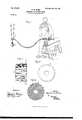
- Figure 1is a perspective view showing a machine embodying my invention.
- Fig. 2is a front view of a rossing-head.
- Fig. 3is a view at the side a of Fig. 2, and
- Fig. 4is a section on the line 4: at of Fig. 2.
- 5designates the rotary rossing-head, adapted while rotating to be moved lengthwise of the stick.
- spindle 6is connected at one end to a flexible shaft '7, here shown as having a bearing at its opposite end in a roller 8, supported in a hanger 9 and held downward by a weight 10. Motion may be imparted to the flexible shaft by any suitable device, which it is not deemed necessary to show herein.
- the spindle 6is also provided with a handle 11.
- the teeth of the rossing-headare disposed lengthwise and diagonally to the axis of the head, gradually deepening from one end to the other, and the edges of the teeth are dulled or not carried to a cutting edge.
Landscapes
- Life Sciences & Earth Sciences (AREA)
- Biodiversity & Conservation Biology (AREA)
- Ecology (AREA)
- Forests & Forestry (AREA)
- Environmental Sciences (AREA)
- Debarking, Splitting, And Disintegration Of Timber (AREA)
Description
Patented May 28, l90l.
C. R. KLlNE.
UNITED STATES PATENT OFFICE.
CHARLES R. KLINE, OF BEEGHWOOD, PENNSYLVANIA.
MACHINE FOR ROSSING BARK.
SPECIFICATION fogpart of Letters Patent No. 675,282, dated May 28, 1901.
A li ati fil d August 28, 1900- Serial No. 28,292. (No model.)
To all whom it may concern: I Be it known that I, CHARLES R. KLINE, a citizen of the United States, and a resident of Beechwood, in the county of Cameron and State of Pennsylvania, have invented a new and Improved Machine for Barking Wood and Rossin g Bark, of which the following is a full, clear, and exact description.
This invention relates to improvements in machines for removing bark from logs or timber and for rossing the bark; and the object is to provide a machine of this character having its rossing-head so formed as to remove the bark without cutting into the wood and adapted to be used on either straight, crooked, or knotted timber.
I will describe a machine for barking wood and rossing bark embodying my invention and then point out the novel features in the appended claims.
Reference is to be had to the accompanying drawings, forming a part of this specification, in which similar characters of reference indicate corresponding parts in all the figures.
Figure 1 is a perspective view showing a machine embodying my invention. Fig. 2 is a front view of a rossing-head. Fig. 3 is a view at the side a of Fig. 2, and Fig. 4 is a section on the line 4: at of Fig. 2.
Referring to the drawings, 5 designates the rotary rossing-head, adapted while rotating to be moved lengthwise of the stick. Its spindle 6 is connected at one end to a flexible shaft '7, here shown as having a bearing at its opposite end in a roller 8, supported in a hanger 9 and held downward by aweight 10. Motion may be imparted to the flexible shaft by any suitable device, which it is not deemed necessary to show herein. The spindle 6 is also provided with a handle 11. The teeth of the rossing-head are disposed lengthwise and diagonally to the axis of the head, gradually deepening from one end to the other, and the edges of the teeth are dulled or not carried to a cutting edge. By this construction when the head is moved along ,the bark by a person taking hold of the handle 11 with one hand and the covering of the flexible shaft with the other hand the bark will be removed by a rasping operation or in a manner similar to that of running a coarse rasp around the bark. The bark will thus be com= pletely removed and without danger of cutting into the wood. By disposing the teeth diagonally the fine particles of bark will be carried off to one side.
By employing a flexible shaft for rotating the head it is obvious that the head may be moved over crooked or irregular logs equally as Well as along straight logs and also around or over knots, which is not possible with machines having cutter-heads arranged in fixed bearings.
Having thus described my invention, I claim as new and desire to secure by Letters Patent 1. A rossinghead of equal diameter through out its length and having its teeth disposed lengthwise diagonally to the head and gradually deepening from one end to the other, forming gradually widenin g surfaces between teeth, and the front surfaces of the teeth be ing perpendicular to the axis, substantially as specified.
2. Arossing-head of equal diameter throughout its length and having its teeth disposed lengthwise diagonally to the head and gradually deepening from one end to the other, forming gradually-widenin g surfaces between teeth, the front surfaces of the teeth being perpendicular to the axis, and means for rotating said head while moving it over a log, substantially as specified.
In testimony whereof I have signed my name to this specification in the presence of two subscribing witnesses.
August 24, 1900.
CHARLES R. KLINE.
Witnesses:
T. B. LLOYD, O. E. CRANDELL.
Priority Applications (1)
| Application Number | Priority Date | Filing Date | Title |
|---|---|---|---|
| US2829200AUS675282A (en) | 1900-08-28 | 1900-08-28 | Machine for rossing bark. |
Applications Claiming Priority (1)
| Application Number | Priority Date | Filing Date | Title |
|---|---|---|---|
| US2829200AUS675282A (en) | 1900-08-28 | 1900-08-28 | Machine for rossing bark. |
Publications (1)
| Publication Number | Publication Date |
|---|---|
| US675282Atrue US675282A (en) | 1901-05-28 |
Family
ID=2743832
Family Applications (1)
| Application Number | Title | Priority Date | Filing Date |
|---|---|---|---|
| US2829200AExpired - LifetimeUS675282A (en) | 1900-08-28 | 1900-08-28 | Machine for rossing bark. |
Country Status (1)
| Country | Link |
|---|---|
| US (1) | US675282A (en) |
Cited By (2)
| Publication number | Priority date | Publication date | Assignee | Title |
|---|---|---|---|---|
| US2780252A (en)* | 1953-10-16 | 1957-02-05 | Anthony Brandenthaler | Log barking machine having bilateral cutters, brushes, and feed rollers |
| US20050197687A1 (en)* | 2004-03-02 | 2005-09-08 | Masoud Molaei | Medical devices including metallic films and methods for making same |
- 1900
- 1900-08-28USUS2829200Apatent/US675282A/ennot_activeExpired - Lifetime
Cited By (2)
| Publication number | Priority date | Publication date | Assignee | Title |
|---|---|---|---|---|
| US2780252A (en)* | 1953-10-16 | 1957-02-05 | Anthony Brandenthaler | Log barking machine having bilateral cutters, brushes, and feed rollers |
| US20050197687A1 (en)* | 2004-03-02 | 2005-09-08 | Masoud Molaei | Medical devices including metallic films and methods for making same |
Similar Documents
| Publication | Publication Date | Title |
|---|---|---|
| US675282A (en) | Machine for rossing bark. | |
| US1249332A (en) | Column-mill. | |
| US479332A (en) | Combined cutting and scouring device | |
| US239807A (en) | peters | |
| US519698A (en) | Charles a | |
| US1110736A (en) | Sawing-machine. | |
| US331195A (en) | William g | |
| US1106177A (en) | Peeling-machine for wood logs. | |
| US953359A (en) | Cutting-wheel. | |
| US300099A (en) | Wood-splitting machine | |
| US272892A (en) | Machine for forming and dressing lumber-rules | |
| US291727A (en) | hayes | |
| US60648A (en) | stearns | |
| US141206A (en) | Improvement in wood-grinders | |
| US347854A (en) | William wicke | |
| US141948A (en) | John b | |
| US370928A (en) | Machinery for dressing or planing ice | |
| US8612A (en) | fergus | |
| US225292A (en) | Wood-pulp machine | |
| US1242369A (en) | Rotary cutter. | |
| US330260A (en) | Cutter-head | |
| US155074A (en) | Improvement in machines for cutting wood for paper-pulp | |
| US17249A (en) | Cutter foe turning cylindrical wooden boxes | |
| US74333A (en) | Improvement in planing-machines | |
| US647074A (en) | Slab-barking machine. |