US6711427B1 - Skin abrading medical electrode mounting and packaging system - Google Patents
Skin abrading medical electrode mounting and packaging systemDownload PDFInfo
- Publication number
- US6711427B1 US6711427B1US10/075,660US7566002AUS6711427B1US 6711427 B1US6711427 B1US 6711427B1US 7566002 AUS7566002 AUS 7566002AUS 6711427 B1US6711427 B1US 6711427B1
- Authority
- US
- United States
- Prior art keywords
- electrode
- panel
- skin
- lower panel
- tab
- Prior art date
- Legal status (The legal status is an assumption and is not a legal conclusion. Google has not performed a legal analysis and makes no representation as to the accuracy of the status listed.)
- Expired - Fee Related, expires
Links
Images
Classifications
- A—HUMAN NECESSITIES
- A61—MEDICAL OR VETERINARY SCIENCE; HYGIENE
- A61B—DIAGNOSIS; SURGERY; IDENTIFICATION
- A61B5/00—Measuring for diagnostic purposes; Identification of persons
- A61B5/24—Detecting, measuring or recording bioelectric or biomagnetic signals of the body or parts thereof
- A61B5/316—Modalities, i.e. specific diagnostic methods
- A61B5/318—Heart-related electrical modalities, e.g. electrocardiography [ECG]
- A61B5/325—Preparing electrode sites, e.g. by abrasion
Definitions
- the present inventionrelates to electrocardiogram monitoring electrodes, and more specifically to an improved integral mounting and packaging system for the electrodes.
- electrocardiogram or ECG monitoring electrodesare positioned on the body of a patient in the vicinity of the heart.
- the electrodespick up electric signals generated by the heart and transmit the signals to a monitor which provides a visual representation of the heart signals to a physician for analysis of the condition of the heart.
- the electrodesare designed for a single use and are individually packaged in disposable packages that allow quick access to the electrode contained therein.
- the electrodesIn order to provide an accurate representation of the signal for analysis by the physician, the electrodes must be placed in direct electrical contact with the skin of the patient.
- an abrasive pad or equivalentis rubbed against the skin of the individual on the location where the electrode is to be positioned to remove a portion of the epidermis, or the outer layer of the skin. After the hair and epidermis portion have been removed by razor and rubbing the pad against the skin, the electrode may then be positioned on the skin in the prepared location.
- an amount of an electrically-conductive gelis utilized with the electrode.
- the gelcan either be applied to the contact side of the electrode or incorporated within the electrode.
- the gelspreads outwardly between the electrode and the skin to provide a conduit between the skin and the electrode to enhance the transmission of electrical signals emitting from the heart of the patient to the electrode.
- the speed of the preparation of the skin using the separate abrasive padis not fast enough to adequately serve the needs of the patient.
- the application of the ECG electrodes to the skin of the patient in a proper mannerneeds to be accomplished as fast as possible.
- the time needed to properly prepare the skin of the individual using the abrasive padincreases the time needed to properly apply the electrodes to the patient, possibly to the detriment of the patient.
- the improved systemshould entail a minimal number of steps in preparing the skin, unpackaging the electrode and applying the electrode, so that the minimal amount of time is needed for the application of the electrode to the patient.
- the present inventionis an improved mounting and packaging system for an ECG electrode that allows medical personnel to prepare the skin of the patient and apply the electrode in a single step.
- the systemincludes at least one carrier formed of a single sheet of a flexible material that includes an upper panel and a lower panel joined to one another by a fold.
- the upper panelincludes a depression over which the electrode is releasably attached.
- An amount of an electrically conductive gelis disposed within the depression and covered by the electrode.
- the lower panelincludes an abrasive surface that is used to contact and prepare the skin of the patient for the application of the electrode.
- the lower panel of the systemfurther includes a tab that is grasped by an individual in order to utilize the mounting and packaging system and prepare the skin and apply the electrode to the individual in a single step.
- the individualplaces the mounting and packaging system against the skin of the patient such that the abrasive surface of the lower panel of the system contacts the skin of the patient.
- the individualgrasps the electrode to hold the electrode in the desired position over the skin.
- the individualgrabs the tab on the lower panel and pulls the tab such that the abrasive surface on the lower panel is dragged along the patient's skin, removing a portion of the epidermis from the skin of the patient.
- Continued pulling of the tabremoves the upper panel and exposes the conductive gel disposed within the depression and the electrode such that the gel and electrode are subsequently positioned in contact with the prepared surface of the skin of the individual.
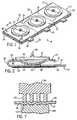
- FIG. 1is an isometric view of a number of carriers forming a mounting and packaging system constructed according to the present invention and supporting a number of ECG electrodes and joined to one another;
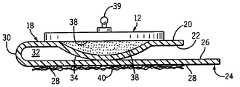
- FIG. 2is a cross-sectional view along line 2 — 2 of FIG. 1;
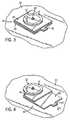
- FIG. 3is an isometric view of the carrier of FIG. 1 applied to the skin of a patient;
- FIG. 4is an isometric view of the carrier of FIG. 3 illustrating the electrode in a partially mounted position
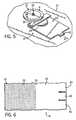
- FIG. 5is an isometric view of the carrier of FIG. 3 with the electrode in a generally fully mounted position;
- FIG. 6is a bottom plan view of a sheet forming a carrier of the system of FIG. 1;
- FIG. 7is a schematic view of the formation of the abrasive surface on the sheet of FIG. 6 .
- FIG. 1an improved ECG electrode mounting and packaging system 8 formed of a plurality of carriers 10 supporting a number of disposable electrodes 12 is illustrated in FIG. 1 .
- the carriers 10are formed of a piece 13 of flexible material, such as a soft plastic, that is separated into a number of individual sheets 14 by lines of perforation 16 extending between each sheet 14 .
- Other satisfactory materials for the material of carriers 10include laminated paper.
- each sheet 14includes an upper panel 18 that defines a top surface 20 and a bottom surface 22 , and a lower panel 24 which defines a top surface 26 and a bottom surface 28 .
- the upper panel 18 and lower panel 24are joined by a generally U-shaped fold 30 that extends between adjacent edges of the upper panel 18 and lower panel 24 in order to define a space 32 between the upper panel 18 and lower panel 24 .
- the upper panel 18includes a circular, concave pocket or depression 34 disposed in the center of the upper panel 18 .
- the depression 34extends downwardly from the top surface 20 of the upper panel 18 such that, at the lowermost portion of the depression 34 , the bottom surface 22 contacts the top surface 26 of lower panel 24 .
- the depression 34is filled with an electrically conductive gel 36 which is used to enhance the electrical contact of the electrode 12 with signals transmitted through the skin 37 of the patient.
- the gel 36 usedcan be any commercially available electrolyte gel, with a preferred gel being a silver/silver chloride (Ag/AgCl) gel.
- the gel 36is retained within the depression 34 by the placement of the electrode 12 over the top of the depression 34 .
- the electrode 12is generally circular in shape and has a diameter greater than the diameter of the depression 34 so that the electrode 12 completely covers the depression 34 .
- the electrode 12is secured to the top surface 20 of the upper panel 18 around the depression 34 by an adhesive (not shown) which is capable of retaining the electrode 12 on the upper panel 18 until the sheet 14 is pulled away from the electrode 12 .
- the electrode 12includes a contact surface 38 that is disposed in contact with the gel 36 and receives the signals transmitted through the skin 37 of the patient and a contact 39 disposed opposite the contact surface 38 .
- the contact 39is connected to the contact surface 38 and can be connected to a signal lead wire (not shown) extending from a monitor (not shown) in order to transmit the signal received by the contact surface 38 to the monitor for viewing by medical personnel.
- the monitor that the electrode 12 is connected tocan be any device used to monitor or diagnose an ECG, such as a defibrillator or electrocardiograph, for example.
- the electrode 12can be any commercially available ECG monitoring electrode which is made to be disposed of after a single use, such as the electrode Part No. 9431-303 manufactured and sold by Marquette Electronics, Inc. of Jupiter, Fla.
- the lower panel 24includes a roughened, abrasive material or area 40 disposed on the bottom surface 28 of the lower panel 24 .
- the roughened area 40is used to remove the portion of the epidermis from the skin 37 of the patient.
- the roughened area 40can be formed on the bottom surface 28 of the lower panel 24 prior to folding into the configuration for the strip 10 by drawing sheet 14 between an extrusion punch 106 and an extrusion die 108 .
- the punch 106 and die 108include a number of pins 110 and channels 112 , respectively, that engage and deform the bottom surface 28 of the sheet 14 to create the roughened area 40 on the bottom surface 28 .
- the abrasive areamay be formed by an abrasive material separate from and applied to bottom surface 28 of the lower panel 24 in a conventional manner.
- the materialcan include granules of a hardened substance such as silica or other suitable materials which provide an abrasive property to the bottom surface 28 .
- the lower panel 24further includes a tab 42 disposed opposite the fold 30 .
- the tab 42extends outwardly from the lower panel 24 beyond the side of upper panel 18 opposite the fold 30 .
- the tab 42is adapted to be grasped by an individual using the carrier 10 , as will be explained, to draw the abrasive material 40 across the skin 37 of the patient and apply the gel 36 and electrode 12 .
- the tab 42is formed on the lower panel 24 by cutting away a pair of end portions 43 from opposite sides at one end of the sheet 14 to form a tab 42 of a desired shape for grasping by an individual to employ the carrier 10 .
- FIGS. 3-5the operation of the carrier 10 to place the electrode 12 on the skin of the patient is illustrated.
- a carrier 10is detached from the system 8 along the perforation 16 .
- the detached carrier 10is then positioned on the skin 37 of the patient such that the abrasive area 40 on the lower panel 24 is positioned against the skin 37 , with the upper panel 18 and electrode 12 spaced above the skin 37 .
- the individual placing the electrode 12 on the skin 37then holds the electrode 12 in position by pressing down on opposite sides of the electrode 12 , as indicated by the arrows A in FIGS. 3-5.
- the individualgrasps and pulls the tab 42 on lower panel 24 laterally outwardly in a direction away from the upper panel 18 , shown by arrow B in FIGS.
- the roughened area 40 on the bottom surface 28 of the lower panel 24is drawn across the skin 37 of the patient. As the roughened area 40 moves across the skin 37 , it removes an amount of the skin 37 to improve the contact and electrical conductivity between the skin 37 and the contact surface 38 of the electrode 12 .
- the depression 34becomes bent backwards or retracted under the electrode 12 , thereby exposing and depositing the gel 36 on the skin 37 of the patient.
- upper panel 18peels away from electrode 12 as fold 30 is drawn below electrode 12 , to separate electrode 12 from upper panel 18 . Because the individual is holding the electrode 12 in position, the electrode 12 remains directly over the gel 36 when the upper panel 18 is withdrawn and applies the gel 36 between the electrode 12 and the skin 37 .
- carrier 10provides a simple, efficient and effective arrangement for both packaging electrode 12 and rapidly applying electrode 12 to the skin of a patient.
- the presence of skin abrading material on lower panel 24eliminates the need for separate skin abrading supplies, and provides skin abrasion and electrode application in a single step operation.
- the depression 34can have any size or shape in order to accommodate the desired amount of gel 36 .
- the sheet 14can also be used to support and position any medical device other than an electrode 12 which requires the skin 37 of the patient to be prepared prior to applying the device.
- abrasive area 40 on lower surface 28 of lower panel 24may be applied to less than the entire area of bottom surface 28 , so long as the width of abrasive area 40 corresponds to the diameter of electrode 12 .
- lower panel 24may have a length greater than that of upper panel 18 so as to increase the length of abrasive area 40 , if a greater amount of abrasive is required to attain proper skin abrasion.
- carrier 10may be in the form of a single panel having electrode 12 mounted to its top surface and having abrasive 40 on its bottom surface.
- the electrode 12must release from the panel as the panel is moved laterally from between the electrode and the skin.
- a system of this typecontemplates adhesive release upon application of lateral force, or a separate adhesive carrier which provides adhesive release when a lateral force is applied.
- This type of arrangementwould be especially advantageous upon development of a material which can function both to temporarily adhere the electrode to the packaging material and to also remain with the electrode and perform an electrically conductive function, such that the packaging of conductive gel 36 along with the electrode can be eliminated.
Landscapes
- Health & Medical Sciences (AREA)
- Life Sciences & Earth Sciences (AREA)
- Heart & Thoracic Surgery (AREA)
- Medical Informatics (AREA)
- Biophysics (AREA)
- Pathology (AREA)
- Engineering & Computer Science (AREA)
- Biomedical Technology (AREA)
- Cardiology (AREA)
- Physics & Mathematics (AREA)
- Molecular Biology (AREA)
- Surgery (AREA)
- Animal Behavior & Ethology (AREA)
- General Health & Medical Sciences (AREA)
- Public Health (AREA)
- Veterinary Medicine (AREA)
- Electrotherapy Devices (AREA)
Abstract
Description
The present invention relates to electrocardiogram monitoring electrodes, and more specifically to an improved integral mounting and packaging system for the electrodes.
In order to monitor the condition of a patient, electrocardiogram or ECG monitoring electrodes are positioned on the body of a patient in the vicinity of the heart. The electrodes pick up electric signals generated by the heart and transmit the signals to a monitor which provides a visual representation of the heart signals to a physician for analysis of the condition of the heart. The electrodes are designed for a single use and are individually packaged in disposable packages that allow quick access to the electrode contained therein.
In order to provide an accurate representation of the signal for analysis by the physician, the electrodes must be placed in direct electrical contact with the skin of the patient. For the electrodes to be placed in direct electrical contact with the skin, it is desirable to remove the hair and a portion of the epidermis or external skin layer prior to the application of the electrode to the skin of the patient. This is normally accomplished by first cleaning the site to which the electrode is to be applied using rubbing alcohol on a cotton ball. This will remove oils secreted from the skin from the site. After the site is cleaned, a razor is used to remove the hair on the site. Finally, an abrasive pad or equivalent is rubbed against the skin of the individual on the location where the electrode is to be positioned to remove a portion of the epidermis, or the outer layer of the skin. After the hair and epidermis portion have been removed by razor and rubbing the pad against the skin, the electrode may then be positioned on the skin in the prepared location.
To further enhance the electrical contact of the electrode with the skin, an amount of an electrically-conductive gel is utilized with the electrode. The gel can either be applied to the contact side of the electrode or incorporated within the electrode. When the electrode and gel are positioned on the skin, the gel spreads outwardly between the electrode and the skin to provide a conduit between the skin and the electrode to enhance the transmission of electrical signals emitting from the heart of the patient to the electrode.
While the use of the separate abrasive pad and ECG electrode is adequate to provide sufficient electrical contact between the electrode and the skin of the patient, in certain situations the speed of the preparation of the skin using the separate abrasive pad is not fast enough to adequately serve the needs of the patient. For example, in situations where the patient is in cardiac arrest, the application of the ECG electrodes to the skin of the patient in a proper manner needs to be accomplished as fast as possible. As a result, the time needed to properly prepare the skin of the individual using the abrasive pad increases the time needed to properly apply the electrodes to the patient, possibly to the detriment of the patient.
Therefore, it is desirable to develop a simple mounting and packaging system for an ECG electrode which allows a physician or other medical personnel to quickly prepare the skin of the patient and apply the electrode. The improved system should entail a minimal number of steps in preparing the skin, unpackaging the electrode and applying the electrode, so that the minimal amount of time is needed for the application of the electrode to the patient.
Furthermore, since it has recently been found that it is only necessary to abrade or prepare the skin on an electrode application site in order to obtain good electrical contact between the electrode and the skin, it is desirable to develop a self-prepping electrode that can easily prepare the skin of a patient through the hair of the patient.
It is an object of the present invention to provide an improved mounting and packaging system for an ECG electrode which enables the skin of the patient to be prepared through the hair of a patient and the electrode to be applied to the skin in a single step.
It is another object of the present invention to provide an improved mounting and packaging system for an ECG electrode that can be formed in conjunction with other separable mounting and packaging systems for separate ECG electrodes such that a number of electrodes can be packaged together in a single unit.
It is still another object of the invention to provide an improved mounting and packaging system for an ECG electrode that also contains an amount of an electrically conductive gel that is applied to the skin with the electrode.
It is still a further object of the invention to provide an improved mounting system for an ECG electrode that can be readily modified to accommodate ECG electrodes of various configurations and sizes.
The present invention is an improved mounting and packaging system for an ECG electrode that allows medical personnel to prepare the skin of the patient and apply the electrode in a single step. The system includes at least one carrier formed of a single sheet of a flexible material that includes an upper panel and a lower panel joined to one another by a fold. The upper panel includes a depression over which the electrode is releasably attached. An amount of an electrically conductive gel is disposed within the depression and covered by the electrode. Opposite the electrode, the lower panel includes an abrasive surface that is used to contact and prepare the skin of the patient for the application of the electrode. Opposite the fold, the lower panel of the system further includes a tab that is grasped by an individual in order to utilize the mounting and packaging system and prepare the skin and apply the electrode to the individual in a single step.
To apply the electrode to the patient, the individual places the mounting and packaging system against the skin of the patient such that the abrasive surface of the lower panel of the system contacts the skin of the patient. The individual grasps the electrode to hold the electrode in the desired position over the skin. The individual then grabs the tab on the lower panel and pulls the tab such that the abrasive surface on the lower panel is dragged along the patient's skin, removing a portion of the epidermis from the skin of the patient. Continued pulling of the tab removes the upper panel and exposes the conductive gel disposed within the depression and the electrode such that the gel and electrode are subsequently positioned in contact with the prepared surface of the skin of the individual.
Various alternatives and other embodiments of the invention will become apparent from the following detailed description taken together with the drawings.
The drawings illustrate the best mode presently contemplated of carrying out the invention.
In the drawings:
FIG. 1 is an isometric view of a number of carriers forming a mounting and packaging system constructed according to the present invention and supporting a number of ECG electrodes and joined to one another;
FIG. 2 is a cross-sectional view along line2—2 of FIG. 1;
FIG. 3 is an isometric view of the carrier of FIG. 1 applied to the skin of a patient;
FIG. 4 is an isometric view of the carrier of FIG. 3 illustrating the electrode in a partially mounted position;
FIG. 5 is an isometric view of the carrier of FIG. 3 with the electrode in a generally fully mounted position;
FIG. 6 is a bottom plan view of a sheet forming a carrier of the system of FIG. 1; and
FIG. 7 is a schematic view of the formation of the abrasive surface on the sheet of FIG.6.
With respect now to the following detailed description in which like reference numerals designate like parts throughout the disclosure, an improved ECG electrode mounting and packaging system8 formed of a plurality ofcarriers 10 supporting a number ofdisposable electrodes 12 is illustrated in FIG.1. Thecarriers 10 are formed of apiece 13 of flexible material, such as a soft plastic, that is separated into a number ofindividual sheets 14 by lines ofperforation 16 extending between eachsheet 14. Other satisfactory materials for the material ofcarriers 10 include laminated paper.
Referring now to FIGS. 2 and 6, eachsheet 14 includes anupper panel 18 that defines atop surface 20 and abottom surface 22, and alower panel 24 which defines atop surface 26 and abottom surface 28. Theupper panel 18 andlower panel 24 are joined by a generallyU-shaped fold 30 that extends between adjacent edges of theupper panel 18 andlower panel 24 in order to define aspace 32 between theupper panel 18 andlower panel 24.
Theupper panel 18 includes a circular, concave pocket ordepression 34 disposed in the center of theupper panel 18. Thedepression 34 extends downwardly from thetop surface 20 of theupper panel 18 such that, at the lowermost portion of thedepression 34, thebottom surface 22 contacts thetop surface 26 oflower panel 24. Thedepression 34 is filled with an electrically conductive gel36 which is used to enhance the electrical contact of theelectrode 12 with signals transmitted through theskin 37 of the patient. The gel36 used can be any commercially available electrolyte gel, with a preferred gel being a silver/silver chloride (Ag/AgCl) gel.
The gel36 is retained within thedepression 34 by the placement of theelectrode 12 over the top of thedepression 34. Theelectrode 12 is generally circular in shape and has a diameter greater than the diameter of thedepression 34 so that theelectrode 12 completely covers thedepression 34. Theelectrode 12 is secured to thetop surface 20 of theupper panel 18 around thedepression 34 by an adhesive (not shown) which is capable of retaining theelectrode 12 on theupper panel 18 until thesheet 14 is pulled away from theelectrode 12. Theelectrode 12 includes acontact surface 38 that is disposed in contact with the gel36 and receives the signals transmitted through theskin 37 of the patient and acontact 39 disposed opposite thecontact surface 38. Thecontact 39 is connected to thecontact surface 38 and can be connected to a signal lead wire (not shown) extending from a monitor (not shown) in order to transmit the signal received by thecontact surface 38 to the monitor for viewing by medical personnel. The monitor that theelectrode 12 is connected to can be any device used to monitor or diagnose an ECG, such as a defibrillator or electrocardiograph, for example. Theelectrode 12 can be any commercially available ECG monitoring electrode which is made to be disposed of after a single use, such as the electrode Part No. 9431-303 manufactured and sold by Marquette Electronics, Inc. of Jupiter, Fla.
Opposite theupper panel 18, thelower panel 24 includes a roughened, abrasive material orarea 40 disposed on thebottom surface 28 of thelower panel 24. The roughenedarea 40 is used to remove the portion of the epidermis from theskin 37 of the patient. As best shown in FIG. 7, the roughenedarea 40 can be formed on thebottom surface 28 of thelower panel 24 prior to folding into the configuration for thestrip 10 by drawingsheet 14 between anextrusion punch 106 and anextrusion die 108. Thepunch 106 and die108 include a number ofpins 110 andchannels 112, respectively, that engage and deform thebottom surface 28 of thesheet 14 to create the roughenedarea 40 on thebottom surface 28. Alternatively, the abrasive area may be formed by an abrasive material separate from and applied tobottom surface 28 of thelower panel 24 in a conventional manner. When theabrasive area 40 is formed by an abrasive material separate from thesheet 14, the material can include granules of a hardened substance such as silica or other suitable materials which provide an abrasive property to thebottom surface 28.
Thelower panel 24 further includes atab 42 disposed opposite thefold 30. Thetab 42 extends outwardly from thelower panel 24 beyond the side ofupper panel 18 opposite thefold 30. Thetab 42 is adapted to be grasped by an individual using thecarrier 10, as will be explained, to draw theabrasive material 40 across theskin 37 of the patient and apply the gel36 andelectrode 12. Thetab 42 is formed on thelower panel 24 by cutting away a pair ofend portions 43 from opposite sides at one end of thesheet 14 to form atab 42 of a desired shape for grasping by an individual to employ thecarrier 10.
Referring now to FIGS. 3-5, the operation of thecarrier 10 to place theelectrode 12 on the skin of the patient is illustrated. Initially, acarrier 10 is detached from the system8 along theperforation 16. Thedetached carrier 10 is then positioned on theskin 37 of the patient such that theabrasive area 40 on thelower panel 24 is positioned against theskin 37, with theupper panel 18 andelectrode 12 spaced above theskin 37. The individual placing theelectrode 12 on theskin 37 then holds theelectrode 12 in position by pressing down on opposite sides of theelectrode 12, as indicated by the arrows A in FIGS. 3-5. The individual then grasps and pulls thetab 42 onlower panel 24 laterally outwardly in a direction away from theupper panel 18, shown by arrow B in FIGS. 4 and 5, such that thefold 30 is drawn beneath theupper panel 18. In doing so, the roughenedarea 40 on thebottom surface 28 of thelower panel 24 is drawn across theskin 37 of the patient. As the roughenedarea 40 moves across theskin 37, it removes an amount of theskin 37 to improve the contact and electrical conductivity between theskin 37 and thecontact surface 38 of theelectrode 12.
Referring now to FIG. 4, as thetab 42 is pulled to move thelower panel 24 out from beneath theupper panel 18, thedepression 34 becomes bent backwards or retracted under theelectrode 12, thereby exposing and depositing the gel36 on theskin 37 of the patient. Simultaneously,upper panel 18 peels away fromelectrode 12 asfold 30 is drawn belowelectrode 12, to separateelectrode 12 fromupper panel 18. Because the individual is holding theelectrode 12 in position, theelectrode 12 remains directly over the gel36 when theupper panel 18 is withdrawn and applies the gel36 between theelectrode 12 and theskin 37. Continued pulling on thetab 42 deflects continually more of thedepression 34 such that substantially the entire amount of gel36 is deposited from within thedepression 34 onto theskin 37 of the patient between theelectrode 12 and theskin 37. The individual continues to pull on thetab 42 until theentire sheet 14 is completely retracted from between theelectrode 12 and theskin 37, leaving theelectrode 12 and gel36 disposed on the prepared location on theskin 37. Theelectrode 12 can then be hooked up to the monitor to display the signals generated by the heart of the patient, while thesheet 14 can be disposed of in a conventional manner.
It can thus be appreciated thatcarrier 10 provides a simple, efficient and effective arrangement for bothpackaging electrode 12 and rapidly applyingelectrode 12 to the skin of a patient. The presence of skin abrading material onlower panel 24 eliminates the need for separate skin abrading supplies, and provides skin abrasion and electrode application in a single step operation.
While the above description illustrates the best mode currently used to practice the invention, other modifications and embodiment are also considered to be part of the invention. For example, thedepression 34 can have any size or shape in order to accommodate the desired amount of gel36. Thesheet 14 can also be used to support and position any medical device other than anelectrode 12 which requires theskin 37 of the patient to be prepared prior to applying the device.
In addition, it should be understood that the present invention contemplates simultaneous skin abrasion and electrode application in other arrangements than the specifically described components and operation. For example,abrasive area 40 onlower surface 28 oflower panel 24 may be applied to less than the entire area ofbottom surface 28, so long as the width ofabrasive area 40 corresponds to the diameter ofelectrode 12. Further,lower panel 24 may have a length greater than that ofupper panel 18 so as to increase the length ofabrasive area 40, if a greater amount of abrasive is required to attain proper skin abrasion. Further, in an alternative embodiment, it is contemplated thatcarrier 10 may be in the form of a singlepanel having electrode 12 mounted to its top surface and having abrasive40 on its bottom surface. In this type of arrangement, theelectrode 12 must release from the panel as the panel is moved laterally from between the electrode and the skin. A system of this type contemplates adhesive release upon application of lateral force, or a separate adhesive carrier which provides adhesive release when a lateral force is applied. This type of arrangement would be especially advantageous upon development of a material which can function both to temporarily adhere the electrode to the packaging material and to also remain with the electrode and perform an electrically conductive function, such that the packaging of conductive gel36 along with the electrode can be eliminated.
Various alternatives are contemplated as being within the scope of the following claims particularly pointing out and distinctly claiming the subject matter regarded as the invention.
Claims (18)
1. A medical electrode system, comprising:
a medical electrode having a contact surface adapted to contact the skin of a patient; and
an electrode carrier, comprising a top panel interconnected with a bottom panel, wherein the contact surface of the electrode is releasably secured to an upper surface defined by the top panel and wherein the bottom panel defines a downwardly facing surface, and wherein at least a portion of the downwardly facing surface includes an abrasive area.
2. The medical electrode system ofclaim 1 , wherein the top panel and the bottom panel are interconnected by a fold therebetween.
3. The medical electrode system ofclaim 2 , wherein the top panel includes a side edge located on an opposite side of the electrode from the fold between the top and bottom panels, and wherein at least a portion of the bottom panel extends outwardly of the side edge defined by the top panel.
4. The medical electrode system ofclaim 3 , wherein the bottom panel defines a side edge and an outwardly extending tab, wherein the outwardly extending tab comprises the portion of the bottom panel which extends outwardly of the side edge defined by the top panel.
5. The medical electrode system ofclaim 4 , wherein the tab occupies less than the entire length of the side edge defined by the bottom panel.
6. The medical electrode system ofclaim 2 , further comprising a pocket defined by the top panel, wherein at least a portion of the contact surface of the electrode is located over the pocket, and a quantity of conductive fluid contained within the pocket.
7. The medical electrode system ofclaim 2 , wherein the abrasive area of the downwardly facing surface comprises a layer of abrasive material applied to the downwardly facing surface.
8. In a medical electrode package wherein an electrode is releasably secured to a first surface defined by a substantially flat carrier panel, the improvement comprising an abrasive area disposed on a second surface defined by the carrier panel, wherein the second surface faces in a direction opposite that of the first surface, wherein the carrier panel comprises a top wall and a bottom wall with a fold area therebetween, wherein the first surface is defined by the top wall and the second surface is defined by the bottom wall.
9. The improvement ofclaim 8 , wherein the top wall defines a side edge opposite the fold area and a depression between the side edge and the fold area.
10. The improvement ofclaim 9 wherein the depression holds an amount of a conductive fluid.
11. The improvement ofclaim 8 wherein the abrasive area is formed integrally with the second surface.
12. The improvement ofclaim 8 wherein the abrasive area is applied to the second surface.
13. The improvement ofclaim 8 further comprising a tab extending outwardly from the second surface.
14. A method of applying an electrode to the skin of a patient, the method comprising the steps of:
a) providing a carrier including an upper panel and a lower panel disposed beneath and interconnected with the upper panel, the upper panel releasably supporting an electrode and the lower panel including an abrasive material opposite the upper panel;
b) placing the abrasive material on the lower panel against the skin of an individual;
c) holding the electrode stationary; and
d) pulling the lower panel and upper panel outwardly from beneath the electrode.
15. The method ofclaim 14 wherein the step of pulling the lower panel and upper panel from beneath the electrode comprises the steps of:
a) grasping a tab formed on the lower panel that extends outwardly from beneath the upper panel; and
b) pulling the tab outwardly in a direction parallel to the upper panel.
16. The method ofclaim 15 wherein the upper panel includes a pocket located above the lower panel over which the electrode is positioned.
17. The method ofclaim 16 wherein the pocket contains an electrically conductive fluid.
18. The method ofclaim 17 further comprising the step of depositing the fluid from within the pocket on the skin of the patient simultaneously with the step of pulling the tab.
Priority Applications (1)
| Application Number | Priority Date | Filing Date | Title |
|---|---|---|---|
| US10/075,660US6711427B1 (en) | 2002-02-13 | 2002-02-13 | Skin abrading medical electrode mounting and packaging system |
Applications Claiming Priority (1)
| Application Number | Priority Date | Filing Date | Title |
|---|---|---|---|
| US10/075,660US6711427B1 (en) | 2002-02-13 | 2002-02-13 | Skin abrading medical electrode mounting and packaging system |
Publications (1)
| Publication Number | Publication Date |
|---|---|
| US6711427B1true US6711427B1 (en) | 2004-03-23 |
Family
ID=31975676
Family Applications (1)
| Application Number | Title | Priority Date | Filing Date |
|---|---|---|---|
| US10/075,660Expired - Fee RelatedUS6711427B1 (en) | 2002-02-13 | 2002-02-13 | Skin abrading medical electrode mounting and packaging system |
Country Status (1)
| Country | Link |
|---|---|
| US (1) | US6711427B1 (en) |
Cited By (24)
| Publication number | Priority date | Publication date | Assignee | Title |
|---|---|---|---|---|
| USD536673S1 (en)* | 2004-08-16 | 2007-02-13 | Koninklijke Philips Electronics N.V. | Electrode |
| US7215989B1 (en)* | 2004-03-15 | 2007-05-08 | Burks Jonathan W | Multiple electrode assembly |
| US20090227857A1 (en)* | 2008-03-06 | 2009-09-10 | Chuck Rowe | Biomedical electrode |
| US20090253975A1 (en)* | 2008-04-04 | 2009-10-08 | Mark Tiegs | ECG monitoring electrode |
| US20100130847A1 (en)* | 2008-11-21 | 2010-05-27 | Tyco Healthcare Group Lp | Electrode Garment |
| US20110130640A1 (en)* | 2008-03-06 | 2011-06-02 | Tyco Healthcare Group Lp | Electrode Capable of Attachment to a Garment, System, and Methods of Manufacturing |
| US20130018250A1 (en)* | 2011-07-14 | 2013-01-17 | Verathon Inc. | Releasable liner for sensor device |
| CN103211592A (en)* | 2013-04-23 | 2013-07-24 | 韩宝石 | Device for placing electrocardio measuring electrode and electrocardiogram instrument |
| US8550234B2 (en) | 2010-12-07 | 2013-10-08 | Interroll Corporation | Sequential controlled start-up for zoned conveyor systems |
| US8695786B2 (en) | 2010-12-07 | 2014-04-15 | Interroll Holding Ag | Singulated release for zoned conveyor systems |
| US8814574B2 (en)* | 2012-12-31 | 2014-08-26 | Suunto Oy | Male end of a telemetric transceiver |
| US20140303647A1 (en)* | 2013-04-08 | 2014-10-09 | Irhythm Technologies, Inc. | Skin abrader |
| US9241649B2 (en) | 2010-05-12 | 2016-01-26 | Irhythm Technologies, Inc. | Device features and design elements for long-term adhesion |
| US9597004B2 (en) | 2014-10-31 | 2017-03-21 | Irhythm Technologies, Inc. | Wearable monitor |
| US9615790B2 (en) | 2011-07-14 | 2017-04-11 | Verathon Inc. | Sensor device with flexible joints |
| US9859642B2 (en)* | 2016-05-19 | 2018-01-02 | Japan Aviation Electronics Industry, Limited | Connector and method for using connector |
| US10271754B2 (en) | 2013-01-24 | 2019-04-30 | Irhythm Technologies, Inc. | Physiological monitoring device |
| US11083371B1 (en) | 2020-02-12 | 2021-08-10 | Irhythm Technologies, Inc. | Methods and systems for processing data via an executable file on a monitor to reduce the dimensionality of the data and encrypting the data being transmitted over the wireless network |
| US11147465B2 (en) | 2015-05-05 | 2021-10-19 | Welch Allyn, Inc. | Abrasive electrode |
| US11246523B1 (en) | 2020-08-06 | 2022-02-15 | Irhythm Technologies, Inc. | Wearable device with conductive traces and insulator |
| US11350864B2 (en) | 2020-08-06 | 2022-06-07 | Irhythm Technologies, Inc. | Adhesive physiological monitoring device |
| WO2023105466A1 (en)* | 2021-12-10 | 2023-06-15 | Novocure Gmbh | Compression garment assembly for applying ttfields and methods of production and use thereof |
| FI20235920A1 (en)* | 2023-08-17 | 2025-02-18 | Teknologian Tutkimuskeskus Vtt Oy | Functional attachment for bioelectrode |
| USD1063079S1 (en) | 2021-08-06 | 2025-02-18 | Irhythm Technologies, Inc. | Physiological monitoring device |
Citations (39)
| Publication number | Priority date | Publication date | Assignee | Title |
|---|---|---|---|---|
| US2887112A (en) | 1957-08-15 | 1959-05-19 | Sanborn Company | Pad for skin preparation for electrocardiography and the like |
| US3151619A (en) | 1961-07-17 | 1964-10-06 | Spacelab Inc | Electrode for electromedical equipment |
| US3490439A (en) | 1965-07-30 | 1970-01-20 | Dale R Rolston | Electrode holder for use with an electroencephalograph |
| US3566860A (en) | 1968-12-20 | 1971-03-02 | United Aircraft Corp | Carbon-impregnated body electrode |
| US3580240A (en)* | 1969-01-17 | 1971-05-25 | Hoffmann La Roche | Disposable electrode with self-sealing plug outlet |
| US3602216A (en) | 1969-09-16 | 1971-08-31 | United Aircraft Corp | Paste dispensing body electrode |
| US3774592A (en) | 1971-12-16 | 1973-11-27 | Xerox Corp | Method for providing an improved body electrode electrical connection |
| US3805769A (en) | 1971-08-27 | 1974-04-23 | R Sessions | Disposable electrode |
| US3828766A (en) | 1972-08-14 | 1974-08-13 | Jet Medical Prod Inc | Disposable medical electrode |
| US3911906A (en)* | 1974-04-24 | 1975-10-14 | Survival Technology | Dry applied and operably dry electrode device |
| US4004578A (en) | 1974-09-10 | 1977-01-25 | Salve S.A. | Expendable electro-cardiograph electrode |
| US4027664A (en)* | 1975-11-17 | 1977-06-07 | Baxter Travenol Laboratories, Inc. | Diagnostic electrode assembly with a skin preparation surface |
| US4029086A (en) | 1975-08-11 | 1977-06-14 | Consolidated Medical Equipment, Inc. | Electrode arrangement |
| US4072145A (en) | 1976-07-19 | 1978-02-07 | Silva Jose R | Brain wave signal sensor headband assembly |
| US4126126A (en) | 1976-07-27 | 1978-11-21 | C. R. Bard, Inc. | Non-metallic pregelled electrode |
| US4274419A (en) | 1979-10-19 | 1981-06-23 | Quinton Instrument Co. | Skin preparation device and method used in the application of medical electrodes |
| US4311152A (en) | 1979-01-15 | 1982-01-19 | Quinton Instrument Co. | Medical electrode and system for minimizing motion artifacts |
| US4459987A (en) | 1982-03-10 | 1984-07-17 | William W. Haefliger | Flexible abrasive pad |
| US4595013A (en) | 1984-08-17 | 1986-06-17 | Neurologics, Inc. | Electrode harness |
| US4638807A (en) | 1985-08-27 | 1987-01-27 | Ryder International Corporation | Headband electrode system |
| US4640289A (en) | 1983-11-14 | 1987-02-03 | Minnesota Mining And Manufacturing Company | Biomedical electrode |
| US4640290A (en) | 1985-04-25 | 1987-02-03 | Westinghouse Electric Corp. | Shielded, self-preparing electrode suitable for electroencephalographic mapping |
| US4683892A (en) | 1985-04-24 | 1987-08-04 | Johansson Nils E | Method and apparatus for conducting brain function diagnostic test |
| US4706679A (en) | 1986-01-27 | 1987-11-17 | Westinghouse Electric Corp. | Disposable monitor for an EEG head set |
| US4709702A (en) | 1985-04-25 | 1987-12-01 | Westinghouse Electric Corp. | Electroencephalographic cap |
| US4770180A (en) | 1986-01-27 | 1988-09-13 | Westinghouse Electric Corp. | Electroencephalographic head set with a disposable monitor |
| US4899754A (en) | 1986-10-03 | 1990-02-13 | Minnesota Mining And Manufacturing Company | Flat, conformable, biomedical electrode allowing removal of electrical lead wire |
| US4928696A (en) | 1989-07-26 | 1990-05-29 | Mindcenter Corporation | Electrode-supporting headset |
| US4936306A (en) | 1985-02-15 | 1990-06-26 | Doty James R | Device and method for monitoring evoked potentials and electroencephalograms |
| US4938219A (en) | 1987-01-16 | 1990-07-03 | Fukuda Denshi Co., Ltd. | Electrocardiographic electrode |
| US4945911A (en) | 1988-01-22 | 1990-08-07 | Joel Cohen | Medical electrode |
| US4967038A (en) | 1986-12-16 | 1990-10-30 | Sam Techology Inc. | Dry electrode brain wave recording system |
| US4995392A (en) | 1988-12-29 | 1991-02-26 | Westinghouse Electric Corp. | Self-preparing electrode with removable plastic abrading brush |
| US5197471A (en) | 1990-05-24 | 1993-03-30 | Otero Servio T A | Dry medical electrode |
| US5211174A (en) | 1990-09-14 | 1993-05-18 | Physiometrix, Inc. | Low impedance, low durometer, dry conforming contact element |
| JPH0614894A (en) | 1992-05-12 | 1994-01-25 | Fukuda M Ii Kogyo Kk | Electrode for living body |
| US5305746A (en) | 1992-09-29 | 1994-04-26 | Aspect Medical Systems, Inc. | Disposable, pre-gelled, self-prepping electrode |
| US5984102A (en) | 1992-09-24 | 1999-11-16 | Survivalink Corporation | Medical electrode packaging technology |
| US6136008A (en) | 1998-03-19 | 2000-10-24 | 3M Innovative Properties Company | Skin abrader for biomedical electrode |
- 2002
- 2002-02-13USUS10/075,660patent/US6711427B1/ennot_activeExpired - Fee Related
Patent Citations (39)
| Publication number | Priority date | Publication date | Assignee | Title |
|---|---|---|---|---|
| US2887112A (en) | 1957-08-15 | 1959-05-19 | Sanborn Company | Pad for skin preparation for electrocardiography and the like |
| US3151619A (en) | 1961-07-17 | 1964-10-06 | Spacelab Inc | Electrode for electromedical equipment |
| US3490439A (en) | 1965-07-30 | 1970-01-20 | Dale R Rolston | Electrode holder for use with an electroencephalograph |
| US3566860A (en) | 1968-12-20 | 1971-03-02 | United Aircraft Corp | Carbon-impregnated body electrode |
| US3580240A (en)* | 1969-01-17 | 1971-05-25 | Hoffmann La Roche | Disposable electrode with self-sealing plug outlet |
| US3602216A (en) | 1969-09-16 | 1971-08-31 | United Aircraft Corp | Paste dispensing body electrode |
| US3805769A (en) | 1971-08-27 | 1974-04-23 | R Sessions | Disposable electrode |
| US3774592A (en) | 1971-12-16 | 1973-11-27 | Xerox Corp | Method for providing an improved body electrode electrical connection |
| US3828766A (en) | 1972-08-14 | 1974-08-13 | Jet Medical Prod Inc | Disposable medical electrode |
| US3911906A (en)* | 1974-04-24 | 1975-10-14 | Survival Technology | Dry applied and operably dry electrode device |
| US4004578A (en) | 1974-09-10 | 1977-01-25 | Salve S.A. | Expendable electro-cardiograph electrode |
| US4029086A (en) | 1975-08-11 | 1977-06-14 | Consolidated Medical Equipment, Inc. | Electrode arrangement |
| US4027664A (en)* | 1975-11-17 | 1977-06-07 | Baxter Travenol Laboratories, Inc. | Diagnostic electrode assembly with a skin preparation surface |
| US4072145A (en) | 1976-07-19 | 1978-02-07 | Silva Jose R | Brain wave signal sensor headband assembly |
| US4126126A (en) | 1976-07-27 | 1978-11-21 | C. R. Bard, Inc. | Non-metallic pregelled electrode |
| US4311152A (en) | 1979-01-15 | 1982-01-19 | Quinton Instrument Co. | Medical electrode and system for minimizing motion artifacts |
| US4274419A (en) | 1979-10-19 | 1981-06-23 | Quinton Instrument Co. | Skin preparation device and method used in the application of medical electrodes |
| US4459987A (en) | 1982-03-10 | 1984-07-17 | William W. Haefliger | Flexible abrasive pad |
| US4640289A (en) | 1983-11-14 | 1987-02-03 | Minnesota Mining And Manufacturing Company | Biomedical electrode |
| US4595013A (en) | 1984-08-17 | 1986-06-17 | Neurologics, Inc. | Electrode harness |
| US4936306A (en) | 1985-02-15 | 1990-06-26 | Doty James R | Device and method for monitoring evoked potentials and electroencephalograms |
| US4683892A (en) | 1985-04-24 | 1987-08-04 | Johansson Nils E | Method and apparatus for conducting brain function diagnostic test |
| US4709702A (en) | 1985-04-25 | 1987-12-01 | Westinghouse Electric Corp. | Electroencephalographic cap |
| US4640290A (en) | 1985-04-25 | 1987-02-03 | Westinghouse Electric Corp. | Shielded, self-preparing electrode suitable for electroencephalographic mapping |
| US4638807A (en) | 1985-08-27 | 1987-01-27 | Ryder International Corporation | Headband electrode system |
| US4770180A (en) | 1986-01-27 | 1988-09-13 | Westinghouse Electric Corp. | Electroencephalographic head set with a disposable monitor |
| US4706679A (en) | 1986-01-27 | 1987-11-17 | Westinghouse Electric Corp. | Disposable monitor for an EEG head set |
| US4899754A (en) | 1986-10-03 | 1990-02-13 | Minnesota Mining And Manufacturing Company | Flat, conformable, biomedical electrode allowing removal of electrical lead wire |
| US4967038A (en) | 1986-12-16 | 1990-10-30 | Sam Techology Inc. | Dry electrode brain wave recording system |
| US4938219A (en) | 1987-01-16 | 1990-07-03 | Fukuda Denshi Co., Ltd. | Electrocardiographic electrode |
| US4945911A (en) | 1988-01-22 | 1990-08-07 | Joel Cohen | Medical electrode |
| US4995392A (en) | 1988-12-29 | 1991-02-26 | Westinghouse Electric Corp. | Self-preparing electrode with removable plastic abrading brush |
| US4928696A (en) | 1989-07-26 | 1990-05-29 | Mindcenter Corporation | Electrode-supporting headset |
| US5197471A (en) | 1990-05-24 | 1993-03-30 | Otero Servio T A | Dry medical electrode |
| US5211174A (en) | 1990-09-14 | 1993-05-18 | Physiometrix, Inc. | Low impedance, low durometer, dry conforming contact element |
| JPH0614894A (en) | 1992-05-12 | 1994-01-25 | Fukuda M Ii Kogyo Kk | Electrode for living body |
| US5984102A (en) | 1992-09-24 | 1999-11-16 | Survivalink Corporation | Medical electrode packaging technology |
| US5305746A (en) | 1992-09-29 | 1994-04-26 | Aspect Medical Systems, Inc. | Disposable, pre-gelled, self-prepping electrode |
| US6136008A (en) | 1998-03-19 | 2000-10-24 | 3M Innovative Properties Company | Skin abrader for biomedical electrode |
Cited By (79)
| Publication number | Priority date | Publication date | Assignee | Title |
|---|---|---|---|---|
| US7215989B1 (en)* | 2004-03-15 | 2007-05-08 | Burks Jonathan W | Multiple electrode assembly |
| USD536673S1 (en)* | 2004-08-16 | 2007-02-13 | Koninklijke Philips Electronics N.V. | Electrode |
| US8548558B2 (en) | 2008-03-06 | 2013-10-01 | Covidien Lp | Electrode capable of attachment to a garment, system, and methods of manufacturing |
| US20110130640A1 (en)* | 2008-03-06 | 2011-06-02 | Tyco Healthcare Group Lp | Electrode Capable of Attachment to a Garment, System, and Methods of Manufacturing |
| US20090227857A1 (en)* | 2008-03-06 | 2009-09-10 | Chuck Rowe | Biomedical electrode |
| US20090253975A1 (en)* | 2008-04-04 | 2009-10-08 | Mark Tiegs | ECG monitoring electrode |
| US8406843B2 (en) | 2008-04-04 | 2013-03-26 | Mark Tiegs | ECG monitoring electrode |
| US20100130847A1 (en)* | 2008-11-21 | 2010-05-27 | Tyco Healthcare Group Lp | Electrode Garment |
| US8868216B2 (en) | 2008-11-21 | 2014-10-21 | Covidien Lp | Electrode garment |
| US12274554B2 (en) | 2010-05-12 | 2025-04-15 | Irhythm Technologies, Inc. | Device features and design elements for long-term adhesion |
| US12324668B2 (en) | 2010-05-12 | 2025-06-10 | Irhythm Technologies, Inc. | Device features and design elements for long-term adhesion |
| US10517500B2 (en) | 2010-05-12 | 2019-12-31 | Irhythm Technologies, Inc. | Device features and design elements for long-term adhesion |
| US11141091B2 (en) | 2010-05-12 | 2021-10-12 | Irhythm Technologies, Inc. | Device features and design elements for long-term adhesion |
| US12133734B2 (en) | 2010-05-12 | 2024-11-05 | Irhythm Technologies, Inc. | Device features and design elements for long-term adhesion |
| US12303277B2 (en) | 2010-05-12 | 2025-05-20 | Irhythm Technologies, Inc. | Device features and design elements for long-term adhesion |
| US12408856B1 (en) | 2010-05-12 | 2025-09-09 | Irhythm Technologies, Inc. | Device features and design elements for long-term adhesion |
| US10405799B2 (en) | 2010-05-12 | 2019-09-10 | Irhythm Technologies, Inc. | Device features and design elements for long-term adhesion |
| US9241649B2 (en) | 2010-05-12 | 2016-01-26 | Irhythm Technologies, Inc. | Device features and design elements for long-term adhesion |
| US8550234B2 (en) | 2010-12-07 | 2013-10-08 | Interroll Corporation | Sequential controlled start-up for zoned conveyor systems |
| US8695786B2 (en) | 2010-12-07 | 2014-04-15 | Interroll Holding Ag | Singulated release for zoned conveyor systems |
| US20130018250A1 (en)* | 2011-07-14 | 2013-01-17 | Verathon Inc. | Releasable liner for sensor device |
| EP2731670A4 (en)* | 2011-07-14 | 2015-01-21 | Verathon Inc | Releasable liner for sensor device |
| US8897851B2 (en)* | 2011-07-14 | 2014-11-25 | Verathon Inc. | Releasable liner for sensor device |
| JP2014523781A (en)* | 2011-07-14 | 2014-09-18 | ベラソン インコーポレイテッド | Removable liner for sensor devices |
| US9615790B2 (en) | 2011-07-14 | 2017-04-11 | Verathon Inc. | Sensor device with flexible joints |
| WO2013010179A1 (en) | 2011-07-14 | 2013-01-17 | Verathon Inc. | Releasable liner for sensor device |
| US8814574B2 (en)* | 2012-12-31 | 2014-08-26 | Suunto Oy | Male end of a telemetric transceiver |
| US12402819B1 (en) | 2013-01-24 | 2025-09-02 | Irhythm Technologies, Inc. | Physiological monitoring device |
| US11051738B2 (en) | 2013-01-24 | 2021-07-06 | Irhythm Technologies, Inc. | Physiological monitoring device |
| US10271754B2 (en) | 2013-01-24 | 2019-04-30 | Irhythm Technologies, Inc. | Physiological monitoring device |
| US11627902B2 (en) | 2013-01-24 | 2023-04-18 | Irhythm Technologies, Inc. | Physiological monitoring device |
| US12245859B2 (en) | 2013-01-24 | 2025-03-11 | Irhythm Technologies, Inc. | Physiological monitoring device |
| US12245860B2 (en) | 2013-01-24 | 2025-03-11 | Irhythm Technologies, Inc. | Physiological monitoring device |
| US10555683B2 (en) | 2013-01-24 | 2020-02-11 | Irhythm Technologies, Inc. | Physiological monitoring device |
| US12303275B2 (en) | 2013-01-24 | 2025-05-20 | Irhythm Technologies, Inc. | Physiological monitoring device |
| US12357212B2 (en) | 2013-01-24 | 2025-07-15 | Irhythm Technologies, Inc. | Physiological monitoring device |
| US9451975B2 (en)* | 2013-04-08 | 2016-09-27 | Irhythm Technologies, Inc. | Skin abrader |
| WO2014168841A1 (en)* | 2013-04-08 | 2014-10-16 | Irhythm Technologies, Inc | Skin abrader |
| US20140303647A1 (en)* | 2013-04-08 | 2014-10-09 | Irhythm Technologies, Inc. | Skin abrader |
| US9173670B2 (en)* | 2013-04-08 | 2015-11-03 | Irhythm Technologies, Inc. | Skin abrader |
| CN103211592A (en)* | 2013-04-23 | 2013-07-24 | 韩宝石 | Device for placing electrocardio measuring electrode and electrocardiogram instrument |
| CN103211592B (en)* | 2013-04-23 | 2016-08-10 | 韩宝石 | Place electrocardio and measure device and the electrocardiograph of electrode |
| US10813565B2 (en) | 2014-10-31 | 2020-10-27 | Irhythm Technologies, Inc. | Wearable monitor |
| US10667712B2 (en) | 2014-10-31 | 2020-06-02 | Irhythm Technologies, Inc. | Wearable monitor |
| US11289197B1 (en) | 2014-10-31 | 2022-03-29 | Irhythm Technologies, Inc. | Wearable monitor |
| US11605458B2 (en) | 2014-10-31 | 2023-03-14 | Irhythm Technologies, Inc | Wearable monitor |
| US9597004B2 (en) | 2014-10-31 | 2017-03-21 | Irhythm Technologies, Inc. | Wearable monitor |
| US9955887B2 (en) | 2014-10-31 | 2018-05-01 | Irhythm Technologies, Inc. | Wearable monitor |
| US10098559B2 (en) | 2014-10-31 | 2018-10-16 | Irhythm Technologies, Inc. | Wearable monitor with arrhythmia burden evaluation |
| US11756684B2 (en) | 2014-10-31 | 2023-09-12 | Irhythm Technologies, Inc. | Wearable monitor |
| US10299691B2 (en) | 2014-10-31 | 2019-05-28 | Irhythm Technologies, Inc. | Wearable monitor with arrhythmia burden evaluation |
| US11147465B2 (en) | 2015-05-05 | 2021-10-19 | Welch Allyn, Inc. | Abrasive electrode |
| US9859642B2 (en)* | 2016-05-19 | 2018-01-02 | Japan Aviation Electronics Industry, Limited | Connector and method for using connector |
| US11375941B2 (en) | 2020-02-12 | 2022-07-05 | Irhythm Technologies, Inc. | Methods and systems for processing data via an executable file on a monitor to reduce the dimensionality of the data and encrypting the data being transmitted over the wireless network |
| US11497432B2 (en) | 2020-02-12 | 2022-11-15 | Irhythm Technologies, Inc. | Methods and systems for processing data via an executable file on a monitor to reduce the dimensionality of the data and encrypting the data being transmitted over the wireless |
| US11083371B1 (en) | 2020-02-12 | 2021-08-10 | Irhythm Technologies, Inc. | Methods and systems for processing data via an executable file on a monitor to reduce the dimensionality of the data and encrypting the data being transmitted over the wireless network |
| US11246524B2 (en) | 2020-02-12 | 2022-02-15 | Irhythm Technologies, Inc. | Non-invasive cardiac monitor and methods of using recorded cardiac data to infer a physiological characteristic of a patient |
| US11382555B2 (en) | 2020-02-12 | 2022-07-12 | Irhythm Technologies, Inc. | Non-invasive cardiac monitor and methods of using recorded cardiac data to infer a physiological characteristic of a patient |
| US11253186B2 (en) | 2020-02-12 | 2022-02-22 | Irhythm Technologies, Inc. | Methods and systems for processing data via an executable file on a monitor to reduce the dimensionality of the data and encrypting the data being transmitted over the wireless network |
| US11253185B2 (en) | 2020-02-12 | 2022-02-22 | Irhythm Technologies, Inc. | Methods and systems for processing data via an executable file on a monitor to reduce the dimensionality of the data and encrypting the data being transmitted over the wireless network |
| US11925469B2 (en) | 2020-02-12 | 2024-03-12 | Irhythm Technologies, Inc. | Non-invasive cardiac monitor and methods of using recorded cardiac data to infer a physiological characteristic of a patient |
| US11998342B2 (en) | 2020-02-12 | 2024-06-04 | Irhythm Technologies, Inc. | Methods and systems for processing data via an executable file on a monitor to reduce the dimensionality of the data and encrypting the data being transmitted over the wireless network |
| US12213791B2 (en) | 2020-08-06 | 2025-02-04 | Irhythm Technologies, Inc. | Wearable device |
| US12133731B2 (en) | 2020-08-06 | 2024-11-05 | Irhythm Technologies, Inc. | Adhesive physiological monitoring device |
| US11504041B2 (en) | 2020-08-06 | 2022-11-22 | Irhythm Technologies, Inc. | Electrical components for physiological monitoring device |
| US11589792B1 (en) | 2020-08-06 | 2023-02-28 | Irhythm Technologies, Inc. | Wearable device with bridge portion |
| US11399760B2 (en) | 2020-08-06 | 2022-08-02 | Irhythm Technologies, Inc. | Wearable device with conductive traces and insulator |
| US11350865B2 (en) | 2020-08-06 | 2022-06-07 | Irhythm Technologies, Inc. | Wearable device with bridge portion |
| US11350864B2 (en) | 2020-08-06 | 2022-06-07 | Irhythm Technologies, Inc. | Adhesive physiological monitoring device |
| US11337632B2 (en) | 2020-08-06 | 2022-05-24 | Irhythm Technologies, Inc. | Electrical components for physiological monitoring device |
| US11806150B2 (en) | 2020-08-06 | 2023-11-07 | Irhythm Technologies, Inc. | Wearable device with bridge portion |
| US11751789B2 (en) | 2020-08-06 | 2023-09-12 | Irhythm Technologies, Inc. | Wearable device with conductive traces and insulator |
| US11246523B1 (en) | 2020-08-06 | 2022-02-15 | Irhythm Technologies, Inc. | Wearable device with conductive traces and insulator |
| USD1063079S1 (en) | 2021-08-06 | 2025-02-18 | Irhythm Technologies, Inc. | Physiological monitoring device |
| USD1083114S1 (en) | 2021-08-06 | 2025-07-08 | Irhythm Technologies, Inc. | Physiological monitoring device |
| WO2023105466A1 (en)* | 2021-12-10 | 2023-06-15 | Novocure Gmbh | Compression garment assembly for applying ttfields and methods of production and use thereof |
| US12434051B2 (en) | 2021-12-10 | 2025-10-07 | Novocure Gmbh | Compression garment assembly for applying TTFields and methods of production and use thereof |
| WO2025037048A1 (en)* | 2023-08-17 | 2025-02-20 | Teknologian Tutkimuskeskus Vtt Oy | Functional attachment for bioelectrode |
| FI20235920A1 (en)* | 2023-08-17 | 2025-02-18 | Teknologian Tutkimuskeskus Vtt Oy | Functional attachment for bioelectrode |
Similar Documents
| Publication | Publication Date | Title |
|---|---|---|
| US6711427B1 (en) | Skin abrading medical electrode mounting and packaging system | |
| US7027877B2 (en) | Method of applying defibrilator electrode pad with folded release sheet | |
| US4640289A (en) | Biomedical electrode | |
| EP0509704B1 (en) | Biomedical electrode having centrally-positiond tab construction | |
| US3998215A (en) | Bio-medical electrode conductive gel pads | |
| US4727881A (en) | Biomedical electrode | |
| EP0216455A1 (en) | Medical electrode with reusable conductor and method of manufacture | |
| JPH05104U (en) | Biomedical electrode structure | |
| EP0142372B1 (en) | Biomedical electrode | |
| JP5193928B2 (en) | Bioelectrode pad and bioelectrode | |
| WO1986000008A1 (en) | Medical electrode | |
| WO2008124077A1 (en) | Electrode lead set for measuring physiologic information | |
| KR20210138583A (en) | Electrode assembly and method | |
| JP2004503323A (en) | Device for extracting electrical signals generated from the human body, especially the heart | |
| WO2021191930A1 (en) | A medical electrode and system thereof | |
| US5226225A (en) | Method of making a biomedical electrode | |
| US5178144A (en) | Assembly for dispensing tab electrodes | |
| JP5612051B2 (en) | Adhesive pad and adhesive pad sheet for bioelectrode | |
| US20060058599A1 (en) | Assembly for storing and dispensing an electrode device | |
| US7164939B2 (en) | Disposable biomedical electrode having multiple connection sites | |
| CA2570793C (en) | Packaging for medical pads and electrodes | |
| JPH09315959A (en) | Supporting body for cataplasm | |
| EP4329612B1 (en) | Medical electrode | |
| JP2014100604A (en) | Adhesive pad for bioelectrode | |
| CN210673309U (en) | Disposable electrode slice |
Legal Events
| Date | Code | Title | Description |
|---|---|---|---|
| AS | Assignment | Owner name:MILWAUKEE ELECTRONICS CORPORATION, WISCONSIN Free format text:ASSIGNMENT OF ASSIGNORS INTEREST;ASSIGNOR:KETELHOHN, CHARLES H.;REEL/FRAME:014952/0250 Effective date:20040203 | |
| REMI | Maintenance fee reminder mailed | ||
| FPAY | Fee payment | Year of fee payment:4 | |
| SULP | Surcharge for late payment | ||
| FPAY | Fee payment | Year of fee payment:8 | |
| REMI | Maintenance fee reminder mailed | ||
| LAPS | Lapse for failure to pay maintenance fees | ||
| STCH | Information on status: patent discontinuation | Free format text:PATENT EXPIRED DUE TO NONPAYMENT OF MAINTENANCE FEES UNDER 37 CFR 1.362 | |
| FP | Lapsed due to failure to pay maintenance fee | Effective date:20160323 |