US6543151B2 - Apparatus for determining diameter of an object and method thereof - Google Patents
Apparatus for determining diameter of an object and method thereofDownload PDFInfo
- Publication number
- US6543151B2 US6543151B2US09/862,158US86215801AUS6543151B2US 6543151 B2US6543151 B2US 6543151B2US 86215801 AUS86215801 AUS 86215801AUS 6543151 B2US6543151 B2US 6543151B2
- Authority
- US
- United States
- Prior art keywords
- sensor
- diameter
- measured object
- quick disconnect
- measured
- Prior art date
- Legal status (The legal status is an assumption and is not a legal conclusion. Google has not performed a legal analysis and makes no representation as to the accuracy of the status listed.)
- Expired - Fee Related
Links
- 238000000034methodMethods0.000titleclaimsabstractdescription18
- 239000000523sampleSubstances0.000claimsabstractdescription42
- 238000005259measurementMethods0.000claimsabstractdescription28
- 230000008878couplingEffects0.000claimsdescription8
- 238000010168coupling processMethods0.000claimsdescription8
- 238000005859coupling reactionMethods0.000claimsdescription8
- 230000007246mechanismEffects0.000claimsdescription4
- 230000008569processEffects0.000claimsdescription3
- 230000000712assemblyEffects0.000description12
- 238000000429assemblyMethods0.000description12
- 238000005096rolling processMethods0.000description8
- 238000004519manufacturing processMethods0.000description6
- 238000003754machiningMethods0.000description5
- 229910052751metalInorganic materials0.000description4
- 239000002184metalSubstances0.000description4
- 238000013461designMethods0.000description2
- 239000000463materialSubstances0.000description2
- 229910000838Al alloyInorganic materials0.000description1
- OKTJSMMVPCPJKN-UHFFFAOYSA-NCarbonChemical compound[C]OKTJSMMVPCPJKN-UHFFFAOYSA-N0.000description1
- 229910000831SteelInorganic materials0.000description1
- 230000006978adaptationEffects0.000description1
- 239000000956alloySubstances0.000description1
- 229910052782aluminiumInorganic materials0.000description1
- XAGFODPZIPBFFR-UHFFFAOYSA-NaluminiumChemical compound[Al]XAGFODPZIPBFFR-UHFFFAOYSA-N0.000description1
- 238000005452bendingMethods0.000description1
- 229910052799carbonInorganic materials0.000description1
- 230000008859changeEffects0.000description1
- 238000005097cold rollingMethods0.000description1
- 230000003247decreasing effectEffects0.000description1
- 230000007547defectEffects0.000description1
- 230000001419dependent effectEffects0.000description1
- 239000007770graphite materialSubstances0.000description1
- 238000005098hot rollingMethods0.000description1
- 239000003562lightweight materialSubstances0.000description1
- 239000007788liquidSubstances0.000description1
- 238000012986modificationMethods0.000description1
- 230000004048modificationEffects0.000description1
- 229920001568phenolic resinPolymers0.000description1
- 239000010959steelSubstances0.000description1
- 238000012546transferMethods0.000description1
Images
Classifications
- G—PHYSICS
- G01—MEASURING; TESTING
- G01B—MEASURING LENGTH, THICKNESS OR SIMILAR LINEAR DIMENSIONS; MEASURING ANGLES; MEASURING AREAS; MEASURING IRREGULARITIES OF SURFACES OR CONTOURS
- G01B5/00—Measuring arrangements characterised by the use of mechanical techniques
- G01B5/08—Measuring arrangements characterised by the use of mechanical techniques for measuring diameters
Definitions
- This inventionis directed to apparatus for measuring large diameter rolls, and in particular, it is directed to a roll diameter measuring device having an LVDT probe in combination with an internal processor programmed to provide a direct roll diameter display.
- the space between the lower and upper working rolls in a rolling mill standdefine a roll gap that must be adjusted to transfer a proper rolling force from the working rolls to the incoming metal plate or strip product being manufactured.
- To more accurately control the thickness of the metal productit is necessary to monitor the roll gap using any one of a variety of measuring devices known in the art.
- roll gap measurement devicescalculate and adjust the roll gap, and hence the rolling force, based upon the known diameters of working and backup rolls supported within the mill stand. Therefore, it follows that in order to more accurately control both the roll gap and product quality, it is necessary to be able to determine correct roll diameter to insure product quality.
- Accurate roll diameter measurementsare necessary to set and control roll gap in both hot and cold rolling mills as well as in other industrial applications. For example, similar accuracy is required in continuous caster rolls that contain and control the path of the cast product. Similarly, it is necessary to accurately determine original and refinished roll or shaft diameter in other industrial applications including rolls in paper and plastic manufacturing processes, in large shafts used in electrical generators, and drive shafts used in marine applications. Therefore, although the present invention may be directed to metal rolling mill applications, it should be understood that the scope of the invention extends into other manufacturing processes and industries.
- Refinishingincludes surface grinding along the roll diameter to remove any roll defects, for example pits, burrs, gouges, or wear spots that may reduce product quality, and the rolls are periodically refinished until the diameter has been reduced to a size where the roll is no longer suitable for service.
- roll service lifeends when the roll diameter is reduced to about 90% of its original roll diameter size.
- a new work rollshould have a 32 inch (81.28 cm) diameter.
- the rollis considered scrap and is removed from the rolling line. Therefore, in this instance, roll service life ends when the diameter is reduced to about 93.75% of the original roll diameter.
- Roll service life criterionwill vary from mill to mill.
- the present inventionprovides a measuring apparatus having a frame adapted to receive an interchangeable sensor assemblies and a centering head adapted to engage then object being measured.
- the interchangeable sensor assembliesinclude a sensor probe that is biased in an outward direction therefrom so that its tip end contacts the measured object, and the probe includes means to generate a signal indicative of its tip end position.
- the frame portion of the measuring devicealso includes a microprocessor capable of receiving the sensor probe signals, and the microprocessor is programmed to provide an output display that corresponds to the diameter of the object.
- the diameter of the object being measuredis determined by storing in the microprocessor a calibrated gap distance in the based upon a first sensor probe signal indicative of probe tip position, calculating a measured gap distance based upon the stored calibrated gap distance and a second first sensor probe signal indicative of probe tip position, and determining diameter of the object based upon the calculated measured gap distance.
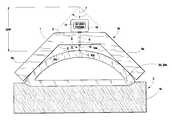
- FIG. 1is an elevation view of the preferred diameter measuring system of the present invention.
- FIG. 1Ais an alternate view of the digital display shown in FIG. 1 .
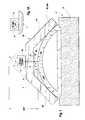
- FIG. 2is a view showing the present invention used to measure an increased range of different diameter objects.
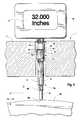
- FIG. 3is an enlarged portion of FIG. 2 showing a first sensor assembly.
- FIG. 4is an enlarged portion of FIG. 2 showing a second sensor assembly.
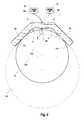
- FIG. 5is an isometric view showing an alternate frame embodiment.
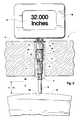
- FIG. 6is a cross-section view taken through a set of calibration rings included in the diameter measuring system.
- the preferred embodiment of the present inventionincludes a frame 1 having a pair of converging arms or jaws 2 a and 2 b that extend outward from a cross member 3 to provide a centering head 2 formed by the opening 4 between jaws 2 a and 2 b .
- frame 1is constructed using a lightweight material having a low coefficient of expansion, and the design of the frame is such that its section modulus and torsional properties provide rigidity against bending forces.
- measuring device “M”may comprise a beam shape member 23 having sufficient depth to provide desired section properties.
- Suitable materials for constructing the frameinclude, but are not limited to, extruded aluminum or aluminum alloy materials, phenolic plastic materials, and carbon graphite materials, etc.
- the measuring devicemay include handles 25 for ease of placement along the circumference of a large diameter object, and similar to the embodiment shown in FIG. 1, includes a cross member 3 , a centering head 2 formed by jaws 2 a and 2 b , a sensor assembly 5 , a microprocessor (not shown), and a display 16 .
- cross member 3is adapted to receive removable sensor assemblies 5 and 5 a
- the cross memberincludes a quick disconnect coupling 6 to facilitate attaching different removable sensor assemblies to frame 1 .
- Any suitable locking means known in the artmay be used for a quick disconnect fastener without departing from the scope of this invention.
- a bayonet type couplingmay be used to provide a quick disconnect.
- coupling 6includes a plurality of detents 7 shaped to receive and capture corresponding lugs 8 provided in the locking end 9 of the sensor assemblies 5 and 5 a.
- the sensor assemblies 5 and 5 ainclude the above mentioned lock end 9 , an extendable sensor probe 10 such as an LVDT probe or the like, and a biasing mechanism 11 positioned between the lock end 9 and probe 10 .
- the biasing mechanism 11continuously urges the extendable sensor probe 10 in an outward direction away from frame 1 and into opening 4 of the centering head 2 .
- coupling mechanism 6is arranged so that the sensor assembly is positioned and aligned along axis “X” that bisects an angle 9 formed by an extension of the jaws 2 a and 2 b .
- Such axial alignmentinsures that the extendable sensor probe 10 is radially aligned to the object being measured, for example objects 20 , 21 , and 22 in FIGS. 1-4, when the inside surfaces 12 a and 12 b of the centering head 2 tangentially engage the measured object.
- lock end 6includes contacts 13 that communicate with corresponding contacts 14 provided in a microprocessor 15 housed within frame 1 of the measuring device portion of the diameter measuring system.
- the sensor probe of the sensor assemblygenerates an output signal indicative of the extended position of the probe tip 10 a , and the microprocessor receives the sensor output signal via contacts 13 and 14 .
- Microprocessor 15is programmed to process and digitize the output signal from the sensor probe and generate a digital display 16 that provides a readout, in either English units 17 or metric units 18 as illustrated in FIGS. 1 and 1A; the readout corresponding to the diameter of the object being measured.
- micrometers and the likehave a limited diameter measuring range, typically one-inch diameter increments. For example, a one-inch micrometer to measure one-inch diameter and smaller round stock. A two-inch micrometer is used to measure rounds between one and two inches in diameter, and so on. Such one-inch measuring increments makes it necessary to purchase a wide range of different micrometers in order to meet various job requirements in a machine shop operation. In instances where a machine shop is manufacturing or refurbishing large diameter products, for example, working rolls and backup rolls used to manufacture metal plate and sheet products collecting a large variety of different micrometers to meet different product sizes is both inconvenient and expensive.
- the present inventionprovides removable sensor assemblies that increase the measuring range of device “M”.
- the extendable sensor probe 10has a measuring range that falls between D 1 and a maximum extended D 2 probe position.
- sensor assembly 5is disconnected from coupling 6 and a different sensor assembly 5 A is attached to coupling 6 as shown in FIG. 4 .
- the different sensor assembly 5 Aprovides an extended measuring range that falls between D 2 and a maximum extended D 3 probe position.
- Such removable sensor assembliesprovide means for using a single measuring device to determine the diameter of a wide range of different diameter objects as illustrated in FIG. 2 .
- centering head 2 of frame 1is shown placed on a round object 21 so that jaws 2 a and 2 b are tangent to the object at 21 a with the probe of sensor assembly 5 extended to engage the surface of the object 21 being measured.
- the round objecthas a 70.000 cm (27.559 inch) diameter.
- the measuring deviceis capable of measuring a range of diameters that would have required using 11-12 different micrometers and anvil combinations as taught in the past.
- a diameter measuring kit or setincludes a measuring device “M”, at least one replaceable sensor assembly “S”, and a collection of calibration rings “CC”.
- collection “C”comprises a plurality of ring segments 20 , each ring segment providing a different measurement standard for calibrating the sensor probe 10 .
- the number of ring segmentswill correspond to the diameter measuring range of a particular kit or system, and the measuring range is determined by the number of interchangeable or replaceable sensor assemblies “S” in a particular kit.
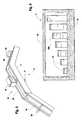
- collection “C”comprises a calibration box having a base 19 adapted to hold the ring segments 20 and a lid or cover 24 to protect the ring segments 20 from damage when they are not being used.
- an operatorwill first calibrate the measuring device “M” using an appropriate ring segment 20 a that is slightly larger in diameter than the work piece.
- an appropriate ring segment 20 athat is slightly larger in diameter than the work piece.
- the 32 inch measurementis representative of the “new roll” diameter when the roll was first placed into service.
- a machinistwill first select an appropriate ring segment to calibrate the measuring device, for example 32 inch (81.280 cm) diameter ring segment 20 a provided in collection “C”. Referring for a moment to either FIG.
- a lock ring 26is loosened to adjust the sensor probe 10 until the digital display 16 reads either 32.000 inches or 81.280 cm depending on the units selected.
- lock ring 26is tightened and the measuring device “M” is ready for use.
- the readout on the digital displayis responsive to a calibrated “GAP” distance measured from the vertex of angle to the tip 10 a of the sensor probe, and the calibrated “GAP” distance is stored in microprocessor 15 (FIG. 3) for later use in determining roll diameter during the machining operation.
- the exemplary different work pieces 21 and 22show that the diameter size determines the position of a work piece within the centering head 2 .
- the decreasing diameter of the work pieceresults in a measured “GAP” distance that is less than the calibrated “GAP” distance.
- Microprocessor 15is programmed to calculate the measured “GAP” by comparing the difference between the calibrated “GAP” and different position of the probe tip 10 a , and the calculated “GAP” is multiplied by a constant to determine the diameter of the measured object as shown at the different Roll Measurements 1-4 in the following Table A.
- Table Ashows an exemplary series of roll measurements that may be taken throughout the service life of 32 inch roll.
- mill operatorscalibrate measuring device “M” using the 32 inch ring segment 20 a (FIGS. 1 and 6 ).
- Device “M”is then positioned along the circumference of roll 21 (FIG. 2 ), and a diameter reading is taken to verify roll size.
- the resulting digitized output on display 16(FIG. 3) is recorded for future use and for setting roll gap in the manufacturing operation.
- the rollis periodically removed from the mill stand for reconditioning worn or damaged roll surface areas.
- the measuring device “M”is calibrated using the 32 inch calibration ring segment 20 a before new diameter measurements are taken during the machining operation.
- the roll 21is in use at our operation, when the digitized output on display 16 reads 30 inches or less (81.280 cm), the roll is considered scrap and is removed from service.
Landscapes
- Physics & Mathematics (AREA)
- General Physics & Mathematics (AREA)
- Length Measuring Devices With Unspecified Measuring Means (AREA)
Abstract
Description
| TABLE A |
| Machining Operation - 32 Inch Roll |
| {square root over (2r2− r)} | OD/GAP | Roll OD | |
| Measured Object | GAP | Constant | Display (inches) |
| Calibration GAP | 6.6274 | 4.8284 | 32.0000 |
| Roll Measurement No. 1 | 6.5239 | 4.8284 | 31.5000 |
| Roll Measurement No. 2 | 6.4203 | 4.8284 | 31.0000 |
| Roll Measurement No. 3 | 6.3168 | 4.8284 | 30.5000 |
| Roll Measurement No. 4 | 6.2132 | 4.8284 | 30.0000 |
Claims (21)
Priority Applications (1)
| Application Number | Priority Date | Filing Date | Title |
|---|---|---|---|
| US09/862,158US6543151B2 (en) | 2001-05-21 | 2001-05-21 | Apparatus for determining diameter of an object and method thereof |
Applications Claiming Priority (1)
| Application Number | Priority Date | Filing Date | Title |
|---|---|---|---|
| US09/862,158US6543151B2 (en) | 2001-05-21 | 2001-05-21 | Apparatus for determining diameter of an object and method thereof |
Publications (2)
| Publication Number | Publication Date |
|---|---|
| US20020178599A1 US20020178599A1 (en) | 2002-12-05 |
| US6543151B2true US6543151B2 (en) | 2003-04-08 |
Family
ID=25337822
Family Applications (1)
| Application Number | Title | Priority Date | Filing Date |
|---|---|---|---|
| US09/862,158Expired - Fee RelatedUS6543151B2 (en) | 2001-05-21 | 2001-05-21 | Apparatus for determining diameter of an object and method thereof |
Country Status (1)
| Country | Link |
|---|---|
| US (1) | US6543151B2 (en) |
Cited By (5)
| Publication number | Priority date | Publication date | Assignee | Title |
|---|---|---|---|---|
| US20030051360A1 (en)* | 2001-09-19 | 2003-03-20 | Reginald Galestien | Method and apparatus for centering smooth objects or objects provided with screw thread in a one-axis measuring system, as well as for measuring a diameter of such objects |
| US20040075829A1 (en)* | 2000-02-04 | 2004-04-22 | Kostadin Doytchinov | Roundness standard |
| US20090229137A1 (en)* | 2007-08-24 | 2009-09-17 | Mr. Peter Galbert | Galbert caliper |
| US20110119946A1 (en)* | 2009-11-24 | 2011-05-26 | Leo Duarte | Digital sizing tool |
| US20220332151A1 (en)* | 2020-11-06 | 2022-10-20 | Wehrs Machine & Racing Products, Inc. | Stagger Stick |
Families Citing this family (5)
| Publication number | Priority date | Publication date | Assignee | Title |
|---|---|---|---|---|
| DE102012205302B3 (en)* | 2012-03-30 | 2013-07-25 | Mario Neugärtner | folding rule |
| GB2505193B (en)* | 2012-08-21 | 2018-07-18 | Elcometer Ltd | Probe |
| CN103575195A (en)* | 2013-10-10 | 2014-02-12 | 奇瑞汽车股份有限公司 | Detection tool for detecting chamfering of hole |
| US9232693B2 (en)* | 2014-05-08 | 2016-01-12 | Deere & Company | System and method for sensing and mapping stalk diameter |
| US9494404B1 (en)* | 2015-02-06 | 2016-11-15 | Denis Bresolin | Pipe measurement device |
Citations (16)
| Publication number | Priority date | Publication date | Assignee | Title |
|---|---|---|---|---|
| US181809A (en) | 1876-09-05 | Improvement in diameter-gages | ||
| US2503871A (en) | 1945-02-23 | 1950-04-11 | John J Hartl | Straddle gauge for cylindrical work |
| US2548010A (en) | 1945-12-15 | 1951-04-10 | George E Frisz | Shaft measuring means |
| US2799945A (en)* | 1954-03-12 | 1957-07-23 | Forse Corp | Caliper for measuring rotating padded ironer rolls |
| US3169323A (en)* | 1961-05-31 | 1965-02-16 | Farrel Birmingham Co Inc | Differential electronic roll caliper |
| US4141149A (en) | 1976-09-30 | 1979-02-27 | Gravure Research Institute, Inc. | Portable comparator gage for measuring the relative deviation in the diameter of cylinders |
| US4389788A (en)* | 1981-08-07 | 1983-06-28 | The Goodyear Tire & Rubber Company | Apparatus and method for measuring roll diameters |
| US4729174A (en)* | 1986-07-15 | 1988-03-08 | Pgl Corporation | Method of determining circularity and mean radius of closed curved surface |
| US5077908A (en)* | 1987-11-04 | 1992-01-07 | David Moore | Apparatus for measuring the roundness of a surface of an object |
| US5088207A (en) | 1989-12-13 | 1992-02-18 | Betsill Harry E | True end-to-end electronic saddle micrometer |
| US5337485A (en) | 1992-01-28 | 1994-08-16 | Chien An Y | Roundness error and crown electronic measuring system |
| US5404649A (en)* | 1991-11-09 | 1995-04-11 | Renishaw Metrology Ltd. | Touch probe |
| US5671541A (en)* | 1995-09-01 | 1997-09-30 | Brown & Sharpe Manufacturing Company | Accuracy verification devices for coordinate measuring machines |
| US6079113A (en)* | 1998-03-18 | 2000-06-27 | Helmrichs; Terry L. | Electronic radius gauge |
| US20020050069A1 (en)* | 2000-11-02 | 2002-05-02 | Mellander William E. | Electronic profile acquisition caliper |
| US6381861B1 (en)* | 1999-08-20 | 2002-05-07 | Gary W. Deterling | Effective diameter system |
- 2001
- 2001-05-21USUS09/862,158patent/US6543151B2/ennot_activeExpired - Fee Related
Patent Citations (16)
| Publication number | Priority date | Publication date | Assignee | Title |
|---|---|---|---|---|
| US181809A (en) | 1876-09-05 | Improvement in diameter-gages | ||
| US2503871A (en) | 1945-02-23 | 1950-04-11 | John J Hartl | Straddle gauge for cylindrical work |
| US2548010A (en) | 1945-12-15 | 1951-04-10 | George E Frisz | Shaft measuring means |
| US2799945A (en)* | 1954-03-12 | 1957-07-23 | Forse Corp | Caliper for measuring rotating padded ironer rolls |
| US3169323A (en)* | 1961-05-31 | 1965-02-16 | Farrel Birmingham Co Inc | Differential electronic roll caliper |
| US4141149A (en) | 1976-09-30 | 1979-02-27 | Gravure Research Institute, Inc. | Portable comparator gage for measuring the relative deviation in the diameter of cylinders |
| US4389788A (en)* | 1981-08-07 | 1983-06-28 | The Goodyear Tire & Rubber Company | Apparatus and method for measuring roll diameters |
| US4729174A (en)* | 1986-07-15 | 1988-03-08 | Pgl Corporation | Method of determining circularity and mean radius of closed curved surface |
| US5077908A (en)* | 1987-11-04 | 1992-01-07 | David Moore | Apparatus for measuring the roundness of a surface of an object |
| US5088207A (en) | 1989-12-13 | 1992-02-18 | Betsill Harry E | True end-to-end electronic saddle micrometer |
| US5404649A (en)* | 1991-11-09 | 1995-04-11 | Renishaw Metrology Ltd. | Touch probe |
| US5337485A (en) | 1992-01-28 | 1994-08-16 | Chien An Y | Roundness error and crown electronic measuring system |
| US5671541A (en)* | 1995-09-01 | 1997-09-30 | Brown & Sharpe Manufacturing Company | Accuracy verification devices for coordinate measuring machines |
| US6079113A (en)* | 1998-03-18 | 2000-06-27 | Helmrichs; Terry L. | Electronic radius gauge |
| US6381861B1 (en)* | 1999-08-20 | 2002-05-07 | Gary W. Deterling | Effective diameter system |
| US20020050069A1 (en)* | 2000-11-02 | 2002-05-02 | Mellander William E. | Electronic profile acquisition caliper |
Cited By (8)
| Publication number | Priority date | Publication date | Assignee | Title |
|---|---|---|---|---|
| US20040075829A1 (en)* | 2000-02-04 | 2004-04-22 | Kostadin Doytchinov | Roundness standard |
| US20030051360A1 (en)* | 2001-09-19 | 2003-03-20 | Reginald Galestien | Method and apparatus for centering smooth objects or objects provided with screw thread in a one-axis measuring system, as well as for measuring a diameter of such objects |
| US20090229137A1 (en)* | 2007-08-24 | 2009-09-17 | Mr. Peter Galbert | Galbert caliper |
| US8091249B2 (en)* | 2007-08-24 | 2012-01-10 | Peter Galbert | Galbert caliper |
| US20110119946A1 (en)* | 2009-11-24 | 2011-05-26 | Leo Duarte | Digital sizing tool |
| US8024869B2 (en)* | 2009-11-24 | 2011-09-27 | Leo Duarte | Digital sizing tool |
| US20220332151A1 (en)* | 2020-11-06 | 2022-10-20 | Wehrs Machine & Racing Products, Inc. | Stagger Stick |
| US12023966B2 (en)* | 2020-11-06 | 2024-07-02 | Wehrs Machine & Racing Products, Inc. | Stagger stick |
Also Published As
| Publication number | Publication date |
|---|---|
| US20020178599A1 (en) | 2002-12-05 |
Similar Documents
| Publication | Publication Date | Title |
|---|---|---|
| US4059794A (en) | Method and apparatus for monitoring pass alignment in rolling mills | |
| US6543151B2 (en) | Apparatus for determining diameter of an object and method thereof | |
| US5337485A (en) | Roundness error and crown electronic measuring system | |
| US7909676B2 (en) | Independent measuring apparatus for grinding machines | |
| US5533371A (en) | Measurement device for roll gap control and process for its operation | |
| US20100245843A1 (en) | Method for measuring the roundness of round profiles | |
| EP0138430B1 (en) | Process and apparatus for strip flatness and tension measurements | |
| US6381861B1 (en) | Effective diameter system | |
| KR20010010085A (en) | Apparatus for measuring the strip flatness between stands in mill | |
| GB2069700A (en) | Gap measuring device for piston rings | |
| US6212960B1 (en) | Apparatus for measuring the flatness of a strip in movement | |
| US3808859A (en) | Hydraulic presses | |
| CN113566676A (en) | Roller box assembly measuring device and measuring method thereof | |
| CN216283206U (en) | Taper hole measuring device | |
| EP0127263B1 (en) | Measurement of surface profile | |
| US5918493A (en) | Sensor support | |
| JP3302641B2 (en) | Leveling adjustment method of rolling mill and apparatus for adjusting the same | |
| CN111981955A (en) | Method for measuring and adjusting off-line arc alignment sample plate of continuous casting machine | |
| US4993170A (en) | Hands-off micrometer | |
| JPH07280546A (en) | Roll crown measuring apparatus | |
| JPH05272959A (en) | Measurement of roll profile | |
| JP2982645B2 (en) | Roll profile measuring device | |
| EP0329880B1 (en) | Method of machining a cylindrical article | |
| KR20010001853U (en) | A device for measuring outer diameter of roll | |
| JPH08103808A (en) | Aligning method of rolling mill |
Legal Events
| Date | Code | Title | Description |
|---|---|---|---|
| AS | Assignment | Owner name:BETHLEHEM STEEL CORPORATION, PENNSYLVANIA Free format text:ASSIGNMENT OF ASSIGNORS INTEREST;ASSIGNOR:SMOLA, JOSEPH D.;REEL/FRAME:011872/0957 Effective date:20010511 | |
| AS | Assignment | Owner name:ISG TECHNOLOGIES, INC., OHIO Free format text:ASSIGNMENT OF ASSIGNORS INTEREST;ASSIGNOR:BETHLEHEM STEEL CORPORATION;REEL/FRAME:014033/0881 Effective date:20030506 | |
| AS | Assignment | Owner name:CIT GROUP/BUSINESS CREDIT, INC., AS COLLATERAL AGE Free format text:PLEDGE AND SECURITY AGREEMENT;ASSIGNOR:INTERNATIONAL STEEL GROUP, INC.;REEL/FRAME:013663/0415 Effective date:20030507 | |
| FPAY | Fee payment | Year of fee payment:4 | |
| AS | Assignment | Owner name:ISG HENNEPIN, INC., OHIO Free format text:RELEASE BY SECURED PARTY;ASSIGNOR:THE CIT GROUP/BUSINESS CREDIT, INC., AS COLLATERAL AGENT;REEL/FRAME:019432/0170 Effective date:20070613 Owner name:ISG INDIANA HARBOR INC., OHIO Free format text:RELEASE BY SECURED PARTY;ASSIGNOR:THE CIT GROUP/BUSINESS CREDIT, INC., AS COLLATERAL AGENT;REEL/FRAME:019432/0170 Effective date:20070613 Owner name:BETHLEHEM HIBBING CORPORATION, OHIO Free format text:RELEASE BY SECURED PARTY;ASSIGNOR:THE CIT GROUP/BUSINESS CREDIT, INC., AS COLLATERAL AGENT;REEL/FRAME:019432/0170 Effective date:20070613 Owner name:ISG PLATE INC., OHIO Free format text:RELEASE BY SECURED PARTY;ASSIGNOR:THE CIT GROUP/BUSINESS CREDIT, INC., AS COLLATERAL AGENT;REEL/FRAME:019432/0170 Effective date:20070613 Owner name:ISG/EGL HOLDING COMPANY, OHIO Free format text:RELEASE BY SECURED PARTY;ASSIGNOR:THE CIT GROUP/BUSINESS CREDIT, INC., AS COLLATERAL AGENT;REEL/FRAME:019432/0170 Effective date:20070613 Owner name:ISG RIVERDALE INC., OHIO Free format text:RELEASE BY SECURED PARTY;ASSIGNOR:THE CIT GROUP/BUSINESS CREDIT, INC., AS COLLATERAL AGENT;REEL/FRAME:019432/0170 Effective date:20070613 Owner name:ISG SALES, INC., OHIO Free format text:RELEASE BY SECURED PARTY;ASSIGNOR:THE CIT GROUP/BUSINESS CREDIT, INC., AS COLLATERAL AGENT;REEL/FRAME:019432/0170 Effective date:20070613 Owner name:ISG HIBBING, INC., OHIO Free format text:RELEASE BY SECURED PARTY;ASSIGNOR:THE CIT GROUP/BUSINESS CREDIT, INC., AS COLLATERAL AGENT;REEL/FRAME:019432/0170 Effective date:20070613 Owner name:ISG LACKAWANNA INC., OHIO Free format text:RELEASE BY SECURED PARTY;ASSIGNOR:THE CIT GROUP/BUSINESS CREDIT, INC., AS COLLATERAL AGENT;REEL/FRAME:019432/0170 Effective date:20070613 Owner name:ISG TECHNOLOGIES, INC., OHIO Free format text:RELEASE BY SECURED PARTY;ASSIGNOR:THE CIT GROUP/BUSINESS CREDIT, INC., AS COLLATERAL AGENT;REEL/FRAME:019432/0170 Effective date:20070613 Owner name:ISG WARREN INC., OHIO Free format text:RELEASE BY SECURED PARTY;ASSIGNOR:THE CIT GROUP/BUSINESS CREDIT, INC., AS COLLATERAL AGENT;REEL/FRAME:019432/0170 Effective date:20070613 Owner name:ISG CLEVELAND WORKS RAILWAY COMPANY, OHIO Free format text:RELEASE BY SECURED PARTY;ASSIGNOR:THE CIT GROUP/BUSINESS CREDIT, INC., AS COLLATERAL AGENT;REEL/FRAME:019432/0170 Effective date:20070613 Owner name:ISG RAILWAYS, INC., OHIO Free format text:RELEASE BY SECURED PARTY;ASSIGNOR:THE CIT GROUP/BUSINESS CREDIT, INC., AS COLLATERAL AGENT;REEL/FRAME:019432/0170 Effective date:20070613 Owner name:INTERNATIONAL STEEL GROUP, INC., OHIO Free format text:RELEASE BY SECURED PARTY;ASSIGNOR:THE CIT GROUP/BUSINESS CREDIT, INC., AS COLLATERAL AGENT;REEL/FRAME:019432/0170 Effective date:20070613 Owner name:ISG CLEVELAND WEST, INC., OHIO Free format text:RELEASE BY SECURED PARTY;ASSIGNOR:THE CIT GROUP/BUSINESS CREDIT, INC., AS COLLATERAL AGENT;REEL/FRAME:019432/0170 Effective date:20070613 Owner name:ISG BURNS HARBOR INC., OHIO Free format text:RELEASE BY SECURED PARTY;ASSIGNOR:THE CIT GROUP/BUSINESS CREDIT, INC., AS COLLATERAL AGENT;REEL/FRAME:019432/0170 Effective date:20070613 Owner name:ISG STEELTON INC., OHIO Free format text:RELEASE BY SECURED PARTY;ASSIGNOR:THE CIT GROUP/BUSINESS CREDIT, INC., AS COLLATERAL AGENT;REEL/FRAME:019432/0170 Effective date:20070613 Owner name:ISG SPARROWS POINT INC., OHIO Free format text:RELEASE BY SECURED PARTY;ASSIGNOR:THE CIT GROUP/BUSINESS CREDIT, INC., AS COLLATERAL AGENT;REEL/FRAME:019432/0170 Effective date:20070613 Owner name:ISG PIEDMONT INC., OHIO Free format text:RELEASE BY SECURED PARTY;ASSIGNOR:THE CIT GROUP/BUSINESS CREDIT, INC., AS COLLATERAL AGENT;REEL/FRAME:019432/0170 Effective date:20070613 Owner name:ISG CLEVELAND INC., OHIO Free format text:RELEASE BY SECURED PARTY;ASSIGNOR:THE CIT GROUP/BUSINESS CREDIT, INC., AS COLLATERAL AGENT;REEL/FRAME:019432/0170 Effective date:20070613 Owner name:ISG VENTURE, INC., OHIO Free format text:RELEASE BY SECURED PARTY;ASSIGNOR:THE CIT GROUP/BUSINESS CREDIT, INC., AS COLLATERAL AGENT;REEL/FRAME:019432/0170 Effective date:20070613 Owner name:ISG CLEVELAND WEST PROPERTIES, INC., OHIO Free format text:RELEASE BY SECURED PARTY;ASSIGNOR:THE CIT GROUP/BUSINESS CREDIT, INC., AS COLLATERAL AGENT;REEL/FRAME:019432/0170 Effective date:20070613 Owner name:ISG SOUTH CHICAGO & INDIANA HARBOR RAILWAY COMPANY Free format text:RELEASE BY SECURED PARTY;ASSIGNOR:THE CIT GROUP/BUSINESS CREDIT, INC., AS COLLATERAL AGENT;REEL/FRAME:019432/0170 Effective date:20070613 Owner name:ISG ACQUISITION INC., OHIO Free format text:RELEASE BY SECURED PARTY;ASSIGNOR:THE CIT GROUP/BUSINESS CREDIT, INC., AS COLLATERAL AGENT;REEL/FRAME:019432/0170 Effective date:20070613 | |
| FPAY | Fee payment | Year of fee payment:8 | |
| REMI | Maintenance fee reminder mailed | ||
| LAPS | Lapse for failure to pay maintenance fees | ||
| STCH | Information on status: patent discontinuation | Free format text:PATENT EXPIRED DUE TO NONPAYMENT OF MAINTENANCE FEES UNDER 37 CFR 1.362 | |
| FP | Lapsed due to failure to pay maintenance fee | Effective date:20150408 | |
| AS | Assignment | Owner name:CLEVELAND-CLIFFS STEEL TECHNOLOGIES INC., OHIO Free format text:CHANGE OF NAME;ASSIGNOR:ISG TECHNOLOGIES INC.;REEL/FRAME:055323/0438 Effective date:20210115 |