US6535985B1 - Data processing apparatus - Google Patents
Data processing apparatusDownload PDFInfo
- Publication number
- US6535985B1 US6535985B1US09/583,168US58316800AUS6535985B1US 6535985 B1US6535985 B1US 6535985B1US 58316800 AUS58316800 AUS 58316800AUS 6535985 B1US6535985 B1US 6535985B1
- Authority
- US
- United States
- Prior art keywords
- information
- processing section
- section
- processing
- display
- Prior art date
- Legal status (The legal status is an assumption and is not a legal conclusion. Google has not performed a legal analysis and makes no representation as to the accuracy of the status listed.)
- Expired - Fee Related
Links
Images






Classifications
- G—PHYSICS
- G06—COMPUTING OR CALCULATING; COUNTING
- G06F—ELECTRIC DIGITAL DATA PROCESSING
- G06F1/00—Details not covered by groups G06F3/00 - G06F13/00 and G06F21/00
- G06F1/26—Power supply means, e.g. regulation thereof
- G06F1/32—Means for saving power
- G06F1/3203—Power management, i.e. event-based initiation of a power-saving mode
- G06F1/3206—Monitoring of events, devices or parameters that trigger a change in power modality
- G06F1/3215—Monitoring of peripheral devices
- G06F1/3218—Monitoring of peripheral devices of display devices
- G—PHYSICS
- G09—EDUCATION; CRYPTOGRAPHY; DISPLAY; ADVERTISING; SEALS
- G09G—ARRANGEMENTS OR CIRCUITS FOR CONTROL OF INDICATING DEVICES USING STATIC MEANS TO PRESENT VARIABLE INFORMATION
- G09G5/00—Control arrangements or circuits for visual indicators common to cathode-ray tube indicators and other visual indicators
- G09G5/36—Control arrangements or circuits for visual indicators common to cathode-ray tube indicators and other visual indicators characterised by the display of a graphic pattern, e.g. using an all-points-addressable [APA] memory
- G—PHYSICS
- G09—EDUCATION; CRYPTOGRAPHY; DISPLAY; ADVERTISING; SEALS
- G09G—ARRANGEMENTS OR CIRCUITS FOR CONTROL OF INDICATING DEVICES USING STATIC MEANS TO PRESENT VARIABLE INFORMATION
- G09G2300/00—Aspects of the constitution of display devices
- G09G2300/04—Structural and physical details of display devices
- G09G2300/0469—Details of the physics of pixel operation
- G09G2300/0473—Use of light emitting or modulating elements having two or more stable states when no power is applied
- G—PHYSICS
- G09—EDUCATION; CRYPTOGRAPHY; DISPLAY; ADVERTISING; SEALS
- G09G—ARRANGEMENTS OR CIRCUITS FOR CONTROL OF INDICATING DEVICES USING STATIC MEANS TO PRESENT VARIABLE INFORMATION
- G09G2310/00—Command of the display device
- G09G2310/04—Partial updating of the display screen
- G—PHYSICS
- G09—EDUCATION; CRYPTOGRAPHY; DISPLAY; ADVERTISING; SEALS
- G09G—ARRANGEMENTS OR CIRCUITS FOR CONTROL OF INDICATING DEVICES USING STATIC MEANS TO PRESENT VARIABLE INFORMATION
- G09G2330/00—Aspects of power supply; Aspects of display protection and defect management
- G09G2330/02—Details of power systems and of start or stop of display operation
- G09G2330/021—Power management, e.g. power saving
- G—PHYSICS
- G09—EDUCATION; CRYPTOGRAPHY; DISPLAY; ADVERTISING; SEALS
- G09G—ARRANGEMENTS OR CIRCUITS FOR CONTROL OF INDICATING DEVICES USING STATIC MEANS TO PRESENT VARIABLE INFORMATION
- G09G2330/00—Aspects of power supply; Aspects of display protection and defect management
- G09G2330/02—Details of power systems and of start or stop of display operation
- G09G2330/021—Power management, e.g. power saving
- G09G2330/022—Power management, e.g. power saving in absence of operation, e.g. no data being entered during a predetermined time
- G—PHYSICS
- G09—EDUCATION; CRYPTOGRAPHY; DISPLAY; ADVERTISING; SEALS
- G09G—ARRANGEMENTS OR CIRCUITS FOR CONTROL OF INDICATING DEVICES USING STATIC MEANS TO PRESENT VARIABLE INFORMATION
- G09G2360/00—Aspects of the architecture of display systems
- G09G2360/06—Use of more than one graphics processor to process data before displaying to one or more screens
- G—PHYSICS
- G09—EDUCATION; CRYPTOGRAPHY; DISPLAY; ADVERTISING; SEALS
- G09G—ARRANGEMENTS OR CIRCUITS FOR CONTROL OF INDICATING DEVICES USING STATIC MEANS TO PRESENT VARIABLE INFORMATION
- G09G2360/00—Aspects of the architecture of display systems
- G09G2360/08—Power processing, i.e. workload management for processors involved in display operations, such as CPUs or GPUs
- G—PHYSICS
- G09—EDUCATION; CRYPTOGRAPHY; DISPLAY; ADVERTISING; SEALS
- G09G—ARRANGEMENTS OR CIRCUITS FOR CONTROL OF INDICATING DEVICES USING STATIC MEANS TO PRESENT VARIABLE INFORMATION
- G09G3/00—Control arrangements or circuits, of interest only in connection with visual indicators other than cathode-ray tubes
- G09G3/20—Control arrangements or circuits, of interest only in connection with visual indicators other than cathode-ray tubes for presentation of an assembly of a number of characters, e.g. a page, by composing the assembly by combination of individual elements arranged in a matrix no fixed position being assigned to or needed to be assigned to the individual characters or partial characters
- G09G3/34—Control arrangements or circuits, of interest only in connection with visual indicators other than cathode-ray tubes for presentation of an assembly of a number of characters, e.g. a page, by composing the assembly by combination of individual elements arranged in a matrix no fixed position being assigned to or needed to be assigned to the individual characters or partial characters by control of light from an independent source
- G09G3/36—Control arrangements or circuits, of interest only in connection with visual indicators other than cathode-ray tubes for presentation of an assembly of a number of characters, e.g. a page, by composing the assembly by combination of individual elements arranged in a matrix no fixed position being assigned to or needed to be assigned to the individual characters or partial characters by control of light from an independent source using liquid crystals
- G09G3/3611—Control of matrices with row and column drivers
- G09G3/3622—Control of matrices with row and column drivers using a passive matrix
- G09G3/3629—Control of matrices with row and column drivers using a passive matrix using liquid crystals having memory effects, e.g. ferroelectric liquid crystals
- G—PHYSICS
- G09—EDUCATION; CRYPTOGRAPHY; DISPLAY; ADVERTISING; SEALS
- G09G—ARRANGEMENTS OR CIRCUITS FOR CONTROL OF INDICATING DEVICES USING STATIC MEANS TO PRESENT VARIABLE INFORMATION
- G09G5/00—Control arrangements or circuits for visual indicators common to cathode-ray tube indicators and other visual indicators
- G09G5/40—Control arrangements or circuits for visual indicators common to cathode-ray tube indicators and other visual indicators characterised by the way in which both a pattern determined by character code and another pattern are displayed simultaneously, or either pattern is displayed selectively, e.g. with character code memory and APA, i.e. all-points-addressable, memory
Definitions
- the present inventionrelates to a data processing apparatus provided with a display device.
- compact and lightweight microcomputers portable type computers powered by batteriesare now used extensively. Particularly, one of them known as a note-size, computer is lighter in weight and smaller in size yet providing equal capabilities to those of a desktop or laptop computer.
- the note-size computer powered by batteriesis handy for use in a place where a power supply facility is rarely available, e.g. a meeting room or a lecture hall.
- the disadvantage of such handy useis that the life of batteries is short and limited.
- the service duration of such a note-size computer with fully charged batteriesis preferably 10 hours nonstop; more preferably, 20 to 30 hours. If possible, more than 100 hours—a standard of hand calculators—is most desired.
- pocket-type portable data processing apparatusesincluding hand calculators and electronic notebooks are much slower in processing speeds than common microcomputers and thus, exhibit less power requirements. They are capable of servicing for years with the use of a common primary cell(s) of which life will thus be no matter of concern.
- the note-size computerhas as a processing speed as high as that of a desktop computer and consumes a considerable amount of electric energy-namely, 10 to 1000 times the power consumption of any pocket-type portable data processing apparatus. Even with the application of up-to-date high quality rechargeable batteries, the serving period will be 2 to 3 hours at maximum. This is far from a desired duration demanded by the users. For the purpose of compensating the short life of batteries, a number of techniques for energy saving have been developed and some are now in practical use.
- a “resume” functionis widely used in a common note-size computer. It works in a manner that when no input action continues for a given period of time, the data needed for restarting the computer with corresponding information is saved in a nonvolatile IC memory and then, a CPU and a display are systematically turned off. For restart, a power switch is closed and the data stored in the IC memory. is instantly retrieved for display of the preceding data provided before disconnection of the power supply. This technique is effective for extension of the battery servicing time and suitable in practical use.
- the foregoing techniqueincorporates as a means for energy saving a system which de-energizes all the components including a processing circuit and a display circuit.
- the operatoris thus requested to turn on the power switch of the computer at considerable frequencies during intermittent data input action because each no data entry duration of a given length triggers automatic disconnection of the switch.
- the data input operation with a note-size computeris commonly intermittent and thus, the foregoing disadvantage will be much emphasized.
- a data processing apparatuscomprises: a data input unit for input of external data; a first processing unit for processing the data inputted through the data input unit; a second processing unit for processing the data inputted through the data input unit and/or an output data of the first processing unit; and a display unit for displaying an output data of the first and/or second processing units, wherein the display unit has a memory function for maintaining a display state without being energized, and the first processing unit has a means for actuating the second processing unit according to a timing or a kind of the input data.
- the second processing unit or the display unitis inactivated or decreased in clock rate thus diminishing power consumption.
- the present inventionallows the display of data to remain intact.
- the first processing unitactivates the second processing unit to process the data.
- the first processing unitmay activate the second processing unit according to the kind of the input data.
- the first processing unitactivates the second processing unit.
- the second processing unitafter completing a required operation or processing, may becomes an inactive state by itself or may be forced into the inactive state by the first processing unit.
- the power consumptionwill be reduced to a considerable rate without affecting the operability.
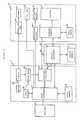
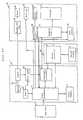
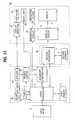
- FIG. 1is a block diagram of a data processing apparatus showing a first embodiment of the present invention
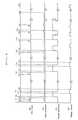
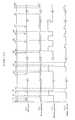
- FIG. 2is a timing chart
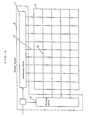
- FIG. 3is a view showing the arrangement of a display unit
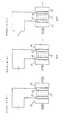
- FIG. 4is a cross sectional view explaining the operating principle of the display unit
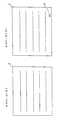
- FIGS. 5 ( a ) and 5 ( b )are is a views showing displayed images on the display unit
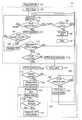
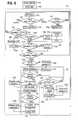
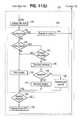
- FIG. 6is a flow chart
- FIG. 7- ais a block diagram showing an arrangement of components
- FIG. 7- bis a block diagram showing another arrangement
- FIG. 7- cis a block diagram showing a further arrangement
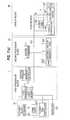
- FIG. 7- dis a flow chart
- FIG. 8illustrates the operating principle of a reflective device with the use of different reflecting plates
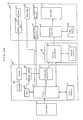
- FIG. 9is a block diagram showing a second embodiment of the present invention.
- FIG. 10- ais a block diagram associated with a first processing unit
- FIG. 10- bis a block diagram associated with a second processing unit
- FIGS. 11- a and 11 - bare flow charts:
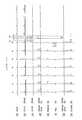
- FIG. 12is a timing chart
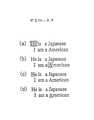
- FIG. 13is a view explaining the representation of a cursor
- FIG. 14is a view showing a sequence of translation procedures
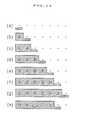
- FIG. 15is a view explaining data insertion
- FIG. 16is a view explaining a copy mode
- FIG. 17is a block diagram showing a modification of the second embodiment
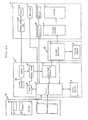
- FIG. 18is a block diagram showing a third embodiment of the present invention.
- FIG. 19is a flow chart
- FIG. 20is a block diagram showing a fourth embodiment of the present invention.
- FIG. 21is a timing chart of the fourth embodiment
- FIG. 22is a block diagram showing a fifth embodiment of the present invention.
- FIG. 23is a timing chart of the fifth embodiment
- FIG. 24is a block diagram showing a data input unit
- FIG. 25is a block diagram showing a combination of the first and second processing units.
- FIG. 1is a block diagram of a data processing apparatus showing a first embodiment of the present invention.
- the data processing apparatuscomprises a data input unit 3 , a first processing block 1 , a second processing block 98 , and a display block 99 .
- a data input which is fed to the data input unit 3 of the data processing apparatus by means of key entry with a key-board or communications interfaceis transferred to the first processing block 1 in which a first processor 4 examines which key in key entry is pressed or what sorts of data are input from the outside and determines the following subsequenent procedure according to the information from a first memory 5 .
- a data input entered at t 1 using an n-th key of the key-boardis transferred from the data input unit 3 to the first processor 4 .
- the first processor 4when examining the data input and determining that further processing at the second processor 7 is needed delivers a start instruction via the interruption controller 6 and a start instruction line 80 to the second processor 7 which thus commences receiving the data input from the first processor 4 .
- either the first processor 4 or the interruption controller 6delivers a stop instruction to the second processor 4 via the startup instruction line 80 .
- the command signalis transmitted to the display circuit 8 which in turn retrieves the data of a previous display text from a video memory 82 or the second memory 9 and displays a new image corresponding to the display change signal and data from the second processor 7 .
- the display circuit 8sends its own instruction or an end signal via the interruption controller 6 to the first processor 4 and upon receiving an instruction from the first processor 4 , stops or diminishes clock generation to enter a display energy saving mode. Thereafter, the power consumption of the display circuit 8 will largely be declined as illustrated in after t 6 in FIG. 2- d.
- the display 2e.g. a simple matrix type liquid crystal display, contains a matrix of electrodes in which horizontal drive lines 13 and vertical drive lines 14 coupled to a horizontal driver 11 and a vertical driver 12 respectively intersect each other, as best shown in FIG. 3 .
- FIG. 4illustrates a pixel of the display 2 in action with a voltage being applied.
- a ferroelectric liquid crystal 17is energized by the two, horizontal and vertical lines 13 , 14 which serve as electrodes and are provided on glass plates 15 and 16 respectively.
- FIG. 4- ashows a state where light is transmitted through.
- the ferroelectric liquid crystal 17changes its crystalline orientation and acts as a polarizer in which an angle of polarization is altered, thus allowing the light to pass through.
- the ferroelectric liquid crystal 17When a voltage is applied in the reverse direction, the ferroelectric liquid crystal 17 causes the angle of polarization to turn 90 degrees and inhibits the passage of light with polarization effects, as shown in FIG. 4- b.
- the first processor 4performs only conversion of key entry to letter code or the like.
- the key entryis conducted by a human operator and executed some tens times in a second at best.
- the speed of data entry by a human operatoris 100 times or more slower than the processing speed of any microcomputer.
- the processing speed of the first processor 4may be as low as of a known hand calculator and the power consumption will be decreased to hundredths or thousandths of one watt as compared with that of a main CPU in a desktop computer.
- the first processor 4continues operating while a power switch 20 of the data processing unit 1 is closed. However, it consumes a lesser amount of energy and thus, the power consumption of the apparatus will be low.
- the first processor 4examines the data of the entry at t 12 and if necessary, delivers a start instruction via the interruption controller 6 or directly to the second processor 7 for actuation.
- the second processor 7is arranged to operate at high speeds and its power consumption is as high as that of a desk-top computer. If the second processor 7 is continuously activated, the life of batteries will be shortened as well as in a known note computer.
- the present inventionhowever provides a series of energy saving mode actions during the operation, whereby the energy consumption will be minimized.
- the energy saving modeis advantageous.
- the duration required for processing the data of a word processing softwareis commonly less than 1 ms while the key entry by a human operator takes several tens of milliseconds at maximum.
- the peak of energy consumption during a period from t 13 to t 15is fairly high in the second processor 7 as shown in FIG. 2- c, the average is not more than a tenth or a hundredth of the peak value. It is now understood that the energy saving mode allows lower power consumption.
- the second processor 7sends a desired portion of the display data to the display 2 .
- the display 2continues to display the text altered at t 6 due to the memory effects of the ferroelectric liquid crystal 17 while the display circuit 8 remains inactivated.
- the desired data given through the key entry at t 11is written at t 14 for regional replacement.
- the replacement of one to several lines of display textis executed by means of voltage application to corresponding numbers of the horizontal and vertical drive lines 13 and 14 . This procedure requires a shorter period of processing time and thus, consumes a lesser amount of energy as compared with replacement of the entire display text.
- the second processor 7saves the latest data in the second memory 9 .
- the second processor 7stops operation or diminishes an operating speed and enters into the energy saving mode.
- the second processor 7shifts to the energy saving mode at t 23 , t 33 , and t 43 as shown in FIG. 2- c. If the first processor 4 detects that the interval between data inputs is shorter than a predetermined time, it delivers an energy saving mode stop instruction to the second processor 7 which thus remains activated without forced de-energization and no longer enters into the energy saving mode.
- the energy saving modeis called back only when the interval between two data inputs becomes sufficiently long.
- the first processor 4when the first processor 4 detects that the key entry is absent during a given length of time, it actuates to disconnect the power supply to primary components including the first processor 4 for shift to a power supply stop mode.
- the memory datais being saved by the back-up battery while the power supply is fully disconnected.
- the first processor 2Before disconnection of the power supply, the first processor 2 however sends a power supply stop display instruction directly or via the second processor 7 to the display circuit 8 for display of an “OFF” sign 21 shown in FIG. 5- b and then, enters into the power supply stop mode.
- the OFF sign 21remains displayed due to the memory effects of the display 2 after the power supply is disconnected, thus allowing the operator to distinguish the power supply stop mode from the energy saving mode.
- the operationcan be started again by key entry action and thus, the operator will perceive no interruption in the processing action.
- the OFF sign 21is displayed and the operator can restart the operation in succession with the previous data retrieved from the second memory 9 by the second processor 9 when the power switch 20 is turned on. This procedure is similar to that in the conventional “resume” mode.
- Step 101When the power switch 20 is turned on at Step 101 , the first processor 4 starts activating at Step 102 .
- the input data given by key entryis transferred from the data input unit 3 to the first processor 4 at Step 103 .
- Step 104it is examined whether the duration of no-data entry lasts for a predetermined time or not. If the no-data entry duration t is greater than the predetermined time, the procedure moves to Step 105 where the actuation of the second processor 7 is examined. If the second processor 7 is in action, the procedure moves back to Step 103 . If not, the entire apparatus is de-energized, at Step 106 , and stops actuating at Step 107 before restarting with Step 101 where the power supply switch 20 is closed.
- Step 104If the no-data entry duration t is greater than the predetermined time, but is as short as a few minutes, the procedure is shifted from Step 104 to Step 108 .
- the processing frequency in the first and second processors 4 and 7is low, the procedure moves from Step 108 to Step 109 where a back light is turned off for energy saving.
- Step 110If the no-data entry duration t is not greater than the predetermined time, the operation in the first processor 4 is prosecuted at Step 110 . Also, it is examined at Step 110 a whether the data of text is kept displayed throughout a considerable length of time or not. If too long, refreshing action of the data display is executed at Step 110 b for prevention of an image burn on the screen.
- Step 110 cthe processing frequency in the second processor 7 is examined and if it is high, the second processor 7 is kept in action at Step 110 d. If the processing frequency is low, the procedure moves to Step 111 . When it is determined at Step 111 that no further processing in the second processor 7 is needed, the procedure returns to Step 103 .
- Step 111When further processing in the second processor 7 is required, the procedure moves from Step 111 to Step 112 a where the actuation of the second processor 7 is examined. If the second processor 7 is not in action, a start instruction is fed at Step 112 b to the second processor 7 which is in turn activated at Step 113 by the first processor 4 and the interruption controller 6 . The second processor 7 then starts processing action at Step 114 . If it is determined at Step 115 that a change in the text of display is needed, the procedure moves to Step 116 a where a display change instruction is supplied to both the interruption controller 6 and the first processor 4 . Then, the interruption controller 6 delivers a display energizing instruction to the display block 99 at Step 116 b.
- the display circuit 8is activated at Step 116 c and the display change on the display 2 including the replacement of a regional data with a desired data is carried out at Step 117 .
- a display change completion signalis sent to the first processor 4 at Step 117 a.
- the display change completion signalis accepted at Step 117 b, the display 2 is turned off at Step 119 .
- Step 115the procedure moves from Step 115 to Step 120 where the completion of the processing in the second processor 7 is examined. If yes, a processing completion signal is released at Step 120 a. As a result, the second processor 7 stops operation at Step 121 upon receiving a stop signal produced at Step 120 b and the procedure returns back to Step 103 .
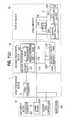
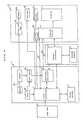
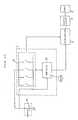
- FIGS. 7- a and 7 - bare block diagrams of a note-size computer according to the first embodiment of the present invention.
- a data input block 97comprises a keyboard 201 , a communication port 51 with RS232C, and a floppy disk controller 202 . Also, a hard disk unit 203 is provided separately.
- a first processing block 1is mainly consisted of a first processor 4 .
- a second processing block 98contains a second processor 7 which is a CPU arranged for shift to and back from the energy saving mode upon stopping and feeding of a clock signal respectively and is coupled to a bus line 210 .
- a ROM 204 for start action, a second memory 9 of DRAM, and a backup RAM 205which is an SRAM for storage of individual data of returning from the resume mode are coupled to the bus line 210 .
- Both ends of the bus line 210are connected to the first processor 4 and a display block 99 respectively.
- the display block 99has a graphic controller 206 and a liquid crystal controller driver 207 arranged in a display circuit.
- corresponding components only in the arrangementare activated while the remaining components are de-energized. This energy saving technique is illustrated in more detail in Table 1.
- input operation for e.g. word processinginvolves an intermittent action of keyboard entry.
- the power supplyis connected to every component except the communications I/O unit.
- a clock signalis fed to the first processing block 1
- no clock signalsare supplied to the second processing block 98 and the display block 99 . Power is thus consumed only in the first processing block 1 .
- the second block 98 and/or the display block 99are activated within a short period of time. If more frequent operations are needed, the second processing block 98 is kept activated for acceleration of processing speeds.
- the second processing block 98When the key entry is absent for a given time, the second processing block 98 is disconnected and simultaneously, its processing data is stored in a backup memory for retrieval in response to the next key entry.
- FIG. 7- bis similar to FIG. 7- a, except that the first processor 4 having a lower clock frequency is used as a “monitor” for the total system and the processing will be executed by the second processor 7 having a higher clock frequency.
- the first processor 4is adapted for operating an event processing method by which the second processor 7 is activated for processing action corresponding to data of the keyboard entry.
- the second processor 7stops operation for the purpose of energy saving when the processing action is finished and remains inactivated until another key entry commences.
- the display block 99starts operating in response to a display signal from the second processor 7 and stops automatically after completion of display. This procedure can be executed with a common operating system similar to any known operating system, thus ensuring high software compatibility.
- MS-DOSis designed to run with the use of one complete CPU.
- the energy saving effectwill hardly be expected during operation with conventional application software programs.
- a specific operating system and a corresponding word processing softwarewhich are installed in two CPUs are provided in addition to the conventional operating system. Accordingly, a word processing job can be performed using the specific software with the operating system of the present invention and thus, the power consumption will be reduced to less than a tenth or hundredth.
- general purpose software programscan work with the conventional operating system—although the energy saving effect will be diminished. It would be understood that about 80% of the job on a note-size computer is word processing and the foregoing arrangement can contribute to the energy saving.
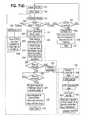
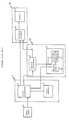
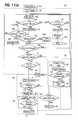
- FIG. 7- cis a block diagram of another example according to the first embodiment and FIG. 7- d is a flow chart showing a procedure with the use of a conventional operating system such as MS-DOS.
- the second processor 7is a CPU capable of holding data from its register and internal RAM during actuation of no clock or de-energization.
- a keyboard code signal from the keyboard 201is transferred by the first processor 4 to a start device 221 which remains activated, at Step 252 .
- the start device 221delivers a clock signal to a main processor 222 which is de-energized.
- Both of the register 224 and the internal RAM 223are coupled to a backup source and thus, start operating upon receipt of the clock signal.
- the main processor 222starts the program which has been on stand-by for key entry.
- the programis then processed for e.g. word processing according to data of the key entry, at Step 255 .
- a display instructionis released for replacement of display text if required at Step 256 .
- the graphic controller 206is activated.
- the data in the video RAM 209is thus rewritten at Step 259 .
- the liquid crystal controller driver 207is activated at Step 261 , a desired change in the display text is made on the liquid crystal display 208 formed of ferroelectric liquid crystal.
- the video RAM 209is backup energized at Step 262 and the display block 99 is de-energized, at Step 263 , thus entering into the energy saving mode.
- the programstops and moves into a “keyboard entry stand-by” stage at Step 271 .
- the data required for re-actuation of the register 223 and the internal RAM 234is saved and the second memory 9 is backup energized before a clock in the CPU is stopped.
- the second processor 7stops operation, at Step 273 , thus entering into the energy saving mode.
- the start device 221remains activated, the second processor 7 stays on stand-by for input through keyboard entry at Step 251 or from the communications port 5 .
- the second processor 7stays on stand-by for input through keyboard entry at Step 251 or from the communications port 5 .
- the start device 221only is kept activated in the second processing block 98 .
- the CPU shown in FIG. 7- cprovides backup of registers with its clock unactuated and ensures instant return to operation upon actuation of the clock.
- a conventional operating systemcan be used with equal success.
- existing software programs including word processing programscan be processed with less assignment and thus, private data stock will be permitted for optimum use. Consequently, it would be apparent that this method is eligible.
- the consumption of electric energywill be much decreased using a technique of direct control of the first processor 1 on display text change which will be described later with a second embodiment of the present invention.
- the resume modeallows most components to remain de-energized when no keyboard entry lasts for a long time.
- the crystalline orientation of liquid crystalis realigned by heating up the display 2 with a heater 24 triggered by a display reset switch 23 . Then, arbitrary change in the display text on the display 2 will be possible.
- Energy savingcan be promoted by stopping the clock in the second processor 7 during the energy saving mode. When more or full energy saving is wanted, the power supply to the second processor 7 or the display circuit 8 is disconnected by the interruption controller 6 .
- the power supply stop moderequires a minimum. of power consumption for backup of the second memory 9 .
- the back light 25is turned off when the power source is a battery and a reflective device 27 is activated by a reflection circuit 26 for display with a reflection mode.
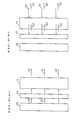
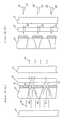
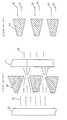
- the reflective device 27is composed of a film of ferroelectric liquid crystal which provides a transparent mode for transmission of light, as shown in FIG. 8- a, and an opaque mode for reflection as shown in FIG. 8- b, for alternative action.
- Incoming light 32is reflected on the reflective device 27 and runs back as reflected light 33 .
- polarizationis also effected by the polarizers in the display 2 and the reflective device 27 , whereby the number of components will be reduced.
- a film-form electrochromic display devicemay be used for providing a transmission mode and a white diffusion screen mode in which it appears like a sheet of white paper.
- the reflective device 27may be of fixed type, as shown in FIGS. 8- c and 8 - d, comprising a light transmitting layer composed of low refraction transmitting regions 28 and high refraction transmitting regions 29 and a reflecting layer 31 having apertures 30 therein.
- outside light 32passes the liquid crystal layer 17 and is reflected by the reflecting layer 31 formed by vapor deposition of aluminum and reflected light 33 runs across the liquid crystal layer 17 again for providing optical display.
- the reflective device 27requires no external drive circuit, thus contributing to the simple arrangement of a total system. It is known that such a combination of high and low refraction transmitting regions is easily fabricated by a fused salt immersion method which is commonly used for making refraction distributed lenses.
- the back light 25is lit upon receiving an instruction from the first processor 4 which also delivers a transmission instruction to the reflection circuit 26 and thus, the reflective device 27 becomes transparent simultaneously. Accordingly, transmitting light can illuminate the display as shown in FIG. 8- a.
- the first processor 4delivers a reflection signal to the reflection circuit 26 and the reflective device 27 becomes opaque to cause reflection and diffusion.
- the displayis made by reflected outside light as shown in FIG. 8- b while an amount of electric energy required for actuation of the back light 25 is saved.
- a transmitting reflective plate 34which is formed of a metal plate, e.g. of aluminum, having a multiplicity of tapered round apertures therein, as illustrated in FIGS. 8- e and 8 - f.
- the CPU in this arrangementprovides intermittent actuation in response to the intermittent key entry and the average power consumption of the apparatus will be declined to an appreciable rate.
- the textremains on display during the operation and thus, the operator can perceive no sign of abnormality when the processing unit is inactivated. More particularly, a great degree of energy saving will be ensured without affecting the operability.
- each key entry actiontakes several tens of milliseconds while the average of CPU processing durations in word processing is about tens to hundreds of microseconds.
- the CPUis activated 1/100 to 1/1000 of the key entry action time for accomplishing the task and its energy consumption will thus be reduced in proportion.
- the display unitconsumes about 10 to 20%, namely 0.5 to 1 W, of the entire power requirement.
- the display unitemploys a memory effect display device provided with e.g. ferroelectric liquid crystal and thus, its power consumption will be minimized through intermittent activation as well as the CPU.
- the overall power consumption during mainly key entry operation for e.g. word processingwill be reduced to 1/100 to 1/1000.
- FIG. 9is a block diagram showing a second embodiment of the present invention.
- the first processor 4is improved in the operational capability and the second processor 7 of which energy requirement is relatively great is reduced in the frequency of actuation so that energy saving can be encouraged.
- the arrangement of the second embodimentis distinguished from that of the first embodiment by having a signal line 97 for transmission of a display instruction signal from the first processing block 1 to the display block 99 .
- the first processor 4 of the first processing block 1delivers a display change signal to the display circuit 8 of the display block 99 for change of the display text on the display 2 .
- the second processor 7delivers such a display change signal to the display circuit 8 according to the first embodiment.
- FIG. 10- ais a block diagram showing in more detail the connection of the first processor 4 , in which the first memory 5 comprises a first font ROM 40 for storage of dot patterns of alphabet and Japanese character fonts or the like in a ROM, an image memory 41 , and a general memory 42 .
- the first memory 5comprises a first font ROM 40 for storage of dot patterns of alphabet and Japanese character fonts or the like in a ROM, an image memory 41 , and a general memory 42 .
- the second memory 9may contain a second font ROM 43 which serves as a font memory.
- a series of simple actions for display text changecan be executed using the first processor 4 .
- Character codesare produced in response to the key entry and font patterns corresponding to the character codes are read from the first 40 or second font memory 43 for display on the display 2 after passing the display circuit 8 .
- the second memory 9may also contain a second general memory 44 .
- the first processor 4having less energy requirement is actuated for operation of the display text change. If large scale of processing is needed, the second processor 7 is then utilized. Accordingly, the frequency of actuation of the second processor 7 is minimized and energy saving will be guaranteed. Also, as shown in FIG. 11, the memory size of the first memory 5 can be decreased because of retrieval of font patterns from the second font ROM 43 of the second memory 9 .
- FIG. 11- ais substantially similar to FIG. 6 which shows a flow chart in the first embodiment.
- Step 130A difference is that as the first processor 4 directly actuates the display circuit 8 , a step 130 and a display flow chart 131 are added.
- the proceduremoves to the display flow chart 131 .
- the display flow chart 131will now be described briefly. It starts with Step 132 where the display block 99 is activated.
- Step 133the display text is changed and the change is examined at Step 133 .
- the display block 99is de-energized at Step 135 and the procedure returns back to Step 103 for stand-by for succeeding data input.
- FIG. 11- billustrates the step 133 in more detail.
- Step 140After the display block 99 is activated, at Step 132 , by a start instruction from the first processing block 1 , the movement of a cursor with no restriction is examined at Step 140 . If yes, data input throughout the cursor movement is executed at Step 141 . If not, it is then examined whether the desired input area on the display 2 is occupied by existing data or not at Step 142 . This procedure can be carried out by reading the data in the image memory 41 with the first processor 4 . If no, partial text replacement with desired data is executed at Step 143 . If yes, the procedure moves to Step 144 where the existing data in the input area of the display block 99 is checked using the image memory 41 and examined whether it is necessarily associated or not with the desired data to be input.
- Step 143overwriting of the desired data is executed at Step 143 . If yes, the existing data is retrieved from the image memory 41 or read from the second font ROM 9 and coupled with the desired data for composition, at Step 145 . At Step 146 , it is examined whether a black/white inversion mode is involved or not. If yes, the data is displayed in reverse color at Step 147 . If no, the text change with the composite data is carried out at Step 148 . Then, the completion of the text change is confirmed at Step 134 and the display block 99 is turned off at Step 99 .
- the processing action of corresponding components when the key entry is madeis illustrated in FIG. 12 .
- the first processor 4shifts input data into a letter “I” code, reads a font pattern of the letter code from the first font ROM 40 shown in FIG. 10, and actuates the display circuit for display of the letter “I” on the display 2 .
- the memory effect displayhaving ferroelectric crystal liquid, partial replacement in a character can be made. The partial replacement is feasible in two different manners; one for change dot by dot and the other for change of a vertical or horizontal line of dots at once.
- the dot-by-dot changeis executed with less energy requirement but at a higher voltage, thus resulting in high cost.
- the line changehas to be done in the group of dots at once even when one dot only is replaced but at relatively lower voltages. Both the manners in this embodiment will now be explained.
- every data processing apparatusis preferably arranged, in view of capability of up-to-date semiconductors, for providing line-by-line text change operation.
- first memory 5 of the first processor 4carries at least data of one text line.
- the one text line datais equal to 640 ⁇ 24 dots.
- the writing of the letter “I”thus involves replacement of 24 of 640-dot lines.
- the previous data of a target lineis retrieved from the image memory 41 of the first memory 5 and also, the pattern data of the letter “I” is read from the first font ROM 40 . Then, the two data are combined together to a composite data which is then fed to the display circuit 8 for rewriting of one text line on the display 2 . Simultaneously, the same data is stored into the image memory 41 . The input of “I” is now completed.
- the first font ROM 40 and the image memory 41are needed when the second font ROM 43 is employed for the same operation, which is capable of processing coded data.
- the second processor 7provides no processing action as shown in FIG. 12- c.
- first processor 4“space” at t 2 , “L” at t 3 , “i” at t 4 , “v” at t 5 , and “e” at t 6 .
- first processor 4is much slower in the processing speed than the second processor 7 , the replacement of one text line on display can be pursued at an acceptable speed with less energy consumption.
- t 7represents the key input of an instruction for processing a large amount of data, e.g. spelling check in word processing, translation from Japanese to English, conversion of Japanese characters into Chinese characters, or calculation of chart data.
- the second processor 7When the first processor 4 determines that the processing at the second processor 7 is needed, the second processor 7 is turned on at t 71 .
- the start-up of the second processor 7is the same as of Embodiment 1.
- the second processor 7upon being activated at t 71 returns to the original state prior to interruption and starts processing the data of text lines fed from the first processor 4 .
- each character of changed textis displayed on the display 2 through the display circuit 8 as shown at t 72 in FIG. 12- d.
- the second processor 7remains inactivated as shown in FIG. 12- c.
- the second processor 7starts processing at t 71 . Accordingly, the Japanese paragraph “kareha” is translated to “He is” in English.
- the resultant datais sent to the display circuit 8 for dot-by-dot replacement for display.
- the displayreads “He is” as shown in FIG. 12- h.
- the dot-by-dot character replacement shown in FIG. 12- grequires less electric energy than the text line replacement shown in FIG. 12- d.
- the black/white inversion or negative modeis used as shown in FIGS. 13- a and 13 - b. This however increases the power consumption in the line replacement.
- a bar between the linesis used for display of the cursor as shown in FIGS. 13- c and 13 - d, the replacement of the full line is not needed and thus, energy saving will be expected.
- the speed of processingis increased and the response will speed up during processing with the low speed first processor 4 . This advantage is equally undertaken in the dot-by-dot replacement.
- the movement of the cursoris expressed by the bar.
- the barmay be lit at intervals by means of control with the first processor 4 .
- a corresponding characteris displayed in the reverse color as shown in FIG. 14- b. This technique will also reduce the energy consumption at least during the cursor movement.
- FIGS. 14- a to 14 - gillustrate the steps of display corresponding to t 1 to t 7 .
- FIG. 14- hshows the conversion of the input text.
- FIGS. 15- a to 15 - fshows the insertion of a word during dot-by-dot replacement. It is necessary with the use of the second font ROM 43 in the arrangement shown in FIG. 10 that the data of one text line is saved in the image memory 41 because the first font ROM 40 does not carry all the Chinese characters. When the cursor moves backward as shown in FIGS. 15- c and 15 - d, the letter n is called back from the image memory 41 . Accordingly, the data prior to insertion can be restored without the use of the second processor 7 or the second front ROM 43 as shown in FIG. 15- d.
- FIGS. 16- a to 16 - gshow the copy of a sentence “He is a man”.
- the procedure from FIG. 16- a to FIG. 16- fcan be carried out with the first processor 4 .
- the step of FIG. 16- ginvolves an insertion action which is executed by the second processor 7 .
- most of the job which is processed by the second processor 7 in the first embodimentis executed by the low power consuming first processor 4 .
- the average energy consumptionwill be much lower than that of the first embodiment.
- the optimum of a job sharing ratio between the first and second processors 4 and 7may vary depending on particulars of a program for e.g. word processing or chart calculation. Hence, a share of the first processor 4 in operation of a software program can be controlled by adjustment on the program so as to give an optimum balance between the energy consumption and the processing speed.
- a video memory 82may be provided in the display block 99 for connection via a connecting line 96 with the first processor 4 . This allows the data prior to replacement to be stored in the video memory 82 and thus, the image memory 41 shown in FIG. 10- a will be eliminated.
- FIG. 18is a block diagram showing a third embodiment of the present invention. The difference of the third embodiment from the first and second embodiments will now be described.
- the first embodimenthas the display start instruction line 81 along which both a start instruction and a stop instruction are transferred from the first processing block 1 to the display block 99 while equal instructions are transferred by the start instruction line 80 from the same to the second processing block 98 .
- the third embodimentcontains no display start instruction line 81 to the display block 99 as shown in FIG. 18 . Also, the start instruction line 80 of the third embodiment allows only a start instruction but not a stop instruction to be transmitted from the first processing block 1 to the second processing block 98 .
- the second processor 7stops itself upon finishing the processing and enters into the energy saving mode.
- the second processor 7determines that the display change is needed, it delivers an display start instruction via a data line 84 to the display block 99 which is then activated.
- the display block 99stops operation and enters into the display energy saving mode.
- the flow chartis composed of a first processing step group 151 , a second processing step group 152 , and a third processing step group 153 . At first, the difference of this flow chart will be described in respect to the sequence from start to stop of the second processing block 98 .
- the first processor 4delivers, at Step 112 , a start instruction to the second processor 7 which is then activated. This step is equal to that of the first embodiment.
- the second processor 7is automatically inactivated at Step 121 , as compared with de- e nergization by an instruction from the first processor 4 in the first embodiment.
- the second processor 7is turned to a data input stand-by state.
- a display start instruction to the display block 99is given by the second processor 7 after completion of display data processing.
- the start instructionis delivered by the second processing block 98 to the display block 99 , at Step 115 a shown in FIG. 19 .
- the display block 99is activated at Step 116 and the display change is conducted at Step 117 .
- the display block 99stops itself at Step 119 .
- the third embodimentwhich is similar in the function to the first embodiment provides the self-controlled de-energization of both the second processing block 98 and the display block 99 .
- a start instruction to the display block 99is given by the second processing block 98 . Accordingly, the task of the first processing block 1 is lessened, whereby the overall processing speed will be increased and the arrangement itself will be facilitated.
- FIG. 20is a block diagram showing a fourth embodiment of the present invention, in which an energy saving manner is disclosed with the use of an input/output port for communications with the outside.
- a data processing apparatus of the fourth embodimentincorporates an input/output unit 50 mounted in its data input block 97 .
- the input/output unit 50contains a communications port 51 and an external interface 52 .
- the unit 50performs actions as shown in a timing chart of FIG. 21 which is similar to the timing chart of key data entry shown in FIG. 12 .
- the input/output unit 50delivers corresponding signals to the first processing block 1 .
- the first processor 4sends an input data at t 1 to the display circuit 8 which in turn actuates, as shown in FIG. 21- d, for display of a data string as illustrated in FIG. 21- e. If an input at t 7 is bulky, the second processor 7 is activated at t 71 as shown in FIG. 21- c.
- the second processor 7delivers a start instruction at t 72 to the display circuit 8 which is then actuated for data replacement on the display 2 . If the input through the communications port is not bulky, it is processed in the first processor 4 or the input/output unit 50 while the second processor 7 remains inactivated. Accordingly, energy saving during the input and output action will be ensured.
- FIG. 22is a block diagram showing a fifth embodiment of the present invention, in which a solar battery 60 is added as an extra power source.
- the first processor 4operates at low speeds thus consuming a small amount of electric energy. Accordingly, the apparatus can be powered by the solar battery 60 . While the action is almost equal to that of the first embodiment, the solar battery however stops power supply when the amount of incident light is decreased considerably. If the supply is stopped, it is shifted to from the source 61 . When no key entry is made throughout a length of time and no power supply from the solar battery 60 is fed, the source stop mode is called for as shown in FIG. 23- b.
- the first processor 4saves processing data into the first memory 5 and then, stops operation. Thus, the power consumption will be reduced.
- the first processor 4starts actuating for performance of an equal action from t 72 .
- a key input device 62 of the data input unit 3feeds a voltage from the battery 64 to a hold circuit 63 .
- the hold circuit 63upon pressing of a key connects the power source to the first processor 4 for energization. Simultaneously, the key input device 62 transfers a key input data to the first processor 4 and processing will start.
- Each key of the key input device 62may have a couple of switches; one for power supply and the other for data entry.
- the power consumptionwill be minimized and the operating life of the apparatus will last much longer.
- the solar battery 60which becomes inactive when no incoming light falls, may be mounted on the same plane as of the display 2 so that no display is made including text and keyboard when the solar battery 60 is inactivated.
- the data processing apparatus of the fifth embodimentprovides more energy saving, it may be realized in the form of a note-size microcomputer featuring no battery replacement for years. Also, the first and second processors in any of the first to fifth embodiments may be integrated to a single unit as shown in FIG. 25 .
- the present inventionin particular focuses a more attention on the energy saving effects of the ferroelectric liquid crystal which have been less regarded.
- liquid crystal displayis not limited to a matrix drive as described and may be driven by a TFT drive system.
Landscapes
- Engineering & Computer Science (AREA)
- Theoretical Computer Science (AREA)
- Physics & Mathematics (AREA)
- General Physics & Mathematics (AREA)
- Computer Hardware Design (AREA)
- General Engineering & Computer Science (AREA)
- Power Sources (AREA)
- Liquid Crystal Display Device Control (AREA)
- Control Of Indicators Other Than Cathode Ray Tubes (AREA)
- Calculators And Similar Devices (AREA)
- Digital Computer Display Output (AREA)
- User Interface Of Digital Computer (AREA)
Abstract
Description
This is a Rule 1.53(b) Continuation application of Ser. No. 08/283,165, filed Aug. 3, 1994, now abandonded, which is a continuation of Ser. No. 07/671,929, filed Mar. 20, 1991, now abandoned.
1. Field of the Invention
The present invention relates to a data processing apparatus provided with a display device.
2. Description of the Prior Art
Among, compact and lightweight microcomputers portable type computers powered by batteries are now used extensively. Particularly, one of them known as a note-size, computer is lighter in weight and smaller in size yet providing equal capabilities to those of a desktop or laptop computer. The note-size computer powered by batteries is handy for use in a place where a power supply facility is rarely available, e.g. a meeting room or a lecture hall.
However, the disadvantage of such handy use is that the life of batteries is short and limited. When used to record of a business meeting or a college lecture, the service duration of such a note-size computer with fully charged batteries is preferably 10 hours nonstop; more preferably, 20 to 30 hours. If possible, more than 100 hours—a standard of hand calculators—is most desired.
So far, the service operation of a commercially available note-size computer lasts 2 to 3 hours at best. This results in battery runout in the middle of a meeting or college lecture causing an interruption during input work. As a result, troublesome replacement of batteries with new ones will be needed at considerable frequency.
Such a drawback of the note-size computer tends to offset the portability in spite of its light weight and compactness.
It is understood that known pocket-type portable data processing apparatuses including hand calculators and electronic notebooks are much slower in processing speeds than common microcomputers and thus, exhibit less power requirements. They are capable of servicing for years with the use of a common primary cell(s) of which life will thus be no matter of concern. The note-size computer, however, has as a processing speed as high as that of a desktop computer and consumes a considerable amount of electric energy-namely, 10 to 1000 times the power consumption of any pocket-type portable data processing apparatus. Even with the application of up-to-date high quality rechargeable batteries, the serving period will be 2 to 3 hours at maximum. This is far from a desired duration demanded by the users. For the purpose of compensating the short life of batteries, a number of techniques for energy saving have been developed and some are now in practical use.
The most well known technique will now be explained.
A “resume” function is widely used in a common note-size computer. It works in a manner that when no input action continues for a given period of time, the data needed for restarting the computer with corresponding information is saved in a nonvolatile IC memory and then, a CPU and a display are systematically turned off. For restart, a power switch is closed and the data stored in the IC memory. is instantly retrieved for display of the preceding data provided before disconnection of the power supply. This technique is effective for extension of the battery servicing time and suitable in practical use.
However, a specified duration, e.g. 5 minutes, of no key entry results in de-energization of the entire system of the computer and thus, disappearance of display data. Accordingly, the operator loses information and his input action is interrupted. For reviewing the display data or continuing the input action, the power switch has to be turned on each time. This procedure is a nuisance for the operator. The resume technique is advantageous in saving energy of battery power but very disadvantageous in operability of the note-size computer.
More specifically, the foregoing technique incorporates as a means for energy saving a system which de-energizes all the components including a processing circuit and a display circuit. The operator is thus requested to turn on the power switch of the computer at considerable frequencies during intermittent data input action because each no data entry duration of a given length triggers automatic disconnection of the switch. In particular, the data input operation with a note-size computer is commonly intermittent and thus, the foregoing disadvantage will be much emphasized.
It is an object of the present invention, to provide an improved data processing apparatus capable of substantially reducing power consumption while performing required data processing operations.
A data processing apparatus according to the present invention comprises: a data input unit for input of external data; a first processing unit for processing the data inputted through the data input unit; a second processing unit for processing the data inputted through the data input unit and/or an output data of the first processing unit; and a display unit for displaying an output data of the first and/or second processing units, wherein the display unit has a memory function for maintaining a display state without being energized, and the first processing unit has a means for actuating the second processing unit according to a timing or a kind of the input data.
For example, when no data entry continues, the second processing unit or the display unit is inactivated or decreased in clock rate thus diminishing power consumption. Also, the present invention allows the display of data to remain intact. Upon occurrence an input data, the first processing unit activates the second processing unit to process the data. Thus, the operator can prosecute his job without knowledge of an interrupted de-energization. As a result, an appreciable degree of energy saving is guaranteed without affecting the operability and thus, the service life of batteries will largely be increased.
In another aspect, the first processing unit may activate the second processing unit according to the kind of the input data. When the input data is such a data that requires a processing in the second processing unit, the first processing unit activates the second processing unit. The second processing unit, after completing a required operation or processing, may becomes an inactive state by itself or may be forced into the inactive state by the first processing unit. Thus, the power consumption will be reduced to a considerable rate without affecting the operability.
FIG. 1 is a block diagram of a data processing apparatus showing a first embodiment of the present invention;
FIG. 2 is a timing chart;
FIG. 3 is a view showing the arrangement of a display unit;
FIG. 4 is a cross sectional view explaining the operating principle of the display unit;
FIGS.5(a) and5(b) are is a views showing displayed images on the display unit;
FIG. 6 is a flow chart;
FIG. 7-ais a block diagram showing an arrangement of components;
FIG. 7-bis a block diagram showing another arrangement;
FIG. 7-cis a block diagram showing a further arrangement;
FIG. 7-dis a flow chart;
FIG. 8 illustrates the operating principle of a reflective device with the use of different reflecting plates;
FIG. 9 is a block diagram showing a second embodiment of the present invention;
FIG. 10-ais a block diagram associated with a first processing unit;
FIG. 10-bis a block diagram associated with a second processing unit;
FIGS. 11-aand11-bare flow charts:
FIG. 12 is a timing chart;
FIG. 13 is a view explaining the representation of a cursor;
FIG. 14 is a view showing a sequence of translation procedures;
FIG. 15 is a view explaining data insertion;
FIG. 16 is a view explaining a copy mode;
FIG. 17 is a block diagram showing a modification of the second embodiment;
FIG. 18 is a block diagram showing a third embodiment of the present invention;
FIG. 19 is a flow chart;
FIG. 20 is a block diagram showing a fourth embodiment of the present invention;
FIG. 21 is a timing chart of the fourth embodiment;
FIG. 22 is a block diagram showing a fifth embodiment of the present invention;
FIG. 23 is a timing chart of the fifth embodiment;
FIG. 24 is a block diagram showing a data input unit; and
FIG. 25 is a block diagram showing a combination of the first and second processing units.
Preferred embodiments of the present invention will be described referring to the accompanying drawings.
FIG. 1 is a block diagram of a data processing apparatus showing a first embodiment of the present invention.
The data processing apparatus comprises adata input unit 3, afirst processing block 1, asecond processing block 98, and adisplay block 99.
In operation, a data input which is fed to thedata input unit 3 of the data processing apparatus by means of key entry with a key-board or communications interface is transferred to thefirst processing block 1 in which afirst processor 4 examines which key in key entry is pressed or what sorts of data are input from the outside and determines the following subsequenent procedure according to the information from afirst memory 5.
If no input is supplied to thedata input unit 3 throughout a given period of time as shown in FIG. 2-aand also, the action of asecond processor 7 has been completed, the feeding of clock signals to thesecond processor 7 and adisplay circuit 8 is halted by aninterruption controller 6 and/or a process of energy saving is systematically executed.
The energy saving process will now be described referring to FIG.2.
As shown in FIG. 2a,a data input entered at t1using an n-th key of the key-board is transferred from thedata input unit 3 to thefirst processor 4.
Thefirst processor 4 when examining the data input and determining that further processing at thesecond processor 7 is needed delivers a start instruction via theinterruption controller 6 and a start instruction line80 to thesecond processor 7 which thus commences receiving the data input from thefirst processor 4. Thesecond processor 7 starts processing the data input when t=t3as shown in FIG. 2-cand upon finishing, sends an end signal to thefirst processor 4. In turn, either thefirst processor 4 or theinterruption controller 6 delivers a stop instruction to thesecond processor 4 via the startup instruction line80. Accordingly, thesecond processor 4 transfers finally processed data from its RAM memory or register to the second memory for temporary storage and then, stops processing action when t=t5as shown in FIG. 2-cor enters into an energy saving mode where a consuming power is sharply attenuated. After t5where the actuation of thesecond processor 7 is ceased, the data remains held in thesecond memory 9 due to its nonvolatile properties or due to the action of a back-up battery. If display change is needed, thesecond processor 4 sends a display change signal to thefirst processor 4. Thefirst processor 4 then delivers a display start instruction via a displaystart instruction line 81 to thedisplay circuit 8 for starting actuation. When t=t4as shown in FIG. 2-d,the command signal is transmitted to thedisplay circuit 8 which in turn retrieves the data of a previous display text from avideo memory 82 or thesecond memory 9 and displays a new image corresponding to the display change signal and data from thesecond processor 7. When t=t6, thedisplay circuit 8 sends its own instruction or an end signal via theinterruption controller 6 to thefirst processor 4 and upon receiving an instruction from thefirst processor 4, stops or diminishes clock generation to enter a display energy saving mode. Thereafter, the power consumption of thedisplay circuit 8 will largely be declined as illustrated in after t6in FIG. 2-d.
After t6, thedisplay circuit 8 stays fully or nearly inactivated but adisplay 2 which is substantially consisted of memory retainable devices, e.g. ferroelectric liquid crystal devices, continues to hold the display image. The arrangement of thedisplay 2 will now be described. Thedisplay 2, e.g. a simple matrix type liquid crystal display, contains a matrix of electrodes in whichhorizontal drive lines 13 andvertical drive lines 14 coupled to ahorizontal driver 11 and avertical driver 12 respectively intersect each other, as best shown in FIG.3. FIG. 4 illustrates a pixel of thedisplay 2 in action with a voltage being applied.
In each pixel, aferroelectric liquid crystal 17 is energized by the two, horizontal andvertical lines glass plates
More particularly, FIG. 4-ashows a state where light is transmitted through. When a signal is given, theferroelectric liquid crystal 17 changes its crystalline orientation and acts as a polarizer in which an angle of polarization is altered, thus allowing the light to pass through.
When a voltage is applied in the reverse direction, theferroelectric liquid crystal 17 causes the angle of polarization to turn 90 degrees and inhibits the passage of light with polarization effects, as shown in FIG. 4-b.Theferroelectric liquid crystal 17 also has a memory retainable effect as being capable of remaining unchanged in the crystalline orientation after the supply of voltage is stopped, as shown in FIG. 4-c.Accordingly, throughout a duration from t=t6to t=t14, explained later, the display remains intact without any operation of thedisplay circuit 8. While the energy saving mode is involved after t6, both thedata input unit 3 and thefirst processor 4 are only in action.
Thefirst processor 4 performs only conversion of key entry to letter code or the like. In general, the key entry is conducted by a human operator and executed some tens times in a second at best. The speed of data entry by a human operator is 100 times or more slower than the processing speed of any microcomputer. Hence, the processing speed of thefirst processor 4 may be as low as of a known hand calculator and the power consumption will be decreased to hundredths or thousandths of one watt as compared with that of a main CPU in a desktop computer. As shown in FIG. 2-b,thefirst processor 4 continues operating while apower switch 20 of thedata processing unit 1 is closed. However, it consumes a lesser amount of energy and thus, the power consumption of the apparatus will be low.
When n+l-th key entry is made at t11, thefirst processor 4 examines the data of the entry at t12and if necessary, delivers a start instruction via theinterruption controller 6 or directly to thesecond processor 7 for actuation. Upon receiving the start instruction, thesecond processor 7 starts processing again with the use of clock signals so that the data stored in thesecond memory 9, i.e. data at a previous stop when t=t5, such as memory data, register information, or display data, is read out and the CPU environment when t=t5can fully be restored. When t=t13, the data in thefirst processor 4 is transferred to thesecond processor 7 for reprocessing. Thesecond processor 7 is arranged to operate at high speeds and its power consumption is as high as that of a desk-top computer. If thesecond processor 7 is continuously activated, the life of batteries will be shortened as well as in a known note computer. The present invention however provides a series of energy saving mode actions during the operation, whereby the energy consumption will be minimized.
The energy saving mode is advantageous. For example, the duration required for processing the data of a word processing software is commonly less than 1 ms while the key entry by a human operator takes several tens of milliseconds at maximum. Hence, although the peak of energy consumption during a period from t13to t15is fairly high in thesecond processor 7 as shown in FIG. 2-c,the average is not more than a tenth or a hundredth of the peak value. It is now understood that the energy saving mode allows lower power consumption.
When t=t14, thesecond processor 7 sends a desired portion of the display data to thedisplay 2. Before t14, thedisplay 2 continues to display the text altered at t6due to the memory effects of theferroelectric liquid crystal 17 while thedisplay circuit 8 remains inactivated. The desired data given through the key entry at t11is written at t14for regional replacement. The replacement of one to several lines of display text is executed by means of voltage application to corresponding numbers of the horizontal andvertical drive lines
Thesecond processor 7 then stops operation when t=t15and enters into the energy saving mode again as shown in FIG. 2-c.
At the moment when the operation of thesecond processor 7 has been finished before t15or when a stop instruction from thefirst processor 4 is received, thesecond processor 7 saves the latest data in thesecond memory 9.
When t=t14, thesecond processor 7 stops operation or diminishes an operating speed and enters into the energy saving mode.
When the input data is fed at short intervals, e.g. at t21, t31, t41, and t51, through a series of key entry actions or from a communications port, thesecond processor 7 shifts to the energy saving mode at t23, t33, and t43as shown in FIG. 2-c.If thefirst processor 4 detects that the interval between data inputs is shorter than a predetermined time, it delivers an energy saving mode stop instruction to thesecond processor 7 which thus remains activated without forced de-energization and no longer enters into the energy saving mode. The energy saving mode is called back only when the interval between two data inputs becomes sufficiently long.
Also, when thefirst processor 4 detects that the key entry is absent during a given length of time, it actuates to disconnect the power supply to primary components including thefirst processor 4 for shift to a power supply stop mode. The memory data is being saved by the back-up battery while the power supply is fully disconnected.
Before disconnection of the power supply, thefirst processor 2 however sends a power supply stop display instruction directly or via thesecond processor 7 to thedisplay circuit 8 for display of an “OFF”sign 21 shown in FIG. 5-band then, enters into the power supply stop mode. TheOFF sign 21 remains displayed due to the memory effects of thedisplay 2 after the power supply is disconnected, thus allowing the operator to distinguish the power supply stop mode from the energy saving mode.
In the energy saving mode, the operation can be started again by key entry action and thus, the operator will perceive no interruption in the processing action.
In the power supply stop mode, theOFF sign 21 is displayed and the operator can restart the operation in succession with the previous data retrieved from thesecond memory 9 by thesecond processor 9 when thepower switch 20 is turned on. This procedure is similar to that in the conventional “resume” mode.
The foregoing operation will now be described in more detail referring to a flow chart of FIG.6. When thepower switch 20 is turned on atStep 101, thefirst processor 4 starts activating atStep 102. The input data given by key entry is transferred from thedata input unit 3 to thefirst processor 4 atStep 103. AtStep 104, it is examined whether the duration of no-data entry lasts for a predetermined time or not. If the no-data entry duration t is greater than the predetermined time, the procedure moves to Step105 where the actuation of thesecond processor 7 is examined. If thesecond processor 7 is in action, the procedure moves back toStep 103. If not, the entire apparatus is de-energized, atStep 106, and stops actuating atStep 107 before restarting withStep 101 where thepower supply switch 20 is closed.
If the no-data entry duration t is greater than the predetermined time, but is as short as a few minutes, the procedure is shifted fromStep 104 to Step108. When the processing frequency in the first andsecond processors Step 108 to Step109 where a back light is turned off for energy saving.
If the no-data entry duration t is not greater than the predetermined time, the operation in thefirst processor 4 is prosecuted atStep 110. Also, it is examined atStep 110awhether the data of text is kept displayed throughout a considerable length of time or not. If too long, refreshing action of the data display is executed atStep 110bfor prevention of an image burn on the screen. AtStep 110c,the processing frequency in thesecond processor 7 is examined and if it is high, thesecond processor 7 is kept in action atStep 110d.If the processing frequency is low, the procedure moves to Step111. When it is determined atStep 111 that no further processing in thesecond processor 7 is needed, the procedure returns to Step103.
When further processing in thesecond processor 7 is required, the procedure moves fromStep 111 to Step112awhere the actuation of thesecond processor 7 is examined. If thesecond processor 7 is not in action, a start instruction is fed atStep 112bto thesecond processor 7 which is in turn activated atStep 113 by thefirst processor 4 and theinterruption controller 6. Thesecond processor 7 then starts processing action atStep 114. If it is determined atStep 115 that a change in the text of display is needed, the procedure moves to Step116awhere a display change instruction is supplied to both theinterruption controller 6 and thefirst processor 4. Then, theinterruption controller 6 delivers a display energizing instruction to thedisplay block 99 atStep 116b.Thedisplay circuit 8 is activated atStep 116cand the display change on thedisplay 2 including the replacement of a regional data with a desired data is carried out atStep 117. After the display change is checked atStep 118, a display change completion signal is sent to thefirst processor 4 atStep 117a.When the display change completion signal is accepted atStep 117b,thedisplay 2 is turned off atStep 119.
If no change in the display text is needed, the procedure moves fromStep 115 to Step120 where the completion of the processing in thesecond processor 7 is examined. If yes, a processing completion signal is released atStep 120a.As a result, thesecond processor 7 stops operation atStep 121 upon receiving a stop signal produced atStep 120band the procedure returns back toStep 103.
FIGS. 7-aand7-bare block diagrams of a note-size computer according to the first embodiment of the present invention.
As shown in FIG. 7-a,adata input block 97 comprises akeyboard 201, acommunication port 51 with RS232C, and afloppy disk controller 202. Also, ahard disk unit 203 is provided separately. Afirst processing block 1 is mainly consisted of afirst processor 4. Asecond processing block 98 contains asecond processor 7 which is a CPU arranged for shift to and back from the energy saving mode upon stopping and feeding of a clock signal respectively and is coupled to abus line 210. Also, aROM 204 for start action, asecond memory 9 of DRAM, and abackup RAM 205 which is an SRAM for storage of individual data of returning from the resume mode are coupled to thebus line 210. Both ends of thebus line 210 are connected to thefirst processor 4 and adisplay block 99 respectively. Thedisplay block 99 has agraphic controller 206 and a liquidcrystal controller driver 207 arranged in a display circuit. There are also provided avideo RAM 209 and aliquid crystal display 208. For energy saving operation, corresponding components only in the arrangement are activated while the remaining components are de-energized. This energy saving technique is illustrated in more detail in Table 1. In general, input operation for e.g. word processing involves an intermittent action of keyboard entry. Hence, the power supply is connected to every component except the communications I/O unit. While a clock signal is fed to thefirst processing block 1, no clock signals are supplied to thesecond processing block 98 and thedisplay block 99. Power is thus consumed only in thefirst processing block 1. If necessary, thesecond block 98 and/or thedisplay block 99 are activated within a short period of time. If more frequent operations are needed, thesecond processing block 98 is kept activated for acceleration of processing speeds.
When the key entry is absent for a given time, thesecond processing block 98 is disconnected and simultaneously, its processing data is stored in a backup memory for retrieval in response to the next key entry.
FIG. 7-bis similar to FIG. 7-a,except that thefirst processor 4 having a lower clock frequency is used as a “monitor” for the total system and the processing will be executed by thesecond processor 7 having a higher clock frequency. Thefirst processor 4 is adapted for operating an event processing method by which thesecond processor 7 is activated for processing action corresponding to data of the keyboard entry. Thesecond processor 7 stops operation for the purpose of energy saving when the processing action is finished and remains inactivated until another key entry commences. Thedisplay block 99 starts operating in response to a display signal from thesecond processor 7 and stops automatically after completion of display. This procedure can be executed with a common operating system similar to any known operating system, thus ensuring high software compatibility. For example, MS-DOS is designed to run with the use of one complete CPU. Hence, the energy saving effect will hardly be expected during operation with conventional application software programs. It is then a good idea that a specific operating system and a corresponding word processing software which are installed in two CPUs are provided in addition to the conventional operating system. Accordingly, a word processing job can be performed using the specific software with the operating system of the present invention and thus, the power consumption will be reduced to less than a tenth or hundredth. Also, general purpose software programs can work with the conventional operating system—although the energy saving effect will be diminished. It would be understood that about 80% of the job on a note-size computer is word processing and the foregoing arrangement can contribute to the energy saving.
FIG. 7-cis a block diagram of another example according to the first embodiment and FIG. 7-dis a flow chart showing a procedure with the use of a conventional operating system such as MS-DOS. Thesecond processor 7 is a CPU capable of holding data from its register and internal RAM during actuation of no clock or de-energization. When key entry is made at Step251, a keyboard code signal from thekeyboard 201 is transferred by thefirst processor 4 to astart device 221 which remains activated, atStep 252. AtStep 253, thestart device 221 delivers a clock signal to amain processor 222 which is de-energized. Both of theregister 224 and theinternal RAM 223 are coupled to a backup source and thus, start operating upon receipt of the clock signal. At Step254, themain processor 222 starts the program which has been on stand-by for key entry. The program is then processed for e.g. word processing according to data of the key entry, atStep 255. AtStep 257, a display instruction is released for replacement of display text if required atStep 256. AtStep 258, thegraphic controller 206 is activated. The data in thevideo RAM 209 is thus rewritten atStep 259. After the liquidcrystal controller driver 207 is activated atStep 261, a desired change in the display text is made on theliquid crystal display 208 formed of ferroelectric liquid crystal. Then, thevideo RAM 209 is backup energized atStep 262 and thedisplay block 99 is de-energized, at Step263, thus entering into the energy saving mode. When the processing in thesecond processor 7 is completed atStep 270, the program stops and moves into a “keyboard entry stand-by” stage atStep 271. AtStep 272, the data required for re-actuation of theregister 223 and the internal RAM234 is saved and thesecond memory 9 is backup energized before a clock in the CPU is stopped. Then, thesecond processor 7 stops operation, at Step273, thus entering into the energy saving mode. As thestart device 221 remains activated, thesecond processor 7 stays on stand-by for input through keyboard entry at Step251 or from thecommunications port 5. As. understood, thestart device 221 only is kept activated in thesecond processing block 98. The CPU shown in FIG. 7-cprovides backup of registers with its clock unactuated and ensures instant return to operation upon actuation of the clock. As a single unit of the CPU is commonly activated, a conventional operating system can be used with equal success. Also, existing software programs including word processing programs can be processed with less assignment and thus, private data stock will be permitted for optimum use. Consequently, it would be apparent that this method is eligible. In addition, the consumption of electric energy will be much decreased using a technique of direct control of thefirst processor 1 on display text change which will be described later with a second embodiment of the present invention. As understood, the resume mode allows most components to remain de-energized when no keyboard entry lasts for a long time.
As a ferroelectric liquid crystal material has a memory effect, permanent memory results known as protracted metastable phenomenon will appear when the same text is displayed for a longer time. For prevention of such phenomenon, a display change instruction is given to thefirst processor 4 and thepower switch 20 upon detection with thetimer 22 that the display duration exceeds a predetermined time in the energy saving mode or power supply stop mode. Accordingly, thedisplay circuit 8 actuates thedisplay 2 to change the whole or a part of the display text, whereby permanent memory drawbacks will be eliminated.
If it is happened that the persistence of such permanent memory effects allows no change in the display text on thedisplay 2, the crystalline orientation of liquid crystal is realigned by heating up thedisplay 2 with aheater 24 triggered by adisplay reset switch 23. Then, arbitrary change in the display text on thedisplay 2 will be possible.
Energy saving can be promoted by stopping the clock in thesecond processor 7 during the energy saving mode. When more or full energy saving is wanted, the power supply to thesecond processor 7 or thedisplay circuit 8 is disconnected by theinterruption controller 6.
As understood, the power supply stop mode requires a minimum. of power consumption for backup of thesecond memory 9.
As shown in FIG. 1, theback light 25 is turned off when the power source is a battery and areflective device 27 is activated by areflection circuit 26 for display with a reflection mode.
Thereflective device 27 is composed of a film of ferroelectric liquid crystal which provides a transparent mode for transmission of light, as shown in FIG. 8-a,and an opaque mode for reflection as shown in FIG. 8-b,for alternative action.Incoming light 32 is reflected on thereflective device 27 and runs back as reflectedlight 33. At this time, polarization is also effected by the polarizers in thedisplay 2 and thereflective device 27, whereby the number of components will be reduced. Also, a film-form electrochromic display device may be used for providing a transmission mode and a white diffusion screen mode in which it appears like a sheet of white paper.
Thereflective device 27 may be of fixed type, as shown in FIGS. 8-cand8-d,comprising a light transmitting layer composed of lowrefraction transmitting regions 28 and highrefraction transmitting regions 29 and a reflectinglayer 31 havingapertures 30 therein.
As shown in FIG. 8-c,light emitted from theback light 25 enters the highrefraction transmitting regions 29 where it is fully reflected on the interface between the high and lowrefraction transmitting regions apertures 31 to apolarizer plate 35. The polarized light is then transmitted to aliquid crystal layer 17 for producing optical display with outwardly emitted light.
During the reflection mode in battery operation, outside light32 passes theliquid crystal layer 17 and is reflected by the reflectinglayer 31 formed by vapor deposition of aluminum and reflected light33 runs across theliquid crystal layer 17 again for providing optical display.
Thereflective device 27 requires no external drive circuit, thus contributing to the simple arrangement of a total system. It is known that such a combination of high and low refraction transmitting regions is easily fabricated by a fused salt immersion method which is commonly used for making refraction distributed lenses.
Although such a transmission/reflection combination type liquid crystal display is disadvantageous in the quality of a display image as compared with a transmission or reflection speciality type liquid crystal display, the foregoing switching between transmission and reflection allows display of as good an image as of the speciality type display in both the transmission and reflection modes. This technique is thus suited to two-source, battery and AC supply, drive application.
When the external power source is connected, theback light 25 is lit upon receiving an instruction from thefirst processor 4 which also delivers a transmission instruction to thereflection circuit 26 and thus, thereflective device 27 becomes transparent simultaneously. Accordingly, transmitting light can illuminate the display as shown in FIG. 8-a.
When the battery is connected, thefirst processor 4 delivers a reflection signal to thereflection circuit 26 and thereflective device 27 becomes opaque to cause reflection and diffusion. As a result, the display is made by reflected outside light as shown in FIG. 8-bwhile an amount of electric energy required for actuation of theback light 25 is saved.
Also, the same result as shown in FIGS. 8-cand8-dmay be provided with the use of a transmittingreflective plate 34 which is formed of a metal plate, e.g. of aluminum, having a multiplicity of tapered round apertures therein, as illustrated in FIGS. 8-eand8-f.
As set forth above, the CPU in this arrangement provides intermittent actuation in response to the intermittent key entry and the average power consumption of the apparatus will be declined to an appreciable rate.
Also, the text remains on display during the operation and thus, the operator can perceive no sign of abnormality when the processing unit is inactivated. More particularly, a great degree of energy saving will be ensured without affecting the operability.
More particularly, each key entry action takes several tens of milliseconds while the average of CPU processing durations in word processing is about tens to hundreds of microseconds. Hence, the CPU is activated 1/100 to 1/1000 of the key entry action time for accomplishing the task and its energy consumption will thus be reduced in proportion. However, while the energy consumption of the CPU is reduced to 1/1000, 1/10 to 1/20 of the overall consumption remains intact because the display unit consumes about 10 to 20%, namely 0.5 to 1 W, of the entire power requirement. According to the present invention, the display unit employs a memory effect display device provided with e.g. ferroelectric liquid crystal and thus, its power consumption will be minimized through intermittent activation as well as the CPU.
As the result, the overall power consumption during mainly key entry operation for e.g. word processing will be reduced to 1/100 to 1/1000.
FIG. 9 is a block diagram showing a second embodiment of the present invention.
In the second embodiment, thefirst processor 4 is improved in the operational capability and thesecond processor 7 of which energy requirement is relatively great is reduced in the frequency of actuation so that energy saving can be encouraged.
As shown in FIG. 9, the arrangement of the second embodiment is distinguished from that of the first embodiment by having asignal line 97 for transmission of a display instruction signal from thefirst processing block 1 to thedisplay block 99. In operation, thefirst processor 4 of thefirst processing block 1 delivers a display change signal to thedisplay circuit 8 of thedisplay block 99 for change of the display text on thedisplay 2. As understood, thesecond processor 7 delivers such a display change signal to thedisplay circuit 8 according to the first embodiment.
FIG. 10-ais a block diagram showing in more detail the connection of thefirst processor 4, in which thefirst memory 5 comprises afirst font ROM 40 for storage of dot patterns of alphabet and Japanese character fonts or the like in a ROM, animage memory 41, and ageneral memory 42.
As shown in FIG. 11, thesecond memory 9 may contain asecond font ROM 43 which serves as a font memory.
In operation, a series of simple actions for display text change can be executed using thefirst processor 4. Character codes are produced in response to the key entry and font patterns corresponding to the character codes are read from the first40 orsecond font memory 43 for display on thedisplay 2 after passing thedisplay circuit 8. Thesecond memory 9 may also contain a secondgeneral memory 44.
During input of a series of data characters which requires no large scale of processing, thefirst processor 4 having less energy requirement is actuated for operation of the display text change. If large scale of processing is needed, thesecond processor 7 is then utilized. Accordingly, the frequency of actuation of thesecond processor 7 is minimized and energy saving will be guaranteed. Also, as shown in FIG. 11, the memory size of thefirst memory 5 can be decreased because of retrieval of font patterns from thesecond font ROM 43 of thesecond memory 9.
The operation according to the second embodiment will now be described in more detail referring to flow charts of FIGS. 11-aand11-b.FIG. 11-ais substantially similar to FIG. 6 which shows a flow chart in the first embodiment.
A difference is that as thefirst processor 4 directly actuates thedisplay circuit 8, astep 130 and adisplay flow chart 131 are added. When thefirst processor 4 judges that a desired data for replacement in the display text is simple enough to be processed by thefirst processor 4 atStep 130, the procedure moves to thedisplay flow chart 131. Thedisplay flow chart 131 will now be described briefly. It starts withStep 132 where thedisplay block 99 is activated. AtStep 133, the display text is changed and the change is examined atStep 133. After the confirmation of the completion of the text change atStep 134, thedisplay block 99 is de-energized atStep 135 and the procedure returns back toStep 103 for stand-by for succeeding data input. FIG. 11-billustrates thestep 133 in more detail. After thedisplay block 99 is activated, atStep 132, by a start instruction from thefirst processing block 1, the movement of a cursor with no restriction is examined atStep 140. If yes, data input throughout the cursor movement is executed atStep 141. If not, it is then examined whether the desired input area on thedisplay 2 is occupied by existing data or not atStep 142. This procedure can be carried out by reading the data in theimage memory 41 with thefirst processor 4. If no, partial text replacement with desired data is executed atStep 143. If yes, the procedure moves to Step144 where the existing data in the input area of thedisplay block 99 is checked using theimage memory 41 and examined whether it is necessarily associated or not with the desired data to be input. If no, overwriting of the desired data is executed atStep 143. If yes, the existing data is retrieved from theimage memory 41 or read from thesecond font ROM 9 and coupled with the desired data for composition, atStep 145. AtStep 146, it is examined whether a black/white inversion mode is involved or not. If yes, the data is displayed in reverse color atStep 147. If no, the text change with the composite data is carried out atStep 148. Then, the completion of the text change is confirmed atStep 134 and thedisplay block 99 is turned off atStep 99.
For a more particular explanation, the processing action of corresponding components when the key entry is made is illustrated in FIG.12. When the key entry with “I” is conducted at t1as shown in FIG. 12-e,thefirst processor 4 shifts input data into a letter “I” code, reads a font pattern of the letter code from thefirst font ROM 40 shown in FIG. 10, and actuates the display circuit for display of the letter “I” on thedisplay 2. With the memory effect display having ferroelectric crystal liquid, partial replacement in a character can be made. The partial replacement is feasible in two different manners; one for change dot by dot and the other for change of a vertical or horizontal line of dots at once. The dot-by-dot change is executed with less energy requirement but at a higher voltage, thus resulting in high cost. The line change has to be done in the group of dots at once even when one dot only is replaced but at relatively lower voltages. Both the manners in this embodiment will now be explained.
When the horizontal andvertical drivers first processor 4. However, ICs accepting such a high voltage are costly. It is thus desired for cost saving that the operating voltage is low. It is now understood that every data processing apparatus is preferably arranged, in view of capability of up-to-date semiconductors, for providing line-by-line text change operation.
It is also necessary that thefirst memory 5 of thefirst processor 4 carries at least data of one text line.
For Japanese characters, the one text line data is equal to 640×24 dots. The writing of the letter “I” thus involves replacement of 24 of 640-dot lines.
In operation, the previous data of a target line is retrieved from theimage memory 41 of thefirst memory 5 and also, the pattern data of the letter “I” is read from thefirst font ROM 40. Then, the two data are combined together to a composite data which is then fed to thedisplay circuit 8 for rewriting of one text line on thedisplay 2. Simultaneously, the same data is stored into theimage memory 41. The input of “I” is now completed.
None of thefirst font ROM 40 and theimage memory 41 is needed when thesecond font ROM 43 is employed for the same operation, which is capable of processing coded data. In particular, the same text line can be expressed with about 40 of 2-byte characters and thus, 40×2=80 bytes per line. Therefore, thefirst memory 5 may carry coded data of the entire screen image.
During the processing of data input “I” in either of the two foregoing manners, thesecond processor 7 provides no processing action as shown in FIG. 12-c.
Similarly, a series of key inputs are prosecuted by thefirst processor 4, “space” at t2, “L” at t3, “i” at t4, “v” at t5, and “e” at t6. Although thefirst processor 4 is much slower in the processing speed than thesecond processor 7, the replacement of one text line on display can be pursued at an acceptable speed with less energy consumption.
As shown in FIG. 12, t7represents the key input of an instruction for processing a large amount of data, e.g. spelling check in word processing, translation from Japanese to English, conversion of Japanese characters into Chinese characters, or calculation of chart data.
When thefirst processor 4 determines that the processing at thesecond processor 7 is needed, thesecond processor 7 is turned on at t71. The start-up of thesecond processor 7 is the same as ofEmbodiment 1. As shown in FIG. 12-c,thesecond processor 7 upon being activated at t71returns to the original state prior to interruption and starts processing the data of text lines fed from thefirst processor 4. As the processing is prosecuted, each character of changed text is displayed on thedisplay 2 through thedisplay circuit 8 as shown at t72in FIG. 12-d.
This procedure will now be explained in the form of data entry for translation from Japanese to English. After the letter k is input at t1, as shown in FIG. 12-f,and displayed on the screen, as shown in FIG. 12-h.Then, the letter a is input at t2and the display reads “ka” as shown in FIG. 12-h.
By then, thesecond processor 7 remains inactivated as shown in FIG. 12-c.When a key of translating conversion is pressed at t7, thesecond processor 7 starts processing at t71. Accordingly, the Japanese paragraph “kareha” is translated to “He is” in English. The resultant data is sent to thedisplay circuit 8 for dot-by-dot replacement for display.
Now, the display reads “He is” as shown in FIG. 12-h.The dot-by-dot character replacement shown in FIG. 12-grequires less electric energy than the text line replacement shown in FIG. 12-d.
For the purpose of saving energy during the movement of the cursor, the black/white inversion or negative mode is used as shown in FIGS. 13-aand13-b.This however increases the power consumption in the line replacement. When a bar between the lines is used for display of the cursor as shown in FIGS. 13-cand13-d,the replacement of the full line is not needed and thus, energy saving will be expected. Also, the speed of processing is increased and the response will speed up during processing with the low speedfirst processor 4. This advantage is equally undertaken in the dot-by-dot replacement.
As shown in FIG. 14-a,the movement of the cursor is expressed by the bar. For ease of viewing, the bar may be lit at intervals by means of control with thefirst processor 4. When a key data input is given, a corresponding character is displayed in the reverse color as shown in FIG. 14-b.This technique will also reduce the energy consumption at least during the cursor movement.
FIGS. 14-ato14-gillustrate the steps of display corresponding to t1to t7. FIG. 14-hshows the conversion of the input text.
FIGS. 15-ato15-fshows the insertion of a word during dot-by-dot replacement. It is necessary with the use of thesecond font ROM 43 in the arrangement shown in FIG. 10 that the data of one text line is saved in theimage memory 41 because thefirst font ROM 40 does not carry all the Chinese characters. When the cursor moves backward as shown in FIGS. 15-cand15-d,the letter n is called back from theimage memory 41. Accordingly, the data prior to insertion can be restored without the use of thesecond processor 7 or the secondfront ROM 43 as shown in FIG. 15-d.
FIGS. 16-ato16-gshow the copy of a sentence “He is a man”. The procedure from FIG. 16-ato FIG. 16-fcan be carried out with thefirst processor 4. The step of FIG. 16-ginvolves an insertion action which is executed by thesecond processor 7.
According to the second embodiment, most of the job which is processed by thesecond processor 7 in the first embodiment is executed by the low power consumingfirst processor 4. Thereby, the average energy consumption will be much lower than that of the first embodiment.
The optimum of a job sharing ratio between the first andsecond processors first processor 4 in operation of a software program can be controlled by adjustment on the program so as to give an optimum balance between the energy consumption and the processing speed. Also, avideo memory 82 may be provided in thedisplay block 99 for connection via a connecting line96 with thefirst processor 4. This allows the data prior to replacement to be stored in thevideo memory 82 and thus, theimage memory 41 shown in FIG. 10-awill be eliminated.
FIG. 18 is a block diagram showing a third embodiment of the present invention. The difference of the third embodiment from the first and second embodiments will now be described. As shown in FIG. 1, the first embodiment has the displaystart instruction line 81 along which both a start instruction and a stop instruction are transferred from thefirst processing block 1 to thedisplay block 99 while equal instructions are transferred by the start instruction line80 from the same to thesecond processing block 98.
The third embodiment contains no display startinstruction line 81 to thedisplay block 99 as shown in FIG.18. Also, the start instruction line80 of the third embodiment allows only a start instruction but not a stop instruction to be transmitted from thefirst processing block 1 to thesecond processing block 98.
Thesecond processor 7 stops itself upon finishing the processing and enters into the energy saving mode. When thesecond processor 7 determines that the display change is needed, it delivers an display start instruction via a data line84 to thedisplay block 99 which is then activated. After the display change on thedisplay 2 is completed, thedisplay block 99 stops operation and enters into the display energy saving mode. This procedure will be explained in more detail using a flow chart of FIG.19. The flow chart is composed of a firstprocessing step group 151, a secondprocessing step group 152, and a thirdprocessing step group 153. At first, the difference of this flow chart will be described in respect to the sequence from start to stop of thesecond processing block 98.
There is no control flow from the secondprocessing step group 152 of thesecond processing block 98 to the firstprocessing step group 151, unlike the flow chart of the first embodiment shown in FIG.6. More specifically, thefirst processor 4 delivers, atStep 112, a start instruction to thesecond processor 7 which is then activated. This step is equal to that of the first embodiment. However, thesecond processor 7 is automatically inactivated atStep 121, as compared with de-energization by an instruction from thefirst processor 4 in the first embodiment. AtStep 103, thesecond processor 7 is turned to a data input stand-by state.
The difference will further be described in respect to the sequence from start to stop of thedisplay block 99.
In the first embodiment, a display start instruction to thedisplay block 99 is given by thesecond processor 7 after completion of display data processing. According to the third embodiment, the start instruction is delivered by thesecond processing block 98 to thedisplay block 99, atStep 115ashown in FIG.19. Then, thedisplay block 99 is activated atStep 116 and the display change is conducted atStep 117. After the display change is examined atStep 118, thedisplay block 99 stops itself atStep 119.
As understood, the third embodiment which is similar in the function to the first embodiment provides the self-controlled de-energization of both thesecond processing block 98 and thedisplay block 99.
Also, a start instruction to thedisplay block 99 is given by thesecond processing block 98. Accordingly, the task of thefirst processing block 1 is lessened, whereby the overall processing speed will be increased and the arrangement itself will be facilitated.
FIG. 20 is a block diagram showing a fourth embodiment of the present invention, in which an energy saving manner is disclosed with the use of an input/output port for communications with the outside. A data processing apparatus of the fourth embodiment incorporates an input/output unit 50 mounted in itsdata input block 97. The input/output unit 50 contains acommunications port 51 and an external interface52. In operation, theunit 50 performs actions as shown in a timing chart of FIG. 21 which is similar to the timing chart of key data entry shown in FIG.12. When a series of inputs from the communications port are introduced at t1to t74, as shown in FIG. 21-a,the input/output unit 50 delivers corresponding signals to thefirst processing block 1. Thefirst processor 4 sends an input data at t1to thedisplay circuit 8 which in turn actuates, as shown in FIG. 21-d,for display of a data string as illustrated in FIG. 21-e.If an input at t7is bulky, thesecond processor 7 is activated at t71as shown in FIG. 21-c.
Thesecond processor 7 delivers a start instruction at t72to thedisplay circuit 8 which is then actuated for data replacement on thedisplay 2. If the input through the communications port is not bulky, it is processed in thefirst processor 4 or the input/output unit 50 while thesecond processor 7 remains inactivated. Accordingly, energy saving during the input and output action will be ensured.
FIG. 22 is a block diagram showing a fifth embodiment of the present invention, in which asolar battery 60 is added as an extra power source. Thefirst processor 4 operates at low speeds thus consuming a small amount of electric energy. Accordingly, the apparatus can be powered by thesolar battery 60. While the action is almost equal to that of the first embodiment, the solar battery however stops power supply when the amount of incident light is decreased considerably. If the supply is stopped, it is shifted to from the source61. When no key entry is made throughout a length of time and no power supply from thesolar battery 60 is fed, the source stop mode is called for as shown in FIG. 23-b.Thefirst processor 4 saves processing data into thefirst memory 5 and then, stops operation. Thus, the power consumption will be reduced. When a power supply from thesolar battery 60 is fed again at t71or another key input data is fed from thedata input unit 3, thefirst processor 4 starts actuating for performance of an equal action from t72.
One example of the start procedure of thefirst processor 4 will now be described. As shown in FIG. 24, akey input device 62 of thedata input unit 3 feeds a voltage from thebattery 64 to ahold circuit 63. Thehold circuit 63 upon pressing of a key connects the power source to thefirst processor 4 for energization. Simultaneously, thekey input device 62 transfers a key input data to thefirst processor 4 and processing will start.
Each key of thekey input device 62 may have a couple of switches; one for power supply and the other for data entry.
Accordingly, as the solar battery is equipped, the power consumption will be minimized and the operating life of the apparatus will last much longer.
Thesolar battery 60, which becomes inactive when no incoming light falls, may be mounted on the same plane as of thedisplay 2 so that no display is made including text and keyboard when thesolar battery 60 is inactivated.
Hence, no particular trouble will arise in practice. In case of word processing in the dark e.g. during projection of slide pictures in a lecture, a key entry action triggers thehold circuit 3 for actuation of thefirst processor 4.
As the data processing apparatus of the fifth embodiment provides more energy saving, it may be realized in the form of a note-size microcomputer featuring no battery replacement for years. Also, the first and second processors in any of the first to fifth embodiments may be integrated to a single unit as shown in FIG.25.
It was found through experiments of simulative calculation conducted by us that the average power consumption during a word processing program was reduced from 5 w of a reference value to as small as several hundredths of a watt when the present invention was associated. This means that a conventional secondary cell lasts hundreds of hours and a primary cell, e.g. a highly efficient lithium cell, lasts more than 1000 hours. In other words, a note-size computer will be available which lasts, like a pocket calculator, over one year in use of 5-hour a day without replacement of batteries. As understood, intensive attempts at higher-speed operation and more-pixel display are concurrently being prosecuted and also, troublesome recharging of rechargeable batteries needs to be avoided. The present invention is intended to free note-size computers from tangling cords and time-consuming rechargers.
The advantages of high speed and high resolution attributed to ferroelectric liquid crystal materials have been known.
The present invention in particular focuses a more attention on the energy saving effects of the ferroelectric liquid crystal which have been less regarded.
No such approach has been previously made. The energy saving effects will surely contribute to low power requirements of portable data processing apparatuses such as note-size computers.
Although the embodiments of the present invention employ a display device of ferroelectric liquid crystal for utilization of memory effects, other memory devices of smectic liquid crystal or electrochromic material will be used with equal success. The liquid crystal display is not limited to a matrix drive as described and may be driven by a TFT drive system.
Claims (14)
1. An information processing apparatus comprising:
an information inputting section operable to input information external to the information processing apparatus;
a first processing section; and
a second processing section, wherein:
the first processing section is operable to operate in accordance with a first clock having a first frequency,
the second processing section has an operation state and a stop state, in the operation state the second processing section operates in accordance with a second clock having a second frequency which is higher than the first frequency, in the stop state the second processing section stops operating in accordance with the second clock,
the first processing section is operable, when the second processing section is in the stop state, to process the information inputted by the information inputting section and provide to the second processing section, if the first processing section is unable to process at least part of the information, an output for initiating the second processing section and the at least part of the information that the first processing section is unable to process,
the second processing section in the stop state is operable to make a transition from the stop state to the operation state based on the output for initiating the second processing section output from the first processing section, and
the second processing section in the operation state is operable to perform a predetermined process based on the at least part of the information output from the first processing section.
2. An information processing apparatus according toclaim 1 , wherein the transition from the stop state to the operation state in the second processing section is made by supplying the second clock to the second processing section in the stop state.
3. An information processing apparatus according toclaim 1 , wherein the second processing section includes a main processing section operable to perform the predetermined process based on the information output from the first processing section, the main processing section includes a RAM and a register.
4. An information processing apparatus according toclaim 1 , further comprising:
an outputting section operable to output data for displaying a result of the predetermined process performed by the second processing section.
5. An information processing apparatus according toclaim 4 , further comprising:
a display section operable to display the data output from the outputting section,
wherein the first processing section is operable to determine whether the information is inputted into the information inputting section during a predetermined period, stop the display section when the first processing section determines that the information is not inputted into the information inputting section during the predetermined period, and initiate the display section when the first processing section determines that the information is inputted into the information inputting section during the predetermined period.
6. An information processing apparatus according toclaim 5 , further comprising:
a back light section operable to provide the display section with light,
wherein the first processing section is operable to stop the back light section when the first processing section determines that the information is not inputted into the information inputting section during the predetermined period, and initiate the back light section when the first processing section determines that the information is inputted into the information inputting section during the predetermined period.
7. An information processing apparatus according toclaim 5 , wherein:
the first processing section is operable to stop a program for controlling the operation of the information processing apparatus at a step of waiting for an input and stop the second processing section when the first processing section determines that the information is not inputted into the information inputting section during the predetermined period, and is operable to restart the program from the step of waiting for an input when the first processing section determines that the information is inputted into the information inputting section during the predetermined period.
8. An information processing apparatus comprising:
an information inputting section operable to input information external to the information processing apparatus:
a first processing section; and
a second processing section, wherein:
the first processing section is operable to operate in accordance with a first clock having a first frequency,
the second processing section has an operation state and a lower-operation state, in the operation state the second processing section operates in accordance with a second clock having a second frequency which is higher than the first frequency, in the lower-operation state the second processing section operates in accordance with a clock having a frequency which is lower than the second frequency,
the first processing section is operable, when the second processing section is in the lower-operation state, to process the information inputted by the information inputting section and provide to the second processing section, if the first processing section is unable to process at least part of the information, an output for initiating the second processing section and the at least part of the information that the first processing section is unable to process,
the second processing section in the lower-operation state is operable to make a transition from the lower-operation state to the operation state based on the output for initiating the second processing section output from the first processing section, and
the second processing section in the operation state is operable to perform a predetermined process based on the at least part of the information output from the first processing section.
9. An information processing apparatus according toclaim 8 , wherein the transition from the lower-operation state to the operation state in the second processing section is made by supplying the second clock to the second processing section in the lower-operation state.
10. An information processing apparatus according toclaim 8 , wherein the second processing section includes a main processing section operable to perform the predetermined process based on the information output from the first processing section, the main processing section includes a RAM and a register.
11. An information processing apparatus according toclaim 8 , further comprising:
an outputting section operable to output data for displaying a result of the predetermined process performed by the second processing section.
12. An information processing apparatus according toclaim 11 , further comprising:
a display section operable to display the data output from the outputting section,
wherein the first processing section is operable to determine whether the information is inputted into the information inputting section during a predetermined period, stop the display section when the first processing section determines that the information is not inputted into the information inputting section during the predetermined period, and initiate the display section when the first processing section determines that the information is inputted into the information inputting section during the predetermined period.
13. An information processing apparatus according toclaim 12 , further comprising:
a back light section operable to provide the display section with light,
wherein the first processing section is operable to stop the back light section when the first processing section determines that the information is not inputted into the information inputting section during the predetermined period, and initiate the back light section when the first processing section determines that the information is inputted into the information inputting section during the predetermined period.
14. An information processing apparatus according toclaim 12 , wherein:
the first processing section is operable to stop a program for controlling the operation of the information processing apparatus at a step of waiting for an input and operate the second processing section in the lower-operation state when the first processing section determines that the information is not inputted into the information inputting section during the predetermined period, and is operable to restart the program from the step of waiting for an input when the first processing section determines that the information is inputted into the information inputting section during the predetermined period.
Priority Applications (31)
| Application Number | Priority Date | Filing Date | Title |
|---|---|---|---|
| US09/583,168US6535985B1 (en) | 1990-03-23 | 2000-05-30 | Data processing apparatus |
| US10/201,155US6792552B2 (en) | 1990-03-23 | 2002-07-24 | Data processing apparatus |
| US10/194,687US6804791B2 (en) | 1990-03-23 | 2002-07-24 | Data processing apparatus |
| US10/201,483US6941481B2 (en) | 1990-03-23 | 2002-07-24 | Data processing apparatus |
| US10/201,082US6795929B2 (en) | 1990-03-23 | 2002-07-24 | Data processing apparatus |
| US10/201,316US6782483B2 (en) | 1990-03-23 | 2002-07-24 | Data processing apparatus |
| US10/201,307US6839855B2 (en) | 1990-03-23 | 2002-07-24 | Data processing apparatus |
| US10/425,878US7024572B2 (en) | 1990-03-23 | 2003-04-30 | Data processing apparatus |
| US10/425,870US6990595B2 (en) | 1990-03-23 | 2003-04-30 | Data processing apparatus |
| US10/425,965US7120809B2 (en) | 1990-03-23 | 2003-04-30 | Data processing apparatus |
| US10/425,880US6882389B2 (en) | 1990-03-23 | 2003-04-30 | Transflective LCD device with different transmission parts each having a particular transmittance |
| US10/425,879US6909483B2 (en) | 1990-03-23 | 2003-04-30 | Transflective LCD device with different transmission parts each having a particular transmittance |
| US10/425,871US7006181B2 (en) | 1990-03-23 | 2003-04-30 | Data processing apparatus |
| US10/425,796US7821489B2 (en) | 1990-03-23 | 2003-04-30 | Data processing apparatus |
| US10/425,613US6952248B2 (en) | 1990-03-23 | 2003-04-30 | Data processing apparatus |
| US10/425,964US7079108B2 (en) | 1990-03-23 | 2003-04-30 | Data processing apparatus |
| US10/772,352US6952787B2 (en) | 1990-03-23 | 2004-02-06 | Data processing apparatus |
| US10/772,364US6971037B2 (en) | 1990-03-23 | 2004-02-06 | Data processing apparatus |
| US10/885,586US7062667B2 (en) | 1990-03-23 | 2004-07-08 | Data processing apparatus |
| US10/885,589US7213162B2 (en) | 1990-03-23 | 2004-07-08 | Data processing apparatus |
| US10/885,750US7080272B2 (en) | 1990-03-23 | 2004-07-08 | Data processing apparatus |
| US10/885,720US7073084B2 (en) | 1990-03-23 | 2004-07-08 | Data processing apparatus |
| US11/045,324US20050128176A1 (en) | 1990-03-23 | 2005-01-31 | Data processing apparatus |
| US11/045,392US7432921B2 (en) | 1990-03-23 | 2005-01-31 | Data processing apparatus |
| US11/045,393US7548235B2 (en) | 1990-03-23 | 2005-01-31 | Data processing apparatus |
| US11/045,325US20050128177A1 (en) | 1990-03-23 | 2005-01-31 | Data processing apparatus |
| US11/092,719US20050168400A1 (en) | 1990-03-23 | 2005-03-30 | Data processing apparatus |
| US11/543,924US7464281B2 (en) | 1990-03-23 | 2006-10-06 | Data processing apparatus |
| US11/599,298US20070061604A1 (en) | 1990-03-23 | 2006-11-15 | Data processing apparatus |
| US11/599,352US20070061560A1 (en) | 1990-03-23 | 2006-11-15 | Data processing apparatus |
| US11/600,152US20070136566A1 (en) | 1990-03-23 | 2006-11-16 | Data processing apparatus |
Applications Claiming Priority (5)
| Application Number | Priority Date | Filing Date | Title |
|---|---|---|---|
| JP02-73737 | 1990-03-23 | ||
| JP7373790 | 1990-03-23 | ||
| US67192991A | 1991-03-20 | 1991-03-20 | |
| US28316594A | 1994-08-03 | 1994-08-03 | |
| US09/583,168US6535985B1 (en) | 1990-03-23 | 2000-05-30 | Data processing apparatus |
Related Parent Applications (1)
| Application Number | Title | Priority Date | Filing Date |
|---|---|---|---|
| US28316594AContinuation | 1990-03-23 | 1994-08-03 |
Related Child Applications (6)
| Application Number | Title | Priority Date | Filing Date |
|---|---|---|---|
| US10/201,483DivisionUS6941481B2 (en) | 1990-03-23 | 2002-07-24 | Data processing apparatus |
| US10/201,155DivisionUS6792552B2 (en) | 1990-03-23 | 2002-07-24 | Data processing apparatus |
| US10/194,687DivisionUS6804791B2 (en) | 1990-03-23 | 2002-07-24 | Data processing apparatus |
| US10/201,082DivisionUS6795929B2 (en) | 1990-03-23 | 2002-07-24 | Data processing apparatus |
| US10/201,307DivisionUS6839855B2 (en) | 1990-03-23 | 2002-07-24 | Data processing apparatus |
| US10/201,316DivisionUS6782483B2 (en) | 1990-03-23 | 2002-07-24 | Data processing apparatus |
Publications (1)
| Publication Number | Publication Date |
|---|---|
| US6535985B1true US6535985B1 (en) | 2003-03-18 |
Family
ID=13526851
Family Applications (2)
| Application Number | Title | Priority Date | Filing Date |
|---|---|---|---|
| US09/583,168Expired - Fee RelatedUS6535985B1 (en) | 1990-03-23 | 2000-05-30 | Data processing apparatus |
| US10/201,155Expired - Fee RelatedUS6792552B2 (en) | 1990-03-23 | 2002-07-24 | Data processing apparatus |
Family Applications After (1)
| Application Number | Title | Priority Date | Filing Date |
|---|---|---|---|
| US10/201,155Expired - Fee RelatedUS6792552B2 (en) | 1990-03-23 | 2002-07-24 | Data processing apparatus |
Country Status (4)
| Country | Link |
|---|---|
| US (2) | US6535985B1 (en) |
| EP (1) | EP0448350B1 (en) |
| JP (3) | JP2000148315A (en) |
| DE (1) | DE69123770T2 (en) |
Cited By (40)
| Publication number | Priority date | Publication date | Assignee | Title |
|---|---|---|---|---|
| US20030080967A1 (en)* | 2001-11-01 | 2003-05-01 | Eastman Kodak Company | Method for reducing the power used by emissive display devices |
| US20030100340A1 (en)* | 2001-03-16 | 2003-05-29 | Cupps Bryan T. | Novel personal electronics device with thermal management |
| US20030135771A1 (en)* | 2001-03-16 | 2003-07-17 | Cupps Bryan T. | Novel personal electronics device with a dual core processor |
| US20030153353A1 (en)* | 2001-03-16 | 2003-08-14 | Cupps Bryan T. | Novel personal electronics device with simultaneous multi-processor operation |
| US20030153354A1 (en)* | 2001-03-16 | 2003-08-14 | Cupps Bryan T. | Novel personal electronics device with keypad application |
| US20030159026A1 (en)* | 2001-03-16 | 2003-08-21 | Cupps Bryan T. | Novel personal electronics device with appliance drive features |
| US20030163601A1 (en)* | 2001-03-16 | 2003-08-28 | Cupps Bryan T. | Novel personal electronics device with common application platform |
| US20030163666A1 (en)* | 2001-03-16 | 2003-08-28 | Cupps Bryan T. | Novel personal electronics device with display switching |
| US20030193633A1 (en)* | 1990-03-23 | 2003-10-16 | Mitsuaki Oshima | Data processing apparatus |
| US20040012805A1 (en)* | 2002-07-16 | 2004-01-22 | Akihiko Tojo | Image storage apparatus, external image processing apparatus, control method for image storage apparatus and control method for external image processing apparatus |
| US20040034803A1 (en)* | 2002-08-14 | 2004-02-19 | Hamilton Tony G. | Method and apparatus for a computing system having an active sleep mode |
| US20040034802A1 (en)* | 2002-08-14 | 2004-02-19 | Hamilton Tony G. | Method and apparatus for a computing system having an active sleep mode CPU that uses the cache of a normal active mode CPU |
| US20040066381A1 (en)* | 2002-08-13 | 2004-04-08 | Geng-Jen Lin | Display control device and method |
| US20040163005A1 (en)* | 2003-02-14 | 2004-08-19 | Kardach James P. | Computing system with operational low power states |
| US20040162922A1 (en)* | 2003-02-14 | 2004-08-19 | Kardach James P. | Non main CPU/OS based operational environment |
| US20040163004A1 (en)* | 2003-02-14 | 2004-08-19 | James Kardach | Method and apparatus for a user to interface with a mobile computing device |
| US20050268126A1 (en)* | 2001-05-23 | 2005-12-01 | Lee Howard H | Operating system for providing energy-conserving operating functions |
| US20060026445A1 (en)* | 2004-08-02 | 2006-02-02 | Seiko Epson Corporation | Information processing apparatus and power control method |
| US6999056B1 (en)* | 1999-04-06 | 2006-02-14 | Lg.Philips Lcd Co., Ltd. | Liquid crystal monitor drive apparatus capable of reducing electromagnetic interference |
| US7019737B1 (en) | 1999-03-12 | 2006-03-28 | Minolta Co., Ltd. | Liquid crystal display device, portable electronic device and driving method thereof |
| US20070016810A1 (en)* | 2005-06-30 | 2007-01-18 | Seiko Epson Corporation | Information processing apparatus and program for causing computer to execute power control method |
| US20070075829A1 (en)* | 2005-08-26 | 2007-04-05 | Hon Hai Precision Industry Co., Ltd. | Portable electronic apparatus and method for timely receiving and displaying electronic files |
| US20070079174A1 (en)* | 2005-09-30 | 2007-04-05 | Hon Hai Precision Industry Co., Ltd. | System, portable electronic apparatus and method for timely receiving and displaying electronic files |
| US20070077887A1 (en)* | 2004-06-30 | 2007-04-05 | Vodafone K.K. | Coordination operation method and mobile communication terminal |
| US7216242B2 (en) | 2001-03-16 | 2007-05-08 | Dualcor Technologies, Inc. | Personal electronics device with appliance drive features |
| US20070188506A1 (en)* | 2005-02-14 | 2007-08-16 | Lieven Hollevoet | Methods and systems for power optimized display |
| US20090013200A1 (en)* | 2007-07-03 | 2009-01-08 | Canon Kabushiki Kaisha | Data processing apparatus and data processing apparatus control method |
| US7496775B2 (en) | 2004-12-15 | 2009-02-24 | Seiko Epson Corporation | Information processing apparatus and information processing method for autonomously controlling the supply of electric power |
| US20100005325A1 (en)* | 2006-09-06 | 2010-01-07 | China Mobile Communications Corporation | Energy saving information appliance network and energy saving control method |
| US7725748B1 (en) | 2000-12-29 | 2010-05-25 | Intel Corporation | Low power subsystem for portable computers |
| US7774631B1 (en)* | 2007-06-30 | 2010-08-10 | Emc Corporation | Method and system for minimizing power consumption in a multiprocessor data storage system |
| US20110157216A1 (en)* | 2009-12-28 | 2011-06-30 | Semiconductor Energy Laboratory Co., Ltd. | Liquid crystal display device and electronic device |
| US20110157253A1 (en)* | 2009-12-28 | 2011-06-30 | Semiconductor Energy Laboratory Co., Ltd. | Liquid crystal display device and electronic device |
| US20110173472A1 (en)* | 2010-01-08 | 2011-07-14 | Yohzoh Ogura | Graphic Controller, Information Processing Apparatus, and Power Saving Method |
| US20110210332A1 (en)* | 2010-02-26 | 2011-09-01 | Semiconductor Energy Laboratory Co., Ltd. | Semiconductor device and manufacturing method thereof |
| US20120015698A1 (en)* | 1999-12-29 | 2012-01-19 | Samsung Electronics Co., Ltd. | Method for controlling power in wireless telephone set |
| US8954774B2 (en) | 2011-06-29 | 2015-02-10 | Fujitsu Limited | Preventing starting of the current user operation to save power based on combined most recent operation time |
| US9448433B2 (en) | 2009-12-28 | 2016-09-20 | Semiconductor Energy Laboratory Co., Ltd. | Semiconductor device and method for manufacturing the semiconductor device |
| US9478704B2 (en) | 2011-11-30 | 2016-10-25 | Semiconductor Energy Laboratory Co., Ltd. | Semiconductor display device |
| US11068174B2 (en) | 2016-04-15 | 2021-07-20 | Semiconductor Energy Laboratory Co., Ltd. | Semiconductor device, electronic component, and electronic device |
Families Citing this family (16)
| Publication number | Priority date | Publication date | Assignee | Title |
|---|---|---|---|---|
| JP3369162B2 (en)* | 1990-03-23 | 2003-01-20 | 松下電器産業株式会社 | Liquid crystal display device |
| JP3369164B2 (en)* | 1990-03-23 | 2003-01-20 | 松下電器産業株式会社 | Liquid crystal display device |
| JP3369163B2 (en)* | 1990-03-23 | 2003-01-20 | 松下電器産業株式会社 | Liquid crystal display device |
| FI100280B (en)* | 1994-10-07 | 1997-10-31 | Nokia Mobile Phones Ltd | Procedure for minimizing power consumption in computer equipment |
| CN100555173C (en) | 2004-10-22 | 2009-10-28 | 松下电器产业株式会社 | External memory and method for managing power supply thereof |
| JP5099143B2 (en) | 2007-10-11 | 2012-12-12 | 富士通株式会社 | Information processing apparatus, operation control method, and operation control program |
| JP5198665B2 (en)* | 2009-10-15 | 2013-05-15 | 富士通株式会社 | Circuit boards and electronic equipment |
| PT2517086E (en)* | 2009-12-22 | 2015-06-08 | Nokia Technologies Oy | Method and apparatus for performing energy management via sub-system |
| CN102609073A (en)* | 2012-02-10 | 2012-07-25 | 杭州再灵电子科技有限公司 | Display method of tablet computer |
| CN102682741B (en)* | 2012-05-30 | 2014-12-03 | 华为技术有限公司 | Multi-display control system and implementation method of multi-display control system |
| JP5787852B2 (en)* | 2012-09-07 | 2015-09-30 | 株式会社東芝 | Control device, information processing device, control method, and program |
| US9622182B2 (en) | 2015-04-17 | 2017-04-11 | Suunto Oy | Embedded computing device |
| US20170365209A1 (en)* | 2016-06-17 | 2017-12-21 | Semiconductor Energy Laboratory Co., Ltd. | Semiconductor device, display device, and electronic device |
| US10650727B2 (en)* | 2016-10-04 | 2020-05-12 | Semiconductor Energy Laboratory Co., Ltd. | Semiconductor device, display device, and electronic device |
| CN107680556B (en)* | 2017-11-03 | 2019-08-02 | 深圳市华星光电半导体显示技术有限公司 | A kind of display power-economizing method, device and display |
| US11639944B2 (en)* | 2019-08-26 | 2023-05-02 | Apple Inc. | Methods and apparatus for detecting individual health related events |
Citations (41)
| Publication number | Priority date | Publication date | Assignee | Title |
|---|---|---|---|---|
| US4109315A (en) | 1976-08-30 | 1978-08-22 | Hewlett-Packard Company | Wristwatch calculator with selectively scanned keyboard |
| JPS56132654A (en) | 1979-12-26 | 1981-10-17 | Texas Instruments Inc | Portable electronic calculator |
| JPS5792932A (en) | 1980-12-01 | 1982-06-09 | Nec Corp | Selective calling receiver with display |
| JPS5920352A (en) | 1982-07-26 | 1984-02-02 | Unitika Ltd | Resin composition |
| GB2134676A (en) | 1983-01-24 | 1984-08-15 | Sharp Kk | Control of multi-processor system |
| EP0121070A2 (en) | 1983-03-07 | 1984-10-10 | International Business Machines Corporation | Plasma display management systems |
| JPS60241116A (en) | 1984-05-16 | 1985-11-30 | Hitachi Ltd | portable terminal device |
| EP0175935A2 (en) | 1984-09-25 | 1986-04-02 | Kabushiki Kaisha Toshiba | Integrated circuit for arithmetic operation and display |
| JPS61182123A (en) | 1985-02-06 | 1986-08-14 | Nec Corp | Semiconductor logical circuit containing stand-by function |
| JPS61255420A (en) | 1985-05-07 | 1986-11-13 | Seiko Epson Corp | Signal discrimination power supply automatic stop circuit |
| JPS61262826A (en) | 1985-05-17 | 1986-11-20 | Canon Inc | Electronic appliance |
| JPS61288725A (en) | 1985-06-13 | 1986-12-18 | 沖電気工業株式会社 | Power source control system for electronic equipment |
| JPS62169219A (en) | 1986-01-17 | 1987-07-25 | インタ−ナショナル ビジネス マシ−ンズ コ−ポレ−ション | Information processing system |
| JPS62200414A (en) | 1986-02-27 | 1987-09-04 | Nec Corp | Hand-held computer |
| JPS6353626A (en) | 1986-08-22 | 1988-03-07 | Mitsubishi Electric Corp | Microcomputer system |
| US4747041A (en) | 1983-06-27 | 1988-05-24 | Unisys Corporation | Automatic power control system which automatically activates and deactivates power to selected peripheral devices based upon system requirement |
| JPS63142453A (en) | 1986-12-05 | 1988-06-14 | Hitachi Ltd | Semiconductor integrated circuit device |
| JPS63292312A (en) | 1987-05-26 | 1988-11-29 | Nec Home Electronics Ltd | Clock signal generating circuit |
| JPS6419386A (en) | 1987-07-14 | 1989-01-23 | Canon Kk | Display controller |
| JPS6466719A (en) | 1987-09-08 | 1989-03-13 | Fujitsu Ltd | Power saving system for portable terminal equipment |
| JPH0192826A (en) | 1987-10-02 | 1989-04-12 | Canon Inc | Information input/output device |
| JPH01175015A (en) | 1987-12-28 | 1989-07-11 | Toshiba Corp | Personal word processor |
| JPH01177623A (en) | 1988-01-08 | 1989-07-13 | Nec Corp | Microcomputer system |
| JPH01228006A (en) | 1988-03-08 | 1989-09-12 | Fujitsu Ltd | Clock signal supplying device for microcomputer system |
| JPH01251120A (en) | 1988-03-31 | 1989-10-06 | Toshiba Corp | Information processor |
| JPH01293742A (en) | 1988-05-21 | 1989-11-27 | Fujitsu Ltd | mobile phone terminal |
| JPH0282306A (en) | 1988-09-06 | 1990-03-22 | Motorola Inc | Power saving device for clock type digital circuit |
| JPH02178818A (en) | 1988-12-29 | 1990-07-11 | Toppan Moore Co Ltd | Power saving circuit and terminal equipment |
| US4964073A (en)* | 1988-02-12 | 1990-10-16 | Seiko Instruments Inc. | Portable data collecting and processing apparatus |
| US4999794A (en) | 1988-03-14 | 1991-03-12 | Sharp Kabushiki Kaisha | Electronic device for reducing the power consumption during the supply of back up power |
| US5065357A (en) | 1985-07-22 | 1991-11-12 | Sharp Kabushiki Kaisha | Data processing machine with liquid crystal display and control means for regulating backlighting to the display |
| US5083266A (en) | 1986-12-26 | 1992-01-21 | Kabushiki Kaisha Toshiba | Microcomputer which enters sleep mode for a predetermined period of time on response to an activity of an input/output device |
| JPH04153714A (en) | 1990-10-17 | 1992-05-27 | Fujitsu Ltd | Control method for information processing equipment |
| US5142684A (en)* | 1989-06-23 | 1992-08-25 | Hand Held Products, Inc. | Power conservation in microprocessor controlled devices |
| US5163153A (en) | 1989-06-12 | 1992-11-10 | Grid Systems Corporation | Low-power, standby mode computer |
| US5167024A (en) | 1989-09-08 | 1992-11-24 | Apple Computer, Inc. | Power management for a laptop computer with slow and sleep modes |
| US5182810A (en) | 1989-05-31 | 1993-01-26 | Dallas Semiconductor Corp. | Isolation gates to permit selective power-downs within a closely-coupled multi-chip system |
| US5214785A (en)* | 1989-09-27 | 1993-05-25 | Third Point Systems, Inc. | Controller with keyboard emulation capability for control of host computer operation |
| US5239652A (en)* | 1991-02-04 | 1993-08-24 | Apple Computer, Inc. | Arrangement for reducing computer power consumption by turning off the microprocessor when inactive |
| US5241680A (en)* | 1989-06-12 | 1993-08-31 | Grid Systems Corporation | Low-power, standby mode computer |
| US5404546A (en)* | 1991-02-14 | 1995-04-04 | Dell Usa | BIOS independent power management for portable computer |
Family Cites Families (2)
| Publication number | Priority date | Publication date | Assignee | Title |
|---|---|---|---|---|
| US4317181A (en)* | 1979-12-26 | 1982-02-23 | Texas Instruments Incorporated | Four mode microcomputer power save operation |
| US4980836A (en)* | 1988-10-14 | 1990-12-25 | Compaq Computer Corporation | Apparatus for reducing computer system power consumption |
- 1991
- 1991-03-19DEDE69123770Tpatent/DE69123770T2/ennot_activeExpired - Fee Related
- 1991-03-19EPEP91302365Apatent/EP0448350B1/ennot_activeExpired - Lifetime
- 1999
- 1999-12-13JPJP11352963Apatent/JP2000148315A/enactivePending
- 2000
- 2000-01-11JPJP2000002188Apatent/JP2000172365A/enactivePending
- 2000-01-11JPJP2000002187Apatent/JP2000172364A/enactivePending
- 2000-05-30USUS09/583,168patent/US6535985B1/ennot_activeExpired - Fee Related
- 2002
- 2002-07-24USUS10/201,155patent/US6792552B2/ennot_activeExpired - Fee Related
Patent Citations (44)
| Publication number | Priority date | Publication date | Assignee | Title |
|---|---|---|---|---|
| US4109315A (en) | 1976-08-30 | 1978-08-22 | Hewlett-Packard Company | Wristwatch calculator with selectively scanned keyboard |
| JPS56132654A (en) | 1979-12-26 | 1981-10-17 | Texas Instruments Inc | Portable electronic calculator |
| US4409665A (en) | 1979-12-26 | 1983-10-11 | Texas Instruments Incorporated | Turn-off-processor between keystrokes |
| JPS5792932A (en) | 1980-12-01 | 1982-06-09 | Nec Corp | Selective calling receiver with display |
| JPS5920352A (en) | 1982-07-26 | 1984-02-02 | Unitika Ltd | Resin composition |
| GB2134676A (en) | 1983-01-24 | 1984-08-15 | Sharp Kk | Control of multi-processor system |
| EP0121070A2 (en) | 1983-03-07 | 1984-10-10 | International Business Machines Corporation | Plasma display management systems |
| US4747041A (en) | 1983-06-27 | 1988-05-24 | Unisys Corporation | Automatic power control system which automatically activates and deactivates power to selected peripheral devices based upon system requirement |
| JPS60241116A (en) | 1984-05-16 | 1985-11-30 | Hitachi Ltd | portable terminal device |
| EP0175935A2 (en) | 1984-09-25 | 1986-04-02 | Kabushiki Kaisha Toshiba | Integrated circuit for arithmetic operation and display |
| JPS61182123A (en) | 1985-02-06 | 1986-08-14 | Nec Corp | Semiconductor logical circuit containing stand-by function |
| JPS61255420A (en) | 1985-05-07 | 1986-11-13 | Seiko Epson Corp | Signal discrimination power supply automatic stop circuit |
| JPS61262826A (en) | 1985-05-17 | 1986-11-20 | Canon Inc | Electronic appliance |
| JPS61288725A (en) | 1985-06-13 | 1986-12-18 | 沖電気工業株式会社 | Power source control system for electronic equipment |
| US5065357A (en) | 1985-07-22 | 1991-11-12 | Sharp Kabushiki Kaisha | Data processing machine with liquid crystal display and control means for regulating backlighting to the display |
| US4851987A (en) | 1986-01-17 | 1989-07-25 | International Business Machines Corporation | System for reducing processor power consumption by stopping processor clock supply if a desired event does not occur |
| JPS62169219A (en) | 1986-01-17 | 1987-07-25 | インタ−ナショナル ビジネス マシ−ンズ コ−ポレ−ション | Information processing system |
| JPS62200414A (en) | 1986-02-27 | 1987-09-04 | Nec Corp | Hand-held computer |
| JPS6353626A (en) | 1986-08-22 | 1988-03-07 | Mitsubishi Electric Corp | Microcomputer system |
| JPS63142453A (en) | 1986-12-05 | 1988-06-14 | Hitachi Ltd | Semiconductor integrated circuit device |
| US5083266A (en) | 1986-12-26 | 1992-01-21 | Kabushiki Kaisha Toshiba | Microcomputer which enters sleep mode for a predetermined period of time on response to an activity of an input/output device |
| JPS63292312A (en) | 1987-05-26 | 1988-11-29 | Nec Home Electronics Ltd | Clock signal generating circuit |
| JPS6419386A (en) | 1987-07-14 | 1989-01-23 | Canon Kk | Display controller |
| JPS6466719A (en) | 1987-09-08 | 1989-03-13 | Fujitsu Ltd | Power saving system for portable terminal equipment |
| JPH0192826A (en) | 1987-10-02 | 1989-04-12 | Canon Inc | Information input/output device |
| JPH01175015A (en) | 1987-12-28 | 1989-07-11 | Toshiba Corp | Personal word processor |
| JPH01177623A (en) | 1988-01-08 | 1989-07-13 | Nec Corp | Microcomputer system |
| US4964073A (en)* | 1988-02-12 | 1990-10-16 | Seiko Instruments Inc. | Portable data collecting and processing apparatus |
| JPH01228006A (en) | 1988-03-08 | 1989-09-12 | Fujitsu Ltd | Clock signal supplying device for microcomputer system |
| US4999794A (en) | 1988-03-14 | 1991-03-12 | Sharp Kabushiki Kaisha | Electronic device for reducing the power consumption during the supply of back up power |
| JPH01251120A (en) | 1988-03-31 | 1989-10-06 | Toshiba Corp | Information processor |
| JPH01293742A (en) | 1988-05-21 | 1989-11-27 | Fujitsu Ltd | mobile phone terminal |
| US5058203A (en) | 1988-05-21 | 1991-10-15 | Fujitsu Limited | Mobile telephone terminal having selectively used processor unit for low power consumption |
| JPH0282306A (en) | 1988-09-06 | 1990-03-22 | Motorola Inc | Power saving device for clock type digital circuit |
| JPH02178818A (en) | 1988-12-29 | 1990-07-11 | Toppan Moore Co Ltd | Power saving circuit and terminal equipment |
| US5182810A (en) | 1989-05-31 | 1993-01-26 | Dallas Semiconductor Corp. | Isolation gates to permit selective power-downs within a closely-coupled multi-chip system |
| US5163153A (en) | 1989-06-12 | 1992-11-10 | Grid Systems Corporation | Low-power, standby mode computer |
| US5241680A (en)* | 1989-06-12 | 1993-08-31 | Grid Systems Corporation | Low-power, standby mode computer |
| US5142684A (en)* | 1989-06-23 | 1992-08-25 | Hand Held Products, Inc. | Power conservation in microprocessor controlled devices |
| US5167024A (en) | 1989-09-08 | 1992-11-24 | Apple Computer, Inc. | Power management for a laptop computer with slow and sleep modes |
| US5214785A (en)* | 1989-09-27 | 1993-05-25 | Third Point Systems, Inc. | Controller with keyboard emulation capability for control of host computer operation |
| JPH04153714A (en) | 1990-10-17 | 1992-05-27 | Fujitsu Ltd | Control method for information processing equipment |
| US5239652A (en)* | 1991-02-04 | 1993-08-24 | Apple Computer, Inc. | Arrangement for reducing computer power consumption by turning off the microprocessor when inactive |
| US5404546A (en)* | 1991-02-14 | 1995-04-04 | Dell Usa | BIOS independent power management for portable computer |
Non-Patent Citations (2)
| Title |
|---|
| "Dynabook", Nikkei Electronics Aug. 7, 1989, pp. 181-186. |
| "Macintosh Portable", Nikkei Electronics Nov. 13, 1989, pp. 183-186. |
Cited By (111)
| Publication number | Priority date | Publication date | Assignee | Title |
|---|---|---|---|---|
| US6952248B2 (en) | 1990-03-23 | 2005-10-04 | Matsushita Electric Industrial Co., Ltd. | Data processing apparatus |
| US7464281B2 (en) | 1990-03-23 | 2008-12-09 | Panasonic Corporation | Data processing apparatus |
| US20070061604A1 (en)* | 1990-03-23 | 2007-03-15 | Mitsuaki Oshima | Data processing apparatus |
| US20070061560A1 (en)* | 1990-03-23 | 2007-03-15 | Mitsuaki Oshima | Data processing apparatus |
| US20070028086A1 (en)* | 1990-03-23 | 2007-02-01 | Mitsuaki Oshima | Data processing apparatus |
| US7120809B2 (en) | 1990-03-23 | 2006-10-10 | Matsushita Electric Industrial Co., Ltd. | Data processing apparatus |
| US20070136566A1 (en)* | 1990-03-23 | 2007-06-14 | Mitsuaki Oshima | Data processing apparatus |
| US7213162B2 (en) | 1990-03-23 | 2007-05-01 | Matsushita Electric Industrial Co., Ltd. | Data processing apparatus |
| US20030193633A1 (en)* | 1990-03-23 | 2003-10-16 | Mitsuaki Oshima | Data processing apparatus |
| US20030193470A1 (en)* | 1990-03-23 | 2003-10-16 | Mitsuaki Oshima | Data processing apparatus |
| US20030193469A1 (en)* | 1990-03-23 | 2003-10-16 | Mitsuaki Oshima | Data processing apparatus |
| US20030193634A1 (en)* | 1990-03-23 | 2003-10-16 | Mitsuaki Oshima | Data processing apparatus |
| US20030193467A1 (en)* | 1990-03-23 | 2003-10-16 | Mitsuaki Oshima | Data processing apparatus |
| US20030193466A1 (en)* | 1990-03-23 | 2003-10-16 | Mitsuaki Oshima | Data processing apparatus |
| US20030193468A1 (en)* | 1990-03-23 | 2003-10-16 | Mitsuaki Oshima | Data processing apparatus |
| US20030197818A1 (en)* | 1990-03-23 | 2003-10-23 | Mitsuaki Oshima | Data processing apparatus |
| US7079108B2 (en) | 1990-03-23 | 2006-07-18 | Matsushita Electric Industrial Co., Ltd. | Data processing apparatus |
| US7024572B2 (en) | 1990-03-23 | 2006-04-04 | Matsushita Electric Industrial Co., Ltd. | Data processing apparatus |
| US7006181B2 (en) | 1990-03-23 | 2006-02-28 | Matsushita Electric Industrial Co., Ltd. | Data processing apparatus |
| US6909483B2 (en) | 1990-03-23 | 2005-06-21 | Matsushita Electric Industrial Co., Ltd. | Transflective LCD device with different transmission parts each having a particular transmittance |
| US7821489B2 (en) | 1990-03-23 | 2010-10-26 | Panasonic Corporation | Data processing apparatus |
| US6990595B2 (en) | 1990-03-23 | 2006-01-24 | Matsushita Electric Industrial Co., Ltd. | Data processing apparatus |
| US6882389B2 (en) | 1990-03-23 | 2005-04-19 | Matsushita Electric Industrial Co., Ltd. | Transflective LCD device with different transmission parts each having a particular transmittance |
| US20040243864A1 (en)* | 1990-03-23 | 2004-12-02 | Mitsuaki Oshima | Data processing apparatus |
| US7019737B1 (en) | 1999-03-12 | 2006-03-28 | Minolta Co., Ltd. | Liquid crystal display device, portable electronic device and driving method thereof |
| US6999056B1 (en)* | 1999-04-06 | 2006-02-14 | Lg.Philips Lcd Co., Ltd. | Liquid crystal monitor drive apparatus capable of reducing electromagnetic interference |
| US9119161B2 (en)* | 1999-12-29 | 2015-08-25 | Samsung Electronics Co., Ltd | Method for controlling power in wireless telephone set |
| US20120015698A1 (en)* | 1999-12-29 | 2012-01-19 | Samsung Electronics Co., Ltd. | Method for controlling power in wireless telephone set |
| US7725748B1 (en) | 2000-12-29 | 2010-05-25 | Intel Corporation | Low power subsystem for portable computers |
| US7623893B2 (en) | 2001-03-16 | 2009-11-24 | Dualcor Technologies, Inc. | Personal electronics device with common application platform |
| US20030163601A1 (en)* | 2001-03-16 | 2003-08-28 | Cupps Bryan T. | Novel personal electronics device with common application platform |
| US20090267954A1 (en)* | 2001-03-16 | 2009-10-29 | Dualcor Technologies, Inc. | Personal electronic device with display switching |
| US20070043961A1 (en)* | 2001-03-16 | 2007-02-22 | Dualcor Technologies, Inc. | Novel personal electronics device with thermal management |
| US20070038875A1 (en)* | 2001-03-16 | 2007-02-15 | Dualcor Technologies, Inc. | Novel personal electronics device with simultaneous multi-processor operation |
| US20030100340A1 (en)* | 2001-03-16 | 2003-05-29 | Cupps Bryan T. | Novel personal electronics device with thermal management |
| US7216242B2 (en) | 2001-03-16 | 2007-05-08 | Dualcor Technologies, Inc. | Personal electronics device with appliance drive features |
| US7184003B2 (en) | 2001-03-16 | 2007-02-27 | Dualcor Technologies, Inc. | Personal electronics device with display switching |
| US20030153354A1 (en)* | 2001-03-16 | 2003-08-14 | Cupps Bryan T. | Novel personal electronics device with keypad application |
| US20100259895A1 (en)* | 2001-03-16 | 2010-10-14 | Dualcor Technologies, Inc. | Novel personal electronics device with thermal management |
| US7231531B2 (en) | 2001-03-16 | 2007-06-12 | Dualcor Technologies, Inc. | Personal electronics device with a dual core processor |
| US20030163666A1 (en)* | 2001-03-16 | 2003-08-28 | Cupps Bryan T. | Novel personal electronics device with display switching |
| US20080214237A1 (en)* | 2001-03-16 | 2008-09-04 | Dualcor Technologies, Inc. | Novel personal electronics device with common application platform |
| US20080148078A1 (en)* | 2001-03-16 | 2008-06-19 | Dualcor Technologies, Inc. | Novel personal electronics device with thermal management |
| US20030135771A1 (en)* | 2001-03-16 | 2003-07-17 | Cupps Bryan T. | Novel personal electronics device with a dual core processor |
| US20030159026A1 (en)* | 2001-03-16 | 2003-08-21 | Cupps Bryan T. | Novel personal electronics device with appliance drive features |
| US20030153353A1 (en)* | 2001-03-16 | 2003-08-14 | Cupps Bryan T. | Novel personal electronics device with simultaneous multi-processor operation |
| US20050268126A1 (en)* | 2001-05-23 | 2005-12-01 | Lee Howard H | Operating system for providing energy-conserving operating functions |
| US20030080967A1 (en)* | 2001-11-01 | 2003-05-01 | Eastman Kodak Company | Method for reducing the power used by emissive display devices |
| US7002593B2 (en)* | 2001-11-01 | 2006-02-21 | Eastman Kodak Company | Method for reducing the power used by emissive display devices |
| US7719699B2 (en)* | 2002-07-16 | 2010-05-18 | Canon Kabushiki Kaisha | Image storage apparatus, external image processing apparatus, control method for image storage apparatus and control method for external image processing apparatus |
| US20040012805A1 (en)* | 2002-07-16 | 2004-01-22 | Akihiko Tojo | Image storage apparatus, external image processing apparatus, control method for image storage apparatus and control method for external image processing apparatus |
| US7518599B2 (en)* | 2002-08-13 | 2009-04-14 | Toppoly Optoelectronics Corp. | Display control device and method |
| US20040066381A1 (en)* | 2002-08-13 | 2004-04-08 | Geng-Jen Lin | Display control device and method |
| US20100250989A1 (en)* | 2002-08-14 | 2010-09-30 | Hamilton Tony G | Method and apparatus for a computing system having an active sleep mode cpu that uses the cache of a normal active mode cpu |
| US20060212733A1 (en)* | 2002-08-14 | 2006-09-21 | Hamilton Tony G | Method and apparatus for a computing system having an active sleep mode CPU that uses the Cache of a normal active mode CPU |
| US20040034803A1 (en)* | 2002-08-14 | 2004-02-19 | Hamilton Tony G. | Method and apparatus for a computing system having an active sleep mode |
| US8301916B2 (en) | 2002-08-14 | 2012-10-30 | Intel Corporation | Method and apparatus for a computing system having an active sleep mode CPU that uses the cache of a normal active mode CPU |
| US20040034802A1 (en)* | 2002-08-14 | 2004-02-19 | Hamilton Tony G. | Method and apparatus for a computing system having an active sleep mode CPU that uses the cache of a normal active mode CPU |
| US7117379B2 (en) | 2002-08-14 | 2006-10-03 | Intel Corporation | Method and apparatus for a computing system having an active sleep mode |
| US7734936B2 (en) | 2002-08-14 | 2010-06-08 | Intel Corporation | Method and apparatus for a computing system having an active sleep mode CPU that uses the cache of a normal active mode CPU |
| US7058829B2 (en)* | 2002-08-14 | 2006-06-06 | Intel Corporation | Method and apparatus for a computing system having an active sleep mode CPU that uses the cache of a normal active mode CPU |
| US20040162922A1 (en)* | 2003-02-14 | 2004-08-19 | Kardach James P. | Non main CPU/OS based operational environment |
| US20060036887A1 (en)* | 2003-02-14 | 2006-02-16 | Kardach James P | Computing system with operational low power states |
| US7406610B2 (en) | 2003-02-14 | 2008-07-29 | Intel Corporation | Computing system with low power states and proxy for integration with legacy application software |
| US7421597B2 (en) | 2003-02-14 | 2008-09-02 | Intel Corporation | Computing system with operational low power states |
| US8166325B2 (en) | 2003-02-14 | 2012-04-24 | Intel Corporation | Non main CPU/OS based operational environment |
| US7428650B2 (en) | 2003-02-14 | 2008-09-23 | Intel Corporation | Non main CPU/OS based operational environment |
| US20060206627A1 (en)* | 2003-02-14 | 2006-09-14 | Kardach James P | Non main CPU/OS based operational environment |
| US10078363B2 (en) | 2003-02-14 | 2018-09-18 | Intel Corporation | Non main CPU/OS based operational environment |
| US20090019185A1 (en)* | 2003-02-14 | 2009-01-15 | Kardach James P | Non Main CPU/OS Based Operational Environment |
| US8522063B2 (en) | 2003-02-14 | 2013-08-27 | Intel Corporation | Non main CPU/OS based operational environment |
| US7080271B2 (en) | 2003-02-14 | 2006-07-18 | Intel Corporation | Non main CPU/OS based operational environment |
| US20060143487A1 (en)* | 2003-02-14 | 2006-06-29 | Kardach James P | Computing system with operational low power states |
| US9015511B2 (en) | 2003-02-14 | 2015-04-21 | Intel Corporation | Non main CPU/OS based operational environment |
| US7114090B2 (en) | 2003-02-14 | 2006-09-26 | Intel Corporation | Computing system with operational low power states |
| US20040163005A1 (en)* | 2003-02-14 | 2004-08-19 | Kardach James P. | Computing system with operational low power states |
| US20040163004A1 (en)* | 2003-02-14 | 2004-08-19 | James Kardach | Method and apparatus for a user to interface with a mobile computing device |
| US9305562B2 (en) | 2003-02-14 | 2016-04-05 | Intel Corporation | Non main CPU/OS based operational environment |
| US7254730B2 (en) | 2003-02-14 | 2007-08-07 | Intel Corporation | Method and apparatus for a user to interface with a mobile computing device |
| US20070077887A1 (en)* | 2004-06-30 | 2007-04-05 | Vodafone K.K. | Coordination operation method and mobile communication terminal |
| US8826053B2 (en)* | 2004-06-30 | 2014-09-02 | Vodafone Group Plc | Coordination operation method and mobile communication terminal |
| US20060026445A1 (en)* | 2004-08-02 | 2006-02-02 | Seiko Epson Corporation | Information processing apparatus and power control method |
| US7383456B2 (en) | 2004-08-02 | 2008-06-03 | Seiko Epson Corporation | Method of autonomously controlling power to respective units of an information processing apparatus |
| US7496775B2 (en) | 2004-12-15 | 2009-02-24 | Seiko Epson Corporation | Information processing apparatus and information processing method for autonomously controlling the supply of electric power |
| US20070188506A1 (en)* | 2005-02-14 | 2007-08-16 | Lieven Hollevoet | Methods and systems for power optimized display |
| US7747880B2 (en) | 2005-06-30 | 2010-06-29 | Seiko Epson Corporation | Information processing apparatus and program for causing computer to execute power control method |
| US20070016810A1 (en)* | 2005-06-30 | 2007-01-18 | Seiko Epson Corporation | Information processing apparatus and program for causing computer to execute power control method |
| US20070075829A1 (en)* | 2005-08-26 | 2007-04-05 | Hon Hai Precision Industry Co., Ltd. | Portable electronic apparatus and method for timely receiving and displaying electronic files |
| US7716508B2 (en)* | 2005-08-26 | 2010-05-11 | Hong Fu Jin Precision Industry (Shen Zhen) Co., Ltd. | Portable electronic apparatus and method for timely receiving and displaying electronic files |
| US20070079174A1 (en)* | 2005-09-30 | 2007-04-05 | Hon Hai Precision Industry Co., Ltd. | System, portable electronic apparatus and method for timely receiving and displaying electronic files |
| US20100005325A1 (en)* | 2006-09-06 | 2010-01-07 | China Mobile Communications Corporation | Energy saving information appliance network and energy saving control method |
| US7774631B1 (en)* | 2007-06-30 | 2010-08-10 | Emc Corporation | Method and system for minimizing power consumption in a multiprocessor data storage system |
| US8732494B2 (en)* | 2007-07-03 | 2014-05-20 | Canon Kabushiki Kaisha | Data processing apparatus and method for selectively powering on a processing unit based on a correct port number in the encrypted data packet |
| US20090013200A1 (en)* | 2007-07-03 | 2009-01-08 | Canon Kabushiki Kaisha | Data processing apparatus and data processing apparatus control method |
| US10242629B2 (en) | 2009-12-28 | 2019-03-26 | Semiconductor Energy Laboratory Co., Ltd. | Display device with a transistor having an oxide semiconductor |
| US10347197B2 (en) | 2009-12-28 | 2019-07-09 | Semiconductor Energy Laboratory Co., Ltd. | Liquid crystal display device and electronic device |
| US10861401B2 (en) | 2009-12-28 | 2020-12-08 | Semiconductor Energy Laboratory Co., Ltd. | Liquid crystal display device and electronic device configured to operate at two different refresh ratees |
| US20110157253A1 (en)* | 2009-12-28 | 2011-06-30 | Semiconductor Energy Laboratory Co., Ltd. | Liquid crystal display device and electronic device |
| US20110157216A1 (en)* | 2009-12-28 | 2011-06-30 | Semiconductor Energy Laboratory Co., Ltd. | Liquid crystal display device and electronic device |
| US9298035B2 (en) | 2009-12-28 | 2016-03-29 | Semiconductor Energy Laboratory Co., Ltd. | Liquid crystal display device and electronic device |
| US8866725B2 (en) | 2009-12-28 | 2014-10-21 | Semiconductor Energy Laboratory Co., Ltd. | Liquid crystal display device viewable in dim ambient light |
| US9448433B2 (en) | 2009-12-28 | 2016-09-20 | Semiconductor Energy Laboratory Co., Ltd. | Semiconductor device and method for manufacturing the semiconductor device |
| US10600372B2 (en) | 2009-12-28 | 2020-03-24 | Semiconductor Energy Laboratory Co., Ltd. | Transreflective liquid crystal display device |
| US20110173472A1 (en)* | 2010-01-08 | 2011-07-14 | Yohzoh Ogura | Graphic Controller, Information Processing Apparatus, and Power Saving Method |
| US9927654B2 (en) | 2010-02-26 | 2018-03-27 | Semiconductor Energy Laboratory Co., Ltd. | Semiconductor device and manufacturing method thereof |
| US20110210332A1 (en)* | 2010-02-26 | 2011-09-01 | Semiconductor Energy Laboratory Co., Ltd. | Semiconductor device and manufacturing method thereof |
| US9000438B2 (en) | 2010-02-26 | 2015-04-07 | Semiconductor Energy Laboratory Co., Ltd. | Semiconductor device and manufacturing method thereof |
| US8954774B2 (en) | 2011-06-29 | 2015-02-10 | Fujitsu Limited | Preventing starting of the current user operation to save power based on combined most recent operation time |
| US10002580B2 (en) | 2011-11-30 | 2018-06-19 | Semiconductor Energy Laboratory Co., Ltd. | Semiconductor display device |
| US9478704B2 (en) | 2011-11-30 | 2016-10-25 | Semiconductor Energy Laboratory Co., Ltd. | Semiconductor display device |
| US11068174B2 (en) | 2016-04-15 | 2021-07-20 | Semiconductor Energy Laboratory Co., Ltd. | Semiconductor device, electronic component, and electronic device |
Also Published As
| Publication number | Publication date |
|---|---|
| EP0448350B1 (en) | 1996-12-27 |
| JP2000172365A (en) | 2000-06-23 |
| DE69123770D1 (en) | 1997-02-06 |
| JP2000172364A (en) | 2000-06-23 |
| US20030009703A1 (en) | 2003-01-09 |
| DE69123770T2 (en) | 1997-06-19 |
| JP2000148315A (en) | 2000-05-26 |
| EP0448350A3 (en) | 1993-05-26 |
| US6792552B2 (en) | 2004-09-14 |
| EP0448350A2 (en) | 1991-09-25 |
Similar Documents
| Publication | Publication Date | Title |
|---|---|---|
| US6535985B1 (en) | Data processing apparatus | |
| US7073084B2 (en) | Data processing apparatus |
Legal Events
| Date | Code | Title | Description |
|---|---|---|---|
| FEPP | Fee payment procedure | Free format text:PAYOR NUMBER ASSIGNED (ORIGINAL EVENT CODE: ASPN); ENTITY STATUS OF PATENT OWNER: LARGE ENTITY | |
| FPAY | Fee payment | Year of fee payment:4 | |
| FPAY | Fee payment | Year of fee payment:8 | |
| REMI | Maintenance fee reminder mailed | ||
| LAPS | Lapse for failure to pay maintenance fees | ||
| STCH | Information on status: patent discontinuation | Free format text:PATENT EXPIRED DUE TO NONPAYMENT OF MAINTENANCE FEES UNDER 37 CFR 1.362 | |
| FP | Lapsed due to failure to pay maintenance fee | Effective date:20150318 |