US6529896B1 - Method of optimizing a query having an existi subquery and a not-exists subquery - Google Patents
Method of optimizing a query having an existi subquery and a not-exists subqueryDownload PDFInfo
- Publication number
- US6529896B1 US6529896B1US09/506,471US50647100AUS6529896B1US 6529896 B1US6529896 B1US 6529896B1US 50647100 AUS50647100 AUS 50647100AUS 6529896 B1US6529896 B1US 6529896B1
- Authority
- US
- United States
- Prior art keywords
- subquery
- query
- exists
- computer
- block
- Prior art date
- Legal status (The legal status is an assumption and is not a legal conclusion. Google has not performed a legal analysis and makes no representation as to the accuracy of the status listed.)
- Expired - Fee Related
Links
Images




Classifications
- G—PHYSICS
- G06—COMPUTING OR CALCULATING; COUNTING
- G06F—ELECTRIC DIGITAL DATA PROCESSING
- G06F16/00—Information retrieval; Database structures therefor; File system structures therefor
- G06F16/20—Information retrieval; Database structures therefor; File system structures therefor of structured data, e.g. relational data
- G06F16/24—Querying
- G06F16/245—Query processing
- G06F16/2453—Query optimisation
- G06F16/24534—Query rewriting; Transformation
- G06F16/24535—Query rewriting; Transformation of sub-queries or views
- G—PHYSICS
- G06—COMPUTING OR CALCULATING; COUNTING
- G06F—ELECTRIC DIGITAL DATA PROCESSING
- G06F16/00—Information retrieval; Database structures therefor; File system structures therefor
- G06F16/20—Information retrieval; Database structures therefor; File system structures therefor of structured data, e.g. relational data
- G06F16/24—Querying
- G06F16/245—Query processing
- G06F16/2453—Query optimisation
- G06F16/24534—Query rewriting; Transformation
- G06F16/24542—Plan optimisation
- Y—GENERAL TAGGING OF NEW TECHNOLOGICAL DEVELOPMENTS; GENERAL TAGGING OF CROSS-SECTIONAL TECHNOLOGIES SPANNING OVER SEVERAL SECTIONS OF THE IPC; TECHNICAL SUBJECTS COVERED BY FORMER USPC CROSS-REFERENCE ART COLLECTIONS [XRACs] AND DIGESTS
- Y10—TECHNICAL SUBJECTS COVERED BY FORMER USPC
- Y10S—TECHNICAL SUBJECTS COVERED BY FORMER USPC CROSS-REFERENCE ART COLLECTIONS [XRACs] AND DIGESTS
- Y10S707/00—Data processing: database and file management or data structures
- Y10S707/99931—Database or file accessing
- Y10S707/99932—Access augmentation or optimizing
Definitions
- This inventionrelates in general to database management systems performed by computers, and in particular to the optimization of SQL queries in a relational database management system having an EXISTS subquery and a NOT EXISTS subquery.
- RDBMSRelational Database Management System
- DBMSdatabase management system
- SQLStructured Query Language
- the SQL interfacehas evolved into a standard language for RDBMS software and has been adopted as such by both the American National Standards Organization (ANSI) and the International Standards Organization (ISO).
- the SQL interfaceallows users to formulate relational operations on the tables either interactively, in batch files, or embedded in host language, such as C, COBOL, etc. Operators are provided in SQL that allow the user to manipulate the data, wherein each operator operates on either one or two tables and produces a new table as a result.
- the power of SQLlies on its ability to link information from multiple tables or views together to perform complex sets of procedures with a single statement.
- the SELECT statementIn the SQL standard, the SELECT statement generally has the format: “SELECT ⁇ clause>FROM ⁇ clause>WHERE ⁇ clause>GROUP BY ⁇ clause>HAVING ⁇ clause>ORDER BY ⁇ clause>.” The clauses generally must follow this sequence. Only the SELECT and FROM clauses are required and all other clauses are optional.
- the result of a SELECT statementis a subset of data retrieved by the RDBMS software from one or more existing tables stored in the relational database, wherein the FROM clause identifies the name of the table or tables from which data is being selected.
- the subset of datais treated as a new table, termed the result table.
- the WHERE clausedetermines which rows should be returned in the result table.
- the WHERE clausecontains a search condition that must be satisfied by each row returned in the result table. The rows that meet the search condition form an intermediate set, which is then processed further according to specifications in the SELECT clause.
- the search conditiontypically comprises one or more predicates, each of which specifies a comparison between two values from certain columns, constants or correlated values.
- Multiple predicates in the WHERE clauseare typically connected by Boolean operators.
- Queries using aggregate expressionsreturn as many result rows as there exist unique “result groups” in the source of the aggregation.
- a result groupis defined as the set of values contained in the fields of a row corresponding to the list of columns or expressions specified in the GROUP BY clause of the query.
- the value of the aggregate functionis the cumulative result of applying the function to the result of the contained expression for each row having the same result group.
- JOIN operationAnother operation permitted by SQL is the JOIN operation, which concatenates horizontally all or parts of two or more tables to create a new resulting table.
- the JOIN operationis implied by naming more than one table in the FROM clause of a SELECT statement.
- An SQL querygenerally includes at least one predicate, which is an SQL expression that can assume a logical value of TRUE, FALSE, or UNKNOWN.
- a predicatetypically either specifies a data range, tests for an existence condition, tests for equivalence, or performs a similar table comparison operation.
- NULLi.e., unknown
- tri-value logici.e., TRUE, FALSE or UNKNOWN
- SQL queries and their resulting table operationscan be nested through several levels of predicates such that a higher nested predicate, or level of operation, cannot be evaluated until after a lower level predicate, or operation, has been evaluated.
- a lower level of SQL operation in an SQL statementis generally referred to as a subquery.
- Nested SQL statementsmay require tuple-by-tuple data manipulation in each subquery for evaluation of the complete statement. For example, each entry of a table column may need to be compared against each entry of a corresponding column in another table to determine if a SELECT operation should retrieve a table row. Such tuple-by-tuple operations are very inefficient and requires simplification and optimization.
- QBRQuery Box Representation
- a QBR representationemploys hierarchically arranged “boxes” to represent subquery operations, such as SELECT and GROUP BY.
- the interconnections between the boxesdefine the relationship between different items of data from different subquery operations.
- Various techniquesmay be used to store a complex query in computer memory in accordance with a QBR format.
- multiple data structures in the memoryare used to represent the QBR boxes and interrelationships.
- These data structuresmay comprise, for example, records and associated pointers, strings, stack arrangements, doubly linked lists, hashing arrangements, or other suitable formats.
- records and pointersare used, where each record represents a QBR box, and the pointers represent the relationships between the boxes.
- Each recordalso includes a listing of various properties associated with the corresponding QBR box.
- QBRQuery Graph Model
- the query graph modelsupports arbitrary table operations where the inputs are tables and outputs are tables. Such operations are SELECT, GROUP BY, UNION, INTERSECT, and EXCEPT operations, as defined in the SQL standard, and the restriction, projection and join operations performed by the SELECT operation.
- Type “E” (Existential) quantifierscorrespond to the subquery associated with SQL's predicates EXISTS, IN, ANY, and SOME, which are true if at least one tuple of the subquery satisfies the predicate.
- the quantifiers associated with existential and universal subqueriesare called COUNTING quantifiers.
- Type “S” (Scalar) quantifierscorrespond to scalar subqueries. The database system has to enforce the rule that exactly one tuple has to be returned from the scalar subquery. If the subquery does not produce any rows, a tuple with null value(s) will be returned via the S quantifier. On the other hand, if the subquery returns more than one row, a runtime error will be raised. Additionally, quantifiers may be ordered within a box to support asymmetric operators, such as EXCEPT.
- the query graph model boxesare coupled to each other by quantifier “edges”, also called “arcs”.
- the head of a boxdescribes the output data stream or table produced by the operation, and the body specifies the operation required to compute the output table from records flowing into the body.
- the headspecifies each output column, such as those specified in the SELECT clause of a query, and includes column names, types, and output ordering information.
- the head, body, and quantifiers of a boxmay each have a separate attribute called “DISTINCT”, to manage the production of duplicate tuples.
- FIG. 1illustrates an exemplary query graph model corresponding to the following SQL query.
- This queryprovides information about suppliers and parts for which the supplier price is less than that of all other suppliers.
- the corresponding query graph model of FIG. 1contains four boxes 100 , 101 , 102 , 103 . Two of the boxes 100 and 101 are associated with the tables INVENTORY and QUOTATIONS, respectively.
- the third box 102is a SELECT box representing the main part of the query, and the box 103 is a SELECT box representing the subquery.
- each of the boxes 100 - 103has a head and a body, where each head describes the output columns produced by the associated box, and the body specifies the operation required to compute the output.
- “Base” tables, exemplified by boxes 100 - 101are considered to have empty or nonexistent bodies because they do not perform any operations.
- a head 105is shown, specifying output columns PARTNO, DESCR, and SUPPNO which correspond to the SELECT clause of the main query.
- the specification of these columnsincludes column names, types, and output ordering information.
- the head 105includes a distinct attribute 106 , which indicates that the associated table contains only distinct tuples and may not have duplicates.
- each non-base table boxcontains a graph, the vertices of which represent quantified tuple variables, the quantifiers.
- the verticeswhich are represented with dark circles, are also called “nodes”.
- vertices 108 - 110correspond to quantifiers Q 1 , Q 2 , and Q 4 .
- Quantifiers Q 1 and Q 2range over the INVENTORY and QUOTATIONS base tables respectively, and correspond to the table references in the FROM clause of the SQL query.
- arcsalso called “inter-box edges” connect quantifiers to other boxes or to each other.
- the Q 1 and Q 2 quantifiersnodes 108 - 109
- Arcsmay also interconnect quantifiers of the same box where each inter-quantifier arc represents a predicate of the WHERE clause in the query block.
- predicatesare represented by labeled rectangles along the corresponding edge.
- edgesare also called Boolean factors.
- the Q 1 and Q 2 quantifiersare interconnected by an edge 116 that represents a join predicate.
- a looped edge 118 attached to the Q 1 (node 108 )represents a local predicate on the quantifier Q 1 .
- each output columnmay have an associated expression corresponding to expressions allowed in the SELECT clause of the query. In FIG. 1, all of these expressions are simple identity functions over the referenced quantified columns.
- Quantifier Q 4is a UNIVERSAL quantifier is of type A, because it is associated with the ALL subquery in the WHERE clause. This means that for ALL tuples associated with Q 4 , the predicate represented by the edge between Q 2 and Q 4 is TRUE.
- DISTINCTThe body of every box in QGM has an attribute called DISTINCT that may have one of the following values: ENFORCE, PRESERVE or PERMIT.
- PERMITmeans that the operation is permitted to eliminate (or generate) duplicates arbitrarily.
- the DISTINCT attribute of Box 4can have the value PERMIT, because its output is used in a universal quantifier (Q 4 in Box 3 ), and universal quantifiers are insensitive to duplicate tuples.
- each quantifieralso has an attribute called DISTINCT that may have a value of ENFORCE, PRESERVE or PERMIT.
- ENFORCEmeans that the quantifier requires the table over which it ranges to enforce duplicate elimination.
- PRESERVEmeans that the quantifier requires that the exact number of duplicates in the lower table be preserved.
- PERMITmeans that the table below may have an arbitrary number of duplicates.
- Existential and universal quantifierscan always have DISTINCT PERMIT, since they are insensitive to duplicates.
- RDBMS softwaresupports view definitions, and a view can be used anywhere a table can be used. Views, just like queries and subqueries, may be represented with a QGM, with one or many boxes. When a view is referenced in a query, its QGM becomes part of the QGM graph of the query. Derived tables, which are similar to view definitions, can be defined anywhere a table can be used, and their QGM becomes part of the QGM graph of the query.
- each output columnmay have an associated expression corresponding to one of the expressions allowed in the select list of the query. These expressions are called head expressions.
- the output of a boxcan be used multiple times (e.g., a view may be used multiple times in the same query), creating common subexpressions.
- This particular inventionis designed to simplify and optimize a query having both an EXISTS subquery and a NOT EXISTS subquery.
- Conventional decision support systemsmust handle and process complex queries efficiently. There is a need, especially in a DBMS interactive mode of operation, for the response time to be shortened drastically, even if a large amount of data is being processed.
- Conventional query optimization techniquesinclude:
- One preferred embodiment of the present inventionincludes a method of optimizing a query in a computer in which a WHERE clause contains both an “EXISTS” subquery and a “NOT EXISTS” subquery, or their equivalent subqueries.
- the methodhas the following steps:
- the step (d) of performing the transformation of the queryincludes the QGM query transformation, and it further has the steps:
- Another preferred embodiment of the present inventionincludes a program storage device storing the query optimization program, according to the method of the present invention.
- Yet another preferred embodiment of the present inventionincludes an apparatus for optimizing a query, according to the method of the present invention.
- FIG. 1illustrates the QGM technique, according to the prior art
- FIG. 2illustrates a computer hardware and software environment usable in the present invention
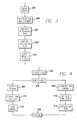
- FIG. 3is a flowchart illustrating the steps for the interpretation and execution of SQL statements in an interactive environment, usable in the present invention
- FIG. 4is a flowchart illustrating the steps for the interpretation and execution of SQL statements in an embedded source code, usable in the present invention
- FIGS. 5-6represent the query graph models of an example provided herein.
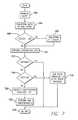
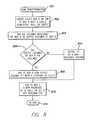
- FIGS. 7-8are flowcharts illustrating the method of optimizing SQL queries in steps 204 of FIG. 3 and 314 of FIG. 4, according to the present invention.
- the methodanalyzes the query to determine whether it includes the WHERE clause which contains an “EXISTS” subquery and a “NOT EXISTS” subquery, or EXISTS-equivalent subqueries, in Boolean factor. If so, it performs the subsumption test to determine whether the two subqueries include identical predicate sets. If they are not identical, it determines the compensation predicate and eliminates the EXISTS subquery by merging it into the NOT EXISTS subquery. This improves the query performance by eliminating a subquery altogether and hence allows generation of more efficient execution plans for retrieving data from the relational database.
- the preferred embodiment of the present inventiondiscloses an improved optimization technique using the Query Graph Model (QGM).
- QGMQuery Graph Model
- FIG. 2illustrates an exemplary computer hardware environment that could be used with the present invention.
- a computer system 102is comprised of one or more processors with computer memory, connected to one or more electronic storage devices 104 and 106 , such as disk drives, that store one or more relational databases.
- These drivesmay comprise, for example, optical disk drives, magnetic tapes and/or semiconductor memory.
- Operators of the computer system 102use a standard operator terminal interface 108 , such as IMS/DB/DC, CICS, TSO, OS/ 2 or other similar interface, to transmit electrical signals to and from the computer system 102 , that represent commands for performing various search and retrieval functions, termed queries, against the databases.
- queriesconform to the Structured Query Language (SQL) standard, and invoke functions performed by Relational DataBase Management System (RDBMS) software.
- the RDBMS softwarecomprises the DB 2 product offered by IBM for the MVS or OS/ 2 operating systems.
- the DB 2 architecture for the MVS operating systemincludes three major components: the IMS Resource Lock Manager (IRLM) 110 , the Systems Services module 112 , and the Database Services module 114 .
- the IRLM 110handles locking services, because DB 2 treats data as a shared resource, thereby allowing any number of users to access the same data simultaneously, and thus concurrency control is required to isolate users and to maintain data integrity.
- the Systems Services module 112controls the overall DB 2 execution environment, including managing log data sets 106 , gathering statistics, handling startup and shutdown, and providing management support.
- the Database Services module 114contains several submodules, including the Relational Database System (RDS) 116 , the Data Manager 118 , the Buffer Manager 120 and other components 122 such as an SQL compiler/interpreter. These submodules support the functions of the SQL language, i.e., definition, access control, retrieval, and update of user and system data.
- RDSRelational Database System
- FIG. 3is a flowchart illustrating the steps necessary for the interpretation and execution of SQL statements in an interactive environment, according to the present invention.
- Block 202represents the step of accepting the user's input of SQL statements into the computer system 102 .
- Block 204represents the step of compiling or interpreting the SQL statements. An optimization function within block 204 may transform the SQL query in a manner described in more detail later in this specification.
- Block 206represents the step of generating a compiled set of runtime structures called an application plan from the compiled SQL statements.
- the SQL statements received as input from the userspecify only the data that the user wants, but not the instructions on how to get to it.
- Block 208represents the execution of the application plan
- block 210represents the output of the results of the application plan to the user.
- FIG. 4is a flowchart illustrating the steps necessary for the interpretation and execution of SQL statements embedded in source code, according to the present invention.
- Block 302represents program source code containing a host language (such as COBOL or C) and embedded SQL statements.
- the program source codeis then input to a precompile step 304 .
- the modified source module 306contains host language calls to DB 2 , which the precompile step 304 inserts in place of SQL statements.
- the DBRM 308consists of the SQL statements from the program source code 302 .
- a compile and link-edit step 310uses the modified source module 306 to produce a load module 312
- an optimize and bind step 314uses the DBRM 308 to produce a compiled set of runtime structures for the application plan 316 .
- the SQL statements from the program source code 302specify only the data that the user wants, but not how to get to it.
- the optimize and bind step 314may optimize the SQL query in a manner described in more detail later in this specification.
- the optimize and bind step 314considers both the available access paths (indexes, sequential reads, etc.) and system held statistics on the data to be accessed (the size of the table, the number of distinct values in a particular column, etc.), to choose what it considers to be the most efficient access path for the query.
- the load module 312 and application plan 316are then executed together at step 318 .
- the operation of the present inventioncan be best understood in context, i.e., using a real-world example, such as a data warehouse application, performed by the RDBMS software.
- a real-world examplesuch as a data warehouse application, performed by the RDBMS software.
- Such an applicationthere typically consists of several large tables, each with one or more columns forming the primary or unique key of the table, or equivalently, there is a unique constraint on one or more columns of the table.
- the database architectureconsists of suppliers and customers. Customers may order items (parts) which may be supplied many suppliers. Both customers and suppliers table have location information.
- the tablesmay be created using the SQL statement as follows:
- the following query Qreturns a list of suppliers who kept orders waiting.
- the queryidentifies suppliers in Saudi Arabia whose product was part of a multi-supplier order, where they were the only supplier who failed to meet the committed delivery date.
- the QGM of this queryis presented in FIG. 5 .
- the present inventionis based on the observation that the result set that satisfies the correlated EXISTS subquery (LINEITEM L 2 in subquery Q 1 ) is a superset of the result set that satisfies the correlated NOT EXISTS subquery (LINEITEM L 3 in subquery Q 2 ). Therefore, in the QGM the NOT EXISTS subquery can be stacked on top of the EXISTS subquery, and during the query execution the access to the LINEITEM table will be reduced by one reference.
- FIG. 6is a simplified QGM transformation diagram for the rewritten query.
- the output (head) of box B 602for the EXISTS subquery, instead of only columns C 1 604 and C 2 606 , further includes a column C 3 608 :
- an output column C 3 608 containing the constant value, such as “1” or some other pre-defined value,is not necessary when one of the other columns in the output is defined as non-nullable.
- the column C 3 608is used to assure return of at least one row from box B 602 into box A 610 , used for NOT EXISTS subquery, indicating that there is a row which satisfies the predicates used in box B 602 and allowing the subquery of box A 610 to be evaluated, by force feeding it, and not filtering it out.
- the predicate P 2 ′is defined as:
- the quantifier ranging over box B 602is a regular F quantifier (ForEach) with a property of generating a null row if the input is empty. If there is no match in box B 602 , a row of nulls will be fed into box A 610 including the column C 3 . In this case, the value of C 3 will be NULL indicating that there is no match in box B 602 . Identifying no match is required because a ‘no match’ in the EXISTS subquery in the original query means the outer row in the main query block will be filtered out.
- the quantifier Q 1 ′remains to be a universal quantifier of type ‘A’ (for NOT EXISTS subquery of box A 610 ), and ranges over box A 610 which does not return any columns because the NOT EXISTS subquery does not require return of any column.
- the predicate P 1 ′ in box A 610is defined as:
- the rewritten query of FIG. 6retains the same semantics as the original query of FIG. 5 .
- the EXISTS subquerywill be FALSE and therefore the row of LINEITEM L 1 will be filtered out.
- a null row of the present inventionwill be fed into box A 610 for evaluation, making the predicate P 1 ′ TRUE. Since there is a row generated by box A 610 , the NOT EXISTS subquery predicate for the quantifier Q 1 ′ is FALSE, by definition. Hence, the said row of LINEITEM L 1 will also be filtered out in the rewritten query and the semantics is the same as in the original EXISTS subquery.
- the EXISTS subquerywill be TRUE and the NOT EXISTS subquery will be evaluated. Its truthfulness depends on whether there is any match based on the predicate P 2 (shown in FIG. 5 ). If there is at least one row such that “L RECEIPTDATE>L_COMMITDATE” is TRUE, then the NOT EXISTS subquery is FALSE; otherwise it is TRUE. When the NOT EXISTS subquery is TRUE, the row of LINEITEM L 1 is selected. In the rewritten query, C 3 608 is always 1 (i.e., the predicate “C 3 IS NOT NULL” is always TRUE).
- the predicate “L_RECEIPTDATE>L_COMMITDATE”will thus be applied on all rows returning from box B 602 into box A 610 . If the predicate is TRUE for any row, the NOT EXISTS subquery is FALSE; otherwise it is TRUE. Hence, the semantics is the same as in the original NOT EXISTS subquery. From the above discussion, it can be concluded that the query rewritten according to the preferred embodiment of the present invention has the same semantics as the original query.
- the result set that satisfies the correlated EXISTS subquery(LINEITEM L 2 in subquery Q 1 ) is a superset of the result set that satisfies the correlated NOT EXISTS subquery (LINEITEM L 3 in subquery Q 2 ).
- the differenceis the predicate “L_RECEIPTDATE>L_COMMITDATE”.
- the preferred embodiment of the present inventionutilizes a well-known technique called “subsumption test”.
- a SELECT box Xis said to be subsumed by another SELECT box Y, if the result set of X is a subset of the result set of Y, and if the output column set of X is a subset of the output column set of Y. In this case the result set of X can be re-derived using the result set of Y.
- the SELECT box Xfilters out more rows since it has more predicates than the box Y.
- the result set produced by Lis a subset of the result set produced by M, because both queries select rows from the same table T (i.e., table T is a common subexpression), and all predicates in M appear in L. Hence, M subsumes L.
- query subsumptioncan be defined in terms of predicate set mapping.
- a SELECT box A from the query Lhas a quantifier Q
- a SELECT box B from the query Mhas a quantifier Q′
- the quantifiers Q and Q′range over a common subexpression table T, referenced by the SELECT boxes A and B.
- query Lhas two predicates in its predicate set and query M has one predicate in its predicate set.
- the predicate set mapping rulemay be defined as follows: a predicate from a predicate set of one query can be mapped into a corresponding predicate from a predicate set of another query by mapping their corresponding quantifiers if they range over common subexpressions.
- the predicate set in the query Mcan be mapped by mapping the quantifier ⁇ Q′ ⁇ to ⁇ Q ⁇ , so that the query M becomes:
- subsumptioncan be defined as predicate set mapping, where corresponding predicates are mapped via their respective quantifiers.
- the predicate set in select box Bmapped from the quantifier ⁇ Q ⁇ to ⁇ Q′ ⁇ , is a subset of the predicate set in select box A, then A is subsumed by B, which means that all the rows produced by A can be found in the result set produced by B. In this case A is a subsumee and B a subsumer.
- the result set of query Lcan be obtained by applying the predicate “C 2 >0” on the result set of query M.
- the predicate that needs to be applied on the subsumer result set in order to re-derive the subsumee result setis called “compensation predicate”.
- a SELECT box Xis identical to another SELECT box Y if box X is subsumed by Y and Y is subsumed by X, i.e., there is no need for a compensation predicate.
- This testdoes not require that all output columns of box X are identical to output columns of box Y, but only that the boxes are mutually subsumed in each other in terms of the rows produced.
- the topmost SELECT boxhas a quantifier Q 1 ranging over the SELECT box B 502 (an EXISTS subquery), and a quantifier Q 2 ranging over the SELECT box A 504 .
- box A 504is subsumed by box B 502 , meaning that all the rows produced by box B 502 are a subset of the result set produced by box A 504 .
- the compensation predicate of the original queryis defined as “L RECEIPTDATE>L_COMMITDATE”.
- the box A 504 and box B 502have a quantifier which ranges over a common subexpression, the table LINEITEM.
- box B 602behaves like the EXISTS subquery and outputs rows to box A 610 .
- the compensation predicate as applied in box A 610is modified to: “(C 3 IS NULL) OR ((C 3 IS NOT NULL) AND (L_RECEIPTDATE>L_COMMITDATE)).”
- the method embodiment of the present inventionis applied to the query which includes the WHERE clause which contains an “EXISTS” subquery and a “NOT EXISTS” subquery, or EXISTS-equivalent subqueries, in Boolean factor. If there is an EXISTS-equivalent subquery instead of an EXISTS or NOT EXISTS subquery, it has to be transformed to the corresponding EXISTS or NOT EXISTS subquery.
- the transformed queries produced by this techniquemay be processed more efficiently by database applications than the original queries.
- Block 706represents the software for performing the subsumption test on two subqueries. If the software of block 712 finds that the subqueries are not subsumed, the RDBMS software returns in block 714 .
- Block 716represents the RDBMS software analyzing the query to determine whether the subqueries are identical.
- FIG. 8is a flowchart illustrating the method of QGM transformation of the query.
- Block 802represents the software for merging and stacking the subquery box A on top of box B for the other subquery.
- the box Bhas a single quantifier with the property that a row of null values will be returned if the input table is empty.
- Block 804represents the software for adding the columns necessary for box A as output columns of box B.
- Block 806represents the software for testing whether all output columns of box B are nullable. If so, the software of block 808 adds the new output column C to box B with a constant value, such as “1”. If not so, the software of block 810 designates a non-nullable column as column C.
Landscapes
- Engineering & Computer Science (AREA)
- Theoretical Computer Science (AREA)
- Computational Linguistics (AREA)
- Data Mining & Analysis (AREA)
- Databases & Information Systems (AREA)
- Physics & Mathematics (AREA)
- General Engineering & Computer Science (AREA)
- General Physics & Mathematics (AREA)
- Operations Research (AREA)
- Information Retrieval, Db Structures And Fs Structures Therefor (AREA)
Abstract
Description
1. Field of the Invention
This invention relates in general to database management systems performed by computers, and in particular to the optimization of SQL queries in a relational database management system having an EXISTS subquery and a NOT EXISTS subquery.
2. Description of Related Art
Databases are computerized information storage and retrieval systems. A Relational Database Management System (RDBMS) is a database management system (DBMS) which uses relational techniques for storing and retrieving data. RDBMS software using a Structured Query Language (SQL) interface is well known in the art. The SQL interface has evolved into a standard language for RDBMS software and has been adopted as such by both the American National Standards Organization (ANSI) and the International Standards Organization (ISO).
In RDBMS software all data is externally structured into tables. The SQL interface allows users to formulate relational operations on the tables either interactively, in batch files, or embedded in host language, such as C, COBOL, etc. Operators are provided in SQL that allow the user to manipulate the data, wherein each operator operates on either one or two tables and produces a new table as a result. The power of SQL lies on its ability to link information from multiple tables or views together to perform complex sets of procedures with a single statement.
One of the most common SQL queries executed by RDBMS software is the SELECT statement. In the SQL standard, the SELECT statement generally has the format: “SELECT<clause>FROM<clause>WHERE<clause>GROUP BY<clause>HAVING<clause>ORDER BY<clause>.” The clauses generally must follow this sequence. Only the SELECT and FROM clauses are required and all other clauses are optional.
Generally, the result of a SELECT statement is a subset of data retrieved by the RDBMS software from one or more existing tables stored in the relational database, wherein the FROM clause identifies the name of the table or tables from which data is being selected. The subset of data is treated as a new table, termed the result table. The WHERE clause determines which rows should be returned in the result table. Generally, the WHERE clause contains a search condition that must be satisfied by each row returned in the result table. The rows that meet the search condition form an intermediate set, which is then processed further according to specifications in the SELECT clause.
The search condition typically comprises one or more predicates, each of which specifies a comparison between two values from certain columns, constants or correlated values. Multiple predicates in the WHERE clause are typically connected by Boolean operators.
The SELECT statement may also include a grouping function indicated by the GROUP BY clause. The GROUP BY clause causes the rows in the intermediate result set to be grouped according to the values specified in the clause. A number of column or aggregate functions are also built into SQL, such as MAX (maximum value in column), MIN (minimum value in column), AVG (average of values in column), SUM (sum of values in column), and COUNT (number of rows).
Queries using aggregate expressions return as many result rows as there exist unique “result groups” in the source of the aggregation. A result group is defined as the set of values contained in the fields of a row corresponding to the list of columns or expressions specified in the GROUP BY clause of the query. The value of the aggregate function is the cumulative result of applying the function to the result of the contained expression for each row having the same result group.
Another operation permitted by SQL is the JOIN operation, which concatenates horizontally all or parts of two or more tables to create a new resulting table. The JOIN operation is implied by naming more than one table in the FROM clause of a SELECT statement.
An SQL query generally includes at least one predicate, which is an SQL expression that can assume a logical value of TRUE, FALSE, or UNKNOWN. A predicate typically either specifies a data range, tests for an existence condition, tests for equivalence, or performs a similar table comparison operation.
In RDBMSs, columns of any type can assume NULL (i.e., unknown) values. In RDBMS software, NULL values are properly handled using tri-value logic (i.e., TRUE, FALSE or UNKNOWN) for predicates, and SQL-based RDBMSs employ such logic.
SQL queries and their resulting table operations can be nested through several levels of predicates such that a higher nested predicate, or level of operation, cannot be evaluated until after a lower level predicate, or operation, has been evaluated. A lower level of SQL operation in an SQL statement is generally referred to as a subquery.
Nested SQL statements may require tuple-by-tuple data manipulation in each subquery for evaluation of the complete statement. For example, each entry of a table column may need to be compared against each entry of a corresponding column in another table to determine if a SELECT operation should retrieve a table row. Such tuple-by-tuple operations are very inefficient and requires simplification and optimization.
In an RDBMS system, users submit SQL queries. The optimizer in the RDBMS optimizes the SQL query and generates an efficient execution plan. Typically, the optimizer adopts a cost-based approach wherein the optimizer generates many possible alternative execution plans, and selects the best/cheapest plan among those generated plans.
Graphical Representation of SQL Queries by Query Graph Model (QGM)
A useful tool in describing SQL queries and their evaluation is a graphical representation of SQL statements known as Query Box Representation (QBR). Known SQL optimizers employ various types of QBR to facilitate their processing and optimization efforts. QBR provides a powerful and manageable representation of queries used to reduce the complexity of query compilation and optimization procedures. Additionally, QBR provides a tool for optimizing queries by facilitating rewriting the QBR components in efficient arrangements.
Generally, a QBR representation employs hierarchically arranged “boxes” to represent subquery operations, such as SELECT and GROUP BY. The interconnections between the boxes define the relationship between different items of data from different subquery operations.
Various techniques may be used to store a complex query in computer memory in accordance with a QBR format. Specifically, multiple data structures in the memory are used to represent the QBR boxes and interrelationships. These data structures may comprise, for example, records and associated pointers, strings, stack arrangements, doubly linked lists, hashing arrangements, or other suitable formats. Preferably, records and pointers are used, where each record represents a QBR box, and the pointers represent the relationships between the boxes. Each record also includes a listing of various properties associated with the corresponding QBR box.
A number of different types of QBR are known in the art. One of the more popular types of QBR is known as the Query Graph Model (QGM), well known in the art, and described in the following reference, which is incorporated by reference in its entirety: Pirahesh et al., “Extensible/Rule Based Query Rewrite Optimization in Starburst,” Proceedings of ACM SIGMOD '92 International Conference on Management of Data, San Diego, Calif., U.S.A., 1992.
The query graph model supports arbitrary table operations where the inputs are tables and outputs are tables. Such operations are SELECT, GROUP BY, UNION, INTERSECT, and EXCEPT operations, as defined in the SQL standard, and the restriction, projection and join operations performed by the SELECT operation.
When a query is represented by the query graph model, each operation of the query may be graphically represented by a box having a head and body. The body of a query graph model box may include “quantifiers”, corresponding to table references or derived tables. Quantifiers are labeled with the columns that it needs from the table it ranges over. Quantifiers may have different types. Type “F” (For Each) quantifiers correspond to the table references in the FROM clause of the SQL query. Type “A” (Universal) quantifiers correspond to the ALL subquery in the WHERE clause. Type “E” (Existential) quantifiers correspond to the subquery associated with SQL's predicates EXISTS, IN, ANY, and SOME, which are true if at least one tuple of the subquery satisfies the predicate. In QGM, the quantifiers associated with existential and universal subqueries are called COUNTING quantifiers. Type “S” (Scalar) quantifiers correspond to scalar subqueries. The database system has to enforce the rule that exactly one tuple has to be returned from the scalar subquery. If the subquery does not produce any rows, a tuple with null value(s) will be returned via the S quantifier. On the other hand, if the subquery returns more than one row, a runtime error will be raised. Additionally, quantifiers may be ordered within a box to support asymmetric operators, such as EXCEPT.
The query graph model boxes are coupled to each other by quantifier “edges”, also called “arcs”. The head of a box describes the output data stream or table produced by the operation, and the body specifies the operation required to compute the output table from records flowing into the body. The head specifies each output column, such as those specified in the SELECT clause of a query, and includes column names, types, and output ordering information. The head, body, and quantifiers of a box may each have a separate attribute called “DISTINCT”, to manage the production of duplicate tuples.
FIG. 1 illustrates an exemplary query graph model corresponding to the following SQL query.
SELECT DISTINCT Q1.PARTNO, Q1.DESCR, Q2.SUPPNO
FROM INVENTORY Q1, QUOTATIONS Q2
WHERE Q1.PARTNO=Q2.PARTNO AND Q1.DESCR=‘ENGINE’
AND Q2.PRICE<=ALL (SELECT Q3.PRICE
FROM QUOTATIONS Q3
WHERE Q2.PARTNO=Q3.PARTNO)
This query provides information about suppliers and parts for which the supplier price is less than that of all other suppliers. The corresponding query graph model of FIG. 1 contains fourboxes boxes third box 102 is a SELECT box representing the main part of the query, and thebox 103 is a SELECT box representing the subquery.
In accordance with the query graph model convention, each of the boxes100-103 has a head and a body, where each head describes the output columns produced by the associated box, and the body specifies the operation required to compute the output. “Base” tables, exemplified by boxes100-101, are considered to have empty or nonexistent bodies because they do not perform any operations.
Referring in greater detail to theSELECT box 102, ahead 105 is shown, specifying output columns PARTNO, DESCR, and SUPPNO which correspond to the SELECT clause of the main query. The specification of these columns includes column names, types, and output ordering information. Thehead 105 includes adistinct attribute 106, which indicates that the associated table contains only distinct tuples and may not have duplicates.
The body of each non-base table box contains a graph, the vertices of which represent quantified tuple variables, the quantifiers. The vertices, which are represented with dark circles, are also called “nodes”. In thebox 102, for example, vertices108-110 correspond to quantifiers Q1, Q2, and Q4. Quantifiers Q1 and Q2 range over the INVENTORY and QUOTATIONS base tables respectively, and correspond to the table references in the FROM clause of the SQL query.
As stated above, arcs (also called “inter-box edges”) connect quantifiers to other boxes or to each other. For example, the Q1 and Q2 quantifiers (nodes108-109) are connected via arcs112-113 to the heads of the boxes100-101, respectively. Arcs may also interconnect quantifiers of the same box where each inter-quantifier arc represents a predicate of the WHERE clause in the query block. Such predicates are represented by labeled rectangles along the corresponding edge. Such edges are also called Boolean factors. For example, the Q1 and Q2 quantifiers are interconnected by anedge 116 that represents a join predicate. A loopededge 118 attached to the Q1 (node108) represents a local predicate on the quantifier Q1. In thehead 105 of thebox 102, each output column may have an associated expression corresponding to expressions allowed in the SELECT clause of the query. In FIG. 1, all of these expressions are simple identity functions over the referenced quantified columns.
Quantifier Q4 is a UNIVERSAL quantifier is of type A, because it is associated with the ALL subquery in the WHERE clause. This means that for ALL tuples associated with Q4, the predicate represented by the edge between Q2 and Q4 is TRUE.
In Box3, Q1 and Q2 participate in joins, and some of their columns are used in the output tuples. These quantifiers have type F (ForEach), since they come from the query's FROM clause. Box4 represents the example's subquery. It contains an F quantifier Q3 over the QUOTATIONS table, and has a predicate that refers to Q2 and Q3.
The body of every box in QGM has an attribute called DISTINCT that may have one of the following values: ENFORCE, PRESERVE or PERMIT. ENFORCE means that the operation must eliminate duplicates in order to enforce head.distinct=TRUE. PRESERVE means that the operation must preserve the number of duplicates it generates. This could happen because head.distinct=FALSE, or because head.distinct=TRUE and no duplicates could exist in the output of the operation, even without duplicate elimination. PERMIT means that the operation is permitted to eliminate (or generate) duplicates arbitrarily. For example, the DISTINCT attribute of Box4 can have the value PERMIT, because its output is used in a universal quantifier (Q4 in Box3), and universal quantifiers are insensitive to duplicate tuples.
Like the body of every box, each quantifier also has an attribute called DISTINCT that may have a value of ENFORCE, PRESERVE or PERMIT. ENFORCE means that the quantifier requires the table over which it ranges to enforce duplicate elimination. PRESERVE means that the quantifier requires that the exact number of duplicates in the lower table be preserved. PERMIT means that the table below may have an arbitrary number of duplicates. Existential and universal quantifiers can always have DISTINCT PERMIT, since they are insensitive to duplicates.
RDBMS software supports view definitions, and a view can be used anywhere a table can be used. Views, just like queries and subqueries, may be represented with a QGM, with one or many boxes. When a view is referenced in a query, its QGM becomes part of the QGM graph of the query. Derived tables, which are similar to view definitions, can be defined anywhere a table can be used, and their QGM becomes part of the QGM graph of the query.
In the body of every box, each output column may have an associated expression corresponding to one of the expressions allowed in the select list of the query. These expressions are called head expressions. The output of a box can be used multiple times (e.g., a view may be used multiple times in the same query), creating common subexpressions.
In the remainder of this paper we draw only rough sketches of QGM graphs, omitting details that are not critical to the discussion.
This particular invention is designed to simplify and optimize a query having both an EXISTS subquery and a NOT EXISTS subquery. Conventional decision support systems must handle and process complex queries efficiently. There is a need, especially in a DBMS interactive mode of operation, for the response time to be shortened drastically, even if a large amount of data is being processed. Conventional query optimization techniques include:
1) converting EXISTS subqueries into joins so that different join methods and join orders can be considered;
2) consequently eliminating redundant join operations, because by converting EXISTS subqueries into joins, the chance of eliminating redundant join operation increases;
3) applying decorrelation techniques if the subqueries are correlated;
4) caching subquery results and re-using the caches for subsequent queries or subquery invocations.
Some of these techniques were described in the following publications. Hamid Pirahesh, Joseph Hellerstein, and Waqar Hasan authored “Extensible/Rule Based Query Rewrite Optimization in STARBURST,” Proceedings of ACM SIGMOD '92 International Conference on Management of Data, San Diego, Calif., 1992. Cliff Leung, Hamid Pirahesh, Praveen Seshadri, and Joseph Hellerstein authored “Query Rewrite Optimization Rules in IBM DB2 Universal Database,” Readings in Database Systems, 3rd Edition, edited by Stonebraker and Hellerstein, 1998.
However, none of the conventional optimization technique addresses the performance issues of a query in which the WHERE clause contains both an “EXISTS” subquery and a “NOT EXISTS” subquery, or EXISTS-equivalent joins, in Boolean factor. Therefore, there is further need in the art for optimization of these queries.
The foregoing and other objects, features, and advantages of the present invention will be apparent from the following detailed description of the preferred embodiment which makes reference to several drawing figures.
One preferred embodiment of the present invention includes a method of optimizing a query in a computer in which a WHERE clause contains both an “EXISTS” subquery and a “NOT EXISTS” subquery, or their equivalent subqueries.
The method has the following steps:
(a) analyzing the query to determine whether the query includes a WHERE clause which contains an “EXISTS” subquery or the equivalent and a “NOT EXISTS” subquery or the equivalent;
(b) performing a subsumption test to determine whether the subqueries are subsumed or identical;
(c) if identical, adding a FALSE predicate to the WHERE clause of the query;
(d) if subsumed and not identical, performing a transformation of the query to merge the subqueries; and
(e) executing the query in the computer to retrieve data from the relational database.
The step (d) of performing the transformation of the query includes the QGM query transformation, and it further has the steps:
stacking the “NOT EXISTS” subquery block (A) on top of the “EXISTS” subquery block (B);
adding to output columns of the block B all columns necessary for the block A;
applying a nullability test to all said columns necessary for the block A;
if not all said columns nullable, designating a non-nullable column as a column C;
if all said columns nullable, adding a column C to said output columns of the block B and filling the column C with a pre-determined constant value;
transforming a compensation predicate CP, obtained during the subsumption test of the step (b), into the form of “(C IS NULL) OR ((C IS NOT NULL) AND CP); and
applying the transformed compensation predicate to the block A to merge the subqueries.
Another preferred embodiment of the present invention includes a program storage device storing the query optimization program, according to the method of the present invention.
Yet another preferred embodiment of the present invention includes an apparatus for optimizing a query, according to the method of the present invention.
Referring now to the drawings in which like reference numbers represent corresponding parts throughout:
FIG. 1 illustrates the QGM technique, according to the prior art;
FIG. 2 illustrates a computer hardware and software environment usable in the present invention;
FIG. 3 is a flowchart illustrating the steps for the interpretation and execution of SQL statements in an interactive environment, usable in the present invention;
FIG. 4 is a flowchart illustrating the steps for the interpretation and execution of SQL statements in an embedded source code, usable in the present invention;
FIGS. 5-6 represent the query graph models of an example provided herein; and
FIGS. 7-8 are flowcharts illustrating the method of optimizing SQL queries insteps 204 of FIG. 3 and 314 of FIG. 4, according to the present invention.
In the following description of the preferred embodiments reference is made to the accompanying drawings which form the part thereof, and in which are shown by way of illustration specific embodiments in which the invention may be practiced. It is to be understood that other embodiments may be utilized and structural and functional changes may be made without departing from the scope of the present invention.
The present invention discloses a method, apparatus and computer program storage device for optimizing a SQL query which contains an “EXISTS” subquery and a “NOT EXISTS” subquery, or EXISTS-equivalent subqueries, in Boolean factor. The EXISTS-equivalent subquery is a subquery that is semantically equivalent to EXISTS or NOT EXISTS subquery. Subqueries that can be replaced by “EXISTS” or “NOT EXISTS” subqueries are referred to herein as EXISTS-equivalent subqueries. In the SQL language, some forms of ALL, ANY, IN, NOT IN, and SOME subqueries are semantically equivalent to some form of EXISTS-type subquery, and are therefore EXISTS-equivalent subqueries. Existential joins are also considered as EXISTS-equivalent subqueries.
The method analyzes the query to determine whether it includes the WHERE clause which contains an “EXISTS” subquery and a “NOT EXISTS” subquery, or EXISTS-equivalent subqueries, in Boolean factor. If so, it performs the subsumption test to determine whether the two subqueries include identical predicate sets. If they are not identical, it determines the compensation predicate and eliminates the EXISTS subquery by merging it into the NOT EXISTS subquery. This improves the query performance by eliminating a subquery altogether and hence allows generation of more efficient execution plans for retrieving data from the relational database.
The preferred embodiment of the present invention discloses an improved optimization technique using the Query Graph Model (QGM).
Hardware and Software Environment
FIG. 2 illustrates an exemplary computer hardware environment that could be used with the present invention. In the exemplary environment, acomputer system 102 is comprised of one or more processors with computer memory, connected to one or moreelectronic storage devices
Operators of thecomputer system 102 use a standardoperator terminal interface 108, such as IMS/DB/DC, CICS, TSO, OS/2 or other similar interface, to transmit electrical signals to and from thecomputer system 102, that represent commands for performing various search and retrieval functions, termed queries, against the databases. In the present invention, these queries conform to the Structured Query Language (SQL) standard, and invoke functions performed by Relational DataBase Management System (RDBMS) software. In the preferred embodiment of the present invention, the RDBMS software comprises the DB2 product offered by IBM for the MVS or OS/2 operating systems. Those skilled in the art will recognize, however, that the present invention has application to any RDBMS software that uses SQL, and may similarly be applied to non-SQL queries.
As illustrated in FIG. 3 the DB2 architecture for the MVS operating system includes three major components: the IMS Resource Lock Manager (IRLM)110, theSystems Services module 112, and theDatabase Services module 114. TheIRLM 110 handles locking services, because DB2 treats data as a shared resource, thereby allowing any number of users to access the same data simultaneously, and thus concurrency control is required to isolate users and to maintain data integrity. TheSystems Services module 112 controls the overall DB2 execution environment, including managinglog data sets 106, gathering statistics, handling startup and shutdown, and providing management support.
At the center of the DB2 architecture is theDatabase Services module 114. TheDatabase Services module 114 contains several submodules, including the Relational Database System (RDS)116, theData Manager 118, theBuffer Manager 120 andother components 122 such as an SQL compiler/interpreter. These submodules support the functions of the SQL language, i.e., definition, access control, retrieval, and update of user and system data.
FIG. 3 is a flowchart illustrating the steps necessary for the interpretation and execution of SQL statements in an interactive environment, according to the present invention.Block 202 represents the step of accepting the user's input of SQL statements into thecomputer system 102.Block 204 represents the step of compiling or interpreting the SQL statements. An optimization function withinblock 204 may transform the SQL query in a manner described in more detail later in this specification.Block 206 represents the step of generating a compiled set of runtime structures called an application plan from the compiled SQL statements. Generally, the SQL statements received as input from the user specify only the data that the user wants, but not the instructions on how to get to it. This step considers both the available access paths (indexes, sequential reads, etc.) and system held statistics on the data to be accessed (the size of the table, the number of distinct values in a particular column, etc.), to choose what it considers to be the most efficient access path for the query.Block 208 represents the execution of the application plan, and block210 represents the output of the results of the application plan to the user.
FIG. 4 is a flowchart illustrating the steps necessary for the interpretation and execution of SQL statements embedded in source code, according to the present invention.Block 302 represents program source code containing a host language (such as COBOL or C) and embedded SQL statements. The program source code is then input to aprecompile step 304. There are two outputs from the precompile step304: a modified source module and a Database Request Module (DBRM)308. The modifiedsource module 306 contains host language calls to DB2, which theprecompile step 304 inserts in place of SQL statements. TheDBRM 308 consists of the SQL statements from theprogram source code 302. A compile and link-edit step 310 uses the modifiedsource module 306 to produce aload module 312, while an optimize and bindstep 314 uses theDBRM 308 to produce a compiled set of runtime structures for theapplication plan 316. As indicated above in conjunction with FIG. 2, the SQL statements from theprogram source code 302 specify only the data that the user wants, but not how to get to it. The optimize and bindstep 314 may optimize the SQL query in a manner described in more detail later in this specification. Thereafter, the optimize and bindstep 314 considers both the available access paths (indexes, sequential reads, etc.) and system held statistics on the data to be accessed (the size of the table, the number of distinct values in a particular column, etc.), to choose what it considers to be the most efficient access path for the query. Theload module 312 andapplication plan 316 are then executed together atstep 318.
Those skilled in the art will recognize that any combination of components, including computer hardware, peripherals and other devices, computer system software programs and application programs may be used to implement the present invention, so long as similar functions are performed thereby. Many modifications of the proposed preferred embodiments may be made without departing from the scope of the present invention.
SQL Optimization
The operation of the present invention can be best understood in context, i.e., using a real-world example, such as a data warehouse application, performed by the RDBMS software. Such an application there typically consists of several large tables, each with one or more columns forming the primary or unique key of the table, or equivalently, there is a unique constraint on one or more columns of the table.
In a generic example of such a structure comprising several tables the database architecture consists of suppliers and customers. Customers may order items (parts) which may be supplied many suppliers. Both customers and suppliers table have location information. The tables may be created using the SQL statement as follows:
| CREATE TABLE | NATION (N_NATIONKEY INTEGER, | ||
| N_NAME | CHAR(25), |
| N_REGIONKEY | INTEGER); |
| CREATE TABLE | REGION (R_REGIONKEY INTEGER, |
| R_NAME | CHAR(25); |
| CREATE TABLE | PART (P_PARTKEY INTEGER, |
| P_NAME | VARCHAR(55), | |
| P_MFGR | CHAR(25), | |
| P_BRAND | CHAR(10), | |
| P_TYPE | VARCHAR(25), | |
| P_SIZE | INTEGER, |
| P_CONTAINER CHAR(10), | |
| P_RETAILPRICE FLOAT); |
| CREATE TABLE | SUPPLIER (S_SUPPKEY INTEGER, |
| S_NAME | CHAR(25), |
| S_ADDRESS VARCHAR(40), | |
| S_NATIONKEY INTEGER, |
| S_PHONE | CHAR(15), |
| S_ACCTBAL | FLOAT); |
| CREATE TABLE | PARTSUPP (PS_PARTKEY INTEGER, |
| PS_SUPPKEY INTEGER, | |
| PS_AVAILQTY INTEGER, | |
| PS_SUPPLYCOST FLOAT); |
| CREATE TABLE | CUSTOMER(C_CUSTKEY INTEGER, |
| C_NAME | VARCHAR(25), |
| C_ADDRESS VARCHAR(40), | |
| C_NATIONKEY INTEGER, |
| C_PHONE | CHAR(15), |
| C_ACCTBAL FLOAT, | |
| C_MKTSEGMENT CHAR(10)); |
| CREATE TABLE | ORDERS (O_ORDERKEY INTEGER, |
| O_CUSTKEY | INTEGER, |
| O_ORDERSTATUS CHAR(1), | |
| O_TOTALPRICE FLOAT, | |
| O_ORDERDATE DATE, | |
| O_ORDERPRIORITY CHAR(15), |
| O_CLERK | CHAR(15), |
| O_SHIPPRIORITY INTEGER); |
| CREATE TABLE | LINEITEM (L_ORDERKEY INTEGER, |
| L_PARTKEY INTEGER, | ||
| L_SUPPKEY INTEGER, | ||
| L_LINENUMBER INTEGER, | ||
| L_QUANTITY FLOAT, | ||
| L_EXTENDEDPRICE FLOAT, | ||
| L_DISCOUNT FLOAT, | ||
| L_TAX FLOAT, | ||
| L_RETURNFLAG CHAR(1), | ||
| L_LINESTATUS CHAR(1), | ||
| L_SHIPDATE DATE, | ||
| L_COMMITDATE DATE, | ||
| L_RECEIPTDATE DATE, | ||
| L_SHIPINSTRUCT CHAR(25), | ||
| L_SHIPMODE CHAR(10)); | ||
The following query Q returns a list of suppliers who kept orders waiting. The query identifies suppliers in Saudi Arabia whose product was part of a multi-supplier order, where they were the only supplier who failed to meet the committed delivery date.
(QUERY Q)
SELECT S_NAME, COUNT(*) AS NUMWAIT
FROM SUPPLIER, LINEITEM L1, ORDERS, NATION
WHERE S_SUPPKEY=L1.L_SUPPKEY
AND O_ORDERKEY=L1.L_ORDERKEY
AND L1.L_RECEIPTDATE>L1.L_COMMITDATE
AND EXISTS (SELECT *
FROM LINEITEM L2
WHERE L2.L_ORDERKEY=L1.L_ORDERKEY
AND L2.L_SUPPKEY<>L1.L_SUPPKEY)
AND NOT EXISTS (SELECT *
FROM LINEITEM L3
WHERE L3.L_ORDERKEY=L1.L_ORDERKEY
AND L3.L_SUPPKEY<>L1.L_SUPPKEY
AND L3.L_RECEIPTDATE>L3.L_COMMITDATE)
AND S_NATIONKEY=N_NATIONKEY
AND N_NAME=‘SAUDI ARABIA’
GROUP BY S_NAME
In formulating this SOL query, a correlated EXISTS subquery is introduced to make sure that the order in concern has more than one supplier:
(SUBQUERY Q1)
EXISTS (SELECT *
FROM LINEITEM L2
WHERE L2.L_ORDERKEY=L1.L_ORDERKEY
AND L2.L_SUPPKEY<>L1.L_SUPPKEY)
If so, the NOT EXISTS subquery is used to find out whether the other suppliers did not ship the item later than the commit date:
(SUBQUERY Q2)
NOT EXISTS (SELECT *
FROM LINEITEM L3
WHERE L3.L_ORDERKEY=L1.L_ORDERKEY
AND L3.L_SUPPKEY <>L1.L_SUPPKEY
AND L3.L_RECEIPTDATE>L3.L COMMITDATE)
The QGM of this query is presented in FIG.5.
Conventional DBMS optimizers will likely evaluate the first subquery ofbox B 502 and the second subquery ofbox A 504, and there will be three different accesses to the LINEITEM table: one in the main query,506, one in the EXISTS subquery,508, and one in the NOT EXISTS subquery of box B,510. Even if the EXISTS subquery is converted into a join (which is often done by existing commercial database systems), the LINEITEM table will still be referenced three times.
In the preferred embodiment of the present invention, a technique is presented that allows removal of one reference to the LINEITEM table so that only two references are used. Moreover, the lack of join operations enhances the query performance substantially.
The present invention is based on the observation that the result set that satisfies the correlated EXISTS subquery (LINEITEM L2 in subquery Q1) is a superset of the result set that satisfies the correlated NOT EXISTS subquery (LINEITEM L3 in subquery Q2). Therefore, in the QGM the NOT EXISTS subquery can be stacked on top of the EXISTS subquery, and during the query execution the access to the LINEITEM table will be reduced by one reference.
FIG. 6 is a simplified QGM transformation diagram for the rewritten query. The output (head) ofbox B 602, for the EXISTS subquery, instead of only columns C1604 and C2606, further includes a column C3608:
C1: L_RECEITPDATE
C2: L_COMMITDATE and
C3:1
The inclusion of anoutput column C3 608 containing the constant value, such as “1” or some other pre-defined value, is not necessary when one of the other columns in the output is defined as non-nullable. When required, thecolumn C3 608 is used to assure return of at least one row frombox B 602 intobox A 610, used for NOT EXISTS subquery, indicating that there is a row which satisfies the predicates used inbox B 602 and allowing the subquery ofbox A 610 to be evaluated, by force feeding it, and not filtering it out. The predicate P2′ is defined as:
L3.L_ORDERKEY=L1.L_ORDERKEY AND
L3.L_SUPPKEY<>L1.L_SUPPKEY
The quantifier ranging overbox B 602 is a regular F quantifier (ForEach) with a property of generating a null row if the input is empty. If there is no match inbox B 602, a row of nulls will be fed intobox A 610 including the column C3. In this case, the value of C3 will be NULL indicating that there is no match inbox B 602. Identifying no match is required because a ‘no match’ in the EXISTS subquery in the original query means the outer row in the main query block will be filtered out.
The quantifier Q1′ remains to be a universal quantifier of type ‘A’ (for NOT EXISTS subquery of box A610), and ranges overbox A 610 which does not return any columns because the NOT EXISTS subquery does not require return of any column.
The predicate P1′ inbox A 610 is defined as:
(Q2′.C3 IS NULL) OR
((Q2′.C3 IS NOT NULL) AND (Q2′.L_RECEIPTDATE>Q2′.L_COMMITDATE))
The rewritten query of FIG. 6 retains the same semantics as the original query of FIG.5. For each row of LINEITEM L1 that satisfies other joins and local predicates, its L_ORDERKEY and L_SUPPKEY values are used as correlation values for evaluatingbox B 602. There are two situation that may exist in matching the predicates using the table LINEITEM L3, which will return the correlation predicate P2′ as TRUE.
If there is no match, in the original query the EXISTS subquery will be FALSE and therefore the row of LINEITEM L1 will be filtered out. In the rewritten query, a null row of the present invention will be fed intobox A 610 for evaluation, making the predicate P1′ TRUE. Since there is a row generated bybox A 610, the NOT EXISTS subquery predicate for the quantifier Q1′ is FALSE, by definition. Hence, the said row of LINEITEM L1 will also be filtered out in the rewritten query and the semantics is the same as in the original EXISTS subquery.
If there is at least one match, in the original query the EXISTS subquery will be TRUE and the NOT EXISTS subquery will be evaluated. Its truthfulness depends on whether there is any match based on the predicate P2 (shown in FIG.5). If there is at least one row such that “L RECEIPTDATE>L_COMMITDATE” is TRUE, then the NOT EXISTS subquery is FALSE; otherwise it is TRUE. When the NOT EXISTS subquery is TRUE, the row of LINEITEM L1 is selected. In the rewritten query,C3 608 is always 1 (i.e., the predicate “C3 IS NOT NULL” is always TRUE). The predicate “L_RECEIPTDATE>L_COMMITDATE” will thus be applied on all rows returning frombox B 602 intobox A 610. If the predicate is TRUE for any row, the NOT EXISTS subquery is FALSE; otherwise it is TRUE. Hence, the semantics is the same as in the original NOT EXISTS subquery. From the above discussion, it can be concluded that the query rewritten according to the preferred embodiment of the present invention has the same semantics as the original query. It can be observed that in the original query, the result set that satisfies the correlated EXISTS subquery (LINEITEM L2 in subquery Q1) is a superset of the result set that satisfies the correlated NOT EXISTS subquery (LINEITEM L3 in subquery Q2). This is due to the fact that the NOT EXISTS subquery applies more predicates than the EXISTS subquery. In the above-presented example, the difference is the predicate “L_RECEIPTDATE>L_COMMITDATE”. By “stacking” the NOT EXISTSsubquery box A 610 on top of the EXISTSsubquery box B 602, one reference to the LINEITEM table is eliminated.
In order to determine whether the two subqueries or two subexpressions could be merged into one subquery, the preferred embodiment of the present invention utilizes a well-known technique called “subsumption test”.
Using QGM terminology, a SELECT box X is said to be subsumed by another SELECT box Y, if the result set of X is a subset of the result set of Y, and if the output column set of X is a subset of the output column set of Y. In this case the result set of X can be re-derived using the result set of Y.
When the predicate set in box X is a superset of the predicate set in Y, then the SELECT box X filters out more rows since it has more predicates than the box Y.
In the following queries L and M:
L: SELECT*FROM T WHERE C1>0 AND C2>0
M: SELECT*FROM T WHERE C1>0
The result set produced by L is a subset of the result set produced by M, because both queries select rows from the same table T (i.e., table T is a common subexpression), and all predicates in M appear in L. Hence, M subsumes L.
In QGM, query subsumption can be defined in terms of predicate set mapping. In this example a SELECT box A from the query L has a quantifier Q and a SELECT box B from the query M has a quantifier Q′, and the quantifiers Q and Q′ range over a common subexpression table T, referenced by the SELECT boxes A and B.
The respective predicate sets in queries L and M are:
L: Q.C1>0 and Q.C2>0
M: Q′.C1>0
In this case query L has two predicates in its predicate set and query M has one predicate in its predicate set.
The predicate set mapping rule may be defined as follows: a predicate from a predicate set of one query can be mapped into a corresponding predicate from a predicate set of another query by mapping their corresponding quantifiers if they range over common subexpressions.
For example, the predicate set in the query M can be mapped by mapping the quantifier {Q′} to {Q}, so that the query M becomes:
M: Q.C1>0
Therefore, subsumption can be defined as predicate set mapping, where corresponding predicates are mapped via their respective quantifiers.
For example, if the predicate set in select box B, mapped from the quantifier {Q} to {Q′}, is a subset of the predicate set in select box A, then A is subsumed by B, which means that all the rows produced by A can be found in the result set produced by B. In this case A is a subsumee and B a subsumer.
Since the result set of the subsumee can be re-derived from the subsumer result set, in this example the result set of query L can be obtained by applying the predicate “C2>0” on the result set of query M. The predicate that needs to be applied on the subsumer result set in order to re-derive the subsumee result set is called “compensation predicate”.
By definition, a SELECT box X is identical to another SELECT box Y if box X is subsumed by Y and Y is subsumed by X, i.e., there is no need for a compensation predicate. This test does not require that all output columns of box X are identical to output columns of box Y, but only that the boxes are mutually subsumed in each other in terms of the rows produced.
Referring to FIG. 5, the topmost SELECT box has a quantifier Q1 ranging over the SELECT box B502 (an EXISTS subquery), and a quantifier Q2 ranging over theSELECT box A 504. By the query subsumption defined above,box A 504 is subsumed bybox B 502, meaning that all the rows produced bybox B 502 are a subset of the result set produced bybox A 504. The compensation predicate of the original query is defined as “L RECEIPTDATE>L_COMMITDATE”. In query Q thebox A 504 andbox B 502 have a quantifier which ranges over a common subexpression, the table LINEITEM.
Referring to the QGM transformation of FIG. 6, thebox B 602 behaves like the EXISTS subquery and outputs rows tobox A 610. The compensation predicate as applied inbox A 610 is modified to: “(C3 IS NULL) OR ((C3 IS NOT NULL) AND (L_RECEIPTDATE>L_COMMITDATE)).”
If the subqueries are identical, the query is transformed by adding a FALSE predicate (e.g., 1=0) to the WHERE clause of the query.
Another simple situation exists when the predicate set in box X is more restrictive than the predicate set in box Y. For example:
L: SELECT*FROM T WHERE C1>10
M: SELECT*FROM T WHERE C1>0
The result set produced by L is a subset of the result set produced by M and, therefore, M subsumes L.
Generally, the method embodiment of the present invention is applied to the query which includes the WHERE clause which contains an “EXISTS” subquery and a “NOT EXISTS” subquery, or EXISTS-equivalent subqueries, in Boolean factor. If there is an EXISTS-equivalent subquery instead of an EXISTS or NOT EXISTS subquery, it has to be transformed to the corresponding EXISTS or NOT EXISTS subquery. The transformed queries produced by this technique may be processed more efficiently by database applications than the original queries.
With this method there is no requirement for storing any results in a temporary table or file, and hence there is no performance penalty, and yet the EXISTS subquery can be removed all together, resulting in performance gain.
FIG. 7 is a flowchart illustrating the method of optimizing SQL queries insteps 204 of FIG. 3 and 314 of FIG. 4 according to the present invention.Block 702 represents the RDMBS software accepting the query in the memory of thecomputer 102. The query should include a WHERE clause which contains an “EXISTS” subquery block (represented in QGM as box B and below) and a “NOT EXISTS” subquery block (represented in QGM as box A and below), or EXISTS-equivalent subqueries, in Boolean factor.Block 704 represents the RDBMS software transforming a query into the QGM format.
If the software ofblock 706 finds that there is an EXISTS-equivalent subquery instead of an EXISTS or NOT EXISTS subquery, for example, an equivalent join, it is transformed in the software ofblock 708 to the corresponding EXISTS or NOT EXISTS subquery.Block 710 represents the RDBMS software for performing the subsumption test on two subqueries. If the software ofblock 712 finds that the subqueries are not subsumed, the RDBMS software returns inblock 714.Block 716 represents the RDBMS software analyzing the query to determine whether the subqueries are identical.
If so, block718 represents the RDBMS software transforming the query by adding a FALSE predicate to the WHERE clause of the query, and returns. If not identical, the software ofblock 720 determines the compensation predicate CP.Block 722 represents the software for the QGM transformation of the query, as shown in FIG. 8, after which the software returns inblock 714 to block204 in FIG. 3 or block314 in FIG. 4 for subsequent processing steps, including the execution of the SQL query against the relational database and the output of the result set.
FIG. 8 is a flowchart illustrating the method of QGM transformation of the query.Block 802 represents the software for merging and stacking the subquery box A on top of box B for the other subquery. The box B has a single quantifier with the property that a row of null values will be returned if the input table is empty.Block 804 represents the software for adding the columns necessary for box A as output columns ofbox B. Block 806 represents the software for testing whether all output columns of box B are nullable. If so, the software ofblock 808 adds the new output column C to box B with a constant value, such as “1”. If not so, the software ofblock 810 designates a non-nullable column as column C. Next, the software ofblock 812 adds a modified compensation predicate, in the form of “(C IS NULL) OR ((C IS NOT NULL) AND CP), to the box A, where CP is the compensation predicate determined instep 720 of FIG.7. This operation identifies the compensation predicate that eliminates the EXISTS subquery by merging it into the NOT EXISTS subquery. Then, instep 814 the software returns control to block714 of FIG.7.
The foregoing description of the preferred embodiment of the invention has been presented for the purposes of illustration and description. It is not intended to be exhaustive or to limit the invention to the precise form disclosed. Many modifications and variations are possible in light of the above teaching. It is intended that the scope of the invention be limited not by this detailed description, but rather by the claims appended hereto.
Claims (12)
1. A method of optimizing a query in a computer, the query being performed by the computer to retrieve data from a relational database stored in an electronic storage device coupled to the computer, the method comprising the steps of:
(a) analyzing the query to determine whether the query includes a WHERE clause which contains an “EXISTS” subquery or the equivalent and a “NOT EXISTS” subquery or the equivalent;
(b) performing a subsumption test to determine whether the subqueries are subsumed or identical;
(c) if identical, adding a FALSE predicate to the WHERE clause of the query;
(d) if subsumed and not identical, performing a transformation of the query to merge the subqueries; and
(e) executing the query in the computer to retrieve data from the relational database.
2. The method according toclaim 1 , wherein the step (a) further comprises the steps of:
determining whether the “EXISTS” subquery is presented with an equivalent; and
if so, transforming the EXISTS-equivalent subquery into an “EXISTS” subquery.
3. The method according toclaim 1 , wherein the step (a) further comprises the steps of:
determining whether the “NOT EXISTS” subquery is presented with an equivalent; and
if so, transforming the NOT EXISTS-equivalent subquery into an “NOT EXISTS” subquery.
4. The method according toclaim 1 , wherein the step (d) of performing the transformation of the query including the QGM query transformation and the step (d) further comprises the steps of:
stacking the “NOT EXISTS” subquery block (A) on top of the “EXISTS” subquery block (B);
adding to output columns of the block B all columns necessary for the block A;
applying a nullability test to all said columns necessary for the block A;
if not all said columns nullable, designating a non-nullable column as a column C;
if all said columns nullable, adding a column C to said output columns of the block B and filling the column C with a pre-determined constant value;
transforming a compensation predicate CP, obtained during the subsumption test of the step (b), into the form of “(C IS NULL) OR ((C IS NOT NULL) AND CP); and
applying the transformed compensation predicate to the block A to merge the subqueries.
5. An apparatus for optimizing a query, comprising:
a computer having an electronic storage device coupled thereto for storing a relational database, the query being performed by the computer to retrieve data from the relational database;
means, performed by the computer, for analyzing the query to determine whether the query includes a WHERE clause which contains an “EXISTS” subquery or the equivalent and a “NOT EXISTS” subquery or the equivalent;
means, performed by the computer, for performing a subsumption test to determine whether the subqueries are subsumed or identical;
means, performed by the computer, for adding a FALSE predicate to the WHERE clause of the query;
means, performed by the computer, for performing a transformation of the query to merge the subqueries; and
means, performed by the computer, for executing the query in the computer to retrieve data from the relational database.
6. The apparatus according toclaim 5 , wherein the means for analyzing the query further comprises:
means, performed by the computer, for determining whether the “EXISTS” subquery is presented with an equivalent; and
means, performed by the computer, for transforming the EXISTS-equivalent subquery into an “EXISTS” subquery.
7. The apparatus according toclaim 5 , wherein the means for analyzing the query further comprises:
means, performed by the computer, for determining whether the “NOT EXISTS” subquery is presented with an equivalent; and
means, performed by the computer, for transforming the NOT EXISTS-equivalent subquery into an “NOT EXISTS” subquery.
8. The apparatus according toclaim 5 , wherein the means for performing the transformation of the query further including the QGM query transformation means and comprises:
means, performed by the computer, for stacking the “NOT EXISTS” subquery block (A) on top of the “EXISTS” subquery block (B);
means, performed by the computer, for adding to output columns of the block B all columns necessary for the block A;
means, performed by the computer, for applying a nullability test to all said columns necessary for the block A;
means, performed by the computer, for designating a non-nullable column as a column C;
means, performed by the computer, for adding a column C to said output columns of the block B and filling the column C with a pre-determined constant value;
means, performed by the computer, for transforming a compensation predicate CP, obtained during the subsumption test, into the form of “(C IS NULL) OR ((C IS NOT NULL) AND CP); and
means, performed by the computer, for applying the transformed compensation predicate to the block A to merge the subqueries.
9. A program storage device readable by a computer tangibly embodying a program of instructions executable by the computer to perform method steps for optimizing a query, the query being performed by the computer to retrieve data from a relational database stored in an electronic storage device coupled to the computer, the method comprising the steps of:
(a) analyzing the query to determine whether the query includes a WHERE clause which contains an “EXISTS” subquery or the equivalent and a “NOT EXISTS” subquery or the equivalent;
(b) performing a subsumption test to determine whether the subqueries are subsumed or identical;
(c) if identical, adding a FALSE predicate to the WHERE clause of the query;
(d) if subsumed and not identical, performing a transformation of the query to merge the subqueries; and
(e) executing the query in the computer to retrieve data from the relational database.
10. The program storage device according toclaim 9 , wherein the step (a) further comprises the steps of:
determining whether the “EXISTS” subquery is presented with an equivalent; and
if so, transforming the EXISTS-equivalent subquery into an “EXISTS” subquery.
11. The program storage device according toclaim 9 , wherein the step (a) further comprises the steps of:
determining whether the “NOT EXISTS” subquery is presented with an equivalent; and
if so, transforming the NOT EXISTS-equivalent subquery into an “NOT EXISTS” subquery.
12. The program storage device according toclaim 9 , wherein the step (d) of performing the transformation of the query including the QGM query transformation and the step (d) further comprises the steps of:
stacking the “NOT EXISTS” subquery block (A) on top of the “EXISTS” subquery block (B);
adding to output columns of the block B all columns necessary for the block A;
applying a nullability test to all said columns necessary for the block A;
if not all said columns nullable, designating a non-nullable column as a column C;
if all said columns nullable, adding a column C to said output columns of the block B and filling the column C with a pre-determined constant value;
transforming a compensation predicate CP, obtained during the subsumption test of the step (b), into the form of “(C IS NULL) OR ((C IS NOT NULL) AND CP); and
applying the transformed compensation predicate to the block A to merge the subqueries.
Priority Applications (1)
| Application Number | Priority Date | Filing Date | Title |
|---|---|---|---|
| US09/506,471US6529896B1 (en) | 2000-02-17 | 2000-02-17 | Method of optimizing a query having an existi subquery and a not-exists subquery |
Applications Claiming Priority (1)
| Application Number | Priority Date | Filing Date | Title |
|---|---|---|---|
| US09/506,471US6529896B1 (en) | 2000-02-17 | 2000-02-17 | Method of optimizing a query having an existi subquery and a not-exists subquery |
Publications (1)
| Publication Number | Publication Date |
|---|---|
| US6529896B1true US6529896B1 (en) | 2003-03-04 |
Family
ID=24014733
Family Applications (1)
| Application Number | Title | Priority Date | Filing Date |
|---|---|---|---|
| US09/506,471Expired - Fee RelatedUS6529896B1 (en) | 2000-02-17 | 2000-02-17 | Method of optimizing a query having an existi subquery and a not-exists subquery |
Country Status (1)
| Country | Link |
|---|---|
| US (1) | US6529896B1 (en) |
Cited By (64)
| Publication number | Priority date | Publication date | Assignee | Title |
|---|---|---|---|---|
| US20030167258A1 (en)* | 2002-03-01 | 2003-09-04 | Fred Koo | Redundant join elimination and sub-query elimination using subsumption |
| WO2004027649A1 (en)* | 2002-09-18 | 2004-04-01 | Netezza Corporation | Asymmetric streaming record data processor method and apparatus |
| US20040138988A1 (en)* | 2002-12-20 | 2004-07-15 | Bart Munro | Method to facilitate a search of a database utilizing multiple search criteria |
| US20040220896A1 (en)* | 2003-04-30 | 2004-11-04 | International Business Machines Corporation | System and method for optimizing queries on views defined by conditional expressions having mutually exclusive conditions |
| US20040249845A1 (en)* | 2002-04-08 | 2004-12-09 | Oracle International Corporation | Efficient processing of multi-column and function-based in-list predicates |
| US20050165751A1 (en)* | 2004-01-23 | 2005-07-28 | International Business Machines Corporation | Query transformation for queries involving correlated subqueries having correlation join predicates with local filtering predicates involving predicate transitive closure and predicate pull-out |
| US20050240392A1 (en)* | 2004-04-23 | 2005-10-27 | Munro W B Jr | Method and system to display and search in a language independent manner |
| US20050283471A1 (en)* | 2004-06-22 | 2005-12-22 | Oracle International Corporation | Multi-tier query processing |
| US20060004863A1 (en)* | 2004-06-08 | 2006-01-05 | International Business Machines Corporation | Method, system and program for simplifying data flow in a statement with sequenced subexpressions |
| US20060015483A1 (en)* | 2004-07-15 | 2006-01-19 | International Business Machines Corporation | SQL query enhancement technique |
| US20060041537A1 (en)* | 2004-08-17 | 2006-02-23 | Oracle International Corporation | Selecting candidate queries |
| US20060064395A1 (en)* | 2004-09-23 | 2006-03-23 | Seguin Christopher A | Data element storage method |
| US20060287979A1 (en)* | 2005-06-17 | 2006-12-21 | Beavin Thomas A | Cost-based subquery correlation and decorrelation |
| US20070073643A1 (en)* | 2005-09-27 | 2007-03-29 | Bhaskar Ghosh | Multi-tiered query processing techniques for minus and intersect operators |
| US20070168324A1 (en)* | 2006-01-18 | 2007-07-19 | Microsoft Corporation | Relational database scalar subquery optimization |
| US20070179947A1 (en)* | 2004-06-22 | 2007-08-02 | Oracle International Corporation | Efficient interaction among cost-based transformations |
| US20070219969A1 (en)* | 2006-03-15 | 2007-09-20 | Oracle International Corporation | Join factorization of union/union all queries |
| US20070219952A1 (en)* | 2006-03-15 | 2007-09-20 | Oracle International Corporation | Null aware anti-join |
| US20070219977A1 (en)* | 2006-03-15 | 2007-09-20 | Oracle International Corporation | Efficient search space analysis for join factorization |
| US20070219943A1 (en)* | 2006-03-19 | 2007-09-20 | Mr. Alphonza Draughn | Transforming SQL Queries with Table Subqueries |
| US20080010240A1 (en)* | 2006-06-30 | 2008-01-10 | Mohamed Zait | Executing alternative plans for a SQL statement |
| US20080243916A1 (en)* | 2007-03-26 | 2008-10-02 | Oracle International Corporation | Automatically determining a database representation for an abstract datatype |
| US20090006346A1 (en)* | 2007-06-29 | 2009-01-01 | Kanthi C N | Method and Apparatus for Efficient Aggregate Computation over Data Streams |
| US20090055349A1 (en)* | 2007-08-21 | 2009-02-26 | Oracle International Corporation | Table elimination technique for group-by query optimization |
| US20090077016A1 (en)* | 2007-09-14 | 2009-03-19 | Oracle International Corporation | Fully automated sql tuning |
| US20090077017A1 (en)* | 2007-09-18 | 2009-03-19 | Oracle International Corporation | Sql performance analyzer |
| US20090106320A1 (en)* | 2007-10-17 | 2009-04-23 | Benoit Dageville | Automatic Recognition and Capture of SQL Execution Plans |
| US20090112793A1 (en)* | 2007-10-29 | 2009-04-30 | Rafi Ahmed | Techniques for bushy tree execution plans for snowstorm schema |
| CN100535905C (en)* | 2007-06-08 | 2009-09-02 | 北京神舟航天软件技术有限公司 | Method for removing SQL query statement constant condition |
| US20100030756A1 (en)* | 2008-07-29 | 2010-02-04 | Oracle International Corporation | Techniques for coalescing subqueries |
| US20100036825A1 (en)* | 2008-08-08 | 2010-02-11 | Oracle International Corporation | Interleaving Query Transformations For XML Indexes |
| US20110010694A1 (en)* | 2008-01-09 | 2011-01-13 | Thranx Investment B.V. | Method for Creating Sub-Query Related Memory Stores |
| US7877379B2 (en) | 2005-09-30 | 2011-01-25 | Oracle International Corporation | Delaying evaluation of expensive expressions in a query |
| US7945562B2 (en) | 2006-03-15 | 2011-05-17 | Oracle International Corporation | Join predicate push-down optimizations |
| US20110295838A1 (en)* | 2010-05-27 | 2011-12-01 | Salesforce.Com, Inc. | Transforming queries in a multi-tenant database system |
| US20140379690A1 (en)* | 2013-06-20 | 2014-12-25 | Oracle International Corporation | Transforming a query by eliminating a subquery |
| US20150074135A1 (en)* | 2013-09-10 | 2015-03-12 | International Business Machines Corporation | Boolean term conversion for null-tolerant disjunctive predicates |
| US20150088919A1 (en)* | 2013-09-20 | 2015-03-26 | Oracle International Corporation | Transforming a query to reuse stored data |
| US9613090B2 (en) | 2010-06-30 | 2017-04-04 | International Business Machines Corporation | Simplified query generation from prior query results |
| US9740718B2 (en) | 2013-09-20 | 2017-08-22 | Oracle International Corporation | Aggregating dimensional data using dense containers |
| US9836519B2 (en) | 2013-09-20 | 2017-12-05 | Oracle International Corporation | Densely grouping dimensional data |
| US9870390B2 (en) | 2014-02-18 | 2018-01-16 | Oracle International Corporation | Selecting from OR-expansion states of a query |
| US9990398B2 (en) | 2013-09-20 | 2018-06-05 | Oracle International Corporation | Inferring dimensional metadata from content of a query |
| US20190102428A1 (en)* | 2017-09-29 | 2019-04-04 | Oracle International Corporation | Statistics based query transformation |
| US10558659B2 (en) | 2016-09-16 | 2020-02-11 | Oracle International Corporation | Techniques for dictionary based join and aggregation |
| US10585887B2 (en) | 2015-03-30 | 2020-03-10 | Oracle International Corporation | Multi-system query execution plan |
| US10606960B2 (en) | 2001-10-11 | 2020-03-31 | Ebay Inc. | System and method to facilitate translation of communications between entities over a network |
| US10621064B2 (en) | 2014-07-07 | 2020-04-14 | Oracle International Corporation | Proactive impact measurement of database changes on production systems |
| US10642831B2 (en) | 2015-10-23 | 2020-05-05 | Oracle International Corporation | Static data caching for queries with a clause that requires multiple iterations to execute |
| US10649995B2 (en)* | 2010-04-19 | 2020-05-12 | Salesforce.Com, Inc. | Methods and systems for optimizing queries in a multi-tenant store |
| US10678792B2 (en) | 2015-10-23 | 2020-06-09 | Oracle International Corporation | Parallel execution of queries with a recursive clause |
| US10783142B2 (en) | 2015-10-23 | 2020-09-22 | Oracle International Corporation | Efficient data retrieval in staged use of in-memory cursor duration temporary tables |
| US10915946B2 (en) | 2002-06-10 | 2021-02-09 | Ebay Inc. | System, method, and medium for propagating a plurality of listings to geographically targeted websites using a single data source |
| US11030193B2 (en)* | 2017-03-28 | 2021-06-08 | International Business Machines Corporation | Subquery predicate generation to reduce processing in a multi-table join |
| US20210173839A1 (en)* | 2019-09-25 | 2021-06-10 | Snowflake Inc. | Placement of adaptive aggregation operators and properties in a query plan |
| US11086876B2 (en) | 2017-09-29 | 2021-08-10 | Oracle International Corporation | Storing derived summaries on persistent memory of a storage device |
| US11222018B2 (en) | 2019-09-09 | 2022-01-11 | Oracle International Corporation | Cache conscious techniques for generation of quasi-dense grouping codes of compressed columnar data in relational database systems |
| US11327932B2 (en) | 2017-09-30 | 2022-05-10 | Oracle International Corporation | Autonomous multitenant database cloud service framework |
| US20220156237A1 (en)* | 2020-11-17 | 2022-05-19 | Coupang Corp. | Systems and methods for database query efficiency improvement |
| US11354310B2 (en) | 2018-05-23 | 2022-06-07 | Oracle International Corporation | Dual purpose zone maps |
| US11386058B2 (en) | 2017-09-29 | 2022-07-12 | Oracle International Corporation | Rule-based autonomous database cloud service framework |
| US11445037B2 (en) | 2006-08-23 | 2022-09-13 | Ebay, Inc. | Dynamic configuration of multi-platform applications |
| US11714810B2 (en)* | 2021-03-25 | 2023-08-01 | Oracle International Corporation | Join-based containment for set operation-based sub query removal |
| US12436886B2 (en) | 2024-01-04 | 2025-10-07 | Oracle International Corporation | Caching strategy based on model execution time |
Citations (5)
| Publication number | Priority date | Publication date | Assignee | Title |
|---|---|---|---|---|
| US5367675A (en)* | 1991-12-13 | 1994-11-22 | International Business Machines Corporation | Computer automated system and method for optimizing the processing of a query in a relational database system by merging subqueries with the query |
| US5659725A (en)* | 1994-06-06 | 1997-08-19 | Lucent Technologies Inc. | Query optimization by predicate move-around |
| US5732258A (en)* | 1996-02-08 | 1998-03-24 | Oracle Corporation | Method and apparatus for efficiently evaluating exists and not exists equivalent subqueries |
| US5799302A (en) | 1995-03-30 | 1998-08-25 | Pitney Bowes Inc. | Method and system for minimizing attribute naming errors in set oriented duplicate detection |
| US5895470A (en) | 1997-04-09 | 1999-04-20 | Xerox Corporation | System for categorizing documents in a linked collection of documents |
- 2000
- 2000-02-17USUS09/506,471patent/US6529896B1/ennot_activeExpired - Fee Related
Patent Citations (5)
| Publication number | Priority date | Publication date | Assignee | Title |
|---|---|---|---|---|
| US5367675A (en)* | 1991-12-13 | 1994-11-22 | International Business Machines Corporation | Computer automated system and method for optimizing the processing of a query in a relational database system by merging subqueries with the query |
| US5659725A (en)* | 1994-06-06 | 1997-08-19 | Lucent Technologies Inc. | Query optimization by predicate move-around |
| US5799302A (en) | 1995-03-30 | 1998-08-25 | Pitney Bowes Inc. | Method and system for minimizing attribute naming errors in set oriented duplicate detection |
| US5732258A (en)* | 1996-02-08 | 1998-03-24 | Oracle Corporation | Method and apparatus for efficiently evaluating exists and not exists equivalent subqueries |
| US5895470A (en) | 1997-04-09 | 1999-04-20 | Xerox Corporation | System for categorizing documents in a linked collection of documents |
Cited By (121)
| Publication number | Priority date | Publication date | Assignee | Title |
|---|---|---|---|---|
| US10606960B2 (en) | 2001-10-11 | 2020-03-31 | Ebay Inc. | System and method to facilitate translation of communications between entities over a network |
| US20030167258A1 (en)* | 2002-03-01 | 2003-09-04 | Fred Koo | Redundant join elimination and sub-query elimination using subsumption |
| US7587383B2 (en) | 2002-03-01 | 2009-09-08 | International Business Machines Corporation | Redundant join elimination and sub-query elimination using subsumption |
| US20040249845A1 (en)* | 2002-04-08 | 2004-12-09 | Oracle International Corporation | Efficient processing of multi-column and function-based in-list predicates |
| US7213011B1 (en)* | 2002-04-08 | 2007-05-01 | Oracle International Corporation | Efficient processing of multi-column and function-based in-list predicates |
| US10915946B2 (en) | 2002-06-10 | 2021-02-09 | Ebay Inc. | System, method, and medium for propagating a plurality of listings to geographically targeted websites using a single data source |
| US7634477B2 (en) | 2002-09-18 | 2009-12-15 | Netezza Corporation | Asymmetric data streaming architecture having autonomous and asynchronous job processing unit |
| US20040133565A1 (en)* | 2002-09-18 | 2004-07-08 | Netezza Corporation | Intelligent storage device controller |
| US7577667B2 (en) | 2002-09-18 | 2009-08-18 | Netezza Corporation | Programmable streaming data processor for database appliance having multiple processing unit groups |
| US20040148420A1 (en)* | 2002-09-18 | 2004-07-29 | Netezza Corporation | Programmable streaming data processor for database appliance having multiple processing unit groups |
| US20040205110A1 (en)* | 2002-09-18 | 2004-10-14 | Netezza Corporation | Asymmetric data streaming architecture having autonomous and asynchronous job processing unit |
| US7698338B2 (en) | 2002-09-18 | 2010-04-13 | Netezza Corporation | Field oriented pipeline architecture for a programmable data streaming processor |
| US7730077B2 (en) | 2002-09-18 | 2010-06-01 | Netezza Corporation | Intelligent storage device controller |
| US20100257537A1 (en)* | 2002-09-18 | 2010-10-07 | Netezza Corporation | Field Oriented Pipeline Architecture For A Programmable Data Streaming Processor |
| US7529752B2 (en) | 2002-09-18 | 2009-05-05 | Netezza Corporation | Asymmetric streaming record data processor method and apparatus |
| US20040117037A1 (en)* | 2002-09-18 | 2004-06-17 | Netezza Corporation | Asymmetric streaming record data processor method and apparatus |
| US8880551B2 (en) | 2002-09-18 | 2014-11-04 | Ibm International Group B.V. | Field oriented pipeline architecture for a programmable data streaming processor |
| US20040139214A1 (en)* | 2002-09-18 | 2004-07-15 | Netezza Corporation | Field oriented pipeline architecture for a programmable data streaming processor |
| WO2004027649A1 (en)* | 2002-09-18 | 2004-04-01 | Netezza Corporation | Asymmetric streaming record data processor method and apparatus |
| US20040138988A1 (en)* | 2002-12-20 | 2004-07-15 | Bart Munro | Method to facilitate a search of a database utilizing multiple search criteria |
| US20040220896A1 (en)* | 2003-04-30 | 2004-11-04 | International Business Machines Corporation | System and method for optimizing queries on views defined by conditional expressions having mutually exclusive conditions |
| US7181446B2 (en) | 2004-01-23 | 2007-02-20 | International Business Machines Corporation | Query transformation for queries involving correlated subqueries having correlation join predicates with local filtering predicates involving predicate transitive closure and predicate pull-out |
| US20050165751A1 (en)* | 2004-01-23 | 2005-07-28 | International Business Machines Corporation | Query transformation for queries involving correlated subqueries having correlation join predicates with local filtering predicates involving predicate transitive closure and predicate pull-out |
| US10068274B2 (en) | 2004-04-23 | 2018-09-04 | Ebay Inc. | Method and system to display and search in a language independent manner |
| US9189568B2 (en) | 2004-04-23 | 2015-11-17 | Ebay Inc. | Method and system to display and search in a language independent manner |
| US20050240392A1 (en)* | 2004-04-23 | 2005-10-27 | Munro W B Jr | Method and system to display and search in a language independent manner |
| US8589435B2 (en) | 2004-06-08 | 2013-11-19 | International Business Machines Corporation | Method, system and program for simplifying data flow in a statement with sequenced subexpressions |
| US20060004863A1 (en)* | 2004-06-08 | 2006-01-05 | International Business Machines Corporation | Method, system and program for simplifying data flow in a statement with sequenced subexpressions |
| US20050283471A1 (en)* | 2004-06-22 | 2005-12-22 | Oracle International Corporation | Multi-tier query processing |
| US7702627B2 (en) | 2004-06-22 | 2010-04-20 | Oracle International Corporation | Efficient interaction among cost-based transformations |
| US20070179947A1 (en)* | 2004-06-22 | 2007-08-02 | Oracle International Corporation | Efficient interaction among cost-based transformations |
| US20060015483A1 (en)* | 2004-07-15 | 2006-01-19 | International Business Machines Corporation | SQL query enhancement technique |
| US7814042B2 (en) | 2004-08-17 | 2010-10-12 | Oracle International Corporation | Selecting candidate queries |
| US20060041537A1 (en)* | 2004-08-17 | 2006-02-23 | Oracle International Corporation | Selecting candidate queries |
| US20060064395A1 (en)* | 2004-09-23 | 2006-03-23 | Seguin Christopher A | Data element storage method |
| US7840552B2 (en) | 2005-06-17 | 2010-11-23 | International Business Machines Corporation | Cost-based subquery correlation and decorrelation |
| US7376646B2 (en) | 2005-06-17 | 2008-05-20 | International Business Machines Corporation | Cost-based subquery correlation and decorrelation |
| US20060287979A1 (en)* | 2005-06-17 | 2006-12-21 | Beavin Thomas A | Cost-based subquery correlation and decorrelation |
| US20080215534A1 (en)* | 2005-06-17 | 2008-09-04 | International Business Machines Corporation | Cost-based subquery correlation and decorrelation |
| US7814091B2 (en) | 2005-09-27 | 2010-10-12 | Oracle International Corporation | Multi-tiered query processing techniques for minus and intersect operators |
| US20070073643A1 (en)* | 2005-09-27 | 2007-03-29 | Bhaskar Ghosh | Multi-tiered query processing techniques for minus and intersect operators |
| US7877379B2 (en) | 2005-09-30 | 2011-01-25 | Oracle International Corporation | Delaying evaluation of expensive expressions in a query |
| US20070168324A1 (en)* | 2006-01-18 | 2007-07-19 | Microsoft Corporation | Relational database scalar subquery optimization |
| US7873627B2 (en)* | 2006-01-18 | 2011-01-18 | Microsoft Corporation | Relational database scalar subquery optimization |
| US20070219969A1 (en)* | 2006-03-15 | 2007-09-20 | Oracle International Corporation | Join factorization of union/union all queries |
| US20070219952A1 (en)* | 2006-03-15 | 2007-09-20 | Oracle International Corporation | Null aware anti-join |
| US20070219977A1 (en)* | 2006-03-15 | 2007-09-20 | Oracle International Corporation | Efficient search space analysis for join factorization |
| US7676450B2 (en) | 2006-03-15 | 2010-03-09 | Oracle International Corporation | Null aware anti-join |
| US7945562B2 (en) | 2006-03-15 | 2011-05-17 | Oracle International Corporation | Join predicate push-down optimizations |
| US7644062B2 (en) | 2006-03-15 | 2010-01-05 | Oracle International Corporation | Join factorization of union/union all queries |
| US7809713B2 (en) | 2006-03-15 | 2010-10-05 | Oracle International Corporation | Efficient search space analysis for join factorization |
| US20070219943A1 (en)* | 2006-03-19 | 2007-09-20 | Mr. Alphonza Draughn | Transforming SQL Queries with Table Subqueries |
| US20080010240A1 (en)* | 2006-06-30 | 2008-01-10 | Mohamed Zait | Executing alternative plans for a SQL statement |
| US7877373B2 (en) | 2006-06-30 | 2011-01-25 | Oracle International Corporation | Executing alternative plans for a SQL statement |
| US11445037B2 (en) | 2006-08-23 | 2022-09-13 | Ebay, Inc. | Dynamic configuration of multi-platform applications |
| US20080243916A1 (en)* | 2007-03-26 | 2008-10-02 | Oracle International Corporation | Automatically determining a database representation for an abstract datatype |
| US7860899B2 (en) | 2007-03-26 | 2010-12-28 | Oracle International Corporation | Automatically determining a database representation for an abstract datatype |
| CN100535905C (en)* | 2007-06-08 | 2009-09-02 | 北京神舟航天软件技术有限公司 | Method for removing SQL query statement constant condition |
| US9116956B2 (en) | 2007-06-29 | 2015-08-25 | Alcatel Lucent | Method and apparatus for efficient aggregate computation over data streams |
| US20090006346A1 (en)* | 2007-06-29 | 2009-01-01 | Kanthi C N | Method and Apparatus for Efficient Aggregate Computation over Data Streams |
| US8832073B2 (en)* | 2007-06-29 | 2014-09-09 | Alcatel Lucent | Method and apparatus for efficient aggregate computation over data streams |
| US8209322B2 (en) | 2007-08-21 | 2012-06-26 | Oracle International Corporation | Table elimination technique for group-by query optimization |
| US20090055349A1 (en)* | 2007-08-21 | 2009-02-26 | Oracle International Corporation | Table elimination technique for group-by query optimization |
| US9734200B2 (en) | 2007-09-14 | 2017-08-15 | Oracle International Corporation | Identifying high risk database statements in changing database environments |
| US20090077016A1 (en)* | 2007-09-14 | 2009-03-19 | Oracle International Corporation | Fully automated sql tuning |
| US8903801B2 (en) | 2007-09-14 | 2014-12-02 | Oracle International Corporation | Fully automated SQL tuning |
| US9720941B2 (en) | 2007-09-14 | 2017-08-01 | Oracle International Corporation | Fully automated SQL tuning |
| US20090077017A1 (en)* | 2007-09-18 | 2009-03-19 | Oracle International Corporation | Sql performance analyzer |
| US8341178B2 (en) | 2007-09-18 | 2012-12-25 | Oracle International Corporation | SQL performance analyzer |
| US10229158B2 (en) | 2007-10-17 | 2019-03-12 | Oracle International Corporation | SQL execution plan verification |
| US8700608B2 (en) | 2007-10-17 | 2014-04-15 | Oracle International Corporation | SQL execution plan verification |
| US8600977B2 (en) | 2007-10-17 | 2013-12-03 | Oracle International Corporation | Automatic recognition and capture of SQL execution plans |
| US9189522B2 (en) | 2007-10-17 | 2015-11-17 | Oracle International Corporation | SQL execution plan baselines |
| US8335767B2 (en) | 2007-10-17 | 2012-12-18 | Oracle International Corporation | Maintaining and utilizing SQL execution plan histories |
| US20090106320A1 (en)* | 2007-10-17 | 2009-04-23 | Benoit Dageville | Automatic Recognition and Capture of SQL Execution Plans |
| US8438152B2 (en) | 2007-10-29 | 2013-05-07 | Oracle International Corporation | Techniques for bushy tree execution plans for snowstorm schema |
| US20090112793A1 (en)* | 2007-10-29 | 2009-04-30 | Rafi Ahmed | Techniques for bushy tree execution plans for snowstorm schema |
| US20110010694A1 (en)* | 2008-01-09 | 2011-01-13 | Thranx Investment B.V. | Method for Creating Sub-Query Related Memory Stores |
| US8150865B2 (en)* | 2008-07-29 | 2012-04-03 | Oracle International Corporation | Techniques for coalescing subqueries |
| US20100030756A1 (en)* | 2008-07-29 | 2010-02-04 | Oracle International Corporation | Techniques for coalescing subqueries |
| US7958112B2 (en) | 2008-08-08 | 2011-06-07 | Oracle International Corporation | Interleaving query transformations for XML indexes |
| US20100036825A1 (en)* | 2008-08-08 | 2010-02-11 | Oracle International Corporation | Interleaving Query Transformations For XML Indexes |
| US10649995B2 (en)* | 2010-04-19 | 2020-05-12 | Salesforce.Com, Inc. | Methods and systems for optimizing queries in a multi-tenant store |
| US9122722B2 (en)* | 2010-05-27 | 2015-09-01 | Salesforce.Com, Inc. | Transforming queries in a multi-tenant database system |
| US20110295838A1 (en)* | 2010-05-27 | 2011-12-01 | Salesforce.Com, Inc. | Transforming queries in a multi-tenant database system |
| US10262027B2 (en) | 2010-05-27 | 2019-04-16 | Salesforce.Com, Inc. | Transforming queries in a multi-tenant database system |
| US9613090B2 (en) | 2010-06-30 | 2017-04-04 | International Business Machines Corporation | Simplified query generation from prior query results |
| US20140379690A1 (en)* | 2013-06-20 | 2014-12-25 | Oracle International Corporation | Transforming a query by eliminating a subquery |
| US10133776B2 (en)* | 2013-06-20 | 2018-11-20 | Oracle International Corporation | Transforming a query by eliminating a subquery |
| US9524305B2 (en)* | 2013-09-10 | 2016-12-20 | International Business Machines Corporation | Boolean term conversion for null-tolerant disjunctive predicates |
| US9519662B2 (en)* | 2013-09-10 | 2016-12-13 | International Business Machines Corporation | Boolean term conversion for null-tolerant disjunctive predicates |
| US20150074134A1 (en)* | 2013-09-10 | 2015-03-12 | International Business Machines Corporation | Boolean term conversion for null-tolerant disjunctive predicates |
| US20150074135A1 (en)* | 2013-09-10 | 2015-03-12 | International Business Machines Corporation | Boolean term conversion for null-tolerant disjunctive predicates |
| US20150088919A1 (en)* | 2013-09-20 | 2015-03-26 | Oracle International Corporation | Transforming a query to reuse stored data |
| US9990398B2 (en) | 2013-09-20 | 2018-06-05 | Oracle International Corporation | Inferring dimensional metadata from content of a query |
| US9836519B2 (en) | 2013-09-20 | 2017-12-05 | Oracle International Corporation | Densely grouping dimensional data |
| US9740718B2 (en) | 2013-09-20 | 2017-08-22 | Oracle International Corporation | Aggregating dimensional data using dense containers |
| US9870390B2 (en) | 2014-02-18 | 2018-01-16 | Oracle International Corporation | Selecting from OR-expansion states of a query |
| US10621064B2 (en) | 2014-07-07 | 2020-04-14 | Oracle International Corporation | Proactive impact measurement of database changes on production systems |
| US10585887B2 (en) | 2015-03-30 | 2020-03-10 | Oracle International Corporation | Multi-system query execution plan |
| US10678792B2 (en) | 2015-10-23 | 2020-06-09 | Oracle International Corporation | Parallel execution of queries with a recursive clause |
| US10783142B2 (en) | 2015-10-23 | 2020-09-22 | Oracle International Corporation | Efficient data retrieval in staged use of in-memory cursor duration temporary tables |
| US10642831B2 (en) | 2015-10-23 | 2020-05-05 | Oracle International Corporation | Static data caching for queries with a clause that requires multiple iterations to execute |
| US10558659B2 (en) | 2016-09-16 | 2020-02-11 | Oracle International Corporation | Techniques for dictionary based join and aggregation |
| US20210256023A1 (en)* | 2017-03-28 | 2021-08-19 | International Business Machines Corporation | Subquery predicate generation to reduce processing in a multi-table join |
| US11030193B2 (en)* | 2017-03-28 | 2021-06-08 | International Business Machines Corporation | Subquery predicate generation to reduce processing in a multi-table join |
| US11036732B2 (en)* | 2017-03-28 | 2021-06-15 | International Business Machines Corporation | Subquery predicate generation to reduce processing in a multi-table join |
| US11556534B2 (en)* | 2017-03-28 | 2023-01-17 | International Business Machines Corporation | Subquery predicate generation to reduce processing in a multi-table join |
| US11561973B2 (en)* | 2017-09-29 | 2023-01-24 | Oracle International Corporation | Statistics based query transformation |
| US11386058B2 (en) | 2017-09-29 | 2022-07-12 | Oracle International Corporation | Rule-based autonomous database cloud service framework |
| US20190102428A1 (en)* | 2017-09-29 | 2019-04-04 | Oracle International Corporation | Statistics based query transformation |
| US11086876B2 (en) | 2017-09-29 | 2021-08-10 | Oracle International Corporation | Storing derived summaries on persistent memory of a storage device |
| US11327932B2 (en) | 2017-09-30 | 2022-05-10 | Oracle International Corporation | Autonomous multitenant database cloud service framework |
| US11354310B2 (en) | 2018-05-23 | 2022-06-07 | Oracle International Corporation | Dual purpose zone maps |
| US11222018B2 (en) | 2019-09-09 | 2022-01-11 | Oracle International Corporation | Cache conscious techniques for generation of quasi-dense grouping codes of compressed columnar data in relational database systems |
| US20210173839A1 (en)* | 2019-09-25 | 2021-06-10 | Snowflake Inc. | Placement of adaptive aggregation operators and properties in a query plan |
| US11971888B2 (en)* | 2019-09-25 | 2024-04-30 | Snowflake Inc. | Placement of adaptive aggregation operators and properties in a query plan |
| US20220156237A1 (en)* | 2020-11-17 | 2022-05-19 | Coupang Corp. | Systems and methods for database query efficiency improvement |
| US12013826B2 (en)* | 2020-11-17 | 2024-06-18 | Coupang Corp. | Systems and methods for database query efficiency improvement |
| US11714810B2 (en)* | 2021-03-25 | 2023-08-01 | Oracle International Corporation | Join-based containment for set operation-based sub query removal |
| US12436886B2 (en) | 2024-01-04 | 2025-10-07 | Oracle International Corporation | Caching strategy based on model execution time |
Similar Documents
| Publication | Publication Date | Title |
|---|---|---|
| US6529896B1 (en) | Method of optimizing a query having an existi subquery and a not-exists subquery | |
| US6826562B1 (en) | Method of simplifying and optimizing scalar subqueries and derived tables that return exactly or at most one tuple | |
| US6574623B1 (en) | Query transformation and simplification for group by queries with rollup/grouping sets in relational database management systems | |
| US5590324A (en) | Optimization of SQL queries using universal quantifiers, set intersection, and max/min aggregation in the presence of nullable columns | |
| US6996557B1 (en) | Method of optimizing SQL queries where a predicate matches nullable operands | |
| US5615361A (en) | Exploitation of uniqueness properties using a 1-tuple condition for the optimization of SQL queries | |
| US5367675A (en) | Computer automated system and method for optimizing the processing of a query in a relational database system by merging subqueries with the query | |
| US6618719B1 (en) | Database system with methodology for reusing cost-based optimization decisions | |
| US5822750A (en) | Optimization of correlated SQL queries in a relational database management system | |
| US6339768B1 (en) | Exploitation of subsumption in optimizing scalar subqueries | |
| US6801905B2 (en) | Database system providing methodology for property enforcement | |
| US5706495A (en) | Encoded-vector indices for decision support and warehousing | |
| US5548758A (en) | Optimization of SQL queries using early-out join transformations of column-bound relational tables | |
| US6032143A (en) | Evaluation of existential and universal subquery in a relational database management system for increased efficiency | |
| US6278994B1 (en) | Fully integrated architecture for user-defined search | |
| US7587383B2 (en) | Redundant join elimination and sub-query elimination using subsumption | |
| US6847962B1 (en) | Analyzing, optimizing and rewriting queries using matching and compensation between query and automatic summary tables | |
| US7275056B2 (en) | System and method for transforming queries using window aggregation | |
| US8126870B2 (en) | System and methodology for parallel query optimization using semantic-based partitioning | |
| US5864847A (en) | Reordering of complex SQL queries involving groupbys, joins, outer joins and full outer joins | |
| US6665663B2 (en) | Outerjoin and antijoin reordering using extended eligibility lists | |
| US7246108B2 (en) | Reusing optimized query blocks in query processing | |
| US7080062B1 (en) | Optimizing database queries using query execution plans derived from automatic summary table determining cost based queries | |
| US6289334B1 (en) | Apparatus and method for decomposing database queries for database management system including multiprocessor digital data processing system | |
| US6374263B1 (en) | System for maintaining precomputed views |
Legal Events
| Date | Code | Title | Description |
|---|---|---|---|
| AS | Assignment | Owner name:INTERNATIONAL BUSINESS MACHINES CORPORATION, NEW Y Free format text:ASSIGNMENT OF ASSIGNORS INTEREST;ASSIGNORS:LEUNG, TING YU;TRUONG, TUONG CHANH;URATA, MONICA SACHIYE;REEL/FRAME:010632/0714;SIGNING DATES FROM 20000208 TO 20000211 | |
| REMI | Maintenance fee reminder mailed | ||
| LAPS | Lapse for failure to pay maintenance fees | ||
| STCH | Information on status: patent discontinuation | Free format text:PATENT EXPIRED DUE TO NONPAYMENT OF MAINTENANCE FEES UNDER 37 CFR 1.362 | |
| FP | Lapsed due to failure to pay maintenance fee | Effective date:20070304 |