CROSS-REFERENCE TO RELATED APPLICATIONSThis application is related to provisional application, Serial No. 60/225,472 filed Aug. 15, 2000, entitled “INTELLIGENT REMOTE LOCATION SYSTEM”, and is related to two U.S. Patent Applications each filed on Jul. 18, 2001 entitled “COMMUNICATION PROTOCOL FOR A REMOTE LOCATOR SYSTEM”, Serial No. 09/907,801 and entitled “TIGHTLY COUPLED REMOTE LOCATION DEVICE UTILIZING FLEXIBLE CIRCUITRY”, Ser. No. 09/907,800.
STATEMENT REGARDING FEDERALLY SPONSORED RESEARCH OR DEVELOPMENTNot Applicable.
REFERENCE TO A MICROFICHE APPENDIXNot Applicable.
BACKGROUND OF THE INVENTION1. Field of the Invention
The present invention pertains generally to communication systems, and more particularly to a communication system, which utilizes an intelligent location agent to provide, on demand, the current locations of one or more remote location devices as well as sets of past locations of the devices.
2. Related Art
In many fields of human endeavor it is useful to know the precise geographic location of a person or object. For example, if an individual were mentally handicapped, it would be desirable to continuously know the individual's exact whereabouts in order to ensure his or her well-being. Similarly, it would be useful to know in real time the location of a delivery person in the field so that more efficient delivery scheduling may be accomplished. A multitude of other applications for geographic location information can be found in the commercial sector, civilian agencies, law enforcement agencies, and the military., With the arrival of the Global Positioning System (GPS), which provides three-dimensional coordinates of any location on earth, such remote locator systems have become a practicality.
What is needed is a system (hardware, software, protocols) that provides, on demand, the current locations of one or more remote location devices as well as sets of past locations of the devices. The past locations should be selected according to intelligent algorithms so as to deliver only useful information and to minimize memory requirements. The system should also be able to initiate alerts based upon the current location of the devices and the intelligent location algorithms.
BRIEF SUMMARY OF THE INVENTIONIn one aspect of the present invention there is provided a remote location system for communicating location information between a movable remote location device that generates such location information and a location service comprising at least one remote location device having detecting means for determining a location of the remote location device, communication means for communicating the location information to the service and from the service to a user of the service, and intelligent location agent means for selectively defining the location information in terms of location event data to be communicated to the locator service. The communication means includes a communication protocol for communicating with a remote location device and includes a computer system for communicating with a remote locator device by way of the protocol. The communication means also includes user communication modes for communication between a user and the service. The modes include service-initiated communication from the service to a user. The communication means further includes protocols for controlling communication between the service and a user. The communication means includes software for integrating communication between the service and a remote locator device and between a user and the service.
The intelligent location agent means defines location event data to include a remote locator device crossing a specified boundary as established by the location service. The intelligent location agent means can also define location event data to include a remote location device traveling a specified minimum distance from a prior location as established by the location service and to define location event data to include a remote locator device exceeding a specified velocity as established by the location service.
In other aspects of the present invention there is provided a remote location system for communicating location information between a movable remote location device that generates such location information and a location service comprising a plurality of remote location devices each having detecting means for determining the location of the remote location device, communication means for communicating the location information to the location service from each remote location device and from the location service to a user of the location service, and program means for selectively defining the location information in terms of location event data to be communicated to the location service and under what circumstances the data is communicated from the service to a user of the service. The communication means includes a communication protocol for communicating with each remote location device and a computer system for communicating with each remote locator device by way of the protocol. The communication means also includes user communication modes for communication between a user and the location service and service-initiated communications from the location service to a user. The communication means includes software protocols for controlling communication between the location service and a user and includes human operator protocols for controlling communication between the location service and a user.
The program means defines location event data to include a remote locator device crossing a specified boundary as established by the location service; a remote location device traveling a specified minimum distance from a prior location as established by the location service; and a remote locator device exceeding a specified velocity as established by the location service.
Another aspect of the present invention provides a remote location system for communicating location information between a movable remote location device that generates such location information and a location service comprising at least one remote location device having detecting means for determining a location of a remote location device identified by the system and memory for storing the location information, communication means for communicating the location information to the location service and from the service to a user of the location service, and intelligent location agent means for selectively defining the location information in terms of location event data to be communicated to the locator service. The intelligent location agent means includes at least one location algorithm for selecting which location data is to be stored in the memory of the remote locator device. The location algorithm is for minimum distance sampling whereby the current location is recorded only when the distance from the most recently recorded location to the current location is at least as much as some prescribed distance; for fixed time interval sampling whereby the current location is recorded only when a prescribed amount of time has passed since the most recently recorded location; and for velocity-determined sampling whereby the rate that the locations are recorded depends on the velocity of a remote location device.
BRIEF DESCRIPTION OF THE SEVERAL VIEWS OF THE DRAWINGThe novel features which are believed to be characteristic of this invention are set forth with particularity in the appended claims. The invention itself, however, both as to its organization and method of operation, together with further objects and advantages thereof, may best be understood by reference to the following description, taken in connection with the accompanying drawings, in which:
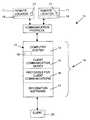
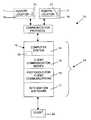
The sole figure is a block diagram of the system in accord with the present invention.
DETAILED DESCRIPTION OF THE INVENTIONDefinitionsA remote location system consists of one or more remote location devices, a protocol for communicating with the remote location devices, and a service (protocol, software, and hardware) for delivering location information (from the location devices) on demand.
A remote location device is an electronic assembly that has a means for establishing its location and an ability to communicate that location to a querying agent at another location.
Purpose
This invention is a system that provides, on demand, the current locations of one or more remote location devices as well as sets of past locations of the devices. The sets of past locations may be selected according to an intelligent algorithm so as to avoid inundating the user with trivial data and so as to minimize memory requirements. Thesystem10 may initiate alerts based upon the current location of thedevice11 and the intelligent location capability.
Parts—Theintelligent location system10 has four parts as shown in the figure.
1. Theremote location devices11,
2. The protocol for communicating with the remote location devices (communication protocol)12,
3. Thedelivery service13, and
4. Theintelligent location agent18.
Descriptions and examples ofremote location devices11 may be found in Appendix 2.
A description of the protocol for communication with remote location devices12 is in Appendix 3.
Thedelivery service13 consists of:
a) Acomputer system14, which is capable of communicating with theremote location devices11 through the communication protocol12. Thecomputer system14 may be distributed across multiple physical locations or may be in a single site. In this context, “computer system” includes hardware (including, but not limited to, CPU, peripheral devices such as modems, network interface cards, data storage devices, and a console and other input and output devices) and operating software (including, but not limited to, an operating system and device controllers).
b) One or moreclient communication modes15. Example client (or end user)communication modes15 include (but are not limited to):
i. Internet access (including world wide websites),
ii. telephone call centers (including automated voice response systems, human operators, and combinations of the two),
iii. local and wide area networks, and
iv. direct console access.
Thecomputer system14 is preferably capable of initiating communication withclients20. System-initiated communication modes include (but are not limited to):
i. email messages,
ii. fax messages,
iii. automated voice phone calls,
iv. messages to human operators' monitors directing the operators to make telephone calls.
c) Software andhuman operator protocols16 for controlling communication with clients. Functions that may be required ofclient communication software16 include (but are not limited to):
i. identify clients (verify account numbers and passwords),
ii. verify account status,
iii. manage accounts,
iv. accept and handle location requests,
v. accept and handle changes to smart location parameters,
vi. accept and handle requests for historical location data,
vii. initializeremote location devices11,
viii. deliver locations to clients (maps, directions, or addresses faxed, e-mailed, or described by operator), and
ix. refine location data (scrolling, zooming, labeling of maps, conversion of measurement units).
Features that may be required ofoperator protocols16 include (but are not limited to):
i. specification of information to be acquired fromclient20 and order of acquisition,
ii. specification of which operators are allowed access to which data (As examples, the location operators may not be allowed access to identity data, and the account management operators may not be allowed access to current or historical location data).
d) Software for integrating17 client communication, communication with the remote location devices; and access to necessary data (including, but not limited to data related to states ofdevices11, smart location algorithms, and client accounts).
Theintelligent location agent18 is software that allows thelocation service19 to be configured with user-specified location events of interest and which determines the location service's responses to the location events.
Examples of location events include (but are not limited to):
Crossing a specified boundary:
1. An amusement park rentsremote location devices11 to customers and wants to know when adevice11 travels more than 10 yards outside of the gates of the park.
2. A pharmaceutical company keeps track of the time the sales force is within physicians' offices (versus traveling between offices) by setting multiple boundaries, one around each physician's office.
3. An alarm installation contractor's employees drive company vans to many small jobs. By setting a boundary around each job site, the contractor is able to precisely monitor time spent on each job.
Traveling a specified minimum distance since the last recorded location event:
4. A person's movements are monitored over the course of a day or a week. It is common for a person to spend lengthy periods in a small location (at home, at the office, at a restaurant, in a grocery store). Only movements from one location to another need to be recorded; continually recording that the person is in the office every two minutes for four hours would waste memory; transmitting the information would waste battery charge. So, a new location and time are recorded only if the location is at least 25 yards away from the most recently recorded location.
Exceeding a specified velocity:
5. A delivery service monitors the speed of each of its vehicles (using elapsed time and distance traveled between locations observed at short time intervals) to ensure that drivers do not exceed legal speed limits.
Examples of responses to location events include (but are not limited to):
1. Send an alert to the client20 (potentially appropriate for location event examples 1 and 5).
2. Record the event for later download to the client20 (potentially appropriate for location event examples 2, 3, and 4).
Novel Features—The present invention is the first remote location system to include an intelligent location agent. The intelligent agent allows the system to conserve memory and/or power resources on board the remote locator devices by selectively recording location data. It also allows the system to send alert messages when location events of interest occur, and allows the system's delivery service to present information to the clients in the most useable format (digesting large quantities of location data and presenting useful extracts). Additional features are discussed below.
1. First Embodiment—Personal Locator SystemThis embodiment is the first remote location system:
To include comprehensive location data (personal, vehicle, goods, etc.) with an intelligent agent.
To-provide multiple client access modes with an intelligent agent.
To provide minimum-distance sampling for recording location events.
To provide velocity-determined sampling for recording events.
2. Second Embodiment—Park Location System
This embodiment is the first park locator system:
To include anintelligent agent18.
To notify the system owner if aremote location device11 leaves the park.
To provide location information without the use of permanently installed transmitters.
3. Third Embodiment—Sales Force Location System
This embodiment is the first sales force location system.
To provide real-time data.
To include anintelligent agent18.
To provide verification that a sales representative has visited a specific client.
To provide differentiation between various internal locations of a client's office.
To provide data on how many clients and of what type are visited on a given day.
To provide data on how much time is spent at each location and in transit.
4. Fourth Embodiment—Delivery Fleet Location SystemTo provide anintelligent location agent18.
That can be utilized by a fleet of bicycles.
That can be carried by delivery personnel to provide data on personnel within buildings and at other locations.
SYSTEM DESCRIPTIONEmbodiments of the intelligentremote location system10 include (but are not limited to) the following examples.
Personal Location System
The purpose of this embodiment of the invention is to provide an ability to locate an individual person without the person having to actively participate in the act of location, or to locate valuable goods. The embodiment also provides an ability to track the movements of the person, and provides the person with the ability to send an alarm signal in an emergency.
Theremote location devices11 are small and unobtrusive and may be built with flexible circuitry (Appendix 2). This allows the devices to be conveniently carried on a person or valued pet. Methods of carrying aremote location device11 include, but are not limited to, the following:
1. Thedevice11 may be sewn into clothing;
2. Thedevice11 may be embedded in a watch or watchband or a pet collar;
3. Thedevice11 may be carried in a wallet or a purse.
Theremote location devices11 may also be inserted into or attached to shipments of valuable goods or attached to a vehicle. Because thedevice11 is small and unobtrusive, it should be unnoticed in the event of theft or abduction, allowing theclient20 to locate and recover the person, pet, goods or vehicle. Because the flexible version of theremote location device11 can be sewn into clothing (or a pet collar), the device will not annoy non-responsible carriers (including, but not limited to, persons with Alzheimer's disease, autistic or very young children, and pets). Thus it is unlikely that a non-responsible carrier will discard thedevice11.
Theremote location devices11 use global positioning system (GPS) satellite receivers to determine location and AMPS cellular telephones to communicate with thelocation system19. Consequently, theremote location device11 can determine can determine its position virtually anywhere in the world, and can communicate from any location that has AMPS cellular coverage (including most of North America).
Theremote location devices11 have on-board memory and logic allowing storage of a history of 200 or more locations and times. Part of theintelligent location agent18 resides in theremote location devices11—that part which determines whether the device has moved a set distance since the last recorded location. If so, thedevice11 will store the current location in memory along with the most recent 199 locations. If thedevice11 has not moved far enough to satisfy the algorithm, the current location will be discarded. When theclient20 requests the location of thedevice11, the past history will also be available.
Another part of theintelligent location agent18 resides in the service19: Theclient20 specifies named locations by specifying the centers, radii and names of the locations. (Named locations might include such locations as “home”, “school”, “mall”, “Grandmother's house”, etc.) If theremote location device11 is in one of the named locations when theservice19 delivers the location information, theservice19 will deliver that name as the location.
Clients20 may access theservice19 through three modes:
1. Automated voice response system,
2. Call center staffed by human operators,
3. World-wide-website.
In each mode, theclient20 first is identified (through account number and password) and then may request: the current location of theremote location device11 or may request the location history of the device11 (up to 200 most recently recorded locations and times). Theservice19 telephones theremote location device11 to acquire the requested information and then delivers the information to theclient20. The information may be delivered as named location(s), as a map (via world-wide-web, e-mail or fax), or by a human operator describing a map delivered to the operator's computer display. Through the same access modes, theclient20 may set parameters controlling the intelligent agent18 (whether to record at specified fixed time intervals or when movement exceeds a specified distance, named location information, etc.).
Theremote location device11 may initiate communication with the remote location service in two circumstances. If the battery is low, thedevice11 will call a dedicated phone number to report this fact and download its history of locations before going into a dormant mode. If the panic button on thedevice11 is pressed, thedevice11 will call a dedicated emergency phone number and thesystem19 will initiate a specified emergency procedure (typically a call to911 in the appropriate jurisdiction and notification of theclient20 that an emergency is in progress).
Remote Location Device11 (Appendix 2) The components of this embodiment are as follows:
Theremote location device11 is a self-contained unit combining:
1. a battery,
2. global positioning (GPS) antenna and circuitry,
3. cellular telephone antenna and circuitry (AMPS),
4. modem circuitry,
5. on-board memory for storing data for 100 locations (including latitude, longitude, elevation, time, and number of satellites contributing to the location fix),
6. logical processing capability (a CPU).
Theremote location device11 also has apanic button21 that the carrier may press in an emergency. If thepanic button21 is pressed, thedevice11 calls a specified telephone number to inform thelocation service19 that an emergency is occurring. Theservice19 then alerts the appropriate agency (PSAP and/or the client20 ) and requests the device's current location at short intervals until the emergency is over.
Theremote location device11 fixes its location at regular intervals (typically at least once per minute). A sample of these location fixes is saved. The sample is chosen according to an intelligent location algorithm.
To conserve battery power thedevice11 checks in with the cellular telephone network less frequently. A typical setting for cellular telephone contact is for thedevice11 to advise the network of its presence once every three minutes and to be available to receive calls for 60 seconds after each notification of availability.
If the device's battery level falls below a prescribed level, thedevice11 calls a specified primary phone number to inform theservice19 that the battery is low and to download the stored location data. Then thedevice11 becomes dormant until the battery is recharged.
Through thelocation service19, aclient20 can:
1. request the current location of hisdevice11,
2. request the stored past locations,
3. instruct thedevice11 to store locations either
a. at fixed time intervals (intervals specified by the user),
b. as thedevice11 moves a fixed distance (distance specified by the user) from the most recently stored location, or
c. according to other intelligent location algorithms.
When any of these actions is initiated, theservice19 telephones theremote location device11 through the service's modem and the device's cell phone), issues the instruction or requests the data, receives confirmation and/or data from the device, and then delivers the data to theclient20 in suitable format.
Before apersonal location device11 can be put into service, it must be initialized or registered with thelocation service19. This is done via the device's cell phone in a call initiated by thedevice11. One mechanism, but not the only mechanism for doing this is for thedevice11 to store a logical flag indicating whether it has been initialized. If it has not been initialized, then pressing the panic button will cause thedevice11 to place an initialization call to thelocation service19.
Thedevice11 is provided (by its manufacturer) with an electronic serial number (ESN) that is unique to that specific device. Thedevice11 also knows:
1. whether it has been assigned a mobile identification number (MIN—its cell phone number) and a cellular home system identification number (SID) by a cellular phone service provider,
2. its MIN and SID if they have been assigned,
3. its manufacturer's identification code,
4. its manufacturer's private encryption key (for a public key encryption algorithm),
5. its manufacturer's public encryption algorithm,
6. the service's public encryption (for the public key encryption algorithm),
7. a symmetric key encryption algorithm, the algorithm's identification code, and the device's unique encryption key,
8. the error-detecting algorithm used by the service,
9. the initialization phone number for the service.
Items 1, 2, 3, and 8, the identification code from Item 7, and the ESN are transmitted to the location service during initialization.
Theservice19 knows:
1. the public key and encryption algorithm associated with every manufacturer's identification code,
2. The symmetric encryption algorithm associated with every symmetric encryption identification code,
3. primary and secondary phone numbers for thedevice11 to call,
4. appropriate, available MIN and SID for thedevice11 if these have not already been assigned.
Items 3 and 4 are transmitted to theremote location device11 during initialization.
Communication Protocol12 (Appendix 3) Part1—Initialization The physical communication channel layer is the cellular telephone network and the telephone network between the cellular telephone service provider and the location service's physical location.
The link layer is an onboard modem using a standard low-level modulation protocol such as V.34, V.32bis, V.32, V.22bis, or V.22.
For the initial phase of the initialization call, the encryption/encoding layer will be encryption-null (no encryption, error-detection encoding with the algorithm used by the service). As communication is established and an encryption algorithm is negotiated, the encryption/encoding layer will convert (in stages, as described in the following description of an initialization call) to the agreed upon encryption algorithm. An error in the initialization call will require re-transmission of the block containing the error. After five unsuccessful attempts to transmit a block error-free, the initialization call will be terminated by theservice19.
The content layer consists of the legal instructions and data identified in the following description of an initialization call.
Description of an initialization call Once modem handshaking has been completed, thedevice11 will send a four-character device manufacturer identification code (unencrypted). (The four-character length is before encoding for error detection). The manufacturer and the owner of theservice19 will agree upon each manufacturer's identification code in advance. An unrecognized code is an error.
Next thedevice11 will send a code identifying a symmetric encryption algorithm and an encryption key. The algorithm code and the key will both be encrypted with a standard public key encryption algorithm (such as PGP) using both the service's public key and the device manufacturer's private key. One encryption algorithm code will specify that no encryption will be used. An unrecognized encryption identification code is an error.
If a symmetric encryption algorithm is specified, it will be used for the remainder of the initialization process.
All data and codes described below are part of the content layer. When the call description says that thedevice11 will send a particular code or datum, this means that the code or datum is first encrypted, then encoded for error detection, then modulated, then transmitted.
Thedevice11 next sends its ESN, and a three-character code identifying the device type. This device type code will allow the protocol to be used for specialized devices (with some standard features disabled or with non-standard features added) as well as for the standard devices. An unrecognized device type code is an error.
The next information thedevice11 will send is a code indicating whether thedevice11 has already been assigned an SID and an MIN by a cellular phone service provider. If an SID and an MIN have been assigned, thedevice11 will also send these numbers to theservice19. An illegal SID or MIN is an error.
Theservice19 will respond (using the specified encryption algorithm and key) by sending thedevice11 an SID and an MIN (if the device does not already have these), and sending primary and secondary telephone numbers (which thedevice11 may use to contact the service for subsequent communication sessions).
Theservice19 will then send a call termination code and terminate the call.
In summary, for initialization thedevice11 sends the following data to the service19:
1. Device manufacturer identification code (unencrypted).
2. Symmetric encryption algorithm identification code (using public key encryption).
3. Symmetric encryption key (using public key encryption).
4. ESN (using symmetric encryption).
5. Code identifying device type (using symmetric encryption).
6. Cod indicating whether device has been assigned SID and MTN (using symmetric encryption).
7. (If SID and MIN have been assigned) SID (using symmetric encryption).
8. (If SID and MIN have been assigned) MIN (using symmetric encryption).
Theservice19 responds by sending the following data to the device:
9. (If SID and MIN have not been assigned) SID (using symmetric encryption).
10. (If SID and MIN have not been assigned) MIN (using symmetric encryption).
11. Primary telephone number for contacting service (using symmetric encryption).
12. Secondary telephone number for contacting service (using symmetric encryption).
When the initialization call has been successfully completed, theservice19 will call thedevice11 and issue each legal instruction and data request (defined below) to test the initialization and will instruct thedevice11 to call the primary and secondary phone numbers. If the instruction and data requests are correctly received by thedevice11, if the data transmitted by the device are correctly received by theservice19, and if the primary and secondary phone numbers are successfully called by thedevice11 within 10 minutes, then thedevice11 is initialized. Otherwise theclient20 is notified that initialization failed.
Communication Protocol12: Part2—Communicating with an Initialized Personal Location Device.
The physical communication channel layer is the cellular telephone network and the telephone network between the cellular telephone service provider and the location services physical location.
The link layer is an onboard modem using a standard low-level modulation protocol such as V.34, V.32bis, V.32, V.22bis, or V.22.
For calls initiated by theservice19, the encryption/encoding layer will be the symmetric encryption algorithm agreed upon during initialization, and the service's error detecting algorithm. Calls initiated by thedevice11 will begin with null-encryption and switch to the agreed-upon symmetric encryption algorithm as soon as the service correctly acknowledges receipt of a registered ESN. Device-initiated calls will use the service's error-detecting algorithm throughout. An error in recognition of the call-initiator (device or service) will require retransmission. After five unsuccessful attempts, the call will be terminated. Other errors will result in a single attempt to retransmit. If retransmission is unsuccessful, the particular request, data transfer, or instruction will be abandoned and the call will continue.
The procedure for re-establishing communication if a call is interrupted before all tasks have been completed (a missing call-terminator code error) is:
1. If a service-initiated communication session is interrupted before the call-terminator is sent and acknowledged, the session will be re-initiated by theservice19.
2. If adevice11 initiated communication session is interrupted before theservice19 has acknowledged the device ESN, the device will re-initiate the session.
3. If adevice11 initiated communication session is interrupted after theservice19 has acknowledged the device ESN, but before the call-terminator is sent and acknowledged, theservice19 will re-initiate the session.
The content layer consists of the instructions and data identified in the following descriptions of calls.
Description of a service-initiated communication call. Theservice19 may initiate a call to poll thedevice11 for its location (current and/or past), to instruct thedevice11 on appropriate time intervals or distance intervals for saving past locations, or to toggle thedevice11 between standard and emergency states.
After modem handshaking has been completed, theservice19 will send a signature and thedevice11 will acknowledge that the signature is genuine. Then theservice19 will send instruction codes and parameters (where needed) to thedevice11 and thedevice11 will respond by sending requested data or by acknowledging the instruction (if the instruction is not a request for data). Data, commands, and acknowledgements are all encrypted using the specified symmetric encryption algorithm, and coded using the service's error-detecting algorithm.
Theservice19 will send one instruction code and accompanying parameters, wait for thedevice11 to send data or acknowledgement, and then send the next code and parameters. When all instructions have been send and acted upon, theservice19 will send a code that terminates the session.
The set of instructions and parameters correspond to the entries in Table 1.
| TABLE 1 |
|
| Instruction/Parameter Set for Personal Location System. |
| Instruction | Parameters | Action |
|
| Send location | None | Send most recent latitude, |
| | longitude, elevation, time of fix, |
| | and number of satellites in fix. |
| Send past | None | Send latitudes, longitudes, |
| locations | | elevations, times, numbers of |
| | satellites for all saved locations, |
| | starting with the most recent. |
| Send battery | None | Send status of battery. |
| status | |
| Set time | Time interval | Acknowledge receipt of interval |
| | instruction, set interval of time |
| | between saved locations. |
| Set distance | Distance Interval | Acknowledge receipt of |
| interval | | instruction, set interval of |
| | distance between saved locations. |
| Set state | New state | Acknowledge receipt of instruction, |
| (emergency or | set state of device. |
| standard) |
|
Description of a primary device-initiated call—Thedevice11 initiates a call to the primary phone number to notify theservice19 that the device's battery is low.
After modem handshaking is completed, thedevice11 will send its ESN using public-key encryption with the service's public key. If the ESN is properly registered (via initialization), theservice19 will respond by sending the ESN back, encrypted using the symmetric encryption algorithm and key specified when initializing the device.
Next thedevice11 will send the latitudes, longitudes, elevations, times, and numbers of satellites for the saved locations, starting with the most recent. When the data has all been sent and received without error, theservice19 will send a code to terminate the communication session.
Description of a secondary device-initiated call—Thedevice11 initiates a call to the secondary phone number to alert the service that thedevice11 carrier has pressed the panic button.
After modem handshaking is completed, thedevice11 will send its ESN using public-key encryption with the service's public key. If the ESN is properly registered (via initialization), theservice19 will respond by sending the ESN back, encrypted using the symmetric encryption algorithm and key specified when initializing the device.
Next thedevice11 will send the latitude, longitude, elevation, time, and number of satellites for the most recent location. Theservice19 will acknowledge, and then thedevice11 will await instructions from theservice19. When appropriate, theservice19 will send a code to terminate the session.
Delivery Service—Theclient20 may contact theservice13 through any of three modes: automated voice response system, a call center staffed by human operators, or through a world-wide-website. Theclient20 is led through the same series of steps in any of the three modes. Each mode implements security through the use of passwords. The world-wide-website uses encryption to provide additional security. When calling operator-staffed call center, theclient20 is first greeted by an automated voice response system, but may opt out of the system (and into the operator queue) at any point.
Call center operators access the software portions of thedelivery service13 through a local or wide area network or via the Internet, using either a traditional client/server model or a web-browser/website model. Call center operators typically do not know the identity ofclients20 they are serving, nor do they know the clients' passwords or contact information. If aclient20 opts to have the operator enter either the account number or the password (rather than doing these through the automated voice response system), the operator will necessarily discover these items, but otherwise the call is anonymous unless theclient20 voluntarily discloses information about his identity.
For account set-up and modification (contact information, billing plan, password choice, etc.), theclient20 uses the world-wide-website or calls an account service representative (who does not have access to any information about the current or past locations of the remote location devices). This separation of access to data (between call center operators and account service representatives) assures confidentiality for thoseclients20 who require a high level of security.
Appendix 1 presents a flow diagram for a typical call to the call center to request the current location of aremote location device11. A request submitted through the automated voice response system or through the world-wide-website follows virtually the same flow, with obvious modifications (for example, data sent to the operator's monitor would instead be sent to the client's web browser, etc.). The following notes clarify some points in the diagrams.
1. The software attempts to contact theremote location device11 as soon as it has enough information (if the clients' account has good or marginal status). This will reduce waiting time for theclient20 if the client has given the automated voice response system enough information to contact thedevice11 before going into the operator queue.
2. If theclient20 determines that an emergency exists, he may request that the automated voice response system promote him to the head of the operator queue.
3. If theclient20 has forgotten his password, a hint will be provided (through any of the three access modes). If he has forgotten his account number, it can be provided by an account service representative (or through the world-wide-website).
4. If an account has marginal status (up to two months in arrears), theservice19 will honor location requests, but theclient20 will be referred to accounting afterward to discuss payment. If an account is more than two months in arrears, its status is bad and location requests will not be honored. Thedelivery service19 determines the status of the account before contacting theremote location device11 to verify good or marginal status.
5. Aremote location device11 may not respond to an attempt to contact it, either because it is not actively listening for a call (to conserve battery charge or because the battery is low) or because it is not in a clear reception area for the cellular phone system. In this case, thesystem10 will check for thedevice11 in the low-battery database (described below). If thedevice11 is in the low-battery database, theclient20 will be asked whether the battery has been recharged since the data was entered into the database. If not, the data from the low-battery database will be given to theclient20.
If thedevice11 is not in the low-battery database, or if theclient11 responds that the battery has been recharged, thesystem10 will preferably make five attempts to contact thedevice11 at 30-second intervals. If none of these attempts are successful, the operator offers theclient20 the option of having the system continue to attempt to contact thedevice11 after the client-contact call ends. If theclient20 chooses this option, the system attempts to contact thedevice11 as many as six more times at 10-minute intervals (up to six tries at 30-second intervals for each of the six attempts). If contact is successful, a map and contact data (including name if the location is named, otherwise address or latitude and longitude, time, battery status) will be faxed and/or emailed to the client (using default contact information unless the client has specified otherwise in the phone call).
When aremote location device11 notices that its battery charge is lower than a threshold value, it phones a number dedicated to receiving low-battery notification phone calls. Thedevice11 then downloads its most recent location and time and its stored history of locations and times. Thesystem10 puts this information in a low-battery database and sends notification to theclient20 via e-mail, fax, or recorded voice message. Thesystem10 keeps the location information for a specificremote location device11 in the low-battery database until thedevice11 is successfully contacted again. Theclient20 may access the location data for hisremote location device11 at any time during the storage period.
Intelligent Location Agent—Part of theintelligent location agent18 software is stored in the logic circuitry on board theremote location devices11 and part is stored within the server of theservice19.
Theremote location devices11 use intelligent algorithms to determine which locations to store in on-board memory, so that the on-board memory is not exhausted by storing redundant data and so that the battery is not exhausted by transmitting redundant data. Thedevice11 typically will get a fix from the GPS satellites at least once per minute. With an ability to store approximately 200 locations, thedevice11 would be able to store only a little over three hours of locations if every fix were saved. Formany clients20, this represents an inadequate span of time.
In most cases, a person's day includes periods of virtually no movement (time in an office or at school) or of fairly regular movement (within a vehicle). Consequently, theremote location device11 may save a small sample of locations relative to the total number of fixed locations) and still satisfy the clients' needs. The samples are selected according to an intelligent algorithm. The algorithm used by a specificremote location device11 will depend upon the client's needs.
Examples of intelligent location algorithms available for theremote location device11 include (but are not limited to):
1. Minimum distance sampling—The current location (and time and number of satellites contributing information to the fix) is recorded if and only if the distance from the most recently recorded location to the current location is at least as much as some prescribed distance. A typical value for the prescribed distance is 25 yards.
2. Fixed time interval sampling—The current location is recorded if and only if a prescribed amount of time has passed since the most recently recorded location. A typical value for the prescribed time is 15 minutes.
3. Velocity-determined sampling—High velocity travel (over 50 mph) is fairly regular in nature (freeway travel with limited exit points, for example). Very low velocities (under 0.5 mph) are often associated with essentially stationary behavior (example: in the office with trips to the restroom or lunch-room). In between (pedestrian to local driving speeds) is the range where location events that interest theclient20 are likely to happen. This algorithm first checks velocity, using distance and time over the past few location fixes. If velocity is high or low, sampling is infrequent (based on elapsed time at high velocity and upon elapsed distance at low velocity). If velocity is intermediate, sampling is more frequent (based upon either elapsed distance, elapsed time, or both).
The part of theintelligent location agent18 resident in the location service's server controls the ability of theservice19 to deliver locations with client-specified names and boundaries. Through the location service's website, theclient20 may specify locations, using addresses, using latitudes and longitudes, or pointing and clicking on maps generated by the web site. Theclient20 supplies names and boundaries for the locations. When theservice19 delivers subsequent location information to theclient20, it first checks the list of named locations for thatclient20. If theremote location device11 is within the boundary of a named location, thedevice11 is reported to be in that location. On maps delivered by the service to theclient20, all named locations are highlighted and labeled with their names.
Park Location System—The purpose of this embodiment is to provide locator service to groups and families visiting parks (including, but not limited to, theme parks, natural parks, and historical parks). The embodiment may also be used in other large or obscured venues (including, but not limited to, Olympic games, music/cultural festivals, department stores or shopping malls). Theservice19 allows members of a group to find one another after they have been separated. Theservice19 is administered by a central authority (owner of the park, concessionaire licensed by the festival organizer,; etc.), who leases theremote location devices11 to the visitors.
Remote Location Device—Theremote location devices11 are contained in or on wristbands or are cards that can be worn on cords around the neck. To determine their locations, thedevices11 use either GPS technology or triangulation from transmitters placed around the park. The use of GPS technology is particularly attractive for events or for national parks, where installation of transmitters may not be economically justified. The devices contain batteries sufficient for typical visits to the park (a full day). Thedevices11 also contain logic circuitry that allows them to determine when they have passed outside the boundaries of the park. Thedevices11 may have a serial port to facilitate initiation, or may have initiation information programmed in at the time of manufacture.
Communication Protocol—The communication protocol12 specifies communication with theremote location devices11 through wireless transmission (channels include, but are not limited to, cellular telephone network—again attractive for venues which do not justify extensive infrastructure investment—and: spread spectrum radio frequency transmissions). Otherwise, the communication protocol12 is similar to that of the personal location system, with the addition of a code to be sent at the beginning of the data stream for a secondary device-initiated call. The code identifies whether the call is to inform theservice19 that the user has pressed thepanic button21 or whether the call is to inform that theremote location device11 has left the park boundaries. Other modifications to the communication protocol are necessary if spread-spectrum transmission is used.
Delivery Service—Thelocation delivery service13 provides access to visitors through kiosks with display units and input devices (keyboards and pointing devices). The kiosks are in convenient locations around the park. Theservice19 also alerts the system owner whenever aremote location device11 informs it that thedevice11 has crossed the boundary of the park.
Intelligent Location Agent—Theintelligent location agent18 resides on-board theremote location devices11. It consists of a logical description of the boundary of the park and an ability to determine whether any location is within or outside the boundary. When thedevice11 determines that it is outside the boundary, it alerts the system owner. This allows recovery ofdevice11 that visitors have forgotten to return as they leave the park.
Sales Force Location System—A company may be interested in tracking the movements of its sales personnel for a variety of reasons. Sales call schedules can be made more efficient if the company properly analyses data on lengths of sales calls, time spent waiting, time in transit, etc. In some cases, compensation of sales personnel is based in part upon how many sales calls are made, so a company may want independent verification of a sales representative's claims about numbers of calls made. The purpose of this embodiment of the invention is to provide comprehensive data on the movements of members of a sales force.
As a particular example, a pharmaceutical company will typically assign a particular region to a sales representative, and will provide lists of physicians rated according to their value to the company (based upon numbers of prescriptions written, influence over other physicians' prescribing habits, etc.). Sales representatives are expected to make a certain percentage of their calls to the A-listed physicians, a certain percentage to the B-listed physicians, and so on. Compensation is based in part upon how many physicians on each list are called upon during each month. Sales calls are typically of similar duration, but waiting times may vary greatly between physicians.
Remote Location Device—In this example embodiment, theremote location device11 is a self-contained unit that may be carried with the representative's sales materials (in the sample case, for example) or on the representative's person. Thedevice11 may be implemented as an independent locator or as a manual locator. The independent locator requires no intervention from the sales representative as the day progresses. With the manual locator, the representative must signal the device11 (by pushing a button, for example) to have it report or record its position when entering and leaving each physician's office. Thedevice11 contains a battery with sufficient capacity for a day's travels. Location is determined using GPS circuitry.
For the independent locator, the representative downloads the day's list of physicians' office locations into theremote location device11 before beginning the day's calls. Thedevice11 monitors its location (getting fixes at least one per minute) throughout the day. When it passes into or out of a physician's office, thedevice11 records the location and time or reports these to the location service.
For the manual locator, when the representative signals thedevice11 it records the location and time or contacts theservice19 to report its location.
Aremote location device11 may report each movement into and out of a physician's office in real time (via cellular network), or it may record the locations and times for later transmission (via cellular network, land lines, WAN or LAN) en mass. In the latter case, thedevice11 may be plugged into a docking unit for simultaneous recharging of its battery and communication with theservice19.
Communication Protocol—The communication protocol12 is largely the same as that for the personal location system of the first example embodiment of this invention. One exception is that, for the independentremote locator device11, the content layer of the protocol includes provision for sending to thedevice11 the location information for a set of physicians' offices. Another exception is that the physical channel layer may be the cellular telephone network, land telephone lines, WAN or LAN.
Delivery Service—Thelocation delivery service13 may be owned and operated by the pharmaceutical company or may be owned and operated by a service vendor. Typically, theservice13 will deliver the collected locations for all of the representatives for the entire month in one or more large file transfers. Sales and marketing researchers may receive all the data, district managers may receive all the data for the representatives in their districts, and accounting may receive only digests of the data (numbers of physicians called upon by each representative, for example). Delivery of the data may be through the Internet or over a LAN or WAN, or the data may be delivered on magnetic or optical media.
Intelligent Location Agent—Theintelligent location agent18 may reside in the delivery service's server or may be distributed between the server and theremote location devices11. The latter is necessary if theremote location devices11 store office boundary crossings, and is necessary forindependent locators11 which report crossings in real time.
Theagent18 consists of logical descriptions of the boundaries of physicians' offices and programmed logic with the ability to determine whether a particular location is within a physician's office boundary or whether it is outside of all boundaries. If theremote locator devices11 report boundary crossings in real time, theintelligent agent18 must also include the ability to load a particular day's boundaries into aremote location device11. Theagent18 may be able to distinguish physician's names and other identifying data (medical education number, drug enforcement agency number, etc.) and value to the company with the office locations. Theagent18 may include data analysis capability (OLAP, data mining, etc.).
Delivery Fleet Location System—The purpose of this embodiment of the invention is to provide an ability to determine the locations of each vehicle in a delivery fleet at any time. A fleet manager may be interested in modifying delivery schedules on the fly if important new orders come in after vehicles have been dispatched for the day or if unanticipated traffic problems arise. To alter the schedules, it is necessary to know the current locations of the vehicles and to know which locations on the current schedules have already been visited. The manager may also want to implement more optimal scheduling in the future, or may want to make certain that drivers are conforming to prescribed schedules, routes and speed limits. This embodiment of the invention will provide data to support these needs. The embodiment may be configured to send an alarm to the manager if a driver exceeds a specified speed. If smallremote location devices11 are used (as in the first example embodiment of this invention), this embodiment can be utilized by bicycle delivery services.
Remote Location Device—Theremote location devices11 may be self-contained units containing batteries, or may be built into vehicles and powered by the vehicle electrical systems. Thedevices11 contain GPS and cellular telephone circuitry as well as memory and processing circuitry. Thedevices11 store, on-board, a history of up to 200 locations, sampled according to an intelligent algorithm (including, but not limited to, those mentioned in the first example embodiment).
Communication Protocol—The communication protocol12 is largely the same as that for the personal location system of the first example embodiment of this invention. One exception is that, in addition to location, time, and number of satellites contributing data to each fix, thedevice11 also computes and stores or transmits velocity (calculated from the current and past locations and times). Another is: that provision is made for theremote location device11 will accept from the location service19 a maximum acceptable velocity.
Location Delivery Service—The client communicates with thedelivery service13 through a computer terminal via LAN or WAN or world-wide-website browser and a website. Typically, theservice13 will deliver an entire day's data for all vehicles in the fleet at one time. If aremote location device11 determines that the vehicle is exceeding the maximum acceptable velocity, it will alert theclient20. Theclient20 may query thesystem10 at any time for the locations of any or all vehicles. Theclient20 may also request a list of all scheduled locations that have already been visited and may request a list of vehicles ordered by current distance from a specified location or ordered by distance from a specified location to nearest point in currently scheduled route.
Intelligent Location Agent—Theintelligent agent18 is distributed between the service19 's server and theremote location devices11. Thedevices11 implement an intelligent sampling algorithm in order to store only useful location data (as in the first example embodiment). They also have an algorithm for determining velocity and for comparing current velocity with a specified maximum acceptable velocity.
The part of theintelligent agent18 located on the service's server includes the ability to order the fleet's vehicles according current distance from a specified location and according to planned routes' minimum distances to a specified location. The service's server also has software that allows some data analysis (for optimizing future routes) and which assists in determining optimal route changes to accommodate changed road conditions or altered call lists.
A flow diagram of call center flow is attached and incorporated into this application as Appendix 1.
The teachings of the attached Appendix 2 entitled “TIGHTLY COUPLED REMOTE LOCATION DEVICE UTILIZING FLEXIBLE CIRCUITRY” are hereby incorporated into this application as Appendix 2. The device described in Appendix 2 comprises only one possible remote location device, which could be utilized in the remote location system of the present invention.
The teachings of the attached Appendix 3 entitled “COMMUNICATION PROTOCOL FOR A REMOTE LOCATOR SYSTEM” are hereby incorporated into this application as Appendix 3. The protocol described in Appendix 3 comprises only one possible communication protocol, which could be utilized in the remote location system of the present invention.
While the invention has been described with respect to certain specific embodiments, it will be appreciated that many modifications and changes may be made by those skilled in the art without departing from the spirit of the invention. It is intended, therefore, by the appended claims to cover all such modifications and changes as fall within the true spirit and scope of the invention.