US6470329B1 - One-way hash functions for distributed data synchronization - Google Patents
One-way hash functions for distributed data synchronizationDownload PDFInfo
- Publication number
- US6470329B1 US6470329B1US09/613,642US61364200AUS6470329B1US 6470329 B1US6470329 B1US 6470329B1US 61364200 AUS61364200 AUS 61364200AUS 6470329 B1US6470329 B1US 6470329B1
- Authority
- US
- United States
- Prior art keywords
- data
- data set
- signature
- data blocks
- signatures
- Prior art date
- Legal status (The legal status is an assumption and is not a legal conclusion. Google has not performed a legal analysis and makes no representation as to the accuracy of the status listed.)
- Expired - Lifetime, expires
Links
Images
Classifications
- G—PHYSICS
- G06—COMPUTING OR CALCULATING; COUNTING
- G06F—ELECTRIC DIGITAL DATA PROCESSING
- G06F16/00—Information retrieval; Database structures therefor; File system structures therefor
- G06F16/90—Details of database functions independent of the retrieved data types
- G06F16/901—Indexing; Data structures therefor; Storage structures
- G06F16/9014—Indexing; Data structures therefor; Storage structures hash tables
- G—PHYSICS
- G06—COMPUTING OR CALCULATING; COUNTING
- G06F—ELECTRIC DIGITAL DATA PROCESSING
- G06F16/00—Information retrieval; Database structures therefor; File system structures therefor
- G06F16/20—Information retrieval; Database structures therefor; File system structures therefor of structured data, e.g. relational data
- G06F16/23—Updating
- G06F16/2308—Concurrency control
- G06F16/2315—Optimistic concurrency control
- G06F16/2322—Optimistic concurrency control using timestamps
- G—PHYSICS
- G06—COMPUTING OR CALCULATING; COUNTING
- G06F—ELECTRIC DIGITAL DATA PROCESSING
- G06F16/00—Information retrieval; Database structures therefor; File system structures therefor
- G06F16/20—Information retrieval; Database structures therefor; File system structures therefor of structured data, e.g. relational data
- G06F16/27—Replication, distribution or synchronisation of data between databases or within a distributed database system; Distributed database system architectures therefor
- G06F16/273—Asynchronous replication or reconciliation
- Y—GENERAL TAGGING OF NEW TECHNOLOGICAL DEVELOPMENTS; GENERAL TAGGING OF CROSS-SECTIONAL TECHNOLOGIES SPANNING OVER SEVERAL SECTIONS OF THE IPC; TECHNICAL SUBJECTS COVERED BY FORMER USPC CROSS-REFERENCE ART COLLECTIONS [XRACs] AND DIGESTS
- Y10—TECHNICAL SUBJECTS COVERED BY FORMER USPC
- Y10S—TECHNICAL SUBJECTS COVERED BY FORMER USPC CROSS-REFERENCE ART COLLECTIONS [XRACs] AND DIGESTS
- Y10S707/00—Data processing: database and file management or data structures
- Y10S707/99931—Database or file accessing
- Y—GENERAL TAGGING OF NEW TECHNOLOGICAL DEVELOPMENTS; GENERAL TAGGING OF CROSS-SECTIONAL TECHNOLOGIES SPANNING OVER SEVERAL SECTIONS OF THE IPC; TECHNICAL SUBJECTS COVERED BY FORMER USPC CROSS-REFERENCE ART COLLECTIONS [XRACs] AND DIGESTS
- Y10—TECHNICAL SUBJECTS COVERED BY FORMER USPC
- Y10S—TECHNICAL SUBJECTS COVERED BY FORMER USPC CROSS-REFERENCE ART COLLECTIONS [XRACs] AND DIGESTS
- Y10S707/00—Data processing: database and file management or data structures
- Y10S707/99941—Database schema or data structure
- Y10S707/99942—Manipulating data structure, e.g. compression, compaction, compilation
- Y—GENERAL TAGGING OF NEW TECHNOLOGICAL DEVELOPMENTS; GENERAL TAGGING OF CROSS-SECTIONAL TECHNOLOGIES SPANNING OVER SEVERAL SECTIONS OF THE IPC; TECHNICAL SUBJECTS COVERED BY FORMER USPC CROSS-REFERENCE ART COLLECTIONS [XRACs] AND DIGESTS
- Y10—TECHNICAL SUBJECTS COVERED BY FORMER USPC
- Y10S—TECHNICAL SUBJECTS COVERED BY FORMER USPC CROSS-REFERENCE ART COLLECTIONS [XRACs] AND DIGESTS
- Y10S707/00—Data processing: database and file management or data structures
- Y10S707/99951—File or database maintenance
- Y10S707/99952—Coherency, e.g. same view to multiple users
- Y10S707/99953—Recoverability
Definitions
- the inventionrelates generally to methods for synchronizing distributed data sets.
- a large data sete.g., a database or compiled programming routines, stored in a first memory (or storage device) is duplicated in a second memory (or storage device).
- This scenariowould occur, for example, in a file backup operation wherein a data set is copied onto a magnetic tape or in database replication wherein all or a portion of a database is copied onto a different machine.
- the data set in the first memory orwill be referred to as the “original data set,” and the data set in the second memory will be referred to as the “remote copy.”
- the original data set or the remote copy or bothmay be modified.
- the amount of data changedis relatively small in comparison to the total size of the original data set.
- the taskthen becomes how to synchronize the original data set and the remote copy in an efficient manner.
- One data synchronization techniqueuses “time stamps” to identify the areas of differences in the data sets prior to transferring data between the data sets.
- a memory spaceis allocated to hold the time of the last update for every block of data in the data set. Every executable routine that operates on the content of the data block logs the time stamp of the update.
- the time stampis used to determine if the corresponding data block has changed since the last synchronization. If the corresponding data block has changed, data is then transferred between the original data set and the remote copy.
- Time stampsallow immediate identification of different data blocks that need to be synchronized, so no additional processing beyond time stamp comparison is needed to perform the data synchronization. Time stamps are typically used in file backups, code recompilation routines, and database replication.
- time stampsallow immediate identification of data blocks that have been updated, but do not indicate whether the content of the data blocks actually changed. Thus, unnecessary data transfer between the original data set and the remote copy may be initiated. Time stamps also do not typically provide sufficient granularity for minimal data transfer. For example, in most file backup services, if a one-byte change occurs in a file, the entire file is transferred. Memory overhead can also be a concern when fine granularity time stamping is required. For example, if it is desirable to keep the granularity of data transfer to a field level for a database table, then the number of fields in the table must be doubled to accommodate time stamping.
- Dirty flagsare similar to time stamps, except that they usually hold a Boolean value instead of time. For every block of data, a bit of memory space is allocated to hold the value of the dirty flag. The dirty flag reflects whether the data block has been changed since the last synchronization. Dirty flags are used in database replication and transactional processing. Like time stamps, dirty flags allow immediate identification of different data blocks that need to be synchronized. Synchronization techniques using dirty flags also face many of the challenges discussed above for time stamps. In addition, dirty flags are not applicable to situations where the last time of synchronization is ambiguous. This may occur, for example, if more than one remote copy of the original data set exists and each remote copy is synchronized at different points in time.
- Version numbersare also similar to time stamps. For every block of data, a memory space is allocated to hold the version number of that data block. The version number, usually a string of characters of some fixed length, is changed whenever the data block changes. The version numbers are then used by the synchronization algorithm to determine if the corresponding data block has changed since the last synchronization. Like time stamps, version numbers allow immediate identification of different data blocks that need to be synchronized. Synchronization techniques using version numbers also face many of the challenges discussed above for time stamps, most notable is insufficient granularity for minimal data transfer. Version numbers work well with coarse-grained blocks, especially when the updates are infrequent and/or bandwidth is not an issue. Version numbers are typically used in synchronization operations involving software distribution and source control.
- the inventionis a method for synchronizing two data sets.
- the method for synchronizing two data setscomprises computing a signature for a first data set in a first address space and a signature for a second data set in a second address space using a one-way hash function.
- the methodfurther includes comparing the signatures for the first and second data sets to determine whether they are identical. If the signatures are not identical, the method further includes identifying an area of difference between the first data set and the second data set and transferring data corresponding to the area of difference between the first data set and the second data set from the first data set to the second data set.
- the method for synchronizing two data setscomprises subdividing a first data set in a first address space and a second data set in a second address space into their respective elementary data blocks.
- the methodfurther includes computing a signature for each elementary data block using a one-way hash function and storing the signatures of the elementary data blocks in the first data set in a first array and the signatures of the elementary data blocks in the second data set in a second array.
- the methodfurther includes comparing each signature in the first array to a corresponding signature in the second array to determine whether they are identical and, if they are not identical, transferring the corresponding data block from the first data set to the second data set.
- the method for synchronizing two data setscomprises subdividing a first data set in a first address space and a second data set in a second address space into their respective elementary data blocks.
- the methodfurther includes computing a signature for each elementary data block using a first one-way hash function and storing the signatures of the elementary data blocks in the first data set in a first array and the signatures of the elementary data blocks in the second data set in a second array.
- the methodfurther includes computing a signature for the first array and a signature for the second array using a second one-way hash function and comparing the signatures for the first and second arrays to determine whether they are identical. If the signatures for the first and second arrays are not identical, the method further includes identifying the unique signatures in the first and second arrays and transferring the elementary data blocks corresponding to the unique signatures from the first data set to the second data set.
- the inventionis a data synchronization system which comprises a first agent having access to a first data set in a first address space, a second agent having access to a second data set in a second address space, and an engine which communicates with the first agent and the second agent when activated.
- the engineis configured to send a request to the first agent to compute a signature for the first data set in the first address space and a request to the second agent to compute a signature for the second data in the second address space using a one-way hash function.
- the engineis also configured to transfer the signature for the first data set from the first address space to the second address space and send a request to the second agent to determine whether the signature for the first data set is identical to the signature for the second data set.
- the engineis also configured to identify an area of difference between the first data set and the second data set in collaboration with the first and second agents if the signatures of the data sets are not identical and, upon identifying the area of difference between the data sets, transfer data corresponding to the area of difference between the data sets from the first address space to the second address space and copy the data into the second data set.
- the engineis configured to send a request to the first agent to subdivide the first data set into elementary data blocks, compute a signature for each elementary data block using a one-way hash function, and store the signatures of the elementary data blocks in a first array.
- the engineis also configured to send a request to the second agent to subdivide the second data set into elementary data blocks, compute a signature for each elementary block using the one-way hash function, and store the signatures of the elementary data blocks in a second array.
- the engineis also configured to transfer the first array from the first address space to the second address space and send a request to the second agent to compare each signature in the first array to a corresponding signature in the second array to determine whether they are identical and, if they are not identical, transfer the corresponding data block from the first data set to the second data set.
- the engineis configured to send a request to the first agent to subdivide the first data set into elementary data blocks, compute a signature for each elementary data block using a first one-way hash function, store the signatures of the elementary data blocks in a first array, and compute a signature for the first array using a second one-way hash function.
- the engineis also configured to send a request to the second agent to subdivide the second data set into elementary data blocks, compute a signature for each elementary block using the first one-way hash function, store the signatures of the elementary data blocks in a second array, and compute a signature for the second array using the second one-way hash function.
- the engineis also configured to transfer the signature for the first array from the first address space to the second address space and send a request to the second agent to determine whether the signature for the first array is identical to the signature for the second array.
- the engineis also configured to identify an area of difference between the first array and the second array in collaboration with the first and second agents if the signatures of the arrays are not identical and, upon identifying the area of difference between the arrays, transfer data corresponding to the area of difference between the arrays from the first address space to the second address space and copy the data into the second data set.
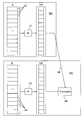
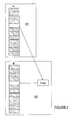
- FIG. 1illustrates a process for determining if synchronization is needed between two data sets in accordance with one embodiment of the invention.
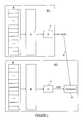
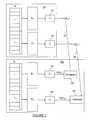
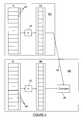
- FIGS. 2 and 3illustrate a recursive process for isolating areas of differences between two data sets in accordance with one embodiment of the invention.
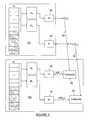
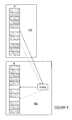
- FIG. 4shows elementary data blocks of one of the two data sets in FIGS. 1-3 being transferred to the appropriate blocks in the other data set.
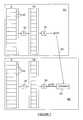
- FIG. 5shows signatures of elementary blocks in two data sets computed and stored in arrays and a process for isolating areas of differences between the two data sets using the arrays in accordance with one embodiment of the invention.
- FIG. 6shows elementary data blocks of one of the two data sets in FIG. 5 being transferred to the appropriate blocks in the other data set.
- FIG. 7shows signatures of elementary blocks in two data sets computed and stored in arrays and a process for isolating areas of differences between the two data sets using the arrays in accordance with another embodiment of the invention.
- FIG. 8illustrates a recursive process for isolating areas of differences between two signature arrays in accordance with one embodiment of the invention.
- FIG. 9illustrates a distributed system in which the invention may be implemented.
- Embodiments of the inventionprovide a process for synchronizing distributed data sets.
- the processinvolves using a one-way hash function to compute the “signature” of a data set of arbitrary nature, e.g., strings, ASCII files, and binary files. More specifically, the process uses a one-way hash function to compute the hash value of an original data set and its remote copy. The process then compares the hash value for the original data set with the hash value for the remote copy to determine whether they are identical. If the hash values are identical, then the original data set and its remote copy are identical, and there is no need for synchronization. If the hash values are not identical, the task then becomes identifying the areas of differences between the two data sets prior to synchronizing the data sets.
- Embodiments of the inventionprovide methods for precisely identifying the areas of differences between two data sets.
- One-way hash functionsare algorithms that turn messages or text into a fixed string of digits, known as the “hash value.”
- the “one-way”means that it is nearly impossible to derive the original message from the hash value.
- a one-way hash functionto produce the same hash value for two different messages.
- a one-way hash functionprovides a unique signature of a message.
- Various algorithms for computing one-way hash functions for data sets of different natureare known. See, for example, “Secure Hash Standard,” Federal Information Processing Standards Publication (FIPS PUB) 180-1, U.S. Department of Commerce, Springfield, Va, Apr. 17, 1995.
- the implementation of some form of one-way hash algorithmsexist off-the-shelf on virtually every computing platform.
- One-way hash functionshave been used extensively in the field of cryptography to encrypt and decrypt digital signatures.
- Digital signaturesare used to identify and authenticate the sender and message of a digitally distributed message.
- the digital signatureis transformed with a one-way hash function into a message digest.
- the message digest and the digital signatureare then separately transmitted to the receiver.
- the receiveruses the same one-way hash function as the sender, the receiver derives a message-digest from the signature and compares it with the received message-digest to authenticate the message sender.
- One-way hash functionsare also used to index and retrieve items in a database. A search for an item in the database involves computing the hash value of the search term and comparing the hash value of the search term to the hash values of the items in the database.
- one-way hash functionscan be used to produce the signature of an arbitrary data set.
- the length of the signatureis dramatically smaller than the length of the data set.
- the amount of computation needed to compute the signature of a data setis linearly proportional to the size of the data set.
- Data sets of arbitrary lengthresult in signature of fixed length.
- Two identical data setsresult in identical signatures.
- Two similar, but different documents with very small difference between themresult in different signatures.
- Two different data setsresult in different signatures with great degree of probability.
- one-way hash functionscan be depended on as a basis for synchronizing distributed data sets. However, if no mistake can be afforded in synchronizing data, one-way hash function should not be used.
- FIG. 1depicts data sets A and B in two different address spaces M 1 and M 2 , respectively. Both data sets A and B are large and can be decomposed into smaller data blocks.
- the data blocksare either logical or physical in nature. Examples of logical data blocks are object states cached in memory of JavaTM virtual machine (JVM), Hypertext Markup Language (HTML) pages cached in memory of a Web browser, or files in the file system of a computer. Examples of physical data blocks are tiles in bitmap pictures, fixed-length records in data files, or 256-byte sentences in a message. However, the physical data blocks need not be a meaningful entity in the context of the application.
- JVMJavaTM virtual machine
- HTMLHypertext Markup Language
- nbe the number of elementary data blocks that permit no further decomposition.
- the size of the elementary data blocksdetermines the granularity of the smallest detectable change between the data sets A and B.
- Hrepresent a hash function that operates on the data sets A and B and any subsets of the data sets A and B available on both address spaces M 1 and M 2 .
- a process for synchronizing the data sets A and B in accordance with one embodiment of the inventionstarts by computing the signatures h(A) and h(B) for the data sets A and B, respectively.
- the hash function Hoperates on the data sets A and B to produce the signatures h(A) and h(B), as indicated by reference numerals 2 and 4 .
- the signature h(A)is then transferred from the address space M 1 to the address space M 2 , as indicated by arrow 6 .
- the signatures h(A) and h(B)are compared in the address space M 2 to determine whether they are identical. If the signature h(A) is identical to h(B), there is no need for synchronization. If the signature h(A) is not identical to the signature h(B), a recursive process is used to isolate the portions of the data sets A and B that need to be synchronized.
- the recursive processstarts by dividing the data set A into two data blocks A 11 , A 12 and the data set B into two data blocks B 11 , B 12 .
- the data sets A, Bcould each be divided into more than two data blocks, if desired. However, the data sets A and B should be divided into equal number of data blocks.
- the signatures h(A 11 ), h(A 12 ) and h(B 11 ), h(B 12 ) for the new data blocksare computed in their respective address spaces M 1 and M 2 .
- the hash function Hoperates on the data blocks A 11 , A 12 and B 11 , B 12 to produce the signatures h(A 11 ), h(A 12 ) and h(B 11 ), h(B 12 ), as indicated by reference numerals 10 - 16 . 16 .
- the signatures h(A 11 ), h(A 12 )are transferred from the address space M 1 to the address space M 2 , as indicated by arrows 18 , 20 .
- the signatures h(A 11 ) and h(B 11 )are then compared, as shown at 22 , to determine whether they are identical.
- the signatures h(A 12 ) and h(B 12 )are compared, as shown at 24 , to determine whether they are identical. If any of the paired signatures are identical, the corresponding data blocks are determined to be in sync and eliminated from further processing. However, the data blocks corresponding to paired signatures that are not identical are further processed to find the precise location of the differences in the data blocks. If the data blocks with paired signatures that are not identical are elementary data blocks, the recursive process is terminated.
- h(A 12 )is identical to h(B 12 ) and h(A 11 ) is not identical to h(B 11 ). Then, the data blocks A 12 and B 12 corresponding to the paired signatures h(A 12 ) and h(B 12 ) can be eliminated from further consideration.
- the recursive processcontinues by checking the size of the data blocks A 11 and B 11 to determine whether the data blocks A 11 and B 11 , which correspond to the paired signatures that are not identical, are elementary data blocks. Assuming that the data blocks A 11 and B 11 , are larger than elementary data blocks, each data block A 11 , B 11 is then subdivided into two blocks.
- the data block A 11is subdivided into two data blocks A 21 and A 22
- the data block B 11is subdivided into two data blocks B 21 and B 22 , as shown in FIG. 3 .
- Each data block A 11 , B 11could be subdivided into more than two data blocks, if desired.
- the signatures for the data blocks A 21 , A 22 and B 21 , B 22are obtained in their respective address spaces M 1 , M 2 .
- the hash function Hoperates on the data blocks A 21 , A 22 and B 21 , B 22 to produce the signatures h(A 21 ), h(A 22 ) and h(B 21 ), h(B 22 ), as indicated by reference numerals 26 - 32 .
- the signatures of the data blocks A 21 , A 22are transferred from the address space M 1 to the address space M 2 , as indicated by arrows 34 , 36 .
- the signatures h(A 21 ) and h(B 21 )are compared, as shown at 38 , to determine whether they are identical.
- the signatures h(A 22 ) and h(B 22 )are compared, as shown at 40 , to determine whether they are identical.
- Data blocks corresponding to paired signatures that are identicalare removed from further consideration, and the recursive process is again applied to data blocks corresponding to paired signatures that are not identical. It should be noted that several data blocks may need to be processed at every run of the recursive process.
- the data blocks A 21 , A 22 , B 21 , B 22will each need to be divided into two data blocks and processed in the next run of the recursive process.
- the recursive processis terminated if all the remaining data blocks with paired signatures that are not identical are elementary data blocks. After the recursive process is terminated, all remaining elementary data blocks of the data set A are transferred from address space M 1 to address space M 2 and copied into the corresponding data blocks in the data set B, as shown in FIG. 4 .
- FIGS. 1-4A number of observations can be made about the process illustrated in FIGS. 1-4.
- the processis extremely generic in nature and can operate on logical or physical blocks in a variety of applications. Signature calculations are performed on as-needed basis, so no persistent memory is required to store signatures.
- the recursive processcan be multi-threaded so that signatures of data blocks of the data sets A and B can be simultaneously computed.
- Elementary blocksare identified on the order of log(n) steps. When the areas of differences in the data sets are not numerous, every recursive step is roughly one-half cheaper from computational standpoint than the previous recursive step.
- the process described abovemakes effective use of bandwidth for a given granularity of elementary data blocks.
- the processrequires collaboration between two distributed machines, i.e., the machines on which the data sets A and B are stored.
- FIG. 5illustrates another process for synchronizing the data sets A and B.
- the processinvolves computing the signature of each elementary data block 42 , 44 of data sets A and B in address space M 1 and M 2 , respectively.
- the signatures for the elementary data blocks of data sets A and Bare stored in arrays hA and hB, respectively.
- the hash function Hoperates on each elementary block of the data sets A and B to produce the elements of the arrays hA and hB, respectively.
- the array hBis then transferred to address space M 2 , as indicated by arrow 46 , and compared to array hB on an element-by-element basis, as indicated at 48 . Any pair of signatures that are identical are marked for elimination.
- the elementary blocks of data set A that correspond to unmatched signaturesare selected and transferred from the address space M 1 to the address space M 2 .
- the appropriate data blocks in the data set Bare then replaced by the transferred elementary blocks, as shown in FIG. 6 .
- the processinvolves calculating signatures upfront in the address spaces M 1 , M 2 .
- Each signature calculationis cheap because it is performed on small elementary data blocks.
- the cost of isolating the areas of differences between the data sets A and Bis constant, i.e., it is not dependent on a recursive process.
- Signature calculations during the initial stage of the processis well-suited for multithreading. For large n, the transfer of hA from address space M 1 to M 2 may consume large bandwidth.
- the processis still very generic and can operate on logical or physical blocks in a variety of applications. Also, collaboration between two distributed machines is still required, but significantly smaller in comparison to the process described in FIGS. 1-4.
- FIG. 7illustrates another process for synchronizing the data sets A and B.
- the signature of each elementary data block 42 , 44 of the data sets A and Bare computed upfront, as indicated at 52 and 54 , and stored in arrays hA and hB in address spaces M 1 and M 2 , respectively.
- Unique signaturesare next found using a process similar to the one described in FIGS. 1-4. That is, the signatures h(hA) and h(hB) for the arrays hA and hB are computed, as shown at 56 , 58 , in address spaces M 1 and M 2 , respectively.
- the signature h(hA)is then transferred, as indicated by arrow 60 , to the address space M 2 and compared, as indicated at 62 , to the signature h(hB) to determine whether it is identical to the signature h(hB).
- a hash function Goperates on the arrays hA and hB to produce the signatures g(hA) and g(hB).
- the hash function Gwill be different from the hash function H.
- the hash function Hwill be selected based on the nature of the data sets A and B, and the hash function G will be selected based on the nature of the hash arrays hA and hB.
- the processthen proceeds to isolate the elements of the arrays hA and hB that are different.
- a recursive process similar to the one illustrated in FIGS. 2 and 3is used to isolate the elements of the arrays hA and hB that are different.
- the recursive processstarts by dividing the array hA into two sub-arrays hA 11 , hA 12 and the array hB into two sub-arrays hB 11 , hB 12 .
- Each array hA, hBcould be divided into more than two sub-arrays hA and hB, if desired. However, the arrays hA and hB should be divided into equal number of sub-arrays.
- the signatures g(hA 11 ), g(hA 12 ) and g(hB 11 ), g(hB 12 ) for the sub-arraysare computed in their respective address spaces M 1 and M 2 .
- the hash function Goperates on the data blocks hA 11 , hA 12 and hB 11 , hB 12 to produce the signatures g(hA 11 ), g(hA 12 ) and g(hB 11 ), g(hB 12 ), as indicated by reference numerals 64 - 70 .
- the signatures g(hA 11 ), g(hA 12 )are transferred from the address space M 1 to the address space M 2 , as indicated by arrows 72 , 74 .
- the signatures g(hA 11 ) and g(hB 11 )are then compared, as shown at 76 , to determine whether they are identical.
- the signatures g(hA 12 ) and g(hB 12 )are compared, as shown at 78 , to determine whether they are identical. If any of the paired signatures are identical, the corresponding sub-arrays are determined to be the same and are eliminated from further processing. However, the sub-arrays corresponding to paired signatures that are not identical are further processed using the recursive process described above. The recursive process is terminated when all the remaining sub-arrays are elementary sub-arrays, i.e., if they have only one element. The elementary data blocks corresponding to the sub-arrays with unique signatures are then transferred from the data set A into appropriate blocks in the data set B.
- the process just describedis a hybrid of the processes illustrated in FIGS. 1-4 and FIGS. 5-6. Like the processes illustrated in FIGS. 1-4 and FIGS. 5-6, the process just described is extremely generic in nature and can operate on logical or physical blocks in a variety of applications.
- the processinvolves calculating signatures upfront in the address spaces M 1 and M 2 , but unlike the process illustrated in FIGS. 5 and 6, the signature array hA is not transferred from the address space M 1 to the address space M 2 . Instead, the signature g(hA) of the hash array hA is transferred from the address space M 1 to the address space M 2 .
- signatures of hash sub-arraysare computed and transferred from the address space M 1 to the address space M 2 and compared.
- the signatures of the hash arrays, or sub-arraysmay be smaller and faster to compute than the signatures of the data sets, or data blocks.
- the actual recursive processmay progress much faster than in the process illustrated in FIGS. 1-4. The process is very useful when bandwidth is very limited.
- FIG. 9shows an example of a distributed system which includes computer systems 80 and 82 that are linked by a network 84 , e.g., a local area network (LAN) or wide area network (WAN).
- the distributed systemwould typically include more than two computer systems.
- the computer system 80includes a processor 85 , a memory 86 , and input/output (I/O) devices such as terminal 88 .
- the computer system 82includes a processor 90 , a memory 92 , and I/O devices such as terminal 94 .
- the data set Amay be stored on the computer system 80 , e.g., in the memory 86
- the data set Bmay be stored on the computer system 82 , e.g., in the memory 92 .
- the data synchronization servicehas two distinct distributed components: a single synchronization engine, i.e., engine 96 , and a pair of synchronization agents, i.e., agents 98 and 100 .
- the engine 96may be located anywhere on the network 84 , while the agents 98 and 100 are collocated with the data sets A and B that are being synchronized.
- the engine 96may be located on the computer system 82 or on a separate computer system (not shown) that can communicate with the computer systems 80 and 82 , e.g., via the network 84 .
- the engine 96 and the agents 98 and 100collaborate to provide distributed synchronization service.
- the engine 96may send requests to the agents 98 and 100 to compute signatures of the data sets A and B and any subsets of the data sets A and B in memories 86 and 92 , respectively.
- the engine 96may send requests to the agents to determine whether two signatures are identical.
- the engine 96 and agents 98 and 100each comprise a set of computer-executable instructions.
- the synchronization serviceis implemented in technologies such as JavaTM that allow on-demand download of the synchronization agents into the machines that contain the synchronized data sets.
- technologiessuch as JavaTM that allow on-demand download of the synchronization agents into the machines that contain the synchronized data sets.
- JavaTMJavaTM
- Such architecturewould allow for a very flexible implementation of the data synchronization service.
- the data synchronization serviceis defined via object-oriented framework that specifies abstract interfaces for synchronization service, synchronization engine, and synchronization agents. A particular implementation of such framework can then be provided for fine-tuned data synchronization service optimized to operate on specific types of data sets, or in specific computing environments.
- PDApersonal digital assistant
- remote PDA servera remote PDA server
- a PDA devicehas been used as a stand-alone device for a period of time to record daily schedules.
- the PDA serverhas been reconnected to the PDA server and there is now a need to synchronize the calendar containing daily schedules for a twelve-month period with a copy of the calendar maintained on the PDA server.
- each working daycontains four entries and each entry has a startTime, endtime, a place, and description.
- the PDA deviceuses a wireless connectivity, e.g., Wireless Application Protocol (WAP), to upload the schedule.
- WAPWireless Application Protocol
- bandwidthis limited.
- the amount of information exchanged between the PDA device and the PDA servershould be minimized.
- any of the processes described abovecan be used to synchronize the schedules.
- the natural granularity of the data blocki.e., the size of the elementary data block, for this example is one day. A month and a week can make the appropriate levels of granularity in a different context, as we will see below.
- the data for each day of the calendaris hashed into a short signature of the appropriate length, both on the PDA device and on the PDA server. Assume for the purpose of this example that the sufficient length of the day signature is 8 bytes.
- the PDA servercompares the array that contains the signatures of the calendar on the PDA device with an array that contains the signatures of the calendar on the PDA server.
- the PDA serverthen returns a 365-bit mask that encodes the days with different signatures with 1 and the days with identical signatures with 0 to the PDA device.
- the PDA deviceuploads the complete daily schedule for the days whose signatures did not match with the signatures on the PDA server.
- the PDA serverupdates these days, and the synchronization process is terminated.
- the PDA devicefirst sends a signature for a full year to the PDA server. If that signature matches the signature of the year's worth of calendar on the PDA server, the synchronization is done. If not, the signatures of twelve months are computed, uploaded and compared. For the months that don't have a match, the weekly signatures are computed, uploaded and compared. Finally, for the weeks that don't have a match, the daily signatures are computed, uploaded and compared. At the end, the distinct daily schedules are uploaded to the PDA server, and the process is over.
- the inventionis advantageous in that it allows areas of differences between two data sets of arbitrary nature to be precisely located. In this way, only the data that has changed is transferred between the data sets. This ensures that bandwidth is used efficiently. Moreover, the data synchronization can be done without any upfront planning. The process also requires no additional memory overhead and does not put any requirements on data access or modifier routines.
Landscapes
- Engineering & Computer Science (AREA)
- Theoretical Computer Science (AREA)
- Databases & Information Systems (AREA)
- Data Mining & Analysis (AREA)
- Physics & Mathematics (AREA)
- General Engineering & Computer Science (AREA)
- General Physics & Mathematics (AREA)
- Software Systems (AREA)
- Computing Systems (AREA)
- Information Retrieval, Db Structures And Fs Structures Therefor (AREA)
Abstract
Description
The invention relates generally to methods for synchronizing distributed data sets. Consider a scenario where a large data set, e.g., a database or compiled programming routines, stored in a first memory (or storage device) is duplicated in a second memory (or storage device). This scenario would occur, for example, in a file backup operation wherein a data set is copied onto a magnetic tape or in database replication wherein all or a portion of a database is copied onto a different machine. For discussion purposes, the data set in the first memory or will be referred to as the “original data set,” and the data set in the second memory will be referred to as the “remote copy.” At some point in time, either the original data set or the remote copy or both may be modified. Typically, the amount of data changed is relatively small in comparison to the total size of the original data set. The task then becomes how to synchronize the original data set and the remote copy in an efficient manner.
There are various prior art techniques for synchronizing distributed data sets. One data synchronization technique uses “time stamps” to identify the areas of differences in the data sets prior to transferring data between the data sets. In this technique, a memory space is allocated to hold the time of the last update for every block of data in the data set. Every executable routine that operates on the content of the data block logs the time stamp of the update. During data synchronization, the time stamp is used to determine if the corresponding data block has changed since the last synchronization. If the corresponding data block has changed, data is then transferred between the original data set and the remote copy. In general, the more precisely the areas of differences in the data sets can be identified, the lesser the amount of data transfer required between the original data set and the remote copy. Time stamps allow immediate identification of different data blocks that need to be synchronized, so no additional processing beyond time stamp comparison is needed to perform the data synchronization. Time stamps are typically used in file backups, code recompilation routines, and database replication.
There are several issues to take into consideration when using time stamps to synchronize data. For example, time stamps allow immediate identification of data blocks that have been updated, but do not indicate whether the content of the data blocks actually changed. Thus, unnecessary data transfer between the original data set and the remote copy may be initiated. Time stamps also do not typically provide sufficient granularity for minimal data transfer. For example, in most file backup services, if a one-byte change occurs in a file, the entire file is transferred. Memory overhead can also be a concern when fine granularity time stamping is required. For example, if it is desirable to keep the granularity of data transfer to a field level for a database table, then the number of fields in the table must be doubled to accommodate time stamping. Furthermore, for proper granular time stamping, upfront design of the data set layout and data access routines is required. This means, for example, that unless adequate space is allocated upfront to hold the time stamps and data access routines are programmed to log the time stamps upon the updates, synchronization at a later time may not be possible.
Another technique for synchronizing data uses “dirty flags” to identify modified blocks of data in a data set. Dirty flags are similar to time stamps, except that they usually hold a Boolean value instead of time. For every block of data, a bit of memory space is allocated to hold the value of the dirty flag. The dirty flag reflects whether the data block has been changed since the last synchronization. Dirty flags are used in database replication and transactional processing. Like time stamps, dirty flags allow immediate identification of different data blocks that need to be synchronized. Synchronization techniques using dirty flags also face many of the challenges discussed above for time stamps. In addition, dirty flags are not applicable to situations where the last time of synchronization is ambiguous. This may occur, for example, if more than one remote copy of the original data set exists and each remote copy is synchronized at different points in time.
Another technique for identifying modified data blocks in a data set is “version numbers.” Version numbers are also similar to time stamps. For every block of data, a memory space is allocated to hold the version number of that data block. The version number, usually a string of characters of some fixed length, is changed whenever the data block changes. The version numbers are then used by the synchronization algorithm to determine if the corresponding data block has changed since the last synchronization. Like time stamps, version numbers allow immediate identification of different data blocks that need to be synchronized. Synchronization techniques using version numbers also face many of the challenges discussed above for time stamps, most notable is insufficient granularity for minimal data transfer. Version numbers work well with coarse-grained blocks, especially when the updates are infrequent and/or bandwidth is not an issue. Version numbers are typically used in synchronization operations involving software distribution and source control.
In one aspect, the invention is a method for synchronizing two data sets. In some embodiments, the method for synchronizing two data sets comprises computing a signature for a first data set in a first address space and a signature for a second data set in a second address space using a one-way hash function. The method further includes comparing the signatures for the first and second data sets to determine whether they are identical. If the signatures are not identical, the method further includes identifying an area of difference between the first data set and the second data set and transferring data corresponding to the area of difference between the first data set and the second data set from the first data set to the second data set.
In some embodiments, the method for synchronizing two data sets comprises subdividing a first data set in a first address space and a second data set in a second address space into their respective elementary data blocks. The method further includes computing a signature for each elementary data block using a one-way hash function and storing the signatures of the elementary data blocks in the first data set in a first array and the signatures of the elementary data blocks in the second data set in a second array. The method further includes comparing each signature in the first array to a corresponding signature in the second array to determine whether they are identical and, if they are not identical, transferring the corresponding data block from the first data set to the second data set.
In some embodiments, the method for synchronizing two data sets comprises subdividing a first data set in a first address space and a second data set in a second address space into their respective elementary data blocks. The method further includes computing a signature for each elementary data block using a first one-way hash function and storing the signatures of the elementary data blocks in the first data set in a first array and the signatures of the elementary data blocks in the second data set in a second array. The method further includes computing a signature for the first array and a signature for the second array using a second one-way hash function and comparing the signatures for the first and second arrays to determine whether they are identical. If the signatures for the first and second arrays are not identical, the method further includes identifying the unique signatures in the first and second arrays and transferring the elementary data blocks corresponding to the unique signatures from the first data set to the second data set.
In another aspect, the invention is a data synchronization system which comprises a first agent having access to a first data set in a first address space, a second agent having access to a second data set in a second address space, and an engine which communicates with the first agent and the second agent when activated. In some embodiments, the engine is configured to send a request to the first agent to compute a signature for the first data set in the first address space and a request to the second agent to compute a signature for the second data in the second address space using a one-way hash function. The engine is also configured to transfer the signature for the first data set from the first address space to the second address space and send a request to the second agent to determine whether the signature for the first data set is identical to the signature for the second data set. The engine is also configured to identify an area of difference between the first data set and the second data set in collaboration with the first and second agents if the signatures of the data sets are not identical and, upon identifying the area of difference between the data sets, transfer data corresponding to the area of difference between the data sets from the first address space to the second address space and copy the data into the second data set.
In some embodiments, the engine is configured to send a request to the first agent to subdivide the first data set into elementary data blocks, compute a signature for each elementary data block using a one-way hash function, and store the signatures of the elementary data blocks in a first array. The engine is also configured to send a request to the second agent to subdivide the second data set into elementary data blocks, compute a signature for each elementary block using the one-way hash function, and store the signatures of the elementary data blocks in a second array. The engine is also configured to transfer the first array from the first address space to the second address space and send a request to the second agent to compare each signature in the first array to a corresponding signature in the second array to determine whether they are identical and, if they are not identical, transfer the corresponding data block from the first data set to the second data set.
In some embodiments, the engine is configured to send a request to the first agent to subdivide the first data set into elementary data blocks, compute a signature for each elementary data block using a first one-way hash function, store the signatures of the elementary data blocks in a first array, and compute a signature for the first array using a second one-way hash function. The engine is also configured to send a request to the second agent to subdivide the second data set into elementary data blocks, compute a signature for each elementary block using the first one-way hash function, store the signatures of the elementary data blocks in a second array, and compute a signature for the second array using the second one-way hash function. The engine is also configured to transfer the signature for the first array from the first address space to the second address space and send a request to the second agent to determine whether the signature for the first array is identical to the signature for the second array. The engine is also configured to identify an area of difference between the first array and the second array in collaboration with the first and second agents if the signatures of the arrays are not identical and, upon identifying the area of difference between the arrays, transfer data corresponding to the area of difference between the arrays from the first address space to the second address space and copy the data into the second data set.
FIG. 1 illustrates a process for determining if synchronization is needed between two data sets in accordance with one embodiment of the invention.
FIGS. 2 and 3 illustrate a recursive process for isolating areas of differences between two data sets in accordance with one embodiment of the invention.
FIG. 4 shows elementary data blocks of one of the two data sets in FIGS. 1-3 being transferred to the appropriate blocks in the other data set.
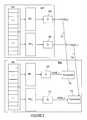
FIG. 5 shows signatures of elementary blocks in two data sets computed and stored in arrays and a process for isolating areas of differences between the two data sets using the arrays in accordance with one embodiment of the invention.
FIG. 6 shows elementary data blocks of one of the two data sets in FIG. 5 being transferred to the appropriate blocks in the other data set.
FIG. 7 shows signatures of elementary blocks in two data sets computed and stored in arrays and a process for isolating areas of differences between the two data sets using the arrays in accordance with another embodiment of the invention.
FIG. 8 illustrates a recursive process for isolating areas of differences between two signature arrays in accordance with one embodiment of the invention.
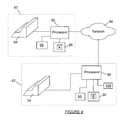
FIG. 9 illustrates a distributed system in which the invention may be implemented.
Embodiments of the invention provide a process for synchronizing distributed data sets. In general, the process involves using a one-way hash function to compute the “signature” of a data set of arbitrary nature, e.g., strings, ASCII files, and binary files. More specifically, the process uses a one-way hash function to compute the hash value of an original data set and its remote copy. The process then compares the hash value for the original data set with the hash value for the remote copy to determine whether they are identical. If the hash values are identical, then the original data set and its remote copy are identical, and there is no need for synchronization. If the hash values are not identical, the task then becomes identifying the areas of differences between the two data sets prior to synchronizing the data sets. Embodiments of the invention provide methods for precisely identifying the areas of differences between two data sets.
One-way hash functions are algorithms that turn messages or text into a fixed string of digits, known as the “hash value.” The “one-way” means that it is nearly impossible to derive the original message from the hash value. Furthermore, it is nearly impossible for a one-way hash function to produce the same hash value for two different messages. In essence, a one-way hash function provides a unique signature of a message. Various algorithms for computing one-way hash functions for data sets of different nature are known. See, for example, “Secure Hash Standard,” Federal Information Processing Standards Publication (FIPS PUB) 180-1, U.S. Department of Commerce, Springfield, Va, Apr. 17, 1995. The implementation of some form of one-way hash algorithms exist off-the-shelf on virtually every computing platform.
One-way hash functions have been used extensively in the field of cryptography to encrypt and decrypt digital signatures. Digital signatures are used to identify and authenticate the sender and message of a digitally distributed message. The digital signature is transformed with a one-way hash function into a message digest. The message digest and the digital signature are then separately transmitted to the receiver. Using the same one-way hash function as the sender, the receiver derives a message-digest from the signature and compares it with the received message-digest to authenticate the message sender. One-way hash functions are also used to index and retrieve items in a database. A search for an item in the database involves computing the hash value of the search term and comparing the hash value of the search term to the hash values of the items in the database.
Before the invention is described in detail, it is helpful to further discuss the nature of one-way hash functions. As previously mentioned, one-way hash functions can be used to produce the signature of an arbitrary data set. Typically, the length of the signature is dramatically smaller than the length of the data set. The amount of computation needed to compute the signature of a data set is linearly proportional to the size of the data set. Data sets of arbitrary length result in signature of fixed length. Two identical data sets result in identical signatures. Two similar, but different documents with very small difference between them, result in different signatures. Two different data sets result in different signatures with great degree of probability. In other words, it is possible, but very rare, for two different data sets to have identical signatures. Therefore, one-way hash functions can be depended on as a basis for synchronizing distributed data sets. However, if no mistake can be afforded in synchronizing data, one-way hash function should not be used.
Various embodiments of the invention will now be discussed with reference to the accompanying figures. FIG. 1 depicts data sets A and B in two different address spaces M1 and M2, respectively. Both data sets A and B are large and can be decomposed into smaller data blocks. The data blocks are either logical or physical in nature. Examples of logical data blocks are object states cached in memory of Java™ virtual machine (JVM), Hypertext Markup Language (HTML) pages cached in memory of a Web browser, or files in the file system of a computer. Examples of physical data blocks are tiles in bitmap pictures, fixed-length records in data files, or 256-byte sentences in a message. However, the physical data blocks need not be a meaningful entity in the context of the application. Let n be the number of elementary data blocks that permit no further decomposition. The size of the elementary data blocks determines the granularity of the smallest detectable change between the data sets A and B. Further, let H represent a hash function that operates on the data sets A and B and any subsets of the data sets A and B available on both address spaces M1 and M2.
A process for synchronizing the data sets A and B in accordance with one embodiment of the invention starts by computing the signatures h(A) and h(B) for the data sets A and B, respectively. The hash function H operates on the data sets A and B to produce the signatures h(A) and h(B), as indicated byreference numerals arrow 6. The signatures h(A) and h(B) are compared in the address space M2 to determine whether they are identical. If the signature h(A) is identical to h(B), there is no need for synchronization. If the signature h(A) is not identical to the signature h(B), a recursive process is used to isolate the portions of the data sets A and B that need to be synchronized.
Referring to FIG. 2, the recursive process starts by dividing the data set A into two data blocks A11, A12and the data set B into two data blocks B11, B12. The data sets A, B could each be divided into more than two data blocks, if desired. However, the data sets A and B should be divided into equal number of data blocks. The signatures h(A11), h(A12) and h(B11), h(B12) for the new data blocks are computed in their respective address spaces M1 and M2. Again, the hash function H operates on the data blocks A11, A12and B11, B12to produce the signatures h(A11), h(A12) and h(B11), h(B12), as indicated by reference numerals10-16.16. The signatures h(A11), h(A12) are transferred from the address space M1 to the address space M2, as indicated byarrows
Suppose that h(A12) is identical to h(B12) and h(A11) is not identical to h(B11). Then, the data blocks A12and B12corresponding to the paired signatures h(A12) and h(B12) can be eliminated from further consideration. The recursive process continues by checking the size of the data blocks A11and B11to determine whether the data blocks A11and B11, which correspond to the paired signatures that are not identical, are elementary data blocks. Assuming that the data blocks A11and B11, are larger than elementary data blocks, each data block A11, B11is then subdivided into two blocks. In other words, the data block A11is subdivided into two data blocks A21and A22, and the data block B11is subdivided into two data blocks B21and B22, as shown in FIG.3. Each data block A11, B11could be subdivided into more than two data blocks, if desired. Then, as illustrated for the data sets A and B in FIG. 2, the signatures for the data blocks A21, A22and B21, B22are obtained in their respective address spaces M1, M2. The hash function H operates on the data blocks A21, A22and B21, B22to produce the signatures h(A21), h(A22) and h(B21), h(B22), as indicated by reference numerals26-32.
The signatures of the data blocks A21, A22are transferred from the address space M1 to the address space M2, as indicated byarrows
A number of observations can be made about the process illustrated in FIGS. 1-4. First, the process is extremely generic in nature and can operate on logical or physical blocks in a variety of applications. Signature calculations are performed on as-needed basis, so no persistent memory is required to store signatures. The recursive process can be multi-threaded so that signatures of data blocks of the data sets A and B can be simultaneously computed. Elementary blocks are identified on the order of log(n) steps. When the areas of differences in the data sets are not numerous, every recursive step is roughly one-half cheaper from computational standpoint than the previous recursive step. The process described above makes effective use of bandwidth for a given granularity of elementary data blocks. The process requires collaboration between two distributed machines, i.e., the machines on which the data sets A and B are stored.
FIG. 5 illustrates another process for synchronizing the data sets A and B. The process involves computing the signature of eachelementary data block arrow 46, and compared to array hB on an element-by-element basis, as indicated at48. Any pair of signatures that are identical are marked for elimination. The elementary blocks of data set A that correspond to unmatched signatures are selected and transferred from the address space M1 to the address space M2. The appropriate data blocks in the data set B are then replaced by the transferred elementary blocks, as shown in FIG.6.
A number of observations can be made about the process illustrated in FIGS. 5 and 6. First, the process involves calculating signatures upfront in the address spaces M1, M2. Each signature calculation is cheap because it is performed on small elementary data blocks. The cost of isolating the areas of differences between the data sets A and B is constant, i.e., it is not dependent on a recursive process. Signature calculations during the initial stage of the process is well-suited for multithreading. For large n, the transfer of hA from address space M1 to M2 may consume large bandwidth. However, the process is still very generic and can operate on logical or physical blocks in a variety of applications. Also, collaboration between two distributed machines is still required, but significantly smaller in comparison to the process described in FIGS. 1-4.
FIG. 7 illustrates another process for synchronizing the data sets A and B. As in the process illustrated in FIGS. 5 and 6, the signature of eachelementary data block arrow 60, to the address space M2 and compared, as indicated at62, to the signature h(hB) to determine whether it is identical to the signature h(hB). A hash function G operates on the arrays hA and hB to produce the signatures g(hA) and g(hB). Typically, the hash function G will be different from the hash function H. In general, the hash function H will be selected based on the nature of the data sets A and B, and the hash function G will be selected based on the nature of the hash arrays hA and hB. If the signature g(hA) is not identical to g(hB), the process then proceeds to isolate the elements of the arrays hA and hB that are different. A recursive process similar to the one illustrated in FIGS. 2 and 3 is used to isolate the elements of the arrays hA and hB that are different.
Referring to FIG. 8, the recursive process starts by dividing the array hA into two sub-arrays hA11, hA12and the array hB into two sub-arrays hB11, hB12. Each array hA, hB could be divided into more than two sub-arrays hA and hB, if desired. However, the arrays hA and hB should be divided into equal number of sub-arrays. The signatures g(hA11), g(hA12) and g(hB11), g(hB12) for the sub-arrays are computed in their respective address spaces M1 and M2. Again, the hash function G operates on the data blocks hA11, hA12and hB11, hB12to produce the signatures g(hA11), g(hA12) and g(hB11), g(hB12), as indicated by reference numerals64-70. The signatures g(hA11), g(hA12) are transferred from the address space M1 to the address space M2, as indicated byarrows
The process just described is a hybrid of the processes illustrated in FIGS. 1-4 and FIGS. 5-6. Like the processes illustrated in FIGS. 1-4 and FIGS. 5-6, the process just described is extremely generic in nature and can operate on logical or physical blocks in a variety of applications. The process involves calculating signatures upfront in the address spaces M1 and M2, but unlike the process illustrated in FIGS. 5 and 6, the signature array hA is not transferred from the address space M1 to the address space M2. Instead, the signature g(hA) of the hash array hA is transferred from the address space M1 to the address space M2. During the recursive process, signatures of hash sub-arrays are computed and transferred from the address space M1 to the address space M2 and compared. The signatures of the hash arrays, or sub-arrays, may be smaller and faster to compute than the signatures of the data sets, or data blocks. Thus, once the initial signatures are calculated upfront, the actual recursive process may progress much faster than in the process illustrated in FIGS. 1-4. The process is very useful when bandwidth is very limited.
Each of the data synchronization processes illustrated in FIGS. 1-8 may be implemented as a service that can operate on a broad range of data sets of certain nature. Such service may be implemented in a distributed system. FIG.9 shows an example of a distributed system which includescomputer systems network 84, e.g., a local area network (LAN) or wide area network (WAN). The distributed system would typically include more than two computer systems. Thecomputer system 80 includes aprocessor 85, amemory 86, and input/output (I/O) devices such asterminal 88. Thecomputer system 82 includes aprocessor 90, amemory 92, and I/O devices such asterminal 94. The data set A may be stored on thecomputer system 80, e.g., in thememory 86, and the data set B may be stored on thecomputer system 82, e.g., in thememory 92.
The data synchronization service has two distinct distributed components: a single synchronization engine, i.e.,engine 96, and a pair of synchronization agents, i.e.,agents engine 96 may be located anywhere on thenetwork 84, while theagents engine 96 may be located on thecomputer system 82 or on a separate computer system (not shown) that can communicate with thecomputer systems network 84. Theengine 96 and theagents engine 96 may send requests to theagents memories engine 96 may send requests to the agents to determine whether two signatures are identical. Theengine 96 andagents
Preferably, the synchronization service is implemented in technologies such as Java™ that allow on-demand download of the synchronization agents into the machines that contain the synchronized data sets. Such architecture would allow for a very flexible implementation of the data synchronization service. The data synchronization service is defined via object-oriented framework that specifies abstract interfaces for synchronization service, synchronization engine, and synchronization agents. A particular implementation of such framework can then be provided for fine-tuned data synchronization service optimized to operate on specific types of data sets, or in specific computing environments.
The following is an illustration of how the data synchronization processes described above can be used to synchronize data between a personal digital assistant (PDA) device and a remote PDA server, for example. Suppose that a PDA device has been used as a stand-alone device for a period of time to record daily schedules. Further, suppose that the PDA server has been reconnected to the PDA server and there is now a need to synchronize the calendar containing daily schedules for a twelve-month period with a copy of the calendar maintained on the PDA server. Assume that on average, each working day contains four entries and each entry has a startTime, endtime, a place, and description. Further, assume that the PDA device uses a wireless connectivity, e.g., Wireless Application Protocol (WAP), to upload the schedule. In this type of connection, bandwidth is limited. Thus, the amount of information exchanged between the PDA device and the PDA server should be minimized.
Any of the processes described above can be used to synchronize the schedules. First, assume that the process illustrated in FIGS. 5 and 6 is used. The natural granularity of the data block, i.e., the size of the elementary data block, for this example is one day. A month and a week can make the appropriate levels of granularity in a different context, as we will see below. Thus, upon establishing the connection between the PDA device and the PDA server and agreeing to begin the synchronization of the calendars, the data for each day of the calendar is hashed into a short signature of the appropriate length, both on the PDA device and on the PDA server. Assume for the purpose of this example that the sufficient length of the day signature is 8 bytes. Then an array of size 365*8 bytes, which contains the signatures for the daily data on the PDA device, is created and passed from the PDA device to the PDA server. The PDA server compares the array that contains the signatures of the calendar on the PDA device with an array that contains the signatures of the calendar on the PDA server. The PDA server then returns a 365-bit mask that encodes the days with different signatures with 1 and the days with identical signatures with 0 to the PDA device. The PDA device uploads the complete daily schedule for the days whose signatures did not match with the signatures on the PDA server. The PDA server updates these days, and the synchronization process is terminated.
If 365*8 bytes is too long a message to pass from the PDA device to the PDA sever, then the rendering of the first process illustrated in FIGS. 1-5 may be appropriate. In that recursive scenario, the PDA device first sends a signature for a full year to the PDA server. If that signature matches the signature of the year's worth of calendar on the PDA server, the synchronization is done. If not, the signatures of twelve months are computed, uploaded and compared. For the months that don't have a match, the weekly signatures are computed, uploaded and compared. Finally, for the weeks that don't have a match, the daily signatures are computed, uploaded and compared. At the end, the distinct daily schedules are uploaded to the PDA server, and the process is over.
The invention is advantageous in that it allows areas of differences between two data sets of arbitrary nature to be precisely located. In this way, only the data that has changed is transferred between the data sets. This ensures that bandwidth is used efficiently. Moreover, the data synchronization can be done without any upfront planning. The process also requires no additional memory overhead and does not put any requirements on data access or modifier routines.
While the invention has been described with respect to a limited number of embodiments, those skilled in the art will appreciate that other embodiments can be devised which do not depart from the scope of the invention as disclosed herein. Accordingly, the scope of the invention should be limited only by the attached claims.
Claims (30)
1. A method for synchronizing two data sets, comprising:
computing a signature for a first data set in a first address space and a signature for a second data set in a second address space using a one-way hash function;
comparing the signatures for the first and second data sets to determine whether they are identical; and
if the signatures are not identical, identifying an area of difference between the first data set and the second data set and transferring data corresponding to the area of difference between the first data set and the second data set from the first data set to the second data set.
2. The method ofclaim 1 , wherein comparing the signatures for the first and second data sets to determine whether they are identical includes transferring the signature for the first data set from the first address space to the second address space.
3. The method ofclaim 1 , wherein identifying an area of difference between the first data set and the second data set comprises dividing the first data set into at least two data blocks and the second data set into at least two data blocks and pairing each data block in the first data set with a corresponding data block in the second data set.
4. The method ofclaim 3 , wherein identifying an area of difference between the first data set and the second data set further comprises identifying an area of difference between each pair of data blocks by computing the signature for each data block in the pair of data blocks using a one-way hash function and comparing the signature for the data blocks in the pair of data blocks to determine whether they are identical.
5. The method ofclaim 4 , wherein comparing the signature for the data blocks in the pair of data blocks includes transferring the signatures of each data block divided out of the first data set from the first address space to the second address space.
6. The method ofclaim 4 , wherein identifying an area of difference between each pair of data blocks further comprises eliminating the pair of data blocks from further consideration if the signatures of the data blocks in the pair of data blocks are identical.
7. The method ofclaim 6 , wherein identifying an area of difference between each pair of data blocks further comprises checking the size of the data blocks in the pair of data blocks if the signatures are not identical to determine whether the data blocks are elementary data blocks.
8. The method ofclaim 7 , wherein identifying an area of difference between each pair of data blocks further comprises subdividing each data block in the pair of data blocks into at least two data blocks if the data block is not an elementary data block and pairing each data block in the first of the pair of data blocks with a corresponding data block in the second of the pair of data blocks.
9. The method ofclaim 8 , wherein identifying an area of difference between each pair of data blocks further comprises repeating identifying an area of difference between each pair of data blocks until all the remaining data blocks are elementary data blocks.
10. The method ofclaim 9 , wherein transferring data corresponding to the areas of differences between the first data set and the second data set includes transferring the elementary data blocks from the first data set to the second data set.
11. A method for synchronizing two data sets, comprising:
computing a signature for a first data set in a first address space and a signature for a second data set in a second address space using a one-way hash function;
comparing the signatures for the first and second data sets to determine whether they are identical; and
if the signatures are not identical, dividing the first data set into two data blocks and the second data set into two data blocks, pairing each data block in the first data set with a corresponding data block in the second data set, and identifying an area of difference for each pair of data blocks by
computing the signature for each data block in the pair of data blocks using the one-way hash function and comparing the signature of the data blocks in the pair of data blocks to determine whether they are identical,
eliminating the pair of data blocks from further consideration if the signatures are identical,
checking the size of the data blocks to determine whether the data blocks are elementary data blocks if the signatures are not identical,
subdividing each data block into two data blocks and pairing each data block in the first of the pair of data blocks with a corresponding data block in the second of the pair of data blocks if the data blocks are not elementary data blocks,
repeating identifying an area of difference for each pair of data blocks until all remaining data blocks are elementary data blocks; and
transferring the elementary data blocks from the first data set to the second data set.
12. The method ofclaim 11 , wherein comparing the signatures for the first and second data sets to determine whether they are identical includes transferring the signature for the first data set from the first address space to the second address space.
13. The method ofclaim 11 , wherein comparing the signature of the data blocks includes transferring the signatures of each data block divided out of the first data set from the first address space to the second address space.
14. A method for synchronizing two data sets, comprising:
subdividing a first data set in a first address space and a second data set in a second address space into their respective elementary data blocks;
computing a signature for each elementary data block using a one-way hash function and storing the signatures of the elementary data blocks in the first data set in a first array and the signatures of the elementary data blocks in the second data set in a second array; and
comparing each signature in the first array to a corresponding signature in the second array to determine whether they are identical and, if they are not identical, transferring the corresponding data block from the first data set to the second data set.
15. The method ofclaim 14 , wherein comparing each signature in the first array to a corresponding signature in the second array to determine whether they are identical includes transferring the first array from the first address space to the second address space.
16. A method for synchronizing two data sets, the method comprising:
subdividing a first data set in a first address space and a second data set in a second address space into their respective elementary data blocks;
computing a signature for each elementary data block using a first one-way hash function and storing the signatures of the elementary data blocks in the first data set in a first array and the signatures of the elementary data blocks in the second data set in a second array;
computing a signature for the first array and a signature for the second array using a second one-way hash function and comparing the signatures for the first and second arrays to determine whether they are identical;
if the signatures for the first and second arrays are not identical, identifying the unique signatures in the first and second arrays; and
transferring the elementary data blocks corresponding to the unique signatures from the first data set to the second data set.
17. The method ofclaim 16 , wherein identifying the unique signatures in the first and second arrays comprises dividing the first array into two sub-arrays and the second array into two sub-arrays and pairing each sub-array from the first array with a corresponding sub-array from the second array.
18. The method ofclaim 16 , further comprising identifying the area of difference between each pair of sub-arrays by computing the signature for each sub-array in the pair of sub-arrays using the second one-way hash function and comparing the signature of the sub-arrays in the pair of sub-arrays to determine whether they are identical.
19. The method ofclaim 18 , wherein comparing the signature of the sub-arrays in the pair of sub-arrays includes transferring the signatures of each sub-array derived from the first array from the address space of the first data set to the address space of the second data set.
20. The method ofclaim 19 , wherein identifying the area of difference between each pair of sub-arrays further comprises eliminating the pair of sub-arrays from further consideration if the signatures of the sub-arrays in the pair of sub-arrays are identical.
21. The method ofclaim 20 , wherein identifying the area of difference between each pair of sub-arrays further comprises checking the size of the sub-arrays in the pair of sub-arrays if the signatures are not identical to determine whether the sub-arrays have more than one element.
22. The method ofclaim 21 , wherein identifying the area of difference between each pair of sub-arrays further comprises subdividing each sub-array into two sub-arrays if the sub-array has more than one element and pairing each sub-array in the first of the pair of sub-arrays with a corresponding sub-array in the second of the pair of sub-arrays.
23. The method ofclaim 22 , wherein identifying the unique signatures in the first and second arrays further comprises repeating identifying the area of difference between each pair of sub-arrays until all the remaining sub-arrays have only one element.
24. The method ofclaim 23 , wherein transferring the elementary data blocks corresponding to the unique signatures from the first data set to the second data set includes identifying the elementary data blocks in the first data set which correspond to the remaining sub-arrays and transferring the elementary data blocks from the first data set to the second data set.
25. A data synchronization system, comprising:
a first agent having access to a first data set in a first address space;
a second agent having access to a second data set in a second address space; and
an engine which communicates with the first agent and the second agent when activated, the engine being configured to:
send a request to the first agent to compute a signature for the first data set in the first address space and a request to the second agent to compute a signature for the second data in the second address space using a one-way hash function;
transfer the signature for the first data set from the first address space to the second address space and send a request to the second agent to determine whether the signature for the first data set is identical to the signature for the second data set; and
identify an area of difference between the first data set and the second data set in collaboration with the first and second agents if the signatures of the data sets are not identical and, upon identifying the area of difference between the data sets, transfer data corresponding to the area of difference between the data sets from the first address space to the second address space and copy the data into the second data set.
26. The data synchronization system ofclaim 25 , wherein the first agent, the second agent, and the engine each comprise a set of computer-executable instructions.
27. A data synchronization system, comprising:
a first agent having access to a first data set in a first address space;
a second agent having access to a second data set in a second address space; and
an engine which communicates with the first agent and the second agent when activated, the engine being configured to:
send a request to the first agent to subdivide the first data set into elementary data blocks, to compute a signature for each elementary data block using a one-way hash function, and to store the signatures of the elementary data blocks in a first array;
send a request to the second agent to subdivide the second data set into elementary data blocks, to compute a signature for each elementary block using the one-way hash function, and to store the signatures of the elementary data blocks in a second array;
transfer the first array from the first address space to the second address space and send a request to the second agent to compare each signature in the first array to a corresponding signature in the second array to determine whether they are identical and, if they are not identical, transfer the corresponding data block from the first data set to the second data set.
28. The data synchronization system ofclaim 27 , wherein the first agent, the second agent, and the engine each comprise a set of computer-executable instructions.
29. A data synchronization system, comprising:
a first agent having access to a first data set in a first address space;
a second agent having access to a second data set in a second address space; and
an engine which communicates with the first agent and the second agent when activated, the engine being configured to:
send a request to the first agent to subdivide the first data set into elementary data blocks, to compute a signature for each elementary data block using a first one-way hash function, to store the signatures of the elementary data blocks in a first array, and to compute a signature for the first array using a second one-way hash function;
send a request to the second agent to subdivide the second data set into elementary data blocks, to compute the a signature for each elementary block using the first one-way hash function, to store the signatures of the elementary data blocks in a second array, and to compute a signature for the second array using the second one-way hash function;
transfer the signature for the first array from the first address space to the second address space and send a request to the second agent to determine whether the signature for the first array is identical to the signature for the second array; and
identify an area of difference between the first array and the second array in collaboration with the first and second agents if the signatures of the arrays are not identical and, upon identifying the area of difference between the arrays, transfer data corresponding to the area of difference between the arrays from the first address space to the second address space and copy the data into the second data set.
30. The data synchronization system ofclaim 29 , wherein the first agent, the second agent, and the engine each comprise a set of computer-executable instructions.
Priority Applications (1)
| Application Number | Priority Date | Filing Date | Title |
|---|---|---|---|
| US09/613,642US6470329B1 (en) | 2000-07-11 | 2000-07-11 | One-way hash functions for distributed data synchronization |
Applications Claiming Priority (1)
| Application Number | Priority Date | Filing Date | Title |
|---|---|---|---|
| US09/613,642US6470329B1 (en) | 2000-07-11 | 2000-07-11 | One-way hash functions for distributed data synchronization |
Publications (1)
| Publication Number | Publication Date |
|---|---|
| US6470329B1true US6470329B1 (en) | 2002-10-22 |
Family
ID=24458117
Family Applications (1)
| Application Number | Title | Priority Date | Filing Date |
|---|---|---|---|
| US09/613,642Expired - LifetimeUS6470329B1 (en) | 2000-07-11 | 2000-07-11 | One-way hash functions for distributed data synchronization |
Country Status (1)
| Country | Link |
|---|---|
| US (1) | US6470329B1 (en) |
Cited By (140)
| Publication number | Priority date | Publication date | Assignee | Title |
|---|---|---|---|---|
| US20020174180A1 (en)* | 2001-03-16 | 2002-11-21 | Novell, Inc. | Client-server model for synchronization of files |
| US20030195924A1 (en)* | 2002-04-15 | 2003-10-16 | Franke Michael Martin | Methods and system using a local proxy server to process media data for local area users |
| US20030212712A1 (en)* | 2002-05-13 | 2003-11-13 | Jinsheng Gu | Byte-level file differencing and updating algorithms |
| US6694337B1 (en)* | 2000-10-26 | 2004-02-17 | Intel Corporation | Synchronizing databases |
| US20040068523A1 (en)* | 2002-10-07 | 2004-04-08 | Keith Robert Olan | Method and system for full asynchronous master-to-master file synchronization |
| US20040098361A1 (en)* | 2002-11-18 | 2004-05-20 | Luosheng Peng | Managing electronic file updates on client devices |
| US20040098413A1 (en)* | 2002-11-18 | 2004-05-20 | Luosheng Peng | Controlling updates of electronic files |
| US20040098421A1 (en)* | 2002-11-18 | 2004-05-20 | Luosheng Peng | Scheduling updates of electronic files |
| US20040111427A1 (en)* | 2002-12-06 | 2004-06-10 | Jinsheng Gu | System and method for data compression and decompression |
| US20040127242A1 (en)* | 2002-12-31 | 2004-07-01 | Dashevsky Jane Y. | Apparatus and associated methods for the synchronization of shared content |
| US20040246902A1 (en)* | 2003-06-02 | 2004-12-09 | Weinstein Joseph J. | Systems and methods for synchronizing multple copies of a database using datablase digest |
| US20040260734A1 (en)* | 2003-06-20 | 2004-12-23 | Liwei Ren | Processing software images for use in generating difference files |
| US20050004954A1 (en)* | 2003-07-01 | 2005-01-06 | Hand Held Products, Inc. | Systems and methods for expedited data transfer in a communication system using hash segmentation |
| US20050010870A1 (en)* | 2003-07-09 | 2005-01-13 | Jinsheng Gu | Post-processing algorithm for byte-level file differencing |
| US20050010576A1 (en)* | 2003-07-09 | 2005-01-13 | Liwei Ren | File differencing and updating engines |
| US20050020308A1 (en)* | 2003-07-23 | 2005-01-27 | David Lai | Dynamically binding Subscriber Identity Modules (SIMs)/User Identity Modules (UIMs) with portable communication devices |
| US20050021572A1 (en)* | 2003-07-21 | 2005-01-27 | Liwei Ren | Algorithms for block-level code alignment of software binary files |
| WO2005010773A1 (en)* | 2003-07-23 | 2005-02-03 | Intel Corporation | Method and system for high-performance hashing |
| US20050050221A1 (en)* | 2003-08-27 | 2005-03-03 | Tasman Mitchell Paul | Systems and methods for forwarding data units in a communications network |
| EP1519268A2 (en) | 2003-09-25 | 2005-03-30 | Curitel Communications, Inc. | Communication terminal and communication network for partially updating software, software update method, and software creation device and method therefor |
| US6879996B1 (en)* | 2000-09-13 | 2005-04-12 | Edward W. Laves | Method and apparatus for displaying personal digital assistant synchronization data using primary and subordinate data fields |
| US20050149520A1 (en)* | 2000-11-27 | 2005-07-07 | Microsoft Corporation | Distributed confidential contextual querying |
| US20050160079A1 (en)* | 2004-01-16 | 2005-07-21 | Andrzej Turski | Systems and methods for controlling a visible results set |
| US20050165858A1 (en)* | 2004-01-09 | 2005-07-28 | Tom Richard W. | Well-known transactions in data replication |
| US20050177632A1 (en)* | 2004-02-10 | 2005-08-11 | Yach David P. | Apparatus, and associated method, for synchronizing databases connected by way of a radio air interface |
| US20050192973A1 (en)* | 2004-02-12 | 2005-09-01 | Smith Micro Software, Inc. | Visual database management system and method |
| US20050204351A1 (en)* | 2002-11-18 | 2005-09-15 | James Jiang | Dynamic addressing (DA) using a centralized DA Manager |
| US20050204353A1 (en)* | 2002-11-12 | 2005-09-15 | De Ji | Upgrading electronic files of a mobile device upgrade client |
| US20050216537A1 (en)* | 2002-11-18 | 2005-09-29 | James Jiang | Dynamic addressing (DA) using a centralized DA manager |
| US20050234961A1 (en)* | 2004-04-16 | 2005-10-20 | Pinnacle Systems, Inc. | Systems and Methods for providing a proxy for a shared file system |
| US20050257023A1 (en)* | 2002-11-18 | 2005-11-17 | Doongo Technologies, Inc. | Device memory management during electronic file updating |
| US20050254521A1 (en)* | 2002-11-18 | 2005-11-17 | Doongo Technologies, Inc. | Generating difference files using module information of embedded software components |
| US20050262310A1 (en)* | 2004-04-30 | 2005-11-24 | Starbuck Bryan T | Methods and systems for halting synchronization loops in a distributed system |
| US6977937B1 (en) | 2000-04-10 | 2005-12-20 | Bbnt Solutions Llc | Radio network routing apparatus |
| US20050283623A1 (en)* | 2004-06-17 | 2005-12-22 | Vanderheyden Peter J | Computer-based method and apparatus for certifying a file |
| US20060020804A1 (en)* | 2004-02-04 | 2006-01-26 | Microsoft Corporation | Cross-pollination synchronization of data |
| US20060059207A1 (en)* | 2004-09-15 | 2006-03-16 | Diligent Technologies Corporation | Systems and methods for searching of storage data with reduced bandwidth requirements |
| US20060059173A1 (en)* | 2004-09-15 | 2006-03-16 | Michael Hirsch | Systems and methods for efficient data searching, storage and reduction |
| US20060069755A1 (en)* | 2004-08-31 | 2006-03-30 | Luosheng Peng | Maintaining mobile device electronic files |
| US20060126805A1 (en)* | 2004-12-15 | 2006-06-15 | Pantech&Curitel Communications, Inc. | Method of managing multimedia data and mobile communication terminal equipped with function of managing multimedia data |
| US7096311B2 (en) | 2002-09-30 | 2006-08-22 | Innopath Software, Inc. | Updating electronic files using byte-level file differencing and updating algorithms |
| US20060253485A1 (en)* | 2005-05-05 | 2006-11-09 | International Business Machines Corporation | Method, system, and program product for using analysis views to identify data synchronization problems between databases |
| US20060267973A1 (en)* | 2005-05-12 | 2006-11-30 | Lg Electronics Inc. | Apparatus for supplying power source |
| US20070030763A1 (en)* | 2004-08-24 | 2007-02-08 | Bbn Technologies Corp. | System and method for disambiguating shooter locations |
| US20070073787A1 (en)* | 2005-09-29 | 2007-03-29 | Research In Motion Limited | Method and apparatus for synchronizing databases connected by wireless interface |
| US20070129072A1 (en)* | 2000-04-25 | 2007-06-07 | Kabushiki Kaisha Toshiba | Method and system for radio communications using mobile terminal moving route prediction |
| US20070139189A1 (en)* | 2005-12-05 | 2007-06-21 | Helmig Kevin S | Multi-platform monitoring system and method |
| US7249198B1 (en)* | 2000-05-23 | 2007-07-24 | Palmsource, Inc. | Method and system for device bootstrapping via server synchronization |
| US20070198838A1 (en)* | 2004-04-02 | 2007-08-23 | Masao Nonaka | Unauthorized Contents Detection System |
| US20070239961A1 (en)* | 2006-03-27 | 2007-10-11 | Fujitsu Limited | Computer-readable recording medium having recorded hash-value generation program, computer-readable recording medium having recorded storage management program, and storage system |
| US20080104078A1 (en)* | 2006-10-31 | 2008-05-01 | Kave Eshghi | Method for creating sketches of sets to permit comparison |
| US20080162597A1 (en)* | 2006-12-27 | 2008-07-03 | Research In Motion Limited | Method and apparatus for synchronizing databases connected by wireless interface |
| US20080163098A1 (en)* | 2006-12-27 | 2008-07-03 | Research In Motion Limited | Method for presenting data on a small screen |
| US20080162501A1 (en)* | 2006-12-27 | 2008-07-03 | Research In Motion Limited | Method and apparatus for memory management in an electronic device |
| US20080162486A1 (en)* | 2006-12-27 | 2008-07-03 | Research In Motion Limited | Method and apparatus for storing data from a network address |
| US20080189159A1 (en)* | 2007-02-02 | 2008-08-07 | Researech In Motion Limited | Electronic device and method of meeting notification |
| US20080186807A1 (en)* | 2007-02-02 | 2008-08-07 | Research In Motion Limited | Electronic device and method of controlling an electronic device for calendar event updates |
| EP1956499A1 (en) | 2007-02-09 | 2008-08-13 | Research In Motion Limited | System and method for managing databases associated with respective personal information manager service accounts |
| US20080191896A1 (en)* | 2007-02-09 | 2008-08-14 | Jain Rohit Rocky | Electronic device and method of adding parties to a calendar event |
| US20080195455A1 (en)* | 2007-02-09 | 2008-08-14 | Research In Motion Limited | Electronic device and method of scheduling calendar events |
| US20080195619A1 (en)* | 2007-02-09 | 2008-08-14 | Jain Rohit Rocky | Electronic device and method of sharing calendar-event information |
| US20080215602A1 (en)* | 2003-10-21 | 2008-09-04 | Jerome Samson | "Methods and Apparatus for Fusing Databases" |
| US20080250085A1 (en)* | 2007-04-09 | 2008-10-09 | Microsoft Corporation | Backup system having preinstalled backup data |
| US20080256326A1 (en)* | 2007-04-11 | 2008-10-16 | Data Domain, Inc. | Subsegmenting for efficient storage, resemblance determination, and transmission |
| US20090006792A1 (en)* | 2007-06-28 | 2009-01-01 | Federwisch Michael L | System and Method to Identify Changed Data Blocks |
| US20090150416A1 (en)* | 2007-12-07 | 2009-06-11 | Roche Diagnostics Operations, Inc. | Method and system for enhanced data transfer |
| US20090157716A1 (en)* | 2007-12-17 | 2009-06-18 | Kim Keonwoo | Apparatus and method for acquiring data from memory of terminal |
| US7552327B2 (en) | 2003-11-13 | 2009-06-23 | International Business Machines Corporation | Method and apparatus for conducting a confidential search |
| US20090192983A1 (en)* | 2008-01-28 | 2009-07-30 | Yahoo! Inc. | Method and system for mining, ranking and visualizing lexically similar search queries for advertisers |
| US20090300643A1 (en)* | 2008-05-27 | 2009-12-03 | Gove Darryl J | Using hardware support to reduce synchronization costs in multithreaded applications |
| US7634657B1 (en)* | 2004-12-23 | 2009-12-15 | Symantec Corporation | Reducing the probability of undetected collisions in hash-based data block processing |
| US20100020643A1 (en)* | 2008-07-28 | 2010-01-28 | Bbn Technologies Corp. | System and methods for detecting shooter locations from an aircraft |
| US7668083B1 (en) | 2003-10-28 | 2010-02-23 | Bbn Technologies Corp. | Systems and methods for forwarding data in a communications network |
| US7716312B2 (en) | 2002-11-13 | 2010-05-11 | Avid Technology, Inc. | Method and system for transferring large data files over parallel connections |
| US20100131526A1 (en)* | 2008-11-21 | 2010-05-27 | Lin Sun | Method and apparatus for reconciliation of multiple sets of data |
| US20100257149A1 (en)* | 2009-04-03 | 2010-10-07 | International Business Machines Corporation | Data synchronization and consistency across distributed repositories |
| US20100287307A1 (en)* | 2006-05-24 | 2010-11-11 | Sagem Orga Gmbh | Data Synchronization |
| US20100293260A1 (en)* | 2006-01-24 | 2010-11-18 | Nokia Siemens Networks Gmbh & Co. Kg | Use of an identification information in a network management |
| US7849056B2 (en) | 2007-02-09 | 2010-12-07 | Research In Motion Limited | System and method for managing databases associated with respective personal information manager service accounts |
| US7881229B2 (en) | 2003-08-08 | 2011-02-01 | Raytheon Bbn Technologies Corp. | Systems and methods for forming an adjacency graph for exchanging network routing data |
| US7895651B2 (en) | 2005-07-29 | 2011-02-22 | Bit 9, Inc. | Content tracking in a network security system |
| US20110066593A1 (en)* | 2009-09-16 | 2011-03-17 | Madhu Ahluwalia | Method and system for capturing change of data |
| US20110153564A1 (en)* | 2009-12-23 | 2011-06-23 | Telcordia Technologies, Inc. | Error-sensitive electronic directory synchronization system and methods |
| US7983239B1 (en) | 2003-01-07 | 2011-07-19 | Raytheon Bbn Technologies Corp. | Systems and methods for constructing a virtual model of a multi-hop, multi-access network |
| CN1684464B (en)* | 2004-04-15 | 2011-07-27 | 微软公司 | Method and system for updating objects between a local device and a remote device |
| US20110258239A1 (en)* | 2010-04-19 | 2011-10-20 | Greenbytes, Inc. | Method of minimizing the amount of network bandwidth needed to copy data between data deduplication storage systems |
| US8099391B1 (en)* | 2009-03-17 | 2012-01-17 | Symantec Corporation | Incremental and differential backups of virtual machine files |
| US20120016848A1 (en)* | 2010-07-19 | 2012-01-19 | Quantum Corporation | Establishing parse scope |
| US8139504B2 (en) | 2009-04-07 | 2012-03-20 | Raytheon Bbn Technologies Corp. | System, device, and method for unifying differently-routed networks using virtual topology representations |
| US8149649B1 (en) | 2004-08-24 | 2012-04-03 | Raytheon Bbn Technologies Corp. | Self calibrating shooter estimation |
| US8176338B1 (en)* | 2005-04-29 | 2012-05-08 | Symantec Corporation | Hash-based data block processing with intermittently-connected systems |
| US8204868B1 (en)* | 2008-06-30 | 2012-06-19 | Symantec Operating Corporation | Method and system for improving performance with single-instance-storage volumes by leveraging data locality |
| US20120176386A1 (en)* | 2011-01-10 | 2012-07-12 | Hutchins Edward A | Reducing recurrent computation cost in a data processing pipeline |
| US8272058B2 (en) | 2005-07-29 | 2012-09-18 | Bit 9, Inc. | Centralized timed analysis in a network security system |
| US8320217B1 (en) | 2009-10-01 | 2012-11-27 | Raytheon Bbn Technologies Corp. | Systems and methods for disambiguating shooter locations with shockwave-only location |
| US20120303817A1 (en)* | 2011-05-27 | 2012-11-29 | Oracle International Corporation | Method and system for implementing an on-demand scheduler in a mobile device |
| US20120303647A1 (en)* | 2011-05-27 | 2012-11-29 | Oracle International Corporation | Method and system for implementing an on-demand scheduler |
| US20120330887A1 (en)* | 2010-09-08 | 2012-12-27 | Young Daniel J | Distribution and synchronization of digital objects |
| US8543540B1 (en) | 2012-05-09 | 2013-09-24 | Bertec Corporation | System and method for the merging of databases |
| US20130326150A1 (en)* | 2012-06-05 | 2013-12-05 | Vmware, Inc. | Process for maintaining data write ordering through a cache |
| US8655865B1 (en)* | 2011-05-27 | 2014-02-18 | Adobe Systems Incorporated | Method and apparatus for indexing rich internet content using contextual information |
| US8666944B2 (en) | 2010-09-29 | 2014-03-04 | Symantec Corporation | Method and system of performing a granular restore of a database from a differential backup |
| US8700569B1 (en) | 2012-05-09 | 2014-04-15 | Bertec Corporation | System and method for the merging of databases |
| US20140195482A1 (en)* | 2013-01-08 | 2014-07-10 | Lyve Minds, Inc. | Data synchronization in a storage network |
| EP2665001A3 (en)* | 2009-04-03 | 2014-10-08 | Google, Inc. | Architectural pattern for persistent web application design |
| US8924741B2 (en) | 2012-12-29 | 2014-12-30 | Intel Corporation | Instruction and logic to provide SIMD secure hashing round slice functionality |
| US8984636B2 (en) | 2005-07-29 | 2015-03-17 | Bit9, Inc. | Content extractor and analysis system |
| US9027104B2 (en) | 2012-12-28 | 2015-05-05 | Intel Corporation | Instructions processors, methods, and systems to process secure hash algorithms |
| US9043278B1 (en) | 2012-05-09 | 2015-05-26 | Bertec Corporation | System and method for the merging of databases |
| US20150205819A1 (en)* | 2008-12-22 | 2015-07-23 | Ctera Networks, Ltd. | Techniques for optimizing data flows in hybrid cloud storage systems |
| US9092499B2 (en) | 2012-01-20 | 2015-07-28 | Blackberry Limited | Synchronizing endpoint data stores having disparate schemas |
| US9165011B2 (en) | 2011-09-30 | 2015-10-20 | Oracle International Corporation | Concurrent calculation of resource qualification and availability using text search |
| US20160063050A1 (en)* | 2014-08-28 | 2016-03-03 | Joerg Schoen | Database Migration Consistency Checker |
| US9479567B1 (en) | 2015-10-29 | 2016-10-25 | Dropbox, Inc. | Synchronization protocol for multi-premises hosting of digital content items |
| US9537952B1 (en) | 2016-01-29 | 2017-01-03 | Dropbox, Inc. | Apparent cloud access for hosted content items |
| US20170099150A1 (en)* | 2015-10-02 | 2017-04-06 | Google Inc. | Signatures of updates exchanged in a binary data synchronization protocol |
| US20170161330A1 (en)* | 2015-11-25 | 2017-06-08 | International Business Machines Corporation | Combining data matches from multiple sources in a deduplication storage system |
| US9678678B2 (en) | 2013-12-20 | 2017-06-13 | Lyve Minds, Inc. | Storage network data retrieval |
| US20170308513A1 (en)* | 2016-04-26 | 2017-10-26 | RiskIQ, Inc. | Techniques for web framework detection |
| US9852147B2 (en) | 2015-04-01 | 2017-12-26 | Dropbox, Inc. | Selective synchronization and distributed content item block caching for multi-premises hosting of digital content items |
| US9912481B2 (en) | 2014-03-27 | 2018-03-06 | Intel Corporation | Method and apparatus for efficiently executing hash operations |
| US9959061B1 (en)* | 2015-09-30 | 2018-05-01 | EMC IP Holding Company LLC | Data synchronization |
| US10038550B2 (en) | 2013-08-08 | 2018-07-31 | Intel Corporation | Instruction and logic to provide a secure cipher hash round functionality |
| US10296608B2 (en) | 2015-10-02 | 2019-05-21 | Google Llc | Single table multi-schema data store in a key value store |
| US10375166B2 (en) | 2008-12-22 | 2019-08-06 | Ctera Networks, Ltd. | Caching device and method thereof for integration with a cloud storage system |
| US10503510B2 (en) | 2013-12-27 | 2019-12-10 | Intel Corporation | SM3 hash function message expansion processors, methods, systems, and instructions |
| US20190391762A1 (en)* | 2018-06-25 | 2019-12-26 | Panasonic Intellectual Property Management Co. Ltd. | Memory controller, non-volatile storage device, non-volatile storage system, and memory control method |
| US10521423B2 (en) | 2008-12-22 | 2019-12-31 | Ctera Networks, Ltd. | Apparatus and methods for scanning data in a cloud storage service |
| US10592245B2 (en) | 2014-09-26 | 2020-03-17 | Intel Corporation | Instructions and logic to provide SIMD SM3 cryptographic hashing functionality |
| US10623175B2 (en) | 2014-09-04 | 2020-04-14 | Intel Corporation | SM3 hash algorithm acceleration processors, methods, systems, and instructions |
| US10691718B2 (en) | 2015-10-29 | 2020-06-23 | Dropbox, Inc. | Synchronization protocol for multi-premises hosting of digital content items |
| US10699025B2 (en) | 2015-04-01 | 2020-06-30 | Dropbox, Inc. | Nested namespaces for selective content sharing |
| US10742595B2 (en) | 2018-04-20 | 2020-08-11 | Pulse Secure, Llc | Fully qualified domain name-based traffic control for virtual private network access control |
| WO2020227659A1 (en)* | 2019-05-08 | 2020-11-12 | Datameer, Inc. | Recommendation model generation and use in a hybrid multi-cloud database environment |
| US10963430B2 (en) | 2015-04-01 | 2021-03-30 | Dropbox, Inc. | Shared workspaces with selective content item synchronization |
| WO2021133406A1 (en)* | 2019-12-27 | 2021-07-01 | Hitachi Vantara Llc | Hybrid cloud asynchronous data synchronization |
| US11223677B2 (en) | 2015-10-02 | 2022-01-11 | Google Llc | Peer-to-peer syncable storage system |
| US11290531B2 (en) | 2019-12-04 | 2022-03-29 | Dropbox, Inc. | Immediate cloud content item creation from local file system interface |
| US11356448B1 (en) | 2018-04-13 | 2022-06-07 | Pulse Secure, Llc | Device and method for tracking unique device and user network access across multiple security appliances |
| US11477028B2 (en) | 2019-04-15 | 2022-10-18 | Pulse Secure, Llc | Preventing account lockout through request throttling |
Citations (7)
| Publication number | Priority date | Publication date | Assignee | Title |
|---|---|---|---|---|
| US5867125A (en)* | 1995-12-20 | 1999-02-02 | Cluff; Larry A. | Incremental phase and distance measurement through digital phase signature comparison |
| US5878095A (en)* | 1994-03-01 | 1999-03-02 | Nokia Telecommunications Oy | Hierarchical synchronization method |
| US6088456A (en)* | 1996-11-15 | 2000-07-11 | Desktop Guardian Limited | Data encryption technique |
| US6149522A (en)* | 1995-06-29 | 2000-11-21 | Silicon Gaming - Nevada | Method of authenticating game data sets in an electronic casino gaming system |
| US6247135B1 (en)* | 1999-03-03 | 2001-06-12 | Starfish Software, Inc. | Synchronization process negotiation for computing devices |
| US6308223B1 (en)* | 1996-05-22 | 2001-10-23 | Siemens Aktiengesellschaft | Process for the synchronization of programs on different computers of an interconnected system |
| US6374250B2 (en)* | 1997-02-03 | 2002-04-16 | International Business Machines Corporation | System and method for differential compression of data from a plurality of binary sources |
- 2000
- 2000-07-11USUS09/613,642patent/US6470329B1/ennot_activeExpired - Lifetime
Patent Citations (7)
| Publication number | Priority date | Publication date | Assignee | Title |
|---|---|---|---|---|
| US5878095A (en)* | 1994-03-01 | 1999-03-02 | Nokia Telecommunications Oy | Hierarchical synchronization method |
| US6149522A (en)* | 1995-06-29 | 2000-11-21 | Silicon Gaming - Nevada | Method of authenticating game data sets in an electronic casino gaming system |
| US5867125A (en)* | 1995-12-20 | 1999-02-02 | Cluff; Larry A. | Incremental phase and distance measurement through digital phase signature comparison |
| US6308223B1 (en)* | 1996-05-22 | 2001-10-23 | Siemens Aktiengesellschaft | Process for the synchronization of programs on different computers of an interconnected system |
| US6088456A (en)* | 1996-11-15 | 2000-07-11 | Desktop Guardian Limited | Data encryption technique |
| US6374250B2 (en)* | 1997-02-03 | 2002-04-16 | International Business Machines Corporation | System and method for differential compression of data from a plurality of binary sources |
| US6247135B1 (en)* | 1999-03-03 | 2001-06-12 | Starfish Software, Inc. | Synchronization process negotiation for computing devices |
Cited By (286)
| Publication number | Priority date | Publication date | Assignee | Title |
|---|---|---|---|---|
| US6977937B1 (en) | 2000-04-10 | 2005-12-20 | Bbnt Solutions Llc | Radio network routing apparatus |
| US20070129072A1 (en)* | 2000-04-25 | 2007-06-07 | Kabushiki Kaisha Toshiba | Method and system for radio communications using mobile terminal moving route prediction |
| US7249198B1 (en)* | 2000-05-23 | 2007-07-24 | Palmsource, Inc. | Method and system for device bootstrapping via server synchronization |
| US20080016250A1 (en)* | 2000-05-23 | 2008-01-17 | Palmsource, Inc. | Method and system for device bootstrapping via server synchronization |
| US8037208B2 (en) | 2000-05-23 | 2011-10-11 | Access Co., Ltd. | Method and system for device bootstrapping via server synchronization |
| US6879996B1 (en)* | 2000-09-13 | 2005-04-12 | Edward W. Laves | Method and apparatus for displaying personal digital assistant synchronization data using primary and subordinate data fields |
| US6694337B1 (en)* | 2000-10-26 | 2004-02-17 | Intel Corporation | Synchronizing databases |
| US7698324B2 (en)* | 2000-11-27 | 2010-04-13 | Microsoft Corporation | Distributed confidential contextual querying |
| US20050149520A1 (en)* | 2000-11-27 | 2005-07-07 | Microsoft Corporation | Distributed confidential contextual querying |
| US20020174180A1 (en)* | 2001-03-16 | 2002-11-21 | Novell, Inc. | Client-server model for synchronization of files |
| US7734826B2 (en)* | 2001-03-16 | 2010-06-08 | Novell, Inc. | Client-server model for synchronization of files |
| US20060112150A1 (en)* | 2001-03-16 | 2006-05-25 | Brown David K | Server for synchronization of files |
| US7657517B2 (en) | 2001-03-16 | 2010-02-02 | Novell, Inc. | Server for synchronization of files |
| US7668901B2 (en) | 2002-04-15 | 2010-02-23 | Avid Technology, Inc. | Methods and system using a local proxy server to process media data for local area users |
| US20030195924A1 (en)* | 2002-04-15 | 2003-10-16 | Franke Michael Martin | Methods and system using a local proxy server to process media data for local area users |
| US20030212712A1 (en)* | 2002-05-13 | 2003-11-13 | Jinsheng Gu | Byte-level file differencing and updating algorithms |
| US20050234997A1 (en)* | 2002-05-13 | 2005-10-20 | Jinsheng Gu | Byte-level file differencing and updating algorithms |
| US6925467B2 (en)* | 2002-05-13 | 2005-08-02 | Innopath Software, Inc. | Byte-level file differencing and updating algorithms |
| US8156071B2 (en) | 2002-05-13 | 2012-04-10 | Innopath Software, Inc. | Byte-level file differencing and updating algorithms |
| US7096311B2 (en) | 2002-09-30 | 2006-08-22 | Innopath Software, Inc. | Updating electronic files using byte-level file differencing and updating algorithms |
| US7366824B2 (en) | 2002-09-30 | 2008-04-29 | Innopath Software, Inc. | Updating electronic files using byte-level file differencing and updating algorithms |
| US8713137B2 (en) | 2002-09-30 | 2014-04-29 | Innopath Software, Inc. | Fail-safe upgrading of portable electronic device software |
| US20040068523A1 (en)* | 2002-10-07 | 2004-04-08 | Keith Robert Olan | Method and system for full asynchronous master-to-master file synchronization |
| US20050204353A1 (en)* | 2002-11-12 | 2005-09-15 | De Ji | Upgrading electronic files of a mobile device upgrade client |
| US7350205B2 (en) | 2002-11-12 | 2008-03-25 | Innopath Software, Inc. | Upgrading electronic files of a mobile device upgrade client |
| US7716312B2 (en) | 2002-11-13 | 2010-05-11 | Avid Technology, Inc. | Method and system for transferring large data files over parallel connections |
| US20050257023A1 (en)* | 2002-11-18 | 2005-11-17 | Doongo Technologies, Inc. | Device memory management during electronic file updating |
| US20050254521A1 (en)* | 2002-11-18 | 2005-11-17 | Doongo Technologies, Inc. | Generating difference files using module information of embedded software components |
| US7320010B2 (en)* | 2002-11-18 | 2008-01-15 | Innopath Software, Inc. | Controlling updates of electronic files |
| US20050204351A1 (en)* | 2002-11-18 | 2005-09-15 | James Jiang | Dynamic addressing (DA) using a centralized DA Manager |
| US20040098361A1 (en)* | 2002-11-18 | 2004-05-20 | Luosheng Peng | Managing electronic file updates on client devices |
| US20050216537A1 (en)* | 2002-11-18 | 2005-09-29 | James Jiang | Dynamic addressing (DA) using a centralized DA manager |
| US7313577B2 (en) | 2002-11-18 | 2007-12-25 | Innopath Software, Inc. | Generating difference files using module information of embedded software components |
| US7007049B2 (en) | 2002-11-18 | 2006-02-28 | Innopath Software, Inc. | Device memory management during electronic file updating |
| US7003534B2 (en) | 2002-11-18 | 2006-02-21 | Innopath Software, Inc. | Generating difference files using module information of embedded software components |
| US20040098413A1 (en)* | 2002-11-18 | 2004-05-20 | Luosheng Peng | Controlling updates of electronic files |
| US7844734B2 (en) | 2002-11-18 | 2010-11-30 | Innopath Software, Inc. | Dynamic addressing (DA) using a centralized DA manager |
| US20040098421A1 (en)* | 2002-11-18 | 2004-05-20 | Luosheng Peng | Scheduling updates of electronic files |
| US7779055B2 (en) | 2002-11-18 | 2010-08-17 | Innopath Software, Inc. | Device memory management during electronic file updating |
| US20040111427A1 (en)* | 2002-12-06 | 2004-06-10 | Jinsheng Gu | System and method for data compression and decompression |
| US7099884B2 (en) | 2002-12-06 | 2006-08-29 | Innopath Software | System and method for data compression and decompression |
| US20040127242A1 (en)* | 2002-12-31 | 2004-07-01 | Dashevsky Jane Y. | Apparatus and associated methods for the synchronization of shared content |
| US7983239B1 (en) | 2003-01-07 | 2011-07-19 | Raytheon Bbn Technologies Corp. | Systems and methods for constructing a virtual model of a multi-hop, multi-access network |
| US20040246902A1 (en)* | 2003-06-02 | 2004-12-09 | Weinstein Joseph J. | Systems and methods for synchronizing multple copies of a database using datablase digest |
| US20040260734A1 (en)* | 2003-06-20 | 2004-12-23 | Liwei Ren | Processing software images for use in generating difference files |
| US7089270B2 (en) | 2003-06-20 | 2006-08-08 | Innopath Software | Processing software images for use in generating difference files |
| US20050004954A1 (en)* | 2003-07-01 | 2005-01-06 | Hand Held Products, Inc. | Systems and methods for expedited data transfer in a communication system using hash segmentation |
| US20050010870A1 (en)* | 2003-07-09 | 2005-01-13 | Jinsheng Gu | Post-processing algorithm for byte-level file differencing |
| US20050010576A1 (en)* | 2003-07-09 | 2005-01-13 | Liwei Ren | File differencing and updating engines |
| US7392260B2 (en) | 2003-07-21 | 2008-06-24 | Innopath Software, Inc. | Code alignment of binary files |
| US7031972B2 (en) | 2003-07-21 | 2006-04-18 | Innopath Software, Inc. | Algorithms for block-level code alignment of software binary files |
| US20050021572A1 (en)* | 2003-07-21 | 2005-01-27 | Liwei Ren | Algorithms for block-level code alignment of software binary files |
| WO2005010773A1 (en)* | 2003-07-23 | 2005-02-03 | Intel Corporation | Method and system for high-performance hashing |
| US20050020308A1 (en)* | 2003-07-23 | 2005-01-27 | David Lai | Dynamically binding Subscriber Identity Modules (SIMs)/User Identity Modules (UIMs) with portable communication devices |
| US7373514B2 (en) | 2003-07-23 | 2008-05-13 | Intel Corporation | High-performance hashing system |
| US20050044134A1 (en)* | 2003-07-23 | 2005-02-24 | Krueger Jon H. | High-performance hashing system |
| US7881229B2 (en) | 2003-08-08 | 2011-02-01 | Raytheon Bbn Technologies Corp. | Systems and methods for forming an adjacency graph for exchanging network routing data |
| US20050050221A1 (en)* | 2003-08-27 | 2005-03-03 | Tasman Mitchell Paul | Systems and methods for forwarding data units in a communications network |
| US8103792B2 (en) | 2003-08-27 | 2012-01-24 | Raytheon Bbn Technologies Corp. | Systems and methods for forwarding data units in a communications network |
| US7606927B2 (en) | 2003-08-27 | 2009-10-20 | Bbn Technologies Corp | Systems and methods for forwarding data units in a communications network |
| US20050071839A1 (en)* | 2003-09-25 | 2005-03-31 | Curitel Communications, Inc. | Communication terminal and communication network for partially updating software, software update method, and software creation device and method therefor |
| EP1519268A3 (en)* | 2003-09-25 | 2007-08-29 | Curitel Communications, Inc. | Communication terminal and communication network for partially updating software, software update method, and software creation device and method therefor |
| EP1519268A2 (en) | 2003-09-25 | 2005-03-30 | Curitel Communications, Inc. | Communication terminal and communication network for partially updating software, software update method, and software creation device and method therefor |
| US7873956B2 (en)* | 2003-09-25 | 2011-01-18 | Pantech & Curitel Communications, Inc. | Communication terminal and communication network for partially updating software, software update method, and software creation device and method therefor |
| US20080215602A1 (en)* | 2003-10-21 | 2008-09-04 | Jerome Samson | "Methods and Apparatus for Fusing Databases" |
| US7698345B2 (en) | 2003-10-21 | 2010-04-13 | The Nielsen Company (Us), Llc | Methods and apparatus for fusing databases |
| US7668083B1 (en) | 2003-10-28 | 2010-02-23 | Bbn Technologies Corp. | Systems and methods for forwarding data in a communications network |
| US7552327B2 (en) | 2003-11-13 | 2009-06-23 | International Business Machines Corporation | Method and apparatus for conducting a confidential search |
| US20050165858A1 (en)* | 2004-01-09 | 2005-07-28 | Tom Richard W. | Well-known transactions in data replication |
| US7143123B2 (en) | 2004-01-09 | 2006-11-28 | Microsoft Corporation | Well-known transactions in data replication |
| US7613751B2 (en) | 2004-01-09 | 2009-11-03 | Microsoft Corporation | Well-known transactions in data replication |
| US20050160079A1 (en)* | 2004-01-16 | 2005-07-21 | Andrzej Turski | Systems and methods for controlling a visible results set |
| US9292585B2 (en) | 2004-02-04 | 2016-03-22 | Microsoft Technology Licensing, Llc | Cross-pollination synchronization of data |
| US20060020804A1 (en)* | 2004-02-04 | 2006-01-26 | Microsoft Corporation | Cross-pollination synchronization of data |
| US8386558B2 (en)* | 2004-02-04 | 2013-02-26 | Microsoft Corporation | Cross-pollination synchronization of data |
| US20050177632A1 (en)* | 2004-02-10 | 2005-08-11 | Yach David P. | Apparatus, and associated method, for synchronizing databases connected by way of a radio air interface |
| US8126842B2 (en)* | 2004-02-10 | 2012-02-28 | Research In Motion Limited | Apparatus, and associated method, for synchronizing databases connected by way of a radio air interface |
| US20050192973A1 (en)* | 2004-02-12 | 2005-09-01 | Smith Micro Software, Inc. | Visual database management system and method |
| US8261084B2 (en)* | 2004-04-02 | 2012-09-04 | Panasonic Corporation | Unauthorized contents detection system |
| US7549061B2 (en)* | 2004-04-02 | 2009-06-16 | Panasonic Corporation | Unauthorized contents detection system |
| US20080034442A1 (en)* | 2004-04-02 | 2008-02-07 | Masao Nonaka | Unauthorized contents detection system |
| US9270470B2 (en)* | 2004-04-02 | 2016-02-23 | Panasonic Intellectual Property Management Co., Ltd. | Unauthorized contents detection system |
| US20070198838A1 (en)* | 2004-04-02 | 2007-08-23 | Masao Nonaka | Unauthorized Contents Detection System |
| US20110119493A1 (en)* | 2004-04-02 | 2011-05-19 | Masao Nonaka | Unauthorized contents detection system |
| US20150127948A1 (en)* | 2004-04-02 | 2015-05-07 | Panasonic Intellectual Property Management Co., Ltd. | Unauthorized contents detection system |
| US7900062B2 (en)* | 2004-04-02 | 2011-03-01 | Panasonic Corporation | Unauthorized contents detection system |
| US20080034443A1 (en)* | 2004-04-02 | 2008-02-07 | Masao Nonaka | Unauthorized contents detection system |
| US8972737B2 (en)* | 2004-04-02 | 2015-03-03 | Panasonic Intellectual Property Management Co., Ltd. | Unauthorized contents detection system |
| US7743261B2 (en) | 2004-04-02 | 2010-06-22 | Panasonic Corporation | Unauthorized contents detection system |
| US8667291B2 (en)* | 2004-04-02 | 2014-03-04 | Panasonic Corporation | Unauthorized contents detection system |
| US20140129842A1 (en)* | 2004-04-02 | 2014-05-08 | Panasonic Corporation | Unauthorized contents detection system |
| US20120290846A1 (en)* | 2004-04-02 | 2012-11-15 | Masao Nonaka | Unauthorized contents detection system |
| CN102170455A (en)* | 2004-04-15 | 2011-08-31 | 微软公司 | Method and system for updating objects between a local device and a remote device |
| CN1684464B (en)* | 2004-04-15 | 2011-07-27 | 微软公司 | Method and system for updating objects between a local device and a remote device |
| CN102170455B (en)* | 2004-04-15 | 2015-12-16 | 微软技术许可有限责任公司 | For the method and system of upgating object between local device and remote-control device |
| US20050234961A1 (en)* | 2004-04-16 | 2005-10-20 | Pinnacle Systems, Inc. | Systems and Methods for providing a proxy for a shared file system |
| US20100211542A1 (en)* | 2004-04-30 | 2010-08-19 | Microsoft Corporation | Methods and systems for halting synchronization loops in a distributed system |
| US7730167B2 (en)* | 2004-04-30 | 2010-06-01 | Microsoft Corporation | Methods and systems for halting synchronization loops in a distributed system |
| US20050262310A1 (en)* | 2004-04-30 | 2005-11-24 | Starbuck Bryan T | Methods and systems for halting synchronization loops in a distributed system |
| US20050283623A1 (en)* | 2004-06-17 | 2005-12-22 | Vanderheyden Peter J | Computer-based method and apparatus for certifying a file |
| US8149649B1 (en) | 2004-08-24 | 2012-04-03 | Raytheon Bbn Technologies Corp. | Self calibrating shooter estimation |
| US20070030763A1 (en)* | 2004-08-24 | 2007-02-08 | Bbn Technologies Corp. | System and method for disambiguating shooter locations |
| US7408840B2 (en) | 2004-08-24 | 2008-08-05 | Bbn Technologies Corp. | System and method for disambiguating shooter locations |
| US7516451B2 (en) | 2004-08-31 | 2009-04-07 | Innopath Software, Inc. | Maintaining mobile device electronic files including using difference files when upgrading |
| US20060069755A1 (en)* | 2004-08-31 | 2006-03-30 | Luosheng Peng | Maintaining mobile device electronic files |
| US7523098B2 (en) | 2004-09-15 | 2009-04-21 | International Business Machines Corporation | Systems and methods for efficient data searching, storage and reduction |
| US8275755B2 (en) | 2004-09-15 | 2012-09-25 | International Business Machines Corporation | Systems and methods for efficient data searching, storage and reduction |
| US20060059207A1 (en)* | 2004-09-15 | 2006-03-16 | Diligent Technologies Corporation | Systems and methods for searching of storage data with reduced bandwidth requirements |
| US20060059173A1 (en)* | 2004-09-15 | 2006-03-16 | Michael Hirsch | Systems and methods for efficient data searching, storage and reduction |
| US9400796B2 (en) | 2004-09-15 | 2016-07-26 | International Business Machines Corporation | Systems and methods for efficient data searching, storage and reduction |
| US8725705B2 (en) | 2004-09-15 | 2014-05-13 | International Business Machines Corporation | Systems and methods for searching of storage data with reduced bandwidth requirements |
| US20090234855A1 (en)* | 2004-09-15 | 2009-09-17 | International Business Machines Corporation | Systems and Methods for Efficient Data Searching, Storage and Reduction |
| US20090234821A1 (en)* | 2004-09-15 | 2009-09-17 | International Business Machines Corporation | Systems and Methods for Efficient Data Searching, Storage and Reduction |
| US20090228453A1 (en)* | 2004-09-15 | 2009-09-10 | International Business Machines Corporation | Systems and Methods for Efficient Data Searching, Storage and Reduction |
| US10649854B2 (en) | 2004-09-15 | 2020-05-12 | International Business Machines Corporation | Systems and methods for efficient data searching, storage and reduction |
| US20090228454A1 (en)* | 2004-09-15 | 2009-09-10 | International Business Machines Corporation | Systems and Methods for Efficient Data Searching, Storage and Reduction |
| US20090228456A1 (en)* | 2004-09-15 | 2009-09-10 | International Business Machines Corporation | Systems and Methods for Efficient Data Searching, Storage and Reduction |
| US9378211B2 (en) | 2004-09-15 | 2016-06-28 | International Business Machines Corporation | Systems and methods for efficient data searching, storage and reduction |
| US20090228455A1 (en)* | 2004-09-15 | 2009-09-10 | International Business Machines Corporation | Systems and Methods for Efficient Data Searching, Storage and Reduction |
| US9430486B2 (en) | 2004-09-15 | 2016-08-30 | International Business Machines Corporation | Systems and methods for efficient data searching, storage and reduction |
| US8275782B2 (en) | 2004-09-15 | 2012-09-25 | International Business Machines Corporation | Systems and methods for efficient data searching, storage and reduction |
| US10282257B2 (en) | 2004-09-15 | 2019-05-07 | International Business Machines Corporation | Systems and methods for efficient data searching, storage and reduction |
| US8275756B2 (en) | 2004-09-15 | 2012-09-25 | International Business Machines Corporation | Systems and methods for efficient data searching, storage and reduction |
| US20110087894A1 (en)* | 2004-12-15 | 2011-04-14 | Pantech & Curitel Communications,Inc. | Method of managing multimedia data and mobile communication terminal equipped with function of managing multimedia data |
| US7870391B2 (en)* | 2004-12-15 | 2011-01-11 | Pantech & Curitel Communications, Inc. | Method of managing multimedia data and mobile communication terminal equipped with function of managing multimedia data |
| US20060126805A1 (en)* | 2004-12-15 | 2006-06-15 | Pantech&Curitel Communications, Inc. | Method of managing multimedia data and mobile communication terminal equipped with function of managing multimedia data |
| US7634657B1 (en)* | 2004-12-23 | 2009-12-15 | Symantec Corporation | Reducing the probability of undetected collisions in hash-based data block processing |
| US8176338B1 (en)* | 2005-04-29 | 2012-05-08 | Symantec Corporation | Hash-based data block processing with intermittently-connected systems |
| US9053164B2 (en)* | 2005-05-05 | 2015-06-09 | International Business Machines Corporation | Method, system, and program product for using analysis views to identify data synchronization problems between databases |
| US20060253485A1 (en)* | 2005-05-05 | 2006-11-09 | International Business Machines Corporation | Method, system, and program product for using analysis views to identify data synchronization problems between databases |
| US20060267973A1 (en)* | 2005-05-12 | 2006-11-30 | Lg Electronics Inc. | Apparatus for supplying power source |
| US7895651B2 (en) | 2005-07-29 | 2011-02-22 | Bit 9, Inc. | Content tracking in a network security system |
| US8272058B2 (en) | 2005-07-29 | 2012-09-18 | Bit 9, Inc. | Centralized timed analysis in a network security system |
| US8984636B2 (en) | 2005-07-29 | 2015-03-17 | Bit9, Inc. | Content extractor and analysis system |
| US20070073787A1 (en)* | 2005-09-29 | 2007-03-29 | Research In Motion Limited | Method and apparatus for synchronizing databases connected by wireless interface |
| CN101317164B (en)* | 2005-09-29 | 2011-09-07 | 捷讯研究有限公司 | Efficient database synchronization by comparing representative information |
| WO2007036015A1 (en)* | 2005-09-29 | 2007-04-05 | Research In Motion Limited | Efficient database synchronization by comparing representative information |
| US20070139189A1 (en)* | 2005-12-05 | 2007-06-21 | Helmig Kevin S | Multi-platform monitoring system and method |
| US8918491B2 (en)* | 2006-01-24 | 2014-12-23 | Nokia Solutions And Networks Gmbh & Co. Kg | Use of an identification information in a network management |
| US20100293260A1 (en)* | 2006-01-24 | 2010-11-18 | Nokia Siemens Networks Gmbh & Co. Kg | Use of an identification information in a network management |
| US20070239961A1 (en)* | 2006-03-27 | 2007-10-11 | Fujitsu Limited | Computer-readable recording medium having recorded hash-value generation program, computer-readable recording medium having recorded storage management program, and storage system |
| US7734598B2 (en)* | 2006-03-27 | 2010-06-08 | Fujitsu Limited | Computer-readable recording medium having recorded hash-value generation program, computer-readable recording medium having recorded storage management program, and storage system |
| US20100287307A1 (en)* | 2006-05-24 | 2010-11-11 | Sagem Orga Gmbh | Data Synchronization |
| US7668852B2 (en)* | 2006-10-31 | 2010-02-23 | Hewlett-Packard Development Company, L.P. | Method for creating sketches of sets to permit comparison |
| US20080104078A1 (en)* | 2006-10-31 | 2008-05-01 | Kave Eshghi | Method for creating sketches of sets to permit comparison |
| US8099386B2 (en) | 2006-12-27 | 2012-01-17 | Research In Motion Limited | Method and apparatus for synchronizing databases connected by wireless interface |
| US20080162486A1 (en)* | 2006-12-27 | 2008-07-03 | Research In Motion Limited | Method and apparatus for storing data from a network address |
| US20080162501A1 (en)* | 2006-12-27 | 2008-07-03 | Research In Motion Limited | Method and apparatus for memory management in an electronic device |
| US20080163098A1 (en)* | 2006-12-27 | 2008-07-03 | Research In Motion Limited | Method for presenting data on a small screen |
| US20080162597A1 (en)* | 2006-12-27 | 2008-07-03 | Research In Motion Limited | Method and apparatus for synchronizing databases connected by wireless interface |
| US10156953B2 (en) | 2006-12-27 | 2018-12-18 | Blackberry Limited | Method for presenting data on a small screen |
| US8275741B2 (en) | 2006-12-27 | 2012-09-25 | Research In Motion Limited | Method and apparatus for memory management in an electronic device |
| US9552571B2 (en) | 2007-02-02 | 2017-01-24 | Blackberry Limited | Electronic device and method of meeting notification |
| US20080186807A1 (en)* | 2007-02-02 | 2008-08-07 | Research In Motion Limited | Electronic device and method of controlling an electronic device for calendar event updates |
| US20080189159A1 (en)* | 2007-02-02 | 2008-08-07 | Researech In Motion Limited | Electronic device and method of meeting notification |
| EP1956499A1 (en) | 2007-02-09 | 2008-08-13 | Research In Motion Limited | System and method for managing databases associated with respective personal information manager service accounts |
| US20080195455A1 (en)* | 2007-02-09 | 2008-08-14 | Research In Motion Limited | Electronic device and method of scheduling calendar events |
| US20080195619A1 (en)* | 2007-02-09 | 2008-08-14 | Jain Rohit Rocky | Electronic device and method of sharing calendar-event information |
| US20080191896A1 (en)* | 2007-02-09 | 2008-08-14 | Jain Rohit Rocky | Electronic device and method of adding parties to a calendar event |
| US7849056B2 (en) | 2007-02-09 | 2010-12-07 | Research In Motion Limited | System and method for managing databases associated with respective personal information manager service accounts |
| US20080250085A1 (en)* | 2007-04-09 | 2008-10-09 | Microsoft Corporation | Backup system having preinstalled backup data |
| US9841898B2 (en)* | 2007-04-11 | 2017-12-12 | EMC IP Holding Company LLC | Subsegmenting for efficient storage, resemblance determination, and transmission |
| US20080256326A1 (en)* | 2007-04-11 | 2008-10-16 | Data Domain, Inc. | Subsegmenting for efficient storage, resemblance determination, and transmission |
| US20140337363A1 (en)* | 2007-04-11 | 2014-11-13 | Data Domain, Inc. | Subsegmenting for efficient storage, resemblance determination, and transmission |
| US8768895B2 (en)* | 2007-04-11 | 2014-07-01 | Emc Corporation | Subsegmenting for efficient storage, resemblance determination, and transmission |
| US20090006792A1 (en)* | 2007-06-28 | 2009-01-01 | Federwisch Michael L | System and Method to Identify Changed Data Blocks |
| US8280849B2 (en) | 2007-12-07 | 2012-10-02 | Roche Diagnostics Operations, Inc. | Method and system for enhanced data transfer |
| US20090150416A1 (en)* | 2007-12-07 | 2009-06-11 | Roche Diagnostics Operations, Inc. | Method and system for enhanced data transfer |
| WO2009071186A3 (en)* | 2007-12-07 | 2009-12-23 | Roche Diagniostics Gmbh | Method and system for enhanced data transfer |
| US8019721B2 (en) | 2007-12-07 | 2011-09-13 | Roche Diagnostics Operations, Inc. | Method and system for enhanced data transfer |
| US20090157716A1 (en)* | 2007-12-17 | 2009-06-18 | Kim Keonwoo | Apparatus and method for acquiring data from memory of terminal |
| US20090192983A1 (en)* | 2008-01-28 | 2009-07-30 | Yahoo! Inc. | Method and system for mining, ranking and visualizing lexically similar search queries for advertisers |
| US20090300643A1 (en)* | 2008-05-27 | 2009-12-03 | Gove Darryl J | Using hardware support to reduce synchronization costs in multithreaded applications |
| US8359459B2 (en) | 2008-05-27 | 2013-01-22 | Oracle America, Inc. | Using hardware support to reduce synchronization costs in multithreaded applications |
| US8204868B1 (en)* | 2008-06-30 | 2012-06-19 | Symantec Operating Corporation | Method and system for improving performance with single-instance-storage volumes by leveraging data locality |
| US8437223B2 (en) | 2008-07-28 | 2013-05-07 | Raytheon Bbn Technologies Corp. | System and methods for detecting shooter locations from an aircraft |
| US20100020643A1 (en)* | 2008-07-28 | 2010-01-28 | Bbn Technologies Corp. | System and methods for detecting shooter locations from an aircraft |
| US9535959B2 (en)* | 2008-11-21 | 2017-01-03 | Li Sun | Method and apparatus for reconciliation of multiple sets of data |
| US10515084B2 (en) | 2008-11-21 | 2019-12-24 | Fair Isaac Corporation | Method and apparatus for reconciliation of multiple sets of data |
| US20100131526A1 (en)* | 2008-11-21 | 2010-05-27 | Lin Sun | Method and apparatus for reconciliation of multiple sets of data |
| US11178225B2 (en) | 2008-12-22 | 2021-11-16 | Ctera Networks, Ltd. | Data files synchronization with cloud storage service |
| US10574753B2 (en)* | 2008-12-22 | 2020-02-25 | Ctera Networks, Ltd. | Data files synchronization with cloud storage service |
| US20150205819A1 (en)* | 2008-12-22 | 2015-07-23 | Ctera Networks, Ltd. | Techniques for optimizing data flows in hybrid cloud storage systems |
| US10375166B2 (en) | 2008-12-22 | 2019-08-06 | Ctera Networks, Ltd. | Caching device and method thereof for integration with a cloud storage system |
| US10521423B2 (en) | 2008-12-22 | 2019-12-31 | Ctera Networks, Ltd. | Apparatus and methods for scanning data in a cloud storage service |
| US10783121B2 (en)* | 2008-12-22 | 2020-09-22 | Ctera Networks, Ltd. | Techniques for optimizing data flows in hybrid cloud storage systems |
| US8099391B1 (en)* | 2009-03-17 | 2012-01-17 | Symantec Corporation | Incremental and differential backups of virtual machine files |
| EP2665001A3 (en)* | 2009-04-03 | 2014-10-08 | Google, Inc. | Architectural pattern for persistent web application design |
| US20100257149A1 (en)* | 2009-04-03 | 2010-10-07 | International Business Machines Corporation | Data synchronization and consistency across distributed repositories |
| US8260742B2 (en)* | 2009-04-03 | 2012-09-04 | International Business Machines Corporation | Data synchronization and consistency across distributed repositories |
| US8139504B2 (en) | 2009-04-07 | 2012-03-20 | Raytheon Bbn Technologies Corp. | System, device, and method for unifying differently-routed networks using virtual topology representations |
| US8543539B2 (en) | 2009-09-16 | 2013-09-24 | Business Objects Software Limited | Method and system for capturing change of data |
| EP2302538A1 (en)* | 2009-09-16 | 2011-03-30 | Business Objects Software Ltd. | Method and system for capturing change of data |
| US20110066593A1 (en)* | 2009-09-16 | 2011-03-17 | Madhu Ahluwalia | Method and system for capturing change of data |
| US20130346364A1 (en)* | 2009-09-16 | 2013-12-26 | Madhu Ahluwalia | Method and system for capturing change of data |
| US8320217B1 (en) | 2009-10-01 | 2012-11-27 | Raytheon Bbn Technologies Corp. | Systems and methods for disambiguating shooter locations with shockwave-only location |
| US20110153564A1 (en)* | 2009-12-23 | 2011-06-23 | Telcordia Technologies, Inc. | Error-sensitive electronic directory synchronization system and methods |
| US8370305B2 (en)* | 2010-04-19 | 2013-02-05 | Greenbytes, Inc., A Rhode Island Corporation | Method of minimizing the amount of network bandwidth needed to copy data between data deduplication storage systems |
| US20110258239A1 (en)* | 2010-04-19 | 2011-10-20 | Greenbytes, Inc. | Method of minimizing the amount of network bandwidth needed to copy data between data deduplication storage systems |
| US8195629B2 (en)* | 2010-07-19 | 2012-06-05 | Tofano Jeffrey Vincent | Establishing parse scope |
| US20120016848A1 (en)* | 2010-07-19 | 2012-01-19 | Quantum Corporation | Establishing parse scope |
| US8725682B2 (en)* | 2010-09-08 | 2014-05-13 | Daniel J Young | Distribution and synchronization of digital objects |
| US20150293985A1 (en)* | 2010-09-08 | 2015-10-15 | Daniel Young | Distribution and synchronization of digital objects |
| US20120330887A1 (en)* | 2010-09-08 | 2012-12-27 | Young Daniel J | Distribution and synchronization of digital objects |
| US8666944B2 (en) | 2010-09-29 | 2014-03-04 | Symantec Corporation | Method and system of performing a granular restore of a database from a differential backup |
| US20120176386A1 (en)* | 2011-01-10 | 2012-07-12 | Hutchins Edward A | Reducing recurrent computation cost in a data processing pipeline |
| US9021095B2 (en)* | 2011-05-27 | 2015-04-28 | Oracle International Corporation | Method and system for implementing an on-demand scheduler in a mobile device |
| US20120303647A1 (en)* | 2011-05-27 | 2012-11-29 | Oracle International Corporation | Method and system for implementing an on-demand scheduler |
| US20120303817A1 (en)* | 2011-05-27 | 2012-11-29 | Oracle International Corporation | Method and system for implementing an on-demand scheduler in a mobile device |
| US8700656B2 (en)* | 2011-05-27 | 2014-04-15 | Oracle International Corporation | Method and system for implementing an on-demand scheduler |
| US8655865B1 (en)* | 2011-05-27 | 2014-02-18 | Adobe Systems Incorporated | Method and apparatus for indexing rich internet content using contextual information |
| US9165011B2 (en) | 2011-09-30 | 2015-10-20 | Oracle International Corporation | Concurrent calculation of resource qualification and availability using text search |
| US9092499B2 (en) | 2012-01-20 | 2015-07-28 | Blackberry Limited | Synchronizing endpoint data stores having disparate schemas |
| US9043278B1 (en) | 2012-05-09 | 2015-05-26 | Bertec Corporation | System and method for the merging of databases |
| US8700569B1 (en) | 2012-05-09 | 2014-04-15 | Bertec Corporation | System and method for the merging of databases |
| US8543540B1 (en) | 2012-05-09 | 2013-09-24 | Bertec Corporation | System and method for the merging of databases |
| US11068414B2 (en)* | 2012-06-05 | 2021-07-20 | Vmware, Inc. | Process for maintaining data write ordering through a cache |
| US20190324922A1 (en)* | 2012-06-05 | 2019-10-24 | Vmware, Inc. | Process for maintaining data write ordering through a cache |
| US10387331B2 (en)* | 2012-06-05 | 2019-08-20 | Vmware, Inc. | Process for maintaining data write ordering through a cache |
| US20130326150A1 (en)* | 2012-06-05 | 2013-12-05 | Vmware, Inc. | Process for maintaining data write ordering through a cache |
| US10581594B2 (en) | 2012-12-28 | 2020-03-03 | Intel Corporation | Instructions processors, methods, and systems to process secure hash algorithms |
| US10009172B2 (en) | 2012-12-28 | 2018-06-26 | Intel Corporation | Instructions processors, methods, and systems to process secure hash algorithms |
| US9542561B2 (en) | 2012-12-28 | 2017-01-10 | Intel Corporation | Instructions processors, methods, and systems to process secure hash algorithms |
| US9027104B2 (en) | 2012-12-28 | 2015-05-05 | Intel Corporation | Instructions processors, methods, and systems to process secure hash algorithms |
| US10911222B2 (en) | 2012-12-28 | 2021-02-02 | Intel Corporation | Instructions processors, methods, and systems to process secure hash algorithms |
| US9251377B2 (en) | 2012-12-28 | 2016-02-02 | Intel Corporation | Instructions processors, methods, and systems to process secure hash algorithms |
| US10148428B2 (en) | 2012-12-29 | 2018-12-04 | Intel Corporation | Instruction and logic to provide SIMD secure hashing round slice functionality |
| US8924741B2 (en) | 2012-12-29 | 2014-12-30 | Intel Corporation | Instruction and logic to provide SIMD secure hashing round slice functionality |
| US10686591B2 (en) | 2012-12-29 | 2020-06-16 | Intel Corporation | Instruction and logic to provide SIMD secure hashing round slice functionality |
| US9910614B2 (en) | 2013-01-08 | 2018-03-06 | Lyve Minds, Inc. | Storage network data distribution |
| US20140195482A1 (en)* | 2013-01-08 | 2014-07-10 | Lyve Minds, Inc. | Data synchronization in a storage network |
| US9727268B2 (en) | 2013-01-08 | 2017-08-08 | Lyve Minds, Inc. | Management of storage in a storage network |
| US10038550B2 (en) | 2013-08-08 | 2018-07-31 | Intel Corporation | Instruction and logic to provide a secure cipher hash round functionality |
| US9678678B2 (en) | 2013-12-20 | 2017-06-13 | Lyve Minds, Inc. | Storage network data retrieval |
| US10503510B2 (en) | 2013-12-27 | 2019-12-10 | Intel Corporation | SM3 hash function message expansion processors, methods, systems, and instructions |
| US9912481B2 (en) | 2014-03-27 | 2018-03-06 | Intel Corporation | Method and apparatus for efficiently executing hash operations |
| US20160063050A1 (en)* | 2014-08-28 | 2016-03-03 | Joerg Schoen | Database Migration Consistency Checker |
| US11075746B2 (en) | 2014-09-04 | 2021-07-27 | Intel Corporation | SM3 hash algorithm acceleration processors, methods, systems, and instructions |
| US12132821B2 (en) | 2014-09-04 | 2024-10-29 | Intel Corporation | SM3 hash algorithm acceleration processors, methods, systems, and instructions |
| US10623175B2 (en) | 2014-09-04 | 2020-04-14 | Intel Corporation | SM3 hash algorithm acceleration processors, methods, systems, and instructions |
| US11128443B2 (en) | 2014-09-04 | 2021-09-21 | Intel Corporation | SM3 hash algorithm acceleration processors, methods, systems, and instructions |
| US10592245B2 (en) | 2014-09-26 | 2020-03-17 | Intel Corporation | Instructions and logic to provide SIMD SM3 cryptographic hashing functionality |
| US9852147B2 (en) | 2015-04-01 | 2017-12-26 | Dropbox, Inc. | Selective synchronization and distributed content item block caching for multi-premises hosting of digital content items |
| US10699025B2 (en) | 2015-04-01 | 2020-06-30 | Dropbox, Inc. | Nested namespaces for selective content sharing |
| US11580241B2 (en) | 2015-04-01 | 2023-02-14 | Dropbox, Inc. | Nested namespaces for selective content sharing |
| US10963430B2 (en) | 2015-04-01 | 2021-03-30 | Dropbox, Inc. | Shared workspaces with selective content item synchronization |
| US12118112B2 (en) | 2015-04-01 | 2024-10-15 | Dropbox, Inc. | Nested namespaces for selective content sharing |
| US9959061B1 (en)* | 2015-09-30 | 2018-05-01 | EMC IP Holding Company LLC | Data synchronization |
| US10296608B2 (en) | 2015-10-02 | 2019-05-21 | Google Llc | Single table multi-schema data store in a key value store |
| US11138161B2 (en) | 2015-10-02 | 2021-10-05 | Google Llc | Single table multi-schema data store in a key value store |
| US11223677B2 (en) | 2015-10-02 | 2022-01-11 | Google Llc | Peer-to-peer syncable storage system |
| US20170099150A1 (en)* | 2015-10-02 | 2017-04-06 | Google Inc. | Signatures of updates exchanged in a binary data synchronization protocol |
| US11240298B2 (en) | 2015-10-02 | 2022-02-01 | Google Llc | Peer-to-peer syncable storage system |
| US11487719B2 (en) | 2015-10-02 | 2022-11-01 | Google Llc | Single table multi-schema data store in a key value store |
| US11632250B2 (en)* | 2015-10-02 | 2023-04-18 | Google Llc | Signatures of updates exchanged in a binary data synchronization protocol |
| US20210184862A1 (en)* | 2015-10-02 | 2021-06-17 | Google Llc | Signatures Of Updates Exchanged In A Binary Data Synchronization Protocol |
| US11677820B2 (en) | 2015-10-02 | 2023-06-13 | Google Llc | Peer-to-peer syncable storage system |
| US10972285B2 (en)* | 2015-10-02 | 2021-04-06 | Google Llc | Signatures of updates exchanged in a binary data synchronization protocol |
| US10038559B2 (en)* | 2015-10-02 | 2018-07-31 | Google Llc | Signatures of updates exchanged in a binary data synchronization protocol |
| US9479567B1 (en) | 2015-10-29 | 2016-10-25 | Dropbox, Inc. | Synchronization protocol for multi-premises hosting of digital content items |
| US11144573B2 (en) | 2015-10-29 | 2021-10-12 | Dropbox, Inc. | Synchronization protocol for multi-premises hosting of digital content items |
| US10133804B2 (en) | 2015-10-29 | 2018-11-20 | Dropbox, Inc. | Content item block replication protocol for multi-premises hosting of digital content items |
| US9697269B2 (en) | 2015-10-29 | 2017-07-04 | Dropbox, Inc. | Content item block replication protocol for multi-premises hosting of digital content items |
| US9571573B1 (en) | 2015-10-29 | 2017-02-14 | Dropbox, Inc. | Peer-to-peer synchronization protocol for multi-premises hosting of digital content items |
| US10740350B2 (en) | 2015-10-29 | 2020-08-11 | Dropbox, Inc. | Peer-to-peer synchronization protocol for multi-premises hosting of digital content items |
| US10691718B2 (en) | 2015-10-29 | 2020-06-23 | Dropbox, Inc. | Synchronization protocol for multi-premises hosting of digital content items |
| US10685038B2 (en)* | 2015-10-29 | 2020-06-16 | Dropbox Inc. | Synchronization protocol for multi-premises hosting of digital content items |
| US20170161330A1 (en)* | 2015-11-25 | 2017-06-08 | International Business Machines Corporation | Combining data matches from multiple sources in a deduplication storage system |
| US10657103B2 (en)* | 2015-11-25 | 2020-05-19 | International Business Machines Corporation | Combining data matches from multiple sources in a deduplication storage system |
| US9537952B1 (en) | 2016-01-29 | 2017-01-03 | Dropbox, Inc. | Apparent cloud access for hosted content items |
| US10819559B2 (en) | 2016-01-29 | 2020-10-27 | Dropbox, Inc. | Apparent cloud access for hosted content items |
| US9882770B2 (en) | 2016-01-29 | 2018-01-30 | Dropbox, Inc. | Apparent cloud access for hosted content items |
| US11361149B2 (en) | 2016-04-26 | 2022-06-14 | Microsoft Technology Licensing, Llc | Techniques for web framework detection |
| US10346520B2 (en)* | 2016-04-26 | 2019-07-09 | RiskIQ, Inc. | Techniques for monitoring version numbers of web frameworks |
| US20170308513A1 (en)* | 2016-04-26 | 2017-10-26 | RiskIQ, Inc. | Techniques for web framework detection |
| US11356448B1 (en) | 2018-04-13 | 2022-06-07 | Pulse Secure, Llc | Device and method for tracking unique device and user network access across multiple security appliances |
| US10742595B2 (en) | 2018-04-20 | 2020-08-11 | Pulse Secure, Llc | Fully qualified domain name-based traffic control for virtual private network access control |
| US11362987B2 (en) | 2018-04-20 | 2022-06-14 | Pulse Secure, Llc | Fully qualified domain name-based traffic control for virtual private network access control |
| US20190391762A1 (en)* | 2018-06-25 | 2019-12-26 | Panasonic Intellectual Property Management Co. Ltd. | Memory controller, non-volatile storage device, non-volatile storage system, and memory control method |
| US11477028B2 (en) | 2019-04-15 | 2022-10-18 | Pulse Secure, Llc | Preventing account lockout through request throttling |
| US11449506B2 (en)* | 2019-05-08 | 2022-09-20 | Datameer, Inc | Recommendation model generation and use in a hybrid multi-cloud database environment |
| WO2020227659A1 (en)* | 2019-05-08 | 2020-11-12 | Datameer, Inc. | Recommendation model generation and use in a hybrid multi-cloud database environment |
| US11216461B2 (en) | 2019-05-08 | 2022-01-04 | Datameer, Inc | Query transformations in a hybrid multi-cloud database environment per target query performance |
| US11290531B2 (en) | 2019-12-04 | 2022-03-29 | Dropbox, Inc. | Immediate cloud content item creation from local file system interface |
| US12086158B2 (en) | 2019-12-27 | 2024-09-10 | Hitachi Vantara Llc | Hybrid cloud asynchronous data synchronization |
| WO2021133406A1 (en)* | 2019-12-27 | 2021-07-01 | Hitachi Vantara Llc | Hybrid cloud asynchronous data synchronization |
Similar Documents
| Publication | Publication Date | Title |
|---|---|---|
| US6470329B1 (en) | One-way hash functions for distributed data synchronization | |
| EP3619640B1 (en) | Method and system for registering digital documents | |
| US7222139B2 (en) | Method, system and program for synchronizing data | |
| US7444387B2 (en) | Locating potentially identical objects across multiple computers based on stochastic partitioning of workload | |
| AU2019378667B2 (en) | Performing map iterations in blockchain-based system | |
| US5864837A (en) | Methods and apparatus for efficient caching in a distributed environment | |
| US7383289B2 (en) | Updating and maintaining data in a multi-system network using asynchronous message transfer | |
| US7340502B2 (en) | Method and apparatus for maintaining consistency of a shared space across multiple endpoints in a peer-to-peer collaborative computer system | |
| US8140599B1 (en) | Garbage collection for merged collections | |
| CN111373693A (en) | Indexing and recovering encoded blockchain data | |
| AU2019381980A1 (en) | Taking snapshots of blockchain data | |
| US8631235B2 (en) | System and method for storing data using a virtual worm file system | |
| CN108388438A (en) | System base table update method, device, computer equipment and storage medium | |
| CN111316256A (en) | Taking snapshots of blockchain data | |
| US20030131241A1 (en) | Trustworthy digital document interchange and preservation | |
| CN116491097A (en) | System and method for reliably destroying encryption keys | |
| US8126852B1 (en) | Merged collections | |
| JP2001125831A (en) | Data scramble method, data distributing device, data scrambler and recording medium | |
| CN113645309B (en) | Processing method and system for multi-client data differentiated secondary cache and synchronization | |
| US7685186B2 (en) | Optimized and robust in-place data transformation | |
| SE545318C2 (en) | Method and system for registering digital documents | |
| US7693840B1 (en) | Method and system for distribution of common elements | |
| Tian et al. | Sed‐Dedup: An efficient secure deduplication system with data modifications | |
| Cormack | A counterexample to the distributed operational transform and a corrected algorithm for point-to-point communication | |
| WO2022216289A1 (en) | Efficiently accessing, storing and transmitting data elements |
Legal Events
| Date | Code | Title | Description |
|---|---|---|---|
| AS | Assignment | Owner name:SUN MICROSYSTEMS, INC., CALIFORNIA Free format text:ASSIGNMENT OF ASSIGNORS INTEREST;ASSIGNOR:LIVSCHITZ, VICTORIA V.;REEL/FRAME:010973/0487 Effective date:20000628 | |
| STCF | Information on status: patent grant | Free format text:PATENTED CASE | |
| FPAY | Fee payment | Year of fee payment:4 | |
| FPAY | Fee payment | Year of fee payment:8 | |
| FPAY | Fee payment | Year of fee payment:12 | |
| AS | Assignment | Owner name:ORACLE AMERICA, INC., CALIFORNIA Free format text:MERGER AND CHANGE OF NAME;ASSIGNORS:ORACLE USA, INC.;SUN MICROSYSTEMS, INC.;ORACLE AMERICA, INC.;REEL/FRAME:037278/0638 Effective date:20100212 |