US6394069B1 - Apparatus for controlling internal combustion engine at decelerating state - Google Patents
Apparatus for controlling internal combustion engine at decelerating stateDownload PDFInfo
- Publication number
- US6394069B1 US6394069B1US09/608,153US60815300AUS6394069B1US 6394069 B1US6394069 B1US 6394069B1US 60815300 AUS60815300 AUS 60815300AUS 6394069 B1US6394069 B1US 6394069B1
- Authority
- US
- United States
- Prior art keywords
- rotational speed
- controlling
- engine
- air amount
- predetermined
- Prior art date
- Legal status (The legal status is an assumption and is not a legal conclusion. Google has not performed a legal analysis and makes no representation as to the accuracy of the status listed.)
- Expired - Fee Related, expires
Links
- 238000002485combustion reactionMethods0.000titleclaimsabstractdescription21
- 230000007423decreaseEffects0.000claimsabstractdescription44
- 230000003247decreasing effectEffects0.000claimsabstractdescription35
- 239000000446fuelSubstances0.000claimsabstractdescription23
- 238000000034methodMethods0.000claimsdescription24
- XLYOFNOQVPJJNP-UHFFFAOYSA-NwaterSubstancesOXLYOFNOQVPJJNP-UHFFFAOYSA-N0.000description8
- 238000002347injectionMethods0.000description3
- 239000007924injectionSubstances0.000description3
- 238000010586diagramMethods0.000description2
- 238000012986modificationMethods0.000description2
- 230000004048modificationEffects0.000description2
- 230000008569processEffects0.000description2
- 230000004044responseEffects0.000description2
- 230000008859changeEffects0.000description1
- 238000003672processing methodMethods0.000description1
Images


Classifications
- F—MECHANICAL ENGINEERING; LIGHTING; HEATING; WEAPONS; BLASTING
- F02—COMBUSTION ENGINES; HOT-GAS OR COMBUSTION-PRODUCT ENGINE PLANTS
- F02D—CONTROLLING COMBUSTION ENGINES
- F02D41/00—Electrical control of supply of combustible mixture or its constituents
- F02D41/02—Circuit arrangements for generating control signals
- F02D41/04—Introducing corrections for particular operating conditions
- F02D41/12—Introducing corrections for particular operating conditions for deceleration
- F02D41/123—Introducing corrections for particular operating conditions for deceleration the fuel injection being cut-off
- F02D41/126—Introducing corrections for particular operating conditions for deceleration the fuel injection being cut-off transitional corrections at the end of the cut-off period
Definitions
- the present inventionrelates to an apparatus for controlling an internal combustion engine (hereinafter referred to an engine) when the engine is required to decelerate a rotational speed.
- an enginean internal combustion engine
- JP-A-63-71539discloses an idle speed control system (hereinafter referred to an ISC) having an ISC valve for varying an amount of air bypassing a throttle valve.
- ISCidle speed control system
- a target rotational speedis set relatively low to save fuel consumption when an actual rotational speed is slowly lowered.
- the target rotational speedis set relatively high to prevent an engine stall when the actual rotational speed is rapidly lowered.
- the target rotational speedmust be set sufficiently high from a final target rotational speed to prevent a stall and a vibration of the engine. Such a high target rotational speed causes a delay on the ISC and increases fuel consumption.
- the present inventionaddresses these drawbacks.
- an air amount bypassing a throttle valveis decreased according to a difference between an actual rotational speed and a target rotational speed when the engine is operated under a predetermined decelerating state. Therefore, the rotational speed of the engine is quickly lowered.
- a feedback controlis started after a completion of the decrease control. Therefore, the rotational speed can be stably maintained at the target rotational speed after a quick lowering by the decrease control.
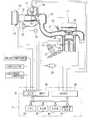
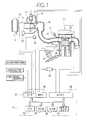
- FIG. 1is a block diagram of an engine control system according to a first embodiment of the present invention
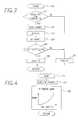
- FIGS. 2 to 4are flowcharts of the engine control system according to the first embodiment of the present invention.
- FIG. 5is a graph showing signals of the system according to the first embodiment of the present invention.
- FIG. 1shows a schematic block diagram of an engine control system of the vehicle according to a first embodiment.
- the present inventionis applied to a bypass air control type ISC system.
- the engine 11has an intake passage 12 and an air cleaner 13 .
- An intake air temperature sensor 14is provided to the air cleaner.
- a throttle valve 15 operated in accordance to an operating amount of an accelerator pedalis disposed in the intake passage 12 .
- a throttle sensor 16is provided to detect an opening degree of the throttle valve 15 .
- the throttle sensor 16has an idle switch (not shown) for detecting a fully closed state of the throttle valve 15 .
- a bypass passage 17is provided to bypass the throttle valve 15 .
- An ISC valve 18for varying a passage area of the bypass passage 17 in response to a drive signal is disposed in the bypass passage.
- a surge tank 19is disposed in a downstream of the throttle valve 15 .
- An intake pressure sensor 20is connected to the surge tank 19 to detect a pressure of air in the surge tank 19 .
- An intake manifold 21is disposed between the surge tank 19 and the engine 11 to provide passages to cylinders of the engine 11 .
- Fuel injectors 22are disposed in each of branch passages of the intake manifold to supply fuel to each of the cylinders.
- a water temperature sensor 25is disposed in a water jacket 24 of the engine 11 to detect a water temperature of the engine 11 as an engine temperature.
- An ignition systemhas an ignition plug 26 , a distributor 27 , a rotational speed sensor 28 for providing a signal indicating a rotational speed NE of the engine 11 and an ignition coil 29 .
- An engine control circuit unit (hereinafter referred to an ECU) 31is constructed as a microcomputer including a CPU 33 , an input circuit having an A/D converter 32 , a ROM 35 , a RAM 36 , a BACK-UP RAM 37 , and an output circuit 38 .
- the ECU 31inputs a plurality of signals such as signals from the sensors 14 , 16 , 20 , 25 and 28 , and signals indicating a load of an air conditioner, a load of electrical devices, a load of a torque converter and the like through the input circuit 34 .
- the ECU 31provides drive signals for the ISC valve 18 , the throttle valve 15 , the injectors 22 and the ignition coil 29 through the output circuit 38 .
- the ECU 31controls the system in accordance with memorized programs such as a fuel injection control, an ignition control and a bypass air control.
- the bypass air controlcontains a feedback control for varying the bypass air amount according to the rotational speed by using a feedback control method and a decrease control for decreasing the bypass air amount compulsorily.
- FIG. 2 through FIG. 4show flowcharts of the feedback control and the decrease control.
- FIG. 2shows a routine for calculating a command value of a bypass air amount. The routine runs every predetermined time by an interrupt processing method.
- FIG. 3shows a routine for determining a deceleration of the engine. The routine determines whether the engine is in a predetermined deceleration state or not, and acts as a means for determining a deceleration.
- FIG. 4shows a routine for calculating a correction value of the bypass air amount.
- the ECU 31reads a learned value QG of the bypass air amount.
- the learned value QGis learned to correct a deviation of a control characteristic, is memorized in the back-up RAM 37 , and renewed at the idle state.
- the ECU 31reads a plurality of correction values. For instance, a water temperature correction value QTHW is obtained by a map or the like according to a water temperature detected by the water temperature sensor 25 .
- An air conditioner correction value QACis obtained by a map or the like according to a load of the air conditioner.
- a rotational speed correction value QNEis obtained by a map according to a changing speed of the rotational speed.
- a feedback correction value QFBis calculated by a usual feedback control method such as a PID control method.
- the feedback correction value QFBis set to control the bypass air amount so that the actual rotational speed is controlled to a target rotational speed.
- the feedback control by using the feedback correction value QFBis started after a completion of the decrease control.
- Such the rotational speed controlacts as a means for controlling the rotational speed at an idle state.
- step 106the routine shown in FIG. 3 is executed.
- step 201it is discriminated that whether a condition is met or not.
- the conditionincludes, the accelerator pedal is not operated by a driver (accel:off), and a vehicle speed is not less than a predetermined value (speed ⁇ THS).
- speed ⁇ THSa predetermined value
- the programproceeds to step 207 , the flag is set “OFF”.
- the programexecutes steps 202 through 206 .
- the ECU 31reads the target rotational speed TARGET and the present rotational speed NE detected by the sensor 28 .
- a difference between the NE and the TARGETis calculated.
- the value THnis defined as a sufficient value to prevent the stall of the engine and the bad vibration.
- the processbranches to step 207 .
- the flagis set “ON” at step 206 .
- the conditionincludes the following conditions: (1) the flag is “ON”, (2) it is not in a fuel-cut mode, (3) the water temperature is not less than a predetermined value, and (4) a rotational speed change. NE is not bigger than a predetermined value.
- the condition (2)prohibits an execution of the decrease control when the engine 11 runs under the fuel-cut mode in which a fuel injection is cut to save fuel.
- the condition (3)prohibits an execution of the decrease control when the engine runs under a cold condition, for avoiding an increasing of an emission of an exhaust, because fuel adhered on a wall is increased when the engine is cold.
- the condition (4)prohibits an execution of the decrease control when the rotational speed of the engine is rapidly lowered, for avoiding an excess drop of the rotating speed and preventing the stall and the vibration of the engine. If any one of the conditions is not met, the program branches “No”, and the correction value QDWN is set “0” at step 108 . On the other hand, in a case of “Yes”, the process proceeds to step 109 and 110 .
- the feedback correction value QFBis set “0” at step 109 .
- the correction value QDWNis calculated.
- the ECU 31reads the difference (NE-TARGET).
- the ECU 31calculates the correction value QDWN according to the difference (NE-TARGET) by using a map or an expression.
- a relationship between the correction value QDWN and the difference (NE-TARGET)is defined so that the correction value QDWN is increased as the difference (NE-TARGET) increases.
- the command value QBSEis calculated by the following expression.
- the ECU 31calculates a duty ratio of the ISC valve 18 according to the command value QBSE, and drives the ISC valve 18 by a driving signal having a calculated duty.
- FIG. 5A typical operation of this embodiment is shown in FIG. 5 by solid lines, the broken line shows that of the prior art.
- the accelerator pedalis released at a time t 1 , when the vehicle runs at some speed.
- the throttle valveis fully closed in response to the accelerator pedal, and the idle switch is turned on.
- the ECU 31turns into the fuel-cut mode.
- the flagis set “ON”.
- the rotational speed of the engineis gradually lowered.
- a time t 2the rotational speed of the engine reaches below a lower limit of the fuel-cut mode, the fuel-cut mode is completed.
- the decrease controlis started when the conditions in step 107 are met at the time t 2 .
- the correction value QDWNis calculated based on the difference between the rotational speed NE and the target rotational speed TARGET, and is subtracted from the basic bypass air amount (QG+QTHW+QAC+QNE). Therefore, the rotational speed is decreased quickly.
- the difference (NE-TARGET)reaches below a predetermined value, the flag is set “OFF” at step 207 , and this causes a completion of the decrease control and a start of the feedback control.
- the ECU 31calculates the QFB by using a usual feedback control method such as a PID control so that the rotational speed becomes the target rotational speed, and adds the QFB to the basic bypass air amount (QG+QTHW+QAC+QNE).
- the bypass air amountcan be set an optimum amount because the bypass air amount is calculated based on the engine operating condition such as the water temperature, the load of the air conditioner, the changing amount of the rotational speed or the like during the decrease control.
- the value NEis replaceable with the other engine operating condition signals indicating a condition that the rotational speed may be rapidly lowered, such as a intake air amount, a intake pressure or the like.
- the decrease controlmay be prohibited when said engine is operated under a condition that an accuracy of an air-fuel ratio control by the fuel injection control may be lowered.
- the basic bypass air amountmay be calculated based on a part of the correction values QG, QTHW, QAC, QNE and QFB.
- the basic bypass air amountmay be calculated based on a further correction values such as a load of an electric device, a load of a torque converter or the like.
- the present inventioncan apply to a direct drive type ISC system which drives the throttle valve directly to control the rotational speed of the engine. In a case of this system, an opening degree of the throttle valve may be calculated based on the command value QBSE. Further, the command value QBSE may be calculated by using the other expression, a map or the like.
Landscapes
- Engineering & Computer Science (AREA)
- Chemical & Material Sciences (AREA)
- Combustion & Propulsion (AREA)
- Mechanical Engineering (AREA)
- General Engineering & Computer Science (AREA)
- Electrical Control Of Air Or Fuel Supplied To Internal-Combustion Engine (AREA)
- Combined Controls Of Internal Combustion Engines (AREA)
Abstract
Description
This application is based on Japanese Patent Application No. Hei 11-193857 filed on Jul. 8, 1999, the content of which is incorporated herein by reference.
1. Field of the Invention
The present invention relates to an apparatus for controlling an internal combustion engine (hereinafter referred to an engine) when the engine is required to decelerate a rotational speed.
2. Description of Related Art
JP-A-63-71539 discloses an idle speed control system (hereinafter referred to an ISC) having an ISC valve for varying an amount of air bypassing a throttle valve. In this apparatus, a target rotational speed is set relatively low to save fuel consumption when an actual rotational speed is slowly lowered. On the contrary, the target rotational speed is set relatively high to prevent an engine stall when the actual rotational speed is rapidly lowered. However, since the system has a delay, the target rotational speed must be set sufficiently high from a final target rotational speed to prevent a stall and a vibration of the engine. Such a high target rotational speed causes a delay on the ISC and increases fuel consumption.
The present invention addresses these drawbacks.
It is therefore an object of this invention to provide an apparatus for preventing a stall of the engine and improving fuel consumption.
It is a further object of this invention to provide an apparatus for controlling the rotational speed of the engine to a target rotational speed quickly.
According to a first aspect of the present invention, an air amount bypassing a throttle valve is decreased according to a difference between an actual rotational speed and a target rotational speed when the engine is operated under a predetermined decelerating state. Therefore, the rotational speed of the engine is quickly lowered.
According to a second aspect of the present invention, a feedback control is started after a completion of the decrease control. Therefore, the rotational speed can be stably maintained at the target rotational speed after a quick lowering by the decrease control.
Other features and advantages of the present invention will be appreciated, as well as methods of operation and the function of the related parts, from a study of the following detailed description, the appended claims, and the drawings, all of which form a part of this application. In the drawings:
FIG. 1 is a block diagram of an engine control system according to a first embodiment of the present invention;
FIGS. 2 to4 are flowcharts of the engine control system according to the first embodiment of the present invention; and
FIG. 5 is a graph showing signals of the system according to the first embodiment of the present invention.
FIG. 1 shows a schematic block diagram of an engine control system of the vehicle according to a first embodiment. In this embodiment, the present invention is applied to a bypass air control type ISC system. Theengine 11 has anintake passage 12 and anair cleaner 13. An intakeair temperature sensor 14 is provided to the air cleaner. Athrottle valve 15 operated in accordance to an operating amount of an accelerator pedal is disposed in theintake passage 12. Athrottle sensor 16 is provided to detect an opening degree of thethrottle valve 15. Thethrottle sensor 16 has an idle switch (not shown) for detecting a fully closed state of thethrottle valve 15. Abypass passage 17 is provided to bypass thethrottle valve 15. AnISC valve 18 for varying a passage area of thebypass passage 17 in response to a drive signal is disposed in the bypass passage. Asurge tank 19 is disposed in a downstream of thethrottle valve 15. Anintake pressure sensor 20 is connected to thesurge tank 19 to detect a pressure of air in thesurge tank 19. Anintake manifold 21 is disposed between thesurge tank 19 and theengine 11 to provide passages to cylinders of theengine 11.Fuel injectors 22 are disposed in each of branch passages of the intake manifold to supply fuel to each of the cylinders. Awater temperature sensor 25 is disposed in awater jacket 24 of theengine 11 to detect a water temperature of theengine 11 as an engine temperature. An ignition system has anignition plug 26, adistributor 27, arotational speed sensor 28 for providing a signal indicating a rotational speed NE of theengine 11 and anignition coil 29. An engine control circuit unit (hereinafter referred to an ECU)31 is constructed as a microcomputer including aCPU 33, an input circuit having an A/D converter 32, aROM 35, aRAM 36, a BACK-UP RAM 37, and anoutput circuit 38. TheECU 31 inputs a plurality of signals such as signals from thesensors input circuit 34. TheECU 31 provides drive signals for theISC valve 18, thethrottle valve 15, theinjectors 22 and theignition coil 29 through theoutput circuit 38. The ECU31 controls the system in accordance with memorized programs such as a fuel injection control, an ignition control and a bypass air control. In this embodiment, the bypass air control contains a feedback control for varying the bypass air amount according to the rotational speed by using a feedback control method and a decrease control for decreasing the bypass air amount compulsorily.
FIG.2 through FIG. 4 show flowcharts of the feedback control and the decrease control. FIG. 2 shows a routine for calculating a command value of a bypass air amount. The routine runs every predetermined time by an interrupt processing method. FIG. 3 shows a routine for determining a deceleration of the engine. The routine determines whether the engine is in a predetermined deceleration state or not, and acts as a means for determining a deceleration. FIG. 4 shows a routine for calculating a correction value of the bypass air amount.
Atstep 101, the ECU31 reads a learned value QG of the bypass air amount. Here, the learned value QG is learned to correct a deviation of a control characteristic, is memorized in the back-up RAM 37, and renewed at the idle state. Atstep 102 throughstep 105, the ECU31 reads a plurality of correction values. For instance, a water temperature correction value QTHW is obtained by a map or the like according to a water temperature detected by thewater temperature sensor 25. An air conditioner correction value QAC is obtained by a map or the like according to a load of the air conditioner. A rotational speed correction value QNE is obtained by a map according to a changing speed of the rotational speed. A feedback correction value QFB is calculated by a usual feedback control method such as a PID control method. In this embodiment, the feedback correction value QFB is set to control the bypass air amount so that the actual rotational speed is controlled to a target rotational speed. The feedback control by using the feedback correction value QFB is started after a completion of the decrease control. Such the rotational speed control acts as a means for controlling the rotational speed at an idle state.
Atstep 106, the routine shown in FIG. 3 is executed. Atstep 201, it is discriminated that whether a condition is met or not. In this embodiment, the condition includes, the accelerator pedal is not operated by a driver (accel:off), and a vehicle speed is not less than a predetermined value (speed≧THS). In a case of “No”, the program proceeds to step207, the flag is set “OFF”.
On the other hand, in a case of “Yes”, the program executessteps 202 through206. Atstep ECU 31 reads the target rotational speed TARGET and the present rotational speed NE detected by thesensor 28. Atstep 204, a difference between the NE and the TARGET is calculated. Atstep 205, it is discriminated whether the difference (NE-TARGET) is not less than the predetermined value THn or not. Here, the value THn is defined as a sufficient value to prevent the stall of the engine and the bad vibration. In a case of “No”, the process branches to step207. In a case of “Yes”, the flag is set “ON” atstep 206.
Referring to FIG. 2 again, atstep 107, it is discriminated whether a condition is met or not. In this embodiment, for instance, the condition includes the following conditions: (1) the flag is “ON”, (2) it is not in a fuel-cut mode, (3) the water temperature is not less than a predetermined value, and (4) a rotational speed change. NE is not bigger than a predetermined value. The condition (2) prohibits an execution of the decrease control when theengine 11 runs under the fuel-cut mode in which a fuel injection is cut to save fuel. The condition (3) prohibits an execution of the decrease control when the engine runs under a cold condition, for avoiding an increasing of an emission of an exhaust, because fuel adhered on a wall is increased when the engine is cold. The condition (4) prohibits an execution of the decrease control when the rotational speed of the engine is rapidly lowered, for avoiding an excess drop of the rotating speed and preventing the stall and the vibration of the engine. If any one of the conditions is not met, the program branches “No”, and the correction value QDWN is set “0” atstep 108. On the other hand, in a case of “Yes”, the process proceeds to step109 and110. The feedback correction value QFB is set “0” at step109. Atstep 110, the correction value QDWN is calculated.
Referring to FIG. 4, atstep 301, theECU 31 reads the difference (NE-TARGET). Atstep 302, theECU 31 calculates the correction value QDWN according to the difference (NE-TARGET) by using a map or an expression. In this embodiment, as shown in FIG. 4, a relationship between the correction value QDWN and the difference (NE-TARGET) is defined so that the correction value QDWN is increased as the difference (NE-TARGET) increases.
Referring to FIG. 2 again, atstep 111, the command value QBSE is calculated by the following expression.
After that, theECU 31 calculates a duty ratio of theISC valve 18 according to the command value QBSE, and drives theISC valve 18 by a driving signal having a calculated duty.
A typical operation of this embodiment is shown in FIG. 5 by solid lines, the broken line shows that of the prior art. Referring to FIG. 5, the accelerator pedal is released at a time t1, when the vehicle runs at some speed. Simultaneously, the throttle valve is fully closed in response to the accelerator pedal, and the idle switch is turned on. In a case that conditions for the fuel-cut mode are met, theECU 31 turns into the fuel-cut mode. Atstep 206, the flag is set “ON”. After that, the rotational speed of the engine is gradually lowered. At a time t2, the rotational speed of the engine reaches below a lower limit of the fuel-cut mode, the fuel-cut mode is completed. Therefore, the decrease control is started when the conditions instep 107 are met at the time t2. During the decrease control, the correction value QDWN is calculated based on the difference between the rotational speed NE and the target rotational speed TARGET, and is subtracted from the basic bypass air amount (QG+QTHW+QAC+QNE). Therefore, the rotational speed is decreased quickly. At a time t3, the difference (NE-TARGET) reaches below a predetermined value, the flag is set “OFF” atstep 207, and this causes a completion of the decrease control and a start of the feedback control. During the feedback control, theECU 31 calculates the QFB by using a usual feedback control method such as a PID control so that the rotational speed becomes the target rotational speed, and adds the QFB to the basic bypass air amount (QG+QTHW+QAC+QNE).
In this embodiment, it is possible to prevent the stall of the engine and the vibration even the rotational speed is lowered quickly, because the bypass air amount is decreased according to the difference (NE-TARGET). Therefore, it is possible to improve fuel consumption, since the rotational speed can be controlled near an idle rotational speed quickly. Further, the bypass air amount can be set an optimum amount because the bypass air amount is calculated based on the engine operating condition such as the water temperature, the load of the air conditioner, the changing amount of the rotational speed or the like during the decrease control.
Alternatively, the value NE is replaceable with the other engine operating condition signals indicating a condition that the rotational speed may be rapidly lowered, such as a intake air amount, a intake pressure or the like. Further, the decrease control may be prohibited when said engine is operated under a condition that an accuracy of an air-fuel ratio control by the fuel injection control may be lowered. Further, the basic bypass air amount may be calculated based on a part of the correction values QG, QTHW, QAC, QNE and QFB. The basic bypass air amount may be calculated based on a further correction values such as a load of an electric device, a load of a torque converter or the like. Further, the present invention can apply to a direct drive type ISC system which drives the throttle valve directly to control the rotational speed of the engine. In a case of this system, an opening degree of the throttle valve may be calculated based on the command value QBSE. Further, the command value QBSE may be calculated by using the other expression, a map or the like.
Although the present invention has been described in connection with the preferred embodiments thereof with reference to the accompanying drawings, it is to be noted that various changes and modifications will be apparent to those skilled in the art. Such changes and modifications are to be understood as being included within the scope of the present invention as defined in the appended claims.
Claims (20)
1. An apparatus for controlling an internal combustion engine at a decelerating state comprising:
means for varying an air amount introduced into said engine;
means for discriminating whether said engine is operated in a predetermined deceleration state or not; and
means for controlling said air amount according to an actual rotational speed and a target rotational speed, wherein said controlling means comprises decreasing means for decreasing said air amount according to a difference between an actual rotational speed and a target rotational speed when said predetermined decelerating state is discriminated by said discriminating means;
wherein said controlling means further comprises prohibiting means for prohibiting decrease control by said decreasing means when a fuel supply to said engine is cut; and
wherein said prohibiting means prohibits said decrease control when said engine is operated under a condition that an accuracy of an air-fuel ratio control may be lowered.
2. An apparatus for controlling an internal combustion engine at a decelerating state comprising:
means for varying an air amount introduced into said engine;
means for discriminating whether said engine is operated in a predetermined deceleration state or not; and
means for controlling said air amount according to a difference between an actual rotational speed and a target rotational speed and a operating condition of said engine;
wherein said controlling means comprises decreasing means for decreasing said air amount and prohibiting means for prohibiting a decrease control by said decreasing means when a fuel supply to said engine is cut; and
wherein said prohibiting means prohibits said decrease control when said engine is operated under a condition that an accuracy of an air-fuel ratio control may be lowered.
3. A method for controlling an internal combustion engine during a decelerating state, the method comprising:
varying an air amount introduced into said engine;
discriminating whether said engine is operated in a predetermined deceleration state or not; and
controlling said air amount according to an actual rotational speed and a target rotational speed;
wherein said controlling comprises decreasing said air amount according to a difference between an actual rotational speed and a target rotational speed when said predetermined decelerating state is discriminated;
wherein decreasing said air amount continually decreases said air by a predetermined amount, said predetermined amount being increased as said difference between an actual rotational speed and a target rotational speed increases; and
wherein said controlling comprises feedback for controlling said air amount by using a feedback control method so that said rotational speed is controlled to a target rotational speed, said feedback control beginning after completion of decrease control during said decreasing of the air amount.
4. A method of controlling an internal combustion engine at a decelerating state, the method comprising:
varying an air amount introduced into said engine;
discriminating whether said engine is operated in a predetermined deceleration state or not; and
controlling said air amount according to a difference between an actual rotational speed and a target rotational speed and an operating condition of said engine;
wherein said controlling comprises feedback controlling said air amount by using a feedback control method so that said rotational speed is controlled to a target rotational speed and decrease controlling in which said air amount is decreased, wherein the feedback control is started after a completion of the decrease control; and
wherein a predetermined amount is decreased from said air amount, said predetermined amount being increased as said difference increases.
5. A method for controlling an internal combustion engine during a decelerating state, the method comprising:
varying an air amount introduced into said engine;
discriminating whether said engine is operated in a predetermined deceleration state or not; and
controlling said air amount according to an actual rotational speed and a target rotational speed;
wherein said controlling comprises decrease controlling said air amount such that the air amount is decreased according to a difference between an actual rotational speed and a target rotational speed when said predetermined decelerating state is discriminated;
wherein the decrease control is prohibited when a fuel supply to said engine is cut; and
wherein the decrease control is prohibited when said engine is operated under a condition that an accuracy of an air-fuel ratio control may be lowered.
6. A method of controlling an internal combustion engine at a decelerating state, the method comprising:
varying an air amount introduced into said engine;
discriminating whether said engine is operated in a predetermined deceleration state or not; and
controlling said air amount according to a difference between an actual rotational speed and a target rotational speed and a operating condition of said engine;
wherein the controlling comprises decreasing said air amount and prohibiting a decrease control when a fuel supply to said engine is cut; and
wherein the decrease control is prohibited when said engine is operated under a condition that an accuracy of an air-fuel ratio control may be lowered.
7. An apparatus for controlling an internal combustion engine at a decelerating state, the apparatus comprising:
an air controller for varying an air amount introduced into said engine;
discriminator for discriminating whether said engine is operated in a predetermined deceleration state or not; and
a controller for controlling said air amount introduced into said engine via the air controller according to an actual rotational speed and a target rotational speed, wherein said controller provides decrease control in which said air amount is decreased according to a difference between an actual rotational speed and a target rotational speed when said predetermined decelerating state is discriminated by said discriminator, the decrease control being accomplished by the controller without using feedback control;
wherein said controller provides feedback control for controlling said air amount by using a feedback control method so that said rotational speed is controlled to a target rotational speed, said feedback control starting after a completion of said decrease control.
8. An apparatus according toclaim 7 , wherein the decrease control comprises decreasing a predetermined amount from said air amount, the predetermined amount being decreased as the difference between the actual and target rotational speeds increases.
9. A method for controlling an internal combustion engine during a decelerating state, the method comprising:
varying an air amount introduced into said engine;
discriminating whether said engine is operated in a predetermined deceleration state or not; and
controlling said air amount according to an actual rotational speed and a target rotational speed;
wherein said controlling comprises a decrease control and a feedback control;
wherein the decrease control includes decreasing said air amount according to a difference between an actual rotational speed and a target rotational speed when said predetermined decelerating state is discriminated, the decrease control being accomplished without using feedback control; and
wherein said feedback control for controlling said air amount includes using a feedback control method so that said rotational speed is controlled to a target rotational speed, said feedback control beginning after completion of said decrease control.
10. The method according toclaim 9 , wherein the decrease control comprises decreasing said air amount by a predetermined amount, the predetermined amount being increased as said difference increases.
11. An apparatus for controlling an internal combustion engine at a decelerating state comprising:
means for varying an air amount introduced into said engine;
means for discriminating whether said engine is operated in a predetermined deceleration state or not; and
means for controlling said air amount according to an actual rotational speed and a target rotational speed, wherein said controlling means comprises decreasing means for decreasing said air amount according to a difference between an actual rotational speed and a target rotational speed when said predetermined decelerating state is discriminated by said discriminating means;
wherein said decreasing means decreases a predetermined amount from said air amount, said predetermined amount being increased as said difference increases; and
wherein said controlling means further comprises feedback means for controlling said air amount by using a feedback control method so that said rotational speed is controlled to a target rotational speed, wherein said feedback means starts said feedback control after a completion of decrease control by said decreasing means.
12. An apparatus for controlling an internal combustion engine at a decelerating state according toclaim 11 , wherein said controlling means further comprises means for calculating a basic air amount, wherein said decreasing means comprises means for calculating a correction value according to said difference and means for subtracting said correction value from said basic air amount.
13. An apparatus for controlling an internal combustion engine at a decelerating state according toclaim 11 , wherein said discriminating means discriminates said predetermined decelerating state when an accelerator is not operated, a vehicle speed is not less than a predetermined speed, and said difference is not less than a predetermined value.
14. An apparatus for controlling an internal combustion engine at a decelerating state according toclaim 11 , wherein said controlling means further comprises prohibiting means for prohibiting said decrease control by said decreasing means when a fuel supply to said engine is cut.
15. An apparatus for controlling an internal combustion engine at a decelerating state according toclaim 14 , wherein said prohibiting means prohibits said decrease control when said engine is operated under a condition that said rotational speed may be dropped excessively.
16. An apparatus for controlling an internal combustion engine at a decelerating state comprising:
means for varying an air amount introduced into said engine;
means for discriminating whether said engine is operated in a predetermined deceleration state or not; and
means for controlling said air amount according to a difference between an actual rotational speed and a target rotational speed and an operating condition of said engine;
wherein controlling means further comprises feedback means for controlling said air amount by using a feedback control method so that said rotational speed is controlled to a target rotational speed and decreasing means for decreasing said amount, wherein said feedback means starts said feedback control after a completion of decrease control by said decreasing means; and
wherein said controlling means decreases a predetermined amount from said air amount, said predetermined amount being increased as said difference increases.
17. An apparatus for controlling an internal combustion engine at a decelerating state according toclaim 16 , wherein said controlling means further comprises means for calculating a basic air amount according to said operating condition, means for calculating a correction value according to said difference and means for subtracting said correction value from said basic air amount.
18. An apparatus for controlling an internal combustion engine at a decelerating state according toclaim 16 , wherein said discriminating means discriminates said predetermined decelerating state when an accelerator is not operated, a vehicle speed is not less than a predetermined speed, and said difference is not less than a predetermined value.
19. An apparatus for controlling an internal combustion engine at a decelerating state according toclaim 16 , wherein said controlling means further comprises decreasing means for decreasing said air amount and prohibiting means for prohibiting a decrease control by said decreasing means when a fuel supply to said engine is cut.
20. An apparatus for controlling an internal combustion engine at a decelerating state according toclaim 19 , wherein said prohibiting means prohibits said decrease control when said engine is operated under a condition that said rotational speed may be dropped excessively.
Applications Claiming Priority (2)
| Application Number | Priority Date | Filing Date | Title |
|---|---|---|---|
| JP11193857AJP2001020788A (en) | 1999-07-08 | 1999-07-08 | Deceleration control system for internal combustion engine |
| JP11-193857 | 1999-07-08 |
Publications (1)
| Publication Number | Publication Date |
|---|---|
| US6394069B1true US6394069B1 (en) | 2002-05-28 |
Family
ID=16314917
Family Applications (1)
| Application Number | Title | Priority Date | Filing Date |
|---|---|---|---|
| US09/608,153Expired - Fee RelatedUS6394069B1 (en) | 1999-07-08 | 2000-06-30 | Apparatus for controlling internal combustion engine at decelerating state |
Country Status (3)
| Country | Link |
|---|---|
| US (1) | US6394069B1 (en) |
| JP (1) | JP2001020788A (en) |
| DE (1) | DE10032902A1 (en) |
Cited By (20)
| Publication number | Priority date | Publication date | Assignee | Title |
|---|---|---|---|---|
| US20020134596A1 (en)* | 2001-03-21 | 2002-09-26 | Kazuhiko Morimoto | Controller of a hybrid vehicle |
| US6820597B1 (en) | 2004-03-05 | 2004-11-23 | Ford Global Technologies, Llc | Engine system and dual fuel vapor purging system with cylinder deactivation |
| US20040237514A1 (en)* | 2002-06-04 | 2004-12-02 | Gopichandra Surnilla | Engine system and method for injector cut-out operation with improved exhaust heating |
| US20050193980A1 (en)* | 2004-03-05 | 2005-09-08 | Jeff Doering | Torque control for engine during cylinder activation or deactivation |
| US20050193997A1 (en)* | 2004-03-05 | 2005-09-08 | Cullen Michael J. | System and method for estimating fuel vapor with cylinder deactivation |
| US20050193719A1 (en)* | 2004-03-05 | 2005-09-08 | Gopichandra Sumilla | System for emission device control with cylinder deactivation |
| US20050193718A1 (en)* | 2004-03-05 | 2005-09-08 | Gopichandra Surnilla | Engine system and method for efficient emission control device purging |
| US20050193986A1 (en)* | 2004-03-05 | 2005-09-08 | Cullen Michael J. | Engine system and fuel vapor purging system with cylinder deactivation |
| US20050197761A1 (en)* | 2004-03-05 | 2005-09-08 | David Bidner | System and method for controlling valve timing of an engine with cylinder deactivation |
| US20050193721A1 (en)* | 2004-03-05 | 2005-09-08 | Gopichandra Surnilla | Emission control device |
| US20050193988A1 (en)* | 2004-03-05 | 2005-09-08 | David Bidner | System for controlling valve timing of an engine with cylinder deactivation |
| US20050193987A1 (en)* | 2004-03-05 | 2005-09-08 | Jeff Doering | Engine system and method accounting for engine misfire |
| US20050272560A1 (en)* | 2004-06-07 | 2005-12-08 | Jeff Doering | System and method for utilizing estimated driver braking effort |
| US6978204B2 (en) | 2004-03-05 | 2005-12-20 | Ford Global Technologies, Llc | Engine system and method with cylinder deactivation |
| US20060243245A1 (en)* | 2003-03-28 | 2006-11-02 | Yasutaka Mine | Idle speed controller of internal, combustion engine, and internal combustion engine controller and internal combustion engine |
| US20070144494A1 (en)* | 2005-12-20 | 2007-06-28 | Yoshinobu Mori | Method and device for controlling combustion of an internal-combustion engine, and vehicle |
| US20070266991A1 (en)* | 2004-06-17 | 2007-11-22 | Toyota Jidosha Kabushiki Kaisha | Control System of Internal Combustion Engine |
| US20080066450A1 (en)* | 2004-03-05 | 2008-03-20 | Ford Global Technologies, Llc | System and Method for Controlling Valve Timing of an Engine with Cylinder Deactivation |
| US20130261859A1 (en)* | 2012-03-28 | 2013-10-03 | Toyota Jidosha Kabushiki Kaisha | Hybrid vehicle |
| US20230212988A1 (en)* | 2022-01-04 | 2023-07-06 | General Electric Company | Versatile control of a propulsion system with a fuel cell |
Families Citing this family (4)
| Publication number | Priority date | Publication date | Assignee | Title |
|---|---|---|---|---|
| DE102005042679B4 (en) | 2005-09-08 | 2013-04-18 | Pierburg Gmbh | Bypass valve for internal combustion engines |
| JP4749281B2 (en)* | 2006-08-31 | 2011-08-17 | 富士通テン株式会社 | Electronic control device and engine control method |
| JP5027062B2 (en) | 2008-06-18 | 2012-09-19 | トヨタ自動車株式会社 | Vehicle and control method thereof |
| CN111946471B (en)* | 2020-07-21 | 2021-11-02 | 东风汽车集团有限公司 | Control Method for Prohibition and Recovery of Engine Idle Speed Fuel Cutoff |
Citations (7)
| Publication number | Priority date | Publication date | Assignee | Title |
|---|---|---|---|---|
| US4570592A (en)* | 1985-01-22 | 1986-02-18 | Honda Giken Kogyo Kabushiki Kaisha | Method of feedback-controlling idling speed of internal combustion engine |
| JPS6371539A (en) | 1986-09-12 | 1988-03-31 | Nippon Denso Co Ltd | Controller for internal combustion engine |
| US5065717A (en)* | 1989-12-28 | 1991-11-19 | Mazda Motor Corporation | Idle speed control system for engine |
| US5191865A (en)* | 1990-09-27 | 1993-03-09 | Mazda Motor Corporation | Engine idle control system for vehicle |
| JPH06299909A (en) | 1994-03-03 | 1994-10-25 | Nissan Motor Co Ltd | Engine intake control device |
| JPH10311236A (en) | 1997-05-13 | 1998-11-24 | Mitsubishi Electric Corp | Intake air amount control device for internal combustion engine |
| JPH11125139A (en)* | 1997-10-23 | 1999-05-11 | Mazda Motor Corp | Intake amount control device for engine |
- 1999
- 1999-07-08JPJP11193857Apatent/JP2001020788A/enactivePending
- 2000
- 2000-06-30USUS09/608,153patent/US6394069B1/ennot_activeExpired - Fee Related
- 2000-07-06DEDE10032902Apatent/DE10032902A1/ennot_activeWithdrawn
Patent Citations (7)
| Publication number | Priority date | Publication date | Assignee | Title |
|---|---|---|---|---|
| US4570592A (en)* | 1985-01-22 | 1986-02-18 | Honda Giken Kogyo Kabushiki Kaisha | Method of feedback-controlling idling speed of internal combustion engine |
| JPS6371539A (en) | 1986-09-12 | 1988-03-31 | Nippon Denso Co Ltd | Controller for internal combustion engine |
| US5065717A (en)* | 1989-12-28 | 1991-11-19 | Mazda Motor Corporation | Idle speed control system for engine |
| US5191865A (en)* | 1990-09-27 | 1993-03-09 | Mazda Motor Corporation | Engine idle control system for vehicle |
| JPH06299909A (en) | 1994-03-03 | 1994-10-25 | Nissan Motor Co Ltd | Engine intake control device |
| JPH10311236A (en) | 1997-05-13 | 1998-11-24 | Mitsubishi Electric Corp | Intake air amount control device for internal combustion engine |
| JPH11125139A (en)* | 1997-10-23 | 1999-05-11 | Mazda Motor Corp | Intake amount control device for engine |
Cited By (40)
| Publication number | Priority date | Publication date | Assignee | Title |
|---|---|---|---|---|
| US20020134596A1 (en)* | 2001-03-21 | 2002-09-26 | Kazuhiko Morimoto | Controller of a hybrid vehicle |
| US6742614B2 (en)* | 2001-03-21 | 2004-06-01 | Suzuki Motor Corporation | Controller of a hybrid vehicle |
| US20040237514A1 (en)* | 2002-06-04 | 2004-12-02 | Gopichandra Surnilla | Engine system and method for injector cut-out operation with improved exhaust heating |
| US7249583B2 (en) | 2002-06-04 | 2007-07-31 | Ford Global Technologies, Llc | System for controlling valve timing of an engine with cylinder deactivation |
| US7069718B2 (en) | 2002-06-04 | 2006-07-04 | Ford Global Technologies, Llc | Engine system and method for injector cut-out operation with improved exhaust heating |
| US20050268880A1 (en)* | 2002-06-04 | 2005-12-08 | David Bidner | System for controlling valve timing of an engine with cylinder deactivation |
| US7311080B2 (en)* | 2003-03-28 | 2007-12-25 | Yamaha Hatsudoki Kabushiki Kaisha | Idle speed controller of internal, combustion engine, and internal combustion engine controller and internal combustion engine |
| US20060243245A1 (en)* | 2003-03-28 | 2006-11-02 | Yasutaka Mine | Idle speed controller of internal, combustion engine, and internal combustion engine controller and internal combustion engine |
| US20050193721A1 (en)* | 2004-03-05 | 2005-09-08 | Gopichandra Surnilla | Emission control device |
| US7086386B2 (en) | 2004-03-05 | 2006-08-08 | Ford Global Technologies, Llc | Engine system and method accounting for engine misfire |
| US20050193986A1 (en)* | 2004-03-05 | 2005-09-08 | Cullen Michael J. | Engine system and fuel vapor purging system with cylinder deactivation |
| US20050193988A1 (en)* | 2004-03-05 | 2005-09-08 | David Bidner | System for controlling valve timing of an engine with cylinder deactivation |
| US20050193987A1 (en)* | 2004-03-05 | 2005-09-08 | Jeff Doering | Engine system and method accounting for engine misfire |
| US7941994B2 (en) | 2004-03-05 | 2011-05-17 | Ford Global Technologies, Llc | Emission control device |
| US20050193718A1 (en)* | 2004-03-05 | 2005-09-08 | Gopichandra Surnilla | Engine system and method for efficient emission control device purging |
| US6978204B2 (en) | 2004-03-05 | 2005-12-20 | Ford Global Technologies, Llc | Engine system and method with cylinder deactivation |
| US7000602B2 (en) | 2004-03-05 | 2006-02-21 | Ford Global Technologies, Llc | Engine system and fuel vapor purging system with cylinder deactivation |
| US7021046B2 (en) | 2004-03-05 | 2006-04-04 | Ford Global Technologies, Llc | Engine system and method for efficient emission control device purging |
| US7025039B2 (en) | 2004-03-05 | 2006-04-11 | Ford Global Technologies, Llc | System and method for controlling valve timing of an engine with cylinder deactivation |
| US7028670B2 (en) | 2004-03-05 | 2006-04-18 | Ford Global Technologies, Llc | Torque control for engine during cylinder activation or deactivation |
| US20050193719A1 (en)* | 2004-03-05 | 2005-09-08 | Gopichandra Sumilla | System for emission device control with cylinder deactivation |
| US7073494B2 (en) | 2004-03-05 | 2006-07-11 | Ford Global Technologies, Llc | System and method for estimating fuel vapor with cylinder deactivation |
| US7073322B2 (en) | 2004-03-05 | 2006-07-11 | Ford Global Technologies, Llc | System for emission device control with cylinder deactivation |
| US20050197761A1 (en)* | 2004-03-05 | 2005-09-08 | David Bidner | System and method for controlling valve timing of an engine with cylinder deactivation |
| US20050193997A1 (en)* | 2004-03-05 | 2005-09-08 | Cullen Michael J. | System and method for estimating fuel vapor with cylinder deactivation |
| US7159387B2 (en) | 2004-03-05 | 2007-01-09 | Ford Global Technologies, Llc | Emission control device |
| US7647766B2 (en) | 2004-03-05 | 2010-01-19 | Ford Global Technologies, Llc | System and method for controlling valve timing of an engine with cylinder deactivation |
| US20050193980A1 (en)* | 2004-03-05 | 2005-09-08 | Jeff Doering | Torque control for engine during cylinder activation or deactivation |
| US7497074B2 (en) | 2004-03-05 | 2009-03-03 | Ford Global Technologies, Llc | Emission control device |
| US6820597B1 (en) | 2004-03-05 | 2004-11-23 | Ford Global Technologies, Llc | Engine system and dual fuel vapor purging system with cylinder deactivation |
| US20080066450A1 (en)* | 2004-03-05 | 2008-03-20 | Ford Global Technologies, Llc | System and Method for Controlling Valve Timing of an Engine with Cylinder Deactivation |
| US7448983B2 (en) | 2004-06-07 | 2008-11-11 | Ford Global Technologies, Llc | System and method for utilizing estimated driver braking effort |
| US20050272560A1 (en)* | 2004-06-07 | 2005-12-08 | Jeff Doering | System and method for utilizing estimated driver braking effort |
| US7395808B2 (en)* | 2004-06-17 | 2008-07-08 | Toyota Jidosha Kabushiki Kaisha | Control system of internal combustion engine |
| US20070266991A1 (en)* | 2004-06-17 | 2007-11-22 | Toyota Jidosha Kabushiki Kaisha | Control System of Internal Combustion Engine |
| US7475677B2 (en)* | 2005-12-20 | 2009-01-13 | Kawasaki Jukogyo Kabushiki Kaisha | Method and device for controlling combustion of an internal-combustion engine, and vehicle |
| US20070144494A1 (en)* | 2005-12-20 | 2007-06-28 | Yoshinobu Mori | Method and device for controlling combustion of an internal-combustion engine, and vehicle |
| US20130261859A1 (en)* | 2012-03-28 | 2013-10-03 | Toyota Jidosha Kabushiki Kaisha | Hybrid vehicle |
| US9145135B2 (en)* | 2012-03-28 | 2015-09-29 | Toyota Jidosha Kabushika Kaisha | Hybrid vehicle |
| US20230212988A1 (en)* | 2022-01-04 | 2023-07-06 | General Electric Company | Versatile control of a propulsion system with a fuel cell |
Also Published As
| Publication number | Publication date |
|---|---|
| JP2001020788A (en) | 2001-01-23 |
| DE10032902A1 (en) | 2001-01-18 |
Similar Documents
| Publication | Publication Date | Title |
|---|---|---|
| US6394069B1 (en) | Apparatus for controlling internal combustion engine at decelerating state | |
| US4779597A (en) | Fail-safe system for vehicle engine | |
| US7099768B2 (en) | Automatic shutdown control for vehicular internal combustion | |
| US5701867A (en) | Apparatus for controlling the speed of an engine | |
| JPH1136946A (en) | Throttle valve control device for internal combustion engine | |
| JP3760591B2 (en) | Engine air volume control device | |
| US4545349A (en) | Method for regulating intake air flow for internal combustion engines | |
| JPH07133740A (en) | Idle control valve diagnostic device | |
| EP0787897B1 (en) | Suction air control apparatus of internal combustion engine | |
| KR100289457B1 (en) | Method for controlling the internal combustion engine during no load at low speed | |
| JPH0774625B2 (en) | Control device for internal combustion engine | |
| JP4472488B2 (en) | Idle operation control method for internal combustion engine | |
| JPH05312076A (en) | Idle speed control device | |
| JPH09287508A (en) | Electronic throttle control device | |
| KR100337340B1 (en) | Method for engine controlling of vehicle | |
| JP3859809B2 (en) | Intake air amount control device for internal combustion engine | |
| KR100305792B1 (en) | Engine air volume control device according to torque converter load and its method | |
| KR100272691B1 (en) | Idle speed control fault determination method | |
| US6832975B2 (en) | Method for controlling an internal combustion engine | |
| JP2666897B2 (en) | Engine throttle valve controller | |
| JPH06221209A (en) | Revolution speed control device of internal combustion engine for vehicle | |
| JP3203790B2 (en) | Fuel injection control device | |
| JPH11200928A (en) | Idling speed control device for vehicle engine | |
| KR100520555B1 (en) | A creep control device of automatic transmission vehicle | |
| JPH044453B2 (en) |
Legal Events
| Date | Code | Title | Description |
|---|---|---|---|
| AS | Assignment | Owner name:DENSO CORPORATION, JAPAN Free format text:ASSIGNMENT OF ASSIGNORS INTEREST;ASSIGNOR:KONDO, WAKICHI;REEL/FRAME:010904/0485 Effective date:20000620 | |
| REMI | Maintenance fee reminder mailed | ||
| LAPS | Lapse for failure to pay maintenance fees | ||
| STCH | Information on status: patent discontinuation | Free format text:PATENT EXPIRED DUE TO NONPAYMENT OF MAINTENANCE FEES UNDER 37 CFR 1.362 | |
| FP | Lapsed due to failure to pay maintenance fee | Effective date:20060528 |