US6339979B1 - Adjustable tool handle - Google Patents
Adjustable tool handleDownload PDFInfo
- Publication number
- US6339979B1 US6339979B1US09/687,106US68710600AUS6339979B1US 6339979 B1US6339979 B1US 6339979B1US 68710600 AUS68710600 AUS 68710600AUS 6339979 B1US6339979 B1US 6339979B1
- Authority
- US
- United States
- Prior art keywords
- handle body
- barrel
- handle
- adjustable tool
- catch
- Prior art date
- Legal status (The legal status is an assumption and is not a legal conclusion. Google has not performed a legal analysis and makes no representation as to the accuracy of the status listed.)
- Expired - Fee Related
Links
- 230000002093peripheral effectEffects0.000claimsdescription24
- 238000010276constructionMethods0.000description1
- 230000008878couplingEffects0.000description1
- 238000010168coupling processMethods0.000description1
- 238000005859coupling reactionMethods0.000description1
Images

Classifications
- B—PERFORMING OPERATIONS; TRANSPORTING
- B25—HAND TOOLS; PORTABLE POWER-DRIVEN TOOLS; MANIPULATORS
- B25G—HANDLES FOR HAND IMPLEMENTS
- B25G1/00—Handle constructions
- B25G1/04—Handle constructions telescopic; extensible; sectional
- B25G1/043—Handle constructions telescopic; extensible; sectional for screwdrivers, wrenches or spanners
- B—PERFORMING OPERATIONS; TRANSPORTING
- B25—HAND TOOLS; PORTABLE POWER-DRIVEN TOOLS; MANIPULATORS
- B25G—HANDLES FOR HAND IMPLEMENTS
- B25G1/00—Handle constructions
- B25G1/06—Handle constructions reversible or adjustable for position
- B25G1/063—Handle constructions reversible or adjustable for position for screwdrivers, wrenches or spanners
- Y—GENERAL TAGGING OF NEW TECHNOLOGICAL DEVELOPMENTS; GENERAL TAGGING OF CROSS-SECTIONAL TECHNOLOGIES SPANNING OVER SEVERAL SECTIONS OF THE IPC; TECHNICAL SUBJECTS COVERED BY FORMER USPC CROSS-REFERENCE ART COLLECTIONS [XRACs] AND DIGESTS
- Y10—TECHNICAL SUBJECTS COVERED BY FORMER USPC
- Y10T—TECHNICAL SUBJECTS COVERED BY FORMER US CLASSIFICATION
- Y10T403/00—Joints and connections
- Y10T403/32—Articulated members
- Y10T403/32254—Lockable at fixed position
- Y10T403/32467—Telescoping members
Definitions
- the present inventionrelates to a tool handle, and more particularly to an adjustable tool handle.
- U.S. Pat. No. 4,711,145 to Inouediscloses a typical tool handle having a bolt rotatably received in the handle body and rotated relative to the handle body to actuate a pawl to engage with a driving head and to secure the driving head relative to the handle at the required angular position.
- the boltmay not be slided or extended relative to the handle body such that the tool handle may not be adjusted to different lengths.
- the present inventionhas arisen to mitigate and/or obviate the afore-described disadvantages of the conventional tool handles.
- the primary objective of the present inventionis to provide an adjustable tool handle which may be easily and quickly adjusted or extended or retracted to the required length.
- an adjustable tool handlecomprising a barrel including a first end, a handle body slidably received in the barrel and extendible and adjustable relative to the barrel, the handle body including a first end slidably received in the barrel and including a channel formed in the first end thereof, the channel of the handle body including two narrower ends and a greater middle portion, and a rod received in the channel of the handle body.
- the barrelis allowed to be slided relative to the handle body when the rod is engaged in the greater middle portion of the channel of the handle body, and the barrel is clamped between the barrel and the handle body to secure the barrel and the handle body together when the rod is engaged in either of the narrower ends of the channel of the handle body.
- the barrelmay thus be easily and quickly adjusted or moved relative to the handle body and may be easily and quickly secured to the handle body by rotating the barrel relative to the handle body.
- a retaining, meansis further provided for retaining the barrel to the handle body and to prevent the barrel from being disengaged from the handle body, and includes an inner peripheral chamber formed in the first end of the barrel, a catch received in the handle body, and means for biasing the catch to engage into the inner peripheral chamber of the barrel.
- the barrelmay thus be prevented from being disengaged from the handle body inadvertently by engaging the catch into the inner peripheral chamber of the barrel.
- the barrelincludes an inclined inner peripheral surface formed in the first end thereof for defining the inner peripheral chamber thereof.
- the handle bodyincludes a longitudinal axis, and includes a reference surface perpendicular to the longitudinal axis of the handle body, and includes a recess formed therein for receiving the catch, and includes a first inclined surface for defining the recess of the handle body, the catch includes a surface engaged with the first inclined surface of the handle body for allowing the catch to be biased to engage with the inclined inner peripheral surface of the barrel.
- a ferruleis secured to the first end of the barrel and includes a peripheral flange extended therefrom for engaging with the catch and for preventing the barrel from being disengaged from the handle body.
- the handle bodyincludes a second end
- the adjustable tool handlefurther includes a coupler rotatably secured to the second end of the handle body with a pivot shaft and having a stud extended therefrom, a driving tool, and means for latching the driving tool to the stud of the coupler.
- the latching meansincludes an orifice formed in the stud, a ball received in the orifice of the stud, a latch slidably received in the stud and having a cavity formed therein for receiving the ball, and means for biasing the latch to force the ball outward of the orifice of the stud and to engage with the driving tool.
- the handle bodyincludes an ear provided in the second end thereof and having a bulge formed therein and defined by at least one surface, the latch is moved against the biasing means by the bulge when the coupler is rotated relative to the handle body and when the latch is engaged with the bulge of the handle body.
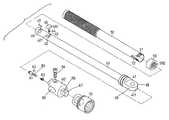
- FIG. 1is an exploded view of an adjustable tool handle in accordance with the present invention
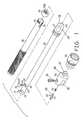
- FIG. 2is a partial cross sectional view of the driving mechanism of the tool
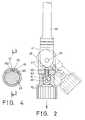
- FIG. 3is a partial cross sectional view taken along lines 3 — 3 of FIG. 4;
- FIG. 4is a cross sectional view taken along lines 4 — 4 of FIG. 3;
- FIG. 5is a partial cross sectional view similar to FIG. 3, illustrating the operation of the adjustable tool handle.
- the ear 41includes a bulge 411 formed thereon, particularly formed on the outer and middle portion thereof and defined by a pair of opposite depressions or flat surfaces 48 , best shown in FIG. 2.
- a coupler 60includes a slot 66 formed therein for rotatably receiving the ear 41 which is rotatably or pivotally secured to the coupler 60 with a pivot shaft 64 .
- the coupler 60includes a stud 67 extended therefrom for coupling to a driving tool, such as a driving socket 70 , the stud 67 includes an orifice 68 formed therein for receiving a ball 62 therein.
- a latch 61is slidably received in the stud 67 and extended inward of the slot 66 of the coupler 60 for engaging with the bulge 411 of the ear 41 .
- the latch 61includes a cavity 69 formed therein for receiving the ball 62 , best shown in FIG. 2, and for allowing the driving tool 70 to be engaged onto or disengaged from the stud 67 .
- a spring 63is engaged with the latch 61 for biasing the latch 61 to force the ball 62 outward through the orifice 68 of the stud 67 and to engage with the driving tool 70 in order to solidly secure the driving tool 70 to the coupler 60 .
- the coupler 60when the coupler 60 is rotated relative to the handle body 40 to the position in line with the handle body 40 , the bulge 411 of the ear 41 may engage with the latch 61 and may move the latch 61 against the spring in order to receive the ball 61 , in the cavity 69 of the latch 61 .
- the driving tool 70may be easily disengaged from the stud 67 of the coupler 60 and may be replaced with the other driving tool 70 .
- the coupler 60is rotated relative to the handle body 40 to disengage the bulge 411 of the ear 41 from the latch 61 , as shown in dotted lines in FIG.
- the latch 61may be forced to engage with the depressions or the surfaces 48 of the ear 41 and may be biased to engage with the ball 62 and to force the ball 62 to engage with the driving tool 70 and to solidly retain the driving tool 70 to the stud of the coupler 60 .
- a barrel 50is rotatably engaged on the handle body 40 and includes an outer thread 51 formed on one end, such as the front end, thereof and includes a frustum-shaped or an inclined inner peripheral surface 52 formed in the front end thereof for defining or for forming a peripheral chamber 57 between the handle body 40 and the front end of the barrel 50 (FIGS. 3, 5 ).
- a ferrule 53is threaded to the outer thread 51 of the barrel 50 and includes one end, such as the front end, thereof having an inner peripheral flange 530 formed thereon or extended radially inward therefrom for forming an inner peripheral shoulder 531 therein (FIGS. 3, 5 ).
- a rod 47is received in the channel 46 of the handle body 40 .
- the channel 46includes two narrower ends 461 having a width smaller than the outer diameter of the rod 47 , and includes a greater middle portion 463 (FIG. 4) having a width no less than the outer diameter of the rod 47 .
- the barrel 50may be slided relative to the handle body 40 to any suitable or selected position relative to the handle body 40 .
- the rod 47may be forced to engage in either of the narrower ends 461 of the channel 46 of the channel body 40 and to be engaged between the barrel 50 and the handle body 40 in order to secure the barrel 50 and the handle body 40 together.
- the barrel 50may thus be easily and quickly extended or adjusted relative to the handle body 40 and may be easily and quickly secured to the handle body 40 at the required relative position when the rod 47 is forced to be engaged or clamped between the barrel 50 and the handle body 40 .
- the handle body 40includes one or more surfaces 421 for defining the recess 42 thereof, and includes an aperture 43 formed therein and communicating with the recess 42 thereof for receiving a spring 44 therein.
- a catch 45is slidably received in the recess 42 of the handle body 40 and engaged with the spring 44 and includes one or more surfaces 451 for engaging with the corresponding surfaces 421 of the handle body 40 .
- the catch 45may be biased inward of the peripheral chamber 57 of the barrel 50 (FIG. 5) when the barrel 50 is slided relative to the handle body 40 . As best shown in FIGS.
- the surfaces 431 , 451 of the handle body 40 and of the catch 45are not perpendicular to the longitudinal axis 71 of the handle body 40 and are inclined relative to a reference line or surface 73 that is perpendicular to the longitudinal axis 71 of the handle body 40 , such that the catch 45 may be biased into the peripheral chamber 57 of the barrel 50 and to engage with the inclined inner peripheral surface 52 of the barrel 50 and to engage with the peripheral shoulder 531 and the peripheral flange 530 of the ferrule 53 .
- the catch 45may limit the further relative movement between the barrel 50 and the handle body 40 and may prevent the barrel 50 from being disengaged from the handle body 40 .
- the adjustable tool handle in accordance with the present inventionmay be easily and quickly adjusted or extended or retracted to the required length and may prevent the barrel from being disengaged from the handle body.
Landscapes
- Engineering & Computer Science (AREA)
- Mechanical Engineering (AREA)
- Details Of Spanners, Wrenches, And Screw Drivers And Accessories (AREA)
Abstract
Description
1. Field of the Invention
The present invention relates to a tool handle, and more particularly to an adjustable tool handle.
2. Description of the Prior Art
U.S. Pat. No. 4,711,145 to Inoue discloses a typical tool handle having a bolt rotatably received in the handle body and rotated relative to the handle body to actuate a pawl to engage with a driving head and to secure the driving head relative to the handle at the required angular position. The bolt may not be slided or extended relative to the handle body such that the tool handle may not be adjusted to different lengths.
The present invention has arisen to mitigate and/or obviate the afore-described disadvantages of the conventional tool handles.
The primary objective of the present invention is to provide an adjustable tool handle which may be easily and quickly adjusted or extended or retracted to the required length.
In accordance with one aspect of the invention, there is provided an adjustable tool handle comprising a barrel including a first end, a handle body slidably received in the barrel and extendible and adjustable relative to the barrel, the handle body including a first end slidably received in the barrel and including a channel formed in the first end thereof, the channel of the handle body including two narrower ends and a greater middle portion, and a rod received in the channel of the handle body. The barrel is allowed to be slided relative to the handle body when the rod is engaged in the greater middle portion of the channel of the handle body, and the barrel is clamped between the barrel and the handle body to secure the barrel and the handle body together when the rod is engaged in either of the narrower ends of the channel of the handle body. The barrel may thus be easily and quickly adjusted or moved relative to the handle body and may be easily and quickly secured to the handle body by rotating the barrel relative to the handle body.
A retaining, means is further provided for retaining the barrel to the handle body and to prevent the barrel from being disengaged from the handle body, and includes an inner peripheral chamber formed in the first end of the barrel, a catch received in the handle body, and means for biasing the catch to engage into the inner peripheral chamber of the barrel. The barrel may thus be prevented from being disengaged from the handle body inadvertently by engaging the catch into the inner peripheral chamber of the barrel.
The barrel includes an inclined inner peripheral surface formed in the first end thereof for defining the inner peripheral chamber thereof. The handle body includes a longitudinal axis, and includes a reference surface perpendicular to the longitudinal axis of the handle body, and includes a recess formed therein for receiving the catch, and includes a first inclined surface for defining the recess of the handle body, the catch includes a surface engaged with the first inclined surface of the handle body for allowing the catch to be biased to engage with the inclined inner peripheral surface of the barrel.
A ferrule is secured to the first end of the barrel and includes a peripheral flange extended therefrom for engaging with the catch and for preventing the barrel from being disengaged from the handle body.
The handle body includes a second end, the adjustable tool handle further includes a coupler rotatably secured to the second end of the handle body with a pivot shaft and having a stud extended therefrom, a driving tool, and means for latching the driving tool to the stud of the coupler.
The latching means includes an orifice formed in the stud, a ball received in the orifice of the stud, a latch slidably received in the stud and having a cavity formed therein for receiving the ball, and means for biasing the latch to force the ball outward of the orifice of the stud and to engage with the driving tool.
The handle body includes an ear provided in the second end thereof and having a bulge formed therein and defined by at least one surface, the latch is moved against the biasing means by the bulge when the coupler is rotated relative to the handle body and when the latch is engaged with the bulge of the handle body.
Further objectives and advantages of the present invention will become apparent from a careful reading of a detailed description provided hereinbelow, with appropriate reference to accompanying drawings.
FIG. 1 is an exploded view of an adjustable tool handle in accordance with the present invention;
FIG. 2 is a partial cross sectional view of the driving mechanism of the tool;
FIG. 3 is a partial cross sectional view taken alonglines 3—3 of FIG. 4;
FIG. 4 is a cross sectional view taken alonglines 4—4 of FIG. 3; and
FIG. 5 is a partial cross sectional view similar to FIG. 3, illustrating the operation of the adjustable tool handle.
Referring to the drawings, and initially to FIGS. 1 and 2, an adjustable tool handle in accordance with the present invention comprises ahandle body 40 including anear 41 formed on one end including arecess 42 and achannel 46 formed in the other end thereof. Theear 41 includes abulge 411 formed thereon, particularly formed on the outer and middle portion thereof and defined by a pair of opposite depressions orflat surfaces 48, best shown in FIG. 2. Acoupler 60 includes aslot 66 formed therein for rotatably receiving theear 41 which is rotatably or pivotally secured to thecoupler 60 with apivot shaft 64. Thecoupler 60 includes astud 67 extended therefrom for coupling to a driving tool, such as adriving socket 70, thestud 67 includes anorifice 68 formed therein for receiving aball 62 therein. Alatch 61 is slidably received in thestud 67 and extended inward of theslot 66 of thecoupler 60 for engaging with thebulge 411 of theear 41. Thelatch 61 includes acavity 69 formed therein for receiving theball 62, best shown in FIG. 2, and for allowing thedriving tool 70 to be engaged onto or disengaged from thestud 67. Aspring 63 is engaged with thelatch 61 for biasing thelatch 61 to force theball 62 outward through theorifice 68 of thestud 67 and to engage with thedriving tool 70 in order to solidly secure thedriving tool 70 to thecoupler 60.
In operation, as shown in solid lines in FIG. 2, when thecoupler 60 is rotated relative to thehandle body 40 to the position in line with thehandle body 40, thebulge 411 of theear 41 may engage with thelatch 61 and may move thelatch 61 against the spring in order to receive theball 61, in thecavity 69 of thelatch 61. At this moment, thedriving tool 70 may be easily disengaged from thestud 67 of thecoupler 60 and may be replaced with theother driving tool 70. When thecoupler 60 is rotated relative to thehandle body 40 to disengage thebulge 411 of theear 41 from thelatch 61, as shown in dotted lines in FIG. 2, thelatch 61 may be forced to engage with the depressions or thesurfaces 48 of theear 41 and may be biased to engage with theball 62 and to force theball 62 to engage with thedriving tool 70 and to solidly retain thedriving tool 70 to the stud of thecoupler 60.
Referring next to FIGS. 3,4 and again to FIG. 1, abarrel 50 is rotatably engaged on thehandle body 40 and includes anouter thread 51 formed on one end, such as the front end, thereof and includes a frustum-shaped or an inclined innerperipheral surface 52 formed in the front end thereof for defining or for forming aperipheral chamber 57 between thehandle body 40 and the front end of the barrel50 (FIGS. 3,5). Aferrule 53 is threaded to theouter thread 51 of thebarrel 50 and includes one end, such as the front end, thereof having an innerperipheral flange 530 formed thereon or extended radially inward therefrom for forming an innerperipheral shoulder 531 therein (FIGS. 3,5). Arod 47 is received in thechannel 46 of thehandle body 40. Thechannel 46 includes twonarrower ends 461 having a width smaller than the outer diameter of therod 47, and includes a greater middle portion463 (FIG. 4) having a width no less than the outer diameter of therod 47.
In operation, when thebarrel 50 is rotated relative to thehandle body 40 to receive therod 47 in thegreater middle portion 463 of thechannel 46 of thehandle body 40, thebarrel 50 may be slided relative to thehandle body 40 to any suitable or selected position relative to thehandle body 40. When thebarrel 50 is rotated relative to thehandle body 40, therod 47 may be forced to engage in either of thenarrower ends 461 of thechannel 46 of thechannel body 40 and to be engaged between thebarrel 50 and thehandle body 40 in order to secure thebarrel 50 and thehandle body 40 together. Thebarrel 50 may thus be easily and quickly extended or adjusted relative to thehandle body 40 and may be easily and quickly secured to thehandle body 40 at the required relative position when therod 47 is forced to be engaged or clamped between thebarrel 50 and thehandle body 40.
As shown in FIGS. 1 and 3, thehandle body 40 includes one ormore surfaces 421 for defining therecess 42 thereof, and includes anaperture 43 formed therein and communicating with therecess 42 thereof for receiving aspring 44 therein. Acatch 45 is slidably received in therecess 42 of thehandle body 40 and engaged with thespring 44 and includes one ormore surfaces 451 for engaging with thecorresponding surfaces 421 of thehandle body 40. Thecatch 45 may be biased inward of theperipheral chamber 57 of the barrel50 (FIG. 5) when thebarrel 50 is slided relative to thehandle body 40. As best shown in FIGS. 3 and 5, thesurfaces 431,451 of thehandle body 40 and of thecatch 45 are not perpendicular to thelongitudinal axis 71 of thehandle body 40 and are inclined relative to a reference line orsurface 73 that is perpendicular to thelongitudinal axis 71 of thehandle body 40, such that thecatch 45 may be biased into theperipheral chamber 57 of thebarrel 50 and to engage with the inclined innerperipheral surface 52 of thebarrel 50 and to engage with theperipheral shoulder 531 and theperipheral flange 530 of theferrule 53.
In operation, as shown in FIG. 5, when thebarrel 50 is moved relative to thehandle body 40 until thecatch 45 is biased to engage into theperipheral chamber 57 of thebarrel 50 and to engage with theperipheral flange 530 of theferrule 53, thecatch 45 may limit the further relative movement between thebarrel 50 and thehandle body 40 and may prevent thebarrel 50 from being disengaged from thehandle body 40.
Accordingly, the adjustable tool handle in accordance with the present invention may be easily and quickly adjusted or extended or retracted to the required length and may prevent the barrel from being disengaged from the handle body.
Although this invention has been described with a certain degree of particularity, it is to be understood that the present disclosure has been made by way of example only and that numerous changes in the detailed construction and the combination and arrangement of parts may be resorted to without departing from the spirit and scope of the invention as hereinafter claimed.
Claims (9)
1. An adjustable tool handle comprising:
a barrel including a first end,
a handle body slidably received in said barrel and extendible and adjustable relative to said barrel, said handle body including a first end slidably received in said barrel and including a channel formed in said first end thereof, said channel of said handle body including two narrower ends and a greater middle portion, and
a rod received in said channel of said handle body,
said barrel being allowed to be slided relative to said handle body when said rod is engaged in said greater middle portion of said channel of said handle body, and said barrel being clamped between said barrel and said handle body to secure said barrel and said handle body together when said rod is engaged in either of said narrower ends of said channel of said handle body.
2. The adjustable tool handle according toclaim 1 further comprising retaining means for retaining said barrel to said handle body and to prevent said barrel from being disengaged from said handle body.
3. The adjustable tool handle according toclaim 2 , wherein said retaining means includes an inner peripheral chamber formed in said first end of said barrel, a catch received in said handle body, and means for biasing said catch to engage into said inner peripheral chamber of said barrel.
4. The adjustable tool handle according toclaim 3 , wherein said barrel includes an inclined inner peripheral surface formed in said first end thereof for defining said inner peripheral chamber thereof.
5. The adjustable tool handle according toclaim 4 , wherein said handle body includes a longitudinal axis, and includes a reference surface perpendicular to said longitudinal axis of said handle body, and includes a recess formed therein for receiving said catch, and includes a first inclined surface for defining said recess of said handle body, said catch includes a surface engaged with said first inclined surface of said handle body for allowing said catch to be biased to engage with said inclined inner peripheral surface of said barrel.
6. The adjustable tool handle according toclaim 3 further comprising a ferrule secured to said first end of said barrel, said ferrule including a peripheral flange extended therefrom for engaging with said catch and for preventing said barrel from being disengaged from said handle body.
7. The adjustable tool handle according toclaim 1 , wherein said handle body includes a second end, said adjustable tool handle further includes a coupler rotatably secured to said second end of said handle body with a pivot shaft and having a stud extended therefrom, a driving tool, and means for latching said driving tool to said stud of said coupler.
8. The adjustable tool handle according toclaim 7 , wherein said latching means includes an orifice formed in said stud, a ball received in said orifice of said stud, a latch slidably received in said stud and having a cavity formed therein for receiving said ball, and means for biasing, said latch to force said ball outward of said orifice of said stud and to engage with said driving tool.
9. The adjustable tool handle according toclaim 8 , wherein said handle body includes an ear provided in said second end thereof and having a bulge formed therein and defined by at least one surface, said latch is moved against said biasing means by said bulge when said coupler is rotated relative to said handle body and when said latch is engaged with said bulge of said handle body.
Priority Applications (1)
| Application Number | Priority Date | Filing Date | Title |
|---|---|---|---|
| US09/687,106US6339979B1 (en) | 2000-10-16 | 2000-10-16 | Adjustable tool handle |
Applications Claiming Priority (1)
| Application Number | Priority Date | Filing Date | Title |
|---|---|---|---|
| US09/687,106US6339979B1 (en) | 2000-10-16 | 2000-10-16 | Adjustable tool handle |
Publications (1)
| Publication Number | Publication Date |
|---|---|
| US6339979B1true US6339979B1 (en) | 2002-01-22 |
Family
ID=24759068
Family Applications (1)
| Application Number | Title | Priority Date | Filing Date |
|---|---|---|---|
| US09/687,106Expired - Fee RelatedUS6339979B1 (en) | 2000-10-16 | 2000-10-16 | Adjustable tool handle |
Country Status (1)
| Country | Link |
|---|---|
| US (1) | US6339979B1 (en) |
Cited By (32)
| Publication number | Priority date | Publication date | Assignee | Title |
|---|---|---|---|---|
| US20040145141A1 (en)* | 2003-01-23 | 2004-07-29 | The Electric Transportation Company, Llc | Vehicle hinge assembly |
| US20040187261A1 (en)* | 2003-03-27 | 2004-09-30 | Hans-Christoph Haenlein | Friction hinge |
| US6874392B1 (en)* | 2003-07-25 | 2005-04-05 | Keng Hao Wu | Connector of hand tool |
| US20050204873A1 (en)* | 2004-03-22 | 2005-09-22 | Ana Giovanni S | Tool handle extension |
| US20050246851A1 (en)* | 2004-05-05 | 2005-11-10 | Rubbermaid Commercial Products Llc | Color coded mop pads and method of color coding same |
| US20050252921A1 (en)* | 2004-05-05 | 2005-11-17 | Rubbermaid Commercial Products Llc | Disinfecting bucket |
| USD528729S1 (en) | 2005-05-10 | 2006-09-19 | Rubbermaid Commerical Products Llc | Cart |
| USD529294S1 (en) | 2005-01-31 | 2006-10-03 | Rubbermaid Commercial Products Llc | Universal joint |
| GB2425980A (en)* | 2005-05-11 | 2006-11-15 | King Hawk Co Ltd | Socket wrench with a positioning structure |
| US7137323B1 (en)* | 2005-08-11 | 2006-11-21 | Chih-Ching Hsieh | Replaceable and rotatable tool with function of measuring twisting forces |
| USD533356S1 (en) | 2005-01-31 | 2006-12-12 | Rubbermaid Commercial Products Llc | Universal joint |
| US20070062343A1 (en)* | 2005-09-22 | 2007-03-22 | Dodson Gerald K Jr | Breaker bar for heavy duty applications |
| US20070067935A1 (en)* | 2005-09-29 | 2007-03-29 | Tien-Shih Lin | Mop assembly having therein a rotatable device to allow a mop head to rotate relative to stick and a positioning device to allow the stick to be positioned when not in use |
| US20070107165A1 (en)* | 2003-03-19 | 2007-05-17 | Remy Oddo | Anti-vibratory handle for percussive and other reciprocating tools |
| US20070131070A1 (en)* | 2005-12-14 | 2007-06-14 | Hull Ricky E | Tool having a telescoping handle |
| US20070143967A1 (en)* | 2005-12-22 | 2007-06-28 | Robert Newman | On-the-go adjustable extension pole providing hands-free tool connection and disconnection |
| USD547017S1 (en) | 2005-05-10 | 2007-07-17 | Rubbermaid Commercial Products Llc | Mop handle |
| USD548913S1 (en) | 2005-05-10 | 2007-08-14 | Rubbermaid Commercial Products Llc | Mop bucket and wringer |
| USD549414S1 (en) | 2005-01-31 | 2007-08-21 | Rubbermaid Commercial Products Llc | Mop frame |
| USD549912S1 (en) | 2007-01-12 | 2007-08-28 | Rubbermaid Commercial Products Llc | Mop |
| US20080023085A1 (en)* | 2006-07-28 | 2008-01-31 | Michael Scot Rosko | Mixing valve |
| USD563751S1 (en)* | 2006-08-18 | 2008-03-11 | Lanz Donald D | Socket mount, angle adjustable tool holder for extension poles |
| US20080163726A1 (en)* | 2007-01-05 | 2008-07-10 | Wente Steve R | Adjustable tool extender |
| US20100050825A1 (en)* | 2007-04-30 | 2010-03-04 | Brett Kelly May | Hand tool embodying extensible handle |
| US20110197984A1 (en)* | 2006-07-28 | 2011-08-18 | Kurt Judson Thomas | Mixing valve |
| US20120045963A1 (en)* | 2010-08-20 | 2012-02-23 | Moss James P | Striker for calling game and method |
| US20120186401A1 (en)* | 2011-01-21 | 2012-07-26 | Chia-Yu Chen | Multi-function socket wrench |
| US20130228051A1 (en)* | 2012-03-03 | 2013-09-05 | Chin-Tan Huang | Telescopic hand tool |
| US8683657B2 (en)* | 2012-08-29 | 2014-04-01 | Thomas Lin | Press button-controlled retractable bar |
| CN104858821A (en)* | 2015-05-20 | 2015-08-26 | 赵静 | Foldable mechanical spanner |
| USD935856S1 (en)* | 2019-10-25 | 2021-11-16 | Yi-Cheng Li | Wrench |
| US11465270B2 (en)* | 2019-09-21 | 2022-10-11 | Sebastian Fodera | Expendable hydrant wrench |
Citations (5)
| Publication number | Priority date | Publication date | Assignee | Title |
|---|---|---|---|---|
| US4711145A (en) | 1986-07-24 | 1987-12-08 | Isao Inoue | Ratchet handle |
| US4905548A (en)* | 1988-12-02 | 1990-03-06 | Colace Ronald J | Adjustable socket wrench extension |
| US5471899A (en)* | 1994-01-05 | 1995-12-05 | Twomlow; Daniel B. | Extensible ratchet wrench |
| US5931065A (en)* | 1997-05-19 | 1999-08-03 | Jackson; Roger Lee | Hand tool with axially repositionable shaft |
| US6058814A (en)* | 1998-01-05 | 2000-05-09 | Johnson; Russell | Extendable tool |
- 2000
- 2000-10-16USUS09/687,106patent/US6339979B1/ennot_activeExpired - Fee Related
Patent Citations (5)
| Publication number | Priority date | Publication date | Assignee | Title |
|---|---|---|---|---|
| US4711145A (en) | 1986-07-24 | 1987-12-08 | Isao Inoue | Ratchet handle |
| US4905548A (en)* | 1988-12-02 | 1990-03-06 | Colace Ronald J | Adjustable socket wrench extension |
| US5471899A (en)* | 1994-01-05 | 1995-12-05 | Twomlow; Daniel B. | Extensible ratchet wrench |
| US5931065A (en)* | 1997-05-19 | 1999-08-03 | Jackson; Roger Lee | Hand tool with axially repositionable shaft |
| US6058814A (en)* | 1998-01-05 | 2000-05-09 | Johnson; Russell | Extendable tool |
Cited By (46)
| Publication number | Priority date | Publication date | Assignee | Title |
|---|---|---|---|---|
| US20040145141A1 (en)* | 2003-01-23 | 2004-07-29 | The Electric Transportation Company, Llc | Vehicle hinge assembly |
| US20070107165A1 (en)* | 2003-03-19 | 2007-05-17 | Remy Oddo | Anti-vibratory handle for percussive and other reciprocating tools |
| US7669290B2 (en)* | 2003-03-19 | 2010-03-02 | Universite De Sherbrooke | Anti-vibratory handle for percussive and other reciprocating tools |
| US20040187261A1 (en)* | 2003-03-27 | 2004-09-30 | Hans-Christoph Haenlein | Friction hinge |
| US7032272B2 (en)* | 2003-03-27 | 2006-04-25 | Masco Corporation Of Indiana | Friction hinge |
| US6874392B1 (en)* | 2003-07-25 | 2005-04-05 | Keng Hao Wu | Connector of hand tool |
| US20050204873A1 (en)* | 2004-03-22 | 2005-09-22 | Ana Giovanni S | Tool handle extension |
| US20050246851A1 (en)* | 2004-05-05 | 2005-11-10 | Rubbermaid Commercial Products Llc | Color coded mop pads and method of color coding same |
| US20050252921A1 (en)* | 2004-05-05 | 2005-11-17 | Rubbermaid Commercial Products Llc | Disinfecting bucket |
| USD529294S1 (en) | 2005-01-31 | 2006-10-03 | Rubbermaid Commercial Products Llc | Universal joint |
| USD549414S1 (en) | 2005-01-31 | 2007-08-21 | Rubbermaid Commercial Products Llc | Mop frame |
| USD533356S1 (en) | 2005-01-31 | 2006-12-12 | Rubbermaid Commercial Products Llc | Universal joint |
| USD548913S1 (en) | 2005-05-10 | 2007-08-14 | Rubbermaid Commercial Products Llc | Mop bucket and wringer |
| USD547017S1 (en) | 2005-05-10 | 2007-07-17 | Rubbermaid Commercial Products Llc | Mop handle |
| USD528729S1 (en) | 2005-05-10 | 2006-09-19 | Rubbermaid Commerical Products Llc | Cart |
| GB2425980B (en)* | 2005-05-11 | 2007-08-29 | King Hawk Co Ltd | Socket wrench having a positioning structure |
| GB2425980A (en)* | 2005-05-11 | 2006-11-15 | King Hawk Co Ltd | Socket wrench with a positioning structure |
| US7137323B1 (en)* | 2005-08-11 | 2006-11-21 | Chih-Ching Hsieh | Replaceable and rotatable tool with function of measuring twisting forces |
| US20070062343A1 (en)* | 2005-09-22 | 2007-03-22 | Dodson Gerald K Jr | Breaker bar for heavy duty applications |
| US20070067935A1 (en)* | 2005-09-29 | 2007-03-29 | Tien-Shih Lin | Mop assembly having therein a rotatable device to allow a mop head to rotate relative to stick and a positioning device to allow the stick to be positioned when not in use |
| US7540057B2 (en)* | 2005-09-29 | 2009-06-02 | Dikai International Enterprises Ltd. | Mop assembly having therein a rotatable device to allow a mop head to rotate relative to stick and a positioning device to allow the stick to be positioned when not in use |
| US20070131070A1 (en)* | 2005-12-14 | 2007-06-14 | Hull Ricky E | Tool having a telescoping handle |
| US7677140B2 (en) | 2005-12-14 | 2010-03-16 | Ricky Eugene Hull | Tool having a telescoping handle |
| US20070143967A1 (en)* | 2005-12-22 | 2007-06-28 | Robert Newman | On-the-go adjustable extension pole providing hands-free tool connection and disconnection |
| US7716790B2 (en)* | 2005-12-22 | 2010-05-18 | Robert D. Newman, Jr. | On-the-go adjustable extension pole providing hands-free tool connection and disconnection |
| US20080023085A1 (en)* | 2006-07-28 | 2008-01-31 | Michael Scot Rosko | Mixing valve |
| US8578966B2 (en) | 2006-07-28 | 2013-11-12 | Masco Corporation Of Indiana | Mixing valve |
| US7753074B2 (en) | 2006-07-28 | 2010-07-13 | Masco Corporation Of Indiana | Mixing valve |
| US20100252131A1 (en)* | 2006-07-28 | 2010-10-07 | Michael Scot Rosko | Mixing valve |
| US7980268B2 (en) | 2006-07-28 | 2011-07-19 | Masco Corporation Of Indiana | Mixing valve |
| US20110197984A1 (en)* | 2006-07-28 | 2011-08-18 | Kurt Judson Thomas | Mixing valve |
| US8671984B2 (en) | 2006-07-28 | 2014-03-18 | Masco Corporation Of Indiana | Mixing valve |
| USD563751S1 (en)* | 2006-08-18 | 2008-03-11 | Lanz Donald D | Socket mount, angle adjustable tool holder for extension poles |
| US20080163726A1 (en)* | 2007-01-05 | 2008-07-10 | Wente Steve R | Adjustable tool extender |
| US8534165B2 (en) | 2007-01-05 | 2013-09-17 | Snap-On Incorporated | Adjustable tool extender |
| USD549912S1 (en) | 2007-01-12 | 2007-08-28 | Rubbermaid Commercial Products Llc | Mop |
| US20100050825A1 (en)* | 2007-04-30 | 2010-03-04 | Brett Kelly May | Hand tool embodying extensible handle |
| US9155296B2 (en)* | 2010-08-20 | 2015-10-13 | Evergreen Hunting Llc | Striker for calling game and method |
| US20120045963A1 (en)* | 2010-08-20 | 2012-02-23 | Moss James P | Striker for calling game and method |
| US8342060B2 (en)* | 2011-01-21 | 2013-01-01 | Chia-Yu Chen | Multi-function socket wrench |
| US20120186401A1 (en)* | 2011-01-21 | 2012-07-26 | Chia-Yu Chen | Multi-function socket wrench |
| US20130228051A1 (en)* | 2012-03-03 | 2013-09-05 | Chin-Tan Huang | Telescopic hand tool |
| US8683657B2 (en)* | 2012-08-29 | 2014-04-01 | Thomas Lin | Press button-controlled retractable bar |
| CN104858821A (en)* | 2015-05-20 | 2015-08-26 | 赵静 | Foldable mechanical spanner |
| US11465270B2 (en)* | 2019-09-21 | 2022-10-11 | Sebastian Fodera | Expendable hydrant wrench |
| USD935856S1 (en)* | 2019-10-25 | 2021-11-16 | Yi-Cheng Li | Wrench |
Similar Documents
| Publication | Publication Date | Title |
|---|---|---|
| US6339979B1 (en) | Adjustable tool handle | |
| US6334377B1 (en) | Adjustable torque wrench having a lock device | |
| US5732606A (en) | Extendible screw driver | |
| US7669860B2 (en) | Tool retaining or connecting device | |
| US6105473A (en) | Lock device for rotatable tool driving head | |
| US6536088B1 (en) | Gear puller having outwardly forced jaws | |
| US5996452A (en) | Chuck device for power tool | |
| US7287450B1 (en) | Tool device having rotatable driving shank | |
| US6622597B2 (en) | Ratchel tool having longitudinally movable pawls | |
| US6557442B1 (en) | Adjustable wrench | |
| US6282995B1 (en) | Plier tool having quickly attachable tool members | |
| US6739637B2 (en) | Gripping device having length adjusting mechanism | |
| US5737982A (en) | Ratchet tool control mechanism | |
| US20080264215A1 (en) | Tool device for driving various tool members | |
| US6520053B2 (en) | Rotatable tool handle having a solid locking structure | |
| US7497149B2 (en) | Hand tool with adjustable handle | |
| US11745319B2 (en) | Torque wrench with improved handle and/or adjuster | |
| TWI613043B (en) | Pipe wrench | |
| US6540430B2 (en) | Quick release clasping device for rake or other tools | |
| US6412373B1 (en) | Operating tool having shanks turnable relative to one another | |
| US6109141A (en) | Biasing structure for ratchet wrench pawl | |
| WO2004012891A3 (en) | Quick-connect chuck mechanism | |
| US6976411B1 (en) | Extension tool having anchoring device | |
| US20080050255A1 (en) | Pumping Device | |
| US6427561B1 (en) | Strap wrench for driving tubular members |
Legal Events
| Date | Code | Title | Description |
|---|---|---|---|
| REMI | Maintenance fee reminder mailed | ||
| LAPS | Lapse for failure to pay maintenance fees | ||
| LAPS | Lapse for failure to pay maintenance fees | Free format text:PATENT EXPIRED FOR FAILURE TO PAY MAINTENANCE FEES (ORIGINAL EVENT CODE: EXP.); ENTITY STATUS OF PATENT OWNER: SMALL ENTITY | |
| STCH | Information on status: patent discontinuation | Free format text:PATENT EXPIRED DUE TO NONPAYMENT OF MAINTENANCE FEES UNDER 37 CFR 1.362 | |
| FP | Lapsed due to failure to pay maintenance fee | Effective date:20060122 |