US6311111B1 - Method and device for detecting motor vehicle tilt - Google Patents
Method and device for detecting motor vehicle tiltDownload PDFInfo
- Publication number
- US6311111B1 US6311111B1US09/355,135US35513599AUS6311111B1US 6311111 B1US6311111 B1US 6311111B1US 35513599 AUS35513599 AUS 35513599AUS 6311111 B1US6311111 B1US 6311111B1
- Authority
- US
- United States
- Prior art keywords
- wheel
- vehicle
- variable
- describing
- variable describing
- Prior art date
- Legal status (The legal status is an assumption and is not a legal conclusion. Google has not performed a legal analysis and makes no representation as to the accuracy of the status listed.)
- Expired - Lifetime
Links
- 238000000034methodMethods0.000titleclaimsabstractdescription53
- 230000000087stabilizing effectEffects0.000claimsabstractdescription6
- 230000001133accelerationEffects0.000claimsdescription22
- 230000005484gravityEffects0.000claimsdescription14
- 238000005096rolling processMethods0.000claimsdescription8
- 230000003213activating effectEffects0.000claims1
- 230000006399behaviorEffects0.000description35
- 230000006870functionEffects0.000description32
- 238000010586diagramMethods0.000description6
- 230000002265preventionEffects0.000description3
- 101000903318Homo sapiens Stress-70 protein, mitochondrialProteins0.000description2
- 101150007250MOT1 geneProteins0.000description2
- 102100022760Stress-70 protein, mitochondrialHuman genes0.000description2
- 230000008859changeEffects0.000description2
- 238000001514detection methodMethods0.000description2
- 230000008569processEffects0.000description2
- 230000001960triggered effectEffects0.000description2
- 238000004458analytical methodMethods0.000description1
- 230000008901benefitEffects0.000description1
- 238000012512characterization methodMethods0.000description1
- 238000006073displacement reactionMethods0.000description1
- 230000009977dual effectEffects0.000description1
- 230000000694effectsEffects0.000description1
- 238000009472formulationMethods0.000description1
- 230000000977initiatory effectEffects0.000description1
- 230000003993interactionEffects0.000description1
- 239000000203mixtureSubstances0.000description1
- 230000004048modificationEffects0.000description1
- 238000012986modificationMethods0.000description1
- 239000000725suspensionSubstances0.000description1
Images



Classifications
- B—PERFORMING OPERATIONS; TRANSPORTING
- B60—VEHICLES IN GENERAL
- B60R—VEHICLES, VEHICLE FITTINGS, OR VEHICLE PARTS, NOT OTHERWISE PROVIDED FOR
- B60R16/00—Electric or fluid circuits specially adapted for vehicles and not otherwise provided for; Arrangement of elements of electric or fluid circuits specially adapted for vehicles and not otherwise provided for
- B60R16/02—Electric or fluid circuits specially adapted for vehicles and not otherwise provided for; Arrangement of elements of electric or fluid circuits specially adapted for vehicles and not otherwise provided for electric constitutive elements
- B—PERFORMING OPERATIONS; TRANSPORTING
- B60—VEHICLES IN GENERAL
- B60R—VEHICLES, VEHICLE FITTINGS, OR VEHICLE PARTS, NOT OTHERWISE PROVIDED FOR
- B60R16/00—Electric or fluid circuits specially adapted for vehicles and not otherwise provided for; Arrangement of elements of electric or fluid circuits specially adapted for vehicles and not otherwise provided for
- B60R16/02—Electric or fluid circuits specially adapted for vehicles and not otherwise provided for; Arrangement of elements of electric or fluid circuits specially adapted for vehicles and not otherwise provided for electric constitutive elements
- B60R16/023—Electric or fluid circuits specially adapted for vehicles and not otherwise provided for; Arrangement of elements of electric or fluid circuits specially adapted for vehicles and not otherwise provided for electric constitutive elements for transmission of signals between vehicle parts or subsystems
- B60R16/0231—Circuits relating to the driving or the functioning of the vehicle
- B60R16/0232—Circuits relating to the driving or the functioning of the vehicle for measuring vehicle parameters and indicating critical, abnormal or dangerous conditions
- B60R16/0233—Vehicle tilting, overturning or roll over
- B—PERFORMING OPERATIONS; TRANSPORTING
- B60—VEHICLES IN GENERAL
- B60T—VEHICLE BRAKE CONTROL SYSTEMS OR PARTS THEREOF; BRAKE CONTROL SYSTEMS OR PARTS THEREOF, IN GENERAL; ARRANGEMENT OF BRAKING ELEMENTS ON VEHICLES IN GENERAL; PORTABLE DEVICES FOR PREVENTING UNWANTED MOVEMENT OF VEHICLES; VEHICLE MODIFICATIONS TO FACILITATE COOLING OF BRAKES
- B60T8/00—Arrangements for adjusting wheel-braking force to meet varying vehicular or ground-surface conditions, e.g. limiting or varying distribution of braking force
- B60T8/17—Using electrical or electronic regulation means to control braking
- B60T8/1755—Brake regulation specially adapted to control the stability of the vehicle, e.g. taking into account yaw rate or transverse acceleration in a curve
- B60T8/17551—Brake regulation specially adapted to control the stability of the vehicle, e.g. taking into account yaw rate or transverse acceleration in a curve determining control parameters related to vehicle stability used in the regulation, e.g. by calculations involving measured or detected parameters
- B—PERFORMING OPERATIONS; TRANSPORTING
- B60—VEHICLES IN GENERAL
- B60T—VEHICLE BRAKE CONTROL SYSTEMS OR PARTS THEREOF; BRAKE CONTROL SYSTEMS OR PARTS THEREOF, IN GENERAL; ARRANGEMENT OF BRAKING ELEMENTS ON VEHICLES IN GENERAL; PORTABLE DEVICES FOR PREVENTING UNWANTED MOVEMENT OF VEHICLES; VEHICLE MODIFICATIONS TO FACILITATE COOLING OF BRAKES
- B60T8/00—Arrangements for adjusting wheel-braking force to meet varying vehicular or ground-surface conditions, e.g. limiting or varying distribution of braking force
- B60T8/17—Using electrical or electronic regulation means to control braking
- B60T8/1755—Brake regulation specially adapted to control the stability of the vehicle, e.g. taking into account yaw rate or transverse acceleration in a curve
- B60T8/17554—Brake regulation specially adapted to control the stability of the vehicle, e.g. taking into account yaw rate or transverse acceleration in a curve specially adapted for enhancing stability around the vehicles longitudinal axle, i.e. roll-over prevention
- B—PERFORMING OPERATIONS; TRANSPORTING
- B60—VEHICLES IN GENERAL
- B60T—VEHICLE BRAKE CONTROL SYSTEMS OR PARTS THEREOF; BRAKE CONTROL SYSTEMS OR PARTS THEREOF, IN GENERAL; ARRANGEMENT OF BRAKING ELEMENTS ON VEHICLES IN GENERAL; PORTABLE DEVICES FOR PREVENTING UNWANTED MOVEMENT OF VEHICLES; VEHICLE MODIFICATIONS TO FACILITATE COOLING OF BRAKES
- B60T2230/00—Monitoring, detecting special vehicle behaviour; Counteracting thereof
- B60T2230/03—Overturn, rollover
Definitions
- the present inventionrelates to a method and a device for detecting the tendency of a vehicle to roll over.
- German Patent No. 44 16 991describes a method and a device for warning the driver of a truck of the risk of roll over when turning a corner.
- the type of vehicle and the relevant status data for the risk of roll overare determined before the vehicle enters the turn, and the risk of roll over or the critical speed limit for the latter is determined as a function of the radius of the curve and the center of gravity of the vehicle.
- a signal prompting the driver to reduce his speedis triggered when the prevailing road speed of the vehicle is the reason for the risk of roll over or a predetermined safety margin from the risk of roll over is no longer met.
- the vehicle's road speed at which there is with certainty no risk of roll overis determined on the basis of a roll-over equation.
- the roll-over equationincludes the vehicle speed, the curve radius traveled by the vehicle, the height of the vehicle's center of gravity above the road surface and the wheel load imbalance.
- the wheel loadsare determined with the help of wheel load sensors embedded in the road surface. If the road speed of the vehicle no longer meets a predetermined safety margin from the road speed at the limit of the risk of roll over, a signal is generated, warning the driver of the vehicle of excessive speed in turning the curve. The signal indicating excessive speed is triggered until the measured road speed has been reduced to an extent that rules out any risk of roll over.
- German Patent No. 44 16 991shows that the wheel slip of the vehicle's wheels on the road surface can be determined and taken into account in evaluating the risk of roll over.
- An object of the present inventionis to improve upon the method and the device detecting the tendency of a vehicle to roll over.
- a tendency of a vehicle to roll over about a vehicle axis oriented in the longitudinal direction of the vehicleis detected using a method according to the present invention. For this, a variable describing the wheel rpm is determined for at least one wheel. Furthermore, at least one variable representing the transverse dynamics of the vehicle is determined. A variable describing wheel behavior quantitatively is determined for at least one wheel at least as a function of the variable describing the wheel rpm of the corresponding wheel and one of the variables representing the transverse dynamics of the vehicle. Whether the vehicle has a tendency to roll over about a vehicle axis oriented in the longitudinal direction of the vehicle is determined at least as a function of the variable determined for the minimum of one wheel, describing the wheel behavior of this wheel quantitatively.
- the “tendency of a vehicle to roll over”refers to the “tendency of a vehicle to roll over about a vehicle axis oriented in the longitudinal direction of the vehicle.”
- the formulation “a vehicle axis oriented in the longitudinal direction of the vehicle”is to be understood as follows: first, the vehicle axis about which the vehicle has a tendency to roll over may be the actual longitudinal axis of the vehicle. Second, it may be a vehicle axis which is twisted by a certain angle with respect to the actual longitudinal axis of the vehicle. It does not matter here whether or not the twisted vehicle axis passes through the center of gravity of the vehicle. The case of the twisted vehicle axis should also permit an orientation of the vehicle axis such that the vehicle axis corresponds either to a diagonal axis of the vehicle or to an axis parallel to it.
- Determination of a variable describing the wheel behavior quantitatively and as a function of which it is determined whether the vehicle has a tendency to roll overis the reason for the following advantage in comparison with the related art: since a tendency of a vehicle to roll over about a vehicle axis oriented in the longitudinal direction of the vehicle is reflected directly in the wheel behavior of the wheels of the vehicle, it is possible to determine quickly and accurately whether the vehicle has a tendency to roll over by using the method according to the present invention on the basis of analysis of a variable describing the wheel behavior quantitatively. It can be done quickly because a variable describing the wheel behavior quantitatively enters directly into the determination of the roll-over tendency. It is accurate because multiple wheels can be analyzed to determine the roll-over tendency, and because the variables which describe the wheel behavior are available as quantitative values and thus, for example, precisely gradated plausibility queries are possible.
- the method according to the present invention of detecting a tendency of the vehicle to roll overcan be advantageous in the context of, for example, a method of stabilizing the vehicle. Such a method may be advantageous for a method of preventing the vehicle from rolling over, for example.
- At least braking measuresare advantageously implemented on at least one wheel and/or engine measures and/or measures involving the chassis actuators are taken to stabilize the vehicle, in particular, to prevent the vehicle from rolling over.
- the absolute value of one of the variables representing the transverse dynamics of the vehiclein particular, the absolute value of the variable describing the transverse acceleration and/or the absolute value of a variable describing the yaw of the vehicle is compared with a threshold value. Then a determination of whether the vehicle has a tendency to roll over is performed when the absolute value of the one variable representing the transverse dynamics of the vehicle is greater than the threshold value. Therefore, the method according to the present invention is activated only in those transverse dynamic vehicle situations in which the vehicle can be expected to have a tendency to roll over.
- the drive slip and/or wheel slip prevailing on a wheelis determined for at least that one wheel, and its absolute value is compared with a corresponding threshold value, and if the determination of whether the vehicle has a tendency to roll over is performed as a function of this comparison. Different determinations of the tendency of the vehicle to roll over are performed on the basis of this comparison.
- the absolute value of the drive slip and/or wheel slip prevailing on this wheelis smaller than the corresponding threshold value
- the determination of whether the vehicle has a tendency to roll overis performed at least as a function of the variable describing the wheel behavior quantitatively and determined for the minimum of one wheel in the instantaneous time increment.
- the determination of whether the vehicle has a tendency to roll overis performed at least as a function of the variable describing the wheel behavior quantitatively and determined for at least one wheel in a preceding time increment.
- a variable depending on the wheel load acting on the respective wheelis determined as the variable describing the wheel behavior of the respective wheel quantitatively.
- Variables describing the diameter or radius of the respective wheelare particularly advantageous because a displacement in the center of gravity of the vehicle due to turning a corner has a significant effect on the diameter of the vehicle's wheels, for example, and thus a tendency of a vehicle to roll over can be detected directly on the basis of the vehicle's wheel diameter.
- variable describing the wheel behavior quantitativelyis advantageously determined at least as a function of the variable describing the wheel rpm of the corresponding wheel, a variable describing the vehicle speed, a variable representing the transverse dynamics of the vehicle and a variable describing the vehicle geometry.
- the variable describing the vehicle speedis determined at least as a function of the variables determined for the wheels and describing the wheel rpm.
- a variable describing the transverse acceleration of the vehicle and/or the yaw of the vehicleis advantageously determined as a variable representing the transverse dynamics of the vehicle.
- a vehiclehas a tendency to roll over about a vehicle axis oriented in the longitudinal direction of the vehicle.
- the value of the variable describing the wheel behaviorquantitatively is greater than a first threshold value. Or when, for at least one wheel, the value of the variable describing the wheel behavior quantitatively is smaller than a second threshold value.
- Roll over of a vehicleis thus associated with the fact that at the forefront of the roll over, some of the wheels are under a greater load in comparison with the normal condition when driving straight ahead and some of the wheels are under a lesser load accordingly. Both factors lead to a change in the wheel diameter, which can be analyzed to detect a tendency to roll over.
- the first querydetermines which wheels have a reduced load, i.e., are at risk of lifting.
- the second querydetermines which wheels are under a greater load, i.e., are being compressed.
- the absolute value of a difference derived from the value of the variable describing the wheel behavior quantitatively and a comparison valueis greater than a corresponding threshold value.
- the instantaneous wheel behaviorcan be compared with the wheel behavior when driving straight ahead, for example. A tendency of the vehicle to roll over can be deduced from this comparison.
- variable describing the angle of inclination of a wheel axleis greater than a corresponding threshold value.
- the variable describing the angle of inclination of a wheel axleis advantageously determined as a function of the variables determined for the wheels of the corresponding wheel axle and describing the wheel behavior quantitatively.
- the queries described aboveare combined to yield a first type of query with the help of which a tendency of a vehicle to roll over about a vehicle axis oriented in the longitudinal direction of the vehicle can be determined.
- a second typeis also used.
- the type of query used to determine the tendency to roll overis advantageously selected with the help of the comparison described above, which is based on the drive slip and/or wheel slip determined for at least one wheel.
- the absolute value of a difference formed from a variable describing the vehicle speed and a speed limit valueis compared with a corresponding threshold value. If the absolute value of the difference is smaller than the corresponding threshold value, then the vehicle has a tendency to roll over.
- the speed limit valueis advantageously determined at least as a function of a variable describing the height of the center of gravity of the vehicle, the latter being determined at least as a function of the variable determined for at least one wheel and describing the wheel behavior quantitatively.
- FIG. 1 ashows a one-piece vehicle for which a method according to the present invention may be used.
- FIG. 1 bshows a vehicle combination for which the method according to the present invention may be used.
- FIG. 1 cshows the vehicle combination with two control devices for which the method according to the present invention may be used.
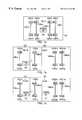
- FIG. 2 ashows a general arrangement of a device according to the present invention for the one-piece vehicle.
- FIG. 2 bshows the general arrangement of the device according to the present invention for the vehicle combination.
- FIG. 2 cshows the general arrangement of the device according to the present invention for the vehicle combination with two control devices.
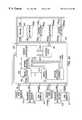
- FIG. 3 ashows a first part of a flowchart illustrating the method according to the present invention.
- FIG. 3 bshows a second part of a flowchart illustrating the method according to the present invention.
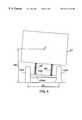
- FIG. 4shows a schematic illustrating physical conditions for a vehicle when cornering according to the present invention.
- FIGS. 1 a , 1 b and 1 cshow the various road vehicles in which the method according to the present invention can be used.
- FIG. 1 ashows a one-piece vehicle 101 according to the present invention.
- This vehiclemay be a passenger vehicle or a commercial vehicle.
- One-piece vehicle 101 shown in FIG. 1 ais a vehicle with at least two wheel axles, which are indicated by the dotted lines in part of the diagram.
- the wheel axles of vehicle 101are labeled as 103 ix .
- Index iindicates whether it is a front axle (v) or a rear axle (h).
- index xindicates which of the front or rear axles are involved.
- the following assignment of valuesholds: The front and/or rear axle closest to the edge of the vehicle is assigned index x with the smallest value. The farther the respective wheel axle from the edge of the vehicle, the greater the value of respective index x.
- Wheels 102 ixjare assigned to wheel axles 103 ix .
- the meaning of indices i and xcorresponds to that described above.
- Index jindicates whether the wheel is on the right (r) or left ( 1 ) side of the vehicle.
- vehicle 101has a control unit 104 in which the device according to the present invention for carrying out the method according to the present invention is implemented.
- a vehiclehas a front axle 103 v 1 with wheels 102 v 1 r and 102 v 1 l assigned to it and a rear axle 103 h 1 with wheels 102 h 1 r and 102 h 1 l assigned to it.
- a triple-axle vehiclewill normally have a front axle 103 v 1 with wheels 102 v 1 r and 102 v 1 l and a first rear axle 103 h 1 with wheels 102 h 1 r and 102 h 1 l and a second rear axle 103 h 2 with wheels 102 h 2 r and 102 h 2 l.
- FIG. 1 bshows a vehicle combination according to the present invention with a tractor 105 and a trailer 106 .
- Tractor 105has wheel axles 108 iz .
- Wheel axles 108 izhave corresponding wheels 107 ijz .
- the meaning of indices i and jcorresponds to that already described in conjunction with FIG. 1 a .
- Index zindicates that these are wheels or wheel axles belonging to the tractor 105 .
- tractor 105has a control unit 109 with which a tendency of tractor 105 and/or trailer 106 and/or the entire vehicle combination to roll over about a vehicle axis oriented in the longitudinal direction of the vehicle is detected.
- Trailer 106has two wheel axles 108 ixa .
- wheels 107 ixjaare assigned to two wheel axles 108 ixa .
- the meaning of indices i and x and jcorresponds to that already described in conjunction with FIG. 1 a .
- Index aindicates that it is a component of trailer 106 .
- the number of wheel axles for tractor 105 or for trailer 106 shown in FIG. 1 bshould not restrict the scope of the present invention in any way.
- Control unit 109may also be arranged in trailer 106 instead of in tractor 105 .
- FIG. 1 cshows a vehicle combination according to the present invention corresponding to the vehicle combination shown in FIG. 1 b .
- the tractor, trailer, wheel axles and wheelsare labeled with the same reference notation.
- a difference between FIG. 1 c and FIG. 1 bis that the vehicle combination shown in FIG. 1 c has two control units.
- Tractor 105is assigned a control unit 110 according to the present invention.
- a control unit 111 according to the present inventionis assigned to trailer 106 .
- a method of detecting a tendency to roll overis run in both control units.
- FIGS. 2 a , 2 b and 2 cthree embodiments are discussed below which are based on the different vehicles illustrated in FIGS. 1 a , 1 b and 1 c .
- the device according to the present invention which is implemented in the respective control unit 104 for vehicle 101 shown in FIG. 1 ais described with reference to FIG. 2 a .
- the device according to the present invention which is implemented in the respective control unit 109 for the vehicle combination shown in FIG. 1 bis described with reference to FIG. 2 b .
- tractor 105has its own control unit 110
- trailer 106has its own control unit 111 .
- the interaction of the two control units 110 and 111is described on the basis of FIG. 2 c.
- the first embodimentwill be described with the help of FIG. 2 a.
- the vehicle on which the first embodiment is basedis a one-piece vehicle, as shown in FIG. 1 a . Furthermore, it is assumed that this one-piece vehicle has at least two wheel axles 103 ix . These two wheel axles are front axle 103 v 1 with wheels 102 v 1 r and 102 v 1 l and rear axle 103 h 1 with wheels 102 h 1 r and 102 h 1 l . Wheel rpm sensors 201 v 1 r , 201 v 1 l , 201 h 1 r and 201 h 1 l assigned to these wheels are shown in FIG. 2 a .
- wheel rpm sensors 201 ixjmay also be taken into account, as indicated in FIG. 2 a .
- Variables nixj describing the wheel rpm of corresponding wheel 102 ixjare determined with wheel rpm sensors 201 ixj .
- Variables nixjare sent to blocks 204 , 205 and 208 .
- transverse acceleration sensor 202 and yaw sensor 203have a transverse acceleration sensor 202 and a yaw sensor 203 .
- transverse acceleration sensor 202 and yaw sensor 203is not intended to restrict the scope of the present invention in any way.
- this variablemay also be determined on the basis of variables nixj.
- this variablemay also be determined on the basis of variables nixj.
- Variable aq describing the transverse acceleration of the vehicle determined with the help of transverse acceleration sensor 202is sent to block 208 as well as to a block 206 .
- Variable omega describing the yaw of the vehicle with the help of yaw sensor 203is sent to blocks 208 , 205 and 206 .
- a variable vf describing the vehicle speedis determined in block 204 in a known way from variables nixj. This variable vf is sent from block 204 to blocks 205 and 208 . Furthermore, variables lambdaixj describing the drive slip and/or wheel slip of the wheels are determined in block 204 in a known way from variables nixj and variable vf. These variables lambdaixj are sent from block 204 to both block 206 and block 208 .
- variable a in the equationdescribes half the wheel base of the vehicle.
- the plus signis used for the wheels on the outside of the curve and the minus sign for the wheels on the inside of the curve.
- variable omega used in the above equation describing the yaw of the vehiclecan also be replaced by a term derived from the transverse acceleration of the vehicle and the vehicle speed. In this case, variable aq would have to be sent instead of variable omega to block 205 .
- Variables rixj describing the wheel behavior quantitatively, corresponding to the dynamic running radii of the wheelsare sent from block 205 to block 206 . Since variables rixj describing the wheel behavior quantitatively are the dynamic running radii, these variables describe the diameter and the corresponding radius of the respective wheel.
- block 206it is determined whether the vehicle has a tendency to roll over about a vehicle axis oriented in the longitudinal direction of the vehicle on the basis of variables lambdaixj, aq, omega supplied to block 206 and variables mlix supplied to it as an alternative, describing the axle-specific load.
- various queriesare performed in block 206 on the basis of the variables supplied to the block. These different queries are presented in FIGS. 3 a and 3 b which are yet to be described. If it is determined in block 206 that the vehicle does have a tendency to roll over about a vehicle axis oriented in the longitudinal direction of the vehicle, a variable KT is generated and sent from block 206 to block 208 .
- the controller or vehicle controller 208is notified whether or not the vehicle has a tendency to roll over.
- two components 205 and 206which are contained in the control unit, 104 are combined in one block 207 .
- Controller 208which is implemented in control unit 104 is labeled as 208 .
- Controller 208may be, for example, a controller which in its basic function regulates a variable describing the drive dynamics of the vehicle, e.g., a variable depending on the transverse acceleration and/or yaw of the vehicle, and does so by measures affecting the wheel brakes and/or the engine.
- a controlleris described, for example, in the article “FDR—die Fahrdynamikregelung von Bosch” published in the automotive engineering journal Automobiltechnische Zeitschrift (ATZ), vol. 16, no. 11 (1994) pages 674 through 689.
- the control taking place in its basic function in block 208is based in a conventional manner on variables sent to block 208 , namely nixj, aq, omega, vf, lambdaixj, a variable mot 2 describing the engine rpm of engine 210 , for example, sent from engine 210 to block 208 , as well as variables ST 2 , sent to block 208 from a block 209 , which is the control logic for the actuators present in the vehicle.
- a wheel slip controlwhich acts on the wheel brakes and/or a drive slip control which acts on the wheel brakes and/or the engine can also be implemented in controller 208 as its basic function.
- a roll-over preventionis implemented in controller 208 .
- This roll-over preventioncan be more or less a higher priority than controlling the basic function.
- the roll-over preventionis executed on the basis of variables KT, which are generated in block 206 as part of the roll-over detection.
- controller 208can be notified, for example, that the vehicle has a tendency to roll over about a vehicle axis oriented in the longitudinal direction of the vehicle; in addition, controller 208 can be notified how strong this roll-over tendency is.
- variables KTmay contain information regarding how the vehicle is at risk of roll-over and to which wheels this risk applies.
- Axle-specific wheel loads mlixare required in block 206 for this type of roll-over detection, which is performed in block 206 . They are determined in controller 208 in a conventional manner, for example, from wheel rpm values and sent from block 208 to block 206 .
- Controller 208generates variables ST 1 which are sent to control logic 209 and with which the actuators provided for the vehicle are controlled. Variables ST 1 notify control logic 209 which actuators are to be controlled. Variables ST 1 are generated in controller 208 as follows, for example. If the vehicle has no tendency to roll over, variables ST 1 are generated according to the control implemented for the basic function. In the case of the control described, for example, in the above-mentioned publication “FDR—drive dynamics control by Bosch,” then variables ST 1 contain information regarding which wheel(s) is/are to be braked and how and to what extent the engine torque delivered by the engine is to be influenced. If the vehicle has a tendency to roll over, then two procedures are contemplated by the present invention for forming variables ST 1 .
- variables ST 1 *which have been determined according to the control concept implemented for the basic function, are modified so that roll-over of the vehicle about a vehicle axis oriented in the longitudinal direction of the vehicle is prevented.
- variables ST 1 * determined according to the control concept implemented for the basic functioncan be replaced by variables generated to prevent the vehicle from rolling over.
- the following measures affecting the actuators of the vehicleare contemplated by the present invention, for example, to prevent the vehicle from rolling over about a vehicle axis oriented in the longitudinal direction of the vehicle.
- the vehicle speedcan be reduced by braking or by reducing engine torque.
- roll-over of the vehiclecan be counteracted in a controlled manner by braking measures taken for each wheel individually.
- a rolling motion of the vehiclecan be limited by measures involving the chassis actuators assigned to the vehicle.
- control logicvariables ST 1 generated by controller 208 are converted into control signals for engine 210 and control signals for the actuators of the vehicle.
- the actuatorsare, for example, chassis actuators 211 ixj with which the behavior of the chassis can be influenced and actuators 212 ixj with which a braking force can be generated on the corresponding wheels.
- control logicgenerates a signal mot 1 with which the throttle valve setting of the engine, for example, can be influenced.
- control logic 209generates signals Fsixj with which the attenuation or rigidity implemented by chassis actuators 211 ixj can be influenced.
- control logic 209To control actuators 212 ixj , which are designed as brakes, in particular, control logic 209 generates signals Aixj with which the braking forces generated by actuators 212 ixj on the corresponding wheels can be influenced. Control logic 209 generates variables ST 2 which are sent to controller 208 and contain information about the control of the individual actuators.
- chassis actuators 211 ixjWith chassis actuators 211 ixj , the chassis of the vehicle is influenced. In order for the controller to detect the actual status of chassis actuators 211 ixj , signals Frixj are sent from chassis actuators 211 ixj to controller 208 .
- the brake system used in FIG. 2 amay be a hydraulic or pneumatic or electrohydraulic or electropneumatic brake system.
- FIG. 2 bA second embodiment based on the vehicle combination illustrated in FIG. 1 b will be described now with the help of FIG. 2 b .
- the description of the components illustrated in FIG. 2 bis based on the description of FIG. 2 a as much as possible.
- tractor 105is equipped with wheel rpm sensors 212 ijz , a transverse acceleration sensor 213 and a yaw sensor 214 .
- Trailer 106should be equipped at least with wheel rpm sensors 215 hxja .
- the trailermay also be equipped with a transverse acceleration sensor 216 and a yaw sensor 217 .
- transverse acceleration sensor 216 and yaw sensor 217are not necessary for trailer 106 , because the transverse acceleration acting on trailer 106 or the yaw acting on trailer 106 each correspond to the transverse acceleration or yaw acting on tractor 105 .
- both the transverse acceleration and the yaw of trailer 106can be determined in a conventional manner from the wheel rpm of the trailer. For this reason, transverse acceleration sensor 216 as well as yaw sensor 217 are shown with dotted lines in FIG. 2 b.
- Block 218corresponds in its function to block 204 shown in FIG. 2 a .
- Block 219corresponds in its function to blocks 205 and 206 which are combined to form block 207 in FIG. 2 a .
- Block 220corresponds in its function to block 208 shown in FIG. 2 a .
- Block 221corresponds in its function to block 209 shown in FIG. 2 a .
- Variables nijz, aqz and omegaz determined for tractor 105 as described in conjunction with FIG. 2 aare sent similarly to blocks 218 , 219 and 220 .
- the sensors for trailer 106are also to be taken into account.
- Variables nhxja, aqa and omegaa generated with the help of sensors 215 hxja , 216 and 217 for the trailer 106are processed in control unit 109 in a similar manner to variables nijz, aqz and omegaz generated for tractor 105 .
- variables nhxjaare sent to block 218 as well as to block 220 .
- variables aqa and omegaaare sent to blocks 219 and 220 .
- a variable vf describing the speed of the vehicle combinationis determined in block 218 from variables nijz and nhxja in accordance with that in block 204 .
- This variable vfis sent to block 219 and/or block 220 .
- variables lambdaijz and lambdahxjaare also determined in block 218 in a manner similar to that in block 204 and are sent to both block 219 and block 220 .
- the result of the determination of the roll-over tendencyis relayed from block 219 to block 220 by variables KTz and KTa.
- Variable KTacontains information for tractor 105
- variable KTacontains information for the trailer.
- variables ST 1 ′are determined in block 220 and sent to control logic 221 .
- axle-specific loads mliz of the tractor and axle-specific loads mlhxa of the trailerare determined in block 220 and sent to block 219 .
- variables ST 2 ′are determined in block 221 and sent to controller 220 .
- control signals for the engine and control signals for the actuatorsare determined in block 221 .
- theseare the following control signals for tractor 105 :
- Control signal mot 1is determined for engine 222 .
- Control signals Aijzare determined for actuators 223 ijz with which braking forces can be generated. For any chassis actuators 224 ijz assigned to the tractor, control signals Fsijz are determined. In addition, control signals Ahxja are determined in control logic 221 for actuators 225 hxja which are provided in the trailer and with which braking forces can be generated. If the trailer has chassis actuators 226 hxja , control signals Fshxja are determined in control logic 221 for the chassis actuators. In FIG. 2 b , controller 220 receives a variable mot 2 from engine 222 , variables Frijz from chassis actuators 224 ijz and variables Frhxja from chassis actuators 226 hxja.
- tractor 105is equipped with a control unit 110 and trailer 106 is equipped with a control unit 111 .
- control unit 110 and 111supply of input variables or the output of output variables can be seen in FIGS. 2 a and 2 b .
- Control unit 110corresponds to control unit 104 shown in FIG. 2 a .
- control unit 104To arrive at control unit 110 , control unit 104 must be modified in controller 208 to the extent that it can also determine and output additional variables SG 1 and can receive and process additional variables SG 2 .
- Control unit 111can also be derived from control unit 104 in FIG. 2 a . To do so, controller 208 must be modified to the extent that it can determine and output additional variables SG 2 , and can receive and process additional variables SG 1 . Since the trailer has as actuators only brakes 225 hxja and chassis actuators 226 hxja , controller 208 shown in FIG. 2 a and/or control logic 209 must also be modified to this extent.
- an exchange of information or variables SG 1 and SG 2may assist in the coordination of the two control units to coordinate measures taken by the two control units. For example, through variables SG 1 and SG 2 it is possible to exchange information regarding which actuators are activated at a given time. As an alternative, however, it is also contemplated by the present invention for the two control units 110 and 111 to function autonomously. In this case, no exchange of information or variables SG 1 or SG 2 between the two control units is necessary.
- FIGS. 3 a and 3 bthe sequence of the method according to the present invention is to be illustrated.
- the flow chart in FIGS. 3 a and 3 bdescribes the sequence of the method according to the present invention as it would take place for a one-piece vehicle shown in FIG. 1 a , which is used as the basis for the device according to the present invention as illustrated in FIG. 2 a.
- the method according to the present inventionbegins with a step 301 in which variables nixj, omega, aq, vf, lambdaixj and mlix are entered.
- a step 302is carried out following step 301 .
- FIGS. 3 a and 3 bThe method according to the present invention illustrated in FIGS. 3 a and 3 b takes place essentially in the two blocks 205 and 206 which are combined to form block 207 .
- the query performed in step 302determines whether the condition of the vehicle is such that there may be a tendency of the vehicle to roll over about a vehicle axis oriented in the longitudinal direction of the vehicle. It is therefore determined in step 302 whether the absolute value of variable aq describing the transverse acceleration of the vehicle is greater than a first threshold value S 1 a and/or whether the absolute value of variable omega describing the yaw of the vehicle is greater than a second threshold value S 1 b.
- step 302has the following reasons: first, the case may occur that block 206 receives either variable aq describing the transverse acceleration or variable omega describing the yaw. In this case, only one of the two partial queries can be executed. Otherwise, the case may occur where both variables are sent to block 206 . In this case, either one of the two partial queries can be carried out or both partial queries can be carried out at the same time to make the result more reliable. If at least one of the two partial queries is satisfied in step 302 , then a step 303 is carried out following step 302 . If, however, neither of the two partial queries is satisfied in step 302 , step 301 is carried out again following step 302 .
- step 303the absolute value of variable lambdaixj describing the drive slip and/or wheel slip is compared with a threshold value S 2 .
- the query performed in step 303is carried out for the following reason: the determination in step 304 of variables rixj, which represent the dynamic running radii of the wheels and describe the wheel behavior quantitatively, can only be carried out if the wheels are more or less free of slip, i.e., if the drive slip and/or wheel slip of the wheels is smaller than a predetermined threshold value. If this is not the case, variables rixj which describe the wheel behavior quantitatively cannot be determined without error.
- step 303If it is found in step 303 that the absolute value of variable lambdaixj is less than the corresponding threshold value, then a step 304 is carried out following step 303 . However, if it is found in step 303 that the absolute value of the variable lambdaixj is greater than the corresponding threshold value S 2 , then a step 308 is carried out following step 303 .
- step 303it is decided whether a first or second type of query is to be carried out to determine whether the vehicle has a tendency to roll over. If it is found in step 303 that the absolute value of the wheel slip is less than the corresponding threshold value, then a first type of determination which is composed of steps 304 , 305 and 306 is carried out. If, however, it is found in step 303 that the absolute value of the wheel slip is greater than the threshold value, a second type of query composed of steps 308 , 309 and 310 is carried out.
- step 304the variables describing the wheel behavior quantitatively are determined with the help of the equation given above. These variables can be determined only if there is not much wheel slip, i.e., these variables can be determined only if there is not too great a difference between the wheel rpm and the vehicle speed. If the difference between the wheel rpm and the vehicle speed is too great, as is the case, for example, when individual wheels have a great slip, then faulty decisions may be made in step 306 because of variables rixj determined in this vehicle state.
- a step 305is carried out following step 304 .
- variables deltarixj, rixjddling and alphaixare determined.
- Variable deltarixjis a difference derived from the instantaneous value, variable rixj describing the wheel behavior quantitatively and a value, the variable describing the wheel behavior quantitatively, which was determined when driving straight ahead.
- the value corresponding to the variable describing the wheel behavior quantitatively when driving straight aheadis determined from time to time in suitable driving situations and is stored temporarily in a suitable memory.
- Variable rixjddlingis a variable representing the time characteristic of variable rixj, which describes the wheel behavior quantitatively.
- variable rixjyakcorresponds to the time derivative of variable rixj.
- variable alphaixa variable describing the inclination of the wheel axle is determined on the basis of the variables determined for the two wheels of the wheel axle, describing the wheel behavior quantitatively.
- wheel base 2 a of the vehicleenters into variable alphaix.
- the above equation for angle of inclination alphaixrepresents an approximation which applies to small angles alphaix.
- a step 306is carried out following step 305 .
- the individual queries executed in step 306are carried out using the variables determined in step 305 , which are in turn determined as a function of the instantaneous value of variable rixj describing the wheel behavior quantitatively as determined in step 304 .
- the presentation selected in step 306is intended to express the following: either the method according to the present invention can be designed in such a way that in general only one of these four partial queries is implemented, or a portion of these partial queries is implemented, or all partial queries are implemented.
- first threshold value S 3 ais intended to represent the radius of the unloaded wheel.
- This querydetermines whether the wheels on the inside of the curve when turning are at risk of lifting.
- the first partial querycontains another query with which it is ascertained whether the instantaneous value of variable rixj is smaller than a second threshold value S 3 b .
- This queryincludes wheels on the outside of the curve which are compressed greatly due to the tendency of the vehicle to roll over.
- the absolute variable of the dynamic running radiusis compared with corresponding threshold values to detect a tendency of the vehicle to roll over.
- the vehiclehas a tendency to roll over when either the dynamic running radius of a wheel on the inside of the curve is greater than threshold value S 3 a or when the dynamic running radius of a wheel on the outside of the curve is smaller than threshold S 3 b.
- a second partial queryit is determined whether the absolute value of difference deltarixj is greater than a third threshold value S 3 c .
- the relative change in the dynamic running radius resulting when turning a corner after driving straight aheadis analyzed to detect whether the vehicle has a tendency to roll over.
- a vehiclehas a tendency to roll over when the absolute value of the difference is greater than the corresponding threshold value S 3 c.
- a third partial queryit is determined whether the absolute value of variable rixjyak which describes the time characteristic of variable rixj describing the wheel behavior quantitatively is smaller than a fourth threshold value S 3 d .
- the vehiclehas a tendency to roll over when the absolute value of the variable describing the time characteristic is smaller than a fourth threshold value S 3 d.
- a fourth partial queryit is ascertained whether the absolute value of variable alphaix describing the angle of inclination of a wheel axle is greater than a fifth threshold value S 3 e .
- the vehiclehas a tendency to roll over when the absolute value of variable alphaix is greater than threshold value S 3 e.
- step 306With the help of the partial queries taking place in step 306 , the tendency of a vehicle to roll over about a vehicle axis oriented in the longitudinal direction of the vehicle is detected when at least one of the four partial queries is satisfied. It should be pointed out here that it is also appropriate to perform in step 306 only the first partial query in combination with the third partial query or to perform the second partial query in combination with the third partial query, for example. If at least one of the partial queries is satisfied in step 306 , i.e., if the vehicle has a tendency to roll over, then a step 307 is carried out following step 306 . The output of variable KT taking place in block 206 when there is a roll-over tendency is not shown in FIGS. 3 a and 3 b . However, if none of the partial queries is satisfied in step 306 , i.e., the vehicle does not have a roll-over tendency, then step 301 is carried out again following step 306 .
- step 307suitable braking measures and/or engine measures and/or chassis measures are taken in step 307 to prevent the vehicle from rolling over about a vehicle axis oriented in the longitudinal direction of the vehicle. It should be pointed out here that the measures presented in step 307 are carried out in conjunction with the control logic on the basis of the vehicle controller when the vehicle controller is notified by variables KT and KTa or KTz that the vehicle has a tendency to roll over about a vehicle axis oriented in the longitudinal direction of the vehicle.
- step 303If it is found in step 303 that the absolute value of variable lambdaixj is greater than the corresponding threshold value S 2 , then the first type of determination cannot be used because faulty decisions would be made in step 306 because of the excessive slip values and the resulting error in determination of variables rixj describing the wheel behavior quantitatively. Therefore, if the absolute value of variable lambdaixj is greater than threshold value S 2 , a step 308 is carried out following step 303 , initiating a second type of determination of whether the vehicle has a tendency to roll over. This second type of determination is performed as a function of the variable determined for at least one wheel in a preceding time increment, describing the wheel behavior quantitatively.
- variable hsixdescribing the height of the center of gravity of the vehicle, in particular, an axle-specific center of gravity height, is supplied in step 308 .
- variable hsixfor example, which was determined for a preceding time increment when the query performed in step 303 was satisfied and which was stored temporarily is entered.
- variable hsixmay be determined as a function of variables rixj, which were determined for a preceding time increment when the query taking place in step 303 was satisfied and which were stored temporarily.
- variable Crepresents the resulting vertical rigidity of the wheels assigned to the wheel axle
- variable acorresponds to half the wheel base of the wheel axle
- variable alphaixcorresponds to the angle of inclination of the wheel axle with respect to the road surface
- variable mlixcorresponds to the load acting on the wheel axle
- variable aqcorresponds to the transverse acceleration acting on the vehicle.
- a speed limit valueis determined for cornering by the vehicle in a conventional manner on the basis of the variable hsix describing the height of the center of gravity of the vehicle.
- the speed limit valueindicates the speed of the vehicle at which the vehicle cannot be expected to roll over about a vehicle axis oriented in the longitudinal direction of the vehicle.
- To determine the speed limit value as a function of the variable describing the height of the center of gravity of the vehiclereference is made, for example, to the formula given on page 346 of Kraftfahrtechnisches Taschenbuch, VDI Verlag, 21 st edition.
- a step 310is carried out following step 309 .
- step 310it is ascertained whether the absolute value of the difference between the vehicle speed and the speed limit value is less than or equal to a threshold value S 4 . If the absolute value of the difference is less than or equal to threshold value S 4 , then the vehicle has a tendency to roll over about a vehicle axis oriented in the longitudinal direction of the vehicle, and then step 307 is carried out following step 310 . However, if the absolute value of the difference is greater than threshold value S 4 , which is equivalent to the vehicle not having a tendency to roll over, then step 301 is carried out following step 310 .
- FIGS. 3 a and 3 bThe fact that only a one-piece vehicle is illustrated in FIGS. 3 a and 3 b is not intended to restrict the scope of the present invention in any way.
- the flow chart shown in FIGS. 3 a and 3 bcan also be used accordingly for a vehicle combination.
- FIG. 4shows a schematic diagram of a one-piece vehicle such as that illustrated in FIG. 1 a .
- thisis not intended to restrict the scope of the present invention in any way.
- FIG. 4shows a wheel axle 103 ix with respective wheels 102 ixl and 102 ixr . Furthermore, vehicle body 401 which is attached to wheel axle 103 ix by suspension devices 405 and 406 is also shown. FIG. 4 shows wheel base 2 a of the vehicle. Furthermore, axle-specific center of gravity S and respective axle-specific height hsix of the center of gravity are also shown. Likewise, angle of inclination alphaix of the wheel axle with respect to the road surface is also shown. The vehicle is turning left.
- FIG. 4shows, load shifts occur when turning a corner, the load on wheel 102 ixl on the inside of the curve is reduced and in extreme situations it may lose contact with the ground. It does not matter here whether the turn is on a flat or inclined road surface. Wheel 102 ixr on the outside of the curve is under a greater load. Due to this load shift at the individual wheels, the respective dynamic running radius rixj changes. Consequently, these changes can be used to detect a wheel lifting up from the road surface, which in turn can be used to detect a tendency of a vehicle to roll over about a vehicle axis oriented in the longitudinal direction of the vehicle.
Landscapes
- Engineering & Computer Science (AREA)
- Mechanical Engineering (AREA)
- Transportation (AREA)
- Automation & Control Theory (AREA)
- Regulating Braking Force (AREA)
- Auxiliary Drives, Propulsion Controls, And Safety Devices (AREA)
- Vehicle Body Suspensions (AREA)
Abstract
Description
The present invention relates to a method and a device for detecting the tendency of a vehicle to roll over.
Methods and devices for detecting the tendency of a vehicle to roll over are known in various modifications from the related art.
German Patent No. 44 16 991 describes a method and a device for warning the driver of a truck of the risk of roll over when turning a corner. To do so, the type of vehicle and the relevant status data for the risk of roll over are determined before the vehicle enters the turn, and the risk of roll over or the critical speed limit for the latter is determined as a function of the radius of the curve and the center of gravity of the vehicle. A signal prompting the driver to reduce his speed is triggered when the prevailing road speed of the vehicle is the reason for the risk of roll over or a predetermined safety margin from the risk of roll over is no longer met. The vehicle's road speed at which there is with certainty no risk of roll over is determined on the basis of a roll-over equation. The roll-over equation includes the vehicle speed, the curve radius traveled by the vehicle, the height of the vehicle's center of gravity above the road surface and the wheel load imbalance. The wheel loads are determined with the help of wheel load sensors embedded in the road surface. If the road speed of the vehicle no longer meets a predetermined safety margin from the road speed at the limit of the risk of roll over, a signal is generated, warning the driver of the vehicle of excessive speed in turning the curve. The signal indicating excessive speed is triggered until the measured road speed has been reduced to an extent that rules out any risk of roll over. Furthermore, German Patent No. 44 16 991 shows that the wheel slip of the vehicle's wheels on the road surface can be determined and taken into account in evaluating the risk of roll over.
An object of the present invention is to improve upon the method and the device detecting the tendency of a vehicle to roll over.
A tendency of a vehicle to roll over about a vehicle axis oriented in the longitudinal direction of the vehicle is detected using a method according to the present invention. For this, a variable describing the wheel rpm is determined for at least one wheel. Furthermore, at least one variable representing the transverse dynamics of the vehicle is determined. A variable describing wheel behavior quantitatively is determined for at least one wheel at least as a function of the variable describing the wheel rpm of the corresponding wheel and one of the variables representing the transverse dynamics of the vehicle. Whether the vehicle has a tendency to roll over about a vehicle axis oriented in the longitudinal direction of the vehicle is determined at least as a function of the variable determined for the minimum of one wheel, describing the wheel behavior of this wheel quantitatively.
It should be pointed out here that when the “tendency of a vehicle to roll over” is used below, this refers to the “tendency of a vehicle to roll over about a vehicle axis oriented in the longitudinal direction of the vehicle.” The formulation “a vehicle axis oriented in the longitudinal direction of the vehicle” is to be understood as follows: first, the vehicle axis about which the vehicle has a tendency to roll over may be the actual longitudinal axis of the vehicle. Second, it may be a vehicle axis which is twisted by a certain angle with respect to the actual longitudinal axis of the vehicle. It does not matter here whether or not the twisted vehicle axis passes through the center of gravity of the vehicle. The case of the twisted vehicle axis should also permit an orientation of the vehicle axis such that the vehicle axis corresponds either to a diagonal axis of the vehicle or to an axis parallel to it.
Determination of a variable describing the wheel behavior quantitatively and as a function of which it is determined whether the vehicle has a tendency to roll over is the reason for the following advantage in comparison with the related art: since a tendency of a vehicle to roll over about a vehicle axis oriented in the longitudinal direction of the vehicle is reflected directly in the wheel behavior of the wheels of the vehicle, it is possible to determine quickly and accurately whether the vehicle has a tendency to roll over by using the method according to the present invention on the basis of analysis of a variable describing the wheel behavior quantitatively. It can be done quickly because a variable describing the wheel behavior quantitatively enters directly into the determination of the roll-over tendency. It is accurate because multiple wheels can be analyzed to determine the roll-over tendency, and because the variables which describe the wheel behavior are available as quantitative values and thus, for example, precisely gradated plausibility queries are possible.
The method according to the present invention of detecting a tendency of the vehicle to roll over can be advantageous in the context of, for example, a method of stabilizing the vehicle. Such a method may be advantageous for a method of preventing the vehicle from rolling over, for example.
If the vehicle has a tendency to roll over, at least braking measures are advantageously implemented on at least one wheel and/or engine measures and/or measures involving the chassis actuators are taken to stabilize the vehicle, in particular, to prevent the vehicle from rolling over.
It has proven to be advantageous that the absolute value of one of the variables representing the transverse dynamics of the vehicle, in particular, the absolute value of the variable describing the transverse acceleration and/or the absolute value of a variable describing the yaw of the vehicle is compared with a threshold value. Then a determination of whether the vehicle has a tendency to roll over is performed when the absolute value of the one variable representing the transverse dynamics of the vehicle is greater than the threshold value. Therefore, the method according to the present invention is activated only in those transverse dynamic vehicle situations in which the vehicle can be expected to have a tendency to roll over.
It is also advantageous if the drive slip and/or wheel slip prevailing on a wheel is determined for at least that one wheel, and its absolute value is compared with a corresponding threshold value, and if the determination of whether the vehicle has a tendency to roll over is performed as a function of this comparison. Different determinations of the tendency of the vehicle to roll over are performed on the basis of this comparison. Thus, if for at least one wheel the absolute value of the drive slip and/or wheel slip prevailing on this wheel is smaller than the corresponding threshold value, the determination of whether the vehicle has a tendency to roll over is performed at least as a function of the variable describing the wheel behavior quantitatively and determined for the minimum of one wheel in the instantaneous time increment. However, if the absolute value of the drive slip and/or wheel slip determined for at least one wheel is greater than the corresponding threshold value, the determination of whether the vehicle has a tendency to roll over is performed at least as a function of the variable describing the wheel behavior quantitatively and determined for at least one wheel in a preceding time increment.
Advantageously, a variable depending on the wheel load acting on the respective wheel is determined as the variable describing the wheel behavior of the respective wheel quantitatively. Variables describing the diameter or radius of the respective wheel are particularly advantageous because a displacement in the center of gravity of the vehicle due to turning a corner has a significant effect on the diameter of the vehicle's wheels, for example, and thus a tendency of a vehicle to roll over can be detected directly on the basis of the vehicle's wheel diameter.
The variable describing the wheel behavior quantitatively is advantageously determined at least as a function of the variable describing the wheel rpm of the corresponding wheel, a variable describing the vehicle speed, a variable representing the transverse dynamics of the vehicle and a variable describing the vehicle geometry. The variable describing the vehicle speed is determined at least as a function of the variables determined for the wheels and describing the wheel rpm. A variable describing the transverse acceleration of the vehicle and/or the yaw of the vehicle is advantageously determined as a variable representing the transverse dynamics of the vehicle.
The following criteria have proven advantageous in determining whether the vehicle has a tendency to roll over about a vehicle axis oriented in the longitudinal direction of the vehicle. A vehicle has a tendency to roll over:
When, for at least one wheel, the value of the variable describing the wheel behavior quantitatively is greater than a first threshold value. Or when, for at least one wheel, the value of the variable describing the wheel behavior quantitatively is smaller than a second threshold value.
Roll over of a vehicle is thus associated with the fact that at the forefront of the roll over, some of the wheels are under a greater load in comparison with the normal condition when driving straight ahead and some of the wheels are under a lesser load accordingly. Both factors lead to a change in the wheel diameter, which can be analyzed to detect a tendency to roll over. Thus, the first query determines which wheels have a reduced load, i.e., are at risk of lifting. The second query determines which wheels are under a greater load, i.e., are being compressed.
When, for at least one wheel, the absolute value of a difference derived from the value of the variable describing the wheel behavior quantitatively and a comparison value is greater than a corresponding threshold value.
With the help of this query, the instantaneous wheel behavior can be compared with the wheel behavior when driving straight ahead, for example. A tendency of the vehicle to roll over can be deduced from this comparison.
When for at least one wheel the absolute value of a variable describing the time characteristic of the variable describing the wheel behavior quantitatively is lower than a corresponding threshold value.
When the absolute value of a variable describing the angle of inclination of a wheel axle is greater than a corresponding threshold value. The variable describing the angle of inclination of a wheel axle is advantageously determined as a function of the variables determined for the wheels of the corresponding wheel axle and describing the wheel behavior quantitatively.
The queries described above are combined to yield a first type of query with the help of which a tendency of a vehicle to roll over about a vehicle axis oriented in the longitudinal direction of the vehicle can be determined. In addition to this first type of query, a second type is also used. The type of query used to determine the tendency to roll over is advantageously selected with the help of the comparison described above, which is based on the drive slip and/or wheel slip determined for at least one wheel.
The following is advantageously suggested for the second type of query: The absolute value of a difference formed from a variable describing the vehicle speed and a speed limit value is compared with a corresponding threshold value. If the absolute value of the difference is smaller than the corresponding threshold value, then the vehicle has a tendency to roll over. The speed limit value is advantageously determined at least as a function of a variable describing the height of the center of gravity of the vehicle, the latter being determined at least as a function of the variable determined for at least one wheel and describing the wheel behavior quantitatively.
FIG. 1ashows a one-piece vehicle for which a method according to the present invention may be used.
FIG. 1bshows a vehicle combination for which the method according to the present invention may be used.
FIG. 1cshows the vehicle combination with two control devices for which the method according to the present invention may be used.
FIG. 2ashows a general arrangement of a device according to the present invention for the one-piece vehicle.
FIG. 2bshows the general arrangement of the device according to the present invention for the vehicle combination.
FIG. 2cshows the general arrangement of the device according to the present invention for the vehicle combination with two control devices.
FIG. 3ashows a first part of a flowchart illustrating the method according to the present invention.
FIG. 3bshows a second part of a flowchart illustrating the method according to the present invention.
FIG. 4 shows a schematic illustrating physical conditions for a vehicle when cornering according to the present invention.
It should be pointed out that blocks with the same designation in different figures have the same function.
First, FIGS. 1a,1band1cshow the various road vehicles in which the method according to the present invention can be used.
FIG. 1ashows a one-piece vehicle 101 according to the present invention. This vehicle may be a passenger vehicle or a commercial vehicle. One-piece vehicle 101 shown in FIG. 1ais a vehicle with at least two wheel axles, which are indicated by the dotted lines in part of the diagram. The wheel axles ofvehicle 101 are labeled as103ix. Index i indicates whether it is a front axle (v) or a rear axle (h). For vehicles with more than two axles, index x indicates which of the front or rear axles are involved. The following assignment of values holds: The front and/or rear axle closest to the edge of the vehicle is assigned index x with the smallest value. The farther the respective wheel axle from the edge of the vehicle, the greater the value of respective index x. Wheels102ixjare assigned to wheel axles103ix. The meaning of indices i and x corresponds to that described above. Index j indicates whether the wheel is on the right (r) or left (1) side of the vehicle. In the diagram of wheels102ixj, no distinction has been made between single wheels and dual wheels. Furthermore,vehicle 101 has acontrol unit 104 in which the device according to the present invention for carrying out the method according to the present invention is implemented.
To illustrate the diagram shown in FIG. 1a, it should be pointed out, for example, that a vehicle has a front axle103v1 with wheels102v1rand102v1lassigned to it and a rear axle103h1 with wheels102h1rand102h1lassigned to it. A triple-axle vehicle will normally have a front axle103v1 with wheels102v1rand102v1land a first rear axle103h1 with wheels102h1rand102h1land a second rear axle103h2 with wheels102h2rand102h2l.
FIG. 1bshows a vehicle combination according to the present invention with atractor 105 and atrailer 106. The diagram given here should not restrict the scope of the present invention in any way; for example, a vehicle combination consisting of a tractor and draw-bar trailer is also contemplated by the present invention.Tractor 105 has wheel axles108iz. Wheel axles108izhave corresponding wheels107ijz. The meaning of indices i and j corresponds to that already described in conjunction with FIG. 1a. Index z indicates that these are wheels or wheel axles belonging to thetractor 105. Furthermore,tractor 105 has acontrol unit 109 with which a tendency oftractor 105 and/ortrailer 106 and/or the entire vehicle combination to roll over about a vehicle axis oriented in the longitudinal direction of the vehicle is detected.Trailer 106 has two wheel axles108ixa. Similarly, wheels107ixjaare assigned to two wheel axles108ixa. The meaning of indices i and x and j corresponds to that already described in conjunction with FIG. 1a. Index a indicates that it is a component oftrailer 106. The number of wheel axles fortractor 105 or fortrailer 106 shown in FIG. 1bshould not restrict the scope of the present invention in any way.Control unit 109 may also be arranged intrailer 106 instead of intractor 105.
FIG. 1cshows a vehicle combination according to the present invention corresponding to the vehicle combination shown in FIG. 1b. For this reason, the tractor, trailer, wheel axles and wheels are labeled with the same reference notation. A difference between FIG. 1cand FIG. 1bis that the vehicle combination shown in FIG. 1chas two control units.Tractor 105 is assigned acontrol unit 110 according to the present invention. Acontrol unit 111 according to the present invention is assigned totrailer 106. A method of detecting a tendency to roll over is run in both control units.
The characterization by indices a, i, j, x and z used in FIGS. 1a,1band1cis the same for all the variables and components with which they are used.
On the basis of FIGS. 2a,2band2c, three embodiments are discussed below which are based on the different vehicles illustrated in FIGS. 1a,1band1c. The device according to the present invention which is implemented in therespective control unit 104 forvehicle 101 shown in FIG. 1ais described with reference to FIG. 2a. The device according to the present invention which is implemented in therespective control unit 109 for the vehicle combination shown in FIG. 1bis described with reference to FIG. 2b. With the vehicle combination illustrated in FIG. 1c,tractor 105 has itsown control unit 110, andtrailer 106 has itsown control unit 111. The interaction of the twocontrol units
The first embodiment will be described with the help of FIG. 2a.
The vehicle on which the first embodiment is based is a one-piece vehicle, as shown in FIG. 1a. Furthermore, it is assumed that this one-piece vehicle has at least two wheel axles103ix. These two wheel axles are front axle103v1 with wheels102v1rand102v1land rear axle103h1 with wheels102h1rand102h1l. Wheel rpm sensors201v1r,201v1l,201h1rand201h1lassigned to these wheels are shown in FIG. 2a. Depending on the number of wheel axles on the one-piece vehicle, additional wheel rpm sensors201ixjmay also be taken into account, as indicated in FIG. 2a. Variables nixj describing the wheel rpm of corresponding wheel102ixjare determined with wheel rpm sensors201ixj. Variables nixj are sent toblocks
Furthermore, it is assumed thatvehicle 101 has atransverse acceleration sensor 202 and ayaw sensor 203. It should be pointed out here that the use oftransverse acceleration sensor 202 andyaw sensor 203 is not intended to restrict the scope of the present invention in any way. For example, instead of determining a variable aq describing the transverse acceleration with the help of a transverse acceleration sensor, this variable may also be determined on the basis of variables nixj. Likewise, instead of determining a variable omega describing the yaw of the vehicle with the help of ayaw sensor 203, this variable may also be determined on the basis of variables nixj.
Variable aq describing the transverse acceleration of the vehicle determined with the help oftransverse acceleration sensor 202 is sent to block208 as well as to ablock 206. Variable omega describing the yaw of the vehicle with the help ofyaw sensor 203 is sent toblocks
A variable vf describing the vehicle speed is determined inblock 204 in a known way from variables nixj. This variable vf is sent fromblock 204 toblocks block 204 in a known way from variables nixj and variable vf. These variables lambdaixj are sent fromblock 204 to both block206 and block208.
Variables rixj describing the wheel behavior of the wheels quantitatively are determined inblock 205 on the basis of variable vf, variables nixj and variable omega. These variables rixj depend on the wheel load acting on the respective wheel. In particular, variables rixj describe the dynamic running radii of the wheels which are determined using the equation:

where variable a in the equation describes half the wheel base of the vehicle. The plus sign is used for the wheels on the outside of the curve and the minus sign for the wheels on the inside of the curve.
It should be pointed out here that variable omega used in the above equation describing the yaw of the vehicle can also be replaced by a term derived from the transverse acceleration of the vehicle and the vehicle speed. In this case, variable aq would have to be sent instead of variable omega to block205.
Variables rixj describing the wheel behavior quantitatively, corresponding to the dynamic running radii of the wheels are sent fromblock 205 to block206. Since variables rixj describing the wheel behavior quantitatively are the dynamic running radii, these variables describe the diameter and the corresponding radius of the respective wheel.
Inblock 206, it is determined whether the vehicle has a tendency to roll over about a vehicle axis oriented in the longitudinal direction of the vehicle on the basis of variables lambdaixj, aq, omega supplied to block206 and variables mlix supplied to it as an alternative, describing the axle-specific load. To determine whether the vehicle has a tendency to roll over, various queries are performed inblock 206 on the basis of the variables supplied to the block. These different queries are presented in FIGS. 3aand3bwhich are yet to be described. If it is determined inblock 206 that the vehicle does have a tendency to roll over about a vehicle axis oriented in the longitudinal direction of the vehicle, a variable KT is generated and sent fromblock 206 to block208. With this variable KT, the controller orvehicle controller 208 is notified whether or not the vehicle has a tendency to roll over. In FIG. 2a, twocomponents block 207.
The controller orvehicle controller 208 which is implemented incontrol unit 104 is labeled as208.Controller 208 may be, for example, a controller which in its basic function regulates a variable describing the drive dynamics of the vehicle, e.g., a variable depending on the transverse acceleration and/or yaw of the vehicle, and does so by measures affecting the wheel brakes and/or the engine. Such a controller is described, for example, in the article “FDR—die Fahrdynamikregelung von Bosch” published in the automotive engineering journal Automobiltechnische Zeitschrift (ATZ), vol. 16, no. 11 (1994) pages 674 through 689. The control taking place in its basic function inblock 208 is based in a conventional manner on variables sent to block208, namely nixj, aq, omega, vf, lambdaixj, a variable mot2 describing the engine rpm ofengine 210, for example, sent fromengine 210 to block208, as well as variables ST2, sent to block208 from ablock 209, which is the control logic for the actuators present in the vehicle. It should be pointed out here that the control described above for the basic function of the controller is not intended to restrict the scope of the present invention in any way. As an alternative to this control, a wheel slip control which acts on the wheel brakes and/or a drive slip control which acts on the wheel brakes and/or the engine can also be implemented incontroller 208 as its basic function.
In addition to the control implemented inblock 208 in its basic function, a roll-over prevention is implemented incontroller 208. This roll-over prevention can be more or less a higher priority than controlling the basic function. The roll-over prevention is executed on the basis of variables KT, which are generated inblock 206 as part of the roll-over detection. With variables KT,controller 208 can be notified, for example, that the vehicle has a tendency to roll over about a vehicle axis oriented in the longitudinal direction of the vehicle; in addition,controller 208 can be notified how strong this roll-over tendency is. In addition, variables KT may contain information regarding how the vehicle is at risk of roll-over and to which wheels this risk applies.
Axle-specific wheel loads mlix are required inblock 206 for this type of roll-over detection, which is performed inblock 206. They are determined incontroller 208 in a conventional manner, for example, from wheel rpm values and sent fromblock 208 to block206.
The following measures affecting the actuators of the vehicle are contemplated by the present invention, for example, to prevent the vehicle from rolling over about a vehicle axis oriented in the longitudinal direction of the vehicle. First, the vehicle speed can be reduced by braking or by reducing engine torque. Second, roll-over of the vehicle can be counteracted in a controlled manner by braking measures taken for each wheel individually. Furthermore, a rolling motion of the vehicle can be limited by measures involving the chassis actuators assigned to the vehicle.
Inblock 209, the control logic, variables ST1 generated bycontroller 208 are converted into control signals forengine 210 and control signals for the actuators of the vehicle. The actuators are, for example, chassis actuators211ixjwith which the behavior of the chassis can be influenced and actuators212ixjwith which a braking force can be generated on the corresponding wheels. To controlengine 210, control logic generates a signal mot1 with which the throttle valve setting of the engine, for example, can be influenced. To control chassis actuators211ixj,control logic 209 generates signals Fsixj with which the attenuation or rigidity implemented by chassis actuators211ixjcan be influenced. To control actuators212ixj, which are designed as brakes, in particular,control logic 209 generates signals Aixj with which the braking forces generated by actuators212ixjon the corresponding wheels can be influenced.Control logic 209 generates variables ST2 which are sent tocontroller 208 and contain information about the control of the individual actuators.
With chassis actuators211ixj, the chassis of the vehicle is influenced. In order for the controller to detect the actual status of chassis actuators211ixj, signals Frixj are sent from chassis actuators211ixjtocontroller 208.
It should be pointed out here that it is also contemplated by the present invention to use retarders in addition to the actuators shown in FIG. 2a.
The brake system used in FIG. 2amay be a hydraulic or pneumatic or electrohydraulic or electropneumatic brake system.
A second embodiment based on the vehicle combination illustrated in FIG. 1bwill be described now with the help of FIG. 2b. The description of the components illustrated in FIG. 2bis based on the description of FIG. 2aas much as possible.
In FIG. 2b,tractor 105 is equipped with wheel rpm sensors212ijz, atransverse acceleration sensor 213 and ayaw sensor 214.Trailer 106 should be equipped at least with wheel rpm sensors215hxja. In addition, the trailer may also be equipped with atransverse acceleration sensor 216 and ayaw sensor 217. In the normal case, i.e., for a steady state of operation,transverse acceleration sensor 216 andyaw sensor 217 are not necessary fortrailer 106, because the transverse acceleration acting ontrailer 106 or the yaw acting ontrailer 106 each correspond to the transverse acceleration or yaw acting ontractor 105. In the non-steady state of operation, both the transverse acceleration and the yaw oftrailer 106 can be determined in a conventional manner from the wheel rpm of the trailer. For this reason,transverse acceleration sensor 216 as well asyaw sensor 217 are shown with dotted lines in FIG. 2b.
A variable vf describing the speed of the vehicle combination is determined inblock 218 from variables nijz and nhxja in accordance with that inblock 204. This variable vf is sent to block219 and/or block220. Likewise, variables lambdaijz and lambdahxja are also determined inblock 218 in a manner similar to that inblock 204 and are sent to both block219 and block220. Inblock 219, according to the procedure inblock 207, it is determined whether there is a roll-over tendency for the vehicle combination and/ortractor 105 and/ortrailer 106. To do this, the dynamic running radii are determined inblock 219 for the wheels oftractor 105 as well as for the wheels oftrailer 106. The result of the determination of the roll-over tendency is relayed fromblock 219 to block220 by variables KTz and KTa. Variable KTa contains information fortractor 105, and variable KTa contains information for the trailer.
According to the procedure described in conjunction withblock 208, variables ST1′ are determined inblock 220 and sent to controllogic 221. Likewise, axle-specific loads mliz of the tractor and axle-specific loads mlhxa of the trailer are determined inblock 220 and sent to block219. According to FIG. 2b, variables ST2′ are determined inblock 221 and sent tocontroller 220. On the basis of variables ST1′ sent to block221, control signals for the engine and control signals for the actuators are determined inblock 221. In FIG. 2b, these are the following control signals for tractor105: Control signal mot1 is determined forengine 222. Control signals Aijz are determined for actuators223ijzwith which braking forces can be generated. For any chassis actuators224ijzassigned to the tractor, control signals Fsijz are determined. In addition, control signals Ahxja are determined incontrol logic 221 for actuators225hxjawhich are provided in the trailer and with which braking forces can be generated. If the trailer has chassis actuators226hxja, control signals Fshxja are determined incontrol logic 221 for the chassis actuators. In FIG. 2b,controller 220 receives a variable mot2 fromengine 222, variables Frijz from chassis actuators224ijzand variables Frhxja from chassis actuators226hxja.
With the help of FIG. 2c, a third embodiment according to the present invention is described based on the vehicle combination illustrated in FIG. 1c. In this embodiment,tractor 105 is equipped with acontrol unit 110 andtrailer 106 is equipped with acontrol unit 111. It should be pointed out here that the function of components and the meaning of variables used in FIG. 2cand already explained in conjunction with FIG. 2bare similar. With regard to controlunits Control unit 110 corresponds to controlunit 104 shown in FIG. 2a. To arrive atcontrol unit 110,control unit 104 must be modified incontroller 208 to the extent that it can also determine and output additional variables SG1 and can receive and process additional variables SG2.Control unit 111 can also be derived fromcontrol unit 104 in FIG. 2a. To do so,controller 208 must be modified to the extent that it can determine and output additional variables SG2, and can receive and process additional variables SG1. Since the trailer has as actuators only brakes225hxjaand chassis actuators226hxja,controller 208 shown in FIG. 2aand/orcontrol logic 209 must also be modified to this extent.
Since the vehicle combination has twoseparate control units control units
With the help of the flow chart illustrated in FIGS. 3aand3b, the sequence of the method according to the present invention is to be illustrated. The flow chart in FIGS. 3aand3bdescribes the sequence of the method according to the present invention as it would take place for a one-piece vehicle shown in FIG. 1a, which is used as the basis for the device according to the present invention as illustrated in FIG. 2a.
The method according to the present invention begins with astep 301 in which variables nixj, omega, aq, vf, lambdaixj and mlix are entered. Astep 302 is carried out followingstep 301.
The method according to the present invention illustrated in FIGS. 3aand3btakes place essentially in the twoblocks block 207.
The query performed instep 302 determines whether the condition of the vehicle is such that there may be a tendency of the vehicle to roll over about a vehicle axis oriented in the longitudinal direction of the vehicle. It is therefore determined instep 302 whether the absolute value of variable aq describing the transverse acceleration of the vehicle is greater than a first threshold value S1aand/or whether the absolute value of variable omega describing the yaw of the vehicle is greater than a second threshold value S1b.
The alternative linking of the two partial queries instep 302 has the following reasons: first, the case may occur thatblock 206 receives either variable aq describing the transverse acceleration or variable omega describing the yaw. In this case, only one of the two partial queries can be executed. Otherwise, the case may occur where both variables are sent to block206. In this case, either one of the two partial queries can be carried out or both partial queries can be carried out at the same time to make the result more reliable. If at least one of the two partial queries is satisfied instep 302, then astep 303 is carried out followingstep 302. If, however, neither of the two partial queries is satisfied instep 302,step 301 is carried out again followingstep 302.
Instep 303, the absolute value of variable lambdaixj describing the drive slip and/or wheel slip is compared with a threshold value S2. The query performed instep 303 is carried out for the following reason: the determination instep 304 of variables rixj, which represent the dynamic running radii of the wheels and describe the wheel behavior quantitatively, can only be carried out if the wheels are more or less free of slip, i.e., if the drive slip and/or wheel slip of the wheels is smaller than a predetermined threshold value. If this is not the case, variables rixj which describe the wheel behavior quantitatively cannot be determined without error.
If it is found instep 303 that the absolute value of variable lambdaixj is less than the corresponding threshold value, then astep 304 is carried out followingstep 303. However, if it is found instep 303 that the absolute value of the variable lambdaixj is greater than the corresponding threshold value S2, then astep 308 is carried out followingstep 303.
It should be pointed out here that the indexed representation used in the individual steps, e.g., lambdaixj, is intended to denote that the individual steps are to be carried out for any desired single wheel or any number of wheels or for all the wheels of the vehicle.
With the query performed instep 303, it is decided whether a first or second type of query is to be carried out to determine whether the vehicle has a tendency to roll over. If it is found instep 303 that the absolute value of the wheel slip is less than the corresponding threshold value, then a first type of determination which is composed ofsteps step 303 that the absolute value of the wheel slip is greater than the threshold value, a second type of query composed ofsteps
Instep 304, the variables describing the wheel behavior quantitatively are determined with the help of the equation given above. These variables can be determined only if there is not much wheel slip, i.e., these variables can be determined only if there is not too great a difference between the wheel rpm and the vehicle speed. If the difference between the wheel rpm and the vehicle speed is too great, as is the case, for example, when individual wheels have a great slip, then faulty decisions may be made instep 306 because of variables rixj determined in this vehicle state. Astep 305 is carried out followingstep 304. Instep 305, variables deltarixj, rixjpunkt and alphaix are determined. Variable deltarixj is a difference derived from the instantaneous value, variable rixj describing the wheel behavior quantitatively and a value, the variable describing the wheel behavior quantitatively, which was determined when driving straight ahead.
The value corresponding to the variable describing the wheel behavior quantitatively when driving straight ahead is determined from time to time in suitable driving situations and is stored temporarily in a suitable memory.
Variable rixjpunkt is a variable representing the time characteristic of variable rixj, which describes the wheel behavior quantitatively. In particular, variable rixjpunkt corresponds to the time derivative of variable rixj. Variable alphaix is a variable describing the angle of inclination of a wheel axle. Variable alphaix is determined according to the equation:

As this equation shows, a variable describing the inclination of the wheel axle is determined on the basis of the variables determined for the two wheels of the wheel axle, describing the wheel behavior quantitatively. In addition,wheel base 2aof the vehicle enters into variable alphaix. The above equation for angle of inclination alphaix represents an approximation which applies to small angles alphaix.
Astep 306 is carried out followingstep 305. With the help ofstep 306, it is determined whether the vehicle has a tendency to roll over about a vehicle axis oriented in the longitudinal direction of the vehicle. The individual queries executed instep 306 are carried out using the variables determined instep 305, which are in turn determined as a function of the instantaneous value of variable rixj describing the wheel behavior quantitatively as determined instep 304. The presentation selected instep 306 is intended to express the following: either the method according to the present invention can be designed in such a way that in general only one of these four partial queries is implemented, or a portion of these partial queries is implemented, or all partial queries are implemented.
In a first partial query, it is determined whether the instantaneous value of variable rixj is greater than a first threshold value S3a. First threshold value S3ais intended to represent the radius of the unloaded wheel. With the help of this query, it is consequently ascertained whether the dynamic running radius of a wheel of the vehicle is greater than that of an unloaded wheel due to the tendency of the vehicle to roll over. This query determines whether the wheels on the inside of the curve when turning are at risk of lifting. The first partial query contains another query with which it is ascertained whether the instantaneous value of variable rixj is smaller than a second threshold value S3b. This query includes wheels on the outside of the curve which are compressed greatly due to the tendency of the vehicle to roll over. Thus, with the help of the first partial query, the absolute variable of the dynamic running radius is compared with corresponding threshold values to detect a tendency of the vehicle to roll over. The vehicle has a tendency to roll over when either the dynamic running radius of a wheel on the inside of the curve is greater than threshold value S3aor when the dynamic running radius of a wheel on the outside of the curve is smaller than threshold S3b.
In a second partial query, it is determined whether the absolute value of difference deltarixj is greater than a third threshold value S3c. With this query, the relative change in the dynamic running radius resulting when turning a corner after driving straight ahead is analyzed to detect whether the vehicle has a tendency to roll over. A vehicle has a tendency to roll over when the absolute value of the difference is greater than the corresponding threshold value S3c.
In a third partial query, it is determined whether the absolute value of variable rixjpunkt which describes the time characteristic of variable rixj describing the wheel behavior quantitatively is smaller than a fourth threshold value S3d. The vehicle has a tendency to roll over when the absolute value of the variable describing the time characteristic is smaller than a fourth threshold value S3d.
In a fourth partial query, it is ascertained whether the absolute value of variable alphaix describing the angle of inclination of a wheel axle is greater than a fifth threshold value S3e. The vehicle has a tendency to roll over when the absolute value of variable alphaix is greater than threshold value S3e.
With the help of the partial queries taking place instep 306, the tendency of a vehicle to roll over about a vehicle axis oriented in the longitudinal direction of the vehicle is detected when at least one of the four partial queries is satisfied. It should be pointed out here that it is also appropriate to perform instep 306 only the first partial query in combination with the third partial query or to perform the second partial query in combination with the third partial query, for example. If at least one of the partial queries is satisfied instep 306, i.e., if the vehicle has a tendency to roll over, then astep 307 is carried out followingstep 306. The output of variable KT taking place inblock 206 when there is a roll-over tendency is not shown in FIGS. 3aand3b. However, if none of the partial queries is satisfied instep 306, i.e., the vehicle does not have a roll-over tendency, then step301 is carried out again followingstep 306.
As already indicated in conjunction with FIGS. 2a,2band2c, suitable braking measures and/or engine measures and/or chassis measures are taken instep 307 to prevent the vehicle from rolling over about a vehicle axis oriented in the longitudinal direction of the vehicle. It should be pointed out here that the measures presented instep 307 are carried out in conjunction with the control logic on the basis of the vehicle controller when the vehicle controller is notified by variables KT and KTa or KTz that the vehicle has a tendency to roll over about a vehicle axis oriented in the longitudinal direction of the vehicle.
If it is found instep 303 that the absolute value of variable lambdaixj is greater than the corresponding threshold value S2, then the first type of determination cannot be used because faulty decisions would be made instep 306 because of the excessive slip values and the resulting error in determination of variables rixj describing the wheel behavior quantitatively. Therefore, if the absolute value of variable lambdaixj is greater than threshold value S2, astep 308 is carried out followingstep 303, initiating a second type of determination of whether the vehicle has a tendency to roll over. This second type of determination is performed as a function of the variable determined for at least one wheel in a preceding time increment, describing the wheel behavior quantitatively. A variable hsix describing the height of the center of gravity of the vehicle, in particular, an axle-specific center of gravity height, is supplied instep 308. To do this, variable hsix, for example, which was determined for a preceding time increment when the query performed instep 303 was satisfied and which was stored temporarily is entered. As an alternative, variable hsix may be determined as a function of variables rixj, which were determined for a preceding time increment when the query taking place instep 303 was satisfied and which were stored temporarily. Axle-specific height hsix of the center of gravity is generally determined according to the equation:

In this equation, variable C represents the resulting vertical rigidity of the wheels assigned to the wheel axle, variable a corresponds to half the wheel base of the wheel axle, variable alphaix corresponds to the angle of inclination of the wheel axle with respect to the road surface, variable mlix corresponds to the load acting on the wheel axle, and variable aq corresponds to the transverse acceleration acting on the vehicle. This uses variables mlix, aq and alphaix from the time increment when the query taking place instep 303 was still satisfied, for example. In this case, it means that variable mlix, variable aq and variable alphaix or variables rixj which are needed to determine variable alphaix must be saved in a buffer memory on an ongoing basis. Astep 309 is carried out followingstep 308.
Instep 309, a speed limit value is determined for cornering by the vehicle in a conventional manner on the basis of the variable hsix describing the height of the center of gravity of the vehicle. The speed limit value indicates the speed of the vehicle at which the vehicle cannot be expected to roll over about a vehicle axis oriented in the longitudinal direction of the vehicle. To determine the speed limit value as a function of the variable describing the height of the center of gravity of the vehicle, reference is made, for example, to the formula given on page 346 of Kraftfahrtechnisches Taschenbuch, VDI Verlag, 21stedition. Astep 310 is carried out followingstep 309. Instep 310, it is ascertained whether the absolute value of the difference between the vehicle speed and the speed limit value is less than or equal to a threshold value S4. If the absolute value of the difference is less than or equal to threshold value S4, then the vehicle has a tendency to roll over about a vehicle axis oriented in the longitudinal direction of the vehicle, and then step307 is carried out followingstep 310. However, if the absolute value of the difference is greater than threshold value S4, which is equivalent to the vehicle not having a tendency to roll over, then step301 is carried out followingstep 310.
The fact that only a one-piece vehicle is illustrated in FIGS. 3aand3bis not intended to restrict the scope of the present invention in any way. The flow chart shown in FIGS. 3aand3bcan also be used accordingly for a vehicle combination.
In conclusion, with the help of FIG. 4, the physical state of affairs on which the method according to the present invention is based is to be explained. FIG. 4 shows a schematic diagram of a one-piece vehicle such as that illustrated in FIG. 1a. However, this is not intended to restrict the scope of the present invention in any way.
FIG. 4 shows a wheel axle103ixwith respective wheels102ixland102ixr. Furthermore,vehicle body 401 which is attached to wheel axle103ixbysuspension devices wheel base 2aof the vehicle. Furthermore, axle-specific center of gravity S and respective axle-specific height hsix of the center of gravity are also shown. Likewise, angle of inclination alphaix of the wheel axle with respect to the road surface is also shown. The vehicle is turning left.
As FIG. 4 shows, load shifts occur when turning a corner, the load on wheel102ixlon the inside of the curve is reduced and in extreme situations it may lose contact with the ground. It does not matter here whether the turn is on a flat or inclined road surface. Wheel102ixron the outside of the curve is under a greater load. Due to this load shift at the individual wheels, the respective dynamic running radius rixj changes. Consequently, these changes can be used to detect a wheel lifting up from the road surface, which in turn can be used to detect a tendency of a vehicle to roll over about a vehicle axis oriented in the longitudinal direction of the vehicle.
In conclusion, it should be pointed out that the form of the embodiment selected for the description and the illustrations in the drawings should not restrict the scope of the present invention in any way.
Claims (17)
1. A method for detecting a tendency of a vehicle to roll over about a vehicle axis, the vehicle axis being oriented in a longitudinal direction of the vehicle, the method comprising the steps of:
(a) determining, for at least one wheel, a variable describing a wheel rpm;
(b) determining at least one variable representing transverse dynamics of the vehicle;
(c) determining, for the at least one wheel, a variable describing quantitatively a wheel behavior, the variable describing quantitatively the wheel behavior being a function of (1) the variable describing the wheel rpm for a corresponding wheel of the at least one wheel and (2) the at least one variable representing the transverse dynamics of the vehicle; and
(d) determining whether the vehicle has the tendency to roll over about the vehicle axis as a function of at least the variable describing quantitatively the wheel behavior of at least one of the at least one wheel.
2. The method according to claim1, wherein the method is used for stabilizing the vehicle and wherein, if the vehicle is determined to have the tendency to roll over, then, in order to stabilize the vehicle, at least one of a braking measure at the at least one wheel, an engine measure and a measure involving chassis actuators is taken.
3. The method according to claim2, wherein the stabilizing of the vehicle includes preventing the vehicle from rolling over.
4. The method according to claim1, wherein the step of determining, for a respective wheel of the at least one wheel, the variable describing quantitatively the wheel behavior includes the step of determining a variable describing a wheel load acting on the respective wheel.
5. The method according to claim1, wherein the step of determining the variable describing quantitatively the wheel behavior includes the step of determining the variable describing quantitatively the wheel behavior as a function of at least one of the variable describing the wheel rpm for the corresponding wheel and a variable describing a vehicle speed, and at least one of the variable representing the transverse dynamics of the vehicle and a variable describing a vehicle geometry.
6. The method according to claim5, wherein the at least one variable representing the transverse dynamics of the vehicle is a function of at least one of a variable describing a transverse acceleration of the vehicle and a variable describing a yaw of the vehicle, and wherein the variable describing the vehicle speed is a function of the variable describing the wheel rpm.
7. The method according to claim1, wherein the vehicle has the tendency to roll over when at least one of the following occurs:
the variable, for the at least one wheel, describing quantitatively the wheel behavior is greater than a first threshold value;
the variable, for the at least one wheel, describing quantitatively the wheel behavior is smaller than a second threshold value;
an absolute value of a difference between the variable, for the at least one wheel, describing quantitatively the wheel behavior and a comparison value is greater than a third threshold value;
an absolute value of a variable describing a time characteristic of the variable, for the at least one wheel, describing quantitatively the wheel behavior is smaller than a fourth threshold value; and
an absolute value of a variable describing an angle of inclination of a particular wheel axle is greater than a fifth threshold value, the variable describing the angle of inclination being a function of at least the respective variable describing quantitatively the wheel behavior for each wheel of the at least one wheel on the particular wheel axle.
8. A device for detecting a tendency of a vehicle to roll over about a vehicle axis, the vehicle axis being oriented in a longitudinal direction of the vehicle, comprising:
first means for determining a variable describing a wheel rpm for at least one wheel;
second means for determining at least one variable representing transverse dynamics of the vehicle;
third means for determining, for the at least one wheel, a variable describing quantitatively a wheel behavior, the variable describing quantitatively the wheel behavior being a function of the variable determined by the first means for a corresponding wheel and the at least one variable determined by the second means; and
fourth means for determining whether the vehicle has the tendency to roll over about the vehicle axis as a function of at least the variable determined by the third means for the at least one wheel.
9. The device according to claim8, wherein the device is used for stabilizing the vehicle and wherein, if the vehicle has the tendency to roll over, then, in order to stabilize the vehicle, at least one measure is taken at the at least one wheel including activating at least one of (A) at least one actuator associated with the at least one wheel, (B) means for influencing a torque delivered by an engine and (C) at least one actuator associated with a chassis.
10. The device according to claim9, wherein the stabilizing of the vehicle includes preventing the vehicle from rolling over.
11. A method for detecting a tendency of a vehicle to roll over about a vehicle axis, the vehicle axis being oriented in a longitudinal direction of the vehicle, the method comprising the steps of:
(a) determining, for at least one wheel, a variable describing a wheel rpm;
(b) determining at least one variable representing transverse dynamics of the vehicle;
(c) determining, for the at least one wheel, a variable describing quantitatively a wheel behavior, the variable describing quantitatively the wheel behavior being a function of (1) the variable describing the wheel rpm for a corresponding wheel of the at least one wheel and (2) the at least one variable representing the transverse dynamics of the vehicle; and
(d) determining whether the vehicle has the tendency to roll over about the vehicle axis as a function of at least the variable describing quantitatively the wheel behavior of at least one of the at least one wheel, wherein the step of determining whether the vehicle has the tendency to roll over includes the steps of:
comparing an absolute value of one of the at least one variable representing the transverse dynamics of the vehicle to a threshold value; and
performing the determination of whether the vehicle has the tendency to roll over when the absolute value is greater than the threshold value.
12. The method according to claim11, wherein the absolute value of one of the at least one variable representing the transverse dynamics of the vehicle includes an absolute value of at least one of a variable describing a transverse acceleration and a variable describing a yaw of the vehicle.
13. A method for detecting a tendency of a vehicle to roll over about a vehicle axis, the vehicle axis being oriented in a longitudinal direction of the vehicle, the method comprising the steps of:
(a) determining, for at least one wheel, a variable describing a wheel rpm;
(b) determining at least one variable representing transverse dynamics of the vehicle;
(c) determining, for the at least one wheel, a variable describing quantitatively a wheel behavior, the variable describing quantitatively the wheel behavior being a function of (1) the variable describing the wheel rpm for a corresponding wheel of the at least one wheel and (2) the at least one variable representing the transverse dynamics of the vehicle; and
(d) determining whether the vehicle has the tendency to roll over about the vehicle axis as a function of at least the variable describing quantitatively the wheel behavior of at least one of the at least one wheel, wherein the step of determining whether the vehicle has the tendency to roll over includes the steps of:
determining a variable describing at least one of a drive slip and a wheel slip prevailing at a particular wheel of the at least one wheel;
comparing an absolute value of the variable describing at least one of the drive slip and the wheel slip to a corresponding threshold value; and
performing the determination of whether the vehicle has the tendency to roll over as a function of the comparing.
14. The method according to claim13, wherein the performing of the determination includes at least one of the following steps:
performing a first kind of determination of whether the vehicle has the tendency to roll over if the absolute value of the variable describing at least one of the drive slip and the wheel slip prevailing at the particular wheel is smaller than the corresponding threshold value, the first kind of determination being a function of at least the variable describing quantitatively the wheel behavior for at least the particular wheel in an instantaneous time increment; and
performing a second kind of determination of whether the vehicle has the tendency to roll over if the absolute value of the variable describing at least one of the drive slip and the wheel slip prevailing at the particular wheel is not smaller than the corresponding threshold value, the second kind of determination being a function of at least the variable describing quantitatively the wheel behavior for at least the particular wheel in a preceding time increment.
15. A method for detecting a tendency of a vehicle to roll over about a vehicle axis, the vehicle axis being oriented in a longitudinal direction of the vehicle, the method comprising the steps of:
(a) determining, for at least one wheel, a variable describing a wheel rpm;
(b) determining at least one variable representing transverse dynamics of the vehicle;
(c) determining, for the at least one wheel, a variable describing quantitatively a wheel behavior, the variable describing quantitatively the wheel behavior being a function of (1) the variable describing the wheel rpm for a corresponding wheel of the at least one wheel and (2) the at least one variable representing the transverse dynamics of the vehicle, wherein the step of determining for a respective wheel of the at least one wheel, the variable describing quantitatively the wheel behavior includes a step of determining a variable describing a wheel load acting on the respective wheel and a step of determining a variable describing at least one of a diameter and a radius of the respective wheel; and
(d) determining whether the vehicle has the tendency to roll over about the vehicle axis as a function of at least the variable describing quantitatively the wheel behavior of at least one of the at least one wheel.
16. A method for detecting a tendency of a vehicle to roll over about a vehicle axis, the vehicle axis being oriented in a longitudinal direction of the vehicle, the method comprising the steps of:
(a) determining, for at least one wheel, a variable describing a wheel rpm;
(b) determining at least one variable representing transverse dynamics of the vehicle;
(c) determining, for the at least one wheel, a variable describing quantitatively a wheel behavior, the variable describing quantitatively the wheel behavior being a function of (1) the variable describing the wheel rpm for a corresponding wheel of the at least one wheel and (2) the at least one variable representing the transverse dynamics of the vehicle; and
(d) determining whether the vehicle has the tendency to roll over about the vehicle axis as a function of at least the variable describing quantitatively the wheel behavior of at least one of the at least one wheel, wherein the vehicle has the tendency to roll over when an absolute value of a difference between a variable describing a vehicle speed and a speed limit value is smaller than a corresponding threshold value.
17. The method according to claim16, wherein the speed limit value is a function of at least a variable describing a height of a center of gravity of the vehicle and wherein the variable describing the height of the center of gravity of the vehicle is a function of the variable describing quantitatively the wheel behavior for the at least one wheel.
Applications Claiming Priority (3)
| Application Number | Priority Date | Filing Date | Title |
|---|---|---|---|
| DE19751867ADE19751867A1 (en) | 1997-11-22 | 1997-11-22 | Tilt tendency detection in vehicle |
| DE19751867 | 1997-11-22 | ||
| PCT/DE1998/001805WO1999026811A1 (en) | 1997-11-22 | 1998-07-01 | Method and device for detecting motor vehicle tilt |
Publications (1)
| Publication Number | Publication Date |
|---|---|
| US6311111B1true US6311111B1 (en) | 2001-10-30 |
Family
ID=7849565
Family Applications (1)
| Application Number | Title | Priority Date | Filing Date |
|---|---|---|---|
| US09/355,135Expired - LifetimeUS6311111B1 (en) | 1997-11-22 | 1998-07-01 | Method and device for detecting motor vehicle tilt |
Country Status (6)
| Country | Link |
|---|---|
| US (1) | US6311111B1 (en) |
| EP (1) | EP0954460B1 (en) |
| JP (1) | JP4302192B2 (en) |
| KR (1) | KR100540859B1 (en) |
| DE (2) | DE19751867A1 (en) |
| WO (1) | WO1999026811A1 (en) |
Cited By (54)
| Publication number | Priority date | Publication date | Assignee | Title |
|---|---|---|---|---|
| US20030004568A1 (en)* | 2001-05-04 | 2003-01-02 | Concentric Medical | Coated combination vaso-occlusive device |
| US20030158636A1 (en)* | 2002-01-12 | 2003-08-21 | Hardy Haas | Method and device for detecting dangerous driving maneuvers |
| US6756890B1 (en)* | 1997-11-22 | 2004-06-29 | Robert Bosch Gmbh | Method and apparatus for stabilizing a vehicle in the presence of a tilt tendency |
| US20040254703A1 (en)* | 2001-07-18 | 2004-12-16 | Ansgar Traechtler | Method and device for identifying and eliminating the risk of rollover |
| US6834218B2 (en) | 2001-11-05 | 2004-12-21 | Ford Global Technologies, Llc | Roll over stability control for an automotive vehicle |
| US6904350B2 (en) | 2000-09-25 | 2005-06-07 | Ford Global Technologies, Llc | System for dynamically determining the wheel grounding and wheel lifting conditions and their applications in roll stability control |
| US6941205B2 (en) | 2002-08-01 | 2005-09-06 | Ford Global Technologies, Llc. | System and method for deteching roll rate sensor fault |
| US6961648B2 (en) | 2002-08-05 | 2005-11-01 | Ford Motor Company | System and method for desensitizing the activation criteria of a rollover control system |
| US6963797B2 (en) | 2002-08-05 | 2005-11-08 | Ford Global Technologies, Llc | System and method for determining an amount of control for operating a rollover control system |
| US7003389B2 (en) | 2002-08-01 | 2006-02-21 | Ford Global Technologies, Llc | System and method for characterizing vehicle body to road angle for vehicle roll stability control |
| US20060058934A1 (en)* | 2004-09-15 | 2006-03-16 | Ford Global Technologies A Corporation Of Michigan | Methods and systems for detecting automobile rollover |
| US20060064218A1 (en)* | 2004-09-17 | 2006-03-23 | Ford Global Technologies A Corporation Of Michigan | Intelligent vehicle rollover detection methods and systems |
| US7027902B2 (en) | 2001-11-21 | 2006-04-11 | Ford Global Technologies, Llc | Enhanced system for yaw stability control system to include roll stability control function |
| US7079928B2 (en) | 2002-08-01 | 2006-07-18 | Ford Global Technologies, Llc | System and method for determining a wheel departure angle for a rollover control system with respect to road roll rate and loading misalignment |
| US7085642B2 (en) | 2002-08-05 | 2006-08-01 | Ford Global Technologies, Llc | Method and system for correcting sensor offsets |
| US7085639B2 (en) | 2002-08-01 | 2006-08-01 | Ford Global Technologies, Llc | System and method for characterizing the road bank for vehicle roll stability control |
| US7096103B2 (en) | 2002-08-05 | 2006-08-22 | Ford Motor Company | System and method for operating a rollover control system during an elevated condition |
| US20060187008A1 (en)* | 2005-02-04 | 2006-08-24 | Robert Bosch Gmbh | Trailer presence detection system and method |
| US20060206253A1 (en)* | 2005-03-14 | 2006-09-14 | Robert Bosch Gmbh | Method and system of controlling a vehicle in the presence of a disturbance |
| US7109856B2 (en) | 2000-09-25 | 2006-09-19 | Ford Global Technologies, Llc | Wheel lifted and grounded identification for an automotive vehicle |
| US7120528B2 (en) | 2002-08-05 | 2006-10-10 | Ford Global Technologies, Llc | System and method for operating a rollover control system in a transition to a rollover condition |
| US7132937B2 (en) | 2000-09-25 | 2006-11-07 | Ford Global Technologies, Llc | Wheel lift identification for an automotive vehicle using passive and active detection |
| US7136731B2 (en) | 2003-06-11 | 2006-11-14 | Ford Global Technologies, Llc | System for determining vehicular relative roll angle during a potential rollover event |
| US7194351B2 (en) | 2002-08-01 | 2007-03-20 | Ford Global Technologies, Llc | System and method for determining a wheel departure angle for a rollover control system |
| US7233236B2 (en) | 2000-09-25 | 2007-06-19 | Ford Global Technologies, Llc | Passive wheel lift identification for an automotive vehicle using operating input torque to wheel |
| US7239949B2 (en) | 2003-02-26 | 2007-07-03 | Ford Global Technologies, Llc | Integrated sensing system |
| US7302331B2 (en) | 2002-08-01 | 2007-11-27 | Ford Global Technologies, Inc. | Wheel lift identification for an automotive vehicle |
| US7308350B2 (en) | 2004-05-20 | 2007-12-11 | Ford Global Technologies, Llc | Method and apparatus for determining adaptive brake gain parameters for use in a safety system of an automotive vehicle |
| US20080036296A1 (en)* | 2006-08-11 | 2008-02-14 | Robert Bosch Gmbh | Closed-loop control for trailer sway mitigation |
| USRE40268E1 (en) | 2000-09-25 | 2008-04-29 | Ford Global Technologies, Llc | Wheel lift identification for an automotive vehicle |
| USRE40496E1 (en) | 2002-03-04 | 2008-09-09 | Ford Global Technologies, Llc | Attitude sensing system for an automotive vehicle relative to the road |
| US7430468B2 (en) | 2002-08-05 | 2008-09-30 | Ford Global Technologies, Llc | System and method for sensitizing the activation criteria of a rollover control system |
| US7451032B2 (en) | 2004-06-02 | 2008-11-11 | Ford Global Technologies, Llc | System and method for determining desired yaw rate and lateral velocity for use in a vehicle dynamic control system |
| US7480547B2 (en) | 2005-04-14 | 2009-01-20 | Ford Global Technologies, Llc | Attitude sensing system for an automotive vehicle relative to the road |
| US20090082923A1 (en)* | 2007-09-24 | 2009-03-26 | Manfred Gerdes | Method for reducing the rollover risk in vehicles |
| US20090145929A1 (en)* | 2007-07-13 | 2009-06-11 | Hansen Beverage Company | Liquid dispenser |
| US7590481B2 (en) | 2005-09-19 | 2009-09-15 | Ford Global Technologies, Llc | Integrated vehicle control system using dynamically determined vehicle conditions |
| US7600826B2 (en) | 2005-11-09 | 2009-10-13 | Ford Global Technologies, Llc | System for dynamically determining axle loadings of a moving vehicle using integrated sensing system and its application in vehicle dynamics controls |
| US7640081B2 (en) | 2004-10-01 | 2009-12-29 | Ford Global Technologies, Llc | Roll stability control using four-wheel drive |
| US7653471B2 (en)* | 2003-02-26 | 2010-01-26 | Ford Global Technologies, Llc | Active driven wheel lift identification for an automotive vehicle |
| US7660654B2 (en) | 2004-12-13 | 2010-02-09 | Ford Global Technologies, Llc | System for dynamically determining vehicle rear/trunk loading for use in a vehicle control system |
| US7668645B2 (en) | 2004-10-15 | 2010-02-23 | Ford Global Technologies | System and method for dynamically determining vehicle loading and vertical loading distance for use in a vehicle dynamic control system |
| US7715965B2 (en) | 2004-10-15 | 2010-05-11 | Ford Global Technologies | System and method for qualitatively determining vehicle loading conditions |
| US20100185354A1 (en)* | 2009-01-21 | 2010-07-22 | Raytheon Company | Dynamic Rollover Prevention |
| US20110022282A1 (en)* | 2009-07-24 | 2011-01-27 | Robert Bosch Gmbh | Trailer sway mitigation using measured distance between a trailer and a tow vehicle |
| US20110029210A1 (en)* | 2009-07-30 | 2011-02-03 | Wu Hsien-Cheng | Holistic control for stabilizing vehicle-trailer swaying |
| US8121758B2 (en) | 2005-11-09 | 2012-02-21 | Ford Global Technologies | System for determining torque and tire forces using integrated sensing system |
| WO2013101709A1 (en)* | 2011-12-29 | 2013-07-04 | Hearts On Fire Company, Llc | Retail marketing environment |
| US9162656B2 (en) | 2003-02-26 | 2015-10-20 | Ford Global Technologies, Llc | Active driven wheel lift identification for an automotive vehicle |
| US9175701B2 (en) | 2010-09-02 | 2015-11-03 | Kelsey-Hayes Company | Speed control strategy |
| US20160061132A1 (en)* | 2014-09-03 | 2016-03-03 | Yamaha Hatsudoki Kabushiki Kaisha | Driving force control system and saddled vehicle |
| US9283825B2 (en) | 2014-02-25 | 2016-03-15 | Isam Mousa | System, method, and apparatus to prevent commercial vehicle rollover |
| CN105517863A (en)* | 2013-09-10 | 2016-04-20 | 威伯科有限公司 | Method for stabilizing driving characteristic of vehicle combination and driving dynamic adjustment device |
| US10500413B2 (en) | 2002-06-19 | 2019-12-10 | Palomar Medical Technologies, Llc | Method and apparatus for treatment of cutaneous and subcutaneous conditions |
Families Citing this family (11)
| Publication number | Priority date | Publication date | Assignee | Title |
|---|---|---|---|---|
| DE10039108B4 (en)* | 1999-08-13 | 2012-03-22 | Continental Teves Ag & Co. Ohg | Method and device for determining vehicle state variables |
| US6332104B1 (en) | 1999-12-21 | 2001-12-18 | Ford Global Technologies, Inc. | Roll over detection for an automotive vehicle |
| US6324446B1 (en) | 1999-12-21 | 2001-11-27 | Ford Global Technologies, Inc. | Roll over stability control for an automotive vehicle |
| US6263261B1 (en) | 1999-12-21 | 2001-07-17 | Ford Global Technologies, Inc. | Roll over stability control for an automotive vehicle |
| DE10000550B4 (en)* | 2000-01-08 | 2005-09-15 | Bayerische Motoren Werke Ag | Device for detecting flashovers in a vehicle |
| US6397127B1 (en) | 2000-09-25 | 2002-05-28 | Ford Global Technologies, Inc. | Steering actuated wheel lift identification for an automotive vehicle |
| US6799092B2 (en) | 2001-02-21 | 2004-09-28 | Ford Global Technologies, Llc | Rollover stability control for an automotive vehicle using rear wheel steering and brake control |
| JP4973195B2 (en)* | 2007-01-04 | 2012-07-11 | 株式会社アドヴィックス | Vehicle state determination device |
| DE102007029605A1 (en) | 2007-06-27 | 2009-01-02 | Daimler Ag | Method and device for influencing the lateral dynamics of a vehicle |
| US8498773B2 (en)* | 2010-05-20 | 2013-07-30 | GM Global Technology Operations LLC | Stability enhancing system and method for enhancing the stability of a vehicle |
| JP6969858B1 (en)* | 2020-06-24 | 2021-11-24 | 三菱ロジスネクスト株式会社 | Cargo handling system and control method |
Citations (15)
| Publication number | Priority date | Publication date | Assignee | Title |
|---|---|---|---|---|
| US3609313A (en) | 1968-01-16 | 1971-09-28 | Sa. Dite | Regulation system for the hydraulic control of braking of a vehicle with pneumatic tires |
| US4023864A (en) | 1973-09-20 | 1977-05-17 | Lang Davis Industries, Inc. | Automatic stability control system with strain gauge sensors |
| FR2425342A1 (en) | 1978-05-12 | 1979-12-07 | Saint Marcel Ste Metallurg | Heavy vehicle anti-overturning retarder - has centrifugal acceleration detector emitting signal to solenoid operated brake valve and alarm circuit |
| US4386674A (en) | 1979-12-27 | 1983-06-07 | Toyo Umpanki Co., Ltd. | Apparatus for preventing overturn |
| DE3222149A1 (en) | 1982-03-05 | 1983-11-03 | Toyo Umpanki Co., Ltd., Osaka | DEVICE FOR PREVENTING A VEHICLE SIDE TILTING |
| JPH01101238A (en) | 1987-10-14 | 1989-04-19 | Matsushita Electric Ind Co Ltd | Speed control device |
| EP0330149A2 (en) | 1988-02-23 | 1989-08-30 | LUCAS INDUSTRIES public limited company | Procedure and device for controlling the brake installation of heavy vehicles |
| GB2257403A (en) | 1991-07-06 | 1993-01-13 | Gloster Saro Ltd | Road vehicle stability indicating system. |
| DE4228893A1 (en) | 1992-08-29 | 1994-03-03 | Bosch Gmbh Robert | System for controlling travel dynamics of road vehicle e.g. for ABS or ASR - has sensors for determining longitudinal, transverse or sheer coupled to and physically combined with evaluation unit in module, and separates further evaluation units for activating actuators from module |
| DE4342732A1 (en) | 1993-12-15 | 1995-06-22 | Anton Ellinghaus Maschinenfabr | Tilt sensor for tanker vehicle |
| US5446658A (en) | 1994-06-22 | 1995-08-29 | General Motors Corporation | Method and apparatus for estimating incline and bank angles of a road surface |
| DE4416991A1 (en) | 1994-05-13 | 1995-11-16 | Pietzsch Ag | Warning HGV driver against overturning in negotiation of curve |
| US5471386A (en) | 1994-10-03 | 1995-11-28 | Ford Motor Company | Vehicle traction controller with torque and slip control |
| WO1997028017A1 (en) | 1996-01-29 | 1997-08-07 | Knorr-Bremse Systeme für Nutzfahrzeuge GmbH | Method and device for controlling vehicle travel dynamics |
| DE19632943A1 (en) | 1996-08-16 | 1998-02-19 | Daimler Benz Ag | Method for operating a motor vehicle with brake interventions that stabilize driving |
Family Cites Families (3)
| Publication number | Priority date | Publication date | Assignee | Title |
|---|---|---|---|---|
| JP3982011B2 (en)* | 1997-06-24 | 2007-09-26 | 三菱ふそうトラック・バス株式会社 | Vehicle rollover prevention device |
| DE19751891A1 (en)* | 1997-11-22 | 1999-05-27 | Bosch Gmbh Robert | Control method for vehicle with tendency to tip or tilt, e.g. lorries or wagons |
| JPH11254992A (en)* | 1998-03-09 | 1999-09-21 | Mitsubishi Motors Corp | Vehicle rollover tendency determination device and rollover prevention device using the device |
- 1997
- 1997-11-22DEDE19751867Apatent/DE19751867A1/ennot_activeWithdrawn
- 1998
- 1998-07-01KRKR1019997006586Apatent/KR100540859B1/ennot_activeExpired - Lifetime
- 1998-07-01JPJP52728699Apatent/JP4302192B2/ennot_activeExpired - Lifetime
- 1998-07-01USUS09/355,135patent/US6311111B1/ennot_activeExpired - Lifetime
- 1998-07-01DEDE59809866Tpatent/DE59809866D1/ennot_activeExpired - Lifetime
- 1998-07-01WOPCT/DE1998/001805patent/WO1999026811A1/enactiveIP Right Grant
- 1998-07-01EPEP98942467Apatent/EP0954460B1/ennot_activeExpired - Lifetime
Patent Citations (16)
| Publication number | Priority date | Publication date | Assignee | Title |
|---|---|---|---|---|
| US3609313A (en) | 1968-01-16 | 1971-09-28 | Sa. Dite | Regulation system for the hydraulic control of braking of a vehicle with pneumatic tires |
| US4023864A (en) | 1973-09-20 | 1977-05-17 | Lang Davis Industries, Inc. | Automatic stability control system with strain gauge sensors |
| FR2425342A1 (en) | 1978-05-12 | 1979-12-07 | Saint Marcel Ste Metallurg | Heavy vehicle anti-overturning retarder - has centrifugal acceleration detector emitting signal to solenoid operated brake valve and alarm circuit |
| US4386674A (en) | 1979-12-27 | 1983-06-07 | Toyo Umpanki Co., Ltd. | Apparatus for preventing overturn |
| DE3222149A1 (en) | 1982-03-05 | 1983-11-03 | Toyo Umpanki Co., Ltd., Osaka | DEVICE FOR PREVENTING A VEHICLE SIDE TILTING |
| JPH01101238A (en) | 1987-10-14 | 1989-04-19 | Matsushita Electric Ind Co Ltd | Speed control device |
| EP0330149A2 (en) | 1988-02-23 | 1989-08-30 | LUCAS INDUSTRIES public limited company | Procedure and device for controlling the brake installation of heavy vehicles |
| US4964679A (en) | 1988-02-23 | 1990-10-23 | Lucas Industries Public Limited Co. | Monitoring method and apparatus for a brake system of heavy-duty vehicles |
| GB2257403A (en) | 1991-07-06 | 1993-01-13 | Gloster Saro Ltd | Road vehicle stability indicating system. |
| DE4228893A1 (en) | 1992-08-29 | 1994-03-03 | Bosch Gmbh Robert | System for controlling travel dynamics of road vehicle e.g. for ABS or ASR - has sensors for determining longitudinal, transverse or sheer coupled to and physically combined with evaluation unit in module, and separates further evaluation units for activating actuators from module |
| DE4342732A1 (en) | 1993-12-15 | 1995-06-22 | Anton Ellinghaus Maschinenfabr | Tilt sensor for tanker vehicle |
| DE4416991A1 (en) | 1994-05-13 | 1995-11-16 | Pietzsch Ag | Warning HGV driver against overturning in negotiation of curve |
| US5446658A (en) | 1994-06-22 | 1995-08-29 | General Motors Corporation | Method and apparatus for estimating incline and bank angles of a road surface |
| US5471386A (en) | 1994-10-03 | 1995-11-28 | Ford Motor Company | Vehicle traction controller with torque and slip control |
| WO1997028017A1 (en) | 1996-01-29 | 1997-08-07 | Knorr-Bremse Systeme für Nutzfahrzeuge GmbH | Method and device for controlling vehicle travel dynamics |
| DE19632943A1 (en) | 1996-08-16 | 1998-02-19 | Daimler Benz Ag | Method for operating a motor vehicle with brake interventions that stabilize driving |
Non-Patent Citations (2)
| Title |
|---|
| Limpert Leiber, Der Elektronische Bremsregler, ATZ Automobiltechnische Zeitschrift., vol. 71, No. 6, pp. 181-189 (Jun. 1969). |
| Zanten et al., FDR-Die Fahrdynamik-Regelung Von Bosch, ATZ Automobiltechnische Zeitschrift., vol. 96, No. 11, pp. 674-689 (Nov. 1994). |
Cited By (88)
| Publication number | Priority date | Publication date | Assignee | Title |
|---|---|---|---|---|
| US6756890B1 (en)* | 1997-11-22 | 2004-06-29 | Robert Bosch Gmbh | Method and apparatus for stabilizing a vehicle in the presence of a tilt tendency |
| US7130735B2 (en) | 1999-12-21 | 2006-10-31 | Ford Global Technologies, Llc | Roll over stability control for an automotive vehicle |
| US7233236B2 (en) | 2000-09-25 | 2007-06-19 | Ford Global Technologies, Llc | Passive wheel lift identification for an automotive vehicle using operating input torque to wheel |
| US7109856B2 (en) | 2000-09-25 | 2006-09-19 | Ford Global Technologies, Llc | Wheel lifted and grounded identification for an automotive vehicle |
| US6904350B2 (en) | 2000-09-25 | 2005-06-07 | Ford Global Technologies, Llc | System for dynamically determining the wheel grounding and wheel lifting conditions and their applications in roll stability control |
| US7132937B2 (en) | 2000-09-25 | 2006-11-07 | Ford Global Technologies, Llc | Wheel lift identification for an automotive vehicle using passive and active detection |
| USRE40268E1 (en) | 2000-09-25 | 2008-04-29 | Ford Global Technologies, Llc | Wheel lift identification for an automotive vehicle |
| US20030004568A1 (en)* | 2001-05-04 | 2003-01-02 | Concentric Medical | Coated combination vaso-occlusive device |
| US20040254703A1 (en)* | 2001-07-18 | 2004-12-16 | Ansgar Traechtler | Method and device for identifying and eliminating the risk of rollover |
| US7149614B2 (en) | 2001-07-18 | 2006-12-12 | Robert Bosch Gmbh | Method and device for identifying and eliminating the risk of rollover |
| US6834218B2 (en) | 2001-11-05 | 2004-12-21 | Ford Global Technologies, Llc | Roll over stability control for an automotive vehicle |
| US7136730B2 (en) | 2001-11-21 | 2006-11-14 | Ford Global Technologies, Llc | Enhanced system for yaw stability control system to include roll stability control function |
| US7027902B2 (en) | 2001-11-21 | 2006-04-11 | Ford Global Technologies, Llc | Enhanced system for yaw stability control system to include roll stability control function |
| US20030158636A1 (en)* | 2002-01-12 | 2003-08-21 | Hardy Haas | Method and device for detecting dangerous driving maneuvers |
| USRE40496E1 (en) | 2002-03-04 | 2008-09-09 | Ford Global Technologies, Llc | Attitude sensing system for an automotive vehicle relative to the road |
| US10500413B2 (en) | 2002-06-19 | 2019-12-10 | Palomar Medical Technologies, Llc | Method and apparatus for treatment of cutaneous and subcutaneous conditions |
| US10556123B2 (en) | 2002-06-19 | 2020-02-11 | Palomar Medical Technologies, Llc | Method and apparatus for treatment of cutaneous and subcutaneous conditions |
| US7194351B2 (en) | 2002-08-01 | 2007-03-20 | Ford Global Technologies, Llc | System and method for determining a wheel departure angle for a rollover control system |
| US7085639B2 (en) | 2002-08-01 | 2006-08-01 | Ford Global Technologies, Llc | System and method for characterizing the road bank for vehicle roll stability control |
| US7079928B2 (en) | 2002-08-01 | 2006-07-18 | Ford Global Technologies, Llc | System and method for determining a wheel departure angle for a rollover control system with respect to road roll rate and loading misalignment |
| US6941205B2 (en) | 2002-08-01 | 2005-09-06 | Ford Global Technologies, Llc. | System and method for deteching roll rate sensor fault |
| US7003389B2 (en) | 2002-08-01 | 2006-02-21 | Ford Global Technologies, Llc | System and method for characterizing vehicle body to road angle for vehicle roll stability control |
| US7302331B2 (en) | 2002-08-01 | 2007-11-27 | Ford Global Technologies, Inc. | Wheel lift identification for an automotive vehicle |
| US7277787B2 (en) | 2002-08-05 | 2007-10-02 | Ford Motor Company | System and method for desensitizing the activation criteria of a rollover control system |
| US7096103B2 (en) | 2002-08-05 | 2006-08-22 | Ford Motor Company | System and method for operating a rollover control system during an elevated condition |
| US7120528B2 (en) | 2002-08-05 | 2006-10-10 | Ford Global Technologies, Llc | System and method for operating a rollover control system in a transition to a rollover condition |
| US7085642B2 (en) | 2002-08-05 | 2006-08-01 | Ford Global Technologies, Llc | Method and system for correcting sensor offsets |
| US7430468B2 (en) | 2002-08-05 | 2008-09-30 | Ford Global Technologies, Llc | System and method for sensitizing the activation criteria of a rollover control system |
| US6961648B2 (en) | 2002-08-05 | 2005-11-01 | Ford Motor Company | System and method for desensitizing the activation criteria of a rollover control system |
| US6963797B2 (en) | 2002-08-05 | 2005-11-08 | Ford Global Technologies, Llc | System and method for determining an amount of control for operating a rollover control system |
| US7653471B2 (en)* | 2003-02-26 | 2010-01-26 | Ford Global Technologies, Llc | Active driven wheel lift identification for an automotive vehicle |
| US9162656B2 (en) | 2003-02-26 | 2015-10-20 | Ford Global Technologies, Llc | Active driven wheel lift identification for an automotive vehicle |
| US7239949B2 (en) | 2003-02-26 | 2007-07-03 | Ford Global Technologies, Llc | Integrated sensing system |
| US7136731B2 (en) | 2003-06-11 | 2006-11-14 | Ford Global Technologies, Llc | System for determining vehicular relative roll angle during a potential rollover event |
| US7308350B2 (en) | 2004-05-20 | 2007-12-11 | Ford Global Technologies, Llc | Method and apparatus for determining adaptive brake gain parameters for use in a safety system of an automotive vehicle |
| US7451032B2 (en) | 2004-06-02 | 2008-11-11 | Ford Global Technologies, Llc | System and method for determining desired yaw rate and lateral velocity for use in a vehicle dynamic control system |
| GB2418282B (en)* | 2004-09-15 | 2010-02-24 | Ford Global Tech Llc | System for detecting a rollover |
| GB2418282A (en)* | 2004-09-15 | 2006-03-22 | Ford Global Tech Llc | A method and system for detecting a rollover |
| US20060058934A1 (en)* | 2004-09-15 | 2006-03-16 | Ford Global Technologies A Corporation Of Michigan | Methods and systems for detecting automobile rollover |
| US8014922B2 (en) | 2004-09-15 | 2011-09-06 | Ford Global Technologies, Llc | Methods for detecting vehicle rollover |
| US7522982B2 (en) | 2004-09-15 | 2009-04-21 | Ford Global Technologies, Llc | Methods and systems for detecting automobile rollover |
| US20090150021A1 (en)* | 2004-09-15 | 2009-06-11 | Ford Global Technologies, Llc | Methods for Detecting Vehicle Rollover |
| US20060064218A1 (en)* | 2004-09-17 | 2006-03-23 | Ford Global Technologies A Corporation Of Michigan | Intelligent vehicle rollover detection methods and systems |
| US7162343B2 (en) | 2004-09-17 | 2007-01-09 | Ford Global Technologies, Llc | Intelligent vehicle rollover detection methods and systems |
| US7640081B2 (en) | 2004-10-01 | 2009-12-29 | Ford Global Technologies, Llc | Roll stability control using four-wheel drive |
| US7715965B2 (en) | 2004-10-15 | 2010-05-11 | Ford Global Technologies | System and method for qualitatively determining vehicle loading conditions |
| US8050857B2 (en) | 2004-10-15 | 2011-11-01 | Ford Global Technologies | System and method for dynamically determining vehicle loading and vertical loading distance for use in a vehicle dynamic control system |
| US7877199B2 (en) | 2004-10-15 | 2011-01-25 | Ford Global Technologies | System and method for dynamically determining vehicle loading and vertical loading distance for use in a vehicle dynamic control system |
| US7877201B2 (en) | 2004-10-15 | 2011-01-25 | Ford Global Technologies | System and method for dynamically determining vehicle loading and vertical loading distance for use in a vehicle dynamic control system |
| US7877200B2 (en) | 2004-10-15 | 2011-01-25 | Ford Global Technologies | System and method for dynamically determining vehicle loading and vertical loading distance for use in a vehicle dynamic control system |
| US7877178B2 (en) | 2004-10-15 | 2011-01-25 | Ford Global Technologies | System and method for dynamically determining vehicle loading and vertical loading distance for use in a vehicle dynamic control system |
| US7668645B2 (en) | 2004-10-15 | 2010-02-23 | Ford Global Technologies | System and method for dynamically determining vehicle loading and vertical loading distance for use in a vehicle dynamic control system |
| US7899594B2 (en) | 2004-10-15 | 2011-03-01 | Ford Global Technologies | System and method for qualitatively determining vehicle loading conditions |
| US8005596B2 (en) | 2004-12-13 | 2011-08-23 | Ford Global Technologies | System for dynamically determining vehicle rear/trunk loading for use in a vehicle control system |
| US8219282B2 (en) | 2004-12-13 | 2012-07-10 | Ford Global Technologies | System for dynamically determining vehicle rear/trunk loading for use in a vehicle control system |
| US7660654B2 (en) | 2004-12-13 | 2010-02-09 | Ford Global Technologies, Llc | System for dynamically determining vehicle rear/trunk loading for use in a vehicle control system |
| US8346433B2 (en) | 2004-12-13 | 2013-01-01 | Ford Global Technologies | System for dynamically determining vehicle rear/trunk loading for use in a vehicle control system |
| US7394354B2 (en) | 2005-02-04 | 2008-07-01 | Robert Bosch Gmbh | Trailer presence detection system and method |
| US20060187008A1 (en)* | 2005-02-04 | 2006-08-24 | Robert Bosch Gmbh | Trailer presence detection system and method |
| US7561953B2 (en) | 2005-03-14 | 2009-07-14 | Robert Bosch Gmbh | Method and system of controlling a vehicle in the presence of a disturbance |
| US20060206253A1 (en)* | 2005-03-14 | 2006-09-14 | Robert Bosch Gmbh | Method and system of controlling a vehicle in the presence of a disturbance |
| US7480547B2 (en) | 2005-04-14 | 2009-01-20 | Ford Global Technologies, Llc | Attitude sensing system for an automotive vehicle relative to the road |
| US8311706B2 (en) | 2005-09-19 | 2012-11-13 | Ford Global Technologies | Integrated vehicle control system using dynamically determined vehicle conditions |
| US8442720B2 (en) | 2005-09-19 | 2013-05-14 | Ford Global Technologies | Integrated vehicle control system using dynamically determined vehicle conditions |
| US8352143B2 (en) | 2005-09-19 | 2013-01-08 | Ford Global Technologies | Integrated vehicle control system using dynamically determined vehicle conditions |
| US7590481B2 (en) | 2005-09-19 | 2009-09-15 | Ford Global Technologies, Llc | Integrated vehicle control system using dynamically determined vehicle conditions |
| US8346452B2 (en) | 2005-09-19 | 2013-01-01 | Ford Global Technologies | Integrated vehicle control system using dynamically determined vehicle conditions |
| US8121758B2 (en) | 2005-11-09 | 2012-02-21 | Ford Global Technologies | System for determining torque and tire forces using integrated sensing system |
| US8005592B2 (en) | 2005-11-09 | 2011-08-23 | Ford Global Technologies | System for dynamically determining axle loadings of a moving vehicle using integrated sensing system and its application in vehicle dynamics controls |
| US7600826B2 (en) | 2005-11-09 | 2009-10-13 | Ford Global Technologies, Llc | System for dynamically determining axle loadings of a moving vehicle using integrated sensing system and its application in vehicle dynamics controls |
| US8740317B2 (en) | 2006-08-11 | 2014-06-03 | Robert Bosch Gmbh | Closed-loop control for trailer sway mitigation |
| US20080036296A1 (en)* | 2006-08-11 | 2008-02-14 | Robert Bosch Gmbh | Closed-loop control for trailer sway mitigation |
| US20090145929A1 (en)* | 2007-07-13 | 2009-06-11 | Hansen Beverage Company | Liquid dispenser |
| US8315765B2 (en)* | 2007-09-24 | 2012-11-20 | Robert Bosch Gmbh | Method for reducing the rollover risk in vehicles |
| US20090082923A1 (en)* | 2007-09-24 | 2009-03-26 | Manfred Gerdes | Method for reducing the rollover risk in vehicles |
| US8095269B2 (en) | 2009-01-21 | 2012-01-10 | Raytheon Company | Dynamic rollover prevention |
| US20100185354A1 (en)* | 2009-01-21 | 2010-07-22 | Raytheon Company | Dynamic Rollover Prevention |
| US8838353B2 (en) | 2009-07-24 | 2014-09-16 | Robert Bosch Gmbh | Trailer sway mitigation using measured distance between a trailer and a tow vehicle |
| US20110022282A1 (en)* | 2009-07-24 | 2011-01-27 | Robert Bosch Gmbh | Trailer sway mitigation using measured distance between a trailer and a tow vehicle |
| US8326504B2 (en) | 2009-07-30 | 2012-12-04 | Robert Bosch Gmbh | Holistic control for stabilizing vehicle-trailer swaying |
| US20110029210A1 (en)* | 2009-07-30 | 2011-02-03 | Wu Hsien-Cheng | Holistic control for stabilizing vehicle-trailer swaying |
| US9175701B2 (en) | 2010-09-02 | 2015-11-03 | Kelsey-Hayes Company | Speed control strategy |
| WO2013101709A1 (en)* | 2011-12-29 | 2013-07-04 | Hearts On Fire Company, Llc | Retail marketing environment |
| CN105517863A (en)* | 2013-09-10 | 2016-04-20 | 威伯科有限公司 | Method for stabilizing driving characteristic of vehicle combination and driving dynamic adjustment device |
| CN105517863B (en)* | 2013-09-10 | 2019-05-31 | 威伯科有限公司 | Method and traveling dynamic regulation device for keeping the ride characteristic of vehicle combination stable |
| US9283825B2 (en) | 2014-02-25 | 2016-03-15 | Isam Mousa | System, method, and apparatus to prevent commercial vehicle rollover |
| US20160061132A1 (en)* | 2014-09-03 | 2016-03-03 | Yamaha Hatsudoki Kabushiki Kaisha | Driving force control system and saddled vehicle |
| US9758041B2 (en)* | 2014-09-03 | 2017-09-12 | Yamaha Hatsudoki Kabushiki Kaisha | Driving force control system and saddled vehicle |
Also Published As
| Publication number | Publication date |
|---|---|
| EP0954460B1 (en) | 2003-10-08 |
| KR20000070353A (en) | 2000-11-25 |
| EP0954460A1 (en) | 1999-11-10 |
| JP2001511739A (en) | 2001-08-14 |
| DE59809866D1 (en) | 2003-11-13 |
| JP4302192B2 (en) | 2009-07-22 |
| WO1999026811A1 (en) | 1999-06-03 |
| DE19751867A1 (en) | 1999-05-27 |
| KR100540859B1 (en) | 2006-01-12 |
Similar Documents
| Publication | Publication Date | Title |
|---|---|---|
| US6311111B1 (en) | Method and device for detecting motor vehicle tilt | |
| US6321141B1 (en) | Method and device for detecting motor vehicle tilt | |
| US6370938B1 (en) | Method and device for determining a quantity describing the height of the center of gravity of a vehicle | |
| US6756890B1 (en) | Method and apparatus for stabilizing a vehicle in the presence of a tilt tendency | |
| US6349247B1 (en) | Method and device for stabilizing a motor vehicle in order to prevent it from rolling over | |
| US6253123B1 (en) | Process and device for stabilizing a vehicle depending on the speed of the vehicle | |
| US6272420B1 (en) | Method and device for detecting motor vehicle tilt | |
| US6324447B1 (en) | Process and device for stabilizing a vehicle on the basis of a determined torsional value | |
| US6494281B1 (en) | Method and device for stabilizing a vehicle | |
| US6473682B2 (en) | Apparatus and method for estimating maximum road friction coefficient | |
| US5696681A (en) | Brake steer vehicle dynamics control intervention | |
| US7149614B2 (en) | Method and device for identifying and eliminating the risk of rollover | |
| US6438464B1 (en) | Method and device for detecting the overturning hazard of a motor vehicle | |
| US20010018630A1 (en) | Device and method for stabilizing a combination of a tractor vehicle and at least one semitrailer or trailer | |
| US9950702B2 (en) | Method for stabilizing the driving behavior of a tractor-trailer combination and vehicle movement dynamics control device | |
| US20040078131A1 (en) | Method and device for stabilizing a vehicle | |
| US20050065695A1 (en) | Method for determining an estimate of the mass of a motor vehicle | |
| US20040002795A1 (en) | Apparatus and method for estimating a turning characteristic of a vehicle | |
| US6819980B2 (en) | Method for the avoidance of rollover phenomena in semitrailers | |
| US6584396B2 (en) | Method for determining the lateral acceleration of a motor vehicle | |
| US12304444B2 (en) | Methods and systems for automatic trailer brake gain scaling | |
| US6266599B1 (en) | Method and device for adjusting an amount of movement representing the vehicle motion | |
| JP2004224262A (en) | Automatic brake controller | |
| US20050273209A1 (en) | Device for making available parameters | |
| JP2002508275A (en) | How to improve the tilt stability of a car |
Legal Events
| Date | Code | Title | Description |
|---|---|---|---|
| AS | Assignment | Owner name:ROBERT BOSCH GMBH, GERMANY Free format text:ASSIGNMENT OF ASSIGNORS INTEREST;ASSIGNORS:LEIMBACH, KLAUS-DIETER;WETZEL, GABRIEL;REEL/FRAME:010330/0332;SIGNING DATES FROM 19990708 TO 19990712 | |
| STCF | Information on status: patent grant | Free format text:PATENTED CASE | |
| FEPP | Fee payment procedure | Free format text:PAYOR NUMBER ASSIGNED (ORIGINAL EVENT CODE: ASPN); ENTITY STATUS OF PATENT OWNER: LARGE ENTITY | |
| FPAY | Fee payment | Year of fee payment:4 | |
| FPAY | Fee payment | Year of fee payment:8 | |
| FPAY | Fee payment | Year of fee payment:12 |