US6284046B1 - Optical fiber resin coating apparatus - Google Patents
Optical fiber resin coating apparatusDownload PDFInfo
- Publication number
- US6284046B1 US6284046B1US09/245,341US24534199AUS6284046B1US 6284046 B1US6284046 B1US 6284046B1US 24534199 AUS24534199 AUS 24534199AUS 6284046 B1US6284046 B1US 6284046B1
- Authority
- US
- United States
- Prior art keywords
- hole
- resin
- die
- optical fiber
- tapered
- Prior art date
- Legal status (The legal status is an assumption and is not a legal conclusion. Google has not performed a legal analysis and makes no representation as to the accuracy of the status listed.)
- Expired - Lifetime
Links
- 239000011347resinSubstances0.000titleclaimsabstractdescription292
- 229920005989resinPolymers0.000titleclaimsabstractdescription292
- 239000013307optical fiberSubstances0.000titleclaimsabstractdescription112
- 239000011248coating agentSubstances0.000titleclaimsabstractdescription103
- 238000000576coating methodMethods0.000titleclaimsabstractdescription103
- 210000002445nippleAnatomy0.000claimsabstractdescription65
- 239000000835fiberSubstances0.000claims1
- 238000005516engineering processMethods0.000description4
- 238000005253claddingMethods0.000description3
- 230000000052comparative effectEffects0.000description3
- 238000001816coolingMethods0.000description2
- 238000004804windingMethods0.000description2
- 239000004925Acrylic resinSubstances0.000description1
- 229920000178Acrylic resinPolymers0.000description1
- 230000015572biosynthetic processEffects0.000description1
- 230000000694effectsEffects0.000description1
- 230000008030eliminationEffects0.000description1
- 238000003379elimination reactionMethods0.000description1
- 238000010438heat treatmentMethods0.000description1
- 238000004519manufacturing processMethods0.000description1
- 238000005259measurementMethods0.000description1
- 230000005499meniscusEffects0.000description1
Images


Classifications
- C—CHEMISTRY; METALLURGY
- C03—GLASS; MINERAL OR SLAG WOOL
- C03C—CHEMICAL COMPOSITION OF GLASSES, GLAZES OR VITREOUS ENAMELS; SURFACE TREATMENT OF GLASS; SURFACE TREATMENT OF FIBRES OR FILAMENTS MADE FROM GLASS, MINERALS OR SLAGS; JOINING GLASS TO GLASS OR OTHER MATERIALS
- C03C25/00—Surface treatment of fibres or filaments made from glass, minerals or slags
- C03C25/10—Coating
- C03C25/12—General methods of coating; Devices therefor
- C03C25/18—Extrusion
- Y—GENERAL TAGGING OF NEW TECHNOLOGICAL DEVELOPMENTS; GENERAL TAGGING OF CROSS-SECTIONAL TECHNOLOGIES SPANNING OVER SEVERAL SECTIONS OF THE IPC; TECHNICAL SUBJECTS COVERED BY FORMER USPC CROSS-REFERENCE ART COLLECTIONS [XRACs] AND DIGESTS
- Y10—TECHNICAL SUBJECTS COVERED BY FORMER USPC
- Y10S—TECHNICAL SUBJECTS COVERED BY FORMER USPC CROSS-REFERENCE ART COLLECTIONS [XRACs] AND DIGESTS
- Y10S118/00—Coating apparatus
- Y10S118/18—Wire and cord die
Definitions
- the present inventionrelates to an optical fiber resin coating apparatus, more particularly, an optical fiber resin coating apparatus for uniformly coating a resin on an optical fiber at a high speed.
- An optical fiber consisting of a core and a cladding provided at an outer circumferential of the coreis produced by heating a preform of the optical fiber at a furnace and drawing it out from the furnace. Thereafter, the optical fiber is coated by a resin to produce a resin coated optical fiber.
- FIG. 1is a sectional view of an optical fiber resin coating apparatus of Japanese Unexamined Patent Publication (Kokai) 6-279047.
- a resin supply meansfor supplying a resin to the optical fiber resin coating apparatus, a moving means for introducing an optical fiber into the optical fiber resin coating apparatus and drawing out a resin coated optical fiber from the optical fiber resin coating apparatus, a cooling means for cooling the drew out hot resin coated optical fiber, an outer diameter measurement means for measuring an outer diameter of the resin coated optical fiber, a control means for reading the measured outer diameter and controlling a drawing-out speed of the moving means, and resin supply parameters at the resin supply means, and a winding means for winding the cooled resin coated optical fiber.
- a resin supply meansfor supplying a resin to the optical fiber resin coating apparatus
- a moving meansfor introducing an optical fiber into the optical fiber resin coating apparatus and drawing out a resin coated optical fiber from the optical fiber resin coating apparatus
- a cooling meansfor cooling the drew out hot resin coated optical fiber
- an outer diameter measurement meansfor measuring an outer diameter of the resin coated optical fiber
- a control meansfor reading the measured outer diameter and controlling a drawing-out speed of the moving means
- the optical fiber resin coating apparatusis formed as an assembly 3 of a combination of a nipple 1 and a resin coating die 2 .
- a resin flow path 4is defined at the gap (a boundary portion or an interface) of the nipple 1 and the resin coating die 2 .
- a nipple hole 5 of the nipple 1 and a die hole 6 of the resin coating die 2are aligned in the assembly 3 at a same center line.
- the nipple hole 5is constituted by a tapered-hole portion 5 a and a land portion 5 b .
- a resin supply chamber 7is provided in the coating die 2 in a concentricity with the die hole 6 .
- a resin supply inlet 8is also provided in the coating die 2 to supply a resin 9 to the resin supply chamber 7 .
- An optical fiber 10is introduced into the nipple hole 5 and the die hole 6 to be coated with the resin 9 .
- the resin 9is supplied to the die hole 6 at a predetermined pressure from the resin supply chamber 7 through the resin flow path 5 , to produce a resultant resin coated optical fiber 11 .
- a meniscus-shaped portion 12which is a boundary plane of the resin 9 and the optical fiber 10 , is formed at an outlet portion of the nipple hole 5 , and a circular flow 13 of the resin 9 is caused in a cavity formed inside of tapered-hole portion 6 a of the die hole 6 in the resin coating die 2 .
- the optical fiber resin coating apparatus disclosed in Japanese Unexamined Patent Publication (Kokai) 6-279047suffers from the disadvantages of a partial lack (partial failure) of the coating of the resin on the optical fiber 10 in certain portions and/or unevenness of the diameter of the resin coated optical fiber 11 when the resin coated optical fiber 11 is drawn out from the optical fiber resin coating apparatus a high speed. Accordingly, the optical fiber resin coating apparatus of Japanese Unexamined Patent Publication (Kokai) 6-279047 suffers from the disadvantage of a limitation of the speed up of the drawing-out speed. Consequently, the optical fiber resin coating apparatus of Japanese Unexamined Patent Publication (Kokai) 6-279047 can not achieve a high productivity of the resin coating.
- Japanese Examined Patent Publication (Kokoku) 7-91092discloses a technology for preventing the partial lack (failure) of the coating and/or unevenness of the diameter of the resin coated optical fiber by suitably defining (designing) the size of the resin flow path 4 and the angle of the tapered-hole portion 6 a in the resin coating die 2 .
- Japanese Examined Patent Publication (Kokoku) 7-91092can provide a good result below the drawing speed of the resin coated optical fiber is 1000 m/min, but still suffers from the disadvantages of the partial lack (failure) of the coating and/or unevenness of the diameter of the resin coated optical fiber at higher speed drawing.
- An object of the present inventionis to provide an optical fiber resin coating apparatus enabling a uniform coating on an optical fiber during high speed drawing.
- an optical fiber resin coating apparatuscomprising: a nipple including a nipple hole, a resin reserving chamber for reserving resin, and a resin supply inlet, said nipple hole having a first tapered-hole portion introducing an optical fiber therethrough and a first land portion continuing from the first tapered-hole portion and defining a first hole of a first diameter, a meniscus-shaped portion being positioned at an end of the first land portion; a resin coating die, and including a second tapered-hole and a second land portion continued to the second tapered-hole and defining a second hole of a second diameter which is defined a diameter of a resin coated optical fiber; and an intermediate die provided between the nipple and the resin coating die, including a third hole which communicates an end of the nipple hole and the second tapered-hole and has a third diameter, a fourth hole which communicates to the resin reserving chamber, a center axis
- said first hole of the first diameter, said third hole of the third diameter, said second hole of the second diameter, said second tapered-hole, said first and second resin flow pathsare defined, so that a first circular resin flow path, including said resin reserving chamber, said first resin flow path, said third hole, a cavity defined in said second tapered-hole, said second resin flow path, said fourth hole and said resin reserving chamber, in formed, and a second circular resin flow is formed in said cavity.
- said second tapered-hole in the resin coated diehas a large diameter dn(in) at an end and a small diameter dn(out) at another end equal to the second diameter of the second hole, wherein the first diameter of the first hole of the nipple hole is defined as dm, and the third diameter of the third hole of the intermediate die is defined as d 1 , and the following relationship are defined:
- the optical fiber resin coating apparatusfurther comprises at least one additional intermediate die provided between said intermediate die and said resin coating die.
- the additional intermediate dieincludes a fifth hole which communicates said third hole in said intermediate die and said second tapered-hole in said resin coating die and has a fifth diameter, and a sixth hole which communicates to said fourth hole in said intermediate die.
- the first resin flow pathis defined at a boundary position of the nipple and the intermediate die, said first resin flow path communicating the resin reserving chamber, the end of the nipple hole and the third hole in the intermediate die.
- the second resin flow pathis defined at a boundary position of the additional intermediate die and the resin coating die, said second resin flow path communicating the fifth hole, the second tapered-hole and the sixth hole.
- a third resin flow pathis defined at a boundary position of the intermediate die and the additional intermediate die, said third resin flow path communicating the third hole and the fourth hole.
- the fifth diameter of the fifth hole in the additional intermediate diemay be equal to said third diameter in the intermediate die.
- the fifth diameter of the fifth hole in the additional intermediate diemay be defined as
- the fifth hole in the additional intermediate diehas a tapered-inner wall the maximum inner diameter d 2 of the inner wall may be defined as d 1 ⁇ d 2 ⁇ d n (in).
- FIG. 1is a sectional view of an optical fiber resin coating apparatus of a related art
- FIG. 2is a sectional view of a first embodiment of an optical fiber resin coating apparatus of the present invention
- FIG. 3is an enlarged sectional view of a part of the optical fiber resin coating apparatus shown in FIG. 2;
- FIG. 4is a graph showing examples used the optical fiber resin coating apparatus of the first embodiment and a comparative example of the related art
- FIG. 5is a sectional view of a second embodiment of an optical fiber resin coating apparatus of the present invention.
- FIG. 6is an enlarged view of a part of a third embodiment of an optical fiber resin coating apparatus of the present invention.
- FIG. 7is an enlarged view of a part of a fourth embodiment of an optical fiber resin coating apparatus of the present invention.
- FIGS. 1 and 2a first embodiment of an optical fiber resin coating apparatus of the present invention will be described.
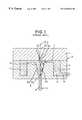
- FIG. 2is a sectional view of a first embodiment of an optical fiber resin coating apparatus of the present invention.
- the optical fiber resin coating apparatus shown in FIG. 2includes a nipple 1 A, an intermediate die 2 A and a resin coating die 2 N.
- the nipple 1 A, the intermediate die 2 A and the resin coating die 2 Nare assembled as an integrated assembly 3 A.
- this integral assemblyis defined as the “optical fiber resin coating apparatus”.
- the nipple 1 A forming part of the assembly (optical fiber resin coating apparatus) 3 Ais provided with a nipple hole 5 which is constituted by a tapered-hole portion 5 a and a land portion 5 b .
- a meniscus-shaped portion 12which defines a boundary face of an optical fiber 10 and a resin 9 and has a meniscus shape may be formed.
- the nipple 1 Ais also provided with a resin supply inlet 8 and a resin supply chamber 7 .
- the resin supply inlet 8receives the UV type molten resin 9 and supplies the same to the resin supply chamber 7 .
- the nipple 1 Ais further provided with a first recess for defining a first resin flow path 4 A.
- the nipple hole 5is positioned at a center of the nipple 1 A.
- the resin supply chamber 7is formed in a coaxial portion of a center axis of the nipple hole 5 through which the optical fiber 10 is introduced.
- the resin supply chamber 7has a size for temporary storing the UV type resin 9 .
- the intermediate die 2 A forming the assembly 3 Ais provided with a communicating hole 14 A which is communicated to the resin supply chamber 7 in the nipple 1 A and has an sectional area meeting to the resin supply chamber 7 , and a center die hole 6 A.
- the intermediate die 2 Ais also provided with a second recess for defining a second resin flow path 4 N.
- the resin coating die 2 N forming the assembly 3 Ais provided with a center die hole 6 N formed by a tapered-hole portion 6 Na and a land portion 6 Nb. Inside of the tapered-hole portion 6 Na a cavity, in which a resin circular flow 13 may be formed, is defined.
- the center axis of the nipple hole 5 in the nipple 1 A, the center axis of the die hole 6 A in the intermediate die 2 A and the center axis of the resin coating die 2 Nare perfectly matched to define a path which passes the optical fiber 10 .
- the first resin flow path 4 Ais defined, and the sections of the resin supply chamber 7 and the communicating hole 14 A are matched.
- the second resin flow path 4 Nis defined.
- the die hole 6 A in the intermediate die 2 Acommunicates the meniscus-shaped portion 12 of the nipple 1 A and the cavity of the tapered-hole portion 6 Na of the die hole 6 N.
- the UV type resin 9 introduced into the resin supply chamber 7 from the resin supply inlet 8flows a flow path of the resin supply chamber 7 , the first resin flow path 4 A, the meniscus-shaped portion 12 , the die hole 6 A, the cavity inside, the tapered-hole portion 6 Na of the die hole 6 N, the second resin flow path 4 N, the communicating hole 14 A, and the first resin flow path 4 A.
- the resin circular flow 13may be generated in the cavity inside the tapered-hole portion 6 Na of the die hole 6 N.
- the UV type resin 9 introduced into the cavity inside the tapered-hole portion 6 Nais coated on the outer surface of the optical fiber 10 to produce a resin coated optical fiber 11 and the redundant resin may flow back to the second resin flow path 4 N.
- the optical fiber 10may be a single mode optical fiber consisting of a core having a diameter of 10 ⁇ m and a cladding formed on the core and having a diameter of 125 ⁇ m.
- the diameter of the resin coated optical fiber 11is, for example, 0.25 mm.
- the diameter of a hole formed in the land portion 6 Nb of the die hole 6 Nis designed to define the outer diameter of the resin coated optical fiber 11 .
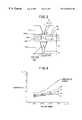
- FIG. 3is an enlarged view of the nipple hole 5 in the nipple 1 A, the die hole 6 A in the intermediate die 2 A and the die hole 6 N in the resin coating die 2 N.
- Nomenclatures (references) in FIG. 2are as follows:
- dman inner diameter of a hole formed at the land portion 5 b in the nipple hole 5 ,
- dn(out)an outlet inner diameter of the tapered-hole portion 6 Na and an inner diameter of a hole formed in the land portion 6 Nb of the die hole 6 N,
- L 1a height (a length or a thickness) of the intermediate die 2 A
- L n1a length of the tapered-hole portion 6 Na of the die hole 6 N
- L n2a length of the tapered-hole portion 6 Na of the die hole 6 N.
- the tapered-hole portion 6 Nais formed between the inlet inner diameter dn(in) and the outlet inner diameter dn(out) spaced by the length L n1 and has an angle ⁇ .
- the diameter d 1 of the die hole 6 A formed in the land portion 6 Abis smaller than the inlet diameter dn(in) of the tapered-hole portion 6 Na of the die hole 6 N.
- the inner diameter dm of the hole at the land portion 5 bis smaller than the inner diameter d 1 of the die hole 6 A.
- the intermediate die 2 Ais provided with only the die hole 6 A formed by the land portion 6 Ab, in other words, the intermediate die 2 A is not provided with a tapered-hole portion, and thus a circular flow of the resin 9 does not generate in the die hole 6 A.
- a section area of the first resin flow path 4 Ashould be simply reduced from an end of the same at the resin supply chamber 7 to another end of the same at the die hole 6 A.
- the UV type resin 9is introduced into the resin supply chamber 7 through the resin supply inlet 9 , introduced into the die hole 6 A of the intermediate die 2 A through the first resin flow path 4 A and introduced into the cavity inside the tapered-hole portion 6 Na of the resin coating die 2 N.
- the circular flow 13 of the resin 9is formed in the cavity inside the tapered-hole portion 6 Na.
- a part of the resin 9 in the circular flow 13directs to the resin supply chamber 7 through the second resin flow path 4 N and the communicating hole 14 A since the sized of the holes designed to meet the conditions as stated by the equations 1 and 2.
- the lowering of the speed of the circular flow 13means the lowering of the speed energy of the circular flow 13 , prevents the disorder of the circular flow 13 even if the resin coated optical fiber 11 is drew out at a high speed.
- the provision of the first resin flow path 4 A formed at the boundary of the nipple 1 A and the intermediate die 2 B and functioning as a communicating path communicating the resin reserving chamber 7 and the die hole 6 Aforms a major circular flow path of the resin reserving chamber 7 , the first resin flow path 4 A, the die hole 6 A, the cavity of the tapered-hole portion 6 Na wherein the circular flow 13 is generated, the second resin flow path 4 N, the communicating hole 14 A and the resin reserving chamber 7 .
- the design of the sizes of the diameters of the holes as stated by the formula 1 and 2facilitates the escape of the redundant resin 9 to the resin reserving chamber 7 and suppresses the generation of the circular flow in the die hole 6 A in the intermediate die 2 B.
- the flow at the meniscus-shaped portion 12 positioned at the outlet of the nipple hole 5is free from the circular flow 13 in the cavity at the tapered-hole portion 6 Na, in other words, the shape of the meniscus-shaped portion 12 can be kept at a desired shape.
- the assembly (optical fiber resin coating apparatus) 3 A of the present embodimentmay achieve the objects of the present invention, namely, the stable proportion of a resin coated optical fiber having a uniform diameter at the high speed drawing the same and free from the lack of resin coating.
- Table 1shows the specific sizes of the holes and the taper angle ⁇ of the assembly (optical fiber resin coating apparatus) 3 A of FIGS. 2 and 3.
- FIG. 4is a graph showing examples of the resin coated optical fiber 11 produced by the assembly (optical fiber resin coating apparatus) 3 A under the conditions of Table 1, and a comparative example of the resin coated optical fiber produced by the optical fiber resin coating apparatus shown in FIG. 1 .
- the optical fiber 10was a single mode optical fiber consisting of a core having a diameter of 10 ⁇ m and a cladding having a diameter of 125 ⁇ m.
- the outer diameter (dn(out)) of the resin coated optical fiber 11was 0.25 mm as shown in Table 1.
- the resin 9was urethane-acrylic resin.
- the drawing speed (line speed) of the resin coated optical fiber 11 for drawing out the same from the assemblywas varied at 800, 1000, 1200 and 1400 m/min, as shown by the abscissa of FIG. 4 .
- the ordinate of FIG. 4shows the eccentricity value of the diameter of the resin coated optical fiber 11 .
- a first example A of the assembly 3 Ashows that the taper angle ⁇ of the tapered-hole portion 6 Na is 5° and inlet inner diameter dn(in) of the tapered-hole portion 6 Na is 1.1 mm.
- Curve Ashows the eccentricity value of the resin coated optical fiber 11 produced by the first example A of the assembly 3 A. Curve A shows that the eccentricity value is smaller than 4 ⁇ m under the drawing speed 800 to 1200 m/min.
- Second to fourth examples B to D of the assembly 3 Ahave the large taper angle ⁇ of the tapered-hole portion 6 Na, of 10° to 15°, to that of the example A.
- Curve B to Dshow the eccentricity values of the resin coated optical fiber 11 produced by the second to fourth examples B to D of the assembly 3 A.
- Curves B to Dshow that the eccentricity values are smaller than 4 ⁇ m under the drawing speed 800 to 1400 m/min.
- a comparative examplewas that the eccentricity value exceeds 6 ⁇ m when the drawing speed was equal to and higher than 1200 m/min.
- the assembly (optical fiber resin coating apparatus) 3 A of the embodiment of the present inventionrealizes a stable resin coating, and thus the lack of resin coating on the optical fiber 10 could be avoided, at a high speed drawing.
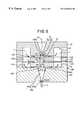
- FIG. 5is a sectional view of an assembly 3 B of the second embodiment.
- references indicating components (elements) constituting the assembly 3 Bsame as or similar to those in FIGS. 2 and 3, are used as same to the references in FIGS. 2 and 3.
- the assembly 3 Bis constituted by a nipple 1 A, a first intermediate die 2 A, a second intermediate die 2 B, and a resin coating die 2 N, as an integrated assembly.
- the nipple 1 A and the resin coating die 2 Nare substantially same to those in the first embodiment of the assembly 3 A.
- the first and second intermediate dies 2 A and 2 B shown in FIG. 5correspond to the intermediate die 2 A in FIG. 2 .
- the intermediate diecomprises (or is divided) the first and second sub-intermediate die 2 A and 2 B in the second embodiment, but the intermediate die can comprise two or more sub-intermediate dies.
- two sub-intermediate diesi.e., the first and second intermediate die 2 A and 2 B, will be described.
- the first intermediate die 2 Ais provided with a die hole 6 A having an inner diameter di and defined by a land portion 6 Ab, and a first communicating hole 14 A communicating to the resin reserving chamber 7 in the nipple 1 A.
- the second intermediate die 2 Bis provided with a die hole 6 B having an inner diameter d 2 and defined by a land portion 6 Bb, and a second communicating hole 14 B communicating to the first communicating hole 14 A of the first intermediate die 2 A.
- a first resin flow path 4 Ais defined at a boundary position of the nipple 1 A and the first intermediate die 2 A
- a second resin flow path 4 Nis defined at a boundary position of the second intermediate die 2 B and the resin coating die 2 N
- a third resin flow path 4 Bis defined at a boundary position of the first intermediate die 2 A and the second intermediate die 2 B.
- the resin reserving chamber 7 , the first communicating hole 14 A and the second communicating hole 14 Bare aligned in a vertical direction.
- the inner diameter d 2 of the second die hole 6 Bis smaller than an inlet inner diameter d n (in) of the tapered-hole portion 6 Na. That is, d 2 ⁇ d n (in).
- An outlet inner diameter d n (out) of the tapered-hole portion 6 Nais equal to an inner diameter of a hole defined by a land portion 6 Na and is smaller than the inlet inner diameter d n (in) of the tapered-hole portion 6 Na. That is, d n (in)>d n (out).
- the inner diameter d m of a hole defined by the land portion 5 b of the nipple hole 5is smaller than the inner diameter d 1 of the die hole 6 A.
- the UV type resin 9 introduced into the resin reserving chamber 7passes the first resin flow path 4 A and flows into the first die hole 6 A.
- the resin 9passes the second die hole 6 B and flows into the cavity inside the tapered-hole portion 6 Na to coat the same on the outer surface of the optical fiber 10 .
- the circular flowmay be generated in the cavity inside the tapered-hole portion 6 Na and the redundant resin flows through the second resin flow path 4 N and reaches to the communicating hole 14 B.
- the resin 9 in the resin reserving chamber 7has a strong pressure than that of the resin 9 in the communicating hole 14 B, and thus the resin 9 in the communicating hole 14 B passes through the third resin flow path 4 B, enters in the second die hole 6 B and flows into the cavity inside the tapered-hole portion 6 Na.
- the provision of the third resin flow path 4 Bestablishes a branched major circular flow path formed by the third resin flow path 4 B, the second die hole 6 B, the cavity inside the tapered-hole portion 6 Na, the second resin flow path 4 N and the communicating hole 14 B.
- the branched major circular flow pathhas a rapid response than that of the major circular flow path consisting of the second resin flow path 4 N, the communicating hole 14 A, the resin flow path 4 A, and the die hole 6 A of the first embodiment shown in FIG. 2 .
- the branched major circular flow pathdoes not include the meniscus-shaped portion 12 , therefore, the meniscus-shaped portion is not affected by the disorder of the circular flow in the cavity inside the tapered-hole portion 6 Na.
- the assembly 3 Bimproves a quality of the resin coated optical fiber 11 , i.e., the elimination of the lack of the resin, and the formation of uniform diameter of the resin coated optical fiber 11 .
- the assembly 3 Benables a more high speed drawing.
- the generation of the disorder of the circular flowmay be prevented, as to the first embodiment, by the conditions of the equations 4 and 5.
- FIG. 6is an enlarged sectional view of a part of the assembly 3 C.
- the assembly 3 Chas the structure similar to that of the assembly 3 B shown in FIG. 5 except for the following relationship.
- the redundant resincan pass through resin flow path 4 Na formed at a boundary portion of the first intermediate die 2 A and the second intermediate die 2 BA and a resin flow path 4 Nb formed at a boundary portion of the second intermediate die 2 BA and the resin coating die 2 N, because a second die hole 6 BA formed in the second intermediate die 2 BA has a large diameter d 2 equal to the inner diameter d n (in) of the tapered-hole portion 6 Na.
- a second die hole 6 BA formed in the second intermediate die 2 BAhas a large diameter d 2 equal to the inner diameter d n (in) of the tapered-hole portion 6 Na.
- the flow speed of the circular flow in the cavity inside the tapered-hole portion 6 Namay be lowered. Consequently, the generation of the disorder of the circular flow in the cavity inside the tapered-hole portion 6 Na can be prevented and the flow of the resin adjacent to the meniscus-shaped portion 12 can be stabilized.
- the assembly 3 Cimproves a quality of the resin coated optical fiber. Namely, the resin coated optical fiber without the lack of the resin and with a uniform diameter may be produced.
- the assembly 3 Calso enables a more high speed drawing.
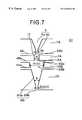
- FIG. 7is an enlarged sectional view of a part of the assembly 3 D.
- the assembly 3 Dhas the structure similar to that of the assembly 3 B except for the following conditions.
- a second intermediate die 2 BBis provided with a die hole 6 BB having an inclined inner wall.
- the inclined-shape die hole 6 BBhas an inlet inner diameter d n (in) equivalent to the inlet inner diameter d n (in) of the tapered-hole portion 6 Na shown in FIG. 5 .
- the following equationsstand.
- the flow paths of the assembly 3 Dare substantially equal to those of the assembly 3 C In FIG. 6 .
- the assembly 3 D of the fourth embodimentresults in the effects same as those of the assembly 3 C of the third embodiment.
- the production of the resin coated single mode optical fiberwas discussed, but the optical fiber resin coating apparatus (assembly) of the present invention can be applied to a variety of optical fibers.
- the optical fiber resin coating apparatus of the present Inventionproduces a high quality resin coated optical fiber having a uniform diameter and without the lack of the resin at a high speed. Therefore, the present invention improves the yield of the resin coated optical fiber.
- the present inventionenables a high speed drawing of the resin coated optical fiber.
- the present inventionImproves the productivity of the resin coated optical fiber.
Landscapes
- Life Sciences & Earth Sciences (AREA)
- Chemical & Material Sciences (AREA)
- General Life Sciences & Earth Sciences (AREA)
- Engineering & Computer Science (AREA)
- Chemical Kinetics & Catalysis (AREA)
- General Chemical & Material Sciences (AREA)
- Geochemistry & Mineralogy (AREA)
- Materials Engineering (AREA)
- Organic Chemistry (AREA)
- Optical Fibers, Optical Fiber Cores, And Optical Fiber Bundles (AREA)
- Surface Treatment Of Glass Fibres Or Filaments (AREA)
Abstract
Description
1. Field of the Invention
The present invention relates to an optical fiber resin coating apparatus, more particularly, an optical fiber resin coating apparatus for uniformly coating a resin on an optical fiber at a high speed.
2. Description of the Related Art
An optical fiber consisting of a core and a cladding provided at an outer circumferential of the core is produced by heating a preform of the optical fiber at a furnace and drawing it out from the furnace. Thereafter, the optical fiber is coated by a resin to produce a resin coated optical fiber.
Japanese Unexamined Patent Publication (Kokai) 6-279047 discloses a technology for coating a resin on an optical fiber. FIG. 1 is a sectional view of an optical fiber resin coating apparatus of Japanese Unexamined Patent Publication (Kokai) 6-279047.
For coating resin on an optical fiber, in addition to the optical fiber resin coating apparatus shown in FIG. 1, as disclosed in Japanese Unexamined Patent Publication (Kokai) 6-279047, it is necessary to provide a resin supply means for supplying a resin to the optical fiber resin coating apparatus, a moving means for introducing an optical fiber into the optical fiber resin coating apparatus and drawing out a resin coated optical fiber from the optical fiber resin coating apparatus, a cooling means for cooling the drew out hot resin coated optical fiber, an outer diameter measurement means for measuring an outer diameter of the resin coated optical fiber, a control means for reading the measured outer diameter and controlling a drawing-out speed of the moving means, and resin supply parameters at the resin supply means, and a winding means for winding the cooled resin coated optical fiber. Below, the optical fiber resin coating apparatus in FIG. 1 will be described in detail.
The optical fiber resin coating apparatus is formed as anassembly 3 of a combination of anipple 1 and aresin coating die 2.
Aresin flow path 4 is defined at the gap (a boundary portion or an interface) of thenipple 1 and theresin coating die 2. Anipple hole 5 of thenipple 1 and adie hole 6 of the resin coating die2 are aligned in theassembly 3 at a same center line. Thenipple hole 5 is constituted by a tapered-hole portion 5aand aland portion 5b. Aresin supply chamber 7 is provided in the coating die2 in a concentricity with thedie hole 6. Aresin supply inlet 8 is also provided in thecoating die 2 to supply aresin 9 to theresin supply chamber 7. Anoptical fiber 10 is introduced into thenipple hole 5 and thedie hole 6 to be coated with theresin 9. Theresin 9 is supplied to thedie hole 6 at a predetermined pressure from theresin supply chamber 7 through theresin flow path 5, to produce a resultant resin coatedoptical fiber 11.
A meniscus-shaped portion 12, which is a boundary plane of theresin 9 and theoptical fiber 10, is formed at an outlet portion of thenipple hole 5, and acircular flow 13 of theresin 9 is caused in a cavity formed inside of tapered-hole portion 6a of thedie hole 6 in the resin coating die2.
The optical fiber resin coating apparatus disclosed in Japanese Unexamined Patent Publication (Kokai) 6-279047 suffers from the disadvantages of a partial lack (partial failure) of the coating of the resin on theoptical fiber 10 in certain portions and/or unevenness of the diameter of the resin coatedoptical fiber 11 when the resin coatedoptical fiber 11 is drawn out from the optical fiber resin coating apparatus a high speed. Accordingly, the optical fiber resin coating apparatus of Japanese Unexamined Patent Publication (Kokai) 6-279047 suffers from the disadvantage of a limitation of the speed up of the drawing-out speed. Consequently, the optical fiber resin coating apparatus of Japanese Unexamined Patent Publication (Kokai) 6-279047 can not achieve a high productivity of the resin coating.
Japanese Examined Patent Publication (Kokoku) 7-91092 discloses a technology for preventing the partial lack (failure) of the coating and/or unevenness of the diameter of the resin coated optical fiber by suitably defining (designing) the size of theresin flow path 4 and the angle of the tapered-hole portion 6ain theresin coating die 2.
The technology of Japanese Examined Patent Publication (Kokoku) 7-91092 can provide a good result below the drawing speed of the resin coated optical fiber is 1000 m/min, but still suffers from the disadvantages of the partial lack (failure) of the coating and/or unevenness of the diameter of the resin coated optical fiber at higher speed drawing.
According to an analysis of such disadvantages by inventors of the present invention, it was found that the reasons of the partial lack of the resin coating and/or the unevenness of the diameter of the resin coated optical fiber during high speed drawing had probably been due to disruptions in thecircular flow 13 in the cavity of the tapered-hole portion 6aof theresin coating die 2 during high speed drawing. Namely, the high speed drawing of the resin coatedoptical fiber 11 disrupted the smooth circular flow in the cavity of tapered-hole portion 6aand caused vibration of the movingoptical fiber 10 and destabilized the meniscus-shaped portion 12 formed at the outlet portion of thenipple hole 5.
The countermeasures of the technology disclosed in Japanese Examined Patent Publication (Kokoku) 7-91092 run up against the disadvantages of the limit on speed of Japanese Unexamined Patent Publication (Kokai) 6-279047.
An object of the present invention is to provide an optical fiber resin coating apparatus enabling a uniform coating on an optical fiber during high speed drawing.
According to the present invention, there is provided an optical fiber resin coating apparatus comprising: a nipple including a nipple hole, a resin reserving chamber for reserving resin, and a resin supply inlet, said nipple hole having a first tapered-hole portion introducing an optical fiber therethrough and a first land portion continuing from the first tapered-hole portion and defining a first hole of a first diameter, a meniscus-shaped portion being positioned at an end of the first land portion; a resin coating die, and including a second tapered-hole and a second land portion continued to the second tapered-hole and defining a second hole of a second diameter which is defined a diameter of a resin coated optical fiber; and an intermediate die provided between the nipple and the resin coating die, including a third hole which communicates an end of the nipple hole and the second tapered-hole and has a third diameter, a fourth hole which communicates to the resin reserving chamber, a center axis of the nipple hole in the nipple, a center axis of the second hole of the resin coating die and a center axis of the third hole of the intermediate die being matched, a first resin flow path being defined at a boundary position of the nipple and the intermediate die, said first resin flow path communicating the resin reserving chamber, the end of the nipple hole and the third hole in the intermediate die, and a second resin flow path being defined at a boundary position of the intermediate die and the resin coating die, said second resin flow path communicating the third hole in the intermediate die, the second tapered-hole in the resin coating die and the fourth hole of the intermediate die.
Preferably, said first hole of the first diameter, said third hole of the third diameter, said second hole of the second diameter, said second tapered-hole, said first and second resin flow paths are defined, so that a first circular resin flow path, including said resin reserving chamber, said first resin flow path, said third hole, a cavity defined in said second tapered-hole, said second resin flow path, said fourth hole and said resin reserving chamber, in formed, and a second circular resin flow is formed in said cavity.
Preferably, said second tapered-hole in the resin coated die has a large diameter dn(in) at an end and a small diameter dn(out) at another end equal to the second diameter of the second hole, wherein the first diameter of the first hole of the nipple hole is defined as dm, and the third diameter of the third hole of the intermediate die is defined as d1, and the following relationship are defined:
More preferably, the optical fiber resin coating apparatus further comprises at least one additional intermediate die provided between said intermediate die and said resin coating die. The additional intermediate die includes a fifth hole which communicates said third hole in said intermediate die and said second tapered-hole in said resin coating die and has a fifth diameter, and a sixth hole which communicates to said fourth hole in said intermediate die. The first resin flow path is defined at a boundary position of the nipple and the intermediate die, said first resin flow path communicating the resin reserving chamber, the end of the nipple hole and the third hole in the intermediate die. The second resin flow path is defined at a boundary position of the additional intermediate die and the resin coating die, said second resin flow path communicating the fifth hole, the second tapered-hole and the sixth hole. A third resin flow path is defined at a boundary position of the intermediate die and the additional intermediate die, said third resin flow path communicating the third hole and the fourth hole. The fifth diameter of the fifth hole in the additional intermediate die may be equal to said third diameter in the intermediate die. The fifth diameter of the fifth hole in the additional intermediate die may be defined as
The fifth hole in the additional intermediate die has a tapered-inner wall the maximum inner diameter d2of the inner wall may be defined as d1<d2≦dn(in).
The above and other objects and features of the present invention will be become more apparently by the following description with reference to the accompanying drawings, in which:
FIG. 1 is a sectional view of an optical fiber resin coating apparatus of a related art;
FIG. 2 is a sectional view of a first embodiment of an optical fiber resin coating apparatus of the present invention;
FIG. 3 is an enlarged sectional view of a part of the optical fiber resin coating apparatus shown in FIG. 2;
FIG. 4 is a graph showing examples used the optical fiber resin coating apparatus of the first embodiment and a comparative example of the related art;
FIG. 5 is a sectional view of a second embodiment of an optical fiber resin coating apparatus of the present invention;
FIG. 6 is an enlarged view of a part of a third embodiment of an optical fiber resin coating apparatus of the present invention; and
FIG. 7 is an enlarged view of a part of a fourth embodiment of an optical fiber resin coating apparatus of the present invention.
First Embodiment
Referring to FIGS. 1 and 2, a first embodiment of an optical fiber resin coating apparatus of the present invention will be described.
FIG. 2 is a sectional view of a first embodiment of an optical fiber resin coating apparatus of the present invention.
The optical fiber resin coating apparatus shown in FIG. 2 includes anipple 1A, anintermediate die 2A and a resin coating die2N. Thenipple 1A, theintermediate die 2A and the resin coating die2N are assembled as an integrated assembly3A. In this specification, this integral assembly is defined as the “optical fiber resin coating apparatus”.
Thenipple 1A forming part of the assembly (optical fiber resin coating apparatus)3A is provided with anipple hole 5 which is constituted by a tapered-hole portion 5aand aland portion 5b. At the outlet of thenipple hole 5b, a meniscus-shaped portion 12 which defines a boundary face of anoptical fiber 10 and aresin 9 and has a meniscus shape may be formed. Thenipple 1A is also provided with aresin supply inlet 8 and aresin supply chamber 7. Theresin supply inlet 8 receives the UV typemolten resin 9 and supplies the same to theresin supply chamber 7. Thenipple 1A is further provided with a first recess for defining a firstresin flow path 4A.
Anoptical fiber 10 will be introduced into thenipple hole 5. Thenipple hole 5 is positioned at a center of thenipple 1A. Theresin supply chamber 7 is formed in a coaxial portion of a center axis of thenipple hole 5 through which theoptical fiber 10 is introduced. Theresin supply chamber 7 has a size for temporary storing theUV type resin 9.
Theintermediate die 2A forming the assembly3A is provided with a communicatinghole 14A which is communicated to theresin supply chamber 7 in thenipple 1A and has an sectional area meeting to theresin supply chamber 7, and acenter die hole 6A. Theintermediate die 2A is also provided with a second recess for defining a secondresin flow path 4N.
The resin coating die2N forming the assembly3A is provided with acenter die hole 6N formed by a tapered-hole portion6Na and a land portion6Nb. Inside of the tapered-hole portion6Na a cavity, in which aresin circular flow 13 may be formed, is defined.
When assembled thenipple 1A, theintermediate die 2A and the resin coating die2N to form the integrated assembly (optical fiber resin coating apparatus)3A, the center axis of thenipple hole 5 in thenipple 1A, the center axis of thedie hole 6A in theintermediate die 2A and the center axis of the resin coating die2N are perfectly matched to define a path which passes theoptical fiber 10. At a boundary portion of thenipple 1A and theintermediate die 2A, the firstresin flow path 4A is defined, and the sections of theresin supply chamber 7 and the communicatinghole 14A are matched.
At a boundary portion of theintermediate die 2A and the resin coating die2N, the secondresin flow path 4N is defined. Thedie hole 6A in theintermediate die 2A communicates the meniscus-shapedportion 12 of thenipple 1A and the cavity of the tapered-hole portion6Na of thedie hole 6N.
As illustrated in FIG. 2, theUV type resin 9 introduced into theresin supply chamber 7 from theresin supply inlet 8 flows a flow path of theresin supply chamber 7, the firstresin flow path 4A, the meniscus-shapedportion 12, thedie hole 6A, the cavity inside, the tapered-hole portion6Na of thedie hole 6N, the secondresin flow path 4N, the communicatinghole 14A, and the firstresin flow path 4A.
Note theresin circular flow 13 may be generated in the cavity inside the tapered-hole portion6Na of thedie hole 6N. TheUV type resin 9 introduced into the cavity inside the tapered-hole portion6Na is coated on the outer surface of theoptical fiber 10 to produce a resin coatedoptical fiber 11 and the redundant resin may flow back to the secondresin flow path 4N.
Theoptical fiber 10 may be a single mode optical fiber consisting of a core having a diameter of 10 μm and a cladding formed on the core and having a diameter of 125 μm. The diameter of the resin coatedoptical fiber 11 is, for example, 0.25 mm. The diameter of a hole formed in the land portion6Nb of thedie hole 6N is designed to define the outer diameter of the resin coatedoptical fiber 11.
Referring to FIG. 3, a size of the assembly3A shown in FIG. 2 will be described. FIG. 3 is an enlarged view of thenipple hole 5 in thenipple 1A, thedie hole 6A in theintermediate die 2A and thedie hole 6N in the resin coating die2N.
The sizes discussed below are important to avoid the generation of the disorder of thecircular resin flow 13 in the cavity inside the tapered-hole portion6Na of thedie hole 6N.
Nomenclatures (references) in FIG. 2 are as follows:
dm: an inner diameter of a hole formed at theland portion 5bin thenipple hole 5,
d1: an inner diameter of thedie hole 6A formed in a land portion6Ab of theintermediate die 2A,
dn(in): an inlet inner diameter of the tapered-hole portion6Na of thedie hole 6N,
dn(out): an outlet inner diameter of the tapered-hole portion6Na and an inner diameter of a hole formed in the land portion6Nb of thedie hole 6N,
C1: a height (a clearance) of the firstresin flow path 4A,
Cn: a height (a clearance) of the secondresin flow path 4N,
L1: a height (a length or a thickness) of theintermediate die 2A,
Ln1: a length of the tapered-hole portion6Na of thedie hole 6N, and
Ln2: a length of the tapered-hole portion6Na of thedie hole 6N.
The tapered-hole portion6Na is formed between the inlet inner diameter dn(in) and the outlet inner diameter dn(out) spaced by the length Ln1and has an angle θ. Of course, dn(in)>dn(out).
The diameter d1of thedie hole 6A formed in the land portion6Ab is smaller than the inlet diameter dn(in) of the tapered-hole portion6Na of thedie hole 6N. The inner diameter dm of the hole at theland portion 5bis smaller than the inner diameter d1of thedie hole 6A. Thus, the following equations stand.
Theintermediate die 2A is provided with only thedie hole 6A formed by the land portion6Ab, in other words, theintermediate die 2A is not provided with a tapered-hole portion, and thus a circular flow of theresin 9 does not generate in thedie hole 6A.
To ensure the smooth flow of theresin 9, a section area of the firstresin flow path 4A should be simply reduced from an end of the same at theresin supply chamber 7 to another end of the same at thedie hole 6A.
TheUV type resin 9 is introduced into theresin supply chamber 7 through theresin supply inlet 9, introduced into thedie hole 6A of theintermediate die 2A through the firstresin flow path 4A and introduced into the cavity inside the tapered-hole portion6Na of the resin coating die2N. Thecircular flow 13 of theresin 9 is formed in the cavity inside the tapered-hole portion6Na.
A part of theresin 9 in thecircular flow 13 directs to theresin supply chamber 7 through the secondresin flow path 4N and the communicatinghole 14A since the sized of the holes designed to meet the conditions as stated by theequations
The analysis of the assembly (optical fiber resin coating apparatus)3A will be described.
The provision of the secondresin flow path 4N formed at the boundary of theintermediate die 2B and the resin coating die2N and functioning as a communicating path together with the communicatinghole 14A for communicating the tapered-hole portion6Na and theresin reserving chamber 7, enables the escape (or the return) of the part of theUV type resin 9 in thecircular flow 13 in the cavity inside the tapered-hole portion6Na to theresin reserving chamber 7 to reduce the speed of thecircular flow 13. The lowering of the speed of thecircular flow 13 means the lowering of the speed energy of thecircular flow 13, prevents the disorder of thecircular flow 13 even if the resin coatedoptical fiber 11 is drew out at a high speed.
Of course, the provision of the firstresin flow path 4A formed at the boundary of thenipple 1A and theintermediate die 2B and functioning as a communicating path communicating theresin reserving chamber 7 and thedie hole 6A forms a major circular flow path of theresin reserving chamber 7, the firstresin flow path 4A, thedie hole 6A, the cavity of the tapered-hole portion6Na wherein thecircular flow 13 is generated, the secondresin flow path 4N, the communicatinghole 14A and theresin reserving chamber 7.
Second, the design of the sizes of the diameters of the holes as stated by theformula redundant resin 9 to theresin reserving chamber 7 and suppresses the generation of the circular flow in thedie hole 6A in theintermediate die 2B. Under the conditions, the flow at the meniscus-shapedportion 12 positioned at the outlet of thenipple hole 5 is free from thecircular flow 13 in the cavity at the tapered-hole portion6Na, in other words, the shape of the meniscus-shapedportion 12 can be kept at a desired shape.
As a result, the assembly (optical fiber resin coating apparatus)3A of the present embodiment may achieve the objects of the present invention, namely, the stable proportion of a resin coated optical fiber having a uniform diameter at the high speed drawing the same and free from the lack of resin coating.
Table 1 shows the specific sizes of the holes and the taper angle θ of the assembly (optical fiber resin coating apparatus)3A of FIGS. 2 and 3.
| TABLE 1 | ||||||||||
| No. | dm | C1 | L1 | d1 | Cn | Ln1 | Ln2 | dn(out) | θ | dn(in) |
| A | 0.3 | 0.2 | 1.0 | 0.8 | 0.3 | 10 | 0.5 | 0.25 | 5° | 1.1 |
| B | 0.3 | 0.3 | 1.0 | 0.8 | 0.3 | 7 | 0.5 | 0.25 | 10° | 1.5 |
| C | 0.3 | 0.4 | 1.0 | 0.8 | 0.3 | 5 | 0.5 | 0.25 | 15° | 1.6 |
| D | 0.3 | 0.3 | 1.0 | 0.6 | 0.3 | 7 | 0.5 | 0.25 | 10° | 1.5 |
| unit: mm for dm, C1, L1, d1, Cn, Ln1, Ln2, dn(out) and dn(in) | ||||||||||
FIG. 4 is a graph showing examples of the resin coatedoptical fiber 11 produced by the assembly (optical fiber resin coating apparatus)3A under the conditions of Table 1, and a comparative example of the resin coated optical fiber produced by the optical fiber resin coating apparatus shown in FIG.1.
Theoptical fiber 10 was a single mode optical fiber consisting of a core having a diameter of 10 μm and a cladding having a diameter of 125 μm. The outer diameter (dn(out)) of the resin coatedoptical fiber 11 was 0.25 mm as shown in Table 1. Theresin 9 was urethane-acrylic resin. The drawing speed (line speed) of the resin coatedoptical fiber 11 for drawing out the same from the assembly was varied at 800, 1000, 1200 and 1400 m/min, as shown by the abscissa of FIG.4. The ordinate of FIG. 4 shows the eccentricity value of the diameter of the resin coatedoptical fiber 11.
A first example A of the assembly3A shows that the taper angle θ of the tapered-hole portion6Na is 5° and inlet inner diameter dn(in) of the tapered-hole portion6Na is 1.1 mm. Curve A shows the eccentricity value of the resin coatedoptical fiber 11 produced by the first example A of the assembly3A. Curve A shows that the eccentricity value is smaller than 4 μm under thedrawing speed 800 to 1200 m/min.
Second to fourth examples B to D of the assembly3A have the large taper angle θ of the tapered-hole portion6Na, of 10° to 15°, to that of the example A. Curve B to D show the eccentricity values of the resin coatedoptical fiber 11 produced by the second to fourth examples B to D of the assembly3A. Curves B to D show that the eccentricity values are smaller than 4 μm under thedrawing speed 800 to 1400 m/min.
A comparative example was that the eccentricity value exceeds 6 μm when the drawing speed was equal to and higher than 1200 m/min.
From the above examples, it is understood that the assembly (optical fiber resin coating apparatus)3A of the embodiment of the present invention realizes a stable resin coating, and thus the lack of resin coating on theoptical fiber 10 could be avoided, at a high speed drawing.
Second Embodiment
Referring to FIG. 5, a second embodiment of an assembly (optical fiber resin coating apparatus) of the present invention will be described. FIG. 5 is a sectional view of anassembly 3B of the second embodiment. In FIG. 5 references indicating components (elements) constituting theassembly 3B, same as or similar to those in FIGS. 2 and 3, are used as same to the references in FIGS. 2 and 3.
Theassembly 3B is constituted by anipple 1A, a firstintermediate die 2A, a secondintermediate die 2B, and a resin coating die2N, as an integrated assembly.
Thenipple 1A and the resin coating die2N are substantially same to those in the first embodiment of the assembly3A.
The first and second intermediate dies2A and2B shown in FIG. 5 correspond to theintermediate die 2A in FIG.2. Namely, the intermediate die comprises (or is divided) the first and secondsub-intermediate die intermediate die
The firstintermediate die 2A is provided with adie hole 6A having an inner diameter di and defined by a land portion6Ab, and a first communicatinghole 14A communicating to theresin reserving chamber 7 in thenipple 1A.
The secondintermediate die 2B is provided with adie hole 6B having an inner diameter d2and defined by a land portion6Bb, and a second communicatinghole 14B communicating to the first communicatinghole 14A of the firstintermediate die 2A.
A firstresin flow path 4A is defined at a boundary position of thenipple 1A and the firstintermediate die 2A, a secondresin flow path 4N is defined at a boundary position of the secondintermediate die 2B and the resin coating die2N, and a thirdresin flow path 4B is defined at a boundary position of the firstintermediate die 2A and the secondintermediate die 2B.
The first to thirdresin flow path second die holes resin reserving chamber 7 and the cavity inside the tapered-hole portion6Na of thedie hole 6N.
Center axes of thenipple hole 5, thefirst die hole 6A, thesecond die hole 6B, thedie hole 6N coincide and define the path moving theoptical fiber 10. Theresin reserving chamber 7, the first communicatinghole 14A and the second communicatinghole 14B are aligned in a vertical direction.
In the second embodiment, the inner diameter d1of thefirst die hole 6A is equal to the inner diameter d2of thesecond die hole 6B. That is, d1=d2.
The inner diameter d2of thesecond die hole 6B is smaller than an inlet inner diameter dn(in) of the tapered-hole portion6Na. That is, d2<dn(in).
An outlet inner diameter dn(out) of the tapered-hole portion6Na is equal to an inner diameter of a hole defined by a land portion6Na and is smaller than the inlet inner diameter dn(in) of the tapered-hole portion6Na. That is, dn(in)>dn(out).
The inner diameter dmof a hole defined by theland portion 5bof thenipple hole 5 is smaller than the inner diameter d1of thedie hole 6A.
Accordingly, the following equations stand:
In theassembly 3B shown in FIG. 5, theUV type resin 9 introduced into theresin reserving chamber 7 passes the firstresin flow path 4A and flows into thefirst die hole 6A. Theresin 9 passes thesecond die hole 6B and flows into the cavity inside the tapered-hole portion6Na to coat the same on the outer surface of theoptical fiber 10. The circular flow may be generated in the cavity inside the tapered-hole portion6Na and the redundant resin flows through the secondresin flow path 4N and reaches to the communicatinghole 14B. Theresin 9 in theresin reserving chamber 7 has a strong pressure than that of theresin 9 in the communicatinghole 14B, and thus theresin 9 in the communicatinghole 14B passes through the thirdresin flow path 4B, enters in thesecond die hole 6B and flows into the cavity inside the tapered-hole portion6Na.
The provision of the thirdresin flow path 4B establishes a branched major circular flow path formed by the thirdresin flow path 4B, thesecond die hole 6B, the cavity inside the tapered-hole portion6Na, the secondresin flow path 4N and the communicatinghole 14B. Compared with the first embodiment of the assembly3A, the branched major circular flow path has a rapid response than that of the major circular flow path consisting of the secondresin flow path 4N, the communicatinghole 14A, theresin flow path 4A, and thedie hole 6A of the first embodiment shown in FIG.2. Further, the branched major circular flow path does not include the meniscus-shapedportion 12, therefore, the meniscus-shaped portion is not affected by the disorder of the circular flow in the cavity inside the tapered-hole portion6Na. As a result, theassembly 3B improves a quality of the resin coatedoptical fiber 11, i.e., the elimination of the lack of the resin, and the formation of uniform diameter of the resin coatedoptical fiber 11. Theassembly 3B enables a more high speed drawing.
Of course, in the second embodiment of theassembly 3B, the generation of the disorder of the circular flow may be prevented, as to the first embodiment, by the conditions of theequations
Third Embodiment
Referring to FIG. 6, a third embodiment of an assembly (optical fiber resin coating apparatus)3C of the present invention will be described. FIG. 6 is an enlarged sectional view of a part of theassembly 3C.
Theassembly 3C has the structure similar to that of theassembly 3B shown in FIG. 5 except for the following relationship.
In theassembly 3C shown in FIG. 6, the redundant resin can pass through resin flow path4Na formed at a boundary portion of the firstintermediate die 2A and the second intermediate die2BA and a resin flow path4Nb formed at a boundary portion of the second intermediate die2BA and the resin coating die2N, because a second die hole6BA formed in the second intermediate die2BA has a large diameter d2equal to the inner diameter dn(in) of the tapered-hole portion6Na. As a result, the flow speed of the circular flow in the cavity inside the tapered-hole portion6Na may be lowered. Consequently, the generation of the disorder of the circular flow in the cavity inside the tapered-hole portion6Na can be prevented and the flow of the resin adjacent to the meniscus-shapedportion 12 can be stabilized.
Theassembly 3C improves a quality of the resin coated optical fiber. Namely, the resin coated optical fiber without the lack of the resin and with a uniform diameter may be produced. Theassembly 3C also enables a more high speed drawing.
Fourth Embodiment
Referring to FIG. 7, a fourth embodiment of an assembly (optical fiber resin coating apparatus)3D of the present invention will be described. FIG. 7 is an enlarged sectional view of a part of theassembly 3D.
Theassembly 3D has the structure similar to that of theassembly 3B except for the following conditions.
A second intermediate die2BB is provided with a die hole6BB having an inclined inner wall. The inclined-shape die hole6BB has an inlet inner diameter dn(in) equivalent to the inlet inner diameter dn(in) of the tapered-hole portion6Na shown in FIG.5. The following equations stand.
The flow paths of theassembly 3D are substantially equal to those of theassembly 3C In FIG.6.
Theassembly 3D of the fourth embodiment results in the effects same as those of theassembly 3C of the third embodiment.
In the above embodiments, the production of the resin coated single mode optical fiber was discussed, but the optical fiber resin coating apparatus (assembly) of the present invention can be applied to a variety of optical fibers.
As described above, the optical fiber resin coating apparatus of the present Invention produces a high quality resin coated optical fiber having a uniform diameter and without the lack of the resin at a high speed. Therefore, the present invention improves the yield of the resin coated optical fiber.
Further, the present invention enables a high speed drawing of the resin coated optical fiber. Thus, the present invention Improves the productivity of the resin coated optical fiber.
Claims (7)
1. An optic fiber resin coating apparatus comprising:
a nipple including a nipple hole, a resin reserving chamber for storing a resin, and a resin supply inlet, said nipple hole having a first tapered-hole portion through which an optical fiber is introduced therethrough and a first land portion continuing from the first tapered-hole portion and defining a first hole of a first diameter, a meniscus-shaped portion being positioned at an end of the first land portion;
a resin coating die, including a second tapered-hole and a second land portion continuing from the second tapered-hole and defining a second hole of a second diameter of a resin coated optical fiber; and
an intermediate die provided between the nipple and the resin coating die, including a third hole which communicates an end of the nipple hole and the second tapered-hole and has a third diameter, and a fourth hole which communicates with the resin reserving chamber,
a center axis of the nipple hole in the nipple, a center axis of the second hole of the resin coating die and a center axis of the third hole of the intermediate die being aligned,
a first resin flow path being defined at a boundary position of the nipple and the intermediate die, said first resin flow path communicating with the resin reserving chamber, the end of the nipple hole and the third hole in the intermediate die, and
a second resin flow path being defined at a boundary position of the intermediate die and the resin coating die, said second resin flow path communicating with the third hole in the intermediate die, the second tapered-hole in the resin coating die and the fourth hole of the intermediate die, and said second resin flow path communicating with said resin reserving chamber connected to said first resin flow path through said tapered-portion of said resin coating die and said fourth hole of said intermediate die.
2. An optical fiber resin coating apparatus according to claim1, wherein said first hole of the first diameter, said third hole of the third diameter, said second hole of the second diameter, said second tapered-hole, said first and second resin flow paths are defined, so that a first circular resin flow path, including said resin reserving chamber, said first resin flow path, said third hole, a cavity defined in said second tapered-hole, said second resin flow path, said fourth hole and said resin reserving chamber, is formed, and a second circular resin flow is caused in said cavity.
3. An optical fiber resin coating apparatus according to claim2, said second tapered-hole in the resin coating die has a large diameter dn(in) at an end and a small diameter dn(out) at another end equal to the second diameter of the second hole,
wherein the first diameter of the first hole of the nipple hole is defined as dm, and the third diameter of the third hole of the intermediate die is defined as d1, and
wherein the following relationships stand:
4. An optical fiber resin coating apparatus according to claim2, further comprising at least one additional intermediate die provided between said intermediate die and said resin coating die,
said additional intermediate die including
a fifth hole which communicates said third hole in said intermediate die and said second tapered-hole in said resin coating die and has a fifth diameter, and
a sixth hole which communicates to said fourth hole in said intermediate die,
said first resin flow path being defined at a boundary position of the nipple and the intermediate die, said first resin flow path communicating the resin reserving chamber, the end of the nipple hole and the third hole in the intermediate die,
said second resin flow path being defined at a boundary position of the additional intermediate die and the resin coating die, and communicating the fifth hole, the second tapered-hole and the sixth hole, and
a third resin flow path being defined at a boundary position of the intermediate die and the additional intermediate die, said third resin flow path communicating the third hole and the fourth hole.
5. An optical fiber resin coating apparatus according to claim4, wherein said fifth diameter of the fifth hole in the additional intermediate die is equal to said third diameter in the Intermediate die.
6. An optical fiber resin coating apparatus according to claim4, wherein said fifth diameter d2of the fifth hole in the additional intermediate die is defined as
7. An optical fiber resin coating apparatus according to claim4, wherein said fifth hole in the additional intermediate die has a tapered-inner wall, the maximum inner diameter d2of the inner wall is defined as d1<d2≦dn(in).
Priority Applications (2)
| Application Number | Priority Date | Filing Date | Title |
|---|---|---|---|
| JP21483997AJP3238105B2 (en) | 1997-08-08 | 1997-08-08 | Optical fiber resin coating method and optical fiber resin coating apparatus |
| US09/245,341US6284046B1 (en) | 1997-08-08 | 1999-02-05 | Optical fiber resin coating apparatus |
Applications Claiming Priority (2)
| Application Number | Priority Date | Filing Date | Title |
|---|---|---|---|
| JP21483997AJP3238105B2 (en) | 1997-08-08 | 1997-08-08 | Optical fiber resin coating method and optical fiber resin coating apparatus |
| US09/245,341US6284046B1 (en) | 1997-08-08 | 1999-02-05 | Optical fiber resin coating apparatus |
Publications (1)
| Publication Number | Publication Date |
|---|---|
| US6284046B1true US6284046B1 (en) | 2001-09-04 |
Family
ID=26520539
Family Applications (1)
| Application Number | Title | Priority Date | Filing Date |
|---|---|---|---|
| US09/245,341Expired - LifetimeUS6284046B1 (en) | 1997-08-08 | 1999-02-05 | Optical fiber resin coating apparatus |
Country Status (2)
| Country | Link |
|---|---|
| US (1) | US6284046B1 (en) |
| JP (1) | JP3238105B2 (en) |
Cited By (11)
| Publication number | Priority date | Publication date | Assignee | Title |
|---|---|---|---|---|
| US20020166345A1 (en)* | 2001-03-14 | 2002-11-14 | The Furukawa Electric Co, Ltd. | Resin coating device for optical fiber |
| US6660086B1 (en) | 2000-03-06 | 2003-12-09 | Innovative Coatings, Inc. | Method and apparatus for extruding a coating upon a substrate surface |
| EP1452501A1 (en)* | 2003-02-28 | 2004-09-01 | Fitel Usa Corporation | Multiple feed applicator assembly for coating optical fibers |
| US20070020475A1 (en)* | 2005-07-21 | 2007-01-25 | Prince Kendall W | Primed substrate and method for making the same |
| US20090145168A1 (en)* | 2007-05-08 | 2009-06-11 | The Furukawa Electric Co., Ltd | Optical fiber manufacturing method and optical fiber manufacturing apparatus |
| US20110011956A1 (en)* | 2009-03-16 | 2011-01-20 | Furukawa Electric Co., Ltd. | Cleaning method of coloring device of optical fiber, and coloring device of optical fiber |
| US9289795B2 (en) | 2008-07-01 | 2016-03-22 | Precision Coating Innovations, Llc | Pressurization coating systems, methods, and apparatuses |
| US9616457B2 (en) | 2012-04-30 | 2017-04-11 | Innovative Coatings, Inc. | Pressurization coating systems, methods, and apparatuses |
| WO2018140393A1 (en)* | 2017-01-24 | 2018-08-02 | Corning Incorporated | Optical fiber coating die with reduced wetted length |
| US10562814B2 (en) | 2013-06-07 | 2020-02-18 | Fujikura Ltd. | Bare optical fiber coating device and bare optical fiber coating method |
| CN116037384A (en)* | 2022-12-29 | 2023-05-02 | 华能(泰安)光电科技有限公司 | Optical fiber ointment coating assembly |
Citations (5)
| Publication number | Priority date | Publication date | Assignee | Title |
|---|---|---|---|---|
| JPH04124048A (en) | 1990-09-17 | 1992-04-24 | Sumitomo Electric Ind Ltd | Resin coater for optical fiber |
| JPH06279047A (en) | 1993-03-24 | 1994-10-04 | Furukawa Electric Co Ltd:The | Production of coated optical fiber |
| US5449408A (en)* | 1991-11-25 | 1995-09-12 | Furukawa Electric Co., Ltd. | Optical fiber coating apparatus and positioning method thereof |
| US5976611A (en)* | 1995-10-06 | 1999-11-02 | Sumitomo Electric Industries, Ltd. | Optical fiber coating method and apparatus therefor |
| US6030658A (en)* | 1997-02-14 | 2000-02-29 | Sumitomo Electric Industries Ltd. | Resin coating applicator for an optical fiber |
- 1997
- 1997-08-08JPJP21483997Apatent/JP3238105B2/ennot_activeExpired - Lifetime
- 1999
- 1999-02-05USUS09/245,341patent/US6284046B1/ennot_activeExpired - Lifetime
Patent Citations (5)
| Publication number | Priority date | Publication date | Assignee | Title |
|---|---|---|---|---|
| JPH04124048A (en) | 1990-09-17 | 1992-04-24 | Sumitomo Electric Ind Ltd | Resin coater for optical fiber |
| US5449408A (en)* | 1991-11-25 | 1995-09-12 | Furukawa Electric Co., Ltd. | Optical fiber coating apparatus and positioning method thereof |
| JPH06279047A (en) | 1993-03-24 | 1994-10-04 | Furukawa Electric Co Ltd:The | Production of coated optical fiber |
| US5976611A (en)* | 1995-10-06 | 1999-11-02 | Sumitomo Electric Industries, Ltd. | Optical fiber coating method and apparatus therefor |
| US6030658A (en)* | 1997-02-14 | 2000-02-29 | Sumitomo Electric Industries Ltd. | Resin coating applicator for an optical fiber |
Cited By (24)
| Publication number | Priority date | Publication date | Assignee | Title |
|---|---|---|---|---|
| US6660086B1 (en) | 2000-03-06 | 2003-12-09 | Innovative Coatings, Inc. | Method and apparatus for extruding a coating upon a substrate surface |
| US20040109946A1 (en)* | 2000-03-06 | 2004-06-10 | Prince Kendall W. | Method and apparatus for extruding a coating upon a substrate surface |
| US8113143B2 (en) | 2000-03-06 | 2012-02-14 | Prince Kendall W | Method and apparatus for extruding a coating upon a substrate surface |
| US20080314312A1 (en)* | 2000-03-06 | 2008-12-25 | Prince Kendall W | Method and apparatus for extruding a coating upon a substrate surface |
| US7374795B2 (en) | 2000-03-06 | 2008-05-20 | Innovative Coatings Inc. | Method for extruding a coating upon a substrate surface |
| US20020166345A1 (en)* | 2001-03-14 | 2002-11-14 | The Furukawa Electric Co, Ltd. | Resin coating device for optical fiber |
| US6991679B2 (en) | 2003-02-28 | 2006-01-31 | Fitel Usa Corporation | Multiple feed applicator assembly for coating optical fibers |
| US20040170367A1 (en)* | 2003-02-28 | 2004-09-02 | Nirupama Kenkare | Systems and methods involving optical fibers having separate color layers |
| US20040170758A1 (en)* | 2003-02-28 | 2004-09-02 | Nirupama Kenkare | Multiple feed applicator assembly for coating optical fibers |
| EP1452501A1 (en)* | 2003-02-28 | 2004-09-01 | Fitel Usa Corporation | Multiple feed applicator assembly for coating optical fibers |
| US20070020475A1 (en)* | 2005-07-21 | 2007-01-25 | Prince Kendall W | Primed substrate and method for making the same |
| US20090145168A1 (en)* | 2007-05-08 | 2009-06-11 | The Furukawa Electric Co., Ltd | Optical fiber manufacturing method and optical fiber manufacturing apparatus |
| US9289795B2 (en) | 2008-07-01 | 2016-03-22 | Precision Coating Innovations, Llc | Pressurization coating systems, methods, and apparatuses |
| US10576491B2 (en) | 2008-07-01 | 2020-03-03 | Precision Coating Innovations, Llc | Pressurization coating systems, methods, and apparatuses |
| US20110011956A1 (en)* | 2009-03-16 | 2011-01-20 | Furukawa Electric Co., Ltd. | Cleaning method of coloring device of optical fiber, and coloring device of optical fiber |
| US20130298825A1 (en)* | 2009-03-16 | 2013-11-14 | Furukawa Electric Co., Ltd. | Cleaning method of coloring device of optical fiber, and coloring device of optical fiber |
| EP2410363A4 (en)* | 2009-03-16 | 2017-12-13 | Furukawa Electric Co., Ltd. | Washing method for coloring device for optical fiber and coloring device for optical fiber |
| US8491725B2 (en)* | 2009-03-16 | 2013-07-23 | Furukawa Electric Co., Ltd. | Cleaning method of coloring device of optical fiber, and coloring device of optical fiber |
| US9616457B2 (en) | 2012-04-30 | 2017-04-11 | Innovative Coatings, Inc. | Pressurization coating systems, methods, and apparatuses |
| US10562814B2 (en) | 2013-06-07 | 2020-02-18 | Fujikura Ltd. | Bare optical fiber coating device and bare optical fiber coating method |
| WO2018140393A1 (en)* | 2017-01-24 | 2018-08-02 | Corning Incorporated | Optical fiber coating die with reduced wetted length |
| US11440839B2 (en) | 2017-01-24 | 2022-09-13 | Corning Incorporated | Optical fiber coating die with reduced wetted length |
| US11524920B2 (en) | 2017-01-24 | 2022-12-13 | Corning Incorporated | Optical fiber coating die with reduced wetted length |
| CN116037384A (en)* | 2022-12-29 | 2023-05-02 | 华能(泰安)光电科技有限公司 | Optical fiber ointment coating assembly |
Also Published As
| Publication number | Publication date |
|---|---|
| JPH1160288A (en) | 1999-03-02 |
| JP3238105B2 (en) | 2001-12-10 |
Similar Documents
| Publication | Publication Date | Title |
|---|---|---|
| US6284046B1 (en) | Optical fiber resin coating apparatus | |
| US4531959A (en) | Method and apparatus for coating optical fibers | |
| US4474830A (en) | Multiple coating of fibers | |
| US10562814B2 (en) | Bare optical fiber coating device and bare optical fiber coating method | |
| KR101095913B1 (en) | Optical fiber element wire manufacturing method and optical fiber element wire manufacturing device | |
| EP0888196B1 (en) | Method and apparatus for coating optical fibers | |
| RU2475459C1 (en) | Method of making optical fibre | |
| JPH054347B2 (en) | ||
| CA2120379A1 (en) | Method and apparatus for coating optical waveguide fibers | |
| US4480898A (en) | Fibers with multiple coatings | |
| JP2002274894A (en) | Optical fiber resin coating equipment | |
| CN100378022C (en) | Multi-Position Coater Assemblies for Coating Optical Fibers | |
| KR20010033044A (en) | Method and apparatus for coating optical fiber | |
| US6030664A (en) | Biconic coating die for making coated optical fibers | |
| US11524920B2 (en) | Optical fiber coating die with reduced wetted length | |
| US6911086B2 (en) | Device for coating optical fibers | |
| JPH0891862A (en) | Optical fiber drawing method and drawing furnace | |
| US6537377B1 (en) | Apparatus for coating optical fibers | |
| JPH09255372A (en) | Resin coating device for optical fiber | |
| JPH09132437A (en) | Optical fiber coating equipment | |
| JP4216442B2 (en) | Spinneret | |
| JP2571796Y2 (en) | Coating dies for optical fiber drawing | |
| JP2000319041A (en) | Dies for optical fiber coating |
Legal Events
| Date | Code | Title | Description |
|---|---|---|---|
| AS | Assignment | Owner name:FURUKAWA ELECTRIC CO., LTD., THE, JAPAN Free format text:ASSIGNMENT OF ASSIGNORS INTEREST;ASSIGNORS:ORITA, NOBUAKI;KOAIZAWA, HISASHI;REEL/FRAME:009761/0585 Effective date:19981223 | |
| STCF | Information on status: patent grant | Free format text:PATENTED CASE | |
| FEPP | Fee payment procedure | Free format text:PAYOR NUMBER ASSIGNED (ORIGINAL EVENT CODE: ASPN); ENTITY STATUS OF PATENT OWNER: LARGE ENTITY | |
| FPAY | Fee payment | Year of fee payment:4 | |
| FPAY | Fee payment | Year of fee payment:8 | |
| FPAY | Fee payment | Year of fee payment:12 |