US6283367B1 - IC card reader with synthesized voice output - Google Patents
IC card reader with synthesized voice outputDownload PDFInfo
- Publication number
- US6283367B1 US6283367B1US08/536,163US53616395AUS6283367B1US 6283367 B1US6283367 B1US 6283367B1US 53616395 AUS53616395 AUS 53616395AUS 6283367 B1US6283367 B1US 6283367B1
- Authority
- US
- United States
- Prior art keywords
- card
- case
- card reader
- synthetic speech
- microcontroller
- Prior art date
- Legal status (The legal status is an assumption and is not a legal conclusion. Google has not performed a legal analysis and makes no representation as to the accuracy of the status listed.)
- Expired - Lifetime, expires
Links
Images
Classifications
- G—PHYSICS
- G09—EDUCATION; CRYPTOGRAPHY; DISPLAY; ADVERTISING; SEALS
- G09B—EDUCATIONAL OR DEMONSTRATION APPLIANCES; APPLIANCES FOR TEACHING, OR COMMUNICATING WITH, THE BLIND, DEAF OR MUTE; MODELS; PLANETARIA; GLOBES; MAPS; DIAGRAMS
- G09B21/00—Teaching, or communicating with, the blind, deaf or mute
- G09B21/001—Teaching or communicating with blind persons
- G09B21/006—Teaching or communicating with blind persons using audible presentation of the information
- G—PHYSICS
- G06—COMPUTING OR CALCULATING; COUNTING
- G06K—GRAPHICAL DATA READING; PRESENTATION OF DATA; RECORD CARRIERS; HANDLING RECORD CARRIERS
- G06K7/00—Methods or arrangements for sensing record carriers, e.g. for reading patterns
- G06K7/0013—Methods or arrangements for sensing record carriers, e.g. for reading patterns by galvanic contacts, e.g. card connectors for ISO-7816 compliant smart cards or memory cards, e.g. SD card readers
Definitions
- the inventionrelates to IC card (smart card) readers, and more particularly, to a portable, hand-held IC card reader that provides an audio output.
- IC cardsare cards, typically the size of a credit card, that contain integrated circuitry including an erasable and programmable ROM (EPROM) permitting the storage of data that can be read out and changed.
- EPROMerasable and programmable ROM
- the most common use of IC cardshas been as debit cards. As debit cards, IC cards have had several applications.
- IC cardshave been used by subway riders who purchase a card with a desired value programmed into the card, with the stored value decreasing by an amount equal to the fare each time the card is used to gain access to the subway system.
- Other cardsare used in vending machines, allowing users to carry one card to use for all their vending purchases instead of needing change or single dollars. The programmed amount on the card is reduced each time a purchase is made.
- Prepaid telephone IC cardsare also popular.
- IC cardshave also been used to make purchases from merchants.
- the merchantprocesses the purchaser's debit card to deduct an amount from a balance stored on the card and add the same to his own bank balance.
- the cardalways stores the current credit balance, which can be increased, for example, while inserted in a device that is electronically coupled to the user's bank account and decreased, for example, while inserted in a device that is electronically coupled to a merchant's bank account.
- IC cardsthat do not store cash information can also be used.
- IC cardshave been used as identification cards and drivers'licenses that can store personal or medical data, etc.
- IC cardsOne disadvantage of IC cards is that the user has no easy way to determine the data that is stored on the card unless he or she remembers it. If the user forgets, then he or she must normally go to a machine that accepts such cards to find out what is stored on the card (e.g., the amount of money that is left on the card).
- IC card readersIn order for the card holder to recall a balance amount that is on the card or to verify that the proper amount was deducted from his or her card in any particular transaction, stationary and portable IC card readers have been developed, which read data from the cards and provide a visual output on a visual display such as a CRT or LCD or LED display. Such readers are known, for example, in U.S. Pat. No. 5,015,830 to Masuzawa et al, U.S. Pat. No. 5,272,319 to Rey, and U.S. Pat. Nos. 5,247,164 and 4,406,064 to Takahashi. Those devices require a user to view and read the information. Such IC card readers can be difficult for anyone to read in low light situations if the visual display is an LCD, and impossible for sight impaired persons to read with any type of visual display.
- Sight impaired personshave a problem with cash transactions, since such persons do not have a foolproof way of determining the denominations of paper currency.
- the problemalso exists for using the conventional IC card as a debit card for transactions, since again, in the example of a purchase from a merchant using the debit card, the sight impaired person has no way of verifying the actual amount of any deduction processed by the merchant.
- An object of the inventionis to provide a means by which an IC card holder, particularly a sight impaired person, can verify the contents of, and changes in, data stored on the IC card. It is another object of the invention to provide an IC card reader which can output data in a form other than visual and that can be easily understood by a visually impaired person.
- the IC card readerincludes a small case in which are provided means for receiving an IC card having data stored thereon, means for reading the stored data and means for encoding the read data into a series of voice commands.
- such meansare provided by a microcontroller.
- a voice synthesizer circuitwhich is responsive to the encoded data for producing a synthetic speech signal.
- An audio amplifier within the caseis connected to the voice synthesizer circuit for amplifying the synthetic speech signal.
- a miniature speaker internal to the caseis responsive to the synthetic speech signal for outputting an audio signal corresponding to the stored data through small holes in a front face of the case.
- a membrane switch within the caseis closed by a push button on the front face of the case to electrically connect the microcontroller to the card.
- the microcontrolleris caused to interrogate the card so that the data stored on the card is read into the microcontroller.
- the microcomputerproduces a synthetic speech signal that is amplified by the amplifier and output by the speaker as synthetic speech which can be heard by the user while holding the card reader with the speaker against the ear.
- the cardserves as a debit card
- the usermay insert the card in the card reader to determine the balance stored in the card by voice output.
- the usercan easily determine the actual amount of any credit to or debit from the card balance.
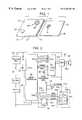
- FIG. 1is a perspective view of the IC card reader according to the invention.
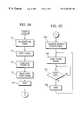
- FIG. 2is a block circuit diagram of the IC card reader of the invention.
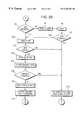
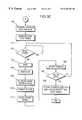
- FIGS. 3A, 3 B, 3 C and 3 Dare flow charts illustrating the operation of the IC card reader.
- an embodiment 10 of the IC card readerincludes a small rectangular case 12 suitably formed of hard plastic and of a size convenient to be placed in a shirt or jacket pocket, for example 3.75 inches long, 2.5 inches wide and 0.25 inch thick.
- the caseis closed on all sides except an end 14 having a slot 16 into which an IC card 18 of conventional design may be inserted.
- a conventional IC cardhas an erasable programmable ROM (not shown) and associated circuitry such as a microprocessor (not shown). These electrical components are embedded in the IC card and communicate with the outside by means such as an IC contact area 19 .
- the contacts of contact area 19make electrical contact with circuitry of the reader as will be explained in detail below.
- the top face 22 of the case 12has a push button 24 of a membrane switch, and a region 26 with small holes 28 .
- the holes 28communicate with a miniature speaker (not shown in FIG. 1) that outputs synthetic speech indicative of data on the card 18 , when the button 24 is depressed and held, as will be described below.
- a substrate(not shown) on which is provided a microcontroller 32 having a seven-terminal audio address port (MP) 32 A, an IC card port 32 B and two resonator input/output terminals 32 C and other terminals as shown, and a voice synthesizer circuit 34 having a seven-terminal address input port 34 A, a strobe input terminal 34 B, a busy output terminal 34 C and two audio output terminals 34 D. Two additional terminals are provided for connecting a crystal 35 .
- the microcontrollersuitably is an MCHCO5 (available from Motorola, Inc.) or equivalent.
- the voice synthesizer circuit 34suitably is an MSM6374 (available from Oki Semiconductor, Inc.).
- an audio amplifier 36connected to the audio output terminals 34 D, a ceramic resonator 38 connected to the terminals 32 C, a flip-flop 40 connected to the IC card port 32 B and the resonator 38 , a membrane switch 42 , a transistor 44 which serves as a card power switch, an IC card connector 46 , connectors (not shown) for receiving 3-volt cells 49 , and a 5-volt low dropout voltage regulator 50 .
- the IC card connector 46has eight card connector pads (according to International Standard Organization (ISO) 7816 ). These include pads 46 a , 46 b , 46 c , 46 d and 46 e that are connected as will be described below, and three additional (unnumbered) pads not utilized in the present embodiment.
- ISOInternational Standard Organization
- a miniature speaker 48connected to the amplifier 36 by conductive lines 48 a .
- the microcontroller 32 , voice synthesis circuit 34 and audio amplifier 36are powered by the cells 49 , through the membrane switch 42 and the 5-volt voltage regulator 50 .
- a conductive line 52 aconnects the collector of transistor 44 to pad 46 a in order to supply power to the IC card 18 from the battery cells 49 through the switch 44 and voltage regulator 50 , in response to a signal from the microcontroller 32 .
- a conductive line 52 bcarries an IC card reset signal from the microcontroller 32 to pad 46 b and thence to the IC card.
- a line 52 ccarries serial data from the IC card 18 to the microcontroller 32 via pad 46 c .
- a conductive line 52 dcarries a card clock signal having half the frequency of ceramic resonator 38 from the flip flop 40 to pad 46 d and thence the IC card 18 in response to a signal from the microcontroller 32 .
- a conductive pad 46 eis connected to ground.
- the voice synthesizer circuit 34stores various sounds in its internal memory, including syllables that make up all numbers zero to nine and a beep sound.
- the synthesizer circuit 34produces an analog audio signal corresponding to the location in the memory that the address references.
- the audio analog signalis output to the amplifier 36 , which in turn drives the speaker 48 .
- the synthesizer circuit 34indicates that it is performing audio conversion by issuing a busy signal back to the microcontroller 32 via the synthesizer circuit's busy output terminal 34 C.
- the IC card reader 10operates in the following manner. Upon insertion of the card 18 into the slot 16 of the reader 10 , the IC contact area 19 of the card makes physical electrical contact with the contact pads 46 a - 46 e of the IC card connector 46 . The user then holds the IC card reader close to his or her ear so as to be able to hear an audio output from the miniature speaker 48 , and presses the button 24 so that the battery power switch 42 is closed, thereby providing DC power to the microcontroller 32 , voice synthesizer circuit 34 and amplifier 36 . The microcontroller 32 then establishes communication with the IC card 18 , performs initial housekeeping tasks (step S 1 ) and resets the IC card reset line 52 b to a logic 0 (step S 2 ).
- the microcontroller 32turns the transistor 44 ON to provide power to the card 18 (step S 3 ).
- the microcontrollerenables flip-flop 40 by discontinuing a clear signal, whereupon flip-flop 40 begins to provide a clock signal to the IC card (step S 4 ). This initiates a cold reset process.
- the microcontroller 32monitors the card data line 46 c and waits a predetermined number of clock cycles, for example 40,000 clock cycles, for an initial response from the IC card 18 (step S 5 ).
- step S 6the initial response is referred to by International Standard Organization (ISO) 7816 as an answer to reset (ATR).
- ISOInternational Standard Organization
- step S 6the microcontroller sets the IC card reset line 52 b high to initiate a warm reset (step S 7 ).
- step S 8the microcontroller 32 then again waits a predetermined number of clock cycles (for example 40,000) (step S 8 ), while continuing to monitor the data line 52 c for the ATR signal from the IC card.
- step S 9Another check is made at step S 9 to determine whether the ATR signal has been received. If the ATR signal has been received (“Yes” at step S 6 or step S 9 ), a verification procedure is conducted at step S 10 .
- an error flagis set within an internal RAM (not shown) in the microcontroller 32 and the microcontroller shuts down the IC card by disabling the card clock signal at the flip-flop 40 and turning transistor 44 OFF to stop providing power to the IC card (step S 12 ).
- the microcontroller 32requests card balance data from a file inside the IC card (step S 13 ). This can be done in a number of ways, depending on the details of the IC card. In the preferred embodiment, the microcontroller 32 sends a command to the IC card on the data line 52 c and waits for a response. Data is then sent from the IC card to the microcontroller on the data line 52 c and the received data is temporarily stored in the internal RAM (step S 14 ). The microcontroller 32 then checks the data for parity and time-out errors (step S 15 ). If any errors are detected, the process goes to step S 12 ; that is, the microcontroller sets an error flag in its memory and discontinues the card clock signal and turns the transistor 44 OFF.
- microcontroller 32shuts down the IC card by discontinuing the card clock signal and turning transistor 44 OFF (step S 16 ). The microcontroller then converts the card balance data to binary coded decimal (BCD) form.
- BCDbinary coded decimal
- the next series of stepsare to vocalize the data.
- the microcontroller 32writes the address code of the beep tone to the MP 32 A from which it is applied to the address input port 34 A of the synthesizer circuit 34 (step S 18 ).
- step S 19two beep tones are output, separated by a 100 millisecond break.
- the two beep tonesare generated in the following manner:
- the microcontroller 32issues a strobe pulse to the strobe input terminal 34 B of the synthesizer circuit 34 , in response to which the synthesizer circuit causes a beep tone to be generated.
- the synthesizer circuitalso responds by applying a busy signal to the microcontroller 32 and the microcontroller responds by waiting before issuing the next sound code.
- the busy signalis removed.
- the microcontroller 32delays 100 milliseconds so that there is a distinct pause between sounds, and then issues another strobe signal to cause another beep tone to be generated (accompanied by issuance of another busy signal), in the same manner the first beep tone was generated.
- the two beepsindicate to the user that valid data is about to be spoken.
- the microcontrollerwaits for the end of the latest busy signal (step 20 ). At the end of the second busy signal, the microcontroller 32 again delays, this time for 500 milliseconds (step S 21 ), and then reads the most significant digit from the BCD data stored in the RAM (step S 22 ), goes to a lookup table to obtain the corresponding sound address code (step S 23 ) and then writes this code to the AAP 32 A so as to be applied to the synthesizer circuit 34 (step S 24 ). The microcontroller 32 then issues a strobe signal to the synthesizer circuit (step S 25 ) to start the vocalization.
- microcontroller 32an internal memory pointer to the data digits is incremented to reference the next most significant digit to be vocalized (step S 26 ). A determination is then made as to whether end of the data (the least significant digit) has been processed (step S 27 ). If not, the process returns to step S 20 , and steps S 20 to S 27 are repeated until all digits have been vocalized. If the data includes a decimal point, it is represented by a single short beep.
- step S 28the beep code is reloaded into the AAP port 32 A in the same manner as is discussed above with reference to step S 18 , and two strobe signals are issued at 100 millisecond intervals to produce two short beeps in the same manner as discussed above with reference to step S 19 .
- the usercan release pressure from the button 24 to open the membrane switch 42 .
- step S 12the microcontroller first performs step S 12 as discussed above to discontinue the clock signal and power to the IC card, and then performs an error routine that is shown in FIG. 3D, to issue continuous beeps at 250 millisecond intervals.
- the different tempo of the beepsmakes it easy for the user to distinguish an error signal from the start of valid data.
- the error signalremains active until the user releases pressure from the button 24 .
- the error routine as illustrated in FIG. 3Dincludes the following steps:
- the code for the beep toneis loaded into the AAP port 32 A (step S 29 ) in the same manner as is discussed above with reference to step S 18 .
- the strobe signalis then applied by the microcontroller 32 to the strobe input terminal 34 B of the synthesizer circuit 34 , in response to which the synthesizer circuit 34 produces a beep tone (step 30 ).
- the synthesizer circuitalso responds by applying a busy signal to the microcontroller 32 , causing the latter to wait before issuing the next sound code (step S 31 ). When the full beep tone has been sounded, the busy signal is removed.
- the microcontrollerthen delays 250 milliseconds (step 32 ) and then the process returns to step S 30 for production of another beep tone.
- the routineis repeated over and over to produce successive beeps until the user releases the button 24 to open the membrane switch 42 and thereby cuts off the power supply.
- a visual output like that provided in a conventional IC card reader, for use by those not visually impairedmay also be provided at minimal additional cost and with little if any additional space requirements in and on the case.
- the inventionmay be further useful to non-sight-impaired persons in low light conditions.
Landscapes
- Engineering & Computer Science (AREA)
- General Physics & Mathematics (AREA)
- Theoretical Computer Science (AREA)
- Physics & Mathematics (AREA)
- General Health & Medical Sciences (AREA)
- Computer Vision & Pattern Recognition (AREA)
- Health & Medical Sciences (AREA)
- Audiology, Speech & Language Pathology (AREA)
- Artificial Intelligence (AREA)
- Business, Economics & Management (AREA)
- Educational Administration (AREA)
- Educational Technology (AREA)
- Credit Cards Or The Like (AREA)
- Reverberation, Karaoke And Other Acoustics (AREA)
- Telephone Function (AREA)
- Diaphragms For Electromechanical Transducers (AREA)
Abstract
Description
Claims (10)
Priority Applications (10)
| Application Number | Priority Date | Filing Date | Title |
|---|---|---|---|
| US08/536,163US6283367B1 (en) | 1995-09-29 | 1995-09-29 | IC card reader with synthesized voice output |
| DE69635040TDE69635040T2 (en) | 1995-09-29 | 1996-09-13 | IC card reader with audio output |
| AT96114753TATE301852T1 (en) | 1995-09-29 | 1996-09-13 | IC CARD READER WITH AUDIO OUTPUT |
| EP96114753AEP0766190B1 (en) | 1995-09-29 | 1996-09-13 | IC card reader with audio output |
| NO963863ANO963863L (en) | 1995-09-29 | 1996-09-16 | Card reader with audio output |
| CA002186435ACA2186435C (en) | 1995-09-29 | 1996-09-25 | Ic card reader with audio output |
| TW085111851ATW315443B (en) | 1995-09-29 | 1996-09-26 | |
| JP8256041AJPH09128503A (en) | 1995-09-29 | 1996-09-27 | Ic card reader |
| CN96113051ACN1151562A (en) | 1995-09-29 | 1996-09-27 | IC card reader with audio output |
| SG1996010738ASG43418A1 (en) | 1995-09-29 | 1996-09-27 | Ic card reader with audio output |
Applications Claiming Priority (1)
| Application Number | Priority Date | Filing Date | Title |
|---|---|---|---|
| US08/536,163US6283367B1 (en) | 1995-09-29 | 1995-09-29 | IC card reader with synthesized voice output |
Publications (1)
| Publication Number | Publication Date |
|---|---|
| US6283367B1true US6283367B1 (en) | 2001-09-04 |
Family
ID=24137420
Family Applications (1)
| Application Number | Title | Priority Date | Filing Date |
|---|---|---|---|
| US08/536,163Expired - LifetimeUS6283367B1 (en) | 1995-09-29 | 1995-09-29 | IC card reader with synthesized voice output |
Country Status (10)
| Country | Link |
|---|---|
| US (1) | US6283367B1 (en) |
| EP (1) | EP0766190B1 (en) |
| JP (1) | JPH09128503A (en) |
| CN (1) | CN1151562A (en) |
| AT (1) | ATE301852T1 (en) |
| CA (1) | CA2186435C (en) |
| DE (1) | DE69635040T2 (en) |
| NO (1) | NO963863L (en) |
| SG (1) | SG43418A1 (en) |
| TW (1) | TW315443B (en) |
Cited By (13)
| Publication number | Priority date | Publication date | Assignee | Title |
|---|---|---|---|---|
| US20020056757A1 (en)* | 2000-11-15 | 2002-05-16 | Pace Micro Technology Plc | Signal sequencing control means |
| US20020151330A1 (en)* | 2001-04-17 | 2002-10-17 | Claude Fouque | System with IC card deactivation before a hardware reset |
| US20030069977A1 (en)* | 2001-10-09 | 2003-04-10 | Pitney Bowes Incorporated | Method and system for identifying and providing additional information about an article to the visually impaired |
| US20030156686A1 (en)* | 2002-02-15 | 2003-08-21 | Pines Benjamin A. | Technique and an apparatus for producing postcards having an audio message for playback by recipient |
| US20030229745A1 (en)* | 2002-06-07 | 2003-12-11 | Hsuan-Ming Shih | Driver for non-volatile solid-state memory |
| US20050026643A1 (en)* | 2001-05-14 | 2005-02-03 | White Andrew David | Electrical devices |
| US20050203749A1 (en)* | 2004-03-01 | 2005-09-15 | Sharp Kabushiki Kaisha | Input device |
| US7085556B2 (en)* | 2000-01-12 | 2006-08-01 | Siemens Ag | Vending machine |
| US20060229978A1 (en)* | 2005-04-05 | 2006-10-12 | Dxstorm.Com Inc. | Electronic balance checking and credit approval system for use in conducting electronic transactions |
| US7967214B2 (en) | 2006-12-29 | 2011-06-28 | Solicore, Inc. | Card configured to receive separate battery |
| US7992067B1 (en) | 2001-11-09 | 2011-08-02 | Identita Technologies International SRL | Method of improving successful recognition of genuine acoustic authentication devices |
| US8181879B2 (en) | 2006-12-29 | 2012-05-22 | Solicore, Inc. | Mailing apparatus for powered cards |
| US20250190137A1 (en)* | 2022-04-28 | 2025-06-12 | CFTek Corp. | Memory card reader equipped with data deletion and optimization function |
Families Citing this family (5)
| Publication number | Priority date | Publication date | Assignee | Title |
|---|---|---|---|---|
| DE19622729A1 (en)* | 1996-06-07 | 1997-12-11 | Deutsche Telekom Ag | Telecommunication terminal |
| WO1999026237A1 (en)* | 1997-11-13 | 1999-05-27 | Vastar Technology Corporation | The method and apparatus for storing and reproducing an audio card |
| NL1010645C2 (en)* | 1998-11-25 | 2000-05-26 | Hugo Winant Willem Lathouwers | Reader for extracting data from smart card has audible output, converts digital data into analogue speech signals which are announced from loudspeaker |
| KR20040098843A (en)* | 2003-05-16 | 2004-11-26 | (주)효진티엠에스 | Credit card authorization terminal |
| TWM349642U (en)* | 2008-09-03 | 2009-01-21 | Int Currency Tech | Voice device attached on the vending machine |
Citations (18)
| Publication number | Priority date | Publication date | Assignee | Title |
|---|---|---|---|---|
| US4634845A (en)* | 1984-12-24 | 1987-01-06 | Ncr Corporation | Portable personal terminal for use in a system for handling transactions |
| JPS6376046A (en) | 1986-09-19 | 1988-04-06 | Toshiba Corp | portable electronic devices |
| US4779138A (en)* | 1985-11-27 | 1988-10-18 | Casio Computer Co., Ltd. | Compact liquid crystal television receiver having information memory |
| US4837422A (en)* | 1987-09-08 | 1989-06-06 | Juergen Dethloff | Multi-user card system |
| US4904853A (en)* | 1987-09-22 | 1990-02-27 | Kabushiki Kaisha Astex | Dual-function information-carrying sheet device |
| US4961229A (en)* | 1985-09-24 | 1990-10-02 | Nec Corporation | Speech recognition system utilizing IC cards for storing unique voice patterns |
| US4964167A (en) | 1987-07-15 | 1990-10-16 | Matsushita Electric Works, Ltd. | Apparatus for generating synthesized voice from text |
| US5015830A (en)* | 1988-07-04 | 1991-05-14 | Sharp Kabushiki Kaisha | Electronic card reading device |
| US5146493A (en)* | 1989-07-06 | 1992-09-08 | Canon Kabushiki Kaisha | Communication system |
| US5247164A (en)* | 1989-01-26 | 1993-09-21 | Hitachi Maxell, Ltd. | IC card and portable terminal |
| US5252815A (en)* | 1990-10-08 | 1993-10-12 | Alcatel Cit | Compact smart card reader with unitary case and connector cover |
| US5272319A (en)* | 1991-12-19 | 1993-12-21 | Rey Jean Yves | Memory holder for credit card or the like |
| US5361173A (en)* | 1990-01-21 | 1994-11-01 | Sony Corporation | Devices for controlling recording and/or reproducing apparatus utilizing recorded management data and interactive information input apparatus for an electronic device |
| US5379153A (en)* | 1990-01-21 | 1995-01-03 | Sony Corporation | Recording and reproducing apparatus having program information |
| US5384834A (en)* | 1989-05-19 | 1995-01-24 | Kabushiki Kaisha Toshiba | Telephone apparatus using a detachable memory device |
| US5394332A (en)* | 1991-03-18 | 1995-02-28 | Pioneer Electronic Corporation | On-board navigation system having audible tone indicating remaining distance or time in a trip |
| US5455851A (en)* | 1993-07-02 | 1995-10-03 | Executone Information Systems, Inc. | System for identifying object locations |
| US5521362A (en)* | 1994-06-08 | 1996-05-28 | Mci Communications Corporation | Electronic purse card having multiple storage memories to prevent fraudulent usage and method therefor |
Family Cites Families (2)
| Publication number | Priority date | Publication date | Assignee | Title |
|---|---|---|---|---|
| EP0294202A3 (en)* | 1987-06-03 | 1989-10-18 | Kabushiki Kaisha Toshiba | Digital sound data storing device |
| WO1995023409A1 (en)* | 1994-02-25 | 1995-08-31 | Amico Joyce Links D | Audioplayback system with interrelated visual display using static card 'software' |
- 1995
- 1995-09-29USUS08/536,163patent/US6283367B1/ennot_activeExpired - Lifetime
- 1996
- 1996-09-13ATAT96114753Tpatent/ATE301852T1/ennot_activeIP Right Cessation
- 1996-09-13DEDE69635040Tpatent/DE69635040T2/ennot_activeExpired - Lifetime
- 1996-09-13EPEP96114753Apatent/EP0766190B1/ennot_activeRevoked
- 1996-09-16NONO963863Apatent/NO963863L/ennot_activeApplication Discontinuation
- 1996-09-25CACA002186435Apatent/CA2186435C/ennot_activeExpired - Fee Related
- 1996-09-26TWTW085111851Apatent/TW315443B/zhactive
- 1996-09-27CNCN96113051Apatent/CN1151562A/enactivePending
- 1996-09-27SGSG1996010738Apatent/SG43418A1/enunknown
- 1996-09-27JPJP8256041Apatent/JPH09128503A/ennot_activeWithdrawn
Patent Citations (18)
| Publication number | Priority date | Publication date | Assignee | Title |
|---|---|---|---|---|
| US4634845A (en)* | 1984-12-24 | 1987-01-06 | Ncr Corporation | Portable personal terminal for use in a system for handling transactions |
| US4961229A (en)* | 1985-09-24 | 1990-10-02 | Nec Corporation | Speech recognition system utilizing IC cards for storing unique voice patterns |
| US4779138A (en)* | 1985-11-27 | 1988-10-18 | Casio Computer Co., Ltd. | Compact liquid crystal television receiver having information memory |
| JPS6376046A (en) | 1986-09-19 | 1988-04-06 | Toshiba Corp | portable electronic devices |
| US4964167A (en) | 1987-07-15 | 1990-10-16 | Matsushita Electric Works, Ltd. | Apparatus for generating synthesized voice from text |
| US4837422A (en)* | 1987-09-08 | 1989-06-06 | Juergen Dethloff | Multi-user card system |
| US4904853A (en)* | 1987-09-22 | 1990-02-27 | Kabushiki Kaisha Astex | Dual-function information-carrying sheet device |
| US5015830A (en)* | 1988-07-04 | 1991-05-14 | Sharp Kabushiki Kaisha | Electronic card reading device |
| US5247164A (en)* | 1989-01-26 | 1993-09-21 | Hitachi Maxell, Ltd. | IC card and portable terminal |
| US5384834A (en)* | 1989-05-19 | 1995-01-24 | Kabushiki Kaisha Toshiba | Telephone apparatus using a detachable memory device |
| US5146493A (en)* | 1989-07-06 | 1992-09-08 | Canon Kabushiki Kaisha | Communication system |
| US5361173A (en)* | 1990-01-21 | 1994-11-01 | Sony Corporation | Devices for controlling recording and/or reproducing apparatus utilizing recorded management data and interactive information input apparatus for an electronic device |
| US5379153A (en)* | 1990-01-21 | 1995-01-03 | Sony Corporation | Recording and reproducing apparatus having program information |
| US5252815A (en)* | 1990-10-08 | 1993-10-12 | Alcatel Cit | Compact smart card reader with unitary case and connector cover |
| US5394332A (en)* | 1991-03-18 | 1995-02-28 | Pioneer Electronic Corporation | On-board navigation system having audible tone indicating remaining distance or time in a trip |
| US5272319A (en)* | 1991-12-19 | 1993-12-21 | Rey Jean Yves | Memory holder for credit card or the like |
| US5455851A (en)* | 1993-07-02 | 1995-10-03 | Executone Information Systems, Inc. | System for identifying object locations |
| US5521362A (en)* | 1994-06-08 | 1996-05-28 | Mci Communications Corporation | Electronic purse card having multiple storage memories to prevent fraudulent usage and method therefor |
Cited By (18)
| Publication number | Priority date | Publication date | Assignee | Title |
|---|---|---|---|---|
| US7085556B2 (en)* | 2000-01-12 | 2006-08-01 | Siemens Ag | Vending machine |
| US20020056757A1 (en)* | 2000-11-15 | 2002-05-16 | Pace Micro Technology Plc | Signal sequencing control means |
| US6705532B2 (en)* | 2000-11-15 | 2004-03-16 | Pace Micro Technology Plc | Signal sequencing control means |
| US20020151330A1 (en)* | 2001-04-17 | 2002-10-17 | Claude Fouque | System with IC card deactivation before a hardware reset |
| US7050830B2 (en)* | 2001-04-17 | 2006-05-23 | Thomson Licensing | System with IC card deactivation |
| US20050026643A1 (en)* | 2001-05-14 | 2005-02-03 | White Andrew David | Electrical devices |
| US7248892B2 (en)* | 2001-05-14 | 2007-07-24 | Innovision Research & Technology Plc | Electrical devices |
| US20030069977A1 (en)* | 2001-10-09 | 2003-04-10 | Pitney Bowes Incorporated | Method and system for identifying and providing additional information about an article to the visually impaired |
| US7992067B1 (en) | 2001-11-09 | 2011-08-02 | Identita Technologies International SRL | Method of improving successful recognition of genuine acoustic authentication devices |
| US7292681B2 (en) | 2002-02-15 | 2007-11-06 | Apple Corporate Technologies, Inc. | Technique and an apparatus for producing postcards having an audio message for playback by recipient |
| US20030156686A1 (en)* | 2002-02-15 | 2003-08-21 | Pines Benjamin A. | Technique and an apparatus for producing postcards having an audio message for playback by recipient |
| US20030229745A1 (en)* | 2002-06-07 | 2003-12-11 | Hsuan-Ming Shih | Driver for non-volatile solid-state memory |
| US20050203749A1 (en)* | 2004-03-01 | 2005-09-15 | Sharp Kabushiki Kaisha | Input device |
| US20060229978A1 (en)* | 2005-04-05 | 2006-10-12 | Dxstorm.Com Inc. | Electronic balance checking and credit approval system for use in conducting electronic transactions |
| US8050991B2 (en)* | 2005-04-05 | 2011-11-01 | DXStorm. com Inc. | Electronic balance checking and credit approval system for use in conducting electronic transactions |
| US7967214B2 (en) | 2006-12-29 | 2011-06-28 | Solicore, Inc. | Card configured to receive separate battery |
| US8181879B2 (en) | 2006-12-29 | 2012-05-22 | Solicore, Inc. | Mailing apparatus for powered cards |
| US20250190137A1 (en)* | 2022-04-28 | 2025-06-12 | CFTek Corp. | Memory card reader equipped with data deletion and optimization function |
Also Published As
| Publication number | Publication date |
|---|---|
| NO963863D0 (en) | 1996-09-16 |
| ATE301852T1 (en) | 2005-08-15 |
| SG43418A1 (en) | 1997-10-17 |
| TW315443B (en) | 1997-09-11 |
| CN1151562A (en) | 1997-06-11 |
| EP0766190A3 (en) | 2002-02-06 |
| DE69635040D1 (en) | 2005-09-15 |
| NO963863L (en) | 1997-04-01 |
| DE69635040T2 (en) | 2006-06-08 |
| EP0766190B1 (en) | 2005-08-10 |
| EP0766190A2 (en) | 1997-04-02 |
| CA2186435C (en) | 2001-05-01 |
| CA2186435A1 (en) | 1997-03-30 |
| JPH09128503A (en) | 1997-05-16 |
Similar Documents
| Publication | Publication Date | Title |
|---|---|---|
| US6283367B1 (en) | IC card reader with synthesized voice output | |
| US10977644B2 (en) | Information processing system, information processing device, information processing method, and information recording medium | |
| US5585787A (en) | Programmable credit card | |
| US10956881B2 (en) | Methods and systems for biometric card enrollment | |
| US7440771B2 (en) | Transaction card providing displayed information | |
| US5955961A (en) | Programmable transaction card | |
| US5506393A (en) | Donation kettle accepting credit card, debit card, and cash donations, and donation kettle network | |
| US7913919B2 (en) | Multi application smartcard with currency exchange, location, tracking and personal identification capabilities | |
| US4719338A (en) | Pocket calculator with credit card controller and dispenser | |
| GB2201125A (en) | Verification device | |
| EP0101711A1 (en) | A portable device for storing and transferring data | |
| JPS62238794A (en) | Magnetic stripe-emulator transaction card | |
| IL104422A (en) | Method and apparatus for magnetically writing on plastic cards | |
| FR2600799A1 (en) | PORTABLE ELECTRONIC DEVICE | |
| EP1205895A2 (en) | Integrated cash register | |
| KR100332497B1 (en) | A card approval method for overall financial information using a fingerprinter information | |
| JP2000194484A (en) | Portable electronic device and method for operating portable electronic device | |
| US7147156B2 (en) | Apparatus and method for sound-enabling regular plastic | |
| JP3896269B2 (en) | Simple card settlement system, program thereof, and recording medium | |
| GB2139457A (en) | Interactive Audio Transaction Terminal | |
| EP1020820B1 (en) | Portable device for remote financial transactions with microprocessor card | |
| JPH0830693A (en) | Transaction processing method | |
| KR20010063383A (en) | A portable telecommunication complex terminal | |
| JPH056481A (en) | PIN inquiry device | |
| TW202026976A (en) | Electronic transaction card identifying the user's identity through the biological identification module on the transaction card during the transaction |
Legal Events
| Date | Code | Title | Description |
|---|---|---|---|
| AS | Assignment | Owner name:OKI ELECTRIC INDUSTRY CO., LTD., JAPAN Free format text:ASSIGNMENT OF ASSIGNORS INTEREST;ASSIGNORS:MATTHEW, KERRY RAY;CHAU, PAUL WAIHUNG;REEL/FRAME:007683/0129 Effective date:19950928 | |
| AS | Assignment | Owner name:ADVANCED ELECOMM PRODUCTS, INC., MASSACHUSETTS Free format text:ASSIGNMENT OF ASSIGNORS INTEREST;ASSIGNOR:OKI ELECTRIC INDUSTRY CO., LTD.;REEL/FRAME:009115/0872 Effective date:19980413 | |
| AS | Assignment | Owner name:OKI ELECTRIC INDUSTRY CO., LTD., JAPAN Free format text:ASSIGNMENT OF ASSIGNORS INTEREST;ASSIGNOR:ADVANCED ELECCOMM PRODUCTS, INC.;REEL/FRAME:009198/0054 Effective date:19980512 | |
| AS | Assignment | Owner name:INFO TELECOM, FRANCE Free format text:ASSIGNMENT OF ASSIGNORS INTEREST;ASSIGNOR:OKI ELECTRIC INDUSTRY CO., LTD.;REEL/FRAME:009293/0168 Effective date:19980623 | |
| STCF | Information on status: patent grant | Free format text:PATENTED CASE | |
| FPAY | Fee payment | Year of fee payment:4 | |
| AS | Assignment | Owner name:XIRING SA, FRANCE Free format text:ASSIGNMENT OF ASSIGNORS INTEREST;ASSIGNOR:INFO TELECOM;REEL/FRAME:019773/0292 Effective date:20070802 | |
| FEPP | Fee payment procedure | Free format text:PAT HOLDER CLAIMS SMALL ENTITY STATUS, ENTITY STATUS SET TO SMALL (ORIGINAL EVENT CODE: LTOS); ENTITY STATUS OF PATENT OWNER: SMALL ENTITY | |
| FPAY | Fee payment | Year of fee payment:8 | |
| AS | Assignment | Owner name:GEMALTO SA,FRANCE Free format text:ASSIGNMENT OF ASSIGNORS INTEREST;ASSIGNOR:XIRING;REEL/FRAME:024218/0626 Effective date:20100119 | |
| FPAY | Fee payment | Year of fee payment:12 |